WO2019021723A1 - タイヤ - Google Patents
タイヤ Download PDFInfo
- Publication number
- WO2019021723A1 WO2019021723A1 PCT/JP2018/024227 JP2018024227W WO2019021723A1 WO 2019021723 A1 WO2019021723 A1 WO 2019021723A1 JP 2018024227 W JP2018024227 W JP 2018024227W WO 2019021723 A1 WO2019021723 A1 WO 2019021723A1
- Authority
- WO
- WIPO (PCT)
- Prior art keywords
- groove
- width direction
- width
- tire
- groove portion
- Prior art date
- Legal status (The legal status is an assumption and is not a legal conclusion. Google has not performed a legal analysis and makes no representation as to the accuracy of the status listed.)
- Ceased
Links
Images



Classifications
-
- B—PERFORMING OPERATIONS; TRANSPORTING
- B60—VEHICLES IN GENERAL
- B60C—VEHICLE TYRES; TYRE INFLATION; TYRE CHANGING; CONNECTING VALVES TO INFLATABLE ELASTIC BODIES IN GENERAL; DEVICES OR ARRANGEMENTS RELATED TO TYRES
- B60C11/00—Tyre tread bands; Tread patterns; Anti-skid inserts
- B60C11/03—Tread patterns
- B60C11/13—Tread patterns characterised by the groove cross-section, e.g. for buttressing or preventing stone-trapping
- B60C11/1307—Tread patterns characterised by the groove cross-section, e.g. for buttressing or preventing stone-trapping with special features of the groove walls
-
- B—PERFORMING OPERATIONS; TRANSPORTING
- B60—VEHICLES IN GENERAL
- B60C—VEHICLE TYRES; TYRE INFLATION; TYRE CHANGING; CONNECTING VALVES TO INFLATABLE ELASTIC BODIES IN GENERAL; DEVICES OR ARRANGEMENTS RELATED TO TYRES
- B60C11/00—Tyre tread bands; Tread patterns; Anti-skid inserts
- B60C11/03—Tread patterns
- B60C11/12—Tread patterns characterised by the use of narrow slits or incisions, e.g. sipes
- B60C11/1272—Width of the sipe
- B60C11/1281—Width of the sipe different within the same sipe, i.e. enlarged width portion at sipe bottom or along its length
-
- B—PERFORMING OPERATIONS; TRANSPORTING
- B60—VEHICLES IN GENERAL
- B60C—VEHICLE TYRES; TYRE INFLATION; TYRE CHANGING; CONNECTING VALVES TO INFLATABLE ELASTIC BODIES IN GENERAL; DEVICES OR ARRANGEMENTS RELATED TO TYRES
- B60C11/00—Tyre tread bands; Tread patterns; Anti-skid inserts
- B60C11/01—Shape of the shoulders between tread and sidewall, e.g. rounded, stepped or cantilevered
-
- B—PERFORMING OPERATIONS; TRANSPORTING
- B60—VEHICLES IN GENERAL
- B60C—VEHICLE TYRES; TYRE INFLATION; TYRE CHANGING; CONNECTING VALVES TO INFLATABLE ELASTIC BODIES IN GENERAL; DEVICES OR ARRANGEMENTS RELATED TO TYRES
- B60C11/00—Tyre tread bands; Tread patterns; Anti-skid inserts
- B60C11/03—Tread patterns
- B60C11/12—Tread patterns characterised by the use of narrow slits or incisions, e.g. sipes
- B60C11/1204—Tread patterns characterised by the use of narrow slits or incisions, e.g. sipes with special shape of the sipe
- B60C11/1218—Three-dimensional shape with regard to depth and extending direction
-
- B—PERFORMING OPERATIONS; TRANSPORTING
- B60—VEHICLES IN GENERAL
- B60C—VEHICLE TYRES; TYRE INFLATION; TYRE CHANGING; CONNECTING VALVES TO INFLATABLE ELASTIC BODIES IN GENERAL; DEVICES OR ARRANGEMENTS RELATED TO TYRES
- B60C11/00—Tyre tread bands; Tread patterns; Anti-skid inserts
- B60C11/03—Tread patterns
- B60C11/12—Tread patterns characterised by the use of narrow slits or incisions, e.g. sipes
- B60C11/1236—Tread patterns characterised by the use of narrow slits or incisions, e.g. sipes with special arrangements in the tread pattern
-
- B—PERFORMING OPERATIONS; TRANSPORTING
- B60—VEHICLES IN GENERAL
- B60C—VEHICLE TYRES; TYRE INFLATION; TYRE CHANGING; CONNECTING VALVES TO INFLATABLE ELASTIC BODIES IN GENERAL; DEVICES OR ARRANGEMENTS RELATED TO TYRES
- B60C11/00—Tyre tread bands; Tread patterns; Anti-skid inserts
- B60C11/03—Tread patterns
- B60C11/12—Tread patterns characterised by the use of narrow slits or incisions, e.g. sipes
- B60C11/1272—Width of the sipe
-
- B—PERFORMING OPERATIONS; TRANSPORTING
- B60—VEHICLES IN GENERAL
- B60C—VEHICLE TYRES; TYRE INFLATION; TYRE CHANGING; CONNECTING VALVES TO INFLATABLE ELASTIC BODIES IN GENERAL; DEVICES OR ARRANGEMENTS RELATED TO TYRES
- B60C11/00—Tyre tread bands; Tread patterns; Anti-skid inserts
- B60C11/03—Tread patterns
- B60C11/13—Tread patterns characterised by the groove cross-section, e.g. for buttressing or preventing stone-trapping
- B60C11/1307—Tread patterns characterised by the groove cross-section, e.g. for buttressing or preventing stone-trapping with special features of the groove walls
- B60C11/1315—Tread patterns characterised by the groove cross-section, e.g. for buttressing or preventing stone-trapping with special features of the groove walls having variable inclination angles, e.g. warped groove walls
-
- B—PERFORMING OPERATIONS; TRANSPORTING
- B60—VEHICLES IN GENERAL
- B60C—VEHICLE TYRES; TYRE INFLATION; TYRE CHANGING; CONNECTING VALVES TO INFLATABLE ELASTIC BODIES IN GENERAL; DEVICES OR ARRANGEMENTS RELATED TO TYRES
- B60C19/00—Tyre parts or constructions not otherwise provided for
- B60C19/002—Noise damping elements provided in the tyre structure or attached thereto, e.g. in the tyre interior
-
- B—PERFORMING OPERATIONS; TRANSPORTING
- B60—VEHICLES IN GENERAL
- B60C—VEHICLE TYRES; TYRE INFLATION; TYRE CHANGING; CONNECTING VALVES TO INFLATABLE ELASTIC BODIES IN GENERAL; DEVICES OR ARRANGEMENTS RELATED TO TYRES
- B60C11/00—Tyre tread bands; Tread patterns; Anti-skid inserts
- B60C11/03—Tread patterns
- B60C2011/0337—Tread patterns characterised by particular design features of the pattern
- B60C2011/0339—Grooves
- B60C2011/0341—Circumferential grooves
-
- B—PERFORMING OPERATIONS; TRANSPORTING
- B60—VEHICLES IN GENERAL
- B60C—VEHICLE TYRES; TYRE INFLATION; TYRE CHANGING; CONNECTING VALVES TO INFLATABLE ELASTIC BODIES IN GENERAL; DEVICES OR ARRANGEMENTS RELATED TO TYRES
- B60C11/00—Tyre tread bands; Tread patterns; Anti-skid inserts
- B60C11/03—Tread patterns
- B60C2011/0337—Tread patterns characterised by particular design features of the pattern
- B60C2011/0339—Grooves
- B60C2011/0341—Circumferential grooves
- B60C2011/0353—Circumferential grooves characterised by width
-
- B—PERFORMING OPERATIONS; TRANSPORTING
- B60—VEHICLES IN GENERAL
- B60C—VEHICLE TYRES; TYRE INFLATION; TYRE CHANGING; CONNECTING VALVES TO INFLATABLE ELASTIC BODIES IN GENERAL; DEVICES OR ARRANGEMENTS RELATED TO TYRES
- B60C11/00—Tyre tread bands; Tread patterns; Anti-skid inserts
- B60C11/03—Tread patterns
- B60C2011/0337—Tread patterns characterised by particular design features of the pattern
- B60C2011/0339—Grooves
- B60C2011/0358—Lateral grooves, i.e. having an angle of 45 to 90 degees to the equatorial plane
- B60C2011/0365—Lateral grooves, i.e. having an angle of 45 to 90 degees to the equatorial plane characterised by width
-
- B—PERFORMING OPERATIONS; TRANSPORTING
- B60—VEHICLES IN GENERAL
- B60C—VEHICLE TYRES; TYRE INFLATION; TYRE CHANGING; CONNECTING VALVES TO INFLATABLE ELASTIC BODIES IN GENERAL; DEVICES OR ARRANGEMENTS RELATED TO TYRES
- B60C11/00—Tyre tread bands; Tread patterns; Anti-skid inserts
- B60C11/03—Tread patterns
- B60C2011/0337—Tread patterns characterised by particular design features of the pattern
- B60C2011/0339—Grooves
- B60C2011/0374—Slant grooves, i.e. having an angle of about 5 to 35 degrees to the equatorial plane
- B60C2011/0376—Slant grooves, i.e. having an angle of about 5 to 35 degrees to the equatorial plane characterised by width
-
- B—PERFORMING OPERATIONS; TRANSPORTING
- B60—VEHICLES IN GENERAL
- B60C—VEHICLE TYRES; TYRE INFLATION; TYRE CHANGING; CONNECTING VALVES TO INFLATABLE ELASTIC BODIES IN GENERAL; DEVICES OR ARRANGEMENTS RELATED TO TYRES
- B60C11/00—Tyre tread bands; Tread patterns; Anti-skid inserts
- B60C11/03—Tread patterns
- B60C11/12—Tread patterns characterised by the use of narrow slits or incisions, e.g. sipes
- B60C11/1236—Tread patterns characterised by the use of narrow slits or incisions, e.g. sipes with special arrangements in the tread pattern
- B60C2011/1245—Tread patterns characterised by the use of narrow slits or incisions, e.g. sipes with special arrangements in the tread pattern being arranged in crossing relation, e.g. sipe mesh
-
- B—PERFORMING OPERATIONS; TRANSPORTING
- B60—VEHICLES IN GENERAL
- B60C—VEHICLE TYRES; TYRE INFLATION; TYRE CHANGING; CONNECTING VALVES TO INFLATABLE ELASTIC BODIES IN GENERAL; DEVICES OR ARRANGEMENTS RELATED TO TYRES
- B60C11/00—Tyre tread bands; Tread patterns; Anti-skid inserts
- B60C11/03—Tread patterns
- B60C11/12—Tread patterns characterised by the use of narrow slits or incisions, e.g. sipes
- B60C11/1236—Tread patterns characterised by the use of narrow slits or incisions, e.g. sipes with special arrangements in the tread pattern
- B60C2011/1254—Tread patterns characterised by the use of narrow slits or incisions, e.g. sipes with special arrangements in the tread pattern with closed sipe, i.e. not extending to a groove
-
- B—PERFORMING OPERATIONS; TRANSPORTING
- B60—VEHICLES IN GENERAL
- B60C—VEHICLE TYRES; TYRE INFLATION; TYRE CHANGING; CONNECTING VALVES TO INFLATABLE ELASTIC BODIES IN GENERAL; DEVICES OR ARRANGEMENTS RELATED TO TYRES
- B60C11/00—Tyre tread bands; Tread patterns; Anti-skid inserts
- B60C11/03—Tread patterns
- B60C11/12—Tread patterns characterised by the use of narrow slits or incisions, e.g. sipes
- B60C11/1259—Depth of the sipe
- B60C2011/1268—Depth of the sipe being different from sipe to sipe
Definitions
- the present invention relates to a tire.
- the tire noise around 1000 Hz is mainly due to air column resonance.
- the air column resonance noise is a noise generated by the resonance of air in the pipe, which is surrounded by the circumferential groove extending continuously in the circumferential direction of the tread surface, and is about 800 to 1200 Hz in a general passenger car. It is often observed.
- Such air column resonance noise accounts for most of the noise generated from the tire because the peak level is high and the frequency band is wide.
- a side branch type resonator having a longitudinal groove and a lateral groove is provided on a rib-like land portion partitioned by a plurality of circumferential grooves.
- An air chamber opened to the surface of the land portion at a position separated from the circumferential groove in the land portion, and one or more narrowing necks connecting the air chamber to the circumferential groove;
- a device provided with a Helmholtz-type resonator (Japanese Patent Application Laid-Open No. 2000-147118).
- an object of this invention is to provide the tire which can suppress the partial abrasion in a tread, reducing air column resonance noise.
- the tire according to the present invention has a shoulder which is divided into at least one circumferential groove continuously extending in the circumferential direction of the tire, and the circumferential groove on the outermost side in the tire width direction and the tread contact end on the tread tread surface.
- the shoulder land portion has a width direction groove extending in the width direction of the tire and communicating the circumferential groove with the tread contact end, and the width direction groove includes the land portion.
- a first width direction groove portion communicating with the circumferential direction groove and a second width direction groove portion adjacent to and continuous with the tread ground end side of the first width direction groove portion, the first width direction groove portion
- the circumferential groove having a narrow groove portion in which the opening width in the tread surface is smaller than the groove width on the groove bottom side in at least a partial region in the extending direction of the first width direction groove portion.
- Respective groove widths of the first width direction groove portion and the second width direction groove portion And satisfies a relational expression "circumferential grooves in groove width> groove width> groove width of the second width direction groove portion of the first width direction groove portion".
- the term “tread tread surface” refers to a tire that is assembled to a rim and filled with a predetermined internal pressure and is rolled in a state of loading a maximum load (hereinafter referred to as “maximum load state”). In this case, it means the outer circumferential surface over the entire circumference of the tire that comes into contact with the road surface, and "tread ground contact end” means the tire width direction end of the tread surface.
- the “reference state” described later in the present specification refers to a state in which the tire is assembled to the rim, filled with a predetermined internal pressure, and not loaded.
- rim is an industrial standard effective for the area where tires are produced and used, and in Japan, JATMA (Japan Automobile Tire Association) JATMA YEAR BOOK, in Europe ETRTO (The European Tire and Rim Technical Standard rims in applicable sizes (Measuring Rim, STANDARDS MANUAL at ETRTO, described in Organizations' STANDARDS MANUAL, and in the United States, TRA (The Tire and Rim Association, Inc.) YEAR BOOK etc. in the United States, or in the future) In the TRA's YEAR BOOK, it refers to Design Rim) (ie, the "rim” above includes in addition to the current size a size that may be included in the above industry standard in the future.
- predetermined internal pressure refers to the air pressure (maximum air pressure) corresponding to the maximum load capacity of a single wheel in application size and ply rating described in the above-mentioned JATMA YEAR BOOK etc.
- predetermined internal pressure refers to the air pressure (maximum air pressure) corresponding to the maximum load capacity defined for each vehicle on which the tire is mounted.
- maximum load load shall mean the load corresponding to the above-mentioned maximum load capacity.
- the “groove width of the circumferential groove” refers to the length measured in the above-mentioned reference direction in the direction orthogonal to the extending direction of the circumferential groove.
- the groove width of the first width direction groove portion refers to the length measured in the above-mentioned reference direction in the direction orthogonal to the extending direction of the circumferential groove.
- the groove width of the first width direction groove portion refers to the length measured in the above-mentioned reference direction in the direction orthogonal to the extending direction of the circumferential groove.
- groove width of circumferential groove “groove width of first width direction groove portion”, “groove width of second width direction groove portion”, and “groove width of third width direction groove portion” described later
- the groove width changes along the depth direction of the groove and / or the extending direction of the groove, with the maximum width unless otherwise specified conditions such as the measurement position in the depth direction or the extending direction
- the groove width is taken.
- the dimensions and the like of the respective elements such as grooves are measured in the reference state (the dimensions and the like on the tread surface of the respective elements are on the developed view of the tread surface in the reference state).
- “sipe” refers to a narrow groove having a width such that at least a portion of the tire is closed when the tire is rolled under a maximum load state.
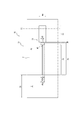
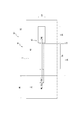
- FIG. 1 is a partially developed view schematically showing a part of a tread surface of a tire according to an embodiment of the present invention. It is a partial expanded view which expands a part of tread surface of Drawing 1 typically, and is shown typically.
- (A) is a cross-sectional view taken along the line II of FIG. 2
- (b) is a cross-sectional view taken along the line II-II of FIG.
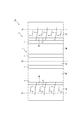
- FIG. 5 is a partially developed view schematically showing an enlarged part of a tread surface of a tire according to another embodiment of the present invention. It is a partially developed view schematically showing a part of a tread surface of a tire according to still another embodiment of the present invention in an enlarged manner.
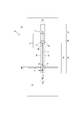
- FIG. 10 is a partial development view schematically showing a part of a tread surface of a tire according to still another embodiment of the present invention. It is a partially developed view schematically showing a part of a tread surface of a tire according to still another embodiment of the present invention in an enlarged manner.
- (A) is a cross-sectional view taken along the line III-III in FIG. 8, and (b) is a modified example thereof.
- FIG. 9 is a partially developed view schematically showing an enlarged part of a tread surface to explain the positional relationship of grooves and the like in the tire of FIG. 8.
- FIG. 1 is a partially developed view schematically showing a tread surface T of a tread 1 of a tire 10 according to an embodiment of the present invention.
- the tire 10 extends continuously in the tire circumferential direction on the tread surface T of the tread 1 (in the illustrated example, along the tire circumferential direction, that is, in the tire circumferential direction at an angle of 0 ° with respect to the tire circumferential direction
- At least one (four in the illustrated example) circumferential grooves 2 extending continuously, and including the tire equatorial plane TC by the four circumferential grooves 2 and both tread contact edges TE
- the center land portion 4C, two middle land portions 4M adjacent to both center sides of the center land portion 4C in the tire width direction via the circumferential groove 2, and the center land portion 4M in the tire width direction both sides circumferentially
- Two shoulder lands 4S adjacent to each other through the groove 2 are sectioned.
- the circumferential groove 2 in this embodiment is a linear groove continuously extending in the tire circumferential direction along the tire circumferential direction
- the circumferential groove 2 is in the tire circumferential direction. It is also possible to form a zigzag or wave-like groove that extends continuously in the circumferential direction of the tire while being inclined with respect to (tire equatorial plane TC).
- at least one circumferential groove 2 may be provided, and in the present embodiment there are four, but the number is not limited to this and it is preferable to have a plurality. In the case of plural, two, three or five or more may be used.
- the tire 10 according to the present embodiment is divided into at least one circumferential groove 2 continuously extending in the circumferential direction of the tire, and the circumferential groove 2 and the tread contact end TE in the tread surface T. And the land portion 4S.
- the tire 10 which concerns on this embodiment is a pneumatic radial tire for passenger cars
- this invention is applicable also to the tire of the other kind which has a request
- the internal structure of the tire is not particularly limited.
- a plurality of shoulder land portions 4S in the present embodiment extend in the tire width direction and communicate the circumferential groove 2 with the tread contact end TE, and are separated from each other in the tire circumferential direction in the present embodiment (in the illustrated example Of which three are shown)), and a plurality of block-like land portions are formed in the tire circumferential direction on the shoulder land portion 4S by the width direction grooves 3. .
- the widthwise groove 3 in the present embodiment is inclined with respect to the tire width direction and extends in an arc shape between the circumferential groove 2 and the tread contact end TE.
- the width direction groove according to the present invention is not limited to this, and the width direction groove can be extended along the tire width direction, or the width direction groove can be made linear.
- the width direction groove 3 should just have a tire width direction component.
- the width direction grooves 3 in both shoulder land portions 4S are points substantially symmetrical to each other with respect to the tire equatorial plane TC, and a point centered on any one point on the tire equatorial plane TC in the figure. It is arranged symmetrically. That is, in the shoulder land portion 4S on one side (right side in the drawing) of the tire equatorial plane TC, the width direction groove 3 has an arc shape having the center of the arc on one side (upper side in the drawing) of the width direction groove 3 in the tire circumferential direction.
- the widthwise groove 3 has a center of arc on the other side (lower side in the drawing) of the widthwise groove 3 of the tire equatorial plane TC. It extends in an arc shape.
- the tire 10 according to the present embodiment is a tire regardless of the rotational direction of the tire and the mounting direction to the vehicle.
- the widthwise groove 3 according to the present invention can be either line symmetrical or point symmetrical with respect to the tire equatorial plane TC, and is neither linear symmetrical nor point symmetrical with respect to the tire equatorial plane TC May be
- FIG. 2 is a partially developed view schematically showing a part of the tread surface T shown in FIG. 1 in an enlarged manner.
- all width direction grooves 3 in both shoulder land portions 4S have the same configuration, but in FIG. 2, a plurality of grooves formed on the tread surface T of the tread 1 of FIG.
- One of the width direction grooves 3 is enlarged and schematically shown.
- 3 (a) and 3 (b) are cross-sectional views taken along line II and line II-II in FIG. 2, respectively.
- the width direction groove 3 is orthogonal to the extending direction of the width direction groove 3 Shows the cross section of the plane to be
- the width direction groove 3 which concerns on this embodiment inclines with respect to the tire width direction and extends in circular arc shape as above-mentioned, here, for description, this width direction groove 3 is a tire width. It is schematically shown as extending linearly along the direction.
- the widthwise groove 3 in the present embodiment is narrower than the circumferential groove 2 as shown in FIG. 2, and a first widthwise groove portion 3A communicating with the circumferential groove 2 and the first widthwise direction A second width direction groove portion 3B adjacent to the tread ground contact end TE side of the groove portion 3A and narrower than the first width direction groove portion 3A, and a tread ground end TE of the second width direction groove portion 3B And a third width direction groove portion 3C communicating with the tread ground contact end TE.
- the opening width W2b at the tread surface T is the groove width W2a at the groove bottom side in at least a partial region of the extension direction of the first width direction groove portion 3A.
- the narrowing groove 3a is provided smaller than the groove width W2 of the first widthwise groove portion 3A. That is, although the first width direction groove portion 3A in the present embodiment has the same groove width over the entire length of the first width direction groove portion 3A on the groove bottom side, the first width direction groove at the open end position In at least a partial area of the extending direction of the portion 3A, there is an area where the opening width to the tread surface T is relatively small.
- the region is referred to as a constricted groove 3a.
- the groove wall 3w on the groove bottom side of the constricted groove 3a is indicated by a broken line
- the open end of the tread tread T of the constricted groove 3a is indicated by a solid line.
- the narrowing groove portion 3a is a region extending substantially the entire length of the first widthwise groove portion 3A, more specifically, from the end on the circumferential groove 2 side of the first widthwise groove portion 3A. It extends continuously in a region up to a position of 90% or more of the extension length of the first widthwise groove portion 3A. That is, the extension length of the narrowing groove portion 3a is 90% or more of the extension length of the first width direction groove portion 3A.
- the narrowing groove portion 3a may be formed in at least a partial region of the extending direction of the first width direction groove portion 3A, and the extending length is not limited.
- the extension length of the narrowing groove portion 3a is preferably 50% or more of the extension length of the first width direction groove portion 3A, more preferably 60% or more, 70% or more, further preferably 80% or more, and 100% most preferable. However, it may be less than 50%.
- the constriction groove 3a may be continuous or discontinuous, and may be divided into, for example, two, three or more and discontinuously extended.
- the narrowing groove 3a in the present embodiment is a cross section of the narrowing groove 3a taken along a plane perpendicular to the extending direction of the width direction groove 3. While having a relatively wide groove width W2a (in the present embodiment, equal to the groove width W2 of the first width direction groove portion 3A), at the open end position of the narrowed groove portion 3a in the tread surface T, The opening width W2b is narrower than the groove width W2a.
- a groove wall 3 v of a portion other than the narrow groove portion 3 a of the first width direction groove portion 3 A is indicated by a broken line.
- the narrow groove portion 3a in the present embodiment has a groove bottom side region R1 having a relatively wide groove width W2a on the groove bottom side of the narrow groove portion 3a, and a tire of the groove bottom side region R1. And an open end region R2 having a width (equal to the opening width W2b in this embodiment) narrower than the groove width W2a of the groove bottom region R1 disposed radially outward and extending to the tread surface T. There is.
- the groove width W2a of the groove bottom side region R1 is the groove width of the portion of the first width direction groove portion 3A other than the narrowing groove portion 3a (the groove width W2 of the first width direction groove portion 3A)
- the groove width W2a of the groove bottom side region R1 can be made smaller and / or larger than the groove width of the portion of the first widthwise groove portion 3A other than the narrowing groove portion 3a.
- the opening end region R2 in the present embodiment extends from the tire radial direction inner end to the outer end of the opening end region R2 with a constant groove width.
- the opening end region R2 is located substantially on the groove width center of the constricted groove 3a, and extends along the normal direction of the tread surface T.
- the opening end region R2 in the present embodiment has a constant groove width over the tire radial direction (equal to the opening width W2b over the tire radial direction), but the groove width is the inner side of the tire radial direction. It may be changed so as to decrease or increase from the outside to the outside. However, it is preferable that the groove width in the opening end region R2 be constant in the tire radial direction because the falling of the block of the shoulder land portion 4S can be suppressed when the vehicle is traveling.
- the cross-sectional shape of the narrowing groove portion 3a is not limited to the above-described example, and may be, for example, a triangular shape whose apex on the tread tread surface T side is an apex. It may be a symmetrical pentagonal shape or the like with the R2 side as an apex.
- the second widthwise groove portion 3B is a cross section taken along a plane perpendicular to the extending direction of the widthwise groove 3 of the second widthwise groove portion 3B in this embodiment.
- a groove width W3 that is narrower than the groove width W2 of the widthwise groove 3 is provided across the tire radial direction.
- the groove width W3 of the second width direction groove portion 3B in the present embodiment is constant over the tire radial direction, the groove width W3 gradually decreases or gradually increases from the inner side to the outer side of the tire radial direction. May be changed to Further, the groove depth D3 of the second widthwise groove portion 3B in the present embodiment is equal to the groove depth D1 of the first widthwise groove portion 3A (that is, the groove depth of the narrowed groove portion 3a).
- the groove depth D3 of the directional groove portion 3B can be made shallower than the groove depth D1 of the first widthwise groove portion 3A. In this example, the groove depth D1 of the first widthwise groove portion 3A and the groove depth D3 of the second widthwise groove portion 3B are constant.
- the tire 10 in the tire 10 according to the present embodiment, at least one (four in the present embodiment) circumferential grooves 2 extending continuously in the tire circumferential direction on the tread tread surface T, and the outermost in the tire width direction
- the shoulder land portion 4S is divided by the circumferential groove 2 and the tread ground contact end TE, and the shoulder land portion 4S extends in the tire width direction and communicates the circumferential groove 2 with the tread ground end TE.
- a first width direction groove portion 3A communicating with the circumferential direction groove 2 and having a width direction groove 3 and a first width direction groove portion 3A adjacent to the tread ground end TE side of the first width direction groove portion 3A
- the first widthwise groove portion 3A has a groove bottom with an opening width W2b at the tread surface T in at least a part of the area in the extension direction of the first widthwise groove portion 3A.
- Each of the groove widths W1, W2, and W3 of the circumferential groove 2, the first width direction groove portion 3A, and the second width direction groove portion 3B has the following relationship. Formula (1) is satisfied. Groove width W1 of circumferential groove 2> Groove width W2 of first width direction groove portion 3A> Groove width W3 of second width direction groove portion 3B (1)
- the widthwise groove 3 provided in the shoulder land portion 4S which communicates the circumferential groove 2 with the tread ground contact end TE, includes the first widthwise groove portion 3A having the narrowed groove portion 3a and A two-width direction groove portion 3B is provided, and further, the groove width W1 of the circumferential direction groove 2, the groove width W2 of the first width direction groove portion 3A, and the groove width W3 of the second width direction groove portion 3B Since 1) is satisfied, it is possible to suppress uneven wear in the tread while reducing air column resonance noise.
- the vehicle is provided with a width direction groove 3 having a groove width W2 narrower than the groove width W1 of the circumferential groove 2 which connects the circumferential groove 2 and the tread ground contact end TE.
- the frequency of air column resonance noise generated in the circumferential groove 2 during traveling can be shifted to a high frequency band, and noise of the entire tire can be alleviated (make it hard to be offensive).
- the circumferential grooves 2 to which the width grooves 3 are connected and the circumferential direction in which the width grooves 3 are not connected Although the frequency of the air column resonance noise is different in the groove 2 and so, the noise due to the air column resonance sound is alleviated by dispersing the frequency of the resonance sound generated from the circumferential groove 2 in this manner ( It can be difficult to make you feel unpleasant.
- the groove of the first width direction groove portion 3A is adjacent to the tire width direction outer side of the first width direction groove portion 3A communicating with the circumferential direction groove 2 of the width direction groove 3 Since the second width direction groove portion 3B having the groove width W3 narrower than the width W2 is provided, air column resonance noise can be reduced by the second width direction groove portion 3B.
- the air (sound wave) flowing into the circumferential groove 2 and passing through the circumferential groove 2 moves outward in the tire width direction via the width direction groove 3 connected to the circumferential groove 2
- the groove width W3 of the second width direction groove portion 3B is smaller than the groove width W2 of the first width direction groove portion 3A, viscous friction when air passes through the second width direction groove portion 3B
- the kinetic energy of the air is converted to heat energy by friction (friction due to the flow of air being throttled in the second width direction groove portion 3B), and this heat energy is released to the outside, or the second width direction groove Air column resonance noise is reduced by being absorbed into the groove wall or groove bottom of the portion 3B.
- Air column resonance can be reduced.
- the shoulder land portion 4S does not have a groove or a recess having a large or complicated shape such as a conventional branch-type or Helmholtz-type resonator.
- the column resonance noise can be reduced by providing the width direction groove 3 satisfying the above-mentioned relational expression (1) in 4S.
- the uneven land portion rigidity of the tread is unlikely to be uneven while reducing the air column resonance noise, so partial wear on the tread surface T can be suppressed. Furthermore, the freedom of tread design can be maintained.
- the opening width W2b of the tread surface T is the groove bottom side in the area of at least a part of the first width direction groove portion 3A of the width direction groove 3 communicating with the circumferential direction groove 2 Since the narrow groove portion 3a is made smaller than the groove width W2a, the groove in the width direction groove 3 is more easily closed at the opening end of the narrow groove portion 3a when the tire is grounded, and the groove wall that divides the narrow groove portion 3a Even if the shoulder land portion 4S is provided with the width direction groove 3 (first width direction groove portion 3A), the rigidity (particularly, shear rigidity) of the shoulder land portion 4S is more suitably maintained because be able to. As a result, it is possible to more reliably suppress uneven wear such as heel and toe wear and the like in the tread surface T, to suppress a decrease in handling performance, and the like.
- another resonator may be provided in the center land portion 4C and / or the middle land portion 4M.
- the ratio (W2 / W1) of the groove width W2 of the first width direction groove portion 3A to the groove width W1 of the circumferential direction groove 2 is preferably 0.1 or more and 0.5 or less. . If it is 0.1 or more, a sufficient amount of air can be fed into the width direction groove 3, so air column resonance noise can be further reduced. Further, if it is 0.5 or less, the air flowing in from the circumferential groove 2 is sufficiently squeezed by the first width direction groove portion 3A of the width direction groove 3, and relatively high speed air is made to the second width direction groove portion 3B. Since it can be fed in, air column resonance can be further reduced. Moreover, if it is 0.5 or less, the partial wear of a tread can be suppressed more reliably. The ratio is more preferably 0.2 or more and 0.4 or less for the same reason.
- the ratio (W3 / W2) of the groove width W3 of the second width direction groove portion 3B to the groove width W2 of the first width direction groove portion 3A is 0.1 or more and 0.8 or less. Is preferred. If it is 0.1 or more, since a sufficient amount of air can be fed into the second widthwise groove portion 3B, air column resonance noise can be further reduced. In addition, since air flowing in from the first width direction groove portion 3A can be sufficiently narrowed at the second width direction groove portion 3B if it is 0.8 or less, air column resonance noise can be further reduced. .
- the above ratio is more preferably 0.2 or more and 0.6 or less for the same reason.
- the ratio of the cross sectional area of the second width direction groove portion 3B to the cross sectional area of the first width direction groove portion 3A is And 0.08 or more and 0.80 or less. If it is 0.08 times or more, a sufficient amount of air passes through the second widthwise groove portion 3B, and a sufficient damping effect is obtained in the second widthwise groove portion 3B, so that the air column resonance noise is further reduced. It can be reduced. Further, if it is 0.8 times or less, air can be sufficiently squeezed in the second widthwise groove portion 3B, and the damping effect in the second widthwise groove portion 3 becomes large, so air column resonance noise is further reduced. It can be reduced.
- the cross-sectional area of the second widthwise groove portion 3B is preferably 0.5 or less times the cross-sectional area of the first widthwise groove portion 3A. If it is 0.5 times or less, the attenuation effect of the sound wave in the second width direction groove portion 3B is increased, and the air column resonance sound is further reduced. For the same reason, it is more preferable to set the cross-sectional area of the second width direction groove portion 3B to 0.4 times or less of the cross-sectional area of the first width direction groove 2.
- the second widthwise groove portion 3B and the second widthwise groove portion 3B communicate with each other.
- the cross-sectional area of the second width-direction groove portion 3B at the boundary position with the first width-direction groove portion 3A is referred to as the cross-sectional area of the second width-direction groove portion 3B.
- the maximum cross sectional area thereof is taken as the cross sectional area of the first widthwise groove portion 3A.
- the groove width W2 of the first width direction groove portion 3A and the groove width W3 of the second width direction groove portion 3B may be changed continuously and smoothly at the boundary position of both grooves, air column resonance From the viewpoint of enhancing the sound reduction effect, it is preferable that the boundary position between the two grooves be changed continuously and not smoothly.
- the groove width W2 of the first width direction groove portion 3A and the groove width W3 of the second width direction groove portion 3B are both as in the present embodiment from the viewpoint of enhancing the air column resonance noise reduction effect.
- the groove width W2 of the first width direction groove portion 3A and the groove width W3 of the second width direction groove portion 3B at the boundary position are changing intermittently at the boundary position of the groove. Is particularly preferred.
- the groove width W2 of the first width direction groove portion 3A is preferably 1.5 mm or more and 3.0 mm or less. If it is 1.5 mm or more, a sufficient amount of air can be fed into the width direction groove 3, so air column resonance noise can be further reduced. If it is 3.0 mm or less, the excessive decrease in rigidity of the shoulder land portion 4S is avoided, the uneven wear such as the heel and toe wear is more reliably suppressed, and the decrease in handling performance is more reliably suppressed. Can. In this example, as described above, the groove width W2 of the first width direction groove portion 3A and the groove width (groove width on the groove bottom side) W2a of the narrowed groove portion 3a of the first width direction groove portion 3A equal.
- the groove width (groove width of groove bottom side region R1) W2a of the narrow groove portion 3a of the first width direction groove portion 3A is 1.5 mm or more and 3.0 mm or less. preferable. If it is 1.5 mm or more, the groove space can be secured even when the tire is in contact with the ground, and air and rainwater can pass through the groove bottom side (the groove bottom side region R1) of the narrowed groove portion 3a. If it is 3.0 mm or less, it is possible to avoid an excessive decrease in rigidity of the shoulder land portion 4S, to more reliably suppress uneven wear, and to more reliably suppress a decrease in handling performance.
- the opening width W2b of the narrowed groove portion 3a of the first widthwise groove portion 3A is preferably 0.2 mm or more and 1.0 mm or less. If it is 0.2 mm or more, the mold for molding the narrow groove portion 3a of the width direction groove 3 can be easily pulled out when manufacturing the tire, and if it is 1.0 mm or less, the width direction groove at the time of grounding the tire 3 is easier to close at the open end of the narrowing groove 3a, and the groove walls defining the narrowing groove 3a support each other, so that the rigidity (especially shear rigidity) of the shoulder land 4S is more suitably maintained. be able to.
- the groove depth (length along the normal direction of the tread surface T) D2 of the open end region R2 in the narrowed groove portion 3a of the first width direction groove portion 3A is 1.0 mm or more It is preferable that it is 4.0 mm or less. If it is 1.0 mm or more, the rigidity in the opening end region R2 can be more suitably secured. In addition, if it is 4.0 mm or less, the groove depth D1 of the relatively wide groove bottom side region R1 can be sufficiently provided, and a sufficient amount of air can be fed into the narrow groove portion 3a.
- the groove depth D1 of the groove bottom side region R1 is the groove depth of the first width direction groove portion 3A and the groove depth D2 of the opening end portion region R2 of the narrowed groove portion 3a of the first width direction groove portion 3A. It can be set arbitrarily according to the etc.
- the groove depth D3 of the second widthwise groove portion 3B can be smaller than the groove depth D1 of the first widthwise groove portion 3A. This is because the attenuation effect of the sound wave by the viscosity is increased, and the air column resonance sound can be further reduced.
- FIG. 4 is a partially developed view schematically showing an enlarged part of a tread surface T of the tread 21 in a tire 20 according to another embodiment of the present invention. Specifically, one of the plurality of width direction grooves 23 formed in the tread surface T is enlarged and schematically shown.
- the tire 20 has the same tread pattern as the tire 10 according to the above-described embodiment shown in FIG. Therefore, about the same composition as the above-mentioned embodiment, the same numerals are attached and the explanation is omitted.
- the widthwise groove 23 is provided adjacent to and continuous with the tread ground contact end TE side of the second widthwise groove portion 3B, and includes a third widthwise groove portion 3C communicating with the tread ground contact end TE.
- the groove width W4 of the third widthwise groove portion 3C is larger than the groove width W3 of the second widthwise groove portion 3B. That is, the groove widths W3 and W4 of the second widthwise groove portion 3B and the third widthwise groove portion 3C satisfy the following relational expression (3). Groove width W4 of third width direction groove portion 3C> Groove width W3 of second width direction groove portion 3B (3)
- the groove width W4 of the third widthwise groove portion 3C is larger than the groove width W2 of the first widthwise groove portion 3A. That is, the groove widths W2 and W4 of the first width direction groove portion 3A and the third width direction groove portion 3C satisfy the following relational expression (4). Groove width W4 of third width direction groove portion 3C> Groove width W2 of first width direction groove portion 3A (4)
- the air passing through the width direction groove 3 is efficiently exhausted to the tire width direction outer side of the tread ground contact end TE, and the width direction from the circumferential direction groove 2 Since air is efficiently taken into the groove 3, air column resonance noise can be further reduced.
- the third widthwise groove portion 3C of the tire 20 is the groove width W2 of the first widthwise groove portion 3A in the area inward of the tire width direction, more specifically, in the tire widthwise direction than the tread ground contact end TE.
- the third widthwise groove portion 3C may have a groove width equivalent to the groove width W2 of the first widthwise groove portion 3A in a part of the third widthwise groove portion 3C.
- the groove width at the tread ground contact end TE position is larger than the groove width W2 of the first width direction groove portion 3A.
- FIG. 5 is a partially developed view schematically showing an enlarged part of the tread surface T of the tread 31 in a tire 30 according to still another embodiment of the present invention. Specifically, one of the plurality of width direction grooves 33 formed in the tread surface T is enlarged and schematically shown.
- the tire 30 has the same tread pattern as the tire 10 according to the above-described embodiment shown in FIG. Therefore, about the same composition as the above-mentioned embodiment, the same numerals are attached and the explanation is omitted.
- the third width direction groove portion 3C in the present embodiment has a groove width W4 of the third width direction groove portion 3C that extends over the entire length of the third width direction groove portion 3C. It is larger than the width W2.
- the air passing through the widthwise groove 3 is more efficiently exhausted to the outer side in the tire width direction of the tread ground contact end TE, and the intake of air from the circumferential groove 2 into the widthwise groove 3 is more efficient. Air column resonance can be further reduced.
- FIG. 6 is a partially developed view schematically showing an enlarged part of the tread surface T of the tread 41 in a tire 40 according to still another embodiment of the present invention. Specifically, one of the plurality of width direction grooves 43 formed in the tread surface T is enlarged and schematically shown.
- the tire 40 has the same tread pattern as the tire 10 according to the above-described embodiment shown in FIG. Therefore, about the same composition as the above-mentioned embodiment, the same numerals are attached and the explanation is omitted.
- the narrowing groove portion 3a formed in the first width direction groove portion 3A is provided adjacent to the second width direction groove portion 3B. ing.
- a narrowing groove portion 3 a formed in the first width direction groove portion 3 A is provided apart from the tire width direction inner end of the width direction groove 3.
- the narrowing groove 3a can be provided separately from both the second widthwise groove portion 3B and the tire widthwise inner end of the widthwise groove 3.
- the first width direction groove It can be provided at any position of the portion 3A.
- FIG. 7 is a partially developed view schematically showing a tread surface T of a tread 51 in a tire 50 according to still another embodiment of the present invention.
- the tire 50 according to the present embodiment extends in the tire circumferential direction at the shoulder land portion 4S (in the present embodiment, the tire circumferential direction at an angle of 0 ° with the tire circumferential direction, that is, along the tire circumferential direction). And further comprises at least one circumferential sipe 5.
- the block rigidity of the shoulder land portion 4S is appropriately reduced, so that pattern noise of the tire can be suppressed.
- the sipe width W5 of the circumferential sipe 5 By making the sipe width W5 of the circumferential sipe 5 smaller than the groove width W2 of the first width direction groove portion 3A, it is possible to suppress an excessive decrease in block rigidity of the shoulder land portion 4S. Further, by setting the sipe width W5 of the circumferential sipe 5 to be larger than the groove width W3 of the second width direction groove portion 3B, the rigidity of the shoulder land portion 4S is more appropriately reduced, and the tire pattern noise is reduced. It can reduce more reliably. In addition, the rigidity of the shoulder land portion 4S is appropriately reduced, so that the riding comfort when traveling the vehicle is improved.
- the circumferential sipe 5 intersects with the first widthwise groove portion 3A (the first widthwise groove portion 3A has an intersecting portion E intersecting with the circumferential sipe 5)
- the sipe width W5 of the circumferential sipe 5 smaller than the groove width W2 of the first widthwise groove portion 3A
- the air flowing through the first widthwise groove portion 3A is diverted to the circumferential sipe 5 Can be suppressed.
- air column resonance noise can be reduced more reliably.
- the crossing portion E means a region where the groove bottom of the first width direction groove portion 3A and the groove bottom of the circumferential sipe 5 overlap.
- FIG. 9 (a) is a cross-sectional view taken along the line III-III in FIG. 8, and FIG. 9 (b) is a modification thereof.
- the groove depth of the first width direction groove portion 3A (that is, the groove depth of the narrowed groove portion 3a) D1 and the groove depth D5 of the circumferential sipe 5 are the same.
- the groove bottom of the first widthwise groove portion 3A be raised by an arbitrary height HE of
- the circumferential sipe 5 may extend intermittently in the tire circumferential direction.
- the circumferential sipe 5 is disposed between the plurality of width direction grooves 3 provided in the shoulder land portion 4S such that both ends of the circumferential sipe 5 terminate in the shoulder land portion 4S.
- one end of the circumferential sipe 5 may be connected to the first widthwise groove portion 3A, or the first widthwise groove may be terminated such that both ends of the circumferential sipe 5 terminate in the shoulder land portion 4S. It can be arranged to cross the portion 3A.
- the shoulder land portion 4S further includes a width direction sipe 6 which extends in the tire width direction and does not communicate with the circumferential groove 2, and the width direction sipe 6 It does not intersect, and the width direction groove 3 and the width direction groove 3 alternately overlap in the tire circumferential direction at intervals with the width direction groove 3 and the second width direction groove portion 3B so as to overlap in the tire circumferential direction. It is preferable that it is arrange
- the rigidity of the land portion block is in the tire width direction region corresponding to the tire width direction extension region of the second width direction groove portion 3B.
- the widthwise sipe 6 is alternately spaced apart from the widthwise groove 3 in the tire circumferential direction with the widthwise groove 3 and the tire circumferential direction alternately, and overlaps the second widthwise groove portion 3B in the tire circumferential direction. If so arranged, the block rigidity in the tire width direction area corresponding to the tire extension area of the second width direction groove portion 3B is appropriately reduced, and the balance of the compression rigidity in each block partitioned by the width direction grooves 3 is achieved. Can be brought closer to uniformity.
- the widthwise sipe 6 in the depth direction of the sipe is formed in a zigzag shape in the tire circumferential direction. Specifically, it is preferable that at least a portion in the depth direction of the widthwise sipe 6 extend with two or more bending points. In this case, at the position of the widthwise sipe 6, it is possible to suppress an excessive decrease in the rigidity in each block divided by the widthwise groove 3. Furthermore, the widthwise sipe 6 has a normal direction extension region extending along the normal direction of the tread surface T on the tread surface T side of the width direction sipe 6, and the normal direction extension It is preferable to have a bend region that extends with normal to the region with two or more bend points.
- the tire 50 shown in FIGS. 7 to 9 has the same configuration as the tire 10 according to the embodiment shown in FIGS. 1 and 2 except that the circumferential sipe 5 and the widthwise sipe 6 are provided.
- the second widthwise groove portion 3B is formed by dividing the distance in the tire widthwise direction between the tire width direction inner end of the widthwise groove 3 and the tread contact edge TE into four equal parts.
- the tire width direction areas RA, RB, RC, and RD it is preferable that the tire width direction area RD on the outermost side in the tire width direction or the second tire width direction area RC from the tire width direction outside be provided.
- the second width direction groove portion 3B is provided in the region RC or the region RD” means that the entire second width direction groove portion 3B is included in the region RC or the region RD Point).
- the entire second widthwise groove portion 3B is provided in the region RC or the region RD, at least a portion of the second widthwise groove portion 3B is provided on the inner side in the tire width direction than the region RC.
- the air flow in the first width direction groove portion 3A closer to the circumferential direction groove 2 than the second width direction groove portion 3B can be secured more sufficiently, and the air flowing into the second width direction groove portion 3B Is faster, the damping effect due to viscosity is increased, and air column resonance noise can be further reduced.
- the second widthwise groove portion 3B be provided in the tire width direction area RC.
- “the second width direction groove portion 3B is provided in the region RC” indicates that the entire second width direction groove portion 3B is included (contained) in the region RC. .
- the second width direction groove portion 3B is almost always located in the tread contact surface during rolling of the tire, the air width resonance noise reduction effect by the second width direction groove portion 3B can be reduced. It is because it can be obtained more reliably.
- the intersection E of the first width direction groove portion 3A is the inner width end of the width direction groove 3 and the tread ground end TE. It is preferable to be provided on the inner side in the tire width direction than the middle point C.
- the arrangement position of the second width direction groove portion 3B described with reference to FIG. 10 is the same as in the other embodiments.
- concavo-convex processing is performed on at least a part of the surfaces of the both groove walls of the second width direction groove portion 3B, and the arithmetic average roughness Ra of the surface be 1.0 ⁇ m to 5.0 ⁇ m.
- the energy loss in the second widthwise groove portion 3B is increased, and the air column resonance noise can be further reduced.
- arithmetic mean roughness Ra is "arithmetic mean roughness Ra” prescribed
- the extension length of the second width direction groove portion 3B is preferably 1.0 mm or more and 3.0 mm or less. If it is 1.0 mm or more, the extension length of the first width direction groove portion 3A and / or the third width direction groove portion 3C becomes relatively short, so excessive reduction of the rigidity of the shoulder land portion 4S is suppressed. can do. Further, the attenuation effect of the sound wave in the second widthwise groove portion 3B is not particularly proportional to the extension length of the second widthwise groove portion 3B, and therefore, 3.0 mm or less is sufficient.
- the widthwise groove 3 including the first widthwise groove portion 3A having the narrowed groove portion 3a and the second widthwise groove portion 3B is in contact with the road surface of the tire (maximum load condition It is preferable to arrange two or more in the surface), and it is more preferable to arrange four or more.
- the attenuation effect of air column resonance sound by the second widthwise groove portion 3B is proportional to the number of the widthwise grooves 3 having the second widthwise groove portion 3B, but the rigidity of the shoulder land portion 4S is excessive. It is preferable to set it as six or less from a viewpoint which does not reduce to.
- the widthwise groove 3 including the first widthwise groove portion 3A having the narrowed groove portion 3a and the second widthwise groove portion 3B is one side of the tread surface T bordering on the tire equatorial plane TC. It may be provided only in one half (for example, the other half of the mounting outer side of the tire for which the mounting direction to the vehicle is specified).
- the shoulder land portion 4S may not include the third width direction groove portion 3C, and the second width direction groove portion 3B may be in direct communication with the tread ground end TE.
- no grooves or sipes are arranged in the center land portion 4C and the middle land portion 4M, but various grooves or sipes may optionally be provided according to the desired tire performance. it can.
- Inventive example tire 1-1 has a tread pattern shown in FIG. That is, the width direction groove 3 according to the present invention (that is, the first width direction groove portion communicating with the circumferential groove 2) according to the present invention, the shoulder land portion 4S extends in the tire width direction and communicates the circumferential groove 2 with the tread ground contact end TE.
- the widthwise groove 3 also has a third widthwise groove portion 3C.
- the comparative example tire 1-1 has the invention example tire 1-1 except that it has a conventional Helmholtz-type resonator instead of having the same width direction groove as the invention example tire 1 in the shoulder land portion. It is a similar tire.
- the comparative example tire 1-2 has a width direction groove in the shoulder land portion, and the invention does not include the first width direction groove portion and the second width direction groove portion having the narrowing groove portion.
- the tire is the same as the example tire 1-1.
- the comparative example tire 1-3 is a tire similar to the inventive example tire 1-1 except that it has a width direction groove in the shoulder land portion and the width direction groove does not have the second width direction groove portion. .
- the comparative example tire 1-4 is a tire similar to the inventive example tire 1-1 except that the first widthwise groove portion does not have the narrow groove portion.
- the comparative example tire 1-5 has a width direction groove in the shoulder land portion, and the width direction groove includes the first width direction groove portion and the second width direction groove portion.
- the tire of the invention example tire 1-1 is the same as that of the example tire 1-1 except that the groove width of the first width direction groove portion> the groove width of the second width direction groove portion.
- Inventive example tire 1-2 is the same tire as inventive example tire 1-1 except that it has the third width direction groove portion 3C shown in FIG.
- Inventive example tire 1-3 as shown in FIGS. 7 and 8, has shoulder land portion 4S having circumferential sipe 5 extending in the tire circumferential direction and intersecting first width direction groove portion 3A.
- the intersection E is not raised.
- Inventive example tire 1-4 as shown in FIGS. 7 and 8, has shoulder land portion 4S having circumferential sipe 5 extending in the tire circumferential direction and intersecting first width direction groove portion 3A.
- the tire is the same tire as Example tire 1-1 except that the groove width W2a of the width direction groove portion> the groove width W5 of the circumferential direction sipe 5> the groove width W3 of the second width direction groove portion ”.
- the intersection E is not raised.
- Example tire 2-1 basically has a tread pattern shown in FIG. 1, and the number of width direction grooves 3 according to the present invention in the contact surface of the tire is 1 for each shoulder land portion on both sides in the tire width direction. It is a book.
- the comparative example tire 2-1 is the same as the inventive example tire 2-1 except that the widthwise groove is not provided with the second widthwise groove portion.
- Invention tires 2-2 to 2-5 are inventions except that the number of width direction grooves 3 entering the contact surface of the tire is 2 to 5 for each of the shoulder land portions on both sides in the tire width direction.
- Example tire is similar to 2-1.
- test and evaluation method of the test tire is the same as the quietness test in [Test 1].
- the results are shown in Table 2 for the amount of reduction (dB) of air column resonance noise for the comparative example tire 2-1.
Landscapes
- Engineering & Computer Science (AREA)
- Mechanical Engineering (AREA)
- Tires In General (AREA)
Abstract
トレッド踏面に、タイヤ周方向に連続して延びる少なくとも1本の周方向溝と、タイヤ幅方向最外側の該周方向溝とトレッド接地端とで区画されるショルダ陸部と、を有するタイヤであって、前記ショルダ陸部は、タイヤ幅方向に延び前記周方向溝と前記トレッド接地端とを連通する、幅方向溝を有し、前記幅方向溝は、前記周方向溝に連通する第1幅方向溝部分と、該第1幅方向溝部分のトレッド接地端側に隣接して連なる第2幅方向溝部分とを備え、前記第1幅方向溝部分は、該第1幅方向溝部分の延在方向の少なくとも一部の領域に、トレッド踏面における開口幅が溝底側の溝幅よりも小さくされた、狭窄溝部を有し、前記周方向溝、前記第1幅方向溝部分および前記第2幅方向溝部分の、それぞれの溝幅が、関係式「周方向溝の溝幅>第1幅方向溝部分の溝幅>第2幅方向溝部分の溝幅」を満たす。
Description
本発明は、タイヤに関する。
近年、車両の高性能化に伴い、走行中の自動車から生じる騒音においては、負荷転動中のタイヤに起因する騒音の割合が大きくなり、その低減が求められている。なかでも、高周波数、特に、1000Hz周辺のタイヤノイズが車外騒音の主たる原因となっており、環境問題の観点からもその低減対策が求められている。
この1000Hz周辺のタイヤノイズは、主に、気柱共鳴音によるものである。気柱共鳴音とは、トレッド踏面の周方向に連続して延びる周方向溝と路面とによって囲繞される、管内の空気の共鳴により発生する騒音であり、一般的な乗用車では800~1200Hz程度に観測されることが多い。かかる気柱共鳴音は、ピークレベルが高く、周波数帯域が広いことから、タイヤから発生する騒音の大部分を占めている。
また、人間の聴覚は、1000Hz周辺の周波数帯域で特に敏感であることから、走行時のフィーリング面での静粛性を向上させる上でも、このような気柱共鳴音の低減は有効である。
ここで、気柱共鳴音の低減を所期したタイヤとしては、例えば、複数本の周方向溝により区画されたリブ状陸部に、縦溝および横溝を有するサイドブランチ型の共鳴器を設けたもの(特許文献1)や、同陸部に、周方向溝に離間した位置で陸部表面に開口する気室と、該気室を周方向溝に連通させる1本以上の狭窄ネックと、を有するヘルムホルツ型の共鳴器を設けたもの(特許文献2)がある。
上述のサイドブランチ型およびヘルムホルツ型の共鳴器においては、トレッドの陸部に大きなまたは複雑な形状の溝や凹部を設ける必要があることから、陸部の剛性分布が不均一になり、偏摩耗の原因となる虞があった。
そこで、本発明は、気柱共鳴音を低減しつつ、トレッドにおける偏摩耗を抑制可能なタイヤを提供することを目的とする。
(1)本発明のタイヤは、トレッド踏面に、タイヤ周方向に連続して延びる少なくとも1本の周方向溝と、タイヤ幅方向最外側の該周方向溝とトレッド接地端とで区画されるショルダ陸部と、を有するタイヤであって、前記ショルダ陸部は、タイヤ幅方向に延び前記周方向溝と前記トレッド接地端とを連通する、幅方向溝を有し、前記幅方向溝は、前記周方向溝に連通する第1幅方向溝部分と、該第1幅方向溝部分のトレッド接地端側に隣接して連なる第2幅方向溝部分と、を備え、前記第1幅方向溝部分は、該第1幅方向溝部分の延在方向の少なくとも一部の領域に、トレッド踏面における開口幅が溝底側の溝幅よりも小さくされた、狭窄溝部を有し、前記周方向溝、前記第1幅方向溝部分および前記第2幅方向溝部分の、それぞれの溝幅が、関係式「周方向溝の溝幅>第1幅方向溝部分の溝幅>第2幅方向溝部分の溝幅」を満たすことを特徴とする。
ここで、本明細書において、「トレッド踏面」とは、リムに組み付けるとともに所定の内圧を充填したタイヤを、最大負荷荷重を負荷した状態(以下、「最大負荷状態」という。)で転動させた際に、路面と接触することになる、タイヤの全周に亘る外周面を意味し、「トレッド接地端」とは、トレッド踏面のタイヤ幅方向端を意味する。
また、本明細書において後述する、「基準状態」とは、タイヤをリムに組み付け、所定の内圧を充填し、無負荷とした状態を指す。
上記の「リム」とは、タイヤが生産され、使用される地域に有効な産業規格であって、日本ではJATMA(日本自動車タイヤ協会)のJATMA YEAR BOOK、欧州ではETRTO (The European Tyre and Rim Technical Organisation)のSTANDARDS MANUAL、米国ではTRA (The Tire and Rim Association, Inc.)のYEAR BOOK等に記載されているまたは将来的に記載される、適用サイズにおける標準リム(ETRTOのSTANDARDS MANUALではMeasuring Rim、TRAのYEAR BOOKではDesign Rim)を指す(すなわち、上記の「リム」には、現行サイズに加えて将来的に上記産業規格に含まれ得るサイズも含む。「将来的に記載されるサイズ」の例としては、ETRTOのSTANDARDS MANUAL 2013年度版において「FUTURE DEVELOPMENTS」として記載されているサイズを挙げることができる。)が、上記産業規格に記載のないサイズの場合は、タイヤのビード幅に対応した幅のリムをいう。
また、「所定の内圧」とは、上記のJATMA YEAR BOOK等に記載されている、適用サイズ・プライレーティングにおける単輪の最大負荷能力に対応する空気圧(最高空気圧)をいい、上記産業規格に記載のないサイズの場合は、「所定の内圧」は、タイヤを装着する車両ごとに規定される最大負荷能力に対応する空気圧(最高空気圧)をいうものとする。さらに、「最大負荷荷重」とは、上記最大負荷能力に対応する荷重をいうものとする。なお、ここでいう空気は、窒素ガス等の不活性ガスその他に置換することも可能である。
また、「所定の内圧」とは、上記のJATMA YEAR BOOK等に記載されている、適用サイズ・プライレーティングにおける単輪の最大負荷能力に対応する空気圧(最高空気圧)をいい、上記産業規格に記載のないサイズの場合は、「所定の内圧」は、タイヤを装着する車両ごとに規定される最大負荷能力に対応する空気圧(最高空気圧)をいうものとする。さらに、「最大負荷荷重」とは、上記最大負荷能力に対応する荷重をいうものとする。なお、ここでいう空気は、窒素ガス等の不活性ガスその他に置換することも可能である。
さらに、本明細書において、「周方向溝の溝幅」は、上記基準状態で測定した、周方向溝の延在方向に直交する向きの長さをいうものとする。同様に、「第1幅方向溝部分の溝幅」、「第2幅方向溝部分の溝幅」、「狭窄溝部の開口幅」、後述する「第3幅方向溝部分の溝幅」及び「周方向サイプのサイプ幅」等の幅は、基準状態で測定した、当該溝部分又は当該サイプの延在方向に直交する向きの長さをいうものとする。
なお、「周方向溝の溝幅」、「第1幅方向溝部分の溝幅」、「第2幅方向溝部分の溝幅」及び、後述する「第3幅方向溝部分の溝幅」においては、溝の深さ方向及び/又は溝の延在方向に沿って溝幅が変化する場合は、深さ方向又は延在方向の測定位置等の条件の指定が特にない限り、その最大幅をもって溝幅とする。
以下、特に断りのない限り、溝等の各要素の寸法等は、基準状態で(各要素のトレッド踏面における寸法等は、基準状態におけるトレッド踏面の展開図上で)測定されるものとする。
また、本明細書において、「サイプ」とは、タイヤを最大負荷状態で転動させた際にその少なくとも一部分が閉塞する程度の幅を有する、細溝を指す。
以下、特に断りのない限り、溝等の各要素の寸法等は、基準状態で(各要素のトレッド踏面における寸法等は、基準状態におけるトレッド踏面の展開図上で)測定されるものとする。
また、本明細書において、「サイプ」とは、タイヤを最大負荷状態で転動させた際にその少なくとも一部分が閉塞する程度の幅を有する、細溝を指す。
本発明によれば、気柱共鳴音を低減しつつ、かつトレッドにおける偏摩耗を抑制可能なタイヤを提供することができる。
以下に、図面を参照しながら、本発明に係るタイヤの実施形態を例示説明する。
図1は、本発明の一実施形態に係るタイヤ10の、トレッド1のトレッド踏面Tを模式的に示す、部分展開図である。タイヤ10は、トレッド1のトレッド踏面Tに、タイヤ周方向に連続して延びる(図示例では、タイヤ周方向に沿って、すなわち、タイヤ周方向に対して0°の角度で、タイヤ周方向に連続して延びる)少なくとも1本(図示例では、4本)の周方向溝2を有し、該4本の周方向溝2と両トレッド接地端TEとにより、タイヤ赤道面TCを含む1つのセンター陸部4Cと、該センター陸部4Cのタイヤ幅方向両外側に周方向溝2を介して隣接する、2つの中間陸部4Mと、該中間陸部4Mのタイヤ幅方向両外側に周方向溝2を介して隣接する、2つのショルダ陸部4Sと、が区画形成されている。
図1は、本発明の一実施形態に係るタイヤ10の、トレッド1のトレッド踏面Tを模式的に示す、部分展開図である。タイヤ10は、トレッド1のトレッド踏面Tに、タイヤ周方向に連続して延びる(図示例では、タイヤ周方向に沿って、すなわち、タイヤ周方向に対して0°の角度で、タイヤ周方向に連続して延びる)少なくとも1本(図示例では、4本)の周方向溝2を有し、該4本の周方向溝2と両トレッド接地端TEとにより、タイヤ赤道面TCを含む1つのセンター陸部4Cと、該センター陸部4Cのタイヤ幅方向両外側に周方向溝2を介して隣接する、2つの中間陸部4Mと、該中間陸部4Mのタイヤ幅方向両外側に周方向溝2を介して隣接する、2つのショルダ陸部4Sと、が区画形成されている。
なお、本実施形態における周方向溝2は、タイヤ周方向に沿ってタイヤ周方向に連続して延びる、直線状の溝であるが、本発明のタイヤにおいて、周方向溝2は、タイヤ周方向(タイヤ赤道面TC)に対して傾斜してタイヤ周方向に連続して延びる、ジグザグ状や波状の溝とすることもできる。
また、本発明のタイヤにおいて、周方向溝2は、少なくとも1本あればよく、本実施形態では4本であるが、これに限らず複数本あるのが好ましい。複数本の場合、2本、3本または5本以上であってもよい。
また、本発明のタイヤにおいて、周方向溝2は、少なくとも1本あればよく、本実施形態では4本であるが、これに限らず複数本あるのが好ましい。複数本の場合、2本、3本または5本以上であってもよい。
以上のとおり、本実施形態に係るタイヤ10は、トレッド踏面Tに、タイヤ周方向に連続して延びる少なくとも1本の周方向溝2と、該周方向溝2とトレッド接地端TEとで区画されるショルダ陸部4Sと、を有している。
なお、本実施形態に係るタイヤ10は、乗用車用の空気入りラジアルタイヤであるが、本発明は、気柱共鳴音低減の要請のあるこれ以外の種類のタイヤにも適用可能である。また、本実施形態に係るタイヤ10において、タイヤの内部構造は特に問わない。
本実施形態におけるショルダ陸部4Sは、タイヤ幅方向に延び周方向溝2とトレッド接地端TEとを連通する、本実施形態では互いにタイヤ周方向に離隔して配置された複数本(図示例では、そのうちの3本を示している。)の、幅方向溝3を有し、該幅方向溝3によって、ショルダ陸部4Sには、タイヤ周方向に複数のブロック状陸部が形成されている。
なお、本実施形態における幅方向溝3は、周方向溝2とトレッド接地端TEとの間に、タイヤ幅方向に対して傾斜し、かつ円弧状に延びている。
しかしながら、本発明に係る幅方向溝はこれに限定されず、該幅方向溝をタイヤ幅方向に沿って延在させることや、該幅方向溝を直線状とすること等ができる。幅方向溝3は、タイヤ幅方向成分を有していればよい。
しかしながら、本発明に係る幅方向溝はこれに限定されず、該幅方向溝をタイヤ幅方向に沿って延在させることや、該幅方向溝を直線状とすること等ができる。幅方向溝3は、タイヤ幅方向成分を有していればよい。
また、本実施形態における、両ショルダ陸部4Sにおける幅方向溝3は、タイヤ赤道面TCに対して互いにほぼ線対称の位置で、図上、タイヤ赤道面TC上の任意の一点を中心として点対称に配置されている。すなわち、タイヤ赤道面TCの一方側(紙面右側)のショルダ陸部4Sでは、幅方向溝3が、該幅方向溝3のタイヤ周方向一方側(紙面上側)に弧の中心を有する円弧状に延在し、タイヤ赤道面TCの他方側(紙面左側)のショルダ陸部4Sでは、幅方向溝3が、該幅方向溝3のタイヤ周方向他方側(紙面下側)に弧の中心を有する円弧状に延在している。本実施形態に係るタイヤ10は、タイヤの回転方向及び車両への装着方向を問わないタイヤである。
しかしながら、本発明に係る幅方向溝3は、タイヤ赤道面TCに対して線対称又は点対称のいずれかとすることができ、また、タイヤ赤道面TCに対して線対称又は点対称のいずれでなくてもよい。
しかしながら、本発明に係る幅方向溝3は、タイヤ赤道面TCに対して線対称又は点対称のいずれかとすることができ、また、タイヤ赤道面TCに対して線対称又は点対称のいずれでなくてもよい。
つぎに、この幅方向溝3について、図2及び図3(a),(b)を参照して詳しく説明する。
図2は、図1に示すトレッド踏面Tの一部を拡大して模式的に示す、部分展開図である。具体的に、図1の例では、両ショルダ陸部4Sにおける全ての幅方向溝3が同様の構成であるが、図2では、図1のトレッド1のトレッド踏面Tに形成された複数本の幅方向溝3のうちの1本を拡大して模式的に示している。また、図3(a),(b)はそれぞれ、図2のI-I線及びII-II線に沿う断面図であり、幅方向溝3の、該幅方向溝3の延在方向に直交する面の断面を示している。
なお、上述のとおり、本実施形態に係る幅方向溝3は、タイヤ幅方向に対して傾斜し、かつ円弧状に延びているが、ここでは、説明のため、該幅方向溝3がタイヤ幅方向に沿って直線状に延びるものとして模式的に示している。
図2は、図1に示すトレッド踏面Tの一部を拡大して模式的に示す、部分展開図である。具体的に、図1の例では、両ショルダ陸部4Sにおける全ての幅方向溝3が同様の構成であるが、図2では、図1のトレッド1のトレッド踏面Tに形成された複数本の幅方向溝3のうちの1本を拡大して模式的に示している。また、図3(a),(b)はそれぞれ、図2のI-I線及びII-II線に沿う断面図であり、幅方向溝3の、該幅方向溝3の延在方向に直交する面の断面を示している。
なお、上述のとおり、本実施形態に係る幅方向溝3は、タイヤ幅方向に対して傾斜し、かつ円弧状に延びているが、ここでは、説明のため、該幅方向溝3がタイヤ幅方向に沿って直線状に延びるものとして模式的に示している。
本実施形態における幅方向溝3は、図2に示すように、周方向溝2よりも狭幅であり、該周方向溝2に連通する第1幅方向溝部分3Aと、該第1幅方向溝部分3Aのトレッド接地端TE側に隣接して連なり、第1幅方向溝部分3Aよりも狭幅である第2幅方向溝部分3Bと、該第2幅方向溝部分3Bのトレッド接地端TE側に隣接して連なり、トレッド接地端TEに連通する第3幅方向溝部分3Cと、を備えている。
本実施形態における第1幅方向溝部分3Aは、該第1幅方向溝部分3Aの延在方向の少なくとも一部の領域に、トレッド踏面Tにおける開口幅W2bが溝底側の溝幅W2a(本実施形態では、第1幅方向溝部分3Aの溝幅W2に等しい。)よりも小さくされた、狭窄溝部3aを有している。
すなわち、本実施形態における第1幅方向溝部分3Aは、溝底側では、該第1幅方向溝部分3Aの全長に亘って溝幅が等しいが、開口端位置では、該第1幅方向溝部分3Aの延在方向の少なくとも一部の領域に、トレッド踏面Tへの開口幅が比較的小さい領域を有している。当該領域を、狭窄溝部3aといい、図2では、該狭窄溝部3aの溝底側の溝壁3wを破線で示し、該狭窄溝部3aのトレッド踏面Tにおける開口端を実線で示している。
すなわち、本実施形態における第1幅方向溝部分3Aは、溝底側では、該第1幅方向溝部分3Aの全長に亘って溝幅が等しいが、開口端位置では、該第1幅方向溝部分3Aの延在方向の少なくとも一部の領域に、トレッド踏面Tへの開口幅が比較的小さい領域を有している。当該領域を、狭窄溝部3aといい、図2では、該狭窄溝部3aの溝底側の溝壁3wを破線で示し、該狭窄溝部3aのトレッド踏面Tにおける開口端を実線で示している。
なお、本実施形態では、該狭窄溝部3aが、第1幅方向溝部分3Aのほぼ全長に亘る領域、より詳細には、第1幅方向溝部分3Aの周方向溝2側の端から、該第1幅方向溝部分3Aの延在長さの90%以上の位置までの領域、に連続して延在している。すなわち、狭窄溝部分3aの延在長さは、第1幅方向溝部分3Aの延在長さの90%以上となっている。
しかしながら、狭窄溝部3aは、第1幅方向溝部分3Aの延在方向の少なくとも一部の領域に形成されていればよく、延在長さは限定されない。狭窄溝部3aの延在長さは、第1幅方向溝部分3Aの延在長さの50%以上が好ましく、60%以上、70%以上、さらには80%以上がより好ましく、100%が最も好ましい。但し、50%未満でもよい。
また、狭窄溝部3aは連続していても、不連続であってもよく、例えば、2つ、3つ、又はそれ以上に分割されて不連続に延在していてもよい。
しかしながら、狭窄溝部3aは、第1幅方向溝部分3Aの延在方向の少なくとも一部の領域に形成されていればよく、延在長さは限定されない。狭窄溝部3aの延在長さは、第1幅方向溝部分3Aの延在長さの50%以上が好ましく、60%以上、70%以上、さらには80%以上がより好ましく、100%が最も好ましい。但し、50%未満でもよい。
また、狭窄溝部3aは連続していても、不連続であってもよく、例えば、2つ、3つ、又はそれ以上に分割されて不連続に延在していてもよい。
本実施形態における狭窄溝部3aは、図3(a)に、該狭窄溝部3aの、幅方向溝3の延在方向に直交する面による断面を示すように、当該狭窄溝部3aの溝底側では、比較的広幅の溝幅W2a(本実施形態では、第1幅方向溝部分3Aの溝幅W2に等しい。)を有する一方で、該狭窄溝部3aの、トレッド踏面Tにおける開口端位置では、該溝幅W2aよりも狭幅の開口幅W2bを有している。なお、図3では、第1幅方向溝部分3Aの、狭窄溝部3a以外の部分の溝壁3vを破線で示している。
より具体的には、本実施形態における狭窄溝部3aは、該狭窄溝部3aの溝底側に、比較的広幅の溝幅W2aを有する、溝底側領域R1と、該溝底側領域R1のタイヤ径方向外側に配置されてトレッド踏面Tまで延びる、溝底側領域R1の溝幅W2aよりも狭幅の(本実施形態では、開口幅W2bに等しい)、開口端部領域R2と、を備えている。
本実施形態において、比較的広幅の溝幅W2aを有する溝底側領域R1のタイヤ径方向外側端部では、タイヤ径方向内側から外側に向かって溝幅が漸減し、もって、比較的狭幅の溝幅を有する開口端部領域R2に接続している。
なお、本実施形態における、溝底側領域R1の溝幅W2aは、第1幅方向溝部分3Aの、狭窄溝部3a以外の部分の溝幅(第1幅方向溝部分3Aの溝幅W2)に等しいが、溝底側領域R1の溝幅W2aを、第1幅方向溝部分3Aの、狭窄溝部3a以外の部分の溝幅よりも小さくすること、及び/又は、大きくすることもできる。
なお、本実施形態における、溝底側領域R1の溝幅W2aは、第1幅方向溝部分3Aの、狭窄溝部3a以外の部分の溝幅(第1幅方向溝部分3Aの溝幅W2)に等しいが、溝底側領域R1の溝幅W2aを、第1幅方向溝部分3Aの、狭窄溝部3a以外の部分の溝幅よりも小さくすること、及び/又は、大きくすることもできる。
また、本実施形態における開口端部領域R2は、該開口端部領域R2のタイヤ径方向内側端から外側端に亘り、一定の溝幅を有して延びている。開口端部領域R2は、狭窄溝部3aのほぼ溝幅中心上に位置し、トレッド踏面Tの法線方向に沿って延びている。
なお、本実施形態における開口端部領域R2は、タイヤ径方向に亘って溝幅が一定である(タイヤ径方向に亘って、開口幅W2bに等しい)が、該溝幅は、タイヤ径方向内側から外側に向かって漸減又は漸増するように変化していてもよい。ただし、開口端部領域R2における溝幅が、タイヤ径方向に亘って一定である方が、車両走行時におけるショルダ陸部4Sのブロックの倒れ込みを抑制できるため好ましい。
しかしながら、狭窄溝部3aの断面形状は、上記した例に限定されず、例えば、全体がトレッド踏面T側を頂点とする三角形状であってもよいし、溝底側領域R1が、開口端側領域R2側を頂点とする左右対称の五角形状等であってもよい。
また、図3(b)に、本実施形態における第2幅方向溝部分3Bの、幅方向溝3の延在方向に直交する面による断面を示すように、第2幅方向溝部分3Bは、タイヤ径方向に亘って、幅方向溝3の溝幅W2よりも狭幅の溝幅W3を有している。
なお、本実施形態における第2幅方向溝部分3Bの溝幅W3は、タイヤ径方向に亘って一定であるが、該溝幅W3は、タイヤ径方向内側から外側に向かって漸減又は漸増するように変化していてもよい。また、本実施形態における第2幅方向溝部分3Bの溝深さD3は、第1幅方向溝部分3Aの溝深さ(すなわち、狭窄溝部3aの溝深さ)D1と等しいが、第2幅方向溝部分3Bの溝深さD3を、第1幅方向溝部分3Aの溝深さD1よりも浅くすることもできる。
なお、この例では、第1幅方向溝部分3Aの溝深さD1及び第2幅方向溝部分3Bの溝深さD3は、それぞれ一定である。
なお、この例では、第1幅方向溝部分3Aの溝深さD1及び第2幅方向溝部分3Bの溝深さD3は、それぞれ一定である。
以上より、本実施形態に係るタイヤ10では、トレッド踏面Tに、タイヤ周方向に連続して延びる少なくとも1本(本実施形態では、4本)の周方向溝2と、タイヤ幅方向最外側の該周方向溝2とトレッド接地端TEとで区画されるショルダ陸部4Sと、を有し、ショルダ陸部4Sが、タイヤ幅方向に延び周方向溝2とトレッド接地端TEとを連通する、幅方向溝3を有し、幅方向溝3が、周方向溝2に連通する第1幅方向溝部分3Aと、該第1幅方向溝部分3Aのトレッド接地端TE側に隣接して連なる第2幅方向溝部分3Bと、を備え、第1幅方向溝部分3Aが、該第1幅方向溝部分3Aの延在方向の少なくとも一部の領域に、トレッド踏面Tにおける開口幅W2bが溝底側の溝幅(本実施形態では、幅方向溝3の溝幅W2に等しい)W2aよりも小さくされた、狭窄溝部3aを有し、周方向溝2、第1幅方向溝部分3Aおよび第2幅方向溝部分3Bの、それぞれの溝幅W1,W2,W3が、下記の関係式(1)を満たしている。
周方向溝2の溝幅W1>第1幅方向溝部分3Aの溝幅W2>第2幅方向溝部分3Bの溝幅W3 …… (1)
周方向溝2の溝幅W1>第1幅方向溝部分3Aの溝幅W2>第2幅方向溝部分3Bの溝幅W3 …… (1)
本実施形態のタイヤ10では、周方向溝2とトレッド接地端TEとを連通する、ショルダ陸部4Sに設けられた幅方向溝3が、狭窄溝部3aを有する第1幅方向溝部分3A及び第2幅方向溝部分3Bを備え、さらに、周方向溝2の溝幅W1、第1幅方向溝部分3Aの溝幅W2及び、第2幅方向溝部分3Bの溝幅W3が上記の関係式(1)を満たしているため、気柱共鳴音を低減しつつ、トレッドにおける偏摩耗を抑制することができる。
具体的には、まず、周方向溝2とトレッド接地端TEとを接続する、該周方向溝2の溝幅W1よりも狭幅の溝幅W2を有する幅方向溝3を設けることにより、車両走行中に周方向溝2に生じる気柱共鳴音の周波数を高周波数帯域に移行させ、タイヤ全体の騒音を緩和する(耳障りに感じさせ難くする)ことができる。特に、本実施形態に係るタイヤ10のように、トレッド1に複数本の周方向溝2を設けた場合、幅方向溝3が接続する周方向溝2と、幅方向溝3が接続しない周方向溝2と、では気柱共鳴音の周波数が異なるものになるが、このように、周方向溝2から生じる共鳴音の周波数を分散させることにより、気柱共鳴音に起因する騒音を緩和する(耳障りに感じさせ難くする)ことができる。
さらに、本実施形態のタイヤ10では、幅方向溝3の、周方向溝2に連通する第1幅方向溝部分3Aのタイヤ幅方向外側に隣接して、該第1幅方向溝部分3Aの溝幅W2よりも狭幅の溝幅W3を有する、第2幅方向溝部分3Bを設けているため、該第2幅方向溝部分3Bによって、気柱共鳴音を低減することができる。
すなわち、車両走行中に、周方向溝2に流入して該周方向溝2を通過する空気(音波)は、当該周方向溝2に接続する幅方向溝3を介してタイヤ幅方向外側へ移動するが、第2幅方向溝部分3Bの溝幅W3は、第1幅方向溝部分3Aの溝幅W2に比し小さいため、空気が該第2幅方向溝部分3Bを通過する際の粘性摩擦(第2幅方向溝部分3Bにて空気の流れが絞られることによる摩擦)によって、空気の運動エネルギーが熱エネルギーに変換され、この熱エネルギーが、外部へ放出され、または、第2幅方向溝部分3Bの溝壁や溝底等へ吸収されることにより、気柱共鳴音が低減される。
このように、本実施形態のタイヤ10では、第2幅方向溝部分3B(特に、第2幅方向溝部分3Bの入口と出口)における、空気の粘性による音波の減衰効果を利用することによって、気柱共鳴音を低減することができる。
すなわち、車両走行中に、周方向溝2に流入して該周方向溝2を通過する空気(音波)は、当該周方向溝2に接続する幅方向溝3を介してタイヤ幅方向外側へ移動するが、第2幅方向溝部分3Bの溝幅W3は、第1幅方向溝部分3Aの溝幅W2に比し小さいため、空気が該第2幅方向溝部分3Bを通過する際の粘性摩擦(第2幅方向溝部分3Bにて空気の流れが絞られることによる摩擦)によって、空気の運動エネルギーが熱エネルギーに変換され、この熱エネルギーが、外部へ放出され、または、第2幅方向溝部分3Bの溝壁や溝底等へ吸収されることにより、気柱共鳴音が低減される。
このように、本実施形態のタイヤ10では、第2幅方向溝部分3B(特に、第2幅方向溝部分3Bの入口と出口)における、空気の粘性による音波の減衰効果を利用することによって、気柱共鳴音を低減することができる。
以上のとおり、本実施形態のタイヤ10では、従来の、ブランチ型やヘルムホルツ型の共鳴器のような、大きな又は複雑な形状の溝や凹部をショルダ陸部4Sに設けずとも、該ショルダ陸部4Sに、上述の関係式(1)を満たす幅方向溝3を設けることによって気柱共鳴音を低減できる。換言すれば、本実施形態のタイヤ10では、気柱共鳴音を低減しつつも、トレッドの陸部剛性が不均一になり難いので、トレッド踏面Tにおける偏摩耗を抑制することができる。さらには、トレッドのデザインの自由度を維持することができる。
さらに、本実施形態のタイヤ10では、周方向溝2に連通する、幅方向溝3の第1幅方向溝部分3Aの少なくとも一部の領域に、トレッド踏面Tにおける開口幅W2bが溝底側の溝幅W2aよりも小さくされた、狭窄溝部3aを有するため、タイヤの接地時に、幅方向溝3が、該狭窄溝部3aの開口端にてより閉塞し易く、当該狭窄溝部3aを区画する溝壁が相互に支え合うため、ショルダ陸部4Sに幅方向溝3(第1幅方向溝部分3A)を設けていても、該ショルダ陸部4Sの剛性(特に、せん断剛性)をより好適に維持することができる。その結果、トレッド踏面Tにおける、ヒールアンドトウ摩耗等の偏摩耗をより確実に抑制することや、ハンドリング性能の低下を抑制すること等が可能となる。
ただし、本実施形態では、センター陸部4C及び/又は中間陸部4Mに他の共鳴器を設けてもよい。
なお、本実施形態において、周方向溝2の溝幅W1に対する、第1幅方向溝部分3Aの溝幅W2の比(W2/W1)は、0.1以上0.5以下であることが好ましい。
0.1以上であれば、幅方向溝3に十分な量の空気を送り込むことができるため、気柱共鳴音をさらに低減させることができる。また、0.5以下であれば、周方向溝2から流れ込む空気を幅方向溝3の第1幅方向溝部分3Aにて十分に絞り、比較的高速な空気を第2幅方向溝部分3Bに送り込むことができるため、気柱共鳴音をさらに低減させることができる。また、0.5以下であれば、トレッドの偏摩耗をより確実に抑制することができる。
当該比は、0.2以上0.4以下であることが、同様の理由からさらに好ましい。
0.1以上であれば、幅方向溝3に十分な量の空気を送り込むことができるため、気柱共鳴音をさらに低減させることができる。また、0.5以下であれば、周方向溝2から流れ込む空気を幅方向溝3の第1幅方向溝部分3Aにて十分に絞り、比較的高速な空気を第2幅方向溝部分3Bに送り込むことができるため、気柱共鳴音をさらに低減させることができる。また、0.5以下であれば、トレッドの偏摩耗をより確実に抑制することができる。
当該比は、0.2以上0.4以下であることが、同様の理由からさらに好ましい。
また、本実施形態において、第1幅方向溝部分3Aの溝幅W2に対する、第2幅方向溝部分3Bの溝幅W3の比(W3/W2)は、0.1以上0.8以下であることが好ましい。
0.1以上であれば、第2幅方向溝部分3Bに十分な量の空気を送り込むことができるため、気柱共鳴音をさらに低減させることができる。また、0.8以下であれば、第2幅方向溝部分3Bにて、第1幅方向溝部分3Aから流れ込む空気を十分に絞ることができるため、気柱共鳴音をさらに低減させることができる。
上記比は、0.2以上0.6以下であることが、同様の理由からさらに好ましい。
0.1以上であれば、第2幅方向溝部分3Bに十分な量の空気を送り込むことができるため、気柱共鳴音をさらに低減させることができる。また、0.8以下であれば、第2幅方向溝部分3Bにて、第1幅方向溝部分3Aから流れ込む空気を十分に絞ることができるため、気柱共鳴音をさらに低減させることができる。
上記比は、0.2以上0.6以下であることが、同様の理由からさらに好ましい。
また、第2幅方向溝部分3Bの断面積と第1幅方向溝部分3Aの断面積との比(第2幅方向溝部分3Bの断面積/第1幅方向溝部分3Aの断面積)が、0.08以上0.80以下であることが好ましい。
0.08倍以上であれば、十分な量の空気が第2幅方向溝部分3Bを通過し、該第2幅方向溝部分3Bにおいて十分な減衰効果が得られるため、気柱共鳴音をさらに低減することができる。また、0.8倍以下であれば、第2幅方向溝部分3Bにおいて十分に空気を絞ることができ、該第2幅方向溝部分3における減衰効果が大きくなるため、気柱共鳴音をさらに低減することができる。
0.08倍以上であれば、十分な量の空気が第2幅方向溝部分3Bを通過し、該第2幅方向溝部分3Bにおいて十分な減衰効果が得られるため、気柱共鳴音をさらに低減することができる。また、0.8倍以下であれば、第2幅方向溝部分3Bにおいて十分に空気を絞ることができ、該第2幅方向溝部分3における減衰効果が大きくなるため、気柱共鳴音をさらに低減することができる。
気柱共鳴音をさらに低減する観点から言えば、第2幅方向溝部分3Bの断面積を第1幅方向溝部分3Aの断面積の0.5倍以下とすることが好ましい。0.5倍以下であれば、第2幅方向溝部分3Bにおける音波の減衰効果が増し、気柱共鳴音がより低減するからである。同様の理由から、第2幅方向溝部分3Bの断面積を第1幅方向溝2の断面積の0.4倍以下とすることが、さらに好ましい。
なお、第2幅方向溝部分3Bの断面積が当該第2幅方向溝部分3Bの延在方向に沿って変化する場合、第2幅方向溝部分3Bと当該第2幅方向溝部分3Bが連通する第1幅方向溝部分3Aとの境界位置における第2幅方向溝部分3Bの断面積を、第2幅方向溝部分3Bの断面積とし、第1幅方向溝部分3Aの断面積が当該第1幅方向溝部分3Aの延在方向に沿って変化する場合、その最大断面積を、第1幅方向溝部分3Aの断面積とする。
なお、第2幅方向溝部分3Bの断面積が当該第2幅方向溝部分3Bの延在方向に沿って変化する場合、第2幅方向溝部分3Bと当該第2幅方向溝部分3Bが連通する第1幅方向溝部分3Aとの境界位置における第2幅方向溝部分3Bの断面積を、第2幅方向溝部分3Bの断面積とし、第1幅方向溝部分3Aの断面積が当該第1幅方向溝部分3Aの延在方向に沿って変化する場合、その最大断面積を、第1幅方向溝部分3Aの断面積とする。
なお、第1幅方向溝部分3Aの溝幅W2と第2幅方向溝部分3Bの溝幅W3とは、両溝の境界位置で連続的かつ滑らかに変化していてもよいが、気柱共鳴音の低減効果を高める観点からは、両溝の境界位置で連続的かつ滑らかでなく変化していることが好ましい。但し、第1幅方向溝部分3Aの溝幅W2と第2幅方向溝部分3Bの溝幅W3とは、気柱共鳴音の低減効果をより高める観点からは、本実施形態のように、両溝の境界位置で断続的に変化している(当該境界位置(境界面)における、第1幅方向溝部分3Aの溝幅W2と第2幅方向溝部分3Bの溝幅W3とが異なっている)ことが特に好ましい。
また、本実施形態において、第1幅方向溝部分3Aの溝幅W2が、1.5mm以上3.0mm以下であることが好ましい。
1.5mm以上であれば、幅方向溝3に十分な量の空気を送り込むことができるため、気柱共鳴音をさらに低減させることができる。3.0mm以下であれば、ショルダ陸部4Sの過度な剛性低下を回避し、ヒールアンドトウ摩耗等の偏摩耗をより確実に抑制すること、及び、ハンドリング性能の低下をより確実に抑制することができる。
なお、この例では、上述のように、第1幅方向溝部分3Aの溝幅W2と、該第1幅方向溝部分3Aの狭窄溝部3aの溝幅(溝底側の溝幅)W2aとが等しい。
1.5mm以上であれば、幅方向溝3に十分な量の空気を送り込むことができるため、気柱共鳴音をさらに低減させることができる。3.0mm以下であれば、ショルダ陸部4Sの過度な剛性低下を回避し、ヒールアンドトウ摩耗等の偏摩耗をより確実に抑制すること、及び、ハンドリング性能の低下をより確実に抑制することができる。
なお、この例では、上述のように、第1幅方向溝部分3Aの溝幅W2と、該第1幅方向溝部分3Aの狭窄溝部3aの溝幅(溝底側の溝幅)W2aとが等しい。
また、本実施形態において、第1幅方向溝部分3Aの狭窄溝部3aの溝底側の溝幅(溝底側領域R1の溝幅)W2aが、1.5mm以上3.0mm以下であることが好ましい。
1.5mm以上であれば、タイヤの接地時においても、溝空間を確保し、狭窄溝部3aの溝底側(溝底側領域R1)においても、空気や雨水を通過させることができる。3.0mm以下であれば、ショルダ陸部4Sの過度な剛性低下を回避し、偏摩耗をより確実に抑制すること、及び、ハンドリング性能の低下をより確実に抑制することができる。
1.5mm以上であれば、タイヤの接地時においても、溝空間を確保し、狭窄溝部3aの溝底側(溝底側領域R1)においても、空気や雨水を通過させることができる。3.0mm以下であれば、ショルダ陸部4Sの過度な剛性低下を回避し、偏摩耗をより確実に抑制すること、及び、ハンドリング性能の低下をより確実に抑制することができる。
また、本実施形態においては、第1幅方向溝部分3Aの狭窄溝部3aの開口幅(開口端側領域R2の溝幅)W2bが、0.2mm以上1.0mm以下であることが好ましい。
0.2mm以上であれば、タイヤの製造時において、幅方向溝3の狭窄溝部3aを成形する金型の引き抜きが容易になり、1.0mm以下であれば、タイヤの接地時に、幅方向溝3が、狭窄溝部3aの開口端にてより閉塞し易く、該狭窄溝部3aを区画する溝壁が相互に支え合うため、ショルダ陸部4Sの剛性(特に、せん断剛性)をより好適に維持することができる。
0.2mm以上であれば、タイヤの製造時において、幅方向溝3の狭窄溝部3aを成形する金型の引き抜きが容易になり、1.0mm以下であれば、タイヤの接地時に、幅方向溝3が、狭窄溝部3aの開口端にてより閉塞し易く、該狭窄溝部3aを区画する溝壁が相互に支え合うため、ショルダ陸部4Sの剛性(特に、せん断剛性)をより好適に維持することができる。
また、本実施形態においては、第1幅方向溝部分3Aの狭窄溝部3aにおける、開口端部領域R2の溝深さ(トレッド踏面Tの法線方向に沿う長さ)D2が、1.0mm以上4.0mm以下であることが好ましい。
1.0mm以上であれば、開口端部領域R2における剛性をより好適に確保することができる。また、4.0mm以下であれば、比較的広幅の溝底側領域R1の溝深さD1を十分に設けて、狭窄溝部3aに十分な量の空気を送り込むことができる。
なお、溝底側領域R1の溝深さD1は、第1幅方向溝部分3Aの溝深さや、該第1幅方向溝部分3Aの狭窄溝分3aにおける開口端部領域R2の溝深さD2等に応じて任意に設定できる。
1.0mm以上であれば、開口端部領域R2における剛性をより好適に確保することができる。また、4.0mm以下であれば、比較的広幅の溝底側領域R1の溝深さD1を十分に設けて、狭窄溝部3aに十分な量の空気を送り込むことができる。
なお、溝底側領域R1の溝深さD1は、第1幅方向溝部分3Aの溝深さや、該第1幅方向溝部分3Aの狭窄溝分3aにおける開口端部領域R2の溝深さD2等に応じて任意に設定できる。
なお、第2幅方向溝部分3Bの溝深さD3は、第1幅方向溝部分3Aの溝深さD1よりも小さくすることができる。粘性による音波の減衰効果が増し、気柱共鳴音をさらに低減できるからである。
図4は、本発明の他の実施形態に係るタイヤ20における、トレッド21のトレッド踏面Tの一部を拡大して模式的に示す、部分展開図である。具体的には、トレッド踏面Tに形成された複数本の幅方向溝23のうちの1本を拡大して模式的に示している。タイヤ20は、図1に示す、上述の実施形態に係るタイヤ10と同様のトレッドパターンを有している。従って、上述の実施形態と同様の構成については、同一の符号を付してその説明を省略する。
本実施形態において、幅方向溝23は、第2幅方向溝部分3Bのトレッド接地端TE側に隣接して連なり、トレッド接地端TEに連通する第3幅方向溝部分3Cを備えている。第3幅方向溝部分3Cの溝幅W4は、第2幅方向溝部分3Bの溝幅W3よりも大きい。すなわち、第2幅方向溝部分3B及び第3幅方向溝部分3Cの、それぞれの溝幅W3,W4が、下記の関係式(3)を満たしている。
第3幅方向溝部分3Cの溝幅W4>第2幅方向溝部分3Bの溝幅W3 …… (3)
本実施形態において、幅方向溝23は、第2幅方向溝部分3Bのトレッド接地端TE側に隣接して連なり、トレッド接地端TEに連通する第3幅方向溝部分3Cを備えている。第3幅方向溝部分3Cの溝幅W4は、第2幅方向溝部分3Bの溝幅W3よりも大きい。すなわち、第2幅方向溝部分3B及び第3幅方向溝部分3Cの、それぞれの溝幅W3,W4が、下記の関係式(3)を満たしている。
第3幅方向溝部分3Cの溝幅W4>第2幅方向溝部分3Bの溝幅W3 …… (3)
さらに、第3幅方向溝部分3Cの溝幅W4は、第1幅方向溝部分3Aの溝幅W2よりも大きい。すなわち、第1幅方向溝部分3A及び第3幅方向溝部分3Cの、それぞれの溝幅W2,W4が、下記の関係式(4)を満たしている。
第3幅方向溝部分3Cの溝幅W4>第1幅方向溝部分3Aの溝幅W2 …… (4)
第3幅方向溝部分3Cの溝幅W4>第1幅方向溝部分3Aの溝幅W2 …… (4)
関係式(3)及び/又は(4)を満たす構成によれば、幅方向溝3内を通る空気が、トレッド接地端TEのタイヤ幅方向外側に効率良く排気され、周方向溝2から幅方向溝3内への空気の取り込みが効率的に行われるため、気柱共鳴音をさらに低減することができる。
なお、タイヤ20における第3幅方向溝部分3Cは、タイヤ幅方向内側、より具体的に、トレッド接地端TEよりもタイヤ幅方向内側の領域では、第1幅方向溝部分3Aの溝幅W2と同一の溝幅を有する部分を備え、タイヤ幅方向外側、より具体的に、トレッド接地端TEを含むタイヤ幅方向外側の領域では、第1幅方向溝部分3Aの溝幅W2よりも広幅の溝幅W4を有している。
このように、第3幅方向溝部分3Cは、該第3幅方向溝部分3Cの一部に、第1幅方向溝部分3Aの溝幅W2と同等の溝幅を有していてもよく、また、トレッド接地端TE位置における溝幅が、第1幅方向溝部分3Aの溝幅W2よりも大きいことが好ましい。
このように、第3幅方向溝部分3Cは、該第3幅方向溝部分3Cの一部に、第1幅方向溝部分3Aの溝幅W2と同等の溝幅を有していてもよく、また、トレッド接地端TE位置における溝幅が、第1幅方向溝部分3Aの溝幅W2よりも大きいことが好ましい。
また、図5は、本発明のさらに他の実施形態に係るタイヤ30における、トレッド31のトレッド踏面Tの一部を拡大して模式的に示す、部分展開図である。具体的には、トレッド踏面Tに形成された複数本の幅方向溝33のうちの1本を拡大して模式的に示している。タイヤ30は、図1に示す、上述の実施形態に係るタイヤ10と同様のトレッドパターンを有している。従って、上述の実施形態と同様の構成については、同一の符号を付してその説明を省略する。
本実施形態における第3幅方向溝部分3Cは、該第3幅方向溝部分3Cの全長に亘って、該第3幅方向溝部分3Cの溝幅W4が、第1幅方向溝部分3Aの溝幅W2よりも大きい。
本実施形態における第3幅方向溝部分3Cは、該第3幅方向溝部分3Cの全長に亘って、該第3幅方向溝部分3Cの溝幅W4が、第1幅方向溝部分3Aの溝幅W2よりも大きい。
この構成によれば、幅方向溝3内を通る空気が、トレッド接地端TEのタイヤ幅方向外側にさらに効率良く排気され、周方向溝2から幅方向溝3内への空気の取り込みがさらに効率的に行われるため、気柱共鳴音をより低減することができる。
また、図6は、本発明のさらに他の実施形態に係るタイヤ40における、トレッド41のトレッド踏面Tの一部を拡大して模式的に示す、部分展開図である。具体的には、トレッド踏面Tに形成された複数本の幅方向溝43のうちの1本を拡大して模式的に示している。タイヤ40は、図1に示す、上述の実施形態に係るタイヤ10と同様のトレッドパターンを有している。従って、上述の実施形態と同様の構成については、同一の符号を付してその説明を省略する。
本実施形態における第1幅方向溝部分3Aは、図6に示すように、該第1幅方向溝部分3Aに形成される狭窄溝部3aが、第2幅方向溝部分3Bに隣接して設けられている。さらに、第1幅方向溝部分3Aに形成される狭窄溝部3aが、幅方向溝3のタイヤ幅方向内側端から離間して設けられている。
狭窄溝部3aは、第2幅方向溝部分3B及び幅方向溝3のタイヤ幅方向内側端の双方から離間して設けることもできる。
本実施形態における第1幅方向溝部分3Aは、図6に示すように、該第1幅方向溝部分3Aに形成される狭窄溝部3aが、第2幅方向溝部分3Bに隣接して設けられている。さらに、第1幅方向溝部分3Aに形成される狭窄溝部3aが、幅方向溝3のタイヤ幅方向内側端から離間して設けられている。
狭窄溝部3aは、第2幅方向溝部分3B及び幅方向溝3のタイヤ幅方向内側端の双方から離間して設けることもできる。
このように、本発明において、第1幅方向溝部分3Aに形成される狭窄溝部分3aは、該第1幅方向溝部分3Aの少なくとも一部に形成されていれば、当該第1幅方向溝部分3Aの任意の位置に設けることができる。
図7は、本発明のさらに他の実施形態に係るタイヤ50における、トレッド51のトレッド踏面Tを模式的に示す、部分展開図である。上述の実施形態と同様の構成については、同一の符号を付してその説明を省略する。
本実施形態に係るタイヤ50は、ショルダ陸部4Sに、タイヤ周方向に延びる(本実施形態では、タイヤ周方向に沿って、すなわち、タイヤ周方向に対して0°の角度で、タイヤ周方向に連続して延びる)少なくとも1本の周方向サイプ5をさらに有している。
本実施形態に係るタイヤ50は、ショルダ陸部4Sに、タイヤ周方向に延びる(本実施形態では、タイヤ周方向に沿って、すなわち、タイヤ周方向に対して0°の角度で、タイヤ周方向に連続して延びる)少なくとも1本の周方向サイプ5をさらに有している。
このように、ショルダ陸部4Sに周方向サイプ5を設けることによれば、該ショルダ陸部4Sのブロック剛性が適度に低下するため、タイヤのパターンノイズを抑制することができる。
さらに、周方向サイプ5においては、該周方向サイプ5のサイプ幅W5と、第1幅方向溝部分3Aおよび第2幅方向溝部分3Bの、それぞれの溝幅W2,W3とが、次の関係式(2)を満たしている。
第1幅方向溝部分3Aの溝幅W2>周方向サイプ5のサイプ幅W5>第2幅方向溝部分3Bの溝幅W3 …… (2)
第1幅方向溝部分3Aの溝幅W2>周方向サイプ5のサイプ幅W5>第2幅方向溝部分3Bの溝幅W3 …… (2)
周方向サイプ5のサイプ幅W5を第1幅方向溝部分3Aの溝幅W2よりも小さくすることにより、ショルダ陸部4Sのブロック剛性の過度な低下を抑制できる。また、周方向サイプ5のサイプ幅W5を、第2幅方向溝部分3Bの溝幅W3よりも大きくすることによれば、ショルダ陸部4Sの剛性をより適度に低下させ、タイヤのパターンノイズをより確実に低減することができる。また、ショルダ陸部4Sの剛性が適度に低下することにより、車両走行時における乗り心地性が向上する。
また、図7に示すように、周方向サイプ5が第1幅方向溝部分3Aと交差する(第1幅方向溝部分3Aが、周方向サイプ5と交差する交差部Eを有する)場合において、周方向サイプ5のサイプ幅W5を、第1幅方向溝部分3Aの溝幅W2よりも小さくすることによれば、第1幅方向溝部分3Aを流れる空気が、周方向サイプ5に分流するのを抑制できる。第1幅方向溝部分3Aを流れる空気を、周方向サイプ5に分流させずに、第2幅方向溝部分3Bに確実に流すことにより、気柱共鳴音をより確実に低減することができる。
なお、第1幅方向溝部分3Aが、周方向サイプ5と交差する交差部Eを有する場合、該交差部Eの溝底の少なくとも一部が底上げされていることが好ましい。
この場合、当該交差部Eにおける陸部剛性の過剰な低下を回避できるため、ショルダ陸部4Sにおける偏摩耗をより確実に抑制することができる。
なお、ここでいう交差部Eとは、第1幅方向溝部分3Aの溝底面と、周方向サイプ5の溝底面と、が重複する領域を意味する。
この場合、当該交差部Eにおける陸部剛性の過剰な低下を回避できるため、ショルダ陸部4Sにおける偏摩耗をより確実に抑制することができる。
なお、ここでいう交差部Eとは、第1幅方向溝部分3Aの溝底面と、周方向サイプ5の溝底面と、が重複する領域を意味する。
図9を参照して、交差部Eの一例について説明する。図9(a)は、図8のIII-III線に沿う断面図であり、図9(b)はその変形例である。
図9(a)において、第1幅方向溝部分3Aの溝深さ(すなわち、狭窄溝部3aの溝深さ)D1と、周方向サイプ5の溝深さD5と、は同一である。この場合、交差部Eの少なくとも一部、より好適には、該交差部Eの全域に亘って、図示のように、例えば、第1幅方向溝部分3Aの溝深さD1の1/2以下の任意の高さHE分だけ、第1幅方向溝部分3Aの溝底が底上げされていることが好ましい。
図9(a)において、第1幅方向溝部分3Aの溝深さ(すなわち、狭窄溝部3aの溝深さ)D1と、周方向サイプ5の溝深さD5と、は同一である。この場合、交差部Eの少なくとも一部、より好適には、該交差部Eの全域に亘って、図示のように、例えば、第1幅方向溝部分3Aの溝深さD1の1/2以下の任意の高さHE分だけ、第1幅方向溝部分3Aの溝底が底上げされていることが好ましい。
また、図9(b)は、周方向サイプ5の溝深さD5が、第1幅方向溝部分3Aの溝深さD1よりも小さい場合の例であり、この場合、交差部Eにおける第1幅方向溝部分3Aの溝深さが、周方向サイプ5の溝深さD5と同等になるように、交差部Eにおける溝底を、高さHE分(HE=D1-D5)だけ底上げすることができる。
なお、図示しないが、周方向サイプ5は、タイヤ周方向に断続的に延びていてもよい。この場合、周方向サイプ5は、ショルダ陸部4Sに設けられた複数本の幅方向溝3間に、該周方向サイプ5の両端が該ショルダ陸部4S内にて終端するように配置することや、周方向サイプ5の一方端を第1幅方向溝部分3Aに接続させて配置すること、又は、該周方向サイプ5の両端がショルダ陸部4S内で終端するように第1幅方向溝部分3Aと交差させて配置すること等ができる。
また、図7に示すように、ショルダ陸部4Sは、タイヤ幅方向に延び周方向溝2には連通しない、幅方向サイプ6をさらに有し、該幅方向サイプ6は、幅方向溝3と交差せず、該幅方向溝3とタイヤ周方向に間隔を隔てて該幅方向溝3とタイヤ周方向に交互に、かつ、第2幅方向溝部分3Bとタイヤ周方向視において重なるように、配置されていることが好ましい。
幅方向溝3によりショルダ陸部4Sに区画される、陸部ブロック内においては、第2幅方向溝部分3Bのタイヤ幅方向延在領域に相当するタイヤ幅方向領域で、該陸部ブロックの剛性が相対的に高くなる傾向にある。そこで、幅方向サイプ6を、幅方向溝3とタイヤ周方向に間隔を隔てて該幅方向溝3とタイヤ周方向に交互に、かつ、第2幅方向溝部分3Bとタイヤ周方向視において重なるように配置すれば、第2幅方向溝部分3Bのタイヤ延在領域に相当するタイヤ幅方向領域のブロック剛性を適度に低減し、幅方向溝3により区画された各ブロック内の圧縮剛性のバランスを均一に近づけることができる。
さらには、該幅方向サイプ6は、サイプ深さ方向の少なくとも一部が、タイヤ周方向にジグザグ状に形成されていることが好ましい。具体的には、幅方向サイプ6の深さ方向の少なくとも一部が、2つ以上の屈曲点を有して延在していることが好ましい。
この場合、該幅方向サイプ6の位置にて、幅方向溝3により区画された各ブロック内の剛性が過度に低下するのを抑制することができる。
さらには、幅方向サイプ6は、該幅方向サイプ6のトレッド踏面T側では、該トレッド踏面Tの法線方向に沿って延びる、法線方向延在領域を有し、該法線方向延在領域の法線方向内側に、2つ以上の屈曲点を有して延びる、屈曲領域を有することが好ましい。
この場合、該幅方向サイプ6の位置にて、幅方向溝3により区画された各ブロック内の剛性が過度に低下するのを抑制することができる。
さらには、幅方向サイプ6は、該幅方向サイプ6のトレッド踏面T側では、該トレッド踏面Tの法線方向に沿って延びる、法線方向延在領域を有し、該法線方向延在領域の法線方向内側に、2つ以上の屈曲点を有して延びる、屈曲領域を有することが好ましい。
なお、図7~9に示すタイヤ50は、当該周方向サイプ5及び幅方向サイプ6を有すること以外は、図1,2に示す実施形態に係るタイヤ10と同様の構成を有している。
また、第2幅方向溝部分3Bは、図10に示すように、幅方向溝3のタイヤ幅方向内側端とトレッド接地端TEとのタイヤ幅方向距離を4等分して形成される4つのタイヤ幅方向領域RA、RB、RC、RDのうち、タイヤ幅方向最外側のタイヤ幅方向領域RD、又は、タイヤ幅方向外側から2番目のタイヤ幅方向領域RCに設けられていることが好ましい。
ここで、「第2幅方向溝部分3Bが、領域RC又は領域RDに設けられている」とは、第2幅方向溝部分3Bの全体が、領域RC又は領域RDに含まれている(収まっている)ことを指す。
ここで、「第2幅方向溝部分3Bが、領域RC又は領域RDに設けられている」とは、第2幅方向溝部分3Bの全体が、領域RC又は領域RDに含まれている(収まっている)ことを指す。
第2幅方向溝部分3Bの全体が、領域RC又は領域RDに設けられている場合の方が、第2幅方向溝部分3Bの少なくとも一部が、領域RCよりもタイヤ幅方向内側に設けられている場合と比較して、第2幅方向溝部分3Bよりも周方向溝2側の第1幅方向溝部分3Aにおける空気の流れをより十分確保でき、第2幅方向溝部分3Bに流れ込む空気がより高速になって、粘性による減衰効果が増し、気柱共鳴音をさらに低減できるからである。
また、同様の観点から、第2幅方向溝部分3Bは、上記のタイヤ幅方向領域RCに設けられていることが好ましい。
ここで、「第2幅方向溝部分3Bが、領域RCに設けられている」とは、第2幅方向溝部分3Bの全体が、領域RCに含まれている(収まっている)ことを指す。
ここで、「第2幅方向溝部分3Bが、領域RCに設けられている」とは、第2幅方向溝部分3Bの全体が、領域RCに含まれている(収まっている)ことを指す。
この場合、第2幅方向溝部分3Bが、タイヤの転動中、ほぼ常にトレッドの接地面内に位置することになるため、該第2幅方向溝部分3Bによる気柱共鳴音の低減効果をより確実に得ることができるからである。
また、第2幅方向溝部分3Bが上記のように配置されたうえで、第1幅方向溝部分3Aの交差部Eが、幅方向溝3のタイヤ幅方向内側端とトレッド接地端TEとの中点Cよりもタイヤ幅方向内側に設けられていることが好ましい。
なお、図10を参照して説明した、第2幅方向溝部分3Bの配設位置については、他の実施形態においても同様である。
なお、図10を参照して説明した、第2幅方向溝部分3Bの配設位置については、他の実施形態においても同様である。
また、第2幅方向溝部分3Bの両溝壁の表面の少なくとも一部に凹凸加工を施し、該表面の算術平均粗さRaを1.0μm以上5.0μm以下とすることが好ましい。この場合、第2幅方向溝部分3Bにおけるエネルギー損失が増し、気柱共鳴音をさらに低減できるからである。なお、「算術平均粗さRa」とは、JIS B 0601(2001年)に規定の「算術平均粗さRa」であり、単位長さを10mmとして求めたものである。
さらに、第2幅方向溝部分3Bの延在長さを、1.0mm以上3.0mm以下とすることが好ましい。
1.0mm以上とすれば、第1幅方向溝部分3A及び/又は第3幅方向溝部分3Cの延在長さが相対的に短くなるため、ショルダ陸部4Sの剛性の過度の低下を抑制することができる。また、第2幅方向溝部分3Bにおける音波の減衰効果は、該第2幅方向溝部分3Bの延在長さに特には比例しないため、3.0mm以下であれば十分である。
1.0mm以上とすれば、第1幅方向溝部分3A及び/又は第3幅方向溝部分3Cの延在長さが相対的に短くなるため、ショルダ陸部4Sの剛性の過度の低下を抑制することができる。また、第2幅方向溝部分3Bにおける音波の減衰効果は、該第2幅方向溝部分3Bの延在長さに特には比例しないため、3.0mm以下であれば十分である。
また、本発明のタイヤにおいては、狭窄溝部3aを有する第1幅方向溝部分3A及び第2幅方向溝部分3Bを備える幅方向溝3を、タイヤの接地面(最大負荷状態で、路面と接触する面)内に2本以上配置することが好ましく、さらには、4本以上配置することがより好ましい。なお、第2幅方向溝部分3Bによる気柱共鳴音の減衰効果は、該第2幅方向溝部分3Bを有する幅方向溝3の配設本数に比例するが、ショルダ陸部4Sの剛性を過度に低下させない観点から、6本以下とすることが好ましい。
さらに、本発明のタイヤにおいては、狭窄溝部3aを有する第1幅方向溝部分3A及び第2幅方向溝部分3Bを備える幅方向溝3を、トレッド踏面Tのタイヤ赤道面TCを境とする片側半部(例えば、車両への装着方向が指定されたタイヤの装着外側の半部)のみに設けてもよい。
さらに、各実施形態において、ショルダ陸部4Sが第3幅方向溝部分3Cを備えず、第2幅方向溝部分3Bがトレッド接地端TEに直接連通していてもよい。
なお、以上に示した例では、センター陸部4C及び中間陸部4Mに溝やサイプ等が配置されていないが、所期するタイヤ性能に応じて、各種溝やサイプ等を任意に設けることができる。
以下に、本発明の実施例について説明するが、本発明は下記の実施例に何ら限定されるものではない。
[試験1]
発明例タイヤおよび比較例タイヤ(ともに、タイヤサイズは215/55R17)を表1に示す仕様のもと試作し、気柱共鳴音の低減効果(静粛性)及び耐偏摩耗性能を評価した。
発明例タイヤおよび比較例タイヤ(ともに、タイヤサイズは215/55R17)を表1に示す仕様のもと試作し、気柱共鳴音の低減効果(静粛性)及び耐偏摩耗性能を評価した。
発明例タイヤ1-1は、図1に示すトレッドパターンを備えている。すなわち、ショルダ陸部4Sが、タイヤ幅方向に延び周方向溝2とトレッド接地端TEとを連通する、本発明に従う幅方向溝3(すなわち、周方向溝2に連通する第1幅方向溝部分3Aと、該第1幅方向溝部分3Aのトレッド接地端TE側に隣接して連なる第2幅方向溝部分3Bとを備え、第1幅方向溝部分3Aは、該第1幅方向溝部分3Aの延在方向の少なくとも一部の領域に、トレッド踏面Tにおける開口幅W2bが溝底側の溝幅W2aよりも小さくされた、狭窄溝部3aを有し、関係式「周方向溝2の溝幅W1>第1幅方向溝部分3Aの溝幅W2>第2幅方向溝部分3Bの溝幅W3」を満たしている、幅方向溝3)を有している。なお、幅方向溝3は、第3幅方向溝部分3Cも有している。
比較例タイヤ1-1は、ショルダ陸部に発明例タイヤ1と同様の幅方向溝を有しない代わりに、従来のヘルムホルツ型の共鳴器を備えていること以外は、発明例タイヤ1-1と同様のタイヤである。
比較例タイヤ1-2は、ショルダ陸部に幅方向溝を有し、該幅方向溝が、狭窄溝部を有する第1幅方向溝部分及び第2幅方向溝部分を備えないこと以外は、発明例タイヤ1-1と同様のタイヤである。
比較例タイヤ1-3は、ショルダ陸部に幅方向溝を有し、該幅方向溝が、第2幅方向溝部分を備えないこと以外は、発明例タイヤ1-1と同様のタイヤである。
比較例タイヤ1-4は、第1幅方向溝部分に狭窄溝部を有しないこと以外は、発明例タイヤ1-1と同様のタイヤである。
比較例タイヤ1-5は、ショルダ陸部に幅方向溝を有し、該幅方向溝が第1幅方向溝部分及び第2幅方向溝部分を備えるが、「周方向溝の溝幅=第1幅方向溝部分の溝幅>第2幅方向溝部分の溝幅」であること以外は、発明例タイヤ1-1と同様のタイヤである。
発明例タイヤ1-2は、図4に図示する、第3幅方向溝部分3Cを有すること以外は、発明例タイヤ1-1と同様のタイヤである。
発明例タイヤ1-3は、図7,8に示すように、ショルダ陸部4Sに、第1幅方向溝部分3Aと交差する、タイヤ周方向に延びる周方向サイプ5を有し、「第1幅方向溝部分の溝幅W2a=周方向サイプ5の溝幅W5>第2幅方向溝部分の溝幅W3」であること以外は、発明例タイヤ1-1と同様のタイヤである。なお、交差部Eは底上げされていない。
発明例タイヤ1-4は、図7,8に示すように、ショルダ陸部4Sに、第1幅方向溝部分3Aと交差する、タイヤ周方向に延びる周方向サイプ5を有し、「第1幅方向溝部分の溝幅W2a>周方向サイプ5の溝幅W5>第2幅方向溝部分の溝幅W3」であること以外は、発明例タイヤ1-1と同様のタイヤである。なお、交差部Eは底上げされていない。
[静粛性]
各供試タイヤをリム7.5Jに組み付けてタイヤ車輪とし、空気圧230kPa(相当圧)、タイヤ負荷荷重4.46kNを適用し、時速80km/hにて、室内ドラム試験機上で走行させた際のタイヤ側方音を、JASO C606規格にて定める条件で測定して、1/3オクターブ中心周波数800-1000-1250Hz帯域における、パーシャルオーバーオール値を演算し、気柱共鳴音を算出した。結果は、表1に、比較例タイヤ1に対する気柱共鳴音の低減量(dB)を示した。数値が大きい方が、気柱共鳴音の低減量が大きいことを示している。
各供試タイヤをリム7.5Jに組み付けてタイヤ車輪とし、空気圧230kPa(相当圧)、タイヤ負荷荷重4.46kNを適用し、時速80km/hにて、室内ドラム試験機上で走行させた際のタイヤ側方音を、JASO C606規格にて定める条件で測定して、1/3オクターブ中心周波数800-1000-1250Hz帯域における、パーシャルオーバーオール値を演算し、気柱共鳴音を算出した。結果は、表1に、比較例タイヤ1に対する気柱共鳴音の低減量(dB)を示した。数値が大きい方が、気柱共鳴音の低減量が大きいことを示している。
[耐偏摩耗性能]
各供試タイヤをリム7.5Jに組み付けてタイヤ車輪とし、空気圧230kPa(相当圧)、タイヤ負荷荷重4.46kNを適用し、時速80km/hにて、室内ドラム試験機上で10000km走行させた後の、トレッド踏面の摩耗状態を目視にて確認した。結果は、表1に、比較例タイヤ1の偏摩耗量による耐偏摩耗性能を1として5段階評価した。数値が大きい方が、耐偏摩耗性能に優れていることを示している。
各供試タイヤをリム7.5Jに組み付けてタイヤ車輪とし、空気圧230kPa(相当圧)、タイヤ負荷荷重4.46kNを適用し、時速80km/hにて、室内ドラム試験機上で10000km走行させた後の、トレッド踏面の摩耗状態を目視にて確認した。結果は、表1に、比較例タイヤ1の偏摩耗量による耐偏摩耗性能を1として5段階評価した。数値が大きい方が、耐偏摩耗性能に優れていることを示している。

[試験2]
タイヤの接地面内における、本発明に従う幅方向溝3の配設本数による、気柱共鳴音の低減効果の違いを評価した。
タイヤの接地面内における、本発明に従う幅方向溝3の配設本数による、気柱共鳴音の低減効果の違いを評価した。
発明例タイヤ2-1は、基本的に図1に示すトレッドパターンを備え、タイヤの接地面内における、本発明に従う幅方向溝3の本数は、タイヤ幅方向両側のショルダ陸部につき、それぞれ1本である。
比較例タイヤ2-1は、幅方向溝が、第2幅方向溝部分を備えないこと以外は、発明例タイヤ2-1と同様である。
発明例タイヤ2-2~2-5は、タイヤの接地面内に入る幅方向溝3の本数が、タイヤ幅方向両側の上記ショルダ陸部につき、それぞれ2~5本であること以外は、発明例タイヤ2-1と同様である。
供試タイヤの試験・評価方法は、[試験1]の静粛性試験と同様である。
結果は、表2に、比較例タイヤ2-1に対する気柱共鳴音の低減量(dB)を示した。
結果は、表2に、比較例タイヤ2-1に対する気柱共鳴音の低減量(dB)を示した。
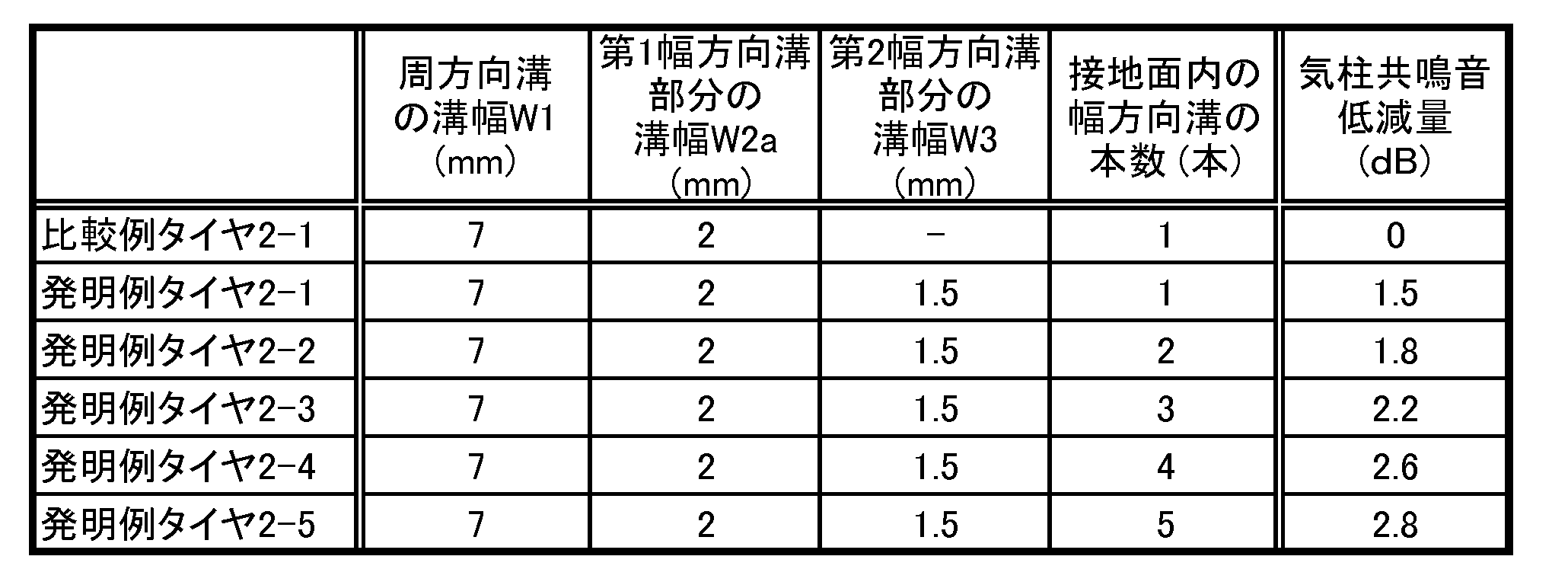
1:トレッド、 2:周方向溝、 3:幅方向溝、 3A:第1幅方向溝部分、 3a:狭窄溝部、 3B:第2幅方向溝部分、 3C:第3幅方向溝部分、 4C:センター陸部、 4M:中間陸部、 4S:ショルダ陸部、 5:周方向サイプ、 6:幅方向サイプ、 10,20,30,40,50:タイヤ、 E:交差部、 T:トレッド踏面、 TC:タイヤ赤道面、 TE:トレッド接地端、 W1:周方向サイプの溝幅、 W2:第1幅方向溝部分の溝幅、 W2a:狭窄溝部の(溝底側の)溝幅、 W2b:狭窄溝部の(トレッド踏面における)開口幅、 W3:第2幅方向溝部分の溝幅、 W4:第3幅方向溝部分の溝幅、 W5:周方向サイプのサイプ幅
Claims (5)
- トレッド踏面に、タイヤ周方向に連続して延びる少なくとも1本の周方向溝と、タイヤ幅方向最外側の該周方向溝とトレッド接地端とで区画されるショルダ陸部と、を有するタイヤであって、
前記ショルダ陸部は、タイヤ幅方向に延び前記周方向溝と前記トレッド接地端とを連通する、幅方向溝を有し、
前記幅方向溝は、前記周方向溝に連通する第1幅方向溝部分と、該第1幅方向溝部分のトレッド接地端側に隣接して連なる第2幅方向溝部分と、を備え、
前記第1幅方向溝部分は、該第1幅方向溝部分の延在方向の少なくとも一部の領域に、トレッド踏面における開口幅が溝底側の溝幅よりも小さくされた、狭窄溝部を有し、
前記周方向溝、前記第1幅方向溝部分および前記第2幅方向溝部分の、それぞれの溝幅が、次の関係式(1)を満たすことを特徴とする、タイヤ。
周方向溝の溝幅>第1幅方向溝部分の溝幅>第2幅方向溝部分の溝幅 …… (1)
- 前記ショルダ陸部は、タイヤ周方向に延びる、周方向サイプをさらに有し、
前記周方向サイプのサイプ幅と、前記第1幅方向溝部分および前記第2幅方向溝部分の、それぞれの溝幅とが、次の関係式(2)を満たす、請求項1に記載のタイヤ。
第1幅方向溝部分の溝幅>周方向サイプのサイプ幅>第2幅方向溝部分の溝幅 …… (2) - 前記幅方向溝は、前記第2幅方向溝部分のトレッド接地端側に隣接して連なり、前記トレッド接地端に連通する第3幅方向溝部分をさらに備え、
前記第2幅方向溝部分および前記第3幅方向溝部分の、それぞれの溝幅が、次の関係式(3)を満たす、請求項1に記載のタイヤ。
第3幅方向溝部分の溝幅>第2幅方向溝部分の溝幅 …… (3)
- 前記第1幅方向溝部分および前記第3幅方向溝部分の、それぞれの溝幅が、次の関係式(4)を満たす、請求項3に記載のタイヤ。
第3幅方向溝部分の溝幅>第1幅方向溝部分の溝幅 …… (4) - 前記第2幅方向溝部分が、前記幅方向溝のタイヤ幅方向内側端と前記トレッド接地端とのタイヤ幅方向距離を4等分して形成される4つのタイヤ幅方向領域のうち、タイヤ幅方向外側から2番目のタイヤ幅方向領域に設けられており、
前記第1幅方向溝部分の前記交差部が、前記幅方向溝のタイヤ幅方向内側端と前記トレッド接地端との中点よりもタイヤ幅方向内側に設けられている、請求項1に記載のタイヤ。
Priority Applications (3)
| Application Number | Priority Date | Filing Date | Title |
|---|---|---|---|
| US16/633,302 US20200148009A1 (en) | 2017-07-27 | 2018-06-26 | Tire |
| CN201880049098.6A CN110958950B (zh) | 2017-07-27 | 2018-06-26 | 轮胎 |
| EP18837246.0A EP3659826B1 (en) | 2017-07-27 | 2018-06-26 | Tire |
Applications Claiming Priority (2)
| Application Number | Priority Date | Filing Date | Title |
|---|---|---|---|
| JP2017145856A JP6887908B2 (ja) | 2017-07-27 | 2017-07-27 | タイヤ |
| JP2017-145856 | 2017-07-27 |
Publications (1)
| Publication Number | Publication Date |
|---|---|
| WO2019021723A1 true WO2019021723A1 (ja) | 2019-01-31 |
Family
ID=65040440
Family Applications (1)
| Application Number | Title | Priority Date | Filing Date |
|---|---|---|---|
| PCT/JP2018/024227 Ceased WO2019021723A1 (ja) | 2017-07-27 | 2018-06-26 | タイヤ |
Country Status (5)
| Country | Link |
|---|---|
| US (1) | US20200148009A1 (ja) |
| EP (1) | EP3659826B1 (ja) |
| JP (1) | JP6887908B2 (ja) |
| CN (1) | CN110958950B (ja) |
| WO (1) | WO2019021723A1 (ja) |
Cited By (2)
| Publication number | Priority date | Publication date | Assignee | Title |
|---|---|---|---|---|
| WO2021111665A1 (ja) | 2019-12-05 | 2021-06-10 | 株式会社ブリヂストン | 空気入りタイヤ |
| US12090794B2 (en) | 2019-12-05 | 2024-09-17 | Bridgestone Corporation | Pneumatic tire |
Families Citing this family (5)
| Publication number | Priority date | Publication date | Assignee | Title |
|---|---|---|---|---|
| JP7091648B2 (ja) * | 2017-12-20 | 2022-06-28 | 住友ゴム工業株式会社 | タイヤ |
| JP7424814B2 (ja) * | 2019-12-13 | 2024-01-30 | 株式会社ブリヂストン | タイヤ |
| CN112976947B (zh) * | 2020-12-22 | 2024-05-14 | 风神轮胎股份有限公司 | 一种中长途低滚阻全轮位型轮胎胎面花纹 |
| WO2023105877A1 (ja) * | 2021-12-10 | 2023-06-15 | 株式会社ブリヂストン | タイヤ |
| CN114161886A (zh) * | 2021-12-17 | 2022-03-11 | 风神轮胎股份有限公司 | 一种适用于牵引车导向轮位的轮胎 |
Citations (7)
| Publication number | Priority date | Publication date | Assignee | Title |
|---|---|---|---|---|
| JPH0569706A (ja) * | 1991-09-10 | 1993-03-23 | Ohtsu Tire & Rubber Co Ltd :The | 空気入りタイヤ |
| JP2011051529A (ja) | 2009-09-03 | 2011-03-17 | Bridgestone Corp | タイヤ |
| JP2011143898A (ja) * | 2010-01-18 | 2011-07-28 | Bridgestone Corp | 空気入りタイヤ |
| JP2013107501A (ja) * | 2011-11-21 | 2013-06-06 | Toyo Tire & Rubber Co Ltd | 空気入りタイヤ |
| JP2013539735A (ja) * | 2010-10-14 | 2013-10-28 | コンパニー ゼネラール デ エタブリッスマン ミシュラン | タイヤ用ノイズ減衰装置 |
| JP2014166827A (ja) | 2013-02-28 | 2014-09-11 | Bridgestone Corp | 空気入りタイヤ |
| JP2015214303A (ja) * | 2014-05-13 | 2015-12-03 | 株式会社ブリヂストン | タイヤ |
Family Cites Families (10)
| Publication number | Priority date | Publication date | Assignee | Title |
|---|---|---|---|---|
| JP3238101B2 (ja) * | 1997-06-27 | 2001-12-10 | 住友ゴム工業株式会社 | 重荷重用空気入りタイヤ |
| JP4299804B2 (ja) * | 2005-04-18 | 2009-07-22 | 住友ゴム工業株式会社 | 空気入りタイヤ |
| JP5366539B2 (ja) * | 2006-03-31 | 2013-12-11 | 株式会社ブリヂストン | 空気入りタイヤ |
| JP5798106B2 (ja) * | 2010-02-22 | 2015-10-21 | 株式会社ブリヂストン | タイヤ |
| DE102010016977B4 (de) * | 2010-05-18 | 2023-08-17 | Continental Reifen Deutschland Gmbh | Fahrzeugluftreifen |
| WO2014136500A1 (ja) * | 2013-03-06 | 2014-09-12 | 横浜ゴム株式会社 | 空気入りタイヤ |
| JP6306436B2 (ja) * | 2014-05-30 | 2018-04-04 | 株式会社ブリヂストン | 空気入りタイヤ |
| CN203937444U (zh) * | 2014-06-12 | 2014-11-12 | 重庆红旗杰勋车轮有限公司 | 轮胎 |
| JP2017024542A (ja) * | 2015-07-22 | 2017-02-02 | 横浜ゴム株式会社 | 空気入りタイヤ |
| FR3042738B1 (fr) * | 2015-10-27 | 2017-11-24 | Michelin & Cie | Pneumatique a couches de travail comprenant des monofilaments et a bande de roulement rainuree |
-
2017
- 2017-07-27 JP JP2017145856A patent/JP6887908B2/ja not_active Expired - Fee Related
-
2018
- 2018-06-26 CN CN201880049098.6A patent/CN110958950B/zh not_active Expired - Fee Related
- 2018-06-26 EP EP18837246.0A patent/EP3659826B1/en active Active
- 2018-06-26 WO PCT/JP2018/024227 patent/WO2019021723A1/ja not_active Ceased
- 2018-06-26 US US16/633,302 patent/US20200148009A1/en not_active Abandoned
Patent Citations (7)
| Publication number | Priority date | Publication date | Assignee | Title |
|---|---|---|---|---|
| JPH0569706A (ja) * | 1991-09-10 | 1993-03-23 | Ohtsu Tire & Rubber Co Ltd :The | 空気入りタイヤ |
| JP2011051529A (ja) | 2009-09-03 | 2011-03-17 | Bridgestone Corp | タイヤ |
| JP2011143898A (ja) * | 2010-01-18 | 2011-07-28 | Bridgestone Corp | 空気入りタイヤ |
| JP2013539735A (ja) * | 2010-10-14 | 2013-10-28 | コンパニー ゼネラール デ エタブリッスマン ミシュラン | タイヤ用ノイズ減衰装置 |
| JP2013107501A (ja) * | 2011-11-21 | 2013-06-06 | Toyo Tire & Rubber Co Ltd | 空気入りタイヤ |
| JP2014166827A (ja) | 2013-02-28 | 2014-09-11 | Bridgestone Corp | 空気入りタイヤ |
| JP2015214303A (ja) * | 2014-05-13 | 2015-12-03 | 株式会社ブリヂストン | タイヤ |
Non-Patent Citations (1)
| Title |
|---|
| See also references of EP3659826A4 |
Cited By (3)
| Publication number | Priority date | Publication date | Assignee | Title |
|---|---|---|---|---|
| WO2021111665A1 (ja) | 2019-12-05 | 2021-06-10 | 株式会社ブリヂストン | 空気入りタイヤ |
| US12090794B2 (en) | 2019-12-05 | 2024-09-17 | Bridgestone Corporation | Pneumatic tire |
| US12122190B2 (en) | 2019-12-05 | 2024-10-22 | Bridgestone Corporation | Pneumatic tire |
Also Published As
| Publication number | Publication date |
|---|---|
| EP3659826A4 (en) | 2021-04-07 |
| EP3659826B1 (en) | 2022-06-01 |
| CN110958950A (zh) | 2020-04-03 |
| JP6887908B2 (ja) | 2021-06-16 |
| CN110958950B (zh) | 2022-04-12 |
| US20200148009A1 (en) | 2020-05-14 |
| JP2019026018A (ja) | 2019-02-21 |
| EP3659826A1 (en) | 2020-06-03 |
Similar Documents
| Publication | Publication Date | Title |
|---|---|---|
| US9302553B2 (en) | Pneumatic tire | |
| JP6887908B2 (ja) | タイヤ | |
| JP5266307B2 (ja) | 空気入りタイヤ | |
| JP6762267B2 (ja) | タイヤ | |
| EP2796298B1 (en) | Pneumatic tire | |
| JP6450224B2 (ja) | 空気入りタイヤ | |
| JP3391755B2 (ja) | 空気入りタイヤ | |
| US10889150B2 (en) | Pneumatic tire | |
| JPWO2005068225A1 (ja) | 空気入りタイヤ | |
| JP5613273B2 (ja) | 空気入りタイヤ | |
| JP6657707B2 (ja) | 空気入りタイヤ | |
| US10086656B2 (en) | Heavy-duty tire | |
| JP6851858B2 (ja) | タイヤ | |
| JP6421652B2 (ja) | 空気入りタイヤ | |
| JP7633490B2 (ja) | タイヤ | |
| JP7633491B2 (ja) | タイヤ | |
| JP7583258B2 (ja) | タイヤ | |
| EP3461657A1 (en) | Tire | |
| JP6851859B2 (ja) | タイヤ | |
| JP6571993B2 (ja) | 空気入りタイヤ | |
| JP7108632B2 (ja) | 空気入りタイヤ | |
| JP2024099174A (ja) | 空気入りタイヤ | |
| JP7074586B2 (ja) | 空気入りタイヤ | |
| JP2011168220A (ja) | 空気入りタイヤ | |
| JP2024099172A (ja) | 空気入りタイヤ |
Legal Events
| Date | Code | Title | Description |
|---|---|---|---|
| 121 | Ep: the epo has been informed by wipo that ep was designated in this application |
Ref document number: 18837246 Country of ref document: EP Kind code of ref document: A1 |
|
| NENP | Non-entry into the national phase |
Ref country code: DE |
|
| WWE | Wipo information: entry into national phase |
Ref document number: 2018837246 Country of ref document: EP |
|
| ENP | Entry into the national phase |
Ref document number: 2018837246 Country of ref document: EP Effective date: 20200227 |