WO2019026811A1 - ジルコニア粒子を含む粉末の製造方法 - Google Patents
ジルコニア粒子を含む粉末の製造方法 Download PDFInfo
- Publication number
- WO2019026811A1 WO2019026811A1 PCT/JP2018/028331 JP2018028331W WO2019026811A1 WO 2019026811 A1 WO2019026811 A1 WO 2019026811A1 JP 2018028331 W JP2018028331 W JP 2018028331W WO 2019026811 A1 WO2019026811 A1 WO 2019026811A1
- Authority
- WO
- WIPO (PCT)
- Prior art keywords
- zirconia
- sintered body
- powder
- mass
- less
- Prior art date
- Legal status (The legal status is an assumption and is not a legal conclusion. Google has not performed a legal analysis and makes no representation as to the accuracy of the status listed.)
- Ceased
Links
Classifications
-
- C—CHEMISTRY; METALLURGY
- C01—INORGANIC CHEMISTRY
- C01G—COMPOUNDS CONTAINING METALS NOT COVERED BY SUBCLASSES C01D OR C01F
- C01G25/00—Compounds of zirconium
-
- A—HUMAN NECESSITIES
- A61—MEDICAL OR VETERINARY SCIENCE; HYGIENE
- A61C—DENTISTRY; APPARATUS OR METHODS FOR ORAL OR DENTAL HYGIENE
- A61C13/00—Dental prostheses; Making same
- A61C13/08—Artificial teeth; Making same
- A61C13/081—Making teeth by casting or moulding
-
- C—CHEMISTRY; METALLURGY
- C01—INORGANIC CHEMISTRY
- C01G—COMPOUNDS CONTAINING METALS NOT COVERED BY SUBCLASSES C01D OR C01F
- C01G25/00—Compounds of zirconium
- C01G25/02—Oxides
-
- C—CHEMISTRY; METALLURGY
- C04—CEMENTS; CONCRETE; ARTIFICIAL STONE; CERAMICS; REFRACTORIES
- C04B—LIME, MAGNESIA; SLAG; CEMENTS; COMPOSITIONS THEREOF, e.g. MORTARS, CONCRETE OR LIKE BUILDING MATERIALS; ARTIFICIAL STONE; CERAMICS; REFRACTORIES; TREATMENT OF NATURAL STONE
- C04B35/00—Shaped ceramic products characterised by their composition; Ceramics compositions; Processing powders of inorganic compounds preparatory to the manufacturing of ceramic products
- C04B35/01—Shaped ceramic products characterised by their composition; Ceramics compositions; Processing powders of inorganic compounds preparatory to the manufacturing of ceramic products based on oxide ceramics
- C04B35/48—Shaped ceramic products characterised by their composition; Ceramics compositions; Processing powders of inorganic compounds preparatory to the manufacturing of ceramic products based on oxide ceramics based on zirconium or hafnium oxides, zirconates, zircon or hafnates
- C04B35/486—Fine ceramics
-
- C—CHEMISTRY; METALLURGY
- C04—CEMENTS; CONCRETE; ARTIFICIAL STONE; CERAMICS; REFRACTORIES
- C04B—LIME, MAGNESIA; SLAG; CEMENTS; COMPOSITIONS THEREOF, e.g. MORTARS, CONCRETE OR LIKE BUILDING MATERIALS; ARTIFICIAL STONE; CERAMICS; REFRACTORIES; TREATMENT OF NATURAL STONE
- C04B35/00—Shaped ceramic products characterised by their composition; Ceramics compositions; Processing powders of inorganic compounds preparatory to the manufacturing of ceramic products
- C04B35/622—Forming processes; Processing powders of inorganic compounds preparatory to the manufacturing of ceramic products
- C04B35/626—Preparing or treating the powders individually or as batches ; preparing or treating macroscopic reinforcing agents for ceramic products, e.g. fibres; mechanical aspects section B
- C04B35/62605—Treating the starting powders individually or as mixtures
- C04B35/62625—Wet mixtures
- C04B35/6264—Mixing media, e.g. organic solvents
-
- C—CHEMISTRY; METALLURGY
- C04—CEMENTS; CONCRETE; ARTIFICIAL STONE; CERAMICS; REFRACTORIES
- C04B—LIME, MAGNESIA; SLAG; CEMENTS; COMPOSITIONS THEREOF, e.g. MORTARS, CONCRETE OR LIKE BUILDING MATERIALS; ARTIFICIAL STONE; CERAMICS; REFRACTORIES; TREATMENT OF NATURAL STONE
- C04B35/00—Shaped ceramic products characterised by their composition; Ceramics compositions; Processing powders of inorganic compounds preparatory to the manufacturing of ceramic products
- C04B35/622—Forming processes; Processing powders of inorganic compounds preparatory to the manufacturing of ceramic products
- C04B35/626—Preparing or treating the powders individually or as batches ; preparing or treating macroscopic reinforcing agents for ceramic products, e.g. fibres; mechanical aspects section B
- C04B35/62605—Treating the starting powders individually or as mixtures
- C04B35/62645—Thermal treatment of powders or mixtures thereof other than sintering
- C04B35/62655—Drying, e.g. freeze-drying, spray-drying, microwave or supercritical drying
-
- C—CHEMISTRY; METALLURGY
- C04—CEMENTS; CONCRETE; ARTIFICIAL STONE; CERAMICS; REFRACTORIES
- C04B—LIME, MAGNESIA; SLAG; CEMENTS; COMPOSITIONS THEREOF, e.g. MORTARS, CONCRETE OR LIKE BUILDING MATERIALS; ARTIFICIAL STONE; CERAMICS; REFRACTORIES; TREATMENT OF NATURAL STONE
- C04B35/00—Shaped ceramic products characterised by their composition; Ceramics compositions; Processing powders of inorganic compounds preparatory to the manufacturing of ceramic products
- C04B35/622—Forming processes; Processing powders of inorganic compounds preparatory to the manufacturing of ceramic products
- C04B35/626—Preparing or treating the powders individually or as batches ; preparing or treating macroscopic reinforcing agents for ceramic products, e.g. fibres; mechanical aspects section B
- C04B35/628—Coating the powders or the macroscopic reinforcing agents
- C04B35/62802—Powder coating materials
- C04B35/62842—Metals
-
- C—CHEMISTRY; METALLURGY
- C04—CEMENTS; CONCRETE; ARTIFICIAL STONE; CERAMICS; REFRACTORIES
- C04B—LIME, MAGNESIA; SLAG; CEMENTS; COMPOSITIONS THEREOF, e.g. MORTARS, CONCRETE OR LIKE BUILDING MATERIALS; ARTIFICIAL STONE; CERAMICS; REFRACTORIES; TREATMENT OF NATURAL STONE
- C04B35/00—Shaped ceramic products characterised by their composition; Ceramics compositions; Processing powders of inorganic compounds preparatory to the manufacturing of ceramic products
- C04B35/622—Forming processes; Processing powders of inorganic compounds preparatory to the manufacturing of ceramic products
- C04B35/626—Preparing or treating the powders individually or as batches ; preparing or treating macroscopic reinforcing agents for ceramic products, e.g. fibres; mechanical aspects section B
- C04B35/63—Preparing or treating the powders individually or as batches ; preparing or treating macroscopic reinforcing agents for ceramic products, e.g. fibres; mechanical aspects section B using additives specially adapted for forming the products, e.g.. binder binders
- C04B35/6303—Inorganic additives
-
- C—CHEMISTRY; METALLURGY
- C04—CEMENTS; CONCRETE; ARTIFICIAL STONE; CERAMICS; REFRACTORIES
- C04B—LIME, MAGNESIA; SLAG; CEMENTS; COMPOSITIONS THEREOF, e.g. MORTARS, CONCRETE OR LIKE BUILDING MATERIALS; ARTIFICIAL STONE; CERAMICS; REFRACTORIES; TREATMENT OF NATURAL STONE
- C04B35/00—Shaped ceramic products characterised by their composition; Ceramics compositions; Processing powders of inorganic compounds preparatory to the manufacturing of ceramic products
- C04B35/622—Forming processes; Processing powders of inorganic compounds preparatory to the manufacturing of ceramic products
- C04B35/626—Preparing or treating the powders individually or as batches ; preparing or treating macroscopic reinforcing agents for ceramic products, e.g. fibres; mechanical aspects section B
- C04B35/63—Preparing or treating the powders individually or as batches ; preparing or treating macroscopic reinforcing agents for ceramic products, e.g. fibres; mechanical aspects section B using additives specially adapted for forming the products, e.g.. binder binders
- C04B35/632—Organic additives
-
- C—CHEMISTRY; METALLURGY
- C04—CEMENTS; CONCRETE; ARTIFICIAL STONE; CERAMICS; REFRACTORIES
- C04B—LIME, MAGNESIA; SLAG; CEMENTS; COMPOSITIONS THEREOF, e.g. MORTARS, CONCRETE OR LIKE BUILDING MATERIALS; ARTIFICIAL STONE; CERAMICS; REFRACTORIES; TREATMENT OF NATURAL STONE
- C04B35/00—Shaped ceramic products characterised by their composition; Ceramics compositions; Processing powders of inorganic compounds preparatory to the manufacturing of ceramic products
- C04B35/622—Forming processes; Processing powders of inorganic compounds preparatory to the manufacturing of ceramic products
- C04B35/626—Preparing or treating the powders individually or as batches ; preparing or treating macroscopic reinforcing agents for ceramic products, e.g. fibres; mechanical aspects section B
- C04B35/63—Preparing or treating the powders individually or as batches ; preparing or treating macroscopic reinforcing agents for ceramic products, e.g. fibres; mechanical aspects section B using additives specially adapted for forming the products, e.g.. binder binders
- C04B35/632—Organic additives
- C04B35/634—Polymers
-
- C—CHEMISTRY; METALLURGY
- C04—CEMENTS; CONCRETE; ARTIFICIAL STONE; CERAMICS; REFRACTORIES
- C04B—LIME, MAGNESIA; SLAG; CEMENTS; COMPOSITIONS THEREOF, e.g. MORTARS, CONCRETE OR LIKE BUILDING MATERIALS; ARTIFICIAL STONE; CERAMICS; REFRACTORIES; TREATMENT OF NATURAL STONE
- C04B35/00—Shaped ceramic products characterised by their composition; Ceramics compositions; Processing powders of inorganic compounds preparatory to the manufacturing of ceramic products
- C04B35/622—Forming processes; Processing powders of inorganic compounds preparatory to the manufacturing of ceramic products
- C04B35/64—Burning or sintering processes
-
- C—CHEMISTRY; METALLURGY
- C04—CEMENTS; CONCRETE; ARTIFICIAL STONE; CERAMICS; REFRACTORIES
- C04B—LIME, MAGNESIA; SLAG; CEMENTS; COMPOSITIONS THEREOF, e.g. MORTARS, CONCRETE OR LIKE BUILDING MATERIALS; ARTIFICIAL STONE; CERAMICS; REFRACTORIES; TREATMENT OF NATURAL STONE
- C04B35/00—Shaped ceramic products characterised by their composition; Ceramics compositions; Processing powders of inorganic compounds preparatory to the manufacturing of ceramic products
- C04B35/622—Forming processes; Processing powders of inorganic compounds preparatory to the manufacturing of ceramic products
- C04B35/64—Burning or sintering processes
- C04B35/645—Pressure sintering
-
- C—CHEMISTRY; METALLURGY
- C09—DYES; PAINTS; POLISHES; NATURAL RESINS; ADHESIVES; COMPOSITIONS NOT OTHERWISE PROVIDED FOR; APPLICATIONS OF MATERIALS NOT OTHERWISE PROVIDED FOR
- C09K—MATERIALS FOR MISCELLANEOUS APPLICATIONS, NOT PROVIDED FOR ELSEWHERE
- C09K11/00—Luminescent materials, e.g. electroluminescent or chemiluminescent
- C09K11/08—Luminescent materials, e.g. electroluminescent or chemiluminescent containing inorganic luminescent materials
-
- C—CHEMISTRY; METALLURGY
- C09—DYES; PAINTS; POLISHES; NATURAL RESINS; ADHESIVES; COMPOSITIONS NOT OTHERWISE PROVIDED FOR; APPLICATIONS OF MATERIALS NOT OTHERWISE PROVIDED FOR
- C09K—MATERIALS FOR MISCELLANEOUS APPLICATIONS, NOT PROVIDED FOR ELSEWHERE
- C09K11/00—Luminescent materials, e.g. electroluminescent or chemiluminescent
- C09K11/08—Luminescent materials, e.g. electroluminescent or chemiluminescent containing inorganic luminescent materials
- C09K11/67—Luminescent materials, e.g. electroluminescent or chemiluminescent containing inorganic luminescent materials containing refractory metals
-
- C—CHEMISTRY; METALLURGY
- C09—DYES; PAINTS; POLISHES; NATURAL RESINS; ADHESIVES; COMPOSITIONS NOT OTHERWISE PROVIDED FOR; APPLICATIONS OF MATERIALS NOT OTHERWISE PROVIDED FOR
- C09K—MATERIALS FOR MISCELLANEOUS APPLICATIONS, NOT PROVIDED FOR ELSEWHERE
- C09K11/00—Luminescent materials, e.g. electroluminescent or chemiluminescent
- C09K11/08—Luminescent materials, e.g. electroluminescent or chemiluminescent containing inorganic luminescent materials
- C09K11/77—Luminescent materials, e.g. electroluminescent or chemiluminescent containing inorganic luminescent materials containing rare earth metals
- C09K11/7701—Chalogenides
-
- A—HUMAN NECESSITIES
- A61—MEDICAL OR VETERINARY SCIENCE; HYGIENE
- A61C—DENTISTRY; APPARATUS OR METHODS FOR ORAL OR DENTAL HYGIENE
- A61C13/00—Dental prostheses; Making same
- A61C13/08—Artificial teeth; Making same
- A61C13/083—Porcelain or ceramic teeth
-
- C—CHEMISTRY; METALLURGY
- C01—INORGANIC CHEMISTRY
- C01P—INDEXING SCHEME RELATING TO STRUCTURAL AND PHYSICAL ASPECTS OF SOLID INORGANIC COMPOUNDS
- C01P2002/00—Crystal-structural characteristics
- C01P2002/50—Solid solutions
- C01P2002/52—Solid solutions containing elements as dopants
- C01P2002/54—Solid solutions containing elements as dopants one element only
-
- C—CHEMISTRY; METALLURGY
- C01—INORGANIC CHEMISTRY
- C01P—INDEXING SCHEME RELATING TO STRUCTURAL AND PHYSICAL ASPECTS OF SOLID INORGANIC COMPOUNDS
- C01P2004/00—Particle morphology
- C01P2004/60—Particles characterised by their size
- C01P2004/64—Nanometer sized, i.e. from 1-100 nanometer
-
- C—CHEMISTRY; METALLURGY
- C04—CEMENTS; CONCRETE; ARTIFICIAL STONE; CERAMICS; REFRACTORIES
- C04B—LIME, MAGNESIA; SLAG; CEMENTS; COMPOSITIONS THEREOF, e.g. MORTARS, CONCRETE OR LIKE BUILDING MATERIALS; ARTIFICIAL STONE; CERAMICS; REFRACTORIES; TREATMENT OF NATURAL STONE
- C04B2235/00—Aspects relating to ceramic starting mixtures or sintered ceramic products
- C04B2235/02—Composition of constituents of the starting material or of secondary phases of the final product
- C04B2235/30—Constituents and secondary phases not being of a fibrous nature
- C04B2235/32—Metal oxides, mixed metal oxides, or oxide-forming salts thereof, e.g. carbonates, nitrates, (oxy)hydroxides, chlorides
- C04B2235/3217—Aluminum oxide or oxide forming salts thereof, e.g. bauxite, alpha-alumina
- C04B2235/3222—Aluminates other than alumino-silicates, e.g. spinel (MgAl2O4)
-
- C—CHEMISTRY; METALLURGY
- C04—CEMENTS; CONCRETE; ARTIFICIAL STONE; CERAMICS; REFRACTORIES
- C04B—LIME, MAGNESIA; SLAG; CEMENTS; COMPOSITIONS THEREOF, e.g. MORTARS, CONCRETE OR LIKE BUILDING MATERIALS; ARTIFICIAL STONE; CERAMICS; REFRACTORIES; TREATMENT OF NATURAL STONE
- C04B2235/00—Aspects relating to ceramic starting mixtures or sintered ceramic products
- C04B2235/02—Composition of constituents of the starting material or of secondary phases of the final product
- C04B2235/30—Constituents and secondary phases not being of a fibrous nature
- C04B2235/32—Metal oxides, mixed metal oxides, or oxide-forming salts thereof, e.g. carbonates, nitrates, (oxy)hydroxides, chlorides
- C04B2235/3224—Rare earth oxide or oxide forming salts thereof, e.g. scandium oxide
-
- C—CHEMISTRY; METALLURGY
- C04—CEMENTS; CONCRETE; ARTIFICIAL STONE; CERAMICS; REFRACTORIES
- C04B—LIME, MAGNESIA; SLAG; CEMENTS; COMPOSITIONS THEREOF, e.g. MORTARS, CONCRETE OR LIKE BUILDING MATERIALS; ARTIFICIAL STONE; CERAMICS; REFRACTORIES; TREATMENT OF NATURAL STONE
- C04B2235/00—Aspects relating to ceramic starting mixtures or sintered ceramic products
- C04B2235/02—Composition of constituents of the starting material or of secondary phases of the final product
- C04B2235/30—Constituents and secondary phases not being of a fibrous nature
- C04B2235/32—Metal oxides, mixed metal oxides, or oxide-forming salts thereof, e.g. carbonates, nitrates, (oxy)hydroxides, chlorides
- C04B2235/3224—Rare earth oxide or oxide forming salts thereof, e.g. scandium oxide
- C04B2235/3225—Yttrium oxide or oxide-forming salts thereof
-
- C—CHEMISTRY; METALLURGY
- C04—CEMENTS; CONCRETE; ARTIFICIAL STONE; CERAMICS; REFRACTORIES
- C04B—LIME, MAGNESIA; SLAG; CEMENTS; COMPOSITIONS THEREOF, e.g. MORTARS, CONCRETE OR LIKE BUILDING MATERIALS; ARTIFICIAL STONE; CERAMICS; REFRACTORIES; TREATMENT OF NATURAL STONE
- C04B2235/00—Aspects relating to ceramic starting mixtures or sintered ceramic products
- C04B2235/02—Composition of constituents of the starting material or of secondary phases of the final product
- C04B2235/30—Constituents and secondary phases not being of a fibrous nature
- C04B2235/32—Metal oxides, mixed metal oxides, or oxide-forming salts thereof, e.g. carbonates, nitrates, (oxy)hydroxides, chlorides
- C04B2235/3224—Rare earth oxide or oxide forming salts thereof, e.g. scandium oxide
- C04B2235/3229—Cerium oxides or oxide-forming salts thereof
-
- C—CHEMISTRY; METALLURGY
- C04—CEMENTS; CONCRETE; ARTIFICIAL STONE; CERAMICS; REFRACTORIES
- C04B—LIME, MAGNESIA; SLAG; CEMENTS; COMPOSITIONS THEREOF, e.g. MORTARS, CONCRETE OR LIKE BUILDING MATERIALS; ARTIFICIAL STONE; CERAMICS; REFRACTORIES; TREATMENT OF NATURAL STONE
- C04B2235/00—Aspects relating to ceramic starting mixtures or sintered ceramic products
- C04B2235/02—Composition of constituents of the starting material or of secondary phases of the final product
- C04B2235/30—Constituents and secondary phases not being of a fibrous nature
- C04B2235/32—Metal oxides, mixed metal oxides, or oxide-forming salts thereof, e.g. carbonates, nitrates, (oxy)hydroxides, chlorides
- C04B2235/3231—Refractory metal oxides, their mixed metal oxides, or oxide-forming salts thereof
- C04B2235/3244—Zirconium oxides, zirconates, hafnium oxides, hafnates, or oxide-forming salts thereof
- C04B2235/3246—Stabilised zirconias, e.g. YSZ or cerium stabilised zirconia
-
- C—CHEMISTRY; METALLURGY
- C04—CEMENTS; CONCRETE; ARTIFICIAL STONE; CERAMICS; REFRACTORIES
- C04B—LIME, MAGNESIA; SLAG; CEMENTS; COMPOSITIONS THEREOF, e.g. MORTARS, CONCRETE OR LIKE BUILDING MATERIALS; ARTIFICIAL STONE; CERAMICS; REFRACTORIES; TREATMENT OF NATURAL STONE
- C04B2235/00—Aspects relating to ceramic starting mixtures or sintered ceramic products
- C04B2235/02—Composition of constituents of the starting material or of secondary phases of the final product
- C04B2235/30—Constituents and secondary phases not being of a fibrous nature
- C04B2235/32—Metal oxides, mixed metal oxides, or oxide-forming salts thereof, e.g. carbonates, nitrates, (oxy)hydroxides, chlorides
- C04B2235/3284—Zinc oxides, zincates, cadmium oxides, cadmiates, mercury oxides, mercurates or oxide forming salts thereof
-
- C—CHEMISTRY; METALLURGY
- C04—CEMENTS; CONCRETE; ARTIFICIAL STONE; CERAMICS; REFRACTORIES
- C04B—LIME, MAGNESIA; SLAG; CEMENTS; COMPOSITIONS THEREOF, e.g. MORTARS, CONCRETE OR LIKE BUILDING MATERIALS; ARTIFICIAL STONE; CERAMICS; REFRACTORIES; TREATMENT OF NATURAL STONE
- C04B2235/00—Aspects relating to ceramic starting mixtures or sintered ceramic products
- C04B2235/02—Composition of constituents of the starting material or of secondary phases of the final product
- C04B2235/30—Constituents and secondary phases not being of a fibrous nature
- C04B2235/32—Metal oxides, mixed metal oxides, or oxide-forming salts thereof, e.g. carbonates, nitrates, (oxy)hydroxides, chlorides
- C04B2235/3286—Gallium oxides, gallates, indium oxides, indates, thallium oxides, thallates or oxide forming salts thereof, e.g. zinc gallate
-
- C—CHEMISTRY; METALLURGY
- C04—CEMENTS; CONCRETE; ARTIFICIAL STONE; CERAMICS; REFRACTORIES
- C04B—LIME, MAGNESIA; SLAG; CEMENTS; COMPOSITIONS THEREOF, e.g. MORTARS, CONCRETE OR LIKE BUILDING MATERIALS; ARTIFICIAL STONE; CERAMICS; REFRACTORIES; TREATMENT OF NATURAL STONE
- C04B2235/00—Aspects relating to ceramic starting mixtures or sintered ceramic products
- C04B2235/02—Composition of constituents of the starting material or of secondary phases of the final product
- C04B2235/30—Constituents and secondary phases not being of a fibrous nature
- C04B2235/32—Metal oxides, mixed metal oxides, or oxide-forming salts thereof, e.g. carbonates, nitrates, (oxy)hydroxides, chlorides
- C04B2235/3298—Bismuth oxides, bismuthates or oxide forming salts thereof, e.g. zinc bismuthate
-
- C—CHEMISTRY; METALLURGY
- C04—CEMENTS; CONCRETE; ARTIFICIAL STONE; CERAMICS; REFRACTORIES
- C04B—LIME, MAGNESIA; SLAG; CEMENTS; COMPOSITIONS THEREOF, e.g. MORTARS, CONCRETE OR LIKE BUILDING MATERIALS; ARTIFICIAL STONE; CERAMICS; REFRACTORIES; TREATMENT OF NATURAL STONE
- C04B2235/00—Aspects relating to ceramic starting mixtures or sintered ceramic products
- C04B2235/02—Composition of constituents of the starting material or of secondary phases of the final product
- C04B2235/30—Constituents and secondary phases not being of a fibrous nature
- C04B2235/34—Non-metal oxides, non-metal mixed oxides, or salts thereof that form the non-metal oxides upon heating, e.g. carbonates, nitrates, (oxy)hydroxides, chlorides
- C04B2235/3427—Silicates other than clay, e.g. water glass
-
- C—CHEMISTRY; METALLURGY
- C04—CEMENTS; CONCRETE; ARTIFICIAL STONE; CERAMICS; REFRACTORIES
- C04B—LIME, MAGNESIA; SLAG; CEMENTS; COMPOSITIONS THEREOF, e.g. MORTARS, CONCRETE OR LIKE BUILDING MATERIALS; ARTIFICIAL STONE; CERAMICS; REFRACTORIES; TREATMENT OF NATURAL STONE
- C04B2235/00—Aspects relating to ceramic starting mixtures or sintered ceramic products
- C04B2235/02—Composition of constituents of the starting material or of secondary phases of the final product
- C04B2235/50—Constituents or additives of the starting mixture chosen for their shape or used because of their shape or their physical appearance
- C04B2235/54—Particle size related information
- C04B2235/5418—Particle size related information expressed by the size of the particles or aggregates thereof
- C04B2235/5454—Particle size related information expressed by the size of the particles or aggregates thereof nanometer sized, i.e. below 100 nm
-
- C—CHEMISTRY; METALLURGY
- C04—CEMENTS; CONCRETE; ARTIFICIAL STONE; CERAMICS; REFRACTORIES
- C04B—LIME, MAGNESIA; SLAG; CEMENTS; COMPOSITIONS THEREOF, e.g. MORTARS, CONCRETE OR LIKE BUILDING MATERIALS; ARTIFICIAL STONE; CERAMICS; REFRACTORIES; TREATMENT OF NATURAL STONE
- C04B2235/00—Aspects relating to ceramic starting mixtures or sintered ceramic products
- C04B2235/02—Composition of constituents of the starting material or of secondary phases of the final product
- C04B2235/50—Constituents or additives of the starting mixture chosen for their shape or used because of their shape or their physical appearance
- C04B2235/54—Particle size related information
- C04B2235/549—Particle size related information the particle size being expressed by crystallite size or primary particle size
-
- C—CHEMISTRY; METALLURGY
- C04—CEMENTS; CONCRETE; ARTIFICIAL STONE; CERAMICS; REFRACTORIES
- C04B—LIME, MAGNESIA; SLAG; CEMENTS; COMPOSITIONS THEREOF, e.g. MORTARS, CONCRETE OR LIKE BUILDING MATERIALS; ARTIFICIAL STONE; CERAMICS; REFRACTORIES; TREATMENT OF NATURAL STONE
- C04B2235/00—Aspects relating to ceramic starting mixtures or sintered ceramic products
- C04B2235/60—Aspects relating to the preparation, properties or mechanical treatment of green bodies or pre-forms
- C04B2235/602—Making the green bodies or pre-forms by moulding
- C04B2235/6027—Slip casting
-
- C—CHEMISTRY; METALLURGY
- C04—CEMENTS; CONCRETE; ARTIFICIAL STONE; CERAMICS; REFRACTORIES
- C04B—LIME, MAGNESIA; SLAG; CEMENTS; COMPOSITIONS THEREOF, e.g. MORTARS, CONCRETE OR LIKE BUILDING MATERIALS; ARTIFICIAL STONE; CERAMICS; REFRACTORIES; TREATMENT OF NATURAL STONE
- C04B2235/00—Aspects relating to ceramic starting mixtures or sintered ceramic products
- C04B2235/60—Aspects relating to the preparation, properties or mechanical treatment of green bodies or pre-forms
- C04B2235/604—Pressing at temperatures other than sintering temperatures
-
- C—CHEMISTRY; METALLURGY
- C04—CEMENTS; CONCRETE; ARTIFICIAL STONE; CERAMICS; REFRACTORIES
- C04B—LIME, MAGNESIA; SLAG; CEMENTS; COMPOSITIONS THEREOF, e.g. MORTARS, CONCRETE OR LIKE BUILDING MATERIALS; ARTIFICIAL STONE; CERAMICS; REFRACTORIES; TREATMENT OF NATURAL STONE
- C04B2235/00—Aspects relating to ceramic starting mixtures or sintered ceramic products
- C04B2235/65—Aspects relating to heat treatments of ceramic bodies such as green ceramics or pre-sintered ceramics, e.g. burning, sintering or melting processes
- C04B2235/656—Aspects relating to heat treatments of ceramic bodies such as green ceramics or pre-sintered ceramics, e.g. burning, sintering or melting processes characterised by specific heating conditions during heat treatment
-
- C—CHEMISTRY; METALLURGY
- C04—CEMENTS; CONCRETE; ARTIFICIAL STONE; CERAMICS; REFRACTORIES
- C04B—LIME, MAGNESIA; SLAG; CEMENTS; COMPOSITIONS THEREOF, e.g. MORTARS, CONCRETE OR LIKE BUILDING MATERIALS; ARTIFICIAL STONE; CERAMICS; REFRACTORIES; TREATMENT OF NATURAL STONE
- C04B2235/00—Aspects relating to ceramic starting mixtures or sintered ceramic products
- C04B2235/65—Aspects relating to heat treatments of ceramic bodies such as green ceramics or pre-sintered ceramics, e.g. burning, sintering or melting processes
- C04B2235/656—Aspects relating to heat treatments of ceramic bodies such as green ceramics or pre-sintered ceramics, e.g. burning, sintering or melting processes characterised by specific heating conditions during heat treatment
- C04B2235/6562—Heating rate
-
- C—CHEMISTRY; METALLURGY
- C04—CEMENTS; CONCRETE; ARTIFICIAL STONE; CERAMICS; REFRACTORIES
- C04B—LIME, MAGNESIA; SLAG; CEMENTS; COMPOSITIONS THEREOF, e.g. MORTARS, CONCRETE OR LIKE BUILDING MATERIALS; ARTIFICIAL STONE; CERAMICS; REFRACTORIES; TREATMENT OF NATURAL STONE
- C04B2235/00—Aspects relating to ceramic starting mixtures or sintered ceramic products
- C04B2235/65—Aspects relating to heat treatments of ceramic bodies such as green ceramics or pre-sintered ceramics, e.g. burning, sintering or melting processes
- C04B2235/656—Aspects relating to heat treatments of ceramic bodies such as green ceramics or pre-sintered ceramics, e.g. burning, sintering or melting processes characterised by specific heating conditions during heat treatment
- C04B2235/6567—Treatment time
-
- C—CHEMISTRY; METALLURGY
- C04—CEMENTS; CONCRETE; ARTIFICIAL STONE; CERAMICS; REFRACTORIES
- C04B—LIME, MAGNESIA; SLAG; CEMENTS; COMPOSITIONS THEREOF, e.g. MORTARS, CONCRETE OR LIKE BUILDING MATERIALS; ARTIFICIAL STONE; CERAMICS; REFRACTORIES; TREATMENT OF NATURAL STONE
- C04B2235/00—Aspects relating to ceramic starting mixtures or sintered ceramic products
- C04B2235/70—Aspects relating to sintered or melt-casted ceramic products
- C04B2235/74—Physical characteristics
- C04B2235/76—Crystal structural characteristics, e.g. symmetry
- C04B2235/762—Cubic symmetry, e.g. beta-SiC
-
- C—CHEMISTRY; METALLURGY
- C04—CEMENTS; CONCRETE; ARTIFICIAL STONE; CERAMICS; REFRACTORIES
- C04B—LIME, MAGNESIA; SLAG; CEMENTS; COMPOSITIONS THEREOF, e.g. MORTARS, CONCRETE OR LIKE BUILDING MATERIALS; ARTIFICIAL STONE; CERAMICS; REFRACTORIES; TREATMENT OF NATURAL STONE
- C04B2235/00—Aspects relating to ceramic starting mixtures or sintered ceramic products
- C04B2235/70—Aspects relating to sintered or melt-casted ceramic products
- C04B2235/74—Physical characteristics
- C04B2235/77—Density
-
- C—CHEMISTRY; METALLURGY
- C04—CEMENTS; CONCRETE; ARTIFICIAL STONE; CERAMICS; REFRACTORIES
- C04B—LIME, MAGNESIA; SLAG; CEMENTS; COMPOSITIONS THEREOF, e.g. MORTARS, CONCRETE OR LIKE BUILDING MATERIALS; ARTIFICIAL STONE; CERAMICS; REFRACTORIES; TREATMENT OF NATURAL STONE
- C04B2235/00—Aspects relating to ceramic starting mixtures or sintered ceramic products
- C04B2235/70—Aspects relating to sintered or melt-casted ceramic products
- C04B2235/74—Physical characteristics
- C04B2235/78—Grain sizes and shapes, product microstructures, e.g. acicular grains, equiaxed grains, platelet-structures
- C04B2235/781—Nanograined materials, i.e. having grain sizes below 100 nm
-
- C—CHEMISTRY; METALLURGY
- C04—CEMENTS; CONCRETE; ARTIFICIAL STONE; CERAMICS; REFRACTORIES
- C04B—LIME, MAGNESIA; SLAG; CEMENTS; COMPOSITIONS THEREOF, e.g. MORTARS, CONCRETE OR LIKE BUILDING MATERIALS; ARTIFICIAL STONE; CERAMICS; REFRACTORIES; TREATMENT OF NATURAL STONE
- C04B2235/00—Aspects relating to ceramic starting mixtures or sintered ceramic products
- C04B2235/70—Aspects relating to sintered or melt-casted ceramic products
- C04B2235/74—Physical characteristics
- C04B2235/78—Grain sizes and shapes, product microstructures, e.g. acicular grains, equiaxed grains, platelet-structures
- C04B2235/785—Submicron sized grains, i.e. from 0,1 to 1 micron
-
- C—CHEMISTRY; METALLURGY
- C04—CEMENTS; CONCRETE; ARTIFICIAL STONE; CERAMICS; REFRACTORIES
- C04B—LIME, MAGNESIA; SLAG; CEMENTS; COMPOSITIONS THEREOF, e.g. MORTARS, CONCRETE OR LIKE BUILDING MATERIALS; ARTIFICIAL STONE; CERAMICS; REFRACTORIES; TREATMENT OF NATURAL STONE
- C04B2235/00—Aspects relating to ceramic starting mixtures or sintered ceramic products
- C04B2235/70—Aspects relating to sintered or melt-casted ceramic products
- C04B2235/96—Properties of ceramic products, e.g. mechanical properties such as strength, toughness, wear resistance
-
- C—CHEMISTRY; METALLURGY
- C04—CEMENTS; CONCRETE; ARTIFICIAL STONE; CERAMICS; REFRACTORIES
- C04B—LIME, MAGNESIA; SLAG; CEMENTS; COMPOSITIONS THEREOF, e.g. MORTARS, CONCRETE OR LIKE BUILDING MATERIALS; ARTIFICIAL STONE; CERAMICS; REFRACTORIES; TREATMENT OF NATURAL STONE
- C04B2235/00—Aspects relating to ceramic starting mixtures or sintered ceramic products
- C04B2235/70—Aspects relating to sintered or melt-casted ceramic products
- C04B2235/96—Properties of ceramic products, e.g. mechanical properties such as strength, toughness, wear resistance
- C04B2235/9646—Optical properties
- C04B2235/9653—Translucent or transparent ceramics other than alumina
Definitions
- the present invention relates to a method of producing a powder containing zirconia particles.
- Zirconia sintered bodies have recently been used in applications of dental materials such as dental prostheses.
- These dental prostheses are often zirconia molded articles having a desired shape such as a disk shape or a prismatic shape by pressing zirconia particles or molding using a composition containing zirconia particles. Then, it is manufactured by calcining it into a calcined body (mill blank), cutting it (milling) into the shape of a target dental prosthesis, and then sintering it.
- the zirconia sintered body may be required to have both high light transmittance and high strength.
- the method of making the crystal grain size of a zirconia sintered compact small can be considered, for example using the zirconia particle with a small particle size.
- Patent Document 1 describes a specific translucent zirconia sintered body in which primary particles have a size of 100 nm or less.
- an object of this invention is to provide the manufacturing method of the powder containing a zirconia particle which can manufacture the zirconia sintered compact which has high light transmission and high intensity
- the present invention provides a powder obtained by the manufacturing method, a method of manufacturing a zirconia molded body using the powder, a zirconia molded body obtained thereby, a method of manufacturing a zirconia calcined body and a zirconia calcined body obtained thereby Moreover, it aims at providing the manufacturing method of a zirconia sinter, and the zirconia sinter obtained by it.
- the inventors of the present invention have found that, when producing a powder for producing a zirconia sintered body by drying a slurry containing zirconia particles, a dispersion medium contained in the slurry. It is found that when a liquid having a specific surface tension is used and drying is performed by spray drying, a zirconia sintered body having both high light transmittance and high strength is easily obtained, and further based on the finding The present invention has been completed after repeated studies.
- the present invention relates to the following [1] to [26].
- a method for producing a powder containing zirconia particles comprising a drying step of spray-drying a slurry containing zirconia particles, wherein the average primary particle diameter of the zirconia particles is 30 nm or less, and the dispersion medium of the slurry is 25
- the manufacturing method containing the liquid whose surface tension in ° C is 50 mN / m or less.
- the process according to [1], wherein the zirconia particles contain 2.0 to 9.0 mol% of yttria.
- the liquid is at least one selected from the group consisting of methanol, ethanol, 2-methoxyethanol, 1,4-dioxane, 2-ethoxyethanol and 2- (2-ethoxyethoxy) ethanol
- the manufacturing method in any one of-[3].
- [6] The production according to [5], wherein the fluorescent agent contains a metal element, and the content of the fluorescent agent in the powder is 0.001 to 1% by mass in terms of the oxide of the metal element with respect to the mass of zirconia. Method.
- the three-point bending strength after sintering for 2 hours at 1100 ° C under normal pressure as a zirconia molded body is 400 MPa or more, and after forming by uniaxial pressing, cold isostatic pressing (pressure 170 MPa) ( CIP)
- a method for producing a zirconia formed body comprising the step of forming zirconia particles, the powder obtained by the method according to any one of [1] to [7], or [9] Production method using powder.
- the production method according to [10], wherein the forming step is a step of press-forming the powder.
- the production method according to [10], wherein the molding step is a step of molding a composition containing zirconia particles and a resin.
- the production method according to [12], wherein the composition is obtained by mixing the powder and a resin.
- the production method according to [10], wherein the forming step is a step of polymerizing a composition containing zirconia particles and a polymerizable monomer.
- the production method according to [14], wherein the composition is obtained by mixing the powder and the polymerizable composition.
- a method for producing a zirconia sintered body comprising the step of sintering the zirconia molded body obtained by the production method according to any one of [10] to [16] under normal pressure.
- a method for producing a zirconia sintered body comprising the step of sintering a zirconia calcined body obtained by the method according to [18] or [19] under normal pressure.
- the manufacturing method of the powder containing a zirconia particle which can manufacture easily the zirconia sintered compact which has high light transmission and high intensity
- a powder obtained by the manufacturing method a method of manufacturing a zirconia molded body using the powder, a zirconia molded body obtained thereby, a method of manufacturing a zirconia calcined body and a zirconia calcined obtained thereby A body, a method for producing a zirconia sintered body, and a zirconia sintered body obtained thereby are provided.
- the method of the present invention for producing a powder containing zirconia particles has a drying step of spray-drying a slurry containing zirconia particles, the average primary particle diameter of the zirconia particles is 30 nm or less, and the dispersion medium of the slurry is It includes a liquid whose surface tension at 25 ° C. is 50 mN / m or less.
- the average primary particle diameter of the zirconia particles used can easily produce a zirconia sintered body having both high light transmission and high strength, and the effect of the present invention is more remarkably exhibited. Therefore, it is 30 nm or less, preferably 20 nm or less, more preferably 15 nm or less, and may be 10 nm or less, or preferably 1 nm or more, and preferably 5 nm or more. More preferable.
- the average primary particle size of the zirconia particles is, for example, a photograph of zirconia particles (primary particles) taken by a transmission electron microscope (TEM), and the particle size of each particle for 100 arbitrary particles on the obtained image. (Maximum diameter) can be measured and determined as their average value.
- the zirconia particles to be used preferably have a content of primary particles of 50 nm or more of 5% by mass or less, since a zirconia sintered body excellent in transparency and strength can be obtained, and the like. It is more preferable that it is the following, and it is further more preferable that it is 1 mass% or less.
- the content can be measured, for example, by a zeta potential measuring device.
- the content of yttria contained in the zirconia particles used may be the same as the content of yttria in the target zirconia sintered body.
- the content of yttria in the zirconia particles is preferably 2.0 mol% or more, and 3.0 mol% or more because a zirconia sintered body excellent in light transmittance and strength can be obtained. More preferably, it is more preferably 4.0 mol% or more, particularly preferably 4.5 mol% or more, and it may be 5.0 mol% or more, more preferably 5.5 mol% or more.
- the content of yttria in the zirconia particles means the ratio (mol%) of the number of moles of yttria to the total number of moles of zirconia and yttria.
- zirconia particles there is no particular limitation on the method of preparing the zirconia particles, and, for example, a breakdown process in which coarse particles are pulverized into fine particles, a building-up process in which atoms or ions are synthesized by nucleation and growth processes can be adopted. Among these, in order to obtain highly pure fine zirconia particles, a building-up process is preferable.
- the breakdown process can be performed, for example, by grinding using a ball mill, bead mill, or the like. Under the present circumstances, it is preferable to use the grinding
- a building-up process for example, a vapor phase thermal decomposition method in which an oxide is precipitated by thermal decomposition while vaporizing an oxy acid salt of an metal ion having a high vapor pressure or an organic metal compound; Gas phase reaction method of synthesis by gas phase chemical reaction of gas and reaction gas; Evaporative concentration method in which the raw material is heated and vaporized, and the vapor is condensed into fine particles by quenching in inert gas at a predetermined pressure; Melt process in which the liquid is cooled and solidified as small droplets to form a powder; solvent evaporation in which the solvent concentration is increased to increase the concentration in the solution to cause supersaturation and precipitation; the solute concentration is supersaturated by reaction with the precipitant or hydrolysis And precipitation methods in which poorly soluble compounds such as oxides and hydroxides are precipitated through nucleation-growth processes.
- a chemical reaction produces a precipitant in the solution, and the homogeneous precipitation method which eliminates the local heterogeneity of the precipitant concentration; a coprecipitation in which a plurality of metal ions coexisting in the liquid are simultaneously precipitated by the addition of the precipitant Precipitation method; Hydrolysis method to obtain oxide or hydroxide by hydrolysis from alcohol solution such as metal salt solution, metal alkoxide etc. Subdivision by solvothermal synthesis method etc.
- the solvothermal synthesis method is further subdivided into a hydrothermal synthesis method using water as a solvent, and a supercritical synthesis method using a supercritical fluid such as water or carbon dioxide as a solvent.
- zirconia particles obtained are preferably classified.
- zirconium source in the building up process for example, nitrate, acetate, chloride, alkoxide and the like can be used, and specifically, zirconium oxychloride, zirconium acetate, zirconyl nitrate and the like can be used.
- yttria in order to make content of the yttria contained in a zirconia particle into the said range, yttria can be mix
- the yttrium source for example, nitrate, acetate, chloride, alkoxide and the like can be used, and specifically, yttrium chloride, yttrium acetate, yttrium nitrate and the like can be used.
- Zirconia particles are, if necessary, organic compounds having an acidic group; fatty acid amides such as saturated fatty acid amides, unsaturated fatty acid amides, saturated fatty acid bisamides, unsaturated fatty acid bisamides; silane coupling agents (organosilicon compounds), organic titanium
- the surface may be previously treated with a known surface treatment agent such as a compound, an organic zirconium compound, or an organic metal compound such as an organic aluminum compound.
- the surface treatment of the zirconia particles adjusts the miscibility with a liquid having a surface tension of 50 mN / m or less at 25 ° C. and polymerizes a composition containing zirconia particles and a polymerizable monomer as described later.
- the miscibility with a zirconia particle and a polymerizable monomer can be adjusted.
- a zirconia molded body which is excellent in the miscibility with a liquid having a surface tension of 50 mN / m or less at 25 ° C. and obtained by enhancing the chemical bonding between the zirconia particles and the polymerizable monomer
- the organic compound having an acidic group is preferable because the strength of the organic compound can be improved.
- Examples of the organic compound having an acidic group include organic compounds having at least one acidic group such as a phosphoric acid group, a carboxylic acid group, a pyrophosphoric acid group, a thiophosphoric acid group, a phosphonic acid group, and a sulfonic acid group.
- a phosphoric acid group-containing organic compound having at least one phosphoric acid group and a carboxylic acid group-containing organic compound having at least one carboxylic acid group are preferable, and a phosphoric acid group-containing organic compound is more preferable.
- the zirconia particles may be surface-treated with one surface treatment agent, or may be surface-treated with two or more surface treatment agents.
- the surface treatment layer thereby may be a surface treatment layer of a mixture of two or more surface treatment agents, or a plurality of surface treatment layers. It may be a surface treatment layer of a laminated multi-layer structure.
- Examples of phosphoric acid group-containing organic compounds include 2-ethylhexyl acid phosphate, stearyl acid phosphate, 2- (meth) acryloyloxyethyl dihydrogen phosphate, 3- (meth) acryloyloxypropyl dihydrogen phosphate, 4- ( Meta) acryloyloxybutyl dihydrogen phosphate, 5- (meth) acryloyloxypentyl dihydrogen phosphate, 6- (meth) acryloyl oxyhexyl dihydrogen phosphate, 7- (meth) acryloyl oxyheptyl dihydrogen phosphate, 8 -(Meth) acryloyloxyoctyl dihydrogen phosphate, 9- (Meth) acryloyl oxynonyl dihydrogen phosphate, 10- (meth) Cryloyl oxydecyl dihydrogen phosphate, 11- (meth) acryloyloxyundec
- Hydrogen phosphate bis [10- (meth) acryloyloxydecyl] hydrogen phosphate, 1,3-di (meth) acryloyloxypropyl dihydrogen phosphate, 2- (meth) acryloyloxyethyl phenyl hydrogen phosphate, 2- (Meth) acryloyloxyethyl-2-bromoethyl hydrogen phosphate, bis [2- (meth) acryloyloxy- (1-hydroxymethyl) ethyl] hydrogen phosphate, and their acid chlorides, alkali metal salts, Ammonium salts and the like can be mentioned.
- carboxylic acid group-containing organic compounds examples include succinic acid, oxalic acid, octanoic acid, decanoic acid, stearic acid, polyacrylic acid, 4-methyloctanoic acid, neodecanoic acid, pivalic acid, 2,2-dimethylbutyric acid, 3 , 3-dimethylbutyric acid, 2,2-dimethylvaleric acid, 2,2-diethylbutyric acid, 3,3-diethylbutyric acid, naphthenic acid, cyclohexanedicarboxylic acid, (meth) acrylic acid, N- (meth) acryloylglycine, N -(Meth) acryloyl aspartic acid, O- (meth) acryloyl tyrosine, N- (meth) acryloyl tyrosine, N- (meth) acryloyl- p- aminobenzoic acid, N- (meth) acryloyl
- organic compound which has at least one acidic group other than the above such as a pyrophosphate group, a thio phosphoric acid group, a phosphonic acid group, a sulfonic acid group, the thing as described in international publication 2012/042911 etc. is mentioned, for example. It can be used.
- saturated fatty acid amides include palmitic acid amide, stearic acid amide, behenic acid amide and the like.
- unsaturated fatty acid amide for example, oleic acid amide, erucic acid amide and the like can be mentioned.
- saturated fatty acid bisamides include ethylene bispalmitic acid amide, ethylene bisstearic acid amide, hexamethylene bisstearic acid amide and the like.
- unsaturated fatty acid bisamides include ethylene bis oleic acid amide, hexamethylene bis oleic acid amide, N, N'-dioleyl sebacic acid amide and the like.
- silane coupling agents include compounds represented by R 1 n SiX 4-n (wherein R 1 is a substituted or unsubstituted hydrocarbon having 1 to 12 carbon atoms) And X is an alkoxy group having 1 to 4 carbon atoms, a hydroxy group, a halogen atom or a hydrogen atom, n is an integer of 0 to 3, provided that a plurality of R 1 and X are present, respectively. , May be the same or different).
- silane coupling agent organic silane
- examples of the silane coupling agent include, for example, methyltrimethoxysilane, dimethyldimethoxysilane, phenyltrimethoxysilane, diphenyldimethoxysilane, methyltriethoxysilane, dimethyldiethoxysilane, phenyltriethoxysilane, Diphenyldiethoxysilane, isobutyltrimethoxysilane, vinyltrimethoxysilane, vinyltriethoxysilane, vinyltris ( ⁇ -methoxyethoxy) silane, 3,3,3-trifluoropropyltrimethoxysilane, methyl-3,3,3- Trifluoropropyldimethoxysilane, ⁇ - (3,4-epoxycyclohexyl) ethyltrimethoxysilane, ⁇ -glycidoxypropyltrimethoxysilane, ⁇ -glycidoxypropy
- silane coupling agents having a functional group are preferable, and ⁇ - (meth) acryloyloxyalkyltrimethoxysilane [carbon number between (meth) acryloyloxy group and silicon atom: 3 to 12], ⁇ - (Meth) acryloyloxyalkyltriethoxysilane [carbon number between (meth) acryloyloxy group and silicon atom: 3 to 12], vinyltrimethoxysilane, vinyltriethoxysilane, vinyltriacetoxysilane, ⁇ -glycid More preferred is xylpropyltrimethoxysilane.
- organic titanium compound examples include tetramethyl titanate, tetraisopropyl titanate, tetra n-butyl titanate, butyl titanate dimer, tetra (2-ethylhexyl) titanate and the like.
- organic zirconium compound examples include zirconium isopropoxide, zirconium n-butoxide, zirconium acetylacetonate, zirconyl acetate and the like.
- organic aluminum compound aluminum acetylacetonate, an aluminum organic acid salt chelate compound, etc. are mentioned, for example.
- the solvent may be a dispersion medium containing a liquid having a surface tension of 50 mN / m or less at 25 ° C.
- refluxing or high temperature high pressure treatment (autoclave treatment or the like) may be performed.
- the dispersion medium in the slurry containing the zirconia particles to be subjected to the drying step contains a liquid having a surface tension of 50 mN / m or less at 25 ° C.
- a liquid having a surface tension of 50 mN / m or less at 25 ° C thereby, aggregation of particles can be suppressed at the time of drying, and a denser zirconia sintered body can be obtained, resulting in a zirconia sintered body having both high transparency and high strength.
- the surface tension of the liquid is preferably 40 mN / m or less, more preferably 30 mN / m or less.
- the surface tension at 25 ° C. can use, for example, the values described in the Handbook of Chemistry and Phisics, and for liquids not described in this document, the values described in WO 2014/126034 can be used. it can.
- the liquid which is not described in any of these can be determined by a known measurement method, and can be measured by, for example, a suspension ring method or a Wilhelmy method.
- the surface tension at 25 ° C. is preferably measured using an automatic surface tension meter “CBVP-Z” manufactured by Kyowa Interface Science Co., Ltd. or “SIGMA 702” manufactured by KSV INSTRUMENTS LTD.
- an organic solvent having the above surface tension can be used.
- the dispersion medium of the above slurry may contain one of these liquids alone, or may contain two or more thereof.
- these liquids methanol, ethanol, 2-methoxyethanol, 1,4-dioxane, 2 can be obtained because aggregation of particles can be suppressed at the time of drying and a more dense zirconia sintered body can be obtained.
- At least one member selected from the group consisting of -ethoxyethanol and 2- (2-ethoxyethoxy) ethanol is preferable, and at least one member selected from the group consisting of methanol, ethanol, 2-ethoxyethanol and 2- (2-ethoxyethoxy) ethanol
- One is more preferred.
- the content of the liquid in the dispersion medium is preferably 50% by mass or more, since the aggregation of particles can be suppressed at the time of drying, and a more dense zirconia sintered body can be obtained. % Or more, more preferably 95% by mass or more, and particularly preferably 99% by mass or more.
- the slurry containing the zirconia particles to be subjected to the drying step can be obtained by substituting the dispersion medium for the slurry in which the dispersion medium is water.
- the slurry (slurry containing zirconia particles) in which the dispersion medium is water may be obtained through the above-mentioned breakdown process or building up process, or may be commercially available.
- the substituted method of a dispersion medium For example, after adding the said liquid to the slurry whose dispersion medium is water, the method of distilling off water can be employ
- the slurry containing zirconia particles to be subjected to the drying step may be subjected to dispersion treatment by heat or pressure such as reflux treatment or hydrothermal treatment.
- the slurry containing zirconia particles to be subjected to the drying step is one which has been mechanically dispersed by a roll mill, a colloid mill, a high pressure jet disperser, an ultrasonic disperser, a vibration mill, a planetary mill, a bead mill or the like. It may be. Only one process may be employed, or two or more processes may be employed.
- the slurry containing the zirconia particles to be subjected to the drying step further contains one or more of other components such as a binder, a plasticizer, a dispersant, an emulsifier, an antifoamer, a pH adjuster, and a lubricant. It may be. By including such other components (in particular, a binder, a dispersing agent, an antifoamer, etc.), aggregation of particles can be suppressed at the time of drying, and a more dense zirconia sintered body can be obtained. is there.
- binder polyvinyl alcohol, methylcellulose, carboxymethylcellulose, an acryl-type binder, a wax-type binder, polyvinyl butyral, polymethyl methacrylate, an ethyl cellulose etc. are mentioned, for example.
- plasticizer examples include polyethylene glycol, glycerin, propylene glycol, dibutyl phthalic acid and the like.
- the dispersant for example, ammonium polycarboxylate (triammonium ammonium etc.), ammonium polyacrylate, acrylic copolymer resin, acrylic ester copolymer, polyacrylic acid, bentonite, carboxymethyl cellulose, anionic surfactant Agents (for example, polyoxyethylene alkyl ether phosphate ester such as polyoxyethylene lauryl ether phosphate ester etc.), nonionic surfactant, oleic glyceride, amine surfactant, oligosaccharide alcohol etc.
- ammonium polycarboxylate triammonium ammonium etc.
- ammonium polyacrylate for example, ammonium polyacrylate, acrylic copolymer resin, acrylic ester copolymer, polyacrylic acid, bentonite, carboxymethyl cellulose
- anionic surfactant Agents for example, polyoxyethylene alkyl ether phosphate ester such as polyoxyethylene lauryl ether phosphate ester etc.
- an alkyl ether, phenyl ether, sorbitan derivative, ammonium salt etc. are mentioned, for example.
- alcohol polyether, polyethylene glycol, silicone, a wax etc. are mentioned, for example.
- pH adjusters examples include ammonia, ammonium salts (including ammonium hydroxide such as tetramethyl ammonium hydroxide), alkali metal salts, alkaline earth metal salts and the like.
- a lubricant for example, polyoxyethylene alkylate ether, wax and the like can be mentioned.
- the slurry containing the zirconia particles to be subjected to the drying step preferably contains a fluorescent agent.
- 1 type (s) or 2 or more types can be used among fluorescent substances which can emit light with the light of any wavelength.
- a fluorescent agent one containing a metal element can be mentioned.
- the metal element include Ga, Bi, Ce, Nd, Sm, Eu, Gd, Tb, Dy and Tm.
- the fluorescent agent may contain one of these metal elements alone, or may contain two or more. Among these metal elements, Ga, Bi, Eu, Gd, and Tm are preferable, and Bi and Eu are more preferable because the effects of the present invention are more significantly exhibited.
- the oxide of the said metallic element, a hydroxide, acetate, nitrate etc. are mentioned, for example.
- the fluorescent agent is Y 2 SiO 5 : Ce, Y 2 SiO 5 : Tb, (Y, Gd, Eu) BO 3 , Y 2 O 3 : Eu, YAG: Ce, ZnGa 2 O 4 : Zn, BaMgAl 10 O 17 : Eu, etc. may be used.
- the amount of the fluorescent agent used is not particularly limited and may be appropriately adjusted depending on the type of fluorescent agent and the application of the finally obtained zirconia sintered body, but the zirconia sintered body obtained finally is From the viewpoint that it can be preferably used as a prostheses, etc., the content of the fluorescent agent in the obtained powder is 0.001% by mass or more in terms of the oxide of the metal element contained in the fluorescent agent with respect to the mass of zirconia. Is preferably 0.005% by mass or more, more preferably 0.01% by mass or more, and preferably 1% by mass or less. More preferably, it is 0.1 mass% or less.
- the content being at least the above lower limit, a zirconia sintered body which is not inferior in fluorescence even when compared to natural human teeth is obtained, and by the content being at the above upper limit or less, It is possible to suppress the decrease in light transmittance and strength in the zirconia sintered body.
- the slurry containing the zirconia particles to be subjected to the drying step contains a fluorescent agent
- the slurry containing the zirconia particles and the fluorescent agent is obtained by adding the fluorescent agent to the slurry in which the above-mentioned dispersion medium is water. It may be obtained by substituting with the above-mentioned liquid, or the dispersion medium may be obtained by adding a fluorescent agent to the slurry containing the above-mentioned liquid, but a zirconia sintered body more uniform and excellent in physical properties is obtained It is preferable that the dispersion medium be obtained by replacing the dispersion medium with the above-mentioned liquid after adding the fluorescent agent to the slurry in which the dispersion medium is water.
- the method of adding the fluorescent agent there is no particular limitation on the method of adding the fluorescent agent, and a powdery fluorescent agent may be added, but a slurry containing zirconia particles (the dispersion medium may be water or the liquid described above) and a liquid state It is preferable to carry out by mixing with a fluorescent agent. As a result, the inclusion of coarse particles is prevented, and a zirconia sintered body that is more excellent in light transmission and strength can be obtained despite the inclusion of a fluorescent agent.
- the fluorescent agent in the liquid state for example, a solution or dispersion of the above-mentioned fluorescent agent can be used, and a solution of the fluorescent agent is preferable.
- aqueous solution is mentioned.
- the aqueous solution may be a dilute nitric acid solution, a dilute hydrochloric acid solution or the like, and can be appropriately selected according to the type of the fluorescent agent used and the like.
- the slurry containing the zirconia particles subjected to the drying step may further contain a colorant and / or a light transmission modifier.
- a colorant and / or a light transmission modifier When the slurry further contains a coloring agent and / or a light transmission modifier, a powder containing these components, and thus a zirconia sintered body containing these components can be obtained.
- the colorant and / or the light transmission modifier is preferably mixed with a slurry containing zirconia particles in a liquid state such as a solution or a dispersion.
- a colorant and / or a light transmission adjusting agent may be added after replacing the dispersion medium with the above liquid, but it is more uniform and has excellent physical properties. Since a zirconia sintered body can be obtained, it is preferable to add a colorant and / or a light transmission modifier before replacing the dispersion medium with the liquid.
- the zirconia sintered body becomes a zirconia sintered body colored by containing a coloring agent.
- a coloring agent there is no restriction
- the well-known pigment generally used in order to color ceramics, the well-known dental liquid coloring agent, etc. can be used.
- the colorant include those containing a metal element, and specific examples include oxides, composite oxides, and salts containing metal elements such as iron, vanadium, praseodymium, erbium, chromium, nickel, manganese and the like. .
- commercially available coloring agents can also be used, and for example, Prettau Color Liquid made by Zirkon leopard can be used.
- the above-mentioned slurry may contain one kind of coloring agent, and may contain two or more kinds of coloring agents.
- the amount of the colorant used is not particularly limited and may be suitably adjusted according to the type of colorant and the application of the finally obtained zirconia sintered body, but the zirconia sintered body obtained finally is From the viewpoint that it can be preferably used as a prostheses, etc., the content of the colorant in the obtained powder is 0.001% by mass or more in terms of the oxide of the metal element contained in the colorant with respect to the mass of zirconia. Is preferably 0.005% by mass or more, more preferably 0.01% by mass or more, and preferably 5% by mass or less, and 1% by mass or less. It is more preferable that it is 0.5 mass% or less, and 0.1 mass% or less may be 0.05 mass% or less.
- the said slurry can contain, aluminum oxide, titanium oxide, silicon dioxide, zircon, lithium silicate, lithium disilicate etc. are mentioned, for example.
- the above-mentioned slurry may contain one sort of light transmission control agent, and may contain two or more types of light transmission control agent.
- the amount of use of the light transmission adjusting agent which can be appropriately adjusted according to the type of light transmission adjusting agent and the application of the zirconia sintered body finally obtained, but it is finally obtained.
- the content of the light transmittance adjusting agent in the obtained powder is preferably 0.1% by mass or less with respect to the mass of zirconia.
- the water content in the slurry containing the zirconia particles to be subjected to the drying step is 3% by mass or less because aggregation of the particles can be suppressed during drying and a more dense zirconia sintered body can be obtained. It is preferable that it is 1 mass% or less, It is further more preferable that it is 0.1 mass% or less.
- the water content can be measured using a Karl Fischer moisture meter.
- a slurry containing zirconia particles (a zirconia slurry in which the dispersion medium contains the above liquid) is spray-dried. Thereby, aggregation of particles can be suppressed at the time of drying, and a denser zirconia sintered body can be obtained, resulting in a zirconia sintered body having both high transparency and high strength.
- the powder containing the target zirconia particle is obtained.
- drying is preferably performed in the presence of a noncombustible gas, and more preferably in the presence of nitrogen.
- the target powder can be obtained by the above manufacturing method.
- the powder preferably contains such a fluorescent agent.
- the content of the fluorescent agent in the powder can be appropriately adjusted in accordance with the content of the fluorescent agent and the like in the obtained zirconia sintered body.
- the specific content of the fluorescent agent contained in the powder is preferably 0.001% by mass or more in terms of the oxide of the metal element contained in the fluorescent agent, with respect to the mass of zirconia contained in the powder. It is more preferably 0.005% by mass or more, further preferably 0.01% by mass or more, and preferably 1% by mass or less, more preferably 0.5% by mass or less It is more preferable that it is 0.1 mass% or less.
- the zirconia sintered body contains a colorant
- the content of the colorant in the powder can be appropriately adjusted according to the content of the colorant in the obtained zirconia sintered body, and the like.
- the specific content of the coloring agent contained in the powder is preferably 0.001% by mass or more in terms of the oxide of the metal element contained in the coloring agent, with respect to the mass of zirconia contained in the powder.
- the content is more preferably 0.005% by mass or more, further preferably 0.01% by mass or more, and preferably 5% by mass or less, more preferably 1% by mass or less, 0 More preferably, it is not more than 0.5% by mass, and not more than 0.1% by mass, furthermore, not more than 0.05% by mass.
- the powder preferably contains such a light transmission adjusting agent.
- the content of the light transmission adjusting agent in the powder can be appropriately adjusted in accordance with the content of the light transmission adjusting agent in the obtained zirconia sintered body, and the like.
- the specific content of the light transmittance adjusting agent contained in the powder is preferably 0.1% by mass or less with respect to the mass of zirconia contained in the powder.
- the content of yttria contained in the powder may be the same as the content of yttria in the zirconia sintered body obtained, and the specific content of yttria in the powder is 2.0 mol% or more
- the content is preferably 3.0 mol% or more, more preferably 4.0 mol% or more, particularly preferably 4.5 mol% or more, 5.0 mol% or more, and further preferably It may be 5.5 mol% or more, and is preferably 9.0 mol% or less, more preferably 8.0 mol% or less, and still more preferably 7.0 mol% or less preferable.
- the content of yttria in the powder means the ratio (mol%) of the number of moles of yttria to the total number of moles of zirconia and yttria.
- the powder obtained by the above manufacturing method is uniaxially pressed and molded, and then subjected to cold isostatic pressing (CIP) treatment at a pressure of 170 MPa to form a zirconia molded body, and further sintered at 1100 ° C. for 2 hours under normal pressure.
- CIP cold isostatic pressing
- After being sintered (after being made into a zirconia sintered body; it may be temporarily calcined at 700 ° C. for 2 hours under normal pressure and then sintered under the above conditions) and the crystal grain diameter is 180 nm or less preferable.
- a zirconia sintered body having high transparency can be easily manufactured.
- the crystal grain diameter is more preferably 140 nm or less, still more preferably 120 nm or less, particularly preferably 115 nm or less, since a zirconia sintered body excellent in light transmittance can be obtained. It may be the following.
- the lower limit of the crystal grain size is not particularly limited, but the crystal grain size may be, for example, 50 nm or more, and further 100 nm or more.
- it is necessary is just to employ
- the powder obtained by the above manufacturing method is uniaxially pressed and molded, and then subjected to cold isostatic pressing (CIP) treatment at a pressure of 170 MPa to form a zirconia molded body, and further sintered at 1100 ° C. for 2 hours under normal pressure.
- CIP cold isostatic pressing
- Three-point bending strength after sintering (after being made into a zirconia sintered body; it may be temporarily calcined at 700 ° C. for 2 hours under normal pressure and then sintered under the above conditions) is 400 MPa or more Is preferred. Thereby, a zirconia sintered body having high strength can be easily manufactured.
- the three-point bending strength is preferably 500 MPa or more, more preferably 600 MPa or more, and particularly preferably 650 MPa or more, since a zirconia sintered body excellent in strength can be obtained. It is most preferable that it is the above, and 800 MPa or more may be sufficient.
- the upper limit of the three-point bending strength is not particularly limited, but the three-point bending strength can be, for example, 1,500 MPa or less, and further, 1,000 MPa or less.
- the powder obtained by the above manufacturing method is uniaxially pressed and molded, and then subjected to cold isostatic pressing (CIP) treatment at a pressure of 170 MPa to form a zirconia molded body, and further sintered at 1100 ° C. for 2 hours under normal pressure.
- CIP cold isostatic pressing
- After being sintered (after being made into a zirconia sintered body; it may be temporarily calcined at 700 ° C. for 2 hours under normal pressure and then sintered under the above conditions) light with a wavelength of 700 nm at a thickness of 0.5 mm It is preferable that the transmittance of at least 35%.
- a zirconia sintered body having high transparency can be easily manufactured.
- the transmittance is preferably 40% or more, more preferably 45% or more, and still more preferably 46% or more and 48% or more, since a zirconia sintered body excellent in light transmittance can be obtained. It may be 50% or more, or 52% or more.
- the upper limit of the transmittance is not particularly limited, but the transmittance can be, for example, 60% or less, and further 57% or less.
- adopt the method mentioned later as description in a zirconia molded object as a measuring method of the said transmittance
- a powder containing zirconia particles which can easily manufacture a zirconia sintered body having both high light transmittance and high strength.
- the powder is formed by, for example, uniaxial pressing, cold isostatic pressing (CIP) treatment at a pressure of 170 MPa to form a zirconia molded body, and sintering under a normal pressure at 1100 ° C. for 2 hours ( After being made into a zirconia sintered body; in addition, it may be temporarily calcined at 700 ° C.
- CIP cold isostatic pressing
- the three-point bending strength is 400 MPa or more, and uniaxial
- CIP cold isostatically pressed
- it is cold isostatically pressed (CIP) treated at a pressure of 170 MPa to form a zirconia molded body, and after being sintered at 1100 ° C. for 2 hours under normal pressure (after being made into a zirconia sintered body
- it may be temporarily sintered at 700 ° C. for 2 hours under normal pressure and then sintered under the above conditions) even if the transmittance of light with a wavelength of 700 nm at a thickness of 0.5 mm is 40% or more Good.
- the present invention is a powder containing such zirconia particles, and the average primary particle diameter of the zirconia particles is 30 nm or less, and after uniaxial pressing and forming, cold isostatic pressing (pressure 170 MPa) CIP) to form a zirconia molded body, and after sintering at 1100 ° C. for 2 hours under normal pressure (after being made into a zirconia sintered body; once temporary calcining at 700 ° C.
- the three-point bending strength of sintering may be 400 MPa or more, and after forming by uniaxial pressing, it is subjected to cold isostatic pressing (CIP) treatment at a pressure of 170 MPa to form a zirconia molded body Further, after sintering at 1100 ° C. for 2 hours under normal pressure (after being made into a zirconia sintered body; it may be temporarily calcined at 700 ° C. for 2 hours under normal pressure and then sintered under the above conditions) Wavelength 7 at a thickness of 0.5 mm Light transmittance of 0nm encompasses the powder is 40% or more.
- the method mentioned later in an Example is employable.
- the calcined zirconia body may be sintered to form a zirconia sintered body, or a zirconia molded body is manufactured using the powder, and then the zirconia molded body is sintered to form a zirconia sintered body. It may be a body.
- the zirconia molded body may be manufactured by a method including a molding step of molding zirconia particles.
- the molding process is (I) a step of pressing a powder containing zirconia particles; (Ii) forming a composition comprising zirconia particles and a resin; and (iii) polymerizing a composition comprising zirconia particles and a polymerizable monomer; It is preferable that it is either of
- composition containing a zirconia particle and resin There is no restriction
- composition containing a zirconia particle and a polymerizable monomer there is no restriction
- the powder and polymerization containing a zirconia particle obtained by the said manufacturing method It can be obtained by mixing with a monomer.
- (I) Press Forming In the case of producing a zirconia molded body by a method having a step of press forming a powder containing zirconia particles, the specific method of press forming is not particularly limited, and is performed using a known press forming machine be able to. As a specific method of press molding, a uniaxial press etc. are mentioned, for example. Moreover, in order to raise the density of the zirconia molded object obtained, it is preferable to further perform a cold isostatic pressing (CIP) treatment after uniaxial pressing.
- CIP cold isostatic pressing
- the powder containing the above-mentioned zirconia particles used for press molding may further contain at least one of a fluorescent agent, a colorant and a light transmission modifier as described above, as described above, It may further contain one or more of other components such as a binder, a plasticizer, a dispersant, an emulsifier, an antifoamer, a pH adjuster, and a lubricant. These components may be blended in preparing the powder.
- the resin include, for example, paraffin wax, polyvinyl alcohol, polyethylene, polypropylene, ethylene vinyl acetate copolymer, polystyrene, atactic polypropylene, methacrylic resin, fatty acids such as stearic acid, and the like.
- paraffin wax polyvinyl alcohol
- polyethylene polyethylene
- polypropylene polypropylene
- ethylene vinyl acetate copolymer polystyrene
- atactic polypropylene polystyrene
- methacrylic resin methacrylic resin
- methacrylic resin methacrylic resin
- fatty acids such as stearic acid
- the composition containing the zirconia particles and the resin may further contain at least one of the fluorescent agent, the colorant and the light transmittance regulator as described above, or the plasticizer as described above, It may further contain one or more of other components such as dispersants, emulsifiers, antifoaming agents, pH adjusters, and lubricants.
- the polymerizable monomer in the composition is polymerized to cure the composition. It can be done.
- the specific method is not particularly limited, and, for example, (a) polymerization of a composition containing zirconia particles and a polymerizable monomer in a mold (B) Photolithography (stereolithography; SLA) using a composition containing zirconia particles and a polymerizable monomer can be employed.
- the photofabrication method (b) is preferable.
- the optical shaping method it is possible to impart a shape corresponding to the desired shape in the finally obtained zirconia sintered body at the time of producing the zirconia molded body. Therefore, in particular, when the zirconia sintered body of the present invention is used as a dental material such as a dental prosthesis, the optical shaping method may be suitable.
- polymerizable monomer in the composition containing the above-mentioned zirconia particles and the polymerizable monomer, and monofunctional (meth) acrylate, monofunctional (meth) acrylamide and the like monofunctional
- monofunctional (meth) acrylate, monofunctional (meth) acrylamide and the like monofunctional Any of polymerizable monomers and polyfunctional polymerizable monomers such as difunctional aromatic compounds, difunctional aliphatic compounds, and trifunctional or higher compounds may be used. .
- a polymerizable monomer may be used individually by 1 type, and may use 2 or more types together. Among these, it is preferable to use a polyfunctional polymerizable monomer, particularly when adopting a stereolithography method.
- Examples of monofunctional (meth) acrylates include 2-hydroxyethyl (meth) acrylate, 2-hydroxypropyl (meth) acrylate, 3-hydroxypropyl (meth) acrylate, 4-hydroxybutyl (meth) acrylate, 6 (Meth) acrylates having a hydroxyl group such as -hydroxyhexyl (meth) acrylate, 10-hydroxydecyl (meth) acrylate, propylene glycol mono (meth) acrylate, glycerol mono (meth) acrylate, erythritol mono (meth) acrylate; Meta) acrylate, ethyl (meth) acrylate, propyl (meth) acrylate, isopropyl (meth) acrylate, n-butyl (meth) acrylate, sec-butyl (meth) acrylate, t-b Alkyl (meth) acrylates such as decyl (meth) acrylate, is
- Examples of monofunctional (meth) acrylamides include (meth) acrylamide, N- (meth) acryloyl morpholine, N, N-dimethyl (meth) acrylamide, N, N-diethyl (meth) acrylamide, N, N- Di-n-propyl (meth) acrylamide, N, N-di-n-butyl (meth) acrylamide, N, N-di-n-hexyl (meth) acrylamide, N, N-di-n-octyl (meth) Acrylamide, N, N-di-2-ethylhexyl (meth) acrylamide, N-hydroxyethyl (meth) acrylamide, N, N-di (hydroxyethyl) (meth) acrylamide and the like.
- (meth) acrylamide is preferable in terms of excellent polymerizability, and N- (meth) acryloyl morpholine, N, N-dimethyl (meth) acrylamide, N, N- More preferred is diethyl (meth) acrylamide.
- difunctional aromatic compounds examples include 2,2-bis ((meth) acryloyloxyphenyl) propane and 2,2-bis [4- (3-acryloyloxy-2-hydroxypropoxy) phenyl] propane, 2,2-Bis [4- (3-methacryloyloxy-2-hydroxypropoxy) phenyl] propane (generally called “Bis-GMA”), 2,2-bis (4- (meth) acryloyloxyethoxyphenyl) propane, 2 , 2-Bis (4- (meth) acryloyloxypolyethoxyphenyl) propane, 2,2-bis (4- (meth) acryloyloxydiethoxyphenyl) propane, 2,2-bis (4- (meth) acryloyloxy) Tetraethoxyphenyl) propane, 2,2-bis (4- (meth) acryloyloxypentaethoxy) Phenyl) propane, 2,2-bis (4- (meth) acryloyloxydipropoxyphenyl) propane, 2- (4- (
- 2,2-bis [4- (3-methacryloyloxy-2-hydroxypropoxy) phenyl] propane (generally called “Bis-GMA”)
- 2,2-bis (4- (meth) acryloyloxypolyethoxyphenyl) propane (the average number of moles of ethoxy groups added is 2.6)
- the compound (generally called "D-2.6E”) is preferred.
- difunctional aliphatic compounds include glycerol di (meth) acrylate, ethylene glycol di (meth) acrylate, diethylene glycol di (meth) acrylate, triethylene glycol di (meth) acrylate, propylene glycol di (meth) acrylate Butylene glycol di (meth) acrylate, neopentyl glycol di (meth) acrylate, polyethylene glycol di (meth) acrylate, 1,3-butanediol di (meth) acrylate, 1,4-butanediol di (meth) acrylate, 1,6-Hexanediol di (meth) acrylate, 2-ethyl-1,6-hexanediol di (meth) acrylate, 1,9-nonanediol di (meth) acrylate, 1,10-decanediol di (meth) Acrylate, 1,2-bis (3-methacryloyl
- triethylene glycol dimethacrylate (generally called "TEGDMA"), 2,2,4-trimethylhexamethylene bis (2-carbamoyloxyethyl) dimethacrylate in that the polymerizability and strength of the obtained zirconia molded article are excellent. Is preferred.
- trifunctional or higher compounds examples include trimethylolpropane tri (meth) acrylate, trimethylolethane tri (meth) acrylate, trimethylolmethane tri (meth) acrylate, pentaerythritol tri (meth) acrylate, pentaerythritol tetra ( Meta) acrylate, dipentaerythritol penta (meth) acrylate, N, N- (2,2,4-trimethylhexamethylene) bis [2- (aminocarboxy) propane-1,3-diol] tetra (meth) acrylate, 1,7-diacryloyloxy-2,2,6,6-tetra (meth) acryloyloxymethyl-4-oxyheptane and the like.
- N N- (2,2,4-trimethylhexamethylene) bis [2- (aminocarboxy) propane-1,3-diol] in that the polymerizability and the strength of the obtained zirconia molded article are excellent.
- Tetramethacrylate and 1,7-diacryloyloxy-2,2,6,6-tetraacryloyloxymethyl-4-oxyheptane are preferred.
- polymerization of the composition is preferably performed using a polymerization initiator, and the composition preferably further includes a polymerization initiator.
- a polymerization initiator there is no restriction
- the photopolymerization initiator can be appropriately selected from photopolymerization initiators used in the general industry, and among them, photopolymerization initiators used for dental use are preferable.
- the photopolymerization initiator examples include (bis) acyl phosphine oxides (including salts), thioxanthones (including salts such as quaternary ammonium salts), ketals, ⁇ -diketones and coumarins. And anthraquinones, benzoin alkyl ether compounds, ⁇ -amino ketone compounds and the like.
- a photoinitiator may be used individually by 1 type, and may use 2 or more types together.
- polymerization can be performed in both the ultraviolet region (including the near ultraviolet region) and the visible light region, and in particular, lasers such as Ar laser and He-Cd laser; halogen lamp, xenon lamp, metal halide
- the polymerization (gelation) can be sufficiently performed using any light source such as a lamp, a light emitting diode (LED), a mercury lamp, a fluorescent lamp and the like.
- examples of the acyl phosphine oxides include 2,4,6-trimethyl benzoyl diphenyl phosphine oxide (generally called “TPO”), 2,6-dimethoxy benzoyl diphenyl phosphine oxide, 6-Dichlorobenzoyl diphenyl phosphine oxide, 2,4,6-trimethyl benzoyl methoxy phenyl phosphine oxide, 2,4,6- trimethyl benzoyl ethoxy phenyl phosphine oxide, 2,3,5,6- tetramethyl benzoyl diphenyl phosphine oxide, benzoyl di -(2,6-Dimethylphenyl) phosphonate, sodium salt of 2,4,6-trimethylbenzoylphenyl phosphine oxide, 2,4,6-trimethylbenzoyldiphenylphos Potassium salt of In'okishido, and ammonium
- bisacyl phosphine oxides for example, bis (2,6-dichlorobenzoyl) phenyl phosphine oxide, bis (2,6-dichlorobenzoyl) -2,5-dimethylphenyl Phosphine oxide, bis (2,6-dichlorobenzoyl) -4-propylphenyl phosphine oxide, bis (2,6-dichlorobenzoyl) -1-naphthyl phosphine oxide, bis (2,6-dimethoxybenzoyl) phenyl phosphine oxide, bis (2,6-dimethoxybenzoyl) -2,4,4-trimethylpentylphosphine oxide, bis (2,6-dimethoxybenzoyl) -2,5-dimethylphenyl phosphine oxide, bis (2,4,6-trimethylbenzoyl) Pheny
- ⁇ -diketones include diacetyl, benzyl, camphorquinone, 2,3-pentadione, 2,3-octadione, 9,10-phenanthrenequinone, 4,4′-oxybenzyl, acenaphthenequinone and the like .
- camphor quinone is preferable.
- composition containing the above-mentioned zirconia particles and the polymerizable monomer may further contain at least one of the fluorescent agent, the colorant and the light transmission regulator as described above, or as described above You may further contain 1 type, or 2 or more types of other components, such as a plasticizer, a dispersing agent, an emulsifier, an antifoamer, a pH adjuster, and a lubricant.
- the specific method of the optical shaping method is not particularly limited, and a known method is appropriately adopted to perform optical shaping can do.
- a liquid composition is photopolymerized by ultraviolet light, laser or the like to sequentially form each layer having a desired shape, and a method of obtaining a target zirconia molded body is adopted. be able to.
- the content of the zirconia particles in the composition containing the zirconia particles and the polymerizable monomer is preferably as large as possible from the viewpoint of the later sinterability, etc.
- the content is preferably 20% by mass or more, more preferably 30% by mass or more, still more preferably 40% by mass or more, and particularly preferably 50% by mass or more.
- the viscosity of the composition is within a certain range from the principle of lamination molding, so that the content of zirconia particles in the composition is 90% by mass or less
- the content is preferably 80% by mass or less, more preferably 70% by mass or less, and particularly preferably 60% by mass or less.
- the viscosity of the composition is adjusted by irradiating a light from the lower side of the container through the bottom of the container to cure the layer to form a zirconia molded body one by one in a controlled liquid surface method. It may be particularly important to raise the cured layer by one layer and to allow the composition to flow smoothly between the lower surface of the cured layer and the bottom of the container to form the next layer. .
- the specific viscosity of the above composition is preferably 20,000 mPa ⁇ s or less, more preferably 10,000 mPa ⁇ s or less, and 5,000 mPa ⁇ s or less as the viscosity at 25 ° C. It is more preferable that the viscosity is 100 mPa ⁇ s or more.
- the viscosity tends to increase as the content of the zirconia particles increases. Therefore, according to the performance of the optical shaping apparatus used, the balance between the speed at the time of optical shaping and the accuracy of the obtained zirconia molded body It is preferable to appropriately adjust the balance between the content of the zirconia particles and the viscosity in the above composition while taking into consideration etc.
- the viscosity can be measured using an E-type viscometer.
- the zirconia sintered body contains a fluorescent agent
- the content of the fluorescent agent in the zirconia molded body can be appropriately adjusted in accordance with the content of the fluorescent agent and the like in the obtained zirconia sintered body.
- the specific content of the fluorescent agent contained in the zirconia molded body is 0.001% by mass or more in terms of the oxide of the metal element contained in the fluorescent agent with respect to the mass of zirconia contained in the zirconia molded body Is preferably 0.005% by mass or more, more preferably 0.01% by mass or more, and preferably 1% by mass or less. More preferably, it is 0.1 mass% or less.
- the zirconia sintered body contains a colorant
- the content of the colorant in the zirconia molded body can be appropriately adjusted according to the content of the colorant in the obtained zirconia sintered body, and the like.
- the specific content of the coloring agent contained in the zirconia molded body is 0.001% by mass or more in terms of the oxide of the metal element contained in the coloring agent with respect to the mass of zirconia contained in the zirconia molded body Is preferably 0.005% by mass or more, more preferably 0.01% by mass or more, and preferably 5% by mass or less, and 1% by mass or less. It is more preferable that it is 0.5 mass% or less, and 0.1 mass% or less may be 0.05 mass% or less.
- the zirconia sintered body contains a light transmission adjusting agent
- a light transmission adjusting agent is preferably contained in the zirconia molded body.
- the content of the light transmission adjusting agent in the zirconia molded body can be appropriately adjusted according to the content of the light transmission adjusting agent in the obtained zirconia sintered body, and the like.
- the specific content of the light transmittance adjusting agent contained in the zirconia molded body is preferably 0.1% by mass or less based on the mass of zirconia contained in the zirconia molded body.
- the content of yttria contained in the zirconia molded body may be the same as the content of yttria in the obtained zirconia sintered body, and the specific content of yttria in the zirconia molded body is 2.0 mol% or more Is preferably 3.0 mol% or more, more preferably 4.0 mol% or more, and particularly preferably 4.5 mol% or more, 5.0 mol% Or more, and may be 5.5 mol% or more, and is preferably 9.0 mol% or less, more preferably 8.0 mol% or less, and 7.0 mol% or less It is further preferred that The content of yttria in the zirconia molded body means the ratio (mol%) of the number of moles of yttria to the total number of moles of zirconia and yttria.
- the density of the zirconia molded body which varies depending on the manufacturing method of the zirconia molded body, but the density is 3.0 g / cm 3 or more because a dense zirconia sintered body can be obtained. Is preferably 3.2 g / cm 3 or more, and more preferably 3.4 g / cm 3 or more.
- the upper limit of the density is not particularly limited, but may be, for example, 6.0 g / cm 3 or less, or further 5.8 g / cm 3 or less.
- the shape of the zirconia molded body there is no particular limitation on the shape of the zirconia molded body, and the desired shape can be made according to the application, but when obtaining a zirconia calcined body used as a mill blank for producing a dental material such as a dental prosthesis In view of the handleability and the like in the above, it is preferable to use a disk shape, a prismatic shape (e.g. a rectangular shape, etc.) and the like. In addition, as described above, if the optical shaping method or the like is adopted in the production of the zirconia molded body, the shape corresponding to the desired shape in the finally obtained zirconia sintered body can be imparted to the zirconia molded body.
- the present invention also encompasses a zirconia shaped body having such a desired shape.
- the zirconia molded body may have a single layer structure or a multilayer structure.
- the finally obtained zirconia sintered body can be made into a multilayer structure, and physical properties such as light transmission can be locally changed.
- the zirconia molded body preferably has a biaxial bending strength in the range of 2 to 10 MPa, and more preferably in the range of 5 to 8 MPa, from the viewpoint of handleability and the like.
- the biaxial bending strength of the zirconia molded body can be measured in accordance with JIS T 6526: 2012.
- the zirconia molded body obtained by the above production method is sintered at 1100 ° C. for 2 hours under normal pressure (after being made into a zirconia sintered body; in addition, it is temporarily calcined at 700 ° C. for 2 hours under normal pressure once
- the crystal grain size of the above-mentioned conditions may be 180 nm or less.
- the crystal grain diameter is more preferably 140 nm or less, still more preferably 120 nm or less, particularly preferably 115 nm or less, since a zirconia sintered body excellent in light transmittance can be obtained. It may be the following.
- the lower limit of the crystal grain size is not particularly limited, but the crystal grain size may be, for example, 50 nm or more, and further 100 nm or more.
- the grain size of the zirconia sintered body is determined by photographing a field emission scanning electron microscope (FE-SEM) photograph of the cross section of the zirconia sintered body, selecting 10 arbitrary particles in the photographed image, It can be determined as the average value of the equivalent circle diameter (diameter of a perfect circle of the same area).
- the zirconia molded body obtained by the above production method is sintered at 1100 ° C. for 2 hours under normal pressure (after being made into a zirconia sintered body; in addition, it is temporarily calcined at 700 ° C. for 2 hours under normal pressure once
- the three-point bending strength of Sintering may be 400 MPa or more.
- the three-point bending strength is preferably 500 MPa or more, more preferably 600 MPa or more, and particularly preferably 650 MPa or more, since a zirconia sintered body excellent in strength can be obtained. It is most preferable that it is the above, and 800 MPa or more may be sufficient.
- the upper limit of the three-point bending strength is not particularly limited, but the three-point bending strength can be, for example, 1,500 MPa or less, and further, 1,000 MPa or less.
- the three-point bending strength of the zirconia sintered body can be measured in accordance with JIS R 1601: 2008.
- the zirconia molded body obtained by the above production method is sintered at 1100 ° C. for 2 hours under normal pressure (after being made into a zirconia sintered body; in addition, it is temporarily calcined at 700 ° C. for 2 hours under normal pressure once
- permeability of the light of wavelength 700nm in thickness 0.5mm may be 35% or more, although you may sinter on the said conditions.
- the transmittance is preferably 40% or more, more preferably 45% or more, and still more preferably 46% or more and 48% or more, since a zirconia sintered body excellent in light transmittance can be obtained.
- the transmittance may be 50% or more, or 52% or more.
- the upper limit of the transmittance is not particularly limited, but the transmittance can be, for example, 60% or less, and further 57% or less.
- the transmittance of light having a wavelength of 700 nm at a thickness of 0.5 mm of the zirconia sintered body may be measured using a spectrophotometer.
- a spectrophotometer manufactured by Hitachi High-Technologies Corporation, "Hitachi spectrophotometer"
- the light generated from the light source can be transmitted and scattered to the sample and measured using an integrating sphere, using a total of U-3900H ").
- the transmittance for light having a wavelength of 700 nm may be determined.
- the disk-shaped zirconia sintered compact of diameter 15 mm x thickness 0.5 mm which mirror-polished both surfaces can be used.
- the calcination temperature is preferably 300 ° C. or higher, more preferably 400 ° C. or higher, and still more preferably 500 ° C. or higher, from the viewpoint that the desired zirconia calcined body is easily obtained. Moreover, it is preferable that it is less than 900 degreeC, It is more preferable that it is 850 degrees C or less, It is more preferable that it is 800 degrees C or less.
- the calcination temperature is equal to or higher than the above lower limit, the generation of organic residue can be effectively suppressed. Moreover, it can suppress that sintering advances excessively and cutting (milling) with a cutting machine becomes difficult because calcination temperature is below the said upper limit.
- the temperature rising rate at the time of calcination is preferably 0.1 ° C./min or more, more preferably 0.2 ° C./min or more, and more preferably 0.5 ° C./min or more. It is more preferably 50 ° C./minute or less, more preferably 30 ° C./minute or less, and still more preferably 20 ° C./minute or less. Productivity is improved by the temperature rising rate being at least the above lower limit.
- the temperature rise rate is less than or equal to the above upper limit
- the volume difference between the inside and the outside of the zirconia molded body or the zirconia calcined body can be suppressed, and when the zirconia molded body contains an organic substance, the organic substance is rapidly decomposed Can be suppressed to suppress cracks and breakage.
- the calcining time for calcining the zirconia compact is not particularly limited, but the calcining time is 0.2. It is preferably 5 hours or more, more preferably 1 hour or more, further preferably 2 hours or more, and preferably 10 hours or less, more preferably 8 hours or less, More preferably, it is 6 hours or less.
- the calcination can be performed using a calcination furnace.
- a calcination furnace There is no restriction
- the zirconia sintered body Before making the zirconia sintered body into a zirconia sintered body, it can be cut into a desired shape according to the application.
- a zirconia sintered body having both high light transmitting properties and high strength can be easily manufactured, so the zirconia sintered body is particularly suitable as a dental material for dental prostheses etc.
- the zirconia calcined body can be milled to a corresponding shape.
- zirconia calcined body When the zirconia sintered body contains a fluorescent agent, it is preferable to contain such a fluorescent agent in the zirconia calcined body.
- the content of the fluorescent agent in the zirconia calcined body can be appropriately adjusted in accordance with the content of the fluorescent agent and the like in the obtained zirconia sintered body.
- the specific content of the fluorescent agent contained in the zirconia calcined body is 0.001% by mass or more in terms of the oxide of the metal element contained in the fluorescent agent with respect to the mass of zirconia contained in the zirconia calcined body Is preferably 0.005% by mass or more, more preferably 0.01% by mass or more, and preferably 1% by mass or less Is more preferably 0.1% by mass or less.
- the zirconia sintered body contains a coloring agent
- the content of the colorant in the zirconia calcined body can be appropriately adjusted according to the content of the colorant in the obtained zirconia sintered body, and the like.
- the specific content of the colorant contained in the zirconia calcined body is 0.001% by mass or more in terms of the oxide of the metal element contained in the colorant with respect to the mass of zirconia contained in the zirconia calcined body Is preferably 0.005% by mass or more, more preferably 0.01% by mass or more, and preferably 5% by mass or less, and 1% by mass or less More preferably, the content is 0.5% by mass or less, further preferably 0.1% by mass or less, and even 0.05% by mass or less.
- the zirconia sintered body contains the light transmission adjusting agent
- a light transmission adjusting agent is contained in the zirconia calcined body.
- the content of the light transmission adjusting agent in the zirconia calcined body can be appropriately adjusted in accordance with the content of the light transmission adjusting agent in the obtained zirconia sintered body, and the like.
- the specific content of the light transmittance adjusting agent contained in the zirconia calcined body is preferably 0.1% by mass or less with respect to the mass of zirconia contained in the zirconia calcined body.
- the content of yttria contained in the zirconia calcined body may be the same as the content of yttria in the obtained zirconia sintered body, and the specific content of yttria in the zirconia calcined body is 2.0 mol. % Or more, preferably 3.0% by mol or more, more preferably 4.0% by mol or more, and particularly preferably 4.5% by mol or more. It may be not less than mol%, further not less than 5.5 mol%, and preferably not more than 9.0 mol%, more preferably not more than 8.0 mol%, and 7.0 mol% It is more preferable that it is the following.
- the content of yttria in the zirconia calcined body means the ratio (mol%) of the number of moles of yttria to the total number of moles of zirconia and yttria.
- the density of the zirconia calcined body is not particularly limited, and may differ depending on the method of producing the zirconia molded body used for the production, etc., but preferably in the range of 3.0 to 6.0 g / m 3 , 3 More preferably, it is in the range of from 2 to 5.8 g / m 3 .
- the shape of the zirconia calcined body there is no particular limitation on the shape of the zirconia calcined body, and the desired shape can be made according to the application, but the handling property etc. when used as a mill blank for producing a dental material such as a dental prosthesis etc. When considering it, a disk shape, a prismatic shape (rectangular shape etc.) and the like are preferable.
- a disk shape, a prismatic shape (rectangular shape etc.) and the like are preferable.
- the zirconia calcined body before the zirconia calcined body is made into a zirconia sintered body, it can be made into a desired shape according to the application by cutting (milling), but the present invention makes such cutting (milling)
- zirconia calcined bodies having the later desired shape.
- the zirconia calcined body may have a single layer structure or a multilayer structure. By using a multilayer structure, the finally obtained zirconia sin
- the three-point bending strength of the zirconia calcined body is 10 to 70 MPa, from the viewpoint of being able to maintain the shape of the workpiece during processing using a cutting machine and also capable of easily performing cutting itself. It is preferably in the range, and more preferably in the range of 20 to 60 MPa.
- the three-point bending strength of the zirconia calcined body can be measured on a test piece of 5 mm ⁇ 40 mm ⁇ 10 mm using a universal testing machine under conditions of a span length of 30 mm and a crosshead speed of 0.5 mm / min. .
- the calcined zirconia body obtained by the above production method preferably has a crystal grain diameter of 180 nm or less after being sintered at 1100 ° C. for 2 hours under normal pressure (after being made into a zirconia sintered body).
- the crystal grain diameter is more preferably 140 nm or less, still more preferably 120 nm or less, particularly preferably 115 nm or less, since a zirconia sintered body excellent in light transmittance can be obtained. It may be the following.
- the lower limit of the crystal grain size is not particularly limited, but the crystal grain size may be, for example, 50 nm or more, and further 100 nm or more.
- the measuring method of the said crystal grain diameter is as having mentioned above as description in a zirconia compact.
- the zirconia calcined body obtained by the above-mentioned production method preferably has a three-point bending strength of 400 MPa or more after sintering under a normal pressure at 1100 ° C. for 2 hours (after being made into a zirconia sintered body). Thereby, a zirconia sintered body having high strength can be easily manufactured.
- the three-point bending strength is preferably 500 MPa or more, more preferably 600 MPa or more, and particularly preferably 650 MPa or more, since a zirconia sintered body excellent in strength can be obtained. It is most preferable that it is the above, and 800 MPa or more may be sufficient.
- the upper limit of the three-point bending strength is not particularly limited, but the three-point bending strength can be, for example, 1,500 MPa or less, and further, 1,000 MPa or less.
- piece bending strength is as having mentioned above as description in a zirconia molded object.
- the zirconia calcined body obtained by the above manufacturing method has a transmittance of light with a wavelength of 700 nm at a thickness of 0.5 mm after sintering at 1100 ° C. for 2 hours under normal pressure (after being made into a zirconia sintered body) % Or more is preferable.
- a zirconia sintered body having high transparency can be easily manufactured.
- the transmittance is preferably 40% or more, more preferably 45% or more, and still more preferably 46% or more and 48% or more, since a zirconia sintered body excellent in light transmittance can be obtained. It may be 50% or more, or 52% or more.
- the upper limit of the transmittance is not particularly limited, but the transmittance can be, for example, 60% or less, and further 57% or less.
- permeability is as having mentioned above as description in a zirconia molded body.
- a zirconia sintered body can be obtained by sintering the above-described zirconia compact or zirconia calcined body under normal pressure.
- the sintering temperature is 900 ° C. or higher from the viewpoint that the target zirconia sintered body can be easily obtained, etc., in both of the case of sintering the zirconia molded body and the case of sintering the zirconia calcined body Is preferably 1000 ° C. or more, more preferably 1050 ° C. or more, and is preferably 1200 ° C. or less, more preferably 1150 ° C. or less, and 1120 ° C. or less Is more preferred.
- the sintering temperature is at least the above lower limit, sintering can be sufficiently advanced, and a dense sintered body can be easily obtained.
- the sintering temperature is not more than the above upper limit, a zirconia sintered body having a crystal grain diameter in the above range can be easily obtained, and when the fluorescent agent is contained, the deactivation is suppressed. it can.
- the sintering time is not particularly limited in any of the case of sintering the zirconia molded body and the case of sintering the zirconia calcined body, but the target zirconia sintered body can be efficiently stably stabilized with high productivity
- the sintering time is preferably 5 minutes or more, more preferably 15 minutes or more, still more preferably 30 minutes or more, and it is 6 hours or less, because it can be obtained. Preferably, it is 4 hours or less, more preferably 2 hours or less.
- Sintering can be performed using a sintering furnace.
- a sintering furnace There is no restriction
- a dental porcelain furnace having a relatively low sintering temperature in addition to the conventional sintering furnace for dental zirconia.
- the zirconia sintered body can be easily manufactured without hot isostatic pressing (HIP) treatment, but after hot sintering under normal pressure, hot isostatic pressing (HIP) treatment Can further improve the light transmission and strength.
- HIP hot isostatic pressing
- the zirconia sintered body may contain a fluorescent agent.
- a fluorescent agent When the zirconia sintered body contains a fluorescent agent, it has fluorescence.
- the content of the fluorescent agent in the zirconia sintered body is not particularly limited, and can be appropriately adjusted according to the type of the fluorescent agent, the application of the zirconia sintered body, etc. However, it can be preferably used as a dental prosthesis Therefore, it is preferable that it is 0.001 mass% or more, and is 0.005 mass% or more in conversion of the oxide of the metal element contained in a fluorescent agent with respect to the mass of the zirconia contained in a zirconia sintered compact.
- the content is at least the above lower limit, the fluorescence is not inferior even when compared to human natural teeth, and when the content is at most the above upper limit, the light transmittance and the strength decrease. Can be suppressed.
- the zirconia sintered body may contain a colorant.
- the zirconia sintered body becomes a zirconia sintered body colored by containing a coloring agent.
- the content of the colorant in the zirconia sintered body is not particularly limited, and can be appropriately adjusted according to the type of the colorant, the application of the zirconia sintered body, etc. However, it can be preferably used as a dental prosthesis Therefore, it is preferable that it is 0.001 mass% or more, and is 0.005 mass% or more in conversion of the oxide of the metal element contained in a coloring agent with respect to the mass of the zirconia contained in a zirconia sintered compact. Is more preferably 0.01% by mass or more, and preferably 5% by mass or less, more preferably 1% by mass or less, and 0.5% by mass or less More preferably, it may be 0.1 mass% or less, or even 0.05 mass% or less.
- the zirconia sintered body may contain a light transmission adjusting agent in order to adjust the light transmission of the zirconia sintered body.
- a light transmission adjusting agent in order to adjust the light transmission of the zirconia sintered body.
- the content of yttria contained in the zirconia sintered body is preferably 2.0% by mol or more, and 3.0% by mol or more, since it becomes a zirconia sintered body which is more excellent in light transmittance and strength. Is more preferably 4.0 mol% or more, particularly preferably 4.5 mol% or more, and more preferably 5.0 mol% or more, and even 5.5 mol% or more. Also, it is preferably 9.0 mol% or less, more preferably 8.0 mol% or less, and still more preferably 7.0 mol% or less.
- the content of yttria in the zirconia sintered body means the ratio (mol%) of the number of moles of yttria to the total number of moles of zirconia and yttria.
- the crystal grain size in the zirconia sintered body obtained by the above manufacturing method is preferably 180 nm or less, more preferably 140 nm or less, and preferably 120 nm or less, from the viewpoint of being excellent in light transmittance and the like. More preferably, it is particularly preferably 115 nm or less, and may be 110 nm or less.
- the lower limit of the crystal grain size is not particularly limited, but the crystal grain size may be, for example, 50 nm or more, and further 100 nm or more.
- the measuring method of the said crystal grain diameter is as having mentioned above as description in a zirconia compact.
- the three-point bending strength of the zirconia sintered body obtained by the above manufacturing method is preferably 400 MPa or more, more preferably 500 MPa or more, and more preferably 600 MPa or more, from the viewpoint of being excellent in strength etc. More preferably, it is particularly preferably 650 MPa or more, most preferably 700 MPa or more, and may be 800 MPa or more.
- the upper limit of the three-point bending strength is not particularly limited, but the three-point bending strength can be, for example, 1,500 MPa or less, and further, 1,000 MPa or less.
- piece bending strength is as having mentioned above as description in a zirconia molded object.
- the transmittance of light with a wavelength of 700 nm at a thickness of 0.5 mm of the zirconia sintered body obtained by the above-described manufacturing method is preferably 35% or more, preferably 40% or more, from the viewpoint of being excellent in light transmission. It is more preferably 45% or more, and may be 46% or more, 48% or more, 50% or more, or 52% or more.
- the upper limit of the transmittance is not particularly limited, but the transmittance can be, for example, 60% or less, and further 57% or less.
- permeability is as having mentioned above as description in a zirconia molded body.
- the main crystal phase of the zirconia sintered body obtained by the above production method may be either tetragonal or cubic, but the main crystal phase is preferably cubic.
- 10% or more is preferably cubic, 50% or more is more preferably cubic, and 70% or more is more preferably cubic.
- the proportion of cubic crystals in the zirconia sintered body can be determined by analysis of the crystal phase. Specifically, X-ray diffraction (XRD; X-Ray Diffraction) measurement is performed on a portion of the zirconia sintered body whose surface is mirror-finished, and the value can be obtained by the following equation.
- f c 100 ⁇ I c / (I m + I t + I c )
- a peak around 2 ⁇ 30 degrees appears as a peak based on a mixed phase of a tetragonal (111) face and a cubic (111) face, and a peak based on the tetragonal (111) face and a cubic (111) face. If it is difficult to separate from the peak based on the surface), the ratio of tetragonal crystal to cubic crystal is determined by employing Rietveld method, etc., and then this is used to determine the height of the peak based on the mixed phase (I t + c by multiplying the), it can be determined I t and I c.
- the zirconia sintered body obtained by the above manufacturing method preferably has a ratio of monoclinic crystals to tetragonal crystals and cubic crystals of 5% or less, preferably 3% or less, after being immersed in 180 ° C. hot water for 5 hours. Is more preferable, and 1% or less is more preferable.
- a ratio of monoclinic crystals to tetragonal crystals and cubic crystals of 5% or less, preferably 3% or less, after being immersed in 180 ° C. hot water for 5 hours. Is more preferable, and 1% or less is more preferable.
- a secular change of volume can be suppressed and destruction can be prevented.
- the said ratio mirror-finishes the surface of a zirconia sintered compact, after making this immersed in 180 degreeC hot water for 5 hours, X-ray-diffraction (XRD; X-Ray Diffraction) measurement is performed about the said part, It can be determined by the following equation.
- XRD X-ray-diffraction
- f m 100 ⁇ I m / (I t + c )
- f m represents the ratio (%) of tetraclinic crystal to cubic crystal after immersion in 180 ° C.
- the peak near 2 ⁇ 30 degrees appears separately in the peak based on the (111) face of tetragonal and the peak based on the (111) face of cubic crystal, and it is difficult to specify the above I t + c
- the sum of the height (I t ) of the peak based on the (111) face of tetragonal crystal and the height (I c ) of the peak based on the (111) face of cubic crystal can be set as the above I t + c. .
- the use of the zirconia sintered body is not particularly limited, but according to the present invention, the zirconia sintered body can easily be manufactured because it can be easily manufactured to have a high light transmittance and high strength. It is particularly suitable as a dental material for dental prostheses and the like, and is particularly useful not only as a dental prosthesis used for the cervix, but also as a dental prosthesis used for the occlusal surface of the molar and the anterior incisor It is.
- the zirconia sintered body of the present invention is preferably used as a dental prosthesis particularly used for the front incisal end.
- the grain size of the zirconia sintered body is obtained by taking a field emission scanning electron microscope (FE-SEM) photograph of the cross section of the zirconia sintered body, and selecting 10 arbitrary particles in the photographed image. And it calculated
- FE-SEM field emission scanning electron microscope
- Light transmittance (wavelength 700 nm, 0.5 mm thickness)
- the transmittance of light with a wavelength of 700 nm at a thickness of 0.5 mm of a zirconia sintered body was measured using a spectrophotometer ("Hitachi Spectrophotometer U-3900H" manufactured by Hitachi High-Technologies Corporation).
- the transmittance was once measured in a wavelength range of 300 to 750 nm, and then the transmittance for light having a wavelength of 700 nm was determined.
- the cubic crystal ratio in the zirconia sintered body was determined by analysis of the crystal phase. Specifically, X-ray diffraction (XRD; X-Ray Diffraction) measurement was performed on a portion of the zirconia sintered body whose surface was mirror-finished, and the value was obtained from the following equation.
- XRD X-ray diffraction
- f c 100 ⁇ I c / (I m + I t + I c )
- f c represents the percentage (%) of cubic crystals in the zirconia sintered body
- Ratio of monoclinic crystal after hydrothermal treatment The ratio of monoclinic crystal to tetragonal crystal and cubic crystal after immersion in 180 ° C. hot water for 5 hours is the same as that of the zirconia sintered body The surface was mirror-finished, and this was immersed in hot water of 180 ° C. for 5 hours, after which X-ray diffraction (XRD; X-Ray Diffraction) measurement was performed on the above portion, and the value was obtained from the following equation.
- XRD X-ray diffraction
- f m 100 ⁇ I m / (I t + c )
- f m represents the ratio (%) of tetraclinic crystal to cubic crystal after immersion in 180 ° C.
- Example 1 To an aqueous zirconia slurry “MELOx Nanosize 3Y” (MEL Chemicals, Inc., average primary particle diameter of zirconia particles 13 nm, zirconia concentration 23 mass%) containing 3 mol% of yttria, 9 volumes of isopropanol of the zirconia slurry is added, This was placed in a centrifuge tube, mixed well, and centrifuged at 4000 rpm for 10 minutes. After confirming the precipitation of the white matter, the supernatant was removed, isopropanol was again added to this, mixed well, and centrifuged at 4000 rpm for 10 minutes.
- MELOx Nanosize 3Y MEL Chemicals, Inc., average primary particle diameter of zirconia particles 13 nm, zirconia concentration 23 mass
- 9 volumes of isopropanol of the zirconia slurry is added, This was placed in a centrifuge tube, mixed well, and centrifuged at 4000 r
- the supernatant was removed, and methanol was added thereto to make it have the same volume as the zirconia slurry used, and the mixture was sufficiently mixed to obtain a methanol-substituted slurry.
- the residual water content of this methanol-substituted slurry was measured using a Karl Fischer moisture meter and found to be 0.05% by mass.
- the methanol-substituted slurry was dried using a spray dryer (B-290 manufactured by Nippon Buchi) under conditions of a feed amount of 5 mL / min, an inlet temperature of 150 ° C., and an outlet temperature of 100 ° C. to obtain a powder containing zirconia particles. .
- the obtained powder is formed into a plate of 80 mm ⁇ 40 mm ⁇ 10 mm and a disk of 15 mm in diameter ⁇ 1.5 mm in thickness by a uniaxial press, respectively, and these are subjected to cold isostatic pressing (CIP) treatment (pressure 170 MPa) ) To increase the density to obtain a zirconia molded body.
- CIP cold isostatic pressing
- These zirconia compacts were calcined at 700 ° C. for 2 hours under normal pressure to obtain zirconia calcined bodies. Furthermore, these zirconia calcined bodies were sintered at 1100 ° C. for 2 hours under normal pressure to obtain a zirconia sintered body.
- the zirconia sintered body obtained was white (no fluorescence).
- Comparative Example 1 Water-based zirconia slurry "MELox Nanosize 3Y” (MEL Chemicals, Inc., average primary particle diameter of zirconia particles 13 nm, zirconia concentration 23%) containing 3 mol% of yttria is fed 5 mL / min, inlet temperature 150 ° C., outlet temperature 100 The powder was dried using a spray dryer (B-290 manufactured by Nippon Buchi) under the conditions of ° C. to obtain a powder containing zirconia particles. A zirconia molded body, a zirconia calcined body and a zirconia sintered body were obtained in the same manner as in Example 1 except that the powder obtained above was used as a powder.
- MELox Nanosize 3Y MEL Chemicals, Inc., average primary particle diameter of zirconia particles 13 nm, zirconia concentration 23%) containing 3 mol% of yttria is fed 5 mL / min, inlet temperature 150 ° C.
- the zirconia sintered body obtained was white (no fluorescence).
- the powder containing the zirconia particles was strongly coagulated, the molding density did not increase, and a dense zirconia sintered body could not be obtained, so the measurement of the crystal grain size and the like was omitted.
- Example 2 Example 1 and Example 1 except that a water-based zirconia slurry "MELox Nanosize 5Y” (MEL Chemicals, Inc., average primary particle diameter of zirconia particles 13 nm, zirconia concentration 23 mass%) containing 5 mol% of yttria was used as the zirconia slurry. In the same manner, a methanol-substituted slurry was obtained. The residual water content of this methanol-substituted slurry was measured using a Karl Fischer moisture meter and found to be 0.08 mass%.
- MELox Nanosize 5Y MEL Chemicals, Inc.
- a powder containing zirconia particles, a zirconia molded body, a zirconia calcined body and a zirconia sintered body were respectively obtained in the same manner as in Example 1 except that the above-obtained one was used as the methanol-substituted slurry.
- the zirconia sintered body obtained was white (no fluorescence).
- the measurement results are shown in Table 1.
- a zirconia calcined body having a crown shape is cut using a milling apparatus ("Katana H-18" manufactured by Kurare Noritake Dental Co., Ltd.) with respect to the zirconia calcined body manufactured in the same manner as above. This was sintered under normal pressure at 1100 ° C. for 2 hours to obtain a dental prosthesis having a crown shape.
- Example 3 Example 1 and Example 1 except that a water-based zirconia slurry "MELOx Nanosize 8Y” (MEL Chemicals, manufactured by MEL Chemicals, average primary particle diameter of zirconia particles 13 nm, zirconia concentration 23 mass%) containing 8 mol% of yttria was used as a zirconia slurry.
- a methanol-substituted slurry was obtained. The residual water content of this methanol-substituted slurry was measured using a Karl Fischer moisture meter and found to be 0.04 mass%.
- a powder containing zirconia particles, a zirconia molded body, a zirconia calcined body and a zirconia sintered body were respectively obtained in the same manner as in Example 1 except that the above-obtained one was used as the methanol-substituted slurry.
- the zirconia sintered body obtained was white (no fluorescence). The measurement results are shown in Table 1.
- Example 4 2.0 L of mixed aqueous solution containing 0.62 mol / L of zirconium oxychloride and 0.066 mol / L of yttrium chloride and 1.0 L of 1.9 mol / L of sodium hydroxide aqueous solution were respectively prepared. Into a precipitation tank, 2.0 L of pure water was poured, and then the above mixed aqueous solution and sodium hydroxide aqueous solution were simultaneously poured to co-precipitate zirconium oxychloride and yttrium chloride to obtain a slurry.
- a methanol-substituted slurry was obtained in the same manner as in Example 1 except that the above-obtained one was used as the zirconia slurry.
- the residual water content of this methanol-substituted slurry was measured using a Karl Fischer moisture meter and found to be 0.05% by mass.
- a powder containing zirconia particles, a zirconia molded body, a zirconia calcined body and a zirconia sintered body were respectively obtained in the same manner as in Example 1 except that the above-obtained one was used as the methanol-substituted slurry.
- the zirconia sintered body obtained was white (no fluorescence). The measurement results are shown in Table 1.
- Example 5 An ethanol-substituted slurry was obtained in the same manner as in Example 2 except that ethanol was used instead of methanol. The residual water content of this ethanol-substituted slurry was measured using a Karl Fischer moisture meter, and was 0.06 mass%. A powder containing zirconia particles, a zirconia molded body, a zirconia calcined body and a zirconia sintered body are obtained in the same manner as in Example 1 except that the ethanol-substituted slurry obtained above is used instead of the methanol-substituted slurry. The zirconia sintered body obtained was white (no fluorescence). The measurement results are shown in Table 2.
- Example 6 A 2-methoxyethanol-substituted slurry was obtained in the same manner as in Example 2 except that 2-methoxyethanol was used instead of methanol. The residual water content of this 2-methoxyethanol-substituted slurry was measured using a Karl-Fisher moisture meter and found to be 0.08 mass%. A powder containing zirconia particles, a zirconia compact, a zirconia calcined body, and a zirconia sintered body, in the same manner as in Example 1, except that the 2-methoxyethanol-substituted slurry obtained above was used instead of the methanol-substituted slurry. I got each. The zirconia sintered body obtained was white (no fluorescence). The measurement results are shown in Table 2.
- Example 7 A 2-ethoxyethanol-substituted slurry was obtained in the same manner as in Example 2 except that 2-ethoxyethanol was used instead of methanol. The residual water content of this 2-ethoxyethanol-substituted slurry was measured using a Karl Fischer moisture meter and found to be 0.07 mass%. A powder containing zirconia particles, a zirconia compact, a zirconia calcined body, and a zirconia sintered body, in the same manner as in Example 1, except that the 2-ethoxyethanol-substituted slurry obtained above was used instead of the methanol-substituted slurry. I got each. The zirconia sintered body obtained was white (no fluorescence). The measurement results are shown in Table 2.
- Example 8 A 2- (2-ethoxyethoxy) ethanol-substituted slurry was obtained in the same manner as in Example 2 except that 2- (2-ethoxyethoxy) ethanol was used instead of methanol. The residual water content of this 2- (2-ethoxyethoxy) ethanol-substituted slurry was measured using a Karl Fischer moisture meter and was 0.06 mass%. A powder containing zirconia particles, a zirconia molded body, a zirconia calcined body, in the same manner as in Example 1 except that the 2- (2-ethoxyethoxy) ethanol-substituted slurry obtained above was used instead of the methanol-substituted slurry. And zirconia sintered bodies were obtained respectively. The zirconia sintered body obtained was white (no fluorescence). The measurement results are shown in Table 2.
- Example 9 A 1,4-dioxane-substituted slurry was obtained in the same manner as in Example 2 except that 1,4-dioxane was used instead of methanol. The residual water content of this 1,4-dioxane-substituted slurry was measured using a Karl Fischer moisture meter and was 0.11% by mass.
- a powder containing zirconia particles, a zirconia compact, a zirconia calcined body, and a zirconia sintered body are prepared in the same manner as in Example 1 except that the 1,4-dioxane-substituted slurry obtained above is used instead of the methanol-substituted slurry. I got each body. The zirconia sintered body obtained was white (no fluorescence). The measurement results are shown in Table 2.
- Example 10 With respect to a methanol-substituted slurry obtained in the same manner as in Example 2, an aqueous solution of nickel (II) nitrate was used, and the content of nickel (II) in terms of oxide (NiO) was 0.02% by mass relative to the mass of zirconia. To obtain a slurry containing zirconia particles and a colorant. This was dried using a spray dryer (B-290 manufactured by Nippon Buchi) under conditions of a feed amount of 5 mL / min, an inlet temperature of 150 ° C., and an outlet temperature of 100 ° C. to obtain a powder containing zirconia particles and a colorant. .
- a spray dryer B-290 manufactured by Nippon Buchi
- a zirconia molded body, a zirconia calcined body and a zirconia sintered body were obtained in the same manner as in Example 1 except that the powder obtained above was used as a powder.
- the obtained zirconia sintered body was colored in red (no fluorescence). The measurement results are shown in Table 3.
- Example 11 An aqueous bismuth hydroxide solution is added to 100 parts by mass of a water-based zirconia slurry "MELOx Nanosize 3Y" (MEL Chemicals, Inc., average primary particle diameter of zirconia particles 13 nm, zirconia concentration 23% by mass) containing 3 mol% of yttria the content of bismuth oxide with respect to the mass (Bi 2 O 3) in terms were added to a 0.02 mass%. Subsequently, 50 parts by mass of 2-ethoxyethanol was added as a dispersion medium replacement operation, and the mixture was concentrated to a total amount of 100 parts by mass using a rotary evaporator.
- MELOx Nanosize 3Y MEL Chemicals, Inc., average primary particle diameter of zirconia particles 13 nm, zirconia concentration 23% by mass
- the above-mentioned dispersion medium substitution operation was repeated four times to obtain a 2-ethoxyethanol-substituted slurry.
- the residual water content of this 2-ethoxyethanol-substituted slurry was measured using a Karl Fischer moisture meter and found to be 0.05% by mass.
- This 2-ethoxyethanol-substituted slurry is dried using a spray dryer (B-290 manufactured by Nippon Buchi) at a feed rate of 5 mL / min, an inlet temperature of 150 ° C., and an outlet temperature of 100 ° C. to obtain zirconia particles and a fluorescent agent A powder containing was obtained.
- a zirconia molded body, a zirconia calcined body and a zirconia sintered body were obtained in the same manner as in Example 1 except that the powder obtained above was used as a powder.
- the obtained zirconia sintered body was white and had fluorescence.
- the measurement results are shown in Table 3.
- the zirconia calcined body produced in the same manner as above using a milling apparatus ("Katana H-18, manufactured by Kurare Noritake Dental Co., Ltd.”), the upper central incisor single crown shape and the first mandibular first large diameter
- Each of the single-cone-shaped zirconia calcined bodies was cut, and sintered under normal pressure at 1100 ° C. for 2 hours to obtain dental crown-shaped dental prostheses having fluorescence.
- Example 12 A water-based zirconia slurry "MELOx Nanosize 8Y” (MEL Chemicals, Inc., average primary particle diameter of zirconia particles 13 nm, zirconia concentration 23 mass%) containing 8 mol% of yttria was used as the zirconia slurry Similarly, a 2-ethoxyethanol-substituted slurry was obtained. The residual water content of this 2-ethoxyethanol-substituted slurry was measured using a Karl Fischer moisture meter and found to be 0.04 mass%.
- a powder containing a zirconia particle and a fluorescent agent, a zirconia molded body, a zirconia calcined body and a zirconia sintered body are prepared in the same manner as in Example 11 except that the above-obtained one as the 2-ethoxyethanol-substituted slurry is used. I got each. The obtained zirconia sintered body was white and had fluorescence. The measurement results are shown in Table 3.
- Example 13 A dilute nitric acid solution of bismuth nitrate is used with respect to 100 parts by weight of a water-based zirconia slurry "MELOx Nanosize 5Y" (MEL Chemicals, Inc., average primary particle diameter of zirconia particles 13 nm, zirconia concentration 23% by mass) containing 5 mol% of yttria It was added so that the content in terms of oxide of bismuth (Bi 2 O 3 ) relative to the mass of zirconia was 0.02 mass%. Subsequently, 50 parts by mass of 2-ethoxyethanol was added as a dispersion medium replacement operation, and the mixture was concentrated to a total amount of 100 parts by mass using a rotary evaporator.
- MELOx Nanosize 5Y MEL Chemicals, Inc., average primary particle diameter of zirconia particles 13 nm, zirconia concentration 23% by mass
- the above-mentioned dispersion medium substitution operation was repeated four times to obtain a 2-ethoxyethanol-substituted slurry.
- the residual water content of this 2-ethoxyethanol-substituted slurry was measured using a Karl Fischer moisture meter and found to be 0.05% by mass.
- a powder containing a zirconia particle and a fluorescent agent, a zirconia molded body, a zirconia calcined body and a zirconia sintered body are prepared in the same manner as in Example 11 except that the above-obtained one as the 2-ethoxyethanol-substituted slurry is used. I got each.
- the obtained zirconia sintered body was white and had fluorescence.
- the measurement results are shown in Table 3.
- Example 14 With respect to a methanol-substituted slurry obtained in the same manner as in Example 2, a dilute nitric acid solution of bismuth nitrate was used, wherein the content in terms of oxide of bismuth (Bi 2 O 3 ) relative to the mass of zirconia was 0.02 mass% To obtain a slurry containing zirconia particles and a fluorescent agent. It was dried using a spray dryer (B-290 manufactured by Nippon Buchi) under conditions of a feed amount of 5 mL / min, an inlet temperature of 150 ° C. and an outlet temperature of 100 ° C. to obtain a powder containing zirconia particles and a fluorescent agent .
- a spray dryer B-290 manufactured by Nippon Buchi
- a zirconia molded body, a zirconia calcined body and a zirconia sintered body were obtained in the same manner as in Example 1 except that the powder obtained above was used as a powder.
- the obtained zirconia sintered body was white and had fluorescence. The measurement results are shown in Table 3.
- Example 15 To a methanol-substituted slurry obtained in the same manner as in Example 2, polyvinyl alcohol (degree of polymerization: 500) is added so as to be 2% by mass with respect to the mass of zirconia, and a slurry containing zirconia particles and polyvinyl alcohol I got It was dried using a spray dryer (B-290 manufactured by Nippon Buchi) under conditions of a feed amount of 5 mL / min, an inlet temperature of 150 ° C., and an outlet temperature of 100 ° C. to obtain a powder containing zirconia particles and polyvinyl alcohol .
- a spray dryer B-290 manufactured by Nippon Buchi
- a zirconia molded body, a zirconia calcined body and a zirconia sintered body were obtained in the same manner as in Example 1 except that the powder obtained above was used as a powder.
- the zirconia sintered body obtained was white (no fluorescence). The measurement results are shown in Table 4.
- Example 16 Polyvinyl alcohol (degree of polymerization: 500) is added to the methanol-substituted slurry obtained in the same manner as in Example 2 so as to be 2% by mass with respect to the mass of zirconia, and polyethylene glycol (molecular weight: 400) is further added. And 2 mass% with respect to the mass of zirconia.
- the resultant is subjected to a dispersion treatment at 57 Hz for 5 minutes using a bead mill (media material: zirconia, media diameter: ⁇ 100 ⁇ m, media amount: 3 times the mass of the slurry) to obtain a slurry containing zirconia particles, polyvinyl alcohol and polyethylene glycol Obtained.
- the powder is dried using a spray dryer (B-290 manufactured by Nippon Buchi) at a feed rate of 5 mL / min, an inlet temperature of 150 ° C., and an outlet temperature of 100 ° C. to obtain a powder containing zirconia particles, polyvinyl alcohol and polyethylene glycol I got A zirconia molded body, a zirconia calcined body and a zirconia sintered body were obtained in the same manner as in Example 1 except that the powder obtained above was used as a powder.
- the zirconia sintered body obtained was white (no fluorescence). The measurement results are shown in Table 4.
- Example 17 For the methanol-substituted slurry obtained in the same manner as in Example 2, "Plysurf A 219 B" (main component: polyoxyethylene lauryl ether phosphate ester) manufactured by Daiichi Kogyo Seiyaku Co., Ltd. It added so that it might become 2 mass%. The resultant was subjected to dispersion treatment at 57 Hz for 5 minutes using a bead mill (media material: zirconia, media diameter: ⁇ 100 ⁇ m, media amount: 3 times the mass of the slurry) to obtain a slurry containing zirconia particles and a dispersant.
- a bead mill media material: zirconia, media diameter: ⁇ 100 ⁇ m, media amount: 3 times the mass of the slurry
- the resultant is dried using a spray dryer (B-290 manufactured by Nippon Buchi) under conditions of a feed amount of 5 mL / min, an inlet temperature of 150 ° C., and an outlet temperature of 100 ° C. to obtain a powder containing zirconia particles and a surfactant.
- the A zirconia molded body, a zirconia calcined body and a zirconia sintered body were obtained in the same manner as in Example 1 except that the powder obtained above was used as a powder.
- the zirconia sintered body obtained was white (no fluorescence). The measurement results are shown in Table 4.
- Example 18 10-Methacryloyloxydecyl dihydrogen phosphate was added to the methanol-substituted slurry obtained in the same manner as in Example 2 so as to be 2% by mass with respect to the mass of zirconia, and autoclaved at 200 ° C. for 3 hours The treatment was carried out to obtain a slurry containing zirconia particles.
- the resultant was dried using a spray dryer (B-290 manufactured by Nippon Buchi) under conditions of a feed amount of 5 mL / min, an inlet temperature of 150 ° C., and an outlet temperature of 100 ° C. to obtain a powder containing zirconia particles.
- a zirconia molded body, a zirconia calcined body and a zirconia sintered body were obtained in the same manner as in Example 1 except that the powder obtained above was used as a powder.
- the zirconia sintered body obtained was white (no fluorescence). The measurement results are shown in Table 4.
- Example 19 To a methanol-substituted slurry obtained in the same manner as in Example 2, ⁇ -methacryloyloxypropyltrimethoxysilane was added so as to be 2% by mass with respect to the mass of zirconia, and autoclaved at 200 ° C. for 3 hours To obtain a slurry containing zirconia particles. The resultant was dried using a spray dryer (B-290 manufactured by Nippon Buchi) under conditions of a feed amount of 5 mL / min, an inlet temperature of 150 ° C., and an outlet temperature of 100 ° C. to obtain a powder containing zirconia particles.
- a spray dryer B-290 manufactured by Nippon Buchi
- a zirconia molded body, a zirconia calcined body and a zirconia sintered body were obtained in the same manner as in Example 1 except that the powder obtained above was used as a powder.
- the zirconia sintered body obtained was white (no fluorescence). The measurement results are shown in Table 4.
Landscapes
- Chemical & Material Sciences (AREA)
- Engineering & Computer Science (AREA)
- Ceramic Engineering (AREA)
- Manufacturing & Machinery (AREA)
- Organic Chemistry (AREA)
- Inorganic Chemistry (AREA)
- Materials Engineering (AREA)
- Structural Engineering (AREA)
- Health & Medical Sciences (AREA)
- Physics & Mathematics (AREA)
- Thermal Sciences (AREA)
- Composite Materials (AREA)
- Oral & Maxillofacial Surgery (AREA)
- Dentistry (AREA)
- Epidemiology (AREA)
- Life Sciences & Earth Sciences (AREA)
- Animal Behavior & Ethology (AREA)
- General Health & Medical Sciences (AREA)
- Public Health (AREA)
- Veterinary Medicine (AREA)
- Inorganic Compounds Of Heavy Metals (AREA)
- Dental Prosthetics (AREA)
- Compositions Of Oxide Ceramics (AREA)
- Dental Preparations (AREA)
Abstract
Description
そこで本発明は、高い透光性および高い強度を兼ね備えたジルコニア焼結体を簡便に製造することのできる、ジルコニア粒子を含む粉末の製造方法を提供することを目的とする。また本発明は、当該製造方法により得られる粉末、当該粉末を用いる、ジルコニア成形体の製造方法およびそれにより得られるジルコニア成形体、ジルコニア仮焼体の製造方法およびそれにより得られるジルコニア仮焼体、ならびに、ジルコニア焼結体の製造方法およびそれにより得られるジルコニア焼結体を提供することを目的とする。
〔1〕 ジルコニア粒子を含む粉末の製造方法であって、ジルコニア粒子を含むスラリーを噴霧乾燥する乾燥工程を有し、ジルコニア粒子の平均一次粒子径が30nm以下であり、スラリーの分散媒が、25℃における表面張力が50mN/m以下の液体を含む、製造方法。
〔2〕 ジルコニア粒子がイットリアを2.0~9.0モル%含む、〔1〕に記載の製造方法。
〔3〕 分散媒における前記液体の含有量が50質量%以上である、〔1〕または〔2〕に記載の製造方法。
〔4〕 前記液体が、メタノール、エタノール、2-メトキシエタノール、1,4-ジオキサン、2-エトキシエタノールおよび2-(2-エトキシエトキシ)エタノールからなる群より選ばれる少なくとも1種である、〔1〕~〔3〕のいずれかに記載の製造方法。
〔5〕 ジルコニア粒子および蛍光剤を含む粉末の製造方法である、〔1〕~〔4〕のいずれかに記載の製造方法。
〔6〕 蛍光剤が金属元素を含み、前記粉末における蛍光剤の含有量がジルコニアの質量に対して金属元素の酸化物換算で0.001~1質量%である、〔5〕に記載の製造方法。
〔7〕 ジルコニア粒子を含むスラリーが蛍光剤を含む、〔5〕または〔6〕に記載の製造方法。
〔8〕 〔1〕~〔7〕のいずれかに記載の製造方法により得られる粉末。
〔9〕 ジルコニア粒子を含む粉末であって、ジルコニア粒子の平均一次粒子径が30nm以下であり、一軸プレスして成形した後、圧力170MPaにて冷間等方圧加圧(CIP)処理してジルコニア成形体とし、さらに常圧下、1100℃で2時間焼結した後の3点曲げ強さが400MPa以上であり、一軸プレスして成形した後、圧力170MPaにて冷間等方圧加圧(CIP)処理してジルコニア成形体とし、さらに常圧下、1100℃で2時間焼結した後の厚さ0.5mmにおける波長700nmの光の透過率が40%以上である粉末。
〔10〕 ジルコニア粒子を成形する成形工程を有するジルコニア成形体の製造方法であって、〔1〕~〔7〕のいずれかに記載の製造方法により得られる粉末、または、〔9〕に記載の粉末を用いる、製造方法。
〔11〕 成形工程が、前記粉末をプレス成形する工程である、〔10〕に記載の製造方法。
〔12〕 成形工程が、ジルコニア粒子および樹脂を含む組成物を成形する工程である、〔10〕に記載の製造方法。
〔13〕 前記組成物が、前記粉末と樹脂とを混合することにより得られるものである、〔12〕に記載の製造方法。
〔14〕 成形工程が、ジルコニア粒子および重合性単量体を含む組成物を重合させる工程である、〔10〕に記載の製造方法。
〔15〕 前記組成物が、前記粉末と重合性組成物とを混合することにより得られるものである、〔14〕に記載の製造方法。
〔16〕 成形工程が光造形工程である、〔14〕または〔15〕に記載の製造方法。
〔17〕 〔10〕~〔16〕のいずれかに記載の製造方法により得られるジルコニア成形体。
〔18〕 〔10〕~〔16〕のいずれかに記載の製造方法により得られるジルコニア成形体を仮焼する工程を有する、ジルコニア仮焼体の製造方法。
〔19〕 300℃以上900℃未満で仮焼する、〔18〕に記載の製造方法。
〔20〕 〔18〕または〔19〕に記載の製造方法により得られるジルコニア仮焼体。
〔21〕 〔10〕~〔16〕のいずれかに記載の製造方法により得られるジルコニア成形体を常圧下で焼結する工程を有する、ジルコニア焼結体の製造方法。
〔22〕 900℃以上1200℃以下で焼結する、〔21〕に記載の製造方法。
〔23〕 〔18〕または〔19〕に記載の製造方法により得られるジルコニア仮焼体を常圧下で焼結する工程を有する、ジルコニア焼結体の製造方法。
〔24〕 900℃以上1200℃以下で焼結する、〔23〕に記載の製造方法。
〔25〕 ジルコニア焼結体が歯科材料である、〔21〕~〔24〕のいずれかに記載の製造方法。
〔26〕 〔21〕~〔25〕のいずれかに記載の製造方法により得られるジルコニア焼結体。
ジルコニア粒子を含む粉末を製造するための本発明の方法は、ジルコニア粒子を含むスラリーを噴霧乾燥する乾燥工程を有し、ジルコニア粒子の平均一次粒子径が30nm以下であり、スラリーの分散媒が、25℃における表面張力が50mN/m以下の液体を含む。
使用されるジルコニア粒子の平均一次粒子径は、高い透光性および高い強度を兼ね備えたジルコニア焼結体を簡便に製造することができると共に、本発明の効果がより顕著に奏されることなどから、30nm以下であり、20nm以下であることが好ましく、15nm以下であることがより好ましく、10nm以下であってもよく、また、1nm以上であることが好ましく、5nm以上であることがより好ましい。なお、ジルコニア粒子の平均一次粒子径は、例えば、ジルコニア粒子(一次粒子)を透過型電子顕微鏡(TEM)にて写真撮影し、得られた画像上の任意の粒子100個について各粒子の粒子径(最大径)を測定し、それらの平均値として求めることができる。
乾燥工程に供されるジルコニア粒子を含むスラリーにおける分散媒は、25℃における表面張力が50mN/m以下の液体を含む。これにより、乾燥時に粒子同士の凝集を抑制することができてより緻密なジルコニア焼結体を得ることができ、高い透光性および高い強度を兼ね備えたジルコニア焼結体となる。このような観点から、上記液体の表面張力は、40mN/m以下であることが好ましく、30mN/m以下であることがより好ましい。
乾燥工程では、ジルコニア粒子を含むスラリー(分散媒が上記液体を含むジルコニアスラリー)を噴霧乾燥する。これにより、乾燥時に粒子同士の凝集を抑制することができてより緻密なジルコニア焼結体を得ることができ、高い透光性および高い強度を兼ね備えたジルコニア焼結体となる。当該乾燥工程により、目的とするジルコニア粒子を含む粉末が得られる。
上記の製造方法により目的とする粉末を得ることができる。ジルコニア焼結体に蛍光剤を含ませる場合には、粉末においてこのような蛍光剤を含むことが好ましい。粉末における蛍光剤の含有量は、得られるジルコニア焼結体における蛍光剤の含有量などに応じて適宜調整することができる。粉末に含まれる蛍光剤の具体的な含有量は、粉末に含まれるジルコニアの質量に対して、蛍光剤に含まれる金属元素の酸化物換算で、0.001質量%以上であることが好ましく、0.005質量%以上であることがより好ましく、0.01質量%以上であることがさらに好ましく、また、1質量%以下であることが好ましく、0.5質量%以下であることがより好ましく、0.1質量%以下であることがさらに好ましい。
上記の粉末を用いてジルコニア焼結体を製造するための方法に特に制限はなく、例えば、当該粉末を用いてジルコニア成形体を製造した上で、このジルコニア成形体を仮焼してジルコニア仮焼体とし、さらにこのジルコニア仮焼体を焼結してジルコニア焼結体としてもよいし、あるいは、当該粉末を用いてジルコニア成形体を製造した上で、このジルコニア成形体を焼結してジルコニア焼結体としてもよい。ここで、当該ジルコニア成形体は、ジルコニア粒子を成形する成形工程を有する方法により製造すればよい。
(i)ジルコニア粒子を含む粉末をプレス成形する工程;
(ii)ジルコニア粒子および樹脂を含む組成物を成形する工程;および
(iii)ジルコニア粒子および重合性単量体を含む組成物を重合させる工程;
のうちのいずれかであることが好ましい。
ジルコニア粒子および樹脂を含む組成物の調製方法に特に制限はなく、例えば、上記製造方法により得られる、ジルコニア粒子を含む粉末と樹脂とを混合することにより得ることができる。
ジルコニア粒子および重合性単量体を含む組成物の調製方法に特に制限はなく、例えば、上記製造方法により得られる、ジルコニア粒子を含む粉末と重合性単量体とを混合することにより得ることができる。
ジルコニア粒子を含む粉末をプレス成形する工程を有する方法によりジルコニア成形体を製造する場合において、プレス成形の具体的な方法に特に制限はなく、公知のプレス成形機を用いて行うことができる。プレス成形の具体的な方法としては、例えば、一軸プレスなどが挙げられる。また、得られるジルコニア成形体の密度を上げるため、一軸プレスした後に冷間等方圧加圧(CIP)処理をさらに施すことが好ましい。
ジルコニア粒子および樹脂を含む組成物を成形する工程を有する方法によりジルコニア成形体を製造する場合において、当該組成物を成形するための具体的な方法に特に制限はなく、例えば、射出成形、注型成形、押出成形などを採用することができる。また、当該組成物を熱溶解法(FDM)で造形する方法、インクジェット法、粉末/バインダー積層法等の積層造形法(3Dプリンティング等)を採用してもよい。これらの成形方法の中でも、射出成形および注型成形が好ましく、射出成形がより好ましい。
ジルコニア粒子および重合性単量体を含む組成物を重合させることにより、当該組成物中の重合性単量体が重合して組成物を硬化させることができる。当該重合させる工程を有する方法によりジルコニア成形体を製造する場合において、その具体的な方法に特に制限はなく、例えば、(a)ジルコニア粒子および重合性単量体を含む組成物を型内で重合させる方法;(b)ジルコニア粒子および重合性単量体を含む組成物を用いる光造形(ステレオリソグラフィー;SLA)法などを採用することができる。これらの中でも、(b)の光造形法が好ましい。光造形法によれば、最終的に得られるジルコニア焼結体における所望の形状に対応した形状をジルコニア成形体を製造する時点で付与することができる。そのため、特に本発明のジルコニア焼結体を歯科用補綴物等の歯科材料として用いる場合などにおいて、当該光造形法が好適な場合がある。
ジルコニア焼結体に蛍光剤を含ませる場合には、ジルコニア成形体においてこのような蛍光剤を含むことが好ましい。ジルコニア成形体における蛍光剤の含有量は、得られるジルコニア焼結体における蛍光剤の含有量などに応じて適宜調整することができる。ジルコニア成形体に含まれる蛍光剤の具体的な含有量は、ジルコニア成形体に含まれるジルコニアの質量に対して、蛍光剤に含まれる金属元素の酸化物換算で、0.001質量%以上であることが好ましく、0.005質量%以上であることがより好ましく、0.01質量%以上であることがさらに好ましく、また、1質量%以下であることが好ましく、0.5質量%以下であることがより好ましく、0.1質量%以下であることがさらに好ましい。
上記したジルコニア成形体を仮焼することによりジルコニア仮焼体を得ることができる。仮焼温度は、目的とするジルコニア仮焼体が容易に得られるなどの観点から、300℃以上であることが好ましく、400℃以上であることがより好ましく、500℃以上であることがさらに好ましく、また、900℃未満であることが好ましく、850℃以下であることがより好ましく、800℃以下であることがさらに好ましい。仮焼温度が上記下限以上であることにより、有機物の残渣の発生を効果的に抑制することができる。また、仮焼温度が上記上限以下であることにより、焼結が過剰に進行して切削加工機での切削(ミリング)が困難になるのを抑制することができる。
ジルコニア焼結体に蛍光剤を含ませる場合には、ジルコニア仮焼体においてこのような蛍光剤を含むことが好ましい。ジルコニア仮焼体における蛍光剤の含有量は、得られるジルコニア焼結体における蛍光剤の含有量などに応じて適宜調整することができる。ジルコニア仮焼体に含まれる蛍光剤の具体的な含有量は、ジルコニア仮焼体に含まれるジルコニアの質量に対して、蛍光剤に含まれる金属元素の酸化物換算で、0.001質量%以上であることが好ましく、0.005質量%以上であることがより好ましく、0.01質量%以上であることがさらに好ましく、また、1質量%以下であることが好ましく、0.5質量%以下であることがより好ましく、0.1質量%以下であることがさらに好ましい。
上記したジルコニア成形体またはジルコニア仮焼体を常圧下で焼結することによりジルコニア焼結体を得ることができる。ジルコニア成形体を焼結する場合およびジルコニア仮焼体を焼結する場合のいずれにおいても、焼結温度は、目的とするジルコニア焼結体が容易に得られるなどの観点から、900℃以上であることが好ましく、1000℃以上であることがより好ましく、1050℃以上であることがさらに好ましく、また、1200℃以下であることが好ましく、1150℃以下であることがより好ましく、1120℃以下であることがさらに好ましい。焼結温度が上記下限以上であることにより、焼結を十分に進行させることができ、緻密な焼結体を容易に得ることができる。また、焼結温度が上記上限以下であることにより、結晶粒径が上記範囲内にあるジルコニア焼結体を容易に得ることができ、また蛍光剤を含む場合にその失活を抑制することができる。
ジルコニア焼結体は蛍光剤を含んでいてもよい。ジルコニア焼結体が蛍光剤を含むことにより蛍光性を有する。ジルコニア焼結体における蛍光剤の含有量に特に制限はなく、蛍光剤の種類やジルコニア焼結体の用途などに応じて適宜調整することができるが、歯科用補綴物として好ましく使用できるなどの観点から、ジルコニア焼結体に含まれるジルコニアの質量に対して、蛍光剤に含まれる金属元素の酸化物換算で、0.001質量%以上であることが好ましく、0.005質量%以上であることがより好ましく、0.01質量%以上であることがさらに好ましく、また、1質量%以下であることが好ましく、0.5質量%以下であることがより好ましく、0.1質量%以下であることがさらに好ましい。当該含有量が上記下限以上であることにより、ヒトの天然歯と比較しても蛍光性に劣ることがなく、また、当該含有量が上記上限以下であることにより、透光性や強度の低下を抑制することができる。
fc = 100 × Ic/(Im+It+Ic)
ここで、fcはジルコニア焼結体における立方晶の割合(%)を表し、Imは2θ=28度付近のピーク(単斜晶の(11-1)面に基づくピーク)の高さを表し、Itは2θ=30度付近のピーク(正方晶の(111)面に基づくピーク)の高さを表し、Icは2θ=30度付近のピーク(立方晶の(111)面に基づくピーク)の高さを表す。なお、2θ=30度付近のピークが、正方晶の(111)面および立方晶の(111)面の混相に基づくピークとして現れ、正方晶の(111)面に基づくピークと立方晶の(111)面に基づくピークとの分離が困難な場合には、リートベルト法を採用するなどして正方晶と立方晶の比を求めた上で、これを当該混相に基づくピークの高さ(It+c)に乗じることにより、ItおよびIcを求めることができる。
fm = 100 × Im/(It+c)
ここで、fmはジルコニア焼結体における、180℃熱水中に5時間浸漬させた後の正方晶および立方晶に対する単斜晶の割合(%)を表し、Imは2θ=28度付近のピーク(単斜晶の(11-1)面に基づくピーク)の高さを表し、It+cは2θ=30度付近のピーク(正方晶の(111)面および立方晶の(111)面の混相に基づくピーク)の高さを表す。なお、2θ=30度付近のピークが、正方晶の(111)面に基づくピークと立方晶の(111)面に基づくピークとに分離して現れ、上記It+cを特定するのが困難な場合には、正方晶の(111)面に基づくピークの高さ(It)と立方晶の(111)面に基づくピークの高さ(Ic)との和を上記It+cとすることができる。
ジルコニア焼結体の用途に特に制限はないが、本発明によれば、高い透光性および高い強度を兼ね備えたジルコニア焼結体を簡便に製造することができることから、当該ジルコニア焼結体は歯科用補綴物等の歯科材料などとして特に好適であり、中でも、歯頸部に使用される歯科用補綴物のみならず、臼歯咬合面や前歯切端部に使用される歯科用補綴物としても極めて有用である。本発明のジルコニア焼結体は、特に前歯切端部に使用される歯科用補綴物として使用することが好ましい。
ジルコニア粒子を透過型電子顕微鏡(TEM)にて写真撮影し、得られた画像上で任意の粒子100個について各粒子の粒子径(最大径)を測定し、それらの平均値をジルコニア粒子の平均一次粒子径とした。
Handbook of Chemistry and Phisicsに記載の値を使用した。2-(2-エトキシエトキシ)エタノールについては、国際公開第2014/126034号に記載の値を使用した。
ジルコニア焼結体における結晶粒径は、ジルコニア焼結体断面の電界放出型走査電子顕微鏡(FE-SEM)写真を撮影し、その撮影画像にある任意の粒子を10個選択し、各々の円相当径(同一面積の真円の直径)の平均値として求めた。
ジルコニア焼結体の3点曲げ強さは、JIS R 1601:2008に準拠して測定した。
ジルコニア焼結体の厚さ0.5mmにおける波長700nmの光の透過率は、分光光度計(株式会社日立ハイテクノロジーズ製、「日立分光光度計 U-3900H形」)を用い、光源より発生した光を試料に透過および散乱させ、積分球を利用して測定した。当該測定においては、一旦、300~750nmの波長領域で透過率を測定した上で、波長700nmの光についての透過率を求めた。測定には、両面を鏡面研磨加工した直径15mm×厚さ0.5mmの円盤形状のジルコニア焼結体を試料として用いた。
ジルコニア焼結体における立方晶の割合は結晶相の解析によって求めた。具体的には、ジルコニア焼結体の表面を鏡面加工した部分について、X線回折(XRD;X-Ray Diffraction)測定を行い、以下の式から求めた。
fc = 100 × Ic/(Im+It+Ic)
ここで、fcはジルコニア焼結体における立方晶の割合(%)を表し、Imは2θ=28度付近のピーク(単斜晶の(11-1)面に基づくピーク)の高さを表し、Itは2θ=30度付近のピーク(正方晶の(111)面に基づくピーク)の高さを表し、Icは2θ=30度付近のピーク(立方晶の(111)面に基づくピーク)の高さを表す。
ジルコニア焼結体の、180℃熱水中に5時間浸漬させた後の正方晶および立方晶に対する単斜晶の割合は、ジルコニア焼結体の表面を鏡面加工し、これを180℃の熱水中に5時間浸漬させた後、上記部分について、X線回折(XRD;X-Ray Diffraction)測定を行い、以下の式から求めた。
fm = 100 × Im/(It+c)
ここで、fmはジルコニア焼結体における、180℃熱水中に5時間浸漬させた後の正方晶および立方晶に対する単斜晶の割合(%)を表し、Imは2θ=28度付近のピーク(単斜晶の(11-1)面に基づくピーク)の高さを表し、It+cは2θ=30度付近のピーク(正方晶の(111)面および立方晶の(111)面の混相に基づくピーク)の高さを表す。
ジルコニア焼結体の外観(色)は目視にて評価した。
ジルコニア焼結体の蛍光性はUV光下における蛍光の有無を目視にて評価した。
イットリアを3モル%含む水系のジルコニアスラリー「MELox Nanosize 3Y」(MEL Chemicals社製、ジルコニア粒子の平均一次粒子径13nm、ジルコニア濃度23質量%)に、当該ジルコニアスラリーの9体積倍のイソプロパノールを加え、これを遠沈管に入れて十分に混合し、4000rpmで10分間遠心した。白色物の沈降を確認した上で上清を取り除き、これに再度イソプロパノールを加えて十分に混合し、4000rpmで10分間遠心した。白色物の沈降を確認した上で上清を取り除き、これにメタノールを加えることによって使用したジルコニアスラリーと同体積となるようにし、さらに十分に混合してメタノール置換スラリーを得た。このメタノール置換スラリーの残存水分量をカールフィッシャー水分量計を用いて測定したところ0.05質量%であった。
このメタノール置換スラリーを送り量5mL/分、入口温度150℃、出口温度100℃の条件でスプレードライヤー(日本ビュッヒ社製、B-290)を用いて乾燥して、ジルコニア粒子を含む粉末を得た。
また、上記と同様にして作製したジルコニア仮焼体に対して、ミリング装置(「カタナH-18」、クラレノリタケデンタル株式会社製)を用いて、歯冠形状のジルコニア仮焼体を切削し、これを常圧下、1100℃で2時間焼結して、歯冠形状の歯科用補綴物を得た。
イットリアを3モル%含む水系のジルコニアスラリー「MELox Nanosize 3Y」(MEL Chemicals社製、ジルコニア粒子の平均一次粒子径13nm、ジルコニア濃度23%)を送り量5mL/分、入口温度150℃、出口温度100℃の条件でスプレードライヤー(日本ビュッヒ社製、B-290)を用いて乾燥して、ジルコニア粒子を含む粉末を得た。
粉末として上記で得られたものを用いたこと以外は実施例1と同様にして、ジルコニア成形体、ジルコニア仮焼体およびジルコニア焼結体をそれぞれ得た。得られたジルコニア焼結体は白色であった(蛍光性はなし)。比較例1では、ジルコニア粒子を含む粉末が強固に凝集してしまい、成形密度が上がらず、緻密なジルコニア焼結体を得ることができなかったため、結晶粒径などの測定を省略した。
ジルコニアスラリーとして、イットリアを5モル%含む水系のジルコニアスラリー「MELox Nanosize 5Y」(MEL Chemicals社製、ジルコニア粒子の平均一次粒子径13nm、ジルコニア濃度23質量%)を用いたこと以外は実施例1と同様にして、メタノール置換スラリーを得た。このメタノール置換スラリーの残存水分量をカールフィッシャー水分量計を用いて測定したところ0.08質量%であった。
メタノール置換スラリーとして上記で得られたものを用いたこと以外は実施例1と同様にして、ジルコニア粒子を含む粉末、ジルコニア成形体、ジルコニア仮焼体およびジルコニア焼結体をそれぞれ得た。得られたジルコニア焼結体は白色であった(蛍光性はなし)。各測定結果を表1に示した。
また、上記と同様にして作製したジルコニア仮焼体に対して、ミリング装置(「カタナH-18」、クラレノリタケデンタル株式会社製)を用いて、歯冠形状のジルコニア仮焼体を切削し、これを常圧下、1100℃で2時間焼結して、歯冠形状の歯科用補綴物を得た。
ジルコニアスラリーとして、イットリアを8モル%含む水系のジルコニアスラリー「MELox Nanosize 8Y」(MEL Chemicals社製、ジルコニア粒子の平均一次粒子径13nm、ジルコニア濃度23質量%)を用いたこと以外は実施例1と同様にして、メタノール置換スラリーを得た。このメタノール置換スラリーの残存水分量をカールフィッシャー水分量計を用いて測定したところ0.04質量%であった。
メタノール置換スラリーとして上記で得られたものを用いたこと以外は実施例1と同様にして、ジルコニア粒子を含む粉末、ジルコニア成形体、ジルコニア仮焼体およびジルコニア焼結体をそれぞれ得た。得られたジルコニア焼結体は白色であった(蛍光性はなし)。各測定結果を表1に示した。
0.62モル/Lのオキシ塩化ジルコニウムおよび0.066モル/Lの塩化イットリウムを含む混合水溶液2.0Lと、1.9モル/Lの水酸化ナトリウム水溶液1.0Lをそれぞれ準備した。
沈殿槽内に純水2.0Lを注ぎ、さらに上記混合水溶液と水酸化ナトリウム水溶液とを同時に注ぎ、オキシ塩化ジルコニウムと塩化イットリウムを共沈させてスラリーを得た。これを濾過および洗浄し、固形分濃度(ジルコニアとイットリアの濃度)が5.0質量%となるように純水を加えてスラリー2.0Lを得た。その後、酢酸22.2gを上記スラリーに加え、200℃で3時間水熱処理し、ジルコニアスラリーを得た。このジルコニアスラリーに含まれるジルコニア粒子の平均一次粒子径は18nmであった。
メタノール置換スラリーとして上記で得られたものを用いたこと以外は実施例1と同様にして、ジルコニア粒子を含む粉末、ジルコニア成形体、ジルコニア仮焼体およびジルコニア焼結体をそれぞれ得た。得られたジルコニア焼結体は白色であった(蛍光性はなし)。各測定結果を表1に示した。

メタノールの代わりにエタノールを用いたこと以外は実施例2と同様にして、エタノール置換スラリーを得た。このエタノール置換スラリーの残存水分量をカールフィッシャー水分量計を用いて測定したところ0.06質量%であった。
メタノール置換スラリーの代わりに上記で得られたエタノール置換スラリーを用いたこと以外は実施例1と同様にして、ジルコニア粒子を含む粉末、ジルコニア成形体、ジルコニア仮焼体およびジルコニア焼結体をそれぞれ得た。得られたジルコニア焼結体は白色であった(蛍光性はなし)。各測定結果を表2に示した。
メタノールの代わりに2-メトキシエタノールを用いたこと以外は実施例2と同様にして、2-メトキシエタノール置換スラリーを得た。この2-メトキシエタノール置換スラリーの残存水分量をカールフィッシャー水分量計を用いて測定したところ0.08質量%であった。
メタノール置換スラリーの代わりに上記で得られた2-メトキシエタノール置換スラリーを用いたこと以外は実施例1と同様にして、ジルコニア粒子を含む粉末、ジルコニア成形体、ジルコニア仮焼体およびジルコニア焼結体をそれぞれ得た。得られたジルコニア焼結体は白色であった(蛍光性はなし)。各測定結果を表2に示した。
メタノールの代わりに2-エトキシエタノールを用いたこと以外は実施例2と同様にして、2-エトキシエタノール置換スラリーを得た。この2-エトキシエタノール置換スラリーの残存水分量をカールフィッシャー水分量計を用いて測定したところ0.07質量%であった。
メタノール置換スラリーの代わりに上記で得られた2-エトキシエタノール置換スラリーを用いたこと以外は実施例1と同様にして、ジルコニア粒子を含む粉末、ジルコニア成形体、ジルコニア仮焼体およびジルコニア焼結体をそれぞれ得た。得られたジルコニア焼結体は白色であった(蛍光性はなし)。各測定結果を表2に示した。
メタノールの代わりに2-(2-エトキシエトキシ)エタノールを用いたこと以外は実施例2と同様にして、2-(2-エトキシエトキシ)エタノール置換スラリーを得た。この2-(2-エトキシエトキシ)エタノール置換スラリーの残存水分量をカールフィッシャー水分量計を用いて測定したところ0.06質量%であった。
メタノール置換スラリーの代わりに上記で得られた2-(2-エトキシエトキシ)エタノール置換スラリーを用いたこと以外は実施例1と同様にして、ジルコニア粒子を含む粉末、ジルコニア成形体、ジルコニア仮焼体およびジルコニア焼結体をそれぞれ得た。得られたジルコニア焼結体は白色であった(蛍光性はなし)。各測定結果を表2に示した。
メタノールの代わりに1,4-ジオキサンを用いたこと以外は実施例2と同様にして、1,4-ジオキサン置換スラリーを得た。この1,4-ジオキサン置換スラリーの残存水分量をカールフィッシャー水分量計を用いて測定したところ0.11質量%であった。
メタノール置換スラリーの代わりに上記で得られた1,4-ジオキサン置換スラリーを用いたこと以外は実施例1と同様にして、ジルコニア粒子を含む粉末、ジルコニア成形体、ジルコニア仮焼体およびジルコニア焼結体をそれぞれ得た。得られたジルコニア焼結体は白色であった(蛍光性はなし)。各測定結果を表2に示した。
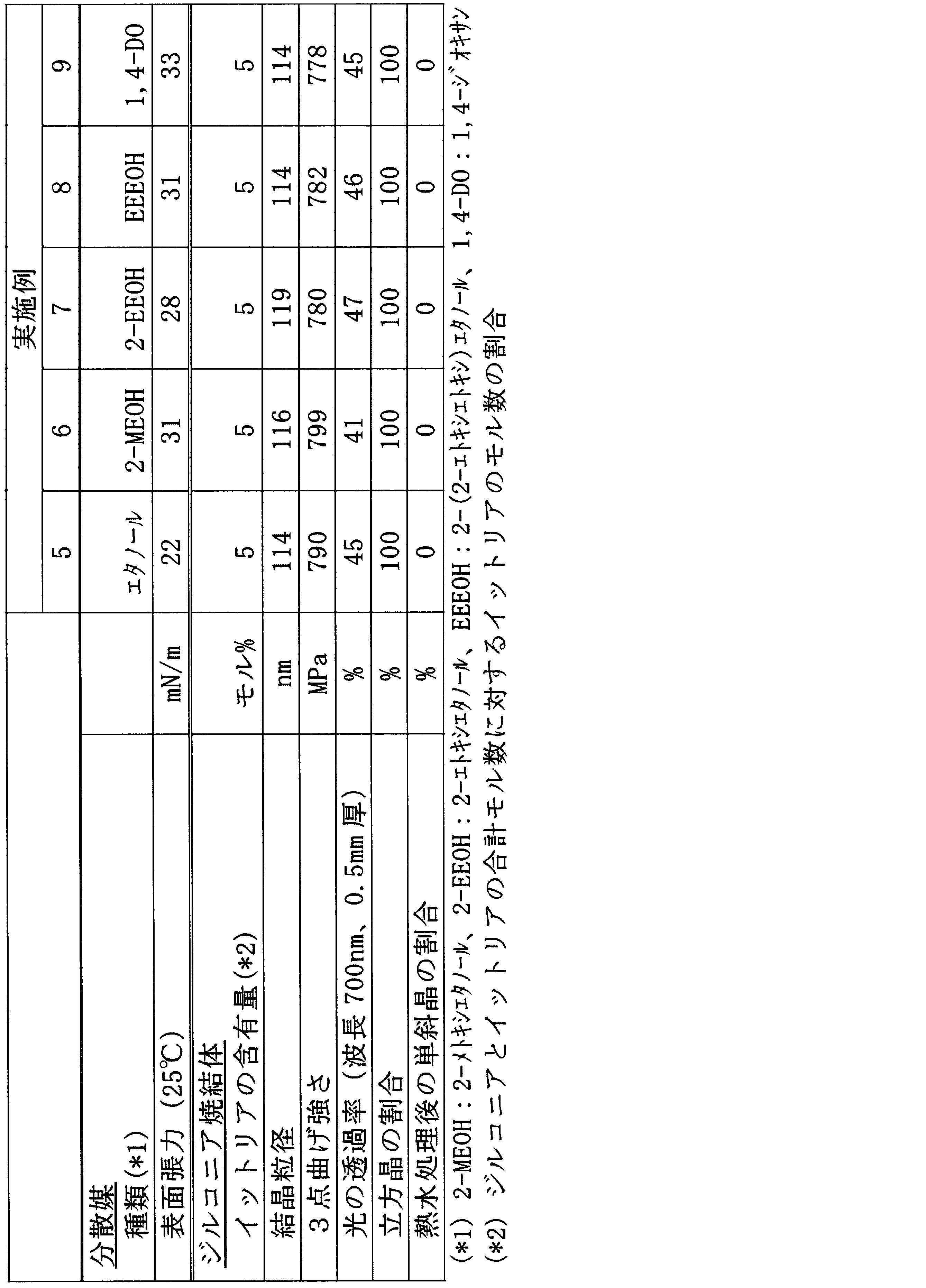
実施例2と同様にして得られたメタノール置換スラリーに対して、硝酸ニッケル(II)水溶液を、ジルコニアの質量に対するニッケル(II)の酸化物(NiO)換算の含有量が0.02質量%となるように添加し、ジルコニア粒子および着色剤を含むスラリーを得た。これを送り量5mL/分、入口温度150℃、出口温度100℃の条件でスプレードライヤー(日本ビュッヒ社製、B-290)を用いて乾燥して、ジルコニア粒子および着色剤を含む粉末を得た。
粉末として上記で得られたものを用いたこと以外は実施例1と同様にして、ジルコニア成形体、ジルコニア仮焼体およびジルコニア焼結体をそれぞれ得た。得られたジルコニア焼結体は赤色に着色していた(蛍光性はなし)。各測定結果を表3に示した。
イットリアを3モル%含む水系のジルコニアスラリー「MELox Nanosize 3Y」(MEL Chemicals社製、ジルコニア粒子の平均一次粒子径13nm、ジルコニア濃度23質量%)100質量部に対して、水酸化ビスマス水溶液を、ジルコニアの質量に対するビスマスの酸化物(Bi2O3)換算の含有量が0.02質量%となるように添加した。続いて分散媒置換操作として、2-エトキシエタノール50質量部を加え、ロータリーエバポレーターを用いて総量100質量部になるように濃縮した。上記分散媒置換操作を4回繰り返して2-エトキシエタノール置換スラリーを得た。この2-エトキシエタノール置換スラリーの残存水分量をカールフィッシャー水分量計を用いて測定したところ0.05質量%であった。
この2-エトキシエタノール置換スラリーを送り量5mL/分、入口温度150℃、出口温度100℃の条件でスプレードライヤー(日本ビュッヒ社製、B-290)を用いて乾燥して、ジルコニア粒子および蛍光剤を含む粉末を得た。
また、上記と同様にして作製したジルコニア仮焼体に対して、ミリング装置(「カタナH-18」、クラレノリタケデンタル株式会社製)を用いて、上顎中切歯単冠形状および下顎第一大臼歯単冠形状のジルコニア仮焼体をそれぞれ切削し、これらを常圧下、1100℃で2時間焼結して、蛍光性を有する歯冠形状の歯科用補綴物をそれぞれ得た。
ジルコニアスラリーとして、イットリアを8モル%含む水系のジルコニアスラリー「MELox Nanosize 8Y」(MEL Chemicals社製、ジルコニア粒子の平均一次粒子径13nm、ジルコニア濃度23質量%)を用いたこと以外は実施例11と同様にして、2-エトキシエタノール置換スラリーを得た。この2-エトキシエタノール置換スラリーの残存水分量をカールフィッシャー水分量計を用いて測定したところ0.04質量%であった。
2-エトキシエタノール置換スラリーとして上記で得られたものを用いたこと以外は実施例11と同様にして、ジルコニア粒子および蛍光剤を含む粉末、ジルコニア成形体、ジルコニア仮焼体およびジルコニア焼結体をそれぞれ得た。得られたジルコニア焼結体は白色であり、また蛍光性を有していた。各測定結果を表3に示した。
イットリアを5モル%含む水系のジルコニアスラリー「MELox Nanosize 5Y」(MEL Chemicals社製、ジルコニア粒子の平均一次粒子径13nm、ジルコニア濃度23質量%)100質量部に対して、硝酸ビスマスの希硝酸溶液を、ジルコニアの質量に対するビスマスの酸化物(Bi2O3)換算の含有量が0.02質量%となるように添加した。続いて分散媒置換操作として、2-エトキシエタノール50質量部を加え、ロータリーエバポレーターを用いて総量100質量部になるように濃縮した。上記分散媒置換操作を4回繰り返して2-エトキシエタノール置換スラリーを得た。この2-エトキシエタノール置換スラリーの残存水分量をカールフィッシャー水分量計を用いて測定したところ0.05質量%であった。
2-エトキシエタノール置換スラリーとして上記で得られたものを用いたこと以外は実施例11と同様にして、ジルコニア粒子および蛍光剤を含む粉末、ジルコニア成形体、ジルコニア仮焼体およびジルコニア焼結体をそれぞれ得た。得られたジルコニア焼結体は白色であり、また蛍光性を有していた。各測定結果を表3に示した。
また、上記と同様にして作製したジルコニア仮焼体に対して、ミリング装置(「カタナH-18」、クラレノリタケデンタル株式会社製)を用いて、上顎中切歯単冠形状および下顎第一大臼歯単冠形状のジルコニア仮焼体をそれぞれ切削し、これらを常圧下、1100℃で2時間焼結して、蛍光性を有する歯冠形状の歯科用補綴物をそれぞれ得た。
実施例2と同様にして得られたメタノール置換スラリーに対して、硝酸ビスマスの希硝酸溶液を、ジルコニアの質量に対するビスマスの酸化物(Bi2O3)換算の含有量が0.02質量%となるように添加し、ジルコニア粒子および蛍光剤を含むスラリーを得た。これを送り量5mL/分、入口温度150℃、出口温度100℃の条件でスプレードライヤー(日本ビュッヒ社製、B-290)を用いて乾燥して、ジルコニア粒子および蛍光剤を含む粉末を得た。
粉末として上記で得られたものを用いたこと以外は実施例1と同様にして、ジルコニア成形体、ジルコニア仮焼体およびジルコニア焼結体をそれぞれ得た。得られたジルコニア焼結体は白色であり、また蛍光性を有していた。各測定結果を表3に示した。
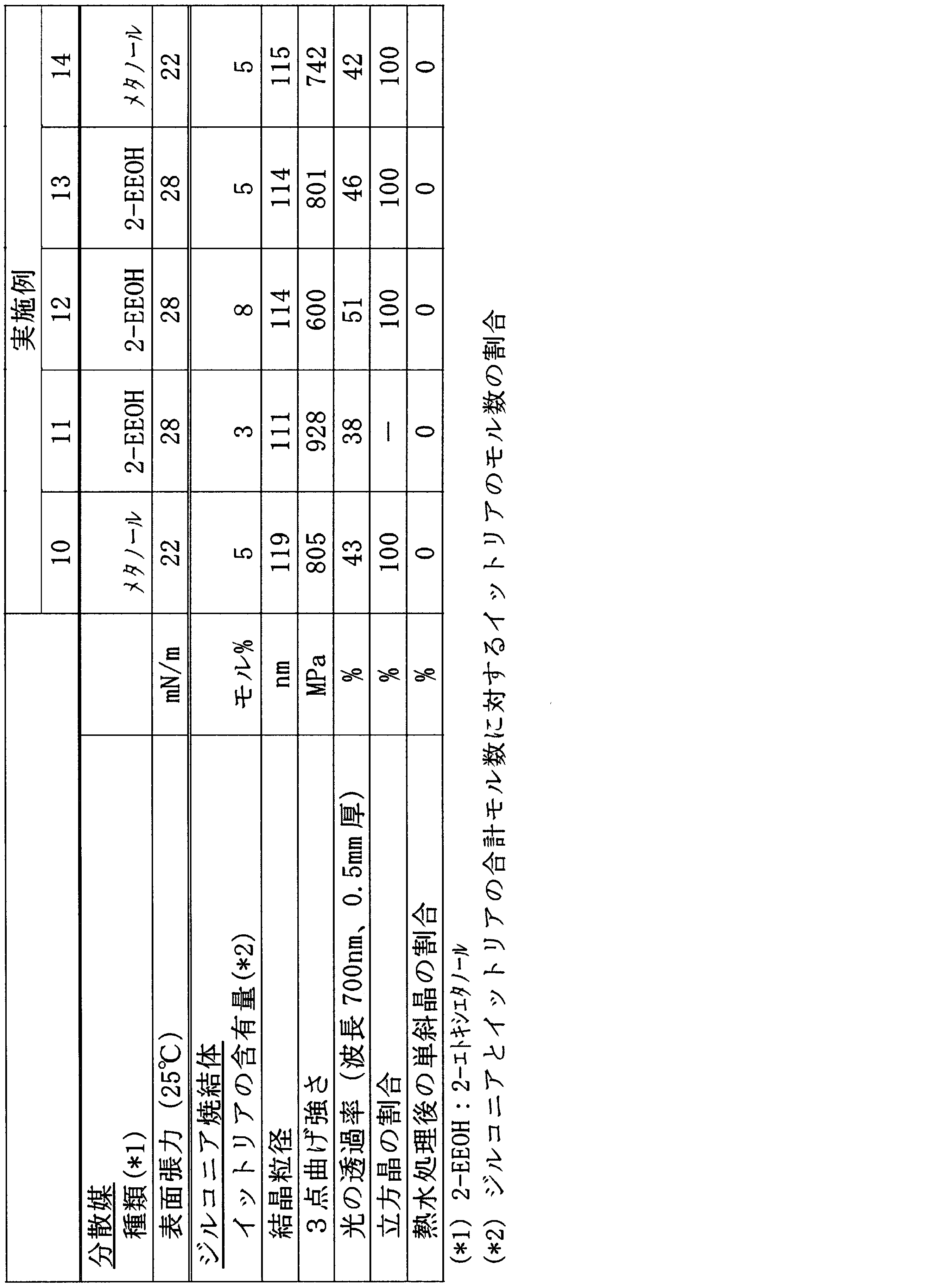
実施例2と同様にして得られたメタノール置換スラリーに対して、ポリビニルアルコール(重合度500)を、ジルコニアの質量に対して2質量%となるように添加し、ジルコニア粒子およびポリビニルアルコールを含むスラリーを得た。これを送り量5mL/分、入口温度150℃、出口温度100℃の条件でスプレードライヤー(日本ビュッヒ社製、B-290)を用いて乾燥して、ジルコニア粒子およびポリビニルアルコールを含む粉末を得た。
粉末として上記で得られたものを用いたこと以外は実施例1と同様にして、ジルコニア成形体、ジルコニア仮焼体およびジルコニア焼結体をそれぞれ得た。得られたジルコニア焼結体は白色であった(蛍光性はなし)。各測定結果を表4に示した。
実施例2と同様にして得られたメタノール置換スラリーに対して、ポリビニルアルコール(重合度500)を、ジルコニアの質量に対して2質量%となるように添加し、さらにポリエチレングリコール(分子量400)を、ジルコニアの質量に対して2質量%となるように添加した。これをビーズミル(メディア材質:ジルコニア、メディア径:φ100μm、メディア量:スラリーの質量の3倍)を用いて、57Hzで5分間分散処理を施して、ジルコニア粒子、ポリビニルアルコールおよびポリエチレングリコールを含むスラリーを得た。これを送り量5mL/分、入口温度150℃、出口温度100℃の条件でスプレードライヤー(日本ビュッヒ社製、B-290)を用いて乾燥して、ジルコニア粒子、ポリビニルアルコールおよびポリエチレングリコールを含む粉末を得た。
粉末として上記で得られたものを用いたこと以外は実施例1と同様にして、ジルコニア成形体、ジルコニア仮焼体およびジルコニア焼結体をそれぞれ得た。得られたジルコニア焼結体は白色であった(蛍光性はなし)。各測定結果を表4に示した。
実施例2と同様にして得られたメタノール置換スラリーに対して、第一工業製薬株式会社製「プライサーフ A219B」(主成分:ポリオキシエチレンラウリルエーテルリン酸エステル)を、ジルコニアの質量に対して2質量%となるように添加した。これをビーズミル(メディア材質:ジルコニア、メディア径:φ100μm、メディア量:スラリーの質量の3倍)を用いて、57Hzで5分間分散処理を施して、ジルコニア粒子および分散剤を含むスラリーを得た。これを送り量5mL/分、入口温度150℃、出口温度100℃の条件でスプレードライヤー(日本ビュッヒ社製、B-290)を用いて乾燥して、ジルコニア粒子および界面活性剤を含む粉末を得た。
粉末として上記で得られたものを用いたこと以外は実施例1と同様にして、ジルコニア成形体、ジルコニア仮焼体およびジルコニア焼結体をそれぞれ得た。得られたジルコニア焼結体は白色であった(蛍光性はなし)。各測定結果を表4に示した。
実施例2と同様にして得られたメタノール置換スラリーに対して、10-メタクリロイルオキシデシルジハイドロジェンホスフェートを、ジルコニアの質量に対して2質量%となるように添加し、200℃で3時間オートクレーブ処理を施して、ジルコニア粒子を含むスラリーを得た。これを送り量5mL/分、入口温度150℃、出口温度100℃の条件でスプレードライヤー(日本ビュッヒ社製、B-290)を用いて乾燥して、ジルコニア粒子を含む粉末を得た。
粉末として上記で得られたものを用いたこと以外は実施例1と同様にして、ジルコニア成形体、ジルコニア仮焼体およびジルコニア焼結体をそれぞれ得た。得られたジルコニア焼結体は白色であった(蛍光性はなし)。各測定結果を表4に示した。
実施例2と同様にして得られたメタノール置換スラリーに対して、γ-メタクリロイルオキシプロピルトリメトキシシランを、ジルコニアの質量に対して2質量%となるように添加し、200℃で3時間オートクレーブ処理を施して、ジルコニア粒子を含むスラリーを得た。これを送り量5mL/分、入口温度150℃、出口温度100℃の条件でスプレードライヤー(日本ビュッヒ社製、B-290)を用いて乾燥して、ジルコニア粒子を含む粉末を得た。
粉末として上記で得られたものを用いたこと以外は実施例1と同様にして、ジルコニア成形体、ジルコニア仮焼体およびジルコニア焼結体をそれぞれ得た。得られたジルコニア焼結体は白色であった(蛍光性はなし)。各測定結果を表4に示した。
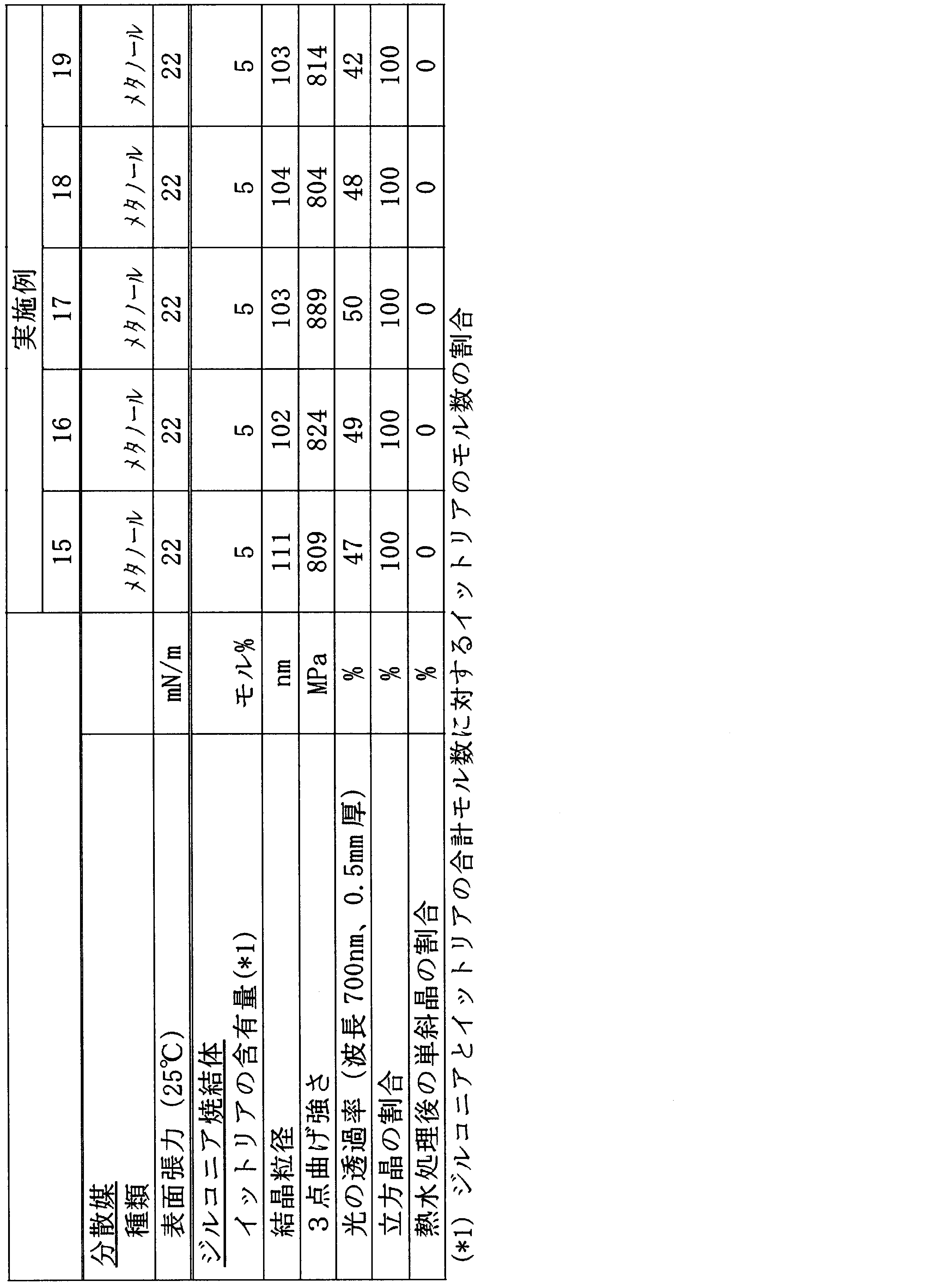
Claims (26)
- ジルコニア粒子を含む粉末の製造方法であって、ジルコニア粒子を含むスラリーを噴霧乾燥する乾燥工程を有し、ジルコニア粒子の平均一次粒子径が30nm以下であり、スラリーの分散媒が、25℃における表面張力が50mN/m以下の液体を含む、製造方法。
- ジルコニア粒子がイットリアを2.0~9.0モル%含む、請求項1に記載の製造方法。
- 分散媒における前記液体の含有量が50質量%以上である、請求項1または2に記載の製造方法。
- 前記液体が、メタノール、エタノール、2-メトキシエタノール、1,4-ジオキサン、2-エトキシエタノールおよび2-(2-エトキシエトキシ)エタノールからなる群より選ばれる少なくとも1種である、請求項1~3のいずれかに記載の製造方法。
- ジルコニア粒子および蛍光剤を含む粉末の製造方法である、請求項1~4のいずれかに記載の製造方法。
- 蛍光剤が金属元素を含み、前記粉末における蛍光剤の含有量がジルコニアの質量に対して金属元素の酸化物換算で0.001~1質量%である、請求項5に記載の製造方法。
- ジルコニア粒子を含むスラリーが蛍光剤を含む、請求項5または6に記載の製造方法。
- 請求項1~7のいずれかに記載の製造方法により得られる粉末。
- ジルコニア粒子を含む粉末であって、ジルコニア粒子の平均一次粒子径が30nm以下であり、一軸プレスして成形した後、圧力170MPaにて冷間等方圧加圧(CIP)処理してジルコニア成形体とし、さらに常圧下、1100℃で2時間焼結した後の3点曲げ強さが400MPa以上であり、一軸プレスして成形した後、圧力170MPaにて冷間等方圧加圧(CIP)処理してジルコニア成形体とし、さらに常圧下、1100℃で2時間焼結した後の厚さ0.5mmにおける波長700nmの光の透過率が40%以上である粉末。
- ジルコニア粒子を成形する成形工程を有するジルコニア成形体の製造方法であって、請求項1~7のいずれかに記載の製造方法により得られる粉末、または、請求項9に記載の粉末を用いる、製造方法。
- 成形工程が、前記粉末をプレス成形する工程である、請求項10に記載の製造方法。
- 成形工程が、ジルコニア粒子および樹脂を含む組成物を成形する工程である、請求項10に記載の製造方法。
- 前記組成物が、前記粉末と樹脂とを混合することにより得られるものである、請求項12に記載の製造方法。
- 成形工程が、ジルコニア粒子および重合性単量体を含む組成物を重合させる工程である、請求項10に記載の製造方法。
- 前記組成物が、前記粉末と重合性組成物とを混合することにより得られるものである、請求項14に記載の製造方法。
- 成形工程が光造形工程である、請求項14または15に記載の製造方法。
- 請求項10~16のいずれかに記載の製造方法により得られるジルコニア成形体。
- 請求項10~16のいずれかに記載の製造方法により得られるジルコニア成形体を仮焼する工程を有する、ジルコニア仮焼体の製造方法。
- 300℃以上900℃未満で仮焼する、請求項18に記載の製造方法。
- 請求項18または19に記載の製造方法により得られるジルコニア仮焼体。
- 請求項10~16のいずれかに記載の製造方法により得られるジルコニア成形体を常圧下で焼結する工程を有する、ジルコニア焼結体の製造方法。
- 900℃以上1200℃以下で焼結する、請求項21に記載の製造方法。
- 請求項18または19に記載の製造方法により得られるジルコニア仮焼体を常圧下で焼結する工程を有する、ジルコニア焼結体の製造方法。
- 900℃以上1200℃以下で焼結する、請求項23に記載の製造方法。
- ジルコニア焼結体が歯科材料である、請求項21~24のいずれかに記載の製造方法。
- 請求項21~25のいずれかに記載の製造方法により得られるジルコニア焼結体。
Priority Applications (6)
| Application Number | Priority Date | Filing Date | Title |
|---|---|---|---|
| JP2019534478A JP7175273B2 (ja) | 2017-07-31 | 2018-07-27 | ジルコニア粒子を含む粉末の製造方法 |
| EP18841309.0A EP3663264A4 (en) | 2017-07-31 | 2018-07-27 | PROCESS FOR MANUFACTURING POWDER CONTAINING ZIRCONIA PARTICLES |
| CN201880050538.XA CN110891903A (zh) | 2017-07-31 | 2018-07-27 | 包含氧化锆颗粒的粉末的制造方法 |
| KR1020207005162A KR102658088B1 (ko) | 2017-07-31 | 2018-07-27 | 지르코니아 입자를 포함하는 분말의 제조 방법 |
| US16/635,201 US11479510B2 (en) | 2017-07-31 | 2018-07-27 | Method for producing zirconia particle-containing powder |
| JP2022124370A JP7447194B2 (ja) | 2017-07-31 | 2022-08-03 | ジルコニア粒子を含む粉末の製造方法 |
Applications Claiming Priority (2)
| Application Number | Priority Date | Filing Date | Title |
|---|---|---|---|
| JP2017147546 | 2017-07-31 | ||
| JP2017-147546 | 2017-07-31 |
Publications (1)
| Publication Number | Publication Date |
|---|---|
| WO2019026811A1 true WO2019026811A1 (ja) | 2019-02-07 |
Family
ID=65233829
Family Applications (1)
| Application Number | Title | Priority Date | Filing Date |
|---|---|---|---|
| PCT/JP2018/028331 Ceased WO2019026811A1 (ja) | 2017-07-31 | 2018-07-27 | ジルコニア粒子を含む粉末の製造方法 |
Country Status (6)
| Country | Link |
|---|---|
| US (1) | US11479510B2 (ja) |
| EP (1) | EP3663264A4 (ja) |
| JP (2) | JP7175273B2 (ja) |
| KR (1) | KR102658088B1 (ja) |
| CN (1) | CN110891903A (ja) |
| WO (1) | WO2019026811A1 (ja) |
Cited By (4)
| Publication number | Priority date | Publication date | Assignee | Title |
|---|---|---|---|---|
| WO2020179876A1 (ja) * | 2019-03-06 | 2020-09-10 | クラレノリタケデンタル株式会社 | 高い直線光透過率を有するジルコニア焼結体 |
| KR20210133275A (ko) * | 2019-03-06 | 2021-11-05 | 쿠라레 노리타케 덴탈 가부시키가이샤 | 단시간에 소성 가능한 지르코니아 성형체 및 가소체 |
| JPWO2022220301A1 (ja) * | 2021-04-16 | 2022-10-20 | ||
| WO2025057923A1 (ja) * | 2023-09-12 | 2025-03-20 | 堺化学工業株式会社 | 酸化ジルコニウム粉体の製造方法、及び、酸化ジルコニウム粉体 |
Families Citing this family (7)
| Publication number | Priority date | Publication date | Assignee | Title |
|---|---|---|---|---|
| DE102016225208B4 (de) * | 2016-12-15 | 2026-01-15 | Ivoclar Vivadent Ag | Ausbrennbares Material auf Polymerbasis für die Lost-Wax Technik |
| CN113105232A (zh) * | 2020-10-10 | 2021-07-13 | 深圳爱尔创口腔技术有限公司 | 氧化锆组合物、氧化锆预烧体及制备方法、氧化锆烧结体及制备方法和氧化锆牙科制品 |
| DE102020129910A1 (de) * | 2020-11-12 | 2022-05-12 | Bundesrepublik Deutschland, vertreten durch den Bundesminister für Wirtschaft und Energie, dieser vertreten durch den Präsidenten der Bundesanstalt für Materialforschung und –prüfung (BAM) | Verfahren zur Überführung suspendierter keramischer Nanopartikel aus einem wässrigen Medium in ein organisches photovernetzbares Medium zum Erlangen eines transparenten keramischen Schlickers mit definierter Nanopartikelgröße |
| WO2022138881A1 (ja) * | 2020-12-24 | 2022-06-30 | クラレノリタケデンタル株式会社 | ジルコニア仮焼体 |
| CN112851374B (zh) * | 2021-01-25 | 2022-09-27 | 上海佰奥聚新材料科技有限公司 | 一种用于纳米氧化锆陶瓷的分散粘结剂组合及其用途 |
| CN113101230A (zh) * | 2021-03-03 | 2021-07-13 | 深圳爱尔创口腔技术有限公司 | 氧化锆组合物、荧光氧化锆及制备方法和氧化锆牙科制品 |
| CN114014651B (zh) * | 2021-09-10 | 2023-10-24 | 王必庆 | 一种水热法生产纳米复合氧化锆粉体的方法 |
Citations (8)
| Publication number | Priority date | Publication date | Assignee | Title |
|---|---|---|---|---|
| JPS6144718A (ja) * | 1984-08-07 | 1986-03-04 | Nippon Shokubai Kagaku Kogyo Co Ltd | ジルコニア微粉末の製造方法 |
| JP2000159621A (ja) | 1998-12-02 | 2000-06-13 | Kuraray Co Ltd | 歯科用光重合性組成物 |
| JP2010514665A (ja) | 2006-12-29 | 2010-05-06 | スリーエム イノベイティブ プロパティズ カンパニー | ジルコニア体及び方法 |
| JP2010222466A (ja) * | 2009-03-23 | 2010-10-07 | Noritake Co Ltd | 蛍光性ジルコニア材料 |
| JP2011073907A (ja) * | 2009-09-29 | 2011-04-14 | World Lab:Kk | ジルコニア焼結体及びその製造方法 |
| WO2012042911A1 (ja) | 2010-09-30 | 2012-04-05 | クラレメディカル株式会社 | 歯科用ミルブランク |
| WO2014126034A1 (ja) | 2013-02-14 | 2014-08-21 | 富士フイルム株式会社 | インクジェット塗布用感光性樹脂組成物、熱処理物及びその製造方法、樹脂パターン製造方法、液晶表示装置、有機el表示装置、タッチパネル及びその製造方法、並びに、タッチパネル表示装置 |
| WO2017057636A1 (ja) * | 2015-09-30 | 2017-04-06 | 株式会社日本触媒 | 酸化ジルコニウムナノ粒子 |
Family Cites Families (11)
| Publication number | Priority date | Publication date | Assignee | Title |
|---|---|---|---|---|
| US4485182A (en) * | 1982-07-28 | 1984-11-27 | Ibiden Kabushiki Kaisha | Powder composition for producing sintered ceramic |
| DE3586115D1 (de) | 1984-08-07 | 1992-07-02 | Nippon Catalytic Chem Ind | Feinteiliges zirkondioxydpulver und herstellungsverfahren. |
| US4939996A (en) * | 1986-09-03 | 1990-07-10 | Coors Porcelain Company | Ceramic munitions projectile |
| US8115326B2 (en) | 2006-11-30 | 2012-02-14 | Corning Incorporated | Flexible substrates having a thin-film barrier |
| JP2012195501A (ja) | 2011-03-17 | 2012-10-11 | Sumitomo Chemical Co Ltd | 薄膜光電変換素子および太陽電池 |
| CN103641472B (zh) * | 2013-11-14 | 2015-04-15 | 厦门惠方生物科技有限公司 | 一种制备着色半透性氧化锆预烧结体的方法 |
| WO2015098765A1 (ja) * | 2013-12-24 | 2015-07-02 | 東ソー株式会社 | 透光性ジルコニア焼結体及びジルコニア粉末、並びにその用途 |
| CN104291832B (zh) * | 2014-09-10 | 2016-01-20 | 济南大学 | 一种三d打印快速成型纳米二氧化锆材料的制备方法 |
| JP6326363B2 (ja) | 2014-12-22 | 2018-05-16 | クラレノリタケデンタル株式会社 | ジルコニア組成物、ジルコニア仮焼体、ジルコニア焼結体及びジルコニア焼結体の製造方法、並びに歯科用製品 |
| CN106431395A (zh) * | 2016-08-31 | 2017-02-22 | 山东国瓷功能材料股份有限公司 | 高透光性氧化锆烧结体及其制备方法与应用 |
| CN106892660A (zh) * | 2017-01-16 | 2017-06-27 | 广东百工新材料科技有限公司 | 一种陶瓷手机后盖及其制备方法 |
-
2018
- 2018-07-27 EP EP18841309.0A patent/EP3663264A4/en active Pending
- 2018-07-27 JP JP2019534478A patent/JP7175273B2/ja active Active
- 2018-07-27 US US16/635,201 patent/US11479510B2/en active Active
- 2018-07-27 CN CN201880050538.XA patent/CN110891903A/zh active Pending
- 2018-07-27 KR KR1020207005162A patent/KR102658088B1/ko active Active
- 2018-07-27 WO PCT/JP2018/028331 patent/WO2019026811A1/ja not_active Ceased
-
2022
- 2022-08-03 JP JP2022124370A patent/JP7447194B2/ja active Active
Patent Citations (8)
| Publication number | Priority date | Publication date | Assignee | Title |
|---|---|---|---|---|
| JPS6144718A (ja) * | 1984-08-07 | 1986-03-04 | Nippon Shokubai Kagaku Kogyo Co Ltd | ジルコニア微粉末の製造方法 |
| JP2000159621A (ja) | 1998-12-02 | 2000-06-13 | Kuraray Co Ltd | 歯科用光重合性組成物 |
| JP2010514665A (ja) | 2006-12-29 | 2010-05-06 | スリーエム イノベイティブ プロパティズ カンパニー | ジルコニア体及び方法 |
| JP2010222466A (ja) * | 2009-03-23 | 2010-10-07 | Noritake Co Ltd | 蛍光性ジルコニア材料 |
| JP2011073907A (ja) * | 2009-09-29 | 2011-04-14 | World Lab:Kk | ジルコニア焼結体及びその製造方法 |
| WO2012042911A1 (ja) | 2010-09-30 | 2012-04-05 | クラレメディカル株式会社 | 歯科用ミルブランク |
| WO2014126034A1 (ja) | 2013-02-14 | 2014-08-21 | 富士フイルム株式会社 | インクジェット塗布用感光性樹脂組成物、熱処理物及びその製造方法、樹脂パターン製造方法、液晶表示装置、有機el表示装置、タッチパネル及びその製造方法、並びに、タッチパネル表示装置 |
| WO2017057636A1 (ja) * | 2015-09-30 | 2017-04-06 | 株式会社日本触媒 | 酸化ジルコニウムナノ粒子 |
Cited By (15)
| Publication number | Priority date | Publication date | Assignee | Title |
|---|---|---|---|---|
| KR102685231B1 (ko) * | 2019-03-06 | 2024-07-15 | 쿠라레 노리타케 덴탈 가부시키가이샤 | 단시간에 소성 가능한 지르코니아 성형체 및 가소체 |
| US12116320B2 (en) | 2019-03-06 | 2024-10-15 | Kuraray Noritake Dental Inc. | Zirconia sintered body having high linear light transmittance |
| KR20210133275A (ko) * | 2019-03-06 | 2021-11-05 | 쿠라레 노리타케 덴탈 가부시키가이샤 | 단시간에 소성 가능한 지르코니아 성형체 및 가소체 |
| JPWO2020179876A1 (ja) * | 2019-03-06 | 2021-12-23 | クラレノリタケデンタル株式会社 | 高い直線光透過率を有するジルコニア焼結体 |
| US20220135486A1 (en) * | 2019-03-06 | 2022-05-05 | Kuraray Noritake Dental Inc. | Zirconia molded body and pre-sintered body capable of being sintered in short time |
| US12145888B2 (en) * | 2019-03-06 | 2024-11-19 | Kuraray Noritake Dental Inc. | Zirconia molded body and pre-sintered body capable of being sintered in short time |
| CN113490653A (zh) * | 2019-03-06 | 2021-10-08 | 可乐丽则武齿科株式会社 | 具有高直线光透射率的氧化锆烧结体 |
| JP2023040099A (ja) * | 2019-03-06 | 2023-03-22 | クラレノリタケデンタル株式会社 | 高い直線光透過率を有するジルコニア焼結体 |
| JP7575441B2 (ja) | 2019-03-06 | 2024-10-29 | クラレノリタケデンタル株式会社 | 高い直線光透過率を有するジルコニア焼結体 |
| WO2020179876A1 (ja) * | 2019-03-06 | 2020-09-10 | クラレノリタケデンタル株式会社 | 高い直線光透過率を有するジルコニア焼結体 |
| EP3936490A4 (en) * | 2019-03-06 | 2022-11-30 | Kuraray Noritake Dental Inc. | ZIRCONIA SINTERED BODY WITH HIGH LINEAR LIGHT TRANSMITTANCE |
| WO2022220301A1 (ja) * | 2021-04-16 | 2022-10-20 | クラレノリタケデンタル株式会社 | ジルコニア成形体、ジルコニア仮焼体及びジルコニア焼結体並びにこれらの製造方法 |
| JPWO2022220301A1 (ja) * | 2021-04-16 | 2022-10-20 | ||
| JP7835737B2 (ja) | 2021-04-16 | 2026-03-25 | クラレノリタケデンタル株式会社 | ジルコニア成形体、ジルコニア仮焼体及びジルコニア焼結体並びにこれらの製造方法 |
| WO2025057923A1 (ja) * | 2023-09-12 | 2025-03-20 | 堺化学工業株式会社 | 酸化ジルコニウム粉体の製造方法、及び、酸化ジルコニウム粉体 |
Also Published As
| Publication number | Publication date |
|---|---|
| US11479510B2 (en) | 2022-10-25 |
| KR102658088B1 (ko) | 2024-04-17 |
| EP3663264A4 (en) | 2021-04-21 |
| JP7447194B2 (ja) | 2024-03-11 |
| US20200369573A1 (en) | 2020-11-26 |
| JP7175273B2 (ja) | 2022-11-18 |
| JPWO2019026811A1 (ja) | 2020-08-06 |
| CN110891903A (zh) | 2020-03-17 |
| KR20200035279A (ko) | 2020-04-02 |
| EP3663264A1 (en) | 2020-06-10 |
| JP2022169576A (ja) | 2022-11-09 |
Similar Documents
| Publication | Publication Date | Title |
|---|---|---|
| JP7447194B2 (ja) | ジルコニア粒子を含む粉末の製造方法 | |
| US11401461B2 (en) | Zirconia sintered body containing fluorescent agent | |
| KR102685231B1 (ko) | 단시간에 소성 가능한 지르코니아 성형체 및 가소체 | |
| JP7061827B2 (ja) | ジルコニア成形体の製造方法 | |
| JP7575441B2 (ja) | 高い直線光透過率を有するジルコニア焼結体 | |
| KR102658087B1 (ko) | 지르코니아 입자 및 형광제를 포함하는 분말의 제조 방법 | |
| JP2019026594A (ja) | ジルコニア成形体の製造方法 | |
| KR20230169209A (ko) | 지르코니아 성형체, 지르코니아 가소체 및 지르코니아 소결체 그리고 이들의 제조 방법 |
Legal Events
| Date | Code | Title | Description |
|---|---|---|---|
| 121 | Ep: the epo has been informed by wipo that ep was designated in this application |
Ref document number: 18841309 Country of ref document: EP Kind code of ref document: A1 |
|
| ENP | Entry into the national phase |
Ref document number: 2019534478 Country of ref document: JP Kind code of ref document: A |
|
| NENP | Non-entry into the national phase |
Ref country code: DE |
|
| ENP | Entry into the national phase |
Ref document number: 20207005162 Country of ref document: KR Kind code of ref document: A |
|
| ENP | Entry into the national phase |
Ref document number: 2018841309 Country of ref document: EP Effective date: 20200302 |