WO2019030106A1 - Protective housing for a sensing device - Google Patents

Protective housing for a sensing device Download PDF

Info

Publication number
WO2019030106A1
WO2019030106A1 PCT/EP2018/070954 EP2018070954W WO2019030106A1 WO 2019030106 A1 WO2019030106 A1 WO 2019030106A1 EP 2018070954 W EP2018070954 W EP 2018070954W WO 2019030106 A1 WO2019030106 A1 WO 2019030106A1
Authority
WO
WIPO (PCT)
Prior art keywords
glass sheet
detection device
range
expressed
glass
Prior art date
Legal status (The legal status is an assumption and is not a legal conclusion. Google has not performed a legal analysis and makes no representation as to the accuracy of the status listed.)
Ceased
Application number
PCT/EP2018/070954
Other languages
French (fr)
Inventor
Yannick Sartenaer
Quentin FRASELLE
Thomas LAMBRICHT
Jean-François NOULET
Sébastien CALIARO
Current Assignee (The listed assignees may be inaccurate. Google has not performed a legal analysis and makes no representation or warranty as to the accuracy of the list.)
AGC Glass Europe SA
Original Assignee
AGC Glass Europe SA
Priority date (The priority date is an assumption and is not a legal conclusion. Google has not performed a legal analysis and makes no representation as to the accuracy of the date listed.)
Filing date
Publication date
Application filed by AGC Glass Europe SA filed Critical AGC Glass Europe SA
Priority to US16/636,870 priority Critical patent/US11668800B2/en
Priority to EP18762766.6A priority patent/EP3665495A1/en
Priority to CN201880063891.1A priority patent/CN111149012B/en
Priority to JP2020506788A priority patent/JP2020530117A/en
Priority to EP25213389.7A priority patent/EP4685122A3/en
Priority to EA202090421A priority patent/EA038514B1/en
Publication of WO2019030106A1 publication Critical patent/WO2019030106A1/en
Anticipated expiration legal-status Critical
Ceased legal-status Critical Current

Links

Classifications

    • GPHYSICS
    • G01MEASURING; TESTING
    • G01SRADIO DIRECTION-FINDING; RADIO NAVIGATION; DETERMINING DISTANCE OR VELOCITY BY USE OF RADIO WAVES; LOCATING OR PRESENCE-DETECTING BY USE OF THE REFLECTION OR RERADIATION OF RADIO WAVES; ANALOGOUS ARRANGEMENTS USING OTHER WAVES
    • G01S7/00Details of systems according to groups G01S13/00, G01S15/00, G01S17/00
    • G01S7/48Details of systems according to groups G01S13/00, G01S15/00, G01S17/00 of systems according to group G01S17/00
    • G01S7/481Constructional features, e.g. arrangements of optical elements
    • G01S7/4811Constructional features, e.g. arrangements of optical elements common to transmitter and receiver
    • G01S7/4813Housing arrangements
    • CCHEMISTRY; METALLURGY
    • C03GLASS; MINERAL OR SLAG WOOL
    • C03CCHEMICAL COMPOSITION OF GLASSES, GLAZES OR VITREOUS ENAMELS; SURFACE TREATMENT OF GLASS; SURFACE TREATMENT OF FIBRES OR FILAMENTS MADE FROM GLASS, MINERALS OR SLAGS; JOINING GLASS TO GLASS OR OTHER MATERIALS
    • C03C17/00Surface treatment of glass, not in the form of fibres or filaments, by coating
    • C03C17/34Surface treatment of glass, not in the form of fibres or filaments, by coating with at least two coatings having different compositions
    • C03C17/3411Surface treatment of glass, not in the form of fibres or filaments, by coating with at least two coatings having different compositions with at least two coatings of inorganic materials
    • CCHEMISTRY; METALLURGY
    • C03GLASS; MINERAL OR SLAG WOOL
    • C03CCHEMICAL COMPOSITION OF GLASSES, GLAZES OR VITREOUS ENAMELS; SURFACE TREATMENT OF GLASS; SURFACE TREATMENT OF FIBRES OR FILAMENTS MADE FROM GLASS, MINERALS OR SLAGS; JOINING GLASS TO GLASS OR OTHER MATERIALS
    • C03C17/00Surface treatment of glass, not in the form of fibres or filaments, by coating
    • C03C17/34Surface treatment of glass, not in the form of fibres or filaments, by coating with at least two coatings having different compositions
    • C03C17/3411Surface treatment of glass, not in the form of fibres or filaments, by coating with at least two coatings having different compositions with at least two coatings of inorganic materials
    • C03C17/3429Surface treatment of glass, not in the form of fibres or filaments, by coating with at least two coatings having different compositions with at least two coatings of inorganic materials at least one of the coatings being a non-oxide coating
    • C03C17/3482Surface treatment of glass, not in the form of fibres or filaments, by coating with at least two coatings having different compositions with at least two coatings of inorganic materials at least one of the coatings being a non-oxide coating comprising silicon, hydrogenated silicon or a silicide
    • CCHEMISTRY; METALLURGY
    • C03GLASS; MINERAL OR SLAG WOOL
    • C03CCHEMICAL COMPOSITION OF GLASSES, GLAZES OR VITREOUS ENAMELS; SURFACE TREATMENT OF GLASS; SURFACE TREATMENT OF FIBRES OR FILAMENTS MADE FROM GLASS, MINERALS OR SLAGS; JOINING GLASS TO GLASS OR OTHER MATERIALS
    • C03C17/00Surface treatment of glass, not in the form of fibres or filaments, by coating
    • C03C17/34Surface treatment of glass, not in the form of fibres or filaments, by coating with at least two coatings having different compositions
    • C03C17/42Surface treatment of glass, not in the form of fibres or filaments, by coating with at least two coatings having different compositions at least one coating of an organic material and at least one non-metal coating
    • CCHEMISTRY; METALLURGY
    • C03GLASS; MINERAL OR SLAG WOOL
    • C03CCHEMICAL COMPOSITION OF GLASSES, GLAZES OR VITREOUS ENAMELS; SURFACE TREATMENT OF GLASS; SURFACE TREATMENT OF FIBRES OR FILAMENTS MADE FROM GLASS, MINERALS OR SLAGS; JOINING GLASS TO GLASS OR OTHER MATERIALS
    • C03C3/00Glass compositions
    • C03C3/04Glass compositions containing silica
    • C03C3/076Glass compositions containing silica with 40% to 90% silica, by weight
    • C03C3/083Glass compositions containing silica with 40% to 90% silica, by weight containing aluminium oxide or an iron compound
    • C03C3/085Glass compositions containing silica with 40% to 90% silica, by weight containing aluminium oxide or an iron compound containing an oxide of a divalent metal
    • C03C3/087Glass compositions containing silica with 40% to 90% silica, by weight containing aluminium oxide or an iron compound containing an oxide of a divalent metal containing calcium oxide, e.g. common sheet or container glass
    • CCHEMISTRY; METALLURGY
    • C03GLASS; MINERAL OR SLAG WOOL
    • C03CCHEMICAL COMPOSITION OF GLASSES, GLAZES OR VITREOUS ENAMELS; SURFACE TREATMENT OF GLASS; SURFACE TREATMENT OF FIBRES OR FILAMENTS MADE FROM GLASS, MINERALS OR SLAGS; JOINING GLASS TO GLASS OR OTHER MATERIALS
    • C03C3/00Glass compositions
    • C03C3/04Glass compositions containing silica
    • C03C3/076Glass compositions containing silica with 40% to 90% silica, by weight
    • C03C3/089Glass compositions containing silica with 40% to 90% silica, by weight containing boron
    • C03C3/091Glass compositions containing silica with 40% to 90% silica, by weight containing boron containing aluminium
    • CCHEMISTRY; METALLURGY
    • C03GLASS; MINERAL OR SLAG WOOL
    • C03CCHEMICAL COMPOSITION OF GLASSES, GLAZES OR VITREOUS ENAMELS; SURFACE TREATMENT OF GLASS; SURFACE TREATMENT OF FIBRES OR FILAMENTS MADE FROM GLASS, MINERALS OR SLAGS; JOINING GLASS TO GLASS OR OTHER MATERIALS
    • C03C4/00Compositions for glass with special properties
    • C03C4/08Compositions for glass with special properties for glass selectively absorbing radiation of specified wave lengths
    • C03C4/082Compositions for glass with special properties for glass selectively absorbing radiation of specified wave lengths for infrared absorbing glass
    • CCHEMISTRY; METALLURGY
    • C03GLASS; MINERAL OR SLAG WOOL
    • C03CCHEMICAL COMPOSITION OF GLASSES, GLAZES OR VITREOUS ENAMELS; SURFACE TREATMENT OF GLASS; SURFACE TREATMENT OF FIBRES OR FILAMENTS MADE FROM GLASS, MINERALS OR SLAGS; JOINING GLASS TO GLASS OR OTHER MATERIALS
    • C03C4/00Compositions for glass with special properties
    • C03C4/10Compositions for glass with special properties for infrared transmitting glass
    • CCHEMISTRY; METALLURGY
    • C03GLASS; MINERAL OR SLAG WOOL
    • C03CCHEMICAL COMPOSITION OF GLASSES, GLAZES OR VITREOUS ENAMELS; SURFACE TREATMENT OF GLASS; SURFACE TREATMENT OF FIBRES OR FILAMENTS MADE FROM GLASS, MINERALS OR SLAGS; JOINING GLASS TO GLASS OR OTHER MATERIALS
    • C03C2217/00Coatings on glass
    • C03C2217/20Materials for coating a single layer on glass
    • C03C2217/21Oxides
    • C03C2217/213SiO2
    • CCHEMISTRY; METALLURGY
    • C03GLASS; MINERAL OR SLAG WOOL
    • C03CCHEMICAL COMPOSITION OF GLASSES, GLAZES OR VITREOUS ENAMELS; SURFACE TREATMENT OF GLASS; SURFACE TREATMENT OF FIBRES OR FILAMENTS MADE FROM GLASS, MINERALS OR SLAGS; JOINING GLASS TO GLASS OR OTHER MATERIALS
    • C03C2217/00Coatings on glass
    • C03C2217/70Properties of coatings
    • C03C2217/73Anti-reflective coatings with specific characteristics
    • C03C2217/732Anti-reflective coatings with specific characteristics made of a single layer
    • CCHEMISTRY; METALLURGY
    • C03GLASS; MINERAL OR SLAG WOOL
    • C03CCHEMICAL COMPOSITION OF GLASSES, GLAZES OR VITREOUS ENAMELS; SURFACE TREATMENT OF GLASS; SURFACE TREATMENT OF FIBRES OR FILAMENTS MADE FROM GLASS, MINERALS OR SLAGS; JOINING GLASS TO GLASS OR OTHER MATERIALS
    • C03C2217/00Coatings on glass
    • C03C2217/70Properties of coatings
    • C03C2217/73Anti-reflective coatings with specific characteristics
    • C03C2217/734Anti-reflective coatings with specific characteristics comprising an alternation of high and low refractive indexes
    • CCHEMISTRY; METALLURGY
    • C03GLASS; MINERAL OR SLAG WOOL
    • C03CCHEMICAL COMPOSITION OF GLASSES, GLAZES OR VITREOUS ENAMELS; SURFACE TREATMENT OF GLASS; SURFACE TREATMENT OF FIBRES OR FILAMENTS MADE FROM GLASS, MINERALS OR SLAGS; JOINING GLASS TO GLASS OR OTHER MATERIALS
    • C03C2217/00Coatings on glass
    • C03C2217/70Properties of coatings
    • C03C2217/75Hydrophilic and oleophilic coatings
    • CCHEMISTRY; METALLURGY
    • C03GLASS; MINERAL OR SLAG WOOL
    • C03CCHEMICAL COMPOSITION OF GLASSES, GLAZES OR VITREOUS ENAMELS; SURFACE TREATMENT OF GLASS; SURFACE TREATMENT OF FIBRES OR FILAMENTS MADE FROM GLASS, MINERALS OR SLAGS; JOINING GLASS TO GLASS OR OTHER MATERIALS
    • C03C2217/00Coatings on glass
    • C03C2217/70Properties of coatings
    • C03C2217/76Hydrophobic and oleophobic coatings
    • CCHEMISTRY; METALLURGY
    • C03GLASS; MINERAL OR SLAG WOOL
    • C03CCHEMICAL COMPOSITION OF GLASSES, GLAZES OR VITREOUS ENAMELS; SURFACE TREATMENT OF GLASS; SURFACE TREATMENT OF FIBRES OR FILAMENTS MADE FROM GLASS, MINERALS OR SLAGS; JOINING GLASS TO GLASS OR OTHER MATERIALS
    • C03C2218/00Methods for coating glass
    • C03C2218/10Deposition methods
    • C03C2218/15Deposition methods from the vapour phase
    • C03C2218/151Deposition methods from the vapour phase by vacuum evaporation
    • GPHYSICS
    • G01MEASURING; TESTING
    • G01SRADIO DIRECTION-FINDING; RADIO NAVIGATION; DETERMINING DISTANCE OR VELOCITY BY USE OF RADIO WAVES; LOCATING OR PRESENCE-DETECTING BY USE OF THE REFLECTION OR RERADIATION OF RADIO WAVES; ANALOGOUS ARRANGEMENTS USING OTHER WAVES
    • G01S7/00Details of systems according to groups G01S13/00, G01S15/00, G01S17/00
    • G01S7/48Details of systems according to groups G01S13/00, G01S15/00, G01S17/00 of systems according to group G01S17/00
    • G01S7/497Means for monitoring or calibrating
    • G01S2007/4975Means for monitoring or calibrating of sensor obstruction by, e.g. dirt- or ice-coating, e.g. by reflection measurement on front-screen
    • G01S2007/4977Means for monitoring or calibrating of sensor obstruction by, e.g. dirt- or ice-coating, e.g. by reflection measurement on front-screen including means to prevent or remove the obstruction

Definitions

  • the invention relates to a detection device comprising a LiDAR sensing device and a protective housing enclosing said sensing device.
  • Said protective housing comprises at least one cover lens. At least a portion of the cover lens is made of at least one glass sheet having an absorption coefficient lower than 5m "1 in the wavelength range from 750 to 1650 nm.
  • Said protective housing provides improved protection against external degradation while maintaining excellent infrared transmission.
  • Infrared-based remote sensing devices such as LiDAR sensing devices
  • LiDAR sensing devices are technologies that measure distance to a target by illuminating that target with a pulsed laser light, and measuring the reflected pulses with a sensor. Differences in laser return times and wavelengths can then be used to make digital 3D- representations of the target.
  • These instruments are commonly used in industrial, consumer and other applications for sensing movement, position, proximity, ambient light, speed, and direction.
  • LiDAR sensing devices have a wide range of applications which can be of airborne and terrestrial type. Airborne LiDAR sensing devices are linked to a flying device such as plane, helicopter, drone, ... Terrestrial applications can be both stationary or mobile. Stationary terrestrial scanning is indeed the most common survey method. Mobile scanning is used onto a moving vehicle to collect data along a path.
  • LiDAR sensing devices are popularly used to make high-resolution maps, with applications in amongst others agriculture for e.g. crop mapping or to apply appropriately costly fertilizer; archeology for e.g. providing an overview of broad, continuous features that may be indistinguishable on the ground; autonomous vehicles, for e.g. obstacle detection and avoidance to navigate safely through environments; atmospheric remote sensing and meteorology; military applications; physics and astronomy e.g. to measure the position of the moon, to produce precise global topographic surveys of planets; robotics for e.g.
  • LiDAR sensing devices play a critical role in this development by providing the required sensory feedback from the vehicles' 360° environment.
  • LiDAR sensing devices are indeed used in very different conditions and environment. The localization of the sensing devices is critical to operate at their best. They need to be located where that can have the largest and most effective overview of the target to be measured. For that reason, LiDAR sensing devices are generally very exposed to the external environment and could be damaged by the external conditions that can be very extreme and harsh. Therefore, is a need to protect LiDAR sensing devices from external degradation.
  • Previous generations of LiDAR sensing devices were based on the emission of one to a few light pulses. In contrast, the new generation of LiDAR is of high resolution, based on the emission and reception of an array of light pulses. These LiDAR sensing devices require very high levels of infrared transmission to map physical features with very high resolution and produce extremely accurate results. Therefore, the new generation of LiDAR sensing devices is much more demanding in terms of optical properties and is therefore not fully compatible with conventional cover lenses of a protective housing.
  • Conventional cover lenses can be made of plastic which provide proper infrared transmission but are very poor in terms of durability. Plastics offer indeed poor resistance to scratches, poor mechanical resistance and chemical durability. Other conventional cover lenses can use special glazings with high infrared transmission and good durability but these are very expensive and complex to produce and cannot be used in large dimensions. Further conventional cover lens are made of regular glass sheet. However, these do not provide the required infrared transmission, especially for the novel generation of LiDARS sensing devices. Therefore, there is a need for a cost effective and simple cover lens providing excellent infrared transmission as well as the required mechanical and chemical resistance to the external environment.
  • the protective housing of the present invention comprising at least one cover lens wherein at least a portion of the cover lens is made of at least one glass sheet having an absorption coefficient lower than 5m 1 in the wavelength range from 750 to 1650nm provides the required high level of infrared transmission as well as the required mechanical resistance and chemical durability to a LiDAR sensing device
  • the present invention concerns a detection device comprising (a) a LiDAR sensing device; (b) a housing enclosing said LiDAR sensing device, and comprising at least one cover lens; characterized in that, at least a portion of the cover lens is made of at least one glass sheet having an absorption coefficient lower than 5 m "1 in the wavelength range from 750 to 1650nm, preferably in the range of 750 to 1050nm, more preferably in the range of 750 to 950nm
  • the present invention further concerns the use of a cover lens made of at least one glass sheet having an absorption coefficient lower than 5 m 1 in the wavelength range comprised between 750 and 1650nm, preferably in the range of 750 to 1050nm, more preferably in the range of 750 to 950nm, to protect a LiDAR sensing device from external degradation.
  • the detection device of the present invention comprises a LiDAR sensing device and a protective housing enclosing said LiDAR sensing device.
  • the protective housing comprises at least a cover lens wherein at least a portion of the cover lens is made of at least one glass sheet having an absorption coefficient lower than 5 m "1 in the wavelength range from 750 to 1650nm.
  • the LiDAR sensing device of the present invention (also written Lidar, LIDAR or LADAR - being the acronym of Light Detection And Ranging) is a technology that measures distance by illuminating a target with an infrared (IR) laser light, and measuring the reflected pulses with a sensor. Distance to the target is determined by recording the time between transmitted and backscattered pulses and by using the speed of light to calculate the distance traveled. It can then be used to make digital 3D-representations of the target.
  • IR infrared
  • LiDARs have a wide range of applications which can be of airborne or terrestrial types. These different types of applications require scanners with varying specifications based on the data's purpose, the size of the area to be captured, the range of measurement desired, the cost of equipment, and more.
  • a LiDAR sensing device is an optoelectronic system which is composed of several major components: (1) at least a laser transmitter. It is preferred that the laser transmitter of the LiDAR sensing device of the present invention transmits principally in infrared wavelength from 700nm to 1mm, preferably in the near infrared wavelength 780nm to 3 ⁇ , more preferably in the wavelength range from 750 to 1650nm; (2) at least a receiver comprising a light collector (telescope or other optics).
  • Several scanning technologies are available such dual oscillating plane mirrors, combination with polygon mirrors and dual axis scanners. Optic choices affect the angular resolution and range that can be detected.
  • a hole mirror or a beam splitter can be used as light collectors.
  • LiDAR sensing devices which are mounted on mobile platforms such as airplanes or satellites, may further require instrumentation to determine their absolute position and orientation and therefore further include a position and/or navigation system.
  • the LiDAR sensing device to be used in the present invention is a new generation LiDAR sensing device based on scanning, rotating, flashing or solid state LiDAR.
  • the scanning or rotating LiDARs are using moving lasers beams while flashing and solid state LiDAR emits light pulses which reflect off objects.
  • the protective housing can be made from any regular material known to make protective housing, such as any suitable metal material (aluminum, ...), plastic material (PVC, PVC coated with polyester, polypropylene HD, polyethylene%) opaque and/or transparent, and combinations thereof.
  • the housing shape will generally be linked to the shape of the LiDAR sensing device for better protection. LiDAR sensing devices can comprise several different parts that can be fixed or rotating. Common LiDARs' shape refers to "mushrooms-like" devices popping up the platform where they are located.
  • the protective housing will comprise at least one cover lens.
  • the housing may comprise two cover lenses, one dedicated to the emission and the other dedicated to the reflection, or more. For avoidance of doubt, visible light is defined as having wavelengths in the range of 400 to 700nm.
  • the glass sheet has an absorption coefficient lower than 5 m "1 in the wavelength range from 750 to 1650 nm.
  • the absorption coefficient is used in the wavelength range from 750 to 1650nm.
  • the absorption coefficient is defined by the ratio between the absorbance and the optical path length traversed by electromagnetic radiation in a given environment. It is expressed in m "1 . It is therefore independent of the thickness of the material but it is function of the wavelength of the absorbed radiation and the chemical nature of the material.
  • the glass sheet according to the invention preferably has an absorption coefficient in the wavelength range of 750 to 1650 nm, generally used in optical technologies relating to the invention, very low compared to conventional glasses ( as the said "clear glass” to which such a coefficient is about 30m "1 order).
  • the glass sheet according to the invention has an absorption coefficient in the wavelength range from 750 to 1650 nm lower than 5
  • the glass sheet has an absorption coefficient of lower than 3 m "1 , or even lower than 2 m "1 and, even more preferably lower than 1 m "1 , or even lower than 0.8 m "1 .
  • the glass sheet has an absorption coefficient of the above mentioned values in the wavelength range of 750 to 1050 nm, preferably from 750 to 950nm.
  • a low absorption presents an additional advantage that the final IR transmission is less impacted by the optical path in the material. It means that for large field of view (FOV) sensors with high aperture angles the intensity perceived at the various angles (in different areas are the image) will be more uniform.
  • FOV field of view
  • the glass sheet is made of glass which may belong to different categories with the particularity of having an absorption coefficient lower than 5 m "1 in the wavelength range from 750 to 1650nm.
  • the glass can thus be a soda- lime-silica type glass, alumino-silicate, boro-silicate, ...
  • the glass sheet having a high level of near infrared radiation transmission is an extra-clear glass.
  • the base glass composition of the invention comprises a total content expressed in weight percentages of glass: Si0 2 55 - 85%
  • the base glass composition comprises according to the invention in a content, expressed as total weight of glass percentages:
  • the at least one glass sheet according to the invention is made of soda-lime glass.
  • the base glass composition comprises a content, expressed as the total weight of glass percentages:
  • the glass may include other components, nature and adapted according to quantity of the desired effect.
  • the glass sheet preferably has a composition which comprises a content, expressed as the total weight of glass percentages:
  • Suitable glass compositions are described in WO2014128016A1 incorporated by reference in the present application, such as the glass sheet composition described herein below.
  • Composition A (% by weight of the composition) u
  • Composition A (% by weight of the composition) 14
  • Composition A (% by weight of the composition) 1.6 Si0 2 68.42
  • the glass sheet has a composition which comprises a content, expressed as the total weight of glass percentages:
  • Such chromium and cobalt based glass compositions showed particularly good performance in terms of infrared reflection while offering interesting possibilities in terms of aesthetics / color (bluish neutrality to intense coloration even up opacity).
  • Suitable glass compositions are described in WO2015091106A1 incorporated by reference in the present application, such as the glass sheet compositions described herein below.
  • Composition A (% by weight of 2J_ 22 23 2A the composition)
  • the glass sheets have a composition which comprises a content, expressed as the total weight of glass percentages: total iron (expressed as Fe 2 0 3 ) 0,02 - 1% Cr 2 0 3 0,002 - 0,5% Co 0,0001 - 0,5%.
  • the composition comprises: 0.06% ⁇ Total Iron ⁇ 1%.
  • compositions based on chromium and cobalt are used to obtain colored glass sheets in the blue-green range, comparable in terms of color and light transmission with blue and green glasses on the market, but with performances particularly good in terms of infrared reflection.
  • Suitable glass compositions are described in WO2016202606A1 incorporated by reference in the present application, such as the glass sheet compositions described herein below.
  • the glass sheet has a composition which comprises a content, expressed as the total weight of glass percentages: total iron (expressed as Fe 2 0 3 ) 0,002 - 1%
  • Such glass compositions based on chromium, cobalt and selenium have shown particularly good performance in terms of infrared reflection, while offering interesting possibilities in terms of aesthetics / color (gray neutral to slight staining intense in the gray-bronze range).
  • Suitable glass compositions are described in WO2016202689 Al incorporated by reference in the present application, such as the glass sheet composition described herein.
  • Composition A (% by 4.1 4.2 4.3 4.4 4.5 weight of the composition)
  • the glass sheet has a composition which comprises a content, expressed as the total weight of glass percentages: total iron (expressed as Fe 2 0 3 ) 0,002 - 0,06%
  • Such suitable glass compositions are described WO2015071456A1 incorporated by reference in the present application, such the glass sheet composition described herein below.
  • Composition B (% by weight of the composition) 1
  • the glass has a composition which comprises a content, expressed as the total weight of glass percentages: total iron (expressed as Fe 2 03) 0,002 - 0,06% ; and one of the following components:
  • Such suitable glass compositions are described in WO2015172983A1 incorporated by reference in the present application, such as the glass sheet compositions described herein below.
  • Composition C (% by 1 2 3
  • the glass sheet of the cover lens within the protective housing may be in the form of planar sheets or may be curved.
  • the glass sheet has a value of light transmission in the visible wavelength range of 400 to 700 nm lower than its value of in the near infrared transmission wavelength range of 750 to 1650 nm.
  • the value of light transmission in the visible range is lower than 10% and the value of near infrared transmission is higher than 50%.
  • the cover lens made of the glass sheet according to the present invention provides the combined required properties of very high infrared transmission required for novel generations of LiDAR sensing devices as well as the required protective properties against external degradation.
  • the cover lens made of the glass sheet according to the present invention provides indeed the required mechanical resistance against deformation, scratching and/or breaking. It provides as well superior chemical durability, as well as UV protection and anti-aging properties. Furthermore, such cover lenses can be processed in a simple and economical way. It allows as well the production and use of lenses with reduced weight as well as of large dimensions.
  • the glass sheet can be coated with at least one IR transparent absorbing (tinted) and/or reflecting coating in order to hide the un-aesthetic element of the sensor from the outside while ensuring a good level of operating performances.
  • This coating may, for example, be composed of at least one layer of a black film or a layer of black paint having no (or very low) transmission in the visible optical range but having a high transparency in the infrared range of interest for the application.
  • such coating would demonstrate a transmission value in the visible optical range of maximum 15%, and a transmission value in the wavelength range from 750 to 1650 nm of at least 85%.
  • Such paint can be made of organic compounds as, for example, commercial products manufactured by Seiko Advance Ltd.
  • the coating may be provided on the external and/or internal face(s) of the cover lens, depending of its durability.
  • the glass sheet may be coated with a multilayer coating optimized to reflect selectively the visible range while maintaining high IR transmission. Some properties such as observed on Kromatix® product are thus sought. These properties ensure a total low IR absorbance of the complete system when such layer is deposited on adequate glass composition.
  • the coating may be provided on the external and/or internal face(s) of the cover lens, depending of its durability.
  • the glass sheet is coated with at least one antireflection layer.
  • An antireflection layer according to the invention may, for example, be a layer based on porous silica having a low refractive index or it may be composed of several layers (stack), in particular a stack of layers of dielectric material alternating layers having low and high refractive indexes and terminating in a layer having a low refractive index.
  • Such coating may be provided on the external and/or internal face of the cover lens.
  • a textured glass sheet may be also used. Etching or coating techniques may as well be used in order to avoid reflection.
  • the reflection of the treated surface would decrease from at least 1% and preferably from at least 2% if both surfaces are coated, within the concerned wavelength range.
  • an antireflection layer according to the invention may, for example, be a layer based on refractive index gradient layer deposited for example by ion implantation technique.
  • a combination of the above cited antireflection layers may be provided on the external and/or internal face of the cover lens.
  • the layers are deposited by PVD (soft coating).
  • PVD soft coating
  • the glass sheet may be coupled with a heating system that allows the cover lens to quickly defrost or defog when the external operating conditions are unfavorable.
  • a heating system can be composed of a network of conductive wires, conductive patch or alternatively a silverprint network directly applied on the glass surface where an adequate power supply can be applied.
  • the system can also comprise a temperature sensor for dynamically triggering the heating function in case of need.
  • the glass sheet may be coated with a hydrophobic layer that prevents water droplets to aggregate onto the cover lens external surface in order to ensure proper sensor operation during rainy conditions.
  • a hydrophobic layer that prevents water droplets to aggregate onto the cover lens external surface in order to ensure proper sensor operation during rainy conditions.
  • Such water repellant coating can be, for example, composed of thin molecular layers of fluoropolymers that reduces the surface energy and provides self-cleanability, anti-stain properties and improved moisture resistance among other effects.
  • Other suitable advantageous functionalities can be added to the glass sheet of the lens cover of the invention, in particular to provide supporting functions to further enhance the good operation of the LiDAR sensing device.
  • Those supporting functions can be for example: the coupling with integrated detection functions for breakage, dirt, stain, rain, ... or additional protection layers for preventing scratches, glare, stain, dirt, paint, ...
  • Dedicated filters could also be integrated for polarization, phase or spectral discrimination.

Landscapes

  • Chemical & Material Sciences (AREA)
  • Engineering & Computer Science (AREA)
  • Life Sciences & Earth Sciences (AREA)
  • Chemical Kinetics & Catalysis (AREA)
  • General Chemical & Material Sciences (AREA)
  • Geochemistry & Mineralogy (AREA)
  • Materials Engineering (AREA)
  • Organic Chemistry (AREA)
  • Computer Networks & Wireless Communication (AREA)
  • Physics & Mathematics (AREA)
  • General Physics & Mathematics (AREA)
  • Radar, Positioning & Navigation (AREA)
  • Remote Sensing (AREA)
  • Glass Compositions (AREA)
  • Optical Radar Systems And Details Thereof (AREA)
  • Optical Filters (AREA)
  • Surface Treatment Of Glass (AREA)
  • Lenses (AREA)

Abstract

The present invention concerns a detection device comprising (a) a LiDAR sensing device; (b) a housing enclosing said LiDAR sensing device, and comprising at least one cover lens; characterized in that, at least a portion of the cover lens is made of at least one glass sheet having an absorption coefficient lower than 5 m-1 in the wavelength range from 750 to 1650nm, preferably in the range of 750 to 1050nm. The present invention further concerns the use of a cover lens made of at least one glass sheet having an absorption coefficient lower than 5 m-1 in the wavelength range comprised between 750 and 1650 nm, preferably in the range of 750 to 1050nm, to protect a LiDAR sensing device from external degradation.

Description

Protective housing for a sensing device
FIELD OF THE INVENTION
The invention relates to a detection device comprising a LiDAR sensing device and a protective housing enclosing said sensing device. Said protective housing comprises at least one cover lens. At least a portion of the cover lens is made of at least one glass sheet having an absorption coefficient lower than 5m"1 in the wavelength range from 750 to 1650 nm. Said protective housing provides improved protection against external degradation while maintaining excellent infrared transmission.
PRIOR ART Infrared-based remote sensing devices, such as LiDAR sensing devices, are technologies that measure distance to a target by illuminating that target with a pulsed laser light, and measuring the reflected pulses with a sensor. Differences in laser return times and wavelengths can then be used to make digital 3D- representations of the target. These instruments are commonly used in industrial, consumer and other applications for sensing movement, position, proximity, ambient light, speed, and direction. LiDAR sensing devices have a wide range of applications which can be of airborne and terrestrial type. Airborne LiDAR sensing devices are linked to a flying device such as plane, helicopter, drone, ... Terrestrial applications can be both stationary or mobile. Stationary terrestrial scanning is indeed the most common survey method. Mobile scanning is used onto a moving vehicle to collect data along a path.
LiDAR sensing devices are popularly used to make high-resolution maps, with applications in amongst others agriculture for e.g. crop mapping or to apply appropriately costly fertilizer; archeology for e.g. providing an overview of broad, continuous features that may be indistinguishable on the ground; autonomous vehicles, for e.g. obstacle detection and avoidance to navigate safely through environments; atmospheric remote sensing and meteorology; military applications; physics and astronomy e.g. to measure the position of the moon, to produce precise global topographic surveys of planets; robotics for e.g. the perception of the environment as well as object classification to enable safe landing of robotic and manned vehicles with a high degree of precision; the combination of airborne and mobile terrestrial LiDAR sensing devices for surveying and mapping, wind farm optimization to e.g. to increase the energy output from wind farms by accurately measuring wind speeds and wind turbulence, solar photovoltaic deployment for e.g. optimizing solar photovoltaic systems at the city level by determining appropriate roof tops and for determining shading losses
In particular, in the field of autonomous vehicles, the current industry trend is to design truly autonomous cars. To approach such self-driving future, the number of sensors in vehicles will increase significantly. LiDAR sensing devices play a critical role in this development by providing the required sensory feedback from the vehicles' 360° environment.
LiDAR sensing devices are indeed used in very different conditions and environment. The localization of the sensing devices is critical to operate at their best. They need to be located where that can have the largest and most effective overview of the target to be measured. For that reason, LiDAR sensing devices are generally very exposed to the external environment and could be damaged by the external conditions that can be very extreme and harsh. Therefore, is a need to protect LiDAR sensing devices from external degradation. Previous generations of LiDAR sensing devices were based on the emission of one to a few light pulses. In contrast, the new generation of LiDAR is of high resolution, based on the emission and reception of an array of light pulses. These LiDAR sensing devices require very high levels of infrared transmission to map physical features with very high resolution and produce extremely accurate results. Therefore, the new generation of LiDAR sensing devices is much more demanding in terms of optical properties and is therefore not fully compatible with conventional cover lenses of a protective housing.
Conventional cover lenses can be made of plastic which provide proper infrared transmission but are very poor in terms of durability. Plastics offer indeed poor resistance to scratches, poor mechanical resistance and chemical durability. Other conventional cover lenses can use special glazings with high infrared transmission and good durability but these are very expensive and complex to produce and cannot be used in large dimensions. Further conventional cover lens are made of regular glass sheet. However, these do not provide the required infrared transmission, especially for the novel generation of LiDARS sensing devices. Therefore, there is a need for a cost effective and simple cover lens providing excellent infrared transmission as well as the required mechanical and chemical resistance to the external environment.
It has been surprisingly found that the protective housing of the present invention comprising at least one cover lens wherein at least a portion of the cover lens is made of at least one glass sheet having an absorption coefficient lower than 5m 1 in the wavelength range from 750 to 1650nm provides the required high level of infrared transmission as well as the required mechanical resistance and chemical durability to a LiDAR sensing device
SUMMARY OF THE INVENTION
The present invention concerns a detection device comprising (a) a LiDAR sensing device; (b) a housing enclosing said LiDAR sensing device, and comprising at least one cover lens; characterized in that, at least a portion of the cover lens is made of at least one glass sheet having an absorption coefficient lower than 5 m"1 in the wavelength range from 750 to 1650nm, preferably in the range of 750 to 1050nm, more preferably in the range of 750 to 950nm The present invention further concerns the use of a cover lens made of at least one glass sheet having an absorption coefficient lower than 5 m 1 in the wavelength range comprised between 750 and 1650nm, preferably in the range of 750 to 1050nm, more preferably in the range of 750 to 950nm, to protect a LiDAR sensing device from external degradation.
DETAILED DESCRIPTION
The detection device of the present invention comprises a LiDAR sensing device and a protective housing enclosing said LiDAR sensing device. The protective housing comprises at least a cover lens wherein at least a portion of the cover lens is made of at least one glass sheet having an absorption coefficient lower than 5 m"1 in the wavelength range from 750 to 1650nm.
The LiDAR sensing device of the present invention (also written Lidar, LIDAR or LADAR - being the acronym of Light Detection And Ranging) is a technology that measures distance by illuminating a target with an infrared (IR) laser light, and measuring the reflected pulses with a sensor. Distance to the target is determined by recording the time between transmitted and backscattered pulses and by using the speed of light to calculate the distance traveled. It can then be used to make digital 3D-representations of the target.
LiDARs have a wide range of applications which can be of airborne or terrestrial types. These different types of applications require scanners with varying specifications based on the data's purpose, the size of the area to be captured, the range of measurement desired, the cost of equipment, and more.
In general, a LiDAR sensing device is an optoelectronic system which is composed of several major components: (1) at least a laser transmitter. It is preferred that the laser transmitter of the LiDAR sensing device of the present invention transmits principally in infrared wavelength from 700nm to 1mm, preferably in the near infrared wavelength 780nm to 3 μιη, more preferably in the wavelength range from 750 to 1650nm; (2) at least a receiver comprising a light collector (telescope or other optics). Several scanning technologies are available such dual oscillating plane mirrors, combination with polygon mirrors and dual axis scanners. Optic choices affect the angular resolution and range that can be detected. A hole mirror or a beam splitter can be used as light collectors. (3) at least a photodetector which converts the light into an electrical signal; and an electronic processing chain signal that extracts the information sought. Two main photodetector technologies are generally used: solid state photodetectors, such as silicon avalanche photodiodes, or photomultipliers. LiDAR sensing devices which are mounted on mobile platforms such as airplanes or satellites, may further require instrumentation to determine their absolute position and orientation and therefore further include a position and/or navigation system.
Preferably, the LiDAR sensing device to be used in the present invention, is a new generation LiDAR sensing device based on scanning, rotating, flashing or solid state LiDAR. The scanning or rotating LiDARs are using moving lasers beams while flashing and solid state LiDAR emits light pulses which reflect off objects.
The protective housing can be made from any regular material known to make protective housing, such as any suitable metal material (aluminum, ...), plastic material (PVC, PVC coated with polyester, polypropylene HD, polyethylene...) opaque and/or transparent, and combinations thereof. The housing shape will generally be linked to the shape of the LiDAR sensing device for better protection. LiDAR sensing devices can comprise several different parts that can be fixed or rotating. Common LiDARs' shape refers to "mushrooms-like" devices popping up the platform where they are located. The protective housing will comprise at least one cover lens. The housing may comprise two cover lenses, one dedicated to the emission and the other dedicated to the reflection, or more. For avoidance of doubt, visible light is defined as having wavelengths in the range of 400 to 700nm.
According to the invention, the glass sheet has an absorption coefficient lower than 5 m"1 in the wavelength range from 750 to 1650 nm. To quantify the low absorption of the glass sheet in the infrared range, in the present description, the absorption coefficient is used in the wavelength range from 750 to 1650nm. The absorption coefficient is defined by the ratio between the absorbance and the optical path length traversed by electromagnetic radiation in a given environment. It is expressed in m"1. It is therefore independent of the thickness of the material but it is function of the wavelength of the absorbed radiation and the chemical nature of the material.
In the case of glass, the absorption coefficient (μ) at a chosen wavelength λ can be calculated from a measurement in transmission (T) as well as the refractive index n of the material (thick = thickness), the values of n, p and T being a function of the chosen wavelength λ:
Figure imgf000007_0001
with p = (n-l)7(n+l)2.
The glass sheet according to the invention preferably has an absorption coefficient in the wavelength range of 750 to 1650 nm, generally used in optical technologies relating to the invention, very low compared to conventional glasses ( as the said "clear glass" to which such a coefficient is about 30m"1 order). In particular, the glass sheet according to the invention has an absorption coefficient in the wavelength range from 750 to 1650 nm lower than 5 Preferably, the glass sheet has an absorption coefficient of lower than 3 m"1, or even lower than 2 m"1 and, even more preferably lower than 1 m"1, or even lower than 0.8 m"1.
According to a preferred embodiment of the present invention, the glass sheet has an absorption coefficient of the above mentioned values in the wavelength range of 750 to 1050 nm, preferably from 750 to 950nm.
A low absorption presents an additional advantage that the final IR transmission is less impacted by the optical path in the material. It means that for large field of view (FOV) sensors with high aperture angles the intensity perceived at the various angles (in different areas are the image) will be more uniform.
According to the invention, the glass sheet is made of glass which may belong to different categories with the particularity of having an absorption coefficient lower than 5 m"1 in the wavelength range from 750 to 1650nm. The glass can thus be a soda- lime-silica type glass, alumino-silicate, boro-silicate, ...
Preferably, the glass sheet having a high level of near infrared radiation transmission is an extra-clear glass.
Preferably, the base glass composition of the invention comprises a total content expressed in weight percentages of glass: Si02 55 - 85%
A1203 0 - 30%
B203 0 - 20%
Na20 0 - 25%
CaO 0 - 20% MgO 0 - 15% Κ20 0 - 20%
BaO 0 - 20%.
More preferably, the base glass composition comprises according to the invention in a content, expressed as total weight of glass percentages:
Figure imgf000009_0001
Na20 0 - 20%
CaO 0 - 15% MgO 0 - 10%
K20 0 - 10%
BaO 0 - 5%
More preferably, for reasons of lower production costs, the at least one glass sheet according to the invention is made of soda-lime glass. Advantageously, according to this embodiment, the base glass composition comprises a content, expressed as the total weight of glass percentages:
Figure imgf000009_0002
CaO 0 - 15%
MgO 0 - 10% Na20 5 - 20%
K20 0 - 10%
BaO 0 - 5%.
In addition to its basic composition, the glass may include other components, nature and adapted according to quantity of the desired effect.
A solution proposed in the invention to obtain a very transparent glass in the near infrared (IR), with weak or no impact on its aesthetic or its color, is to combine in the glass composition a low iron quantity and chromium in a range of specific contents. Thus, according to a first embodiment, the glass sheet preferably has a composition which comprises a content, expressed as the total weight of glass percentages:
Fe total (expressed asFe203) 0,002 - 0,06%
Cr203 0,0001 - 0,06 %. Such glass compositions combining low levels of iron and chromium showed particularly good performance in terms of infrared transmission and show a high transparency in the visible and a little marked tint, near a glass called "extra- clear ".
Suitable glass compositions are described in WO2014128016A1 incorporated by reference in the present application, such as the glass sheet composition described herein below.
Composition A (% by weight of the composition) u
Si02 72
Figure imgf000011_0001
Other suitable glass compositions are described in WO2014 incorporated by reference in the present application, such as the g composition described herein below.
Figure imgf000011_0002
Other suitable glass compositions are described in WO2015011040A1 and WO2015011042A1 incorporated by reference in the present application, such as the glass sheet composition described herein below.
Figure imgf000012_0001
Other suitable glass compositions are described in WO2015011041A1 incorporated by reference in the present application, such as the glass sheet composition described herein below.
Composition A (% by weight of the composition) 14
Si02 60
B203 8
MgO 5
CaO 8
A1203 19
Total Iron expressed in Fe203 lOOppm Total Chromium expressed in Cr203 50ppm
Other suitable glass compositions are described WO2015011043A1 incorporated by reference in the present application, such the glass sheet composition described herein below.
Figure imgf000013_0001
Other suitable glass compositions are described WO2015011044A1 incorporated by reference in the present application, such the glass sheet composition described herein below.
Composition A (% by weight of the composition) 1.6 Si02 68.42
MgO 4.49
K20 14.94
Na20 0.71
CaO 9.32
A1203 1.84
S03 0.27
Total Iron expressed in Fe203 0.01
Total Chromium expressed in Cr203 (ppm) 15-50-100
According to a second embodiment, the glass sheet has a composition which comprises a content, expressed as the total weight of glass percentages:
Fe total (expressed as Fe203) 0,002 - 0,06%
Cr203 0,0015 - 1 %
Co 0,0001 - 1%.
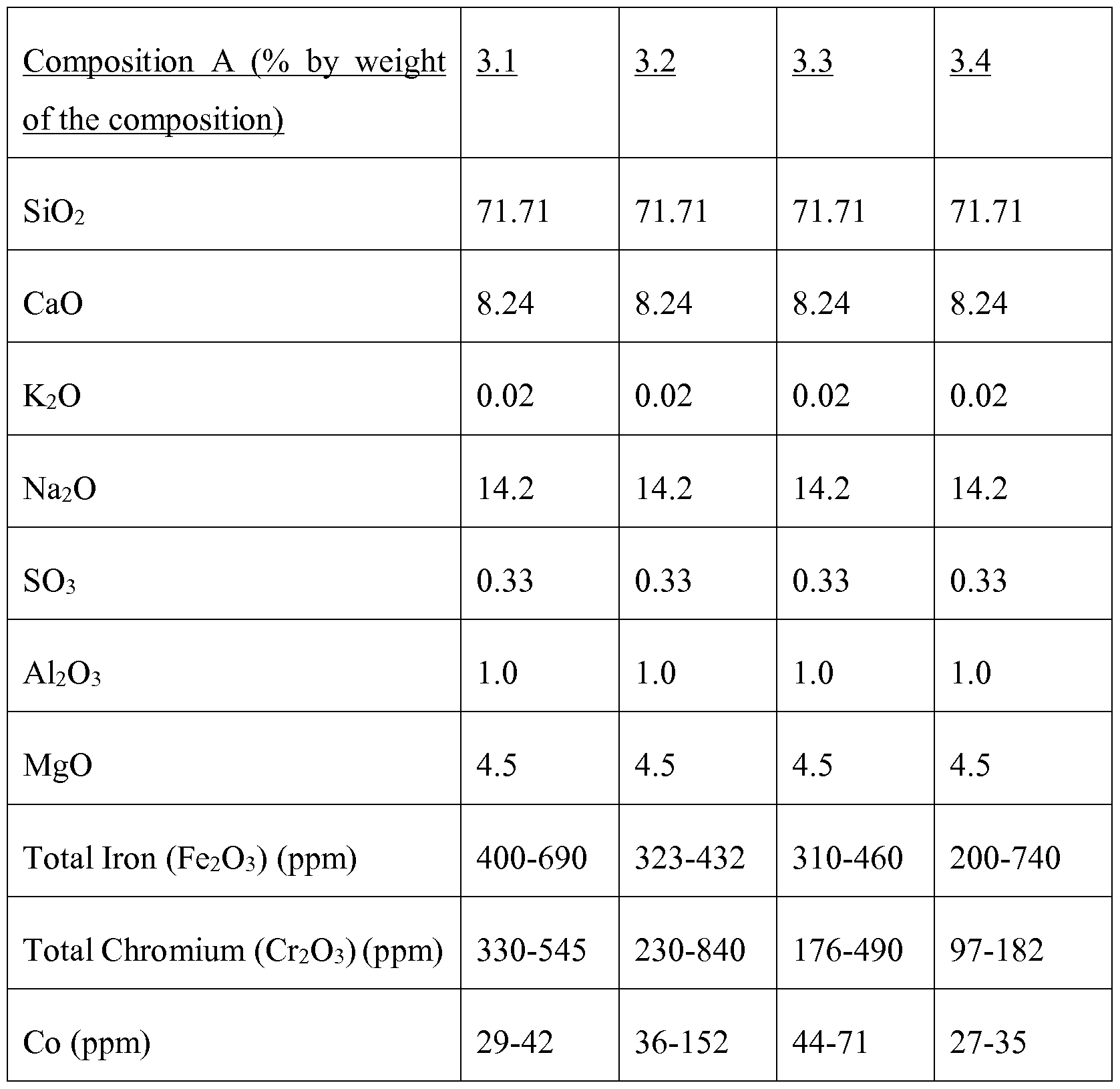
Such chromium and cobalt based glass compositions showed particularly good performance in terms of infrared reflection while offering interesting possibilities in terms of aesthetics / color (bluish neutrality to intense coloration even up opacity). Suitable glass compositions are described in WO2015091106A1 incorporated by reference in the present application, such as the glass sheet compositions described herein below.
Composition A (% by weight of 2J_ 22 23 2A the composition)
Si02 71.71 71.71 71.71 71.71
CaO 8.24 8.24 8.24 8.24
K20 0.02 0.02 0.02 0.02
Na20 14.2 14.2 14.2 14.2
S03 0.33 0.33 0.33 0.33
A1203 1.0 1.0 1.0 1.0
MgO 4.5 4.5 4.5 4.5
Total Iron expressed in Fe203 125 ppm 86 ppm 92 ppm 82 ppm
Total Chromium expressed Cr203 44ppm 65 ppm 6882 ppm 5070ppm
Co 3.5ppm 41 ppm 651 ppm 5169ppm
According to a third embodiment, the glass sheets have a composition which comprises a content, expressed as the total weight of glass percentages: total iron (expressed as Fe203) 0,02 - 1% Cr203 0,002 - 0,5% Co 0,0001 - 0,5%.
Preferably, according to this embodiment, the composition comprises: 0.06% <Total Iron <1%.
Such compositions based on chromium and cobalt are used to obtain colored glass sheets in the blue-green range, comparable in terms of color and light transmission with blue and green glasses on the market, but with performances particularly good in terms of infrared reflection. Suitable glass compositions are described in WO2016202606A1 incorporated by reference in the present application, such as the glass sheet compositions described herein below.
Figure imgf000016_0001
According to a fourth embodiment, the glass sheet has a composition which comprises a content, expressed as the total weight of glass percentages: total iron (expressed as Fe203) 0,002 - 1%
Cr203 0,001 - 0,5% Co 0,0001 - 0,5%.
Se 0,0003 - 0,5%.
Such glass compositions based on chromium, cobalt and selenium have shown particularly good performance in terms of infrared reflection, while offering interesting possibilities in terms of aesthetics / color (gray neutral to slight staining intense in the gray-bronze range). Suitable glass compositions are described in WO2016202689 Al incorporated by reference in the present application, such as the glass sheet composition described herein.
Composition A (% by 4.1 4.2 4.3 4.4 4.5 weight of the composition)
Si02 71.71 71.71 71.71 71.71 71.71
CaO 8.24 8.24 8.24 8.24 8.24
K20 0.02 0.02 0.02 0.02 0.02
Na20 14.2 14.2 14.2 14.2 14.2
S03 0.33 0.33 0.33 0.33 0.33
A1203 1.0 1.0 1.0 1.0 1.0
MgO 4.5 4.5 4.5 4.5 4.5
Total Iron (Fe203) (ppm) 200-431 670-690 206-400 750 480
Total Chromium (Cr203) 133-288 460-800 137-200 111 167-168 (ppm)
Co (ppm) 68-70 204-215 45-38 36 44-45
Se (ppm) 200-468 256-560 341-566 74 48-53 Ni (ppm) 0-56 0-656 0-41 0 0
According to a first alternative embodiment, the glass sheet has a composition which comprises a content, expressed as the total weight of glass percentages: total iron (expressed as Fe203) 0,002 - 0,06%
Ce02 0,001 - 1%.
Such suitable glass compositions are described WO2015071456A1 incorporated by reference in the present application, such the glass sheet composition described herein below.
Composition B (% by weight of the composition) 1
Si02 72
CaO 8.2
K20 0.01
Na20 14
S03 0.3
A1203 1.0
MgO 4.5
Fe203 (ppm) 100
Ce02 (ppm) 85-670-4600 According to another alternative embodiment, the glass has a composition which comprises a content, expressed as the total weight of glass percentages: total iron (expressed as Fe203) 0,002 - 0,06% ; and one of the following components:
- manganese (calculated as MnO) in an amount ranging from 0.01 to 1% by weight;
- antimony (expressed as Sb203), in an amount ranging from 0.01 to 1% by weight;
- arsenic (expressed as AS2O3), in an amount ranging from 0.01 to 1% by weight, or
- copper (expressed as CuO), in an amount ranging from 0.0002 to 0.1%> by weight.
Such suitable glass compositions are described in WO2015172983A1 incorporated by reference in the present application, such as the glass sheet compositions described herein below.
Composition C (% by 1 2 3
weight of the composition)
Si02 72 72 72
CaO 8.2 8.2 8.2
K20 0.01 0.01 0.01
Na20 14 14 14
Figure imgf000020_0001
CuO (ppm) 0 0 65-80
According to the present invention, the glass sheet of the cover lens within the protective housing, may be in the form of planar sheets or may be curved.
According to one embodiment of the present invention, the glass sheet has a value of light transmission in the visible wavelength range of 400 to 700 nm lower than its value of in the near infrared transmission wavelength range of 750 to 1650 nm. Particularly, according to another embodiment of the present invention, the value of light transmission in the visible range is lower than 10% and the value of near infrared transmission is higher than 50%.
It has been found that the cover lens made of the glass sheet according to the present invention provides the combined required properties of very high infrared transmission required for novel generations of LiDAR sensing devices as well as the required protective properties against external degradation. The cover lens made of the glass sheet according to the present invention provides indeed the required mechanical resistance against deformation, scratching and/or breaking. It provides as well superior chemical durability, as well as UV protection and anti-aging properties. Furthermore, such cover lenses can be processed in a simple and economical way. It allows as well the production and use of lenses with reduced weight as well as of large dimensions.
It can be advantageous to add one or more of the useful functionalities to the glass sheet of the cover lens of the present invention.
According to an advantageous embodiment of the invention, the glass sheet can be coated with at least one IR transparent absorbing (tinted) and/or reflecting coating in order to hide the un-aesthetic element of the sensor from the outside while ensuring a good level of operating performances. This coating may, for example, be composed of at least one layer of a black film or a layer of black paint having no (or very low) transmission in the visible optical range but having a high transparency in the infrared range of interest for the application. Preferably, such coating would demonstrate a transmission value in the visible optical range of maximum 15%, and a transmission value in the wavelength range from 750 to 1650 nm of at least 85%. Such paint can be made of organic compounds as, for example, commercial products manufactured by Seiko Advance Ltd. Or Teikoku Printing Ink Mfg. Co. Ltd. that can achieve transmission < 5 % in the 400-750 nm range and > 70% in the 850-950 nm range. The coating may be provided on the external and/or internal face(s) of the cover lens, depending of its durability. According to another embodiment of the invention, the glass sheet may be coated with a multilayer coating optimized to reflect selectively the visible range while maintaining high IR transmission. Some properties such as observed on Kromatix® product are thus sought. These properties ensure a total low IR absorbance of the complete system when such layer is deposited on adequate glass composition. The coating may be provided on the external and/or internal face(s) of the cover lens, depending of its durability.
According to another advantageous embodiment of the invention, the glass sheet is coated with at least one antireflection layer. An antireflection layer according to the invention may, for example, be a layer based on porous silica having a low refractive index or it may be composed of several layers (stack), in particular a stack of layers of dielectric material alternating layers having low and high refractive indexes and terminating in a layer having a low refractive index. Such coating may be provided on the external and/or internal face of the cover lens. A textured glass sheet may be also used. Etching or coating techniques may as well be used in order to avoid reflection. Preferably, the reflection of the treated surface would decrease from at least 1% and preferably from at least 2% if both surfaces are coated, within the concerned wavelength range.
According to another embodiment of the invention, an antireflection layer according to the invention may, for example, be a layer based on refractive index gradient layer deposited for example by ion implantation technique.
According to another embodiment of the invention, a combination of the above cited antireflection layers may be provided on the external and/or internal face of the cover lens. Preferably, the layers are deposited by PVD (soft coating). Thus, it may be possible to have a reflective coating in visible range, which also presents anti-reflective capability in IR range.
According to another advantageous embodiment of the invention, the glass sheet may be coupled with a heating system that allows the cover lens to quickly defrost or defog when the external operating conditions are unfavorable. Such heating system can be composed of a network of conductive wires, conductive patch or alternatively a silverprint network directly applied on the glass surface where an adequate power supply can be applied. Optionally, the system can also comprise a temperature sensor for dynamically triggering the heating function in case of need.
According to another advantageous embodiment of the invention, the glass sheet may be coated with a hydrophobic layer that prevents water droplets to aggregate onto the cover lens external surface in order to ensure proper sensor operation during rainy conditions. Such water repellant coating can be, for example, composed of thin molecular layers of fluoropolymers that reduces the surface energy and provides self-cleanability, anti-stain properties and improved moisture resistance among other effects. Other suitable advantageous functionalities can be added to the glass sheet of the lens cover of the invention, in particular to provide supporting functions to further enhance the good operation of the LiDAR sensing device. Those supporting functions can be for example: the coupling with integrated detection functions for breakage, dirt, stain, rain, ... or additional protection layers for preventing scratches, glare, stain, dirt, paint, ... Dedicated filters could also be integrated for polarization, phase or spectral discrimination.

Claims

1. A detection device comprising: a. a LiDAR sensing device; b. a protective housing enclosing said LiDAR sensing device, and comprising at least one cover lens; characterized in that, at least a portion of the cover lens is made of at least one glass sheet having an absorption coefficient lower than 5 m"1 in the wavelength range from 750 to 1650nm, preferably in the range of 750 to 1050nm, more preferably in the range of 750 to 950nm.
2. A detection device according to claim 1, wherein said glass sheet has an absorption coefficient lower than 1 m"1 in the wavelength range from 750 to 1650nm, preferably in the range of 750 to 1050nm, more preferably in the range of 750 to 950nm.
3. A detection device according to claim 1 or 2, wherein the value of light transmission of said glass sheet in the visible wavelength range of 400 to 700 nm is lower than its value of in the near infrared transmission wavelength range of 750 to 1650 nm.
4. A detection device according to anyone of the preceding claims, wherein said glass sheet comprises a content, expressed as the total weight of glass percentages of :
Figure imgf000024_0001
A1203 0 - 30%
B203 0 - 20%
Na20 0 - 25%
CaO 0 - 20%
MgO 0 - 15% Κ20 0 - 20%
BaO 0 - 20%
Total iron (expressed as Fe203) 0.002 - 0.06%
Cr203 0.0001 - 0.06%.
5. A detection device according to anyone of the preceding claims 1 to 3, wherein said glass sheet comprises a content, expressed as the total weight of glass percentages of:
Si02 55 - 85%
Figure imgf000025_0001
Na20 0 - 25%
CaO 0 - 20%
MgO 0 - 15%
K20 0 - 20%
BaO 0 - 20%.
Total iron (expressed as Fe203) 0.002 - 0.06%
Cr203 0.0015 - 1%
Co 0.0001 - 1%.
6. A detection device according to anyone of the
3, wherein said glass sheet comprises a content, expressed ;
glass percentages of:
Si02 55 - 85%
Figure imgf000025_0002
Na20 0 - 25%
CaO 0 - 20%
MgO 0 - 15%
K20 0 - 20%
BaO 0 - 20%.
Total iron (expressed as Fe203) 0.02 - 1% Cr203 0.002 - 0.5%
Co 0.0001 - 0.5%.
7. A detection device according to anyone of the preceding claims 1 to 3, wherein said glass sheet comprises a content, expressed as the total weight of glass percentages of:
Si02 55 - 85%
A1203 0 - 30%
B203 0 - 20%
Na20 0 - 25%
CaO 0 - 20%
MgO 0 - 15%
K20 0 - 20%
BaO 0 - 20%.
total iron (expressed as Fe203) 0.002 - 1%
Cr203 0.001 - 0.5%
Co 0.0001 - 0.5%
Se 0.0003 -
8. A detection device according to anyone of the preceding claims, wherein said glass sheet is coated with at least one near-infrared transparent layer that absorbs and/or reflects the visible light, wherein said layer is preferably a layer of black film or layer of black paint having a transmission value in the visible optical range of maximum 15%, and a transmission value in the wavelength range from 750 to 1650 nm of at least 85%.
9. A detection device according to anyone of the preceding claims, wherein said glass sheet is coated with at least one antireflection layer, preferably selected from the group consisting of a layer based on porous silica having a low refractive index, several layers of dielectric material alternating layers having low and high refractive indexes and terminating in a layer having a low refractive index and mixtures thereof.
10. A detection device according to anyone of the preceding claims wherein said glass sheet is coupled with a heating system, preferably selected from a network of conductive wires, conductive patch, a silverprint network and combinations thereof.
11. A detection device according to anyone of the preceding claims wherein said glass sheet is coated with a hydrophobic layer, preferably thin molecular layers of fluoropolymers.
12. A detection device according to anyone of the preceding claims wherein the LIDAR sensing device is a scanning, rotating, flashing or solid state LiDAR device enabling of 3D mapping, and emitting a laser beam of wavelength ranging between 750 and 1650 nm.
13. The use of a cover lens made of at least one glass sheet having an absorption coefficient lower than 5 m"1 in the wavelength range comprised between 750 and 1650nm, preferably in the range of 750 to 1050nm, more preferably in the range of 750 to 950nm to protect a LiDAR sensing device from external degradation.
PCT/EP2018/070954 2017-08-07 2018-08-02 Protective housing for a sensing device Ceased WO2019030106A1 (en)

Priority Applications (6)

Application Number Priority Date Filing Date Title
US16/636,870 US11668800B2 (en) 2017-08-07 2018-08-02 Protective housing for a sensing device
EP18762766.6A EP3665495A1 (en) 2017-08-07 2018-08-02 Protective housing for a sensing device
CN201880063891.1A CN111149012B (en) 2017-08-07 2018-08-02 Protective housing for a sensing device
JP2020506788A JP2020530117A (en) 2017-08-07 2018-08-02 Protective housing for sensing devices
EP25213389.7A EP4685122A3 (en) 2017-08-07 2018-08-02 Protective housing for a sensing device
EA202090421A EA038514B1 (en) 2017-08-07 2018-08-02 Detection device

Applications Claiming Priority (2)

Application Number Priority Date Filing Date Title
EP17185156 2017-08-07
EP17185156.1 2017-08-07

Publications (1)

Publication Number Publication Date
WO2019030106A1 true WO2019030106A1 (en) 2019-02-14

Family

ID=59558334

Family Applications (1)

Application Number Title Priority Date Filing Date
PCT/EP2018/070954 Ceased WO2019030106A1 (en) 2017-08-07 2018-08-02 Protective housing for a sensing device

Country Status (7)

Country Link
US (1) US11668800B2 (en)
EP (2) EP4685122A3 (en)
JP (1) JP2020530117A (en)
CN (1) CN111149012B (en)
DE (1) DE202018007030U1 (en)
EA (1) EA038514B1 (en)
WO (1) WO2019030106A1 (en)

Cited By (17)

* Cited by examiner, † Cited by third party
Publication number Priority date Publication date Assignee Title
WO2019161261A1 (en) * 2018-02-19 2019-08-22 Corning Incorporated Lidar cover with laminate glasses
WO2020216733A1 (en) 2019-04-26 2020-10-29 Agc Glass Europe Protective housing for a sensing device
WO2021009347A1 (en) * 2019-07-18 2021-01-21 Agc Glass Europe Glass for autonomous car
US10901071B2 (en) * 2018-08-29 2021-01-26 Robert Bosch Gmbh Device and method for manufacturing a device
EP3769960A1 (en) 2019-07-23 2021-01-27 Schott AG Curved glass window for lidar applications
DE102019128217B3 (en) * 2019-10-18 2021-04-01 Automotive Lighting Reutlingen Gmbh Optical device for a motor vehicle
CN113003934A (en) * 2019-12-20 2021-06-22 肖特股份有限公司 Optical member and glass composition and use thereof
CN113966476A (en) * 2019-04-05 2022-01-21 旭硝子欧洲玻璃公司 Lidar assembly for motor traffic applications comprising an anti-reflection unit
EP3629675B1 (en) 2018-09-25 2022-02-09 Aptiv Technologies Limited Object sensor including deposited heater
CN114174857A (en) * 2019-06-04 2022-03-11 罗伯特·博世有限公司 Laser radar apparatus
WO2022080105A1 (en) * 2020-10-13 2022-04-21 日本板硝子株式会社 Optical filter, optical device, and light-absorbing composition
JP2022535392A (en) * 2019-06-05 2022-08-08 コーニング インコーポレイテッド Cured optical windows for LiDAR applications at 850-950 nm
EP4215499A1 (en) 2022-01-19 2023-07-26 Schott Ag Optical component and glass composition as well as use thereof
WO2023242128A1 (en) 2022-06-13 2023-12-21 Agc Glass Europe Calibration method for an automotive glazing
WO2024246056A1 (en) * 2023-05-31 2024-12-05 Agc Glass Europe Porous antireflective coating for a near-infrared sensor cover
US12287503B2 (en) 2019-04-18 2025-04-29 Nippon Sheet Glass Company, Limited Light-absorbing composition and optical filter
EP4428107A4 (en) * 2021-12-24 2025-05-07 Fuyao Glass Industry Group Co., Ltd. GLASS, GLASS ARRANGEMENT AND VEHICLE

Families Citing this family (6)

* Cited by examiner, † Cited by third party
Publication number Priority date Publication date Assignee Title
JP2022516424A (en) * 2018-12-21 2022-02-28 エージーシー グラス ユーロップ LIDAR detector with removable protective layer
US12497323B2 (en) * 2019-04-03 2025-12-16 Agc Glass Europe Glass sheet with high near-IR transmission and very low visible transmission
US20200369002A1 (en) * 2019-05-22 2020-11-26 GM Global Technology Operations LLC Sensor Applique With Ultra Violet Curable Pressure Sensitive Adhesive
JP2023526119A (en) * 2020-05-25 2023-06-20 エージーシー グラス ユーロップ Detector baffle for automotive vehicles
CN112876066B (en) * 2020-06-30 2022-04-15 成都光明光电股份有限公司 Environment-friendly glass material
EP4303626A1 (en) * 2022-07-05 2024-01-10 AGC Glass Europe Drone detection device

Citations (16)

* Cited by examiner, † Cited by third party
Publication number Priority date Publication date Assignee Title
DE102008054785A1 (en) * 2008-12-17 2010-06-24 Robert Bosch Gmbh Receiver lens system and optical rangefinder
DE102011122345A1 (en) * 2011-12-23 2013-06-27 Valeo Schalter Und Sensoren Gmbh Optical measuring device and method for producing a cover for a housing of an optical measuring device
WO2014128016A1 (en) 2013-02-19 2014-08-28 Agc Glass Europe Glass sheet with a high level of infrared radiation transmission
WO2014180679A1 (en) 2013-05-07 2014-11-13 Agc Glass Europe Sheet of glass with high infrared radiation transmission
WO2015011044A1 (en) 2013-07-24 2015-01-29 Agc Glass Europe High infrared transmission glass sheet
WO2015011042A1 (en) 2013-07-24 2015-01-29 Agc Glass Europe High infrared transmission glass sheet
WO2015011043A1 (en) 2013-07-24 2015-01-29 Agc Glass Europe High infrared transmission glass sheet
WO2015011041A1 (en) 2013-07-24 2015-01-29 Agc Glass Europe High infrared transmission glass sheet
WO2015011040A1 (en) 2013-07-24 2015-01-29 Agc Glass Europe High infrared transmission glass sheet
US20150029487A1 (en) * 2013-07-29 2015-01-29 Mitsuru Nakajima Detection apparatus and vehicle
WO2015071456A1 (en) 2013-11-18 2015-05-21 Agc Glass Europe Glass sheet having a high transmission in the infrared
WO2015091106A1 (en) 2013-12-19 2015-06-25 Agc Glass Europe Glass sheet having high transmission of infrared radiation
KR20150127156A (en) * 2013-03-20 2015-11-16 에이쥐씨 글래스 유럽 Glass sheet having high infrared radiation transmission
WO2015172983A1 (en) 2014-05-12 2015-11-19 Agc Glass Europe Glass sheet having a high transmission in the infrared
WO2016202606A1 (en) 2015-06-18 2016-12-22 Agc Glass Europe Glass sheet having high transmission of infrared radiation
WO2016202689A1 (en) 2015-06-18 2016-12-22 Agc Glass Europe Glass sheet having high transmission of infrared radiation

Family Cites Families (12)

* Cited by examiner, † Cited by third party
Publication number Priority date Publication date Assignee Title
JPH09311181A (en) * 1996-05-23 1997-12-02 Denso Corp Vehicle radar device
JP2006194639A (en) * 2005-01-11 2006-07-27 Denso Corp Radar equipment
US8629977B2 (en) * 2010-04-14 2014-01-14 Digital Ally, Inc. Traffic scanning LIDAR
JP2013525955A (en) * 2010-04-16 2013-06-20 フレックス ライティング 2,エルエルシー Lighting device with film-based light guide
WO2013120540A1 (en) * 2012-02-16 2013-08-22 Telefonaktiebolaget L M Ericsson (Publ) Packet network traffic flow effective bandwidth estimation apparatus and method
BE1020610A3 (en) * 2012-04-04 2014-01-07 Agc Glass Europe GLASS SHEET WITH HIGH ENERGY TRANSMISSION.
TWI576617B (en) * 2012-07-16 2017-04-01 唯亞威方案公司 Optical filter and sensor system
US9069080B2 (en) * 2013-05-24 2015-06-30 Advanced Scientific Concepts, Inc. Automotive auxiliary ladar sensor
US9921307B2 (en) * 2015-01-30 2018-03-20 Toyota Motor Engineering & Manufacturing North America, Inc. Combined RADAR sensor and LIDAR sensor processing
DE102015217910A1 (en) * 2015-09-18 2017-03-23 Robert Bosch Gmbh Lidar sensor with optical filter
US10209709B2 (en) * 2016-08-15 2019-02-19 Ford Global Technologies, Llc LIDAR sensor frost detection
US9869754B1 (en) * 2017-03-22 2018-01-16 Luminar Technologies, Inc. Scan patterns for lidar systems

Patent Citations (16)

* Cited by examiner, † Cited by third party
Publication number Priority date Publication date Assignee Title
DE102008054785A1 (en) * 2008-12-17 2010-06-24 Robert Bosch Gmbh Receiver lens system and optical rangefinder
DE102011122345A1 (en) * 2011-12-23 2013-06-27 Valeo Schalter Und Sensoren Gmbh Optical measuring device and method for producing a cover for a housing of an optical measuring device
WO2014128016A1 (en) 2013-02-19 2014-08-28 Agc Glass Europe Glass sheet with a high level of infrared radiation transmission
KR20150127156A (en) * 2013-03-20 2015-11-16 에이쥐씨 글래스 유럽 Glass sheet having high infrared radiation transmission
WO2014180679A1 (en) 2013-05-07 2014-11-13 Agc Glass Europe Sheet of glass with high infrared radiation transmission
WO2015011044A1 (en) 2013-07-24 2015-01-29 Agc Glass Europe High infrared transmission glass sheet
WO2015011043A1 (en) 2013-07-24 2015-01-29 Agc Glass Europe High infrared transmission glass sheet
WO2015011041A1 (en) 2013-07-24 2015-01-29 Agc Glass Europe High infrared transmission glass sheet
WO2015011040A1 (en) 2013-07-24 2015-01-29 Agc Glass Europe High infrared transmission glass sheet
WO2015011042A1 (en) 2013-07-24 2015-01-29 Agc Glass Europe High infrared transmission glass sheet
US20150029487A1 (en) * 2013-07-29 2015-01-29 Mitsuru Nakajima Detection apparatus and vehicle
WO2015071456A1 (en) 2013-11-18 2015-05-21 Agc Glass Europe Glass sheet having a high transmission in the infrared
WO2015091106A1 (en) 2013-12-19 2015-06-25 Agc Glass Europe Glass sheet having high transmission of infrared radiation
WO2015172983A1 (en) 2014-05-12 2015-11-19 Agc Glass Europe Glass sheet having a high transmission in the infrared
WO2016202606A1 (en) 2015-06-18 2016-12-22 Agc Glass Europe Glass sheet having high transmission of infrared radiation
WO2016202689A1 (en) 2015-06-18 2016-12-22 Agc Glass Europe Glass sheet having high transmission of infrared radiation

Non-Patent Citations (1)

* Cited by examiner, † Cited by third party
Title
See also references of EP3665495A1

Cited By (35)

* Cited by examiner, † Cited by third party
Publication number Priority date Publication date Assignee Title
WO2019161261A1 (en) * 2018-02-19 2019-08-22 Corning Incorporated Lidar cover with laminate glasses
US10901071B2 (en) * 2018-08-29 2021-01-26 Robert Bosch Gmbh Device and method for manufacturing a device
US12439524B2 (en) 2018-09-25 2025-10-07 Antaya Technologies Corporation Object sensor including a deposited heater and method of forming same
EP3629675B1 (en) 2018-09-25 2022-02-09 Aptiv Technologies Limited Object sensor including deposited heater
CN113966476A (en) * 2019-04-05 2022-01-21 旭硝子欧洲玻璃公司 Lidar assembly for motor traffic applications comprising an anti-reflection unit
US12287503B2 (en) 2019-04-18 2025-04-29 Nippon Sheet Glass Company, Limited Light-absorbing composition and optical filter
CN114008476A (en) * 2019-04-26 2022-02-01 旭硝子欧洲玻璃公司 Protective housing for a sensing device
JP7486520B2 (en) 2019-04-26 2024-05-17 エージーシー グラス ユーロップ Protective housing for sensing devices
WO2020216733A1 (en) 2019-04-26 2020-10-29 Agc Glass Europe Protective housing for a sensing device
JP2022530102A (en) * 2019-04-26 2022-06-27 エージーシー グラス ユーロップ Protective housing for detectors
CN114174857A (en) * 2019-06-04 2022-03-11 罗伯特·博世有限公司 Laser radar apparatus
JP2022535392A (en) * 2019-06-05 2022-08-08 コーニング インコーポレイテッド Cured optical windows for LiDAR applications at 850-950 nm
WO2021009347A1 (en) * 2019-07-18 2021-01-21 Agc Glass Europe Glass for autonomous car
CN114126923A (en) * 2019-07-18 2022-03-01 旭硝子欧洲玻璃公司 Glass for autonomous vehicle
JP2022540467A (en) * 2019-07-18 2022-09-15 エージーシー グラス ユーロップ Glass for self-driving cars
CN112282619A (en) * 2019-07-23 2021-01-29 肖特股份有限公司 Glazing for LiDAR applications
EP3769960A1 (en) 2019-07-23 2021-01-27 Schott AG Curved glass window for lidar applications
DE102019128217B3 (en) * 2019-10-18 2021-04-01 Automotive Lighting Reutlingen Gmbh Optical device for a motor vehicle
EP3838857A1 (en) 2019-12-20 2021-06-23 Schott AG Optical component and glass composition as well as use thereof
US12252439B2 (en) 2019-12-20 2025-03-18 Schott Ag Tube-drawable glass, method for the production and use
KR102875937B1 (en) 2019-12-20 2025-10-23 쇼오트 아게 Optical component and glass composition as well as use thereof
CN113003934A (en) * 2019-12-20 2021-06-22 肖特股份有限公司 Optical member and glass composition and use thereof
US12410088B2 (en) 2019-12-20 2025-09-09 Schott Ag Optical component and glass composition as well as use thereof
CN113003934B (en) * 2019-12-20 2024-04-05 肖特股份有限公司 Optical component, glass composition and use thereof
JP2021098645A (en) * 2019-12-20 2021-07-01 ショット アクチエンゲゼルシャフトSchott AG Tube-drawable glass, method for production and use of the same
KR20210081273A (en) * 2019-12-20 2021-07-01 쇼오트 아게 Optical component and glass composition as well as use thereof
JP7628818B2 (en) 2019-12-20 2025-02-12 ショット アクチエンゲゼルシャフト Tube-drawable glass, its method of manufacture and use - Patents.com
WO2022080105A1 (en) * 2020-10-13 2022-04-21 日本板硝子株式会社 Optical filter, optical device, and light-absorbing composition
US12313869B2 (en) 2020-10-13 2025-05-27 Nippon Sheet Glass Company, Limited Optical filter, optical device, and light-absorbing composition
EP4428107A4 (en) * 2021-12-24 2025-05-07 Fuyao Glass Industry Group Co., Ltd. GLASS, GLASS ARRANGEMENT AND VEHICLE
US12391602B2 (en) 2022-01-19 2025-08-19 Schott Ag Optical component and glass composition as well as use thereof
EP4223712A1 (en) 2022-01-19 2023-08-09 Schott Ag Optical component and glass composition as well as use thereof
EP4215499A1 (en) 2022-01-19 2023-07-26 Schott Ag Optical component and glass composition as well as use thereof
WO2023242128A1 (en) 2022-06-13 2023-12-21 Agc Glass Europe Calibration method for an automotive glazing
WO2024246056A1 (en) * 2023-05-31 2024-12-05 Agc Glass Europe Porous antireflective coating for a near-infrared sensor cover

Also Published As

Publication number Publication date
DE202018007030U1 (en) 2026-03-12
JP2020530117A (en) 2020-10-15
EP4685122A2 (en) 2026-01-28
US11668800B2 (en) 2023-06-06
CN111149012B (en) 2024-03-29
US20200371211A1 (en) 2020-11-26
EP3665495A1 (en) 2020-06-17
EP4685122A3 (en) 2026-04-15
CN111149012A (en) 2020-05-12
EA038514B1 (en) 2021-09-08
EA202090421A1 (en) 2020-05-22

Similar Documents

Publication Publication Date Title
US11668800B2 (en) Protective housing for a sensing device
US11897232B2 (en) Glazing with optical device
US12222443B2 (en) Optical cover for detection device
US20190225534A1 (en) Glass for autonomous car
EA037017B1 (en) Glass for autonomous car
US11390557B2 (en) Glass for autonomous car
EA037887B1 (en) Glass trim element for a motor vehicle
EP3487825A1 (en) Glass for autonomous car
US20220380248A1 (en) Glass for autonomous car
US20220206157A1 (en) Protective housing for a sensing device
US11319240B2 (en) Glass for autonomous car
EA036101B1 (en) Glass for autonomous car
EA041238B1 (en) GLAZING WITH OPTICAL DEVICE

Legal Events

Date Code Title Description
121 Ep: the epo has been informed by wipo that ep was designated in this application

Ref document number: 18762766

Country of ref document: EP

Kind code of ref document: A1

ENP Entry into the national phase

Ref document number: 2020506788

Country of ref document: JP

Kind code of ref document: A

NENP Non-entry into the national phase

Ref country code: DE

ENP Entry into the national phase

Ref document number: 2018762766

Country of ref document: EP

Effective date: 20200309

WWW Wipo information: withdrawn in national office

Ref document number: 2018762766

Country of ref document: EP