WO2019031185A1 - タイヤ用ゴム改質剤 - Google Patents
タイヤ用ゴム改質剤 Download PDFInfo
- Publication number
- WO2019031185A1 WO2019031185A1 PCT/JP2018/027083 JP2018027083W WO2019031185A1 WO 2019031185 A1 WO2019031185 A1 WO 2019031185A1 JP 2018027083 W JP2018027083 W JP 2018027083W WO 2019031185 A1 WO2019031185 A1 WO 2019031185A1
- Authority
- WO
- WIPO (PCT)
- Prior art keywords
- mass
- meth
- rosin
- styrene
- tire
- Prior art date
- Legal status (The legal status is an assumption and is not a legal conclusion. Google has not performed a legal analysis and makes no representation as to the accuracy of the status listed.)
- Ceased
Links
Classifications
-
- C—CHEMISTRY; METALLURGY
- C08—ORGANIC MACROMOLECULAR COMPOUNDS; THEIR PREPARATION OR CHEMICAL WORKING-UP; COMPOSITIONS BASED THEREON
- C08F—MACROMOLECULAR COMPOUNDS OBTAINED BY REACTIONS ONLY INVOLVING CARBON-TO-CARBON UNSATURATED BONDS
- C08F212/00—Copolymers of compounds having one or more unsaturated aliphatic radicals, each having only one carbon-to-carbon double bond, and at least one being terminated by an aromatic carbocyclic ring
- C08F212/02—Monomers containing only one unsaturated aliphatic radical
- C08F212/04—Monomers containing only one unsaturated aliphatic radical containing one ring
- C08F212/06—Hydrocarbons
- C08F212/08—Styrene
-
- B—PERFORMING OPERATIONS; TRANSPORTING
- B60—VEHICLES IN GENERAL
- B60C—VEHICLE TYRES; TYRE INFLATION; TYRE CHANGING; CONNECTING VALVES TO INFLATABLE ELASTIC BODIES IN GENERAL; DEVICES OR ARRANGEMENTS RELATED TO TYRES
- B60C1/00—Tyres characterised by the chemical composition or the physical arrangement or mixture of the composition
-
- C—CHEMISTRY; METALLURGY
- C08—ORGANIC MACROMOLECULAR COMPOUNDS; THEIR PREPARATION OR CHEMICAL WORKING-UP; COMPOSITIONS BASED THEREON
- C08L—COMPOSITIONS OF MACROMOLECULAR COMPOUNDS
- C08L21/00—Compositions of unspecified rubbers
-
- C—CHEMISTRY; METALLURGY
- C08—ORGANIC MACROMOLECULAR COMPOUNDS; THEIR PREPARATION OR CHEMICAL WORKING-UP; COMPOSITIONS BASED THEREON
- C08L—COMPOSITIONS OF MACROMOLECULAR COMPOUNDS
- C08L25/00—Compositions of, homopolymers or copolymers of compounds having one or more unsaturated aliphatic radicals, each having only one carbon-to-carbon double bond, and at least one being terminated by an aromatic carbocyclic ring; Compositions of derivatives of such polymers
- C08L25/02—Homopolymers or copolymers of hydrocarbons
- C08L25/04—Homopolymers or copolymers of styrene
- C08L25/08—Copolymers of styrene
-
- C—CHEMISTRY; METALLURGY
- C08—ORGANIC MACROMOLECULAR COMPOUNDS; THEIR PREPARATION OR CHEMICAL WORKING-UP; COMPOSITIONS BASED THEREON
- C08L—COMPOSITIONS OF MACROMOLECULAR COMPOUNDS
- C08L33/00—Compositions of homopolymers or copolymers of compounds having one or more unsaturated aliphatic radicals, each having only one carbon-to-carbon double bond, and only one being terminated by only one carboxyl radical, or of salts, anhydrides, esters, amides, imides or nitriles thereof; Compositions of derivatives of such polymers
- C08L33/04—Homopolymers or copolymers of esters
- C08L33/06—Homopolymers or copolymers of esters of esters containing only carbon, hydrogen and oxygen, which oxygen atoms are present only as part of the carboxyl radical
- C08L33/10—Homopolymers or copolymers of methacrylic acid esters
-
- C—CHEMISTRY; METALLURGY
- C08—ORGANIC MACROMOLECULAR COMPOUNDS; THEIR PREPARATION OR CHEMICAL WORKING-UP; COMPOSITIONS BASED THEREON
- C08L—COMPOSITIONS OF MACROMOLECULAR COMPOUNDS
- C08L93/00—Compositions of natural resins; Compositions of derivatives thereof
- C08L93/04—Rosin
-
- C—CHEMISTRY; METALLURGY
- C08—ORGANIC MACROMOLECULAR COMPOUNDS; THEIR PREPARATION OR CHEMICAL WORKING-UP; COMPOSITIONS BASED THEREON
- C08L—COMPOSITIONS OF MACROMOLECULAR COMPOUNDS
- C08L25/00—Compositions of, homopolymers or copolymers of compounds having one or more unsaturated aliphatic radicals, each having only one carbon-to-carbon double bond, and at least one being terminated by an aromatic carbocyclic ring; Compositions of derivatives of such polymers
- C08L25/02—Homopolymers or copolymers of hydrocarbons
- C08L25/04—Homopolymers or copolymers of styrene
- C08L25/08—Copolymers of styrene
- C08L25/14—Copolymers of styrene with unsaturated esters
-
- C—CHEMISTRY; METALLURGY
- C08—ORGANIC MACROMOLECULAR COMPOUNDS; THEIR PREPARATION OR CHEMICAL WORKING-UP; COMPOSITIONS BASED THEREON
- C08L—COMPOSITIONS OF MACROMOLECULAR COMPOUNDS
- C08L33/00—Compositions of homopolymers or copolymers of compounds having one or more unsaturated aliphatic radicals, each having only one carbon-to-carbon double bond, and only one being terminated by only one carboxyl radical, or of salts, anhydrides, esters, amides, imides or nitriles thereof; Compositions of derivatives of such polymers
- C08L33/04—Homopolymers or copolymers of esters
- C08L33/06—Homopolymers or copolymers of esters of esters containing only carbon, hydrogen and oxygen, which oxygen atoms are present only as part of the carboxyl radical
- C08L33/08—Homopolymers or copolymers of acrylic acid esters
-
- C—CHEMISTRY; METALLURGY
- C08—ORGANIC MACROMOLECULAR COMPOUNDS; THEIR PREPARATION OR CHEMICAL WORKING-UP; COMPOSITIONS BASED THEREON
- C08L—COMPOSITIONS OF MACROMOLECULAR COMPOUNDS
- C08L9/00—Compositions of homopolymers or copolymers of conjugated diene hydrocarbons
- C08L9/06—Copolymers with styrene
Definitions
- the present invention relates to a rubber modifier for a tire, and more particularly to a rubber modifier for a tire added to a rubber composition for a tire in order to modify the rubber for a tire.
- 0.1 to 30 parts by weight of a rosin ester having a softening point of 100 ° C. or less is compounded with 100 parts by weight of at least one rubber raw material selected from the group consisting of natural rubber and synthetic rubber.
- a rubber composition has been proposed (see, for example, Patent Document 1 below).
- the present invention is a rubber modifier for a tire capable of obtaining a tire having excellent rolling resistance and wet grip properties.
- the present invention [1] is a rubber modifier for a tire for modifying a rubber for a tire, which is a polymer of a rosin, and a monomer component containing a styrenic monomer and a (meth) acrylic monomer. And-a rubber modifier for a tire, which contains a-(meth) acrylic copolymer.
- the present invention [2] contains the rubber modifier for a tire according to the above [1], wherein the weight average molecular weight of the styrene- (meth) acrylic copolymer is 3,000 or more and 35,000 or less.
- Invention [3] contains the rubber modifier for a tire according to the above [1] or [2], which has an acid value of more than 0 mg KOH / g and not more than 25 mg KOH / g.
- the present invention [4] contains the rubber modifier for a tire according to any one of the above [1] to [3], which has a softening point of 30 ° C. or more and 100 ° C. or less.
- the content ratio of the styrene- (meth) acrylic copolymer is 2% by mass or more and 20% by mass with respect to the total amount of the rosin and the styrene- (meth) acrylic copolymer.
- the present invention [6] is any one of the above-mentioned [1] to [5], wherein the content of the styrenic monomer is 50% by mass or more and 95% by mass or less based on the total amount of the monomer components. It contains the rubber modifier for tires as described.
- the rubber modifier for a tire of the present invention can impart excellent rolling resistance and wet grip to a tire produced from the rubber composition by being added to a rubber composition for a tire.
- the rubber modifier for tires of the present invention contains rosins and a styrene- (meth) acrylic copolymer.
- Rosins are obtained as solid hydrocarbons and the like secreted from trees (eg, pine and the like) such as conifers, and contain resin acids having reactive double bonds.
- the resin acid is a compound having a carboxyl group derived from a tree, and specific examples of the resin acid having a reactive double bond include abietic acid, parastringic acid, neoabietic acid, levopimaric acid and the like. .
- Such rosins are classified according to the presence or absence of modification, and specifically, as rosins, non-modified rosin (unmodified rosin) and rosin modified body (rosin derivative) can be mentioned.
- non-modified rosin examples include tall rosin (also known as tall oil rosin), gum rosin, wood rosin, asymmetric rosin, polymerized rosin, hydrogenated rosin, and other chemically modified rosins.
- unmodified rosins can be used alone or in combination of two or more.
- the unmodified rosin preferably, tall rosin is mentioned.
- the rosin-modified product is a modified product of the above-mentioned unmodified rosin, such as rosin esters, unsaturated carboxylic acid modified rosins, unsaturated carboxylic acid modified rosin esters, amide compounds of rosin, amine salts of rosin, etc. Can be mentioned.
- the rosin esters can be obtained, for example, by reacting the above-described unmodified rosin with a polyhydric alcohol by a known esterification method.
- polyhydric alcohols examples include dihydric alcohols such as ethylene glycol, propylene glycol, neopentyl glycol, trimethylene glycol, tetramethylene glycol, 1,3-butanediol and 1,6-hexanediol, for example, glycerin, Trihydric alcohols such as methylol propane, trimethylol ethane, triethylol ethane, for example, tetrahydric alcohols such as pentaerythritol, dipentaerythritol etc., such as triethanolamine, tripropanolamine, triisopropanolamine, N-isobutyldiethanolamine, N And amino alcohols such as normal butyl diethanolamine. These polyhydric alcohols can be used alone or in combination of two or more.
- the blending ratio of non-modified rosin and polyhydric alcohol is such that the molar ratio of hydroxyl group of polyhydric alcohol to carboxyl group of non-modified rosin (OH / COOH) is, for example, 0.2 to 1.2.
- the reaction temperature is, for example, 150 to 300 ° C.
- the reaction time is, for example, 2 to 30 hours.
- known catalysts can be blended at an appropriate ratio, as necessary.
- the unsaturated carboxylic acid-modified rosins can be obtained, for example, by reacting the above-mentioned non-modified rosins with ⁇ , ⁇ -unsaturated carboxylic acids by a known method.
- Examples of ⁇ , ⁇ -unsaturated carboxylic acids include ⁇ , ⁇ -unsaturated carboxylic acids and acid anhydrides thereof, and specific examples thereof include fumaric acid, maleic acid, and maleic anhydride, Itaconic acid, citraconic acid, citraconic anhydride, acrylic acid, methacrylic acid and the like. These ⁇ , ⁇ -unsaturated carboxylic acids can be used alone or in combination of two or more.
- the blending ratio of the non-modified rosin and the ⁇ , ⁇ -unsaturated carboxylic acid is, for example, 1 mole or less of the ⁇ , ⁇ -unsaturated carboxylic acid with respect to 1 mole of the non-modified rosin.
- the reaction temperature is, for example, 150 to 300 ° C.
- the reaction time is, for example, 1 to 24 hours.
- known catalysts can be blended at an appropriate ratio, as necessary.
- the unsaturated carboxylic acid-modified rosin esters can be obtained, for example, by sequentially or simultaneously reacting the above-described non-modified rosin with the above-described polyhydric alcohols and the above-described ⁇ , ⁇ -unsaturated carboxylic acids. it can.
- the amide compound of rosin can be obtained, for example, by reacting the above-mentioned non-modified rosin with an amidifying agent.
- amidating agent examples include primary and / or secondary polyamine compounds, polyoxazoline compounds, and polyisocyanate compounds.
- a primary and / or secondary polyamine compound is a compound having two or more primary and / or secondary amino groups in one molecule, which is obtained by condensation reaction with a carboxyl group contained in non-modified rosin Rosin can be amidated.
- polyamine compounds specifically, for example, ethylenediamine, N-ethylaminoethylamine, 1,2-propanediamine, 1,3-propanediamine, N-methyl-1,3-propanediamine, bis (3 -Aminopropyl) ether, 1,2-bis (3-aminopropoxy) ethane, 1,3-bis (3-aminopropoxy) -2,2-dimethylpropane, 1,4-diaminobutane, laurylaminopropyl Linear diamines such as amines, for example 2-aminomethylpiperidine, 4-aminomethylpiperidine, 1,3-di (4-piperidyl) -propane, cyclic diamines such as homopiperazine,
- These primary and / or secondary polyamine compounds can be used alone or in combination of two or more.
- the polyoxazoline compound is a compound having two or more polyoxazoline rings in one molecule, and the rosin can be amidated by an addition reaction with a carboxyl group contained in non-modified rosin.
- examples of such polyoxazoline compounds include 2,2 '-(1,3-phenylene) -bis (2-oxazoline) and the like.
- polyoxazoline compounds can be used alone or in combination of two or more.
- the polyisocyanate compound is a compound having two or more isocyanate groups in one molecule and can amidate a rosin by addition condensation decarboxylation reaction with a carboxyl group contained in non-modified rosin.
- polyisocyanate compounds for example, aromatic diisocyanates (for example, tolylene diisocyanate (2,4- or 2,6-tolylene diisocyanate or a mixture thereof), phenylene diisocyanate (m-, p-phenylene diisocyanate or Mixtures), 1,5-naphthalene diisocyanate, diphenylmethane diisocyanate (4,4'-, 2,4'- or 2,2'-diphenylmethane diisocyanate or mixtures thereof), 4,4'-toluidine diisocyanate etc.)
- Aromatic aliphatic diisocyanates eg, xylylene diisocyanate (1,3- or 1,4-xylylene diisocyan
- polyisocyanate compounds can be used alone or in combination of two or more.
- amidating agents can be used individually or in combination of 2 or more types.
- the mixing ratio of non-modified rosin and amidifying agent is the molar ratio (OH of the active group (primary and / or secondary amino group, polyoxazoline ring, isocyanate group) of the amidifying agent to the carboxyl group of non-modified rosin (OH) / Active group) is, for example, 0.2 to 1.2.
- the reaction temperature is, for example, 120 to 300 ° C.
- the reaction time is, for example, 2 to 30 hours.
- known catalysts can be blended at an appropriate ratio, as necessary.
- the amine salt of rosin can be obtained by neutralizing the carboxyl group contained in unmodified rosin with a tertiary amine compound.
- tertiary amine compounds include triC1-4 alkylamines such as trimethylamine and triethylamine, heterocyclic amines such as morpholine, and the like.
- tertiary amine compounds can be used alone or in combination of two or more.
- rosin modified product for example, rosin modified phenols, for example, rosin alcohols obtained by reducing the carboxyl group of rosins (non-modified rosin, unsaturated carboxylic acid modified rosins, etc.) may be mentioned.
- rosin modifications can be used alone or in combination of two or more.
- rosin ester is mentioned.
- rosins can be used alone or in combination of two or more.
- rosins preferably, modified products of tall rosin are mentioned, and more preferably, rosin esters of tall rosin are mentioned.
- rosins Preferably, content of a carboxyl group is not excessively high, but having an appropriate acid value is mentioned.
- the acid value of the rosins usually exceeds 0 mg KOH / g, for example, 100 mg KOH / g or less, preferably 30 mg KOH / g or less, more preferably 10 mg KOH / g or less, more preferably 9 mg KOH It is less than / g.
- the carboxyl group of rosins can be reduced by well-known esterification processing, and an acid value can also be adjusted to the said range.
- the styrene- (meth) acrylic copolymer is a polymer of a monomer component containing a styrenic monomer and a (meth) acrylic monomer.
- (meth) acrylic is defined as acrylic and / or methacryl.
- styrenic monomers examples include styrene and derivatives thereof. Specifically, aromatic vinyl monomers such as styrene (vinylbenzene), p-methylstyrene, o-methylstyrene, ⁇ -methylstyrene, ethylvinylbenzene and the like It can be mentioned.
- styrenic monomers can be used alone or in combination of two or more.
- styrene-type monomer Preferably, styrene is mentioned.
- the (meth) acrylic monomer is a copolymerizable monomer having a (meth) acrylic group and, for example, methyl (meth) acrylate, ethyl (meth) acrylate, propyl (meth) acrylate, (meth) acrylic Isopropyl acid, butyl (meth) acrylate, isobutyl (meth) acrylate, sec-butyl (meth) acrylate, t-butyl (meth) acrylate, pentyl (meth) acrylate, neopentyl (meth) acrylate ( (Meth) acrylate isopentyl, hexyl (meth) acrylate, heptyl (meth) acrylate, octyl (meth) acrylate, 2-ethylhexyl (meth) acrylate, isooctyl (meth) acrylate, (meth) acrylate Isoborn
- (meth) acrylic monomers can be used alone or in combination of two or more.
- the combined use ratio of them is suitably set according to the objective and a use.
- the (meth) acrylic monomer preferably contains isobornyl (meth) acrylate, more preferably methyl (meth) acrylate, ethyl (meth) acrylate and isobornyl (meth) acrylate.
- the monomer component may contain, besides styrenic monomers and (meth) acrylic monomers, copolymerizable monomers copolymerizable therewith.
- copolymerizable monomers include unsaturated carboxylic acids such as (meth) acrylic acid, fumaric acid, maleic acid, itaconic acid, crotonic acid, cinnamic acid, etc., for example, fumaric anhydride, maleic anhydride, itaconic anhydride Unsaturated dicarboxylic acid anhydrides such as monomethyl itaconate, monobutyl itaconate, 2-acryloyloxyethyl phthalic acid, etc., eg 2-methacryloyloxyethyl trimellitic acid, 2-methacryloyloxy Unsaturated tricarboxylic acid monoesters such as ethyl pyromellitic acid For example, sulfonyls such as styrene sulfonic acid, isoprene sulfonic acid, vinyl sulfonic acid, allyl sulfonic acid, 2- (meth) acrylamido-2-
- the copolymerizable monomers can be used alone or in combination of two or more.
- a copolymerizable monomer When a copolymerizable monomer is used, preferably, it does not contain a diene monomer as the copolymerizable monomer.
- the monomer component preferably does not contain a copolymerizable monomer, and is composed of a styrenic monomer and a (meth) acrylic monomer.
- the content ratio of the styrenic monomer and the (meth) acrylic monomer is, for example, 50% by mass or more, preferably more than 50% by mass, and more preferably 60, based on the total amount of the monomer components. It is at least 70% by mass, for example, at most 95% by mass, preferably at most 90% by mass, more preferably at most 80% by mass.
- the (meth) acrylic monomer is, for example, 5% by mass or more, preferably 10% by mass or more, more preferably 20% by mass or more, and for example, 50% by mass or less, preferably less than 50% by mass More preferably, it is 40 mass% or less, More preferably, it is 30 mass% or less.
- the rolling resistance can be reduced and the wet grip can be improved.
- the styrene- (meth) acrylic copolymer can be obtained by polymerizing the above-mentioned monomer components by a known method.
- a monomer component, a polymerization initiator and a solvent are charged into a predetermined reaction vessel and reacted.
- the reaction can also proceed while dropping a part or all of the polymerization initiator into the reaction vessel.
- the polymerization initiator examples include radical polymerization initiators, and preferably, radical polymerization initiators other than azo compounds, specifically, peroxide compounds, sulfides, sulfins, sulfinic acids, etc. And more preferably peroxide compounds.
- the peroxide compound may be used in combination with a reducing agent as a redox polymerization initiator.
- an organic peroxide, an inorganic peroxide, etc. are mentioned, for example, Preferably, an inorganic peroxide is mentioned.
- organic peroxide examples include benzoyl peroxide, lauroyl peroxide, acetyl peroxide, capryel peroxide, 2,4-dichlorobenzoyl peroxide, isobutyl peroxide, acetylcyclohexylsulfonyl peroxide, and t-butylperoxide.
- inorganic peroxides include persulfates such as sodium persulfate, potassium persulfate and ammonium persulfate, hydrogen peroxide, bromate salts such as potassium permanganate, sodium bromate and potassium bromate, perboronic acid
- Sodium perborate such as potassium perborate, ammonium perborate, sodium percarbonate, potassium percarbonate, ammonium percarbonate, percarbonate, sodium perphosphate, potassium perphosphate, ammonium perphosphate, etc.
- persulfates more preferably potassium persulfate and ammonium persulfate, and still more preferably ammonium persulfate.
- These polymerization initiators can be used alone or in combination of two or more.
- the proportion of the polymerization initiator is, for example, 1 part by mass or more, preferably 2 parts by mass or more, and for example, 10 parts by mass or less, preferably 7 parts by mass or less, based on 100 parts by mass of the total monomer components. It is.
- the solvent examples include water; ketone solvents such as acetone and methyl ethyl ketone; monohydric alcohol solvents such as methanol, ethanol, propanol, isopropanol and butanol; ethylene glycol monoethyl ether, propylene glycol monomethyl ether Glycol ether solvents such as, for example, ester ether solvents such as propylene glycol monomethyl ether acetate, hydrocarbon solvents such as cyclohexane, methylcyclohexane, toluene, xylene and the like, preferably hydrocarbon solvents, More preferably, toluene is mentioned.
- ketone solvents such as acetone and methyl ethyl ketone
- monohydric alcohol solvents such as methanol, ethanol, propanol, isopropanol and butanol
- ethylene glycol monoethyl ether propylene glycol monomethyl ether
- solvents can be used alone or in combination of two or more.
- the blending ratio of the solvent is not particularly limited, and is appropriately set according to the purpose and application.
- a crosslinking agent, a chain transfer agent, etc. can be suitably blended with the above-mentioned monomer component, polymerization initiator and solvent.
- a crosslinking agent for example, a bifunctional crosslinking agent (for example, methylene bis (meth) acrylamide, ethylene bis (meth) acrylamide, divinyl benzene, allyl (meth) acrylamide, ethylene glycol di (meth) acrylate, diethylene glycol di (meth) Acrylate, triethylene glycol di (meth) acrylate, allyl (meth) acrylate etc., multifunctional crosslinking agent (eg 1,3,5-triacryloylhexahydro-S-triazine, triallylisocyanurate, triacrylic acid Pentaerythritol, trimethylol propane acrylate, diacryloyl imide, etc., N-substituted acrylamide type monomers (eg, N, N'-dimethyl acrylamide, diacetone acrylamide, isopropyl acrylamide) Ruamido) and the like, preferably, a bifunctional cross-linking
- the blending ratio of these crosslinking agents is appropriately set according to the purpose and application.
- chain transfer agent for example, isopropyl alcohol, for example, mercaptos (eg, mercaptoethanol, thiourea, thioglycolic acid, mercaptopropionic acid, thiosalicylic acid, thiolactic acid, aminoethanethiol, thioglycerol, thiomalic acid, etc.),
- mercaptos eg, mercaptoethanol, thiourea, thioglycolic acid, mercaptopropionic acid, thiosalicylic acid, thiolactic acid, aminoethanethiol, thioglycerol, thiomalic acid, etc.
- allyls eg, allyl alcohol, sodium allyl sulfonate, sodium methallyl sulfonate etc.
- chain transfer agents can be used alone or in combination of two or more.
- the blending ratio of these chain transfer agents is appropriately set according to the purpose and application.
- the polymerization conditions vary depending on the types of the monomer component, the polymerization initiator, the solvent and the like, but the polymerization temperature is, for example, 85 ° C. or more, preferably 100 ° C. or more.
- the polymerization time is, for example, 5 hours or more, preferably 7 hours or more.
- the weight average molecular weight (standard polystyrene conversion molecular weight by GPC measurement) of the resulting styrene- (meth) acrylic copolymer is, for example, 3,000 or more, preferably 5,000 or more, more preferably 7,000 or more, for example, 35,000 or less Preferably it is 20000 or less, More preferably, it is 13000 or less, More preferably, it is 10000 or less.
- the rolling resistance can be lowered and the wet grip can be improved.
- the rubber modifier for a tire can be obtained by mixing the rosin and the styrene- (meth) acrylic copolymer by a known method.
- the mixing method is not particularly limited, for example, a method of mixing rosins and a styrene- (meth) acrylic copolymer in a state in which they are dissolved can be mentioned.
- rosins and styrene- for example, there may be mentioned a method of dissolving a meta) acrylic copolymer in a known organic solvent and mixing a solution of rosins and a solution of a styrene- (meth) acrylic copolymer.
- the content ratio of the rosins is 80% by mass or more, preferably 83% by mass or more, more preferably with respect to the total amount of the rosins and the styrene- (meth) acrylic copolymer. 88% by mass or more, further preferably 93% by mass or more, for example, 98% by mass or less, preferably 97% by mass or less, more preferably 96% by mass or less.
- the content ratio of the styrene- (meth) acrylic copolymer is, for example, 2% by mass or more, preferably 3% by mass or more, more preferably 4% by mass or more, and for example, 20% by mass or less, preferably Is preferably 17% by mass or less, more preferably 12% by mass or less, and still more preferably 7% by mass or less.
- the rolling resistance can be reduced and the wet grip can be improved.
- the rubber modifier for tires can further contain other resin.
- the other resins are resins excluding rosins and styrene- (meth) acrylic copolymers, and examples thereof include coumarone-indene resins. These can be used alone or in combination of two or more. From the viewpoint of reducing the softening point and improving the dispersibility of the rubber modifier for a tire and improving the grip of the tire, other resins preferably include a coumarone indene resin.
- the coumarone-indene resin is a resin containing coumarone and indene as raw material monomer components constituting the skeleton (main chain) of the resin.
- the raw material monomer component of the coumarone-indene resin can contain, for example, monomers such as styrene, ⁇ -methylstyrene, methylindene and vinyltoluene.
- the coumarone-indene resin is not particularly limited, and is produced by a known method.
- a liquid coumarone indene resin is mentioned, for example.
- the softening point of liquid coumarone-indene resin is, for example, -20 ° C. or more, preferably -10 ° C. or more, more preferably -5 ° C. or more, and for example, 45 ° C. or less, preferably 40 ° C. or less, Preferably, it is 35 degrees C or less.
- the rubber modifier for tires can contain components other than the resin, in addition to the resin components including the above-described rosins and styrene- (meth) acrylic copolymer (further, other resins).
- dispersants for example, dispersants, vulcanization acceleration assistants, reinforcements, anti-aging agents, anti-aging agents, anti-cracking agents, silane coupling agents, vulcanization retarders, vulcanization activators, plasticization
- additives such as an agent, a softener, an oil, an antiaging agent, a filler, etc. are mentioned.
- Components other than these resin can be used individually or in combination of 2 or more types.
- the content ratio of the components other than the resin is not particularly limited as long as the excellent effects of the present invention are not impaired.
- the content is 20% by mass or less, preferably 10% by mass or less, more preferably 5% by mass or less, and usually 0% by mass or more.
- the content ratio of the resin component is, for example, preferably 80% by mass or more with respect to the total amount of the rubber modifiers for tires from the viewpoint of achieving the effects of the present invention well. Is 90% by mass or more, more preferably 95% by mass or more, and usually 100% by mass or less.
- the content of the rosins is, for example, 70% by mass or more, preferably 75% by mass or more, and more preferably 80% by mass, based on the total amount of the resin components, from the viewpoint of achieving the effects of the present invention well. It is the above, for example, 98 mass% or less, preferably 97 mass% or less, more preferably 96 mass% or less.
- the content of the styrene- (meth) acrylic copolymer is, for example, 2% by mass or more, preferably 3% by mass or more, based on the total amount of the resin component, from the viewpoint of achieving the effects of the present invention favorably. More preferably, it is 4% by mass or more, for example, 20% by mass or less, preferably 17% by mass or less, more preferably 12% by mass or less, and still more preferably 7% by mass or less.
- the total content ratio of the rosins and the styrene- (meth) acrylic copolymer with respect to the total amount of the resin component is, for example, 70% by mass or more, preferably, from the viewpoint of achieving the effects of the present invention favorably. It is 75% by mass or more, more preferably 80% by mass or more, further preferably 85% by mass or more, and usually 100% by mass or less, preferably 95% by mass or less.
- the content ratio of the other resin is, for example, 0% by mass or more, preferably 3%, from the viewpoint of achieving the effects of the present invention favorably with respect to the total amount of the resin component. % Or more, more preferably 5% by mass or more, for example, 25% by mass or less, preferably 15% by mass or less.
- content of a carboxyl group is not excessively high, and has an appropriate acid value.
- the acid value of the rubber modifier for tires exceeds, for example, 0 mg KOH / g, preferably 2 mg KOH / g or more, more preferably 5 mg KOH / g or more, still more preferably 7 mg KOH / g or more More preferably, it is 9 mg KOH / g or more, for example, 30 mg KOH / g or less, preferably 25 mg KOH / g or less, more preferably 20 mg KOH / g or less, still more preferably 15 mg KOH / g or less, more preferably 12 mg KOH It is less than / g.
- the acid value of the tire rubber modifier is preferably derived only from the acid value of the rosins.
- the carboxyl group of the rubber modifier for tires can be reduced by well-known esterification processing, and an acid value can also be adjusted in the said range.
- the softening point of the rubber modifier for tires is, for example, 30 ° C. or more, preferably 40 ° C. or more, more preferably 60 ° C. or more, and more
- the temperature is 65 ° C. or more, for example, 130 ° C. or less, preferably 120 ° C. or less, more preferably 100 ° C. or less, still more preferably 90 ° C. or less, particularly preferably 80 ° C. or less.
- the rolling resistance can be reduced and the wet grip can be improved.
- the softening point is the temperature at which the ball descends, which is measured by a ring and ball type softening point measuring apparatus according to the method defined in JIS K 6220-1 (2001).
- Such a tire rubber modifier can impart excellent rolling resistance and wet grip to a tire produced from the rubber composition by being added to the tire rubber composition.
- the above-described tire rubber modifier is added to a tire rubber component, whereby a tire rubber composition is prepared.
- the rubber composition for a tire contains the above-described rubber modifier for a tire and a rubber component.
- the rubber component is not particularly limited, and examples thereof include diene rubbers.
- the diene rubber is not particularly limited.
- natural rubber NR
- SBR styrene butadiene rubber
- BR butadiene rubber
- IR isoprene rubber
- NBR butyl rubber
- EPDM Ethylene propylene diene rubber
- CR chloroprene rubber
- Rubber components can be used alone or in combination of two or more.
- the rubber component examples include natural rubber (NR), styrene butadiene rubber (SBR) and butadiene rubber (BR), and more preferably Combinations of styrene butadiene rubber (SBR) and butadiene rubber (BR) can be mentioned.
- NR natural rubber
- SBR styrene butadiene rubber
- BR butadiene rubber
- SBR styrene butadiene rubber
- BR butadiene rubber
- SBR styrene butadiene rubber
- BR butadiene rubber
- the combined use ratio thereof is styrene butadiene rubber (SBR) with respect to 100 parts by mass in total of styrene butadiene rubber (SBR) and butadiene rubber (BR)
- SBR styrene butadiene rubber
- BR butadiene rubber
- the butadiene rubber (BR) is, for example, 5 parts by mass or more, preferably 15 parts by mass or more, and for example, 60 parts by mass or less, preferably 40 parts by mass or less.
- SBR styrene butadiene rubber
- BR butadiene rubber
- the blending ratio of the rubber modifier for a tire and the rubber component is appropriately set according to the purpose and the application, for example, the rubber modifier for a tire is 100 parts by mass of the rubber component
- the rubber modifier for a tire is 100 parts by mass of the rubber component
- 0.1 parts by mass or more preferably 1 part by mass or more, more preferably 3 parts by mass or more, still more preferably 5 parts by mass or more, still more preferably 10 parts by mass or more, particularly preferably Is 15 parts by mass or more, for example, 50 parts by mass or less, preferably 40 parts by mass or less, more preferably 30 parts by mass or less.
- the rubber composition for tires can contain a filler.
- inorganic fillers such as calcium carbonate, magnesium carbonate, silicic acid and salts thereof, silica, clay, talc, mica powder, bentonite, alumina, aluminum silicate, carbon (such as acetylene black), aluminum powder, etc.
- Organic fillers such as cork are mentioned. These can be used alone or in combination of two or more.
- the blending ratio is appropriately set according to the purpose and application.
- the rubber composition for a tire preferably contains a vulcanizing agent.
- Sulfur is mentioned as a vulcanizing agent.
- the sulfur is not particularly limited, and examples thereof include powdery sulfur, precipitated sulfur, colloidal sulfur, insoluble sulfur, highly dispersible sulfur and the like.
- vulcanizing agents can be used alone or in combination of two or more.
- the compounding ratio of the vulcanizing agent is, for example, 0.5 parts by mass or more, preferably 1 part by mass or more, and for example, 5 parts by mass or less, preferably 3 parts by mass or less with respect to 100 parts by mass of the rubber component. It is.
- the rubber composition for a tire preferably contains a vulcanization accelerator.
- a vulcanization accelerator for example, zinc oxide, stearic acid and the like, and further, a sulfenamide vulcanization accelerator [N-tert-butyl-2-benzothiazolylsulfenamide (TBBS), N-cyclohexyl- 2-benzothiazolylsulfenamide (CBS), N, N-dicyclohexyl-2-benzothiazolylsulfenamide (DCBS), N, N-diisopropyl-2-benzothiazolesulfenamide, etc.], guanidine-based vulcanization Promoters (such as diphenyl guanidine (DPG), diortho triguanidine, triphenyl guanidine, ortho tolylbiguanide, diphenyl guanidine phthalate and the like) and the like can be mentioned.
- DPG diphenyl guanidine
- DPG diortho triguanidine
- triphenyl guanidine ortho
- vulcanization accelerators can be used alone or in combination of two or more.
- the compounding ratio of the vulcanization accelerator is appropriately set according to the purpose and application.
- an antidegradant for example, an antiozonant, a thermal antidegradant, an antioxidative agent
- an anticracking agent for example, an anticracking agent, a silane coupling agent, an additive, etc.
- an antidegradant for example, an antiozonant, a thermal antidegradant, an antioxidative agent
- an anticracking agent for example, an anticracking agent, a silane coupling agent, an additive, etc.
- vulcanization accelerators for example, an antiozonant, a thermal antidegradant, an antioxidative agent
- anticracking agent for example, an anticracking agent, a silane coupling agent, an additive, etc.
- vulcanization accelerators for example, an antiozonant, a thermal antidegradant, an antioxidative agent
- anticracking agent for example, an anticracking agent, a silane coupling agent, an additive, etc.
- vulcanization accelerators for example, an antiozonant, a thermal antidegradant
- additives may be previously blended with, for example, at least one of the above-described components, and may be simultaneously blended at the time of mixing them.
- the rubber composition for tires can be obtained by mixing each said component.
- the mixing method is not particularly limited, and, for example, known rubber kneading machines such as rolls, Banbury mixers, and kneaders can be used. Further, the mixing conditions are not particularly limited, and are appropriately set in accordance with the apparatus to be used.
- the rubber composition for a tire is extruded according to the shape of the tire in an unvulcanized state, and other tire members (for example, sidewall portion, shoulder portion, beat portion, etc.) on a tire molding machine
- the unvulcanized tire is formed by laminating it with a member such as an inner liner.
- the unvulcanized tire is heated and pressurized in a vulcanizer and vulcanized.
- the tire obtained in this way contains the above-mentioned rubber modifier for tires, it is excellent in rolling resistance and wet grip.
- a tire of various vehicles such as a car, a two-wheeled vehicle, and a railway vehicle (for example, monorail etc.), for example, a tire of an aircraft.
- the end point of the titration was a point at which the measurement solution became slightly crimson and did not disappear within 30 seconds.
- the weight average molecular weight of the styrene- (meth) acrylic copolymer 1 was 31,455.
- the acid value of the styrene- (meth) acrylic copolymer 1 was 0 mg KOH / g.
- the weight average molecular weight of the styrene- (meth) acrylic copolymer 2 was 13901.
- the acid value of the styrene- (meth) acrylic copolymer 2 was 0 mg KOH / g.
- Styrene- (meth) acryl was prepared by the same method as in Preparation Example 1 except that the reaction temperature was changed to 108 ° C. and the amount of the polymerization initiator dropped first to 5.5 parts with respect to Preparation Example 1. The toluene solution (50 mass%) of the copolymer 3 was obtained.
- the weight average molecular weight of the styrene- (meth) acrylic copolymer 3 was 8607.
- the acid value of the styrene- (meth) acrylic copolymer 3 was 0 mg KOH / g.
- Example 1 85 parts of tall rosin (non-modified rosin, product name Hartol R-WW, manufactured by Harima Chemicals, Inc.) was charged into a reaction apparatus equipped with a stirrer, a cooler, a thermometer and a nitrogen inlet tube, and dissolved at 180 ° C.
- the tire rubber modifier had an acid value of 21.7 mg KOH / g and a softening point of 88 ° C.
- Example 2 90 parts of tall rosin (non-modified rosin, product name Hartol R-WW, manufactured by Harima Chemicals, Inc.) was charged into a reaction apparatus equipped with a stirrer, a cooler, a thermometer and a nitrogen inlet tube, and dissolved at 180 ° C.
- the system is gradually cooled and maintained at 180 ° C., to the ester modified product of tall rosin thus obtained is 20 parts by weight of a 50% by mass solution of styrene- (meth) acrylic copolymer 2 of Production Example 2 (ie, Then, 10 parts by mass of the solid content of styrene- (meth) acrylic copolymer 2) was dropped, and all the solvent was distilled off while mixing.
- the tire rubber modifier had an acid value of 19.1 mg KOH / g and a softening point of 85 ° C.
- Example 3 95 parts of tall rosin (non-modified rosin, product name Hartol R-WW, manufactured by Harima Chemicals, Inc.) was charged into a reaction apparatus equipped with a stirrer, a condenser, a thermometer and a nitrogen inlet tube, and dissolved at 180 ° C.
- the system is gradually cooled and maintained at 180 ° C., and 50 parts by mass of a 50% by mass solution of styrene- (meth) acrylic copolymer 3 of Production Example 3 in the ester modified product of tall rosin obtained Then, 5 parts by mass of the solid content of styrene- (meth) acrylic copolymer 3) was dropped, and all the solvent was distilled off while mixing.
- the tire rubber modifier had an acid value of 22.6 mg KOH / g and a softening point of 80 ° C.
- Example 4 95 parts of tall rosin (non-modified rosin, product name Hartol R-WW, manufactured by Harima Chemicals, Inc.) was charged into a reaction apparatus equipped with a stirrer, a condenser, a thermometer and a nitrogen inlet tube, and dissolved at 180 ° C.
- the system is gradually cooled and maintained at 180 ° C., and 50 parts by mass of a 50% by mass solution of styrene- (meth) acrylic copolymer 3 of Production Example 3 in the ester modified product of tall rosin obtained Then, 5 parts by mass of the solid content of styrene- (meth) acrylic copolymer 3) was dropped, and all the solvent was distilled off while mixing.
- the tire rubber modifier had an acid value of 9.8 mg KOH / g and a softening point of 86 ° C.
- Example 5 97.5 parts of tall rosin (non-modified rosin, product name Hartol R-WW, manufactured by Harima Chemicals, Inc.) was charged into a reaction apparatus equipped with a stirrer, a condenser, a thermometer and a nitrogen introduction tube, and dissolved at 180 ° C.
- the tire rubber modifier had an acid value of 20.3 mg KOH / g and a softening point of 78 ° C.
- Example 6 95 parts of tall rosin (non-modified rosin, product name Hartol R-WW, manufactured by Harima Chemicals, Inc.) was charged into a reaction apparatus equipped with a stirrer, a condenser, a thermometer and a nitrogen inlet tube, and dissolved at 180 ° C.
- the system is gradually cooled and maintained at 180 ° C., and 50 parts by mass of a 50% by mass solution of styrene- (meth) acrylic copolymer 3 of Production Example 3 in the ester modified product of tall rosin obtained Then, 5 parts by mass of the solid content of styrene- (meth) acrylic copolymer 3) was dropped, and all the solvent was distilled off while mixing.
- coumarone-indene resin liquid coumarone-indene resin, trade name: NOVARES C10, manufactured by Rutgers Chemicals
- the tire rubber modifier had an acid value of 8.5 mg KOH / g and a softening point of 72 ° C.
- the raw material B shown below was added to the obtained kneaded material, and it knead
- the obtained unvulcanized rubber composition was formed into a sheet, and press-cured for 10 minutes under the condition of 170 ° C. to obtain a 2 mm-thick molded article.
- NS616 non-oil-extended SBR, styrene amount: 20% by mass, vinyl amount: 66% by mass, Tg: -23 ° C, Mw: 240,000
- Brand name CB25 rare earth based BR synthesized using Nd catalyst, T
- Silane coupling agent Si75 (bis (3-triethoxysilylpropyl) disulfide), manufactured by Degussa) 8 parts by mass Paraffin wax (trade name: Ozoace 0355, manufactured by Nippon Seiwa) 1.5 parts by mass Stearic acid (trade name: made by NOF Corporation) 2 parts by mass Aroma-based process oil (commodity Diana Process AH-24, Idemitsu Kosan Co., Ltd.
- Vulcanization accelerator (trade name Noxcella D (1,3-diphenylguanidine), Ouchi Shinko Chemical Co.) 2.5 parts by mass ⁇ 1 .
- the tan ⁇ at 0 ° C. indicates that the larger the index value, the better the wet grip.
- tan ⁇ at 50 ° C. indicates that the smaller the index value, the smaller the rolling resistance.
- the rubber modifier for a tire according to the present invention is suitably used, for example, in the tires of various vehicles such as automobiles, two-wheeled vehicles, and railway vehicles (for example, monorails), and, for example, in the tires of aircraft.
Landscapes
- Chemical & Material Sciences (AREA)
- Health & Medical Sciences (AREA)
- Chemical Kinetics & Catalysis (AREA)
- Medicinal Chemistry (AREA)
- Polymers & Plastics (AREA)
- Organic Chemistry (AREA)
- Engineering & Computer Science (AREA)
- Mechanical Engineering (AREA)
- Compositions Of Macromolecular Compounds (AREA)
- Tires In General (AREA)
- Addition Polymer Or Copolymer, Post-Treatments, Or Chemical Modifications (AREA)
Abstract
タイヤ用ゴム改質剤は、タイヤ用ゴムを改質するためのタイヤ用ゴム改質剤であって、ロジン類と、スチレン系モノマーおよび(メタ)アクリル系モノマーを含むモノマー成分の重合体であるスチレン-(メタ)アクリル共重合体とを含有する。
Description
本発明は、タイヤ用ゴム改質剤に関し、詳しくは、タイヤ用ゴムを改質するためにタイヤ用ゴム組成物に添加されるタイヤ用ゴム改質剤に関する。
近年、車両タイヤなどにおいては、低燃費性、機械強度、グリップ性などの種々の物性を向上させるため、機能性フィラーや、ゴム改質剤などを添加することが知られている。
より具体的には、例えば、天然ゴムおよび合成ゴムからなる群より選ばれる少なくとも一種のゴム原料100重量部に対して、軟化点が100℃以下のロジンエステルを0.1~30重量部配合してなることを特徴とするゴム組成物が、提案されている(例えば、下記特許文献1参照。)。
上記特許文献1に記載されるように、ロジンエステルを、ゴム改質剤としてゴム組成物に添加することにより、耐発熱性などの向上(すなわち、転がり抵抗性の低下)を図ることができる。
一方、タイヤにおいては、さらなる転がり抵抗性の低下が要求されており、加えて、ウェットグリップ性の向上が要求されている。
しかしながら、転がり抵抗性の低下と、ウェットグリップ性の向上とは、両立が困難であるという不具合がある。
本発明は、優れた転がり抵抗性およびウェットグリップ性を有するタイヤを得ることができるタイヤ用ゴム改質剤である。
本発明[1]は、タイヤ用ゴムを改質するためのタイヤ用ゴム改質剤であって、ロジン類と、スチレン系モノマーおよび(メタ)アクリル系モノマーを含むモノマー成分の重合体であるスチレン-(メタ)アクリル共重合体とを含有する、タイヤ用ゴム改質剤を含んでいる。
本発明[2]は、前記スチレン-(メタ)アクリル共重合体の重量平均分子量が、3000以上35000以下である、上記[1]に記載のタイヤ用ゴム改質剤を含んでいる。
本発明[3]は、酸価が0mgKOH/gを超過し25mgKOH/g以下である、上記[1]または[2]に記載のタイヤ用ゴム改質剤を含んでいる。
本発明[4]は、軟化点が30℃以上100℃以下である、上記[1]~[3]のいずれか一項に記載のタイヤ用ゴム改質剤を含んでいる。
本発明[5]は、前記ロジン類と、前記スチレン-(メタ)アクリル共重合体との総量に対して、前記スチレン-(メタ)アクリル共重合体の含有割合が、2質量%以上20質量%以下である、上記[1]~[4]のいずれか一項に記載のタイヤ用ゴム改質剤を含んでいる。
本発明[6]は、前記モノマー成分の総量に対して、前記スチレン系モノマーの含有割合が、50質量%以上95質量%以下である、上記[1]~[5]のいずれか一項に記載のタイヤ用ゴム改質剤を含んでいる。
本発明のタイヤ用ゴム改質剤は、タイヤ用ゴム組成物に添加することによって、そのゴム組成物から製造されるタイヤに、優れた転がり抵抗性およびウェットグリップ性を与えることができる。
すなわち、本発明のタイヤ用ゴム改質剤によれば、転がり抵抗性およびウェットグリップ性に優れたタイヤを得ることができる。
本発明のタイヤ用ゴム改質剤は、ロジン類と、スチレン-(メタ)アクリル共重合体とを含有している。
ロジン類は、針葉樹などの樹木(例えば、松など)から分泌される固体炭化水素などとして得られ、反応性二重結合を有する樹脂酸を含んでいる。
樹脂酸とは、樹木由来のカルボキシル基を有する化合物であり、反応性二重結合を有する樹脂酸として、具体的には、例えば、アビエチン酸、パラストリン酸、ネオアビエチン酸、レボピマール酸などが挙げられる。
このようなロジン類は、変性の有無によって分類され、具体的には、ロジン類としては、無変性ロジン(未変性ロジン)、ロジン変性体(ロジン誘導体)が挙げられる。
無変性ロジンとしては、例えば、トールロジン(別名トール油ロジン)、ガムロジン、ウッドロジン、不均斉化ロジン、重合ロジン、水素化ロジン、その他の化学的に修飾されたロジンなどが挙げられる。
これら無変性ロジンは、単独使用または2種類以上併用することができる。
無変性ロジンとして、好ましくは、トールロジンが挙げられる。
ロジン変性体は、上記した無変性ロジンの変性体であって、例えば、ロジンエステル類、不飽和カルボン酸変性ロジン類、不飽和カルボン酸変性ロジンエステル類、ロジンのアミド化合物、ロジンのアミン塩などが挙げられる。
ロジンエステル類は、例えば、上記した無変性ロジンと多価アルコールとを、公知のエステル化法により反応させることによって、得ることができる。
多価アルコールとしては、例えば、エチレングリコール、プロピレングリコール、ネオペンチルグリコール、トリメチレングリコール、テトラメチレングリコール、1,3-ブタンジオール、1,6-ヘキサンジオールなどの2価アルコール、例えば、グリセリン、トリメチロールプロパン、トリメチロールエタン、トリエチロールエタンなどの3価アルコール、例えば、ペンタエリスリトール、ジペンタエリスリトールなどの4価アルコール、例えば、トリエタノールアミン、トリプロパノールアミン、トリイソプロパノールアミン、N-イソブチルジエタノールアミン、N-ノルマルブチルジエタノールアミンなどのアミノアルコールなどが挙げられる。これら多価アルコールは、単独使用または2種類以上併用することができる。
無変性ロジンと多価アルコール類との配合割合は、無変性ロジンのカルボキシル基に対する、多価アルコールの水酸基のモル比(OH/COOH)が、例えば、0.2~1.2である。また、無変性ロジンと多価アルコール類との反応では、反応温度が、例えば、150~300℃であり、反応時間が、例えば、2~30時間である。また、この反応では、必要に応じて公知の触媒を適宜の割合で配合することもできる。
不飽和カルボン酸変性ロジン類は、例えば、上記した無変性ロジンにα,β-不飽和カルボン酸類を公知の方法により反応させることによって、得ることができる。
α,β-不飽和カルボン酸類としては、例えば、α,β-不飽和カルボン酸、および、その酸無水物などが挙げられ、具体的には、例えば、フマル酸、マレイン酸、無水マレイン酸、イタコン酸、シトラコン酸、無水シトラコン酸、アクリル酸、メタクリル酸などが挙げられる。これらα,β-不飽和カルボン酸類は、単独使用または2種類以上併用することができる。
無変性ロジンとα,β-不飽和カルボン酸類との配合割合は、無変性ロジン1モルに対して、α,β-不飽和カルボン酸類が、例えば、1モル以下である。また、無変性ロジンとα,β-不飽和カルボン酸類との反応では、反応温度が、例えば、150~300℃であり、反応時間が、例えば、1~24時間である。また、この反応では、必要に応じて公知の触媒を適宜の割合で配合することもできる。
不飽和カルボン酸変性ロジンエステル類は、例えば、上記した無変性ロジンに、上記した多価アルコール類、および、上記したα,β-不飽和カルボン酸類を順次または同時に反応させることにより、得ることができる。
上記成分を順次反応させる場合は、まず、無変性ロジンと多価アルコールとを反応させ、その後、α,β-不飽和カルボン酸類を反応させるか、または、まず、無変性ロジンとα,β-不飽和カルボン酸類とを反応させ、その後、多価アルコールを反応させる。無変性ロジンと多価アルコールとのエステル化反応や、無変性ロジンとα,β-不飽和カルボン酸類との変性反応における反応条件は、上記と同様とすることができる。
ロジンのアミド化合物は、例えば、上記した無変性ロジンと、アミド化剤とを反応させることによって、得ることができる。
アミド化剤としては、例えば、1級および/または2級ポリアミン化合物、ポリオキサゾリン化合物、ポリイソシアネート化合物などが挙げられる。
1級および/または2級ポリアミン化合物は、1分子中に1級および/または2級アミノ基を2つ以上含有する化合物であって、無変性ロジンに含有されるカルボキシル基との縮合反応により、ロジンをアミド化することができる。このようなポリアミン化合物として、具体的には、例えば、エチレンジアミン、N-エチルアミノエチルアミン、1,2-プロパンジアミン、1,3-プロパンジアミン、N-メチル-1,3-プロパンジアミン、ビス(3-アミノプロピル)エ-テル、1,2-ビス(3-アミノプロポキシ)エタン、1,3-ビス(3-アミノプロポキシ)-2,2-ジメチルプロパン、1,4-ジアミノブタン、ラウリルアミノプロピルアミンなどの鎖状ジアミン類、例えば、2-アミノメチルピペリジン、4-アミノメチルピペリジン、1,3-ジ(4-ピペリジル)-プロパン、ホモピペラジンなどの環状ジアミン類、例えば、ジエチレントリアミン、トリエチレンテトラミン、イミノビスプロピルアミン、メチルイミノビスプロピルアミンなどのポリアミン類、さらには、これらのハロゲン化水素酸塩などが挙げられる。
これら1級および/または2級ポリアミン化合物は、単独使用または2種類以上併用することができる。
ポリオキサゾリン化合物は、1分子中にポリオキサゾリン環を2つ以上含有する化合物であって、無変性ロジンに含有されるカルボキシル基との付加反応により、ロジンをアミド化することができる。このようなポリオキサゾリン化合物としては、例えば、2,2’-(1,3-フェニレン)-ビス(2-オキサゾリン)などが挙げられる。
これらポリオキサゾリン化合物は、単独使用または2種類以上併用することができる。
ポリイソシアネート化合物は、1分子中にイソシアネート基を2つ以上含有する化合物であって、無変性ロジンに含有されるカルボキシル基との付加縮合脱炭酸反応により、ロジンをアミド化することができる。このようなポリイソシアネート化合物としては、例えば、芳香族ジイソシアネート(例えば、トリレンジイソシアネート(2,4-または2,6-トリレンジイソシアネートもしくはその混合物)、フェニレンジイソシアネート(m-、p-フェニレンジイソシアネートもしくはその混合物)、1,5-ナフタレンジイソシアネート、ジフェニルメタンジイソシネート(4,4’-、2,4’-または2,2’-ジフェニルメタンジイソシネートもしくはその混合物)、4,4’-トルイジンジイソシアネートなど)、芳香脂肪族ジイソシアネート(例えば、キシリレンジイソシアネート(1,3-または1,4-キシリレンジイソシアネートもしくはその混合物)、テトラメチルキシリレンジイソシアネート(1,3-または1,4-テトラメチルキシリレンジイソシアネートもしくはその混合物)など)、脂肪族ジイソシアネート(例えば、1,3-トリメチレンジイソシアネート、1,4-テトラメチレンジイソシアネート、1,5-ペンタメチレンジイソシアネート、1,6-ヘキサメチレンジイソシアネートなど)、脂環族ジイソシアネート(例えば、シクロヘキサンジイソシアネート、3-イソシアナトメチル-3,5,5-トリメチルシクロヘキシルイソシアネート(イソホロジイソシアネート)、メチレンビス(シクロヘキシルイソシアネート)、ノルボルナンジイソシアネート、ビス(イソシアナトメチル)シクロヘキサンなどのジイソシアネート、さらには、これらの誘導体(例えば、多量体、ポリオール付加体など)などが挙げられる。
これらポリイソシアネート化合物は、単独使用または2種類以上併用することができる。
また、これらアミド化剤は、単独使用または2種類以上併用することができる。
無変性ロジンとアミド化剤との配合割合は、無変性ロジンのカルボキシル基に対する、アミド化剤の活性基(1級および/または2級アミノ基、ポリオキサゾリン環、イソシアネート基)のモル比(OH/活性基)が、例えば、0.2~1.2である。また、無変性ロジンと多価アルコール類との反応では、反応温度が、例えば、120~300℃であり、反応時間が、例えば、2~30時間である。また、この反応では、必要に応じて公知の触媒を適宜の割合で配合することもできる。
ロジンのアミン塩は、無変性ロジンに含有されるカルボキシル基を、3級アミン化合物で中和することにより、得ることができる。
3級アミン化合物としては、例えば、トリメチルアミン、トリエチルアミンなどのトリC1-4アルキルアミン、例えば、モルホリンなどの複素環式アミンなどが挙げられる。
これら3級アミン化合物は、単独使用または2種類以上併用することができる。
さらに、ロジン変性体としては、例えば、ロジン変性フェノール類、例えば、ロジン類(無変性ロジン、不飽和カルボン酸変性ロジン類など)のカルボキシル基を還元処理したロジンアルコール類なども挙げられる。
これらロジン変性体は、単独使用または2種類以上併用することができる。
ロジン変性体として、好ましくは、ロジンエステル類が挙げられる。
また、ロジン類は、単独使用または2種類以上併用することができる。
ロジン類として、好ましくは、トールロジンの変性体が挙げられ、より好ましくは、トールロジンのロジンエステル類が挙げられる。
また、ロジン類として、好ましくは、カルボキシル基の含有量が過度に高くなく、適度な酸価を有していることが挙げられる。
具体的には、ロジン類の酸価は、通常、0mgKOH/gを超過し、例えば、100mgKOH/g以下、好ましくは、30mgKOH/g以下、より好ましくは、10mgKOH/g以下、さらに好ましくは、9mgKOH/g以下である。
なお、酸価は、後述する実施例に準拠して測定される(以下同様。)。
また、酸価が過度に高い場合などには、公知のエステル化処理によって、ロジン類のカルボキシル基を低減し、酸価を上記範囲に調整することもできる。
スチレン-(メタ)アクリル共重合体は、スチレン系モノマーおよび(メタ)アクリル系モノマーを含むモノマー成分の重合体である。なお、(メタ)アクリルとは、アクリルおよび/またはメタクリルと定義される。
スチレン系モノマーとしては、スチレンおよびその誘導体が挙げられ、具体的には、スチレン(ビニルベンゼン)、p-メチルスチレン、o-メチルスチレン、α-メチルスチレン、エチルビニルベンゼンなどの芳香族ビニルモノマーが挙げられる。
これらスチレン系モノマーは、単独使用または2種類以上併用することができる。
スチレン系モノマーとして、好ましくは、スチレンが挙げられる。
(メタ)アクリル系モノマーは、(メタ)アクリル基を有する共重合性モノマーであって、例えば、(メタ)アクリル酸メチル、(メタ)アクリル酸エチル、(メタ)アクリル酸プロピル、(メタ)アクリル酸イソプロピル、(メタ)アクリル酸ブチル、(メタ)アクリル酸イソブチル、(メタ)アクリル酸sec-ブチル、(メタ)アクリル酸t-ブチル、(メタ)アクリル酸ペンチル、(メタ)アクリル酸ネオペンチル、(メタ)アクリル酸イソペンチル、(メタ)アクリル酸ヘキシル、(メタ)アクリル酸へプチル、(メタ)アクリル酸オクチル、(メタ)アクリル酸2-エチルへキシル、(メタ)アクリル酸イソオクチル、(メタ)アクリル酸イソボルニル、(メタ)アクリル酸2-ヒドロキシエチルなどが挙げられる。
これら(メタ)アクリル系モノマーは、単独使用または2種類以上併用することができる。なお、(メタ)アクリル系モノマーが2種類以上併用される場合、それらの併用割合は、目的および用途に応じて、適宜設定される。
(メタ)アクリル系モノマーとして、好ましくは、(メタ)アクリル酸イソボルニルを含み、より好ましくは、(メタ)アクリル酸メチル、(メタ)アクリル酸エチルおよび(メタ)アクリル酸イソボルニルを含む。
また、モノマー成分は、スチレン系モノマーおよび(メタ)アクリル系モノマーの他、それらと共重合可能な共重合性モノマーを含有することができる。
共重合性モノマーとしては、例えば、(メタ)アクリル酸、フマル酸、マレイン酸、イタコン酸、クロトン酸、ケイ皮酸などの不飽和カルボン酸、例えば、無水フマル酸、無水マレイン酸、無水イタコン酸などの不飽和ジカルボン酸無水物、例えば、イタコン酸モノメチル、イタコン酸モノブチル、2-アクリロイルオキシエチルフタル酸などの不飽和ジカルボン酸モノエステル、例えば、2-メタクリロイルオキシエチルトリメリット酸、2-メタクリロイルオキシエチルピロメリット酸などの不飽和トリカルボン酸モノエステル例えば、スチレンスルホン酸、イソプレンスルホン酸、ビニルスルホン酸、アリルスルホン酸、2-(メタ)アクリルアミド-2-メチルプロパンスルホン酸およびこれらの塩などのスルホニル基含有ビニルモノマー、例えば、ブタジエン、イソプレン、クロロプレンなどのジエン系モノマーなどが挙げられる。
共重合性モノマーは、単独使用または2種類以上併用することができる。
共重合性モノマーが用いられる場合、その共重合性モノマーとして、好ましくは、ジエン系モノマーを含有しないことが挙げられる。
モノマー成分は、好ましくは、共重合性モノマーを含有せず、スチレン系モノマーおよび(メタ)アクリル系モノマーからなる。
スチレン系モノマーおよび(メタ)アクリル系モノマーの含有割合は、モノマー成分の総量に対して、スチレン系モノマーが、例えば、50質量%以上、好ましくは、50質量%を超過し、より好ましくは、60質量%以上、さらに好ましくは、70質量%以上であり、例えば、95質量%以下、好ましくは、90質量%以下、より好ましくは、80質量%以下である。また、(メタ)アクリル系モノマーが、例えば、5質量%以上、好ましくは、10質量%以上、より好ましくは、20質量%以上であり、例えば、50質量%以下、好ましくは、50質量%未満、より好ましくは、40質量%以下、さらに好ましくは、30質量%以下である。
スチレン系モノマーおよび(メタ)アクリル系モノマーの含有割合が上記範囲であれば、転がり抵抗性の低下、および、ウェットグリップ性の向上を図ることができる。
そして、スチレン-(メタ)アクリル共重合体は、上記のモノマー成分を、公知の方法で重合させることにより得ることができる。
具体的には、例えば、所定の反応容器に、モノマー成分、重合開始剤および溶剤を仕込み、反応させる。なお、この方法では、重合開始剤の一部または全部を反応容器中に滴下しながら、反応を進行させることもできる。
重合開始剤としては、例えば、ラジカル重合開始剤が挙げられ、好ましくは、アゾ系化合物以外のラジカル重合開始剤、具体的には、パーオキサイド系化合物、スルフィド類、スルフィン類、スルフィン酸類などが挙げられ、さらに好ましくは、パーオキサイド系化合物が挙げられる。なお、パーオキサイド系化合物は、還元剤と併用し、レドックス系重合開始剤として使用してもよい。
パーオキサイド系化合物としては、例えば、有機過酸化物、無機過酸化物などが挙げられ、好ましくは、無機過酸化物が挙げられる。
有機過酸化物としては、例えば、ベンゾイルパーオキサイド、ラウロイルパーオキサイド、アセチルパーオキサイド、カプリエルパーオキサイド、2,4-ジクロルベンゾイルパーオキサイド、イソブチルパーオキサイド、アセチルシクロヘキシルスルホニルパーオキサイド、t-ブチルパーオキシビパレート、t-ブチルパーオキシ-2-エチルヘキサノエート、1,1-ジ-t-ブチルパーオキシシクロヘキサン、1,1-ジ-t-ブチルパーオキシ-3,3,5-トリメチルシクロヘキサン、1,1-ジ-t-ヘキシルパーオキシ-3,3,5-トリメチルシクロヘキサン、イソプロピルパーオキシジカーボネート、イソブチルパーオキシジカーボネート、s-ブチルパーオキシジカーボネート、n-ブチルパーオキシジカーボネート、2-エチルヘキシルパーオキシジカーボネート、ビス(4-t-ブチルシクロヘキシル)パーオキシジカーボネート、t-アミルパーオキシ-2-エチルヘキサエノート、1,1,3,3-テトラメチルブチルパーオキシ-エチルヘキサノエート、1,1,2-トリメチルプロピルパーオキシ-2-エチルヘキサノエート、t-ブチルパーオキシイソプロピルモノカーボネート、t-アミルパーオキシイソプロピルモノカーボネート、t-ブチルパーオキシ-2-エチルヘキシルカーボネート、t-ブチルパーオキシアリルカーボネート、t-ブチルパーオキシイソプロピルカーボネート、1,1,3,3-テトラメチルブチルパーオキシイソプロピルモノカーボネート、1,1,2-トリメチルプロピルパーオキシイソプロピルモノカーボネート、1,1,3,3-テトラメチルブチルパーオキシイソノナエート、1,1,2-トリメチルプロピルパーオキシ-イソノナエート、t-ブチルパーオキシベンゾエートなどが挙げられる。
無機過酸化物としては、例えば、過硫酸ナトリウム、過硫酸カリウム、過硫酸アンモニウムなどの過硫酸塩、過酸化水素、過マンガン酸カリウム、臭素酸ナトリウム、臭素酸カリウムなどの臭素酸塩、過ホウ素酸ナトリウム、過ホウ素酸カリウム、過ホウ素酸アンモニウムなどの過ホウ素酸塩、過炭酸ナトリウム、過炭酸カリウム、過炭酸アンモニウムなどの過炭酸塩、過リン酸ナトリウム、過リン酸カリウム、過リン酸アンモニウムなどの過リン酸塩などが挙げられ、好ましくは、過硫酸塩が挙げられ、より好ましくは、過硫酸カリウム、過硫酸アンモニウムが挙げられ、さらに好ましくは、過硫酸アンモニウムが挙げられる。
これら重合開始剤は、単独使用または、2種類以上併用することができる。
重合開始剤の配合割合は、モノマー成分の総量100質量部に対して、例えば、1質量部以上、好ましくは、2質量部以上であり、例えば、10質量部以下、好ましくは、7質量部以下である。
溶剤としては、例えば、水、例えば、アセトン、メチルエチルケトンなどのケトン系溶剤、例えば、メタノール、エタノール、プロパノール、イソプロパノール、ブタノールなどの1価アルコール系溶剤、例えば、エチレングリコールモノエチルエーテル、プロピレングリコールモノメチルエーテルなどのグリコールエーテル系溶剤、例えば、プロピレングリコールモノメチルエーテルアセテートなどのエステルエーテル系溶剤、例えば、シクロヘキサン、メチルシクロヘキサン、トルエン、キシレンなどの炭化水素系溶剤などが挙げられ、好ましくは、炭化水素系溶剤、より好ましくは、トルエンが挙げられる。
これら溶剤は、単独使用または2種類以上併用することができる。
なお、溶剤の配合割合は、特に制限されず、目的および用途に応じて、適宜設定される。
また、この方法では、上記のモノマー成分、重合開始剤および溶剤とともに、さらに、架橋剤、連鎖移動剤などを適宜配合することができる。
架橋剤としては、例えば、2官能性架橋剤(例えば、メチレンビス(メタ)アクリルアミド、エチレンビス(メタ)アクリルアミド、ジビニルベンゼン、アリル(メタ)アクリルアミド、エチレングリコールジ(メタ)アクリレート、ジエチレングリコールジ(メタ)アクリレート、トリエチレングリコールジ(メタ)アクリレート、アリル(メタ)アクリレートなど)、多官能性架橋剤(例えば、1,3,5-トリアクリロイルヘキサヒドローS-トリアジン、トリアリルイソシアヌレート、トリアクリル酸ペンタエリスリトール、トリメチロールプロパンアクリレート、ジアクリロイルイミドなど)、N-置換アクリルアミド系モノマー(例えば、N,N’-ジメチルアクリルアミド、ダイアセトンアクリルアミド、イソプロピルアクリルアミド)などが挙げられ、好ましくは、2官能性架橋剤、N-置換アクリルアミド系モノマーが挙げられ、より好ましくは、メチレンビス(メタ)アクリルアミド、N,N’-ジメチルアクリルアミドが挙げられる。これら架橋剤は、単独使用または2種類以上併用することができる。
これらの架橋剤の配合割合は、目的および用途に応じて、適宜設定される。
連鎖移動剤としては、例えば、イソプロピルアルコール、例えば、メルカプト類(例えば、メルカプトエタノール、チオ尿素、チオグリコール酸、メルカプトプロピオン酸、チオサリチル酸、チオ乳酸、アミノエタンチオール、チオグリセロール、チオリンゴ酸など)、例えば、アリル類(例えば、アリルアルコール、アリルスルホン酸ナトリウム、メタアリルスルホン酸ナトリウムなど)などが挙げられる。
これら連鎖移動剤は、単独使用または2種類以上併用することができる。
これらの連鎖移動剤の配合割合は、目的および用途に応じて、適宜設定される。
また、重合条件は、モノマー成分、重合開始剤、溶剤などの種類によって異なるが、重合温度が、例えば、85℃以上、好ましくは、100℃以上である。また、重合時間は、例えば、5時間以上、好ましくは、7時間以上である。
そして、このような重合反応によって、スチレン-(メタ)アクリル共重合体を得ることができる。
得られるスチレン-(メタ)アクリル共重合体の重量平均分子量(GPC測定による標準ポリスチレン換算分子量)は、例えば、3000以上、好ましくは、5000以上、より好ましくは、7000以上であり、例えば、35000以下、好ましくは、20000以下、より好ましくは、13000以下、さらに好ましくは、10000以下である。
スチレン-(メタ)アクリル共重合体の重量平均分子量が上記範囲であれば、転がり抵抗性の低下、および、ウェットグリップ性の向上を図ることができる。
なお、重量平均分子量は、後述する実施例に準拠して測定される(以下同様。)。
そして、ロジン類と、スチレン-(メタ)アクリル共重合体とを、公知の方法で混合することにより、タイヤ用ゴム改質剤を得ることができる。
混合方法は特に限定されないが、例えば、ロジン類およびスチレン-(メタ)アクリル共重合体を、それらが溶解している状態において混合する方法が挙げられ、具体的には、ロジン類およびスチレン-(メタ)アクリル共重合体を公知の有機溶媒に溶解させ、ロジン類の溶液とスチレン-(メタ)アクリル共重合体の溶液とを混合する方法などが挙げられる。
タイヤ用ゴム改質剤において、ロジン類とスチレン-(メタ)アクリル共重合体との総量に対して、ロジン類の含有割合は、80質量%以上、好ましくは、83質量%以上、より好ましくは、88質量%以上、さらに好ましくは、93質量%以上であり、例えば、98質量%以下、好ましくは、97質量%以下、より好ましくは、96質量%以下である。
また、スチレン-(メタ)アクリル共重合体の含有割合は、例えば、2質量%以上、好ましくは、3質量%以上、より好ましくは、4質量%以上であり、例えば、20質量%以下、好ましくは、17質量%以下、より好ましくは、12質量%以下、さらに好ましくは、7質量%以下である。
また、スチレン-(メタ)アクリル共重合体の含有割合は、例えば、2質量%以上、好ましくは、3質量%以上、より好ましくは、4質量%以上であり、例えば、20質量%以下、好ましくは、17質量%以下、より好ましくは、12質量%以下、さらに好ましくは、7質量%以下である。
スチレン-(メタ)アクリル共重合体の含有割合が上記範囲であれば、転がり抵抗性の低下、および、ウェットグリップ性の向上を図ることができる。
また、タイヤ用ゴム改質剤は、さらに、その他の樹脂を含有することができる。
その他の樹脂は、ロジン類およびスチレン-(メタ)アクリル共重合体を除く樹脂であって、例えば、クマロンインデン樹脂などが挙げられる。これらは、単独使用または2種類以上併用することができる。その他の樹脂として、タイヤ用ゴム改質剤の軟化点の低下および分散性の向上を図り、タイヤのグリップ性を向上させる観点から、好ましくは、クマロンインデン樹脂が挙げられる。
クマロンインデン樹脂は、樹脂の骨格(主鎖)を構成する原料モノマー成分として、クマロンおよびインデンを含む樹脂である。また、クマロンインデン樹脂の原料モノマー成分は、例えば、スチレン、α-メチルスチレン、メチルインデン、ビニルトルエンなどのモノマーを含むことができる。
クマロンインデン樹脂は、特に制限されず、公知の方法で製造される。
このようなクマロンインデン樹脂としては、例えば、液状クマロンインデン樹脂が挙げられる。
液状クマロンインデン樹脂の軟化点は、例えば、-20℃以上、好ましくは、-10℃以上、より好ましくは、-5℃以上であり、例えば、45℃以下、好ましくは、40℃以下、より好ましくは、35℃以下である。
また、タイヤ用ゴム改質剤は、上記したロジン類およびスチレン-(メタ)アクリル共重合体(さらに、その他の樹脂)を含む樹脂成分の他、樹脂以外の成分を含有することができる。
樹脂以外の成分としては、例えば、分散剤、加硫促進助剤、補強材、老化防止剤、劣化防止剤、亀裂防止剤、シランカップリング剤、加硫遅延剤、加硫活性化剤、可塑剤、軟化剤、オイル、老化防止剤、充填剤など、公知の添加剤が挙げられる。
これら樹脂以外の成分は、単独使用または2種類以上併用することができる。
タイヤ用ゴム改質剤において、樹脂以外の成分の含有割合は、本発明の優れた効果を阻害しない範囲であれば、特に制限されないが、タイヤ用ゴム改質剤の総量に対して、例えば、20質量%以下、好ましくは、10質量%以下、より好ましくは、5質量%以下であり、通常、0質量%以上である。
換言すれば、タイヤ用ゴム改質剤において、樹脂成分の含有割合は、本発明の効果を良好に奏する観点から、タイヤ用ゴム改質剤の総量に対して、例えば、80質量%以上、好ましくは、90質量%以上、より好ましくは、95質量%以上であり、通常、100質量%以下である。
また、樹脂成分の総量に対して、ロジン類の含有割合は、本発明の効果を良好に奏する観点から、例えば、70質量%以上、好ましくは、75質量%以上、より好ましくは、80質量%以上であり、例えば、98質量%以下、好ましくは、97質量%以下、より好ましくは、96質量%以下である。
また、樹脂成分の総量に対して、スチレン-(メタ)アクリル共重合体の含有割合は、本発明の効果を良好に奏する観点から、例えば、2質量%以上、好ましくは、3質量%以上、より好ましくは、4質量%以上であり、例えば、20質量%以下、好ましくは、17質量%以下、より好ましくは、12質量%以下、さらに好ましくは、7質量%以下である。
また、樹脂成分の総量に対して、ロジン類およびスチレン-(メタ)アクリル共重合体の含有割合の合計は、本発明の効果を良好に奏する観点から、例えば、70質量%以上、好ましくは、75質量%以上、より好ましくは、80質量%以上、さらに好ましくは、85質量%以上であり、通常、100質量%以下、好ましくは、95質量%以下である。
また、樹脂成分の総量に対して、その他の樹脂(好ましくは、クマロンインデン樹脂)の含有割合は、本発明の効果を良好に奏する観点から、例えば、0質量%以上、好ましくは、3質量%以上、より好ましくは、5質量%以上であり、例えば、25質量%以下、好ましくは、15質量%以下である。
また、タイヤ用ゴム改質剤として、好ましくは、カルボキシル基の含有量が過度に高くなく、適度な酸価を有していることが挙げられる。
具体的には、タイヤ用ゴム改質剤の酸価は、例えば、0mgKOH/gを超過し、好ましくは、2mgKOH/g以上、より好ましくは、5mgKOH/g以上、さらに好ましくは、7mgKOH/g以上、さらに好ましくは、9mgKOH/g以上であり、例えば、30mgKOH/g以下、好ましくは、25mgKOH/g以下、より好ましくは、20mgKOH/g以下、さらに好ましくは、15mgKOH/g以下、さらに好ましくは、12mgKOH/g以下である。
タイヤ用ゴム改質剤の酸価が上記範囲であれば、転がり抵抗性の低減、および、ウェットグリップ性の向上を図ることができる。
なお、タイヤ用ゴム改質剤の酸価は、好ましくは、ロジン類の酸価のみに由来する。
また、酸価が過度に高い場合などには、公知のエステル化処理によって、タイヤ用ゴム改質剤のカルボキシル基を低減し、酸価を上記範囲に調整することもできる。
また、タイヤ用ゴム改質剤の軟化点(タイヤ用ゴム改質剤中の樹脂成分の軟化点)は、例えば、30℃以上、好ましくは、40℃以上、より好ましくは、60℃以上、さらに好ましくは、65℃以上であり、例えば、130℃以下、好ましくは、120℃以下、より好ましくは、100℃以下、さらに好ましくは、90℃以下、とりわけ好ましくは、80℃以下である。
軟化点が上記範囲であれば、転がり抵抗性の低減、および、ウェットグリップ性の向上を図ることができる。
なお、軟化点は、JIS K 6220-1(2001年)に規定される方法により、環球式軟化点測定装置で測定し、球が降下した温度である。
そして、このようなタイヤ用ゴム改質剤は、タイヤ用ゴム組成物に添加することによって、そのゴム組成物から製造されるタイヤに、優れた転がり抵抗性およびウェットグリップ性を与えることができる。
すなわち、上記のタイヤ用ゴム改質剤によれば転がり抵抗性およびウェットグリップ性に優れたタイヤを得ることができる。
より具体的には、上記のタイヤ用ゴム改質剤は、タイヤ用ゴム成分に添加され、それによって、タイヤ用ゴム組成物が調製される。
換言すれば、タイヤ用ゴム組成物は、上記のタイヤ用ゴム改質剤とゴム成分とを含有している。
ゴム成分としては、特に制限されないが、例えば、ジエン系ゴムが挙げられる。
ジエン系ゴムとしては、特に制限されないが、例えば、天然ゴム(NR)、スチレンブタジエンゴム(SBR)、ブタジエンゴム(BR)、イソプレンゴム(IR)、ブチルゴム(IIR)、アクリロニトリルブタジエンゴム(NBR)、エチレンプロピレンジエンゴム(EPDM)、クロロプレンゴム(CR)などが挙げられる。
これらゴム成分は、単独使用または2種類以上併用することができる。
得られる成形物の強度や耐摩耗性の向上を図る観点から、ゴム成分として、好ましくは、天然ゴム(NR)、スチレンブタジエンゴム(SBR)、ブタジエンゴム(BR)が挙げられ、より好ましくは、スチレンブタジエンゴム(SBR)およびブタジエンゴム(BR)の併用が挙げられる。
スチレンブタジエンゴム(SBR)およびブタジエンゴム(BR)を併用する場合、それらの併用割合は、スチレンブタジエンゴム(SBR)およびブタジエンゴム(BR)の総量100質量部に対して、スチレンブタジエンゴム(SBR)が、例えば、40質量部以上、好ましくは、60質量部以上であり、例えば、95質量部以下、好ましくは、85質量部以下である。また、ブタジエンゴム(BR)が、例えば、5質量部以上、好ましくは、15質量部以上であり、例えば、60質量部以下、好ましくは、40質量部以下である。
スチレンブタジエンゴム(SBR)およびブタジエンゴム(BR)の併用割合が上記範囲であれば、得られる成形物の強度や耐摩耗性の向上を図ることができる。
タイヤ用ゴム組成物において、タイヤ用ゴム改質剤とゴム成分との配合割合は、目的および用途に応じて、適宜設定されるが、例えば、タイヤ用ゴム改質剤が、ゴム成分100質量部に対して、例えば、0.1質量部以上、好ましくは、1質量部以上、より好ましくは、3質量部以上、さらに好ましくは、5質量部以上、さらに好ましくは、10質量部以上、とりわけ好ましくは、15質量部以上であり、例えば、50質量部以下、好ましくは、40質量部以下、より好ましくは、30質量部以下である。
また、タイヤ用ゴム組成物は、フィラーを含有することができる。
フィラーとしては、例えば、炭酸カルシウム、炭酸マグネシウム、ケイ酸およびその塩類、シリカ、クレー、タルク、雲母粉、ベントナイト、アルミナ、アルミニウムシリケート、カーボン(アセチレンブラックなど)、アルミニウム粉などの無機フィラー、例えば、コルクなどの有機フィラーなどが挙げられる。これらは、単独使用または2種類以上併用することができる。
フィラーが配合される場合、その配合割合は、目的および用途に応じて、適宜設定される。
また、タイヤ用ゴム組成物は、好ましくは、加硫剤を含有する。
加硫剤としては、硫黄が挙げられる。
硫黄としては、特に制限されないが、例えば、粉末硫黄、沈降硫黄、コロイド硫黄、不溶性硫黄、高分散性硫黄などが挙げられる。
これら加硫剤は、単独使用または2種類以上併用することができる。
加硫剤の配合割合は、ゴム成分100質量部に対して、例えば、0.5質量部以上、好ましくは、1質量部以上であり、例えば、5質量部以下、好ましくは、3質量部以下である。
また、タイヤ用ゴム組成物は、好ましくは、加硫促進剤を含有する。
加硫促進剤としては、例えば、酸化亜鉛、ステアリン酸など、さらには、スルフェンアミド系加硫促進剤〔N‐tert‐ブチル‐2‐ベンゾチアゾリルスルフェンアミド(TBBS)、N‐シクロヘキシル‐2‐ベンゾチアゾリルスルフェンアミド(CBS)、N,N‐ジシクロヘキシル‐2‐ベンゾチアゾリルスルフェンアミド(DCBS)、N,N‐ジイソプロピル‐2‐ベンゾチアゾールスルフェンアミドなど〕、グアニジン系加硫促進剤(ジフェニルグアニジン(DPG)、ジオルトトリグアニジン、トリフェニルグアニジン、オルトトリルビグアニド、ジフェニルグアニジンフタレートなど)などが挙げられる。
これら加硫促進剤は、単独使用または2種類以上併用することができる。
加硫促進剤の配合割合は、目的および用途に応じて、適宜設定される。
さらに、このようなタイヤ用ゴム組成物には、必要により、例えば、劣化防止剤(例えば、オゾン劣化防止剤、熱劣化防止剤、酸化劣化防止剤)、亀裂防止剤、シランカップリング剤、加硫促進剤、さらには、加硫助剤、加硫遅延剤、加硫活性化剤、可塑剤、軟化剤(処理蒸留芳香族系留出物(TDAE)など)、老化防止剤など、公知の各種添加剤を、適宜の割合で配合することができる。
また、これら添加剤は、例えば、上記各成分の少なくともいずれかに予め配合してもよく、また、それらの混合時において同時に配合してもよい。
そして、タイヤ用ゴム組成物は、上記の各成分を混合することにより、得ることができる。
混合方法としては、特に制限されず、例えば、ロール、バンバリーミキサー、ニーダーなどの公知のゴム用混練機械を使用することができる。また、混合条件は、特に制限されず、使用される装置などに応じて、適宜設定される。
そして、このようなタイヤ用ゴム組成物は、上記のタイヤ用ゴム改質剤が含まれているため、転がり抵抗性およびウェットグリップ性に優れたタイヤを得ることができる。
そして、上記のタイヤ用ゴム組成物は、タイヤの製造に用いられる。
上記のタイヤ用ゴム組成物を用いてタイヤを製造する方法としては、特に制限されず、公知の加硫成形法を採用することができる。
すなわち、例えば、タイヤ用ゴム組成物を、未加硫状態でタイヤの形状に合わせて押し出し加工し、タイヤ成型機上にて、他のタイヤ部材(例えば、サイドウォール部、ショルダー部、ビート部、インナーライナーなど)の部材と貼り合わせて、未加硫タイヤを形成する。次いで、この未加硫タイヤを、加硫機中にて、加熱加圧し、加硫する。
そして、このようにして得られたタイヤは、上記のタイヤ用ゴム改質剤が含まれているため、転がり抵抗性およびウェットグリップ性に優れる。
そのため、例えば、自動車、二輪車、鉄道車両(例えば、モノレールなど)などの各種車両のタイヤや、例えば、航空機のタイヤなどとして、好適に用いられる。
次に、本発明を、実施例および比較例に基づいて説明するが、本発明は、下記の実施例によって限定されるものではない。なお、「部」および「%」は、特に言及がない限り、質量基準である。また、以下の記載において用いられる配合割合(含有割合)、物性値、パラメータなどの具体的数値は、上記の「発明を実施するための形態」において記載されている、それらに対応する配合割合(含有割合)、物性値、パラメータなど該当記載の上限値(「以下」、「未満」として定義されている数値)または下限値(「以上」、「超過」として定義されている数値)に代替することができる。
なお、以下において、製造例、実施例および比較例で用いられる測定方法を詳述する。
<ゲルパーミエーションクロマトグラフィーによる重量均分子量(Mw)測定>
サンプルをテトラヒドロフランに溶解させ、試料濃度を5.0g/Lとして、示差屈折率検出器(RID)を装備したゲルパーミエーションクロマトグラフ(GPC)によって測定し、サンプルの分子量分布を得た。
サンプルをテトラヒドロフランに溶解させ、試料濃度を5.0g/Lとして、示差屈折率検出器(RID)を装備したゲルパーミエーションクロマトグラフ(GPC)によって測定し、サンプルの分子量分布を得た。
その後、得られたクロマトグラム(チャート)から、標準ポリスチレンを検量線として、サンプルの重量平均分子量(Mw)を算出した。測定装置および測定条件を以下に示す。
データ処理装置:品番GPC-101(昭和電工社製)
示差屈折率検出器:品番GPC-101に内蔵されたRI検出器
カラム:品番KF-803、KF-802、KF-801×2本(昭和電工社製)
移動相:テトラヒドロフラン
カラム流量:1.0mL/min
試料濃度:5.0g/L
注入量:100μL
測定温度:40℃
分子量マーカー:標準ポリスチレン(SHODEX STANDARD.昭和電工社製標準物質)
<酸価(mgKOH/g)>
JIS K 5902(2006年)に準拠し、サンプルを化学天秤で0.5~0.7g、100mlマイヤーに量り取り、中性溶剤(トルエン/メタノール=2:1)に完全に溶解させるまでよく振った後、1%フェノールフタレインを約5滴加え、N/5KOHにて滴定することにより、酸価を求めた。
データ処理装置:品番GPC-101(昭和電工社製)
示差屈折率検出器:品番GPC-101に内蔵されたRI検出器
カラム:品番KF-803、KF-802、KF-801×2本(昭和電工社製)
移動相:テトラヒドロフラン
カラム流量:1.0mL/min
試料濃度:5.0g/L
注入量:100μL
測定温度:40℃
分子量マーカー:標準ポリスチレン(SHODEX STANDARD.昭和電工社製標準物質)
<酸価(mgKOH/g)>
JIS K 5902(2006年)に準拠し、サンプルを化学天秤で0.5~0.7g、100mlマイヤーに量り取り、中性溶剤(トルエン/メタノール=2:1)に完全に溶解させるまでよく振った後、1%フェノールフタレインを約5滴加え、N/5KOHにて滴定することにより、酸価を求めた。
なお、滴定の終点は、測定液が、微紅色となり30秒以内に消えなかった点とした。
<軟化点(℃)>
軟化点は、JIS K 6220-1(2001年)に規定される方法で、環球式軟化点測定装置で測定し、球が降下した温度とした。
軟化点は、JIS K 6220-1(2001年)に規定される方法で、環球式軟化点測定装置で測定し、球が降下した温度とした。
<スチレン-(メタ)アクリル共重合体の製造>
製造例1
撹拌機、コンデンサー、温度計、不活性ガス導入管および滴下ロートを備えたフラスコに、溶剤としてトルエン100部を入れ、不活性ガス(窒素ガス)を導入し、100℃に昇温した。
製造例1
撹拌機、コンデンサー、温度計、不活性ガス導入管および滴下ロートを備えたフラスコに、溶剤としてトルエン100部を入れ、不活性ガス(窒素ガス)を導入し、100℃に昇温した。
その後、撹拌下、滴下ロートにモノマー成分として、スチレン75部(79モル%)、メタクリル酸イソボルニル10部(5モル%)、メタクリル酸メチル10部(11モル%)およびメタクリル酸エチル5部(5モル%)を仕込んだ。
さらに、モノマー成分に対して、重合開始剤としてt-ブチルパーオキシ-2-エチルヘキサノエート2部を加え、2時間かけて滴下した。
滴下終了後、重合開始剤を、適宜0.3部ずつ数回添加し、同温度のまま5時間反応させた。
これにより、スチレン-(メタ)アクリル共重合体1のトルエン溶液(50質量%)を得た。
スチレン-(メタ)アクリル共重合体1の重量平均分子量は、31455であった。
また、スチレン-(メタ)アクリル共重合体1の酸価は、0mgKOH/gであった。
製造例2
製造例1に対して、反応温度を105℃に変更し、最初に滴下する重合開始剤の量を3部に変更した以外は、製造例1と同じ方法により、スチレン-(メタ)アクリル共重合体2のトルエン溶液(50質量%)を得た。
製造例1に対して、反応温度を105℃に変更し、最初に滴下する重合開始剤の量を3部に変更した以外は、製造例1と同じ方法により、スチレン-(メタ)アクリル共重合体2のトルエン溶液(50質量%)を得た。
スチレン-(メタ)アクリル共重合体2の重量平均分子量は、13901であった。
また、スチレン-(メタ)アクリル共重合体2の酸価は、0mgKOH/gであった。
製造例3
製造例1に対して、反応温度を108℃に変更し、最初に滴下する重合開始剤の量を5.5部に変更した以外は、製造例1と同じ方法により、スチレン-(メタ)アクリル共重合体3のトルエン溶液(50質量%)を得た。
製造例1に対して、反応温度を108℃に変更し、最初に滴下する重合開始剤の量を5.5部に変更した以外は、製造例1と同じ方法により、スチレン-(メタ)アクリル共重合体3のトルエン溶液(50質量%)を得た。
スチレン-(メタ)アクリル共重合体3の重量平均分子量は、8607であった。
また、スチレン-(メタ)アクリル共重合体3の酸価は、0mgKOH/gであった。
<タイヤ用ゴム改質剤>
実施例1
撹拌装置、冷却器、温度計および窒素導入管を備えた反応装置にトールロジン(未変性ロジン、製品名ハートール R-WW、ハリマ化成社製)を85部仕込み、180℃で溶解させた。
実施例1
撹拌装置、冷却器、温度計および窒素導入管を備えた反応装置にトールロジン(未変性ロジン、製品名ハートール R-WW、ハリマ化成社製)を85部仕込み、180℃で溶解させた。
次いで、トールロジンにグリセリン9.2部を加え、窒素ガス気流下で、系内が260℃になるまで徐々に加熱し、同温度で4時間反応させ、トールロジンをグリセリンによりエステル変性させた。これにより、トールロジンのエステル変性体(ロジンエステル類)を含有するロジン類を、90.3質量部得た。
その後、系内を徐々に冷却して180℃に保ち、得られたトールロジンのエステル変性体に、製造例1のスチレン-(メタ)アクリル共重合体1の50質量%トルエン溶液、30部(すなわち、スチレン-(メタ)アクリル共重合体1の固形分として15質量部)を滴下し、混合しながら溶媒をすべて留去した。
これにより、トールロジンのエステル変性体(ロジンエステル類)と、スチレン-(メタ)アクリル共重合体1とを含有するタイヤ用ゴム改質剤を得た。
タイヤ用ゴム改質剤の酸価は21.7mgKOH/g、軟化点は88℃であった。
実施例2
撹拌装置、冷却器、温度計および窒素導入管を備えた反応装置にトールロジン(未変性ロジン、製品名ハートール R-WW、ハリマ化成社製)を90部仕込み、180℃で溶解させた。
撹拌装置、冷却器、温度計および窒素導入管を備えた反応装置にトールロジン(未変性ロジン、製品名ハートール R-WW、ハリマ化成社製)を90部仕込み、180℃で溶解させた。
次いで、トールロジンにグリセリン9.7部を加え、窒素ガス気流下で系内が260℃になるまで徐々に加熱し、同温度で4時間反応させることにより、トールロジンをグリセリンによりエステル変性させた。これにより、トールロジンのエステル変性体(ロジンエステル類)を含有するロジン類を、95.6質量部得た。
その後、系内を徐々に冷却して180℃に保ち、得られたトールロジンのエステル変性体に、製造例2のスチレン-(メタ)アクリル共重合体2の50質量%トルエン溶液、20部(すなわち、スチレン-(メタ)アクリル共重合体2の固形分として10質量部)を滴下し、混合しながら溶媒をすべて留去した。
これにより、トールロジンのエステル変性体(ロジンエステル類)と、スチレン-(メタ)アクリル共重合体2とを含有するタイヤ用ゴム改質剤を得た。
タイヤ用ゴム改質剤の酸価は19.1mgKOH/g、軟化点は85℃であった。
実施例3
撹拌装置、冷却器、温度計および窒素導入管を備えた反応装置にトールロジン(未変性ロジン、製品名ハートール R-WW、ハリマ化成社製)を95部仕込み、180℃で溶解させた。
撹拌装置、冷却器、温度計および窒素導入管を備えた反応装置にトールロジン(未変性ロジン、製品名ハートール R-WW、ハリマ化成社製)を95部仕込み、180℃で溶解させた。
次いで、トールロジンにグリセリン10.3部を加え、窒素ガス気流下で、系内が260℃になるまで徐々に加熱し、同温度で4時間反応させ、トールロジンをグリセリンによりエステル変性させた。これにより、トールロジンのエステル変性体(ロジンエステル類)を含有するロジン類を、100.9質量部得た。
その後、系内を徐々に冷却して180℃に保ち、得られたトールロジンのエステル変性体に、製造例3のスチレン-(メタ)アクリル共重合体3の50質量%トルエン溶液、10部(すなわち、スチレン-(メタ)アクリル共重合体3の固形分として5質量部)を滴下し、混合しながら溶媒をすべて留去した。
これにより、トールロジンのエステル変性体(ロジンエステル類)と、スチレン-(メタ)アクリル共重合体3とを含有するタイヤ用ゴム改質剤を得た。
タイヤ用ゴム改質剤の酸価は22.6mgKOH/g、軟化点は80℃であった。
実施例4
撹拌装置、冷却器、温度計および窒素導入管を備えた反応装置にトールロジン(未変性ロジン、製品名ハートール R-WW、ハリマ化成社製)を95部仕込み、180℃で溶解させた。
撹拌装置、冷却器、温度計および窒素導入管を備えた反応装置にトールロジン(未変性ロジン、製品名ハートール R-WW、ハリマ化成社製)を95部仕込み、180℃で溶解させた。
次いで、トールロジンにグリセリン10.3部を加え、窒素ガス気流下で、系内が260℃になるまで徐々に加熱し、同温度で10時間反応させ、トールロジンをグリセリンによりエステル変性させた。これにより、トールロジンのエステル変性体(ロジンエステル類)を含有するロジン類を、100.5質量部得た。
その後、系内を徐々に冷却して180℃に保ち、得られたトールロジンのエステル変性体に、製造例3のスチレン-(メタ)アクリル共重合体3の50質量%トルエン溶液、10部(すなわち、スチレン-(メタ)アクリル共重合体3の固形分として5質量部)を滴下し、混合しながら溶媒をすべて留去した。
これにより、トールロジンのエステル変性体(ロジンエステル類)と、スチレン-(メタ)アクリル共重合体3とを含有するタイヤ用ゴム改質剤を得た。
タイヤ用ゴム改質剤の酸価は9.8mgKOH/g、軟化点は86℃であった。
実施例5
撹拌装置、冷却器、温度計および窒素導入管を備えた反応装置にトールロジン(未変性ロジン、製品名ハートール R-WW、ハリマ化成社製)を97.5部仕込み、180℃で溶解させた。
撹拌装置、冷却器、温度計および窒素導入管を備えた反応装置にトールロジン(未変性ロジン、製品名ハートール R-WW、ハリマ化成社製)を97.5部仕込み、180℃で溶解させた。
次いで、トールロジンにグリセリン10.6部を加え、窒素ガス気流下で、系内が260℃になるまで徐々に加熱し、同温度で4時間反応させ、トールロジンをグリセリンによりエステル変性させた。これにより、トールロジンのエステル変性体(ロジンエステル類)を含有するロジン類を、103.5質量部得た。
その後、系内を徐々に冷却して180℃に保ち、得られたトールロジンのエステル変性体に、製造例3のスチレン-(メタ)アクリル共重合体の50質量%トルエン溶液、5部(すなわち、スチレン-(メタ)アクリル共重合体3の固形分として2.5質量部)を滴下し、混合しながら溶媒をすべて留去した。
これにより、トールロジンのエステル変性体(ロジンエステル類)と、スチレン-(メタ)アクリル共重合体3とを含有するタイヤ用ゴム改質剤を得た。
タイヤ用ゴム改質剤の酸価は20.3mgKOH/g、軟化点は78℃であった。
実施例6
撹拌装置、冷却器、温度計および窒素導入管を備えた反応装置にトールロジン(未変性ロジン、製品名ハートール R-WW、ハリマ化成社製)を95部仕込み、180℃で溶解させた。
撹拌装置、冷却器、温度計および窒素導入管を備えた反応装置にトールロジン(未変性ロジン、製品名ハートール R-WW、ハリマ化成社製)を95部仕込み、180℃で溶解させた。
次いで、トールロジンにグリセリン10.3部を加え、窒素ガス気流下で、系内が260℃になるまで徐々に加熱し、同温度で10時間反応させ、トールロジンをグリセリンによりエステル変性させた。これにより、トールロジンのエステル変性体(ロジンエステル類)を含有するロジン類を、100.5質量部得た。
その後、系内を徐々に冷却して180℃に保ち、得られたトールロジンのエステル変性体に、製造例3のスチレン-(メタ)アクリル共重合体3の50質量%トルエン溶液、10部(すなわち、スチレン-(メタ)アクリル共重合体3の固形分として5質量部)を滴下し、混合しながら溶媒をすべて留去した。
そして、得られた混合物90部に、クマロンインデン樹脂(液状クマロンインデン樹脂、商品名NOVARES C10、Rutgers Chemicals社製)10部を加え、200℃で溶解させた後、さらに混合した。
これにより、トールロジンのエステル変性体(ロジンエステル類)と、スチレン-(メタ)アクリル共重合体3と、クマロンインデン樹脂とを含有するタイヤ用ゴム改質剤を得た。
タイヤ用ゴム改質剤の酸価は8.5mgKOH/g、軟化点は72℃であった。
比較例1
スチレン-(メタ)アクリル共重合体を用いることなく、ロジンエステル(商品名ハリエスターTF(ロジン変性グリセリンエステル(軟化点:80℃、酸価:7.8mgKOH/g、重量平均分子量:1000)を用意した。これを、タイヤ用ゴム改質剤とした。
スチレン-(メタ)アクリル共重合体を用いることなく、ロジンエステル(商品名ハリエスターTF(ロジン変性グリセリンエステル(軟化点:80℃、酸価:7.8mgKOH/g、重量平均分子量:1000)を用意した。これを、タイヤ用ゴム改質剤とした。
<<評価>>
<評価サンプルの製造>
以下に示す原料Aを、1.7Lバンバリーミキサー(神戸製鋼所製)を用いて設定温度150℃の条件下で5分間混練りし、混練り物を得た。
<評価サンプルの製造>
以下に示す原料Aを、1.7Lバンバリーミキサー(神戸製鋼所製)を用いて設定温度150℃の条件下で5分間混練りし、混練り物を得た。
次いで、得られた混練り物に、以下に示す原料Bを添加し、オープンロールを用いて、80℃の条件下で5分間練り込み、未加硫ゴム組成物を得た。
その後、得られた未加硫ゴム組成物をシートの形状に成形し、170℃の条件下で10分間プレス加硫して2mm厚の成形品を得た。
そして、得られた成形品を用いて、以下の方法で評価した。その結果を、表2に示す。
<原料A>
スチレンブタジエンゴム(商品名NS616(非油展SBR、スチレン量:20質量%、ビニル量:66質量%、Tg:-23℃、Mw:24万)、日本ゼオン社製)80質量部ポリブタジエンゴム(商品名CB25(Nd系触媒を用いて合成した希土類系BR、Tg:-110℃)、ランクセス社製)20質量部
シリカ(商品名ウルトラシルVN3、デグッサ社製)75質量部
カーボンブラック(商品名ショウブラックN220、キャボットジャパン社製)5質量部シランカップリング剤(Si75(ビス(3-トリエトキシシリルプロピル)ジスルフィド)、デグッサ社製)8質量部
パラフィンワックス(商品名オゾエース0355、日本精蝋製)1.5質量部
ステアリン酸(商品名椿、日油製)2質量部
アロマ系プロセスオイル(商品名ダイアナプロセスAH-24、出光興産製)20質量部老化防止剤(商品名アンチゲン6C、住友化学製)2.5質量部
酸化亜鉛(酸化亜鉛第2種、三井金属鉱業製)2質量部
各実施例および比較例で得られたタイヤ用ゴム改質剤20質量部
<原料B>
粉末硫黄(商品名HK-200-5(5質量%オイル含有粉末硫黄)、細井化学工業製)1.5質量部
加硫促進剤(商品名ノクセラーNS(N-tert-ブチル-2-ベンゾチアゾリルスルフェンアミド)、大内新興化学工業製)1.3質量部
加硫促進剤(商品名ノクセラーD(1,3-ジフェニルグアニジン)、大内新興化学工業製)2.5質量部
<1.tanδ>
粘弾性スペクトロメータVES(岩本製作所製)を用いて、温度0℃および50℃にて、周波数10Hz、初期歪10%および動歪2%の条件下で、損失正接tanδを測定した。
スチレンブタジエンゴム(商品名NS616(非油展SBR、スチレン量:20質量%、ビニル量:66質量%、Tg:-23℃、Mw:24万)、日本ゼオン社製)80質量部ポリブタジエンゴム(商品名CB25(Nd系触媒を用いて合成した希土類系BR、Tg:-110℃)、ランクセス社製)20質量部
シリカ(商品名ウルトラシルVN3、デグッサ社製)75質量部
カーボンブラック(商品名ショウブラックN220、キャボットジャパン社製)5質量部シランカップリング剤(Si75(ビス(3-トリエトキシシリルプロピル)ジスルフィド)、デグッサ社製)8質量部
パラフィンワックス(商品名オゾエース0355、日本精蝋製)1.5質量部
ステアリン酸(商品名椿、日油製)2質量部
アロマ系プロセスオイル(商品名ダイアナプロセスAH-24、出光興産製)20質量部老化防止剤(商品名アンチゲン6C、住友化学製)2.5質量部
酸化亜鉛(酸化亜鉛第2種、三井金属鉱業製)2質量部
各実施例および比較例で得られたタイヤ用ゴム改質剤20質量部
<原料B>
粉末硫黄(商品名HK-200-5(5質量%オイル含有粉末硫黄)、細井化学工業製)1.5質量部
加硫促進剤(商品名ノクセラーNS(N-tert-ブチル-2-ベンゾチアゾリルスルフェンアミド)、大内新興化学工業製)1.3質量部
加硫促進剤(商品名ノクセラーD(1,3-ジフェニルグアニジン)、大内新興化学工業製)2.5質量部
<1.tanδ>
粘弾性スペクトロメータVES(岩本製作所製)を用いて、温度0℃および50℃にて、周波数10Hz、初期歪10%および動歪2%の条件下で、損失正接tanδを測定した。
なお、実施例1~6に関しては、比較例1の0℃および50℃でのtanδの値をそれぞれ100として指数表示した。
0℃でのtanδは、指数値が大きい程、ウェットグリップ性が良好であることを示す。
また、50℃でのtanδは、指数値が小さい程、転がり抵抗性が小さいことを示す。

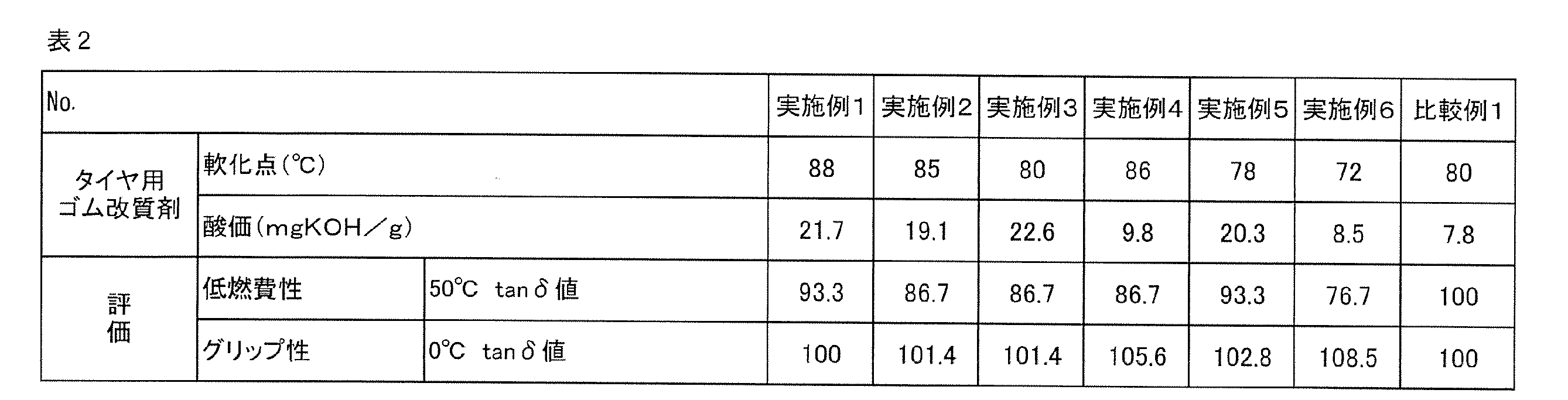
なお、上記発明は、本発明の例示の実施形態として提供したが、これは単なる例示に過ぎず、限定的に解釈してはならない。当該技術分野の当事者によって明らかな本発明の変形例は、後記請求の範囲に含まれる。
本発明のタイヤ用ゴム改質剤は、例えば、自動車、二輪車、鉄道車両(例えば、モノレールなど)などの各種車両のタイヤや、例えば、航空機のタイヤなどにおいて、好適に用いられる。
Claims (6)
- タイヤ用ゴムを改質するためのタイヤ用ゴム改質剤であって、
ロジン類と、
スチレン系モノマーおよび(メタ)アクリル系モノマーを含むモノマー成分の重合体で
あるスチレン-(メタ)アクリル共重合体と
を含有することを特徴とする、タイヤ用ゴム改質剤。 - 前記スチレン-(メタ)アクリル共重合体の重量平均分子量が、3000以上3500
0以下である
ことを特徴とする、請求項1に記載のタイヤ用ゴム改質剤。 - 酸価が0mgKOH/gを超過し25mgKOH/g以下である
ことを特徴とする、請求項1に記載のタイヤ用ゴム改質剤。 - 軟化点が30℃以上100℃以下である
ことを特徴とする、請求項1に記載のタイヤ用ゴム改質剤。 - 前記ロジン類と、前記スチレン-(メタ)アクリル共重合体との総量に対して、
前記スチレン-(メタ)アクリル共重合体の含有割合が、2質量%以上20質量%以下
である
ことを特徴とする、請求項1に記載のタイヤ用ゴム改質剤。 - 前記モノマー成分の総量に対して、
前記スチレン系モノマーの含有割合が、50質量%以上95質量%以下である
ことを特徴とする、請求項1に記載のタイヤ用ゴム改質剤。
Priority Applications (4)
| Application Number | Priority Date | Filing Date | Title |
|---|---|---|---|
| CN201880049776.9A CN110945070A (zh) | 2017-08-08 | 2018-07-19 | 轮胎橡胶改性剂 |
| US16/633,639 US20200231815A1 (en) | 2017-08-08 | 2018-07-19 | Rubber modifier for tires |
| JP2019535061A JPWO2019031185A1 (ja) | 2017-08-08 | 2018-07-19 | タイヤ用ゴム改質剤 |
| EP18844339.4A EP3666822A4 (en) | 2017-08-08 | 2018-07-19 | Modifier for tire rubber |
Applications Claiming Priority (2)
| Application Number | Priority Date | Filing Date | Title |
|---|---|---|---|
| JP2017152847 | 2017-08-08 | ||
| JP2017-152847 | 2017-08-08 |
Publications (1)
| Publication Number | Publication Date |
|---|---|
| WO2019031185A1 true WO2019031185A1 (ja) | 2019-02-14 |
Family
ID=65272125
Family Applications (1)
| Application Number | Title | Priority Date | Filing Date |
|---|---|---|---|
| PCT/JP2018/027083 Ceased WO2019031185A1 (ja) | 2017-08-08 | 2018-07-19 | タイヤ用ゴム改質剤 |
Country Status (6)
| Country | Link |
|---|---|
| US (1) | US20200231815A1 (ja) |
| EP (1) | EP3666822A4 (ja) |
| JP (1) | JPWO2019031185A1 (ja) |
| CN (1) | CN110945070A (ja) |
| TW (1) | TW201920583A (ja) |
| WO (1) | WO2019031185A1 (ja) |
Cited By (2)
| Publication number | Priority date | Publication date | Assignee | Title |
|---|---|---|---|---|
| CN112898651A (zh) * | 2019-12-03 | 2021-06-04 | 固特异轮胎和橡胶公司 | 橡胶组合物和包含橡胶组合物的制品 |
| WO2023058674A1 (ja) * | 2021-10-06 | 2023-04-13 | 横浜ゴム株式会社 | タイヤ用ゴム組成物 |
Families Citing this family (1)
| Publication number | Priority date | Publication date | Assignee | Title |
|---|---|---|---|---|
| US11560462B1 (en) * | 2019-09-20 | 2023-01-24 | The Goodyear Tire & Rubber Company | Functionalized high cis-1,4-polybutadiene |
Citations (6)
| Publication number | Priority date | Publication date | Assignee | Title |
|---|---|---|---|---|
| JP2005248056A (ja) * | 2004-03-05 | 2005-09-15 | Sumitomo Rubber Ind Ltd | ゴム組成物およびそれを用いたタイヤ |
| KR20140066292A (ko) * | 2012-11-23 | 2014-06-02 | 한국타이어 주식회사 | 타이어 트레드용 고무 조성물 및 이를 이용하여 제조한 타이어 |
| WO2015030056A1 (ja) * | 2013-08-30 | 2015-03-05 | ハリマ化成株式会社 | シリカ造粒物、ゴム組成物、タイヤ、シリカ造粒物の製造方法およびゴム組成物の製造方法 |
| JP2016050252A (ja) * | 2014-08-29 | 2016-04-11 | 住友ゴム工業株式会社 | 高性能タイヤ用トレッドゴム組成物及び高性能タイヤ |
| JP2016056234A (ja) * | 2014-09-05 | 2016-04-21 | 住友ゴム工業株式会社 | 空気入りタイヤ |
| JP2016056238A (ja) * | 2014-09-05 | 2016-04-21 | 住友ゴム工業株式会社 | 空気入りタイヤ |
Family Cites Families (4)
| Publication number | Priority date | Publication date | Assignee | Title |
|---|---|---|---|---|
| JPS61108796A (ja) * | 1984-10-26 | 1986-05-27 | ディック・ハーキュレス株式会社 | ロジン系エマルジョンサイズ剤 |
| JP3593437B2 (ja) * | 1997-04-11 | 2004-11-24 | 株式会社ブリヂストン | ゴム組成物及びこれを用いたタイヤ |
| JP5490575B2 (ja) * | 2010-03-10 | 2014-05-14 | 東洋ゴム工業株式会社 | タイヤ用ゴム組成物及び空気入りタイヤ |
| JP5559234B2 (ja) * | 2011-08-09 | 2014-07-23 | 住友ゴム工業株式会社 | タイヤ用ゴム組成物及び空気入りタイヤ |
-
2018
- 2018-07-19 WO PCT/JP2018/027083 patent/WO2019031185A1/ja not_active Ceased
- 2018-07-19 US US16/633,639 patent/US20200231815A1/en not_active Abandoned
- 2018-07-19 CN CN201880049776.9A patent/CN110945070A/zh active Pending
- 2018-07-19 EP EP18844339.4A patent/EP3666822A4/en not_active Withdrawn
- 2018-07-19 JP JP2019535061A patent/JPWO2019031185A1/ja active Pending
- 2018-08-03 TW TW107127078A patent/TW201920583A/zh unknown
Patent Citations (6)
| Publication number | Priority date | Publication date | Assignee | Title |
|---|---|---|---|---|
| JP2005248056A (ja) * | 2004-03-05 | 2005-09-15 | Sumitomo Rubber Ind Ltd | ゴム組成物およびそれを用いたタイヤ |
| KR20140066292A (ko) * | 2012-11-23 | 2014-06-02 | 한국타이어 주식회사 | 타이어 트레드용 고무 조성물 및 이를 이용하여 제조한 타이어 |
| WO2015030056A1 (ja) * | 2013-08-30 | 2015-03-05 | ハリマ化成株式会社 | シリカ造粒物、ゴム組成物、タイヤ、シリカ造粒物の製造方法およびゴム組成物の製造方法 |
| JP2016050252A (ja) * | 2014-08-29 | 2016-04-11 | 住友ゴム工業株式会社 | 高性能タイヤ用トレッドゴム組成物及び高性能タイヤ |
| JP2016056234A (ja) * | 2014-09-05 | 2016-04-21 | 住友ゴム工業株式会社 | 空気入りタイヤ |
| JP2016056238A (ja) * | 2014-09-05 | 2016-04-21 | 住友ゴム工業株式会社 | 空気入りタイヤ |
Non-Patent Citations (1)
| Title |
|---|
| See also references of EP3666822A4 * |
Cited By (5)
| Publication number | Priority date | Publication date | Assignee | Title |
|---|---|---|---|---|
| CN112898651A (zh) * | 2019-12-03 | 2021-06-04 | 固特异轮胎和橡胶公司 | 橡胶组合物和包含橡胶组合物的制品 |
| CN112898651B (zh) * | 2019-12-03 | 2023-12-12 | 固特异轮胎和橡胶公司 | 橡胶组合物和包含橡胶组合物的制品 |
| WO2023058674A1 (ja) * | 2021-10-06 | 2023-04-13 | 横浜ゴム株式会社 | タイヤ用ゴム組成物 |
| JPWO2023058674A1 (ja) * | 2021-10-06 | 2023-04-13 | ||
| JP7620246B2 (ja) | 2021-10-06 | 2025-01-23 | 横浜ゴム株式会社 | タイヤ用ゴム組成物 |
Also Published As
| Publication number | Publication date |
|---|---|
| US20200231815A1 (en) | 2020-07-23 |
| TW201920583A (zh) | 2019-06-01 |
| JPWO2019031185A1 (ja) | 2020-08-27 |
| EP3666822A1 (en) | 2020-06-17 |
| CN110945070A (zh) | 2020-03-31 |
| EP3666822A4 (en) | 2021-04-07 |
Similar Documents
| Publication | Publication Date | Title |
|---|---|---|
| JP7466740B2 (ja) | 変性液状ジエン系ゴム | |
| CN109206690B (zh) | 橡胶组合物和充气轮胎 | |
| JP5391557B2 (ja) | 共役ジエン系重合体、共役ジエン系重合体の製造方法及び共役ジエン系重合体組成物 | |
| KR101404390B1 (ko) | 실란을 함유하고 가능하게는 관능화된 디엔 고무 및 마이크로겔을 갖는 고무 혼합물, 그의 제조 방법 및 그의 용도 | |
| WO2002074820A1 (en) | Oil-extended rubber and rubber composition | |
| US20180244808A1 (en) | Method for producing modified diene-based rubber, rubber composition and tire | |
| CN101326240B (zh) | 橡胶组合物以及使用其的轮胎 | |
| WO2019031227A1 (ja) | 空気入りタイヤ | |
| CN114058151B (zh) | 共轭二烯系聚合物组合物 | |
| WO2019031185A1 (ja) | タイヤ用ゴム改質剤 | |
| WO1999050309A1 (en) | Conjugated diene rubber, process for producing the same, and rubber composition | |
| WO2009151103A1 (ja) | ゴム組成物及びそれを用いたタイヤ | |
| JP5121300B2 (ja) | ゴム組成物及びそれを用いた空気入りタイヤ | |
| WO2017038087A1 (ja) | 乳化重合スチレンブタジエンゴム、ゴム組成物及びタイヤ | |
| KR20170120113A (ko) | 변성 공액 디엔계 고무의 제조 방법 | |
| HK40022813A (en) | Rubber modifier for tires | |
| WO2016002433A1 (ja) | ゴム組成物及び該ゴム組成物を用いて作製したトレッドを有する空気入りタイヤ | |
| JP6705191B2 (ja) | アミノ化石油樹脂及びその製造方法 | |
| JP2018131478A (ja) | タイヤ用ゴム組成物及び空気入りタイヤ | |
| KR20250153766A (ko) | 폴리(알킬렌 옥사이드) 그래프트를 갖는 폴리디엔 및 폴리디엔 공중합체 및 타이어 구성 요소의 제조에 있어서 이의 사용 | |
| JP6329063B2 (ja) | ゴム組成物及び該ゴム組成物を用いて作製したトレッドを有する空気入りタイヤ | |
| WO2003070797A1 (fr) | Caoutchouc dienique conjugue, caoutchouc etendu a l'huile et composition de caoutchouc |
Legal Events
| Date | Code | Title | Description |
|---|---|---|---|
| 121 | Ep: the epo has been informed by wipo that ep was designated in this application |
Ref document number: 18844339 Country of ref document: EP Kind code of ref document: A1 |
|
| ENP | Entry into the national phase |
Ref document number: 2019535061 Country of ref document: JP Kind code of ref document: A |
|
| NENP | Non-entry into the national phase |
Ref country code: DE |
|
| ENP | Entry into the national phase |
Ref document number: 2018844339 Country of ref document: EP Effective date: 20200309 |