WO2019031475A1 - Procédé de distillation sous vide et de vieillissement d'un breuvage et boisson alcoolisée - Google Patents
Procédé de distillation sous vide et de vieillissement d'un breuvage et boisson alcoolisée Download PDFInfo
- Publication number
- WO2019031475A1 WO2019031475A1 PCT/JP2018/029524 JP2018029524W WO2019031475A1 WO 2019031475 A1 WO2019031475 A1 WO 2019031475A1 JP 2018029524 W JP2018029524 W JP 2018029524W WO 2019031475 A1 WO2019031475 A1 WO 2019031475A1
- Authority
- WO
- WIPO (PCT)
- Prior art keywords
- sake
- liquor
- brewed
- brewed liquor
- alcohol
- Prior art date
- Legal status (The legal status is an assumption and is not a legal conclusion. Google has not performed a legal analysis and makes no representation as to the accuracy of the status listed.)
- Ceased
Links
Images

Classifications
-
- C—CHEMISTRY; METALLURGY
- C12—BIOCHEMISTRY; BEER; SPIRITS; WINE; VINEGAR; MICROBIOLOGY; ENZYMOLOGY; MUTATION OR GENETIC ENGINEERING
- C12H—PASTEURISATION, STERILISATION, PRESERVATION, PURIFICATION, CLARIFICATION OR AGEING OF ALCOHOLIC BEVERAGES; METHODS FOR ALTERING THE ALCOHOL CONTENT OF FERMENTED SOLUTIONS OR ALCOHOLIC BEVERAGES
- C12H6/00—Methods for increasing the alcohol content of fermented solutions or alcoholic beverages
- C12H6/02—Methods for increasing the alcohol content of fermented solutions or alcoholic beverages by distillation
-
- C—CHEMISTRY; METALLURGY
- C12—BIOCHEMISTRY; BEER; SPIRITS; WINE; VINEGAR; MICROBIOLOGY; ENZYMOLOGY; MUTATION OR GENETIC ENGINEERING
- C12G—WINE; PREPARATION THEREOF; ALCOHOLIC BEVERAGES; PREPARATION OF ALCOHOLIC BEVERAGES NOT PROVIDED FOR IN SUBCLASSES C12C OR C12H
- C12G3/00—Preparation of other alcoholic beverages
- C12G3/02—Preparation of other alcoholic beverages by fermentation
- C12G3/021—Preparation of other alcoholic beverages by fermentation of botanical family Poaceae, e.g. wheat, millet, sorghum, barley, rye, or corn
- C12G3/022—Preparation of other alcoholic beverages by fermentation of botanical family Poaceae, e.g. wheat, millet, sorghum, barley, rye, or corn of botanical genus Oryza, e.g. rice
-
- C—CHEMISTRY; METALLURGY
- C12—BIOCHEMISTRY; BEER; SPIRITS; WINE; VINEGAR; MICROBIOLOGY; ENZYMOLOGY; MUTATION OR GENETIC ENGINEERING
- C12H—PASTEURISATION, STERILISATION, PRESERVATION, PURIFICATION, CLARIFICATION OR AGEING OF ALCOHOLIC BEVERAGES; METHODS FOR ALTERING THE ALCOHOL CONTENT OF FERMENTED SOLUTIONS OR ALCOHOLIC BEVERAGES
- C12H1/00—Pasteurisation, sterilisation, preservation, purification, clarification, or ageing of alcoholic beverages
- C12H1/22—Ageing or ripening by storing, e.g. lagering of beer
Definitions
- the present invention relates to a method for vacuum distillation of brewed wine manufactured in advance, in particular, to a method for vacuum distillation of brewed wine capable of increasing the alcohol concentration without losing its aroma and taste, a method for aging the brewed liquor, and decompressing the brewed liquor. It relates to an alcoholic beverage obtained by distillation.
- Non-patent Document 1 Non-patent Document 1
- Sake which is a type of brewed sake, is an alcoholic beverage that produces alcohol or umami or flavor by fermentation, but there is a limit to raising the alcohol concentration only by fermentation.
- Patent Document 1 describes a technology for enhancing umami components in alcoholic beverages such as sake at low temperatures using a zeolite membrane.
- Patent No. 6105923 gazette
- the present invention has been made in view of the above problems, and the object of the present invention is to increase the alcohol concentration without impairing the smell or taste in sake, particularly in pre-made brews such as sake. It is an object of the present invention to provide a method for vacuum distillation of brewed liquor, a method for aging brewed liquor, and an alcoholic beverage obtained by vacuum distillation of the previously prepared brewed liquor, which can be aged for a long time.
- the present inventors have made alcoholic beverages which are excellent in aroma and taste and can be aged for a long time by vacuum distillation of sake, which is brewed sake, using a vacuum drying apparatus at low temperatures. It has been found that it is possible to obtain the present invention.
- the subject is a method for vacuum distillation of brewed liquor prepared in advance, which comprises: producing alcohol vapor from the brewed liquor at a temperature of 55 ° C. or less by reducing the pressure of the brewed liquor. And a condensing step of cooling the vapor generated in the alcohol vapor generation step to generate a condensate, and a recovery step of recovering the condensate generated in the condensation step.
- the reduced-pressure distillation method of the present invention has the advantage of using less energy and requiring a shorter time as compared to the conventional method of increasing the alcohol concentration.
- the pressure it is preferable to reduce the pressure to -85 kPa or less in the alcohol vapor generation step.
- By reducing the pressure to ⁇ 85 kPa or less it is possible to generate a brew-derived steam at a low temperature, and therefore it is possible to increase the alcohol concentration in a short time and in a short time without losing the aroma or taste.
- the condensation step may be performed by cooling the vapor to 15 ° C. or more and 30 ° C. or less.
- the condensation of the vapor can be reliably performed, and further pressure reduction can be generated as the volume decreases due to the condensation of the vapor. it can.
- the brewed sake is sake, and it is more preferable that the sake is sake.
- Sake, especially sake is produced by fermentation, so it has a low alcohol concentration, but according to the reduced-pressure distillation method of brewed sake of the present invention, it is processed at low temperature under reduced pressure, so the alcohol does not lose its aroma or taste. The concentration can be increased.
- the sake is pure rice wine. Brewing alcohol is not likely to change with age, and the feeling of irritation remains even after time passes. When pure rice liquor is used, the effect of improving the aroma and taste by ripening is greater than in pure sake added with brewer's alcohol.
- the above-mentioned subject is solved by the aging method of brewed sake, further comprising a ripening step of ripening the condensate obtained in the method of vacuum distillation of brewed sake for one year or more.
- Ru a ripening step of ripening the condensate obtained in the method of vacuum distillation of brewed sake for one year or more.
- an alcoholic beverage characterized in that it is obtained by distillation under a reduced pressure of -85 kPa or less and at a temperature of 55 ° C. or less.
- An alcoholic beverage obtained by decompressing a previously prepared brewed liquor and distilling at a low temperature of 55 ° C. or less has the advantage that the aroma and taste are improved without the aroma and taste being lost. .
- the method for vacuum distillation of brewed wine according to the present invention has the advantage of using less energy and requiring a shorter time as compared to the conventional method of increasing the alcohol concentration.
- the condensed liquid of a brewed liquor such as sake obtained by the vacuum distillation method of the brewed wine according to the present invention can improve its aroma and taste by aging for a long time because the alcohol concentration is increased. is there.
- the alcoholic beverage obtained by decompressing the previously produced sake and distilling it at a low temperature of 55 ° C. or less has an advantage that the aroma and taste are improved without losing the aroma and taste.
- the present invention relates to a method for vacuum distillation of brewed liquor, a method for aging brewed liquor, and an alcoholic beverage obtained by vacuum distillation of brewed liquor.
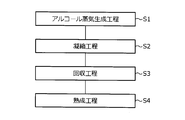
- a method for vacuum distillation of brewed liquor according to an embodiment of the present invention (hereinafter, referred to as the present embodiment) will be described with reference to FIGS. 1 and 2.
- an apparatus to be used is not limited to a specific apparatus.
- examples of the pre-produced brewed liquor to be subjected to the reduced pressure distillation include brewed liquor, mixed liquor using the brewed liquor, and the like. It is preferable to use, as a target of reduced-pressure distillation, brewer's liquor whose aroma and taste are lost by heating, in particular sake and sake, but it is not limited thereto.
- Brewing liquor is an alcoholic beverage produced by fermenting the raw material as it is or after saccharifying the raw material. Brewing liquor is roughly divided into mono-fermented liquor and double-fermented liquor. Examples of the single-fermented liquor include, but are not limited to, wines made from fruits containing sugar and the like as raw materials, ciders and the like. In the case of double-fermented liquor, when the raw material is cereals such as rice and wheat, starch contained in the raw material grain etc. may be saccharified and then alcohol-fermented beer or sake may be mentioned, but it is not limited thereto. . In the reduced pressure distillation method of a brewed liquor according to the present embodiment, the brewed liquor to be subjected to the reduced pressure distillation is preferably sake, particularly preferably sake.
- Sake is a generic term for brewed sake made from rice, and includes sake, sake, sake, moromi shu and so on.
- Sake refers to sake, which is rice, rice bran, liquor that is fermented using water as a raw material and filtered (except turbid sake, turbid sake, moromi shu). Furthermore, in the Japanese liquor tax law, sake is defined as "fermented and fermented using rice, rice bran and water as raw materials" and having an alcohol content of less than 22 degrees.
- the raw material and manufacturing method meet a fixed standard, and the specific name sake which displayed specific names, such as Ginjo sake, pure rice liquor, this brewing liquor, is mentioned.
- "Ginjo sake” refers to refined sake manufactured by examining white rice, rice koji and water at a rice content of 60% or less, or these and brewed alcohol as raw materials and having a good intrinsic flavor and color sore.
- the term "pure rice sake” refers to sake produced with white rice, rice koji and water as its raw material and having good flavor and color, and pure rice wine, pure rice ginjo liquor, pure rice dainjyo wine in Table 1 below. Special 4 types of pure rice wine.
- This brewed liquor is a sake produced with white rice, rice koji, brewed alcohol and water as raw materials having a rice content of 70% or less, and having a good flavor and color.
- the amount of brewing alcohol used as the sake to be subjected to vacuum distillation is 50% or less of the weight of the raw material rice (including rice used for rice koji) It is preferable that the sake is sake, and it is more preferable that the amount of brewing alcohol used is 10/100 or less of the weight of the raw material rice (including rice used for rice koji), and that the sake not using the brewer alcohol, Particularly preferred is pure rice wine.
- Brewing alcohol is hard to change with age, and it remains irritating over time, so it is not possible to achieve good ripening. Therefore, when the sake is aged after being subjected to vacuum distillation, when the sake is pure rice liquor, the effect of improving the aroma and taste thereof is greater than that of sake added with a brewer's alcohol.
- Wine wine liquor, wine
- wine is a kind of fruit liquor, which is obtained by fermenting grape juice by the action of yeast and storing it in barrels or bottles as necessary.
- wines to be subjected to reduced-pressure distillation are red wine, white wine, rose wine, and the like, but are not limited thereto.
- a mixed liquor is an alcoholic beverage which uses ingredients such as plant skins and fruits, herbs, herbs, spices, sweeteners, flavors and the like from brewing liquor and distilled liquor as raw materials.
- the mixed liquor to be subjected to reduced-pressure distillation is, for example, vermot made from brewed liquor, but is not limited thereto.
- FIG. 1 is a schematic explanatory drawing which shows the structure of the vacuum-drying apparatus D which can be used by the reduced-pressure distillation method of the brewed liquor which concerns on this embodiment.
- the vacuum drying apparatus D mainly includes a container 10 for containing the object to be treated, a condenser 20 for cooling the vapor emitted from the container 10, and an ejector 30 as a pressure reducing means for reducing the pressure in the container 10.
- the vessel 10 is provided with a steam chamber 11 for heating the vessel 10 by supplying steam from a steam boiler (not shown), which is a heating means of steam, around the lower part thereof.
- a discharge pipe 12 connected to a discharge port for taking out the processed object is provided, and a discharge valve 13 for discharging the dried object to a discharge box 14 is provided.
- a stirring blade 15 for stirring an object to be treated, and on the upper part of the container 10 is provided an inlet 16 having a lid that can be opened and closed. 16 into the container 10.
- An exhaust port 17 for the vapor sucked by the ejector 30 is provided on the upper side surface of the container 10, and an exhaust pipe 18 connected to the cooling pipe 21 in the condenser 20 is connected to the exhaust port 17.
- the condenser 20 cools and condenses the steam passing through the cooling pipe 21 by the cooling water sent from the cooling unit 22 through the feed water pipe 23.
- the condenser 20 is connected with a drainage pipe 24 for discharging the cooling water flowing from the water supply pipe 23.
- the set temperature of the cooling water circulated through the cooling unit 22 and the water supply pipe 23 is set to be 5 ° C. or more lower than the evaporation temperature, and is set to, for example, 20 ° C. or more and 30 ° C. or less.
- the amount of cooling water depends on the throughput, that is, the amount of steam generated in the vessel 10.
- the fluid inlet 30 a of the ejector 30 is connected to the water tank 34 via a water supply pipe 32 provided with a pump 31, and a silencer (not shown) is attached to the end of the drainage pipe 33 of the ejector 30. It is submerged and installed in the water.
- the fluid suction port 30 b of the ejector 30 is connected to the cooling pipe 21 of the condenser 20 via a pipe 40. Further, to a portion of the pipe 40 between the vacuum valve 44 and the condenser 20, a condensate recovery pipe 41 having a recovery valve 42 for recovering the condensate is connected.
- the operation of the vacuum drying device D is performed as follows. Cooling water is supplied to the condenser 20 from the cooling unit 22 at the start of work. Further, the water tank 34 is filled with water to a predetermined water level. First, an object to be treated is put into the container 10 through the inlet 16 and the lid is closed. When the start switch (not shown) is turned on, the drive mechanism (not shown) is activated to rotate the stirring blade 15, thereby stirring the object in the container 10. At the same time as stirring, heating is performed by supplying heating steam from the steam boiler (not shown) into the steam chamber 11. The heat applied to the container 10 is transferred to the object to be treated, and the object to be treated is agitated by the stirring blade 15 to be effectively transferred to the entire object to promote the generation of steam.
- the pump 31 for the ejector 30 is driven, jet water is ejected in the ejector 30, and the jet water is silently discharged to the water in the water tank 34 through the drainage pipe 33.
- the fluid suction port 30 b of the ejector 30 exerts a fluid suction force.
- the vacuum valve 44 is opened, the suction force acting on the fluid suction port 30b of the ejector 30 acts on the inside of the container 10 through the exhaust pipe 18, the cooling pipe 21 and the pipe 40, so the vapor and air in the container 10 It is sucked.
- the pressure in the container 10 can be reduced from atmospheric pressure to, for example, 20 to 40 Torr (-98.6 kPa to -96.0 kPa).
- the water contained in the object to be processed in the container 10 and the liquid such as ethanol are evaporated even at a low temperature.
- the boiling point of the moisture of the object in the container 10 is about 25 ° C.
- the boiling point of ethanol is about 10 ° C. Therefore, when heating under reduced pressure, evaporation of water and ethanol contained in the object in the container 10 starts.
- the vapor generated by the evaporation of water and ethanol is drawn into the ejector 30 by the suction force acting on the fluid suction port 30b of the ejector 30, so evaporation of the water and ethanol contained in the object in the container 10 continues. It will be.
- the condenser 20 In the condenser 20, all or a part of the vapor generated by evaporation of water and ethanol contained in the object in the container 10 is transferred from the cooling unit 22 through the water supply pipe 23 to the cooling medium and circulated with the cooling medium. Exchange takes place and cools rapidly and condenses to liquid.
- the collection valve 42 When the collection valve 42 is opened after the flow of the condensate from the condenser 20 is started, the suction force generated by the ejector 30 is accumulated in the condensate collection tank 43 from the condensate collection piping 41 through the piping 40.
- the water vapor of the object to be treated evaporates and the generated vapor can be returned to water and recovered without being diffused into the atmosphere.
- the reduced-pressure distillation method of a brewed wine according to the present embodiment includes the step of producing an alcohol vapor from the brewed liquor by reducing the pressure of the previously produced brewed liquor at a temperature of 55 ° C. or less, and producing the alcohol vapor-producing step. And a recovery step of recovering the condensate produced in the condensation step.
- the reduced-pressure distillation method of a brewed wine according to the present embodiment includes the step of producing an alcohol vapor from the brewed liquor by reducing the pressure of the previously produced brewed liquor at a temperature of 55 ° C. or less, and producing the alcohol vapor-producing step. And a recovery step of recovering the condensate produced in the condensation step.
- the brewed liquor produced in advance is depressurized, and a brewed liquor-derived vapor is produced at a temperature of 55 ° C. or less (step S1).
- the pressure of reduced pressure is preferably -85 kPa or less, more preferably -90 kPa or less, still more preferably -92 kPa or less, and particularly preferably -95 kPa or less. Absent.
- the lower the depressurization pressure the lower the temperature at which brew-derived vapor is produced.
- the pressure is usually reduced to -101.3 kPa or more which is an absolute vacuum.
- the expression of pressure is described by a gauge pressure where atmospheric pressure is zero. That is, -85 kPa means that the pressure is 85 kPa lower than 101.3 kPa (one atmospheric pressure).
- the pressure reduction is preferably performed using an ejector that requires less energy.
- Latent heat is required to evaporate the liquid to a gas. Because the latent heat of water vapor has more energy than the sensible heat of warm water, when giving the latent heat to the brewed wine using water vapor at 100 ° C to 105 ° C, the sensible heat was given to the brewed water using hot water at 45 to 60 ° C The processing time can be shorter than in the case.
- the evaporation temperature of ethanol which is an alcohol component contained in the brewed liquor is determined by the degree of vacuum (degree of vacuum). It is preferable that the pressure and temperature which process the brewing liquor manufactured beforehand in the alcohol vapor production process be the pressure and temperature which can control the quality change of the ingredient contained in brewing liquor, and can carry out distillation fractionation of the alcohol ingredient.
- the pressure and temperature conditions may be from -98 kPa to -85 kPa and from 20 ° C. to 55 ° C., preferably from -98 kPa to -92 kPa and from 25 ° C. to 45 ° C., more preferably from -98 kPa to -94 kPa And 30 ° C. or more and 40 ° C. or less, particularly preferably ⁇ 98 kPa and 35 ° C.
- the brewed liquor generates steam derived from the brewed liquor.
- the vapor contains, as a main component, an alcohol component that is more easily evaporated than water, and also contains components of umami and aroma that are soluble in the alcohol component.
- the condensation step the vapor generated in the alcohol vapor generation step is cooled to form a condensate (step S2).
- the steam derived from the brewed liquor generated in the alcohol vapor producing step is transferred using a reduced pressure, and is condensed by cooling to a temperature lower than the temperature of the steam.
- the cooling temperature at the time of condensing the steam is 5 ° C. or more lower than the evaporation temperature of the brew-derived steam, preferably 10 ° C. or more and 35 ° C. or less, more preferably 15 ° C. or more and 30 ° C. or less, particularly preferably Although it is 15 ° C or more and 25 ° C or less, it is not limited to these temperature ranges.
- the condensation efficiency of the steam is unfavorably poor.
- the cooling temperature is low, the condensation efficiency of the steam is improved, but the energy required for cooling is increased, which is not preferable.
- the condensate generated in the condensation step is recovered (step S3). Specifically, the condensate produced by the cooling in the condensation step is moved using reduced pressure, and recovered using a container such as a recovery tank. The condensate recovered in the recovery step has a higher alcohol concentration than the original brewed liquor.
- the reduced-pressure distillation method according to the present embodiment can separate and recover the alcohol component under low temperature and in a closed condition with less oxygen, so it is possible to suppress deterioration, degeneration or decomposition of components contained in the wine. .
- a vacuum drying apparatus manufactured by F.E.C., trade name "vacuum dryer FED-50" as shown in FIG. 1 is used as a vacuum distillation apparatus. Is preferred.
- the vacuum drying apparatus D shown in FIG. 1 can carry out vacuum distillation of the brewed liquor inside, keeping the inside of the container 10 low temperature (for example, 20 degreeC or more and 55 degrees C or less). Therefore, denaturation and decomposition of the aroma component and the like contained in the brewed liquor are suppressed, and the alcohol concentration can be increased while retaining the aroma component of the brewed liquor.
- Vacuum-drying apparatus D which is an example of the decompression drying apparatus of the brewed liquor which concerns on this embodiment can be set as an apparatus structure of a comparatively small scale. Therefore, the vacuum drying apparatus D may be attached to and installed in a sake brewer producing sake, and a novel alcoholic beverage having an increased alcohol concentration can be produced using sake manufactured in the sake brewer.
- the time required for the vacuum distillation process varies depending on the apparatus used for the vacuum distillation and the amount and type of liquor to be treated, but usually, it is preferably about 2 to 6 hours with 50 to 3000 liters of treatment . It corresponds to 25 to 500 L / hour when converted to the processing speed of brewed liquor.
- the condensed liquid (distilled fraction) obtained by the reduced-pressure distillation method of the brewed wine according to the present embodiment has the alcohol concentration increased by being reduced-pressure distillation at a low temperature, and the aroma and taste are not impaired. It can be used as brewed liquor.
- the ripening method of the brewed liquor according to the present embodiment is a ripening step (step S4 of FIG. 2) in which the condensate obtained in the above-described vacuum distillation method of brewed liquor (steps S1 to S3 of FIG. 2) And the like.
- the period of ripening is preferably 1 year or more, more preferably 2 years or more, further preferably 3 years or more, particularly preferably 5 years or more, but is not limited to these periods.
- the period of ripening is preferably 1 year or more, more preferably 2 years or more, further preferably 3 years or more, particularly preferably 5 years or more, but is not limited to these periods.
- Example 1 A vacuum dryer (manufactured by F.E.C., trade name "vacuum dryer FED-50”) was used as a vacuum distillation apparatus. Into the vessel was charged 10 L of previously produced sake, and the pressure was reduced to -98 kPa, and distillation under reduced pressure was performed for 30 minutes at a temperature in the vessel of 35 ° C. The condensate collected was 2 L, and 8 L of liquid remained in the container. The collected condensate (alcohol beverage having an alcohol content of about 50 degrees) was subjected to the evaluation.
- Example 2 The condensate of Example 1 was stored and aged at 20 ° C. for 12 months. The condensate after ripening (alcoholic beverage after ripening) was subjected to evaluation.
- ⁇ Test 1 Sensory Evaluation of the Alcoholic Beverage of Example 1> About the item of "a taste, a color, an aroma" of the alcoholic beverage (recovered condensate) of Example 1 obtained by vacuum distillation, sensory evaluation by five panelists was performed. The results are shown in Table 2. In the table, ⁇ is extremely good, ⁇ is good, ⁇ is normal, and x is somewhat poor.
- ⁇ Test 2 Sensory Evaluation of the Alcoholic Beverage of Example 2> After the distillation under reduced pressure, sensory evaluation was performed by a panel of five persons in the same manner as in Test 1 with respect to the aged alcoholic beverage of Example 2 (a product obtained by ripening the recovered condensate). The results are shown in Table 3.
- Vacuum drying apparatus 10 container 11 steam chamber 12 discharge pipe 14 discharge box 13 discharge valve 15 stirring blade 16 inlet 17 exhaust port 18 exhaust piping 20 condenser 21 cooling pipe 22 cooling unit 23 water supply piping 24 drainage piping 30 ejector 30a fluid inlet 30b Fluid suction port 31 Pump 32 Water supply piping 33 Drainage piping 34 Water tank 40 Piping 41 Condensate collection piping 42 Collection valve 43 Condensate collection tank 44 Vacuum valve
Landscapes
- Chemical & Material Sciences (AREA)
- Organic Chemistry (AREA)
- Engineering & Computer Science (AREA)
- Bioinformatics & Cheminformatics (AREA)
- Life Sciences & Earth Sciences (AREA)
- Biochemistry (AREA)
- Health & Medical Sciences (AREA)
- General Engineering & Computer Science (AREA)
- General Health & Medical Sciences (AREA)
- Genetics & Genomics (AREA)
- Wood Science & Technology (AREA)
- Zoology (AREA)
- Food Science & Technology (AREA)
- Distillation Of Fermentation Liquor, Processing Of Alcohols, Vinegar And Beer (AREA)
- Alcoholic Beverages (AREA)
Abstract
L'invention concerne un procédé de distillation sous vide d'un breuvage tel que du saké japonais qui est fabriqué à l'avance, permettant d'augmenter la concentration d'alcool à faible énergie, en un court laps de temps, sans dégrader l'arôme, la flaveur, etc. Le procédé de distillation sous vide d'un breuvage est caractérisé en ce qu'il comprend : une étape de production de vapeur d'alcool dans laquelle le breuvage fabriqué à l'avance est dépressurisé, la vapeur issue du breuvage étant produite à une température inférieure ou égale à 55 °C ; une étape de condensation dans laquelle la vapeur produite à l'étape de production de vapeur d'alcool est refroidie et un condensat est produit ; et une étape de récupération dans laquelle le condensat produit à l'étape de condensation est récupéré.
Priority Applications (3)
| Application Number | Priority Date | Filing Date | Title |
|---|---|---|---|
| EP18843701.6A EP3666877A4 (fr) | 2017-08-08 | 2018-08-07 | Procédé de distillation sous vide et de vieillissement d'un breuvage et boisson alcoolisée |
| CN201880051979.1A CN111133092A (zh) | 2017-08-08 | 2018-08-07 | 酿造酒的减压蒸馏方法和陈化方法及酒精饮料 |
| US16/636,958 US20200369994A1 (en) | 2017-08-08 | 2018-08-07 | Method for distilling brewage under reduced pressure, method for aging brewage, and alcoholic beverage |
Applications Claiming Priority (2)
| Application Number | Priority Date | Filing Date | Title |
|---|---|---|---|
| JP2017153625A JP6592703B2 (ja) | 2017-08-08 | 2017-08-08 | 醸造酒の減圧蒸留方法及び熟成方法、並びにアルコール飲料 |
| JP2017-153625 | 2017-08-08 |
Publications (1)
| Publication Number | Publication Date |
|---|---|
| WO2019031475A1 true WO2019031475A1 (fr) | 2019-02-14 |
Family
ID=65272287
Family Applications (1)
| Application Number | Title | Priority Date | Filing Date |
|---|---|---|---|
| PCT/JP2018/029524 Ceased WO2019031475A1 (fr) | 2017-08-08 | 2018-08-07 | Procédé de distillation sous vide et de vieillissement d'un breuvage et boisson alcoolisée |
Country Status (5)
| Country | Link |
|---|---|
| US (1) | US20200369994A1 (fr) |
| EP (1) | EP3666877A4 (fr) |
| JP (1) | JP6592703B2 (fr) |
| CN (1) | CN111133092A (fr) |
| WO (1) | WO2019031475A1 (fr) |
Families Citing this family (5)
| Publication number | Priority date | Publication date | Assignee | Title |
|---|---|---|---|---|
| CA3187402A1 (fr) * | 2020-07-27 | 2022-02-03 | Trade Secret Chocolates | Systemes et methodes de rehabilitation de compositions d'alcool et produits alcoolises rehabilites |
| CN112066262B (zh) * | 2020-09-07 | 2021-05-11 | 普瑞特机械制造股份有限公司 | 一种可控速度的旋转量水自动加注装置 |
| CN113214900A (zh) * | 2021-05-12 | 2021-08-06 | 劲牌有限公司 | 一种适用于酒体调香的玫瑰花香基的制备工艺 |
| JP2023131573A (ja) * | 2022-03-09 | 2023-09-22 | アサヒグループホールディングス株式会社 | ビールテイスト飲料の蒸留脱香気処理液及びアルコール飲料ベース |
| KR102709604B1 (ko) * | 2023-09-27 | 2024-09-25 | 주식회사 대영 | 대용량 감압식 증류장치 및 이를 이용한 증류주 제조방법 |
Citations (4)
| Publication number | Priority date | Publication date | Assignee | Title |
|---|---|---|---|---|
| JPS615923B2 (fr) | 1978-11-16 | 1986-02-22 | Daikin Mfg Co Ltd | |
| JPH08290002A (ja) * | 1995-04-19 | 1996-11-05 | Nakano Kimie | 乙類焼酎用真空蒸溜装置 |
| JP2016054662A (ja) * | 2014-09-08 | 2016-04-21 | 三和酒類株式会社 | 蒸留酒の製造方法および製造装置 |
| JP2017006081A (ja) * | 2015-06-25 | 2017-01-12 | 三和酒類株式会社 | 蒸留酒の製造方法および装置 |
Family Cites Families (4)
| Publication number | Priority date | Publication date | Assignee | Title |
|---|---|---|---|---|
| JP3328018B2 (ja) * | 1993-08-02 | 2002-09-24 | 宝ホールディングス株式会社 | 酒類の製造方法 |
| JP2006280359A (ja) * | 2005-04-04 | 2006-10-19 | Joho Kagaku Kenkyusho:Kk | 酒類の還元熟成方法と還元熟成酒 |
| US7780999B2 (en) * | 2006-06-01 | 2010-08-24 | Bacardi & Company Limited | Reduced pressure distillation of an alcoholic mixture |
| CN104293632B (zh) * | 2014-04-25 | 2017-06-06 | 广东石湾酒厂集团有限公司 | 一种白酒减压蒸馏系统及蒸馏方法 |
-
2017
- 2017-08-08 JP JP2017153625A patent/JP6592703B2/ja active Active
-
2018
- 2018-08-07 EP EP18843701.6A patent/EP3666877A4/fr not_active Withdrawn
- 2018-08-07 WO PCT/JP2018/029524 patent/WO2019031475A1/fr not_active Ceased
- 2018-08-07 CN CN201880051979.1A patent/CN111133092A/zh active Pending
- 2018-08-07 US US16/636,958 patent/US20200369994A1/en not_active Abandoned
Patent Citations (4)
| Publication number | Priority date | Publication date | Assignee | Title |
|---|---|---|---|---|
| JPS615923B2 (fr) | 1978-11-16 | 1986-02-22 | Daikin Mfg Co Ltd | |
| JPH08290002A (ja) * | 1995-04-19 | 1996-11-05 | Nakano Kimie | 乙類焼酎用真空蒸溜装置 |
| JP2016054662A (ja) * | 2014-09-08 | 2016-04-21 | 三和酒類株式会社 | 蒸留酒の製造方法および製造装置 |
| JP2017006081A (ja) * | 2015-06-25 | 2017-01-12 | 三和酒類株式会社 | 蒸留酒の製造方法および装置 |
Non-Patent Citations (5)
| Title |
|---|
| AKIRA MATSUDA: "Concentration of Sake Using Freeze Concentration", INDUSTRIAL RESEARCH INSTITUTE OF ISHIKAWA, IRII TECHNICAL NEWS, vol. 39, no. 2, 2014 |
| ANONYMOUS: "Vacuum Separator", ENVIRONMENT-RELATED TECHNOLOGY DATABASE IN THE KANSAI REGION 2013, 2013, pages 1, XP009519279, Retrieved from the Internet <URL:http://www.kansai.meti.go.jp/kankyo.html> * |
| RED VOLTAGE: "RV Urawa's Tears", 7 June 2012 (2012-06-07), pages 1 - 4, XP009519276, Retrieved from the Internet <URL:http://www.urawa-reds.co.jp/red-voltage/2012/06/07> [retrieved on 20181029] * |
| See also references of EP3666877A4 * |
| YOSHIZAWA, KIYOSHI, ET AL.: "Brandy", SCIENCE OF LIQUOR, 10 April 1998 (1998-04-10), pages 154 - 164, XP009519287, ISBN: 4-254-43037-X * |
Also Published As
| Publication number | Publication date |
|---|---|
| CN111133092A (zh) | 2020-05-08 |
| JP6592703B2 (ja) | 2019-10-23 |
| JP2019030258A (ja) | 2019-02-28 |
| EP3666877A4 (fr) | 2020-08-19 |
| EP3666877A1 (fr) | 2020-06-17 |
| US20200369994A1 (en) | 2020-11-26 |
Similar Documents
| Publication | Publication Date | Title |
|---|---|---|
| WO2019031475A1 (fr) | Procédé de distillation sous vide et de vieillissement d'un breuvage et boisson alcoolisée | |
| Kaur et al. | Traditional bio-preservation in beverages: Fermented beverages | |
| Piornos et al. | Alcohol‐free and low‐alcohol beers: Aroma chemistry and sensory characteristics | |
| WO2008143372A1 (fr) | Appareil de fabrication de liqueur domestique | |
| US10428298B1 (en) | Methanol slicing of wine | |
| CN113811595A (zh) | 啤酒味发酵麦芽饮料 | |
| JP6510780B2 (ja) | ビールテイスト発酵飲料及びその製造方法 | |
| JPWO2011162118A1 (ja) | 麦芽飲料の製造方法 | |
| JP6604779B2 (ja) | ホップ加工品の製造方法、及びビールテイスト飲料 | |
| JP2022010409A (ja) | 蒸留酒類、甲類焼酎、清酒、及び果汁含有アルコール飲料 | |
| CN116390653A (zh) | 发酵的饮料组合物 | |
| US20220259531A1 (en) | Method and apparatus for preparation of an alcoholic beverage | |
| JP6040204B2 (ja) | 蒸留酒の製造方法および製造装置 | |
| CN108285848A (zh) | 一种半甜型玫瑰酒及其制备方法 | |
| JP2011000066A (ja) | 発泡性の酒類の製造方法 | |
| JP6951071B2 (ja) | 蒸留酒類、混和焼酎、及び蒸留酒類の製造方法 | |
| RU2013134946A (ru) | Напитки на основе киноа и способ приготовления напитков на основе киноа | |
| WO2020218295A1 (fr) | Procédé de production de boisson | |
| CN217265619U (zh) | 用于白酒的分段蒸馏装置 | |
| JP7357472B2 (ja) | 芳香液の製造方法及び芳香液 | |
| CN224040052U (zh) | 一种葡萄酒真空负压蒸馏系统 | |
| JP2023131573A (ja) | ビールテイスト飲料の蒸留脱香気処理液及びアルコール飲料ベース | |
| US20230416660A1 (en) | Vacuum Distillation Process for Cocktails | |
| JP4866043B2 (ja) | 焼酎の製造方法 | |
| JP2012135277A (ja) | ビール様飲料の製造方法 |
Legal Events
| Date | Code | Title | Description |
|---|---|---|---|
| 121 | Ep: the epo has been informed by wipo that ep was designated in this application |
Ref document number: 18843701 Country of ref document: EP Kind code of ref document: A1 |
|
| NENP | Non-entry into the national phase |
Ref country code: DE |
|
| ENP | Entry into the national phase |
Ref document number: 2018843701 Country of ref document: EP Effective date: 20200309 |