WO2019039548A1 - 化粧料 - Google Patents
化粧料 Download PDFInfo
- Publication number
- WO2019039548A1 WO2019039548A1 PCT/JP2018/031168 JP2018031168W WO2019039548A1 WO 2019039548 A1 WO2019039548 A1 WO 2019039548A1 JP 2018031168 W JP2018031168 W JP 2018031168W WO 2019039548 A1 WO2019039548 A1 WO 2019039548A1
- Authority
- WO
- WIPO (PCT)
- Prior art keywords
- cosmetic
- mass
- oil
- examples
- component
- Prior art date
- Legal status (The legal status is an assumption and is not a legal conclusion. Google has not performed a legal analysis and makes no representation as to the accuracy of the status listed.)
- Ceased
Links
Classifications
-
- A—HUMAN NECESSITIES
- A61—MEDICAL OR VETERINARY SCIENCE; HYGIENE
- A61K—PREPARATIONS FOR MEDICAL, DENTAL OR TOILETRY PURPOSES
- A61K8/00—Cosmetics or similar toiletry preparations
- A61K8/18—Cosmetics or similar toiletry preparations characterised by the composition
- A61K8/19—Cosmetics or similar toiletry preparations characterised by the composition containing inorganic ingredients
- A61K8/27—Zinc; Compounds thereof
-
- A—HUMAN NECESSITIES
- A61—MEDICAL OR VETERINARY SCIENCE; HYGIENE
- A61K—PREPARATIONS FOR MEDICAL, DENTAL OR TOILETRY PURPOSES
- A61K8/00—Cosmetics or similar toiletry preparations
- A61K8/02—Cosmetics or similar toiletry preparations characterised by special physical form
- A61K8/0241—Containing particulates characterized by their shape and/or structure
- A61K8/0254—Platelets; Flakes
-
- A—HUMAN NECESSITIES
- A61—MEDICAL OR VETERINARY SCIENCE; HYGIENE
- A61K—PREPARATIONS FOR MEDICAL, DENTAL OR TOILETRY PURPOSES
- A61K8/00—Cosmetics or similar toiletry preparations
- A61K8/02—Cosmetics or similar toiletry preparations characterised by special physical form
- A61K8/0216—Solid or semisolid forms
- A61K8/022—Powders; Compacted Powders
-
- A—HUMAN NECESSITIES
- A61—MEDICAL OR VETERINARY SCIENCE; HYGIENE
- A61K—PREPARATIONS FOR MEDICAL, DENTAL OR TOILETRY PURPOSES
- A61K8/00—Cosmetics or similar toiletry preparations
- A61K8/18—Cosmetics or similar toiletry preparations characterised by the composition
- A61K8/19—Cosmetics or similar toiletry preparations characterised by the composition containing inorganic ingredients
- A61K8/25—Silicon; Compounds thereof
-
- A—HUMAN NECESSITIES
- A61—MEDICAL OR VETERINARY SCIENCE; HYGIENE
- A61K—PREPARATIONS FOR MEDICAL, DENTAL OR TOILETRY PURPOSES
- A61K8/00—Cosmetics or similar toiletry preparations
- A61K8/18—Cosmetics or similar toiletry preparations characterised by the composition
- A61K8/19—Cosmetics or similar toiletry preparations characterised by the composition containing inorganic ingredients
- A61K8/26—Aluminium; Compounds thereof
-
- A—HUMAN NECESSITIES
- A61—MEDICAL OR VETERINARY SCIENCE; HYGIENE
- A61K—PREPARATIONS FOR MEDICAL, DENTAL OR TOILETRY PURPOSES
- A61K8/00—Cosmetics or similar toiletry preparations
- A61K8/18—Cosmetics or similar toiletry preparations characterised by the composition
- A61K8/19—Cosmetics or similar toiletry preparations characterised by the composition containing inorganic ingredients
- A61K8/28—Zirconium; Compounds thereof
-
- A—HUMAN NECESSITIES
- A61—MEDICAL OR VETERINARY SCIENCE; HYGIENE
- A61K—PREPARATIONS FOR MEDICAL, DENTAL OR TOILETRY PURPOSES
- A61K8/00—Cosmetics or similar toiletry preparations
- A61K8/18—Cosmetics or similar toiletry preparations characterised by the composition
- A61K8/30—Cosmetics or similar toiletry preparations characterised by the composition containing organic compounds
- A61K8/40—Cosmetics or similar toiletry preparations characterised by the composition containing organic compounds containing nitrogen
- A61K8/41—Amines
- A61K8/416—Quaternary ammonium compounds
-
- A—HUMAN NECESSITIES
- A61—MEDICAL OR VETERINARY SCIENCE; HYGIENE
- A61K—PREPARATIONS FOR MEDICAL, DENTAL OR TOILETRY PURPOSES
- A61K8/00—Cosmetics or similar toiletry preparations
- A61K8/18—Cosmetics or similar toiletry preparations characterised by the composition
- A61K8/96—Cosmetics or similar toiletry preparations characterised by the composition containing materials, or derivatives thereof of undetermined constitution
- A61K8/965—Cosmetics or similar toiletry preparations characterised by the composition containing materials, or derivatives thereof of undetermined constitution of inanimate origin
-
- A—HUMAN NECESSITIES
- A61—MEDICAL OR VETERINARY SCIENCE; HYGIENE
- A61Q—SPECIFIC USE OF COSMETICS OR SIMILAR TOILETRY PREPARATIONS
- A61Q17/00—Barrier preparations; Preparations brought into direct contact with the skin for affording protection against external influences, e.g. sunlight, X-rays or other harmful rays, corrosive materials, bacteria or insect stings
- A61Q17/04—Topical preparations for affording protection against sunlight or other radiation; Topical sun tanning preparations
Definitions
- the present invention relates to a cosmetic which is hard to come off even when in contact with water, clothes, fingers and the like, and in which a reduction in cosmetic effects such as an ultraviolet protective effect is suppressed, and which also has an excellent feeling in use.
- Cosmetics applied to the skin are washed off by the skin secreted from the skin, run off by moisture from the external environment, and exfoliated by contact with clothing and fingers, and the cosmetic effect is reduced. Therefore, various attempts have been made to maintain the cosmetic effect of the applied cosmetic for a long time.
- the present invention provides a cosmetic which exhibits strong resistance to contact with water, clothes, fingers, etc., and is resistant to deterioration of cosmetic effects such as UV protection even after contact, and is excellent in the feeling of use. With the goal.
- the present inventors have found that when a plate-like powder and a specific cationic surfactant are blended in a cosmetic, the coated layer becomes more resistant to rubbing, and the cosmetic Since it becomes difficult to peel off a coating film, it discovers that it is hard to fall even after cosmetic effects, such as an ultraviolet-ray protective effect, have come to the end, and came to complete this invention.
- the present invention (A) plate-like powder, (B) 6 to 40% by mass of a UV absorber, and (C) A cosmetic comprising a cationic surfactant is provided.
- the present invention by the above-mentioned configuration, it is possible to show a strong resistance to contact (scrub) with water, clothes, fingers and the like, and to suppress a reduction in cosmetic effects such as an ultraviolet ray protecting effect after the contact. Furthermore, since the blending amount of the film forming agent can be reduced compared to the conventional anti-smearing cosmetic, the gloss and tackiness after application are small, and the feeling of use is excellent.
- the cosmetic of the present invention is characterized by containing (A) a plate-like powder, (B) a UV absorber, and (C) a cationic surfactant.
- A a plate-like powder
- B a UV absorber
- C a cationic surfactant
- component (A) examples of the plate-like powder (hereinafter sometimes referred to simply as “component (A)”) to be blended in the cosmetic according to the present invention include powders which are usually blended in cosmetic if they are plate-like. It can be used, and inorganic powder and organic powder can be mentioned.
- any of natural and synthetic ones can be optionally used, without limitation, silica, silica (silica gel), magnesium silicate, talc, kaolin, mica, bentonite, Titanium coated mica, bismuth oxychloride, zirconium oxide, magnesium oxide, zinc oxide, titanium dioxide, aluminum oxide, calcium oxide, calcium sulfate, barium sulfate, magnesium sulfate, calcium carbonate, magnesium carbonate, iron oxide, ultramarine blue, bitumen, chromium oxide, hydroxide hydroxide Included are chromium, carbon black, and complexes of these. These powders may have an ultraviolet light scattering effect.
- Organic powders include, but are not limited to, polyamide, polyester, polyethylene, polypropylene, polystyrene, polyurethane, vinyl resin, epoxy resin, epoxy resin, polycarbonate resin, divinyl benzene / styrene copolymer, monomers of the above compounds 2 Copolymers comprising a species or more, celluloid, acetyl cellulose, cellulose, polysaccharides and the like are included.
- the plate-like powder of the present invention has an average particle diameter of 1 to 100 ⁇ m by a laser diffraction method, and a ratio (aspect ratio, a / b) of long side length (a) to thickness (b) of 2 to 200. is there.
- the plate-like powder used in the present invention may be subjected to a hydrophobization surface treatment.
- the hydrophobized surface treatment is not particularly limited, but, for example, silicone treatment (silicone oil such as methyl hydrogen polysiloxane, dimethyl polysiloxane, methyl phenyl polysiloxane, etc .; methyl trimethoxysilane, ethyl trimethoxysilane, Alkyltrisilanes such as hexyltrimethoxysilane and octyltrimethoxysilane; treatment with fluoroalkylsilanes such as trifluoromethylethyltrimethoxysilane and heptadecafluorodecyltrimethoxysilane; and fatty acid treatment (palmitic acid, isostearic acid, stearic acid) Treated with lauric acid, myristic acid, behenic acid, oleic acid, rosin acid,
- the plate-like powder used in the present invention may be prepared by wet-milling a raw material mineral by a conventional method, or a commercially available product may be used as it is.
- talc and mica are preferable in terms of resistance to rubbing (scratch resistance) and emulsion stability. By blending these powders, resistance to abrasion can be increased.
- preferable commercial products include Talclyar LH series (manufactured by Nippon Talc Co., Ltd.), Silky Talc series (manufactured by Yamaguchi Mica Co., Ltd.), and Fit Powder series (manufactured by Yamaguchi Mica Co., Ltd.) And the like.
- the compounding amount of the component (A) is 1 to 30% by mass, preferably 2 to 20% by mass, more preferably 3 to 15% by mass, and still more preferably 4 to 10% by mass, based on the total amount of the cosmetic. If the blending amount of the component (A) is less than 1% by mass, resistance to rubbing is not sufficiently obtained, and if it is more than 30% by mass, it is not preferable from the viewpoint of deterioration in stability.
- (B) ultraviolet light absorber (hereinafter, may be simply referred to as "(B) component") to be blended in the cosmetic according to the present invention, those which are usually blended in sunscreen cosmetics can be used. .
- the ultraviolet absorber generally used for cosmetics can be mentioned widely.
- Specific examples include benzoic acid derivatives, salicylic acid derivatives, cinnamic acid derivatives, dibenzoylmethane derivatives, ⁇ , ⁇ -diphenylacrylate derivatives, benzophenone derivatives, benzylidene camphor derivatives, phenylbenzimidazole derivatives, triazine derivatives, phenylbenzotriazole derivatives, anthranyl Derivatives, imidazoline derivatives, benzalmalonate derivatives, 4,4-diaryl butadiene derivatives and the like can be mentioned.
- benzoic acid derivatives include ethyl para-aminobenzoic acid (PABA), ethyl-dihydroxypropyl PABA, ethylhexyl-dimethyl PABA, glyceryl PABA, PEG-25-PABA, hexyl diethylaminohydroxybenzoylbenzoate and the like.
- PABA ethyl para-aminobenzoic acid
- PABA ethyl-dihydroxypropyl PABA
- ethylhexyl-dimethyl PABA glyceryl PABA
- PEG-25-PABA hexyl diethylaminohydroxybenzoylbenzoate and the like.
- salicylic acid derivatives include homosalate, ethylhexyl salicylate, dipropylene glycol salicylate, TEA salicylate and the like.
- cinnamic acid derivatives include octyl methoxycinnamate or ethyl hexyl methoxycinnamate, isopropyl methoxycinnamate, isoamyl methoxycinnamic acid, cinnoxate, DEA methoxycinnamate, diisopropyl methylcinnamic acid, glyceryl-ethylhexanoate-dimethoxycinnamate, di- Examples thereof include (2-ethylhexyl) -4'-methoxybenzalmalonate and the like.
- dibenzoylmethane derivatives examples include 4-tert-butyl-4'-methoxydibenzoylmethane and the like.
- An octocrylene etc. are illustrated as a (beta), (beta)-diphenyl acrylate derivative.
- benzophenone derivatives include benzophenone-1, benzophenone-2, benzophenone-3 or oxybenzone, benzophenone-4, benzophenone-5, benzophenone-6, benzophenone-8, benzophenone-9, benzophenone-12 and the like.
- benzylidene camphor derivative examples include 3-benzylidene camphor, 4-methylbenzylidene camphor, benzylidene camphor sulfonic acid, camphorbenzbenzalkonium methosulfate, terephthalylidene dicamphor sulfonic acid, polyacrylamidomethyl benzylidene camphor and the like.
- phenyl benzimidazole derivative examples include phenyl benzimidazole sulfonic acid and disodium phenyl dibenzimidazole tetrasulfonate.
- triazine derivatives include bisethylhexyl oxyphenol methoxyphenyl triazine, ethylhexyl triazone, diethylhexyl butamido triazone, 2,4,6-tris (diisobutyl-4'-aminobenzalmalonate) -s-triazine, 2, 4,6-tris [4- (2-ethylhexyloxycarbonyl) anilino] -1,3,5-triazine is exemplified.
- phenylbenzotriazole derivatives examples include drometrizole trisiloxane, methylenebis (benzotriazolyltetramethylbutylphenol) and the like.
- anthranyl derivatives examples include menthyl anthranilate and the like.
- imidazoline derivatives include ethylhexyl dimethoxybenzylidene dioxoimidazoline propionate and the like.
- benzalmalonate derivatives include polyorganosiloxanes having benzalmalonate functional groups.
- 4,4-diarylbutadiene derivatives include 1,1-dicarboxy (2,2'-dimethylpropyl) -4,4-diphenylbutadiene and the like.
- the blending amount of the component (B) is 6 to 40% by mass, more preferably 7 to 35% by mass, and still more preferably 8 to 30% by mass, with respect to the total amount of the cosmetic. If the blending amount of the component (B) is less than 6% by mass, it is difficult to obtain a sufficient UV protection effect, and even if it exceeds 40% by mass, an increase in the UV protection effect corresponding to the blending amount can not be expected. Is not preferable from the point of becoming worse.
- the component (B) one type may be used alone, or two or more types may be used in combination.
- the (C) cationic surfactant (hereinafter sometimes referred to simply as “(C) component”) to be added to the cosmetic according to the present invention is an organic amine or a salt thereof, a surfactant thereof, quaternary ammonium or the like.
- the surfactant etc. which are the salt are preferable. Specific examples thereof include lauryltrimethylammonium chloride, cetyltrimethylammonium chloride (cetrimonium chloride), stearyltrimethylammonium chloride (stealtrimonium chloride), alkyltrimethylammonium chloride, behenyltrimethylammonium chloride (behentrimonium chloride), and distearyl dichloride.
- Monium chloride disearyl dimethyl ammonium chloride
- dicocoyl dimethyl ammonium chloride cetyl trimethyl ammonium bromide
- stearyl trimethyl ammonium bromide cetyl trimethyl ammonium bromide
- ethyl lanolin sulfate fatty acid aminopropyl ethyl dimethyl ammonium stearyl trimethyl ammonium saccharin
- cetyl trimethyl ammonium saccharin cetyl trimethyl ammonium saccharin
- methyl sulfate Behenyltrimethylammonium Quo
- iodonium -91 etc. are preferred.
- quaternary ammonium salt type cationic surfactants are preferable
- distearyldimonium chloride is particularly preferable.
- the blending amount of the component (C) is 0.1 to 3% by mass, preferably 0.15 to 2% by mass, and more preferably 0.2 to 1% by mass, with respect to the total amount of the cosmetic. If the blending amount of the component (C) is less than 0.1% by mass, the effect of resistance to a water bath and rubbing is not obtained, and if it is more than 3% by mass, stickiness occurs, which is not preferable in terms of usability.
- an ultraviolet light scattering agent (hereinafter sometimes simply referred to as “component (D)”) in terms of the improvement of the ultraviolet ray protective effect and the resistance to scuffing.
- the ultraviolet light scattering agent used in the present invention is not particularly limited, and specific examples thereof include zinc oxide, titanium oxide, iron oxide, cerium oxide, tungsten oxide and the like. Titanium oxide and zinc oxide are preferred from the viewpoint of achieving both UV protection and transparency, and zinc oxide is most preferred from the viewpoint of resistance to rubbing.
- the ultraviolet light scattering agent may be used in any shape such as massive, scaly, spherical, porous spherical, petal-like, etc. However, the plate-like one is not included in the component (D). Also, the particle size is not particularly limited.
- the ultraviolet light scattering agent may be one that has not been surface-treated or one that has been subjected to various hydrophobic surface treatments, but it is preferable to use a hydrophobicized surface treatment, and as a hydrophobicized surface treatment agent, those widely used in the cosmetic field
- silicones such as dimethicone and alkyl-modified silicone, alkoxysilanes such as octyltriethoxysilane, dextrin fatty acid esters such as dextrin palmitate, and fatty acids such as stearic acid can be used.
- the compounding amount of the component (D) is 1 to 30% by mass, preferably 3 to 20% by mass, and more preferably 5 to 15% by mass, with respect to the total amount of the cosmetic. If the blending amount of the component (D) is less than 1% by mass, the effect of protecting against ultraviolet rays and resistance to rubbing can not be obtained, and if it is more than 30% by mass, it is not preferable from the viewpoint of deterioration of stability.
- the effect of improving ultraviolet light protection ability can be obtained, (E) organic modified clay mineral, (F) above ((E) It is preferable to blend a surfactant other than the component C) and an oil phase thickener (G).
- the (E) organically modified clay mineral (hereinafter sometimes simply referred to as “component (E)”) to be added to the cosmetic according to the present invention is a kind of colloidal hydrous aluminum silicate having a three-layer structure, What modified
- montmorillonite groups in this case, those wherein the (OH) group in the formula is substituted with fluorine
- montmorillonite, saponite and hectorite commercially available products such as bee gum, kunipia, laponite and the like.
- clay minerals such as sodium silicic mica and synthetic micas known by the name of sodium or lithium teniolite (in the commercial products, there are dymonite: manufactured by TOPY INDUSTRIES, LTD.) With a quaternary ammonium salt type cationic surfactant It is obtained by processing.
- the quaternary ammonium salt type cationic surfactant used here is represented by the following general formula (2).
- R 1 is an alkyl group or benzyl group having 10 to 22 carbon atoms
- R 2 is a methyl group or an alkyl group having 10 to 22 carbon atoms
- R 3 and R 4 are an alkyl group having 1 to 3 carbon atoms or hydroxy
- X represents a halogen atom or a methyl sulfate residue
- quaternary ammonium salt type cationic surfactant for example, dodecyl trimethyl ammonium chloride, myristyl trimethyl ammonium chloride, cetyl trimethyl ammonium chloride, stearyl trimethyl ammonium chloride, arachyl trimethyl ammonium chloride, behenyl trimethyl ammonium chloride, myristyl dimethyl ethyl ammonium Chloride, cetyldimethylethyl ammonium chloride, stearyl dimethyl ethyl ammonium chloride, aralkyl dimethyl ethyl ammonium chloride, behenyl dimethyl ethyl ammonium chloride, myristyl diethyl methyl ammonium chloride, cetyl diethyl methyl ammonium chloride, stearyl diethyl methyl ammonium chloride, ara Methyl diethyl methyl ammonium chloride, behenyl dieth
- component (E) include dimethyl distearial ammonium hectorite (distear di monium hectorite), dimethyl alkyl ammonium hectorite, benzyl dimethyl stearyl ammonium hectorite, distearyl dimethyl ammonium chloride-treated aluminum magnesium silicate Etc. Among these, dimethyldistearammonium hectorite is particularly preferable. As commercially available products, Benton 27 (benzyldimethyl stearyl ammonium chloride treated hectorite: manufactured by Elementis Japan Ltd.) and Benton 38 (distearyl dimethyl ammonium chloride treated hectorite: manufactured by Elementis Japan Ltd.) are preferable.
- Benton 27 benzyldimethyl stearyl ammonium chloride treated hectorite: manufactured by Elementis Japan Ltd.
- Benton 38 disearyl dimethyl ammonium chloride treated hectorite: manufactured by Elementis Japan Ltd.
- the blending amount of the component (E) is 0.1 to 3% by mass, preferably 0.2 to 2.5% by mass with respect to the total amount of the cosmetic. If the compounding amount of the component (E) is less than 0.1% by mass, the improvement effect of the ultraviolet light protective ability can not be obtained, and if it is more than 3% by mass, the viscosity becomes high and the elongation on the skin becomes heavy Unfavorable in terms of
- the surfactant (F) (hereinafter sometimes simply referred to as "component (F)") further blended into the cosmetic of the present invention refers to a surfactant other than a cationic surfactant to realize an emulsified form.
- a surfactant having an HLB of less than 8 is particularly preferred.
- silicone surfactants having an HLB of less than 8 may include polyoxyalkylene modified silicones, polyoxyalkylene alkyl co-modified silicones, polyglycerin modified silicones, and / or polyglycerin alkyl co-modified silicones. .
- KF-6017 PEG-10 dimethicone, Shin-Etsu Chemical Co., Ltd.
- KF-6028 PEG-9 polydimethylsiloxyethyl dimethicone, Shin-Etsu Chemical Co., Ltd.
- ABIL EM90 cetyl PEG / PPG) -10/1 dimethicone, manufactured by Evonik Goldschmidt
- KF-6038 laauryl PEG-9 polydimethylsiloxyethyl dimethicone, manufactured by Shin-Etsu Chemical Co., Ltd.
- the blending amount of the component (F) is 0.1 to 8% by mass, more preferably 0.2 to 7% by mass, more preferably 0.4 to 5% by mass, and still more preferably 0 based on the total amount of the cosmetic. 6 to 3% by mass.
- the (G) oil-phase thickener (hereinafter sometimes simply referred to as "(G) component”) to be blended in the cosmetic of the present invention adjusts the viscosity of the oil phase in addition to the (E) component of the present invention.
- (G) component oil-phase thickener
- Dextrin fatty acid ester is an ester of dextrin or reduced dextrin and a higher fatty acid, and it can be used without particular limitation as long as it is generally used in cosmetics. It is preferable to use dextrin or reduced dextrin having an average sugar polymerization degree of 3 to 100. Further, it is preferable to use a saturated fatty acid having 8 to 22 carbon atoms as a constituent fatty acid of the dextrin fatty acid ester. As specific examples, dextrin palmitate, dextrin oleate, dextrin stearate, dextrin myristate, (palmitic acid / 2-ethylhexanoic acid) dextrin and the like can be mentioned.
- sucrose fatty acid ester a linear or branched, saturated or unsaturated fatty acid having 12 to 22 carbon atoms can be preferably used.
- sucrose caprylic acid ester sucrose capric acid ester, sucrose lauric acid ester, sucrose myristic acid ester, sucrose palmitic acid ester, sucrose stearic acid ester, sucrose oleic acid ester, sucrose oleic acid ester
- sucrose oleic acid ester examples thereof include acid esters and sucrose stearate and the like.
- fatty acid those which are solid at normal temperature can be used, and examples thereof include myristic acid, palmitic acid, stearic acid, behenic acid and the like.
- salts of fatty acids these calcium salts, magnesium salts, aluminum salts and the like can be mentioned.
- Vegetable hydrogenated oils include hydrogenated palm kernel oil, hydrogenated castor oil, hydrogenated peanut oil, hydrogenated rapeseed seed oil, hydrogenated palm oil, hydrogenated camellia oil, hydrogenated soybean oil, hydrogenated soybean oil, hydrogenated olive oil, hydrogenated macadamia nut oil, Examples thereof include hydrogenated sunflower oil, hydrogenated wheat germ oil, hydrogenated rice germ oil, hydrogenated rice bran oil, hydrogenated cotton seed oil, hydrogenated avocado oil and the like.
- vegetable oils which are solid or semisolid at room temperature can also be used.
- solid oil means an oil which is solid at 25 ° C.
- semi-solid oil means an oil which is a half solid at 25 ° C. More specifically, it is preferable that the melting point is in the range of 44 ° C. to 90 ° C., and the viscosity measured with a B-type viscometer at 25 ° C. is 5000 mPa ⁇ s or more, more preferably 10000 mPa ⁇ s or more.
- cocoa butter, coconut oil, palm oil, palm kernel oil, mokurou, shea butter, etc. can be exemplified.
- the blending amount of the component (G) is 0.1 to 15% by mass, more preferably 0.2 to 10% by mass, more preferably 0.4 to 8% by mass, and still more preferably 0 based on the total amount of the cosmetic. 5 to 4% by mass.
- (G) component used for the cosmetics of this invention dextrin fatty acid ester is preferable.
- components generally used in cosmetics for example, oil, water, alcohols, oil-based active agents, aqueous active agents, and the like can be added as long as the effects of the present invention are not impaired.
- a tackifier, a moisturizer, a whitening agent, an antioxidant and the like may be appropriately blended as needed.
- the cosmetic composition of the present invention preferably contains 3% by mass or less, and more preferably 1% by mass or less of the coating agent.
- the cosmetic of the present invention can be used in the form of a water-in-oil type emulsion cosmetic, an oil type cosmetic, an oil-in-water type emulsion cosmetic, such as an oil-in-water type emulsion cosmetic in which a powder component is mixed in oil. It can be manufactured by Among these, water-in-oil emulsified cosmetics are preferable.
- the cosmetic composition of the present invention can be used not only as a sunscreen cream, a sunscreen milk, a sunscreen lotion, but also as a foundation with a sunscreen effect, a makeup base, a makeup cosmetic, a hair cosmetic, etc. It can be manufactured by a conventional method.
- Examples 1, 2, 5, 6 and Comparative Examples 1 to 3 Prepared by adding the aqueous phase separately mixed to what the oily component was heated and dissolved and the powder was dispersed, and the cosmetic having the composition listed in Table 1 below was emulsified by stirring treatment. .
- Example 1 The cosmetics of Examples 1, 3 and 4 all showed good resistance to rubbing. As shown in Table 2, when the compounding amount of the film agent is small (Example 1), the cosmetic with the least stickiness and the best usability is obtained, but as the compounded amount of the film agent increases ( Example 3, Example 4) There was a tendency to feel stickiness.
- oil phase components were uniformly heated and mixed to prepare an oil phase portion, and a powder component was dispersed in this oil phase portion to obtain a mixture. Then, the aqueous phase component is heated and dissolved to prepare an aqueous phase, and the mixture is added to the mixture, and the mixture is emulsified by stirring, whereby a sunscreen cream (formulation example 1) and a sunscreen lotion (formulation example 2) ), Cosmetic base (formulation example 3), BB cream (formulation example 4), foundation (formulation example 5), hair spray stock solution (formulation example 6).
- a sunscreen hair spray was produced by mixing the hair spray stock solution and LP gas at 1: 1 and aerosolizing.
Landscapes
- Health & Medical Sciences (AREA)
- Life Sciences & Earth Sciences (AREA)
- Animal Behavior & Ethology (AREA)
- General Health & Medical Sciences (AREA)
- Public Health (AREA)
- Veterinary Medicine (AREA)
- Birds (AREA)
- Epidemiology (AREA)
- Chemical & Material Sciences (AREA)
- Inorganic Chemistry (AREA)
- Dermatology (AREA)
- Cosmetics (AREA)
Abstract
本発明は、水、衣類、指等との接触に対して強い耐性を示し、接触後であっても紫外線防御作用等の化粧効果が低下しにくく、使用感にも優れる化粧料を提供することを目的とする。本発明は、(A)板状粉末、(B)6~40質量%の紫外線吸収剤、および(C)カチオン界面活性剤を含有することを特徴とする化粧料を提供する。
Description
本発明は、水、衣類、指等と接触してもはがれにくく、紫外線防御作用等の化粧効果の低下が抑制され、なおかつ、使用感にも優れた化粧料に関する。
皮膚に塗布した化粧料は、皮膚から分泌される汗、外的環境からの水分による流れ落ち、衣類や指との接触によるはがれが生じ、化粧効果が低下する。よって、塗布した化粧料の化粧効果を長時間持続させるために様々な試みがなされてきた。
近年、汗や水分と接触した場合であっても紫外線防御作用が低下せず、逆に効果が向上するという特異な効果(以下、「紫外線防御能力向上効果」と称する場合がある)を有する日焼け止め化粧料を開発している(特許文献1)。
一方、一般に耐水性に優れるとされている油性または油中水型乳化化粧料であっても、衣類や指との接触による化粧はがれは生じる。そこで、化粧料に被膜剤を配合することにより化粧塗膜を強化し、こすれに対する耐性を強くする提案がなされている(特許文献2)。
しかし、シリコーン樹脂や被膜剤等を高配合すると、塗布した化粧料の被膜感が強くなり、使用性が損なわれるほか、通常の洗浄料や石鹸で簡単に落とすことができず、専用クレンジング剤を用いなければならないといった問題が生じる場合もある。
本発明は、水、衣類、指等との接触に対して強い耐性を示し、接触後であっても紫外線防御作用等の化粧効果が低下しにくく、使用感にも優れる化粧料を提供することを目的とする。
本発明者等は、前記の課題を解決すべく鋭意検討を重ねた結果、化粧料において板状粉末と特定のカチオン界面活性剤とを配合すると塗布層がこすれに対して耐性が強くなり、化粧塗膜がはがれにくくなるため、紫外線防御作用等の化粧効果がこすれた後であっても低下しにくいことを見出し、本発明を完成するに至った。
すなわち、本発明は、
(A)板状粉末、
(B)6~40質量%の紫外線吸収剤、および、
(C)カチオン界面活性剤
を含有する、化粧料を提供する。
(A)板状粉末、
(B)6~40質量%の紫外線吸収剤、および、
(C)カチオン界面活性剤
を含有する、化粧料を提供する。
本発明は、上記構成とすることにより、水、衣類、指等との接触(こすれ)に対して強い耐性を示し、接触後の紫外線防御作用等の化粧効果の低下を抑制することができる。さらに、従来の耐こすれ性化粧料よりも被膜剤の配合量を低減することができるので、塗布後のてかりやべたつきが少なく、使用感に優れる。
上記の通り、本発明の化粧料は、(A)板状粉末、(B)紫外線吸収剤、および(C)カチオン界面活性剤を含むことを特徴としている。以下、本発明の化粧料を構成する各成分について詳述する。
<(A)板状粉末>
本発明に係る化粧料に配合される(A)板状粉末(以下、単に「(A)成分」と称する場合がある)としては、板状であれば化粧料に通常配合される粉体を使用することができ、無機粉体や有機粉体が挙げられる。
本発明に係る化粧料に配合される(A)板状粉末(以下、単に「(A)成分」と称する場合がある)としては、板状であれば化粧料に通常配合される粉体を使用することができ、無機粉体や有機粉体が挙げられる。
無機粉体には、天然、合成のいずれのものも任意に用いることができ、限定するものではないが、ケイ酸、無水ケイ酸(シリカゲル)、ケイ酸マグネシウム、タルク、カオリン、雲母、ベントナイト、チタン被覆雲母、オキシ塩化ビスマス、酸化ジルコニウム、酸化マグネシウム、酸化亜鉛、二酸化チタン、酸化アルミニウム、硫酸カルシウム、硫酸バリウム、硫酸マグネシウム、炭酸カルシウム、炭酸マグネシウム、酸化鉄、群青、紺青、酸化クロム、水酸化クロム、カーボンブラックおよびこれらの複合体等が含まれる。これら粉体は、紫外線散乱効果を有していてもよい。
有機粉体には、限定するものではないが、ポリアミド、ポリエステル、ポリエチレン、ポリプロピレン、ポリスチレン、ポリウレタン、ビニル樹脂、エポキシ樹脂、ポリカーボネート樹脂、ジビニルベンゼン・スチレン共重合体、上記化合物の単量体の2種以上からなる共重合体、セルロイド、アセチルセルロース、セルロース、多糖類等が含まれる。
本発明の板状粉末は、レーザー回折法による平均粒径が1~100μmで、長辺長さ(a)と厚み(b)の比(アスペクト比、a/b)が2~200のものである。
本発明に用いられる板状粉末は、疎水化表面処理が施されていてもよい。疎水化表面処理としては、特に制限されるものではないが、例えば、シリコーン処理(メチルハイドロジェンポリシロキサン、ジメチルポリシロキサン、メチルフェニルポリシロキサン等のシリコーンオイル;メチルトリメトキシシラン、エチルトリメトキシシラン、ヘキシルトリメトキシシラン、オクチルトリメトキシシラン等のアルキルシラン;トリフルオロメチルエチルトリメトキシシラン、ヘプタデカフルオロデシルトリメトキシシラン等のフルオロアルキルシラン等による処理)、脂肪酸処理(パルミチン酸、イソステアリン酸、ステアリン酸、ラウリン酸、ミリスチン酸、ベヘニン酸、オレイン酸、ロジン酸、12-ヒドロキシステアリン酸等による処理)、脂肪酸石鹸処理(ステアリン酸アルミニウム、ステアリン酸カルシウム、12-ヒドロキシステアリン酸等による処理)、脂肪酸エステル処理(デキストリン脂肪酸エステル、コレステロール脂肪酸エステル、ショ糖脂肪酸エステル、デンプン脂肪酸エステル等による処理)等が挙げられる。これらの中でも、ジメチルポリシロキサンまたはステアリン酸カルシウムによる処理が特に好ましい。これらの疎水化処理は、常法に従って行うことができる。
本発明で使用される板状粉末は、原料鉱物を通常の方法で好ましくは湿式解砕して製造したものでもよく、あるいは市販品をそのまま使用してもよい。
本発明に用いられる板状粉末としては、こすれに対する耐性(耐こすれ)および乳化安定性の面から、タルク、雲母が好ましい。これら粉末を配合することにより、こすれに対して耐性を高くすることができる。
好ましい市販品の例として、タルクリヤーLHシリーズ(日本タルク社製)、シルキータルクシリーズ(山口雲母社製)、およびフィットパウダーシリーズ(山口雲母社製)、タルクJET化粧品用シリーズ(浅田製粉社製)などを挙げることができる。
好ましい市販品の例として、タルクリヤーLHシリーズ(日本タルク社製)、シルキータルクシリーズ(山口雲母社製)、およびフィットパウダーシリーズ(山口雲母社製)、タルクJET化粧品用シリーズ(浅田製粉社製)などを挙げることができる。
(A)成分の配合量は、化粧料全量に対して、1~30質量%、好ましくは2~20質量%、より好ましくは3~15質量%、さらに好ましくは4~10質量%である。(A)成分の配合量が1質量%未満ではこすれに対する耐性が十分に得られず、30質量%を超えて配合すると安定性が悪くなるなどの点から好ましくない。
<(B)紫外線吸収剤>
本発明に係る化粧料に配合される(B)紫外線吸収剤(以下、単に「(B)成分」と称する場合がある)は、日焼け止め化粧料に通常配合されるものを使用することができる。
本発明に係る化粧料に配合される(B)紫外線吸収剤(以下、単に「(B)成分」と称する場合がある)は、日焼け止め化粧料に通常配合されるものを使用することができる。
紫外線吸収剤には、特に限定されないが、一般に化粧料に用いられる紫外線吸収剤を広く挙げることができる。具体例としては、安息香酸誘導体、サリチル酸誘導体、ケイヒ酸誘導体、ジベンゾイルメタン誘導体、β,β-ジフェニルアクリレート誘導体、ベンゾフェノン誘導体、ベンジリデンショウノウ誘導体、フェニルベンゾイミダゾール誘導体、トリアジン誘導体、フェニルベンゾトリアゾール誘導体、アントラニル誘導体、イミダゾリン誘導体、ベンザルマロナート誘導体、4,4-ジアリールブタジエン誘導体等が挙げられる。
安息香酸誘導体としては、パラ-アミノ安息香酸(PABA)エチル、エチル-ジヒドロキシプロピルPABA、エチルヘキシル-ジメチルPABA、グリセリルPABA、PEG-25-PABA、ジエチルアミノヒドロキシベンゾイル安息香酸ヘキシルなどが例示される。
サリチル酸誘導体としては、ホモサレート、エチルヘキシルサリチレート、ジプロピレングリコールサリチレート、TEAサリチラートなどが例示される。
ケイヒ酸誘導体としては、オクチルメトキシシンナメートまたはメトキシケイヒ酸エチルヘキシル、メトキシケイヒ酸イソプロピル、メトキシケイヒ酸イソアミル、シンノキセート、DEAメトキシシンナメート、メチルケイヒ酸ジイソプロピル、グリセリル-エチルヘキサノエート-ジメトキシシンナメート、ジ-(2-エチルヘキシル)-4’-メトキシベンザルマロネートなどが例示される。
ジベンゾイルメタン誘導体としては、4-tert-ブチル-4’-メトキシジベンゾイルメタンなどが例示される。
β,β-ジフェニルアクリレート誘導体としては、オクトクリレンなどが例示される。
ベンゾフェノン誘導体としては、ベンゾフェノン-1、ベンゾフェノン-2、ベンゾフェノン-3またはオキシベンゾン、ベンゾフェノン-4、ベンゾフェノン-5、ベンゾフェノン-6、ベンゾフェノン-8、ベンゾフェノン-9、ベンゾフェノン-12などが例示される。
ベンジリデンショウノウ誘導体としては、3-ベンジリデンショウノウ、4-メチルベンジリデンショウノウ、ベンジリデンショウノウスルホン酸、メト硫酸ショウノウベンザルコニウム、テレフタリリデンジショウノウスルホン酸、ポリアクリルアミドメチルベンジリデンショウノウなどが例示される。
フェニルベンゾイミダゾール誘導体としては、フェニルベンゾイミダゾールスルホン酸、フェニルジベンゾイミダゾールテトラスルホン酸二ナトリウムなどが例示される。
トリアジン誘導体としては、ビスエチルヘキシルオキシフェノールメトキシフェニルトリアジン、エチルヘキシルトリアゾン、ジエチルヘキシルブタミドトリアゾン、2,4,6-トリス(ジイソブチル-4’-アミノベンザルマロナート)-s-トリアジン、2,4,6-トリス[4-(2-エチルヘキシルオキシカルボニル)アニリノ]-1,3,5-トリアジンなどが例示される。
フェニルベンゾトリアゾール誘導体としては、ドロメトリゾールトリシロキサン、メチレンビス(ベンゾトリアゾリルテトラメチルブチルフェノール)などが例示される。
アントラニル誘導体としては、アントラニル酸メンチルなどが例示される。
イミダゾリン誘導体としては、エチルヘキシルジメトキシベンジリデンジオキソイミダゾリンプロピオナートなどが例示される。
ベンザルマロナート誘導体としては、ベンザルマロナート官能基を有するポリオルガノシロキサンなどが例示される。
4,4-ジアリールブタジエン誘導体としては、1,1-ジカルボキシ(2,2’-ジメチルプロピル)-4,4-ジフェニルブタジエンなどが例示される。
(B)成分の配合量は、化粧料全量に対して、6~40質量%、より好ましくは7~35質量%、さらに好ましくは8~30質量%である。(B)成分の配合量が6質量%未満では十分な紫外線防御効果が得られにくく、40質量%を超えて配合しても配合量に見合った紫外線防御効果の増加を期待できず、安定性が悪くなるなどの点から好ましくない。(B)成分は、一種を単独で使用してもよいし、二種以上を併用してもよい。
<(C)カチオン界面活性剤>
本発明に係る化粧料に配合される(C)カチオン界面活性剤(以下、単に「(C)成分」と称する場合がある)は、有機アミンやその塩である界面活性剤、四級アンモニウムやその塩である界面活性剤等が好ましい。具体例としては、塩化ラウリルトリメチルアンモニウム、塩化セチルトリメチルアンモニウム(セトリモニウムクロリド)、塩化ステアリルトリメチルアンモニウム(ステアルトリモニウムクロリド)、塩化アルキルトリメチルアンモニウム、塩化ベヘニルトリメチルアンモニウム(ベヘントリモニウムクロリド)、ジステアリルジモニウムクロリド(塩化ジステアリルジメチルアンモニウム)、塩化ジココイルジメチルアンモニウム、臭化セチルトリメチルアンモニウム、臭化ステアリルトリメチルアンモニウム、エチル硫酸ラノリン脂肪酸アミノプロピルエチルジメチルアンモニウム、ステアリルトリメチルアンモニウムサッカリン、セチルトリメチルアンモニウムサッカリン、メチル硫酸ベヘニルトリメチルアンモニウム、およびクオタニウム-91等から選択される1種以上が好ましい。これらカチオン界面活性剤の中でも、第四級アンモニウム塩型カチオン界面活性剤が好ましく、さらにジステアリルジモニウムクロリドが特に好ましい。
本発明に係る化粧料に配合される(C)カチオン界面活性剤(以下、単に「(C)成分」と称する場合がある)は、有機アミンやその塩である界面活性剤、四級アンモニウムやその塩である界面活性剤等が好ましい。具体例としては、塩化ラウリルトリメチルアンモニウム、塩化セチルトリメチルアンモニウム(セトリモニウムクロリド)、塩化ステアリルトリメチルアンモニウム(ステアルトリモニウムクロリド)、塩化アルキルトリメチルアンモニウム、塩化ベヘニルトリメチルアンモニウム(ベヘントリモニウムクロリド)、ジステアリルジモニウムクロリド(塩化ジステアリルジメチルアンモニウム)、塩化ジココイルジメチルアンモニウム、臭化セチルトリメチルアンモニウム、臭化ステアリルトリメチルアンモニウム、エチル硫酸ラノリン脂肪酸アミノプロピルエチルジメチルアンモニウム、ステアリルトリメチルアンモニウムサッカリン、セチルトリメチルアンモニウムサッカリン、メチル硫酸ベヘニルトリメチルアンモニウム、およびクオタニウム-91等から選択される1種以上が好ましい。これらカチオン界面活性剤の中でも、第四級アンモニウム塩型カチオン界面活性剤が好ましく、さらにジステアリルジモニウムクロリドが特に好ましい。
(C)成分の配合量は、化粧料全量に対して、0.1~3質量%、好ましくは0.15~2質量%、より好ましくは0.2~1質量%である。(C)成分の配合量が0.1質量%より少ない場合には水浴およびこすれに対する耐性の効果が得られず、3質量%を超えて配合するとべたつきが生じるなど使用性の点で好ましくない。
本発明に係る化粧料には、(D)紫外線散乱剤(以下、単に「(D)成分」と称する場合がある)をさらに配合すると、紫外線防御効果の向上およびこすれに対する耐性の点で好ましい。本発明に用いられる紫外線散乱剤は、特に限定されるものではないが、具体例としては、酸化亜鉛、酸化チタン、酸化鉄、酸化セリウム、酸化タングステン等を挙げることができる。紫外線防御力と透明性の両立の点から酸化チタン、酸化亜鉛が好ましく、さらには、こすれに対する耐性の点から酸化亜鉛が最も好ましい。また、紫外線散乱剤は、塊状、鱗片状、球状、多孔性球状、花びら状等、どのような形状のものでも用いることができるが、板状のものは(D)成分には含まれない。また、粒径についても特に制限されない。
紫外線散乱剤は、表面処理していないものでも各種疎水化表面処理したものでもよいが、疎水化表面処理をしたものが好ましく、疎水化表面処理剤としては、化粧料分野で汎用されているもの、例えば、ジメチコン、アルキル変性シリコーン等のシリコーン、オクチルトリエトキシシランなどのアルコキシシラン、パルミチン酸デキストリンなどのデキストリン脂肪酸エステル、ステアリン酸などの脂肪酸を用いることができる。
(D)成分の配合量は、化粧料全量に対して、1~30質量%、好ましくは3~20質量%、より好ましくは5~15質量%である。(D)成分の配合量が1質量%未満では紫外線防御効果およびこすれに対する耐性の効果が得られず、30質量%を超えて配合すると安定性が悪くなるなどの点から好ましくない。
本発明に係る化粧料においては、上記(A)、(B)および(C)成分に加えて、紫外線防御能力向上効果が得られる点で、(E)有機変性粘土鉱物、(F)上記(C)成分以外の界面活性剤および(G)油相増粘剤を配合するのが好ましい。
本発明に係る化粧料に配合される(E)有機変性粘土鉱物(以下、単に「(E)成分」と称する場合がある)は、三層構造を有するコロイド性含水ケイ酸アルミニウムの一種で、下記一般式(1)で表される粘土鉱物を第四級アンモニウム塩型カチオン界面活性剤で変性したものを使用することができる。
(X,Y)2―3(Si,Al)4O10(OH)2Z1/3・nH2O (1)
(但し、X=Al,Fe(III),Mn(III),Cr(III)、Y=Mg,Fe(II),Ni,Zn,Li、Z=K,Na,Ca)
(X,Y)2―3(Si,Al)4O10(OH)2Z1/3・nH2O (1)
(但し、X=Al,Fe(III),Mn(III),Cr(III)、Y=Mg,Fe(II),Ni,Zn,Li、Z=K,Na,Ca)
具体的にはモンモリロナイト、サポナイト、ヘクトライト等の天然または合成(この場合、式中の(OH)基がフッ素で置換されたもの)のモンモリロナイト群(市販品ではビーガム、クニピア、ラポナイト等がある。)およびナトリウムシリシックマイカやナトリウムまたはリチウムテニオライトの名で知られる合成雲母(市販品ではダイモナイト:トピー工業社製等がある。)等の粘土鉱物を第四級アンモニウム塩型カチオン界面活性剤で処理して得られる。
ここで用いられる第四級アンモニウム塩型カチオン界面活性剤は、下記一般式(2)で表されるものである。
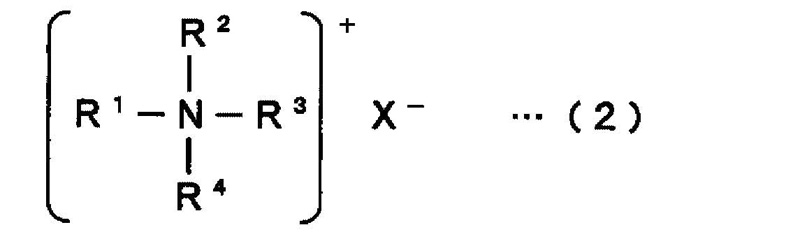
(式中、R1は炭素数10~22のアルキル基またはベンジル基、R2はメチル基または炭素数10~22のアルキル基、R3およびR4は炭素数1~3のアルキル基またはヒドロキシアルキル基、Xはハロゲン原子またはメチルサルフェート残基を表す。)
かかる第四級アンモニウム塩型カチオン界面活性剤としては、例えばドデシルトリメチルアンモニウムクロリド、ミリスチルトリメチルアンモニウムクロリド、セチルトリメチルアンモニウムクロリド、ステアリルトリメチルアンモニウムクロリド、アラキルトリメチルアンモニウムクロリド、ベヘニルトリメチルアンモニウムクロリド、ミリスチルジメチルエチルアンモニウムクロリド、セチルジメチルエチルアンモニウムクロリド、ステアリルジメチルエチルアンモニウムクロリド、アラキルジメチルエチルアンモニウムクロリド、ベヘニルジメチルエチルアンモニウムクロリド、ミリスチルジエチルメチルアンモニウムクロリド、セチルジエチルメチルアンモニウムクロリド、ステアリルジエチルメチルアンモニウムクロリド、アラキルジエチルメチルアンモニウムクロリド、ベヘニルジエチルメチルアンモニウムクロリド、ベンジルジメチルミリスチルアンモニウムクロリド、ベンジルジメチルセチルアンモニウムクロリド、ベンジルジメチルステアリルアンモニウムクロリド、ベンジルジメチルベヘニルアンモニウムクロリド、ベンジルメチルエチルセチルアンモニウムクロリド、ベンジルメチルエチルステアリルアンモニウムクロリド、ジベヘニルジヒドロキシエチルアンモニウムクロリド、および相当するブロミド等、更にはジパルミチルプロピルエチルアンモニウムメチルサルフェート等が挙げられる。本発明の実施にあたっては、これらのうち一種または二種以上が任意に選択される。
(E)成分の代表的なものとしては、ジメチルジステアルアンモニウムヘクトライト(ジステアルジモニウムヘクトライト)、ジメチルアルキルアンモニウムヘクトライト、ベンジルジメチルステアリルアンモニウムヘクトライト、塩化ジステアリルジメチルアンモニウム処理ケイ酸アルミニウムマグネシウム等が挙げられる。なかでも、ジメチルジステアルアンモニウムヘクトライトが特に好ましい。市販品としては、ベントン27(ベンジルジメチルステアリルアンモニウムクロライド処理ヘクトライト:エレメンティスジャパン社製)およびベントン38(ジステアリルジメチルアンモニウムクロライド処理ヘクトライト:エレメンティスジャパン社製)が好ましい。
(E)成分の配合量は、化粧料全量に対して、0.1~3質量%、好ましくは0.2~2.5質量%である。(E)成分の配合量が0.1質量%未満では紫外線防御能力の向上効果が得られず、3質量%を超えて配合すると高粘度となり、肌上での伸びが重くなるなどの使用性の点で好ましくない。
本発明の化粧料にさらに配合される(F)界面活性剤(以下、単に「(F)成分」と称する場合がある)は、カチオン界面活性剤以外の界面活性剤を指し、乳化形態を実現するため、HLBが8未満の界面活性剤であり、特にシリコーン系界面活性剤が好ましい。
HLBが8未満のシリコーン系界面活性剤としては、例えば、ポリオキシアルキレン変性シリコーン、ポリオキシアルキレン・アルキル共変性シリコーン、ポリグリセリン変性シリコーン、および/またはポリグリセリン・アルキル共変性シリコーンを挙げることができる。具体例には、KF-6017(PEG-10ジメチコン、信越化学工業株式会社製)、KF-6028(PEG-9ポリジメチルシロキシエチルジメチコン、信越化学工業株式会社製)、ABIL EM90(セチルPEG/PPG-10/1ジメチコン、Evonik Goldschmidt社製)、KF-6038(ラウリルPEG-9ポリジメチルシロキシエチルジメチコン、信越化学工業株式会社製)、ビスブチルジメチコンポリグリセリル-3等が含まれる。
HLBが8未満のシリコーン系界面活性剤としては、例えば、ポリオキシアルキレン変性シリコーン、ポリオキシアルキレン・アルキル共変性シリコーン、ポリグリセリン変性シリコーン、および/またはポリグリセリン・アルキル共変性シリコーンを挙げることができる。具体例には、KF-6017(PEG-10ジメチコン、信越化学工業株式会社製)、KF-6028(PEG-9ポリジメチルシロキシエチルジメチコン、信越化学工業株式会社製)、ABIL EM90(セチルPEG/PPG-10/1ジメチコン、Evonik Goldschmidt社製)、KF-6038(ラウリルPEG-9ポリジメチルシロキシエチルジメチコン、信越化学工業株式会社製)、ビスブチルジメチコンポリグリセリル-3等が含まれる。
(F)成分の配合量は、化粧料全量に対して、0.1~8質量%、さらに好ましくは0.2~7質量%、より好ましくは0.4~5質量%、さらに好ましくは0.6~3質量%である。
本発明の化粧料に配合される(G)油相増粘剤(以下、単に「(G)成分」と称する場合がある)は、本発明の(E)成分以外に油相の粘度を調整することができるものであり、デキストリン脂肪酸エステル、ショ糖脂肪酸エステル、脂肪酸もしくはその塩、植物性硬化油、固形もしくは半固形の植物油等が挙げられる。
デキストリン脂肪酸エステルは、デキストリンまたは還元デキストリンと高級脂肪酸とのエステルであり、化粧料に一般的に使用されているものであれば特に制限されず使用することができる。デキストリンまたは還元デキストリンは平均糖重合度が3~100のものを用いるのが好ましい。また、デキストリン脂肪酸エステルの構成脂肪酸としては、炭素数8~22の飽和脂肪酸を用いるのが好ましい。具体例としては、パルミチン酸デキストリン、オレイン酸デキストリン、ステアリン酸デキストリン、ミリスチン酸デキストリン、(パルミチン酸/2-エチルヘキサン酸)デキストリン等を挙げることができる。
ショ糖脂肪酸エステルは、その脂肪酸が直鎖状あるいは分岐鎖状の、飽和あるいは不飽和の、炭素数12から22のものを好ましく用いることができる。具体例としては、ショ糖カプリル酸エステル、ショ糖カプリン酸エステル、ショ糖ラウリン酸エステル、ショ糖ミリスチン酸エステル、ショ糖パルミチン酸エステル、ショ糖ステアリン酸エステル、ショ糖オレイン酸エステル、ショ糖エルカ酸エステル、酢酸ステアリン酸スクロース等を挙げることができる。
脂肪酸は、常温で固形のものを使用することができ、例として、ミリスチン酸、パルミチン酸、ステアリン酸、ベヘニン酸等を挙げることができる。また、脂肪酸の塩としては、これらのカルシウム塩、マグネシウム塩、アルミニウム塩等を挙げることができる。
植物性硬化油は、パーム核硬化油、硬化ひまし油、水添ピーナッツ油、水添ナタネ種子油、水添パーム油、水添ツバキ油、水添大豆油、水添オリーブ油、水添マカダミアナッツ油、水添ヒマワリ油、水添小麦胚芽油、水添米胚芽油、水添米ヌカ油、水添綿実油、水添アボカド油等を挙げることができる。
また、植物性硬化油と同様に、室温で固形または半固形の植物油も使用することができる。ここで、固形油とは25℃において固体の油を意味し、半固形油とは25℃において半量が固体である油を意味する。より具体的には、融点が44℃~90℃の範囲であり、25℃でB型粘度計により測定した粘度が5000mPa・s以上のもの、さらには10000mPa・s以上であるものが好ましい。室温で固形または半固形の植物油としては、カカオ脂、ヤシ油、パーム油、パーム核油、モクロウ、シアバター等を例示することができる。
(G)成分の配合量は、化粧料全量に対して、0.1~15質量%、さらに好ましくは0.2~10質量%、より好ましくは0.4~8質量%、さらに好ましくは0.5~4質量%である。本発明の化粧料に用いられる(G)成分としては、デキストリン脂肪酸エステルが好ましい。
本発明の化粧料には、上記必須成分以外に、本発明の効果を妨げない範囲で、化粧料に通常用いられる成分、例えば、油分、水、アルコール類、油性活性剤、水性活性剤、増粘剤、保湿剤、美白剤、酸化防止剤等を必要に応じて適宜配合してよい。
本願発明の化粧料は、使用性の観点から、被膜剤の配合量を3質量%以下、さらには1質量%以下とするのが好ましい。
本発明の化粧料は、油中水型乳化化粧料、油性化粧料、水中油型乳化化粧料、例えば油分の中に粉末成分が配合された水中油型乳化化粧料などの形態として、常法により製造することができる。なかでも、油中水型乳化化粧料であるのが好ましい。
本発明の化粧料は、例えば日焼け止めクリーム、日焼け止め乳液、日焼け止めローションとして提供できるのみならず、日焼け止め効果を付与したファンデーション、化粧下地、メーキャップ化粧料、毛髪化粧料等としても使用でき、常法により製造することができる。
以下に具体例を挙げて本発明をさらに詳細に説明するが、本発明は以下の実施例に限定されるものではない。また、以下の実施例等における配合量は特に断らない限り質量%を示す。
(実施例1、2、5、6および比較例1~3)
以下の表1に掲げた組成を有する化粧料を、油性成分を加温して溶解し粉末を分散させたものに、別途混合した水相を添加し、攪拌処理にて乳化することにより調製した。
以下の表1に掲げた組成を有する化粧料を、油性成分を加温して溶解し粉末を分散させたものに、別途混合した水相を添加し、攪拌処理にて乳化することにより調製した。
紫外線防御能残存率の測定方法
Sプレート(5×5cmのV溝PMMA板、SPFMASTER-PA01)に各例のサンプルを2mg/cm2の量で滴下し、60秒間指で塗布し、15分間乾燥した後、その吸光度(400~280nm)を株式会社日立製作所社製U-3500型自記録分光光度計にて測定した。未塗布のプレートをコントロールとし、吸光度(Abs)を以下の式で算出した。
Abs=-log(T/To)
T:サンプルの透過率、To:未塗布プレートの透過率
次に、測定プレートを水に浸し、Sプレートの塗布面を上にして置き、ティッシュペーパーを指に巻きつけ、一定の圧、回数でプレートをこすった。その後、再度Sプレートの吸光度を分光光度計で測定した。
化粧料の塗布直後とティッシュでこすった後の吸光度(積算値)から、下記式より、水、こすれに対する化粧効果の変化率を求めた。変化率が100%未満である場合には、塗布直後に化粧料が有していた化粧効果(紫外線防御能)が低下したことを示し、100%を超える場合には、化粧料塗布直後を上回る化粧効果が残存していることを示す。
化粧効果の変化率(%)
={(ティッシュでこすった後の吸光度の積算値)/(塗布直後の吸光度の積算値)}×100
Sプレート(5×5cmのV溝PMMA板、SPFMASTER-PA01)に各例のサンプルを2mg/cm2の量で滴下し、60秒間指で塗布し、15分間乾燥した後、その吸光度(400~280nm)を株式会社日立製作所社製U-3500型自記録分光光度計にて測定した。未塗布のプレートをコントロールとし、吸光度(Abs)を以下の式で算出した。
Abs=-log(T/To)
T:サンプルの透過率、To:未塗布プレートの透過率
次に、測定プレートを水に浸し、Sプレートの塗布面を上にして置き、ティッシュペーパーを指に巻きつけ、一定の圧、回数でプレートをこすった。その後、再度Sプレートの吸光度を分光光度計で測定した。
化粧料の塗布直後とティッシュでこすった後の吸光度(積算値)から、下記式より、水、こすれに対する化粧効果の変化率を求めた。変化率が100%未満である場合には、塗布直後に化粧料が有していた化粧効果(紫外線防御能)が低下したことを示し、100%を超える場合には、化粧料塗布直後を上回る化粧効果が残存していることを示す。
化粧効果の変化率(%)
={(ティッシュでこすった後の吸光度の積算値)/(塗布直後の吸光度の積算値)}×100
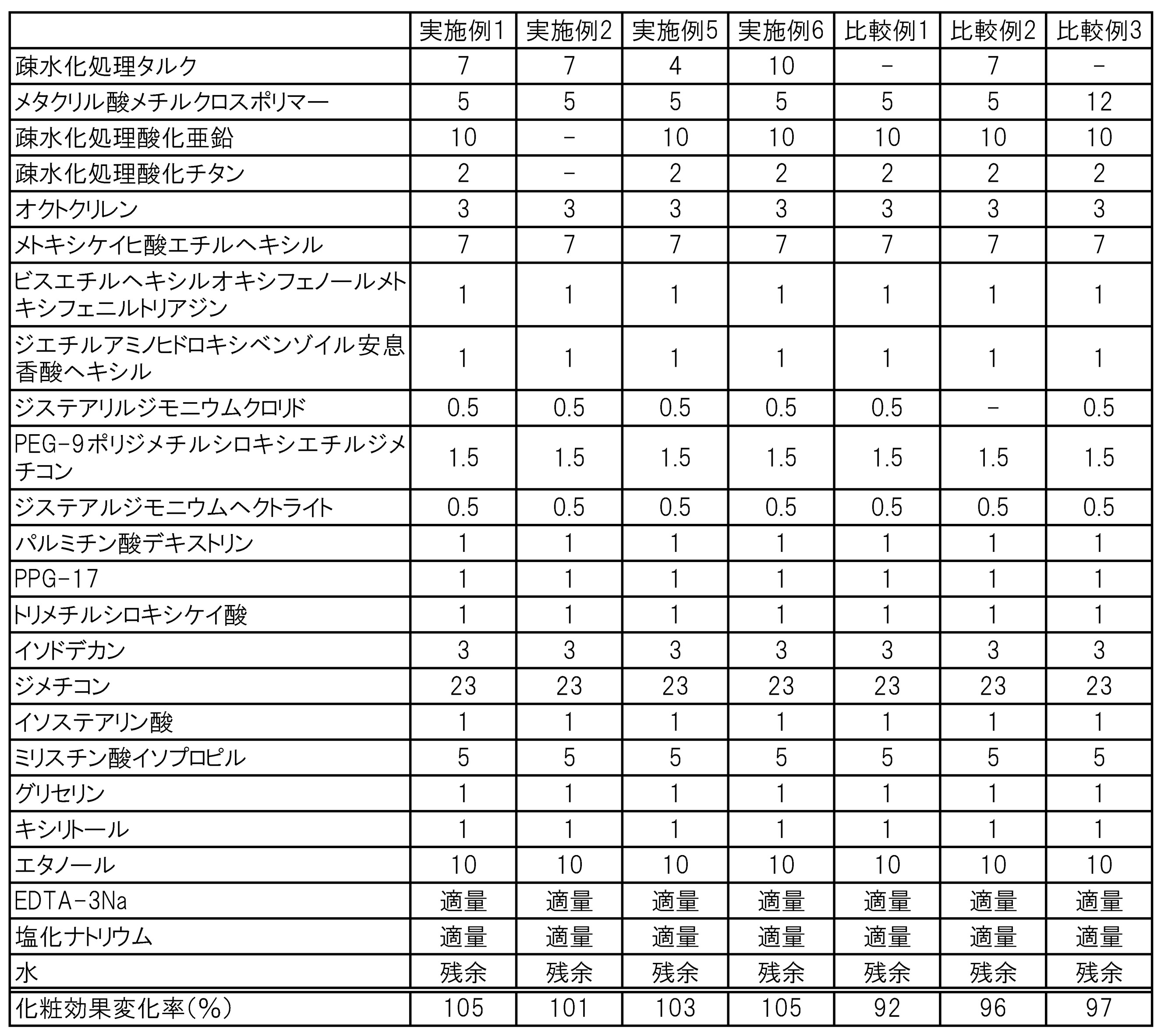
表1に示すように、(A)板状粉末を含まない化粧料(比較例1)および(C)カチオン界面活性剤を含まない化粧料(比較例2)はいずれも、水浴およびこすれにより、化粧料塗布直後よりも化粧効果が低下した。また、合計粉末量が同じであっても、球状粉末のみを含む化粧料(比較例3)も水浴およびこすれにより化粧効果が低下した。
一方、本願発明の(A)、(B)および(C)成分を配合する化粧料(実施例1、2)は、水浴およびこすれの後であっても紫外線防御能で表される化粧効果を十分に維持しており、むしろ化粧料塗布直後よりも高い紫外線防御効果を有していた。よって、本願発明の化粧料は水やこすれに対して高い耐性を有することが示された。また、実施例1、2、5および6の化粧料は安定性も良く、使用感にも優れていた。
一方、本願発明の(A)、(B)および(C)成分を配合する化粧料(実施例1、2)は、水浴およびこすれの後であっても紫外線防御能で表される化粧効果を十分に維持しており、むしろ化粧料塗布直後よりも高い紫外線防御効果を有していた。よって、本願発明の化粧料は水やこすれに対して高い耐性を有することが示された。また、実施例1、2、5および6の化粧料は安定性も良く、使用感にも優れていた。
次に、実施例1の化粧料について被膜剤(トリメチルシロキシケイ酸)の配合量を多くした場合の使用感(べたつき)について、下記の基準に基づいて評価した。結果は表2に示す。
<評価基準>
A:パネル10人中8名以上がべたつかないと回答した。
B:パネル10人中4~7名がべたつかないと回答した。
C:パネル10人中0~3名がべたつかないと回答した。
<評価基準>
A:パネル10人中8名以上がべたつかないと回答した。
B:パネル10人中4~7名がべたつかないと回答した。
C:パネル10人中0~3名がべたつかないと回答した。
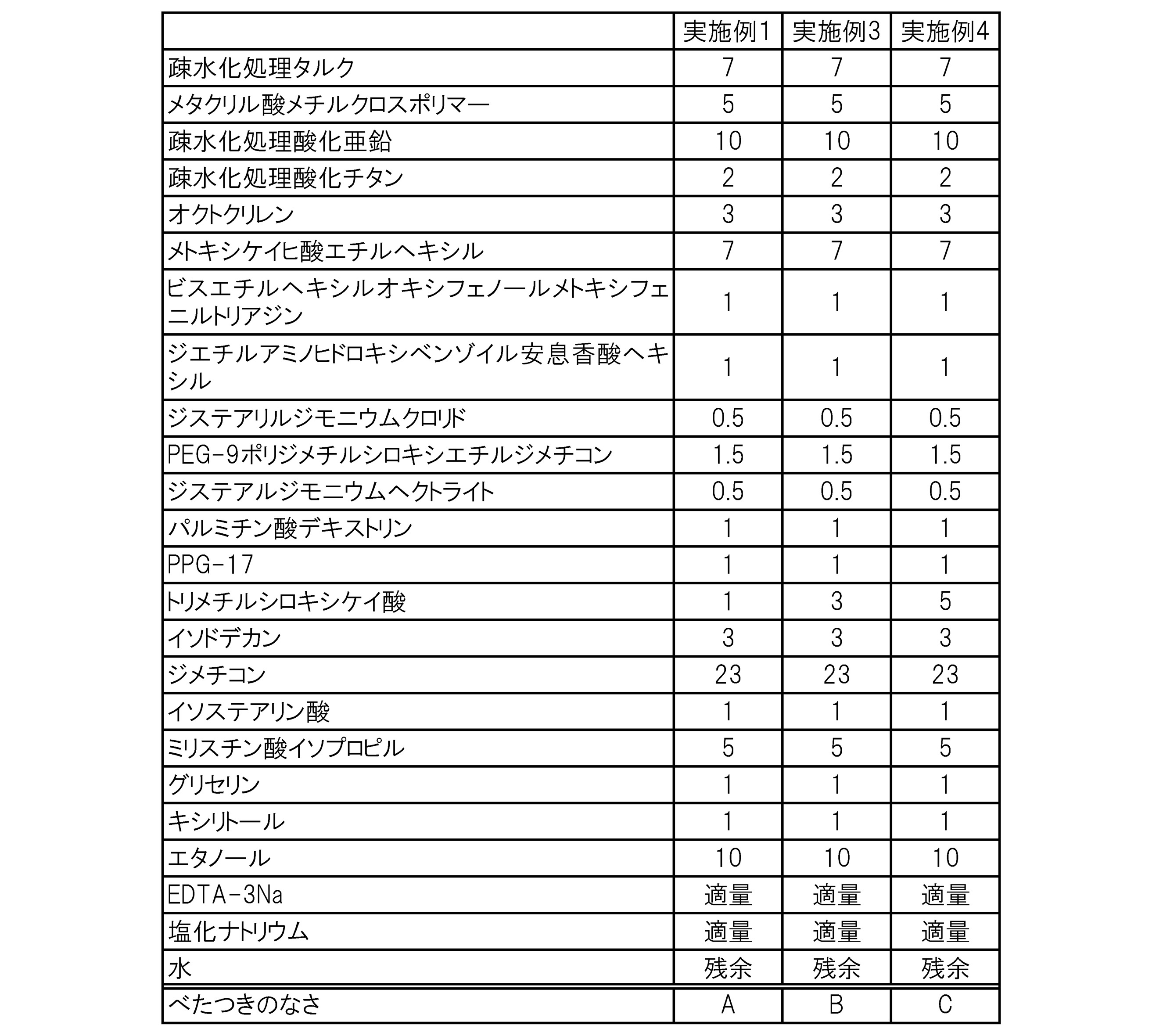
実施例1、3および4の化粧料はいずれもこすれに対して良好な耐性を示した。表2に示すように、被膜剤の配合量が少ない場合(実施例1)にはべたつきが少なく、使用性が最も良好な化粧料が得られたが、被膜剤の配合量が増加するにつれて(実施例3、実施例4)べたつきを感じる傾向にあった。
(処方例)
以下に、本発明の化粧料の処方例を挙げる。なお、配合量はすべて製品全量に対する質量%で表す。
以下に、本発明の化粧料の処方例を挙げる。なお、配合量はすべて製品全量に対する質量%で表す。
製法
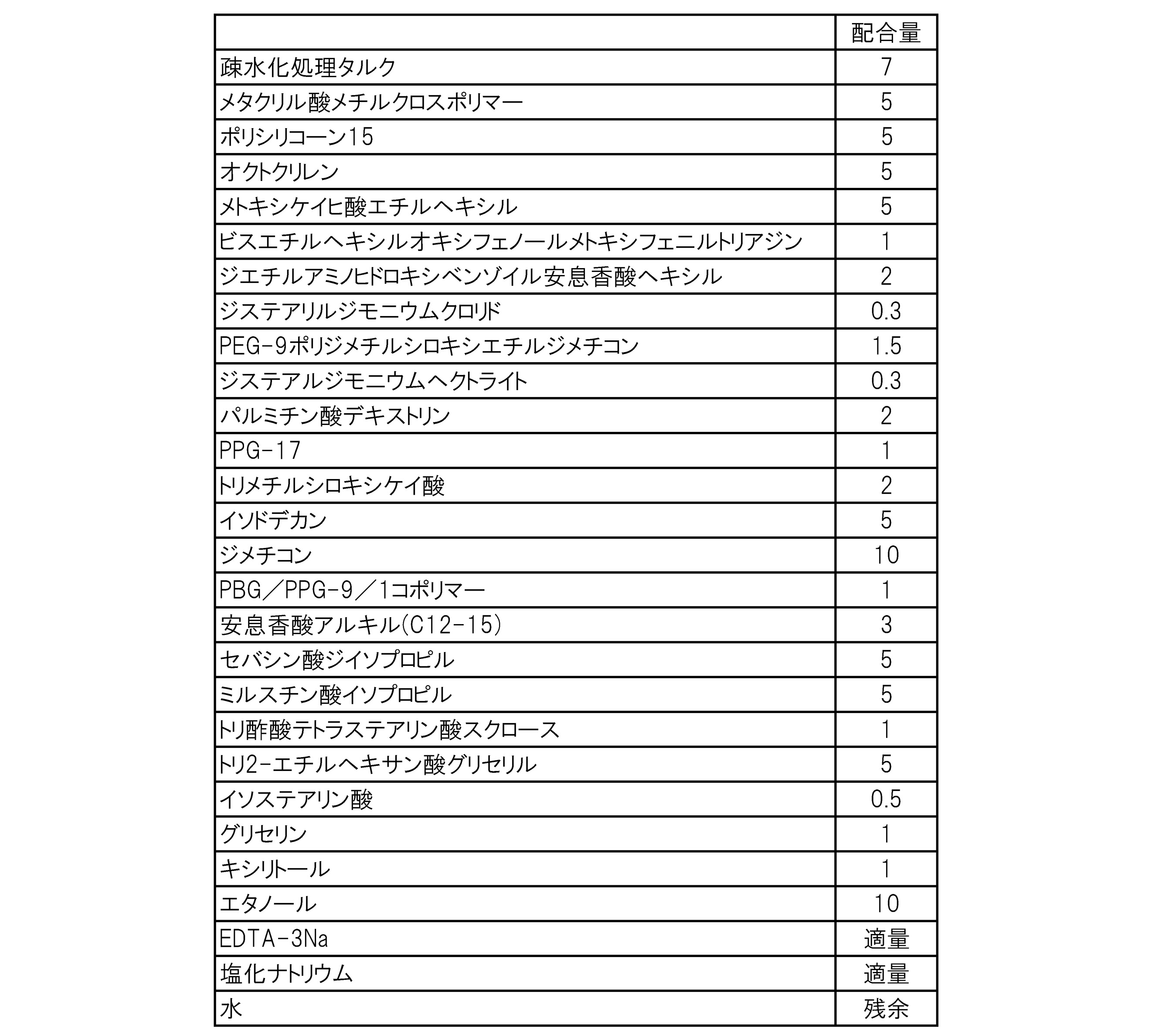
下記表3~8について、表中に示す成分のうち油相成分を均一に加熱混合して油相部を調製し、この油相部に粉末成分を分散させて混合物を得た。次いで、水相成分を加温溶解して水相部を調製し、前記混合物に添加し、撹拌処理にて乳化することにより、それぞれ日焼け止めクリーム(処方例1)、日焼け止めローション(処方例2)、化粧下地(処方例3)、BBクリーム(処方例4)、ファンデーション(処方例5)、ヘアスプレー原液(処方例6)を得た。処方例6については、ヘアスプレー原液とLPガスとを1:1で混合しエアゾール化することによって、日焼け止めヘアスプレーを製造した。
下記表3~8について、表中に示す成分のうち油相成分を均一に加熱混合して油相部を調製し、この油相部に粉末成分を分散させて混合物を得た。次いで、水相成分を加温溶解して水相部を調製し、前記混合物に添加し、撹拌処理にて乳化することにより、それぞれ日焼け止めクリーム(処方例1)、日焼け止めローション(処方例2)、化粧下地(処方例3)、BBクリーム(処方例4)、ファンデーション(処方例5)、ヘアスプレー原液(処方例6)を得た。処方例6については、ヘアスプレー原液とLPガスとを1:1で混合しエアゾール化することによって、日焼け止めヘアスプレーを製造した。
処方例1.日焼け止めクリーム

処方例2.日焼け止めローション

処方例3.化粧下地

処方例4.BBクリーム

処方例5.ファンデーション
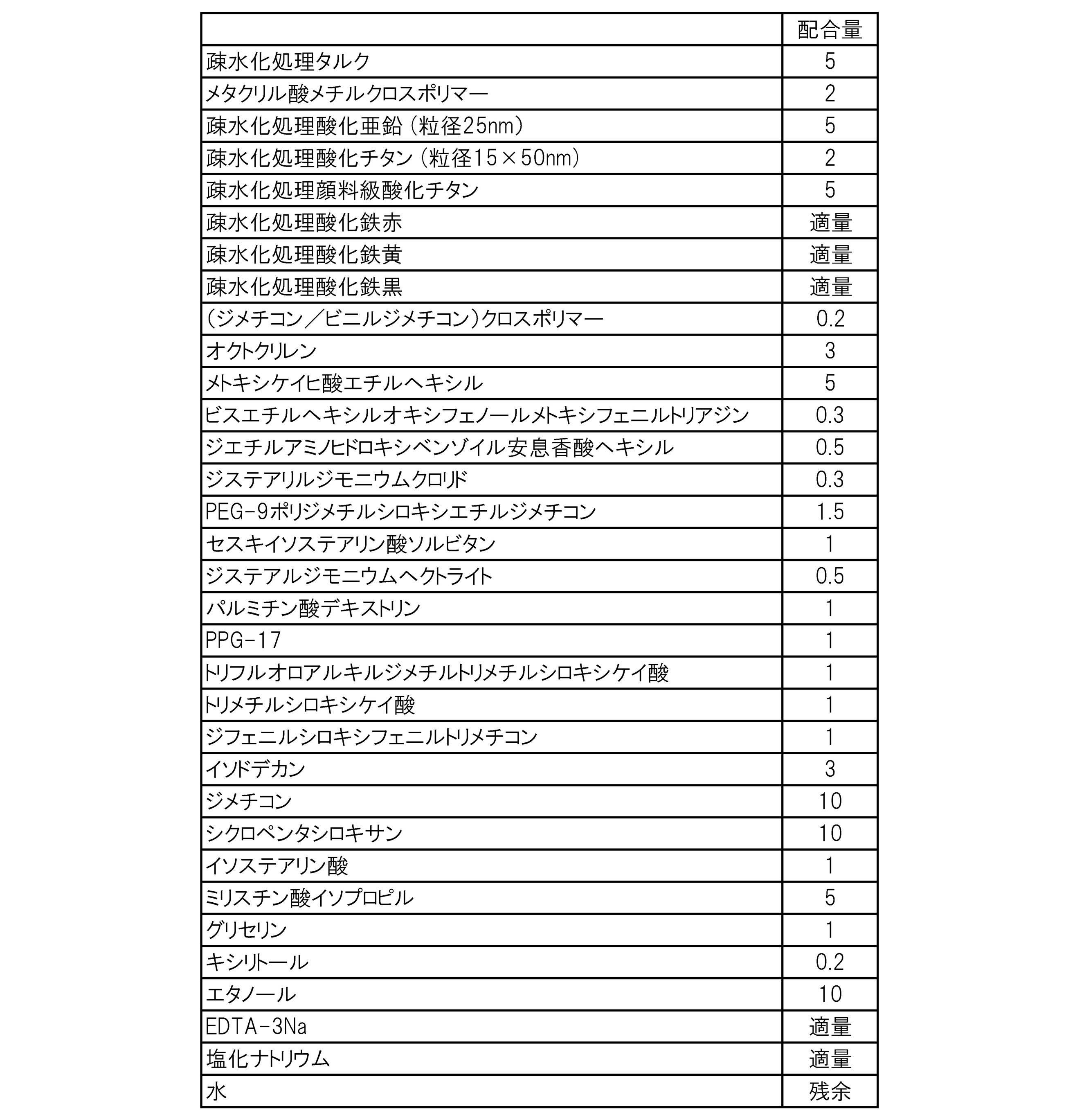
処方例6.ヘアスプレー
Claims (6)
- (A)板状粉末、
(B)6~40質量%の紫外線吸収剤、および、
(C)カチオン界面活性剤
を含有する、化粧料。 - (D)紫外線散乱剤をさらに含有する、請求項1に記載の化粧料。
- (E)有機変性粘土鉱物をさらに含有する、請求項1または2に記載の化粧料。
- (F)カチオン界面活性剤以外の界面活性剤をさらに含有する、請求項1から3のいずれか一項に記載の化粧料。
- (G)油相増粘剤をさらに含有する、請求項1から4のいずれか一項に記載の化粧料。
- (A)板状粉末が疎水化処理タルクである、請求項1から5のいずれか一項に記載の化粧料。
Priority Applications (4)
| Application Number | Priority Date | Filing Date | Title |
|---|---|---|---|
| CN201880054491.4A CN110996892A (zh) | 2017-08-25 | 2018-08-23 | 化妆品 |
| EP18847319.3A EP3673894A4 (en) | 2017-08-25 | 2018-08-23 | COSMETIC PRODUCT |
| JP2019537679A JP7196080B2 (ja) | 2017-08-25 | 2018-08-23 | 化粧料 |
| US16/641,937 US11413227B2 (en) | 2017-08-25 | 2018-08-23 | Durable sunscreen cosmetic |
Applications Claiming Priority (2)
| Application Number | Priority Date | Filing Date | Title |
|---|---|---|---|
| JP2017162724 | 2017-08-25 | ||
| JP2017-162724 | 2017-08-25 |
Publications (1)
| Publication Number | Publication Date |
|---|---|
| WO2019039548A1 true WO2019039548A1 (ja) | 2019-02-28 |
Family
ID=65438964
Family Applications (1)
| Application Number | Title | Priority Date | Filing Date |
|---|---|---|---|
| PCT/JP2018/031168 Ceased WO2019039548A1 (ja) | 2017-08-25 | 2018-08-23 | 化粧料 |
Country Status (6)
| Country | Link |
|---|---|
| US (1) | US11413227B2 (ja) |
| EP (1) | EP3673894A4 (ja) |
| JP (1) | JP7196080B2 (ja) |
| CN (1) | CN110996892A (ja) |
| TW (1) | TW201919567A (ja) |
| WO (1) | WO2019039548A1 (ja) |
Cited By (4)
| Publication number | Priority date | Publication date | Assignee | Title |
|---|---|---|---|---|
| JP2022526245A (ja) * | 2019-03-15 | 2022-05-24 | ビーエーエスエフ ソシエタス・ヨーロピア | ジエチルアミノヒドロキシベンゾイル安息香酸ヘキシル及びブチルメトキシジベンゾイルメタンを含む効果的な日焼け止め組成物 |
| WO2023238747A1 (ja) * | 2022-06-10 | 2023-12-14 | 花王株式会社 | 毛髪処理剤又は頭飾製品用繊維処理剤 |
| JP2023183089A (ja) * | 2022-06-15 | 2023-12-27 | 日油株式会社 | 油中水型日焼け止め化粧料 |
| JP2024541529A (ja) * | 2021-11-29 | 2024-11-08 | エルブイエムエイチ レシェルシェ | 油中水型化粧料 |
Families Citing this family (6)
| Publication number | Priority date | Publication date | Assignee | Title |
|---|---|---|---|---|
| WO2022006408A1 (en) * | 2020-07-01 | 2022-01-06 | L'oreal | Organic and mineral filter hybrid sunscreen |
| FR3113831B1 (fr) * | 2020-09-07 | 2024-11-08 | Oreal | Filtre solaire hybride organique et minéral |
| WO2022255182A1 (ja) * | 2021-06-02 | 2022-12-08 | 花王株式会社 | 油中水型乳化組成物 |
| CN114732744A (zh) * | 2022-03-17 | 2022-07-12 | 上海家化联合股份有限公司 | 基于阳离子乳化剂与片状粉末的控油组合物 |
| CN115006311B (zh) * | 2022-07-06 | 2024-03-26 | 浙江宜格企业管理集团有限公司 | 一种透明双相防晒组合物及其制备方法 |
| WO2025137570A1 (en) * | 2023-12-22 | 2025-06-26 | Coty Inc. | Color cosmetics formulation |
Citations (14)
| Publication number | Priority date | Publication date | Assignee | Title |
|---|---|---|---|---|
| JPH08188723A (ja) * | 1995-01-09 | 1996-07-23 | Pola Chem Ind Inc | コアシェル顔料及びこれを含有するメークアップ化粧料 |
| JPH08217619A (ja) | 1995-02-20 | 1996-08-27 | Shiseido Co Ltd | 油中水型乳化化粧料 |
| JP2002020217A (ja) * | 2000-06-30 | 2002-01-23 | Pola Chem Ind Inc | 化粧料及び化粧料の製造方法 |
| JP2004002274A (ja) * | 2002-03-29 | 2004-01-08 | Shiyouritsu Plast Kogyo Kk | 化粧料 |
| JP2005015437A (ja) * | 2003-06-27 | 2005-01-20 | Fuji Xerox Co Ltd | 化粧料用樹脂粉体およびこれを用いた化粧料 |
| JP2005298475A (ja) * | 2004-03-17 | 2005-10-27 | Kose Corp | 固形粉末化粧料 |
| JP2005350367A (ja) * | 2004-06-08 | 2005-12-22 | Shiseido Co Ltd | 油中水型皮膚外用組成物 |
| JP2008508323A (ja) * | 2004-08-06 | 2008-03-21 | ザ プロクター アンド ギャンブル カンパニー | ワックス粒子と、血小板状、球状又は不規則形状粒子とを含有するパーソナルクレンジング組成物 |
| JP2010059076A (ja) * | 2008-09-02 | 2010-03-18 | Shiseido Co Ltd | 水中油型乳化組成物 |
| JP2010168302A (ja) * | 2009-01-22 | 2010-08-05 | Shiseido Co Ltd | 乳化化粧料 |
| JP2011236201A (ja) * | 2010-04-13 | 2011-11-24 | Shiseido Co Ltd | 油中水型乳化組成物 |
| JP2012001440A (ja) * | 2010-06-14 | 2012-01-05 | Ohken Co Ltd | ポリエステル扁平粒子の製造方法 |
| JP2013151436A (ja) * | 2012-01-24 | 2013-08-08 | Shin-Etsu Chemical Co Ltd | 化粧料の製造方法及び化粧料 |
| WO2016068298A1 (ja) | 2014-10-31 | 2016-05-06 | 株式会社 資生堂 | 油中水型乳化日焼け止め化粧料 |
Family Cites Families (9)
| Publication number | Priority date | Publication date | Assignee | Title |
|---|---|---|---|---|
| US5093099A (en) * | 1987-11-16 | 1992-03-03 | Kao Corporation | Flaky powder of zinc oxide and its composition for external use |
| JP3073887B2 (ja) * | 1994-06-30 | 2000-08-07 | 花王株式会社 | 皮膚外用剤 |
| EP1990042B1 (en) * | 2006-02-20 | 2014-08-27 | Shiseido Company, Limited | Water-in-oil emulsified sunscreen cosmetic composition |
| US9040094B2 (en) * | 2007-02-13 | 2015-05-26 | Sakai Chemical Industry Co., Ltd. | Flaky particle and cosmetic |
| KR20110135916A (ko) * | 2009-03-26 | 2011-12-20 | 가부시키가이샤 시세이도 | 자외선차단 화장료 |
| JP5728388B2 (ja) * | 2009-11-06 | 2015-06-03 | 花王株式会社 | 水中油型乳化化粧料 |
| JP5363540B2 (ja) * | 2011-08-04 | 2013-12-11 | 信越化学工業株式会社 | 複合粒子の製造方法 |
| JP5546056B2 (ja) * | 2011-08-31 | 2014-07-09 | 株式会社 資生堂 | 油中水型乳化日焼け止め化粧料 |
| JP2014024765A (ja) * | 2012-07-24 | 2014-02-06 | Shiseido Co Ltd | 水中油型乳化日焼け止め化粧料 |
-
2018
- 2018-08-23 JP JP2019537679A patent/JP7196080B2/ja active Active
- 2018-08-23 CN CN201880054491.4A patent/CN110996892A/zh active Pending
- 2018-08-23 WO PCT/JP2018/031168 patent/WO2019039548A1/ja not_active Ceased
- 2018-08-23 EP EP18847319.3A patent/EP3673894A4/en active Pending
- 2018-08-23 US US16/641,937 patent/US11413227B2/en active Active
- 2018-08-24 TW TW107129617A patent/TW201919567A/zh unknown
Patent Citations (14)
| Publication number | Priority date | Publication date | Assignee | Title |
|---|---|---|---|---|
| JPH08188723A (ja) * | 1995-01-09 | 1996-07-23 | Pola Chem Ind Inc | コアシェル顔料及びこれを含有するメークアップ化粧料 |
| JPH08217619A (ja) | 1995-02-20 | 1996-08-27 | Shiseido Co Ltd | 油中水型乳化化粧料 |
| JP2002020217A (ja) * | 2000-06-30 | 2002-01-23 | Pola Chem Ind Inc | 化粧料及び化粧料の製造方法 |
| JP2004002274A (ja) * | 2002-03-29 | 2004-01-08 | Shiyouritsu Plast Kogyo Kk | 化粧料 |
| JP2005015437A (ja) * | 2003-06-27 | 2005-01-20 | Fuji Xerox Co Ltd | 化粧料用樹脂粉体およびこれを用いた化粧料 |
| JP2005298475A (ja) * | 2004-03-17 | 2005-10-27 | Kose Corp | 固形粉末化粧料 |
| JP2005350367A (ja) * | 2004-06-08 | 2005-12-22 | Shiseido Co Ltd | 油中水型皮膚外用組成物 |
| JP2008508323A (ja) * | 2004-08-06 | 2008-03-21 | ザ プロクター アンド ギャンブル カンパニー | ワックス粒子と、血小板状、球状又は不規則形状粒子とを含有するパーソナルクレンジング組成物 |
| JP2010059076A (ja) * | 2008-09-02 | 2010-03-18 | Shiseido Co Ltd | 水中油型乳化組成物 |
| JP2010168302A (ja) * | 2009-01-22 | 2010-08-05 | Shiseido Co Ltd | 乳化化粧料 |
| JP2011236201A (ja) * | 2010-04-13 | 2011-11-24 | Shiseido Co Ltd | 油中水型乳化組成物 |
| JP2012001440A (ja) * | 2010-06-14 | 2012-01-05 | Ohken Co Ltd | ポリエステル扁平粒子の製造方法 |
| JP2013151436A (ja) * | 2012-01-24 | 2013-08-08 | Shin-Etsu Chemical Co Ltd | 化粧料の製造方法及び化粧料 |
| WO2016068298A1 (ja) | 2014-10-31 | 2016-05-06 | 株式会社 資生堂 | 油中水型乳化日焼け止め化粧料 |
Non-Patent Citations (1)
| Title |
|---|
| See also references of EP3673894A4 |
Cited By (6)
| Publication number | Priority date | Publication date | Assignee | Title |
|---|---|---|---|---|
| JP2022526245A (ja) * | 2019-03-15 | 2022-05-24 | ビーエーエスエフ ソシエタス・ヨーロピア | ジエチルアミノヒドロキシベンゾイル安息香酸ヘキシル及びブチルメトキシジベンゾイルメタンを含む効果的な日焼け止め組成物 |
| JP7551640B2 (ja) | 2019-03-15 | 2024-09-17 | ベーアーエスエフ・エスエー | ジエチルアミノヒドロキシベンゾイル安息香酸ヘキシル及びブチルメトキシジベンゾイルメタンを含む効果的な日焼け止め組成物 |
| JP2024541529A (ja) * | 2021-11-29 | 2024-11-08 | エルブイエムエイチ レシェルシェ | 油中水型化粧料 |
| WO2023238747A1 (ja) * | 2022-06-10 | 2023-12-14 | 花王株式会社 | 毛髪処理剤又は頭飾製品用繊維処理剤 |
| JP2023183089A (ja) * | 2022-06-15 | 2023-12-27 | 日油株式会社 | 油中水型日焼け止め化粧料 |
| JP7800315B2 (ja) | 2022-06-15 | 2026-01-16 | 日油株式会社 | 油中水型日焼け止め化粧料 |
Also Published As
| Publication number | Publication date |
|---|---|
| CN110996892A (zh) | 2020-04-10 |
| EP3673894A4 (en) | 2021-05-26 |
| US11413227B2 (en) | 2022-08-16 |
| EP3673894A1 (en) | 2020-07-01 |
| JPWO2019039548A1 (ja) | 2020-09-17 |
| US20200246234A1 (en) | 2020-08-06 |
| TW201919567A (zh) | 2019-06-01 |
| JP7196080B2 (ja) | 2022-12-26 |
Similar Documents
| Publication | Publication Date | Title |
|---|---|---|
| JP7196080B2 (ja) | 化粧料 | |
| JP7583083B2 (ja) | 油中水型乳化化粧料 | |
| CN101384245B (zh) | 油包水型乳化防晒化妆品 | |
| US20140105943A1 (en) | Aqueous wax dispersions containing sunscreen agents | |
| WO2016204946A1 (en) | Water-in-oil sunscreen composition having organic sunscreen actives | |
| US9649263B2 (en) | Sunscreen composition containing high levels of liposoluble UV filters | |
| KR102894303B1 (ko) | 유화 화장료 및 이의 제조방법 | |
| BR112015003963B1 (pt) | Dispersões de cera aquosas e composições de modelação do cabelo contendo as mesmas | |
| EP3334401B1 (en) | Sunscreen composition containing high levels of liposoluble uv filters | |
| WO2021125211A1 (ja) | 日焼け止め化粧料 | |
| CN106659671A (zh) | 呈乳液形式的组合物 | |
| US9655825B2 (en) | Sunscreen composition containing high levels of liposoluble UV filters | |
| CN110087609B (zh) | 含有黄芩苷、黄嘌呤碱、维生素b3、和多价金属阳离子盐的油包水乳液 | |
| JP4447541B2 (ja) | 日焼け止め化粧料 | |
| JP5898997B2 (ja) | 日焼け止め化粧料 | |
| JP2024544301A (ja) | 少なくともメロシアニン及びヒドロトロープを含む化粧用又は皮膚用組成物 | |
| WO2021153465A1 (ja) | 粉末分散組成物、乳化組成物、及び化粧料 | |
| KR20240163180A (ko) | 외용제 | |
| JP2025018346A (ja) | 油中水型乳化化粧料 | |
| WO2026034238A1 (ja) | 油中水型日焼け止め化粧料 | |
| WO2025079165A1 (ja) | 油性または乳化メーキャップ化粧料 | |
| CN116437892A (zh) | 包含硅酮乳化剂共混物的防晒乳液 |
Legal Events
| Date | Code | Title | Description |
|---|---|---|---|
| 121 | Ep: the epo has been informed by wipo that ep was designated in this application |
Ref document number: 18847319 Country of ref document: EP Kind code of ref document: A1 |
|
| ENP | Entry into the national phase |
Ref document number: 2019537679 Country of ref document: JP Kind code of ref document: A |
|
| NENP | Non-entry into the national phase |
Ref country code: DE |
|
| ENP | Entry into the national phase |
Ref document number: 2018847319 Country of ref document: EP Effective date: 20200325 |