WO2019046511A1 - Compounds, compositions, and methods for the treatment of disease - Google Patents

Compounds, compositions, and methods for the treatment of disease Download PDF

Info

Publication number
WO2019046511A1
WO2019046511A1 PCT/US2018/048705 US2018048705W WO2019046511A1 WO 2019046511 A1 WO2019046511 A1 WO 2019046511A1 US 2018048705 W US2018048705 W US 2018048705W WO 2019046511 A1 WO2019046511 A1 WO 2019046511A1
Authority
WO
WIPO (PCT)
Prior art keywords
alkyl
aryl
heteroaryl
independently
heteroalkyl
Prior art date
Legal status (The legal status is an assumption and is not a legal conclusion. Google has not performed a legal analysis and makes no representation as to the accuracy of the status listed.)
Ceased
Application number
PCT/US2018/048705
Other languages
French (fr)
Inventor
Anjaneyulu Sheri
Geeta MEHER
Sreerupa CHALLA
Shenghua Zhou
Radhakrishnan P. Iyer
Current Assignee (The listed assignees may be inaccurate. Google has not performed a legal analysis and makes no representation or warranty as to the accuracy of the list.)
Sperovie Biosciences Inc
Original Assignee
Sperovie Biosciences Inc
Priority date (The priority date is an assumption and is not a legal conclusion. Google has not performed a legal analysis and makes no representation as to the accuracy of the date listed.)
Filing date
Publication date
Application filed by Sperovie Biosciences Inc filed Critical Sperovie Biosciences Inc
Priority to JP2020512430A priority Critical patent/JP7270608B2/en
Priority to EP18850903.8A priority patent/EP3675859A4/en
Priority to CA3074232A priority patent/CA3074232C/en
Priority to US16/643,393 priority patent/US11638716B2/en
Publication of WO2019046511A1 publication Critical patent/WO2019046511A1/en
Anticipated expiration legal-status Critical
Ceased legal-status Critical Current

Links

Classifications

    • AHUMAN NECESSITIES
    • A61MEDICAL OR VETERINARY SCIENCE; HYGIENE
    • A61KPREPARATIONS FOR MEDICAL, DENTAL OR TOILETRY PURPOSES
    • A61K45/00Medicinal preparations containing active ingredients not provided for in groups A61K31/00 - A61K41/00
    • A61K45/06Mixtures of active ingredients without chemical characterisation, e.g. antiphlogistics and cardiaca
    • AHUMAN NECESSITIES
    • A61MEDICAL OR VETERINARY SCIENCE; HYGIENE
    • A61KPREPARATIONS FOR MEDICAL, DENTAL OR TOILETRY PURPOSES
    • A61K31/00Medicinal preparations containing organic active ingredients
    • A61K31/70Carbohydrates; Sugars; Derivatives thereof
    • A61K31/7084Compounds having two nucleosides or nucleotides, e.g. nicotinamide-adenine dinucleotide, flavine-adenine dinucleotide
    • AHUMAN NECESSITIES
    • A61MEDICAL OR VETERINARY SCIENCE; HYGIENE
    • A61KPREPARATIONS FOR MEDICAL, DENTAL OR TOILETRY PURPOSES
    • A61K31/00Medicinal preparations containing organic active ingredients
    • A61K31/33Heterocyclic compounds
    • A61K31/395Heterocyclic compounds having nitrogen as a ring hetero atom, e.g. guanethidine or rifamycins
    • A61K31/495Heterocyclic compounds having nitrogen as a ring hetero atom, e.g. guanethidine or rifamycins having six-membered rings with two or more nitrogen atoms as the only ring heteroatoms, e.g. piperazine or tetrazines
    • A61K31/505Pyrimidines; Hydrogenated pyrimidines, e.g. trimethoprim
    • A61K31/513Pyrimidines; Hydrogenated pyrimidines, e.g. trimethoprim having oxo groups directly attached to the heterocyclic ring, e.g. cytosine
    • AHUMAN NECESSITIES
    • A61MEDICAL OR VETERINARY SCIENCE; HYGIENE
    • A61PSPECIFIC THERAPEUTIC ACTIVITY OF CHEMICAL COMPOUNDS OR MEDICINAL PREPARATIONS
    • A61P31/00Antiinfectives, i.e. antibiotics, antiseptics, chemotherapeutics
    • AHUMAN NECESSITIES
    • A61MEDICAL OR VETERINARY SCIENCE; HYGIENE
    • A61PSPECIFIC THERAPEUTIC ACTIVITY OF CHEMICAL COMPOUNDS OR MEDICINAL PREPARATIONS
    • A61P35/00Antineoplastic agents
    • CCHEMISTRY; METALLURGY
    • C07ORGANIC CHEMISTRY
    • C07CACYCLIC OR CARBOCYCLIC COMPOUNDS
    • C07C69/00Esters of carboxylic acids; Esters of carbonic or haloformic acids
    • C07C69/76Esters of carboxylic acids having a carboxyl group bound to a carbon atom of a six-membered aromatic ring
    • C07C69/84Esters of carboxylic acids having a carboxyl group bound to a carbon atom of a six-membered aromatic ring of monocyclic hydroxy carboxylic acids, the hydroxy groups and the carboxyl groups of which are bound to carbon atoms of a six-membered aromatic ring
    • C07C69/92Esters of carboxylic acids having a carboxyl group bound to a carbon atom of a six-membered aromatic ring of monocyclic hydroxy carboxylic acids, the hydroxy groups and the carboxyl groups of which are bound to carbon atoms of a six-membered aromatic ring with etherified hydroxyl groups
    • CCHEMISTRY; METALLURGY
    • C07ORGANIC CHEMISTRY
    • C07HSUGARS; DERIVATIVES THEREOF; NUCLEOSIDES; NUCLEOTIDES; NUCLEIC ACIDS
    • C07H19/00Compounds containing a hetero ring sharing one ring hetero atom with a saccharide radical; Nucleosides; Mononucleotides; Anhydro-derivatives thereof
    • C07H19/02Compounds containing a hetero ring sharing one ring hetero atom with a saccharide radical; Nucleosides; Mononucleotides; Anhydro-derivatives thereof sharing nitrogen
    • C07H19/04Heterocyclic radicals containing only nitrogen atoms as ring hetero atom
    • C07H19/06Pyrimidine radicals
    • C07H19/10Pyrimidine radicals with the saccharide radical esterified by phosphoric or polyphosphoric acids
    • C07H19/11Pyrimidine radicals with the saccharide radical esterified by phosphoric or polyphosphoric acids containing cyclic phosphate
    • CCHEMISTRY; METALLURGY
    • C07ORGANIC CHEMISTRY
    • C07HSUGARS; DERIVATIVES THEREOF; NUCLEOSIDES; NUCLEOTIDES; NUCLEIC ACIDS
    • C07H19/00Compounds containing a hetero ring sharing one ring hetero atom with a saccharide radical; Nucleosides; Mononucleotides; Anhydro-derivatives thereof
    • C07H19/02Compounds containing a hetero ring sharing one ring hetero atom with a saccharide radical; Nucleosides; Mononucleotides; Anhydro-derivatives thereof sharing nitrogen
    • C07H19/04Heterocyclic radicals containing only nitrogen atoms as ring hetero atom
    • C07H19/16Purine radicals
    • C07H19/20Purine radicals with the saccharide radical esterified by phosphoric or polyphosphoric acids
    • C07H19/207Purine radicals with the saccharide radical esterified by phosphoric or polyphosphoric acids the phosphoric or polyphosphoric acids being esterified by a further hydroxylic compound, e.g. flavine adenine dinucleotide or nicotinamide-adenine dinucleotide
    • CCHEMISTRY; METALLURGY
    • C07ORGANIC CHEMISTRY
    • C07HSUGARS; DERIVATIVES THEREOF; NUCLEOSIDES; NUCLEOTIDES; NUCLEIC ACIDS
    • C07H19/00Compounds containing a hetero ring sharing one ring hetero atom with a saccharide radical; Nucleosides; Mononucleotides; Anhydro-derivatives thereof
    • C07H19/02Compounds containing a hetero ring sharing one ring hetero atom with a saccharide radical; Nucleosides; Mononucleotides; Anhydro-derivatives thereof sharing nitrogen
    • C07H19/04Heterocyclic radicals containing only nitrogen atoms as ring hetero atom
    • C07H19/16Purine radicals
    • C07H19/20Purine radicals with the saccharide radical esterified by phosphoric or polyphosphoric acids
    • C07H19/213Purine radicals with the saccharide radical esterified by phosphoric or polyphosphoric acids containing cyclic phosphate
    • CCHEMISTRY; METALLURGY
    • C07ORGANIC CHEMISTRY
    • C07HSUGARS; DERIVATIVES THEREOF; NUCLEOSIDES; NUCLEOTIDES; NUCLEIC ACIDS
    • C07H21/00Compounds containing two or more mononucleotide units having separate phosphate or polyphosphate groups linked by saccharide radicals of nucleoside groups, e.g. nucleic acids
    • CCHEMISTRY; METALLURGY
    • C07ORGANIC CHEMISTRY
    • C07HSUGARS; DERIVATIVES THEREOF; NUCLEOSIDES; NUCLEOTIDES; NUCLEIC ACIDS
    • C07H21/00Compounds containing two or more mononucleotide units having separate phosphate or polyphosphate groups linked by saccharide radicals of nucleoside groups, e.g. nucleic acids
    • C07H21/02Compounds containing two or more mononucleotide units having separate phosphate or polyphosphate groups linked by saccharide radicals of nucleoside groups, e.g. nucleic acids with ribosyl as saccharide radical
    • CCHEMISTRY; METALLURGY
    • C07ORGANIC CHEMISTRY
    • C07HSUGARS; DERIVATIVES THEREOF; NUCLEOSIDES; NUCLEOTIDES; NUCLEIC ACIDS
    • C07H21/00Compounds containing two or more mononucleotide units having separate phosphate or polyphosphate groups linked by saccharide radicals of nucleoside groups, e.g. nucleic acids
    • C07H21/04Compounds containing two or more mononucleotide units having separate phosphate or polyphosphate groups linked by saccharide radicals of nucleoside groups, e.g. nucleic acids with deoxyribosyl as saccharide radical
    • YGENERAL TAGGING OF NEW TECHNOLOGICAL DEVELOPMENTS; GENERAL TAGGING OF CROSS-SECTIONAL TECHNOLOGIES SPANNING OVER SEVERAL SECTIONS OF THE IPC; TECHNICAL SUBJECTS COVERED BY FORMER USPC CROSS-REFERENCE ART COLLECTIONS [XRACs] AND DIGESTS
    • Y02TECHNOLOGIES OR APPLICATIONS FOR MITIGATION OR ADAPTATION AGAINST CLIMATE CHANGE
    • Y02ATECHNOLOGIES FOR ADAPTATION TO CLIMATE CHANGE
    • Y02A50/00TECHNOLOGIES FOR ADAPTATION TO CLIMATE CHANGE in human health protection, e.g. against extreme weather
    • Y02A50/30Against vector-borne diseases, e.g. mosquito-borne, fly-borne, tick-borne or waterborne diseases whose impact is exacerbated by climate change

Definitions

  • PAMPs pathogen-associated molecular patterns
  • PRRs pattern recognition receptors
  • the retinoic acid-inducible gene-I (RIG-I) protein is a RNA helicase that also functions as a sensor of microbial-derived RNA.
  • RIG-I is important factor in host recognition of RNA viruses from a variety of different viral families, including Flaviviridae (e.g., West Nile virus, Hepatitis C virus, Japanese encephalitis virus, Dengue virus), Paramyxoviridae (e.g., Sendai virus, Newcastle disease virus, Respiratory syncytial virus, Measles virus), Rhabdoviridae (e.g., Rabies virus), Orthomyxoviridae (e.g., influenza A virus, influenza B virus), and Arenaviridae (e.g., Lassa virus).
  • Flaviviridae e.g., West Nile virus, Hepatitis C virus, Japanese encephalitis virus, Dengue virus
  • Paramyxoviridae e.g., Sendai virus, Newcastle disease virus, Respiratory syncytial virus, Measles virus
  • Rhabdoviridae e.g., Rabies virus
  • Orthomyxoviridae
  • Stimulator of interferon genes is a cytoplasmic adaptor protein that activates the TBK1-IRF3 signaling complex, resulting in induction of type I interferons (IFN- ⁇ and IFN-a) and other immune pathway proteins.
  • Other PRRs also play a role in sensing microbial-derived nucleic acids, including NOD2, LGP2, MDA5, and a number of Toll-like receptors (TLRs) that are expressed on the cell surface and within endosomal compartments.
  • a shortcoming of many current antiviral therapies relates to the emergence of drug resistant variants that occurs upon extended use.
  • many available treatments require persistent and long-term therapy, which often results in unwanted side effects and the risk of relapse upon conclusion of treatment.
  • many viruses can be subdivided into different genotypes, and certain drugs developed against one genotype may not be active against other genotypes.
  • the use of small molecule mimics of viral-derived RNA capable of PRR induction provides an alternate approach to the treatment of viral infection, as these compounds may be agnostic to genotype, may possess both direct antiviral activity as well as the ability to activate the host immune response, and potentially limit the development of drug resistance and toxicity.
  • therapies that induce expression of PRRs for use in the treatment of disease and as diagnostic tools.
  • RIG-I serves as a biomarker for the prediction of prognosis for certain types of cancer, such as hepatocellular carcinoma (Hou, J. et al, Cancer Cell (2014) 25:49-63).
  • Recent publications have highlighted the importance of RIG-I and STING as mediators of innate and adaptive immunity, and RIG-I and STING agonists have been recognized as immuno-oncology agents in cancer therapy (Li, X.Y. et al, Mol Cell Oncol (2014) 1 :e968016; Woo, S. R. Trends in Immunol (2015) 36:250-256).
  • RIG-I is involved in the regulation of basic cellular processes such as hematopoietic proliferation and differentiation, maintenance of leukemic sternness, and tumorigenesis of hepatocellular carcinoma, indicating that RIG-I performs an essential function as a tumor suppressor.
  • STING pathway of cytosolic DNA sensing has been shown to play an important mechanistic role in innate immune sensing, driving type I IFN production in cancer and in the context of immune- oncology applications, including therapeutics and diagnostics.
  • Cyclic dinucleotide compounds compositions comprising cyclic dinucleotide compounds, and related methods of use are described herein.
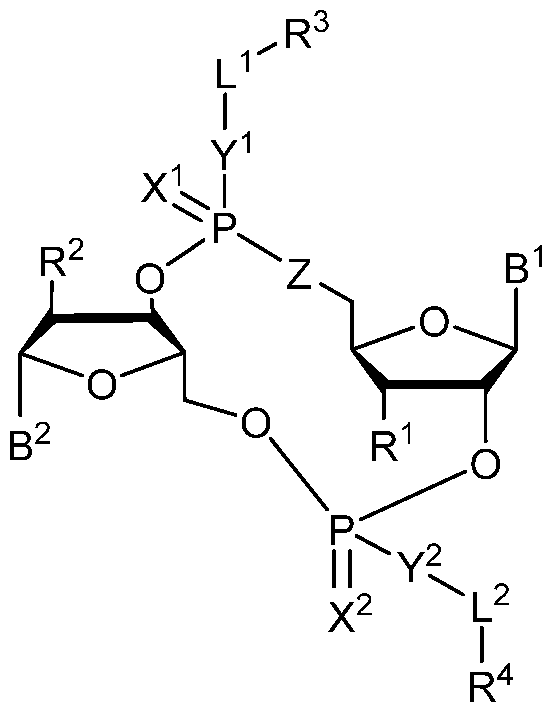
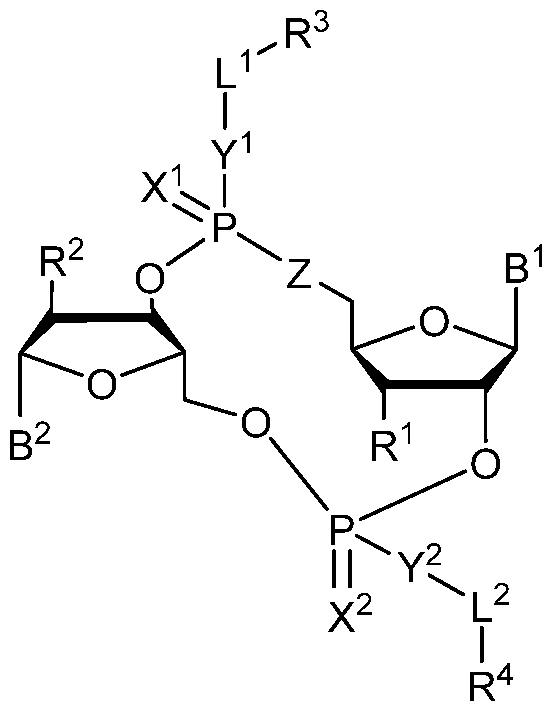
  • the disclosure features a compound of Formula (I):
  • Z is either S or O; each of B 1 and B 2 is independently a purinyl nucleobase or pyrimidinyl nucleobase; each of X 1 and X 2 is independently O or S; each of Y 1 and Y 2 is independently O, S, or R 5 ; each of L 1 and L 2 is independently absent, Ci-C 6 alkyl or C1-G5 heteroalkyl, wherein each alkyl and heteroalkyl is optionally substituted with R 6 ; each of R 1 and R 2 is independently hydrogen, halo, -CN, C1-C20 alkyl (e.g., Ci-C 6 alkyl), or OR 7 ; each of R 3 and R 4 is independently hydrogen, C1-C20 alkyl (e.g., Ci-C 6 alkyl), C1-C20 heteroalkyl (e.g., Ci-C 6 heteroalkyl), OC(0)OCi-C2o alkyl
  • each alkyl, heteroalkyl, aryl, and heteroaryl is optionally substituted by one or more R 9 ; and each R 9 is independently C1-C20 alkyl, O-C1-C20 alkyl, Ci- C20 heteroalkyl, halo, -CN, OH, oxo, aryl, heteroaryl, 0-aryl, or O-heteroaiyl.
  • the compound is a compound of Formula (I-a), (I-b), (I-c), or
  • Formula (I-c) Formula (I-d) or a pharmaceutically acceptable salt thereof, wherein each of Z, B 1 , B 2 , X 1 , X 2 , Y 1 , Y 2 , L 1 , L 2 , R 1 , R 2 , R 3 , R 4 , and subvariables thereof, are as previously described.
  • the present disclosure describes a method of inducing the expression of a pattern recognition receptor in a subject suffering from a microbial infection, comprising administering to the subject an effective amount of a compound of Formula (I),
  • Z is either S or O
  • each of B 1 and B 2 is independently a purinyl nucleobase or pyrimidinyl nucleobase; each of X 1 and X 2 is independently O or S;
  • each of Y 1 and Y 2 is independently O, S, or R 5 ;
  • each of L 1 and L 2 is independently absent, Ci-C 6 alkyl or C1-G5 heteroalkyl, wherein each Ci-C 6 alkyl and Ci-C 6 heteroalkyl is optionally substituted with R 6 ;
  • each of R 1 and R 2 is independently hydrogen, halo, -CN, C1-C20 alkyl (e.g., Ci-C 6 alkyl), or OR 7 ;
  • each of R 3 and R 4 is independently hydrogen, C1-C20 alkyl (e.g., Ci-C 6 alkyl), C1-C20 heteroalkyl (e.g., Ci-C 6 heteroalkyl), cycloalkyl, heterocyclyl, OC(0)OCi-C2o alkyl (e.g., Ci- C 6 alkyl), aryl, or heteroaryl, wherein each C1-C20 alkyl, C1-C20 heteroalkyl, cycloalkyl, heterocyclyl, aryl, OC(0)0 C1-C20 alkyl (e.g., Ci-6 alkyl), and heteroaryl is optionally substituted with 1-5 R 8 ;
  • each R 5 is independently hydrogen or C1-C20 alkyl (e.g., Ci-C 6 alkyl);
  • R 6 is halo, -CN, C1-C20 alkyl (e.g., Ci-Ce alkyl), OR 7 , oxo, cycloalkyl, heterocyclyl, aryl, or heteroaryl, wherein each C1-C20 alkyl, cycloalkyl, heterocyclyl, aryl, or heteroaryl is optionally substituted with 1-5 R 9 ;
  • R 7 is hydrogen, C1-C20 alkyl (e.g., Ci-C 6 alkyl), cycloalkyl, heterocyclyl, aryl, or heteroaryl, wherein each C1-C20 alkyl, cycloalkyl, heterocyclyl, aryl, or heteroaryl is optionally substituted with 1-5 R 9 ;
  • each R 8 is independently C1-C20 alkyl (e.g., Ci-Ce alkyl), O-aiyl, OC(0)NR 5 -Ci-C 2 o alkyl (e.g., Ci-Ce alkyl), S(0) 2 NR 5 -aryl, NR 5 C(0)-aryl, NR 5 R 5 C(0)-aryl, C(0)-aryl, C(O)- heteroaryl, OC(0)-aryl, or OC(0)-heteroaryl, OC(0)-Ci-C 2 o alkyl (e.g., Ci-Ce), OC(0)0-Ci- C20 alkyl (e.g., Ci-Ce), wherein each C1-C20 alkyl, O-aiyl, OC(0) R 5 -Ci-C 2 o alkyl,
  • each R 9 is independently C1-C20 alkyl (e.g., Ci-Ce alkyl), halo, -CN, OH, O-C1-C20 alkyl, O-C1-C20 heteroalkyl, O-aiyl, O-heteroaiyl.
  • the disclosure features a method of treating cancer in a subject, the method comprising administering to the subject a therapeutically effective amount of a compound of Formula (I),
  • Z is either S or O; each of B 1 and B 2 is independently a purinyl nucleobase or pyrimidinyl nucleobase; each of X 1 and X 2 is independently O or S; each of Y 1 and Y 2 is independently O, S, or R 5 ; each of L 1 and L 2 is independently absent, Ci-C 6 alkyl or Ci-C 6 heteroalkyl, wherein each alkyl and heteroalkyl is optionally substituted with R 6 ; each of R 1 and R 2 is independently hydrogen, halo, -CN, C1-C20 alkyl (e.g., Ci-C 6 alkyl), or OR 7 ; each of R 3 and R 4 is independently hydrogen, C1-C20 alkyl (e.g., Ci-C 6 alkyl), C1-C20 heteroalkyl (e.g., Ci-C 6 heteroalkyl), OC(0)OCi-C 2 o alkyl
  • each alkyl, heteroalkyl, aryl, and heteroaryl is optionally substituted by one or more R 9 ; and each R 9 is independently C1-C20 alkyl, O-C1-C20 alkyl, Ci- C20 heteroalkyl, halo, -CN, OH, oxo, aryl, heteroaryl, 0-aryl, or O-heteroaiyl.
  • composition comprising a vaccine, and a vaccine adjuvant comprising a compound of Formula (I),
  • Z is either S or O; each of B 1 and B 2 is independently a purinyl nucleobase or pyrimidinyl nucleobase; each of X 1 and X 2 is independently O or S; each of Y 1 and Y 2 is independently O, S, or R 5 ; each of L 1 and L 2 is independently absent, Ci-Ce alkyl or C1-G5 heteroalkyl, wherein each alkyl and heteroalkyl is optionally substituted with R 6 ; each of R 1 and R 2 is independently hydrogen, halo, -CN, C1-C20 alkyl (e.g., C1-G5 alkyl), or OR 7 ; each of R 3 and R 4 is independently hydrogen, C1-C20 alkyl (e.g., Ci-C 6 alkyl), C1-C20 heteroalkyl (e.g., Ci-C 6 heteroalkyl), OC(0)OCi-C 2 o al
  • each alkyl, heteroalkyl, aryl, and heteroaryl is optionally substituted by one or more R 9 ; and each R 9 is independently C1-C20 alkyl, O-C1-C20 alkyl, Ci- C20 heteroalkyl, , halo, -CN, OH, oxo, aryl, heteroaryl, 0-aryl, or O-heteroaiyl.
  • the disclosure features a method of inducing the expression of a pattern recognition receptors (PRR) for immune-modulation in a subject, the method comprising administering to the subject an effective amount of a compound of Formula (I),
  • Z is either S or O; each of B 1 and B 2 is independently a purinyl nucleobase or pyrimidinyl nucleobase; each of X 1 and X 2 is independently O or S; each of Y 1 and Y 2 is independently O, S, or R 5 ; each of L 1 and L 2 is independently absent, Ci-Ce alkyl or C1-G5 heteroalkyl, wherein each alkyl and heteroalkyl is optionally substituted with R 6 ; each of R 1 and R 2 is independently hydrogen, halo, -CN, C1-C20 alkyl (e.g., Ci-C 6 alkyl), or OR 7 ; each of R 3 and R 4 is independently hydrogen, C1-C20 alkyl (e.g., Ci-C 6 alkyl), C1-C20 heteroalkyl (e.g., Ci-C 6 heteroalkyl), OC(0)OCi-C 2 o alky
  • each alkyl, heteroalkyl, aryl, and heteroaryl is optionally substituted by one or more R 9 ; and each R 9 is independently C1-C20 alkyl, O-C1-C20 alkyl, Ci- C20 heteroalkyl, , halo, -CN, OH, oxo, aryl, heteroaryl, O-aiyl, or O-heteroaiyl.
  • the disclosure features a method of inducing the expression of a pattern recognition receptor (PRR) for immunomodulation and inducing a therapeutic response in a subject having cancer, the method comprising administering to the subject an effective amount of a compound of Formula I),
  • PRR pattern recognition receptor
  • Z is either S or O; each of B 1 and B 2 is independently a purinyl nucleobase or pyrimidinyl nucleobase; each of X 1 and X 2 is independently O or S; each of Y 1 and Y 2 is independently O, S, or NR 5 ; each of L 1 and L 2 is independently absent, Ci-Ce alkyl or Ci-C 6 heteroalkyl, wherein each alkyl and heteroalkyl is optionally substituted with R 6 ; each of R 1 and R 2 is independently hydrogen, halo, -CN, C1-C20 alkyl (e.g., Ci-C 6 alkyl), or OR 7 ; each of R 3 and R 4 is independently hydrogen, C1-C20 alkyl (e.g., C1-G5 alkyl), C1-C20 heteroalkyl (e.g., Ci-C 6 heteroalkyl), OC(0)OCi-C2o alky
  • each alkyl, heteroalkyl, aryl, and heteroaryl is optionally substituted by one or more R 9 ; and each R 9 is independently C1-C20 alkyl, O-C1-C20 alkyl, Ci- C20 heteroalkyl, 0-Ci-C 2 o-NR 10 R 10 , halo, -CN, OH, oxo, aryl, heteroaryl, O-aiyl, or O- heteroaryl.
  • the present disclosure features a method of inducing an immune response in a subject, the method comprising administering to the subject a therapeutically effective amount of a compound of Formula I),
  • Formula (I) or a pharmaceutically acceptable salt or stereoisomer thereof wherein: Z is either S or O; each of B 1 and B 2 is independently a purinyl nucleobase or pyrimidinyl nucleobase; each of X 1 and X 2 is independently O or S; each of Y 1 and Y 2 is independently O, S, or R 5 ; each of L 1 and L 2 is independently absent, Ci-C 6 alkyl or C1-G5 heteroalkyl, wherein each alkyl and heteroalkyl is optionally substituted with R 6 ; each of R 1 and R 2 is independently hydrogen, halo, -CN, C1-C20 alkyl (e.g., Ci-C 6 alkyl), or OR 7 ; each of R 3 and R 4 is independently hydrogen, C1-C20 alkyl (e.g., Ci-C 6 alkyl), C1-C20 heteroalkyl (e.g., Ci-C 6 heteroalkyl), OC(0)OCi-C2
  • each alkyl, heteroalkyl, aryl, and heteroaryl is optionally substituted by one or more R 9 ; and each R 9 is independently C1-C20 alkyl, O-C1-C20 alkyl, Ci- C20 heteroalkyl, halo, -CN, OH, oxo, aryl, heteroaryl, O-aiyl, or O-heteroaiyl.
  • the immune response comprises antitumoral immunity. In some embodiments, the immune response comprises induction of a PRR (e.g., STING, RIG-I, MDA5).
  • a PRR e.g., STING, RIG-I, MDA5
  • Figure 1 depicts SZ14 cells treated with either compound 2 or compound 4 and digitonin for 5.5 hours. ISG54 ISRE-luciferase activity was determined and normalized to DMSO treated cells (mean ⁇ standard deviation of triplicate wells per stimulant).
  • Figure 2 depicts SZ14 cells treated with compound 3 and digitonin for 6 hours.
  • ISG54 ISRE-luciferase activity was determined and normalized to DMSO treated cells (mean ⁇ standard deviation of triplicate wells per stimulant).
  • Figure 3A depicts K-92 cells were stimulated with compound 4 alone in the absence of IL-2 for 23 hours. Levels of IFN- ⁇ in culture supernatants were quantified using ELISA, and results were shown as pg/mL. Cells were also treated with control DMSO as well as cultured with medium in presence/absence of IL-2
  • Figure 3B depicts that the growth of NK-92 cells is IL-2 dependent. The presence of IL-2 is able to induce the production of IFN- ⁇ .
  • Figure 4 depicts RAW-Lucia-ISG-WT and RAW-Lucia-ISG- STING KO cells were stimulated with compound 2 or compound 4, alone for 19 hours. Activity of secreted luciferase (IRF-type I IFN activity) in cell culture supernatant was measured using
  • Figure 5 depicts human endothelial cells isolated from lung microvascular, liver sinusoidal microvascular, and large intestine microvascular were plated into 96-well plate and stimulated with compound 4 alone. Cell culture supernatants were collected at 6 and 23 hours post-treatment. Levels of RANTES in culture supernatants were quantified using ELISA and results were shown as pg/mL. Concentrations (1.25, 2.5, 5, and 10 micromolar) increase from left to right within each of the six bar graphs.
  • FIG. 6 depicts TUP 1 -Dual -KI-STING-R232 cells stimulated with compound alone for 20 hours. Activities of secreted luciferase (IRF-type I IFN activity) (top panels) and NF- KB (bottom panels) in cell culture supernatant were measured using Invivogen's Quanti-luc and Quanti-blue, respectively. Data are shown as fold induction over DMSO treated cells (mean ⁇ standard deviation of triplicate wells per stimulant). ECso values were calculated using XLfit. THPl-Dual-KI-STING-R232 reporter cell line was generated from THP-Dual- STING KO cells by inserting STING-R232 (STING-WT) to rescue the STING signaling pathway. Compound did not induce IRF activity in STING KO cells.
  • FIG. 7 depicts TUPl-Dual-WT cells stimulated with compound alone for 20 hrs. Activities of secreted luciferase (IRF-type I IFN activity) (top panels) and NF- ⁇ (bottom panels) in cell culture supernatant were measured using Invivogen's Quanti-luc and Quanti- blue, respectively. Data are shown as fold induction over DMSO treated cells (mean ⁇ standard deviation of triplicate wells per stimulant). ECso values were calculated using XLfit. THPl-Dual-WT cells express STING-HAQ variant. Compound did not induce IRF activity in STING KO cells.
  • Figure 8A depicts TUP 1 -Dual -WT cell stimulated in triplicate with compound 4 alone for 20 hours. Activities of IRF-driven secreted luciferase in cell culture supernatant were measured using Invivogen's Quanti-luc and Quanti-blue, respectively. Data are shown as fold increase over DMSO treated cells (mean ⁇ standard deviation of triplicate wells per stimulant).
  • Figure 8B depicts TUP 1 -Dual -WT cell stimulated in triplicate with compound 4 alone for 20 hours. Activities of NF- ⁇ in cell culture supernatant were measured using Invivogen's Quanti-luc and Quanti-blue, respectively. Data are shown as fold increase over DMSO treated cells (mean ⁇ standard deviation of triplicate wells per stimulant).
  • Figure 8C depicts TUP 1 -Dual -WT cell stimulated in triplicate with compound 4 alone for 20 hours. Levels of RANTES in culture supernatants were quantified using ELISA and results were shown as pg/mL.
  • Figure 8D depicts TUP 1 -Dual -WT cell stimulated in triplicate with compound 4 alone for 20 hours. Levels of IL-29 in culture supernatants were quantified using ELISA and results were shown as pg/mL.
  • FIG. 9A THPl-Dual (WT) cells were stimulated with compound 3 alone (top panel) or compound/lipo mixture (bottom panel) for 20 hours. Activities of secreted luciferase (IRF -type I IFN activity) in cell culture supernatant were measured using
  • FIG. 9B depicts THPl-Dual (WT) cells were stimulated with compound 3 alone (top panel) or compound/lipo mixture (bottom panel) for 20 hours. Activities of sNF- ⁇ in cell culture supernatant were measured using Invivogen's Quanti-luc and Quanti-blue, respectively. Data are shown as fold induction over DMSO treated cells (mean ⁇ standard deviation of triplicate wells per stimulant). ECso values were calculated using XLfit.
  • FIG. 10 depicts THP1 dual & STING KO THP1 dual cells grown in complete media were treated with various concentrations of compound 2 or DMSO control with Lipofectamine LTX.
  • Dual cells carry both secreted embryonic alkaline phosphatase (SEAP) reporter gene under the control of an IFN-b minimal promoter fused to five copies of the NF- kB consensus transcriptional response element to measure NF-kB activity and Lucia reporter gene under the control of an ISG54 minimal promoter to measure IRF activity.
  • SEAP embryonic alkaline phosphatase
  • IRF activity was assessed using QUANTI-luc to measure levels of Lucia and NF- kB activity was determined by measure SEAP levels at 620-655 nm.
  • % induction was calculated from fold change in luminescence/absorbance compared to DMSO treated sample.
  • FIG 11 depicts SZ14 reporter cells (a HEK293 -derived type I IFN inducible reporter cell line) that were treated with compound and digitonin.
  • ISG54 ISRE-luciferase activity was determined and normalized to DMSO treated cells (mean ⁇ standard deviation of triplicate wells per stimulant).
  • Figure 12 depicts THPl-Dual-WT cells in a 96-well plate that were stimulated in triplicate with 8 concentrations of compound 4 for 20 hours. Activities of IRF-driven secreted luciferase and NF- ⁇ -driven SEAP in cell culture supernatant were measured using
  • Figure 13 depicts the treatment of groups of 5 Balb/C mice (female, 8 weeks of age) which were intravenously injected via tail vein with saline control or compound 4 at 9 mg/kg. Serum, spleen, and liver samples were collected at 2, 4, and 24 hours post-treatment. Levels of RANTES (A, C, E) and TNF-a (B, D, F) were measured using ELISA. Results are displayed as pg/mL for serum samples and pg/g of tissue for spleen and liver samples.
  • Figure 14 depicts the treatment groups of 5 Balb/C mice (female, 10 weeks of age) which were intravenously injected via tail vein with saline control or compound 3 at 9 mg/kg. Serum, spleen, and liver samples were collected at 2 and 24 hrs post-treatment. Levels of RANTES and TNF-a were measured using ELISA and results are shown as pg/mL for serum samples and pg/g of tissue for spleen and liver samples.
  • Figure 15 depicts the response summary in the study to determine the efficacy of compound 4 in a CT26 murine colon carcinoma model using female balb/c mice. Mice in the treatment groups took at least 10 days longer to reach the endpoint when compared to the vehicle group.
  • Figure 16 depicts tumor growth inhibition in the study to determine the efficacy of compound 4 in a CT26 murine colon carcinoma model using female balb/c mice. Mice in the treatment groups displayed at least 89% increase tumor growth inhibition when compared to the vehicle group.
  • Figure 17 depicts the individual times to endpoint for mice in the study to determine the efficacy of compound 4 in a CT26 murine colon carcinoma model using female balb/c mice. Mice in the treatment groups took longer to reach the endpoint when compared to the vehicle group.
  • Figure 18 depicts the tumor volume distribution on day 18 in the study to determine the efficacy of compound 4 in a CT26 murine colon carcinoma model using female balb/c mice. Mice in the treatment groups possessed significantly smaller tumor volumes when compared to the vehicle group.
  • Figure 19 depicts the Kaplan-Meier plot for the study to determine of the study to determine the efficacy of compound 4 in a CT26 murine colon carcinoma model using female balb/c mice.
  • the treatment groups had a greater percent of mice remaining at day 21 than the vehicle group.
  • Figure 20 depicts compound 4 administered intravenously at 1 mg/kg and 3 mg/kg to mice in a CT26 colon cancer model. Tumor growth was slowed in the compound 4 group(s) compared to the vehicle.
  • Figure 21 depicts cells stably expressing both or either one of the reporters to measure IRF and F-kB activity were treated with a range of concentrations of compound 1 or DMSO control for 20 hours.
  • IRF activity was assessed using QUANTI-luc to measure levels of Lucia and NF-kB activity was determined by measure SEAP levels at 620-655 nm.
  • % induction was calculated from fold change in luminescence/absorbance compared to DMSO treated sample. ECso values are generated by curve fit in Xlfit.
  • Compound 1 did not induce IRF activity or NF- ⁇ in STING KO cells.
  • Compound 1 possess STING dependent activity.
  • Figure 22 depicts cells stably expressing both or either one of the reporters to measure IRF and NF-kB activity were treated with a range of concentrations of compound 2 or DMSO control for 20 hours.
  • IRF activity was assessed using QUANTI-luc to measure levels of Lucia and NF-kB activity was determined by measure SEAP levels at 620-655 nm.
  • % induction was calculated from fold change in luminescence/absorbance compared to DMSO treated sample. ECso values are generated by curve fit in Xlfit.
  • Compound 2 did not induce IRF activity or NF- ⁇ in STING KO cells.
  • Compound 2 possess activity against wild type STING, R71H-G230A-R293Q (HAQ) variants of hSTING and wt-mSTING.
  • Figure 23 depicts cryopreserved mouse bone marrow derived dendritic cells (DCs) and macrophages treated with a range of concentrations of compound 2 or DMSO control for 20 hours.
  • Cell pellets were harvested to collect total RNA.
  • the gene expression levels of ISGs were measured by Taqman Assays.
  • Compound 2 induces ISG expression in mouse bone marrow derived DCs and macrophages.
  • Figure 24 depicts cells stably expressing both or either one of the reporters to measure IRF and NF-kfi activity were treated with a range of concentrations of compound 3 or DMSO control for 20 hours.
  • IRF activity was assessed using QUANTI-luc to measure levels of Lucia and NF-kfi activity was determined by measure SEAP levels at 620-655 nm. % induction was calculated from fold change in luminescence/absorbance compared to DMSO treated sample. ECso values are generated by curve fit in Xlfit. Compound did not induce IRF activity or NF- ⁇ in STING KO cells. Compound 3 possess activity against wild type STING, STING-HAQ and wt-m STING.
  • Figure 25 depicts freshly isolated peripheral blood mononuclear cells (PBMCs) treated with a range of concentrations of compound 3 or DMSO control for 20 hours.
  • PBMCs peripheral blood mononuclear cells
  • Figure 26 depicts compound 3 administered intravenously at 3 mg/kg to mice in a CT26 colon cancer model. Tumor growth was slowed in the compound 3 group when compared to the vehicle.
  • Figure 27 depicts cells stably expressing both or either one of the reporters to measure IRF and NF-kfi activity were treated with a range of concentrations of compound 4 or DMSO control for 20 hours.
  • IRF activity was assessed using QUANTI-luc to measure levels of Lucia and NF-kfi activity was determined by measure SEAP levels at 620-655 nm.
  • % induction was calculated from fold change in luminescence/absorbance compared to DMSO treated sample. ECso values are generated by curve fit in Xlfit.
  • Compound 4 did not induce IRF activity or NF- ⁇ in STING KO cells.
  • Compound 4 possess activity against wild type STING, R71H-G230A-R293Q (HAQ), R232H variants of h STING, MYD88 knock out cells and wt-mSTING.
  • Figure 28 depicts cells stably expressing both or either one of the reporters to measure IRF and NF-kfi activity were treated with a range of concentrations of compound 4 or DMSO control for 20 hours.
  • IRF activity was assessed using QUANTI-luc to measure levels of Lucia and NF-kfi activity was determined by measure SEAP levels at 620-655 nm.
  • % induction was calculated from fold change in luminescence/absorbance compared to DMSO treated sample.
  • ECso values are generated by curve fit in Xlfit.
  • RIG-I is not implicated in the mechanism of action of compound 4.
  • Figure 29 depicts freshly isolated PBMCs that were treated with a range of concentrations of compound 4 or DMSO control for 20 hours.
  • Figure 30 depicts that compound 3 administered intravenously (9 mg/kg) strongly induced upregulation of ISGs/type I IFN response in normal Balb/C mice.
  • Figure 31A depicts cells treated with various concentrations of compound 3 and two of its diastereomers (3 A and 3B), or DMSO control for 20 hours.
  • Cells stably expressed one or both of the reporters used to measure IRF activity.
  • IRF activity was assessed using QUANTI-luc to measure levels of Lucia.
  • % induction was calculated from fold change in luminescence/absorbance compared to DMSO treated sample.
  • Figure 31B depicts cells treated with various concentrations of compound 3 and two of its diastereomers (3 -A and 3-B), or DMSO control for 20 hours.
  • Cells stably expressed one or both of the reporters used to measure NF-kB activity.
  • NF-kB activity was determined by measure SEAP levels at 620-655 nm.
  • % induction was calculated from fold change in luminescence/absorbance compared to DMSO treated sample.
  • Figure 31C depicts cells treated with various concentrations of compound 3 and two of its diastereomers (3 -A and 3-B), or DMSO control for 20 hours.
  • Cells stably expressed one or both of the reporters used to measure NF-kB activity.
  • IRF activity was assessed using QUANTI-luc to measure levels of Lucia.
  • % induction was calculated from fold change in luminescence/absorbance compared to DMSO treated sample.
  • Figure 32 depicts compound 3 and its diastereomers (3 -A and 3-B) bind to STING with high affinity.
  • Thermal shift assay was conducted with 0.1 mg/mL of STING CTD with various dilutions compound 3 and two of its diastereomers (3 -A and 3-B) from 2mM to 0.05uM in lOmM HEPES (pH 7.5), 140mM NaCl and a 5 dilution of SYPRO Orange dye (Invitrogen). Fluorescence as a function of temperature was recorded using a Real Time PCR machine (Thermo Fisher). The temperature gradient was performed in the range of 25-80 °C with a ramp of 0.2 °C over the course of 60 minutes.
  • Figure 34A depicts compound 4 and its diastereomers (4-A and 4-B) are efficacious in inducing IRF signaling.
  • Cells were treated with various concentrations of compound 3 and two of its diastereomers (4-A and 4-B), or DMSO control for 20 hours. Cells stably expressed one or both of the reporters used to measure IRF activity. IRF activity was assessed using QUANTI-luc to measure levels of Lucia. % induction was calculated from fold change in luminescence/absorbance compared to DMSO treated sample.
  • Figure 34B depicts compound 4 and its diastereomers (4-A and 4-B) are efficacious in inducing NF-kB signaling.
  • Cells were treated with various concentrations of compound 4 and two of its diastereomers (4-A and 4-B), or DMSO control for 20 hours. Cells stably expressed one or both of the reporters used to measure NF-kB activity.
  • NF-kB activity was determined by measure SEAP levels at 620-655 nm. % induction was calculated from fold change in luminescence/absorbance compared to DMSO treated sample.
  • Figure 34C depicts compound 4 and its diastereomers (4-A and 4-B) are efficacious in inducing IRF signaling.
  • Cells were treated with various concentrations of compound 4 and two of its diastereomers (4-A and 4-B), or DMSO control for 20 hours. Cells stably expressed one or both of the reporters used to measure IRF activity. IRF activity was assessed using QUANTI-luc to measure levels of Lucia. % induction was calculated from fold change in luminescence/absorbance compared to DMSO treated sample.
  • the present disclosure relates to methods of activating and/or inducing the expression of PRRs (e.g., STING) in a subject, in particular for the treatment of a microbial infection or a proliferative disease (e.g., cancer).
  • the method comprises administration of a compound of Formula (I) or pharmaceutically acceptable salt thereof. It is to be noted that induction of any PRR with these compounds can stimulate interferon and/or NF-KB production which can induce the expression of a variety of PRRs which are inducible genes by feedback mechanism.
  • the articles “a” and “an” refer to one or to more than one (e.g., to at least one) of the grammatical object of the article.
  • “About” and “approximately” shall generally mean an acceptable degree of error for the quantity measured given the nature or precision of the measurements. Exemplary degrees of error are within 20 percent (%), typically, within 10%, and more typically, within 5% of a given value or range of values.
  • the term "acquire” or “acquiring” as the terms are used herein, refer to obtaining possession of a physical entity (e.g., a sample, e.g., blood sample or liver biopsy specimen), or a value, e.g., a numerical value, by “directly acquiring” or “indirectly acquiring” the physical entity or value.
  • a physical entity e.g., a sample, e.g., blood sample or liver biopsy specimen
  • a value e.g., a numerical value
  • Directly acquiring a value includes performing a process that includes a physical change in a sample or another substance, e.g., performing an analytical process which includes a physical change in a substance, e.g., a sample, performing an analytical method, e.g., a method as described herein, e.g., by sample analysis of bodily fluid, such as blood by, e.g., mass spectroscopy, e.g., LC-MS.
  • an analytical method e.g., a method as described herein, e.g., by sample analysis of bodily fluid, such as blood by, e.g., mass spectroscopy, e.g., LC-MS.
  • the terms “induce” or “induction of” refer to the increase or enhancement of a function, e.g., the increase or enhancement of the expression of a pattern recognition receptor (e.g, STING).
  • induction of PRR expression refers to induction of transcription of PRR RNA, e.g., STING RNA (e.g., mRNA, e.g., an increase or enhancement of), or the translation of a PRR protein, e.g., the STING protein (e.g., an increase or enhancement of).
  • induction of PRR expression refers to the increase or enhancement of the concentration of a PRR RNA, e.g., or STING RNA (e.g., mRNA) or the STING protein, e.g., in a cell.
  • induction of PRR expression refers to the increase of the number of copies of PRR RNA, e.g., STING RNA (e.g., mRNA) or PRR protein, e.g., the STING protein, e.g., in a cell.
  • to induce expression of a PRR may refer to the initiation of PRR RNA (e.g., STING RNA (e.g., mRNA)) or transcription or PRR protein (e.g., STING protein) translation.
  • PRR protein e.g., STING protein
  • to induce expression of a PRR may refer to an increase in the rate of PRR RNA (e.g., STING RNA (e.g., mRNA)) transcription or an increase in the rate of PRR protein (e.g., STING protein) expression.
  • activation refers to the stimulation or triggering of a function, e.g., of a downstream pathway, e.g., a downstream signaling pathway.
  • activation of a pattern recognition receptor refers to the stimulation of a specific protein or pathway, e.g., through interaction with a downstream signaling partner (e.g., IFN- ⁇ promoter stimulator 1 (IPS-1), IRF3, IRF7, NF-KB, interferons (e.g., IFN-a or IFN- ⁇ ) and/or cytokines).
  • IPS-1 IFN- ⁇ promoter stimulator 1
  • IRF3, IRF7 IRF3, IRF7
  • NF-KB NF-KB
  • interferons e.g., IFN-a or IFN- ⁇
  • cytokines interferons
  • a PRR may be activated without resulting in an induction of PRR expression (e.g., expression of STING).
  • activation may include induction of expression of a PRR (e.g., STING).
  • activation of a PRR may trigger the induction of expression of a PRR (e.g., STING) by about 0.1%, about 0.5%, about 1%, about 5%, about 10%, about 15%, about 20%, about 25%, about 30%, about 40%, about 50%, about 60%, about 70%), about 80%, about 90%, about 95%, or more compared to a reference standard (e.g., basal expression levels of a PRR (e.g., STING)).
  • a reference standard e.g., basal expression levels of a PRR (e.g., STING)
  • an amount of a compound, conjugate, or substance effective to treat a disorder refers to an amount of the compound, substance, or composition which is effective, upon single or multiple dose administration(s) to a subject, in treating a subject, or in curing, alleviating, relieving or improving a subject with a disorder (e.g., a microbial infection) beyond that expected in the absence of such treatment.
  • a disorder e.g., a microbial infection
  • the terms “prevent” or “preventing” as used in the context of a disorder or disease refer to administration of an agent to a subject, e.g., the administration of a compound of the present disclosure (e.g., compound of Formula (I)) to a subject, such that the onset of at least one symptom of the disorder or disease is delayed as compared to what would be seen in the absence of administration of said agent.
  • a compound of the present disclosure e.g., compound of Formula (I)
  • the terms "reference treatment” or “reference standard” refer to a standardized level or standardized treatment that is used as basis for comparison.
  • the reference standard or reference treatment is an accepted, well known, or well characterized standard or treatment in the art.
  • the reference standard describes an outcome of a method described herein.
  • the reference standard describes a level of a marker (e.g., a level of induction of a PRR, e.g., STING) in a subject or a sample, e.g., prior to initiation of treatment, e.g., with a compound or composition described herein.
  • the reference standard describes a measure of the presence of, progression of, or severity of a disease or the symptoms thereof, e.g., prior to initiation of treatment, e.g., with a compound or composition described herein.
  • the term "subject” is intended to include human and non-human animals.
  • exemplary human subjects include a human patient having a disorder, e.g., a disorder described herein, or a normal subject.
  • non-human animals includes all vertebrates, e.g., non-mammals (such as chickens, amphibians, reptiles) and mammals, such as non-human primates, domesticated and/or agriculturally useful animals, e.g., sheep, dogs, cats, cows, pigs.
  • the subject is a woodchuck (e.g., an Eastern woodchuck (Marmota monax)).
  • the terms "treat” or “treating" a subject having a disorder or disease refer to subjecting the subject to a regimen, e.g., the administration of a compound of Formula (I) or pharmaceutically acceptable salt thereof, or a composition comprising Formula (I) or pharmaceutically acceptable salt thereof, such that at least one symptom of the disorder or disease is cured, healed, alleviated, relieved, altered, remedied, ameliorated, or improved. Treating includes administering an amount effective to alleviate, relieve, alter, remedy, ameliorate, improve or affect the disorder or disease, or the symptoms of the disorder or disease. The treatment may inhibit deterioration or worsening of a symptom of a disorder or disease.
  • Cmd refers to the word “compound” or “Compound”, and all of the terms are used interchangeably.
  • ranges for the amount of a drug administered per day, are provided herein.
  • the range includes both endpoints.
  • the range excludes one or both endpoints.
  • the range can exclude the lower endpoint.
  • a range of 250 to 400 mg/day, excluding the lower endpoint would cover an amount greater than 250 that is less than or equal to 400 mg/day.
  • alkyl refers to a monovalent saturated, straight- or branched-chain hydrocarbon such as a straight or branched group of 1-12, 1-10, or 1-6 carbon atoms, referred to herein as C1-C12 alkyl, C1-C10 alkyl, and Ci-C 6 alkyl, respectively.
  • alkyl groups include, but are not limited to, methyl, ethyl, n-propyl, isopropyl, n-butyl, iso-butyl, sec-butyl, sec-pentyl, iso-pentyl, tert-butyl, n-pentyl, neopentyl, n-hexyl, sec-hexyl, and the like.
  • alkenyl and alkynyl are art-recognized and refer to unsaturated aliphatic groups analogous in length and possible substitution to the alkyls described above, but that contain at least one double or triple bond, respectively.
  • alkylene refers to the diradical of an alkyl group.
  • alkenylene and “alkynylene” refer to the diradicals of an alkenyl and an alkynyl group, respectively.
  • methylene unit refers to a divalent -CH 2 - group present in an alkyl, alkenyl, alkynyl, alkylene, alkenylene, or alkynylene moiety.
  • carrier means a monocyclic, or fused, spiro-fused, and/or bridged bicyclic or polycyclic hydrocarbon ring system, wherein each ring is either completely saturated or contains one or more units of unsaturation, but where no ring is aromatic.
  • Carbocyclyl refers to a radical of a carbocyclic ring system.
  • carbocyclyl groups include cycloalkyl groups (e.g., cyclopentyl, cyclobutyl, cyclopentyl, cyclohexyl and the like), and cycloalkenyl groups (e.g., cyclopentenyl, cyclohexenyl, cyclopentadienyl, and the like).
  • cycloalkyl groups e.g., cyclopentyl, cyclobutyl, cyclopentyl, cyclohexyl and the like
  • cycloalkenyl groups e.g., cyclopentenyl, cyclohexenyl, cyclopentadienyl, and the like.
  • aromatic ring system refers to a monocyclic, bicyclic or polycyclic hydrocarbon ring system, wherein at least one ring is aromatic.
  • aryl refers to a radical of an aromatic ring system.
  • Representative aryl groups include fully aromatic ring systems, such as phenyl, naphthyl, and anthracenyl, and ring systems where an aromatic carbon ring is fused to one or more non-aromatic carbon rings, such as indanyl, phthalimidyl, naphthimidyl, or tetrahydronaphthyl, and the like.
  • heteroalkyl refers to an "alkyl” moiety wherein at least one of the carbone molecules has been replaced with a heteroatom such as O, S, or N.
  • heteromatic ring system refers to monocyclic, bicyclic or polycyclic ring system wherein at least one ring is both aromatic and comprises a heteroatom; and wherein no other rings are heterocyclyl (as defined below).
  • a ring which is aromatic and comprises a heteroatom contains 1, 2, 3, or 4 independently selected ring heteroatoms in such ring.
  • heteroaryl refers to a radical of a heteroaromatic ring system.
  • heteroaryl groups include ring systems where (i) each ring comprises a heteroatom and is aromatic, e.g., imidazolyl, oxazolyl, thiazolyl, triazolyl, pyrrolyl, furanyl, thiophenyl pyrazolyl, pyridinyl, pyrazinyl, pyridazinyl, pyrimidinyl, indolizinyl, purinyl, naphthyridinyl, and pteridinyl; (ii) each ring is aromatic or carbocyclyl, at least one aromatic ring comprises a heteroatom and at least one other ring is a hydrocarbon ring or e.g., indolyl, isoindolyl, benzothienyl, benzofuranyl, dibenzofuranyl, indazolyl, benzimidazolyl, benzthiazolyl, quinolyl, isoquinolyl, cinn
  • each ring is aromatic or carbocyclyl, and at least one aromatic ring shares a bridgehead heteroatom with another aromatic ring, e.g.,
  • the heteroaryl is a monocyclic or bicyclic ring, wherein each of said rings contains 5 or 6 ring atoms where 1, 2, 3, or 4 of said ring atoms are a heteroatom independently selected from N, O, and S.
  • heterocyclic ring system refers to monocyclic, or fused, spiro-fused, and/or bridged bicyclic and polycyclic ring systems where at least one ring is saturated or partially unsaturated (but not aromatic) and comprises a heteroatom.
  • a heterocyclic ring system can be attached to its pendant group at any heteroatom or carbon atom that results in a stable structure and any of the ring atoms can be optionally substituted.
  • heterocyclyl refers to a radical of a heterocyclic ring system.
  • heterocyclyls include ring systems in which (i) every ring is non-aromatic and at least one ring comprises a heteroatom, e.g., tetrahydrofuranyl, tetrahydrothienyl, pyrrolidinyl, pyrrolidonyl, piperidinyl, pyrrolinyl, decahydroquinolinyl, oxazolidinyl, piperazinyl, dioxanyl, dioxolanyl, diazepinyl, oxazepinyl, thiazepinyl, morpholinyl, and quinuclidinyl; (ii) at least one ring is non-aromatic and comprises a heteroatom and at least one other ring is an aromatic carbon ring, e.g., 1,2,3,4-tetrahydroquinolinyl,
  • At least one ring is non-aromatic and comprises a heteroatom and at least one other ring is aromatic and comprises a heteroatom, e.g.,
  • the heterocyclyl is a monocyclic or bicyclic ring, wherein each of said rings contains 3-7 ring atoms where 1, 2, 3, or 4 of said ring atoms are a heteroatom independently selected from N, O, and S.
  • saturated heterocyclyl refers to a radical of heterocyclic ring system wherein every ring is saturated, e.g., tetrahydrofuran, tetrahydro-2H-pyran, pyrrolidine, piperidine and piperazine.
  • Partially unsaturated refers to a group that includes at least one double or triple bond.
  • a “partially unsaturated” ring system is further intended to encompass rings having multiple sites of unsaturation, but is not intended to include aromatic groups (e.g., aryl or heteroaryl groups) as herein defined.
  • aromatic groups e.g., aryl or heteroaryl groups
  • saturated refers to a group that does not contain a double or triple bond, i.e., contains all single bonds.
  • nucleobase is a nitrogen-containing biological compound found linked to a sugar within a nucleoside— the basic building blocks of deoxyribonucleic acid (DNA) and ribonucleic acid (RNA).
  • the primary, or naturally occurring, nucleobases are cytosine (DNA and RNA), guanine (DNA and RNA), adenine (DNA and RNA), thymine (DNA) and uracil (RNA), abbreviated as C, G, A, T, and U, respectively. Because A, G, C, and T appear in the DNA, these molecules are called DNA-bases; A, G, C, and U are called RNA-bases.
  • Adenine and guanine belong to the double-ringed class of molecules called purines (abbreviated as R). Cytosine, thymine, and uracil are all pyrimidines. Other nucleobases that do not function as normal parts of the genetic code are termed non-naturally occurring.
  • substituted moieties.
  • substituted whether preceded by the term “optionally” or not, means that one or more hydrogens of the designated moiety are replaced with a suitable substituent.
  • an "optionally substituted” group may have a suitable substituent at each substitutable position of the group, and when more than one position in any given structure may be substituted with more than one substituent selected from a specified group, the substituent may be either the same or different at each position.
  • Combinations of substituents envisioned under this disclosure are preferably those that result in the formation of stable or chemically feasible compounds.
  • stable refers to compounds that are not substantially altered when subjected to conditions to allow for their production, detection, and, in certain embodiments, their recovery, purification, and use for one or more of the purposes disclosed herein.
  • each expression e.g., alkyl, m, n, etc., when it occurs more than once in any structure, is intended to be independent of its definition elsewhere in the same structure.
  • substituted moieties.
  • substituted whether preceded by the term “optionally” or not, means that one or more hydrogens of the designated moiety are replaced with a suitable substituent.
  • an "optionally substituted” group may have a suitable substituent at each substitutable position of the group, and when more than one position in any given structure may be substituted with more than one substituent selected from a specified group, the substituent may be either the same or different at each position.
  • Combinations of substituents envisioned under this disclosure are preferably those that result in the formation of stable or chemically feasible compounds.
  • stable refers to compounds that are not substantially altered when subjected to conditions to allow for their production, detection, and, in certain embodiments, their recovery, purification, and use for one or more of the purposes disclosed herein.
  • PRR expression e.g., STING expression
  • a subject with a microbial infection e.g., a viral infection, bacterial infection, fungal infection, or parasitic infection
  • a proliferative disease e.g., cancer
  • Pattern recognition receptors are a broad class of proteins which recognize pathogen-associated molecular patterns (PAMPs) conserved within pathogenic invaders. PAMPs are typically products of biosynthetic pathways that are essential to the survival and/or infectivity of the pathogen, e.g., lipopolysaccharides, glycoproteins, and nucleic acids. Recognition of PAMPs by their cognate PRRs activates signaling pathways that result in the production of immune defense factors such as pro-inflammatory and anti-inflammatory cytokines, type I interferons (IFN-a, IFN- ⁇ ), and/or interferon stimulated genes (ISGs).
  • IFN-a type I interferons
  • ISGs interferon stimulated genes
  • ISRE interferon response elements
  • the stimulator of interferon genes is a cytosolic microbial-derived DNA sensor that has been shown to be particularly sensitive to double-stranded DNA and cyclic dinucleotides (e.g., cyclic di-GMP) (Burdette, D. L. and Vance, R. E. (2013) Nat Immunol 14: 19-26).
  • cyclic di-GMP cyclic dinucleotides
  • Two molecules of STING form a homodimer mediated by an a-helix present in the C-terminal dimerization domain, and molecular binding studies have revealed that each STING dimer binds one molecule of microbial nucleic acids, e.g., DNA or a cyclic dinucleotide.
  • STING Upon ligand binding, STING activates the innate immune response through interaction with RIG-I and IPS-1, resulting in interferon production (e.g., IFN-a and IFN- ⁇ ) and other downstream signaling events. Since its discovery, STING has been shown to function as a critical sensor of viruses (e.g., adenovirus, herpes simplex virus, hepatitis B virus, vesicular stomatitis virus, hepatitis C virus), bacteria (e.g., Listeria monocytogenes, Legionella pneumopholia, Mycobacterium tuberculosis) and protozoa ⁇ Plasmodium falciparum, Plasmodium berghei).
  • viruses e.g., adenovirus, herpes simplex virus, hepatitis B virus, vesicular stomatitis virus, hepatitis C virus
  • bacteria e.g., Listeria monocytogenes, Legion
  • STING has been shown to play a major role in the innate immune response against tumor antigens, driving dendritic cell activation and subsequent T cell priming in several cancers (Woo, S.R. et al. Trends in Immunol (2015) 36:250-256).
  • RIG-I is the founding member of a family of PRRs termed RIG-I-like receptors (RLRs) that primarily detect RNA derived from foreign sources. It is a critical sensor of microbial infection (e.g., viral infection) in most cells and is constitutively expressed at low levels in the cytosol. After ligand binding, the expression of RIG-I is rapidly enhanced, leading to increased RIG-I concentrations in the cell (Jensen, S. and Thomsen, A.R. J Virol (2012) 86:2900-2910; Yoneyama M. et al. Nat Immunol (2004) 5:730-737).
  • RIG-I RIG-I-like receptors
  • RIG-I is an ATP-dependent helicase containing a central DExD/H box ATPase domain and tandem N-terminal caspase-recruiting domains (CARDs) that mediate downstream signaling.
  • the C-terminus of RIG-I comprises an ssRNA/dsRNA-binding domain that when unbound acts to silence CARD function at the N-terminus.
  • IPS-1 IFN- ⁇ promoter stimulator 1
  • mitochondrial antiviral signaling molecule MAVS
  • CARDIF mitochondrial antiviral signaling molecule
  • RLRs are homologous to RIG-I and function in a similar manner, including MDA5, LGP2, and RNase L.
  • MDA5 is highly homologous to RIG-I, and has been shown to be crucial for triggering a cytokine response upon infection with picornaviruses (e.g., encephalomyocarditis virus (EMCV), Theiler's virus, and Mengo virus), Sendai virus, rabies virus, West Nile virus, rabies virus, rotavirus, murine hepatitis virus, and murine norovirus.
  • EMCV encephalomyocarditis virus
  • MDA5 encephalomyocarditis virus
  • NLR nucleotide-binding and oligomerization domain
  • NLR family Caruso, R. et al, Immunity (2014) 41 :898- 908
  • NOD2 is composed of an N-terminal CARD, a centrally-located nucleotide-binding oligomerization domain, and a C-terminal leucine rich repeat domain that is responsible for binding microbial PAMPs, such as bacterial peptidoglycan fragments and microbial nucleic acids.
  • NOD2 Ligand binding activates NOD2 and is believed to drive interaction with the CARD-containing kinase RIPK2, which in turn activates a number of downstream proteins including F- ⁇ , MAPK, IRF7, and IRF3, the latter of which results in the induction of type 1 interferons.
  • NOD2 is expressed in a diverse set of cell types, including macrophages, dendritic cells, paneth cells, epithelial cells (e.g., lung epithelial cells, intestinal epithelia), and osteoblasts.
  • NOD2 has been established as a sensor of infection by variety of pathogenic invaders, such as protozoa (e.g., Toxoplasma gondii and Plasmodium berghei), bacteria (e.g., Bacillus anthracis, Borrelia burgdorferi, Burkholderia pseudomallei, Helicobacter hepaticus, Legionella pneumophilia,
  • protozoa e.g., Toxoplasma gondii and Plasmodium berghei
  • bacteria e.g., Bacillus anthracis, Borrelia burgdorferi, Burkholderia pseudomallei, Helicobacter hepaticus, Legionella pneumophilia
  • the present disclosure features compounds and methods for the induction of PRR expression (e.g., STING expression) in a subject (e.g., a subject with a microbial infection (e.g., a viral infection, bacterial infection, fungal infection, or parasitic infection) or a proliferative disease (e.g., cancer)), comprising administration of an effective amount of a compound of Formula (I) or a pharmaceutically acceptable salt or stereoisomer thereof.
  • a microbial infection e.g., a viral infection, bacterial infection, fungal infection, or parasitic infection
  • a proliferative disease e.g., cancer
  • the present disclosure features a compound of Formula (I) in which the 3'-OH end of a first nucleoside is joined to the 5'-OH of a second nucleoside through a linkage; and the 2'-OH end of the second nucleoside is joined to the 5'-OH of the first nucleoside through a linkage.
  • the compound is a compound of Formula (I):
  • Z is either S or O; each of B 1 and B 2 is independently a purinyl nucleobase or pyrimidinyl nucleobase; each of X 1 and X 2 is independently O or S; each of Y 1 and Y 2 is independently O, S, or R 5 ; each of L 1 and L 2 is independently absent, Ci-C 6 alkyl or C1-G5 heteroalkyl, wherein each alkyl and heteroalkyl is optionally substituted with R 6 ; each of R 1 and R 2 is independently hydrogen, halo, -CN, C1-C20 alkyl (e.g., Ci-C 6 alkyl), or OR 7 ; each of R 3 and R 4 is independently hydrogen, C1-C20 alkyl (e.g., Ci-C 6 alkyl), C1-C20 heteroalkyl (e.g., Ci-C 6 heteroalkyl), OC(0)OCi-C2o alkyl
  • each alkyl, heteroalkyl, aryl, and heteroaryl is optionally substituted by one or more R 9 ; and each R 9 is independently C1-C20 alkyl, O-C1-C20 alkyl, Ci- C20 heteroalkyl, halo, -CN, OH, oxo, aryl, heteroaryl, 0-aryl, or O-heteroaiyl.
  • Z is S.
  • Z is O.
  • at least one of B 1 or B 2 is a purinyl nucleobase.
  • each of B 1 or B 2 is independently a purinyl nucleobase.
  • B 1 is a purinyl nucleobase.
  • B 2 is a pyrimidinyl nucleobase.
  • B 1 is a purinyl nucleobase and B 2 is a pyrimidinyl nucleobase.
  • Z is S. In some embodiments Z is O.
  • B 1 or B 2 is a purinyl nucleobase. In some embodiments, each of B 1 or B 2 is independently a purinyl nucleobase. In some embodiments, B 1 is a purinyl nucleobase. In some embodiments, B 2 is a pyrimidinyl nucleobase. In some embodiments, B 1 is a purinyl nucleobase and B 2 is a pyrimidinyl nucleobase. In some embodiments, B 1 is a pyrimidinyl nucleobase. In some embodiments, B 2 is a purinyl nucleobase. In some embodiments, B 1 is a pyrimidinyl nucleobase and B 2 is a purinyl nucleobase.
  • each of B 1 or B 2 is selected from a naturally occurring nucleobase or a modified nucleobase. In some embodiments, each of B 1 or B 2 is selected from adenosinyl, guanosinyl, cytosinyl, thyminyl, uracilyl, 5'-methylcytosinyl, 5'- fluorouracilyl, 5'-propynyluracilyl, and 7-deazaadenosinyl. In some embodiments, each of B 1 or B 2 is selected from:
  • JVWW ' indicates the linkage of the nucleobase to the ribose ring.
  • one of B 1 or B 2 is selected from a naturally occurring nucleobase and the other of B 1 or B 2 is a modified nucleobase.
  • one of B 1 or B 2 is adenosinyl, guanosinyl, thyminyl, cytosinyl, or uracilyl, and the other of B 1 or B 2 is 5'-methylcytosinyl, 5 '-fiuorouracilyl, 5'-propynyluracilyl, or 7-deazaadenosinyl.
  • B 1 is adenosinyl or guanosinyl.
  • B 2 is cytosinyl, thyminyl, or uracilyl.
  • B 1 is adenosinyl or guanosinyl and B 2 is cytosinyl, thyminyl, or uracilyl.
  • B 2 is adenosinyl or guanosinyl.
  • B 1 is cytosinyl, thyminyl, or uracilyl.
  • B 2 is adenosinyl or guanosinyl and B 1 is cytosinyl, thyminyl, or uracilyl.
  • each of B 1 and B 2 is independently uracilyl. In some embodiments, each of B 1 and B 2 is independently adenosinyl.
  • each of R 1 and R 2 is independently hydrogen, halo, or OR 7 . In some embodiments, each of R 1 and R 2 is independently halo (e.g., fluoro). In some embodiments, each of R 1 and R 2 is not hydrogen or OR 7 .
  • X 1 is O. In some embodiments, X 2 is O. In some
  • each of X 1 and X 2 is independently O.
  • Y 1 is O or S. In some embodiments, Y 2 is O or S. In some embodiments, each of Y 1 and Y 2 is independently O or S. In some embodiments, one of Y 1 or Y 2 is O and the other of Y 1 or Y 2 is S. In some embodiments, each of Y 1 or Y 2 is independently S. In some embodiments, each of Y 1 or Y 2 is independently O.
  • L 1 is Ci-C 6 alkyl (e.g., CH2).
  • L 2 is Ci- C 6 alkyl (e.g., CH2).
  • each of L 1 and L 2 is independently Ci-C 6 alkyl (e.g., CH 2 ).
  • R 3 is hydrogen, aryl, or heteroaryl, wherein aryl and heteroaryl is optionally substituted with 1-5 R 8 . In some embodiments, R 3 is aryl or heteroaryl, each of which is optionally substituted with 1-5 R 8 . In some embodiments, R 3 is phenyl substituted with 1 R 8 .
  • R 4 is independently hydrogen, aryl, or heteroaryl, wherein aryl and heteroaryl is optionally substituted with 1-5 R 8 . In some embodiments, R 4 is aryl or heteroaryl, each of which is optionally substituted with 1-5 R 8 . In some embodiments, R 4 is phenyl substituted with 1 R 8 .
  • each of R 3 and R 4 is independently hydrogen, aryl, or heteroaryl, wherein aryl and heteroaryl is optionally substituted with 1-5 R 8 .
  • R 3 is aryl or heteroaryl, each of which is optionally substituted with 1-5 R 8 , and R 4 is hydrogen.
  • R 3 is phenyl substituted with 1 R 8 and R 4 is hydrogen.
  • each of R 3 and R 4 is independently phenyl substituted with 1 R 8 .
  • each of Y 1 and Y 2 is O and each of R 3 and R 4 is independently hydrogen. In some embodiments, Y 2 is O and R 4 is hydrogen. In some embodiments, each of Y 1 and Y 2 is independently S and each of R 3 and R 4 is independently substituted with 1 R 8 . In some embodiments, Y 1 is S and R 3 is substituted with 1 R 8 . In some embodiments, each R is independently C1-C20 alkyl (e.g., Ci-C 6 alkyl), Ci- C20 heteroalkyl, C(0)-Ci-C 2 o alkyl, OC(0)-Ci-C 2 o alkyl, OC(0)0-Ci-C 2 o alkyl,
  • R 8 is C(0)-aryl optionally substituted by 1-5 R 9 (e.g., 1 R 9 ). In some embodiments, R 8 is OC(0)-aryl optionally substituted by 1-5 R 9 (e.g., 1 R 9 ).
  • R 9 is O-C1-C12 alkyl (e.g., 0-CH2(CH2)8CH3). In some embodiments, R 9 is O-Ci-Cio alkyl (e.g., 0-CH2(CH2)8CH3). In some embodiments, R 9 is O- Ci-Cs alkyl (e.g., 0-CH 2 (CH 2 )6CH3). In some embodiments, R 9 is O-Ci-Ce alkyl (e.g., O-
  • each R 9 is independently O-C1-C20 alkyl.
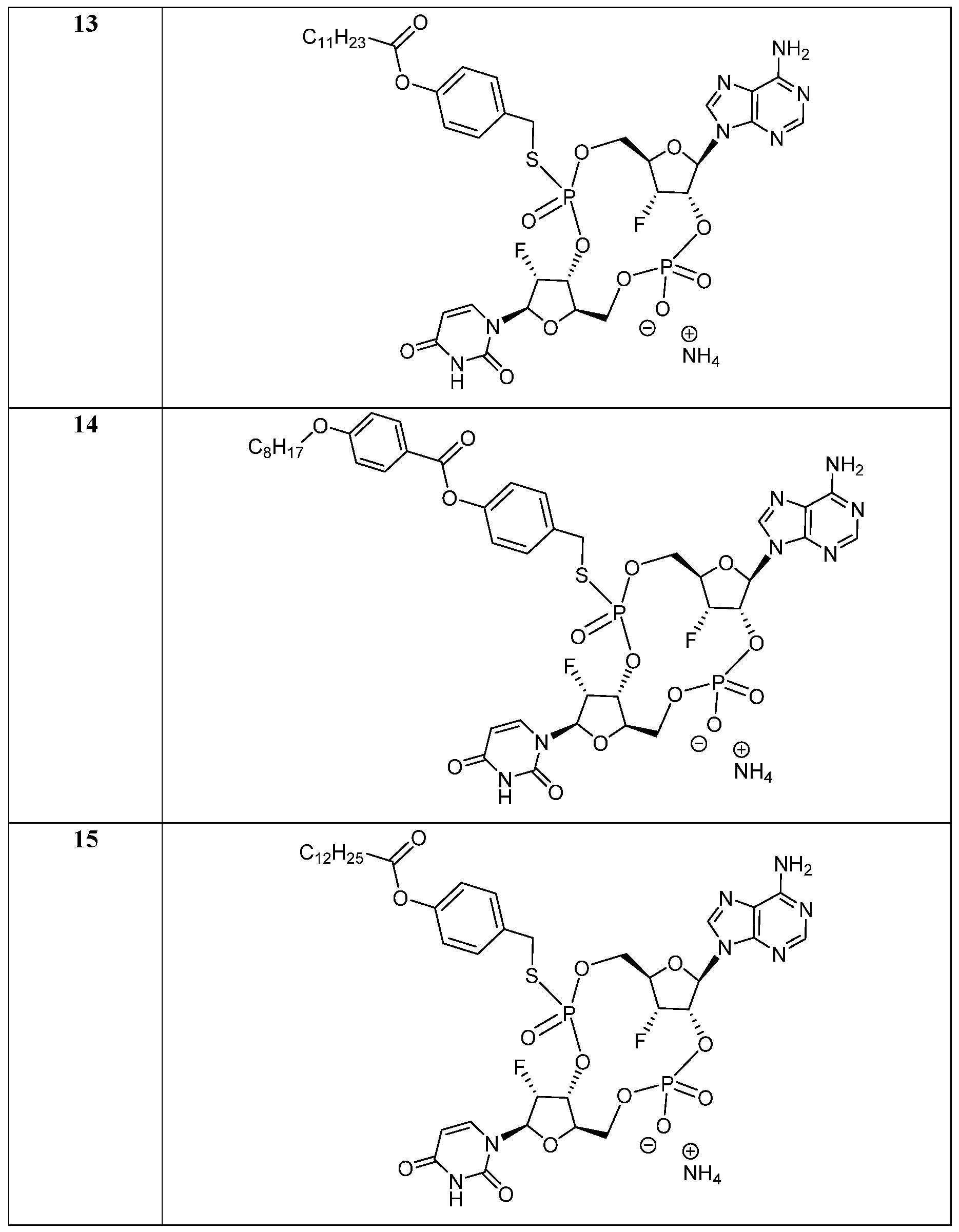
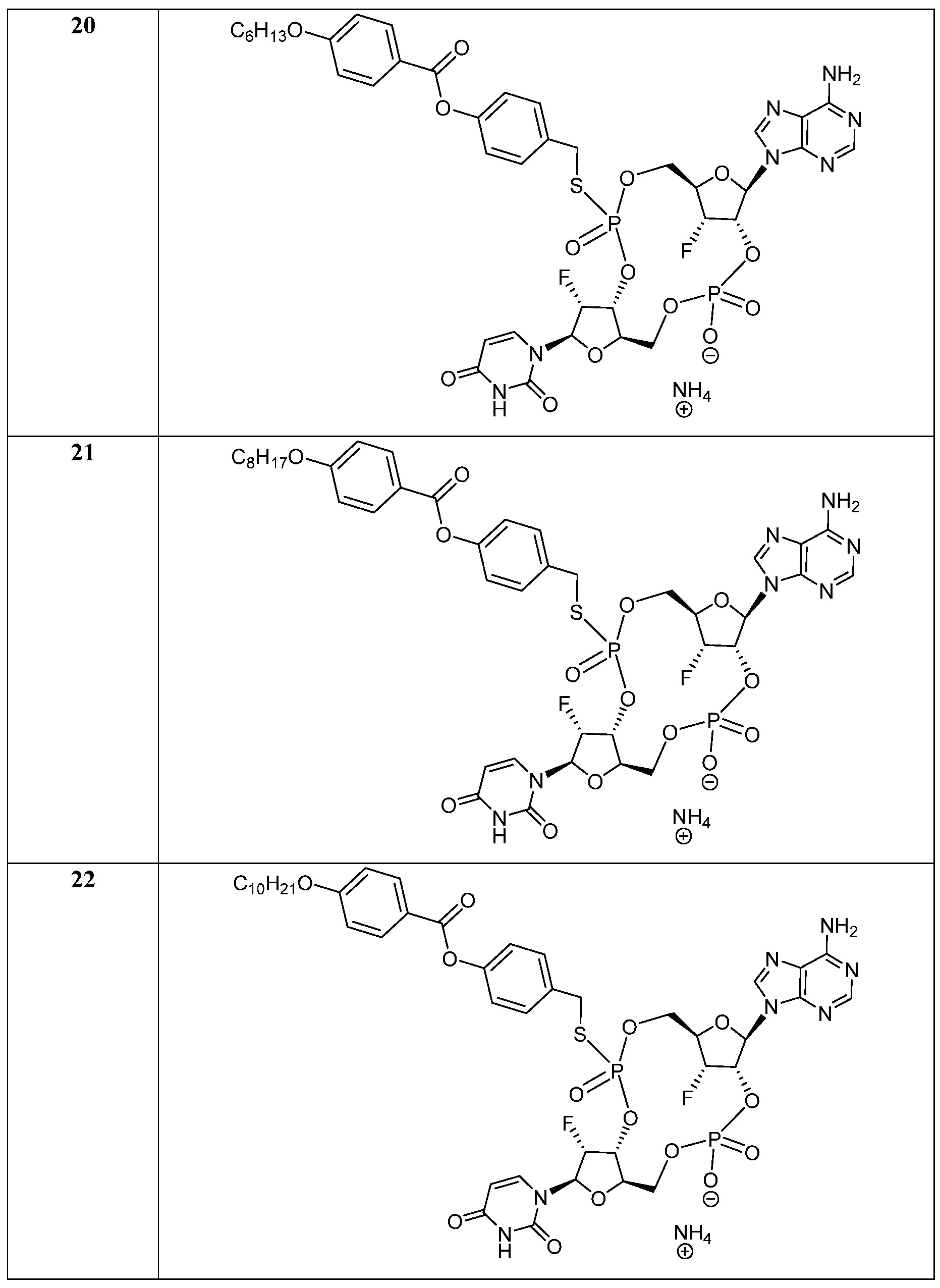
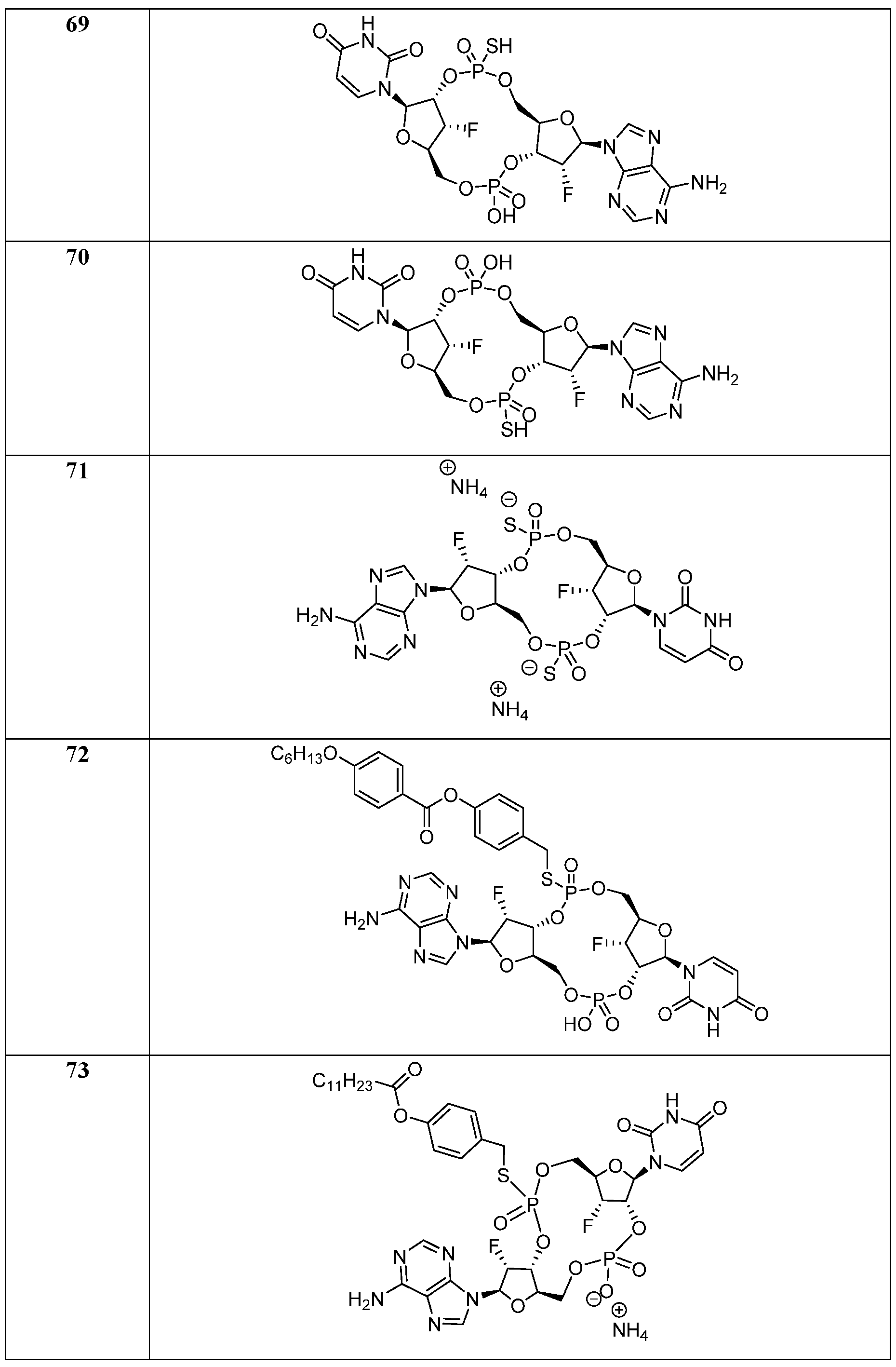
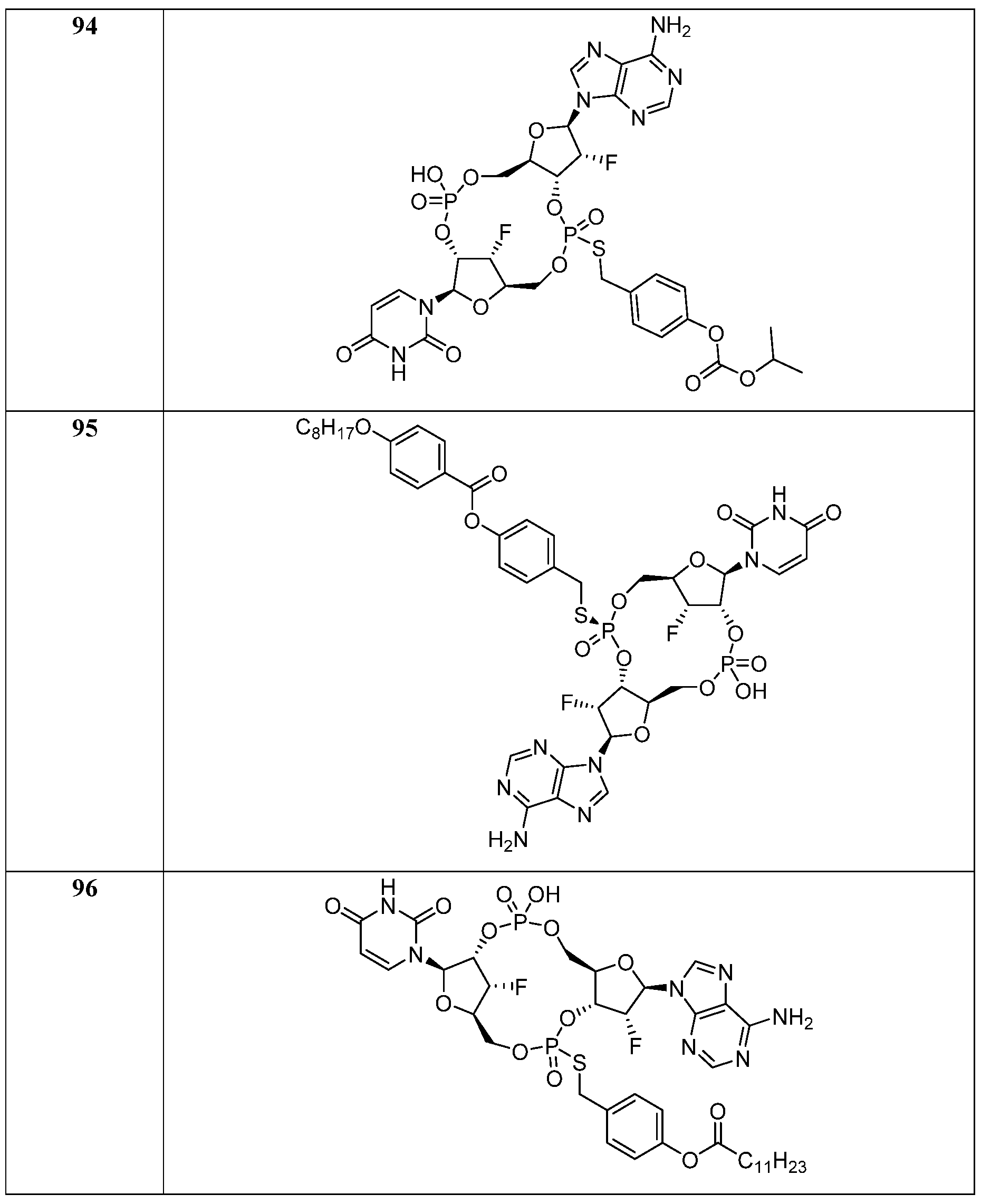
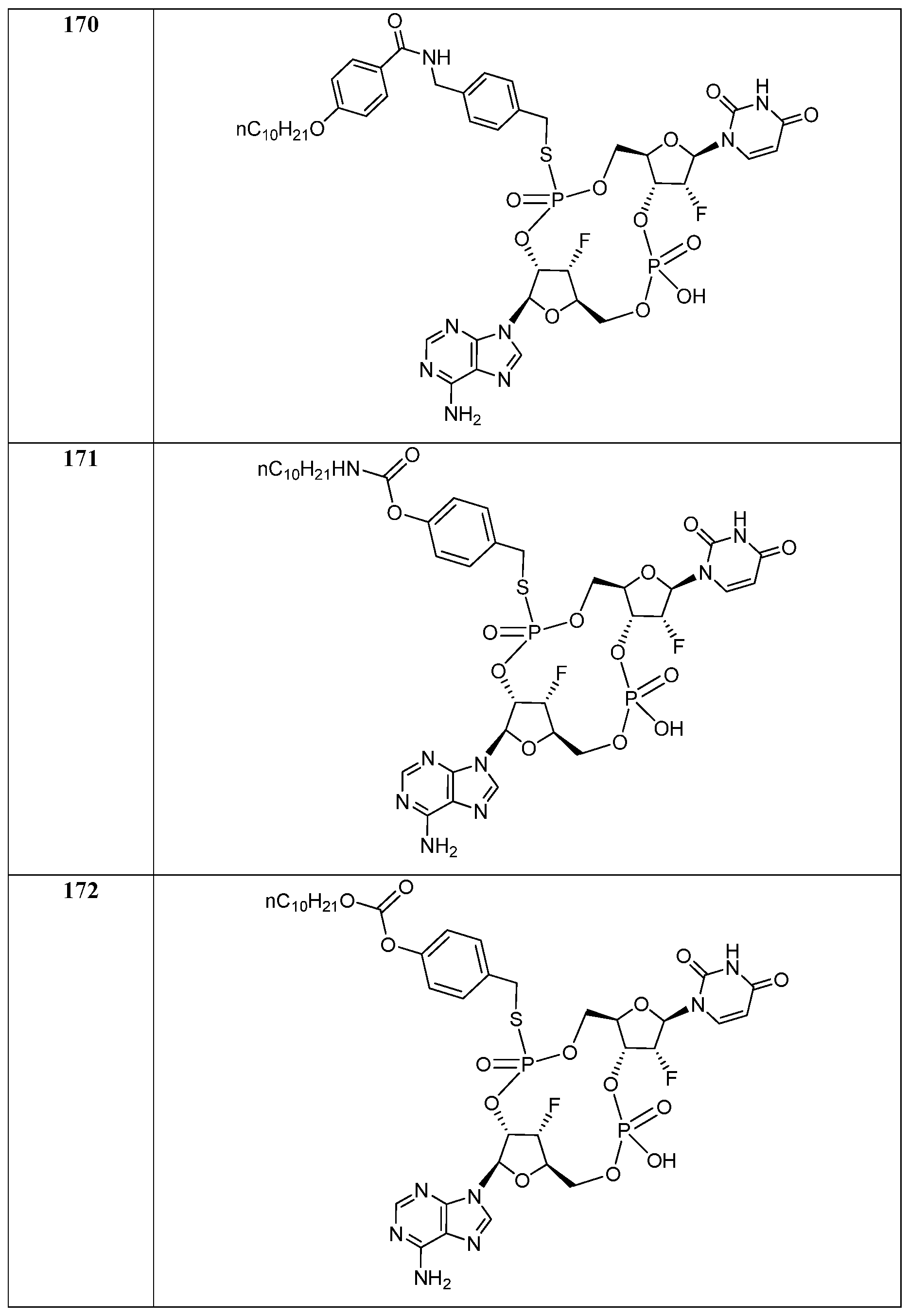
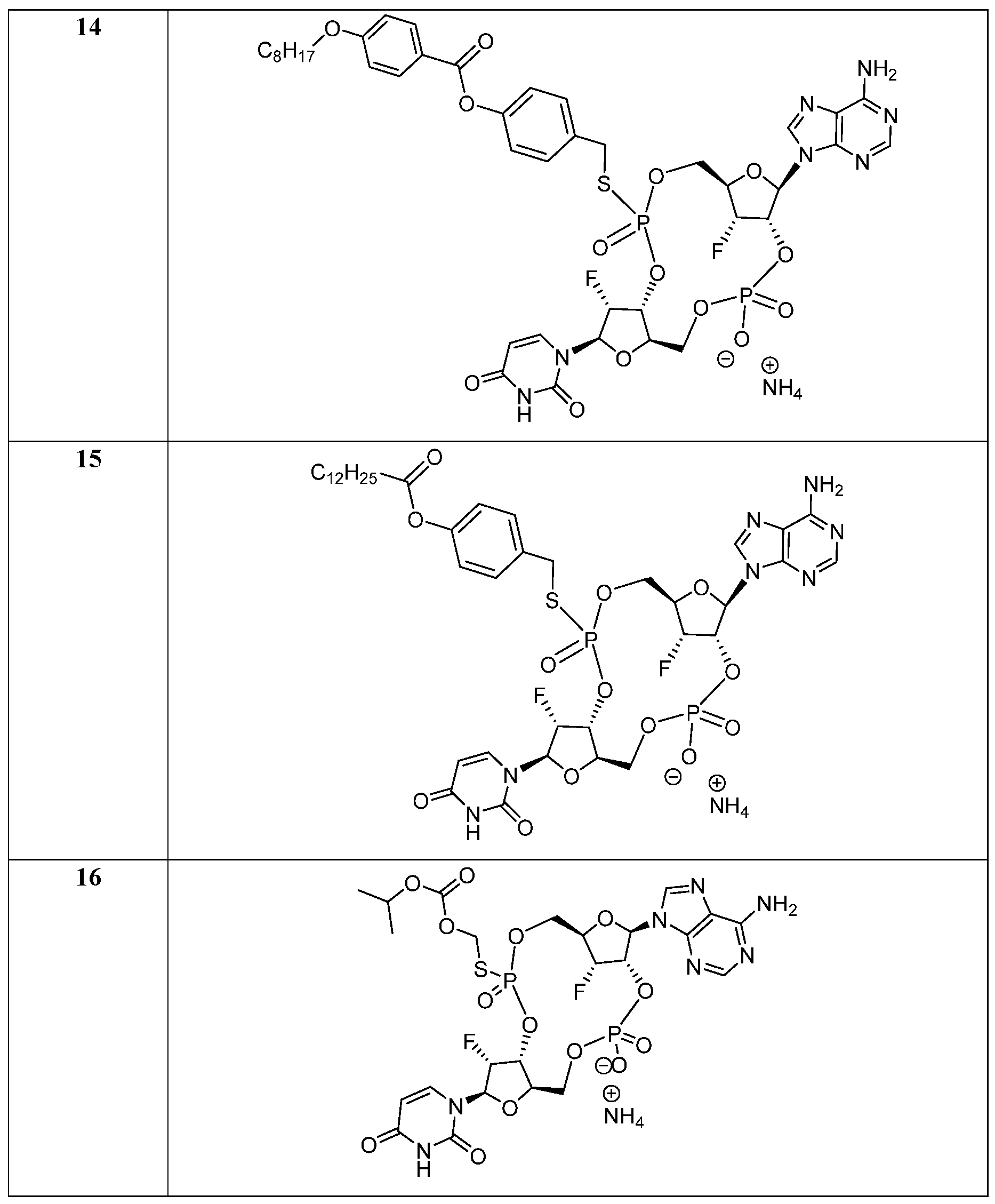
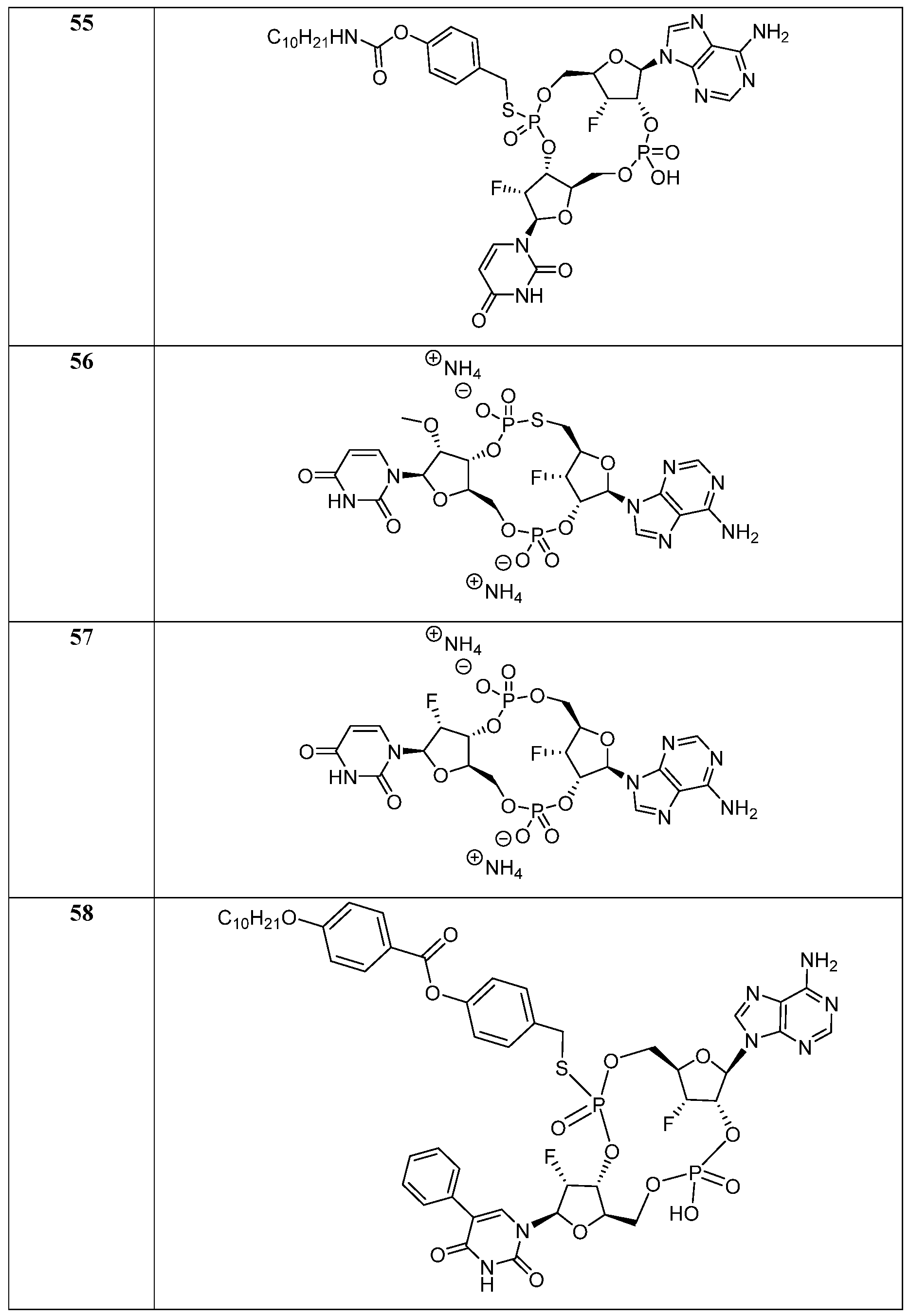
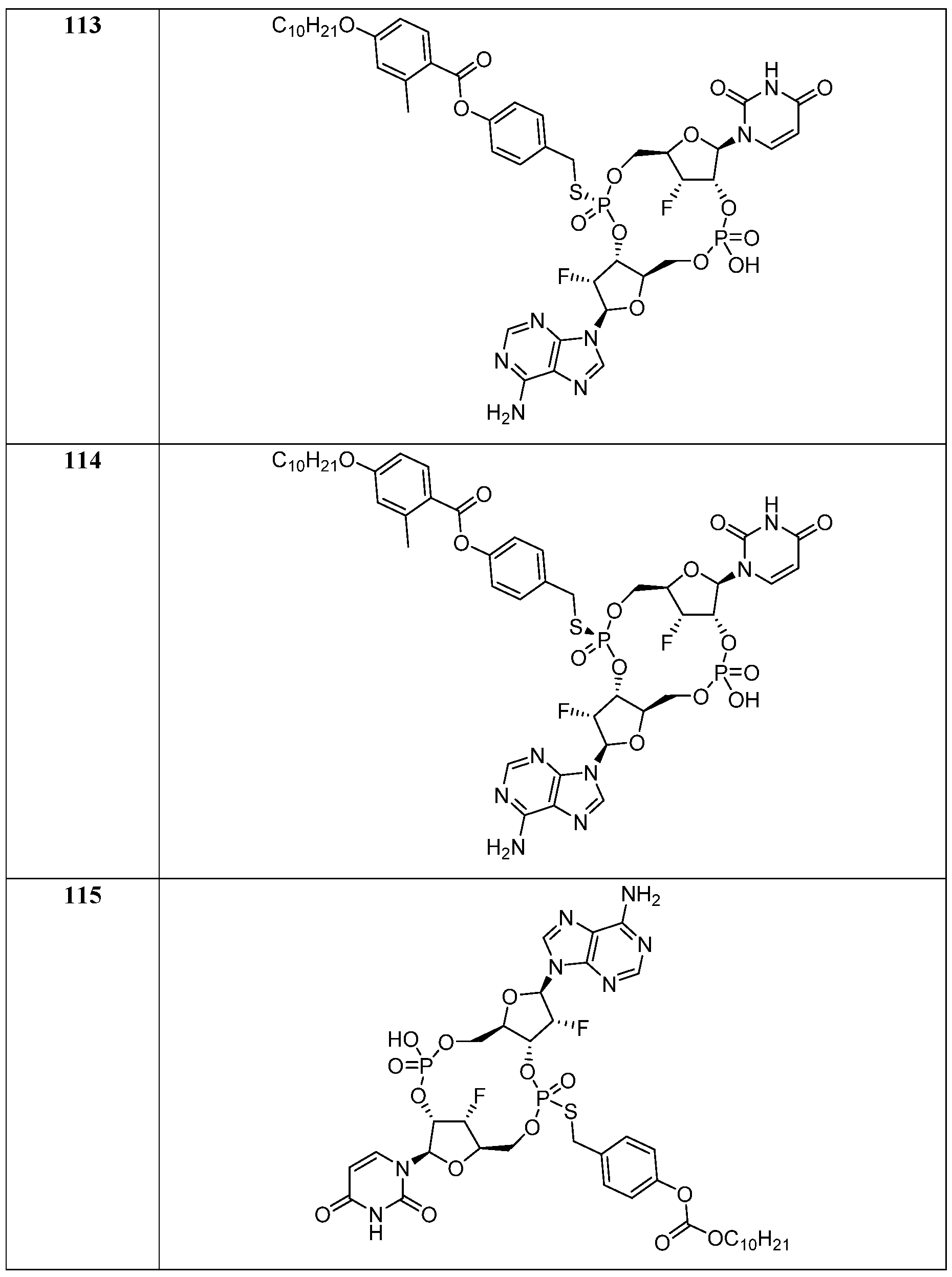
  • the compound of Formula (I) is selected from those depicted in Table 1.
  • X is any pharmaceutically acceptable counterion, e.g., lithium, sodium, potassium, calcium, magnesium, aluminum, ammonium, ethylamine, diethylamine, ethylenediamine, ethanolamine, diethanolamine, piperazine and the like (see, for example, Berge et al., supra); and the label "n" indicates that the associated alkyl chain is "normal” (i.e., unbranched).
  • the compound of Table 1 is not a salt (i.e., it's a free acid or free base).
  • a compound described herein is in the form of a pharmaceutically acceptable salt.
  • Exemplary salts are described herein, such as ammonium salts.
  • the compound is a mono-salt.
  • the compound is a di- salt.
  • a compound described herein e.g., a compound in Table 1 is not a salt (e.g., is a free acid or free base).
  • a compound of Formula (I) is a small molecule nucleic acid hybrid (cyclic dinucleotide) compound that combines both antiviral and immune modulating activities.
  • the latter activity mediates, for example, controlled apoptosis of virus-infected hepatocytes via stimulation of the innate immune response, similar to what is also achieved by IFN-a therapy in patients suffering from a viral infection.
  • the mechanism of action of a compound of Formula (I) entails its host immune stimulating activity, which may induce endogenous IFNs via the activation of a PRR, e.g., RIG-I, NOD2, and STING.
  • Activation may occur by binding of a compound of Formula (I) to the nucleotide binding domain of a PRR (e.g., STING), as described previously, and may further result in the induction of PRR expression (e.g., STING expression).
  • a PRR e.g., STING
  • the compounds provided herein may contain one or more asymmetric centers and thus occur as racemates and racemic mixtures, single enantiomers, individual diastereomers, and diastereomeric mixtures. All such isomeric forms of these compounds are expressly included within the scope. Unless otherwise indicated when a compound is named or depicted by a structure without specifying the stereochemistry and has one or more chiral centers, it is understood to represent all possible stereoisomers of the compound.
  • the compounds provided herewith may also contain linkages (e.g., carbon-carbon bonds, phosphorus-oxygen bonds, or phosphorus-sulfur bonds) or substituents that can restrict bond rotation, e.g., restriction resulting from the presence of a ring or double bond.
  • the compound of Formula (I) comprises an isomer (e.g., an Rp-isomer or Sp isomer) or a mixture of isomers (e.g., Rp-isomers or Sp isomers) of a compound of Formula (I).
  • an isomer e.g., an Rp-isomer or Sp isomer
  • a mixture of isomers e.g., Rp-isomers or Sp isomers
  • the present disclosure relates to methods for inducing the expression of a PRR (e.g., STING) in a subject through administration of an effective amount of a compound of Formula (I) or a pharmaceutically acceptable salt or stereoisomer thereof.
  • a PRR e.g., STING
  • the subject may be suffering from a condition described below, e.g., a viral infection (e.g., viral latency), a bacterial infection, a cancer (e.g., a proliferative disease).
  • Pattern recognition receptors such as STING, RIG-I, and NOD2 have been shown to be an important factor in host recognition of a large number of RNA viruses from a variety of different viral families.
  • the methods of inducing expression of PRRs e.g., STING
  • the methods of inducing expression of PRRs comprise administration of an effective amount of a compound of Formula (I) or a pharmaceutically acceptable salt or stereoisomer thereof to a subject infected with a microbial infection.
  • the microbial infection is a virus.
  • the virus is a RNA virus (e.g., a double-stranded RNA (dsRNA) virus, a single-stranded RNA (ssRNA) virus (e.g., a positive-strand (sense) ssRNA virus or a negative-strand (antisense) ssRNA virus), or a ssRNA retrovirus) or a DNA virus (e.g., a dsDNA virus, ssDNA virus, or a dsDNA retrovirus).
  • the virus may be a Group I, Group II, Group III, Group IV, Group V, Group VI, or Group VII class of virus, e.g., according to the Baltimore classification system.
  • the virus is dsRNA virus, e.g., a Group III virus.
  • expression of a PRR e.g., STING
  • the virus is a dsRNA virus, and is a member of the Birnaviridae, Chrysoviridae, Cystoviridae, Endornaviridae, Hypoviridae,
  • dsRNA viruses and virus genera include, but are not limited to, Picobirnavirus, Rotavirus, Seadornavirus, Coltivirus, Orbivirus, and
  • Orthoreovirus or a subtype, species, or variant thereof.
  • the virus is ssRNA virus, e.g., a positive-strand (sense) ssRNA virus, e.g., a Group IV virus.
  • expression of a PRR e.g., STING
  • STING is induced through host-produced or viral-derived RNA.
  • the virus is a positive-strand (sense) ssRNA virus, and is a member of the Arteriviridae, Coronaviridae, Mesoniviridae, Roniviridae, Dicistroviridae, Iflaviridae, Marnaviridae, Piconaviridae, Secoviridae, Alphaflexiviridae, Betaflexiviridae, Gammaflexiviridae, Tymoviridae, Alphatetraviridae, Alvernaviridae, Astroviridae, Barnaviridae, Bromoviridae, Caliciviridae, Carmotetraviridae, Closteroviridae, Flaviviridae, Leviviridae, Luteoviridae, Narnaviridae, Nodaviridae, Permutotetraviridae, Potyviridae, Togaviridae, or Virgaviridae families, or other family of positive-
  • Exemplary positive-strand (sense) ssRNA viruses and virus genera include, but are not limited to, Yellow fever virus, West Nile virus, Hepatitis C virus, Dengue fever virus, Rubella virus, Ross River virus, Sindbis virus, Chikungya virus, Norwalk virus, Japanese encephalitis virus, Tick-borne encephalitis virus, St.
  • Enterovirus B Enterovirus C (e.g., poliovirus), Enterovirus D, Enterovirus E, Enterovirus F, Enterovirus G, or Enterovirus H), Apthovirus (e.g., Foot and mouth disease virus),
  • Enterovirus C e.g., poliovirus
  • Enterovirus D Enterovirus D
  • Enterovirus E Enterovirus E
  • Enterovirus F Enterovirus G
  • Enterovirus H Enterovirus H
  • Apthovirus e.g., Foot and mouth disease virus
  • Nidovirales e.g., Cavally virus, Nam Dinh virus, Middle East respiratory syndrome coronavirus (MERS-CoV), Coronavirus HKU1, Coronavirus NL63, SARS-CoV,
  • Coronavirus OC43 coronavirus OC43, and Coronavirus 229E
  • Benyvirus Blunevirus
  • Cilevirus Hepevirus
  • I l l - e.g., Hepatitis E virus
  • Higrevirus Idaeovirus
  • Negevirus Ourmiavirus
  • Polemovirus Polemovirus
  • Sobemovirus or Umbravirus, or a subtype, species, or variant thereof.
  • the virus is a member of the genus Norovirus, or a subtype, species, or variant thereof. In some embodiments, the virus is the Norwalk virus, Hawaii virus, Snow Mountain virus, Mexico virus, Desert Shield virus, Victoria virus, Lordsdale virus, or Wilkinson virus, or a subtype or variant thereof. In some embodiments, the virus is a member of the genus Norovirus and can be classified as genogroup GI, genogroup Gil, genogroup GUI, genogroup GIV, or genogroup GV.
  • the virus is ssRNA virus, e.g., a negative- strand (antisense) ssRNA virus, e.g., a Group V virus.
  • expression of a PRR e.g., STING
  • STING is induced through host-produced or viral-derived RNA.
  • the virus is a negative- strand (antisense) ssRNA virus, and is a member of the Bornaviridae , Filoviridae, Paramyxoviridae, Rhabdoviridae, Nyamiviridae, Arenaviridae, Bunyaviridae, Ophioviridae, or Orthomyxoviridae families, or other family of negative- strand (antisense) ssRNA virus.
  • Exemplary negative- strand (antisense) ssRNA viruses and virus genera include, but are not limited to, Brona disease virus, Ebola virus, Marburg virus, Measles virus, Mumps virus, Nipah virus, Hendra virus, Respiratory syncytial virus, Influenza and Parainfluenza viruses, Metapneumovirus, Newcastle disease virus, Deltavirus (e.g., Hepatitis D virus), Dichohavirus, Emaravirus, Nyavirus, Tenuivirus, Varicosavirus, or a subtype, species, or variant thereof.
  • Brona disease virus ebola virus, Marburg virus, Measles virus, Mumps virus, Nipah virus, Hendra virus, Respiratory syncytial virus, Influenza and Parainfluenza viruses
  • Metapneumovirus Newcastle disease virus
  • Deltavirus e.g., Hepatitis D virus
  • Dichohavirus Emaravirus
  • Nyavirus Nyavirus
  • Tenuivirus Varicosavirus
  • the virus is an ssRNA retrovirus (ssRNA RT virus), e.g., a Group VI virus.
  • expression of a PRR e.g., STING
  • the virus is an ssRNA RT virus and is a member of the Metaviridae, Pseudoviridae, or Retrovir idae families, or other family of ssRNA RT virus.
  • Exemplary ssRNA RT viruses and virus genera include, but are not limited to, Metavirus, Err antivirus, Alpharetrovirus (e.g., Avian leukosis virus, Rous sarcoma virus), Betaretrovirus (e.g., Mouse mammary tumor virus), Gammaretrovirus (e.g., Murine leukemia virus, Feline leukemia virus), Deltaretrovirus (e.g., human T- lymphotropic virus), Epsilonretrovirus (e.g., Walleye dermal sarcoma virus), Lentivirus (e.g., Human immunodeficiency virus 1 (HIV)), or a subtype, species, or variant thereof.
  • Metavirus Err antivirus
  • Alpharetrovirus e.g., Avian leukosis virus, Rous sarcoma virus
  • Betaretrovirus e.g., Mouse mammary tumor virus
  • Gammaretrovirus e.g., Murine leukemia virus, Feline leukemia virus
  • the virus is a DNA virus, e.g., a dsDNA virus or an ssDNA virus.
  • the virus is a dsDNA virus, e.g., a Group I virus, and expression of a PRR (e.g., STING) is induced through host-produced or viral-derived RNA.
  • a PRR e.g., STING
  • the virus is a dsDNA virus and is a member of the Myovir idae, Podoviridae, Siphoviridae, Alloherpesviridae, Herpesviridae, Malacoherpesviridae, Lipothrixviridae, Rudiviridae, Adenoviridae, Ampullaviridae, Ascoviridae, Asfarviridae, Baculoviridae, Bicaudaviridae, Clavaviridae, Corticoviridae, Fuselloviridae,
  • dsDNA viruses and virus genera include, but are not limited to, Dinodnavirus, Nudivirus, smallpox, human herpes virus, Varicella Zoster virus,
  • polyomavirus 6 polyomavirus 7, polyomavirus 9, polyomavirus 10, JC virus, BK virus, KI virus, WU virus, Merkel cell polyomavirus, Trichodysplasia spinulosa-associated polyomavirus, MX polyomavirus, Simian virus 40, or a subtype, species, or variant thereof.
  • the virus is an ssDNA virus, e.g., a Group II virus, and expression of a PRR (e.g., STING) is induced through host-produced or viral-derived RNA.
  • a PRR e.g., STING
  • the virus is an ssDNA virus and is a member of the Anelloviridae, Bacillariodnaviridiae, Bidnaviridae, Circoviridae, Geminiviridae, Inoviridae, Microviridae, Nanoviridae, Parvoviridae, or Spiraviridae families, or other family of ssDNA virus.
  • Exemplary ssDNA viruses and virus genera include, but are not limited to, Torque teno virus, Torque teno midi virus, Torque teno mini virus, Gyrovirus, Circovirus, Parvovirus B19, Bocaparvovirus, Dependoparvovirus, Erythroparvovirus, Protoparvovirus,
  • Hepatopancreatic parvo-like virus or a subtype, species, or variant thereof.
  • the virus is a dsDNA reverse transcriptase (RT) virus, e.g., a Group VII virus, and expression of a PRR (e.g., STING) is induced through host-produced or viral-derived RNA.
  • RT dsDNA reverse transcriptase
  • PRR e.g., STING
  • the virus is a dsDNA RT virus and is a member of the Hepadnaviridae, or Caulimoviridae families, or other family of dsDNA RT virus.
  • Exemplary dsDNA RT viruses and virus genera include, but are not limited to, Hepatitis B virus, or a subtype, species, or variant thereof.
  • the virus (e.g., a virus described herein) is latent, e.g., within a cell.
  • the virus is an RNA virus (e.g., a double-stranded RNA (dsRNA) virus, a single-stranded RNA (ssRNA) virus (e.g., a positive-strand (sense) ssRNA virus or a negative-strand (antisense) ssRNA virus), or a ssRNA retrovirus) or a DNA virus (e.g., a dsDNA virus, ssDNA virus, or a dsDNA retrovirus) and is latent, e.g., within a cell.
  • dsRNA double-stranded RNA
  • ssRNA single-stranded RNA
  • DNA virus e.g., a dsDNA virus, ssDNA virus, or a dsDNA retrovirus
  • the virus is a Group I, Group II, Group III, Group IV, Group V, Group VI, or Group VII class of virus, e.g., according to the Baltimore classification system, and is latent, e.g., within a cell.
  • the virus is an RNA virus (e.g., an RNA virus described herein) and is latent, e.g., within a cell.
  • the virus is an ssRNA retrovirus (ssRNA RT virus), e.g., a Group VI virus, and is latent, e.g., within a cell.
  • the virus is the human immunodeficiency virus 1 (HIV)), or a subtype, species, or variant thereof, and is latent, e.g., within a cell.
  • HIV human immunodeficiency virus 1
  • the methods of inducing expression of a PRR in a subject suffering from a viral infection disclosed herein result in an increase in PRR expression (e.g., STING expression).
  • expression of a PRR is induced by a factor of about 1.1, about 1.2, about 1.3, about 1.4, about 1.5, about 1.6, about 1.7, about 1.8, about 1.9, about 2, about 2.5, about 3, about 4, about 5, about 7.5, about 10, about 15, about 20, about 25, about 30, about 40, about 50, about 75, about 100, about 150, about 200, about 250, about 500, about 1000, about 1500, about 2500, about 5000, about 10,000, or more.
  • induction of expression of a PRR occurs within about 5 minutes of administration of a compound of Formula (I) or a pharmaceutically acceptable salt thereof. In some embodiments, induction of expression of a PRR (e.g., STING) occurs within about 10 minutes, about 15 minutes, about 20 minutes, about 25 minutes, about 30 minutes, about 45 minutes, about 1 hour, about 1.5 hours, about 2 hours, about 3 hours, about 4 hours, about 5 hours, about 6 hours, about 7 hours, about 8 hours, about 10 hours, about 12 hours or more following administration of a compound of Formula (I) or a pharmaceutically acceptable salt thereof to a subject.
  • induction of expression of a PRR e.g., STING
  • induction of expression of a PRR occurs within about 10 minutes, about 15 minutes, about 20 minutes, about 25 minutes, about 30 minutes, about 45 minutes, about 1 hour, about 1.5 hours, about 2 hours, about 3 hours, about 4 hours, about 5 hours, about 6 hours, about 7 hours, about 8 hours, about 10 hours, about 12 hours or more following
  • PRRs e.g., STING
  • STING STING
  • bacteria may secrete nucleic acids during the exponential growth phase (e.g., Listeria monocytogenes; Abdullah, Z. et al, EMBO J (2012) 31 :4153-4164), which in turn are detected by PRRs such as RIG-I and thus promote the induction of further PRR expression.
  • PRR expression e.g., STING expression
  • STING expression may further be induced upon recognition of RNA released during phagocytotic uptake of bacteria.
  • bacterial cell wall components such as peptidoglycans (e.g., muramyl dipeptide, i.e., MDP) may serve as ligands for activation and induction of PRRs, namely NOD2, and bacterial-derived nucleic acids such as cyclic dinucleotides (e.g., cyclic di-GMP) may bind to and activate PRRs, in particular STING.
  • peptidoglycans e.g., muramyl dipeptide, i.e., MDP
  • MDP muramyl dipeptide
  • bacterial-derived nucleic acids such as cyclic dinucleotides
  • the expression of one or more PRRs may be induced through other means not explicitly recited herein.
  • the methods of inducing expression of a PRR comprise administration of an effective amount of a compound of Formula (I) or a pharmaceutically acceptable salt thereof to a subject infected with a microbial infection, e.g., a bacterial infection.
  • the bacterium is a Gram-negative bacterium or a Gram- positive bacterium.
  • Exemplary bacteria include, but are not limited to, Listeria (e.g., Listeria monocytogenes), Francisella (e.g., Francisella tularensis), Mycobacteria (e.g., Mycobacteria tuberculosis), Brucella (e.g., Brucella abortis), Streptococcus (e.g., group B Streptococcus), Legionella (e.g., Legionella pneumophila), Escherichia (e.g., Escherichia coli), Pseudomonas (e.g., Psuedomonas aeruginosa), Salmonella (e.g., Salmonella typhi), Shigella (e.g., Shigella flexneri), Campylobacter (e.g., Campylobacter jejuni), Clostridium (e.
  • the methods of inducing expression of a PRR in a subject suffering from a bacterial infection disclosed herein result in an increase in PRR expression (e.g., STING expression).
  • expression of a PRR is induced by a factor of about 1.1, about 1.2, about 1.3, about 1.4, about 1.5, about 1.6, about 1.7, about 1.8, about 1.9, about 2, about 2.5, about 3, about 4, about 5, about 7.5, about 10, about 15, about 20, about 25, about 30, about 40, about 50, about 75, about 100, about 150, about 200, about 250, about 500, about 1000, about 1500, about 2500, about 5000, about 10,000, or more.
  • induction of expression of a PRR occurs within about 5 minutes of administration of a compound of Formula (I) or a pharmaceutically acceptable salt thereof. In some embodiments, induction of expression of a PRR (e.g., STING) occurs within about 10 minutes, about 15 minutes, about 20 minutes, about 25 minutes, about 30 minutes, about 45 minutes, about 1 hour, about 1.5 hours, about 2 hours, about 3 hours, about 4 hours, about 5 hours, about 6 hours, about 7 hours, about 8 hours, about 10 hours, about 12 hours or more following administration of a compound of Formula (I) or a pharmaceutically acceptable salt thereof.
  • T cell infiltrate includes tumor antigen- specific T cells that have been activated spontaneously in response to the growing tumor, perhaps through immune surveillance mechanisms. This attempted host immune response, even if it does not eliminate the tumor completely, is thought to delay tumor progression and thus yield improved clinical outcome. Furthermore, the innate immune mechanisms can lead to adaptive T cell response against tumor antigens even in the absence of exogenous infection.
  • CD8+ T cells were required for the up- regulation of all immune factors within the tumor micro-environment. Studies indicate that IFN production is necessary for optimal T cell priming against tumor antigens.
  • PRRs that trigger IFN- ⁇ production by host DCs in response to a growing tumor in vivo including STING.
  • STING is an adapter protein that is activated by cyclic dinucleotides generated by cyclic GMP-AMP synthase (cGAS), which in turn is directly activated by cytosolic DNA.
  • cGAS cyclic GMP-AMP synthase
  • STING is translocated from the endoplasmic reticulum to various perinuclear components; for example, palmitoylation of STING at the Golgi has been shown to be essential for STING activation (Mukai, K. et al (2016) Nat Commun doi: 10.1038/ncommsl 1932).
  • STING forms aggregates, activates TBK1, which in turn phosphorylates interferon regulatory factor 3 (IRF3) that directly contributes to type I IFN gene transcription.
  • IRF3 interferon regulatory factor 3
  • This pathway has been implicated in the sensing of DNA viruses, and also in selected autoimmune models.
  • activating mutations of STING have recently been identified in human patients with a vasculitis/pulmonary inflammation syndrome that is characterized by increased type I IFN production.
  • Mechanistic studies using mouse transplantable tumor models revealed that STING-knockout mice, and IRF3-knockout mice showed defective spontaneous T cell priming against tumor antigens in vivo, and rejection of immunogenic tumors was ablated.
  • STING pathway activation and IFN- ⁇ production were found within the cytosol of a major population of tumor-infiltrating DCs, and this was associated with STING pathway activation and IFN- ⁇ production. Therefore, the host STING pathway appears to be an important innate immune sensing pathway that detects the presence of a tumor and to drive DC activation and subsequent T cell priming against tumor-associated antigens in vivo. A functional role for the STING pathway in vivo has also been reported in other mouse-tumor systems. An inducible glioma model was shown to result in induction of a type I IFN gene signature as part of the host response. This induction was substantially reduced in STING-knockout mice, and tumors grew more aggressively, leading to shorter mouse survival.
  • PRRs such as cGAS, RIG-I and/STING stimulates the production of type I interferons (e.g., IFN-a or IFN- ⁇ ), thus triggering a series of downstream signaling events that may lead to apoptosis in susceptible cells.
  • type I interferons e.g., IFN-a or IFN- ⁇
  • PRRs such as cGAS, RIG-I and/STING
  • RIG-I expression may be useful as a biomarker for prediction of prognosis and response to immunotherapy.
  • induction of RIG-I expression has been shown to induce immunogenic cell death of pancreatic cancer cells, prostate cancer cells, breast cancer cells, skin cancer cells, and lung cancer cells (Duewell, P. et al, Cell Death Differ (2014) 21 : 1825-1837; Besch, R. et al, J Clin Invest (2009) 119:2399-2411; Kaneda, Y. Oncoimmunology (2013) 2:e23566; Li, X.Y. et al, Mol Cell Oncol (2014) 1 :e968016), highlighting a new approach in immune- mediated cancer treatment.
  • STING is recognized as the key adapter protein in the cGAS-STING-IFN cascade, although it is also reported to be a sensor for DNA.
  • a role for STING in the stimulation of innate immunity in response to cancer has also been identified.
  • Recent studies have revealed the presence of tumor-derived DNA in the cytosol of certain antigen-presenting cells, such as tumor-infiltrating dendritic cells, likely generated through tumor cell stress or cell death.
  • This tumor-derived DNA is known to activate cGAS which causes the production of cyclic nucleotides that have been shown to activate STING, resulting in production of associated type 1 interferons (Woo, S.R. et al, Immunity (2014) 41 :830-842).
  • Stimulation of STING and resulting downstream signaling pathways also likely contributes to effector T cell recruitment into the inflamed tumor microenvironment (Woo, S. R. Trends in Immunol (2015) 36:250-256).
  • STING activation in the tumor microenvironment can induce adaptive immune response leading to anti-tumor activity.
  • the described herein can still have anti-tumor activity through activation of antigen-presenting cells and dendritic cells, (APCs and DCs) and induction of adaptive immune response.
  • the methods of inducing expression of a PRR comprise administration of an effective amount of a compound of Formula (I) or a pharmaceutically acceptable salt thereof to a subject suffering from cancer.
  • the methods of inducing expression of STING disclosed herein comprise administration of a compound of Formula (I) or a pharmaceutically acceptable salt thereof to a subject suffering from cancer.
  • the methods of inducing expression of RIG-I disclosed herein comprise administration of a compound of Formula (I) or a pharmaceutically acceptable salt thereof to a subject suffering from cancer.
  • the methods of inducing expression of NOD2 disclosed herein comprise administration of a compound of Formula (I) or a pharmaceutically acceptable salt thereof to a subject suffering from cancer.
  • the cancer is selected from a cancer of the breast, bone, brain, cervix, colon, gastrointestinal tract, eye, gall bladder, lymph nodes, blood, lung, liver, skin, mouth, prostate, ovary, penis, pancreas, uterus, testicles, stomach, thymus, thyroid, or other part of the body.
  • the cancer comprises a solid tumor (e.g., a carcinoma, a sarcoma, or a lymphoma).
  • the cancer is a hepatocellular carcinoma or other cancer of the liver.
  • the cancer is a leukemia or other cancer of the blood.
  • the cancer comprises breast cancer, renal cell carcinoma, colon cancer, melanoma, ovarian cancer, head and neck squamous cell carcinoma, pancreatic cancer, prostate cancer, lung cancer, brain cancer, thyroid cancer, renal cancer, testis cancer, stomach cancer, urothelial cancer, skin cancer, cervical cancer, endometrial cancer, liver cancer, lung cancer, lymphoma or gastrointestinal stromal cancer and solid tumors.
  • the cancer cells e.g., tumor cells
  • the methods of inducing expression of a PRR e.g., STING, RIG-I, MDA5, LGP2
  • a PRR e.g., STING, RIG-I, MDA5, LGP2
  • an increase in PRR expression e.g., STING expression
  • expression of a PRR is induced by a factor of about 1.1, about 1.2, about 1.3, about 1.4, about 1.5, about 1.6, about 1.7, about 1.8, about 1.9, about 2, about 2.5, about 3, about 4, about 5, about 7.5, about 10, about 15, about 20, about 25, about 30, about 40, about 50, about 75, about 100, about 150, about 200, about 250, about 500, about 1000, about 1500, about 2500, about 5000, about 10,000, or more.
  • induction of expression of a PRRs e.g., STING occurs within about 5 minutes of administration of a compound of Formula (I) or a pharmaceutically acceptable salt thereof.
  • induction of expression of a PRRs occurs within about 5 minutes of administration of a compound of Formula (I) or a pharmaceutically acceptable salt thereof.
  • induction of expression of a PRR occurs within about 10 minutes, about 15 minutes, about 20 minutes, about 25 minutes, about 30 minutes, about 45 minutes, about 1 hour, about 1.5 hours, about 2 hours, about 3 hours, about 4 hours, about 5 hours, about 6 hours, about 7 hours, about 8 hours, about 10 hours, about 12 hours or more following administration of a compound of Formula (I) or a pharmaceutically acceptable salt thereof.
  • STING activation of STING by compounds may lead to induction of expression of other PRRs such as RIG-I, MDA5, NOD2 etc. which may further amplify IFN production in the tumor microenvironment and prime T-cells for enhanced anti-tumor activity.
  • PRRs such as RIG-I, MDA5, NOD2 etc.
  • the methods of inducing expression of a PRR in a subject suffering from a cancer disclosed herein result in an increase in PRR expression (e.g., STING expression).
  • expression of a PRR is induced by a factor of about 1.1, about 1.2, about 1.3, about 1.4, about 1.5, about 1.6, about 1.7, about 1.8, about 1.9, about 2, about 2.5, about 3, about 4, about 5, about 7.5, about 10, about 15, about 20, about 25, about 30, about 40, about 50, about 75, about 100, about 150, about 200, about 250, about 500, about 1000, about 1500, about 2500, about 5000, about 10,000, or more.
  • induction of expression of a PRR occurs within about 5 minutes of administration of a compound of Formula (I) or a pharmaceutically acceptable salt or stereoisomer thereof. In some embodiments, induction of expression of a PRR (e.g., STING) occurs within about 10 minutes, about 15 minutes, about 20 minutes, about 25 minutes, about 30 minutes, about 45 minutes, about 1 hour, about 1.5 hours, about 2 hours, about 3 hours, about 4 hours, about 5 hours, about 6 hours, about 7 hours, about 8 hours, about 10 hours, about 12 hours or more following
  • a compound of the present disclosure may be administered alone, it is preferable to administer said compound as a pharmaceutical composition or formulation, where the compounds are combined with one or more pharmaceutically acceptable diluents, excipients or carriers.
  • the compounds according to the disclosure may be formulated for administration in any convenient way for use in human or veterinary medicine.
  • the compounds included in the pharmaceutical preparation may be active itself, or may be a prodrug, e.g., capable of being converted to an active compound in a physiological setting.
  • the compounds of the present disclosure which may be used in a suitable hydrated form, and/or the pharmaceutical compositions of the present disclosure, are formulated into a pharmaceutically acceptable dosage form such as described below or by other conventional methods known to those of skill in the art.
  • the amount and concentration of compounds of the present disclosure e.g., a compound of Formula (I)
  • the quantity of the pharmaceutical composition administered to a subject can be selected based on clinically relevant factors, such as medically relevant characteristics of the subject (e.g., age, weight, gender, other medical conditions, and the like), the solubility of compounds in the
  • compositions comprising a therapeutically effective amount or prophylactically effective amount of a compound described herein (e.g., a compound of Formula (I)), formulated together with one or more pharmaceutically acceptable carriers (additives) and/or diluents.
  • a compound described herein e.g., a compound of Formula (I)
  • the pharmaceutical compositions of the present disclosure may be specially formulated for administration in solid or liquid form, including those adapted for oral, intratumoral, parenteral administration, for example, by subcutaneous, intramuscular, intraperitoneal, or intravenous injection as, for example, a sterile solution or suspension.
  • the subject compounds may be simply dissolved or suspended in sterile water.
  • the pharmaceutical preparation is non- pyrogenic, i.e., does not elevate the body temperature of a patient.
  • systemic administration means the administration of the compound other than directly into the central nervous system, such that it enters the patient's system and, thus, is subject to metabolism and other like processes, for example, subcutaneous administration.
  • phrases "pharmaceutically acceptable” is employed herein to refer to those compounds, materials, compositions, and/or dosage forms which are, within the scope of sound medical judgment, suitable for use in contact with the tissues of human beings and animals without excessive toxicity, irritation, allergic response, or other problem or complication, commensurate with a reasonable benefit/risk ratio.
  • phrases "pharmaceutically acceptable carrier” as used herein means a
  • composition or vehicle such as a liquid or solid filler, diluent, stabilizing agent, excipient, solvent or encapsulating material, involved in carrying or transporting the subject antagonists from one organ, or portion of the body, to another organ, or portion of the body.
  • a pharmaceutically acceptable material, composition or vehicle such as a liquid or solid filler, diluent, stabilizing agent, excipient, solvent or encapsulating material, involved in carrying or transporting the subject antagonists from one organ, or portion of the body, to another organ, or portion of the body.
  • Each carrier must be “acceptable” in the sense of being compatible with the other ingredients of the formulation and not injurious to the patient.
  • materials which can serve as pharmaceutically acceptable carriers include, but are not limited to: (1) sugars, such as lactose, glucose and sucrose; (2) starches, such as corn starch and potato starch; (3) cellulose, and its derivatives, such as sodium carboxymethyl cellulose, ethyl cellulose and cellulose acetate; (4) powdered tragacanth; (5) malt; (6) gelatin; (7) talc; (8) excipients, such as cocoa butter and suppository waxes; (9) oils, such as peanut oil, cottonseed oil, safflower oil, sesame oil, olive oil, corn oil and soybean oil; (10) glycols, such as propylene glycol; (11) polyols, such as glycerin, sorbitol, mannitol and polyethylene glycol; (12) esters, such as ethyl oleate and ethyl laurate; (13) agar; (14) buffering agents, such as magnesium hydroxide, such
  • certain embodiments of the compounds described herein may contain a basic functional group, such as an amine, and are thus capable of forming pharmaceutically acceptable salts with pharmaceutically acceptable acids.
  • a basic functional group such as an amine
  • “pharmaceutically acceptable salts” in this respect, refers to the relatively non-toxic, inorganic and organic acid addition salts of compounds of the present disclosure. These salts can be prepared in situ during the final isolation and purification of the compounds of the disclosure, or by separately reacting a purified compound of the disclosure in its free base form with a suitable organic or inorganic acid, and isolating the salt thus formed.
  • Representative salts include the hydrobromide, hydrochloride, sulfate, bisulfate, phosphate, nitrate, acetate, valerate, oleate, palmitate, stearate, laurate, benzoate, lactate, phosphate, tosylate, citrate, maleate, fumarate, succinate, tartrate, napthylate, mesylate, glucoheptonate, lactobionate, and laurylsulphonate salts and the like (see, for example, Berge et al. (1977) "Pharmaceutical Salts", J. Pharm. Sci. 66: 1-19).
  • the compounds of the present disclosure may contain one or more acidic functional groups and, thus, are capable of forming pharmaceutically acceptable salts with pharmaceutically acceptable bases.
  • pharmaceutically acceptable salts refers to the relatively non-toxic, inorganic and organic base addition salts of the compound of the present disclosure (e.g., a compound of Formula (I). These salts can likewise be prepared in situ during the final isolation and purification of the compounds, or by separately reacting the purified compound in its free acid form with a suitable base, such as the hydroxide, carbonate or bicarbonate of a pharmaceutically acceptable metal cation, with ammonia, or with a pharmaceutically acceptable organic primary, secondary or tertiary amine.
  • a suitable base such as the hydroxide, carbonate or bicarbonate of a pharmaceutically acceptable metal cation, with ammonia, or with a pharmaceutically acceptable organic primary, secondary or tertiary amine.
  • Representative alkali or alkaline earth salts include the lithium, sodium, potassium, calcium, magnesium, and aluminum salts and the like.
  • Representative organic amines useful for the formation of base addition salts include ethylamine, diethylamine, ethylenediamine, ethanolamine, diethanolamine, piperazine and the like (see, for example, Berge et al., supra).
  • wetting agents such as sodium lauryl sulfate and magnesium stearate, as well as coloring agents, release agents, coating agents, sweetening, flavoring and perfuming agents, preservatives and antioxidants can also be present in the compositions.
  • antioxidants examples include: (1) water soluble antioxidants, such as ascorbic acid, cysteine hydrochloride, sodium bisulfate, sodium metabi sulfite, sodium sulfite and the like; (2) oil-soluble antioxidants, such as ascorbyl palmitate, butylated hydroxyanisole (BHA), butylated hydroxytoluene (BHT), lecithin, propyl gallate, alpha-tocopherol, and the like; and (3) metal chelating agents, such as citric acid, ethylenediamine tetraacetic acid (EDTA), sorbitol, tartaric acid, phosphoric acid, and the like.
  • water soluble antioxidants such as ascorbic acid, cysteine hydrochloride, sodium bisulfate, sodium metabi sulfite, sodium sulfite and the like
  • oil-soluble antioxidants such as ascorbyl palmitate, butylated hydroxyanisole (BHA), butylated hydroxytoluene (
  • the pharmaceutically acceptable carriers as well as wetting agents, emulsifiers, lubricants, coloring agents, release agents, coating agents, sweetening, flavoring agents, perfuming agents, preservatives, antioxidants, and other additional components may be present in an amount between about 0.001% and 99% of the composition described herein.
  • said pharmaceutically acceptable carriers as well as wetting agents, emulsifiers, lubricants, coloring agents, release agents, coating agents, sweetening, flavoring agents, perfuming agents, preservatives, antioxidants, and other additional components may be present from about 0.005%, about 0.01%, about 0.05%, about 0.1%, about 0.25%, about 0.5%, about 0.75%, about 1%, about 1.5%, about 2%, about 3%, about 4%, about 5%, about 6%, about 7%, about 8%, about 9%, about 10%, about 15%, about 20%, about 25%, about 30%, about 35%, about 40%, about 45%, about 50%, about 55%, about 60%, about 65%, about 70%), about 75%, about 85%>, about 90%, about 95%, or about 99% of the composition described herein.
  • compositions of the present disclosure may be in a form suitable for oral administration, e.g., a liquid or solid oral dosage form.
  • the liquid dosage form comprises a suspension, a solution, a linctus, an emulsion, a drink, an elixir, or a syrup.
  • the solid dosage form comprises a capsule, tablet, powder, dragee, or powder.
  • the pharmaceutical composition may be in unit dosage forms suitable for single administration of precise dosages.
  • Pharmaceutical compositions may comprise, in addition to the compound described herein (e.g., a compound of Formula (I)) or a
  • pharmaceutically acceptable salt thereof a pharmaceutically acceptable carrier
  • pharmaceutically acceptable excipients such as, for example, stabilizers (e.g., a binder, e.g., polymer, e.g., a precipitation inhibitor, diluents, binders, and lubricants.
  • stabilizers e.g., a binder, e.g., polymer, e.g., a precipitation inhibitor, diluents, binders, and lubricants.
  • the composition described herein comprises a liquid dosage form for oral administration, e.g., a solution or suspension.
  • the composition described herein comprises a solid dosage form for oral administration capable of being directly compressed into a tablet.
  • said tablet may include other medicinal or pharmaceutical agents, carriers, and or adjuvants.
  • Exemplary pharmaceutical compositions include compressed tablets (e.g., directly compressed tablets), e.g., comprising a compound of the present disclosure (e.g., a compound of Formula (I)) or a pharmaceutically acceptable salt thereof.
  • Formulations of the present disclosure include those suitable for parenteral administration.
  • the formulations may conveniently be presented in unit dosage form and may be prepared by any methods well known in the art of pharmacy.
  • the amount of active ingredient which can be combined with a carrier material to produce a single dosage form will vary depending upon the host being treated, the particular mode of administration.
  • the amount of active ingredient that can be combined with a carrier material to produce a single dosage form will generally be that amount of the compound which produces a therapeutic effect. Generally, out of one hundred percent, this amount will range from about 1 percent to about 99 percent of active ingredient, preferably from about 5 percent to about 70 percent, most preferably from about 10 percent to about 30 percent.
  • compositions of this disclosure suitable for parenteral administration comprise compounds of the disclosure in combination with one or more pharmaceutically acceptable sterile isotonic aqueous or nonaqueous solutions, dispersions, suspensions or emulsions, or sterile powders which may be reconstituted into sterile injectable solutions or dispersions just prior to use, which may contain antioxidants, buffers, bacteriostats, solutes which render the formulation isotonic with the blood of the intended recipient or suspending or thickening agents.
  • aqueous and nonaqueous carriers examples include water, ethanol, polyols (such as glycerol, propylene glycol, polyethylene glycol, and the like), and suitable mixtures thereof, vegetable oils, such as olive oil, and injectable organic esters, such as ethyl oleate.
  • polyols such as glycerol, propylene glycol, polyethylene glycol, and the like
  • vegetable oils such as olive oil
  • injectable organic esters such as ethyl oleate.
  • Proper fluidity can be maintained, for example, by the use of coating materials, such as lecithin, by the maintenance of the required particle size in the case of dispersions, and by the use of surfactants.
  • compositions may also contain adjuvants such as preservatives, wetting agents, emulsifying agents and dispersing agents. Prevention of the action of microorganisms may be ensured by the inclusion of various antibacterial and antifungal agents, for example, paraben, chlorobutanol, phenol sorbic acid, and the like. It may also be desirable to include isotonic agents, such as sugars, sodium chloride, and the like into the compositions. In addition, prolonged absorption of the injectable pharmaceutical form may be brought about by the inclusion of agents that delay absorption such as aluminum monostearate and gelatin.
  • a compound of the present disclosure e.g., a compound of Formula (I)
  • delayed absorption of a parenterally administered form of the compound of the present disclosure is accomplished by dissolving or suspending compound in an oil vehicle.
  • sustained absorption may be achieved by combining a compound of the present disclosure with other pharmaceutically acceptable ingredients, diluents, or carriers that slow its release properties into systemic circulation.
  • compositions used in the methods described herein may be administered to a subject in a variety of forms depending on the selected route of administration, as will be understood by those skilled in the art.
  • exemplary routes of administration of the compositions used in the methods described herein include topical, enteral, or parenteral applications.
  • Topical applications include but are not limited to epicutaneous, inhalation, enema, eye drops, ear drops, and applications through mucous membranes in the body.
  • Enteral applications include oral administration, rectal administration, vaginal administration, and gastric feeding tubes.
  • Parenteral administration includes intravenous, intraarterial, intracapsular, intraorbital, intracardiac, intradermal, transtracheal, subcuticular, intraarticular, subcapsular, subarachnoid, intraspinal, epidural, intrastemal, intraperitoneal, subcutaneous, intramuscular, transepithelial, nasal,
  • intrapulmonary, intrathecal, rectal, and topical modes of administration may be by continuous infusion over a selected period of time.
  • a composition described herein comprising a compound of Formula (I) is administered orally.
  • a composition described herein comprising a compound of Formula (I) is administered parenterally (e.g., intraperitoneally). It is recognized that for treatment of solid tumors, direct injection of the compounds into the tumor may also be carried out (e.g., intratumoral administration). It is recognized that for treatment of solid tumors, direct injection of the compounds into the tumor may also be carried out (e.g., intratumoral administration).
  • the composition For intravenous, intraperitoneal, or intrathecal delivery or direct injection (e.g., intratumoral), the composition must be sterile and fluid to the extent that the composition is deliverable by syringe.
  • the carrier can be an isotonic buffered saline solution, ethanol, polyol (for example, glycerol, propylene glycol, and liquid polyetheylene glycol, and the like), and suitable mixtures thereof.
  • Proper fluidity can be maintained, for example, by use of coating such as lecithin, by maintenance of required particle size in the case of dispersion and by use of surfactants.
  • isotonic agents for example, sugars, polyalcohols such as mannitol or sorbitol, and sodium chloride in the composition.
  • Long-term absorption of the injectable compositions can be brought about by including in the composition an agent which delays absorption, for example, aluminum monostearate or gelatin.
  • the choice of the route of administration will depend on whether a local or systemic effect is to be achieved.
  • the composition can be formulated for topical administration and applied directly where its action is desired.
  • the composition can be formulated for enteral administration and given via the digestive tract.
  • the composition can be formulated for parenteral administration and given by routes other than through the digestive tract.
  • compositions of the present disclosure are formulated into acceptable dosage forms by conventional methods known to those of skill in the art.
  • Actual dosage levels of the active ingredients in the compositions of the present disclosure may be varied so as to obtain an amount of the active ingredient which is effective to achieve the desired therapeutic response for a particular subject, composition, and mode of administration, without being toxic to the subject.
  • the selected dosage level will depend upon a variety of pharmacokinetic factors including the activity of the particular
  • compositions of the present disclosure employed, the route of administration, the time of administration, the rate of absorption of the particular agent being employed, the duration of the treatment, other drugs, substances, and/or materials used in combination with the particular compositions employed, the age, sex, weight, condition, general health and prior medical history of the subject being treated, and like factors well known in the medical arts.
  • a physician or veterinarian having ordinary skill in the art can readily determine and prescribe the effective amount of the composition required.
  • the physician or veterinarian can start doses of the substances of the disclosure employed in the composition at levels lower than that required in order to achieve the desired therapeutic effect and gradually increase the dosage until the desired effect is achieved.
  • a suitable daily dose of a composition of the disclosure will be that amount of the substance which is the lowest dose effective to produce a therapeutic effect. Such an effective dose will generally depend upon the factors described above.
  • the effective daily dose of a therapeutic composition may be administered as two, three, four, five, six or more sub-doses
  • Preferred therapeutic dosage levels are between about 0.1 mg/kg to about 1000 mg/kg (e.g., about 0.2 mg/kg, 0.5 mg/kg, 1.0 mg/kg, 1.5 mg/kg, 2 mg/kg, 3 mg/kg, 4 mg/kg, 5 mg/kg, 10 mg/kg, 15 mg/kg, 20 mg/kg, 25 mg/kg, 30 mg/kg, 35 mg/kg, 40 mg/kg, 45 mg/kg, 50 mg/kg, 60 mg/kg, 70 mg/kg, 80 mg/kg, 90 mg/kg, 100 mg/kg, 125 mg/kg, 150 mg/kg, 175 mg/kg, 200 mg/kg, 250 mg/kg, 300 mg/kg, 350 mg/kg, 400 mg/kg, 450 mg/kg, 500 mg/kg, 600 mg/kg, 700 mg/kg, 800 mg/kg, 900 mg/kg, or 1000 mg/kg) of the composition per day administered (e.g., orally or intraperitone
  • Preferred prophylactic dosage levels are between about 0.1 mg/kg to about 1000 mg/kg (e.g., about 0.2 mg/kg, 0.5 mg/kg, 1.0 mg/kg, 1.5 mg/kg, 2 mg/kg, 3 mg/kg, 4 mg/kg, 5 mg/kg, 10 mg/kg, 15 mg/kg, 20 mg/kg, 25 mg/kg, 30 mg/kg, 35 mg/kg, 40 mg/kg, 45 mg/kg, 50 mg/kg, 60 mg/kg, 70 mg/kg, 80 mg/kg, 90 mg/kg, 100 mg/kg, 125 mg/kg, 150 mg/kg, 175 mg/kg, 200 mg/kg, 250 mg/kg, 300 mg/kg, 350 mg/kg, 400 mg/kg, 450 mg/kg, 500 mg/kg, 600 mg/kg, 700 mg/kg, 800 mg/kg, 900 mg/kg, or 1000 mg/kg) of the composition per day administered (e.g., orally or intraperitoneally) to a subject.
  • the dose may also be
  • the frequency of treatment may also vary.
  • the subject can be treated one or more times per day (e.g., once, twice, three, four or more times) or every so-many hours (e.g., about every 2, 4, 6, 8, 12, or 24 hours).
  • the composition can be administered 1 or 2 times per 24 hours.
  • the time course of treatment may be of varying duration, e.g., for two, three, four, five, six, seven, eight, nine, ten, or more days, two weeks, 1 month, 2 months, 4 months, 6 months, 8 months, 10 months, or more than one year.
  • the treatment can be twice a day for three days, twice a day for seven days, twice a day for ten days.
  • Treatment cycles can be repeated at intervals, for example weekly, bimonthly or monthly, which are separated by periods in which no treatment is given.
  • the treatment can be a single treatment or can last as long as the life span of the subject (e.g., many years).
  • the methods of the present disclosure described herein entail administration of a compound of Formula (I) or a pharmaceutically acceptable salt thereof to a subject to activate the PRR for IFNs, ISGs and cytokines production or additionally induce the expression of PRRs (e.g., RIG-I, STING etc.).
  • the subject is suffering from or is diagnosed with a condition, e.g., a proliferative disease, e.g., cancer.
  • a patient and/or subject can be selected for treatment using a compound of Formula (I) or a pharmaceutically acceptable salt thereof by first evaluating the patient and/or subject to determine whether the subject is infected with a proliferative disease, e.g., cancer.
  • a subject can be evaluated as infected with a proliferative disease (e.g., cancer) using methods known in the art.
  • the subject can also be monitored, for example, subsequent to administration of a compound described herein (e.g., a compound of Formula (I) or a pharmaceutically acceptable salt thereof.
  • the subject is a mammal. In some embodiments, the subject is a human. In some embodiments, the subject is an adult. In some embodiments, the subject has a proliferative disease, e.g., cancer. In some embodiments, the subject has a cancer of the of the breast, bone, brain, cervix, colon, gastrointestinal tract, eye, gall bladder, lymph nodes, blood, lung, liver, skin, mouth, prostate, ovary, penis, pancreas, uterus, testicles, stomach, thymus, thyroid, or other part of the body. In some embodiments, the subject has a cancer comprising a solid tumor (e.g., a carcinoma, a sarcoma, or a lymphoma). In some embodiments, a solid tumor (e.g., a carcinoma, a sarcoma, or a lymphoma). In some embodiments, a solid tumor (e.g., a carcinoma, a sarcoma, or a lymph
  • the subject has a hepatocellular carcinoma or other cancer of the liver.
  • the subject has a leukemia or other cancer of the blood.
  • the subject has a breast cancer, renal cell carcinoma, colon cancer, melanoma, ovarian cancer, head and neck squamous cell carcinoma, pancreatic cancer, prostate cancer, lung cancer, brain cancer, or gastrointestinal stromal cancer.
  • the subject has cancer cells (e.g., tumor cells) comprising specific cancer-associated antigens that induce a T-cell response.
  • the subject is treatment naive. In some embodiments, the subject has been previously treated for a proliferative disease (e.g., a cancer). In some embodiments, the subject has relapsed.
  • a proliferative disease e.g., a cancer
  • a compound described herein may be used in combination with other known therapies.
  • Administered "in combination”, as used herein, means that two (or more) different treatments are delivered to the subject during the course of the subject's affliction with the disorder, e.g., the two or more treatments are delivered after the subject has been diagnosed with the disorder and before the disorder has been cured or eliminated or treatment has ceased for other reasons.
  • the delivery of one treatment is still occurring when the delivery of the second begins, so that there is overlap in terms of administration. This is sometimes referred to herein as “simultaneous" or "concurrent delivery".
  • the delivery of one treatment ends before the delivery of the other treatment begins. In some embodiments of either case, the treatment is more effective because of combined administration.
  • the second treatment is more effective, e.g., an equivalent effect is seen with less of the second treatment, or the second treatment reduces symptoms to a greater extent, than would be seen if the second treatment were administered in the absence of the first treatment, or the analogous situation is seen with the first treatment.
  • delivery is such that the reduction in a symptom, or other parameter related to the disorder is greater than what would be observed with one treatment delivered in the absence of the other.
  • the effect of the two treatments can be partially additive, wholly additive, or greater than additive.
  • the delivery can be such that an effect of the first treatment delivered is still detectable when the second is delivered.
  • a compound described herein and the at least one additional therapeutic agent can be administered simultaneously, in the same or in separate compositions, or sequentially.
  • the compound described herein can be administered first, and the additional agent can be administered second, or the order of administration can be reversed.
  • additive refers to an outcome wherein when two agents are used in combination, the combination of the agents acts in a manner equal to but not greater than the sum of the individual activity of each agent.
  • the term "additive” refers to an outcome wherein when two agents are used in combination, the combination of the agents acts in a manner equal to but not greater than the sum of the individual activity of each agent.
  • the terms “synergy” or “synergistic” refer to an outcome wherein when two agents are used in combination, the combination of the agents acts so as to require a lower concentration of each individual agent than the concentration required to be efficacious in the absence of the other agent.
  • a synergistic effect results in a reduced in a reduced minimum inhibitory concentration of one or both agents, such that the effect is greater than the sum of the effects.
  • a synergistic effect is greater than an additive effect.
  • the agents in the composition herein may exhibit a synergistic effect, wherein the activity at a particular concentration is greater than at least about 1.25, 1.5, 1.75, 2, 2.5, 3, 4, 5, 10, 12, 15, 20, 25, 50, or 100 times the activity of either agent alone.
  • any of the methods described herein may further comprise the administration of a therapeutically effective amount of an additional agent.
  • additional pharmaceutical agents include, but are not limited to, anti-proliferative agents, anti-cancer agents, anti-diabetic agents, anti-inflammatory agents, immunosuppressant agents, and a pain-relieving agent.
  • Pharmaceutical agents include small organic molecules such as drug compounds (e.g., compounds approved by the U.S. Food and Drug
  • the additional agent is an anti-cancer agent, e.g., an alkylating agent (e.g., cyclophosphamide).
  • the additional agent is an immunooncology agent, for example, an agent that activate the immune system, e.g., making it able to recognize cancer cells and destroy them.
  • exemplary immonooncology compounds are compounds that inhibit the immune checkpoint blockade pathway.
  • the compound is an antibody such as a PD-1 or PD-L1 antibody or a co-stimulatory antibody.
  • the compound is an anti-CTLA4 antibody.
  • the agent is a cell based agent such as CAR-t therapy.
  • IP A isopropyl alcohol
  • Step 1 5'0-DMT-2'F-3'Phosphramidite-dA (15.0 g, 17.12 mmol) was co-evaporated with anhydrous acetonitrile (2 x 100 mL), and dried under high vacuum for 1 h. Argon was flushed over the residue in the flask. Acetonitrile (150 mL, anhydrous) was added to residue under argon. Allyl alcohol (Aldrich, 99%) (2.32 mL, 34.24 mmol) was added to the solution followed by ETT (2.22 g, 17.12 mmol) in acetonitrile (20 mL). The reaction mixture was stirred at room temperature under argon for 2.5 hours.
  • Step 2 Detritylation: The solution of crude DMT-N-bz-3'-0-Allyl-2'-FdA obtained above (200 mL) in DCM was cooled in an ice-water bath.
  • Step 2 Sulfurization: In a silanized flask, Iyer-Beaucage reagent (3H-BD) (800 mg, 4.0 mmol) was dissolved in acetonitrile (10.0 mL). The reaction mixture of C and E from above was added to a solution of sulfurizing reagent (3H-BD) under argon and stirred at room temperature for 45 minutes to complete the sulfurization reaction. Methanol (10 mL) was added to reaction mixture and it was stirred for 30 min followed by concentration under reduced pressure until dryness. The dried residue was dissolved in DCM (50 mL) and washed with water (50 mL). The DCM layer was collected and dried over Na 2 S04 and filtered.
  • Iyer-Beaucage reagent 3H-BD
  • Step 3 Detritylation: The dried DCM solution (50 mL) was cooled to approximately 0°C in a round bottom flask.
  • Step 1 To a suspension of benzoic acid derivative (10 g, 0.054 mol) in a 250 mL single neck flask in toluene, thionyl chloride (7.8 mL) was added slowly and stirred at r.t. for 15 minutes followed by heating in an oil bath at 80-85°C to obtain a clear solution that was maintained for ⁇ 3h. The reaction mixture was cooled to RT and excess thionyl chloride was removed in vacuo. The toluene was concentrated using a rotavap at 40-45°C. It was then co-evaporated twice with ethyl acetate (25 mL). The residue was taken up in ethyl acetate (15ml).
  • Step 2 To a suspension of 4- hydroxyl benzyl alcohol coupled derivative (9.0 g, 0.026 mol) in a mixture of anhydrous acetonitrile (80 mL) and anhydrous dichloromethane (30 mL) in a 250 mL single neck flask, was added Csl (18.2 g, 0.078 mol) in one portion. To this, BF3.Et 2 0 (8.7 mL) was added slowly and stirred in the dark (covered with aluminum foil) under argon overnight at room temperature. The reaction was found to be complete by TLC Hex: EtOAc (7:3).
  • Step 1 Deprotection of cyclic phosphoromonothio diphosphate: Fully protected cyclic phosphoro monothio diphosphate (70 mg) was dissolved in a mixture of cone. H 4 OH (2.0 mL) and DCM (5.0 mL) stirred at room temperature overnight. LC-MS analysis showed completion of the reaction. Reaction mixture was transferred to separatory funnel and the DCM layer was removed. The aqueous layer was evaporated under reduced pressure to remove ammonia and was then washed with ethyl acetate (3 x 5 mL) to remove benzamide byproduct completely. The product was isolated from the aqueous layer by lyophilization to yield 60 mg of as white solid.
  • Step 2 Cyclic phosphoromonothio diphosphate (50 mg, 0.072 mmol) was dissolved in water (500 uL). A solution of I (53 mg, 0.108 mmol) in a mixture of THF: Acetone (1 : 1, 3.5 mL) was added to the reaction mixture. The solution was stirred at room temperature for two days. Solvents were removed under reduced pressur. The crude product was re-dissolved in THF: acetone (1 : 1, 5.0 mL) and precipitated by adding to diethyl ether (10 mL) to remove unreacted iodo-compound. The precipitate was collected by centrifugation to yield product as an off white solid.
  • Table 2 ECso values for exemplary compounds of the disclosure.
  • A represents an ECso of less than 50 nM;
  • B an ECso of between 50 nM and 500 nM;
  • C an ECso of between 500 nM and 1 ⁇ ;
  • D an ECso of between 1 ⁇ and 2 ⁇ ;
  • E an ECso of greater than 2 ⁇ .
  • TFIP1 dual cells grown in complete media were treated with various concentrations of a compound of the present disclosure or DMSO control.
  • Dual cells carry both secreted embryonic alkaline phosphatase (SEAP) reporter gene under the control of an IFN- ⁇ minimal promoter fused to five copies of the NF-kB consensus transcriptional response element to measure F-kB activity and Lucia reporter gene under the control of an ISG54 minimal promoter to measure IRF activity.
  • SEAP embryonic alkaline phosphatase
  • IRF activity was assessed using QUANTI-luc to measure levels of Lucia and NF-kB activity was determined by measure SEAP levels at 620-655 nm.
  • % induction was calculated from fold change in luminescence/absorbance compared to DMSO treated sample. Any negative values were given base value 1 for plotting data in log scale for accurate demonstration of dose response.
  • EC50 values were generated by curve fit in Xlfit.
  • Dual cells carry both secreted embryonic alkaline phosphatase (SEAP) reporter gene under the control of an IFN- ⁇ minimal promoter fused to five copies of the NF-kB consensus transcriptional response element to measure NF- kB activity and Lucia reporter gene under the control of an ISG54 minimal promoter to measure IRF activity.
  • SEAP embryonic alkaline phosphatase
  • IRF activity was assessed using QUANTI-luc to measure levels of Lucia and NF-kB activity was determined by measure SEAP levels at 620- 655 nm.
  • % induction was calculated from fold change in luminescence/absorbance compared to DMSO treated sample.
  • EC50 values are generated by curve fit in Xlfit.
  • Example 4 Study to Determine the Efficacy of Compound 4 in a CT26 Murine Colon Carcinoma Model Using Female BALB/c Mice
  • mice Female BALB/c mice (BALB/c AnNcrl, Charles River) were eight weeks old on Day 1 of the study and had a body weight range of 15.1 to 19.7 g. The animals were fed ad libitum water (reverse osmosis, 1 ppm CI) and a NIH 31 Modified and Irradiated Lab Diet consisting of 18.0% crude protein, 5.0% crude fat, and 5.0% crude fiber.
  • ad libitum water reverse osmosis, 1 ppm CI
  • NIH 31 Modified and Irradiated Lab Diet consisting of 18.0% crude protein, 5.0% crude fat, and 5.0% crude fiber.
  • CT26 murine colon carcinoma cells were grown in RPMI-1640 medium containing 10%) fetal bovine serum, 2 mM glutamine, 100 units/mL penicillin G sodium, 100 ⁇ g/mL streptomycin sulfate, and 25 ⁇ g/mL gentamicin.
  • the cells were cultured in tissue culture flasks in a humidified incubator at 37 °C, in an atmosphere of 5% CO2 and 95% air.
  • Tumor weight may be estimated with the assumption that 1 mg is equivalent to 1 mm 3 of tumor volume.
  • Compound 4 was dissolved by adding the appropriate volume of sterile saline (vehicle) into each tube, vortexing, incubating at 37 °C for 2-5 minutes, followed by sonication, if needed. Preparations of Compound 4 resulted in the appropriate 0.2 and 0.6 mg/mL dosing solutions which provided 1 and 3 mg/kg doses in a dosing volume of 5 mL/kg, adjusted to the body weight of the animal. A fresh vial was prepared on each day of dosing.
  • the study endpoint was a tumor volume of 2000 mm 3 or Day 30, whichever came first. The study ended on Day 29.
  • the study protocol specified a tumor growth delay assay based on the median time-to-endpoint (TTE) in a treated group versus the control group. Tumors were measured using calipers twice per week, and each animal was euthanized for tumor progression (TP) when its tumor reached the 2000 mm 3 volume endpoint.
  • TTE for each mouse was calculated with the following equation: where b is the intercept and m is the slope of the line obtained by linear regression of a log- transformed tumor growth data set. The data set is comprised of the first observation that exceeded the study endpoint volume and the three consecutive observations that immediately preceded the attainment of the endpoint volume.
  • TTE value equal to the last day of the study (Day 29).
  • a linear interpolation was performed to approximate TTE.
  • MTV (n) was defined as the median tumor volume of the number of animals, n, that survived to the last day and whose tumors had not reached the volume endpoint. Any animal determined to have died from treatment-related (TR) causes was to be assigned a TTE value equal to the day of death. Any animal that died from non- treatment-related (NTR) causes was to be excluded from the analysis. Treatment outcome was evaluated from tumor growth delay (TGD), which was defined as the increase in the median TTE for a treatment group compared to the control group:
  • TGD T - C expressed in days, or as a percentage of the median TTE of the control group: x 1 0 wherein T is the median TTE for a treatment group and C is the median TTE for the control group.
  • TGI Tumor Growth Inhibition
  • the study endpoint was defined as a mean tumor volume of 2000 mm 3 in the control group (sum of both flank tumors) or 30 days, whichever came first. The study reached TGI endpoint on Day 18. Treatment efficacy was determined using data from the final day that all control animals remained on study (Day 18). The MTV (n), the median tumor volume for the number of animals, n, on the final day, was determined for each group. Percent tumor growth inhibition (%TGI) was defined as the difference between the MTV of the designated control group (Group 1) and the MTV of the drug-treated group, expressed as a percentage of the MTV of the control group: dr te-iieaied
  • the data set for TGI analysis includes all animals in a group, except those euthanized for sample collection (ES) and those that die due to treatment-related (TR) or non-treatment- related (NTR) causes. Criteria for Regression Responses
  • Treatment efficacy was also determined from the number of regression responses. Treatment may cause partial regression (PR) or complete regression (CR) of the tumor in an animal.
  • PR partial regression
  • CR complete regression
  • the tumor volume is 50% or less of its Day 1 volume for three consecutive measurements during the course of the study, and equal to or greater than 13.5 mm for one or more of these three measurements.
  • the tumor volume is less
  • a death was to be classified as TR if it was attributable to treatment side effects as evidenced by clinical signs and/or necropsy, or may also be classified as TR if due to unknown causes during the dosing period or within 14 days of the last dose.
  • a death was classified as NTR if there was evidence that the death was related to the tumor model, rather than treatment-related. NTR deaths are further categorized as NTRa (due to accident or human error), NTRm (due to necropsy-confirmed tumor dissemination by invasion or metastasis), and NTRu (due to unknown causes).
  • Tab e 1 displays the study design as of Day 1 of the study.
  • Vehicle is saline.

Landscapes

  • Chemical & Material Sciences (AREA)
  • Health & Medical Sciences (AREA)
  • Organic Chemistry (AREA)
  • Life Sciences & Earth Sciences (AREA)
  • General Health & Medical Sciences (AREA)
  • Molecular Biology (AREA)
  • Biochemistry (AREA)
  • Medicinal Chemistry (AREA)
  • Pharmacology & Pharmacy (AREA)
  • Animal Behavior & Ethology (AREA)
  • Public Health (AREA)
  • Veterinary Medicine (AREA)
  • Biotechnology (AREA)
  • Genetics & Genomics (AREA)
  • Engineering & Computer Science (AREA)
  • Epidemiology (AREA)
  • Chemical Kinetics & Catalysis (AREA)
  • General Chemical & Material Sciences (AREA)
  • Nuclear Medicine, Radiotherapy & Molecular Imaging (AREA)
  • Communicable Diseases (AREA)
  • Oncology (AREA)
  • Pharmaceuticals Containing Other Organic And Inorganic Compounds (AREA)
  • Medicines That Contain Protein Lipid Enzymes And Other Medicines (AREA)
  • Saccharide Compounds (AREA)

Abstract

Disclosed are compounds and compositions for the activation or induction of expression of a pattern recognition receptor (e.g., STING, RIG-I, MDA5), and methods of use thereof.

Description

COMPOUNDS, COMPOSITIONS, AND METHODS FOR THE
TREATMENT OF DISEASE
RELATED APPLICATIONS
This application claims the benefit of priority to U.S. provisional patent application Nos. 62/664,493, filed April 30, 2018; and 62/552,473, filed August 31, 2017; the contents of each of which are hereby incorporated by reference in their entireties.
FIELD
Disclosed are compounds and compositions that activate in a host the innate immune defense system and induce expression of pattern recognition receptors, as well as methods of using them for the treatment of a microbial infection or a proliferative disease (e.g., cancer).
BACKGROUND
A key feature of the innate immune system is the recognition and elimination of foreign substances. Identification of these pathogenic invaders occurs through host recognition of evolutionarily conserved microbial structures known as pathogen-associated molecular patterns (PAMPs) (Jensen, S. and Thomsen, A.R. J / o/ (2012) 86:2900-2910). These PAMPs include a wide array of molecular structures, such as nucleic acids, lipopolysaccharides, and glycoproteins that may be broadly shared by multiple microbial species and are critical to their survival and/or pathogenicity. Host recognition may occur by multiple pathways, such as activation of pattern recognition receptors (PRRs), which ultimately lead to downstream signaling events and culminate in the mounting of an immune response.
To date, several PRRs have been identified that serve as sensors of pathogenic infection. For example, the retinoic acid-inducible gene-I (RIG-I) protein is a RNA helicase that also functions as a sensor of microbial-derived RNA. RIG-I is important factor in host recognition of RNA viruses from a variety of different viral families, including Flaviviridae (e.g., West Nile virus, Hepatitis C virus, Japanese encephalitis virus, Dengue virus), Paramyxoviridae (e.g., Sendai virus, Newcastle disease virus, Respiratory syncytial virus, Measles virus), Rhabdoviridae (e.g., Rabies virus), Orthomyxoviridae (e.g., influenza A virus, influenza B virus), and Arenaviridae (e.g., Lassa virus). Stimulator of interferon genes (STING) is a cytoplasmic adaptor protein that activates the TBK1-IRF3 signaling complex, resulting in induction of type I interferons (IFN-β and IFN-a) and other immune pathway proteins. Other PRRs also play a role in sensing microbial-derived nucleic acids, including NOD2, LGP2, MDA5, and a number of Toll-like receptors (TLRs) that are expressed on the cell surface and within endosomal compartments.
A shortcoming of many current antiviral therapies relates to the emergence of drug resistant variants that occurs upon extended use. In addition, many available treatments require persistent and long-term therapy, which often results in unwanted side effects and the risk of relapse upon conclusion of treatment. Further, many viruses can be subdivided into different genotypes, and certain drugs developed against one genotype may not be active against other genotypes. In contrast, the use of small molecule mimics of viral-derived RNA capable of PRR induction provides an alternate approach to the treatment of viral infection, as these compounds may be agnostic to genotype, may possess both direct antiviral activity as well as the ability to activate the host immune response, and potentially limit the development of drug resistance and toxicity. As such, there exists a need for a new generation of therapies that induce expression of PRRs for use in the treatment of disease and as diagnostic tools.
In addition, RIG-I serves as a biomarker for the prediction of prognosis for certain types of cancer, such as hepatocellular carcinoma (Hou, J. et al, Cancer Cell (2014) 25:49-63). Recent publications have highlighted the importance of RIG-I and STING as mediators of innate and adaptive immunity, and RIG-I and STING agonists have been recognized as immuno-oncology agents in cancer therapy (Li, X.Y. et al, Mol Cell Oncol (2014) 1 :e968016; Woo, S. R. Trends in Immunol (2015) 36:250-256). In particular, RIG-I is involved in the regulation of basic cellular processes such as hematopoietic proliferation and differentiation, maintenance of leukemic sternness, and tumorigenesis of hepatocellular carcinoma, indicating that RIG-I performs an essential function as a tumor suppressor. Importantly, the STING pathway of cytosolic DNA sensing has been shown to play an important mechanistic role in innate immune sensing, driving type I IFN production in cancer and in the context of immune- oncology applications, including therapeutics and diagnostics.
SUMMARY
Cyclic dinucleotide compounds, compositions comprising cyclic dinucleotide compounds, and related methods of use are described herein.
In one aspect, the disclosure features a compound of Formula (I):
Figure imgf000004_0001
Formula (I)
or a pharmaceutically acceptable salt or stereoisomer thereof, wherein: Z is either S or O; each of B1 and B2 is independently a purinyl nucleobase or pyrimidinyl nucleobase; each of X1 and X2 is independently O or S; each of Y1 and Y2 is independently O, S, or R5; each of L1 and L2 is independently absent, Ci-C6 alkyl or C1-G5 heteroalkyl, wherein each alkyl and heteroalkyl is optionally substituted with R6; each of R1 and R2 is independently hydrogen, halo, -CN, C1-C20 alkyl (e.g., Ci-C6 alkyl), or OR7; each of R3 and R4 is independently hydrogen, C1-C20 alkyl (e.g., Ci-C6 alkyl), C1-C20 heteroalkyl (e.g., Ci-C6 heteroalkyl), OC(0)OCi-C2o alkyl (e.g., Ci-C6 alkyl), cycloalkyl, heterocyclyl, aryl, or heteroaryl, wherein each alkyl, heteroalkyl, cycloalkyl, heterocyclyl, aryl, and heteroaryl is optionally substituted with one or more R8; R5 is hydrogen or C1-C20 alkyl (e.g., Ci-C6 alkyl); R6 is halo, -CN, Ci- C20 alkyl (e.g., Ci-C6 alkyl), OR7, oxo, cycloalkyl, heterocyclyl, aryl, or heteroaryl, wherein each alkyl, cycloalkyl, heterocyclyl, aryl, and heteroaryl is optionally substituted with one or more R9; R7 is hydrogen, C1-C20 alkyl (e.g., Ci-C6 alkyl), cycloalkyl, heterocyclyl, aryl, or heteroaryl, wherein each alkyl, cycloalkyl, heterocyclyl, aryl, and heteroaryl is optionally substituted with one or more R9; ach R8 is independently C1-C20 alkyl (e.g., Ci-C6 alkyl), Ci- C20 heteroalkyl, C(0)-Ci-C2o alkyl, OC(0)-Ci-C2o alkyl (e.g., Ci-Ce alkyl), C(0)0-Ci-C2o alkyl (e.g., Ci-Ce alkyl), OC(0)0-Ci-C2o alkyl (e.g., Ci-Ce alkyl), C(0)N(R5)-Ci-C2o alkyl (e.g., Ci-Ce alkyl), N(R5)C(0)-Ci-C2o alkyl (e.g., Ci-Ce alkyl), OC(0)N(R5)-Ci-C2o alkyl (e.g., Ci-Ce alkyl), 0-aryl, O-heteroaiyl, C(0)-aryl, C(0)-heteroaryl, OC(0)-aryl, C(0)0- aryl, OC(0)-heteroaryl, C(0)0-heteroaryl, C(0)0-aryl, C(0)0-heteroaryl, C(0)N(R5)-aryl, C(0)N(R5)-heteroaryl, N(R5)C(0)-aryl, N(R5)2C(0)-aryl, or N(R5)C(0)-heteroaiyl,
S(0)2N(R5)-aryl, wherein each alkyl, heteroalkyl, aryl, and heteroaryl is optionally substituted by one or more R9; and each R9 is independently C1-C20 alkyl, O-C1-C20 alkyl, Ci- C20 heteroalkyl, halo, -CN, OH, oxo, aryl, heteroaryl, 0-aryl, or O-heteroaiyl. In some embodiments, the compound is a compound of Formula (I-a), (I-b), (I-c), or
(I-d):
Figure imgf000005_0001
Formula (I-a) Formula (I-b)
Figure imgf000005_0002
Formula (I-c) Formula (I-d) or a pharmaceutically acceptable salt thereof, wherein each of Z, B1, B2, X1, X2, Y1, Y2, L1, L2, R1, R2, R3, R4, and subvariables thereof, are as previously described.
In one aspect, the present disclosure describes a method of inducing the expression of a pattern recognition receptor in a subject suffering from a microbial infection, comprising administering to the subject an effective amount of a compound of Formula (I),
Figure imgf000006_0001
Formula (I)
or a pharmaceutically acceptable salt or stereoisomer thereof, wherein:
Z is either S or O
each of B 1 and B2 is independently a purinyl nucleobase or pyrimidinyl nucleobase; each of X1 and X2 is independently O or S;
each of Y1 and Y2 is independently O, S, or R5;
each of L1 and L2 is independently absent, Ci-C6 alkyl or C1-G5 heteroalkyl, wherein each Ci-C6 alkyl and Ci-C6 heteroalkyl is optionally substituted with R6;
each of R1 and R2 is independently hydrogen, halo, -CN, C1-C20 alkyl (e.g., Ci-C6 alkyl), or OR7;
each of R3 and R4 is independently hydrogen, C1-C20 alkyl (e.g., Ci-C6 alkyl), C1-C20 heteroalkyl (e.g., Ci-C6 heteroalkyl), cycloalkyl, heterocyclyl, OC(0)OCi-C2o alkyl (e.g., Ci- C6 alkyl), aryl, or heteroaryl, wherein each C1-C20 alkyl, C1-C20 heteroalkyl, cycloalkyl, heterocyclyl, aryl, OC(0)0 C1-C20 alkyl (e.g., Ci-6 alkyl), and heteroaryl is optionally substituted with 1-5 R8;
each R5 is independently hydrogen or C1-C20 alkyl (e.g., Ci-C6 alkyl);
R6 is halo, -CN, C1-C20 alkyl (e.g., Ci-Ce alkyl), OR7, oxo, cycloalkyl, heterocyclyl, aryl, or heteroaryl, wherein each C1-C20 alkyl, cycloalkyl, heterocyclyl, aryl, or heteroaryl is optionally substituted with 1-5 R9;
R7 is hydrogen, C1-C20 alkyl (e.g., Ci-C6 alkyl), cycloalkyl, heterocyclyl, aryl, or heteroaryl, wherein each C1-C20 alkyl, cycloalkyl, heterocyclyl, aryl, or heteroaryl is optionally substituted with 1-5 R9;
each R8 is independently C1-C20 alkyl (e.g., Ci-Ce alkyl), O-aiyl, OC(0)NR5-Ci-C2o alkyl (e.g., Ci-Ce alkyl), S(0)2NR5-aryl, NR5C(0)-aryl, NR5R5C(0)-aryl, C(0)-aryl, C(O)- heteroaryl, OC(0)-aryl, or OC(0)-heteroaryl, OC(0)-Ci-C2o alkyl (e.g., Ci-Ce), OC(0)0-Ci- C20 alkyl (e.g., Ci-Ce), wherein each C1-C20 alkyl, O-aiyl, OC(0) R5-Ci-C2o alkyl,
S(0)2 R5-aryl, R5C(0)-aryl, CH2 R5C(0)-aryl, C(0)-aryl, C(0)-heteroaryl, OC(0)-aryl, or OC(0)-heteroaryl, OC(0)-Ci-C2o alkyl (e.g., Ci-Ce), OC(0)0-Ci-C2o alkyl (e.g., Ci-Ce), is optionally substituted by 1-5 R9; and
each R9 is independently C1-C20 alkyl (e.g., Ci-Ce alkyl), halo, -CN, OH, O-C1-C20 alkyl, O-C1-C20 heteroalkyl, O-aiyl, O-heteroaiyl.
In another aspect, the disclosure features a method of treating cancer in a subject, the method comprising administering to the subject a therapeutically effective amount of a compound of Formula (I),
Figure imgf000007_0001
Formula (I)
or a pharmaceutically acceptable salt or stereoisomer thereof, wherein: Z is either S or O; each of B1 and B2 is independently a purinyl nucleobase or pyrimidinyl nucleobase; each of X1 and X2 is independently O or S; each of Y1 and Y2 is independently O, S, or R5; each of L1 and L2 is independently absent, Ci-C6 alkyl or Ci-C6 heteroalkyl, wherein each alkyl and heteroalkyl is optionally substituted with R6; each of R1 and R2 is independently hydrogen, halo, -CN, C1-C20 alkyl (e.g., Ci-C6 alkyl), or OR7; each of R3 and R4 is independently hydrogen, C1-C20 alkyl (e.g., Ci-C6 alkyl), C1-C20 heteroalkyl (e.g., Ci-C6 heteroalkyl), OC(0)OCi-C2o alkyl (e.g., C1-G5 alkyl), cycloalkyl, heterocyclyl, aryl, or heteroaryl, wherein each alkyl, heteroalkyl, cycloalkyl, heterocyclyl, aryl, and heteroaryl is optionally substituted with one or more R8; R5 is hydrogen or C1-C20 alkyl (e.g., Ci-C6 alkyl); R6 is halo, -CN, Ci- C20 alkyl (e.g., Ci-C6 alkyl), OR7, oxo, cycloalkyl, heterocyclyl, aryl, or heteroaryl, wherein each alkyl, cycloalkyl, heterocyclyl, aryl, and heteroaryl is optionally substituted with one or more R9; R7 is hydrogen, C1-C20 alkyl (e.g., Ci-C6 alkyl), cycloalkyl, heterocyclyl, aryl, or heteroaryl, wherein each alkyl, cycloalkyl, heterocyclyl, aryl, and heteroaryl is optionally substituted with one or more R9; ach R8 is independently C1-C20 alkyl (e.g., Ci-C6 alkyl), Ci- C20 heteroalkyl, C(0)-Ci-C2o alkyl, OC(0)-Ci-C2o alkyl (e.g., Ci-Ce alkyl), C(0)0-Ci-C2o alkyl (e.g., Ci-Ce alkyl), OC(0)0-Ci-C2o alkyl (e.g., Ci-Ce alkyl), C(0)N(R5)-Ci-C2o alkyl (e.g., Ci-Ce alkyl), N(R5)C(0)-Ci-C2o alkyl (e.g., Ci-Ce alkyl), OC(0)N(R5)-Ci-C2o alkyl (e.g., Ci-Ce alkyl), 0-aryl, 0-heteroaryl, C(0)-aryl, C(0)-heteroaryl, OC(0)-aryl, C(0)0- aryl, OC(0)-heteroaryl, C(0)0-heteroaryl, C(0)0-aryl, C(0)0-heteroaryl, C(0)N(R5)-aryl, C(0)N(R5)-heteroaryl, N(R5)C(0)-aryl, N(R5)2C(0)-aryl, or N(R5)C(0)-heteroaiyl,
S(0)2N(R5)-aryl, wherein each alkyl, heteroalkyl, aryl, and heteroaryl is optionally substituted by one or more R9; and each R9 is independently C1-C20 alkyl, O-C1-C20 alkyl, Ci- C20 heteroalkyl, halo, -CN, OH, oxo, aryl, heteroaryl, 0-aryl, or O-heteroaiyl.
In another aspect, the disclosure features a composition, comprising a vaccine, and a vaccine adjuvant comprising a compound of Formula (I),
Figure imgf000008_0001
Formula (I)
or a pharmaceutically acceptable salt or stereoisomer thereof, wherein: Z is either S or O; each of B1 and B2 is independently a purinyl nucleobase or pyrimidinyl nucleobase; each of X1 and X2 is independently O or S; each of Y1 and Y2 is independently O, S, or R5; each of L1 and L2 is independently absent, Ci-Ce alkyl or C1-G5 heteroalkyl, wherein each alkyl and heteroalkyl is optionally substituted with R6; each of R1 and R2 is independently hydrogen, halo, -CN, C1-C20 alkyl (e.g., C1-G5 alkyl), or OR7; each of R3 and R4 is independently hydrogen, C1-C20 alkyl (e.g., Ci-C6 alkyl), C1-C20 heteroalkyl (e.g., Ci-C6 heteroalkyl), OC(0)OCi-C2o alkyl (e.g., C1-G5 alkyl), cycloalkyl, heterocyclyl, aryl, or heteroaryl, wherein each alkyl, heteroalkyl, cycloalkyl, heterocyclyl, aryl, and heteroaryl is optionally substituted with one or more R8; R5 is hydrogen or C1-C20 alkyl (e.g., Ci-C6 alkyl); R6 is halo, -CN, Ci- C20 alkyl (e.g., Ci-C6 alkyl), OR7, oxo, cycloalkyl, heterocyclyl, aryl, or heteroaryl, wherein each alkyl, cycloalkyl, heterocyclyl, aryl, and heteroaryl is optionally substituted with one or more R9; R7 is hydrogen, C1-C20 alkyl (e.g., Ci-C6 alkyl), cycloalkyl, heterocyclyl, aryl, or heteroaryl, wherein each alkyl, cycloalkyl, heterocyclyl, aryl, and heteroaryl is optionally substituted with one or more R9; ach R8 is independently C1-C20 alkyl (e.g., Ci-C6 alkyl), Ci- C20 heteroalkyl, C(0)-Ci-C2o alkyl, OC(0)-Ci-C2o alkyl (e.g., Ci-Ce alkyl), C(0)0-Ci-C2o alkyl (e.g., Ci-Ce alkyl), OC(0)0-Ci-C2o alkyl (e.g., Ci-Ce alkyl), C(0)N(R5)-Ci-C2o alkyl (e.g., Ci-Ce alkyl), N(R5)C(0)-Ci-C2o alkyl (e.g., Ci-Ce alkyl), OC(0)N(R5)-Ci-C2o alkyl (e.g., Ci-Ce alkyl), 0-aryl, O-heteroaiyl, C(0)-aryl, C(0)-heteroaryl, OC(0)-aryl, C(0)0- aryl, OC(0)-heteroaryl, C(0)0-heteroaryl, C(0)0-aryl, C(0)0-heteroaryl, C(0)N(R5)-aryl, C(0)N(R5)-heteroaryl, N(R5)C(0)-aryl, N(R5)2C(0)-aryl, or N(R5)C(0)-heteroaiyl,
S(0)2N(R5)-aryl, wherein each alkyl, heteroalkyl, aryl, and heteroaryl is optionally substituted by one or more R9; and each R9 is independently C1-C20 alkyl, O-C1-C20 alkyl, Ci- C20 heteroalkyl, , halo, -CN, OH, oxo, aryl, heteroaryl, 0-aryl, or O-heteroaiyl.
In another aspect, the disclosure features a method of inducing the expression of a pattern recognition receptors (PRR) for immune-modulation in a subject, the method comprising administering to the subject an effective amount of a compound of Formula (I),
Figure imgf000009_0001
Formula (I)
or a pharmaceutically acceptable salt or stereoisomer thereof, wherein: Z is either S or O; each of B1 and B2 is independently a purinyl nucleobase or pyrimidinyl nucleobase; each of X1 and X2 is independently O or S; each of Y1 and Y2 is independently O, S, or R5; each of L1 and L2 is independently absent, Ci-Ce alkyl or C1-G5 heteroalkyl, wherein each alkyl and heteroalkyl is optionally substituted with R6; each of R1 and R2 is independently hydrogen, halo, -CN, C1-C20 alkyl (e.g., Ci-C6 alkyl), or OR7; each of R3 and R4 is independently hydrogen, C1-C20 alkyl (e.g., Ci-C6 alkyl), C1-C20 heteroalkyl (e.g., Ci-C6 heteroalkyl), OC(0)OCi-C2o alkyl (e.g., C1-G5 alkyl), cycloalkyl, heterocyclyl, aryl, or heteroaryl, wherein each alkyl, heteroalkyl, cycloalkyl, heterocyclyl, aryl, and heteroaryl is optionally substituted with one or more R8; R5 is hydrogen or C1-C20 alkyl (e.g., Ci-C6 alkyl); R6 is halo, -CN, Ci- C20 alkyl (e.g., Ci-C6 alkyl), OR7, oxo, cycloalkyl, heterocyclyl, aryl, or heteroaryl, wherein each alkyl, cycloalkyl, heterocyclyl, aryl, and heteroaryl is optionally substituted with one or more R9; R7 is hydrogen, C1-C20 alkyl (e.g., Ci-C6 alkyl), cycloalkyl, heterocyclyl, aryl, or heteroaryl, wherein each alkyl, cycloalkyl, heterocyclyl, aryl, and heteroaryl is optionally substituted with one or more R9; ach R8 is independently C1-C20 alkyl (e.g., Ci-C6 alkyl), Ci- C20 heteroalkyl, C(0)-Ci-C2o alkyl, OC(0)-Ci-C2o alkyl (e.g., Ci-Ce alkyl), C(0)0-Ci-C2o alkyl (e.g., Ci-Ce alkyl), OC(0)0-Ci-C2o alkyl (e.g., Ci-Ce alkyl), C(0)N(R5)-Ci-C2o alkyl (e.g., Ci-Ce alkyl), N(R5)C(0)-Ci-C2o alkyl (e.g., Ci-Ce alkyl), OC(0)N(R5)-Ci-C2o alkyl (e.g., Ci-Ce alkyl), O-aiyl, O-heteroaiyl, C(0)-aryl, C(0)-heteroaryl, OC(0)-aryl, C(0)0- aryl, OC(0)-heteroaryl, C(0)0-heteroaryl, C(0)0-aryl, C(0)0-heteroaryl, C(0)N(R5)-aryl, C(0)N(R5)-heteroaryl, N(R5)C(0)-aryl, N(R5)2C(0)-aryl, or N(R5)C(0)-heteroaiyl,
S(0)2N(R5)-aryl, wherein each alkyl, heteroalkyl, aryl, and heteroaryl is optionally substituted by one or more R9; and each R9 is independently C1-C20 alkyl, O-C1-C20 alkyl, Ci- C20 heteroalkyl, , halo, -CN, OH, oxo, aryl, heteroaryl, O-aiyl, or O-heteroaiyl.
In another aspect, the disclosure features a method of inducing the expression of a pattern recognition receptor (PRR) for immunomodulation and inducing a therapeutic response in a subject having cancer, the method comprising administering to the subject an effective amount of a compound of Formula I),
Figure imgf000010_0001
Formula (I)
or a pharmaceutically acceptable salt or stereoisomer thereof, wherein: Z is either S or O; each of B1 and B2 is independently a purinyl nucleobase or pyrimidinyl nucleobase; each of X1 and X2 is independently O or S; each of Y1 and Y2 is independently O, S, or NR5; each of L1 and L2 is independently absent, Ci-Ce alkyl or Ci-C6 heteroalkyl, wherein each alkyl and heteroalkyl is optionally substituted with R6; each of R1 and R2 is independently hydrogen, halo, -CN, C1-C20 alkyl (e.g., Ci-C6 alkyl), or OR7; each of R3 and R4 is independently hydrogen, C1-C20 alkyl (e.g., C1-G5 alkyl), C1-C20 heteroalkyl (e.g., Ci-C6 heteroalkyl), OC(0)OCi-C2o alkyl (e.g., Ci-C6 alkyl), cycloalkyl, heterocyclyl, aryl, or heteroaryl, wherein each alkyl, heteroalkyl, cycloalkyl, heterocyclyl, aryl, and heteroaryl is optionally substituted with one or more R8; R5 is hydrogen or C1-C20 alkyl (e.g., Ci-C6 alkyl); R6 is halo, -CN, Ci- C20 alkyl (e.g., Ci-C6 alkyl), OR7, oxo, cycloalkyl, heterocyclyl, aryl, or heteroaryl, wherein each alkyl, cycloalkyl, heterocyclyl, aryl, and heteroaryl is optionally substituted with one or more R9; R7 is hydrogen, C1-C20 alkyl (e.g., Ci-C6 alkyl), cycloalkyl, heterocyclyl, aryl, or heteroaryl, wherein each alkyl, cycloalkyl, heterocyclyl, aryl, and heteroaryl is optionally substituted with one or more R9; ach R8 is independently C1-C20 alkyl (e.g., Ci-C6 alkyl), Ci- C20 heteroalkyl, C(0)-Ci-C2o alkyl, OC(0)-Ci-C2o alkyl (e.g., Ci-Ce alkyl), C(0)0-Ci-C2o alkyl (e.g., Ci-Ce alkyl), OC(0)0-Ci-C2o alkyl (e.g., Ci-Ce alkyl), C(0)N(R5)-Ci-C2o alkyl (e.g., Ci-Ce alkyl), N(R5)C(0)-Ci-C2o alkyl (e.g., Ci-Ce alkyl), OC(0)N(R5)-Ci-C2o alkyl (e.g., Ci-Ce alkyl), O-aiyl, O-heteroaiyl, C(0)-aryl, C(0)-heteroaryl, OC(0)-aryl, C(0)0- aryl, OC(0)-heteroaryl, C(0)0-heteroaryl, C(0)0-aryl, C(0)0-heteroaryl, C(0)N(R5)-aryl, C(0)N(R5)-heteroaryl, N(R5)C(0)-aryl, N(R5)2C(0)-aryl, or N(R5)C(0)-heteroaiyl,
S(0)2N(R5)-aryl, wherein each alkyl, heteroalkyl, aryl, and heteroaryl is optionally substituted by one or more R9; and each R9 is independently C1-C20 alkyl, O-C1-C20 alkyl, Ci- C20 heteroalkyl, 0-Ci-C2o-NR10R10, halo, -CN, OH, oxo, aryl, heteroaryl, O-aiyl, or O- heteroaryl.
In another aspect, the present disclosure features a method of inducing an immune response in a subject, the method comprising administering to the subject a therapeutically effective amount of a compound of Formula I),
Figure imgf000011_0001
Formula (I) or a pharmaceutically acceptable salt or stereoisomer thereof, wherein: Z is either S or O; each of B1 and B2 is independently a purinyl nucleobase or pyrimidinyl nucleobase; each of X1 and X2 is independently O or S; each of Y1 and Y2 is independently O, S, or R5; each of L1 and L2 is independently absent, Ci-C6 alkyl or C1-G5 heteroalkyl, wherein each alkyl and heteroalkyl is optionally substituted with R6; each of R1 and R2 is independently hydrogen, halo, -CN, C1-C20 alkyl (e.g., Ci-C6 alkyl), or OR7; each of R3 and R4 is independently hydrogen, C1-C20 alkyl (e.g., Ci-C6 alkyl), C1-C20 heteroalkyl (e.g., Ci-C6 heteroalkyl), OC(0)OCi-C2o alkyl (e.g., Ci-C6 alkyl), cycloalkyl, heterocyclyl, aryl, or heteroaryl, wherein each alkyl, heteroalkyl, cycloalkyl, heterocyclyl, aryl, and heteroaryl is optionally substituted with one or more R8; R5 is hydrogen or C1-C20 alkyl (e.g., Ci-C6 alkyl); R6 is halo, -CN, Ci- C20 alkyl (e.g., Ci-C6 alkyl), OR7, oxo, cycloalkyl, heterocyclyl, aryl, or heteroaryl, wherein each alkyl, cycloalkyl, heterocyclyl, aryl, and heteroaryl is optionally substituted with one or more R9; R7 is hydrogen, C1-C20 alkyl (e.g., Ci-C6 alkyl), cycloalkyl, heterocyclyl, aryl, or heteroaryl, wherein each alkyl, cycloalkyl, heterocyclyl, aryl, and heteroaryl is optionally substituted with one or more R9; ach R8 is independently C1-C20 alkyl (e.g., Ci-C6 alkyl), Ci- C20 heteroalkyl, C(0)-Ci-C2o alkyl, OC(0)-Ci-C2o alkyl (e.g., Ci-Ce alkyl), C(0)0-Ci-C2o alkyl (e.g., Ci-Ce alkyl), OC(0)0-Ci-C2o alkyl (e.g., Ci-Ce alkyl), C(0)N(R5)-Ci-C2o alkyl (e.g., Ci-Ce alkyl), N(R5)C(0)-Ci-C2o alkyl (e.g., Ci-Ce alkyl), OC(0)N(R5)-Ci-C2o alkyl (e.g., Ci-Ce alkyl), O-aiyl, O-heteroaiyl, C(0)-aryl, C(0)-heteroaryl, OC(0)-aryl, C(0)0- aryl, OC(0)-heteroaryl, C(0)0-heteroaryl, C(0)0-aryl, C(0)0-heteroaryl, C(0)N(R5)-aryl, C(0)N(R5)-heteroaryl, N(R5)C(0)-aryl, N(R5)2C(0)-aryl, or N(R5)C(0)-heteroaiyl,
S(0)2N(R5)-aryl, wherein each alkyl, heteroalkyl, aryl, and heteroaryl is optionally substituted by one or more R9; and each R9 is independently C1-C20 alkyl, O-C1-C20 alkyl, Ci- C20 heteroalkyl, halo, -CN, OH, oxo, aryl, heteroaryl, O-aiyl, or O-heteroaiyl.
In some embodiments, the immune response comprises antitumoral immunity. In some embodiments, the immune response comprises induction of a PRR (e.g., STING, RIG-I, MDA5).
BRIEF DESCRIPTION OF THE DRAWINGS
Figure 1 depicts SZ14 cells treated with either compound 2 or compound 4 and digitonin for 5.5 hours. ISG54 ISRE-luciferase activity was determined and normalized to DMSO treated cells (mean ± standard deviation of triplicate wells per stimulant). Figure 2 depicts SZ14 cells treated with compound 3 and digitonin for 6 hours.
ISG54 ISRE-luciferase activity was determined and normalized to DMSO treated cells (mean ± standard deviation of triplicate wells per stimulant).
Figure 3A depicts K-92 cells were stimulated with compound 4 alone in the absence of IL-2 for 23 hours. Levels of IFN-γ in culture supernatants were quantified using ELISA, and results were shown as pg/mL. Cells were also treated with control DMSO as well as cultured with medium in presence/absence of IL-2
Figure 3B depicts that the growth of NK-92 cells is IL-2 dependent. The presence of IL-2 is able to induce the production of IFN-γ.
Figure 4 depicts RAW-Lucia-ISG-WT and RAW-Lucia-ISG- STING KO cells were stimulated with compound 2 or compound 4, alone for 19 hours. Activity of secreted luciferase (IRF-type I IFN activity) in cell culture supernatant was measured using
Invivogen's Quanti-luc. Data is shown as fold induction over DMSO treated cells (mean ± standard deviation of triplicate wells per stimulant). ECso values were calculated using XLfit. Neither compound induced IRF activity in STING KO cells.
Figure 5 depicts human endothelial cells isolated from lung microvascular, liver sinusoidal microvascular, and large intestine microvascular were plated into 96-well plate and stimulated with compound 4 alone. Cell culture supernatants were collected at 6 and 23 hours post-treatment. Levels of RANTES in culture supernatants were quantified using ELISA and results were shown as pg/mL. Concentrations (1.25, 2.5, 5, and 10 micromolar) increase from left to right within each of the six bar graphs.
Figure 6 depicts TUP 1 -Dual -KI-STING-R232 cells stimulated with compound alone for 20 hours. Activities of secreted luciferase (IRF-type I IFN activity) (top panels) and NF- KB (bottom panels) in cell culture supernatant were measured using Invivogen's Quanti-luc and Quanti-blue, respectively. Data are shown as fold induction over DMSO treated cells (mean ± standard deviation of triplicate wells per stimulant). ECso values were calculated using XLfit. THPl-Dual-KI-STING-R232 reporter cell line was generated from THP-Dual- STING KO cells by inserting STING-R232 (STING-WT) to rescue the STING signaling pathway. Compound did not induce IRF activity in STING KO cells.
Figure 7 depicts TUPl-Dual-WT cells stimulated with compound alone for 20 hrs. Activities of secreted luciferase (IRF-type I IFN activity) (top panels) and NF-κΒ (bottom panels) in cell culture supernatant were measured using Invivogen's Quanti-luc and Quanti- blue, respectively. Data are shown as fold induction over DMSO treated cells (mean ± standard deviation of triplicate wells per stimulant). ECso values were calculated using XLfit. THPl-Dual-WT cells express STING-HAQ variant. Compound did not induce IRF activity in STING KO cells.
Figure 8A depicts TUP 1 -Dual -WT cell stimulated in triplicate with compound 4 alone for 20 hours. Activities of IRF-driven secreted luciferase in cell culture supernatant were measured using Invivogen's Quanti-luc and Quanti-blue, respectively. Data are shown as fold increase over DMSO treated cells (mean ± standard deviation of triplicate wells per stimulant).
Figure 8B depicts TUP 1 -Dual -WT cell stimulated in triplicate with compound 4 alone for 20 hours. Activities of NF-κΒ in cell culture supernatant were measured using Invivogen's Quanti-luc and Quanti-blue, respectively. Data are shown as fold increase over DMSO treated cells (mean ± standard deviation of triplicate wells per stimulant).
Figure 8C depicts TUP 1 -Dual -WT cell stimulated in triplicate with compound 4 alone for 20 hours. Levels of RANTES in culture supernatants were quantified using ELISA and results were shown as pg/mL.
Figure 8D depicts TUP 1 -Dual -WT cell stimulated in triplicate with compound 4 alone for 20 hours. Levels of IL-29 in culture supernatants were quantified using ELISA and results were shown as pg/mL.
Figure 9A THPl-Dual (WT) cells were stimulated with compound 3 alone (top panel) or compound/lipo mixture (bottom panel) for 20 hours. Activities of secreted luciferase (IRF -type I IFN activity) in cell culture supernatant were measured using
Invivogen's Quanti-luc and Quanti-blue, respectively. Data are shown as fold induction over DMSO treated cells (mean ± standard deviation of triplicate wells per stimulant). ECso values were calculated using XLfit.
Figure 9B depicts THPl-Dual (WT) cells were stimulated with compound 3 alone (top panel) or compound/lipo mixture (bottom panel) for 20 hours. Activities of sNF-κΒ in cell culture supernatant were measured using Invivogen's Quanti-luc and Quanti-blue, respectively. Data are shown as fold induction over DMSO treated cells (mean ± standard deviation of triplicate wells per stimulant). ECso values were calculated using XLfit.
Figure 10 depicts THP1 dual & STING KO THP1 dual cells grown in complete media were treated with various concentrations of compound 2 or DMSO control with Lipofectamine LTX. Dual cells carry both secreted embryonic alkaline phosphatase (SEAP) reporter gene under the control of an IFN-b minimal promoter fused to five copies of the NF- kB consensus transcriptional response element to measure NF-kB activity and Lucia reporter gene under the control of an ISG54 minimal promoter to measure IRF activity. After 20 hours incubation, IRF activity was assessed using QUANTI-luc to measure levels of Lucia and NF- kB activity was determined by measure SEAP levels at 620-655 nm. % induction was calculated from fold change in luminescence/absorbance compared to DMSO treated sample.
Figure 11 depicts SZ14 reporter cells (a HEK293 -derived type I IFN inducible reporter cell line) that were treated with compound and digitonin. ISG54 ISRE-luciferase activity was determined and normalized to DMSO treated cells (mean ± standard deviation of triplicate wells per stimulant).
Figure 12 depicts THPl-Dual-WT cells in a 96-well plate that were stimulated in triplicate with 8 concentrations of compound 4 for 20 hours. Activities of IRF-driven secreted luciferase and NF-κΒ -driven SEAP in cell culture supernatant were measured using
Invivogen's Quanti-luc and Quanti-blue, respectively. Data is shown as fold increase over DMSO treated cells (mean ± standard deviation of triplicate wells per stimulant). Compound 4 did not induced IRF activity in THP1 -STING KO cells.
Figure 13 depicts the treatment of groups of 5 Balb/C mice (female, 8 weeks of age) which were intravenously injected via tail vein with saline control or compound 4 at 9 mg/kg. Serum, spleen, and liver samples were collected at 2, 4, and 24 hours post-treatment. Levels of RANTES (A, C, E) and TNF-a (B, D, F) were measured using ELISA. Results are displayed as pg/mL for serum samples and pg/g of tissue for spleen and liver samples.
Figure 14 depicts the treatment groups of 5 Balb/C mice (female, 10 weeks of age) which were intravenously injected via tail vein with saline control or compound 3 at 9 mg/kg. Serum, spleen, and liver samples were collected at 2 and 24 hrs post-treatment. Levels of RANTES and TNF-a were measured using ELISA and results are shown as pg/mL for serum samples and pg/g of tissue for spleen and liver samples.
Figure 15 depicts the response summary in the study to determine the efficacy of compound 4 in a CT26 murine colon carcinoma model using female balb/c mice. Mice in the treatment groups took at least 10 days longer to reach the endpoint when compared to the vehicle group.
Figure 16 depicts tumor growth inhibition in the study to determine the efficacy of compound 4 in a CT26 murine colon carcinoma model using female balb/c mice. Mice in the treatment groups displayed at least 89% increase tumor growth inhibition when compared to the vehicle group.
Figure 17 depicts the individual times to endpoint for mice in the study to determine the efficacy of compound 4 in a CT26 murine colon carcinoma model using female balb/c mice. Mice in the treatment groups took longer to reach the endpoint when compared to the vehicle group.
Figure 18 depicts the tumor volume distribution on day 18 in the study to determine the efficacy of compound 4 in a CT26 murine colon carcinoma model using female balb/c mice. Mice in the treatment groups possessed significantly smaller tumor volumes when compared to the vehicle group.
Figure 19 depicts the Kaplan-Meier plot for the study to determine of the study to determine the efficacy of compound 4 in a CT26 murine colon carcinoma model using female balb/c mice. The treatment groups had a greater percent of mice remaining at day 21 than the vehicle group.
Figure 20 depicts compound 4 administered intravenously at 1 mg/kg and 3 mg/kg to mice in a CT26 colon cancer model. Tumor growth was slowed in the compound 4 group(s) compared to the vehicle.
Figure 21 depicts cells stably expressing both or either one of the reporters to measure IRF and F-kB activity were treated with a range of concentrations of compound 1 or DMSO control for 20 hours. IRF activity was assessed using QUANTI-luc to measure levels of Lucia and NF-kB activity was determined by measure SEAP levels at 620-655 nm. % induction was calculated from fold change in luminescence/absorbance compared to DMSO treated sample. ECso values are generated by curve fit in Xlfit. Compound 1 did not induce IRF activity or NF-κβ in STING KO cells. Compound 1 possess STING dependent activity.
Figure 22 depicts cells stably expressing both or either one of the reporters to measure IRF and NF-kB activity were treated with a range of concentrations of compound 2 or DMSO control for 20 hours. IRF activity was assessed using QUANTI-luc to measure levels of Lucia and NF-kB activity was determined by measure SEAP levels at 620-655 nm. % induction was calculated from fold change in luminescence/absorbance compared to DMSO treated sample. ECso values are generated by curve fit in Xlfit. Compound 2 did not induce IRF activity or NF-κβ in STING KO cells. Compound 2 possess activity against wild type STING, R71H-G230A-R293Q (HAQ) variants of hSTING and wt-mSTING.
Figure 23 depicts cryopreserved mouse bone marrow derived dendritic cells (DCs) and macrophages treated with a range of concentrations of compound 2 or DMSO control for 20 hours. Cell pellets were harvested to collect total RNA. The gene expression levels of ISGs were measured by Taqman Assays. Compound 2 induces ISG expression in mouse bone marrow derived DCs and macrophages. Figure 24 depicts cells stably expressing both or either one of the reporters to measure IRF and NF-kfi activity were treated with a range of concentrations of compound 3 or DMSO control for 20 hours. IRF activity was assessed using QUANTI-luc to measure levels of Lucia and NF-kfi activity was determined by measure SEAP levels at 620-655 nm. % induction was calculated from fold change in luminescence/absorbance compared to DMSO treated sample. ECso values are generated by curve fit in Xlfit. Compound did not induce IRF activity or NF-κβ in STING KO cells. Compound 3 possess activity against wild type STING, STING-HAQ and wt-m STING.
Figure 25 depicts freshly isolated peripheral blood mononuclear cells (PBMCs) treated with a range of concentrations of compound 3 or DMSO control for 20 hours.
Supernatants were collected to measure IFNb and TNFa secretion by Verikine-Human IFN beta Serum ELISA kit and Human TNF Alpha ELISA kit respectively. The amount of cytokine releases into supernatant was calculated by a standard curve. Compound 3 induces ΠΤΝΓβ and TNFa secretion in PBMCs after treatment.
Figure 26 depicts compound 3 administered intravenously at 3 mg/kg to mice in a CT26 colon cancer model. Tumor growth was slowed in the compound 3 group when compared to the vehicle.
Figure 27 depicts cells stably expressing both or either one of the reporters to measure IRF and NF-kfi activity were treated with a range of concentrations of compound 4 or DMSO control for 20 hours. IRF activity was assessed using QUANTI-luc to measure levels of Lucia and NF-kfi activity was determined by measure SEAP levels at 620-655 nm. % induction was calculated from fold change in luminescence/absorbance compared to DMSO treated sample. ECso values are generated by curve fit in Xlfit. Compound 4 did not induce IRF activity or NF-κβ in STING KO cells. Compound 4 possess activity against wild type STING, R71H-G230A-R293Q (HAQ), R232H variants of h STING, MYD88 knock out cells and wt-mSTING.
Figure 28 depicts cells stably expressing both or either one of the reporters to measure IRF and NF-kfi activity were treated with a range of concentrations of compound 4 or DMSO control for 20 hours. IRF activity was assessed using QUANTI-luc to measure levels of Lucia and NF-kfi activity was determined by measure SEAP levels at 620-655 nm. % induction was calculated from fold change in luminescence/absorbance compared to DMSO treated sample. ECso values are generated by curve fit in Xlfit. RIG-I is not implicated in the mechanism of action of compound 4. Figure 29 depicts freshly isolated PBMCs that were treated with a range of concentrations of compound 4 or DMSO control for 20 hours. Supematants were collected to measure IFNb and TNFa secretion by Verikine-Human IFN beta Serum ELISA kit and Human TNF Alpha ELISA kit respectively. The amount of cytokine releases into supernatant was calculated by a standard curve. Compound 4 induces ΠΤΝΓβ and TNFa secretion in PBMCs after treatment.
Figure 30 depicts that compound 3 administered intravenously (9 mg/kg) strongly induced upregulation of ISGs/type I IFN response in normal Balb/C mice.
Figure 31A depicts cells treated with various concentrations of compound 3 and two of its diastereomers (3 A and 3B), or DMSO control for 20 hours. Cells stably expressed one or both of the reporters used to measure IRF activity. IRF activity was assessed using QUANTI-luc to measure levels of Lucia. % induction was calculated from fold change in luminescence/absorbance compared to DMSO treated sample.
Figure 31B depicts cells treated with various concentrations of compound 3 and two of its diastereomers (3 -A and 3-B), or DMSO control for 20 hours. Cells stably expressed one or both of the reporters used to measure NF-kB activity. NF-kB activity was determined by measure SEAP levels at 620-655 nm. % induction was calculated from fold change in luminescence/absorbance compared to DMSO treated sample.
Figure 31C depicts cells treated with various concentrations of compound 3 and two of its diastereomers (3 -A and 3-B), or DMSO control for 20 hours. Cells stably expressed one or both of the reporters used to measure NF-kB activity. IRF activity was assessed using QUANTI-luc to measure levels of Lucia. % induction was calculated from fold change in luminescence/absorbance compared to DMSO treated sample.
Figure 32 depicts compound 3 and its diastereomers (3 -A and 3-B) bind to STING with high affinity. Thermal shift assay was conducted with 0.1 mg/mL of STING CTD with various dilutions compound 3 and two of its diastereomers (3 -A and 3-B) from 2mM to 0.05uM in lOmM HEPES (pH 7.5), 140mM NaCl and a 5 dilution of SYPRO Orange dye (Invitrogen). Fluorescence as a function of temperature was recorded using a Real Time PCR machine (Thermo Fisher). The temperature gradient was performed in the range of 25-80 °C with a ramp of 0.2 °C over the course of 60 minutes. Data was analyzed with the Thermal Shift Software (Thermo Fisher) and DSF analysis. The Derivative model was used to fit the fluorescence data to obtain the midpoint temperature for the thermal protein unfolding transition (Tm) using the curve-fitting software Prism. Figure 33 depicts compound 3 and its diastereomers (3-A and 3-B) bind to STING with high affinity. Isothermal Calorimetry was carried out on a MicroCal Itc200 at 25 °C. 1.5mM. compound 3 and two of its diastereomers (3-A and 3-B) were titrated against 132.5 μΜ human wtSTING-CTD(with SUMO tag). After buffer subtraction, the resulting binding curve was fit using either two binding sites (3-A) or one binding site (3-B).
Figure 34A depicts compound 4 and its diastereomers (4-A and 4-B) are efficacious in inducing IRF signaling. Cells were treated with various concentrations of compound 3 and two of its diastereomers (4-A and 4-B), or DMSO control for 20 hours. Cells stably expressed one or both of the reporters used to measure IRF activity. IRF activity was assessed using QUANTI-luc to measure levels of Lucia. % induction was calculated from fold change in luminescence/absorbance compared to DMSO treated sample.
Figure 34B depicts compound 4 and its diastereomers (4-A and 4-B) are efficacious in inducing NF-kB signaling. Cells were treated with various concentrations of compound 4 and two of its diastereomers (4-A and 4-B), or DMSO control for 20 hours. Cells stably expressed one or both of the reporters used to measure NF-kB activity. NF-kB activity was determined by measure SEAP levels at 620-655 nm. % induction was calculated from fold change in luminescence/absorbance compared to DMSO treated sample.
Figure 34C depicts compound 4 and its diastereomers (4-A and 4-B) are efficacious in inducing IRF signaling. Cells were treated with various concentrations of compound 4 and two of its diastereomers (4-A and 4-B), or DMSO control for 20 hours. Cells stably expressed one or both of the reporters used to measure IRF activity. IRF activity was assessed using QUANTI-luc to measure levels of Lucia. % induction was calculated from fold change in luminescence/absorbance compared to DMSO treated sample.
DETAILED DESCRIPTION
The present disclosure relates to methods of activating and/or inducing the expression of PRRs (e.g., STING) in a subject, in particular for the treatment of a microbial infection or a proliferative disease (e.g., cancer). In some embodiments, the method comprises administration of a compound of Formula (I) or pharmaceutically acceptable salt thereof. It is to be noted that induction of any PRR with these compounds can stimulate interferon and/or NF-KB production which can induce the expression of a variety of PRRs which are inducible genes by feedback mechanism.
Definitions As used herein, the articles "a" and "an" refer to one or to more than one (e.g., to at least one) of the grammatical object of the article.
"About" and "approximately" shall generally mean an acceptable degree of error for the quantity measured given the nature or precision of the measurements. Exemplary degrees of error are within 20 percent (%), typically, within 10%, and more typically, within 5% of a given value or range of values.
As used herein, the term "acquire" or "acquiring" as the terms are used herein, refer to obtaining possession of a physical entity (e.g., a sample, e.g., blood sample or liver biopsy specimen), or a value, e.g., a numerical value, by "directly acquiring" or "indirectly acquiring" the physical entity or value. "Directly acquiring" means performing a process (e.g., an analytical method) to obtain the physical entity or value. "Indirectly acquiring" refers to receiving the physical entity or value from another party or source (e.g., a third party laboratory that directly acquired the physical entity or value). Directly acquiring a value includes performing a process that includes a physical change in a sample or another substance, e.g., performing an analytical process which includes a physical change in a substance, e.g., a sample, performing an analytical method, e.g., a method as described herein, e.g., by sample analysis of bodily fluid, such as blood by, e.g., mass spectroscopy, e.g., LC-MS.
As used herein, the terms "induce" or "induction of refer to the increase or enhancement of a function, e.g., the increase or enhancement of the expression of a pattern recognition receptor (e.g, STING). In some embodiments, "induction of PRR expression" refers to induction of transcription of PRR RNA, e.g., STING RNA (e.g., mRNA, e.g., an increase or enhancement of), or the translation of a PRR protein, e.g., the STING protein (e.g., an increase or enhancement of). In some embodiments, induction of PRR expression (e.g., STING expression) refers to the increase or enhancement of the concentration of a PRR RNA, e.g., or STING RNA (e.g., mRNA) or the STING protein, e.g., in a cell. In some embodiments, induction of PRR expression (e.g., STING expression) refers to the increase of the number of copies of PRR RNA, e.g., STING RNA (e.g., mRNA) or PRR protein, e.g., the STING protein, e.g., in a cell. In some embodiments, to induce expression of a PRR (e.g., STING) may refer to the initiation of PRR RNA (e.g., STING RNA (e.g., mRNA)) or transcription or PRR protein (e.g., STING protein) translation. In some embodiments, to induce expression of a PRR (e.g., STING) may refer to an increase in the rate of PRR RNA (e.g., STING RNA (e.g., mRNA)) transcription or an increase in the rate of PRR protein (e.g., STING protein) expression. As used herein, the terms "activate" or "activation" refer to the stimulation or triggering of a function, e.g., of a downstream pathway, e.g., a downstream signaling pathway. In some embodiments, activation of a pattern recognition receptor (PRR) (e.g., STING) refers to the stimulation of a specific protein or pathway, e.g., through interaction with a downstream signaling partner (e.g., IFN-β promoter stimulator 1 (IPS-1), IRF3, IRF7, NF-KB, interferons (e.g., IFN-a or IFN-β) and/or cytokines). In some embodiments, activation is distinct from the induction of expression of a PRR. In some embodiments, a PRR may be activated without resulting in an induction of PRR expression (e.g., expression of STING). In some embodiments, activation may include induction of expression of a PRR (e.g., STING). In some embodiments, activation of a PRR may trigger the induction of expression of a PRR (e.g., STING) by about 0.1%, about 0.5%, about 1%, about 5%, about 10%, about 15%, about 20%, about 25%, about 30%, about 40%, about 50%, about 60%, about 70%), about 80%, about 90%, about 95%, or more compared to a reference standard (e.g., basal expression levels of a PRR (e.g., STING)).
As used herein, an amount of a compound, conjugate, or substance effective to treat a disorder (e.g., a disorder described herein), "therapeutically effective amount," "effective amount" or "effective course" refers to an amount of the compound, substance, or composition which is effective, upon single or multiple dose administration(s) to a subject, in treating a subject, or in curing, alleviating, relieving or improving a subject with a disorder (e.g., a microbial infection) beyond that expected in the absence of such treatment.
As used herein, the terms "prevent" or "preventing" as used in the context of a disorder or disease, refer to administration of an agent to a subject, e.g., the administration of a compound of the present disclosure (e.g., compound of Formula (I)) to a subject, such that the onset of at least one symptom of the disorder or disease is delayed as compared to what would be seen in the absence of administration of said agent.
As used herein, the terms "reference treatment" or "reference standard" refer to a standardized level or standardized treatment that is used as basis for comparison. In some embodiments, the reference standard or reference treatment is an accepted, well known, or well characterized standard or treatment in the art. In some embodiments, the reference standard describes an outcome of a method described herein. In some embodiments, the reference standard describes a level of a marker (e.g., a level of induction of a PRR, e.g., STING) in a subject or a sample, e.g., prior to initiation of treatment, e.g., with a compound or composition described herein. In some embodiments, the reference standard describes a measure of the presence of, progression of, or severity of a disease or the symptoms thereof, e.g., prior to initiation of treatment, e.g., with a compound or composition described herein.
As used herein, the term "subject" is intended to include human and non-human animals. Exemplary human subjects include a human patient having a disorder, e.g., a disorder described herein, or a normal subject. The term "non-human animals" includes all vertebrates, e.g., non-mammals (such as chickens, amphibians, reptiles) and mammals, such as non-human primates, domesticated and/or agriculturally useful animals, e.g., sheep, dogs, cats, cows, pigs. In exemplary embodiments of the disclosure, the subject is a woodchuck (e.g., an Eastern woodchuck (Marmota monax)).
As used herein, the terms "treat" or "treating" a subject having a disorder or disease refer to subjecting the subject to a regimen, e.g., the administration of a compound of Formula (I) or pharmaceutically acceptable salt thereof, or a composition comprising Formula (I) or pharmaceutically acceptable salt thereof, such that at least one symptom of the disorder or disease is cured, healed, alleviated, relieved, altered, remedied, ameliorated, or improved. Treating includes administering an amount effective to alleviate, relieve, alter, remedy, ameliorate, improve or affect the disorder or disease, or the symptoms of the disorder or disease. The treatment may inhibit deterioration or worsening of a symptom of a disorder or disease.
As used herein, the term "Cmd" refers to the word "compound" or "Compound", and all of the terms are used interchangeably.
Numerous ranges, e.g., ranges for the amount of a drug administered per day, are provided herein. In some embodiments, the range includes both endpoints. In other embodiments, the range excludes one or both endpoints. By way of example, the range can exclude the lower endpoint. Thus, in such an embodiment, a range of 250 to 400 mg/day, excluding the lower endpoint, would cover an amount greater than 250 that is less than or equal to 400 mg/day.
The term "alkyl," as used herein, refers to a monovalent saturated, straight- or branched-chain hydrocarbon such as a straight or branched group of 1-12, 1-10, or 1-6 carbon atoms, referred to herein as C1-C12 alkyl, C1-C10 alkyl, and Ci-C6 alkyl, respectively.
Examples of alkyl groups include, but are not limited to, methyl, ethyl, n-propyl, isopropyl, n-butyl, iso-butyl, sec-butyl, sec-pentyl, iso-pentyl, tert-butyl, n-pentyl, neopentyl, n-hexyl, sec-hexyl, and the like.
The terms "alkenyl" and "alkynyl" are art-recognized and refer to unsaturated aliphatic groups analogous in length and possible substitution to the alkyls described above, but that contain at least one double or triple bond, respectively. Exemplary alkenyl groups include, but are not limited to, -CH=CH2 and -CH2CH=CH2.
The term "alkylene" refers to the diradical of an alkyl group.
The terms "alkenylene" and "alkynylene" refer to the diradicals of an alkenyl and an alkynyl group, respectively.
The term "methylene unit" refers to a divalent -CH2- group present in an alkyl, alkenyl, alkynyl, alkylene, alkenylene, or alkynylene moiety.
The term "carbocyclic ring system", as used herein, means a monocyclic, or fused, spiro-fused, and/or bridged bicyclic or polycyclic hydrocarbon ring system, wherein each ring is either completely saturated or contains one or more units of unsaturation, but where no ring is aromatic.
The term "carbocyclyl" refers to a radical of a carbocyclic ring system.
Representative carbocyclyl groups include cycloalkyl groups (e.g., cyclopentyl, cyclobutyl, cyclopentyl, cyclohexyl and the like), and cycloalkenyl groups (e.g., cyclopentenyl, cyclohexenyl, cyclopentadienyl, and the like).
The term "aromatic ring system" is art-recognized and refers to a monocyclic, bicyclic or polycyclic hydrocarbon ring system, wherein at least one ring is aromatic.
The term "aryl" refers to a radical of an aromatic ring system. Representative aryl groups include fully aromatic ring systems, such as phenyl, naphthyl, and anthracenyl, and ring systems where an aromatic carbon ring is fused to one or more non-aromatic carbon rings, such as indanyl, phthalimidyl, naphthimidyl, or tetrahydronaphthyl, and the like.
The term "heteroalkyl" refers to an "alkyl" moiety wherein at least one of the carbone molecules has been replaced with a heteroatom such as O, S, or N.
The term "heteroaromatic ring system" is art-recognized and refers to monocyclic, bicyclic or polycyclic ring system wherein at least one ring is both aromatic and comprises a heteroatom; and wherein no other rings are heterocyclyl (as defined below). In certain instances, a ring which is aromatic and comprises a heteroatom contains 1, 2, 3, or 4 independently selected ring heteroatoms in such ring.
The term "heteroaryl" refers to a radical of a heteroaromatic ring system.
Representative heteroaryl groups include ring systems where (i) each ring comprises a heteroatom and is aromatic, e.g., imidazolyl, oxazolyl, thiazolyl, triazolyl, pyrrolyl, furanyl, thiophenyl pyrazolyl, pyridinyl, pyrazinyl, pyridazinyl, pyrimidinyl, indolizinyl, purinyl, naphthyridinyl, and pteridinyl; (ii) each ring is aromatic or carbocyclyl, at least one aromatic ring comprises a heteroatom and at least one other ring is a hydrocarbon ring or e.g., indolyl, isoindolyl, benzothienyl, benzofuranyl, dibenzofuranyl, indazolyl, benzimidazolyl, benzthiazolyl, quinolyl, isoquinolyl, cinnolinyl, phthalazinyl, quinazolinyl, quinoxalinyl, carbazolyl, acridinyl, phenazinyl, phenothiazinyl, phenoxazinyl,
pyrido[2,3-b]-l,4-oxazin-3(4H)-one, 5,6,7,8-tetrahydroquinolinyl and
5,6,7,8-tetrahydroisoquinolinyl; and (iii) each ring is aromatic or carbocyclyl, and at least one aromatic ring shares a bridgehead heteroatom with another aromatic ring, e.g.,
4H-quinolizinyl. In certain embodiments, the heteroaryl is a monocyclic or bicyclic ring, wherein each of said rings contains 5 or 6 ring atoms where 1, 2, 3, or 4 of said ring atoms are a heteroatom independently selected from N, O, and S.
The term "heterocyclic ring system" refers to monocyclic, or fused, spiro-fused, and/or bridged bicyclic and polycyclic ring systems where at least one ring is saturated or partially unsaturated (but not aromatic) and comprises a heteroatom. A heterocyclic ring system can be attached to its pendant group at any heteroatom or carbon atom that results in a stable structure and any of the ring atoms can be optionally substituted.
The term "heterocyclyl" refers to a radical of a heterocyclic ring system.
Representative heterocyclyls include ring systems in which (i) every ring is non-aromatic and at least one ring comprises a heteroatom, e.g., tetrahydrofuranyl, tetrahydrothienyl, pyrrolidinyl, pyrrolidonyl, piperidinyl, pyrrolinyl, decahydroquinolinyl, oxazolidinyl, piperazinyl, dioxanyl, dioxolanyl, diazepinyl, oxazepinyl, thiazepinyl, morpholinyl, and quinuclidinyl; (ii) at least one ring is non-aromatic and comprises a heteroatom and at least one other ring is an aromatic carbon ring, e.g., 1,2,3,4-tetrahydroquinolinyl,
1,2,3,4-tetrahydroisoquinolinyl; and (iii) at least one ring is non-aromatic and comprises a heteroatom and at least one other ring is aromatic and comprises a heteroatom, e.g.,
3,4-dihydro-lH-pyrano[4,3-c]pyridine, and l,2,3,4-tetrahydro-2,6-naphthyridine. In certain embodiments, the heterocyclyl is a monocyclic or bicyclic ring, wherein each of said rings contains 3-7 ring atoms where 1, 2, 3, or 4 of said ring atoms are a heteroatom independently selected from N, O, and S.
The term "saturated heterocyclyl" refers to a radical of heterocyclic ring system wherein every ring is saturated, e.g., tetrahydrofuran, tetrahydro-2H-pyran, pyrrolidine, piperidine and piperazine.
"Partially unsaturated" refers to a group that includes at least one double or triple bond. A "partially unsaturated" ring system is further intended to encompass rings having multiple sites of unsaturation, but is not intended to include aromatic groups (e.g., aryl or heteroaryl groups) as herein defined. Likewise, "saturated" refers to a group that does not contain a double or triple bond, i.e., contains all single bonds.
The term "nucleobase" as used herein, is a nitrogen-containing biological compound found linked to a sugar within a nucleoside— the basic building blocks of deoxyribonucleic acid (DNA) and ribonucleic acid (RNA). The primary, or naturally occurring, nucleobases are cytosine (DNA and RNA), guanine (DNA and RNA), adenine (DNA and RNA), thymine (DNA) and uracil (RNA), abbreviated as C, G, A, T, and U, respectively. Because A, G, C, and T appear in the DNA, these molecules are called DNA-bases; A, G, C, and U are called RNA-bases. Adenine and guanine belong to the double-ringed class of molecules called purines (abbreviated as R). Cytosine, thymine, and uracil are all pyrimidines. Other nucleobases that do not function as normal parts of the genetic code are termed non-naturally occurring.
As described herein, compounds of the disclosure may contain "optionally
substituted" moieties. In general, the term "substituted", whether preceded by the term "optionally" or not, means that one or more hydrogens of the designated moiety are replaced with a suitable substituent. Unless otherwise indicated, an "optionally substituted" group may have a suitable substituent at each substitutable position of the group, and when more than one position in any given structure may be substituted with more than one substituent selected from a specified group, the substituent may be either the same or different at each position. Combinations of substituents envisioned under this disclosure are preferably those that result in the formation of stable or chemically feasible compounds. The term "stable", as used herein, refers to compounds that are not substantially altered when subjected to conditions to allow for their production, detection, and, in certain embodiments, their recovery, purification, and use for one or more of the purposes disclosed herein.
As used herein, the definition of each expression, e.g., alkyl, m, n, etc., when it occurs more than once in any structure, is intended to be independent of its definition elsewhere in the same structure.
As described herein, compounds of the disclosure may contain "optionally
substituted" moieties. In general, the term "substituted", whether preceded by the term "optionally" or not, means that one or more hydrogens of the designated moiety are replaced with a suitable substituent. Unless otherwise indicated, an "optionally substituted" group may have a suitable substituent at each substitutable position of the group, and when more than one position in any given structure may be substituted with more than one substituent selected from a specified group, the substituent may be either the same or different at each position. Combinations of substituents envisioned under this disclosure are preferably those that result in the formation of stable or chemically feasible compounds. The term "stable", as used herein, refers to compounds that are not substantially altered when subjected to conditions to allow for their production, detection, and, in certain embodiments, their recovery, purification, and use for one or more of the purposes disclosed herein.
Pattern Recognition Receptors
The disclosure presented herein features methods for the activation and induction of PRR expression (e.g., STING expression) in a subject, e.g., a subject with a microbial infection (e.g., a viral infection, bacterial infection, fungal infection, or parasitic infection) or a proliferative disease (e.g., cancer).
Pattern recognition receptors (PRRs) are a broad class of proteins which recognize pathogen-associated molecular patterns (PAMPs) conserved within pathogenic invaders. PAMPs are typically products of biosynthetic pathways that are essential to the survival and/or infectivity of the pathogen, e.g., lipopolysaccharides, glycoproteins, and nucleic acids. Recognition of PAMPs by their cognate PRRs activates signaling pathways that result in the production of immune defense factors such as pro-inflammatory and anti-inflammatory cytokines, type I interferons (IFN-a, IFN-β), and/or interferon stimulated genes (ISGs). It is well known that induction of innate immune signaling also results in the activation of T cell responses as well as the induction of adaptive immunity. These downstream immune effects are essential for clearance of the virus through apoptosis and killing of infected cells through cytotoxic T lymphocytes and other defense mechanisms. It is also well known that interferons act on ISRE (interferon response elements) that can trigger the production of ISGs, which play an important role in antiviral cellular defense.
The stimulator of interferon genes (STING) is a cytosolic microbial-derived DNA sensor that has been shown to be particularly sensitive to double-stranded DNA and cyclic dinucleotides (e.g., cyclic di-GMP) (Burdette, D. L. and Vance, R. E. (2013) Nat Immunol 14: 19-26). Two molecules of STING form a homodimer mediated by an a-helix present in the C-terminal dimerization domain, and molecular binding studies have revealed that each STING dimer binds one molecule of microbial nucleic acids, e.g., DNA or a cyclic dinucleotide. Upon ligand binding, STING activates the innate immune response through interaction with RIG-I and IPS-1, resulting in interferon production (e.g., IFN-a and IFN-β) and other downstream signaling events. Since its discovery, STING has been shown to function as a critical sensor of viruses (e.g., adenovirus, herpes simplex virus, hepatitis B virus, vesicular stomatitis virus, hepatitis C virus), bacteria (e.g., Listeria monocytogenes, Legionella pneumopholia, Mycobacterium tuberculosis) and protozoa {Plasmodium falciparum, Plasmodium berghei). In addition, STING has been shown to play a major role in the innate immune response against tumor antigens, driving dendritic cell activation and subsequent T cell priming in several cancers (Woo, S.R. et al. Trends in Immunol (2015) 36:250-256).
Another class of PRRs includes RIG-I, which is the founding member of a family of PRRs termed RIG-I-like receptors (RLRs) that primarily detect RNA derived from foreign sources. It is a critical sensor of microbial infection (e.g., viral infection) in most cells and is constitutively expressed at low levels in the cytosol. After ligand binding, the expression of RIG-I is rapidly enhanced, leading to increased RIG-I concentrations in the cell (Jensen, S. and Thomsen, A.R. J Virol (2012) 86:2900-2910; Yoneyama M. et al. Nat Immunol (2004) 5:730-737). RIG-I is an ATP-dependent helicase containing a central DExD/H box ATPase domain and tandem N-terminal caspase-recruiting domains (CARDs) that mediate downstream signaling. The C-terminus of RIG-I comprises an ssRNA/dsRNA-binding domain that when unbound acts to silence CARD function at the N-terminus. Without wishing to be bound by theory, it is believed that upon recognition of target RNA structures, two N-terminal CARDs are exposed, allowing for interaction with the CARD of a downstream binding partner, IFN-β promoter stimulator 1 (IPS-1), also known as
mitochondrial antiviral signaling molecule (MAVS) and CARDIF. This interaction in turn triggers further downstream signaling, such as induction of IRF3, IRF7, NF-κΒ, IFNs, and cytokine production that results in the initiation of the host immune response.
Other RLRs are homologous to RIG-I and function in a similar manner, including MDA5, LGP2, and RNase L. MDA5 is highly homologous to RIG-I, and has been shown to be crucial for triggering a cytokine response upon infection with picornaviruses (e.g., encephalomyocarditis virus (EMCV), Theiler's virus, and Mengo virus), Sendai virus, rabies virus, West Nile virus, rabies virus, rotavirus, murine hepatitis virus, and murine norovirus. LPG2 lacks a CARD domain found in RIG-I and MDA5, which is responsible for direct interaction with IPS-1 to initiate downstream signaling. As such, LPG2 is believed to behave as a modulator of the innate immune response in conjunction with other CARD-bearing RLRs such as RIG-I and MDA5.
Another class of PRRs encompasses the nucleotide-binding and oligomerization domain (NOD)-like receptors, or NLR family (Caruso, R. et al, Immunity (2014) 41 :898- 908), which includes the microbial sensor NOD2. NOD2 is composed of an N-terminal CARD, a centrally-located nucleotide-binding oligomerization domain, and a C-terminal leucine rich repeat domain that is responsible for binding microbial PAMPs, such as bacterial peptidoglycan fragments and microbial nucleic acids. Ligand binding activates NOD2 and is believed to drive interaction with the CARD-containing kinase RIPK2, which in turn activates a number of downstream proteins including F-κΒ, MAPK, IRF7, and IRF3, the latter of which results in the induction of type 1 interferons. NOD2 is expressed in a diverse set of cell types, including macrophages, dendritic cells, paneth cells, epithelial cells (e.g., lung epithelial cells, intestinal epithelia), and osteoblasts. NOD2 has been established as a sensor of infection by variety of pathogenic invaders, such as protozoa (e.g., Toxoplasma gondii and Plasmodium berghei), bacteria (e.g., Bacillus anthracis, Borrelia burgdorferi, Burkholderia pseudomallei, Helicobacter hepaticus, Legionella pneumophilia,
Mycobacterium tuberculosis, Propionibacterium acne, Porphyromonas gingivalis,
Salmonella enterica, and Streptococcus pneumonia), and viruses (e.g., respiratory syncytial virus and murine norovirus-1) (Moreira, L. O. and Zamboni, D. S. Front Immunol (2012) 3 : 1- 12). Recent work has shown that mutation of NOD2 may contribute to inflammatory diseases such as Crohn's disease, resulting in an aberrant inflammatory response upon stimulation.
Representative Compounds
The present disclosure features compounds and methods for the induction of PRR expression (e.g., STING expression) in a subject (e.g., a subject with a microbial infection (e.g., a viral infection, bacterial infection, fungal infection, or parasitic infection) or a proliferative disease (e.g., cancer)), comprising administration of an effective amount of a compound of Formula (I) or a pharmaceutically acceptable salt or stereoisomer thereof.
In some embodiments, the present disclosure features a compound of Formula (I) in which the 3'-OH end of a first nucleoside is joined to the 5'-OH of a second nucleoside through a linkage; and the 2'-OH end of the second nucleoside is joined to the 5'-OH of the first nucleoside through a linkage.
In some embodiments, the compound is a compound of Formula (I):
Figure imgf000029_0001
Formula (I)
or a pharmaceutically acceptable salt or stereoisomer thereof, wherein: Z is either S or O; each of B1 and B2 is independently a purinyl nucleobase or pyrimidinyl nucleobase; each of X1 and X2 is independently O or S; each of Y1 and Y2 is independently O, S, or R5; each of L1 and L2 is independently absent, Ci-C6 alkyl or C1-G5 heteroalkyl, wherein each alkyl and heteroalkyl is optionally substituted with R6; each of R1 and R2 is independently hydrogen, halo, -CN, C1-C20 alkyl (e.g., Ci-C6 alkyl), or OR7; each of R3 and R4 is independently hydrogen, C1-C20 alkyl (e.g., Ci-C6 alkyl), C1-C20 heteroalkyl (e.g., Ci-C6 heteroalkyl), OC(0)OCi-C2o alkyl (e.g., Ci-C6 alkyl), cycloalkyl, heterocyclyl, aryl, or heteroaryl, wherein each alkyl, heteroalkyl, cycloalkyl, heterocyclyl, aryl, and heteroaryl is optionally substituted with one or more R8; R5 is hydrogen or C1-C20 alkyl (e.g., Ci-C6 alkyl); R6 is halo, -CN, Ci- C20 alkyl (e.g., Ci-C6 alkyl), OR7, oxo, cycloalkyl, heterocyclyl, aryl, or heteroaryl, wherein each alkyl, cycloalkyl, heterocyclyl, aryl, and heteroaryl is optionally substituted with one or more R9; R7 is hydrogen, C1-C20 alkyl (e.g., Ci-C6 alkyl), cycloalkyl, heterocyclyl, aryl, or heteroaryl, wherein each alkyl, cycloalkyl, heterocyclyl, aryl, and heteroaryl is optionally substituted with one or more R9; ach R8 is independently C1-C20 alkyl (e.g., Ci-C6 alkyl), Ci- C20 heteroalkyl, C(0)-Ci-C2o alkyl, OC(0)-Ci-C2o alkyl (e.g., Ci-Ce alkyl), C(0)0-Ci-C2o alkyl (e.g., Ci-Ce alkyl), OC(0)0-Ci-C2o alkyl (e.g., Ci-Ce alkyl), C(0)N(R5)-Ci-C2o alkyl (e.g., Ci-Ce alkyl), N(R5)C(0)-Ci-C2o alkyl (e.g., Ci-Ce alkyl), OC(0)N(R5)-Ci-C2o alkyl (e.g., Ci-Ce alkyl), 0-aryl, O-heteroaiyl, C(0)-aryl, C(0)-heteroaryl, OC(0)-aryl, C(0)0- aryl, OC(0)-heteroaryl, C(0)0-heteroaryl, C(0)0-aryl, C(0)0-heteroaryl, C(0)N(R5)-aryl, C(0)N(R5)-heteroaryl, N(R5)C(0)-aryl, N(R5)2C(0)-aryl, or N(R5)C(0)-heteroaiyl,
S(0)2N(R5)-aryl, wherein each alkyl, heteroalkyl, aryl, and heteroaryl is optionally substituted by one or more R9; and each R9 is independently C1-C20 alkyl, O-C1-C20 alkyl, Ci- C20 heteroalkyl, halo, -CN, OH, oxo, aryl, heteroaryl, 0-aryl, or O-heteroaiyl. In some embodiments Z is S. In some embodiments Z is O. In some embodiments, at least one of B1 or B2 is a purinyl nucleobase. In some embodiments, each of B1 or B2 is independently a purinyl nucleobase. In some embodiments, B1 is a purinyl nucleobase. In some embodiments, B2 is a pyrimidinyl nucleobase. In some embodiments, B1 is a purinyl nucleobase and B2 is a pyrimidinyl nucleobase.
In some embodiments Z is S. In some embodiments Z is O.
In some embodiments, at least one of B1 or B2 is a purinyl nucleobase. In some embodiments, each of B1 or B2 is independently a purinyl nucleobase. In some embodiments, B1 is a purinyl nucleobase. In some embodiments, B2 is a pyrimidinyl nucleobase. In some embodiments, B1 is a purinyl nucleobase and B2 is a pyrimidinyl nucleobase. In some embodiments, B1 is a pyrimidinyl nucleobase. In some embodiments, B2 is a purinyl nucleobase. In some embodiments, B1 is a pyrimidinyl nucleobase and B2 is a purinyl nucleobase.
In some embodiments, each of B1 or B2 is selected from a naturally occurring nucleobase or a modified nucleobase. In some embodiments, each of B1 or B2 is selected from adenosinyl, guanosinyl, cytosinyl, thyminyl, uracilyl, 5'-methylcytosinyl, 5'- fluorouracilyl, 5'-propynyluracilyl, and 7-deazaadenosinyl. In some embodiments, each of B1 or B2 is selected from:
Figure imgf000030_0001
wherein " JVWW' " indicates the linkage of the nucleobase to the ribose ring.
In some embodiments, one of B1 or B2 is selected from a naturally occurring nucleobase and the other of B1 or B2 is a modified nucleobase. In some embodiments, one of B1 or B2 is adenosinyl, guanosinyl, thyminyl, cytosinyl, or uracilyl, and the other of B1 or B2 is 5'-methylcytosinyl, 5 '-fiuorouracilyl, 5'-propynyluracilyl, or 7-deazaadenosinyl.
In some embodiments, B1 is adenosinyl or guanosinyl. In some embodiments, B2 is cytosinyl, thyminyl, or uracilyl. In some embodiments, B1 is adenosinyl or guanosinyl and B2 is cytosinyl, thyminyl, or uracilyl. In some embodiments, B2 is adenosinyl or guanosinyl. In some embodiments, B1 is cytosinyl, thyminyl, or uracilyl. In some embodiments, B2 is adenosinyl or guanosinyl and B1 is cytosinyl, thyminyl, or uracilyl.
In some embodiments, each of B1 and B2 is independently uracilyl. In some embodiments, each of B1 and B2 is independently adenosinyl.
In some embodiments, each of R1 and R2 is independently hydrogen, halo, or OR7. In some embodiments, each of R1 and R2 is independently halo (e.g., fluoro). In some embodiments, each of R1 and R2 is not hydrogen or OR7.
In some embodiments, X1 is O. In some embodiments, X2 is O. In some
embodiments, each of X1 and X2 is independently O.
In some embodiments, Y1 is O or S. In some embodiments, Y2 is O or S. In some embodiments, each of Y1 and Y2 is independently O or S. In some embodiments, one of Y1 or Y2 is O and the other of Y1 or Y2 is S. In some embodiments, each of Y1 or Y2 is independently S. In some embodiments, each of Y1 or Y2 is independently O.
In some embodiments, L1 is Ci-C6 alkyl (e.g., CH2). In some embodiments, L2 is Ci- C6 alkyl (e.g., CH2). In some embodiments, each of L1 and L2 is independently Ci-C6 alkyl (e.g., CH2).
In some embodiments, R3 is hydrogen, aryl, or heteroaryl, wherein aryl and heteroaryl is optionally substituted with 1-5 R8. In some embodiments, R3 is aryl or heteroaryl, each of which is optionally substituted with 1-5 R8. In some embodiments, R3 is phenyl substituted with 1 R8.
In some embodiments, R4 is independently hydrogen, aryl, or heteroaryl, wherein aryl and heteroaryl is optionally substituted with 1-5 R8. In some embodiments, R4 is aryl or heteroaryl, each of which is optionally substituted with 1-5 R8. In some embodiments, R4 is phenyl substituted with 1 R8.
In some embodiments, each of R3 and R4 is independently hydrogen, aryl, or heteroaryl, wherein aryl and heteroaryl is optionally substituted with 1-5 R8. In some embodiments, R3 is aryl or heteroaryl, each of which is optionally substituted with 1-5 R8, and R4 is hydrogen. In some embodiments, R3 is phenyl substituted with 1 R8 and R4 is hydrogen. In some embodiments, each of R3 and R4 is independently phenyl substituted with 1 R8.
In some embodiments, each of Y1 and Y2 is O and each of R3 and R4 is independently hydrogen. In some embodiments, Y2 is O and R4 is hydrogen. In some embodiments, each of Y1 and Y2 is independently S and each of R3 and R4 is independently substituted with 1 R8. In some embodiments, Y1 is S and R3 is substituted with 1 R8. In some embodiments, each R is independently C1-C20 alkyl (e.g., Ci-C6 alkyl), Ci- C20 heteroalkyl, C(0)-Ci-C2o alkyl, OC(0)-Ci-C2o alkyl, OC(0)0-Ci-C2o alkyl,
OC(O)N(R5)-Ci-C20 alkyl, O-aiyl, C(0)-aryl, OC(0)-aryl, or C(0)N(R5)-aryl, wherein each alkyl, heteroalkyl, aryl, and heteroaryl is optionally substituted by one or more R9.
In some embodiments, R8 is C(0)-aryl optionally substituted by 1-5 R9 (e.g., 1 R9).In some embodiments, R8 is OC(0)-aryl optionally substituted by 1-5 R9 (e.g., 1 R9).
In some embodiments, R9 is O-C1-C12 alkyl (e.g., 0-CH2(CH2)8CH3). In some embodiments, R9 is O-Ci-Cio alkyl (e.g., 0-CH2(CH2)8CH3). In some embodiments, R9 is O- Ci-Cs alkyl (e.g., 0-CH2(CH2)6CH3). In some embodiments, R9 is O-Ci-Ce alkyl (e.g., O-
Figure imgf000032_0001
substituted by 1-5 R9; and each R9 is independently O-C1-C20 alkyl.
In some embodiments, the compound of Formula (I) is selected from those depicted in Table 1.
Table 1 (Unless otherwise indicated in the table, a formula CnH(2n+i) refers to an n-alkyl group. For example, C10H21 refers to n-decyl unless otherwise indicated.).
Figure imgf000032_0002
Figure imgf000033_0001
Figure imgf000034_0001
Figure imgf000035_0001
Figure imgf000036_0001
Figure imgf000037_0001
Figure imgf000038_0001
Figure imgf000039_0001
Figure imgf000040_0001
Figure imgf000041_0001
Figure imgf000042_0001
Figure imgf000043_0001
Figure imgf000044_0001
Figure imgf000045_0001
Figure imgf000046_0001
Figure imgf000047_0001
Figure imgf000048_0001
Figure imgf000049_0001
Figure imgf000050_0001
Figure imgf000051_0001
- 50 -
Figure imgf000052_0001
Figure imgf000053_0001
Figure imgf000054_0001
Figure imgf000055_0001
Figure imgf000056_0001
Figure imgf000057_0001
Figure imgf000058_0001
Figure imgf000059_0001
Figure imgf000060_0001
Figure imgf000061_0001
Figure imgf000062_0001
Figure imgf000063_0001
Figure imgf000064_0001
Figure imgf000065_0001
Figure imgf000066_0001
Figure imgf000067_0001
Figure imgf000068_0001
Figure imgf000069_0001
Figure imgf000070_0001
Figure imgf000071_0001
Figure imgf000072_0001
Figure imgf000073_0001
Figure imgf000074_0001
Figure imgf000075_0001
Figure imgf000076_0001
Figure imgf000077_0001
Figure imgf000078_0001
Figure imgf000079_0001
Figure imgf000080_0001
-79-
Figure imgf000081_0001
Figure imgf000082_0001
Figure imgf000083_0001
Figure imgf000084_0001
Figure imgf000085_0001
Figure imgf000086_0001
Figure imgf000087_0001
Figure imgf000088_0001
Figure imgf000089_0001
Figure imgf000090_0001
Figure imgf000091_0001
Figure imgf000092_0001
Figure imgf000093_0001
Figure imgf000094_0001
Figure imgf000095_0001
Figure imgf000096_0001
Figure imgf000097_0001
Figure imgf000098_0001
Figure imgf000099_0001
Figure imgf000100_0001
-99-
Figure imgf000101_0001
Figure imgf000102_0001
Figure imgf000103_0001
Figure imgf000104_0001
Figure imgf000105_0001
Figure imgf000106_0001
Figure imgf000107_0001
Figure imgf000108_0001
Figure imgf000109_0001
Figure imgf000110_0001
wherein X is any pharmaceutically acceptable counterion, e.g., lithium, sodium, potassium, calcium, magnesium, aluminum, ammonium, ethylamine, diethylamine, ethylenediamine, ethanolamine, diethanolamine, piperazine and the like (see, for example, Berge et al., supra); and the label "n" indicates that the associated alkyl chain is "normal" (i.e., unbranched). In some embodiments, the compound of Table 1 is not a salt (i.e., it's a free acid or free base).
In an embodiment, a compound described herein is in the form of a pharmaceutically acceptable salt. Exemplary salts are described herein, such as ammonium salts. In some embodiments, the compound is a mono-salt. In some embodiments, the compound is a di- salt. In some embodiments, a compound described herein (e.g., a compound in Table 1) is not a salt (e.g., is a free acid or free base).
Without wishing to be bound by theory, a compound of Formula (I) is a small molecule nucleic acid hybrid (cyclic dinucleotide) compound that combines both antiviral and immune modulating activities. The latter activity mediates, for example, controlled apoptosis of virus-infected hepatocytes via stimulation of the innate immune response, similar to what is also achieved by IFN-a therapy in patients suffering from a viral infection. The mechanism of action of a compound of Formula (I) entails its host immune stimulating activity, which may induce endogenous IFNs via the activation of a PRR, e.g., RIG-I, NOD2, and STING. Activation may occur by binding of a compound of Formula (I) to the nucleotide binding domain of a PRR (e.g., STING), as described previously, and may further result in the induction of PRR expression (e.g., STING expression).
The compounds provided herein may contain one or more asymmetric centers and thus occur as racemates and racemic mixtures, single enantiomers, individual diastereomers, and diastereomeric mixtures. All such isomeric forms of these compounds are expressly included within the scope. Unless otherwise indicated when a compound is named or depicted by a structure without specifying the stereochemistry and has one or more chiral centers, it is understood to represent all possible stereoisomers of the compound. The compounds provided herewith may also contain linkages (e.g., carbon-carbon bonds, phosphorus-oxygen bonds, or phosphorus-sulfur bonds) or substituents that can restrict bond rotation, e.g., restriction resulting from the presence of a ring or double bond. In some embodiments, the compound of Formula (I) comprises an isomer (e.g., an Rp-isomer or Sp isomer) or a mixture of isomers (e.g., Rp-isomers or Sp isomers) of a compound of Formula (I).
Exemplary Methods of Use
The present disclosure relates to methods for inducing the expression of a PRR (e.g., STING) in a subject through administration of an effective amount of a compound of Formula (I) or a pharmaceutically acceptable salt or stereoisomer thereof. In some embodiments, the subject may be suffering from a condition described below, e.g., a viral infection (e.g., viral latency), a bacterial infection, a cancer (e.g., a proliferative disease).
Treatment of Viral Infections
Pattern recognition receptors such as STING, RIG-I, and NOD2, have been shown to be an important factor in host recognition of a large number of RNA viruses from a variety of different viral families. In some embodiments, the methods of inducing expression of PRRs (e.g., STING) disclosed herein comprise administration of an effective amount of a compound of Formula (I) or a pharmaceutically acceptable salt or stereoisomer thereof to a subject infected with a microbial infection. In some embodiments, the microbial infection is a virus. In some embodiments, the virus is a RNA virus (e.g., a double-stranded RNA (dsRNA) virus, a single-stranded RNA (ssRNA) virus (e.g., a positive-strand (sense) ssRNA virus or a negative-strand (antisense) ssRNA virus), or a ssRNA retrovirus) or a DNA virus (e.g., a dsDNA virus, ssDNA virus, or a dsDNA retrovirus). In some embodiments, the virus may be a Group I, Group II, Group III, Group IV, Group V, Group VI, or Group VII class of virus, e.g., according to the Baltimore classification system.
In some embodiments, the virus is dsRNA virus, e.g., a Group III virus. In some embodiments, expression of a PRR (e.g., STING) is induced through host-produced or viral- derived RNA. In some embodiments, the virus is a dsRNA virus, and is a member of the Birnaviridae, Chrysoviridae, Cystoviridae, Endornaviridae, Hypoviridae,
Megabimaviridae, Partitiviridae, Picobimaviridae, Reoviridae, or Totiviridae families, or other family of dsRNA virus. Exemplary dsRNA viruses and virus genera include, but are not limited to, Picobirnavirus, Rotavirus, Seadornavirus, Coltivirus, Orbivirus, and
Orthoreovirus, or a subtype, species, or variant thereof.
In some embodiments, the virus is ssRNA virus, e.g., a positive-strand (sense) ssRNA virus, e.g., a Group IV virus. In some embodiments, expression of a PRR (e.g., STING) is induced through host-produced or viral-derived RNA. In some embodiments, the virus is a positive-strand (sense) ssRNA virus, and is a member of the Arteriviridae, Coronaviridae, Mesoniviridae, Roniviridae, Dicistroviridae, Iflaviridae, Marnaviridae, Piconaviridae, Secoviridae, Alphaflexiviridae, Betaflexiviridae, Gammaflexiviridae, Tymoviridae, Alphatetraviridae, Alvernaviridae, Astroviridae, Barnaviridae, Bromoviridae, Caliciviridae, Carmotetraviridae, Closteroviridae, Flaviviridae, Leviviridae, Luteoviridae, Narnaviridae, Nodaviridae, Permutotetraviridae, Potyviridae, Togaviridae, or Virgaviridae families, or other family of positive-strand (sense) ssRNA virus. Exemplary positive-strand (sense) ssRNA viruses and virus genera include, but are not limited to, Yellow fever virus, West Nile virus, Hepatitis C virus, Dengue fever virus, Rubella virus, Ross River virus, Sindbis virus, Chikungya virus, Norwalk virus, Japanese encephalitis virus, Tick-borne encephalitis virus, St. Louis encephalitis virus, Murray Valley encephalitis virus, Kyasanur Forest disease virus (e.g., Monkey disease virus), Western Equine encephalitis virus, Eastern Equine encephalitis virus, Venezuelan Equine encephalitis virus, Sapporo virus, Norovirus, Sapovirus, Calicivirus, Parechovirus, Hepatitis A virus, Rhinovirus (e.g., Rhinovirus A, Rhinovirus B, and Rhinovirus C), Enterovirus (e.g., Enterovirus A,
Enterovirus B, Enterovirus C (e.g., poliovirus), Enterovirus D, Enterovirus E, Enterovirus F, Enterovirus G, or Enterovirus H), Apthovirus (e.g., Foot and mouth disease virus),
Nidovirales (e.g., Cavally virus, Nam Dinh virus, Middle East respiratory syndrome coronavirus (MERS-CoV), Coronavirus HKU1, Coronavirus NL63, SARS-CoV,
Coronavirus OC43, and Coronavirus 229E), Benyvirus, Blunevirus, Cilevirus, Hepevirus
- I l l - (e.g., Hepatitis E virus), Higrevirus, Idaeovirus, Negevirus, Ourmiavirus, Polemovirus, Sobemovirus, or Umbravirus, or a subtype, species, or variant thereof.
In some embodiments, the virus is a member of the genus Norovirus, or a subtype, species, or variant thereof. In some embodiments, the virus is the Norwalk virus, Hawaii virus, Snow Mountain virus, Mexico virus, Desert Shield virus, Southampton virus, Lordsdale virus, or Wilkinson virus, or a subtype or variant thereof. In some embodiments, the virus is a member of the genus Norovirus and can be classified as genogroup GI, genogroup Gil, genogroup GUI, genogroup GIV, or genogroup GV.
In some embodiments, the virus is ssRNA virus, e.g., a negative- strand (antisense) ssRNA virus, e.g., a Group V virus. In some embodiments, expression of a PRR (e.g., STING) is induced through host-produced or viral-derived RNA. In some embodiments, the virus is a negative- strand (antisense) ssRNA virus, and is a member of the Bornaviridae , Filoviridae, Paramyxoviridae, Rhabdoviridae, Nyamiviridae, Arenaviridae, Bunyaviridae, Ophioviridae, or Orthomyxoviridae families, or other family of negative- strand (antisense) ssRNA virus. Exemplary negative- strand (antisense) ssRNA viruses and virus genera include, but are not limited to, Brona disease virus, Ebola virus, Marburg virus, Measles virus, Mumps virus, Nipah virus, Hendra virus, Respiratory syncytial virus, Influenza and Parainfluenza viruses, Metapneumovirus, Newcastle disease virus, Deltavirus (e.g., Hepatitis D virus), Dichohavirus, Emaravirus, Nyavirus, Tenuivirus, Varicosavirus, or a subtype, species, or variant thereof.
In some embodiments, the virus is an ssRNA retrovirus (ssRNA RT virus), e.g., a Group VI virus. In some embodiments, expression of a PRR (e.g., STING) is induced through host-produced or viral-derived RNA. In some embodiments, the virus is an ssRNA RT virus and is a member of the Metaviridae, Pseudoviridae, or Retrovir idae families, or other family of ssRNA RT virus. Exemplary ssRNA RT viruses and virus genera include, but are not limited to, Metavirus, Err antivirus, Alpharetrovirus (e.g., Avian leukosis virus, Rous sarcoma virus), Betaretrovirus (e.g., Mouse mammary tumor virus), Gammaretrovirus (e.g., Murine leukemia virus, Feline leukemia virus), Deltaretrovirus (e.g., human T- lymphotropic virus), Epsilonretrovirus (e.g., Walleye dermal sarcoma virus), Lentivirus (e.g., Human immunodeficiency virus 1 (HIV)), or a subtype, species, or variant thereof.
In some embodiments, the virus is a DNA virus, e.g., a dsDNA virus or an ssDNA virus. In some embodiments, the virus is a dsDNA virus, e.g., a Group I virus, and expression of a PRR (e.g., STING) is induced through host-produced or viral-derived RNA. In some embodiments, the virus is a dsDNA virus and is a member of the Myovir idae, Podoviridae, Siphoviridae, Alloherpesviridae, Herpesviridae, Malacoherpesviridae, Lipothrixviridae, Rudiviridae, Adenoviridae, Ampullaviridae, Ascoviridae, Asfarviridae, Baculoviridae, Bicaudaviridae, Clavaviridae, Corticoviridae, Fuselloviridae,
Globuloviridae, Guttaviridae, Hytrosaviridae, Iridoviridae, Marseilleviridae, Nimaviridae, Pandoraviridae, Papillomaviridae, Phycodnaviridae, Polydnaviruses, Polymaviridae, Poxviridae, Sphaerolipoviridae , Tectiviridae, or Turriviridae families, or other family of dsDNA virus. Exemplary dsDNA viruses and virus genera include, but are not limited to, Dinodnavirus, Nudivirus, smallpox, human herpes virus, Varicella Zoster virus,
polyomavirus 6, polyomavirus 7, polyomavirus 9, polyomavirus 10, JC virus, BK virus, KI virus, WU virus, Merkel cell polyomavirus, Trichodysplasia spinulosa-associated polyomavirus, MX polyomavirus, Simian virus 40, or a subtype, species, or variant thereof.
In some embodiments, the virus is an ssDNA virus, e.g., a Group II virus, and expression of a PRR (e.g., STING) is induced through host-produced or viral-derived RNA. In some embodiments, the virus is an ssDNA virus and is a member of the Anelloviridae, Bacillariodnaviridiae, Bidnaviridae, Circoviridae, Geminiviridae, Inoviridae, Microviridae, Nanoviridae, Parvoviridae, or Spiraviridae families, or other family of ssDNA virus.
Exemplary ssDNA viruses and virus genera include, but are not limited to, Torque teno virus, Torque teno midi virus, Torque teno mini virus, Gyrovirus, Circovirus, Parvovirus B19, Bocaparvovirus, Dependoparvovirus, Erythroparvovirus, Protoparvovirus,
Tetraparvovirus, Bombyx mori densovirus type 2, lymphoidal parvo-like virus,
Hepatopancreatic parvo-like virus, or a subtype, species, or variant thereof.
In some embodiments, the virus is a dsDNA reverse transcriptase (RT) virus, e.g., a Group VII virus, and expression of a PRR (e.g., STING) is induced through host-produced or viral-derived RNA. In some embodiments, the virus is a dsDNA RT virus and is a member of the Hepadnaviridae, or Caulimoviridae families, or other family of dsDNA RT virus. Exemplary dsDNA RT viruses and virus genera include, but are not limited to, Hepatitis B virus, or a subtype, species, or variant thereof.
In some embodiments, the virus (e.g., a virus described herein) is latent, e.g., within a cell. In some embodiments, the virus is an RNA virus (e.g., a double-stranded RNA (dsRNA) virus, a single-stranded RNA (ssRNA) virus (e.g., a positive-strand (sense) ssRNA virus or a negative-strand (antisense) ssRNA virus), or a ssRNA retrovirus) or a DNA virus (e.g., a dsDNA virus, ssDNA virus, or a dsDNA retrovirus) and is latent, e.g., within a cell. In some embodiments, the virus is a Group I, Group II, Group III, Group IV, Group V, Group VI, or Group VII class of virus, e.g., according to the Baltimore classification system, and is latent, e.g., within a cell.
In some embodiments, the virus is an RNA virus (e.g., an RNA virus described herein) and is latent, e.g., within a cell. In some embodiments, the virus is an ssRNA retrovirus (ssRNA RT virus), e.g., a Group VI virus, and is latent, e.g., within a cell. In some embodiments, the virus is the human immunodeficiency virus 1 (HIV)), or a subtype, species, or variant thereof, and is latent, e.g., within a cell.
In some embodiments, the methods of inducing expression of a PRR (e.g., STING) in a subject suffering from a viral infection disclosed herein result in an increase in PRR expression (e.g., STING expression). In some embodiments, expression of a PRR (e.g., STING) is induced by a factor of about 1.1, about 1.2, about 1.3, about 1.4, about 1.5, about 1.6, about 1.7, about 1.8, about 1.9, about 2, about 2.5, about 3, about 4, about 5, about 7.5, about 10, about 15, about 20, about 25, about 30, about 40, about 50, about 75, about 100, about 150, about 200, about 250, about 500, about 1000, about 1500, about 2500, about 5000, about 10,000, or more. In some embodiments, induction of expression of a PRR (e.g., STING) occurs within about 5 minutes of administration of a compound of Formula (I) or a pharmaceutically acceptable salt thereof. In some embodiments, induction of expression of a PRR (e.g., STING) occurs within about 10 minutes, about 15 minutes, about 20 minutes, about 25 minutes, about 30 minutes, about 45 minutes, about 1 hour, about 1.5 hours, about 2 hours, about 3 hours, about 4 hours, about 5 hours, about 6 hours, about 7 hours, about 8 hours, about 10 hours, about 12 hours or more following administration of a compound of Formula (I) or a pharmaceutically acceptable salt thereof to a subject.
Treatment of Bacterial Infections
Recent studies have shown that PRRs (e.g., STING) play a critical role in host recognition of bacterial infections stemming from a variety of species (Dixit, E. and Kagan, J.C. Adv Immunol (2013) 117:99-125). In some cases, bacteria may secrete nucleic acids during the exponential growth phase (e.g., Listeria monocytogenes; Abdullah, Z. et al, EMBO J (2012) 31 :4153-4164), which in turn are detected by PRRs such as RIG-I and thus promote the induction of further PRR expression. In other cases, such as for Legionella pneumophila, bacterial DNA enters into the cytosol over the course of infection and is transcribed into an RNA ligand for RIG-I (Chiu, Y. H. et al, Cell (2009) 138:576-591), thus triggering downstream PRR-mediated signaling events. PRR expression (e.g., STING expression) may further be induced upon recognition of RNA released during phagocytotic uptake of bacteria. Additionally, bacterial cell wall components such as peptidoglycans (e.g., muramyl dipeptide, i.e., MDP) may serve as ligands for activation and induction of PRRs, namely NOD2, and bacterial-derived nucleic acids such as cyclic dinucleotides (e.g., cyclic di-GMP) may bind to and activate PRRs, in particular STING. In some embodiments, the expression of one or more PRRs may be induced through other means not explicitly recited herein.
In some embodiments, the methods of inducing expression of a PRR (e.g., STING) disclosed herein comprise administration of an effective amount of a compound of Formula (I) or a pharmaceutically acceptable salt thereof to a subject infected with a microbial infection, e.g., a bacterial infection.
In some embodiments, the bacterium is a Gram-negative bacterium or a Gram- positive bacterium. Exemplary bacteria include, but are not limited to, Listeria (e.g., Listeria monocytogenes), Francisella (e.g., Francisella tularensis), Mycobacteria (e.g., Mycobacteria tuberculosis), Brucella (e.g., Brucella abortis), Streptococcus (e.g., group B Streptococcus), Legionella (e.g., Legionella pneumophila), Escherichia (e.g., Escherichia coli), Pseudomonas (e.g., Psuedomonas aeruginosa), Salmonella (e.g., Salmonella typhi), Shigella (e.g., Shigella flexneri), Campylobacter (e.g., Campylobacter jejuni), Clostridium (e.g., Clostrodium botulinum), Enterococcus (e.g., Enterococcus faecalis), Vibrio (e.g., Vibrio cholera), Yersinia (e.g., Yersinia pestis), Staphylococcus (e.g., Staphylococcus aureus), or other genera, species, subtypes, or variants thereof.
In some embodiments, the methods of inducing expression of a PRR (e.g., STING) in a subject suffering from a bacterial infection disclosed herein result in an increase in PRR expression (e.g., STING expression). In some embodiments, expression of a PRR (e.g., STING) is induced by a factor of about 1.1, about 1.2, about 1.3, about 1.4, about 1.5, about 1.6, about 1.7, about 1.8, about 1.9, about 2, about 2.5, about 3, about 4, about 5, about 7.5, about 10, about 15, about 20, about 25, about 30, about 40, about 50, about 75, about 100, about 150, about 200, about 250, about 500, about 1000, about 1500, about 2500, about 5000, about 10,000, or more. In some embodiments, induction of expression of a PRR (e.g., STING) occurs within about 5 minutes of administration of a compound of Formula (I) or a pharmaceutically acceptable salt thereof. In some embodiments, induction of expression of a PRR (e.g., STING) occurs within about 10 minutes, about 15 minutes, about 20 minutes, about 25 minutes, about 30 minutes, about 45 minutes, about 1 hour, about 1.5 hours, about 2 hours, about 3 hours, about 4 hours, about 5 hours, about 6 hours, about 7 hours, about 8 hours, about 10 hours, about 12 hours or more following administration of a compound of Formula (I) or a pharmaceutically acceptable salt thereof.
Treatment of Cancer
Many patients with advanced solid tumors show a spontaneous T cell-inflamed tumor microenvironment, which is predictive of prognosis and clinical response to
immunotherapies. Recent findings suggest the STING pathway of cytosolic DNA sensing is an important innate immune sensing mechanism driving type I IFN production in the tumor context. Knowledge of this pathway is guiding the further development of novel
immunotherapeutic strategies.
In early-stage colorectal cancer, the presence of activated CD8+ T cells within the tumor microenvironment is prognostic of a positive outcome. Patients with other solid tumor histology also appear to have a spontaneous T cell infiltrate that may have similar positive prognostic value. These include breast cancer, renal cell carcinoma, melanoma, ovarian cancer, and gastrointestinal tumors. It is believed that T cell infiltrate includes tumor antigen- specific T cells that have been activated spontaneously in response to the growing tumor, perhaps through immune surveillance mechanisms. This attempted host immune response, even if it does not eliminate the tumor completely, is thought to delay tumor progression and thus yield improved clinical outcome. Furthermore, the innate immune mechanisms can lead to adaptive T cell response against tumor antigens even in the absence of exogenous infection. In this regard, human cancer gene expression profiling studies reveal an association between a type I IFN signature, T cell infiltration, and clinical outcome. Thus, innate immune sensing pathways that trigger type I IFN production might represent crucial intermediate mechanistic step. In gene expression profiling of melanoma, two major subsets of tumor microenvironment have been found that represent either the presence or absence of a transcriptional profile indicative of T cell infiltrate. In fact, CD8+ T cells, macrophages, as well as of some B cells and plasma cells in these lesions in melanoma metastases is similar to the phenotype described in early-stage colon cancer and other tumors in which activated T cells have been associated with favorable prognosis. CD8+ T cells were required for the up- regulation of all immune factors within the tumor micro-environment. Studies indicate that IFN production is necessary for optimal T cell priming against tumor antigens. There are many PRRs that trigger IFN-β production by host DCs in response to a growing tumor in vivo including STING. STING is an adapter protein that is activated by cyclic dinucleotides generated by cyclic GMP-AMP synthase (cGAS), which in turn is directly activated by cytosolic DNA. In the presence of these cyclic dinucleotides and/or DNA, STING is translocated from the endoplasmic reticulum to various perinuclear components; for example, palmitoylation of STING at the Golgi has been shown to be essential for STING activation (Mukai, K. et al (2016) Nat Commun doi: 10.1038/ncommsl 1932).
Activated STING forms aggregates, activates TBK1, which in turn phosphorylates interferon regulatory factor 3 (IRF3) that directly contributes to type I IFN gene transcription. This pathway has been implicated in the sensing of DNA viruses, and also in selected autoimmune models. Moreover, activating mutations of STING have recently been identified in human patients with a vasculitis/pulmonary inflammation syndrome that is characterized by increased type I IFN production. Mechanistic studies using mouse transplantable tumor models revealed that STING-knockout mice, and IRF3-knockout mice showed defective spontaneous T cell priming against tumor antigens in vivo, and rejection of immunogenic tumors was ablated. Similarly, tumor-derived DNA was found within the cytosol of a major population of tumor-infiltrating DCs, and this was associated with STING pathway activation and IFN-β production. Therefore, the host STING pathway appears to be an important innate immune sensing pathway that detects the presence of a tumor and to drive DC activation and subsequent T cell priming against tumor-associated antigens in vivo. A functional role for the STING pathway in vivo has also been reported in other mouse-tumor systems. An inducible glioma model was shown to result in induction of a type I IFN gene signature as part of the host response. This induction was substantially reduced in STING-knockout mice, and tumors grew more aggressively, leading to shorter mouse survival. Exogenous delivery of cyclic dinucleotides as STING agonists exerted a therapeutic effect in vivo. A crucial role for host type I IFNs and the host STING pathway was also confirmed in the B16.0VA and EL4.0VA models in response to cryo-ablation. Interestingly, the mechanisms involved paralleled what was observed in the Bml2 mouse model of lupus because host STING was also required for maximal production of anti-DNA antibodies. Thus, the antitumor immune response triggered in part by tumor DNA has overlap with the mechanisms involved in autoimmunity driven by extracellular DNA. A role for STING also has been explored in an inducible colon cancer model. It seems likely that the ability of a cancer in an individual patient to support STING pathway activation is linked to the spontaneous generation of a T cell-inflamed tumor microenvironment. Because this phenotype is associated with improved prognosis of early-stage cancer patients, and also with clinical response to immunotherapies in the metastatic setting, failed STING activation may therefore represent an early functional block, and thus itself may have prognostic/predictive value as a biomarker. Second, strategies that activate or mimic the output of the host STING pathway should have immunotherapeutic potential in the clinic. In as much as non-T cell-inflamed tumors appear to lack evidence of a type I IFN transcriptional signature, strategies to promote robust innate signaling via APCs in the tumor microenvironment might facilitate improved cross-priming of tumor antigen- specific CD8+ T cells, and also augment chemokine production for subsequent oncolytic activity.
Recognition of nucleic acid ligands by a PRRs such as cGAS, RIG-I and/STING stimulates the production of type I interferons (e.g., IFN-a or IFN-β), thus triggering a series of downstream signaling events that may lead to apoptosis in susceptible cells. In recent years, a connection between the induction of PRR expression and a number of cancers has been discovered. For example, RIG-I expression has been shown to be significantly downregulated in hepatocellular carcinoma, and patients exhibiting low RIG-I expression in tumors had shorter survival and poorer responses to IFN-a therapy (Hou, J. et al, Cancer Cell (2014) 25:49-63). As such, it has been suggested that the level of RIG-I expression may be useful as a biomarker for prediction of prognosis and response to immunotherapy. In other cases, induction of RIG-I expression has been shown to induce immunogenic cell death of pancreatic cancer cells, prostate cancer cells, breast cancer cells, skin cancer cells, and lung cancer cells (Duewell, P. et al, Cell Death Differ (2014) 21 : 1825-1837; Besch, R. et al, J Clin Invest (2009) 119:2399-2411; Kaneda, Y. Oncoimmunology (2013) 2:e23566; Li, X.Y. et al, Mol Cell Oncol (2014) 1 :e968016), highlighting a new approach in immune- mediated cancer treatment.
STING is recognized as the key adapter protein in the cGAS-STING-IFN cascade, although it is also reported to be a sensor for DNA. A role for STING in the stimulation of innate immunity in response to cancer has also been identified. Recent studies have revealed the presence of tumor-derived DNA in the cytosol of certain antigen-presenting cells, such as tumor-infiltrating dendritic cells, likely generated through tumor cell stress or cell death. This tumor-derived DNA is known to activate cGAS which causes the production of cyclic nucleotides that have been shown to activate STING, resulting in production of associated type 1 interferons (Woo, S.R. et al, Immunity (2014) 41 :830-842). Stimulation of STING and resulting downstream signaling pathways also likely contributes to effector T cell recruitment into the inflamed tumor microenvironment (Woo, S. R. Trends in Immunol (2015) 36:250-256). STING activation in the tumor microenvironment can induce adaptive immune response leading to anti-tumor activity. Hence, in those tumors that are STING-deficient, the described herein can still have anti-tumor activity through activation of antigen-presenting cells and dendritic cells, (APCs and DCs) and induction of adaptive immune response.
In some embodiments, the methods of inducing expression of a PRR (e.g., a PRR described herein) comprise administration of an effective amount of a compound of Formula (I) or a pharmaceutically acceptable salt thereof to a subject suffering from cancer. In some embodiments, the methods of inducing expression of STING disclosed herein comprise administration of a compound of Formula (I) or a pharmaceutically acceptable salt thereof to a subject suffering from cancer. In some embodiments, the methods of inducing expression of RIG-I disclosed herein comprise administration of a compound of Formula (I) or a pharmaceutically acceptable salt thereof to a subject suffering from cancer. In some embodiments, the methods of inducing expression of NOD2 disclosed herein comprise administration of a compound of Formula (I) or a pharmaceutically acceptable salt thereof to a subject suffering from cancer. In some embodiments, the cancer is selected from a cancer of the breast, bone, brain, cervix, colon, gastrointestinal tract, eye, gall bladder, lymph nodes, blood, lung, liver, skin, mouth, prostate, ovary, penis, pancreas, uterus, testicles, stomach, thymus, thyroid, or other part of the body. In some embodiments, the cancer comprises a solid tumor (e.g., a carcinoma, a sarcoma, or a lymphoma). In some embodiments, the cancer is a hepatocellular carcinoma or other cancer of the liver. In some embodiments, the cancer is a leukemia or other cancer of the blood. In some embodiments, the cancer comprises breast cancer, renal cell carcinoma, colon cancer, melanoma, ovarian cancer, head and neck squamous cell carcinoma, pancreatic cancer, prostate cancer, lung cancer, brain cancer, thyroid cancer, renal cancer, testis cancer, stomach cancer, urothelial cancer, skin cancer, cervical cancer, endometrial cancer, liver cancer, lung cancer, lymphoma or gastrointestinal stromal cancer and solid tumors. In some embodiments, the cancer cells (e.g., tumor cells) comprise specific cancer-associated antigens that induce a T-cell-mediated anti-tumor response.
In some embodiments, the methods of inducing expression of a PRR (e.g., STING, RIG-I, MDA5, LGP2) in a subject suffering from a cancer disclosed herein result in an increase in PRR expression (e.g., STING expression). In some embodiments, expression of a PRR (e.g., STING) is induced by a factor of about 1.1, about 1.2, about 1.3, about 1.4, about 1.5, about 1.6, about 1.7, about 1.8, about 1.9, about 2, about 2.5, about 3, about 4, about 5, about 7.5, about 10, about 15, about 20, about 25, about 30, about 40, about 50, about 75, about 100, about 150, about 200, about 250, about 500, about 1000, about 1500, about 2500, about 5000, about 10,000, or more. In some embodiments, induction of expression of a PRRs e.g., STING) occurs within about 5 minutes of administration of a compound of Formula (I) or a pharmaceutically acceptable salt thereof. In some
embodiments, induction of expression of a PRRs (e.g., STING) occurs within about 5 minutes of administration of a compound of Formula (I) or a pharmaceutically acceptable salt thereof. In some embodiments, induction of expression of a PRR (e.g., STING) occurs within about 10 minutes, about 15 minutes, about 20 minutes, about 25 minutes, about 30 minutes, about 45 minutes, about 1 hour, about 1.5 hours, about 2 hours, about 3 hours, about 4 hours, about 5 hours, about 6 hours, about 7 hours, about 8 hours, about 10 hours, about 12 hours or more following administration of a compound of Formula (I) or a pharmaceutically acceptable salt thereof. It is recognized that activation of STING by compounds may lead to induction of expression of other PRRs such as RIG-I, MDA5, NOD2 etc. which may further amplify IFN production in the tumor microenvironment and prime T-cells for enhanced anti-tumor activity.
In some embodiments, the methods of inducing expression of a PRR (e.g., STING) in a subject suffering from a cancer disclosed herein result in an increase in PRR expression (e.g., STING expression). In some embodiments, expression of a PRR (e.g., STING) is induced by a factor of about 1.1, about 1.2, about 1.3, about 1.4, about 1.5, about 1.6, about 1.7, about 1.8, about 1.9, about 2, about 2.5, about 3, about 4, about 5, about 7.5, about 10, about 15, about 20, about 25, about 30, about 40, about 50, about 75, about 100, about 150, about 200, about 250, about 500, about 1000, about 1500, about 2500, about 5000, about 10,000, or more. In some embodiments, induction of expression of a PRR (e.g., STING) occurs within about 5 minutes of administration of a compound of Formula (I) or a pharmaceutically acceptable salt or stereoisomer thereof. In some embodiments, induction of expression of a PRR (e.g., STING) occurs within about 10 minutes, about 15 minutes, about 20 minutes, about 25 minutes, about 30 minutes, about 45 minutes, about 1 hour, about 1.5 hours, about 2 hours, about 3 hours, about 4 hours, about 5 hours, about 6 hours, about 7 hours, about 8 hours, about 10 hours, about 12 hours or more following
administration of a compound of Formula (I) or a pharmaceutically acceptable salt thereof.
Pharmaceutical Compositions
While a compound of the present disclosure (e.g., a compound of Formula (I)) may be administered alone, it is preferable to administer said compound as a pharmaceutical composition or formulation, where the compounds are combined with one or more pharmaceutically acceptable diluents, excipients or carriers. The compounds according to the disclosure may be formulated for administration in any convenient way for use in human or veterinary medicine. In certain embodiments, the compounds included in the pharmaceutical preparation may be active itself, or may be a prodrug, e.g., capable of being converted to an active compound in a physiological setting. Regardless of the route of administration selected, the compounds of the present disclosure, which may be used in a suitable hydrated form, and/or the pharmaceutical compositions of the present disclosure, are formulated into a pharmaceutically acceptable dosage form such as described below or by other conventional methods known to those of skill in the art.
The amount and concentration of compounds of the present disclosure (e.g., a compound of Formula (I)) in the pharmaceutical compositions, as well as the quantity of the pharmaceutical composition administered to a subject, can be selected based on clinically relevant factors, such as medically relevant characteristics of the subject (e.g., age, weight, gender, other medical conditions, and the like), the solubility of compounds in the
pharmaceutical compositions, the potency and activity of the compounds, and the manner of administration of the pharmaceutical compositions. For further information on Routes of Administration and Dosage Regimes the reader is referred to Chapter 25.3 in Volume 5 of Comprehensive Medicinal Chemistry (Corwin Hansch; Chairman of Editorial Board), Pergamon Press 1990.
Thus, another aspect of the present disclosure provides pharmaceutically acceptable compositions comprising a therapeutically effective amount or prophylactically effective amount of a compound described herein (e.g., a compound of Formula (I)), formulated together with one or more pharmaceutically acceptable carriers (additives) and/or diluents. As described in detail below, the pharmaceutical compositions of the present disclosure may be specially formulated for administration in solid or liquid form, including those adapted for oral, intratumoral, parenteral administration, for example, by subcutaneous, intramuscular, intraperitoneal, or intravenous injection as, for example, a sterile solution or suspension. However, in certain embodiments the subject compounds may be simply dissolved or suspended in sterile water. In certain embodiments, the pharmaceutical preparation is non- pyrogenic, i.e., does not elevate the body temperature of a patient.
The phrases "systemic administration," "administered systemically," "peripheral administration" and "administered peripherally" as used herein mean the administration of the compound other than directly into the central nervous system, such that it enters the patient's system and, thus, is subject to metabolism and other like processes, for example, subcutaneous administration.
The phrase "pharmaceutically acceptable" is employed herein to refer to those compounds, materials, compositions, and/or dosage forms which are, within the scope of sound medical judgment, suitable for use in contact with the tissues of human beings and animals without excessive toxicity, irritation, allergic response, or other problem or complication, commensurate with a reasonable benefit/risk ratio.
The phrase "pharmaceutically acceptable carrier" as used herein means a
pharmaceutically acceptable material, composition or vehicle, such as a liquid or solid filler, diluent, stabilizing agent, excipient, solvent or encapsulating material, involved in carrying or transporting the subject antagonists from one organ, or portion of the body, to another organ, or portion of the body. Each carrier must be "acceptable" in the sense of being compatible with the other ingredients of the formulation and not injurious to the patient. Some examples of materials which can serve as pharmaceutically acceptable carriers include, but are not limited to: (1) sugars, such as lactose, glucose and sucrose; (2) starches, such as corn starch and potato starch; (3) cellulose, and its derivatives, such as sodium carboxymethyl cellulose, ethyl cellulose and cellulose acetate; (4) powdered tragacanth; (5) malt; (6) gelatin; (7) talc; (8) excipients, such as cocoa butter and suppository waxes; (9) oils, such as peanut oil, cottonseed oil, safflower oil, sesame oil, olive oil, corn oil and soybean oil; (10) glycols, such as propylene glycol; (11) polyols, such as glycerin, sorbitol, mannitol and polyethylene glycol; (12) esters, such as ethyl oleate and ethyl laurate; (13) agar; (14) buffering agents, such as magnesium hydroxide and aluminum hydroxide; (15) alginic acid; (16) ascorbic acid; (17) pyrogen-free water; (18) isotonic saline; (19) Ringer's solution; (20) ethyl alcohol; (21) phosphate buffer solutions; (22) cyclodextrins such as Captisol®; and (23) other non-toxic compatible substances such as antioxidants and antimicrobial agents employed in
pharmaceutical formulations.
As set out above, certain embodiments of the compounds described herein may contain a basic functional group, such as an amine, and are thus capable of forming pharmaceutically acceptable salts with pharmaceutically acceptable acids. The term
"pharmaceutically acceptable salts" in this respect, refers to the relatively non-toxic, inorganic and organic acid addition salts of compounds of the present disclosure. These salts can be prepared in situ during the final isolation and purification of the compounds of the disclosure, or by separately reacting a purified compound of the disclosure in its free base form with a suitable organic or inorganic acid, and isolating the salt thus formed. Representative salts include the hydrobromide, hydrochloride, sulfate, bisulfate, phosphate, nitrate, acetate, valerate, oleate, palmitate, stearate, laurate, benzoate, lactate, phosphate, tosylate, citrate, maleate, fumarate, succinate, tartrate, napthylate, mesylate, glucoheptonate, lactobionate, and laurylsulphonate salts and the like (see, for example, Berge et al. (1977) "Pharmaceutical Salts", J. Pharm. Sci. 66: 1-19).
In other cases, the compounds of the present disclosure may contain one or more acidic functional groups and, thus, are capable of forming pharmaceutically acceptable salts with pharmaceutically acceptable bases. The term "pharmaceutically acceptable salts" in these instances refers to the relatively non-toxic, inorganic and organic base addition salts of the compound of the present disclosure (e.g., a compound of Formula (I). These salts can likewise be prepared in situ during the final isolation and purification of the compounds, or by separately reacting the purified compound in its free acid form with a suitable base, such as the hydroxide, carbonate or bicarbonate of a pharmaceutically acceptable metal cation, with ammonia, or with a pharmaceutically acceptable organic primary, secondary or tertiary amine. Representative alkali or alkaline earth salts include the lithium, sodium, potassium, calcium, magnesium, and aluminum salts and the like. Representative organic amines useful for the formation of base addition salts include ethylamine, diethylamine, ethylenediamine, ethanolamine, diethanolamine, piperazine and the like (see, for example, Berge et al., supra).
Wetting agents, emulsifiers, and lubricants, such as sodium lauryl sulfate and magnesium stearate, as well as coloring agents, release agents, coating agents, sweetening, flavoring and perfuming agents, preservatives and antioxidants can also be present in the compositions. Examples of pharmaceutically acceptable antioxidants include: (1) water soluble antioxidants, such as ascorbic acid, cysteine hydrochloride, sodium bisulfate, sodium metabi sulfite, sodium sulfite and the like; (2) oil-soluble antioxidants, such as ascorbyl palmitate, butylated hydroxyanisole (BHA), butylated hydroxytoluene (BHT), lecithin, propyl gallate, alpha-tocopherol, and the like; and (3) metal chelating agents, such as citric acid, ethylenediamine tetraacetic acid (EDTA), sorbitol, tartaric acid, phosphoric acid, and the like.
The pharmaceutically acceptable carriers, as well as wetting agents, emulsifiers, lubricants, coloring agents, release agents, coating agents, sweetening, flavoring agents, perfuming agents, preservatives, antioxidants, and other additional components may be present in an amount between about 0.001% and 99% of the composition described herein. For example, said pharmaceutically acceptable carriers, as well as wetting agents, emulsifiers, lubricants, coloring agents, release agents, coating agents, sweetening, flavoring agents, perfuming agents, preservatives, antioxidants, and other additional components may be present from about 0.005%, about 0.01%, about 0.05%, about 0.1%, about 0.25%, about 0.5%, about 0.75%, about 1%, about 1.5%, about 2%, about 3%, about 4%, about 5%, about 6%, about 7%, about 8%, about 9%, about 10%, about 15%, about 20%, about 25%, about 30%, about 35%, about 40%, about 45%, about 50%, about 55%, about 60%, about 65%, about 70%), about 75%, about 85%>, about 90%, about 95%, or about 99% of the composition described herein.
Pharmaceutical compositions of the present disclosure may be in a form suitable for oral administration, e.g., a liquid or solid oral dosage form. In some embodiments, the liquid dosage form comprises a suspension, a solution, a linctus, an emulsion, a drink, an elixir, or a syrup. In some embodiments, the solid dosage form comprises a capsule, tablet, powder, dragee, or powder. The pharmaceutical composition may be in unit dosage forms suitable for single administration of precise dosages. Pharmaceutical compositions may comprise, in addition to the compound described herein (e.g., a compound of Formula (I)) or a
pharmaceutically acceptable salt thereof, a pharmaceutically acceptable carrier, and may optionally further comprise one or more pharmaceutically acceptable excipients, such as, for example, stabilizers (e.g., a binder, e.g., polymer, e.g., a precipitation inhibitor, diluents, binders, and lubricants.
In some embodiments, the composition described herein comprises a liquid dosage form for oral administration, e.g., a solution or suspension. In other embodiments, the composition described herein comprises a solid dosage form for oral administration capable of being directly compressed into a tablet. In addition, said tablet may include other medicinal or pharmaceutical agents, carriers, and or adjuvants. Exemplary pharmaceutical compositions include compressed tablets (e.g., directly compressed tablets), e.g., comprising a compound of the present disclosure (e.g., a compound of Formula (I)) or a pharmaceutically acceptable salt thereof.
Formulations of the present disclosure include those suitable for parenteral administration. The formulations may conveniently be presented in unit dosage form and may be prepared by any methods well known in the art of pharmacy. The amount of active ingredient which can be combined with a carrier material to produce a single dosage form will vary depending upon the host being treated, the particular mode of administration. The amount of active ingredient that can be combined with a carrier material to produce a single dosage form will generally be that amount of the compound which produces a therapeutic effect. Generally, out of one hundred percent, this amount will range from about 1 percent to about 99 percent of active ingredient, preferably from about 5 percent to about 70 percent, most preferably from about 10 percent to about 30 percent. Pharmaceutical compositions of this disclosure suitable for parenteral administration comprise compounds of the disclosure in combination with one or more pharmaceutically acceptable sterile isotonic aqueous or nonaqueous solutions, dispersions, suspensions or emulsions, or sterile powders which may be reconstituted into sterile injectable solutions or dispersions just prior to use, which may contain antioxidants, buffers, bacteriostats, solutes which render the formulation isotonic with the blood of the intended recipient or suspending or thickening agents.
Examples of suitable aqueous and nonaqueous carriers that may be employed in the pharmaceutical compositions of the disclosure include water, ethanol, polyols (such as glycerol, propylene glycol, polyethylene glycol, and the like), and suitable mixtures thereof, vegetable oils, such as olive oil, and injectable organic esters, such as ethyl oleate. Proper fluidity can be maintained, for example, by the use of coating materials, such as lecithin, by the maintenance of the required particle size in the case of dispersions, and by the use of surfactants.
These compositions may also contain adjuvants such as preservatives, wetting agents, emulsifying agents and dispersing agents. Prevention of the action of microorganisms may be ensured by the inclusion of various antibacterial and antifungal agents, for example, paraben, chlorobutanol, phenol sorbic acid, and the like. It may also be desirable to include isotonic agents, such as sugars, sodium chloride, and the like into the compositions. In addition, prolonged absorption of the injectable pharmaceutical form may be brought about by the inclusion of agents that delay absorption such as aluminum monostearate and gelatin.
In some cases, in order to prolong the effect of a compound of the present disclosure (e.g., a compound of Formula (I)), it may be desirable to slow the absorption of the drug from subcutaneous, intraperitoneal, or intramuscular injection. This may be accomplished by the use of a liquid suspension of crystalline or amorphous material having poor water solubility. The rate of absorption of the drug then depends upon its rate of dissolution, which, in turn, may depend upon crystal size and crystalline form. Alternatively, delayed absorption of a parenterally administered form of the compound of the present disclosure is accomplished by dissolving or suspending compound in an oil vehicle.
In some embodiments, it may be advantageous to administer the compound of the present disclosure (e.g., a compound of Formula (I)) in a sustained fashion. It will be appreciated that any formulation that provides a sustained absorption profile may be used. In certain embodiments, sustained absorption may be achieved by combining a compound of the present disclosure with other pharmaceutically acceptable ingredients, diluents, or carriers that slow its release properties into systemic circulation.
Routes of Administration
The compounds and compositions used in the methods described herein may be administered to a subject in a variety of forms depending on the selected route of administration, as will be understood by those skilled in the art. Exemplary routes of administration of the compositions used in the methods described herein include topical, enteral, or parenteral applications. Topical applications include but are not limited to epicutaneous, inhalation, enema, eye drops, ear drops, and applications through mucous membranes in the body. Enteral applications include oral administration, rectal administration, vaginal administration, and gastric feeding tubes. Parenteral administration includes intravenous, intraarterial, intracapsular, intraorbital, intracardiac, intradermal, transtracheal, subcuticular, intraarticular, subcapsular, subarachnoid, intraspinal, epidural, intrastemal, intraperitoneal, subcutaneous, intramuscular, transepithelial, nasal,
intrapulmonary, intrathecal, rectal, and topical modes of administration. Parenteral administration may be by continuous infusion over a selected period of time. In certain embodiments of the disclosure, a composition described herein comprising a compound of Formula (I) is administered orally. In other embodiments of the disclosure, a composition described herein comprising a compound of Formula (I) is administered parenterally (e.g., intraperitoneally). It is recognized that for treatment of solid tumors, direct injection of the compounds into the tumor may also be carried out (e.g., intratumoral administration). It is recognized that for treatment of solid tumors, direct injection of the compounds into the tumor may also be carried out (e.g., intratumoral administration).
For intravenous, intraperitoneal, or intrathecal delivery or direct injection (e.g., intratumoral), the composition must be sterile and fluid to the extent that the composition is deliverable by syringe. In addition to water, the carrier can be an isotonic buffered saline solution, ethanol, polyol (for example, glycerol, propylene glycol, and liquid polyetheylene glycol, and the like), and suitable mixtures thereof. Proper fluidity can be maintained, for example, by use of coating such as lecithin, by maintenance of required particle size in the case of dispersion and by use of surfactants. In many cases, it is preferable to include isotonic agents, for example, sugars, polyalcohols such as mannitol or sorbitol, and sodium chloride in the composition. Long-term absorption of the injectable compositions can be brought about by including in the composition an agent which delays absorption, for example, aluminum monostearate or gelatin.
The choice of the route of administration will depend on whether a local or systemic effect is to be achieved. For example, for local effects, the composition can be formulated for topical administration and applied directly where its action is desired. For systemic, long term effects, the composition can be formulated for enteral administration and given via the digestive tract. For systemic, immediate and/or short term effects, the composition can be formulated for parenteral administration and given by routes other than through the digestive tract.
Dosages
The compositions of the present disclosure are formulated into acceptable dosage forms by conventional methods known to those of skill in the art. Actual dosage levels of the active ingredients in the compositions of the present disclosure (e.g., a compound of Formula (I)) may be varied so as to obtain an amount of the active ingredient which is effective to achieve the desired therapeutic response for a particular subject, composition, and mode of administration, without being toxic to the subject. The selected dosage level will depend upon a variety of pharmacokinetic factors including the activity of the particular
compositions of the present disclosure employed, the route of administration, the time of administration, the rate of absorption of the particular agent being employed, the duration of the treatment, other drugs, substances, and/or materials used in combination with the particular compositions employed, the age, sex, weight, condition, general health and prior medical history of the subject being treated, and like factors well known in the medical arts. A physician or veterinarian having ordinary skill in the art can readily determine and prescribe the effective amount of the composition required. For example, the physician or veterinarian can start doses of the substances of the disclosure employed in the composition at levels lower than that required in order to achieve the desired therapeutic effect and gradually increase the dosage until the desired effect is achieved. In general, a suitable daily dose of a composition of the disclosure will be that amount of the substance which is the lowest dose effective to produce a therapeutic effect. Such an effective dose will generally depend upon the factors described above. Preferably, the effective daily dose of a therapeutic composition may be administered as two, three, four, five, six or more sub-doses
administered separately at appropriate intervals throughout the day, optionally, in unit dosage forms. Preferred therapeutic dosage levels are between about 0.1 mg/kg to about 1000 mg/kg (e.g., about 0.2 mg/kg, 0.5 mg/kg, 1.0 mg/kg, 1.5 mg/kg, 2 mg/kg, 3 mg/kg, 4 mg/kg, 5 mg/kg, 10 mg/kg, 15 mg/kg, 20 mg/kg, 25 mg/kg, 30 mg/kg, 35 mg/kg, 40 mg/kg, 45 mg/kg, 50 mg/kg, 60 mg/kg, 70 mg/kg, 80 mg/kg, 90 mg/kg, 100 mg/kg, 125 mg/kg, 150 mg/kg, 175 mg/kg, 200 mg/kg, 250 mg/kg, 300 mg/kg, 350 mg/kg, 400 mg/kg, 450 mg/kg, 500 mg/kg, 600 mg/kg, 700 mg/kg, 800 mg/kg, 900 mg/kg, or 1000 mg/kg) of the composition per day administered (e.g., orally or intraperitoneally) to a subject afflicted with the disorders described herein (e.g., HBV infection). Preferred prophylactic dosage levels are between about 0.1 mg/kg to about 1000 mg/kg (e.g., about 0.2 mg/kg, 0.5 mg/kg, 1.0 mg/kg, 1.5 mg/kg, 2 mg/kg, 3 mg/kg, 4 mg/kg, 5 mg/kg, 10 mg/kg, 15 mg/kg, 20 mg/kg, 25 mg/kg, 30 mg/kg, 35 mg/kg, 40 mg/kg, 45 mg/kg, 50 mg/kg, 60 mg/kg, 70 mg/kg, 80 mg/kg, 90 mg/kg, 100 mg/kg, 125 mg/kg, 150 mg/kg, 175 mg/kg, 200 mg/kg, 250 mg/kg, 300 mg/kg, 350 mg/kg, 400 mg/kg, 450 mg/kg, 500 mg/kg, 600 mg/kg, 700 mg/kg, 800 mg/kg, 900 mg/kg, or 1000 mg/kg) of the composition per day administered (e.g., orally or intraperitoneally) to a subject. The dose may also be titrated (e.g., the dose may be escalated gradually until signs of toxicity appear, such as headache, diarrhea, or nausea).
The frequency of treatment may also vary. The subject can be treated one or more times per day (e.g., once, twice, three, four or more times) or every so-many hours (e.g., about every 2, 4, 6, 8, 12, or 24 hours). The composition can be administered 1 or 2 times per 24 hours. The time course of treatment may be of varying duration, e.g., for two, three, four, five, six, seven, eight, nine, ten, or more days, two weeks, 1 month, 2 months, 4 months, 6 months, 8 months, 10 months, or more than one year. For example, the treatment can be twice a day for three days, twice a day for seven days, twice a day for ten days. Treatment cycles can be repeated at intervals, for example weekly, bimonthly or monthly, which are separated by periods in which no treatment is given. The treatment can be a single treatment or can last as long as the life span of the subject (e.g., many years).
Patient Selection and Monitoring
The methods of the present disclosure described herein entail administration of a compound of Formula (I) or a pharmaceutically acceptable salt thereof to a subject to activate the PRR for IFNs, ISGs and cytokines production or additionally induce the expression of PRRs (e.g., RIG-I, STING etc.). In some embodiments, the subject is suffering from or is diagnosed with a condition, e.g., a proliferative disease, e.g., cancer. Accordingly, a patient and/or subject can be selected for treatment using a compound of Formula (I) or a pharmaceutically acceptable salt thereof by first evaluating the patient and/or subject to determine whether the subject is infected with a proliferative disease, e.g., cancer. A subject can be evaluated as infected with a proliferative disease (e.g., cancer) using methods known in the art. The subject can also be monitored, for example, subsequent to administration of a compound described herein (e.g., a compound of Formula (I) or a pharmaceutically acceptable salt thereof.
In some embodiments, the subject is a mammal. In some embodiments, the subject is a human. In some embodiments, the subject is an adult. In some embodiments, the subject has a proliferative disease, e.g., cancer. In some embodiments, the subject has a cancer of the of the breast, bone, brain, cervix, colon, gastrointestinal tract, eye, gall bladder, lymph nodes, blood, lung, liver, skin, mouth, prostate, ovary, penis, pancreas, uterus, testicles, stomach, thymus, thyroid, or other part of the body. In some embodiments, the subject has a cancer comprising a solid tumor (e.g., a carcinoma, a sarcoma, or a lymphoma). In some
embodiments, the subject has a hepatocellular carcinoma or other cancer of the liver. In some embodiments, the subject has a leukemia or other cancer of the blood. In some embodiments, the subject has a breast cancer, renal cell carcinoma, colon cancer, melanoma, ovarian cancer, head and neck squamous cell carcinoma, pancreatic cancer, prostate cancer, lung cancer, brain cancer, or gastrointestinal stromal cancer. In some embodiments, the subject has cancer cells (e.g., tumor cells) comprising specific cancer-associated antigens that induce a T-cell response.
In some embodiments, the subject is treatment naive. In some embodiments, the subject has been previously treated for a proliferative disease (e.g., a cancer). In some embodiments, the subject has relapsed.
Combination Therapies
A compound described herein may be used in combination with other known therapies. Administered "in combination", as used herein, means that two (or more) different treatments are delivered to the subject during the course of the subject's affliction with the disorder, e.g., the two or more treatments are delivered after the subject has been diagnosed with the disorder and before the disorder has been cured or eliminated or treatment has ceased for other reasons. In some embodiments, the delivery of one treatment is still occurring when the delivery of the second begins, so that there is overlap in terms of administration. This is sometimes referred to herein as "simultaneous" or "concurrent delivery". In other embodiments, the delivery of one treatment ends before the delivery of the other treatment begins. In some embodiments of either case, the treatment is more effective because of combined administration. For example, the second treatment is more effective, e.g., an equivalent effect is seen with less of the second treatment, or the second treatment reduces symptoms to a greater extent, than would be seen if the second treatment were administered in the absence of the first treatment, or the analogous situation is seen with the first treatment. In some embodiments, delivery is such that the reduction in a symptom, or other parameter related to the disorder is greater than what would be observed with one treatment delivered in the absence of the other. The effect of the two treatments can be partially additive, wholly additive, or greater than additive. The delivery can be such that an effect of the first treatment delivered is still detectable when the second is delivered.
A compound described herein and the at least one additional therapeutic agent can be administered simultaneously, in the same or in separate compositions, or sequentially. For sequential administration, the compound described herein can be administered first, and the additional agent can be administered second, or the order of administration can be reversed.
In some embodiments, the combination of a compound of Formula (I) or a
pharmaceutically acceptable salt thereof and the additional agent has a synergistic or additive effect. In some embodiments, the term "additive" refers to an outcome wherein when two agents are used in combination, the combination of the agents acts in a manner equal to but not greater than the sum of the individual activity of each agent.
In some embodiments, the term "additive" refers to an outcome wherein when two agents are used in combination, the combination of the agents acts in a manner equal to but not greater than the sum of the individual activity of each agent. In some embodiments, the terms "synergy" or "synergistic" refer to an outcome wherein when two agents are used in combination, the combination of the agents acts so as to require a lower concentration of each individual agent than the concentration required to be efficacious in the absence of the other agent. In some embodiments, a synergistic effect results in a reduced in a reduced minimum inhibitory concentration of one or both agents, such that the effect is greater than the sum of the effects. A synergistic effect is greater than an additive effect. In some embodiments, the agents in the composition herein may exhibit a synergistic effect, wherein the activity at a particular concentration is greater than at least about 1.25, 1.5, 1.75, 2, 2.5, 3, 4, 5, 10, 12, 15, 20, 25, 50, or 100 times the activity of either agent alone.
For example, any of the methods described herein may further comprise the administration of a therapeutically effective amount of an additional agent. Exemplary additional pharmaceutical agents include, but are not limited to, anti-proliferative agents, anti-cancer agents, anti-diabetic agents, anti-inflammatory agents, immunosuppressant agents, and a pain-relieving agent. Pharmaceutical agents include small organic molecules such as drug compounds (e.g., compounds approved by the U.S. Food and Drug
Administration as provided in the Code of Federal Regulations (CFR)), peptides, proteins, carbohydrates, monosaccharides, oligosaccharides, polysaccharides, nucleoproteins, mucoproteins, lipoproteins, synthetic polypeptides or proteins, small molecules linked to proteins, glycoproteins, steroids, nucleic acids, DNAs, RNAs, nucleotides, nucleosides, oligonucleotides, antisense oligonucleotides, lipids, hormones, vitamins, and cells. In some embodiments, the additional agent is an anti-cancer agent, e.g., an alkylating agent (e.g., cyclophosphamide).
In an embodiment, the additional agent is an immunooncology agent, for example, an agent that activate the immune system, e.g., making it able to recognize cancer cells and destroy them. Exemplary immonooncology compounds are compounds that inhibit the immune checkpoint blockade pathway. In an embodiment, the compound is an antibody such as a PD-1 or PD-L1 antibody or a co-stimulatory antibody. In some embodiments, the compound is an anti-CTLA4 antibody. In another embodiment, the agent is a cell based agent such as CAR-t therapy.
EXAMPLES
The disclosure is further illustrated by the following examples and synthesis schemes, which are not to be construed as limiting this disclosure in scope or spirit to the specific procedures herein described. It is to be understood that the examples are provided to illustrate certain embodiments and that no limitation to the scope of the disclosure is intended thereby. It is to be further understood that resort may be had to various other embodiments, modifications, and equivalents thereof which may suggest themselves to those skilled in the art without departing from the spirit of the present disclosure and/or scope of the appended claims.
Abbreviations used in the following examples and elsewhere herein are:
3H-BD Iyer-Beaucage reagent
Ac Acetyl
DCA dichloroacetic acid
DCC N,N'-dicyclohexylcarbodiimide
DCM dichloromethane
DMAP 4-dimethylaminopyridine DMT Dimethoxytrityl
EtOAc Ethyl acetate
ETT 5-(ethylthio)-lH-tetrazole
h hours
IP A isopropyl alcohol
LCMS liquid chromatography-mass spectrometry
MeOH methanol
MSNT 1 -Mesitylene-2-sulfonyl-3 -nitro- 1 ,2,4-triazole
PTSA p-Toluenesulfonic acid
Py Pyridine
r.t. room temperature
TBHP Tert-butyl hydroperoxide
TEA Triethylamine
THF tetrahydrofuran
TLC thin-layer chromatography
Example 1. Synthesis of exemplary compounds of the disclosure
Figure imgf000134_0001
Figure imgf000134_0002
Figure imgf000134_0003
Synthesis of Allyl ((2R,3R,4R,5R)-5-(6-benzamido-9H-purin-9-yl)-4-fluoro-2- (hydroxymethyl)tetrahydrofuran-3-yl) (2-cyanoethyl) phosphate (C)
Figure imgf000134_0004
Step 1: 5'0-DMT-2'F-3'Phosphramidite-dA (15.0 g, 17.12 mmol) was co-evaporated with anhydrous acetonitrile (2 x 100 mL), and dried under high vacuum for 1 h. Argon was flushed over the residue in the flask. Acetonitrile (150 mL, anhydrous) was added to residue under argon. Allyl alcohol (Aldrich, 99%) (2.32 mL, 34.24 mmol) was added to the solution followed by ETT (2.22 g, 17.12 mmol) in acetonitrile (20 mL). The reaction mixture was stirred at room temperature under argon for 2.5 hours. TLC analysis (98:2 DCM: MeOH, multiple runs) showed completion of the reaction. It was then cooled in an ice water bath to 0-5C. Tert-butyl hydroperoxide (TBHP, 5-6 M solution in nonane, 2.0 equivalents) was added to the reaction mixture dropwise at 0-5°C (ice water bath). The mixture was allowed to warm to room temperature and stirred for an additional 30 minutes at room temperature. Excess TBHP was quenched by cooling the solution followed by the addition of saturated thiosulfate solution (10 mL). Reaction mixture was warmed up to room temperature and solvents were evaporated under reduced pressure to remove acetonitrile. The reaction mixture was partitioned between DCM (150 mL) and water (100 mL). The organic layer was separated and water layer was extracted with DCM (50 mL). The combined organic layers were dried over Na2S04 and filtered to remove the Na2S04 salt.
Step 2 Detritylation: The solution of crude DMT-N-bz-3'-0-Allyl-2'-FdA obtained above (200 mL) in DCM was cooled in an ice-water bath. Para-Toluene Sulfonic Acid (PTSA) (10.0 g) was dissolved in MeOH (60 mL) and diluted with DCM (140 mL) to make 5% PTSA solution in DCM : MeOH (7:3, 200 mL) and added to DMT-N-bz-3'-0-Allyl-2'-FdA. This was stirred at 0-5C for about 30 minutes and checked for reaction completion by TLC (95:5 DCM: MeOH, Rf = 0.2). When DMT deprotection was completed, water (100 mL) was added and stirred for 15 min whilst the reaction was allowed to warm to room temperature. The mixture was transferred to a separately funnel and the layers were separated. The aqueous layer was extracted with DCM (25 mL) and the combined organic layers were washed with aq. NaHC03 (5%, 2 x 100 mL). The organic layer was then washed with saturated brine (100 mL) and dried over Na2S04. After filtering the salts, the solution was concentrated in vacuo to yield the crude product which was dried under high vacuum to yield a foamy solid. The crude product was dissolved in DCM (30 mL) and added to t-butyl methyl ether (180 mL) to yield a white precipitate, which was collected by filtration. After the first isolation, the product was triturated with t-butyl methyl ether (150 mL) and filtered to obtain a white powder, which was dried under high vacuum for overnight to get 9.3 g (99% yield) of pure product C as white solid. Synthesis of allyl ((2R,3R,4R,5R)-5-(6-benzamido-9H-purin-9-yl)-2-((((2- cyanoethoxy)(((2R,3S,4R,5R)-2-(2,4-dioxo-3,4-dihydropyrimidin-l(2H)-yl)-4-fluoro-5- (hydroxymethyl)tetrahydrofuran-3-yl)oxy)phosphorothioyl)oxy)methyl)-4- fluorotetrahydrofuran-3-yl) (2-cyanoethyl) phosphate (F)
Figure imgf000136_0001
Step 1 Coupling Reaction for Synthesis of Phosphorothioate Dimer: A mixture of C (1.09 g, 2.0 mmol) and E (1.5 g, 2.0 mmol) was co-evaporated with anhydrous acetonitrile (2 x 40 mL) and dried under high vacuum for 1 h. Argon was flushed over the round bottom flask and anhydrous acetonitrile (40 mL) was added to reaction mixture. ETT (260 mg, 2.0 mmol) in acetonitrile (2.0 mL) was added to the mixture of C and E, under argon. The mixture was stirred at room temperature under argon for 2h. TLC analysis (95:5 DCM: MeOH, Rf = 0.5) indicated reaction completion. Deoxygenated water was added to the reaction mixture (72 μΐ^, 2 equivalents to E).
Step 2 Sulfurization: In a silanized flask, Iyer-Beaucage reagent (3H-BD) (800 mg, 4.0 mmol) was dissolved in acetonitrile (10.0 mL). The reaction mixture of C and E from above was added to a solution of sulfurizing reagent (3H-BD) under argon and stirred at room temperature for 45 minutes to complete the sulfurization reaction. Methanol (10 mL) was added to reaction mixture and it was stirred for 30 min followed by concentration under reduced pressure until dryness. The dried residue was dissolved in DCM (50 mL) and washed with water (50 mL). The DCM layer was collected and dried over Na2S04 and filtered.
Step 3 Detritylation: The dried DCM solution (50 mL) was cooled to approximately 0°C in a round bottom flask. PTSA (2.5 g) was dissolved in methanol (15 mL) and diluted with DCM (35 mL) to make 5% PTSA solution in DCM:MeOH (7:3, 50 mL) which was added to DCM reaction mixture solution and stirred for 15-20 min in an ice water bath. Reaction progress was monitored by TLC (95:5 DCM : MeOH, Rf = 0.15). Water (50 mL) was added and mixed for another 15 minutes. The mixtures were transferred to separator funnel, the water layer was separated and the organic layer was collected. The water layer was extracted with DCM (25.0 mL). The combined organic layers were washed with 5% NaHCCb solution (2 x 50 mL) to ensure the pH of the aqueous layer was > 7.0. The organic layers were then washed with saturated brine and dried over Na2S04, filtered, and concentrated under reduced pressure to give crude product, which was dried under high vacuum. Crude product was purified by combiflash silica gel column chromatography using 0-5% MeOH in DCM to give 550 mg of the desired product F as off white solid.
Synthesis of (2S,3S,4S,5S)-5-(6-benzamido-9H-purin-9-yl)-2-((((2- cyanoethoxy)(((2S,3R,4S,5S)-2-(2,4-dioxo-3,4-dihydropyrimidin-l(2H)-yl)-4-fluoro-5- (hydroxymethyl)tetrahydrofuran-3-yl)oxy)phosphorothioyl)oxy)methyl)-4- fluorotetrahydrofuran-3-yl (2-cyanoethyl) hydrogen phosphate (G)
Figure imgf000137_0001
To a solution of 3'-Allyl protected dimer (500 mg, 0.565 mmol) in acetone (10 mL) was added sodium iodide (810 mg, 5.41 mmol) and the resulting solution was stirred at 60°C for 1 h. TLC analysis (80:20 DCM : MeOH, Rf = 0.15) showed completion of the reaction. The reaction mixture was cooled to room temperature. DCM (10 mL) was added to the suspension to precipitate of the product. Product was collected by centrifugation, which was triturate with DCM (25 mL) then centrifuged a second time to obtain the product. The product was dried under high vacuum to yield an off white solid. This solid was triturated with 20% MeOH in DCM:tButyl methyl ether (1 : 1, 25 mL) and collected by centrifugation, which was dried under high vacuum to get 500 mg of product as off white solid.
Synthesis of (H)
Figure imgf000138_0001
Dinucleotide G (500 mg, 0.565 mmol) was co-evaporated with anhydrous pyridine (2 x 20 mL), dried under high vacuum, flushed with argon (3 times) and dissolved in anhydrous pyridine (20 mL). l-Mesitylene-2-sulfonyl-3-nitro-l,2,4-triazole (MSNT) (0.838 g, 2.82 mmol) was added to the solution of G at room temperature. The resulting mixture was stirred at room temperature for 1.5 h. Reaction progress was monitored by TLC analysis (90: 10 DCM: MeOH) showed completion of the cyclization after 1.5 hours. Toluene (20 mL) was added to the reaction mixture. Solvents were evaporated under reduced pressure to give crude product. The resulting mixture was dissolved in 25% IPA in DCM (50 mL) and washed with water (50 mL). The aqueous layer was extracted with 25% IPA in DCM (50 mL), and the combined organic layers were washed with saturated aq. NaHCCb (10 mL) and brine (10 mL). Organic layers were dried over Na2S04, filtered, and concentrated under reduced pressure to give crude product. Crude product was dissolved in 10% MeOH in DCM (5 mL) and precipitated by adding to t-butyl methyl ether (10 mL) (to remove colored impurities). The precipitate was collected by centrifugation. Product was triturated with DCM: t-butyl methyl ether (1 : 1, 15 mL) and product was collected by centrifugation to give light yellow product. Crude product was purified by combiflash silica gel column chromatography (gradient 0-10% MeOH in DCM) to yield 80 mg of product H as off white solid.
Synthesis of 4-(Iodomethyl)phenyl 4-(decyloxy)benzoate (I)
Figure imgf000138_0002
Step 1: To a suspension of benzoic acid derivative (10 g, 0.054 mol) in a 250 mL single neck flask in toluene, thionyl chloride (7.8 mL) was added slowly and stirred at r.t. for 15 minutes followed by heating in an oil bath at 80-85°C to obtain a clear solution that was maintained for ~ 3h. The reaction mixture was cooled to RT and excess thionyl chloride was removed in vacuo. The toluene was concentrated using a rotavap at 40-45°C. It was then co-evaporated twice with ethyl acetate (25 mL). The residue was taken up in ethyl acetate (15ml). 4-Hydroxybenzyl alcohol (4.5 g, 0.054 mol) was suspended in ethyl acetate (25 mL) and cooled in an ice bath. TEA (5.5 mL) was added with stirring followed by the addition of the ethyl acetate solution of acid chloride. A suspension forms and this was stirred overnight. The insoluble solids were removed by filtration and the filtrate was transferred to a separatory funnel. The filtrate was diluted with ethyl acetate (200 mL), washed with water (50 mL), and the organic layer washed with brine (50 mL). Concentration after drying gave the crude product, which was taken up in 200 mL of 4: 1 Hexane (or Heptanes):EtOAc, and stirred for 2 h to precipitate the product. The precipitated product was filtered and the solid dried under high vacuum to yield 9.0 g (67% yield) of the desired product.
Step 2: To a suspension of 4- hydroxyl benzyl alcohol coupled derivative (9.0 g, 0.026 mol) in a mixture of anhydrous acetonitrile (80 mL) and anhydrous dichloromethane (30 mL) in a 250 mL single neck flask, was added Csl (18.2 g, 0.078 mol) in one portion. To this, BF3.Et20 (8.7 mL) was added slowly and stirred in the dark (covered with aluminum foil) under argon overnight at room temperature. The reaction was found to be complete by TLC Hex: EtOAc (7:3). The product was concentrated and the reaction mixture was worked up by adding water (50 mL) followed by extraction with DCM (200 mL) in a separatory funnel. The organic layer was washed with saturated sodium bicarbonate (25 mL), followed by washing with NaHSCb (5%, 30 mL). The organic layer was dried over anhydrous Na2S04, filtered, concentrated to a film and later dried in high vacuum for two days to give 9.6 g (85% yield) the desired product I
Synthesis of Example 4
Figure imgf000139_0001
Step 1 Deprotection of cyclic phosphoromonothio diphosphate: Fully protected cyclic phosphoro monothio diphosphate (70 mg) was dissolved in a mixture of cone. H4OH (2.0 mL) and DCM (5.0 mL) stirred at room temperature overnight. LC-MS analysis showed completion of the reaction. Reaction mixture was transferred to separatory funnel and the DCM layer was removed. The aqueous layer was evaporated under reduced pressure to remove ammonia and was then washed with ethyl acetate (3 x 5 mL) to remove benzamide byproduct completely. The product was isolated from the aqueous layer by lyophilization to yield 60 mg of as white solid.
Step 2: Cyclic phosphoromonothio diphosphate (50 mg, 0.072 mmol) was dissolved in water (500 uL). A solution of I (53 mg, 0.108 mmol) in a mixture of THF: Acetone (1 : 1, 3.5 mL) was added to the reaction mixture. The solution was stirred at room temperature for two days. Solvents were removed under reduced pressur. The crude product was re-dissolved in THF: acetone (1 : 1, 5.0 mL) and precipitated by adding to diethyl ether (10 mL) to remove unreacted iodo-compound. The precipitate was collected by centrifugation to yield product as an off white solid. This was re-dissolved in IPA:DCM (1 : 1, 20 mL) and mixed with water (20 mL), which was formed as a single-phase solution. Saturated sodium chloride (5 mL) was added to achieve separation of the two phases. The organic layer was collected (lower layer) and aqueous layer was re-extracted with IPA:DCM (1 : 1, 2x10 mL). The combined organic layers were dried over Na2S04, filtered, and concentrated under reduced pressure to yield the product as off white solid. The product was re-dissolved in 5% acetonitrile in water (2.0 mL) and lyophilized to obtain 76 mg of product 4 as off white solid.
Example 2. In vitro induction of IRF and NF-κβ in THP1 cells
Table 2: ECso values for exemplary compounds of the disclosure. "A" represents an ECso of less than 50 nM; "B" an ECso of between 50 nM and 500 nM; "C" an ECso of between 500 nM and 1 μΜ; "D" an ECso of between 1 μΜ and 2 μΜ; "E" an ECso of greater than 2 μΜ.
Figure imgf000140_0001
Example 3: Evaluation of Induction of IRF and NF-KB
TFIP1 dual cells grown in complete media were treated with various concentrations of a compound of the present disclosure or DMSO control. Dual cells carry both secreted embryonic alkaline phosphatase (SEAP) reporter gene under the control of an IFN-β minimal promoter fused to five copies of the NF-kB consensus transcriptional response element to measure F-kB activity and Lucia reporter gene under the control of an ISG54 minimal promoter to measure IRF activity. After 20 h incubation, IRF activity was assessed using QUANTI-luc to measure levels of Lucia and NF-kB activity was determined by measure SEAP levels at 620-655 nm. % induction was calculated from fold change in luminescence/absorbance compared to DMSO treated sample. Any negative values were given base value 1 for plotting data in log scale for accurate demonstration of dose response. EC50 values were generated by curve fit in Xlfit.
Cells grown in complete media were treated with various concentrations of a compound of the disclosure or DMSO control. Dual cells carry both secreted embryonic alkaline phosphatase (SEAP) reporter gene under the control of an IFN-β minimal promoter fused to five copies of the NF-kB consensus transcriptional response element to measure NF- kB activity and Lucia reporter gene under the control of an ISG54 minimal promoter to measure IRF activity. After 20 h incubation, IRF activity was assessed using QUANTI-luc to measure levels of Lucia and NF-kB activity was determined by measure SEAP levels at 620- 655 nm. % induction was calculated from fold change in luminescence/absorbance compared to DMSO treated sample. EC50 values are generated by curve fit in Xlfit.
Example 4: Study to Determine the Efficacy of Compound 4 in a CT26 Murine Colon Carcinoma Model Using Female BALB/c Mice
Mice
Female BALB/c mice (BALB/c AnNcrl, Charles River) were eight weeks old on Day 1 of the study and had a body weight range of 15.1 to 19.7 g. The animals were fed ad libitum water (reverse osmosis, 1 ppm CI) and a NIH 31 Modified and Irradiated Lab Diet consisting of 18.0% crude protein, 5.0% crude fat, and 5.0% crude fiber.
Tumor Cell Culture
CT26 murine colon carcinoma cells were grown in RPMI-1640 medium containing 10%) fetal bovine serum, 2 mM glutamine, 100 units/mL penicillin G sodium, 100 μg/mL streptomycin sulfate, and 25 μg/mL gentamicin. The cells were cultured in tissue culture flasks in a humidified incubator at 37 °C, in an atmosphere of 5% CO2 and 95% air.
In Vivo Implantation and Tumor Growth
On the day of implantation, cultured CT26 cells were harvested during log phase growth and resuspended in phosphate buffered saline, pH 7.4 (PBS) at a concentration of 3 x 10⁶ cells/mL. Each mouse was injected subcutaneously in the right flank with 3 x 10⁵ tumor cells (0.1 mL cell suspension) and tumors were monitored as their volumes approached the target range of 80 to 120 mm . Eleven days after tumor cell implantation, on Day 1 of the study, animals were sorted into three groups (n=8/group) with individual tumor volumes of 63 to 126 mm3, and a group mean tumor volume of 105 mm3. Tumors were measured with a caliper twice weekly for the duration of the study. Tumor size was calculated using the formula:
»· '' x /
I imior Volume (mm'")™
2
wherein w is width and 1 is length, in mm, of a tumor. Tumor weight may be estimated with the assumption that 1 mg is equivalent to 1 mm3 of tumor volume.
Test Articles
Compound 4 was dissolved by adding the appropriate volume of sterile saline (vehicle) into each tube, vortexing, incubating at 37 °C for 2-5 minutes, followed by sonication, if needed. Preparations of Compound 4 resulted in the appropriate 0.2 and 0.6 mg/mL dosing solutions which provided 1 and 3 mg/kg doses in a dosing volume of 5 mL/kg, adjusted to the body weight of the animal. A fresh vial was prepared on each day of dosing.
Treatment
On Day 1 of the study, three groups of BALB/c mice (n = 8) began dosing according to the protocol in Figure 20. Compound 4 and vehicle were administered intravenously (i.v.). Group 1 received vehicle on Days 1, 5, 9, and 14. Groups 2 and 3 received CMD 4 at 1 and 3 mg/kg, respectively, on Days 1, 5, 9, and 14.
Tumor Growth Delay Endpoint
The study endpoint was a tumor volume of 2000 mm3 or Day 30, whichever came first. The study ended on Day 29. The study protocol specified a tumor growth delay assay based on the median time-to-endpoint (TTE) in a treated group versus the control group. Tumors were measured using calipers twice per week, and each animal was euthanized for tumor progression (TP) when its tumor reached the 2000 mm3 volume endpoint. The TTE for each mouse was calculated with the following equation:
Figure imgf000142_0001
where b is the intercept and m is the slope of the line obtained by linear regression of a log- transformed tumor growth data set. The data set is comprised of the first observation that exceeded the study endpoint volume and the three consecutive observations that immediately preceded the attainment of the endpoint volume. Any animal that did not reach endpoint was euthanized at the end of the study and assigned a TTE value equal to the last day of the study (Day 29). In instances in which the log-transformed calculated TTE preceded the day prior to reaching endpoint or exceeded the day of reaching tumor volume endpoint, a linear interpolation was performed to approximate TTE.
On Day 29, MTV (n) was defined as the median tumor volume of the number of animals, n, that survived to the last day and whose tumors had not reached the volume endpoint. Any animal determined to have died from treatment-related (TR) causes was to be assigned a TTE value equal to the day of death. Any animal that died from non- treatment-related (NTR) causes was to be excluded from the analysis. Treatment outcome was evaluated from tumor growth delay (TGD), which was defined as the increase in the median TTE for a treatment group compared to the control group:
TGD = T - C expressed in days, or as a percentage of the median TTE of the control group: x 1 0 wherein T is the median TTE for a treatment group and C is the median TTE for the control group.
Tumor Growth Inhibition (TGI) Analysis
The study endpoint was defined as a mean tumor volume of 2000 mm3 in the control group (sum of both flank tumors) or 30 days, whichever came first. The study reached TGI endpoint on Day 18. Treatment efficacy was determined using data from the final day that all control animals remained on study (Day 18). The MTV (n), the median tumor volume for the number of animals, n, on the final day, was determined for each group. Percent tumor growth inhibition (%TGI) was defined as the difference between the MTV of the designated control group (Group 1) and the MTV of the drug-treated group, expressed as a percentage of the MTV of the control group: dr te-iieaied
TGI x 1.00
MTV,
% [ 1 --{MWdnig-tt¾ated MTV foatrof)] x * 00
The data set for TGI analysis includes all animals in a group, except those euthanized for sample collection (ES) and those that die due to treatment-related (TR) or non-treatment- related (NTR) causes. Criteria for Regression Responses
Treatment efficacy was also determined from the number of regression responses. Treatment may cause partial regression (PR) or complete regression (CR) of the tumor in an animal. In a PR response, the tumor volume is 50% or less of its Day 1 volume for three consecutive measurements during the course of the study, and equal to or greater than 13.5 mm for one or more of these three measurements. In a CR response, the tumor volume is less
->
than 13.5 mm for three consecutive measurements during the course of the study. Animals were scored only once during the study for a PR or CR event and only as CR if both PR and CR criteria were satisfied. Any animal with a CR response on the last day of the study is additionally classified as a tumor-free-survivor (TFS).
Toxicity
Animals were weighed daily for the first five days of the study and twice weekly thereafter. The mice were observed frequently for health and overt signs of any adverse treatment related (TR) side effects, and noteworthy clinical observations were recorded. Individual body weight loss was monitored per protocol, and any animal with weight loss exceeding 30% for one measurement, or exceeding 25% for three measurements, was to be euthanized for health as a TR death. If group mean body weight recovered, dosing may resume in that group, but at a lower dose or less frequent dosing schedule. Acceptable toxicity was defined as a group mean BW loss of less than 20% during the study and not more than one TR death among ten treated animals, or 10%. Any dosing regimen resulting in greater toxicity is considered above the maximum tolerated dose (MTD). A death was to be classified as TR if it was attributable to treatment side effects as evidenced by clinical signs and/or necropsy, or may also be classified as TR if due to unknown causes during the dosing period or within 14 days of the last dose. A death was classified as NTR if there was evidence that the death was related to the tumor model, rather than treatment-related. NTR deaths are further categorized as NTRa (due to accident or human error), NTRm (due to necropsy-confirmed tumor dissemination by invasion or metastasis), and NTRu (due to unknown causes).
Study Design
Table 2: Protocol Design for the CT26 Study
Figure imgf000144_0001
2 8 CMD 4 1 iv Days 1,5,9,14
3 8 CMD 4 3 iv Days 1,5,9,14
Tab e 1 displays the study design as of Day 1 of the study. Vehicle is saline.
EQUIVALENTS
The disclosures of each and every patent, patent application, and publication cited herein are hereby incorporated by reference in their entirety. While this disclosure has been described with reference to specific aspects, it is apparent that other aspects and variations may be devised by others skilled in the art without departing from the true spirit and scope of the disclosure. The appended claims are intended to be construed to include all such aspects and equivalent variations. Any patent, publication, or other disclosure material, in whole or in part, that is said to be incorporated by reference herein is incorporated herein only to the extent that the incorporated material does not conflict with existing definitions, statements, or other disclosure material set forth in this disclosure. As such, and to the extent necessary, the disclosure as explicitly set forth herein supersedes any conflicting material incorporated herein by reference.
While this disclosure has been particularly shown and described with references to preferred embodiments thereof, it will be understood by those skilled in the art that various changes in form and details may be made therein without departing from the scope of the disclosure encompassed by the appended claims.

Claims

What is claimed is:
1. A compound of Formula I):
Figure imgf000146_0001
Formula (I) or a pharmaceutically acceptable salt or stereoisomer thereof, wherein:
Z is either S or O;
each of B 1 and B2 is independently a purinyl nucleobase or pyrimidinyl nucleobase;
each of X1 and X2 is independently O or S;
each of Y1 and Y2 is independently O, S, or R5;
each of L1 and L2 is independently absent, Ci-C6 alkyl or C1-G5 heteroalkyl, wherein each alkyl and heteroalkyl is optionally substituted with R6;
each of R1 and R2 is independently hydrogen, halo, -CN, C1-C20 alkyl (e.g., Ci-C6 alkyl), or
OR7;
each of R3 and R4 is independently hydrogen, C1-C20 alkyl (e.g., Ci-C6 alkyl), C1-C20
heteroalkyl (e.g., Ci-Ce heteroalkyl), OC(0)OCi-C2o alkyl (e.g., Ci-Ce alkyl), cycloalkyl, heterocyclyl, aryl, or heteroaryl, wherein each alkyl, heteroalkyl, cycloalkyl, heterocyclyl, aryl, and heteroaryl is optionally substituted with one or more R8;
R5 is hydrogen or C1-C20 alkyl (e.g., C1-G5 alkyl);
R6 is halo, -CN, C1-C20 alkyl (e.g., Ci-C6 alkyl), OR7, oxo, cycloalkyl, heterocyclyl, aryl, or heteroaryl, wherein each alkyl, cycloalkyl, heterocyclyl, aryl, and heteroaryl is optionally substituted with one or more R9; R is hydrogen, C1-C20 alkyl (e.g., Ci-Ce alkyl), cycloalkyl, heterocyclyl, aryl, or heteroaryl, wherein each alkyl, cycloalkyl, heterocyclyl, aryl, and heteroaryl is optionally substituted with one or more R9;
each R8 is independently C1-C20 alkyl (e.g., Ci-Ce alkyl), C1-C20 heteroalkyl, C(0)-Ci-C2o alkyl, OC(0)-Ci-C2o alkyl (e.g., Ci-Ce alkyl), C(0)0-Ci-C2o alkyl (e.g., Ci-Ce alkyl), OC(0)0-Ci-C2o alkyl (e.g., Ci-Ce alkyl), C(0)N(R5)-Ci-C2o alkyl (e.g., Ci-Ce alkyl), N(R5)C(0)-Ci-C2o alkyl (e.g., Ci-Ce alkyl), OC(0)N(R5)-Ci-C2o alkyl (e.g., Ci-Ce alkyl), O-aryl, 0-heteroaryl, C(0)-aryl, C(0)-heteroaryl, OC(0)-aryl, C(0)0-aryl, OC(0)-heteroaryl, C(0)0-heteroaryl, C(0)0-aryl, C(0)0-heteroaryl, C(0)N(R5)- aryl, C(0)N(R5)-heteroaryl, N(R5)C(0)-aryl, N(R5)2C(0)-aryl, or N(R5)C(0)- heteroaryl, S(0)2N(R5)-aryl, wherein each alkyl, heteroalkyl, aryl, and heteroaryl is optionally substituted by one or more R9;
and each R9 is independently C1-C20 alkyl, O-C1-C20 alkyl, C1-C20 heteroalkyl, halo, -CN, OH, oxo, aryl, heteroaryl, O-aryl, or O-heteroaiyl.
2. The compound of claim 1, wherein the compound is a compound of Formula (I-a), (I- b), (I-c -d):
Figure imgf000147_0001
Formula (I-a) Formula (I-b)
Figure imgf000148_0001
Formula (I-c) Formula (I-d) or a pharmaceutically acceptable salt thereof.
3. The compound of claim 1 or 2, wherein Z is O.
4. The compound of claim 1 or 2, wherein Z is S.
5. The compound of any one of claims 1-4, wherein B1 is a purinyl nucleobase and B2 is a pyrimidinyl nucleobase.
6. The compound of any one of claims 1-4, wherein B1 is adenosinyl or guanosinyl and B2 is cytosinyl, thyminyl, or uracilyl.
7. The compound of any one of claims 1-4, wherein B1 is adenosinyl, and B2 is uracilyl.
8. The compound of any one of claims 1-4, wherein B2 is a purinyl nucleobase and B1 is a pyrimidinyl nucleobase.
9. The compound of any one of claims 1-4 and 8, wherein B2 is adenosinyl or guanosinyl and B1 is cytosinyl, thyminyl, or uracilyl.
10. The compounds of any one of claims 1-4, 8, and 9, wherein B2 is adenosinyl, and B1 is uracilyl.
11. The compound of any one of claims 1-10, wherein each of R1 and R2 is independently hydrogen, halo, or OR7.
12. The compound of any one of claims 1-11, wherein each of R1 and R2 is independently halo (e.g., fluoro).
13. The compound of any one of claims 1-12, wherein each of R1 and R2 is not hydrogen or OR7.
14. The compound of any one of claims 1-13, wherein each of X1 and X2 is independently O.
15. The compound of any one of claims 1-14, wherein each of Y1 and Y2 is independently O or S.
16. The compound of any one of claims 1-15, wherein one of Y1 or Y2 is O and the other of Y1 or Y2 is S.
17. The compound of any one of claims 1-15, wherein each of Y1 or Y2 is independently S.
18. The compound of any one of claims 1-15, wherein each of Y1 or Y2 is independently O.
19. The compound of any one of claims 1-18, wherein each of L1 and L2 is independently Ci-Ce alkyl (e.g., CH2).
20. The compound of any one of claims 1-19, wherein each of R3 and R4 is independently hydrogen, aryl, or heteroaryl, wherein aryl and heteroaryl is optionally substituted with 1-5 R8.
21. The compound of any one of claims 1-20, wherein R3 is aryl or heteroaryl, each of which is optionally substituted with 1-5 R8, and R4 is hydrogen.
22. The compound of any one of claims 1-21, wherein R3 is phenyl substituted with 1 R8 and R4 is hydrogen.
23. The compound of any one of claims 1-20, wherein each of R3 and R4 is independently phenyl substituted with 1 R8.
24. The compound of any one of claims 1-16, wherein each of Y1 and Y2 is O and each of R3 and R4 is independently hydrogen.
25. The compound of any one of claims 1-16, wherein Y2 is O and R4 is hydrogen.
26. The compound of any one of claims 1-16, wherein each of Y1 and Y2 is independently S and each of R3 and R4 is independently substituted with 1 R8.
27. The compound of any one of claims 1-16, wherein Y1 is S and R3 is substituted with 1 R8.
28. The compound of any one of claims 1-27, wherein R8 is C(0)-aryl optionally substituted by 1-5 R9 (e.g., 1 R9).
29. The compound of any one of claims 1-27, wherein R8 is OC(0)-aryl optionally substituted by 1-5 R9 (e.g., 1 R9).
30. The compound of claim 28, wherein R9 is O-C1-C12 alkyl (e.g., 0-CH2(CH2 CH3).
31. The compound of claim 1, wherein the compound is selected from the following table:
or a pharmaceutically acceptable salt thereof.
Figure imgf000151_0001
Figure imgf000152_0001
Figure imgf000153_0001
Figure imgf000154_0001
Figure imgf000155_0001
Figure imgf000156_0001
Figure imgf000157_0001
Figure imgf000158_0001
Figure imgf000159_0001
Figure imgf000160_0001
Figure imgf000161_0001
Figure imgf000162_0001
Figure imgf000163_0001
Figure imgf000164_0001
Figure imgf000165_0001
Figure imgf000166_0001
Figure imgf000167_0001
Figure imgf000168_0001
Figure imgf000169_0001
Figure imgf000170_0001
- 169-
Figure imgf000171_0001
Figure imgf000172_0001
Figure imgf000173_0001
Figure imgf000174_0001
Figure imgf000175_0001
Figure imgf000176_0001
Figure imgf000177_0001
Figure imgf000178_0001
Figure imgf000179_0001
Figure imgf000180_0001
Figure imgf000181_0001
Figure imgf000182_0001
Figure imgf000183_0001
Figure imgf000184_0001
Figure imgf000185_0001
Figure imgf000186_0001
Figure imgf000187_0001
Figure imgf000188_0001
Figure imgf000189_0001
Figure imgf000190_0001
Figure imgf000191_0001
Figure imgf000192_0001
Figure imgf000193_0001
Figure imgf000194_0001
Figure imgf000195_0001
Figure imgf000196_0001
Figure imgf000197_0001
Figure imgf000198_0001
Figure imgf000199_0001
- 198 -
Figure imgf000200_0001
Figure imgf000201_0001
Figure imgf000202_0001
Figure imgf000203_0001
Figure imgf000204_0001
Figure imgf000205_0001
Figure imgf000206_0001
Figure imgf000207_0001
Figure imgf000208_0001
Figure imgf000209_0001
Figure imgf000210_0001
Figure imgf000211_0001
Figure imgf000212_0001
Figure imgf000213_0001
Figure imgf000214_0001
Figure imgf000215_0001
Figure imgf000216_0001
Figure imgf000217_0001
Figure imgf000218_0001
Figure imgf000219_0001
-218 -
Figure imgf000220_0001
Figure imgf000221_0001
Figure imgf000222_0001
Figure imgf000223_0001
Figure imgf000224_0001
Figure imgf000225_0001
Figure imgf000226_0001
Figure imgf000227_0001
Figure imgf000228_0001
Figure imgf000229_0001
32. A method of treating cancer in a subject, comprising administering to the subject a therapeutically effective amount of a compound of Formula (I),
Figure imgf000229_0002
Formula (I) or a pharmaceutically acceptable salt or stereoisomer thereof, wherein:
Z is either S or O;
each of B1 and B2 is independently a purinyl nucleobase or pyrimidinyl nucleobase; each of X1 and X2 is independently O or S; each of Y1 and Y2 is independently O, S, or R5;
each of L1 and L2 is independently absent, Ci-C6 alkyl or C1-G5 heteroalkyl, wherein each alkyl and heteroalkyl is optionally substituted with R6;
each of R1 and R2 is independently hydrogen, halo, -CN, C1-C20 alkyl (e.g., Ci-C6 alkyl), or
OR7;
each of R3 and R4 is independently hydrogen, C1-C20 alkyl (e.g., Ci-C6 alkyl), C1-C20
heteroalkyl (e.g., Ci-Ce heteroalkyl), OC(0)OCi-C2o alkyl (e.g., Ci-Ce alkyl), cycloalkyl, heterocyclyl, aryl, or heteroaryl, wherein each alkyl, heteroalkyl, cycloalkyl, heterocyclyl, aryl, and heteroaryl is optionally substituted with one or more R8;
R5 is hydrogen or C1-C20 alkyl (e.g., C1-G5 alkyl);
R6 is halo, -CN, C1-C20 alkyl (e.g., Ci-C6 alkyl), OR7, oxo, cycloalkyl, heterocyclyl, aryl, or heteroaryl, wherein each alkyl, cycloalkyl, heterocyclyl, aryl, and heteroaryl is optionally substituted with one or more R9;
R7 is hydrogen, C1-C20 alkyl (e.g., Ci-C6 alkyl), cycloalkyl, heterocyclyl, aryl, or heteroaryl, wherein each alkyl, cycloalkyl, heterocyclyl, aryl, and heteroaryl is optionally substituted with one or more R9;
each R8 is independently C1-C20 alkyl (e.g., Ci-C6 alkyl), C1-C20 heteroalkyl, C(0)-Ci-C2o alkyl, OC(0)-Ci-C2o alkyl (e.g., Ci-Ce alkyl), C(0)0-Ci-C2o alkyl (e.g., Ci-Ce alkyl), OC(0)0-Ci-C2o alkyl (e.g., Ci-Ce alkyl), C(0)N(R5)-Ci-C2o alkyl (e.g., Ci-Ce alkyl), N(R5)C(0)-Ci-C2o alkyl (e.g., Ci-Ce alkyl), OC(0)N(R5)-Ci-C2o alkyl (e.g., Ci-Ce alkyl), 0-aryl, O-heteroaiyl, C(0)-aryl, C(0)-heteroaryl, OC(0)-aryl, C(0)0-aryl, OC(0)-heteroaryl, C(0)0-heteroaryl, C(0)0-aryl, C(0)0-heteroaryl, C(0)N(R5)- aryl, C(0)N(R5)-heteroaryl, N(R5)C(0)-aryl, N(R5)2C(0)-aryl, or N(R5)C(0)- heteroaryl, S(0)2N(R5)-aryl, wherein each alkyl, heteroalkyl, aryl, and heteroaryl is optionally substituted by one or more R9; and
each R9 is independently C1-C20 alkyl, O-C1-C20 alkyl, C1-C20 heteroalkyl, halo, -CN, OH, oxo, aryl, heteroaryl, 0-aryl, or O-heteroaiyl.
33. The method of claim 32, wherein the cancer is a cancer of the breast, bone, brain, cervix, colon, gastrointestinal tract, eye, gall bladder, lymph nodes, blood, lung, liver, skin, mouth, prostate, ovary, penis, pancreas, uterus, testicles, stomach, thymus, thyroid, or other part of the body.
34. The method of claim 33, wherein the cancer is a cancer of the liver.
35. The method of any one of claims 32-34, wherein the method comprises intratumoral administration of a compound of Formula (I), or a pharmaceutically acceptable salt thereof, or a pharmaceutical composition thereof.
36. The method of any one of claims 32-35, wherein the method comprises oral administration of a compound of Formula (I), or a pharmaceutically acceptable salt thereof, or a pharmaceutical composition thereof.
37. The method of any one of claims 32-36, wherein the method comprises parenteral administration (e.g., intravenous, subcutaneous, intraperitoneal, or intramuscular administration) of a compound of Formula (I), or a pharmaceutically acceptable salt thereof, or a pharmaceutical composition thereof.
38. The method of claim 37, wherein the parenteral administration comprises intraperitoneal administration.
39. The method of any one of claims 32-38, further comprising administration of an additional agent (e.g., an anticancer agent).
40. The method of claim 39, wherein the additional agent comprises methotrexate, 5- fluorouracil, doxorubicin, vincristine, bleomycin, vinblastine, dacarbazine, toposide, cisplatin, epirubicin, or sorafenib tosylate.
41. A method of inducing the expression of a pattern recognition receptors (PRRs) for immune-modulation in a subject, comprising administering to the subject a therapeutically effective amount of a compound of Formula (I),
Figure imgf000232_0001
or a pharmaceutically acceptable salt or stereoisomer thereof, wherein:
Z is either S or O;
each of B 1 and B2 is independently a purinyl nucleobase or pyrimidinyl nucleobase;
each of X1 and X2 is independently O or S;
each of Y1 and Y2 is independently O, S, or R5;
each of L1 and L2 is independently absent, Ci-C6 alkyl or C1-G5 heteroalkyl, wherein each alkyl and heteroalkyl is optionally substituted with R6;
each of R1 and R2 is independently hydrogen, halo, -CN, C1-C20 alkyl (e.g., Ci-C6 alkyl), or
OR7;
each of R3 and R4 is independently hydrogen, C1-C20 alkyl (e.g., Ci-C6 alkyl), C1-C20
heteroalkyl (e.g., Ci-Ce heteroalkyl), OC(0)OCi-C2o alkyl (e.g., Ci-Ce alkyl), cycloalkyl, heterocyclyl, aryl, or heteroaryl, wherein each alkyl, heteroalkyl, cycloalkyl, heterocyclyl, aryl, and heteroaryl is optionally substituted with one or more R8;
R5 is hydrogen or C1-C20 alkyl (e.g., C1-G5 alkyl);
R6 is halo, -CN, C1-C20 alkyl (e.g., Ci-C6 alkyl), OR7, oxo, cycloalkyl, heterocyclyl, aryl, or heteroaryl, wherein each alkyl, cycloalkyl, heterocyclyl, aryl, and heteroaryl is optionally substituted with one or more R9;
R7 is hydrogen, C1-C20 alkyl (e.g., Ci-C6 alkyl), cycloalkyl, heterocyclyl, aryl, or heteroaryl, wherein each alkyl, cycloalkyl, heterocyclyl, aryl, and heteroaryl is optionally substituted with one or more R9;
each R8 is independently C1-C20 alkyl (e.g., Ci-C6 alkyl), C1-C20 heteroalkyl, C(0)-Ci-C2o alkyl, OC(0)-Ci-C2o alkyl (e.g., Ci-Ce alkyl), C(0)0-Ci-C2o alkyl (e.g., Ci-Ce alkyl), OC(0)0-Ci-C2o alkyl (e.g., Ci-Ce alkyl), C(0)N(R5)-Ci-C2o alkyl (e.g., Ci-Ce alkyl), N(R5)C(0)-Ci-C2o alkyl (e.g., Ci-Ce alkyl), OC(0)N(R5)-Ci-C2o alkyl (e.g., Ci-Ce alkyl), 0-aryl, 0-heteroaryl, C(0)-aryl, C(0)-heteroaryl, OC(0)-aryl, C(0)0-aryl, OC(0)-heteroaryl, C(0)0-heteroaryl, C(0)0-aryl, C(0)0-heteroaryl, C(0)N(R5)- aryl, C(0)N(R5)-heteroaryl, N(R5)C(0)-aryl, N(R5)2C(0)-aryl, or N(R5)C(0)- heteroaryl, S(0)2N(R5)-aryl, wherein each alkyl, heteroalkyl, aryl, and heteroaryl is optionally substituted by one or more R9; and
each R9 is independently C1-C20 alkyl, O-C1-C20 alkyl, C1-C20 heteroalkyl, halo, -CN, OH, oxo, aryl, heteroaryl, 0-aryl, or O-heteroaiyl.
42. A method of inducing the expression of a pattern recognition receptors for immunomodulation and inducing a therapeutic response in a subject having cancer, comprising administering to the subject a therapeutically effective amount of a compound of Formula (I),
Figure imgf000233_0001
Formula (I) or a pharmaceutically acceptable salt or stereoisomer thereof, wherein:
Z is either S or O;
each of B1 and B2 is independently a purinyl nucleobase or pyrimidinyl nucleobase;
each of X1 and X2 is independently O or S;
each of Y1 and Y2 is independently O, S, or R5;
each of L1 and L2 is independently absent, Ci-C6 alkyl or Ci-C6 heteroalkyl, wherein each alkyl and heteroalkyl is optionally substituted with R6;
each of R1 and R2 is independently hydrogen, halo, -CN, C1-C20 alkyl (e.g., Ci-C6 alkyl), or
OR7; each of R3 and R4 is independently hydrogen, C1-C20 alkyl (e.g., Ci-C6 alkyl), C1-C20 heteroalkyl (e.g., Ci-Ce heteroalkyl), OC(0)OCi-C2o alkyl (e.g., Ci-Ce alkyl), cycloalkyl, heterocyclyl, aryl, or heteroaryl, wherein each alkyl, heteroalkyl, cycloalkyl, heterocyclyl, aryl, and heteroaryl is optionally substituted with one or more R8;
R5 is hydrogen or C1-C20 alkyl (e.g., C1-G5 alkyl);
R6 is halo, -CN, C1-C20 alkyl (e.g., Ci-Ce alkyl), OR7, oxo, cycloalkyl, heterocyclyl, aryl, or heteroaryl, wherein each alkyl, cycloalkyl, heterocyclyl, aryl, and heteroaryl is optionally substituted with one or more R9;
R7 is hydrogen, C1-C20 alkyl (e.g., Ci-C6 alkyl), cycloalkyl, heterocyclyl, aryl, or heteroaryl, wherein each alkyl, cycloalkyl, heterocyclyl, aryl, and heteroaryl is optionally substituted with one or more R9;
each R8 is independently C1-C20 alkyl (e.g., Ci-C6 alkyl), C1-C20 heteroalkyl, C(0)-Ci-C2o alkyl, OC(0)-Ci-C2o alkyl (e.g., Ci-Ce alkyl), C(0)0-Ci-C2o alkyl (e.g., Ci-Ce alkyl), OC(0)0-Ci-C2o alkyl (e.g., Ci-Ce alkyl), C(0)N(R5)-Ci-C2o alkyl (e.g., Ci-Ce alkyl), N(R5)C(0)-Ci-C2o alkyl (e.g., Ci-Ce alkyl), OC(0)N(R5)-Ci-C2o alkyl (e.g., Ci-Ce alkyl), 0-aryl, O-heteroaiyl, C(0)-aryl, C(0)-heteroaryl, OC(0)-aryl, C(0)0-aryl, OC(0)-heteroaryl, C(0)0-heteroaryl, C(0)0-aryl, C(0)0-heteroaryl, C(0)N(R5)- aryl, C(0)N(R5)-heteroaryl, N(R5)C(0)-aryl, N(R5)2C(0)-aryl, or N(R5)C(0)- heteroaryl, S(0)2N(R5)-aryl, wherein each alkyl, heteroalkyl, aryl, and heteroaryl is optionally substituted by one or more R9;
and each R9 is independently C1-C20 alkyl, O-C1-C20 alkyl, C1-C20 heteroalkyl, halo, -CN, OH, oxo, aryl, heteroaryl, 0-aryl, or O-heteroaiyl.
43. A method of inducing an immune response in a subject, comprising administering to the subject a therapeutically effective amount of a compound of Formula (I),
Figure imgf000235_0001
or a pharmaceutically acceptable salt or stereoisomer thereof, wherein:
Z is either S or O;
each of B 1 and B2 is independently a purinyl nucleobase or pyrimidinyl nucleobase;
each of X1 and X2 is independently O or S;
each of Y1 and Y2 is independently O, S, or R5;
each of L1 and L2 is independently absent, Ci-C6 alkyl or C1-G5 heteroalkyl, wherein each alkyl and heteroalkyl is optionally substituted with R6;
each of R1 and R2 is independently hydrogen, halo, -CN, C1-C20 alkyl (e.g., Ci-C6 alkyl), or
OR7;
each of R3 and R4 is independently hydrogen, C1-C20 alkyl (e.g., Ci-C6 alkyl), C1-C20
heteroalkyl (e.g., Ci-Ce heteroalkyl), OC(0)OCi-C2o alkyl (e.g., Ci-Ce alkyl), cycloalkyl, heterocyclyl, aryl, or heteroaryl, wherein each alkyl, heteroalkyl, cycloalkyl, heterocyclyl, aryl, and heteroaryl is optionally substituted with one or more R8;
R5 is hydrogen or C1-C20 alkyl (e.g., C1-G5 alkyl);
R6 is halo, -CN, C1-C20 alkyl (e.g., Ci-C6 alkyl), OR7, oxo, cycloalkyl, heterocyclyl, aryl, or heteroaryl, wherein each alkyl, cycloalkyl, heterocyclyl, aryl, and heteroaryl is optionally substituted with one or more R9;
R7 is hydrogen, C1-C20 alkyl (e.g., Ci-C6 alkyl), cycloalkyl, heterocyclyl, aryl, or heteroaryl, wherein each alkyl, cycloalkyl, heterocyclyl, aryl, and heteroaryl is optionally substituted with one or more R9;
each R8 is independently C1-C20 alkyl (e.g., Ci-C6 alkyl), C1-C20 heteroalkyl, C(0)-Ci-C2o alkyl, OC(0)-Ci-C2o alkyl (e.g., Ci-Ce alkyl), C(0)0-Ci-C2o alkyl (e.g., Ci-Ce alkyl), OC(0)0-Ci-C2o alkyl (e.g., Ci-Ce alkyl), C(0)N(R5)-Ci-C2o alkyl (e.g., Ci-Ce alkyl), N(R5)C(0)-Ci-C2o alkyl (e.g., Ci-Ce alkyl), OC(0)N(R5)-Ci-C2o alkyl (e.g., Ci-Ce alkyl), 0-aryl, 0-heteroaryl, C(0)-aryl, C(0)-heteroaryl, OC(0)-aryl, C(0)0-aryl, OC(0)-heteroaryl, C(0)0-heteroaryl, C(0)0-aryl, C(0)0-heteroaryl, C(0)N(R5)- aryl, C(0)N(R5)-heteroaryl, N(R5)C(0)-aryl, N(R5)2C(0)-aryl, or N(R5)C(0)- heteroaryl, S(0)2N(R5)-aryl, wherein each alkyl, heteroalkyl, aryl, and heteroaryl is optionally substituted by one or more R9;
and each R9 is independently C1-C20 alkyl, O-C1-C20 alkyl, C1-C20 heteroalkyl, halo, -CN, OH, oxo, aryl, heteroaryl, 0-aryl, or O-heteroaiyl.
44. The method of claim 43, wherein the immune response comprises antitumoral immunity.
45. The method of claim 43 or 44, wherein the immune response comprises induction of a PRR (e.g., STING, RIG-I, MDA5).
46. A method of treating a microbial infection in a subject, comprising administering to the subject a therapeutically effec ive amount of a com ound of Formula (I),
Figure imgf000236_0001
Formula (I)
or a pharmaceutically acceptable salt or stereoisomer thereof, wherein:
Z is either S or O
each of B1 and B2 is independently a purinyl nucleobase or pyrimidinyl nucleobase;
each of X1 and X2 is independently O or S;
each of Y1 and Y2 is independently O, S, or NR5; each of L1 and L2 is independently absent, Ci-C6 alkyl or C1-G5 heteroalkyl, wherein each Ci- C6 alkyl and Ci-C6 heteroalkyl is optionally substituted with R6;
each of R1 and R2 is independently hydrogen, halo, -CN, C1-C20 alkyl (e.g., Ci-C6 alkyl), or OR7;
each of R3 and R4 is independently hydrogen, C1-C20 alkyl (e.g., Ci-C6 alkyl), C1-C20
heteroalkyl (e.g., Ci-C6 heteroalkyl), cycloalkyl, heterocyclyl, OC(0)OCi-C2o alkyl (e.g., Ci-C6 alkyl), aryl, or heteroaryl, wherein each C1-C20 alkyl, C1-C20 heteroalkyl, cycloalkyl, heterocyclyl, aryl, OC(0)0 C1-C20 alkyl (e.g., Ci-6 alkyl), and heteroaryl is optionally substituted with 1-5 R8;
each R5 is independently hydrogen or C1-C20 alkyl (e.g., Ci-C6 alkyl);
R6 is halo, -CN, C1-C20 alkyl (e.g., Ci-C6 alkyl), OR7, oxo, cycloalkyl, heterocyclyl, aryl, or heteroaryl, wherein each C1-C20 alkyl, cycloalkyl, heterocyclyl, aryl, or heteroaryl is optionally substituted with 1-5 R9;
R7 is hydrogen, C1-C20 alkyl (e.g., Ci-C6 alkyl), cycloalkyl, heterocyclyl, aryl, or heteroaryl, wherein each C1-C20 alkyl, cycloalkyl, heterocyclyl, aryl, or heteroaryl is optionally substituted with 1-5 R9;
each R8 is independently C1-C20 alkyl (e.g., Ci-Ce alkyl), O-aiyl, OC(0)NR5-Ci-C2o alkyl (e.g., Ci-Ce alkyl), S(0)2NR5-aryl, NR5C(0)-aryl, NR5R5C(0)-aryl, C(0)-aryl, C(0)-heteroaryl, OC(0)-aryl, or OC(0)-heteroaryl, OC(0)-Ci-C2o alkyl (e.g., Ci-Ce), OC(O)O-Ci-C20 alkyl (e.g., Ci-Ce), wherein each C1-C20 alkyl, O-aiyl, OC(0)NR5- C1-C20 alkyl, S(0)2NR5-aryl, NR5C(0)-aryl, CH2NR5C(0)-aryl, C(0)-aryl, C(O)- heteroaryl, OC(0)-aryl, or OC(0)-heteroaryl, OC(0)-Ci-C2o alkyl (e.g., Ci-Ce), OC(0)0-Ci-C2o alkyl (e.g., Ci-Ce), is optionally substituted by 1-5 R9; and each R9 is independently C1-C20 alkyl (e.g., Ci-Ce alkyl), halo, -CN, OH, O-C1-C20 alkyl, O- C1-C20 heteroalkyl, O-aiyl, O-heteroaiyl.
47. A method of inducing the expression of a pattern recognition receptor in a subject suffering from a microbial infection, comprising administering to the subject a therapeutically effective amount of a compound of Formula (I),
Figure imgf000238_0001
Formula (I)
or a pharmaceutically acceptable salt or stereoisomer thereof, wherein:
Z is either S or O
each of B 1 and B2 is independently a purinyl nucleobase or pyrimidinyl nucleobase;
each of X1 and X2 is independently O or S;
each of Y1 and Y2 is independently O, S, or R5;
each of L1 and L2 is independently absent, Ci-C6 alkyl or C1-G5 heteroalkyl, wherein each Ci- C6 alkyl and Ci-C6 heteroalkyl is optionally substituted with R6;
each of R1 and R2 is independently hydrogen, halo, -CN, C1-C20 alkyl (e.g., Ci-C6 alkyl), or OR7;
each of R3 and R4 is independently hydrogen, C1-C20 alkyl (e.g., Ci-C6 alkyl), C1-C20
heteroalkyl (e.g., Ci-C6 heteroalkyl), cycloalkyl, heterocyclyl, OC(0)OCi-C2o alkyl (e.g., Ci-C6 alkyl), aryl, or heteroaryl, wherein each C1-C20 alkyl, C1-C20 heteroalkyl, cycloalkyl, heterocyclyl, aryl, OC(0)0 C1-C20 alkyl (e.g., Ci-6 alkyl), and heteroaryl is optionally substituted with 1-5 R8;
each R5 is independently hydrogen or C1-C20 alkyl (e.g., Ci-C6 alkyl);
R6 is halo, -CN, C1-C20 alkyl (e.g., Ci-Ce alkyl), OR7, oxo, cycloalkyl, heterocyclyl, aryl, or heteroaryl, wherein each C1-C20 alkyl, cycloalkyl, heterocyclyl, aryl, or heteroaryl is optionally substituted with 1-5 R9;
R7 is hydrogen, C1-C20 alkyl (e.g., Ci-C6 alkyl), cycloalkyl, heterocyclyl, aryl, or heteroaryl, wherein each C1-C20 alkyl, cycloalkyl, heterocyclyl, aryl, or heteroaryl is optionally substituted with 1-5 R9;
each R8 is independently C1-C20 alkyl (e.g., Ci-Ce alkyl), O-aiyl, OC(0)NR5-Ci-C2o alkyl (e.g., Ci-Ce alkyl), S(0)2NR5-aryl, NR5C(0)-aryl, NR5R5C(0)-aryl, C(0)-aryl, C(0)-heteroaryl, OC(0)-aryl, or OC(0)-heteroaryl, OC(0)-Ci-C2o alkyl (e.g., Ci-Ce), OC(O)O-Ci-C20 alkyl (e.g., Ci-Ce), wherein each C1-C20 alkyl, O-aiyl, OC(0)NR5- C1-C20 alkyl, S(0)2 R5-aryl, R5C(0)-aryl, CH2 R5C(0)-aryl, C(0)-aryl, C(0)- heteroaryl, OC(0)-aryl, or OC(0)-heteroaryl, OC(0)-Ci-C2o alkyl (e.g., Ci-Ce), OC(0)0-Ci-C2o alkyl (e.g., Ci-Ce), is optionally substituted by 1-5 R9; and each R9 is independently C1-C20 alkyl (e.g., Ci-Ce alkyl), halo, -CN, OH, O-C1-C20 alkyl, O- C1-C20 heteroalkyl, O-aiyl, O-heteroaiyl.
48. A method of treating a viral infection in a subject, comprising administering to the subject a therapeutically effective amount of a com ound of Formula (I),
Figure imgf000239_0001
Formula (I)
or a pharmaceutically acceptable salt or stereoisomer thereof, wherein:
Z is either S or O
each of B1 and B2 is independently a purinyl nucleobase or pyrimidinyl nucleobase;
each of X1 and X2 is independently O or S;
each of Y1 and Y2 is independently O, S, or R5;
each of L1 and L2 is independently absent, Ci-C6 alkyl or Ci-C6 heteroalkyl, wherein each Ci- C6 alkyl and Ci-C6 heteroalkyl is optionally substituted with R6;
each of R1 and R2 is independently hydrogen, halo, -CN, C1-C20 alkyl (e.g., Ci-C6 alkyl), or OR7;
each of R3 and R4 is independently hydrogen, C1-C20 alkyl (e.g., Ci-C6 alkyl), C1-C20
heteroalkyl (e.g., Ci-C6 heteroalkyl), cycloalkyl, heterocyclyl, OC(0)OCi-C2o alkyl (e.g., C1-G5 alkyl), aryl, or heteroaryl, wherein each C1-C20 alkyl, C1-C20 heteroalkyl, cycloalkyl, heterocyclyl, aryl, OC(0)0 C1-C20 alkyl (e.g., Ci-6 alkyl), and heteroaryl is optionally substituted with 1-5 R8;
each R5 is independently hydrogen or C1-C20 alkyl (e.g., Ci-C6 alkyl); R6 is halo, -CN, C1-C20 alkyl (e.g., Ci-Ce alkyl), OR7, oxo, cycloalkyl, heterocyclyl, aryl, or heteroaryl, wherein each C1-C20 alkyl, cycloalkyl, heterocyclyl, aryl, or heteroaryl is optionally substituted with 1-5 R9;
R7 is hydrogen, C1-C20 alkyl (e.g., C1-G5 alkyl), cycloalkyl, heterocyclyl, aryl, or heteroaryl, wherein each C1-C20 alkyl, cycloalkyl, heterocyclyl, aryl, or heteroaryl is optionally substituted with 1-5 R9;
each R8 is independently C1-C20 alkyl (e.g., Ci-Ce alkyl), O-aiyl, OC(0) R5-Ci-C2o alkyl (e.g., Ci-Ce alkyl), S(0)2 R5-aryl, R5C(0)-aryl, R5R5C(0)-aryl, C(0)-aryl, C(0)-heteroaryl, OC(0)-aryl, or OC(0)-heteroaryl, OC(0)-Ci-C2o alkyl (e.g., Ci-Ce), OC(O)O-Ci-C20 alkyl (e.g., Ci-Ce), wherein each C1-C20 alkyl, O-aiyl, OC(0)NRs- C1-C20 alkyl, S(0)2 R5-aryl, R5C(0)-aryl, CH2 R5C(0)-aryl, C(0)-aryl, C(O)- heteroaryl, OC(0)-aryl, or OC(0)-heteroaryl, OC(0)-Ci-C2o alkyl (e.g., Ci-Ce), OC(0)0-Ci-C2o alkyl (e.g., Ci-Ce), is optionally substituted by 1-5 R9; and each R9 is independently C1-C20 alkyl (e.g., Ci-Ce alkyl), halo, -CN, OH, O-C1-C20 alkyl, O- C1-C20 heteroalkyl, O-aiyl, O-heteroaiyl.
49. The method of claim 48, wherein the viral infection is Hepatitis C virus, Norovirus, Junin virus, Respiratory syncytial virus, or Dengue virus.
PCT/US2018/048705 2017-08-31 2018-08-30 Compounds, compositions, and methods for the treatment of disease Ceased WO2019046511A1 (en)

Priority Applications (4)

Application Number Priority Date Filing Date Title
JP2020512430A JP7270608B2 (en) 2017-08-31 2018-08-30 Compounds, compositions, and methods of treating disease
EP18850903.8A EP3675859A4 (en) 2017-08-31 2018-08-30 COMPOUNDS, COMPOSITIONS AND METHODS FOR THE TREATMENT OF A DISEASE
CA3074232A CA3074232C (en) 2017-08-31 2018-08-30 Compounds, compositions, and methods for the treatment of disease
US16/643,393 US11638716B2 (en) 2017-08-31 2018-08-30 Compounds, compositions, and methods for the treatment of disease

Applications Claiming Priority (4)

Application Number Priority Date Filing Date Title
US201762552473P 2017-08-31 2017-08-31
US62/552,473 2017-08-31
US201862664493P 2018-04-30 2018-04-30
US62/664,493 2018-04-30

Publications (1)

Publication Number Publication Date
WO2019046511A1 true WO2019046511A1 (en) 2019-03-07

Family

ID=65526007

Family Applications (1)

Application Number Title Priority Date Filing Date
PCT/US2018/048705 Ceased WO2019046511A1 (en) 2017-08-31 2018-08-30 Compounds, compositions, and methods for the treatment of disease

Country Status (5)

Country Link
US (1) US11638716B2 (en)
EP (1) EP3675859A4 (en)
JP (2) JP7270608B2 (en)
TW (1) TWI688390B (en)
WO (1) WO2019046511A1 (en)

Cited By (18)

* Cited by examiner, † Cited by third party
Publication number Priority date Publication date Assignee Title
WO2019232392A1 (en) 2018-06-01 2019-12-05 Eisai R&D Management Co., Ltd. Methods for the treatment of bladder cancer
WO2020227159A2 (en) 2019-05-03 2020-11-12 Flagship Pioneering Innovations V, Inc. Methods of modulating immune activity
WO2021007160A1 (en) 2019-07-05 2021-01-14 Tambo, Inc. Trans-cyclooctene bioorthogonal agents and uses in cancer and immunotherapy
US10966999B2 (en) 2017-12-20 2021-04-06 Institute Of Organic Chemistry And Biochemistry Ascr, V.V.I. 3′3′ cyclic dinucleotides with phosphonate bond activating the sting adaptor protein
US11110106B2 (en) 2018-10-29 2021-09-07 Venenum Biodesign, LLC Sting agonists for treating bladder cancer and solid tumors
WO2021206158A1 (en) 2020-04-10 2021-10-14 小野薬品工業株式会社 Method of cancer therapy
US11149052B2 (en) 2018-04-06 2021-10-19 Institute Of Organic Chemistry And Biochemistry Ascr, V.V.I. 2′3′-cyclic dinucleotides
US11161864B2 (en) 2018-10-29 2021-11-02 Venenum Biodesign, LLC Sting agonists
WO2021232019A1 (en) 2020-05-15 2021-11-18 Immunesensor Therapeutics, Inc. Sting agonist combination treatments with immune checkpoint inhibitors
US11203610B2 (en) 2017-12-20 2021-12-21 Institute Of Organic Chemistry And Biochemistry Ascr, V.V.I. 2′3′ cyclic dinucleotides with phosphonate bond activating the sting adaptor protein
WO2022032191A1 (en) 2020-08-07 2022-02-10 Tambo, Inc. Trans-cyclooctene bioorthogonal agents and uses in cancer and immunotherapy
US11292812B2 (en) 2018-04-06 2022-04-05 Institute Of Organic Chemistry And Biochemistry Ascr, V.V.I. 3′3′-cyclic dinucleotides
US11299512B2 (en) 2016-03-18 2022-04-12 Immunesensor Therapeutics, Inc. Cyclic di-nucleotide compounds and methods of use
JP2022531899A (en) * 2019-05-09 2022-07-12 アリゴス セラピューティクス インコーポレイテッド Modified cyclic dinucleoside compound as a STING modulator
US11400108B2 (en) 2017-02-21 2022-08-02 Board Of Regents, The University Of Texas System Cyclic dinucleotides as agonists of stimulator of interferon gene dependent signalling
WO2023004440A2 (en) 2021-07-23 2023-01-26 Immunesensor Therapeutics, Inc. Sting agonist combination treatments with cytokines
US11638716B2 (en) 2017-08-31 2023-05-02 F-star Therapeutics, Inc. Compounds, compositions, and methods for the treatment of disease
WO2024201004A1 (en) 2023-03-24 2024-10-03 Prostate Cancer Research Combinatorial il-15 therapy

Citations (6)

* Cited by examiner, † Cited by third party
Publication number Priority date Publication date Assignee Title
WO2015077354A1 (en) * 2013-11-19 2015-05-28 The University Of Chicago Use of sting agonist as cancer treatment
US20170044206A1 (en) * 2015-08-13 2017-02-16 Merck Sharp & Dohme Corp. Cyclic di-nucleotide compounds as sting agonists
WO2017075477A1 (en) * 2015-10-28 2017-05-04 Aduro Biotech, Inc. Compositions and methods for activating "stimulator of interferon gene"-dependent signalling
US20170158724A1 (en) * 2015-12-03 2017-06-08 Glaxosmithkline Intellectual Property Development Limited Novel Compounds
WO2017161349A1 (en) * 2016-03-18 2017-09-21 Immune Sensor, Llc Cyclic di-nucleotide compounds and methods of use
WO2017186711A1 (en) * 2016-04-25 2017-11-02 Invivogen Novel complexes of immunostimulatory compounds, and uses thereof

Family Cites Families (50)

* Cited by examiner, † Cited by third party
Publication number Priority date Publication date Assignee Title
CN104507538B (en) 2012-06-08 2018-04-06 艾杜罗生物科技公司 Compositions and methods for cancer immunotherapy
PL2931738T3 (en) 2012-12-13 2019-07-31 Aduro Biotech, Inc. Compositions comprising cyclic purine dinucleotides having defined stereochemistries and methods for their preparation and use
EP2956145A4 (en) * 2013-02-18 2016-08-17 Spring Bank Pharmaceuticals Inc Design of short oligonucleotides as vaccine adjuvants and therapeutic agents
RS59500B1 (en) 2013-05-18 2019-12-31 Aduro Biotech Inc Compositions and methods for activating "stimulator of interferon gene"-dependent signalling
EP2996472B1 (en) 2013-05-18 2019-03-27 Aduro Biotech, Inc. Compositions and methods for inhibiting "stimulator of interferon gene" dependent signalling
AU2015228372B2 (en) 2014-03-12 2018-05-31 Yeda Research And Development Co. Ltd Reducing systemic regulatory T cell levels or activity for treatment of disease and injury of the CNS
PE20170198A1 (en) 2014-06-04 2017-04-08 Glaxosmithkline Ip Dev Ltd CYCLIC DINUCLEOTIDES AS STING MODULATORS
CH710524A2 (en) 2014-12-18 2016-06-30 Swatch Group Res & Dev Ltd Resonator clockwork cross-band.
GB201501462D0 (en) 2015-01-29 2015-03-18 Glaxosmithkline Ip Dev Ltd Novel compounds
HK1248603A1 (en) 2015-03-10 2018-10-19 Aduro Biotech, Inc. Compositions and methods for activating "stimulator of interferon gene" -dependent signalling
CN106540260A (en) 2015-12-09 2017-03-29 聊城市奥润生物医药科技有限公司 Interferon gene stimulatory protein(SP)(STING)Application of the agonist in anti-alzheimer's disease
US20180369268A1 (en) 2015-12-16 2018-12-27 Aduro Biotech, Inc. Methods for identifying inhibitors of "stimulator of interferon gene"- dependent interferon production
WO2017123657A1 (en) 2016-01-11 2017-07-20 Gary Glick Cyclic dinucleotides for treating conditions associated with sting activity such as cancer
RS67188B1 (en) 2016-01-11 2025-10-31 Innate Tumor Immunity Inc Cyclic dinucleotides for treating conditions associated with sting activity such as cancer
MX2018010586A (en) 2016-03-02 2019-03-28 Univ Texas STING ACTIVATION NANOVACUNA FOR IMMUNOTHERAPY.
WO2018009466A1 (en) 2016-07-05 2018-01-11 Aduro Biotech, Inc. Locked nucleic acid cyclic dinucleotide compounds and uses thereof
US20190345191A1 (en) 2016-08-31 2019-11-14 Innate Tumor Immunity, Inc. Cyclic dinucleotide analogs for treating conditions associated with sting (stimulator of interferon genes) activity
US10414747B2 (en) 2016-10-04 2019-09-17 Merck Sharp & Dohme Corp. Benzo[b]thiophene compounds as sting agonists
WO2018100558A2 (en) 2016-12-01 2018-06-07 Takeda Pharmaceutical Company Limited Cyclic dinucleotide
CA3047394A1 (en) 2016-12-20 2018-06-28 Merck Sharp & Dohme Corp. Combinations of pd-1 antagonists and cyclic dinucleotide sting agonists for cancer treatment
WO2018118665A1 (en) 2016-12-20 2018-06-28 Merck Sharp & Dohme Corp. Cyclic dinucleotide sting agonists for cancer treatment
CA3053568A1 (en) 2017-02-21 2018-08-30 Board Of Regents, The University Of Texas System Cyclic dinucleotides as agonists of stimulator of interferon gene dependent signalling
UY37695A (en) 2017-04-28 2018-11-30 Novartis Ag BIS 2’-5’-RR- (3’F-A) (3’F-A) CYCLE DINUCLEOTIDE COMPOUND AND USES OF THE SAME
US11466047B2 (en) 2017-05-12 2022-10-11 Merck Sharp & Dohme Llc Cyclic di-nucleotide compounds as sting agonists
WO2018231752A1 (en) 2017-06-12 2018-12-20 University Of Miami Sting-dependent activators for treatment of disease
PE20200696A1 (en) 2017-06-22 2020-06-16 Curadev Pharma Ltd HUMAN STING SMALL MOLECULES MODULATORS
US20200138827A1 (en) 2017-06-22 2020-05-07 Curadev Pharma Limited Small molecule modulators of human sting
JP2020524718A (en) 2017-06-22 2020-08-20 キュラデブ・ファーマ・リミテッドCuradev Pharma Limited Heterocyclic small molecule regulator of human STING
US11312772B2 (en) 2017-08-04 2022-04-26 Merck Sharp & Dohme Corp. Combinations of PD-1 antagonists and benzo [b] thiophene STING agonists for cancer treatment
US11285131B2 (en) 2017-08-04 2022-03-29 Merck Sharp & Dohme Corp. Benzo[b]thiophene STING agonists for cancer treatment
WO2019035901A1 (en) 2017-08-15 2019-02-21 University Of Miami Compositions and methods for modulating sting protein
JP7270608B2 (en) 2017-08-31 2023-05-10 エフ-スター・セラピューティクス・インコーポレイテッド Compounds, compositions, and methods of treating disease
WO2019067468A1 (en) 2017-09-26 2019-04-04 La Jolla Institute For Allergy And Immunology Modulation of immune response through stimulator of interferon genes
SG11202004442VA (en) 2017-11-20 2020-06-29 Silicon Swat Inc Oxoacridinyl acetic acid derivatives and methods of use
WO2019104353A1 (en) 2017-11-27 2019-05-31 Children's Medical Center Corporation Stimulator of interferon genes (sting) ligands and uses thereof
EP3727401A4 (en) 2017-12-20 2022-04-06 Merck Sharp & Dohme Corp. CYCLIC DINUCLEOTIDE COMPOUNDS USED AS STING AGONISTS
WO2019147509A1 (en) 2018-01-26 2019-08-01 The Regents Of The University Of California Intranasal delivery of a cyclic-di-nucleotide adjuvanted vaccine for tuberculosis
WO2019161171A1 (en) * 2018-02-16 2019-08-22 Sperovie Biosciences, Inc. Nanoparticle formulations of sting agonists
WO2019165032A1 (en) 2018-02-21 2019-08-29 The Scripps Research Institute Agonists of stimulator of interferon genes sting
CA3097850A1 (en) 2018-03-26 2019-10-03 University Of Miami Recombinant viral vector and uses thereof
US10793557B2 (en) 2018-04-03 2020-10-06 Merck Sharp & Dohme Corp. Sting agonist compounds
US11702430B2 (en) 2018-04-03 2023-07-18 Merck Sharp & Dohme Llc Aza-benzothiophene compounds as STING agonists
US20210228648A1 (en) 2018-06-04 2021-07-29 Aarhus Universitet Worm products and methods of use
US12162863B2 (en) 2018-06-12 2024-12-10 Ryvu Therapeutics S.A. Modulators of stimulator of interferon genes (STING)
CN108498529A (en) 2018-06-20 2018-09-07 福建师范大学 Dnmt rna inhibitor and cGAMP pharmaceutical compositions for tumor prevention treatment
WO2019243823A1 (en) 2018-06-21 2019-12-26 Curadev Pharma Limited Azaheterocyclic small molecule modulators of human sting
WO2019243825A1 (en) 2018-06-21 2019-12-26 Curadev Pharma Limited Small molecule modulators of human sting, conjugates and therapeutic applications
CN112823036B (en) 2018-07-03 2024-11-08 艾福姆德尤股份有限公司 Compounds and compositions for treating diseases associated with STING activity
WO2020010451A1 (en) 2018-07-10 2020-01-16 Trillium Therapeutics Inc. Heteroaromatic-fused imidazolyl amides, compositions and uses thereof as sting agonists
AU2019311031A1 (en) 2018-07-23 2021-03-18 Fosun Orinove Pharmatech, Inc. IRE1α inhibitor in combination with cancer therapeutic agent for cancer treatment

Patent Citations (6)

* Cited by examiner, † Cited by third party
Publication number Priority date Publication date Assignee Title
WO2015077354A1 (en) * 2013-11-19 2015-05-28 The University Of Chicago Use of sting agonist as cancer treatment
US20170044206A1 (en) * 2015-08-13 2017-02-16 Merck Sharp & Dohme Corp. Cyclic di-nucleotide compounds as sting agonists
WO2017075477A1 (en) * 2015-10-28 2017-05-04 Aduro Biotech, Inc. Compositions and methods for activating "stimulator of interferon gene"-dependent signalling
US20170158724A1 (en) * 2015-12-03 2017-06-08 Glaxosmithkline Intellectual Property Development Limited Novel Compounds
WO2017161349A1 (en) * 2016-03-18 2017-09-21 Immune Sensor, Llc Cyclic di-nucleotide compounds and methods of use
WO2017186711A1 (en) * 2016-04-25 2017-11-02 Invivogen Novel complexes of immunostimulatory compounds, and uses thereof

Non-Patent Citations (1)

* Cited by examiner, † Cited by third party
Title
See also references of EP3675859A4 *

Cited By (24)

* Cited by examiner, † Cited by third party
Publication number Priority date Publication date Assignee Title
US11299512B2 (en) 2016-03-18 2022-04-12 Immunesensor Therapeutics, Inc. Cyclic di-nucleotide compounds and methods of use
US12036231B2 (en) 2017-02-21 2024-07-16 Board Of Regents, The University Of Texas System Cyclic dinucleotides as agonists of stimulator of interferon gene dependent signalling
US11400108B2 (en) 2017-02-21 2022-08-02 Board Of Regents, The University Of Texas System Cyclic dinucleotides as agonists of stimulator of interferon gene dependent signalling
US11638716B2 (en) 2017-08-31 2023-05-02 F-star Therapeutics, Inc. Compounds, compositions, and methods for the treatment of disease
US11203610B2 (en) 2017-12-20 2021-12-21 Institute Of Organic Chemistry And Biochemistry Ascr, V.V.I. 2′3′ cyclic dinucleotides with phosphonate bond activating the sting adaptor protein
US10966999B2 (en) 2017-12-20 2021-04-06 Institute Of Organic Chemistry And Biochemistry Ascr, V.V.I. 3′3′ cyclic dinucleotides with phosphonate bond activating the sting adaptor protein
US11149052B2 (en) 2018-04-06 2021-10-19 Institute Of Organic Chemistry And Biochemistry Ascr, V.V.I. 2′3′-cyclic dinucleotides
US11292812B2 (en) 2018-04-06 2022-04-05 Institute Of Organic Chemistry And Biochemistry Ascr, V.V.I. 3′3′-cyclic dinucleotides
US12251394B2 (en) 2018-06-01 2025-03-18 Eisai R&D Management Co., Ltd. Methods for the treatment of bladder cancer
WO2019232392A1 (en) 2018-06-01 2019-12-05 Eisai R&D Management Co., Ltd. Methods for the treatment of bladder cancer
US11110106B2 (en) 2018-10-29 2021-09-07 Venenum Biodesign, LLC Sting agonists for treating bladder cancer and solid tumors
US11161864B2 (en) 2018-10-29 2021-11-02 Venenum Biodesign, LLC Sting agonists
US11883420B2 (en) 2018-10-29 2024-01-30 Venenum Biodesign, LLC Sting agonists for treating bladder cancer and solid tumors
WO2020227159A2 (en) 2019-05-03 2020-11-12 Flagship Pioneering Innovations V, Inc. Methods of modulating immune activity
JP2022531899A (en) * 2019-05-09 2022-07-12 アリゴス セラピューティクス インコーポレイテッド Modified cyclic dinucleoside compound as a STING modulator
JP7621974B2 (en) 2019-05-09 2025-01-27 アリゴス セラピューティクス インコーポレイテッド Modified cyclic dinucleoside compounds as STING modulators
WO2021007160A1 (en) 2019-07-05 2021-01-14 Tambo, Inc. Trans-cyclooctene bioorthogonal agents and uses in cancer and immunotherapy
WO2021206158A1 (en) 2020-04-10 2021-10-14 小野薬品工業株式会社 Method of cancer therapy
WO2021232019A1 (en) 2020-05-15 2021-11-18 Immunesensor Therapeutics, Inc. Sting agonist combination treatments with immune checkpoint inhibitors
EP4295917A2 (en) 2020-08-07 2023-12-27 Tambo, Inc. Trans-cyclooctene bioorthogonal agents and uses in cancer and immunotherapy
WO2022032191A1 (en) 2020-08-07 2022-02-10 Tambo, Inc. Trans-cyclooctene bioorthogonal agents and uses in cancer and immunotherapy
US12589162B2 (en) 2020-08-07 2026-03-31 Tambo, Inc. Trans-cyclooctene prodrug of monomethyl auristatin E
WO2023004440A2 (en) 2021-07-23 2023-01-26 Immunesensor Therapeutics, Inc. Sting agonist combination treatments with cytokines
WO2024201004A1 (en) 2023-03-24 2024-10-03 Prostate Cancer Research Combinatorial il-15 therapy

Also Published As

Publication number Publication date
JP2023093662A (en) 2023-07-04
JP7673118B2 (en) 2025-05-08
EP3675859A1 (en) 2020-07-08
EP3675859A4 (en) 2021-06-30
CA3074232A1 (en) 2019-03-07
US20210205347A1 (en) 2021-07-08
US11638716B2 (en) 2023-05-02
JP2020532532A (en) 2020-11-12
JP7270608B2 (en) 2023-05-10
TWI688390B (en) 2020-03-21
TW201919651A (en) 2019-06-01

Similar Documents

Publication Publication Date Title
JP7673118B2 (en) Compounds, Compositions, and Methods for Treating Diseases
JP7749629B2 (en) Compounds, compositions, and methods for the treatment of diseases
US12390668B2 (en) Compounds, compositions, and methods for the treatment of disease
WO2018009652A1 (en) Compounds, compositions, and methods for the treatment of disease
US12187761B2 (en) Compounds, compositions, and methods for the treatment of disease
WO2018013887A1 (en) Compounds, compositions, and methods for the treatment of disease
JP2019521138A (en) COMPOUNDS, COMPOSITIONS, AND METHODS FOR THE TREATMENT OF DISEASES
WO2017011622A1 (en) Compounds and compositions that induce rig-i-and other pattern recongnition receptors
WO2019161171A1 (en) Nanoparticle formulations of sting agonists
KR20210152580A (en) Compositions and methods for treating retinal degradation
US12291548B2 (en) Compounds, compositions, and methods for the treatment of disease
CA3074232C (en) Compounds, compositions, and methods for the treatment of disease

Legal Events

Date Code Title Description
121 Ep: the epo has been informed by wipo that ep was designated in this application

Ref document number: 18850903

Country of ref document: EP

Kind code of ref document: A1

ENP Entry into the national phase

Ref document number: 3074232

Country of ref document: CA

ENP Entry into the national phase

Ref document number: 2020512430

Country of ref document: JP

Kind code of ref document: A

NENP Non-entry into the national phase

Ref country code: DE

ENP Entry into the national phase

Ref document number: 2018850903

Country of ref document: EP

Effective date: 20200331