WO2019049723A1 - 水系ゲル化剤を含む皮膚用又は毛髪用洗浄剤組成物、並びに該水系ゲル化剤及び該洗浄剤組成物の製造方法 - Google Patents
水系ゲル化剤を含む皮膚用又は毛髪用洗浄剤組成物、並びに該水系ゲル化剤及び該洗浄剤組成物の製造方法 Download PDFInfo
- Publication number
- WO2019049723A1 WO2019049723A1 PCT/JP2018/031705 JP2018031705W WO2019049723A1 WO 2019049723 A1 WO2019049723 A1 WO 2019049723A1 JP 2018031705 W JP2018031705 W JP 2018031705W WO 2019049723 A1 WO2019049723 A1 WO 2019049723A1
- Authority
- WO
- WIPO (PCT)
- Prior art keywords
- group
- component
- carbon atoms
- hydrocarbon group
- hair
- Prior art date
- Legal status (The legal status is an assumption and is not a legal conclusion. Google has not performed a legal analysis and makes no representation as to the accuracy of the status listed.)
- Ceased
Links
Classifications
-
- A—HUMAN NECESSITIES
- A61—MEDICAL OR VETERINARY SCIENCE; HYGIENE
- A61K—PREPARATIONS FOR MEDICAL, DENTAL OR TOILETRY PURPOSES
- A61K8/00—Cosmetics or similar toiletry preparations
- A61K8/18—Cosmetics or similar toiletry preparations characterised by the composition
- A61K8/72—Cosmetics or similar toiletry preparations characterised by the composition containing organic macromolecular compounds
- A61K8/84—Cosmetics or similar toiletry preparations characterised by the composition containing organic macromolecular compounds obtained by reactions otherwise than those involving only carbon-carbon unsaturated bonds
- A61K8/87—Polyurethanes
-
- A—HUMAN NECESSITIES
- A61—MEDICAL OR VETERINARY SCIENCE; HYGIENE
- A61K—PREPARATIONS FOR MEDICAL, DENTAL OR TOILETRY PURPOSES
- A61K8/00—Cosmetics or similar toiletry preparations
- A61K8/02—Cosmetics or similar toiletry preparations characterised by special physical form
- A61K8/04—Dispersions; Emulsions
- A61K8/042—Gels
-
- A—HUMAN NECESSITIES
- A61—MEDICAL OR VETERINARY SCIENCE; HYGIENE
- A61K—PREPARATIONS FOR MEDICAL, DENTAL OR TOILETRY PURPOSES
- A61K8/00—Cosmetics or similar toiletry preparations
- A61K8/18—Cosmetics or similar toiletry preparations characterised by the composition
- A61K8/30—Cosmetics or similar toiletry preparations characterised by the composition containing organic compounds
- A61K8/33—Cosmetics or similar toiletry preparations characterised by the composition containing organic compounds containing oxygen
- A61K8/39—Derivatives containing from 2 to 10 oxyalkylene groups
-
- A—HUMAN NECESSITIES
- A61—MEDICAL OR VETERINARY SCIENCE; HYGIENE
- A61K—PREPARATIONS FOR MEDICAL, DENTAL OR TOILETRY PURPOSES
- A61K8/00—Cosmetics or similar toiletry preparations
- A61K8/18—Cosmetics or similar toiletry preparations characterised by the composition
- A61K8/30—Cosmetics or similar toiletry preparations characterised by the composition containing organic compounds
- A61K8/40—Cosmetics or similar toiletry preparations characterised by the composition containing organic compounds containing nitrogen
- A61K8/41—Amines
- A61K8/416—Quaternary ammonium compounds
-
- A—HUMAN NECESSITIES
- A61—MEDICAL OR VETERINARY SCIENCE; HYGIENE
- A61K—PREPARATIONS FOR MEDICAL, DENTAL OR TOILETRY PURPOSES
- A61K8/00—Cosmetics or similar toiletry preparations
- A61K8/18—Cosmetics or similar toiletry preparations characterised by the composition
- A61K8/30—Cosmetics or similar toiletry preparations characterised by the composition containing organic compounds
- A61K8/40—Cosmetics or similar toiletry preparations characterised by the composition containing organic compounds containing nitrogen
- A61K8/44—Aminocarboxylic acids or derivatives thereof, e.g. aminocarboxylic acids containing sulfur; Salts; Esters or N-acylated derivatives thereof
-
- A—HUMAN NECESSITIES
- A61—MEDICAL OR VETERINARY SCIENCE; HYGIENE
- A61K—PREPARATIONS FOR MEDICAL, DENTAL OR TOILETRY PURPOSES
- A61K8/00—Cosmetics or similar toiletry preparations
- A61K8/18—Cosmetics or similar toiletry preparations characterised by the composition
- A61K8/30—Cosmetics or similar toiletry preparations characterised by the composition containing organic compounds
- A61K8/40—Cosmetics or similar toiletry preparations characterised by the composition containing organic compounds containing nitrogen
- A61K8/44—Aminocarboxylic acids or derivatives thereof, e.g. aminocarboxylic acids containing sulfur; Salts; Esters or N-acylated derivatives thereof
- A61K8/442—Aminocarboxylic acids or derivatives thereof, e.g. aminocarboxylic acids containing sulfur; Salts; Esters or N-acylated derivatives thereof substituted by amido group(s)
-
- A—HUMAN NECESSITIES
- A61—MEDICAL OR VETERINARY SCIENCE; HYGIENE
- A61K—PREPARATIONS FOR MEDICAL, DENTAL OR TOILETRY PURPOSES
- A61K8/00—Cosmetics or similar toiletry preparations
- A61K8/18—Cosmetics or similar toiletry preparations characterised by the composition
- A61K8/30—Cosmetics or similar toiletry preparations characterised by the composition containing organic compounds
- A61K8/46—Cosmetics or similar toiletry preparations characterised by the composition containing organic compounds containing sulfur
- A61K8/463—Cosmetics or similar toiletry preparations characterised by the composition containing organic compounds containing sulfur containing sulfuric acid derivatives, e.g. sodium lauryl sulfate
-
- A—HUMAN NECESSITIES
- A61—MEDICAL OR VETERINARY SCIENCE; HYGIENE
- A61K—PREPARATIONS FOR MEDICAL, DENTAL OR TOILETRY PURPOSES
- A61K8/00—Cosmetics or similar toiletry preparations
- A61K8/18—Cosmetics or similar toiletry preparations characterised by the composition
- A61K8/30—Cosmetics or similar toiletry preparations characterised by the composition containing organic compounds
- A61K8/46—Cosmetics or similar toiletry preparations characterised by the composition containing organic compounds containing sulfur
- A61K8/466—Cosmetics or similar toiletry preparations characterised by the composition containing organic compounds containing sulfur containing sulfonic acid derivatives; Salts
-
- A—HUMAN NECESSITIES
- A61—MEDICAL OR VETERINARY SCIENCE; HYGIENE
- A61K—PREPARATIONS FOR MEDICAL, DENTAL OR TOILETRY PURPOSES
- A61K8/00—Cosmetics or similar toiletry preparations
- A61K8/18—Cosmetics or similar toiletry preparations characterised by the composition
- A61K8/30—Cosmetics or similar toiletry preparations characterised by the composition containing organic compounds
- A61K8/60—Sugars; Derivatives thereof
- A61K8/604—Alkylpolyglycosides; Derivatives thereof, e.g. esters
-
- A—HUMAN NECESSITIES
- A61—MEDICAL OR VETERINARY SCIENCE; HYGIENE
- A61K—PREPARATIONS FOR MEDICAL, DENTAL OR TOILETRY PURPOSES
- A61K8/00—Cosmetics or similar toiletry preparations
- A61K8/18—Cosmetics or similar toiletry preparations characterised by the composition
- A61K8/72—Cosmetics or similar toiletry preparations characterised by the composition containing organic macromolecular compounds
- A61K8/90—Block copolymers
-
- A—HUMAN NECESSITIES
- A61—MEDICAL OR VETERINARY SCIENCE; HYGIENE
- A61Q—SPECIFIC USE OF COSMETICS OR SIMILAR TOILETRY PREPARATIONS
- A61Q19/00—Preparations for care of the skin
- A61Q19/10—Washing or bathing preparations
-
- A—HUMAN NECESSITIES
- A61—MEDICAL OR VETERINARY SCIENCE; HYGIENE
- A61Q—SPECIFIC USE OF COSMETICS OR SIMILAR TOILETRY PREPARATIONS
- A61Q5/00—Preparations for care of the hair
- A61Q5/02—Preparations for cleaning the hair
-
- C—CHEMISTRY; METALLURGY
- C08—ORGANIC MACROMOLECULAR COMPOUNDS; THEIR PREPARATION OR CHEMICAL WORKING-UP; COMPOSITIONS BASED THEREON
- C08G—MACROMOLECULAR COMPOUNDS OBTAINED OTHERWISE THAN BY REACTIONS ONLY INVOLVING UNSATURATED CARBON-TO-CARBON BONDS
- C08G18/00—Polymeric products of isocyanates or isothiocyanates
- C08G18/06—Polymeric products of isocyanates or isothiocyanates with compounds having active hydrogen
- C08G18/08—Processes
- C08G18/16—Catalysts
- C08G18/22—Catalysts containing metal compounds
-
- C—CHEMISTRY; METALLURGY
- C08—ORGANIC MACROMOLECULAR COMPOUNDS; THEIR PREPARATION OR CHEMICAL WORKING-UP; COMPOSITIONS BASED THEREON
- C08G—MACROMOLECULAR COMPOUNDS OBTAINED OTHERWISE THAN BY REACTIONS ONLY INVOLVING UNSATURATED CARBON-TO-CARBON BONDS
- C08G18/00—Polymeric products of isocyanates or isothiocyanates
- C08G18/06—Polymeric products of isocyanates or isothiocyanates with compounds having active hydrogen
- C08G18/08—Processes
- C08G18/16—Catalysts
- C08G18/22—Catalysts containing metal compounds
- C08G18/225—Catalysts containing metal compounds of alkali or alkaline earth metals
-
- C—CHEMISTRY; METALLURGY
- C08—ORGANIC MACROMOLECULAR COMPOUNDS; THEIR PREPARATION OR CHEMICAL WORKING-UP; COMPOSITIONS BASED THEREON
- C08G—MACROMOLECULAR COMPOUNDS OBTAINED OTHERWISE THAN BY REACTIONS ONLY INVOLVING UNSATURATED CARBON-TO-CARBON BONDS
- C08G18/00—Polymeric products of isocyanates or isothiocyanates
- C08G18/06—Polymeric products of isocyanates or isothiocyanates with compounds having active hydrogen
- C08G18/28—Polymeric products of isocyanates or isothiocyanates with compounds having active hydrogen characterised by the compounds used containing active hydrogen
-
- C—CHEMISTRY; METALLURGY
- C08—ORGANIC MACROMOLECULAR COMPOUNDS; THEIR PREPARATION OR CHEMICAL WORKING-UP; COMPOSITIONS BASED THEREON
- C08G—MACROMOLECULAR COMPOUNDS OBTAINED OTHERWISE THAN BY REACTIONS ONLY INVOLVING UNSATURATED CARBON-TO-CARBON BONDS
- C08G18/00—Polymeric products of isocyanates or isothiocyanates
- C08G18/06—Polymeric products of isocyanates or isothiocyanates with compounds having active hydrogen
- C08G18/28—Polymeric products of isocyanates or isothiocyanates with compounds having active hydrogen characterised by the compounds used containing active hydrogen
- C08G18/2805—Compounds having only one group containing active hydrogen
- C08G18/2815—Monohydroxy compounds
- C08G18/283—Compounds containing ether groups, e.g. oxyalkylated monohydroxy compounds
-
- C—CHEMISTRY; METALLURGY
- C08—ORGANIC MACROMOLECULAR COMPOUNDS; THEIR PREPARATION OR CHEMICAL WORKING-UP; COMPOSITIONS BASED THEREON
- C08G—MACROMOLECULAR COMPOUNDS OBTAINED OTHERWISE THAN BY REACTIONS ONLY INVOLVING UNSATURATED CARBON-TO-CARBON BONDS
- C08G18/00—Polymeric products of isocyanates or isothiocyanates
- C08G18/06—Polymeric products of isocyanates or isothiocyanates with compounds having active hydrogen
- C08G18/28—Polymeric products of isocyanates or isothiocyanates with compounds having active hydrogen characterised by the compounds used containing active hydrogen
- C08G18/40—High-molecular-weight compounds
- C08G18/48—Polyethers
-
- C—CHEMISTRY; METALLURGY
- C08—ORGANIC MACROMOLECULAR COMPOUNDS; THEIR PREPARATION OR CHEMICAL WORKING-UP; COMPOSITIONS BASED THEREON
- C08G—MACROMOLECULAR COMPOUNDS OBTAINED OTHERWISE THAN BY REACTIONS ONLY INVOLVING UNSATURATED CARBON-TO-CARBON BONDS
- C08G18/00—Polymeric products of isocyanates or isothiocyanates
- C08G18/06—Polymeric products of isocyanates or isothiocyanates with compounds having active hydrogen
- C08G18/28—Polymeric products of isocyanates or isothiocyanates with compounds having active hydrogen characterised by the compounds used containing active hydrogen
- C08G18/40—High-molecular-weight compounds
- C08G18/48—Polyethers
- C08G18/4833—Polyethers containing oxyethylene units
-
- C—CHEMISTRY; METALLURGY
- C08—ORGANIC MACROMOLECULAR COMPOUNDS; THEIR PREPARATION OR CHEMICAL WORKING-UP; COMPOSITIONS BASED THEREON
- C08G—MACROMOLECULAR COMPOUNDS OBTAINED OTHERWISE THAN BY REACTIONS ONLY INVOLVING UNSATURATED CARBON-TO-CARBON BONDS
- C08G18/00—Polymeric products of isocyanates or isothiocyanates
- C08G18/06—Polymeric products of isocyanates or isothiocyanates with compounds having active hydrogen
- C08G18/70—Polymeric products of isocyanates or isothiocyanates with compounds having active hydrogen characterised by the isocyanates or isothiocyanates used
- C08G18/72—Polyisocyanates or polyisothiocyanates
- C08G18/721—Two or more polyisocyanates not provided for in one single group C08G18/73 - C08G18/80
- C08G18/722—Combination of two or more aliphatic and/or cycloaliphatic polyisocyanates
-
- C—CHEMISTRY; METALLURGY
- C08—ORGANIC MACROMOLECULAR COMPOUNDS; THEIR PREPARATION OR CHEMICAL WORKING-UP; COMPOSITIONS BASED THEREON
- C08G—MACROMOLECULAR COMPOUNDS OBTAINED OTHERWISE THAN BY REACTIONS ONLY INVOLVING UNSATURATED CARBON-TO-CARBON BONDS
- C08G18/00—Polymeric products of isocyanates or isothiocyanates
- C08G18/06—Polymeric products of isocyanates or isothiocyanates with compounds having active hydrogen
- C08G18/70—Polymeric products of isocyanates or isothiocyanates with compounds having active hydrogen characterised by the isocyanates or isothiocyanates used
- C08G18/72—Polyisocyanates or polyisothiocyanates
- C08G18/73—Polyisocyanates or polyisothiocyanates acyclic
-
- C—CHEMISTRY; METALLURGY
- C08—ORGANIC MACROMOLECULAR COMPOUNDS; THEIR PREPARATION OR CHEMICAL WORKING-UP; COMPOSITIONS BASED THEREON
- C08G—MACROMOLECULAR COMPOUNDS OBTAINED OTHERWISE THAN BY REACTIONS ONLY INVOLVING UNSATURATED CARBON-TO-CARBON BONDS
- C08G18/00—Polymeric products of isocyanates or isothiocyanates
- C08G18/06—Polymeric products of isocyanates or isothiocyanates with compounds having active hydrogen
- C08G18/70—Polymeric products of isocyanates or isothiocyanates with compounds having active hydrogen characterised by the isocyanates or isothiocyanates used
- C08G18/72—Polyisocyanates or polyisothiocyanates
- C08G18/74—Polyisocyanates or polyisothiocyanates cyclic
- C08G18/75—Polyisocyanates or polyisothiocyanates cyclic cycloaliphatic
- C08G18/758—Polyisocyanates or polyisothiocyanates cyclic cycloaliphatic containing two or more cycloaliphatic rings
-
- C—CHEMISTRY; METALLURGY
- C08—ORGANIC MACROMOLECULAR COMPOUNDS; THEIR PREPARATION OR CHEMICAL WORKING-UP; COMPOSITIONS BASED THEREON
- C08L—COMPOSITIONS OF MACROMOLECULAR COMPOUNDS
- C08L75/00—Compositions of polyureas or polyurethanes; Compositions of derivatives of such polymers
- C08L75/04—Polyurethanes
- C08L75/08—Polyurethanes from polyethers
-
- A—HUMAN NECESSITIES
- A61—MEDICAL OR VETERINARY SCIENCE; HYGIENE
- A61K—PREPARATIONS FOR MEDICAL, DENTAL OR TOILETRY PURPOSES
- A61K2800/00—Properties of cosmetic compositions or active ingredients thereof or formulation aids used therein and process related aspects
- A61K2800/40—Chemical, physico-chemical or functional or structural properties of particular ingredients
- A61K2800/48—Thickener, Thickening system
-
- A—HUMAN NECESSITIES
- A61—MEDICAL OR VETERINARY SCIENCE; HYGIENE
- A61K—PREPARATIONS FOR MEDICAL, DENTAL OR TOILETRY PURPOSES
- A61K2800/00—Properties of cosmetic compositions or active ingredients thereof or formulation aids used therein and process related aspects
- A61K2800/40—Chemical, physico-chemical or functional or structural properties of particular ingredients
- A61K2800/59—Mixtures
- A61K2800/596—Mixtures of surface active compounds
-
- C—CHEMISTRY; METALLURGY
- C08—ORGANIC MACROMOLECULAR COMPOUNDS; THEIR PREPARATION OR CHEMICAL WORKING-UP; COMPOSITIONS BASED THEREON
- C08L—COMPOSITIONS OF MACROMOLECULAR COMPOUNDS
- C08L2201/00—Properties
- C08L2201/54—Aqueous solutions or dispersions
Definitions
- the present invention has a flowability suitable for skin or hair cleansers, has high temperature stability of viscosity, is excellent in foamability and foamability, and further has a good feel after use.
- a method of producing an aqueous gelling agent contained in the detergent composition, and a method of producing the detergent composition is a method of producing the detergent composition.
- viscosity modifiers include natural gelling agents such as carboxymethyl cellulose and hydroxyethyl cellulose, and alkali-increasing types of alkali thickening agents such as polyacrylic acid and polyacrylic acid-containing copolymers.
- a viscosity type gelling agent, a urethane type gelling agent such as a urethane modified polyether, and the like can be mentioned.
- urethane type gelling agents can freely gel various kinds of products as compared with other gelling agents, can impart various viscosity to the added products, and are hardly affected by pH or salt Many types of urethane type gelling agents are manufactured and used for various reasons.
- hydrophobically modified polyether urethanes are used in various cosmetics and the like because they form unique and elastic gels and obtain gels excellent in temperature stability (for example, they are used frequently) Patent documents 1 to 4).
- Patent Document 5 is a detergent composition characterized by containing a hydrophobically modified polyether urethane as the component (A) and an anionic surfactant and / or an amphoteric surfactant as the component (B). It is disclosed.
- the main performances required for detergents for cleansing the skin and hair are excellent foamability and foam durability, sufficient detergency, and viscosity when used as a detergent. It has an easy viscosity, good feel after use (fresh feeling), etc.
- a cleaner composition with viscosity adsorbs and penetrates dirt and floats dirt, which is efficient. It is often preferred because it can be dropped.
- the cleaning agent composition described in Patent Document 5 is a cleaning agent composition having viscosity, is excellent in foamability and foamability, and is intended to provide a good feel (fresh feeling) after use. It is a composition.
- JP 2002-080329 A JP, 2011-006371, A JP, 2016-023180, A JP, 2014-040385, A Japanese Patent Application Laid-Open No. 2002-105493
- the inventors of the present invention conducted intensive studies, and found a cleaning composition for skin or hair having improved performance as compared with a conventional cleaning composition for skin or hair and arrived at the present invention. That is, the present invention has a flowability suitable for a skin or hair cleansing agent, has high temperature stability of viscosity, is excellent in foamability and foamability, and furthermore, feel after use (freshness feeling) Is a good detergent composition.
- a detergent composition comprising the following components (A) and (B), wherein the viscosity of a 1% by mass aqueous solution of component (A) at 25 ° C. is 1,000 to 5,000 mPa ⁇ and the cloud point of a 1% by mass aqueous solution of the component (A) is 60 ° C. or more and 80 ° C. or less, and the weight average molecular weight of the component (A) is 10,000 to 30,000.
- Agent composition Component (A): an aqueous gelling agent represented by the following general formula (1)
- R 1 , R 2 , R 8 and R 9 each independently represent a hydrocarbon group having 4 to 20 carbon atoms, and R 3 , R 5 and R 7 each independently have 2 to 4 carbon atoms And R 4 and R 6 each independently represent a divalent hydrocarbon group having 3 to 16 carbon atoms, and a and e each independently represent a number of 10 to 100.
- D represents a number of 100 to 500, and g represents a number of 0 to 10.
- the present invention is a general formula (1) used for producing a cleansing composition for the skin or the hair, which uses the compounds of the general formulas (2) to (4) described later and higher fatty acid metal salts as catalysts.
- the present invention also provides a method for producing the cleansing composition for the skin or the hair, which comprises the step of combining the aqueous gelling agent obtained by the above-mentioned production method and an anionic surfactant.
- the present invention has fluidity suitable for skin or hair cleansers, high temperature stability of viscosity, excellent foamability and foam durability, and further, good feel after use (freshness feeling) Skin or hair cleanser composition can be provided.
- the component (A) which comprises the cleansing composition for skin or hair of the present invention is an aqueous gelling agent represented by the following general formula (1).
- R 1 , R 2 , R 8 and R 9 each independently represent a hydrocarbon group having 4 to 20 carbon atoms, and R 3 , R 5 and R 7 each independently have 2 to 4 carbon atoms
- R 4 and R 6 each independently represent a divalent hydrocarbon group having 3 to 16 carbon atoms, and a and e each independently represent a number of 10 to 100.
- D represents a number of 100 to 500
- g represents a number of 0 to 10.
- R 1 , R 2 , R 8 and R 9 each independently represent a hydrocarbon group having 4 to 20 carbon atoms, and examples of such a group include n-butyl and isobutyl. s-butyl group, t-butyl group, n-pentyl group, branched pentyl group, secondary pentyl group, tertiary pentyl group, n-hexyl group, branched hexyl group, secondary hexyl group, third Secondary hexyl group, n-heptyl group, branched heptyl group, secondary heptyl group, tertiary heptyl group, n-octyl group, 2-ethylhexyl group, branched octyl group, secondary octyl group, tertiary Octyl group, n-nonyl group, branched nonyl group, secondary nonyl
- R 1 , R 2 , R 8 and R 9 are such hydrocarbon groups, it is not possible to obtain a detergent composition that satisfies all the effects of the present invention, and in particular, it is possible to obtain foamability And it is not possible to obtain a detergent composition which is excellent in foam retention and feel after use.
- R 1 , R 2 , R 8 and R 9 may be identical to or different from each other.
- a saturated aliphatic hydrocarbon group and an unsaturated aliphatic hydrocarbon group are preferable, and a saturated aliphatic hydrocarbon group is more preferable because the effects of the present invention are easily obtained, and procurement and production of raw materials are easy.
- a saturated aliphatic hydrocarbon group having 5 to 18 carbon atoms is more preferable, a saturated aliphatic hydrocarbon group having 8 to 14 carbon atoms is still more preferable, and a saturated aliphatic hydrocarbon group having 10 to 12 carbon atoms is most preferable.
- R 3 , R 5 and R 7 each independently represent a divalent hydrocarbon group having 2 to 4 carbon atoms.
- the hydrocarbon group for example, ethylene group; propane-1,3-diyl (linear propylene) group; branched propylene group such as propane-1,2-diyl group, propane-2,2-diyl group; Butane-1,4-diyl group, butane-1,2-diyl group, butane-1,3-diyl group, butane-2,3-diyl group, butane-1,1-diyl group, butane-2,2
- a linear butylene group such as -diyl group; a branched butylene group such as 2-methylpropane-1,3-diyl group, 2-methylpropane-1,2-diyl group, and the like.
- a divalent linear hydrocarbon group having 2 to 4 carbon atoms is preferable, and an ethylene group and propane-1,3-diyl (linear propylene) group are more preferable because the effects of the present invention can be easily obtained.
- ethylene groups are more preferred.
- R 3 may be all the same groups, may be different groups, and R 5 may also be all the same groups, may be different groups, R 7 In addition, all of them may be the same group or different groups.
- R 4 and R 6 each independently represent a divalent hydrocarbon group having 3 to 16 carbon atoms.
- the hydrocarbon group include a divalent aliphatic hydrocarbon group having 3 to 16 carbon atoms, an aromatic hydrocarbon group or an alicyclic hydrocarbon group. Any of these hydrocarbon groups may be used as long as they have a carbon number in the range of 3 to 16, but since they are easy to manufacture and the raw materials are easily obtainable, they are represented by the general formula (4) It is preferable that it is the group remove
- a and e each independently represent a number of 10 to 100. Among them, 12 to 50 is preferable and 15 to 30 is more preferable because the raw materials can be easily produced or obtained and the effects of the present invention can be easily obtained.
- D represents a number of 100 to 500. Among them, from the viewpoint of easily obtaining the effects of the present invention, it is preferably 120 to 450, more preferably 150 to 400, still more preferably 180 to 350, and most preferably 200 to 300. preferable.
- G represents a number of 0 to 10; Among them, from the viewpoint of easily obtaining the effects of the present invention, it is preferably 0 to 8, and more preferably 0 to 6.
- the aqueous gelling agent in which g is 0 exhibits a function like a gelation accelerator when used in combination with the aqueous gelling agent in which g is 1 to 10.
- a mixture of an aqueous gelling agent wherein g is 0 and an aqueous gelling agent wherein g is 1 to 10 is more preferable since the effects of the invention are more easily obtained, and an aqueous member wherein g is 0 Still more preferably, it is a mixture of a gelling agent and an aqueous gelling agent having a g of 1 to 8, and a mixture of an aqueous gelling agent having a g of 0 and an aqueous gelling agent having a g of 1 to 6 Is most preferred.
- the aqueous gelation is mixed in a mass ratio of 95: 5 to 85:15 (the aqueous gelling agent having g of 1 to 10) and the aqueous gelling agent having g of 0 (zero). If it is an agent, it becomes possible to exhibit the effect of the present invention notably.
- the water-based gelling agent is a mixture of (a water-based gelling agent whose g is 1 to 10) and (a water-based gelling agent whose g is 0) in a weight ratio of 95: 5 to 85:15. If it is possible to obtain an elastic soft gel which has particularly good self-smoothness and can be used in a spray bottle, it can be suitably used as a cleaning agent for which these effects are required.
- self-smoothness refers to the property of the gel to naturally return to its original smooth surface after being given a physical stimulus (eg, skimming the gel, scraping the gel, etc.).
- available as a spray bottle means that when it is contained in a spray bottle, it has the properties of a soft gel having elasticity, and when it is sprayed from the spray bottle (when the gel is subjected to shear stress) It has the property of being easily sprayed like water.
- the component (A) constituting the detergent composition for skin or hair of the present invention has a viscosity of 1,000 to 5,000 mPa ⁇ s of a 1% by mass aqueous solution at 25 ° C. It is an aqueous gelling agent represented by the general formula (1) having a point of 60 ° C. or more and 80 ° C. or less and a weight average molecular weight of 10,000 to 30,000.
- a manufacturing method of a component (A) it must be a method of obtaining the component (A) of the said property. This can be synthesized from the compounds represented by the following general formulas (2) to (4) as a raw material in the presence of a specific catalyst.
- R 10 and R 11 each independently represent a hydrocarbon group having 4 to 20 carbon atoms
- R 12 represents a divalent hydrocarbon group having 2 to 4 carbon atoms
- r is 10 to 100
- R 13 represents a divalent hydrocarbon group having 2 to 4 carbon atoms, and t represents a number of 100 to 500).
- Q represents a divalent hydrocarbon group having 3 to 16 carbon atoms.
- R 10 and R 11 each independently represent a hydrocarbon group having 4 to 20 carbon atoms.
- the hydrocarbon group include n-butyl group, isobutyl group, s-butyl group, t-butyl group, n-pentyl group, branched pentyl group, secondary pentyl group, tertiary pentyl group, n -Hexyl group, branched hexyl group, secondary hexyl group, tertiary hexyl group, n-heptyl group, branched heptyl group, secondary heptyl group, tertiary heptyl group, n-octyl group, 2- Ethylhexyl group, branched octyl group, secondary octyl group, tertiary octyl group, n-nonyl group, branched nonyl group, secondary nonyl group, secondary non
- R 10 and R 11 may be identical to or different from each other.
- a saturated aliphatic hydrocarbon group and an unsaturated aliphatic hydrocarbon group are preferable, and a saturated aliphatic hydrocarbon group is more preferable because the effects of the present invention are easily obtained, and procurement and production of raw materials are easy.
- a saturated aliphatic hydrocarbon group having 5 to 18 carbon atoms is more preferable, a saturated aliphatic hydrocarbon group having 8 to 14 carbon atoms is still more preferable, and a saturated aliphatic hydrocarbon group having 10 to 12 carbon atoms is most preferable.
- R 12 represents a divalent hydrocarbon group having 2 to 4 carbon atoms.
- the hydrocarbon group for example, ethylene group; propane-1,3-diyl (linear propylene) group; branched propylene group such as propane-1,2-diyl group, propane-2,2-diyl group; Butane-1,4-diyl group, butane-1,2-diyl group, butane-1,3-diyl group, butane-2,3-diyl group, butane-1,1-diyl group, butane-2,2 A linear butylene group such as -diyl group; a branched butylene group such as 2-methylpropane-1,3-diyl group, 2-methylpropane-1,2-diyl group, and the like.
- a divalent linear hydrocarbon group having 2 to 4 carbon atoms is preferable, and an ethylene group and propane-1,3-diyl (linear propylene) group are more preferable because the effects of the present invention can be easily obtained.
- ethylene groups are more preferred.
- all R ⁇ 12> may be the same group, and may be different groups.
- R represents a number of 10 to 100. Among them, the number is preferably 12 to 50, and more preferably 15 to 30, because the compound of the general formula (2) is easily produced or obtained.
- R 13 represents a divalent hydrocarbon group having 2 to 4 carbon atoms.
- the hydrocarbon group for example, ethylene group; propane-1,3-diyl (linear propylene) group; branched propylene group such as propane-1,2-diyl group, propane-2,2-diyl group; Butane-1,4-diyl group, butane-1,2-diyl group, butane-1,3-diyl group, butane-2,3-diyl group, butane-1,1-diyl group, butane-2,2 A linear butylene group such as -diyl group; a branched butylene group such as 2-methylpropane-1,3-diyl group, 2-methylpropane-1,2-diyl group, and the like.
- a divalent linear hydrocarbon group having 2 to 4 carbon atoms is preferable, and an ethylene group and propane-1,3-diyl (linear propylene) group are more preferable because the effects of the present invention can be easily obtained. And ethylene groups are more preferred.
- R 13 may all be the same group or may be different groups.
- T represents a number of 100 to 500. Among them, from the viewpoint of easily obtaining the effects of the present invention, it is preferably 120 to 450, more preferably 150 to 400, still more preferably 180 to 350, and most preferably 200 to 300. preferable.
- diisocyanate compound represented by the general formula (4) examples include trimethylene diisocyanate, tetramethylene diisocyanate, pentamethylene diisocyanate, hexamethylene diisocyanate (HDI), 2,2-dimethylpentane diisocyanate, octamethylene diisocyanate, 2,2 2,4-trimethylpentane diisocyanate, nonamethylene diisocyanate, decamethylene diisocyanate, dodecamethylene diisocyanate, isophorone diisocyanate (IPDI), dicyclohexylmethane diisocyanate (hydrogenated MDI), hydrogenated xylylene diisocyanate (hydrogenated XDI) and 2,4,4,4 Aliphatic diisocyanates such as (or 2,2,4) -trimethylhexamethylene diisocyanate (TMDI) Tolylene diisocyanate (TDI), diphenylmethane diisocyanate (MDI
- Q in the general formula (4) may be any divalent hydrocarbon group having 3 to 16 carbon atoms, but is preferably a group in which two isocyanate groups have been removed from the diisocyanate compounds exemplified above. .
- diisocyanates aliphatic diisocyanates are preferred, and trimethylene diisocyanate, tetramethylene diisocyanate, hexamethylene diisocyanate (HDI), octamethylene diisocyanate, isophorone diisocyanate (IPDI) and dicyclohexylmethane diisocyanate (hydrogenated MDI), hydrogenated xylylene diisocyanate ( Hydrogenated XDI) and 2,4,4 (or 2,2,4) -trimethylhexamethylene diisocyanate (TMDI) are more preferred, tetramethylene diisocyanate, hexamethylene diisocyanate (HDI), isophorone diisocyanate (IPDI)
- R 4 and R 6 in the general formula (1) described above each independently represent a divalent hydrocarbon group having 3 to 16 carbon atoms. More specifically, a group in which two isocyanate groups are removed from the diisocyanate compounds exemplified above is preferable, a group in which two isocyanate groups are removed from aliphatic diisocyanate is more preferable, and trimethylene diisocyanate is more preferable.
- HDI hexamethylene diisocyanate
- IPDI isophorone diisocyanate
- MDI dicyclohexylmethane diisocyanate
- hydrogenated xylylene diisocyanate hydrogenated xylylene diisocyanate
- 2,4,4 2,4,4 (or
- isocyanate groups are removed from any of methylene diisocyanate (HDI), isophorone diisocyanate (IPDI) and dicyclohexylmethane diisocyanate (hydrogenated MDI), and two isocyanates from hexamethylene diisocyanate (HDI)
- the group is a group other than a group.
- Specific catalysts used in producing the component (A) include metal salts of lauric acid, metal salts of myristic acid, metal salts of palmitic acid, metal salts of stearic acid and metal salts of higher fatty acids, and metal salts of higher fatty acids selected from metal salts of oleic acid Salts may be mentioned, and one or more may be used.
- the metal salt refers to any of calcium salt, potassium salt, sodium salt and magnesium salt. Among them, metal laurates are preferable, and potassium laurate or sodium laurate is more preferable, because it is possible to produce an aqueous gelling agent exhibiting the remarkable effects of the present invention.
- the aqueous gelling agent represented by the general formula (1) can be produced with or without a catalyst.
- a catalyst metal halides such as titanium tetrachloride, hafnium chloride, zirconium chloride, aluminum chloride, gallium chloride, indium chloride, iron chloride, tin chloride, boron fluoride, etc .; sodium hydroxide, potassium hydroxide , Hydroxides of alkali metals or alkaline earth metals such as sodium methylate and sodium carbonate, alcoholates, carbonates; metal oxides such as aluminum oxide, calcium oxide, barium oxide and sodium oxide; tetraisopropyl titanate, Organic metal compounds such as dibutyltin dichloride, dibutyltin oxide, dibutyltin dilaurate, dibutyltin bis (2-ethylhexyl thioglycolate) and the like; and soaps such as sodium octylate and potassium octy
- the viscosity of a 1% by mass aqueous solution at 25 ° C. of component (A) is 1,000 to 5,000 mPa ⁇ s
- the cloud point of a 1% by mass aqueous solution of component (A) is 60 ° C. to 80 ° C.
- the aqueous gelling agent represented by the general formula (1) having a weight average molecular weight of 10,000 to 30,000 of the component (A) can be obtained by using the above-mentioned higher fatty acid metal salt.
- any one of 1% by mass aqueous solution viscosity, 1% by mass aqueous solution cloud point and weight average molecular weight of the present invention (A) It may deviate from the specification of ingredients.
- the amount of the higher fatty acid metal salt used as a catalyst can be 0.01 to 5% by mass based on the total amount of the reaction system at the production of the component (A). Among these, 0.1 to 2% by mass is preferably used with respect to the entire system, and 0.5 to 1% by mass is more preferable, because sufficiently significant effects as a catalyst can be obtained. If the amount is less than 0.01% by mass, the function as a catalyst may not be sufficiently exhibited, and the component (A) used in the present invention may not be obtained. If the amount is more than 5% by mass, an effect corresponding to the addition amount May not be obtained.
- the step of removing the present catalyst is not performed after the production of the component (A), and remains in the skin or hair cleansing composition containing the components (A) and (B) of the present invention.
- the remaining amount is determined by the amount of the catalyst used in the production of the component (A) described above and the amount of the component (A) in the skin or hair cleansing composition described later.
- Examples of the method for producing the component (A) include a method in which the compounds represented by the general formulas (2) to (4) listed above are used as a raw material and synthesized in the presence of a specific catalyst.
- a specific catalyst For example, 1.5 to 2.4 moles, preferably 1.8 to 2.2 moles of the alcohol compound represented by the general formula (2) relative to 2 moles of the diisocyanate compound represented by the general formula (4) More preferably, it is 1.9 to 2.1 mol, and 0.5 to 1.4 mol, preferably 0.8 to 1.2 mol, more preferably 0 to 0.5 mol of the polyalkylene glycol represented by the general formula (3).
- 9 to 1.1 moles of catalyst may be further added and reacted.
- Specific reaction conditions include adding a diisocyanate compound represented by the general formula (4), an alcohol compound represented by the general formula (2) and a polyalkylene glycol represented by the general formula (3) into a system together with a catalyst And a reaction at 60 to 100 ° C. for 1 to 10 hours.
- a system containing an alcohol compound represented by the general formula (2) and a polyalkylene glycol represented by the general formula (3) is uniformly mixed and then represented by the general formula (4) And the reaction is carried out at 60 to 100.degree. C. for 1 to 10 hours.
- the viscosity of a 1% by mass aqueous solution at 25 ° C. of the component (A) constituting the cleansing composition for skin or hair of the present invention is 1,000 to 5,000 mPa ⁇ s.
- the viscosity is preferably 1,500 to 4,000 mPa ⁇ s, and more preferably 2,000 to 3,500 mPa ⁇ s because the effects of the present invention appear more remarkably.
- As a measuring method of the viscosity of 1 mass% aqueous solution in 25 ° C the viscosity measuring method by B type viscosity meter in 25 ° C of a statement to JIS Z 8803: 2011 can be used.
- the cloud point of a 1% by mass aqueous solution of the component (A) constituting the detergent composition for skin or hair of the present invention is 60 ° C. or more and 80 ° C. or less.
- the cloud point is preferably 60 ° C. or more and 70 ° C. or less because the effects of the present invention appear more remarkably.
- a method of measuring the cloud point a method of preparing a 1% by mass aqueous solution of the component (A) and gradually heating to make the temperature at which turbidity occurs be the cloud point can be used.
- the weight average molecular weight of the component (A) constituting the detergent composition for skin or hair of the present invention is 10,000 to 30,000. Among these, the weight average molecular weight is preferably 12,000 to 25,000, and more preferably 15,000 to 20,000, because the effects of the present invention are more prominent.
- the weight average molecular weight can be measured by standard polystyrene conversion using GPC (Gel Permeation Chromatography gel permeation chromatography).
- GPC Gel Permeation Chromatography gel permeation chromatography
- the component (A) constituting the cleansing composition for skin or hair of the present invention is solid or viscous at room temperature. It is preferable to dissolve it in a solvent such as water beforehand to make it into a liquid form, since it is easy to handle when it is mixed in a detergent. Although the amount of the solvent is not particularly specified, it is preferable to adjust the component (A) to be 10 to 50% by mass, and to be 15 to 40% by mass because of easy handling. More preferable.
- Examples of the solvent that can be used include water or volatile primary alcohol compounds such as methanol, ethanol and propanol. On the other hand, since the volatile solvent may be regulated depending on the use site, water is most preferable among these.
- the amount of the component (A) constituting the detergent composition for skin or hair of the present invention is not particularly limited, but it is a detergent composition in order to form an aqueous gel in which the effect of the present invention can be easily obtained. It is preferable to mix
- the component (B) which comprises the cleansing composition for skin or hair of this invention is an anionic surfactant. It is not particularly limited as long as it is an anionic surfactant generally known in the cosmetic industry.
- an anionic surfactant suitable for the cleansing composition for skin or hair of the present invention for example, a higher fatty acid salt surfactant, a sulfonate surfactant, a sulfate ester surfactant, a phosphoric acid Examples include ester salt surfactants, sulfosuccinate surfactants, and the like.
- higher fatty acid salt type surfactant for example, saturated or unsaturated fatty acid having 12 to 18 carbon atoms, coconut oil fatty acid, hardened coconut oil fatty acid, palm oil fatty acid, hardened palm oil fatty acid, beef tallow fatty acid, hardened beef tallow fatty acid, etc.
- Salts (potassium salts, sodium salts, triethanolamine salts, ammonium salts and the like) and the like; alkyl ether carboxylates, alkyl allyl ether carboxylates, N-acyl sarcosine salts, N-acyl glutamates and the like.
- sulfonate type surfactant for example, higher fatty acid amido sulfonate, alkyl benzene sulfonate, N-acyl amino sulfonate, ⁇ -olefin sulfonate, higher fatty acid ester sulfonate, hydroxyalkyl sulfonate Salt etc. are mentioned.
- sulfate ester surfactant examples include higher alkyl sulfates, polyoxyethylene alkyl ether sulfates, higher fatty acid ester sulfates, secondary alcohol sulfates, higher fatty acid alkylolamide sulfates and the like. More specifically, sodium lauryl sulfate, potassium lauryl sulfate, polyoxyethylene lauryl sulfate triethanolamine, polyoxyethylene lauryl sulfate sodium, hardened coconut oil fatty acid glycerin sodium sulfate and the like can be mentioned.
- phosphate ester type surfactant examples include triethanolamine monolauryl phosphate, dipotassium monolauryl phosphate, sodium polyoxyethylene oleyl ether phosphate, sodium polyoxyethylene stearyl ether phosphate and the like.
- sulfosuccinate-type surfactants include sodium polyoxyethylene alkyl sulfosuccinate, sodium di-2-ethylhexyl sulfosuccinate, monolauroyl monoethanolamide polyoxyethylene sodium sulfosuccinate, lauryl polypropylene glycol sodium sulfosuccinate and the like. Be Among them, higher fatty acid salt surfactants, sulfonate surfactants, and sulfate ester surfactants are preferable because the effects of the present invention can be easily obtained.
- the anionic surfactant which is a component (B) which comprises the cleansing composition for skin or hair of the present invention may be blended in one kind or in combination of two or more kinds.
- the compounding amount thereof is not particularly limited, but 0.5 to 50% by mass is preferably compounded, and 3 to 30% by mass is compounded with respect to the total amount of the detergent composition, since a remarkable effect of the present invention is obtained.
- the content is more preferably 5 to 20% by mass.
- the compounding ratio (mass ratio) of the component (A) and the component (B) is not particularly limited, but the gelling effect of the component (A) can be more remarkably obtained, and the fluidity suitable for the detergent composition can be obtained. Therefore, it is preferable to mix
- the detergent composition for the skin or the hair according to the present invention can contain an amphoteric surfactant as the component (C), and when used in combination with the component (A) and the component (B), more foaming occurs. It is preferable from being able to obtain a cleansing composition for the skin or the hair which is excellent in the nature and foam durability and in the feel after use.
- the component (C) is not particularly limited as long as it is an amphoteric surfactant generally known in the cosmetic industry, but as the amphoteric surfactant suitable for the skin or hair cleansing composition of the present invention
- an imidazoline type amphoteric surfactant, a betaine type amphoteric surfactant, an acyl tertiary amine oxide, an acyl tertiary phosphine oxide and the like can be mentioned.
- imidazoline type amphoteric surfactant examples include 2-undecyl-N, N, N- (hydroxyethylcarboxymethyl) -2-imidazoline sodium, 2-cocoyl-2-imidazolinium hydroxide-1-carboxyethyloxy Disodium salt etc. are mentioned.
- betaine-type amphoteric surfactants include alkylbetaines, alkylamidobetaines, alkylsulfobetaines, alkylhydroxysulfobetaines, phosphobetaines and the like, and more specifically, for example, lauryl dimethylaminoacetic acid betaine, myristyl dimethyl Aminoacetic acid betaine, coconut oil fatty acid amidopropyl betaine, coconut oil fatty acid dimethylsulfopropylbetaine, lauryldimethylaminohydroxysulfobetaine, lauryl hydroxyphosphobetaine, 2-heptadecyl-N-carboxymethyl-N-hydroxyethylimidazolinium betaine, coconut Oil alkyl-N-hydroxyethyl imidazolinium betaine and the like.
- acyl tertiary amine oxide a lauryl dimethylamine oxide etc. are mentioned, for example.
- examples of the acyl tertiary phosphine oxide include lauryl dimethyl phosphine oxide and the like.
- a betaine type amphoteric surfactant is more preferable because the effect of the present invention can be easily obtained.
- amphoteric surfactant which is the component (C) may be compounded in combination of one or more kinds, and the compounding amount thereof is not particularly specified, but a remarkable effect of the present invention can be obtained, so a detergent It is preferable to mix
- the detergent composition for the skin or the hair according to the present invention may contain, as the component (D), a block copolymer of polyoxyethylene polyoxypropylene which is a kind of nonionic surfactant, and the component (A) And the component (B) are preferable because they can provide a cleansing composition for the skin or hair having better fluidity and feel after use which are more suitable for detergents.
- component (D) a block copolymer of polyoxyethylene polyoxypropylene which is a kind of nonionic surfactant
- the component (A) And the component (B) are preferable because they can provide a cleansing composition for the skin or hair having better fluidity and feel after use which are more suitable for detergents.
- the component (D) is not particularly limited as long as it is a block copolymer of polyoxyethylene polyoxypropylene generally known in the cosmetic industry, but it is suitable for the cleaning composition for the skin or the hair according to the present invention
- the block copolymer of polyoxyethylene polyoxypropylene include poloxamer 101, poloxamer 105, poloxamer 123, poloxamer 1214, poloxamer 181, poloxamer 182, poloxamer 184, poloxamer 185, poloxamer 188, poloxamer 215, poloxamer 217, and the like.
- the poloxamer 234, the poloxamer 235, the poloxamer 331, the poloxamer 333, the poloxamer 335, the poloxamer 338, the poloxamer 407 and the like can be mentioned.
- the poloxamer 184 is more preferable because the effects of the present invention can be easily obtained.
- the block copolymer of polyoxyethylene polyoxypropylene which is the component (D) may be compounded in combination of one or more kinds, and the compounding amount thereof is not particularly specified, but the remarkable effect of the present invention is It is preferable to blend 0 to 40% by mass, more preferably 1 to 20% by mass, and even more preferably 2 to 10% by mass, with respect to the total amount of the detergent composition, because it can be obtained.
- the detergent composition for skin or hair of the present invention contains both an amphoteric surfactant as component (C) and a block copolymer of polyoxyethylene polyoxypropylene as component (D)
- component (C): component (D) 10: 1 to 10: 100 mass ratio
- mass ratio of component (C): component (D) 10: 2 to 10:50
- mass ratio of component (C): component (D) 10: 5 to 10:20 It is more preferable to use in combination.
- the detergent composition for the skin or the hair according to the present invention is generally used in a cosmetic composition for the purpose of imparting various properties as appropriate within the qualitative and quantitative range that does not impair the effects of the present invention.
- Other additives can be used.
- An anti-inflammatory agent, an activator, a skin-whitening agent, an anti-seborrhea agent, an anti-inflammatory agent, various extracts, etc. are mentioned, 1 type, or 2 or more types can be mix
- inorganic powder for example, talc, kaolin, mica, sericite (sericite), muscovite, phlogopite, synthetic mica, pyromica, biotite, permiculite, magnesium carbonate, calcium carbonate, silicate Aluminum, barium silicate, calcium silicate, magnesium silicate, strontium silicate, metal salt of tungstate, magnesium, silica, zeolite, barium sulfate, calcined calcium sulfate (baked gypsum), calcium phosphate, fluoroapatite, hydroxyapatite, ceramic powder , Metal soaps (eg, zinc myristate, calcium palmitate, aluminum stearate), boron nitride etc .; organic powders (eg, polyamide resin powder (nylon powder), polyethylene powder, polymethyl methacrylate powder Polystyrene powder, copolymer resin powder of styrene and acrylic acid,
- organic powders eg
- Organic pigments Red No. 3, Red No. 104, Red No. 106, Red No. 227, Red No. 230, Red No. 401, Red No. 505, Orange No. 205, Yellow No. 4, Yellow No. 5, Yellow No. 202, Yellow No. 203, Yellow 203 No., Green No. 3 and Blue No. 1); Natural dyes (eg, chlorophyll, ⁇ -carotene etc.) And the like.
- liquid oils and fats examples include avocado oil, camellia oil, turtle oil, macadamia nut oil, corn oil, mink oil, olive oil, rapeseed oil, egg yolk oil, sesame oil, persic oil, wheat germ oil, sasanqua oil, castor oil, linseed oil And safflower oil, cotton seed oil, eno oil, soybean oil, peanut oil, tea seed oil, kaya oil, rice bran oil, Japanese oak oil, Japanese tung oil, jojoba oil, germ oil, triglycerin and the like.
- ester oils isopropyl myristate, octyldodecyl myristate, isopropyl isostearate, isononyl isononanoate, isotridecyl isononanoate, butyl stearate, oleyl oleate, octyldodecyl licinoleate, octyl hydroxystearate, ethylhexyl paramethoxycinnamate , Neopentyl glycol dicaprate, propylene glycol dicaprate, diisostearyl malate, polyglyceryl diisostearate, polyglyceryl triisostearate, glyceryl diisostearate, glyceryl triisostearate, glyceryl tri (capryl capric acid), glyceryl trihexanoate , Glyceryl tri-2-ethylhexanoate, trimethylo tri
- silicone oil polysiloxane, dimethylpolysiloxane, dimethicone, methylphenylpolysiloxane, cyclic dimethicone, amino modified silicone, carbinol modified silicone, methacryl modified silicone, mercapto modified silicone, phenol modified silicone, polyether modified silicone, methylstyryl Modified silicone, alkyl modified silicone, higher fatty acid ester modified silicone and the like can be mentioned.
- solid fats and oils examples include cocoa butter, coconut oil, hydrogenated coconut oil, palm oil, palm kernel oil, Japanese wax kernel oil, hydrogenated oil, coconut wax, hydrogenated castor oil and the like.
- wax examples include beeswax, candelilla wax, cotton wax, carnauba wax, bayberry wax, ivory wax, persimmon wax, montan wax, nuka wax, lanolin, kapok wax, lanolin acetate, liquid lanolin acetate, sugar cane wax, lanolin fatty acid isopropyl, hexyl laurate, reduced lanolin, Jojoba wax, hard lanolin, shellac wax, POE lanolin alcohol ether, POE lanolin alcohol acetate, POE cholesterol ether, lanolin fatty acid polyethylene glycol, POE hydrogenated lanolin alcohol ether, etc. may be mentioned.
- hydrocarbon oils examples include liquid paraffin, ozokerite, squalane, pristane, paraffin, ceresin, squalene, vaseline, microcrystalline wax and the like.
- higher fatty acids examples include decanoic acid, lauric acid, myristic acid, palmitic acid, stearic acid, behenic acid, oleic acid, undecylenic acid, tall oil fatty acid, 12-hydroxystearic acid, isostearic acid, linoleic acid, linolenic acid, Eicosapentaenoic acid (EPA), docosahexaenoic acid (DHA) and the like.
- linear alcohol such as decyl alcohol, lauryl alcohol, cetyl alcohol, stearyl alcohol, behenyl alcohol, myristyl alcohol, oleyl alcohol, cetostearyl alcohol, monostearyl glycerin ether (butyl alcohol), 2-decyl tetradecyl Alcohol, lanolin alcohol, cholesterol, phytosterol, hexyl dodecanol, isostearyl alcohol, branched-chain alcohol such as octyl dodecanol, etc. may be mentioned.
- polyol compound examples include ethylene glycol, propylene glycol, butylene glycol, glycerin, diethylene glycol, dipropylene glycol, sugar alcohol and the like.
- nonionic surfactants other than polyoxyethylene polyoxypropylene block copolymers which are component (D) include sorbitan fatty acid esters (eg, sorbitan monooleate, sorbitan monoisostearate, sorbitan monolaurate Sorbitan monopalmitate, sorbitan monostearate, sorbitan sesquioleate, sorbitan trioleate, diglycerol sorbitan penta-2-ethylhexyl acid, diglycerol sorbitan tetra-2-ethylhexyl acid, etc .; glycerin and polyglycerin fatty acids (eg, , Mono cotton seed oil fatty acid glycerin, glycerin monoerucate, glycerin sesquioleate, glycerin monostearate, POE-glycerine monostearate, monoisostearin Polyglycerin, ⁇ , ⁇ '-pyrogluta
- POE-glycerin fatty acid esters eg, POE-glycerin monostearate, POE-glycerin monoisostearate, POE-glycerin triisostearate etc.
- POE-di-fatty acid esters eg, POE-distearate, POE
- POE-alkyl ethers eg, POE-lauryl ether, POE-oleyl ether, POE-stearyl ether, POE-behenyl ether, POE-2-octyldodecyl ether, POE-cholestanol ether, etc.
- POE ⁇ POP-alkyl ether Eg, POE.POP-lauryl ether, POE.POP-cetyl ether, POE.POP-2-decyl tetradecyl ether, POE.POP-monobutyl ether, POE.POP-hydrogenated lanolin, POE.POP-glycerin ether Etc.
- tetra POE ⁇ tetra POP-ethylene diamine condensates eg, Tetronic etc.
- POE-castor oil hydrogenated castor oil derivatives eg, POE-castor oil, POE-hydrogenated castor oil,
- alkyl trimethyl ammonium salts such as cetyl trimethyl ammonium chloride, stearyl trimethyl ammonium chloride, lauryl trimethyl ammonium chloride, behenyl trimethyl ammonium chloride, behenyl trimethyl ammonium methosulfate; cetyl triethyl ammonium chloride, stearyl triethyl ammonium chloride Alkyltriethyl ammonium salts such as lauryl triethyl ammonium chloride, behenyl triethyl ammonium chloride, cetyl triethyl ammonium methosulfate, behenyl triethyl ammonium methosulfate; distearyldimethyl ammonium chloride, disetyl dimethyl ammonium chloride, dilauryl Dialkyldimethyl ammonium salts such as methyl ammonium chloride, stearyl dimethyl
- a moisturizing agent for example, polyethylene glycol, xylitol, sorbitol, maltitol, L-glutamic acid, chondroitin sulfate, hyaluronic acid, mucotin sulfate, caronic acid, atelocollagen, cholesteryl-12-hydroxystearate, sodium lactate, bile salt, Examples thereof include dl-pyrrolidone carboxylate, short chain soluble collagen, diglycerin (EO) PO adduct, extract of Izayoira, extract of Yarrow extract, extract of Meriloto, and the like.
- EO diglycerin
- water-soluble polymer compound for example, starch-based polymers (eg, carboxymethyl starch, methyl hydroxypropyl starch etc.); cellulose-based polymers (methyl cellulose, ethyl cellulose, methyl hydroxypropyl cellulose, hydroxyethyl cellulose, cellulose sodium sulfate, hydroxy) Propyl cellulose, carboxymethyl cellulose, sodium carboxymethyl cellulose, crystalline cellulose, cellulose powder, etc .; alginic acid-based polymer (eg, sodium alginate, alginic acid propylene glycol ester, etc.); vinyl-based polymer (eg, polyvinyl alcohol, polyvinyl methyl ether, polyvinyl alcohol) Pyrrolidone, carboxyvinyl polymer, etc.); Polyethylene glycol, polyoxyethylene, polyoxypropylene copolymer of 20,000, 40,000, 60,000, etc.); acrylic polymers (eg, sodium polyacrylate, polyethyl acrylate
- the sequestering agent for example, 1-hydroxyethane-1,1-diphosphonic acid, 1-hydroxyethane-1,1-diphosphonic acid tetrasodium salt, edetate disodium, edetate trisodium, edetate tetrasodium Sodium citrate, sodium polyphosphate, sodium metaphosphate, gluconic acid, phosphoric acid, citric acid, ascorbic acid, succinic acid, edetic acid, trisodium ethylenediamine hydroxyethyl triacetate and the like.
- monosaccharides include tricarbon sugars (eg, D-glyceryl aldehyde, dihydroxyacetone etc.); tetracarbon sugars (eg, D-erythrose, D-erythrulose, D-Treose, erythritol etc.); , L-arabinose, D-xylose, L-lyxose, D-arabinose, D-ribose, D-ribulose, D-xylulose, L-xylulose, etc .; 6-carbon sugar (eg, D-glucose, D-talose, D -Psicose, D-galactose, D-fructose, L-galactose, L-mannose, D-tagatose etc .; heptacarbon sugars (eg aldoheptose, heprose etc.); octacarbon sugars (eg octulose etc); de
- oligosaccharides include sucrose, umbelliferoses, lactose, planothose, isolicinoses, ⁇ , ⁇ -trehalose, raffinose, lycnoses, umbilicins, stachyose vervascose and the like.
- polysaccharides include cellulose, quince seed, chondroitin sulfate, starch, galactan, dermatan sulfate, glycogen, gum arabic, heparan sulfate, hyaluronic acid, tragacanth gum, keratan sulfate, chondroitin, xanthan gum, mucotin sulfate, guar gum, dextran, kerato sulfate , Locust bingham, succinoglucan, caronic acid and the like.
- amino acids examples include neutral amino acids (eg, threonine, cysteine and the like); basic amino acids (eg, hydroxylysine and the like) and the like.
- amino acid derivative examples include sodium acylsarcosine (sodium lauroyl sarcosine), acyl glutamate, sodium acyl ⁇ -alanine, glutathione, pyrrolidone carboxylic acid and the like.
- organic amines examples include monoethanolamine, diethanolamine, triethanolamine, morpholine, triisopropanolamine, 2-amino-2-methyl-1,3-propanediol, 2-amino-2-methyl-1-propanol and the like. Can be mentioned.
- pH adjusters examples include buffers such as lactic acid-sodium lactate, citric acid-sodium citrate, and succinic acid-sodium succinate.
- vitamins examples include vitamin A, B1, B2, B6, C, E and derivatives thereof, pantothenic acid and derivatives thereof, biotin and the like.
- antioxidant examples include tocopherols, dibutylhydroxytoluene, butylhydroxyanisole, gallic acid esters and the like.
- preservatives methylparaben, ethylparaben, butylparaben, phenoxyethanol, etc.
- anti-inflammatory agents eg, glycyrrhizinic acid derivatives, glycyrrhetinic acid derivatives, salicylic acid derivatives, hinokitiol, zinc oxide, allantoin etc.
- Whitening agents for example, Yukinoshita extract, arbutin etc.
- Extracts for example, Ouchibacus, auula, sikonyaku, peony, serpents, birch, sage, loquat, carrots, aloe, zenia oysters, iris, grapes, yokinin, lichens, lily , Saffron, senkyu, shochu, hyperglossia, onynis, garlic, pepper, chimney, seaweed, etc.
- activator eg, royal jelly, photosen
- the product which can use the cleansing composition for skin or hair of the present invention is not particularly limited, but the cleansing agent for body (body shampoo, body soap, etc.), the cleansing for face, etc. requiring the effect of the present invention Can be used for products such as face wash foams etc., hair washing agents (shampoo etc.), hand washing agents etc. Moreover, it is suitable for cleaning composition (gel-like, gel-like etc.) requiring viscosity It can be used for
- the viscosity of the 1 mass% aqueous solution at 25 ° C is 1,000 to 5,000 mPa ⁇ s
- the cloud point of the 1 mass% aqueous solution is 60 ° C to 80 ° C
- the weight average molecular weight is 10,000.
- the aqueous gelling agent represented by the above general formula (1) of the component (A) of the present invention which is ⁇ 30,000, is a fluid of a skin or hair cleansing composition comprising an anionic surfactant It can be used to improve at least one, preferably all of the effects selected from the group consisting of viscosity, temperature stability of viscosity, foamability, foam persistence, feel after use.
- Catalyst 1 potassium laurate catalyst 2: sodium laurate catalyst 3: tetraisopropyl titanate catalyst 4: dibutyltin dilaurate
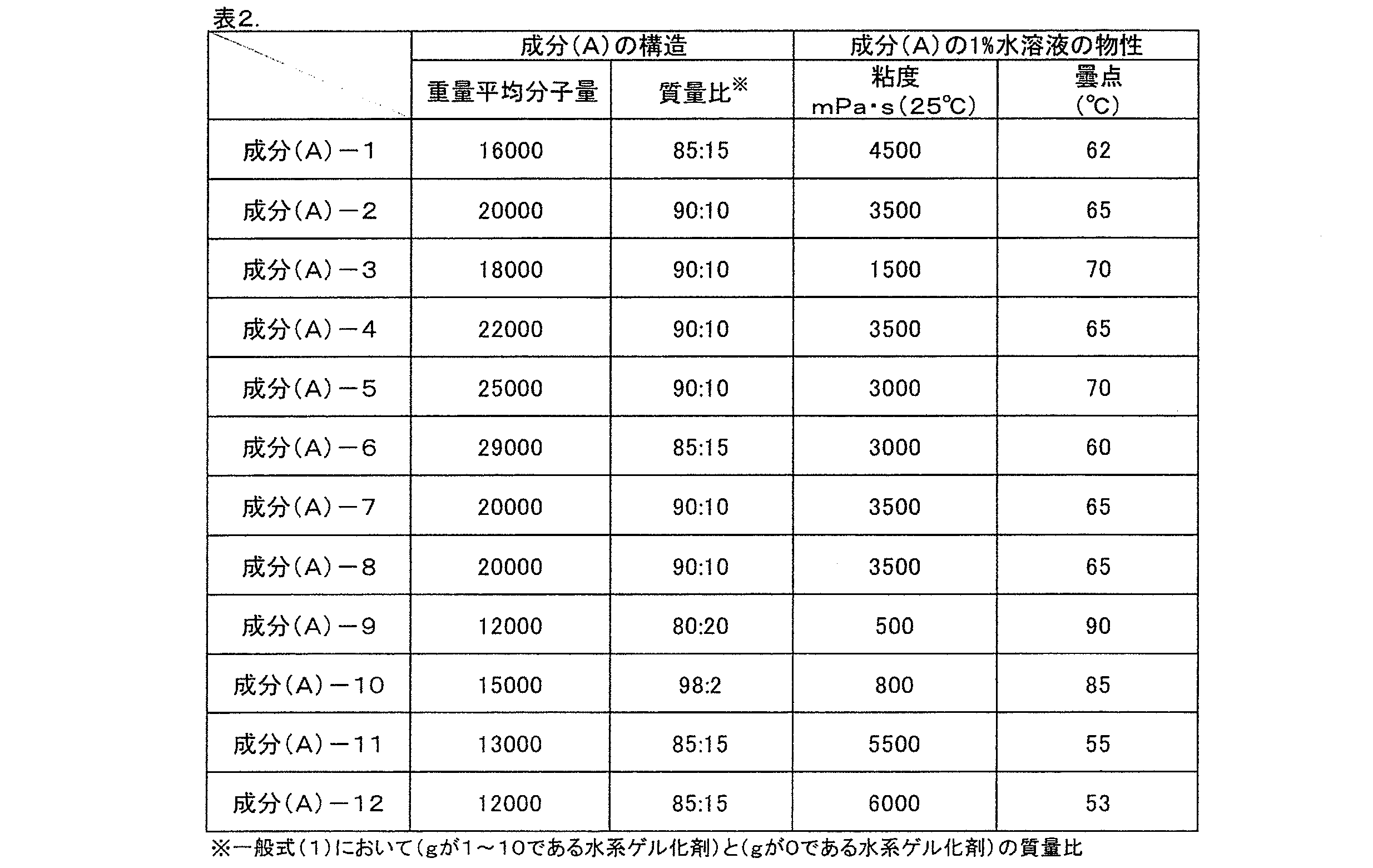
- components (A) -2 to (A) -12 were produced in the same manner using the raw materials listed in Table 1.
- the components (A) -9 and (A) -10 are produced without using a catalyst, and the components (A) -1 to (A) -12 are all starting compounds (2), compounds The total mass (mass of the whole reaction system) of (3) and a compound (4) is unified and manufactured.
- Each component (A) obtained may be a mixture of an aqueous gelling agent having g of 1 to 10 and an aqueous gelling agent having g of 0 in the general formula (1), and the mass ratio thereof Table 2 also shows the results.
- the mass ratio of the compound having 0 in the general formula (1) of the component (A) and the compound having 1 to 10 of g was calculated from the area ratio using the chart obtained from the above-mentioned GPC.
- Component (B) The component (B) used for the present Example and the comparative example is shown below.
- Component (B) -1 coconut oil fatty acid methyl taurine sodium component
- B) -2 coconut oil fatty acid sodium component
- B) -3 polyoxyethylene lauryl ether sodium component
- B) -4 olefin (C14- C16)
- Sodium sulfonate component (B) -5 sodium lauryl glucoside hydroxypropyl sulfonate
- Component (C) The component (C) used for the present Example and the comparative example is shown below.
- Component (C) -1 coconut oil fatty acid amidopropyl betaine
- Component (D) > The component (D) used for the present Example and the comparative example is shown below.
- the cleaning agent composition prepared according to the composition described in Tables 3 to 7 is placed in each 100 ml pump type container, (i) easiness of extruding from the pump type container, (ii) extrusion into palm Instructs 10 people to comprehensively evaluate them on a 5-point scale (the lowest score is 1 point) in terms of ease of applying and spreading (cleansability) when applying the cleaning composition to hair or body Based on the score, it was evaluated by the following AE. Evaluation passed B or more.
- the total score is 45 to 50 points B: The total score is 40 to 44 points C: The total score is 35 to 39 points D: The total score is 30 to 34 points E: The total score is 29 or less
- A Compared with the viscosity of the 25 ° C. storage sample, the change in viscosity of the 50 ° C. storage sample was 10% or less.
- B Compared with the viscosity of the 25 ° C. storage sample, the change in viscosity of the 50 ° C. storage sample was more than 10% and not more than 20%.
- C Compared with the viscosity of the 25 ° C. storage sample, the change rate of the viscosity of the 50 ° C. storage sample was more than 20% and not more than 30%.
- D The change in viscosity of the 50 ° C. stored sample was greater than 30% as compared to the viscosity of the 25 ° C. stored sample.
- feel after use Specifically, the feel after use (fresh feel) means that approximately 2 g of each of the samples described in (I) Tables 3 to 7 are taken, spread out over the entire hand, and then washed off with water.
- feeling, (II) points to a comprehensive evaluation of refreshing feeling after wiping off moisture with a towel etc. Instruct the subjects to comprehensively evaluate the samples described in Tables 3 to 7 with respect to the above-mentioned feeling with a full score of 5 (1 point is the lowest score) for 10 persons, and further, based on the total score, the following A to E It evaluated by. Evaluation passed B or more.
- the total score is 45 to 50 points B: The total score is 40 to 44 points C: The total score is 35 to 39 points D: The total score is 30 to 34 points E: The total score is 29 or less
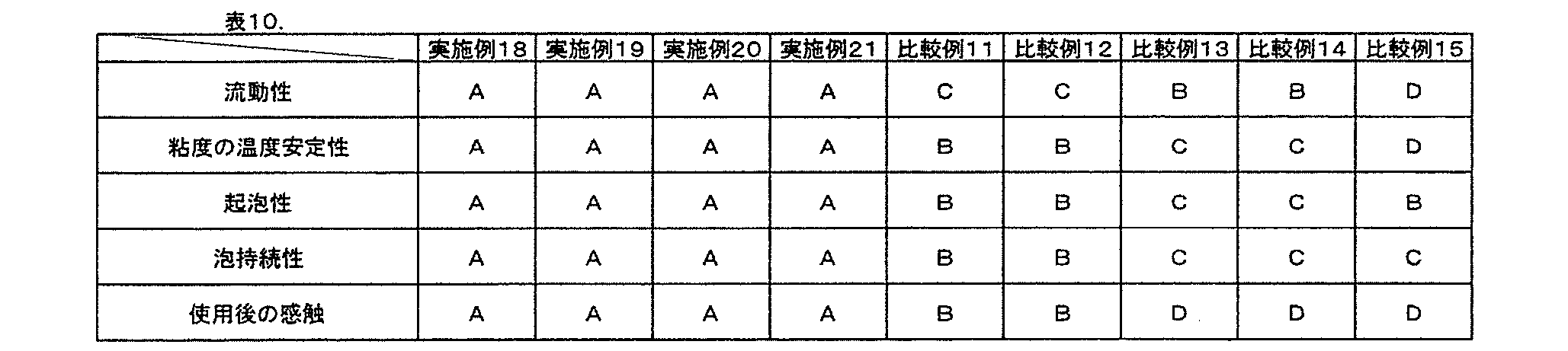
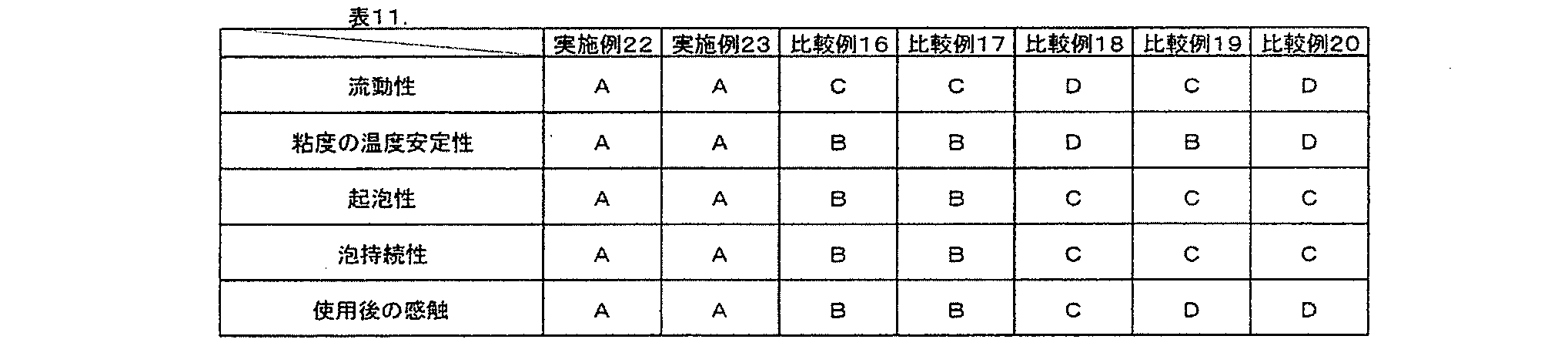
- the product of the present invention is good in all items of (1) fluidity, (2) temperature stability of viscosity, (3) foamability, (4) foam durability, and (5) feel after use It turned out that it was a cleanser composition.
- the dermatological or hair cleansing composition of the present invention has suitable fluidity, high temperature stability of viscosity, excellent foamability and foamability, and further, than conventional detergents, The feel after use is good. From the standpoint of the user, the cleaning composition is an invention with a better feeling of use, and the needs are high, and the usefulness thereof is very large.
Landscapes
- Health & Medical Sciences (AREA)
- Life Sciences & Earth Sciences (AREA)
- Chemical & Material Sciences (AREA)
- Animal Behavior & Ethology (AREA)
- General Health & Medical Sciences (AREA)
- Public Health (AREA)
- Veterinary Medicine (AREA)
- Birds (AREA)
- Epidemiology (AREA)
- Chemical Kinetics & Catalysis (AREA)
- Medicinal Chemistry (AREA)
- Polymers & Plastics (AREA)
- Organic Chemistry (AREA)
- Dermatology (AREA)
- Dispersion Chemistry (AREA)
- Emergency Medicine (AREA)
- Cosmetics (AREA)
- Detergent Compositions (AREA)
- Polyurethanes Or Polyureas (AREA)
Abstract
Description
成分(A):下記の一般式(1)で表される水系ゲル化剤

成分(B):アニオン性界面活性剤
さらに、本発明は上記の製造方法で得られた水系ゲル化剤とアニオン性界面活性剤を組み合わせる工程を含む、皮膚用又は毛髪用洗浄剤組成物の製造方法も提供する。




ビタミンとしては、例えば、ビタミンA、B1、B2、B6、C、E及びその誘導体、パントテン酸及びその誘導体、ビオチンなどが挙げられる。
酸化防止剤としては、例えば、トコフェロール類、ジブチルヒドロキシトルエン、ブチルヒドロキシアニソール、没食子酸エステル類などが挙げられる。
< 成分(A)の製造に使用する原料 >
成分(A)を製造するにあたり使用した原料を以下に示す。
化合物(2)-1:一般式(2)において、R10=デシル基、R11=ドデシル基、R12=エチレン基、r=20である化合物
化合物(2)-2:一般式(2)において、R10=オクチル基、R11=デシル基、R12=エチレン基、r=20である化合物
化合物(2)-3:一般式(2)において、R10=ドデシル基、R11=テトラデシル基、R12=エチレン基、r=20である化合物
化合物(2)-4:一般式(2)において、R10=デシル基、R11=ドデシル基、R12=エチレン基、r=100である化合物
化合物(3)-1:一般式(3)において、R13=エチレン基、t=250である化合物
化合物(3)-2:一般式(3)において、R13=エチレン基、t=450である化合物
化合物(4)-1:ヘキサメチレンジイソシアネート
化合物(4)-2:ジシクロヘキシルメタンジイソシアネート(水添MDI)
触媒2:ラウリン酸ナトリウム
触媒3:テトライソプロピルチタネート
触媒4:ジブチル錫ジラウレート
温度計、窒素導入管及び攪拌機を付した4つ口フラスコに、化合物(3)-1を550g(0.05mol)、化合物(2)-1を198g(0.16mol)仕込み、40~50℃に昇温し、各成分が均一になるまで撹拌し、各成分が均一に混合されたことを確認した後、化合物(4)-1を29.6g(0.18mol)、触媒1を5.8g(0.02mol)仕込み、系内を窒素置換した。その後、更に80~90℃まで昇温し、同温度で6時間反応させ、成分(A)-1を得た。

得られた各成分(A)をそれぞれ1質量%水溶液になるよう水を加え測定用試料を調製し、25℃にてB型粘度計(東機産業株式会社製、型番TVB-10)を用い測定した。
上記調製した各成分(A)の1質量%水溶液を恒温槽に設置し、徐々に加温(約1℃/分)して濁りが生じる温度を曇点(℃)とした。
重量平均分子量の測定方法
GPC(Gel Permeation Chromatographyゲル浸透クロマトグラフィー)を用いて測定した。詳細な測定条件は以下の通りである。
GPC装置:HLC-8220GPC(東ソー株式会社製)
カラム:TSKgel guardcolumn SuperMP(HZ)-N(1本)、TSKgel SuperMultiporeHZ-N(4本)の5本のカラムを直列に接続して使用。
検出器:RI
サンプル濃度:5mg/ml(in THF溶液)
カラム温度:40℃
標準サンプル:ポリスチレン
本実施例及び比較例に使用した成分(B)を以下に示す。
成分(B)-1:ヤシ油脂肪酸メチルタウリンナトリウム
成分(B)-2:ヤシ油脂肪酸グルタミン酸ナトリウム
成分(B)-3:ポリオキシエチレンラウリルエーテル硫酸ナトリウム
成分(B)-4:オレフィン(C14-C16)スルホン酸ナトリウム
成分(B)-5:ヒドロキシプロピルスルホン酸ラウリルグルコシドナトリウム
本実施例及び比較例に使用した成分(C)を以下に示す。
成分(C)-1:ヤシ油脂肪酸アミドプロピルベタイン
本実施例及び比較例に使用した成分(D)を以下に示す。
成分(D)-1:ポロキサマー184
次に、前述した成分(A)~成分(D)を用いて洗浄剤組成物の調製を行った(表3~表7)。

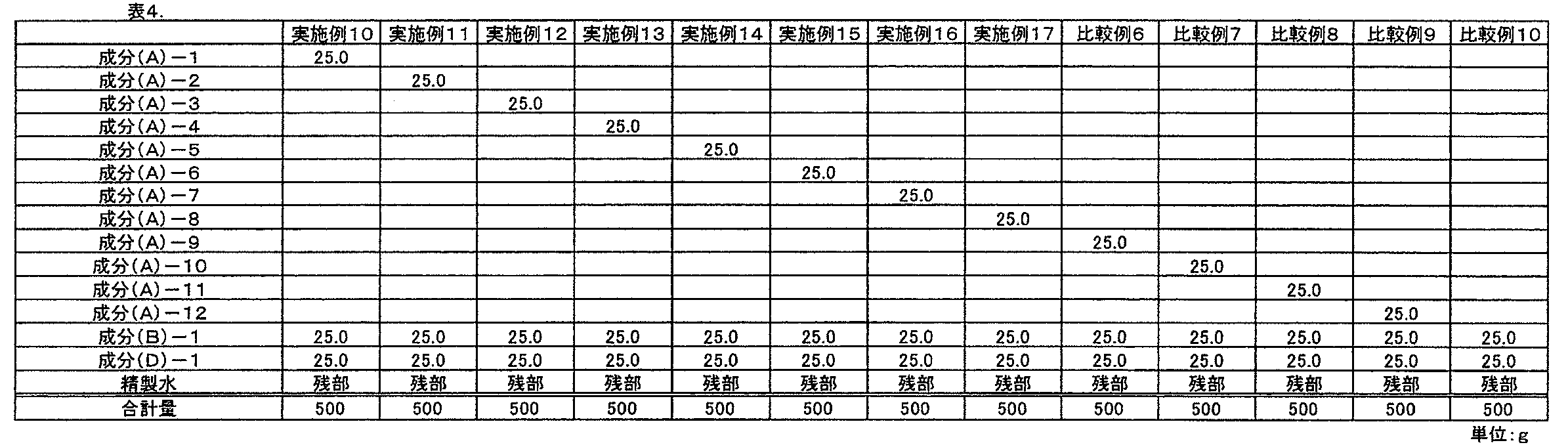
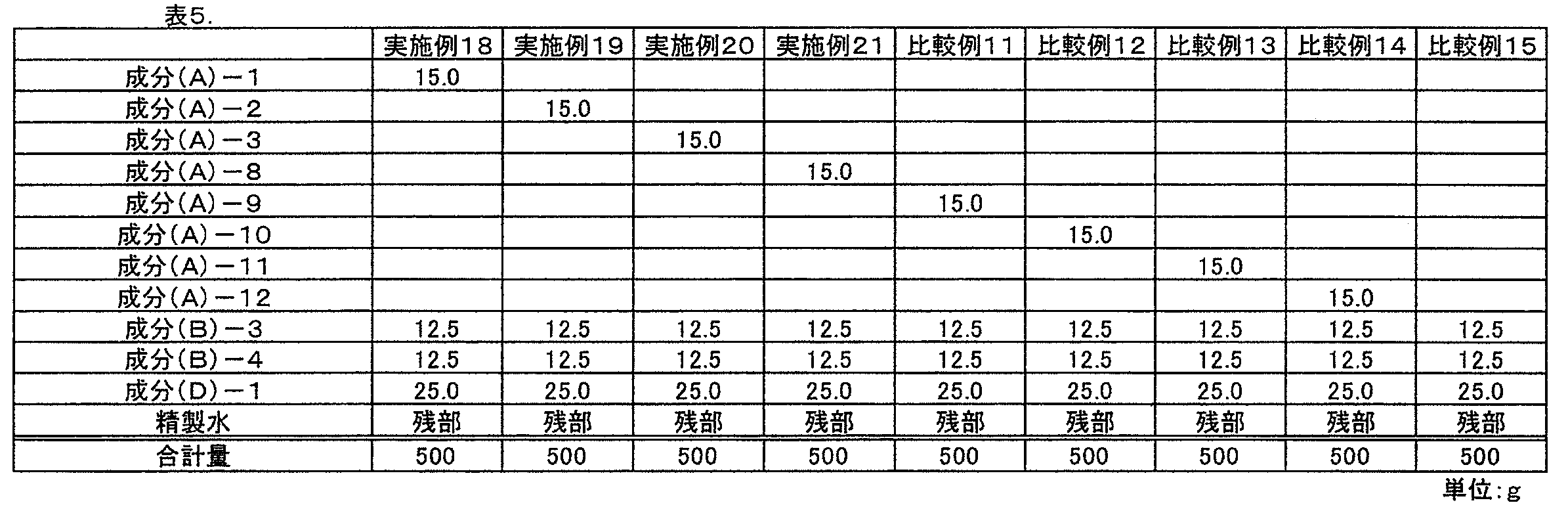

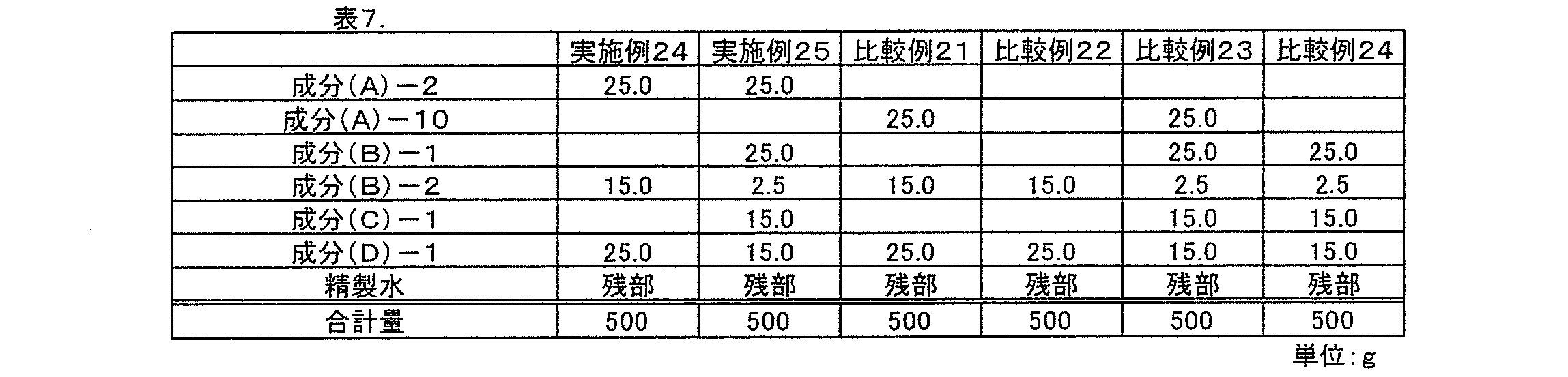
上記表3~表7に記載の組成で調製した実施例1~25及び比較例1~24の洗浄剤組成物に関し、(1)流動性、(2)粘度の温度安定性、(3)起泡性、(4)泡持続性、(5)使用後の感触(さっぱり感)について評価を行なった。各評価基準に関しては以下の通りである。なお、粘度の測定は、B型粘度計(東機産業株式会社製、型番TVB-10)を使用し測定を行った。
ボディーシャンプー若しくはヘアーシャンプーなどとして使用する際、使用しやすい流動性を有しているか否かに関して官能評価試験を行った。ボディーシャンプー若しくはヘアーシャンプーなどで使用される皮膚用又は毛髪用洗浄剤組成物は、洗浄剤組成物を手に取り体や髪全体に塗り伸ばして使用する、若しくはタオルなどに浸透させ泡立てて使用する場合が多い。そのため、水のような粘度の低い液体では、手やタオルなどからの液垂れなど、使用上扱いにくいというデメリットが生じる。また、ボディーシャンプー若しくはヘアーシャンプーなどは、ポンプ式の容器に収容され使用されることが多く、これら洗浄剤は容器から押し出せる程度の粘度でなければならない。つまり、その粘度が高すぎても、身体や髪などへの塗り伸ばしやすさなど、使用上扱いにくいというデメリットが生じる。すなわち、本試験では、下記基準に従って、ボディーシャンプー若しくはヘアーシャンプーなどの洗浄剤の使用時の利便性をその流動性の観点から評価した。
B:合計点数が40~44点
C:合計点数が35~39点
D:合計点数が30~34点
E:合計点数が29点以下
表3~表7に記載のサンプルをそれぞれ透明ガラス容器に100g入れ、25℃及び50℃の恒温槽にて2ヵ月間保存した。その後、サンプルの状態(粘度)を25℃にて測定し、その結果から25℃保存サンプルの粘度(基準値)と50℃保存サンプルの粘度との差を粘度変化率として算出し、以下A~Dにて評価した。評価がB以上を合格とした。
B:25℃保存サンプルの粘度と比較し、50℃保存サンプルの粘度の変化率が10%より大きく、20%以下であった。
C:25℃保存サンプルの粘度と比較し、50℃保存サンプルの粘度の変化率が20%より大きく、30%以下であった。
D:25℃保存サンプルの粘度と比較し、50℃保存サンプルの粘度の変化率が30%より大きかった。
まず、蒸留水100mlに表3~表7に記載のサンプルを各1g添加した後、均一になるように混合する。次に、共栓付き100ml円筒形シリンダー容器(メスシリンダー)に、得られた混合溶液各10mlを入れ、約1分間上下に振とうし、振とう直後の泡の量を測定した。評価がB以上を合格とした。
A:泡立ち良好(泡容量50ml以上)
B:泡立ち普通(泡容量20ml以上50ml未満)
C:泡立ち不良(泡容量20ml未満)
上記の泡容量の測定後、5分放置し、再度泡容量を測定し、振とう直後の泡容量と5分経過後の泡容量の比率を算出した。比率の計算式は以下の通りである。評価がB以上を合格とした。
(5分経過後の泡容量/振とう直後の泡容量)
B:泡持続性普通(比率0.6以上0.8未満)
C:泡持続性不良(比率0.6未満)
使用後の感触(さっぱり感)とは、具体的には(I)表3~表7に記載のサンプルをそれぞれ約2g手に取り、手全体に塗り伸ばした後に、水で洗い流した後のさっぱり感、(II)更にタオルなどにて水分を拭き取った後のさっぱり感の総合評価を指す。10人に5点満点(最低点は1点)で、上記の感触に関して表3~表7に記載のサンプルをそれぞれ総合的に評価するよう指示し、更にその合計点数を基準に以下A~Eで評価した。評価がB以上を合格とした。
B:合計点数が40~44点
C:合計点数が35~39点
D:合計点数が30~34点
E:合計点数が29点以下



Claims (11)
- 下記の成分(A)及び(B)を含有する、皮膚用又は毛髪用洗浄剤組成物であって、成分(A)の25℃での1質量%水溶液の粘度が1,000~5,000mPa・sであり、成分(A)の1質量%水溶液の曇点が60℃以上80℃以下であり、成分(A)の重量平均分子量が10,000~30,000である洗浄剤組成物。
成分(A):下記の一般式(1)で表される水系ゲル化剤

成分(B):アニオン性界面活性剤 - 成分(A)である一般式(1)で表される水系ゲル化剤の、R1、R2、R8及びR9がそれぞれ独立して炭素数10~12の脂肪族炭化水素基である請求項1に記載の皮膚用又は毛髪用洗浄剤組成物。
- 成分(A)である一般式(1)で表される水系ゲル化剤の、R4及びR6がそれぞれ独立して炭素数4~8の2価の脂肪族炭化水素基である請求項1又は2に記載の皮膚用又は毛髪用洗浄剤組成物。
- 成分(B)が、高級脂肪酸塩型界面活性剤、スルホン酸塩型界面活性剤及び硫酸エステル塩型界面活性剤の群から選択される1種又は2種以上である請求項1~3のいずれか一項に記載の皮膚用又は毛髪用洗浄剤組成物。
- 更に(C)成分として、両性界面活性剤を含有する請求項1~4のいずれか一項に記載の皮膚用又は毛髪用洗浄剤組成物。
- (C)成分が、ベタイン型両性界面活性剤である請求項5に記載の皮膚用又は毛髪用洗浄剤組成物。
- 更に(D)成分として、ポリオキシエチレンポリオキシプロピレンのブロック共重合体を含有する請求項1~6のいずれか一項に記載の皮膚用又は毛髪用洗浄剤組成物。
- 下記一般式(4)で表されるジイソシアネート化合物をモル比で2に対して、一般式(2)で表されるアルコール化合物をモル比で1.5~2.4及び一般式(3)で表されるポリアルキレングリコールをモル比で0.5~1.4の量で加え、高級脂肪酸金属塩の存在下でこれらを反応させることを含む、皮膚用又は毛髪用洗浄剤を製造するために用いられる、下記一般式(1)で表される水系ゲル化剤の製造方法。




- 前記高級脂肪酸金属塩が、ラウリン酸金属塩、ミリスチン酸金属塩、パルミチン酸金属塩、ステアリン酸金属塩、オレイン酸金属塩の群から選択される1種又は2種以上の高級脂肪酸金属塩である、請求項8に記載の製造方法。
- 前記高級脂肪酸金属塩が、ラウリン酸金属塩である請求項8に記載の製造方法。
- 下記一般式(4)で表されるジイソシアネート化合物をモル比で2に対して、一般式(2)で表されるアルコール化合物をモル比で1.5~2.4及び一般式(3)で表されるポリアルキレングリコールをモル比で0.5~1.4の量で加え、高級脂肪酸金属塩の存在下でこれらを反応させて、下記一般式(1)で表される水系ゲル化剤を得る工程、及び
前記水系ゲル化剤及びアニオン性界面活性を組み合わせる工程を含む、皮膚用又は毛髪用洗浄剤組成物の製造方法。




Priority Applications (6)
| Application Number | Priority Date | Filing Date | Title |
|---|---|---|---|
| CN201880057991.3A CN111093615B (zh) | 2017-09-07 | 2018-08-28 | 含有水系凝胶化剂的皮肤用或毛发用清洗剂组合物以及该水系凝胶化剂和该清洗剂组合物的制造方法 |
| JP2019540902A JP7179005B2 (ja) | 2017-09-07 | 2018-08-28 | 水系ゲル化剤を含む皮膚用又は毛髪用洗浄剤組成物、並びに該水系ゲル化剤及び該洗浄剤組成物の製造方法 |
| KR1020207009376A KR102684828B1 (ko) | 2017-09-07 | 2018-08-28 | 수계 겔화제를 포함하는 피부용 또는 모발용 세정제 조성물, 그리고 그 수계 겔화제 및 그 세정제 조성물의 제조 방법 |
| EP18853948.0A EP3679919A4 (en) | 2017-09-07 | 2018-08-28 | SKIN OR HAIR CLEANSING COMPOSITION WITH AN AQUATIC GELLING AGENT AND PROCESS FOR THE PREPARATION OF AN AQUATIC GELLING AND DETERGENT COMPOSITION |
| US16/644,011 US20210000720A1 (en) | 2017-09-07 | 2018-08-28 | Skin- or hair-cleansing composition containing aqueous gelling agent, and methods for producing aqueous gelling agent and cleansing composition |
| US17/669,537 US11771632B2 (en) | 2017-09-07 | 2022-02-11 | Skin- or hair-cleansing composition containing aqueous gelling agent, and methods for producing aqueous gelling agent and cleansing composition |
Applications Claiming Priority (2)
| Application Number | Priority Date | Filing Date | Title |
|---|---|---|---|
| JP2017-172300 | 2017-09-07 | ||
| JP2017172300 | 2017-09-07 |
Related Child Applications (2)
| Application Number | Title | Priority Date | Filing Date |
|---|---|---|---|
| US16/644,011 A-371-Of-International US20210000720A1 (en) | 2017-09-07 | 2018-08-28 | Skin- or hair-cleansing composition containing aqueous gelling agent, and methods for producing aqueous gelling agent and cleansing composition |
| US17/669,537 Division US11771632B2 (en) | 2017-09-07 | 2022-02-11 | Skin- or hair-cleansing composition containing aqueous gelling agent, and methods for producing aqueous gelling agent and cleansing composition |
Publications (1)
| Publication Number | Publication Date |
|---|---|
| WO2019049723A1 true WO2019049723A1 (ja) | 2019-03-14 |
Family
ID=65634876
Family Applications (1)
| Application Number | Title | Priority Date | Filing Date |
|---|---|---|---|
| PCT/JP2018/031705 Ceased WO2019049723A1 (ja) | 2017-09-07 | 2018-08-28 | 水系ゲル化剤を含む皮膚用又は毛髪用洗浄剤組成物、並びに該水系ゲル化剤及び該洗浄剤組成物の製造方法 |
Country Status (6)
| Country | Link |
|---|---|
| US (2) | US20210000720A1 (ja) |
| EP (1) | EP3679919A4 (ja) |
| JP (1) | JP7179005B2 (ja) |
| KR (1) | KR102684828B1 (ja) |
| CN (1) | CN111093615B (ja) |
| WO (1) | WO2019049723A1 (ja) |
Cited By (2)
| Publication number | Priority date | Publication date | Assignee | Title |
|---|---|---|---|---|
| JP2021183591A (ja) * | 2020-05-21 | 2021-12-02 | 株式会社マンダム | 液状皮膚洗浄用組成物 |
| WO2022202766A1 (ja) * | 2021-03-25 | 2022-09-29 | ロート製薬株式会社 | 洗浄組成物 |
Families Citing this family (3)
| Publication number | Priority date | Publication date | Assignee | Title |
|---|---|---|---|---|
| FR3104587B1 (fr) * | 2019-12-16 | 2022-01-07 | Coatex Sas | Agent thermo-stabilisant |
| CN112920369B (zh) * | 2021-01-28 | 2022-07-26 | 孝感市易生新材料有限公司 | 自抗菌性乳酸基水性聚氨酯、其制备方法及其乳液 |
| CN113403150B (zh) * | 2021-06-22 | 2022-07-05 | 河南省紫风养护发展有限公司 | 一种烟厂空调管道清理消杀方法 |
Citations (13)
| Publication number | Priority date | Publication date | Assignee | Title |
|---|---|---|---|---|
| JPS63113013A (ja) * | 1986-09-05 | 1988-05-18 | アクゾ・エヌ・ヴエー | 粘稠剤の製造法 |
| JP2000239649A (ja) * | 1999-02-25 | 2000-09-05 | Asahi Denka Kogyo Kk | 粘性調整剤 |
| JP2002080329A (ja) | 2000-06-26 | 2002-03-19 | Shiseido Co Ltd | 毛髪処理剤組成物 |
| JP2002105493A (ja) | 2000-06-26 | 2002-04-10 | Shiseido Co Ltd | 洗浄剤組成物 |
| JP2004534747A (ja) * | 2001-04-12 | 2004-11-18 | コグニス・ドイッチュランド・ゲゼルシヤフト・ミト・ベシュレンクテル・ハフツング・ウント・コンパニー・コマンデイトゲゼルシヤフト | 化粧用製剤 |
| JP2005263815A (ja) * | 2000-01-21 | 2005-09-29 | L'oreal Sa | 両親媒性脂質及び非イオン性ポリマーを含有するナノエマルション及びその使用 |
| JP2010095592A (ja) * | 2008-10-15 | 2010-04-30 | Ogawa & Co Ltd | 水性ゲル状組成物及びその製造方法 |
| JP2011006371A (ja) | 2009-06-29 | 2011-01-13 | Shiseido Co Ltd | 皮膚外用剤 |
| JP2011231061A (ja) * | 2010-04-28 | 2011-11-17 | Shiseido Co Ltd | 増粘性組成物およびそれを含む化粧料 |
| JP2014040385A (ja) | 2012-08-21 | 2014-03-06 | Shiseido Co Ltd | 乳化化粧料 |
| WO2014084174A1 (ja) * | 2012-11-29 | 2014-06-05 | 株式会社Adeka | ウレタン型ポリマー及びその用途 |
| JP2015091771A (ja) * | 2013-10-01 | 2015-05-14 | 花王株式会社 | 水中油型乳化化粧料 |
| JP2016023180A (ja) | 2014-07-24 | 2016-02-08 | ロート製薬株式会社 | ジェル状組成物 |
Family Cites Families (8)
| Publication number | Priority date | Publication date | Assignee | Title |
|---|---|---|---|---|
| JP3828700B2 (ja) * | 1998-12-17 | 2006-10-04 | 株式会社資生堂 | 化粧料組成物 |
| CN1186004C (zh) * | 2000-06-26 | 2005-01-26 | 株式会社资生堂 | 头发用组合物 |
| US7445790B2 (en) * | 2002-05-09 | 2008-11-04 | Shiseido Company, Ltd. | External preparations for skin |
| JP5305574B2 (ja) * | 2006-09-29 | 2013-10-02 | 株式会社 資生堂 | 皮膚外用剤 |
| US20080124293A1 (en) | 2006-11-24 | 2008-05-29 | Kpss-Kao Professional Salon Services Gmbh | Composition for keratin fibres |
| JP5522647B2 (ja) * | 2008-03-31 | 2014-06-18 | 株式会社 資生堂 | 起泡性皮膚洗浄料 |
| JP6362243B2 (ja) * | 2013-06-07 | 2018-07-25 | 株式会社Adeka | 化粧料用ゲル状組成物 |
| WO2017139765A1 (en) * | 2016-02-12 | 2017-08-17 | Rodan & Fields, Llc | Moisturizing compositions and uses thereof |
-
2018
- 2018-08-28 US US16/644,011 patent/US20210000720A1/en not_active Abandoned
- 2018-08-28 EP EP18853948.0A patent/EP3679919A4/en active Pending
- 2018-08-28 CN CN201880057991.3A patent/CN111093615B/zh active Active
- 2018-08-28 WO PCT/JP2018/031705 patent/WO2019049723A1/ja not_active Ceased
- 2018-08-28 KR KR1020207009376A patent/KR102684828B1/ko active Active
- 2018-08-28 JP JP2019540902A patent/JP7179005B2/ja active Active
-
2022
- 2022-02-11 US US17/669,537 patent/US11771632B2/en active Active
Patent Citations (13)
| Publication number | Priority date | Publication date | Assignee | Title |
|---|---|---|---|---|
| JPS63113013A (ja) * | 1986-09-05 | 1988-05-18 | アクゾ・エヌ・ヴエー | 粘稠剤の製造法 |
| JP2000239649A (ja) * | 1999-02-25 | 2000-09-05 | Asahi Denka Kogyo Kk | 粘性調整剤 |
| JP2005263815A (ja) * | 2000-01-21 | 2005-09-29 | L'oreal Sa | 両親媒性脂質及び非イオン性ポリマーを含有するナノエマルション及びその使用 |
| JP2002080329A (ja) | 2000-06-26 | 2002-03-19 | Shiseido Co Ltd | 毛髪処理剤組成物 |
| JP2002105493A (ja) | 2000-06-26 | 2002-04-10 | Shiseido Co Ltd | 洗浄剤組成物 |
| JP2004534747A (ja) * | 2001-04-12 | 2004-11-18 | コグニス・ドイッチュランド・ゲゼルシヤフト・ミト・ベシュレンクテル・ハフツング・ウント・コンパニー・コマンデイトゲゼルシヤフト | 化粧用製剤 |
| JP2010095592A (ja) * | 2008-10-15 | 2010-04-30 | Ogawa & Co Ltd | 水性ゲル状組成物及びその製造方法 |
| JP2011006371A (ja) | 2009-06-29 | 2011-01-13 | Shiseido Co Ltd | 皮膚外用剤 |
| JP2011231061A (ja) * | 2010-04-28 | 2011-11-17 | Shiseido Co Ltd | 増粘性組成物およびそれを含む化粧料 |
| JP2014040385A (ja) | 2012-08-21 | 2014-03-06 | Shiseido Co Ltd | 乳化化粧料 |
| WO2014084174A1 (ja) * | 2012-11-29 | 2014-06-05 | 株式会社Adeka | ウレタン型ポリマー及びその用途 |
| JP2015091771A (ja) * | 2013-10-01 | 2015-05-14 | 花王株式会社 | 水中油型乳化化粧料 |
| JP2016023180A (ja) | 2014-07-24 | 2016-02-08 | ロート製薬株式会社 | ジェル状組成物 |
Cited By (3)
| Publication number | Priority date | Publication date | Assignee | Title |
|---|---|---|---|---|
| JP2021183591A (ja) * | 2020-05-21 | 2021-12-02 | 株式会社マンダム | 液状皮膚洗浄用組成物 |
| JP7463038B2 (ja) | 2020-05-21 | 2024-04-08 | 株式会社マンダム | 液状皮膚洗浄用組成物 |
| WO2022202766A1 (ja) * | 2021-03-25 | 2022-09-29 | ロート製薬株式会社 | 洗浄組成物 |
Also Published As
| Publication number | Publication date |
|---|---|
| CN111093615B (zh) | 2023-04-18 |
| US20210000720A1 (en) | 2021-01-07 |
| JP7179005B2 (ja) | 2022-11-28 |
| JPWO2019049723A1 (ja) | 2020-08-20 |
| US20220160603A1 (en) | 2022-05-26 |
| KR102684828B1 (ko) | 2024-07-12 |
| CN111093615A (zh) | 2020-05-01 |
| EP3679919A4 (en) | 2021-06-16 |
| KR20200051677A (ko) | 2020-05-13 |
| US11771632B2 (en) | 2023-10-03 |
| EP3679919A1 (en) | 2020-07-15 |
Similar Documents
| Publication | Publication Date | Title |
|---|---|---|
| WO2019049723A1 (ja) | 水系ゲル化剤を含む皮膚用又は毛髪用洗浄剤組成物、並びに該水系ゲル化剤及び該洗浄剤組成物の製造方法 | |
| US9675536B2 (en) | Gel-like composition for cosmetic preparations | |
| JP2015027953A (ja) | 皮膚用化粧料 | |
| JP7179004B2 (ja) | 水系ゲル化剤を含む毛髪化粧料組成物、並びに該水系ゲル化剤及び該毛髪化粧料組成物の製造方法 | |
| US10729640B2 (en) | Aqueous gelling agent composition and cosmetics using same | |
| JP7179006B2 (ja) | 水系ゲル化剤を含む化粧料組成物、並びに該水系ゲル化剤及び該化粧料組成物の製造方法 | |
| TW202011936A (zh) | 洗淨劑組成物 | |
| WO2022259917A1 (ja) | 洗浄料組成物 |
Legal Events
| Date | Code | Title | Description |
|---|---|---|---|
| 121 | Ep: the epo has been informed by wipo that ep was designated in this application |
Ref document number: 18853948 Country of ref document: EP Kind code of ref document: A1 |
|
| ENP | Entry into the national phase |
Ref document number: 2019540902 Country of ref document: JP Kind code of ref document: A |
|
| NENP | Non-entry into the national phase |
Ref country code: DE |
|
| ENP | Entry into the national phase |
Ref document number: 20207009376 Country of ref document: KR Kind code of ref document: A |
|
| ENP | Entry into the national phase |
Ref document number: 2018853948 Country of ref document: EP Effective date: 20200407 |