WO2019050036A1 - 癌治療薬 - Google Patents
癌治療薬 Download PDFInfo
- Publication number
- WO2019050036A1 WO2019050036A1 PCT/JP2018/033502 JP2018033502W WO2019050036A1 WO 2019050036 A1 WO2019050036 A1 WO 2019050036A1 JP 2018033502 W JP2018033502 W JP 2018033502W WO 2019050036 A1 WO2019050036 A1 WO 2019050036A1
- Authority
- WO
- WIPO (PCT)
- Prior art keywords
- peptide
- protein
- amino acid
- c16orf74
- present
- Prior art date
- Legal status (The legal status is an assumption and is not a legal conclusion. Google has not performed a legal analysis and makes no representation as to the accuracy of the status listed.)
- Ceased
Links
Images





Classifications
-
- C—CHEMISTRY; METALLURGY
- C07—ORGANIC CHEMISTRY
- C07K—PEPTIDES
- C07K14/00—Peptides having more than 20 amino acids; Gastrins; Somatostatins; Melanotropins; Derivatives thereof
- C07K14/435—Peptides having more than 20 amino acids; Gastrins; Somatostatins; Melanotropins; Derivatives thereof from animals; from humans
- C07K14/46—Peptides having more than 20 amino acids; Gastrins; Somatostatins; Melanotropins; Derivatives thereof from animals; from humans from vertebrates
- C07K14/47—Peptides having more than 20 amino acids; Gastrins; Somatostatins; Melanotropins; Derivatives thereof from animals; from humans from vertebrates from mammals
-
- A—HUMAN NECESSITIES
- A61—MEDICAL OR VETERINARY SCIENCE; HYGIENE
- A61K—PREPARATIONS FOR MEDICAL, DENTAL OR TOILETRY PURPOSES
- A61K35/00—Medicinal preparations containing materials or reaction products thereof with undetermined constitution
- A61K35/66—Microorganisms or materials therefrom
- A61K35/76—Viruses; Subviral particles; Bacteriophages
-
- A—HUMAN NECESSITIES
- A61—MEDICAL OR VETERINARY SCIENCE; HYGIENE
- A61K—PREPARATIONS FOR MEDICAL, DENTAL OR TOILETRY PURPOSES
- A61K38/00—Medicinal preparations containing peptides
- A61K38/16—Peptides having more than 20 amino acids; Gastrins; Somatostatins; Melanotropins; Derivatives thereof
- A61K38/17—Peptides having more than 20 amino acids; Gastrins; Somatostatins; Melanotropins; Derivatives thereof from animals; from humans
-
- A—HUMAN NECESSITIES
- A61—MEDICAL OR VETERINARY SCIENCE; HYGIENE
- A61K—PREPARATIONS FOR MEDICAL, DENTAL OR TOILETRY PURPOSES
- A61K45/00—Medicinal preparations containing active ingredients not provided for in groups A61K31/00 - A61K41/00
-
- A—HUMAN NECESSITIES
- A61—MEDICAL OR VETERINARY SCIENCE; HYGIENE
- A61K—PREPARATIONS FOR MEDICAL, DENTAL OR TOILETRY PURPOSES
- A61K48/00—Medicinal preparations containing genetic material which is inserted into cells of the living body to treat genetic diseases; Gene therapy
-
- A—HUMAN NECESSITIES
- A61—MEDICAL OR VETERINARY SCIENCE; HYGIENE
- A61P—SPECIFIC THERAPEUTIC ACTIVITY OF CHEMICAL COMPOUNDS OR MEDICINAL PREPARATIONS
- A61P1/00—Drugs for disorders of the alimentary tract or the digestive system
- A61P1/18—Drugs for disorders of the alimentary tract or the digestive system for pancreatic disorders, e.g. pancreatic enzymes
-
- A—HUMAN NECESSITIES
- A61—MEDICAL OR VETERINARY SCIENCE; HYGIENE
- A61P—SPECIFIC THERAPEUTIC ACTIVITY OF CHEMICAL COMPOUNDS OR MEDICINAL PREPARATIONS
- A61P35/00—Antineoplastic agents
-
- A—HUMAN NECESSITIES
- A61—MEDICAL OR VETERINARY SCIENCE; HYGIENE
- A61P—SPECIFIC THERAPEUTIC ACTIVITY OF CHEMICAL COMPOUNDS OR MEDICINAL PREPARATIONS
- A61P43/00—Drugs for specific purposes, not provided for in groups A61P1/00-A61P41/00
-
- C—CHEMISTRY; METALLURGY
- C07—ORGANIC CHEMISTRY
- C07K—PEPTIDES
- C07K19/00—Hybrid peptides, i.e. peptides covalently bound to nucleic acids, or non-covalently bound protein-protein complexes
-
- C—CHEMISTRY; METALLURGY
- C07—ORGANIC CHEMISTRY
- C07K—PEPTIDES
- C07K7/00—Peptides having 5 to 20 amino acids in a fully defined sequence; Derivatives thereof
- C07K7/04—Linear peptides containing only normal peptide links
- C07K7/08—Linear peptides containing only normal peptide links having 12 to 20 amino acids
-
- C—CHEMISTRY; METALLURGY
- C12—BIOCHEMISTRY; BEER; SPIRITS; WINE; VINEGAR; MICROBIOLOGY; ENZYMOLOGY; MUTATION OR GENETIC ENGINEERING
- C12Q—MEASURING OR TESTING PROCESSES INVOLVING ENZYMES, NUCLEIC ACIDS OR MICROORGANISMS; COMPOSITIONS OR TEST PAPERS THEREFOR; PROCESSES OF PREPARING SUCH COMPOSITIONS; CONDITION-RESPONSIVE CONTROL IN MICROBIOLOGICAL OR ENZYMOLOGICAL PROCESSES
- C12Q1/00—Measuring or testing processes involving enzymes, nucleic acids or microorganisms; Compositions therefor; Processes of preparing such compositions
- C12Q1/02—Measuring or testing processes involving enzymes, nucleic acids or microorganisms; Compositions therefor; Processes of preparing such compositions involving viable microorganisms
-
- G—PHYSICS
- G01—MEASURING; TESTING
- G01N—INVESTIGATING OR ANALYSING MATERIALS BY DETERMINING THEIR CHEMICAL OR PHYSICAL PROPERTIES
- G01N33/00—Investigating or analysing materials by specific methods not covered by groups G01N1/00 - G01N31/00
- G01N33/15—Medicinal preparations ; Physical properties thereof, e.g. dissolubility
-
- G—PHYSICS
- G01—MEASURING; TESTING
- G01N—INVESTIGATING OR ANALYSING MATERIALS BY DETERMINING THEIR CHEMICAL OR PHYSICAL PROPERTIES
- G01N33/00—Investigating or analysing materials by specific methods not covered by groups G01N1/00 - G01N31/00
- G01N33/48—Biological material, e.g. blood, urine; Haemocytometers
- G01N33/50—Chemical analysis of biological material, e.g. blood, urine; Testing involving biospecific ligand binding methods; Immunological testing
-
- A—HUMAN NECESSITIES
- A61—MEDICAL OR VETERINARY SCIENCE; HYGIENE
- A61K—PREPARATIONS FOR MEDICAL, DENTAL OR TOILETRY PURPOSES
- A61K38/00—Medicinal preparations containing peptides
-
- A—HUMAN NECESSITIES
- A61—MEDICAL OR VETERINARY SCIENCE; HYGIENE
- A61K—PREPARATIONS FOR MEDICAL, DENTAL OR TOILETRY PURPOSES
- A61K9/00—Medicinal preparations characterised by special physical form
- A61K9/0012—Galenical forms characterised by the site of application
- A61K9/0019—Injectable compositions; Intramuscular, intravenous, arterial, subcutaneous administration; Compositions to be administered through the skin in an invasive manner
-
- C—CHEMISTRY; METALLURGY
- C07—ORGANIC CHEMISTRY
- C07K—PEPTIDES
- C07K2319/00—Fusion polypeptide
-
- C—CHEMISTRY; METALLURGY
- C07—ORGANIC CHEMISTRY
- C07K—PEPTIDES
- C07K2319/00—Fusion polypeptide
- C07K2319/01—Fusion polypeptide containing a localisation/targetting motif
- C07K2319/03—Fusion polypeptide containing a localisation/targetting motif containing a transmembrane segment
Definitions
- the present invention relates to a therapeutic drug for cancer and a method of screening a therapeutic drug for cancer.
- pancreatic cancer can not be eradicated by conventional chemotherapy, and novel molecular-targeted therapeutic agents can only achieve several weeks of survival benefit when used in combination with conventional chemotherapy, which is a promising new There is an urgent need to develop therapeutic agents.
- the inventors have identified a novel gene, Homo sapiens chromosome 16 open reading frame 74 (C16orf74) that is strongly related to the malignancy of pancreatic cancer, from comprehensive gene expression analysis using clinical specimens, and from protein expression and functional analysis, The usefulness as a therapeutic target molecule was reported (Non-patent Document 1). However, no new treatment targeting C16orf74 has been established.
- the challenge was to treat cancer effectively. In particular, it was an issue to find new therapeutic agents targeting C16orf74. In addition, it was also an issue to find a method for easily screening a superior cancer therapeutic.
- the present inventors found that the C16orf74 protein was localized immediately below the cell membrane to form a homodimer.
- the inventors of the present invention considered that the function of C16orf74 could be inhibited by inhibiting the formation of this dimer and cancer cell growth could be suppressed, and repeated studies on the dimer formation inhibitor.
- a peptide in which a membrane permeable peptide is bound to the amino acid sequence at the N-terminal side of C16orf74 protein inhibits dimer formation of C16orf74 protein and effectively suppresses the growth of cancer cells, completing the present invention It came to
- the present invention relates to: (1) A peptide comprising a partial amino acid sequence of C16orf74 protein, which comprises either or both of a cysteine corresponding to a cysteine at position 7 and a cysteine corresponding to a cysteine at position 14 of C16orf74 protein, and a dimer formation of C16orf74 protein A peptide that is inhibitory; (2) The peptide according to (1), which comprises both a cysteine corresponding to the cysteine at position 7 of the C16 or f74 protein and a cysteine corresponding to the cysteine at position 14; (3) The peptide according to (2), which is 12 to 20 amino acids in length; (4) The peptide according to (3), which comprises the amino acid sequence shown in SEQ ID NO: 2; (5) A variant peptide of the peptide according to any one of (1) to (4), wherein one to several amino acids are substituted, deleted or substituted in the partial amino acid sequence of the amino acid sequence shown in SEQ ID NO: 1 A peptide
- cancer therapeutic agent of the present invention can dramatically improve the treatment result of cancer. Moreover, the screening of the cancer therapeutic agent of the present invention makes it possible to easily find a superior cancer therapeutic.
- FIG. 1 is an immunoblotting showing dimer formation of C16oef74 protein.
- C16-A, C16-B, C16-C show three parallel experimental systems.
- FIG. 2 is an immunoblotting showing inhibition of dimerization of C16oef74 protein by the peptide of the present invention.
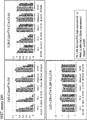
- FIG. 3 is a graph showing inhibition of dimerization of C16oef74 protein by the peptide of the present invention in pancreatic cancer cells. The vertical axis is the relative amount of dimer formation when the peptide is not added is 1.
- FIG. 4 is a photograph (left) and a graph (right) showing suppression of invasiveness of pancreatic cancer cells by the peptide of the present invention.
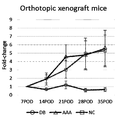
- FIG. 5 is a graph showing time-course changes (7 days, 14 days, 21 days, 28 days and 35 days after transplantation) of animals in tumor fluorescence intensity.
- the vertical axis is the change rate of the fluorescence intensity.
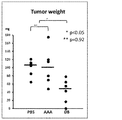
- Figure 6 is a graph showing tumor weight in animals.
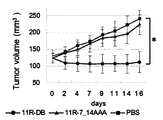
- FIG. 7 is a graph showing tumor volume in animals.
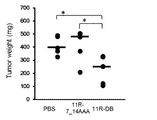
- FIG. 8 is a graph showing tumor weight in animals.
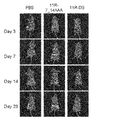
- FIG. 9 shows the time course of the fluorescence image of the tumor in animals.
- FIG. 10 is a graph showing the time course of tumor fluorescence intensity in animals.
- FIG. 11 shows a fluorescence image of a tumor in the peritoneum of an animal.
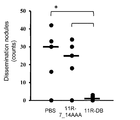
- FIG. 12 is a graph showing the number of disseminated nodules in animals.
- the present invention relates, in one aspect, to a peptide comprising a partial amino acid sequence of the amino acid sequence (SEQ ID NO: 1) of the C16orf74 protein, which corresponds to the cysteine corresponding to the cysteine at position 7 and the cysteine at position 14 of C16orf74 protein
- the present invention relates to a peptide comprising one or both of cysteines (hereinafter, the peptide may be abbreviated as "the peptide of the present invention”).
- the peptide of the present invention is not identical to the entire amino acid sequence (SEQ ID NO: 1) of the C16 or f74 protein.
- a specific example of the peptide of the present invention of this embodiment is a peptide consisting of a partial amino acid sequence of C16orf74 protein, which corresponds to a cysteine corresponding to a cysteine at position 7 of the C16orf74 protein and a cysteine corresponding to a cysteine at position 14 Included are peptides that include either or both.
- the position of the amino acid in the C16 or f74 protein is calculated with the N-terminal amino acid methionine as the first position.
- the amino acid in the peptide of the present invention may be represented as “an amino acid corresponding to the amino acid at position x of the C16 or f74 protein”.
- the term “C16orf74 protein” refers to a monomer of wild-type human C16orf74 protein.
- the partial amino acid sequence of the C16 or f74 protein is a portion of the amino acid sequence of the C16 or f74 protein shown in SEQ ID NO: 1.
- the peptide of the present invention contains one or both of a cysteine corresponding to the seventh (seventh) cysteine from the N-terminus of the C16 or f74 protein and a cysteine corresponding to the fourteenth (seventh) cysteine.
- the peptide of the invention comprises both a cysteine corresponding to position 7 of the C16 or f74 protein and a cysteine corresponding to position 14. These cysteines are thought to be involved in the dimer formation of the C16 or f74 protein.
- the peptide of the present invention inhibits dimer formation of C16orf74 protein.
- the length of the peptide of the present invention is not particularly limited, but is preferably 5 to 30 amino acids, more preferably 8 to 25 amino acids, and still more preferably 12 to 20 amino acids.
- peptides containing the amino acid sequence of An example thereof includes, but is not limited to, a peptide comprising the amino acid sequence shown in SEQ ID NO: 2.
- the peptide of the present invention may be a mutant peptide.
- the mutant peptides of the invention inhibit dimer formation of the C16orf74 protein.
- the mutant peptide of the peptide of the present invention is an amino acid sequence in which one to several amino acids are substituted, deleted or added in the partial amino acid sequence of the amino acid sequence of the wild type C16 or f74 protein (amino acid sequence shown in SEQ ID NO: 1) (Mutated amino acid sequence of wild type C16 or f74 protein).
- severeal means, for example, two, three, four, five, six, seven, eight or nine.
- mutant peptide of the peptide of the present invention retains a cysteine corresponding to the cysteine at position 7 and / or 14 of the wild-type C16 or f74 protein.
- Specific examples of the mutant peptide of the present invention include peptides consisting of a mutant amino acid sequence of wild-type C16 or f74 protein.
- conservative amino acid substitutions are preferred.
- conservative amino acid substitutions include: when the amino acid to be substituted is an aromatic amino acid, if the amino acid to be substituted is a hydrophobic amino acid between Phe, Trp and Tyr Among Leu, Ile, and Val, when the amino acid substituted is a polar amino acid, between Gln and Asn, when the amino acid to be substituted is a basic amino acid, Lys, Arg, and His, In the case where the amino acid to be substituted is an acidic amino acid, Asp, between Glu, and in the case where the amino acid to be substituted is an amino acid having a hydroxyl group, substitution between Ser, Thr.
- the mutated peptide of the peptide of the present invention may contain a non-naturally occurring amino acid, any amino acid residue may be modified, or a label may be attached.
- a membrane permeable peptide may be bound to the peptide of the present invention or a variant peptide thereof. Such peptides can be efficiently transported to cancer cells and can inhibit dimer formation of C16orf74 protein in cancer cells.
- the membrane permeable peptide may be any peptide capable of transporting the peptide of the present invention into cancer cells.
- Membrane permeable peptides are known.
- the membrane permeable peptide to be bound to the peptide of the present invention may be a known membrane permeable peptide.
- Various membrane permeable peptides are commercially available. Examples of transmembrane peptides include, but are not limited to, TAT peptide, peptides consisting of 8 to 11 arginines, and the like.
- the membrane permeable peptide may be linked to any of the N-terminal, C-terminal and internal amino acid residues of the peptide of the present invention or a variant peptide thereof, but is preferably linked to the N-terminal amino acid residue.
- the linkage of the membrane permeable peptide may be directly linked to the N-terminal amino acid residue of the peptide of the present invention or a variant peptide thereof, or may be linked via a spacer.
- the spacer may be known, for example, a peptide consisting of several glycines.
- peptide of the present invention or a variant peptide thereof to which a membrane permeable peptide is bound, using known methods such as chemical synthesis and genetic engineering techniques.
- the present invention relates, in another aspect, to a polypeptide of the present invention, a variant peptide thereof, or a polynucleotide encoding a peptide having a membrane permeable peptide bound thereto.
- Methods for producing polynucleotides are known, and those skilled in the art can produce these polynucleotides using, for example, chemical synthesis.
- the invention relates, in another aspect, to a vector comprising a polynucleotide as described above.
- An expression vector containing the above polynucleotide may be introduced into cancer cells to inhibit dimer formation of C16orf74 protein in cancer cells. Since various vectors are known and commercially available, they can be appropriately selected and used.
- the present inventors obtained the finding that the growth of cancer cells can be effectively suppressed by inhibiting the formation of the dimer of C16orf74 protein.
- the present invention relates, in a further aspect, to a pharmaceutical composition for treating cancer comprising a substance that inhibits the formation of a dimer of C16orf74 protein.
- the type of cancer that can be treated by the pharmaceutical composition for treating cancer of the present invention is not limited as long as it is a cancer that expresses C16orf74.
- Examples of cancers that can be treated by the pharmaceutical composition for treating cancer of the present invention include pancreatic cancer, bladder cancer, cervical cancer, oral tongue squamous cell carcinoma and the like.
- the substance which inhibits dimer formation of C16orf74 protein contained in the pharmaceutical composition of the present invention is not particularly limited, but preferred examples thereof include the peptide of the present invention, its mutated peptide, the peptide having membrane permeable peptide bound to them, and these And polynucleotides encoding such peptides, and vectors comprising such polynucleotides.
- “Inhibiting dimer formation of C16 or f74 protein” preferably refers to inhibition of dimer formation of C16 or f74 protein by 30% or more, more preferably 50% or more, still more preferably 60% or more, still more preferably 70% or more .
- the pharmaceutical composition of the present invention of various dosage forms can be manufactured using known means and methods.
- the pharmaceutical composition of the present invention is a solution, and may be, for example, an injection, an infusion solution and the like. More preferably, the pharmaceutical composition of the present invention is an injection.
- the administration route of the pharmaceutical composition of the present invention is not particularly limited, and can be administered by various routes.
- the pharmaceutical composition of the present invention is administered intraperitoneally.
- a specific example of the pharmaceutical composition of the present invention includes a pharmaceutical composition for treating cancer, which comprises the peptide of the present invention or a variant peptide thereof to which a membrane permeable peptide is bound.
- Such pharmaceutical composition can exert an effect when administered intraperitoneally.
- the dose of the pharmaceutical composition of the present invention may be an amount that suppresses the growth of cancer, or may be an amount that reduces or eliminates cancer. Such dose can be determined by a physician in consideration of the patient's cancer state, body weight and the like. As an example, when administered intraperitoneally to an adult, the pharmaceutical composition of the present invention may be given to a patient such that about 1 mg to several tens of mg / kg (body weight) of the peptide of the present invention is administered per day.
- composition of the present invention may be used in combination with other anti-cancer agents and / or anti-cancer treatments.
- the present invention provides, in a further aspect, a method of treating cancer in a patient, comprising administering to the cancer patient a substance that inhibits dimer formation of C16orf74 protein.
- the present invention provides, in a further aspect, the use of a substance that inhibits C16orf74 protein dimer formation for the production of a pharmaceutical composition for treating cancer.
- the present invention provides, in a further aspect, a substance that inhibits dimer formation of C16orf74 protein used for the treatment of cancer.
- the cell used in step (a) may be any cell as long as it expresses a monomer of C16orf74 protein, and is preferably a cancer cell. Many cancer cells are known and may be used. Alternatively, it may be obtained from a clinical sample of cancer. When cells with weak or no C16 or f74 protein expression are used, monomers of C16 or f74 protein may be forcibly expressed. Forced expression of C16 or f74 protein can be carried out by introducing a gene encoding it into an expression vector and introducing it into cells. By forcing the expression of the C16 or f74 protein monomer, the screening result can be made more clear.
- the candidate agent may be any type of substance.
- the candidate agent is a peptide, one to which a membrane permeable peptide is bound may be used. Since the peptide is transported into the cell by binding the membrane-permeable peptide, the step of injecting the candidate substance into the cell can be omitted.
- the candidate agent is a peptide, one in which a polynucleotide encoding the peptide is contained in an expression vector may be used.
- a dimer of C16orf74 protein By culturing the cells in the presence and absence of the candidate agent, a dimer of C16orf74 protein can be formed in the cells.
- Cell culture conditions can be easily determined by those skilled in the art, taking into consideration factors such as cell type.
- step (b) the amount of dimer formation of C16orf74 protein in cells is measured.
- the amount of dimer formation can be measured by a known method by detecting a dimer of C16 or f74 protein in a cellate of cultured cells.
- native polyacrylamide gel electrophoresis can be used to detect the dimer of C16orf74 protein.
- step (c) the amount of dimer formation of C16orf74 protein in the presence of the candidate drug is compared with the amount of dimer formation of C16orf74 protein in the absence of the candidate agent, and the amount of dimer formation in the presence of the candidate agent is decreased
- a decrease in the amount of dimer formation is considered to be inhibition of dimer formation. If the amount of dimer formation is reduced by, for example, 50% or more, 60% or more, or 70% or more, it may be determined that the candidate agent may be a cancer treatment agent.
- a peptide that does not inhibit the formation of C16orf74 protein dimer (eg, SEQ ID NO: 6) may be used as a negative control.
- MOCK is obtained by attaching an empty vector of pCAGGS with a Flag tag and an HA tag and cotransfecting HEK293T cells.
- a band of C16orf74 protein with Flag tag at the target height (120 kDa) was observed. From these results, it was shown that the Flag-tagged C16orf74 protein and the HA-tagged C16orf74 protein were directly bound.
- the peptide RRRRRRRRRRR-GGG-MGLKMSALKGFQMAV (SEQ ID NO: 7) is a peptide obtained by converting the seventh and fourteenth cysteines from the N-terminus of the amino acid sequence of SEQ ID NO: 2 into alanine.
- the peptide RRRRRRRRRRRRR-GGG-MGLKMAAAKGFQAAA (SEQ ID NO: 8) is the seventh and fourteenth cysteines from the N terminus of the amino acid sequence of SEQ ID NO: 2 and one amino acid before and after them is converted to alanine It is.
- PK-1 human pancreatic cancer cells
- PK-9 human pancreatic cancer cells
- NHDF normal human skin fibroblasts
- FIG. 11R-C16orf74-DB inhibited the formation of C16orf74 protein dimer in a concentration dependent manner in four pancreatic cancer cells.
- PK-1 and PK-9 dimer formation was inhibited by about 60% at a concentration of 30 ⁇ M.
- Panc1 and Miapaca2 inhibited dimer formation by 60% or more at a concentration of 40 ⁇ M.
- NHDF a weaker inhibition of dimer formation was observed than in pancreatic cancer cells.
- RRRRRRRRRRR-GGG-MGLKMSCLKGFQMCV SEQ ID NO: 4
- RRRRRRRRRRR-GGG-MGLKMSCLKGFQMCV SEQ ID NO: 4
- PK-1, PK-9, Panc-1, Miapaca-2 The effect on infiltration ability was examined using Matrigel.
- the peptide of the present invention inhibited infiltration in a concentration-dependent manner to any cell.
- Tumor growth suppression by the peptide of the present invention (5-1) Tumor growth suppression effect of the peptide of the present invention in an animal transplanted with cancer cells on the back Human pancreatic cancer cells (PK-9) in nude mice (Balb / cA Jcl It was transplanted to the back of nu / nu mice, female, distributor CLEA Japan). From 7 to 35 days after transplantation, peptide RRRRRRRRRR-GGG-MGLKMSCLKGFQMCV (SEQ ID NO: 4), peptide RRRRRRRRRRR-GGG-MGLKMAAAKGFQ AAA (SEQ ID NO: 8) or PBS was intraperitoneally administered 5 times a week.
- the weight and tumor volume of the animals were measured to obtain fluorescent images of the tumors.
- Tumors were removed 35 days after transplantation and weighed.
- the weight of the animals tended to increase in the group to which the peptide of the present invention was administered, as compared to the other administration groups.
- the time course of tumor fluorescence intensity is shown in FIG.
- the fluorescence intensity of the group to which the peptide of the present invention was administered did not increase, indicating that the tumor did not grow.
- the fluorescence intensity increased in the group to which the peptide of SEQ ID NO: 8 was administered indicated as AAA in FIG. 5
- the PBS administration group indicated as NC in FIG. 5
- Tumor weights are shown in FIG.
- the average tumor weight of the group to which the peptide of the present invention was administered (indicated as DB in FIG. 6) was about 50 mg, while that of the other two groups was about 100 mg to 110 mg. From these results, it was confirmed that the peptide of the present invention has a potent tumor growth inhibitory effect in vivo.
- Tumors were removed at the end of the dosing period and tumor weights were measured.
- the tumor volume decreased and then became constant (about 100 mm 3 ) (11R-DB group in FIG. 7).
- the tumor volume was increased in the group to which the peptide of SEQ ID NO: 8 and PBS were administered (11R-7_14AAA group in FIG. 7, PBS group).
- the average tumor weight was about 250 mg (11R-DB group in FIG. 8).
- the tumor weight also greatly exceeded the group administered with the peptide of the present invention (about 400 mg to 500 mg) (11R-7 — 14AAA group in FIG. 8, PBS group). From these results, it was confirmed that the peptide of the present invention has a potent tumor growth inhibitory effect in vivo.
- the peptide RRRRRRRRRRR-GGG-MGLKMSCLKGFQMCV (SEQ ID NO: 4), peptide RRRRRRRRRRR-GGG-MGLKMAAAKGFQ AAA (SEQ ID NO: 8) or PBS, 5 times a week in the vicinity of the tumor
- the subcutaneous tissue was injected (1 mg / kg / mouse). Tumors were imaged at 3, 7, 14, 21, 28 and 35 days after peritoneal dissemination. The number of nodules was counted at the end of the peptide dosing period.
- engraftment of tumor cells was suppressed (FIG. 9, 11R-DB group in FIG. 10).
- the pharmaceutical composition and screening method of the present invention are useful in the fields of cancer therapeutic drugs and cancer research.
- SEQ ID NO: 1 shows the full-length amino acid sequence of C16 or f74 protein.
- SEQ ID NO: 2 shows an example of the amino acid sequence of the peptide of the present invention.
- SEQ ID NO: 3 shows an example of the amino acid sequence of polyarginine acid signal.
- SEQ ID NO: 4 shows an example of the amino acid sequence of the peptide of the present invention to which a membrane permeable peptide has been added.
- SEQ ID NO: 5 shows an example of the amino acid sequence of polyarginine acid signal.
- SEQ ID NO: 6 shows an example of the amino acid sequence of the peptide of the present invention to which a membrane permeable peptide has been added.
- SEQ ID NO: 7 shows the amino acid sequence of a peptide obtained by converting the seventh and fourteenth cysteines from the N-terminus of the amino acid sequence of SEQ ID NO: 2 into alanine.
- SEQ ID NO: 8 shows the amino acid sequence of a peptide in which, in addition to the seventh and fourteenth cysteines from the N-terminus of the amino acid sequence of SEQ ID NO: 2, one amino acid before and one after them has been converted to alanine.
Landscapes
- Health & Medical Sciences (AREA)
- Chemical & Material Sciences (AREA)
- Life Sciences & Earth Sciences (AREA)
- Organic Chemistry (AREA)
- General Health & Medical Sciences (AREA)
- Medicinal Chemistry (AREA)
- Engineering & Computer Science (AREA)
- Pharmacology & Pharmacy (AREA)
- Molecular Biology (AREA)
- Public Health (AREA)
- Veterinary Medicine (AREA)
- Biochemistry (AREA)
- Animal Behavior & Ethology (AREA)
- Proteomics, Peptides & Aminoacids (AREA)
- Biophysics (AREA)
- Genetics & Genomics (AREA)
- Immunology (AREA)
- Bioinformatics & Cheminformatics (AREA)
- Nuclear Medicine, Radiotherapy & Molecular Imaging (AREA)
- General Chemical & Material Sciences (AREA)
- Chemical Kinetics & Catalysis (AREA)
- Epidemiology (AREA)
- Zoology (AREA)
- Microbiology (AREA)
- Analytical Chemistry (AREA)
- Biotechnology (AREA)
- Physics & Mathematics (AREA)
- Hematology (AREA)
- Pathology (AREA)
- Urology & Nephrology (AREA)
- Gastroenterology & Hepatology (AREA)
- Wood Science & Technology (AREA)
- Biomedical Technology (AREA)
- Food Science & Technology (AREA)
- General Physics & Mathematics (AREA)
- General Engineering & Computer Science (AREA)
- Toxicology (AREA)
- Cell Biology (AREA)
- Virology (AREA)
- Mycology (AREA)
Abstract
Description
(1)C16orf74蛋白の部分アミノ酸配列を含むペプチドであって、C16orf74蛋白の7位のシステインに対応するシステインおよび14位のシステインに対応するシステインのいずれかまたは両方を含み、C16orf74蛋白のダイマー形成を阻害するものであるペプチド;
(2)C16orf74蛋白の7位のシステインに対応するシステインおよび14位のシステインに対応するシステインの両方を含むものである(1)記載のペプチド;
(3)長さが12~20アミノ酸である(2)記載のペプチド;
(4)配列番号:2に示すアミノ酸配列を含む(3)記載のペプチド;
(5)(1)~(4)のいずれかに記載のペプチドの変異ペプチドであって、配列番号:1に示すアミノ酸配列の部分アミノ酸配列において1個~数個のアミノ酸が置換、欠失または付加されたアミノ酸配列を含み、C16orf74蛋白のダイマー形成を阻害するものであるペプチド;
(6)膜透過性ペプチドが結合されている、(1)~(5)のいずれか記載のペプチド;
(7)(1)~(6)のいずれかに記載のペプチドをコードするポリヌクレオチド;
(8)(7)記載のポリヌクレオチドを含むベクター;
(9)C16orf74蛋白のダイマー形成を阻害する物質を含む癌治療用医薬組成物;
(10)(1)~(6)のいずれかに記載のペプチド、(7)記載のポリヌクレオチド、または(8)記載のベクターを含む癌治療用医薬組成物;
(11)(6)記載のペプチドを含む癌治療用医薬組成物;
(12)腹腔内投与される(11)記載の癌治療用医薬組成物;
(13)下記工程:
(a)候補薬剤の存在下および不存在下でC16orf74蛋白のモノマーを細胞内で発現させてダイマーを形成させ、
(b)細胞内のダイマー形成量を測定し、次いで
(c)候補薬剤の不存在下と比較して、候補薬剤の存在下においてダイマー形成量が減少した場合に、候補薬剤が癌治療薬である可能性があると判定する
を含む、癌治療薬のスクリーニング方法。
下記工程:
(a)候補薬剤の存在下および不存在下でC16orf74蛋白のモノマーを細胞内で発現させてダイマーを形成させ、
(b)細胞内のダイマー形成量を測定し、次いで
(c)候補薬剤の不存在下と比較して、候補薬剤の存在下においてダイマー形成量が減少した場合に、候補薬剤が癌治療薬である可能性があると判定する
を含む、癌治療薬のスクリーニング方法に関する。
プルダウンアッセイをこの検証に用いた。C16orf74蛋白にFlagタグを付した蛋白を発現するベクター(pCAGGS-C16orf74-3×Flag)とC16orf74蛋白にHAタグを付した蛋白を発現するベクター(pCAGGS-C16orf74-HA)をHEK293T細胞にコトランスフェクションし、24時間後に細胞ライセートを得て、HA抗体を付けたアガロースビーズで免疫沈降を行った。得られた免疫沈降生成物を電気泳動にかけ、Flag抗体でブロッティングした。実験を3つの系で並行して行った。結果を図1に示す。図中MOCKはpCAGGSの空ベクターにFlagタグ、HAタグを付してHEK293T細胞にコトランスフェクションしたものである。目標の高さ(120kDa)にFlagタグが付いたC16orf74蛋白のバンドを認めた。この結果から、Flagタグを付したC16orf74蛋白とHAタグ付きのC16orf74蛋白が直接結合していることが示された。
化学合成法により、C16orf74蛋白のN末端から15番目のアミノ酸までのアミノ酸配列MGLKMSCLKGFQMCV(配列番号:2)とポリアルギニンシグナルRRRRRRRRRRR(配列番号:3)をGGGタグを介して結合し、ペプチドRRRRRRRRRRR-GGG-MGLKMSCLKGFQMCV(配列番号:4)を得た。同様にして、ポリアルギニンシグナルRRRRRRRRR(配列番号:5)を結合し、ペプチドRRRRRRRRR-GGG-MGLKMSCLKGFQMCV(配列番号:6)を得た。
pCAGGS-C16orf74-3×FlagおよびpCAGGS-C16orf74-HAをHEK293T細胞にトランスフェクトし、40μMのペプチドRRRRRRRRR-GGG-MGLKMSCLKGFQMCV(配列番号:6)の存在下および不存在下で24時間培養し、その後(1)に記載したのと同様の方法でダイマーのバンドを検出した。図2に示すように、40μMのペプチド存在下(図2ではDN-peptideと表記)ではバンドが薄くなり、ダイマー形成が阻害されたことが確認された。
11R-C16orf74-DBは4種の膵癌細胞においてC16orf74蛋白のダイマーの形成を濃度依存的に阻害した。PK-1、PK-9においては30μMの濃度でダイマー形成を約60%阻害した。Panc1、Miapaca2においては40μMの濃度でダイマー形成を60%以上阻害した。NHDFにおいては膵癌細胞よりも弱いダイマー形成阻害が見られた。
11R-C16orf74 C7A-C14Aについては、PK-1、PK-9においてダイマー形成阻害が見られたが、11R-C16orf74-DBを用いた場合よりも阻害が弱かった。Panc1、Miapaca2、NHDFにおいてはダイマー形成阻害がほとんど見られなかった。
11R-C16orf74-6-8A-13-15Aについては、いずれの細胞においてもダイマー形成阻害は見られなかった。
本発明のペプチドRRRRRRRRRRR-GGG-MGLKMSCLKGFQMCV(配列番号:4)がヒト膵癌細胞(PK-1、PK-9、Panc-1、Miapaca-2)の浸潤能に及ぼす影響について、マトリゲルを用いて調べた。図4に示すように、本発明のペプチドは、いずれの細胞に対しても濃度依存的に浸潤を阻害した。
(5-1)癌細胞を背部に移植した動物における本発明のペプチドの腫瘍増殖抑制効果
ヒト膵癌細胞(PK-9)をヌードマウス(Balb/cA Jcl nu/nu mice、メス、販売元CLEA Japan)の背部に移植した。移植7日後から35日後まで、本発明のペプチドRRRRRRRRRRR-GGG-MGLKMSCLKGFQMCV(配列番号:4)、ペプチドRRRRRRRRRRR-GGG-MGLKMAAAKGFQAAA(配列番号:8)またはPBSを週5回腹腔内投与した。この期間中、動物の体重および腫瘍体積を測定し、腫瘍の蛍光像を得た。移植35日後に腫瘍を摘出し、重量を測定した。動物の体重は、本発明のペプチドを投与した群のほうが、他の投与群よりも増加傾向を示した。腫瘍蛍光強度の経時変化を図5に示す。本発明のペプチドを投与した群(図5ではDBと表示)の蛍光強度は増加せず、腫瘍が増殖しなかったことが示された。配列番号:8のペプチドを投与した群(図5ではAAAと表示)およびPBS投与群(図5ではNCと表示)では蛍光強度が増加し、腫瘍が増殖したことが示された。腫瘍重量を図6に示す。本発明のペプチドを投与した群(図6ではDBと表示)の平均腫瘍重量が約50mgであったのに対し、他の2群では約100mg~110mgであった。これらの結果から、本発明のペプチドは、インビボにおいて強力な腫瘍増殖抑制効果を有することが確認された。
PK-9細胞をヌードマウス(Balb/cA Jcl nu/nu mice、メス、販売元CLEA Japan)の背部に注射した。注射から2週間後に本発明のペプチドRRRRRRRRRRR-GGG-MGLKMSCLKGFQMCV(配列番号:4)、ペプチドRRRRRRRRRRR-GGG-MGLKMAAAKGFQAAA(配列番号:8)またはPBSを週5回、腫瘍近傍の皮下組織に注射した(10mg/kg/mouse)。投与期間は3週間であった。投与期間終了時に腫瘍を摘出し、腫瘍重量を測定した。本発明のペプチドを投与した群では、腫瘍体積が減少し、その後一定(約100mm3)となった(図7の11R-DB群)。配列番号:8のペプチドおよびPBSを投与した群では、腫瘍体積は増加した(図7の11R-7_14AAA群、PBS群)。本発明のペプチド(配列番号:4)を投与した群では平均腫瘍重量は約250mgであった(図8の11R-DB群)。配列番号:8のペプチドおよびPBSを投与した群では、腫瘍重量も本発明のペプチドを投与した群を大きく上回った(約400mg~500mg)(図8の11R-7_14AAA群、PBS群)。これらの結果から、本発明のペプチドは、インビボにおいて強力な腫瘍増殖抑制効果を有することが確認された。
ルシフェラーゼを発現するPK-9細胞(PK-9-td Tomato-luc2)をヌードマウス(Balb/cA Jcl nu/nu mice、メス、販売元CLEA Japan)に腹腔内注射した。腹膜播種の日から35日目までの間、本発明のペプチドRRRRRRRRRRR-GGG-MGLKMSCLKGFQMCV(配列番号:4)、ペプチドRRRRRRRRRRR-GGG-MGLKMAAAKGFQAAA(配列番号:8)またはPBSを週5回、腫瘍近傍の皮下組織に注射した(1mg/kg/mouse)。腹膜播種から3、7、14、21、28および35日目に腫瘍をイメージングした。ペプチド投与期間終了時に結節数を計測した。本発明のペプチドの投与により、腫瘍細胞の生着が抑制された(図9、図10の11R-DB群)。配列番号:8のペプチドおよびPBSを投与した群では、腫瘍細胞の生着は抑制されなかった(図9、図10の11R-7_14AAA群、PBS群)。本発明のペプチドの投与により結節数が大幅に減少し、1個であった(図11、図12の11R-DB群)。配列番号:8のペプチドおよびPBSを投与した群では、結節数は減少せず、26~30個であった(図11、図12の11R-7_14AAA群、PBS群)。これらの結果から、本発明のペプチドは、インビボにおいて強力な腫瘍増殖抑制効果を有することが確認された。
配列番号:2は本発明のペプチドのアミノ酸配列の一例を示す。
配列番号:3はポリアルギニン酸シグナルのアミノ酸配列の一例を示す。
配列番号:4は膜透過性ペプチドを付加した本発明のペプチドのアミノ酸配列の一例を示す。
配列番号:5はポリアルギニン酸シグナルのアミノ酸配列の一例を示す。
配列番号:6は膜透過性ペプチドを付加した本発明のペプチドのアミノ酸配列の一例を示す。
配列番号:7は、配列番号:2のアミノ酸配列のN末端から7番目および14番目のシステインをアラニンに変換したペプチドのアミノ酸配列を示す。
配列番号:8は、配列番号:2のアミノ酸配列のN末端から7番目と14番目のシステインに加えて、それらの前後1つずつのアミノ酸をアラニンに変換したペプチドのアミノ酸配列を示す。
Claims (13)
- C16orf74蛋白の部分アミノ酸配列を含むペプチドであって、C16orf74蛋白の7位のシステインに対応するシステインおよび14位のシステインに対応するシステインのいずれかまたは両方を含み、C16orf74蛋白のダイマー形成を阻害するものであるペプチド。
- C16orf74蛋白の7位のシステインに対応するシステインおよび14位のシステインに対応するシステインの両方を含むものである請求項1記載のペプチド。
- 長さが12~20アミノ酸である請求項2記載のペプチド。
- 配列番号:2に示すアミノ酸配列を含む請求項3記載のペプチド。
- 請求項1~4のいずれか1項記載のペプチドの変異ペプチドであって、配列番号:1に示すアミノ酸配列の部分アミノ酸配列において1個~数個のアミノ酸が置換、欠失または付加されたアミノ酸配列を含み、C16orf74蛋白のダイマー形成を阻害するものであるペプチド。
- 膜透過性ペプチドが結合されている、請求項1~5のいずれか1項記載のペプチド。
- 請求項1~6のいずれか1項記載のペプチドをコードするポリヌクレオチド。
- 請求項7記載のポリヌクレオチドを含むベクター。
- C16orf74蛋白のダイマー形成を阻害する物質を含む癌治療用医薬組成物。
- 請求項1~6のいずれか1項記載のペプチド、請求項7記載のポリヌクレオチド、または請求項8記載のベクターを含む癌治療用医薬組成物。
- 請求項6記載のペプチドを含む癌治療用医薬組成物。
- 腹腔内投与される請求項11記載の癌治療用医薬組成物。
- 下記工程:
(a)候補薬剤の存在下および不存在下でC16orf74蛋白のモノマーを細胞内で発現させてダイマーを形成させ、
(b)細胞内のダイマー形成量を測定し、次いで
(c)候補薬剤の不存在下と比較して、候補薬剤の存在下においてダイマー形成量が減少した場合に、候補薬剤が癌治療薬である可能性があると判定する
を含む、癌治療薬のスクリーニング方法。
Priority Applications (5)
| Application Number | Priority Date | Filing Date | Title |
|---|---|---|---|
| CN201880072474.3A CN111566213B (zh) | 2017-09-11 | 2018-09-10 | 癌症治疗药物 |
| EP18855070.1A EP3683311A4 (en) | 2017-09-11 | 2018-09-10 | MEDICINE FOR THE TREATMENT OF CANCER |
| JP2019541049A JP7320840B2 (ja) | 2017-09-11 | 2018-09-10 | 癌治療薬 |
| US16/645,859 US11203615B2 (en) | 2017-09-11 | 2018-09-10 | Cancer treatment drug |
| JP2023067718A JP7557897B2 (ja) | 2017-09-11 | 2023-04-18 | 癌治療薬 |
Applications Claiming Priority (2)
| Application Number | Priority Date | Filing Date | Title |
|---|---|---|---|
| JP2017-174125 | 2017-09-11 | ||
| JP2017174125 | 2017-09-11 |
Publications (1)
| Publication Number | Publication Date |
|---|---|
| WO2019050036A1 true WO2019050036A1 (ja) | 2019-03-14 |
Family
ID=65635348
Family Applications (1)
| Application Number | Title | Priority Date | Filing Date |
|---|---|---|---|
| PCT/JP2018/033502 Ceased WO2019050036A1 (ja) | 2017-09-11 | 2018-09-10 | 癌治療薬 |
Country Status (5)
| Country | Link |
|---|---|
| US (1) | US11203615B2 (ja) |
| EP (1) | EP3683311A4 (ja) |
| JP (2) | JP7320840B2 (ja) |
| CN (1) | CN111566213B (ja) |
| WO (1) | WO2019050036A1 (ja) |
Citations (2)
| Publication number | Priority date | Publication date | Assignee | Title |
|---|---|---|---|---|
| JP2006500947A (ja) * | 2002-09-30 | 2006-01-12 | オンコセラピー・サイエンス株式会社 | ヒト膵癌に関連する遺伝子およびポリペプチド |
| JP2009502735A (ja) * | 2005-07-28 | 2009-01-29 | オンコセラピー・サイエンス株式会社 | Vivitポリペプチド、これを含む治療物質、および抗癌剤をスクリーニングする方法 |
Family Cites Families (5)
| Publication number | Priority date | Publication date | Assignee | Title |
|---|---|---|---|---|
| US20050260639A1 (en) | 2002-09-30 | 2005-11-24 | Oncotherapy Science, Inc. | Method for diagnosing pancreatic cancer |
| JP2005062807A (ja) | 2003-07-29 | 2005-03-10 | Canon Inc | トナー |
| TW200538739A (en) | 2004-02-27 | 2005-12-01 | Oncotherapy Science Inc | EphA4 as therapeutic target of PRC and PDACa |
| EP1733047A2 (en) | 2004-02-27 | 2006-12-20 | Oncotherapy Science, Inc. | Pin-prc transition genes |
| IL294183B2 (en) * | 2015-05-20 | 2023-10-01 | Dana Farber Cancer Inst Inc | shared neoantigens |
-
2018
- 2018-09-10 US US16/645,859 patent/US11203615B2/en not_active Expired - Fee Related
- 2018-09-10 JP JP2019541049A patent/JP7320840B2/ja active Active
- 2018-09-10 EP EP18855070.1A patent/EP3683311A4/en not_active Withdrawn
- 2018-09-10 WO PCT/JP2018/033502 patent/WO2019050036A1/ja not_active Ceased
- 2018-09-10 CN CN201880072474.3A patent/CN111566213B/zh active Active
-
2023
- 2023-04-18 JP JP2023067718A patent/JP7557897B2/ja active Active
Patent Citations (2)
| Publication number | Priority date | Publication date | Assignee | Title |
|---|---|---|---|---|
| JP2006500947A (ja) * | 2002-09-30 | 2006-01-12 | オンコセラピー・サイエンス株式会社 | ヒト膵癌に関連する遺伝子およびポリペプチド |
| JP2009502735A (ja) * | 2005-07-28 | 2009-01-29 | オンコセラピー・サイエンス株式会社 | Vivitポリペプチド、これを含む治療物質、および抗癌剤をスクリーニングする方法 |
Non-Patent Citations (5)
| Title |
|---|
| FUTAKI, SHIROH ET AL.: "Arginine-rich Peptides", J. BIOL. CHEM., vol. 276, no. 8, 2001, pages 5836 - 5840, XP002210171, DOI: doi:10.1074/jbc.M007540200 * |
| NAKAMURA T ET AL., ONCOTARGET, 28 July 2016 (2016-07-28) |
| NAKAMURA, TORU ET AL.: "Overexpression of C16orf74 is involved in aggressive pancreatic cancers", ONCOTARGET, vol. 8, no. 31, 28 July 2016 (2016-07-28), pages 50460 - 50475, XP055581402, DOI: 10.18632/oncotarget.10912 * |
| SATO, SHOKI ET AL.: "Molecular targeting of cell - permeable peptide inhibits pancreatic ductal adenocarcinoma cell proliferation", ONCOTARGET, vol. 8, no. 69, 19 October 2017 (2017-10-19), pages 113662 - 113672, XP055581412, DOI: 10.18632/oncotarget.21939 * |
| TAN, MING ET AL.: "Selective Inhibition of ErbB2- Overexpressing Breast Cancer In vivo by a Novel TAT-Based ErbB2-Targeting Signal Transducers and Activators of Transcription 3-Blocking Peptide", CANCER RES., vol. 66, no. 7, 1 April 2006 (2006-04-01), pages 3764 - 3772, XP055581407, DOI: 10.1158/0008-5472.CAN-05-2747 * |
Also Published As
| Publication number | Publication date |
|---|---|
| JPWO2019050036A1 (ja) | 2021-01-14 |
| JP2023083423A (ja) | 2023-06-15 |
| EP3683311A1 (en) | 2020-07-22 |
| US11203615B2 (en) | 2021-12-21 |
| US20200270308A1 (en) | 2020-08-27 |
| EP3683311A4 (en) | 2021-06-02 |
| JP7557897B2 (ja) | 2024-09-30 |
| CN111566213A (zh) | 2020-08-21 |
| JP7320840B2 (ja) | 2023-08-04 |
| CN111566213B (zh) | 2023-08-04 |
Similar Documents
| Publication | Publication Date | Title |
|---|---|---|
| CA2927592C (en) | Fgf-19 variants for treating a fgf-19 dependent cancer or tumor | |
| JP2004203890A (ja) | マクロファージ炎症蛋白変種 | |
| EP1735335B1 (en) | Cell-killing peptide | |
| RU2685869C1 (ru) | Варианты дизинтегрина и их фармацевтическое применение | |
| US20200062811A1 (en) | Yap protein inhibiting polypeptide and application thereof | |
| CN113336829A (zh) | 靶向anp32a抗白血病的小分子肽及其制备方法和应用 | |
| CN119751591B (zh) | 一种靶向增稳brd7抑瘤蛋白的多肽及其在制备治疗实体肿瘤药物中的应用 | |
| CN110627905A (zh) | 靶向vegf与egfr的双功能融合蛋白及其应用 | |
| US12577292B2 (en) | Ferritin nanocage for multi-displaying trail trimer and cancer-targeting peptide and use thereof as anticancer agent | |
| US20200317809A1 (en) | Bispecific antigen-binding construct and preparation method and use thereof | |
| JP7557897B2 (ja) | 癌治療薬 | |
| US20210024928A1 (en) | C/ebp alpha sarna compositions and methods of use | |
| US20150329639A1 (en) | Compositions and methods for regulating erythropoiesis | |
| KR101323669B1 (ko) | 암세포 특이적 세포괴사 유도 및 암 소멸 효과를 나타내는 세포사 유도 융합 펩타이드 | |
| JP7194928B2 (ja) | 抗腫瘍ペプチドおよびその利用 | |
| CN115073554B (zh) | 一种订书肽及其在制备治疗胰腺癌的药物中的应用 | |
| CN113398270B (zh) | 一种治疗骨巨细胞瘤的方法 | |
| CN112979764B (zh) | 特异结合人cd47分子的多肽及其用途 | |
| JP5852731B2 (ja) | 高増殖性疾患治療のための医薬組成物 | |
| CN101017166A (zh) | 人rtn4b蛋白在制备抗肿瘤药物中的应用 | |
| JP3450006B2 (ja) | 細胞周期制御組成物およびその使用方法 | |
| WO2024175887A1 (en) | Compositions and methods of using c/ebp alpha sarna | |
| CN121673368A (zh) | 细胞死亡诱导肽、含有其的功能偶合多肽或融合蛋白及其应用 | |
| KR102256159B1 (ko) | Gkn1을 유효성분으로 포함하는 자가면역질환의 예방 또는 치료용 조성물 | |
| CN121673420A (zh) | 一种周细胞靶向活性肽及其在制备抗肿瘤药物中的应用 |
Legal Events
| Date | Code | Title | Description |
|---|---|---|---|
| 121 | Ep: the epo has been informed by wipo that ep was designated in this application |
Ref document number: 18855070 Country of ref document: EP Kind code of ref document: A1 |
|
| ENP | Entry into the national phase |
Ref document number: 2019541049 Country of ref document: JP Kind code of ref document: A |
|
| NENP | Non-entry into the national phase |
Ref country code: DE |
|
| ENP | Entry into the national phase |
Ref document number: 2018855070 Country of ref document: EP Effective date: 20200414 |
|
| WWW | Wipo information: withdrawn in national office |
Ref document number: 2018855070 Country of ref document: EP |