WO2019055319A1 - Stable asphalt emulsions, methods of forming the same, and composite structures formed from the same - Google Patents
Stable asphalt emulsions, methods of forming the same, and composite structures formed from the same Download PDFInfo
- Publication number
- WO2019055319A1 WO2019055319A1 PCT/US2018/050058 US2018050058W WO2019055319A1 WO 2019055319 A1 WO2019055319 A1 WO 2019055319A1 US 2018050058 W US2018050058 W US 2018050058W WO 2019055319 A1 WO2019055319 A1 WO 2019055319A1
- Authority
- WO
- WIPO (PCT)
- Prior art keywords
- asphalt
- emulsion
- weight
- base
- oxidized
- Prior art date
- Legal status (The legal status is an assumption and is not a legal conclusion. Google has not performed a legal analysis and makes no representation as to the accuracy of the status listed.)
- Ceased
Links
Classifications
-
- C—CHEMISTRY; METALLURGY
- C04—CEMENTS; CONCRETE; ARTIFICIAL STONE; CERAMICS; REFRACTORIES
- C04B—LIME, MAGNESIA; SLAG; CEMENTS; COMPOSITIONS THEREOF, e.g. MORTARS, CONCRETE OR LIKE BUILDING MATERIALS; ARTIFICIAL STONE; CERAMICS; REFRACTORIES; TREATMENT OF NATURAL STONE
- C04B26/00—Compositions of mortars, concrete or artificial stone, containing only organic binders, e.g. polymer or resin concrete
- C04B26/02—Macromolecular compounds
- C04B26/26—Bituminous materials, e.g. tar, pitch
-
- C—CHEMISTRY; METALLURGY
- C04—CEMENTS; CONCRETE; ARTIFICIAL STONE; CERAMICS; REFRACTORIES
- C04B—LIME, MAGNESIA; SLAG; CEMENTS; COMPOSITIONS THEREOF, e.g. MORTARS, CONCRETE OR LIKE BUILDING MATERIALS; ARTIFICIAL STONE; CERAMICS; REFRACTORIES; TREATMENT OF NATURAL STONE
- C04B24/00—Use of organic materials as active ingredients for mortars, concrete or artificial stone, e.g. plasticisers
- C04B24/24—Macromolecular compounds
- C04B24/26—Macromolecular compounds obtained by reactions only involving carbon-to-carbon unsaturated bonds
-
- C—CHEMISTRY; METALLURGY
- C04—CEMENTS; CONCRETE; ARTIFICIAL STONE; CERAMICS; REFRACTORIES
- C04B—LIME, MAGNESIA; SLAG; CEMENTS; COMPOSITIONS THEREOF, e.g. MORTARS, CONCRETE OR LIKE BUILDING MATERIALS; ARTIFICIAL STONE; CERAMICS; REFRACTORIES; TREATMENT OF NATURAL STONE
- C04B24/00—Use of organic materials as active ingredients for mortars, concrete or artificial stone, e.g. plasticisers
- C04B24/24—Macromolecular compounds
- C04B24/26—Macromolecular compounds obtained by reactions only involving carbon-to-carbon unsaturated bonds
- C04B24/2611—Polyalkenes
-
- C—CHEMISTRY; METALLURGY
- C08—ORGANIC MACROMOLECULAR COMPOUNDS; THEIR PREPARATION OR CHEMICAL WORKING-UP; COMPOSITIONS BASED THEREON
- C08L—COMPOSITIONS OF MACROMOLECULAR COMPOUNDS
- C08L95/00—Compositions of bituminous materials, e.g. asphalt, tar, pitch
-
- C—CHEMISTRY; METALLURGY
- C08—ORGANIC MACROMOLECULAR COMPOUNDS; THEIR PREPARATION OR CHEMICAL WORKING-UP; COMPOSITIONS BASED THEREON
- C08L—COMPOSITIONS OF MACROMOLECULAR COMPOUNDS
- C08L95/00—Compositions of bituminous materials, e.g. asphalt, tar, pitch
- C08L95/005—Aqueous compositions, e.g. emulsions
-
- E—FIXED CONSTRUCTIONS
- E01—CONSTRUCTION OF ROADS, RAILWAYS, OR BRIDGES
- E01C—CONSTRUCTION OF, OR SURFACES FOR, ROADS, SPORTS GROUNDS, OR THE LIKE; MACHINES OR AUXILIARY TOOLS FOR CONSTRUCTION OR REPAIR
- E01C13/00—Pavings or foundations specially adapted for playgrounds or sports grounds; Drainage, irrigation or heating of sports grounds
- E01C13/06—Pavings made in situ, e.g. for sand grounds, clay courts E01C13/003
- E01C13/065—Pavings made in situ, e.g. for sand grounds, clay courts E01C13/003 at least one in situ layer consisting of or including bitumen, rubber or plastics
-
- E—FIXED CONSTRUCTIONS
- E01—CONSTRUCTION OF ROADS, RAILWAYS, OR BRIDGES
- E01C—CONSTRUCTION OF, OR SURFACES FOR, ROADS, SPORTS GROUNDS, OR THE LIKE; MACHINES OR AUXILIARY TOOLS FOR CONSTRUCTION OR REPAIR
- E01C7/00—Coherent pavings made in situ
- E01C7/08—Coherent pavings made in situ made of road-metal and binders
- E01C7/18—Coherent pavings made in situ made of road-metal and binders of road-metal and bituminous binders
- E01C7/24—Binder incorporated as an emulsion or solution
-
- E—FIXED CONSTRUCTIONS
- E01—CONSTRUCTION OF ROADS, RAILWAYS, OR BRIDGES
- E01C—CONSTRUCTION OF, OR SURFACES FOR, ROADS, SPORTS GROUNDS, OR THE LIKE; MACHINES OR AUXILIARY TOOLS FOR CONSTRUCTION OR REPAIR
- E01C7/00—Coherent pavings made in situ
- E01C7/08—Coherent pavings made in situ made of road-metal and binders
- E01C7/32—Coherent pavings made in situ made of road-metal and binders of courses of different kind made in situ
-
- E—FIXED CONSTRUCTIONS
- E01—CONSTRUCTION OF ROADS, RAILWAYS, OR BRIDGES
- E01C—CONSTRUCTION OF, OR SURFACES FOR, ROADS, SPORTS GROUNDS, OR THE LIKE; MACHINES OR AUXILIARY TOOLS FOR CONSTRUCTION OR REPAIR
- E01C7/00—Coherent pavings made in situ
- E01C7/08—Coherent pavings made in situ made of road-metal and binders
- E01C7/32—Coherent pavings made in situ made of road-metal and binders of courses of different kind made in situ
- E01C7/325—Joining different layers, e.g. by adhesive layers; Intermediate layers, e.g. for the escape of water vapour, for spreading stresses
-
- E—FIXED CONSTRUCTIONS
- E01—CONSTRUCTION OF ROADS, RAILWAYS, OR BRIDGES
- E01C—CONSTRUCTION OF, OR SURFACES FOR, ROADS, SPORTS GROUNDS, OR THE LIKE; MACHINES OR AUXILIARY TOOLS FOR CONSTRUCTION OR REPAIR
- E01C7/00—Coherent pavings made in situ
- E01C7/08—Coherent pavings made in situ made of road-metal and binders
- E01C7/35—Toppings or surface dressings; Methods of mixing, impregnating, or spreading them
- E01C7/358—Toppings or surface dressings; Methods of mixing, impregnating, or spreading them with a combination of two or more binders according to groups E01C7/351 - E01C7/356
-
- C—CHEMISTRY; METALLURGY
- C04—CEMENTS; CONCRETE; ARTIFICIAL STONE; CERAMICS; REFRACTORIES
- C04B—LIME, MAGNESIA; SLAG; CEMENTS; COMPOSITIONS THEREOF, e.g. MORTARS, CONCRETE OR LIKE BUILDING MATERIALS; ARTIFICIAL STONE; CERAMICS; REFRACTORIES; TREATMENT OF NATURAL STONE
- C04B2111/00—Mortars, concrete or artificial stone or mixtures to prepare them, characterised by specific function, property or use
- C04B2111/00474—Uses not provided for elsewhere in C04B2111/00
- C04B2111/0075—Uses not provided for elsewhere in C04B2111/00 for road construction
-
- C—CHEMISTRY; METALLURGY
- C08—ORGANIC MACROMOLECULAR COMPOUNDS; THEIR PREPARATION OR CHEMICAL WORKING-UP; COMPOSITIONS BASED THEREON
- C08L—COMPOSITIONS OF MACROMOLECULAR COMPOUNDS
- C08L2207/00—Properties characterising the ingredient of the composition
- C08L2207/06—Properties of polyethylene
- C08L2207/062—HDPE
-
- C—CHEMISTRY; METALLURGY
- C08—ORGANIC MACROMOLECULAR COMPOUNDS; THEIR PREPARATION OR CHEMICAL WORKING-UP; COMPOSITIONS BASED THEREON
- C08L—COMPOSITIONS OF MACROMOLECULAR COMPOUNDS
- C08L23/00—Compositions of homopolymers or copolymers of unsaturated aliphatic hydrocarbons having only one carbon-to-carbon double bond; Compositions of derivatives of such polymers
- C08L23/26—Compositions of homopolymers or copolymers of unsaturated aliphatic hydrocarbons having only one carbon-to-carbon double bond; Compositions of derivatives of such polymers modified by chemical after-treatment
- C08L23/30—Compositions of homopolymers or copolymers of unsaturated aliphatic hydrocarbons having only one carbon-to-carbon double bond; Compositions of derivatives of such polymers modified by chemical after-treatment by oxidation
-
- C—CHEMISTRY; METALLURGY
- C08—ORGANIC MACROMOLECULAR COMPOUNDS; THEIR PREPARATION OR CHEMICAL WORKING-UP; COMPOSITIONS BASED THEREON
- C08L—COMPOSITIONS OF MACROMOLECULAR COMPOUNDS
- C08L2555/00—Characteristics of bituminous mixtures
- C08L2555/20—Mixtures of bitumen and aggregate defined by their production temperatures, e.g. production of asphalt for road or pavement applications
- C08L2555/28—Asphalt produced between 0°C and below 65°C, e.g. cold mix asphalt produced between 0°C and 35°C
-
- C—CHEMISTRY; METALLURGY
- C08—ORGANIC MACROMOLECULAR COMPOUNDS; THEIR PREPARATION OR CHEMICAL WORKING-UP; COMPOSITIONS BASED THEREON
- C08L—COMPOSITIONS OF MACROMOLECULAR COMPOUNDS
- C08L2555/00—Characteristics of bituminous mixtures
- C08L2555/40—Mixtures based upon bitumen or asphalt containing functional additives
- C08L2555/80—Macromolecular constituents
- C08L2555/86—Polymers containing aliphatic hydrocarbons only, e.g. polyethylene, polypropylene or ethylene-propylene-diene copolymers
-
- E—FIXED CONSTRUCTIONS
- E01—CONSTRUCTION OF ROADS, RAILWAYS, OR BRIDGES
- E01C—CONSTRUCTION OF, OR SURFACES FOR, ROADS, SPORTS GROUNDS, OR THE LIKE; MACHINES OR AUXILIARY TOOLS FOR CONSTRUCTION OR REPAIR
- E01C7/00—Coherent pavings made in situ
- E01C7/08—Coherent pavings made in situ made of road-metal and binders
- E01C7/35—Toppings or surface dressings; Methods of mixing, impregnating, or spreading them
- E01C7/353—Toppings or surface dressings; Methods of mixing, impregnating, or spreading them with exclusively bituminous binders; Aggregate, fillers or other additives for application on or in the surface of toppings with exclusively bituminous binders, e.g. for roughening or clearing
Definitions
- the technical field generally relates to asphalt emul sions, methods of forming the asphalt emulsions, and composite structures formed from the asphalt emulsions. More particularly, the technical field relates to asphalt emulsions having excellent stabil ity.
- Asphalt, or bitumen is commonly col lected or synthesized and refined for use in applications such as paving, roofing, sealing, and water-proofing applications.
- Asphalt often referred to as “asphalt binder” or “asphalt cement”
- asphalt is often mi xed with aggregate to form material used in asphalt paving.
- the asphalt is often provided in an asphalt emulsion that is free of aggregate.
- Asphalt emulsions are also employed in applications that do not involv e mixing with aggregate, i.e..
- composite paving structure s generally include multiple aggregate-containing asphalt layers, with each succeeding layer bonded to an underlying layer through a tack coat layer, The tack coat layer effectiv ely promotes adhesion and/or fusion between the aggregate-contain asphalt layers.
- the tack coat layer may also contribute to wear and/or weather resistance features of the composite paving structures.
- insufficient adhesion between a new aggregate-containing asphalt layer and an existing aggregate-containing asphalt layer, he * , a previously laid pavement layer or a prepared pavement surface, can cause pavement separation and cracking during construction of the composite paving structure, as well as subsequent failures and premature deterioration of the composite paving structure and/or surface. Such conditions often require costly repairs, can cause damage to vehicles traveling on the surface, and may cause dangerous traffic conditions threatening damage to property and injury to vehicle passengers. Therefore, the tack coat layer desirably promotes maximized adhesion between the adjacent aggregate-containing asphalt layers. Properties of the tack coat layer, such as pull strength and softening point, provide an objective measure of how well the tack coat layer can adhere adjacent aggregate-containing asphalt layer .
- the tack coat layer is formed on the existing aggregate-containing asphalt layer, construction or other vehicles may travel over the tack coat layer prior to subsequent formation of the new aggregate-comainmg asphalt layer on the tack coat layer, Oftentimes, the tack coat layer is damaged by such exposure doe to pick -up on ti res or tracks of vehicles traveling over the tack coat layer. Where suc h damage occurs, the picked -up material front the tack coat layer can be deposited onto other surfaces of the pavement composi te, causing collateral problems in other areas..
- tack coat layers as well as other layers as formed in the composite paving structures that are subject to direct contact with vehicle tires or tracks during construction of the composite paving structure.s. desirably exhibit excellent trackless adhesion properties.
- the asphalt emulsions that are employed to form the tack coat layers, as well as the other layers referenced above, may be prepared through a variety of techniques to provide a liquid, flowable fluid.
- asphalt emulsions may be prepared by heating compositions that primarily include asphalt above a melting temperature of the asphalt. Such techniques generally avoid the use of significant amounts of solvent that would be required to maintain the emulsions in liquid form at temperatures below the melting temperature of the asphalt. Further, such techniques minimize instability concerns that are prevalent when polymeric additives are included in the asphalt emulsions.
- asphalt may be dissolved in solvents or emulsified in water to form the asphalt emulsions that are in liquid form at temperatures that are below the melting temperature of the asphalt.
- ajiphait emulsions in water are notoriously unstable, especially when polymeric additives are included, and exhibit significant asphalt delta in solids content between a top of the asphalt emulsion and a bottom of the asphalt emulsion over relati vely short periods of time, e.g., at 1 day or 5 days after emulsificaiion.
- asphalt emulsions that include appreciable amounts of water and that exhibit excellent stability, as well as methods of forming such stable asphalt emulsions and composite paving structures that are formed from the stable asphalt emulsions.
- asphalt emulsions that, whi le exhibiting excel lent stability, further provide layers in composite pavement structures that have excellent physical properties such as trackless adhesion, pul l adhesion, and high softening point.
- an asphalt emulsion includes a base asphalt component, water, and an oxidized high density polyethylene.
- the base asphalt component is present in an amount of from about 15%- to about ?0%- weight %
- the water is present in an amount of at least about 25 weight %
- the oxidized high density polyethylene is present in an amount of front about 1 to about 20 weight where all amounts are based on the total weight of the asphalt emulsion.
- the oxidized high density polyethylene has an acid value of from about 5 to about 50 mgKOH/g>
- the asphalt emulsion is free of aggregate and other mineral materials,
- a method of forming an asphalt emulsion includes forming a base asphalt emulsion that includes a base asphalt component and water.
- An oxidi zed polyethylene emulsion is formed separate from the base asphalt emulsion.
- the ox idized polyethylene emulsion includes an oxidized high density polyethylene and water.
- the oxidi zed high density polyethylene has an acid value of from about 5 to about 50 mgKOH/g.
- the base asphalt emulsion and the ox idized polyethylene emulsion are combined to form the asphalt emulsion .
- the asphalt emulsion includes the base asphalt component present in an amount of from about 15% to about 10% weight % .
- the asphalt emulsion i s free of aggregate and other mi neral materials
- a composite pavement structure in another embodiment, includes an underlying aggregate-containing asphait layer and an emulsion-derived asphalt layer disposed directly on and over the underlying aggregate contai ning asphalt layer.
- the emulsion-derived asphalt layer is formed from an asphalt emulsion including a base asphait component, water, and an oxidized high density polyethylene.
- the base asphalt emulsion is present tn an amount of from about 15% to about 70% weight %
- the water is present in an amount of at least about 25 weight % .
- the oxidized high density polyethylene is present in an amount of from about 1 to about 20 weight %. wherein all amounts are based on the total weight of the asphalt emulsion.
- the oxidized high density polyethylene hats an acid value of from about 5 to about 50 mgKOH/g.
- the emulsion-derived asphalt layer as deposited is free of aggregate and other mineral materials.
- FIG. 1 is a cross-sectional side view of a composite pavement structure in accordance with an embodiment
- the various embodiments contemplated herein relate to asphalt emulsions, methods of forming the asphalt emulsions, and composite pavement structures formed from the asphalt emulsions.
- the asphalt emulsions have excellent stability despite the presence of poly meric additives and appreciable amounts of water in the asphalt emulsions.
- the asphal t emulsions as contemplated herein include water in an amount of at least about 25 weight % and a base asphalt component pre.sem in an amount of tip to about 65 weight % . wi th both amounts based on ihe total weight of the asphal t emul sion.
- the asphalt emulsions as conte mplated herein are free of aggregate or other mineral materials. i,e. aggregate and other mineral materials such as rock, sand, clay, and the l ike are not intentionally mixed into the asphalt emulsion* dari ng preparation of the emulsions or prior so depositing the asphalt emulsions on a base substrate and. to the extent that such materials may he included in the asphalt emulsions (e.g., due to field conditions), such materials are only present hi trace amounts of less than about 1 percent by weighs based upon a total weight of the asphalt emulsions.
- the asphal t emulsions as contemplated herein include oxidised high density polyethylene (Ox H DPE ) that has an acid value of from about 5 to about 50 mg KOH/gm. with acid value of ihe OxHDPE found to have a direct impact on stability of the asphah emulsions.
- OxH DPE oxidised high density polyethylene
- the excellent stability of the asphalt emulsion can be attained while also enabling formation of various str uct ures therefrom that have excellent physical prepenses attributable to the presence of ox idized polyethylene such as trackless adhesion, pull adhesion, and high softening point.
- the asphalt emulsions may be employed to form a layer such as a tack coat layer, a fog seal, a primer layer, a chip seal, a micro surface layer, a slurry seal, or the like.
- a layer such as a tack coat layer, a fog seal, a primer layer, a chip seal, a micro surface layer, a slurry seal, or the like.
- the asphal t emulsions include the base asphalt component, water, and OxHDPE.
- the asphalt emulsion is free of aggregate and other mineral materials.
- aggregate is a col lective term for mineral materials, such as, for example, sand, gravel, or crushed stone.
- the asphalt emulsions are liquid, i.e., flowable, at ambient temperatures of about 21°C..
- the asphalt emulsions as described herein are not formulated as a binder for aggregate-containing asphalt compositions.
- the asphalt emulsions may be formulated to mix with aggregate but are still flowable at ambient temperature.
- the base asphalt component is neat asphalt thatis free of polymers.
- the neat asphalt is often a byproduct of petroleum refining or post refining operations and includes air-blown asphalt, blended asphalt, cracked or residual asphalt, petroleum asphalt, propane asphalt, straight-run asphalt, thermal asphalt, and the tike.
- suitable base asphalt components include those having a penetration value, or "PEN", of from about 60 to about 100 dmm, as measured in accordance with T0604-2011.
- the base asphalt component is present in the asphalt emulsion in an amount of from about 15 to about 70 weight .such as from anon! 45 to about 65 weight % based on the total weight of the asphalt emulsion.
- Watej is present in the asphalt emulsion in an amount of at least about 25 weight % , such as from about 30 to about 65 weight % . or such as from about 40 to about 65 weight % , based on the total weight of the asphalt emulsion .
- Such amounts of water are sufficiently high to render the asphalt emulsion liquid, or flowable, at ambient temperatures of about 21 " C.
- Such amounts of water also present stability concerns that have traditionally been difficult to address in asphalt emulsions that include polyethylene, with such concerns documented in the literature.
- the Ox HOPE that Is included in the asphalt emulsion can include one or more different types of oxidized high density polyethylene.
- high density polyethylene includes polyethylene having a density in excess of 0.95 g/cm 3 such as polyethylenes having a density of from about 0.9? to about 1.01 g/cm 3
- OxHDPE is known to provide beneficial properties to asphalt compositions when used in various layers of a composite pavement structure. For example, it has been suggested that OxHDPE may assist with ami-rutting performance.
- layers formed from the asphalt emulsions as contemplated herein that include the OxHDPE exhibit excellent pull strength, owing to the presence of the OxHDPE.
- suitable OxHDPE has an acid value of from about 5 to about 50 mgKOH/g, such as from about 15 to about 40 mgKOH/g , or such as from about 26 to about 35 mgKOH/g.
- the acid value is indicative of a degree of oxidation of the OxHDPE, e.g., carboxyl group content.
- the acid value may be determined by titrating a
- the OxHDPE has a number average molecular weight of from about 1000 to about 30,000 Dal tons, such as from about 1000 to about 10.000 Dai tons.
- the Ox HDPE has a viscosity of from about 100 to about 20000 cP at 150° C as measured in accordance with ASTM D4402.
- sui table OxHDPE include, but are not limited to. Honeywell Titan 1686, Honeywell Than ?60S, and Honeywel l Titan 7 183 oxidized high-density polyethylene homopol y mers, manufactured by Honeywell International I nc ., which is headquartered in Morristown, NJ .
- the OxHDPE is present in an amount of from about 1 to about 20 weight % such as from about 1 to about 5 weight % , such as from about 1 to about 3 weight such as from about 1 .5 to about 3 weight % . bused on the total weight of the asphak emu lsion.
- the Ox HDPE may be present in art amount of from about 0.5 to about 10 weight % , such as from about 0.5 to about 2. 5 weight % , or such as from about 0.5 to about 1.5 weight based upon the combined we ight of the oxidized high density polyethylene and base asphalt component in the asphalt emulsion.
- the balance of the asphalt emulsion may include conventional additives that are included to .-enhance physical properties of layers formed from the asphalt emulsion or to enhance physical properties of the asphalt emulsion itself.
- the asphalt emulsion further includes a styrene alkadiene copolymer to modify softening point and/or adhesion properties of layers formed from the asphalt emulsions.
- the styrene aikadiene copolymer may be introduced into the asphalt emulsion along with the base asphah component, e.g.. in a polymer-modified asphalt component.
- the styrene alkakiene copolymer may be introduced into the .asphalt emulsion separate from the base asphalt component.
- the styrene alkadiene copolymer is chosen from .styrene butadiene styrene (SB S ), styrene butadiene rubber (SBR). or combinations thereof.
- SB S .styrene butadiene styrene
- SBR styrene butadiene rubber
- SEBS styrene ethylene bntylene styrene
- SIS styrene isoprene styrens
- polychloroprene polychloroprene.
- the concentration of ihe .styrene alkadsene copolymer is in the range of front about 0.5 w eight % to about. 4.0 weight % , based on the total weight of the base asphalt component.
- Additional optional additives that may be included in the asphalt emulsions include, but are not limited to, emulsifiers. acids, stabilizers, and the like, with the additional optional additives generally present in amount* of less than about 1 weight based upon the total weight of the asphalt emulsion, when present.
- the asphalt emulsions as contemplated herei n exhibit excellent storage stabil ity.
- the asphalt emulsions have a 24 hour .storage .stability at a temperature of about 2 t 3 ⁇ 4 C of lews than about I weight . $ ⁇ such as from about 0, 1 to about I weight Cf. or such as from about 0. 1 to -about 0,8 weight %, based upon the total weight of the asphalt emulsion as measured in accordance wi th T0665- I 993 per T07 19 201 1 in the Industry Standard JIG E20 - 201 I Speci fication and Test Methods of Bitumen and Bituminous Mixture for High Engineering, China.
- the asphalt emulsions as contemplated herein have a five day storage stability at a temperature of about 2 I *C of jess than about 5.0 weight such from about 0, 1 to about 4.5 weight or such as from about 0. 1 to about 4.2 weight based upon the total weight of the asphalt emulsion as measured in accordance with 70665- 1 993 per T07 I 9 201 1 in the Industry Standard JTG £20-201 1 Specification and Test Methods of Bitumen and Bituminous Mixture for High Engineering. China.
- a base asphalt emulsion and an oxidized polyethylene emulsion are separately prepared prior to mixing the respective emulsions to form the asphalt emulsion.
- the base asphalt emulsion is formed including the base asphalt component and water.
- the base asphalt emulsion includes the base asphalt component in an amount of from about 20 to about 70 weight 7c and water in an amount of from about 29 to about 77 weight %, wherein the amounts are based on the total weight of the base asphalt emulsion.
- the base asphalt emulsion is free of the oxidized high density polyethylene.
- the base asphalt emulsion may be formed at elevated temperatures to effectuate adequate dispersion and mixing of components therein.
- the base asphalt, component is heated to an elevated temperature of at least 1 30 °C-
- the base asphalt emulsion is cooled to a temperature of less than or equal to about 40 °C, such as less than or equal to about 30 °C prior to mixing with the oxidized polyethylene emulsion.
- the oxidized polyethylene emulsion is formed.
- the oxidized polyethylene emulsion includes the OxHDPE and water, with the OxHDPE present in an amount of from about 0. 1 to about 40 weight % and water present in an amount of front about 50 to about 90 weight % , wherein the amounts are based on the total weight of the oxidized polyethylene emulsion.
- the ox idized polyethylene emulsion is free of the base asphalt component.
- the oxidized polyethylene emulsion maybe formed at elev ated temperatures, e.g..
- the oxidized polyethylene emulsion is cooled to a temperature of less than or equal to about 40 ° C. such as less than or equal to about 30 °C. prior to mixing the base asphalt emulsion and the oxidized polyethylene emulsion.
- the base asphalt emulsion and the oxidized polyethylene emulsion are combined to form the asphal t emu lsion.
- the base asphalt e mu lsion and the ox idized polyethylene emulsion are combined at rekuh ely low temperatures, e.g ., at a composition temperature of front about 1 5 to about 25 °C,
- the asphalt emulsion is free of aggregate and other mineral materials; and the asphalt emulsion may be stored or immediately employed to form an appropriate layer in a composite pavement structure.
- an exemplary composite pavement structure is shown at 30. with the composite pavement structure 10 including an emulsion deri ved asphalt layer 12 formed from the asphalt emulsion as described herein.
- the composite pavement structure includes an emulsion deri ved asphalt layer 12 formed from the asphalt emulsion as described herein.
- emu l sion deri ved asphalt layer 12 is disposed between the underlying aggregate-containing asphalt layer l 4 and an overly ing layer 16 disposed directly on the emulsion-derived asphalt layer
- the emulsion-derived asphalt layer 1 2 as deposited, is free front aggregate.
- the overlying layer 16 is an aggregate-containing asphalt layer and i s disposed on an opposite side of the e mu lsion-derived asphalt layer 1 2 from the underlying aggregate-containing asphalt layer.
- the overlying layer 16 is an aggregate-containing asphalt layer and i s disposed on an opposite side of the e mu lsion-derived asphalt layer 1 2 from the underlying aggregate-containing asphalt layer.
- the emulsion-derived asphalt layer l 2 may be a tack coat layer that serves to bind the underlying layer 14 and the overlying layer 16 together, or can be a primer layer.
- the emulsion-derived asphalt layer 1 2 has an as-deposited thickness of from about I .0 to about 4,0 cm.
- the emulsion- derived asphalt layer 12 may have an exposed surface that is intended for direct contact by vehicles and/or pedestrians traveling on the composite pavement structure 10.
- the emulsion- derived asphalt layer 1 2 exhibits excellent physical properties such as high softening point, pull resistance .strength, and trackless adhesion, and thus provides the composite pavement structure 10 with excellent physical properties.
- the emulsion derived asphalt layer 12 has a softening point of at least 60 °C. such as at least 70 °C. as measured in accordance with T0606 per T07 19 201 1 in the industry Standard JTG E20 -20 I I Specification and Test Methods of Bitumen and Bituminous Mi xture for High Engineering. China. Higher softening point is generally understood to correlate to increased pull resistance strength.
- the emulsion-derived asphalt layer 12 exhibits excellent trackless performance, as determined through qualitative testing where an asphaltic felt is dabbed with the asphalt emulsion and heated for 30 minutes at 60 °C.
- the demuisified asphalt emulsions as contemplated herein generally do not remain sticky to the touch of a hand after the period of heating at 60 °C .
- ihe emulsion -deri ved asphalt layer 1 .2 exhibits superior pull strength as compared to conventional tack coal layers, while also exhibiting the .superior softening point and with the asphalt emulsions also exhibiting the e xcellent storage stability.
- Base asphalt emulsions are first prepared that include a base asphalt component, water, and other components as shown below in TABLE 1. where all amounts are shown in weight % based on the total weight of the base asphalt emulsion.
- the base asphalt emulsions are prepared by preparing a polymer modified asphalt include the base asphalt component and polymeric components as set forth in TABLE I, heating the resulting mixture to a temperature of 160 °C, separately combining and heating the remaining components to a temperature of 55 °C, and then combining the respective mixtures and mixing the composition in a colloidal mi ll for a period of from I to 2 minutes.
- the emulsion is then cooled lo room temperature of about 2 1 °C
- Base asphalt component is AH70#. local Chinese base asphalt, with a penetration at 25 °C of from 60 to 80 (0. 1 mm ).
- Emulsi bomb 1 is quaternary ammonium sals .
- Polymer is hard asphalt
- Polymeric Modifier ⁇ is styrene butadiene rubber.
- Polymeric Modifier 2 is styrene butadiene styrene .
- Stabilizer 1 is a solution of calcium chloride and carboxymethyl cellulose ether in a 1: 1 weighs ratio.
- pH Regulator is hydroch loric acid.
- Oxidized polyethylene emulsions are .separately prepared that include an oxidized high density polyethylene and other components as shown below in TABLE If, w here all amounts are shown in weight % based on the total weight of ihe oxidized polyethylene emulsion.
- the oxidized polyethylene emulsions are prepared by sequentially combining all of the ingredients in a pressure vessel , followed by sealing the pressure vessel and heating to a temperature of 145 °C for a period of 20 minutes while mixing. The emulsion is then cooled to room temperature of about 21 °C with continuous stirring.
- VanOLis examples and comparative examples of asphalt emissions are prepared using the prepared base asphalt emulsions and oxidized polyethylene emis sions.
- the asphalt emulsions are prepared by mixing the base asphalt emulsion* and the oxidized polyethylene emulsions, for 60 minutes at 600 rpm speed using a low speed mixer.
- TABLE III provides a listing of the components included in the asphalt emulsions with all amounts in weight % based upon total weight of the asphalt emulsions. TABLE III further provides select physical properties of the asphalt emulsions.
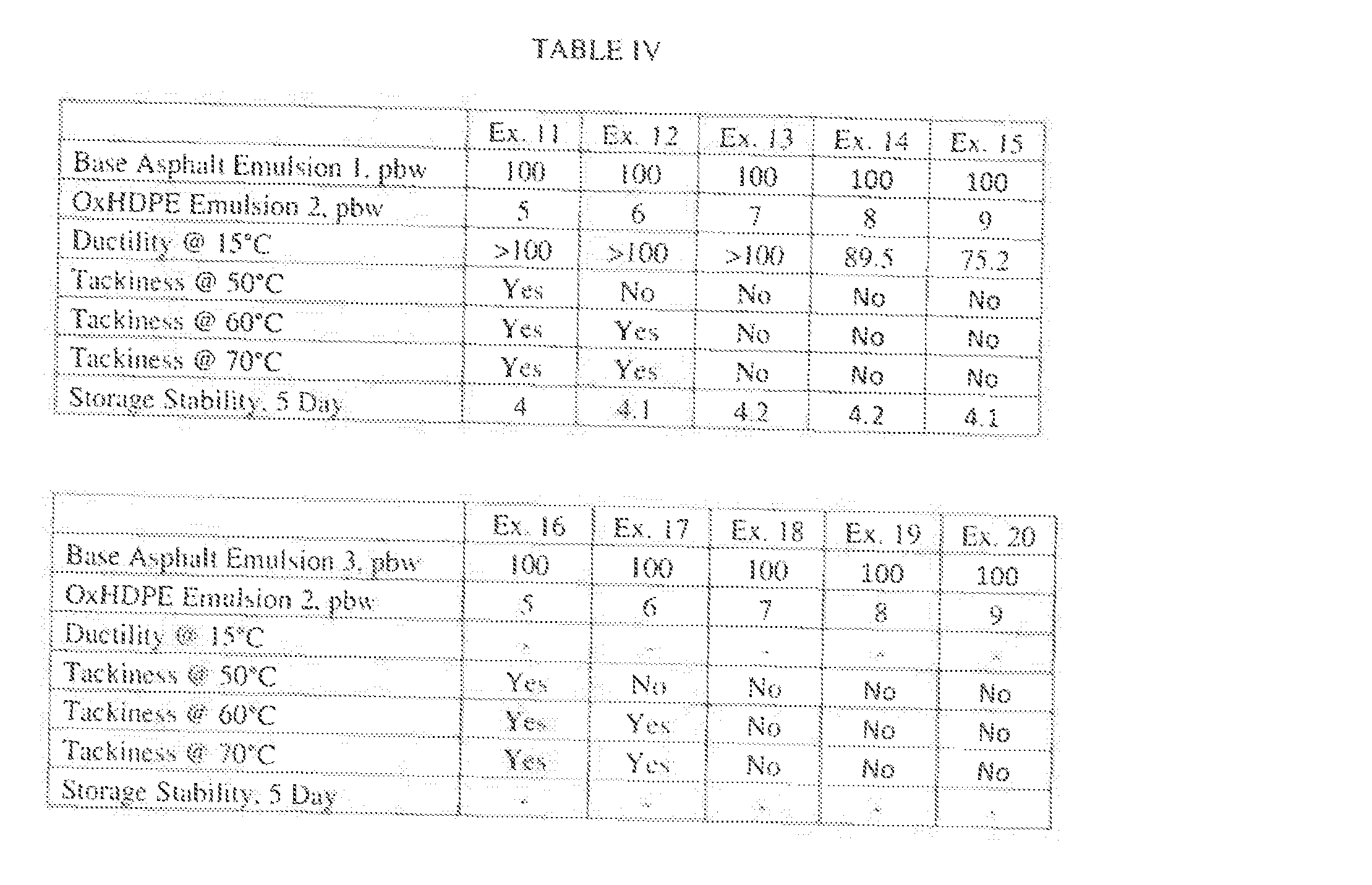
- samples of asphah emulsion are prepared to Illustrate the impact of the amount of oxidized polyethylene emulsion on trackless performance.
- trackless performance is qualitatively tested whereby an asphahic lelt is dabbed with the asphalt emulsion and heated for 30 minutes at 60 °C in an oven.
- the resulting demulsified asphalt emulsions are then tested for tackiness by contacting the demulsified asphalt emulsions with a finger and observing whether or not the demulsified asphalt emulsions remain sticky to the touch after the period of heating at 60 °C. TABLE fV provides the results of such testing.
Landscapes
- Chemical & Material Sciences (AREA)
- Engineering & Computer Science (AREA)
- Structural Engineering (AREA)
- Civil Engineering (AREA)
- Ceramic Engineering (AREA)
- Architecture (AREA)
- Organic Chemistry (AREA)
- Materials Engineering (AREA)
- Chemical Kinetics & Catalysis (AREA)
- Health & Medical Sciences (AREA)
- Polymers & Plastics (AREA)
- Medicinal Chemistry (AREA)
- Dispersion Chemistry (AREA)
- Road Paving Structures (AREA)
- Compositions Of Macromolecular Compounds (AREA)
Abstract
Description


Claims
Priority Applications (6)
| Application Number | Priority Date | Filing Date | Title |
|---|---|---|---|
| CN201880066871.XA CN111212820A (en) | 2017-09-13 | 2018-09-07 | Stabilized bituminous emulsion, method of forming the same, and composite structures formed therefrom |
| EP18857204.4A EP3681850A4 (en) | 2017-09-13 | 2018-09-07 | STABLE ASPHALT EMULSIONS, THE PROCESS FOR THEIR PRODUCTION AND COMPOSITE STRUCTURES PRODUCED FROM THEM |
| JP2020514260A JP6923752B2 (en) | 2017-09-13 | 2018-09-07 | Stable asphalt emulsion, its formation method, and the composite structure formed from it |
| KR1020207008871A KR102416763B1 (en) | 2017-09-13 | 2018-09-07 | Stable asphalt emulsion, method for forming same, and composite structure formed therefrom |
| RU2020111286A RU2743756C1 (en) | 2017-09-13 | 2018-09-07 | Stable bituminous emulsions, methods of their formation and composite structures formed from these emulsions |
| MX2020002599A MX2020002599A (en) | 2017-09-13 | 2018-09-07 | Stable asphalt emulsions, methods of forming the same, and composite structures formed from the same. |
Applications Claiming Priority (4)
| Application Number | Priority Date | Filing Date | Title |
|---|---|---|---|
| US201762558191P | 2017-09-13 | 2017-09-13 | |
| US62/558,191 | 2017-09-13 | ||
| US16/121,381 US11174200B2 (en) | 2017-09-13 | 2018-09-04 | Stable asphalt emulsions, methods of forming the same, and composite structures formed from the same |
| US16/121,381 | 2018-09-04 |
Publications (1)
| Publication Number | Publication Date |
|---|---|
| WO2019055319A1 true WO2019055319A1 (en) | 2019-03-21 |
Family
ID=65630568
Family Applications (1)
| Application Number | Title | Priority Date | Filing Date |
|---|---|---|---|
| PCT/US2018/050058 Ceased WO2019055319A1 (en) | 2017-09-13 | 2018-09-07 | Stable asphalt emulsions, methods of forming the same, and composite structures formed from the same |
Country Status (8)
| Country | Link |
|---|---|
| US (1) | US11174200B2 (en) |
| EP (1) | EP3681850A4 (en) |
| JP (1) | JP6923752B2 (en) |
| KR (1) | KR102416763B1 (en) |
| CN (1) | CN111212820A (en) |
| MX (1) | MX2020002599A (en) |
| RU (1) | RU2743756C1 (en) |
| WO (1) | WO2019055319A1 (en) |
Families Citing this family (7)
| Publication number | Priority date | Publication date | Assignee | Title |
|---|---|---|---|---|
| CN112011134A (en) * | 2019-05-28 | 2020-12-01 | 霍尼韦尔特性材料和技术(中国)有限公司 | Emulsified asphalt modified material and preparation method and application thereof |
| EP4130381B1 (en) * | 2020-03-30 | 2025-07-30 | Nichireki Co., Ltd. | Method for constructing roadbase layer, and mixture for use in said method |
| CN111648190A (en) * | 2020-04-25 | 2020-09-11 | 河南省金德园林绿化工程有限公司 | Asphalt concrete pavement and paving construction method thereof |
| US12612517B2 (en) | 2021-04-16 | 2026-04-28 | Honeywell International Inc. | Asphalt emulsion and method of forming the same |
| CN113214759A (en) * | 2021-04-23 | 2021-08-06 | 杨际梅 | Self-adhesive polymer modified asphalt waterproof coiled material modifier and preparation and use methods thereof |
| KR102562855B1 (en) * | 2022-02-14 | 2023-08-02 | 주식회사 넷폼알앤디 | Boundary stone having adhesion layer of boundary stone for reconstruction at ascon repavement |
| KR102562854B1 (en) * | 2022-02-14 | 2023-08-02 | 주식회사 넷폼알앤디 | Ascon repavement layer having asphalt adhesion layer |
Citations (5)
| Publication number | Priority date | Publication date | Assignee | Title |
|---|---|---|---|---|
| US20110041734A1 (en) * | 2008-04-29 | 2011-02-24 | Gian Luca Guerrini | paving with a pollution-abating activity and a photocatalytic mixture for its preparation |
| US20130042792A1 (en) * | 2011-08-16 | 2013-02-21 | Henry Company Llc | Aqueous asphalt/wax emulsions for use in gypsum compositions and building products |
| US20140373750A1 (en) * | 2013-06-24 | 2014-12-25 | Invia Pavement Technologies, LLC | Sprayable coating composition and method for asphalt surfaces |
| US20160340552A1 (en) * | 2015-05-18 | 2016-11-24 | Invia Pavement Technologies, LLC | Mastic asphalt compositions with coalescents |
| US20170190618A1 (en) * | 2015-12-31 | 2017-07-06 | Honeywell International Inc. | Foamed asphalt compositions, recycled asphalt composition including the same, asphalt pavement including the same, and methods of forming asphalt pavement using the same |
Family Cites Families (24)
| Publication number | Priority date | Publication date | Assignee | Title |
|---|---|---|---|---|
| CA787330A (en) | 1968-06-11 | Esso Research And Engineering Company | Soil treatment composition | |
| US3651000A (en) | 1967-11-09 | 1972-03-21 | Phillips Petroleum Co | Stable emulsions |
| US3740201A (en) | 1968-09-18 | 1973-06-19 | Phillips Petroleum Co | Polyolefin emulsions containing n,n-dimethylsulfenyl dithiocarbamates |
| JPS58189206U (en) * | 1982-06-09 | 1983-12-15 | 日瀝化学工業株式会社 | Bituminous surface pavement |
| US4853427A (en) * | 1984-06-15 | 1989-08-01 | Allied-Signal Inc. | Composition and method to process polymers including ultrahigh molecular weight polyethylene |
| JPH0726362B2 (en) * | 1985-04-08 | 1995-03-22 | 日瀝化学工業株式会社 | Bituminous pavement construction method |
| JPS61252239A (en) | 1985-05-01 | 1986-11-10 | Human Ind Corp | Production of thermally restorable sheet |
| US4868233A (en) * | 1987-07-15 | 1989-09-19 | Exxon Research And Engineering Company | Polyethylene modified asphalts |
| CN1058274C (en) | 1990-09-07 | 2000-11-08 | 联合信号股份有限公司 | Coemulsification of oxidized polyethylene homopolymers and amino functional silicone fluids |
| EP1003818B1 (en) * | 1997-08-11 | 2005-05-04 | Esso Societe Anonyme Francaise | Emulsified bituminous binder |
| RU2130909C1 (en) * | 1998-03-16 | 1999-05-27 | Иркутское областное управление автомобильных дорог | Bitumen emulsion with improved service properties |
| FR2781234B1 (en) * | 1998-07-16 | 2000-10-13 | Lafarge Mortiers Sa | BITUMEN EMULSIONS, PROCESS FOR OBTAINING SAME, AND COMPOSITIONS CONTAINING SAME |
| RU2244725C1 (en) * | 2003-06-04 | 2005-01-20 | Кемалов Алим Фейзрахманович | Bitumen emulsion |
| EP2087174B1 (en) * | 2006-11-13 | 2017-01-18 | Kraton Polymers U.S. LLC | Bituminous emulsions |
| US8658717B2 (en) * | 2011-01-28 | 2014-02-25 | Honeywell International Inc. | Asphalt paving materials and methods for making the same |
| RU2505570C1 (en) * | 2012-08-01 | 2014-01-27 | Федеральное государственное бюджетное образовательное учреждение высшего профессионального образования "Казанский национальный исследовательский технологический университет" | Bitumen emulsion for road surface |
| US9631094B2 (en) * | 2012-09-12 | 2017-04-25 | Honeywell International Inc. | Bitumen compositions and methods of making |
| US10584247B2 (en) * | 2012-12-28 | 2020-03-10 | Honeywell International Inc. | Methods for reducing asphalt pavement thickness |
| US9267038B2 (en) * | 2014-01-07 | 2016-02-23 | Honeywell International Inc. | Asphalt binder compositions and methods to make and use same |
| US9764984B2 (en) | 2014-02-07 | 2017-09-19 | Honeywell International Inc. | Plastomer-modified asphalt binders meeting MSCR specifications, asphalt paving materials with such asphalt binders, and methods for fabricating such asphalt binders |
| US9745480B2 (en) | 2014-06-12 | 2017-08-29 | Akzo Nobel Chemicals International B.V. | Method for producing bituminous coatings with reduced tackiness |
| CN106715595A (en) * | 2014-07-16 | 2017-05-24 | 霍尼韦尔国际公司 | Bituminous paint for roofing waterproofing membrane, waterproofing membrane comprising same and method for preparing same |
| US9605152B2 (en) * | 2014-07-16 | 2017-03-28 | Honeywell International Inc. | Asphalt compositions for roofing applications, methods for making the same, and filled asphalt material comprising the same |
| US20160201271A1 (en) * | 2015-01-08 | 2016-07-14 | Honeywell International Inc. | Surface treated pavement and methods for treating pavement surfaces to improve chip retention |
-
2018
- 2018-09-04 US US16/121,381 patent/US11174200B2/en active Active
- 2018-09-07 CN CN201880066871.XA patent/CN111212820A/en active Pending
- 2018-09-07 KR KR1020207008871A patent/KR102416763B1/en active Active
- 2018-09-07 EP EP18857204.4A patent/EP3681850A4/en active Pending
- 2018-09-07 RU RU2020111286A patent/RU2743756C1/en active
- 2018-09-07 MX MX2020002599A patent/MX2020002599A/en unknown
- 2018-09-07 JP JP2020514260A patent/JP6923752B2/en active Active
- 2018-09-07 WO PCT/US2018/050058 patent/WO2019055319A1/en not_active Ceased
Patent Citations (5)
| Publication number | Priority date | Publication date | Assignee | Title |
|---|---|---|---|---|
| US20110041734A1 (en) * | 2008-04-29 | 2011-02-24 | Gian Luca Guerrini | paving with a pollution-abating activity and a photocatalytic mixture for its preparation |
| US20130042792A1 (en) * | 2011-08-16 | 2013-02-21 | Henry Company Llc | Aqueous asphalt/wax emulsions for use in gypsum compositions and building products |
| US20140373750A1 (en) * | 2013-06-24 | 2014-12-25 | Invia Pavement Technologies, LLC | Sprayable coating composition and method for asphalt surfaces |
| US20160340552A1 (en) * | 2015-05-18 | 2016-11-24 | Invia Pavement Technologies, LLC | Mastic asphalt compositions with coalescents |
| US20170190618A1 (en) * | 2015-12-31 | 2017-07-06 | Honeywell International Inc. | Foamed asphalt compositions, recycled asphalt composition including the same, asphalt pavement including the same, and methods of forming asphalt pavement using the same |
Non-Patent Citations (1)
| Title |
|---|
| See also references of EP3681850A4 * |
Also Published As
| Publication number | Publication date |
|---|---|
| EP3681850A1 (en) | 2020-07-22 |
| MX2020002599A (en) | 2020-08-17 |
| CN111212820A (en) | 2020-05-29 |
| US20190077710A1 (en) | 2019-03-14 |
| KR102416763B1 (en) | 2022-07-05 |
| EP3681850A4 (en) | 2021-07-21 |
| RU2743756C1 (en) | 2021-02-25 |
| JP2020533502A (en) | 2020-11-19 |
| KR20200037427A (en) | 2020-04-08 |
| US11174200B2 (en) | 2021-11-16 |
| JP6923752B2 (en) | 2021-08-25 |
Similar Documents
| Publication | Publication Date | Title |
|---|---|---|
| WO2019055319A1 (en) | Stable asphalt emulsions, methods of forming the same, and composite structures formed from the same | |
| US12031042B2 (en) | Recycled oil and rubber modified for asphalt and method of use | |
| US6310122B1 (en) | Stable bitumen polymer compositions | |
| US8772380B2 (en) | Performance graded sulfur modified asphalt compositions for super pave compliant pavements | |
| JP6683855B2 (en) | Asphalt composition | |
| US6180697B1 (en) | Method for preparation of stable bitumen polymer compositions | |
| JP2018525481A (en) | Epoxy-functionalized ethylene copolymer asphalt reaction product | |
| US6972047B2 (en) | Incorporation of gilsonite into asphalt compositions | |
| JP2018526497A (en) | Modified asphalt using phosphorous acid | |
| Nebratenko et al. | Influence of SBS polymers of various structure on the properties of semi-blown bitumen binders | |
| US6441065B1 (en) | Method for preparation of stable bitumen polymer compositions | |
| US7993441B2 (en) | Roadway patching composition | |
| EP2917284A1 (en) | Asphalt compositions with cracking resistance additives | |
| US20040152805A1 (en) | Process for preparing bitumen/rubber compositions | |
| US6469075B1 (en) | Method and preparation of stable bitumen polymer compositions | |
| US6786962B2 (en) | Emulsion of a colloidal clay and water slurry in a bitumen cutback | |
| JP4079446B2 (en) | Modified asphalt composition for paving | |
| EP0885935A1 (en) | Asphalt compositions and process for low temperature paving applications | |
| JP3736818B2 (en) | Modified asphalt composition for paving | |
| EP1081193A1 (en) | Method for preparation of stable bitumen polymer compostions | |
| KR20230169975A (en) | Asphalt emulsion and method of forming same | |
| JP3396003B2 (en) | Modified asphalt composition for pavement | |
| CA2235727C (en) | Low temperature pavement binders and methods of their preparation | |
| EP1205520A1 (en) | Method for preparation of stable bitumen polymer compositions | |
| US20220017750A1 (en) | Bituminous mastic, method for preparing same and uses thereof |
Legal Events
| Date | Code | Title | Description |
|---|---|---|---|
| 121 | Ep: the epo has been informed by wipo that ep was designated in this application |
Ref document number: 18857204 Country of ref document: EP Kind code of ref document: A1 |
|
| ENP | Entry into the national phase |
Ref document number: 2020514260 Country of ref document: JP Kind code of ref document: A |
|
| NENP | Non-entry into the national phase |
Ref country code: DE |
|
| ENP | Entry into the national phase |
Ref document number: 20207008871 Country of ref document: KR Kind code of ref document: A |
|
| ENP | Entry into the national phase |
Ref document number: 2018857204 Country of ref document: EP Effective date: 20200414 |
|
| WWG | Wipo information: grant in national office |
Ref document number: MX/A/2020/002599 Country of ref document: MX |