WO2019065341A1 - 銀粉およびその製造方法 - Google Patents
銀粉およびその製造方法 Download PDFInfo
- Publication number
- WO2019065341A1 WO2019065341A1 PCT/JP2018/034336 JP2018034336W WO2019065341A1 WO 2019065341 A1 WO2019065341 A1 WO 2019065341A1 JP 2018034336 W JP2018034336 W JP 2018034336W WO 2019065341 A1 WO2019065341 A1 WO 2019065341A1
- Authority
- WO
- WIPO (PCT)
- Prior art keywords
- silver powder
- diameter
- particle diameter
- sem
- copper
- Prior art date
- Legal status (The legal status is an assumption and is not a legal conclusion. Google has not performed a legal analysis and makes no representation as to the accuracy of the status listed.)
- Ceased
Links
Images



Classifications
-
- H—ELECTRICITY
- H01—ELECTRIC ELEMENTS
- H01B—CABLES; CONDUCTORS; INSULATORS; SELECTION OF MATERIALS FOR THEIR CONDUCTIVE, INSULATING OR DIELECTRIC PROPERTIES
- H01B1/00—Conductors or conductive bodies characterised by the conductive materials; Selection of materials as conductors
- H01B1/02—Conductors or conductive bodies characterised by the conductive materials; Selection of materials as conductors mainly consisting of metals or alloys
- H01B1/026—Alloys based on copper
-
- B—PERFORMING OPERATIONS; TRANSPORTING
- B22—CASTING; POWDER METALLURGY
- B22F—WORKING METALLIC POWDER; MANUFACTURE OF ARTICLES FROM METALLIC POWDER; MAKING METALLIC POWDER; APPARATUS OR DEVICES SPECIALLY ADAPTED FOR METALLIC POWDER
- B22F1/00—Metallic powder; Treatment of metallic powder, e.g. to facilitate working or to improve properties
-
- B—PERFORMING OPERATIONS; TRANSPORTING
- B22—CASTING; POWDER METALLURGY
- B22F—WORKING METALLIC POWDER; MANUFACTURE OF ARTICLES FROM METALLIC POWDER; MAKING METALLIC POWDER; APPARATUS OR DEVICES SPECIALLY ADAPTED FOR METALLIC POWDER
- B22F1/00—Metallic powder; Treatment of metallic powder, e.g. to facilitate working or to improve properties
- B22F1/05—Metallic powder characterised by the size or surface area of the particles
-
- B—PERFORMING OPERATIONS; TRANSPORTING
- B22—CASTING; POWDER METALLURGY
- B22F—WORKING METALLIC POWDER; MANUFACTURE OF ARTICLES FROM METALLIC POWDER; MAKING METALLIC POWDER; APPARATUS OR DEVICES SPECIALLY ADAPTED FOR METALLIC POWDER
- B22F7/00—Manufacture of composite layers, workpieces, or articles, comprising metallic powder, by sintering the powder, with or without compacting wherein at least one part is obtained by sintering or compression
- B22F7/02—Manufacture of composite layers, workpieces, or articles, comprising metallic powder, by sintering the powder, with or without compacting wherein at least one part is obtained by sintering or compression of composite layers
- B22F7/04—Manufacture of composite layers, workpieces, or articles, comprising metallic powder, by sintering the powder, with or without compacting wherein at least one part is obtained by sintering or compression of composite layers with one or more layers not made from powder, e.g. made from solid metal
-
- B—PERFORMING OPERATIONS; TRANSPORTING
- B22—CASTING; POWDER METALLURGY
- B22F—WORKING METALLIC POWDER; MANUFACTURE OF ARTICLES FROM METALLIC POWDER; MAKING METALLIC POWDER; APPARATUS OR DEVICES SPECIALLY ADAPTED FOR METALLIC POWDER
- B22F9/00—Making metallic powder or suspensions thereof
- B22F9/02—Making metallic powder or suspensions thereof using physical processes
- B22F9/06—Making metallic powder or suspensions thereof using physical processes starting from liquid material
- B22F9/08—Making metallic powder or suspensions thereof using physical processes starting from liquid material by casting, e.g. through sieves or in water, by atomising or spraying
-
- B—PERFORMING OPERATIONS; TRANSPORTING
- B22—CASTING; POWDER METALLURGY
- B22F—WORKING METALLIC POWDER; MANUFACTURE OF ARTICLES FROM METALLIC POWDER; MAKING METALLIC POWDER; APPARATUS OR DEVICES SPECIALLY ADAPTED FOR METALLIC POWDER
- B22F9/00—Making metallic powder or suspensions thereof
- B22F9/02—Making metallic powder or suspensions thereof using physical processes
- B22F9/06—Making metallic powder or suspensions thereof using physical processes starting from liquid material
- B22F9/08—Making metallic powder or suspensions thereof using physical processes starting from liquid material by casting, e.g. through sieves or in water, by atomising or spraying
- B22F9/082—Making metallic powder or suspensions thereof using physical processes starting from liquid material by casting, e.g. through sieves or in water, by atomising or spraying atomising using a fluid
-
- C—CHEMISTRY; METALLURGY
- C22—METALLURGY; FERROUS OR NON-FERROUS ALLOYS; TREATMENT OF ALLOYS OR NON-FERROUS METALS
- C22C—ALLOYS
- C22C5/00—Alloys based on noble metals
- C22C5/06—Alloys based on silver
-
- C—CHEMISTRY; METALLURGY
- C22—METALLURGY; FERROUS OR NON-FERROUS ALLOYS; TREATMENT OF ALLOYS OR NON-FERROUS METALS
- C22C—ALLOYS
- C22C5/00—Alloys based on noble metals
- C22C5/06—Alloys based on silver
- C22C5/08—Alloys based on silver with copper as the next major constituent
-
- H—ELECTRICITY
- H01—ELECTRIC ELEMENTS
- H01B—CABLES; CONDUCTORS; INSULATORS; SELECTION OF MATERIALS FOR THEIR CONDUCTIVE, INSULATING OR DIELECTRIC PROPERTIES
- H01B1/00—Conductors or conductive bodies characterised by the conductive materials; Selection of materials as conductors
- H01B1/20—Conductive material dispersed in non-conductive organic material
- H01B1/22—Conductive material dispersed in non-conductive organic material the conductive material comprising metals or alloys
-
- H—ELECTRICITY
- H01—ELECTRIC ELEMENTS
- H01B—CABLES; CONDUCTORS; INSULATORS; SELECTION OF MATERIALS FOR THEIR CONDUCTIVE, INSULATING OR DIELECTRIC PROPERTIES
- H01B13/00—Apparatus or processes specially adapted for manufacturing conductors or cables
- H01B13/0026—Apparatus for manufacturing conducting or semi-conducting layers, e.g. deposition of metal
-
- B—PERFORMING OPERATIONS; TRANSPORTING
- B22—CASTING; POWDER METALLURGY
- B22F—WORKING METALLIC POWDER; MANUFACTURE OF ARTICLES FROM METALLIC POWDER; MAKING METALLIC POWDER; APPARATUS OR DEVICES SPECIALLY ADAPTED FOR METALLIC POWDER
- B22F9/00—Making metallic powder or suspensions thereof
- B22F9/02—Making metallic powder or suspensions thereof using physical processes
- B22F9/06—Making metallic powder or suspensions thereof using physical processes starting from liquid material
- B22F9/08—Making metallic powder or suspensions thereof using physical processes starting from liquid material by casting, e.g. through sieves or in water, by atomising or spraying
- B22F2009/0804—Dispersion in or on liquid, other than with sieves
-
- B—PERFORMING OPERATIONS; TRANSPORTING
- B22—CASTING; POWDER METALLURGY
- B22F—WORKING METALLIC POWDER; MANUFACTURE OF ARTICLES FROM METALLIC POWDER; MAKING METALLIC POWDER; APPARATUS OR DEVICES SPECIALLY ADAPTED FOR METALLIC POWDER
- B22F9/00—Making metallic powder or suspensions thereof
- B22F9/02—Making metallic powder or suspensions thereof using physical processes
- B22F9/06—Making metallic powder or suspensions thereof using physical processes starting from liquid material
- B22F9/08—Making metallic powder or suspensions thereof using physical processes starting from liquid material by casting, e.g. through sieves or in water, by atomising or spraying
- B22F9/082—Making metallic powder or suspensions thereof using physical processes starting from liquid material by casting, e.g. through sieves or in water, by atomising or spraying atomising using a fluid
- B22F2009/0824—Making metallic powder or suspensions thereof using physical processes starting from liquid material by casting, e.g. through sieves or in water, by atomising or spraying atomising using a fluid with a specific atomising fluid
- B22F2009/0828—Making metallic powder or suspensions thereof using physical processes starting from liquid material by casting, e.g. through sieves or in water, by atomising or spraying atomising using a fluid with a specific atomising fluid with water
-
- B—PERFORMING OPERATIONS; TRANSPORTING
- B22—CASTING; POWDER METALLURGY
- B22F—WORKING METALLIC POWDER; MANUFACTURE OF ARTICLES FROM METALLIC POWDER; MAKING METALLIC POWDER; APPARATUS OR DEVICES SPECIALLY ADAPTED FOR METALLIC POWDER
- B22F2301/00—Metallic composition of the powder or its coating
- B22F2301/10—Copper
-
- B—PERFORMING OPERATIONS; TRANSPORTING
- B22—CASTING; POWDER METALLURGY
- B22F—WORKING METALLIC POWDER; MANUFACTURE OF ARTICLES FROM METALLIC POWDER; MAKING METALLIC POWDER; APPARATUS OR DEVICES SPECIALLY ADAPTED FOR METALLIC POWDER
- B22F2301/00—Metallic composition of the powder or its coating
- B22F2301/25—Noble metals, i.e. Ag Au, Ir, Os, Pd, Pt, Rh, Ru
- B22F2301/255—Silver or gold
-
- B—PERFORMING OPERATIONS; TRANSPORTING
- B22—CASTING; POWDER METALLURGY
- B22F—WORKING METALLIC POWDER; MANUFACTURE OF ARTICLES FROM METALLIC POWDER; MAKING METALLIC POWDER; APPARATUS OR DEVICES SPECIALLY ADAPTED FOR METALLIC POWDER
- B22F2304/00—Physical aspects of the powder
- B22F2304/10—Micron size particles, i.e. above 1 micrometer up to 500 micrometer
Definitions
- the present invention relates to silver powder and a method for producing the same, and more particularly to silver powder suitable for a material of a conductive paste and a method for producing the same.
- the electrodes of solar cells the internal electrodes of multilayer ceramic electronic components such as electronic components using low-temperature fired ceramic (LTCC) and multilayer ceramic inductors (MLCI), and the external electrodes such as multilayer ceramic capacitors and multilayer ceramic inductors are formed.
- LTCC low-temperature fired ceramic
- MLCI multilayer ceramic inductors
- the external electrodes such as multilayer ceramic capacitors and multilayer ceramic inductors
- metal powder such as silver powder is used as silver powder.
- a reducing agent is added to an aqueous reaction system containing silver ions in the presence of seed particles such as copper to reduce and deposit silver particles.
- a manufacturing method has been proposed (see, for example, Patent Document 1).
- silver powder produced by the conventional method of producing silver powder by water atomization is likely to agglomerate and the secondary particle diameter tends to be large, and the surface is smooth when the silver powder thus agglomerated is used as a material of the conductive paste It becomes difficult to form a thin conductive film.
- silver powder with a small particle diameter is required as silver powder used for conductive paste in recent years due to miniaturization of internal electrodes of electronic components such as multilayer ceramic inductors (MLCI), but the particle diameter of silver powder is small. Then, the silver powder tends to aggregate.
- MLCI multilayer ceramic inductors
- the inventors of the present invention found that 40 ppm or more of copper can be obtained by rapidly solidifying by spraying high pressure water while dropping a molten metal in which silver containing 40 ppm or more of copper is dissolved. It has been found that silver powder containing and having a carbon content of 0.1% by mass or less can be produced to produce a silver powder having a low carbon content and which is difficult to aggregate, and the present invention has been completed.
- the silver powder according to the present invention is characterized by containing 40 ppm or more of copper and having a carbon content of 0.1 mass% or less.
- the content of copper in this silver powder is preferably 40 to 10000 ppm.
- the silver powder preferably has a volume-based 50% cumulative particle diameter (D 50 diameter) of 1 to 15 ⁇ m as measured by a laser diffraction particle size distribution analyzer, and the cumulative 50% particle diameter of the silver powder (D 50)
- the ratio (SEM diameter / D 50 diameter) of the average particle diameter (SEM diameter) of single particles observed by a field emission scanning electron microscope to the diameter) is preferably 0.3 to 1.0. Further, it is preferable that a ratio of tap density (tap density / D 50 diameter) to a cumulative 50% particle diameter (D 50 diameter) of this silver powder is 0.45 to 3.0 g / (cm 3 ⁇ ⁇ m).
- the oxygen content in silver dust is 0.1 mass% or less.
- the BET specific surface area of the silver powder is preferably 0.1 to 1.0 m 2 / g, and the tap density is preferably 2 to 6 g / cm 3 .
- the method for producing silver powder according to the present invention is characterized in that high-pressure water is sprayed to rapidly solidify while dropping a molten metal in which silver containing 40 ppm or more of copper is dissolved.
- the content of copper in the molten metal is preferably 40 to 10000 ppm.
- the conductive paste according to the present invention is characterized in that the silver powder is dispersed in the organic component.
- the method for producing a conductive film according to the present invention is characterized in that the above-mentioned conductive paste is applied onto a substrate and then fired to produce a conductive film.
- the copper content is 40 ppm or more and the carbon content is 0.1 mass% or less.
- the content of copper in the silver powder is 40 ppm or more (from the viewpoint of preventing aggregation of the silver powder), and from the viewpoint of improving the oxidation resistance and conductivity of the silver powder, the content is preferably 40 to 10000 ppm. It is more preferably 2000 ppm, particularly preferably 40 to 800 ppm, and most preferably 230 to 750 ppm.
- the carbon content in the silver powder is 0.1% by mass or less, preferably 0.03% by mass or less, and more preferably 0.007% by mass or less.
- the oxygen content in the silver powder is preferably 0.1% by mass or less, and more preferably 0.01 to 0.07% by mass. Thus, if the oxygen content in silver powder is low, it can fully sinter and can form a highly conductive conductive film.
- the volume-based 50% cumulative particle diameter (D 50 diameter) of this silver powder (by the Heros method) measured by a laser diffraction particle size distribution analyzer is preferably 1 to 15 ⁇ m, and the electronic component is further miniaturized silver powder
- the thickness is more preferably 1 to 8 ⁇ m, and most preferably 1.2 to 7 ⁇ m.
- the average particle diameter (SEM diameter) of single particles observed by field emission scanning electron microscope (SEM) of this silver powder is used as a material of conductive paste for forming internal electrodes of electronic components obtained by further miniaturizing silver powder.
- the ratio (SEM diameter / D 50 diameter) of the average particle diameter (SEM diameter) of single particles observed by a field emission scanning electron microscope to the cumulative 50% particle diameter (D 50 diameter) of this silver powder is 0. It is preferably 3 to 1.0, more preferably 0.35 to 1.0, still more preferably 0.5 to 1.0, and 0.65 to 1.0. Is most preferred. As the ratio (SEM diameter / D 50 diameter) (primary particle diameter / secondary particle diameter) is larger, it can be said that aggregation of silver powder is less.
- the BET specific surface area of silver powder is preferably 0.1 to 1.0 m 2 / g, more preferably 0.2 to 0.8 m 2 / g, and 0.3 to 0.5 m 2. It is most preferable that it is / g.
- the tap density of silver powder is 2 to 6 g / g to enhance the filling property of silver powder and form a conductive film having good conductivity when silver powder is used as a material of the conductive paste to form a conductive film. It is preferably cm 3, and more preferably from 2.5 ⁇ 5.5g / cm 3, is most preferable 3.5 ⁇ 5.5g / cm 3.
- the cumulative 50% particle diameter of silver powder (D 50 to increase the filling property of silver powder and form a conductive film having good conductivity)
- the ratio of tap density to diameter) is preferably 0.45 to 3.0 g / (cm 3 ⁇ ⁇ m), and 0.8 to 2.8 g / (cm 3 ⁇ ⁇ m) More preferably 1.1 to 2.5 g / (cm 3 ⁇ ⁇ m).
- the shape of said silver powder may be any shape of various granular shapes, such as spherical shape and flake shape, and the shape may not be uniform.
- the embodiment of the silver powder described above can be manufactured by the embodiment of the method for manufacturing silver powder according to the present invention.
- copper of 40 ppm or more is preferably added to silver.
- a very small amount (40 ppm or more, preferably 40 to 10000 ppm, more preferably 40 to 2000 ppm, particularly preferably 40 to 800 ppm, most preferably 230 to 750 ppm) of copper is added to silver by so-called water atomizing method of spraying high pressure water.
- water atomizing method of spraying high pressure water When silver powder is produced from a molten metal, it is possible to obtain silver powder which has a small particle size, a small carbon content and is difficult to aggregate.
- the average particle diameter of silver powder can be adjusted by adjusting the temperature of a molten metal, and the pressure of high pressure water.
- the average particle diameter of the silver powder can be reduced by increasing the temperature of the molten metal or the pressure of high pressure water.
- the solid obtained by solid-liquid separation may be washed with water before drying, or after drying, the particle size may be adjusted by crushing or classification.
- this silver powder (saturated aliphatic hydrocarbons, unsaturated aliphatic hydrocarbons, ketones, etc.
- a conductive paste can be produced by dispersing in organic components such as aromatic hydrocarbons, glycol ethers, esters, alcohols and the like organic solvents and binder resins (such as ethyl cellulose and acrylic resin) and the like.
- organic components such as aromatic hydrocarbons, glycol ethers, esters, alcohols and the like organic solvents and binder resins (such as ethyl cellulose and acrylic resin) and the like.
- the content of silver powder in the conductive paste is preferably 5 to 98% by mass, and more preferably 70 to 95% by mass, from the viewpoint of the production cost of the conductive paste and the conductivity of the conductive film.
- the silver powder in the conductive paste may be used by mixing with one or more other metal powders (alloy powder of silver and tin, metal powder such as tin powder).
- the metal powder may be a metal powder having a shape or particle size different from that of the silver powder according to the present invention.
- the cumulative 50% particle diameter (D 50 diameter) based on volume measured by laser diffraction type particle size distribution measuring device of this metal powder is 0.5 to 20 ⁇ m in order to form a thin conductive film by firing the conductive paste. Is preferred.
- the content of the metal powder in the conductive paste is preferably 1 to 94% by mass, and more preferably 4 to 29% by mass.
- the total content of silver powder and metal powder in the conductive paste is preferably 60 to 99% by mass.
- the content of the organic solvent in the conductive paste is preferably 0.8 to 20% by mass in consideration of the dispersibility of silver powder in the conductive paste and the appropriate viscosity of the conductive paste, More preferably, it is 8 to 15% by mass.
- the organic solvent may be used as a mixture of two or more.
- the content of the binder resin in the conductive paste is preferably 0.1 to 10% by mass from the viewpoint of the dispersibility of silver powder in the conductive paste and the conductivity of the conductive paste. It is more preferable that the content be 6% by mass.
- the binder resin may be used as a mixture of two or more. Further, the content of the glass frit in the conductive paste is preferably 0.1 to 20% by mass from the viewpoint of the sinterability of the conductive paste, and further preferably 0.1 to 10% by mass. preferable. You may use this glass frit in mixture of 2 or more types.
- Such a conductive paste is prepared, for example, by weighing each component and putting it in a predetermined container, prekneading it using a grinder, a universal stirrer, a kneader or the like, and then carrying out main kneading with a triple roll. can do. Further, if necessary, an organic solvent may be added thereafter to adjust the viscosity. In addition, after the glass frit or the inorganic oxide and the organic solvent or the binder resin are kneaded to reduce the particle size, silver powder may be finally added and this kneading may be performed.
- This conductive paste is applied in a predetermined pattern on a substrate (such as a ceramic substrate or dielectric layer) by dipping or printing (such as metal mask printing, screen printing, or inkjet printing), and then fired to form a conductive film. can do.
- a substrate such as a ceramic substrate or dielectric layer
- dipping or printing such as metal mask printing, screen printing, or inkjet printing
- the conductive paste is applied by dipping, the substrate is dipped in the conductive paste to form a coating film, and the unnecessary portion of the conductive film obtained by firing the coating film is removed to obtain a substrate.
- a conductive film having a predetermined pattern shape can be formed thereon.
- the baking of the conductive paste applied on the substrate may be performed in a non-oxidizing atmosphere such as nitrogen, argon, hydrogen or carbon monoxide, but since silver powder is difficult to oxidize, it is performed in the air because of cost. Is preferred.
- the firing temperature of the conductive paste is preferably about 600 to 1000 ° C., and more preferably about 700 to 900 ° C.
- volatile components such as an organic solvent in the conductive paste may be removed by preliminary drying by vacuum drying or the like.
- the conductive paste contains a binder resin, it is preferable to heat the conductive paste at a low temperature of 250 to 400 ° C. as a binder removal step for reducing the content of the binder resin before firing.
- Example 1 Molten metal (silver containing 46 ppm copper) dissolved by heating 23.96 kg of shot silver having a purity of 99.99% by mass and 6.04 kg of Ag-Cu alloy (containing 228 ppm copper) at 1600 ° C. in the atmosphere. while dropping the melt) from the lower tundish, pressure by the water atomizing device in an air atmosphere 150 MPa, the amount of water 160L / min with alkaline water (aqueous alkaline solution prepared by adding sodium hydroxide 157.55g against pure water 21.6 m 3 (pH 10 .7)) was sprayed to quench and solidify, the obtained slurry was solid-liquid separated, the solid was washed with water and dried to obtain silver powder (containing a trace amount of copper).
- alkaline water aqueous alkaline solution prepared by adding sodium hydroxide 157.55g against pure water 21.6 m 3 (pH 10 .7)
- the particle size (primary particle size) of the silver powder thus obtained is a single particle observed at a magnification of 5000 with a field emission scanning electron microscope (SEM) (S-4700 manufactured by Hitachi High-Technologies Corporation)
- SEM field emission scanning electron microscope
- the average particle diameter (SEM diameter) was determined from the average value of Feret diameters of 30 arbitrary particles.
- the SEM diameter (primary particle diameter) of the silver powder was 2.35 ⁇ m.
- dispersion is performed using a laser diffraction type particle size distribution measuring apparatus (Hyros particle size distribution measuring apparatus (HELOS & RODOS (air flow type dispersing module) made by SYMPATEC)).
- HELOS & RODOS air flow type dispersing module
- the content of copper in silver powder is ⁇ 10% of the content of copper in molten metal within the range of
- the carbon content in the silver powder is measured by a carbon / sulfur analyzer (EMIA-920V2 manufactured by Horiba, Ltd.), the carbon content is 0.004 mass%, and the oxygen content is oxygen / nitrogen / The oxygen content was 0.040% by mass as measured by a hydrogen analyzer (EMGA-920 manufactured by Horiba, Ltd.).
- the BET specific surface area of silver powder is degassed by flowing nitrogen gas at 105 ° C. for 20 minutes in the measuring device using a BET specific surface area measuring device (Macsorb manufactured by Mounttech Co., Ltd.), and then mixing nitrogen and helium
- the BET specific surface area was 0.34 m 2 / g as measured by the BET one-point method while flowing a gas (N 2 : 30 vol%, He: 70 vol%).
- the tap density (TAP) of silver powder silver powder is used up to 80% of the volume in a bottomed cylindrical die with an inner diameter of 6 mm and a height of 11.9 mm, similarly to the method described in JP-A-2007-263860.
- Fill to form a silver powder layer uniformly apply a pressure of 0.160 N / m 2 to the upper surface of the silver powder layer, and compress the silver powder until the silver powder is no longer densely packed at this pressure, and then the silver powder layer
- the density of the silver powder was determined from the measured value of the height of the silver powder layer and the weight of the filled silver powder. As a result, the tap density was 3.0 g / cm 3 .
- the ratio (TAP / D 50 diameter) of tap density (TAP) to the 50% cumulative particle diameter (D 50 diameter) of silver powder was calculated to be 0.50 g / (cm 3 ⁇ ⁇ m).
- Example 2 A small amount of copper was used in the same manner as in Example 1 except that a molten metal (a molten metal of silver containing 218 ppm of copper) in which 25 kg of shot silver and 15 kg of Ag—Cu alloy (containing 581 ppm of copper) were dissolved was used. ) Containing silver powder.
- a molten metal a molten metal of silver containing 218 ppm of copper
- Ag—Cu alloy containing 581 ppm of copper
- the SEM diameter (primary particle diameter) is calculated, the cumulative 50% particle diameter (D 50 diameter) (secondary particle diameter) is measured, and the cumulative 50% particle diameter (D 50 diameter)
- the SEM diameter (primary particle diameter) of the silver powder is The cumulative 50% particle diameter (D 50 diameter) was 4.1 ⁇ m, and the SEM diameter / D 50 diameter (primary particle diameter / secondary particle diameter) was 0.57.
- composition analysis of silver powder is carried out by the same method as in Example 1, carbon content and oxygen content in silver powder are measured, BET specific surface area and tap density (TAP) of silver powder are determined, and accumulation of silver powder 50 %
- TAP tap density
- D 50 diameter particle size
- the content of copper in silver powder is within ⁇ 10% of the content of copper in molten metal
- the carbon content is 0.002% by mass
- the oxygen content is 0.041% by mass
- the BET specific surface area is 0.36 m 2 / g
- the tap density is 4.1 g / cm 3
- 50 of the silver powder is accumulated.
- % ratio of tap density to particle diameter (D 50 diameter) (tAP) (tAP / D 50 diameter) was 1.00g / (cm 3 ⁇ ⁇ m) .
- Example 3 A small amount of copper was used in the same manner as in Example 1 except that a molten metal (a molten metal of silver containing 238 ppm of copper) in which 24 kg of shot silver and 16 kg of Ag—Cu alloy (containing 595 ppm of copper) were dissolved was used. ) Containing silver powder.
- the SEM diameter (primary particle diameter) is calculated, the cumulative 50% particle diameter (D 50 diameter) (secondary particle diameter) is measured, and the cumulative 50% particle diameter (D 50 diameter)
- the SEM diameter (primary particle diameter) of the silver powder is The cumulative 50% particle diameter (D 50 diameter) was 2.9 ⁇ m, and the SEM diameter / D 50 diameter (primary particle diameter / secondary particle diameter) was 0.75.
- composition analysis of silver powder is carried out by the same method as in Example 1, carbon content and oxygen content in silver powder are measured, BET specific surface area and tap density (TAP) of silver powder are determined, and accumulation of silver powder 50 %
- TEP tap density
- D 50 diameter particle size
- the content of copper in silver powder is within ⁇ 10% of the content of copper in molten metal
- the carbon content is 0.004% by mass
- the oxygen content is 0.051% by mass
- the BET specific surface area is 0.42 m 2 / g
- the tap density is 4.2 g / cm 3
- 50 of the silver powder is accumulated.
- the ratio of tap density (TAP) to% particle diameter (D 50 diameter) (TAP / D 50 diameter) was 1.45 g / (cm 3 ⁇ ⁇ m).
- Example 4 A small amount of copper was used in the same manner as in Example 1 except that a molten metal (a molten metal of silver containing 253 ppm of copper) in which 25 kg of shot silver and 15 kg of Ag—Cu alloy (containing 675 ppm of copper) were dissolved was used. ) Containing silver powder.
- a molten metal a molten metal of silver containing 253 ppm of copper
- Ag—Cu alloy containing 675 ppm of copper
- the SEM diameter (primary particle diameter) is calculated, the cumulative 50% particle diameter (D 50 diameter) (secondary particle diameter) is measured, and the cumulative 50% particle diameter (D 50 diameter)
- the SEM diameter (primary particle diameter) of the silver powder is The cumulative 50% particle diameter (D 50 diameter) was 3.1 ⁇ m, and the SEM diameter / D 50 diameter (primary particle diameter / secondary particle diameter) was 0.81.
- composition analysis of silver powder is carried out by the same method as in Example 1, carbon content and oxygen content in silver powder are measured, BET specific surface area and tap density (TAP) of silver powder are determined, and accumulation of silver powder 50 %
- TAP tap density
- D 50 diameter particle size
- the content of copper in silver powder is within ⁇ 10% of the content of copper in molten metal
- the carbon content is 0.003% by mass
- the oxygen content is 0.036% by mass
- the BET specific surface area is 0.36 m 2 / g
- the tap density is 5.0 g / cm 3
- 50 of the silver powder is accumulated.
- % ratio of tap density to particle diameter (D 50 diameter) (tAP) (tAP / D 50 diameter) was 1.61g / (cm 3 ⁇ ⁇ m) .
- Example 5 By the same method as Example 1, except that a molten metal (a molten metal of silver containing 370 ppm of copper) in which 18.62 kg of shot silver and 11.38 kg of Ag-Cu alloy (containing 975 ppm of copper) were dissolved was used. Silver powder (containing a small amount of copper) was obtained.
- a molten metal a molten metal of silver containing 370 ppm of copper
- Ag-Cu alloy containing 975 ppm of copper
- the SEM diameter (primary particle diameter) is calculated, the cumulative 50% particle diameter (D 50 diameter) (secondary particle diameter) is measured, and the cumulative 50% particle diameter (D 50 diameter)
- the SEM diameter (primary particle diameter) of the silver powder is The cumulative 50% particle diameter (D 50 diameter) was 2.8 ⁇ m, and the SEM diameter / D 50 diameter (primary particle diameter / secondary particle diameter) was 0.90.
- composition analysis of silver powder is carried out by the same method as in Example 1, carbon content and oxygen content in silver powder are measured, BET specific surface area and tap density (TAP) of silver powder are determined, and accumulation of silver powder 50 %
- TAP tap density
- D 50 diameter particle size
- accumulation of silver powder 50 % When the ratio of tap density (TAP) to particle size (D 50 diameter) (TAP / D 50 diameter) was calculated, the content of copper in silver powder is within ⁇ 10% of the content of copper in molten metal
- the carbon content is 0.004% by mass
- the oxygen content is 0.049% by mass
- the BET specific surface area is 0.37 m 2 / g
- the tap density is 4.7 g / cm 3.
- % ratio of tap density to particle diameter (D 50 diameter) (tAP) (tAP / D 50 diameter) was 1.68g / (cm 3 ⁇ ⁇ m) .
- Example 6 By the same method as in Example 1, except that a molten metal (a molten metal of silver containing 375 ppm of copper) in which 6.27 kg of shot silver and 2.43 kg of an Ag—Cu alloy (containing 1343 ppm of copper) were dissolved was used Silver powder (containing a small amount of copper) was obtained.
- a molten metal a molten metal of silver containing 375 ppm of copper
- Ag—Cu alloy containing 1343 ppm of copper
- the SEM diameter (primary particle diameter) is calculated, the cumulative 50% particle diameter (D 50 diameter) (secondary particle diameter) is measured, and the cumulative 50% particle diameter (D 50 diameter)
- the SEM diameter (primary particle diameter) of the silver powder is The cumulative 50% particle diameter (D 50 diameter) was 3.1 ⁇ m, and the SEM diameter / D 50 diameter (primary particle diameter / secondary particle diameter) was 0.91.
- composition analysis of silver powder is carried out by the same method as in Example 1, carbon content and oxygen content in silver powder are measured, BET specific surface area and tap density (TAP) of silver powder are determined, and accumulation of silver powder 50 %
- TAP tap density
- D 50 diameter particle size
- accumulation of silver powder 50 % When the ratio of tap density (TAP) to particle size (D 50 diameter) (TAP / D 50 diameter) was calculated, the content of copper in silver powder is within ⁇ 10% of the content of copper in molten metal
- the carbon content is 0.006% by mass
- the oxygen content is 0.069% by mass
- the BET specific surface area is 0.35 m 2 / g
- the tap density is 4.7 g / cm 3
- the accumulated 50 of silver powder is % ratio of tap density to particle diameter (D 50 diameter) (tAP) (tAP / D 50 diameter) was 1.52g / (cm 3 ⁇ ⁇ m) .
- Example 7 By the same method as Example 1, except that a molten metal (a molten metal of silver containing 385 ppm of copper) in which 29.79 kg of shot silver and 10.21 kg of an Ag—Cu alloy (containing 1508 ppm of copper) were dissolved was used Silver powder (containing a small amount of copper) was obtained.
- a molten metal a molten metal of silver containing 385 ppm of copper
- an Ag—Cu alloy containing 1508 ppm of copper
- the SEM diameter (primary particle diameter) is calculated, the cumulative 50% particle diameter (D 50 diameter) (secondary particle diameter) is measured, and the cumulative 50% particle diameter (D 50 diameter)
- the SEM diameter (primary particle diameter) of the silver powder is The cumulative 50% particle diameter (D 50 diameter) was 2.9 ⁇ m, and the SEM diameter / D 50 diameter (primary particle diameter / secondary particle diameter) was 0.89.
- composition analysis of silver powder is carried out by the same method as in Example 1, carbon content and oxygen content in silver powder are measured, BET specific surface area and tap density (TAP) of silver powder are determined, and accumulation of silver powder 50 %
- TEP tap density
- D 50 diameter particle size
- the content of copper in silver powder is within ⁇ 10% of the content of copper in molten metal
- the carbon content is 0.002% by mass
- the oxygen content is 0.046% by mass
- the BET specific surface area is 0.36 m 2 / g
- the tap density is 4.3 g / cm 3
- 50 of the silver powder is accumulated.
- the ratio of tap density (TAP) to the% particle size (D 50 diameter) (TAP / D 50 diameter) was 1.48 g / (cm 3 ⁇ ⁇ m).
- Example 8 The same method as in Example 1 except that a molten metal (a molten metal of silver containing 218 ppm of copper) in which 39.97 kg of shot silver and 0.031 kg of an Ag—Cu alloy (containing 28 mass% of copper) were dissolved was used. Thus, silver powder (containing 220 ppm of copper) was obtained.
- a molten metal a molten metal of silver containing 218 ppm of copper
- an Ag—Cu alloy containing 28 mass% of copper
- the SEM diameter (primary particle diameter) is calculated, the cumulative 50% particle diameter (D 50 diameter) (secondary particle diameter) is measured, and the cumulative 50% particle diameter (D 50 diameter)
- the SEM diameter (primary particle diameter) of the silver powder is The cumulative 50% particle diameter (D 50 diameter) was 4.3 ⁇ m, and the SEM diameter / D 50 diameter (primary particle diameter / secondary particle diameter) was 0.54.
- composition analysis of silver powder is carried out by the same method as in Example 1, carbon content and oxygen content in silver powder are measured, BET specific surface area and tap density (TAP) of silver powder are determined, and accumulation of silver powder 50 % was calculated the ratio of tap density to particle diameter (D 50 diameter) (tAP) (tAP / D 50 diameter), the content of copper in the silver powder is 220 ppm, the carbon content is 0.005 wt%, The oxygen content is 0.046% by mass, the BET specific surface area is 0.34 m 2 / g, the tap density is 3.7 g / cm 3 , and the tap density (TAP) relative to the 50% cumulative particle diameter (D 50 diameter) of silver powder The ratio of (TAP / D 50 diameter) was 0.84 g / (cm 3 ⁇ ⁇ m).
- Example 9 By the same method as Example 1, except that a molten metal (a molten metal of silver containing 257 ppm of copper) in which 31.79 kg of shot silver and 8.21 kg of an Ag—Cu alloy (containing 1252 ppm of copper) were dissolved was used Silver powder (containing 270 ppm copper) was obtained.
- a molten metal a molten metal of silver containing 257 ppm of copper
- an Ag—Cu alloy containing 1252 ppm of copper
- the SEM diameter (primary particle diameter) is calculated, the cumulative 50% particle diameter (D 50 diameter) (secondary particle diameter) is measured, and the cumulative 50% particle diameter (D 50 diameter)
- the SEM diameter (primary particle diameter) of the silver powder is The cumulative 50% particle diameter (D 50 diameter) was 2.9 ⁇ m, and the SEM diameter / D 50 diameter (primary particle diameter / secondary particle diameter) was 0.89.
- composition analysis of silver powder is carried out by the same method as in Example 1, carbon content and oxygen content in silver powder are measured, BET specific surface area and tap density (TAP) of silver powder are determined, and accumulation of silver powder 50 % was calculated the ratio of tap density to particle diameter (D 50 diameter) (tAP) (tAP / D 50 diameter), the content of copper in the silver powder is 270 ppm, the carbon content is 0.001 wt%, The oxygen content is 0.042% by mass, the BET specific surface area is 0.37 m 2 / g, the tap density is 4.7 g / cm 3 , and the tap density (TAP) relative to the cumulative 50% particle diameter (D 50 diameter) of silver powder Ratio (TAP / D 50 diameter) was 1.60 g / (cm 3 ⁇ ⁇ m).
- Example 10 By the same method as in Example 1, except that a molten metal (a molten metal of silver containing 303 ppm of copper) in which 48.00 kg of shot silver and 32.00 kg of an Ag—Cu alloy (containing 757 ppm of copper) were dissolved was used. Silver powder (containing 310 ppm copper) was obtained.
- a molten metal a molten metal of silver containing 303 ppm of copper
- an Ag—Cu alloy containing 757 ppm of copper
- the SEM diameter (primary particle diameter) is calculated, the cumulative 50% particle diameter (D 50 diameter) (secondary particle diameter) is measured, and the cumulative 50% particle diameter (D 50 diameter)
- the SEM diameter (primary particle diameter) of the silver powder is The cumulative 50% particle diameter (D 50 diameter) was 3.6 ⁇ m, and the SEM diameter / D 50 diameter (primary particle diameter / secondary particle diameter) was 0.76.
- composition analysis of silver powder is carried out by the same method as in Example 1, carbon content and oxygen content in silver powder are measured, BET specific surface area and tap density (TAP) of silver powder are determined, and accumulation of silver powder 50 % was calculated the ratio of tap density to particle diameter (D 50 diameter) (tAP) (tAP / D 50 diameter), the content of copper in the silver powder is 310 ppm, the carbon content is 0.003 wt%, The oxygen content is 0.042% by mass, the BET specific surface area is 0.35 m 2 / g, the tap density is 4.1 g / cm 3 , and the tap density (TAP) relative to the 50% cumulative particle diameter (D 50 diameter) of silver powder The ratio of (TAP / D 50 diameter) was 1.14 g / (cm 3 ⁇ ⁇ m).
- Example 11 By the same method as in Example 1, except that a molten metal (a molten metal of silver containing 349 ppm of copper) in which 20.69 kg of shot silver and 19.31 kg of an Ag—Cu alloy (containing 723 ppm of copper) were dissolved was used Silver powder (containing 360 ppm copper) was obtained.
- the SEM diameter (primary particle diameter) is calculated, the cumulative 50% particle diameter (D 50 diameter) (secondary particle diameter) is measured, and the cumulative 50% particle diameter (D 50 diameter)
- the SEM diameter (primary particle diameter) of the silver powder is The cumulative 50% particle diameter (D 50 diameter) was 3.3 ⁇ m, and the SEM diameter / D 50 diameter (primary particle diameter / secondary particle diameter) was 0.97.
- composition analysis of silver powder is carried out by the same method as in Example 1, carbon content and oxygen content in silver powder are measured, BET specific surface area and tap density (TAP) of silver powder are determined, and accumulation of silver powder 50 % was calculated the ratio of tap density to particle diameter (D 50 diameter) (tAP) (tAP / D 50 diameter), the content of copper in the silver powder is 360 ppm, the carbon content is 0.003 wt%, The oxygen content is 0.043% by mass, the BET specific surface area is 0.38 m 2 / g, the tap density is 3.8 g / cm 3 , and the tap density (TAP) relative to the 50% cumulative particle diameter (D 50 diameter) of silver powder The ratio of (TAP / D 50 diameter) was 1.16 g / (cm 3 ⁇ ⁇ m).
- Example 12 By the same method as in Example 1, except that a molten metal (a molten metal of silver containing 560 ppm of copper) in which 6.00 kg of shot silver and 14.00 kg of Ag-Cu alloy (containing 800 ppm of copper) were dissolved was used Silver powder (containing 620 ppm copper) was obtained.
- a molten metal a molten metal of silver containing 560 ppm of copper
- Ag-Cu alloy containing 800 ppm of copper
- the SEM diameter (primary particle diameter) is calculated, the cumulative 50% particle diameter (D 50 diameter) (secondary particle diameter) is measured, and the cumulative 50% particle diameter (D 50 diameter)
- the SEM diameter (primary particle diameter) of the silver powder is The cumulative 50% particle diameter (D 50 diameter) was 2.8 ⁇ m, and the SEM diameter / D 50 diameter (primary particle diameter / secondary particle diameter) was 0.84.
- composition analysis of silver powder is carried out by the same method as in Example 1, carbon content and oxygen content in silver powder are measured, BET specific surface area and tap density (TAP) of silver powder are determined, and accumulation of silver powder 50 % was calculated the ratio of tap density to particle diameter (D 50 diameter) (tAP) (tAP / D 50 diameter), the content of copper in the silver powder is 620 ppm, the carbon content is 0.003 wt%, The oxygen content is 0.057% by mass, the BET specific surface area is 0.38 m 2 / g, the tap density is 4.4 g / cm 3 , and the tap density (TAP) relative to the 50% cumulative particle diameter (D 50 diameter) of silver powder Ratio (TAP / D 50 diameter) was 1.59 g / (cm 3 ⁇ ⁇ m).
- the SEM diameter (primary particle diameter) is calculated, the cumulative 50% particle diameter (D 50 diameter) (secondary particle diameter) is measured, and the cumulative 50% particle diameter (D 50 diameter)
- the SEM diameter (primary particle diameter) of the silver powder is The cumulative 50% particle diameter (D 50 diameter) was 9.6 ⁇ m, and the SEM diameter / D 50 diameter (primary particle diameter / secondary particle diameter) was 0.24.
- composition analysis of silver powder is carried out by the same method as in Example 1, carbon content and oxygen content in silver powder are measured, BET specific surface area and tap density (TAP) of silver powder are determined, and accumulation of silver powder 50 % was calculated the ratio of tap density to particle diameter (D 50 diameter) (tAP) (tAP / D 50 diameter), resulting silver powder is a silver powder containing no Cu, the carbon content is 0.004 mass%
- the oxygen content is 0.038% by mass
- the BET specific surface area is 0.35 m 2 / g
- the tap density is 2.3 g / cm 3
- the tap density relative to the 50% cumulative particle size (D 50 diameter) of silver powder The ratio of TAP) (TAP / D 50 diameter) was 0.24 g / (cm 3 ⁇ ⁇ m).
- the silver powder according to the present invention forms an electrode of a solar cell, an internal electrode of a multilayer ceramic electronic component such as an electronic component using low temperature fired ceramic (LTCC) or a multilayer ceramic inductor, an external electrode such as a multilayer ceramic capacitor or a multilayer ceramic inductor
- LTCC low temperature fired ceramic
- a multilayer ceramic inductor an external electrode such as a multilayer ceramic capacitor or a multilayer ceramic inductor
- a highly conductive conductive film can be obtained by utilizing it as a material of the fired conductive paste.
Landscapes
- Chemical & Material Sciences (AREA)
- Engineering & Computer Science (AREA)
- Materials Engineering (AREA)
- Mechanical Engineering (AREA)
- Metallurgy (AREA)
- Organic Chemistry (AREA)
- Manufacturing & Machinery (AREA)
- Physics & Mathematics (AREA)
- Dispersion Chemistry (AREA)
- Spectroscopy & Molecular Physics (AREA)
- Composite Materials (AREA)
- Powder Metallurgy (AREA)
- Manufacture Of Metal Powder And Suspensions Thereof (AREA)
Abstract
炭素含有量が少なく且つ凝集し難い銀粉およびその製造方法する。銀に40ppm以上の銅を添加して溶解した溶湯を落下させながら、高圧水を吹き付けて急冷凝固させることにより、銅の含有量が40ppm以上、炭素含有量が0.1質量%以下、酸素含有量が0.1質量%以下、レーザー回折式粒度分布測定装置により測定した体積基準の累積50%粒子径(D50径)が1~15μm、電界放出型走査電子顕微鏡(SEM)によって観測した単体粒子の平均粒子径(SEM径)が1~8μmであり、累積50%粒子径(D50径)に対する、電界放出型走査電子顕微鏡によって観測した単体粒子の平均粒子径(SEM径)の比(SEM径/D50径)が0.3~1.0である銀粉を製造する。
Description
本発明は、銀粉およびその製造方法に関し、特に、導電性ペーストの材料に適した銀粉およびその製造方法に関する。
従来、太陽電池の電極、低温焼成セラミック(LTCC)を使用した電子部品や積層セラミックインダクタ(MLCI)などの積層セラミック電子部品の内部電極、積層セラミックコンデンサや積層セラミックインダクタなどの外部電極などを形成する導電性ペーストの材料として、銀粉などの金属粉末が使用されている。
このような導電性ペーストの材料として使用される銀粉として、銀イオンを含有する水性反応系に、銅などの種粒子の存在下で、還元剤を添加して銀粒子を還元析出させる、銀粉の製造方法が提案されている(例えば、特許文献1参照)。
また、硝酸銀などの銀水溶液に、ステアリン酸塩などの凝集抑制剤を添加した後、還元剤を添加して銀粒子を還元析出させる、銀粉の製造方法も提案されている(例えば、特許文献2参照)。
しかし、特許文献1~2に記載された銀粉の製造方法のように、湿式還元法によって銀粉を製造する方法では、製造中に銀粉の粒子の内部に不純物として炭素含有化合物を取り込んでしまう。そのため、このような方法により製造された銀粉を焼成型導電性ペーストの材料として使用し、この焼成型導電性ペーストを基板に塗布した後に焼成して導電膜を形成すると、焼成の際に炭素分から二酸化炭素などのガスが発生し、このガスによって導電膜にクラックが生じて、導電膜と基板との密着性が悪くなるという問題がある。
このような問題を解消するため、炭素などの不純物の含有量が極めて少ない銀粉を安価に製造する方法として、銀を溶解した溶湯を落下させながら高圧水を吹き付けて急冷凝固させる、所謂水アトマイズ法によって銀粉を製造する方法が知られている。
しかし、従来の水アトマイズ法による銀粉の製造方法により製造された銀粉は、凝集して二次粒子径が大きくなり易く、このように凝集した銀粉を導電性ペーストの材料として使用すると、表面が平滑な薄い導電膜を形成するのが困難になる。
特に、近年、積層セラミックインダクタ(MLCI)などの電子部品の内部電極などの小型化により、導電性ペーストに使用する銀粉として、粒子径の小さい銀粉が求められているが、銀粉の粒子径が小さくなると、銀粉が凝集し易くなる。
したがって、本発明は、このような従来の問題点に鑑み、炭素含有量が少なく且つ凝集し難い銀粉およびその製造方法を提供することを目的とする。
本発明者らは、上記課題を解決するために鋭意研究した結果、40ppm以上の銅を含む銀を溶解した溶湯を落下させながら、高圧水を吹き付けて急冷凝固させることにより、40ppm以上の銅を含み且つ炭素含有量が0.1質量%以下である銀粉を製造して、炭素含有量が少なく且つ凝集し難い銀粉を製造することができることを見出し、本発明を完成するに至った。
すなわち、本発明による銀粉は、40ppm以上の銅を含み且つ炭素含有量が0.1質量%以下であることを特徴とする。
この銀粉中の銅の含有量は40~10000ppmであるのが好ましい。また、この銀粉は、レーザー回折式粒度分布測定装置により測定した体積基準の累積50%粒子径(D50径)が1~15μmであるのが好ましく、この銀粉の累積50%粒子径(D50径)に対する、電界放出型走査電子顕微鏡によって観測した単体粒子の平均粒子径(SEM径)の比(SEM径/D50径)が0.3~1.0であるのが好ましい。また、この銀粉の累積50%粒子径(D50径)に対するタップ密度の比(タップ密度/D50径)が0.45~3.0g/(cm3・μm)であるのが好ましい。また、銀粉中の酸素含有量は0.1質量%以下であるのが好ましい。さらに、銀粉のBET比表面積は0.1~1.0m2/gであるのが好ましく、タップ密度は2~6g/cm3であるのが好ましい。
また、本発明による銀粉の製造方法は、40ppm以上の銅を含む銀を溶解した溶湯を落下させながら、高圧水を吹き付けて急冷凝固させることを特徴とする。この銀粉の製造方法において、溶湯中の銅の含有量が40~10000ppmであるのが好ましい。
また、本発明による導電性ペーストは、上記の銀粉が有機成分中に分散していることを特徴とする。
さらに、本発明による導電膜の製造方法は、上記の導電性ペーストを基板上に塗布した後に焼成して導電膜を製造することを特徴とする。
本発明によれば、炭素含有量が少なく且つ凝集し難い銀粉を製造することができる。
本発明による銀粉の実施の形態では、銅の含有量が40ppm以上であり、炭素含有量が0.1質量%以下である。
この銀粉中の銅の含有量は、(銀粉の凝集を防止する観点から)40ppm以上であり、銀粉の耐酸化性や導電性を向上させる観点から、40~10000ppmであるのが好ましく、40~2000ppmであるのがさらに好ましく、40~800ppmであるのが特に好ましく、230~750ppmであるのが最も好ましい。
この銀粉中の炭素含有量は、0.1質量%以下であり、0.03質量%以下であるのが好ましく、0.007質量%以下であるのがさらに好ましい。このような炭素含有量が低い銀粉を材料として使用した焼成型導電性ペーストを基板に塗布した後に焼成して導電膜を形成すると、焼成の際に炭素分から発生する二酸化炭素などのガスの量が少なく、ガスによる導電膜のクラックが生じ難くなり、基板との密着性に優れた導電膜を形成することができる。
また、銀粉中の酸素含有量は、0.1質量%以下であるのが好ましく、0.01~0.07質量%であるのがさらに好ましい。このように銀粉中の酸素含有量が低ければ、十分に焼結して高い導電性の導電膜を形成することができる。
この銀粉の(ヘロス法によって)レーザー回折式粒度分布測定装置により測定した体積基準の累積50%粒子径(D50径)は、1~15μmであるのが好ましく、銀粉をさらに小型化した電子部品の内部電極などを形成する導電性ペーストの材料として使用する場合には、1~8μmであるのがさらに好ましく、1.2~7μmであるのが最も好ましい。また、この銀粉の電界放出型走査電子顕微鏡(SEM)によって観測した単体粒子の平均粒子径(SEM径)は、銀粉をさらに小型化した電子部品の内部電極などを形成する導電性ペーストの材料として使用する場合には、1~8μmであるのが好ましく、1~5μmであるのがさらに好ましく、1.2~4μmであるのが最も好ましい。また、この銀粉の累積50%粒子径(D50径)に対する、電界放出型走査電子顕微鏡によって観測した単体粒子の平均粒子径(SEM径)の比(SEM径/D50径)は、0.3~1.0であるのが好ましく、0.35~1.0であるのがさらに好ましく、0.5~1.0であるのがさらに一層好ましく、0.65~1.0であるのが最も好ましい。この比(SEM径/D50径)(一次粒子径/二次粒子径)が大きいほど、銀粉の凝集が少ないといえる。
また、銀粉のBET比表面積は、0.1~1.0m2/gであるのが好ましく、0.2~0.8m2/gであるのがさらに好ましく、0.3~0.5m2/gであるのが最も好ましい。また、銀粉のタップ密度は、銀粉を導電性ペーストの材料として使用して導電膜を形成する場合に銀粉の充填性を高めて良好な導電性の導電膜を形成するために、2~6g/cm3であるのが好ましく、2.5~5.5g/cm3であるのがさらに好ましく、3.5~5.5g/cm3であるのが最も好ましい。さらに、銀粉を導電性ペーストの材料として使用して導電膜を形成する場合に銀粉の充填性を高めて良好な導電性の導電膜を形成するために、銀粉の累積50%粒子径(D50径)に対するタップ密度の比(タップ密度/D50径)は、0.45~3.0g/(cm3・μm)であるのが好ましく、0.8~2.8g/(cm3・μm)であるのがさらに好ましく、1.1~2.5g/(cm3・μm)であるのが最も好ましい。
なお、上記の銀粉の形状は、球状やフレーク状などの様々な粒状の形状のいずれの形状でもよく、形状が揃っていない不定形状でもよい。
上述した銀粉の実施の形態は、本発明による銀粉の製造方法の実施の形態により製造することができる。
本発明による銀粉の製造方法の実施の形態では、銀に40ppm以上(好ましくは40~10000ppm、さらに好ましくは40~2000ppm、特に好ましくは40~800ppm、最も好ましくは230~750ppm)の銅を(好ましくは銅単体またはAg-Cu合金の形態で)添加して溶解した(好ましくは銀の融点約962℃より300~720℃高い温度の)溶湯を落下させながら、(好ましくは、大気雰囲気中または(水素、一酸化炭素、アルゴン、窒素などの)非酸化性雰囲気中において水圧70~400MPa(さらに好ましくは90~280MPa)で(純水またはpH8~12のアルカリ水である))高圧水を吹き付けて急冷凝固させる。
高圧水を吹き付ける、所謂水アトマイズ法によって、銀に微量(40ppm以上、好ましくは40~10000ppm、さらに好ましくは40~2000ppm、特に好ましくは40~800ppm、最も好ましくは230~750ppm)の銅を添加した溶湯から銀粉を製造すると、粒子径が小さく、炭素含有量が少なく且つ凝集し難い銀粉を得ることができる。
また、水アトマイズ法によって溶湯から銀粉を製造する際に、溶湯の温度と高圧水の圧力を調整することによって、銀粉の平均粒子径を調整することができる。例えば、溶湯の温度や高圧水の圧力を高くすることにより、銀粉の平均粒子径を小さくすることができる。
また、水アトマイズ法によって溶湯から銀粉を製造する際に、溶湯を落下させながら高圧水を吹き付けて急冷凝固させて得られたスラリーを固液分離し、得られた固形物を乾燥して銀粉を得ることができる。なお、必要に応じて、固液分離して得られた固形物を乾燥する前に水洗してもよいし、乾燥した後に解砕や分級を行って、粒度を調整してもよい。
本発明による銀粉の実施の形態を(焼成型導電性ペーストなどの)導電性ペーストの材料として使用する場合、この銀粉を(飽和脂肪族炭化水素類、不飽和脂肪族炭化水素類、ケトン類、芳香族炭化水素類、グリコールエーテル類、エステル類、アルコール類などの)有機溶剤や(エチルセルロースやアクリル樹脂などの)バインダ樹脂などの有機成分中に分散させて導電性ペーストを製造することができる。また、必要に応じて、ガラスフリット、無機酸化物、分散剤などを導電性ペーストに添加してもよい。
導電性ペースト中の銀粉の含有量は、導電性ペーストの製造コストおよび導電膜の導電性の観点から、5~98質量%であるのが好ましく、70~95質量%であるのがさらに好ましい。また、導電性ペースト中の銀粉は、1種以上の他の金属粉末(銀と錫の合金粉末、錫粉などの金属粉末)と混合して使用してもよい。この金属粉末は、本発明による銀粉の実施の形態と形状や粒径が異なる金属粉末でもよい。この金属粉末のレーザー回折式粒度分布測定装置により測定した体積基準の累積50%粒子径(D50径)は、導電性ペーストを焼成して薄い導電膜を形成するために、0.5~20μmであるのが好ましい。また、この金属粉末の導電性ペースト中の含有量は、1~94質量%であるのが好ましく、4~29質量%であるのがさらに好ましい。なお、導電性ペースト中の銀粉と金属粉末の含有量の合計は、60~99質量%であるのが好ましい。また、導電性ペースト中の有機溶剤の含有量は、導電性ペースト中の銀粉の分散性や導電性ペーストの適切な粘度を考慮して、0.8~20質量%であるのが好ましく、0.8~15質量%であるのがさらに好ましい。この有機溶剤は、2種以上を混合して使用してもよい。また、導電性ペースト中のバインダ樹脂の含有量は、導電性ペースト中の銀粉の分散性や導電性ペーストの導電性の観点から、0.1~10質量%であるのが好ましく、0.1~6質量%であるのがさらに好ましい。このバインダ樹脂は、2種以上を混合して使用してもよい。また、導電性ペースト中のガラスフリットの含有量は、導電性ペーストの焼結性の観点から、0.1~20質量%であるのが好ましく、0.1~10質量%であるのがさらに好ましい。このガラスフリットは、2種以上を混合して使用してもよい。
このような導電性ペーストは、例えば、各構成要素を計量して所定の容器に入れ、らいかい機、万能攪拌機、ニーダーなどを用いて予備混練した後、3本ロールで本混練することによって作製することができる。また、必要に応じて、その後、有機溶剤を添加して、粘度調整を行ってもよい。また、ガラスフリットや無機酸化物と有機溶剤やバインダ樹脂とを混練して粒度を下げた後、最後に銀粉を追加して本混練してもよい。
この導電性ペーストをディッピングや(メタルマスク印刷、スクリーン印刷、インクジェット印刷などの)印刷などにより(セラミック基板や誘電体層などの)基板上に所定パターン形状に塗布した後に焼成して導電膜を形成することができる。導電性ペーストをディッピングにより塗布する場合には、導電性ペースト中に基板をディッピングして塗膜を形成し、この塗膜を焼成して得られた導電膜の不要な部分を除去して、基板上に所定パターン形状の導電膜を形成することができる。
基板上に塗布した導電性ペーストの焼成は、窒素、アルゴン、水素、一酸化炭素などの非酸化性雰囲気下で行ってもよいが、銀粉は酸化し難いため、コスト面から大気雰囲気下で行うのが好ましい。なお、導電性ペーストの焼成温度は、600~1000℃程度であるのが好ましく、700~900℃程度であるのがさらに好ましい。また、導電性ペーストの焼成の前に、真空乾燥などにより予備乾燥を行うことにより、導電性ペースト中の有機溶剤などの揮発成分を除去してもよい。また、導電性ペーストがバインダ樹脂を含む場合は、導電性ペーストの焼成の前に、バインダ樹脂の含有量を低減させる脱バインダ工程として250~400℃の低温で加熱するのが好ましい。
以下、本発明による銀粉およびその製造方法の実施例について詳細に説明する。
[実施例1]
純度99.99質量%のショット銀23.96kgと(228ppmの銅を含む)Ag-Cu合金6.04kgとを大気雰囲気中において1600℃に加熱して溶解した溶湯(46ppmの銅を含む銀の溶湯)をタンディッシュ下部から落下させながら、水アトマイズ装置により大気雰囲気中において水圧150MPa、水量160L/分でアルカリ水(純水21.6m3に対して苛性ソーダ157.55gを添加したアルカリ水溶液(pH10.7))を吹き付けて急冷凝固させ、得られたスラリーを固液分離し、固形物を水洗し、乾燥し、(微量の銅を含む)銀粉を得た。
純度99.99質量%のショット銀23.96kgと(228ppmの銅を含む)Ag-Cu合金6.04kgとを大気雰囲気中において1600℃に加熱して溶解した溶湯(46ppmの銅を含む銀の溶湯)をタンディッシュ下部から落下させながら、水アトマイズ装置により大気雰囲気中において水圧150MPa、水量160L/分でアルカリ水(純水21.6m3に対して苛性ソーダ157.55gを添加したアルカリ水溶液(pH10.7))を吹き付けて急冷凝固させ、得られたスラリーを固液分離し、固形物を水洗し、乾燥し、(微量の銅を含む)銀粉を得た。
このようにして得られた銀粉の単体粒子径(一次粒子径)として、電界放出型走査電子顕微鏡(SEM)(株式会社日立ハイテクノロジーズ製のS-4700)によって倍率5000倍で観測した単体粒子の平均粒子径(SEM径)を、任意の粒子30個のフェレ径の平均値から求めた。その結果、銀粉のSEM径(一次粒子径)は2.35μmであった。また、銀粉の凝集粒子径(二次粒子径)として、レーザー回折式粒度分布測定装置(SYMPATEC社製のへロス粒度分布測定装置(HELOS&RODOS(気流式の分散モジュール)))を使用して、分散圧5barで体積基準の累積50%粒子径(D50径)を測定したところ、銀粉の累積50%粒子径(D50径)は6.0μmであった。なお、累積50%粒子径(D50径)(二次粒子径)に対するSEM径(一次粒子径)の比(一次粒子径/二次粒子径)を算出すると、0.39になる。
また、銀粉の組成分析を誘導結合プラズマ(ICP)発光分析装置(株式会社日立ハイテクサイエンス製のSPS3520V)によって行ったところ、銀粉中の銅の含有量は溶湯中の銅の含有量の±10%の範囲内であった。
また、銀粉中の炭素含有量を炭素・硫黄分析装置(株式会社堀場製作所製のEMIA-920V2)により測定したところ、炭素含有量は0.004質量%であり、酸素含有量を酸素・窒素・水素分析装置(株式会社堀場製作所製のEMGA-920)により測定したところ、酸素含有量は0.040質量%であった。
また、銀粉のBET比表面積をBET比表面積測定器(株式会社マウンテック製のMacsorb)を使用して、測定器内に105℃で20分間窒素ガスを流して脱気した後、窒素とヘリウムの混合ガス(N2:30体積%、He:70体積%)を流しながら、BET1点法により測定したところ、BET比表面積は0.34m2/gであった。
さらに、銀粉のタップ密度(TAP)として、特開2007-263860号公報に記載された方法と同様に、銀粉を内径6mm×高さ11.9mmの有底円筒形のダイに容積の80%まで充填して銀粉層を形成し、この銀粉層の上面に0.160N/m2の圧力を均一に加えて、この圧力で銀粉がこれ以上密に充填されなくなるまで銀粉を圧縮した後、銀粉層の高さを測定し、この銀粉層の高さの測定値と、充填された銀粉の重量とから、銀粉の密度を求めた。その結果、タップ密度は3.0g/cm3であった。なお、銀粉の累積50%粒子径(D50径)に対するタップ密度(TAP)の比(TAP/D50径)を算出したところ、0.50g/(cm3・μm)であった。
[実施例2]
ショット銀25kgと(581ppmの銅を含む)Ag-Cu合金15kgとを溶解した溶湯(218ppmの銅を含む銀の溶湯)を使用した以外は、実施例1と同様の方法により、(微量の銅を含む)銀粉を得た。
ショット銀25kgと(581ppmの銅を含む)Ag-Cu合金15kgとを溶解した溶湯(218ppmの銅を含む銀の溶湯)を使用した以外は、実施例1と同様の方法により、(微量の銅を含む)銀粉を得た。
このようにして得られた銀粉について、SEM径(一次粒子径)を算出し、累積50%粒子径(D50径)(二次粒子径)を測定し、累積50%粒子径(D50径)(二次粒子径)に対するSEM径(一次粒子径)の比(SEM径/D50径)(一次粒子径/二次粒子径)を算出したところ、銀粉のSEM径(一次粒子径)は2.34μm、累積50%粒子径(D50径)は4.1μmであり、SEM径/D50径(一次粒子径/二次粒子径)は0.57であった。
また、実施例1と同様の方法により、銀粉の組成分析を行い、銀粉中の炭素含有量および酸素含有量を測定し、銀粉のBET比表面積およびタップ密度(TAP)を求め、銀粉の累積50%粒子径(D50径)に対するタップ密度(TAP)の比(TAP/D50径)を算出したところ、銀粉中の銅の含有量は溶湯中の銅の含有量の±10%の範囲内であり、炭素含有量は0.002質量%、酸素含有量は0.041質量%、BET比表面積は0.36m2/g、タップ密度は4.1g/cm3であり、銀粉の累積50%粒子径(D50径)に対するタップ密度(TAP)の比(TAP/D50径)は1.00g/(cm3・μm)であった。
[実施例3]
ショット銀24kgと(595ppmの銅を含む)Ag-Cu合金16kgとを溶解した溶湯(238ppmの銅を含む銀の溶湯)を使用した以外は、実施例1と同様の方法により、(微量の銅を含む)銀粉を得た。
ショット銀24kgと(595ppmの銅を含む)Ag-Cu合金16kgとを溶解した溶湯(238ppmの銅を含む銀の溶湯)を使用した以外は、実施例1と同様の方法により、(微量の銅を含む)銀粉を得た。
このようにして得られた銀粉について、SEM径(一次粒子径)を算出し、累積50%粒子径(D50径)(二次粒子径)を測定し、累積50%粒子径(D50径)(二次粒子径)に対するSEM径(一次粒子径)の比(SEM径/D50径)(一次粒子径/二次粒子径)を算出したところ、銀粉のSEM径(一次粒子径)は2.19μm、累積50%粒子径(D50径)は2.9μmであり、SEM径/D50径(一次粒子径/二次粒子径)は0.75であった。
また、実施例1と同様の方法により、銀粉の組成分析を行い、銀粉中の炭素含有量および酸素含有量を測定し、銀粉のBET比表面積およびタップ密度(TAP)を求め、銀粉の累積50%粒子径(D50径)に対するタップ密度(TAP)の比(TAP/D50径)を算出したところ、銀粉中の銅の含有量は溶湯中の銅の含有量の±10%の範囲内であり、炭素含有量は0.004質量%、酸素含有量は0.051質量%、BET比表面積は0.42m2/g、タップ密度は4.2g/cm3であり、銀粉の累積50%粒子径(D50径)に対するタップ密度(TAP)の比(TAP/D50径)は1.45g/(cm3・μm)であった。
[実施例4]
ショット銀25kgと(675ppmの銅を含む)Ag-Cu合金15kgとを溶解した溶湯(253ppmの銅を含む銀の溶湯)を使用した以外は、実施例1と同様の方法により、(微量の銅を含む)銀粉を得た。
ショット銀25kgと(675ppmの銅を含む)Ag-Cu合金15kgとを溶解した溶湯(253ppmの銅を含む銀の溶湯)を使用した以外は、実施例1と同様の方法により、(微量の銅を含む)銀粉を得た。
このようにして得られた銀粉について、SEM径(一次粒子径)を算出し、累積50%粒子径(D50径)(二次粒子径)を測定し、累積50%粒子径(D50径)(二次粒子径)に対するSEM径(一次粒子径)の比(SEM径/D50径)(一次粒子径/二次粒子径)を算出したところ、銀粉のSEM径(一次粒子径)は2.51μm、累積50%粒子径(D50径)は3.1μmであり、SEM径/D50径(一次粒子径/二次粒子径)は0.81であった。
また、実施例1と同様の方法により、銀粉の組成分析を行い、銀粉中の炭素含有量および酸素含有量を測定し、銀粉のBET比表面積およびタップ密度(TAP)を求め、銀粉の累積50%粒子径(D50径)に対するタップ密度(TAP)の比(TAP/D50径)を算出したところ、銀粉中の銅の含有量は溶湯中の銅の含有量の±10%の範囲内であり、炭素含有量は0.003質量%、酸素含有量は0.036質量%、BET比表面積は0.36m2/g、タップ密度は5.0g/cm3であり、銀粉の累積50%粒子径(D50径)に対するタップ密度(TAP)の比(TAP/D50径)は1.61g/(cm3・μm)であった。
[実施例5]
ショット銀18.62kgと(975ppmの銅を含む)Ag-Cu合金11.38kgとを溶解した溶湯(370ppmの銅を含む銀の溶湯)を使用した以外は、実施例1と同様の方法により、(微量の銅を含む)銀粉を得た。
ショット銀18.62kgと(975ppmの銅を含む)Ag-Cu合金11.38kgとを溶解した溶湯(370ppmの銅を含む銀の溶湯)を使用した以外は、実施例1と同様の方法により、(微量の銅を含む)銀粉を得た。
このようにして得られた銀粉について、SEM径(一次粒子径)を算出し、累積50%粒子径(D50径)(二次粒子径)を測定し、累積50%粒子径(D50径)(二次粒子径)に対するSEM径(一次粒子径)の比(SEM径/D50径)(一次粒子径/二次粒子径)を算出したところ、銀粉のSEM径(一次粒子径)は2.54μm、累積50%粒子径(D50径)は2.8μmであり、SEM径/D50径(一次粒子径/二次粒子径)は0.90であった。
また、実施例1と同様の方法により、銀粉の組成分析を行い、銀粉中の炭素含有量および酸素含有量を測定し、銀粉のBET比表面積およびタップ密度(TAP)を求め、銀粉の累積50%粒子径(D50径)に対するタップ密度(TAP)の比(TAP/D50径)を算出したところ、銀粉中の銅の含有量は溶湯中の銅の含有量の±10%の範囲内であり、炭素含有量は0.004質量%、酸素含有量は0.049質量%、BET比表面積は0.37m2/g、タップ密度は4.7g/cm3であり、銀粉の累積50%粒子径(D50径)に対するタップ密度(TAP)の比(TAP/D50径)は1.68g/(cm3・μm)であった。
[実施例6]
ショット銀6.27kgと(1343ppmの銅を含む)Ag-Cu合金2.43kgとを溶解した溶湯(375ppmの銅を含む銀の溶湯)を使用した以外は、実施例1と同様の方法により、(微量の銅を含む)銀粉を得た。
ショット銀6.27kgと(1343ppmの銅を含む)Ag-Cu合金2.43kgとを溶解した溶湯(375ppmの銅を含む銀の溶湯)を使用した以外は、実施例1と同様の方法により、(微量の銅を含む)銀粉を得た。
このようにして得られた銀粉について、SEM径(一次粒子径)を算出し、累積50%粒子径(D50径)(二次粒子径)を測定し、累積50%粒子径(D50径)(二次粒子径)に対するSEM径(一次粒子径)の比(SEM径/D50径)(一次粒子径/二次粒子径)を算出したところ、銀粉のSEM径(一次粒子径)は2.83μm、累積50%粒子径(D50径)は3.1μmであり、SEM径/D50径(一次粒子径/二次粒子径)は0.91であった。
また、実施例1と同様の方法により、銀粉の組成分析を行い、銀粉中の炭素含有量および酸素含有量を測定し、銀粉のBET比表面積およびタップ密度(TAP)を求め、銀粉の累積50%粒子径(D50径)に対するタップ密度(TAP)の比(TAP/D50径)を算出したところ、銀粉中の銅の含有量は溶湯中の銅の含有量の±10%の範囲内であり、炭素含有量は0.006質量%、酸素含有量は0.069質量%、BET比表面積は0.35m2/g、タップ密度は4.7g/cm3であり、銀粉の累積50%粒子径(D50径)に対するタップ密度(TAP)の比(TAP/D50径)は1.52g/(cm3・μm)であった。
[実施例7]
ショット銀29.79kgと(1508ppmの銅を含む)Ag-Cu合金10.21kgとを溶解した溶湯(385ppmの銅を含む銀の溶湯)を使用した以外は、実施例1と同様の方法により、(微量の銅を含む)銀粉を得た。
ショット銀29.79kgと(1508ppmの銅を含む)Ag-Cu合金10.21kgとを溶解した溶湯(385ppmの銅を含む銀の溶湯)を使用した以外は、実施例1と同様の方法により、(微量の銅を含む)銀粉を得た。
このようにして得られた銀粉について、SEM径(一次粒子径)を算出し、累積50%粒子径(D50径)(二次粒子径)を測定し、累積50%粒子径(D50径)(二次粒子径)に対するSEM径(一次粒子径)の比(SEM径/D50径)(一次粒子径/二次粒子径)を算出したところ、銀粉のSEM径(一次粒子径)は2.57μm、累積50%粒子径(D50径)は2.9μmであり、SEM径/D50径(一次粒子径/二次粒子径)は0.89であった。
また、実施例1と同様の方法により、銀粉の組成分析を行い、銀粉中の炭素含有量および酸素含有量を測定し、銀粉のBET比表面積およびタップ密度(TAP)を求め、銀粉の累積50%粒子径(D50径)に対するタップ密度(TAP)の比(TAP/D50径)を算出したところ、銀粉中の銅の含有量は溶湯中の銅の含有量の±10%の範囲内であり、炭素含有量は0.002質量%、酸素含有量は0.046質量%、BET比表面積は0.36m2/g、タップ密度は4.3g/cm3であり、銀粉の累積50%粒子径(D50径)に対するタップ密度(TAP)の比(TAP/D50径)は1.48g/(cm3・μm)であった。
[実施例8]
ショット銀39.97kgと(28質量%の銅を含む)Ag-Cu合金0.031kgとを溶解した溶湯(218ppmの銅を含む銀の溶湯)を使用した以外は、実施例1と同様の方法により、(220ppmの銅を含む)銀粉を得た。
ショット銀39.97kgと(28質量%の銅を含む)Ag-Cu合金0.031kgとを溶解した溶湯(218ppmの銅を含む銀の溶湯)を使用した以外は、実施例1と同様の方法により、(220ppmの銅を含む)銀粉を得た。
このようにして得られた銀粉について、SEM径(一次粒子径)を算出し、累積50%粒子径(D50径)(二次粒子径)を測定し、累積50%粒子径(D50径)(二次粒子径)に対するSEM径(一次粒子径)の比(SEM径/D50径)(一次粒子径/二次粒子径)を算出したところ、銀粉のSEM径(一次粒子径)は2.33μm、累積50%粒子径(D50径)は4.3μmであり、SEM径/D50径(一次粒子径/二次粒子径)は0.54であった。
また、実施例1と同様の方法により、銀粉の組成分析を行い、銀粉中の炭素含有量および酸素含有量を測定し、銀粉のBET比表面積およびタップ密度(TAP)を求め、銀粉の累積50%粒子径(D50径)に対するタップ密度(TAP)の比(TAP/D50径)を算出したところ、銀粉中の銅の含有量は220ppmであり、炭素含有量は0.005質量%、酸素含有量は0.046質量%、BET比表面積は0.34m2/g、タップ密度は3.7g/cm3であり、銀粉の累積50%粒子径(D50径)に対するタップ密度(TAP)の比(TAP/D50径)は0.84g/(cm3・μm)であった。
[実施例9]
ショット銀31.79kgと(1252ppmの銅を含む)Ag-Cu合金8.21kgとを溶解した溶湯(257ppmの銅を含む銀の溶湯)を使用した以外は、実施例1と同様の方法により、(270ppmの銅を含む)銀粉を得た。
ショット銀31.79kgと(1252ppmの銅を含む)Ag-Cu合金8.21kgとを溶解した溶湯(257ppmの銅を含む銀の溶湯)を使用した以外は、実施例1と同様の方法により、(270ppmの銅を含む)銀粉を得た。
このようにして得られた銀粉について、SEM径(一次粒子径)を算出し、累積50%粒子径(D50径)(二次粒子径)を測定し、累積50%粒子径(D50径)(二次粒子径)に対するSEM径(一次粒子径)の比(SEM径/D50径)(一次粒子径/二次粒子径)を算出したところ、銀粉のSEM径(一次粒子径)は2.60μm、累積50%粒子径(D50径)は2.9μmであり、SEM径/D50径(一次粒子径/二次粒子径)は0.89であった。
また、実施例1と同様の方法により、銀粉の組成分析を行い、銀粉中の炭素含有量および酸素含有量を測定し、銀粉のBET比表面積およびタップ密度(TAP)を求め、銀粉の累積50%粒子径(D50径)に対するタップ密度(TAP)の比(TAP/D50径)を算出したところ、銀粉中の銅の含有量は270ppmであり、炭素含有量は0.001質量%、酸素含有量は0.042質量%、BET比表面積は0.37m2/g、タップ密度は4.7g/cm3であり、銀粉の累積50%粒子径(D50径)に対するタップ密度(TAP)の比(TAP/D50径)は1.60g/(cm3・μm)であった。
[実施例10]
ショット銀48.00kgと(757ppmの銅を含む)Ag-Cu合金32.00kgとを溶解した溶湯(303ppmの銅を含む銀の溶湯)を使用した以外は、実施例1と同様の方法により、(310ppmの銅を含む)銀粉を得た。
ショット銀48.00kgと(757ppmの銅を含む)Ag-Cu合金32.00kgとを溶解した溶湯(303ppmの銅を含む銀の溶湯)を使用した以外は、実施例1と同様の方法により、(310ppmの銅を含む)銀粉を得た。
このようにして得られた銀粉について、SEM径(一次粒子径)を算出し、累積50%粒子径(D50径)(二次粒子径)を測定し、累積50%粒子径(D50径)(二次粒子径)に対するSEM径(一次粒子径)の比(SEM径/D50径)(一次粒子径/二次粒子径)を算出したところ、銀粉のSEM径(一次粒子径)は2.73μm、累積50%粒子径(D50径)は3.6μmであり、SEM径/D50径(一次粒子径/二次粒子径)は0.76であった。
また、実施例1と同様の方法により、銀粉の組成分析を行い、銀粉中の炭素含有量および酸素含有量を測定し、銀粉のBET比表面積およびタップ密度(TAP)を求め、銀粉の累積50%粒子径(D50径)に対するタップ密度(TAP)の比(TAP/D50径)を算出したところ、銀粉中の銅の含有量は310ppmであり、炭素含有量は0.003質量%、酸素含有量は0.042質量%、BET比表面積は0.35m2/g、タップ密度は4.1g/cm3であり、銀粉の累積50%粒子径(D50径)に対するタップ密度(TAP)の比(TAP/D50径)は1.14g/(cm3・μm)であった。
[実施例11]
ショット銀20.69kgと(723ppmの銅を含む)Ag-Cu合金19.31kgとを溶解した溶湯(349ppmの銅を含む銀の溶湯)を使用した以外は、実施例1と同様の方法により、(360ppmの銅を含む)銀粉を得た。
ショット銀20.69kgと(723ppmの銅を含む)Ag-Cu合金19.31kgとを溶解した溶湯(349ppmの銅を含む銀の溶湯)を使用した以外は、実施例1と同様の方法により、(360ppmの銅を含む)銀粉を得た。
このようにして得られた銀粉について、SEM径(一次粒子径)を算出し、累積50%粒子径(D50径)(二次粒子径)を測定し、累積50%粒子径(D50径)(二次粒子径)に対するSEM径(一次粒子径)の比(SEM径/D50径)(一次粒子径/二次粒子径)を算出したところ、銀粉のSEM径(一次粒子径)は3.15μm、累積50%粒子径(D50径)は3.3μmであり、SEM径/D50径(一次粒子径/二次粒子径)は0.97であった。
また、実施例1と同様の方法により、銀粉の組成分析を行い、銀粉中の炭素含有量および酸素含有量を測定し、銀粉のBET比表面積およびタップ密度(TAP)を求め、銀粉の累積50%粒子径(D50径)に対するタップ密度(TAP)の比(TAP/D50径)を算出したところ、銀粉中の銅の含有量は360ppmであり、炭素含有量は0.003質量%、酸素含有量は0.043質量%、BET比表面積は0.38m2/g、タップ密度は3.8g/cm3であり、銀粉の累積50%粒子径(D50径)に対するタップ密度(TAP)の比(TAP/D50径)は1.16g/(cm3・μm)であった。
[実施例12]
ショット銀6.00kgと(800ppmの銅を含む)Ag-Cu合金14.00kgとを溶解した溶湯(560ppmの銅を含む銀の溶湯)を使用した以外は、実施例1と同様の方法により、(620ppmの銅を含む)銀粉を得た。
ショット銀6.00kgと(800ppmの銅を含む)Ag-Cu合金14.00kgとを溶解した溶湯(560ppmの銅を含む銀の溶湯)を使用した以外は、実施例1と同様の方法により、(620ppmの銅を含む)銀粉を得た。
このようにして得られた銀粉について、SEM径(一次粒子径)を算出し、累積50%粒子径(D50径)(二次粒子径)を測定し、累積50%粒子径(D50径)(二次粒子径)に対するSEM径(一次粒子径)の比(SEM径/D50径)(一次粒子径/二次粒子径)を算出したところ、銀粉のSEM径(一次粒子径)は2.32μm、累積50%粒子径(D50径)は2.8μmであり、SEM径/D50径(一次粒子径/二次粒子径)は0.84であった。
また、実施例1と同様の方法により、銀粉の組成分析を行い、銀粉中の炭素含有量および酸素含有量を測定し、銀粉のBET比表面積およびタップ密度(TAP)を求め、銀粉の累積50%粒子径(D50径)に対するタップ密度(TAP)の比(TAP/D50径)を算出したところ、銀粉中の銅の含有量は620ppmであり、炭素含有量は0.003質量%、酸素含有量は0.057質量%、BET比表面積は0.38m2/g、タップ密度は4.4g/cm3であり、銀粉の累積50%粒子径(D50径)に対するタップ密度(TAP)の比(TAP/D50径)は1.59g/(cm3・μm)であった。
[比較例]
ショット銀5kgを溶解した溶湯を使用した以外は、実施例1と同様の方法により、銀粉を得た。
ショット銀5kgを溶解した溶湯を使用した以外は、実施例1と同様の方法により、銀粉を得た。
このようにして得られた銀粉について、SEM径(一次粒子径)を算出し、累積50%粒子径(D50径)(二次粒子径)を測定し、累積50%粒子径(D50径)(二次粒子径)に対するSEM径(一次粒子径)の比(SEM径/D50径)(一次粒子径/二次粒子径)を算出したところ、銀粉のSEM径(一次粒子径)は2.33μm、累積50%粒子径(D50径)は9.6μmであり、SEM径/D50径(一次粒子径/二次粒子径)は0.24であった。
また、実施例1と同様の方法により、銀粉の組成分析を行い、銀粉中の炭素含有量および酸素含有量を測定し、銀粉のBET比表面積およびタップ密度(TAP)を求め、銀粉の累積50%粒子径(D50径)に対するタップ密度(TAP)の比(TAP/D50径)を算出したところ、得られた銀粉はCuを含まない銀粉であり、炭素含有量は0.004質量%、酸素含有量は0.038質量%、BET比表面積は0.35m2/g、タップ密度は2.3g/cm3であり、銀粉の累積50%粒子径(D50径)に対するタップ密度(TAP)の比(TAP/D50径)は0.24g/(cm3・μm)であった。
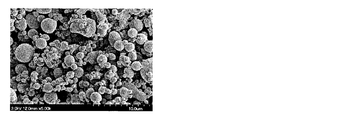
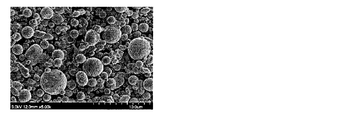
これらの実施例および比較例の銀粉の原料中の銅の量と特性を表1および表2に示す。また、実施例8~12で得られた銀粉を5000倍で観察した電界放出型走査電子顕微鏡(FE-SEM)写真を図1~図5に示す。


本発明による銀粉は、太陽電池の電極、低温焼成セラミック(LTCC)を使用した電子部品や積層セラミックインダクタなどの積層セラミック電子部品の内部電極、積層セラミックコンデンサや積層セラミックインダクタなどの外部電極などを形成するために、焼成型導電性ペーストの材料として利用して、高い導電性の導電膜を得ることができる。
Claims (12)
- 40ppm以上の銅を含み且つ炭素含有量が0.1質量%以下であることを特徴とする、銀粉。
- 前記銀粉中の銅の含有量が40~10000ppmであることを特徴とする、請求項1に記載の銀粉。
- レーザー回折式粒度分布測定装置により測定した体積基準の累積50%粒子径が1~15μmであることを特徴とする、請求項1に記載の銀粉。
- 前記銀粉の累積50%粒子径(D50径)に対する、電界放出型走査電子顕微鏡によって観測した単体粒子の平均粒子径(SEM径)の比(SEM径/D50径)が0.3~1.0であることを特徴とする、請求項3に記載の銀粉。
- 前記銀粉の累積50%粒子径(D50径)に対するタップ密度の比(タップ密度/D50径)が0.45~3.0g/(cm3・μm)であることを特徴とする、請求項3に記載の銀粉。
- 前記銀粉中の酸素含有量が0.1質量%以下であることを特徴とする、請求項1に記載の銀粉。
- 前記銀粉のBET比表面積が0.1~1.0m2/gであることを特徴とする、請求項1に記載の銀粉。
- 前記銀粉のタップ密度が2~6g/cm3であることを特徴とする、請求項1に記載の銀粉。
- 40ppm以上の銅を含む銀を溶解した溶湯を落下させながら、高圧水を吹き付けて急冷凝固させることを特徴とする、銀粉の製造方法。
- 前記溶湯中の銅の含有量が40~10000ppmであることを特徴とする、請求項9に記載の銀粉の製造方法。
- 請求項1に記載の銀粉が有機成分中に分散していることを特徴とする、導電性ペースト。
- 請求項11の導電性ペーストを基板上に塗布した後に焼成して導電膜を製造することを特徴とする、導電膜の製造方法。
Priority Applications (5)
| Application Number | Priority Date | Filing Date | Title |
|---|---|---|---|
| SG11202001993XA SG11202001993XA (en) | 2017-09-29 | 2018-09-18 | Silver powder and method for producing same |
| KR1020207011932A KR102430857B1 (ko) | 2017-09-29 | 2018-09-18 | 은 분말 및 그의 제조 방법 |
| CN201880061178.3A CN111132777B (zh) | 2017-09-29 | 2018-09-18 | 银粉及其制造方法 |
| EP18863425.7A EP3670028A4 (en) | 2017-09-29 | 2018-09-18 | SILVER POWDER AND MANUFACTURING METHOD FOR IT |
| US16/648,423 US11420256B2 (en) | 2017-09-29 | 2018-09-18 | Silver powder and method for producing same |
Applications Claiming Priority (4)
| Application Number | Priority Date | Filing Date | Title |
|---|---|---|---|
| JP2017189319 | 2017-09-29 | ||
| JP2017-189319 | 2017-09-29 | ||
| JP2018162411A JP7090511B2 (ja) | 2017-09-29 | 2018-08-31 | 銀粉およびその製造方法 |
| JP2018-162411 | 2018-08-31 |
Publications (1)
| Publication Number | Publication Date |
|---|---|
| WO2019065341A1 true WO2019065341A1 (ja) | 2019-04-04 |
Family
ID=65903531
Family Applications (1)
| Application Number | Title | Priority Date | Filing Date |
|---|---|---|---|
| PCT/JP2018/034336 Ceased WO2019065341A1 (ja) | 2017-09-29 | 2018-09-18 | 銀粉およびその製造方法 |
Country Status (2)
| Country | Link |
|---|---|
| TW (1) | TWI755565B (ja) |
| WO (1) | WO2019065341A1 (ja) |
Cited By (1)
| Publication number | Priority date | Publication date | Assignee | Title |
|---|---|---|---|---|
| WO2020137329A1 (ja) * | 2018-12-26 | 2020-07-02 | 昭栄化学工業株式会社 | 銀ペースト |
Citations (4)
| Publication number | Priority date | Publication date | Assignee | Title |
|---|---|---|---|---|
| JP2007263860A (ja) | 2006-03-29 | 2007-10-11 | Dowa Holdings Co Ltd | 粉体のタップ密度測定方法およびタップ密度測定装置 |
| JP2009235474A (ja) | 2008-03-26 | 2009-10-15 | Dowa Electronics Materials Co Ltd | 銀粉の製造方法 |
| JP2013014790A (ja) | 2011-06-30 | 2013-01-24 | Mitsui Mining & Smelting Co Ltd | 焼結型導電性ペースト用銀粉 |
| JP2017172043A (ja) * | 2016-03-16 | 2017-09-28 | Dowaエレクトロニクス株式会社 | Ag−Cu合金粉末およびその製造方法 |
-
2018
- 2018-09-11 TW TW107131880A patent/TWI755565B/zh active
- 2018-09-18 WO PCT/JP2018/034336 patent/WO2019065341A1/ja not_active Ceased
Patent Citations (4)
| Publication number | Priority date | Publication date | Assignee | Title |
|---|---|---|---|---|
| JP2007263860A (ja) | 2006-03-29 | 2007-10-11 | Dowa Holdings Co Ltd | 粉体のタップ密度測定方法およびタップ密度測定装置 |
| JP2009235474A (ja) | 2008-03-26 | 2009-10-15 | Dowa Electronics Materials Co Ltd | 銀粉の製造方法 |
| JP2013014790A (ja) | 2011-06-30 | 2013-01-24 | Mitsui Mining & Smelting Co Ltd | 焼結型導電性ペースト用銀粉 |
| JP2017172043A (ja) * | 2016-03-16 | 2017-09-28 | Dowaエレクトロニクス株式会社 | Ag−Cu合金粉末およびその製造方法 |
Cited By (2)
| Publication number | Priority date | Publication date | Assignee | Title |
|---|---|---|---|---|
| WO2020137329A1 (ja) * | 2018-12-26 | 2020-07-02 | 昭栄化学工業株式会社 | 銀ペースト |
| US12340919B2 (en) | 2018-12-26 | 2025-06-24 | Shoei Chemical Inc. | Silver paste |
Also Published As
| Publication number | Publication date |
|---|---|
| TW201920697A (zh) | 2019-06-01 |
| TWI755565B (zh) | 2022-02-21 |
Similar Documents
| Publication | Publication Date | Title |
|---|---|---|
| JP7090511B2 (ja) | 銀粉およびその製造方法 | |
| JP7272834B2 (ja) | 銀粉およびその製造方法 | |
| JP7039126B2 (ja) | 銅粉およびその製造方法 | |
| US12049684B2 (en) | Copper powder and method for producing same | |
| KR102574302B1 (ko) | 은 합금 분말 및 그의 제조 방법 | |
| JP5932638B2 (ja) | 導電性ペースト用銅粉及び導電性ペースト | |
| JP2015021145A (ja) | 銀被覆銅合金粉末およびその製造方法 | |
| JP7136970B2 (ja) | りんを含有する銀粉および該銀粉を含む導電性ペースト | |
| JP2017082327A (ja) | 銀粉およびその製造方法 | |
| JP6194166B2 (ja) | 銀被覆銅合金粉末の製造方法 | |
| JP2012067327A (ja) | 導電性ペースト用銅粉及び導電性ペースト | |
| WO2019065341A1 (ja) | 銀粉およびその製造方法 | |
| JP7084730B2 (ja) | 銀合金粉末およびその製造方法 | |
| JP6899275B2 (ja) | 銀合金粉末およびその製造方法 | |
| WO2017115462A1 (ja) | 銀合金粉末およびその製造方法 | |
| JP6722495B2 (ja) | 銀被覆銅粉およびその製造方法 | |
| WO2017073057A1 (ja) | 銀粉およびその製造方法 |
Legal Events
| Date | Code | Title | Description |
|---|---|---|---|
| 121 | Ep: the epo has been informed by wipo that ep was designated in this application |
Ref document number: 18863425 Country of ref document: EP Kind code of ref document: A1 |
|
| NENP | Non-entry into the national phase |
Ref country code: DE |
|
| ENP | Entry into the national phase |
Ref document number: 2018863425 Country of ref document: EP Effective date: 20200318 |
|
| ENP | Entry into the national phase |
Ref document number: 20207011932 Country of ref document: KR Kind code of ref document: A |