WO2019065704A1 - 非水電解質二次電池電極用バインダー、非水電解質二次電池用電極合剤、非水電解質二次電池用電極、非水電解質二次電池、及び電気機器 - Google Patents
非水電解質二次電池電極用バインダー、非水電解質二次電池用電極合剤、非水電解質二次電池用電極、非水電解質二次電池、及び電気機器 Download PDFInfo
- Publication number
- WO2019065704A1 WO2019065704A1 PCT/JP2018/035609 JP2018035609W WO2019065704A1 WO 2019065704 A1 WO2019065704 A1 WO 2019065704A1 JP 2018035609 W JP2018035609 W JP 2018035609W WO 2019065704 A1 WO2019065704 A1 WO 2019065704A1
- Authority
- WO
- WIPO (PCT)
- Prior art keywords
- electrolyte secondary
- secondary battery
- binder
- electrode
- aqueous electrolyte
- Prior art date
- Legal status (The legal status is an assumption and is not a legal conclusion. Google has not performed a legal analysis and makes no representation as to the accuracy of the status listed.)
- Ceased
Links
Classifications
-
- H—ELECTRICITY
- H01—ELECTRIC ELEMENTS
- H01M—PROCESSES OR MEANS, e.g. BATTERIES, FOR THE DIRECT CONVERSION OF CHEMICAL ENERGY INTO ELECTRICAL ENERGY
- H01M4/00—Electrodes
- H01M4/02—Electrodes composed of, or comprising, active material
- H01M4/62—Selection of inactive substances as ingredients for active masses, e.g. binders, fillers
- H01M4/621—Binders
- H01M4/622—Binders being polymers
-
- C—CHEMISTRY; METALLURGY
- C08—ORGANIC MACROMOLECULAR COMPOUNDS; THEIR PREPARATION OR CHEMICAL WORKING-UP; COMPOSITIONS BASED THEREON
- C08F—MACROMOLECULAR COMPOUNDS OBTAINED BY REACTIONS ONLY INVOLVING CARBON-TO-CARBON UNSATURATED BONDS
- C08F216/00—Copolymers of compounds having one or more unsaturated aliphatic radicals, each having only one carbon-to-carbon double bond, and at least one being terminated by an alcohol, ether, aldehydo, ketonic, acetal or ketal radical
- C08F216/02—Copolymers of compounds having one or more unsaturated aliphatic radicals, each having only one carbon-to-carbon double bond, and at least one being terminated by an alcohol, ether, aldehydo, ketonic, acetal or ketal radical by an alcohol radical
- C08F216/04—Acyclic compounds
- C08F216/06—Polyvinyl alcohol ; Vinyl alcohol
-
- C—CHEMISTRY; METALLURGY
- C08—ORGANIC MACROMOLECULAR COMPOUNDS; THEIR PREPARATION OR CHEMICAL WORKING-UP; COMPOSITIONS BASED THEREON
- C08F—MACROMOLECULAR COMPOUNDS OBTAINED BY REACTIONS ONLY INVOLVING CARBON-TO-CARBON UNSATURATED BONDS
- C08F218/00—Copolymers of compounds having one or more unsaturated aliphatic radicals, each having only one carbon-to-carbon double bond, and at least one being terminated by an acyloxy radical of a saturated carboxylic acid, of carbonic acid or of a haloformic acid
- C08F218/02—Esters of monocarboxylic acids
- C08F218/04—Vinyl esters
- C08F218/08—Vinyl acetate
-
- C—CHEMISTRY; METALLURGY
- C08—ORGANIC MACROMOLECULAR COMPOUNDS; THEIR PREPARATION OR CHEMICAL WORKING-UP; COMPOSITIONS BASED THEREON
- C08L—COMPOSITIONS OF MACROMOLECULAR COMPOUNDS
- C08L29/00—Compositions of homopolymers or copolymers of compounds having one or more unsaturated aliphatic radicals, each having only one carbon-to-carbon double bond, and at least one being terminated by an alcohol, ether, aldehydo, ketonic, acetal or ketal radical; Compositions of hydrolysed polymers of esters of unsaturated alcohols with saturated carboxylic acids; Compositions of derivatives of such polymers
- C08L29/02—Homopolymers or copolymers of unsaturated alcohols
- C08L29/04—Polyvinyl alcohol; Partially hydrolysed homopolymers or copolymers of esters of unsaturated alcohols with saturated carboxylic acids
-
- C—CHEMISTRY; METALLURGY
- C08—ORGANIC MACROMOLECULAR COMPOUNDS; THEIR PREPARATION OR CHEMICAL WORKING-UP; COMPOSITIONS BASED THEREON
- C08L—COMPOSITIONS OF MACROMOLECULAR COMPOUNDS
- C08L33/00—Compositions of homopolymers or copolymers of compounds having one or more unsaturated aliphatic radicals, each having only one carbon-to-carbon double bond, and only one being terminated by only one carboxyl radical, or of salts, anhydrides, esters, amides, imides or nitriles thereof; Compositions of derivatives of such polymers
- C08L33/02—Homopolymers or copolymers of acids; Metal or ammonium salts thereof
-
- C—CHEMISTRY; METALLURGY
- C08—ORGANIC MACROMOLECULAR COMPOUNDS; THEIR PREPARATION OR CHEMICAL WORKING-UP; COMPOSITIONS BASED THEREON
- C08L—COMPOSITIONS OF MACROMOLECULAR COMPOUNDS
- C08L33/00—Compositions of homopolymers or copolymers of compounds having one or more unsaturated aliphatic radicals, each having only one carbon-to-carbon double bond, and only one being terminated by only one carboxyl radical, or of salts, anhydrides, esters, amides, imides or nitriles thereof; Compositions of derivatives of such polymers
- C08L33/04—Homopolymers or copolymers of esters
- C08L33/06—Homopolymers or copolymers of esters of esters containing only carbon, hydrogen and oxygen, which oxygen atoms are present only as part of the carboxyl radical
- C08L33/062—Copolymers with monomers not covered by C08L33/06
- C08L33/064—Copolymers with monomers not covered by C08L33/06 containing anhydride, COOH or COOM groups, with M being metal or onium-cation
-
- C—CHEMISTRY; METALLURGY
- C09—DYES; PAINTS; POLISHES; NATURAL RESINS; ADHESIVES; COMPOSITIONS NOT OTHERWISE PROVIDED FOR; APPLICATIONS OF MATERIALS NOT OTHERWISE PROVIDED FOR
- C09D—COATING COMPOSITIONS, e.g. PAINTS, VARNISHES OR LACQUERS; FILLING PASTES; CHEMICAL PAINT OR INK REMOVERS; INKS; CORRECTING FLUIDS; WOODSTAINS; PASTES OR SOLIDS FOR COLOURING OR PRINTING; USE OF MATERIALS THEREFOR
- C09D129/00—Coating compositions based on homopolymers or copolymers of compounds having one or more unsaturated aliphatic radicals, each having only one carbon-to-carbon double bond, and at least one being terminated by an alcohol, ether, aldehydo, ketonic, acetal, or ketal radical; Coating compositions based on hydrolysed polymers of esters of unsaturated alcohols with saturated carboxylic acids; Coating compositions based on derivatives of such polymers
- C09D129/02—Homopolymers or copolymers of unsaturated alcohols
- C09D129/04—Polyvinyl alcohol; Partially hydrolysed homopolymers or copolymers of esters of unsaturated alcohols with saturated carboxylic acids
-
- H—ELECTRICITY
- H01—ELECTRIC ELEMENTS
- H01M—PROCESSES OR MEANS, e.g. BATTERIES, FOR THE DIRECT CONVERSION OF CHEMICAL ENERGY INTO ELECTRICAL ENERGY
- H01M10/00—Secondary cells; Manufacture thereof
- H01M10/05—Accumulators with non-aqueous electrolyte
- H01M10/052—Li-accumulators
- H01M10/0525—Rocking-chair batteries, i.e. batteries with lithium insertion or intercalation in both electrodes; Lithium-ion batteries
-
- H—ELECTRICITY
- H01—ELECTRIC ELEMENTS
- H01M—PROCESSES OR MEANS, e.g. BATTERIES, FOR THE DIRECT CONVERSION OF CHEMICAL ENERGY INTO ELECTRICAL ENERGY
- H01M4/00—Electrodes
- H01M4/02—Electrodes composed of, or comprising, active material
- H01M4/04—Processes of manufacture in general
- H01M4/0402—Methods of deposition of the material
- H01M4/0404—Methods of deposition of the material by coating on electrode collectors
-
- H—ELECTRICITY
- H01—ELECTRIC ELEMENTS
- H01M—PROCESSES OR MEANS, e.g. BATTERIES, FOR THE DIRECT CONVERSION OF CHEMICAL ENERGY INTO ELECTRICAL ENERGY
- H01M4/00—Electrodes
- H01M4/02—Electrodes composed of, or comprising, active material
- H01M4/13—Electrodes for accumulators with non-aqueous electrolyte, e.g. for lithium-accumulators; Processes of manufacture thereof
-
- H—ELECTRICITY
- H01—ELECTRIC ELEMENTS
- H01M—PROCESSES OR MEANS, e.g. BATTERIES, FOR THE DIRECT CONVERSION OF CHEMICAL ENERGY INTO ELECTRICAL ENERGY
- H01M4/00—Electrodes
- H01M4/02—Electrodes composed of, or comprising, active material
- H01M4/13—Electrodes for accumulators with non-aqueous electrolyte, e.g. for lithium-accumulators; Processes of manufacture thereof
- H01M4/139—Processes of manufacture
-
- H—ELECTRICITY
- H01—ELECTRIC ELEMENTS
- H01M—PROCESSES OR MEANS, e.g. BATTERIES, FOR THE DIRECT CONVERSION OF CHEMICAL ENERGY INTO ELECTRICAL ENERGY
- H01M10/00—Secondary cells; Manufacture thereof
- H01M10/05—Accumulators with non-aqueous electrolyte
- H01M10/052—Li-accumulators
-
- H—ELECTRICITY
- H01—ELECTRIC ELEMENTS
- H01M—PROCESSES OR MEANS, e.g. BATTERIES, FOR THE DIRECT CONVERSION OF CHEMICAL ENERGY INTO ELECTRICAL ENERGY
- H01M2220/00—Batteries for particular applications
- H01M2220/20—Batteries in motive systems, e.g. vehicle, ship, plane
-
- H—ELECTRICITY
- H01—ELECTRIC ELEMENTS
- H01M—PROCESSES OR MEANS, e.g. BATTERIES, FOR THE DIRECT CONVERSION OF CHEMICAL ENERGY INTO ELECTRICAL ENERGY
- H01M2220/00—Batteries for particular applications
- H01M2220/30—Batteries in portable systems, e.g. mobile phone, laptop
-
- H—ELECTRICITY
- H01—ELECTRIC ELEMENTS
- H01M—PROCESSES OR MEANS, e.g. BATTERIES, FOR THE DIRECT CONVERSION OF CHEMICAL ENERGY INTO ELECTRICAL ENERGY
- H01M2300/00—Electrolytes
- H01M2300/0017—Non-aqueous electrolytes
- H01M2300/0025—Organic electrolyte
-
- H—ELECTRICITY
- H01—ELECTRIC ELEMENTS
- H01M—PROCESSES OR MEANS, e.g. BATTERIES, FOR THE DIRECT CONVERSION OF CHEMICAL ENERGY INTO ELECTRICAL ENERGY
- H01M4/00—Electrodes
- H01M4/02—Electrodes composed of, or comprising, active material
- H01M4/13—Electrodes for accumulators with non-aqueous electrolyte, e.g. for lithium-accumulators; Processes of manufacture thereof
- H01M4/133—Electrodes based on carbonaceous material, e.g. graphite-intercalation compounds or CFx
-
- Y—GENERAL TAGGING OF NEW TECHNOLOGICAL DEVELOPMENTS; GENERAL TAGGING OF CROSS-SECTIONAL TECHNOLOGIES SPANNING OVER SEVERAL SECTIONS OF THE IPC; TECHNICAL SUBJECTS COVERED BY FORMER USPC CROSS-REFERENCE ART COLLECTIONS [XRACs] AND DIGESTS
- Y02—TECHNOLOGIES OR APPLICATIONS FOR MITIGATION OR ADAPTATION AGAINST CLIMATE CHANGE
- Y02E—REDUCTION OF GREENHOUSE GAS [GHG] EMISSIONS, RELATED TO ENERGY GENERATION, TRANSMISSION OR DISTRIBUTION
- Y02E60/00—Enabling technologies; Technologies with a potential or indirect contribution to GHG emissions mitigation
- Y02E60/10—Energy storage using batteries
Definitions
- the present invention comprises a binder for a non-aqueous electrolyte secondary battery electrode, an electrode mixture for a non-aqueous electrolyte secondary battery including the binder, an electrode for a non-aqueous electrolyte secondary battery using the electrode mixture, and the electrode
- the present invention relates to a non-aqueous electrolyte secondary battery and an electric device provided with the secondary battery.
- nickel-cadmium batteries, nickel-hydrogen batteries, etc. have mainly been used as non-aqueous electrolyte secondary batteries, but the use of lithium ion secondary batteries has increased due to the above-mentioned demands for miniaturization and high energy density.
- An electrode of a non-aqueous electrolyte secondary battery such as a lithium ion secondary battery usually has a binder solution in which a binder for an electrode (hereinafter, may be simply referred to as a binder) dissolved in a solvent, or a binder dispersed in a dispersion medium
- a binder solution in which a binder for an electrode (hereinafter, may be simply referred to as a binder) dissolved in a solvent, or a binder dispersed in a dispersion medium
- a method of applying a battery electrode mixture slurry (hereinafter may be simply referred to as a slurry) obtained by mixing an active material (electrode active material) and a conductive support agent to a slurry on a current collector, and drying the solvent and the dispersion medium It is manufactured by removing.
- a positive electrode is a positive electrode mixture slurry in which lithium cobaltate (LiCoO 2 ) as an active material, polyvinylidene fluoride (PVDF) as a binder, and carbon black as a conductive additive are dispersed in a dispersion medium. Obtained by coating and drying on an aluminum foil current collector.
- lithium cobaltate LiCoO 2
- PVDF polyvinylidene fluoride
- the negative electrode may be any of graphite (graphite) as an active material, carboxymethylcellulose (CMC) as a binder, styrene butadiene rubber (SBR), PVDF or polyimide, carbon black as a conductive aid, in water or an organic solvent It can be obtained by coating and drying the dispersed negative electrode mixture slurry on a copper foil current collector.
- CMC carboxymethylcellulose
- SBR styrene butadiene rubber
- PVDF polyimide
- carbon black as a conductive aid
- JP-A-8-264180 Unexamined-Japanese-Patent No. 4-188559 Japanese Patent Application Laid-Open No. 10-284082 WO 2004/049475 Japanese Patent Application Laid-Open No. 10-302799
- SBR styrene butadiene rubber
- the main object of the present invention is to provide a binder for an electrode having sufficient binding power and capable of reducing the resistance of a non-aqueous electrolyte secondary battery.
- the present inventors diligently studied to solve the above problems.
- a copolymer of vinyl alcohol and an alkali metal neutralized with an ethylenically unsaturated carboxylic acid and a binder containing at least one of poly (meth) acrylic acid and an alkali metal poly (meth) acrylate neutralized
- a binder containing at least one of poly (meth) acrylic acid and an alkali metal poly (meth) acrylate neutralized By using for the electrode of a non-aqueous electrolyte secondary battery, it discovered that sufficient binding power was exhibited and resistance reduction of a non-aqueous electrolyte secondary battery could be further attained.
- the present invention provides an invention having the following configuration.
- Item 1 A non-aqueous electrolyte comprising a copolymer of vinyl alcohol and an alkali metal neutralized with an ethylenically unsaturated carboxylic acid, and at least one of poly (meth) acrylic acid and an alkali metal poly (meth) acrylate neutralized. Binder for secondary battery electrode.
- Item 2. The non-aqueous electrolyte according to Item 1, wherein the copolymer composition ratio of the vinyl alcohol and the alkali metal neutralized product of the ethylenically unsaturated carboxylic acid in the copolymer is 95/5 to 5/95 in molar ratio. Binder for secondary battery electrode.
- Item 4. The mass ratio of the copolymer to the total of the poly (meth) acrylic acid and the alkali metal poly (meth) acrylate neutralized product is 95/5 to 30/70.
- An electrode mixture for a non-aqueous electrolyte secondary battery comprising the electrode active material, a conductive additive, and the binder for a non-aqueous electrolyte secondary battery electrode according to any one of Items 1 to 4.
- Item 6 The nonaqueous electrolyte secondary battery according to item 5, wherein a content of the binder is 0.5 to 40 parts by mass with respect to a total of 100 parts by mass of the electrode active material, the conductive auxiliary agent, and the binder.
- Item 7. 7 An electrode for a non-aqueous electrolyte secondary battery produced using the electrode mixture for a non-aqueous electrolyte secondary battery according to Item 5 or 6.
- a non-aqueous electrolyte secondary battery comprising the electrode for a non-aqueous electrolyte secondary battery according to Item 7.
- An electrical device comprising the non-aqueous electrolyte secondary battery according to item 8.
- Item 10. A non-water binder comprising a copolymer of vinyl alcohol and an alkali metal neutralized with an ethylenically unsaturated carboxylic acid, and a binder containing at least one of poly (meth) acrylic acid and an alkali metal poly (meth) acrylate neutralized Use for electrolyte secondary battery electrodes.
- a binder for an electrode having sufficient binding power and capable of reducing the resistance of a non-aqueous electrolyte secondary battery.
- an electrode mixture for a non-aqueous electrolyte secondary battery including the binder, an electrode for a non-aqueous electrolyte secondary battery using the electrode mixture, and a non-aqueous electrolyte secondary battery including the electrode And an electric device provided with the secondary battery.
- the binder for non-aqueous electrolyte secondary battery electrodes the electrode mixture for non-aqueous electrolyte secondary batteries, the electrode for non-aqueous electrolyte secondary batteries, the non-aqueous electrolyte secondary battery, and the electric device of the present invention will be described in detail.
- (meth) acrylic acid means “acrylic acid” and / or “methacrylic acid”, and expressions similar thereto are also the same.
- the binder for a non-aqueous electrolyte secondary battery electrode of the present invention (hereinafter sometimes referred to as "the binder of the present invention") is a copolymer of vinyl alcohol and an alkali metal neutralized with an ethylenically unsaturated carboxylic acid, and And / or at least one of poly (meth) acrylic acid and an alkali metal poly (meth) acrylate neutralized.
- the binder for the non-aqueous electrolyte secondary battery electrode of the present invention for the electrode of the non-aqueous electrolyte secondary battery
- the binder can exhibit sufficient binding power, and the resistance of the non-aqueous electrolyte secondary battery can be reduced.
- a copolymer of vinyl alcohol and an alkali metal neutralized with an ethylenically unsaturated carboxylic acid means vinyl alcohol and ethylene as a monomer (monomer) component. It means a copolymer obtained by copolymerizing an aliphatic unsaturated carboxylic acid alkali metal neutralized product.
- the said copolymer is, for example, in a mixed solvent of an aqueous organic solvent and water in the presence of an alkali containing alkali metal, and a precursor obtained by copolymerizing a vinyl ester and an ethylenically unsaturated carboxylic acid ester.
- vinyl ester examples include vinyl acetate and vinyl propionate, and vinyl acetate is preferable from the viewpoint that the saponification reaction easily proceeds.
- a vinyl ester may be used individually by 1 type, and can also be used in combination of 2 or more type.
- ethylenically unsaturated carboxylic acid ester examples include methyl ester of (meth) acrylic acid, ethyl ester, n-propyl ester, isopropyl ester, n-butyl ester, t-butyl ester and the like, and saponification reaction Methyl acrylate and methyl methacrylate are preferred from the viewpoint that The ethylenically unsaturated carboxylic acid esters may be used alone or in combination of two or more.
- ethylenically unsaturated monomers copolymerizable with vinyl ester and ethylenically unsaturated carboxylic acid ester are used in addition to vinyl ester and ethylenically unsaturated carboxylic acid ester, and these are used. It may be copolymerized.
- the saponification reaction in the case of 100% saponification with potassium hydroxide is shown below for the precursor obtained by copolymerizing vinyl acetate / methyl acrylate.
- the copolymer of vinyl alcohol and an alkali metal neutralized with an ethylenically unsaturated carboxylic acid is derived from the monomer of a precursor obtained by random copolymerization of a vinyl ester and an ethylenically unsaturated carboxylic acid ester. And the bond between monomers is a C—C covalent bond.
- a copolymer of vinyl alcohol and an alkali metal neutralized with an ethylenically unsaturated carboxylic acid may be simply referred to as a copolymer. Also, “/” in the above formula indicates that random copolymerization is performed.
- the binder of the present invention exhibits a sufficient binding power and more preferably reduces the resistance of the non-aqueous electrolyte secondary battery
- the precursor obtained by copolymerizing a vinyl ester and an ethylenically unsaturated carboxylic acid ester The molar ratio of vinyl ester to ethylenically unsaturated carboxylic acid ester is preferably 95/5 to 5/95, more preferably 90/10 to 10/90, still more preferably 80/20 to 20/80. By setting the molar ratio to 95/5 to 5/95, the retention of the copolymer obtained after saponification as a binder is further improved.
- the obtained vinyl alcohol and the alkali metal neutralized with ethylenically unsaturated carboxylic acid The copolymer composition ratio is preferably 95/5 to 5/95, more preferably 90/10 to 10/90, still more preferably 80/20 to 20/80 in molar ratio.
- the total mass (100% by mass) of the monomer forming the copolymer is from the viewpoint of the binder of the present invention exhibiting a sufficient binding power and reducing the resistance of the non-aqueous electrolyte secondary battery more suitably.
- the total proportion of the vinyl ester and the ethylenically unsaturated carboxylic acid ester is preferably 5% by mass or more, more preferably 20 to 95% by mass, and still more preferably 40 to 95% by mass.
- an alkali metal (meth) acrylate neutralized product is preferable from the viewpoint of easy handling at the time of production.
- an alkali metal of the ethylenically unsaturated carboxylic acid alkali metal neutralized material lithium, sodium, potassium, rubidium, cesium etc. can be illustrated, Preferably it is potassium and sodium.
- Particularly preferred ethylenically unsaturated carboxylic acid alkali metal neutralized products are selected from the group consisting of sodium acrylate neutralized products, potassium acrylate neutralized products, sodium methacrylate neutralized products, and potassium methacrylate neutralized products It is at least one kind.
- the precursor obtained by copolymerizing a vinyl ester and an ethylenically unsaturated carboxylic acid ester (hereinafter sometimes referred to simply as a precursor) is a dispersant containing a polymerization catalyst from the viewpoint of obtaining a powdery precursor. It is preferable that the polymer particles be obtained by a suspension polymerization method, in which an aqueous solution is polymerized in a state in which monomers consisting mainly of a vinyl ester and an ethylenically unsaturated carboxylic acid ester are suspended to obtain polymer particles.
- polymerization catalyst examples include organic peroxides such as benzoyl peroxide and lauryl peroxide, and azo compounds such as azobisisobutyronitrile and azobisdimethylvaleronitrile. Of these, lauryl peroxide is preferable. .
- the addition amount of the polymerization catalyst is preferably 0.01 to 5% by mass, more preferably 0.05 to 3% by mass, and more preferably 0.1 to 3% by mass with respect to the total mass (100% by mass) of the monomers. Is more preferred. If the amount is less than 0.01% by mass, the polymerization reaction may not be completed. If the amount is more than 5% by mass, the binding effect of the finally obtained copolymer as a binder may not be sufficient.
- a dispersing agent at the time of carrying out polymerization for example, polyvinyl alcohol (partially saponified polyvinyl alcohol, completely saponified polyvinyl alcohol), poly (meth) acrylic acid and salts thereof, polyvinyl pyrrolidone, methyl cellulose, carboxymethyl cellulose, hydroxyethyl cellulose, hydroxy Examples thereof include water-soluble polymers such as propyl cellulose, and water-insoluble inorganic compounds such as calcium phosphate and magnesium silicate. These dispersants may be used alone or in combination of two or more.
- the amount of the dispersant used is preferably 0.01 to 10% by mass, preferably 0.05 to 5% by mass based on the total mass (100% by mass) of the monomers, although it depends on the kind of the monomer to be used. % By mass is more preferred.
- water-soluble salts of alkali metals and alkaline earth metals can also be added in order to adjust the surfactant effect of the dispersant.
- water-soluble salts include sodium chloride, potassium chloride, calcium chloride, lithium chloride, sodium sulfate, potassium sulfate, disodium hydrogen phosphate, dipotassium hydrogen phosphate, trisodium phosphate, tripotassium phosphate and the like. These water-soluble salts may be used alone or in combination of two or more.
- the amount of the water-soluble salt used is usually 0.01 to 10% by mass based on the mass of the aqueous dispersant solution.
- the temperature for polymerizing the monomer is preferably -20 ° C to + 20 ° C, more preferably -10 ° C to + 10 ° C, with respect to the 10 hour half-life temperature of the polymerization catalyst. If the temperature for polymerizing the monomer is less than -20 ° C with respect to the 10 hour half-life temperature of the polymerization catalyst, the polymerization reaction may not be completed, and if it exceeds + 20 ° C, vinyl alcohol and ethylenic unsaturation obtained. In some cases, the binding effect as a binder for a copolymer with an alkali metal carboxylate is not sufficient.
- the time for polymerizing the monomers is usually several hours to several tens of hours.
- the precursor After completion of the polymerization reaction, the precursor is separated by a method such as centrifugation, filtration and the like to obtain a water-containing cake.
- the obtained water-containing cake-like precursor can be used as it is or, if necessary, dried for saponification reaction.
- the number average molecular weight of the precursor can be determined using a polar solvent such as DMF with a molecular weight measurement apparatus equipped with a GFC column (manufactured by Shodex, OHpak) or the like.
- a molecular weight measuring device for example, 2695 manufactured by Waters, RI detector 2414 can be mentioned.
- the number average molecular weight of the precursor is preferably 10,000 to 10,000,000, and more preferably 50,000 to 5,000,000.
- the binding ability is improved as a binder, and in particular, when used as an aqueous binder, the thickness can be easily controlled.
- the saponification reaction can be carried out, for example, in the presence of an alkali containing an alkali metal, in an aqueous organic solvent alone, or in a mixed solvent of an aqueous organic solvent and water.
- An alkali metal hydroxide is preferably used as the alkali, and sodium hydroxide and potassium hydroxide are more preferably used from the viewpoint of high reactivity.
- the amount of the alkali used is preferably 60 to 140 mol%, more preferably 80 to 120 mol%, with respect to the total number of moles of the monomer. If the amount of alkali used is less than 60 mol%, saponification may be insufficient, and even if it is used more than 140 mol%, no further effect is obtained and it is not economical.
- the degree of saponification in the saponification reaction of the precursor is preferably 90 to 100%, and more preferably 95 to 100%. The solubility to water can be improved by making saponification degree into 90% or more.
- the free carboxylic acid (COOH) group derived from the ethylenically unsaturated carboxylic acid ester is hardly present regardless of the amount of the alkali used.
- the prepared slurry-like electrode mixture has an appropriate viscosity, and coating properties and storage stability can be improved.
- aqueous organic solvent As a solvent for the saponification reaction, it is preferable to use only an aqueous organic solvent or a mixed solvent of an aqueous organic solvent and water.
- the aqueous organic solvent include lower alcohols such as methanol, ethanol, n-propanol, isopropanol, n-butanol and t-butanol, ketones such as acetone and methyl ethyl ketone, and mixtures thereof.
- lower alcohols are preferable, and methanol and ethanol are particularly preferable because a copolymer having excellent thickening effect and excellent resistance to mechanical shear can be obtained.
- the aqueous organic solvent may be used alone or in combination of two or more.
- the weight ratio (aqueous organic solvent: water) in the case of using a mixed solvent of an aqueous organic solvent and water is preferably 2: 8 to 10: 0, and more preferably 3: 7 to 8: 2. If it is out of the range of 2: 8 to 10: 0, the solvent affinity of the precursor or the solvent affinity of the copolymer after saponification may be insufficient, and the saponification reaction may not proceed sufficiently.
- the ratio of the aqueous organic solvent is less than 2: 8, it becomes easy to thicken in the saponification reaction, and it becomes difficult to industrially obtain a copolymer.
- the mass ratio of the mixed solvent includes water of the water-containing cake precursor.
- the temperature of the saponification reaction of the precursor is preferably 20 to 80 ° C., and more preferably 20 to 60 ° C.
- the reaction may not be completed, and in the case of a temperature exceeding 80 ° C., the inside of the reaction system may be thickened and it may be difficult to stir.
- the time for the saponification reaction is usually about several hours.
- a paste or slurry-like copolymer dispersion is usually formed.
- the dispersion is solid-liquid separated by a method such as centrifugal separation or filtration, washed with a lower alcohol such as methanol, and dried to obtain spherical single particles or aggregated particles in which spherical particles are aggregated.
- a copolymer with a saturated carboxylic acid alkali metal neutralized product can be obtained.
- an acid such as an inorganic acid such as hydrochloric acid, sulfuric acid, phosphoric acid or nitric acid; an organic acid such as formic acid, acetic acid, oxalic acid or citric acid, lithium hydroxide
- an organic acid such as formic acid, acetic acid, oxalic acid or citric acid, lithium hydroxide
- alkali metals such as sodium hydroxide, potassium hydroxide, rubidium hydroxide, cesium hydroxide, francium hydroxide, etc. (that is, different alkali metals), vinyl alcohol and ethylenic unsaturated carboxylic acid alkali Copolymers of metal-neutralized products can also be obtained.
- the conditions for drying the liquid-containing copolymer it is usually preferable to dry at a temperature of 30 to 120 ° C. under normal pressure or reduced pressure.
- the drying time is usually several hours to several tens of hours, depending on the pressure and temperature at the time of drying.
- the obtained vinyl alcohol and an ethylenically unsaturated carboxylic acid alkali metal neutralized product The volume average particle diameter of the copolymer is preferably 1 to 200 ⁇ m, and more preferably 10 to 100 ⁇ m.
- a binding effect is more preferably obtained at 1 ⁇ m or more, and by making the thickness 200 ⁇ m or less, the thickening liquid becomes more uniform and a preferable binding effect is obtained.
- the volume average particle size of the copolymer can be determined by installing a batch cell (SALD-BC, manufactured by Shimadzu Corporation) in a laser diffraction particle size distribution analyzer (manufactured by Shimadzu Corporation), and using 2-propanol as a dispersion solvent or the like. It is the value measured using methanol.
- the liquid-containing copolymer is dried, and when the volume-average particle size of the obtained copolymer exceeds 200 ⁇ m, the volume-average particle size is 1 ⁇ m or more by grinding using a conventionally known grinding method such as mechanical milling treatment. It can be adjusted to 200 ⁇ m or less.
- Mechanical milling is a method of applying an external force such as impact, tension, friction, compression, or shear to the obtained copolymer, and as a device therefor, a rolling mill, a vibration mill, a planetary mill, a rocking mill Horizontal mill, attritor mill, jet mill, crusher, homogenizer, fluidizer, paint shaker, mixer and the like.
- a rolling mill a vibration mill
- a planetary mill a rocking mill Horizontal mill
- attritor mill jet mill
- crusher homogenizer
- fluidizer paint shaker, mixer and the like.
- the copolymer and the ball are put together in a container, and the mechanical energy generated by simultaneously rotating and revolving the copolymer grinds or mixes the copolymer. According to this method, it is crushed to nano order.
- the viscosity of an aqueous solution containing 1% by mass is preferably 20 to 10000 mP ⁇ s, more preferably 50 to 10000 mPa ⁇ s, and still more preferably 50 to 5000 mPa ⁇ s.
- the said viscosity is 20 mPa * s or more, the electrode mixture on the slurry of a preferable viscosity will be obtained, and coating property will also become easy. Furthermore, the dispersibility of the active material and the conductive additive in the mixture becomes good. If the viscosity is 10000 mPa ⁇ s or less, the viscosity of the prepared mixture is not too high, and it becomes easier to thinly and uniformly coat the current collector.
- the viscosity of the 1% by mass aqueous solution was measured using a rotational viscometer (model DV-I +) manufactured by BROOK FIELD, spindle No. 5 and 50 rpm (liquid temperature 25 ° C.).
- the binder of the present invention exerts sufficient binding power, and from the viewpoint of lowering the resistance of the non-aqueous electrolyte secondary battery more suitably, vinyl alcohol and alkali metal of ethylenically unsaturated carboxylic acid in the binder of the present invention are neutralized
- the proportion of the copolymer with the substance is preferably 5% by mass or more, more preferably 20% by mass to 95% by mass, and still more preferably 40% by mass to 95% by mass.
- the binder of the present invention is added to a copolymer of vinyl alcohol and an alkali metal neutralized with an ethylenically unsaturated carboxylic acid, and further, a poly (meth) acrylic acid and an alkali metal neutralized with poly (meth) acrylate. At least one is included.
- the poly (meth) acrylic acid is a polymer of (meth) acrylic acid
- the alkali metal poly (meth) acrylate neutralized is a metal neutralized product of a polymer of (meth) acrylic acid.
- the poly (meth) acrylic acid is preferably polyacrylic acid, from the viewpoint of achieving a sufficient binding power of the binder of the present invention and reducing the resistance of the non-aqueous electrolyte secondary battery more suitably. It is preferable that the meta) alkali metal alkali metal neutralization thing is a poly alkali metal alkali metal neutralization thing.
- the number average of poly (meth) acrylic acid and alkali metal poly (meth) acrylate neutralized from the viewpoint that the binder of the present invention exerts sufficient binding power and lowers the resistance of the non-aqueous electrolyte secondary battery more suitably.
- the molecular weight is preferably 10,000 to 10,000,000, and further preferably 50,000 to 5,000,000 from the viewpoint of providing a viscosity that is easy to handle when applying the mixture.
- the poly (meth) acrylic acid and the alkali metal poly (meth) acrylate neutralized product may be cross-linked, respectively.
- the number average molecular weights of poly (meth) acrylic acid and alkali metal poly (meth) acrylates are the same as the number average molecular weight of the precursor of the copolymer, and the value measured by a molecular weight measuring apparatus equipped with a GFC column is there.
- the poly (meth) acrylic acid and the alkali metal poly (meth) acrylate can be produced by known methods.
- polyacrylic acid can be produced by a method of polymerizing acrylic acid in the presence of a catalyst.
- polyacrylic acid for example, commercially available products such as product name "Jurimer” series (manufactured by Toa Gosei Co., Ltd.) and product name "Aquaric” series (manufactured by Nippon Shokubai Co., Ltd.) can also be used.
- the alkali metal poly (meth) acrylate can be produced, for example, by the method of neutralizing poly (meth) acrylic acid with an alkali metal salt in the presence of a catalyst.
- alkali metal polyacrylate neutralized product for example, commercial products such as product name "Aron” series (made by Toa Gosei Co., Ltd.) and product name “Aquaric” series (made by Nippon Shokubai Co., Ltd.) It can also be used.
- each of poly (meth) acrylic acid and alkali metal poly (meth) acrylates may be used alone or in combination of two or more. it can. Also, poly (meth) acrylic acid and alkali metal poly (meth) acrylate can be used in combination.
- the poly (meth) acrylic acid and the poly (meth) acrylic acid are more preferable in that the binder of the present invention exerts a sufficient binding power and more suitably reduces the resistance of the non-aqueous electrolyte secondary battery.
- the total content of alkali metal neutralized products is preferably 2.5 to 70% by mass, more preferably 7.5 to 65% by mass, still more preferably 12.5 to 60% by mass, based on the total mass of the binder. It is.
- the content of poly (meth) acrylic acid and an alkali metal poly (meth) acrylate neutralized to 2.5% by mass or more, the resistance at the electrode tends to be further reduced.
- the content of the polyacrylic acid and the alkali metal polyacrylate neutralized to 70% by mass or less, deterioration of the cycle life characteristics due to insufficient binding force tends to be suppressed.
- the copolymer, the poly (meth) acrylic acid, and the poly (meth) acrylic acid are preferable in that the binder of the present invention exhibits a sufficient binding power and more preferably reduces the resistance of the non-aqueous electrolyte secondary battery.
- the mass ratio with the total of the alkali metal poly (meth) acrylates is preferably 95 / 5 to 30/70, more preferably 95/5 to 35/65, still more preferably 95/5 to 40/60.
- the binder for the non-aqueous electrolyte secondary battery electrode of the present invention includes a copolymer of vinyl alcohol and an alkali metal neutralized with an ethylenically unsaturated carboxylic acid, poly (meth) acrylic acid and alkali metal poly (meth) acrylate. Other components may be added in addition to the neutralizer. As another component, what is mix
- CMC carboxymethylcellulose
- PI polyimide
- SBR styrene butadiene rubber
- EVA ethylene vinyl acetate copolymer
- sodium alginate, polyamide, polyamideimide and polyimide are preferably used.
- the other components may be used alone or in combination of two or more.
- the polyalkylene oxide may not be contained in the binder for a non-aqueous electrolyte secondary battery electrode of the present invention. That is, in one embodiment of the binder for non-aqueous electrolyte secondary battery electrodes of the present invention, the polyalkylene oxide is not contained (the content of the polyalkylene oxide is 0% by mass).
- the polyalkylene oxide include polyethylene oxide, polypropylene oxide, polybutylene oxide, ethylene oxide-propylene oxide copolymer, ethylene oxide-butylene oxide copolymer, and propylene oxide-butylene oxide copolymer.
- the proportion of the other components is preferably less than 80% by mass from the viewpoint that the binder of the present invention exhibits a sufficient binding power and more suitably reduces the resistance of the non-aqueous electrolyte secondary battery. More preferably, it is 50 mass% or less, More preferably, it is 20 mass% or less.
- the vinyl alcohol and the alkali metal of the ethylenically unsaturated carboxylic acid are neutralized in the binder of the present invention from the viewpoint that the binder of the present invention exhibits a sufficient binding power and lowers the resistance of the non-aqueous electrolyte secondary battery more suitably.
- the total content of the copolymer with the polymer and the neutralized poly (meth) acrylic acid and the alkali metal poly (meth) acrylate in total is 20 to 100% by mass based on the total mass of the binder Is preferred.
- the binder for non-aqueous electrolyte secondary battery electrodes of the present invention can be suitably used as a water-based binder (that is, a water-based binder for non-aqueous electrolyte secondary battery electrodes).
- the electrode mixture for a non-aqueous electrolyte secondary battery of the present invention comprises the binder for a non-aqueous electrolyte secondary battery electrode of the present invention, an electrode active material (a positive electrode active material and a negative electrode active material), and a conductive additive as essential components. And an electrode mixture used for producing an electrode for a non-aqueous electrolyte secondary battery.
- the content of the binder of the present invention is 100 wt% of the total of the electrode active material, the conductive additive, and the binder, from the viewpoint of exhibiting a sufficient binding power and suitably reducing the resistance of the non-aqueous electrolyte secondary battery.
- the amount is preferably 0.5 to 40 parts by mass, more preferably 1 to 25 parts by mass, and still more preferably 1.5 to 10 parts by mass with respect to parts.
- the content of the binder of the present invention in the electrode mixture of the present invention is preferably 0.5 to 40% by mass, more preferably 1 to 25% by mass, and still more preferably 1.5 to 10%. %.
- the electrode mixture of the present invention can be produced by a known method using the binder of the present invention.
- the electrode active material, the conductive aid, the binder of the present invention, and the dispersion aid (if necessary) And water to form a paste-like slurry.
- the timing of adding water is not particularly limited, and may be added by dissolving the binder of the present invention in water in advance, an electrode active material, a conductive aid, a dispersing aid (if necessary), and the present invention After mixing the binder in the solid state, water may be added thereto.
- the amount of water used is, for example, preferably 40 to 2000 parts by mass, more preferably 50 to 1000 parts by mass with respect to a total of 100 parts by mass of the electrode active material, the conductive auxiliary agent, and the binder of the present invention. .
- the handleability of the electrode mixture (slurry) of this invention improves more by making the usage-amount of water into the said range.
- the positive electrode active material used in this technical field can be used.
- a negative electrode active material used in the present technical field can be used.
- a material that can occlude and release a large amount of lithium ions such as a carbon material, silicon (Si), tin (Sn), lithium titanate, or the like can be used. If it is such a material, it is possible to exhibit the effect of the present embodiment regardless of any one of a simple substance, an alloy, a compound, a solid solution, and a composite active material containing a silicon-containing material and a tin-containing material.
- As said carbon material crystalline carbon, amorphous carbon, etc. can be used.
- Examples of crystalline carbon include graphite such as amorphous, plate-like, flake-like, spherical or fibrous natural graphite or artificial graphite.
- Examples of amorphous carbon include soft carbon (easy-carbonized graphite) or hard carbon (hard-to-carbonize graphite), mesophase pitch carbide, calcined coke and the like.
- As a silicon-containing material Si, SiOx (0.05 ⁇ x ⁇ 1.95), or B, Mg, Ni, Ti, Mo, Co, Ca, Cr, Cu, Fe, Mn, Nb, or any of these can be used.
- An alloy, a compound, a solid solution, or the like in which a part of Si is substituted by at least one or more elements selected from the group consisting of Ta, V, W, Zn, C, N, and Sn can be used. These can be referred to as silicon or silicon compounds.
- the tin-containing material Ni 2 Sn 4 , Mg 2 Sn, SnO x (0 ⁇ x ⁇ 2), SnO 2 , SnSiO 3 , LiSnO or the like can be applied. One of these materials may be used alone, or two or more of these materials may be used in combination.
- graphite is preferable. By using the binder of the present invention, even when graphite is used as the negative electrode active material, the binder exhibits sufficient binding power, and the resistance of the non-aqueous electrolyte secondary battery can be suitably reduced.
- a composite obtained by mixing silicon and a silicon compound as the first negative electrode active material, a carbon material as the second negative electrode active material, and the first and second negative electrode active materials may be used as the negative electrode active material.
- the mixing ratio of the first and second negative electrode active materials is preferably 5/95 to 95/5 by mass.
- the carbon material may be any carbon material used in the technical field, and typical examples thereof include the above-mentioned crystalline carbon and amorphous carbon.
- the method for producing the negative electrode active material may be any method as long as it is possible to uniformly disperse the active material complex in which the first negative electrode active material and the second negative electrode active material are mixed.
- a specific method of manufacturing a negative electrode active material a method of mixing a first negative electrode active material and a second negative electrode active material in a ball mill can be mentioned.
- a method of supporting the second negative electrode active material precursor on the particle surface of the first negative electrode active material and carbonizing the precursor by the heat treatment method may be mentioned.
- the second negative electrode active material precursor may be any carbon precursor that can be a carbon material by heat treatment, and examples thereof include glucose, citric acid, pitch, tar, binder materials (for example, polyvinylidene fluoride, carboxymethylcellulose, acrylic) Resin, sodium polyacrylate, sodium alginate, polyimide, polytetrafluoroethylene, polyamide, polyamide imide, polyacryl, styrene butadiene rubber, polyvinyl alcohol, ethylene vinyl acetate copolymer and the like can be mentioned. Commercially available products of these negative electrode active materials are readily available.
- the conductive aid can use the conductive aid used in the technical field, and carbon powder is preferable.
- carbon powder for example, acetylene black (AB), ketjen black (KB), graphite, carbon fiber, carbon tube, graphene, amorphous carbon, hard carbon, soft carbon, glassy carbon, carbon nanofiber, carbon nanotube (CNT) and the like.
- the amount of the conductive aid used is preferably 0.1 to 30% by mass, more preferably 0.5 to 10% by mass, with respect to 100 parts by mass in total of the electrode active material, the conductive auxiliary and the binder. 5 mass% is more preferable. If the amount of the conductive aid used is less than 0.1% by mass, the conductivity of the electrode may not be sufficiently improved. If the amount of the conductive aid exceeds 30% by mass, the proportion of the electrode active material relatively decreases, and it is difficult to obtain a high capacity at the time of charge and discharge of the battery, and the surface area is small because it is smaller than the electrode active material There is a possibility that the amount of binder used may increase.
- the electrode mixture of the present invention may further contain a dispersion aid.
- a dispersion aid By including the dispersion aid, the dispersibility of the electrode active material and the conductive aid in the electrode mixture becomes high.
- the dispersion aid an organic acid having a molecular weight of 100,000 or less and soluble in an aqueous solution of pH 7 to 13 is preferable.
- these organic acids it is preferable to contain a carboxyl group and at least one of a hydroxy group, an amino group or an imino group.
- compounds having a carboxyl group and a hydroxy group such as lactic acid, tartaric acid, citric acid, malic acid, glycolic acid, thaltronic acid, glucuronic acid, humic acid and the like; glycine, alanine, phenylalanine, 4-aminobutyric acid, leucine Compounds having a carboxyl group and an amino group such as isoleucine and lysine; compounds having a plurality of carboxyl groups and an amino group such as glutamic acid and aspartic acid; proline, 3-hydroxyproline, 4-hydroxyproline, pipecoline Compounds having a carboxyl group such as an acid and an imino group; compounds having a carboxyl group such as glutamine, asparagine, cysteine, histidine and tryptophan and a functional group other than a hydroxyl group and an amino group may be mentioned.
- the molecular weight of the dispersion aid is preferably 100,000 or less from the viewpoint of solubility in water in the case of an aqueous binder. When the molecular weight exceeds 100,000, the hydrophobicity of the molecule becomes strong, and the uniformity of the slurry may be impaired.
- the electrode for a non-aqueous electrolyte secondary battery of the present invention uses the electrode mixture of the present invention (that is, uses the electrode for a non-aqueous electrolyte secondary battery of the present invention), and applies the method used in the technical field.
- examples of materials constituting the current collector include C, Cu, Ni, Fe, V, Nb, Ti, Cr, Mo, Ru, Rh, Ta, W, Os, Ir Conductive materials such as Pt, Au, and AI, and alloys containing two or more of these conductive materials (for example, stainless steel) can be used.
- the current collector may be one obtained by plating a conductive substance with another conductive substance (for example, one obtained by plating Cu on Fe). From the viewpoints of high electrical conductivity and excellent stability and oxidation resistance in the electrolytic solution, Cu, Ni, stainless steel and the like are preferable as the material constituting the current collector, and Cu and Ni are preferable from the viewpoint of material cost. preferable.
- examples of materials constituting the current collector include conductive materials such as C, Ti, Cr, Mo, Ru, Rh, Ta, W, Os, Ir, Pt, Au, Al, etc.
- conductive materials such as C, Ti, Cr, Mo, Ru, Rh, Ta, W, Os, Ir, Pt, Au, Al, etc.
- a substance, an alloy containing two or more of these conductive substances may be used.
- the material constituting the current collector is preferably C, Al, stainless steel, etc., and from the viewpoint of material cost, Al is preferable.
- a foil-like substrate, a three-dimensional substrate or the like can be used as a shape of the current collector.
- a three-dimensional substrate foil metal, mesh, woven fabric, non-woven fabric, expand, etc.
- an electrode with a higher capacity density is obtained, and the high rate charge / discharge characteristics also become good.
- the non-aqueous electrolyte secondary battery of the present invention (non-aqueous electrolyte secondary battery including at least the non-aqueous electrolyte secondary battery electrode of the present invention) can be produced using the electrode of the present invention.
- the non-aqueous electrolyte secondary battery of the present invention may be provided with the non-aqueous electrolyte secondary battery electrode of the present invention as either or both of the positive electrode and the negative electrode.
- a non-aqueous electrolyte secondary battery a lithium ion secondary battery is preferable.
- a method of manufacturing the non-aqueous electrolyte secondary battery of the present invention a general method used in the technical field can be used.
- lithium salts are preferably used as the electrolyte.
- the lithium salt include lithium hexafluorophosphate, lithium perchlorate, lithium tetrafluoroborate, lithium trifluoromethanesulfonate, lithium trifluoromethanesulfonate imide and the like.
- An electrolyte can be used individually by 1 type, and can also be used in combination of 2 or more type.
- an electrolytic solution of the battery for example, propylene carbonate, ethylene carbonate, dimethyl carbonate, diethyl carbonate, ⁇ -butyrolactone and the like can be used.
- An electrolyte solution can also be used individually by 1 type, and can also be used in combination of 2 or more type.
- propylene carbonate alone, a mixture of ethylene carbonate and diethyl carbonate, or ⁇ -butyrolactone alone is preferable.
- the mixing ratio of the mixture of ethylene carbonate and diethyl carbonate described above can be arbitrarily adjusted within the range of 10 to 90% by volume of one component.
- the electric device of the present invention is an electric device provided with at least the non-aqueous electrolyte secondary battery of the present invention. That is, the electric device according to the present invention is an electric device using at least the non-aqueous electrolyte secondary battery of the present invention as a power source.
- Examples of the electric devices include air conditioners, washing machines, televisions, refrigerators, personal computers, tablets, smartphones, personal computer keyboards, monitors, printers, mice, hard disks, personal computer peripherals, irons, clothes dryers, transceivers, blowers, music recorders, Music player, oven, range, warm air heater, car navigation system, flashlight, humidifier, portable karaoke machine, dry battery, air purifier, game machine, sphygmomanometer, coffee mill, coffee maker, kotatsu, copy machine, disc changer, radio , Shaver, juicer, shredder, water purifier, lighting equipment, dishes dryer, rice cooker, trouser press, vacuum cleaner, weight scale, electric carpet, rice cooker, electric pot, electronic dictionary, electronic organizer, electromagnetic cooker, calculator, Electric cart, electric wheelchair, electric Tools, electric toothbrushes, pans, clocks, intercoms, air circulators, electric shock insecticides, hot plates, toasters, water heaters, grinders, soldering irons, video cameras, video decks, facsimiles, duve
- Copolymer A was produced by the following steps 1 to 3.
- Step 1 Synthesis of vinyl ester and ethylenically unsaturated carboxylic acid ester copolymerized precursor (precursor)
- Water (768 g) and anhydrous sodium sulfate (12 g) were charged into a 2- liter reaction vessel equipped with a stirrer, thermometer, N 2 gas introduction pipe, reflux condenser and dropping funnel, and N 2 gas was blown to deoxidize the system.
- the obtained precursor was dissolved in DMF and filtered through a filter, and the molecular weight of the precursor in the filtrate was measured using a molecular weight measuring apparatus (2695 manufactured by Waters, RI detector 2414).
- the number average molecular weight calculated in terms of standard polystyrene was 1,880,000.
- Step 2 Synthesis of copolymer (copolymer) of vinyl alcohol and alkali metal neutralized with ethylenically unsaturated carboxylic acid
- a reaction vessel similar to Step 1 450 g of methanol, 420 g of water, 132 g (3.3 mol) of sodium hydroxide and 288 g of the precursor obtained in Step 1 (10.4 mass% water content) are charged. Saponification reaction was performed for 3 hours. After completion of the saponification reaction, the obtained copolymer is washed with methanol, filtered, dried at 70 ° C.
- vinyl ester / ethylenically unsaturated carboxylic acid ester copolymer (vinyl alcohol and ethylenic unsaturated carboxylic acid)
- a copolymer with an acid alkali metal neutralized product, alkali metal sodium, 98.8% saponification degree) 193 g was obtained.
- the volume average particle size of the obtained copolymer was 180 ⁇ m.
- Step 3 Grinding of copolymer (copolymer) of vinyl alcohol and alkali metal neutralized with ethylenically unsaturated carboxylic acid) 193 g of the copolymer obtained in step 2 was pulverized by a jet mill (LJ, manufactured by Nippon Pneumatic Mfg. Co., Ltd.) to obtain 173 g of a finely powdered copolymer (copolymer A).
- the particle diameter of the obtained copolymer A was measured by a laser diffraction type particle size distribution measuring device (SALD-7100, manufactured by Shimadzu Corporation), and the volume average particle diameter was 39 ⁇ m.
- SALD-7100 laser diffraction type particle size distribution measuring device
- Example 1 2.7 parts by mass of the copolymer A obtained above and sodium polyacrylate (Toa Gosei Co., Ltd. product, Aron A-20 L, concentration in aqueous solution 43 mass%, number average molecular weight 500,000) 0.7 mass Parts were dissolved in 49.6 parts by mass of water to obtain an aqueous solution of a binder (binder composition).
- sodium polyacrylate Toa Gosei Co., Ltd. product, Aron A-20 L, concentration in aqueous solution 43 mass%, number average molecular weight 500,000
- the obtained negative electrode mixture is applied on a 10 ⁇ m-thick electrolytic copper foil and dried, and then the electrolytic copper foil and the coating film are closely bonded by a roll press machine (manufactured by Ono Roll Co., Ltd.). Heat treatment (under reduced pressure, at 140 ° C. for 3 hours or more) to prepare a negative electrode.
- the thickness of the active material layer in the obtained negative electrode was 101 ⁇ m, and the capacity density of the negative electrode was 3.0 mAh / cm 2 .
- Example 2 In Example 1, copolymer A, sodium polyacrylate, in place of water, 2.4 parts by mass of copolymer A, sodium polyacrylate (manufactured by Toagosei Co., Ltd., Aron A-20L, concentration 43% by mass) A negative electrode was produced in the same manner as in Example 1 except that 1.4 parts by mass of a number average molecular weight of 500,000 and 49.2 parts by mass of water were used. The thickness of the active material layer in the obtained negative electrode was 100 ⁇ m, and the capacity density of the negative electrode was 3.0 mAh / cm 2 .
- Example 3 In Example 1, copolymer A, sodium polyacrylate, in place of water, 2.4 parts by mass of copolymer A, polyacrylic acid (manufactured by Toagosei Co., Ltd., Julimer AC-10 LHPK, concentration 40 mass%, A negative electrode was produced in the same manner as Example 1, except that the number average molecular weight was 250,000, and 0.75 parts by mass and 96.5 parts by mass of water were used.
- the thickness of the active material layer in the obtained negative electrode was 101 ⁇ m, and the capacity density of the negative electrode was 3.0 mAh / cm 2 .
- Example 4 In Example 1, copolymer A, sodium polyacrylate, in place of water, 1.5 parts by mass of copolymer A, sodium polyacrylate (manufactured by Toagosei Co., Ltd., Aron A-20 L, concentration 43 mass% A negative electrode was produced in the same manner as in Example 1 except that 3.49 parts by mass of number average molecular weight 500,000 and 48 parts by mass of water were used. The thickness of the active material layer in the obtained negative electrode was 102 ⁇ m, and the capacity density of the negative electrode was 3.0 mAh / cm 2 .
- Example 1 A negative electrode was produced in the same manner as in Example 1 except that, in Example 1, 3 parts by mass of the copolymer A and 50 parts by mass of water were used instead of the copolymer A, sodium polyacrylate and water. .
- the thickness of the active material layer in the obtained negative electrode was 99 ⁇ m, and the capacity density of the negative electrode was 3.0 mAh / cm 2 .
- Example 2 Comparative example 2.
- copolymer A sodium polyacrylate, in place of water, sodium polyacrylate (manufactured by Toagosei Co., Ltd., Aron A-20L, concentration 43% by mass, number average molecular weight 500,000).
- a negative electrode was produced in the same manner as Example 1, except that 28 parts by mass and 46 parts by mass of water were used.
- the thickness of the active material layer in the obtained negative electrode was 98 ⁇ m, and the capacity density of the negative electrode was 3.0 mAh / cm 2 .
- Electrode strength The electrode strength (electrode strength) depending on the presence or absence of peeling, detachment, or chipping of the active material layer when punching out the electrodes obtained in Examples 1 to 4 and Comparative Examples 1 and 2 to a size of 11 mm ⁇ with a punching machine (Referred to as Table 1 shows the evaluation results of the electrode strength.
- O excellent in strength: Among 10 randomly punched out electrodes, 2 or less sheets in which any of peeling, falling off or chipping of the active material layer was confirmed by visual judgment.
- ⁇ significantly superior in strength: 10 out of 10 randomly punched electrodes, 3 to 5 of which the peeling, falling off or chipping of the active material layer was confirmed by visual judgment.
- X poor strength: Of 10 sheets of the electrode randomly punched out, 6 or more sheets in which any of peeling, falling off or chipping of the active material layer was confirmed by visual observation.
- a coin cell (CR2032) comprising the negative electrodes obtained in Examples 1 to 4 and Comparative Examples 1 and 2 and the following counter electrode, separator, and electrolyte is prepared, and subjected to three cycles of 0.1 C in an environment of 30 ° C. Aging treatment was performed to prepare a sample (coin cell).
- Electrolyte solution LiPF 6 is dissolved at a concentration of 1 mol / L in a solvent in which ethylene carbonate (EC) and diethyl carbonate (DEC) are mixed at a volume ratio of 1: 1, vinylene carbonate (VC Solution containing 1% by mass of
Landscapes
- Chemical & Material Sciences (AREA)
- Chemical Kinetics & Catalysis (AREA)
- Engineering & Computer Science (AREA)
- General Chemical & Material Sciences (AREA)
- Electrochemistry (AREA)
- Organic Chemistry (AREA)
- Polymers & Plastics (AREA)
- Health & Medical Sciences (AREA)
- Medicinal Chemistry (AREA)
- Materials Engineering (AREA)
- Manufacturing & Machinery (AREA)
- Life Sciences & Earth Sciences (AREA)
- Wood Science & Technology (AREA)
- Battery Electrode And Active Subsutance (AREA)
- Compositions Of Macromolecular Compounds (AREA)
- Addition Polymer Or Copolymer, Post-Treatments, Or Chemical Modifications (AREA)
Abstract
Description
項1. ビニルアルコールとエチレン性不飽和カルボン酸アルカリ金属中和物との共重合体、並びに、ポリ(メタ)アクリル酸及びポリ(メタ)アクリル酸アルカリ金属中和物の少なくとも一方を含む、非水電解質二次電池電極用バインダー。
項2. 前記共重合体における前記ビニルアルコールと前記エチレン性不飽和カルボン酸アルカリ金属中和物の共重合組成比は、モル比で95/5~5/95である、項1に記載の非水電解質二次電池電極用バインダー。
項3. 前記エチレン性不飽和力ルボン酸アルカリ金属中和物は、(メタ)アクリル酸アルカリ金属中和物である、項1または2に記載の非水電解質二次電池電極用バインダー。
項4. 前記共重合体と、前記ポリ(メタ)アクリル酸及びポリ(メタ)アクリル酸アルカリ金属中和物の合計との質量比が、95/5~30/70である、項1~3のいずれか一項に記載の非水電解質二次電池電極用バインダー。
項5. 電極活物質と、導電助剤と、項1~4のいずれか一項に記載の非水電解質二次電池電極用バインダーとを含む、非水電解質二次電池用電極合剤。
項6. 前記バインダーの含有量が、前記電極活物質、前記導電助剤、及び前記バインダーの合計100質量部に対して、0.5~40質量部である、項5に記載の非水電解質二次電池用電極合剤。
項7. 項5または6に記載の非水電解質二次電池用電極合剤を用いて作製された非水電解質二次電池用電極。
項8. 項7に記載の非水電解質二次電池用電極を備えた非水電解質二次電池。
項9. 項8に記載の非水電解質二次電池を備えた電気機器。
項10. ビニルアルコールとエチレン性不飽和カルボン酸アルカリ金属中和物との共重合体、並びに、ポリ(メタ)アクリル酸及びポリ(メタ)アクリル酸アルカリ金属中和物の少なくとも一方を含むバインダーの、非水電解質二次電池電極への使用。
本発明の非水電解質二次電池電極用バインダー(以下、「本発明のバインダー」と称する場合がある)は、ビニルアルコールとエチレン性不飽和カルボン酸アルカリ金属中和物との共重合体、並びに、ポリ(メタ)アクリル酸及びポリ(メタ)アクリル酸アルカリ金属中和物の少なくとも一方を含むことを特徴としている。本発明の非水電解質二次電池電極用バインダーを、非水電解質二次電池の電極に用いることにより、バインダーは十分な結着力を発揮し、非水電解質二次電池を低抵抗化できる。
ビニルアルコールとエチレン性不飽和カルボン酸アルカリ金属中和物との共重合体(以下、単に「共重合体」と称する場合がある)とは、モノマー(単量体)成分としてのビニルアルコールとエチレン性不飽和カルボン酸アルカリ金属中和物とが共重合された共重合体を意味する。当該共重合体は、例えば、ビニルエステルとエチレン性不飽和カルボン酸エステルとを共重合させて得られた前駆体を、アルカリ金属を含むアルカリの存在下、水性有機溶媒と水との混合溶媒中でケン化することによって得ることができる。すなわち、ビニルアルコール自体は不安定であるため直接モノマーとして使用することはできないが、ビニルエステルをモノマーとして使用して得られた重合体をケン化することにより、生成された共重合体は、結果としてビニルアルコールがモノマー成分として共重合された態様となる。

本発明のバインダーは、ビニルアルコールとエチレン性不飽和カルボン酸アルカリ金属中和物との共重合体に加えて、さらに、ポリ(メタ)アクリル酸及びポリ(メタ)アクリル酸アルカリ金属中和物の少なくとも一方を含む。
本発明の非水電解質二次電池電極用バインダーには、ビニルアルコールとエチレン性不飽和カルボン酸アルカリ金属中和物との共重合体、ポリ(メタ)アクリル酸及びポリ(メタ)アクリル酸アルカリ金属中和物に加えて、さらに他の成分を加えてもよい。他の成分としては、公知の非水電解質二次電池電極用バインダーに配合されるものが挙げられる。他の成分の具体例としては、カルボキシメチルセルロース(CMC)、アルギン酸ナトリウム、ポリイミド(PI)、ポリアミド、ポリアミドイミド、ポリアクリル、スチレンブタジエンゴム(SBR)、エチレン酢酸ビニル共重合体(EVA)が挙げられる。これらのうち、アルギン酸ナトリウム、ポリアミド、ポリアミドイミド、ポリイミドが好適に用いられる。他の成分は、1種類のみを用いてもよいし、2種類以上を混合して用いてもよい。
本発明の非水電解質二次電池用電極合剤は、本発明の非水電解質二次電池電極用バインダーと、電極活物質(正極活物質及び負極活物質)と、導電助剤とを必須成分として含む、非水電解質二次電池用電極を製造するために用いられる電極合剤である。
正極活物質としては、本技術分野で使用される正極活物質が使用できる。例えば、リン酸鉄リチウム(LiFePO4)、リン酸マンガンリチウム(LiMnPO4)、リン酸コバルトリチウム(LiCoPO4)、ピロリン酸鉄(Li2FeP2O7)、コバルト酸リチウム(LiCoO2)、スピネル型マンガン酸リチウム複合酸化物(LiMn2O4)、マンガン酸リチウム複合酸化物(LiMnO2)、ニッケル酸リチウム複合酸化物(LiNiO2)、ニオブ酸リチウム複合酸化物(LiNbO2)、鉄酸リチウム複合酸化物(LiFeO2)、マグネシウム酸リチウム複合酸化物(LiMgO2)、カルシウム酸リチウム複合酸化物(LiCaO2)、銅酸リチウム複合酸化物(LiCuO2)、亜鉛酸リチウム複合酸化物(LiZnO2)、モリブデン酸リチウム複合酸化物(LiMoO2)、タンタル酸リチウム複合酸化物(LiTaO2)、タングステン酸リチウム複合酸化物(LiWO2)、リチウム-ニッケル-コバルト-アルミニウム複合酸化物(LiNi0.8Co0.15Al0.05O2)、リチウム-ニッケル-コバルト-マンガン複合酸化物((LiNixCoyMn1-x-yO2)0<x<1,0<y<1,x+y<1)、Li過剰系ニッケル-コバルト-マンガン複合酸化物、酸化マンガンニッケル(LiNi0.5Mn1.5O4)、酸化マンガン(MnO2)、バナジウム系酸化物、硫黄系酸化物、シリケート系酸化物等が好適に使用される。これらは、1種を単独で又は2種以上を組み合わせて用いることができる。
負極活物質としては、本技術分野で使用される負極活物質を使用できる。例えば、炭素材料、ケイ素(Si)やスズ(Sn)、チタン酸リチウムなどのようにリチウムイオンを大量に吸蔵放出可能な材料を用いることができる。このような材料であれば、単体、合金、化合物、固溶体およびケイ素含有材料やスズ含有材料を含む複合活物質の何れであっても、本実施形態の効果を発揮させることは可能である。前記炭素材料としては、結晶質炭素や非晶質炭素等を使用することができる。結晶質炭素の例としては、無定形、板状、鱗片状(flake)、球状もしくは繊維状の天然黒鉛または人造黒鉛のような黒鉛が挙げられる。非晶質炭素の例としては、ソフトカーボン(易炭素化黒鉛)またはハードカーボン(難炭素化黒鉛)、メソフェーズピッチ炭化物、焼成されたコークス等が挙げられる。ケイ素含有材料としては、Si、SiOx(0.05<x<1.95)、またはこれらのいずれかにB、Mg、Ni、Ti、Mo、Co、Ca、Cr、Cu、Fe、Mn、Nb、Ta、V、W、Zn、C、N、Snからなる群から選択される少なくとも1つ以上の元素でSiの一部を置換した合金や化合物、または固溶体などを用いることができる。これらはケイ素又はケイ素化合物ということができる。スズ含有材料としてはNi2Sn4、Mg2Sn、SnOx(0<x<2)、SnO2、SnSiO3、LiSnOなどが適用できる。これらの材料は、1種を単独で使用することもできるし、2種以上を組み合わせて使用することもできる。これらの中でも、負極活物質としては、黒鉛が好ましい。本発明のバインダーを用いることにより、負極活物質として黒鉛を用いた場合にも、バインダーが十分な結着力を発揮し、非水電解質二次電池を好適に低抵抗化することができる。
導電助剤は、本技術分野で使用される導電助剤を使用することができ、炭素粉末が好ましい。炭素粉末としては、例えば、アセチレンブラック(AB)、ケッチェンブラック(KB)、黒鉛、カーボンファイバー、カーボンチューブ、グラフェン、非晶質炭素、ハードカーボン、ソフトカーボン、グラッシーカーボン、カーボンナノファイバー、カーボンナノチューブ(CNT)等が挙げられる。
本発明の電極合剤には、さらに分散助剤が含まれていてもよい。分散助剤が含まれることにより電極合剤中での電極活物質や導電助剤の分散性が高くなる。分散助剤としては、pH7~13の水溶液に可溶な、分子量が100,000以下の有機酸が好ましい。これらの有機酸の中でも、カルボキシル基と、ヒドロキシ基、アミノ基またはイミノ基の少なくとも1つを含んでいることが好ましい。具体例として、乳酸、酒石酸、クエン酸、リンゴ酸、グリコール酸、タルトロン酸、グルクロン酸、フミン酸などのカルボキシル基とヒドロキシ基とを有する化合物類;グリシン、アラニン、フェニルアラニン、4-アミノ酪酸、ロイシン、イソロイシン、リシン、などのカルボキシル基とアミノ基とを有する化合物類;グルタミン酸、アスパラギン酸などの複数のカルボキシル基とアミノ基とを有する化合物類;プロリン、3-ヒドロキシプロリン、4-ヒドロキシプロリン、ピペコリン酸などのカルボキシル基とイミノ基とを有する化合物類;グルタミン、アスパラギン、システイン、ヒスチジン、トリプトファンなどのカルボキシル基とヒドロキシ基及びアミノ基以外の官能基とを有する化合物類が挙げられる。これらの中でも、入手のしやすさの観点から、グルクロン酸、フミン酸、グリシン、アスパラギン酸、グルタミン酸が好ましい。
本発明の非水電解質二次電池用電極は、本発明の電極合剤を用い(すなわち、本発明の非水電解質二次電池用電極を用い)、本技術分野で使用される手法を適用して作製することができる。例えば、電極合剤を、集電体上に備えさせることにより、作製することができる。より具体的には、例えば当該電極合剤を集電体上に塗布(及び必要に応じて乾燥)させることにより作製することができる。
本発明の非水電解質二次電池用電極を用いて、本発明の非水電解質二次電池(本発明の非水電解質二次電池用電極を少なくとも備える非水電解質二次電池)を製造できる。本発明の非水電解質二次電池は、正極及び負極のいずれか一方又は両方として、本発明の非水電解質二次電池用電極を備えるものであればよい。非水電解質二次電池としては、リチウムイオン二次電池が好ましい。本発明の非水電解質二次電池の製造方法としては、本技術分野で使用される一般的な手法を利用できる。
本発明の電気機器は、本発明の非水電解質二次電池を少なくとも備える電気機器である。即ち、本発明にかかる電気機器は、少なくとも本発明の非水電解質二次電池を電源として利用する電気機器である。
以下の工程1~3により、共重合体Aを作製した。
攪拌機、温度計、N2ガス導入管、還流冷却機及び滴下ロートを備えた容量2Lの反応槽に、水768g及び無水硫酸ナトリウム12gを仕込み、N2ガスを吹き込んで系内を脱酸素した。続いて、部分ケン化ポリビニルアルコール(ケン化度88%)1g及びラウリルパーオキシド1gを仕込み、内温を60℃まで昇温した後、アクリル酸メチル104g(1.209mol)及び酢酸ビニル155g(1.802mol)を滴下ロートにより4時間かけて滴下した。その後、内温を65℃で2時間保持した。次いで、固形分を濾別することにより、前駆体288g(10.4質量%含水)を得た。得られた前駆体をDMFに溶解させた後、フィルターにてろ過し、分子量測定装置(ウォーターズ社製2695、RI検出器2414)を用いてろ液中の前駆体の分子量を測定した。標準ポリスチレン換算で算出された数平均分子量は1,880,000であった。
工程1と同様の反応槽に、メタノール450g、水420g、水酸化ナトリウム132g(3.3mol)及び工程1で得られた前駆体288g(10.4質量%含水)を仕込み、攪拌下で30℃、3時間ケン化反応を行った。ケン化反応終了後、得られた共重合体をメタノールで洗浄、濾過し、70℃で6時間乾燥させ、ビニルエステル/エチレン性不飽和カルボン酸エステル共重合体(ビニルアルコールとエチレン性不飽和カルボン酸アルカリ金属中和物との共重合体、アルカリ金属はナトリウム、ケン化度98.8%)193gを得た。得られた共重合体の体積平均粒子径は、180μmであった。
工程2で得られた共重合体193gを、ジェットミル(日本ニューマチック工業(株)製、LJ)により粉砕し、微粉末状の共重合体(共重合体A)173gを得た。得られた共重合体Aの粒子径をレーザー回折式粒度分布測定装置((株)島津製作所製、SALD-7100)により測定したところ、体積平均粒子径は39μmであった。
(実施例1)
上記で得られた共重合体A2.7質量部とポリアクリル酸ナトリウム(東亜合成(株)製、アロン A-20L、水溶液中の濃度43質量%、数平均分子量500,000)0.7質量部とを、水49.6質量部に溶解させ、バインダー(バインダー組成物)の水溶液を得た。次に、電極活物質として人造黒鉛(日立化成(株)製、MAG-D)96.5質量部、及び導電助剤としてアセチレンブラック(AB)(電気化学工業(株)製、デンカブラック(登録商標))0.5質量部を上記バインダー水溶液に加え混練した。さらに、粘度調製用の水70質量部を添加して混練することで、スラリー状の負極合剤を調製した。得られた負極合剤を厚さ10μmの電解銅箔上に塗布し、乾燥させた後、ロールプレス機(大野ロール(株)製)により、電解銅箔と塗膜とを密着接合させ、次に加熱処理(減圧中、140℃、3時間以上)を行って負極を作製した。得られた負極における活物質層の厚みは101μmであり、当該負極の容量密度は3.0mAh/cm2であった。
実施例1において、共重合体A、ポリアクリル酸ナトリウム、水に代えて、共重合体A2.4質量部、ポリアクリル酸ナトリウム(東亜合成(株)製、アロン A-20L、濃度43質量%、数平均分子量500,000)1.4質量部、および水49.2質量部を用いた以外は、実施例1と同様にして、負極を作製した。得られた負極における活物質層の厚みは100μmであり、当該負極の容量密度は3.0mAh/cm2であった。
実施例1において、共重合体A、ポリアクリル酸ナトリウム、水に代えて、共重合体A2.4質量部、ポリアクリル酸(東亜合成(株)製、ジュリマー AC-10LHPK、濃度40質量%、数平均分子量250,000)0.75質量部、および水96.5質量部を用いた以外は、実施例1と同様にして、負極を作製した。得られた負極における活物質層の厚みは101μmであり、当該負極の容量密度は3.0mAh/cm2であった。
実施例1において、共重合体A、ポリアクリル酸ナトリウム、水に代えて、共重合体A1.5質量部、ポリアクリル酸ナトリウム(東亜合成(株)製、アロン A-20L、濃度43質量%、数平均分子量500,000)3.49質量部、および水48質量部を用いた以外は、実施例1と同様にして、負極を作製した。得られた負極における活物質層の厚みは102μmであり、当該負極の容量密度は3.0mAh/cm2であった。
実施例1において、共重合体A、ポリアクリル酸ナトリウム、水に代えて、共重合体A3質量部及び水50質量部のみを用いた以外は、実施例1と同様にして、負極を作製した。得られた負極における活物質層の厚みは99μmであり、当該負極の容量密度は3.0mAh/cm2であった。
実施例1において、共重合体A、ポリアクリル酸ナトリウム、水に代えて、ポリアクリル酸ナトリウム(東亜合成株式会社製、アロン A-20L、濃度43質量%、数平均分子量500,000)6.28質量部及び水46質量部を用いた以外は、実施例1と同様にして、負極を作製した。得られた負極における活物質層の厚みは98μmであり、当該負極の容量密度は3.0mAh/cm2であった。
実施例1~4及び比較例1、2で得られた負極における集電体に対する塗膜(負極活物質層)の剥離強度試験を行った。負極を幅80mm×15mmに切り出して粘着テープを表面(負極活物質層側)に貼り付けた後、両面テープでステンレス製の板に貼り付け負極(集電体側)を固定し、これを評価用サンプルとした。この評価用サンプルを引張試験機((株)島津製作所製 小型卓上試験機EZ-Test)にてステンレス製の板に対する負極の180度剥離試験(ステンレス製の板に固定した負極に対する粘着テープの180度剥離試験)を実施し、負極における活物質層と集電体間の剥離強度を測定した。表1に剥離試験(剥離強度)の評価結果を示す。
実施例1~4及び比較例1、2で得られた電極を打ち抜き機で11mmφの大きさに打ち抜いた際の活物質層の剥離、脱落、欠けの有無により、電極の強度(「電極強度」と称する)を評価した。表1に電極強度の評価結果を示す。
△(強度にやや優れる):電極を無造作に10枚打ち抜いたうち、目視判定により活物質層の剥離、脱落、欠けのいずれかが確認されたものが3~5枚。
×(強度に劣る):電極を無造作に10枚打ち抜いたうち、目視判定により活物質層の剥離、脱落、欠けのいずれかが確認されたものが6枚以上。
実施例1~4及び比較例1、2で得られた負極と、下記の対極、セパレータ、電解液を具備したコインセル(CR2032)を作製し、30℃の環境下で0.1Cで3サイクルのエージング処理を行って、試料(コインセル)を作製した。
・セパレータ:ガラスフィルター(アドバンテック(株)製、GA-100)
・電解液:エチレンカーボネート(EC)とジエチルカーボネート(DEC)とを体積比1:1で混合した溶媒にLiPF6を1mol/Lの濃度で溶解させ、電解液用添加剤であるビニレンカーボネート(VC)を1質量%添加した溶液
実施例1~4及び比較例1、2で得られた負極を有する、上述の通りに作製した各コインセルについて、それぞれ30℃環境下、0.2Cで充電し、0.2C、0.5C、1C、3C、5Cの各レートで放電を行った。なお、カットオフ電位は、上記のコインセルについて0-1.0V(vs.Li+/Li)に設定した。得られたI-V特性より、電池の直流抵抗(DC-IR)を算出した。表1に実施例と比較例の直流抵抗を示す。
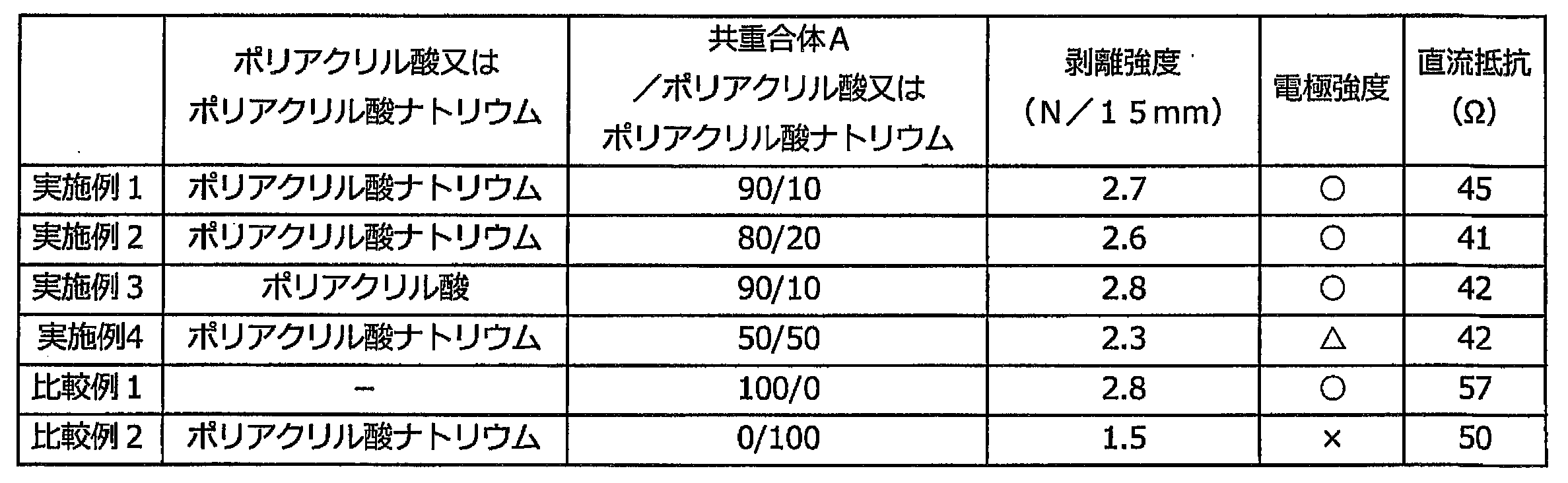
Claims (10)
- ビニルアルコールとエチレン性不飽和カルボン酸アルカリ金属中和物との共重合体、並びに、ポリ(メタ)アクリル酸及びポリ(メタ)アクリル酸アルカリ金属中和物の少なくとも一方を含む、非水電解質二次電池電極用バインダー。
- 前記共重合体における前記ビニルアルコールと前記エチレン性不飽和カルボン酸アルカリ金属中和物の共重合組成比は、モル比で95/5~5/95である、請求項1に記載の非水電解質二次電池電極用バインダー。
- 前記エチレン性不飽和力ルボン酸アルカリ金属中和物は、(メタ)アクリル酸アルカリ金属中和物である、請求項1または2に記載の非水電解質二次電池電極用バインダー。
- 前記共重合体と、前記ポリ(メタ)アクリル酸及びポリ(メタ)アクリル酸アルカリ金属中和物の合計との質量比が、95/5~30/70である、請求項1~3のいずれか一項に記載の非水電解質二次電池電極用バインダー。
- 電極活物質と、導電助剤と、請求項1~4のいずれか一項に記載の非水電解質二次電池電極用バインダーとを含む、非水電解質二次電池用電極合剤。
- 前記バインダーの含有量が、前記電極活物質、前記導電助剤、及び前記バインダーの合計100質量部に対して、0.5~40質量部である、請求項5に記載の非水電解質二次電池用電極合剤。
- 請求項5または6に記載の非水電解質二次電池用電極合剤を用いて作製された非水電解質二次電池用電極。
- 請求項7に記載の非水電解質二次電池用電極を備えた非水電解質二次電池。
- 請求項8に記載の非水電解質二次電池を備えた電気機器。
- ビニルアルコールとエチレン性不飽和カルボン酸アルカリ金属中和物との共重合体、並びに、ポリ(メタ)アクリル酸及びポリ(メタ)アクリル酸アルカリ金属中和物の少なくとも一方を含むバインダーの、非水電解質二次電池電極への使用。
Priority Applications (5)
| Application Number | Priority Date | Filing Date | Title |
|---|---|---|---|
| CN201880044428.2A CN110832684A (zh) | 2017-09-29 | 2018-09-26 | 非水电解质二次电池电极用粘合剂、非水电解质二次电池用电极合剂、非水电解质二次电池用电极、非水电解质二次电池及电气设备 |
| EP18861640.3A EP3691005B1 (en) | 2017-09-29 | 2018-09-26 | Binder for nonaqueous electrolyte secondary battery electrode, electrode mixture for nonaqueous electrolyte secondary battery, electrode for nonaqueous electrolyte secondary battery, nonaqueous electrolyte secondary battery, and electric apparatus |
| KR1020197038558A KR20200062082A (ko) | 2017-09-29 | 2018-09-26 | 비수전해질 이차전지 전극용 바인더, 비수전해질 이차전지용 전극합제, 비수전해질 이차전지용 전극, 비수전해질 이차전지, 및 전기기기 |
| US16/651,623 US20200299495A1 (en) | 2017-09-29 | 2018-09-26 | Binder for nonaqueous electrolyte secondary battery electrode, electrode mixture for nonaqueous electrolyte secondary battery, electrode for nonaqueous electrolyte secondary battery, nonaqueous electrolyte secondary battery, and electrical device |
| JP2019545547A JP7223699B2 (ja) | 2017-09-29 | 2018-09-26 | 非水電解質二次電池電極用バインダー、非水電解質二次電池用電極合剤、非水電解質二次電池用電極、非水電解質二次電池、及び電気機器 |
Applications Claiming Priority (2)
| Application Number | Priority Date | Filing Date | Title |
|---|---|---|---|
| JP2017189254 | 2017-09-29 | ||
| JP2017-189254 | 2017-09-29 |
Publications (1)
| Publication Number | Publication Date |
|---|---|
| WO2019065704A1 true WO2019065704A1 (ja) | 2019-04-04 |
Family
ID=65902944
Family Applications (1)
| Application Number | Title | Priority Date | Filing Date |
|---|---|---|---|
| PCT/JP2018/035609 Ceased WO2019065704A1 (ja) | 2017-09-29 | 2018-09-26 | 非水電解質二次電池電極用バインダー、非水電解質二次電池用電極合剤、非水電解質二次電池用電極、非水電解質二次電池、及び電気機器 |
Country Status (7)
| Country | Link |
|---|---|
| US (1) | US20200299495A1 (ja) |
| EP (1) | EP3691005B1 (ja) |
| JP (1) | JP7223699B2 (ja) |
| KR (1) | KR20200062082A (ja) |
| CN (1) | CN110832684A (ja) |
| TW (1) | TW201921788A (ja) |
| WO (1) | WO2019065704A1 (ja) |
Cited By (4)
| Publication number | Priority date | Publication date | Assignee | Title |
|---|---|---|---|---|
| JP2020194681A (ja) * | 2019-05-27 | 2020-12-03 | 株式会社Gsユアサ | 蓄電素子 |
| CN114424363A (zh) * | 2019-09-30 | 2022-04-29 | 日本瑞翁株式会社 | 二次电池用粘结剂组合物、二次电池电极用浆料组合物、二次电池用电极和二次电池 |
| EP4112653A4 (en) * | 2020-02-26 | 2025-04-09 | Sumitomo Seika Chemicals Co., Ltd. | Binder for secondary battery |
| US12355079B2 (en) | 2020-07-02 | 2025-07-08 | Ionblox, Inc. | Lithium ion cells with silicon based active materials and negative electrodes with water-based binders having good adhesion and cohesion |
Families Citing this family (2)
| Publication number | Priority date | Publication date | Assignee | Title |
|---|---|---|---|---|
| CN113659280A (zh) * | 2021-07-13 | 2021-11-16 | 河北金力新能源科技股份有限公司 | 一种高导电性能的复合涂层隔膜及其制备方法和其组装形成的锂电池 |
| KR102766321B1 (ko) * | 2023-12-26 | 2025-02-14 | 주식회사 한솔케미칼 | 공중합체를 포함하는 바인더, 상기 바인더를 포함하는 이차전지용 음극 및 상기 음극을 포함하는 이차전지 |
Citations (10)
| Publication number | Priority date | Publication date | Assignee | Title |
|---|---|---|---|---|
| JPH04188559A (ja) | 1990-11-21 | 1992-07-07 | Bridgestone Corp | 非水電解質二次電池 |
| JPH08264180A (ja) | 1995-03-24 | 1996-10-11 | Central Glass Co Ltd | リチウム二次電池用負極材料およびそれを用いたリチウム二次電池 |
| JPH10284082A (ja) | 1997-02-10 | 1998-10-23 | Toray Ind Inc | 電池用電極およびそれを用いた二次電池 |
| JPH10302799A (ja) | 1997-04-25 | 1998-11-13 | Jsr Corp | 非水系電池電極用バインダー |
| WO2004049475A1 (ja) | 2002-11-22 | 2004-06-10 | Kureha Chemical Industry Company, Limited | 非水電解液電池の電極用バインダー組成物およびそれを用いた電極合剤、電極並びに電池 |
| WO2014057627A1 (ja) * | 2012-10-12 | 2014-04-17 | 独立行政法人産業技術総合研究所 | リチウムイオン二次電池正極用バインダー、このバインダーを含むリチウムイオン二次電池用正極、この正極を用いたリチウムイオン二次電池及び電気機器 |
| WO2014207967A1 (ja) * | 2013-06-28 | 2014-12-31 | 住友精化株式会社 | 非水電解質二次電池用負極合剤、この合剤を含む非水電解質二次電池用負極及びこの負極を備えた非水電解質二次電池並びに電気機器 |
| JP2015201267A (ja) * | 2014-04-04 | 2015-11-12 | 住友精化株式会社 | リチウムイオン二次電池電極用合剤、この合剤を含むリチウムイオン二次電池用電極およびこの電極を備えたリチウムイオン二次電池並びに電気機器 |
| WO2017168947A1 (ja) * | 2016-03-30 | 2017-10-05 | 住友精化株式会社 | 非水電解質二次電池電極用バインダー、非水電解質二次電池用電極合剤、非水電解質二次電池用電極、非水電解質二次電池、および電気機器 |
| WO2018168520A1 (ja) * | 2017-03-16 | 2018-09-20 | 株式会社クラレ | 非水電解質電池用バインダー組成物、並びにそれを用いた非水電解質電池用バインダー水溶液、非水電解質電池用スラリー組成物、非水電解質電池用電極、及び非水電解質電池 |
Family Cites Families (4)
| Publication number | Priority date | Publication date | Assignee | Title |
|---|---|---|---|---|
| KR20040049475A (ko) | 2002-12-06 | 2004-06-12 | 삼성전자주식회사 | 웨이퍼 소잉 방법 |
| JP2016042408A (ja) * | 2013-01-23 | 2016-03-31 | 昭和電工株式会社 | リチウム二次電池電極用バインダーの製造方法及びリチウム二次電池電極用バインダー |
| JP6258641B2 (ja) * | 2013-09-06 | 2018-01-10 | マクセルホールディングス株式会社 | 非水電解液二次電池 |
| KR102422838B1 (ko) * | 2014-04-01 | 2022-07-19 | 스미토모 세이카 가부시키가이샤 | 전기 이중층 커패시터 전극용 바인더, 이 바인더를 포함하는 전기 이중층 커패시터 전극, 이 전극을 이용한 전기 이중층 커패시터 및 전기기기 |
-
2018
- 2018-09-26 CN CN201880044428.2A patent/CN110832684A/zh active Pending
- 2018-09-26 KR KR1020197038558A patent/KR20200062082A/ko not_active Withdrawn
- 2018-09-26 JP JP2019545547A patent/JP7223699B2/ja active Active
- 2018-09-26 EP EP18861640.3A patent/EP3691005B1/en active Active
- 2018-09-26 WO PCT/JP2018/035609 patent/WO2019065704A1/ja not_active Ceased
- 2018-09-26 US US16/651,623 patent/US20200299495A1/en not_active Abandoned
- 2018-09-27 TW TW107134078A patent/TW201921788A/zh unknown
Patent Citations (10)
| Publication number | Priority date | Publication date | Assignee | Title |
|---|---|---|---|---|
| JPH04188559A (ja) | 1990-11-21 | 1992-07-07 | Bridgestone Corp | 非水電解質二次電池 |
| JPH08264180A (ja) | 1995-03-24 | 1996-10-11 | Central Glass Co Ltd | リチウム二次電池用負極材料およびそれを用いたリチウム二次電池 |
| JPH10284082A (ja) | 1997-02-10 | 1998-10-23 | Toray Ind Inc | 電池用電極およびそれを用いた二次電池 |
| JPH10302799A (ja) | 1997-04-25 | 1998-11-13 | Jsr Corp | 非水系電池電極用バインダー |
| WO2004049475A1 (ja) | 2002-11-22 | 2004-06-10 | Kureha Chemical Industry Company, Limited | 非水電解液電池の電極用バインダー組成物およびそれを用いた電極合剤、電極並びに電池 |
| WO2014057627A1 (ja) * | 2012-10-12 | 2014-04-17 | 独立行政法人産業技術総合研究所 | リチウムイオン二次電池正極用バインダー、このバインダーを含むリチウムイオン二次電池用正極、この正極を用いたリチウムイオン二次電池及び電気機器 |
| WO2014207967A1 (ja) * | 2013-06-28 | 2014-12-31 | 住友精化株式会社 | 非水電解質二次電池用負極合剤、この合剤を含む非水電解質二次電池用負極及びこの負極を備えた非水電解質二次電池並びに電気機器 |
| JP2015201267A (ja) * | 2014-04-04 | 2015-11-12 | 住友精化株式会社 | リチウムイオン二次電池電極用合剤、この合剤を含むリチウムイオン二次電池用電極およびこの電極を備えたリチウムイオン二次電池並びに電気機器 |
| WO2017168947A1 (ja) * | 2016-03-30 | 2017-10-05 | 住友精化株式会社 | 非水電解質二次電池電極用バインダー、非水電解質二次電池用電極合剤、非水電解質二次電池用電極、非水電解質二次電池、および電気機器 |
| WO2018168520A1 (ja) * | 2017-03-16 | 2018-09-20 | 株式会社クラレ | 非水電解質電池用バインダー組成物、並びにそれを用いた非水電解質電池用バインダー水溶液、非水電解質電池用スラリー組成物、非水電解質電池用電極、及び非水電解質電池 |
Non-Patent Citations (1)
| Title |
|---|
| See also references of EP3691005A4 |
Cited By (6)
| Publication number | Priority date | Publication date | Assignee | Title |
|---|---|---|---|---|
| JP2020194681A (ja) * | 2019-05-27 | 2020-12-03 | 株式会社Gsユアサ | 蓄電素子 |
| JP7215329B2 (ja) | 2019-05-27 | 2023-01-31 | 株式会社Gsユアサ | 蓄電素子 |
| CN114424363A (zh) * | 2019-09-30 | 2022-04-29 | 日本瑞翁株式会社 | 二次电池用粘结剂组合物、二次电池电极用浆料组合物、二次电池用电极和二次电池 |
| EP4039715A4 (en) * | 2019-09-30 | 2023-10-18 | Zeon Corporation | BINDER COMPOSITION FOR SECONDARY BATTERIES, THICK SUSPENSION COMPOSITION FOR SECONDARY BATTERY ELECTRODES, ELECTRODE FOR SECONDARY BATTERIES, AND SECONDARY BATTERY |
| EP4112653A4 (en) * | 2020-02-26 | 2025-04-09 | Sumitomo Seika Chemicals Co., Ltd. | Binder for secondary battery |
| US12355079B2 (en) | 2020-07-02 | 2025-07-08 | Ionblox, Inc. | Lithium ion cells with silicon based active materials and negative electrodes with water-based binders having good adhesion and cohesion |
Also Published As
| Publication number | Publication date |
|---|---|
| EP3691005A4 (en) | 2021-08-04 |
| US20200299495A1 (en) | 2020-09-24 |
| TW201921788A (zh) | 2019-06-01 |
| EP3691005A1 (en) | 2020-08-05 |
| JP7223699B2 (ja) | 2023-02-16 |
| EP3691005B1 (en) | 2025-08-13 |
| JPWO2019065704A1 (ja) | 2020-11-05 |
| KR20200062082A (ko) | 2020-06-03 |
| CN110832684A (zh) | 2020-02-21 |
Similar Documents
| Publication | Publication Date | Title |
|---|---|---|
| JP6891166B2 (ja) | 非水電解質二次電池電極用バインダー、非水電解質二次電池用電極合剤、非水電解質二次電池用電極、非水電解質二次電池、および電気機器 | |
| JP5686332B2 (ja) | リチウムイオン二次電池正極用バインダー、このバインダーを含むリチウムイオン二次電池用正極、この正極を用いたリチウムイオン二次電池及び電気機器 | |
| JP7139342B2 (ja) | 非水電解質二次電池用電極合剤 | |
| JP7223699B2 (ja) | 非水電解質二次電池電極用バインダー、非水電解質二次電池用電極合剤、非水電解質二次電池用電極、非水電解質二次電池、及び電気機器 | |
| JP6278804B2 (ja) | リチウムイオン二次電池電極用合剤、この合剤を含むリチウムイオン二次電池用電極およびこの電極を備えたリチウムイオン二次電池並びに電気機器 | |
| KR20160024921A (ko) | 비수전해질 이차전지용 음극합제, 이 합제를 포함하는 비수전해질 이차전지용 음극 및 이 음극을 구비한 비수전해질 이차전지 그리고 전기기기 | |
| JP7223700B2 (ja) | 非水電解質二次電池電極用バインダー、非水電解質二次電池用電極合剤、非水電解質二次電池用電極、非水電解質二次電池、及び電気機器 |
Legal Events
| Date | Code | Title | Description |
|---|---|---|---|
| 121 | Ep: the epo has been informed by wipo that ep was designated in this application |
Ref document number: 18861640 Country of ref document: EP Kind code of ref document: A1 |
|
| ENP | Entry into the national phase |
Ref document number: 20197038558 Country of ref document: KR Kind code of ref document: A |
|
| ENP | Entry into the national phase |
Ref document number: 2019545547 Country of ref document: JP Kind code of ref document: A |
|
| NENP | Non-entry into the national phase |
Ref country code: DE |
|
| ENP | Entry into the national phase |
Ref document number: 2018861640 Country of ref document: EP Effective date: 20200429 |
|
| WWG | Wipo information: grant in national office |
Ref document number: 2018861640 Country of ref document: EP |