WO2019066085A1 - 高密度木質積層材の製造方法 - Google Patents
高密度木質積層材の製造方法 Download PDFInfo
- Publication number
- WO2019066085A1 WO2019066085A1 PCT/JP2018/036707 JP2018036707W WO2019066085A1 WO 2019066085 A1 WO2019066085 A1 WO 2019066085A1 JP 2018036707 W JP2018036707 W JP 2018036707W WO 2019066085 A1 WO2019066085 A1 WO 2019066085A1
- Authority
- WO
- WIPO (PCT)
- Prior art keywords
- treatment
- wood
- density
- strand
- press
- Prior art date
- Legal status (The legal status is an assumption and is not a legal conclusion. Google has not performed a legal analysis and makes no representation as to the accuracy of the status listed.)
- Ceased
Links
Images



Classifications
-
- B—PERFORMING OPERATIONS; TRANSPORTING
- B27—WORKING OR PRESERVING WOOD OR SIMILAR MATERIAL; NAILING OR STAPLING MACHINES IN GENERAL
- B27N—MANUFACTURE BY DRY PROCESSES OF ARTICLES, WITH OR WITHOUT ORGANIC BINDING AGENTS, MADE FROM PARTICLES OR FIBRES CONSISTING OF WOOD OR OTHER LIGNOCELLULOSIC OR LIKE ORGANIC MATERIAL
- B27N1/00—Pretreatment of moulding material
-
- B—PERFORMING OPERATIONS; TRANSPORTING
- B27—WORKING OR PRESERVING WOOD OR SIMILAR MATERIAL; NAILING OR STAPLING MACHINES IN GENERAL
- B27N—MANUFACTURE BY DRY PROCESSES OF ARTICLES, WITH OR WITHOUT ORGANIC BINDING AGENTS, MADE FROM PARTICLES OR FIBRES CONSISTING OF WOOD OR OTHER LIGNOCELLULOSIC OR LIKE ORGANIC MATERIAL
- B27N3/00—Manufacture of substantially flat articles, e.g. boards, from particles or fibres
- B27N3/02—Manufacture of substantially flat articles, e.g. boards, from particles or fibres from particles
-
- B—PERFORMING OPERATIONS; TRANSPORTING
- B27—WORKING OR PRESERVING WOOD OR SIMILAR MATERIAL; NAILING OR STAPLING MACHINES IN GENERAL
- B27D—WORKING VENEER OR PLYWOOD
- B27D5/00—Other working of veneer or plywood specially adapted to veneer or plywood
-
- B—PERFORMING OPERATIONS; TRANSPORTING
- B27—WORKING OR PRESERVING WOOD OR SIMILAR MATERIAL; NAILING OR STAPLING MACHINES IN GENERAL
- B27K—PROCESSES, APPARATUS OR SELECTION OF SUBSTANCES FOR IMPREGNATING, STAINING, DYEING, BLEACHING OF WOOD OR SIMILAR MATERIALS, OR TREATING OF WOOD OR SIMILAR MATERIALS WITH PERMEANT LIQUIDS, NOT OTHERWISE PROVIDED FOR; CHEMICAL OR PHYSICAL TREATMENT OF CORK, CANE, REED, STRAW OR SIMILAR MATERIALS
- B27K5/00—Treating of wood not provided for in groups B27K1/00, B27K3/00
-
- B—PERFORMING OPERATIONS; TRANSPORTING
- B27—WORKING OR PRESERVING WOOD OR SIMILAR MATERIAL; NAILING OR STAPLING MACHINES IN GENERAL
- B27M—WORKING OF WOOD NOT PROVIDED FOR IN SUBCLASSES B27B - B27L; MANUFACTURE OF SPECIFIC WOODEN ARTICLES
- B27M1/00—Working of wood not provided for in subclasses B27B - B27L, e.g. by stretching
- B27M1/08—Working of wood not provided for in subclasses B27B - B27L, e.g. by stretching by multi-step processes
-
- B—PERFORMING OPERATIONS; TRANSPORTING
- B27—WORKING OR PRESERVING WOOD OR SIMILAR MATERIAL; NAILING OR STAPLING MACHINES IN GENERAL
- B27N—MANUFACTURE BY DRY PROCESSES OF ARTICLES, WITH OR WITHOUT ORGANIC BINDING AGENTS, MADE FROM PARTICLES OR FIBRES CONSISTING OF WOOD OR OTHER LIGNOCELLULOSIC OR LIKE ORGANIC MATERIAL
- B27N3/00—Manufacture of substantially flat articles, e.g. boards, from particles or fibres
- B27N3/04—Manufacture of substantially flat articles, e.g. boards, from particles or fibres from fibres
-
- B—PERFORMING OPERATIONS; TRANSPORTING
- B27—WORKING OR PRESERVING WOOD OR SIMILAR MATERIAL; NAILING OR STAPLING MACHINES IN GENERAL
- B27N—MANUFACTURE BY DRY PROCESSES OF ARTICLES, WITH OR WITHOUT ORGANIC BINDING AGENTS, MADE FROM PARTICLES OR FIBRES CONSISTING OF WOOD OR OTHER LIGNOCELLULOSIC OR LIKE ORGANIC MATERIAL
- B27N3/00—Manufacture of substantially flat articles, e.g. boards, from particles or fibres
- B27N3/08—Moulding or pressing
- B27N3/10—Moulding of mats
- B27N3/14—Distributing or orienting the particles or fibres
- B27N3/143—Orienting the particles or fibres
-
- B—PERFORMING OPERATIONS; TRANSPORTING
- B27—WORKING OR PRESERVING WOOD OR SIMILAR MATERIAL; NAILING OR STAPLING MACHINES IN GENERAL
- B27N—MANUFACTURE BY DRY PROCESSES OF ARTICLES, WITH OR WITHOUT ORGANIC BINDING AGENTS, MADE FROM PARTICLES OR FIBRES CONSISTING OF WOOD OR OTHER LIGNOCELLULOSIC OR LIKE ORGANIC MATERIAL
- B27N3/00—Manufacture of substantially flat articles, e.g. boards, from particles or fibres
- B27N3/08—Moulding or pressing
- B27N3/18—Auxiliary operations, e.g. preheating, humidifying, cutting-off
-
- B—PERFORMING OPERATIONS; TRANSPORTING
- B30—PRESSES
- B30B—PRESSES IN GENERAL
- B30B9/00—Presses specially adapted for particular purposes
-
- B—PERFORMING OPERATIONS; TRANSPORTING
- B30—PRESSES
- B30B—PRESSES IN GENERAL
- B30B9/00—Presses specially adapted for particular purposes
- B30B9/28—Presses specially adapted for particular purposes for forming shaped articles
-
- B—PERFORMING OPERATIONS; TRANSPORTING
- B27—WORKING OR PRESERVING WOOD OR SIMILAR MATERIAL; NAILING OR STAPLING MACHINES IN GENERAL
- B27N—MANUFACTURE BY DRY PROCESSES OF ARTICLES, WITH OR WITHOUT ORGANIC BINDING AGENTS, MADE FROM PARTICLES OR FIBRES CONSISTING OF WOOD OR OTHER LIGNOCELLULOSIC OR LIKE ORGANIC MATERIAL
- B27N3/00—Manufacture of substantially flat articles, e.g. boards, from particles or fibres
- B27N3/08—Moulding or pressing
- B27N3/24—Moulding or pressing characterised by using continuously acting presses having endless belts or chains moved within the compression zone
Definitions
- the present invention relates to a method of producing high density wood laminates.
- Patent Document 1 a large OSB plate having a high density of at most 700 kg / m 3 , a length of at least 7 m, and a bending elastic modulus in the main load direction of at least 7000 N / mm 2 Is disclosed.
- the present invention has been made in view of these points, and an object thereof is to produce a high-density wood laminate, and even if it is a high-density wood laminate by devising its process, In order to be able to form with a press pressure similar to the press pressure necessary to obtain wood laminates with a reasonable density, high-density wood laminates can be produced with high production efficiency without using special equipment. It is to do.
- the wood materials themselves are subjected to a specific pretreatment for softening or compressing (collapsing) the wood materials. I decided.
- the fibers are predetermined to be a large number of wood materials made of strands which are thin plate-like cutting pieces having a density of 300 kg / m 3 or more and less than 700 kg / m 3 and elongated in the fiber direction of wood.
- the wood material assembly is stacked while being oriented so as to face the reference direction of the sheet to form an aggregate of wood materials, and the aggregate is laminated in a plurality of layers to form a laminate mat of wood materials, and the laminate mat is pressed by press molding
- the object is a method of producing a high-density wood laminate by integrating and integrating.
- This method is a physical treatment for physically compressing the wood material before it is laminated on the laminated mat, and a high frequency treatment for softening the wood material by dielectric heating from the inside by high frequency irradiation.
- High temperature and high pressure treatment to apply high temperature and high pressure to wood material
- high water pressure treatment to form fine scratches on the surface of wood material with high pressure water
- water from wood material under vacuum condition after making wood material saturated
- the laminated mat of the wood material subjected to the pretreatment process is press-formed at a pressure of 4 N / mm 2 or less at the time of the above-mentioned press forming to obtain a high density having a density of 750 to 950 kg / m 3 Form a wood laminate.
- the fibers are made of strands which are thin plate-like cutting pieces elongated in the fiber direction of the wood, and the fibers are oriented in the predetermined reference direction with a large number of wood materials having a density of 300 kg / m 3 to 700 kg / m 3.
- the aggregate is laminated in a plurality of layers to form a laminated mat of wood materials, and the laminated mats are pressed and integrated by press molding to form a wood laminated material Molding.
- pretreatment is performed to soften, compress, or crush each wood material before being laminated to the laminated mat in the pretreatment process before the press molding.
- the pretreatment step at least one of physical treatment, high frequency treatment, high temperature and high pressure treatment, high water pressure treatment, repeated deaeration and dehydration treatment, and chemical treatment is performed on the wood material.
- assembly of the wood material after this pre-processing is laminated
- the wood material is pretreated in advance, and the wood material is softened or compressed (collapsed) to obtain a high density wood laminate having a high density of 750 to 950 kg / m 3.
- molding can be performed with a pressing pressure of 4 N / mm 2 or less, which is approximately the same as the pressing pressure required to obtain a wood laminated material having a general density. Therefore, it is possible to produce a high density wood laminated material without using special equipment in consideration of the risk of puncture, and it is possible to enhance the production efficiency.
- the physical treatment includes beating treatment for tapping and compressively deforming a wood material, roll press treatment for compressing a wood material with a roll press, or flat plate pressing treatment for compressing a wood material with a flat plate press. Is preferred.
- the physical treatment includes beating treatment, roll pressing treatment or flat plate pressing treatment, and these treatments can perform desired physical treatment on the wood material.
- the first treatment step in which the pretreatment step performs at least one of beating treatment, high frequency treatment, high temperature high pressure treatment, high water pressure treatment, repeated deaeration and dehydration treatment, and chemical treatment, and roll press treatment or It is preferable to consist of at least one with the 2nd process process which performs a flat plate press process.
- the pretreatment step for the wood material is at least one of the first and second treatment steps, and the desired pretreatment can be easily performed by the first and second treatment steps.
- the said pre-processing process performs a 2nd processing process after a 1st processing process.
- at least one of beating treatment, high frequency treatment, high temperature and high pressure treatment, high water pressure treatment, repeated deaeration and dehydration treatment, and chemical treatment is first performed in the first treatment step as pretreatment for wood material.
- roll press treatment or flat plate press treatment is performed.
- the roll press treatment or the flat plate performed in the second treatment process is performed as compared with the case where only the second treatment process is used as the pretreatment process.
- the pressure required for the pressing process can be reduced, and the destruction of the wood material can be suppressed, and the strength of the wood laminate material can be increased.
- a large number of wood material aggregates consisting of strands which are thin plate-like cutting pieces elongated in the fiber direction of wood are laminated in a plurality of layers to form a wood material laminate mat, and the lamination mat is press-formed
- a wood laminate material is formed by pressing and integrating it into a wood laminate material
- the wood material before lamination to the laminate mat is subjected to a specific pretreatment such that the wood material before lamination is softened, compressed or crushed
- High density wood with a high density of 750 to 950 kg / m 3 at a pressure equivalent to or less than 4 N / mm 2 which is similar to that required for obtaining wood laminates of general density when pressing to laminated mats.
- the laminated material can be formed, and the high density wooden laminated material can be produced with high production efficiency without using special equipment.
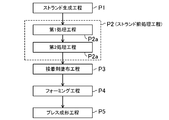
- FIG. 1 is a block diagram showing a manufacturing process of a strand board according to an embodiment of the present invention.
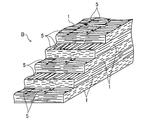
- FIG. 2 is a perspective view of the manufactured strand board.
- FIG. 3 is a cross-sectional view schematically showing a laminated state of strand layers in the strand board.
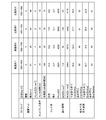
- FIG. 4 is a view showing test results of Examples 1 and 2 and Comparative Examples 1 and 2.
- FIG. 5 is a view showing the density distribution of the strand board according to the first embodiment.
- FIG. 6 is a view showing the density distribution of the strand board according to Comparative Example 1.
- FIG. 1 shows a manufacturing process of a method of manufacturing a high density strand board B as a high density wooden laminate according to an embodiment of the present invention
- FIGS. 2 and 3 show a strand board B manufactured by the manufacturing method. It shows. First, this strand board B will be described.
- the strand board B is provided with strand layers 1, 1,... As plural wood layers (five layers in the illustrated example) as wood material layers.
- Each strand layer 1 is composed of an assembly of a large number of strands 5, 5, ... (wood material) as cutting pieces, and an assembly of the strands 5, 5, ... is laminated and integrated in a plurality of layers , And a plurality of strand layers 1, 1, ... are formed.
- FIG. 2 and 3 show an example in which all the thicknesses of the plurality of strand layers 1, 1, ... are equal to one another. That is, when the upper side of FIG. 2 and FIG. 3 is the front side and the lower side is the back side, the thickness of the strand layers 1, 1 of the front and back and the thickness of the three strand layers 1, 1,. It is the same.
- the thickness of the plurality of strand layers 1, 1, ... may be different so as to be a plurality of types of thickness.
- the number of layers of the strand layers 1, 1, ... may be a plurality of layers.
- the thickness and the number of layers of the strand layers 1, 1,... Can be appropriately changed according to the application of the strand board B and the like.
- Each strand 5 is, for example, a thin plate piece or a piece having a length of 150 to 200 mm, a width of 15 to 25 mm, and a thickness of 0.3 to 2 mm along the fiber direction.
- the tree species used for the strand 5 is not particularly limited, and may be, for example, a south ocean tree or a broadleaf tree, or any other tree species. Specific examples thereof include, but are not limited to, fur materials such as cedar, cypress and bay pine, acacia, aspen, poplar, pines (hard pine, soft pine, radiata pine etc.), birch, rubber (rubber tree) etc. Not limited to these tree species, various tree species can be used.
- Various tree species include sawara, hiba, kaya, persimmon, various pines, persimmons, persimmons, persimmons (white persimmons), vermicelli, beech, persimmons, persimmons, persimmons, persimmons, persimmons, etc., domestic wood, rice Japanese cypress, rice hija, rice cedar, rice bran, spruce, rice bran, redwood etc.
- North American materials such as Agassis, Terminaria, Ravan, Melanch, Sengonlaut, Junkon, CNle, Karampayan, Amberoi, Melina, teak, Apiton, Sengonlaut etc.
- the density is about 300 ⁇ 1100kg / m 3, more preferably 380 ⁇ 700kg / m 3.
- the density is 300 kg / m 3 or less, the thickness of the laminated mat required to form the strand board B having the same density and the same strength is increased, and the hot pressing process is performed in the press forming process P5 described later. It is because it is necessary to raise the press pressure which concerns.
- the density of the strands 5 may exceed 1100 kg / m 3 , it is difficult to easily obtain such strands 5. That is, the upper limit value of the density is not limited to 1100 kg / m 3, and may be a higher value, as long as strands 5 exceeding 1100 kg / m 3 can be easily obtained.
- the moisture content of the strand 5 is preferably about 2 to 20%, and more preferably 2 to 8%. If the water content is less than 2%, it takes a long time to soften in the hot-pressing treatment in the press-forming step, and the pressing time may be prolonged, and the strength may be lowered.
- the moisture content of the strand 5 exceeds 20%, it takes time to heat and compress in the same hot-pressing process, making it easy to puncture, and furthermore, the curing of the adhesive is inhibited and the strength may be lowered. There is.
- each strand layer 1 a large number of strands 5, 5, ... are oriented so that the fiber direction (longitudinal direction of the strands 5) which is the direction along the fibers (not shown) is along a predetermined direction. There is.
- the fibers of the strands 5, 5,... Do not necessarily point in the same direction exactly.
- the fiber directions of the oriented strands 5, 5, ... do not have to be parallel to one another. That is, strands 5, 5,... In which the fiber direction is inclined to a predetermined reference direction (for example, about 20 °) may be included.
- the plurality of strand layers 1, 1,... are laminated so that the fibers of the strands 5, 5,... Extend in directions orthogonal to or intersecting with each other between the adjacent strand layers 1. Being integrated. That is, in the five strand layers 1, 1, ..., in the strand layer 1 of the surface layer (the layer at the top of FIGS. 2 and 3) and the strand layer 1 of the back layer (the layer at the same bottom) The fiber directions of the strands 5, 5, ... that constitute 1, 1 extend along the same direction.
- the plural strand layers 1, 1,... are laminated so that the fibers of the strands 5, 5,... Extend parallel to or substantially parallel to each other between the adjacent strand layers 1. It may be integrated and integrated.
- the density of the strand layers 1, 1, ... in the strand board B may be the same or different. In the latter case, at least one of the strand layers 1, 1, ... in the strand board B is a high density strand layer higher in density than the other strand layers 1, and the remaining other strand layers 1 are low in density It shall be a strand layer.
- the "density of the strand layer 1" refers not to the density of the strand 5 itself but to the density of the strand layer 1 itself which is an aggregate thereof.
- the density of the entire strand board B is 750 to 950 kg / m 3 , which is a high density.
- This manufacturing method includes a strand forming step P1, a strand pretreatment step P2, an adhesive application step P3, a forming step P4 (mat formation step) and a press forming step P5 (forming compression step).
- a strand generation step P1 for obtaining a large number of strands 5, 5, ... (cut pieces of wood or the like) is performed.
- This process P1 includes a cutting process of cutting a raw material (raw wood) by, for example, a cutting machine, and the strands 5, 5, ... are generated by the cutting.
- raw materials mature trees such as logs and thinnings, scraps and wastes generated at construction sites, and waste pallets are used.
- a strand pretreatment step P2 is applied to the obtained large number of strands 5, 5,.
- a low pressure press with a low pressing pressure (clamping pressure) of, for example, about 4 N / mm 2 is possible in the press-forming step P5 of post-treatment by softening or compressing the strand 5
- the pretreatment process P2 is divided into a first treatment process P2a and a second treatment process P2b performed thereafter.
- first treatment step P2a at least one of beating treatment, high frequency treatment, high temperature high pressure treatment, high water pressure treatment, repeated deaeration / dehydration treatment, chemical treatment is performed, and in the second treatment step P2b, roll press treatment or Perform flat plate press processing.
- the beating treatment in the first treatment process P2a and the roll press treatment and the flat plate press treatment in the second treatment process P2b are all the physical treatments for physically compressing the strands 5.
- the beating process performed in the first process step P2a is a point compression method, and in the same manner as the metal forging process, the strand 5 is struck and compressed and deformed by a plurality of continuously arranged spring hammers and the like. This compresses and densifies the strand 5 without breaking it.
- the strand 5 as a dielectric (nonconductor) is irradiated with electromagnetic waves (high frequency) of high frequency for about 2 minutes, for example, between the electrodes, and the strand 5 is softened by dielectric heating from inside It is a method.
- a low pressure press with a low press pressure is made possible in the press forming step P5 of the post-treatment without densifying the strands 5.
- the strand 5 is made of wood having a high moisture content, heat is absorbed by absorption of electromagnetic waves into the moisture in the wood as the high frequency irradiation is applied, and the vapor pressure inside the timber increases and the moisture in the wood increases. It becomes hot water or steam and moves outward, and in the process the wood becomes significantly softened.
- the high temperature and high pressure treatment is a method of putting the strand 5 in a pressure cooker and applying high temperature and high pressure to damage and soften the cell wall of the strand 5 (wood material).
- the processing conditions are, for example, a temperature of 180 ° C. and a pressure of about 10 Bar for about 2 minutes. This method also enables low-pressure pressing with a low pressing pressure in the post-pressing step P5 without densifying the strands 5.
- the high water pressure treatment is a method of uniformly forming the strands 5 in a mesh material such as a wire mesh and forming fine scratches on the surface of the strands 5 with high pressure water of about 200 MPa, for example, through the mesh material. As a result, fine breakage occurs to obtain a softened strand 5.
- the strands 5 are put in a saturated state and then put into a batch-type kettle, and the inside of the kettle is evacuated to make the inside of the kettle vacuum to release moisture from the strands 5. It is a method of promoting the destruction of the cell wall of (wood material) to soften it. This method also enables low-pressure pressing with a low pressing pressure in the post-pressing step P5 without densifying the strands 5.
- the chemical treatment is a method of promoting plasticization of the strand 5 itself to soften it by adding sodium hydroxide or the like to the strand 5 and performing an alkali treatment.
- the strand 5 is immersed in an aqueous sodium hydroxide solution having a concentration of 10 to 15% for a certain time.
- the strand 5 may be immersed for a certain time in a potassium hydroxide aqueous solution having a concentration of 10 to 20%.
- This method also enables low-pressure pressing with a low pressing pressure in the post-pressing step P5 without densifying the strands 5.
- the roll press process performed in the second process step P2b is a linear compression method, and a roll press device (not shown) is provided so that a large number of strands 5, 5, ... (wood material) fall uniformly. Put in and pressurize. At that time, for example, the temperature is set to room temperature to 250 ° C., the clearance between the hot pressure rolls is set to about 0.2 mm, the feed rate is set to about 50 m / min, and the compression ratio is set to about 30 to 60%. As a result, the strand 5 is compressed without being broken to obtain a densified strand 5.
- Flat plate pressing is a surface compression method, in which the strands 5, 5, ... (wood material) are put into a hot-press flat plate press (not shown) and hot pressed.
- the pressing conditions are, for example, a temperature of 120 ° C. and a pressing pressure of about 4 N / mm 2 for about 5 minutes.
- the compression ratio at that time is about 10 to 30%. This method also compresses and densifies the strands 5 without breaking them.
- the strand 5 is dried as needed after the treatment, and the state after the treatment is maintained.
- the first processing step P2a may be performed after the second processing step P2 b by reversing the order of the first and second processing steps P2 a and P2 b, or the first and second processing steps Only one of P2a and P2b may be performed.
- the pressure necessary for the roll press process or the flat plate press process performed in the second process step P2b may be small, and the fracture of the strands 5 may be suppressed to increase the strength of the strand board B. It is preferable to carry out the second treatment process P2b after P2a.
- an adhesive application step P3 of applying an adhesive to the strands 5, 5, When a large number of strands 5, 5,... Are obtained in this manner, an adhesive application step P3 of applying an adhesive to the strands 5, 5,.
- an isocyanate-based adhesive can be used, and in addition, for example, an amine-based adhesive such as a phenol resin, a urea resin or a melamine resin may be used.
- a large number of strands 5, 5 ... coated with an adhesive are dispersed while being oriented so that the fibers are directed to a predetermined reference direction by a mat forming apparatus or the like, for example, to a thickness of about 7 to 12 mm.
- the thickness of the strand assembly is not limited to the above value, and may be less than 7 mm or more than 12 mm.
- a strand 5, 5 which is oriented such that the fiber direction is, for example, orthogonal or crossing. .. are distributed and stacked to form another strand assembly having a constant thickness as well.
- a laminated mat is formed.
- the desired number of laminations for example, 5 layers
- the fiber directions of the strands 5, 5, ... in adjacent strand assemblies are orthogonal to each other Cross.
- a laminated mat is formed.
- the thickness of the five layer laminate mat is, for example, about 35 to 60 mm.
- the number of layers of the strand assembly in the laminated mat is determined according to the number of layers of the strand board B.
- the density of the strands 5, 5, ... constituting the strand layer 1 may be substantially the same as each other among the plurality of strand layers 1, 1, ..., or may be different from each other.
- the press forming step P5 (forming and compressing step) is performed.
- the laminated mat is pressed and formed integrally by a hot press process at a predetermined pressure and temperature by a hot press apparatus.
- the pressure applied for this hot pressing process is 4 N / mm 2 or less, and the pressing time is, for example, 10 to 20 minutes.
- the pressing time varies depending on the thickness of the strand board B (finished product), and may be finished in less than 10 minutes or may take more than 20 minutes.
- a strand board B having a density of 750 to 950 kg / m 3 and a MOR (Modulus of Rupture) of 80 to 150 N / mm 2 as a bending strength is manufactured.
- a strand pretreatment step P2 before the press forming step P5 The pretreatment for the strand 5 is performed at.
- the first treatment step P2a and the subsequent second treatment step P2b are performed, and in the first treatment step P2a, beating treatment (physical treatment), high frequency treatment, high temperature high pressure treatment, high water pressure treatment At least one of repeated deaeration / dehydration treatment and chemical treatment, and roll press treatment or flat plate press treatment (both physical treatments) are performed in the second treatment process P2b.
- the aggregate of the pretreated strands 5 is laminated in a plurality of layers in the forming step P4 (mat formation step), and in that state, it is pressed and integrated by press forming in the press forming step P5, 750 to 950 kg A high density strand board B with a density of / m 3 is obtained.
- the strand 5 is pretreated in advance in the pretreatment step P2 before the press molding in the press molding step P5, and the strand 5 is softened or compressed (collapsed).
- a pressure of 4 kN / mm 2 or less which is as low as that required for obtaining a general density strand board. It becomes possible to form with clamping pressure. Therefore, high-density strand board B can be produced without using special equipment in consideration of the risk of puncture, and the production efficiency can be enhanced.
- the strand pretreatment step P2 first, at least one of beating treatment, high frequency treatment, high temperature high pressure treatment, high water pressure treatment, repeated deaeration and dehydration treatment, and chemical treatment is performed in the first treatment step P2a.
- roll press processing or flat plate press processing is performed in the subsequent second processing step P2b.
- the roll performed in the second treatment process P2b is compared to the case where only the second treatment process P2b is used as the pretreatment process.
- the pressure required in the pressing process or the flat plate pressing process can be reduced, and breakage of the strands 5 can be suppressed, and the strength of the strand board B can be increased.
- the present invention is not limited to the method of manufacturing such strand board B .
- the present invention can be applied to a method for producing a high-density strand material (wood laminated material) in which a plurality of strand layers having a rectangular cross-section (square-like shape) without a large difference in thickness and width are laminated.
- high-density strand material can be used for applications such as joists and columns.
- Example 1 A cypress-made strand with a length of 150 to 200 mm, a width of 15 to 25 mm, a thickness of 0.8 to 2 mm and a density of 300 to 450 kg / m 3 along the fiber direction is subjected to roll pressing as a pretreatment step.
- the temperature was set to 250 ° C.
- the clearance between the hot pressure rolls was set to 0.5 mm
- the feed rate was set to 1.5 m / min
- the compression ratio was set to 40%.
- the aggregate of a large number of strands after the roll pressing treatment was laminated to form a laminated mat of 37 mm in thickness consisting of five strand layers. Thereafter, hot pressing was performed for 10 minutes at a press temperature of 140 ° C. and a press pressure of 4 N / mm 2 to obtain a strand board having a density of 818 kg / m 3 and a thickness of 12.4 mm.
- FIG. 5 shows the result of measuring the density distribution in the thickness direction (stacking direction) of the strand board using a density distribution measuring apparatus (“DENSE-LAB X” manufactured by ELECTRONIC WOOD SYSTEM SGMBH).
- Example 2 A Beimatsu strand having a length of 150 to 200 mm, a width of 15 to 25 mm, a thickness of 0.8 to 2 mm and a density of 350 to 450 kg / m 3 along the fiber direction is subjected to roll pressing as a pretreatment step. Did.
- the pressing conditions are the same as in Example 1.
- the roll press-treated aggregate of a large number of strands was laminated to form a 36 mm-thick laminated mat consisting of five strand layers. Thereafter, hot pressing was performed for 10 minutes at a press temperature of 140 ° C. and a press pressure of 4 N / mm 2 to obtain a strand board having a density of 832 kg / m 3 and a thickness of 12.2 mm.
- the results of the bending test, the dimensional change test, and the water absorption test of Example 2 are shown in FIG.
- Example 1 As seen in Example 1 and Example 2 for cypress strands having a length of 150 to 200 mm, a width of 15 to 25 mm, a thickness of 0.8 to 2 mm and a density of 300 to 450 kg / m 3 along the fiber direction.
- the assembly of the large number of strands was laminated to form a 42 mm thick laminated mat consisting of five strand layers without any pretreatment. Thereafter, hot pressing was performed for 10 minutes at a press temperature of 140 ° C. and a press pressure of 8 N / mm 2 to obtain a strand board having a density of 779 kg / m 3 and a thickness of 12.7 mm.
- FIG. 6 shows the result of measuring the density distribution in the thickness direction (stacking direction) of the strand board using a density distribution measuring apparatus (“DENSE-LAB X” manufactured by ELECTRONIC WOOD SYSTEM SGMBH).
- Example 2 A Beimatsu strand having a length of 150 to 200 mm, a width of 15 to 25 mm, a thickness of 0.8 to 2 mm and a density of 350 to 450 kg / m 3 along the fiber direction, as in Example 1 and Example 2.
- the assembly of the large number of strands was laminated to form a laminated mat of 35 mm thick consisting of five strand layers without any pretreatment. Thereafter, hot pressing was performed for 10 minutes at a press temperature of 140 ° C. and a press pressure of 8 N / mm 2 to obtain a strand board having a density of 812 kg / m 3 and a thickness of 12.4 mm.
- the results of the bending test, the dimensional change test and the water absorption test of Comparative Example 2 are shown in the same FIG.
- Example 1 has a higher density and a higher MOR (Modulus of Rupture) and MOE (Modulus of Elasticity) as flexural strength than Comparative Example 1.
- the dimensional change rate and the water absorption rate are the same values in Example 1 and Comparative Example 1.
- Example 2 has a higher density, almost the same flexural strength and MOR, and a higher MOE, as compared to Comparative Example 2.
- the dimensional change rate and the water absorption rate are the same values in Example 2 and Comparative Example 2.
- the density distribution in the stacking direction of the plurality of strand layers is substantially constant as compared with Comparative Example 1 in Example 1. If the density distribution is substantially constant, for example, as shown in FIG. 5 and FIG. 6, when there is a change in the measurement result of the density distribution, the change in the intermediate value shown by the broken line in each figure is small. It includes that the intermediate value is substantially constant. For example, when the broken line shown in FIG. 5 (Example 1) is compared with the broken line shown in FIG. 6 (Comparative Example 1), the median value of the density distribution shown in FIG. It is a fixed value.
- the density distribution is substantially constant, there is no unevenness in the density distribution, and the water resistance and strength (shear strength etc.) of the strand board as a whole are improved.
- the low density portion is inferior in water resistance performance and strength as compared to the high density portion. Therefore, when there is unevenness in the density distribution, the performance of the entire strand board is limited by the water resistance performance and strength of the low density portion.
- the density distribution is substantially constant, it is possible to eliminate such a portion as a bottleneck of performance.
- the present invention is suitable for use as a floor material for containers, ships, vehicles and the like, and produces a high density building material with a low pressing pressure, which is also suitable for use as a floor material of buildings such as houses and load bearing materials. It is extremely useful and industrially applicable.
Landscapes
- Life Sciences & Earth Sciences (AREA)
- Engineering & Computer Science (AREA)
- Wood Science & Technology (AREA)
- Forests & Forestry (AREA)
- Manufacturing & Machinery (AREA)
- Mechanical Engineering (AREA)
- Dry Formation Of Fiberboard And The Like (AREA)
- Chemical And Physical Treatments For Wood And The Like (AREA)
Abstract
高密度のストランドボードを、一般的な密度のストランドボードと同程度のプレス圧力で成形できるようにして、特殊な設備を用いることなく生産できるようにする。プレス成形前のストランド5に対し、第1処理工程P2aとその後の第2処理工程P2bとからなる前処理工程P2を行う。第1処理工程P2aでは、ビーティング処理、高周波処理、高温高圧処理、高水圧処理、脱気・脱水繰り返し処理、化学処理のうちの少なくとも1つを行い、第2処理工程P2bでは、ロールプレス処理又は平板プレス処理を行う。4N/mm2以下のプレス圧力で750~950kg/m3のストランドボードBを成形する。
Description
本発明は、高密度の木質積層材を製造する方法に関する。
今日、アピトンやクルインといった広葉樹からなる南洋材が少なくなってきており、良質な単板を安価で入手することが困難となっている。そのため、それらの南洋材を用いた合板の品質低下が大きな問題となっている。合板の代替材料としてOSB(Oriented Strand Board)等の木質繊維板が用いられつつあるが、一般的な密度のOSBでは十分な強度を得ることができない。
そこで、従来、例えば特許文献1には、最大で700kg/m3の高い密度を有し、長さが少なくとも7mあり、主負荷方向における曲げ弾性係数として少なくとも7000N/mm2である大型のOSBプレートが開示されている。
しかし、この特許文献1の技術のように、700kg/m3以上の高密度のOSBプレートを成形するときには、パンクのリスクを考慮した特殊な設備が必要となる。そのため、その特殊な設備を用いなければ、それ以上の高密度化が難しく、しかも生産効率も低いという問題があった。
本発明は斯かる点に鑑みてなされたものであり、その目的は、高密度の木質積層材を製造するに当たり、その工程に工夫を加えることにより、高密度の木質積層材であっても一般的な密度の木質積層材を得る際に必要なプレス圧力と同程度のプレス圧力で成形できるようにして、高密度の木質積層材を特殊な設備を用いることなく高い生産効率で生産できるようにすることにある。
上記の目的を達成するために、本発明では、木質材の積層体をプレス成形する前に、その木質材自体に対し、木質材を軟化させないしは圧縮する(潰す)特定の前処理をすることとした。
具体的には、本発明では、300kg/m3以上で700kg/m3未満の密度を有し木材の繊維方向に細長い薄板状の切削片であるストランドからなる多数の木質材を、繊維が所定の基準方向に向くように配向させながら積み重ねて木質材の集合体を形成し、その集合体を複数層に積層して木質材の積層マットを形成し、その積層マットをプレス成形により圧締して一体化することにより、高密度の木質積層材を製造する方法が対象である。
この方法は、上記積層マットに積層される前の各木質材に対し、該木質材を物理的に圧縮処理する物理的処理、木質材を高周波の照射により内部から誘電加熱して軟化させる高周波処理、木質材に高温度及び高圧力を加える高温高圧処理、高圧水により木質材の表面に微細な傷を形成する高水圧処理、木質材を飽水状態にしてから真空条件下において木質材から水分を放出させる脱気・脱水繰り返し処理、木質材をアルカリ処理する化学処理のうちの少なくとも1つを行って、該積層前の木質材を軟化させ、圧縮し又は潰す前処理工程を備えている。そして、この前処理工程の処理が行われた木質材の積層マットを上記プレス成形時に4N/mm2以下の圧締圧力でプレス成形することで、750~950kg/m3の密度を有する高密度木質積層材を成形する。
この構成により、木材の繊維方向に細長い薄板状の切削片であるストランドからなり、300kg/m3以上で700kg/m3未満の密度を有する多数の木質材を繊維が所定の基準方向に向くように配向させながら積み重ねて木質材の集合体を形成し、その集合体を複数層に積層して木質材の積層マットを形成し、その積層マットをプレス成形により圧締して一体化し木質積層材を成形する。そのとき、そのプレス成形前の前処理工程において積層マットに積層される前の各木質材に対し、該木質材を軟化させ、圧縮し又は潰す前処理が行われる。すなわち、その前処理工程では、木質材に対し物理的処理、高周波処理、高温高圧処理、高水圧処理、脱気・脱水繰り返し処理、化学処理のうちの少なくとも1つが行われる。そして、この前処理後の木質材の集合体が複数層に積層されて積層マットが形成され、その積層マットがプレス成形により圧締されて一体化され、高密度の木質積層材が得られる。こうしてプレス成形前に、予め木質材の前処理が行われて、その木質材が軟化されないし圧縮される(潰される)ことで、750~950kg/m3の高い密度を有する高密度木質積層材であっても、一般的な密度の木質積層材を得る際に要するプレス圧力と同程度の4N/mm2以下の圧締圧力で成形することができるようになる。そのため、高密度の木質積層材をパンクのリスクを考慮した特殊な設備を用いることなく生産でき、その生産効率を高めることができる。
上記の方法において、上記物理的処理は、木質材を叩いて圧縮変形させるビーティング処理、木質材をロールプレス装置で圧縮するロールプレス処理、又は木質材を平板プレス装置で圧縮する平板プレス処理を含んでいることが好ましい。
このように、物理的処理はビーティング処理、ロールプレス処理又は平板プレス処理を含んでいることで、これらの処理によって木質材に対し望ましい物理的処理を行うことができる。
そのとき、上記前処理工程が、ビーティング処理、高周波処理、高温高圧処理、高水圧処理、脱気・脱水繰り返し処理、化学処理のうちの少なくとも1つを行う第1処理工程と、ロールプレス処理又は平板プレス処理を行う第2処理工程との少なくとも一方からなることが好ましい。
こうすると、上記木質材に対する前処理工程が第1及び第2処理工程の少なくとも一方であり、これら第1及び第2処理工程によって望ましい前処理を容易に行うことができる。
上記前処理工程は、第1処理工程の後に第2処理工程を行うことが好ましい。こうすると、木質材に対する前処理として、まず、第1処理工程において、ビーティング処理、高周波処理、高温高圧処理、高水圧処理、脱気・脱水繰り返し処理、化学処理のうちの少なくとも1つが行われる。その後の第2処理工程において、ロールプレス処理又は平板プレス処理が行われる。このように第2処理工程の前に第1処理工程を経由させることで、第2処理工程のみを前処理工程とする場合に比較して、当該第2処理工程で行われるロールプレス処理又は平板プレス処理で必要な圧力が小さくて済み、その分、木質材の破壊等を抑制することができ、木質積層材の強度を高くすることができる。
本発明によると、木材の繊維方向に細長い薄板状の切削片であるストランドからなる多数の木質材の集合体を複数層に積層して木質材の積層マットを形成し、その積層マットをプレス成形により圧締して一体化し木質積層材を成形するときに、その積層マットに積層される前の木質材に対し、積層前の木質材を軟化させ、圧縮し又は潰す特定の前処理を行うことにより、積層マットに対するプレス成形時に一般的な密度の木質積層材を得る際に要するのと同程度の4N/mm2以下の圧締圧力で750~950kg/m3の高い密度を有する高密度木質積層材を成形することができ、その高密度木質積層材を特殊な設備を用いることなく高い生産効率で生産することができる。
以下、本発明の実施形態を図面に基づいて詳細に説明する。以下の実施形態の説明は、本質的に例示に過ぎず、本発明、その適用物或いはその用途を制限することを意図するものでは全くない。
図1は、本発明の実施形態に係る高密度木質積層材としての高密度ストランドボードBの製造方法の製造工程を示し、図2及び図3は、その製造方法によって製造されたストランドボードBを示している。最初に、このストランドボードBについて説明する。
図2及び図3に示すように、ストランドボードBは、複数層(図示例では5層)の木質材層としてのストランド層1,1,…を備えている。各ストランド層1は、切削片としての多数のストランド5,5,…(木質材)の集合体からなり、そのストランド5,5,…の集合体が複数層に積層されて一体化されることで、複数のストランド層1,1,…が形成されている。
図2及び図3は、複数のストランド層1,1,…の全ての厚さが互いに等しい例を示している。すなわち、図2及び図3の上側を表側とし、下側を裏側とした場合、表裏面のストランド層1,1の厚さと、表裏中間の3層のストランド層1,1,…の厚さとが同じである。尚、複数のストランド層1,1,…の厚さは、複数種類の厚さになるように異なっていてもよい。また、ストランド層1,1,…の層数は複数層であればよい。これらストランド層1,1,…の厚さ及び層数は、ストランドボードBの用途等に応じて適宜変更することができる。
各ストランド5は、例えば繊維方向に沿う長さが150~200mm、幅が15~25mm、厚さが0.3~2mm程度の薄板片又は削片である。
ストランド5に用いる樹種は特に限定されず、例えば南洋樹や広葉樹を用いてもよいし、それ以外の樹種を用いてもよい。具体的には、例えばスギ、ヒノキ、ベイマツ等のファー材、アカシア、アスペン、ポプラ、パイン系(ハードパイン、ソフトパイン、ラジアータパイン等)、バーチ、ゴム(ゴムの木)等が例示されるが、これらの樹種に限定されず、さらに様々な樹種を用いることができる。様々な樹種としては、サワラ、ヒバ、カヤ、栂、槙、種々の松、桐、楓、樺(白樺)、椎、ブナ、樫、樅、櫟、楢、楠、ケヤキ等の国産材、米ヒノキ、米ヒバ、米杉、米樅、スプルース、米栂、レッドウッド等の北米材、アガチス、ターミナリア、ラワン、メランチ、センゴンラウト、ジュンコン、カメレレ、カランパヤン、アンベロイ、メリナ、チーク、アピトン、センゴンラウト等の南洋材、バルサ、セドロ、マホガニー、リグナムバイタ、アカシアマンギューム、地中海松、竹、コウリャン、カメレレのような他の外材等があり、どのような材料でも使用可能である。
ストランド5の物性に関し、その密度は300~1100kg/m3程度であることが好ましく、380~700kg/m3であることがより好ましい。密度が300kg/m3以下であると、同密度・同強度のストランドボードBを形成するために必要な積層マットの厚さが大きくなるとともに、後述するプレス成形工程P5での熱圧プレス処理に係るプレス圧を高める必要があるからである。
一方、ストランド5の密度は1100kg/m3を超えてもよいが、そのようなストランド5を容易に得ることが難しいからである。すなわち、1100kg/m3を超えるストランド5を容易に得ることができるのであれば、密度の上限値は1100kg/m3に限定されず、さらに高い値であってもよい。
また、ストランド5の含水率は、2~20%程度であることが好ましく、2~8%であることがより好ましい。含水率が2%未満の場合、プレス成形工程での熱圧プレス処理において軟化に時間がかかってプレス時間が長くなり、強度が下がる虞れがある。
一方、ストランド5の含水率が20%を超えると、同熱圧プレス処理において加熱・圧縮に時間がかかり、パンクし易くなるためであり、さらには接着剤の硬化が阻害されて強度が下がる虞れある。
各ストランド層1内において、多数のストランド5,5,…は、その繊維(図示せず)に沿った方向である繊維方向(ストランド5の長手方向)が所定の方向に沿うように配向されている。このとき、図2にも示すように、各ストランド層1内において、ストランド5,5,…の繊維は必ずしも正確に同一方向を向いている必要はない。換言すると、配向されたストランド5,5,…の繊維方向が互いに平行になっている必要はない。すなわち、繊維の方向が所定の基準方向に対してある程度(例えば20°程度)傾いているストランド5,5,…が含まれていてもよい。
また、この実施形態では、複数層のストランド層1,1,…は、隣接するストランド層1との間でストランド5,5,…の繊維が互いに直交ないし交差する方向に沿って延びるように積層されて一体化されている。すなわち、5層のストランド層1,1,…では、表面層のストランド層1(図2及び図3の上端の層)と裏面層のストランド層1(同下端の層)とにおいて、これらの層1,1を構成するストランド5,5,…の繊維方向が同じ方向に沿って延びている。
この他、上記とは異なり、複数層のストランド層1,1,…は、隣接するストランド層1との間でストランド5,5,…の繊維が互いに平行ないし略平行になって延びるように積層されて一体化されていてもよい。
また、ストランドボードBにおけるストランド層1,1,…の密度は互いに同じ程度であってもよく、或いは異なっていてもよい。後者の場合、ストランドボードBにおけるストランド層1,1,…のうちの少なくとも1層が、他のストランド層1よりも密度の高い高密度ストランド層とされ、残りの他のストランド層1は低密度ストランド層とされているものとする。この「ストランド層1の密度」とは、ストランド5そのものの密度ではなく、それらの集合体であるストランド層1自体の密度を指している。
そして、上記ストランドボードB全体の密度は、750~950kg/m3であって高密度とされている。
次に、この実施形態に係るストランドボードBの製造方法について図1に基づいて説明する。この製造方法は、ストランド生成工程P1、ストランド前処理工程P2、接着剤塗布工程P3、フォーミング工程P4(マット形成工程)及びプレス成形工程P5(成形圧縮工程)を有する。
(ストランド生成工程)
ストランドボードBの製造方法では、まず、多数のストランド5,5,…(木材等の切削片)を得るためのストランド生成工程P1を行う。この工程P1は、例えば切削機により原材料(原木)を切削する切削工程を含み、その切削によってストランド5,5,…を生成する。原材料としては、丸太や間伐材等の成木、建築現場等で発生する端材や廃材、廃パレット材等を用いる。
ストランドボードBの製造方法では、まず、多数のストランド5,5,…(木材等の切削片)を得るためのストランド生成工程P1を行う。この工程P1は、例えば切削機により原材料(原木)を切削する切削工程を含み、その切削によってストランド5,5,…を生成する。原材料としては、丸太や間伐材等の成木、建築現場等で発生する端材や廃材、廃パレット材等を用いる。
(ストランド前処理工程)
上記のストランド生成工程P1の後、得られた多数のストランド5,5,…に対し、ストランド前処理工程P2を施す。この前処理工程P2は、ストランド5を軟化させないしは圧縮する(潰す)ことで、後処理のプレス成形工程P5において例えば4N/mm2程度の低いプレス圧(圧締圧力)による低圧プレスを可能とするためのものであり、物理的処理、高周波処理、高温高圧処理、高水圧処理、脱気・脱水繰返し処理、化学処理の少なくとも1つを行う。
上記のストランド生成工程P1の後、得られた多数のストランド5,5,…に対し、ストランド前処理工程P2を施す。この前処理工程P2は、ストランド5を軟化させないしは圧縮する(潰す)ことで、後処理のプレス成形工程P5において例えば4N/mm2程度の低いプレス圧(圧締圧力)による低圧プレスを可能とするためのものであり、物理的処理、高周波処理、高温高圧処理、高水圧処理、脱気・脱水繰返し処理、化学処理の少なくとも1つを行う。
具体的には、前処理工程P2は、第1処理工程P2aと、その後に行われる第2処理工程P2bとに分けられている。第1処理工程P2aでは、ビーティング処理、高周波処理、高温高圧処理、高水圧処理、脱気・脱水繰り返し処理、化学処理のうちの少なくとも1つを行い、第2処理工程P2bでは、ロールプレス処理又は平板プレス処理を行う。上記第1処理工程P2aでのビーティング処理と、第2処理工程P2bでのロールプレス処理及び平板プレス処理とは、いずれもストランド5を物理的に圧縮処理する上記物理的処理である。
第1処理工程P2aで行われるビーティング処理は点圧縮方法であり、金属鍛造処理と同様に、連続的に並べられた複数のスプリングハンマー等によりストランド5を叩いて圧縮変形させる。このことにより、ストランド5を破壊することなく圧縮して高密度化する。
また、上記高周波処理は、誘電体(不導体)としてのストランド5に高い周波数の電磁波(高周波)を電極間等で例えば2分間程度照射して、そのストランド5を内部から誘電加熱して軟化させる方法である。この方法により、ストランド5を高密度化することなく、後処理のプレス成形工程P5において低いプレス圧による低圧プレスを可能としている。特に、ストランド5が含水率の高い木材で構成されている場合、高周波の照射に伴って木材中の水分への電磁波の吸収により発熱して木材内部の蒸気圧が増大し、その内部の水分が熱水ないし水蒸気となって外側に向かって移動し、その過程で木材が著しく軟化するようになる。
また、高温高圧処理は、ストランド5を圧力釜に入れて高温度及び高圧力を加えることにより、ストランド5(木質材)の細胞壁にダメージを与えて軟化させる方法である。その処理条件は例えば180℃の温度、10Bar程度の圧力で2分間程度とする。この方法でも、ストランド5を高密度化することなく、後処理のプレス成形工程P5において低いプレス圧による低圧プレスを可能としている。
さらに、高水圧処理は、ストランド5を金網等のメッシュ材中に均一にフォーミングし、そのメッシュ材を通して例えば200MPa程度の高圧水によりストランド5の表面に微細な傷を形成する方法である。このことにより微細な破壊が生じて軟化したストランド5を得ることができる。
また、脱気・脱水繰返し処理は、ストランド5を飽水状態にしてからバッチ式の釜に投入し、その釜の内部を減圧により真空状態にしてストランド5から水分を放出させることにより、ストランド5(木質材)の細胞壁の破壊を促進させて軟化させる方法である。この方法でも、ストランド5を高密度化することなく、後処理のプレス成形工程P5において低いプレス圧による低圧プレスを可能としている。
そして、化学処理はストランド5に例えば水酸化ナトリウム等を加えてアルカリ処理を行うことにより、ストランド5そのものの可塑化を促進させて軟化させる方法である。水酸化ナトリウムによって処理する場合、例えば10~15%の濃度の水酸化ナトリウム水溶液にストランド5を一定時間浸漬させる。或いは10~20%の濃度の水酸化カリウム水溶液にストランド5を一定時間浸漬させてもよい。この方法でも、ストランド5を高密度化することなく、後処理のプレス成形工程P5において低いプレス圧による低圧プレスを可能としている。
これに対し、第2処理工程P2bで行われるロールプレス処理は線圧縮方法であり、多数のストランド5,5,…(木質材)を均一に落下するようにロールプレス装置(図示せず)に投入して加圧する。そのとき、プレス条件として例えば温度を室温~250℃とし、熱圧ロール間のクリアランスを0.2mm程度とし、送り速度は50m/分程度とし、圧縮率を30~60%程度とする。このことにより、ストランド5を破壊することなく圧縮し、高密度化されたストランド5を得るようにしている。
また、平板プレス処理は面圧縮方法であり、熱圧平板プレス装置(図示せず)にストランド5,5,…(木質材)を投入して熱圧する。プレス条件としては例えば120℃の温度、4N/mm2程度のプレス圧力で5分間程度とする。その際の圧縮率は10~30%程度となる。この方法でも、ストランド5を破壊することなく圧縮して高密度化する。
上記高周波処理、高温高圧処理、高水圧処理、脱気・脱水繰返し処理、化学処理を行う場合には、その処理後にストランド5を必要に応じて乾燥させ、処理後の状態を維持する。
尚、前処理工程では、第1及び第2処理工程P2a,P2bの順序を逆にして、第2処理工程P2bの後に第1処理工程P2aを行ってもよく、或いは第1及び第2処理工程P2a,P2bのうちの一方のみを行ってもよい。しかし、第2処理工程P2bで行われるロールプレス処理又は平板プレス処理で必要な圧力が小さくて済み、ストランド5の破壊等を抑制してストランドボードBの強度を高くできる点では、第1処理工程P2aの後に第2処理工程P2bを行うのが好ましい。
(接着剤塗布工程)
このようにして多数のストランド5,5,…が得られると、その後、それらストランド5,5,…に接着剤を塗布する接着剤塗布工程P3を行う。接着剤として、例えばイソシアネート系の接着剤を用いることができ、その他、例えばフェノール樹脂、ユリア樹脂やメラミン樹脂などのアミン系接着剤を用いてもよい。
このようにして多数のストランド5,5,…が得られると、その後、それらストランド5,5,…に接着剤を塗布する接着剤塗布工程P3を行う。接着剤として、例えばイソシアネート系の接着剤を用いることができ、その他、例えばフェノール樹脂、ユリア樹脂やメラミン樹脂などのアミン系接着剤を用いてもよい。
(フォーミング工程)
次に、多数のストランド5,5,…を配向して積み重ねたストランド集合体を形成し、そのストランド集合体をさらに多段に積層して積層マットを形成するフォーミング工程P4(マット形成工程)を行う。
次に、多数のストランド5,5,…を配向して積み重ねたストランド集合体を形成し、そのストランド集合体をさらに多段に積層して積層マットを形成するフォーミング工程P4(マット形成工程)を行う。
具体的には、接着剤が塗布された多数のストランド5,5,…を、マット成形装置等により繊維が所定の基準方向に向くように配向させながら分散させて例えば厚さ7~12mm程度になるまで積み重ね、一定の厚さを有するストランド集合体を形成する。尚、ストランド集合体の厚さは上記の値に限定されず、7mm未満であっても12mmを超えてもよい。
このようにして、一定の厚さを有するストランド集合体が形成されると、その後、そのストランド集合体の上に、それとは繊維方向が例えば直交ないし交差するように配向されたストランド5,5,…を分散させて積み重ねて、同様に一定の厚さを有する別のストランド集合体を形成する。
以後、上記と同様にして、ストランド集合体の積み重ねを目的の積層数(例えば5層)となるまで繰り返し、そのときに隣接するストランド集合体においてストランド5,5,…の繊維方向を互いに直交ないし交差させる。このようにして積層マットを形成する。図2及び図3に示すように、5層のストランド層1,1,…からなるストランドボードBの場合、その5層の積層マットの厚さは例えば35~60mm程度である。
尚、積層マットにおけるストランド集合体の層数は、ストランドボードBの層数に応じて決定されるものである。
また、ストランド層1を構成するストランド5,5,…の密度は、複数のストランド層1,1,…間において互いに同程度であってもよいし、互いに異なる程度であってもよい。
(プレス成形工程)
このようにして複数のストランド集合体が積層された積層マットが形成された後、プレス成形工程P5(成形圧縮工程)を行う。このプレス成形工程P5では、積層マットを熱圧プレス装置により所定の圧力及び温度での熱圧プレス処理により圧締して一体に成形する。この熱圧プレス処理に係る圧締圧力は4N/mm2以下であり、プレス時間は例えば10~20分間である。尚、プレス時間は、ストランドボードB(完成品)の厚さによって変動するものであり、10分未満で終了する場合もあれば、20分よりも長い時間を要する場合もある。また、熱圧プレス装置による熱圧プレス処理の前に、加熱装置による予備加熱処理を行ってもよい。
このようにして複数のストランド集合体が積層された積層マットが形成された後、プレス成形工程P5(成形圧縮工程)を行う。このプレス成形工程P5では、積層マットを熱圧プレス装置により所定の圧力及び温度での熱圧プレス処理により圧締して一体に成形する。この熱圧プレス処理に係る圧締圧力は4N/mm2以下であり、プレス時間は例えば10~20分間である。尚、プレス時間は、ストランドボードB(完成品)の厚さによって変動するものであり、10分未満で終了する場合もあれば、20分よりも長い時間を要する場合もある。また、熱圧プレス装置による熱圧プレス処理の前に、加熱装置による予備加熱処理を行ってもよい。
以上のような工程P1~P5を経て、密度が750~950kg/m3でありかつ曲げ強度としてのMOR(Modulus of Rupture)が80~150N/mm2のストランドボードBが製造される。
この実施形態では、ストランド5,5,…の集合体を複数層に積層した状態でプレス成形により圧締して一体化しストランドボードBを成形するとき、プレス成形工程P5前のストランド前処理工程P2においてストランド5に対する前処理が行われる。その前処理工程P2では、第1処理工程P2aと、その後の第2処理工程P2bとが行われ、第1処理工程P2aではビーティング処理(物理的処理)、高周波処理、高温高圧処理、高水圧処理、脱気・脱水繰り返し処理、化学処理のうちの少なくとも1つが、また第2処理工程P2bではロールプレス処理又は平板プレス処理(いずれも物理的処理)がそれぞれ行われる。
そして、この前処理されたストランド5の集合体がフォーミング工程P4(マット形成工程)で複数層に積層され、その状態でプレス成形工程P5においてプレス成形により圧締されて一体化され、750~950kg/m3の密度を持つ高密度ストランドボードBが得られる。
したがって、こうしてプレス成形工程P5におけるプレス成形前に前処理工程P2において、予めストランド5の前処理が行われて、そのストランド5が軟化されないし圧縮される(潰される)。このことで、750~950kg/m3の高い密度を有するストランドボードBであっても、一般的な密度のストランドボードを得る際に必要なプレス圧力と同程度の低い4kN/mm2以下の圧締圧力で成形することができるようになる。そのため、高密度のストランドボードBをパンクのリスクを考慮した特殊な設備を用いることなく生産でき、その生産効率を高めることができる。
特に、ストランド前処理工程P2では、まず、第1処理工程P2aにおいて、ビーティング処理、高周波処理、高温高圧処理、高水圧処理、脱気・脱水繰り返し処理、化学処理のうちの少なくとも1つが行われる。その後の第2処理工程P2bにおいて、ロールプレス処理又は平板プレス処理が行われる。このように第2処理工程P2bの前に第1処理工程P2aを経由させることで、第2処理工程P2bのみを前処理工程とする場合に比較して、その第2処理工程P2bで行われるロールプレス処理又は平板プレス処理で必要な圧力が小さくて済み、その分、ストランド5の破壊等を抑制することができ、ストランドボードBの強度を高くすることができる。
(その他の実施形態)
尚、上記実施形態では、ストランド5,5,…の集合体をボード状に積層した高密度ストランドボードBの製造方法について説明したが、本発明はこのようなストランドボードBの製造方法に限定されない。例えば厚さ及び幅に大きな差がない断面矩形状(角材状)の複数のストランド層が積層された高密度のストランド材(木質積層材)の製造方法にも適用することができる。その場合、高密度のストランド材は根太や柱等の用途として利用できる。
尚、上記実施形態では、ストランド5,5,…の集合体をボード状に積層した高密度ストランドボードBの製造方法について説明したが、本発明はこのようなストランドボードBの製造方法に限定されない。例えば厚さ及び幅に大きな差がない断面矩形状(角材状)の複数のストランド層が積層された高密度のストランド材(木質積層材)の製造方法にも適用することができる。その場合、高密度のストランド材は根太や柱等の用途として利用できる。
次に、具体的に実施した実施例について説明する。
(実施例1)
繊維方向に沿う長さが150~200mm、幅が15~25mm、厚さが0.8~2mmで、密度が300~450kg/m3のヒノキ製のストランドに対し、前処理工程としてロールプレス処理を行った。ロールプレス処理のプレス条件として温度を250℃とし、熱圧ロール間のクリアランスを0.5mmとし、送り速度は1.5m/分とし、圧縮率を40%とした。そのロールプレス処理後の多数のストランドの集合体を積層して5層のストランド層からなる37mm厚の積層マットを形成した。その後、プレス温度140℃及びプレス圧4N/mm2で10分間の熱圧プレスを行い、密度818kg/m3、厚さ12.4mmのストランドボードを得た。これが実施例1である。
繊維方向に沿う長さが150~200mm、幅が15~25mm、厚さが0.8~2mmで、密度が300~450kg/m3のヒノキ製のストランドに対し、前処理工程としてロールプレス処理を行った。ロールプレス処理のプレス条件として温度を250℃とし、熱圧ロール間のクリアランスを0.5mmとし、送り速度は1.5m/分とし、圧縮率を40%とした。そのロールプレス処理後の多数のストランドの集合体を積層して5層のストランド層からなる37mm厚の積層マットを形成した。その後、プレス温度140℃及びプレス圧4N/mm2で10分間の熱圧プレスを行い、密度818kg/m3、厚さ12.4mmのストランドボードを得た。これが実施例1である。
この実施例1について曲げ試験、寸法変化試験及び吸水試験を行った結果を図4に示す。さらに、密度分布測定装置(ELECTRONIC WOOD SYSTEMSGMBH社製の「DENSE-LAB X」)を用いて、ストランドボードの厚さ方向(積層方向)の密度分布を測定した結果を図5に示す。
(実施例2)
繊維方向に沿う長さが150~200mm、幅が15~25mm、厚さが0.8~2mmで、密度が350~450kg/m3のベイマツ製のストランドに対し、前処理工程としてロールプレス処理を行った。プレス条件は実施例1と同じである。そのロールプレス処理後の多数のストランドの集合体を積層して5層のストランド層からなる36mm厚の積層マットを形成した。その後、プレス温度140℃及びプレス圧4N/mm2で10分間の熱圧プレスを行い、密度832kg/m3、厚さ12.2mmのストランドボードを得、それを実施例2とした。この実施例2について曲げ試験、寸法変化試験及び吸水試験を行った結果を同じ図4に示す。
繊維方向に沿う長さが150~200mm、幅が15~25mm、厚さが0.8~2mmで、密度が350~450kg/m3のベイマツ製のストランドに対し、前処理工程としてロールプレス処理を行った。プレス条件は実施例1と同じである。そのロールプレス処理後の多数のストランドの集合体を積層して5層のストランド層からなる36mm厚の積層マットを形成した。その後、プレス温度140℃及びプレス圧4N/mm2で10分間の熱圧プレスを行い、密度832kg/m3、厚さ12.2mmのストランドボードを得、それを実施例2とした。この実施例2について曲げ試験、寸法変化試験及び吸水試験を行った結果を同じ図4に示す。
(比較例1)
繊維方向に沿う長さが150~200mm、幅が15~25mm、厚さが0.8~2mmで、密度が300~450kg/m3のヒノキ製のストランドに実施例1や実施例2のような前処理を行わず、その多数のストランドの集合体を積層して5層のストランド層からなる42mm厚の積層マットを形成した。その後、プレス温度140℃及びプレス圧8N/mm2で10分間の熱圧プレスを行い、密度779kg/m3、厚さ12.7mmのストランドボードを得、それを比較例1とした。この比較例1について曲げ試験、寸法変化試験及び吸水試験を行った結果を同じ図4に示す。さらに、密度分布測定装置(ELECTRONIC WOOD SYSTEMSGMBH社製の「DENSE-LAB X」)を用いて、ストランドボードの厚さ方向(積層方向)の密度分布を測定した結果を図6に示す。
繊維方向に沿う長さが150~200mm、幅が15~25mm、厚さが0.8~2mmで、密度が300~450kg/m3のヒノキ製のストランドに実施例1や実施例2のような前処理を行わず、その多数のストランドの集合体を積層して5層のストランド層からなる42mm厚の積層マットを形成した。その後、プレス温度140℃及びプレス圧8N/mm2で10分間の熱圧プレスを行い、密度779kg/m3、厚さ12.7mmのストランドボードを得、それを比較例1とした。この比較例1について曲げ試験、寸法変化試験及び吸水試験を行った結果を同じ図4に示す。さらに、密度分布測定装置(ELECTRONIC WOOD SYSTEMSGMBH社製の「DENSE-LAB X」)を用いて、ストランドボードの厚さ方向(積層方向)の密度分布を測定した結果を図6に示す。
(比較例2)
繊維方向に沿う長さが150~200mm、幅が15~25mm、厚さが0.8~2mmで、密度が350~450kg/m3のベイマツ製のストランドに実施例1や実施例2のような前処理を行わず、その多数のストランドの集合体を積層して5層のストランド層からなる35mm厚の積層マットを形成した。その後、プレス温度140℃及びプレス圧8N/mm2で10分間の熱圧プレスを行い、密度812kg/m3、厚さ12.4mmのストランドボードを得、それを比較例2とした。この比較例2について曲げ試験、寸法変化試験及び吸水試験を行った結果を同じ図4に示す。
繊維方向に沿う長さが150~200mm、幅が15~25mm、厚さが0.8~2mmで、密度が350~450kg/m3のベイマツ製のストランドに実施例1や実施例2のような前処理を行わず、その多数のストランドの集合体を積層して5層のストランド層からなる35mm厚の積層マットを形成した。その後、プレス温度140℃及びプレス圧8N/mm2で10分間の熱圧プレスを行い、密度812kg/m3、厚さ12.4mmのストランドボードを得、それを比較例2とした。この比較例2について曲げ試験、寸法変化試験及び吸水試験を行った結果を同じ図4に示す。
尚、上記曲げ試験は、IICL_Floor_Performance TB001 Ver.2に準じて行った。寸法変化試験及び吸水試験は、合板の日本農林規格の煮沸繰り返し試験に準じて行った。
図4の結果を考察するに、実施例1は比較例1に比べて、密度が高く、曲げ強度としてのMOR(Modulus of Rupture)、MOE(Modulus of Elasticity)がいずれも高いことが判る。寸法変化率、吸水率は、実施例1と比較例1とで同等の値である。同様に、実施例2は比較例2に比べて、密度が高く、曲げ強度、MORがほぼ同等で、MOEが高いことが判る。寸法変化率、吸水率は、実施例2と比較例2とで同等の値である。
そして、実施例1,2を比較例1,2と比較したとき、実施例1,2のように、ストランドにロールプレス処理による前処理をした後に積層マットを形成して熱圧プレスを行うことで、熱圧プレスのプレス圧が4N/mm2の低いプレス圧であっても、比較例1,2よりも高い密度のストランドボードを成形できていることが判る。
また、図5及び図6の結果を考察するに、実施例1は比較例1に比べて、複数のストランド層の積層方向の密度分布が実質的に一定であることが判る。密度分布が実質的に一定であるとは、例えば図5及び図6に示すように、密度分布の測定結果に変動がある場合に、その各図で破線にて示す中間値の変化が少なくて中間値が実質的に一定であることを含むものとする。例えば、図5(実施例1)に示す破線と、図6(比較例1)に示す破線とを比較した場合、図5に示す密度分布の中間値の方が変動は少なく、中間値は略一定の値となっている。
このように密度分布が実質的に一定であることにより、密度分布のむらがなく、ストランドボード全体としての耐水性・強度(せん断強度等)が向上する。具体的には、密度が低い部分は、密度が高い部分と比較して耐水性能、強度が劣る。そのため、密度分布のむらがあると、密度が低い部分の耐水性能及び強度によりストランドボード全体の性能が律則される。これに対し、密度分布が略一定の場合には、そのような性能のボトルネックとなるような部分をなくすことができる。
本発明は、コンテナ、船舶、車両用等の床材として用いるのに好適で、住宅等建築物の床材、耐力面材として用いるのにも好適な高密度の建築用材を低いプレス圧で生産できて極めて有用であり、産業上の利用可能性が高い。
P1 ストランド生成工程
P2 ストランド前処理工程
P2a 第1処理工程
P2b 第2処理工程
P3 接着剤塗布工程
P4 フォーミング工程(マット形成工程)
P5 プレス成形工程(成形圧縮工程)
B ストランドボード(木質積層材)
1 ストランド層(木質材層)
5 ストランド(木質材)
P2 ストランド前処理工程
P2a 第1処理工程
P2b 第2処理工程
P3 接着剤塗布工程
P4 フォーミング工程(マット形成工程)
P5 プレス成形工程(成形圧縮工程)
B ストランドボード(木質積層材)
1 ストランド層(木質材層)
5 ストランド(木質材)
Claims (4)
- 300kg/m3以上で700kg/m3未満の密度を有し木材の繊維方向に細長い薄板状の切削片であるストランドからなる多数の木質材を、繊維が所定の基準方向に向くように配向させながら積み重ねて木質材の集合体を形成し、その集合体を複数層に積層して木質材の積層マットを形成し、その積層マットをプレス成形により圧締して一体化することにより、高密度の木質積層材を製造する方法であって、
上記積層マットに積層される前の各木質材に対し、該木質材を物理的に圧縮処理する物理的処理、木質材を高周波の照射により内部から誘電加熱して軟化させる高周波処理、木質材に高温度及び高圧力を加える高温高圧処理、高圧水により木質材の表面に微細な傷を形成する高水圧処理、木質材を飽水状態にしてから真空条件下において木質材から水分を放出させる脱気・脱水繰り返し処理、木質材をアルカリ処理する化学処理のうちの少なくとも1つを行って、該積層前の木質材を軟化させ、圧縮し又は潰す前処理工程を備えており、
上記前処理工程の処理が行われた木質材の積層マットを、上記プレス成形時に4N/mm2以下の圧締圧力でプレス成形することで、750~950kg/m3の密度を有する高密度木質積層材を成形する高密度木質積層材の製造方法。 - 請求項1において、
物理的処理は、木質材を叩いて圧縮変形させるビーティング処理、木質材をロールプレス装置で圧縮するロールプレス処理、又は木質材を平板プレス装置で圧縮する平板プレス処理を含んでいる高密度木質積層材の製造方法。 - 請求項2において、
前処理工程は、ビーティング処理、高周波処理、高温高圧処理、高水圧処理、脱気・脱水繰り返し処理、化学処理のうちの少なくとも1つを行う第1処理工程と、ロールプレス処理又は平板プレス処理を行う第2処理工程との少なくとも一方からなる高密度木質積層材の製造方法。 - 請求項3において、
前処理工程は、第1処理工程の後に第2処理工程を行う高密度木質積層材の製造方法。
Priority Applications (4)
| Application Number | Priority Date | Filing Date | Title |
|---|---|---|---|
| US16/333,748 US10864652B2 (en) | 2017-09-29 | 2018-10-01 | Method for manufacturing high-density wood laminate material |
| EP18855128.7A EP3501768A4 (en) | 2017-09-29 | 2018-10-01 | PROCESS FOR MANUFACTURING HIGH DENSITY WOOD LAMINATE MATERIAL |
| CA3037327A CA3037327C (en) | 2017-09-29 | 2018-10-01 | Method for manufacturing high-density wood laminate material |
| CN201880003505.XA CN109843528B (zh) | 2017-09-29 | 2018-10-01 | 高密度木质层积材的制造方法 |
Applications Claiming Priority (2)
| Application Number | Priority Date | Filing Date | Title |
|---|---|---|---|
| JP2017-190348 | 2017-09-29 | ||
| JP2017190348A JP6448738B1 (ja) | 2017-09-29 | 2017-09-29 | 高密度木質積層材の製造方法 |
Publications (1)
| Publication Number | Publication Date |
|---|---|
| WO2019066085A1 true WO2019066085A1 (ja) | 2019-04-04 |
Family
ID=64960240
Family Applications (1)
| Application Number | Title | Priority Date | Filing Date |
|---|---|---|---|
| PCT/JP2018/036707 Ceased WO2019066085A1 (ja) | 2017-09-29 | 2018-10-01 | 高密度木質積層材の製造方法 |
Country Status (6)
| Country | Link |
|---|---|
| US (1) | US10864652B2 (ja) |
| EP (1) | EP3501768A4 (ja) |
| JP (1) | JP6448738B1 (ja) |
| CN (1) | CN109843528B (ja) |
| CA (1) | CA3037327C (ja) |
| WO (1) | WO2019066085A1 (ja) |
Families Citing this family (6)
| Publication number | Priority date | Publication date | Assignee | Title |
|---|---|---|---|---|
| US11148318B2 (en) * | 2018-02-26 | 2021-10-19 | Yuan Wang | Method for manufacturing reconstituted bamboo lumber for outdoor bamboo flooring |
| CA3242127A1 (en) * | 2021-12-22 | 2023-06-29 | Stephan Weinkotz | Process of producing a lignocellulosic composite or a product thereof using dielectric heating |
| EP4406712B1 (en) * | 2023-01-30 | 2026-03-11 | Hitachi Energy Ltd | Device and method for pressboard manufacturing |
| EP4673288A1 (en) * | 2023-02-28 | 2026-01-07 | Sze, Ka, Shuen | Methods for producing a biodegradable binding agent and an article made from a bio-composite material using thereof |
| DE102023116006B3 (de) * | 2023-06-19 | 2024-05-23 | Minda Industrieanlagen Gmbh | Verfahren zum Herstellen von mit Ausschnitten versehenen Brettsperrholzplatten |
| JP7770615B1 (ja) * | 2024-11-12 | 2025-11-14 | 三菱電機株式会社 | 木材複合材、空気調和機及び木材複合材の製造方法 |
Citations (5)
| Publication number | Priority date | Publication date | Assignee | Title |
|---|---|---|---|---|
| JPH07171808A (ja) * | 1993-12-20 | 1995-07-11 | Sumitomo Forestry Co Ltd | 高強度パーティクルボード及びその製造方法 |
| JP2000071216A (ja) * | 1998-08-27 | 2000-03-07 | Sekisui Chem Co Ltd | 木質材料及びその製造方法 |
| JP2000117710A (ja) * | 1998-10-15 | 2000-04-25 | Sekisui Chem Co Ltd | 集積木材の製造方法 |
| JP2004202840A (ja) * | 2002-12-25 | 2004-07-22 | Taihei Kogyo Co Ltd | 重量物の下敷材 |
| JP4307992B2 (ja) | 2001-06-12 | 2009-08-05 | フリッツ エッガー ゲゼルシャフト ミット ベシュレンクテル ハフツング ウント コンパニー | 特に建築領域のための、改良された特性を有する大型のosb−プレート |
Family Cites Families (14)
| Publication number | Priority date | Publication date | Assignee | Title |
|---|---|---|---|---|
| JPH0929711A (ja) | 1995-07-21 | 1997-02-04 | Daiken Trade & Ind Co Ltd | 木材の前処理方法およびこれを用いた改質木材の製造方法 |
| CN1043019C (zh) * | 1995-09-14 | 1999-04-21 | 南京林业大学 | 定向结构刨花板制作方法 |
| DE19606393A1 (de) * | 1996-02-21 | 1997-08-28 | Basf Ag | Formaldehydfreie Bindemittel für Formkörper |
| JP2858243B2 (ja) * | 1996-08-31 | 1999-02-17 | 協同組合玉原クラフト | 集成木材の製造方法 |
| DE19843493B4 (de) | 1998-09-22 | 2005-04-28 | Ihd Inst Fuer Holztechnologie | Plattenförmiger Werkstoff aus Holzspänen und Bindemitteln für einen Einsatz im Bauwesen und Möbelbau sowie Verfahren zu seiner Herstellung |
| JP2000117709A (ja) * | 1998-10-19 | 2000-04-25 | Dantani Plywood Co Ltd | 複合木質基材及びその製造方法 |
| DE10160316A1 (de) * | 2001-12-07 | 2003-06-26 | Ihd Inst Fuer Holztechnologie | Verfahren zur Herstellung von Faserplatten mit erhöhter Feuchtebeständigkeit nach dem Trockenverfahren |
| WO2005106110A1 (en) * | 2004-05-03 | 2005-11-10 | Centre Technique De L'industrie Des Papiers, Cartons Et Celluloses | Method for mechanical pulp production |
| JP6175926B2 (ja) * | 2013-06-17 | 2017-08-09 | 株式会社パームホルツ | オイルパーム圧密合板 |
| PL3055453T3 (pl) * | 2013-10-10 | 2024-04-29 | Basf Se | Tworzywa lignocelulozowe zawierające defibrylowaną celulozę |
| US10391669B2 (en) | 2014-01-13 | 2019-08-27 | Basf Se | Method for the production of lignocellulose materials |
| DE102015119546A1 (de) | 2015-11-12 | 2017-05-18 | Flooring Technologies Ltd. | Holzwerkstoffplatte aus einem Holz-Kunststoff-Verbundwerkstoff und Isocyanat, und ein Verfahren zu deren Herstellung |
| CN109153856A (zh) | 2016-02-09 | 2019-01-04 | 美国政府(由农业部的部长所代表) | 以冷温系统和方法用水性碱性和尿素溶液制备的木质纤维素复合物 |
| CN205799798U (zh) * | 2016-05-20 | 2016-12-14 | 万安绿森木业有限公司 | 一种刨花板铺装成型预压装置 |
-
2017
- 2017-09-29 JP JP2017190348A patent/JP6448738B1/ja active Active
-
2018
- 2018-10-01 WO PCT/JP2018/036707 patent/WO2019066085A1/ja not_active Ceased
- 2018-10-01 CA CA3037327A patent/CA3037327C/en active Active
- 2018-10-01 CN CN201880003505.XA patent/CN109843528B/zh active Active
- 2018-10-01 EP EP18855128.7A patent/EP3501768A4/en not_active Withdrawn
- 2018-10-01 US US16/333,748 patent/US10864652B2/en active Active
Patent Citations (5)
| Publication number | Priority date | Publication date | Assignee | Title |
|---|---|---|---|---|
| JPH07171808A (ja) * | 1993-12-20 | 1995-07-11 | Sumitomo Forestry Co Ltd | 高強度パーティクルボード及びその製造方法 |
| JP2000071216A (ja) * | 1998-08-27 | 2000-03-07 | Sekisui Chem Co Ltd | 木質材料及びその製造方法 |
| JP2000117710A (ja) * | 1998-10-15 | 2000-04-25 | Sekisui Chem Co Ltd | 集積木材の製造方法 |
| JP4307992B2 (ja) | 2001-06-12 | 2009-08-05 | フリッツ エッガー ゲゼルシャフト ミット ベシュレンクテル ハフツング ウント コンパニー | 特に建築領域のための、改良された特性を有する大型のosb−プレート |
| JP2004202840A (ja) * | 2002-12-25 | 2004-07-22 | Taihei Kogyo Co Ltd | 重量物の下敷材 |
Non-Patent Citations (1)
| Title |
|---|
| See also references of EP3501768A4 * |
Also Published As
| Publication number | Publication date |
|---|---|
| CA3037327A1 (en) | 2019-03-29 |
| EP3501768A4 (en) | 2020-10-07 |
| EP3501768A1 (en) | 2019-06-26 |
| US10864652B2 (en) | 2020-12-15 |
| US20190358849A1 (en) | 2019-11-28 |
| CN109843528B (zh) | 2020-01-14 |
| CA3037327C (en) | 2020-08-04 |
| JP6448738B1 (ja) | 2019-01-09 |
| CN109843528A (zh) | 2019-06-04 |
| JP2019064080A (ja) | 2019-04-25 |
Similar Documents
| Publication | Publication Date | Title |
|---|---|---|
| JP6448738B1 (ja) | 高密度木質積層材の製造方法 | |
| Lou et al. | Bamboo flattening technique: a literature and patent review | |
| CN101934548B (zh) | 一种人造板及制备方法 | |
| JP6732149B2 (ja) | 木質積層材 | |
| CN100443275C (zh) | 一种竹篾积成材的制造方法 | |
| CN1059116A (zh) | 层压材料及其制造方法 | |
| CN108214729B (zh) | 一种表层增强型胶合板及制备方法 | |
| CN103029177B (zh) | 浸渍压缩重组结构人造板及其制造方法 | |
| CN1389330A (zh) | 一种细木工板芯板的制备方法 | |
| CN102990759B (zh) | 浸渍压缩强化地板及其制造方法 | |
| JP6494419B2 (ja) | 木材薬液処理方法 | |
| KR101042298B1 (ko) | 대나무를 이용한 인조목재 및 그 제조 방법 | |
| CN201353816Y (zh) | 一种用大片竹束帘制造的竹材层积材 | |
| JP2006240032A (ja) | 水蒸気処理、樹脂含浸処理の複合による、木材の圧密化 | |
| JPH0716964A (ja) | 積層材及びその製造方法 | |
| CN107344381A (zh) | 一种高强货车复合底梁及其制造方法 | |
| CN2894989Y (zh) | 竹木胶合板 | |
| JP2014091278A (ja) | 繊維板とその製造方法 | |
| JP2023039720A (ja) | 木質複合材及び床材 | |
| US8021508B2 (en) | Method for producing wood fibre boards | |
| KR20240121358A (ko) | 내충격성이 우수한 고강도 대나무 바닥재 및 그 제조방법 | |
| Ashaari Zaidon et al. | Optimisation of the process parameters affecting properties of Compreg wood using response surface methodology (RSM)[Conference Poster]. | |
| JP2008238448A (ja) | 木質系複合材料 | |
| CN1640637A (zh) | 装潢、家具用竹材饰片的制法 | |
| JP2023164247A (ja) | 木質ボード |
Legal Events
| Date | Code | Title | Description |
|---|---|---|---|
| ENP | Entry into the national phase |
Ref document number: 2018855128 Country of ref document: EP Effective date: 20190319 |
|
| 121 | Ep: the epo has been informed by wipo that ep was designated in this application |
Ref document number: 18855128 Country of ref document: EP Kind code of ref document: A1 |
|
| NENP | Non-entry into the national phase |
Ref country code: DE |