WO2019066392A1 - 항균성 고분자 코팅 조성물 및 항균성 고분자 필름 - Google Patents
항균성 고분자 코팅 조성물 및 항균성 고분자 필름 Download PDFInfo
- Publication number
- WO2019066392A1 WO2019066392A1 PCT/KR2018/011166 KR2018011166W WO2019066392A1 WO 2019066392 A1 WO2019066392 A1 WO 2019066392A1 KR 2018011166 W KR2018011166 W KR 2018011166W WO 2019066392 A1 WO2019066392 A1 WO 2019066392A1
- Authority
- WO
- WIPO (PCT)
- Prior art keywords
- antimicrobial polymer
- coating composition
- compound
- substituted
- antimicrobial
- Prior art date
- Legal status (The legal status is an assumption and is not a legal conclusion. Google has not performed a legal analysis and makes no representation as to the accuracy of the status listed.)
- Ceased
Links
Classifications
-
- C—CHEMISTRY; METALLURGY
- C09—DYES; PAINTS; POLISHES; NATURAL RESINS; ADHESIVES; COMPOSITIONS NOT OTHERWISE PROVIDED FOR; APPLICATIONS OF MATERIALS NOT OTHERWISE PROVIDED FOR
- C09D—COATING COMPOSITIONS, e.g. PAINTS, VARNISHES OR LACQUERS; FILLING PASTES; CHEMICAL PAINT OR INK REMOVERS; INKS; CORRECTING FLUIDS; WOODSTAINS; PASTES OR SOLIDS FOR COLOURING OR PRINTING; USE OF MATERIALS THEREFOR
- C09D5/00—Coating compositions, e.g. paints, varnishes or lacquers, characterised by their physical nature or the effects produced; Filling pastes
- C09D5/14—Paints containing biocides, e.g. fungicides, insecticides or pesticides
-
- C—CHEMISTRY; METALLURGY
- C08—ORGANIC MACROMOLECULAR COMPOUNDS; THEIR PREPARATION OR CHEMICAL WORKING-UP; COMPOSITIONS BASED THEREON
- C08G—MACROMOLECULAR COMPOUNDS OBTAINED OTHERWISE THAN BY REACTIONS ONLY INVOLVING UNSATURATED CARBON-TO-CARBON BONDS
- C08G77/00—Macromolecular compounds obtained by reactions forming a linkage containing silicon with or without sulfur, nitrogen, oxygen or carbon in the main chain of the macromolecule
- C08G77/04—Polysiloxanes
- C08G77/38—Polysiloxanes modified by chemical after-treatment
-
- C—CHEMISTRY; METALLURGY
- C08—ORGANIC MACROMOLECULAR COMPOUNDS; THEIR PREPARATION OR CHEMICAL WORKING-UP; COMPOSITIONS BASED THEREON
- C08J—WORKING-UP; GENERAL PROCESSES OF COMPOUNDING; AFTER-TREATMENT NOT COVERED BY SUBCLASSES C08B, C08C, C08F, C08G or C08H
- C08J5/00—Manufacture of articles or shaped materials containing macromolecular substances
- C08J5/18—Manufacture of films or sheets
-
- C—CHEMISTRY; METALLURGY
- C08—ORGANIC MACROMOLECULAR COMPOUNDS; THEIR PREPARATION OR CHEMICAL WORKING-UP; COMPOSITIONS BASED THEREON
- C08K—Use of inorganic or non-macromolecular organic substances as compounding ingredients
- C08K5/00—Use of organic ingredients
- C08K5/0008—Organic ingredients according to more than one of the "one dot" groups of C08K5/01 - C08K5/59
- C08K5/0058—Biocides
-
- C—CHEMISTRY; METALLURGY
- C08—ORGANIC MACROMOLECULAR COMPOUNDS; THEIR PREPARATION OR CHEMICAL WORKING-UP; COMPOSITIONS BASED THEREON
- C08K—Use of inorganic or non-macromolecular organic substances as compounding ingredients
- C08K5/00—Use of organic ingredients
- C08K5/16—Nitrogen-containing compounds
- C08K5/34—Heterocyclic compounds having nitrogen in the ring
- C08K5/3412—Heterocyclic compounds having nitrogen in the ring having one nitrogen atom in the ring
- C08K5/3415—Five-membered rings
-
- C—CHEMISTRY; METALLURGY
- C08—ORGANIC MACROMOLECULAR COMPOUNDS; THEIR PREPARATION OR CHEMICAL WORKING-UP; COMPOSITIONS BASED THEREON
- C08L—COMPOSITIONS OF MACROMOLECULAR COMPOUNDS
- C08L63/00—Compositions of epoxy resins; Compositions of derivatives of epoxy resins
-
- C—CHEMISTRY; METALLURGY
- C09—DYES; PAINTS; POLISHES; NATURAL RESINS; ADHESIVES; COMPOSITIONS NOT OTHERWISE PROVIDED FOR; APPLICATIONS OF MATERIALS NOT OTHERWISE PROVIDED FOR
- C09D—COATING COMPOSITIONS, e.g. PAINTS, VARNISHES OR LACQUERS; FILLING PASTES; CHEMICAL PAINT OR INK REMOVERS; INKS; CORRECTING FLUIDS; WOODSTAINS; PASTES OR SOLIDS FOR COLOURING OR PRINTING; USE OF MATERIALS THEREFOR
- C09D183/00—Coating compositions based on macromolecular compounds obtained by reactions forming in the main chain of the macromolecule a linkage containing silicon, with or without sulfur, nitrogen, oxygen, or carbon only; Coating compositions based on derivatives of such polymers
- C09D183/04—Polysiloxanes
-
- C—CHEMISTRY; METALLURGY
- C09—DYES; PAINTS; POLISHES; NATURAL RESINS; ADHESIVES; COMPOSITIONS NOT OTHERWISE PROVIDED FOR; APPLICATIONS OF MATERIALS NOT OTHERWISE PROVIDED FOR
- C09D—COATING COMPOSITIONS, e.g. PAINTS, VARNISHES OR LACQUERS; FILLING PASTES; CHEMICAL PAINT OR INK REMOVERS; INKS; CORRECTING FLUIDS; WOODSTAINS; PASTES OR SOLIDS FOR COLOURING OR PRINTING; USE OF MATERIALS THEREFOR
- C09D183/00—Coating compositions based on macromolecular compounds obtained by reactions forming in the main chain of the macromolecule a linkage containing silicon, with or without sulfur, nitrogen, oxygen, or carbon only; Coating compositions based on derivatives of such polymers
- C09D183/04—Polysiloxanes
- C09D183/06—Polysiloxanes containing silicon bound to oxygen-containing groups
-
- C—CHEMISTRY; METALLURGY
- C09—DYES; PAINTS; POLISHES; NATURAL RESINS; ADHESIVES; COMPOSITIONS NOT OTHERWISE PROVIDED FOR; APPLICATIONS OF MATERIALS NOT OTHERWISE PROVIDED FOR
- C09D—COATING COMPOSITIONS, e.g. PAINTS, VARNISHES OR LACQUERS; FILLING PASTES; CHEMICAL PAINT OR INK REMOVERS; INKS; CORRECTING FLUIDS; WOODSTAINS; PASTES OR SOLIDS FOR COLOURING OR PRINTING; USE OF MATERIALS THEREFOR
- C09D7/00—Features of coating compositions, not provided for in group C09D5/00; Processes for incorporating ingredients in coating compositions
- C09D7/40—Additives
-
- C—CHEMISTRY; METALLURGY
- C09—DYES; PAINTS; POLISHES; NATURAL RESINS; ADHESIVES; COMPOSITIONS NOT OTHERWISE PROVIDED FOR; APPLICATIONS OF MATERIALS NOT OTHERWISE PROVIDED FOR
- C09D—COATING COMPOSITIONS, e.g. PAINTS, VARNISHES OR LACQUERS; FILLING PASTES; CHEMICAL PAINT OR INK REMOVERS; INKS; CORRECTING FLUIDS; WOODSTAINS; PASTES OR SOLIDS FOR COLOURING OR PRINTING; USE OF MATERIALS THEREFOR
- C09D7/00—Features of coating compositions, not provided for in group C09D5/00; Processes for incorporating ingredients in coating compositions
- C09D7/40—Additives
- C09D7/60—Additives non-macromolecular
- C09D7/63—Additives non-macromolecular organic
-
- C—CHEMISTRY; METALLURGY
- C08—ORGANIC MACROMOLECULAR COMPOUNDS; THEIR PREPARATION OR CHEMICAL WORKING-UP; COMPOSITIONS BASED THEREON
- C08G—MACROMOLECULAR COMPOUNDS OBTAINED OTHERWISE THAN BY REACTIONS ONLY INVOLVING UNSATURATED CARBON-TO-CARBON BONDS
- C08G77/00—Macromolecular compounds obtained by reactions forming a linkage containing silicon with or without sulfur, nitrogen, oxygen or carbon in the main chain of the macromolecule
- C08G77/04—Polysiloxanes
- C08G77/14—Polysiloxanes containing silicon bound to oxygen-containing groups
-
- C—CHEMISTRY; METALLURGY
- C08—ORGANIC MACROMOLECULAR COMPOUNDS; THEIR PREPARATION OR CHEMICAL WORKING-UP; COMPOSITIONS BASED THEREON
- C08G—MACROMOLECULAR COMPOUNDS OBTAINED OTHERWISE THAN BY REACTIONS ONLY INVOLVING UNSATURATED CARBON-TO-CARBON BONDS
- C08G77/00—Macromolecular compounds obtained by reactions forming a linkage containing silicon with or without sulfur, nitrogen, oxygen or carbon in the main chain of the macromolecule
- C08G77/04—Polysiloxanes
- C08G77/20—Polysiloxanes containing silicon bound to unsaturated aliphatic groups
-
- C—CHEMISTRY; METALLURGY
- C08—ORGANIC MACROMOLECULAR COMPOUNDS; THEIR PREPARATION OR CHEMICAL WORKING-UP; COMPOSITIONS BASED THEREON
- C08J—WORKING-UP; GENERAL PROCESSES OF COMPOUNDING; AFTER-TREATMENT NOT COVERED BY SUBCLASSES C08B, C08C, C08F, C08G or C08H
- C08J2383/00—Characterised by the use of macromolecular compounds obtained by reactions forming in the main chain of the macromolecule a linkage containing silicon with or without sulfur, nitrogen, oxygen, or carbon only; Derivatives of such polymers
- C08J2383/04—Polysiloxanes
-
- C—CHEMISTRY; METALLURGY
- C08—ORGANIC MACROMOLECULAR COMPOUNDS; THEIR PREPARATION OR CHEMICAL WORKING-UP; COMPOSITIONS BASED THEREON
- C08L—COMPOSITIONS OF MACROMOLECULAR COMPOUNDS
- C08L2203/00—Applications
- C08L2203/20—Applications use in electrical or conductive gadgets
-
- C—CHEMISTRY; METALLURGY
- C08—ORGANIC MACROMOLECULAR COMPOUNDS; THEIR PREPARATION OR CHEMICAL WORKING-UP; COMPOSITIONS BASED THEREON
- C08L—COMPOSITIONS OF MACROMOLECULAR COMPOUNDS
- C08L2312/00—Crosslinking
Definitions
- the present invention relates to an antimicrobial polymer coating composition and an antimicrobial polymer film.
- ROS photodynami c therapy
- Korean Patent No. 10- 1465964 discloses a method in which a silicone resin or the like is melted, A method of commonly using a coating solution or a coating solution formed by dissolving a silicone resin and a photosensitizer in a solvent has been disclosed.
- the photosensitizer can be homogeneously distributed in the silicone resin. Further, when melting with a silicone resin, it is impossible to control the thickness of silicon after melting, and there is a limit in that the production of the product is not easy or suited to mass production in accordance with the field or application to which it is applied.
- Patent Document 1 Korean Patent No. 10-1465964 [Registered Date:
- An object of the present invention is to provide an antimicrobial polymer coating composition capable of maintaining a high antimicrobial activity for a long time by using light in a visible light region and providing an antimicrobial material suitable for a mass production process.
- the present invention is to provide an antimicrobial coating film which can maintain high antimicrobial activity for a long time even by using visible light.
- the present invention also provides an antimicrobial polymer coating composition.
- an antimicrobial polymer film comprising a cured product of an antimicrobial polymer coating composition.
- An oxygen permeability of 2 days is provided for the antimicrobial polymer film.
- (meth) acrylate is meant to include both acrylate and methacrylate.
- the inventors of the present invention conducted research on a material having functionality such as antibacterial activity using a photosensitizer and found that the polyhedral oligomeric silsesquioxane having a cage structure in which at least one of the above semi- Polymer coatings prepared by adding the polymer coating material to the coating composition of the present invention can be easily applied to various fields and are suitable for mass production as well as realizing antimicrobial properties even when applied with visible light in production of actual coating film or coated molded product, It has been confirmed through experiments that the active oxygen is retained for a long time compared to the previously known antimicrobial materials and can realize a high antibacterial efficiency, and the invention is completed.
- a predetermined polymer structure may be formed in a polymer film or a polymer molded product prepared using polyhedral oligomeric silsesquioxane having a cage structure substituted with at least one of the semi-functional groups, It is possible to provide an internal space in which the photosensitizer can stay for a long time.
- the polymer film or polymer molded article of a specific air permeability for example, from 10 to 80 cc / m! day, or 20 to 70 cc / day, or 25 to 60 cc / m 2 day.
- active oxygen species or free radicals are generated from the photosensitizer contained in the polymer film or the polymer molded article.
- the semi- Active oxygen derived from the photoinitiator can be maintained for a longer time in a space formed by the polyhedral oligomeric silsesquioxane having a substituted and caged structure and that the polymer film or the polymer molded article has a With oxygen permeability, active oxygen can be produced more efficiently, but the time for which active oxygen remains can be greatly increased.
- the antimicrobial polymer coating composition includes a polyhedral oligomeric silsesquioxane having a cage structure in which at least one of the antimicrobial functional groups is substituted. Accordingly, the coating film or binder resin Mechanical properties such as surface hardness and scratch resistance can be increased.
- Such a semi-functional group may be substituted with a polyhedral oligomeric silsesquioxane having a cage structure through a direct bond, sulfur or oxygen.
- at least one of the silicones of the polyhedral oligomeric silsesquioxane having the cage structure is substituted with a semi-functional group, and the remaining silicon in which the semi-functional group is not substituted is unsubstituted or has a non- .
- the mechanical properties of the coating film or the binder resin formed at the time of curing of the antimicrobial polymer coating composition can be improved
- the non-maleic functional group is substituted in the remaining silicon, a molecular structure steric hinderance appears and the frequency or probability of the siloxane bond (-Si-O-) being exposed to the outside is significantly lowered, And the siloxane bonds do not fall off due to the external pressure as the siloxane bonds are firmly bonded between the antimicrobial functional groups and other organic materials, and the coating film or the like formed during curing of the antimicrobial polymer coating composition It can serve as a solid support in the binder resin, Accordingly, the strength and scratch resistance of a final product can be greatly increased. More specifically, from 4% to 60%, or from 5% to 55%, or from 20% to 40% of the silicones of
- the ratio of the silicone of the polyhedral oligomeric silsesquioxane having the cage structure to the semi-functional group is too large, the hardness of the polymer membrane formed from the antimicrobial polymer coating composition becomes excessively high and the oxygen permeability It is possible to reduce the production rate of monooxygen by a rapid decrease and thus the antimicrobial activity can be very lowered. Also, since active oxygen is not generated in visible light irradiation and antibacterial property is not realized, it may be difficult to apply to various application products have.
- Examples of the polyhedral oligomeric silsesquioxane (POSS) having a cage structure in which at least one of these semi-functional groups are substituted include TMP Diol Isobutyl POSS, Cyclohexanediol Isobutyl POSS, 1,2-Propanediol Isobutyl POSS , Octa (3 ⁇ hydroxy ⁇ 3 methylbutyldimethylsi loxy) POSS substituted with one or more alcohols such as POSS; Amines such as Aminopropyl Isobutyl POSS, Aminopropyl Isooctyl POSS, Aminoethyl Aminopropyl Isobutyl POSS, N-Phenyl Aminopropyl POSS, N-Me thylamycin ropy 1 Isobutyl POSS, OctaAmmonium POSS, Aminophenyl Cyclohexyl POSS and Amin
- the antimicrobial polymer coating composition may further include a thermosetting resin containing at least one thermosetting functional group selected from the group consisting of an epoxy group, an oxetanyl group, a cyclic ether group and a cyclic thioether group.
- the thermosetting resin may have a weight average molecular weight of 500 g / mol to 500,000 g / mol, or 1,000 g / mol to 100,000 gAol considering the specific use and physical properties of the antimicrobial coating composition.
- the weight average molecular weight refers to the weight average molecular weight in terms of polystyrene measured by the GPC method.
- thermosetting resin a thermosetting binder that is commonly known can be used.
- a thermosetting resin a resin having two or more cyclic ether groups and / or cyclic thioether groups (hereinafter referred to as a cyclic (thio) ether group) in a molecule can be used, and a bifunctional epoxy resin Can be used.
- a cyclic (thio) ether group a resin having two or more cyclic (thio) ether groups in a molecule
- a bifunctional epoxy resin can be used.
- Other diisocyanates or their bifunctional block isocyanates may also be used.
- thermosetting binder having at least two cyclic (thio) ether groups in the molecule may be a compound having at least two, three or four or five membered cyclic ether groups or cyclic thioether groups in the molecule have.
- the thermosetting binder may be a polyfunctional epoxy compound having at least two epoxy groups in its molecular formula, a polyfunctional oxetane compound having at least two oxetanyl groups in the molecule, or an episulfide having two or more thioether groups in the molecule Resin or the like.
- polyfunctional epoxy compound examples include bisphenol A type Epoxy resin, hydrogenated bisphenol A type epoxy resin, brominated bisphenol A type epoxy resin, bisphenol F type epoxy resin, bisphenol S type epoxy resin, novolak type epoxy resin, phenol novolac type epoxy resin, cresol novolak type epoxy resin, N-glycidyl type epoxy resin, bisphenol A novolak type epoxy resin, biscylenol type epoxy resin, biphenol type epoxy resin, chelate type epoxy resin, glyoxyl type epoxy resin, amino group containing epoxy resin, rubber modified epoxy resin, Dicyclopentadiene phenolic epoxy resin, diglycidyl phthalate resin, heterocyclic epoxy resin, tetraglycidyl silyloyl ethane resin, silicone modified epoxy resin and ?
- -Caprolactone modified epoxy resin in order to impart flame retardancy, a phosphorus or other atom introduced into the structure may be used.
- epoxy resins improve the properties such as adhesiveness of the cured film, solder heat resistance, and electroless plating resistance by thermosetting.
- polyfunctional oxetane compound examples include bis [(3-methyl-3-oxetanylmethoxy) methyl] ether, bis [ (3-methyl-3-oxetanylmethyl) methyl] benzene, (3-methyl-3-oxetanyl) methyl (3-ethyl-3-oxetanyl) methyl acrylate, (3-methyl-3-oxetanyl) methyl methacrylate,
- polyfunctional oxetanes such as oligomers and copolymers thereof, oxetane alcohol and novolac resins, poly (p-hydroxystyrene), cardo type bisphenols, caries areenes, And ether compounds with a resin having a hydroxyl group such as sesquioxane.
- Other examples include copolymers of an unsaturated monomer having an oxetane ring and an alkyl (meth) acrylate.
- Examples of the compound having two or more cyclic thioether groups in the molecule include a bisphenol A type episulfide resin YL7000 manufactured by Japan Epoxy Resin Co., An episulfide resin in which the oxygen atom of the epoxy group of the novolac epoxy resin is replaced with a sulfur atom can also be used.
- the antimicrobial polymer coating composition may include 10 to 1,000 parts by weight of the thermosetting resin relative to 100 parts by weight of the polyhedral oligomer silsesquioxane having one or more reactive functional groups and having a cage structure.
- the antimicrobial polymer coating composition when the antimicrobial polymer coating composition is irradiated with light in the visible light region after curing, the light antioxidant may be reflected to generate active oxygen or the like.
- the antimicrobial polymer coating composition has a predetermined content And a photo-sensitizer.
- the photoinitiator may be a commonly known compound, for example, a porphine compound, a porphyrin compound, a chlorin compound, a bacterial iochlorin compound, A phthalocyanine compound, a naphthalocyanine compound, a 5-aminoevuline ester compound, or a combination of two or more of these compounds may be used.
- a porphine-based compound or a porphyrin-based compound in order to realize higher antibacterial and antimicrobial-maintaining performance in the final product produced from the antimicrobial polymer coating composition, Is a photoinitiator and a porphine compound or porphyrin compound having 1 to 8 phenyl groups introduced with alkoxy having 1 to 10 carbon atoms such as 5,10,15,20-tetrakis (4-methiciphenyl) Can be used.
- the antimicrobial polymer coating composition may contain an initiator in a predetermined amount. Specifically, 0.001 to 10 parts by weight of the photoinitiator may be added to 100 parts by weight of the polyhedral oligomeric silsesquioxane having one or more of the semi-functional groups and having a cage structure.
- the initiator may be any of various known initiators, for example, a thermosetting initiator.
- thermosetting initiator include t-butyl peroxymaleic acid, t-butyl hydroperoxide, 2,4-dichlorobenzoyl peroxide, 1,1-di (t-butylperoxy) -3,3,5-trimethylcyclo acid, N- butyl-4, 4 '- di (t - butylperoxy) the thermal radical initiator, and their various common compound such as valerate, etc.
- onium salts such as ammonium salts, phosphonium salts and sulfonium salts, and salts such as methyltriphenylphosphonium bromide, ethyltriphenylphosphonium bromide, phenyltriphenylphosphonium bromide and acetophenylbenzylmethylsulfonium fluoroboride.
- Etc. may be used as the cationic initiator.
- the antimicrobial polymer coating composition may further include an organic solvent or a surfactant.
- the organic solvent may be added to the antimicrobial polymer coating composition at the time when each component contained in the antimicrobial polymer coating composition is added, or may be added to the antimicrobial polymer coating composition while each component is added or dispersed in an organic solvent.
- the antimicrobial polymer coating composition may include an organic solvent such that the concentration of the total solids of the components contained therein is 1 wt% to 80 wt%, or 2 wt% to 50 wt%.
- Non-limiting examples of the organic solvent include ketones, alcohols, acetates and ethers, and mixtures of two or more thereof.
- Specific examples of such an organic solvent include ketones such as methyl ethyl ketone, methyl isobutyl ketone, acetylacetone or isobutyl ketone; Alcohols such as methanol, ethanol, n-propanol, i-propanol, n-butanol, i-butanol or t-butanol; Ethyl acetate, i-propyl acetate, or polyethylene glycol monomethyl ether acetate; Ethers such as tetrahydrofuran or propylene glycol monomethyl ether; Or a mixture of two or more of these.
- the kind of the surfactant is not limited, and an anionic surfactant, a cationic surfactant, a positive surfactant, and a nonionic surfactant can be used.
- an antimicrobial polymer film comprising a cured product of the antimicrobial polymer coating composition may be provided.
- the antimicrobial polymer film prepared by curing the antimicrobial polymer coating composition can be easily applied to various fields, is suitable for mass production, and can exhibit high antimicrobial activity even when light of a visible light region is applied. Especially, when the generated active oxygen is compared with previously known antimicrobial materials It can be remained for a long time, thus achieving high antibacterial efficiency.
- the antibacterial polymer film can be obtained by applying the antimicrobial polymer coating composition on a predetermined substrate and thermally curing the coated product.
- the specific kind and thickness of the substrate are not limited to a great extent, and the materials known to be used in the production of ordinary polymer films can be used without any limitations.
- the method and apparatus commonly used for coating the antimicrobial polymer coating composition can be used without any limitations. For example, a bar coating method such as Meyer bar, a gravure coating method, a 2 roll l reverse coating method, a vacuum s lot a diep coating method, a two roll coating method and the like can be used.
- the coating thickness of the antimicrobial polymer coating composition may be determined depending on the use of the antimicrobial polymer film to be finally produced.
- the antimicrobial polymer coating composition may be coated (coated) to a thickness of 1 / . ,
- thermosetting step curing can be carried out at a temperature of 100 ° C or higher using a commonly known heat source.
- a photothermographic material comprising a base layer including a polyhedral oligomeric silsesquioxane having a cage structure substituted with at least one semi-functional group, and a photosensitizer dispersed in the base layer,
- An antibacterial polymer film having an oxygen permeability of 10 to 80 cc / m ay can be provided.
- the antimicrobial polymer film comprising the polyhedral oligomeric silsesquioxane having a cage structure in which at least one of the semi-functional groups are substituted may have a predetermined polymer structure, and in particular, the optical antioxidant may have a long- It is possible to provide an internal space.
- the antimicrobial polymer film may have an oxygen permeability of 10 to 80 cc / m 2 day, or 20 to 70 cc / day, or 25 to 60 cc / m 2 day, with a specific air permeability.
- active oxygen species or free radicals are generated from the contained photosensitizing agent.
- the active oxygen derived from the photosensitizer can be maintained for a longer time in the space formed by the polyhedral oligomeric silsesquioxane having the cage structure substituted with at least one of the semi-functional groups as described above, As the polymer film has the oxygen permeability in the above-mentioned range, the active oxygen can be generated more efficiently, but the time during which the active oxygen remains can be greatly increased.
- the antimicrobial polymer film may have a lifetime of at least 0.1 ms, at least 0.8 ms, or between 0.10 ms and 1.20 ms, measured through a time-resolved phosphorescence spectroscopic laser apparatus (see FIG. 2) have.
- the antimicrobial polymer film may have a thickness of 10 to 10,000 / m.
- the base layer may further include a thermosetting resin.
- an electronic product including the above-mentioned antimicrobial polymer film may be provided.
- the examples of the electronic products are not limited to those described above.
- the present invention can be applied to a product in which harmful bacteria such as a humidifier, a water tank, an air washer, an aquarium, and an air cleaner are easily grown.
- the electronic product may include a light irradiation device.
- the electronic product may further include an apparatus for distributing the produced active oxygen or radical, for example, an air circulating apparatus.
- a photocurable antifungal coating composition capable of maintaining a high antimicrobial activity for a long period of time by using light in a visible light region and capable of providing an antimicrobial material suitable for a mass production process and a photocurable antifungal coating composition capable of exhibiting high antimicrobial activity
- An antimicrobial coating film which can be maintained for a long time can be provided.
- Fig. 1 is MALDI-TOF mass spectrometry data of the formation of oligomeric silsesquioxane having the cage structure prepared in Preparation Example 1.
- FIG. 2 is a graph showing the relationship between the amount of production of single oxygen (oxygen) The following is a schematic representation of the measured method:
- FIG. 3 roughly shows a method for measuring antibacterial activity of the polymer films of Examples and Comparative Examples according to JIS R 1702 (KS L ISO 27447) in Experimental Example 3.
- FIG. 4 is a graph showing the results of measurement of the amount of singlet oxygen produced and life span of Example 1 and Example 2.
- TMAH tetramethyl ammonium hydroxide pentahydrate
- 0VDM-CS 10 g was dissolved in a small amount of dichloromethane (DCM) Fu, met a ⁇ ch 1 or oper oxybenzo ic acid were combined common with the drop ing (m-CPBA), was stirred until a precipitate occur.
- DCM dichloromethane
- m-CPBA oper oxybenzo ic acid
- 00DMS-CS-3 a polyhedral oligomer yarn having a cage structure in which a dimethylsilane epoxide functional group was bonded via oxygen was prepared in the same manner as in Example 1, except that the amount of vinyldimethylchlorosilane was changed to 100 g. Sesquioxane].
- the coating solution was coated using # 20 bar, and then thermosetting was performed in an oven at 120 ° C for 20 minutes to prepare a 20-thick antimicrobial polymer film.
- Example 3 Except that 10 g of 00DMS-CS-1 synthesized in Production Example 2 was used, the antimicrobial polymer coating solution (concentration of solid content was 50%) and the antimicrobial polymer film (20 // m thickness ).
- the antimicrobial polymer coating solution Concentration of solid content was 50%
- the antimicrobial polymer film (20 // m thickness ).
- An antimicrobial polymer coating solution (concentration of solid content of 50%) and an antimicrobial polymer film (20 thickness) were prepared in the same manner as in Example 1, except that 10 g of ⁇ DMS_CS-3 synthesized in Preparation Example 3 was used .
- 2 shows photoluminescence at 1275 nm, and thus a near infrared photomultiplier tube (NIR-PMT) in a wavelength range of 900 nm to WOO nm, And the relative amounts of the two produced were measured, and the movement of 2 was observed through the time-resolved spectrum.
- NIR-PMT near infrared photomultiplier tube
- a photoluminescence value in the wavelength range of 900 to 1400 nm can be obtained. Since the singlet oxygen exhibits the light emission at 1275 nm, in order to detect the light emission of 1275 nm as the selection work, ) To obtain only the light emission (PL) value detected at 1275 nm.
- the measurement results are shown in FIG.
- the antimicrobial activity of the polymer films of Comparative Examples was measured by the method shown schematically in FIG. 3 according to JIS R 1702.
- the polymer film prepared from the antimicrobial polymer coating composition containing a polyhedral polyurethane having a cage structure substituted with at least one semi-functional group exhibited a high antibacterial activity and a high antibacterial activity.
- the polymer films of Examples 1 and 2 exhibited high antibacterial activity It has been confirmed that it has an improved surface hardness.
- the substitution ratio of silicone in the silsesquioxane is between 20 and 40%, the lifetime of the singlet oxygen is increased to 1 ms and the antibacterial property is 99% or more.
- the hardness (500g load) is 5H level and it is possible to use it as a hard coating material.
- the polymer films prepared in Comparative Examples 1 and 2 exhibited the properties of Examples 1 and 2,
Landscapes
- Chemical & Material Sciences (AREA)
- Organic Chemistry (AREA)
- Engineering & Computer Science (AREA)
- Life Sciences & Earth Sciences (AREA)
- Materials Engineering (AREA)
- Chemical Kinetics & Catalysis (AREA)
- Wood Science & Technology (AREA)
- Polymers & Plastics (AREA)
- Medicinal Chemistry (AREA)
- Health & Medical Sciences (AREA)
- Manufacturing & Machinery (AREA)
- Plant Pathology (AREA)
- Biodiversity & Conservation Biology (AREA)
- General Chemical & Material Sciences (AREA)
- Paints Or Removers (AREA)
- Air Humidification (AREA)
- Laminated Bodies (AREA)
- Central Air Conditioning (AREA)
Abstract
본 발명은, 반응성 작용기가 1이상 치환되고 케이지 (cage)구조를 갖는 다면체 올리고머 실세스퀴옥산; 및 광감응제;를 포함하는, 항균성 고분자 코팅 조성물과, 항균성 고분자 코팅 조성물의 경화물을 포함하는 항균성 고분자 필름과, 반응성 작용기가 1이상 치환되고 케이지 (cage)구조를 갖는 다면체 올리고머 실세스퀴옥산을 포함한 기재층 및 상기 기재층에 분산된 광감응제;를 포함하고, 10 내지 80 cc/m2day의 산소 투과도를 갖는 항균성 고분자 필름 에 관한 것이다.
Description
【발명의 명칭】
항균성 고분자 코팅 조성물 및 항균성 고분자 필름
【기술분야】
관련 출원 (들)과의 상호 인용
본 출원은 2017년 9월 27일자 한국특허출원 제 1으2017-0125447호에 기초한 우선권의 이익을 주장하며, 해당 한국 특허 출원의 문헌에 개시된 모든 내용은 본 명세서의 일부로서 포함된다.
본 발명은 항균성 고분자 코팅 조성물 및 항균성 고분자 필름에 관한 것이다.
【발명의 배경이 되는 기술】
광감웅제 (photosens i t i zer )는 빛을 흡수하여 활성산소종 (R0S)을 생성시키는데, 외부에서 특정파장의 빛을 조사하여 광감웅제로부터 활성 산소종 또는 자유 라디칼을 발생시켜 각종 병변 부위나 암세포의 세포사멸을 유도하여 파괴하는 광역동 치료 (photodynami c therapy, PDT) 등이 널리 사용되고 있다.
이러한 광동역학 반응 (photodynamic react ion)을 이용하여 항균성을 갖는 고분자 재료를 개발하려는 다양한 시도가 있으며, 예를 들어 한국등록특허 제 10— 1465964호 등에서는 실리콘 수지 등을 용융시킨 후 용융된 수지와 광감웅제를 흔합하는 방법이나 실리콘 수지 및 광감웅제를 용매에 녹여서 형성된 코팅액을 이용하는 방법이 개시되었다.
그러나, 실리콘 수지 등을 용융하여 광감응제와 흔합하는 방법에 따르면, 광감응제와 실리콘 수지간의 분산성이 낮기 때문에 실리콘 수지 안에서 광감웅제가 균질하게 분포되지 않고 웅집될 수 있다. 또한, 실리콘 수지와 용융할 경우, 용융 후 실리콘의 두께를 조절하는 것이 불가능하기에, 적용되는 분야나 용도에 맞추어 제품 생산이 용이하지 않거나 대량 생산에 적합하지 않은 한계가 있다.
그리고, 실리콘 수지 및 광감웅제를 용매에 녹여서 형성된 코팅액을 이용하는 경우, 적용 분야에 큰 제한을 받지 않으면서 일정 수준의 항균성을 달성할 수 있는 것으로 알려져 있으나, 가시광 영역의 빛을 사용시 충분한 항균성을 발현할 수 있을 정도로 활성 산소를 생산하는 것이 용이하지 않으며,
또한 생성된 활성 산소가 아주 짧은 시간 동안만 존재하게 되어 과량의 광에너지를 상대적으로 긴 기간 동안조사하여야 하는 한계가 있다.
【선행기술문헌】
【특허문헌】
(특허문헌 1) 한국등록특허 제 10-1465964호 [등록일자:
2014년 11월 21일]
【발명의 내용】
【해결하고자 하는 과제】
본 발명은, 가시광 영역의 빛을 이용하여서도 높은 항균성을 장시간 유지할 수 있으며 대량 생산 공정에 적합한 항균 재료를 제공할 수 있는 항균성 고분자 코팅 조성물을 제공하기 위한 것이다.
또한, 본 발명은 가시광 영역꾀 빛을 이용하여서도 높은 항균성을 장시간유지할수 있는 항균성 코팅 필름을 제공하기 위한 것이다.
【과제의 해결 수단】
본 명세서에서는, 반웅성 작용기가 1이상 치환되고 케이지 (cage)구조를 갖는 다면체 을리고머 실세스퀴옥산; 열개시제; 및 광감웅제 ;를 포함하는, 항균성 고분자코팅 조성물이 제공된다.
또한, 본 명세서에서는, 상기 .항균성 고분자 코팅 조성물의 경화물을 포함하는 항균성 고분자 필름이 제공된다.
또한, 본 명세서에서는, 반응성 작용기가 1이상 치환되고 케이지 (cage)구조를 갖는 다면체 올리고머 실세스퀴옥산을 포함한 기재층 및 상기 기재층에 분산된 광감웅제;를 포함하고, 10 내지 80 cc/m2day의 산소 투과도를 갖는, 항균성 고분자 필름이 제공된다.
이하 발명의 구체적인 구현예에 따른 항균성 고분자 코팅 조성물 및 항균성 고분자 필름에 대해서 보다구체적으로 설명하기로 한다 . 본 명세서에서, (메트)아크릴레이트는 아크릴레이트 및 메타크릴레이트를 모두 포함하는 의미이다. 발명의 일 구현예에 따르면, 반웅성 작용기가 1이상 치환되고
케이지 (cage)구조를 갖는 다면체 올리고머 실세스퀴옥산; 열개시제; 및 광감웅제;를 포함하는, 항균성 고분자코팅 조성물이 제공될 수 있다.
본 발명자들은, 광감웅제를 이용하여 항균성 등의 기능성을 갖는 재료에 관한 연구를 진행하였으며, 상기 반웅성 작용기가 1이상 치환되고 케이지 (cage)구조를 갖는 다면체 올리고머 실세스퀴옥산를 광감응제를 흔합하여 제조된 고분자 코팅물이 다양한 분야에 용이하게 적용 가능하며 대량 생산에도 적합할 뿐만 아니라, 실제 코팅 필름이나 코팅 성형품으로 제조시 가시광 영역의 빛을 적용하여도 높은 항균성을 구현할 수 있으며, 특히 생성된 활성 산소가 이전에 알려진 항균성 재료 등에 비하여 오래 잔류하여 높은 항균 효율을 구현할 수 있다는 점을 실험을 통하여 확인하고 발명을 완성하였다. 보다 구체적으로, 상기 반웅성 작용기가 1이상 치환되고 케이지 (cage)구조를 갖는 다면체 올리고머 실세스퀴옥산를 이용하여 제조되는 고분자 필름이나 고분자 성형품의 내부에 소정의 고분자 구조가 형성될 수 있으며, 특히 상기 광감응제가 장시간 체류할 수 있는 내부 공간을 제공할 수 있다. 또한, 상기 고분자 필름이나 고분자 성형품은 특정의 공기 투과도, 예를 들어 10 내지 80 cc/m!day, 또는 20 내지 70 cc/n day, 또는 25 내지 60 cc/m2day 의 산소 투과도를 가질 수 있다.
이와 같은 고분자 필름 또는 고분자 성형품에 대해서 가시광 영역의 빛이 조사되면 상기 고분자 필름 또는 고분자 성형품에 함유된 광감웅제로부터 활성 산소종 또는 자유 라디칼을 발생되는데, 상술한 바와 같이 상기 반웅성 작용기가 1이상 치환되고 케이지 (cage)구조를 갖는 다면체 올리고머 실세스퀴옥산에 의하여 형성하는 공간에서 상기 광감웅제로부터 유래한 활성 산소가 보다 장시간 유지될 수 있으며, 또한 상기 고분자 필름 또는 고분자 성형품이 상술한 범위의 산소 투과도를 가짐에 따라서, 활성 산소가 보다 효율적으로 생성될 수 있으면서도 활성 산소가 잔류하는 시간이 크게 높아질 수 있다.
한편, 상기 항균성 고분자 코팅 조성물이 상기 반웅성 작용기가 1이상 치환되고 케이지 (cage)구조를 갖는 다면체 올리고머 실세스퀴옥산을 포함함에 따라서, 상기 항균성 고분자 코팅 조성물의 경화시 형성되는 도막이나 바인더 수지의 기계적 물성, 예를 들어 표면 경도나 내스크래치성을 높일 수 있다.
상기 케이지 (cage)구조를 갖는 다면체 올리고머 실세스퀴옥산에 치환되는 반웅성 작용기의 보다 구체적인 예로는, (메트)아크릴레이트, 탄소수 1 내지 20의 알킬 (메트)아크릴레이트, 탄소수 3 내지 20의 사이클로알킬 (cyc loalkyl ) 에폭사이드, 탄소수 1 내지 10의 알킬 사이클로알케인 (cycloalkane) 에폭사이드, 또한 디알킬실란 에폭사이드 등을 들 수 있다. 이러한 반웅성 작용기는 직접 결합, 황 또는 산소를 통해서 케이지 (cage)구조를 갖는 다면체 올리고머 실세스퀴옥산에 치환될 수 있다. 한편, 상기 케이지 (cage)구조를 갖는 다면체 올리고머 실세스퀴옥산의 실리콘들 중 적어도 1개 이상에는 반웅성 작용기가 치환되고 상기 반웅성 작용기가 치환되지 않은 나머지 실리콘들은 비치환되거나 또는 비반웅성 작용기가 치환될 수 있다.
상기 케이지 (cage)구조를 갖는 다면체 올리고머 실세스퀴옥산의 실리콘들 중 적어도 1개에 반웅성 작용기가 치환됨에 따라서 상기 항균성 고분자 코팅 조성물의 경화시 형성되는 도막이나 바인더 수지의 기계적 물성을 향상시킬 수 있으며, 아울러 나머지 실리콘들에 비반웅성 작용기가 치환됨에 따라서 분자 구조적으로 입체적인 장애 (Ster i c hinderance)가 나타나서 실록산 결합 (― Si-0-)이 외부로 노출되는 빈도나 확률을 크게 낮추어서 다른 재료들과의 상용성이 보다 높아질 수 있으며 , 상기 실록산 결합이 상기 반웅성 작용기나 다른 유기 재료들 사이에서 견고하게 결합됨에 따라서 외부 압력에 의해서 떨어져 나가지 않게 되며, 상기 항균성 고분자 코팅 조성물의 경화시 형성되는 도막이나 바인더 수지 내부에 견고한 지지체 역할을 할 수 있고, 이에 따라 최종 제조되는 제품의 의 강도나 내스크래치성을 크게 높일 수 있다. 보다 구체적으로, 상기 케이지 (cage)구조를 갖는 다면체 올리고머 실세스퀴옥산의 실리콘들 중 4% 내지 60%, 또는 5 내지 55%, 또는 20 내지 40%가 반웅성 작용기로 치환될 수 있다.
상기 케이지 (cage)구조를 갖는 다면체 을리고머 실세스퀴옥산의 실리콘들 중 반응성 작용기로 치환되는 비율이 너무 작으면, 가시 광선 조사시 활성 산소가 일정 수준 발생할 수 있으나, 고분자 필름의 막의 강도가 낮아져 담지 되어 있는 광감웅제가 미량 필름 밖으로 새어 나올 수 있으며, 새어 나온 광감웅제에 대한 2차 부반웅 (예를 들어, 광감웅제로 인한 인체에 미치는
해로운 영향 및 환경오염 등)이 야기 될 수 있고, 또한 고분자 막의 경도가 낮아 여러 응용제품에 적용하기가 어려울 수 있다.
또한, 상기 케이지 (cage)구조를 갖는 다면체 올리고머 실세스퀴옥산의 실리콘들 중 반웅성 작용기로 치환되는 비율이 너무 너무 크면, 상기 항균성 고분자 코팅 조성물로부터 형성되는 고분자막의 경도가 과도하게 높아지고 산소투과도가 급격히 낮아지면서 단일항산소의 생성율이 급감할 수 있고 이에 따라 항균성도 매우 낮아질 수 있으며, 또한 가시 광선 조사시 활성 산소가 층분히 발생하지 않고, 항균성이 구현되지 않아 여러 응용제품에 적용하기가 어려울 수 있다.
이러한 반웅성 작용기가 1이상 치환되고 케이지 (cage)구조를 갖는 다면체 올리고머 실세스퀴옥산 (Polyhedral Oligomeric Si lsesquioxane, POSS)의 예로는, TMP Diol Isobutyl POSS, Cyclohexanediol Isobutyl POSS, 1,2一 Propanediol Isobutyl POSS, Oct a(3ᅳ hydroxyᅳ 3 methylbutyldimethylsi loxy) POSS 등 알코을이 1이상 치환된 POSS; Aminopropyl Isobutyl POSS, Aminopropyl Isooctyl POSS, Am inoethyl aminopropyl Isobutyl POSS, Nᅳ Phenyl aminopropyl POSS, Nᅳ Me thy lam i卿 ropy 1 Isobutyl POSS, OctaAmmonium POSS, Am inophenyl Cyclohexyl POSS, Am inophenyl Isobutyl POSS 등 아민이 1이상 치환된 POSS; Maleamic Acid-Cyclohexyl POSS, Maleamic Ac id- Isobutyl POSS, Octa Maleamic Acid POSS 등 카르복실산이 1이상 치환된 POSS; EpoxyCyc 1 ohexy 11 s obut y 1 POSS, Epoxycyclohexyl POSS, Glycidyl POSS, GlycidylEthyl POSS, Glycidyl Isobutyl POSS, Glycidyl Isooctyl POSS, Octaoxiranyldimethylsilyl POSS 등 에폭사이드가 1이상 치환된 POSS; POSS Maleimide Cyclohexyl, POSS Maleimide Isobutyl 등 이미드가 1이상 치환된 POSS; Acrylolsobutyl POSS, (Meth)acryl Isobutyl POSS, (Meth)acrylate Cyclohexyl POSS, (Meth)acrylate Isobutyl POSS, (Meth)acrylate Ethyl POSS, (Meth)acrylEthyl POSS, (Meth)acrylate Isooctyl POSS, (Meth)acryl Isooctyl POSS, (Meth)acrylPhenyl POSS, (Meth)acryl POSS, Acrylo POSS 등 (메트)아크릴레이트가 1이상 치환된 POSS; Cyanopropyl Isobutyl POSS 등의 니트릴기가 1이상 치환된 POSS; NorbornenylethylEthyl POSS, Norbornenyl ethyl Isobutyl POSS, Norbornenyl ethyl DiSi lanolsobutyl POSS,
Trisnorbornenyl Isobutyl POSS 등 노보넨기가 1이상 치환된 POSS; Allyllsobutyl POSS, MonoVinyl Isobutyl POSS, OctaCyclohexenyldimethylsi lyl POSS, OctaVinyldimethylsilyl POSS, OctaVinyl POSS 등 비닐기 1이상 치환된 POSS; Allyllsobutyl POSS, MonoVinyl Isobutyl POSS, OctaCyclohexenyldimethylsi lyl POSS, OctaVinyldimethylsilyl' POSS, OctaVinyl POSS 등의 올레핀이 1이상 치환된 POSS; 탄소수 5 내지 30의 PEG가 치환된 POSS; 또는 Mercaptopropyl Isobutyl POSS 또는 Mercaptopropyl Isooctyl POSS등의 싸이올기가 1이상 치환된 P0SS; 등을 들 수 있다.
한편, 상기 항균성 고분자 코팅 조성물은 에폭시기, 옥세타닐기, 환상 에테르기 및 환상 티오 에테르기로 이루어진 군에서 선택된 1종 이상의 열경화 가능한 작용기를 포함하는 열경화성 수지를 더 포함할 수 있다.
상기 열경화성 수지는 상기 항균성 코팅 조성물의 구체적인 용도나 물성 등을 고려하여 500 g/mol 내지 500,000 g/mo, 또는 1,000 g/mol 내지 100,000 gArol의 중량평균분자량을 가질 수 있다. 본 명세서에서, 중량 평균 분자량은 GPC법에 의해 측정한 폴리스티렌 환산의 중량 평균 분자량을 의미한다.
상기 열경화성 수지로는 통상적으로 알려진 열경화성 바인더 등을 사용할 수 있다. 예를 들어, 상기 열경화성 수지로는 분자 중에 2개 이상의 환상 에테르기 및 /또는 환상 티오에테르기 (이하, 환상 (티오)에테르기라고 함)를 갖는 수지를 사용할 수 있고, 또 2관능성의 에폭시 수지를 사용할 수 있다. 기타 디이소시아네이트나 그의 2관능성 블록이소시아네이트도 사용할 수 있다.
상기 분자 중에 2개 이상의 환상 (티오)에테르기를 갖는 열경화성 바인더는 분자 중에 3, 4 또는 5원환의 환상 에테르기, 또는 환상 티오에테르기 중 어느 한쪽 또는 2종의 기를 2개 이상 갖는 화합물로 될 수 있다. 또, 상기 열경화성 바인더는 분자 증에 적어도 2개 이상의 에폭시기를 갖는 다관능 에폭시 화합물, 분자 중에 적어도 2개 이상의 옥세타닐기를 갖는 다관능 옥세탄 화합물 또는 분자 중에 2개 이상의 티오에테르기를 갖는 에피술피드 수지 등으로 될 수 있다.
상기 다관능 에폭시 화합물의 구체예로서는, 예를 들면 비스페놀 A형
에폭시 수지, 수소 첨가 비스페놀 A형 에폭시 수지, 브롬화 비스페놀 A형 에폭시 수지, 비스페놀 F형 에폭시 수지, 비스페놀 S형 에폭시 수지, 노볼락형 에폭시 수지, 페놀 노볼락형 에폭시 수지, 크레졸 노볼락형 에폭시 수지, N- 글리시딜형 에폭시 수지 , 비스페놀 A의 노볼락형 에폭시 수지, 비크실레놀형 에폭시 수지, 비페놀형 에폭시 수지, 킬레이트형 에폭시 수지, 글리옥살형 에폭시 수지, 아미노기 함유 에폭시 수지, 고무 변성 에폭시 수지, 디시클로펜타디엔 페놀릭형 에폭시 수지 , 디글리시딜프탈레이트 수지, 헤테로시클릭 에폭시 수지 , 테트라글리시딜크실레노일에탄 수지, 실리콘 변성 에폭시 수지, ε -카프로락톤 변성 에폭시 수지 등을 들 수 있다. 또한, 난연성 부여를 위해, 인 등의 원자가 그 구조 중에 도입된 것을 사용할 수도 있다. 이들 에폭시 수지는 열경화함으로써, 경화 피막의 밀착성, 땜납 내열성, 무전해 도금 내성 등의 특성을 향상시킨다.
상기 다관능 옥세탄 화합물로서는 비스 [ (3-메틸 -3- 옥세타닐메톡시)메틸]에테르, 비스 [ (3-에틸 -3-옥세타닐메록시)메틸]에테르, 1, 4-비스 [ (3-메틸 -3-옥세타닐메록시)메틸]벤젠, 1 , 4-비스 [ (3-에틸 -3- 옥세타닐메특시)메틸]벤젠, (3-메틸 -3-옥세타닐)메틸아크릴레이트, (3-에틸 -3- 옥세타닐)메틸아크릴레이트, (3-메틸 -3-옥세타닐)메틸메타크릴레이트, (3- 에틸 -3-옥세타닐)메틸메타크릴레이트나 이들의 올리고머 또는 공중합체 등의 다관능 옥세탄류 이외에, 옥세탄 알코올과 노볼락 수지 , 폴리 (Ρ- 히드록시스티렌) , 카르도형 비스페놀류, 카릭스아렌류, 카릭스레졸신아렌류, 또는 실세스퀴옥산 등의 히드록시기를 갖는 수지와의 에테르화물 등을 들 수 있다. 그 밖의, 옥세탄환을 갖는 불포화 모노머와 알킬 (메트)아크릴레이트와의 공중합체 등도 들 수 있다.
상기 분자 중에 2개 이상의 환상 티오에테르기를 갖는 화합물로서는, 예를 들면 재팬 에폭시 레진사 제조의 비스페놀 Α형 에피술피드 수지 YL7000 등을 들 수 있다. 또한, 노볼락형 에폭시 수지의 에폭시기의 산소 원자를 황 원자로 대체한 에피술피드 수지 등도 사용할 수 있다.
상기 항균성 고분자 코팅 조성물은 상기 반응성 작용기가 1이상 치환되고 케이지 (cage)구조를 갖는 다면체 올리고머 실세스퀴옥산 100중량부 대비 상기 열경화성 수지 10 내지 1 , 000 중량부를 포함할 수 있다.
상술한 바와 같이, 상기 항균성 고분자 코팅 조성물이 경화 이후에 가시 광선 영역의 빛이 조사되는 경우 상기 광감웅제가 반영하여 활성 산소 등을 발생시킬 수 있는데, 이를 위해서 상기 항균성 고분자 코팅 조성물은 소정의 함량으로 광감응제를 포함할 수 있다. 구체적으로, 상기 상기 반웅성 작용기가 1이상 치환되고 케이지 (cage)구조를 갖는 다면체 올리고머 실세스퀴옥산 100중량부 대비 광감웅제 0.001 내지 5중량부를 포함할 수 있다. 한편, 상기 광감웅제로는 통상적으로 널리 알려진 화합물을 사용할 수 있으며, 예를 들어 포르핀계 (porphine) 화합물, 포르피린계 (porphyr ins) 화합물 클로린계 (chlor ins) 화합물, 박테리오클로린계 (bacter iochlor ins) 화합물, 프탈로시아닌계 (phthalocyanine) 화합물, 나프탈로시아닌계 (naphthalocyanines) 화합물, 5-아미노레불린 에스테르계 (5ᅳ aminoevul ine esters) 또는 이들의 2종 이상의 화합물을 사용할 수 있다.
다만, 상기 항균성 고분자 코팅 조성물로부터 제조되는 최종 제품에서 보다 높은 항균성 및 항균성 유지 성능을 구현하기 위해서, 포르핀계 (porphine)계 화합물 또는 포르피린계 (porphyr ins) 화합물을 사용하는 것이 바람직하며, 보다 바람직하게는 상기 광감웅제로 5 , 10 , 15 , 20- 테트라키스 (4-메특시페닐) - 포르핀 등과 같이 탄소수 1 내지 10의 알콕시가 도입된 페닐기가 1 내지 8개 도입된 포르핀 화합물 또는 포르피린 화합물을 사용할 수 있다.
상기 항균성 고분자 코팅 조성물은 소정의 함량으로 개시제를 포함할 수 있다. 구체적으로, 상기 반웅성 작용기가 1이상 치환되고 케이지 (cage)구조를 갖는 다면체 올리고머 실세스퀴옥산 100중량부 대비 상기 광개시제 0.001 내지 10중량부를 포함할 수 있다.
상기 개시제는 공지의 다양한 개시제를 사용할 수 있으며, 예를 들어 열경화성 개시제를 사용할 수 있다. 이러한 열경화성 개시제로는, t- 부틸파옥시 말레인산, t—부틸하이드로퍼옥사이드, 2 , 4- 디클로로벤조일퍼옥사이드, 1, 1-디 (t-부틸퍼옥시 ) -3 ,3 , 5-트리메틸시클로핵산, N-부틸 -4,4'-디 (t-부틸퍼옥시)발레레이트 등의 열 라디칼 개시제 및 이들의 다양한 흔합물 등이 사용될 수 있으며, 트리플산염, 3불화 붕소 에테르착화합물, 3불화 붕소 등과 같은 양이온계 또는 프로톤산 촉매,
암모늄염, 포스포늄염 및 술포늄염 등의 각종 오늄염 및 메틸트리페닐포스포늄 브롬화물, 에틸트리페닐포스포늄 브롬화물, 페닐트리페닐포스포늄 브름화물, 아세토페닐벤질메틸설포늄 불화붕소화물 등의 열에 의해 작용하는 양이온 개시제로 등을사용할 수도 있다.
상기 항균성 고분자 코팅 조성물은 유기 용매 또는 계면활성제를 더 포함할수 있다.
상기 유기 용매는 상기 항균성 고분자 코팅 조성물에 포함되는 각 성분들을 흔합하는 시기에 첨가되거나 각 성분들이 유기 용매에 분산 또는 흔합된 상태로 첨가되면서 상기 항균성 고분자 코팅 조성물에 포함될 수 있다. 예를 들어, 상기 항균성 고분자 코팅 조성물은 포함되는 성분들의 전체 고형분의 농도가 1중량 % 내지 80중량 ¾>, 또는 2 내지 50중량%가 되도록 유기 용매를 포함할 수 있다.
상기 유기 용매의 비제한적인 예를 들면 케톤류, 알코올류, 아세테이트류 및 에테르류, 또는 이들의 2종 이상의 흔합물을 들 수 있다. 이러한 유기 용매의 구체적인 예로는, 메틸에틸케논, 메틸이소부틸케톤, 아세틸아세톤 또는 이소부틸케톤 등의 케톤류; 메탄올, 에탄올, n-프로판올, i-프로판올, n-부탄올, i-부탄올, 또는 t-부탄올 등의 알코올류; 에틸아세테이트, i-프로필아세테이트, 또는 폴리에틸렌글리콜 모노메틸에테르 아세테이트 등의 아세테이트류; 테트라하이드로퓨란 또는 프로필렌글라이콜 모노메틸에테르 등의 에테르류; 또는 이들의 2종 이상의 흔합물을 들 수 있다. 상기 계면활성제의 종류 또한 크게 제한 되는 것은 아니며, 음이온성 계면활성제, 양이온성 계면활성제, 양성 계면활성제, 비이온성 계면활성제 등을사용할 수 있다. 한편, 발명의 다른 구현예에 따르면, 상기 항균성 고분자 코팅 조성물의 경화물을 포함하는 항균성 고분자 필름이 제공될 수 있다.
상술한 바와 같이 , 상기 항균성 고분자 코팅 조성물을 경화하여 제조된 항균성 고분자 필름은 다양한 분야에 용이하게 적용 가능하며 대량 생산에도 적합할 뿐만 아니라, 가시광 영역의 빛을 적용하여도 높은 항균성을 구현할 수 있으며, 특히 생성된 활성 산소가 이전에 알려진 항균성 재료 등에 비하여
오래 잔류하여 높은 항균 효율을 구현할 수 있다.
상기 항균성 고분자 필름은 상기 항균성 고분자 코팅 조성물을 소정의 기재 상에 도포하고 도포된 결과물을 열경화함으로서 얻어질 수 있다. 상기 기재의 구체적인 종류나 두께는 크게 한정되는 것은 아니며, 통상의 고분자 필름의 제조에 사용되는 것으로 알려진 기재를 큰 제한 없이 사용할 수 있다. 상기 항균성 고분자 코팅 조성물을 도포하는데 통상적으로 사용되는 방법 및 장치를 별 다른 제한 없이 사용할 수 있으며, 예를 들어, Meyer bar 등의 바 코팅법, 그라비아 코팅법, 2 rol l reverse 코팅법, vacuum s lot di e 코팅법, 2 rol l 코팅법 등을사용할 수 있다.
상기 항균성 고분자 코팅 조성물의 코팅 두께는 최종 제조되는 상기 항균성 고분자 필름의 용도 등에 따라서 결정될 수 있으며, 예를 들어 상기 항균성 고분자 코팅 조성물은 1/im 내지 1ᅳ 000 /m의 두께로 코팅 (도포)될 수 있다. 、
상기 열경화 단계에서는 통상적으로 알려진 열원을 사용하여 100°C 이상의 온도에서 경화를 수행할 수 있다.
또한, 상기 항균성 고분자 코팅 조성물을 열경화 시키는 단계에서는 질소 대기 조건을 적용하기 위하여 질소 퍼징 등을 할 수 있다. 한편, 발명의 또 다른 구현예에 따르면, 반웅성 작용기가 1이상 치환되고 케이지 (cage)구조를 갖는 다면체 올리고머 실세스퀴옥산을 포함한 기재층 및 상기 기재층에 분산된 광감웅제;를 포함하고, 10 내지 80 cc/m ay의 산소 투과도를 갖는 항균성 고분자 필름이 제공될 수 있다.
상기 반웅성 작용기가 1이상 치환되고 케이지 (cage)구조를 갖는 다면체 올리고머 실세스퀴옥산를 포함하는 항균성 고분자 필름은 내부에 소정의 고분자 구조가 형성될 수 있으며, 특히 상기 광감웅제가 장시간 체류할 수 있는 내부 공간을 제공할 수 있다. 또한, 상기 항균성 고분자 필름은 특정의 공기 투과도, 예를 들어 10 내지 80 cc/m2day, 또는 20 내지 70 cc/n day, 또는 25 내지 60 cc/m2day 의 산소 투과도를 가질 수 있다.
이와 같은 항균성 고분자 필름에 대해서 가시광 영역의 빛이 조사되면 함유된 광감웅제로부터 활성 산소종 또는 자유 라디칼을 발생되는데, 상술한
바와 같이 상기 반웅성 작용기가 1이상 치환되고 케이지 (cage)구조를 갖는 다면체 올리고머 실세스퀴옥산에 의하여 형성하는 공간에서 상기 광감웅제로부터 유래한 활성 산소가 보다 장시간 유지될 수 있으며, 또한 상기 항균성 고분자 필름이 상술한 범위의 산소 투과도를 가짐에 따라서, 활성 산소가 보다 효율적으로 생성될 수 있으면서도 활성 산소가 잔류하는 시간이 크게 높아질 수 있다.
보다 구체적으로, 상기 항균성 고분자 필름에 대하여 시간분해 인광분광 레이저 장치 (도 2 참고)를 통해 측정한 단일항 산소의 수명이 0. 1 ms이상, 0.8m s 이상, 또는 0. 10ms 내지 1.20ms일 수 있다.
상기 항균성 고분자 필름은 10/ 내지 10 , 000/ m의 두께를 가질 수 있다. 상기 기재층은 열경화성 수지를 더 포함할수 있다. 한편, 발명의 또 다른 하나의 구현예에 따르면, 상술한 항균성 고분자 필름을 포함하는 전자 제품이 제공될 수 있다.
상기 전자 제품의 예가 크게 한정되는 것은 아니며, 예를 들어 가습기, 수조, 넁장고, 에어워셔, 수족관, 공기청정기 둥의 유해한 박테리아 (곰광이 등)이 쉽게 성장하는 제품에는 적용이 가능하다.
상기 항균성 고분자 필름에서 활성 산소 또는 라디칼을 생성시키기 위하여 상기 전자 제품은 광조사 장치를 구비할 수 있다. 또한, 상기 전자 제품은 생성된 활성 산소 또는 라디칼을 분배하기 위한 장치, 예를 들어 공기 순환 장치 등을 추가로 구비할 수도 있다.
【발명의 효과】
본 발명에 따르면, 가시광 영역의 빛을 이용하여서도 높은 항균성을 장시간 유지할 수 있으며 대량 생산 공정에 적합한 항균 재료를 제공할 수 있는 광경화형 향균 코팅 조성물과, 가시광 영역의 빛을 이용하여서도 높은 항균성을 장시간 유지할 수 있는 항균성 코팅 필름이 제공될 수 있다.
【도면의 간단한 설명】
도 1은 제조예 1에서 제조된 케이지 (cage) 구조를 갖는 다면서 올리고머 실세스퀴옥산의 형성 MALDI-TOF 질량분석 데이터 이다.
도 2는 실험예 2에서 단일항산소 (s ingl et oxygen)의 생성량 및 수명
측정한 방법을 개략적으로 나타낸 것이다:
도 3은 실험예 3에서 J IS R 1702 (KS L ISO 27447)에 따라 실시예 및 비교예의 고분자 필름의 항균성을 측정한 방법을 대략적으로 나타낸 것이다. 도 4는 실시예 1 및 실시예 2의 단일항산소 (singlet oxygen)의 생성량 및 수명 측정 결과를 나타낸 그래프 이다.
【발명을 실시하기 위한 구체적인 내용】
발명의 구현예를 하기의 실시예에서 보다 상세하게 설명한다. 단, 하기의 실시예는 발명의 구현예를 예시하는 것일 뿐, 본 발명의 내용이 하기의 실시예에 의하여 한정되는 것은 아니다.
(제조예: 디알킬실란 에폭사이드 작용기가 도입된 케이지 (cage)구조를 갖는다면체 을리고머 실세스퀴옥산 의 제조)
상온에서. tetramethyl ammonium hydroxide pentahydrate(TMAH) lOg을 소량의 MeOH에 녹인 후, 상기 용액에 TE0S를 10g을 첨가 한 후 증류수 5 g을 흔합하였다.
이후, 상기 용액에 메탄올을 첨가하고 약 40시간 가량 반응시켰다. 그리고, 형성된 0ctaTMA-CS 10g을 alcohlol 에 녹인 후, vinyldimethylchlorosi lane을 약 10g 넣어준 후, DMF를 소량 첨가한 후 1일 동안상온에서 st irr ing 하였다.
생성된 반웅물이 Octavinyldimethyl-CS (0VDM-CS)구조가 맞는지 여부를 도 1에서와 같이 MALDI-T0F와 1H NMR을 통해 분석하였다
그리고, 상기 얻어진 0VDM-CS 10 g을 소량의 dichloromethane(DCM)에 녹인 푸, met a~ch 1 or oper oxybenzo i c acid(m—CPBA)를 drop ing 하면서 흔합하고, 침전물이 생길 때까지 교반하였다.
이후, 10% aqueous sodium sul f i te 100g을 넣어 세정하고, m-CPBA를 비활성화하였다. 그리고, DCM층을 분리한 후, 소량의 aqueous sodium bi carbonate를 첨가하여, 부산물인 benzoi c acid를 제거한 후, 00DMS-CS- 1 [디메틸실란 에폭사이드 작용기가 산소를 매개로 결합된 케이지 (cage)구조를 갖는 다면체 올리고머 실세스퀴옥산] 를 얻었다.
상기 제조예는 하기 일반식 1과 같이 요약된다.
[일반식 1]
Tetraethyl
' -5H

OctaTMA-caged silicate OctaVinyldimethylsilyl- Octaoxiranyldimettiylsilyl- hydroxide
(OctaTMA-CS) caged silicate caged silicate
(OVDM-CS) (OODMS-CS) 제조예 2
상기 vinyldimethylchlorosilane의 양을 50 g으로 달리한 점을 제외하고 실시예 1과 동일한 방법으로 00DMS-CS— 2 [디메틸실란 에폭사이드 작용기가 산소를 매개로 결합된 케이지 (cage)구조를 갖는 다면체 올리고머 실세스퀴옥산] 를 얻었다. 제조예 3
상기 vinyldimethylchlorosilane의 양을 100 g으로 달리한 점을 제외하고, 실시예 1과 동일한 방법으로 00DMS-CS-3 [디메틸실란 에폭사이드 작용기가 산소를 매개로 결합된 케이지 (cage)구조를 갖는 다면체 올리고머 실세스퀴옥산] 를 얻었다.
[실시예: 항균성 고분자코팅 조성물 및 항균성 고분자필름의 제조] 실시예 1
상기 제조예 1에서 합성된 0ODMS— CS— 1 10g, 열개시제 (상품명: S1-B3A, Sanshin chemical社) 0.02 g, 광감웅제 5,10,15,20-테트라키스 (4-메톡시페닐) - 포르핀 (CAS no. 22112-78-3) 0.05 g 및 프로필렌글리콜모노메틸에테르아세테이트 (PGMEA) 10 g 를 흔합하여 고형분의 농도가 50중량 %인 항균성 고분자 코팅 용액을 제조하였다.
그리고, 상기 코팅액을 #20bar를 이용해 코팅한 후, 120°C의 오븐에서 열경화를 20분간 진행하여 20 두께의 항균성 고분자 필름을 제조하였다.
13
RECTIFIED SHEET (RULE 91) ISA/KR
실시예 2
상기 제조예 2에서 합성된 00DMS-CS-1 10g, 을 사용한 점을 제외하고, 실시예 1과 동일한 방법으로 항균성 고분자 코팅 용액 (고형분의 농도를 50%) 및 항균성 고분자 필름 (20//m두께)을 제조하였다. 실시예 3
상기 제조예 3에서 합성된 ∞DMS_CS-3 10g, 을 사용한 점을 제외하고, 실시예 1과 동일한 방법으로 항균성 고분자 코팅 용액 (고형분의 농도를 50%) 및 항균성 고분자 필름 (20 두께)을 제조하였다.
[비교 ^!]
비교예 1
에폭시실리콘오일 (2관능 epoxy, 상품명: X-22-163C, Shinetsu社) 10 g, 열개시제 (상품명: S1-B3A, Sanshin chemical社) 0.02 g, 광감웅제인 5 , 10,15,20—테트라키스 (4-메특시페닐)—포르핀 (CAS no . 22112-78-3) 0.05 g, 프로필렌글리콜 모노메틸에테르아세테이트 (PGMEA) 10 g를 흔합하여, 고형분의 농도가 50중량 %인 고분자코팅 용액을 제조하였다.
그리고, 상기 코팅액을 #20bar를 이용해 코팅한 후, 120°C의 오븐에서 열경화를 20분간 진행하여 20//m두께의 고분자 필름을 제조하였다 비교예 2
에폭시 수지 (3관능 epoxy, 상품명: YH-300 , 국도社) 10 g, 열개시제 (상품명: S1-B3A, Sanshin chemical社) 0.02중량부, 광감웅제 5 , 10 , 15 , 20-테트라키스 (4- 메특시페닐) -포르핀 (CAS no . 22112-78-3) 0.05 g, 프로필렌글리콜 모노메틸에테르아세테이트 (PGMEA) 10중량부를 흔합하여, 고형분의 농도가 50중량 %인 고분자 코팅 용액을 제조하였다.
그리고, 상기 코팅액을 #20bar를 이용해 코팅한 후, 120°C의 오본에서 열경화를 20분간 진행하여 20 m두께의 고분자 필름을 제조하였다 [실험예]
실험예 1: 실시예 및 비교예의 고분자필름의 산소투과도 측정 실시예 및 비교예의 고분자 필름의 산소 투과도를 ASTM D 3895의 방법으로, Oxygen Permeat ion Analyzer (Model 8000, I l l inoi s Instruments사 제품)을사용하여 25도 60R1TO분위기하에서 측정하였다. 실험예 2: 실시예 및 비교예의 고분자 필름의 투과도 및 헤이즈측정 실시예 및 비교예에서 얻어진 고분자 필름이 가시 광선 영역 (380 내지 780nm)에서 나타내는 투광도 및 헤이즈를 분광광도계 C0H-400장비를 이용하여 측정하였다. 실험예 3: 실시예 및 비교예의 고분자 필름의 연필 경도측정
실시예 및 비교예에서 얻어진 고분자 필름의 연필경도는 JIS K5400기준에 따라 연필경도 측정장비를 이용하여 측정하였다. 0.5kg의 하중, 45도의 각도로 코팅층에 측정하고자 하는 연필을 3회 왕복한 후, 홈집이 없는 최대경도를 확인하였다. 실험예 5: 실시예 및 비교예의 고분자 필름의 단일항산소 (singlet oxygen)의 생성량 및 수명 측정
도 2에 모식적으로 나타낸 시간 분해 인광 레이저 분광학 장치를 이용하여 실시예 및 비교예의 고분자 필름의 단일항산소 (singlet oxygen)의 생성량 및 수명 측정하였다.
구체적으로, 2 (단일항산소, singlet oxygen) 는 1275nm에서 광방출 (photoluminescence)이 나타나는데, 이에 따라 900nm 내지 WOOnm의 파장 영역에서 근자외선 광전자증폭관 [near infrared photomul t ipl ier tube , NIR-PMT]을 이용하여 2생성 유 /무 및 상대적인 양을 측정하고, 시간분해 스펙트럼을 통해 2의 움직임을 관찰하였다. NIR-PMT의 경우, 900 내지 1400nm파장 영역대의 photoluminescence 값을 얻을 수 있는데, 단일항 산소는 1275nm에서 광방출이 나타나기 때문에 선택작으로 1275nm의 광방출을 검출하기 위해서, PMT앞쪽에 M/C(monochromator )를 장착해 1275nm에서 검출되는 광방출 (PL)값만 얻어내었다.
상기 측정 결과를 하기 도 4에 나타내었다. 도 4의 그래프 면적이 2의 생성량이며, X축이 수명 (시간)으로 실시예 1의 경우 약 150//S , 실시예 2의 경우 약 1000/ S의 수명을 갖는다는 점이 확인되었다. 실험예 6 : 실시예 및 비교예의 고분자 필름의 항균성 측정
J IS R 1702에 따라서 도 3에 모식적으로 나타낸 방법을 통하여 및 비교예의 고분자 필름의 항균성을 측정하였다.
【표 1】
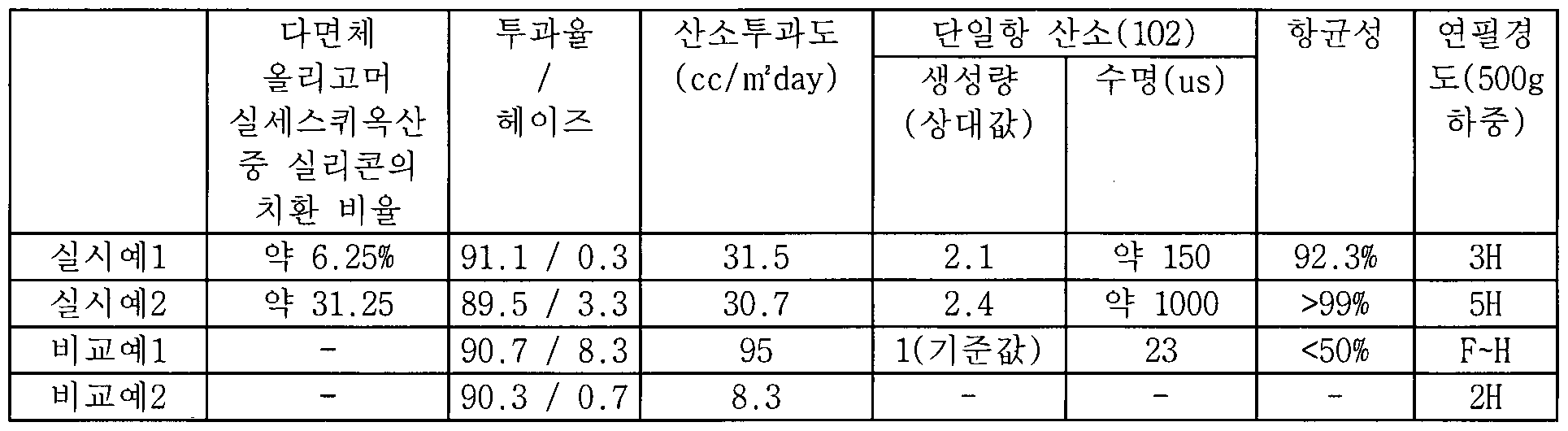
2에 비하여 단일항 산소의 생성량이 크게 낮을 뿐만 아니라 단일항 산소의 수명이 매우 짧다는 점이 확인된다. 이에 따라, 비교예 1 및 2의 고분자 필름의 층분한 항균성을 확보하지 못한다는 점이 확인되며, 표면 경도 또한 상대적으로 낮은 수준에 머물러 있다.
Claims
【청구항 1】
반웅성 작용기가 1이상 치환되고 케이지 (cage)구조를 갖는 다면체 올리고머 실세스퀴옥산; 열개시제; 및 광감웅제;를 포함하는, 항균성 고분자 코팅 조성물.
【청구항 2】
제 1항에 있어서,
상기 케이지 (cage)구조를 갖는 다면체 올리고머 실세스퀴옥산의 실리콘들 중 적어도 1개 이상에는 반웅성 작용기가 치환되고 상기 반응성 작용기가 치환되지 않은 나머지 실리콘들은 비치환되거나 또는 비반웅성 작용기가 치환되는, 항균성 고분자 코팅 조성물.
【청구항 3]
제 1항에 있어서,
상기 케이지 (cage)구조를 갖는 다면체 올리고머 실세스퀴옥산의 실리콘들 중 4 내지 60% 가 반웅성 작용기로 치환되는, 항균성 고분자 코팅 조성물.
【청구항 4】
제 1항에 있어서,
상기 반웅성 작용기는 (메트)아크릴레이트, 탄소수 1 내지 20의 알킬 (메트)아크릴레이트, 탄소수 3 내지 20의 사이클로알킬 (cycloalkyl ) 에폭사이드, 탄소수 1 내지 10의 알킬 사이클로알케인 (cycloalkane) 에폭사이드 및 디알킬실란 에폭사이드로 이루어진 군에서 선택된 1종 이상을 포함하는, 항균성 고분자 코팅 조성물.
【청구항 5]
거 U항에 있어서,
에폭시기, 옥세타닐기, 환상 에테르기 및 환상 티오 에테르기로
이루어진 군에서 선택된 1종 이상의 열경화 가능한 작용기를 포함하는 열경화성 수지를 더 포함하는, 항균성 고분자 코팅 조성물.
【청구항 6】
제 1항에 있어서,
상기 반옹성 작용기가 1이상 치환되고 케이지 (cage)구조를 갖는 다면체 올리고머 실세스퀴옥산 100중량부 대비 상기 열경화성 수지 10 내지 1 , 000 중량부를 포함하는, 항균성 고분자 코팅 조성물.
【청구항 7】
거 U항에 있어서,
상기 반웅성 작용기가 1이상 치환되고 케이지 (cage)구조를 갖는 다면체 올리고머 실세스퀴옥산 100중량부 대비 광감응제 0.001 내지 5중량부를 포함하는, 항균성 고분자코팅 조성물.
【청구항 8】
게 1항에 있어서,
상기 광감웅제는 포르핀계 (porphine)계 화합물, 포르피린계 (porphyr ins) 화합물, 클로린계 (chlor ins) 화합물, 박테리오클로린계 (bacter iochlor ins) 화합물, 프탈로시아닌계 (phthalocyanine) 화합물, 나프탈로시아닌계 (naphthalocyanines) 화합물 및 5-아미노레불린 에스테르계 (5-aminoevul ine esters)으로 이루어진 군에서 선택된 1종 이상을 포함하는, 항균성 고분자 코팅 조성물.
【청구항 9】
제 1항에 있어서,
상기 광감웅제는 탄소수 1 내지 10의 알콕시가 도입된 페닐기가 1 내지 8개 도입된 포르핀 화합물 또는 포르피린 화합물을 포함하는, 항균성 고분자 코팅 조성물.
【청구항 10】
제 1항의 항균성 고분자 코팅 조성물의 경화물을 포함하는 항균성 고분자 필름.
【청구항 11】
반웅성 작용기가 1이상 치환되고 케이지 (cage)구조를 갖는 다면체 올리고머 실세스퀴옥산을 포함한 기재층 및 상기 기재층에 분산된 광감응제;를 포함하고,
10 내지 80 cc/m2day의 산소 투과도를 갖는, 항균성 고분자 필름.
【청구항 12】
제 11항에 있어서,
상기 항균성 고분자 필름은 10/im 내지 10 , 000/ m의 두께를 갖는. 항균성 고분자 필름.
【청구항 13]
제 11항에 있어서,
시간분해 인광 레이저 분광 장치를 이용하여 900nm 내지 1400nm의 파장 영역에서 측정한 단일항 산소의 수명이 0.001초 이상인, 항균성 고분자 필름.
【청구항 14】
제 11항에 있어서,
상기 기재층은 열경화성 수지를 더 포함하는, 항균성 고분자 필름.
【청구항 15】
제 10항의 항균성 고분자 필름 또는 제 11항의 항균성 고분자 필름을 포함하는, 전자 제품.
【청구항 16]
제 14항에 있어서,
상기 전자 제품은 가습기, 냉장고, 에어워셔, 또는 수족관인, 전자 제품.
Priority Applications (4)
| Application Number | Priority Date | Filing Date | Title |
|---|---|---|---|
| US16/488,053 US11124660B2 (en) | 2017-09-27 | 2018-09-20 | Antimicrobial polymer coating composition and antimicrobial polymer film |
| JP2019542500A JP6870746B2 (ja) | 2017-09-27 | 2018-09-20 | 抗菌性高分子コーティング組成物および抗菌性高分子フィルム |
| CN201880008594.7A CN110234715B (zh) | 2017-09-27 | 2018-09-20 | 抗菌聚合物涂料组合物和抗菌聚合物膜 |
| EP18862625.3A EP3569662B1 (en) | 2017-09-27 | 2018-09-20 | Antimicrobial polymer coating composition and antimicrobial polymer film |
Applications Claiming Priority (2)
| Application Number | Priority Date | Filing Date | Title |
|---|---|---|---|
| KR10-2017-0125447 | 2017-09-27 | ||
| KR1020170125447A KR102242545B1 (ko) | 2017-09-27 | 2017-09-27 | 항균성 고분자 코팅 조성물 및 항균성 고분자 필름 |
Publications (1)
| Publication Number | Publication Date |
|---|---|
| WO2019066392A1 true WO2019066392A1 (ko) | 2019-04-04 |
Family
ID=65902537
Family Applications (1)
| Application Number | Title | Priority Date | Filing Date |
|---|---|---|---|
| PCT/KR2018/011166 Ceased WO2019066392A1 (ko) | 2017-09-27 | 2018-09-20 | 항균성 고분자 코팅 조성물 및 항균성 고분자 필름 |
Country Status (6)
| Country | Link |
|---|---|
| US (1) | US11124660B2 (ko) |
| EP (1) | EP3569662B1 (ko) |
| JP (1) | JP6870746B2 (ko) |
| KR (1) | KR102242545B1 (ko) |
| CN (1) | CN110234715B (ko) |
| WO (1) | WO2019066392A1 (ko) |
Families Citing this family (5)
| Publication number | Priority date | Publication date | Assignee | Title |
|---|---|---|---|---|
| KR102578739B1 (ko) * | 2018-12-20 | 2023-09-13 | 주식회사 엘지화학 | 신규한 화합물, 이를 포함하는 항균제, 및 항균성 고분자 코팅 조성물 |
| KR102776958B1 (ko) * | 2019-11-12 | 2025-03-05 | 주식회사 엘지화학 | 항알러지성 고분자 코팅 조성물 및 항알러지성 고분자 필름 |
| KR20210143367A (ko) | 2020-05-19 | 2021-11-29 | 황호원 | 천연 항균성 원료를 포함하는 점착시트 및 이의 제조방법 |
| CN119317354A (zh) * | 2022-02-13 | 2025-01-14 | 诺比奥有限公司 | 官能化的抗微生物颗粒 |
| CN115537607B (zh) * | 2022-08-30 | 2023-03-21 | 鼎圭新材料科技(上海)有限公司 | 一种合金化适合高速复合金卡纸用铝箔及生产工艺 |
Citations (5)
| Publication number | Priority date | Publication date | Assignee | Title |
|---|---|---|---|---|
| WO2009110848A1 (en) * | 2008-03-04 | 2009-09-11 | Agency For Science, Technology And Research | Low shrinkage multifunctional ssq resins |
| KR20120105502A (ko) * | 2009-12-04 | 2012-09-25 | 다우 코닝 코포레이션 | 실세스퀴옥산 수지의 안정화 방법 |
| KR20140080863A (ko) * | 2012-12-20 | 2014-07-01 | 연세대학교 산학협력단 | 항균성 액정보호필름 및 이의 제조방법 |
| KR101643295B1 (ko) * | 2014-10-30 | 2016-07-28 | 건국대학교 산학협력단 | 폴리실세스퀴옥산을 코어로 하는 수용성 포르피린집합체 광감작제 및 그 제조방법 |
| KR20170040411A (ko) * | 2015-10-02 | 2017-04-13 | 연세대학교 산학협력단 | 호흡기용 광기능성 기관내관의 생체내 유사환경 조건에서의 항균성 효능 평가 시스템 |
Family Cites Families (24)
| Publication number | Priority date | Publication date | Assignee | Title |
|---|---|---|---|---|
| US5153099A (en) | 1987-05-27 | 1992-10-06 | Director General, Agency Of Industrial Science And Technology | Wavelength multiplexed optical recording material |
| US5204215A (en) | 1987-05-27 | 1993-04-20 | Agency Of Industrial Science And Technology | Wavelength multiplexed optical recording material |
| JP2701230B2 (ja) | 1987-05-27 | 1998-01-21 | 工業技術院長 | 波長多重記録材料 |
| EP0484027B1 (en) * | 1990-11-02 | 1996-12-18 | Zeneca Limited | Polysubstituted phthalocyanines |
| KR100301262B1 (ko) | 1998-12-04 | 2001-11-22 | 사또미 유따까 | 항균및항곰팡이성이뛰어난알루미늄합금제핀재및그것을구비한에어컨용열교환기및열교환기용핀재 |
| CA2324794A1 (en) * | 2000-10-25 | 2002-04-25 | American Dye Source, Inc. | Organic-inorganic hybrid photocurable compositions |
| JP4222207B2 (ja) * | 2001-07-05 | 2009-02-12 | チッソ株式会社 | ケイ素化合物 |
| US7399819B2 (en) * | 2002-09-17 | 2008-07-15 | Chisso Corporation | Silicon compound |
| US20040120915A1 (en) * | 2002-12-19 | 2004-06-24 | Kaiyuan Yang | Multifunctional compositions for surface applications |
| US7041748B2 (en) * | 2003-01-08 | 2006-05-09 | International Business Machines Corporation | Patternable low dielectric constant materials and their use in ULSI interconnection |
| EP1849787A1 (en) * | 2004-12-28 | 2007-10-31 | Chisso Corporation | Organosilicon compound |
| US7468330B2 (en) * | 2006-04-05 | 2008-12-23 | International Business Machines Corporation | Imprint process using polyhedral oligomeric silsesquioxane based imprint materials |
| JP2009042351A (ja) | 2007-08-07 | 2009-02-26 | Konica Minolta Opto Inc | 光学フィルム、偏光板及び表示装置 |
| US20100004202A1 (en) * | 2008-02-15 | 2010-01-07 | Ndsu Research Foundation | Quaternary ammonium-functionalized-POSS compounds |
| KR101276648B1 (ko) * | 2010-10-04 | 2013-06-19 | 구니오 모리 | 금속막 형성 방법, 및 금속막을 갖는 제품 |
| WO2012058591A1 (en) * | 2010-10-29 | 2012-05-03 | Curators Of The University Of Missouri | Biomaterial compositions |
| US20140018475A1 (en) * | 2012-07-16 | 2014-01-16 | Baker Hughes Incorporated | High glass transition temperature thermoset and method of making the same |
| KR20150000789A (ko) | 2013-06-25 | 2015-01-05 | 삼성전자주식회사 | 내오염성 유무기 복합 화합물, 내오염성 막 및 내오염성 막의 제조 방법 |
| US9341948B2 (en) * | 2013-08-24 | 2016-05-17 | Polyera Corporation | Photopatternable materials and related electronic devices and methods |
| JP6429031B2 (ja) * | 2013-10-30 | 2018-11-28 | 日産化学株式会社 | シルセスキオキサン化合物及び変性シリコーン化合物を含むインプリント材料 |
| TWI683185B (zh) * | 2014-10-24 | 2020-01-21 | 美商飛利斯有限公司 | 可光圖案化組成物以及使用該可光圖案化組成物製造電晶體元件的方法 |
| JP6557521B2 (ja) | 2015-06-17 | 2019-08-07 | 株式会社ダイセル | ポリオルガノシルセスキオキサン、ハードコートフィルム、接着シート、積層物及び装置 |
| KR20170139327A (ko) | 2016-06-09 | 2017-12-19 | 다다인터내셔널 주식회사 | 하드코팅액 및 이를 이용한 필름 제조방법 |
| CN107082885B (zh) * | 2017-04-24 | 2019-09-27 | 华中科技大学 | 一种poss基氨基改性聚丙撑碳酸酯及其制备方法 |
-
2017
- 2017-09-27 KR KR1020170125447A patent/KR102242545B1/ko active Active
-
2018
- 2018-09-20 CN CN201880008594.7A patent/CN110234715B/zh active Active
- 2018-09-20 JP JP2019542500A patent/JP6870746B2/ja active Active
- 2018-09-20 EP EP18862625.3A patent/EP3569662B1/en active Active
- 2018-09-20 WO PCT/KR2018/011166 patent/WO2019066392A1/ko not_active Ceased
- 2018-09-20 US US16/488,053 patent/US11124660B2/en active Active
Patent Citations (6)
| Publication number | Priority date | Publication date | Assignee | Title |
|---|---|---|---|---|
| WO2009110848A1 (en) * | 2008-03-04 | 2009-09-11 | Agency For Science, Technology And Research | Low shrinkage multifunctional ssq resins |
| KR20120105502A (ko) * | 2009-12-04 | 2012-09-25 | 다우 코닝 코포레이션 | 실세스퀴옥산 수지의 안정화 방법 |
| KR20140080863A (ko) * | 2012-12-20 | 2014-07-01 | 연세대학교 산학협력단 | 항균성 액정보호필름 및 이의 제조방법 |
| KR101465964B1 (ko) | 2012-12-20 | 2014-11-28 | 연세대학교 산학협력단 | 항균성 액정보호필름 및 이의 제조방법 |
| KR101643295B1 (ko) * | 2014-10-30 | 2016-07-28 | 건국대학교 산학협력단 | 폴리실세스퀴옥산을 코어로 하는 수용성 포르피린집합체 광감작제 및 그 제조방법 |
| KR20170040411A (ko) * | 2015-10-02 | 2017-04-13 | 연세대학교 산학협력단 | 호흡기용 광기능성 기관내관의 생체내 유사환경 조건에서의 항균성 효능 평가 시스템 |
Non-Patent Citations (3)
| Title |
|---|
| CHEMICAL ABSTRACTS, Columbus, Ohio, US; abstract no. 22112-78-3 |
| ISMAIL, S.: "Efficacy of a novel light-activated antimicrobial coating for disinfecting hospital surfaces", INFECTION CONTROL AND HOSPITAL EPIDEMIOLOGY, vol. 32, no. 11, 2011, pages 1130 - 1132, XP055587082 * |
| See also references of EP3569662A4 |
Also Published As
| Publication number | Publication date |
|---|---|
| US20200048476A1 (en) | 2020-02-13 |
| EP3569662B1 (en) | 2022-12-28 |
| KR20190036335A (ko) | 2019-04-04 |
| JP6870746B2 (ja) | 2021-05-12 |
| JP2020509105A (ja) | 2020-03-26 |
| KR102242545B1 (ko) | 2021-04-19 |
| US11124660B2 (en) | 2021-09-21 |
| EP3569662A4 (en) | 2020-03-04 |
| CN110234715A (zh) | 2019-09-13 |
| CN110234715B (zh) | 2021-07-09 |
| EP3569662A1 (en) | 2019-11-20 |
Similar Documents
| Publication | Publication Date | Title |
|---|---|---|
| US11578179B2 (en) | Antimicrobial polymer coating composition and antimicrobial polymer film | |
| US11124660B2 (en) | Antimicrobial polymer coating composition and antimicrobial polymer film | |
| US20200085057A1 (en) | Antimicrobial polymer coating composition and antimicrobial polymer film | |
| US7018463B2 (en) | Abrasion resistant coating composition | |
| US11958986B2 (en) | Antibacterial polymer coating composition and antibacterial polymer film | |
| KR20150136127A (ko) | 공중합체 또는 조성물을 포함하는 막 | |
| JP2009256563A (ja) | 熱硬化性ハードコート剤組成物、成形品、およびレンズ | |
| WO2020262658A1 (ja) | 硬化性組成物およびその製造方法、眼鏡レンズ、眼鏡ならびに眼鏡レンズの製造方法 | |
| JP2009256293A (ja) | フルオレン骨格を有するケイ素化合物 | |
| JP5297079B2 (ja) | フルオレン骨格を有するケイ素化合物およびその重合性組成物 | |
| JP2021162620A (ja) | フォトクロミックレンズ保護層形成用硬化性組成物、コーティング組成物、硬化体、フォトクロミックレンズ、及び、フォトクロミックレンズの製造方法 | |
| CN112368341B (zh) | 抗菌聚合物涂料组合物和抗菌聚合物膜 | |
| JP4681454B2 (ja) | 保護膜用樹脂組成物 | |
| WO2018092515A1 (ja) | エポキシ基含有オルガノポリシロキサン、紫外線硬化型シリコーン組成物及び硬化皮膜形成方法 | |
| JP2734276B2 (ja) | 光硬化性被覆用組成物の硬化皮膜の形成方法 | |
| JP6762111B2 (ja) | ハードコート剤及び積層フィルム | |
| JP7790035B2 (ja) | 硬化膜を有する基材の製造方法 | |
| KR20210062461A (ko) | 항균성 고분자 코팅 조성물 및 항균성 고분자 필름 | |
| JPH08259855A (ja) | 抗菌性被膜用組成物 | |
| EP3315523A1 (en) | Organic-inorganic composite | |
| KR20250119523A (ko) | 하드 코팅층 부착 적층체의 제조 방법 및 하드 코팅층 부착 적층체 |
Legal Events
| Date | Code | Title | Description |
|---|---|---|---|
| 121 | Ep: the epo has been informed by wipo that ep was designated in this application |
Ref document number: 18862625 Country of ref document: EP Kind code of ref document: A1 |
|
| ENP | Entry into the national phase |
Ref document number: 2019542500 Country of ref document: JP Kind code of ref document: A |
|
| ENP | Entry into the national phase |
Ref document number: 2018862625 Country of ref document: EP Effective date: 20190814 |
|
| NENP | Non-entry into the national phase |
Ref country code: DE |