WO2019070108A1 - Proceso de alto rendimiento para la producción de antivenenos de fragmentos f (ab') 2 de anticuerpos - Google Patents
Proceso de alto rendimiento para la producción de antivenenos de fragmentos f (ab') 2 de anticuerpos Download PDFInfo
- Publication number
- WO2019070108A1 WO2019070108A1 PCT/MX2017/000115 MX2017000115W WO2019070108A1 WO 2019070108 A1 WO2019070108 A1 WO 2019070108A1 MX 2017000115 W MX2017000115 W MX 2017000115W WO 2019070108 A1 WO2019070108 A1 WO 2019070108A1
- Authority
- WO
- WIPO (PCT)
- Prior art keywords
- kda
- obtaining
- fragments
- antibody fragments
- plasma
- Prior art date
- Legal status (The legal status is an assumption and is not a legal conclusion. Google has not performed a legal analysis and makes no representation as to the accuracy of the status listed.)
- Ceased
Links
Classifications
-
- C—CHEMISTRY; METALLURGY
- C07—ORGANIC CHEMISTRY
- C07K—PEPTIDES
- C07K16/00—Immunoglobulins [IG], e.g. monoclonal or polyclonal antibodies
- C07K16/06—Immunoglobulins [IG], e.g. monoclonal or polyclonal antibodies from serum
- C07K16/065—Purification, fragmentation
-
- A—HUMAN NECESSITIES
- A61—MEDICAL OR VETERINARY SCIENCE; HYGIENE
- A61K—PREPARATIONS FOR MEDICAL, DENTAL OR TOILETRY PURPOSES
- A61K39/00—Medicinal preparations containing antigens or antibodies
- A61K39/395—Antibodies; Immunoglobulins; Immune serum, e.g. antilymphocytic serum
- A61K39/39591—Stabilisation, fragmentation
-
- C—CHEMISTRY; METALLURGY
- C07—ORGANIC CHEMISTRY
- C07K—PEPTIDES
- C07K1/00—General methods for the preparation of peptides, i.e. processes for the organic chemical preparation of peptides or proteins of any length
- C07K1/14—Extraction; Separation; Purification
- C07K1/34—Extraction; Separation; Purification by filtration, ultrafiltration or reverse osmosis
-
- C—CHEMISTRY; METALLURGY
- C07—ORGANIC CHEMISTRY
- C07K—PEPTIDES
- C07K16/00—Immunoglobulins [IG], e.g. monoclonal or polyclonal antibodies
- C07K16/18—Immunoglobulins [IG], e.g. monoclonal or polyclonal antibodies against material from animals or humans
-
- C—CHEMISTRY; METALLURGY
- C07—ORGANIC CHEMISTRY
- C07K—PEPTIDES
- C07K2317/00—Immunoglobulins specific features
- C07K2317/50—Immunoglobulins specific features characterized by immunoglobulin fragments
- C07K2317/54—F(ab')2
Definitions
- the present invention relates to the field of biotechnology based on fragmentation of antibodies that are used in vaccines for passive immunization to neutralize toxins present in venoms of poisonous animals; specifically, it refers to a biological product wherein the active principle is a combination of F (ab ') 2 fragments of antibodies and to the process to obtain them with high purity and potency.
- snake bites and scorpion bites are medical emergencies in many parts of the world where these animals are distributed. The most affected are agricultural workers and children from food-producing countries. It is difficult to estimate the true worldwide incidence of snake bites. It is reported that each year there are 5 million snake bites, resulting in 2.5 million poisonings, and 125,000 deaths and perhaps three times that number of permanent sequelae in the world, (Chippaux, 1998).
- Passive immunization which refers to the administration of antibodies to protect against infections or toxins, was experimentally tested by several researchers, including Albert Calmette who protected rabbits against cobra venom by administering antibodies one hour before. in the form of antiserum (Calmette, 1896). Passive immunization is used today to treat infections successfully, for example, against rabies or against Ebola, and also poisoning.
- an antibody is defined by the variable chains it contains, regardless of whether it contains their constant regions or not, hence the interest to produce and isolate only the F (ab ') 2 fragments.
- the Fe fragment comprises the antkjénic determinants of the antibody, such that, when a complete antibody generated in an animal of another species is administered to a patient, the patient generates an immune response against these antigenic determinants, giving rise to a variety of Adverse secondary responses that can even be an anaphylactic shock.
- Fab or F (ab ') 2 fragments finds another advantage in what is known as the concept of volume of distribution, which is only the volume of the body in which a certain drug is dissolved, this volume can refer only to Circulating blood as in the case of IgG or include a greater part of the body water for the case of the fragments. Therefore, the Fab and F (ab ') 2, because they have a greater body volume, can access to neutralize toxins lodged in different tissues, not only in the blood, and can even cross the blood-brain barrier in both directions and can be used to neutralize or eliminate neuro-toxins.
- the use of the F (ab ') 2 has an advantage over the Fab, which is that they have a longer retention time in the body because they have twice the molecular weight, in addition they retain the ability to precipitate the antigen in physiological conditions, and also have a size that allows them to access a sufficient volume of distribution for treatment purposes.
- scorpion poisons are also a complex mixture of a wide variety of molecules and play an important role in the defense and capture of prey.
- scorpion poisons are also a complex mixture of a wide variety of molecules and play an important role in the defense and capture of prey.
- scorpion venom generally shows low levels of enzymatic activity (Gwee et al., 2002).
- the toxins of the venom of the species Trtyus serrulatus were analyzed by radioimmunoassays, showing that in addition to its complexity, they have very different antigenic reactivity patterns, even some antigens can not be detected by the sera, which gives us an idea of how complex the immune response can be, De Lima, et al. (1993).
- Spider poisons are also a complex mixture of proteins, polypeptides, neurotoxins, nucleic acids, free amino acids, inorganic salts and monoamines that cause diverse effects. Heinen, A.B. Gorini da Veiga / Toxicon 57 (2011) 497-511 in vertebrates and invertebrates (Jackson and Parks, 1989, Ori and Ikeda, 1998, Schanbacher et al., 1973). For example, funnel net spiders (robotic Atrax), one of the most poisonous species, produce more than 1000 peptides, as revealed by the mass spectrometric analysis of their venom. A gross estimate of 500 different toxins for each spider venom would give us a total of 19,000,000 toxins for the approximately 38,000 known spider species.
- Hyperimmune plasma is understood as that plasma which contains extremely high levels of antibodies and for this invention refers specifically to the presence of high concentrations of polyclonal antibodies in the plasma generated by immunization with poisons or derivatives thereof of poisonous species, to immunize Generally equines or sheep are used.
- the process of the present invention promotes the generation and obtaining of the F (ab ') 2 fragments of the effectively neutralizing antibodies, although the complexity of the poisons could hinder their generation and separation or fractionation and at the same time achieve them free of molecules that are not F (ab ') 2 and that are irrelevant or even undesirable (like pyrogens among other toxics) for the neutralization mechanism. It is important to consider that the use of recombinant antibodies (such as scFv) or monoclonal antibodies of other variants of recombinant antibodies is not the best alternative for neutralization of complex poisons (of unknown composition), since it involves the isolation of such components of the venom (antigens).
- variable domains VH, VL
- scFv design of humanized or hybrid antibodies , etc.
- antigenic determinants are encrypted and only during the antigen processing that is carried out in antigen presenting cells (APCs), within which the antigens are processed beginning with the degradation of them in cytosolic proteasomes (in the APCs) Random peptides are generated that are presented in the membranes by the major histocompatibilkJad complex molecules to awaken lymphocyte responses, among these responses is the expansion of memory cells and the generation of high affinity antibodies by the antigen. The answers come to light before the immune system so that the production of very effective antibodies will be achieved to neutralize the toxic effects.
- APCs antigen presenting cells
- the protagónica immune response in the generation of antibodies of high affinity is the one that is derived from B cells; B lymphocytes are considered as professional antigen presenting cells (APCs) despite their primary role in humoral immunity.
- B cells process and present specific and non-specific antigens differently, the presentation of specific antigen through the B cell antigen receptor occurs with very high efficiency and is associated with the activation of B cells, resulting in the activation of related T cells.
- the presentation of nonspecific antigen by B cells is minimized and dissociated from the activation of B cells.
- B cells inactivate T cells that recognize non-specific antigenic epitopes presented by B cells, or induce differentiation or expansion of regulatory T cells.
- Protein purification techniques described in the state of the art such as electrophoresis, chromatographic separation (such as gel permeation chromatography, ion exchange and affinity chromatography and high performance liquid chromatography (HPLC)), among others , are ideal to obtain minimum or relatively discrete quantities, in fact, there are innumerable articles that describe methods of protein purification that can produce from a few micrograms to a few hundred milligrams of very pure protein products.
- these processes are very difficult to scale without involving high production costs, which limits their use for levels of industrial protein production.
- the papain enzyme preferably purified, either free or immobilized, removing cell debris by centrifugation, separating and recovering the fragments and then purifying them, preferably by immunoassay.
- Landon uses purified antigens which, unlike poisons, can easily be ligated to supports to obtain a sieve for the purification of the Fabs of interest, and never uses or discusses the method to obtain Fab fragments against antigens that are mixtures of many substances, such as poisons, plus it only works with papain and chemopapain and does not discuss the possibility of using pepsin.
- Landon J. et al. (2014) also describes a process to purify antigens of F (ab ') 2 and Fab of IgG from hyperimmune serum of sheep, with the aim of minimizing the degradation of immunoglobulins first precipitate all the proteins of the serum, including the albumin, with caprylic acid, the immunoglobulins do not precipitate, later they carry out the digestion to obtain the F (ab ') 2 or the Fabs, with the addition of pepsin or papain, respectively.
- papain joined by disulfide bridges with some of the fragments resulting from digestion from which papain can subsequently continue to digest and degrade the obtained fragments.
- it uses anti-papain antibodies, which capture the hybrid compounds of the enzyme.
- the fragments are purified by passing the solution through a column with protein A where the Fe fragments and hybrid compounds are retained.
- This problem that occurs in digestion with papain has not been reported to occur with digestion with pepsin.
- Some traditional methods involve digestion with pepsin and the precipitation of the fraction of the fragments with ammonium or sodium sulfates, but a pre-separation of the antibodies is usually handled first by precipitation with sulphate and then the digestion of the antibody fraction.
- the Chinese application CN 103864930 refers to the obtaining of F (ab ') 2 fragments of antibodies that resist the scorpion venom Buthus martensii karsch and is based on the production of horse plasma immunized with this poison and the fragments are obtained and purified by enzymolysis and salting out, and by exchange column they obtain the active F (ab ') 2 fragments with high purity, the selected peak is purified by desalting column or by ultrafiltration, sterilized by filtration and finally the product is lyophilized.
- the Chinese application CN 101816789 refers to the obtaining of F (ab ') 2 fragments of vi Southerndos anti-venom antibodies, it is based on obtaining horse plasma immunized with this venom and the immunoglobulins are obtained by salting out, it is used the dialysis by centrifugation, then the F (ab ') 2 fragments are obtained by enzymysis and purified by hydrophobic column, they are passed through membrane ultrafiltration from 8000 to 10000 Da or by ultrafiltration by desalination membrane and filter for sterilization of 0.22pm , and freeze-dried at the end.
- Thermocoagulation performed at 54 ° C facilitates the precipitation of non-digested serum proteins such as albumin and fibrinogen, however these temperatures can also damage a certain percentage of the immunoglobulin fragments that were generated during enzymatic digestion, so that by eliminating it, more intact proteins of interest remain (F (ab ') 2 fragments), so that achieving to eliminate its application represents an outstanding advantage to the state of the art.
- the ultrafiltrate is a filtration technique that uses membranes to separate different types of solids and liquids (separates particles with a diameter of 0.1 to 0.001 ⁇ (1,000 to 20,000 Da), by applying a driving force, pressure is always applied,
- concentration and the electric potential also influence as a driving force, with the ultrafiltrate the flow passes parallel to the surface of the membrane and is not perpendicular as is the case with ordinary filtration, so there is an accumulation on the surface of the membrane,
- two liquid phases are separated, one exhausted in solute (ultrafiltrate or permeate) and one enriched in solute (retained) (Garavito, 1995).
- diafiltration is a modification of the ultrafiltrate in which water is added to the Feeding in order to facilitate the permeate of some components through the membrane, the added water recirculates in the process of Thus, the concentration of the soluble components of the permeate is reduced and the concentration of the components of the retentate is increased.
- nanofiltration it is a membrane filtration process that occurs through the application of pressure, where low molecular weight solutes (approximately in the range of 1000 daltons) are retained, while others, such as salts, can pass totally or partially, through the membrane with the filtrate.
- Ultrafiltrate has become an important technique in the treatment of water and industrial effluents; can be used directly in the production of drinking water thanks to its ability to retain bacteria and viruses. In some other cases it can be used as pre-treatment before nanofiltration or reverse osmosis. In the case of agri-food industries, it is in the treatment of milk that the ultrafiltrate has been used most in particular for the concentration of whey. In the surface treatment industries, the ultrafiltrate is used for the regeneration of cataphoresis paint baths used in the automotive industry. Ultrafiltration can also be used to separate oil-in-water emulsions.
- the Ultrafiltration serves to separate and concentrate enzymes, viruses or active ingredients that serve the manufacture of vaccines, which is the technical field that concerns us in the present invention.
- the ultrafiltration operation and its variants is a unitary operation ideally designed and used for the separation and concentration of particles and not so much of molecular classes; for the most tiny separation of sizes and molecular types, the unit operations used in the state of the art are primarily chromatographic techniques, since up to now they have been the only techniques that have allowed to obtain high purity for biotechnological or biological products.
- the ultrafiltration and its variants are applied in the separation of products of not much added value or where an extraordinarily separation of the molecular fractions (in the dairy industry for example) is not so relevant, in order to increase the speed of production, then tend to use higher flows and pressures to perform the purification operation, when such parameters are raised may not have such a precise separation, but this will not have a major impact on the health of the consumer of the product, however , for the separation of molecular fractions in biotechnological products as used for the present invention, the application of ultrafiltration techniques becomes a technical problem that requires experimental design involving an inventive level.
- ultrafiltration has been redirected in a novel and inventive manner towards a high performance process for production, procurement and purification of antibodies and compositions comprising them; particularly, antibody fragments and compositions comprising them; more particularly, F (ab ') 2 fragments and compositions comprising them, capable of neutralizing poisons from hyperimmune plasma of non-human mammal.
- the present invention also presents data on the optimal conditions of digestion, that is, where the highest productivity of F (ab ') 2 is achieved, which also represents an important advance in the production methods based on digestion of antibodies with pepsin .
- salt precipitation that is also used to separate and further purify by dialysis is low cost, but results in low antibody recovery;
- the process based on salting-out is difficult to scale in sterile conditions and gives low yield and purity.
- precipitation with caprylic acid may increase the IgG yield, but the process takes a long time and does not eradicate endotoxin-producing bacterial contamination (Landon J. ef al (2014)).
- the production technique based on the separation or fractionation, which is proposed with the present invention, has a high yield of product at low process cost is certainly beneficial for the biotechnology industry particularly in the field of antivenoms based on polyclonal antibodies or in its active fragments.
- experimental development working with very complex mixtures and of biological origin such as hyper-immune sera (Ghosh, and Cui, 2000) and ultrafiltration is applied based on an exhaustive experimental work with the invention has been optimized the separation of the molecules of interest.
- the current method for the preparation of anti-rabies serum F (ab ') 2 approved by the WHO is based on the approach described by Pope (1938; 1939 a; 1939 b) and Harms, briefly: the digestion with pepsin ( 30 min, 30 ° C, pH 3.2) of raw hyperimmune equine plasma is followed by a heat denaturation step (1 h at 55 ° C, pH 4.3) to precipitate most non-IgG and by additional addition of ammonium sulfate (salting-out), to precipitate the IgG including F (ab ') 2. Due to the precipitation step of the salt, the process results in products F (ab ') 2 of comparatively low yield and low purity.
- the objective of the invention is to provide a new process suitable for industrial production of antivenoms, based on the obtaining and digestion of immunoglobulins and subsequent purification of the F (ab ') 2 fragment of such immunoglobulins, obtained from crude equine hyperinmune plasma with the aim of obtaining a higher yield than with the process approved by WHO, and obtain an active product, more efficient and pure than those obtained by the processes described in the closest state of the art (US Pat 6,709,655, Roodt, AR et al., 2010).
- cresol maximum 3.5 mg per vial of 0.5 to 1 ml
- the process of obtaining it is reported to be initiated by immunizing horses with increased doses of the venom, obtaining the high titre serum and purifying with different stages of saline precipitation and refining by digestion with pepsin, the F (ab ') 2 fragments are purified by gels Adsorbents and multistage filtrations followed by dilution for the required power.
- These products are flaunted as high purity.
- the general processing steps of these antivenoms indicate that the novelty of the claimed invention is not affected.
- the present invention contrasts in many elements with the processes and similar products belonging to the closest state of the art.
- the present invention relates to a high-performance process for the production of antivenoms of F (ab ') 2 fragments of immunoglobulins IgGs; its use is an alternative to the use of IgGs, although as mentioned, smaller variants of IgGs have been developed trying to improve their bioavailability, penetrability in tissues, and solubility; even so, the polyclonal F (ab ') 2 fragments remain to date the most efficient to neutralize the toxicity of the poisons, the present invention obeys to the complexity of the poisons, which contributes to their effectiveness.
- the present invention provides a process for the production and obtaining of antivenoms based on fragments of F (ab ') 2 antibodies of plasma immunoglobulins, designed to confer from a passive immunization, neutralizing toxins from poisons for which they were manufactured. .
- the parameters of the unit operation used allow to obtain pure F (ab ') 2 fragments.
- the analysis by chromatography of F (ab ') 2 fragments shows unique peaks of said fragments making it possible to observe the absence of another type of fragments or biological material, such as proteins and Fab fragments, which makes this invention unique in its kind for obtaining fragments F (ab ') 2 cigars.
- the present invention has the advantage of separating and at the same time purifying very close particles in molecular weight using parameters and ranges of working conditions in the unit operation, which otherwise could not be separated or purified using the conditions, the parameters and the working materials for biological materials, including the pore size of the uttrafiltration membrane, used for the manufacture of antibody fragments.
- the ultrafiltration process of the present invention also makes it possible to raise the yield of the antibody fragments, particularly, of the F (ab ') 2 antibody fragments.
- the high-performance process of the present invention allows obtaining and observing by chromatography a single peak of F (ab) 2 fragments, whose only presence in the absence of other type of particles and / or contaminating fragments, makes the composition comprising fragments of F (ab ') 2 antibodies obtained through the present invention, a composition much more effective than those existing in the state of the art obtained by conventional techniques of conventional dialysis and ultrafiltration. Therefore, the high yield production process and novel and inventive obtaining of antivenoms shown here allows to purify the F (ab ') 2 fragments without reducing their potency as demonstrated by the titles and potency of the fragments in traditional ways.
- the present invention also presents data on optimal digestion conditions, where the highest productivity of F (ab ') 2 is achieved.
- the contribution of the process of obtaining the invention is as important as the quality of the hyperimmune plasmas (in terms of concentration of titles).
- the most direct antecedent of the technology of the present invention is the patent US 6,709,655 (hereinafter patent 655) so that throughout the description an intensive comparative analysis of the process is made.
- the present invention offers a product whose quality is due to the process and is therefore distinctive of the products of the state of the art, they are also an alternative of safe antivenoms and of the quality required for the highest standards.
- Figure 1 Separation by reverse phase chromatography of the components that make up the venom of the species Bitis gabonica gabonica. Calvete, JJ et al (2007).
- Figure 2 Timeline of the development of antibody-based antivenoms.
- Figure 3 A: Chromatogram of the supernatant after precipitation with ammonium sulfate (digested antiviperine plasma + process water + pepsin + ammonium sulfate). B: Chromatogram of the clarified supernatant (digested antiviperine plasma + process water + pepsin + ammonium sulfate); Clarification I and II.
- Plasma (a) Chromatogram of the antiviperine plasma, (b) Chromatogram of the prepared plasma (digested antiviperine plasma + process water), Preparation of the plasma.
- Digestion (c) Chromatogram of the mixture (digested antiviperine plasma + process water + pepsin), End of digestion.
- Precipitation (d) Chromatogram of the precipitate (digested antiviperine plasma + process water + ammonium sulfate).
- Clarification (e) Clarification chromatogram (digested antiviperine plasma + process water + ammonium sulfate).
- Figure 6 Quantification of phenol cresol in the samples of the different stages of the production process and obtaining F (ab ') 2 fragments at the pilot plant level from an antiviperine plasma where it was applied in the filtration stage tangential cassette systems with cut-off size of 30 kDa with washings with 0.9% sodium chloride and 50 kDa with washes with process water.
- Figure 7 Quantification of the phenol in the samples of the different stages of the production process and obtaining F (ab ') 2 fragments at the pilot plant level from an Antialacrán plasma where the fiber system was applied in the tangential filtration stage hollow with cut size of 30 kDa with washes with process water (20 washes).
- Figure 8 Quantification of the phenol of the samples from the different stages of the production process and obtaining F (ab ') 2 fragments at the pilot plant level from an Antialacrán plasma where the fiber system was applied in the tangential filtration stage hollow with cut size of 30 kDa with washes with process water (30 washes).
- Figure 9 Title of antibodies in plasma expressed as DLso Neut / ml, annual averages 2009 to 2014, Viperino Group I. Poisons obtained from induced bite of two species of vi Southerndos were used. FB: Specific fraction for Bot rops and FC: Specific fraction for Crotalus.
- the poisons of the animals have evolved quickly and effectively in conjunction with the mechanisms of defense presented by the relationship between prey and predators, poisons provide defense against predators and also help capture prey, which results in a large repertoire of molecules that bind to specific targets, and of which not yet enough is known to design specific neutralizing molecules for all the toxic molecules in the mixture of proteins that make up a poison.
- the present invention relates to a high performance process for obtaining an antidote against poisonings caused by venoms of poisonous species, based on immunoglobulins of animal origin, the antidotes of the invention are characterized by their efficiency, neutralize the toxic molecules even those of extensive repertoire as some poisons require, and are characterized by their purity as described below.
- the immunoglobulins or antibodies from which the antivenoms of the invention are obtained are polyclonal and are of biological origin, derived from hyperimmune plasma, so they need to be fractionated from the plasma and purified; the purity is conferred by the process of the invention and the potency is conferred both by the process of obtaining and by the quality of the hyperimmune plasmas from which the total immunoglobulins are processed, said quality is referred to by the antibody titer and its neutralizing capacity .
- the quality of the hyperimmune plasmas depends in turn on the quality of the poisons used to immunize the horse and also depends on the immunization schemes, of course on the health condition of the animal.
- example 1 A basic immunization scheme for carrying out the present invention is described and is of an illustrative and non-limiting nature.
- hyperimmune plasma is derived from equines, from the immunoglobulins present in it, the F (ab ') 2 fragments are obtained and these possess the neutralizing capacity of virtually all the toxins present in the poisons.
- F (ab ') 2 fragments are obtained and these possess the neutralizing capacity of virtually all the toxins present in the poisons.
- Patent 655 describes a method of obtaining F (ab ') 2 antibodies from serum or hyperimmune plasma as a source of antibodies that is contacted with pepsin, followed by two precipitations of proteins with ammonium sulfate followed by dialysis and steps of clarification. Table 1 describes 17 steps for this method. Under this technique F (ab ') 2 antibodies with a biological activity and remarkable purity are obtained, but as we have said, they are perfectible characteristics just as the process is.
- the process of 17 steps of Table 1 is the direct antecedent of the present invention, currently, the increased quality in the quality of the poisons used to immunize and obtain the hyperimmune plasma, and better immunization schemes, have in turn made have plasma with better antibody titers, which encourages the development of new, more efficient processes to obtain F (ab ') 2 fragments;
- new processing steps have been developed to make the production of antivenoms more efficient; all these changes are reflected in the time, later data of the quality of the plasma and the way to process it are presented that are reflected in purity, productivity and power of antivenoms.
- the approximate manufacturing time using the 17 steps is 52 days.
- the process of the invention differs in the process of the closest state of the art in several aspects: With the process of the invention only 12 steps equivalent to the 17 of the previous process are applied (see tables 1) and 21). One of the determinations that were carried out was on the enzymatic digestion process, as it is appreciated, it is carried out with different parameters, the optimal conditions found during the development of the invention indicate that the digestion is carried out optimally at a temperature of 37 + 1 ° C and with a pH of 3.5 ⁇ 0.1 for 90 minutes.
- Another difference that is marked as an object of the invention is that for the processing of hyperimmune plasmas, only a process of saline precipitation (or salting out, with ammonium sulfate) is required and this does not require the addition of cresol or ether.
- Ethyl others are carried out without resting, the time it takes for the salt to be dissolved is sufficient for the precipitation to take place and immediately the next step is taken (table 21).
- ethyl ether it should be noted that it is already used in very low concentration and has no relevance to the quality of the final product, since it is easily eliminated during purification, and its presence is not required to be regulated.
- thermocoagulation process that is applied during the time that the salt precipitation lasts.
- a marked difference with the process of the invention refers to the incorporation of ultrafiltration (UF); some special modalities are described below, ultrafiltration replaces the second ammonium sulfate precipitation and also replaces the long and risky dialysis process, which also implies contamination risk.
- the type and parameters of ultrafiltration determine the degree of purity obtained (greater than 95%).
- the ultrafiltration with the elements and parameters as established in the present invention guarantees the purification, desalination and concentration of the F (ab ') 2 fragments, all at visibly advantageous levels with respect to that reported in the state of the art.
- the regulatory levels of cresol phenol were already met, when ultrafiltration was applied, the concentration in the finished product was further reduced.
- the result of this process is obtaining unprecedented yields, an antivenom quality of F (ab ') 2 with potency and purity also unprecedented in its type.
- the total manufacturing time of a finished product is approximately 18 days.
- thermocoagulation occurs after digestion when the product is subjected to a temperature of 54 ° C, for 30 minutes at rest; thermocoagulation occurs simultaneously with the first precipitation with ammonium sulfate and then the mixture is passed at a temperature of 8 to 4 ° C for 2 to 24 hours, also at rest, then the supernatant is recovered by decantation and clarified by passing it through filters of 12, 8 and 4 ⁇ , this is carried out with the 7-plate system, it is worth mentioning that this system no longer meets the reg ⁇ latenos requirements, in this stage 50% of cresol / phenol was eliminated.
- the process of the 955 patent 35% of the ammonium sulfate is again added to the clarified supernatant, the plasma is then subjected to a second precipitation, after adjusting the pH to approximately 6.8, a rest is required for 12 hrs. Subsequently, the soluble fraction is recovered and centrifuged again, the obtained paste is recovered, it contains the F (ab ') 2 fragments, it is solubilized and left to rest for 12 to 20 hrs at 2-8 ° C. The sediment is removed since it contains low molecular weight components and salts, the recovered supernatant is the one that contains the specific F (ab ') 2 fragments against the poison for which it was generated during the immunization.
- the product is clarified at 0.2 ⁇ and proceeds with the dialysis process with a duration of 52 days, and also increases the risk of contamination.
- all these steps, from the thermocoagulation and clarification of the digested mixture to the dialysis, are eliminated, that is, the thermocoagulation, the second precipitation and the dialysis are not carried out, resulting in a lower loss of the proteins of interest (fragments of previously generated immunoglobulins), as mentioned, reduces the risk of contamination, also implies a saving of time, and very considerable man / hours, so Both production costs also decrease considerably.
- the following results support these conclusions.
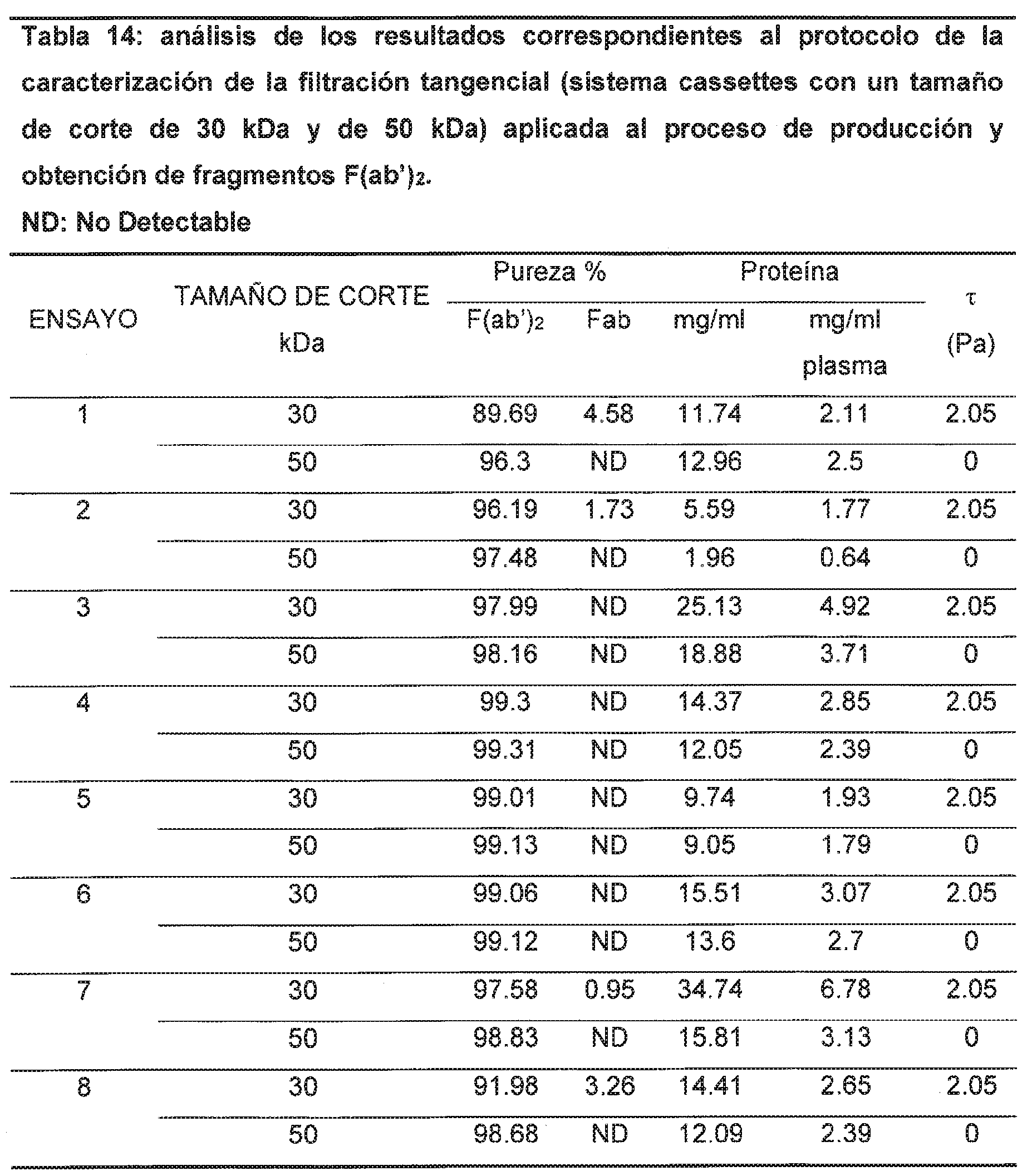
- thermocoagulation itself already with the alternative uRrafiltration conditions, so that we compare the operation of the tangential filtration of the hollow fiber system with a cut-off size of 30 kDa with the tangential filtration system per cassette with a cut-off size of 30 kDa followed by 50 kDa .
- the cassette is a plate and structure device favored by the ease of scaling from the laboratory to small plants, it is the holder of the ultrafiltration system.
- the hollow fiber system is arranged as a module with several tubes or fibers of small diameter (from 0.6 to 2 mm), the solution to filter flows through the open cores of fibers and the percolated liquid is collected in a surrounding cartridge the fibers.
- the HPLC analysis of antiviperine plasma samples from the different stages of a process for the production and obtaining of F (ab ') 2 fragments with the application of cresol, ethyl ether and thermocoagulation was carried out, carrying out an enzymatic digestion at a temperature of 37 ° C ⁇ 2 ° C and applying the operation of the tangential filtration of the hollow fiber system with a cut-off size of 30 kDa.
- the clarifications I and II are described in example 5.
- the UF hollow fiber is technically described in example 6.
- the invention proposes to use 21 to 25 kg of ammonium sulfate for a batch of 60 liters of plasma (35% w / v); in contrast, with the 17-step process (double precipitation) for a batch of 60 liters of plasma, 33 to 34 kg of ammonium sulfate was used for each precipitation (55% w / v).
- this change not only implies the simple saving of salt, but is related to the optimization of the solvation process to favor the precipitation of only the unwanted molecules and simultaneously to conserve in dissolution of the F (ab ') molecules two.
- precipitation with (NhU ⁇ SC involves precisely the saline precipitation of unwanted proteins, precipitate albumin and hemoglobin that are in high concentration, in the supernatant are still soluble F molecules (ab ') 2, so that once the ammonium sulfate is solubilized, the whole mixture is immediately subjected to the clarification step (I and II), the first is carried out in a membrane with a pore of 8.0 to 20.0 ⁇ , the second The clarified step is carried out with nominal 0.2 um pore membrane, the clarification step I and II eliminates large particles and helps a better performance of the ultrafiltration, ensuring that the membranes are not damaged.It is important to note that, according to the observations working with the process of the invention, it is necessary to immediately perform salting out and clarification
- tables 9 and 10 include the power data corresponding to the same 4 batches, but freshly purified, that is, before adjusting power, the 4 batches come from the same volume of plasma.
- the data in tables 9 and 10 corresponds to processing of the same volume of plasma, are 60 liters per lot (ie for each of the lots: B-3K-21, B-3K-11, B-2C-17 and B-3J-01).
- tables 9 and 10 reiterate the data on the number of pieces obtained and are comparable since, as mentioned, they are obtained by processing the same volume of plasma, this time the data have been averaged to facilitate the comparison.
- the difference in the number of pieces (vials) obtained, 25,631 and 27,061 pieces (average 26,346) for the process with ultrafiltration with hollow fiber of 30 kDa, against 1, 670 and 1, 648 is very remarkable pieces (average 1, 659) for the dialysis process, so the process of obtaining antivenoms is more than 15 times more productive, at least 15 times more productive. It is important to note that these data from 4 lots are presented as examples, but the results have been consistent as can be demonstrated in the production records of lots obtained by years of manufacture.
- the power is comparable in all the batches of tables 5 to 8 since this is required for reg ⁇ latenos effects, this power is adjusted to not less than 150 LDso of scorpion venom per bottle (FEUM 2011 2 ) and is the power of the product
- the power data must be considered before said adjustment, that is, the power data of the concentrated product, which is when it has just been obtained from the obtaining process. .
- Tables 9 and 10 show the differences are notable: For batches B-3K-21, B-3K-11 antialacrán (obtained with the method of the invention), the potencies of the concentrated product were 698.42 and 699.23 DLsoNeut mL respectively.
- the cut stress parameter Tau (x) is the value we present as a determinant to achieve a purity of 95% (Ahrer, et al 2006).
- the ultrafiltration of the invention is carried out from the clarification obtained from the previous step, a tangential filtration is carried out.
- the tangential filtration operation of the hollow fiber system with a cut-off size of 30 kDa was replaced by the cassette system with a cut-off size of 30 kDa - 50 kDa, the purity was favored and it was also observed that he reduces the fragmentation of the F (ab ') 2 protein so the cassette system offers higher performance.
- the adequate parameters to use cassettes of 30 and 50 kDa surprisingly the final product not only reaches the expected quality, but exceeds it.
- Chromatograms 4 (a) to 4 (k) are refer to the process of obtaining antivenoms (taking as an example a tote of a product designed as anti-snake (or antiviperino), using the ultrafiltration with cassettes of 30 and then 50 kDa ..
- Chromatograms 4 (c) to 4 (h ) are the result of the digestion kinetics for 6 hours
- the chromatogram (i) is the result of the precipitation with ammonium sulfate and without thermocoagulation by means
- the chromatogram (j) is the clarified product.
- 4 (r) refer to three repetitions of step by cassettes of 30 kDa and 5 0 kDa.
- Table 15 presents results corresponding to the complete process of production and obtaining F (ab ') 2 fragments, which is why it is representative of its characterization. This process was carried out at the pilot plant level. It was made from plasma without the application of cresol, ethyl ether and thermocoagulation, carrying out an enzymatic digestion that was carried out over 6 hours for experimental evaluation purposes, with a single saline precipitation and replacing the operation of tangential filtration of the hollow fiber system with a cut-off size of 30 kDa by the cassette system with a cut-off size of 30 kDa - 50 kDa.
- Phenol and its derivatives such as cresol are preservatives, however, they are toxic substances; As with any hazardous substance, its effects on health will depend on the dose, the duration and type of exposure, the presence of other chemical substances.
- the North American regulation for foods and medicines or FDA (US Food and Drug Administration (FDA) regulation) does not allow the use of cresols in pharmaceutical products. Although other regulations allow, the ideal is to get rid of it. Therefore, during the development of the invention, we determine the purification of phenol and cresol as explained below. According to the FEUM, the process for handling plasmas involves the use of phenol (from Roodt AR ef al, 2010) or cresol as a preservative of the plasma freshly extracted from the immunized animal.
- cresol Upon arrival at the plant cresol is also added according to the standards, only for products manufactured under the regulations of the FDA has not been used cresol added (it should be mentioned that in the end this never impacted on the sterility of the plasma samples processed). Notwithstanding the above, with the dialysis process (17 steps) it was already possible to substantially eliminate the concentration of cresol (cresol / phenol) reaching pharmaceutically acceptable levels, with the process of the invention the concentration of cresol / phenol is reduced to less of 0.058 mg / vial. During the development of the invention we decided to quantify the cresol and the phenol in the different stages of the production process and obtain F (ab ') 2 fragments, this is done through tangential ultrafiltration, using cassettes of 30 kDa and 50 kDa size.
- the analytical method consists of a colorimetric chemical reaction with diazoic solution, the azo compound in the presence of cresol and / or phenol gives rise to a reaction that generates the p-hydroxy-azo-para-nitrobenzene, colored compound which absorbs in the visible range at 550 nm.
- the processing of this test is described.
- the optimal pepsin digestion time was calculated later, with an experimental design in which enzymatic kinetics were evaluated in several batches.
- Pepsin is used at a concentration of 6.6 g / l of plasma.
- the preparation of the pepsin is illustrated in example 2.
- a pH of 3.5 ⁇ 0.1 was controlled with control, a temperature of 37 ° C ⁇ 1 ° C.
- the digestion time was 6 h.
- the samples to be considered are the times 0 h (Time 0), 1.5 h (Time 3), 3 h (Time 6), 4.5 h (Time 9), 6 h (Time 12).
- Example 3 the procedure for enzymatic digestion is described in more detail.
- Pre-filtering is integrated at 0.1 um, which leaves the product in better conditions so that it passes to nanofiltration.
- the components of the formulation that is made in the bulk of the product confer stability to the active principle, since in spite of the fact that the product is subjected to lyophilisation it does not undergo any type of alteration,
- the final product does not need to be stored in refrigeration or is unstable when exposed to light, its expiration lasts for more than 5 years, however, due to sanitary requirements, an expiration date of 4 years is assigned.
- the lyophilization process is described.
- Tables 22 to 25 show the results of the dissolution process and the analysis of the formulations of these concentrated and hyperconcentrated lots, times were taken by direct observation of the vials (seen by two people (Q1 and Q2)) since enter the solution and until the particles disappear, 8 repetitions of each batch were taken.
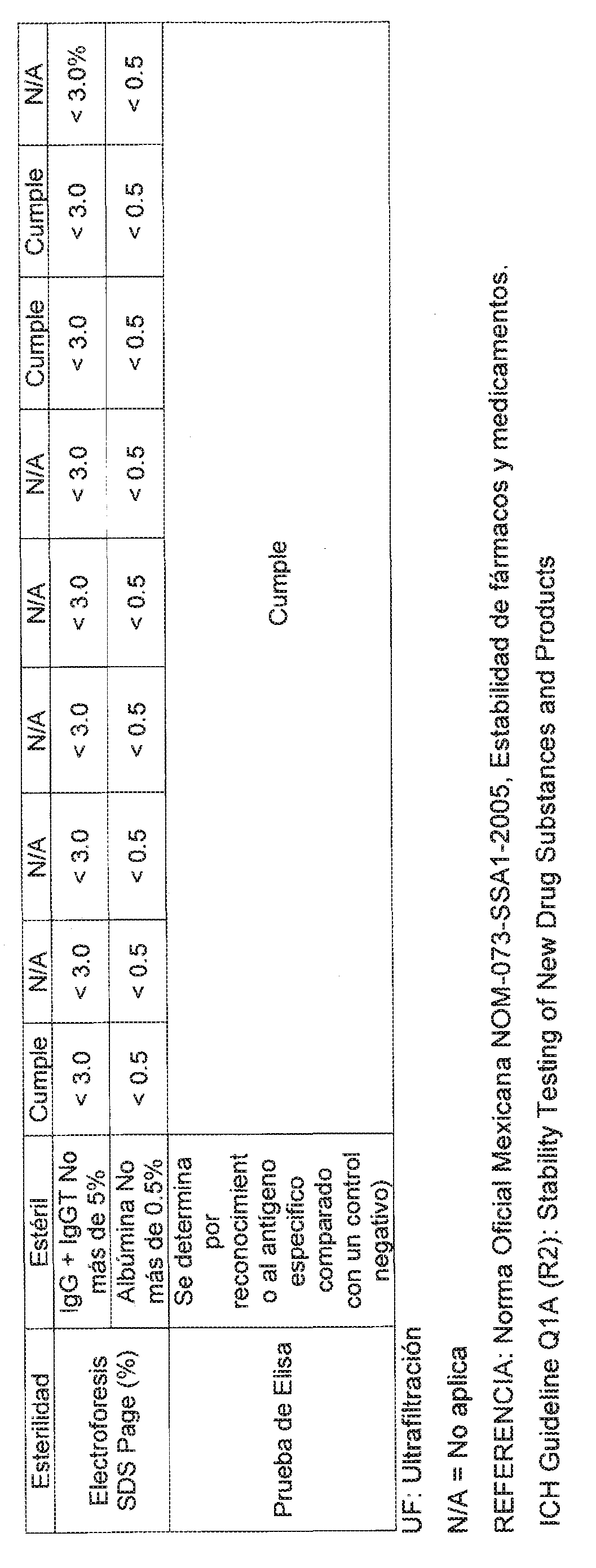
- Tables 26 to 29 indicate the stability of two batches: Lot B-9H-21, produced by only one precipitation and UF per hollow fiber 30 kDa (Tables 26 and 27) and lot B-OK-15, produced by 17 steps and (Tables 28 and 29) and the stability parameters are met in both cases.
- the present invention relates to a novel process for the production of F (ab ') 2 fragments of antibodies that specifically bind to antigens present in poisons, with a preferred embodiment for antagonizing arachnid or vi Southernd poisons;
- the process of the invention is characterized by the use of uKrafiltration and the reduction of unit stages, obtaining a safe antivenom for its neutralizing efficacy and because it does not generate any pyrogenic or anaphylactic reaction.
- the process of the invention is of the utmost performance and purity for the final product, this improves in its neutralizing potency and in its stability, the quality of the final product is therefore superior to that obtained with the processes described in the state of the technique.
- Tables 30 and 31 show the antibody titer expressed as neutralizing doses (DLso Neut / ml) the first (30) using scorpion venom of the species Centruroides noxius, C. limpidus limpidus, C. limpidus tecomanus and C. suffussus suffussus, obtained by maceration of telson glands (Group of horses I and IV) and the second ones (31) using venom obtained by electrical stimulation of telson glands (Group of horses II and III).
- DLso Neut / ml neutralizing doses
- the invention relates to the production of antivenoms against venoms of snake species or ophidians selected from the group of genera and species comprising: genus Cerastes, including the species: C. boehmei, C. cerastes, C. gasperettii, C vivid, Pseudocerastes f ⁇ eldi ,, Pseudocerastes persicus, Pseudocerastes urarachnoides; Brtis genus, including the species B. albanica, B. arietans, B. armata, B. atropos, B. caudalis, B. comuta, B. gabonica, B. harenna, B. heráldica, B.
- genus Cerastes including the species: C. boehmei, C. cerastes, C. gasperettii, C vivid, Pseudocerastes f ⁇ eldi ,, Pseudocerastes persicus
- inomata B. nasicomis , B. parviocula, B. peringueyi, B. rhinoceros, B. rubida, B. schneideri, B. worthingtoni, B. xeropaga; Crotalus genus, including species: C. d. terrific C. adamanteus C. angelensis C. aquilus C. armstrongi C. basiliscus C. campbelli, C. catalinensis, C. cerastes, C. cerberus, C. culminatus, C. durissus, C. enyo, C. er ⁇ csmithi, C. horr ⁇ dus, C. intermedius, C. lannomi, C. lepidus C.
- mitchellii C. molossus, C. morulus, C. oreganus. C. omatus, C. polystictus, C. pricei, C. pusillus, C. pyrrhus, C. ravus, C. ruber, C. scutulatus, C. simus C. stejnegeri, C. stephensi, C. tancitarensis, C. tigris , C. tlaloci, C. totonacus, C. transversus, C. triseriatus, C. tzabcan, C. vegrandis, C. viridis, C.
- melanocephala Lachesis muta, Lachesis stenophrys; likewise, species of elápidos including to the cobras species Naja naja siamensis and the sorts; Acanthophi, Aipysurus, Antaioserpens, Aspidelaps Aspidomorphu, Austrelaps, Brachyumphis, Bungarus, Cacophis.Calliophis, Cryptophis, Demansia, Dendroaspis, Denisonia, Drysdalia, Echiopsis, Elapognathus, Elapsoidea, Emydocephalus, Enhydrna, Ephalophis, Furina, Hemachatus, Hemiaspis, Hemibungarus, Hoplocephalus "Hydrelaps, Hydrophis, Kolpophis, Laticauda, Loveridgelaps.Micropechis, Micruroides, Micrurus, Naja, Notechis, Ogmodon, O
- the invention provides for the production of antivenoms designed against poisons of arachnid species selected from the group consisting of: the Barasian species: Phoneutria nigriventar, the Australian species of funnel net spiders including the species Atrax robustus.and the species of the Hadronyche genus. Species of worldwide distribution of the genera Phoneutria, of the genus Missulena and of the genus Latrodectus, including the species: L. bishopi, L. hesperus, L. mactans, L. variolus, L. antheratus, L. apicalis, L. corallinus, L. curacaviensis, L. diaguita, L. mirabilis, L. quartus, L.
- antivenoms designed against poisonous species of sicharid arachnids (Sicar ⁇ idae family) of both the genus Sicarius and the genus Loxosceles, including the species: L gaucho, L intermedia, L. laeta, L. deserta, L. reclusa, L accepts, L adelaida, L. alamosa, Lalicea, L amazonian, L anomalous, L apachea, L. aphrasta, L. aranea L. arizonic, L. aurea, L low, L. barbara, L. belli L. bentejui, L.
- antivenoms for treatment of scorpions caused by species or genera selected from the group consisting of: Androctonus genus including the species: Androctonus australis Androctonus mauretanicus mauretanicus, Androctonus crassicauda, Buthacus genus including the species: Buthacus macrocentrus , genus Buthus, including the species Buthus occitanus tunetanus, genus Leiurus including the species Leiurus quinquestriatus hebraeus, genus Parabuthus including the species Parabuthus granulatus, genus Centruroides including the species: Centruroides noxius, Centruroides limpidus, Centruroides suf ⁇ üsus, genus Tityus, including the species: Tityus serrulatus, Tityus metuendus, Tityus matthieseni, Tityus bastosi, Tityus bahiensi.
- the therapeutic applications using the antivenoms of the invention are the modality of the invention, in the example e basic treatment schemes are mentioned. It is a principal object of the invention to provide a process for producing and obtaining a composition of F (ab ') 2 antibody fragments capable of neutralizing poisons from hyperimmune mammalian non-human plasma, characterized in that it comprises:
- step (c) above the precipitation of unwanted protein fragments, step (c) above, is performed by adding 21% P / V ammonium sulfate at room temperature, during the for the duration of the solubilization of ammonium sulfate, and immediately at this step proceed to clarification I and II of step (d) above.
- the precipitation of fragments of unwanted proteins from step (c) above is performed by adding 21% P / V ammonium sulfate to the time in which the temperature is increased to 54 ° C, during the time that the solubilization of the ammonium sulphate lasts, and immediately after this step we proceed to the clarification I and II of step (d) above.
- 30 kDa tangential fiber filtration is carried out with an average ⁇ of 4.06 Pa.
- step (e) the tangential filtration by 30 kDa cassette is carried out keeping a t in average of 2.05 Pa and 20 washes are made and the subsequent tangential filtration by cassette of 50 kDa is done keeping a ⁇ of 0 and 20 washes are made.
- compositions obtained by said process are embodiments of the invention in such a way that a degree of purity> 95%, a Fab percentage of 0 to 3%, a percentage of low molecular weight components of 0 to 0.90% and a percentage of high molecular weight components from 0 to 4.2%.
- Methods of the invention are compositions of F (ab ') 2 antibody fragments obtained by said process in such a way that they are capable of neutralizing poisons with a power that exceeds by k) less than 6 times that obtained when the purification is carried out. based on a process of double salt precipitation and dialysis.
- EXAMPLE 1 Immunization to obtain hyperimmune plasma.
- the immunization schemes have been variable.
- An example of the way to immunize is to apply doses of poisons alone or in cocktails, native or recombinant, ranging from 3 to 150 DLso per horse over 12 immunizations given for 5 to 6 weeks for the basic schemes and 70 to 450 DLso per horse during 5 immunizations for 3 weeks
- Complete and incomplete Freund's adjuvants can be used, as well as an isotonic saline solution, using a total of 5, 10 or 20 ml in the different inoculations.
- the source of antibodies used in the present invention can be obtained by plasmapheresis: bleeding at a rate of 6 to 10 liters per horse by bleeding, two bleedings are performed during the 15 days following the last inoculation of each scheme the blood is erythrocyte sedimentation and the entire cellular package is returned, thus reducing the stress associated with the fall of blood cells and producing the least possible impact on the health of the animal despite being subjected to the production of antibodies.
- plasma Only plasma is retained as the source of antibodies for the method of the present invention may be a mixture of blood plasmas from different animals immunized with the same antigen.
- EXAMPLE 2 Preparation of the pepsin solution to produce F (ab ') 2 fragments.
- the clarification of the pepsin solution proceeds, for which a membrane with pore size 1.0 to 3.0 ⁇ is used.
- the membrane with a pore size of 0.2 ⁇ (absolute) is subsequently used. wetted with process water, and flow adjustment as recommended by the protocol for the equipment.
- EXAMPLE 3 Enzymatic digestion of the plasma to produce F (ab ') 2 fragments.
- the temperature of the plasma + process water mixture is increased to 37 ° C ⁇ 2 ° C.
- the pH is adjusted to 3.5 ⁇ 0.2 with 5 N HCl.
- 166.6 ml_ of the sterile pepsin solution is added to the plasma + process water mixture located in the 5 I reactor at a temperature of 37 ° C and a pH of 3.5 ⁇ 0.2.
- the mixture of the plasma + process water + sterile pepsin solution located in the 5 liter reactor is maintained at a temperature of 37 ° C ⁇ 2 ° C and a pH of 3.5 ⁇ 0.2 during 90 minutes in constant agitation.
- the pH is adjusted to 4.2 ⁇ 0.2 of the digested plasma mixture + process water + filtered pepsin solution located in the 5 liter reactor at a temperature of 37 ° C ⁇ 2 ° C with NaOH 5 N.
- Ammonium sulfate is added to the digested plasma mixture + process water + pepsin solution.
- 840 g of ammonium sulfate is added to the digested plasma mixture + process water-i-sterile pepsin solution located in the 5 L reactor at a temperature of 37 ° C ⁇ 2 ° C , pH of 4.2 ⁇ 0.2 and constant agitation.
- EXAMPLE 5 Clarification I and II of the supernatant from precipitation (Salting-Out) to obtain F (ab ') 2 fragments.
- the membrane is with a pore size of 8.0 to 20.0 ⁇
- the system is fed with a peristaltic pump, the feed flow is kept constant, the pressure increase at 25 psi indicates that the process must be stopped in this time, a density of the product to be processed of 1.2 mg / ml was considered, and a volume of 150 g (125 ml) was used, the approximate flow: 6-7 ml / min, with a yield of 56 liters / m 2 .
- Climbing to filter 60 and 120 liters the calculated area of the appropriate filter is 1.05 m 2 or 2.1 m 2 , respectively. With an area of 1 m 2 the process takes 30 minutes applying a flow of 2,000 ml / min.
- This example is scalable.
- Clarification II is carried out with a membrane of pore size of 0.2 ⁇ m.
- the calculated flow of feed is 12 ml / min and the Flux (LHM) of 956, the membrane area is 0.00138 m 2 , in yield is 605 liters / m 2 .
- LHM Flux
- a membrane with 0.099 m 2 of area can be used.
- Climbing to a batch of 120 liters can be used a membrane with 0.198 m 2 of area.
- the theoretical time of the process is 30 minutes with a flow of 2,000 ml / min, but this is adjustable depending on the the availability of commercial membranes or the volume to be filtered.
- EXAMPLE 6 Tangential filtration of the clarified to obtain F (ab ') 2 fragments by 30 kDa hollow fiber membrane.
- the membrane is polyester sulfone cutting size of 30 kDa, the operating conditions (feed flow, recirculation time, volume / area ratio, transmembrane pressure, initial volume concentration factor, diafiltration volume and volume concentration factor) final), were tested and selected internally.
- the purity obtained protein concentration and yield is presented in table 13, is the average of 7 tests where 500 ml were filtered per membrane test of 0.14 m 2 , thus a ratio of volume / area of 4 liters is considered / m 2 , the initial volume concentration factor is 3 X and the final volume is 5 X, the diafiltration volume is 20 and the time of the process is 4 hours. It works with a value of ⁇ on average of 4.06 Pa; This allows the separation of the expected molecules, without causing the formation of aggregates or plugging of the filter.
- EXAMPLE 7 Tangential filtration of the clarified to obtain F (ab ') 2 fragments per 30 kDa cassette.
- the product to be ultrafiltered is concentrated to 2 liters (2x). It diafiltrates maintaining the constant volume of 2 liters by adding the 0.9% sodium chloride solution with another pump until completing 40 liters of 0.9% sodium chloride (20 washes).
- the operating conditions feed flow, recirculation time, volume / area ratio, transmembrane pressure, initial volume concentration factor, diafiltration volume and final volume concentration factor) were tested and selected internally, thus allowing the separation of the expected molecules, without causing the formation of aggregates or plugging of the cassette. It works with a value of ⁇ on average of 2.05 Pa.
- EXAMPLE 8 Tangential filtration of the ultrafiltrate by 30 kDa to obtain F (ab ') 2 fragments per 50 kDa cassette.
- a membrane with pore size 0.2 um (absolute) is prepared, wetting it with process water at a permeate and feed flow calculated according to its performance, volume and system area.
- the pump flow setting is approximately 17 ml / min and the capsule is wetted with this membrane with 100 ml of process water.
- the pump flow is adjusted to approximately 10 ml / min and the solution is clarified through the capsule with this membrane. Everything is done at room temperature.
- EXAMPLE 10 Formulation of the F (ab ') 2 fragment solution.
- the amount of sodium chloride calculated is weighed.
- the calculated amount of sucrose is weighed.
- the calculated amount of glycine is weighed. Dissolve the sodium chloride, sucrose and glycine calculated in 50% of the volume of process water to reach the final volume in the formulation container. This last operation is omitted if the volume of the concentrate does not need to be diluted and then the sodium chloride, sucrose and glycine are added directly.
- the volume of the formula sodium chloride, sucrose and glycine is mixed with the volume of the concentrate to reach the calculated final volume of the formulation. All this step is carried out at room temperature.
- EXAMPLE 11 Prefiltration of the solution of F (ab ') 2 fragments formulated and final nanofiltration.
- the prefiltration and the nanofiltration were integrated in table 21 as steps 8 and 9 of the process of the invention.
- the formulated bulk be pre-filtered to then be subjected to viral clarification by nanofiltration.
- the prefiltration membrane is 0.1 ⁇ (absolute).
- the average flow is 15 ml / min and the Flux (LHM) of 478
- the membrane area is 0.00138 m 2
- the yield is 119.8 Iphores / m 2 .
- Climbing for lots of 40 liters can be used a membrane with 0.335 m 2 of area. If a 0.33 m 2 filtration area available in the market is used, the theoretical time of the process is 12 minutes with a pressure of 10 psi., But this is adjustable depending on the availability of commercial membranes.
- PVDF polyvinylidene difluoride
- EXAMPLE 12 Sterile terminal filtration of the formulated F (ab ') 2 fragment solution.
- step 10 of table 21 As a finished product it is required that the formulated bulk be sterilized by membrane (step 10 of table 21).
- a membrane of 0.2 jim sterilizing grade is used. The system is powered by peristaltic pump, the pressure increase of the system is 2 psi.
- the flow is 12.4 ml / min and the Flux (LHM) of 538, the membrane area is 0.00138 m 2 .
- Climbing to a batch of 40 liters can be used a membrane with 0.111 m 2 of area.
- the product bottles are frozen for 8 hours at -70 ° C and 1000 mBar, the main drying is done at -20 ° C (plate temperature), 0 mBar for 63 hours and the final drying at 30 ° C (temperature of the dish), 0 mBar for 8 hours.
- the main drying and the final drying are carried out with the temperature of the lyophilization chamber -60 ° C. These conditions are established for an operation volume of 125 ml (25 vials).
- Example 14 Verification of cresol and phenol removal for each of the stages of the process of obtaining F (ab ') 2 fragments at the pilot plant level.
- Samples of equine plasma were submitted to the pilot plant process, samples were taken from each stage: digestion with pepsin, precipitation, thermocoagulation, and the diafiltration modalities: the tangential with hollow fiber of 30 kDa cut size and the one made with systems 30 kDa and 50 kDa cassettes, subsequent samples were also taken: the last clarified, the product prefiltered, nano filtered and finished product (PT).
- samples were taken in each stage and in each in the 2X concentration, diafiltered 5, 10, 15 and 20 washes and samples were taken in the 10X concentration, diafiltered 5, 10, 15 and 20 washes.
- Antivenoms against scorpion venom can be used according to the degree of poisoning under the following scheme (Table 33): Table 33.
- Antivenoms against snake venom can be used according to the degree of poisoning under the following scheme (Table 34):
- the present invention is a high performance process for obtaining a safe and effective antidote to act against the toxic activity of poisons; the antidote is a composition based on F (ab ') 2 fragments of IgG antibodies, which when administered in mammals produce a passive immunity.
- the F (ab ') 2 fragments obtained by the process of the present invention are of polyclonal origin and are characterized by their potency and purity.
- Chippaux JP (1998). Snake-bites: appraisal of the global situation. BulEetin of the World Health Organization, 76 (5), 515-24.
- Tityus serrulatus scorpion venom toxins display a complex pattern of antigenic reactivity. Toxicon Feb; 31 (2): 223-7.
- a protocol for 'enhanced pepsin digestion' a step by step method for obtaining purge antibody fragments in high yield from serum Journal of Immunological Methods 275 (2003) 239-250.
Landscapes
- Chemical & Material Sciences (AREA)
- Health & Medical Sciences (AREA)
- Organic Chemistry (AREA)
- Life Sciences & Earth Sciences (AREA)
- Medicinal Chemistry (AREA)
- General Health & Medical Sciences (AREA)
- Immunology (AREA)
- Biochemistry (AREA)
- Biophysics (AREA)
- Genetics & Genomics (AREA)
- Molecular Biology (AREA)
- Proteomics, Peptides & Aminoacids (AREA)
- Engineering & Computer Science (AREA)
- Water Supply & Treatment (AREA)
- Analytical Chemistry (AREA)
- Bioinformatics & Cheminformatics (AREA)
- Microbiology (AREA)
- Mycology (AREA)
- Pharmacology & Pharmacy (AREA)
- Epidemiology (AREA)
- Animal Behavior & Ethology (AREA)
- Public Health (AREA)
- Veterinary Medicine (AREA)
- Peptides Or Proteins (AREA)
- Medicines Containing Antibodies Or Antigens For Use As Internal Diagnostic Agents (AREA)
Abstract
Description






Claims
Priority Applications (5)
| Application Number | Priority Date | Filing Date | Title |
|---|---|---|---|
| PCT/MX2017/000115 WO2019070108A1 (es) | 2017-10-02 | 2017-10-02 | Proceso de alto rendimiento para la producción de antivenenos de fragmentos f (ab') 2 de anticuerpos |
| EP17927999.7A EP3680252A4 (en) | 2017-10-02 | 2017-10-02 | HIGH PERFORMANCE PROCESS FOR PREPARATION OF POISON ANTIDOTS WITH F (AB ') - 2 ANTIBODY FRAGMENTS |
| MA49426A MA49426B1 (fr) | 2017-10-02 | 2017-10-02 | Processus à haut rendement pour la production d’antivenins à partir de fragments d’anticorps f(ab') 2 |
| MX2019015360A MX2019015360A (es) | 2017-10-02 | 2017-10-02 | Proceso de alto rendimiento para la produccion de antivenenos de fragmentos f(ab')2 de anticuerpos. |
| CONC2020/0001084A CO2020001084A2 (es) | 2017-10-02 | 2020-01-29 | Proceso de alto rendimiento para la producción de antivenenos de fragmentos f (ab') 2 de anticuerpos |
Applications Claiming Priority (1)
| Application Number | Priority Date | Filing Date | Title |
|---|---|---|---|
| PCT/MX2017/000115 WO2019070108A1 (es) | 2017-10-02 | 2017-10-02 | Proceso de alto rendimiento para la producción de antivenenos de fragmentos f (ab') 2 de anticuerpos |
Publications (1)
| Publication Number | Publication Date |
|---|---|
| WO2019070108A1 true WO2019070108A1 (es) | 2019-04-11 |
Family
ID=65994605
Family Applications (1)
| Application Number | Title | Priority Date | Filing Date |
|---|---|---|---|
| PCT/MX2017/000115 Ceased WO2019070108A1 (es) | 2017-10-02 | 2017-10-02 | Proceso de alto rendimiento para la producción de antivenenos de fragmentos f (ab') 2 de anticuerpos |
Country Status (5)
| Country | Link |
|---|---|
| EP (1) | EP3680252A4 (es) |
| CO (1) | CO2020001084A2 (es) |
| MA (1) | MA49426B1 (es) |
| MX (1) | MX2019015360A (es) |
| WO (1) | WO2019070108A1 (es) |
Citations (9)
| Publication number | Priority date | Publication date | Assignee | Title |
|---|---|---|---|---|
| US4814433A (en) | 1987-09-16 | 1989-03-21 | Miles Inc. | Method for obtaining a papain-free antibody fragment preparation |
| US4849352A (en) | 1984-10-09 | 1989-07-18 | Sullivan John B | Antibody purification process |
| US5733742A (en) | 1993-06-03 | 1998-03-31 | Therapeutic Antibodies Inc. | Production of antibody fragments from whole blood |
| US6706655B2 (en) | 1998-08-07 | 2004-03-16 | Borealis Technology Oy | Catalyst component comprising magnesium, titanium, a halogen and an electron donor, its preparation and use |
| US6709655B2 (en) | 2001-02-28 | 2004-03-23 | Instituto Bioclon, S.A. De C.V. | Pharmaceutical composition of F(ab1)2 antibody fragments and a process for the preparation thereof |
| US7537916B2 (en) | 2001-12-17 | 2009-05-26 | Crucell Holland B.V. | Efficient production of F(ab')2 fragments in mammalian cells |
| CN101816789A (zh) | 2010-04-08 | 2010-09-01 | 成都军区疾病预防控制中心军事医学研究所 | 抗蝰蛇蛇毒冻干血清及制备方法 |
| CN103864930A (zh) | 2014-02-17 | 2014-06-18 | 中国人民解放军成都军区疾病预防控制中心 | 抗中国东亚钳蝎蝎毒F(ab’)2抗体制备及其使用方法 |
| ES2549690A2 (es) | 2012-10-18 | 2015-10-30 | Inosan Biopharma, S.A. | Inmunoterapéuticos polivalentes de alta especificidad basados en anticuerpos modificados y formulación liofilizada inyectable altamente segura y eficaz |
-
2017
- 2017-10-02 WO PCT/MX2017/000115 patent/WO2019070108A1/es not_active Ceased
- 2017-10-02 EP EP17927999.7A patent/EP3680252A4/en not_active Withdrawn
- 2017-10-02 MA MA49426A patent/MA49426B1/fr unknown
- 2017-10-02 MX MX2019015360A patent/MX2019015360A/es unknown
-
2020
- 2020-01-29 CO CONC2020/0001084A patent/CO2020001084A2/es unknown
Patent Citations (14)
| Publication number | Priority date | Publication date | Assignee | Title |
|---|---|---|---|---|
| US8048414B1 (en) | 1984-10-09 | 2011-11-01 | Btg International Inc. | Antivenom composition containing Fab fragments |
| US4849352A (en) | 1984-10-09 | 1989-07-18 | Sullivan John B | Antibody purification process |
| US4814433A (en) | 1987-09-16 | 1989-03-21 | Miles Inc. | Method for obtaining a papain-free antibody fragment preparation |
| US5733742A (en) | 1993-06-03 | 1998-03-31 | Therapeutic Antibodies Inc. | Production of antibody fragments from whole blood |
| US6706655B2 (en) | 1998-08-07 | 2004-03-16 | Borealis Technology Oy | Catalyst component comprising magnesium, titanium, a halogen and an electron donor, its preparation and use |
| US7485303B2 (en) | 2001-02-28 | 2009-02-03 | Instituto Bioclon, S.A. De C.V. | Pharmaceutical composition of F(ab')2 antibody fragments |
| ES2345245T3 (es) * | 2001-02-28 | 2010-09-20 | Instituto Bioclon S.A. De Cv. | Composicion farmaceutica de fragmentos f(ab)2 de anticuerpos y metodo para la preparacion de los mismos. |
| US6709655B2 (en) | 2001-02-28 | 2004-03-23 | Instituto Bioclon, S.A. De C.V. | Pharmaceutical composition of F(ab1)2 antibody fragments and a process for the preparation thereof |
| US8075893B2 (en) | 2001-02-28 | 2011-12-13 | Instituto Bioclon, S.A. de S.V. | Pharmaceutical composition of F(ab′)2 antibody fragments and a process for the preparation thereof |
| US8512706B2 (en) | 2001-02-28 | 2013-08-20 | Instituto Bioclon, S.A. De C.V. | Compositions of F(ab′)2 antibody fragments |
| US7537916B2 (en) | 2001-12-17 | 2009-05-26 | Crucell Holland B.V. | Efficient production of F(ab')2 fragments in mammalian cells |
| CN101816789A (zh) | 2010-04-08 | 2010-09-01 | 成都军区疾病预防控制中心军事医学研究所 | 抗蝰蛇蛇毒冻干血清及制备方法 |
| ES2549690A2 (es) | 2012-10-18 | 2015-10-30 | Inosan Biopharma, S.A. | Inmunoterapéuticos polivalentes de alta especificidad basados en anticuerpos modificados y formulación liofilizada inyectable altamente segura y eficaz |
| CN103864930A (zh) | 2014-02-17 | 2014-06-18 | 中国人民解放军成都军区疾病预防控制中心 | 抗中国东亚钳蝎蝎毒F(ab’)2抗体制备及其使用方法 |
Non-Patent Citations (39)
| Title |
|---|
| AHRER K.BUCHACHER A.IBERER G.JUNGBAUER A.: "Effects of ultra-/diafiltration conditions on present aggregates in human immunoglobulin G preparations", JOURNAL OF MEMBRANE SCIENCE, vol. 274, 2006, pages 108 - 115, XP024931381, DOI: 10.1016/j.memsci.2005.08.018 |
| ALVARENGA, L. M.ZAHID, M.DI TOMMASO, A.JUSTE, M. 0.AUBREY, N.BILLIALD, P. ET AL.: "Engineering Venom's Toxin-Neutralizing Antibody Fragments and Its Therapeutic Potential", TOXINS, vol. 6, 2014, pages 2541 - 2537 |
| BURNOUF T. ET AL.: "Assessment of the viral safety of antivenoms fractionated from equine plasma", BIOLOGICALS, vol. 32, 2004, pages 115 - 128, XP004630832, DOI: doi:10.1016/j.biologicals.2004.07.001 * |
| CALMETTE: "The treatment of animals poisoned with snake venom by the injection of antivenomous serum", BR. MED. J., vol. 2, pages 399 - 400 |
| CALVETE, J.J.JUAREZ, P.SANZ, L.: "Snake venomics. Strategy and applications", J. MASS SPECTROM, vol. 42, 2007, pages 1405 - 1414 |
| CHEN, JENSEN P. E.: "The role of B lymphocytes as antigen-presenting cells", ARCH IMMUNOL THER EXP (WARSZ, vol. 56, no. 2, March 2008 (2008-03-01), pages 77 - 83 |
| CHIPPAUX JP: "Snake-bites: appraisal of the global situation", BULLETIN OF THE WORLD HEALTH ORGANIZATION, vol. 76, no. 5, 1998, pages 515 - 24 |
| DE LIMA M.E.MARTIN-EAUCLAIRE M.F.CHAVEZ-OLORTEGUI C.DINIZ C.R.GRANIER C.: "Tityus serrulatus scorpion venom toxins display a complex pattern of antigenic reactivity", TOXICON, vol. 31, no. 2, February 1993 (1993-02-01), pages 223 - 7, XP025807527, DOI: 10.1016/0041-0101(93)90290-Y |
| FOX SRATHUWITHANA ACKASTURIRATNE ALALLOO DGDE SILVA, HJ: "Underestimation of snakebite mortality by hospital statistics in the Monaragala District of Sri Lanka", TRANSACTIONS OF THE ROYAL SOCIETY OF TROPICAL MEDICINE AND HYGIENE, vol. 100, no. 7, 2006, pages 693 - 5, XP025125984, DOI: 10.1016/j.trstmh.2005.09.003 |
| GERRINGA D.KINGB T.R.BRANTONC, R.: "Validating a faster method for reconstitution of Crotalidae Polyvalent Immune Fab (ovine", TOXICON, vol. 69, July 2013 (2013-07-01), pages 42 - 49, XP028559247, DOI: 10.1016/j.toxicon.2012.12.005 |
| GHOSH, R.CUI, Z.F.: "Protein purification by ultrafiltration with pre-treated membrane", JOURNAL OF MEMBRANE SCIENCE, vol. 167, no. 1, 14 March 2000 (2000-03-14), pages 47 - 53, XP004187996, DOI: 10.1016/S0376-7388(99)00275-6 |
| GUTIERREZ JMTHEAKSTON RDGWARRELL DA: "Confronting the neglected problem of snake bite envenoming: the need for a global partnership", PLOS-MEDICINE, vol. 6, no. 3, 2006, pages 0727 - 0731 |
| GWEE, M.C.E.NIRTHANAN, S.KHOO, H.E.GOPALAKRIHNAKONE, P.KINI, R.M.CHEAH, L.S.: "Autonomic effects of some scorpion venoms and toxins", CLIN. EXP. PHARM. PHYSIOL., vol. 29, 2002, pages 795 - 801 |
| HARMS A. J.: "The Purification of Antitoxic Plasmas by Enzyme Treatment and Heat Denaturation", BIOCHEM J, vol. 42, no. 3, 1948, pages 390 - 397, XP055590248 * |
| HARMS A.J.: "The purification of antitoxic plasmas by enzyme treatment and heat denaturation", BIOCHEM J., vol. 42, 1948, pages 390 - 397, XP055590248, DOI: 10.1042/bj0420390 |
| HEINEN T. E.GORINI DA VEIGA A. B.: "Review Arthropod venoms and cancer", TOXICON, vol. 57, 2011, pages 497 - 511, XP028175506, DOI: 10.1016/j.toxicon.2011.01.002 |
| HEMKE, V, JOURNAL OF CELL AND TISSUE RESEARCH, vol. 13, no. 1, pages 3479 - 3484 |
| LANDON J. ET AL.: "Single-reagent one-step procedures for the purification of ovine IgG, F(ab')2 and Fab antivenoms by caprylic acid", JOURNAL OF IMMUNOLOGICAL METHODS, vol. 402, 2014, pages 15 - 22, XP028820460, DOI: 10.1016/j.jim.2013.11.001 |
| LANDONJONES: "A protocol for enhanced pepsin digestion': a step by step method for obtaining pure antibody fragments in high yield from serum", JOURNAL OF IMMUNOLOGICAL METHODS, vol. 275, 2003, pages 239 - 250, XP004416752, DOI: 10.1016/S0022-1759(03)00005-X |
| LANDONJONES: "Enhanced pepsin digestion: a novel process for purifying antibody F(ab') fragments in high yield from serum", JOURNAL OF IMMUNOLOGICAL METHODS, vol. 263, 2002, pages 57 - 74, XP004354385, DOI: 10.1016/S0022-1759(02)00031-5 |
| LOURENGO, W.R.: "Diversity and endemism in tropical versus temperate scorpion communities", BIOGEOGRAPHICA, vol. 70, 1994, pages 155 - 160 |
| MARTIN-EAUCLAIRE, M.F.COURAUD, F.: "Proceso de Concentration de Proteina de Suero de Leche por Ultrafiltration. Proyecto de Grado para optar al tftulo de Ingeniero Quimico. Planta de Vegetales", 1995, ICTA, UNIVERSIDAD NACIONAL DE COLOMBIA, article "Scorpion neurotoxins: effects and mechanisms", pages: 683 - 716 |
| MINTONJR. S. A.: "Common Antigens in Snake Venoms. Capftulo: Venenos de serpientes", HANDBOOK OF EXPERIMENTAL PHARMACOLOGY, vol. 52, pages 847 - 862 |
| POPE C.G.: "Dissagregation of proteins by enzymes", BR J EXP PATH, 1938, pages 1886 - 251 |
| POPE, G.G.: "The action of proteolytic enzymes on antitoxins and proteins of immune ser. II. Heat denaturation after partial enzyme action", BR. J. EXP. PATHOL., vol. 20, 1939, pages 201 - 212 |
| POPE, G.G.: "The action of proteolytic enzymes on antitoxins and proteins of immune sera. I. True digestion of the protein", BR. J. EXP. PATHOL., vol. 20, 1939, pages 132 - 149 |
| POSSANI, L.D.MERINO, E.CORONA, M.BOLIVAR, F.BECERRIL, B.: "Peptides and genes coding for scorpion toxins that affect ion-channels", BIOCHIMIE, vol. 82, 2000, pages 861 - 868 |
| PUGH RNTHEAKSTON RDREID HA: "Malumfashi Endemic Diseases Research Project, XIII. Epidemiology of human encounters with the spitting cobra, Naja nigricollis, in the Malumfashi area of northern Nigeria", ANNALS OF TROPICAL MEDICINE AND PARASITOLOGY, vol. 74, no. 5, 1980, pages 523 - 30 |
| RODRIGUEZ-PINTO, REVIEW. B CELLS AS ANTIGEN PRESENTING CELLS CELLULAR IMMUNOLOGY, vol. 238, 2005, pages 67 - 75, Retrieved from the Internet <URL:www.elsevier.com/locate/ycimm> |
| SAETANG, T.TREAMWATTANA, N.SUTTIJITPAISAL, P.RATANABANANGKOON, K.: "Quantitative comparison on the refinement of horse antivenom by salt fractionation and ion-exchange chromatography", J. CHROMATOGR., B: BIOMED. SCI. APPL., vol. 700, 1997, pages 233, XP004095060, DOI: 10.1016/S0378-4347(97)00244-2 |
| See also references of EP3680252A4 |
| SHARMA SK ET AL.: "Impact of snake bites and determinants of fatal outcomes in southeastern Nepal", AMERICAN JOURNAL OF TROPICAL MEDICINE AND HYGIENE, vol. 71, no. 2, 2004, pages 234 - 238 |
| SIMARD, M.J.WATT, D.D.: "The Biology of Scorpions", 1990, STANFORD UNIVERSITY PRESS, article "Venoms and toxins", pages: 414 - 444 |
| SMITH, K.J.SNOW RW ET AL.: "The prevalence and morbidity of snake bite and treatment-seeking behaviour among a rural Kenyan population", ANNALS OF TROPICAL MEDICINE AND PARASITOLOGY, vol. 88, no. 6, 1994, pages 665 - 71 |
| SOLANO RODRÍGUEZ L: "Purification del suero antiviperino polivalente utilizando ácido caprílico (AC) solo y/o en combination con cromatografía de intercambio ionico y su comparacion con el método Birmex tradicional", TESIS PARA OBTENER EL GRADO DE MAESTRA EN CIENCIAS DE LA SALUD CON ÁREA DE CONCENTRATION EN VACUNOLOGÍA, December 2012 (2012-12-01), pages 10, 11, XP055590247 * |
| WARRELL DAARNETT C: "The importance of bites by the saw-scaled or carpet viper (Echis carinatus): epidemiological studies in Nigeria and a review of the world literature", ACTA TROPICA, vol. 33, no. 4, 1976, pages 307 - 41 |
| WHO: "WHO Guidelines for the Production, Control and Regulation of Snake Antivenom Immunoglobulins", WHO EXPERT COMMITTEE ON BIOLOGICAL STANDARDIZATION, 59TH MEETING, 13 October 2008 (2008-10-13), Geneva, pages 47, 48, 54, 64, XP055590246 * |
| WILLIAMS, D.GUTIERREZ, J.-M.CALVETE, J.WUSTER, W.RATANABANANGKOON, K.PAIVA, O.: "Ending the drought: New strategies for improving the flow of affordable, effective antivenoms in Asia and Africa", JOURNAL OF PROTEOMICS, vol. 74, 2011, pages 2292,2293,2316,2367 - 293,2367-2369 |
| WOLFENDEN, R. N.: "On the nature and action of the venom of poisonous snakes", J. PHYSIOL. (LONDON., vol. 7, pages 326 - 324 |
Also Published As
| Publication number | Publication date |
|---|---|
| MA49426A1 (fr) | 2021-02-26 |
| CO2020001084A2 (es) | 2020-02-18 |
| EP3680252A4 (en) | 2021-04-28 |
| EP3680252A1 (en) | 2020-07-15 |
| MA49426B1 (fr) | 2022-09-30 |
| MX2019015360A (es) | 2020-02-07 |
Similar Documents
| Publication | Publication Date | Title |
|---|---|---|
| ES2553385T3 (es) | Proceso para preparar una composición de inmunoglobulina | |
| ES2769783T3 (es) | Procedimiento de purificación de inmunoglobulina | |
| US8512706B2 (en) | Compositions of F(ab′)2 antibody fragments | |
| CN103476786B (zh) | 一种生产血液来源蛋白质注射制剂的方法,以及使用上述方法获得的蛋白质物料 | |
| JP2013532182A (ja) | 組み合わせ医薬組成物及び神経変性疾患に関連する疾患又は状態を治療する方法 | |
| CN101815530A (zh) | 治疗性抗体的纯化方法和使用方法 | |
| Guidlolin et al. | Polyvalent horse F (Ab) 2 snake antivenom: Development of process to produce polyvalent horse F (Ab) 2 antibodies anti-african snake venom | |
| CN101410136A (zh) | 作为药用产品的特异针对虫媒病毒的免疫球蛋白及F(ab)'2和/或Fab片段的浓缩物 | |
| US7276236B2 (en) | Methods of preparing immune globin and uses thereof | |
| Jadhav et al. | Antivenin production in India | |
| WO2019070108A1 (es) | Proceso de alto rendimiento para la producción de antivenenos de fragmentos f (ab') 2 de anticuerpos | |
| Redwan et al. | Production and purification of ovine anti-tetanus antibody | |
| US20200190166A1 (en) | Polyvalent immunotherapeutics of high specificty based on modified antibodies and a lyophilized injectable formulation highly safe and effective | |
| CN101410138A (zh) | 作为药用产品的对切昆贡亚热特异的免疫球蛋白的浓缩物 | |
| CN103087194B (zh) | 一种抗血循型蛇毒鸡卵黄抗体及其应用 | |
| RU2470664C2 (ru) | Способ получения иммуноглобулина для внутривенного введения, обогащенного иммуноглобулином м, и препарат, полученный этим способом | |
| RU2492176C1 (ru) | СПОСОБ ПОЛУЧЕНИЯ КОМПЛЕКСА ИММУНОГЛОБУЛИНОВ IgG, IgM И IgA ДЛЯ ВНУТРИВЕННОГО ВВЕДЕНИЯ | |
| Lati et al. | Efficacy of IgG, Fab, and F (ab') 2 fragments of horse antivenom in the treatment of local symptoms after Cerastes cerastes (Egyptian snake) bite | |
| RU2287345C2 (ru) | Средство для стимуляции выработки фактора viii свертывания крови | |
| TW200904468A (en) | Concentrate of chikungunya-specific immunoglobulins as a medical product | |
| HK1063057B (en) | Pharmaceutical composition of f(ab) 2 fragments of antibodies and method for the preparation thereof |
Legal Events
| Date | Code | Title | Description |
|---|---|---|---|
| 121 | Ep: the epo has been informed by wipo that ep was designated in this application |
Ref document number: 17927999 Country of ref document: EP Kind code of ref document: A1 |
|
| WWE | Wipo information: entry into national phase |
Ref document number: NC2020/0001084 Country of ref document: CO |
|
| WWP | Wipo information: published in national office |
Ref document number: NC2020/0001084 Country of ref document: CO |
|
| ENP | Entry into the national phase |
Ref document number: 2017927999 Country of ref document: EP Effective date: 20200308 |
|
| NENP | Non-entry into the national phase |
Ref country code: DE |
|
| WWG | Wipo information: grant in national office |
Ref document number: NC2020/0001084 Country of ref document: CO |