WO2019073572A1 - 吸収性物品 - Google Patents
吸収性物品 Download PDFInfo
- Publication number
- WO2019073572A1 WO2019073572A1 PCT/JP2017/037003 JP2017037003W WO2019073572A1 WO 2019073572 A1 WO2019073572 A1 WO 2019073572A1 JP 2017037003 W JP2017037003 W JP 2017037003W WO 2019073572 A1 WO2019073572 A1 WO 2019073572A1
- Authority
- WO
- WIPO (PCT)
- Prior art keywords
- absorbent article
- waistline
- hole
- diaper
- region
- Prior art date
- Legal status (The legal status is an assumption and is not a legal conclusion. Google has not performed a legal analysis and makes no representation as to the accuracy of the status listed.)
- Ceased
Links
- YOOOKRSRQALPCJ-UHFFFAOYSA-N C1C2C(C3)=C3CC12 Chemical compound C1C2C(C3)=C3CC12 YOOOKRSRQALPCJ-UHFFFAOYSA-N 0.000 description 1
- CXJMABGXUAHNBW-UHFFFAOYSA-N CCC(C)CC=N Chemical compound CCC(C)CC=N CXJMABGXUAHNBW-UHFFFAOYSA-N 0.000 description 1
Images





Classifications
-
- A—HUMAN NECESSITIES
- A61—MEDICAL OR VETERINARY SCIENCE; HYGIENE
- A61F—FILTERS IMPLANTABLE INTO BLOOD VESSELS; PROSTHESES; DEVICES PROVIDING PATENCY TO, OR PREVENTING COLLAPSING OF, TUBULAR STRUCTURES OF THE BODY, e.g. STENTS; ORTHOPAEDIC, NURSING OR CONTRACEPTIVE DEVICES; FOMENTATION; TREATMENT OR PROTECTION OF EYES OR EARS; BANDAGES, DRESSINGS OR ABSORBENT PADS; FIRST-AID KITS
- A61F13/00—Bandages or dressings; Absorbent pads
- A61F13/15—Absorbent pads, e.g. sanitary towels, swabs or tampons for external or internal application to the body; Supporting or fastening means therefor; Tampon applicators
- A61F13/45—Absorbent pads, e.g. sanitary towels, swabs or tampons for external or internal application to the body; Supporting or fastening means therefor; Tampon applicators characterised by the shape
- A61F13/49—Absorbent pads, e.g. sanitary towels, swabs or tampons for external or internal application to the body; Supporting or fastening means therefor; Tampon applicators characterised by the shape specially adapted to be worn around the waist, e.g. diapers, nappies
- A61F13/49007—Form-fitting, self-adjusting disposable diapers
- A61F13/49009—Form-fitting, self-adjusting disposable diapers with elastic means
- A61F13/4902—Form-fitting, self-adjusting disposable diapers with elastic means characterised by the elastic material
-
- A—HUMAN NECESSITIES
- A61—MEDICAL OR VETERINARY SCIENCE; HYGIENE
- A61F—FILTERS IMPLANTABLE INTO BLOOD VESSELS; PROSTHESES; DEVICES PROVIDING PATENCY TO, OR PREVENTING COLLAPSING OF, TUBULAR STRUCTURES OF THE BODY, e.g. STENTS; ORTHOPAEDIC, NURSING OR CONTRACEPTIVE DEVICES; FOMENTATION; TREATMENT OR PROTECTION OF EYES OR EARS; BANDAGES, DRESSINGS OR ABSORBENT PADS; FIRST-AID KITS
- A61F13/00—Bandages or dressings; Absorbent pads
- A61F13/15—Absorbent pads, e.g. sanitary towels, swabs or tampons for external or internal application to the body; Supporting or fastening means therefor; Tampon applicators
- A61F13/45—Absorbent pads, e.g. sanitary towels, swabs or tampons for external or internal application to the body; Supporting or fastening means therefor; Tampon applicators characterised by the shape
- A61F13/49—Absorbent pads, e.g. sanitary towels, swabs or tampons for external or internal application to the body; Supporting or fastening means therefor; Tampon applicators characterised by the shape specially adapted to be worn around the waist, e.g. diapers, nappies
- A61F13/49007—Form-fitting, self-adjusting disposable diapers
- A61F13/49009—Form-fitting, self-adjusting disposable diapers with elastic means
- A61F13/49011—Form-fitting, self-adjusting disposable diapers with elastic means the elastic means is located at the waist region
-
- A—HUMAN NECESSITIES
- A61—MEDICAL OR VETERINARY SCIENCE; HYGIENE
- A61F—FILTERS IMPLANTABLE INTO BLOOD VESSELS; PROSTHESES; DEVICES PROVIDING PATENCY TO, OR PREVENTING COLLAPSING OF, TUBULAR STRUCTURES OF THE BODY, e.g. STENTS; ORTHOPAEDIC, NURSING OR CONTRACEPTIVE DEVICES; FOMENTATION; TREATMENT OR PROTECTION OF EYES OR EARS; BANDAGES, DRESSINGS OR ABSORBENT PADS; FIRST-AID KITS
- A61F13/00—Bandages or dressings; Absorbent pads
- A61F13/15—Absorbent pads, e.g. sanitary towels, swabs or tampons for external or internal application to the body; Supporting or fastening means therefor; Tampon applicators
- A61F13/45—Absorbent pads, e.g. sanitary towels, swabs or tampons for external or internal application to the body; Supporting or fastening means therefor; Tampon applicators characterised by the shape
- A61F13/49—Absorbent pads, e.g. sanitary towels, swabs or tampons for external or internal application to the body; Supporting or fastening means therefor; Tampon applicators characterised by the shape specially adapted to be worn around the waist, e.g. diapers, nappies
- A61F13/496—Absorbent pads, e.g. sanitary towels, swabs or tampons for external or internal application to the body; Supporting or fastening means therefor; Tampon applicators characterised by the shape specially adapted to be worn around the waist, e.g. diapers, nappies in the form of pants or briefs
-
- A—HUMAN NECESSITIES
- A61—MEDICAL OR VETERINARY SCIENCE; HYGIENE
- A61F—FILTERS IMPLANTABLE INTO BLOOD VESSELS; PROSTHESES; DEVICES PROVIDING PATENCY TO, OR PREVENTING COLLAPSING OF, TUBULAR STRUCTURES OF THE BODY, e.g. STENTS; ORTHOPAEDIC, NURSING OR CONTRACEPTIVE DEVICES; FOMENTATION; TREATMENT OR PROTECTION OF EYES OR EARS; BANDAGES, DRESSINGS OR ABSORBENT PADS; FIRST-AID KITS
- A61F13/00—Bandages or dressings; Absorbent pads
- A61F13/15—Absorbent pads, e.g. sanitary towels, swabs or tampons for external or internal application to the body; Supporting or fastening means therefor; Tampon applicators
- A61F13/51—Absorbent pads, e.g. sanitary towels, swabs or tampons for external or internal application to the body; Supporting or fastening means therefor; Tampon applicators characterised by the outer layers of the pads
- A61F13/514—Backsheet, i.e. the impermeable cover or layer furthest from the skin
- A61F13/51456—Backsheet, i.e. the impermeable cover or layer furthest from the skin characterised by its properties
- A61F13/51458—Backsheet, i.e. the impermeable cover or layer furthest from the skin characterised by its properties being air-pervious or breathable
- A61F13/5146—Backsheet, i.e. the impermeable cover or layer furthest from the skin characterised by its properties being air-pervious or breathable having apertures of perforations
-
- A—HUMAN NECESSITIES
- A61—MEDICAL OR VETERINARY SCIENCE; HYGIENE
- A61F—FILTERS IMPLANTABLE INTO BLOOD VESSELS; PROSTHESES; DEVICES PROVIDING PATENCY TO, OR PREVENTING COLLAPSING OF, TUBULAR STRUCTURES OF THE BODY, e.g. STENTS; ORTHOPAEDIC, NURSING OR CONTRACEPTIVE DEVICES; FOMENTATION; TREATMENT OR PROTECTION OF EYES OR EARS; BANDAGES, DRESSINGS OR ABSORBENT PADS; FIRST-AID KITS
- A61F13/00—Bandages or dressings; Absorbent pads
- A61F13/15—Absorbent pads, e.g. sanitary towels, swabs or tampons for external or internal application to the body; Supporting or fastening means therefor; Tampon applicators
- A61F13/51—Absorbent pads, e.g. sanitary towels, swabs or tampons for external or internal application to the body; Supporting or fastening means therefor; Tampon applicators characterised by the outer layers of the pads
- A61F13/514—Backsheet, i.e. the impermeable cover or layer furthest from the skin
- A61F13/51456—Backsheet, i.e. the impermeable cover or layer furthest from the skin characterised by its properties
- A61F13/51464—Backsheet, i.e. the impermeable cover or layer furthest from the skin characterised by its properties being stretchable or elastomeric
-
- A—HUMAN NECESSITIES
- A61—MEDICAL OR VETERINARY SCIENCE; HYGIENE
- A61F—FILTERS IMPLANTABLE INTO BLOOD VESSELS; PROSTHESES; DEVICES PROVIDING PATENCY TO, OR PREVENTING COLLAPSING OF, TUBULAR STRUCTURES OF THE BODY, e.g. STENTS; ORTHOPAEDIC, NURSING OR CONTRACEPTIVE DEVICES; FOMENTATION; TREATMENT OR PROTECTION OF EYES OR EARS; BANDAGES, DRESSINGS OR ABSORBENT PADS; FIRST-AID KITS
- A61F13/00—Bandages or dressings; Absorbent pads
- A61F13/15—Absorbent pads, e.g. sanitary towels, swabs or tampons for external or internal application to the body; Supporting or fastening means therefor; Tampon applicators
- A61F13/51—Absorbent pads, e.g. sanitary towels, swabs or tampons for external or internal application to the body; Supporting or fastening means therefor; Tampon applicators characterised by the outer layers of the pads
- A61F13/514—Backsheet, i.e. the impermeable cover or layer furthest from the skin
- A61F13/51496—Backsheet, i.e. the impermeable cover or layer furthest from the skin having visual effects
-
- A—HUMAN NECESSITIES
- A61—MEDICAL OR VETERINARY SCIENCE; HYGIENE
- A61F—FILTERS IMPLANTABLE INTO BLOOD VESSELS; PROSTHESES; DEVICES PROVIDING PATENCY TO, OR PREVENTING COLLAPSING OF, TUBULAR STRUCTURES OF THE BODY, e.g. STENTS; ORTHOPAEDIC, NURSING OR CONTRACEPTIVE DEVICES; FOMENTATION; TREATMENT OR PROTECTION OF EYES OR EARS; BANDAGES, DRESSINGS OR ABSORBENT PADS; FIRST-AID KITS
- A61F13/00—Bandages or dressings; Absorbent pads
- A61F13/15—Absorbent pads, e.g. sanitary towels, swabs or tampons for external or internal application to the body; Supporting or fastening means therefor; Tampon applicators
- A61F13/15203—Properties of the article, e.g. stiffness or absorbency
- A61F2013/15284—Properties of the article, e.g. stiffness or absorbency characterized by quantifiable properties
- A61F2013/15544—Permeability
- A61F2013/15552—Air permeability
-
- A—HUMAN NECESSITIES
- A61—MEDICAL OR VETERINARY SCIENCE; HYGIENE
- A61F—FILTERS IMPLANTABLE INTO BLOOD VESSELS; PROSTHESES; DEVICES PROVIDING PATENCY TO, OR PREVENTING COLLAPSING OF, TUBULAR STRUCTURES OF THE BODY, e.g. STENTS; ORTHOPAEDIC, NURSING OR CONTRACEPTIVE DEVICES; FOMENTATION; TREATMENT OR PROTECTION OF EYES OR EARS; BANDAGES, DRESSINGS OR ABSORBENT PADS; FIRST-AID KITS
- A61F13/00—Bandages or dressings; Absorbent pads
- A61F13/15—Absorbent pads, e.g. sanitary towels, swabs or tampons for external or internal application to the body; Supporting or fastening means therefor; Tampon applicators
- A61F13/51—Absorbent pads, e.g. sanitary towels, swabs or tampons for external or internal application to the body; Supporting or fastening means therefor; Tampon applicators characterised by the outer layers of the pads
- A61F13/514—Backsheet, i.e. the impermeable cover or layer furthest from the skin
- A61F13/51401—Backsheet, i.e. the impermeable cover or layer furthest from the skin characterised by the material
- A61F2013/51441—Backsheet, i.e. the impermeable cover or layer furthest from the skin characterised by the material being a fibrous material
- A61F2013/51447—Backsheet, i.e. the impermeable cover or layer furthest from the skin characterised by the material being a fibrous material being air permeable
-
- A—HUMAN NECESSITIES
- A61—MEDICAL OR VETERINARY SCIENCE; HYGIENE
- A61F—FILTERS IMPLANTABLE INTO BLOOD VESSELS; PROSTHESES; DEVICES PROVIDING PATENCY TO, OR PREVENTING COLLAPSING OF, TUBULAR STRUCTURES OF THE BODY, e.g. STENTS; ORTHOPAEDIC, NURSING OR CONTRACEPTIVE DEVICES; FOMENTATION; TREATMENT OR PROTECTION OF EYES OR EARS; BANDAGES, DRESSINGS OR ABSORBENT PADS; FIRST-AID KITS
- A61F13/00—Bandages or dressings; Absorbent pads
- A61F13/15—Absorbent pads, e.g. sanitary towels, swabs or tampons for external or internal application to the body; Supporting or fastening means therefor; Tampon applicators
- A61F13/51—Absorbent pads, e.g. sanitary towels, swabs or tampons for external or internal application to the body; Supporting or fastening means therefor; Tampon applicators characterised by the outer layers of the pads
- A61F13/514—Backsheet, i.e. the impermeable cover or layer furthest from the skin
- A61F13/51401—Backsheet, i.e. the impermeable cover or layer furthest from the skin characterised by the material
- A61F2013/51441—Backsheet, i.e. the impermeable cover or layer furthest from the skin characterised by the material being a fibrous material
- A61F2013/51452—Backsheet, i.e. the impermeable cover or layer furthest from the skin characterised by the material being a fibrous material being nonwovens
Definitions
- the present invention relates to an absorbent article.
- document 1 describes that by forming a plurality of through holes 25 penetrating in the thickness direction, the air permeability of the exterior body 2 of the pants-type absorbent article 1A is improved to prevent internal stuffiness. It is done.
- the through holes 25 are hidden by the wrinkles generated by the contraction of the elastic member 23, or the through holes 25 are contracted in the lateral direction Y.
- the wearer of the pants-type absorbent article 1A or the person trying to wear the same can not visually recognize the through-hole 25, and recognizes from the appearance that the pants-type absorbent article 1A is a breathable article. There was a fear that I could not do it.
- the present invention has been made in view of the conventional problems as described above, and the object thereof is to ventilate an absorbent article provided with a through hole to a wearer of the absorbent article and a person who is caused to wear the absorbent article. It is to make it easy to impress the goodness of sex.
- the main invention for achieving the above object has a front waistline portion and a rear waistline portion which have vertical and horizontal directions, which cross each other, and a front and rear direction, and has the front waistline portion or the rear waistline.
- At least one of the parts is an absorbent article provided with an elastic member that expands and contracts in the left-right direction and a hole that penetrates in the front-rear direction, and the left-right direction of the front waist part and the rear waist part
- the absorbent article is characterized in that the other side waist portion having the larger contraction force in the left-right direction has more holes than the one side waist portion having the smaller contraction force.
- the elastic article when the elastic article is stretched when the absorbent article is worn, it becomes easy to visually recognize the hole.
- the absorbent article is removed from the package, in the natural state, when the elastic article is worn, the holes that were difficult to visually recognize due to wrinkles formed by the contraction of the elastic member. As it becomes visible when stretched, it becomes easier to make the impression of breathability better with the surprise of knowing the presence of the hole when worn.
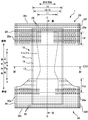
- FIG. 1A is a schematic front view of the diaper 1 in a natural state as an example of the absorbent article of the present embodiment as viewed from the front side.
- FIG. 1B is a schematic rear view of the diaper 1 in a natural state as viewed from the rear side.
- FIG. 2 is a plan view of the expanded diaper 1 as viewed from the skin side.
- FIG. 3 is a cross-sectional view taken along the line III-III in FIG.
- FIG. 4 is a cross-sectional view taken along line IV-IV in FIG.
- FIG. 5A is a schematic view of a Va-Va cross section of the front waist portion 20 in FIG. 1A.
- FIG. 5B is a schematic view of a Va-Va cross section expanded in the left-right direction from the state of FIG. 5A.
- FIG. 6A is a schematic view of a Vb-Vb cross section of the rear waist portion 30 in FIG. 1B.
- FIG. 6B is a schematic view of a Vb-Vb cross section expanded in the left-right direction from the state of FIG. 6A.
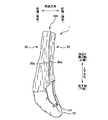
- FIG. 7 is a view showing an example of a method for causing a guardian or the like to wear the diaper 1.
- FIG. 8 is a schematic side view of the diaper 1 as viewed from one end side in the left-right direction.
- FIG. 9 is an enlarged view of the opening 50.
- It has an up-down direction, a left-right direction, and a front-back direction that cross each other, and has a front waistline and a back waistline, and at least one of the front waistline or the rear waistline stretches in the left-right direction Of the front waist part and the rear waist part, the one side waist part having the smaller contraction force in the left-right direction.
- the absorbent article is characterized in that the other side waist portion which is larger in the contraction force in the left-right direction is more provided with the hole portion.
- the left and right end portions of the front waistline portion and the rear waistline portion are respectively joined.
- a person who intends to wear the absorbent article can more surely visually recognize the hole when causing the absorbent article to be worn.
- the front waistline and the rear waistline each have the hole.
- the other side waist portion be the front waist portion.
- the other side waist portion be the back side waist portion.
- the other side waist portion has a non-woven fabric, and has a high density region between the hole and the elastic member adjacent in the vertical direction, and the high density region
- An outer region is provided between the elastic member and the high density region has a predetermined length in the left-right direction, and the density of the non-woven fabric of the high density region is the outer diameter It is desirable that the density of fibers of the non-woven fabric in the area is higher.
- the rigidity of the high density region is higher than the rigidity of the outer region, the shape of the hole can be easily maintained, and the hole can be more easily visible.
- the other side waist portion has a concavo-convex shape in the front-rear direction, and the hole is provided so as to straddle the top of the convex portion which is convex toward the non-skin side. Is desirable.
- the absorbent article is provided, and in the vertical direction, the length of the region where the other side waist portion and the absorber overlap is the length of the region where the one side waist portion and the absorber overlap. It is desirable to be shorter than
- the elastic member can be easily extended in the horizontal direction, so that it is visible in the natural state When the absorbent article is worn, it is easy to visually recognize the holes where it was difficult.
- the absorbent article is included, and the number of the holes in the region overlapping the absorber in the vertical direction in the other side waist portion is the number of the other side waist portion. It is desirable that the number of the holes in the region not overlapping the absorber in the vertical direction be larger than the number of the holes.
- the region overlapping the absorber in the vertical direction is worn even when a person who intends to wear the absorbent article tries to grasp and wear the upper part of the front waist part. Even when putting the arm of the person trying to wear it into the waist opening through the leg opening, it is a region where there is little risk of grasping with the hand of the person trying to wear, so the state where the hole can be seen visually Can be easier to maintain.
- the hole is provided in a region where the hole is overlapped with the absorber in the vertical direction in the other side waist portion, and in the vertical direction in the other side waist portion, the hole is provided. It is desirable not to provide the hole in the area not overlapping the absorber.
- the region overlapping the absorber in the vertical direction is worn even when a person who intends to wear the absorbent article tries to grasp and wear the upper part of the front waist part. Even when putting the arm of the person trying to wear it into the waist opening through the leg opening, it is a region where there is little risk of grasping with the hand of the person trying to wear, so the state where the hole can be seen visually Can be made easier to maintain.
- the left and right ends of the front waistline and the rear waistline are respectively joined, and in the natural state, the front waistline and the rear waistline are the one side. It is desirable that the shape be convex toward the waist portion side.
- the hole which has become invisible due to wrinkles formed by being shrunk with a higher contraction force extends the elastic member when wearing the absorbent article.
- the larger holes make it easier to draw the attention of the wearer.
- FIG. 1A is a schematic front view of the diaper 1 in a natural state as an example of the absorbent article of the present embodiment as viewed from the front side.
- FIG. 1B is a schematic rear view of the diaper 1 in a natural state as viewed from the rear side.
- FIG. 2 is a plan view of the expanded diaper 1 as viewed from the skin side.
- FIG. 3 is a cross-sectional view taken along the line III-III in FIG.
- FIG. 4 is a cross-sectional view taken along line IV-IV in FIG.
- the diaper 1 in the state of FIG. 1 has the “vertical direction”, and the side of the waistline opening BH in the vertical direction of the diaper 1 is referred to as “upper side” and the crotch side is referred to as “lower side”. Moreover, the diaper 1 has a "left and right direction” intersecting with the vertical direction and a “longitudinal direction” intersecting with the vertical direction and the left and right direction, and the "front side” in the front and rear direction is “ventral side” and the rear side is “back side”. It is also called.
- the front-rear direction is also referred to as “thickness direction”
- the side in contact with the wearer is referred to as “skin side”
- the opposite side is referred to as “non-skin side”.
- the longitudinal direction of the diaper 1 in the state of FIG. 2 (the expanded state and the extended state) is also referred to as “longitudinal direction”, one side of the longitudinal direction as “ventral side”, and the other side as “back side”.
- the end on one side and the end on the other side are also referred to as “upper side”
- the substantially central portion C10 side in the longitudinal direction is also referred to as "lower side”.
- CC in FIG. 2 and the like indicates the center in the left-right direction.
- the “natural state” of the diaper 1 is defined as follows. First, after the diaper 1 packaged as a product is taken out of the package, the front waistline portion 20 and the rear waistline portion 30 are pulled outward in the left-right direction, and the front waistline portion 20 and the rear waistline portion 30 are each members Elongate to match or close to the dimensions of the unit. After this extended state is continued for 15 seconds, the extended state of the diaper 1 is released and placed on a flat surface such as a desk. And the state made to pass for 5 minutes in the state put on this plane is a natural state of diaper 1.
- the “deployed state” is a state in which the bonding between the side end 20 a of the front waist portion 20 and the side end 30 a of the rear waist portion 30 is separated, and the entire diaper 1 is expanded flatly.
- the “stretched state” refers to a state in which the diaper 1 (the front waist portion 20 and the rear waist portion 30) is stretched until wrinkles disappear, and specifically, a member (the front waist portion 20 or the like) constituting the diaper 1 It is a state in which the dimension of the rear waist portion 30) is extended until it matches or approximates to the dimension of the single member.
- the disposable diaper 1 is a so-called three-piece type pants-type diaper mainly intended for infants and children, and is an absorbent material disposed between the crotch of the wearer It has the main body 10, the front waist part 20 which covers a wearer's belly side, and the back side waist part 30 which covers a back side.
- the front waistline portion 20 and the rear waistline portion 30 are also referred to as “waistline portions”, respectively.
- the diaper 1 is made to be worn by an infant or the like by a person who is worn by a guardian or the like (hereinafter, also referred to as "a guardian or the like").
- the front waistline portion 20 and the rear waistline portion 30 are arranged parallel to each other with a space in the longitudinal direction, and between the waistline portions 20 and 30.
- the absorbent main body 10 is bridged, and the longitudinal ends of the absorbent main body 10 and the waist parts 20 and 30 are joined and fixed by an adhesive or the like to form a substantially H shape in plan view.
- the absorbent main body 10 is folded in half from the substantially H-shaped unfolded state with the substantially central portion C10 in the longitudinal direction as a folding position, and the front waist portion 20 and the rear waist portion 30 facing each other in a folded state.
- both end portions in the left-right direction that is, the side ends (also referred to as “ends") 20a of the front waist portion 20 and the side ends 30a (also referred to as “ends") of the rear waist portion 30 are welded or the like.
- the pants-type diaper 1 having the front waistline portion 20 and the rear waistline portion 30 annularly connected to each other and having the waist opening BH and the pair of leg openings LH and LH as shown in FIGS. 1A and 1B Become.
- the absorptive main body 10 has planar view substantially rectangular shape, and the longitudinal direction of the absorptive main body 10 is arrange
- the absorbent main body 10 further includes an absorbent body 11, a top sheet 13 that covers the absorbent body 11 from the skin side, and an exterior sheet 14 that covers the absorbent body 11 from the non-skin side, and a back sheet 15.
- the absorbent body 11 has a liquid absorbent absorbent core 11c capable of absorbing excrement such as urine and a liquid permeable core wrap sheet 11r such as tissue paper covering the outer peripheral surface of the absorbent core 11c.
- the absorbent core 11c is a molded body obtained by forming a predetermined liquid absorbent material into an hourglass shape in plan view, which is an example of a predetermined shape.
- the liquid absorbent material include liquid absorbent fibers such as pulp fibers, and liquid absorbent granules such as super absorbent polymer (so-called SAP).
- the top sheet 13 is a liquid-permeable sheet such as a non-woven fabric having a flat size which protrudes from the absorber 11 in the vertical and horizontal directions.
- the back sheet 15 is a sheet
- a non-woven exterior sheet 14 is provided on the back sheet 15 on the non-skin side. You may provide the leg gathers (not shown) which each expand-contracts in the up-down direction in the outer side of the absorber 11 of the absorptive main body 10 in the left-right direction.
- a three-dimensional gather (not shown) as a leak-proof wall is provided at the left-right end of the absorbent main body 10.
- the skin side sheet 21 and the non-skin side sheet 22 are stacked and joined in order from the skin side in the thickness direction, and the back waistline portion 30 is in the thickness direction
- the skin side sheet 31 and the non-skin side sheet 32 are overlapped and joined in order from the skin side of.
- Each of the skin side sheet 21, the non-skin side sheet 22, the skin side sheet 31, and the non-skin side sheet 32 is a substantially rectangular sheet in plan view which is made of non-woven fabric such as spunbond or SMS (spunbond / meltblown / spunbond). It consists of a member.
- an SMS non-woven fabric is used for the skin side sheets 21 and 31, and a spunbond non-woven fabric is used for the non-skin side sheets 22 and 32.
- the spunbonded nonwoven fabric may be composed of a single fiber of a thermoplastic resin such as polypropylene (PP) or polyethylene (PE), or a composite fiber such as a sheath-core structure of PP and PE.
- the skin side sheet 21 and the non-skin side sheet 22 and the skin side sheet 31 and the non-skin side sheet 32 are respectively joined with an adhesive such as hot melt to form a front waist part 20 and a back waist part 30. There is.
- the non-skin side sheet 22 starts from the front upper end 20 t which is the upper end of the front waistline portion 20 at the upper end of the front waistline portion 20 for improving the feel and durability. It is folded downward on the skin side to form a folded portion 22f. Similarly, from the rear upper end 30t which is the upper end of the rear waist portion 30, the non-skin side sheet 32 is folded back to the skin side to form a folded portion 32f from the upper end of the rear waist portion 30 as well. ing.
- the front waistline portion 20 includes a sheet member 24 disposed so as to cover from the skin side the lower end portion of the folded back portion 22 f to the upper end portion on the belly side of the absorbent main body 10.
- the rear side waist portion 30 includes a sheet member 34 disposed so as to cover from the skin side from the lower end portion of the folded portion 32 f to the upper end portion on the back side of the absorbent main body 10.
- the sheet members 24 and 34 are rectangular sheet members made of non-woven fabric or the like. The sheet members 24 and 34 can prevent the vertical end of the absorbent main body 10 from coming into direct contact with the skin of the wearer, and can make the skin feel comfortable when worn. .
- the sheet members 24 and 34 can increase the strength of the upper ends of the front waist part 20 and the rear waist part 30 in the vertical direction.
- a plurality of substantially circular hole portions 50 penetrating from the skin side to the non-skin side are provided at predetermined intervals in the vertical direction and the horizontal direction. Details of the holes 50 will be described later.
- a plurality of elastic members 25, 25... Such as rubber threads along the left-right direction are disposed between the skin side sheet 21 and the non-skin side sheet 22 of the front waist portion 20.
- the elastic member 25 is bonded and fixed to the skin side sheet 21 and the non-skin side sheet 22 with an adhesive or the like in a state of being stretched in the left-right direction.
- the plurality of elastic members 25, 25... Are arranged side by side with an interval in the vertical direction.
- a plurality of elastic members 35, 35 are arranged side by side with an interval in the vertical direction.
- the elastic members 25 and 35 impart stretchability in the left-right direction to the front waist part 20 and the rear waist part 30, and form a plurality of folds in the front waist part 20 and the rear waist part 30. Most of the folds formed on the front waistline portion 20 and the rear waistline portion 30 shrink the respective sheets 21, 22, 31, 32 in the left-right direction to have a shape along the up-down direction.
- the area overlapping the absorber 11 in the vicinity of the central portion in the left-right direction is made discontinuous so that the stretching force does not act. Thereby, the contraction in the left-right direction acting on the absorber 11 is suppressed, and the absorber 11 can be easily maintained substantially flat, so that it is possible to suppress leakage of excrement and the like.
- the hole 50 will be described below.
- the plurality of holes 50 provided in the front waistline portion 20 and the rear waistline portion 30 respectively penetrate the skin side sheets 21 and 31 and the non-skin side sheets 22 and 32, and when the diaper 1 is worn Improve air permeability from the side to the non-skin side.
- the holes 50 of the front waistline portion 20 and the rear waistline portion 30 are substantially circular and have substantially the same size.
- a plurality of elastic members 25 adjacent in the vertical direction are provided in the region 11f outside the absorbent main body 10 in the left and right and overlapping the absorber 11 in the vertical direction.
- the holes 50 are arranged in a staggered manner.
- a plurality of holes 50 are respectively provided between the elastic members 35 adjacent to each other in the region 11d overlapping the absorber 11 in the vertical direction and outside the absorbent main body 10 in the left and right direction. They are arranged in a staggered manner. At this time, it is preferable that each hole 50 does not cut the elastic members 25 and 35, and the elastic members 25 and 35 are not discontinuous by the holes 50.
- the lengths in the vertical direction of the area 11f and the area 11d are substantially the same.
- “Shrinkage force” is a force that maintains the contracted state of the front waist portion 20 or the rear waist portion 30 in the natural state. More specifically, when the front waist portion 20 or the rear waist portion 30 is divided into the right half and the left half at any position in the left-right direction, the diaper 1 is mutually divided between the right half and the left half.
- the force acting is the contraction force. The larger the contraction force, the more the contraction state occurs in the natural state, and the more wrinkles are generated.
- the one with the larger contraction force in the natural state is used. It may be determined that it is a waist portion. Specifically, the joining of the side end 20a of the front waistline portion 20 and the side end 30a of the rear waistline portion 30 of the diaper 1 in the pants-type state shown in FIGS. 1A and 1B is separated, and the front waistline 20 The rear waist portion 30 is pulled to the outside in the left-right direction, and is stretched until the front waist portion 20 and the rear waist portion 30 each have a length equal to or close to the dimensions of each member alone.
- the extended state is released and placed on a surface of a desk or the like, and the front waist part 20 and the rear waist part are left in this flat state for 5 minutes. It is determined which of the units 30 is more contracted.
- the front waist portion 20 is contracted more than the rear waist portion 30, so that the front waist portion 20 has a larger contraction force than the rear waist portion 30, and the rear waist portion
- the portion 30 has a smaller contraction force than the front waist portion 20.
- the rear waistline portion 30 is also referred to as “one side waistline portion”, and the front waistline portion 20 is also referred to as “the other side waistline portion”.
- size of the contraction force about a tape type disposable diaper naturally comprises an elastic member, when the elastic member is provided only in any one of the front waist part and the back waist part. It can be determined that the contraction force is greater at the waist portion.
- “the one with a larger contraction force” is the value obtained by dividing “the length in the horizontal direction of the stretched state from the length in the horizontal direction of the natural state” by “the length in the horizontal direction of the stretched state”. Can be said to be the smaller waistline.
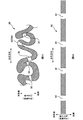
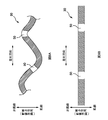
- FIG. 5A is a schematic view of a Va-Va cross section of the front waist part 20 in FIG. 1A
- FIG. 5B is a schematic view of a Va-Va cross section expanded in the left-right direction from the state of FIG. 5A
- 6A is a schematic view of a Vb-Vb cross section of the rear waist part 30 in FIG. 1B
- FIG. 6B is a schematic view of the Vb-Vb cross section expanded in the left-right direction from the state of FIG. 6A.
- the skin side sheet 21 and the non-skin side sheet 22, and the skin side sheet 31 and the non-skin side sheet 32 are respectively integrated and shown. It is indicated by the hatching area below.
- the diaper 1 in the natural state is contracted in the left-right direction by the front waistline portion 20 and the rear waistline portion 30 as the elastic member 25 and the elastic member 35 contract in the left-right direction, as shown in FIGS. 5A and 6A.
- Each of the front waistline portion 20 and the rear waistline portion 30 has a plurality of ridges which are raised and lowered in the thickness direction.
- the diaper 1 has more holes 50 in the waistline (the other side waistline) in which the contraction force in the left-right direction is larger than in the waistline (the one side waistline) in which the contraction force in the left-right direction is smaller. Is equipped. In the present embodiment, the side of the front waistline (the other side waistline) 20 with the larger contraction force in the left-right direction than the rear waistline (the one side waistline) 30 with the smaller contraction force in the left-right direction. Have more holes 50.
- the number of wrinkles per unit area of the front waist portion 20 having a larger magnitude of contraction force is larger than the number of wrinkles per unit area of the rear waist portion 30 having a smaller magnitude of contraction force.
- FIG. 5A even if the number of holes 50 per unit area is large, the holes 50 hidden by the wrinkles are provided by the large number of wrinkles, as shown in FIG. 5A.
- the waist portion 20 is viewed from the non-skin side, the number of holes 50 that can be visually recognized decreases. Further, as the front waistline portion 20 itself is contracted in the left-right direction, the hole 50 is also contracted in the left-right direction, making it difficult to visually recognize the hole 50.
- FIG. 7 is a view showing an example of a method in which a guardian or the like causes an infant to wear the diaper 1.
- FIG. 5B shows a state in which wrinkles in the Va-Va cross section are eliminated by the guardian or the like extending the front waistline portion 20 in the left-right direction.
- the number of wrinkles per unit area of the rear waist part 20 having a smaller magnitude of contraction force is smaller than the number of wrinkles per unit area of the front waist part 20 having a large contraction force. Since the number of wrinkles formed is small, as shown in FIG. 6A, in the natural state, even if the number of holes 50 per unit area is small, the back waist part 30 with less wrinkles is not When viewed from the skin side, there are few holes 50 hidden by the eyelids. In addition, since the contraction in the lateral direction of the rear waist portion 30 is smaller than the contraction in the lateral direction of the front waist portion 20, in the natural state, the hole 50 provided in the rear waist member 30 is in the lateral direction. Shrinkage is smaller and it is easier to see than the hole 50 provided in the front waist part 20.
- the rear waistline 30 is formed in a natural state when the guardian or the like spreads the waistline 20, 30 outward in the left-right direction in order to have the baby wear the diaper 1
- the eyebrows are stretched in the lateral direction, so that the eyebrows disappear and the number of eyebrows decreases.
- FIG. 6B shows a state in which wrinkles in the Vb-Vb cross section are eliminated by the guardian or the like extending the back waistline portion 30 in the left-right direction.
- the diaper 1 of the natural state shown to FIG. 6A is also a state which is easy to do the hole 50 from the non-skin side also about the diaper 1 which extended the back side waist part 30 shown to FIG. 6B to the left-right direction.
- the guardian etc. is likely to notice the hole 50 provided in the back waistline portion 30 of the diaper 1, and the natural state also when trying to make the baby wear the diaper 1.
- the hole 50 which has already been recognized is visually recognized. Therefore, the gap between the good breathability of the diaper 1 which can be recognized in the state taken out from the package and the good breathability of the diaper 1 which can be recognized when trying to wear the diaper 1 is small. It is hard to give the impression of good ventilation.
- the hole 50 may be torn, and the front waistline 20 and the rear waistline 30 may be damaged.
- the front waist portion 20 when the waist portion 20, 30 is extended in the left-right direction in order to wear the diaper 1 from the natural state, the front waist portion 20 can be visually recognized in the natural state than the rear waist portion 30.
- the holes 50 that were not present can be visually recognized more. That is, the number of the holes 50 which can be visually recognized is larger in the holes 50 provided in the front waist part 20 than in the holes 50 provided in the rear side waist part 30.
- the number of gaps makes it possible to more effectively impress the breathability to the parents etc.
- the diaper 1 Since the diaper 1 is provided with more holes 50 in the front waist part 20, as shown in FIG. 7, when trying to wear the diaper 1 from the front side of the baby, the holes in the front waist part 20 It becomes easy to visually recognize 50 and it becomes easy to recognize the goodness of breathability.
- the protector or the like can more easily visually recognize the holes 20 when wearing the diaper 1.
- an elastic member is often provided on the rear waist portion provided with the locking tape, and no elastic member is provided on the front waist portion. It is common to wear on infants in the condition of At this time, even if more holes are provided in the rear waist part having a larger contraction force than the front waist part, the guardian or the like is laid under the supine baby when putting on the tape-type diaper. In some cases, it is not possible to visually recognize the hole portion of the rear waist portion that is in a broken state.
- the contraction force of the front waist portion 20 is made larger to provide more holes 50 in the front waist portion 20, and the back surface of the baby
- the diaper 1 by making the baby wear the diaper 1 by increasing the contraction force of the rear waist part 30 and providing more holes 50 in the rear waist part 30, when the user wears the diaper 1 from the side.
- it can be made to enter the view of the guardian etc. more reliably.
- FIG. 9 is an enlarged view of the opening 50.
- the front waist portion 20 has a high density region H between the hole 50 and the adjacent elastic member 25 in the vertical direction, and an outer region between the high density region H and the elastic member 25. E, and has a low density region L between the high density region H and the holes 50.
- the high density region H has a predetermined length, and the predetermined length is longer than the length of the hole 50 in the left-right direction.
- the density of the non-woven fibers in the high density region H is higher than the density of the non-woven fibers in the outer region E.
- the rigidity of the high density region is higher than the rigidity of the outer region, the shape of the hole 50 can be easily maintained, and the hole 50 can be more easily visually recognized.
- the high density region H and the outer region E are provided in the process of forming the holes 50.
- the skin side sheet 21, the elastic member 25, and the non-skin side sheet 22 are stacked in order and joined and fixed with an adhesive or the like. While the first rotor (not shown) having a plurality of pins and a heat source rotates, the second rotor (not shown) having a plurality of holes fitted with the pins and a heat source rotates in the opposite direction.
- the opening 50 is formed by pressing the pin of the first rotating body toward the front waist portion 20 so as to heat the portion 20 and making the pin fit through the hole of the second rotating body.
- the front waistline portion 20 has a plurality of ridges, and therefore has a concavo-convex shape in the front-rear direction (FIG. 5A).
- the plurality of holes 50 like the hole 50t in FIG. 5A, the top of the convex that is convex to the non-skin side, that is, the top on the most non-skin side of wrinkles formed on the front waist part 20, It is preferable that the hole 50 be formed to straddle.
- the high density region H provided at the edge or periphery of the hole 50 can reduce the possibility of direct contact with the wearer's skin, and the touch of the absorbent article can be improved.
- FIG. 7 is a schematic side view of the diaper 1 as viewed from one end side in the left-right direction. Although the diaper 1 of a natural state is shown in FIG. 7, the diaper 1 of the state taken out from the package is also the same.
- the diaper 1 in the natural state is shaped so as to be convex on the side of the rear waistline portion 30 having a smaller contraction force because the side of the front waistline portion 20 having a larger contraction force is further contracted.
- the front waist portion 20 is a concave portion, which makes the holes 50 more difficult to see.
- the waist portion 20, 30 is extended in the left-right direction so that the diaper 1 is worn, the hole 50 is opened in the left-right direction at the same time the eyebrows of the front waist portion 20 are extended. This makes it easier to feel the gap between the natural condition and the number and size of the holes 50 that can be visually recognized when trying to wear, and to make it easy to impress the guardian etc. with good ventilation. it can.
- the number of the holes 50 in the region 11 f overlapping the absorber 11 in the vertical direction among the front waist portion 20 does not overlap the absorber 11 in the vertical direction, that is, the holes 50 in the region above the region 11 f It is preferable that the number is larger than the number of Further, it is more preferable that the holes 50 be provided only in the region 11 f overlapping the absorber 11 in the vertical direction in the front waist portion 20 and the holes 50 not be provided in the region not overlapping the absorber 11 in the vertical direction. . In the region 11f overlapping the absorber 11 in the vertical direction, even when the protector or the like holds the upper portion of the waist portion 20, 30 and wears the diaper 1, as shown in FIG.
- the area is less likely to be grasped by the hand of the wearer or the like. Therefore, it is possible to reduce the possibility of crushing or hiding the hole 50 provided in the region 11 f with the hand of the guardian or the like.
- the hole 50 was formed in the front waist part 20 and the rear waist part 30, respectively, it is not restricted to this.
- the hole 50 may be formed only in either the front waistline 20 or the rear waistline 30.
- the air permeability of the diaper 1 can be further improved.
- the more holes 50 were provided in the front waist part 20 with larger contraction force, it is not restricted to this.
- the contraction force of the front waist portion 20 may be smaller than that of the rear waist portion 30, and more holes 50 of the rear waist portion 30 may be provided than the front waist portion 20.
- the length in the vertical direction of the region 11 f where the front waist portion 20 and the absorber 11 overlap and the length in the vertical direction of the region 11 d where the rear waist portion 30 and the absorber 11 overlap are substantially the same.
- the hole 50 provided in the region overlapping in the vertical direction with the absorber 11, which has a relatively higher rigidity than the other portions, can easily maintain the open shape even in the natural state, so the region 11d> region
- the number of visible holes 50 in the front waist portion 20 can be further reduced in the natural state, and when trying to wear the diaper 1, more holes can not be recognized in the natural state. 50 can be made visible and the breather good can be made more impressive to the parents etc.
- the circular-shaped hole 50 was provided in the front waist part 20 and the rear waist part 30, it is not restricted to this.
- holes 50 having different shapes may be provided for the front waistline 20 and the rear waistline 30, and holes 50 having different sizes may be provided.
- the diaper 1 which concerns on the said embodiment intended to wear infants, it is not limited to this, It is good also as adults to wear.
- the diaper 1 which concerns on the said embodiment intended to wear infants, it is not limited to this, It is good also as adults to wear.
- the diaper 1 which concerns on the said embodiment intended to wear infants, it is not limited to this, It is good also as adults to wear.
- the diaper 1 which concerns on the said embodiment intended to wear infants, it is not limited to this, It is good also as adults to wear.
- 3 piece type disposable diaper 1 was illustrated as an example of an absorbent article, it is not restricted to this at all.
- a so-called two-piece type disposable diaper in which the front waistline portion 20 and the rear waistline portion 30 are integrally formed, or a tape-type disposable diaper may be used.
Landscapes
- Health & Medical Sciences (AREA)
- Epidemiology (AREA)
- Engineering & Computer Science (AREA)
- Biomedical Technology (AREA)
- Heart & Thoracic Surgery (AREA)
- Vascular Medicine (AREA)
- Life Sciences & Earth Sciences (AREA)
- Animal Behavior & Ethology (AREA)
- General Health & Medical Sciences (AREA)
- Public Health (AREA)
- Veterinary Medicine (AREA)
- Dermatology (AREA)
- Absorbent Articles And Supports Therefor (AREA)
Abstract
Description
本発明の他の特徴については、本明細書及び添付図面の記載により明らかにする。
互いに交差する上下方向と左右方向と前後方向を有し、前側胴回り部と、後側胴回り部と、を有し、前記前側胴回り部又は前記後側胴回り部の少なくとも一方は、前記左右方向に伸縮する弾性部材と、前記前後方向に貫通した孔部を備えた吸収性物品であって、前記前側胴回り部及び前記後側胴回り部のうち、前記左右方向の収縮力が小さい方の一方側胴回り部よりも、前記左右方向の収縮力が大きい方の他方側胴回り部の方が前記孔部を多く備えていることを特徴とする吸収性物品である。
<<<使い捨ておむつ1の構成について>>>
図1Aは、本実施形態の吸収性物品の一例としての自然状態のおむつ1を前側から見た概略正面図である。図1Bは、自然状態のおむつ1を後側から見た概略背面図である。図2は、展開した伸長状態のおむつ1を肌側から見た平面図である。図3は、図2中のIII-III断面図である。図4は、図2中のIV-IV断面図である。
以下、孔部50について説明する。前側胴回り部20及び後側胴回り部30に設けられた複数の孔部50は、それぞれ肌側シート21、31及び非肌側シート22、32を貫通しており、おむつ1の着用時において、肌側から非肌側への通気性を向上させる。前側胴回り部20及び後側胴回り部30の孔部50は、それぞれ略円形状で、略同じ大きさである。図2に示すように、前側胴回り部20には、左右において吸収性本体10より外側、且つ、上下方向において吸収体11と重なる領域11fで、上下方向に隣接する弾性部材25の間に、複数の孔部50がそれぞれ千鳥状に配置されている。後側胴回り部30には、左右方向において吸収性本体10より外側、且つ、上下方向において吸収体11と重なる領域11dで、上下方向に隣接する弾性部材35の間に複数の孔部50がそれぞれ千鳥状に配置されている。このとき、各孔部50は、弾性部材25、35を切断せず、弾性部材25、35は、孔部50によって非連続とはされていないことが好ましい。おむつ1において、領域11fと領域11dの上下方向の長さは、略同じである。
また、「収縮力が大きい方の胴回り部」は、「伸長状態の左右方向の長さと自然状態の左右方向の長さの差」を、「伸長状態の左右方向の長さ」で除した値が小さい方の胴回り部であると言うこともできる。
以上、本発明の実施形態について説明したが、上記の実施形態は、本発明の理解を容易にするためのものであり、本発明を限定して解釈するためのものではない。また、本発明は、その趣旨を逸脱することなく、変更や改良され得るとともに、本発明にはその等価物が含まれるのはいうまでもない。例えば、以下に示すような変形が可能である。
10 吸収性本体、11 吸収体、
11c 吸収性コア、11r コアラップシート、
11f 領域、11d 領域、
13 トップシート、14 外装シート、15 バックシート、
20 前側胴回り部(胴回り部、他方側胴回り部)、
20a 側端部(端部)、20t 前側上端、
21 肌側シート、22 非肌側シート、22f 折り返し部分、
24 シート部材、25 弾性部材、
30 後側胴回り部(胴回り部、一方側胴回り部)、
30a 側端部(端部)、30t 後側上端、
31 肌側シート、32 非肌側シート、32f 折り返し部分、
34 シート部材、35 弾性部材、
50 孔部、
H 高密度領域、E 外側領域、
BH 胴回り開口部、HL 脚回り開口部
Claims (11)
- 互いに交差する上下方向と左右方向と前後方向を有し、
前側胴回り部と、
後側胴回り部と、を有し、
前記前側胴回り部又は前記後側胴回り部の少なくとも一方は、前記左右方向に伸縮する弾性部材と、前記前後方向に貫通した孔部を備えた吸収性物品であって、
前記前側胴回り部及び前記後側胴回り部のうち、前記左右方向の収縮力が小さい方の一方側胴回り部よりも、前記左右方向の収縮力が大きい方の他方側胴回り部の方が前記孔部を多く備えていることを特徴とする吸収性物品。 - 請求項1に記載の吸収性物品において、
前記前側胴回り部と前記後側胴回り部の前記左右方向の両端部は、それぞれ接合されていることを特徴とする吸収性物品。 - 請求項1又は2に記載の吸収性物品において、
前記前側胴回り部及び前記後側胴回り部は、それぞれ前記孔部を備えることを特徴とする吸収性物品。 - 請求項1から3のいずれか1項に記載の吸収性物品において、
前記他方側胴回り部は、前記前側胴回り部であることを特徴とする吸収性物品。 - 請求項1から3のいずれか1項に記載の吸収性物品において、
前記他方側胴回り部は、前記後側胴回り部であることを特徴とする吸収性物品。 - 請求項1から5のいずれか1項に記載の吸収性物品において、
前記他方側胴回り部は、不織布を有しており、
前記上下方向において、
前記孔部と隣接する前記弾性部材との間に高密度領域を有し、
前記高密度領域と前記弾性部材との間に外側領域を有しており、
前記高密度領域は、前記左右方向に所定の長さを有しており、
前記高密度領域の前記不織布の繊維の密度は、前記外側領域の前記不織布の繊維の密度よりも高いことを特徴とする吸収性物品。 - 請求項6に記載の吸収性物品において、
前記他方側胴回り部は、前記前後方向について凹凸形状を有しており、
前記孔部は、非肌側に凸となる凸部の頂部を跨ぐように設けられていることを特徴とする吸収性物品。 - 請求項1から7に記載の吸収性物品において、
吸収体を有しており、
前記上下方向において、前記他方側胴回り部と前記吸収体が重なる領域の長さは、前記一方側胴回り部と前記吸収体が重なる領域の長さよりも短いことを特徴とする吸収性物品。 - 請求項1から8に記載の吸収性物品において、
吸収体を有しており、
前記他方側胴回り部のうちの、前記上下方向において前記吸収体と重なる領域における前記孔部の数は、前記他方側胴回り部のうちの、前記上下方向において前記吸収体と重なっていない領域における前記孔部の数よりも多いことを特徴とする吸収性物品。 - 請求項9に記載の吸収性物品において、
前記他方側胴回り部のうちの、前記上下方向において前記孔部を前記吸収体と重なる領域に前記孔部を設け、前記他方側胴回り部のうちの、前記上下方向において前記吸収体と重なっていない領域に前記孔部を設けないことを特徴とする吸収性物品。 - 請求項2から10のいずれか1項に記載の吸収性物品において、
前記前側胴回り部と前記後側胴回り部の前記左右方向の両端部は、それぞれ接合されており、
自然状態において、前記前側胴回り部及び前記後側胴回り部が、前記一方側胴回り部側に凸形状であることを特徴とする吸収性物品。
Priority Applications (10)
| Application Number | Priority Date | Filing Date | Title |
|---|---|---|---|
| KR1020207010307A KR102169061B1 (ko) | 2017-10-12 | 2017-10-12 | 흡수성 물품 |
| JP2017565863A JP6337221B1 (ja) | 2017-10-12 | 2017-10-12 | 吸収性物品 |
| PCT/JP2017/037003 WO2019073572A1 (ja) | 2017-10-12 | 2017-10-12 | 吸収性物品 |
| BR112018068788-0A BR112018068788B1 (pt) | 2017-10-12 | 2017-10-12 | Artigo absorvente |
| SG11202000921XA SG11202000921XA (en) | 2017-10-12 | 2017-10-12 | Absorbent article |
| MYPI2020000562A MY177580A (en) | 2017-10-12 | 2017-10-12 | Absorbent article |
| EP17928596.0A EP3646832B1 (en) | 2017-10-12 | 2017-10-12 | Absorbent article |
| CN201780026333.3A CN109195561B (zh) | 2017-10-12 | 2017-10-12 | 吸收性物品 |
| EA202090701A EA036327B1 (ru) | 2017-10-12 | 2017-10-12 | Впитывающее изделие |
| TW107122901A TWI657808B (zh) | 2017-10-12 | 2018-07-03 | 吸收性物品 |
Applications Claiming Priority (1)
| Application Number | Priority Date | Filing Date | Title |
|---|---|---|---|
| PCT/JP2017/037003 WO2019073572A1 (ja) | 2017-10-12 | 2017-10-12 | 吸収性物品 |
Publications (1)
| Publication Number | Publication Date |
|---|---|
| WO2019073572A1 true WO2019073572A1 (ja) | 2019-04-18 |
Family
ID=62487246
Family Applications (1)
| Application Number | Title | Priority Date | Filing Date |
|---|---|---|---|
| PCT/JP2017/037003 Ceased WO2019073572A1 (ja) | 2017-10-12 | 2017-10-12 | 吸収性物品 |
Country Status (9)
| Country | Link |
|---|---|
| EP (1) | EP3646832B1 (ja) |
| JP (1) | JP6337221B1 (ja) |
| KR (1) | KR102169061B1 (ja) |
| CN (1) | CN109195561B (ja) |
| BR (1) | BR112018068788B1 (ja) |
| EA (1) | EA036327B1 (ja) |
| SG (1) | SG11202000921XA (ja) |
| TW (1) | TWI657808B (ja) |
| WO (1) | WO2019073572A1 (ja) |
Cited By (1)
| Publication number | Priority date | Publication date | Assignee | Title |
|---|---|---|---|---|
| WO2022209035A1 (ja) * | 2021-03-31 | 2022-10-06 | ユニ・チャーム株式会社 | パンツ型使い捨ておむつ |
Families Citing this family (3)
| Publication number | Priority date | Publication date | Assignee | Title |
|---|---|---|---|---|
| CN113679535B (zh) * | 2020-05-19 | 2025-12-02 | 尤妮佳股份有限公司 | 吸收性物品 |
| JP6878671B1 (ja) * | 2020-12-14 | 2021-06-02 | ユニ・チャーム株式会社 | 吸収性物品 |
| JP7585119B2 (ja) * | 2021-03-31 | 2024-11-18 | ユニ・チャーム株式会社 | パンツ型使い捨ておむつ |
Citations (5)
| Publication number | Priority date | Publication date | Assignee | Title |
|---|---|---|---|---|
| JP2009061127A (ja) * | 2007-09-06 | 2009-03-26 | Uni Charm Corp | 吸収性物品 |
| JP2011078477A (ja) * | 2009-10-05 | 2011-04-21 | Kao Corp | 吸収性物品 |
| JP2014221122A (ja) * | 2013-05-13 | 2014-11-27 | 花王株式会社 | パンツ型着用物品およびその製造方法 |
| JP2015107223A (ja) | 2013-12-04 | 2015-06-11 | 花王株式会社 | パンツ型吸収性物品 |
| WO2017175287A1 (ja) * | 2016-04-05 | 2017-10-12 | ユニ・チャーム株式会社 | 吸収性物品 |
Family Cites Families (12)
| Publication number | Priority date | Publication date | Assignee | Title |
|---|---|---|---|---|
| JPH0737702B2 (ja) * | 1986-12-31 | 1995-04-26 | ユニ・チヤ−ム株式会社 | 開孔模様を有する不織布 |
| JP2809480B2 (ja) * | 1990-05-31 | 1998-10-08 | ユニ・チャーム株式会社 | 吸収性物品の表面シート |
| US5569234A (en) * | 1995-04-03 | 1996-10-29 | The Procter & Gamble Company | Disposable pull-on pant |
| US20020046802A1 (en) * | 2000-08-04 | 2002-04-25 | Ikuo Tachibana | Method for manufacturing disposable worn article |
| JP4184591B2 (ja) * | 2000-12-11 | 2008-11-19 | 大王製紙株式会社 | 伸縮性シートの製造方法およびこれを用いた紙おむつ |
| JP2004267335A (ja) * | 2003-03-06 | 2004-09-30 | Kao Corp | パンツ型おむつ |
| CN101835443B (zh) * | 2007-09-05 | 2014-03-05 | 尤妮佳股份有限公司 | 吸收性物品 |
| JP5270204B2 (ja) * | 2008-03-21 | 2013-08-21 | ユニ・チャーム株式会社 | 吸収性物品 |
| JP5430178B2 (ja) * | 2009-03-03 | 2014-02-26 | ユニ・チャーム株式会社 | 使い捨ておむつ |
| JP6238347B2 (ja) * | 2013-09-30 | 2017-11-29 | 大王製紙株式会社 | テープタイプ使い捨ておむつ |
| JP6331199B2 (ja) * | 2015-09-30 | 2018-05-30 | 大王製紙株式会社 | 吸収性物品 |
| JP6255536B2 (ja) * | 2015-06-30 | 2017-12-27 | ユニ・チャーム株式会社 | 胴回り前後でスリット位置の異なる吸収性物品 |
-
2017
- 2017-10-12 EA EA202090701A patent/EA036327B1/ru unknown
- 2017-10-12 EP EP17928596.0A patent/EP3646832B1/en active Active
- 2017-10-12 SG SG11202000921XA patent/SG11202000921XA/en unknown
- 2017-10-12 BR BR112018068788-0A patent/BR112018068788B1/pt active IP Right Grant
- 2017-10-12 KR KR1020207010307A patent/KR102169061B1/ko active Active
- 2017-10-12 JP JP2017565863A patent/JP6337221B1/ja active Active
- 2017-10-12 WO PCT/JP2017/037003 patent/WO2019073572A1/ja not_active Ceased
- 2017-10-12 CN CN201780026333.3A patent/CN109195561B/zh active Active
-
2018
- 2018-07-03 TW TW107122901A patent/TWI657808B/zh active
Patent Citations (5)
| Publication number | Priority date | Publication date | Assignee | Title |
|---|---|---|---|---|
| JP2009061127A (ja) * | 2007-09-06 | 2009-03-26 | Uni Charm Corp | 吸収性物品 |
| JP2011078477A (ja) * | 2009-10-05 | 2011-04-21 | Kao Corp | 吸収性物品 |
| JP2014221122A (ja) * | 2013-05-13 | 2014-11-27 | 花王株式会社 | パンツ型着用物品およびその製造方法 |
| JP2015107223A (ja) | 2013-12-04 | 2015-06-11 | 花王株式会社 | パンツ型吸収性物品 |
| WO2017175287A1 (ja) * | 2016-04-05 | 2017-10-12 | ユニ・チャーム株式会社 | 吸収性物品 |
Non-Patent Citations (1)
| Title |
|---|
| See also references of EP3646832A4 |
Cited By (4)
| Publication number | Priority date | Publication date | Assignee | Title |
|---|---|---|---|---|
| WO2022209035A1 (ja) * | 2021-03-31 | 2022-10-06 | ユニ・チャーム株式会社 | パンツ型使い捨ておむつ |
| JP2022157106A (ja) * | 2021-03-31 | 2022-10-14 | ユニ・チャーム株式会社 | パンツ型使い捨ておむつ |
| CN116940320A (zh) * | 2021-03-31 | 2023-10-24 | 尤妮佳股份有限公司 | 内裤型一次性尿布 |
| CN116940320B (zh) * | 2021-03-31 | 2026-04-24 | 尤妮佳股份有限公司 | 内裤型一次性尿布 |
Also Published As
| Publication number | Publication date |
|---|---|
| JP6337221B1 (ja) | 2018-06-06 |
| CN109195561B (zh) | 2021-09-03 |
| TWI657808B (zh) | 2019-05-01 |
| BR112018068788A2 (pt) | 2019-07-09 |
| SG11202000921XA (en) | 2020-03-30 |
| KR102169061B1 (ko) | 2020-10-22 |
| EA036327B1 (ru) | 2020-10-27 |
| EA202090701A1 (ru) | 2020-05-27 |
| CN109195561A (zh) | 2019-01-11 |
| EP3646832A4 (en) | 2020-08-05 |
| EP3646832B1 (en) | 2021-09-29 |
| BR112018068788B1 (pt) | 2023-04-11 |
| JPWO2019073572A1 (ja) | 2019-11-14 |
| EP3646832A1 (en) | 2020-05-06 |
| TW201914555A (zh) | 2019-04-16 |
| KR20200042011A (ko) | 2020-04-22 |
Similar Documents
| Publication | Publication Date | Title |
|---|---|---|
| JP7107662B2 (ja) | パンツ型おむつ | |
| JP6205534B1 (ja) | 吸収性物品 | |
| JP6337221B1 (ja) | 吸収性物品 | |
| JP2018102504A (ja) | 吸収性物品 | |
| JP2009195647A (ja) | 吸収性物品及び吸収性本体保持カバー | |
| JP6058886B2 (ja) | 吸収性物品 | |
| JP2003024383A (ja) | パンツ型使い捨ておむつ | |
| JP2018192009A (ja) | 成人男性用使い捨ておむつ | |
| TWI742296B (zh) | 吸收性物品 | |
| JP2003093445A (ja) | パンツ型使い捨ておむつ | |
| JP6709842B2 (ja) | 吸収性物品 | |
| JP2003038572A (ja) | パンツ型使い捨ておむつ | |
| JP6709843B2 (ja) | 吸収性物品 | |
| JP2005211179A (ja) | パンツ型使い捨ておむつ | |
| WO2021235281A1 (ja) | 吸収性物品 | |
| JP2012205612A (ja) | 使い捨ておむつ | |
| JP2019118579A (ja) | パンツ型吸収性物品 | |
| JP2018108336A (ja) | 吸収性物品 | |
| CN209933193U (zh) | 吸收性物品 | |
| WO2017175292A1 (ja) | 吸収性物品 | |
| JP2023162662A (ja) | 吸収性物品 | |
| WO2014200119A1 (ja) | 使い捨ておむつ |
Legal Events
| Date | Code | Title | Description |
|---|---|---|---|
| ENP | Entry into the national phase |
Ref document number: 2017565863 Country of ref document: JP Kind code of ref document: A |
|
| 121 | Ep: the epo has been informed by wipo that ep was designated in this application |
Ref document number: 17928596 Country of ref document: EP Kind code of ref document: A1 |
|
| REG | Reference to national code |
Ref country code: BR Ref legal event code: B01A Ref document number: 112018068788 Country of ref document: BR |
|
| ENP | Entry into the national phase |
Ref document number: 112018068788 Country of ref document: BR Kind code of ref document: A2 Effective date: 20180917 |
|
| ENP | Entry into the national phase |
Ref document number: 2017928596 Country of ref document: EP Effective date: 20200129 |
|
| ENP | Entry into the national phase |
Ref document number: 20207010307 Country of ref document: KR Kind code of ref document: A |
|
| NENP | Non-entry into the national phase |
Ref country code: DE |