WO2019077844A1 - 合成単結晶ダイヤモンド - Google Patents
合成単結晶ダイヤモンド Download PDFInfo
- Publication number
- WO2019077844A1 WO2019077844A1 PCT/JP2018/029001 JP2018029001W WO2019077844A1 WO 2019077844 A1 WO2019077844 A1 WO 2019077844A1 JP 2018029001 W JP2018029001 W JP 2018029001W WO 2019077844 A1 WO2019077844 A1 WO 2019077844A1
- Authority
- WO
- WIPO (PCT)
- Prior art keywords
- diamond
- single crystal
- synthetic
- crystal diamond
- synthetic single
- Prior art date
- Legal status (The legal status is an assumption and is not a legal conclusion. Google has not performed a legal analysis and makes no representation as to the accuracy of the status listed.)
- Ceased
Links
Images
Classifications
-
- C—CHEMISTRY; METALLURGY
- C30—CRYSTAL GROWTH
- C30B—SINGLE-CRYSTAL GROWTH; UNIDIRECTIONAL SOLIDIFICATION OF EUTECTIC MATERIAL OR UNIDIRECTIONAL DEMIXING OF EUTECTOID MATERIAL; REFINING BY ZONE-MELTING OF MATERIAL; PRODUCTION OF A HOMOGENEOUS POLYCRYSTALLINE MATERIAL WITH DEFINED STRUCTURE; SINGLE CRYSTALS OR HOMOGENEOUS POLYCRYSTALLINE MATERIAL WITH DEFINED STRUCTURE; AFTER-TREATMENT OF SINGLE CRYSTALS OR A HOMOGENEOUS POLYCRYSTALLINE MATERIAL WITH DEFINED STRUCTURE; APPARATUS THEREFOR
- C30B29/00—Single crystals or homogeneous polycrystalline material with defined structure characterised by the material or by their shape
- C30B29/02—Elements
- C30B29/04—Diamond
-
- B—PERFORMING OPERATIONS; TRANSPORTING
- B01—PHYSICAL OR CHEMICAL PROCESSES OR APPARATUS IN GENERAL
- B01J—CHEMICAL OR PHYSICAL PROCESSES, e.g. CATALYSIS OR COLLOID CHEMISTRY; THEIR RELEVANT APPARATUS
- B01J3/00—Processes of utilising sub-atmospheric or super-atmospheric pressure to effect chemical or physical change of matter; Apparatus therefor
- B01J3/06—Processes using ultra-high pressure, e.g. for the formation of diamonds; Apparatus therefor, e.g. moulds or dies
- B01J3/062—Processes using ultra-high pressure, e.g. for the formation of diamonds; Apparatus therefor, e.g. moulds or dies characterised by the composition of the materials to be processed
-
- B—PERFORMING OPERATIONS; TRANSPORTING
- B23—MACHINE TOOLS; METAL-WORKING NOT OTHERWISE PROVIDED FOR
- B23B—TURNING; BORING
- B23B27/00—Tools for turning or boring machines; Tools of a similar kind in general; Accessories therefor
- B23B27/14—Cutting tools of which the bits or tips or cutting inserts are of special material
-
- B—PERFORMING OPERATIONS; TRANSPORTING
- B23—MACHINE TOOLS; METAL-WORKING NOT OTHERWISE PROVIDED FOR
- B23B—TURNING; BORING
- B23B27/00—Tools for turning or boring machines; Tools of a similar kind in general; Accessories therefor
- B23B27/14—Cutting tools of which the bits or tips or cutting inserts are of special material
- B23B27/18—Cutting tools of which the bits or tips or cutting inserts are of special material with cutting bits or tips or cutting inserts rigidly mounted, e.g. by brazing
- B23B27/20—Cutting tools of which the bits or tips or cutting inserts are of special material with cutting bits or tips or cutting inserts rigidly mounted, e.g. by brazing with diamond bits or cutting inserts
-
- C—CHEMISTRY; METALLURGY
- C01—INORGANIC CHEMISTRY
- C01B—NON-METALLIC ELEMENTS; COMPOUNDS THEREOF; METALLOIDS OR COMPOUNDS THEREOF NOT COVERED BY SUBCLASS C01C
- C01B32/00—Carbon; Compounds thereof
- C01B32/25—Diamond
-
- C—CHEMISTRY; METALLURGY
- C30—CRYSTAL GROWTH
- C30B—SINGLE-CRYSTAL GROWTH; UNIDIRECTIONAL SOLIDIFICATION OF EUTECTIC MATERIAL OR UNIDIRECTIONAL DEMIXING OF EUTECTOID MATERIAL; REFINING BY ZONE-MELTING OF MATERIAL; PRODUCTION OF A HOMOGENEOUS POLYCRYSTALLINE MATERIAL WITH DEFINED STRUCTURE; SINGLE CRYSTALS OR HOMOGENEOUS POLYCRYSTALLINE MATERIAL WITH DEFINED STRUCTURE; AFTER-TREATMENT OF SINGLE CRYSTALS OR A HOMOGENEOUS POLYCRYSTALLINE MATERIAL WITH DEFINED STRUCTURE; APPARATUS THEREFOR
- C30B33/00—After-treatment of single crystals or homogeneous polycrystalline material with defined structure
- C30B33/02—Heat treatment
-
- C—CHEMISTRY; METALLURGY
- C30—CRYSTAL GROWTH
- C30B—SINGLE-CRYSTAL GROWTH; UNIDIRECTIONAL SOLIDIFICATION OF EUTECTIC MATERIAL OR UNIDIRECTIONAL DEMIXING OF EUTECTOID MATERIAL; REFINING BY ZONE-MELTING OF MATERIAL; PRODUCTION OF A HOMOGENEOUS POLYCRYSTALLINE MATERIAL WITH DEFINED STRUCTURE; SINGLE CRYSTALS OR HOMOGENEOUS POLYCRYSTALLINE MATERIAL WITH DEFINED STRUCTURE; AFTER-TREATMENT OF SINGLE CRYSTALS OR A HOMOGENEOUS POLYCRYSTALLINE MATERIAL WITH DEFINED STRUCTURE; APPARATUS THEREFOR
- C30B33/00—After-treatment of single crystals or homogeneous polycrystalline material with defined structure
- C30B33/04—After-treatment of single crystals or homogeneous polycrystalline material with defined structure using electric or magnetic fields or particle radiation
-
- C—CHEMISTRY; METALLURGY
- C30—CRYSTAL GROWTH
- C30B—SINGLE-CRYSTAL GROWTH; UNIDIRECTIONAL SOLIDIFICATION OF EUTECTIC MATERIAL OR UNIDIRECTIONAL DEMIXING OF EUTECTOID MATERIAL; REFINING BY ZONE-MELTING OF MATERIAL; PRODUCTION OF A HOMOGENEOUS POLYCRYSTALLINE MATERIAL WITH DEFINED STRUCTURE; SINGLE CRYSTALS OR HOMOGENEOUS POLYCRYSTALLINE MATERIAL WITH DEFINED STRUCTURE; AFTER-TREATMENT OF SINGLE CRYSTALS OR A HOMOGENEOUS POLYCRYSTALLINE MATERIAL WITH DEFINED STRUCTURE; APPARATUS THEREFOR
- C30B9/00—Single-crystal growth from melt solutions using molten solvents
- C30B9/04—Single-crystal growth from melt solutions using molten solvents by cooling of the solution
- C30B9/08—Single-crystal growth from melt solutions using molten solvents by cooling of the solution using other solvents
- C30B9/10—Metal solvents
-
- B—PERFORMING OPERATIONS; TRANSPORTING
- B01—PHYSICAL OR CHEMICAL PROCESSES OR APPARATUS IN GENERAL
- B01J—CHEMICAL OR PHYSICAL PROCESSES, e.g. CATALYSIS OR COLLOID CHEMISTRY; THEIR RELEVANT APPARATUS
- B01J2203/00—Processes utilising sub- or super atmospheric pressure
- B01J2203/06—High pressure synthesis
- B01J2203/065—Composition of the material produced
- B01J2203/0655—Diamond
-
- C—CHEMISTRY; METALLURGY
- C01—INORGANIC CHEMISTRY
- C01P—INDEXING SCHEME RELATING TO STRUCTURAL AND PHYSICAL ASPECTS OF SOLID INORGANIC COMPOUNDS
- C01P2002/00—Crystal-structural characteristics
- C01P2002/50—Solid solutions
- C01P2002/52—Solid solutions containing elements as dopants
- C01P2002/54—Solid solutions containing elements as dopants one element only
-
- C—CHEMISTRY; METALLURGY
- C01—INORGANIC CHEMISTRY
- C01P—INDEXING SCHEME RELATING TO STRUCTURAL AND PHYSICAL ASPECTS OF SOLID INORGANIC COMPOUNDS
- C01P2002/00—Crystal-structural characteristics
- C01P2002/80—Crystal-structural characteristics defined by measured data other than those specified in group C01P2002/70
- C01P2002/82—Crystal-structural characteristics defined by measured data other than those specified in group C01P2002/70 by IR- or Raman-data
-
- C—CHEMISTRY; METALLURGY
- C01—INORGANIC CHEMISTRY
- C01P—INDEXING SCHEME RELATING TO STRUCTURAL AND PHYSICAL ASPECTS OF SOLID INORGANIC COMPOUNDS
- C01P2006/00—Physical properties of inorganic compounds
- C01P2006/90—Other properties not specified above
Definitions
- the present disclosure relates to synthetic single crystal diamonds.
- This application claims the priority based on Japanese Patent Application No. 2017-203412 which was filed on October 20, 2017. The entire contents of the description of the Japanese patent application are incorporated herein by reference.
- Single crystal diamond is widely used in tools such as cutting tools, grinding tools, and abrasive tools because of its high hardness.
- Single crystal diamonds used for tools include natural diamond and synthetic diamond.
- natural diamonds contain agglomerated nitrogen atoms as impurities (type Ia).
- the agglomerated nitrogen atoms in the diamond crystal can prevent the development of plastic deformation and cracks that occur when diamond is used as a tool.
- natural diamond has high mechanical strength.
- natural diamond since natural diamond has large variations in quality and unstable supply, its application to industrial applications involves a great risk.
- Type IIa synthetic diamonds which hardly contain nitrogen impurities. Since Type IIa synthetic diamond does not contain impurities or crystal defects that prevent plastic deformation or the development of cracks, chipping of the cutting edge tends to occur when it is used as a tool.
- Patent Document 1 Japanese Patent Laid-Open No. 2015-134718
- the Ib-type synthetic diamond material is irradiated with electron beam or neutron beam to isolate the diamond material.
- a technique is disclosed for annealing after providing vacancy defects.
- Non-Patent Document 1 (A. T. Collins), Vacancy enhanced aggregation of nitrogen in diamond, Journal of Physics C .. Journal of Physics C: Solid State Physics (UK), The Institute of Physics (UK), The 13th, 1980, p.
- a technique has been disclosed in which, after irradiation with radiation, a heat treatment is performed to convert the isolated substitutional nitrogen atoms in the crystal into aggregated nitrogen atoms.
- the synthetic single crystal diamond according to one aspect of the present disclosure is a synthetic single crystal diamond containing nitrogen atoms at a concentration of more than 600 ppm and at most 1,500 ppm, Raman shift ⁇ '(cm -1 ) of the peak in the first-order Raman scattering spectrum of the synthetic single crystal diamond and the peak Raman spectrum of the first-order Raman scattering spectrum of the synthetic type IIa single crystal diamond having a nitrogen atom content of 1 ppm or less
- the shift ⁇ (cm ⁇ 1 ) represents the relationship of the following formula (1), ⁇ ′ ⁇ ⁇ ⁇ 0.10 Formula (1) Synthetic single crystal diamond.
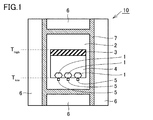
- FIG. 1 is a schematic cross-sectional view showing an example of a sample chamber configuration used for producing a synthetic single crystal diamond according to an embodiment of the present disclosure.
- Patent Document 1 and Non-patent Document 1 are all for converting isolated substitutional nitrogen atoms in type Ib synthetic diamond into aggregated nitrogen atoms, they are obtained because the conversion rate is insufficient. It is a technical problem that the fracture resistance of synthetic diamond is insufficient.
- a synthetic single crystal diamond according to an aspect of the present disclosure is a synthetic single crystal diamond containing nitrogen atoms at a concentration of more than 600 ppm and at most 1,500 ppm, wherein first-order Raman of the synthetic single crystal diamond
- the Raman shift ⁇ '(cm -1 ) of the peak in the scattering spectrum and the Raman shift ⁇ (cm -1 ) of the peak in the first-order Raman scattering spectrum of synthetic type IIa single crystal diamond having a nitrogen atom content of 1 ppm or less Show the relationship of the following formula (1), ⁇ ′ ⁇ ⁇ ⁇ 0.10 Formula (1) Synthetic single crystal diamond.
- the synthetic single crystal diamond of the above aspect has high hardness and low tensile stress in the crystal, and therefore has excellent fracture resistance.
- the synthetic single crystal diamond preferably has a crack generation load of 10 N or more in a fracture strength test in which a spherical diamond indenter with a tip radius of 50 ⁇ m is pressed to the surface at a load rate of 100 N / min.
- the crack initiation load is 10 N or more
- the synthetic single crystal diamond has excellent fracture strength and fracture resistance, and when used as a cutting tool material, it cuts hard hard-to-cut materials without causing chipping of the cutting edge. can do.
- the synthetic single crystal diamond preferably has a Knoop hardness of 95 GPa or more in the ⁇ 100> direction in the ⁇ 001 ⁇ plane.
- a synthetic single crystal diamond having this hardness is used as a tool material, the wear resistance of the tool is improved. Details of Embodiments of the Present Disclosure Specific examples of synthetic single crystal diamond according to an embodiment of the present disclosure will be described below with reference to the drawings.
- the synthetic single crystal diamond according to an embodiment of the present disclosure is a synthetic single crystal diamond containing nitrogen atoms at a concentration of more than 600 ppm and at most 1,500 ppm, which is a first-order Raman scattering spectrum of the synthetic single crystal diamond.
- the state of internal stress in the crystal is the state of internal stress in the crystal.
- a tensile stress exists in the diamond crystal
- plastic deformation or breakage of the diamond crystal is likely to occur starting from the point at which the tensile stress is generated, and the wear resistance and the fracture resistance decrease.
- the presence of compressive stress in the diamond crystal improves the fracture resistance. Therefore, the wear resistance and the fracture resistance of the single crystal diamond can be improved by making the state of the internal stress of the diamond crystal as small as possible in tensile stress or predominant in compressive stress.
- the state of internal stress of synthetic single crystal diamond is the Raman shift ⁇ '(cm -1 ) of the peak in the first-order Raman scattering spectrum of synthetic single crystal diamond, and the content of nitrogen atoms is 1 ppm or less. It can be evaluated by comparing it with the Raman shift ⁇ (cm ⁇ 1 ) of the peak in the first-order Raman scattering spectrum (hereinafter also referred to as a standard sample or synthetic type IIa single crystal diamond). Specifically, the state of the internal stress of the synthetic single crystal diamond can be evaluated by the magnitude of the peak position shift amount represented by the difference ( ⁇ ′ ⁇ ) between ⁇ ′ and ⁇ . The reason is described below.
- the nitrogen atom present as an impurity in the crystal which is one of the main causes of the internal stress of the diamond crystal, will be described.
- the nitrogen atoms in the single crystal diamond can be classified into isolated substitutional nitrogen atoms, aggregated nitrogen atoms, and the like according to their forms of existence.
- the isolated substitutional nitrogen atom is one in which a nitrogen atom is substituted by one atomic unit at the position of the carbon atom in the diamond crystal.
- the isolated substitutional nitrogen atom does not greatly affect the crystal structure of the single crystal diamond itself, and therefore does not contribute to the suppression of the propagation of the crack.
- the presence of isolated substitutional nitrogen atoms in the diamond crystal causes local tensile stress in the crystal lattice around it. Therefore, tensile stress is generated in the diamond crystal containing isolated substitutional nitrogen atoms. For this reason, the vicinity of the place where the isolated substitutional nitrogen atom is present becomes a starting point of plastic deformation or fracture, and the wear resistance and the fracture resistance of the diamond crystal are lowered.
- the aggregation type nitrogen atom is one in which two or more nitrogen atoms are aggregated and present in the diamond crystal.
- the aggregation type nitrogen atom can suppress the propagation of the crack in the single crystal diamond unlike the isolated substitution type nitrogen atom.
- the aggregation type nitrogen atoms in the diamond crystal do not generate tensile stress, they do not contribute to the deterioration of the wear resistance and the fracture resistance of the diamond crystal.
- the aggregation type nitrogen atoms in the diamond crystal generate a compressive stress when the amount is equal to or more than a predetermined amount, depending on the conditions, the wear resistance and the fracture resistance of the diamond crystal are improved.
- Agglomerated nitrogen atoms can be further classified into nitrogen 2 atom pairs, nitrogen 4 atoms condensation, platelets, and the like.
- a two-nitrogen pair is one in which two nitrogen atoms are covalently bonded and replaced with carbon atoms.
- Diamonds containing diatomic nitrogen pairs are called type IaA.
- a platelet is one in which five or more nitrogen atoms are present in a clumped manner and substituted with carbon atoms.
- Diamonds containing platelets are called type IaB '.
- the synthetic type IIa single crystal diamond used as a standard sample means a high purity single crystal diamond free from lattice defects and internal distortions, which is synthesized by a temperature difference method under high temperature and high pressure.
- it is marketed as a high purity type IIa single crystal diamond manufactured by Sumitomo Electric Co., Ltd. Since the type IIa single crystal diamond has a nitrogen atom content of 1 ppm or less and contains almost no nitrogen atom, there is no internal stress in the diamond crystal.
- synthetic type IIa single crystal diamond exhibits a sharp and strong single peak in the first-order Raman scattering spectrum. Usually, the Raman shift of this peak appears in the range of 1332 cm ⁇ 1 to 1333 cm ⁇ 1 .
- the value of Raman shift changes with the temperature of the environment at the time of measurement. In the present specification, the Raman shift is a value measured at room temperature (20 ° C. or more and 25 ° C. or less).
- the present inventors have determined the magnitude of the peak position shift amount represented by the difference ( ⁇ '- ⁇ ) between ⁇ '(cm -1 ) and ⁇ (cm -1 ), and a synthetic single crystal
- ( ⁇ ′- ⁇ ) shows the relationship of the following formula (1)
- synthetic single crystal diamond has excellent fracture resistance as well as high hardness. I found it to have.
- any surface of the sample is polished, and the Raman shift ( ⁇ ′) of the peak in the first-order Raman scattering spectrum of the polished surface is measured.
- any surface of high purity synthetic type IIa single crystal diamond is polished, and the Raman shift ( ⁇ ) of the peak in the primary Raman scattering spectrum of the polished surface is measured.
- ⁇ 'and ⁇ are wave numbers at which the first-order Raman scattering spectrum signal is strongest.
- the peak shape is preferably evaluated by peak fitting processing with a Lorentz function or a Gaussian function.
- the peak position shift amount can be obtained by calculating the value of ( ⁇ ′ ⁇ ).
- the synthetic single crystal diamond according to the present embodiment contains nitrogen atoms at a concentration of more than 600 ppm and at most 1,500 ppm.
- the concentration of nitrogen atoms is the concentration based on mass of nitrogen atoms in synthetic single crystal diamond.
- the concentration of nitrogen atoms in synthetic single crystal diamond can be measured by secondary ion mass spectrometry (SIMS). If the concentration of nitrogen atoms is 600 ppm or less, nitrogen atoms are less likely to aggregate, the tendency for isolated substitutional nitrogen atoms to be present in synthetic single crystal diamond becomes high, and hardness and fracture resistance become insufficient.
- the concentration of nitrogen atoms exceeds 1500 ppm, lattice defects in the synthetic single crystal diamond will increase and the hardness and defect resistance will be insufficient.
- 620 ppm or more and 1300 ppm or less are more preferable, and 800 ppm or more and 1000 ppm or less are more preferable.
- the synthetic single crystal diamond has a crack initiation load of 10 N or more in a fracture strength test where a spherical diamond indenter with a tip radius (R) of 50 ⁇ m is pressed onto the surface of the synthetic single crystal diamond at a loading rate of 100 N / min. preferable.
- the crack initiation load is 10 N or more
- synthetic single crystal diamond has excellent fracture strength and fracture resistance, and when used as a tool material, it cuts hard hard-to-cut materials without causing chipping of the cutting edge. be able to.
- the crack initiation load is more preferably 15 N or more, further preferably 20 N or more.
- the upper limit of the crack initiation load is not particularly limited, but from the viewpoint of production, 50 N or less is preferable.
- the specific method of the breaking strength test is as follows. A spherical diamond indenter with a tip radius (R) of 50 ⁇ m is pressed against the sample, a load is applied to the indenter at a load rate of 100 N / min, and the load at the instant when a crack occurs in the sample (cracked load) is measured. . The moment the crack occurs is measured by the AE sensor. The larger the crack initiation load, the better the chipping resistance and chipping resistance of the tool tip when synthetic single crystal diamond is used for the tool. If an indenter smaller than R 50 ⁇ m is used as the measurement indenter, the sample plastically deforms before the occurrence of the crack, and the accurate strength against the crack can not be measured.
- R tip radius
- the Knoop hardness in the ⁇ 100> direction in the ⁇ 001 ⁇ plane is preferably 95 GPa or more.
- a generic plane orientation including a crystal geometrically equivalent plane orientation is indicated by ⁇ and a generic direction including a crystal geometrically equivalent direction is indicated by ⁇ >.
- Synthetic single crystal diamond having a Knoop hardness of 95 GPa or more is higher in hardness and superior in wear resistance than natural diamond containing nitrogen.
- the Knoop hardness is more preferably 110 GPa or more and 130 GPa or less.
- HK The evaluation method of the Knoop hardness (hereinafter, also referred to as HK, where the unit is GPa) will be described.
- an indentation is made with a load F (N) in the ⁇ 100> direction in the ⁇ 001 ⁇ plane of the synthetic single crystal diamond.
- the width a ( ⁇ m) of the obtained indentation is measured, and the Knoop hardness (HK) is calculated from the following formula (4).
- the synthetic single crystal diamond according to the present embodiment is titanium (Ti), vanadium (V), chromium (Cr), manganese (Mn), iron (Fe), nickel (Ni), cobalt (Co), copper (Cu) , Zirconium (Zr), niobium (Nb), molybdenum (Mo), ruthenium (Ru), rhodium (Rh), palladium (Pd), hafnium (Hf), tantalum (Ta), tungsten (W), osmium (Os) And at least one element selected from the group consisting of iridium (Ir) and platinum (Pt), at least one alloy containing two or more of these elements, and at least one element selected from the group consisting of these elements And inclusions containing at least one selected from the group consisting of compounds with carbon (C) or oxygen (O), and complexes thereof.
- the content density of the inclusions in the synthetic single crystal diamond is preferably 20 pieces / mm 3 or less, and more preferably 10 pieces / mm 3 or less.
- the maximum value of the crossing diameter of the inclusion is 10 ⁇ m or less, and more preferably 5 ⁇ m or less. The crossing diameter is the maximum straight line length that can be drawn into a single crystal having a certain size and shape. Most preferably, the synthetic single crystal diamond does not contain any inclusions.
- the synthetic single crystal diamond according to an embodiment of the present disclosure has high hardness and excellent fracture resistance, is stable in quality, and can be applied to various applications.
- it can be used as a material for polishing tools such as dressers, wire drawing dies, scribing tools, orifices for water jets, cutting tools for precision cutting tools, woodworking cutters and the like.
- the tool using synthetic single crystal diamond according to the present embodiment is excellent in that it can perform stable processing for a long time as compared with those made from conventional synthetic diamond and natural diamond or diamond sintered body. Has a tool life.
- the synthetic single crystal diamond according to an embodiment of the present disclosure can be produced, for example, by the following method.
- a diamond single crystal containing nitrogen atoms at a concentration of more than 600 ppm and at most 1500 ppm is obtained by a temperature difference method using a solvent metal (hereinafter, also referred to as a temperature difference method step).
- a diamond single crystal can be produced by, for example, a temperature difference method using a sample chamber having the configuration shown in FIG.
- an insulator 2 As shown in FIG. 1, in the sample chamber 10 used for producing a diamond single crystal, an insulator 2, a carbon source 3, a solvent metal 4 and a seed crystal 5 are disposed in a space surrounded by a graphite heater 7 A pressure medium 6 is disposed outside the heater 7.
- a temperature gradient in the longitudinal direction is provided inside the sample chamber 10, the carbon source 3 is disposed in the high temperature portion (T high ), and the diamond seed crystal 5 is disposed in the low temperature portion (T low ).
- the solvent metal 4 is placed between the seed crystal 5 and the seed crystal 5.
- the single crystal diamond is held on the seed crystal 5 under the condition that the pressure of the diamond becomes thermally stable above the temperature at which the solvent metal 4 dissolves. Is a synthetic method to grow
- a diamond powder As the carbon source 3. Moreover, graphite (graphite) or pyrolytic carbon can also be used.
- the solvent metal 4 one or more metals selected from iron (Fe), cobalt (Co), nickel (Ni), manganese (Mn) and the like, or an alloy containing these metals can be used.
- the nitrogen source for example, iron nitride (Fe 2 N, Fe 3 N), aluminum nitride (AlN), phosphorus nitride (P 3 N 4 ), silicon nitride (Si 3 N) may be used as the carbon source 3 or the solvent metal 4.
- a nitride such as 4 ) or an organic nitrogen compound such as melamine or sodium azide can be added singly or as a mixture.
- diamond powder or graphite containing a large amount of nitrogen, or a carbon-nitrogen bond (CN bond) compound can be added to the carbon source 3.
- nitrogen atoms are contained in the synthesized diamond single crystal. At this time, the nitrogen atoms in the diamond single crystal are mainly present as isolated substitutional nitrogen atoms.
- the content of the nitrogen source in the carbon source 3 or the solvent metal 4 is adjusted so that the concentration of nitrogen atoms in the diamond single crystal to be synthesized exceeds 600 ppm and does not exceed 1500 ppm.
- the content of nitrogen atoms derived from a nitrogen source can be 200 ppm or more and 3000 ppm or less.
- the solvent metal for example, when the solvent metal is an alloy of iron-cobalt-nickel and the nitrogen source is Fe 3 N, the content of the nitrogen source is 0.08% by mass or more and 0.2 or more. It can be less than mass%.
- the solvent metal 4 further contains titanium (Ti), vanadium (V), chromium (Cr), manganese (Mn), copper (Cu), zirconium (Zr), niobium (Nb), molybdenum (Mo), ruthenium (Ru) And one or more elements selected from the group consisting of rhodium (Rh), hafnium (Hf), tantalum (Ta), tungsten (W), osmium (Os), iridium (Ir) and platinum (Pt) It may be
- an electron beam and a particle beam which give energy of 100 MGy to 1000 MGy are irradiated to the obtained single crystal diamond (hereinafter also referred to as an irradiation step). Thereby, lattice defects are introduced into the diamond single crystal to form pores.
- particle beam neutron beam or proton beam can be used.
- the amount of energy to be irradiated is less than 100 MGy, introduction of lattice defects may be insufficient.
- the amount of energy exceeds 1000 MGy, excess vacancies are generated, and the crystallinity may be greatly reduced. Therefore, the amount of energy is preferably 100 MGy or more and 1000 MGy or less.
- the irradiation conditions are not particularly limited as long as energy of 100 MGy or more and 1000 MGy or less can be given to the diamond single crystal.
- the irradiation energy can be 4.6 MeV to 4.8 MeV
- the current can be 2 mA to 5 mA
- the irradiation time can be 30 hours to 45 hours.
- the diamond single crystal irradiated with one or both of the electron beam and the particle beam is annealed at a temperature of 1700 ° C. or more and 1800 ° C. or less under vacuum or at normal pressure in an inert gas (hereinafter also referred to as annealing step) Note.).
- annealing step an inert gas
- the isolated substitutional nitrogen atoms in the diamond single crystal move through the holes and agglomerate to form agglomerated nitrogen atoms.
- the tensile stress present in the crystal is greatly reduced.
- compressive stress may be dominant depending on the content of nitrogen in the diamond single crystal, irradiation conditions, annealing conditions, and the like.
- the annealing temperature is less than 1700 ° C., because the nitrogen aggregation rate is slow and a long annealing process is required.
- the temperature at the time of annealing exceeds 1800 ° C., the aggregation rate of nitrogen is increased, but the diamond single crystal is graphitized under normal pressure. Therefore, when annealing is performed at a temperature exceeding 1800 ° C., it is necessary to carry out the diamond under thermodynamically stable ultra-high pressure conditions, but this is not preferable from the viewpoint of cost increase and productivity decrease. Therefore, the temperature at the time of annealing is preferably 1700 ° C. or more and 1800 ° C. or less.
- the particle beam irradiation step and the annealing step can be performed twice or more respectively. In addition, when one cycle of each cycle is performed, two cycles or more can be repeated. This can promote aggregation of isolated substitutional nitrogen atoms in the diamond single crystal. By sufficiently performing the particle beam irradiation step and the annealing step, all the isolated substitutional nitrogen atoms in the diamond single crystal are converted into aggregation-type nitrogen atoms.
- the synthetic single crystal diamond according to the present embodiment can be manufactured without performing the irradiation step.
- the annealing process is performed without the irradiation process.
- An alloy consisting of iron-cobalt-nickel was prepared as a solvent metal, to which was added iron nitride (Fe 3 N) powder as a nitrogen source.
- the concentration of iron nitride in the solvent metal was 0.08% by mass.
- Diamond powder was used as a carbon source, and about 0.5 mg of diamond single crystal was used as a seed crystal.
- the temperature in the sample chamber was adjusted by a heater so that a temperature difference of several tens of degrees was obtained between the high temperature part where the carbon source was placed and the low temperature part where the seed crystal was placed.
- the pressure at 5.5 GPa and the temperature of the low temperature part are controlled within the range of 1370 ° C. ⁇ 10 ° C. (1360 ° C. to 1380 ° C.) and held for 60 hours.
- the crystals were synthesized.
- the irradiation conditions were irradiation energy of 4.6 MeV, current of 2 mA, and irradiation time of 30 hours. This is an irradiation condition giving an energy of 100 MGy to a diamond single crystal.
- Samples 2 to 21 were basically subjected to the temperature difference process in the same manner as Sample 1.
- the difference from Sample 1 is that the amount of iron nitride (Fe 3 N) powder added to the solvent metal is described in the “Concentration of iron nitride in solvent metal” column of Table 1 with respect to the concentration of iron nitride in the solvent metal. The point was changed to become the concentration of
- any surface of the sample was polished, and the Raman shift ( ⁇ ′) of the peak in the first-order Raman scattering spectrum of the polished surface was measured.
- ⁇ ′ and ⁇ are wave numbers at which the first-order Raman scattering spectrum signal is strongest in the peak shape of the first-order Raman scattering spectrum signal subjected to peak fitting processing by the Lorentz function.
- the temperature fluctuation of the Raman spectrometer at the time of measurement of the sample and the standard sample was suppressed to ⁇ 1 ° C. or less.
- Knoop hardness makes an impression with a load of 4.9 N in the ⁇ 100> direction in the ⁇ 001 ⁇ plane of the synthetic single crystal diamond.
- the width a of the obtained indentation was measured, and the Knoop hardness (HK) was calculated by the following equation (2). The results are shown in Table 1.
- the synthetic single crystal diamond of Samples 1 to 13 has a nitrogen concentration of more than 600 ppm and in the range of 1500 ppm or less, satisfying the relationship of ( ⁇ ′ ⁇ ) ⁇ ⁇ 0.10, and corresponds to the example. These synthetic single crystal diamonds had high hardness and excellent fracture resistance.
- the synthetic single crystal diamonds of Samples 14 to 21 have a nitrogen concentration of 250 ppm or more and 1500 ppm or less, and the value of ( ⁇ ′ ⁇ ) is ⁇ 0.11 or less, which corresponds to the comparative example. These synthetic single crystal diamonds have insufficient fracture resistance.
Landscapes
- Chemical & Material Sciences (AREA)
- Organic Chemistry (AREA)
- Engineering & Computer Science (AREA)
- Crystallography & Structural Chemistry (AREA)
- Materials Engineering (AREA)
- Metallurgy (AREA)
- Thermal Sciences (AREA)
- Physics & Mathematics (AREA)
- Mechanical Engineering (AREA)
- Life Sciences & Earth Sciences (AREA)
- General Life Sciences & Earth Sciences (AREA)
- Geology (AREA)
- Inorganic Chemistry (AREA)
- Chemical Kinetics & Catalysis (AREA)
- Crystals, And After-Treatments Of Crystals (AREA)
- Carbon And Carbon Compounds (AREA)
Abstract
Description
前記合成単結晶ダイヤモンドの1次ラマン散乱スペクトルにおけるピークのラマンシフトλ’(cm-1)と、窒素原子の含有量が1ppm以下の合成IIa型単結晶ダイヤモンドの1次ラマン散乱スペクトルにおけるピークのラマンシフトλ(cm-1)とは、下記式(1)の関係を示す、
λ’-λ≧-0.10 式(1)
合成単結晶ダイヤモンドである。
特許文献1及び非特許文献1の技術は、いずれもIb型合成ダイヤモンド中の孤立置換型窒素原子を、凝集型窒素原子へ変換するものであるが、変換率が不十分であるため、得られた合成ダイヤモンドの耐欠損性が不十分であることが技術的な問題となっている。
[本開示の効果]
上記態様によれば、高い硬度及び優れた耐欠損性を有する合成単結晶ダイヤモンドを提供することが可能となる。
[本開示の実施形態の説明]
最初に本開示の実施態様を列記して説明する。
λ’-λ≧-0.10 式(1)
合成単結晶ダイヤモンドである。
[本開示の実施形態の詳細]
本開示の一実施形態に係る合成単結晶ダイヤモンドの具体例を、以下に図面を参照しつつ説明する。
本開示の一実施形態に係る合成単結晶ダイヤモンドは、窒素原子を600ppmを超えて、かつ、1500ppm以下の濃度で含有する合成単結晶ダイヤモンドであって、前記合成単結晶ダイヤモンドの1次ラマン散乱スペクトルにおけるピークのラマンシフトλ’(cm-1)と、窒素原子の含有量が1ppm以下の合成IIa型単結晶ダイヤモンドの1次ラマン散乱スペクトルにおけるピークのラマンシフトλ(cm-1)とは、下記式(1)の関係を示す、
λ’-λ≧-0.10 式(1)
合成単結晶ダイヤモンドである。
(λ’-λ)が上記式(1)の関係を満たすと、合成単結晶ダイヤモンド中の孤立置換型窒素原子の量が十分に低減されており、合成単結晶ダイヤモンドは、優れた耐欠損性及び高い硬度を有することができる。(λ’-λ)は、更に下記式(2)又は式(3)の関係を示すことが、耐欠損性の向上の観点から好ましい。
λ’-λ≧0.10 式(3)
合成単結晶ダイヤモンド及び標準試料の1次ラマン散乱スペクトルにおけるピークのラマンシフトは、顕微ラマン分光装置で測定することができる。測定は、波長532nmのレーザーを励起光として、室温(20℃以上25℃以下)で行う。
本実施形態に係る合成単結晶ダイヤモンドは、窒素原子を600ppmを超えて、かつ、1500ppm以下の濃度で含有する。ここで、窒素原子の濃度とは、合成単結晶ダイヤモンドにおける窒素原子の質量基準の濃度である。合成単結晶ダイヤモンド中の窒素原子の濃度は、二次イオン質量分析法(SIMS:Secondary Ion Mass Spectrometry)によって測定することができる。窒素原子の濃度が600ppm以下であると、窒素原子同士が凝集し難く、合成単結晶ダイヤモンド中に孤立置換型窒素原子が存在する傾向が高くなり、硬度及び耐欠損性が不十分となる。一方、窒素原子の濃度が1500ppmを超えると、合成単結晶ダイヤモンド中の格子欠陥が増加し、硬度及び耐欠損性が不十分となる。合成単結晶ダイヤモンド中の窒素原子の濃度は、620ppm以上1300ppm以下がより好ましく、800ppm以上1000ppm以下がさらに好ましい。
本実施形態に係る合成単結晶ダイヤモンドは、チタン(Ti)、バナジウム(V)、クロム(Cr)、マンガン(Mn)、鉄(Fe)、ニッケル(Ni)、コバルト(Co)、銅(Cu)、ジルコニウム(Zr)、ニオブ(Nb)、モリブデン(Mo)、ルテニウム(Ru)、ロジウム(Rh)、パラジウム(Pd)、ハフニウム(Hf)、タンタル(Ta)、タングステン(W)、オスミウム(Os)、イリジウム(Ir)および白金(Pt)からなる群より選ばれる1種以上の元素、これらの元素を2種以上含む1種以上の合金、これらの元素からなる群より選ばれる1種以上の元素と、炭素(C)または酸素(O)との化合物、およびこれらの複合体からなる群から選ばれる少なくとも1種を含む内包物を含有することがある。
本開示の一実施形態に係る合成単結晶ダイヤモンドは、高い硬度、及び、優れた耐欠損性を有し、品質が安定しており、様々な用途に適用できる。例えば、ドレッサー、伸線ダイス、スクライブツール、ウォタージェット用オリフィス等の耐磨工具や、精密切削加工用バイト、木工用カッター等の切削工具の材料として用いることができる。本実施形態に係る合成単結晶ダイヤモンドを用いた工具は、従来の合成ダイヤモンド及び、天然ダイヤモンドやダイヤモンド焼結体から作製されたものに比べて、長時間安定した加工を行うことができ、優れた工具寿命を有する。
本開示の一実施形態に係る合成単結晶ダイヤモンドは、例えば以下の方法で製造することができる。
[試料1]
(温度差法工程)
初めに、図1に示される構成を有する試料室を用いて、溶媒金属を用いた温度差法により、ダイヤモンド単結晶を合成した。
次に、得られたダイヤモンド単結晶に電子線を照射した。照射条件は、照射線エネルギー4.6MeV、電流2mA、照射時間30時間とした。これは、ダイヤモンド単結晶に100MGyのエネルギーを与える照射条件である。
次に、電子線照射後のダイヤモンド単結晶を、真空中、常圧下で1700℃の温度で1時間、アニール処理して、合成単結晶ダイヤモンドを得た。
(温度差法工程)
試料2~21は、基本的に試料1と同一の方法で温度差法工程を行った。試料1と異なる点は、溶媒金属への窒化鉄(Fe3N)粉末の添加量を、溶媒金属中の窒化鉄の濃度が表1の「溶媒金属中の窒化鉄の濃度」の欄に記載の濃度となるように変更した点である。
試料5~15は、得られたダイヤモンド単結晶に試料1と同一の照射条件で電子線を照射した。試料2~4,16~21は電子線照射を行わなかった。
試料2~15、18は、表1の「アニール温度」の欄に記載の温度で1時間アニール処理を行った。試料16,17,19~21は、アニール工程を行わなかった。

得られた合成単結晶ダイヤモンドについて、窒素濃度の測定、ラマン分光分析、ヌープ硬度の測定、及び、破壊強度試験を行った。
各試料の合成単結晶ダイヤモンド中の窒素濃度をSIMS分析により求めた。結果を表1に示す。
各試料及び標準試料(住友電気株式会社製の高純度IIa型単結晶ダイヤモンド)について、1次ラマン散乱スペクトルにおけるピークのラマンシフト(λ’)を、顕微ラマン分光装置で測定した。測定は、波長532nmのレーザーを励起光として、室温(20℃)で行った。
ヌープ硬度は、合成単結晶ダイヤモンドの{001}面内の<100>方向に、荷重4.9Nで圧痕をつける。得られた圧痕の幅aを測定し、下記式(2)によりヌープ硬度(HK)を算出した。結果を表1に示す。
(破壊強度試験)
R50μmの球状のダイヤモンド圧子を準備し、室温(23℃)で、100N/minの負荷速度で各試料に荷重をかけていき、試料に亀裂が発生した瞬間の荷重(亀裂発生荷重)を測定した。亀裂が発生する瞬間はAEセンサーで測定した。亀裂発生荷重が大きいほど、試料の強度が高く、耐欠損性が優れていることを示す。結果を表1に示す。
Claims (3)
- 窒素原子を600ppmを超えて、かつ、1500ppm以下の濃度で含有する合成単結晶ダイヤモンドであって、
前記合成単結晶ダイヤモンドの1次ラマン散乱スペクトルにおけるピークのラマンシフトλ’(cm-1)と、窒素原子の含有量が1ppm以下の合成IIa型単結晶ダイヤモンドの1次ラマン散乱スペクトルにおけるピークのラマンシフトλ(cm-1)とは、下記式(1)の関係を示す、
λ’-λ≧-0.10 式(1)
合成単結晶ダイヤモンド。 - 前記合成単結晶ダイヤモンドの表面に先端半径が50μmの球状のダイヤモンド圧子を100N/minの負荷速度で押し当てる破壊強度試験において、亀裂発生荷重が10N以上である、請求項1に記載の合成単結晶ダイヤモンド。
- 前記合成単結晶ダイヤモンドは、{001}面における<100>方向のヌープ硬度が95GPa以上である、請求項1又は請求項2に記載の合成単結晶ダイヤモンド。
Priority Applications (6)
| Application Number | Priority Date | Filing Date | Title |
|---|---|---|---|
| CN201880068281.0A CN111247276A (zh) | 2017-10-20 | 2018-08-02 | 合成单晶金刚石 |
| US16/756,553 US11613826B2 (en) | 2017-10-20 | 2018-08-02 | Synthetic single crystal diamond |
| JP2019549123A JP7462419B2 (ja) | 2017-10-20 | 2018-08-02 | 合成単結晶ダイヤモンド |
| KR1020207010883A KR102655136B1 (ko) | 2017-10-20 | 2018-08-02 | 합성 단결정 다이아몬드 |
| EP18868267.8A EP3699330A4 (en) | 2017-10-20 | 2018-08-02 | SYNTHETIC SINGLE CRYSTAL DIAMOND |
| JP2023051756A JP2023082081A (ja) | 2017-10-20 | 2023-03-28 | 合成単結晶ダイヤモンド |
Applications Claiming Priority (2)
| Application Number | Priority Date | Filing Date | Title |
|---|---|---|---|
| JP2017-203412 | 2017-10-20 | ||
| JP2017203412 | 2017-10-20 |
Publications (1)
| Publication Number | Publication Date |
|---|---|
| WO2019077844A1 true WO2019077844A1 (ja) | 2019-04-25 |
Family
ID=66173619
Family Applications (1)
| Application Number | Title | Priority Date | Filing Date |
|---|---|---|---|
| PCT/JP2018/029001 Ceased WO2019077844A1 (ja) | 2017-10-20 | 2018-08-02 | 合成単結晶ダイヤモンド |
Country Status (6)
| Country | Link |
|---|---|
| US (1) | US11613826B2 (ja) |
| EP (1) | EP3699330A4 (ja) |
| JP (2) | JP7462419B2 (ja) |
| KR (1) | KR102655136B1 (ja) |
| CN (1) | CN111247276A (ja) |
| WO (1) | WO2019077844A1 (ja) |
Cited By (10)
| Publication number | Priority date | Publication date | Assignee | Title |
|---|---|---|---|---|
| WO2022004149A1 (ja) * | 2020-06-30 | 2022-01-06 | 住友電気工業株式会社 | 合成単結晶ダイヤモンド及びその製造方法 |
| WO2022004150A1 (ja) * | 2020-06-30 | 2022-01-06 | 住友電気工業株式会社 | 合成単結晶ダイヤモンド及びその製造方法 |
| JP2022139094A (ja) * | 2021-03-11 | 2022-09-26 | 住友電気工業株式会社 | 合成単結晶ダイヤモンド及びその製造方法 |
| WO2022209512A1 (ja) * | 2021-03-31 | 2022-10-06 | 住友電気工業株式会社 | 単結晶ダイヤモンド及びその製造方法 |
| US20220348506A1 (en) * | 2019-12-13 | 2022-11-03 | Element Six (Uk) Limited | Polycrystalline diamond with iron-containing binder |
| WO2022264705A1 (ja) * | 2021-06-15 | 2022-12-22 | 住友電気工業株式会社 | 合成単結晶ダイヤモンド及びその製造方法 |
| JP7479577B1 (ja) * | 2022-12-17 | 2024-05-08 | 株式会社ディスコ | 半導体部材加工砥石、半導体部材加工工具、半導体製造装置、および半導体部材加工砥石の製造方法 |
| JP2024086507A (ja) * | 2022-12-17 | 2024-06-27 | エレメント シックス リミテッド | 半導体部材加工砥石用ダイヤモンド砥粒、および半導体部材加工砥石用ダイヤモンド砥粒の製造方法 |
| WO2024150624A1 (ja) * | 2023-01-11 | 2024-07-18 | 住友電気工業株式会社 | 合成単結晶ダイヤモンド |
| US12571126B2 (en) | 2021-03-31 | 2026-03-10 | Sumitomo Electric Industries, Ltd. | Single-crystal diamond, method of manufacturing the same, and method of manufacturing single-crystal diamond plate |
Families Citing this family (2)
| Publication number | Priority date | Publication date | Assignee | Title |
|---|---|---|---|---|
| US20240279843A1 (en) * | 2021-06-15 | 2024-08-22 | Sumitomo Electric Industries, Ltd. | Synthetic single crystal diamond and method for producing the same |
| EP4529575B1 (en) | 2022-05-23 | 2026-04-01 | AdamanT Quanta AB | Method and system for processing a diamond |
Citations (6)
| Publication number | Priority date | Publication date | Assignee | Title |
|---|---|---|---|---|
| JPH1171197A (ja) * | 1997-08-13 | 1999-03-16 | General Electric Co <Ge> | 表面強化ダイヤモンド及びその製造方法 |
| JP2005272191A (ja) * | 2004-03-24 | 2005-10-06 | Sumitomo Electric Ind Ltd | ダイヤモンド単結晶基板 |
| JP2013028492A (ja) * | 2011-07-28 | 2013-02-07 | Sumitomo Electric Ind Ltd | 半導体多結晶ダイヤモンドおよびその製造方法 |
| JP2015134718A (ja) | 2010-06-03 | 2015-07-27 | エレメント シックス リミテッド | ダイヤモンド工具 |
| WO2016073233A1 (en) * | 2014-11-06 | 2016-05-12 | Ii-Vi Incorporated | Highly twinned, oriented polycrystalline diamond film and method of manufacture thereof |
| JP2017203412A (ja) | 2016-05-11 | 2017-11-16 | 株式会社豊田自動織機 | エンジン |
Family Cites Families (7)
| Publication number | Priority date | Publication date | Assignee | Title |
|---|---|---|---|---|
| EP0275063A3 (en) | 1987-01-12 | 1992-05-27 | Sumitomo Electric Industries Limited | Light emitting element comprising diamond and method for producing the same |
| JPH02385A (ja) | 1987-01-12 | 1990-01-05 | Sumitomo Electric Ind Ltd | ダイヤモンド発光素子およびその製造方法 |
| JPH01201976A (ja) * | 1988-02-05 | 1989-08-14 | Sumitomo Electric Ind Ltd | ダイヤモンド固体レーザ素子、その製造方法およびその発振方法 |
| WO2006048957A1 (ja) * | 2004-11-05 | 2006-05-11 | Sumitomo Electric Industries, Ltd. | 単結晶ダイヤモンド |
| EP1990313A1 (en) * | 2007-05-10 | 2008-11-12 | INSERM (Institut National de la Santé et de la Recherche Médicale) | Method to produce light-emitting nano-particles of diamond |
| GB2492822A (en) * | 2011-07-14 | 2013-01-16 | Element Six Ltd | Modifying diamond components by irradiation |
| JP6582597B2 (ja) * | 2015-06-19 | 2019-10-02 | 住友電気工業株式会社 | ダイヤモンド単結晶、工具およびダイヤモンド単結晶の製造方法 |
-
2018
- 2018-08-02 EP EP18868267.8A patent/EP3699330A4/en active Pending
- 2018-08-02 JP JP2019549123A patent/JP7462419B2/ja active Active
- 2018-08-02 US US16/756,553 patent/US11613826B2/en active Active
- 2018-08-02 WO PCT/JP2018/029001 patent/WO2019077844A1/ja not_active Ceased
- 2018-08-02 KR KR1020207010883A patent/KR102655136B1/ko active Active
- 2018-08-02 CN CN201880068281.0A patent/CN111247276A/zh active Pending
-
2023
- 2023-03-28 JP JP2023051756A patent/JP2023082081A/ja not_active Withdrawn
Patent Citations (6)
| Publication number | Priority date | Publication date | Assignee | Title |
|---|---|---|---|---|
| JPH1171197A (ja) * | 1997-08-13 | 1999-03-16 | General Electric Co <Ge> | 表面強化ダイヤモンド及びその製造方法 |
| JP2005272191A (ja) * | 2004-03-24 | 2005-10-06 | Sumitomo Electric Ind Ltd | ダイヤモンド単結晶基板 |
| JP2015134718A (ja) | 2010-06-03 | 2015-07-27 | エレメント シックス リミテッド | ダイヤモンド工具 |
| JP2013028492A (ja) * | 2011-07-28 | 2013-02-07 | Sumitomo Electric Ind Ltd | 半導体多結晶ダイヤモンドおよびその製造方法 |
| WO2016073233A1 (en) * | 2014-11-06 | 2016-05-12 | Ii-Vi Incorporated | Highly twinned, oriented polycrystalline diamond film and method of manufacture thereof |
| JP2017203412A (ja) | 2016-05-11 | 2017-11-16 | 株式会社豊田自動織機 | エンジン |
Non-Patent Citations (2)
| Title |
|---|
| A T COLLINS: "Journal of Physics C: Solid State Physics", 1980, INSTITUTE OF PHYSICS, article "Vacancy enhanced aggregation of nitrogen in diamond", pages: 2641 - 50 |
| A T COLLINS: "Vacancy enhanced aggregation of nitrogen in diamond", JOURNAL OF PHYSICS C: SOLID STATE PHYSICS, vol. 13, no. 14, 20 May 1980 (1980-05-20), pages 2641 - 2650, XP020004646, DOI: doi:10.1088/0022-3719/13/14/006 * |
Cited By (28)
| Publication number | Priority date | Publication date | Assignee | Title |
|---|---|---|---|---|
| US11873256B2 (en) * | 2019-12-13 | 2024-01-16 | Element Six (Uk) Limited | Polycrystalline diamond with iron-containing binder |
| US20220348506A1 (en) * | 2019-12-13 | 2022-11-03 | Element Six (Uk) Limited | Polycrystalline diamond with iron-containing binder |
| JP7722370B2 (ja) | 2020-06-30 | 2025-08-13 | 住友電気工業株式会社 | 合成単結晶ダイヤモンド及びその製造方法 |
| JPWO2022004149A1 (ja) * | 2020-06-30 | 2022-01-06 | ||
| WO2022004149A1 (ja) * | 2020-06-30 | 2022-01-06 | 住友電気工業株式会社 | 合成単結晶ダイヤモンド及びその製造方法 |
| CN115698393B (zh) * | 2020-06-30 | 2026-01-23 | 住友电气工业株式会社 | 合成单晶金刚石及其制造方法 |
| CN115698392B (zh) * | 2020-06-30 | 2026-01-23 | 住友电气工业株式会社 | 合成单晶金刚石及其制造方法 |
| JPWO2022004150A1 (ja) * | 2020-06-30 | 2022-01-06 | ||
| US12606931B2 (en) | 2020-06-30 | 2026-04-21 | Sumitomo Electric Industries, Ltd. | Synthetic single crystal diamond and method for manufacturing same |
| EP4174223A4 (en) * | 2020-06-30 | 2023-12-20 | Sumitomo Electric Industries, Ltd. | SYNTHETIC SINGLE CRYSTAL DIAMOND AND PRODUCTION METHOD THEREFOR |
| CN115698393A (zh) * | 2020-06-30 | 2023-02-03 | 住友电气工业株式会社 | 合成单晶金刚石及其制造方法 |
| CN115698392A (zh) * | 2020-06-30 | 2023-02-03 | 住友电气工业株式会社 | 合成单晶金刚石及其制造方法 |
| WO2022004150A1 (ja) * | 2020-06-30 | 2022-01-06 | 住友電気工業株式会社 | 合成単結晶ダイヤモンド及びその製造方法 |
| EP4174222A4 (en) * | 2020-06-30 | 2023-12-20 | Sumitomo Electric Industries, Ltd. | SINGLE CRYSTAL SYNTHETIC DIAMOND AND MANUFACTURING METHOD THEREFOR |
| JP2022139094A (ja) * | 2021-03-11 | 2022-09-26 | 住友電気工業株式会社 | 合成単結晶ダイヤモンド及びその製造方法 |
| JPWO2022209512A1 (ja) * | 2021-03-31 | 2022-10-06 | ||
| US12571126B2 (en) | 2021-03-31 | 2026-03-10 | Sumitomo Electric Industries, Ltd. | Single-crystal diamond, method of manufacturing the same, and method of manufacturing single-crystal diamond plate |
| WO2022209512A1 (ja) * | 2021-03-31 | 2022-10-06 | 住友電気工業株式会社 | 単結晶ダイヤモンド及びその製造方法 |
| JPWO2022264705A1 (ja) * | 2021-06-15 | 2022-12-22 | ||
| EP4357490A4 (en) * | 2021-06-15 | 2024-07-17 | Sumitomo Electric Industries, Ltd. | Synthetic single-crystal diamond and manufacturing method therefor |
| WO2022264705A1 (ja) * | 2021-06-15 | 2022-12-22 | 住友電気工業株式会社 | 合成単結晶ダイヤモンド及びその製造方法 |
| JP2024086507A (ja) * | 2022-12-17 | 2024-06-27 | エレメント シックス リミテッド | 半導体部材加工砥石用ダイヤモンド砥粒、および半導体部材加工砥石用ダイヤモンド砥粒の製造方法 |
| JP7496026B1 (ja) | 2022-12-17 | 2024-06-05 | 株式会社ディスコ | 半導体部材加工砥石、半導体部材加工工具、半導体製造装置、および半導体部材加工砥石の製造方法 |
| JP7561174B2 (ja) | 2022-12-17 | 2024-10-03 | エレメント シックス リミテッド | 半導体部材加工砥石用ダイヤモンド砥粒、および半導体部材加工砥石用ダイヤモンド砥粒の製造方法 |
| JP2024086569A (ja) * | 2022-12-17 | 2024-06-27 | 株式会社ディスコ | 半導体部材加工砥石、半導体部材加工工具、半導体製造装置、および半導体部材加工砥石の製造方法 |
| JP7479577B1 (ja) * | 2022-12-17 | 2024-05-08 | 株式会社ディスコ | 半導体部材加工砥石、半導体部材加工工具、半導体製造装置、および半導体部材加工砥石の製造方法 |
| WO2024127679A1 (ja) * | 2022-12-17 | 2024-06-20 | 株式会社ディスコ | 半導体部材加工砥石、半導体部材加工工具、半導体製造装置、および半導体部材加工砥石の製造方法 |
| WO2024150624A1 (ja) * | 2023-01-11 | 2024-07-18 | 住友電気工業株式会社 | 合成単結晶ダイヤモンド |
Also Published As
| Publication number | Publication date |
|---|---|
| CN111247276A (zh) | 2020-06-05 |
| US20200283927A1 (en) | 2020-09-10 |
| EP3699330A4 (en) | 2021-06-30 |
| US11613826B2 (en) | 2023-03-28 |
| JP2023082081A (ja) | 2023-06-13 |
| EP3699330A1 (en) | 2020-08-26 |
| KR102655136B1 (ko) | 2024-04-04 |
| JP7462419B2 (ja) | 2024-04-05 |
| KR20200072482A (ko) | 2020-06-22 |
| JPWO2019077844A1 (ja) | 2020-11-05 |
Similar Documents
| Publication | Publication Date | Title |
|---|---|---|
| WO2019077844A1 (ja) | 合成単結晶ダイヤモンド | |
| WO2019077888A1 (ja) | 合成単結晶ダイヤモンド、工具、及び、合成単結晶ダイヤモンドの製造方法 | |
| CN114729469B (zh) | 合成单晶金刚石、具备其的工具、及合成单晶金刚石的制造方法 | |
| EP3312311B1 (en) | Diamond single crystal, tool, and method for manufacturing diamond single crystal | |
| JP7658373B2 (ja) | 合成単結晶ダイヤモンド及びその製造方法 | |
| JPWO2016010028A1 (ja) | 単結晶ダイヤモンド、単結晶ダイヤモンドの製造方法及び単結晶ダイヤモンドを用いた工具 | |
| JP7722370B2 (ja) | 合成単結晶ダイヤモンド及びその製造方法 | |
| WO2022264706A1 (ja) | 合成単結晶ダイヤモンド及びその製造方法 | |
| WO2022097641A1 (ja) | 合成単結晶ダイヤモンド及びその製造方法 | |
| WO2022264705A1 (ja) | 合成単結晶ダイヤモンド及びその製造方法 | |
| WO2024150624A1 (ja) | 合成単結晶ダイヤモンド | |
| JP2022139094A (ja) | 合成単結晶ダイヤモンド及びその製造方法 |
Legal Events
| Date | Code | Title | Description |
|---|---|---|---|
| 121 | Ep: the epo has been informed by wipo that ep was designated in this application |
Ref document number: 18868267 Country of ref document: EP Kind code of ref document: A1 |
|
| ENP | Entry into the national phase |
Ref document number: 2019549123 Country of ref document: JP Kind code of ref document: A |
|
| ENP | Entry into the national phase |
Ref document number: 20207010883 Country of ref document: KR Kind code of ref document: A |
|
| NENP | Non-entry into the national phase |
Ref country code: DE |
|
| ENP | Entry into the national phase |
Ref document number: 2018868267 Country of ref document: EP Effective date: 20200520 |