WO2019078223A1 - 水溶性フィルム及び薬剤包装体 - Google Patents
水溶性フィルム及び薬剤包装体 Download PDFInfo
- Publication number
- WO2019078223A1 WO2019078223A1 PCT/JP2018/038554 JP2018038554W WO2019078223A1 WO 2019078223 A1 WO2019078223 A1 WO 2019078223A1 JP 2018038554 W JP2018038554 W JP 2018038554W WO 2019078223 A1 WO2019078223 A1 WO 2019078223A1
- Authority
- WO
- WIPO (PCT)
- Prior art keywords
- film
- water
- carboxylic acid
- soluble film
- pva
- Prior art date
- Legal status (The legal status is an assumption and is not a legal conclusion. Google has not performed a legal analysis and makes no representation as to the accuracy of the status listed.)
- Ceased
Links
Classifications
-
- C—CHEMISTRY; METALLURGY
- C08—ORGANIC MACROMOLECULAR COMPOUNDS; THEIR PREPARATION OR CHEMICAL WORKING-UP; COMPOSITIONS BASED THEREON
- C08F—MACROMOLECULAR COMPOUNDS OBTAINED BY REACTIONS ONLY INVOLVING CARBON-TO-CARBON UNSATURATED BONDS
- C08F8/00—Chemical modification by after-treatment
- C08F8/14—Esterification
- C08F8/16—Lactonisation
-
- A—HUMAN NECESSITIES
- A61—MEDICAL OR VETERINARY SCIENCE; HYGIENE
- A61J—CONTAINERS SPECIALLY ADAPTED FOR MEDICAL OR PHARMACEUTICAL PURPOSES; DEVICES OR METHODS SPECIALLY ADAPTED FOR BRINGING PHARMACEUTICAL PRODUCTS INTO PARTICULAR PHYSICAL OR ADMINISTERING FORMS; DEVICES FOR ADMINISTERING FOOD OR MEDICINES ORALLY; BABY COMFORTERS; DEVICES FOR RECEIVING SPITTLE
- A61J1/00—Containers specially adapted for medical or pharmaceutical purposes
- A61J1/05—Containers specially adapted for medical or pharmaceutical purposes for collecting, storing or administering blood, plasma or medical fluids ; Infusion or perfusion containers
- A61J1/10—Bag-type containers
-
- B—PERFORMING OPERATIONS; TRANSPORTING
- B65—CONVEYING; PACKING; STORING; HANDLING THIN OR FILAMENTARY MATERIAL
- B65D—CONTAINERS FOR STORAGE OR TRANSPORT OF ARTICLES OR MATERIALS, e.g. BAGS, BARRELS, BOTTLES, BOXES, CANS, CARTONS, CRATES, DRUMS, JARS, TANKS, HOPPERS, FORWARDING CONTAINERS; ACCESSORIES, CLOSURES, OR FITTINGS THEREFOR; PACKAGING ELEMENTS; PACKAGES
- B65D65/00—Wrappers or flexible covers; Packaging materials of special type or form
- B65D65/38—Packaging materials of special type or form
- B65D65/46—Applications of disintegrable, dissolvable or edible materials
-
- C—CHEMISTRY; METALLURGY
- C08—ORGANIC MACROMOLECULAR COMPOUNDS; THEIR PREPARATION OR CHEMICAL WORKING-UP; COMPOSITIONS BASED THEREON
- C08J—WORKING-UP; GENERAL PROCESSES OF COMPOUNDING; AFTER-TREATMENT NOT COVERED BY SUBCLASSES C08B, C08C, C08F, C08G or C08H
- C08J5/00—Manufacture of articles or shaped materials containing macromolecular substances
- C08J5/18—Manufacture of films or sheets
-
- C—CHEMISTRY; METALLURGY
- C08—ORGANIC MACROMOLECULAR COMPOUNDS; THEIR PREPARATION OR CHEMICAL WORKING-UP; COMPOSITIONS BASED THEREON
- C08K—Use of inorganic or non-macromolecular organic substances as compounding ingredients
- C08K5/00—Use of organic ingredients
- C08K5/04—Oxygen-containing compounds
- C08K5/05—Alcohols; Metal alcoholates
- C08K5/053—Polyhydroxylic alcohols
-
- C—CHEMISTRY; METALLURGY
- C11—ANIMAL OR VEGETABLE OILS, FATS, FATTY SUBSTANCES OR WAXES; FATTY ACIDS THEREFROM; DETERGENTS; CANDLES
- C11D—DETERGENT COMPOSITIONS; USE OF SINGLE SUBSTANCES AS DETERGENTS; SOAP OR SOAP-MAKING; RESIN SOAPS; RECOVERY OF GLYCEROL
- C11D17/00—Detergent materials or soaps characterised by their shape or physical properties
- C11D17/04—Detergent materials or soaps characterised by their shape or physical properties combined with or containing other objects
- C11D17/041—Compositions releasably affixed on a substrate or incorporated into a dispensing means
- C11D17/042—Water soluble or water disintegrable containers or substrates containing cleaning compositions or additives for cleaning compositions
- C11D17/043—Liquid or thixotropic (gel) compositions
-
- C—CHEMISTRY; METALLURGY
- C08—ORGANIC MACROMOLECULAR COMPOUNDS; THEIR PREPARATION OR CHEMICAL WORKING-UP; COMPOSITIONS BASED THEREON
- C08F—MACROMOLECULAR COMPOUNDS OBTAINED BY REACTIONS ONLY INVOLVING CARBON-TO-CARBON UNSATURATED BONDS
- C08F216/00—Copolymers of compounds having one or more unsaturated aliphatic radicals, each having only one carbon-to-carbon double bond, and at least one being terminated by an alcohol, ether, aldehydo, ketonic, acetal or ketal radical
- C08F216/02—Copolymers of compounds having one or more unsaturated aliphatic radicals, each having only one carbon-to-carbon double bond, and at least one being terminated by an alcohol, ether, aldehydo, ketonic, acetal or ketal radical by an alcohol radical
- C08F216/04—Acyclic compounds
- C08F216/06—Polyvinyl alcohol ; Vinyl alcohol
-
- C—CHEMISTRY; METALLURGY
- C08—ORGANIC MACROMOLECULAR COMPOUNDS; THEIR PREPARATION OR CHEMICAL WORKING-UP; COMPOSITIONS BASED THEREON
- C08J—WORKING-UP; GENERAL PROCESSES OF COMPOUNDING; AFTER-TREATMENT NOT COVERED BY SUBCLASSES C08B, C08C, C08F, C08G or C08H
- C08J2329/00—Characterised by the use of homopolymers or copolymers of compounds having one or more unsaturated aliphatic radicals, each having only one carbon-to-carbon double bond, and at least one being terminated by an alcohol, ether, aldehydo, ketonic, acetal, or ketal radical; Hydrolysed polymers of esters of unsaturated alcohols with saturated carboxylic acids; Derivatives of such polymer
- C08J2329/02—Homopolymers or copolymers of unsaturated alcohols
- C08J2329/04—Polyvinyl alcohol; Partially hydrolysed homopolymers or copolymers of esters of unsaturated alcohols with saturated carboxylic acids
Definitions
- the present invention relates to a water-soluble film containing a carboxylic acid-modified polyvinyl alcohol resin as a main component, and more specifically, a water-soluble film having excellent cold water solubility and mechanical properties and useful as a drug package,
- the present invention relates to a drug package.
- Patent Document 1 discloses a film composed of an acrylic acid-modified polyvinyl alcohol resin excellent in cold water solubility and having random monomer distribution, and in the water solubility evaluation at 21 ° C., the film disintegration and dissolution time It is stated that the water solubility is short.
- various modified polyvinyl alcohol films containing a specific plasticizer are disclosed in Cited Reference 2 as water-soluble films suitable for cold water solubility, and the films of the films are evaluated for water solubility at 20 ° C. It is stated that the residue is low.
- the acrylic acid-modified polyvinyl alcohol film has low water solubility at a low temperature as compared with other carboxylic acid-modified polyvinyl alcohol films, and depending on the conditions of use, problems such as the film remaining may occur.
- the water solubility of the film decreases with time when it is used for packaging a drug in the neutral to weakly alkaline region.
- the present invention exhibits excellent cold water solubility under such a background, and also suppresses deterioration of water solubility of the film with time during drug packaging over time, and is also excellent in mechanical properties for drug packaging applications.
- the carboxylic acid modified group of the polyvinyl alcohol resin in the film it is necessary to adjust the balance between the lactone ring structure and the carboxylic acid or its salt, that is, the carboxylic acid modified group
- the ratio of lactonization By setting the ratio of lactonization to a specific range lower than before, the water solubility of the film at low temperature can be improved without impairing the mechanical properties of the film, and a water-soluble film excellent in cold water solubility is obtained. It was possible.
- the gist of the present invention is a polyvinyl alcohol-based water-soluble film comprising a carboxylic acid-modified polyvinyl alcohol resin (A) as a main component, wherein the lactone of the carboxylic acid-modified group in the carboxylic acid-modified polyvinyl alcohol resin (A) It is a water-soluble film having a conversion ratio of 20 to 70%.
- a water-soluble film having a dissolution time of 250 seconds or less in a water solubility test in water at 10 ° C. after immersion in a liquid detergent of pH 8 is the second summary.
- a third aspect of the present invention is a drug package containing a package obtained by laminating the water-soluble film and a drug contained in the package.
- the water-soluble film of the present invention has excellent cold water solubility and excellent mechanical properties.
- a water-soluble film composed of an acrylic acid-modified polyvinyl alcohol resin it has excellent cold water solubility, and it is possible to effectively suppress the time-dependent decrease in water solubility of the film at the time of drug packaging.
- carboxylic acid-modified amount of the carboxylic acid-modified polyvinyl alcohol resin (A) is 1 to 20 mol%, more excellent cold water solubility can be obtained.
- a liquid drug etc. is further contained if the content of the plasticizer (B) is 20 to 70 parts by weight with respect to 100 parts by weight of the carboxylic acid-modified polyvinyl alcohol resin (A).
- the liquid of the above is packaged to form a package, the decrease in the toughness of the water-soluble film can be suppressed with time, and the decrease in mechanical strength can also be suppressed.
- the carboxylic acid-modified polyvinyl alcohol resin (A) is an acrylic acid-modified polyvinyl alcohol resin, it is possible to obtain an excellent improvement effect on the temporal water solubility in cold water.
- the water-soluble film when used as a drug package, a drug can be used without opening the package.
- the medicine package can be used more easily without staining the surroundings with the liquid detergent.
- the pH of the liquid detergent is 6 to 14
- the cleaning effect on dirt components such as oils and fats and proteins is excellent, and the reduction effect on the water solubility of the water-soluble film over time is excellent.
- the polyvinyl alcohol-based water-soluble film of the present invention is a polyvinyl alcohol-based water-soluble film containing a carboxylic acid-modified polyvinyl alcohol resin (A) as a main component, and a carboxylic acid possessed by the carboxylic acid-modified polyvinyl alcohol resin (A) in the film. It is characterized in that the rate of lactonization of the modifying group is a specific rate.
- the water-soluble film which has polyvinyl alcohol "PVA” and a polyvinyl alcohol-type resin as a main component may be abbreviated as "PVA water-soluble film.”
- containing the carboxylic acid-modified PVA resin (A) as the main component is usually 50% by weight or more, preferably 55% by weight or more, of the carboxylic acid-modified PVA resin (A) with respect to the entire water-soluble film
- containing the carboxylic acid-modified PVA resin (A) as the main component is usually 50% by weight or more, preferably 55% by weight or more, of the carboxylic acid-modified PVA resin (A) with respect to the entire water-soluble film
- it means containing 60 weight% or more. If the content is too low, the water solubility and mechanical properties of the film tend to be reduced.
- the upper limit of the content is usually 99% by weight or less, preferably 95% by weight or less, and particularly preferably 90% by weight or less, from the viewpoint of shape stability with time when used as a drug package.
- the lactonization ratio of the carboxylic acid modified group possessed by the carboxylic acid-modified PVA resin (A) in the above film is 20 to 70%, preferably 30 to 65%. If the ratio of lactonization is too low, the film becomes too soft and the formability deteriorates, and the dissolution in water becomes too fast to achieve the effects of the present invention, and even if it is too high, the film has a solubility in cold water The effects of the present invention can not be achieved because the water solubility decreases with time or during drug packaging.
- the carboxylic acid modified group possessed by the above carboxylic acid modified PVA resin (A) is usually present as a carboxylic acid or a salt thereof, and a part thereof is formed by the reaction of a hydroxyl group derived from a vinyl ester and a carboxyl group to form a lactone ring structure. There is.
- the lactonization rate for example, (1) a method of adjusting the pH of the film forming material to an appropriate weakly alkaline range at the time of preparation of the film forming material of the water soluble film; At the time of preparation of the membrane raw material, a method in which an acid catalyst and water are allowed to coexist is mentioned, and the method (1) is preferable from the viewpoint of easy control of the lactonization rate.
- the lactonization rate of the carboxylic acid modified group which carboxylic acid modified PVA resin (A) in a film has can be made into the specific range prescribed
- the lactonization ratio of the carboxylic acid modified group of the carboxylic acid-modified PVA resin (A) in the present invention is measured by the following method. That is, a PVA-based water-soluble film is dissolved in a solvent (D 2 O) so that the sample concentration becomes 5 w / v%, and 1 H-NMR measurement is performed (apparatus: “Ascend 400” (400 MHz) used by Bruker, internal Standard substance: sodium 3-trimethylsilyl propionate, solvent: D 2 O, measurement temperature: 50 ° C., integration number of times 16), 1 H-NMR spectrum peak integration value of each structure (carboxylic acid, carboxylate, The content of lactone ring is calculated, and the content ratio of lactone ring is determined.
- the content of carboxylic acid or carboxylate is detected to 2.9 to 3.35 ppm by the integral value (I) of the peak detected to 2.35 to 2.9 ppm
- the content of the lactone ring structure can be calculated from the integral value (II) of the peak.
- the content of carboxylic acid or carboxylate is set to 2.6 to 3.1 ppm by the integral value (III) of the peak detected in 2.35 to 2.6 ppm.
- the content of the lactone ring structure can be calculated from the integral value (IV) of the detected peak.
- carboxylic acid-modified PVA resin (A) used in the present invention will be described.
- carboxylic acid modified PVA resin (A) used by this invention acrylic acid modified PVA resin, itaconic acid modified PVA resin, maleic acid modified PVA resin etc. are mentioned, for example. These can be used alone or in combination of two or more.
- maleic acid-modified PVA resin and itaconic acid-modified PVA resin are preferable in terms of high handleability and high polymerizability with vinyl ester monomers and excellent productivity, and the cold water solubility of the present invention It is preferable that it is acrylic acid modified PVA resin from the point which an improvement effect is easy to be acquired.
- the carboxylic acid-modified PVA resin (A) as the main component is an acrylic acid-modified PVA resin
- a remarkable effect is exhibited in the temporal water solubility in cold water.
- the carboxylic acid-modified PVA resin (A) used in the present invention can be produced by any method, for example, (i) saponification after copolymerizing a vinyl ester compound and an unsaturated monomer having a carboxyl group. (Ii) A method in which a vinyl ester compound is polymerized after coexistence as a chain transfer agent, with a carboxyl group-containing alcohol or a carboxyl group-containing alcohol and a functional group-containing compound such as aldehyde or thiol, etc. Can be mentioned.
- vinyl ester compounds in the method (i) or (ii) include vinyl formate, vinyl acetate, vinyl trifluoroacetate, vinyl propionate, vinyl butyrate, vinyl caprate, vinyl laurate and vinyl versatate. And vinyl palmitate, and vinyl stearate, and the like, with preference given to using vinyl acetate.
- the above vinyl ester compounds may be used alone or in combination of two or more.
- the unsaturated monomer having a carboxyl group in the method (i) is an ethylenically unsaturated dicarboxylic acid (maleic acid, fumaric acid, itaconic acid, etc.) or an ethylenically unsaturated dicarboxylic acid monoester (maleic acid monoester).
- Alkyl esters, fumaric acid monoalkyl esters, itaconic acid monoalkyl esters, etc., or ethylenically unsaturated dicarboxylic acid diesters maleic acid dialkyl esters, fumaric acid dialkyl esters, itaconic acid dialkyl esters etc.
- saponifying a polymer it is necessary to convert to a carboxyl group by hydrolysis], or an ethylenically unsaturated carboxylic acid anhydride (maleic anhydride, itaconic acid etc.), or an ethylenically unsaturated monocarboxylic acid ( (Meth) acrylic acid, black Monomers such as phosphate, etc.), and salts thereof.
- maleic acid maleic acid monoalkyl ester, maleic acid dialkyl ester, maleic acid salt, maleic anhydride, itaconic acid, itaconic acid monoalkyl ester, itaconic acid dialkyl ester, (meth) acrylic acid, etc.
- the unsaturated monomers having a carboxyl group may be used alone or in combination of two or more.
- (meth) acrylic means acrylic or methacrylic.
- n is an integer of 0 to 5 and R 1 , R 2 and R 3 each independently represent a hydrogen atom or a lower alkyl group (which may contain a substituent)] . ]
- n is an integer of 0 to 20.
- mercaptoacetic acid 2-mercaptopropionic acid, 3-mercaptopropionic acid, 2-mercaptostearic acid and the like can be mentioned.
- unsaturated monomer having a carboxyl group and the vinyl ester compound may be contained in the range not to impair the water solubility to carry out the polymerization.
- these monomers for example, allyl ester of saturated carboxylic acid, ⁇ -olefin, alkyl vinyl ether, alkyl allyl ether, others, (meth) acrylamide, (meth) acrylonitrile, styrene, vinyl chloride and the like can be used. .
- the copolymerization method of the vinyl ester compound and the unsaturated monomer having a carboxyl group in the above (i) known polymerization methods such as solution polymerization method, emulsion polymerization method, suspension polymerization method and the like are optionally used. However, it is usually carried out by a solution polymerization method using an alcohol such as methanol, ethanol or isopropyl alcohol as a solvent.
- a known polymerization catalyst such as an azo catalyst such as azobisisobutyronitrile, a peroxide catalyst such as acetyl peroxide, benzoyl peroxide or lauroyl peroxide according to the polymerization method is appropriately selected. be able to.
- the reaction temperature for polymerization is selected from the range of about 50 ° C. to the boiling point.
- Saponification can be carried out by a known method, and usually, the obtained copolymer is dissolved in alcohol and carried out in the presence of a saponification catalyst.
- a saponification catalyst As the alcohol, methanol, ethanol, butanol and the like can be mentioned.
- the concentration of the copolymer in the alcohol is selected from the range of 20 to 50% by weight from the viewpoint of the dissolution rate.
- alkali catalysts such as hydroxides and alcoholates of alkali metals such as sodium hydroxide, potassium hydroxide, sodium methylate, sodium ethylate, potassium methylate and the like can be used, and acid catalysts can be used. It is also possible to use.
- the amount of the saponification catalyst used is preferably 1 to 100 milliequivalents based on the vinyl ester compound.
- the method for producing the carboxylic acid-modified PVA resin (A) is not limited to the above method, and for example, polyvinyl alcohol (partially saponified or completely saponified) is reacted with hydroxyl groups such as dicarboxylic acid, aldehyde carboxylic acid, hydroxycarboxylic acid and the like A method of post-reacting a carboxyl group-containing compound having a functional group having a property is also feasible.
- the average degree of saponification of the carboxylic acid-modified PVA resin (A) used in the present invention is preferably 80 mol% or more, particularly preferably 82 to 99.9 mol%, and still more preferably 85 to 99.5 mol. %, Particularly preferably 90 to 99.0 mol%. If the average degree of saponification is too small, the water solubility tends to decrease.
- the viscosity of a 4 wt% aqueous solution at 20 ° C. of the carboxylic acid-modified PVA resin (A) used in the present invention is preferably 10 to 50 mPa ⁇ s, particularly preferably 15 to 45 mPa ⁇ s, and more preferably 20 to 45 It is 40 mPa ⁇ s.
- the viscosity is too small, the mechanical strength of the film as the packaging material tends to decrease, and when it is too large, the viscosity of the aqueous solution at the time of film formation tends to be high and the productivity is lowered.
- the above average saponification degree is measured in accordance with JIS K 6726 3.5, and the 4 wt% aqueous solution viscosity is measured in accordance with JIS K 6726 3.11.2.
- the modified amount of the carboxylic acid-modified PVA resin (A) is preferably 1 to 20 mol%, particularly preferably 1.5 to 15 mol%, and more preferably 2 to 12 mol%. . If the amount of modification is too small, the solubility in water, particularly cold water solubility, tends to decrease, or the water solubility of the film tends to decrease with time during drug packaging, and if too large, resin productivity decreases. And biodegradability tend to be reduced, and also tend to cause blocking.
- the carboxylic acid-modified PVA resin (A) is a maleic acid-modified PVA resin
- the amount of modification is preferably 1 to 10 mol%, particularly preferably 1.5 to 9 mol%, and more preferably The content is 2 to 8 mol%, and in the case of the acrylic acid-modified PVA resin, it is preferably 2 to 15 mol%, particularly preferably 3 to 12 mol%, and further preferably 4 to 10 mol%.
- the carboxylic acid-modified PVA resin (A) may be used alone, or may be used in combination of two or more different in saponification degree, viscosity, modification amount, modification species, etc. it can.
- the PVA-type water-soluble film of this invention you may contain other modified PVA resin and non-modified PVA other than carboxylic acid modified PVA resin (A) in the range which does not inhibit the effect of this invention.
- modified PVA resins other than carboxylic acid modified PVA resin (A) for example, sulfonic acid group modified PVA resin, phosphoric acid group modified PVA resin, PVA resin having a 1,2-diol structural unit in a side chain, etc. It can be mentioned.
- the content of the modified PVA resin other than the carboxylic acid-modified PVA resin (A) and the unmodified PVA is preferably 50% by weight or less, particularly preferably 30% by weight, based on the entire PVA resin in the film. The content is preferably at most 10% by weight, more preferably at most 10% by weight.
- plasticizer (B) In the PVA-based water-soluble film of the present invention, it is preferable to further contain a plasticizer (B) from the viewpoint of imparting flexibility and ease of molding to the film.
- the plasticizer (B) may be used alone or in combination of two or more. However, using two or more in combination is the toughness of the film itself when it is used as a package, particularly a liquid detergent. It is preferable in the point of the time-dependent shape stability of the package body at the time of packaging.
- plasticizer (B1) having a melting point of 80 ° C. or higher
- plasticizer (B2) having a melting point of 50
- plasticizer (B2) having a temperature of not higher than 0 ° C. at the time of producing a water-soluble film or at the time of producing a package It is preferable in the point of the shape stability with time when it is set as the toughness and the package body for liquid chemical
- the polyhydric alcohol (B1) having a melting point of 80 ° C. or more that is, as the plasticizer (B1)
- Dibasic alcohols such as 83 ° C), catechol (105 ° C), resorcinol (110 ° C), hydroquinone (172 ° C), bisphenol A (158 ° C), bisphenol F (162 ° C), neopentyl glycol (127 ° C), Trivalent alcohol such as roglucinol (218 ° C), erythritol (121 ° C), tritol (88 ° C), tetravalent alcohol such as pentaerythritol (260 ° C), xylitol (92 ° C), arabitol (103 ° C), fusitol (153 ° C), glucose (146 ° C), fructose (104 ° C), etc.
- Hexahydric alcohol such as mannitol (166.degree. C.), Sorbitol (95.degree. C.), inositol (225.degree. C.), Lactitol (146.degree. C.), Sucrose (186.degree. C.), Tetrahydric alcohol such as Trehalose (97.degree. C.) Alcohols having a valence of 9 or more such as tall (145 ° C.) can be mentioned. These can be used alone or in combination of two or more. In the above (), the melting point of each compound is shown. Among the above, in view of the tensile strength of the water-soluble film, one having a melting point of 85 ° C. or more, particularly 90 ° C. or more is preferable. The upper limit of the melting point is usually 300 ° C., preferably 200 ° C.
- the number of hydroxyl groups in one molecule is 4 or more from the viewpoint of compatibility with the PVA-based resin, particularly preferably 5 to 10
- the number is more preferably 6 to 8, and specifically, for example, sorbitol, sucrose, trehalose and the like can be mentioned as suitable.
- the molecular weight of the plasticizer (B1) is preferably 150 or more, particularly preferably 160 to 500, still more preferably 180 to 400, from the viewpoint of tension of the water-soluble film.
- the plasticizer (B1) is preferably 150 or more, particularly preferably 160 to 500, still more preferably 180 to 400, from the viewpoint of tension of the water-soluble film.
- sorbitol, sucrose etc. are mentioned as a suitable thing.
- polyhydric alcohol (B2) having a melting point of 50 ° C. or less, ie, the plasticizer (B2), and preferably, for example, ethylene glycol (-13 ° C.), diethylene glycol (-11 ° C), triethylene glycol (-7 ° C), propylene glycol (-59 ° C), tetraethylene glycol (-5.6 ° C), 1,3-propanediol (-27 ° C), 1,4- Butanediol (20 ° C), 1,6-hexanediol (40 ° C), tripropylene glycol, dihydric alcohol such as polyethylene glycol having a molecular weight of 2000 or less, glycerin (18 ° C), diglycerin, triethanolamine (21 ° C) And other trivalent or higher alcohols.
- dihydric alcohol such as polyethylene glycol having a molecular weight of 2000 or less, glycerin (18 ° C), diglycerin, triethanolamine (21 ° C
- one having a melting point of 30 ° C. or less, particularly 20 ° C. or less is preferable.
- the lower limit of the melting point is usually ⁇ 80 ° C., preferably ⁇ 10 ° C., particularly preferably 0 ° C. These can be used alone or in combination of two or more. In the above (), the melting point of each compound is shown.
- the plasticizers (B2) it is easy to control the flexibility in the vicinity of room temperature (25 ° C.) that the number of hydroxyl groups in one molecule is 4 or less, particularly 3 or less. It is preferable in point, and specifically, glycerin etc. are suitable.
- the plasticizer (B2) preferably has a molecular weight of 100 or less, more preferably 50 to 100, and even more preferably 60 to 95, in terms of easy control of flexibility.
- glycerin and the like are preferable.
- plasticizers (B3) other than the above-mentioned plasticizers (B1) and (B2) may be used in combination, and examples of such plasticizers (C3) include trimethylolpropane (58 ° C.), diethylene glycol Alcohols such as monomethyl ether, cyclohexanol, carbitol, polypropylene glycol etc. Ethers such as dibutyl ether, stearic acid, oleic acid, linoleic acid, linolenic acid, sorbic acid, carboxylic acid such as citric acid, adipic acid, cyclohexanone etc.
- Ketones such as monoethanolamine, triethanolamine, ethylenediamine and imidazole compounds, and amino acids such as alanine, glycine, aspartic acid, glutamic acid, histidine, lysine and cysteine.
- the melting point of the plasticizer (B3) is as large as 50 ° C. and is less than 80 ° C., in addition to the plasticizers (B1) and (B2). It is preferable to use three kinds of plasticizers of polyhydric alcohol, and it is particularly preferable to use trimethylolpropane as a plasticizer (B3).
- the content of the plasticizer (B) is preferably 20 parts by weight or more, more preferably 20 to 70 parts by weight, particularly preferably 25 to 65 parts by weight with respect to 100 parts by weight of the carboxylic acid-modified PVA resin (A). Parts by weight, more preferably 30 to 60 parts by weight, particularly preferably 35 to 50 parts by weight.
- the content of the plasticizer (B) is too small, when a liquid such as a liquid drug is packaged to form a package, the strength of the water-soluble film tends to be impaired with time, and when it is too large, the mechanical strength decreases. Tend.
- the content ratio (weight ratio) (B1 / B2) is preferably 0.1 to 5, Particularly preferably, it is 0.35 to 4.5, more preferably 0.4 to 4, particularly preferably 0.5 to 3.5, and most preferably 0.7 to 3. If the content ratio by weight is too small, the water-soluble film tends to be too soft, the seal strength at low temperature tends to decrease, blocking tends to occur easily, and when it is too large, the water-soluble film becomes too hard It tends to be fragile in low humidity environments.
- the content of the plasticizer (B1) and the plasticizer (B2) is 5 to 40 parts by weight of the plasticizer (B1), and further 100 parts by weight of the carboxylic acid-modified PVA resin (A). It is preferably 8 to 30 parts by weight, particularly 10 to 25 parts by weight, and the plasticizer (B2) is 5 to 40 parts by weight, particularly 10 to 35 parts by weight, further 15 to 30 parts by weight preferable. If the amount of the plasticizer (B1) is too small, the water-soluble film tends to be too soft and blocking tends to occur. If the amount is too large, the water-soluble film tends to be too hard and brittle in a low humidity environment.
- plasticizer (B2) If the amount of plasticizer (B2) is too small, the water-soluble film tends to be too hard, and tends to become brittle even in a low-humidity environment. If it is too large, the water-soluble film becomes too soft and blocking tends to occur. There is.
- the total amount of the plasticizer (B1) and the plasticizer (B2) is preferably 70% by weight or more, particularly 80% by weight or more, further 85% by weight or more based on the entire plasticizer (B). Is preferred. If the total amount of such plasticizers (B1) and (B2) is too small, mechanical strength tends to decrease.
- the content ratio of the plasticizer (B3) to the total amount of the plasticizers (B1), (B2) and (B3) is preferably 20% by weight or less, and in particular, the ease of molding, pin hole resistance and resistance
- the content is preferably 0.5 to 18% by weight, particularly preferably 2 to 15% by weight, and still more preferably 4 to 13% by weight from the viewpoint of the tear resistance.
- the content ratio (weight ratio) (B3 / B1) of the plasticizer (B3) to the plasticizer (B1) is preferably 0.02 to 10, particularly preferably 0.05 to 8, more preferably It is 0.1-5. If the content ratio is too small, the moldability tends to decrease, and if it is too large, the pinhole resistance and the bag resistance tend to decrease.
- the content ratio (weight ratio) (B3 / B2) of the plasticizer (B3) to the plasticizer (B2) is preferably 0.02 to 10, particularly preferably 0.05 to 8, more preferably 0. It is 1 to 5. If the content is too small, the water-soluble film may be softened and the bag may be broken. If the content is too large, the pinhole resistance and the bag resistance may be reduced.
- a filler (C), a surfactant (D) and the like can be further contained.
- the said filler (C) is contained for the purpose of blocking resistance, although an organic filler (C1) and an inorganic filler (C2) are mentioned, an organic filler (C1) is used suitably especially. Moreover, it is preferable to use both an organic filler (C1) and an inorganic filler (C2) together from the point of the water-sealing property improvement at the time of package preparation.
- the organic filler (C1) used in the present invention is a particulate substance (primary particles) having an arbitrary shape such as needle-like, rod-like, layer-like, scaly-like, or the like composed of an organic compound, or its particle form It shows an aggregation of substances (secondary particles).
- the organic filler (C1) is mainly selected from polymer compounds, and, for example, biodegradable resins such as starch and polylactic acid in addition to melamine resins, polymethyl (meth) acrylate resins and polystyrene resins Etc.
- biodegradable resins such as polymethyl (meth) acrylate resins, polystyrene resins, starch and the like are preferable, and starch is particularly preferable in terms of dispersibility in PVA.
- starch examples include raw starch (corn starch, potato starch, sweet potato starch, wheat starch, kissaba starch, sago starch, tapioca starch, sorghum starch, rice starch, bean starch, kudzu starch, bracken starch, lotus starch, Boiled starch, etc.), physically modified starch ( ⁇ -starch, fractionated amylose, moist heat-treated starch, etc.), enzyme-modified starch (hydrolyzed dextrin, enzyme-degraded dextrin, amylose, etc.) chemically degraded modified starch (acid-treated starch, hypophosphorous starch Chlorinated oxidized starch, dialdehyde starch and the like), chemically modified starch derivatives (esterified starch, etherified starch, cationized starch, crosslinked starch and the like) and the like can be mentioned.
- raw starch particularly corn starch and rice starch are
- the inorganic filler (C2) used in the present invention is a particulate substance (primary particles) having an arbitrary shape such as needle-like, rod-like, layer-like, scaly-like, etc. composed of an inorganic compound, or its particulate It shows an aggregation of substances (secondary particles).
- oxide based inorganic compounds such as silica (silicon dioxide), diatomaceous earth, titanium oxide, calcium oxide, magnesium oxide, aluminum oxide, barium oxide, germanium oxide, tin oxide, zinc oxide, Talc, clay, kaolin, mica, asbestos, gypsum, graphite, glass balloon, glass beads, calcium sulfate, barium sulfate, ammonium sulfate, calcium sulfite, calcium carbonate, calcium carbonate whiskers, magnesium carbonate, dosonite, dolomite, potassium titanate, Carbon black, glass fiber, alumina fiber, boron fiber, processed mineral fiber, carbon fiber, carbon hollow sphere, bentonite, montmorillonite, copper powder, sodium sulfate, potassium sulfate, zinc sulfate, copper sulfate, iron sulfate, sulfate Magnesium, aluminum sulfate, potassium aluminum sulfate,
- an oxide-based inorganic compound and talc particularly preferably titanium oxide, talc and silica, from the viewpoint of excellent hydrogen bond action with PVA-based resin and high improvement effect of water sealability.
- titanium oxide, talc and silica from the viewpoint of excellent hydrogen bond action with PVA-based resin and high improvement effect of water sealability.
- silica is more preferable, and it is more preferable to use silica.
- the average particle diameter of the filler (C) is preferably 1 to 50 ⁇ m, particularly preferably 3 to 35 ⁇ m, from the viewpoint of blocking resistance.
- the average particle diameter of the organic filler (C1) is preferably 5 to 50 ⁇ m, particularly preferably 10 to 40 ⁇ m, and still more preferably 15 to 35 ⁇ m. If the average particle size is too small, the blocking properties of the film tend to be high, and if it is too large, the fillers tend to aggregate and the dispersibility is reduced, or the film tends to become pinholes when it is formed and processed. There is.
- the average particle size of the organic filler (C1) is a value measured by a laser diffraction type particle size distribution measuring device, and is calculated from the D50 value (50% of cumulative particle size) of the obtained cumulative volume distribution. .
- the average particle size of the inorganic filler (C2) is preferably 1 to 20 ⁇ m, particularly preferably 2 to 15 ⁇ m, and still more preferably 3 to 10 ⁇ m. If the average particle size is too small, the blocking property of the film tends to be high, the flexibility and toughness of the film decrease, etc. If it is too large, the effect of improving the water sealability tends to be hardly obtained.
- the average particle diameter of the inorganic filler (C2) is a value measured by a laser diffraction type particle size distribution measuring device, and is calculated from the D50 value (50% of cumulative particle diameter) of the obtained cumulative volume distribution. .
- the content of the filler (C) is preferably 1 to 30 parts by weight, particularly preferably 2 to 25 parts by weight, and more preferably 2.5 with respect to 100 parts by weight of the carboxylic acid-modified PVA resin (A). It is up to 20 parts by weight. If the content is too small, blocking properties tend to be high, and if too large, the flexibility and toughness of the film tend to be reduced.
- the content ratio (weight ratio: C1 / C2) of the organic filler (C1) to the inorganic filler (C2) is preferably 2 to 15, Particularly preferably, it is 3 to 13, more preferably 4 to 10. If the content of the organic filler (C1) relative to the inorganic filler (C2) is too small, the flexibility and toughness of the film tend to decrease, making it difficult to obtain a good package, and the organic filler relative to the inorganic filler (C2) If the content of the filler (C1) is too large, the water sealability tends to be reduced.
- the surfactant (D) used in the present invention is contained for the purpose of improving the releasability from the cast surface at the time of production of a water-soluble film, and usually, nonionic surfactants, cationic surfactants, anions Surfactants may be mentioned.
- polyoxyethylene nonyl phenyl ether polyoxyethylene octyl nonyl ether, polyoxyethylene dodecyl phenyl ether, polyoxyethylene alkyl allyl ether, polyoxyethylene sorbitan monolaurate, polyoxyethylene sorbitan monopalmitate, polyoxyethylene sorbitan Monostearate, polyoxyethylene sorbitan monooleate, polyoxyalkylene alkyl ether phosphate ester monoethanolamine salt, polyoxyethylene lauryl amino ether, polyoxyethylene stearyl amino ether such as polyoxyethylene stearyl amino ether, etc. may be mentioned. These may be used alone or in combination of two or more. Among them, polyoxyalkylene alkyl ether phosphoric acid ester monoethanolamine salt and polyoxyethylene lauryl amino ether are preferable in view of production stability.
- the content of the surfactant (D) is preferably 0.01 to 3 parts by weight, particularly preferably 0.1 to 2.5 parts by weight, based on 100 parts by weight of the carboxylic acid-modified PVA resin (A). Parts by weight, more preferably 0.5 to 2 parts by weight.
- the content is too small, the removability between the cast surface of the film forming apparatus and the formed water-soluble film tends to be reduced, and when it is too large, the water-soluble film is used as a package. There is a tendency to cause inconveniences such as a decrease in adhesive strength at the time of sealing.
- water-soluble polymers for example, sodium polyacrylate, polyethylene oxide, polyvinyl pyrrolidone, dextrin, chitosan, chitin, methyl cellulose, hydroxyethyl cellulose, etc.
- perfumes for example, rust prevention, etc. to the extent that the object of the invention is not impaired.
- antioxidants include sulfites such as sodium sulfite, potassium sulfite, calcium sulfite, ammonium sulfite, etc., tartaric acid, ascorbic acid, sodium thiosulfate, catechol, Rongalite, etc. These may be used alone or in combination of two or more. It can be used together. Among them, sulfites, particularly sodium sulfite, are preferred.
- the compounding amount is preferably 0.1 to 10 parts by weight, particularly preferably 0.2 to 5 parts by weight, more preferably 0.3 to 3 parts by weight per 100 parts by weight of the carboxylic acid-modified PVA resin (A). It is a weight part.
- the PVA-based water-soluble film of the present invention can be produced by preparing a PVA-based resin aqueous solution (film forming material) containing a carboxylic acid-modified PVA resin (A), casting and drying to form a film. .
- a PVA-based resin comprising the above-mentioned carboxylic acid-modified PVA resin (A), preferably further a plasticizer (B), and optionally, a filler (C) and a surfactant (D) and the like.
- Dissolution process In the dissolving step, the PVA-based resin composition is dissolved or dispersed in water to prepare a PVA-based resin aqueous solution (film forming raw material).
- a PVA-based resin aqueous solution film forming raw material.
- the dissolution temperature is usually 80 to 100 ° C., preferably 90 to 100 ° C. in the case of high temperature dissolution, and is usually 80 to 130 ° C., preferably 90 to 120 ° C. in the case of pressure dissolution.
- the dissolution time may be properly adjusted according to the dissolution temperature and the pressure during dissolution, but it is usually 1 to 20 hours, preferably 2 to 15 hours, particularly preferably 3 to 10 hours. If the dissolution time is too short, undissolved matter tends to remain, and if it is too long, productivity tends to decrease.
- examples of the stirring blade include a paddle, a full zone, a max blend, a twister, an anchor, a ribbon, a propeller and the like.
- defoaming treatment is performed on the obtained PVA-based resin aqueous solution, and examples of such defoaming methods include stationary defoaming, vacuum defoaming, twin-screw extrusion defoaming, etc.
- stationary degassing and twin-screw extrusion degassing are preferable.
- the temperature of stationary defoaming is usually 50 to 100 ° C., preferably 70 to 95 ° C., and the defoaming time is usually 2 to 30 hours, preferably 5 to 20 hours.
- the solid content concentration of the film-forming material is preferably 10 to 50% by weight, particularly preferably 15 to 40% by weight, and still more preferably 20 to 35% by weight.
- concentration is too low, the productivity of the film tends to decrease, and when it is too high, the viscosity becomes too high, it takes a long time to defoam the film forming raw material, or a die line is generated during film formation. There is.
- the pH of the film-forming material is adjusted to an appropriate weakly alkaline range at the time of preparation of the film-forming material in the dissolving step to obtain carboxylic acid modified groups in the film after film formation. It is possible to produce the PVA-based water-soluble film of the present invention in which the lactonization rate satisfies a specific ratio.
- the pH of the membrane-forming raw material is preferably 7.5 to 10, particularly preferably pH 7.6 to 9, and more preferably pH 7.7 to 8.5.
- a method of adjusting the pH of the film-forming raw material for example, a method of mixing an appropriate amount of an alkali metal salt which can be prepared by adding a pH adjusting agent and showing alkalinity when made into an aqueous solution (I) II) A method of blending an appropriate amount of sodium hydroxide into a film forming material, (III) A method of blending an appropriate amount of a basic substance such as an amine, ammonia or the like into a film forming material, and the like.
- the above methods (I) and (II) are preferable from the viewpoint of the cold water solubility of the film to be made, and further, the point of easiness of adjustment to the target weakly alkaline range and PVA resin by addition of alkali It is especially preferable to adjust by the method of said (I) from the point which suppresses the water-solubility fall of the film accompanying the saponification degree raise.
- it is a salt which consists of an alkali metal and a weak acid as alkali metal salt which shows alkalinity when it is set as the aqueous solution which can be used by the method of said (I).
- alkali metal examples include lithium, sodium, potassium, rubidium, cesium, francium and the like, and from the viewpoint of cold water solubility, sodium and potassium are preferable, and sodium is particularly preferable. These can be used alone or in combination of two or more.
- an acid having an acid dissociation constant pKa of greater than 3 in an aqueous solution at 25 ° C. is preferred, and an acid having an acid dissociation constant pKa of greater than 3 in an aqueous solution at 25 ° C. is, for example, formic acid [3.55]
- the above [] indicates the acid dissociation constant in an aqueous solution at 25 ° C., which is a value quoted from “Iwanami Physiochemical Dictionary 4th Edition (1987)”.
- a weak acid having an acid dissociation constant pKa of 6 ⁇ pKa ⁇ 12 is preferable, in particular 8 ⁇ pKa ⁇ p, from the viewpoint of ease of adjustment to the weak alkaline range and suppression of water solubility decrease due to the increase in saponification degree.
- a weak acid of 11 is preferred, and carbonic acid is more preferred. If an alkali metal salt with an acid having a too small pKa is used, the pH of the film forming material tends to be difficult to adjust to the target weakly alkaline range, and if the pKa is too large, the pH is adjusted to the target pH range There is a possibility that the compounding quantity at the time of carrying out may affect the mechanical strength and heat sealability of a film.
- a compound that functions as a reducing agent such as sulfite
- a reducing agent such as sulfite
- the acid salt is strong in some cases, and it may be difficult to use it for pH adjustment in the weakly alkaline range.
- potassium ethoxide, sodium ethoxide, potassium isobutoxide, sodium butoxide, potassium tert-butoxide and the like can be mentioned, among them, carbonates are preferably used, and sodium carbonate is particularly preferable. These can be used alone or in combination of two or more.
- amine compounds such as ethylamine, diethylamine, ethanolamine, triethylamine etc .
- polyoxyethylene dialkylamine dipolyoxyethylene alkylamine
- monopolyoxyethylene Amine surfactants such as monoalkylamines, dipolyoxyethyleneamines, trialkylamines, tripolyoxyethyleneamines, polyoxyethylene oleylamines; aqueous ammonia and the like.
- amine surfactant it is preferable to use an amine surfactant in view of the fact that the blocking property is also improved, and in particular, polyoxyethylene dialkylamine is preferable in terms of easy preparation to a weakly alkaline range.
- the compounding amount of the pH adjuster is preferably 0.5 to 8 parts by weight, particularly preferably 1 to 7 parts by weight, and more preferably 2 parts by weight with respect to 100 parts by weight of the carboxylic acid-modified PVA resin (A). 6 parts by weight. If the amount is too large, the film may bleed out on the surface of the resulting film to lower the seal strength of the film. If the amount is too small, the ratio of lactonization tends to be high and the water solubility of the film tends to be reduced.
- a method of blending the above-mentioned pH adjuster for example, (1) a method of blending the pH adjuster into the membrane forming raw material after preparing the membrane forming raw material by dissolving or dispersing the PVA-based resin composition in water 2) A method of simultaneously blending and dissolving or dispersing the PVA-based resin composition and the pH adjuster in water to prepare a film-forming material, and (3) dissolving the PVA-based resin composition in which the pH adjuster is blended in advance with water Alternatively, a method of preparing a film forming raw material by dispersing, etc. may be mentioned, but the method of (2) is preferable in that sufficient adjustment time can be obtained.
- the film forming raw material prepared in the dissolving step is shaped into a film, and if necessary, subjected to a drying treatment to form a PVA-based water-soluble film having a water content of less than 15% by weight.
- a method such as a melt extrusion method or a casting method can be employed, and the casting method is preferable in terms of film thickness accuracy.
- the PVA-based water-soluble film of the present invention can be obtained by casting a film-forming material by a method of discharging from a slit such as a slit die and casting it on a cast surface such as an endless belt or a metal surface of a drum roll. It can be manufactured.
- the film-forming raw material of the above (ii) is discharged and cast from a T-shaped slit die onto a cast drum such as a cast drum (drum roll) or an endless belt, and dried to produce a PVA-based water soluble film. I will explain how to do it.
- the temperature of the film forming material in the film forming material discharge part such as a T-shaped slit die is preferably 60 to 98 ° C., particularly preferably 70 to 95 ° C. If the temperature is too low, the viscosity of the film forming raw material tends to increase and the productivity of the PVA-based water-soluble film tends to decrease. If the temperature is too high, foaming or the like tends to occur.
- the film-forming material is dried on the cast surface, but the drying is usually performed by heating the cast surface such as the metal surface of an endless belt or a drum roll.
- the surface temperature of the cast surface is preferably 50 to 110 ° C., particularly preferably 70 to 100 ° C.
- the drying by a heat roll the drying which sprays a hot air on a film using a floating drier, the drying by a far-infrared apparatus, a dielectric heating apparatus, etc. can also be used together.
- the film-forming material After the film-forming material is dried to a moisture content of 15% by weight or less by the above-mentioned drying treatment, it is peeled off from the cast surface (if it is further peeled off from the cast surface after drying by a heat roll, it is peeled off from the dry heat roll ) To obtain a PVA-based water-soluble film.
- the PVA-based water-soluble film peeled off from the cast surface (or the dry heat roll) is transported while being cooled in an environment of 10 to 35.degree.
- the heat treatment can be usually performed by a heat roll, but in addition, a heat treatment using a floating dryer to blow hot air to a film, a far infrared device, a heat treatment using a dielectric heating device, and the like can be mentioned.
- a heat roll is preferable in terms of productivity.
- a plurality of heat rolls can also be used.
- the temperature at which the film is subjected to heat treatment is preferably 50 to 120 ° C., particularly preferably 60 to 115 ° C., and further preferably 70 to 110 ° C.
- the temperature is too low, the curl improving effect tends to be difficult to be obtained.
- the temperature is too high, the water solubility of the film is reduced, and the sealing property (in particular, water sealing property) is reduced when the package is molded. is there.
- the heat treatment time may be appropriately adjusted according to the heat treatment temperature, but it is preferably 0.01 to 30 seconds, particularly preferably 0.05 to 25 seconds, further preferably 0.1 to 20 seconds.
- the heat treatment is preferably conducted at a high temperature for a short time at high temperature, particularly preferably at 90 to 120 ° C., for 0.01 to 5 seconds, from the viewpoint of suppressing the decrease in water solubility of the film and improving the productivity. More preferably, the temperature is 100 to 115 ° C. for 0.05 to 3 seconds.
- the film surface side (hereinafter sometimes referred to as the ⁇ surface side) in contact with the cast surface (endless belt, metal surface of drum roll, etc.) is opposite. It is preferable to carry out a heat treatment on the film side of the film (hereinafter sometimes referred to as the ⁇ surface side), and in particular, that the ⁇ surface of the film is in contact with the heat roll (heat treatment device portion)
- the history is similar, which is preferable in terms of film curl suppression.
- the surface of the water-soluble film of the present invention may be plain, but from the viewpoint of blocking resistance, slipperiness during processing, reduction of adhesion between products, and appearance, on one side or both sides of the water-soluble film. It is also preferable to carry out concavo-convex processing such as an embossed pattern, a fine concavo-convex pattern, and a special engraving pattern.
- the processing temperature is usually 60 to 150 ° C., preferably 80 to 140 ° C.
- the processing pressure is usually 2 to 8 MPa, preferably 3 to 7 MPa.
- the processing time is usually 0.01 to 5 seconds, preferably 0.1 to 3 seconds, though it depends on the above processing pressure and film forming speed.
- cooling may be performed to prevent unintended stretching of the film due to heat.
- the production of the PVA-based water-soluble film is preferably performed under an environment of 10 to 35 ° C., particularly 15 to 30 ° C., and the humidity is preferably 70% RH or less.
- the PVA-based water-soluble film of the present invention can be produced.
- the core tube (S1) for winding the PVA-based water-soluble film is cylindrical, and the material can be appropriately selected from metals, plastics, etc., but metal is preferable in terms of fastness and strength.
- the inner diameter of the core tube (S1) is preferably 3 to 30 cm, particularly preferably 10 to 20 cm.
- the thickness of the core tube (S1) is preferably 1 to 30 mm, particularly preferably 2 to 25 mm.
- the length of the core tube (S1) needs to be longer than the width of the PVA-based water-soluble film, and it is preferable to project 1 to 50 cm from the end of the film roll.
- the core tube (S2) is cylindrical and the material thereof can be appropriately selected from paper, metal, plastic and the like, but is preferably paper in terms of weight reduction and handling.
- the inner diameter of the core tube (S2) is preferably 3 to 30 cm, particularly preferably 10 to 20 cm.
- the thickness of the core tube (S2) is preferably 1 to 30 mm, particularly preferably 3 to 25 mm.
- the length of the core tube (S2) may be equal to or longer than the width of the PVA-based water-soluble film of the product, and preferably is equal to 50 cm longer.
- a PVA type water soluble film is slit by desired width.
- a slit is slit using a shear blade, a razor blade or the like, it is preferable to slit the shear blade in terms of the smoothness of the slit cross section.
- the thickness of the PVA-based water-soluble film is appropriately selected depending on the application etc., but is preferably 10 to 120 ⁇ m, particularly preferably 15 to 110 ⁇ m, and further preferably 20 to 100 ⁇ m. When the thickness is too thin, the mechanical strength of the film tends to decrease, and when it is too thick, the dissolution rate in water tends to decrease, and the film forming efficiency also tends to decrease.
- the width of the PVA-based water-soluble film is appropriately selected depending on the application etc., but is preferably 300 to 5000 mm, particularly preferably 500 to 4000 mm, and further preferably 600 to 3000 mm. When the width is too narrow, the production efficiency tends to decrease, and when it is too wide, the control of the sag and the film thickness tends to be difficult.
- the length of the PVA-based water-soluble film is appropriately selected depending on the application etc., but is preferably 100 to 20000 m, particularly preferably 500 to 15000 m, and further preferably 1000 to 10000 m. If the length is too short, it will tend to take time to switch the film, and if it is too long, the appearance defect due to winding tightness and the weight tend to be too heavy.
- the water content of the PVA-based water-soluble film of the present invention is preferably 3 to 15% by weight, particularly preferably 5 to 14% by weight, and more preferably 6 to 13% by weight in terms of mechanical strength and sealability. It is. If the water content is too low, the film tends to be too hard, and if it is too high, blocking tends to occur. When adjusting to such a moisture content, it can achieve by setting drying conditions and humidity control conditions suitably. In addition, the said moisture content is measured based on JISK67263.4, and let the value of the volatile matter obtained be a moisture content.
- the film roll obtained by winding the PVA-based water-soluble film of the present invention around a core tube is preferably packaged with a packaging film of a water-vapor barrier resin, and such a film is not particularly limited.
- a packaging film of a water-vapor barrier resin is not particularly limited.
- the followings can be used, m 2 / day (measured according to JIS Z 0208).
- a single layer film such as high density polyethylene, low density polyethylene, polypropylene, polyester, polyvinylidene chloride coated polybromopyrene, glass deposited polyester, etc., or a laminated film of these, or split cloth, paper, non-woven fabric And the like.
- a laminated film for example, a laminated film of glass-deposited polyester and polyethylene, a laminated film of polyvinylidene chloride-coated polypropylene and polyethylene, and the like are exemplified.
- the film is preferably subjected to an antistatic treatment in view of preventing contamination with foreign matter, and the antistatic agent may be kneaded into the film or coated on the surface.
- the antistatic agent for example, alkyldiethanolamine, polyoxyethylene alkylamine, higher fatty acid alkanolamide, sorbitan fatty acid ester and the like are used.
- the film roll is packaged with a packaging film of a water vapor barrier resin, and further packaging is performed with a packaging film made of an aluminum material.
- a packaging film is a laminated film of aluminum foil, aluminum foil and moisture resistant plastic film.
- laminated film of aluminum foil and polyethylene film laminated film of aluminum deposited film and moisture resistant plastic film (eg laminated film of aluminum deposited polyester film and polyethylene film), laminated film of alumina deposited film and moisture resistant plastic film (eg (Laminated film of alumina-deposited polyester film and polyethylene film) and the like, and in the present invention, in particular, a laminated film of an aluminum foil and a polyolefin film Laminated film of aluminum vapor deposited film and polyolefin film is useful, and in particular, laminated film consisting of stretched polypropylene film / polyethylene film / aluminum foil / polyethylene film, and stretched polypropylene film / low density polyethylene film / aluminum foil And the like are useful.
- packaging it is preferable to package sequentially with a packaging film of water vapor barrier resin on the inner side and a packaging film made of an aluminum material on the outer side, and push the remaining portion in the width direction into the core pipe.
- protective pads having core tube through holes can be attached to both ends of the film roll directly or after packaging.
- the shape of the protective pad conforms to the film roll, and a disk-like sheet and film are practical.
- a buffer function such as foam, fabric, non-woven or the like.
- a desiccant can be separately enclosed or it can also be laminated
- the material of the protective pad is preferably plastic, and specific examples thereof include polystyrene, polyethylene, polypropylene, polyester, polyvinyl chloride and the like.
- desiccant-containing protective pad for example, calcium chloride, silica gel, molecular sieves, saccharides, saccharides having particularly high osmotic pressure, desiccants such as water-absorbent resins or water absorbents, natural celluloses, synthetic celluloses, A hygroscopic layer dispersed, impregnated, coated and dried in a moldable material such as glass cloth, non-woven fabric, etc., the hygroscopic agent or water absorbing agent of the above can be used as the above moldable material, polyester film, polyethylene film, polypropylene film, Teflon ( What sandwiches in the shape of a sandwich with thermoplastic resin films, such as a registered trademark film, etc.
- IDY sheet made by IDI
- Arrow sheet made by Shinagawa Chemical Co.
- Zero sheet made by Shinagawa Chemical Co.
- Zero sheet made by Shinagawa Chemical Co.
- High sheet dry made by High Sheet Industry Co., etc. .
- the film roll packaged by such means is supported by providing brackets (supporting plates) on the both end projections of the core tube or placing the both ends projections on a pedestal, without being grounded, so-called It is preferable that storage and transportation be performed in a floating state. If the width of the film is relatively small, a bracket is used, and if the width of the film is relatively large, a cradle is used.
- the bracket is made of a plywood or plastic plate, and the size thereof is usually such that four sides of the bracket are larger than the diameter of the film roll.
- a pair of brackets are disposed upright on the core tube projecting portions at both ends of the film roll so as to face each other, and the brackets are provided on the film roll.
- the fitting is normally provided in the center of the bracket with a hole slightly larger than the diameter of the core tube, or U-shaped from the top to the center of the bracket so that the core tube can be easily inserted.
- the film roll supported by the bracket is stored in a carton such as a cardboard box for storage and transportation.
- a carton such as a cardboard box for storage and transportation.
- a rectangular bracket to make the storage operation smooth, cut off the four corners. Is preferred.
- the temperature is 10 to 30 ° C. and the humidity is 40 to 75% RH .
- the PVA-based water-soluble film of the present invention thus obtained is excellent in cold water solubility and also has good mechanical properties, which is useful for individual packaging applications such as medicines.
- the dissolution time of the water solubility test in water at 10 ° C. after immersion in liquid detergent of pH 8 is 250 seconds or less from the point of obtaining the cold water solubility improvement effect which can not be achieved conventionally.
- it is more preferably 200 seconds or less, particularly preferably 180 seconds or less, particularly preferably 150 seconds or less.
- dissolution time of film water solubility test in water at 10 ° C. after immersion in liquid detergent of pH 8 means a PVA-based water-soluble film conditioned at 23 ° C. and 50% RH for 1 day Cut into a size of 100 mm x 100 mm and immerse in pH 8 liquid laundry detergent at 50 ° C for 2 weeks, wipe off the liquid detergent, cut into a size of 3 cm x 5 cm, fix in a jig, then 1 L Put 1 L of water in a beaker and immerse the film fixed to the jig in this water while keeping the water temperature at 10 ° C while stirring with a stirrer (rotor length 3 cm, rotation speed 200 to 300 rpm), the film dissolves Time (seconds) until
- dissolution the case where dispersion of insoluble fine particles having a diameter of 1 mm or more can not be seen is regarded as dissolution.
- Dissolution time in seconds (film thickness 76 ⁇ m) (76 ( ⁇ m) / film thickness ( ⁇ m)) 2 ⁇ (dissolution time (seconds) at that film thickness)
- the drug package of the present invention is a package formed by encapsulating a drug in the PVA-based water-soluble film of the present invention. Because it is packaged in a water-soluble PVA-based film, the entire package is put into water, and after the PVA-based water-soluble film dissolves, the drug dissolves or disperses in water to express the effect of the drug, 1 It is suitable for a medicine package in which a relatively small amount of medicine such as a batch is packaged.
- Examples of the drug to be contained include pesticides such as insecticides, germicides and herbicides, fertilizers, detergents and the like, and detergents are particularly preferable.
- the form of the drug may be liquid or solid, and in the case of liquid, it is liquid, and in the case of solid, it may be in the form of granules, tablets, powders or the like.
- the drug is preferably a drug used by being dissolved or dispersed in water, and in the present invention, it is particularly preferable to enclose a liquid detergent.
- the pH of the drug may be alkaline, neutral or acidic.
- the surface of the drug package is generally smooth, but from the viewpoint of blocking resistance, slipperiness during processing, reduction in adhesion between products (packages), and appearance, the package (
- the outer surface of the PVA-based water-soluble film) may be subjected to a concavo-convex process such as an embossed pattern, a fine concavo-convex pattern, a special engraving pattern, or the like.
- the liquid detergent package retains a shape in which the liquid detergent is contained during storage. And at the time of use (at the time of washing), when a package body (water-soluble film) contacts water, a liquid detergent which a package body melts and is included will flow out of a package body.
- the size of the liquid detergent package is usually 10 to 50 mm, preferably 20 to 40 mm in length.
- the thickness of the film of the package made of the PVA-based water-soluble film is usually 10 to 120 ⁇ m, preferably 15 to 110 ⁇ m, and particularly preferably 20 to 100 ⁇ m.
- the amount of liquid detergent contained is usually 5 to 50 mL, preferably 10 to 40 mL.
- the liquid detergent is packaged using the PVA-based water-soluble film of the present invention to form a drug package
- a known method can be adopted. For example, it is manufactured by bonding using two PVA-based water-soluble films, and a film (bottom film) is fixed on a mold at the bottom of the molding apparatus, and a film (top film) is also on the top of the apparatus. Fix).
- the bottom film is heated by a dryer and vacuum molded into a mold, and then a liquid detergent is added to the molded film, and then the top film and the bottom film are crimped. After crimping, the vacuum can be released to obtain a package.
- Examples of the film pressure bonding method include (1) heat sealing method, (2) water sealing method, (3) glue sealing method, etc., among which (2) water sealing method is versatile. It is preferable at the point which is excellent in productivity.
- the liquid detergent is not limited and may be alkaline, neutral or acidic, but it has a pH value of 6 to 14 when dissolved or dispersed in water from the viewpoint of water solubility of the film. In particular, 7 to 11 is preferable.
- the said pH value is measured based on JISK3362 8.3.
- the water content is measured in accordance with JIS K 336 7.21.3.
- the water content of the liquid detergent is preferably 15% by weight or less, particularly preferably 0.1 to 10% by weight, and more preferably 0.1 to 7% by weight, and the water-soluble film may be gelled. It will not be insolubilized and it will be excellent in water solubility.
- the viscosity of the liquid drug is not particularly limited as long as it is fluid and changes in shape according to the container, but is preferably 10 to 200 mPa ⁇ s.
- the viscosity of the liquid drug is measured with a B-type rotational viscometer at normal temperature (20 ° C.).
- A1 Acrylic acid-modified PVA resin 4% aqueous solution viscosity 23.5 mPa ⁇ s at 20 ° C., average saponification degree 97 mol%, modification amount by acrylic acid 7.6 mol%
- A2 Maleic acid-modified PVA resin 4% aqueous solution viscosity at 20 ° C. 22 mPa ⁇ s, average saponification degree 96 mol%, modification amount with maleic acid monomethyl ester 4.0 mol%
- B1 sorbitol (melting point 95 ° C.)
- B2 glycerin (melting point 18 ° C.)
- B3 trimethylolpropane (melting point 58 ° C.)
- C1 starch (average particle size 20 ⁇ m)
- C2 silica (average particle size 8 ⁇ m)
- Example 1 100 parts of acrylic acid modified PVA resin (A1) as carboxylic acid modified PVA resin (A), 13.5 parts of (B1) as plasticizer (B), 24 parts of (B2), 5 parts of (B3), filler (C) Mixed with 4 parts of (C2), 1.4 parts of (D1) as surfactant (D), 4.4 parts of sodium hydroxide as pH adjuster, and water, and stirred at 90 ° C. for 5 hours.
- a PVA-based resin aqueous solution solid content concentration 22%, pH 8.9, which is a film forming material, was obtained.
- the obtained PVA-based resin aqueous solution was cast on a polyethylene terephthalate (PET) film, passed through a drying chamber at 105 ° C., and dried to obtain a PVA-based water-soluble film having a thickness of 80 ⁇ m.
- PET polyethylene terephthalate
- Example 2 and 3 A PVA-based resin aqueous solution is prepared in the same manner as in Example 1 except that sodium carbonate ⁇ anhydride is used as a pH adjuster instead of sodium hydroxide, and the pH is adjusted to the film forming raw material described in Table 1 below. A PVA-based water soluble film was obtained.
- Example 4 100 parts of maleic acid-modified PVA resin (A2) as carboxylic acid-modified PVA resin (A), 20 parts of (B1) as plasticizer (B), 20 parts of (B2), 8 parts of (C1) as filler (C) 1.4 parts of (D1) as surfactant (D), 4.4 parts of sodium carbonate ⁇ anhydride as pH adjuster, and water are mixed and dissolved while stirring at 90 ° C. for 5 hours, A PVA-based resin aqueous solution (solid content 22%, pH 7.7), which is a film-forming material, was obtained. A PVA-based water-soluble film was obtained in the same manner as in Example 1 except the above.
- Comparative Example 1 A PVA-based resin aqueous solution was prepared in the same manner as in Example 1 except that no pH adjuster was added, to obtain a PVA-based water-soluble film.
- lactonization rate of carboxylic acid modified group The lactonization ratio of the carboxylic acid-modified group in the carboxylic acid-modified PVA resin (A) in each of the PVA-based water-soluble films obtained in Examples 1 to 4 and Comparative Example 1 was measured according to the method described above, and the results were Is shown in Table 1.
- the PVA-based water-soluble films of Examples 1 to 4 in which the ratio of lactonization of the carboxylic acid-modified group satisfies the specific ratio specified in the present invention It is also found that the cold water (10 ° C.) solubility is excellent, and when the drug package is molded using this, a good package can be obtained. At the same time, it can be seen that the value of 8% elastic modulus is also in a sufficiently practicable range, and the mechanical properties at the time of using the package are also satisfactory. Furthermore, the cold water solubility after immersion in detergent is also excellent, and it can be seen that the water solubility does not decrease with time if the ratio of lactonization of the carboxylic acid modified group is within the specific range.
- the carboxylic acid-modified group is an acrylic acid-modified group
- the lactonization ratio is within the specific range
- the decrease in water solubility after immersion in detergent is significantly improved, and a neutral to weakly alkaline agent
- the water solubility does not decrease with time even when the
- the PVA-based water-soluble films of Examples 2 to 4 since the 8% elastic modulus shows a high numerical value, mechanical change is likely to occur, or the tension of the film can be maintained for a long time in the drug package. It can be seen that it is advantageous when higher functionality is required in terms of characteristics.
- Comparative Example 1 which is a PVA-based water-soluble film in which the lactonization ratio of the carboxylic acid-modified group does not satisfy the specific ratio defined in the present invention, the dissolution time in cold water is long and the cold water solubility is poor. It turns out that it is a thing.
- the water-soluble film of the present invention is excellent in cold water solubility and excellent in mechanical properties, a good package can be obtained. For this reason, it can be used for the packaging application of various chemical
Landscapes
- Chemical & Material Sciences (AREA)
- Engineering & Computer Science (AREA)
- Health & Medical Sciences (AREA)
- Chemical Kinetics & Catalysis (AREA)
- Organic Chemistry (AREA)
- Manufacturing & Machinery (AREA)
- Medicinal Chemistry (AREA)
- Polymers & Plastics (AREA)
- Life Sciences & Earth Sciences (AREA)
- Materials Engineering (AREA)
- Wood Science & Technology (AREA)
- Oil, Petroleum & Natural Gas (AREA)
- Dispersion Chemistry (AREA)
- Animal Behavior & Ethology (AREA)
- Mechanical Engineering (AREA)
- Hematology (AREA)
- Pharmacology & Pharmacy (AREA)
- General Chemical & Material Sciences (AREA)
- General Health & Medical Sciences (AREA)
- Public Health (AREA)
- Veterinary Medicine (AREA)
- Wrappers (AREA)
- Compositions Of Macromolecular Compounds (AREA)
- Manufacture Of Macromolecular Shaped Articles (AREA)
- Addition Polymer Or Copolymer, Post-Treatments, Or Chemical Modifications (AREA)
Abstract
Description
かかる薬剤包装用途に用いる水溶性フィルムには、優れた水溶解性に加えて、包装体とした際に、成型しやすい、破袋しない、張りが低減しないといった機械特性も満足することが要求される。
特に、アクリル酸変性ポリビニルアルコールフィルムは、他のカルボン酸変性ポリビニルアルコールフィルムと比べて低温での水溶解性が低く、使用条件によってはフィルムが溶け残るなどの問題が生じることがあった。また、中性~弱アルカリ性領域の薬剤の包装に用いると、フィルムの水溶解性が経時的に低下するという問題もあった。
具体的には、フィルム中のポリビニルアルコール系樹脂のカルボン酸変性基の構造に着目し検討した結果、ラクトン環構造と、カルボン酸またはその塩とのバランスを調整すること、即ちカルボン酸変性基のラクトン化率を従来よりも低い特定範囲とすることにより、フィルムの機械特性を損なうことなく、低温でのフィルムの水溶解性を向上させることができ、冷水溶解性に優れた水溶性フィルムを得ることができたものである。
特にアクリル酸変性ポリビニルアルコール樹脂からなる水溶性フィルムにおいても、優れた冷水溶解性を有し、更には、薬剤包装時のフィルムの経時的な水溶解性の低下を効果的に抑制することができる。
本発明のポリビニルアルコール系水溶性フィルムは、カルボン酸変性ポリビニルアルコール樹脂(A)を主成分とするポリビニルアルコール系水溶性フィルムであり、フィルム中のカルボン酸変性ポリビニルアルコール樹脂(A)が有するカルボン酸変性基のラクトン化率が特定割合であることを特徴とするものである。
以下、ポリビニルアルコールを「PVA」、ポリビニルアルコール系樹脂を主成分とする水溶性フィルムを「PVA系水溶性フィルム」と略記することがある。
かかる含有量が少なすぎると、フィルムの水溶解性や機械特性が低下する傾向がある。かかる含有量の上限については、薬剤包装体とした場合の経時的な形状安定性の点から、通常99重量%以下、好ましくは95重量%以下、特に好ましくは90重量%以下である。
かかるラクトン化率が低すぎると、フィルムが柔らかくなりすぎて成型性が低下したり水への溶解が速くなりすぎ本発明の効果を達成できず、高すぎてもフィルムの冷水への溶解性が低下したり、薬剤包装時に経時的に水溶解性が低下するため本発明の効果が達成できない。
なかでも、ラクトン化を制御しやすい点から炭素数4のγ-ブチロラクトンが好ましい。
即ち、PVA系水溶性フィルムを試料濃度5w/v%となるように溶媒(D2O)に溶解させ、1H-NMR測定を行い(装置:Bruker社製「Ascend400」(400MHz)使用、内部標準物質:3-トリメチルシリルプロピオン酸ナトリウム、溶媒:D2O、測定温度:50℃、積算回数16回)、1H-NMRスペクトルのピークの積分値より、各構造(カルボン酸、カルボン酸塩、ラクトン環)の含有量を算出し、ラクトン環の含有割合を求める。
そして、この場合のカルボン酸変性基のラクトン化率は下記式により算出される。
[式] ラクトン化率(%)=(II)/{(I)+(II)}×100
そして、この場合のカルボン酸変性基のラクトン化率は下記式により算出される。
[式] ラクトン化率(%)=(IV)/{(III)+(IV)}×100
まず、本発明で用いられるカルボン酸変性PVA樹脂(A)について説明する。
本発明で用いられるカルボン酸変性PVA樹脂(A)は、例えば、アクリル酸変性PVA樹脂、イタコン酸変性PVA樹脂、マレイン酸変性PVA樹脂等が挙げられる。これらは単独でもしくは2種以上併せて用いることができる。
なかでも本発明においては、取扱い性やビニルエステル系単量体との重合性が高く生産性に優れる点ではマレイン酸変性PVA樹脂、イタコン酸変性PVA樹脂が好ましく、また、本発明の冷水溶解性改善効果が得られやすい点からは、アクリル酸変性PVA樹脂であることが好ましい。
なお、本発明において、(メタ)アクリルとは、アクリルあるいはメタクリルを意味する。

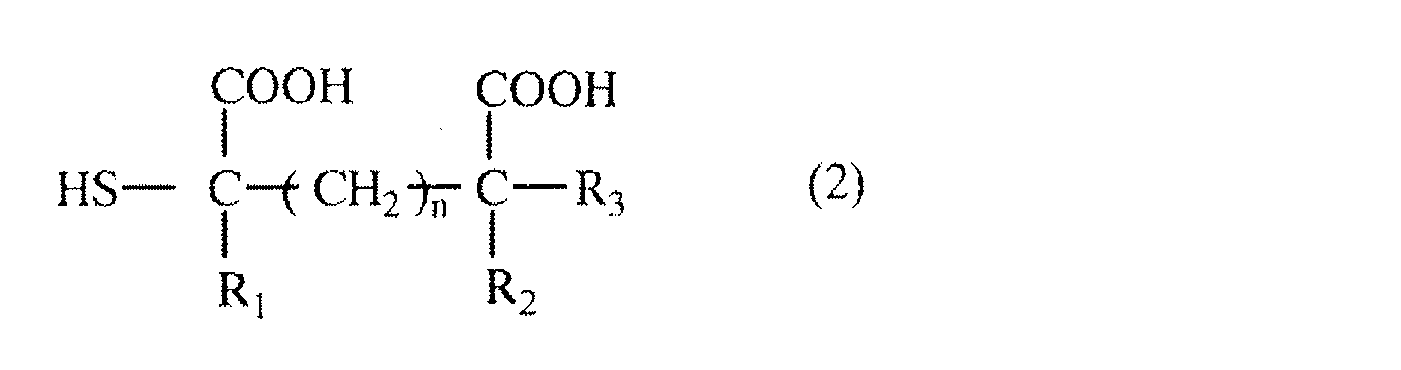
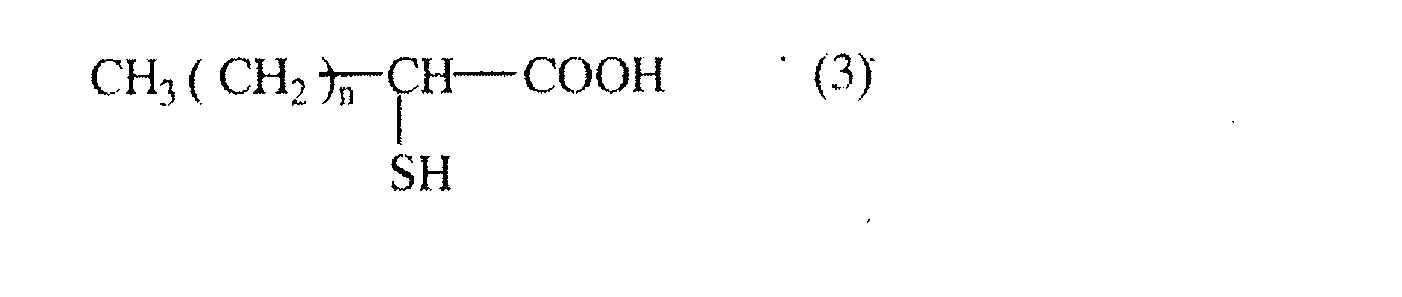
これらカルボン酸変性PVA樹脂(A)以外の他の変性PVA樹脂や未変性PVAの含有量は、フィルム中のPVA系樹脂全体に対して、50重量%以下であることが好ましく、特に好ましくは30重量%以下、更には10重量%以下であることが好ましい。
本発明のPVA系水溶性フィルムにおいては、更に可塑剤(B)を含有させることがフィルムに柔軟性や、成型容易性を付与する点で好ましい。可塑剤(B)は1種のみを用いても、2種以上を併用してもよいが、2種以上を併用することが、包装体として用いる場合のフィルム自身の強靭さや、特に液体洗剤を包装した際の包装体の経時的な形状安定性の点で好ましい。
上記のなかでも、水溶性フィルムの引張強度の点で融点が85℃以上、特には90℃以上のものが好ましい。なお、融点の上限は通常300℃、特には200℃が好ましい。
かかる可塑剤(B1)が少なすぎると水溶性フィルムが柔らかくなりすぎて、ブロッキングが生じやすくなる傾向があり、多すぎると水溶性フィルムが硬くなりすぎて、低湿環境下でもろくなる傾向がある。また、可塑剤(B2)が少なすぎると水溶性フィルムが硬くなりすぎる傾向があり、低湿環境下でもろくなる傾向があり、多すぎると水溶性フィルムが柔らかくなりすぎて、ブロッキングが生じやすくなる傾向がある。
かかる有機フィラー(C1)としては、主に高分子化合物の中から選択され、例えば、メラミン系樹脂、ポリメチル(メタ)アクリレート系樹脂、ポリスチレン系樹脂の他、澱粉、ポリ乳酸等の生分解性樹脂等が挙げられる。これらのなかでも、ポリメチル(メタ)アクリレート系樹脂、ポリスチレン系樹脂、澱粉、等の生分解性樹脂が好ましく、特にはPVAに対する分散性の点から澱粉が好ましい。
無機フィラー(C2)としては、例えば、シリカ(二酸化ケイ素)、珪藻土、酸化チタン、酸化カルシウム、酸化マグネシウム、酸化アルミニウム、酸化バリウム、酸化ゲルマニウム、酸化スズ、酸化亜鉛等の酸化物系無機化合物や、タルク、クレー、カオリン、雲母、アスベスト、石膏、グラファイト、ガラスバルーン、ガラスビーズ、硫酸カルシウム、硫酸バリウム、硫酸アンモニウム、亜硫酸カルシウム、炭酸カルシウム、ウィスカー状炭酸カルシウム、炭酸マグネシウム、ドーソナイト、ドロマイト、チタン酸カリウム、カーボンブラック、ガラス繊維、アルミナ繊維、ボロン繊維、加工鉱物繊維、炭素繊維、炭素中空球、ベントナイト、モンモリロナイト、銅粉、硫酸ナトリウム、硫酸カリウム、硫酸亜鉛、硫酸銅、硫酸鉄、硫酸マグネシウム、硫酸アルミニウム、硫酸アルミニウムカリウム、硝酸アンモニウム、硝酸ナトリウム、硝酸カリウム、硝酸アルミニウム、塩化アンモニウム、塩化ナトリウム、塩化カリウム、塩化マグネシウム、塩化カルシウム、リン酸ナトリウム、クロム酸カリウム等が挙げられる。これらは、単独で、もしくは2種以上併せて用いることができる。
本発明のPVA系水溶性フィルムは、カルボン酸変性PVA樹脂(A)を含有するPVA系樹脂水溶液(製膜原料)を調製し、流延、乾燥して製膜することにより製造することができる。
詳細には、上記のカルボン酸変性PVA樹脂(A)、好ましくは更に可塑剤(B)、必要に応じて更に、フィラー(C)及び界面活性剤(D)等を含有してなるPVA系樹脂組成物を水で溶解または分散してPVA系樹脂水溶液(製膜原料)を調製する溶解工程、前記工程で得られた製膜原料を用いてPVA系水溶性フィルムを製膜する製膜工程、の順序で製造してPVA系水溶性フィルムとする。
〔溶解工程〕
溶解工程では、上記PVA系樹脂組成物を水で溶解または分散して、PVA系樹脂水溶液(製膜原料)を調製する。
上記PVA系樹脂組成物を水に溶解する際の溶解方法としては、通常、常温溶解、高温溶解、加圧溶解等が採用され、なかでも、未溶解物が少なく、生産性に優れる点から高温溶解、加圧溶解が好ましい。
溶解温度としては、高温溶解の場合には、通常80~100℃、好ましくは90~100℃であり、加圧溶解の場合には、通常80~130℃、好ましくは90~120℃である。
溶解時間としては、溶解温度、溶解時の圧力により適宜調整すればよいが、通常1~20時間、好ましくは2~15時間、特に好ましくは3~10時間である。溶解時間が短すぎると未溶解物が残る傾向にあり、長すぎると生産性が低下する傾向にある。
更に、溶解した後、得られたPVA系樹脂水溶液に対して脱泡処理が行われるが、かかる脱泡方法としては、例えば、静置脱泡、真空脱泡、二軸押出脱泡等が挙げられる。なかでも静置脱泡、二軸押出脱泡が好ましい。
静置脱泡の温度としては、通常50~100℃、好ましくは70~95℃であり、脱泡時間は、通常2~30時間、好ましくは5~20時間である。
なお、上記[ ]内は25℃の水溶液中の酸解離定数を示すものであり、「岩波 理化学辞典第4版(1987)」より引用した値である。
pKaが小さすぎる酸とのアルカリ金属塩を用いると、製膜原料のpHを、目的とする弱アルカリ性の範囲に調整しにくくなる傾向があり、pKaが大きすぎると目的とするpHの範囲に調整する際の配合量が多くなりフィルムの機械強度やヒートシール性に影響を及ぼすおそれがある。
また、カルボン酸塩も場合によっては、酸が強く、弱アルカリ性範囲のpH調整には使用しにくい場合がある。
なかでもブロッキング性も良好になる点からアミン系界面活性剤を用いることが好ましく、特には弱アルカリ性の範囲への調製がしやすい点からポリオキシエチレンジアルキルアミンが好ましい。
製膜工程では、溶解工程で調製した製膜原料を膜状に賦形し、必要に応じて乾燥処理を施すことで、含水率15重量%未満にしたPVA系水溶性フィルムに製膜する。
製膜に当たっては、例えば、溶融押出法や流延法等の方法を採用することができ、膜厚の精度の点で流延法が好ましい。
流延法を行うに際しては、例えば、上記製膜原料を、(i)アプリケーター、バーコーター等を用いてギャップ間に通過させて金属表面等のキャスト面に流延する方法、(ii)T型スリットダイ等のスリットから吐出させ、エンドレスベルトやドラムロールの金属表面等のキャスト面に流延する方法、等により製膜原料を流延した後に乾燥することにより本発明のPVA系水溶性フィルムを製造することができる。
流延後、キャスト面上で製膜原料を乾燥させるのであるが、乾燥にあたっては、通常、エンドレスベルトやドラムロールの金属表面等のキャスト面を加熱することにより行う。上記キャスト面の表面温度は、50~110℃であることが好ましく、特に好ましくは70~100℃である。かかる表面温度が低すぎると、乾燥不足でフィルムの含水率が高くなり、ブロッキングしやすくなる傾向があり、高すぎると製膜原料が発泡し、製膜不良となる傾向がある。
また、製膜時の乾燥においては、熱ロールによる乾燥、フローティングドライヤーを用いてフィルムに熱風を吹き付ける乾燥や遠赤外線装置、誘電加熱装置による乾燥等を併用することもできる。
熱処理については、通常熱ロールにて行うことができるが、その他、フローティングドライヤーを用いてフィルムに熱風を吹き付ける熱処理や遠赤外線装置、誘電加熱装置による熱処理等も挙げられる。本発明においては、熱ロールを用いて行うことが、生産性の点で好ましい。なお、熱ロールは、複数本用いることもできる。
かかる熱処理温度と時間は、フィルムの水溶解性低下の抑制と生産性を向上させる観点から高温で短時間の熱処理を行うことが好ましく、特に好ましくは90~120℃で0.01~5秒間、更に好ましくは100~115℃で0.05~3秒間である。
かかる凹凸加工に際しては、加工温度は、通常60~150℃であり、好ましくは80~140℃である。加工圧力は、通常2~8MPa、好ましくは3~7MPaである。加工時間は、上記加工圧力、製膜速度にもよるが、通常0.01~5秒間であり、好ましくは0.1~3秒間である。
また、必要に応じて、凹凸加工処理の後に、熱によるフィルムの意図しない延伸を防止するために、冷却処理を施してもよい。
このようにして、本発明のPVA系水溶性フィルムを製造することができる。
長尺形状のPVA系水溶性フィルムを製造する場合においては、上記の製膜工程の後で、巻取工程、包装、保管、輸送等が必要に応じて実施される。
巻取工程では、製膜工程でキャスト面等から剥離したPVA系水溶性フィルムを搬送して巻き取り、芯管(S1)に巻き取ることによりフィルムロールを調製する。
得られたフィルムロールは、そのまま製品として供給することもできるが、好ましくは所望サイズのPVA系水溶性フィルム幅に見合った長さの芯管(S2)に巻き取り直し、所望のサイズのフィルムロールとして供給することもできる。
芯管(S1)の内径は、3~30cmが好ましく、特に好ましくは10~20cmである。
芯管(S1)の肉厚は、1~30mmが好ましく、特に好ましくは2~25mmである。
芯管(S1)の長さは、PVA系水溶性フィルムの幅より長くすることが必要で、フィルムロールの端部から1~50cm突出するようにするのが好ましい。
芯管(S2)の内径は、3~30cmが好ましく、特に好ましくは10~20cmである。
芯管(S2)の肉厚は、1~30mmが好ましく、特に好ましくは3~25mmである。
芯管(S2)の長さは、製品のPVA系水溶性フィルム幅と同等或いはそれ以上の長さのものであればよく、好ましくは同等~50cm長いものである。
かかるスリットに当たっては、シェア刃やレザー刃等を用いてスリットされるが、シェア刃でスリットすることがスリット断面の平滑性の点で好ましい。
なお、上記含水率は、JIS K 6726 3.4に準拠して測定され、得られた揮発分の値を含水率とする。
帯電防止剤としては、例えば、アルキルジエタノールアミン、ポリオキシエチレンアルキルアミン、高級脂肪酸アルカノールアミド、ソルビタン脂肪酸エステル等が使用される。
保護パッドの形状は、フィルムロールにあわせて、円盤状のシート、フィルムが実用的である。保護効果を顕著にするため発泡体、織物状、不織布状等の緩衝機能を付加させることが好ましい。また、湿度からフィルムロールを守るため乾燥剤を別途封入したり、前記保護パッドに積層または混入したりしておくこともできる。
保護パッドの素材はプラスチックが好ましく、その具体例としては、例えば、ポリスチレン、ポリエチレン、ポリプロピレン、ポリエステル、ポリ塩化ビニル等が挙げられる。
市販されているシート状乾燥剤の例としては、アイディ社製の「アイディシート」や品川化成社製の「アローシート」、「ゼオシート」、ハイシート工業社製の「ハイシートドライ」等がある。
ブラケットはベニヤ板やプラスチック板からなるものであり、その大きさは通常ブラケットの4辺がフィルムロールの直径より大きいものである。
また、上記一対のブラケットがぐらつかないように、両者を結束テープで固定することが好ましく、そのときテープの移動や弛みが起こらないようにブラケットの側面(厚み部分)にテープ幅と同程度のテープズレ防止溝を設けて置くのも実用的である。
ここで、「溶解」の基準として、直径1mm以上の不溶微粒子の分散が見られない場合を溶解とする。
なお、フィルム膜厚が76μmの場合は、上記溶解性試験により得られた溶解時間そのものでよいが、76μm以外の膜厚の場合は下記の換算式により溶解時間を求めることとする。
[式] 膜厚76μm換算での溶解時間(秒)=(76(μm)/フィルム膜厚(μm))2×(その膜厚での溶解時間(秒))
本発明の薬剤包装体は、本発明のPVA系水溶性フィルムで薬剤を内包してなる包装体である。水溶性のPVA系フィルムで包装されているため、包装体ごと水に投入し、PVA系水溶性フィルムが溶解した後に、薬剤が水に溶解または分散して、薬剤の効果を発現するため、1回分等の比較的少量の薬剤が包装されている薬剤包装体に好適である。
薬剤の形状は、液体であっても固体であってもよく、液体の場合は、液状であり、固体の場合は、顆粒状、錠剤状、粉状等が挙げられる。薬剤は、水に溶解または分散させて用いる薬剤が好ましく、本発明においては、とりわけ液体洗剤を内包することが好ましい。
また、薬剤のpHは、アルカリ性、中性、酸性のいずれであっても良い。
液体洗剤包装体は、保存の際には液体洗剤を内包した形状が保持されている。そして、使用時(洗濯時)には、包装体(水溶性フィルム)が水と接触することにより、包装体が溶解して内包されている液体洗剤が包装体から流出することとなる。
液体洗剤包装体の大きさは、通常長さ10~50mm、好ましくは20~40mmである。
また、PVA系水溶性フィルムからなる包装体のフィルムの厚みは、通常10~120μm、好ましくは15~110μm、特に好ましくは20~100μmである。
内包される液体洗剤の量は、通常5~50mL、好ましくは10~40mLである。
例えば、2枚のPVA系水溶性フィルムを用いて貼り合わせることにより製造され、成型装置の下部にある金型の上に、フィルム(ボトムフィルム)を固定し、装置の上部にもフィルム(トップフィルム)を固定する。ボトムフィルムをドライヤーで加熱し、金型に真空成型し、その後、成型されたフィルムに液体洗剤を投入した後、トップフィルムとボトムフィルムを圧着する。圧着した後は真空を解放し、包装体を得ることができる。
また、液体洗剤の水分量が15重量%以下であることが好ましく、特には0.1~10重量%、更には0.1~7重量%であるものが好ましく、水溶性フィルムがゲル化したり不溶化することがなく水溶性に優れることとなる。
液体薬剤は、流動性で、容器に合わせて形を変える液状の薬剤であれば、その粘度は特に限定されないが、好ましくは10~200mPa・sである。なお、かかる液体薬剤の粘度は、常温(20℃)下におけるB型回転粘度計にて測定される。
なお、例中「部」、「%」とあるのは、重量基準を意味する。
(A1):アクリル酸変性PVA樹脂
20℃における4%水溶液粘度23.5mPa・s、平均ケン化度97モル%、アクリル酸による変性量7.6モル%
(A2):マレイン酸変性PVA樹脂
20℃における4%水溶液粘度22mPa・s、平均ケン化度96モル%、マレイン酸モノメチルエステルによる変性量4.0モル%
(B1):ソルビトール(融点95℃)
(B2):グリセリン(融点18℃)
(B3):トリメチロールプロパン(融点58℃)
(C1):澱粉(平均粒子径20μm)
(C2):シリカ(平均粒子径8μm)
(D1):ポリオキシアルキレンアルキルエーテルリン酸エステルモノエタノールアミン塩
カルボン酸変性PVA樹脂(A)として、アクリル酸変性PVA樹脂(A1)100部、可塑剤(B)として(B1)13.5部、(B2)24部、(B3)5部、フィラー(C)として(C2)4部、界面活性剤(D)として(D1)1.4部、pH調整剤として水酸化ナトリウムを4.4部、及び水を混合して、90℃で5時間撹拌しながら溶解処理をし、製膜原料であるPVA系樹脂水溶液(固形分濃度22%、pH8.9)を得た。
得られたPVA系樹脂水溶液をポリエチレンテレフタレート(PET)フィルム上に流延し、105℃の乾燥室を通過させて乾燥し、厚み80μmのPVA系水溶性フィルムを得た。
実施例1において、水酸化ナトリウムの代わりに炭酸ナトリウム・無水物をpH調整剤として用い、下記表1に記載した製膜原料pHに調整した以外は同様にしてPVA系樹脂水溶液を調製して、PVA系水溶性フィルムを得た。
カルボン酸変性PVA樹脂(A)として、マレイン酸変性PVA樹脂(A2)100部、可塑剤(B)として(B1)20部、(B2)20部、フィラー(C)として(C1)8部、界面活性剤(D)として(D1)1.4部、pH調整剤として炭酸ナトリウム・無水物を4.4部、及び水を混合して、90℃で5時間撹拌しながら溶解処理をし、製膜原料であるPVA系樹脂水溶液(固形分濃度22%、pH7.7)を得た。それ以外は、実施例1と同様にしてPVA系水溶性フィルムを得た。
実施例1において、pH調整剤を配合しなかった以外は同様にしてPVA系樹脂水溶液を調製し、PVA系水溶性フィルムを得た。
上記実施例1~4、比較例1で得られた各PVA系水溶性フィルムにおけるカルボン酸変性PVA樹脂(A)中のカルボン酸変性基のラクトン化率を、前記の方法に従って測定し、その結果を表1に示す。
上記実施例1~4、比較例1で得られた各PVA系水溶性フィルムの20℃及び10℃における水溶解性を、以下の通り測定し評価した。
得られたPVA系水溶性フィルムを3cm×5cmのサイズにカットし、治具に固定した。次に、1Lビーカーに水(1L)を入れ、スターラーにより撹拌(回転子長3cm、回転数200~300rpm)しながら、水温を10℃もしくは20℃に保ちつつ、治具に固定したフィルムをかかる水中に浸漬し、フィルムが溶解するまでの時間(秒)を測定した。
「溶解」の基準として、直径1mm以上の不溶微粒子の分散が見られない場合を溶解とした。結果を表1に示す。
上記実施例1~4、比較例1で得られた各PVA系水溶性フィルムについて、以下の通り洗剤浸漬時の経時水溶解性評価を行った。
23℃、50%RHに1日調湿したPVA系水溶性フィルムを100mm×100mmのサイズに3枚カットし、それぞれチャック付ポリエチレン袋(横120mm×縦170mm)に広げて入れた。その後、各チャック付ポリエチレン袋に各pHの衣類用液体洗剤(pH8、pH10.2)を別々に約4mL入れてフィルムを浸漬させた。フィルム及び液体洗剤の入った各チャック付ポリエチレン袋をアルミ袋(300mm×200mm)に入れて、50℃で2週間静置した後、各チャック付ポリエチレン袋からフィルムを取り出し、液体洗剤を拭き取り、上記水溶解性の測定と同様にして10℃におけるフィルムの水溶解性試験を行った。結果を表1に示す。
上記実施例1~4、比較例1で得られた各PVA系水溶性フィルムの引張特性を、JIS K 7127(1999年)に準じて測定した。即ち、PVA系水溶性フィルムを測定前に23℃、50%RH調湿条件下に24時間静置した後、この環境下で島津製作所社製のオートグラフAGS-H(解析ソフトは島津製作所社製 Factory SHiKiBU2000)を用いて、引張速度200mm/分で測定した(フィルム幅15mm、チャック間距離50mm)。
なお、8%弾性率は引張特性の測定結果より以下の数式を用いて算出し、その結果を表1に示す。
[式] 8%弾性率(MPa)=ひずみ8%時点における応力(MPa)/0.08
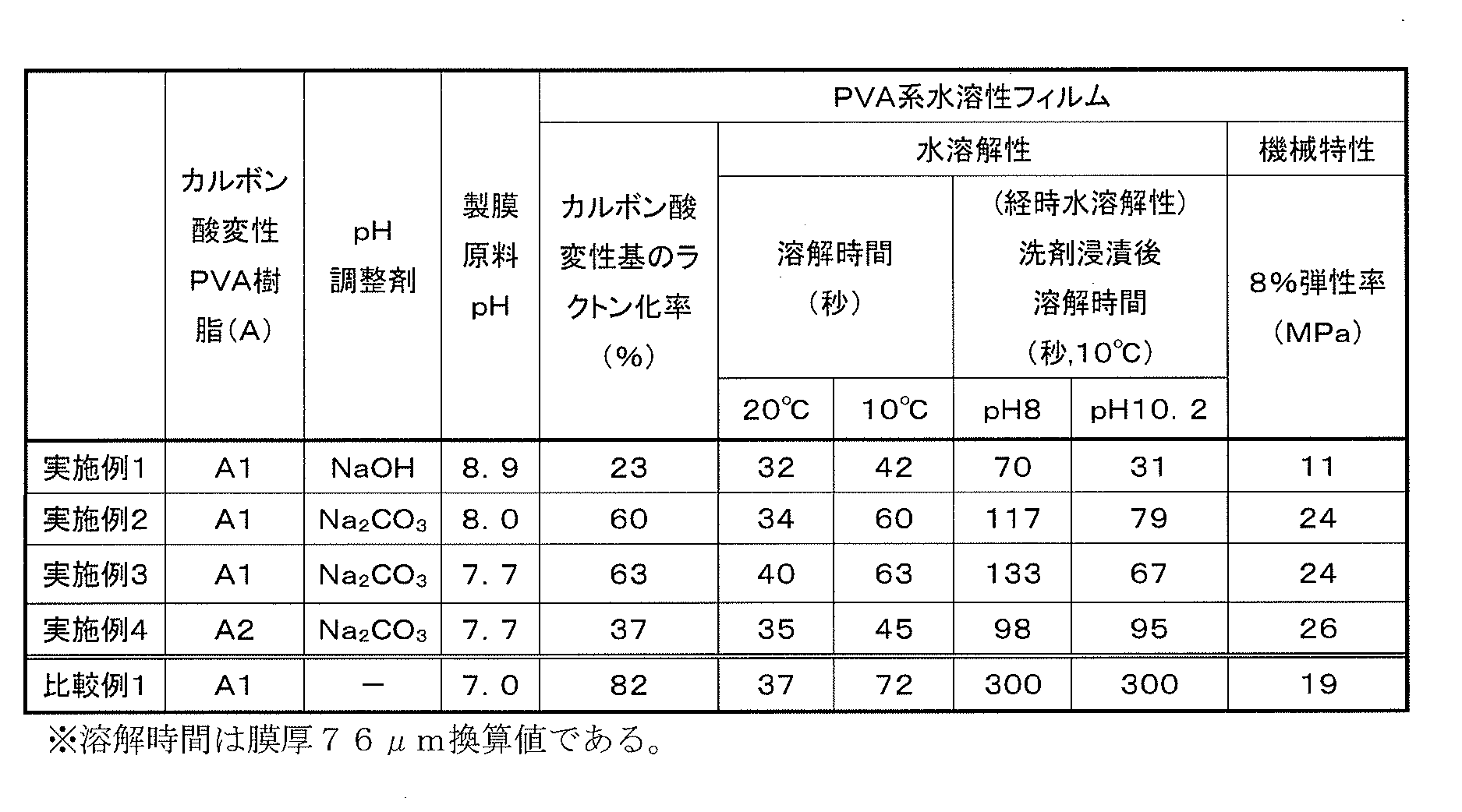
同時に、8%弾性率の値も充分に実用可能な範囲であり、包装体とした際の機械特性も満足するものであることがわかる。
更には、洗剤浸漬後の冷水溶解性も優れており、カルボン酸変性基のラクトン化率が特定範囲であると、水溶解性の経時的低下が生じないことがわかる。特にカルボン酸変性基がアクリル酸変性基である変性PVA樹脂において、ラクトン化率が特定範囲であると、洗剤浸漬後の水溶解性の低下が著しく改善されており、中性~弱アルカリ性の薬剤を包装しても水溶解性の経時的低下が生じないことがわかる。
なお、実施例2~4のPVA系水溶性フィルムでは、8%弾性率が高い数値を示すことから、環境変化が生じやすい場合や、薬剤包装体においてフィルムの張り状態が長期に維持できる等機械特性の面でより高機能性が求められる場合に優位であることがわかる。
Claims (10)
- カルボン酸変性ポリビニルアルコール樹脂(A)を主成分とするポリビニルアルコール系水溶性フィルムであって、上記カルボン酸変性ポリビニルアルコール樹脂(A)中のカルボン酸変性基のラクトン化率が20~70%であることを特徴とする水溶性フィルム。
- 上記カルボン酸変性ポリビニルアルコール樹脂(A)のカルボン酸変性量が1~20モル%であることを特徴とする請求項1記載の水溶性フィルム。
- 更に可塑剤(B)を含有し、上記可塑剤(B)の含有量が上記カルボン酸変性ポリビニルアルコール樹脂(A)100重量部に対して20~70重量部であることを特徴とする請求項1または2記載の水溶性フィルム。
- 上記カルボン酸変性ポリビニルアルコール樹脂(A)がアクリル酸変性ポリビニルアルコール樹脂であることを特徴とする請求項1~3のいずれか一項に記載の水溶性フィルム。
- 薬剤包装体として用いることを特徴とする請求項1~4のいずれか一項に記載の水溶性フィルム。
- pH8の液体洗剤に浸漬した後における10℃の水中での水溶解性テストの溶解時間が250秒以下であることを特徴とする水溶性フィルム。
- 請求項1~6のいずれか一項に記載の水溶性フィルムを貼り合わせてなる包装体と、上記包装体に内包された薬剤とを含有することを特徴とする薬剤包装体。
- 上記薬剤が洗剤であることを特徴とする請求項7記載の薬剤包装体。
- 上記薬剤が液体洗剤であることを特徴とする請求項7または8記載の薬剤包装体。
- 上記液体洗剤のpHが6~14であることを特徴とする請求項9記載の薬剤包装体。
Priority Applications (8)
| Application Number | Priority Date | Filing Date | Title |
|---|---|---|---|
| CN202210494313.1A CN115010843A (zh) | 2017-10-18 | 2018-10-16 | 水溶性薄膜及药剂包装体 |
| EP25183247.3A EP4613799A3 (en) | 2017-10-18 | 2018-10-16 | Water-soluble film and chemical agent package |
| CN201880052273.7A CN111032710A (zh) | 2017-10-18 | 2018-10-16 | 水溶性薄膜及药剂包装体 |
| JP2018554600A JP7124707B2 (ja) | 2017-10-18 | 2018-10-16 | 水溶性フィルム及び薬剤包装体 |
| EP18868674.5A EP3699206B1 (en) | 2017-10-18 | 2018-10-16 | Chemical agent package and use of a water-soluble film |
| US16/807,578 US11780976B2 (en) | 2017-10-18 | 2020-03-03 | Water-soluble film and chemical agent package |
| US17/752,218 US12116465B2 (en) | 2017-10-18 | 2022-05-24 | Water-soluble film and chemical agent package |
| JP2022112545A JP7323018B2 (ja) | 2017-10-18 | 2022-07-13 | 水溶性フィルム及び薬剤包装体 |
Applications Claiming Priority (2)
| Application Number | Priority Date | Filing Date | Title |
|---|---|---|---|
| JP2017201935 | 2017-10-18 | ||
| JP2017-201935 | 2017-10-18 |
Related Child Applications (1)
| Application Number | Title | Priority Date | Filing Date |
|---|---|---|---|
| US16/807,578 Continuation US11780976B2 (en) | 2017-10-18 | 2020-03-03 | Water-soluble film and chemical agent package |
Publications (1)
| Publication Number | Publication Date |
|---|---|
| WO2019078223A1 true WO2019078223A1 (ja) | 2019-04-25 |
Family
ID=66173347
Family Applications (1)
| Application Number | Title | Priority Date | Filing Date |
|---|---|---|---|
| PCT/JP2018/038554 Ceased WO2019078223A1 (ja) | 2017-10-18 | 2018-10-16 | 水溶性フィルム及び薬剤包装体 |
Country Status (5)
| Country | Link |
|---|---|
| US (2) | US11780976B2 (ja) |
| EP (2) | EP4613799A3 (ja) |
| JP (2) | JP7124707B2 (ja) |
| CN (2) | CN111032710A (ja) |
| WO (1) | WO2019078223A1 (ja) |
Cited By (3)
| Publication number | Priority date | Publication date | Assignee | Title |
|---|---|---|---|---|
| JP2021031682A (ja) * | 2019-08-28 | 2021-03-01 | ザ プロクター アンド ギャンブル カンパニーThe Procter & Gamble Company | 水溶性単位用量物品 |
| WO2021145021A1 (ja) * | 2020-01-14 | 2021-07-22 | 株式会社アイセロ | 水溶性フィルム、及びそれを有する薬剤封入用包装カプセル材料 |
| WO2024181297A1 (ja) * | 2023-02-28 | 2024-09-06 | 株式会社アイセロ | 洗剤包装カプセル用の水溶性フィルム及び洗剤包装カプセル |
Families Citing this family (5)
| Publication number | Priority date | Publication date | Assignee | Title |
|---|---|---|---|---|
| TWI865555B (zh) * | 2019-07-04 | 2024-12-11 | 日商愛賽璐股份有限公司 | 轉印用薄片及轉印方法 |
| CN113072724A (zh) * | 2021-03-16 | 2021-07-06 | 浙江农林大学 | 一种洗衣凝珠生产用的塑封薄膜及其制备方法和应用 |
| CN116694152B (zh) * | 2022-02-24 | 2025-05-27 | 湖南中烟工业有限责任公司 | 一种调湿涂料及其制备方法和在卷烟烟盒中的应用 |
| CN115322414A (zh) * | 2022-06-27 | 2022-11-11 | 广东冠豪新材料研发有限公司 | 一种水溶性膜的制备方法 |
| CN116922904B (zh) * | 2023-08-01 | 2024-02-13 | 上海舜睿新材料股份有限公司 | 一种具有防滑性能的pvc地板及其制备方法 |
Citations (5)
| Publication number | Priority date | Publication date | Assignee | Title |
|---|---|---|---|---|
| JPS6414244A (en) * | 1987-05-14 | 1989-01-18 | Clorox Co | Film from pva modified by hydrolyzable anionic comonomer |
| JP2006521449A (ja) * | 2003-03-19 | 2006-09-21 | モノソル エルエルシー | 液体製品包装用の、改良された品質保持期間を有するポリビニルアルコールコポリマーフィルム |
| WO2012087821A1 (en) | 2010-12-22 | 2012-06-28 | Sekisui Specialty Chemicals America, Llc | Cold water soluble polyvinyl alcohol/alkyl acrylate copolymers and films thereof |
| WO2016047126A1 (ja) * | 2014-09-26 | 2016-03-31 | 株式会社クラレ | 変性ポリビニルアルコールおよび水溶性フィルム |
| WO2016160116A1 (en) | 2015-03-27 | 2016-10-06 | Monosol, Llc | Water soluble film, packets employing the film, and methods of making and using same |
Family Cites Families (16)
| Publication number | Priority date | Publication date | Assignee | Title |
|---|---|---|---|---|
| US4747976A (en) * | 1987-05-14 | 1988-05-31 | The Clorox Company | PVA films with nonhydrolyzable anionic comonomers for packaging detergents |
| JP3262406B2 (ja) | 1993-06-01 | 2002-03-04 | 花王株式会社 | 水溶性フィルムによる液体包装体 |
| JP4549474B2 (ja) * | 2000-02-09 | 2010-09-22 | 株式会社クラレ | ランドリーバッグ |
| JP3913601B2 (ja) * | 2001-04-20 | 2007-05-09 | 株式会社クラレ | 水溶性フィルム |
| DE60201142T2 (de) * | 2001-04-20 | 2005-10-20 | Kuraray Co., Ltd., Kurashiki | Wasserlösliche Folie und Verpackung, welche dieselbe verwendet |
| GB0131055D0 (en) * | 2001-12-28 | 2002-02-13 | Unilever Plc | Detergent compositions |
| JP3828454B2 (ja) | 2002-05-22 | 2006-10-04 | 株式会社クラレ | 樹脂組成物およびその成形物 |
| JP4056859B2 (ja) * | 2002-11-11 | 2008-03-05 | 日本合成化学工業株式会社 | 水溶性フィルム |
| EP1640444A1 (en) | 2004-09-17 | 2006-03-29 | The Procter & Gamble Company | Water-soluble, liquid-containing pouch |
| CN101203551B (zh) * | 2005-06-16 | 2011-09-28 | 日本合成化学工业株式会社 | 水溶性膜 |
| CN106795236B (zh) * | 2014-10-09 | 2020-05-15 | 株式会社可乐丽 | 改性聚乙烯醇、树脂组合物和膜 |
| BR112017006796A2 (pt) * | 2014-10-13 | 2017-12-26 | Procter & Gamble | artigos compreendendo filme de mistura de álcool polivinílico solúvel em água e métodos relacionados |
| JP6787132B2 (ja) * | 2015-09-11 | 2020-11-18 | 三菱ケミカル株式会社 | 水溶性フィルム及び薬剤包装体 |
| JP7005894B2 (ja) * | 2015-12-07 | 2022-01-24 | 三菱ケミカル株式会社 | 水溶性フィルム及び薬剤包装体 |
| JP6787064B2 (ja) * | 2015-12-17 | 2020-11-18 | 三菱ケミカル株式会社 | 水溶性フィルム及び薬剤包装体 |
| JP6665316B2 (ja) * | 2016-04-13 | 2020-03-13 | ザ プロクター アンド ギャンブル カンパニーThe Procter & Gamble Company | ポリビニルアルコールポリマーブレンドから製造された水溶性フィルムを有するパウチ |
-
2018
- 2018-10-16 JP JP2018554600A patent/JP7124707B2/ja active Active
- 2018-10-16 EP EP25183247.3A patent/EP4613799A3/en active Pending
- 2018-10-16 CN CN201880052273.7A patent/CN111032710A/zh active Pending
- 2018-10-16 EP EP18868674.5A patent/EP3699206B1/en active Active
- 2018-10-16 WO PCT/JP2018/038554 patent/WO2019078223A1/ja not_active Ceased
- 2018-10-16 CN CN202210494313.1A patent/CN115010843A/zh active Pending
-
2020
- 2020-03-03 US US16/807,578 patent/US11780976B2/en active Active
-
2022
- 2022-05-24 US US17/752,218 patent/US12116465B2/en active Active
- 2022-07-13 JP JP2022112545A patent/JP7323018B2/ja active Active
Patent Citations (5)
| Publication number | Priority date | Publication date | Assignee | Title |
|---|---|---|---|---|
| JPS6414244A (en) * | 1987-05-14 | 1989-01-18 | Clorox Co | Film from pva modified by hydrolyzable anionic comonomer |
| JP2006521449A (ja) * | 2003-03-19 | 2006-09-21 | モノソル エルエルシー | 液体製品包装用の、改良された品質保持期間を有するポリビニルアルコールコポリマーフィルム |
| WO2012087821A1 (en) | 2010-12-22 | 2012-06-28 | Sekisui Specialty Chemicals America, Llc | Cold water soluble polyvinyl alcohol/alkyl acrylate copolymers and films thereof |
| WO2016047126A1 (ja) * | 2014-09-26 | 2016-03-31 | 株式会社クラレ | 変性ポリビニルアルコールおよび水溶性フィルム |
| WO2016160116A1 (en) | 2015-03-27 | 2016-10-06 | Monosol, Llc | Water soluble film, packets employing the film, and methods of making and using same |
Non-Patent Citations (1)
| Title |
|---|
| "Iwanami Rikagaku Jiten", 1987 |
Cited By (6)
| Publication number | Priority date | Publication date | Assignee | Title |
|---|---|---|---|---|
| JP2021031682A (ja) * | 2019-08-28 | 2021-03-01 | ザ プロクター アンド ギャンブル カンパニーThe Procter & Gamble Company | 水溶性単位用量物品 |
| JP7235703B2 (ja) | 2019-08-28 | 2023-03-08 | ザ プロクター アンド ギャンブル カンパニー | 水溶性単位用量物品 |
| WO2021145021A1 (ja) * | 2020-01-14 | 2021-07-22 | 株式会社アイセロ | 水溶性フィルム、及びそれを有する薬剤封入用包装カプセル材料 |
| JPWO2021145021A1 (ja) * | 2020-01-14 | 2021-07-22 | ||
| JP7574225B2 (ja) | 2020-01-14 | 2024-10-28 | 株式会社アイセロ | 水溶性フィルム、及びそれを有する薬剤封入用包装カプセル材料 |
| WO2024181297A1 (ja) * | 2023-02-28 | 2024-09-06 | 株式会社アイセロ | 洗剤包装カプセル用の水溶性フィルム及び洗剤包装カプセル |
Also Published As
| Publication number | Publication date |
|---|---|
| EP4613799A2 (en) | 2025-09-10 |
| US20200199314A1 (en) | 2020-06-25 |
| EP4613799A3 (en) | 2025-10-01 |
| US11780976B2 (en) | 2023-10-10 |
| JP7124707B2 (ja) | 2022-08-24 |
| JP2022140495A (ja) | 2022-09-26 |
| EP3699206A4 (en) | 2020-12-23 |
| EP3699206A1 (en) | 2020-08-26 |
| EP3699206B1 (en) | 2025-08-06 |
| US12116465B2 (en) | 2024-10-15 |
| CN111032710A (zh) | 2020-04-17 |
| JP7323018B2 (ja) | 2023-08-08 |
| JPWO2019078223A1 (ja) | 2020-09-17 |
| CN115010843A (zh) | 2022-09-06 |
| US20220282049A1 (en) | 2022-09-08 |
Similar Documents
| Publication | Publication Date | Title |
|---|---|---|
| JP7323018B2 (ja) | 水溶性フィルム及び薬剤包装体 | |
| JP6805828B2 (ja) | 水溶性フィルム、薬剤包装体及び水溶性フィルムの製造方法 | |
| JP6787132B2 (ja) | 水溶性フィルム及び薬剤包装体 | |
| JP6888256B2 (ja) | 水溶性フィルム及び薬剤包装体 | |
| JP6992253B2 (ja) | 水溶性フィルム及び薬剤包装体 | |
| KR20220152585A (ko) | 수용성 필름 및 약제 포장체 | |
| JP6809227B2 (ja) | 液体洗剤包装用水溶性フィルム及び液体洗剤包装体 | |
| WO2018230583A1 (ja) | 水溶性フィルム及び薬剤包装体、ならびに水溶性フィルムの製造方法 | |
| JP2017110213A (ja) | 薬剤包装体及び薬剤包装体の製造方法 | |
| JPWO2018123892A1 (ja) | 水溶性フィルムおよび薬剤包装体 | |
| WO2018123894A1 (ja) | 水溶性フィルム及び薬剤包装体 | |
| JP2019119877A (ja) | ポリビニルアルコール系フィルム及びその製造方法、ならびに薬剤包装体 | |
| JP7005894B2 (ja) | 水溶性フィルム及び薬剤包装体 | |
| JP7085151B2 (ja) | 水溶性フィルム及び薬剤包装体 | |
| JP7035313B2 (ja) | 水溶性フィルム及び薬剤包装体 | |
| JP7099273B2 (ja) | ポリビニルアルコール系水溶性フィルム及びその製造方法、ならびに薬剤包装体 | |
| JP6787131B2 (ja) | 水溶性フィルムを用いた薬剤包装体、並びに水溶性フィルムの製造方法 | |
| JP6962074B2 (ja) | 水溶性フィルム及び薬剤包装体 | |
| JP2017119851A (ja) | 水溶性フィルム及び薬剤包装体 | |
| JP2022008489A (ja) | 水溶性フィルム及び薬剤包装体 | |
| JP7234625B2 (ja) | ポリビニルアルコール系フィルム及びその製造方法、ならびに薬剤包装体 |
Legal Events
| Date | Code | Title | Description |
|---|---|---|---|
| ENP | Entry into the national phase |
Ref document number: 2018554600 Country of ref document: JP Kind code of ref document: A |
|
| 121 | Ep: the epo has been informed by wipo that ep was designated in this application |
Ref document number: 18868674 Country of ref document: EP Kind code of ref document: A1 |
|
| NENP | Non-entry into the national phase |
Ref country code: DE |
|
| ENP | Entry into the national phase |
Ref document number: 2018868674 Country of ref document: EP Effective date: 20200518 |
|
| WWG | Wipo information: grant in national office |
Ref document number: 2018868674 Country of ref document: EP |