WO2019088102A1 - 樹脂組成物 - Google Patents
樹脂組成物 Download PDFInfo
- Publication number
- WO2019088102A1 WO2019088102A1 PCT/JP2018/040337 JP2018040337W WO2019088102A1 WO 2019088102 A1 WO2019088102 A1 WO 2019088102A1 JP 2018040337 W JP2018040337 W JP 2018040337W WO 2019088102 A1 WO2019088102 A1 WO 2019088102A1
- Authority
- WO
- WIPO (PCT)
- Prior art keywords
- resin composition
- electronic component
- methylene
- group
- composition according
- Prior art date
- Legal status (The legal status is an assumption and is not a legal conclusion. Google has not performed a legal analysis and makes no representation as to the accuracy of the status listed.)
- Ceased
Links
Images

Classifications
-
- C—CHEMISTRY; METALLURGY
- C08—ORGANIC MACROMOLECULAR COMPOUNDS; THEIR PREPARATION OR CHEMICAL WORKING-UP; COMPOSITIONS BASED THEREON
- C08F—MACROMOLECULAR COMPOUNDS OBTAINED BY REACTIONS ONLY INVOLVING CARBON-TO-CARBON UNSATURATED BONDS
- C08F22/00—Homopolymers and copolymers of compounds having one or more unsaturated aliphatic radicals each having only one carbon-to-carbon double bond, and at least one being terminated by a carboxyl radical and containing at least one other carboxyl radical in the molecule; Salts, anhydrides, esters, amides, imides or nitriles thereof
- C08F22/10—Esters
-
- C—CHEMISTRY; METALLURGY
- C09—DYES; PAINTS; POLISHES; NATURAL RESINS; ADHESIVES; COMPOSITIONS NOT OTHERWISE PROVIDED FOR; APPLICATIONS OF MATERIALS NOT OTHERWISE PROVIDED FOR
- C09D—COATING COMPOSITIONS, e.g. PAINTS, VARNISHES OR LACQUERS; FILLING PASTES; CHEMICAL PAINT OR INK REMOVERS; INKS; CORRECTING FLUIDS; WOODSTAINS; PASTES OR SOLIDS FOR COLOURING OR PRINTING; USE OF MATERIALS THEREFOR
- C09D135/00—Coating compositions based on homopolymers or copolymers of compounds having one or more unsaturated aliphatic radicals, each having only one carbon-to-carbon double bond, and at least one being terminated by a carboxyl radical, and containing at least another carboxyl radical in the molecule, or of salts, anhydrides, esters, amides, imides or nitriles thereof; Coating compositions based on derivatives of such polymers
- C09D135/02—Homopolymers or copolymers of esters
-
- C—CHEMISTRY; METALLURGY
- C08—ORGANIC MACROMOLECULAR COMPOUNDS; THEIR PREPARATION OR CHEMICAL WORKING-UP; COMPOSITIONS BASED THEREON
- C08F—MACROMOLECULAR COMPOUNDS OBTAINED BY REACTIONS ONLY INVOLVING CARBON-TO-CARBON UNSATURATED BONDS
- C08F2/00—Processes of polymerisation
- C08F2/44—Polymerisation in the presence of compounding ingredients, e.g. plasticisers, dyestuffs, fillers
-
- C—CHEMISTRY; METALLURGY
- C08—ORGANIC MACROMOLECULAR COMPOUNDS; THEIR PREPARATION OR CHEMICAL WORKING-UP; COMPOSITIONS BASED THEREON
- C08F—MACROMOLECULAR COMPOUNDS OBTAINED BY REACTIONS ONLY INVOLVING CARBON-TO-CARBON UNSATURATED BONDS
- C08F222/00—Copolymers of compounds having one or more unsaturated aliphatic radicals, each having only one carbon-to-carbon double bond, and at least one being terminated by a carboxyl radical and containing at least one other carboxyl radical in the molecule; Salts, anhydrides, esters, amides, imides, or nitriles thereof
- C08F222/10—Esters
- C08F222/12—Esters of phenols or saturated alcohols
- C08F222/14—Esters having no free carboxylic acid groups, e.g. dialkyl maleates or fumarates
-
- C—CHEMISTRY; METALLURGY
- C08—ORGANIC MACROMOLECULAR COMPOUNDS; THEIR PREPARATION OR CHEMICAL WORKING-UP; COMPOSITIONS BASED THEREON
- C08F—MACROMOLECULAR COMPOUNDS OBTAINED BY REACTIONS ONLY INVOLVING CARBON-TO-CARBON UNSATURATED BONDS
- C08F222/00—Copolymers of compounds having one or more unsaturated aliphatic radicals, each having only one carbon-to-carbon double bond, and at least one being terminated by a carboxyl radical and containing at least one other carboxyl radical in the molecule; Salts, anhydrides, esters, amides, imides, or nitriles thereof
- C08F222/10—Esters
- C08F222/12—Esters of phenols or saturated alcohols
- C08F222/14—Esters having no free carboxylic acid groups, e.g. dialkyl maleates or fumarates
- C08F222/145—Esters having no free carboxylic acid groups, e.g. dialkyl maleates or fumarates the ester chains containing seven or more carbon atoms
-
- C—CHEMISTRY; METALLURGY
- C08—ORGANIC MACROMOLECULAR COMPOUNDS; THEIR PREPARATION OR CHEMICAL WORKING-UP; COMPOSITIONS BASED THEREON
- C08F—MACROMOLECULAR COMPOUNDS OBTAINED BY REACTIONS ONLY INVOLVING CARBON-TO-CARBON UNSATURATED BONDS
- C08F4/00—Polymerisation catalysts
-
- C—CHEMISTRY; METALLURGY
- C08—ORGANIC MACROMOLECULAR COMPOUNDS; THEIR PREPARATION OR CHEMICAL WORKING-UP; COMPOSITIONS BASED THEREON
- C08K—Use of inorganic or non-macromolecular organic substances as compounding ingredients
- C08K5/00—Use of organic ingredients
- C08K5/16—Nitrogen-containing compounds
- C08K5/17—Amines; Quaternary ammonium compounds
-
- C—CHEMISTRY; METALLURGY
- C09—DYES; PAINTS; POLISHES; NATURAL RESINS; ADHESIVES; COMPOSITIONS NOT OTHERWISE PROVIDED FOR; APPLICATIONS OF MATERIALS NOT OTHERWISE PROVIDED FOR
- C09J—ADHESIVES; NON-MECHANICAL ASPECTS OF ADHESIVE PROCESSES IN GENERAL; ADHESIVE PROCESSES NOT PROVIDED FOR ELSEWHERE; USE OF MATERIALS AS ADHESIVES
- C09J11/00—Features of adhesives not provided for in group C09J9/00, e.g. additives
- C09J11/02—Non-macromolecular additives
- C09J11/06—Non-macromolecular additives organic
-
- C—CHEMISTRY; METALLURGY
- C09—DYES; PAINTS; POLISHES; NATURAL RESINS; ADHESIVES; COMPOSITIONS NOT OTHERWISE PROVIDED FOR; APPLICATIONS OF MATERIALS NOT OTHERWISE PROVIDED FOR
- C09J—ADHESIVES; NON-MECHANICAL ASPECTS OF ADHESIVE PROCESSES IN GENERAL; ADHESIVE PROCESSES NOT PROVIDED FOR ELSEWHERE; USE OF MATERIALS AS ADHESIVES
- C09J135/00—Adhesives based on homopolymers or copolymers of compounds having one or more unsaturated aliphatic radicals, each having only one carbon-to-carbon double bond, and at least one being terminated by a carboxyl radical, and containing at least another carboxyl radical in the molecule, or of salts, anhydrides, esters, amides, imides or nitriles thereof; Adhesives based on derivatives of such polymers
- C09J135/02—Homopolymers or copolymers of esters
-
- C—CHEMISTRY; METALLURGY
- C09—DYES; PAINTS; POLISHES; NATURAL RESINS; ADHESIVES; COMPOSITIONS NOT OTHERWISE PROVIDED FOR; APPLICATIONS OF MATERIALS NOT OTHERWISE PROVIDED FOR
- C09J—ADHESIVES; NON-MECHANICAL ASPECTS OF ADHESIVE PROCESSES IN GENERAL; ADHESIVE PROCESSES NOT PROVIDED FOR ELSEWHERE; USE OF MATERIALS AS ADHESIVES
- C09J4/00—Adhesives based on organic non-macromolecular compounds having at least one polymerisable carbon-to-carbon unsaturated bond ; adhesives, based on monomers of macromolecular compounds of groups C09J183/00 - C09J183/16
-
- H—ELECTRICITY
- H05—ELECTRIC TECHNIQUES NOT OTHERWISE PROVIDED FOR
- H05K—PRINTED CIRCUITS; CASINGS OR CONSTRUCTIONAL DETAILS OF ELECTRIC APPARATUS; MANUFACTURE OF ASSEMBLAGES OF ELECTRICAL COMPONENTS
- H05K9/00—Screening of apparatus or components against electric or magnetic fields
- H05K9/0073—Shielding materials
-
- H—ELECTRICITY
- H10—SEMICONDUCTOR DEVICES; ELECTRIC SOLID-STATE DEVICES NOT OTHERWISE PROVIDED FOR
- H10F—INORGANIC SEMICONDUCTOR DEVICES SENSITIVE TO INFRARED RADIATION, LIGHT, ELECTROMAGNETIC RADIATION OF SHORTER WAVELENGTH OR CORPUSCULAR RADIATION
- H10F39/00—Integrated devices, or assemblies of multiple devices, comprising at least one element covered by group H10F30/00, e.g. radiation detectors comprising photodiode arrays
- H10F39/011—Manufacture or treatment of image sensors covered by group H10F39/12
-
- H—ELECTRICITY
- H10—SEMICONDUCTOR DEVICES; ELECTRIC SOLID-STATE DEVICES NOT OTHERWISE PROVIDED FOR
- H10F—INORGANIC SEMICONDUCTOR DEVICES SENSITIVE TO INFRARED RADIATION, LIGHT, ELECTROMAGNETIC RADIATION OF SHORTER WAVELENGTH OR CORPUSCULAR RADIATION
- H10F39/00—Integrated devices, or assemblies of multiple devices, comprising at least one element covered by group H10F30/00, e.g. radiation detectors comprising photodiode arrays
- H10F39/80—Constructional details of image sensors
- H10F39/804—Containers or encapsulations
-
- H—ELECTRICITY
- H10—SEMICONDUCTOR DEVICES; ELECTRIC SOLID-STATE DEVICES NOT OTHERWISE PROVIDED FOR
- H10F—INORGANIC SEMICONDUCTOR DEVICES SENSITIVE TO INFRARED RADIATION, LIGHT, ELECTROMAGNETIC RADIATION OF SHORTER WAVELENGTH OR CORPUSCULAR RADIATION
- H10F39/00—Integrated devices, or assemblies of multiple devices, comprising at least one element covered by group H10F30/00, e.g. radiation detectors comprising photodiode arrays
- H10F39/80—Constructional details of image sensors
- H10F39/806—Optical elements or arrangements associated with the image sensors
-
- H—ELECTRICITY
- H10—SEMICONDUCTOR DEVICES; ELECTRIC SOLID-STATE DEVICES NOT OTHERWISE PROVIDED FOR
- H10W—GENERIC PACKAGES, INTERCONNECTIONS, CONNECTORS OR OTHER CONSTRUCTIONAL DETAILS OF DEVICES COVERED BY CLASS H10
- H10W72/00—Interconnections or connectors in packages
- H10W72/071—Connecting or disconnecting
- H10W72/072—Connecting or disconnecting of bump connectors
-
- H—ELECTRICITY
- H10—SEMICONDUCTOR DEVICES; ELECTRIC SOLID-STATE DEVICES NOT OTHERWISE PROVIDED FOR
- H10W—GENERIC PACKAGES, INTERCONNECTIONS, CONNECTORS OR OTHER CONSTRUCTIONAL DETAILS OF DEVICES COVERED BY CLASS H10
- H10W72/00—Interconnections or connectors in packages
- H10W72/071—Connecting or disconnecting
- H10W72/073—Connecting or disconnecting of die-attach connectors
-
- H—ELECTRICITY
- H10—SEMICONDUCTOR DEVICES; ELECTRIC SOLID-STATE DEVICES NOT OTHERWISE PROVIDED FOR
- H10W—GENERIC PACKAGES, INTERCONNECTIONS, CONNECTORS OR OTHER CONSTRUCTIONAL DETAILS OF DEVICES COVERED BY CLASS H10
- H10W74/00—Encapsulations, e.g. protective coatings
- H10W74/10—Encapsulations, e.g. protective coatings characterised by their shape or disposition
- H10W74/131—Encapsulations, e.g. protective coatings characterised by their shape or disposition the semiconductor body being only partially enclosed
- H10W74/142—Encapsulations, e.g. protective coatings characterised by their shape or disposition the semiconductor body being only partially enclosed the encapsulations exposing the passive side of the semiconductor body
-
- H—ELECTRICITY
- H10—SEMICONDUCTOR DEVICES; ELECTRIC SOLID-STATE DEVICES NOT OTHERWISE PROVIDED FOR
- H10W—GENERIC PACKAGES, INTERCONNECTIONS, CONNECTORS OR OTHER CONSTRUCTIONAL DETAILS OF DEVICES COVERED BY CLASS H10
- H10W74/00—Encapsulations, e.g. protective coatings
- H10W74/10—Encapsulations, e.g. protective coatings characterised by their shape or disposition
- H10W74/15—Encapsulations, e.g. protective coatings characterised by their shape or disposition on active surfaces of flip-chip devices, e.g. underfills
-
- H—ELECTRICITY
- H10—SEMICONDUCTOR DEVICES; ELECTRIC SOLID-STATE DEVICES NOT OTHERWISE PROVIDED FOR
- H10W—GENERIC PACKAGES, INTERCONNECTIONS, CONNECTORS OR OTHER CONSTRUCTIONAL DETAILS OF DEVICES COVERED BY CLASS H10
- H10W90/00—Package configurations
- H10W90/701—Package configurations characterised by the relative positions of pads or connectors relative to package parts
- H10W90/721—Package configurations characterised by the relative positions of pads or connectors relative to package parts of bump connectors
- H10W90/724—Package configurations characterised by the relative positions of pads or connectors relative to package parts of bump connectors between a chip and a stacked insulating package substrate, interposer or RDL
-
- H—ELECTRICITY
- H10—SEMICONDUCTOR DEVICES; ELECTRIC SOLID-STATE DEVICES NOT OTHERWISE PROVIDED FOR
- H10W—GENERIC PACKAGES, INTERCONNECTIONS, CONNECTORS OR OTHER CONSTRUCTIONAL DETAILS OF DEVICES COVERED BY CLASS H10
- H10W90/00—Package configurations
- H10W90/701—Package configurations characterised by the relative positions of pads or connectors relative to package parts
- H10W90/731—Package configurations characterised by the relative positions of pads or connectors relative to package parts of die-attach connectors
- H10W90/734—Package configurations characterised by the relative positions of pads or connectors relative to package parts of die-attach connectors between a chip and a stacked insulating package substrate, interposer or RDL
Definitions
- the present invention relates to a resin composition, and more particularly to a resin composition suitable as an adhesive for electronic components.
- a one-component adhesive which is cured at a temperature as low as possible is used. It is preferable to use a one-component adhesive that cures as low as possible even when manufacturing electronic components such as semiconductor elements, integrated circuits, large scale integrated circuits, transistors, thyristors, diodes, and capacitors. In order to avoid the characteristic deterioration of the peripheral member due to heat and further to improve the production efficiency, a one-component adhesive that can be cured at a lower temperature is required.
- the components required to be volatilized at the time of use (at the time of application) or at the time of curing are required as the characteristics required for the one-component adhesive used in the production of the image sensor module and other electronic components.
- the adhesive contains a large amount of components that volatilize during use at room temperature or during curing, volatiles adhere to sensors, lenses, electrodes, etc., particularly when used in electronic component applications such as cameras and sensor modules, They can cause pollution.
- solvent cleaning may be performed to remove deposits generated in the process that cause such contamination.
- the deposit is liquid, the deposit can be removed relatively easily by such cleaning, but if the deposit is a solid cured on the member, removal from the member becomes difficult, and the yield decreases, etc. Increases concerns about causing increased manufacturing costs.
- the adhesive strength may be reduced due to the decrease in bulk strength and the decrease in adherend interface area. If air bubbles are generated at the time of curing, there is a concern that the reliability may be lowered such that the positional accuracy of the adherend may be reduced by deformation.
- the health effects of the worker may be concerned such as irritation to eyes, bronchi or the like, which may lead to deterioration of the working environment.
- one-component adhesives for electronic component applications such as image sensor modules, epoxy resins, multifunctional thiol compounds, thiol-based adhesives containing a curing accelerator as essential components, radical initiators, and anion initiation Acrylate resin-based adhesives containing an agent as an essential component are known, and those curable at about 80 ° C. are also known.
- a one-part adhesive that can be cured at lower temperatures to improve manufacturing efficiency.
- Patent Document 1 discloses a polymerization system comprising diethylmethylene malonate monomer (DEMM) and a polymerization activator supported in an inactive engagement state, which can be cured in a short time even at a low temperature such as room temperature. .
- DEMM diethylmethylene malonate monomer
- Patent Document 1 has many components that volatilize when used at normal temperature or when cured, and particularly when used for electronic component applications such as an image sensor module, adhesion or contamination to sensors, lenses, electrodes, etc. There is a concern that the above problems such as deterioration of working environment and deterioration of reliability may occur.
- this polymerization system instead of diethyl methylene malonate monomer, when methylene malonate or the like having a higher molecular weight which is less volatile is used as a monomer, the reaction start is delayed due to steric hindrance, and curing takes place at low temperature and short time. It may not be suitable for use.
- the present invention can be cured in a relatively short time (within several hours) at a low temperature such as room temperature, and is less likely to cause environmental contamination due to resin volatilization. It aims at provision of the resin composition suitable as a one-pack type adhesive agent used at the time of manufacture of parts.
- the present inventors arrived at the present invention as a result of intensive studies to solve the above problems.
- the present invention includes, but is not limited to, the following inventions.
- a resin composition comprising a 2-methylene 1,3-dicarbonyl compound and an initiator,
- the 2-methylene 1,3-dicarbonyl compound has the following formula (I):
- a compound having a molecular weight of 180 to 10000, comprising a structural unit represented by The initiator comprises a basic substance having a pKa of 8 or more; Resin composition.
- a method of manufacturing a semiconductor device having an electronic component and a circuit board comprising: Preparing electronic components and circuit boards, A semiconductor device comprising applying the resin composition according to any one of the above (1) to (12) onto the surface of the electronic component or the circuit board, and bringing the electronic component and the circuit board into contact with each other. Manufacturing method.
- a method of manufacturing a sealed electronic component comprising: A method for producing a sealed electronic component, comprising: preparing an electronic component; and sealing the electronic component using the resin composition according to any one of the above (1) to (12).
- a method of manufacturing an electronic component Preparing a plurality of members constituting an electronic component; Applying the resin composition according to any one of the above items (1) to (12) on the surface of a member constituting an electronic component, and bringing the member into contact with another member constituting the electronic component,
- a method of manufacturing an electronic component including:
- the resin composition of the present invention can be cured in a relatively short time (within several hours) at a low temperature such as room temperature and is less likely to cause environmental contamination due to resin volatilization, so it can be used when producing image sensor modules and electronic components Is suitable as a one-part adhesive. Such characteristics can improve the production efficiency of electronic components, reduce contamination of surrounding members during use or curing, maintain a good working environment, and provide reliability of the obtained cured product. Is also possible.
- the resin composition of the present invention comprises a 2-methylene 1,3-dicarbonyl compound and an initiator.
- the component contained in the resin composition of this invention is demonstrated.
- the 2-methylene 1,3-dicarbonyl compound of the present invention has the following formula (I): It is a compound containing the structural unit represented by The 2-methylene 1,3-dicarbonyl compound contains one or more structural units of the above formula (I). In one embodiment, the 2-methylene 1,3-dicarbonyl compound contains 2 to 6, preferably 2 structural units of the above formula (I).
- the above-mentioned 2-methylene 1,3-dicarbonyl compound contains the structural unit of the above-mentioned formula (I), it is typically polymerized by Michael addition in the presence of a base catalyst, so that one-part adhesion is achieved. It can be used as a main component of the agent.
- the above-mentioned 2-methylene 1,3-dicarbonyl compound contains two or more structural units of the above-mentioned formula (I) (multifunctional), crosslinking occurs during curing, and the mechanical properties of the cured product at high temperatures are improved Improvement of physical properties such as is expected.
- the resin composition of the present invention may contain only one type of 2-methylene 1,3-dicarbonyl compound, or may contain two or more types.
- the 2-methylene 1,3-dicarbonyl compounds contained in the resin composition of the present invention at least one has a molecular weight of 180 to 10,000, more preferably 180 to 5,000, still more preferably 180 to 2,000. More preferably, it is 200 to 1,500, more preferably 240 to 1,500, particularly preferably 250 to 1,500, and most preferably 260 to 1,500. If the molecular weight of the 2-methylene 1,3-dicarbonyl compound is less than 180, the volatility increases and the working environment deteriorates, and the volatile components tend to cause deposits (solids) on surrounding members .
- the molecular weight of the 2-methylene 1,3-dicarbonyl compound exceeds 10000, the viscosity of the resin composition will be high, the workability will be lowered, and problems such as the addition of filler will be limited.
- the 2-methylene 1,3-dicarbonyl compounds in the above molecular weight range are 2-methylene 1,3-dicarbonyl compounds. It is preferably 80 to 100% by mass, more preferably 85 to 100% by mass, still more preferably 90 to 100% by mass, and still more preferably 95 to 100% by mass with respect to the total mass of the carbonyl compound. Is particularly preferred.
- the 2-methylene 1,3-dicarbonyl compound according to the present invention preferably contains a polyfunctional 2-methylene 1,3-dicarbonyl compound (polyfunctional molecule) from the viewpoint of the heat resistance of the cured product.
- polyfunctional means that the 2-methylene 1,3-dicarbonyl compound contains two or more structural units of the above-mentioned formula (I).
- the number of structural units of the above-mentioned formula (I) contained in the 2-methylene 1,3-dicarbonyl compound is referred to as “the number of functional groups” of the 2-methylene 1,3-dicarbonyl compound.
- the content of the polyfunctional component ie, 2-methylene 1,3-dicarbonyl containing two or more structural units of the above formula (I)
- the content of the compound is preferably 1 to 100% by mass, and preferably 5 to 95% by mass, with respect to the total mass of the 2-methylene 1,3-dicarbonyl compound, from the viewpoint of mechanical properties at high temperatures.
- content of the polyfunctional component is less than 1% by mass, crosslinking is not sufficiently formed at the time of curing, and the mechanical properties of the cured product at high temperatures (above the softening point) are significantly impaired.
- the resin composition of the present invention contains a polyfunctional component, the cured product forms a network-like crosslinked structure, and therefore does not flow at high temperatures, particularly at temperatures above the glass transition temperature, and has a certain storage elasticity. Hold the rate.
- the storage modulus at high temperature of the cured product can be evaluated, for example, by dynamic viscoelasticity measurement (DMA).
- the 2-methylene 1,3-dicarbonyl compound according to the present invention preferably contains an ester structure as shown in the following chemical formulas (VI) and (V) from the viewpoint of the above-mentioned Michael addition reactivity.
- the resin composition of the present invention can contain at least one 2-methylene 1,3-dicarbonyl compound containing two or more structural units represented by the above-mentioned formula (I).
- the weight ratio of the 2-methylene 1,3-dicarbonyl compound contained in the resin composition of the present invention to the entire resin composition is 0.05 to 0.999, more preferably 0.15 to 0.999, More preferably, it is 0.50 to 0.999.
- the resin composition of the 2-methylene 1,3-dicarbonyl compound is such that the weight ratio of the 2-methylene 1,3-dicarbonyl compound contained in the resin composition of the present invention to the entire resin composition is less than 0.05. There is a concern that the entire product will not be distributed and curing may become uneven.
- the 2-methylene 1,3-dicarbonyl compound is represented by the following formula (II): (In the formula, X 1 and X 2 each independently represent a single bond, O or NR 3 (wherein R 3 represents hydrogen or a monovalent hydrocarbon group), Each of R 1 and R 2 independently represents hydrogen, a monovalent hydrocarbon group or the following formula (III): (In the formula, Each of X 3 and X 4 independently represents a single bond, O or NR 5 (wherein R 5 represents hydrogen or a monovalent hydrocarbon group), W represents a spacer, R 4 represents hydrogen or a monovalent hydrocarbon group)) Is represented by
- the 2-methylene 1,3-dicarbonyl compound is represented by the following formula (IV): (In the formula, Each of R 1 and R 2 independently represents hydrogen, a monovalent hydrocarbon group or the following formula (V): (In the formula, W represents a spacer, R 4 represents hydrogen or a monovalent hydrocarbon group)) Is represented by
- the 2-methylene 1,3-dicarbonyl compound is of the following formula (VI):
- R 11 has the following formula (VII):
- Each m independently represents 0 or 1; n represents an integer of 1 or more and 20 or less
- It is a dicarbonyl ethylene derivative represented by
- a monovalent hydrocarbon group refers to a group formed by removing one hydrogen atom from a carbon atom of a hydrocarbon.
- the monovalent hydrocarbon group include an alkyl group, an alkenyl group, an alkynyl group, a cycloalkyl group, an alkyl-substituted cycloalkyl group, an aryl group, an aralkyl group and an alkaryl group.
- Heteroatoms such as O, S, P and Si may be contained.
- the monovalent hydrocarbon groups mentioned above are alkyl, cycloalkyl, heterocyclyl, aryl, heteroaryl, allyl, alkoxy, alkylthio, hydroxyl, nitro, amido, azide, cyano, acyloxy, carboxy, sulfoxy, acryloxy, siloxy, epoxy Or may be substituted with an ester.
- the monovalent hydrocarbon group is preferably an alkyl group substituted with an alkyl group, a cycloalkyl group, an aryl group or a cycloalkyl group, and more preferably an alkyl group, a cycloalkyl group or a cycloalkyl group It is an alkyl group substituted by and particularly preferably an alkyl group.
- alkyl group there is no limitation in particular in carbon number of the said alkyl group, an alkenyl group, and an alkynyl group (Hereafter, it is named generically as "alkyl group etc.”).
- the carbon number of the above alkyl group is usually 1 to 12, preferably 2 to 10, more preferably 3 to 8, more preferably 4 to 7, particularly preferably 5 to 6.
- the carbon number of the above alkenyl group and alkynyl group is usually 2 to 12, preferably 2 to 10, more preferably 3 to 8, more preferably 3 to 7, and particularly preferably 3 to 6.
- the alkyl group or the like has a cyclic structure, the number of carbon atoms of the alkyl group or the like is usually 4 to 12, preferably 4 to 10, more preferably 5 to 8, and more preferably 6 to 8.
- the alkyl group or the like may be linear or have a side chain.
- the alkyl group and the like may be a chain structure or a cyclic structure (cycloalkyl group, cycloalkenyl group, and cycloalkynyl group).
- the alkyl group etc. may have one or more other substituents.
- the alkyl group and the like may have a substituent containing an atom other than a carbon atom and a hydrogen atom as a substituent.
- the alkyl group and the like may contain one or more atoms other than carbon atoms and hydrogen atoms in the chain structure or in the cyclic structure.
- As atoms other than the said carbon atom and hydrogen atom 1 type, or 2 or more types of an oxygen atom, a nitrogen atom, a sulfur atom, a phosphorus atom, and a silicon atom are mentioned, for example.
- alkyl group examples include a methyl group, an ethyl group, an n-propyl group, an i-propyl group, an n-butyl group, an i-butyl group, a sec-butyl group, a t-butyl group, and a pentyl group
- examples include isopentyl group, neopentyl group, hexyl group, heptyl group, octyl group and 2-ethylhexyl group.
- cycloalkyl group examples include a cyclopentyl group, a cyclohexyl group, a cycloheptyl group, and a 2-methylcyclohexyl group.
- alkenyl group a vinyl group, an allyl group, and an isopropenyl group is mentioned, for example.
- cycloalkenyl group examples include cyclohexenyl group.
- 2-methylene 1,3-dicarbonyl compound examples include dibutyl methylene malonate, dipentyl methylene malonate, dihexyl methylene malonate, dicyclohexyl methylene malonate, ethyl octyl methylene malonate, propyl hexyl methylene malonate, 2-ethylhexyl-ethylmethylene malonate, ethylphenyl-ethylmethylene malonate and the like. These are preferable because they have low volatility and high reactivity. From the viewpoint of handleability, dihexyl methylene malonate and dicyclohexyl methylene malonate are particularly preferable.
- the spacer refers to a divalent hydrocarbon group, more specifically, a cyclic, linear or branched substituted or unsubstituted alkylene group.
- carbon number of the said alkylene group is usually 1 to 12, preferably 2 to 10, more preferably 3 to 8, further preferably 4 to 8.
- the above-mentioned alkylene group may, if desired, contain a group containing a hetero atom selected from N, O, S, P and Si.
- the said alkylene group may have an unsaturated bond.
- the spacer is a C 4-8 unsubstituted alkylene group.
- the spacer is a linear substituted or unsubstituted alkylene group, more preferably a group of the formula-(CH 2 ) n- where n is an integer from 2 to 10, preferably 4 to 8.
- An alkylene group having the following structure, wherein the carbon atoms at both ends thereof are bonded to the remaining part of the 2-methylene 1,3-dicarbonyl compound.
- Specific examples of the divalent hydrocarbon group as the spacer include, but are not limited to, a 1,4-n-butylene group and a 1,4-cyclohexylene dimethylene group.
- the carbon number of the terminal monovalent hydrocarbon group is preferably 3 or less. That is, when the 2-methylene 1,3-dicarbonyl compound is represented by the formula (II) or (IV), R 4 in the formula (III) or (V) is an alkyl having 1 to 3 carbon atoms It is preferable that when one of R 1 and R 2 is represented by the above formula (III) or formula (V), the other of R 1 and R 2 is alkyl having 1 to 3 carbon atoms Is preferred.
- both R 1 and R 2 may be represented by the above formula (III) or formula (V), but preferably one of R 1 and R 2 Only is represented by the said Formula (III) or Formula (V).
- the 2-methylene 1,3-dicarbonyl compound is represented by the formula (IV).
- one of R 1 or R 2 in the above formula (IV) is any one of ethyl group, n-hexyl group and cyclohexyl group, and the other is represented by the above formula (V), and W is Examples of the compound include a 1,4-n-butylene group or a 1,4-cyclohexylenedimethylene group, and R 4 is an ethyl group, an n-hexyl group or a cyclohexyl group.
- R 1 and R 2 in the above formula (IV) are represented by the above formula (V)
- W is a 1,4-n-butylene group or 1,4-cyclohexylene dimethylene
- R 4 is any of ethyl, n-hexyl and cyclohexyl.
- the 2-methylene 1,3-dicarbonyl compounds having different molecular weights are described in US Pat.
- the method of synthesis is disclosed in published patent publications such as WO 2012/054616, WO 2012/054633 and WO 2016/040261.
- the diol or polyol disclosed in JP-A-2015-518503 By using a known method such as transesterification with a higher molecular weight 2-methylene 1, 3 in which the structural units represented by the above formula (I) are multiply linked via an ester bond and the above spacer -Dicarbonyl compounds can be produced.
- the 2-methylene 1,3-dicarbonyl compound thus produced can be obtained by reacting R 1 and R 2 in the above formula (II) or the above formula (IV), in the above formula (III) or in the above formula (V) of R 4 and R 14 and R 13 in formula (VI), is, it may include a hydroxy group.
- the resin composition of the present invention contains an initiator.
- the initiator is expected to contribute to the polymerization initiation reaction when the resin composition cures by the Michael addition reaction.
- the initiator used in the present invention contains a basic substance.
- the basic substance used in the present invention is typically composed of an organic base, an inorganic base or an organometallic material.
- an organic base the amine compound etc. which are mentioned later are mentioned.
- the inorganic base alkali metal hydroxides such as lithium hydroxide, sodium hydroxide, potassium hydroxide and cesium hydroxide; alkaline earth metal hydroxides such as calcium hydroxide; lithium carbonate, potassium carbonate, sodium carbonate and the like Alkali or alkaline earth metal carbonates; metal hydrogen carbonates such as potassium hydrogen carbonate and sodium hydrogen carbonate; and the like.
- Organic metal materials include organic alkali metal compounds such as butyllithium, t-butyllithium, phenyllithium, triphenylmethylsodium, ethylsodium and the like; methylmagnesium bromide, dimethylmagnesium, phenylmagnesium chloride, phenylcalcium bromide, bis (dicyclo) Pentadiene; organic alkaline earth metal compounds such as calcium; and alkoxides such as sodium methoxide and t-butyl methoxide; and carboxylates such as sodium benzoate.
- organic alkali metal compounds such as butyllithium, t-butyllithium, phenyllithium, triphenylmethylsodium, ethylsodium and the like
- methylmagnesium bromide dimethylmagnesium, phenylmagnesium chloride, phenylcalcium bromide, bis (dicyclo) Pentadiene
- the basic substance used in the present invention is preferably one which does not contain an alkali metal, an alkaline earth metal, a transition metal element or a halogen element.
- the basic substance used in the present invention is non-ionic.
- the basic substance used in the present invention is preferably an organic base, more preferably an amine compound.
- the amine compound is an organic compound having one or more of at least one of a primary amino group, a secondary amino group, and a tertiary amino group in a molecule, and the same molecule has different amino groups of these classes. You may have 2 or more types simultaneously in the inside.
- a compound having a primary amino group for example, methylamine, ethylamine, propylamine, butylamine, ethylenediamine, propylenediamine, hexamethylenediamine, diethylenetriamine, triethylenetetramine, ethanolamine, propanolamine, cyclohexylamine, isophoronediamine, Aniline, toluidine, diaminodiphenylmethane, diaminodiphenyl sulfone and the like can be mentioned.
- a compound having a secondary amino group for example, dimethylamine, diethylamine, dipropylamine, dibutylamine, dipentylamine, dihexylamine, dimethanolamine, diethanolamine, dipropanolamine, dipropanolamine, dicyclohexylamine, piperidine, piperidone, diphenylamine, Phenyl methyl amine, phenyl ethylamine, etc. are mentioned.
- Examples of compounds having a tertiary amino group include triethylamine, tributylamine, trihexylamine, triallylamine, 3-diethylaminopropylamine, dibutylaminopropylamine, tetramethylethylenediamine, triethylenediamine, tri-n-octylamine, and the like.
- Dimethylaminopropylamine N, N-Dimethylethanolamine, Triethanolamine, N, N-Diethylethanolamine, N-Methyl-N, N-diethanolamine, N, N-Dibutylethanolamine, Triphenylamine, 4-Methyl Triphenylamine, 4,4-dimethyltriphenylamine, diphenylethylamine, diphenylbenzylamine, N, N-diphenyl-p-anisidine, 1,1,3,3-tetramethylguanidine, , N-dicyclohexylmethylamine, diazabicyclooctane, 2,6,10-trimethyl-2,6,10-triazaundecane, 1-benzylpiperidine, N, N-dimethylbenzylamine, N-ethyl-N-methyl Examples thereof include benzylamine, N, N-diethylbenzylamine and the like.
- compounds containing two or more different amino groups simultaneously in the same molecule are not particularly limited, and examples thereof include guanidine compounds and imidazole compounds used as raw materials of the present embodiment.
- guanidine compounds include dicyandiamide, methyl guanidine, ethyl guanidine, propyl guanidine, butyl guanidine, dimethyl guanidine, trimethyl guanidine, trimethyl guanidine, phenyl guanidine, diphenyl guanidine, toluyl guanidine, 1,1,3,3-tetramethyl guanidine and the like.
- imidazole compound examples include 2-ethyl-4-methylimidazole, 2-methylimidazole, 2-heptadecylimidazole, 2-phenyl-4,5-dihydroxymethylimidazole, 2-undecylimidazole, 2-phenyl-4 -Methyl-5-hydroxymethylimidazole, 2-phenyl-4-benzyl-5-hydroxymethylimidazole, 2,4-diamino-6- (2-methylimidazolyl- (1))-ethyl-S-triazine, 2, 4-Diamino-6- (2'-methylimidazolyl- (1) ')-ethyl-S-triazine / isocyanuric acid adduct, 2-methylimidazole, 2-phenylimidazole, 2-phenyl-4-methylimidazole, 1-cyanoethyl-2-phenylimidazole, 1-cyanoe 2-methylimidazole-trimellitate, 1-cyanoethyl,
- the above amine compound preferably contains a secondary or tertiary amino group.
- the above-mentioned amine compound more preferably contains a tertiary amino group.
- the above-mentioned amine compound is preferably one containing no alkali metal, alkaline earth metal and transition metal element and no halogen element.
- the above amine compound is preferably one that does not contain an alcoholic hydroxyl group.
- the basic substance when the basic substance is solid at the time of curing of the resin composition, the reaction proceeds on the surface of the basic substance, and the reaction does not spread over the entire resin composition, so that curing becomes uneven. Therefore, the basic substance is preferably liquid at 80 ° C., and more preferably liquid at 25 ° C.
- the basicity of a basic substance can be evaluated (estimated) by the acid dissociation index pKa, which is the common logarithm of reciprocal of Ka which is the acid dissociation constant between neutral basic substance and its conjugate acid-logKa ).
- the pKa of a basic substance or a conjugate acid of a basic group may be simply referred to as the pKa of the basic substance or basic group.
- the pKa of the basic substance used in the present invention is preferably 8 or more, more preferably 9 or more, still more preferably 10 or more, and most preferably 11 or more.
- the resin composition of the present invention contains a 2-methylene 1,3-dicarbonyl compound having a molecular weight of 180 or more, but when the pKa of the basic substance is less than 8, the resin composition does not cure in a predetermined time. This is because, since the resin composition of the present invention contains a 2-methylene 1,3-dicarbonyl compound having a molecular weight of 180 or more, the steric hindrance near the functional group is large, and the pKa of the basic substance is less than a certain value It is considered that the polymerization initiation reaction is difficult to occur.
- the acid dissociation index (pKa) between the neutral basic substance and its conjugate acid can be appropriately determined by methods known to those skilled in the art, such as electrochemical methods and spectroscopic methods.
- pKa is software: using MarvinSketch 17.22.0 manufactured by ChemAxon, under the setting of temperature: 298 K, Mode: macro, Acid / base prefix: static, It refers to the value of pKa estimated when the solvent is water based on the chemical structure.
- the largest value of pKa is adopted as the pKa of the basic substance.
- N when there are a plurality of basic sites showing the maximum pKa at positions equivalent to each other in molecular structure, the number of basic sites showing the equivalent maximum pKa is defined as N.
- the amine functional group equivalent of the amine compound is preferably less than 180, more preferably less than 170, still more preferably less than 140, particularly preferably less than 120.
- the molecular weight of the above amine compound is preferably 100 to 1000, more preferably 100 to 500, and still more preferably 110 to 300.
- the molecular weight of the amine compound is less than 100, the volatility is high, and there is a concern about the influence on peripheral members and the fluctuation of the physical properties of the cured product.
- the molecular weight of the amine compound exceeds 1000, there is a concern that the viscosity of the amine compound may increase, or the dispersibility in the resin composition may be reduced.
- the initiators of the present invention may be used alone or in combination of two or more.
- the initiator of the present invention may be one which is inactive by separation or latent and activated by any heat, light, mechanical shear or other stimulus. More specifically, the initiator may be a latent curing catalyst such as a microcapsule, an ion dissociation type, an inclusion type, or the like, and a form that generates a base by heat, light, electromagnetic waves, ultrasonic waves, physical shearing. It may be The resin composition of the present invention can also be used as a two-component adhesive.
- the content of the basic substance is preferably 0.01 mol% to 30 mol%, more preferably 0.01 mol% to 30 mol%, based on the total amount (100 mol%) of the 2-methylene 1,3-dicarbonyl compound in the resin composition. And 0.01 mol% to 10 mol%.
- the content of the basic substance is less than 0.01 mol%, curing becomes unstable.
- the content of the basic substance is more than 30 mol%, a large amount of the basic substance which does not form a chemical bond with the resin matrix remains in the cured product, and the physical properties of the cured product decrease and bleed. cause.
- the resin composition of the present invention may contain, if necessary, the components described below, in addition to the 2-methylene 1,3-dicarbonyl compound and the initiator.
- the resin composition of the present invention can contain an inorganic filler of component (A).
- silica fillers such as colloidal silica, hydrophobic silica, fine silica and nano silica, metal oxides such as calcium carbonate, alumina and zinc oxide, metals such as nickel, copper and silver, acrylic Beads, glass beads, urethane beads, bentonite, acetylene black, ketjen black and the like can be mentioned.
- silica fillers are preferable because they can increase the filling amount.
- the inorganic filler of the component (A) may be subjected to surface treatment with a silane coupling agent or the like. When the surface-treated filler is used, the effect of preventing the aggregation of the filler is expected.
- the inorganic filler of component (A) may be used alone or in combination of two or more.
- the average particle diameter (in the case of non-particulates, the average maximum diameter thereof) of the inorganic filler of the component (A) is not particularly limited, but the filler in the resin composition is 0.01 to 50 ⁇ m. It is preferable in terms of uniform dispersion, and preferable because of excellent injectability when the resin composition is used as a liquid sealant such as an adhesive and an underfill. If the thickness is less than 0.01 ⁇ m, the viscosity of the resin composition is increased, and when it is used as a liquid sealing material such as an adhesive or an underfill, the injectability may be deteriorated. If it exceeds 50 ⁇ m, it may be difficult to uniformly disperse the filler in the resin composition.
- the average particle diameter of the component (A) is more preferably 0.6 to 10 ⁇ m.
- high purity synthetic spherical silica manufactured by Admatex product name: SE5200SEE, average particle diameter: 2 ⁇ m; product name: SO-E5, average particle diameter: 2 ⁇ m; product name: SO-E2, average particle diameter: 0.6 ⁇ m
- Ryumori silica product name: FB7SDX, average particle diameter: 10 ⁇ m
- Micron silica product name: TS-10-034P, average particle diameter: 20 ⁇ m
- the average particle size of the inorganic filler is measured by a dynamic light scattering nanotrack particle size analyzer.
- the inorganic filler of component (A) may be insulating or conductive.
- the content of the inorganic filler of the component (A) is preferably 0 to 95 parts by weight with respect to 100 parts by weight in total of all the components of the resin composition, when the inorganic filler is insulating. More preferably, it is 0 to 85 parts by weight, still more preferably 0 to 50 parts by weight. When it is 0 to 50 parts by weight, when the resin composition is used as a liquid sealant such as an underfill, the deterioration of the injectability of the resin composition can be avoided. When it is 10 to 95 parts by weight, the linear expansion coefficient of the resin composition can be lowered. Further, the content of the inorganic filler of the component (A) is 50 to 95 parts by weight so that it can be used as a conductive paste when the inorganic filler is conductive, from the viewpoint of electrical conductivity. preferable.
- the resin composition of the present invention may contain (B) a stabilizer.
- the stabilizer (B) is for enhancing the storage stability of the resin composition, and is added to suppress the occurrence of a polymerization reaction due to an unintended radical or basic component.
- the 2-methylene 1,3-dicarbonyl compound may generate a radical from itself at a low probability, and an unintended radical polymerization reaction may occur with the radical as a base point.
- an anionic polymerization reaction may occur due to the contamination of a very small amount of a basic component.
- the stabilizer (B) known ones can be used.
- strong acids and radical scavengers can be used.
- Specific examples of the (B) stabilizer include trifluoromethanesulfonic acid, maleic acid, methanesulfonic acid, difluoroacetic acid, trichloroacetic acid, phosphoric acid, dichloroacetic acid, N-nitroso-N-phenylhydroxylamine aluminum, tri Mention may be made of phenyl phosphine, 4-methoxyphenol and hydroquinone.
- preferred (B) stabilizers are at least one selected from maleic acid, methanesulfonic acid, N-nitroso-N-phenylhydroxylamine aluminum and 4-methoxyphenol.
- known ones disclosed in JP-A-2010-117545, JP-A-2008-184514, etc. can also be used.
- the stabilizer (B) may be used alone or in combination of two or more.
- the resin composition of the present invention may contain (C) a surface treatment agent.
- the surface treatment agent (C) is not particularly limited, but typically, a coupling agent can be used.
- the coupling agent has two or more different functional groups in the molecule, one of which is a functional group chemically bonded to the inorganic material, and the other one chemically bonded to the organic material It is a functional group.
- the adhesive contains a coupling agent, the adhesion of the adhesive to the substrate or the like is improved.
- coupling agents include, but are not limited to, silane coupling agents, aluminum coupling agents, titanium coupling agents, and the like.
- the coupling agent may be used alone or in combination of two or more.
- the resin composition of the present invention may contain (D) a pigment.
- the pigment (D) is not particularly limited, and, for example, carbon black, titanium black such as titanium nitride, black organic pigment, mixed organic pigment, inorganic pigment and the like can be used. As black organic pigments, perylene black, aniline black, etc.
- the (D) pigment is preferably carbon black or titanium black.
- the resin composition of the present invention may contain (E) a plasticizer.
- a plasticizer any known plasticizer can be blended.
- the plasticizer can improve the moldability and adjust the glass transition temperature.
- a plasticizer having good compatibility and being hard to bleed can be used.
- plasticizer examples include phthalic acid esters such as di n-butyl phthalate, di n-octyl phthalate, bis (2-ethylhexyl) phthalate, di n-decyl phthalate and diisodecyl phthalate; bis (2-ethylhexyl) Adipates, adipates such as di n-octyl adipate; sebacates such as bis (2-ethylhexyl) sebacate, di n-butyl sebacate; azelaic esters such as bis (2-ethylhexyl) azelate; chlorinated Paraffins such as paraffin; glycols such as polypropylene glycol; epoxy-modified vegetable oils such as epoxidized soybean oil and epoxidized linseed oil; phosphoric esters such as trioctyl phosphate and triphenyl phosphate; Rin Esters: Ester
- the resin composition of the present invention contains components (A) to (E) as needed, in addition to the 2-methylene 1,3-dicarbonyl compound and the initiator.
- the resin composition of the present invention can be prepared by mixing these components.
- a well-known apparatus can be used for mixing. For example, it can be mixed by a known device such as a Henschel mixer or a roll mill. These components may be mixed simultaneously or some may be mixed first and the rest may be mixed later.
- the 2-methylene 1,3-dicarbonyl compound contained in the resin composition of the present invention preferably has a vapor pressure of 0.05 mmHg or less at 25 ° C., more preferably 0.01 mmHg or less, and 0. Particularly preferred is 001 mmHg or less.
- the vapor pressure of the compound such as 2-methylene 1,3-dicarbonyl compound is the value registered in the database of HSPiP (4th Edition 4.1.05), which is commercially available software, and the estimated value by the Y-MB method. It can be based. In the present invention, the vapor pressure of the amine compound can also be estimated in the same manner.
- the amine compound contained in the resin composition of the present invention preferably has a vapor pressure of 100 mmHg or less at 25 ° C., more preferably 10 mmHg or less, and particularly preferably 1 mmHg or less.
- the resin composition of the present invention is a component other than the above-mentioned 2-methylene 1,3-dicarbonyl compound and (A) to (E) within the range not impairing the effects of the present invention, for example, flame retardants, ion trap agents, You may contain an antifoamer, a leveling agent, a foam opener etc.
- an organic solvent that does not contribute to curing such as toluene, benzene, chloroform, etc., not only environmental issues but also in the cured product There is concern that a void may occur. For this reason, it is preferable that the resin composition of this invention does not contain an organic solvent substantially. That is, it is preferable that the resin composition of this invention is a non-solvent type.
- the resin composition of the present invention which is used for producing electronic components.
- the resin composition of the present invention can be used as an adhesive or a sealant. That is, the resin composition of the present invention is suitable for adhesion and sealing for electronic components. More specifically, the resin composition of the present invention can be used for parts for camera modules, adhesion and sealing, and is particularly suitable for adhesion of image sensor modules. This is because the resin composition of the present invention is less likely to cause deposits (solids) because there are very few volatile components that contaminate the environment.
- the resin composition of the present invention is preferably a one-part type (one-part resin composition). That is, the present invention also provides use as a one-part adhesive of the resin composition of the present invention. Preferred embodiments of the one-part adhesive are similar to their use as the adhesive described above. Furthermore, it is preferable that the resin composition of this invention is a non-solvent type.
- the resin composition of the present invention can be used for bonding the IR cut filter 20 and the printed wiring board 24.
- the resin composition of the present invention can be used to bond the imaging element 22 and the printed wiring board 24.
- the resin composition of the present invention can be used to bond the support 18 to the printed wiring board 24.
- a jet dispenser, an air dispenser, etc. can be used for supply to the to-be-adhered surface of a resin composition.
- the resin composition of the present invention can be cured at normal temperature without heating.
- the resin composition of the present invention can also be cured by heating, for example, at a temperature of 25 to 80.degree.
- the heating temperature is preferably 50 to 80.degree.
- the heating time is, for example, 0.5 to 4 hours.
- the resin composition of the present invention can also be used in image sensor modules other than camera modules. For example, it can be used for bonding and sealing parts of an image sensor module that may be incorporated in a fingerprint authentication apparatus, a face authentication apparatus, a scanner, a medical device, and the like.
- the resin composition of the present invention is preferably a one-part type (one-part resin composition). Furthermore, it is preferable that the resin composition of this invention is a non-solvent type.
- the resin composition of the present invention can also be used as a constituent material of a film or a prepreg.
- the resin composition of the present invention is suitable as a cover lay film for protecting a wiring pattern, an interlayer adhesive film of a multilayer wiring board, and a constituent material of a prepreg. This is because the resin composition of the present invention has very few volatile components, so that voids are less likely to occur.
- the film or prepreg containing the resin composition of the present invention can be preferably used for electronic parts.
- the prepreg containing the resin composition of the present invention can be produced by a known method such as a hot melt method and a solvent method.
- a hot melt method without dissolving the resin composition of the present invention in an organic solvent, the resin composition and a release paper having good releasability are once coated and laminated on a sheet-like fiber substrate, or a die coater
- the prepreg can be manufactured by direct coating or the like.
- the solvent method is used, first, the sheet-like fiber substrate is dipped in a resin composition varnish obtained by dissolving the resin composition of the present invention in an organic solvent to impregnate the sheet-like fiber substrate with the resin composition varnish. Then, the sheet-like fiber substrate is dried to produce a prepreg.
- a film containing the resin composition of the present invention can be obtained from the resin composition of the present invention by a known method.
- the resin composition of the present invention is diluted with a solvent to form a varnish, which is applied to at least one surface of a support, dried and then provided as a film with a support or a film peeled from the support. be able to.
- the present invention also provides a cured product obtained by curing the resin composition of the present invention.
- the present invention also provides a semiconductor device comprising the cured product of the present invention, the cured product of the adhesive or sealing material of the present invention, or the cured product of the film or prepreg of the present invention.
- the present invention also provides a method of bonding members constituting an electronic component, which comprises applying the resin composition of the present invention to a member constituting an electronic component, and bonding the resin composition to another member constituting the electronic component. Be done.
- the electronic component is preferably a component for a camera module, more preferably an image sensor module.
- a method of sealing the electronic circuit comprising applying the resin composition of the present invention on the electronic circuit formed on a substrate.
- the present invention is also a method of manufacturing an electronic component, wherein a plurality of members constituting the electronic component are prepared, the resin composition of the present invention is applied on the surface of the member constituting the electronic component, the above members.
- a method of manufacturing an electronic component comprising: contacting the other component that constitutes the electronic component.
- the method of manufacturing the electronic component may further include heating and curing the resin composition at a temperature of 25 to 80 ° C. for 0.5 to 4 hours after contacting the members.
- the present invention is also a method for producing a member constituting an electronic component, which comprises: preparing a substrate on which an electronic circuit is formed; and applying the resin composition of the present invention on the electronic circuit formed on the substrate.
- a method of manufacturing a member that constitutes an electronic component including the following.
- the resin composition is heat cured at a temperature of 25 to 80 ° C. for 0.5 to 4 hours. May be Further, in the method of manufacturing a member constituting the electronic component, after the resin composition is applied, the resin composition is further heated and cured at a temperature of 25 to 80 ° C. for 0.5 to 4 hours to form an electronic circuit. Sealing may be included.
- the preferable aspect of the manufacturing method of these electronic parts and the manufacturing method of the member which comprises electronic parts is the same as the use as an adhesive agent of the above-mentioned resin composition of this invention.
- the electronic component is preferably a component for a camera module, more preferably an image sensor module.
- the present invention further comprises (1) preparing an electronic component and a circuit board, (2) applying the resin composition of the present invention on the surface of the electronic component or circuit board, and (3) an electronic component and a circuit. Also provided is a method of adhering an electronic component to a circuit board comprising contacting the substrate.
- the present invention also includes (1) preparing an electronic component and a circuit board, (2) applying the resin composition of the present invention on the surface of the electronic component or the circuit board, and (3) the electronic component and
- the method of manufacturing the semiconductor device further includes heat curing the resin composition at a temperature of 25 to 80 ° C. for 0.5 to 4 hours after bringing the electronic component and the circuit board into contact with each other. It is also good.
- Preferred embodiments of the method of bonding these electronic components to a circuit board and the method of manufacturing a semiconductor device are the same as the use of the resin composition of the present invention as an adhesive.
- the present invention also provides a method of sealing an electronic component, which comprises (1) preparing the electronic component and (2) sealing the electronic component using the resin composition of the present invention. Furthermore, the present invention is a method of manufacturing a sealed electronic component, which comprises (1) preparing the electronic component, and (2) sealing the electronic component using the resin composition of the present invention. Also provided is a method of making a sealed electronic component, comprising: The method of manufacturing the sealed electronic component may further include heating and curing the resin composition at a temperature of 25 to 80 ° C. for 0.5 to 4 hours after sealing the electronic component. Good.
- the preferable aspect of the method of sealing these electronic components and the manufacturing method of sealed electronic components is the same as the use as a sealing material of the above-mentioned resin composition of this invention.
- DMMM dimethyl methylene malonate
- DEMM diethyl methylene malonate
- EPMM ethyl propyl methylene malonate
- DPMM dipropyl methylene malonate
- EPEMM ethyl phenyl-ethyl methylene malonate
- 2EHAMM ethyloctyl methylene malonate
- DHMM dihexyl methylene malonate
- DCHMM dicyclohexyl methylene malonate
- 2-methylene 1,3-dicarbonyl compounds having a molecular weight of 180 or more have a low vapor pressure, and in particular, the vapor pressure at 25 ° C. is 0.05 mmHg or less.
- a 2-methylene 1,3-dicarbonyl compound having a vapor pressure of 0.05 mmHg or less at 25 ° C. causes less volatilization during curing at room temperature and less contamination to surrounding members.
- TMA trimethylamine
- DEMA diethylmethylamine
- TEA triethylamine
- DABCO diazabicyclooctane
- TMG 1,1,3,3-tetramethylguanidine
- N N-dimethylbenzyl
- DMBA N, N, 2,4,6-pentamethylaniline
- PMAN 1-benzylpiperidine
- BPDi 1-benzyl-4-piperidone
- DCHMA N, N-dicyclohexylmethylamine
- TAU 6, 10-trimethyl-2, 6, 10-triazaundecane
- BDMAPA bis (4-dimethylaminophenyl) amine
- 2-Methylene 1,3-dicarbonyl compound EPEMM (made by SIRRUS) 2EHEMM (made by SIRRUS) EOMM (made by SIRRUS) DHMM (made by SIRRUS) DCHMM (made by SIRRUS)
- EPEMM made by SIRRUS
- 2EHEMM made by SIRRUS
- EOMM made by SIRRUS
- DHMM made by SIRRUS
- DCHMM made by SIRRUS
- TMG 1,1,3,3-Tetramethylguanidine (Wako Pure Chemical Industries, Ltd.) DCHMA N, N-Dicyclohexylmethylamine (Tokyo Chemical Industry Co., Ltd.) TEA Triethylamine (Wako Pure Chemical Industries, Ltd.) DABCO Diazabicyclooctane (Wako Pure Chemical Industries, Ltd.) TMTAU 2,6,10-trimethyl-2,6,10-triazaundecane (Tokyo Chemical Industry Co., Ltd.) BPDi 1-benzylpiperidine (Wako Pure Chemical Industries, Ltd.) DMBA N, N-Dimethylbenzylamine (Wako Pure Chemical Industries, Ltd.) BPDo 1-benzyl-4-piperidone (Wako Pure Chemical Industries, Ltd.) BDMAPA bis (4-dimethylaminophenyl) amine (Tokyo Chemical Industry Co., Ltd.) PMAN N, N, 2,4,6-pentamethylaniline (Tokyo Chemical Industry Co.,
- the 2-methylene 1,3-dicarbonyl compound and the initiator were weighed in the amounts (unit: g) shown in Tables 4 and 5 into a screw tube bottle made of borosilicate glass. After vigorously shaking this for 3 minutes, use gel time at room temperature (25 ° C) of the formulation made by CYBER CO., LTD. Automatic curing time measuring device MADOKA (Model number: MDK4G-02SP) using a stirring rod (model number: 3JC-5060W) The curing characteristics were evaluated by measuring under the conditions of a sample amount of 0.3 ml, rotation at 120 rpm, revolution at 50 rpm, and a gap of 0.3 mm. Table 4 also shows the measured gel times of each Example and Comparative Example (the time from the start of measurement with the automatic gelation time measuring device after the above-described 3 minutes of vigorous shaking step to detection of 10% torque). And 5.
- Example 17 As a result of increasing the addition amount of BPDi as compared with Example 16, the gel time was slightly shortened accordingly.
- Example 18 in which the amount of the basic substance added was 30 mol% with respect to the 2-methylene 1,3-dicarbonyl compound, generation of bleeding was observed.
- Examples 13 to 16 and 19 are examples in which a basic substance having the same maximum pKa is added at the concentration of 10 mol% to the same 2-methylene 1,3-dicarbonyl compound (DHMM).
- DHMM 2-methylene 1,3-dicarbonyl compound
- the amine functional group equivalent weight is less than 180.
- the gel time is further shortened and the curing characteristics are excellent.
- N the number of amino groups showing the maximum pKa contained in the amine compound
- Example 11 even when the addition amounts of the basic substance were changed by 5 mol%, 1 mol%, and 0.01 mol% using EPEMM and BPDi, respectively, the resin composition gelled within a predetermined time ( Examples 20-22).
- a 2-methylene 1,3-dicarbonyl compound having a molecular weight of less than 180 has a high vapor pressure in the working environment and is not suitable as a one-component adhesive used in the manufacture of image sensor modules and electronic components .
- the curing reaction hardly proceeds due to steric hindrance, but when an initiator containing a basic substance having a pKa of 8 or more is used, it is specified. It was found that the resin composition cured within the time.
Landscapes
- Chemical & Material Sciences (AREA)
- Organic Chemistry (AREA)
- Health & Medical Sciences (AREA)
- Chemical Kinetics & Catalysis (AREA)
- Medicinal Chemistry (AREA)
- Polymers & Plastics (AREA)
- Engineering & Computer Science (AREA)
- Materials Engineering (AREA)
- Microelectronics & Electronic Packaging (AREA)
- Life Sciences & Earth Sciences (AREA)
- Wood Science & Technology (AREA)
- Adhesives Or Adhesive Processes (AREA)
- Structures Or Materials For Encapsulating Or Coating Semiconductor Devices Or Solid State Devices (AREA)
- Compositions Of Macromolecular Compounds (AREA)
- Macromonomer-Based Addition Polymer (AREA)
- Graft Or Block Polymers (AREA)
- Polymerization Catalysts (AREA)
- Addition Polymer Or Copolymer, Post-Treatments, Or Chemical Modifications (AREA)
Abstract
Description
常温での使用時、または硬化時に揮発する成分が接着剤に多いと、特にこれをカメラ・センサーモジュール等の電子部品用途に用いる際に、揮発物がセンサ、レンズ、電極等へ付着して、それらの汚染を引き起こすことがある。モジュール製造工程においては一般に、工程中で発生する、このような汚染をもたらす付着物を除去するため、溶剤による洗浄を行う場合がある。付着物が液状であれば、このような洗浄によって比較的容易に付着物を除去できるが、付着物が部材上で硬化した固形物の場合には部材からの除去が困難となり、歩留まりの低下等、製造コストの増加を引き起こす懸念が高まる。また、硬化物中に揮発物に起因する気泡が発生すると、バルク強度の低下や、被着体界面積の減少によって、接着強度が低下するおそれがある。硬化時に気泡が発生した場合、変形によって被着物の位置精度が低下するおそれがある等の信頼性の低下を引き起こす懸念がある。さらには、揮発成分が多い場合には、目や気管支等に刺激を与えるなど、作業者の健康面での影響も心配され、作業環境の悪化を招くことがある。
本発明は上記した従来技術の問題点を解決するため、室温程度の低温において比較的短時間(数時間以内)に硬化可能で、樹脂揮発による周囲への汚染が起こりにくい、イメージセンサモジュールや電子部品の製造時に使用する一液型接着剤として好適な樹脂組成物の提供を目的とする。
2-メチレン1,3-ジカルボニル化合物及び開始剤を含む、樹脂組成物であって、
前記2-メチレン1,3-ジカルボニル化合物が以下の式(I):

で表される構造単位を含み、分子量が180~10000である、化合物であって、
前記開始剤が、pKaが8以上である塩基性物質を含む、
樹脂組成物。
前記2-メチレン1,3-ジカルボニル化合物の分子量が260~1500である、前項(1)記載の樹脂組成物。
前記開始剤が、pKaが9以上である塩基性物質を含む、前項(1)又は(2)記載の樹脂組成物。
前記塩基性物質がアミン化合物である、前項(1)~(3)いずれか一項記載の樹脂組成物。
前記アミン化合物のアミン官能基当量が180未満である、前項(4)記載の樹脂組成物。
前記アミン化合物のアミン官能基当量が140未満である、前項(4)記載の樹脂組成物。
前記アミン化合物が第2級又は第3級アミノ基を含む、前項(4)~(6)いずれか一項記載の樹脂組成物。
前記アミン化合物が第3級アミノ基を含む、前項(4)~(6)いずれか一項記載の樹脂組成物。
前記アミン化合物が80℃で液状である、前項(4)~(8)いずれか一項記載の樹脂組成物。
前記アミン化合物が25℃で液状である、前項(4)~(8)いずれか一項記載の樹脂組成物。
前記塩基性物質が前記2-メチレン1,3-ジカルボニル化合物に対して0.01~30mol%である、前項(1)~(9)いずれか一項記載の樹脂組成物。
電子部品製造に用いられる、前項(1)~(11)いずれか一項記載の樹脂組成物。
電子部品及び回路基板を有する半導体装置の製造方法であって、
電子部品及び回路基板を用意すること、
前記電子部品又は前記回路基板の表面上に前項(1)~(12)いずれか一項記載の樹脂組成物を塗布すること、及び
前記電子部品及び前記回路基板を接触させること
を含む、半導体装置の製造方法。
封止された電子部品の製造方法であって、
電子部品を用意すること、及び
前項(1)~(12)いずれか一項記載の樹脂組成物を用いて前記電子部品を封止すること
を含む、封止された電子部品の製造方法。
電子部品の製造方法であって、
電子部品を構成する複数の部材を用意すること、
電子部品を構成する部材の表面上に前項(1)~(12)いずれか一項記載の樹脂組成物を塗布すること、及び
前記部材と前記電子部品を構成する別の部材と接触させること、
を含む、電子部品の製造方法。
電子部品を構成する部材の製造方法であって、
電子回路が形成された基板を用意すること、
基板上に形成された電子回路上に前項(1)~(12)いずれか一項記載の樹脂組成物を塗布すること、及び
を含む、電子部品を構成する部材の製造方法。
本発明の2-メチレン1,3-ジカルボニル化合物は、以下の式(I):

で表される構造単位を含む化合物である。
2-メチレン1,3-ジカルボニル化合物は、上記式(I)の構造単位を1つ又は2つ以上含む。ある態様においては、2-メチレン1,3-ジカルボニル化合物は、上記式(I)の構造単位を2つから6つ、好ましくは2つ含む。
本発明の樹脂組成物が多官能分子からなる多官能成分を含む場合、多官能成分の含有量(すなわち、上記式(I)の構造単位を2つ以上含む2-メチレン1,3-ジカルボニル化合物の含有量)は、高温時における機械特性の観点から、2-メチレン1,3-ジカルボニル化合物の総質量に対し、1~100質量%であることが好ましく、5~95質量%であることがより好ましく、5~90質量%であることがさらに好ましく、10~90質量%であることが特に好ましく、10~80質量%であることが最も好ましい。多官能成分の含有量が1質量%未満であると、硬化時に架橋が十分に形成されず、硬化物の高温(軟化点以上)での機械特性が著しく損なわれる。
本発明の樹脂組成物が多官能成分を含む場合、その硬化物は網目状の架橋構造を形成するため、高温時、特にガラス転移温度以上の温度においても流動することがなく、一定の貯蔵弾性率を保持する。硬化物の高温時における貯蔵弾性率は例えば動的粘弾性測定(DMA)によって評価できる。一般に架橋構造を形成した硬化物をDMAによって評価した場合、ガラス転移温度以上の温度域にプラトーと呼ばれる貯蔵弾性率の温度変化が比較的小さい領域が広範囲にわたって観察される。このプラトー域の貯蔵弾性率は架橋密度、すなわち樹脂組成物中における多官能成分の含有率に関係した量として評価される。
また、本発明に係る2-メチレン1,3-ジカルボニル化合物は、上記マイケル付加反応性の観点から、下記化学式(VI)、(V)等に示されるようにエステル構造を含むことが好ましい。

(式中、
X1及びX2は、各々独立に、単結合、O又はNR3(式中、R3は、水素又は1価の炭化水素基を表す)を表し、
R1及びR2は、各々独立に、水素、1価の炭化水素基又は下記式(III):

(式中、
X3及びX4は、各々独立に、単結合、O又はNR5(式中、R5は、水素又は1価の炭化水素基を表す)を表し、
Wは、スペーサーを表し、
R4は、水素又は1価の炭化水素基を表す)を表す)
で表される。

(式中、
R1及びR2は、各々独立に、水素、1価の炭化水素基又は下記式(V):

(式中、
Wは、スペーサーを表し、
R4は、水素又は1価の炭化水素基を表す)を表す)
で表される。

(式中、
R11は、下記式(VII):

で表される1,1-ジカルボニルエチレン単位を表し、
それぞれのR12は、各々独立に、スペーサーを表し、
R13及びR14は、各々独立に、水素又は1価の炭化水素基を表し、
X11並びにそれぞれのX12及びX13は、各々独立に、単結合、O又はNR15(式中、R15は、水素又は1価の炭化水素基を表す)を表し、
それぞれのmは、各々独立に、0又は1を表し、
nは、1以上20以下の整数を表す)
で表されるジカルボニルエチレン誘導体である。
上記1価の炭化水素基は、好ましくは、アルキル基、シクロアルキル基、アリール基又はシクロアルキル基で置換されているアルキル基であり、さらに好ましくは、アルキル基、シクロアルキル基、又はシクロアルキル基で置換されているアルキル基であり、特に好ましくは、アルキル基である。
上記スペーサーとしての2価の炭化水素基の具体的な例としては、1,4-n-ブチレン基及び1,4-シクロヘキシレンジメチレン基が挙げられるが、これらに限定されない。
特に好ましい化合物としては、上記式(IV)におけるR1又はR2の一方が、エチル基、n-ヘキシル基、シクロヘキシル基のいずれかであり、他方が上記式(V)で表され、Wは1,4-n-ブチレン基又は1,4-シクロヘキシレンジメチレン基のいずれかであり、R4はエチル基、n-ヘキシル基、シクロヘキシル基のいずれかである化合物が挙げられる。また、他の特に好ましい化合物としては、上記式(IV)におけるR1及びR2が上記式(V)で表され、Wは1,4-n-ブチレン基又は1,4-シクロヘキシレンジメチレン基のいずれかであり、R4はエチル基、n-ヘキシル基、シクロヘキシル基のいずれかである化合物が挙げられる。
本発明の樹脂組成物は、開始剤を含む。開始剤は、樹脂組成物がマイケル付加反応によって硬化する際の重合開始反応に寄与することが期待される。本発明に用いる開始剤は、塩基性物質を含む。
有機塩基としては、後述するアミン化合物等が挙げられる。無機塩基としては、水酸化リチウム、水酸化ナトリウム、水酸化カリウム、水酸化セシウム等のアルカリ金属水酸化物;水酸化カルシウム等のアルカリ土類金属水酸化物;炭酸リチウム、炭酸カリウム、炭酸ナトリウム等のアルカリ又はアルカリ土類金属炭酸塩;炭酸水素カリウム、炭酸水素ナトリウム等の金属炭酸水素塩;等が挙げられる。有機金属材料としては、ブチルリチウム、t-ブチルリチウム、フェニルリチウム、トリフェニルメチルナトリウム、エチルナトリウム等の有機アルカリ金属化合物;メチルマグネシウムブロミド、ジメチルマグネシウム、フェニルマグネシウムクロリド、フェニルカルシウムブロミド、ビス(ジシクロペンタジエン)カルシウム等の有機アルカリ土類金属化合物;及びナトリウムメトキシド、t-ブチルメトキシド等のアルコキサイド、ナトリウムベンゾエイト等のカルボキサイド等が挙げられる。
上記アミン化合物は、好ましくはアルカリ金属、アルカリ土類金属、および遷移金属元素ならびに、ハロゲン元素を含まないものである。
上記アミン化合物は、好ましくはアルコール性ヒドロキシル基を含まないものである。
本発明で用いられる塩基性物質のpKaは、好ましくは8以上、より好ましくは9以上、更に好ましくは10以上、最も好ましくは11以上である。本発明の樹脂組成物は、分子量が180以上の2-メチレン1,3-ジカルボニル化合物を含むが、塩基性物質のpKaが8未満であると、樹脂組成物が所定の時間で硬化しない。これは、本発明の樹脂組成物は、分子量180以上の2-メチレン1,3-ジカルボニル化合物を含むため、官能基近傍の立体障害が大きく、塩基性物質のpKaが一定値未満であると重合開始反応が起こりづらいからだと考えられる。
本発明の樹脂組成物は、(A)成分の無機充填剤を含むことができる。(A)成分の無機充填剤としては、コロイダルシリカ、疎水性シリカ、微細シリカ、ナノシリカ等のシリカフィラー、炭酸カルシウム、アルミナ、酸化亜鉛等の金属酸化物、ニッケル、銅、銀等の金属、アクリルビーズ、ガラスビーズ、ウレタンビーズ、ベントナイト、アセチレンブラック、ケッチェンブラック等が挙げられる。これらの中でも、シリカフィラーが、充填量を高くできることから好ましい。(A)成分の無機充填剤は、シランカップリング剤等で表面処理が施されたものであってもよい。表面処理が施されたフィラーを使用した場合、フィラーの凝集を防止する効果が期待される。(A)成分の無機充填剤は、単独でも2種以上を併用してもよい。
本発明の樹脂組成物は、(B)安定化剤を含んでもよい。
(B)安定化剤は、樹脂組成物の保存時の安定性を高めるためのものであり、意図しないラジカルや塩基性成分による重合反応の発生を抑制するために添加される。2-メチレン1,3-ジカルボニル化合物は、低い確率で自分からラジカルを発生することがあり、そのラジカルを基点として意図しないラジカル重合反応が発生する場合がある。また、2-メチレン1,3-ジカルボニル化合物は、非常に微量の塩基性成分の混入によってアニオン重合反応が発生する場合がある。(B)安定化剤を添加することによって、このような意図しないラジカルや塩基性成分による重合反応の発生を抑制することができる。
(B)安定化剤は、単独でも2種以上を併用してもよい。
本発明の樹脂組成物は、(C)界面処理剤を含んでもよい。
(C)界面処理剤は、特に限定されないが、典型的には、カップリング剤を用いることができる。カップリング剤は、分子中に2つ以上の異なった官能基を有しており、その一つは、無機質材料と化学結合する官能基であり、他の一つは、有機質材料と化学結合する官能基である。接着剤がカップリング剤を含有することによって、接着剤の基板等への密着性が向上する。
[(D)成分:顔料]
本発明の樹脂組成物は、(D)顔料を含んでいても良い。
(D)顔料を含むことで、本発明の樹脂組成物の色度を調整することができる。(D)顔料としては、特に限定されないが、例えば、カーボンブラック、チタン窒化物等のチタンブラック、黒色有機顔料、混色有機顔料、および無機顔料等を用いることができる。黒色有機顔料としては、ペリレンブラック、アニリンブラック等が、混色有機顔料としては、赤、青、緑、紫、黄色、マゼンダ、シアン等から選ばれる少なくとも2種類以上の顔料を混合して疑似黒色化されたものが、無機顔料としては、グラファイト、およびチタン、銅、鉄、マンガン、コバルト、クロム、ニッケル、亜鉛、カルシウム、銀等の金属微粒子、金属酸化物、複合酸化物、金属硫化物、金属窒化物等が挙げられる。これらは、1種単独で用いても、2種以上を混合して用いてもよい。(D)顔料は、好ましくは、カーボンブラック又はチタンブラックである。
本発明の樹脂組成物は、(E)可塑剤を含んでいても良い。
(E)可塑剤としては、公知の任意の可塑剤を配合することが出来る。(E)可塑剤により、成形性を向上させたり、ガラス転移温度を調整したりすることができる。(E)可塑剤は、相溶性が良好で、ブリ-ドし難いものを用いることができる。
(E)可塑剤の例としては、ジn-ブチルフタレート、ジn-オクチルフタレート、ビス(2-エチルヘキシル)フタレート、ジn-デシルフタレート、ジイソデシルフタレート等のフタル酸エステル類;ビス(2-エチルヘキシル)アジペート、ジn-オクチルアジペート等のアジピン酸エステル類;ビス(2-エチルヘキシル)セバケート、ジn-ブチルセバケート等のセバシン酸エステル類;ビス(2-エチルヘキシル)アゼレート等のアゼライン酸エステル類;塩素化パラフィン等のパラフィン類;ポリプロピレングリコール等のグリコール類;エポキシ化大豆油、エポキシ化アマニ油等のエポキシ変性植物油類;トリオクチルホスフェート、トリフェニルホスフェート等のリン酸エステル類;トリフェニルホスファイト等の亜リン酸エステル類;アジピン酸と1,3-ブチレングリコールとのエステル化物等のエステルオリゴマー類;低分子量ポリブテン、低分子量ポリイソブチレン、低分子量ポリイソプレン等の低分子量重合体;プロセスオイル、ナフテン系オイル等のオイル類等が挙げられる。
(E)可塑剤は、単独でも2種以上を併用してもよい。
本発明の樹脂組成物に含まれる2-メチレン1,3-ジカルボニル化合物は、25℃における蒸気圧が0.05mmHg以下であることが好ましく、0.01mmHg以下であることが更に好ましく、0.001mmHg以下であることが特に好ましい。
また本発明において、アミン化合物の蒸気圧も、同様の方法で推算することができる。本発明の樹脂組成物に含まれるアミン化合物は、25℃における蒸気圧が100mmHg以下であることが好ましく、10mmHg以下であることが更に好ましく、1mmHg以下であることが特に好ましい。
さらには、本発明においては、本発明の硬化物、本発明の接着剤若しくは封止材の硬化物、又は本発明のフィルム若しくはプリプレグの硬化物を含む半導体装置も提供される。
本発明はまた、電子部品を構成する部材の製造方法であって、電子回路が形成された基板を用意すること、及び基板上に形成された電子回路上に本発明の樹脂組成物を塗布することを含む、電子部品を構成する部材の製造方法も提供される。前記電子部品を構成する部材の製造方法において、前記樹脂組成物を塗布した後に、さらに、樹脂組成物を25~80℃の温度で0.5~4時間加熱硬化させることでことが含まれていてもよい。また、前記電子部品を構成する部材の製造方法において、前記樹脂組成物を塗布した後に、さらに、樹脂組成物を25~80℃の温度で0.5~4時間加熱硬化させることで電子回路を封止することが含まれていてもよい。
これらの電子部品の製造方法及び電子部品を構成する部材の製造方法の好ましい態様は、上記の本発明の樹脂組成物の接着剤としての使用と同様である。これらの方法において、電子部品は、好ましくは、カメラモジュール用部品であり、より好ましくは、イメージセンサモジュールである。
本発明はまた、(1)電子部品及び回路基板を用意すること、(2)前記電子部品又は回路基板の表面上に本発明の樹脂組成物を塗布すること、及び(3)前記電子部品及び前記回路基板を接触させることを含む、半導体装置の製造方法も提供する。前記半導体装置の製造方法においては、前記電子部品及び前記回路基板を接触させた後に、さらに、樹脂組成物を25~80℃の温度で0.5~4時間加熱硬化させることが含まれていてもよい。
これらの電子部品を回路基板に接着させる方法及び半導体装置の製造方法の好ましい態様は、上記の本発明の樹脂組成物の接着剤としての使用と同様である。
さらに、本発明は、封止された電子部品の製造方法であって、(1)電子部品を用意すること、及び(2)本発明の樹脂組成物を用いて前記電子部品を封止することを含む、封止された電子部品の製造方法も提供する。前記封止された電子部品の製造方法において、前記電子部品を封止した後に、さらに、樹脂組成物を25~80℃の温度で0.5~4時間加熱硬化させることが含まれていてもよい。
これらの電子部品を封止する方法及び封止された電子部品の製造方法の好ましい態様は、上記の本発明の樹脂組成物の封止材としての使用と同様である。
本発明に用いる2-メチレン1,3-ジカルボニル化合物のうち幾つかの態様について、各温度における蒸気圧を、HSPiP(4th Edition 4.1.05 Y-MB法)を用いて推算を行った。表1に、ジメチルメチレンマロネート(DMMM)、ジエチルメチレンマロネート(DEMM)、エチルプロピルメチレンマロネート(EPMM)、ジプロピルメチレンマロネート(DPMM)、エチルフェニル-エチルメチレンマロネート(EPEMM)、2-エチルヘキシル-エチルメチレンマロネート(2EHEMM)、エチルオクチルメチレンマロネート(EOMM)、ジヘキシルメチレンマロネート(DHMM)、及びジシクロヘキシルメチレンマロネート(DCHMM)についての各温度における蒸気圧(単位:mmHg)を示す。
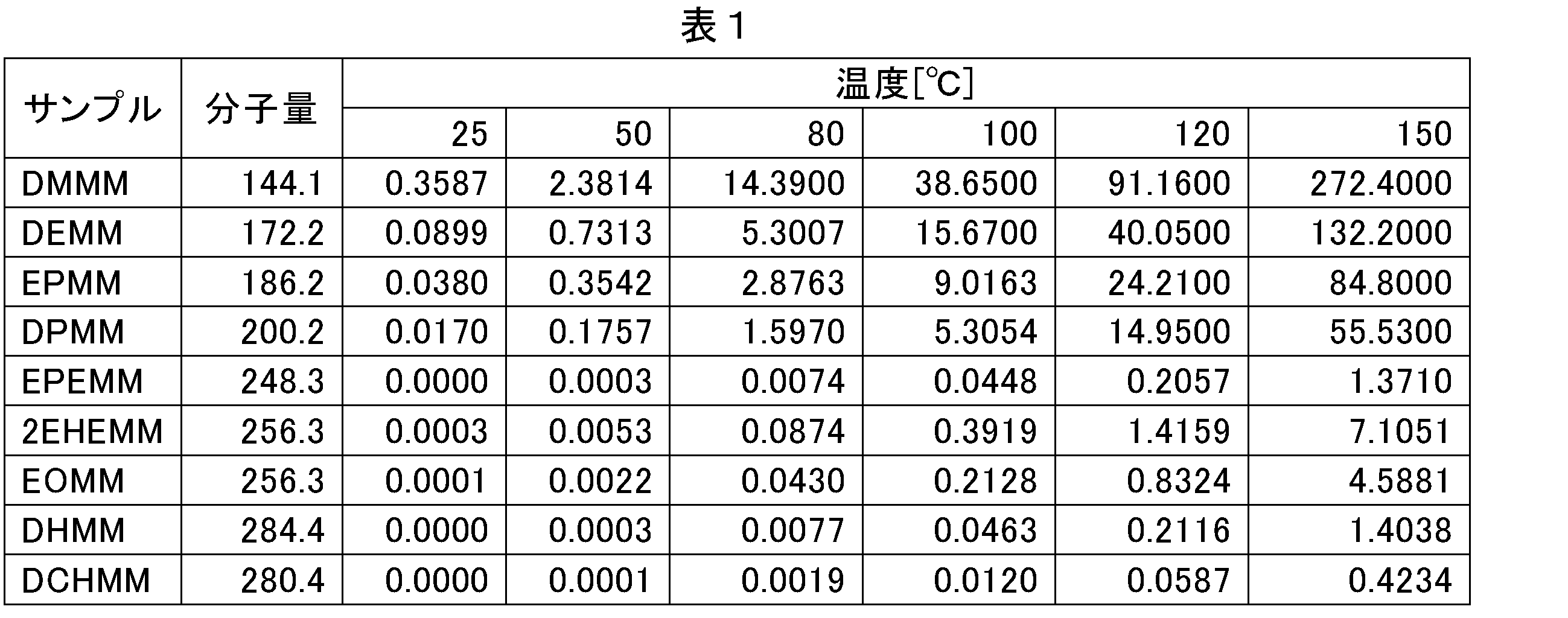
表1より、分子量が180以上の2-メチレン1,3-ジカルボニル化合物は蒸気圧が低く、とくに25℃における蒸気圧が0.05mmHg以下であることがわかる。25℃における蒸気圧が0.05mmHg以下の2-メチレン1,3-ジカルボニル化合物は、室温での硬化時に揮発が少なく、周囲部材への汚染が少ない。

表2より、アミン化合物の分子量が100未満の場合には、蒸気圧が著しく高く、とくに25℃における蒸気圧がほぼ100mmHgを超えることがわかる。
以下の実施例及び比較例において使用した接着剤の原料は、以下のとおりである。
EPEMM (SIRRUS社製)
2EHEMM (SIRRUS社製)
EOMM (SIRRUS社製)
DHMM (SIRRUS社製)
DCHMM (SIRRUS社製)
上記2-メチレン1,3-ジカルボニル化合物の具体的構造式は以下の表3中の化学式のとおりである。

TMG 1,1,3,3-テトラメチルグアニジン(和光純薬工業株式会社)
DCHMA N,N-ジシクロヘキシルメチルアミン(東京化成工業株式会社)
TEA トリエチルアミン(和光純薬工業株式会社)
DABCO ジアザビシクロオクタン(和光純薬工業株式会社)
TMTAU 2,6,10-トリメチル-2,6,10-トリアザウンデカン(東京化成工業株式会社)
BPDi 1-ベンジルピペリジン(和光純薬工業株式会社)
DMBA N,N-ジメチルベンジルアミン(和光純薬工業株式会社)
BPDo 1-ベンジル-4-ピペリドン(和光純薬工業株式会社)
BDMAPA ビス(4-ジメチルアミノフェニル)アミン(東京化成工業株式会社)
PMAN N,N,2,4,6-ペンタメチルアニリン(東京化成工業株式会社)
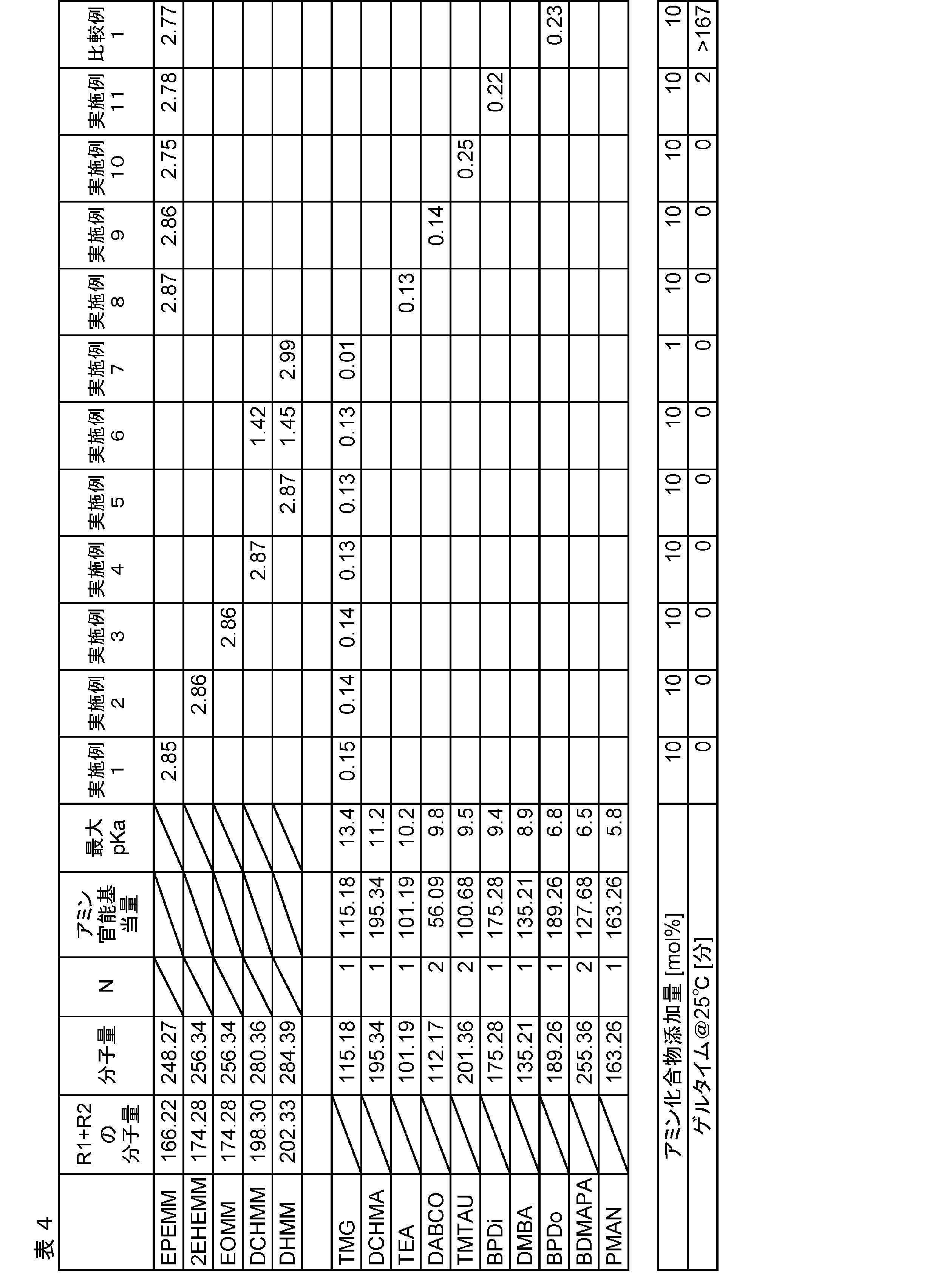

pKaの値が高いTMGを2-メチレン1,3-ジカルボニル化合物に対して10mol%加えた場合には、いずれの樹脂組成物もごく短時間でゲル化した(実施例1~5)。
これは、2-メチレン1,3-ジカルボニル化合物を2種類用いた場合も同様で、DHMM及びDCHMMの等モル混合物に対して、TMGを10mol%加えた場合も、樹脂組成物はごく短時間でゲル化した(実施例6)
12 レンズ
14 ボイスコイルモータ
16 レンズユニット
18 支持体
20 カットフィルタ
22 撮像素子
24 プリント配線基板
30、32、34 接着剤
Claims (16)
- 2-メチレン1,3-ジカルボニル化合物及び開始剤を含む、樹脂組成物であって、
前記2-メチレン1,3-ジカルボニル化合物が以下の式(I):

で表される構造単位を含み、分子量が180~10000である、化合物であって、
前記開始剤が、pKaが8以上である塩基性物質を含む、
樹脂組成物。 - 前記2-メチレン1,3-ジカルボニル化合物の分子量が260~1500である、請求項1記載の樹脂組成物。
- 前記開始剤が、pKaが9以上である塩基性物質を含む、請求項1又は2記載の樹脂組成物。
- 前記塩基性物質がアミン化合物である、請求項1~3いずれか一項記載の樹脂組成物。
- 前記アミン化合物のアミン官能基当量が180未満である、請求項4記載の樹脂組成物。
- 前記アミン化合物のアミン官能基当量が140未満である、請求項4記載の樹脂組成物。
- 前記アミン化合物が第2級又は第3級アミノ基を含む、請求項4~6いずれか一項記載の樹脂組成物。
- 前記アミン化合物が第3級アミノ基を含む、請求項4~6いずれか一項記載の樹脂組成物。
- 前記アミン化合物が80℃で液状である、請求項4~8いずれか一項記載の樹脂組成物。
- 前記アミン化合物が25℃で液状である、請求項4~8いずれか一項記載の樹脂組成物。
- 前記塩基性物質が前記2-メチレン1,3-ジカルボニル化合物に対して0.01~30mol%である、請求項1~10いずれか一項記載の樹脂組成物。
- 電子部品製造に用いられる、請求項1~11いずれか一項記載の樹脂組成物。
- 電子部品及び回路基板を有する半導体装置の製造方法であって、
電子部品及び回路基板を用意すること、
前記電子部品又は前記回路基板の表面上に請求項1~12いずれか一項記載の樹脂組成物を塗布すること、及び
前記電子部品及び前記回路基板を接触させること
を含む、半導体装置の製造方法。 - 封止された電子部品の製造方法であって、
電子部品を用意すること、及び
請求項1~12いずれか一項記載の樹脂組成物を用いて前記電子部品を封止すること
を含む、封止された電子部品の製造方法。 - 電子部品の製造方法であって、
電子部品を構成する複数の部材を用意すること、
電子部品を構成する部材の表面上に請求項1~12いずれか一項記載の樹脂組成物を塗布すること、及び
前記部材と前記電子部品を構成する別の部材と接触させること、
を含む、電子部品の製造方法。 - 電子部品を構成する部材の製造方法であって、
電子回路が形成された基板を用意すること、
基板上に形成された電子回路上に請求項1~12いずれか一項記載の樹脂組成物を塗布すること、及び
を含む、電子部品を構成する部材の製造方法。
Priority Applications (7)
| Application Number | Priority Date | Filing Date | Title |
|---|---|---|---|
| EP18871993.4A EP3705501B1 (en) | 2017-10-31 | 2018-10-30 | Resin composition |
| KR1020207015176A KR102340639B1 (ko) | 2017-10-31 | 2018-10-30 | 수지 조성물 |
| SG11202003707SA SG11202003707SA (en) | 2017-10-31 | 2018-10-30 | Resin composition |
| CN201880070166.7A CN111278869B (zh) | 2017-10-31 | 2018-10-30 | 树脂组合物 |
| US16/759,886 US11230617B2 (en) | 2017-10-31 | 2018-10-30 | Resin composition |
| JP2019550415A JPWO2019088102A1 (ja) | 2017-10-31 | 2018-10-30 | 樹脂組成物 |
| PH12020550595A PH12020550595A1 (en) | 2017-10-31 | 2020-04-24 | Resin composition |
Applications Claiming Priority (2)
| Application Number | Priority Date | Filing Date | Title |
|---|---|---|---|
| JP2017-211302 | 2017-10-31 | ||
| JP2017211302 | 2017-10-31 |
Publications (1)
| Publication Number | Publication Date |
|---|---|
| WO2019088102A1 true WO2019088102A1 (ja) | 2019-05-09 |
Family
ID=66333072
Family Applications (1)
| Application Number | Title | Priority Date | Filing Date |
|---|---|---|---|
| PCT/JP2018/040337 Ceased WO2019088102A1 (ja) | 2017-10-31 | 2018-10-30 | 樹脂組成物 |
Country Status (10)
| Country | Link |
|---|---|
| US (1) | US11230617B2 (ja) |
| EP (1) | EP3705501B1 (ja) |
| JP (1) | JPWO2019088102A1 (ja) |
| KR (1) | KR102340639B1 (ja) |
| CN (1) | CN111278869B (ja) |
| MY (1) | MY178835A (ja) |
| PH (1) | PH12020550595A1 (ja) |
| SG (1) | SG11202003707SA (ja) |
| TW (1) | TWI804523B (ja) |
| WO (1) | WO2019088102A1 (ja) |
Cited By (5)
| Publication number | Priority date | Publication date | Assignee | Title |
|---|---|---|---|---|
| WO2020075707A1 (ja) * | 2018-10-09 | 2020-04-16 | ナミックス株式会社 | 2-メチレン-1,3-ジカルボニル化合物を硬化させるための硬化剤組成物 |
| WO2021231288A1 (en) * | 2020-05-15 | 2021-11-18 | Nippon Shokubai Co., Ltd. | Improved dicarbonyl substituted-1-alkene compositions |
| US11230617B2 (en) | 2017-10-31 | 2022-01-25 | Namics Corporation | Resin composition |
| KR20220117203A (ko) * | 2019-12-16 | 2022-08-23 | 나믹스 가부시끼가이샤 | 수지 조성물 |
| US11773301B2 (en) | 2018-10-05 | 2023-10-03 | Namics Corporation | Resin composition |
Families Citing this family (3)
| Publication number | Priority date | Publication date | Assignee | Title |
|---|---|---|---|---|
| TWI746849B (zh) * | 2017-05-18 | 2021-11-21 | 日商納美仕有限公司 | 樹脂組成物 |
| WO2020184267A1 (ja) * | 2019-03-08 | 2020-09-17 | デクセリアルズ株式会社 | 接続構造体の製造方法、及び接続構造体、並びにフィルム構造体、及びフィルム構造体の製造方法 |
| JP7492754B2 (ja) * | 2019-10-18 | 2024-05-30 | ナミックス株式会社 | 重合性組成物及びそれを用いる硬化性樹脂組成物 |
Citations (9)
| Publication number | Priority date | Publication date | Assignee | Title |
|---|---|---|---|---|
| JP2004504730A (ja) * | 2000-07-21 | 2004-02-12 | ナノピアス・テクノロジーズ・インコーポレイテッド | 電子部品組立体およびその製造方法 |
| JP2008184514A (ja) | 2007-01-29 | 2008-08-14 | Osaka City | 紫外線硬化性樹脂組成物、当該硬化物、およびこれらから誘導される各種物品 |
| JP2010117545A (ja) | 2008-11-13 | 2010-05-27 | Asahi Kasei E-Materials Corp | 感光性樹脂組成物及びその用途 |
| WO2012054616A2 (en) | 2010-10-20 | 2012-04-26 | Bioformix, Llc | Synthesis of methylene malonates substantially free of impurities |
| JP2015512460A (ja) * | 2012-03-30 | 2015-04-27 | シラス・インコーポレイテッド | 重合性組成物の活性化方法、重合系およびこれにより形成される製品 |
| JP2015518503A (ja) | 2012-03-30 | 2015-07-02 | シラス・インコーポレイテッド | 複合材およびラミネート物品ならびにこれらを作製するための重合系 |
| JP2016506072A (ja) | 2012-11-30 | 2016-02-25 | シラス・インコーポレイテッド | エレクトロニクス適用のための複合組成物 |
| WO2016040261A1 (en) | 2014-09-08 | 2016-03-17 | Sirrus, Inc. | Polymers including one or more 1,1-disubstituted alkene compounds and polymer compositions thereof |
| JP2017036361A (ja) * | 2015-08-07 | 2017-02-16 | 三洋化成工業株式会社 | 光硬化性組成物 |
Family Cites Families (12)
| Publication number | Priority date | Publication date | Assignee | Title |
|---|---|---|---|---|
| US4160864A (en) | 1976-09-07 | 1979-07-10 | Eastman Kodak Company | Adhesive compositions comprising methyl allyl methylenemalonate |
| JP2007177014A (ja) | 2005-12-27 | 2007-07-12 | Kawamura Inst Of Chem Res | ホウ酸塩基含有アリルアミン重合体 |
| US9249265B1 (en) | 2014-09-08 | 2016-02-02 | Sirrus, Inc. | Emulsion polymers including one or more 1,1-disubstituted alkene compounds, emulsion methods, and polymer compositions |
| WO2013053100A1 (en) | 2011-10-11 | 2013-04-18 | Henkel China Co. Ltd. | Gel time controllable two part epoxy adhesive |
| CA2853073A1 (en) | 2011-10-19 | 2013-04-25 | Bioformix Inc. | Methylene beta-diketone monomers, methods for making methylene beta-diketone monomers, polymerizable compositions and products formed therefrom |
| US9234107B2 (en) | 2012-03-30 | 2016-01-12 | Sirrus, Inc. | Ink coating formulations and polymerizable systems for producing the same |
| EP2920231B1 (en) | 2012-11-16 | 2020-05-06 | Sirrus, Inc. | Plastics bonding systems and methods |
| US9315597B2 (en) | 2014-09-08 | 2016-04-19 | Sirrus, Inc. | Compositions containing 1,1-disubstituted alkene compounds for preparing polymers having enhanced glass transition temperatures |
| EP3310821B1 (en) * | 2015-06-19 | 2021-02-17 | Sirrus, Inc. | Compositions containing 1,1-disubstituted alkene compounds for preparing polymers having enhanced glass transition temperatures |
| TWI746849B (zh) | 2017-05-18 | 2021-11-21 | 日商納美仕有限公司 | 樹脂組成物 |
| US11230617B2 (en) | 2017-10-31 | 2022-01-25 | Namics Corporation | Resin composition |
| WO2019137853A1 (en) | 2018-01-09 | 2019-07-18 | Basf Se | Compositions comprising polymerizable vinyl compounds, inorganic or organic fillers and their use |
-
2018
- 2018-10-30 US US16/759,886 patent/US11230617B2/en active Active
- 2018-10-30 SG SG11202003707SA patent/SG11202003707SA/en unknown
- 2018-10-30 TW TW107138423A patent/TWI804523B/zh active
- 2018-10-30 WO PCT/JP2018/040337 patent/WO2019088102A1/ja not_active Ceased
- 2018-10-30 MY MYPI2020001435A patent/MY178835A/en unknown
- 2018-10-30 JP JP2019550415A patent/JPWO2019088102A1/ja active Pending
- 2018-10-30 KR KR1020207015176A patent/KR102340639B1/ko active Active
- 2018-10-30 CN CN201880070166.7A patent/CN111278869B/zh active Active
- 2018-10-30 EP EP18871993.4A patent/EP3705501B1/en active Active
-
2020
- 2020-04-24 PH PH12020550595A patent/PH12020550595A1/en unknown
Patent Citations (13)
| Publication number | Priority date | Publication date | Assignee | Title |
|---|---|---|---|---|
| JP2004504730A (ja) * | 2000-07-21 | 2004-02-12 | ナノピアス・テクノロジーズ・インコーポレイテッド | 電子部品組立体およびその製造方法 |
| JP2008184514A (ja) | 2007-01-29 | 2008-08-14 | Osaka City | 紫外線硬化性樹脂組成物、当該硬化物、およびこれらから誘導される各種物品 |
| JP2010117545A (ja) | 2008-11-13 | 2010-05-27 | Asahi Kasei E-Materials Corp | 感光性樹脂組成物及びその用途 |
| WO2012054616A2 (en) | 2010-10-20 | 2012-04-26 | Bioformix, Llc | Synthesis of methylene malonates substantially free of impurities |
| WO2012054633A2 (en) | 2010-10-20 | 2012-04-26 | Bioformix, Llc | Synthesis of methylene malonates using rapid recovery in the presence of a heat transfer agent |
| JP2015518503A (ja) | 2012-03-30 | 2015-07-02 | シラス・インコーポレイテッド | 複合材およびラミネート物品ならびにこれらを作製するための重合系 |
| JP2015512460A (ja) * | 2012-03-30 | 2015-04-27 | シラス・インコーポレイテッド | 重合性組成物の活性化方法、重合系およびこれにより形成される製品 |
| JP2016506072A (ja) | 2012-11-30 | 2016-02-25 | シラス・インコーポレイテッド | エレクトロニクス適用のための複合組成物 |
| WO2016040261A1 (en) | 2014-09-08 | 2016-03-17 | Sirrus, Inc. | Polymers including one or more 1,1-disubstituted alkene compounds and polymer compositions thereof |
| JP2017526791A (ja) * | 2014-09-08 | 2017-09-14 | シラス・インコーポレイテッド | 1つ以上の1,1−二置換アルケン化合物を含むエマルションポリマー、エマルション方法、及びそのポリマー組成物 |
| JP2017527668A (ja) * | 2014-09-08 | 2017-09-21 | シラス・インコーポレイテッド | 1つ以上の1,1−二置換アルケン化合物を含むポリマー及びそのポリマー組成物 |
| JP2017527667A (ja) * | 2014-09-08 | 2017-09-21 | シラス・インコーポレイテッド | 1つ以上の1,1−二置換アルケン化合物を含む溶液ポリマー、溶液重合方法、及びポリマー組成物 |
| JP2017036361A (ja) * | 2015-08-07 | 2017-02-16 | 三洋化成工業株式会社 | 光硬化性組成物 |
Cited By (9)
| Publication number | Priority date | Publication date | Assignee | Title |
|---|---|---|---|---|
| US11230617B2 (en) | 2017-10-31 | 2022-01-25 | Namics Corporation | Resin composition |
| US11773301B2 (en) | 2018-10-05 | 2023-10-03 | Namics Corporation | Resin composition |
| WO2020075707A1 (ja) * | 2018-10-09 | 2020-04-16 | ナミックス株式会社 | 2-メチレン-1,3-ジカルボニル化合物を硬化させるための硬化剤組成物 |
| US12146014B2 (en) | 2018-10-09 | 2024-11-19 | Namics Corporation | Curing agent composition for curing 2-methylene-1,3-dicarbonyl compound |
| KR20220117203A (ko) * | 2019-12-16 | 2022-08-23 | 나믹스 가부시끼가이샤 | 수지 조성물 |
| EP4079773A4 (en) * | 2019-12-16 | 2024-01-03 | Namics Corporation | RESIN COMPOSITION |
| KR102914243B1 (ko) | 2019-12-16 | 2026-01-16 | 나믹스 가부시끼가이샤 | 수지 조성물 |
| US12577331B2 (en) | 2019-12-16 | 2026-03-17 | Namics Corporation | Resin composition |
| WO2021231288A1 (en) * | 2020-05-15 | 2021-11-18 | Nippon Shokubai Co., Ltd. | Improved dicarbonyl substituted-1-alkene compositions |
Also Published As
| Publication number | Publication date |
|---|---|
| KR20200070386A (ko) | 2020-06-17 |
| MY178835A (en) | 2020-10-20 |
| EP3705501A4 (en) | 2021-07-21 |
| US11230617B2 (en) | 2022-01-25 |
| TW201922806A (zh) | 2019-06-16 |
| US20200283551A1 (en) | 2020-09-10 |
| PH12020550595A1 (en) | 2021-02-15 |
| CN111278869B (zh) | 2022-02-11 |
| KR102340639B1 (ko) | 2021-12-20 |
| EP3705501A1 (en) | 2020-09-09 |
| TWI804523B (zh) | 2023-06-11 |
| EP3705501B1 (en) | 2025-10-22 |
| JPWO2019088102A1 (ja) | 2020-12-03 |
| CN111278869A (zh) | 2020-06-12 |
| SG11202003707SA (en) | 2020-05-28 |
Similar Documents
| Publication | Publication Date | Title |
|---|---|---|
| KR102340639B1 (ko) | 수지 조성물 | |
| TWI857239B (zh) | 樹脂組成物 | |
| JP5971522B2 (ja) | 硬化性組成物 | |
| JP7426154B2 (ja) | 樹脂組成物 | |
| KR102816836B1 (ko) | 수지 조성물 | |
| JP6402381B1 (ja) | 樹脂組成物 | |
| JP6427848B1 (ja) | 樹脂組成物 | |
| TW202340267A (zh) | 樹脂組成物及使用該樹脂組成物之硬化性樹脂組成物 | |
| WO2023149445A1 (ja) | 液状重合性組成物及びそれを用いる硬化性樹脂組成物 |
Legal Events
| Date | Code | Title | Description |
|---|---|---|---|
| 121 | Ep: the epo has been informed by wipo that ep was designated in this application |
Ref document number: 18871993 Country of ref document: EP Kind code of ref document: A1 |
|
| ENP | Entry into the national phase |
Ref document number: 2019550415 Country of ref document: JP Kind code of ref document: A |
|
| NENP | Non-entry into the national phase |
Ref country code: DE |
|
| ENP | Entry into the national phase |
Ref document number: 20207015176 Country of ref document: KR Kind code of ref document: A |
|
| ENP | Entry into the national phase |
Ref document number: 2018871993 Country of ref document: EP Effective date: 20200602 |
|
| WWG | Wipo information: grant in national office |
Ref document number: 2018871993 Country of ref document: EP |