WO2019092504A1 - Neutral glycosylated amides and dianionic glucuronidated acids as stabilizers for biological molecules - Google Patents
Neutral glycosylated amides and dianionic glucuronidated acids as stabilizers for biological molecules Download PDFInfo
- Publication number
- WO2019092504A1 WO2019092504A1 PCT/IB2018/001411 IB2018001411W WO2019092504A1 WO 2019092504 A1 WO2019092504 A1 WO 2019092504A1 IB 2018001411 W IB2018001411 W IB 2018001411W WO 2019092504 A1 WO2019092504 A1 WO 2019092504A1
- Authority
- WO
- WIPO (PCT)
- Prior art keywords
- compound
- optionally substituted
- substituted alkyl
- alkyl
- acid
- Prior art date
- Legal status (The legal status is an assumption and is not a legal conclusion. Google has not performed a legal analysis and makes no representation as to the accuracy of the status listed.)
- Ceased
Links
- 0 *C(*)(*)NCC(*)=O Chemical compound *C(*)(*)NCC(*)=O 0.000 description 2
- MQAYFGXOFCEZRW-UHFFFAOYSA-N OC(C1OCCCC1)=O Chemical compound OC(C1OCCCC1)=O MQAYFGXOFCEZRW-UHFFFAOYSA-N 0.000 description 1
- ALHMBTPMQHWRIH-FGSXUIHDSA-N O[C@H](C(CN=O)C1(C2)O[C@H]2CC11O)C1O Chemical compound O[C@H](C(CN=O)C1(C2)O[C@H]2CC11O)C1O ALHMBTPMQHWRIH-FGSXUIHDSA-N 0.000 description 1
Classifications
-
- C—CHEMISTRY; METALLURGY
- C07—ORGANIC CHEMISTRY
- C07H—SUGARS; DERIVATIVES THEREOF; NUCLEOSIDES; NUCLEOTIDES; NUCLEIC ACIDS
- C07H15/00—Compounds containing hydrocarbon or substituted hydrocarbon radicals directly attached to hetero atoms of saccharide radicals
- C07H15/02—Acyclic radicals, not substituted by cyclic structures
- C07H15/04—Acyclic radicals, not substituted by cyclic structures attached to an oxygen atom of the saccharide radical
-
- A—HUMAN NECESSITIES
- A61—MEDICAL OR VETERINARY SCIENCE; HYGIENE
- A61K—PREPARATIONS FOR MEDICAL, DENTAL OR TOILETRY PURPOSES
- A61K45/00—Medicinal preparations containing active ingredients not provided for in groups A61K31/00 - A61K41/00
- A61K45/06—Mixtures of active ingredients without chemical characterisation, e.g. antiphlogistics and cardiaca
-
- A—HUMAN NECESSITIES
- A61—MEDICAL OR VETERINARY SCIENCE; HYGIENE
- A61K—PREPARATIONS FOR MEDICAL, DENTAL OR TOILETRY PURPOSES
- A61K47/00—Medicinal preparations characterised by the non-active ingredients used, e.g. carriers or inert additives; Targeting or modifying agents chemically bound to the active ingredient
- A61K47/06—Organic compounds, e.g. natural or synthetic hydrocarbons, polyolefins, mineral oil, petrolatum or ozokerite
- A61K47/26—Carbohydrates, e.g. sugar alcohols, amino sugars, nucleic acids, mono-, di- or oligo-saccharides; Derivatives thereof, e.g. polysorbates, sorbitan fatty acid esters or glycyrrhizin
Definitions
- Proteins and other biological molecules suffer degradation when exposed to pH and thermal stresses due to denaturation, aggregation and other adverse chemical and physical modifications (Chang et al . 2010; Ueda et al . 2001). Such pH and thermal stresses can occur during processing, formulation or storage of biological molecules. For biological molecules having therpaeutic applications, degradation results in lower yield and loss of activity.
- Trehalose which is a disaccharide of glucose, linked by an alpha, alpha-1, 1-glycosidic bond, that accumulates in many organisms, including bacteria, yeasts, fungi, plants and insects which withstand extended periods of dessication and inanimation. In several bacteria, trehalose is synthesised as a response to osmotic stress (Reed et al . 1986).
- Trehalose has been used as an excipient in several biopharmaceuticals such as Avastin, Herceptin, Lucentis and Rituxan. (Ohtak et al . 2011) .
- Addition of trehalose to several proteins and recombinant proteins increases their stability, as can be seen by the increase of their melting temperatures (Tm) (Kaushik et al . 2003; Lin et al. 1996; Singer et al. 1998; Ueda et al. 2001) .
- Tm melting temperatures
- One theory for the thermal stabilizing effect of trehalose is that when trehalose ' is added to a solution of protein it increases the surface tension of the medium leading to greater preferential hydration of the protein and thus increasing protein stability against degradation.
- Such compounds can be understood to shift equilibrium toward natively- folded conformations by raising the free energy of the unfolded state (Khan et al. 2010; Rajan et al. 2011) .
- Trehalose and saccharose have been studied as stabilizers in freeze-dried formulations of a recombinant monoclonal antibodies.
- One theory for the stabilizing effect of trehalose in dried formulations is that the trehalose interacts with the protein surface and serves as a water substitute which maintains structure of the biological molecule while resisting chemical and physical modification (Kaushik et al. 2003).
- Saccharose has also been shown to stabilize proteins from thermal degradation (Lee et al . 1981) .
- Poly-amido-saccharides (PASs) have been shown to stabilize lysozyme toward dehydration and freezing stresses (Stidham et al. 2014) .
- Stabilization of biological molecules under pH stress remains a challenge.
- a particular challenge is stabilization of biological molecules under combined thermal and pH stress.
- New stabilisers are need which prevent degradation of biological molecules at low pH or high pH including when thermal stress is present.
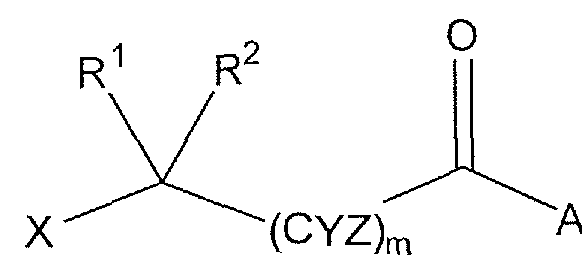
- the sub ect invention provides a compound having the structure:
- X is a hexosyl group selected from the group consisting of glucosyl, mannosyl, galactosyl, allosyl, altrosyl, gulosyl, idosyl and talosyl, or an uronic acid group selected from the group consisting of glucuronic acid, mannuronic acid, galacturonic acid, alluronic acid, altruronic acid, guluronic acid, iduronic acid and taluronic acid, or an uronic acid amide group selected from the group consisting of Glucuronamide , mannuronamide, galacturonamide, alluronamide, altruronamide, guluronamide, iduronamide and taluronamide;
- each of R 1 and R 2 is independently H, halogen, OH, O-alkyl, CONH 2 , C0 2 H, COa-alkyl, or optionally substituted alkyl;
- each of Y and Z is independently H, OH, O-alkyl or optionally substituted alkyl ;
- n 0, 1 or 2;
- A NR3R4 or ORs
- each of R 3 and R 4 is independently H, OH, O-alkyl or optionally substituted alkyl;
- R 5 is independently H or optionally substituted alkyl
- R 1 is optionally substituted alkyl
- the subject invention also provides a composition comprising a biological molecule and at least one compound of the present invention, and a method of stabilizing a biological molecule comprising treating the biological molecule with an effective amount of the compound of the present invention, so as to thereby stabilize the biological molecule.
- Fig. 1 shows the increase of the melting temperature (Tm) of lysozyme in the presence of 0.25 mM of various compounds (MGlyA, LA, GBA, GaGlyA, GaLA, b-GGlyA, b-GLA, b-GaLA, b-GaGlyA, b-GaBA from left to right) in 25 mM sodium acetate buffer pH 3.6 (black bars) and in phosphate buffer at pH 12 (grey bars).
- the melting temperature (Tm) of Lysozyme in the absence of compounds was 71°C in 25 mM sodium acetate buffer pH 3.6 and 55°C in phosphate buffer at pH 12.
- Fig. 2 shows HP-SEC chromatograms of Humira® samples at 0.4 mg/ml under low pH (stress) .
- the line with the second highest peak corresponds to the Humira® at pH 3.2 in the presence of GaGlyA over twelve hours and the line with the third highest peak corresponds to Humira® at pH 3.2 without GaGlyA over twelve hours.
- Fig. 3 shows the increase of the melting temperature (Tm) of Humira® in the presence of 0.25 mM of various compounds (MGlyA, MLA, GBA, GaGlyA, GaLA, b-GGlyA, b-GLA, b-GaLA, b-GaGlyA, b-GaBA from left to right) in phosphate buffer at pH 12.
- the melting temperature (Tm) of Humira® in the absence of compounds was 41 °C in phosphate buffer.
- Fig. 4 shows the increase of the melting temperature (Tm) of ubiquitin in the presence of 0.25 M of various compounds (b-GGly, b-GL, b-GB, b-GaGly, b-GaL, a-MGlyA, GBA, b-GBA, b-GGlyA, b-GaGlyA, GaLA, b-GaLA, b-GaBA from left to right) in phosphate buffer at pH 12.
- the melting temperature (Tm) of ubiquitin in the absence of compounds was 72 °C in phosphate buffer.
- Tm melting temperature
- the present invention provides a compound having the structure:
- X is a hexosyl group selected from the group consisting of glucosyl, mannosyl, galactosyl, allosyl, altrosyl, gulosyl, idosyl and talosyl, or an uronic acid group selected from the group consisting of glucuronic acid, mannuronic acid, galacturonic acid, alluronic acid, altruronic acid, guluronic acid, iduronic acid and taluronic acid, or an uronic acid amide group selected from the group consisting of Glucuronamide, mannuronamide, galacturonamide, alluronamide, altruronamide, guluronamide, iduronamide and taluronamide;
- each of R 1 and R 2 is independently H, halogen, OH, O-alkyl, CONH 2 , C0 2 H, COz-alkyl, or optionally substituted alkyl;
- each of Y and Z is independently H, OH, O-alkyl or optionally substituted alkyl ;
- n 0, 1 or 2;
- A NR3R4 or 0R 5 ,
- each of R 3 and R 4 is independently H, OH, O-alkyl or optionally substituted alkyl;
- R 5 is independently H or optionally substituted alkyl
- R 1 is optionally substituted alkyl
- the present invention provides a compound having the structure:
- X is a hexosyl group selected from the group consisting of glucosyl, mannosyl, galactosyl, allosyl, altrosyl, gulosyl, idosyl and talosyl, or an uronic acid group selected from the group consisting of glucuronic acid, mannuronic acid, galacturonic acid, alluronic acid, altruronic acid, guluronic acid, iduronic acid and taluronic acid, or an uronic acid amide group selected from the group consisting of Glucuronamide, mannuronamide, galacturonamide, alluronamide, altruronamide, guluronamide, iduronamide and taluronamide;
- each of R 1 and R 2 is independently H, halogen, OH, O-alkyl, CONH 2 , C0 2 H, CC>2-alkyl, or hydroxyalkyl;
- each of Y and Z is independently H, OH, O-alkyl or hydroxyalkyl;
- n 0, 1 or 2;
- A NR3R4 or OR5,
- each of R 3 and R 4 is independently H, OH, O-alkyl or optionally substituted alkyl;
- R 5 is independently H or optionally substituted alkyl
- R 1 is optionally substituted alkyl
- the compound having the structure is:
- the optionally substituted alkyl is unsubstituted or substituted. In some embodiments, wherein the optionally substituted alkyl is hydroxyalkyl . In some embodiments, wherein the optionally substituted alkyl is alkyl- OH.
- the optionally substituted alkyl is C1-C4 hydroxyalkyl . In some embodiments, wherein the optionally substituted alkyl is C1-C4 alkyl-OH.
- the compound is a beta-anomer.
- X is a hexosyl group selected from the group consisting of glucosyl, mannosyl, galactosyl, allosyl, altrosyl, gulosyl, idosyl and talosyl, or an uronic acid group selected from the group consisting of glucuronic acid, mannuronic acid, galacturonic acid, alluronic acid, altruronic acid, guluronic acid, iduronic acid and taluronic acid, or an uronic acid amide group selected from the group consisting of Glucuronamide, mannuronamide, galacturonamide, alluronamide, altruronamide, guluronamide, iduronamide and taluronamide;
- each of R 1 and R 2 is independently H, CONH 2 , C0 2 H, C0 2 -alkyl, or unsubstituted alkyl;
- each of Y and Z is independently H;
- n 0, 1 or 2;
- A NR3R4 or ORs
- each of R 3 and R 4 is independently H, OH, 0-alkyl or optionally substituted alkyl;
- R 5 is independently H or optionally substituted alkyl
- R 1 when X is glucosyl, then R 1 is unsubstituted alkyl, and when each of R 1 and R 2 is H and m is 0, then X is other than glucuronic acid;
- X is a hexosyl group selected from the group consisting of glucosyl, mannosyl, galactosyl, allosyl, altrosyl, gulosyl, idosyl and talosyl, or an uronic acid group selected from the group consisting of glucuronic acid, mannuronic acid, galacturonic acid, alluronic acid, altruronic acid, guluronic acid, iduronic acid and taluronic acid, or an uronic acid amide group selected from the group consisting of Glucuronamide, mannuronamide, galacturonamide, alluronamide, altruronamide, guluronamide, iduronamide and taluronamide;
- each of R 1 and R 2 is independently H, CONH 2 , C0 2 H, C0 2 -alkyl, alkyl-OH, or unsubstituted alkyl;
- each of Y and Z is independently H;
- n 0, 1 or 2;
- A NR 3 R ⁇ i or OR 5 ,
- each of R 3 and R 4 is independently H, OH, 0 ⁇ alkyl or optionally substituted alkyl;
- R 5 is independently H or optionally substituted alkyl
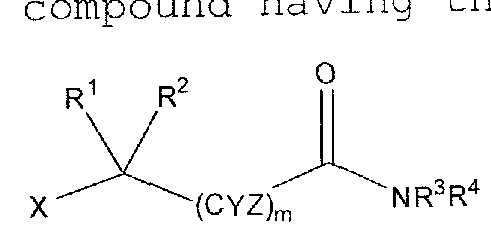
- the resent invention provides compound having the structure:
- X is a hexosyl group selected from the group consisting of glucosyl, mannosyl, galactosyl, allosyl, altrosyl, gulosyl, idosyl and talosyl, each of R 1 and R 2 is independently H, halogen, OH, 0-alkyl, CONH2, or optionally substituted alkyl,
- each of R 3 and R 4 is independently H, OH, O-alkyl or optionally substituted alkyl,
- each of Y and Z is independently H, OH, O-alkyl or optionally substituted alkyl,
- n 0, 1 or 2
- R 1 is optionally substituted alkyl.
- the present invention provides compound having the structure:
- X is a hexosyl group selected from the group consisting of glucosyl, mannosyl, galactosyl, allosyl, altrosyl, gulosyl, idosyl and talosyl, each of R 1 and R 2 is independently H, OH, O-alkyl or optionally substituted alkyl,
- each of R 3 and R 4 is independently H, OH, O-alkyl or optionally substituted alkyl ,
- each of Y and Z is independently H, OH, O-alkyl or optionally substituted alkyl,
- n 0, 1 or 2
- R 1 is optionally substituted alkyl.
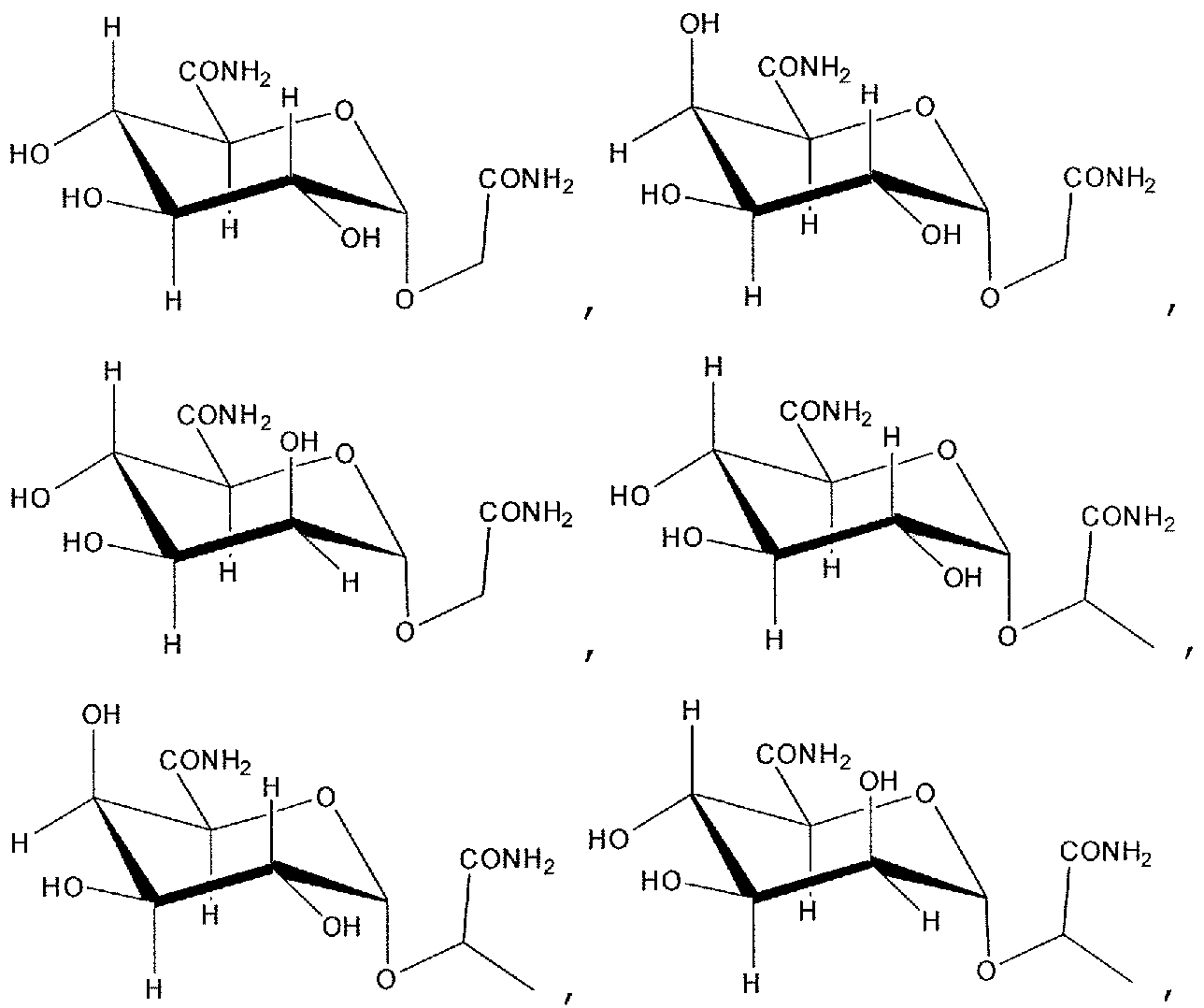
- X is glucosyl, mannosyl or galactosyl.
- each of Y and Z is H.
- each of R 1 and R 2 is H, or R 1 is CH 3 and R 2 is H, or R 1 is C0NH 2 and R 2 is H, or R 1 is CO2CH3 and R 2 is H.
- each of R 3 and R 4 is H.
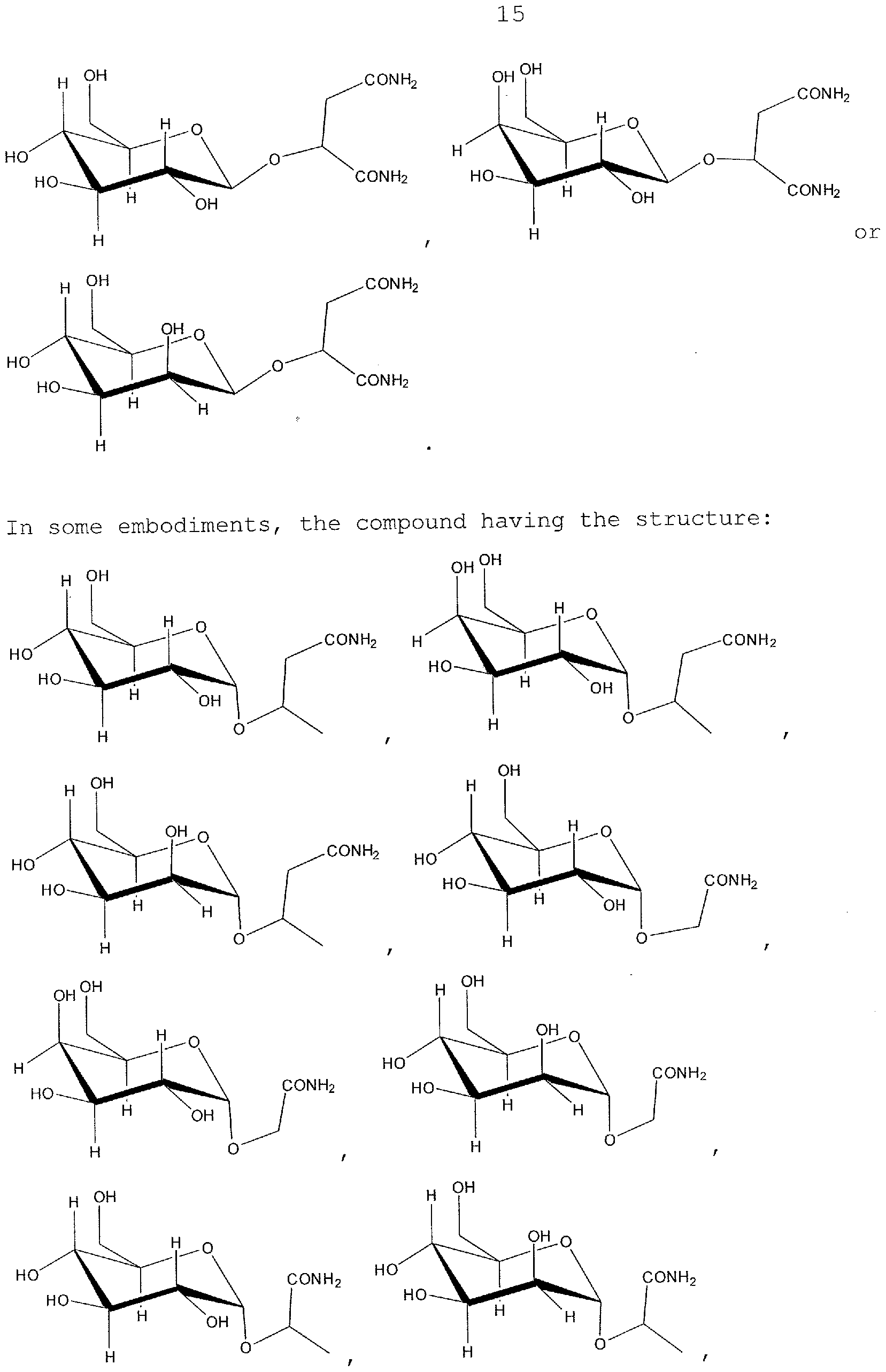
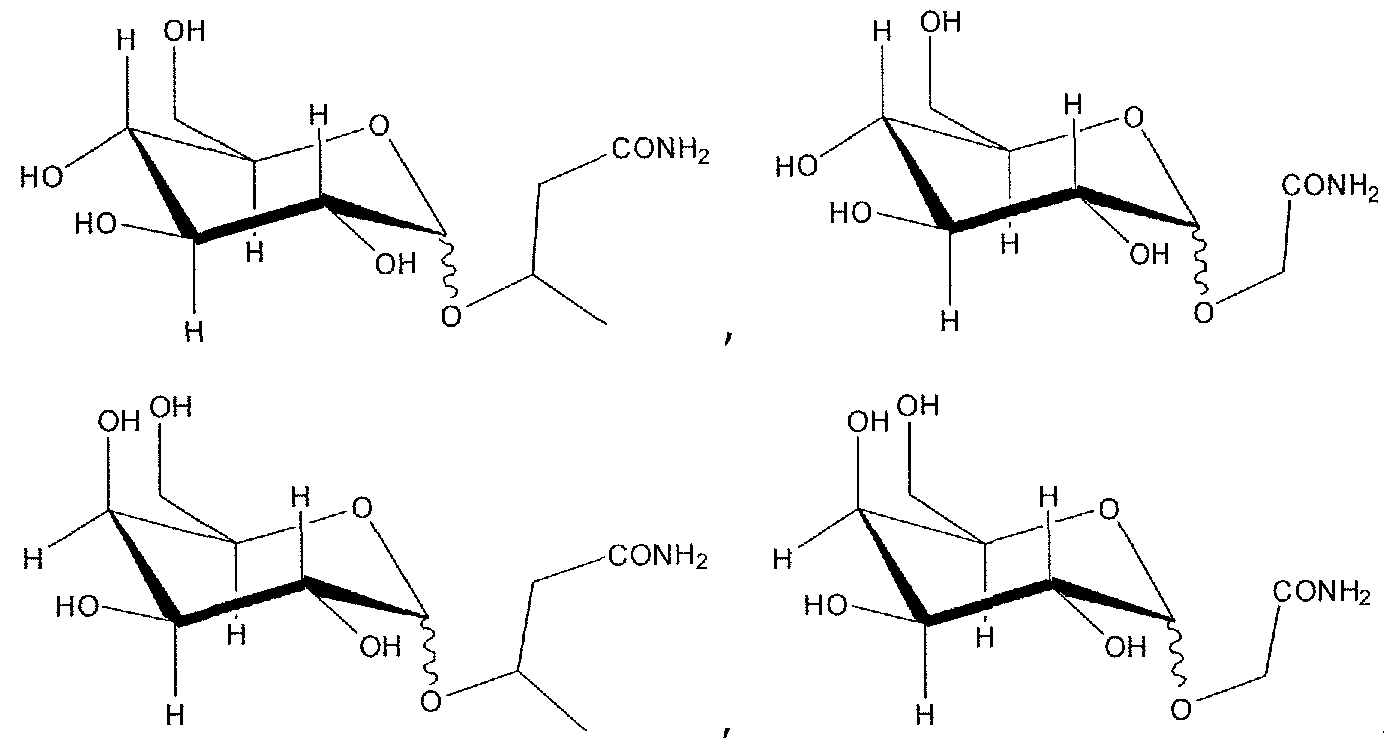
- the compound having the structure is:
- R 1 is H, optionally
- R 1 is H, hydroxylalkyl, or CONH2 and m is 0, 1 or 2.
- n is 0. In some embodiments, wherein m is 1.
- the hexosyl group is an alpha-anome . In some embodiments, wherein the hexosyl group is a beta-anomer. In some embodiments, wherein the hexosyl group is a mix of alpha- and beta-anomers . In some embodiments, wherein the hexosyl group is a D-hexose. In some embodiments, wherein the hexosyl group is an L-hexose. In some embodiments, wherein the hexosyl group is a mix of D and L hexose. some embodiments, the compound having the structure:
- R 1 is hydroxyalkyl .
- R 1 is C 1 -C4 hydroxyalkyl.
- the compound having the structure is:
- the compound having the structure 2018/001411 having the structure 2018/001411
- the compound having the structure having the structure
- X is an uronic acid group selected from the group consisting of glucuronic acid, mannuronic acid, a galacturonic acid, alluronic acid, altruronic acid, guluronic acid, iduronic acid and taluronic acid,
- each of R 1 and R 2 is independently H, halogen, OH, O-alkyl, CONH 2 , C0 2 H, C0 2 -alkyl, or optionally substituted alkyl;
- each of Y and Z is independently H, OH, O-alkyl or optionally substituted alkyl,
- R 5 is independently H or optionally substituted alkyl
- n 0, 1 or 2
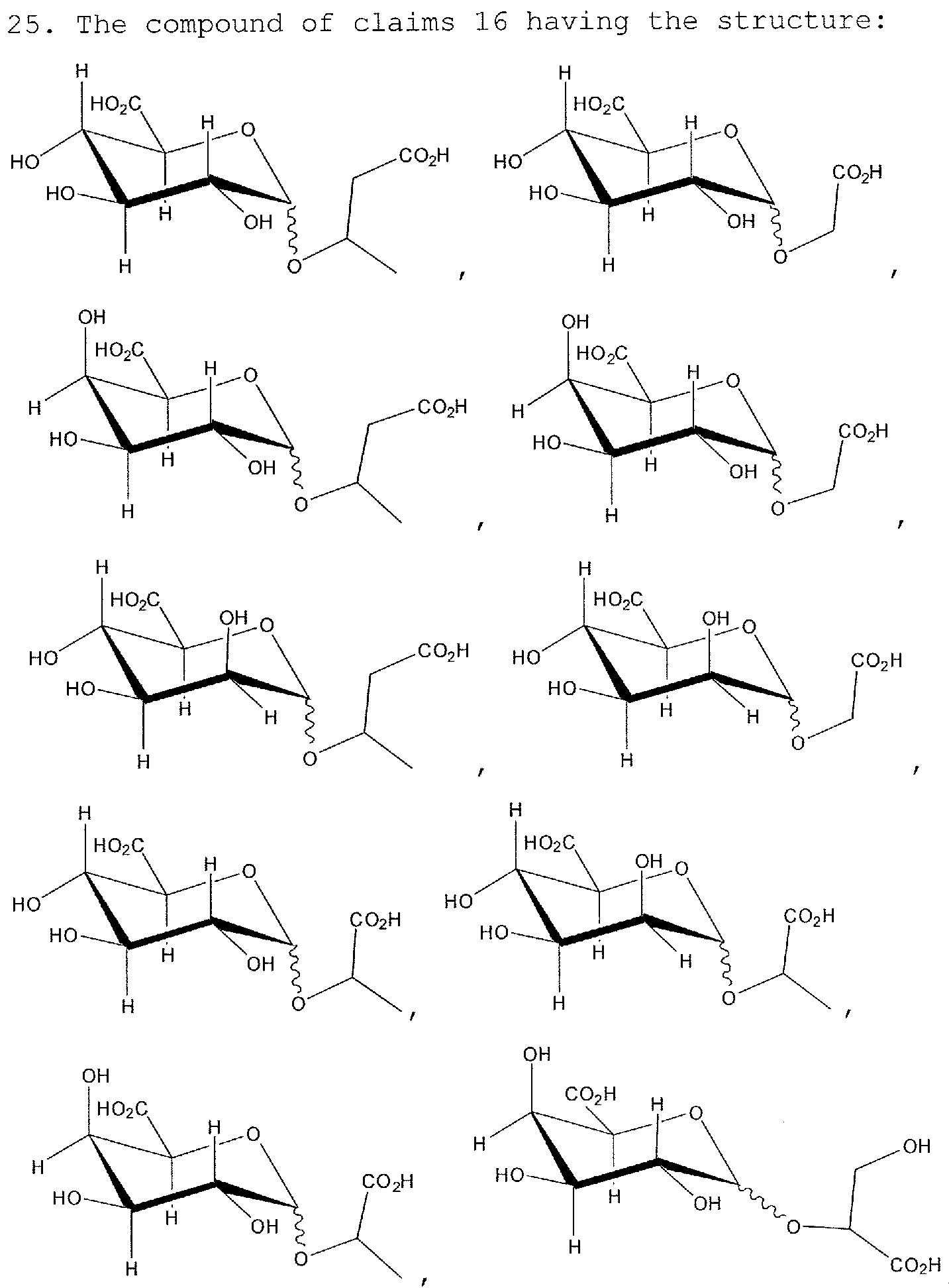
- the compound having the structure is:
- X is an uronic acid group selected from the group consisting of glucuronic acid, mannuronic acid, a galacturonic acid, alluronic acid, altruronic acid, guluronic acid, iduronic acid and taluronic acid,
- each of R 1 and R 2 is independently H, halogen, OH, O-alkyl, CO2H, C0 2 (alkyl), or optionally substituted alkyl,
- each of Y and Z is independently H, OH, O-alkyl or optionally substituted alkyl,
- R 5 is independently H or optionally substituted alkyl
- n 0, 1 or 2
- the compound having the structure having the structure:
- X is an uronic acid group selected from the group consisting of glucuronic acid, mannuronic acid, a galacturonic acid, alluronic acid, altruronic acid, guluronic acid, iduronic acid and taluronic acid,
- each of R 1 and R 2 is independently H, OH, O-alkyl or optionally substituted alkyl,
- each of Y and Z is independently H, OH, O-alkyl or optionally substituted alkyl,
- R 5 is independently H or optionally substituted alkyl
- n 0, 1 or 2
- X is other than glucuronic acid
- X is an uronic acid group selected from the group consisting of glucuronic acid, mannuronic acid, a galacturonic acid, alluronic acid, altruronic acid, guluronic acid, iduronic acid and taluronic acid,
- each of R 1 and R 2 is independently H, CONH 2 , CO 2 H, C0 2 -alkyl, or unsubstituted alkyl;
- each of Y and Z is H
- R 5 is independently H or optionally substituted alkyl
- n 0, 1 or 2
- X is glucuronic acid, mannuronic acid or a galacturonic acid.
- each of R 1 and R 2 is H, or R 1 is CH 3 and R 2 is H, or R 1 is C0 2 CH 3 and R 2 is H.
- each of R is H or CH 3 .
- the compound having the structure is:
- R 1 is H, optionally substituted alkyl or C0 2 H,
- R 5 is H, and m is 0, 1 or 2,
- the compound having the structure having the structure
- R 5 is H
- n 0, 1 or 2
- R 1 is H, hydroxylalkyl, or CO2H
- R 5 is H and m is 0, 1 or 2.
- the compound having the structure is:
- R 1 is H, optionally substituted alkyl or CO2H,
- R 5 is H
- n 0, 1 or 2
- n is 0. In some embodiments, wherein m is 1.
- the uronic acid group is an alpha-anomer . In some embodiments, wherein the uronic acid group is a beta-anomer. In some embodiments, wherein the uronic acid group is a D-uronic acid. In some embodiments, wherein the uremic acid group is an L-uronic acid. In some embodiments, wherein the uronic acid group is a mix of D and L.
- R 1 is optionally substituted alkyl or C0 2 H
- the compound havin the structure: In some embodiments the compound having the structure:
- the compound is a potassium salt, calcium salt or magnesium salt.
- the compound is a sodium salt. In some embodiments, wherein the compound is a sodium salt. In some embodiments the compound having the structure:
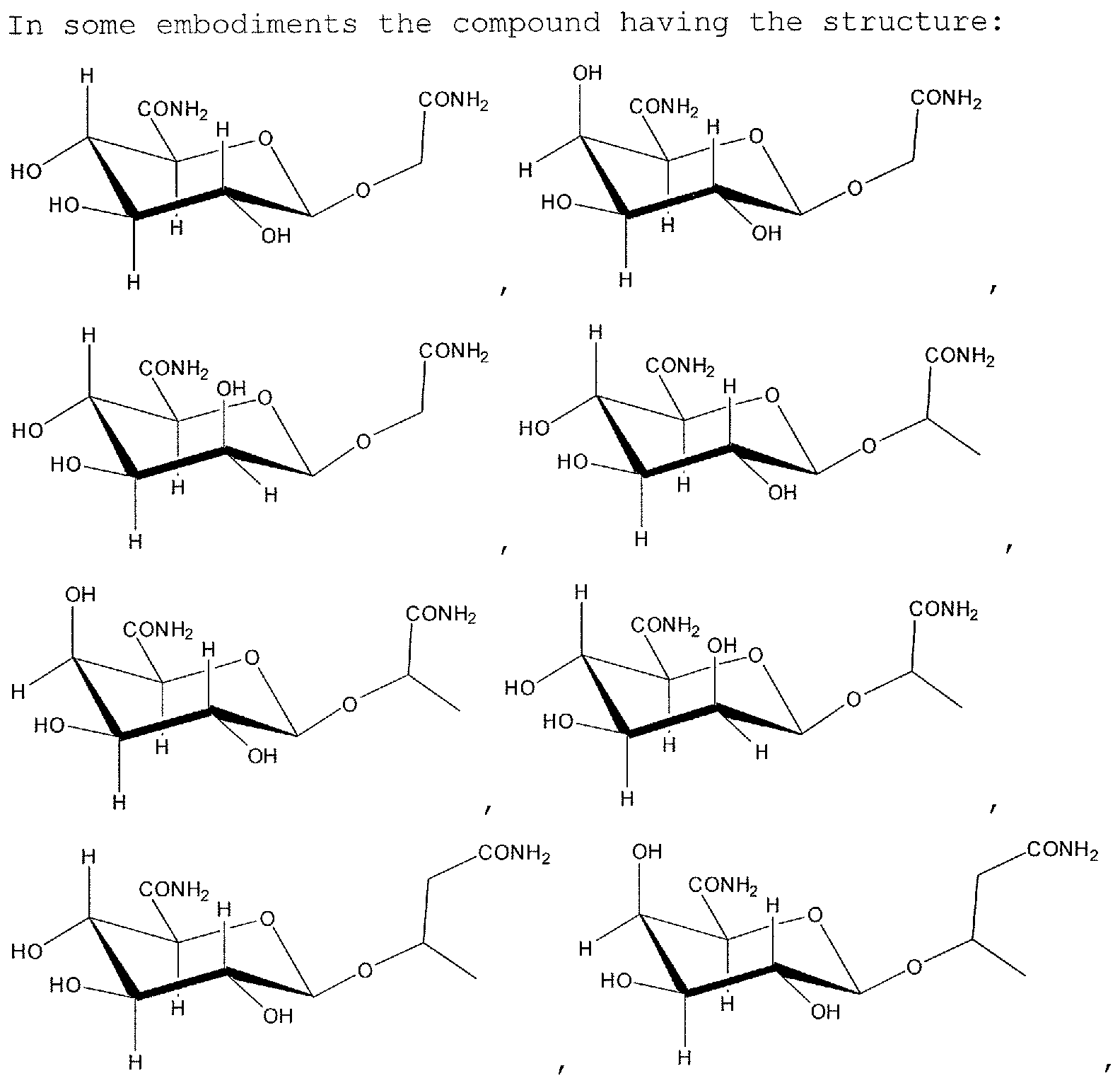
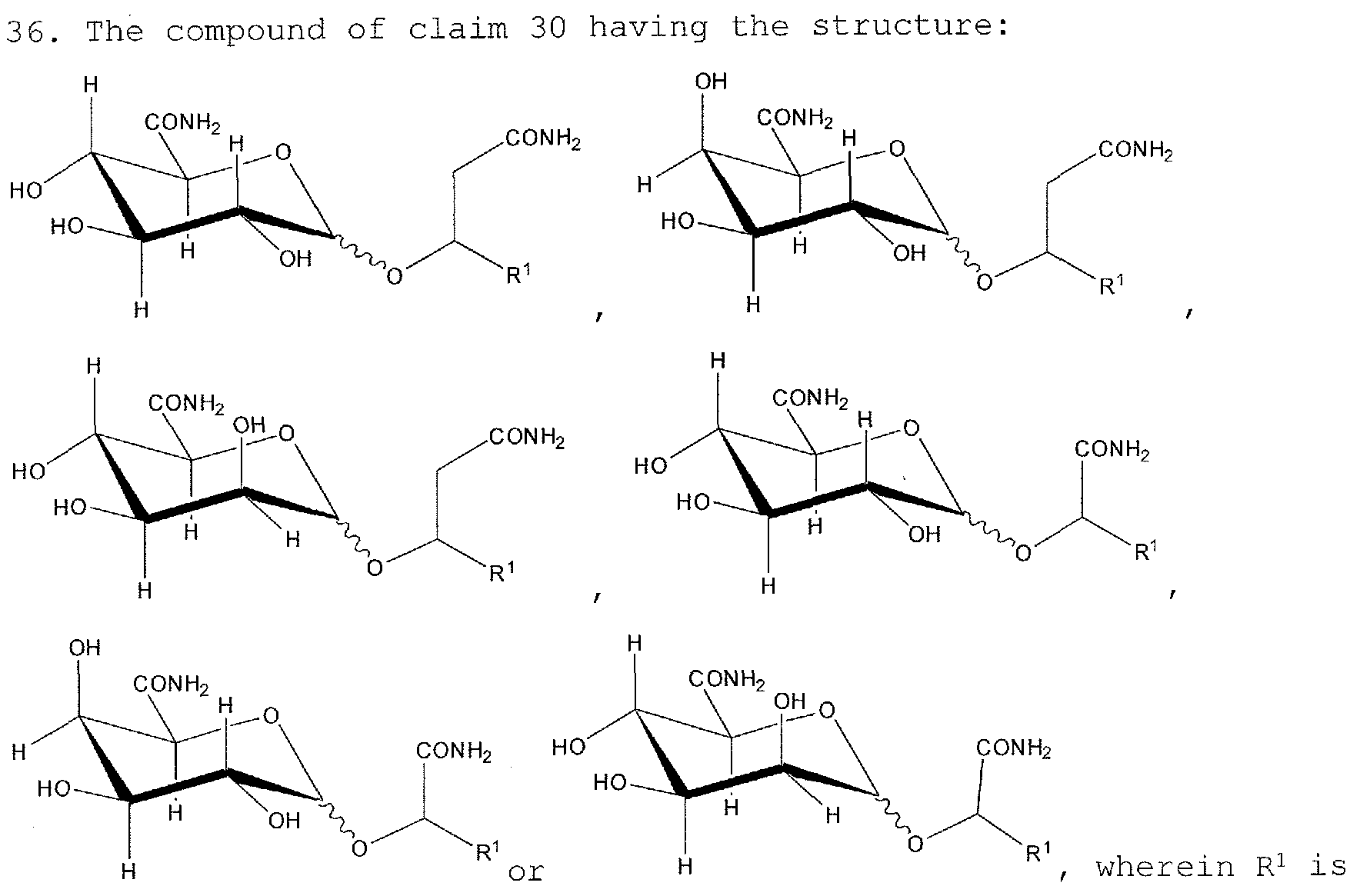
- X is a uronic acid amide group selected from the group consisting of Glucuronamide, mannuronamide, galacturona ide, alluronamide, altruronamide, guluronamide, iduronamide and taluronamide ;
- each of R 1 and R 2 is independently H, halogen, OH, 0-alkyl, CONH2, CO2H, C02-alkyl, or optionally substituted alkyl; each of Y and Z is independently H, OH, O-alkyl or optionally substituted alkyl ;
- n 0, 1 or 2;
- A NR 3 R ,
- each of R 3 and R 4 is independently H, OH, O-alkyl or optionally substituted alkyl; or a salt thereof.
- X is a uronic acid amide group selected from the group consisting of glucuronamide, mannuronamide, galacturonamide, alluronamide, altruronamide , guluronamide , iduronamide and taluronamide ;
- each of R 1 and R 2 is independently H, CONH 2 , C0 2 H, C0 2 -alkyl, alkyl-OH or unsubstituted alkyl;
- each of Y and Z is H
- n 0, 1 or 2;
- each of R 3 and R' 1 is independently H, OH, O-alkyl or optionally substituted alkyl; or a salt thereof.
- X is a uronic acid amide group selected from the group consisting of glucuronamide, mannuronamide, galacturonamide.
- each of R 1 and R 2 is H, or R 1 is C3 ⁇ 4 and is H, or R 1 is CONH 2 and R 2 is H.
- R 1 is H, optionally substituted alkyl, or CONH2 and m is 0, 1 or 2.
- R 1 is H, optionally substituted alkyl, or CONH2 and m is 0, 1 or 2.
- R 1 is H, optionally substituted alkyl, or CONH2 and m is 0, 1 or 2.
- R 1 is H, hydroxylalkyl, or CONH2, and m is 0, 1 or 2.
- m is 1
- the uronic acid amide group is an alpha- anomer. In some embodiments, wherein the uronic acid amide group is a beta- anomer. In some embodiments, wherein the uronic acid amide group is a D- uronic acid amide. In some embodiments, wherein the uronic acid amide group is an L-uronic acid amide. In some embodiments, wherein the uronic acid amide group is a mix of D and L.
- R 1 is H, optionally substituted alkyl or CONH2
- composition comprising a biological molecule and at least one compound of the present invention.
- composition comprising a biological molecule and a compound having the structure:
- X is a hexosyl group selected from the group consisting of glucosyl, mannosyl and galactosyl,
- each of R 1 and R 2 is independently H, halogen, OH, O-alkyl, CONH 2 , or optionally substituted alkyl
- each of R 3 and R 4 is independently H, OH, O-alkyl or optionally substituted alkyl
- each of Y and Z is independently H, OH, O-alkyl or optionally substituted alkyl,
- n 0, 1 or 2.
- composition comprising a biological molecule and a ompound having the structure:
- X is an uronic acid group selected from the group consisting of glucuronic acid, mannuronic acid and a galacturonic acid,
- each of R 1 and R 2 is independently H, halogen, OH, O-alkyl, CONH 2 , C0 2 H, C02-alkyl, or optionally substituted alkyl;
- each of Y and Z is independently H, OH, O-alkyl or optionally substituted alkyl,
- R 3 is independently H or optionally substituted alkyl
- n 0, 1 or 2;
- composition comprising a biological molecule and a com ound having the structure :
- X is a uronic acid amide group selected from the group consisting of glucuronamide , mannuronamide and galacturonamide;
- each of R 1 and R 2 is independently H, halogen, OH, O-alkyl, CONH 2 , C0 2 H, C02-alkyl, or optionally substituted alkyl;
- each of R 3 and R 4 is independently H, OH, O-alkyl or optionally substituted alkyl
- each of Y and Z is independently H, OH, O-alkyl or optionally substituted alkyl;
- n 0, 1 or 2.
- the biological molecule is a biopharmaceutical, protein, nucleotide, polypeptide or antibody.
- composition wherein the biological molecule has therapeutic activity.
- the biological molecule is Insulin; Humulin; Novolin; Insulin human inhalation; Exubera; Insulin aspart; Novolog (aspart) ; Insulin glulisine; Apidra (glulisine) ; Insulin lispro; Humalog (lispro) ; Isophane insulin; NPH; Insulin detemir; Levemir (detemir); Insulin glargine; Lantus (glargine) ; Insulin zinc extended; Lente; Ultralente; Pramlintide acetate; Symlin; Growth hormone (GH) ; somatotropin; genotropin; humatrope; norditropin; NorlVitropin; Nutropin; Omnitrope; Protropin; Siazen; Serostim; Valtropin; Hecasermin; Increlex; Mecasermin rinfabate; IPlex; Factor VIII; Bioclate; Helixate;
- Interferon-a2a IFN 2a
- Roferon-A Roferon-A
- Peglnterferon-a2a Pegasys
- Interferon-a2b IFN 2b
- Intron A Peglnterferon- 2b
- Peg-Intron
- Interferon- n3 Interferon- n3
- Alferon N Interferon-pia
- rIFN- ⁇ Interferon-pia
- Avonex Rebif; Interferon- lb (rIFN- ⁇ )
- Betaseron Interferon-ylb (IFNy) ;
- Aldesleukin interleukin 2 (IL2); epidermal thymocyte activating factor; ETAF) ; Proleukin; Alteplase (tissue plasminogen activator; tPA) ; Activase; Reteplase (deletion mutein of tPA) ; Retavase;
- Tenecteplase Tenecteplase; TNKase; Urokinase; Abbokinase; Factor Vila; NovoSeven; Drotrecogin-a (activated protein C) ; Xigris; Salmon calcitonin; Fortical;
- keratinocyte growth factor KGF keratinocyte growth factor KGF
- kepivance Becaplermin (platelet-derived growth factor; PDGF)
- Regranex Trypsin; Granulex; Nesiritide; Natrecor;
- Botulinum toxin type A Botox; Botulinum toxin type B; Myoblock;
- Collagenase Santyl; Human deoxy-ribonuclease I; dornase-a; pulmozyme; Hyaluronidase (bovine, ovine) ; Amphadase (bovine) ; hydase (bovine) ;
- Vitrase (ovine) ; Hyaluronidase (recombinant human) ; hylenex; Papain; accuzyme; panafil; L-asparaginase; ELSPAR; Peg-asparaginase; Oncaspar;
- Streptokinase Streptase; Streptase; Anistreplase (anisoylated plasminogen streptokinase activator complex; APSAC) ; Eminase; Bevacizumab; Avastin;
- Cetuximab Erbitux; Panitumumab; Vectibix; Alemtuzumab; Campath;
- Rituximab Rituxan
- Trastuzumab Herceptin; Abatacept; Orencia; Anakinra;
- Daclizumab Zenapax; Muromonab-CD3 ; Orthoclone; 0KT3; Omalizumab; Xolair;
- Palivizumab Synagis; Enfuvirtide; Fuzeon; Abciximab; ReoPro; Pegvisomant;
- Somavert Crotalidae polyvalent immune Fab (ovine) ; Crofab; Digoxin immune serum Fab (ovine) ; Digifab; Ranibizumab; Lucentis; Denileukin; Diftitox; Ontak; Ibritumomab; Tiuxetan; Zevalin; Gemtuzumab; Ozogamicin; Mylotarg;
- composition wherein the biological molecule is lysozyme, adlimumab (Humira®) , ubiquitin or Factor IX.
- composition further comprising a buffer.
- composition wherein the composition is acidic. In some embodiments of the composition, having a pH less than 6.8.
- composition having a pH less than 4.
- composition having a pH around 3.
- composition having a pH between 5 and 7.
- composition wherein the composition is basic. In some embodiments of the composition, having a pH more than 7.2.
- composition having a pH more than 10.
- composition having a pH around 12.
- composition having a pH between 7 and 8. In some embodiments of the composition, having a pH less than 12.
- composition having a pH greater than 3. In some embodiments of the composition, having a pH greater than 3 and less than 12.
- composition wherein the composition is freeze dried, lyophilized, a solution, a liquid, a solid or a suspension.
- composition wherein the compound is present at a concentration between 0.1 mM to about 5 M.
- composition wherein the compound is present at a concentration between about 0.01 M to about 1M.
- the present invention also provides a composition comprising any compound of the present invention.
- the present invention also provides a pharmaceutical composition
- the present invention also provides a pharmaceutical composition
- the present invention also provides a method of stabilizing a biological molecule comprising treating the biological molecule with an effective amount of the compound of the present invention, so as to thereby stabilize the biological molecule.
- the method wherein the biological molecule is a protein, nucleotide, polypeptide or antibody. In some embodiments, the method wherein the biological molecule has therapeutic activity. In some embodiments, the method wherein the biological molecule is a biopharmaceutical . In some embodiments, the method wherein the biological molecule is Insulin;
- Novolog (aspart) ; Insulin glulisine; Apidra (glulisine) ; Insulin lispro;
- Humalog (lispro) Isophane insulin; NPH; Insulin detemir; Levemir (detemir) ; Insulin glargine; Lantus (glargine); Insulin zinc extended; Lente; Ultralente; Pramlintide acetate; Symlin; Growth hormone (GH) ; somatotropin; genotropin; humatrope; norditropin; NorlVitropin; Nutropin;
- Mecasermin rinfabate IPlex; Factor VIII; Bioclate; Helixate; Kogenate;
- Recominate ReFacto; Factor IX; Benefix; Antithromin III (AT-III); Thrombate III; Protein C concentrate; Ceprotin; ⁇ -Glucocerebrosidase;
- Cerezyme Cerezyme; ⁇ -Glucocerebrosidase ; Ceredase (purified from pooled human placenta); Alglucosidase-a; Myozyme; Laronidase ( -1-iduronidase ) ;
- Albumin Albumin; Albuminar; AlbuRx; Albutein; Flexbumin; Buminate; Plasbumin; Erythropoietin; Epoetin-cx; Epogen; Procrit; Darbepoetin-a; Aranesp;
- Filgrastim granulocyte colony stimulating factor; G-CS F
- Neupogen granulocyte colony stimulating factor
- Pegfilgrastim Peg-G-CSF
- Neulasta granulocytemacrophage colony stimulating factor
- GM-CS F granulocytemacrophage colony stimulating factor
- Leukine granulocytemacrophage colony stimulating factor
- Oprelvekin interleukinll
- ILll Human follicle-stimulating hormone
- Gonal-F Gonal-F
- Follistim Human chorionic gonadotropin
- HCG Human chorionic gonadotropin
- Luveris Type I alpha-interferon; interferon alfacon 1; consensus interferon; Infergen;
- Interferon-a2a Interferon-a2a (IFNa2a); Roferon-A; Peglnterferon- 2a; Pegasys;
- Interferon-a2b IFNa2b
- Intron A Peglnterferon- 2b
- Peg-Intron
- Interferon-an3 (IFN n3); Alferon N; Interferon- la (rIFN- ⁇ ) ; Avonex; Rebif; Interferon- ⁇ lb (rIFN- ⁇ ) ; Betaseron; Interferon-ylb (IFNy) ;
- Aldesleukin interleukin 2 (IL2); epidermal thymocyte activating factor; ETAF) ; Proleukin; Alteplase (tissue plasminogen activator; tPA) ; Activase; Reteplase (deletion mutein of tPA) ; Retavase;
- Tenecteplase TNKase; Urokinase; Abbokinase; Factor Vila; NovoSeven;
- Drotrecogin- ⁇ activate protein C
- Xigris Salmon calcitonin
- Fortical Miacalcin
- Teriparatide human parathyroid hormone residues 1-34
- GnRH gonadotropin releasing hormone
- Supprelin LA Vantas
- Palifermin keratinocyte growth factor KGF
- kepivance Palifermin
- Becaplermin platelet-derived growth factor; PDGF
- Regranex Trypsin; Granulex; Nesiritide; Natrecor;
- Botulinum toxin type A Botox; Botulinum toxin type B; Myoblock;
- Hyaluronidase (bovine, ovine); Amphadase (bovine); hydase (bovine); Vitrase (ovine); Hyaluronidase (recombinant human); hylenex; Papain; accuzyme; panafil; L-asparaginase; ELSPAR; Peg-asparaginase; Oncaspar;
- Streptokinase Streptase; Streptase; Anistreplase (anisoylated plasminogen streptokinase activator complex; APSAC) ; Eminase; Bevacizumab; Avastin; Cetuximab; Erbitux; Panitumumab; Vectibix; Alemtuzumab; Campath;
- Rituximab Rituxan
- Trastuzumab Herceptin; Abatacept; Orencia; Anakinra;
- Antithymocyte globulin (rabbit); Thymoglobulin; Basiliximab; Simulect; Daclizumab; Zenapax; Muromonab-CD3 ; Orthoclone; 0KT3; Omalizumab; Xolair;
- Palivizumab Synagis; Enfuvirtide; Fuzeon; Abciximab; ReoPro; Pegvisomant;
- Somavert Crotalidae polyvalent immune Fab (ovine) ; Crofab; Digoxin immune serum Fab (ovine) ; Digifab; Ranibizumab; Lucentis; Denileukin; Diftitox;
- Ontak Ibritumomab; Tiuxetan; Zevalin; Gemtuzumab; Ozogamicin; Mylotarg; Tositumomab and I-tositumomab; Bexxar; Bexxar 1-131; Hepatitis B surface antigen (HBsAg) ; Engerix; Recombivax HB; HPV vaccine; Gardasil; OspA;
- LYMErix Anti-Rhesus (Rh) immunoglobulin G; Rhophylac; Recombinant purified protein derivative (DPPD) ; Glucagon; GlucaGen; Growth hormone releasing hormone (GHRH) ; Geref; Secretin; ChiRhoStim (human peptide), SecreFlo (porcine peptide) ; Thyroid stimulating hormone (TSH) ; thyrotropin; Capromab pendetide; ProstaScint; Indium-lll-octreotide; OctreoScan; Satumomab pendetide; OncoScint; Arcitumomab; CEA-scan; Nofetumomab; Verluma; Apcitide; Acutect; Imciromab pentetate; Myoscint; Technetium fanolesomab; NeutroSpec; HIV antigens; Enzyme immunoassay; OraQuick
- the method wherein the biological molecule is lysozyme, adlimumab (Humira®) , ubiquitin or Factor IX. In some embodiments, the method wherein the biological molecule is stabilized in the presence of pH stress.
- the method wherein the pH stress is an acidic environment .
- the method wherein the acidic environment has a pH less than 6.8. In some embodiments, the method wherein the acidic environment has a pH less than 4. In some embodiments, the method wherein the acidic environment has a pH around 3. In some embodiments, the method wherein the acidic environment has a pH between 5 and 7.
- the method wherein the pH stress is a basic environment . In some embodiments, the method wherein the basic environment has a more than 7.2. In some embodiments, the method wherein the basic environment has a pH more than 10. In some embodiments, the method wherein the basic environment has a pH around 12. In some embodiments, the method wherein the biological molecule is treated with the compound prior to being subjected to pH stress.
- the method wherein the biological molecule is stabilized in the presence of thermal stress.
- the method wherein the thermal stress is freeze drying, lyophilization or heating of the biological molecule.
- the method wherein the thermal stress is heating about the glass transition state or melting point of the biological molecule.
- the method wherein the biological molecule is treated with the compound prior to being subjected to thermal stress.
- the method wherein the biological molecule is treated with the compound at a concentration between 0.1 M to about 1 M wherein the biological molecule is treated with the compound at a concentration between 0.1 M to about 1 M.
- any compound of the present inventions or mixture thereof for use in any method of the present invention is not limited.
- composition or pharmaceutical compisiont comprising any compound of the present inventions or mixture thereof.
- the compounds of the present invention include neutral glycosylated amides (neutral amide-type) and dianionic glucuronidated acids (dionic uronic acid-type) .
- the neutral amide-type stabilizers contain only non-ionizable functional groups, e.g., amide and hydroxyl functional groups whereas the dianionic uronic acid-type stabilizers contain two ionizable carboxylic acid functional groups, one which is at C-6 of the hexose moiety and one which is linked to the hexose via the glycosidic bond.
- the dianionic uronic acid-type stabilizers of the present invention includes stabilizers, containing two ionizable acid groups, which are in their neutral form as well as the salts derived from their monoanionic and dianionic forms, e.g., as monosodium salt, disodium salt, monopotassium salt, dipotassium salt, calcium salt, magnesium salt, etc.
- the compound is a dipotassium salt.
- the compounds of the present invention include all hydrates, solvates, and complexes of the compounds used by this invention.
- a chiral center or another form of an isomeric center is present in a compound of the present invention, all forms of such isomer or isomers, including enantiomers and diastereomers , are intended to be covered herein.
- Compounds containing a chiral center may be used as a racemic mixture, an enantiomerically enriched mixture, or the racemic mixture may be separated using well-known techniques and an individual enantiomer may be used alone.
- the enantiomers can be separated using known techniques, such as those described in Pure and Applied Chemistry 69, 1469-1474, (1997) IUPAC.
- each stereogenic carbon may be of the R or S configuration.
- isomers arising from such asymmetry e.g., all enantiomers and diastereomers
- Such isomers can be obtained in substantially pure form by classical separation techniques and by stereochemically controlled synthesis, such as those described in "Enantiomers, Racemates and Resolutions" by J. Jacques, A. Collet and S. Wilen, Pub. John Wiley & Sons, NY, 1981.
- the resolution may be carried out by preparative chromatography on a chiral column.
- the compounds of the subject invention may have spontaneous tautomeric forms.
- compounds may exist in tautomeric forms, such as keto-enol tautomers, each tautomeric form is contemplated as being included within this invention whether existing in equilibrium or predominantly in one form.
- hydrogen atoms are not shown for carbon atoms having less than four bonds to non-hydrogen atoms. However, it is understood that enough hydrogen atoms exist on said carbon atoms to satisfy the octet rule. It is understood that where a numerical range is recited herein, the present invention contemplates each integer between, and including, the upper and lower limits, unless otherwise stated.
- hydrogen can be enriched in the deuterium isotope.
- any notation of a carbon in structures throughout this application, when used without further notation, are intended to represent all isotopes of carbon, such as 12 C, 13 C, or 14 C.
- any compounds containing 13 C or 14 C may specifically have the structure of any of the compounds disclosed herein.
- any notation of a hydrogen in structures throughout this application, when used without further notation are intended to represent all isotopes of hydrogen, such as X H, 2 H, or 3 H.
- any compounds containing 2 H or 3 H may specifically have the structure of any of the compounds disclosed herein.
- Isotopically-labeled compounds can generally be prepared by conventional techniques known to those skilled in the art using appropriate isotopically-labeled reagents in place of the non-labeled reagents employed. It is to be understood that the invention encompasses all such isotopic forms.
- substituents and substitution patterns on the compounds used in the method of the present invention can be selected by one of ordinary skill in the art to provide compounds that are chemically stable and that can be readily synthesized by techniques known in the art from readily available starting materials. If a substituent is itself substituted with more than one group, it is understood that these multiple groups may be On the same carbon or on different carbons, so long as a stable structure results.
- alkyl is intended to include both branched, straight- chain and cycloalkyl saturated aliphatic hydrocarbon groups having the specified number of carbon atoms.
- alkyl specifically includes methyl, ethyl, propyl, cyclopropyl, isopropyl, butyl, pentyl, hexyl, heptyl, isopropyl, isobutyl, sec-butyl and so on.
- An embodiment can be C1-C12 alkyl, C1-C3 alkyl, C2-C12 alkyl, C3-C12 alkyl, C4-C12 alkyl and so on.
- Neighboring alkyl substituents may be linked so as to form a saturated carbocyclic ring.
- cycloalkyl shall mean cyclic rings of alkanes of three to eight total carbon atoms, or any number within this range (i.e., cyclopropyl, cyclobutyl, cyclopentyl, cyclohexyl, cycloheptyl or cyclooctyl).
- Alkyl may be optionally substituted.
- alkyl may be optionally substituted by oxygen, nitrogen or sulfur atoms.
- alkyl may be optionally substituted by a phenyl, an alcohol, a halogen (i.e., F, CI, Br, and I), an alkoxy group such as methoxy, ethoxy, n-propoxy and isopropoxy, an alkyllthio group such as methylthio and ethylthio, a carboxylate or an acetate group.
- a halogen i.e., F, CI, Br, and I
- an alkoxy group such as methoxy, ethoxy, n-propoxy and isopropoxy
- an alkyllthio group such as methylthio and ethylthio
- O-alkyl means an (oxygen) -R radical where R is alkyl as defined above.
- R is alkyl as defined above.
- O-alkyl may be an oxygen atom bonded to a CI to C6 straight chain or branched chain alkyl.
- Hexosyl is a hexose radical.
- Hexosyl groups may be, but are not limited to, glucosyl, mannosyl and galactosyl.
- Other Hexosyl groups include allosyl, altrosyl, gulosyl, idosyl and talosyl.
- Hexosyl includes unoxidized hexosyl groups but also may include oxidized hexosyl groups such as uronic acid groups.
- Uronic acid groups are a uronic acid radical which may be, but are not limited to, glucuronsyl, mannuronsyl and galacturonsyl .
- the hexose or oxidized hexose groups may be a D or L stereoisomer.
- the hexosyl group may be an alpha- or beta-anomer.
- the hexosyl group is linked to the parent substrate via an oxygen to C-l, C- 2, C-3, C-4 or C-6.
- the hexosyl group may be an alpha- or beta-anomer.
- a "glucosyl” group is a radical of a glucose molecule.
- the glucose molecule may be D or L mannose.
- a glucosyl group is linked to the parent substrate via an oxygen to C-l, C-2, C-3, C-4 or C-6.
- the glucosyl group may be an alpha- or beta-anomer. Unless otherwise specified, a glucosyl group is linked at the oxygen off of the anomeric C-l.
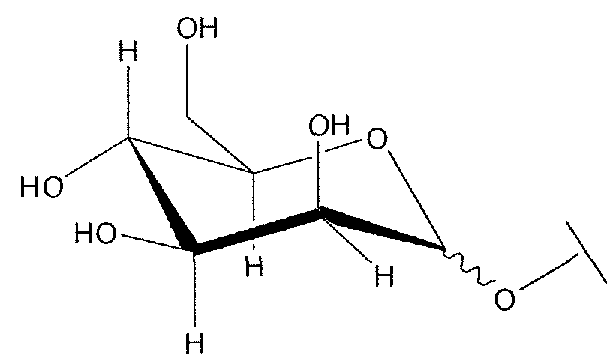
- glucosyl may be defined as:
- a "galactosyl” group is a radical of a galactose molecule.
- the galactose molecule may be D or L mannose.
- a galactosyl group is linked to the parent substrate via an oxygen to C-l, C-2, C-3, C-4 or C-6.
- the galactosyl group may be an alpha- or beta-anomer .
- a galactosyl group is linked at the oxygen off of the anomeric C-l.
- galactosyl may be defined as:
- mannosyl is a radical of a mannose molecule.
- the mannose molecule may be D or L mannose.
- a mannosyl group is linked to the parent substrate via an oxygen to C-l, C-2, C-3, C-4 or C-6.
- the mannosyl group may be an alpha- or beta-anomer. Unless otherwise specified, a mannosyl group is linked at the oxygen off of the anomeric C-l.
- mannosyl may be defined as:
- a "glucuronosyl” or “glucuronic acid group” is a radical of a glucuronic acid molecule.
- the glucuronic acid group may be D or L glucuronic acid.
- a glucuronic acid group is linked to the parent substrate via an oxygen to C-l, C-2, C-3, C-4 or C-6.
- the glucuronic acid group may be an alpha- or beta-anomer. Unless otherwise specified, a glucuronic acid group is linked at the oxygen off of the anomeric C-l.
- glucuronic acid group may be defined as:
- a "galacturonosyl” or “galacturonic acid group” is a radical of a galacturonic acid molecule.
- the galacturonic acid group may be D or L galacturonic acid.
- a galacturonic acid group is linked to the parent substrate via an oxygen to C-l, C-2, C-3, C-4 or C-6.
- the galacturonic acid group may be an alpha- or beta-anomer. Unless otherwise specified, a galacturonic acid group is linked at the oxygen off of the anomeric C- 1.
- galacturonic acid group may be defined as:
- a "mannuronosyl” or “mannuronic acid group” is a radical of a mannuronic acid molecule.
- the mannuronic acid group may be D or L mannuronic acid.
- a mannuronic acid group is linked to the parent substrate via an oxygen to C-l, C-2, C-3, C-4 or C-6.
- the mannuronic acid group may be an alpha- or beta-anomer. Unless otherwise specified, a mannuronic acid group is linked at the oxygen off of the anomeric C-l.
- mannuronic acid group may be defined as:
- halogen refers to F, CI, Br, and I.
- An “optionally substituted” group refers to a functional group in which one or more bonds to a hydrogen atom contained therein are replaced by a bond to non-hydrogen or non-carbon atoms, provided that normal valencies are maintained and that the substitution results in a stable compound. Substituted groups also include groups in which one or more bonds to a carbon (s) or hydrogen (s) atom are replaced by one or more bonds, including double or triple bonds, to a heteroatom.
- substituent groups include halogens (i.e., F, CI, Br, and I); alkyl groups, such as methyl, ethyl, n-propyl, isopropryl, n-butyl, tert-butyl, and trifluoromethyl; hydroxyl; alkoxy groups, such as methoxy, ethoxy, n-propoxy, and isopropoxy; aryloxy groups, such as phenoxy; arylalkyloxy, such as benzyloxy (phenylmethoxy) and p-trifluoromethylbenzyloxy (4- trifluoromethylphenylmethoxy) ; heteroaryloxy groups; sulfonyl groups, such as trifluoromethanesulfonyl, methanesulfonyl, and p-toluenesulfonyl; nitro, nitrosyl; mercapto; sulfanyl groups, such as methyls
- substituted compound can be independently substituted by one or more of the disclosed or claimed substituent moieties, singly or pluraly.
- independently substituted it is meant that the (two or more) substituents can be the same or different.
- the compounds of the present invention also include any of the compounds disclosed herein modified by common protecting groups.
- the compounds of the present invention include glycosylated amides as described herein but modified where the amide is protected by an amide protecting group, e.g., BOC, and the hydroxyl groups are protected by a hydroxyl protecting group, e.g., benzyl.
- the compounds of the present invention include glucuronidated acids where the carboxylic acid moiety is protected as an ester.
- Common protecting groups are known to a person of ordinary skill in the art as set forth in Greene's Protective Groups in Organic Synthesis (Wuts (2006) ) . In choosing the compounds of the present invention, one of ordinary skill in the art will recognize that the various substituents are to be chosen in conformity with well-known principles of chemical structure connectivity .
- the compounds used in the method of the present invention may be in a salt form.
- a “salt” is a salt of the instant compounds which has been modified by making acid or base salts of the compounds.
- the salt may be a pharmaceutically acceptable salt.
- pharmaceutically acceptable salts include, but are not limited to, mineral or organic acid salts of basic residues such as amines; alkali or organic salts of acidic residues such as carboxylic acids.
- the salts can be made using an organic or inorganic acid.
- Such salts include, but are not limited to, alkali metals and alkaline earth metal salts such as lithium sodium, potassium, beryllium, magnesium and calcium salts.
- Salts also include alkyl ammonium salts, ammonium salts and salts derived from amino acids.
- pharmaceutically acceptable salt refers to the relatively non-toxic, inorganic and organic acid or base addition salts of compounds of the present invention. These salts can be prepared in situ during the final isolation and purification of the compounds of the invention, or by separately reacting a purified compound of the invention in its free base or free acid form with a suitable organic or inorganic acid or base, and isolating the salt thus formed. (See, e.g., Berge et al. (1977) "Pharmaceutical Salts", J. Pharm. Sci. 66:1-19).
- the compounds of the present invention may be used in a pharmaceutical composition
- a pharmaceutical composition comprising a therapeutic biological molecule in admixture with suitable pharmaceutical diluents, extenders, excipients or carriers.
- a “biological molecule” is a protein, nucleotide, polypeptide, antibody including monoclonal antibody, enzyme, or a fragment or mixture of any of the preceding.
- a biological molecule may also be a fragment of a cell, virus, liposome or tissue. In alternative embodiments, the biological molecule has therapeutic activity or it has no therapeutic activity.
- the therapeutic biological molecule may be one of: Insulin; Humulin; Novolin; Insulin human inhalation; Exubera; Insulin aspart; Novolog (aspart); Insulin glulisine;
- Apidra (glulisine) ; Insulin lispro; Humalog (lispro) ; Isophane insulin;
- NPH Insulin detemir; Levemir (detemir) ; Insulin glargine; Lantus (glargine) ; Insulin zinc extended; Lente; Ultralente; Pramlintide acetate; Symlin; Growth hormone (GH) ; somatotropin; genotropin; humatrope; norditropin; NorlVitropin; Nutropin; Omnitrope; Protropin; Siazen;
- Factor VIII Bioclate; Helixate; Kogenate; Recominate; ReFacto; Factor IX;
- Laronidase ( ⁇ -1-iduronidase) ; Aldurazyme; Idursulphase ( Iduronate-2- sulphatase) ; Elaprase; Galsulphase; Naglazyme; Agalsidase- ⁇ (human - galactosidase A) ; Fabrazyme; ⁇ -1-Proteinase inhibitor; Aralast; Prolastin; Lactase; Lactaid; Pancreatic enzymes (lipase, amylase, protease) ; Arco-Lase, Cotazym, Creon, Donnazyme, Pancrease, Viokase,
- Zymase Adenosine deaminase (pegademase bovine, PEG-ADA) ; Adagen; Pooled immunoglobulins; Octagam; Human albumin; Albumarc; Albumin; Albuminar;
- GM-CS F GM-CS F
- Leukine Oprelvekin ( interleukinll; IL11) ; Neumega; Human follicle-stimulating hormone (FSH); Gonal-F; Follistim; Human chorionic gonadotropin (HCG) ; Ovidrel; Luveris; Type I alpha-interferon; interferon alfacon 1; consensus interferon; Infergen; Interferon-a2a (IFNa2a);
- Roferon-A Peglnterferon-a2a; Pegasys; Interferon-a2b (IFNa2b); Intron A;
- Peglnterferon-a2b Peg-Intron; Interferon-an3 (IFN n3); Alferon N;
- Interferon-pia rIFN- ⁇
- Avonex Rebif; Interferon- ⁇ lb (rIFN- ⁇ ); Betaseron; Interferon-ylb (IFNy); Actimmune; Aldesleukin (interleukin 2
- IL2 epidermal thymocyte activating factor
- ETAF epidermal thymocyte activating factor
- Proleukin Alteplase
- tissue plasminogen activator tPA
- Activase Activase
- Reteplase detion mutein of tPA
- Retavase Tenecteplase
- TNKase Urokinase
- Abbokinase Factor 1
- Supprelin LA Vantas
- Palifermin keratinocyte growth factor KGF
- kepivance keratinocyte growth factor KGF
- Becaplermin platelet-derived growth factor; PDGF
- Botulinum toxin type B Myoblock; Collagenase; Santyl; Human deoxy- ribonuclease I; dornase-a; pulmozyme; Hyaluronidase (bovine, ovine);
- Amphadase (bovine); hydase (bovine); Vitrase (ovine); Hyaluronidase (recombinant human) ; hylenex; Papain; accuzyme; panafil; L-asparaginase;
- APSAC anisoylated plasminogen streptokinase activator complex
- Bevacizumab Avastin; Cetuximab; Erbitux; Panitumumab; Vectibix; Alemtuzumab; Campath; Rituximab; Rituxan; Trastuzumab; Herceptin;
- Etanercept Enbrel; Infliximab; Remicade; Alefacept; Amevive; Natalizumab;
- Tysabri Eculizumab
- Soliris Antithymocyte globulin (rabbit);
- Thymoglobulin Basiliximab; Simulect; Daclizumab; Zenapax; Muromonab-CD3; Orthoclone; OKT3; Omalizumab; Xolair; Palivizumab; Synagis; Enfuvirtide;
- Recombivax HB HPV vaccine; Gardasil; OspA; LYMErix; Anti-Rhesus (Rh) immunoglobulin G; Rhophylac; Recombinant purified protein derivative
- DPPD Glucagon
- GHRH Growth hormone releasing hormone
- OncoScint Arcitumomab; CEA-scan; Nofetumomab; Verluma; Apcitide; Acutect;
- degradation of a biological molecule includes, but is not limited to, aggregation, denaturation, misfolding and precipitation of the biological molecule.
- the degradation may be induced by physical stress or it may be induced by chemical stress. Physical stress includes high temperature, low temperature, heating above the thermal unfolding temperature, freezing, agitation, shaking, surfaces and pressure.
- Chemical stress includes low pH, high pH, pH divergent from the ideal pH environment of the natively-folded protein (e.g., divergent by a pH of 1, 2, 3, 4 or 5), dehydration, organic solvents and the presence of impurities such as detergents or chaeotropic agents.
- a stabilized biological molecule retains its native structure and activity for longer period of time or across a broader range of conditions than an unstabilized biological molecule. Additionally or alternatively, a stabilized biological molecule does not degrade under conditions which degrade an unstabilized form of the same biological molecule. A stabilized biological molecule has a higher melting temperature than an unstabilized biological molecule. Techniques and compositions for making such compositions are described in the following references: 7 Modern Pharmaceutics, Chapters 9 and 10 (Banker & Rhodes, Editors, 1979); Pharmaceutical Dosage Forms: Tablets (Lieberman et al., 1981); Ansel, Introduction to Pharmaceutical Dosage Forms 2nd Edition (1976); Remington's Pharmaceutical Sciences, 17th ed.
- the present invention also includes embodiments where a glucosyl, mannosyl, or galactosyl group is replaced with allosyl, altrosyl, gulosyl, idosyl or talosyl, or any of the corresponding uronic acids.
- compounds of the present invention may be prepared using a number of methods known in the chemical arts, particularly in light of the description contained herein, in combination with the knowledge of the skilled artisan.
- Various starting materials, intermediates, and reagents may be purchased from commercial sources or made according to literature methods or adaptations thereof.
- other reagents, compounds or methods can be used in practice or testing, generalized methods for the preparation of the compounds of the present invention are illustrated by the following descriptions and reaction Schemes.
- the methods disclosed herein, including those outlined in the Schemes, descriptions, and Examples are for intended for illustrative purposes and are not to be construed in any manner as limitations thereon.
- Various changes and modifications will be obvious to those of skill in the art given the benefit of the present disclosure and are deemed to be within the spirit and scope of the present disclosure as further defined in the appended claims.
- the intermediate products described can be recovered by extraction, evaporation, or other techniques known in the art.
- the crude materials may then be optionally purified by chromatography, HPLC, recrystallization, trituration, distillation, or other techniques known in the art.
- some of the methods useful for the preparation of such compounds may require protection of a particular functionality, e.g., to prevent interference by such functionality in reactions at other sites within the molecule or to preserve the integrity of such functionality.
- the need for, and type of, such protection is readily determined by one skilled in the art, and will vary depending on, for example, the nature of the functionality and the conditions of the selected preparation method. Methods of introducing and removing protecting groups are well known to those of ordinary skill in the art and are described in Greene's Protective Groups in Organic Synthesis (Wuts (2006) ) . Alternate reagents, starting materials, as well as methods for optimizing or adapting the procedures described herein would also be readily determined by one skilled in the art .
- the starting materials (1, 3, 5, 7, 9 and 11) and other related compounds may be synthesized using techniques and materials known to those of skill in the art. Additionally, starting materials in Scheme 1 have been reported in the literature and thus may be accessed as previously described.
- Compound 1 was reported in Carbohydrate Res. 2009, 344, 1646 (beta-anomer); J. Org Chem. 2003, 68, 6672; Tetrahedron Lett. 2000, 41, 8273. (alpha- anomer) .
- the beta-anomer of Compound 3 was reported in WO 2008/007153 A2 and WO 2015/137838 Al .
- the alpha-anomer of Compound 5 was reported in Carbohydrate Res.
- Each starting material as either ethyl or methyl ester, is treated with ammonium in methanol at -78°C and warmed to room temperature to produce the desired amide product via ester amidolysis at quantitative or near- quantitiatve yield.
- Compound 14 was produced in 99% yield from starting material 13.
- the starting materials (13, 15 and 17) and other related compounds may be synthesized using techniques and materials known to those of skill in the art. Additionally, starting materials in Scheme 2 have been reported in the literature and thus may be accessed as previously described.
- Compound 13 (as ethyl ester) was reported in Phytochemistry 1997, 45 and Biotechnol. Lett., 1995, 17, 1169.
- Compound 15 (as ethyl and methyl esters) was reported in Biotechnol. Lett. 1997, 19, 583.
- the alpha-anomer of Compound 17 (as ethyl ester) was reported in WO 2015/137838 Al .
- Gluco-, galacto- and mannuronic acids (Compounds 37-42) are prepared as described in Scheme 3. Due to the presence of the two carboxylic acid moieties, the resulting stabilizers are ionizable in two positions in contrast to trehaolse and saccharose which are devoid* of charge.
- the C-6 primary hydroxyl group is efficiently oxidized to the corresponding carboxylic acid with a BAIB/Tempo reagent combination.
- the benzyl ether protecting groups is next removed with Pd/C and 3 ⁇ 4 at 50 psi. Hydrolysis of the methyl ester with NaOH in water affords the sodium salts of the final products in quantitative yields.
- the final compounds under basic conditions presented two charges, derived from the two carboxylic acid functional groups.
- the disodium salt 37 was prepared at 70% overall yield from starting material 19.
- the disodium salt 38 was prepared at 66% overall yield from starting material 20.
- Gluco-, galacto- and mannuronic acids (Compounds 37-42) are prepared as described in Scheme 3. Due to the presence of the two carboxylic acid moieties, the resulting stabilizers are ionizable in two positions in contrast to trehaolse and saccharose which are devoid of charge.
- Diamides from gluco-, manno- and galactosides 46-48 were prepared in by reaction of 43-45 with ammonia in methanol.
- Gluco-, galacto- and mannuronic acids (Compounds 55-60) are prepared as described in Scheme 5.
- R CH 3 , glu.
- R C0 2 Me, glu.
- R C0 2 Me, glu.
- R CH3, man.
- R CH 3 , man.
- R C0 2 Me, man.
- R C0 2 Me, man.
- Gluco-, galacto- and mannuronic acid amides (Compounds 61-66 and 67-72) were prepared as described in Schemes 6 and 7.
- Uronic acid amides 61-66 were prepared in by reaction of 31-36 with ammonia in methanol.
- Uronic acid amides 67-72 were prepared in by reaction of 49-54 with ammonia in methanol .
- Scheme 6
- HPSEC high performance size exclusion chromatography
- the protein melting temperature (T M ) determination was performed by monitoring protein unfolding with the fluoroprobe SYPRO Orange dye (Molecular Probes) , which although completely quenched in aqueous environment, emits fluorescence upon binding to protein hydrophobic patches. Such increase in fluorescence can be measured as a function of temperature.
- the thermal shift assay was performed on an iCycle iQ5 Real Time PCR Detection System (Bio-Rad) , equipped with a charge-coupled device
- CCD CCD
- Cy3 filter CCD
- This equipment can simultaneously detect the fluorescence changes in 96-well plates (low profile plate, Bio-Rad) and thus can be used for parallel thermal stability assays.
- the 96-well plates are sealed with optical quality sealing tape (Bio-Rad) and centrifuged at 2500 g for 1 minutes immediately before the assay to remove possible air bubbles.
- the plates are subsequently heated from 20 to 90 °C with stepwise increments of 1 °C with 60 seconds equilibration time, followed by the fluorescence read out.
- Fluorescence intensities versus temperature are used to calculate the protein melting temperature (T M ) by determining the first derivative (d(Rfu)/dT) and extract the exact transition inflection point.
- Delta T M values (DT M ) for the various conditions were calculated by subtracting the T M value obtained for the reference from the TM value obtained for each condition.
- a protein concentration from 0.1-0.5 mg/mL and a dye concentration of 5 fold were used to guarantee the best signal to noise ratio.
- the protein stock solutions were prepared in their corresponding buffers before performing the DSF experiments.
- Stabiliser solutions and dyes were prepared according to each assay specific conditions.
- the assay was prepared by adding 1-2 ⁇ of protein to 8-9 ⁇ of dye buffer solution, and 10 ⁇ of compound solution. Controls were prepared by replacing the volume of stabilisers by the correspondent buffer .
- HPSEC High Performance Size Exclusion Chromatography
- HP-SEC was performed with Waters 515 pump, a Waters 248? Dual Absorbance Detector (Waters, USA) and a Rheodyme 77251 injector (Waters, USA) .
- a TSK Gel G3000 SWXL column 300 mm x 7.8 mm) (Tosoh Biosep, Germany) was used. The volume of injection was adjusted according to each sample concentration in order to inject 50 mg sample of biological molecule, and separation was performed at a flow rate of 1.0 mL/min or adjusted as appropriate.
- a suitable running buffer was used, e.g., 100 mM sodium sulfate, 100 mM sodium phosphate dibasic pH 6.8 for Humira® samples.
- UV detection was performed at a wavelength suitable to detect the biological molecule, e.g., 280 nm. No thermal stress was applied and assay was peformed at room temperature. Absorbance was measured to determine the concentration of biological molecule and thus determine amount of degredation of the biological molecule.
- Experiment 10 Stabilization of lysozyme measured by DSF
- the stabilization effect of The neutral amide- containing glycosides namely, mannosyl-glycolamide ( glyA) , mannosyl- lactamide (MLA) 3-glucosyl-butanamide (GBA) , galactosyl-glycolamide (GaGlyA) , galactosyl-lactamide (GaLA) , beta-glucosyl-glycolamide (b- GGlyA) , beta-glucosyl-lactamide (b-GLA) , beta-galactosyl-glycolamide (b- GaGlyA) , beta-3-galactosyl-butanamide (b-GaBA) and beta-galactosyl- lactamide (b-GaLA) described hereinabove, showed a stabilization effect.
- a pH titration of adalimumab (Humira®) to pH 3.2 was performed either in the absence and presence of stabiliser GaGlyA 0.5 M, and the results were analysed by HPSEC (fig. 2) .
- the volume of injection was adjusted according to each sample concentration in order to inject 50 mg of Humira, and separation was performed at a flow rate of 1.0 mL/min.
- the running buffer was composed of 100 mM sodium sulfate, 100 mM sodium phosphate dibasic pH 6.8. UV detection was performed at 280 nm. This assay was performed at room temperature, no thermal stress was applied, contrary to the DSF assays.
- adalimumab The stabilisation of adalimumab was also assessed in the presence of 0.25 M of several stabilisers at pH 12, using DSF (fig. 3). All the tested compounds stabilised adalimumab, and a higher stabilisation was obtained with beta-3-galactosyl-butanamide (b-GaBA) , with a 22 °C increase of the melting temperature of the monoclonal antibody.
- b-GaBA beta-3-galactosyl-butanamide
- beta-glucosyl-glycolate b-Ggly
- beta-glucosyl- lactate b-GL
- beta-3-glucosyl-butyrate b-GB
- beta-galactosyl- glicolate b-GaGly
- beta-galactosyl-lactate b-GaL
- the best results were an increase of the melting temperature of only 2 °C, while neutral amide- containing glycoside, for example, 3-glucosyl-butanamide (GBA) , was able to increase the melting temperature of ubiquitin as much as 9 °C (fig. 4).
- the neutral amide-containing glycosides were better stabilisers than the carboxylic acid containing glycosides as shown in figure .
- the hydroxymethyl amide derivatives are prepared from glycosylation of the glycosyl donor (manno-, gluco-, galactopyranose) with the corresponding glycosyl acceptor using methods described in literature (Carbohydrate Research 343 (2008) , 3025-3033) and by further reaction of the unprotected sugar with ammonia in methanol.
- the hydroxymethyl uronic derivatives are prepared from glycosylation of the glycosyl donor (manno-, gluco-, galactopyranose) with the corresponding glycosyl acceptor using methods described in literature (Carbohydrate Research 343 (2008), 3025-3033) and by further oxidation of the C-6 primary hydroxyl group to the corresponding carboxylic acid with a BAIB/Tempo reagent combination.
- the hydroxymethyl diamide derivatives are prepared from the respective hydroxymethyl uronic derivatives (mann-, glue-, galacturonic) by further reaction of the unprotected sugar with ammonia in methanol.
- the assays above show that the compounds of the present invention stabilize biological molecules under a variety of conditions.
- the results of the DFS studies show that the neutral glycosylated amides stabilize a wide range of biological molecules under both pH stress and thermal stress.
- the increased Tm values correspond to greater structural stability of the biological molecule.
- the results of the HPSEC study shows that the neutral glycosylated amides also stabilize biological molecules under pH stress in the absence of thermal stress.
- the absorbance (mV) values show that the compounds of the present invention have the ability to protect biological molecules from pH induced degradation.
- the neutral glycosylated amides offer unexpectedly improved protection from pH stress in comparison to prior stabilizers. See, comparative data of Experiment 13 and Fig. 4 which shows that the neutral glycosylated amides stabilize the given biological molecule to a greater effect than charged glycosides as evidenced by the increased melting temperature of the biological molecule.
- new molecules were identified that stabilize biological molecules under both thermal and pH stress. These molecules were shown to stabilize biological molecules from pH induced stress even in the absence of thermal stress. Compared to prior charged glycosides, these compounds have been shown to be superior stabilizers of biological molecules under pH stress.
Landscapes
- Chemical & Material Sciences (AREA)
- Health & Medical Sciences (AREA)
- Life Sciences & Earth Sciences (AREA)
- Organic Chemistry (AREA)
- General Health & Medical Sciences (AREA)
- Engineering & Computer Science (AREA)
- Biochemistry (AREA)
- Molecular Biology (AREA)
- Crystallography & Structural Chemistry (AREA)
- Biotechnology (AREA)
- Genetics & Genomics (AREA)
- Public Health (AREA)
- Animal Behavior & Ethology (AREA)
- Veterinary Medicine (AREA)
- Medicinal Chemistry (AREA)
- Pharmacology & Pharmacy (AREA)
- Epidemiology (AREA)
- Chemical Kinetics & Catalysis (AREA)
- General Chemical & Material Sciences (AREA)
- Oil, Petroleum & Natural Gas (AREA)
- Medicines That Contain Protein Lipid Enzymes And Other Medicines (AREA)
- Saccharide Compounds (AREA)
- Peptides Or Proteins (AREA)
- Medicines Containing Antibodies Or Antigens For Use As Internal Diagnostic Agents (AREA)
- Medicinal Preparation (AREA)
- Pharmaceuticals Containing Other Organic And Inorganic Compounds (AREA)
Abstract
Description












Claims










Priority Applications (10)
| Application Number | Priority Date | Filing Date | Title |
|---|---|---|---|
| EP18833997.2A EP3710463A1 (en) | 2017-11-13 | 2018-11-13 | Neutral glycosylated amides and dianionic glucuronidated acids as stabilizers for biological molecules |
| CN201880086234.9A CN111683957A (en) | 2017-11-13 | 2018-11-13 | Neutral glycosylated amides and dianionic glucuronidated acids as stabilizers for biomolecules |
| SG11202004449TA SG11202004449TA (en) | 2017-11-13 | 2018-11-13 | Neutral glycosylated amides and dianionic glucuronidated acids as stabilizers for biological molecules |
| JP2020544996A JP2021502422A (en) | 2017-11-13 | 2018-11-13 | Neutral glycosylated amides and dianionic glucuron-oxidized acids as biomolecular stabilizers |
| BR112020009453-6A BR112020009453B1 (en) | 2017-11-13 | 2018-11-13 | Neutral Glycosylated Amides and Dianionic Glucuronidated Acids as Stabilizers of Biological Molecules |
| US16/763,259 US12098162B2 (en) | 2017-11-13 | 2018-11-13 | Neutral glycosylated amides and dianionic glucuronidated acids as stabilizers for biological molecules |
| CA3082696A CA3082696A1 (en) | 2017-11-13 | 2018-11-13 | Neutral glycosylated amides and dianionic glucuronidated acids as stabilizers for biological molecules |
| IL274642A IL274642A (en) | 2017-11-13 | 2020-05-13 | Neutral glycoslyated amides and dianionic glucuronidated acids as stabilizers for biological molecules |
| JP2024015111A JP7853339B2 (en) | 2017-11-13 | 2024-02-02 | Neutral glycosylated amides and dianionic glucuron-oxidized acids as biomolecule stabilizers |
| US18/893,689 US20250051384A1 (en) | 2017-11-13 | 2024-09-23 | Neutral glycosylated amides and dianionic glucuronidated acids as stabilizers for biological molecules |
Applications Claiming Priority (2)
| Application Number | Priority Date | Filing Date | Title |
|---|---|---|---|
| US201762585341P | 2017-11-13 | 2017-11-13 | |
| US62/585,341 | 2017-11-13 |
Related Child Applications (2)
| Application Number | Title | Priority Date | Filing Date |
|---|---|---|---|
| US16/763,259 A-371-Of-International US12098162B2 (en) | 2017-11-13 | 2018-11-13 | Neutral glycosylated amides and dianionic glucuronidated acids as stabilizers for biological molecules |
| US18/893,689 Division US20250051384A1 (en) | 2017-11-13 | 2024-09-23 | Neutral glycosylated amides and dianionic glucuronidated acids as stabilizers for biological molecules |
Publications (1)
| Publication Number | Publication Date |
|---|---|
| WO2019092504A1 true WO2019092504A1 (en) | 2019-05-16 |
Family
ID=65023925
Family Applications (1)
| Application Number | Title | Priority Date | Filing Date |
|---|---|---|---|
| PCT/IB2018/001411 Ceased WO2019092504A1 (en) | 2017-11-13 | 2018-11-13 | Neutral glycosylated amides and dianionic glucuronidated acids as stabilizers for biological molecules |
Country Status (8)
| Country | Link |
|---|---|
| US (2) | US12098162B2 (en) |
| EP (1) | EP3710463A1 (en) |
| JP (1) | JP2021502422A (en) |
| CN (1) | CN111683957A (en) |
| CA (1) | CA3082696A1 (en) |
| IL (1) | IL274642A (en) |
| SG (1) | SG11202004449TA (en) |
| WO (1) | WO2019092504A1 (en) |
Cited By (8)
| Publication number | Priority date | Publication date | Assignee | Title |
|---|---|---|---|---|
| US10676516B2 (en) | 2017-05-24 | 2020-06-09 | Pandion Therapeutics, Inc. | Targeted immunotolerance |
| US10946068B2 (en) | 2017-12-06 | 2021-03-16 | Pandion Operations, Inc. | IL-2 muteins and uses thereof |
| US10961310B2 (en) | 2017-03-15 | 2021-03-30 | Pandion Operations, Inc. | Targeted immunotolerance |
| US10973890B2 (en) | 2016-09-13 | 2021-04-13 | Allergan, Inc. | Non-protein clostridial toxin compositions |
| US11091526B2 (en) | 2017-12-06 | 2021-08-17 | Pandion Operations, Inc. | IL-2 muteins and uses thereof |
| US11739146B2 (en) | 2019-05-20 | 2023-08-29 | Pandion Operations, Inc. | MAdCAM targeted immunotolerance |
| US11981715B2 (en) | 2020-02-21 | 2024-05-14 | Pandion Operations, Inc. | Tissue targeted immunotolerance with a CD39 effector |
| USRE50550E1 (en) | 2017-12-06 | 2025-08-26 | Pandion Operations, Inc. | IL-2 muteins and uses thereof |
Families Citing this family (3)
| Publication number | Priority date | Publication date | Assignee | Title |
|---|---|---|---|---|
| IL322315A (en) | 2019-05-14 | 2025-09-01 | Provention Bio Inc | Methods and compositions for prevention of type 1 diabetes |
| AU2021287998B2 (en) | 2020-06-11 | 2026-03-12 | Benaroya Research Institute At Virginia Mason | Methods and compositions for preventing type 1 diabetes |
| US12565529B2 (en) | 2021-05-24 | 2026-03-03 | Provention Bio, Inc. | Methods for treating type 1 diabetes |
Citations (10)
| Publication number | Priority date | Publication date | Assignee | Title |
|---|---|---|---|---|
| EP0233837A2 (en) * | 1986-01-24 | 1987-08-26 | Ciba-Geigy Ag | Saccharide derivatives and method for their preparation |
| WO1995018971A1 (en) * | 1994-01-11 | 1995-07-13 | Affymax Technologies N.V. | Methods for the solid phase synthesis of glycoconjugates |
| WO2007097652A2 (en) * | 2006-02-24 | 2007-08-30 | STAB VIDA, Investigação e Serviços em Ciências Biológicas, Lda | Synthetic mannosylglycerate derivatives for the stabilisation and preservation of biomaterials |
| WO2008007153A2 (en) | 2006-07-14 | 2008-01-17 | Iqur Ltd. | Antiviral compounds |
| WO2012109283A2 (en) | 2011-02-07 | 2012-08-16 | Media Cart, Inc. | Contact charging system for vehicle-mounted batteries |
| WO2012109263A1 (en) | 2011-02-07 | 2012-08-16 | The Washington University | Mannoside compounds and methods of use thereof |
| WO2014202416A1 (en) * | 2013-06-17 | 2014-12-24 | Firmenich Sa | Compounds for a controlled release of active molecules |
| WO2015137838A1 (en) | 2014-03-14 | 2015-09-17 | Extremochem, Lda. | Hexose derivatives, preparation and uses thereof |
| FR3022458A1 (en) * | 2014-06-23 | 2015-12-25 | Univ Bretagne Occidentale | USE OF MANNOSYLGLYCERATE AND ITS DERIVATIVES AS AN IMMUNOSTIMULATING AGENT |
| JP2016113578A (en) * | 2014-12-17 | 2016-06-23 | 国立研究開発法人産業技術総合研究所 | Sugar-based surfactant |
Family Cites Families (3)
| Publication number | Priority date | Publication date | Assignee | Title |
|---|---|---|---|---|
| DK388982A (en) * | 1981-09-01 | 1983-03-02 | Sturge John & E Ltd | STABILIZED LACTASE SOLUTIONS AND METHOD OF STABILIZING THEREOF |
| US5336765A (en) * | 1991-12-31 | 1994-08-09 | Lever Brothers Company, Division Of Conopco, Inc. | Process of preparing N-substituted aldobionamides |
| DE102010038496A1 (en) * | 2010-07-27 | 2012-02-02 | Henkel Ag & Co. Kgaa | Stabilized liquid enzyme-containing surfactant preparation |
-
2018
- 2018-11-13 CA CA3082696A patent/CA3082696A1/en active Pending
- 2018-11-13 US US16/763,259 patent/US12098162B2/en active Active
- 2018-11-13 EP EP18833997.2A patent/EP3710463A1/en active Pending
- 2018-11-13 SG SG11202004449TA patent/SG11202004449TA/en unknown
- 2018-11-13 CN CN201880086234.9A patent/CN111683957A/en active Pending
- 2018-11-13 WO PCT/IB2018/001411 patent/WO2019092504A1/en not_active Ceased
- 2018-11-13 JP JP2020544996A patent/JP2021502422A/en active Pending
-
2020
- 2020-05-13 IL IL274642A patent/IL274642A/en unknown
-
2024
- 2024-09-23 US US18/893,689 patent/US20250051384A1/en active Pending
Patent Citations (10)
| Publication number | Priority date | Publication date | Assignee | Title |
|---|---|---|---|---|
| EP0233837A2 (en) * | 1986-01-24 | 1987-08-26 | Ciba-Geigy Ag | Saccharide derivatives and method for their preparation |
| WO1995018971A1 (en) * | 1994-01-11 | 1995-07-13 | Affymax Technologies N.V. | Methods for the solid phase synthesis of glycoconjugates |
| WO2007097652A2 (en) * | 2006-02-24 | 2007-08-30 | STAB VIDA, Investigação e Serviços em Ciências Biológicas, Lda | Synthetic mannosylglycerate derivatives for the stabilisation and preservation of biomaterials |
| WO2008007153A2 (en) | 2006-07-14 | 2008-01-17 | Iqur Ltd. | Antiviral compounds |
| WO2012109283A2 (en) | 2011-02-07 | 2012-08-16 | Media Cart, Inc. | Contact charging system for vehicle-mounted batteries |
| WO2012109263A1 (en) | 2011-02-07 | 2012-08-16 | The Washington University | Mannoside compounds and methods of use thereof |
| WO2014202416A1 (en) * | 2013-06-17 | 2014-12-24 | Firmenich Sa | Compounds for a controlled release of active molecules |
| WO2015137838A1 (en) | 2014-03-14 | 2015-09-17 | Extremochem, Lda. | Hexose derivatives, preparation and uses thereof |
| FR3022458A1 (en) * | 2014-06-23 | 2015-12-25 | Univ Bretagne Occidentale | USE OF MANNOSYLGLYCERATE AND ITS DERIVATIVES AS AN IMMUNOSTIMULATING AGENT |
| JP2016113578A (en) * | 2014-12-17 | 2016-06-23 | 国立研究開発法人産業技術総合研究所 | Sugar-based surfactant |
Non-Patent Citations (65)
| Title |
|---|
| "Advances in Pharmaceutical Sciences", 1992 |
| "Advances in Pharmaceutical Sciences", vol. 7, 1995 |
| "Carbohydrate Res.", vol. 344, 2009, pages: 1646 |
| "Drugs and the Pharmaceutical Sciences", 1989 |
| "Modem Pharmaceutics Drugs and the Pharmaceutical Sciences", vol. 40 |
| "Modern Pharmaceutics", 1979 |
| "Pharmaceutical Particulate Carriers: Therapeutic Applications: Drugs and the Pharmaceutical Sciences", vol. 61, 1993 |
| "Remington's Pharmaceutical Sciences", 1985, MACK PUBLISHING COMPANY |
| ANDYA JD; HSU CC; SHIRE SJ: "Mechanisms of Aggregate Formation and Carbohydrate Excipient Stabilization of Lyophilized Humanized Monoclonal Antibody Formulations", AAPS PHARMSCI, vol. 5, no. 2, 2003, XP055048903, DOI: doi:10.1208/ps050210 |
| ANSEL: "Introduction to Pharmaceutical Dosage Forms", 1976 |
| ASTILL B D ET AL: "The toxicology and fate of 2,2,4-trimethyl-1,3-pentanediol diisobutyrate", TOXICOLOGY AND APPLIED PHARMACOLOGY, ACADEMIC PRESS, AMSTERDAM, NL, vol. 22, no. 3, 1 July 1972 (1972-07-01), pages 387 - 399, XP024886795, ISSN: 0041-008X, [retrieved on 19720701], DOI: 10.1016/0041-008X(72)90244-X * |
| BERGE ET AL.: "Pharmaceutical Salts", J. PHARM. SCI., vol. 66, 1977, pages 1 - 19, XP002675560, DOI: doi:10.1002/jps.2600660104 |
| BIOTECHNOL. LETT., vol. 17, 1995, pages 1169 |
| BIOTECHNOL. LETT., vol. 19, 1997, pages 583 |
| CARBOHYDRATE RES., vol. 343, 2008, pages 3025 |
| CARBOHYDRATE RES., vol. 374, 2013, pages 29 |
| CARBOHYDRATE RES., vol. 5, 1967, pages 453 |
| CARBOHYDRATE RESEARCH, vol. 343, 2008, pages 3025 - 3033 |
| CHANG BS; YEUNG B.: "Physical Stability Of Protein Pharmaceuticals in Formulation And Process Development Strategies For Manufacturing Biopharmaceuticals", 2010, JOHN WILEY & SONS INC., pages: 69 - 104 |
| ELLIS HORWOOD: "Books in the Biological Sciences. Series in Pharmaceutical Technology" |
| FARIA T Q ET AL: "Design of new enzyme stabilizers inspired by glycosides of hyperthermophilic microorganisms", CARBOHYDRATE RESEARCH, PERGAMON, GB, vol. 343, no. 18, 8 December 2008 (2008-12-08), pages 3025 - 3033, XP025625790, ISSN: 0008-6215, [retrieved on 20080909], DOI: 10.1016/J.CARRES.2008.08.030 * |
| FARIA TQ; MINGOTE A; SIOPA F; VENTURA R; MAYCOCK C; SANTOS H: "Design of new enzyme stabilizers inspired by glycosides of hyperthermophilic microorganisms", CARBOHYDRATE RES. 2008, vol. 343, 2008, pages 3025 - 3033, XP025625790, DOI: doi:10.1016/j.carres.2008.08.030 |
| FISCHER L; BROMANN R; WAGNER F: "Enantioselective Synthesis of Several 1-O-beta-D-glucoconjugates Using Almond beta-Glucosidase (E.C.3.2.1.21", BIOTECH. LETT., vol. 17, no. 11, November 1995 (1995-11-01), pages 1169 - 1174 |
| HANESSIAN, DESIGN AND STRATEGY IN ORGANIC SYNTHESIS, 2013 |
| HERMANSSON K ET AL: "ISOLATION AND CHARACTERIZATION OF 2-O-BETA-D-GLUCOPYRANOSYL-L-MALIC ACID FROM SYNADENIUM PERESKIIFOLIUM", PHYTOCHEMI, PERGAMON PRESS, GB, vol. 29, no. 2, 1 January 1990 (1990-01-01), pages 513 - 515, XP009052535, ISSN: 0031-9422, DOI: 10.1016/0031-9422(90)85107-Q * |
| HO, FIESERS' REAGENTS FOR ORGANIC SYNTHESIS, vol. 1- 27, 2013 |
| J. JACQUES; A. COLLET; S. WILEN: "Enantiomers, Racemates and Resolutions", 1981, JOHN WILEY & SONS |
| J. ORG CHEM., vol. 68, 2003, pages 6672 |
| JAIN NK; ROY I: "Effect of trehalose on protein structure", PROTEIN SCI., vol. 18, 2009, pages 24 |
| JIE LI ET AL: "Antioxidant and Quinone Reductase-Inducing Constituents of Black Chokeberry (Aronia melanocarpa) Fruits", JOURNAL OF AGRICULTURAL AND FOOD CHEMISTRY, vol. 60, no. 46, 21 November 2012 (2012-11-21), US, pages 11551 - 11559, XP055575436, ISSN: 0021-8561, DOI: 10.1021/jf303712e * |
| KANAPATHIPILLAI ET AL: "Small stress molecules inhibit aggregation and neurotoxicity of prion peptide 106-126", BIOCHEMICAL AND BIOPHYSICAL RESEARCH COMMUNICATIONS, ELSEVIER, AMSTERDAM, NL, vol. 365, no. 4, 26 November 2007 (2007-11-26), pages 808 - 813, XP022384872, ISSN: 0006-291X, DOI: 10.1016/J.BBRC.2007.11.074 * |
| KATSUHIKO SUZUKI ET AL: "3-O-beta-Glucopyranosyl-(3S)-hydroxybutanolide (Goodyeroside A)", JOURNAL OF CARBOHYDRATE CHEMISTRY, vol. 24, no. 1, 1 January 2005 (2005-01-01), pages 73 - 84, XP055197140, ISSN: 0732-8303, DOI: 10.1081/CAR-200050541 * |
| KAUSHIK JK; BHAT R.: "Why is trehalose an exceptional protein stabilizer? An analysis of the thermal stability of proteins in the presence of the compatible osmolyte trehalose", J BIOL CHEM, vol. 278, no. 29, 2003, pages 26458 - 26465, XP055547280, DOI: doi:10.1074/jbc.M300815200 |
| KHAN SH; AHMAD N; AHMAD F; KUMAR R: "Naturally occurring organic osmolytes: From cell physiology to disease prevention", IUBMB LIFE, vol. 62, 2010, pages 891 - 895 |
| KRAJEWSKI D; DUQUE C; SCHREIER P: "Aliphatic Beta-D-Glucosides From Fruits Of Carica Pubsecens", PHYTOCHEMISTRY, vol. 45, no. 8, 1997, pages 1627 - 1630 |
| LEE JC; TIMASHEFF SN: "The stabilization of proteins by sucrose", J BIOL CHEM., vol. 256, no. 14, 25 July 1981 (1981-07-25), pages 7193 - 201 |
| LIEBERMAN ET AL., PHARMACEUTICAL DOSAGE FORMS: TABLETS, 1981 |
| LIN TY; TIMASHEFF SN: "On the role of surface tension in the stabilization of globular proteins", PROTEIN SCI, vol. 5, no. 2, 1996, pages 372 - 381 |
| LISTKOWSKI ET AL: "Carboxymethylglycoside lactones (CMGLs): structural variations on the carbohydrate moiety", TETRAHEDRON ASYMMETRY, PERGAMON PRESS LTD, OXFORD, GB, vol. 18, no. 18, 12 October 2007 (2007-10-12), pages 2201 - 2210, XP022297189, ISSN: 0957-4166, DOI: 10.1016/J.TETASY.2007.09.007 * |
| M.D. SAUNDERS ET AL: "The acid hydrolysis of glycosides", CARBOHYDRATE RESEARCH, vol. 5, no. 4, 1 December 1967 (1967-12-01), pages 453 - 460, XP055197097, ISSN: 0008-6215, DOI: 10.1016/S0008-6215(00)81118-0 * |
| MARTINA PICMANOVÁ ET AL: "A recycling pathway for cyanogenic glycosides evidenced by the comparative metabolic profiling in three cyanogenic plant species", BIOCHEMICAL JOURNAL, vol. 469, no. 3, 11 June 2015 (2015-06-11), GB, pages 375 - 389, XP055577055, ISSN: 0264-6021, DOI: 10.1042/BJ20150390 * |
| MATSUMURA S; YAMAZAKI H; TOSHIMA K: "R-Enantioselective Galactosylation Of Secondary Alcohols Using beta-Galactosidase", BIOTECH. LETT., vol. 19, no. 6, June 1997 (1997-06-01), pages 583 - 586 |
| MOYNIHAN HA; HAYES JA; ECCLES KS; COLES SJ; LAWRENCE SE: "Hydrogen bonding in crystal forms of primary amide functionalized glucose and cellobiose", CARBOHYDRATE RES. 2013, vol. 374, 2013, pages 29, XP028540137, DOI: doi:10.1016/j.carres.2013.03.024 |
| NADÈGE HAMON ET AL: "Synthesis of Mannosylglycerate Derivatives as Immunostimulating Agents : Synthesis of Mannosylglycerate Derivatives as Immunostimulating Agents", EUROPEAN JOURNAL OF ORGANIC CHEMISTRY, vol. 2017, no. 32, 1 September 2017 (2017-09-01), DE, pages 4803 - 4819, XP055577030, ISSN: 1434-193X, DOI: 10.1002/ejoc.201700682 * |
| OHTAKE S; WANG YJ: "Trehalose: Current Use and Future Applications", J. PHARM. SCIENCES, vol. 100, 2011, pages 2020 - 2053, XP055206368, DOI: doi:10.1002/jps.22458 |
| OLIVER ROLING ET AL: "Layer-by-Layer Deposition of Vesicles Mediated by Supramolecular Interactions", LANGMUIR, vol. 29, no. 32, 13 August 2013 (2013-08-13), US, pages 10174 - 10182, XP055580495, ISSN: 0743-7463, DOI: 10.1021/la4011218 * |
| PHYTOCHEMISTRY, vol. 45, 1997 |
| PURE AND APPLIED CHEMISTRY, vol. 69, 1997, pages 1469 - 1474 |
| QUANG LE DANG ET AL: "Antimicrobial Activities of Novel Mannosyl Lipids Isolated from the Biocontrol Fungus Simplicillium lamellicola BCP against Phytopathogenic Bacteria", JOURNAL OF AGRICULTURAL AND FOOD CHEMISTRY, vol. 62, no. 15, 16 April 2014 (2014-04-16), US, pages 3363 - 3370, XP055576151, ISSN: 0021-8561, DOI: 10.1021/jf500361e * |
| RAJ AN RS; TSUMOTO K; TOKUNAGA M; TOKUNAGA H; KITA Y; ARAKAWA T: "Chemical and pharmacological chaperones: application for recombinant protein production and protein folding diseases", CURR. MED. CHEM., vol. 18, 2011, pages 1 - 15, XP002627743, DOI: doi:10.2174/092986711793979698 |
| REED RH; BOROWITZKA LJ; MACKAY MA; CHUDEK JA; FOSTER R; WARR SCR; MOORE DJ; STEWART WDP: "Organic solute accumulation in osmotically stressed cyanobacteria", FEMS MICROBIOL REV, vol. 39, 1986, pages 51 - 56, XP023918994, DOI: doi:10.1111/j.1574-6968.1986.tb01842.x |
| RUSSA RYSZARD ET AL: "Characterization of the lipopolysaccharides from Rhizobium meliloti strain 102F51 and its nonnodulating mutant WL113", ARCHIVES OF MICROBIOLOGY, SPRINGER BERLIN HEIDELBERG, BERLIN/HEIDELBERG, vol. 165, no. 1, 1 January 1996 (1996-01-01), pages 26 - 33, XP009512431, ISSN: 0302-8933, DOI: 10.1007/S002030050292 * |
| See also references of EP3710463A1 |
| SINGER MA; LINDQUIST S.: "Multiple effects of trehalose on protein folding in vitro and in vivo", MOL. CELL, vol. 1, no. 5, 1998, pages 639 - 648, XP002973663, DOI: doi:10.1016/S1097-2765(00)80064-7 |
| SMITH, MARCH'S ADVANCED ORGANIC CHEMISTRY: REACTIONS, MECHANISMS, AND STRUCTURE, 2013 |
| STIDHAM SE; CHIN SL; DANE EL; GRINSTAFF MW: "Carboxylated glucuronic poly-amido-saccharides as protein stabilizing agents", J. AM. CHEM. SOC., vol. 136, 2014, pages 9544 - 9547 |
| TAPANI VUORINEN: "2-C-carboxyaldoses and aldonic acids from cellobiose, maltose, and 4-O-methyl-d-glucose with 2-anthraquinone-sulfonic acid", CARBOHYDRATE RESEARCH, vol. 141, no. 2, 1 September 1985 (1985-09-01), GB, pages 307 - 317, XP055575509, ISSN: 0008-6215, DOI: 10.1016/S0008-6215(00)90462-2 * |
| TETRAHEDRON LETT, vol. 41, 2000, pages 8273 |
| TROMBOTTO S; BOUCHU A; DESCOTES G; QUENEAU Y: "Hydrogen peroxide oxidation of palatinose and trehalulose: direct preparation of carboxymethyl a-D-glucopyranoside", TETRAHEDRON LETT, vol. 41, 2000, pages 8273 - 8277, XP004236029, DOI: doi:10.1016/S0040-4039(00)01440-4 |
| TROMBOTTO S; DANEL M; FITREMANN J; BOUCHU A; QUENEAU Y: "Straightforward Route for Anchoring a Glucosyl Moiety onto Nucleophilic Species: Reaction of Amines and Alcohols with Carboxymethyl 3,4,6-Tri-O-acetyl-r-D-glucopyranoside 2-0-Lactone", J. ORG. CHEM. 2003, vol. 68, 2003, pages 6672, XP009076843, DOI: doi:10.1021/jo0300237 |
| UEDA T; NAGATA M; IMOTO T, AGGREGATION AND CHEMICAL REACTION IN HEN LYSOZYME CAUSED BY HEATING AT PH 6 ARE DEPRESSED BY OSMOLYTES, SUCROSE AND TREHALOSE, 2001, pages 491 - 496 |
| W. L. F. ARMAREGO; C. L. L. CHAI: "Purification of Laboratory Chemicals", 2003, ELSEVIER |
| WANG XIN ET AL: "Development of a UPLC-MS/MS method for determining [gamma]-hydroxybutyric acid (GHB) and GHB glucuronide concentrations in hair and application to forensic cases", FORENSIC TOXICOLOGY, TOKYO : SPRINGER, TOKYO, vol. 34, no. 1, 24 July 2015 (2015-07-24), pages 51 - 60, XP035939176, ISSN: 1860-8965, [retrieved on 20150724], DOI: 10.1007/S11419-015-0285-6 * |
| WUTS, GREENE'S PROTECTIVE GROUPS IN ORGANIC SYNTHESIS, 2006 |
| XUE JL; CECIONI S; HE L; VIDAL S; PRALY JP: "Variations on the SnC14 and CF3C02Ag-promoted glycosidation of sugar acetates: a direct, versatile and apparently simple method with either alpha or beta stereocontrol", CARBOHYDRATE RES. 2009, vol. 344, 2009, pages 1646, XP026502119, DOI: doi:10.1016/j.carres.2009.06.004 |
Cited By (16)
| Publication number | Priority date | Publication date | Assignee | Title |
|---|---|---|---|---|
| US12144847B2 (en) | 2016-09-13 | 2024-11-19 | Allergan, Inc. | Non-protein clostridial toxin compositions |
| US12409211B2 (en) | 2016-09-13 | 2025-09-09 | Allergan, Inc. | Non-protein Clostridial toxin compositions |
| US10973890B2 (en) | 2016-09-13 | 2021-04-13 | Allergan, Inc. | Non-protein clostridial toxin compositions |
| US12171816B2 (en) | 2016-09-13 | 2024-12-24 | Allergan, Inc. | Non-protein Clostridial toxin compositions |
| US10961310B2 (en) | 2017-03-15 | 2021-03-30 | Pandion Operations, Inc. | Targeted immunotolerance |
| US10676516B2 (en) | 2017-05-24 | 2020-06-09 | Pandion Therapeutics, Inc. | Targeted immunotolerance |
| US11466068B2 (en) | 2017-05-24 | 2022-10-11 | Pandion Operations, Inc. | Targeted immunotolerance |
| US11091526B2 (en) | 2017-12-06 | 2021-08-17 | Pandion Operations, Inc. | IL-2 muteins and uses thereof |
| US11779632B2 (en) | 2017-12-06 | 2023-10-10 | Pandion Operation, Inc. | IL-2 muteins and uses thereof |
| US11945852B2 (en) | 2017-12-06 | 2024-04-02 | Pandion Operations, Inc. | IL-2 muteins and uses thereof |
| US11965008B2 (en) | 2017-12-06 | 2024-04-23 | Pandion Operations, Inc. | IL-2 muteins and uses thereof |
| US11091527B2 (en) | 2017-12-06 | 2021-08-17 | Pandion Operations, Inc. | IL-2 muteins and uses thereof |
| USRE50550E1 (en) | 2017-12-06 | 2025-08-26 | Pandion Operations, Inc. | IL-2 muteins and uses thereof |
| US10946068B2 (en) | 2017-12-06 | 2021-03-16 | Pandion Operations, Inc. | IL-2 muteins and uses thereof |
| US11739146B2 (en) | 2019-05-20 | 2023-08-29 | Pandion Operations, Inc. | MAdCAM targeted immunotolerance |
| US11981715B2 (en) | 2020-02-21 | 2024-05-14 | Pandion Operations, Inc. | Tissue targeted immunotolerance with a CD39 effector |
Also Published As
| Publication number | Publication date |
|---|---|
| CA3082696A1 (en) | 2019-05-16 |
| SG11202004449TA (en) | 2020-06-29 |
| US20220033427A1 (en) | 2022-02-03 |
| JP2024059654A (en) | 2024-05-01 |
| BR112020009453A2 (en) | 2020-10-27 |
| US12098162B2 (en) | 2024-09-24 |
| US20250051384A1 (en) | 2025-02-13 |
| IL274642A (en) | 2020-06-30 |
| EP3710463A1 (en) | 2020-09-23 |
| CN111683957A (en) | 2020-09-18 |
| JP2021502422A (en) | 2021-01-28 |
Similar Documents
| Publication | Publication Date | Title |
|---|---|---|
| US20250051384A1 (en) | Neutral glycosylated amides and dianionic glucuronidated acids as stabilizers for biological molecules | |
| US9933432B2 (en) | Multi-dimensional chromatographic methods for separating N-glycans | |
| ES2611040T3 (en) | Insulin derivatives | |
| AU638701B2 (en) | Glycosylated insulins | |
| AU2018294504A1 (en) | Engineered and fully-functional customized glycoproteins | |
| US12304950B2 (en) | Methods of producing ustekinumab | |
| WO2024068768A1 (en) | Glycoengineering using leishmania cells | |
| Velez‐Suberbie et al. | Holistic process development to mitigate proteolysis of a subunit rotavirus vaccine candidate produced in Pichia pastoris by means of an acid pH pulse during fed‐batch fermentation | |
| AU2018317810A1 (en) | Novel acylated insulin analogues and uses thereof | |
| JP7853339B2 (en) | Neutral glycosylated amides and dianionic glucuron-oxidized acids as biomolecule stabilizers | |
| BR112020009453B1 (en) | Neutral Glycosylated Amides and Dianionic Glucuronidated Acids as Stabilizers of Biological Molecules | |
| EP2300446B1 (en) | Efficient production of heterologous proteins using mannosyl transferase inhibitors | |
| EP2499245A2 (en) | Glycosyl transferase from chinese hamster and related methods | |
| EP2464739B1 (en) | Methods in cell cultures, and related inventions, employing certain additives | |
| JP2022533066A (en) | Polypeptide derivative and its preparation method | |
| US20250011382A1 (en) | Method for the manufacture of biopharmaceuticals | |
| Dou et al. | Expression, purification, and bioactivity of (GLP-1A2G) 2-HSA analogs in Pichia pastoris GS115 | |
| Asai et al. | Biopharmaceutical Discovery by Organic Synthesis | |
| BR112018068803B1 (en) | METHOD FOR MANUFACTURING AN ANTIBODY OR FRAGMENT THEREOF | |
| EA046459B1 (en) | METHODS FOR OBTAINING USTEKINUMAB | |
| UA46666A (en) | Method for preparing dosage form of short-term acting insulin |
Legal Events
| Date | Code | Title | Description |
|---|---|---|---|
| 121 | Ep: the epo has been informed by wipo that ep was designated in this application |
Ref document number: 18833997 Country of ref document: EP Kind code of ref document: A1 |
|
| ENP | Entry into the national phase |
Ref document number: 3082696 Country of ref document: CA |
|
| ENP | Entry into the national phase |
Ref document number: 2020544996 Country of ref document: JP Kind code of ref document: A |
|
| NENP | Non-entry into the national phase |
Ref country code: DE |
|
| ENP | Entry into the national phase |
Ref document number: 2018833997 Country of ref document: EP Effective date: 20200615 |
|
| REG | Reference to national code |
Ref country code: BR Ref legal event code: B01A Ref document number: 112020009453 Country of ref document: BR |
|
| ENP | Entry into the national phase |
Ref document number: 112020009453 Country of ref document: BR Kind code of ref document: A2 Effective date: 20200513 |