WO2019093466A1 - 油脂組成物及びその製造方法 - Google Patents
油脂組成物及びその製造方法 Download PDFInfo
- Publication number
- WO2019093466A1 WO2019093466A1 PCT/JP2018/041635 JP2018041635W WO2019093466A1 WO 2019093466 A1 WO2019093466 A1 WO 2019093466A1 JP 2018041635 W JP2018041635 W JP 2018041635W WO 2019093466 A1 WO2019093466 A1 WO 2019093466A1
- Authority
- WO
- WIPO (PCT)
- Prior art keywords
- oil
- fat
- composition
- mass
- component
- Prior art date
- Legal status (The legal status is an assumption and is not a legal conclusion. Google has not performed a legal analysis and makes no representation as to the accuracy of the status listed.)
- Ceased
Links
Classifications
-
- A—HUMAN NECESSITIES
- A23—FOODS OR FOODSTUFFS; TREATMENT THEREOF, NOT COVERED BY OTHER CLASSES
- A23D—EDIBLE OILS OR FATS, e.g. MARGARINES, SHORTENINGS OR COOKING OILS
- A23D9/00—Other edible oils or fats, e.g. shortenings or cooking oils
- A23D9/007—Other edible oils or fats, e.g. shortenings or cooking oils characterised by ingredients other than fatty acid triglycerides
-
- A—HUMAN NECESSITIES
- A23—FOODS OR FOODSTUFFS; TREATMENT THEREOF, NOT COVERED BY OTHER CLASSES
- A23L—FOODS, FOODSTUFFS OR NON-ALCOHOLIC BEVERAGES, NOT OTHERWISE PROVIDED FOR; PREPARATION OR TREATMENT THEREOF
- A23L27/00—Spices; Flavouring agents or condiments; Artificial sweetening agents; Table salts; Dietetic salt substitutes; Preparation or treatment thereof
- A23L27/20—Synthetic spices, flavouring agents or condiments
- A23L27/202—Aliphatic compounds
-
- A—HUMAN NECESSITIES
- A23—FOODS OR FOODSTUFFS; TREATMENT THEREOF, NOT COVERED BY OTHER CLASSES
- A23C—DAIRY PRODUCTS, e.g. MILK, BUTTER OR CHEESE; MILK OR CHEESE SUBSTITUTES; PREPARATION THEREOF
- A23C19/00—Cheese; Cheese preparations; Making thereof
- A23C19/06—Treating cheese curd after whey separation; Products obtained thereby
- A23C19/068—Particular types of cheese
- A23C19/08—Process cheese preparations; Making thereof, e.g. melting, emulsifying, sterilizing
- A23C19/084—Treating the curd, or adding substances thereto, after melting
-
- A—HUMAN NECESSITIES
- A23—FOODS OR FOODSTUFFS; TREATMENT THEREOF, NOT COVERED BY OTHER CLASSES
- A23C—DAIRY PRODUCTS, e.g. MILK, BUTTER OR CHEESE; MILK OR CHEESE SUBSTITUTES; PREPARATION THEREOF
- A23C19/00—Cheese; Cheese preparations; Making thereof
- A23C19/06—Treating cheese curd after whey separation; Products obtained thereby
- A23C19/09—Other cheese preparations; Mixtures of cheese with other foodstuffs
- A23C19/0908—Sliced cheese; Multilayered or stuffed cheese; Cheese loaves
-
- A—HUMAN NECESSITIES
- A23—FOODS OR FOODSTUFFS; TREATMENT THEREOF, NOT COVERED BY OTHER CLASSES
- A23D—EDIBLE OILS OR FATS, e.g. MARGARINES, SHORTENINGS OR COOKING OILS
- A23D9/00—Other edible oils or fats, e.g. shortenings or cooking oils
- A23D9/02—Other edible oils or fats, e.g. shortenings or cooking oils characterised by the production or working-up
- A23D9/04—Working-up
-
- A—HUMAN NECESSITIES
- A23—FOODS OR FOODSTUFFS; TREATMENT THEREOF, NOT COVERED BY OTHER CLASSES
- A23F—COFFEE; TEA; THEIR SUBSTITUTES; MANUFACTURE, PREPARATION, OR INFUSION THEREOF
- A23F5/00—Coffee; Coffee substitutes; Preparations thereof
- A23F5/24—Extraction of coffee; Coffee extracts; Making instant coffee
-
- A—HUMAN NECESSITIES
- A23—FOODS OR FOODSTUFFS; TREATMENT THEREOF, NOT COVERED BY OTHER CLASSES
- A23L—FOODS, FOODSTUFFS OR NON-ALCOHOLIC BEVERAGES, NOT OTHERWISE PROVIDED FOR; PREPARATION OR TREATMENT THEREOF
- A23L23/00—Soups; Sauces; Preparation or treatment thereof
-
- A—HUMAN NECESSITIES
- A23—FOODS OR FOODSTUFFS; TREATMENT THEREOF, NOT COVERED BY OTHER CLASSES
- A23L—FOODS, FOODSTUFFS OR NON-ALCOHOLIC BEVERAGES, NOT OTHERWISE PROVIDED FOR; PREPARATION OR TREATMENT THEREOF
- A23L27/00—Spices; Flavouring agents or condiments; Artificial sweetening agents; Table salts; Dietetic salt substitutes; Preparation or treatment thereof
- A23L27/20—Synthetic spices, flavouring agents or condiments
- A23L27/202—Aliphatic compounds
- A23L27/2024—Aliphatic compounds having oxygen as the only hetero atom
-
- A—HUMAN NECESSITIES
- A23—FOODS OR FOODSTUFFS; TREATMENT THEREOF, NOT COVERED BY OTHER CLASSES
- A23L—FOODS, FOODSTUFFS OR NON-ALCOHOLIC BEVERAGES, NOT OTHERWISE PROVIDED FOR; PREPARATION OR TREATMENT THEREOF
- A23L27/00—Spices; Flavouring agents or condiments; Artificial sweetening agents; Table salts; Dietetic salt substitutes; Preparation or treatment thereof
- A23L27/20—Synthetic spices, flavouring agents or condiments
- A23L27/202—Aliphatic compounds
- A23L27/2024—Aliphatic compounds having oxygen as the only hetero atom
- A23L27/2028—Carboxy compounds
-
- A—HUMAN NECESSITIES
- A23—FOODS OR FOODSTUFFS; TREATMENT THEREOF, NOT COVERED BY OTHER CLASSES
- A23L—FOODS, FOODSTUFFS OR NON-ALCOHOLIC BEVERAGES, NOT OTHERWISE PROVIDED FOR; PREPARATION OR TREATMENT THEREOF
- A23L27/00—Spices; Flavouring agents or condiments; Artificial sweetening agents; Table salts; Dietetic salt substitutes; Preparation or treatment thereof
- A23L27/60—Salad dressings; Mayonnaise; Ketchup
-
- A—HUMAN NECESSITIES
- A23—FOODS OR FOODSTUFFS; TREATMENT THEREOF, NOT COVERED BY OTHER CLASSES
- A23L—FOODS, FOODSTUFFS OR NON-ALCOHOLIC BEVERAGES, NOT OTHERWISE PROVIDED FOR; PREPARATION OR TREATMENT THEREOF
- A23L5/00—Preparation or treatment of foods or foodstuffs, in general; Food or foodstuffs obtained thereby; Materials therefor
- A23L5/20—Removal of unwanted matter, e.g. deodorisation or detoxification
-
- A—HUMAN NECESSITIES
- A23—FOODS OR FOODSTUFFS; TREATMENT THEREOF, NOT COVERED BY OTHER CLASSES
- A23L—FOODS, FOODSTUFFS OR NON-ALCOHOLIC BEVERAGES, NOT OTHERWISE PROVIDED FOR; PREPARATION OR TREATMENT THEREOF
- A23L7/00—Cereal-derived products; Malt products; Preparation or treatment thereof
- A23L7/10—Cereal-derived products
- A23L7/109—Types of pasta, e.g. macaroni or noodles
- A23L7/113—Parboiled or instant pasta
-
- C—CHEMISTRY; METALLURGY
- C11—ANIMAL OR VEGETABLE OILS, FATS, FATTY SUBSTANCES OR WAXES; FATTY ACIDS THEREFROM; DETERGENTS; CANDLES
- C11B—PRODUCING, e.g. BY PRESSING RAW MATERIALS OR BY EXTRACTION FROM WASTE MATERIALS, REFINING OR PRESERVING FATS, FATTY SUBSTANCES, e.g. LANOLIN, FATTY OILS OR WAXES; ESSENTIAL OILS; PERFUMES
- C11B1/00—Production of fats or fatty oils from raw materials
- C11B1/02—Pretreatment
- C11B1/025—Pretreatment by enzymes or microorganisms, living or dead
-
- C—CHEMISTRY; METALLURGY
- C11—ANIMAL OR VEGETABLE OILS, FATS, FATTY SUBSTANCES OR WAXES; FATTY ACIDS THEREFROM; DETERGENTS; CANDLES
- C11B—PRODUCING, e.g. BY PRESSING RAW MATERIALS OR BY EXTRACTION FROM WASTE MATERIALS, REFINING OR PRESERVING FATS, FATTY SUBSTANCES, e.g. LANOLIN, FATTY OILS OR WAXES; ESSENTIAL OILS; PERFUMES
- C11B1/00—Production of fats or fatty oils from raw materials
- C11B1/12—Production of fats or fatty oils from raw materials by melting out
-
- A—HUMAN NECESSITIES
- A23—FOODS OR FOODSTUFFS; TREATMENT THEREOF, NOT COVERED BY OTHER CLASSES
- A23G—COCOA; COCOA PRODUCTS, e.g. CHOCOLATE; SUBSTITUTES FOR COCOA OR COCOA PRODUCTS; CONFECTIONERY; CHEWING GUM; ICE-CREAM; PREPARATION THEREOF
- A23G9/00—Frozen sweets, e.g. ice confectionery, ice-cream; Mixtures therefor
-
- A—HUMAN NECESSITIES
- A23—FOODS OR FOODSTUFFS; TREATMENT THEREOF, NOT COVERED BY OTHER CLASSES
- A23L—FOODS, FOODSTUFFS OR NON-ALCOHOLIC BEVERAGES, NOT OTHERWISE PROVIDED FOR; PREPARATION OR TREATMENT THEREOF
- A23L35/00—Foods or foodstuffs not provided for in groups A23L5/00 - A23L33/00; Preparation or treatment thereof
-
- A—HUMAN NECESSITIES
- A23—FOODS OR FOODSTUFFS; TREATMENT THEREOF, NOT COVERED BY OTHER CLASSES
- A23V—INDEXING SCHEME RELATING TO FOODS, FOODSTUFFS OR NON-ALCOHOLIC BEVERAGES AND LACTIC OR PROPIONIC ACID BACTERIA USED IN FOODSTUFFS OR FOOD PREPARATION
- A23V2002/00—Food compositions, function of food ingredients or processes for food or foodstuffs
Definitions
- the present invention relates to a novel fat and oil composition that can be used as a material for imparting fat and oil, and a novel method for producing the same.
- Patent Document 1 Japanese Patent No.
- Patent Document 2 Japanese Patent Publication No. 101194704 heat-treats (150 to 300 ° C.) by flowing oxygen (flowing) in the presence of water after lipase treatment of beef tallow, lard, chicken oil, etc.
- Patent Document 3 Japanese Patent No.
- Patent Document 4 Japanese Patent No.
- Patent Document 5 Japanese Patent Application Laid-Open No. 2013-1213205 describes that an aldehyde and an unsaturated aldehyde impart a preferable flavor derived from a hardened oil.
- the taste is a sense created by intertwining complex elements, and if it is any compound and composition, it will be a highly balanced flavor improving material with a good aftertaste while imparting a natural oily feeling.
- Patent No. 4596475 Chinese Patent Publication No. 101194704 Patent No. 5349399 Patent No. 3344522 JP, 2013-121325, A
- the present invention can impart a greasy feeling to foods and drinks with more natural and appropriate strength as compared with conventional taste improving agents and flavors, or enhance or improve the greasy feeling in foods and drinks.
- Novel fat and oil composition that can be used as a material for imparting fat and oil, which can enhance the flavor and feel felt in the oral cavity such as body weight, thickness, volume, feeling of tongue, etc. Intended to be provided.
- the present inventors have treated lipase with animal and vegetable fat and oil, dehydration treatment such that the water content is less than 1.0% by mass, (aeration) heat treatment at 80 ° C. or higher, It has been discovered that a composition capable of imparting unexpectedly superior flavor to food and drink can be obtained by combining and performing peroxide removal treatment under appropriate conditions. Furthermore, as a result of analyzing the obtained composition, it is found that the composition containing a specific free fatty acid and a specific unsaturated aldehyde in a specific ratio and proportion gives unexpectedly superior flavor to food and drink. I also discovered what I could do. Based on these findings, the present inventors have further studied and finally completed the present invention.
- a fat and oil composition having a water content of less than 1.0% by mass and containing the following components A and B, Component A: three free fatty acids consisting of free palmitic acid, free oleic acid, and free stearic acid; Component B: 2-decenal and two types of unsaturated aldehydes consisting of 2-octenal, each containing 0.002 to 0.2 parts by mass of the component B per 100 parts by mass of the component A, and A fat and oil composition containing 8.5% by mass or more of an A component based on the total mass of the composition.
- Animal and vegetable fats and oils beef fat, pork fat, chicken fat, sheep fat, milk fat, olive oil, palm oil, rapeseed oil, corn oil, coconut oil, coconut oil, cocoa butter, coffee oil, cod oil, salmon oil, bonito oil, sardine oil
- the oil and fat composition according to the above [2] which is at least one selected from the group consisting of tuna oil.
- animal and vegetable fats (A) a step of lipase treatment, (B) dehydrating to a water content of less than 1.0% by mass, and (c) heating at 80 ° C.
- step (b) before step (c); (D) The manufacturing method of the oil-fat composition which may include the process of carrying out a peroxide removal process after process (c).
- a step of obtaining a lipase reaction product by subjecting animal and vegetable fats and oils to lipase treatment After dehydration treatment of animal and vegetable fats and oils to a water content of less than 1.0% by mass, heat treatment to 80 ° C. or higher to obtain a heated reaction product; Combining the lipase reactant and the heat reactant, The method for producing a fat and oil composition, wherein the heat reaction product may be further subjected to a peroxide removal treatment after the heat treatment.
- Animal and vegetable fats and oils are beef fat, pork fat, chicken fat, sheep fat, milk fat, olive oil, palm oil, rapeseed oil, corn oil, coconut oil, coconut oil, cocoa butter, coffee oil, cod oil, salmon oil, bonito oil, sardine oil
- the manufacturing method of the oil-fat composition as described in said [4] or [5] which is at least one selected from the group which consists of, tuna oil.
- the oil composition is Component A: three free fatty acids consisting of free palmitic acid, free oleic acid and free stearic acid; and B: two unsaturated aldehydes consisting of 2-decenal and 2-octenal, Containing 0.002 to 0.2 parts by mass of B component per 100 parts by mass of A component,
- the above production method which contains 8.5% by mass or more of the component A based on the total mass of the composition.
- a fat and oil composition obtained by the method according to any one of the above [4] to [7].
- the present invention can impart a greasy feeling to foods and drinks with more natural and appropriate strength as compared with conventional taste improving agents and flavors, or enhance or improve the greasy feeling in foods and drinks.
- Oil and Fat Composition In the oil and fat composition according to the present invention, three kinds of free fatty acids consisting of component A: free palmitic acid, free oleic acid and free stearic acid, and two kinds of component B consisting of 2-decenal and 2-octenal. It should contain all of the unsaturated aldehydes. 0.002 to 0.2 parts by mass, preferably 0.0025 to 0.175 parts by mass, more preferably 0.005 to 0.165 parts by mass of B component based on 100 parts by mass of A component, and 8.5% by mass or more based on the total mass of the composition Preferably, it contains 11.0% by mass or more, more preferably 11.5% by mass or more of the component A.
- the upper limit of the content of A component is 99 mass% with respect to the total mass of a composition.
- the ratio between the three free fatty acids of the component A is not particularly limited, but when the total mass of the three free fatty acids is 100% by mass, at least 30% by mass or more of any free fatty acid is It is desirable that it is included.
- the ratio of the two unsaturated aldehydes of the component B is not particularly limited, but when the total mass is 100%, at least 30 mass% or more of either unsaturated aldehyde is contained. Is desirable.
- the water content of the oil and fat composition according to the present invention is preferably less than 1.0% by mass, more preferably less than 0.5% by mass.
- the oil and fat composition according to the present invention can impart an oil and fat feel to foods and drinks with more natural and appropriate strength as compared with conventional taste improving agents and flavors, or enhance the oil and fat feeling in foods and drinks, Or, it can be improved. Furthermore, it is possible to enhance the taste and feel felt in the oral cavity such as richness, thickness of taste, voluminousness and texture of tongue.
- the oil composition may contain an animal or vegetable oil or a fatty acid derivative-derived oil.
- Animal and vegetable fats and oils are fats and oils selected from fats and oils of animal origin, and fats and oils of vegetable origin, and are not specifically limited. Moreover, it may be one kind of animal and vegetable fat and oil, or a mixture of two or more kinds of animal and vegetable fat and oil.
- Animal fats and oils include, for example, pork fat, beef fat, milk fat, chicken fat, sheep fat, egg fat, sardine oil, mackerel oil, soy sauce, salmon oil, salmon oil, cod oil, bonito oil, tuna oil, etc.
- Preferred animal and vegetable fats and oils are beef fat, pork fat, chicken fat, sheep fat, milk fat, olive oil, palm oil, rapeseed oil, corn oil, coconut oil, cocoa butter, coffee oil, cod oil, salmon oil, bonito oil, sardine oil, It is at least one selected from the group consisting of tuna oil.
- preferable fatty acid derivative-derived fats and oils include metal salts of fatty acids represented by sodium salts of fatty acids, potassium salts of fatty acids and the like, esters of fatty acids and the like.
- metal salts of fatty acids represented by sodium salts of fatty acids, potassium salts of fatty acids and the like, esters of fatty acids and the like.
- fatty acid derivatives in particular, triglycerides, monoglycerides and diglycerides of fatty acids are preferable, and they can be used alone or as a mixture of two or more.
- the method for producing the oil and fat composition according to the present invention may be any method, for example, the following methods 1 to 3 may be mentioned.
- the present invention relates to a method for producing a fat and oil composition
- a method for producing a fat and oil composition comprising the following steps (a) to (c) with respect to animal and vegetable fats and oils: (A) a step of lipase treatment, (B) a step of dehydration treatment so that the water content is less than 1.0% by mass, and (c) a step of heat treatment at 80 ° C. or higher.
- the order of steps is not particularly limited.
- the composition finally obtained does not produce a taste of giving off an unnatural flavor or an unnatural taste as food, And it has the advantage that the trace component which contributes to the taste derived from animal and vegetable fats and oils remains. Moreover, it is more preferable to include the process of (d) peroxide removal treatment after the process (c).
- the animal and vegetable fats and oils used in the production method are fats and oils selected from fats and oils of animal origin and fats and oils of plant origin, and are not particularly limited. Moreover, it may be one kind of animal and vegetable fat and oil, or a mixture of two or more kinds of animal and vegetable fat and oil.
- animal fats and oils for example, pork fat, beef fat, milk fat, chicken fat, sheep fat, egg fat, sardine oil, mackerel oil, soy sauce, salmon oil, salmon oil, cod oil, bonito oil, tuna oil and the like are preferable.
- Peanut oil, corn oil, olive oil, sesame oil, sunflower oil, coconut oil, palm oil, palm kernel oil, safflower oil, soybean oil, almond oil, rapeseed oil, rapeseed oil, rice bran oil, coconut oil, Wheat germ oil, cottonseed oil, camellia oil, castor oil, cocoa butter and the like are preferred.
- Animal and vegetable fats and oils beef fat, pork fat, chicken fat, sheep fat, milk fat, olive oil, palm oil, rapeseed oil, corn oil, coconut oil, cocoa butter, coffee oil, cod oil, salmon oil, bonito oil, bonito oil, sardine oil, tuna Particularly preferred is at least one selected from the group consisting of oils.
- a polar solvent may be added to these animal and vegetable fats and oils in the above process.
- the polar solvent may, for example, be a polyol such as ethylene glycol, propylene glycol or glycerol, a solvent obtained by mixing an aqueous solution in which such a polyol is dissolved with a salt such as sodium chloride or potassium chloride, or water. Among them, it is advantageous to use water.
- the amount of polar solvent used for animal and vegetable fats and oils can not be generally defined because it depends on the type of animal and vegetable fats and oils used, but it is preferably used in an amount of about 0.05 to 5 times the weight of animal and vegetable fats and oils.
- step (b) Process of dehydration processing so that water content is less than 1.0 mass%
- dehydration is carried out so that the water content of the animal or vegetable fat or oil, or the reaction product of the animal or vegetable fat or oil obtained through any of the above steps is less than 1.0% by mass, preferably less than 0.5% by mass.
- step (b) by performing the step (b) before the step (c), it is possible to obtain a fat and oil composition that gives a natural fat and oil feel.
- the water content can be confirmed, for example, by the Karl-Fisher measurement method using a Karl-Fisher moisture measuring device (manufactured by Metrome).
- the method of dehydration treatment is not particularly limited, for example, a method of removing water by contacting animal fats and oils or fats or reactants with desiccant sodium sulfate, anhydrous magnesium sulfate, mirabilite etc., ultra-high speed centrifugal separator Sharp
- the method of separating an oil layer and a water layer using Les made by Sakai Kogyo Co., Ltd.), etc. are mentioned.
- ⁇ (c) Step of heat treatment at 80 ° C or higher >> In the present step, the reaction product subjected to step (b) is subjected to heat treatment at 80 ° C. or higher under aeration conditions. This process produces two types of unsaturated aldehydes of B component.
- step (b) it is important in the present invention to reduce the water content by step (b) prior to step (c).
- step (b) By performing the step (b) in advance, the finally obtained composition does not produce a taste that imparts an unnatural flavor or an unnatural flavor as a food, and contributes to the deliciousness derived from animal and vegetable fats and oils.
- the effect of having the advantage that trace components remain is obtained.
- heat treatment is preferably performed at 80 to 150 ° C., and more preferably at 80 to 130 ° C. If the heat treatment is performed at less than 80 ° C, there is a concern that a desirable product will not be generated because chemical changes in fats and oils proceed gradually, and if the heat treatment is performed at more than 150 ° C, the product is exposed to high temperatures.
- the ventilation conditions are not particularly limited, for example, aeration with an air flow rate of 0.001 vvm to 10 vvm (Volume per Volume per Minutes) is desirable.
- the air flow rate is less than 0.001 vvm or more than 10 vvm, a wide variety of volatile components and non-volatile components generated by oxidation of fats and oils are not contained in a preferable ratio, and a fat and oil composition providing unnatural fat and oil feeling is obtained.
- heating conditions such as heating temperature, air flow, heating time, pressure and the like can be appropriately set by known methods.
- the peroxide value of the composition to be obtained is, for example, 5.0 meq / kg or less, more preferably 2.5 meq / kg or less
- the method of measuring the peroxide value is, for example, the standard fat and oil analysis test method 2.5.2 Reaction conditions, such as reaction time, temperature, etc., can be suitably set by a known method so as to be .1 (the measurement value according to the Nippon Oil and Fat Science Association).
- the oil composition obtained by this production method comprises two types of free fatty acids consisting of component A: free palmitic acid, free oleic acid and free stearic acid, and component B: 2-decenal and 2-octenal.
- Component B is contained in an amount of 0.002 to 0.2 parts by mass, preferably 0.0025 to 0.175 parts by mass, more preferably 0.005 to 0.165 parts by mass with respect to 100 parts by mass of the component A, and the total mass of the composition is
- the content of the component A is 8.5% by mass or more, preferably 11.0% by mass or more, and more preferably 11.5% by mass or more.
- the upper limit of the content of A component is 99 mass% with respect to the total mass of a composition.
- these compositions can be confirmed using, for example, a gas chromatograph apparatus, a high performance liquid chromatograph apparatus, or the like.
- the oil and fat composition obtained by the present production method hardly contains off-flavor and taste giving unnatural taste as food, and a trace component contributing to taste derived from animal and plant oil and fat is It has the advantage of remaining, but this advantage can only be confirmed by sensory evaluation.
- the oil-and-fat composition obtained by this manufacturing method is a composition which should be specified by the manufacturing process and the composition which can be checked with the present analysis device.
- the fat and oil composition obtained by the present production method is subjected to a dehydration treatment so that the water content is less than 1.0% by mass and then subjected to the heat treatment in the step (c).
- the present invention comprises the steps of subjecting animal and plant fats and oils to lipase treatment to obtain a lipase reaction product, and dehydrating animal and plant fats to less than 1.0 mass% water content and then heat treating to 80 ° C. or higher and then removing peroxides.
- the present invention relates to a method for producing a fat and oil composition, which comprises the steps of obtaining a heating reaction product and combining the lipase reaction product and the heating reaction product. After the above-mentioned lipase treatment, dehydration treatment may preferably be carried out so that the water content is less than 1.0% by mass.
- the peroxide removal process of the obtained heating reaction material it is more preferable to carry out the peroxide removal process of the obtained heating reaction material, and to combine a lipase reaction material.
- the resulting mixture may be subjected to peroxide removal treatment.
- the thing similar to the manufacturing method 1 can be used for the animal and vegetable fats and oils as a material.
- the conditions for the lipase treatment and dehydration treatment in the step of obtaining the lipase reaction product can be set in the same manner as in production method 1, but the content of three types of free fatty acids of component A in the finally obtained oil and fat composition It is preferable to adjust the conditions of the lipase treatment appropriately so that it can be set to 8.5% by mass or more.
- the conditions for dehydration treatment, heat treatment, and peroxide removal treatment in the step of obtaining the heat reaction product can be set in the same manner as in production method 1, but the B component in the finally obtained oil and fat composition It is preferable to appropriately adjust the conditions of the heat treatment so that the two types of unsaturated aldehydes can be set to 0.002 to 0.2 parts by mass with respect to 100 parts by mass of the component A.
- the content of each reaction product can be appropriately adjusted so that the composition of the oil composition as shown below can be obtained.
- the oil composition obtained by manufacturing method 2 comprises two types of free fatty acids consisting of component A: free palmitic acid, free oleic acid and free stearic acid, and component B: 2-decenal and 2-octenal.
- Component B is contained in an amount of 0.002 to 0.2 parts by mass, preferably 0.0025 to 0.175 parts by mass, more preferably 0.005 to 0.165 parts by mass with respect to 100 parts by mass of the component A, and the total mass of the composition is
- the content of the component A is 8.5% by mass or more, preferably 11.0% by mass or more, and more preferably 11.5% by mass or more.
- the upper limit of the content of A component is 99 mass% with respect to the total mass of a composition.
- these compositions can be confirmed using, for example, a gas chromatograph apparatus, a high performance liquid chromatograph apparatus, or the like. Similar to the oil and fat composition obtained by the manufacturing method 1, the oil and fat composition obtained by the present manufacturing method hardly contains off-flavor and taste giving unnatural flavor as food, and it is delicious from animal and vegetable oil and fat Although it has the advantage that the trace constituents contributing to C. remain, this advantage can only be confirmed by sensory evaluation.
- the oil and fat composition obtained by the present production method is a composition to be specified by the production process and the composition that can be confirmed by the current analyzer.
- the fat and oil composition obtained by the present production method contains a heat reaction product which is subjected to a dehydration treatment so as to have a water content of less than 1.0% by mass and then to a heat treatment, thereby producing a burnt off flavor or food.
- the oil and fat composition immediately after obtained by the present production method may have a water content of less than 1.0% by mass.
- water or the like is added to the obtained fat and oil composition of the final product to change the water content, it has an off-flavour and an oil-based feeling that hardly contains an unnatural taste as food.
- ⁇ Method 3 of producing a fat and oil composition In the present invention, three free fatty acids consisting of component A: free palmitic acid, free oleic acid and free stearic acid, and two kinds of unsaturated aldehydes consisting of component B: 2-decenal and 2-octenal,
- the fat and oil composition according to the present invention can also be obtained by mixing in a base oil such as medium chain fatty acid.
- the base oil contains 0.002 to 0.2 parts by mass, preferably 0.0025 to 0.175 parts by mass, more preferably 0.005 to 0.165 parts by mass of the component B with respect to 100 parts by mass of the component A, and 8.5 parts by mass relative to the total mass of the composition % Or more, preferably 11.0% by mass or more, more preferably 11.5% by mass or more of the component A.
- the upper limit of the content of A component is 99 mass% with respect to the total mass of a composition.
- the above five types of compounds can be dissolved, and it is not particularly limited as long as it is an edible oil and fat, and for example, medium chain fatty acid (MCT) and triacetin can be used.
- the present invention also provides a flavor composition comprising the above-mentioned oil and fat composition.
- concentration of the oil and fat composition in the fragrance composition can be appropriately determined according to the properties of the flavor composition to be treated and the required effects.
- the flavor and fragrance composition of the present invention can be obtained by adding the above-mentioned oil and fat composition to any flavor that requires improvement in aroma intensity and / or aroma quality.
- Optional flavors targeted by the present invention include, for example, mint flavor, chocolate flavor, vanilla flavor, citrus flavor such as orange flavor / lemon flavor / grapefruit flavor / yuzu flavor, pineapple flavor, banana flavor, mango flavor, apple flavor , Grape flavor, peach flavor, muscat flavor, strawberry flavor, blueberry flavor, cassis flavor, ume flavor, coffee flavor, caramel flavor, sugar flavor, hane flavor, green tea flavor, black tea flavor, oolonga flavor, drink flavor, lamb Flavor, soda flavor, cola flavor, boyfriend Flavor, Stew flavor, Hayashi rice flavor, Soup flavor, Dress flavor, Sauce flavor, Milk flavor, Cheese flavor, Butter flavor, Yogurt flavor, Sour cream flavor, Cream flavor, Beef flavor, Pork flavor, Chicken flavor, Onion flavor, Ginger flavor, Garlic flavor, spice flavor, sausage flavor, consomme flavor, pickle flavor, vinegar flavor, shoyu flavor, fish flavor, fish flavor, torikko flavor, ramen flavor, kimchi flavor, demigrass flavor, chuka flavor and the like
- the perfume composition of the present invention may contain various ingredients and / or additives. Although it does not specifically limit as a combination agent and additive which can be mixed, For example, an antioxidant, an antiseptic agent, an antibacterial agent, a pH adjuster, etc. are mentioned. The aforementioned additives and additives may be used in combination of two or more in any combination.
- antioxidants butylhydroxytoluene, butylhydroxyanisole, citric acid, glutathione, selenium, lycopene, vitamin A, vitamin E, vitamin C, etc., as well as pyrrolopyrrole derivatives and extraction from various plants And free radical scavengers obtained from organic matter, enzymes having antioxidant properties such as superoxide dismutase and glutathione peroxidase, and the like.
- benzoic acid sodium benzoate, isopropyl parahydroxybenzoate, isobutyl parahydroxybenzoate, ethyl parahydroxybenzoate, methyl parahydroxybenzoate, butyl parahydroxybenzoate, propyl parahydroxybenzoate, sodium sulfite, Sodium hyposulfite, potassium pyrosulfite, sorbic acid, potassium sorbate, sodium dehydroacetate, Tsuyapricin, Udo extract, Ego-noki extract, Kawara Yomogi extract, oolong tea extract, silaco protein extract, enzyme-decomposed wax bean extract, tea catechin And apple polyphenols, pectin degradation products, chitosan, lysozyme, ⁇ -polylysine and the like.
- adipic acid, citric acid, trisodium citrate, glucono delta lactone, gluconic acid, potassium gluconate, sodium gluconate, DL-tartaric acid, L-tartaric acid, DL-potassium hydrogen tartrate, L -Potassium hydrogen tartrate, DL-sodium tartrate, L-sodium tartrate, potassium carbonate (anhydrous), sodium bicarbonate, sodium carbonate, carbon dioxide, lactic acid, sodium lactate, glacial acetic acid, disodium dihydrogen pyrophosphate, fumaric acid, fumaric acid Monosodium acid, DL-malic acid, DL-sodium malate, phosphoric acid, dipotassium hydrogen phosphate, potassium dihydrogen phosphate, disodium hydrogen phosphate, sodium dihydrogen phosphate and the like can be mentioned.
- the present invention also provides a food and drink containing the oil composition or the flavor composition.
- concentration of the oil-and-fat composition or the flavor composition in food and drink can be appropriately determined by those skilled in the art according to the nature of the food and drink to be treated and the required effects.
- fruit juice, fruit juice beverage, non-fruit juice beverage vegetable beverage, carbonated beverage, carbonated beverage, sports drink, coffee beverage, tea, black tea, oolong tea, mineral beverage, yoghurt-like beverage, Milk drinks, lactic acid bacteria drinks, nutritional drinks, alcoholic drinks, non-alcoholic drinks, soups (such as chicken soup and corn potage soup), liquid products such as noodle soup, candy, chewing gum, tablets, gummi, jelly, chocolate, cookie cake, etc.
- Seasonings such as baked goods, cotton candy, bread, ice cream, frozen confectionery, ham, sausage, snacks, powdered sauce, fats and oils such as butter and margarine, dairy products such as cheese, retort beef bowl, instant noodles, edible sheet Solid products such as food, curry, stew, hayashirai A source (salmon cream sauce, carpaccio source, mayonnaise), sauce, dressing, cream, cream, jam, ice cream, and a semi-solid and liquidity products such as liquid foods.
- the food and drink targeted by the present invention may contain various combination agents and additives commonly used for food and drink.
- various combination agents and additives commonly used for food and drink.
- antioxidants for example, in addition to the above-mentioned antioxidants, preservatives and antibacterial agents, pH adjusters, sweeteners, acidulants, extenders, pigments, emulsifiers, functional substances, flavor improvers, milk ingredients, amino acids and peptides, etc.
- Nitrogen compounds, various flavor materials, various flavors, etc. may be mentioned.
- These compounding agents / additives may be used in combination of two or more in any combination.
- sweetener for example, sugar, fructose, lactose, glucose, palatinose, maltose, trehalose, sorbitol, erythritol, erythritol, reduced palatinose, xylitol, lactitol starch syrup, oligosaccharide, aspartame, sucralose, acesulfame
- examples thereof include potassium, saccharin, saccharin sodium, stevia, stevia extract, stevioside, neotame, alitame, thaumatin, neohesperidin dihydrochalcone, paramethoxycinnamic aldehyde, perillartine, licorice and the like.
- acetic acid acetic acid, lactic acid, citric acid and the like
- bulking agent saccharides, polysaccharides, modified starch, casein, gelatin, carboxymethylcellulose, lecithin and the like
- pigment include natural pigments, organic synthetic pigments, etc.
- hibiscus pigments huckleberry pigments, plum pigments, nori pigments, duberry pigments, grape juice pigments, blackberry pigments, blueberry pigments, mulberry pigments, morelo Cherry pigment, red currant pigment, logan berry pigment, paprika powder, malt extract, rutin, flavonoid, red cabbage pigment, red radish pigment, azuki bean pigment, turmeric pigment, olive tea, cowberry pigment, chlorella powder, saffron pigment, shiso pigment , Strawberry pigment, chicory pigment, pecan nut pigment, safflower pigment, safflower pigment, purple pigment, lac pigment, spirulina pigment, onion pigment, tamarind pigment, red pepper pigment, gardenia pigment, caramel pigment, shikon pigment, shitan pigment, o Ami dyes, orange dyes, carrot carotene, Blue No. 1, Yellow No. 4, Green No. 3, and the like.
- emulsifier for example, fatty acid monoglyceride, fatty acid diglyceride, fatty acid triglyceride, propylene glycol fatty acid ester, sucrose fatty acid ester, polyglycerin fatty acid ester, lecithin, enzyme-treated lecithin, starch, modified starch, dextrin, sorbitan fatty acid ester, Quillaja extract And gum arabic, tragacanth gum, guar gum, karaya gum, xanthan gum, pectin, alginic acid and salts thereof, carrageenan, gelatin, casein and the like.
- the functional substance means a substance having a trophic function or a bioregulatory function, for example, docosahexaenoic acid (DHA), eicosapentaenoic acid (EPA), fish oil containing DHA and / or EPA, linoleic acid, ⁇ -linolenic acid, ⁇ -Animal and vegetable oils and fats such as linolenic acid, lecithin and diacylglycerol and derivatives thereof, rosemary, sage, perilla oil, chitin, chitosan, extract of animals and plants such as royal jelly and propolis, vitamin A, vitamin D, vitamin E, vitamin F, Vitamins K, coenzyme Q10, vitamins such as alpha lipoic acid, coenzymes and their derivatives, dietary fibers such as ⁇ -oryzanol, catechin, anthocyanins, isoflavones, rutins, polyphenols such as chlorogenic acid, theaflavin,
- milk component examples include raw milk, milk, whole milk powder, skimmed milk powder, raw cream, milk proteins such as casein and whey, and those derived from milk such as goat and sheep, and decomposition products thereof.
- flavor improving material for example, sucralose, cyclodextrin, theanine, hesperidin glucoside, sugar cane extract and the like can be mentioned.
- nitrogen-containing compounds such as amino acids and peptides include alanine, arginine, asparagine, aspartic acid, cysteine, cystine, glutamine, glutamic acid, glycine, histidine, leucine, isoleucine, lysine, methionine, phenylalanine, proline, serine, threonine, Tryptophan, tyrosine, valine, ⁇ -aminobutyric acid, ornithine, citrulline, creatine, theanine, dipeptides including carnosine and anserine, tripeptides represented by glutathione, soy peptides, fish meat peptides, milk peptides, whey peptides etc.
- flavors for example, natural flavors, natural essential oils, and various synthetic flavors can be used. These flavors are not particularly limited as long as they can be used for food and drink, and, for example, esters, aldehydes, (thio) ethers, alcohols, ketones, lactones, carboxylic acids, aliphatic hydrocarbons, Nitrogen-containing heterocyclic compounds, sulfur-containing heterocyclic compounds, amines, thiols, phenols, essential oils and the like can be mentioned.
- Specific compounds include acetaldehyde, ethyl acetoacetate, acetophenone, anethole, anisaldehyde, amyl alcohol, ⁇ -amylcinnamaldehyde, allylcyclohexane propionate, methyl anthranilate, ambretlide, ionone, isoamyl alcohol, isoeugenol , Isoamyl isovalerate, ethyl isovalerate, isothiocyanates, allyl isothiocyanate, isovaleraldehyde, isobutanol, isobutyraldehyde, isopropanol, isopentylamine, indole and derivatives thereof, ⁇ -undecalactone, ethyl acetate, 2 -Ethyl-3,5-dimethylpyrazine and a mixture of 2-ethyl-3,6-dimethylpyrazine,
- Specific essential oils include anise oil, anise star oil, bergamot oil, bergoki oil, bay leaf west indian oil, galvanum oil, apple oil, apricot oil, cassia oil, camphor oil, butu leaf oil, cardamom seed oil, Cassia bark oil, Kumomiru flower roman oil, cinnamon bark oil, cinnamon oil, clove oil, cognac green oil, cricket oil, kubeba oil, hyixia oil, fennel sweet oil, garlic oil, garlic oil, ginger oil, pettigrain oil, lemon oil, Lime oil, orange oil, citrus oil, cedar oil, citronella oil, patchouli oil, eucalyptus oil, eucalyptus oil, bay oil, grapefruit oil, mandarin oil, mandarin oil, apricot seed oil, rose oil, iran oil, tangerine oil, geranium oil , Wintergreen oil, clove oil, thyme oil, sage oil, carda Oil, coriander oil
- mint flavor chocolate flavor, vanilla flavor, citrus flavor such as orange flavor, lemon flavor, grapefruit flavor, yuzu flavor, pineapple flavor, banana flavor, mango flavor, apple flavor, grape flavor, peach flavor, muscat flavor , Strawberry Flavor, Blueberry Flavor, Cassis Flavor, Ume Flavor, Coffee Flavor, Caramel Flavor, Sugar Flavor, Hane Flavor, Green Tea Flavor, Black Tea Flavor, Oolong Tea Flavor, Drink Flavor, Rum Flavor, Soda Flavor, Cola Flavor, Curry Flavor, stew Flavor, Hayashi rice flavor, soup flavor, dressing flavor, sauce flavor, milk flavor, cheese flavor, butter flavor, yogurt flavor, sour cream flavor, cream flavor, beef flavor, pork flavor, chicken flavor, onion flavor, ginger flavor, garlic flavor, Spice flavors, sausage flavors, consomme flavors, pickles flavors, vinegar flavors, shoyu flavors, fish flavors, Teriyaki flavors, tonkotsu flavors, ramen flavors, kimchi flavors, demigrass flavors, chuka flavors and the like.
- the oil and fat composition according to the present invention is treated with animal and vegetable fat and oil (A) lipase treatment step, (b) dehydration treatment to a water content of less than 1.0% by mass, (c) heat treatment step at 80 ° C. or higher, and (d) peroxide Demonstrate the effect obtained by applying all of the removal steps.
- A lipase treatment step
- dehydration treatment to a water content of less than 1.0% by mass
- heat treatment step at 80 ° C. or higher
- peroxide Demonstrate the effect obtained by applying all of the removal steps.
- the oil-fat composition was produced by the composition shown to Table 2-1 and Table 2-2 (in the table, sum means a total mass and a unit is mass (g)). And each concentration of free fatty acid and unsaturated aldehyde was made constant, and it examined about the utility of all the free fatty acid of A component and the unsaturated aldehyde of B component aligning.
- Example 101 Tallow fat-derived fat and oil composition (step (a) ⁇ step (b) ⁇ step (c) ⁇ step (d)) 4.95 g of water was added to 95.0 g of commercially available beef tallow, 0.05 g of Sumiteam RLS (manufactured by Shin Nippon Chemical Co., Ltd.) was added, and the reaction was carried out by stirring at 50 ° C. for 20 hours. After the reaction, heat inactivation was carried out at 85 ° C. for 60 minutes.
- Sumiteam RLS manufactured by Shin Nippon Chemical Co., Ltd.
- Example 102 Chicken fat-derived fat and oil composition (step (a) ⁇ step (b) ⁇ step (c) ⁇ step (d)) 14.5 g of water was added to 85.0 g of commercially available chicken fat, 0.5 g of Sumiteam MML-G (manufactured by Shin Nippon Chemical Industry Co., Ltd.) was added, and the reaction was carried out by stirring at 50 ° C. for 20 hours. After the reaction, heat inactivation was carried out at 85 ° C. for 30 minutes.
- Sumiteam MML-G manufactured by Shin Nippon Chemical Industry Co., Ltd.
- step (b) Pork fat-derived fat and oil composition (step (b) ⁇ step (c) ⁇ step (a) ⁇ step (b) ⁇ step (d))
- the heat treatment was stopped by heating 95.0 g of commercially available pork fat adjusted to have a water content of less than 1.0% to 120 ° C. and bubbling air of 9.5 ml / min for 3 hours, and stopping the heat treatment.
- After cooling to 50 ° C. 4.95 g of water was added to the obtained heat-treated product, 0.05 g of Sumiteam RLS (manufactured by Shin Nippon Chemical Co., Ltd.) was added, and the reaction was carried out by stirring for 20 hours . After the reaction, heat inactivation was carried out at 85 ° C.
- Example 103 After inactivation of the enzyme, dehydration treatment was performed under the same conditions as in Example 102, and after dehydration, the solid content was removed by filtration to obtain 85 g of a filtrate. To the filtrate was added 2.5% by weight of activated clay under the same conditions as in Example 102, and the mixture was stirred at 50 ° C. for 4 hours. After stirring, solids were removed by filtration to obtain 68.4 g of the final product of Example 103.
- Example 104 Milk fat-derived fat and oil composition (step (a)-> step (b)-> step (c)-> step (d)) 9.0 g of water is added to 90.0 g of commercially available unsalted butter, 1.0 g of lipase AY30SD (manufactured by Amano Enzyme Co., Ltd.) is added, and the reaction is carried out under the same conditions as in Example 102. After dehydration treatment, the solid content was removed by filtration to obtain 64.1 g of filtrate. The filtrate was heated to 105 ° C. and stirred for 2 hours while ventilating air at 6.4 ml / min, and the heat treatment was stopped.
- Example 105 Cod oil derived fat and oil composition (mixture of lipase reaction product and heating reaction product) 13.0 g of water was added to 85.0 g of commercial cod oil, 2.0 g of Sumiteam MML-G (manufactured by Shin Nippon Chemical Industry Co., Ltd.) was added, and the reaction was carried out under the same conditions as in Example 102. After inactivation, dehydration was performed, and after dehydration, the solid content was removed by filtration to obtain 70.3 g of a filtrate as a lipase reaction product.
- Syniteam MML-G manufactured by Shin Nippon Chemical Industry Co., Ltd.
- Example 106 Salmon oil-derived fat and oil composition (step (a)-> step (b)-> step (c)-> step (d)) 14.99 g of water was added to 85.0 g of commercially available salmon oil, 0.01 g of lipase DF15 (manufactured by Amano Enzyme Co., Ltd.) was added, and the reaction was carried out by stirring at 37 ° C. for 20 hours. After the reaction, heat inactivation was carried out at 85 ° C. for 60 minutes. After enzyme inactivation, cooling was performed to 37 ° C., and the supernatant was collected by centrifugation. The recovered product was subjected to dehydration treatment under the same conditions as in Example 102.
- step (a)-> step (b)-> step (c)-> step (d) 14.99 g of water was added to 85.0 g of commercially available salmon oil, 0.01 g of lipase DF15 (manufactured by Amano Enzyme Co., Ltd.) was added, and the
- Palm oil-derived fat and oil composition (step (a) ⁇ step (b) ⁇ step (c) ⁇ step (d)) 14.97 g of water was added to 85 g of commercially available palm oil, 0.03 g of lipase AY30G (manufactured by Amano Enzyme Co., Ltd.) was added, and the reaction was carried out by stirring at 50 ° C. for 3 hours. After the reaction, heat inactivation was carried out at 85 ° C. for 60 minutes. After enzyme inactivation, cooling to 50 ° C. was carried out, and left at 50 ° C. overnight.
- step (a) ⁇ step (b) ⁇ step (c) ⁇ step (d) 14.97 g of water was added to 85 g of commercially available palm oil, 0.03 g of lipase AY30G (manufactured by Amano Enzyme Co., Ltd.) was added, and the reaction was carried out by stirring at 50 ° C. for 3 hours. After the reaction, heat in
- Example 101 After standing, the supernatant was separated by liquid separation, and the collected matter obtained was dehydrated under the same conditions as in Example 101, and the solid content was removed by filtration to obtain 57.8 g of a filtrate.
- the filtrate was heated to 105 ° C. and stirred for 2 hours while bubbling air at 11.4 ml / min, and the heat treatment was stopped. After cooling to 50 ° C., 6.0% by weight of activated clay was added to the resulting heat-treated product, and the mixture was stirred at 50 ° C. for 6 hours. After stirring, solids were removed by filtration to obtain 41.6 g of the final product of Example 107.
- Example 108 Olive oil-derived fat and oil composition (step (a) ⁇ step (b) ⁇ step (c) ⁇ step (d)) 300.0 g of water and 0.2 g of an emulsifier were added to 100.0 g of commercially available olive oil, 1.0 g of Lipase MER (manufactured by Amano Enzyme Co., Ltd.) was added, and the reaction was carried out by stirring at 40 ° C. for 20 hours. After the reaction, heat inactivation was carried out at 85 ° C. for 15 minutes. After enzyme inactivation, cooling was performed to 40 ° C., and the supernatant was collected by centrifugation.
- step (a) ⁇ step (b) ⁇ step (c) ⁇ step (d) 300.0 g of water and 0.2 g of an emulsifier were added to 100.0 g of commercially available olive oil, 1.0 g of Lipase MER (manufactured by Amano Enzyme Co., Ltd.
- the recovered product was subjected to dehydration treatment under the same conditions as in Example 102. After dehydration, the solid content was removed by filtration to obtain 79.2 g of a filtrate. The filtrate was heated to 120 ° C., stirred for 2 hours while ventilating air at 7.9 ml / min, and the heat treatment was stopped. Cooling to 50 ° C., the obtained heat-treated product was treated with activated clay under the same conditions as in Example 101, and solids were removed by filtration to obtain 58.9 g of the final product of Example 108.
- Example 109 Corn oil-derived fat and oil composition (step (a) ⁇ step (b) ⁇ step (c) ⁇ step (d)) 4.975 g of water was added to 95.0 g of commercially available corn oil, 0.025 g of Sumizyme NLS (Shin Nippon Chemical Co., Ltd.) was added, and the reaction was carried out under the same conditions as in Example 106 to inactivate the enzyme after the reaction. The solid content was removed by filtration, and 78.7 g of a filtrate was obtained. The filtrate was heated to 120 ° C., stirred for 2 hours while ventilating air at 7.8 ml / min, and the heat treatment was stopped. After replacing with nitrogen, the obtained heat-treated product was stirred for 2 hours while bubbling nitrogen at 15.6 ml / min. Cooling to 50 ° C. gave 70.1 g of the final product of Example 109.
- Example 110 Cocoa butter derived fat and oil composition (step (a)-> step (b)-> step (c)-> step (d)) 14.99 g of water was added to 85.0 g of commercial cocoa butter, 0.01 g of Sumiteam RLS (manufactured by Shin Nippon Chemical Industries Co., Ltd.) was added, and the reaction was carried out by stirring at 50 ° C. for 3 hours. After the reaction, heat inactivation was carried out at 95 ° C. for 60 minutes. After enzyme inactivation, cooling was performed to 55 ° C., and the supernatant was collected by centrifugation. The recovered product was subjected to dehydration treatment under the same conditions as in Example 102.
- Sumiteam RLS manufactured by Shin Nippon Chemical Industries Co., Ltd.
- Example 110 After dehydration, the solid content was removed by filtration to obtain 72.9 g of a filtrate.
- the filtrate was heated to 120 ° C. and stirred for 3 hours while ventilating air at 72 ml / min, and the heat treatment was stopped. Cooling to 55 ° C., the obtained heat-treated product was treated with activated white earth under the same conditions as in Example 102, and solids were removed by filtration to obtain 58.1 g of the final product of Example 110.
- Example 111 Coconut oil-derived fat and oil composition (step (a) ⁇ step (b) ⁇ step (c) ⁇ step (d)) 4.95 g of water is added to 95.0 g of commercially available coconut oil, and 0.15 g of lipase AY30G (manufactured by Amano Enzyme Co., Ltd.) is added and reacted under the same conditions as in Example 102. After the reaction, the enzyme is inactivated Dehydration was carried out, and after dehydration, the solid content was removed by filtration to obtain 81.8 g of a filtrate. The filtrate was heated to 110 ° C., stirred for 2 hours while ventilating air at 8.1 ml / min, and the heat treatment was stopped. Cooling to 50 ° C., the resulting heat-treated product was treated with activated clay under the same conditions as in Example 102, and solids were removed by filtration to obtain 64.9 g of the final product of Example 111.
- Rapeseed oil-derived fat and oil composition (step (a) ⁇ step (b) ⁇ step (c) ⁇ step (d)) 4.9 g of water is added to 95.0 g of commercially available rapeseed oil, 0.1 g of lipase DF15 (manufactured by Amano Enzyme Co., Ltd.) is added, and the reaction is performed under the same conditions as in Example 106. After the reaction, the enzyme is inactivated Dehydration treatment was performed, and after dehydration, the solid content was removed by filtration to obtain 83.5 g of a filtrate. The filtrate was heated to 100 ° C.
- Example 113 Coffee oil-derived fat and oil composition (step (a) ⁇ step (b) ⁇ step (c) ⁇ step (d)) 4.93 g of water is added to 95.0 g of commercial coffee oil, and 0.07 g of lipase DF15 (Amano Enzyme Co., Ltd.) is added, and the reaction is carried out under the same conditions as in Example 106. After the reaction, the enzyme is inactivated Dehydration was carried out, and after dehydration, the solid content was removed by filtration to obtain 75.3 g of a filtrate. The filtrate was heated to 100 ° C., stirred for 2 hours while bubbling air at 37.6 ml / min, and the heat treatment was stopped. After replacing with nitrogen, the obtained heat-treated product was stirred for 2 hours while bubbling through nitrogen at 37.6 ml / min. Cooling to 50 ° C. gave 67.2 g of the final product of Example 113.
- the final products obtained in Examples 101 to 113 contain all three types of free fatty acids of component A and unsaturated aldehydes of component B by using a gas chromatograph (manufactured by Agilent). confirmed.
- Comparative Example 103 Chicken Fat-Derived Fat and Oil Composition 14.5 g of water was added to 85.0 g of commercially available chicken fat, 0.5 g of Sumiteam MML-G (manufactured by Shin Nippon Chemical Industry Co., Ltd.) was added, and the reaction was carried out by stirring at 50 ° C. for 20 hours. After the reaction, heat inactivation was carried out at 85 ° C. for 30 minutes. After enzyme inactivation, cooling was performed to 50 ° C., the supernatant was collected by centrifugation, and 2% by weight of anhydrous magnesium sulfate (manufactured by Nacalai Tesque, Inc.) was added to carry out dehydration treatment. After dehydration, the solid content was removed by filtration to obtain 71.2 g of the final product of Comparative Example 103.
- Sumiteam MML-G manufactured by Shin Nippon Chemical Industry Co., Ltd.
- Comparative Example 104 Chicken Fat-Derived Oil and Fat Composition
- 50.0 g of commercially available pork fat 49.5 g of 0.05 M phosphate buffer was added, 0.5 g of lipase AY30G (manufactured by Amano Enzyme Co., Ltd.) was added, and the reaction was carried out by stirring at 50 ° C. for 8 hours. After the reaction, heat inactivation was carried out at 85 ° C. for 30 minutes. After the enzyme was inactivated, the mixture was heated to 150 ° C., stirred for 1 hour while aerating air at 1000 ml / min, the heat treatment was stopped, and 89.6 g of the final product of Comparative Example 104 was obtained.
- Comparative Example 105 Pork Fat-Derived Oil / Fat Composition 4.95 g of water was added to 95.0 g of commercially available pork fat, and 0.05 g of Sumiteam RLS (manufactured by Shin Nippon Chemical Co., Ltd.) was added, and stirred at 50 ° C. for 20 hours The reaction was carried out. After the reaction, heat inactivation was carried out at 85 ° C. for 60 minutes. After enzyme inactivation, the solid content was removed by dehydration treatment in the same manner as in Comparative Example 103, and 85.0 g of the final product of Comparative Example 105 was obtained.
- Sumiteam RLS manufactured by Shin Nippon Chemical Co., Ltd.
- Comparative Example 106 Pork Fat-Derived Fat and Oil Composition
- the heat treatment was stopped by heating 100.0 g of commercially available pork fat to 120 ° C. and stirring for 3 hours while bubbling air at 10 ml / min. After cooling to 50 ° C., 2.5% by weight of activated clay was added to the obtained heat-treated product, and the mixture was stirred at 50 ° C. for 4 hours. After stirring, solids were removed by filtration to obtain 80.9 g of the final product of Comparative Example 106.
- Cod oil derived fat and oil composition 13.0 g of water was added to 85.0 g of commercial cod oil instead of commercial chicken fat, and 2.0 g of Sumiteam MML-G (manufactured by Shin Nippon Chemical Industry Co., Ltd.) was added instead of Sumiteam MML-G.
- the mixture was processed by the same procedure as in Comparative Example 103 to give 70.3 g of the final product of Comparative Example 109.
- Palm oil-derived fat and oil composition 14.97 g of water was added to 85.0 g of commercially available palm oil, 0.03 g of lipase AY30G (manufactured by Amano Enzyme Co., Ltd.) was added, and the reaction was carried out by stirring at 50 ° C. for 3 hours. After the reaction, heat inactivation was carried out at 85 ° C. for 60 minutes. After enzyme inactivation, cooling to 50 ° C. was carried out, and left at 50 ° C. overnight. After standing, the supernatant was separated by liquid separation, and the collected matter obtained was subjected to the same dehydration treatment as in Comparative Example 101 to remove solids, and 57.8 g of the final product of Comparative Example 111 was obtained.
- Comparative Example 113 Corn oil-derived fat and oil composition 4.975 g of water was added to 95.0 g of commercially available corn oil instead of commercially available salmon oil, and Sumizyme NLS (manufactured by Shin Nippon Chemical Co., Ltd.) instead of adding lipase DF15 The reaction was carried out in the same manner as in Comparative Example 110, except that 0.025 g of was added, to obtain 78.7 g of the final product of Comparative Example 113.
- Comparative Example 115 Cocoa Butter-Derived Oil / Fat Composition 14.99 g of water was added to 85.0 g of commercial cocoa butter, 0.01 g of Sumiteam RLS (manufactured by Shin Nippon Chemical Industries Co., Ltd.) was added, and the reaction was carried out by stirring at 50 ° C. for 3 hours. After the reaction, heat inactivation was carried out at 95 ° C. for 60 minutes. After enzyme inactivation, cooling was performed to 55 ° C., and the supernatant was collected by centrifugation. The recovered product was dewatered by the same procedure as in Comparative Example 103 to remove solids, and 72.9 g of the final product of Comparative Example 115 was obtained.
- Comparative Example 118 Rapeseed oil-derived fat and oil composition Comparative Example 110 was treated in the same manner as Comparative Example 110 except that 4.9 g of water was added to 95.0 g of commercially available rapeseed oil instead of commercially available salmon oil, and 0.1 g of lipase DF15 (manufactured by Amano Enzyme Co., Ltd.) was added. 83.5 g of a final product of 118 were obtained.
- Example 101 Comparative Examples 101 and 102, and commercially available beef tallow (untreated (control)) were respectively added 0.025% to commercially available retort beef bowl and sensory evaluation was performed by 10 expert panels. The results are shown below.
- Example 103 Comparative Examples 105 and 106 and commercially available pork fat (untreated (control)) were respectively added to commercial retort curry at 0.05%, and sensory evaluation was performed by 10 expert panels. The results are shown below.
- Lacto ice was prepared according to a conventional method by adding 0.025% each of Example 104, Comparative Examples 107 and 108 and commercially available milk fat (untreated (control)) to commercial lacto ice. Sensory evaluation was performed by 10 expert panels. The results are shown below.
- Example 106 Comparative Example 110, and commercial salmon oil (untreated (control)) were each added to the commercial salmon cream sauce for 0.05%, and sensory evaluation was performed by 10 expert panels. The results are shown below.
- Example 110 Comparative Examples 115 and 116, and commercial cocoa butter (untreated (control)) were each added to commercial cafemocha at 0.05%, and sensory evaluation was performed by 10 expert panels. The results are shown below.
- Example 112 Comparative Example 118, and commercially available rapeseed oil (untreated (control)) were each added 0.025% to commercially available mayonnaise (calorie half), and sensory evaluation was performed by 10 expert panels. The results are shown below.
- the oil composition having the content ratio and ratio of the free fatty acid of the component A according to the present invention and the unsaturated aldehyde of the component B (the ratio and ratio of the oil composition obtained by the production method according to the present invention
- the present invention is novel which can be used as an oil and fat feeling imparting material which can impart oil and fat feeling to food and drink with more natural and appropriate strength, or can enhance or improve the oil and fat feeling in food and drink.
- An oil and fat composition and a novel method for producing the same can be provided.
Landscapes
- Chemical & Material Sciences (AREA)
- Life Sciences & Earth Sciences (AREA)
- Engineering & Computer Science (AREA)
- Food Science & Technology (AREA)
- Polymers & Plastics (AREA)
- Nutrition Science (AREA)
- Health & Medical Sciences (AREA)
- Oil, Petroleum & Natural Gas (AREA)
- Organic Chemistry (AREA)
- Wood Science & Technology (AREA)
- Chemical Kinetics & Catalysis (AREA)
- Biochemistry (AREA)
- Microbiology (AREA)
- Edible Oils And Fats (AREA)
- Seasonings (AREA)
- Dairy Products (AREA)
- Confectionery (AREA)
- Tea And Coffee (AREA)
- General Preparation And Processing Of Foods (AREA)
- Seeds, Soups, And Other Foods (AREA)
Abstract
Description
特許文献1(特許第4596475号)には、酸化処理した動植物油脂から低沸点成分を除去した蒸留物残渣を有効成分とする呈味改善剤が開示されており、当該呈味改善剤の製造方法において、蒸留物残渣の過酸化物除去工程を含むことが記載されている。また、特許文献2(中国特許公開第101194704号)には、牛脂、ラード、チキンオイル、羊脂等をリパーゼ処理後、水分存在下にて酸素流下(通気)で高温加熱処理(150~300℃)する工程を含む食肉風味のフレーバーの製造方法が開示されている。また、特許文献3(特許第5349399号)には、リパーゼ分解物由来の遊離オレイン酸を有効成分とする植物油脂含有飲食品の後味に残る嫌味および/または舌にまとわりつくべたっとした感じのマスキング剤が開示されており、当該マスキング剤中の遊離のステアリン酸および遊離のオレイン酸の合計量に対する遊離のオレイン酸の含有率が質量比で80%~99.9%であることが記載されている。また、特許文献4(特許第3344522号)には、動植物油脂と水を酸素存在下で加熱し、フレーバーを生成させ、排気される酸素を脂肪酸トリグリセリド溶液中に収集することが記載されており、特許文献5(特開2013-121325号公報)には、アルデヒドと不飽和アルデヒドが硬化油由来の好ましい風味を付与することが記載されている。
しかしながら、味覚は複雑な要素が絡み合って作られる感覚であり、どのような化合物および組成物であれば、自然な油脂感を付与しつつ、後味がよい、高度にバランスのとれた風味改善素材となりうるのか予測しえないため、より優れた風味改善素材に対する需要は尽きない。
〔1〕水分含有量が1.0質量%未満で、以下のA成分及びB成分を含有する油脂組成物であって、
A成分:遊離パルミチン酸、遊離オレイン酸、及び遊離ステアリン酸からなる3種類の遊離脂肪酸;
B成分:2-デセナール、及び2-オクテナールからなる2種類の不飽和アルデヒド
A成分100質量部に対して0.002~0.2質量部のB成分を含有し、かつ、
前記組成物の全質量に対して8.5質量%以上のA成分を含有する、油脂組成物。
〔2〕動植物油脂または脂肪酸誘導体由来の油脂を含む、前記〔1〕に記載の油脂組成物。
〔3〕動植物油脂が牛脂、豚脂、鶏脂、羊脂、乳脂、オリーブ油、パーム油、ナタネ油、コーン油、ヤシ油、カカオバター、コーヒー油、タラ油、サーモン油、カツオ油、イワシ油、マグロ油からなる群から選択される少なくとも1つである、前記〔2〕に記載の油脂組成物。
〔4〕動植物油脂を、
(a)リパーゼ処理する工程、
(b)水分含量1.0質量%未満になるように脱水処理する工程、及び
(c)80℃以上の加熱処理する工程を含み、
工程(b)を工程(c)の前に行い、
(d)過酸化物除去処理する工程を、工程(c)の後に含んでもよい、油脂組成物の製造方法。
〔5〕動植物油脂をリパーゼ処理して リパーゼ反応物を得る工程と、
動植物油脂を水分含量1.0質量%未満に脱水処理した後に80℃以上に加熱処理して加熱反応物を得る工程と、
リパーゼ反応物と加熱反応物とを合わせる工程とを含み、
前記加熱反応物は、加熱処理の後にさらに過酸化物除去処理を受けていてもよい、油脂組成物の製造方法。
〔6〕動植物油脂が牛脂、豚脂、鶏脂、羊脂、乳脂、オリーブ油、パーム油、ナタネ油、コーン油、ヤシ油、カカオバター、コーヒー油、タラ油、サーモン油、カツオ油、イワシ油、マグロ油からなる群から選択される少なくとも1つである、前記〔4〕又は〔5〕に記載の油脂組成物の製造方法。
〔7〕前記〔4〕~〔6〕のいずれか1項に記載の油脂組成物の製造方法であって、
前記油脂組成物が、
A成分:遊離パルミチン酸、遊離オレイン酸、及び遊離ステアリン酸からなる3種類の遊離脂肪酸;及び
B成分:2-デセナール、及び2-オクテナールからなる2種類の不飽和アルデヒドを含み、
A成分100質量部に対して0.002~0.2質量部のB成分を含有し、
組成物の全質量に対して8.5質量%以上のA成分を含有する、前記製造方法。
〔8〕前記〔4〕~〔7〕のいずれか1項に記載の方法で得られる、油脂組成物。
〔9〕前記〔1〕~〔3〕及び〔8〕のいずれか1項記載の油脂組成物を含有する香料組成物。
〔10〕前記〔1〕~〔3〕及び〔8〕のいずれか1項記載の油脂組成物、又は前記〔9〕記載の香料組成物を含有する、飲食品。
本発明に係る油脂組成物においては、A成分:遊離パルミチン酸、遊離オレイン酸、及び遊離ステアリン酸からなる3種類の遊離脂肪酸、及びB成分:2-デセナール、及び2-オクテナールからなる2種類の不飽和アルデヒドの全てを含有する必要がある。A成分100質量部に対して0.002~0.2質量部、好ましくは0.0025~0.175質量部、より好ましくは0.005~0.165質量部のB成分を含有し、組成物の全質量に対して8.5質量%以上、好ましくは11.0質量%以上、より好ましくは、11.5質量%以上のA成分を含有する。なお、A成分の含量の上限値は、組成物の全質量に対して99質量%であることが好ましい。また、A成分の3種の遊離脂肪酸間の比率については、特に限定されないが、3種類の遊離脂肪酸の合計質量を100質量%とした場合に、いずれかの遊離脂肪酸が少なくとも30質量%以上は含まれている事が望ましい。また、B成分の2種類の不飽和アルデヒドの比率については、特に限定されないが、合計質量を100%とした場合に、どちらかの不飽和アルデヒドが、少なくとも30質量%以上は含まれている状態である事が望ましい。
また、本発明に係る油脂組成物の水分含有量は、好ましくは1.0質量%未満、より好ましくは0.5質量%未満である。
本発明に係る油脂組成物は、従来の呈味改善剤やフレーバー等と比べて、より自然かつ適度な強度で油脂感を飲食品に対して付与でき、或いは当該油脂感を飲食品において増強、又は、改善することができる。さらにコク味、味の厚み、ボリューム感、舌ざわりなどの口腔内で感じられる風味や感触を増強できる。
動植物油脂は、動物由来の油脂および植物由来の油脂から選ばれる油脂であり、特に限定されない。また、一種類の動植物性油脂であってもよいし、二種類以上の動植物油脂の混合物であってもよい。動物油脂としては、例えば豚脂、牛脂、乳脂、鶏脂、羊脂、卵脂肪、イワシ油、サバ油、鯨油、サーモン油、タラ油、カツオ油、マグロ油などが挙げられ、植物油脂としては、落花生油、コ-ン油、オリーブ油、ゴマ油、ヒマワリ油、ココナッツ油、パ-ム油、パ-ム核油、サフラワ-油、大豆油、ア-モンド油、ナタネ油、米ぬか油、ヤシ油、小麦胚芽油、綿実油、つばき油、ヒマシ油、カカオバターなどが挙げられる。
好ましい動植物油脂は、牛脂、豚脂、鶏脂、羊脂、乳脂、オリーブ油、パーム油、ナタネ油、コーン油、ヤシ油、カカオバター、コーヒー油、タラ油、サーモン油、カツオ油、イワシ油、マグロ油からなる群から選択される少なくとも1つである。
また、好ましい脂肪酸誘導体由来の油脂は、脂肪酸のナトリウム塩、脂肪酸のカリウム塩などに代表される脂肪酸の金属塩、脂肪酸のエステルなどを挙げることができる。これら脂肪酸誘導体の中でも、とくに脂肪酸のトリグリセリド、モノグリセリド、ジグリセリドが好ましく、それら単独、あるいは二種以上の混合物を用いることもできる。
なお、これらA成分:遊離パルミチン酸、遊離オレイン酸、及び遊離ステアリン酸からなる3種類の遊離脂肪酸と、B成分:2-デセナール、及び2-オクテナールからなる2種類の不飽和アルデヒドを、特定の比率及び割合で含むことで、予想外に優れた油脂感を付与できることは、後述する製造方法1及び2で得られた組成物から発見されたものである。
本発明に係る油脂組成物の製造方法は、どのような方法でもよいが、例えば以下の製造方法1~3のような方法が挙げられる。
本発明は、動植物油脂に対して、下記(a)~(c)の工程を含む、油脂組成物の製造方法に関する:
(a)リパーゼ処理する工程、
(b)水分含有量1.0質量%未満になるように脱水処理する工程、及び
(c)80℃以上の加熱処理する工程。
当該製造方法1においては、動植物油脂に対して工程(a)~工程(c)の全てを少なくとも1回行うことが必要であり、工程(b)を工程(c)の前に行うこと以外は、その工程順は特に限定されない。工程(c)の前に工程(b)を行うことによって、後述するように、最終的に得られる組成物では、生焼け的なオフフレーバーや食品として不自然な風味を与える呈味を生じず、かつ、動植物油脂由来のおいしさに貢献する微量成分は残留しているという利点を有する。また、(d)過酸化物除去処理する工程を、工程(c)の後に含むことがより好ましい。
これら動植物油脂に対し、上記工程において、極性溶媒を加えてもよい。極性溶媒としては、エチレングリコール、プロピレングリコール、グリセロールなどのポリオール、それらポリオールに塩化ナトリウム、塩化カリウムなどの塩類を溶解した水溶液を混合した溶剤、水などが挙げられる。それらのなかでも水を用いることが有利である。動植物油脂に対する極性溶媒の使用量は、使用する動植物油脂の種類にもよるので一概に規定できないが、動植物油脂に対して約0.05~5倍重量の範囲で使用されるのが好ましい。
本工程では、動植物油脂、又は、上記いずれかの工程を経た動植物油脂の反応物に対して、0.1~1000質量%、より好ましくは5~500質量%の水を添加し、リパーゼを添加し、反応させることで、最終的に得られる組成物におけるA成分の3種類の遊離脂肪酸含有量が8.5質量以上となるように、脂質を構成するエステル結合を加水分解する。反応条件は、リパーゼの種類や量、反応時間及び反応温度等を適宜公知の方法で設定することができる。リパーゼは、市販のものを適宜選択して使用することができる。反応後は、例えば85℃程度で30分から1時間程度、反応物を保持することにより、リパーゼを失活させる。
本工程では、動植物油脂、又は、上記いずれかの工程を経た動植物油脂の反応物における水分含量を1.0質量%未満、好ましくは0.5質量%未満になるように脱水処理を行う。本発明においては、工程(c)の前に工程(b)を行うことで、自然な油脂感を与える油脂組成物を得ることができる。水分含量は、例えば、カールフィッシャー水分測定装置(メトローム社製)を用いたカールフィッシャー測定法で確認することができる。脱水処理の方法は特に限定されないが、例えば動植物油脂又は反応物と、乾燥剤である無水硫酸ナトリウム、無水硫酸マグネシウム、芒硝などとを接触させて水分を除去する方法や、超高速遠心分離機シャープレス(巴工業社製)を使用して油層と水層とを分ける方法等が挙げられる。
≪(c)80℃以上の加熱処理する工程≫
本工程では、工程(b)を経た反応物に対して、通気条件下で80℃以上の加熱処理を行う。本工程によってB成分の2種類の不飽和アルデヒドが生じる。本発明において重要なのは、工程(c)の前に工程(b)によって水分含量を低減させておくことである。工程(b)を予め行うことで、最終的に得られる組成物では、生焼け的なオフフレーバーや食品として不自然な風味を与える呈味を生じず、かつ、動植物油脂由来のおいしさに貢献する微量成分は残留しているという利点を有するとの効果が得られる。本工程においては、80~150℃で加熱処理を行うことが好ましく、80~130℃で加熱処理を行うことがより好ましい。80℃未満で加熱処理を行う場合には、油脂中の化学的変化が緩やかに進行するため、好ましい生成物が生じない懸念があり、150℃超過で加熱処理を行う場合には、高温に暴露される事で様々な化学反応が生じ、好ましくない生成物が生じる懸念がある。通気条件は特に限定されないが、例えば通気量0.001vvm~10vvm(Volume per Volume per Minutes)でのエアレーションが望ましい。通気量0.001vvm未満や10vvmを超える場合は、油脂の酸化によって生成する多種多様な揮発成分や不揮発成分が好ましい割合で含まれず、不自然な油脂感を提供する油脂組成物となる。本工程によって達成されるB成分の2種類の不飽和アルデヒドの生成のために、加熱条件、例えば加熱温度、通気量、加熱時間、圧力などは、公知の方法により適宜設定することができる。
本工程では、上記いずれかの工程、例えば工程(c)を経た動植物油脂の反応物における過酸化物を除去する。製造方法1において、本工程(d)が工程(c)の後に行なわれるのが好ましく、製造方法1において最後の工程として行うのがさらに好ましい。本工程では、反応物中に副生する過酸化物を、公知の吸着剤と接触させ、かつ/または、窒素と接触させながら撹拌等することにより、除去する。吸着剤としては、例えば、シリカゲル、酸性白土、ケイ酸マグネシウム、活性炭、活性白土、及びこれらの混合物等が挙げられる。本工程では、得られる組成物の過酸化物価が、例えば5.0meq/kg以下、より好ましくは2.5meq/kg以下(過酸化物値の測定法は、例えば基準油脂分析試験法2.5.2.1(日本油脂学会編)に従った測定値である)となるように反応条件、例えば反応時間、温度等を、公知の方法により適宜設定することができる。
本製造方法で得られる油脂組成物は、A成分:遊離パルミチン酸、遊離オレイン酸、及び遊離ステアリン酸からなる3種類の遊離脂肪酸、及びB成分:2-デセナール、及び2-オクテナールからなる2種類の不飽和アルデヒドを含み、A成分100質量部に対して0.002~0.2質量部、好ましくは0.0025~0.175質量部、より好ましくは0.005~0.165質量部のB成分を含有し、組成物の全質量に対して8.5質量%以上、好ましくは11.0質量%以上、より好ましくは、11.5質量%以上のA成分を含有する。なお、A成分の含量の上限値は、組成物の全質量に対して99質量%であることが好ましい。これらの組成は、例えば、ガスクロマトグラフ装置、高速液体クロマトグラフ装置などを用いて確認することができる。
本製造方法で得られる油脂組成物は、上記の特徴に加えて、オフフレーバーや食品として不自然な風味を与える呈味をほとんど含まず、かつ、動植物油脂由来のおいしさに貢献する微量成分は残留しているという利点を有するが、この利点は、官能評価によってのみ確認できる。なぜならば、味覚は複雑な要素が絶妙に絡み合って作られる感覚であり、味覚に影響を及ぼす成分でありながらも微量のために現状の分析装置では検知できない成分が多く存在するためである。したがって、本製造方法で得られる油脂組成物は、製造工程と、現状の分析装置で確認できる組成とによって特定されるべき組成物である。
また、本製造方法で得られる油脂組成物は、工程(b)において、水分含有量を1.0質量%未満になるように脱水処理してから工程(c)の加熱処理を行うことによって、生焼け的なオフフレーバーや食品として不自然な風味を与える呈味を生じないとの効果が得られ、本製造方法で得られた直後の油脂組成物は、水分含有量を1.0質量%未満である。しかしながら、得られた最終生成物の油脂組成物に対して水分等を添加して、水分含有量を変化させても、オフフレーバーや食品として不自然な風味を与える呈味をほとんど含まない油脂感の付与効果を提供することができる。
本発明は、動植物油脂をリパーゼ処理してリパーゼ反応物を得る工程と、動植物油脂を水分含量1.0質量%未満に脱水処理した後に80℃以上に加熱処理してから過酸化物除去処理することで加熱反応物を得る工程と、リパーゼ反応物と加熱反応物とを合わせる工程とを含む、油脂組成物の製造方法に関する。上記リパーゼ処理した後に、好ましくは水分含量1.0質量%未満になるように脱水処理してもよい。また、得られた加熱反応物を過酸化物除去処理してからリパーゼ反応物を合わせることがより好ましい。また、リパーゼ反応物と加熱反応物とを合わせてから、得られた混合物を過酸化物除去処理してもよい。
材料としての動植物油脂は、製造方法1と同様のものを使用することができる。リパーゼ反応物を得る工程における、リパーゼ処理及び脱水処理の条件は、製造方法1と同様に設定することができるが、最終的に得られる油脂組成物におけるA成分の3種類の遊離脂肪酸の含有量が8.5質量%以上に設定できるように、リパーゼ処理の条件を適宜調整するのが好ましい。また、加熱反応物を得る工程における、脱水処理、加熱処理、及び過酸化物除去処理の条件は、製造方法1と同様に設定することができるが、最終的に得られる油脂組成物におけるB成分の2種類の不飽和アルデヒドがA成分100質量部に対して0.002~0.2質量部となるよう設定できるように、加熱処理の条件を適宜調整するのが好ましい。
リパーゼ反応物と加熱反応物とを合わせる工程では、下記に示すような油脂組成物の組成になるように、それぞれの反応物の含有量を適宜調整することができる。
本製造方法で得られる油脂組成物は、A成分:遊離パルミチン酸、遊離オレイン酸、及び遊離ステアリン酸からなる3種類の遊離脂肪酸、及びB成分:2-デセナール、及び2-オクテナールからなる2種類の不飽和アルデヒドを含み、A成分100質量部に対して0.002~0.2質量部、好ましくは0.0025~0.175質量部、より好ましくは0.005~0.165質量部のB成分を含有し、組成物の全質量に対して8.5質量%以上、好ましくは11.0質量%以上、より好ましくは、11.5質量%以上のA成分を含有する。なお、A成分の含量の上限値は、組成物の全質量に対して99質量%であることが好ましい。これらの組成は、例えば、ガスクロマトグラフ装置、高速液体クロマトグラフ装置などを用いて確認することができる。
本製造方法で得られる油脂組成物は、製造方法1で得られる油脂組成物と同様に、オフフレーバーや食品として不自然な風味を与える呈味をほとんど含まず、かつ、動植物油脂由来のおいしさに貢献する微量成分は残留しているという利点を有するが、この利点は、官能評価によってのみ確認できる。なぜならば、味覚は複雑な要素が絶妙に絡み合って作られる感覚であり、味覚に影響を及ぼす成分でありながらも微量のために現状の分析装置では検知できない成分が多く存在するためである。したがって、本製造方法で得られる油脂組成物は、製造工程と、現状の分析装置で確認できる組成とによって特定されるべき組成物であることは明らかである。
また、本製造方法で得られる油脂組成物は、水分含有量を1.0質量%未満になるように脱水処理してから加熱処理をする加熱反応物を含むことによって、生焼け的なオフフレーバーや食品として不自然な風味を与える呈味を生じないとの効果が得られ、本製造方法で得られた直後の油脂組成物は、水分含有量を1.0質量%未満でありうる。しかしながら、得られた最終生成物の油脂組成物に対して水分等を添加して、水分含有量を変化させても、オフフレーバーや食品として不自然な風味を与える呈味をほとんど含まない油脂感の付与効果を提供することができる。
本発明においては、A成分:遊離パルミチン酸、遊離オレイン酸、及び遊離ステアリン酸からなる3種類の遊離脂肪酸と、B成分:2-デセナール、及び2-オクテナールからなる2種類の不飽和アルデヒドを、中鎖脂肪酸等のベースオイル中で混合して本発明に係る油脂組成物を得ることもできる。この場合、A成分100質量部に対して0.002~0.2質量部、好ましくは0.0025~0.175質量部、より好ましくは0.005~0.165質量部のB成分を含有し、組成物の全質量に対して8.5質量%以上、好ましくは11.0質量%以上、より好ましくは、11.5質量%以上のA成分を含有する。なお、A成分の含量の上限値は、組成物の全質量に対して99質量%であることが好ましい。
前記ベースオイルとしては、上記5種類の化合物が溶解でき、食用油脂であれば、特に限定されないが、例えば中鎖脂肪酸(MCT)やトリアセチンなどを使用することができる。
本発明はまた、上記油脂組成物を含む香料組成物を提供する。香料組成物中の油脂組成物の濃度は、対象とする香料組成物の性質や必要とされる効果に応じて適宜決定することができる。
本発明の香料組成物は、香気強度及び/または香質の向上を必要とする任意の香料に対して、前記油脂組成物を添加することにより得ることができる。本発明が対象とする任意の香料としては、例えば、ミントフレーバー、チョコレートフレーバー、バニラフレーバー、オレンジフレーバー・レモンフレーバー・グレープフルーツフレーバー・ユズフレーバー等のシトラスフレーバー、パイナップルフレーバー、バナナフレーバー、マンゴーフレーバー、アップルフレーバー、グレープフレーバー、ピーチフレーバー、マスカットフレーバー、ストロベリーフレーバー、ブルーベリーフレーバー、カシスフレーバー、ウメフレーバー、コーヒーフレーバー、キャラメルフレーバー、シュガーフレーバー、ハネーフレーバー、グリーンティーフレーバー、ブラックティーフレーバー、ウーロンチャフレーバー、ドリンクフレーバー、ラムフレーバー、ソーダフレーバー、コーラフレーバー、カレーフレーバー、シチューフレーバー、ハヤシライスフレーバー、スープフレーバー、ドレッシングフレーバー、ソースフレーバー、ミルクフレーバー、チーズフレーバー、バターフレーバー、ヨーグルトフレーバー、サワークリームフレーバー、クリームフレーバー、ビーフフレーバー、ポークフレーバー、チキンフレーバー、オニオンフレーバー、ジンジャーフレーバー、ガーリックフレーバー、スパイスフレーバー、ソーセージフレーバー、コンソメフレーバー、ピクルスフレーバー、ビネガーフレーバー、ショウユフレーバー、フィッシュフレーバー、テリヤキフレーバー、トンコツフレーバー、ラーメンフレーバー、キムチフレーバー、デミグラスフレーバー、チュウカフレーバー等が挙げられる。
より具体的には、抗酸化剤としては、ブチルヒドロキシトルエン、ブチルヒドロキシアニソール、クエン酸、グルタチオン、セレン、リコペン、ビタミンA、ビタミンE、ビタミンC等の他、ピロロピロール誘導体や各種植物からの抽出物から得られるフリーラジカル消去剤(free radical scavengers)、スーパーオキサイドディスミューテース(superoxide dismutase)やグルタチオンペルオキシダーゼなどの抗酸化特性を有する酵素等が挙げられる。
また、防腐剤や抗菌剤としては、安息香酸、安息香酸ナトリウム、パラオキシ安息香酸イソプロピル、パラオキシ安息香酸イソブチル、パラオキシ安息香酸エチル、パラオキシ安息香酸メチル、パラオキシ安息香酸ブチル、パラオキシ安息香酸プロピル、亜硫酸ナトリウム、次亜硫酸ナトリウム、ピロ亜硫酸カリウム、ソルビン酸、ソルビン酸カリウム、デヒドロ酢酸ナトリウム、ツヤプリシン、ウド抽出物、エゴノキ抽出物、カワラヨモギ抽出物、ウーロン茶抽出物、シラコタンパク抽出物、酵素分解ハトムギ抽出物、茶カテキン類、リンゴポリフェノール、ペクチン分解物、キトサン、リゾチーム、ε-ポリリジン等が挙げられる。
本発明はまた、前記油脂組成物、又は前記香料組成物を含む飲食品を提供する。飲食品中の油脂組成物又は香料組成物の濃度は、対象とする飲食品の性質や必要とされる効果に応じて当業者が適宜決定することができる。
限定を意図するものではないが、飲食品としては、果物ジュース、果汁飲料、無果汁飲料、野菜系飲料、炭酸飲料、スポーツドリンク、コーヒー飲料、お茶、紅茶、ウーロン茶、ミネラル飲料、ヨーグルト類飲料、乳飲料、乳酸菌飲料、栄養ドリンク、アルコール飲料、ノンアルコール飲料、スープ(チキンスープ、コーンポタージュスープなど)、麺つゆ等の液体製品、キャンディ、チューイングガム、タブレット、グミ、ゼリー、チョコレート、クッキー・ケーキ等の焼き菓子、綿菓子、パン、アイスクリーム、氷菓、ハム、ソーセージ、スナック、粉末ソース等のシーズニング、バター・マーガリン等の油脂類、チーズ等の乳製品、レトルト牛丼、インスタントヌードル、可食シート食品等の固体製品、カレー、シチュー、ハヤシライス、ソース(サーモンクリームソース、カルパッチョソース、マヨネーズソース)、タレ、ドレッシング、生クリーム、クリーム、ジャム、アイスクリーム、流動食等の半固体・流動性製品が挙げられる。
より具体的には、甘味料としては、例えば、砂糖、果糖、乳糖、ブドウ糖、パラチノース、麦芽糖、トレハロース、ソルビトール、エリスリトール、マルチトール、還元パラチノース、キシリトール、ラクチトール水飴、オリゴ糖、アスパルテーム、スクラロース、アセスルファムカリウム、サッカリン、サッカリンナトリウム、ステビア、ステビアエキス、ステビオサイド、ネオテーム、アリテーム、ソーマチン、ネオヘスペリジンジヒドロカルコン、パラメトキシシンナミックアルデヒド、ペリラルチン、甘草等が挙げられる。
酸味料としては、酢酸、乳酸、クエン酸等が挙げられる。
増量剤としては、糖類、多糖類、加工澱粉、カゼイン、ゼラチン、カルボキシメチルセルロース、レシチン等が挙げられる。
色素としては、天然色素、有機合成色素などが挙げられ、具体的には、ハイビスカス色素、ハクルベリー色素、プラム色素、ノリ色素、デュベリー色素、ブドウ果汁色素、ブラックベリー色素、ブルーベリー色素、マルベリー色素、モレロチェリー色素、レッドカーラント色素、ローガンベリー色素、パプリカ粉末、麦芽エキス、ルチン、フラボノイド、アカキャベツ色素、アカダイコン色素、アズキ色素、ウコン色素、オリーブ茶、カウベリー色素、クロレラ末、サフラン色素、シソ色素、ストロベリー色素、チコリ色素、ペカンナッツ色素、ベニコウジ色素、ベニバナ色素、ムラサキイモ色素、ラック色素、スピルリナ色素、タマネギ色素、タマリンド色素、トウガラシ色素、クチナシ色素、カラメル色素、シコン色素、シタン色素、オキアミ色素、オレンジ色素、ニンジンカロテン、青色1号、黄色4号、緑色3号等が挙げられる。
機能性物質とは栄養機能や生体調節機能を有する物質を意味し、例えば、ドコサヘキサエン酸(DHA)、エイコサペンタエン酸(EPA)、DHAおよび/またはEPA含有魚油、リノール酸、γ-リノレン酸、α-リノレン酸、レシチン、ジアシルグリセロールなどの動植物油脂類やその誘導体、ローズマリー、セージ、シソ油、キチン、キトサン、ローヤルゼリー、プロポリスなどの動植物抽出物、ビタミンA、ビタミンD、ビタミンE、ビタミンF、ビタミンK、コエンザイムQ10、αリポ酸などのビタミン類、補酵素およびその誘導体、γ-オリザノール、カテキン、アントシアニン、イソフラボン、ルチン、クロロゲン酸、テアフラビンなどのポリフェノール類、難消化デキストリンなどの食物繊維類、パラチノース、キシリトール、オリゴ糖などの糖質、クエン酸リンゴ酸カルシウム(CCM)などの塩類、カゼインホスホペプチド、ラクトフェリン、乳性ペプチドなどの乳タンパク由来物質、乳酸菌類、ヘム鉄、フッ化ナトリウム、フッ化カリウム、フッ化第1錫、フッ化ストロンチウム、モノフルオロリン酸ナトリウム等のフッ化物、正リン酸のカリウム塩、ナトリウム塩等の水溶性リン酸化合物、トラネキサム酸、イプシロンアミノカプロン酸、酢酸dl-トコフェノール、α-ビサボロール、ジヒドロコレステロール、クロロヘキシジン塩類、アズレン、グリチルレチン、グリチルレチン酸、グリチルリチン酸及びその塩類、銅クロロフィリンナトリウム、クロロフィル、グリセロホスフェート等のキレート性リン酸化合物、グルコン酸銅等の銅化合物、乳酸アルミニウム、塩化ストロンチウム、硝酸カリウム、ヒドロキサム酸及びその誘導体、トリポリリン酸ナトリウム、メトキシエチレン無水マレイン酸共重合化合物、エピジヒドロコレステリン、アラントインクロルヒドロキシアルミニウム、アスコルビン酸、塩化リゾチーム、イソプロピルメチルフェノール、塩化ベンゼトニウム、塩化セチルピリジニウム、トリクロロカルバニリド、クエン酸亜鉛、オウバクエキス等が挙げられる。
風味改善素材としては、例えば、スクラロース、サイクロデキストリン、テアニン、ヘスペリジン配糖体、サトウキビ抽出物等が挙げられる。
アミノ酸やペプチドなどの含窒素化合物としては、例えば、アラニン、アルギニン、アスパラギン、アスパラギン酸、システイン、シスチン、グルタミン、グルタミン酸、グリシン、ヒスチジン、ロイシン、イソロイシン、リジン、メチオニン、フェニルアラニン、プロリン、セリン、トレオニン、トリプトファン、チロシン、バリン、γ-アミノ酪酸、オルニチン、シトルリン、クレアチン、テアニン、カルノシンやアンセリンをはじめとしたジペプチド、グルタチオンに代表されるトリペプチド、大豆ペプチド、魚肉ペプチド、ミルクペプチド、ホエイペプチド等があげられる。
各種フレーバー素材としては、例えば、天然香料、天然精油等や各種合成香料を用いることが出来る。これらの香料は、飲食品に使用できるものであれば特に限定されないが、例えば、エステル類、アルデヒド類、(チオ)エーテル類、アルコール類、ケトン類、ラクトン類、カルボン酸、脂肪族炭化水素、含窒素複素環化合物、含硫黄複素環化合物、アミン類、チオール類、フェノール類、精油などが挙げられる。
また専門パネラーは、事前に試験1~7で調整した油脂組成物を市販レトルトカレーに0.025%添加して、試験1(5種類の化合物未含有)添加品との差を把握できるパネラーを選抜した。

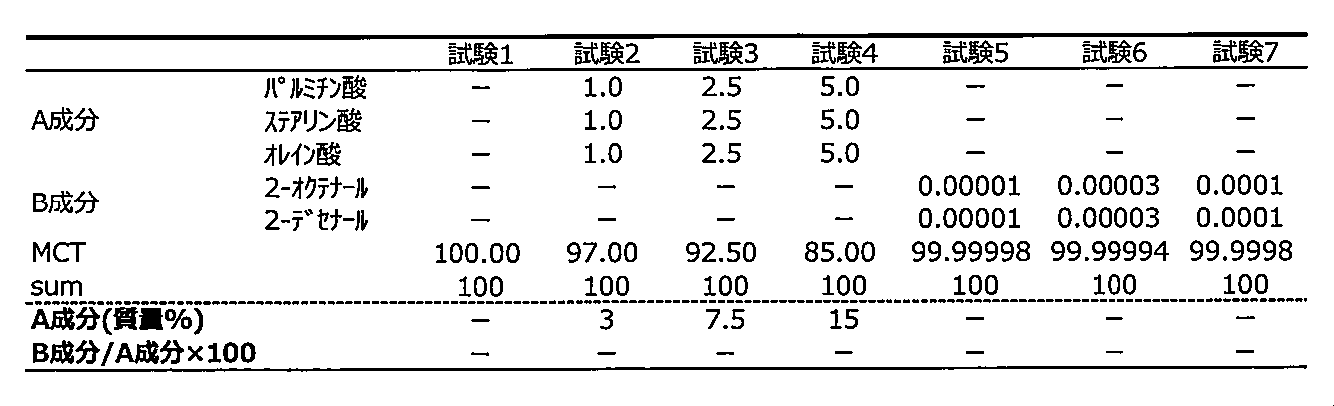
遊離パルミチン酸(純正化学(株)社製、粉末状)、遊離ステアリン酸(純正化学(株)社製、粉末状)、遊離オレイン酸(東京化成工業(株)社製、液体状)、2-オクテナール(東京化成工業(株)社製、液体状)、2-デセナール(東京化成工業(株)社製、液体状)、及び、MCT(日清オイリオグループ(株)社製、液体状)を準備した。そして、MCTをベースにして、表2-1及び表2-2に示す組成で、油脂組成物を作製した(表中、sumは合計質量を意味し、単位は質量(g)である)。そして、遊離脂肪酸及び不飽和アルデヒドの各濃度を一定にし、A成分の遊離脂肪酸及びB成分の不飽和アルデヒド全てが揃うことの有用性について検討した。


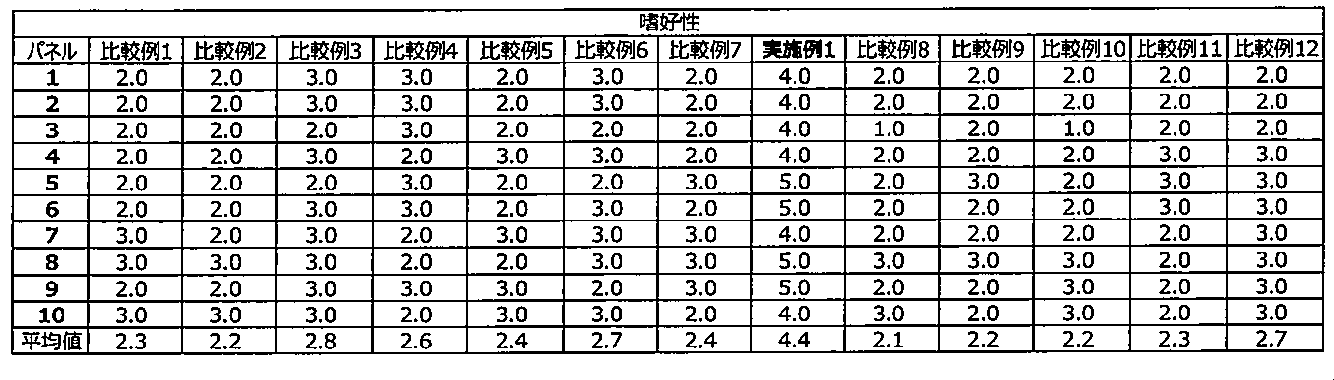
市販レトルトカレーに対して、実施例1、比較例1~12の組成物を各々0.025質量%添加して専門パネル10名により官能評価を実施した。結果を下記表2-3に示す。また、各専門パネルの評点を、表2-4及び表2-5に示す。表2-4及び表2-5から、各パネラー間の評価の程度はほぼ共通していることが理解できる。
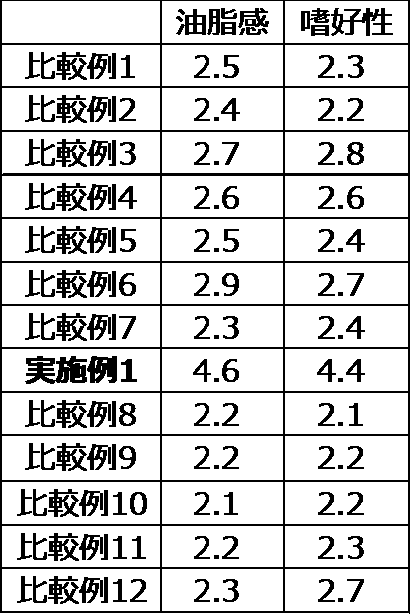

本実験により、A成分の遊離脂肪酸及びB成分の不飽和アルデヒドを全て含有する場合に、食品に対し特異的に高い油脂感を付与できることが示された。
遊離パルミチン酸、遊離ステアリン酸、遊離オレイン酸、2-オクテナール、2-デセナール、及びMCTについては、実験1と同様に準備した。
そして、MCTをベースにして、表3-1に示す組成で、油脂組成物を作製した(表中、sumは合計質量を意味し、単位は質量(g)である)。そして、A成分100質量部に対するB成分の割合、及び組成物の全質量に対するA成分の含有量が、本発明の範囲に含まれることの有用性について検討した。なお、表3-1中、比較例における太字の数値は、本発明の要件を満たさない数値である。
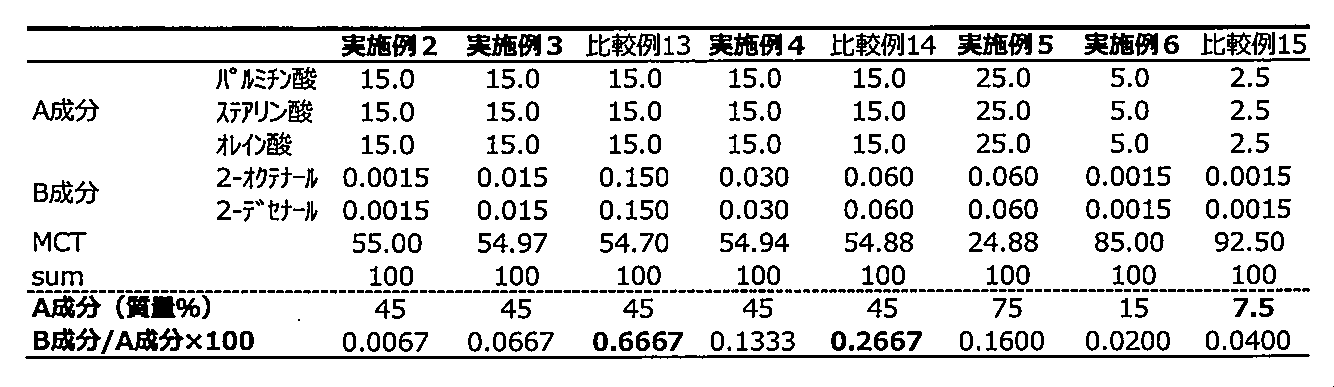
市販チーズリゾットの素を沸騰水で加温溶解後、実施例2~6、比較例13~15の組成物を各々0.025%添加して専門パネル10名により官能評価を実施した。結果を下記表3-2に示す。また、各専門パネルの評点を、表3-3及び表3-4に示す。表3-3及び表3-4から、各パネラー間の評価の程度はほぼ共通していることが理解できる。


本実験により、本発明に係るA成分の遊離脂肪酸及びB成分の不飽和アルデヒドの含有比及び割合を有する油脂組成物は、食品に対し特異的に高い油脂感を付与できることが示された。
実施例101~113及び比較例101~119に従って得られた最終生成物の官能評価を行い、その結果を表4~16に記載し、表中、コメント欄に具体的な効果を示した。
市販牛脂95.0gに4.95gの水を加え、スミチームRLS(新日本化学工業(株)社製)を0.05g添加し、50℃にて20時間撹拌し反応を実施した。反応後、85℃で60分間加熱失活を実施した。酵素失活後、50℃まで冷却を行い、遠心分離にて上清を回収し、芒硝(馬居化成工業(株)社製)を5%重量添加し、脱水処理を実施した。脱水後、濾過にて固形分を除去し、ろ液を77.2g得た。ろ液を120℃まで加熱、7.7ml/分の空気を通気しながら2時間撹拌し、加熱処理を停止した。50℃まで冷却を行い、得られた加熱処理物に対して活性白土を5.0%重量添加し、50℃で4時間撹拌した。撹拌後、濾過にて固形分を除去し、実施例101の最終生成物を57.9g得た。
市販鶏脂85.0gに14.5gの水を加え、スミチームMML-G(新日本化学工業(株)社製)を0.5g添加し、50℃にて20時間撹拌し反応を実施した。反応後、85℃で30分間加熱失活を実施した。酵素失活後、50℃まで冷却を行い、遠心分離にて上清を回収し、無水硫酸マグネシウム(ナカライテスク(株)社製)を2%重量添加し、脱水処理を実施した。脱水後、濾過にて固形分を除去し、ろ液を71.2g得た。ろ液を110℃まで加熱、10.65ml/分の空気を通気しながら2時間撹拌し、加熱処理を停止した。50℃まで冷却を行い、得られた加熱処理物に対して活性白土を2.5%重量添加し、50℃で4時間撹拌した。撹拌後、濾過にて固形分を除去し、実施例102の最終生成物を56.9g得た。
水分含有量を1.0%未満に調整した市販豚脂95.0gを120℃まで加熱、9.5ml/分の空気を通気しながら3時間撹拌し、加熱処理を停止した。50℃まで冷却を行い、得られた加熱処理物に対して4.95gの水を加え、スミチームRLS(新日本化学工業(株)社製)を0.05g添加し、20時間撹拌し反応を実施した。反応後、85℃で60分間加熱失活を実施した。酵素失活後、実施例102と同じ条件で、脱水処理を行い、脱水後、濾過にて固形分を除去し、ろ液を85g得た。ろ液に対して実施例102と同じ条件で活性白土を2.5%重量添加し、50℃で4時間撹拌した。撹拌後、濾過にて固形分を除去し、実施例103の最終生成物を68.4g得た。
市販無塩バター90.0gに9.0gの水を加え、リパーゼAY30SD(天野エンザイム(株)社製)を1.0g添加し、実施例102と同じ条件で反応させて、反応後、酵素を失活させ、脱水処理を行い、脱水後、濾過にて固形分を除去し、ろ液を64.1g得た。ろ液を105℃まで加熱、6.4ml/分の空気を通気しながら2時間撹拌し、加熱処理を停止した。50℃まで冷却を行い、得られた加熱処理物に対して活性白土を2.5%重量添加し、50℃で4時間撹拌した。撹拌後、濾過にて固形分を除去し、実施例104の最終生成物を52.8g得た。
市販タラ油85.0gに13.0gの水を加え、スミチームMML-G(新日本化学工業(株)社製)を2.0g添加し、実施例102と同じ条件で反応させて、反応後、酵素を失活させ、脱水処理を行い、脱水後、濾過にて固形分を除去し、リパーゼ反応物としてのろ液を70.3g得た。また、水分含有量を1.0%未満に調整した市販タラ油100gを120℃まで加熱、10ml/分の空気を通気しながら2時間撹拌し、加熱処理を停止した。窒素置換後、得られた加熱処理物に対して10ml/分の窒素を通気しながら2時間撹拌した。27℃まで冷却を行い、加熱反応物を92.5g得た。前記ろ液と加熱反応物を混合し、実施例105の最終生成物を162.8g得た。
市販サーモン油85.0gに14.99gの水を加え、リパーゼDF15(天野エンザイム(株)社製)を0.01g添加し、37℃にて20時間撹拌し反応を実施した。反応後、85℃で60分間加熱失活を実施した。酵素失活後、37℃まで冷却を行い、遠心分離にて上清を回収した。得られた回収物を実施例102と同じ条件で、脱水処理を行い、脱水後、濾過にて固形分を除去しろ液を70.5g得た。ろ液を120℃まで加熱、7ml/分の空気を通気しながら2時間撹拌し、加熱処理を停止した。窒素置換後、得られた加熱処理物に対して14ml/分の窒素を通気しながら2時間撹拌した。50℃まで冷却を行い、実施例106の最終生成物を63.4g得た。
市販パーム油85gに14.97gの水を加え、リパーゼAY30G(天野エンザイム(株)社製)を0.03g添加し、50℃にて3時間撹拌し反応を実施した。反応後、85℃で60分間加熱失活を実施した。酵素失活後、50℃まで冷却を行い、一晩50℃静置した。静置後、分液にて上清を回収し、得られた回収物を実施例101と同じ条件で脱水処理し、濾過にて固形分を除去して、ろ液を57.8g得た。ろ液を105℃まで加熱、11.4ml/分の空気を通気しながら2時間撹拌し、加熱処理を停止した。50℃まで冷却を行い、得られた加熱処理物に対して6.0重量%の活性白土を添加し、50℃で6時間撹拌した。撹拌後、濾過にて固形分を除去し、実施例107の最終生成物を41.6g得た。
市販オリーブ油100.0gに300.0gの水と乳化剤0.2gを加え、リパーゼMER(天野エンザイム(株)社製)を1.0g添加し、40℃にて20時間撹拌し反応を実施した。反応後、85℃で15分間加熱失活を実施した。酵素失活後、40℃まで冷却を行い、遠心分離にて上清を回収した。得られた回収物を実施例102と同じ条件で、脱水処理を行い、脱水後、濾過にて固形分を除去し、ろ液を79.2g得た。ろ液を120℃まで加熱、7.9ml/分の空気を通気しながら2時間撹拌し、加熱処理を停止した。50℃まで冷却を行い、得られた加熱処理物を実施例101と同じ条件にて活性白土で処理し、濾過にて固形分を除去し、実施例108の最終生成物を58.9g得た。
市販コーン油95.0gに4.975gの水を加え、スミチームNLS(新日本化学工業(株)社製)を0.025g添加し、実施例106と同じ条件で反応させて、反応後、酵素を失活させ、脱水処理を行い、脱水後、濾過にて固形分を除去し、ろ液を78.7g得た。ろ液を120℃まで加熱、7.8ml/分の空気を通気しながら2時間撹拌し、加熱処理を停止した。窒素置換後、得られた加熱処理物に対して15.6ml/分の窒素を通気しながら2時間撹拌した。50℃まで冷却を行い、実施例109の最終生成物を70.1g得た。
市販カカオバター85.0gに14.99gの水を加え、スミチームRLS(新日本化学工業(株)社製)を0.01g添加し、50℃にて3時間撹拌し反応を実施した。反応後、95℃で60分間加熱失活を実施した。酵素失活後、55℃まで冷却を行い、遠心分離にて上清を回収した。得られた回収物を実施例102と同じ条件で、脱水処理を行い、脱水後、濾過にて固形分を除去し、ろ液を72.9g得た。ろ液を120℃まで加熱、72ml/分の空気を通気しながら3時間撹拌し、加熱処理を停止した。55℃まで冷却を行い、得られた加熱処理物を実施例102と同じ条件にて活性白土で処理し、濾過にて固形分を除去し、実施例110の最終生成物を58.1g得た。
市販ヤシ油95.0gに4.85gの水を加え、リパーゼAY30G(天野エンザイム(株)社製)を0.15g添加し、実施例102と同じ条件で反応させて、反応後、酵素を失活させ、脱水処理を行い、脱水後、濾過にて固形分を除去し、ろ液を81.8g得た。ろ液を110℃まで加熱、8.1ml/分の空気を通気しながら2時間撹拌し、加熱処理を停止した。50℃まで冷却を行い、得られた加熱処理物を実施例102と同じ条件にて活性白土で処理し、濾過にて固形分を除去し、実施例111の最終生成物を64.9g得た。
市販ナタネ油95.0gに4.9gの水を加え、リパーゼDF15(天野エンザイム(株)社製)を0.1g添加し、実施例106と同じ条件で反応させて、反応後、酵素を失活させ、脱水処理を行い、脱水後、濾過にて固形分を除去し、ろ液を83.5g得た。ろ液を100℃まで加熱、8.3ml/分の空気を通気しながら2時間撹拌し、加熱処理を停止した。50℃まで冷却を行い、得られた加熱処理物を実施例101と同じ条件にて活性白土で処理し、濾過にて固形分を除去し、実施例112の最終生成物を61.2g得た。
市販コーヒー油95.0gに4.93gの水を加え、リパーゼDF15(天野エンザイム(株)社製)を0.07g添加し、実施例106と同じ条件で反応させて、反応後、酵素を失活させ、脱水処理を行い、脱水後、濾過にて固形分を除去し、ろ液を75.3g得た。ろ液を100℃まで加熱、37.6ml/分の空気を通気しながら2時間撹拌し、加熱処理を停止した。窒素置換後、得られた加熱処理物に対して37.6ml/分の窒素を通気しながら2時間撹拌した。50℃まで冷却を行い、実施例113の最終生成物を67.2g得た。
市販牛脂95.0gに4.95gの水を加え、スミチームRLS(新日本化学工業(株)社製)を0.05g添加し、50℃にて20時間撹拌し反応を実施した。反応後、85℃で60分間加熱失活を実施した。酵素失活後、50℃まで冷却を行い、遠心分離にて上清を回収し、芒硝(馬居化成工業(株)社製)を5%重量添加し、脱水処理を実施した。脱水後、濾過にて固形分を除去し、比較例101の最終生成物を77.2g得た。
市販牛脂100.0gを120℃まで加熱、10ml/分の空気を通気しながら2時間撹拌し、加熱処理を停止した。50℃まで冷却を行い、得られた加熱処理物に対して5.0重量%の活性白土を添加し、50℃で4時間撹拌した。撹拌後、濾過にて固形分を除去し、比較例102の最終生成物を79.5g得た。
市販鶏脂85.0gに14.5gの水を加え、スミチームMML-G(新日本化学工業(株)社製)を0.5g添加し、50℃にて20時間撹拌し反応を実施した。反応後、85℃で30分間加熱失活を実施した。酵素失活後、50℃まで冷却を行い、遠心分離にて上清を回収し、無水硫酸マグネシウム(ナカライテスク(株)社製)を2%重量添加し、脱水処理を実施した。脱水後、濾過にて固形分を除去し、比較例103の最終生成物を71.2g得た。
市販豚脂50.0gに49.5gの0.05Mリン酸緩衝液を加え、リパーゼAY30G(天野エンザイム(株)社製)を0.5g添加し、50℃にて8時間撹拌し反応を実施した。反応後、85℃で30分間加熱失活を実施した。酵素失活後、150℃まで加熱、1000ml/分の空気を通気しながら、1時間撹拌し、加熱処理を停止し、比較例104の最終生成物を89.6g得た。
市販豚脂95.0gに4.95gの水を加え、スミチームRLS(新日本化学工業(株)社製)を0.05g添加し、50℃にて20時間撹拌し反応を実施した。反応後、85℃で60分間加熱失活を実施した。酵素失活後、比較例103と同じ操作により脱水処理して固形分を除去し、比較例105の最終生成物を85.0g得た。
市販豚脂100.0gを120℃まで加熱、10ml/分の空気を通気しながら3時間撹拌し、加熱処理を停止した。50℃まで冷却を行い、得られた加熱処理物に対して2.5重量%の活性白土を添加し、50℃で4時間撹拌した。撹拌後、濾過にて固形分を除去し、比較例106の最終生成物を80.9g得た。
市販鶏脂の代わりに市販無塩バター90.0gに9.0gの水を加え、スミチームMML-Gを添加する代わりにリパーゼAY30SD(天野エンザイム(株)社製)を1.0g添加した以外は、比較例103と同じ操作により処理し、比較例107の最終生成物を64.1g得た。
予め水分含有量1.0%未満に調整した市販無塩バター100.0gを105℃まで加熱、10ml/分の空気を通気しながら2時間撹拌し、加熱処理を停止した。冷却後、得られた加熱処理物を比較例106と同じ操作により脱水処理して固形分を除去し、比較例108の最終生成物を82.4g得た。
市販鶏脂の代わりに市販タラ油85.0gに13.0gの水を加え、スミチームMML-Gを添加する代わりにスミチームMML-G(新日本化学工業(株)社製)を2.0g添加した以外は、比較例103と同じ操作により処理し、比較例109の最終生成物を70.3g得た。
市販サーモン油85.0gに14.99gの水を加え、リパーゼDF15(天野エンザイム(株)社製)を0.01g添加し、37℃にて20時間撹拌し反応を実施した。反応後、85℃で60分間加熱失活を実施した。酵素失活後、37℃まで冷却を行い、遠心分離にて上清を回収した。得られた回収物を比較例103と同じ操作により脱水処理して固形分を除去し、比較例110の最終生成物を70.5g得た。
市販パーム油85.0gに14.97gの水を加え、リパーゼAY30G(天野エンザイム(株)社製)を0.03g添加し、50℃にて3時間撹拌し反応を実施した。反応後、85℃で60分間加熱失活を実施した。酵素失活後、50℃まで冷却を行い、一晩50℃静置した。静置後、分液にて上清を回収し、得られた回収物を比較例101と同じ脱水処理して固形分を除去し、比較例111の最終生成物を57.8g得た。
市販オリーブ油100.0gに300.0gの水と乳化剤0.2gを加え、リパーゼMER(天野エンザイム(株)社製)を1.0g添加し、40℃にて20時間撹拌し反応を実施した。反応後、85℃で15分間加熱失活を実施した。酵素失活後、40℃まで冷却を行い、遠心分離にて上清を回収した。得られた回収物を比較例101と同じ操作により脱水処理して固形分を除去し、比較例112の最終生成物を79.2g得た。
市販サーモン油の代わりに市販コーン油95.0gに4.975gの水を加え、リパーゼDF15を添加する代わりにスミチームNLS(新日本化学工業(株)社製)を0.025g添加した以外は、比較例110と同じ操作により処理し、比較例113の最終生成物を78.7g得た。
市販コーン油100.0gを120℃まで加熱、10ml/分の空気を通気しながら2時間撹拌し、加熱処理を停止した。窒素置換後、得られた加熱処理物に対して20ml/分の窒素を通気しながら2時間撹拌した。50℃まで冷却を行い、比較例114の最終生成物を86.8g得た。
市販カカオバター85.0gに14.99gの水を加え、スミチームRLS(新日本化学工業(株)社製)を0.01g添加し、50℃にて3時間撹拌し反応を実施した。反応後、95℃で60分間加熱失活を実施した。酵素失活後、55℃まで冷却を行い、遠心分離にて上清を回収した。得られた回収物を比較例103と同じ操作により脱水処理して固形分を除去し、比較例115の最終生成物を72.9g得た。
市販カカオバター100.0gを120℃まで加熱、100ml/分の空気を通気しながら3時間撹拌し、加熱処理を停止した。55℃まで冷却を行い、得られた加熱処理物を比較例106と同じ操作により脱水処理して固形分を除去し、比較例116の最終生成物を79.2g得た。
市販鶏脂の代わりに市販ヤシ油95.0gに4.85gの水を加え、スミチームMML-Gを添加する代わりにリパーゼAY30G(天野エンザイム(株)社製)を0.15g添加した以外は、比較例103と同じ操作により処理し、比較例117の最終生成物を81.8g得た。
市販サーモン油の代わりに市販ナタネ油95.0 gに4.9gの水を加え、リパーゼDF15(天野エンザイム(株)社製)を0.1g添加した以外は、比較例110と同じ操作により処理し、比較例118の最終生成物を83.5g得た。
市販サーモン油の代わりに市販コーヒー油95.0gに4.93gの水を加え、リパーゼDF15(天野エンザイム(株)社製)を0.07g添加した以外は、比較例110と同じ操作により処理し、比較例119の最終生成物を75.3g得た。
市販レトルト牛丼に対して実施例101、比較例101と102及び市販牛脂(未処理(コントロール))を各々0.025%添加して専門パネル10名により官能評価を実施した。結果を下記に示す。

市販チキンスープ粉末(顆粒タイプ)5gに対して80℃の湯300gを加えて、十分に混合したものに、実施例102、比較例103と104及び市販鶏脂(未処理(コントロール))を各々0.025%添加して専門パネル10名により官能評価を実施した。結果を下記に示す。

市販レトルトカレーに対して、実施例103、比較例105と106及び市販豚脂(未処理(コントロール))を各々0.05%添加して専門パネル10名により官能評価を実施した。結果を下記に示す。
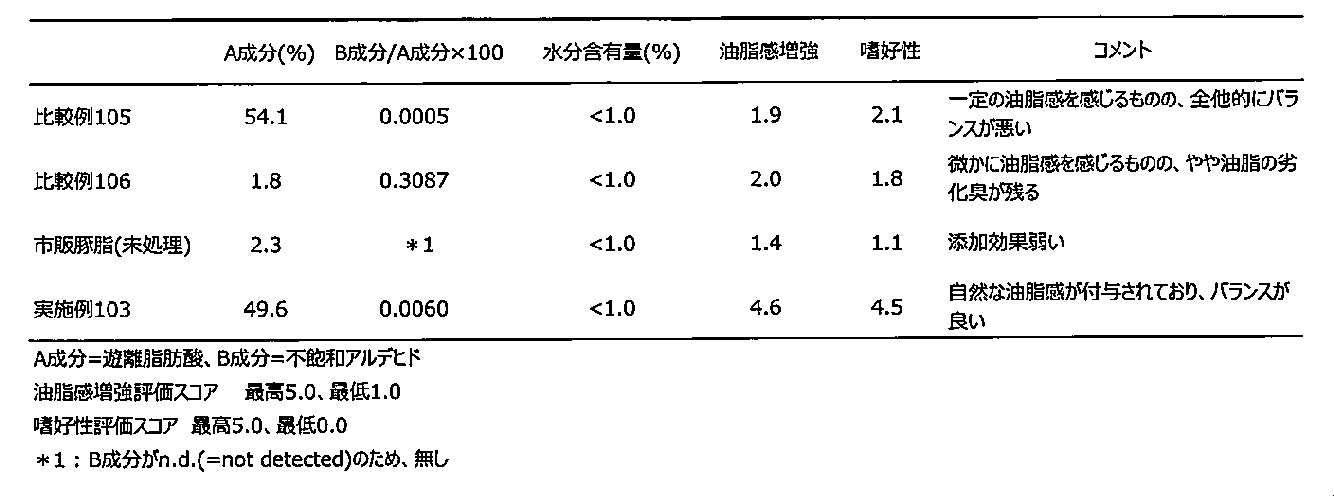
市販ラクトアイスに対して実施例104、比較例107と108及び市販乳脂(未処理(コントロール))を各々0.025%添加して、常法に従い、ラクトアイスを調整した。専門パネル10名により官能評価を実施した。結果を下記に示す。
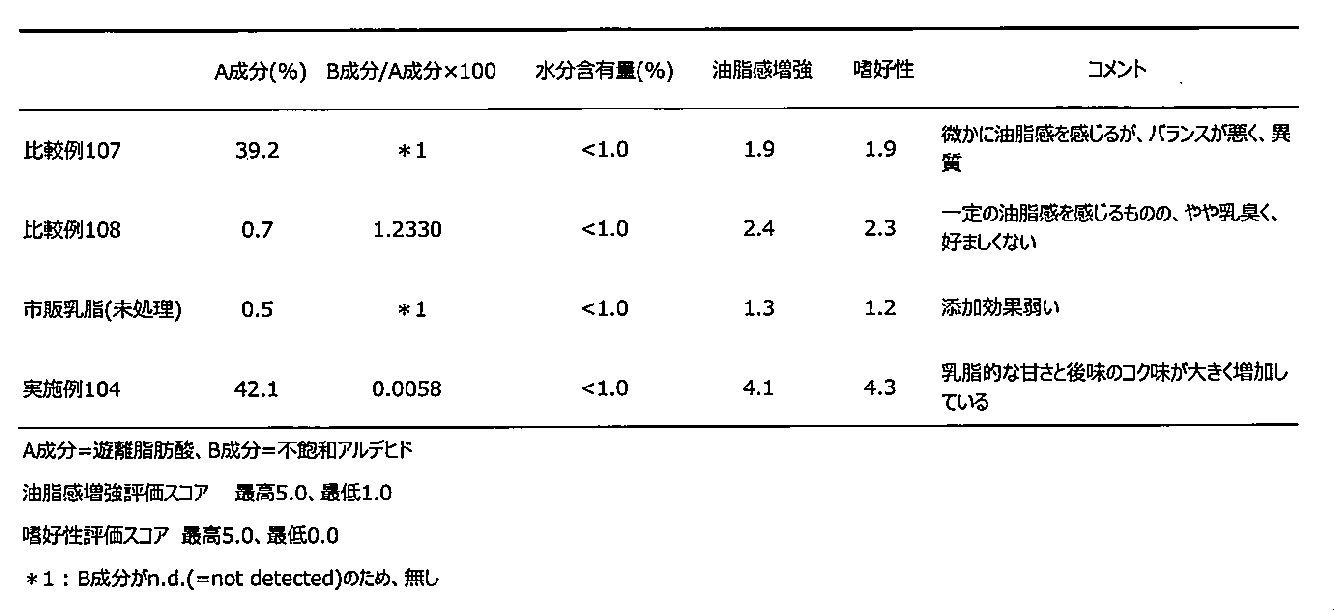
市販インスタントヌードル(シーフード)に対して実施例105、比較例109及び市販タラ油(未処理(コントロール))を各々0.01%添加して専門パネル10名により官能評価を実施した。結果を下記に示す。
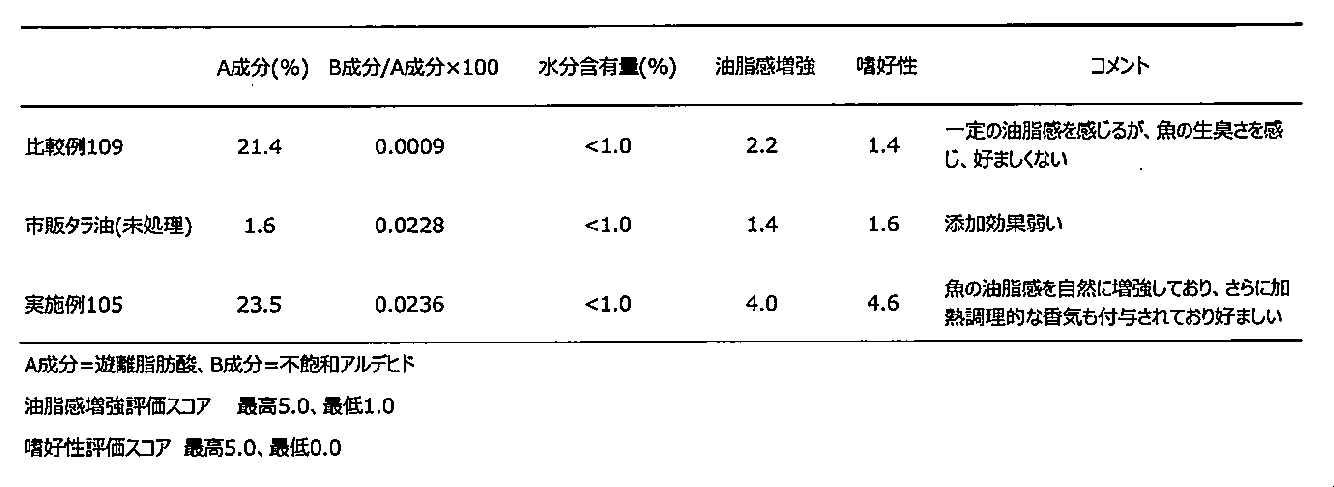
市販サーモンクリーム煮用ソースに対して実施例106、比較例110及び市販サーモン油(未処理(コントロール))を各々0.05%添加して専門パネル10名により官能評価を実施した。結果を下記に示す。

市販レトルトクリームシチューに対して実施例107、比較例111及び市販パーム油(未処理(コントロール))を各々0.025%添加して専門パネル10名により官能評価を実施した。
結果を下記に示す。
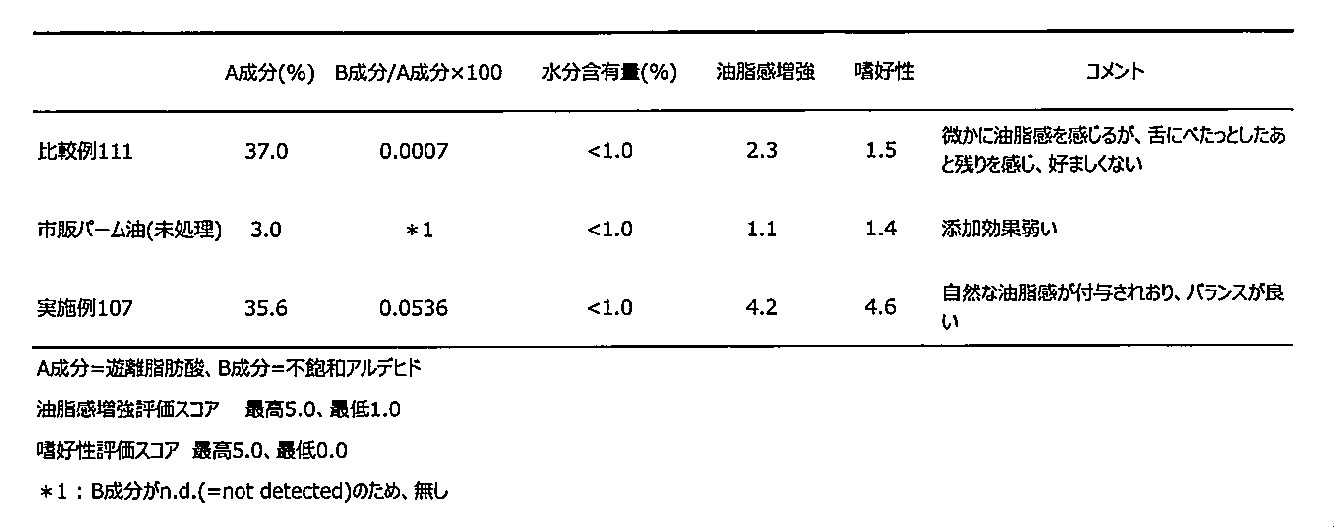
市販カルパッチョソースに対して実施例108、比較例112及び市販オリーブ油(未処理(コントロール))を各々0.025%添加して専門パネル10名により官能評価を実施した。結果を下記に示す。
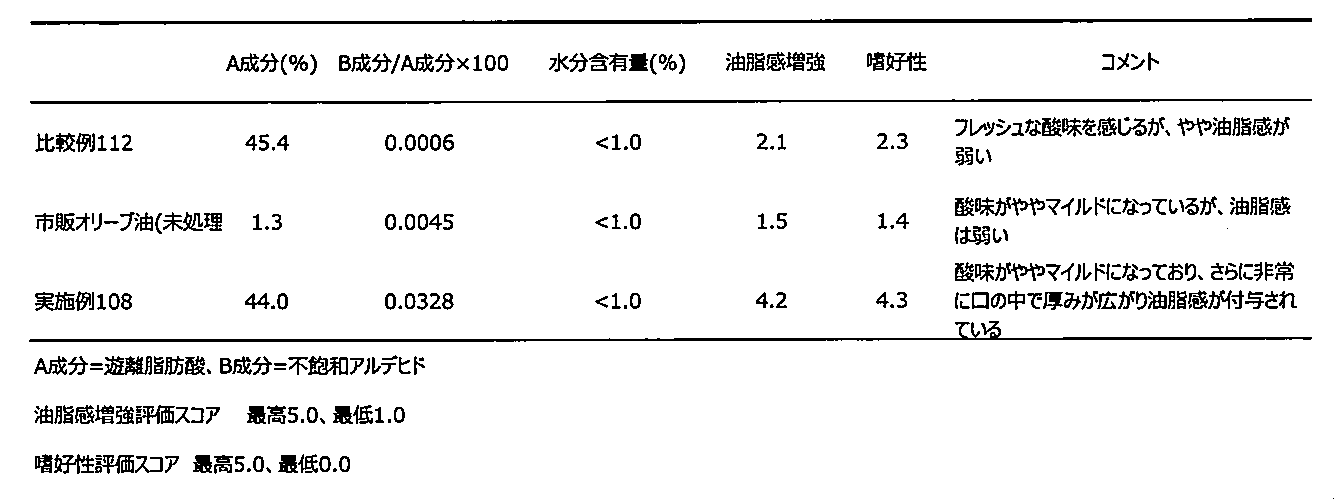
市販コーンポタージュに対して実施例109、比較例113と114及び市販コーン油(未処理(コントロール))を各々0.025%添加して専門パネル10名により官能評価を実施した。結果を下記に示す。
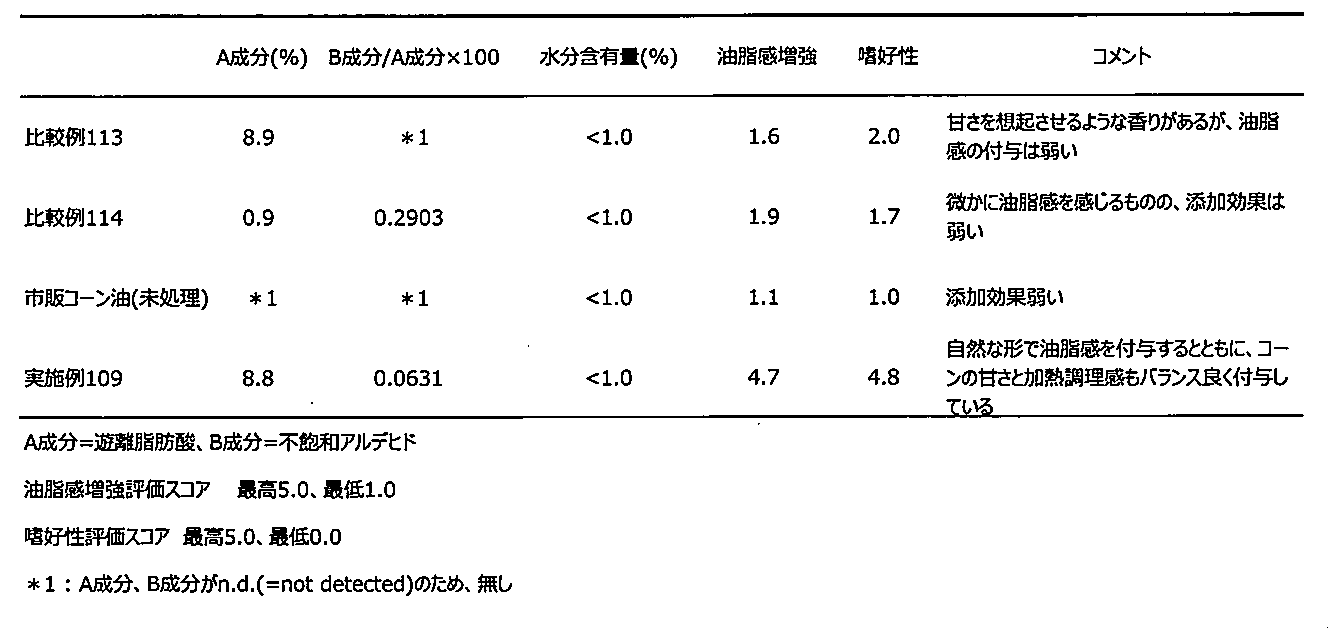
市販カフェモカに対して実施例110、比較例115と116及び市販カカオ脂(未処理(コントロール))を各々0.05%添加して専門パネル10名により官能評価を実施した。結果を下記に示す。
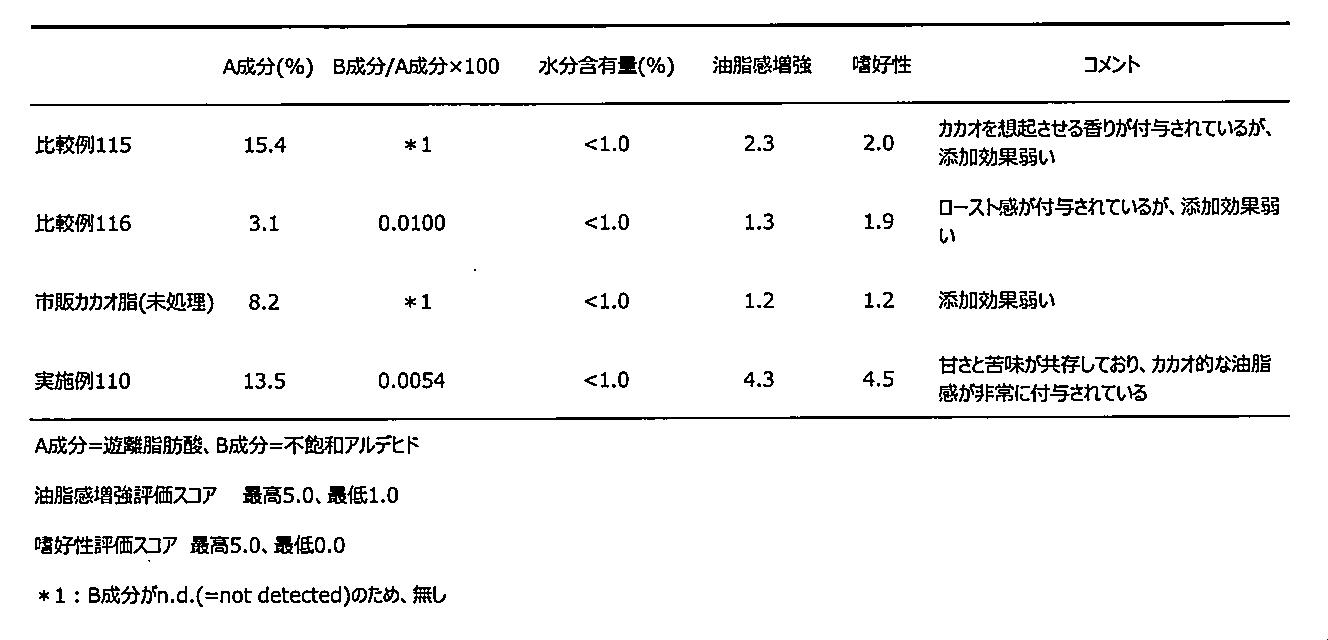
市販スライスチーズを50℃で加温溶解後、実施例111、比較例117及び市販ヤシ油(未処理(コントロール))を各々0.025%添加して、常法に従い、スライスチーズを調整した。
専門パネル10名により官能評価を実施した。結果を下記に示す。
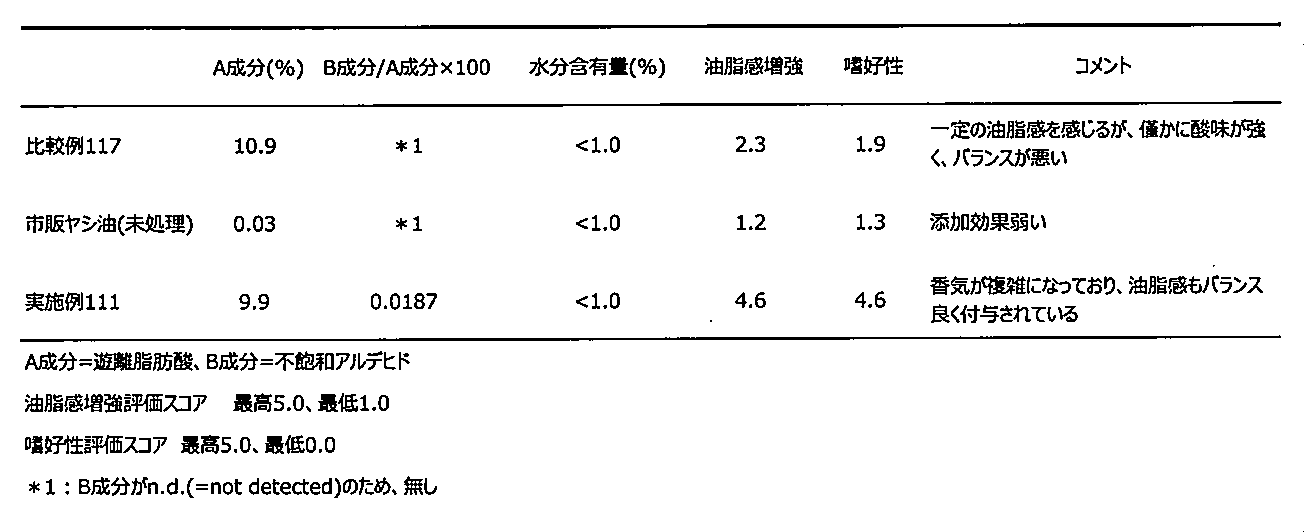
市販マヨネーズ(カロリーハーフ)に対して実施例112、比較例118及び市販ナタネ油(未処理(コントロール))を各々0.025%添加して、専門パネル10名により官能評価を実施した。結果を下記に示す。
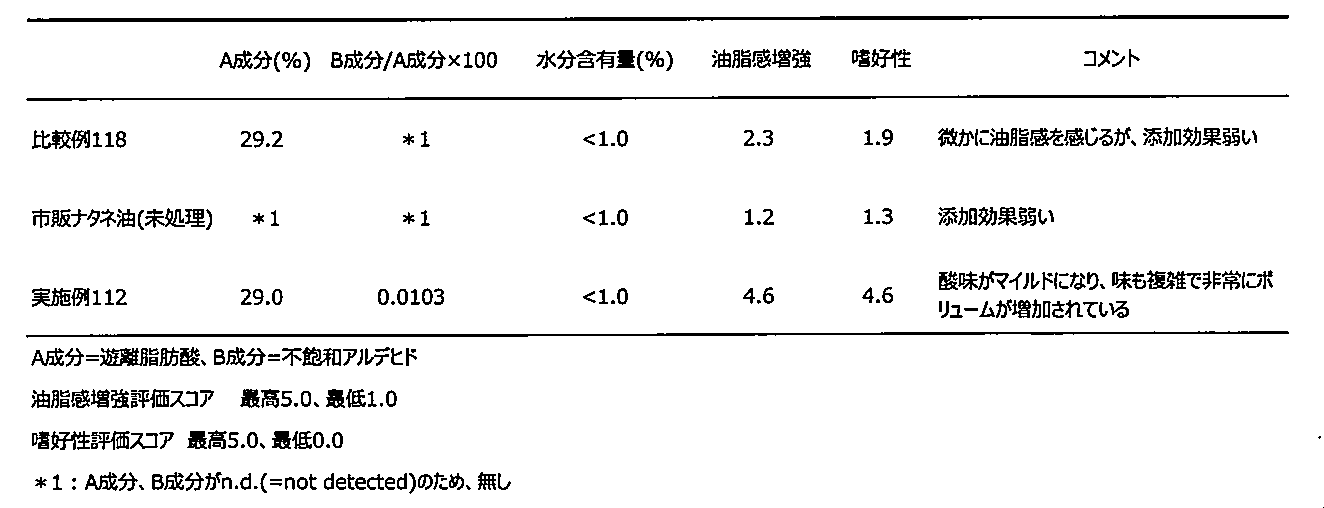
市販インスタントコーヒー(顆粒タイプ)2gに対して95℃の湯140gを加えて、十分に混合したものに、実施例113、比較例119及び市販コーヒー油(未処理(コントロール))を各々0.05%添加して専門パネル10名により官能評価を実施した。結果を下記に示す。

遊離パルミチン酸、遊離ステアリン酸、遊離オレイン酸、2-オクテナール、2-デセナール、及びMCTについては、実験1と同様に準備した。
そして、MCTをベースにして、表17-1及び表17-2に示す組成で、油脂組成物を作製した(表中、sumは合計質量を意味し、単位は質量(g)である)。そして、A成分100質量部に対するB成分の割合、及び組成物の全質量に対するA成分の含有量が、本発明の範囲に含まれることの有用性について検討した。なお、本実験では、5成分のバランスに関しては、実験3の各種実施例における組成物における含有濃度の平均値から算出した。

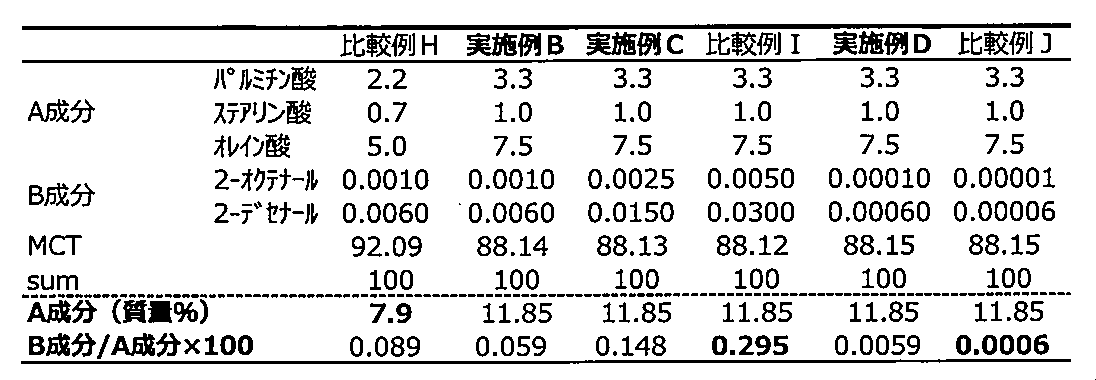
市販レトルトパスタソースに対して実施例A~D、比較例A~Jの組成物を各々0.025%添加して専門パネル10名により官能評価を実施した。結果を下記に示す。

Claims (10)
- 水分含有量が1.0質量%未満で、以下のA成分及びB成分を含有する油脂組成物であって、
A成分:遊離パルミチン酸、遊離オレイン酸、及び遊離ステアリン酸からなる3種類の遊離脂肪酸;
B成分:2-デセナール、及び2-オクテナールからなる2種類の不飽和アルデヒド
A成分100質量部に対して0.002~0.2質量部のB成分を含有し、かつ、
前記組成物の全質量に対して8.5質量%以上のA成分を含有する、油脂組成物。 - 動植物油脂または脂肪酸誘導体由来の油脂を含む、請求項1に記載の油脂組成物。
- 動植物油脂が牛脂、豚脂、鶏脂、羊脂、乳脂、オリーブ油、パーム油、ナタネ油、コーン油、ヤシ油、カカオバター、コーヒー油、タラ油、サーモン油、カツオ油、イワシ油、マグロ油からなる群から選択される少なくとも1つである、請求項2に記載の油脂組成物。
- 動植物油脂を、
(a)リパーゼ処理する工程、
(b)水分含量1.0質量%未満になるように脱水処理する工程、及び
(c)80℃以上の加熱処理する工程を含み、
工程(b)を工程(c)の前に行い、
(d)過酸化物除去処理する工程を、工程(c)の後に含んでもよい、油脂組成物の製造方法。 - 動植物油脂をリパーゼ処理してリパーゼ反応物を得る工程と、
動植物油脂を水分含量1.0質量%未満に脱水処理した後に80℃以上に加熱処理して加熱反応物を得る工程と、
リパーゼ反応物と加熱反応物とを合わせる工程とを含み、
前記加熱反応物は、加熱処理の後にさらに過酸化物除去処理を受けていてもよい、油脂組成物の製造方法。 - 動植物油脂が牛脂、豚脂、鶏脂、羊脂、乳脂、オリーブ油、パーム油、ナタネ油、コーン油、ヤシ油、カカオバター、コーヒー油、タラ油、サーモン油、カツオ油、イワシ油、マグロ油からなる群から選択される少なくとも1つである、請求項4又は5に記載の油脂組成物の製造方法。
- 請求項4~6のいずれか1項に記載の油脂組成物の製造方法であって、
前記油脂組成物が、
A成分:遊離パルミチン酸、遊離オレイン酸、及び遊離ステアリン酸からなる3種類の遊離脂肪酸;及び
B成分:2-デセナール、及び2-オクテナールからなる2種類の不飽和アルデヒド
を含み、
A成分100質量部に対して0.002~0.2質量部のB成分を含有し、
組成物の全質量に対して8.5質量%以上のA成分を含有する、前記製造方法。 - 請求項4~7のいずれか1項に記載の方法で得られる、油脂組成物。
- 請求項1~3及び8のいずれか1項記載の油脂組成物を含有する香料組成物。
- 請求項1~3及び8のいずれか1項記載の油脂組成物、又は請求項9記載の香料組成物を含有する、飲食品。
Priority Applications (4)
| Application Number | Priority Date | Filing Date | Title |
|---|---|---|---|
| SG11202004253QA SG11202004253QA (en) | 2017-11-09 | 2018-11-09 | Oil-and-fat composition and manufacturing method thereof |
| US16/762,197 US11540530B2 (en) | 2017-11-09 | 2018-11-09 | Oil-and-fat composition and manufacturing method thereof |
| CN201880072657.5A CN111315229A (zh) | 2017-11-09 | 2018-11-09 | 油脂组合物及其制造方法 |
| EP18875647.2A EP3708008B1 (en) | 2017-11-09 | 2018-11-09 | Oil-and-fat composition for imparting an oily and greasy feeling and manufacturing method therefor |
Applications Claiming Priority (2)
| Application Number | Priority Date | Filing Date | Title |
|---|---|---|---|
| JP2017-216181 | 2017-11-09 | ||
| JP2017216181A JP7112193B2 (ja) | 2017-11-09 | 2017-11-09 | 油脂組成物及びその製造方法 |
Publications (1)
| Publication Number | Publication Date |
|---|---|
| WO2019093466A1 true WO2019093466A1 (ja) | 2019-05-16 |
Family
ID=66438548
Family Applications (1)
| Application Number | Title | Priority Date | Filing Date |
|---|---|---|---|
| PCT/JP2018/041635 Ceased WO2019093466A1 (ja) | 2017-11-09 | 2018-11-09 | 油脂組成物及びその製造方法 |
Country Status (6)
| Country | Link |
|---|---|
| US (1) | US11540530B2 (ja) |
| EP (1) | EP3708008B1 (ja) |
| JP (1) | JP7112193B2 (ja) |
| CN (1) | CN111315229A (ja) |
| SG (1) | SG11202004253QA (ja) |
| WO (1) | WO2019093466A1 (ja) |
Cited By (2)
| Publication number | Priority date | Publication date | Assignee | Title |
|---|---|---|---|---|
| WO2021201210A1 (ja) * | 2020-04-02 | 2021-10-07 | 味の素株式会社 | 油脂含有食品を改質する方法 |
| WO2022172897A1 (ja) * | 2021-02-09 | 2022-08-18 | 株式会社J-オイルミルズ | うま味増強剤、うま味増強用油脂組成物、食用組成物のうま味増強方法、及びうま味増強剤の製造方法 |
Families Citing this family (14)
| Publication number | Priority date | Publication date | Assignee | Title |
|---|---|---|---|---|
| US12357008B2 (en) * | 2019-02-13 | 2025-07-15 | Pet Food Solutions, Inc. | Refined poultry fat product and uses thereof |
| EP4098131A4 (en) * | 2020-01-31 | 2024-03-20 | Ajinomoto Co., Inc. | METHOD FOR PRODUCING MEAT OR MEAT-LIKE PROCESSED FOOD PRODUCT |
| KR102240450B1 (ko) * | 2020-04-16 | 2021-04-15 | 주식회사 인스푸드코리아 | 혼합 튀김유의 제조방법 및 이에 의해 제조된 혼합 튀김유 |
| CN111658577A (zh) * | 2020-07-28 | 2020-09-15 | 英丽(中山)生物科技有限公司 | 抗菌挥发油及其制备方法、抗菌挥发油冻干粉、抗菌剂及应用 |
| JP7844353B2 (ja) * | 2020-12-17 | 2026-04-13 | 株式会社J-オイルミルズ | 塩味増強剤、塩味増強用油脂組成物、飲食品の塩味増強方法、及び塩味増強剤の製造方法 |
| CN112998235A (zh) * | 2021-03-31 | 2021-06-22 | 四川省川海晨洋食品有限责任公司 | 一种浓香滋补火锅底料及其制备方法 |
| ES3053383T3 (en) * | 2021-09-15 | 2026-01-21 | Nestle Sa | Process for an instant non-fried noodle and a product obtained thereby |
| CN113875826A (zh) * | 2021-10-20 | 2022-01-04 | 阿克苏别迭里食品有限公司 | 一种馕专用核桃黄油 |
| US20250024848A1 (en) * | 2021-12-07 | 2025-01-23 | Amano Enzyme Inc. | Flavor-improving enzyme agent and application thereof |
| CN118541032A (zh) * | 2021-12-16 | 2024-08-23 | 嘉吉公司 | 具有增强风味的基于棕榈油的起酥油组合物及其制备方法 |
| EP4467005A3 (en) * | 2022-08-24 | 2025-04-09 | Symrise AG | Seaweed-based flavouring compositions |
| TW202444258A (zh) * | 2023-03-14 | 2024-11-16 | 日商J 制油股份有限公司 | 牛脂感增強之油脂組成物、牛脂感增強劑、牛脂感增強之油脂組成物之製造方法、油炸食品之製造方法及牛脂感增強方法 |
| WO2025203870A1 (ja) * | 2024-03-25 | 2025-10-02 | 日清オイリオグループ株式会社 | ヨーグルト風味食品及び油性感の低減方法 |
| JP7839826B2 (ja) * | 2024-05-31 | 2026-04-02 | ハウス食品株式会社 | 加工固形食品の製造方法 |
Citations (10)
| Publication number | Priority date | Publication date | Assignee | Title |
|---|---|---|---|---|
| JPS6018577A (ja) * | 1983-07-12 | 1985-01-30 | Toyota Central Res & Dev Lab Inc | 劣化油中の過酸化物の除去方法 |
| JPH04229151A (ja) * | 1990-06-22 | 1992-08-18 | Quest Internatl Bv | 風味混合物の製造方法 |
| JPH07188692A (ja) * | 1993-12-27 | 1995-07-25 | Ikeda Shiyokuken Kk | 高度不飽和脂肪酸類含有組成物の過酸化物除去方法 |
| JP3344522B2 (ja) | 1994-11-02 | 2002-11-11 | 長谷川香料株式会社 | フレ−バ−付与剤の製造方法 |
| JP2007110984A (ja) * | 2005-10-21 | 2007-05-10 | Takasago Internatl Corp | 呈味改善剤 |
| CN101194704A (zh) | 2007-12-21 | 2008-06-11 | 华宝食用香精香料(上海)有限公司 | 一种以酶水解动物脂肪为原料氧化热裂解成肉味香料的方法 |
| JP2011223942A (ja) * | 2010-04-21 | 2011-11-10 | T Hasegawa Co Ltd | 風味改善剤 |
| JP2013121325A (ja) | 2011-12-09 | 2013-06-20 | Kaneka Corp | 硬化油風味付与剤 |
| JP2014045766A (ja) * | 2012-09-04 | 2014-03-17 | Nissin Foods Holdings Co Ltd | 飲食品の呈味増強方法及び呈味増強用香味料組成物 |
| JP2014200236A (ja) * | 2013-04-10 | 2014-10-27 | 長谷川香料株式会社 | 硬化油風味付与剤 |
Family Cites Families (10)
| Publication number | Priority date | Publication date | Assignee | Title |
|---|---|---|---|---|
| US5104672A (en) | 1987-06-17 | 1992-04-14 | Nestec S.A. | Production of flavor |
| DE3864456D1 (de) * | 1987-06-17 | 1991-10-02 | Nestle Sa | Herstellung eines aromas. |
| EP1417288B1 (en) * | 2001-07-23 | 2018-08-29 | Cargill, Incorporated | Method and apparatus for processing vegetable oils |
| JP5249767B2 (ja) | 2006-09-14 | 2013-07-31 | 長谷川香料株式会社 | 硬化油風味付与剤 |
| US20100192453A1 (en) * | 2009-02-02 | 2010-08-05 | VERT CAPITAL LLC, dba VERT BIODIESEL | Production of biodiesel |
| CN102246946B (zh) * | 2011-07-25 | 2013-03-06 | 江南大学 | 一种通过脂肪控制酶解-温和加热氧化制备肉味香精前体物的方法 |
| CN104187558A (zh) | 2014-07-28 | 2014-12-10 | 上海应用技术学院 | 一种特征香气明显的热反应猪肉香精制备方法 |
| JP6238454B2 (ja) * | 2014-09-09 | 2017-11-29 | 長谷川香料株式会社 | 乳風味付与用粉末油脂組成物、および飲食品に乳風味を付与する方法 |
| MY192787A (en) * | 2016-04-27 | 2022-09-08 | Adeka Corp | Flavor improving material |
| JP6304840B2 (ja) * | 2016-10-03 | 2018-04-04 | 長谷川香料株式会社 | 乳風味付与用水中油型乳化組成物、および飲食品に乳風味を付与する方法 |
-
2017
- 2017-11-09 JP JP2017216181A patent/JP7112193B2/ja active Active
-
2018
- 2018-11-09 CN CN201880072657.5A patent/CN111315229A/zh active Pending
- 2018-11-09 EP EP18875647.2A patent/EP3708008B1/en active Active
- 2018-11-09 US US16/762,197 patent/US11540530B2/en active Active
- 2018-11-09 SG SG11202004253QA patent/SG11202004253QA/en unknown
- 2018-11-09 WO PCT/JP2018/041635 patent/WO2019093466A1/ja not_active Ceased
Patent Citations (12)
| Publication number | Priority date | Publication date | Assignee | Title |
|---|---|---|---|---|
| JPS6018577A (ja) * | 1983-07-12 | 1985-01-30 | Toyota Central Res & Dev Lab Inc | 劣化油中の過酸化物の除去方法 |
| JPH04229151A (ja) * | 1990-06-22 | 1992-08-18 | Quest Internatl Bv | 風味混合物の製造方法 |
| JPH07188692A (ja) * | 1993-12-27 | 1995-07-25 | Ikeda Shiyokuken Kk | 高度不飽和脂肪酸類含有組成物の過酸化物除去方法 |
| JP3344522B2 (ja) | 1994-11-02 | 2002-11-11 | 長谷川香料株式会社 | フレ−バ−付与剤の製造方法 |
| JP2007110984A (ja) * | 2005-10-21 | 2007-05-10 | Takasago Internatl Corp | 呈味改善剤 |
| JP4596475B2 (ja) | 2005-10-21 | 2010-12-08 | 高砂香料工業株式会社 | 呈味改善剤 |
| CN101194704A (zh) | 2007-12-21 | 2008-06-11 | 华宝食用香精香料(上海)有限公司 | 一种以酶水解动物脂肪为原料氧化热裂解成肉味香料的方法 |
| JP2011223942A (ja) * | 2010-04-21 | 2011-11-10 | T Hasegawa Co Ltd | 風味改善剤 |
| JP5349399B2 (ja) | 2010-04-21 | 2013-11-20 | 長谷川香料株式会社 | 風味改善剤 |
| JP2013121325A (ja) | 2011-12-09 | 2013-06-20 | Kaneka Corp | 硬化油風味付与剤 |
| JP2014045766A (ja) * | 2012-09-04 | 2014-03-17 | Nissin Foods Holdings Co Ltd | 飲食品の呈味増強方法及び呈味増強用香味料組成物 |
| JP2014200236A (ja) * | 2013-04-10 | 2014-10-27 | 長谷川香料株式会社 | 硬化油風味付与剤 |
Non-Patent Citations (2)
| Title |
|---|
| See also references of EP3708008A4 |
| SHI, XIAOXIA ET AL.: "Identification of characteristic flavour precursors from enzymatic hydrolysis-mild thermal oxidation tallow by descriptive sensory analysis and gas chromatography-olfactometry and partial least squares regression", JOURNAL OF CHROMATOGRAPHY B, vol. 913 - 91, 2013, pages 69 - 76, XP055606430 * |
Cited By (3)
| Publication number | Priority date | Publication date | Assignee | Title |
|---|---|---|---|---|
| WO2021201210A1 (ja) * | 2020-04-02 | 2021-10-07 | 味の素株式会社 | 油脂含有食品を改質する方法 |
| JPWO2021201210A1 (ja) * | 2020-04-02 | 2021-10-07 | ||
| WO2022172897A1 (ja) * | 2021-02-09 | 2022-08-18 | 株式会社J-オイルミルズ | うま味増強剤、うま味増強用油脂組成物、食用組成物のうま味増強方法、及びうま味増強剤の製造方法 |
Also Published As
| Publication number | Publication date |
|---|---|
| JP2019083776A (ja) | 2019-06-06 |
| US20200359644A1 (en) | 2020-11-19 |
| JP7112193B2 (ja) | 2022-08-03 |
| US11540530B2 (en) | 2023-01-03 |
| SG11202004253QA (en) | 2020-06-29 |
| EP3708008B1 (en) | 2026-02-25 |
| EP3708008A4 (en) | 2021-05-05 |
| EP3708008A1 (en) | 2020-09-16 |
| CN111315229A (zh) | 2020-06-19 |
Similar Documents
| Publication | Publication Date | Title |
|---|---|---|
| JP7112193B2 (ja) | 油脂組成物及びその製造方法 | |
| KR102068375B1 (ko) | 향미 프로파일 식용 조성물의 개선을 위한 n-아실-아미노산 유도체 | |
| JP6661657B2 (ja) | 乳製品の劣化臭マスキング剤及び乳製品の劣化臭マスキング方法 | |
| JP2005013138A (ja) | 香辛料フレーバーの製造方法 | |
| JP2005015684A (ja) | 野菜フレーバーの製造方法 | |
| KR20140137456A (ko) | 식품 향미 화합물로서의 감마 아미노-부티르산 및 베타 알라닌의 n-아실 유도체 | |
| KR20140146146A (ko) | 식품 향미 화합물로서의 n-아실-아미노산 유도체 | |
| EP3397072B1 (en) | Mixtures with stabilising properties | |
| KR20140146147A (ko) | 식품 향미 화합물로서의 n-아실화된 1-아미노사이클로알킬 카복실산 | |
| JP5941021B2 (ja) | 塩味増強剤及び飲食品の塩味増強方法 | |
| JP2014055201A (ja) | 野菜フレーバーの製造方法 | |
| JPWO2016084976A1 (ja) | 風味改善剤 | |
| JP2017514468A (ja) | 特に、ホットな及び/又は辛い味覚を生じさせるためのホモバニリン酸エステル | |
| JP2022082685A (ja) | 味質向上剤 | |
| RU2328874C2 (ru) | Средство улучшения основного вкуса (варианты) и содержащий его пищевой продукт | |
| EP2816100A1 (en) | Agent for improving aroma intensity and/or aroma quality | |
| WO2019035487A1 (ja) | シソ科メンタ属植物由来の抽出物とその製造方法 | |
| JP6946039B2 (ja) | 酢酸含有飲食品組成物 | |
| JP7642320B2 (ja) | 呈味改善用組成物 | |
| JP2017209079A (ja) | 風味改善剤 | |
| CN114727635B (zh) | 包含2-乙酰基-1-吡咯啉的植物提取物 | |
| JP7433128B2 (ja) | ロタンドンを有効成分とする飲食品の不快味のマスキング剤 | |
| WO2021235482A1 (ja) | ミント系香料用の呈味改善剤、及びそれを含む香料組成物、並びにミント系香料を含有する香料組成物の呈味改善方法 | |
| JP7654236B2 (ja) | 辛味成分含有液状調味料及びその製造方法 | |
| JP2026052515A (ja) | 不快味の抑制剤、不快味の抑制用香料組成物、不快味の抑制方法 |
Legal Events
| Date | Code | Title | Description |
|---|---|---|---|
| 121 | Ep: the epo has been informed by wipo that ep was designated in this application |
Ref document number: 18875647 Country of ref document: EP Kind code of ref document: A1 |
|
| NENP | Non-entry into the national phase |
Ref country code: DE |
|
| ENP | Entry into the national phase |
Ref document number: 2018875647 Country of ref document: EP Effective date: 20200609 |
|
| WWG | Wipo information: grant in national office |
Ref document number: 2018875647 Country of ref document: EP |
|
| WWG | Wipo information: grant in national office |
Ref document number: 11202004253Q Country of ref document: SG |
|
| WWP | Wipo information: published in national office |
Ref document number: 11202004253Q Country of ref document: SG |