WO2019094491A1 - Esters of dihydrotetrabenazine - Google Patents
Esters of dihydrotetrabenazine Download PDFInfo
- Publication number
- WO2019094491A1 WO2019094491A1 PCT/US2018/059657 US2018059657W WO2019094491A1 WO 2019094491 A1 WO2019094491 A1 WO 2019094491A1 US 2018059657 W US2018059657 W US 2018059657W WO 2019094491 A1 WO2019094491 A1 WO 2019094491A1
- Authority
- WO
- WIPO (PCT)
- Prior art keywords
- compound
- dhtbz
- formula
- oil
- compounds
- Prior art date
- Legal status (The legal status is an assumption and is not a legal conclusion. Google has not performed a legal analysis and makes no representation as to the accuracy of the status listed.)
- Ceased
Links
Classifications
-
- A—HUMAN NECESSITIES
- A61—MEDICAL OR VETERINARY SCIENCE; HYGIENE
- A61P—SPECIFIC THERAPEUTIC ACTIVITY OF CHEMICAL COMPOUNDS OR MEDICINAL PREPARATIONS
- A61P25/00—Drugs for disorders of the nervous system
- A61P25/14—Drugs for disorders of the nervous system for treating abnormal movements, e.g. chorea, dyskinesia
-
- A—HUMAN NECESSITIES
- A61—MEDICAL OR VETERINARY SCIENCE; HYGIENE
- A61K—PREPARATIONS FOR MEDICAL, DENTAL OR TOILETRY PURPOSES
- A61K31/00—Medicinal preparations containing organic active ingredients
- A61K31/33—Heterocyclic compounds
- A61K31/395—Heterocyclic compounds having nitrogen as a ring hetero atom, e.g. guanethidine or rifamycins
- A61K31/435—Heterocyclic compounds having nitrogen as a ring hetero atom, e.g. guanethidine or rifamycins having six-membered rings with one nitrogen as the only ring hetero atom
- A61K31/47—Quinolines; Isoquinolines
- A61K31/473—Quinolines; Isoquinolines ortho- or peri-condensed with carbocyclic ring systems, e.g. acridines, phenanthridines
-
- A—HUMAN NECESSITIES
- A61—MEDICAL OR VETERINARY SCIENCE; HYGIENE
- A61K—PREPARATIONS FOR MEDICAL, DENTAL OR TOILETRY PURPOSES
- A61K31/00—Medicinal preparations containing organic active ingredients
- A61K31/33—Heterocyclic compounds
- A61K31/395—Heterocyclic compounds having nitrogen as a ring hetero atom, e.g. guanethidine or rifamycins
- A61K31/435—Heterocyclic compounds having nitrogen as a ring hetero atom, e.g. guanethidine or rifamycins having six-membered rings with one nitrogen as the only ring hetero atom
- A61K31/47—Quinolines; Isoquinolines
- A61K31/4738—Quinolines; Isoquinolines ortho- or peri-condensed with heterocyclic ring systems
- A61K31/4745—Quinolines; Isoquinolines ortho- or peri-condensed with heterocyclic ring systems condensed with ring systems having nitrogen as a ring hetero atom, e.g. phenantrolines
-
- A—HUMAN NECESSITIES
- A61—MEDICAL OR VETERINARY SCIENCE; HYGIENE
- A61K—PREPARATIONS FOR MEDICAL, DENTAL OR TOILETRY PURPOSES
- A61K47/00—Medicinal preparations characterised by the non-active ingredients used, e.g. carriers or inert additives; Targeting or modifying agents chemically bound to the active ingredient
- A61K47/44—Oils, fats or waxes according to two or more groups of A61K47/02-A61K47/42; Natural or modified natural oils, fats or waxes, e.g. castor oil, polyethoxylated castor oil, montan wax, lignite, shellac, rosin, beeswax or lanolin
-
- C—CHEMISTRY; METALLURGY
- C07—ORGANIC CHEMISTRY
- C07D—HETEROCYCLIC COMPOUNDS
- C07D455/00—Heterocyclic compounds containing quinolizine ring systems, e.g. emetine alkaloids, protoberberine; Alkylenedioxy derivatives of dibenzo [a, g] quinolizines, e.g. berberine
- C07D455/03—Heterocyclic compounds containing quinolizine ring systems, e.g. emetine alkaloids, protoberberine; Alkylenedioxy derivatives of dibenzo [a, g] quinolizines, e.g. berberine containing quinolizine ring systems directly condensed with at least one six-membered carbocyclic ring, e.g. protoberberine; Alkylenedioxy derivatives of dibenzo [a, g] quinolizines, e.g. berberine
- C07D455/04—Heterocyclic compounds containing quinolizine ring systems, e.g. emetine alkaloids, protoberberine; Alkylenedioxy derivatives of dibenzo [a, g] quinolizines, e.g. berberine containing quinolizine ring systems directly condensed with at least one six-membered carbocyclic ring, e.g. protoberberine; Alkylenedioxy derivatives of dibenzo [a, g] quinolizines, e.g. berberine containing a quinolizine ring system condensed with only one six-membered carbocyclic ring, e.g. julolidine
- C07D455/06—Heterocyclic compounds containing quinolizine ring systems, e.g. emetine alkaloids, protoberberine; Alkylenedioxy derivatives of dibenzo [a, g] quinolizines, e.g. berberine containing quinolizine ring systems directly condensed with at least one six-membered carbocyclic ring, e.g. protoberberine; Alkylenedioxy derivatives of dibenzo [a, g] quinolizines, e.g. berberine containing a quinolizine ring system condensed with only one six-membered carbocyclic ring, e.g. julolidine containing benzo [a] quinolizine ring systems
-
- C—CHEMISTRY; METALLURGY
- C07—ORGANIC CHEMISTRY
- C07B—GENERAL METHODS OF ORGANIC CHEMISTRY; APPARATUS THEREFOR
- C07B2200/00—Indexing scheme relating to specific properties of organic compounds
- C07B2200/05—Isotopically modified compounds, e.g. labelled
Definitions
- the present invention relates to the compounds of formula (I), pharmaceutical compositions comprising these compounds, chemical processes for preparing these compounds and their use in the treatment of hyperkinetic diseases and disorders, such as tardive dyskinesia, by administration of such compounds to a warm-blooded animal in need thereof.
- the involuntary movement and repetitive body movement are typical symptoms of hyperkinetic movement disorder caused by exposure of long-term medication with dopamine amine blocking agents, such as antipsychotic agents.
- dopamine amine blocking agents such as antipsychotic agents.
- the actual mechanism of hyperkinetic movement disorder is still not clear.
- TD Tardive dyskinesia
- TD is one of the family of hyperkinetic movement disorder and generally is characterized by involuntary hyperkinetic movement in orofacial area and choreoathetoid disorder in the limbs and trunk.
- TD can be developed by long-term exposure of antipsychotic drugs and often persists even after discontinuation of treatment.
- VMAT2 Vesicular monoamine transporter-2
- VMAT2 is a membrane protein that transports the monoamine such as dopamine, serotonin, histamine and norepinephrine from presynaptic into synaptic vesicle.
- 3-isobutyl-9, 10,dimethoxy-1 ,3,4,6,7, 1 1 b- hexahydro-2H-pyrido[2, 1 -a]isoquinolin-2-one, also known as tetrabenazine (TBZ, XENAZINE ® ) is a potent (ICso is 3.2 nM, Scherman, et al., Proc. Natl. Acad. Sci.
- TBZ is a racemic mixture and presents two chiral centers. It can be rapidly and extensively metabolized to its reduced form, 3-isobutyl-9, 10-dimethoxy-1 ,3,4,6,7, 1 1 b- hexahydro-2H-pyrido[2, 1 -a]isoquinolin-2-ol, known as dihydrotetrabenzaine (DHTBZ). Due to the nature of racemic mixture, DHTBZ can be presented as four isomers, ( ⁇ )-a- DHTBZ and ( ⁇ )- ⁇ - ⁇ , where the extent to which isomer can be highly variable between patients (Mehvar et al., Drug Metab. and Dispos., 1987, 15, 250-255).
- the (+)-a-DHTBZ or 2R, 3R, 1 1 bR-DHTBZ is considered as the major active metabolite and exhibits excellent VMAT2 binding and off-target selectivity.
- other stereoisomers present variable pharmacology effects such as weak to moderate VMAT2 binding and high affinity to some off -target receptors (Grigoriadis et al., J. Pharmacol. Exp. Ther., 2017, 361 , 454-461 ).
- TBZ has been approved as hyperkinetic disorder medication; however, variable bioavailability due to the complexity of TBZ metabolism through extensive first pass effect and off-target phenomenon can result in variable inter-patient therapeutic results. Also, the short half-life and low bioavailability could cause more dosing frequency, three times per day.
- the off -target effect of TBZ caused by complex racemic metabolites can result in several serious side effects, including suicidality, depression, sedation, drowsiness, dizziness, insomnia, akathisia and parkinsonism.
- the genotyping of individuals could exhibit different degrees of metabolism of TBZ to generate variable concentration levels of each metabolite. Also, due to the genotyping issue, the dose titration of TBZ is required.
- a prodrug is a pharmacological substance (drug) that is administered in an inactive (or significantly less active) form.
- the prodrug is metabolized in vivo into its active parent drug.
- Administrating a prodrug of a single stereoisomer can provide the merit by avoiding exposure to all stereoisomer metabolites of dihydrotetrabenazine (DHTBZ).
- DHTBZ dihydrotetrabenazine
- VBZ [(+)-(a)-DHTBZ conjugated with valine, an amino acid] showed VAMT2 binding affinity, Ki, of 187 nM.
- the VBZ is less potent than (+)-(a)-DHTBZ, but is still quite a strong inhibitor for VMAT2.
- Aranda disclosed a caproic acid ester of DHTBZ (see page 370 of Aranda, Compound No. 6) and Kilbourn disclosed an acetic acid ester of DHTBZ (see page 60 of Kilbourn, right hand column).
- these types of compounds are not suitable for use as prodrugs of DHTBZ.
- Aranda reports a VMAT2 binding affinity (EC50) for the caproic acid ester of 8.1 ⁇ 3.3 nM compared to 6.7 ⁇ 1 .1 nM for (+)-(a)-DHTBZ (see Table 1 , page 370). This corresponds to a Ki of 5.7 nM for the caproic acid ester compared to 4.7 nM for (+)-((3 ⁇ 4)-
- DHTBZ see 16 of the Declaration.
- the acetate ester of Kilbourn was found to have a Ki of 16 nM compared to 5.3 nM for (+)-(a)-DHTBZ (see 17 of the Declaration).
- the acetate ester of Kilbourn (C2) showed lower affinity than the caproic acid ester of Aranda (C6), i.e., 16 nM vs 5.7 nM. It appears that the longer the carbon chain of the esters, the stronger the inhibitor for VAMT2.
- Both caproic acid ester and acetate esters are potent VAMT2 inhibitors with comparable potency (Ki) to that of (+)-(a)-DHTBZ.
- the VBZ is a successful oral dosage form, it has to be taken daily for a long time. It's still relative potent to VMAT2 receptor and not ideal for use as a prodrug. Therefore there is still a need for a much longer acting dosage form which can significantly reduce dosing frequency and improved compliance. There is also a need for a modified drug to have a lower potency to VMAT2 than VBZ.
- the present invention relates to a compound of formula (I) including any stereochemical ⁇ isomeric form thereof, or a pharmaceutically acceptable salt thereof.
- the alkyl ester can contain saturated or unsaturated C12 to C26 alkyl carbon.
- the alkyl carbon chain can have either a straight, branched, noncyclic, cyclic or substituted structure.
- the present invention provides the conjugations of (2R, 3R, 1 1 bR)-3- isobutyl-9, 10-dimethoxy-1 ,3,4,6,7, 1 1 b-hexahydro-2H-pyrido[2, 1 -a]isoquinolin-2-ol ((+)-a- DHTBZ) and (2S, 3R, 1 1 bR)-3-isobutyl-9, 10-dimethoxy-1 , 3,4,6,7, 1 1 b-hexahydro-2H- pyrido[2, 1 -a]isoquinolin-2-ol ((- ⁇ )- ⁇ - ⁇ ) compounds, as well as the modification method of these compounds, use, and pharmaceutical compositions containing the same.
- the compounds of formula (I) of the present invention has both good chemical and physical stability, minimal or no VMAT2 binding and acceptable ester hydrolysis rate. [0018]
- the compounds of formula (I) of the present invention can achieve a broad spectrum of therapeutic applications, and may be used as the inhibitor for vesicular monoamine transporter 2 (VMAT2) receptor and its associated disease, such as the family of hyperkinetic movement disorder diseases.
- VMAT2 vesicular monoamine transporter 2
- the compounds of formula (I) of the present invention are designed to deliver the active DHTBZ in a controlled manner with less variable plasma concentration and pharmacokinetics (PK) profile, which can limit the off-target effect to provide an improved safety profile to patients.
- the formula (I) is the alkyl esterification of (+)-DHTBZ ((+)-a-DHTBZ) and (+)- ⁇ - ⁇ )), where the alkyl esterification containing C12 to C26 alkyl ester.
- the present invention provides method for the conjugation of (+)-DHTBZ with fatty acid by reacting the hydroxyl group in (+)-DHTBZ with carboxyl group in fatty acid moiety.
- the compounds of formula (I) of the present invention provide low aqueous solubility (e.g., less than 100 mcg/mL), suitable VMAT2 inhibition (Ki more than 100 nM).
- the compounds of formula (I) of the present invention can be administrated to a subject in need and the active DHTBZ is released after hydrolysis of the conjugate within tissue environment.
- the hydrolysis can be conducted via enzymatic or chemical pathway or in the combination of both pathways.
- compositions comprising at least one pharmaceutically acceptable carrier and a therapeutically effective amount of a compound of formula (I).
- FIG1 The color change of (+)-(a)-DHTBZ and (+)-(a)-DHTBZ palmitate in organic solutions at 37°C.
- the present invention relates to a compound of formula (I) including any stereochemical ⁇ isomeric form thereof, or a pharmaceutically acceptable salt thereof.
- Alkyl means a straight chain or branched, noncyclic or cyclic, substituted, unsaturated or saturated aliphatic hydrocarbon containing from 12 to 26 carbon atoms.
- stereochemically isomeric forms includes all the possible isomeric forms which the compounds of formula (I) may possess. Unless otherwise mentioned or indicated, the chemical designation of compounds denotes the mixture of all possible stereochemically isomeric forms, said mixtures containing all diastereomers and enantiomers of the basic molecular structure. More in particular, stereogenic centers may have the R- or S-configuration. Stereochemically isomeric forms of the compounds of formula (I) are obviously intended to be embraced within the scope of this invention.
- Tetrabenazine is a racemic mixture of (+)-TBZ (R,R-TBZ) and (-)-TBZ (S,S- TBZ) with the following structures:
- DHTBZ Dihydrotetrabenazine
- (+)-(a)-DHTBZ (2R.3R.11bR-DHTBZ) ((2R, 3R, 11bR)-3-isobutyl-9,10- dimethoxy-1 ,3,4,6,7, 11 b-hexahydro-2H-pyrido[2, 1 -a]isoquinolin-2-ol)
- (+)-( )-DHTBZ (2S, 3R, 11bR-DHTBZ) ((2S, 3R, 11bR)-3-isobutyl-9,10- dimethoxy-1 ,3,4,6,7, 11 b-hexahydro-2H-pyrido[2, 1 -a]isoquinolin-2-ol)
- Valbenazine (VBZ) or R,R,R-DHTBZ-Val or [(+)-(a)-DHTBZ)]-Val (VBZ) has the
- (+)-(a)-DHTBZ and (+)-( ⁇ )- ⁇ as well as their deuterated derivatives de-(+)- (a)-DHTBZ and d6-(+)-( )-DHTBZ are preferably used in the present invention to synthesize conjugates of formula (I).
- the pharmaceutically acceptable salts as mentioned herein above are meant to comprise the therapeutically active non-toxic acid addition salts that the compounds of formula (I) are able to form.
- These pharmaceutically acceptable acid addition salts can conveniently be obtained by treating the base form with such appropriate acid.
- Appropriate acids comprise, for example, inorganic acids such as hydrohalic acids, e.g. hydrochloric or hydrobromic acid, sulfuric, nitric, phosphoric and the like acids; or organic acids such as, for example, acetic, propanoic, hydroxyacetic, lactic, pyruvic, oxalic (i.e. ethanedioic), malonic, succinic (i.e.
- butanedioic acid maleic, fumaric, malic, tartaric, citric, methanesulfonic, ethanesulfonic, benzenesulfonic, p-toluenesulfonic, cyclamic, salicylic, p-aminosalicylic, pamoic acids and the like.
- salt forms can be converted by treatment with an appropriate base into the free base form.
- the present invention relates to compounds of formula (I) wherein Ri is ester or carbamate ester or carbonate ester of C12-26 alkyl and R2 is -CH3.
- the present invention relates to compounds of formula (I) wherein Ri is ester or carbamate ester or carbonate ester of C12-26alkyl and R2 is -CD3.
- the present invention relates to compounds of formula (I) wherein Ri is derived from one of the group of lauric acid, tridecylic acid, myristic acid, pentadecylic acid, palmitic acid, margaric acid, stearic acid, nonadecylic acid, arachidic acid, heneicosylic acid, behenic acid, tricosylic acid, lignoceric acid, pentacosylic acid, and cerotic acid.
- Ri is derived from one of the group of lauric acid, tridecylic acid, myristic acid, pentadecylic acid, palmitic acid, margaric acid, stearic acid, nonadecylic acid, arachidic acid, heneicosylic acid, behenic acid, tricosylic acid, lignoceric acid, pentacosylic acid, and cerotic acid.
- the present invention relates to compound of formula (I) wherein Ri is ester of C16alkyl or palmitate.
- the present invention relates to compound of formula (I) wherein Ri is ester of C18alkyl or stearate.
- the present invention relates to compound of formula (I) wherein Ri is ester of C22alkyl or behenate.
- the present invention relates to compound of formula (I) wherein Ri is ester of unsaturated C18alkyl or oleate.
- compounds of formula (la), defined as compounds of formula (I) wherein Ri represents ester of C12-26alkyl, R2 represents -CH3, can be prepared by known esterification methods by reacting (+)-(a)-DHTBZ (IV) with a fatty acid of formula (IX) in the presence of 1 -ethyl-3-(3-dimethy!aminopropyl)carbodiimide (EDC) and 4-dimethylaminopyridine (DMAP) as a coupling reagent and a catalyst, respectively.
- the R substituent in the fatty acid of formula (IX) is defined as C1 1 -25alkyl.
- compounds of formula (lb), defined as compounds of formula (I) wherein Ri represents ester of C12-26alkyl, R2 represents -CD3, can be prepared by known esterification methods by reacting d6-(+)-(a)-DHTBZ (X) with a fatty acid of formula (IX) in the presence of EDC and DMAP as a coupling reagent and a catalyst, respectively.
- the R substituent in the fatty acid of formula (IX) is defined as C1 1 - 25alkyl.
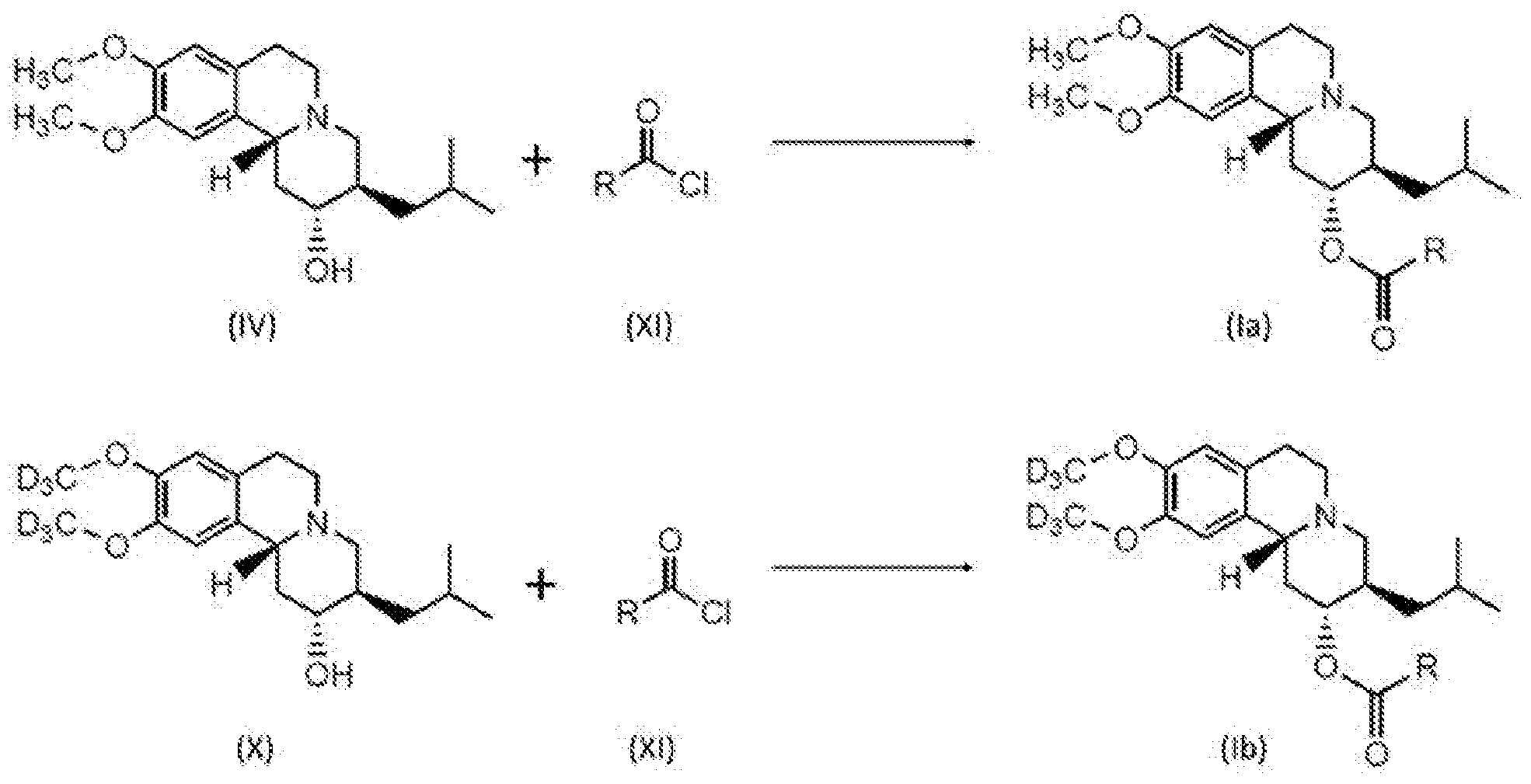
- the compounds (la) and (lb) can be prepared by reacting of (+)-(a)- DHTBZ (IV) and d6-(+)-(a)-DHTBZ (X) with an acyl chloride of formula (XI) in the presence of a base to neutralize the acid liberated during the reaction.
- the R substituent in the acyl chloride of formula (XI) is defined as C1 1 -25alkyl.
- the synthesis of a conjugate of this invention typically consists of the following steps: [0052] Activation of the carboxylic group, if not already in activated form.
- conjugate was converted to its hydrochloride salt by stirring with 4N HCI in dioxane for 15 min. at room temperature and evaporating the solvent to dryness. The residue was triturated with isopropanol (IPA) and the precipitate was filtered and dried to yield the hydrochloride salt of the fatty acid-(+)-(a)-DHTBZ conjugate.
- IPA isopropanol
- other conjugates of the present application can be prepared with or without any modification of the conjugation synthesis procedure.
- the compounds of formula (I) show lower solubility in aqueous solution than the unconjugated compound. This is in contrast to the valbenazine (VBZ) which is a conjugate of (+)-a-DHTBZ with valine. Amino acids have been typically used to increase drug's aqueous solubility (see Jornada et al., Molecules 2016, 21 , 42). This low solubility of the compounds of formula (I) may be used advantageously to develop a slow release formulations to reduce dosing frequency.
- the compounds of formula (I) show improved stability in organic solution.
- the unconjugated DHTBZ When dissolved in pharmaceutically acceptable organic solvents, the unconjugated DHTBZ will change color over time. It's unexpectedly found that when the conjugated DHTBZ is dissolved in the same solvent, the color change can be minimized or prevented. This color stabilization will be useful to develop a high quality product.
- the solvents disclosed herein including dimethylacetamide (DMAc), Dimethyl sulfoxide (DMSO), triacetin (TA), benzyl alcohol, benzyl benzoate, ethanol, N- methylpyrrolidone (NMP), polyethylene glycol, and the like.
- the compounds of formula (I) show no or minimal inhibition of VMAT2 receptor.
- the VMAT2 inhibition IC50 of the compound of formula (I) is more than 200 fold than that of unconjugated parent compound as determined using radioligand binding assays.
- the VMAT2 inhibition IC50 of the compound of formula (I) is more than 500 fold than that of unconjugated parent compound as determined using radioligand binding assays.
- the VMAT2 inhibition IC50 of the compound of formula (I) is more than 1000 fold than that of unconjugated parent compound as determined using radioligand binding assays.
- the compounds of the present invention show the advantage of being a long acting reversible inhibitor of catecholamine uptake by vesicular monoamine transporter 2 (VMAT2) for use in the treatment of hyperkinetic diseases and disorders, such as tardive dyskinesia, by administration of such compounds to a warm-blooded animal in need thereof.
- VMAT2 vesicular monoamine transporter 2
- the compounds of formula (I) of the present invention can stably and continuously liberate free VMAT2 inhibitor within a therapeutic concentration range with a stable PK profile over a long period of time, preferably over 2 weeks and more preferably over 1 month. This can be evidenced, for example, by measuring the plasma levels after administration to an animal.
- the present invention provides pharmaceutical compositions comprising at least one pharmaceutically acceptable carrier and a therapeutically effective amount of a compound of formula (I).
- compositions of this invention In order to prepare the pharmaceutical compositions of this invention, an effective amount of the particular compound, in free base or acid addition salt form, as the active ingredient is combined in intimate admixture with at least one pharmaceutically acceptable carrier, which may take a wide variety of forms depending on the form of preparation desired for administration.
- pharmaceutically acceptable carrier which may take a wide variety of forms depending on the form of preparation desired for administration.
- These pharmaceutical compositions are desirably in unitary dosage form suitable, preferably, for oral administration, rectal administration, percutaneous administration or parenteral injection.
- any of the usual liquid pharmaceutical carriers may be employed, such as water, glycols, oils, alcohols and the like in the case of oral liquid preparations such as suspensions, syrups, elixirs and solutions; or solid pharmaceutical carriers such as starches, sugars, kaolin, lubricants, binders, disintegrating agents and the like in the case of powders, pills, capsules and tablets. Because of their easy administration, tablets and capsules represent the most advantageous oral dosage unit form, in which case solid pharmaceutical carriers are obviously employed.
- the pharmaceutical carrier will mainly comprise sterile water, although other ingredients may be included in order to improve property of the active ingredient.
- Injectable solutions may be prepared for instance by using a pharmaceutical carrier comprising a saline solution, a glucose solution or a mixture of both. Injectable suspensions may also be prepared by using appropriate liquid carriers, suspending agents and the like.
- the pharmaceutical carrier may optionally comprise a penetration enhancing agent and/or a suitable wetting agent, optionally combined with minor proportions of suitable additives, which do not cause a significant deleterious effect to the skin. Said additives may be selected in order to facilitate administration of the active ingredient to the skin and/or be helpful for preparing the desired compositions.
- These topical compositions may be administered in various ways, e.g., as a transdermal patch, a spot-on or an ointment.
- Dosage unit form refers to physically discrete units suitable as unitary dosages, each unit containing a predetermined amount of active ingredient calculated to produce the desired therapeutic effect in association with the required pharmaceutical carrier.
- dosage unit forms are tablets (including scored or coated tablets), capsules, pills, powder packets, wafers, injectable solutions or suspensions, teaspoonfuls, tablespoonfuls and the like, and segregated multiples thereof
- the compounds of formula (I) may be formulated for parenteral administration by injection.
- Formulations for injection may be presented in unit dosage form, e.g. in ampoules or multi-dose containers, including an added preservative. They may take such forms as suspensions, solutions or emulsions in oily or aqueous vehicles, and may contain formulating agents such as isotonizing, suspending, stabilizing and/or dispersing agents.
- the active ingredient may be present in powder form for mixing with a suitable vehicle, e.g. sterile pyrogen-free water, before use.
- the compounds of formula (I) may also be formulated in rectal compositions such as suppositories or retention enemas, e.g. containing conventional suppository bases such as cocoa butter and/or other glycerides.
- the present invention provides the method for treatment of movement disorder associated to the VMAT2 receptor, such as tardive dyskinesia and chorea associated to Huntington's disease.
- the method contains a pharmaceutical composition comprising a compound of formula (I) of present invention, a VMAT2 inhibitor, and pharmaceutical acceptable carriers or diluents to have oral or parenteral administration.
- Shimadzu Nexera X2 series equipped with an auto-sampler, an UV detector (214 nm and 254 nm)
- Shimadzu Nexera X2 series equipped with an auto-sampler, an UV detector (214 nm and 254 nm)
- Shimadzu Nexera X2 series equipped with an auto-sampler, an UV detector (214 nm and 254 nm)
- Shimadzu Nexera X2 series equipped with an auto-sampler, an UV detector (214 nm and 254 nm)
- Palmitic acid (120.4 mg, 0.47 mmol) and 4-dimethylaminopyridine (DMAP) (15.3 mg, 0.12 mmol) were dissolved in anhydrous CH2CI2 (2 mL) and 1 -Ethyl-3-(3- dimethylaminopropyl)carbodiimide (EDC) (1 10.8 uL, 0.62 mmol) was added to the previous solution under an inert environment. The mixture was stirred at room temperature for 5-10 min.
- DMAP 4-dimethylaminopyridine
- EDC 1 -Ethyl-3-(3- dimethylaminopropyl)carbodiimide
- Example 5 Aqueous solubility of various compounds
- B L lower quantitation limit
- the quantitation limit is 1 mcg/mL.
- non-aqueous solvents such as organic solvents
- organic solvents have long been utilized in injectable pharmaceutical products to dissolve water-insoluble drugs.
- solubility of compounds of the present application in various organic solvents were tested.
- the compound suspensions in various pharmaceutical acceptable organic solvents including dimethy!acetamide (DMAc), Dimethyl sulfoxide (DMSO), triacetin (TA), were stirred at 37 °C at designed time interval. At the designed time point, 0.5 mL aliquots were taken and centrifuged at 14,000 rpm for 2 min without temperature control. The supernatant was diluted with ACN and then analyzed by HPLC to determine the amount of dissolved compounds.
- DMAc dimethy!acetamide
- DMSO Dimethyl sulfoxide
- TA triacetin
- Table 2 shows the solubility of compound 1 -1 , compound 1 -2 and compound IV in different pharmaceutical acceptable organic solvents after incubation, where Compound 1 -1 presents good solubility in all tested solvent, but compound 1 -2 show much lower solubility of 0.15 mg/ml_ in DMSO and 8.81 mg/ml_ in DMAc.
- the unconjugated compound IV showed significant color change over time, while the conjugated compounds 1 -1 and 1 -2 showed no or minimal color change after incubation at 37°C for 7 days ( Figure 1 ).
- the conjugation as defined in compound of formula (I) significantly improves the unconjugated compound's color stability in organic solvents.
- Example 7 Solubility of compounds in pharmaceutical acceptable oils.
- fatty acids are used to conjugate with a drug to enhance drug's lipophilicity to increase its solubility in oils.
- the solubility of compounds of the present application in various oils were tested.
- the suspension of compounds in various pharmaceutical acceptable oils, including castor oil, sesame oil, cottonseed oil, peanut oil and soybean oil, were stirred at 37°C for 2-3 days.
- about 200 to 300 ⁇ _ aliquots were taken and centrifuged at 14,000 rpm for 2 min without temperature control.
- the supernatant was carefully withdrawn and extracted with 9 folds of ACN.
- the mixture was then vortexed for 30 sec and subsequently centrifuged at 14,000 rpm for 2 min without temperature control.
- Example 8 Hydrolysis of compound in aqueous solutions
- the method was modified from Wang et al. J. Pharm. Sci, 2016, 105, 773-785.
- the aqueous hydrolysis of compounds were performed in isotonic pH 7.4 PBS, 10 mM pH 4.0 citrate-saline buffer and 10 mM, pH 8.5 borate-saline buffer at 37°C. Due to the low aqueous solubility of palmitate and behanate derivatives, the derivative was firstly dissolved in ACN containing 0.1 % TFA at 5 mg/ml_ as a stock solution.
- Example 9 Enzymatic hydrolysis of compound 1 -1
- the compound solution was prepared as described in Example 8. In short, each tested condition contained 0.4 pmole of compounds in 1.5 mL Eppendorf tube.
- the porcine liver esterase (PLE) was dissolved in PBS (pH 7.4, 10 mM) and the final ratio of esterase to compound in the reaction container was varied from 20 to 1 .
- Final % of ACN is 10%.
- the PLE solution was equilibrated at 37°C for 1 hour before adding to the compound 1 -1 solution in a 1 .5 mL Eppendorf tube. After incubated for 80 min at 37°C, a
- VMAT2 Vesicular monoamine transporter isoform 2
- ICso values were determined by a non-linear, least squares regression analysis using MathlQTM (ID Business Solutions Ltd., UK). Where the Ki values were calculated using the equation of Cheng and Prusoff (see Cheng et al., Biochem. Pharmacol. , 1973, 22, 3099-3108) using the observed ICso of the tested compound, the concentration of radioligand employed in the assay, and the historical values for the Kd of the ligand (obtained experimentally at Eurofins Panlabs Inc.).
- VMAT2 competition binding assay was performed at Eurofins Panlabs Taiwan Ltd. (Item 252020) and the condition is listed below.
- Incubation buffer 25 mM HEPES, 100 mM potassium tartrate, 5 mM MgS04, 0.1 mM EDTA and 0.05 mM EGTA, pH 7.4.
- Non-specific ligand Ro4-1284, 10 ⁇ .
- the palmitate and behenate esters of the compound of formula (I) exhibit desirable prodrug properties of good chemical and physical stability, minimal or no VMAT2 binding and acceptable ester hydrolysis rate. It is reasonable to extrapolate from this data to various other esters of the compound of formula (I) where the alkyl derivative esters are similar to the palmitate and behenate esters, including alkyl derivative esters of the compound of formula (I) where the alkyl contains carbon atoms within the range of 16 (as in the palmitate ester) and 22 (as in the behenate ester). Further, we believe that the alkyl derivative esters of the compound of formula (I) of the present invention may exhibit desirable prodrug properties where the alkyl contains a range of 12 to 26 carbon atoms based on the similarity in their chemical structure.
Landscapes
- Health & Medical Sciences (AREA)
- Chemical & Material Sciences (AREA)
- Organic Chemistry (AREA)
- Veterinary Medicine (AREA)
- Medicinal Chemistry (AREA)
- Public Health (AREA)
- General Health & Medical Sciences (AREA)
- Animal Behavior & Ethology (AREA)
- Life Sciences & Earth Sciences (AREA)
- Pharmacology & Pharmacy (AREA)
- Epidemiology (AREA)
- Neurology (AREA)
- Nuclear Medicine, Radiotherapy & Molecular Imaging (AREA)
- General Chemical & Material Sciences (AREA)
- Chemical Kinetics & Catalysis (AREA)
- Bioinformatics & Cheminformatics (AREA)
- Neurosurgery (AREA)
- Biomedical Technology (AREA)
- Psychology (AREA)
- Engineering & Computer Science (AREA)
- Oil, Petroleum & Natural Gas (AREA)
- Pharmaceuticals Containing Other Organic And Inorganic Compounds (AREA)
- Medicinal Preparation (AREA)
- Nitrogen And Oxygen Or Sulfur-Condensed Heterocyclic Ring Systems (AREA)
- Nitrogen Condensed Heterocyclic Rings (AREA)
Abstract
Description




Claims


Priority Applications (12)
| Application Number | Priority Date | Filing Date | Title |
|---|---|---|---|
| AU2018366039A AU2018366039A1 (en) | 2017-11-08 | 2018-11-07 | Esters of Dihydrotetrabenazine |
| EP18876092.0A EP3706748A4 (en) | 2017-11-08 | 2018-11-07 | Esters of dihydrotetrabenazine |
| RU2020114598A RU2020114598A (en) | 2017-11-08 | 2018-11-07 | ESTERS OF DIHYDROTETRABENAZINE |
| JP2020544585A JP2021503009A (en) | 2017-11-08 | 2018-11-07 | Ester of dihydrotetrabenazine |
| KR1020207016285A KR20210004939A (en) | 2017-11-08 | 2018-11-07 | Ester of dihydrotetrabenazine |
| CN201880071811.7A CN111343985A (en) | 2017-11-08 | 2018-11-07 | Esters of dihydrotetrabenazine |
| BR112020008895-1A BR112020008895A2 (en) | 2017-11-08 | 2018-11-07 | dihydrotetrabenazine esters |
| MX2020004685A MX2020004685A (en) | 2017-11-08 | 2018-11-07 | Esters of dihydrotetrabenazine. |
| SG11202004165UA SG11202004165UA (en) | 2017-11-08 | 2018-11-07 | Esters of dihydrotetrabenazine |
| US16/762,747 US11306082B2 (en) | 2017-11-08 | 2018-11-07 | Esters of dihydrotetrabenazine |
| CA3081709A CA3081709A1 (en) | 2017-11-08 | 2018-11-07 | Esters of dihydrotetrabenazine |
| IL274494A IL274494A (en) | 2017-11-08 | 2020-05-06 | Esters of dihydrotetrabenazine |
Applications Claiming Priority (2)
| Application Number | Priority Date | Filing Date | Title |
|---|---|---|---|
| US201762582979P | 2017-11-08 | 2017-11-08 | |
| US62/582,979 | 2017-11-08 |
Publications (1)
| Publication Number | Publication Date |
|---|---|
| WO2019094491A1 true WO2019094491A1 (en) | 2019-05-16 |
Family
ID=66439296
Family Applications (1)
| Application Number | Title | Priority Date | Filing Date |
|---|---|---|---|
| PCT/US2018/059657 Ceased WO2019094491A1 (en) | 2017-11-08 | 2018-11-07 | Esters of dihydrotetrabenazine |
Country Status (14)
| Country | Link |
|---|---|
| US (1) | US11306082B2 (en) |
| EP (1) | EP3706748A4 (en) |
| JP (1) | JP2021503009A (en) |
| KR (1) | KR20210004939A (en) |
| CN (1) | CN111343985A (en) |
| AU (1) | AU2018366039A1 (en) |
| BR (1) | BR112020008895A2 (en) |
| CA (1) | CA3081709A1 (en) |
| IL (1) | IL274494A (en) |
| MX (1) | MX2020004685A (en) |
| RU (1) | RU2020114598A (en) |
| SG (1) | SG11202004165UA (en) |
| TW (1) | TW201922745A (en) |
| WO (1) | WO2019094491A1 (en) |
Cited By (1)
| Publication number | Priority date | Publication date | Assignee | Title |
|---|---|---|---|---|
| EP4618961A4 (en) * | 2022-11-16 | 2026-05-27 | Foresee Pharmaceuticals Co Ltd | DEPOSIT COMPOSITIONS FOR VESICULAR MONOAMINE TRANSPORTER-2 Inhibitors |
Families Citing this family (2)
| Publication number | Priority date | Publication date | Assignee | Title |
|---|---|---|---|---|
| CN114302883B (en) | 2019-08-12 | 2022-09-06 | 山东绿叶制药有限公司 | VMAT2 inhibitor and preparation method and application thereof |
| PE20240822A1 (en) | 2021-03-22 | 2024-04-18 | Neurocrine Biosciences Inc | VMAT2 INHIBITORS AND METHODS OF USE |
Citations (4)
| Publication number | Priority date | Publication date | Assignee | Title |
|---|---|---|---|---|
| WO2003042162A1 (en) * | 2001-11-17 | 2003-05-22 | Neurosearch A/S | Prodrugs of antidepressants and their use for treating depressions |
| US20080004342A1 (en) * | 2002-12-19 | 2008-01-03 | Zaloga Gary P | Fatty acid phenolic conjugates |
| US20120077839A1 (en) * | 2006-11-08 | 2012-03-29 | Neurocrine Biosciences, Inc. | Substituted 3-isobutyl-9,10-dimethoxy-1,3,4,6,7,11b-hexahydro-2h-pyrido[2,1-a]isoquinolin-2-ol compounds and methods relating thereto |
| US20160030414A1 (en) * | 2010-06-01 | 2016-02-04 | Auspex Pharmaceuticals, Inc. | Benzoquinoline inhibitors of vmat 2 |
Family Cites Families (4)
| Publication number | Priority date | Publication date | Assignee | Title |
|---|---|---|---|---|
| CN102285984B (en) * | 2010-11-25 | 2012-10-10 | 江苏威凯尔医药科技有限公司 | Preparation method of (2R, 3R, 11bR)-dihydrotetrabenazine and relevant compounds |
| FI3936130T3 (en) | 2014-05-06 | 2024-04-23 | Neurocrine Biosciences Inc | VALBENACIN DOSING SCHEDULE FOR THE TREATMENT OF HYPERKINETIC MOVEMENT DISORDERS |
| PL3265085T3 (en) | 2015-03-06 | 2022-11-07 | Auspex Pharmaceuticals, Inc. | Methods for the treatment of abnormal involuntary movement disorders |
| JP2020512986A (en) | 2017-04-01 | 2020-04-30 | アデプティオ ファーマシューティカルズ リミテッド | (+)-Α-Dihydrotetrabenazine for use in the treatment of movement disorders |
-
2018
- 2018-11-07 CA CA3081709A patent/CA3081709A1/en active Pending
- 2018-11-07 US US16/762,747 patent/US11306082B2/en not_active Expired - Fee Related
- 2018-11-07 RU RU2020114598A patent/RU2020114598A/en unknown
- 2018-11-07 MX MX2020004685A patent/MX2020004685A/en unknown
- 2018-11-07 BR BR112020008895-1A patent/BR112020008895A2/en not_active Application Discontinuation
- 2018-11-07 WO PCT/US2018/059657 patent/WO2019094491A1/en not_active Ceased
- 2018-11-07 KR KR1020207016285A patent/KR20210004939A/en not_active Withdrawn
- 2018-11-07 SG SG11202004165UA patent/SG11202004165UA/en unknown
- 2018-11-07 EP EP18876092.0A patent/EP3706748A4/en not_active Withdrawn
- 2018-11-07 CN CN201880071811.7A patent/CN111343985A/en active Pending
- 2018-11-07 JP JP2020544585A patent/JP2021503009A/en active Pending
- 2018-11-07 AU AU2018366039A patent/AU2018366039A1/en not_active Abandoned
- 2018-11-08 TW TW107139983A patent/TW201922745A/en unknown
-
2020
- 2020-05-06 IL IL274494A patent/IL274494A/en unknown
Patent Citations (4)
| Publication number | Priority date | Publication date | Assignee | Title |
|---|---|---|---|---|
| WO2003042162A1 (en) * | 2001-11-17 | 2003-05-22 | Neurosearch A/S | Prodrugs of antidepressants and their use for treating depressions |
| US20080004342A1 (en) * | 2002-12-19 | 2008-01-03 | Zaloga Gary P | Fatty acid phenolic conjugates |
| US20120077839A1 (en) * | 2006-11-08 | 2012-03-29 | Neurocrine Biosciences, Inc. | Substituted 3-isobutyl-9,10-dimethoxy-1,3,4,6,7,11b-hexahydro-2h-pyrido[2,1-a]isoquinolin-2-ol compounds and methods relating thereto |
| US20160030414A1 (en) * | 2010-06-01 | 2016-02-04 | Auspex Pharmaceuticals, Inc. | Benzoquinoline inhibitors of vmat 2 |
Non-Patent Citations (1)
| Title |
|---|
| See also references of EP3706748A4 * |
Cited By (1)
| Publication number | Priority date | Publication date | Assignee | Title |
|---|---|---|---|---|
| EP4618961A4 (en) * | 2022-11-16 | 2026-05-27 | Foresee Pharmaceuticals Co Ltd | DEPOSIT COMPOSITIONS FOR VESICULAR MONOAMINE TRANSPORTER-2 Inhibitors |
Also Published As
| Publication number | Publication date |
|---|---|
| SG11202004165UA (en) | 2020-06-29 |
| TW201922745A (en) | 2019-06-16 |
| EP3706748A1 (en) | 2020-09-16 |
| US20200270241A1 (en) | 2020-08-27 |
| IL274494A (en) | 2020-06-30 |
| RU2020114598A (en) | 2021-12-09 |
| KR20210004939A (en) | 2021-01-13 |
| CA3081709A1 (en) | 2019-05-16 |
| MX2020004685A (en) | 2020-12-09 |
| AU2018366039A1 (en) | 2020-05-14 |
| CN111343985A (en) | 2020-06-26 |
| EP3706748A4 (en) | 2021-08-11 |
| JP2021503009A (en) | 2021-02-04 |
| BR112020008895A2 (en) | 2021-03-23 |
| US11306082B2 (en) | 2022-04-19 |
Similar Documents
| Publication | Publication Date | Title |
|---|---|---|
| US20250099447A1 (en) | Solid forms of fxr agonists | |
| US20220372036A1 (en) | Seven-membered heterocyclic derivative acting as kras g12c mutant protein inhibitor | |
| JP2019528276A (en) | Of (S) -7- (1-acryloylpiperidin-4-yl) -2- (4-phenoxyphenyl) -4,5,6,7-tetra-hydropyrazolo [1,5-A] pyrimidine-3-carboxamide Crystal form, its preparation and its use | |
| US11306082B2 (en) | Esters of dihydrotetrabenazine | |
| US20210177801A1 (en) | Utility of (+) epicatechin and their analogs | |
| AU2006234335B2 (en) | Use of a sulfonamide compound for improving the pharmacokinetics of a drug | |
| KR102502749B1 (en) | Liver Delivery Entecavir Prodrug Nucleotide Cyclophosphate Compounds and Applications | |
| TR201902875T4 (en) | Salt and crystal forms of Plk-4 inhibitor. | |
| JP7608050B2 (en) | Deutetrabenazine analogues, their preparation and use | |
| PT2134712E (en) | Aspartate of 1-cyclopropyl-6-fluoro-7-(8-methoxyimino-2,6-diaza- spiro [3.4]oct-6-yl)-4-oxo-1,4-dihydro-[1,8] naphthyridine-3-carboxylic acid, method for preparing the same, and antimicrobial pharmaceutical composition comprising the same | |
| US10336687B2 (en) | Selected amide of Y-hydroxybutyric acid and uses thereof in the treatment of alcohol misuse | |
| EP3322700B1 (en) | Anti-malarial agents | |
| NZ577311A (en) | The oxalate salt of 3-benzyl-2-methyl-2,3,3a,4,5,6,7,7a-octahydrobenzo[d]isoxazol-4-one | |
| ES2299612T3 (en) | CRYSTALS OF A TAXAN DERIVATIVE AND PROCEDURE OF OBTAINING. | |
| WO2014159501A2 (en) | Processes for preparing tetrahydroisoquinolines | |
| JP2008526835A (en) | Sibutramine sulfonate | |
| KR20240115849A (en) | Laveximod compound | |
| CN108440560B (en) | A kind of K-5a2 prodrug and the preparation method and application thereof | |
| AU2010277947B2 (en) | R-7-(3-aminomethyl-4-methoxyimino-3-methyl-pyrrolidin-1-yl)-1-cyclopropyl- 6-fluoro-4-oxo-1,4-dihydro-[1,8]naphthyridine-3-carboxylic acid and L-aspartic acid salt, process for the preparation thereof and pharmaceutical composition comprising the same for antimicrobial | |
| CN101528696A (en) | Crystalline S-(-)-amlodipine adipic acid salt anhydrous and preparation method thereof | |
| CA3034535C (en) | Novel salt of (r)-(1-methylpyrrolidine-3-yl)methyl(3'-chloro-4'-fluoro-[1,1'-biphenyl]-2-yl)carbamate and a crystal form thereof | |
| AU2022234309B2 (en) | Crystalline salt of a multi-tyrosine kinase inhibitor, method of preparation, and use thereof | |
| US20240409547A1 (en) | Solid Forms of Upadacitinib | |
| WO2025208117A1 (en) | Cleavable ester compounds and uses thereof | |
| WO2008086678A2 (en) | The medical use of levo-phencynonate as neuroprotective agent |
Legal Events
| Date | Code | Title | Description |
|---|---|---|---|
| 121 | Ep: the epo has been informed by wipo that ep was designated in this application |
Ref document number: 18876092 Country of ref document: EP Kind code of ref document: A1 |
|
| ENP | Entry into the national phase |
Ref document number: 2020544585 Country of ref document: JP Kind code of ref document: A |
|
| ENP | Entry into the national phase |
Ref document number: 3081709 Country of ref document: CA |
|
| NENP | Non-entry into the national phase |
Ref country code: DE |
|
| ENP | Entry into the national phase |
Ref document number: 2018366039 Country of ref document: AU Date of ref document: 20181107 Kind code of ref document: A |
|
| ENP | Entry into the national phase |
Ref document number: 20207016285 Country of ref document: KR Kind code of ref document: A |
|
| ENP | Entry into the national phase |
Ref document number: 2018876092 Country of ref document: EP Effective date: 20200608 |
|
| REG | Reference to national code |
Ref country code: BR Ref legal event code: B01A Ref document number: 112020008895 Country of ref document: BR |
|
| ENP | Entry into the national phase |
Ref document number: 112020008895 Country of ref document: BR Kind code of ref document: A2 Effective date: 20200505 |