WO2019099057A1 - Polycarbonate compositions - Google Patents

Polycarbonate compositions Download PDF

Info

Publication number
WO2019099057A1
WO2019099057A1 PCT/US2018/023722 US2018023722W WO2019099057A1 WO 2019099057 A1 WO2019099057 A1 WO 2019099057A1 US 2018023722 W US2018023722 W US 2018023722W WO 2019099057 A1 WO2019099057 A1 WO 2019099057A1
Authority
WO
WIPO (PCT)
Prior art keywords
ppm
stabilizers
alkyl
tert
composition according
Prior art date
Legal status (The legal status is an assumption and is not a legal conclusion. Google has not performed a legal analysis and makes no representation as to the accuracy of the status listed.)
Ceased
Application number
PCT/US2018/023722
Other languages
French (fr)
Inventor
Stephen Mark Andrews
Markus Grob
Current Assignee (The listed assignees may be inaccurate. Google has not performed a legal analysis and makes no representation or warranty as to the accuracy of the list.)
BASF SE
Original Assignee
BASF SE
Priority date (The priority date is an assumption and is not a legal conclusion. Google has not performed a legal analysis and makes no representation as to the accuracy of the date listed.)
Filing date
Publication date
Priority to CN201880073062.1A priority Critical patent/CN111328293A/en
Priority to RU2020119474A priority patent/RU2789290C2/en
Priority to JP2020526361A priority patent/JP2021503021A/en
Priority to AU2018369018A priority patent/AU2018369018B2/en
Priority to US16/763,160 priority patent/US20200385570A1/en
Priority to BR112020009154-5A priority patent/BR112020009154A2/en
Priority to MX2020005050A priority patent/MX2020005050A/en
Priority to EP18877811.2A priority patent/EP3710145A4/en
Priority to KR1020237025290A priority patent/KR102795939B1/en
Application filed by BASF SE filed Critical BASF SE
Priority to IL274420A priority patent/IL274420B2/en
Priority to CA3082349A priority patent/CA3082349A1/en
Priority to KR1020207013386A priority patent/KR102560650B1/en
Publication of WO2019099057A1 publication Critical patent/WO2019099057A1/en
Priority to SA520411974A priority patent/SA520411974B1/en
Anticipated expiration legal-status Critical
Priority to JP2023192518A priority patent/JP7802744B2/en
Priority to US18/647,000 priority patent/US20240294750A1/en
Ceased legal-status Critical Current

Links

Classifications

    • CCHEMISTRY; METALLURGY
    • C08ORGANIC MACROMOLECULAR COMPOUNDS; THEIR PREPARATION OR CHEMICAL WORKING-UP; COMPOSITIONS BASED THEREON
    • C08LCOMPOSITIONS OF MACROMOLECULAR COMPOUNDS
    • C08L69/00Compositions of polycarbonates; Compositions of derivatives of polycarbonates
    • CCHEMISTRY; METALLURGY
    • C07ORGANIC CHEMISTRY
    • C07DHETEROCYCLIC COMPOUNDS
    • C07D307/00Heterocyclic compounds containing five-membered rings having one oxygen atom as the only ring hetero atom
    • C07D307/77Heterocyclic compounds containing five-membered rings having one oxygen atom as the only ring hetero atom ortho- or peri-condensed with carbocyclic rings or ring systems
    • C07D307/78Benzo [b] furans; Hydrogenated benzo [b] furans
    • C07D307/82Benzo [b] furans; Hydrogenated benzo [b] furans with hetero atoms or with carbon atoms having three bonds to hetero atoms with at the most one bond to halogen, e.g. ester or nitrile radicals, directly attached to carbon atoms of the hetero ring
    • C07D307/83Oxygen atoms
    • CCHEMISTRY; METALLURGY
    • C08ORGANIC MACROMOLECULAR COMPOUNDS; THEIR PREPARATION OR CHEMICAL WORKING-UP; COMPOSITIONS BASED THEREON
    • C08JWORKING-UP; GENERAL PROCESSES OF COMPOUNDING; AFTER-TREATMENT NOT COVERED BY SUBCLASSES C08B, C08C, C08F, C08G or C08H
    • C08J5/00Manufacture of articles or shaped materials containing macromolecular substances
    • C08J5/18Manufacture of films or sheets
    • CCHEMISTRY; METALLURGY
    • C08ORGANIC MACROMOLECULAR COMPOUNDS; THEIR PREPARATION OR CHEMICAL WORKING-UP; COMPOSITIONS BASED THEREON
    • C08KUse of inorganic or non-macromolecular organic substances as compounding ingredients
    • C08K5/00Use of organic ingredients
    • C08K5/04Oxygen-containing compounds
    • C08K5/13Phenols; Phenolates
    • CCHEMISTRY; METALLURGY
    • C08ORGANIC MACROMOLECULAR COMPOUNDS; THEIR PREPARATION OR CHEMICAL WORKING-UP; COMPOSITIONS BASED THEREON
    • C08KUse of inorganic or non-macromolecular organic substances as compounding ingredients
    • C08K5/00Use of organic ingredients
    • C08K5/04Oxygen-containing compounds
    • C08K5/15Heterocyclic compounds having oxygen in the ring
    • C08K5/151Heterocyclic compounds having oxygen in the ring having one oxygen atom in the ring
    • C08K5/1535Five-membered rings
    • CCHEMISTRY; METALLURGY
    • C08ORGANIC MACROMOLECULAR COMPOUNDS; THEIR PREPARATION OR CHEMICAL WORKING-UP; COMPOSITIONS BASED THEREON
    • C08KUse of inorganic or non-macromolecular organic substances as compounding ingredients
    • C08K5/00Use of organic ingredients
    • C08K5/16Nitrogen-containing compounds
    • C08K5/34Heterocyclic compounds having nitrogen in the ring
    • C08K5/3467Heterocyclic compounds having nitrogen in the ring having more than two nitrogen atoms in the ring
    • C08K5/3472Five-membered rings
    • C08K5/3475Five-membered rings condensed with carbocyclic rings
    • CCHEMISTRY; METALLURGY
    • C08ORGANIC MACROMOLECULAR COMPOUNDS; THEIR PREPARATION OR CHEMICAL WORKING-UP; COMPOSITIONS BASED THEREON
    • C08KUse of inorganic or non-macromolecular organic substances as compounding ingredients
    • C08K5/00Use of organic ingredients
    • C08K5/49Phosphorus-containing compounds
    • CCHEMISTRY; METALLURGY
    • C08ORGANIC MACROMOLECULAR COMPOUNDS; THEIR PREPARATION OR CHEMICAL WORKING-UP; COMPOSITIONS BASED THEREON
    • C08KUse of inorganic or non-macromolecular organic substances as compounding ingredients
    • C08K5/00Use of organic ingredients
    • C08K5/49Phosphorus-containing compounds
    • C08K5/50Phosphorus bound to carbon only
    • CCHEMISTRY; METALLURGY
    • C08ORGANIC MACROMOLECULAR COMPOUNDS; THEIR PREPARATION OR CHEMICAL WORKING-UP; COMPOSITIONS BASED THEREON
    • C08KUse of inorganic or non-macromolecular organic substances as compounding ingredients
    • C08K5/00Use of organic ingredients
    • C08K5/49Phosphorus-containing compounds
    • C08K5/51Phosphorus bound to oxygen
    • C08K5/52Phosphorus bound to oxygen only
    • C08K5/524Esters of phosphorous acids, e.g. of H3PO3
    • CCHEMISTRY; METALLURGY
    • C08ORGANIC MACROMOLECULAR COMPOUNDS; THEIR PREPARATION OR CHEMICAL WORKING-UP; COMPOSITIONS BASED THEREON
    • C08KUse of inorganic or non-macromolecular organic substances as compounding ingredients
    • C08K5/00Use of organic ingredients
    • C08K5/49Phosphorus-containing compounds
    • C08K5/51Phosphorus bound to oxygen
    • C08K5/53Phosphorus bound to oxygen bound to oxygen and to carbon only
    • C08K5/5377Phosphinous compounds, e.g. R2=P—OR'
    • CCHEMISTRY; METALLURGY
    • C08ORGANIC MACROMOLECULAR COMPOUNDS; THEIR PREPARATION OR CHEMICAL WORKING-UP; COMPOSITIONS BASED THEREON
    • C08KUse of inorganic or non-macromolecular organic substances as compounding ingredients
    • C08K5/00Use of organic ingredients
    • C08K5/49Phosphorus-containing compounds
    • C08K5/51Phosphorus bound to oxygen
    • C08K5/53Phosphorus bound to oxygen bound to oxygen and to carbon only
    • C08K5/5393Phosphonous compounds, e.g. R—P(OR')2
    • CCHEMISTRY; METALLURGY
    • C08ORGANIC MACROMOLECULAR COMPOUNDS; THEIR PREPARATION OR CHEMICAL WORKING-UP; COMPOSITIONS BASED THEREON
    • C08KUse of inorganic or non-macromolecular organic substances as compounding ingredients
    • C08K5/00Use of organic ingredients
    • C08K5/49Phosphorus-containing compounds
    • C08K5/51Phosphorus bound to oxygen
    • C08K5/53Phosphorus bound to oxygen bound to oxygen and to carbon only
    • C08K5/5397Phosphine oxides
    • CCHEMISTRY; METALLURGY
    • C08ORGANIC MACROMOLECULAR COMPOUNDS; THEIR PREPARATION OR CHEMICAL WORKING-UP; COMPOSITIONS BASED THEREON
    • C08JWORKING-UP; GENERAL PROCESSES OF COMPOUNDING; AFTER-TREATMENT NOT COVERED BY SUBCLASSES C08B, C08C, C08F, C08G or C08H
    • C08J2369/00Characterised by the use of polycarbonates; Derivatives of polycarbonates
    • CCHEMISTRY; METALLURGY
    • C08ORGANIC MACROMOLECULAR COMPOUNDS; THEIR PREPARATION OR CHEMICAL WORKING-UP; COMPOSITIONS BASED THEREON
    • C08KUse of inorganic or non-macromolecular organic substances as compounding ingredients
    • C08K2201/00Specific properties of additives
    • C08K2201/019Specific properties of additives the composition being defined by the absence of a certain additive
    • CCHEMISTRY; METALLURGY
    • C08ORGANIC MACROMOLECULAR COMPOUNDS; THEIR PREPARATION OR CHEMICAL WORKING-UP; COMPOSITIONS BASED THEREON
    • C08KUse of inorganic or non-macromolecular organic substances as compounding ingredients
    • C08K5/00Use of organic ingredients
    • C08K5/0008Organic ingredients according to more than one of the "one dot" groups of C08K5/01 - C08K5/59
    • C08K5/005Stabilisers against oxidation, heat, light, ozone
    • CCHEMISTRY; METALLURGY
    • C08ORGANIC MACROMOLECULAR COMPOUNDS; THEIR PREPARATION OR CHEMICAL WORKING-UP; COMPOSITIONS BASED THEREON
    • C08KUse of inorganic or non-macromolecular organic substances as compounding ingredients
    • C08K5/00Use of organic ingredients
    • C08K5/16Nitrogen-containing compounds
    • C08K5/34Heterocyclic compounds having nitrogen in the ring
    • C08K5/3467Heterocyclic compounds having nitrogen in the ring having more than two nitrogen atoms in the ring
    • C08K5/3477Six-membered rings
    • C08K5/3492Triazines
    • CCHEMISTRY; METALLURGY
    • C08ORGANIC MACROMOLECULAR COMPOUNDS; THEIR PREPARATION OR CHEMICAL WORKING-UP; COMPOSITIONS BASED THEREON
    • C08LCOMPOSITIONS OF MACROMOLECULAR COMPOUNDS
    • C08L2666/00Composition of polymers characterized by a further compound in the blend, being organic macromolecular compounds, natural resins, waxes or and bituminous materials, non-macromolecular organic substances, inorganic substances or characterized by their function in the composition
    • C08L2666/28Non-macromolecular organic substances
    • C08L2666/34Oxygen-containing compounds, including ammonium and metal salts

Definitions

  • the disclosure is directed to polycarbonate compositions comprising certain benzofuranone stabilizers.
  • Polycarbonates are desired thermoplastic polymers for their strong mechanical properties and excellent optical properties including high light transmittance, high gloss and clarity. Polycarbonates will, however, undergo yellowing and loss of optical and mechanical properties when subjected to cyclical or constant elevated temperatures.
  • Polycarbonates are employed in applications such as solar energy control window films for construction, automotive and commercial lamp covers, reflective housings for LED lighting, and light diffuser films for LED and LCD electronic display monitors. These applications are subject to elevated temperatures.
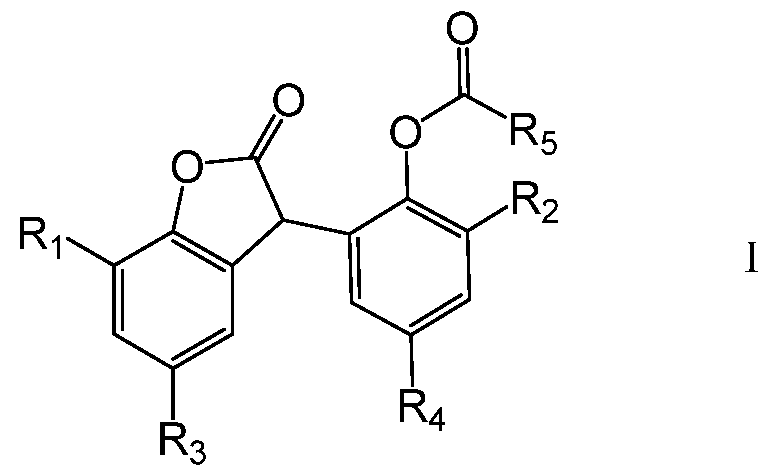
  • composition comprising a polycarbonate and one or more additives selected from the group consisting of benzofuranone stabilizers of formula I
  • FL, R 2 , R 3 , R 4 and R 5 are each independently hydrogen, halogen, hydroxy, C C 25 alkyl, C 2 -C 25 alkenyl, C 2 -C 25 alkynyl, C 7 -C 9 phenylalkyl, phenyl, C 5 -C 8 cycloalkyl, C
  • an additive composition comprising one or more benzofuranone stabilizers of formula I and one or more organophosphorus stabilizers.
  • Polycarbonates may be obtained from bisphenol A and phosgene or a phosgene analogue such as trichloromethylchloroformate, triphosgene or diphenylcarbonate by condensation, in the latter case usually with addition of a suitable transesterification catalyst, for example a boron hydride, an amine, e.g. 2-methylimidazole, or a quaternary ammonium salt.
  • a suitable transesterification catalyst for example a boron hydride, an amine, e.g. 2-methylimidazole, or a quaternary ammonium salt.
  • a suitable transesterification catalyst for example a boron hydride, an amine, e.g. 2-methylimidazole, or a quaternary ammonium salt.
  • a suitable transesterification catalyst for example a boron hydride, an amine, e.g. 2-methylimidazole, or a quaternary am
  • Suitable bisphenol components include for example 2,2-bis(4'-hydroxyphenyl)propane (bisphenol A), 2,4'-dihydroxydiphenylmethane, bis(2-hydroxyphenyl)methane, bis(4- hydroxyphenyl)methane, bis-(4-hydroxy-5-propylphenyl)methane, 1 ,1 -bis(4'- hydroxyphenyl)ethane, bis(4-hydroxyphenyl)cyclohexylmethane, 2,2-bis(4'-hydroxyphenyl)- 1 -phenylpropane, 2,2-bis(3', 5'-dimethyl-4'-hydroxyphenyl)propane, 2,2-bis(3', 5'-dibromo-4'- hydroxyphenyl)propane, 2,2-bis(3',5'-dichloro-4'-hydroxyphenyl)propane, 1 ,1 -bis(4'- hydroxyphenyl)cyclododecane
  • polycarbonates may be obtained from other diols, for example dianhydrohexitols including isosorbide, isoidide and isomannide.
  • Polycarbonates may employ one or more of the aforementioned diols as well as further diols.
  • Polycarbonates may be branched by suitable amounts of more than difunctional monomers.
  • polycarbonate may be present in compositions of the disclosure in a major amount, for example from any one of about 55 wt%, about 60 wt%, about 65 wt%, about 70 wt%, about 75 wt% or about 80 wt% to any one of about 85 wt%, about 90 wt%, about 95 wt%, about 96 wt%, about 97 wt%, about 98 wt% or about 99 wt%.
  • Polycarbonate may be in the form of sheets, films or molded parts. Polycarbonate compositions may be employed for instance in exterior materials of electrical and electronic products, automobile components, building materials, optical components, etc.
  • polycarbonate compositions may be employed in automotive headlamps, street lamps, solar energy control window films for construction (buildings), reflective housings for LED lighting, light diffusion films for LED and LCD electronic display monitors, back-lighting films in computer and large console display screens and containers such as bottles.
  • Automotive includes passenger cars, trucks, vans, construction vehicles, sport utility vehicles, motorcycles and the like.
  • Polycarbonate articles may also include windowpanes, greenhouse panes, roofing articles, mirrors, goggles, noise-absorbing walls, windshields (e.g. motorcycle windshields), solar cell cover or substrate, display covers, touch panels or screens, parts for recreational machines (e.g. pinball machines) and the like.
  • Polycarbonate (PC) films may for instance have a thickness of from less than about 0.05 mm to about 0.50 mm, for instance from any of about 0.05 mm, 0.07 mm, 0.09 mm, 0.10 mm, 0.15 mm, about 0.20 mm or about 0.25 mm to any of about 0.30 mm, about 0.35 mm, about 0.40 mm, about 0.45 mm or about 0.50 mm.
  • Polycarbonate sheet may for instance have a thickness of from about 0.5 mm to greater than about 3.1 mm.
  • PC sheet may be thicker, for example for ballistic window sheet.
  • PC sheet may be from any of about 0.5 mm, about 0.7 mm, about 1 .0 mm, about 1 .5 mm or about 2.0 mm to any of about 2.5 mm, about 2.7 mm or about 3.1 mm or greater.
  • Both film and sheet may be mono- or multi-layer and may include layers comprising other polymers or plastics. Films and sheets may be prepared via extrusion or co-extrusion methods.
  • the polycarbonate compositions may be transparent to light having a wavelength of from any of about 350 nm, about 360 nm, about 370 nm, about 380 nm, about 390 nm, about 400 nm, about 410 nm, about 420 nm, about 430 nm, about 440 nm or about 450 nm to about 700 nm.
  • the polycarbonate compositions are transparent to visible light (about 390 nm to about 700 nm).
  • transparent means that > 90%, > 91 %, > 92%, > 93%, > 94%, > 95%, > 96%, > 97%, > 98% or > 99% of light may pass through the composition.
  • the benzofuranones of the invention include compounds of formula I
  • R 2 , R 3 , R 4 and R 5 are each independently hydrogen, halogen, hydroxy, C 1 -C 25 alkyl, C 2 -C 25 alkenyl, C 2 -C 25 alkynyl, C 7 -C 9 phenylalkyl, phenyl, C 5 -C 8 cycloalkyl, Cr C 18 alkoxy, CrCsalkylamine, di(C 1 -C 8 alkyl)amino, CrC ⁇ alkanoyloxy, CrC ⁇ alkanoylamino, C 3 -C 25 alkenoyloxy or C 3 -C 25 alkanoyloxy interrupted by one to three -0-, -S-, -NH- or -NiCr C 8 alkyl)-, wherein CrC ⁇ alkyl, C 2 -C 25 alkenyl, C 2 -C 25 alkynyl, C 7 -C 9 phenylalkyl, phenyl, C 5
  • R 2 are independently hydrogen or CrCsalkyl
  • R 3 and R 4 are independently CrC ⁇ alkyl
  • R 5 is CrC ⁇ alkyl, phenyl, CrCsalkylphenyl, 3,5-di(C ! - C 8 alkyl)-4-hydroxyphenyl or C 1 -C 8 alkyl(3,5-di(C 1 -C 8 alkyl)-4-hydroxyphenyl).
  • R 2 are hydrogen and R 3 and R 4 are CrCsalkyl.
  • R 5 is Cr ⁇ alkyl, phenyl, CrC ⁇ alkylphenyl, S.S-diiC C ⁇ lkyl) ⁇ - hydroxyphenyl or C 1 -C 4 alkyl(3,5-di(C 1 -C 4 alkyl)-4-hydroxyphenyl.
  • Alkyl groups may be linear or branched and may include methyl, ethyl, propyl, isopropyl, n-butyl, sec-butyl, isobutyl, tert-butyl, 2-ethylbutyl, n-pentyl, isopentyl, 1 - methylpentyl, 1 ,3-dimethylbutyl, n-hexyl, 1 -methylhexyl, n-heptyl, isoheptyl, 1 ,1 , 3, 3- tetramethylbutyl, 1 -methylheptyl, 3-methylheptyl, n-octyl, tert-octyl, 2-ethylhexyl, 1 ,1 ,3- trimethylhexyl, 1 ,1 ,3,3-tetramethylpentyl, nonyl, decyl, undecyl, 1 -methylundecy
  • Cycloalkyl includes cyclohexyl, cyclopentyl and cycloheptyl. Halogen is fluoro, chloro, bromo or iodo. Phenylalkyl includes benzyl and cumyl. Alkenyl and alkynyl are unsaturated versions of alkyl. Alkyl portions of for example alkoxy may be defined as for alkyl.
  • benzofuranones of the disclosure include compounds of formula
  • Benzofuranones of formula I may be prepared as described in U.S. Pat. Nos.
  • Polycarbonate compositions may include one or more ultraviolet light absorbers (UVAs).
  • UV light absorbers may be selected from the group consisting of hydroxyphenylbenzotriazole, tris-aryl-s-triazine, hydroxybenzoate, 2- hydroxybenzophenone and cyanoacrylate ultraviolet light absorbers.
  • hydroxyphenylbenzotriazole UVAs are for instance disclosed in U.S. Pat. Nos. 3,004,896; 3,055,896; 3,072,585; 3,074,910; 3,189,615; 3,218,332; 3,230,194;
  • Tris-aryl-s-triazine UVAs are for instance those disclosed in U. S. Pat. Nos.
  • UV absorbers are for instance esters of substituted and unsubstituted benzoic acids, as for example 4-tert-butylphenyl salicylate, phenyl salicylate, octylphenyl salicylate, dibenzoyl resorcinol, bis(4-tert-butylbenzoyl) resorcinol, benzoyl resorcinol, 2,4-di-tert-butylphenyl 3,5-di-tert-butyl-4-hydroxybenzoate, hexadecyl 3,5-di-tert- butyl-4-hydroxybenzoate, octadecyl 3,5-di-tert-butyl-4-hydroxybenzoate, 2-methyl-4,6-di-tert- butylphenyl 3,5-di-tert-butyl-4-hydroxybenzoate.
  • UV absorbers are for example the 4-hydroxy, 4-methoxy, 4-octyloxy, 4-decyloxy, 4-dodecyloxy, 4-benzyloxy, 4,2',4'-trihydroxy and 2'-hydroxy-4,4'- dimethoxy derivatives.
  • Cyanoacrylate UV absorbers are for instance pentaerythritol tetrakis(2-cyano-3,3- diphenylacrylate), a-cyano-p,p-diphenylacrylic acid ethyl ester or isooctyl ester and a-cyano- b-methyl-p-methoxy-cinnamic acid methyl ester or butyl ester.
  • UVAs are commercial, for example TINUVIN 326, TINUVIN 360, TINUVIN 234, TINUVIN 1577, TINUVIN 1600, CYASORB UV 1164, CYASORB THT, CYASORB UV 2908, CHIMASSORB 81 , UVINUL 3030, etc.
  • ultraviolet light absorbers may be present, in total, from any of about 0.01 weight percent (wt%), about 0.05 wt%, about 0.1 wt%, about 0.2 wt%, about 0.5 wt%, about 0.7 wt%, about 1 .0 wt% or about 1.2 wt% to any of about 1.4 wt%, about 1 .6 wt%, about 1 .8 wt%, about 2.0 wt%, about 2.3 wt%, about 2.5 wt%, about 2.7 wt% or about 3.0 wt%, based on the weight of the polycarbonate.
  • wt% weight percent
  • an interior bulk layer and a top or cap layer may comprise different UVAs.
  • the polycarbonate compositions may optionally contain one or more organophosphorus stabilizers.
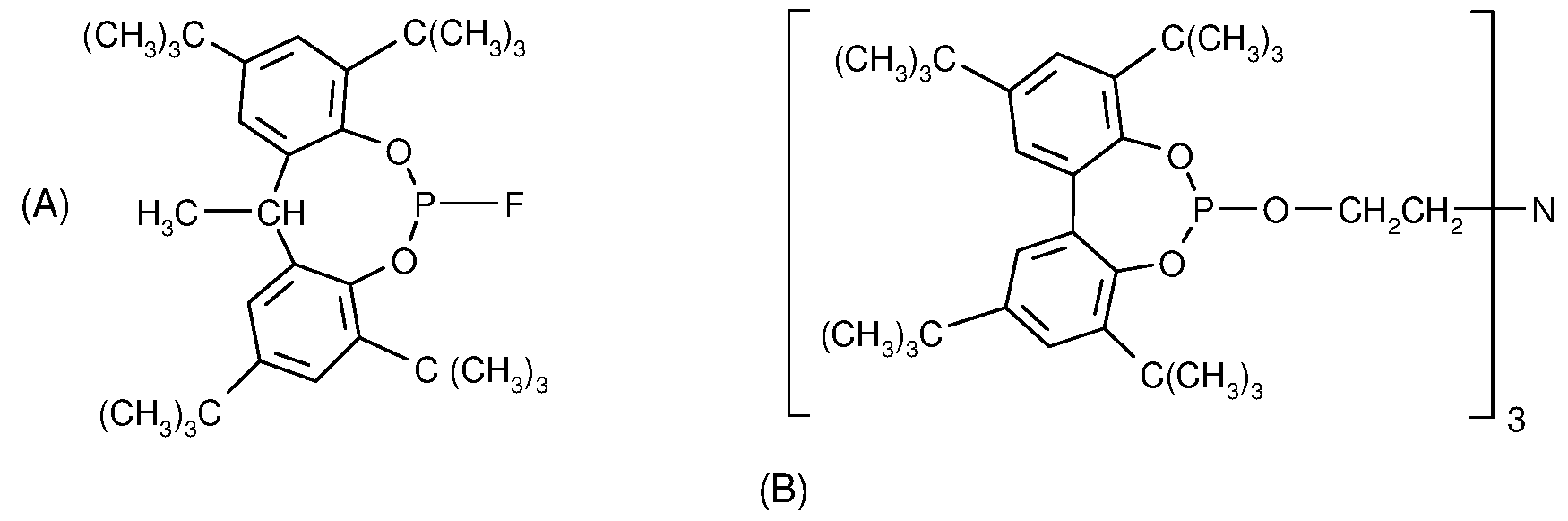
  • Organic phosphorus stabilizers include organic phosphite and organic phosphonite stabilizers and include for example triphenyl phosphite, diphenyl alkyl phosphites, phenyl dialkyl phosphites, tris(nonylphenyl) phosphite, trilauryl phosphite, trioctadecyl phosphite, distearyl pentaerythritol diphosphite (F), tris(2,4-di-tert-butylphenyl) phosphite, bis(2,4-di-a-cumylphenyl) pentaerythrtitol diphosphite (K), diisodecyl
  • pentaerythritol diphosphite bis(2,4-di-tert-butylphenyl) pentaerythritol diphosphite (D), bis(2,6-di-tert-butyl-4-methylphenyl) pentaerythritol diphosphite (E), bisisodecyloxy-pentaery- thritol diphosphite, bis(2,4-di-tert-butyl-6-methylphenyl) pentaerythritol diphosphite, bis(2,4,6- tri-tert-butylphenyl) pentaerythritol diphosphite, tristearyl sorbitol triphosphite, tetrakis (2,4-di- tert-butylphenyl) 4,4'-biphenylene-diphosphonite (H), 6-isooctyloxy-2,4,8,10-te
  • organophosphorus stabilizers also include organic phosphine stabilizers.
  • Organic phosphine stabilizers may be of formula P(R I )(R2)(R3), wherein R ⁇ R 2 and R 3 are each independently H, C 1 -C 2 oalkyl, C 3 -C 7 cycloalkyl, C 2 -C 6 alkenyl, phenyl or naphthyl, each unsubstituted or substituted by 1 to 3 hydroxy, amino, acetoxy, C 1 -C 4 alkoxy, CrC ⁇ alkyl, C 1 -C 4 alkylcarbonyl, phenyl or CrC ⁇ alkoxyphenyl.
  • organic phosphine stabilizers may be selected from triethylphosphine, triisopropylphosphine, tri-n-butylphosphine, tricyclohexylphosphine, allyldiphenylphosphine, triphenylphosphine, diphenylphosphine, tri-2,4- dimethylphenylphosphine, tri-2,4,6-trimethylphenylphosphine, tri-o-tolylphosphine, tri-o- anisylphosphine, diphenylbutylphosphine, diphenyl-octadecylphosphine, tris-(p- nonylphenyl)-phosphine, tris-naphthylphosphine, diphenyl-(hydroxymethyl)-phosphine, diphenyl-acetoxymethylphosphine, diphenyl-(beta-ethy
  • the polycarbonate compositions may optionally contain one or more hindered phenolic antioxidants.
  • Hindered phenolic antioxidants include for example tris(3,5-di-tert- butyl-4-hydroxybenzyl) isocyanurate, 1 ,3,5-tris-(3,5-di-tert-butyl-4-hydroxybenzyl)-2,4,6- trimethylbenzene, the calcium salt of the monoethyl ester of 3,5-di-tert-butyl-4- hydroxybenzylphosphonic acid, pentaerythritol tetrakis [3-(3,5-di-tert-butyl-4-hydroxyphenyl) propionate] and octadecyl 3-(3,5-di-tert-butyl-4-hydroxyphenyl) propionate.
  • both an organic phosphorus stabilizer and a hindered phenolic antioxidant may be present, for example tris(2,4-di-tert-butylphenyl) phosphite and pentaerythritol tetrakis [3-(3,5-di-tert-butyl-4-hydroxyphenyl) propionate] and/or octadecyl 3- (3,5-di-tert-butyl-4-hydroxyphenyl) propionate.
  • the benzofuranones of the disclosure are incorporated into a polycarbonate at levels of from any one of about 10 ppm, about 25 ppm, about 50 ppm, about 100 ppm about 150 ppm, about 175 ppm about 200 ppm, about 225 ppm, about 250 ppm, about 275 ppm, about 300 ppm, about 325 ppm, about 350 ppm, about 400 ppm, about 450 ppm or about 500 ppm to any one of about 550 ppm, about 600 ppm, about 650 ppm, about 700 ppm, about 750 ppm, about 800 ppm, about 850 ppm, about 900 ppm, about 950 ppm or about 1000 ppm (0.1 weight percent (wt%)) by weight, based on the weight of the polycarbonate.
  • wt% weight percent
  • benzofuranones of the disclosure are incorporated into a polycarbonate at levels of from any one of about 0.1 wt%, about 0.5 wt%, about 0.75 wt%, about 1 .0 wt%, about 1 .5 wt%, about 2.0 wt%, about 2.5 wt%, about 3.0 wt%, about 3.5 wt% or about 4.0 wt% to any one of about 4.5 wt%, about 5.0 wt%, about 5.5 wt%, about 6.0 wt%, about 6.5 wt% or about 7.0 wt% (weight percent), based on the weight of the polycarbonate.
  • Organic phosphorus stabilizers are, when present, employed at the weight levels as outlined for the benzofuranones.
  • one or more benzofuranones and one or more organic phosphorus compounds may be employed in a weight/weight ratio of from any one of about 1/99, about 1/90, about 1/80, about 1/70, about 1/60, about 1/50, about 1/40, about 1/30, about 1/20, about 1/10, about 1/9, about 1/8, about 1/7, about 1/6, about 1/5, about 1/4, about 1/3, about 1/2 or about 1/1 to any one of about 2/1 , about 3/1 , about 4/1 , about 5/1 , about 6/1 , about 7/1 , about 8/1 , about 9/1 , about 10/1 , about 20/1 , about 30/1 , about 40/1 , about 50/1 , about 60/1 , about 70/1 , about 80/1 , about 90/1 or about 99/1 .
  • organic phosphorus stabilizers are, when present, employed at equal or higher weight levels than the one or more benzofuranones.
  • the weight/weight ratio of the one or more benzofuranones to one or more organophosphorus stabilizers may be from any one of about 0.05, about 0.10, about 0.1 1 , about 0.12, about 0.13, about 0.14, about 0.15, about 0.16, about 0.20, about 0.25, about 0.30, about 0.35, about 0.40, about 0.45 or about 0.50 to any one of about 0.55, about 0.60, about 0.65, about 0.70, about 0.75, about 0.80, about 0.85, about 0.90, about 0.95 or about 1 .0.
  • a weight/weight ratio of organic phosphorus stabilizers to hindered phenolic antioxidants may be from any one of about 9/1 , about 8/1 , about 7/1 , about 6/1 , about 5/1 , about 4/1 , about 3/1 , about 2/1 or about 1/1 to any one of about 1/2, about 1/3, about 1/4, about 1/5, about 1/6, about 1/7, about 1/8 or about 1/9.
  • the compositions of the invention may be essentially free of organophosphorus stabilizers and/or hindered phenolic antioxidants.
  • the term“essentially free” means“not intentionally added” and that only minor amounts may be present, for example levels of ⁇ 100 ppm, ⁇ 75 ppm, ⁇ 50 ppm, ⁇ 25 ppm, ⁇ 15 ppm, ⁇ 10 ppm, ⁇ 5 ppm or ⁇ 2 ppm, by weight, based on the weight of the total composition.
  • present benzofuranones and optional further additives into a polycarbonate is carried out by known methods, for example before or after molding or also by applying a dissolved or dispersed additive mixture to the polycarbonate, with or without subsequent evaporation of the solvent.
  • Present benzofuranones and optional further additives can also be added to a polycarbonate in the form of a masterbatch which contains the additives in a concentration of, for example, about 2% to about 40% by weight, based on the total weight of the masterbatch.
  • the polymer of the masterbatch need not be the same as the polycarbonate. Molding may be carried out with known mixing machines, for instance mixers, kneaders or extruders.
  • Present benzofuranones and optional further additives can be premixed or added individually.
  • Present benzofuranones and optional further additives can also be added before or during the polymerization or before crosslinking.
  • Present benzofuranones and optional further additives can be incorporated into a polycarbonate in pure form or encapsulated in waxes, oils or polymers.
  • benzofuranones and optional further additives can also be sprayed onto a polycarbonate. They are able to dilute other additives or their melts so that they may be sprayed also together with these additives onto a polycarbonate.
  • the present benzofuranone additives are incorporated into a polycarbonate by melt blending in an extruder.
  • the present benzofuranones and optional further additives may be added together or separately.
  • additives may be incorporated into polycarbonate film or sheet (substrate) via coating processes on the film/sheet.
  • “Dip coating” involves continuously drawing substrate through a liquid medium where additive(s) are adsorbed onto the surface or impregnated partially into the substrate. Such coating processes may allow higher concentrations of additives to be affixed to a substrate.
  • a process of preparing a polycarbonate composition includes measurement of raw materials by weight followed by the dry blending of raw ingredients.
  • the mixture may be fed to a screw extruder at a constant feed rate to extrude the material into a desired form, followed by water cooling and drying.
  • Ingredients may be mixed and dosed via a single feeder at the throat or feeding zone of an extruder. Alternatively, some components may be dosed part way down an extruder barrel in a melting or mixing zone.
  • liquid ingredients may be dosed in a later zone via liquid injection under pressure.
  • a typical flat-film or cast extrusion line for film or sheet generally comprises an extruder, a film or sheet die, a take-off and/or sheet cooling system and a wind-up or spooling system.
  • an extruder for multi-layer sheet or film structures, either a single die with multiple exit ports or multiple extruders may feed molten polymers into suitably designed dies for multi-layer constructs.
  • Optional processing of post-extruded film prior to wind up may include a stretch-draw apparatus to provide orientation of the film in machine, transverse or both directions in order to enhance certain mechanical film properties.
  • composition comprising a polycarbonate and one or more additives selected from the group consisting of benzofuranone stabilizers of formula I
  • R 2 , R 3 , R 4 and R 5 are each independently hydrogen, halogen, hydroxy, C 1 -C2 5 alkyl, C 2 -C 2 5alkenyl, C 2 -C 25 alkynyl, C 7 -C 9 phenylalkyl, phenyl, C 5 -C 8 cycloalkyl, Cr C 18 alkoxy, CrCsalkylamine, d CrCsalky amino, CrC ⁇ alkanoyloxy, CrC ⁇ alkanoylamino, C 3 -C 25 alkenoyloxy or C 3 -C 25 alkanoyloxy interrupted by one to three -0-, -S-, -NH- or -NiCr C 8 alkyl)-, wherein CrC ⁇ alkyl, C 2 -C 25 alkenyl, C 2 -C 25 alkynyl, C 7 -C 9 phenylalkyl, phenyl, C 5 - Cscyclo
  • R ! and R 2 are independently hydrogen or CrCsalkyl
  • R 3 and R 4 are independently CrC ⁇ alkyl and R 5 is CrC ⁇ alkyl, phenyl, CrCsalkylphenyl, 3,5-di(C 1 -C 8 alkyl)-4-hydroxyphenyl or CrCsalkyl ⁇ S-d Cr C 8 alkyl)-4-hydroxyphenyl); or wherein R and R 2 are hydrogen and R 3 and R 4 are CrCsalkyl.
  • a composition according to the first or second embodiments wherein R 5 is CrC ⁇ alkyl, phenyl, CrC ⁇ alkylphenyl, S.S-d CrC ⁇ alkyl) ⁇ - hydroxyphenyl or C 1 -C 4 alkyl(3,5-di(C 1 -C 4 alkyl)-4-hydroxyphenyl.
  • R 5 is CrC ⁇ alkyl, phenyl, CrC ⁇ alkylphenyl, S.S-d CrC ⁇ alkyl) ⁇ - hydroxyphenyl or C 1 -C 4 alkyl(3,5-di(C 1 -C 4 alkyl)-4-hydroxyphenyl.
  • the benzofuranone stabilizers are selected from the group consisting of
  • a composition according to any of the preceding embodiments comprising from any one of about 10 ppm, about 25 ppm, about 50 ppm, about 100 ppm about 150 ppm, about 175 ppm about 200 ppm, about 225 ppm, about 250 ppm, about 275 ppm, about 300 ppm, about 325 ppm, about 350 ppm, about 400 ppm, about 450 ppm or about 500 ppm to any one of about 550 ppm, about 600 ppm, about 650 ppm, about 700 ppm, about 750 ppm, about 800 ppm, about 850 ppm, about 900 ppm, about 950 ppm or about 1000 ppm (0.1 weight percent (wt%)) by weight of the one or more benzofuranone stabilizers, based on the weight of the polycarbonate.
  • wt% weight percent
  • compositions according to any of embodiments 1 to 4 comprising from any one of about 0.1 wt%, about 0.5 wt%, about 0.75 wt%, about 1 .0 wt%, about 1 .5 wt%, about 2.0 wt%, about 2.5 wt%, about 3.0 wt%, about 3.5 wt% or about 4.0 wt% to any one of about 4.5 wt%, about 5.0 wt%, about 5.5 wt%, about 6.0 wt%, about 6.5 wt% or about 7.0 wt% (weight percent) of the one or more benzofuranone stabilizers, based on the weight of the polycarbonate.
  • compositions according to any of the preceding embodiments comprising one or more organophosphorus stabilizers.
  • organophosphorus stabilizers selected from the group consisting of triphenyl phosphite, diphenyl alkyl phosphites, phenyl dialkyl phosphites, tris(nonylphenyl) phosphite, trilauryl phosphite, trioctadecyl phosphite, distearyl pentaerythritol diphosphite, tris(2,4-di-tert-butylphenyl) phosphite, bis(2,4-di-a-cumylphenyl) pentaerythrtitol diphosphite, diisodecyl pentaerythritol diphosphite, bis
  • a composition according to any of the preceding embodiments comprising from any one of about 10 ppm, about 25 ppm, about 50 ppm, about 100 ppm about 150 ppm, about 175 ppm about 200 ppm, about 225 ppm, about 250 ppm, about 275 ppm, about 300 ppm, about 325 ppm, about 350 ppm, about 400 ppm, about 450 ppm or about 500 ppm to any one of about 550 ppm, about 600 ppm, about 650 ppm, about 700 ppm, about 750 ppm, about 800 ppm, about 850 ppm, about 900 ppm, about 950 ppm or about 1000 ppm (0.1 weight percent (wt%)) by weight of one or more organophosphorus stabilizers, based on the weight of the polycarbonate.
  • compositions according to any of the preceding embodiments, wherein the composition comprises one or more benzofuranone stabilizers and one or more organophosphorus stabilizers, wherein a weight/weight ratio of the benzofuranone stabilizers to the organophosphorus stabilizers is from any one of about 1/99, about 1 /90, about 1 /80, about 1 /70, about 1/60, about 1 /50, about 1 /40, about 1/30, about 1 /20, about 1 /10, about 1 /9, about 1 /8, about 1/7, about 1 /6, about 1 /5, about 1 /4, about 1 /3, about 1 /2 or about 1 /1 to any one of about 2/1 , about 3/1 , about 4/1 , about 5/1 , about 6/1 , about 7/1 , about 8/1 , about 9/1 , about 10/1 , about 20/1 , about 30/1 , about 40/1 , about 50/1 , about 60/1 ,
  • compositions according to any of the preceding embodiments, wherein the composition comprises one or more benzofuranone stabilizers and one or more organophosphorous stabilizers, wherein a weight/weight ratio of the one or more benzofuranone stabilizers to the one or more organophosphorus stabilizers may be from any one of about 0.05, about 0.10, about 0.15, about 0.20, about 0.25, about 0.30, about 0.35, about 0.40, about 0.45 or about 0.50 to any one of about 0.55, about 0.60, about 0.65, about 0.70, about 0.75, about 0.80, about 0.85, about 0.90, about 0.95 or about 1 0
  • composition according to any of
  • compositions 1 to 6 wherein the composition is essentially free of organophosphorus stabilizers.
  • a thirteenth embodiment disclosed is a composition according to any of the preceding embodiments, wherein the composition is essentially free of hindered phenolic antioxidants.
  • compositions according to any of the preceding embodiments, wherein the composition is transparent to light having a wavelength of from any of about 350 nm, about 360 nm, about 370 nm, about 380 nm, about 390 nm, about 400 nm, about 410 nm, about 420 nm, about 430 nm, about 440 nm or about 450 nm to about 700 nm.
  • a film, sheet or molded article comprising the composition according to any of the preceding embodiments.
  • a film, sheet or molded article according to the fifteenth embodiment which is transparent to light having a wavelength of from about 350 nm to about 700 nm.
  • a film, sheet or molded article according to embodiments 15 or 16 which is selected from the group consisting of automotive headlamp covers, street lamp covers, solar energy control films, reflective housings for lighting fixtures and light diffuser films.
  • a method of stabilizing polycarbonate against the deleterious effects of heat, light and oxygen comprising
  • R 2 are independently hydrogen or CrCsalkyl
  • R 3 and R 4 are independently C C ⁇ alkyl
  • R 5 is CVCyalkyl, phenyl, CVCsalkylphenyl, S.S-d CrCsalkyl) ⁇ - hydroxyphenyl or C 1 -C 8 alkyl(3,5-di(C 1 -C 8 alkyl)-4-hydroxyphenyl).
  • R 5 is CrC ⁇ alkyl, phenyl, CrC ⁇ alkylphenyl, 3,5- d CrC ⁇ alkyl ⁇ -hydroxyphenyl or C 1 -C 4 alkyl(3,5-di(C 1 -C 4 alkyl)-4-hydroxyphenyl.
  • embodiments 19 to 22, comprising incorporating from any one of about 10 ppm, about 25 ppm, about 50 ppm, about 100 ppm about 150 ppm, about 175 ppm about 200 ppm, about 225 ppm, about 250 ppm, about 275 ppm, about 300 ppm, about 325 ppm, about 350 ppm, about 400 ppm, about 450 ppm or about 500 ppm to any one of about 550 ppm, about 600 ppm, about 650 ppm, about 700 ppm, about 750 ppm, about 800 ppm, about 850 ppm, about 900 ppm, about 950 ppm or about 1000 ppm (0.1 weight percent (wt%)) by weight of the one or more benzofuranone stabilizers, based on the weight of the polycarbonate.
  • wt% weight percent
  • a method comprising incorporating from any one of about 0.1 wt%, about 0.5 wt%, about 0.75 wt%, about 1 .0 wt%, about 1 .5 wt%, about 2.0 wt%, about 2.5 wt%, about 3.0 wt%, about 3.5 wt% or about 4.0 wt% to any one of about 4.5 wt%, about 5.0 wt%, about 5.5 wt%, about 6.0 wt%, about 6.5 wt% or about 7.0 wt% (weight percent) of the one or more benzofuranone stabilizers, based on the weight of the polycarbonate.
  • a method according to any of embodiments 19 to 25 comprising incorporating one or more organophosphorus stabilizers selected from the group consisting of triphenyl phosphite, diphenyl alkyl phosphites, phenyl dialkyl phosphites, tris(nonylphenyl) phosphite, trilauryl phosphite, trioctadecyl phosphite, distearyl
  • pentaerythritol diphosphite tris(2,4-di-tert-butylphenyl) phosphite, bis(2,4-di-a-cumylphenyl) pentaerythrtitol diphosphite, diisodecyl pentaerythritol diphosphite, bis(2,4-di-tert- butylphenyl) pentaerythritol diphosphite, bis(2,6-di-tert-butyl-4-methylphenyl) pentaerythritol diphosphite, bisisodecyloxy-pentaerythritol diphosphite, bis(2,4-di-tert-butyl-6-methylphenyl) pentaerythritol diphosphite, bis(2,4,6-tri-tert-butylphenyl) pentaerythritol diphosphi
  • a method comprising incorporating from any one of about 10 ppm, about 25 ppm, about 50 ppm, about 100 ppm about 150 ppm, about 175 ppm about 200 ppm, about 225 ppm, about 250 ppm, about 275 ppm, about 300 ppm, about 325 ppm, about 350 ppm, about 400 ppm, about 450 ppm or about 500 ppm to any one of about 550 ppm, about 600 ppm, about 650 ppm, about 700 ppm, about 750 ppm, about 800 ppm, about 850 ppm, about 900 ppm, about 950 ppm or about 1000 ppm (0.1 weight percent (wt%)) by weight of one or more organophosphorus stabilizers, based on the weight of the polycarbonate.
  • wt% weight percent
  • a method comprising incorporating one or more benzofuranone stabilizers and one or more organophosphorus stabilizers, wherein a weight/weight ratio of the benzofuranone stabilizers to the organophosphorus stabilizers is from any one of about 1/99, about 1/90, about 1/80, about 1/70, about 1/60, about 1/50, about 1/40, about 1/30, about 1/20, about 1/10, about 1/9, about 1/8, about 1/7, about 1/6, about 1/5, about 1/4, about 1/3, about 1/2 or about 1/1 to any one of about 2/1 , about 3/1 , about 4/1 , about 5/1 , about 6/1 , about 7/1 , about 8/1 , about 9/1 , about 10/1 , about 20/1 , about 30/1 , about 40/1 , about 50/1 , about 60/1 , about 70/1 , about 80/1 , about 90/1 or about 99/1 .
  • embodiments 19 to 28, comprising incorporating one or more benzofuranone stabilizers and one or more organophosphorous stabilizers, wherein a weight/weight ratio of the one or more benzofuranone stabilizers to the one or more organophosphorus stabilizers may be from any one of about 0.05, about 0.10, about 0.15, about 0.20, about 0.25, about 0.30, about 0.35, about 0.40, about 0.45 or about 0.50 to any one of about 0.55, about 0.60, about 0.65, about 0.70, about 0.75, about 0.80, about 0.85, about 0.90, about 0.95 or about 1 .0.
  • a method according to any of embodiments 19 to 24 wherein the method does not comprise incorporating organophosphorus stabilizers.
  • the method does not comprise incorporating hindered phenolic antioxidants.
  • an additive composition comprising one or more benzofuranone stabilizers of formula I
  • R 2 are independently hydrogen or CrCsalkyl
  • R 3 and R 4 are independently CrC ⁇ alkyl
  • R 5 is CrCyalkyl, phenyl, CrCsalkylphenyl, S.S-d CrCsalkyl) ⁇ - hydroxyphenyl or C 1 -C 8 alkyl(3,5-di(C 1 -C 8 alkyl)-4-hydroxyphenyl) and one or more organophosphorus stabilizers.
  • compositions according to the thirty second embodiment wherein R and R 2 are hydrogen and R 3 and R 4 are CrCsalkyl.
  • a composition according to embodiments 32 or 33 wherein R 5 is C 1 -C 4 alkyl, phenyl, C 1 -C 4 alkylphenyl, 3,5-di(C 1 -C 4 alkyl)-4-hydroxyphenyl or Cr C ⁇ alkyl ⁇ S-d CrC ⁇ alky - ⁇ hydroxyphenyl.
  • compositions 33 to 34 wherein the benzofuranone stabilizers are selected from the group consisting of
  • compositions comprising one or more organophosphorus stabilizers selected from the group consisting of triphenyl phosphite, diphenyl alkyl phosphites, phenyl dialkyl phosphites, tris(nonylphenyl) phosphite, trilauryl phosphite, trioctadecyl phosphite, distearyl pentaerythritol diphosphite, tris(2,4-di-tert-butylphenyl) phosphite, bis(2,4-di-a-cumylphenyl) pentaerythrtitol diphosphite, diisodecyl pentaerythritol diphosphite, bis(2,4-di-tert- butylphenyl) pentaerythritol diphosphite,
  • organophosphorus stabilizers selected from the group consisting of tripheny
  • a weight/weight ratio of the benzofuranone stabilizers to the organophosphorus stabilizers is from any one of about 1 /99, about 1 /90, about 1 /80, about 1 /70, about 1 /60, about 1 /50, about 1 /40, about 1 /30, about 1 /20, about 1/10, about 1 /9, about 1/8, about 1/7, about 1/6, about 1/5, about 1/4, about 1/3, about 1/2 or about 1/1 to any one of about 2/1 , about 3/1 , about 4/1 , about 5/1 , about 6/1 , about 7/1 , about 8/1 , about 9/1 , about 10/1 , about 20/1 , about 30/1 , about 40/1 , about 50/1 , about 60/1 , about 70/1 , about 80/1 , about 90/1 or about 99/1 .
  • a weight/weight ratio of the one or more benzofuranone stabilizers to the one or more organophosphorus stabilizers may be from any one of about 0.05, about 0.10, about 0.15, about 0.20, about 0.25, about 0.30, about 0.35, about 0.40, about 0.45 or about 0.50 to any one of about 0.55, about 0.60, about 0.65, about 0.70, about 0.75, about 0.80, about 0.85, about 0.90, about 0.95 or about 1 .0.
  • compositions according to any of embodiments 32 to 38, wherein the composition is essentially free of hindered phenolic antioxidants.
  • the articles“a” and“an” herein refer to one or to more than one (e.g. at least one) of the grammatical object. Any ranges cited herein are inclusive.
  • the term“about” used throughout is used to describe and account for small fluctuations. For instance,“about” may mean the numeric value may be modified by ⁇ 5%, ⁇ 4%, ⁇ 3%, ⁇ 2%, ⁇ 1 %, ⁇ 0.5%, ⁇ 0.4%, ⁇ 0.3%, ⁇ 0.2%, ⁇ 0.1 % or ⁇ 0.05%. All numeric values are modified by the term“about” whether or not explicitly indicated. Numeric values modified by the term“about” include the specific identified value. For example“about 5.0” includes 5.0.
  • Weight percent if not otherwise indicated, is based on an entire composition free of any volatiles.
  • the polycarbonate employed in the Examples is LEXAN 141 ; which is determined to contain from about 600 ppm to about 650 ppm tris(2,4-di-t-butylphenyl)phosphite and from about 250 ppm to about 300 ppm of tris(2,4-di-t-butylphenyl)phosphate as commercially obtained.
  • phosphite tris(2,4-di-t- butylphenyl)phosphite; hindered phenol: octadecyl 3-(3,5-di-tert-butyl-4- hydroxyphenyl)propionate; triazine A: 2,4-bis(4-biphenylyl)-6-(2-hydroxy-4-(2-ethylhexyl)oxy- phenyl)-s-triazine; triazine B: 4,6-diphenyl-2-(4-hexyloxy-2-hydroxyphenyl)-s-triazine;
  • benzotriazole A 2-(2-hydroxy-5-t-octylphenyl)-2H-benzotriazole; benzotriazole B: 2,2’- methylene-bis(4-t-octyl-(6-2H-benzotriazol-2-yl)phenol); TPP: triphenylphosphine;
  • Additives are dry blended with polycarbonate to provide the following formulations. Additive levels are reported in ppm (parts-per-million) by weight, based on the weight of polycarbonate. sample additive(s)
  • the admixed polycarbonate formulations are injection molded into 2 x 2 x 0.125 inch plaques.
  • the plaques are subjected to oven aging at 125 °C and are monitored up to 12,000 hours. Haze is determined on an average of 3 plaques. Yellowness index (Yl), delta E (DE), transmission (T) and haze determined after 12,000 hours oven ageing at 125 °C for plaques containing samples 1 -9 are reported below.
  • Additives are dry blended with polycarbonate to provide the following formulations. Additive levels are reported in ppm by weight, based on the weight of polycarbonate. sample additive(s)
  • the admixed polycarbonate formulations are injection molded into 2 x 2 x 0.125 inch plaques.
  • the plaques are subjected to oven aging at 125 °C.
  • Yellowness Index (Yl) is measured at zero hours and at 5055 hours.
  • Delta Yl (DUI) is Yl at 5055 hours minus Yl at zero hours. Results are below. sample 0 hours 5055 hours DUI
  • Additives are dry blended with polycarbonate to provide the following formulations. Additive levels are in ppm by weight, based on the weight of polycarbonate.
  • the admixed polycarbonate formulations are injection molded into 2 x 2 x 0.125 inch plaques.
  • the plaques are subjected to accelerated weathering in a xenon-arc Weather-O- Meter.
  • Yellowness Index (Yl) is measured at zero hours and at 3022 hours.
  • Delta Yl (DUI) is Yl at 3022 hours minus Yl at zero hours. Results are below. sample 0 hours 3022 hours DUI 5.1 35.8 30.6 7.4 15.9 8.5 6.3 15.5 9.2 2.9 15.1 12.2 3.4 16.9 13.5 5.2 15.3 10.1 2.8 14.8 12.0 4.7 14.8 10.1 2.4 14.6 12.2

Landscapes

  • Chemical & Material Sciences (AREA)
  • Organic Chemistry (AREA)
  • Health & Medical Sciences (AREA)
  • Chemical Kinetics & Catalysis (AREA)
  • Medicinal Chemistry (AREA)
  • Polymers & Plastics (AREA)
  • Engineering & Computer Science (AREA)
  • Manufacturing & Machinery (AREA)
  • Materials Engineering (AREA)
  • Compositions Of Macromolecular Compounds (AREA)
  • Plural Heterocyclic Compounds (AREA)
  • Manufacture Of Macromolecular Shaped Articles (AREA)
  • Building Environments (AREA)

Abstract

Polycarbonate compositions comprising one or more additives selected from the group consisting of benzofuranone stabilizers of formula I, wherein R1, R2, R3, R4 and R5 are each independently hydrogen, halogen, hydroxy, C1-C25alkyl, C2-C25alkenyl, C2-C25alkynyl, C7-C9phenylalkyl, phenyl, C5-C8cycloalkyl, C1-C18alkoxy, C1-C8alkylamine, di(C1-C8alkyl)amino, C1-C25alkanoyloxy, C1-C25alkanoylamino, C3-C25alkenoyloxy, C3-C25alkanoyloxy interrupted by one to three -O-, -S-, -NH- or -N(C1-C8alkyl)-, wherein C1-C25alkyl, C2-C25alkenyl, C2-C25alkynyl, C7-C9phenylalkyl, phenyl, C5-C8cycloalkyl, C1-C18alkoxy, C1-C8alkylamine, di(C1-C8alkyl)amino, C1-C25alkanoyloxy, C1-C25alkanoylamino, C3-C25alkenoyloxy and interrupted C3-C25alkenoyloxy are unsubstituted or substituted by one to three groups selected from halogen, hydroxy, thiol, amino, C1- C4alkylamino, di(C1-C4alkyl)amino and C1-C4alkyl.

Description

Polycarbonate Compositions
The disclosure is directed to polycarbonate compositions comprising certain benzofuranone stabilizers.
Background
Polycarbonates are desired thermoplastic polymers for their strong mechanical properties and excellent optical properties including high light transmittance, high gloss and clarity. Polycarbonates will, however, undergo yellowing and loss of optical and mechanical properties when subjected to cyclical or constant elevated temperatures.
Polycarbonates are employed in applications such as solar energy control window films for construction, automotive and commercial lamp covers, reflective housings for LED lighting, and light diffuser films for LED and LCD electronic display monitors. These applications are subject to elevated temperatures.
There exists a need to more thoroughly protect polycarbonates from the deleterious effects of heat, light and oxygen, which effects result in yellowing, loss of transparency and loss of gloss. Generally, conventional hindered phenolic antioxidants and/or organic phosphite or phosphine stabilizers are employed in polycarbonate.
Summary
Disclosed is a composition comprising a polycarbonate and one or more additives selected from the group consisting of benzofuranone stabilizers of formula I
Figure imgf000002_0001
wherein FL, R2, R3, R4 and R5 are each independently hydrogen, halogen, hydroxy, C C25alkyl, C2-C25alkenyl, C2-C25alkynyl, C7-C9phenylalkyl, phenyl, C5-C8cycloalkyl, C
C18alkoxy, CrCsalkylamine, d CrCsalkyljamino, CrC^alkanoyloxy, CrC^alkanoylamino, l C3-C25alkenoyloxy or C3-C25alkanoyloxy interrupted by one to three -0-, -S-, -NH- or -NiCr C8alkyl)-, wherein CrC^alkyl, C2-C25alkenyl, C2-C25alkynyl, C7-C9phenylalkyl, phenyl, C5- C8cycloalkyl, CrC^alkoxy, CrCsalkylamine, di(C1-C8alkyl)amino, CrC^alkanoyloxy, Cr C25alkanoylamino, C3-C25alkenoyloxy and interrupted C3-C25alkenoyloxy are unsubstituted or substituted by one to three groups selected from halogen, hydroxy, thiol, amino, Cr
C4alkylamino, di(C1-C4alkyl)amino and CrC^alkyl.
Also disclosed is a method of stabilizing polycarbonate against the deleterious effects of heat, light and oxygen, the method comprising incorporating into a polycarbonate one or more additives selected from the group consisting of benzofuranone stabilizers of formula I.
Also disclosed is an additive composition comprising one or more benzofuranone stabilizers of formula I and one or more organophosphorus stabilizers.
Detailed Disclosure
Polycarbonates may be obtained from bisphenol A and phosgene or a phosgene analogue such as trichloromethylchloroformate, triphosgene or diphenylcarbonate by condensation, in the latter case usually with addition of a suitable transesterification catalyst, for example a boron hydride, an amine, e.g. 2-methylimidazole, or a quaternary ammonium salt. In addition to bisphenol A, other bisphenol components may also be used, and it is also possible to use monomers which are halogenated in the benzene nucleus. Suitable bisphenol components include for example 2,2-bis(4'-hydroxyphenyl)propane (bisphenol A), 2,4'-dihydroxydiphenylmethane, bis(2-hydroxyphenyl)methane, bis(4- hydroxyphenyl)methane, bis-(4-hydroxy-5-propylphenyl)methane, 1 ,1 -bis(4'- hydroxyphenyl)ethane, bis(4-hydroxyphenyl)cyclohexylmethane, 2,2-bis(4'-hydroxyphenyl)- 1 -phenylpropane, 2,2-bis(3', 5'-dimethyl-4'-hydroxyphenyl)propane, 2,2-bis(3', 5'-dibromo-4'- hydroxyphenyl)propane, 2,2-bis(3',5'-dichloro-4'-hydroxyphenyl)propane, 1 ,1 -bis(4'- hydroxyphenyl)cyclododecane, 1 ,1 -bis(3'5, '-dimethyl-4'-hydroxyphenyl)cyclododecane, 1 ,1 - bis(4'-hydroxyphenyl)-3,3,5-trimethylcyclohexane, 1 ,1 -bis(4'-hydroxyphenyl)-3, 3,5,5- tetramethylcyclohexane and 1 ,1 -bis(4'-hydroxyphenyl)-3,3,5-trimethylcyclopentane. In addition to bisphenols, polycarbonates may be obtained from other diols, for example dianhydrohexitols including isosorbide, isoidide and isomannide. Polycarbonates may employ one or more of the aforementioned diols as well as further diols. Polycarbonates may be branched by suitable amounts of more than difunctional monomers. In some embodiments, polycarbonate may be present in compositions of the disclosure in a major amount, for example from any one of about 55 wt%, about 60 wt%, about 65 wt%, about 70 wt%, about 75 wt% or about 80 wt% to any one of about 85 wt%, about 90 wt%, about 95 wt%, about 96 wt%, about 97 wt%, about 98 wt% or about 99 wt%.
Polycarbonate may be in the form of sheets, films or molded parts. Polycarbonate compositions may be employed for instance in exterior materials of electrical and electronic products, automobile components, building materials, optical components, etc.
In some embodiments, polycarbonate compositions may be employed in automotive headlamps, street lamps, solar energy control window films for construction (buildings), reflective housings for LED lighting, light diffusion films for LED and LCD electronic display monitors, back-lighting films in computer and large console display screens and containers such as bottles. Automotive includes passenger cars, trucks, vans, construction vehicles, sport utility vehicles, motorcycles and the like.
Polycarbonate articles may also include windowpanes, greenhouse panes, roofing articles, mirrors, goggles, noise-absorbing walls, windshields (e.g. motorcycle windshields), solar cell cover or substrate, display covers, touch panels or screens, parts for recreational machines (e.g. pinball machines) and the like.
Polycarbonate (PC) films may for instance have a thickness of from less than about 0.05 mm to about 0.50 mm, for instance from any of about 0.05 mm, 0.07 mm, 0.09 mm, 0.10 mm, 0.15 mm, about 0.20 mm or about 0.25 mm to any of about 0.30 mm, about 0.35 mm, about 0.40 mm, about 0.45 mm or about 0.50 mm.
Polycarbonate sheet may for instance have a thickness of from about 0.5 mm to greater than about 3.1 mm. PC sheet may be thicker, for example for ballistic window sheet. PC sheet may be from any of about 0.5 mm, about 0.7 mm, about 1 .0 mm, about 1 .5 mm or about 2.0 mm to any of about 2.5 mm, about 2.7 mm or about 3.1 mm or greater.
Both film and sheet may be mono- or multi-layer and may include layers comprising other polymers or plastics. Films and sheets may be prepared via extrusion or co-extrusion methods.
In certain embodiments, the polycarbonate compositions may be transparent to light having a wavelength of from any of about 350 nm, about 360 nm, about 370 nm, about 380 nm, about 390 nm, about 400 nm, about 410 nm, about 420 nm, about 430 nm, about 440 nm or about 450 nm to about 700 nm. In some embodiments, the polycarbonate compositions are transparent to visible light (about 390 nm to about 700 nm). In some embodiments, transparent means that > 90%, > 91 %, > 92%, > 93%, > 94%, > 95%, > 96%, > 97%, > 98% or > 99% of light may pass through the composition.
The benzofuranones of the invention include compounds of formula I
Figure imgf000005_0001
wherein
Figure imgf000005_0002
R2, R3, R4 and R5 are each independently hydrogen, halogen, hydroxy, C1-C25alkyl, C2-C25alkenyl, C2-C25alkynyl, C7-C9phenylalkyl, phenyl, C5-C8cycloalkyl, Cr C18alkoxy, CrCsalkylamine, di(C1-C8alkyl)amino, CrC^alkanoyloxy, CrC^alkanoylamino, C3-C25alkenoyloxy or C3-C25alkanoyloxy interrupted by one to three -0-, -S-, -NH- or -NiCr C8alkyl)-, wherein CrC^alkyl, C2-C25alkenyl, C2-C25alkynyl, C7-C9phenylalkyl, phenyl, C5- Cscycloalkyl, CrC^alkoxy, CrCsalkylamine, di(C1-C8alkyl)amino, CrC^alkanoyloxy, Cr C25alkanoylamino, C3-C25alkenoyloxy and interrupted C3-C25alkenoyloxy are unsubstituted or substituted by one to three groups selected from halogen, hydroxy, thiol, amino, Cr
C4alkylamino, di(C1-C4alkyl)amino and CrC^alkyl.
In certain embodiments,
Figure imgf000005_0003
and R2 are independently hydrogen or CrCsalkyl, R3 and R4 are independently CrC^alkyl and R5 is CrC^alkyl, phenyl, CrCsalkylphenyl, 3,5-di(C!- C8alkyl)-4-hydroxyphenyl or C1-C8alkyl(3,5-di(C1-C8alkyl)-4-hydroxyphenyl).
In certain embodiments,
Figure imgf000005_0004
and R2 are hydrogen and R3 and R4 are CrCsalkyl. In some embodiments, R5 is Cr^alkyl, phenyl, CrC^alkylphenyl, S.S-diiC C^lkyl)^- hydroxyphenyl or C1-C4alkyl(3,5-di(C1-C4alkyl)-4-hydroxyphenyl.
Alkyl groups may be linear or branched and may include methyl, ethyl, propyl, isopropyl, n-butyl, sec-butyl, isobutyl, tert-butyl, 2-ethylbutyl, n-pentyl, isopentyl, 1 - methylpentyl, 1 ,3-dimethylbutyl, n-hexyl, 1 -methylhexyl, n-heptyl, isoheptyl, 1 ,1 , 3, 3- tetramethylbutyl, 1 -methylheptyl, 3-methylheptyl, n-octyl, tert-octyl, 2-ethylhexyl, 1 ,1 ,3- trimethylhexyl, 1 ,1 ,3,3-tetramethylpentyl, nonyl, decyl, undecyl, 1 -methylundecyl and dodecyl.
Cycloalkyl includes cyclohexyl, cyclopentyl and cycloheptyl. Halogen is fluoro, chloro, bromo or iodo. Phenylalkyl includes benzyl and cumyl. Alkenyl and alkynyl are unsaturated versions of alkyl. Alkyl portions of for example alkoxy may be defined as for alkyl.
In certain embodiments, benzofuranones of the disclosure include compounds of formula
Figure imgf000006_0001
Figure imgf000007_0001
Benzofuranones of formula I may be prepared as described in U.S. Pat. Nos.
6881774 and 8840810.
Polycarbonate compositions may include one or more ultraviolet light absorbers (UVAs). In some embodiments, UV light absorbers may be selected from the group consisting of hydroxyphenylbenzotriazole, tris-aryl-s-triazine, hydroxybenzoate, 2- hydroxybenzophenone and cyanoacrylate ultraviolet light absorbers.
The hydroxyphenylbenzotriazole UVAs are for instance disclosed in U.S. Pat. Nos. 3,004,896; 3,055,896; 3,072,585; 3,074,910; 3,189,615; 3,218,332; 3,230,194;
4,127,586; 4,226,763; 4,275,004; 4,278,589; 4,315,848; 4,347,180; 4,383,863;
4,675,352; 4,681 ,905, 4,853,471 ; 5,268,450; 5,278,314; 5,280,124; 5,319,091 ;
5,410,071 ; 5,436,349; 5,516,914; 5,554,760; 5,563,242; 5,574,166; 5,607,987,
5,977,219 and 6,166,218, such as 2-(2-hydroxy-5-methylphenyl)-2H-benzotriazole, 2-(3,5-di- t-butyl-2-hydroxyphenyl)-2H-benzotriazole, 2-(2-hydroxy-5-t-butylphenyl)-2H-benzotriazole, 2-(2-hydroxy-5-t-octylphenyl)-2H-benzotriazole, 5-chloro-2-(3,5-di-t-butyl-2-hydroxyphenyl)- 2H-benzotriazole, 5-chloro-2-(3-t-butyl-2-hydroxy-5-methylphenyl)-2H-benzotriazole, 2-(3- sec-butyl-5-t-butyl-2-hydroxyphenyl)-2H-benzotriazole, 2-(2-hydroxy-4-octyloxyphenyl)-2H- benzotriazole, 2-(3,5-di-t-amyl-2-hydroxyphenyl)-2H-benzotriazole, 2-(3,5-bis-a-cumyl-2- hydroxyphenyl)-2H-benzotriazole, 2-(3-t-butyl-2-hydroxy-5-(2-(co-hydroxy-octa- (ethyleneoxy)carbonyl-ethyl)-, phenyl)-2H-benzotriazole, 2-(3-dodecyl-2-hydroxy-5- methylphenyl)-2H-benzotriazole, 2-(3-t-butyl-2-hydroxy-5-(2-octyloxycarbonyl)ethylphenyl)- 2H-benzotriazole, dodecylated 2-(2-hydroxy-5-methylphenyl)-2H-benzotriazole, 2-(3-t-butyl- 2-hydroxy-5-(2-octyloxycarbonylethyl)phenyl)-5-chloro-2H-benzotriazole, 2-(3-tert-butyl-5-(2- (2-ethylhexyloxy)-carbonylethyl)-2-hydroxyphenyl)-5-chloro-2H-benzotriazole, 2-(3-t-butyl-2- hydroxy-5-(2-methoxycarbonylethyl)phenyl)-5-chloro-2H-benzotriazole, 2-(3-t-butyl-2- hydroxy-5-(2-methoxycarbonylethyl)phenyl)-2H-benzotriazole, 2-(3-t-butyl-5-(2-(2- ethylhexyloxy)carbonylethyl)-2-hydroxyphenyl)-2H-benzotriazole, 2-(3-t-butyl-2-hydroxy-5-(2- isooctyloxycarbonylethyl)phenyl-2H-benzotriazole, 2,2’-methylene-bis(4-t-octyl-(6-2H- benzotriazol-2-yl)phenol), 2-(2-hydroxy-3-a-cumyl-5-t-octylphenyl)-2H-benzotriazole, 2-(2- hydroxy-3-t-octyl-5-a-cumylphenyl)-2H-benzotriazole, 5-fluoro-2-(2-hydroxy-3,5-di-a-cumyl- phenyl)-2H-benzotriazole, 5-chloro-2-(2-hydroxy-3,5-di-a-cumylphenyl)-2H-benzotriazole, 5- chloro-2-(2-hydroxy-3-a-cumyl-5-t-octylphenyl)-2H-benzotriazole, 2-(3-t-butyl-2-hydroxy-5- (2-isooctyloxycarbonylethyl)phenyl)-5-chloro-2H-benzotriazole, 5-trifluoromethyl-2-(2- hydroxy-3-a-cumyl-5-t-octylphenyl)-2H-benzotriazole, 5-trifluoromethyl-2-(2-hydroxy-5-t- octylphenyl)-2H-benzotriazole, 5-trifluoromethyl-2-(2-hydroxy-3,5-di-t-octylphenyl)-2H-benzo- triazole, methyl 3-(5-trifluoromethyl-2H-benzotriazol-2-yl)-5-t-butyl-4-hydroxy- hydrocinnamate, 5-butylsulfonyl-2-(2-hydroxy-3-a-cumyl-5-t-octylphenyl)-2H-benzotriazole, 5-trifluoromethyl-2-(2-hydroxy-3-a-cumyl-5-t-butylphenyl)-2H-benzotriazole, 5- trifluoromethyl-2-(2-hydroxy-3,5-di-t-butylphenyl)-2H-benzotriazole, 5-trifluoromethyl-2-(2- hydroxy-3,5-di-a-cumylphenyl)-2H-benzotriazole, 5-butylsulfonyl-2-(2-hydroxy-3,5-di-t-butyl- phenyl)-2H-benzotriazole and 5-phenylsulfonyl-2-(2-hydroxy-3,5-di-t-butylphenyl)-2H- benzotriazole.
Tris-aryl-s-triazine UVAs are for instance those disclosed in U. S. Pat. Nos.
3,843,371 ; 4,619,956; 4,740,542; 5,096,489; 5,106,891 ; 5,298,067; 5,300,414;
5,354,794; 5,461 ,151 ; 5,476,937; 5,489,503; 5,543,518; 5,556,973; 5,597,854;
5,681 ,955; 5,726,309; 5,736,597; 5,942,626; 5,959,008; 5,998,1 16; 6,013,704;
6,060,543; 6,242,598 and 6,255,483, for example 4,6-bis-(2,4-dimethylphenyl)-2-(2- hydroxy-4-octyloxyphenyl)-s-triazine, CYASORB 1 164, 4,6-bis-(2,4-dimethylphenyl)-2-(2,4- dihydroxyphenyl)-s-triazine, 2,4-bis(2,4-dihydroxyphenyl)-6-(4-chlorophenyl)-s-triazine, 2,4- bis[2-hydroxy-4-(2-hydroxyethoxy)phenyl]-6-(4-chlorophenyl)-s-triazine, 2,4-bis[2-hydroxy-4- (2-hydroxy-4-(2-hydroxyethoxy)phenyl]-6-(2,4-dimethylphenyl)-s-triazine, 2,4-bis[2-hydroxy- 4-(2-hydroxyethoxy)phenyl]-6-(4-bromophenyl)-s-triazine, 2,4-bis[2-hydroxy-4-(2- acetoxyethoxy)phenyl]-6-(4-chlorophenyl)-s-triazine, 2,4-bis(2,4-dihydroxyphenyl)-6-(2,4- dimethylphenyl)-s-triazine, 2,4-bis(4-biphenylyl)-6-(2-hydroxy-4-octyloxycarbonylethylidene- oxyphenyl)-s-triazine, 2,4-bis(4-biphenylyl)-6-(2-hydroxy-4-(2-ethylhexyl)oxyphenyl)-s- triazine, 2-phenyl-4-[2-hydroxy-4-(3-sec-butyloxy-2-hydroxypropyloxy)phenyl]-6-[2-hydroxy- 4-(3-sec-amyloxy-2-hydroxypropyloxy)phenyl]-s-triazine, 2,4-bis(2,4-dimethylphenyl)-6-[2- hydroxy-4-(3-benzyloxy-2-hydroxypropyloxy)phenyl]-s-triazine, 2,4-bis(2-hydroxy-4-n- butyloxyphenyl)-6-(2,4-di-n-butyloxyphenyl)-s-triazine, 2,4-bis(2,4-dimethylphenyl)-6-[2- hydroxy-4-(3-nonyloxy*-2-hydroxypropyloxy)-5-a-cumylphenyl]-s-triazine (* denotes a mixture of octyloxy, nonyloxy and decyloxy groups), methylenebis-{2,4-bis(2,4-dimethyl- phenyl)-6-[2-hydroxy-4-(3-butyloxy-2-hydroxypropoxy)phenyl]-s-triazine}, methylene bridged dimer mixture bridged in the 3:5', 5:5' and 3:3' positions in a 5:4:1 ratio, 2,4,6-tris(2-hydroxy- 4-isooctyloxycarbonylisopropylideneoxyphenyl)-s-triazine, 2,4-bis(2,4-dimethylphenyl)-6-(2- hydroxy-4-hexyloxy-5-a-cumylphenyl)-s-triazine, 2-(2,4,6-trimethylphenyl)-4,6-bis[2-hydroxy- 4-(3-butyloxy-2-hydroxypropyloxy)phenyl]-s-triazine, 2,4,6-tris[2-hydroxy-4-(3-sec-butyloxy- 2-hydroxypropyloxy)phenyl]-s-triazine, mixture of 4,6-bis-(2,4-dimethylphenyl)-2-(2-hydroxy- 4-(3-dodecyloxy-2-hydroxypropoxy)-phenyl)-s-triazine and 4,6-bis-(2,4-dimethylphenyl)-2-(2- hydroxy-4-(3-tridecyloxy-2-hydroxypropoxy)-phenyl)-s-triazine, TINUVIN 400, 4,6-bis-(2,4- dimethylphenyl)-2-(2-hydroxy-4-(3-(2-ethylhexyloxy)-2-hydroxypropoxy)-phenyl)-s-triazine and 4,6-diphenyl-2-(4-hexyloxy-2-hydroxyphenyl)-s-triazine.
Hydroxybenzoate UV absorbers are for instance esters of substituted and unsubstituted benzoic acids, as for example 4-tert-butylphenyl salicylate, phenyl salicylate, octylphenyl salicylate, dibenzoyl resorcinol, bis(4-tert-butylbenzoyl) resorcinol, benzoyl resorcinol, 2,4-di-tert-butylphenyl 3,5-di-tert-butyl-4-hydroxybenzoate, hexadecyl 3,5-di-tert- butyl-4-hydroxybenzoate, octadecyl 3,5-di-tert-butyl-4-hydroxybenzoate, 2-methyl-4,6-di-tert- butylphenyl 3,5-di-tert-butyl-4-hydroxybenzoate.
2-Hydroxybenzophenone UV absorbers are for example the 4-hydroxy, 4-methoxy, 4-octyloxy, 4-decyloxy, 4-dodecyloxy, 4-benzyloxy, 4,2',4'-trihydroxy and 2'-hydroxy-4,4'- dimethoxy derivatives.
Cyanoacrylate UV absorbers are for instance pentaerythritol tetrakis(2-cyano-3,3- diphenylacrylate), a-cyano-p,p-diphenylacrylic acid ethyl ester or isooctyl ester and a-cyano- b-methyl-p-methoxy-cinnamic acid methyl ester or butyl ester.
Many of the UVAs are commercial, for example TINUVIN 326, TINUVIN 360, TINUVIN 234, TINUVIN 1577, TINUVIN 1600, CYASORB UV 1164, CYASORB THT, CYASORB UV 2908, CHIMASSORB 81 , UVINUL 3030, etc.
In some embodiments, ultraviolet light absorbers may be present, in total, from any of about 0.01 weight percent (wt%), about 0.05 wt%, about 0.1 wt%, about 0.2 wt%, about 0.5 wt%, about 0.7 wt%, about 1 .0 wt% or about 1.2 wt% to any of about 1.4 wt%, about 1 .6 wt%, about 1 .8 wt%, about 2.0 wt%, about 2.3 wt%, about 2.5 wt%, about 2.7 wt% or about 3.0 wt%, based on the weight of the polycarbonate.
In certain embodiments, in a multi-layer film or sheet, an interior bulk layer and a top or cap layer may comprise different UVAs. The polycarbonate compositions may optionally contain one or more organophosphorus stabilizers. Organic phosphorus stabilizers include organic phosphite and organic phosphonite stabilizers and include for example triphenyl phosphite, diphenyl alkyl phosphites, phenyl dialkyl phosphites, tris(nonylphenyl) phosphite, trilauryl phosphite, trioctadecyl phosphite, distearyl pentaerythritol diphosphite (F), tris(2,4-di-tert-butylphenyl) phosphite, bis(2,4-di-a-cumylphenyl) pentaerythrtitol diphosphite (K), diisodecyl
pentaerythritol diphosphite, bis(2,4-di-tert-butylphenyl) pentaerythritol diphosphite (D), bis(2,6-di-tert-butyl-4-methylphenyl) pentaerythritol diphosphite (E), bisisodecyloxy-pentaery- thritol diphosphite, bis(2,4-di-tert-butyl-6-methylphenyl) pentaerythritol diphosphite, bis(2,4,6- tri-tert-butylphenyl) pentaerythritol diphosphite, tristearyl sorbitol triphosphite, tetrakis (2,4-di- tert-butylphenyl) 4,4'-biphenylene-diphosphonite (H), 6-isooctyloxy-2,4,8,10-tetra-tert-butyl- dibenzo[d,f][1 ,3,2]dioxaphosphepin (C), 6-fluoro-2,4,8,10-tetra-tert-butyl-12-methyl- dibenzo[d,g][1 ,3,2]dioxaphosphocin (A), bis(2,4-di-tert-butyl-6-methylphenyl) methyl phosphite, bis(2,4-di-tert-butyl-6-methylphenyl) ethyl phosphite (G), 2, 2’, 2”- nitrilo[triethyltris(3,3’5,5’-tetra-tert-butyl-1 ,1’-biphenyl-2,2’-diyl) phosphite] (B), bis(2,4-di-t- butylphenyl) octylphosphite, poly(4,4'- {2,2'-dimethyl-5,5'-di-t-butylphenylsulfide- Joctylphosphite), poly(4,4'{-isopropylidenediphenol}-octylphosphite), poly(4,4'- {isopropylidenebis[2,6-dibromophenol]}-octylphosphite), poly(4,4'- {2,2'-dimethyl-5,5'-di-t- butylphenylsulfidej-pentaerythrityl diphosphite),
Figure imgf000010_0001
Figure imgf000011_0001
Figure imgf000012_0001
In some embodiments, organophosphorus stabilizers also include organic phosphine stabilizers. Organic phosphine stabilizers may be of formula P(RI)(R2)(R3), wherein R^ R2 and R3 are each independently H, C1-C2oalkyl, C3-C7cycloalkyl, C2-C6alkenyl, phenyl or naphthyl, each unsubstituted or substituted by 1 to 3 hydroxy, amino, acetoxy, C1-C4alkoxy, CrC^alkyl, C1-C4alkylcarbonyl, phenyl or CrC^alkoxyphenyl.
In some embodiments, organic phosphine stabilizers may be selected from triethylphosphine, triisopropylphosphine, tri-n-butylphosphine, tricyclohexylphosphine, allyldiphenylphosphine, triphenylphosphine, diphenylphosphine, tri-2,4- dimethylphenylphosphine, tri-2,4,6-trimethylphenylphosphine, tri-o-tolylphosphine, tri-o- anisylphosphine, diphenylbutylphosphine, diphenyl-octadecylphosphine, tris-(p- nonylphenyl)-phosphine, tris-naphthylphosphine, diphenyl-(hydroxymethyl)-phosphine, diphenyl-acetoxymethylphosphine, diphenyl-(beta-ethylcarboxyethyl)phosphine, diphenyl- benzylphosphine, diphenyl-(p-hydroxyphenyl)-phosphine, diphenyl-1 ,4-dihydroxyphenyl-2- phosphine and phenyl-naphthyl-benzylphosphine.
The polycarbonate compositions may optionally contain one or more hindered phenolic antioxidants. Hindered phenolic antioxidants include for example tris(3,5-di-tert- butyl-4-hydroxybenzyl) isocyanurate, 1 ,3,5-tris-(3,5-di-tert-butyl-4-hydroxybenzyl)-2,4,6- trimethylbenzene, the calcium salt of the monoethyl ester of 3,5-di-tert-butyl-4- hydroxybenzylphosphonic acid, pentaerythritol tetrakis [3-(3,5-di-tert-butyl-4-hydroxyphenyl) propionate] and octadecyl 3-(3,5-di-tert-butyl-4-hydroxyphenyl) propionate.
In some embodiments, both an organic phosphorus stabilizer and a hindered phenolic antioxidant may be present, for example tris(2,4-di-tert-butylphenyl) phosphite and pentaerythritol tetrakis [3-(3,5-di-tert-butyl-4-hydroxyphenyl) propionate] and/or octadecyl 3- (3,5-di-tert-butyl-4-hydroxyphenyl) propionate.
In some embodiments, the benzofuranones of the disclosure are incorporated into a polycarbonate at levels of from any one of about 10 ppm, about 25 ppm, about 50 ppm, about 100 ppm about 150 ppm, about 175 ppm about 200 ppm, about 225 ppm, about 250 ppm, about 275 ppm, about 300 ppm, about 325 ppm, about 350 ppm, about 400 ppm, about 450 ppm or about 500 ppm to any one of about 550 ppm, about 600 ppm, about 650 ppm, about 700 ppm, about 750 ppm, about 800 ppm, about 850 ppm, about 900 ppm, about 950 ppm or about 1000 ppm (0.1 weight percent (wt%)) by weight, based on the weight of the polycarbonate.
In other embodiments, benzofuranones of the disclosure are incorporated into a polycarbonate at levels of from any one of about 0.1 wt%, about 0.5 wt%, about 0.75 wt%, about 1 .0 wt%, about 1 .5 wt%, about 2.0 wt%, about 2.5 wt%, about 3.0 wt%, about 3.5 wt% or about 4.0 wt% to any one of about 4.5 wt%, about 5.0 wt%, about 5.5 wt%, about 6.0 wt%, about 6.5 wt% or about 7.0 wt% (weight percent), based on the weight of the polycarbonate.
Organic phosphorus stabilizers are, when present, employed at the weight levels as outlined for the benzofuranones. In some embodiments, one or more benzofuranones and one or more organic phosphorus compounds may be employed in a weight/weight ratio of from any one of about 1/99, about 1/90, about 1/80, about 1/70, about 1/60, about 1/50, about 1/40, about 1/30, about 1/20, about 1/10, about 1/9, about 1/8, about 1/7, about 1/6, about 1/5, about 1/4, about 1/3, about 1/2 or about 1/1 to any one of about 2/1 , about 3/1 , about 4/1 , about 5/1 , about 6/1 , about 7/1 , about 8/1 , about 9/1 , about 10/1 , about 20/1 , about 30/1 , about 40/1 , about 50/1 , about 60/1 , about 70/1 , about 80/1 , about 90/1 or about 99/1 .
In some embodiments, organic phosphorus stabilizers are, when present, employed at equal or higher weight levels than the one or more benzofuranones. For example, in some embodiments, the weight/weight ratio of the one or more benzofuranones to one or more organophosphorus stabilizers may be from any one of about 0.05, about 0.10, about 0.1 1 , about 0.12, about 0.13, about 0.14, about 0.15, about 0.16, about 0.20, about 0.25, about 0.30, about 0.35, about 0.40, about 0.45 or about 0.50 to any one of about 0.55, about 0.60, about 0.65, about 0.70, about 0.75, about 0.80, about 0.85, about 0.90, about 0.95 or about 1 .0.
A weight/weight ratio of organic phosphorus stabilizers to hindered phenolic antioxidants may be from any one of about 9/1 , about 8/1 , about 7/1 , about 6/1 , about 5/1 , about 4/1 , about 3/1 , about 2/1 or about 1/1 to any one of about 1/2, about 1/3, about 1/4, about 1/5, about 1/6, about 1/7, about 1/8 or about 1/9.
In certain embodiments, the compositions of the invention may be essentially free of organophosphorus stabilizers and/or hindered phenolic antioxidants. The term“essentially free” means“not intentionally added” and that only minor amounts may be present, for example levels of < 100 ppm, < 75 ppm, < 50 ppm, < 25 ppm, < 15 ppm, < 10 ppm, < 5 ppm or < 2 ppm, by weight, based on the weight of the total composition.
The incorporation of the present benzofuranones and optional further additives into a polycarbonate is carried out by known methods, for example before or after molding or also by applying a dissolved or dispersed additive mixture to the polycarbonate, with or without subsequent evaporation of the solvent. Present benzofuranones and optional further additives can also be added to a polycarbonate in the form of a masterbatch which contains the additives in a concentration of, for example, about 2% to about 40% by weight, based on the total weight of the masterbatch. In the form of a masterbatch, the polymer of the masterbatch need not be the same as the polycarbonate. Molding may be carried out with known mixing machines, for instance mixers, kneaders or extruders. Present benzofuranones and optional further additives can be premixed or added individually. Present benzofuranones and optional further additives can also be added before or during the polymerization or before crosslinking. Present benzofuranones and optional further additives can be incorporated into a polycarbonate in pure form or encapsulated in waxes, oils or polymers.
Present benzofuranones and optional further additives can also be sprayed onto a polycarbonate. They are able to dilute other additives or their melts so that they may be sprayed also together with these additives onto a polycarbonate.
In certain embodiments, the present benzofuranone additives are incorporated into a polycarbonate by melt blending in an extruder. The present benzofuranones and optional further additives may be added together or separately.
In some embodiments, additives may be incorporated into polycarbonate film or sheet (substrate) via coating processes on the film/sheet. “Dip coating” involves continuously drawing substrate through a liquid medium where additive(s) are adsorbed onto the surface or impregnated partially into the substrate. Such coating processes may allow higher concentrations of additives to be affixed to a substrate.
In some embodiments, a process of preparing a polycarbonate composition includes measurement of raw materials by weight followed by the dry blending of raw ingredients.
The mixture may be fed to a screw extruder at a constant feed rate to extrude the material into a desired form, followed by water cooling and drying. Ingredients may be mixed and dosed via a single feeder at the throat or feeding zone of an extruder. Alternatively, some components may be dosed part way down an extruder barrel in a melting or mixing zone.
For instance, liquid ingredients may be dosed in a later zone via liquid injection under pressure.
A typical flat-film or cast extrusion line for film or sheet generally comprises an extruder, a film or sheet die, a take-off and/or sheet cooling system and a wind-up or spooling system. For multi-layer sheet or film structures, either a single die with multiple exit ports or multiple extruders may feed molten polymers into suitably designed dies for multi-layer constructs. Optional processing of post-extruded film prior to wind up may include a stretch-draw apparatus to provide orientation of the film in machine, transverse or both directions in order to enhance certain mechanical film properties. Following are some embodiments of the disclosure.
In a first embodiment, disclosed is a composition comprising a polycarbonate and one or more additives selected from the group consisting of benzofuranone stabilizers of formula I
Figure imgf000016_0002
wherein
Figure imgf000016_0001
R2, R3, R4 and R5 are each independently hydrogen, halogen, hydroxy, C1-C25alkyl, C2-C25alkenyl, C2-C25alkynyl, C7-C9phenylalkyl, phenyl, C5-C8cycloalkyl, Cr C18alkoxy, CrCsalkylamine, d CrCsalky amino, CrC^alkanoyloxy, CrC^alkanoylamino, C3-C25alkenoyloxy or C3-C25alkanoyloxy interrupted by one to three -0-, -S-, -NH- or -NiCr C8alkyl)-, wherein CrC^alkyl, C2-C25alkenyl, C2-C25alkynyl, C7-C9phenylalkyl, phenyl, C5- Cscycloalkyl, CrC^alkoxy, CrCsalkylamine, di(C1-C8alkyl)amino, CrC^alkanoyloxy, Cr C25alkanoylamino, C3-C25alkenoyloxy and interrupted C3-C25alkenoyloxy are unsubstituted or substituted by one to three groups selected from halogen, hydroxy, thiol, amino, Cr
C4alkylamino, di(C1-C4alkyl)amino and CrC^alkyl.
In a second embodiment, in compounds of formula I, R! and R2 are independently hydrogen or CrCsalkyl, R3 and R4 are independently CrC^alkyl and R5 is CrC^alkyl, phenyl, CrCsalkylphenyl, 3,5-di(C1-C8alkyl)-4-hydroxyphenyl or CrCsalkyl^S-d Cr C8alkyl)-4-hydroxyphenyl); or wherein R and R2 are hydrogen and R3 and R4 are CrCsalkyl. In a third embodiment, disclosed is a composition according to the first or second embodiments, wherein R5 is CrC^alkyl, phenyl, CrC^alkylphenyl, S.S-d CrC^alkyl)^- hydroxyphenyl or C1-C4alkyl(3,5-di(C1-C4alkyl)-4-hydroxyphenyl. In a fourth embodiment, disclosed is a composition according to any of the preceding embodiments, wherein the benzofuranone stabilizers are selected from the group consisting of
Figure imgf000017_0001
In a fifth embodiment, disclosed is a composition according to any of the preceding embodiments, comprising from any one of about 10 ppm, about 25 ppm, about 50 ppm, about 100 ppm about 150 ppm, about 175 ppm about 200 ppm, about 225 ppm, about 250 ppm, about 275 ppm, about 300 ppm, about 325 ppm, about 350 ppm, about 400 ppm, about 450 ppm or about 500 ppm to any one of about 550 ppm, about 600 ppm, about 650 ppm, about 700 ppm, about 750 ppm, about 800 ppm, about 850 ppm, about 900 ppm, about 950 ppm or about 1000 ppm (0.1 weight percent (wt%)) by weight of the one or more benzofuranone stabilizers, based on the weight of the polycarbonate. In a sixth embodiment, disclosed is a composition according to any of embodiments 1 to 4, comprising from any one of about 0.1 wt%, about 0.5 wt%, about 0.75 wt%, about 1 .0 wt%, about 1 .5 wt%, about 2.0 wt%, about 2.5 wt%, about 3.0 wt%, about 3.5 wt% or about 4.0 wt% to any one of about 4.5 wt%, about 5.0 wt%, about 5.5 wt%, about 6.0 wt%, about 6.5 wt% or about 7.0 wt% (weight percent) of the one or more benzofuranone stabilizers, based on the weight of the polycarbonate.
In a seventh embodiment, disclosed is a composition according to any of the preceding embodiments, comprising one or more organophosphorus stabilizers. In an eighth embodiment, disclosed is a composition according to any of the preceding embodiments, comprising one or more organophosphorus stabilizers selected from the group consisting of triphenyl phosphite, diphenyl alkyl phosphites, phenyl dialkyl phosphites, tris(nonylphenyl) phosphite, trilauryl phosphite, trioctadecyl phosphite, distearyl pentaerythritol diphosphite, tris(2,4-di-tert-butylphenyl) phosphite, bis(2,4-di-a-cumylphenyl) pentaerythrtitol diphosphite, diisodecyl pentaerythritol diphosphite, bis(2,4-di-tert-butylphenyl) pentaerythritol diphosphite, bis(2,6-di-tert-butyl-4-methylphenyl) pentaerythritol diphosphite, bisisodecyloxy-pentaery- thritol diphosphite, bis(2,4-di-tert-butyl-6-methylphenyl) pentaerythritol diphosphite, bis(2,4,6- tri-tert-butylphenyl) pentaerythritol diphosphite, tristearyl sorbitol triphosphite, tetrakis (2,4-di- tert-butylphenyl) 4,4'-biphenylene-diphosphonite, 6-isooctyloxy-2,4,8,10-tetra-tert-butyl- dibenzo[d,f][1 ,3,2]dioxaphosphepin, 6-fluoro-2,4,8,10-tetra-tert-butyl-12-methyl- dibenzo[d,g][1 ,3,2]dioxaphosphocin, bis(2,4-di-tert-butyl-6-methylphenyl) methyl phosphite, bis(2,4-di-tert-butyl-6-methylphenyl) ethyl phosphite, 2,2’,2”-nitrilo[triethyltris(3,3’5,5’-tetra- tert-butyl-1 ,1’-biphenyl-2, 2’-diyl) phosphite], bis(2,4-di-t-butylphenyl) octylphosphite, poly(4,4'- {2,2'-dimethyl-5,5'-di-t-butylphenylsulfide- Joctylphosphite), poly(4,4'{- isopropylidenediphenolj-octylphosphite), poly(4,4'- {isopropylidenebis[2,6-dibromophenol]}- octylphosphite), poly(4,4'- {2,2'-dimethyl-5,5'-di-t-butylphenylsulfide}-pentaerythrityl diphosphite),
Figure imgf000019_0001
In a ninth embodiment, disclosed is a composition according to any of the preceding embodiments, comprising from any one of about 10 ppm, about 25 ppm, about 50 ppm, about 100 ppm about 150 ppm, about 175 ppm about 200 ppm, about 225 ppm, about 250 ppm, about 275 ppm, about 300 ppm, about 325 ppm, about 350 ppm, about 400 ppm, about 450 ppm or about 500 ppm to any one of about 550 ppm, about 600 ppm, about 650 ppm, about 700 ppm, about 750 ppm, about 800 ppm, about 850 ppm, about 900 ppm, about 950 ppm or about 1000 ppm (0.1 weight percent (wt%)) by weight of one or more organophosphorus stabilizers, based on the weight of the polycarbonate.
In a tenth embodiment, disclosed is a composition according to any of the preceding embodiments, wherein the composition comprises one or more benzofuranone stabilizers and one or more organophosphorus stabilizers, wherein a weight/weight ratio of the benzofuranone stabilizers to the organophosphorus stabilizers is from any one of about 1/99, about 1 /90, about 1 /80, about 1 /70, about 1/60, about 1 /50, about 1 /40, about 1/30, about 1 /20, about 1 /10, about 1 /9, about 1 /8, about 1/7, about 1 /6, about 1 /5, about 1 /4, about 1 /3, about 1 /2 or about 1 /1 to any one of about 2/1 , about 3/1 , about 4/1 , about 5/1 , about 6/1 , about 7/1 , about 8/1 , about 9/1 , about 10/1 , about 20/1 , about 30/1 , about 40/1 , about 50/1 , about 60/1 , about 70/1 , about 80/1 , about 90/1 or about 99/1 .
In an eleventh embodiment, disclosed is a composition according to any of the preceding embodiments, wherein the composition comprises one or more benzofuranone stabilizers and one or more organophosphorous stabilizers, wherein a weight/weight ratio of the one or more benzofuranone stabilizers to the one or more organophosphorus stabilizers may be from any one of about 0.05, about 0.10, about 0.15, about 0.20, about 0.25, about 0.30, about 0.35, about 0.40, about 0.45 or about 0.50 to any one of about 0.55, about 0.60, about 0.65, about 0.70, about 0.75, about 0.80, about 0.85, about 0.90, about 0.95 or about 1 0
In a twelfth embodiment, disclosed is a composition according to any of
embodiments 1 to 6, wherein the composition is essentially free of organophosphorus stabilizers. In a thirteenth embodiment, disclosed is a composition according to any of the preceding embodiments, wherein the composition is essentially free of hindered phenolic antioxidants.
In a fourteenth embodiment, disclosed is a composition according to any of the preceding embodiments, wherein the composition is transparent to light having a wavelength of from any of about 350 nm, about 360 nm, about 370 nm, about 380 nm, about 390 nm, about 400 nm, about 410 nm, about 420 nm, about 430 nm, about 440 nm or about 450 nm to about 700 nm.
In a fifteenth embodiment, disclosed is a film, sheet or molded article comprising the composition according to any of the preceding embodiments. In a sixteenth embodiment, disclosed is a film, sheet or molded article according to the fifteenth embodiment, which is transparent to light having a wavelength of from about 350 nm to about 700 nm.
In an seventeenth embodiment, disclosed is a film, sheet or molded article according to embodiments 15 or 16, which is selected from the group consisting of automotive headlamp covers, street lamp covers, solar energy control films, reflective housings for lighting fixtures and light diffuser films.
In an eighteenth embodiment, disclosed is a method of preparing the film, sheet or molded article according to any of embodiments 15 to 17, the method comprising melt blending the composition.
In a nineteenth embodiment, disclosed is a method of stabilizing polycarbonate against the deleterious effects of heat, light and oxygen, the method comprising
incorporating into a polycarbonate one or more additives selected from the group consisting of benzofuranone stabilizers of formula I
Figure imgf000021_0001
wherein and R2 are independently hydrogen or CrCsalkyl, R3 and R4 are independently C C^alkyl and R5 is CVCyalkyl, phenyl, CVCsalkylphenyl, S.S-d CrCsalkyl)^- hydroxyphenyl or C1-C8alkyl(3,5-di(C1-C8alkyl)-4-hydroxyphenyl). In a twentieth
embodiment, disclosed is a method according to embodiment 19, wherein RT and R2 are hydrogen and R3 and R4 are CrCsalkyl. In a twenty first embodiment, disclosed is a method according to embodiments 19 or 20, wherein R5 is CrC^alkyl, phenyl, CrC^alkylphenyl, 3,5- d CrC^alkyl^-hydroxyphenyl or C1-C4alkyl(3,5-di(C1-C4alkyl)-4-hydroxyphenyl.
In a twenty second embodiment, disclosed is a method according to any of embodiments 19 to 21 , wherein the benzofuranone stabilizers are selected from the group consisting of
Figure imgf000021_0002
Figure imgf000022_0001
In a twenty third embodiment, disclosed is a method according to any of
embodiments 19 to 22, comprising incorporating from any one of about 10 ppm, about 25 ppm, about 50 ppm, about 100 ppm about 150 ppm, about 175 ppm about 200 ppm, about 225 ppm, about 250 ppm, about 275 ppm, about 300 ppm, about 325 ppm, about 350 ppm, about 400 ppm, about 450 ppm or about 500 ppm to any one of about 550 ppm, about 600 ppm, about 650 ppm, about 700 ppm, about 750 ppm, about 800 ppm, about 850 ppm, about 900 ppm, about 950 ppm or about 1000 ppm (0.1 weight percent (wt%)) by weight of the one or more benzofuranone stabilizers, based on the weight of the polycarbonate.
In a twenty fourth embodiment, disclosed is a method according to any of embodiments 19 to 23, comprising incorporating from any one of about 0.1 wt%, about 0.5 wt%, about 0.75 wt%, about 1 .0 wt%, about 1 .5 wt%, about 2.0 wt%, about 2.5 wt%, about 3.0 wt%, about 3.5 wt% or about 4.0 wt% to any one of about 4.5 wt%, about 5.0 wt%, about 5.5 wt%, about 6.0 wt%, about 6.5 wt% or about 7.0 wt% (weight percent) of the one or more benzofuranone stabilizers, based on the weight of the polycarbonate.
In a twenty fifth embodiment, disclosed is a method according to any of embodiments 19 to 24, comprising incorporating one or more organophosphorus stabilizers. In a twenty sixth embodiment, disclosed is a method according to any of embodiments 19 to 25, comprising incorporating one or more organophosphorus stabilizers selected from the group consisting of triphenyl phosphite, diphenyl alkyl phosphites, phenyl dialkyl phosphites, tris(nonylphenyl) phosphite, trilauryl phosphite, trioctadecyl phosphite, distearyl
pentaerythritol diphosphite, tris(2,4-di-tert-butylphenyl) phosphite, bis(2,4-di-a-cumylphenyl) pentaerythrtitol diphosphite, diisodecyl pentaerythritol diphosphite, bis(2,4-di-tert- butylphenyl) pentaerythritol diphosphite, bis(2,6-di-tert-butyl-4-methylphenyl) pentaerythritol diphosphite, bisisodecyloxy-pentaerythritol diphosphite, bis(2,4-di-tert-butyl-6-methylphenyl) pentaerythritol diphosphite, bis(2,4,6-tri-tert-butylphenyl) pentaerythritol diphosphite, tristearyl sorbitol triphosphite, tetrakis (2,4-di-tert-butylphenyl) 4,4'-biphenylene- diphosphonite, 6-isooctyloxy-2,4,8,10-tetra-tert-butyl-dibenzo[d,f][1 ,3,2]dioxaphosphepin, 6- fluoro-2,4,8,10-tetra-tert-butyl-12-methyl-dibenzo[d,g][1 ,3,2]dioxaphosphocin, bis(2,4-di-tert- butyl-6-methylphenyl) methyl phosphite, bis(2,4-di-tert-butyl-6-methylphenyl) ethyl phosphite, 2, 2’, 2”-nitrilo[triethyltris(3,3’5,5’-tetra-tert-butyl-1 ,1’-biphenyl-2, 2’-diyl) phosphite], bis(2,4-di-t- butylphenyl) octylphosphite, poly(4,4'- {2,2'-dimethyl-5,5'-di-t-butylphenylsulfide- Joctylphosphite), poly(4,4'{-isopropylidenediphenol}-octylphosphite), poly(4,4'- {isopropylidenebis[2,6-dibromophenol]}-octylphosphite), poly(4,4'- {2,2'-dimethyl-5,5'-di-t- butylphenylsulfidej-pentaerythrityl diphosphite),
Figure imgf000023_0001
In a twenty seventh embodiment, disclosed is a method according to any of embodiments 19 to 26, comprising incorporating from any one of about 10 ppm, about 25 ppm, about 50 ppm, about 100 ppm about 150 ppm, about 175 ppm about 200 ppm, about 225 ppm, about 250 ppm, about 275 ppm, about 300 ppm, about 325 ppm, about 350 ppm, about 400 ppm, about 450 ppm or about 500 ppm to any one of about 550 ppm, about 600 ppm, about 650 ppm, about 700 ppm, about 750 ppm, about 800 ppm, about 850 ppm, about 900 ppm, about 950 ppm or about 1000 ppm (0.1 weight percent (wt%)) by weight of one or more organophosphorus stabilizers, based on the weight of the polycarbonate.
In a twenty eighth embodiment, disclosed is a method according to any of embodiments 19 to 27, comprising incorporating one or more benzofuranone stabilizers and one or more organophosphorus stabilizers, wherein a weight/weight ratio of the benzofuranone stabilizers to the organophosphorus stabilizers is from any one of about 1/99, about 1/90, about 1/80, about 1/70, about 1/60, about 1/50, about 1/40, about 1/30, about 1/20, about 1/10, about 1/9, about 1/8, about 1/7, about 1/6, about 1/5, about 1/4, about 1/3, about 1/2 or about 1/1 to any one of about 2/1 , about 3/1 , about 4/1 , about 5/1 , about 6/1 , about 7/1 , about 8/1 , about 9/1 , about 10/1 , about 20/1 , about 30/1 , about 40/1 , about 50/1 , about 60/1 , about 70/1 , about 80/1 , about 90/1 or about 99/1 .
In a twenty ninth embodiment, disclosed is a method according to any of
embodiments 19 to 28, comprising incorporating one or more benzofuranone stabilizers and one or more organophosphorous stabilizers, wherein a weight/weight ratio of the one or more benzofuranone stabilizers to the one or more organophosphorus stabilizers may be from any one of about 0.05, about 0.10, about 0.15, about 0.20, about 0.25, about 0.30, about 0.35, about 0.40, about 0.45 or about 0.50 to any one of about 0.55, about 0.60, about 0.65, about 0.70, about 0.75, about 0.80, about 0.85, about 0.90, about 0.95 or about 1 .0.
In a thirtieth embodiment, disclosed is a method according to any of embodiments 19 to 24, wherein the method does not comprise incorporating organophosphorus stabilizers. In a thirty first embodiment, disclosed is a method according to any of embodiments 19 to 30, wherein the method does not comprise incorporating hindered phenolic antioxidants.
In a thirty second embodiment, disclosed is an additive composition comprising one or more benzofuranone stabilizers of formula I
Figure imgf000024_0001
wherein and R2 are independently hydrogen or CrCsalkyl, R3 and R4 are independently CrC^alkyl and R5 is CrCyalkyl, phenyl, CrCsalkylphenyl, S.S-d CrCsalkyl)^- hydroxyphenyl or C1-C8alkyl(3,5-di(C1-C8alkyl)-4-hydroxyphenyl) and one or more organophosphorus stabilizers.
In a thirty third embodiment, disclosed is a composition according to the thirty second embodiment, wherein R and R2 are hydrogen and R3 and R4 are CrCsalkyl. In a thirty fourth embodiment, disclosed is a composition according to embodiments 32 or 33, wherein R5 is C1-C4alkyl, phenyl, C1-C4alkylphenyl, 3,5-di(C1-C4alkyl)-4-hydroxyphenyl or Cr C^alkyl^S-d CrC^alky -^hydroxyphenyl.
In a thirty fifth embodiment, disclosed is a composition according to any of embodiments 33 to 34, wherein the benzofuranone stabilizers are selected from the group consisting of
Figure imgf000025_0001
In a thirty sixth embodiment, disclosed is a composition according to any of embodiments 32 to 35, comprising one or more organophosphorus stabilizers selected from the group consisting of triphenyl phosphite, diphenyl alkyl phosphites, phenyl dialkyl phosphites, tris(nonylphenyl) phosphite, trilauryl phosphite, trioctadecyl phosphite, distearyl pentaerythritol diphosphite, tris(2,4-di-tert-butylphenyl) phosphite, bis(2,4-di-a-cumylphenyl) pentaerythrtitol diphosphite, diisodecyl pentaerythritol diphosphite, bis(2,4-di-tert- butylphenyl) pentaerythritol diphosphite, bis(2,6-di-tert-butyl-4-methylphenyl) pentaerythritol diphosphite, bisisodecyloxy-pentaerythritol diphosphite, bis(2,4-di-tert-butyl-6-methylphenyl) pentaerythritol diphosphite, bis(2,4,6-tri-tert-butylphenyl) pentaerythritol diphosphite, tristearyl sorbitol triphosphite, tetrakis (2,4-di-tert-butylphenyl) 4,4'-biphenylene- diphosphonite, 6-isooctyloxy-2,4,8,10-tetra-tert-butyl-dibenzo[d,f][1 ,3,2]dioxaphosphepin, 6- fluoro-2,4,8,10-tetra-tert-butyl-12-methyl-dibenzo[d,g][1 ,3,2]dioxaphosphocin, bis(2,4-di-tert- butyl-6-methylphenyl) methyl phosphite, bis(2,4-di-tert-butyl-6-methylphenyl) ethyl phosphite, 2, 2’, 2”-nitrilo[triethyltris(3,3’5,5’-tetra-tert-butyl-1 , 1’-biphenyl-2, 2’-diyl) phosphite], bis(2,4-di-t- butylphenyl) octylphosphite, poly(4,4'- {2,2'-dimethyl-5,5'-di-t-butylphenylsulfide- Joctylphosphite), poly(4,4'{-isopropylidenediphenol}-octylphosphite), poly(4,4'- {isopropylidenebis[2,6-dibromophenol]}-octylphosphite), poly(4,4'- {2,2'-dimethyl-5,5'-di-t- butylphenylsulfidej-pentaerythrityl diphosphite),
Figure imgf000026_0001
In a thirty seventh embodiment, disclosed is a composition according to any of embodiments 32 to 36, wherein a weight/weight ratio of the benzofuranone stabilizers to the organophosphorus stabilizers is from any one of about 1 /99, about 1 /90, about 1 /80, about 1 /70, about 1 /60, about 1 /50, about 1 /40, about 1 /30, about 1 /20, about 1/10, about 1 /9, about 1/8, about 1/7, about 1/6, about 1/5, about 1/4, about 1/3, about 1/2 or about 1/1 to any one of about 2/1 , about 3/1 , about 4/1 , about 5/1 , about 6/1 , about 7/1 , about 8/1 , about 9/1 , about 10/1 , about 20/1 , about 30/1 , about 40/1 , about 50/1 , about 60/1 , about 70/1 , about 80/1 , about 90/1 or about 99/1 .
In a thirty eighth embodiment, disclosed is a composition according to any of embodiments 32 to 36, wherein a weight/weight ratio of the one or more benzofuranone stabilizers to the one or more organophosphorus stabilizers may be from any one of about 0.05, about 0.10, about 0.15, about 0.20, about 0.25, about 0.30, about 0.35, about 0.40, about 0.45 or about 0.50 to any one of about 0.55, about 0.60, about 0.65, about 0.70, about 0.75, about 0.80, about 0.85, about 0.90, about 0.95 or about 1 .0.
In a thirty ninth embodiment, disclosed is a composition according to any of embodiments 32 to 38, wherein the composition is essentially free of hindered phenolic antioxidants.
The articles“a” and“an” herein refer to one or to more than one (e.g. at least one) of the grammatical object. Any ranges cited herein are inclusive. The term“about” used throughout is used to describe and account for small fluctuations. For instance,“about” may mean the numeric value may be modified by ± 5%, ± 4%, ± 3%, ± 2%, ± 1 %, ± 0.5%, ± 0.4%, ± 0.3%, ± 0.2%, ± 0.1 % or ± 0.05%. All numeric values are modified by the term“about” whether or not explicitly indicated. Numeric values modified by the term“about” include the specific identified value. For example“about 5.0” includes 5.0.
U.S. patents, U.S. patent applications and published U.S. patent applications discussed herein are hereby incorporated by reference.
Unless otherwise indicated, all parts and percentages are by weight. Weight percent (wt%), if not otherwise indicated, is based on an entire composition free of any volatiles.
Examples
The polycarbonate employed in the Examples is LEXAN 141 ; which is determined to contain from about 600 ppm to about 650 ppm tris(2,4-di-t-butylphenyl)phosphite and from about 250 ppm to about 300 ppm of tris(2,4-di-t-butylphenyl)phosphate as commercially obtained. The additives employed in the Examples below are: phosphite: tris(2,4-di-t- butylphenyl)phosphite; hindered phenol: octadecyl 3-(3,5-di-tert-butyl-4- hydroxyphenyl)propionate; triazine A: 2,4-bis(4-biphenylyl)-6-(2-hydroxy-4-(2-ethylhexyl)oxy- phenyl)-s-triazine; triazine B: 4,6-diphenyl-2-(4-hexyloxy-2-hydroxyphenyl)-s-triazine;
benzotriazole A: 2-(2-hydroxy-5-t-octylphenyl)-2H-benzotriazole; benzotriazole B: 2,2’- methylene-bis(4-t-octyl-(6-2H-benzotriazol-2-yl)phenol); TPP: triphenylphosphine;
compound A:
Figure imgf000028_0001
Figure imgf000028_0002
Figure imgf000028_0003
Compound C is disclosed for example in U.S. Pat. No. 7,390,912, wherein n = 4.
Example 1 Oven Aging
Additives are dry blended with polycarbonate to provide the following formulations. Additive levels are reported in ppm (parts-per-million) by weight, based on the weight of polycarbonate. sample additive(s)
1 .
2 800 ppm phosphite / 200 ppm hindered phenol
3 200 ppm compound A
4 400 ppm compound A
5 200 ppm compound B
6 400 ppm compound A / 600 ppm phosphite
7 600 ppm compound A / 400 ppm phosphite
8 200 ppm compound B / 600 ppm phosphite
9 600 ppm compound B / 400 ppm phosphite
The admixed polycarbonate formulations are injection molded into 2 x 2 x 0.125 inch plaques. The plaques are subjected to oven aging at 125 °C and are monitored up to 12,000 hours. Haze is determined on an average of 3 plaques. Yellowness index (Yl), delta E (DE), transmission (T) and haze determined after 12,000 hours oven ageing at 125 °C for plaques containing samples 1 -9 are reported below.
Figure imgf000029_0001
1 25.1 14.8 80.6 17.6
2 27.0 13.4 79.4 10.8
3 15.9 6.3 83.0 8.7
4 17.5 6.9 83.4 9.9
5 17.7 7.8 79.0 8.6
6 18.0 7.9 81 .9 10.9
7 21 .2 9.8 82.0 1 1 .3
8 15.6 5.9 84.0 1 1 .8
9 21 .6 10.4 81 .8 10.9
Example 2 Oven Aging
Additives are dry blended with polycarbonate to provide the following formulations. Additive levels are reported in ppm by weight, based on the weight of polycarbonate. sample additive(s)
1
2 320 ppm phosphite / 80 ppm hindered phenol
3 200 ppm compound A
4 400 ppm compound A
5 600 ppm compound A
6 400 ppm compound B
7 400 ppm compound C
8 600 ppm compound C
9 200 ppm compound A / 400 ppm phosphite
10 400 ppm compound A / 400 ppm phosphite
1 1 600 ppm compound A / 400 ppm phosphite
12 400 ppm compound B / 400 ppm phosphite
13 400 ppm compound C / 400 ppm phosphite
14 600 ppm compound C / 400 ppm phosphite
15 5000 ppm triazine A
16 400 ppm compound A / 5000 ppm triazine A
17 600 ppm compound A / 5000 ppm triazine A
18 400 ppm compound B / 5000 ppm triazine A
19 400 ppm compound C / 5000 ppm triazine A
20 600 ppm compound C / 5000 ppm triazine A
The admixed polycarbonate formulations are injection molded into 2 x 2 x 0.125 inch plaques. The plaques are subjected to oven aging at 125 °C. Yellowness Index (Yl) is measured at zero hours and at 5055 hours. Delta Yl (DUI) is Yl at 5055 hours minus Yl at zero hours. Results are below. sample 0 hours 5055 hours DUI
1 6.7 36.3 29.6
2 6.9 29.2 22.3
3 7.3 17.5 10.2
4 7.3 15.5 8.2
5 6.0 14.4 8.4
6 6.2 15.0 8.8
7 6.6 17.1 10.4
8 6.0 16.3 10.3 9 5.1 15.2 10.1
10 5.0 13.9 8.9
1 1 4.8 13.2 8.4
12 5.1 14.7 9.6
13 5.0 14.4 9.4
14 4.9 15.4 10.5
15 14.3 35.3 21 .0
16 14.9 22.3 7.4
17 14.6 21 .6 6.9
18 14.4 22.1 7.7
19 16.5 32.9 16.4
20 14.6 24.0 9.4
Example 3 Accelerated Light Aging
Additives are dry blended with polycarbonate to provide the following formulations. Additive levels are in ppm by weight, based on the weight of polycarbonate.
sample additive(s)
1
2 600 ppm compound A / 3000 ppm triazine A / 400 ppm phosphite
3 600 ppm compound A / 3000 ppm triazine B / 400 ppm phosphite
4 600 ppm compound A / 3000 ppm benzotriazole A / 400 ppm phosphite
5 600 ppm compound A / 3000 ppm benzotriazole B / 400 ppm phosphite
6 600 ppm compound B / 3000 ppm triazine B / 400 ppm phosphite
7 600 ppm compound B / 3000 ppm benzotriazole A / 400 ppm phosphite
8 600 ppm compound A / 3000 ppm triazine B / 400 ppm TPP
9 600 ppm compound A / 3000 ppm benzotriazole A / 400 ppm TPP
The admixed polycarbonate formulations are injection molded into 2 x 2 x 0.125 inch plaques. The plaques are subjected to accelerated weathering in a xenon-arc Weather-O- Meter. Yellowness Index (Yl) is measured at zero hours and at 3022 hours. Delta Yl (DUI) is Yl at 3022 hours minus Yl at zero hours. Results are below. sample 0 hours 3022 hours DUI 5.1 35.8 30.6 7.4 15.9 8.5 6.3 15.5 9.2 2.9 15.1 12.2 3.4 16.9 13.5 5.2 15.3 10.1 2.8 14.8 12.0 4.7 14.8 10.1 2.4 14.6 12.2

Claims

Claims
1. A composition comprising a polycarbonate and one or more additives selected from the group consisting of benzofuranone stabilizers of formula I
Figure imgf000033_0001
wherein
Ri , R2, R3, R4 and R5 are each independently hydrogen, halogen, hydroxy, C1-C25alkyl, C2- C25alkenyl, C2-C25alkynyl, C7-C9phenylalkyl, phenyl, C5-C8cycloalkyl, C C^alkoxy, Cr C8alkylamine, di(C1-C8alkyl)amino, CrC^alkanoyloxy, CrC^alkanoylamino, C3- C25alkenoyloxy or C3-C25alkanoyloxy interrupted by one to three -0-, -S-, -NH- or -N(q!- C8alkyl)-, wherein CrC^alkyl, C2-C25alkenyl, C2-C25alkynyl, C7-C9phenylalkyl, phenyl, C5- Cscycloalkyl, CrC^alkoxy, CrCsalkylamine, di(C1-C8alkyl)amino, CrC^alkanoyloxy, Cr C25alkanoylamino, C3-C25alkenoyloxy and interrupted C3-C25alkenoyloxy are unsubstituted or substituted by one to three groups selected from halogen, hydroxy, thiol, amino, Cr
C4alkylamino, di(C1-C4alkyl)amino and CrC^alkyl.
2. The composition according to claim 1 , wherein
RT and R2 are independently hydrogen or CrCsalkyl,
R3 and R4 are independently CrC^alkyl and
R5 is CrC^lkyl, phenyl, CrCsalkylphenyl, 3,5-di(C1-C8alkyl)-4-hydroxyphenyl or Cr
Csalkyl^S-d CrCsalkyl^-hydroxyphenyl).
3. The composition according to claims 1 or 2, wherein R and R2 are hydrogen and R3 and R4 are CrCsalkyl.
4. The composition according to any of the preceding claims, wherein R5 is CrC^alkyl, phenyl, CrC^alkylphenyl, 3,5-di(C1-C4alkyl)-4-hydroxyphenyl or CrC^lkyl^.S-d Cr C4alkyl)-4-hydroxyphenyl.
5. The composition according to any of the preceding claims, wherein the benzofuranone stabilizers are selected from the group consisting of
Figure imgf000034_0001
6. The composition according to any of the preceding claims, comprising from about 10 ppm to about 1000 ppm by weight of the one or more benzofuranone stabilizers, based on the weight of the polycarbonate.
7. The composition according to any of claims 1 to 4, comprising from about 0.1 wt% to about 7.0 wt% of the one or more benzofuranone stabilizers, based on the weight of the polycarbonate.
8. The composition according to any of the preceding claims, comprising one or more organophosphorus stabilizers.
9. The composition according to any of the preceding claims, comprising one or more organophosphorus stabilizers selected from a group consisting of organic phosphite stabilizers, organic phosphonite stabilizers and organic phosphine stabilizers.
10. The composition according to any of the preceding claims, comprising one or more organophosphorus stabilizers selected from the group consisting of triphenyl phosphite, diphenyl alkyl phosphites, phenyl dialkyl phosphites, tris(nonylphenyl) phosphite, trilauryl phosphite, trioctadecyl phosphite, distearyl pentaerythritol diphosphite, tris(2,4-di-tert- butylphenyl) phosphite, bis(2,4-di-a-cumylphenyl) pentaerythrtitol diphosphite, diisodecyl pentaerythritol diphosphite, bis(2,4-di-tert-butylphenyl) pentaerythritol diphosphite, bis(2,6-di- tert-butyl-4-methylphenyl) pentaerythritol diphosphite, bisisodecyloxy-pentaerythritol diphosphite, bis(2,4-di-tert-butyl-6-methylphenyl) pentaerythritol diphosphite, bis(2,4,6-tri- tert-butylphenyl) pentaerythritol diphosphite, tristearyl sorbitol triphosphite, tetrakis (2,4-di- tert-butylphenyl) 4,4'-biphenylene-diphosphonite, 6-isooctyloxy-2,4,8,10-tetra-tert-butyl- dibenzo[d,f][1 ,3,2]dioxaphosphepin, 6-fluoro-2,4,8,10-tetra-tert-butyl-12-methyl- dibenzo[d,g][1 ,3,2]dioxaphosphocin, bis(2,4-di-tert-butyl-6-methylphenyl) methyl phosphite, bis(2,4-di-tert-butyl-6-methylphenyl) ethyl phosphite, 2,2’,2”-nitrilo[triethyltris(3,3’5,5’-tetra- tert-butyl-1 ,T-biphenyl-2,2’-diyl) phosphite], bis(2,4-di-t-butylphenyl) octylphosphite, poly(4,4'- {2,2'-dimethyl-5,5'-di-t-butylphenylsulfide- Joctylphosphite), poly(4,4'{- isopropylidenediphenolj-octylphosphite), poly(4,4'- {isopropylidenebis[2,6-dibromophenol]}- octylphosphite), poly(4,4'- {2,2'-dimethyl-5,5'-di-t-butylphenylsulfide}-pentaerythrityl diphosphite),
Figure imgf000036_0001
triethylphosphine, triisopropylphosphine, tri-n-butylphosphine, tricyclohexylphosphine, allyldiphenylphosphine, triphenylphosphine, diphenylphosphine, tri-2,4- dimethylphenylphosphine, tri-2,4,6-trimethylphenylphosphine, tri-o-tolylphosphine, tri-o- anisylphosphine, diphenylbutylphosphine, diphenyl-octadecylphosphine, tris-(p- nonylphenyl)-phosphine, tris-naphthylphosphine, diphenyl-(hydroxymethyl)-phosphine, diphenyl-acetoxymethylphosphine, diphenyl-(beta-ethylcarboxyethyl)phosphine, diphenyl- benzylphosphine, diphenyl-(p-hydroxyphenyl)-phosphine, diphenyl-1 ,4-dihydroxyphenyl-2- phosphine and phenyl-naphthyl-benzylphosphine.
11. The composition according to any of the preceding claims, comprising from about 10 ppm to about 1000 ppm by weight of one or more organophosphorus stabilizers, based on the weight of the polycarbonate.
12. The composition according to any of the preceding claims, wherein the composition comprises one or more benzofuranone stabilizers and one or more organophosphorous stabilizers, wherein a weight/weight ratio of the one or more benzofuranone stabilizers to the one or more organophosphorus stabilizers is from about 0.05 to about 1.0.
13. The composition according to any of the preceding claims, wherein the composition comprises one or more ultraviolet light absorbers.
14. The composition according to any of the preceding claims, wherein the composition is essentially free of hindered phenolic antioxidants.
15. A film, sheet or molded article comprising the composition according to any of the preceding claims.
16. The film, sheet or molded article according to claim 15, which is transparent to light having a wavelength of from about 400 nm to about 700 nm.
17. The film, sheet or molded article according to claims 15 or 16, which is selected from the group consisting of automotive headlamp covers, street lamp covers, solar energy control films, reflective housings for lighting fixtures and light diffuser films.
18. A method of preparing the film, sheet or molded article according to any of claims 15 to 17, the method comprising melt blending the composition.
19. A method of stabilizing polycarbonate against the deleterious effects of heat, light and oxygen, the method comprising incorporating into a polycarbonate one or more additives selected from the group consisting of benzofuranone stabilizers of formula I according to claim 1.
20. An additive composition comprising one or more benzofuranone stabilizers of formula I according to claim 1 and one or more organophosphorus stabilizers.
21. The composition according to claim 20, wherein a weight/weight ratio of the one or more benzofuranone stabilizers to the one or more organophosphorus stabilizers is from about 0.05 to about 1.0.
22. The composition according to claims 20 or 21 , wherein the composition is essentially free of hindered phenolic antioxidants.
23. The composition according to claims 20 to 22, wherein the composition comprises one or more ultraviolet light absorbers.
PCT/US2018/023722 2017-11-14 2018-03-22 Polycarbonate compositions Ceased WO2019099057A1 (en)

Priority Applications (15)

Application Number Priority Date Filing Date Title
KR1020237025290A KR102795939B1 (en) 2017-11-14 2018-03-22 Polycarbonate compositions
JP2020526361A JP2021503021A (en) 2017-11-14 2018-03-22 Polycarbonate composition
IL274420A IL274420B2 (en) 2017-11-14 2018-03-22 Polycarbonate compositions
US16/763,160 US20200385570A1 (en) 2017-11-14 2018-03-22 Polycarbonate compositions
BR112020009154-5A BR112020009154A2 (en) 2017-11-14 2018-03-22 film, sheet or molded article composition, methods for preparing the film, sheet or molded article and for stabilizing polycarbonate against the deleterious effects of heat, light and oxygen, and additive composition
MX2020005050A MX2020005050A (en) 2017-11-14 2018-03-22 Polycarbonate compositions.
EP18877811.2A EP3710145A4 (en) 2017-11-14 2018-03-22 POLYCARBONATE COMPOSITIONS
CN201880073062.1A CN111328293A (en) 2017-11-14 2018-03-22 Polycarbonate compositions
AU2018369018A AU2018369018B2 (en) 2017-11-14 2018-03-22 Polycarbonate compositions
RU2020119474A RU2789290C2 (en) 2017-11-14 2018-03-22 Polycarbonate compositions
CA3082349A CA3082349A1 (en) 2017-11-14 2018-03-22 Polycarbonate compositions
KR1020207013386A KR102560650B1 (en) 2017-11-14 2018-03-22 polycarbonate composition
SA520411974A SA520411974B1 (en) 2017-11-14 2020-05-14 Polycarbonate Compositions
JP2023192518A JP7802744B2 (en) 2017-11-14 2023-11-10 Polycarbonate composition
US18/647,000 US20240294750A1 (en) 2017-11-14 2024-04-26 Polycarbonate compositions

Applications Claiming Priority (2)

Application Number Priority Date Filing Date Title
US201762585826P 2017-11-14 2017-11-14
US62/585,826 2017-11-14

Related Child Applications (2)

Application Number Title Priority Date Filing Date
US16/763,160 A-371-Of-International US20200385570A1 (en) 2017-11-14 2018-03-22 Polycarbonate compositions
US18/647,000 Division US20240294750A1 (en) 2017-11-14 2024-04-26 Polycarbonate compositions

Publications (1)

Publication Number Publication Date
WO2019099057A1 true WO2019099057A1 (en) 2019-05-23

Family

ID=66539728

Family Applications (1)

Application Number Title Priority Date Filing Date
PCT/US2018/023722 Ceased WO2019099057A1 (en) 2017-11-14 2018-03-22 Polycarbonate compositions

Country Status (13)

Country Link
US (2) US20200385570A1 (en)
EP (1) EP3710145A4 (en)
JP (2) JP2021503021A (en)
KR (2) KR102560650B1 (en)
CN (1) CN111328293A (en)
AU (1) AU2018369018B2 (en)
BR (1) BR112020009154A2 (en)
CA (1) CA3082349A1 (en)
IL (1) IL274420B2 (en)
MX (1) MX2020005050A (en)
SA (1) SA520411974B1 (en)
TW (2) TW202536106A (en)
WO (1) WO2019099057A1 (en)

Cited By (2)

* Cited by examiner, † Cited by third party
Publication number Priority date Publication date Assignee Title
CN111117216A (en) * 2019-12-19 2020-05-08 金发科技股份有限公司 A kind of polyamide composition and preparation method thereof
WO2021112957A1 (en) * 2019-12-04 2021-06-10 Shpp Global Technologies B.V. Aryl benzofuranone- stabilized polycarbonate compositions, methods of making, and articles formed therefrom

Families Citing this family (3)

* Cited by examiner, † Cited by third party
Publication number Priority date Publication date Assignee Title
EP3710145A4 (en) * 2017-11-14 2021-09-15 Basf Se POLYCARBONATE COMPOSITIONS
CN112341784B (en) * 2020-11-16 2022-06-28 金发科技股份有限公司 A kind of polycarbonate composition and its preparation method and application
JP2023139354A (en) * 2022-03-22 2023-10-04 帝人株式会社 Polycarbonate resin composition and molded products made from it

Citations (2)

* Cited by examiner, † Cited by third party
Publication number Priority date Publication date Assignee Title
US20100168295A1 (en) * 2005-08-16 2010-07-01 Christine Breiner Polycarbonate Flame Retardant Compositions
WO2017125291A1 (en) * 2016-01-21 2017-07-27 Basf Se Additive mixture for stabilization of polyol and polyurethane

Family Cites Families (10)

* Cited by examiner, † Cited by third party
Publication number Priority date Publication date Assignee Title
US5362783A (en) * 1993-06-08 1994-11-08 The Dow Chemical Company Stabilizer composition
ES2149678B1 (en) * 1997-03-06 2001-05-16 Ciba Sc Holding Ag STABILIZATION OF POLYCARBONATES, POLYESTERS AND POLYCETONES.
TW593303B (en) * 2001-09-11 2004-06-21 Ciba Sc Holding Ag Stabilization of synthetic polymers
JP4086530B2 (en) * 2002-04-09 2008-05-14 帝人化成株式会社 Aromatic polycarbonate resin composition
JP2004115609A (en) * 2002-09-25 2004-04-15 Mitsubishi Engineering Plastics Corp Polycarbonate resin composition and molded article thereof
US7390912B2 (en) * 2004-12-17 2008-06-24 Milliken & Company Lactone stabilizing compositions
CN100439350C (en) * 2006-10-16 2008-12-03 湘潭大学 Benzofuranone stabilizers and their applications
TWI403507B (en) * 2011-03-17 2013-08-01 Chitec Technology Co Ltd Benzofuranone derivatives and application of the same
WO2015162125A1 (en) * 2014-04-24 2015-10-29 Bayer Material Science Ag Polyurethane foams based on polyether carbonate polyols
EP3710145A4 (en) * 2017-11-14 2021-09-15 Basf Se POLYCARBONATE COMPOSITIONS

Patent Citations (2)

* Cited by examiner, † Cited by third party
Publication number Priority date Publication date Assignee Title
US20100168295A1 (en) * 2005-08-16 2010-07-01 Christine Breiner Polycarbonate Flame Retardant Compositions
WO2017125291A1 (en) * 2016-01-21 2017-07-27 Basf Se Additive mixture for stabilization of polyol and polyurethane

Non-Patent Citations (1)

* Cited by examiner, † Cited by third party
Title
See also references of EP3710145A4 *

Cited By (3)

* Cited by examiner, † Cited by third party
Publication number Priority date Publication date Assignee Title
WO2021112957A1 (en) * 2019-12-04 2021-06-10 Shpp Global Technologies B.V. Aryl benzofuranone- stabilized polycarbonate compositions, methods of making, and articles formed therefrom
CN111117216A (en) * 2019-12-19 2020-05-08 金发科技股份有限公司 A kind of polyamide composition and preparation method thereof
CN111117216B (en) * 2019-12-19 2021-09-17 金发科技股份有限公司 Polyamide composition and preparation method thereof

Also Published As

Publication number Publication date
JP7802744B2 (en) 2026-01-20
US20240294750A1 (en) 2024-09-05
KR102795939B1 (en) 2025-04-16
JP2021503021A (en) 2021-02-04
AU2018369018B2 (en) 2024-06-06
AU2018369018A1 (en) 2020-05-28
CN111328293A (en) 2020-06-23
IL274420A (en) 2020-06-30
MX2020005050A (en) 2020-08-20
TW202536106A (en) 2025-09-16
KR20200074960A (en) 2020-06-25
KR20230113848A (en) 2023-08-01
SA520411974B1 (en) 2023-12-05
EP3710145A4 (en) 2021-09-15
KR102560650B1 (en) 2023-07-28
IL274420B2 (en) 2023-09-01
JP2024016233A (en) 2024-02-06
US20200385570A1 (en) 2020-12-10
TW201918522A (en) 2019-05-16
BR112020009154A2 (en) 2020-10-27
RU2020119474A3 (en) 2021-12-15
EP3710145A1 (en) 2020-09-23
RU2020119474A (en) 2021-12-15
IL274420B1 (en) 2023-05-01
CA3082349A1 (en) 2019-05-23

Similar Documents

Publication Publication Date Title
JP7802744B2 (en) Polycarbonate composition
EP1216272B1 (en) Polycarbonate resin compositions comprising cyanacrylic acid ester stabilizer compounds
EP1290079B1 (en) Carbonate polymer compositions comprising low volatile uv absorbers
EP2652031B1 (en) Colour-stable led substrates
US9845412B2 (en) Multi-layer body made of polycarbonate with high weathering resistance
KR102258329B1 (en) Organic colorants and coloured polymer compositions with good processing properties
EP4004099A1 (en) Stabilizer composition
EP3374423B1 (en) Abusively molded article including color stable components
KR102557663B1 (en) LED lighting device comprising a molded part made of a translucent polycarbonate composition having a high gloss effect
KR101248680B1 (en) Compositions containing polycarbonate and novel uv absorbers
EP3374424B1 (en) Abusively molded article including color stable components
EP1287072B1 (en) Carbonate polymer compositions comprising low volatile uv absorbing compounds
EP3472236B1 (en) Method for forming polycarbonate molded articles
RU2789290C2 (en) Polycarbonate compositions
WO2021063718A1 (en) Led illumination elements based on multi-layer elements with a stone-like appearance
US6713181B2 (en) Compositions containing polycarbonate
US8741992B2 (en) Polycarbonate compositions with phenolically substituted triazine derivative
HK1081213B (en) Compositions comprising polycarbonates

Legal Events

Date Code Title Description
121 Ep: the epo has been informed by wipo that ep was designated in this application

Ref document number: 18877811

Country of ref document: EP

Kind code of ref document: A1

ENP Entry into the national phase

Ref document number: 3082349

Country of ref document: CA

Ref document number: 20207013386

Country of ref document: KR

Kind code of ref document: A

ENP Entry into the national phase

Ref document number: 2020526361

Country of ref document: JP

Kind code of ref document: A

NENP Non-entry into the national phase

Ref country code: DE

ENP Entry into the national phase

Ref document number: 2018369018

Country of ref document: AU

Date of ref document: 20180322

Kind code of ref document: A

ENP Entry into the national phase

Ref document number: 2018877811

Country of ref document: EP

Effective date: 20200615

REG Reference to national code

Ref country code: BR

Ref legal event code: B01A

Ref document number: 112020009154

Country of ref document: BR

ENP Entry into the national phase

Ref document number: 112020009154

Country of ref document: BR

Kind code of ref document: A2

Effective date: 20200508

WWG Wipo information: grant in national office

Ref document number: 520411974

Country of ref document: SA