WO2019099452A1 - Odor control composition and method of using - Google Patents
Odor control composition and method of using Download PDFInfo
- Publication number
- WO2019099452A1 WO2019099452A1 PCT/US2018/060931 US2018060931W WO2019099452A1 WO 2019099452 A1 WO2019099452 A1 WO 2019099452A1 US 2018060931 W US2018060931 W US 2018060931W WO 2019099452 A1 WO2019099452 A1 WO 2019099452A1
- Authority
- WO
- WIPO (PCT)
- Prior art keywords
- oxide
- odor control
- control composition
- metal
- metal compound
- Prior art date
- Legal status (The legal status is an assumption and is not a legal conclusion. Google has not performed a legal analysis and makes no representation as to the accuracy of the status listed.)
- Ceased
Links
Classifications
-
- D—TEXTILES; PAPER
- D06—TREATMENT OF TEXTILES OR THE LIKE; LAUNDERING; FLEXIBLE MATERIALS NOT OTHERWISE PROVIDED FOR
- D06M—TREATMENT, NOT PROVIDED FOR ELSEWHERE IN CLASS D06, OF FIBRES, THREADS, YARNS, FABRICS, FEATHERS OR FIBROUS GOODS MADE FROM SUCH MATERIALS
- D06M11/00—Treating fibres, threads, yarns, fabrics or fibrous goods made from such materials, with inorganic substances or complexes thereof; Such treatment combined with mechanical treatment, e.g. mercerising
- D06M11/83—Treating fibres, threads, yarns, fabrics or fibrous goods made from such materials, with inorganic substances or complexes thereof; Such treatment combined with mechanical treatment, e.g. mercerising with metals; with metal-generating compounds, e.g. metal carbonyls; Reduction of metal compounds on textiles
-
- D—TEXTILES; PAPER
- D06—TREATMENT OF TEXTILES OR THE LIKE; LAUNDERING; FLEXIBLE MATERIALS NOT OTHERWISE PROVIDED FOR
- D06M—TREATMENT, NOT PROVIDED FOR ELSEWHERE IN CLASS D06, OF FIBRES, THREADS, YARNS, FABRICS, FEATHERS OR FIBROUS GOODS MADE FROM SUCH MATERIALS
- D06M13/00—Treating fibres, threads, yarns, fabrics or fibrous goods made from such materials, with non-macromolecular organic compounds; Such treatment combined with mechanical treatment
- D06M13/005—Compositions containing perfumes; Compositions containing deodorants
-
- A—HUMAN NECESSITIES
- A61—MEDICAL OR VETERINARY SCIENCE; HYGIENE
- A61L—METHODS OR APPARATUS FOR STERILISING MATERIALS OR OBJECTS IN GENERAL; DISINFECTION, STERILISATION OR DEODORISATION OF AIR; CHEMICAL ASPECTS OF BANDAGES, DRESSINGS, ABSORBENT PADS OR SURGICAL ARTICLES; MATERIALS FOR BANDAGES, DRESSINGS, ABSORBENT PADS OR SURGICAL ARTICLES
- A61L9/00—Disinfection, sterilisation or deodorisation of air
- A61L9/01—Deodorant compositions
-
- D—TEXTILES; PAPER
- D06—TREATMENT OF TEXTILES OR THE LIKE; LAUNDERING; FLEXIBLE MATERIALS NOT OTHERWISE PROVIDED FOR
- D06M—TREATMENT, NOT PROVIDED FOR ELSEWHERE IN CLASS D06, OF FIBRES, THREADS, YARNS, FABRICS, FEATHERS OR FIBROUS GOODS MADE FROM SUCH MATERIALS
- D06M11/00—Treating fibres, threads, yarns, fabrics or fibrous goods made from such materials, with inorganic substances or complexes thereof; Such treatment combined with mechanical treatment, e.g. mercerising
- D06M11/32—Treating fibres, threads, yarns, fabrics or fibrous goods made from such materials, with inorganic substances or complexes thereof; Such treatment combined with mechanical treatment, e.g. mercerising with oxygen, ozone, ozonides, oxides, hydroxides or percompounds; Salts derived from anions with an amphoteric element-oxygen bond
- D06M11/36—Treating fibres, threads, yarns, fabrics or fibrous goods made from such materials, with inorganic substances or complexes thereof; Such treatment combined with mechanical treatment, e.g. mercerising with oxygen, ozone, ozonides, oxides, hydroxides or percompounds; Salts derived from anions with an amphoteric element-oxygen bond with oxides, hydroxides or mixed oxides; with salts derived from anions with an amphoteric element-oxygen bond
- D06M11/38—Oxides or hydroxides of elements of Groups 1 or 11 of the Periodic Table
-
- D—TEXTILES; PAPER
- D06—TREATMENT OF TEXTILES OR THE LIKE; LAUNDERING; FLEXIBLE MATERIALS NOT OTHERWISE PROVIDED FOR
- D06M—TREATMENT, NOT PROVIDED FOR ELSEWHERE IN CLASS D06, OF FIBRES, THREADS, YARNS, FABRICS, FEATHERS OR FIBROUS GOODS MADE FROM SUCH MATERIALS
- D06M11/00—Treating fibres, threads, yarns, fabrics or fibrous goods made from such materials, with inorganic substances or complexes thereof; Such treatment combined with mechanical treatment, e.g. mercerising
- D06M11/32—Treating fibres, threads, yarns, fabrics or fibrous goods made from such materials, with inorganic substances or complexes thereof; Such treatment combined with mechanical treatment, e.g. mercerising with oxygen, ozone, ozonides, oxides, hydroxides or percompounds; Salts derived from anions with an amphoteric element-oxygen bond
- D06M11/36—Treating fibres, threads, yarns, fabrics or fibrous goods made from such materials, with inorganic substances or complexes thereof; Such treatment combined with mechanical treatment, e.g. mercerising with oxygen, ozone, ozonides, oxides, hydroxides or percompounds; Salts derived from anions with an amphoteric element-oxygen bond with oxides, hydroxides or mixed oxides; with salts derived from anions with an amphoteric element-oxygen bond
- D06M11/38—Oxides or hydroxides of elements of Groups 1 or 11 of the Periodic Table
- D06M11/42—Oxides or hydroxides of copper, silver or gold
-
- D—TEXTILES; PAPER
- D06—TREATMENT OF TEXTILES OR THE LIKE; LAUNDERING; FLEXIBLE MATERIALS NOT OTHERWISE PROVIDED FOR
- D06M—TREATMENT, NOT PROVIDED FOR ELSEWHERE IN CLASS D06, OF FIBRES, THREADS, YARNS, FABRICS, FEATHERS OR FIBROUS GOODS MADE FROM SUCH MATERIALS
- D06M11/00—Treating fibres, threads, yarns, fabrics or fibrous goods made from such materials, with inorganic substances or complexes thereof; Such treatment combined with mechanical treatment, e.g. mercerising
- D06M11/32—Treating fibres, threads, yarns, fabrics or fibrous goods made from such materials, with inorganic substances or complexes thereof; Such treatment combined with mechanical treatment, e.g. mercerising with oxygen, ozone, ozonides, oxides, hydroxides or percompounds; Salts derived from anions with an amphoteric element-oxygen bond
- D06M11/36—Treating fibres, threads, yarns, fabrics or fibrous goods made from such materials, with inorganic substances or complexes thereof; Such treatment combined with mechanical treatment, e.g. mercerising with oxygen, ozone, ozonides, oxides, hydroxides or percompounds; Salts derived from anions with an amphoteric element-oxygen bond with oxides, hydroxides or mixed oxides; with salts derived from anions with an amphoteric element-oxygen bond
- D06M11/44—Oxides or hydroxides of elements of Groups 2 or 12 of the Periodic Table; Zincates; Cadmates
-
- D—TEXTILES; PAPER
- D06—TREATMENT OF TEXTILES OR THE LIKE; LAUNDERING; FLEXIBLE MATERIALS NOT OTHERWISE PROVIDED FOR
- D06M—TREATMENT, NOT PROVIDED FOR ELSEWHERE IN CLASS D06, OF FIBRES, THREADS, YARNS, FABRICS, FEATHERS OR FIBROUS GOODS MADE FROM SUCH MATERIALS
- D06M11/00—Treating fibres, threads, yarns, fabrics or fibrous goods made from such materials, with inorganic substances or complexes thereof; Such treatment combined with mechanical treatment, e.g. mercerising
- D06M11/32—Treating fibres, threads, yarns, fabrics or fibrous goods made from such materials, with inorganic substances or complexes thereof; Such treatment combined with mechanical treatment, e.g. mercerising with oxygen, ozone, ozonides, oxides, hydroxides or percompounds; Salts derived from anions with an amphoteric element-oxygen bond
- D06M11/36—Treating fibres, threads, yarns, fabrics or fibrous goods made from such materials, with inorganic substances or complexes thereof; Such treatment combined with mechanical treatment, e.g. mercerising with oxygen, ozone, ozonides, oxides, hydroxides or percompounds; Salts derived from anions with an amphoteric element-oxygen bond with oxides, hydroxides or mixed oxides; with salts derived from anions with an amphoteric element-oxygen bond
- D06M11/45—Oxides or hydroxides of elements of Groups 3 or 13 of the Periodic Table; Aluminates
-
- D—TEXTILES; PAPER
- D06—TREATMENT OF TEXTILES OR THE LIKE; LAUNDERING; FLEXIBLE MATERIALS NOT OTHERWISE PROVIDED FOR
- D06M—TREATMENT, NOT PROVIDED FOR ELSEWHERE IN CLASS D06, OF FIBRES, THREADS, YARNS, FABRICS, FEATHERS OR FIBROUS GOODS MADE FROM SUCH MATERIALS
- D06M11/00—Treating fibres, threads, yarns, fabrics or fibrous goods made from such materials, with inorganic substances or complexes thereof; Such treatment combined with mechanical treatment, e.g. mercerising
- D06M11/32—Treating fibres, threads, yarns, fabrics or fibrous goods made from such materials, with inorganic substances or complexes thereof; Such treatment combined with mechanical treatment, e.g. mercerising with oxygen, ozone, ozonides, oxides, hydroxides or percompounds; Salts derived from anions with an amphoteric element-oxygen bond
- D06M11/36—Treating fibres, threads, yarns, fabrics or fibrous goods made from such materials, with inorganic substances or complexes thereof; Such treatment combined with mechanical treatment, e.g. mercerising with oxygen, ozone, ozonides, oxides, hydroxides or percompounds; Salts derived from anions with an amphoteric element-oxygen bond with oxides, hydroxides or mixed oxides; with salts derived from anions with an amphoteric element-oxygen bond
- D06M11/46—Oxides or hydroxides of elements of Groups 4 or 14 of the Periodic Table; Titanates; Zirconates; Stannates; Plumbates
-
- D—TEXTILES; PAPER
- D06—TREATMENT OF TEXTILES OR THE LIKE; LAUNDERING; FLEXIBLE MATERIALS NOT OTHERWISE PROVIDED FOR
- D06M—TREATMENT, NOT PROVIDED FOR ELSEWHERE IN CLASS D06, OF FIBRES, THREADS, YARNS, FABRICS, FEATHERS OR FIBROUS GOODS MADE FROM SUCH MATERIALS
- D06M11/00—Treating fibres, threads, yarns, fabrics or fibrous goods made from such materials, with inorganic substances or complexes thereof; Such treatment combined with mechanical treatment, e.g. mercerising
- D06M11/32—Treating fibres, threads, yarns, fabrics or fibrous goods made from such materials, with inorganic substances or complexes thereof; Such treatment combined with mechanical treatment, e.g. mercerising with oxygen, ozone, ozonides, oxides, hydroxides or percompounds; Salts derived from anions with an amphoteric element-oxygen bond
- D06M11/36—Treating fibres, threads, yarns, fabrics or fibrous goods made from such materials, with inorganic substances or complexes thereof; Such treatment combined with mechanical treatment, e.g. mercerising with oxygen, ozone, ozonides, oxides, hydroxides or percompounds; Salts derived from anions with an amphoteric element-oxygen bond with oxides, hydroxides or mixed oxides; with salts derived from anions with an amphoteric element-oxygen bond
- D06M11/49—Oxides or hydroxides of elements of Groups 8, 9,10 or 18 of the Periodic Table; Ferrates; Cobaltates; Nickelates; Ruthenates; Osmates; Rhodates; Iridates; Palladates; Platinates
-
- D—TEXTILES; PAPER
- D06—TREATMENT OF TEXTILES OR THE LIKE; LAUNDERING; FLEXIBLE MATERIALS NOT OTHERWISE PROVIDED FOR
- D06M—TREATMENT, NOT PROVIDED FOR ELSEWHERE IN CLASS D06, OF FIBRES, THREADS, YARNS, FABRICS, FEATHERS OR FIBROUS GOODS MADE FROM SUCH MATERIALS
- D06M15/00—Treating fibres, threads, yarns, fabrics, or fibrous goods made from such materials, with macromolecular compounds; Such treatment combined with mechanical treatment
- D06M15/19—Treating fibres, threads, yarns, fabrics, or fibrous goods made from such materials, with macromolecular compounds; Such treatment combined with mechanical treatment with synthetic macromolecular compounds
- D06M15/21—Macromolecular compounds obtained by reactions only involving carbon-to-carbon unsaturated bonds
- D06M15/263—Macromolecular compounds obtained by reactions only involving carbon-to-carbon unsaturated bonds of unsaturated carboxylic acids; Salts or esters thereof
-
- D—TEXTILES; PAPER
- D06—TREATMENT OF TEXTILES OR THE LIKE; LAUNDERING; FLEXIBLE MATERIALS NOT OTHERWISE PROVIDED FOR
- D06M—TREATMENT, NOT PROVIDED FOR ELSEWHERE IN CLASS D06, OF FIBRES, THREADS, YARNS, FABRICS, FEATHERS OR FIBROUS GOODS MADE FROM SUCH MATERIALS
- D06M15/00—Treating fibres, threads, yarns, fabrics, or fibrous goods made from such materials, with macromolecular compounds; Such treatment combined with mechanical treatment
- D06M15/19—Treating fibres, threads, yarns, fabrics, or fibrous goods made from such materials, with macromolecular compounds; Such treatment combined with mechanical treatment with synthetic macromolecular compounds
- D06M15/37—Macromolecular compounds obtained otherwise than by reactions only involving carbon-to-carbon unsaturated bonds
- D06M15/507—Polyesters
- D06M15/5075—Polyesters containing sulfonic groups
-
- D—TEXTILES; PAPER
- D06—TREATMENT OF TEXTILES OR THE LIKE; LAUNDERING; FLEXIBLE MATERIALS NOT OTHERWISE PROVIDED FOR
- D06M—TREATMENT, NOT PROVIDED FOR ELSEWHERE IN CLASS D06, OF FIBRES, THREADS, YARNS, FABRICS, FEATHERS OR FIBROUS GOODS MADE FROM SUCH MATERIALS
- D06M16/00—Biochemical treatment of fibres, threads, yarns, fabrics, or fibrous goods made from such materials, e.g. enzymatic
Definitions
- the present invention relates to a chemical composition for controlling odor and to a method of using the chemical composition to impart an odor control treatment to an article.
- Textile binders are chemicals used in fabric pretreatment and textile processing. Textile binders commonly available in the market place are based on acrylates, isocyanate or urethane, silanes, and formaldehyde. However, all the textile binders currently available for use with metal oxides, for example, suffer from at least one of the following disadvantages: high cost, low performance, high curing temperature leading to dyed textile material color fastness degradation, negative impact on other textile properties such as color fastness, softness, moisture wicking performance, and limited to only few fiber types.
- the present invention relates to an odor control composition and a method of treatment for textiles.
- an odor control composition comprising a metal compound selected from the group consisting of a metal oxide, a metal hydroxide, and a combination thereof; and a sulfo polyester is provided.
- an odor control composition comprising a zinc oxide and a sulfo polyester is provided.
- an odor control composition comprising a metal compound selected from the group consisting of a metal oxide, a metal hydroxide, and a combination thereof; and a sulfo polyester is provided.
- the method comprises applying the odor control composition to a textile material.
- a method of using an odor control composition comprising a zinc oxide and a sulfo polyester is provided.
- the method comprises applying the odor control composition to a textile material.
- An article comprising a textile material having been treated with an odor control composition comprising a metal compound selected from the group consisting of a metal oxide, a metal hydroxide, and a combination thereof; and a sulfo polyester is provided.
- An article comprising a material having been treated with an odor control composition comprising a zinc oxide and a sulfo polyester is provided.
- Fig 1 is a graph illustrating results of a sweat odor panel evaluation in accordance with the present invention.
- Fig 2 is a graph illustrating results of a sweat odor panel evaluation in accordance with the present invention.
- Fig 3 is a graph illustrating odor control performance of treated fabric compared with untreated fabric using data obtained from a synthetic sweat odor panel evaluation.
- Fig 4 is a graph illustrating results of a sweat odor panel evaluation in accordance with the present invention.
- an odor control composition comprises a metal compound selected from the group consisting of a metal oxide, a metal hydroxide, and a combination thereof; and a sulfo polyester.
- the odor control composition comprises a metal oxide, a sulfo polyester, and a carrier; consists essentially of a metal oxide, a sulfo polyester, and a carrier; and consists of a metal oxide, a sulfo polyester, and a carrier.
- metal oxides suitable for use in the invention include, but are not limited to, zinc oxide, titanium oxide, silver oxide, copper oxide, iron oxide, magnesium oxide, aluminum oxide, and combinations thereof.
- Metal oxides that are based on transition metals are preferred for the present invention.
- a preferred metal oxide for use in the present invention is zinc oxide.
- Alkaline earth metal oxide can also be used in the present invention.
- a preferred amount of metal oxide for the present invention is in a range of 0.01 weight % to 3 weight % based on the weight of the textile material, more preferably 0.1 weight % to 2 weight % based on the weight of textile material, and most preferably 0.15 weight % to 1.5 weight % based on the weight of the textile material.
- metal compounds that could also be used along with the binder in the present invention.
- examples of other metal compounds include, but are not limited to, zinc hydroxide, zinc nitrate, silver chloride, magnesium hydroxide, aluminum hydroxide, and combinations thereof.
- Sulfo polyester has the properties of a film former, a binder, and a combination thereof.
- Sulfo polyester is prepared by polymerization of dicarboxylic acids, diols, and a sulfo monomer.
- dicarboxylic acids examples include isophthalic acid, terephthalic acid, cyclohexanediacetic acid, succinic acid, adipic acid, maleic acid, glutaric acid.
- ETseful diol components of sulfo polyester include but not limited to diethylene glycol, polyethene glycol, butane diol, hexane diol, pentane diol, cyclohexanedimethanol, and the like.
- the sulfo monomer is a difunctional sulfo monomer. It can be either a dicarboxylic acid or diol containing one or more sulfonate groups. Examples of sulfo monomers include sulfo terephthalic acid, sulfoisophthalic acid.
- An example of water dispersable sulfo polyester is Eastek sulfo polyester commercially available from Eastman Chemical Company. Examples of commercially available sulfo polyesters include, but are not limited to, Eastek 1000 (30% active), Eastek 1200 (30% active), and Eastek 1400 (30% active).
- a method of making an odor control composition comprises combining a metal compound in an aqueous dispersion wherein the metal compound is selected from the group consisting of a metal oxide, a metal hydroxide, and a combination thereof; a sulfo polyester; and a carrier.
- a metal oxide aqueous dispersion can be prepared by dispersing a powder metal oxide with a dispersant in a carrier such as water to form a metal oxide liquid dispersion.
- dispersant Any type of dispersant that is effective to disperse water insoluble particulate inorganic material in a liquid carrier may be used.
- examples of dispersants include, but are not limited to, ethoxylated alcohols, polyacrylates, naphthalene formaldehyde condensates, silicone, saline, or clay based dispersants, and combinations thereof.
- the liquid carrier is preferably a polar solvent.
- polar solvents include, but are not limited to, short to long carbon alcohols, polyethylene glycol, polypropylene alcohol, water, and combinations thereof. More preferably, the polar solvent is water.
- the odor control composition comprises 0.1 weight percent to 70 weight percent of a metal oxide, 0.1 weight percent to 10 weight percent of a dispersant, and the balance of the weight percentage is a carrier and/or other types of chemicals, wherein the weight percentage is based on the weight percentage of the composition.
- the odor control composition comprises a zinc oxide aqueous dispersion.
- the odor control composition comprises 0.1 weight percent to 70 weight percent of a zinc oxide, 0.1 weight percent to 10 weight percent of a dispersant, and the balance of the weight percentage is water and/or other types of chemicals, wherein the weight percentage is based on the weight percentage of the composition.
- sulfo polyester the binder of the present invention, can also be used as a dispersant by itself or in combination with another dispersant or surfactant.
- the odor control composition comprises 0.1 weight percent to 70 weight percent of a metal oxide, 0.1 weight percent to 10 weight percent of a sulfo polyester, and the balance of the weight percentage is a carrier and/or other types of chemicals, wherein the weight percentage is based on the weight percentage of the composition.
- the odor control composition comprises a zinc oxide aqueous dispersion.
- the odor control composition comprises 0.1 weight percent to 70 weight percent of a zinc oxide, 0.1 weight percent to 10 weight percent of a sulfo polyester, and the balance of the weight percentage is water and/or other types of chemicals, wherein the weight percentage is based on the weight percentage of the composition.
- the ratio of zinc oxide to sulfo polyester in a formulation combining zinc oxide with sulfo polyester is preferably between 1 : 10 and 10: 1, more preferably between 1 :6 and 6: 1, and most preferably between 1 :3 and 3: 1.
- composition of the present invention can be added to the composition of the present invention.
- Example include, but are not limited to, softeners, moisture wicking agents, thickeners, water repellents, antimicrobials, colorants, and fragrances.
- a method of using the odor control composition is provided.
- the liquid composition comprising metal oxide can optionally be diluted with water and applied onto a textile material using any traditional textile finishing techniques.
- traditional textile finishing techniques include, but are not limited to, padding, exhausting, spraying, and roller coating, among others.
- Non-limiting examples of commercially available zinc oxide metal dispersions are OTOCURE 462, OCTOCURE 573, and OCTOCURE 803 from Tiarco Chemical.
- the metal oxide aqueous dispersion is further diluted with water to a desired concentration in order to achieve a targeted loading level of metal oxide aqueous dispersion.
- a target loading level of metal oxide aqueous dispersion on a textile material is 2 weight % based on dry weight of textile material and the conversion rate or pick up of the diluted aqueous dispersion onto a textile material is 90% with a typical finishing process, the concentration of the metal oxide aqueous composition in the diluted application bath should be 2% divided by 90% equal to 2.22%.
- any wet processing technique can be used to apply the metal oxide aqueous dispersion to a textile material. However, padding is the most preferred application method.
- Sulfo polyester is normally supplied as an aqueous dispersion and, therefore, it can be directly added to mixing tank where the pad bath is mixed.
- the sulfo polyester aqueous dispersion can be added into mixing tank where water has already been added with mixing.
- the sulfo polyester aqueous dispersion is added either before the addition or following the addition of metal oxide aqueous dispersion in the mixing procedure.
- the pad bath is mixed in a mixing tank and becomes homogenous, it is pumped into a padding trough and is ready for being padded through the nip of two pressurized rolls onto the textile fabric.
- a fabric is continuously fed into a drying stenter range to be cured at elevated temperature.
- the pickup of the metal oxide aqueous dispersion on the fabric can be adjusted by altering the pressure applied on the rolls.
- the appropriate drying or curing temperature for the application should be between 70C to 200C, preferably between 80C and 170C and most preferably between 90C and 150C.
- Sulfo polyester is used as the binder to fix the metal oxides on the textile material once the treatment is dried or cured onto the textile material.
- the use level of sulfo polyester based on solid is between 0.05 weight % to 4 weight %, preferably from 0.1% to 2%, based on weight of textile material.
- the weight ratio between metal oxide and sulfopolyester on dry textile materials after treatment should be in the range between 1 : 15 and 20: 1.
- the ratio is between 1 : 10 and 15: 1, and most preferably, the ratio is in the range between 1 :3 and 5: 1. It has been found that sulfo polyester does not require high curing temperature to adhere appropriately to textile materials.
- the advantage of being able to cure at low temperature is important for those textile materials where low curing temperature must be used to avoid thermo-migration of dyes, which has been recognized as a major contributor to reduced color fastness for dyed textiles.
- a preferred curing temperature for sulfo polyester once being applied onto textile materials is in a range of 70C to 200C, more preferably between 80C and 170C, and most preferably between 90C and 150C.
- an article having been treated with an odor control composition has a surface having been treated with an odor control composition in accordance with the present invention.
- the article may be a textile material such as fabric, a building and/or construction material, wood material, and coating material.
- Immediate and/or future applications (i.e. end uses) of the invention include, but are not limited to, protection of textiles, and protection of building and construction materials against odors and UV degradation.
- IR drier at 130C for 45 seconds.
- the cured fabrics were then laundered with a home laundering machine using Tide laundry detergent for 25 times.
- the treated along with untreated control fabric were then assessed for their odor control performance using synthetic sweat developed at Microban Products Company.
- X-ray fluorescence (XRF) analysis was also used to determine the active zinc levels on fabric treated with Octocure 462 and/or Eastek 1000 after 25 home launderings, and the results are listed in Table 1.
- XRF spectrometry is an elemental metal analysis technique used in identification and quantitative analysis of metals in coatings. XRF is based on the principle that individual atoms, when excited by an external energy source, emit X-ray photons of a characteristic energy or wavelength. By counting the number of photons of each energy emitted from a sample, the elements present may be identified and quantitated. The XRF analysis results show that the active zinc level of fabric treated with combination of Octocure 462 and Eastek is much higher than the other treatments after the fabrics were washed 25 times.
- an aqueous zinc oxide formulation was made using sulfo polyester as a dispersant.
- the composition of the formulation is listed in Table 2.
- the premade formulation was then diluted with water to a pad bath comprising 97% water and 3% premade formulation.
- the pad bath was then padded onto polyester, cotton, and nylon fabrics with a laboratory padding machine. After the padding, fabrics were cured at 130 C using an IR drier. Fabrics were then washed and the active zinc level on the fabric was determined with XRF analysis. The results are listed in Table 3.
- HL are at least 900 ppm dependent on fabric types. Based on our experience, the zinc level of 900 ppm is more than high enough for achieving a good odor control performance in textiles.
- the odor control performance of treated fabrics is confirmed in Fig. 3 where the odor control performance of treated fabric is compared with untreated fabric using the data obtained from the synthetic sweat panel evaluation.
- the synergistic odor control performance with combination of Octocure 462 and Eastek 1000 can therefore be demonstrated not only on polyester textile fibers but also on other types of fibers.
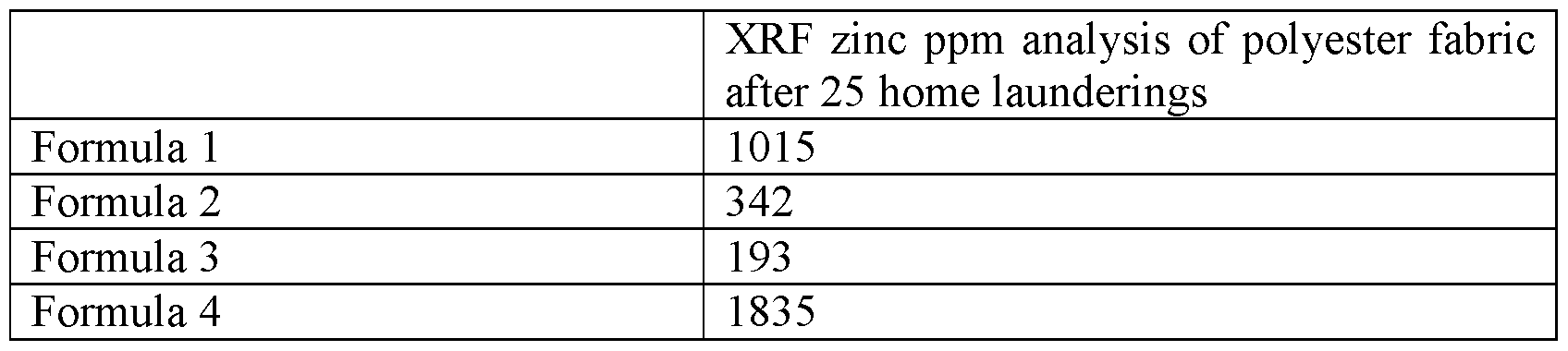
- sulfo polyester was compared with polyacrylic binders on improving the wash durability of zinc oxide treatment on polyester fabric.
- Polyacrylic binder Rhoplex TR-934 HS and Rhoplex TR-407 were obtained from Dow Chemical Company.
- the polyester fabric was treated with formulations in Table 4 through padding and cured at 130C for 45 seconds afterward. The treated fabrics were then laundered 25 times and then the zinc levels on fabric were measured with XRF for durability.
- the pH of treatment bath of Formula 4 was adjusted with citric acid from alkaline pH to a neutral or slightly acidic pH.
- Any type of acids can be used to adjust the pH of zinc oxide treatment bath.
- the useful acids include but are not limited to inorganic acids or organic acids where organic acids may be preferred. Examples of useful acids include but not limited to sulfuric acid, nitric acid, acetic acid, tannic acid, formic acid, succinic acid, ethylenediaminetetraacetic acid, and polyacrylic acid.
- sulfo polyester was compared with polyacrylic acid at binding zinc oxide to nylon fabric and making it resistant to home launderings.
- the polyacrylic acid used in this example is a Microban binder R10950.
- Nylon fabric, texturized Nylon 6.6 stretch, was obtained from Testfabrics, Inc.
- the pad bath formulations listed in Table 6 were prepared first and then padded onto the fabric followed with curing at 130 °C for 45 seconds. Treated fabrics were laundered 25 times and assessed for their wash durability subsequently with XRF analysis. Results are displayed in Table 7
- sulfo polyester was shown to be a much better binder for use to fix zinc oxide permanently on nylon fabric than polyacrylic binder.
- Octocure 462 and Eastek 1000 were exhausted onto a black dyed polyester rich fabric comprising 81% polyester and 19% spandex.
- the exhaustion was performed in a beaker dyeing machine, Lobomat BFA-24, Werner Mathis AG.
- the exhaustion conditions are listed in Table 8.
- BC300A was 1% based on weight of fabric and BC300B was also 1% based on weight of fabric.
Landscapes
- Textile Engineering (AREA)
- Engineering & Computer Science (AREA)
- Chemical & Material Sciences (AREA)
- Chemical Kinetics & Catalysis (AREA)
- Health & Medical Sciences (AREA)
- Life Sciences & Earth Sciences (AREA)
- Veterinary Medicine (AREA)
- Animal Behavior & Ethology (AREA)
- General Health & Medical Sciences (AREA)
- Public Health (AREA)
- Epidemiology (AREA)
- Microbiology (AREA)
- General Chemical & Material Sciences (AREA)
- Biochemistry (AREA)
- Chemical Or Physical Treatment Of Fibers (AREA)
- Treatments For Attaching Organic Compounds To Fibrous Goods (AREA)
- Compositions Of Macromolecular Compounds (AREA)
- Catalysts (AREA)
- Solid-Sorbent Or Filter-Aiding Compositions (AREA)
- Artificial Filaments (AREA)
Abstract
Description




Claims
Priority Applications (7)
| Application Number | Priority Date | Filing Date | Title |
|---|---|---|---|
| KR1020207016648A KR20200087199A (en) | 2017-11-14 | 2018-11-14 | Odor management composition and method of use |
| RU2020119361A RU2020119361A (en) | 2017-11-14 | 2018-11-14 | ODOR REMOVING COMPOSITION AND METHOD OF ITS APPLICATION |
| EP18878246.0A EP3710070A4 (en) | 2017-11-14 | 2018-11-14 | ODOR CONTROL COMPOSITION AND METHOD OF USE |
| BR112020009674-1A BR112020009674A2 (en) | 2017-11-14 | 2018-11-14 | odor control composition, methods for making and using an odor control composition, and, article |
| MX2020005057A MX2020005057A (en) | 2017-11-14 | 2018-11-14 | Odor control composition and method of using. |
| CN201880086478.7A CN111712268A (en) | 2017-11-14 | 2018-11-14 | Odor control compositions and methods of use |
| CA3082775A CA3082775A1 (en) | 2017-11-14 | 2018-11-14 | Odor control composition and method of using |
Applications Claiming Priority (4)
| Application Number | Priority Date | Filing Date | Title |
|---|---|---|---|
| US201762585749P | 2017-11-14 | 2017-11-14 | |
| US62/585,749 | 2017-11-14 | ||
| US16/189,102 US12577725B2 (en) | 2017-11-14 | 2018-11-13 | Odor control composition and method of using |
| US16/189,102 | 2018-11-13 |
Publications (1)
| Publication Number | Publication Date |
|---|---|
| WO2019099452A1 true WO2019099452A1 (en) | 2019-05-23 |
Family
ID=66431261
Family Applications (1)
| Application Number | Title | Priority Date | Filing Date |
|---|---|---|---|
| PCT/US2018/060931 Ceased WO2019099452A1 (en) | 2017-11-14 | 2018-11-14 | Odor control composition and method of using |
Country Status (9)
| Country | Link |
|---|---|
| US (1) | US12577725B2 (en) |
| EP (1) | EP3710070A4 (en) |
| KR (1) | KR20200087199A (en) |
| CN (1) | CN111712268A (en) |
| BR (1) | BR112020009674A2 (en) |
| CA (1) | CA3082775A1 (en) |
| MX (1) | MX2020005057A (en) |
| RU (1) | RU2020119361A (en) |
| WO (1) | WO2019099452A1 (en) |
Families Citing this family (1)
| Publication number | Priority date | Publication date | Assignee | Title |
|---|---|---|---|---|
| WO2024112740A1 (en) | 2022-11-23 | 2024-05-30 | Nutrition & Biosciences USA 4, Inc. | Hygienic treatment of surfaces with compositions comprising hydrophobically modified alpha-glucan derivative |
Citations (4)
| Publication number | Priority date | Publication date | Assignee | Title |
|---|---|---|---|---|
| US6989193B2 (en) * | 2003-06-19 | 2006-01-24 | William Alston Haile | Water-dispersible and multicomponent fibers from sulfopolyesters |
| US20090098016A1 (en) * | 2005-10-26 | 2009-04-16 | Nanoscale Corporation | Treatment of odors using nanocrystalline metal oxides |
| US20120183861A1 (en) * | 2010-10-21 | 2012-07-19 | Eastman Chemical Company | Sulfopolyester binders |
| US20120295987A1 (en) * | 2009-12-23 | 2012-11-22 | Colgate-Palmolive Company | Cleansing bar |
Family Cites Families (66)
| Publication number | Priority date | Publication date | Assignee | Title |
|---|---|---|---|---|
| US7291570B1 (en) | 2000-06-02 | 2007-11-06 | Milliken & Company | Yarns and fabrics having a wash-durable non-electrically conductive topically applied metal-based finish |
| US5833970A (en) | 1977-01-24 | 1998-11-10 | Cox; James P. | Deodorant material and deodorizing method |
| WO1992002583A1 (en) | 1990-08-06 | 1992-02-20 | Eastman Kodak Company | Polymer blends of polyesters and polystyrene for aqueous inks |
| JPH05156510A (en) | 1991-11-29 | 1993-06-22 | Sumitomo Cement Co Ltd | Textile and textile product processing method and textile and textile product |
| US5663224A (en) | 1991-12-03 | 1997-09-02 | Rohm And Haas Company | Process for preparing an aqueous dispersion |
| MX9701122A (en) | 1994-08-12 | 1997-05-31 | Procter & Gamble | Composition for reducing malodor impression on inanimate surfaces. |
| US6162890A (en) | 1994-10-24 | 2000-12-19 | Eastman Chemical Company | Water-dispersible block copolyesters useful as low-odor adhesive raw materials |
| WO1998045525A1 (en) | 1997-04-08 | 1998-10-15 | Cigone Enterprises, Inc. | Method, composition, and system for removing odors |
| FR2776187B1 (en) | 1998-03-23 | 2000-05-05 | Oreal | SOLID DEODORANT COMPOSITION |
| US6060229A (en) * | 1998-10-15 | 2000-05-09 | Eastman Kodak Company | Imaging element containing an electrically-conductive layer and a transparent magnetic recording layer |
| US6096491A (en) * | 1998-10-15 | 2000-08-01 | Eastman Kodak Company | Antistatic layer for imaging element |
| US6723428B1 (en) | 1999-05-27 | 2004-04-20 | Foss Manufacturing Co., Inc. | Anti-microbial fiber and fibrous products |
| AU7136000A (en) | 1999-07-19 | 2001-02-05 | Avantgarb, Llc | Nanoparticle-based permanent treatments for textiles |
| US6171685B1 (en) * | 1999-11-26 | 2001-01-09 | Eastman Chemical Company | Water-dispersible films and fibers based on sulfopolyesters |
| US6461386B1 (en) | 2000-05-17 | 2002-10-08 | Milliken & Company | Antimicrobial transfer substrates and methods of use therewith |
| WO2001094687A2 (en) | 2000-06-02 | 2001-12-13 | Milliken & Company | Yarns and fabrics having a wash-durable non-electrically conductive topically applied metal-based finish |
| US6495079B1 (en) | 2000-06-28 | 2002-12-17 | Prisma Fibers, Inc. | Process to prepare polymeric fibers with improved color and appearance |
| US6780941B2 (en) | 2000-12-22 | 2004-08-24 | Prisma Fibers, Inc. | Process for preparing polymeric fibers based on blends of at least two polymers |
| JP2002339239A (en) | 2001-05-16 | 2002-11-27 | Toray Ind Inc | Fiber structure |
| US6979491B2 (en) | 2002-03-27 | 2005-12-27 | Cc Technology Investment Co., Ltd. | Antimicrobial yarn having nanosilver particles and methods for manufacturing the same |
| JP3991748B2 (en) | 2002-04-05 | 2007-10-17 | 日本エクスラン工業株式会社 | Deodorant fiber structure with indicator |
| US20060128578A9 (en) * | 2002-09-20 | 2006-06-15 | Nathalie Jager Lezer | Cosmetic composition comprising rigid fibres and at least one compound chosen from film-forming polymers and waxes |
| DE10248583A1 (en) | 2002-10-17 | 2004-04-29 | Nanogate Technologies Gmbh | Textile treatment agents |
| JP2004270042A (en) | 2003-03-05 | 2004-09-30 | Teijin Fibers Ltd | Deodorant fibrous structure having soft touch feeling |
| JP4279576B2 (en) | 2003-03-13 | 2009-06-17 | 拓夫 坂井 | Antibacterial natural fiber and fabric and method for producing the same |
| US7794737B2 (en) | 2003-10-16 | 2010-09-14 | Kimberly-Clark Worldwide, Inc. | Odor absorbing extrudates |
| GB2407327A (en) | 2003-10-24 | 2005-04-27 | Reckitt Benckiser | Tear-off odour-reducing sheets |
| US7521410B2 (en) | 2004-03-26 | 2009-04-21 | Arrowstar, Llc | Compositions and methods for imparting odor resistance and articles thereof |
| US7862624B2 (en) | 2004-04-06 | 2011-01-04 | Bao Tran | Nano-particles on fabric or textile |
| JP3761892B1 (en) | 2004-10-19 | 2006-03-29 | シャープ株式会社 | Method for imparting antistatic property to fiber structure and fiber structure provided with antistatic property by the method |
| US20100003296A1 (en) | 2004-12-21 | 2010-01-07 | Jiachong Cheng | Manufacturing methods and applications of antimicrobial plant fibers having silver particles |
| US20090311293A1 (en) * | 2005-04-21 | 2009-12-17 | Marcello Fratini | Method and composition for obtaining odor-suppressing textile products and textile products, namely garments, thus obtained |
| DE102005020889A1 (en) | 2005-05-04 | 2006-11-09 | Fritz Blanke Gmbh & Co.Kg | Antimicrobial finishing of textiles, particularly fabrics, by treatment first with bath containing silver particles and then with bath containing aqueous binder |
| WO2007054827A2 (en) | 2005-10-17 | 2007-05-18 | Mandawewala Rajesh R | Hygro materials for use in making yarns and fabrics |
| CA2632938C (en) | 2005-12-12 | 2015-07-07 | Southern Mills, Inc. | Flame resistant fabric having antimicrobials and methods for making them |
| TWI285694B (en) | 2005-12-29 | 2007-08-21 | Taiwan Textile Res Inst | Long-term antibiotic and deodorant textile and preparation method thereof |
| CA2669438C (en) | 2006-04-24 | 2015-06-16 | Axcelon Biopolymers Corporation | Nanosilver coated bacterial cellulose |
| US7754625B2 (en) | 2006-12-22 | 2010-07-13 | Aglon Technologies, Inc. | Wash-durable and color stable antimicrobial treated textiles |
| US20080299154A1 (en) * | 2007-05-30 | 2008-12-04 | L'oreal Usa Products, Inc. | Cosmetic hair compositions containing metal-oxide layered pigments and methods of use |
| DE102007027632A1 (en) | 2007-06-12 | 2008-12-18 | Detlef Militz | Process for the treatment of at least partially metallised textile, treated textile and its use |
| US8512417B2 (en) | 2008-11-14 | 2013-08-20 | Dune Sciences, Inc. | Functionalized nanoparticles and methods of forming and using same |
| DE102009029152A1 (en) | 2009-09-03 | 2011-03-17 | Evonik Degussa Gmbh | Flexible coating composites with predominantly mineral composition |
| US20110150808A1 (en) * | 2009-12-18 | 2011-06-23 | Richard Rigg | Method for manufacture of pigment-containing cosmetic compositions and related compositions |
| EP2357275B8 (en) | 2010-02-11 | 2021-03-17 | Lautratex B.V. | Woven holder for laundry and method for manufacturing such woven holder |
| EP2688411A4 (en) | 2011-03-24 | 2014-08-27 | Silver Anti Bac Llc | SILVER CHLORIDE COMPOSITIONS FOR DEODORIZATION AND DISINFECTION |
| NL2006634C2 (en) | 2011-04-19 | 2012-10-22 | Ar Metallizing N V | Antimicrobial fabric. |
| EP2729552B1 (en) | 2011-07-06 | 2018-03-21 | National Research Council of Canada | Fire-resistant cellulosic material |
| US9205037B2 (en) * | 2011-07-20 | 2015-12-08 | Church & Dwight Co., Inc. | Single phase depilatory composition |
| FI20115816L (en) | 2011-08-22 | 2013-02-23 | Silverphase Oy | Antimicrobial ionomer composition and its applications |
| US8690964B2 (en) | 2011-10-11 | 2014-04-08 | The Sweet Living Group, LLC | Fabric having ultraviolet radiation protection |
| US8277518B1 (en) | 2011-10-11 | 2012-10-02 | The Sweet Living Group, LLC | Ecological fabric having ultraviolet radiation protection |
| US9234310B2 (en) | 2011-10-11 | 2016-01-12 | The Sweet Living Group, LLC | Fabric having ultraviolet radiation protection, enhanced resistance to degradation, and enhanced resistance to fire |
| US20130319931A1 (en) | 2012-06-04 | 2013-12-05 | Agplus Technologies Pte. Ltd. | Method of forming and immobilizing metal nanoparticles on substrates and the use thereof |
| US20150233049A1 (en) | 2012-08-02 | 2015-08-20 | Nanohorizons Inc. | Wash-durable antimicrobial textiles and methods of manufacture |
| US9986742B2 (en) | 2012-12-20 | 2018-06-05 | Quick-Med Technologies, Inc. | Durable antimicrobial treatments for textiles and other substrates |
| US20140212598A1 (en) | 2013-01-26 | 2014-07-31 | UVR Defense Tech. Ltd. | Protection and performance improvements of fabrics through nanotechnology |
| ES2412608B2 (en) | 2013-06-07 | 2014-01-14 | Sutran I Mas D, S.L. | Anti-odor and antibacterial fabric in textile garments |
| EP2842921A1 (en) | 2013-08-27 | 2015-03-04 | Construction Research & Technology GmbH | Novel fibers, methods for their preparation and use in the manufacture of reinforced elements |
| IN2013MU02827A (en) | 2013-08-29 | 2015-07-03 | Green Impact Holdings Gmbh | |
| GB2518430A (en) | 2013-09-23 | 2015-03-25 | Speciality Fibres And Materials Ltd | Cellulose fibres |
| CN107207771B (en) | 2015-02-08 | 2019-12-06 | 阿尔贾曼技术有限公司 | Antimicrobial materials comprising synergistic combinations of metal oxides |
| US10216111B2 (en) * | 2015-05-07 | 2019-02-26 | Xerox Corporation | Antimicrobial sulfonated polyester resin |
| WO2017031133A1 (en) | 2015-08-17 | 2017-02-23 | Choudhry Salman | A self-cleaning and stain resistant denim fabric |
| US20170314185A1 (en) | 2016-04-28 | 2017-11-02 | Sri Lanka Institute of Nanotechnology (Pvt) Ltd. | Near Infrared Energy Absorbing Textile |
| US12054879B2 (en) | 2016-12-15 | 2024-08-06 | Microban Products Company | Odor control composition and treatment method |
| US20180305859A1 (en) | 2017-04-25 | 2018-10-25 | Milliken & Company | Pattern coated textile for active cooling |
-
2018
- 2018-11-13 US US16/189,102 patent/US12577725B2/en active Active
- 2018-11-14 KR KR1020207016648A patent/KR20200087199A/en not_active Ceased
- 2018-11-14 RU RU2020119361A patent/RU2020119361A/en unknown
- 2018-11-14 MX MX2020005057A patent/MX2020005057A/en unknown
- 2018-11-14 WO PCT/US2018/060931 patent/WO2019099452A1/en not_active Ceased
- 2018-11-14 CA CA3082775A patent/CA3082775A1/en active Pending
- 2018-11-14 CN CN201880086478.7A patent/CN111712268A/en active Pending
- 2018-11-14 BR BR112020009674-1A patent/BR112020009674A2/en active Search and Examination
- 2018-11-14 EP EP18878246.0A patent/EP3710070A4/en active Pending
Patent Citations (4)
| Publication number | Priority date | Publication date | Assignee | Title |
|---|---|---|---|---|
| US6989193B2 (en) * | 2003-06-19 | 2006-01-24 | William Alston Haile | Water-dispersible and multicomponent fibers from sulfopolyesters |
| US20090098016A1 (en) * | 2005-10-26 | 2009-04-16 | Nanoscale Corporation | Treatment of odors using nanocrystalline metal oxides |
| US20120295987A1 (en) * | 2009-12-23 | 2012-11-22 | Colgate-Palmolive Company | Cleansing bar |
| US20120183861A1 (en) * | 2010-10-21 | 2012-07-19 | Eastman Chemical Company | Sulfopolyester binders |
Non-Patent Citations (2)
| Title |
|---|
| ANONYMOUS: "Talc mineral Data- Mineral of the month club", WEBMINERAL, 18 September 2016 (2016-09-18), XP055614198, Retrieved from the Internet <URL:https://web.archive.org/web/20160918211035/http://webmineral.com/data/Talc.shtml> [retrieved on 20181228] * |
| See also references of EP3710070A4 * |
Also Published As
| Publication number | Publication date |
|---|---|
| EP3710070A1 (en) | 2020-09-23 |
| CN111712268A (en) | 2020-09-25 |
| KR20200087199A (en) | 2020-07-20 |
| US20190145045A1 (en) | 2019-05-16 |
| RU2020119361A (en) | 2021-12-15 |
| MX2020005057A (en) | 2020-10-28 |
| BR112020009674A2 (en) | 2020-11-10 |
| CA3082775A1 (en) | 2019-05-23 |
| US12577725B2 (en) | 2026-03-17 |
| EP3710070A4 (en) | 2021-09-01 |
| RU2020119361A3 (en) | 2021-12-15 |
Similar Documents
| Publication | Publication Date | Title |
|---|---|---|
| CN114828631A (en) | Odor reduction and bacteria control on textile materials | |
| JP2006524294A (en) | Fabrics topically applied with a silver-containing finish containing a crosslinker system for improved high temperature wash durability | |
| JP2015089975A (en) | Deodorant and processing method of the deodorant to fabric or yarn | |
| US12173187B1 (en) | Textile coating composition that reduces and/or prevents microbial growth and/or control odor(s) for prolonged time periods | |
| US12577725B2 (en) | Odor control composition and method of using | |
| US3592686A (en) | Process for making durable press and soil release textile and resultant article | |
| KR20180022647A (en) | Antifouling textile structure | |
| Wei et al. | Nonformaldehyde Wrinkle-Free Garment Finishing of Cotton Slacks. | |
| HK40038432A (en) | Odor control composition and methdod of using | |
| US7037441B2 (en) | Durable press cellulosic fibrous substrates with improved physical properties | |
| KR101004245B1 (en) | Compositions and Treated Substrates with Reversible Adjustable Surface Energy Properties and Methods for Making the Same | |
| JP2007291562A (en) | Fiber having durable antistatic function and method for producing the same | |
| JP2009007680A (en) | Denim fabric and method for preventing discoloration thereof | |
| WO2008063641A1 (en) | Benefit compositions and methods | |
| US12252840B2 (en) | Textile formulation and product with odor control | |
| JP2010013771A (en) | Fiber-treating agent and method for producing dyed fiber | |
| WO2023225393A1 (en) | Antimicrobial polymer coatings on textiles | |
| Latta et al. | Oily-soil release for easy-care cotton fabrics1 | |
| JP3228382B2 (en) | Acrylic fiber having antibacterial and antifungal properties and method for producing the same | |
| JP2026002474A (en) | Polyester fiber structure and method for manufacturing polyester fiber structure | |
| JP2009120973A (en) | Textile treatment agent and method for producing dyed fiber | |
| JP2015166502A (en) | polyester fiber structure | |
| HK40079119A (en) | Odor reduction and bacterial control on a textile material |
Legal Events
| Date | Code | Title | Description |
|---|---|---|---|
| 121 | Ep: the epo has been informed by wipo that ep was designated in this application |
Ref document number: 18878246 Country of ref document: EP Kind code of ref document: A1 |
|
| ENP | Entry into the national phase |
Ref document number: 3082775 Country of ref document: CA |
|
| NENP | Non-entry into the national phase |
Ref country code: DE |
|
| ENP | Entry into the national phase |
Ref document number: 20207016648 Country of ref document: KR Kind code of ref document: A |
|
| ENP | Entry into the national phase |
Ref document number: 2018878246 Country of ref document: EP Effective date: 20200615 |
|
| REG | Reference to national code |
Ref country code: BR Ref legal event code: B01A Ref document number: 112020009674 Country of ref document: BR |
|
| ENP | Entry into the national phase |
Ref document number: 112020009674 Country of ref document: BR Kind code of ref document: A2 Effective date: 20200514 |