WO2019117143A1 - タイヤトレッド用ゴム組成物及びタイヤ - Google Patents
タイヤトレッド用ゴム組成物及びタイヤ Download PDFInfo
- Publication number
- WO2019117143A1 WO2019117143A1 PCT/JP2018/045503 JP2018045503W WO2019117143A1 WO 2019117143 A1 WO2019117143 A1 WO 2019117143A1 JP 2018045503 W JP2018045503 W JP 2018045503W WO 2019117143 A1 WO2019117143 A1 WO 2019117143A1
- Authority
- WO
- WIPO (PCT)
- Prior art keywords
- mass
- rubber
- rubber composition
- parts
- fatty acid
- Prior art date
- Legal status (The legal status is an assumption and is not a legal conclusion. Google has not performed a legal analysis and makes no representation as to the accuracy of the status listed.)
- Ceased
Links
- UFWIBTONFRDIAS-UHFFFAOYSA-N c(cc1)cc2c1cccc2 Chemical compound c(cc1)cc2c1cccc2 UFWIBTONFRDIAS-UHFFFAOYSA-N 0.000 description 1
Classifications
-
- C—CHEMISTRY; METALLURGY
- C08—ORGANIC MACROMOLECULAR COMPOUNDS; THEIR PREPARATION OR CHEMICAL WORKING-UP; COMPOSITIONS BASED THEREON
- C08L—COMPOSITIONS OF MACROMOLECULAR COMPOUNDS
- C08L7/00—Compositions of natural rubber
-
- B—PERFORMING OPERATIONS; TRANSPORTING
- B60—VEHICLES IN GENERAL
- B60C—VEHICLE TYRES; TYRE INFLATION; TYRE CHANGING; CONNECTING VALVES TO INFLATABLE ELASTIC BODIES IN GENERAL; DEVICES OR ARRANGEMENTS RELATED TO TYRES
- B60C1/00—Tyres characterised by the chemical composition or the physical arrangement or mixture of the composition
- B60C1/0016—Compositions of the tread
-
- C—CHEMISTRY; METALLURGY
- C08—ORGANIC MACROMOLECULAR COMPOUNDS; THEIR PREPARATION OR CHEMICAL WORKING-UP; COMPOSITIONS BASED THEREON
- C08K—Use of inorganic or non-macromolecular organic substances as compounding ingredients
- C08K3/00—Use of inorganic substances as compounding ingredients
- C08K3/02—Elements
- C08K3/04—Carbon
-
- C—CHEMISTRY; METALLURGY
- C08—ORGANIC MACROMOLECULAR COMPOUNDS; THEIR PREPARATION OR CHEMICAL WORKING-UP; COMPOSITIONS BASED THEREON
- C08K—Use of inorganic or non-macromolecular organic substances as compounding ingredients
- C08K3/00—Use of inorganic substances as compounding ingredients
- C08K3/18—Oxygen-containing compounds, e.g. metal carbonyls
- C08K3/20—Oxides; Hydroxides
- C08K3/22—Oxides; Hydroxides of metals
-
- C—CHEMISTRY; METALLURGY
- C08—ORGANIC MACROMOLECULAR COMPOUNDS; THEIR PREPARATION OR CHEMICAL WORKING-UP; COMPOSITIONS BASED THEREON
- C08K—Use of inorganic or non-macromolecular organic substances as compounding ingredients
- C08K3/00—Use of inorganic substances as compounding ingredients
- C08K3/34—Silicon-containing compounds
- C08K3/36—Silica
-
- C—CHEMISTRY; METALLURGY
- C08—ORGANIC MACROMOLECULAR COMPOUNDS; THEIR PREPARATION OR CHEMICAL WORKING-UP; COMPOSITIONS BASED THEREON
- C08K—Use of inorganic or non-macromolecular organic substances as compounding ingredients
- C08K5/00—Use of organic ingredients
- C08K5/04—Oxygen-containing compounds
- C08K5/09—Carboxylic acids; Metal salts thereof; Anhydrides thereof
-
- C—CHEMISTRY; METALLURGY
- C08—ORGANIC MACROMOLECULAR COMPOUNDS; THEIR PREPARATION OR CHEMICAL WORKING-UP; COMPOSITIONS BASED THEREON
- C08K—Use of inorganic or non-macromolecular organic substances as compounding ingredients
- C08K5/00—Use of organic ingredients
- C08K5/04—Oxygen-containing compounds
- C08K5/09—Carboxylic acids; Metal salts thereof; Anhydrides thereof
- C08K5/098—Metal salts of carboxylic acids
-
- C—CHEMISTRY; METALLURGY
- C08—ORGANIC MACROMOLECULAR COMPOUNDS; THEIR PREPARATION OR CHEMICAL WORKING-UP; COMPOSITIONS BASED THEREON
- C08K—Use of inorganic or non-macromolecular organic substances as compounding ingredients
- C08K5/00—Use of organic ingredients
- C08K5/16—Nitrogen-containing compounds
- C08K5/22—Compounds containing nitrogen bound to another nitrogen atom
- C08K5/24—Derivatives of hydrazine
-
- B—PERFORMING OPERATIONS; TRANSPORTING
- B60—VEHICLES IN GENERAL
- B60C—VEHICLE TYRES; TYRE INFLATION; TYRE CHANGING; CONNECTING VALVES TO INFLATABLE ELASTIC BODIES IN GENERAL; DEVICES OR ARRANGEMENTS RELATED TO TYRES
- B60C2200/00—Tyres specially adapted for particular applications
- B60C2200/02—Tyres specially adapted for particular applications for aircrafts
-
- C—CHEMISTRY; METALLURGY
- C08—ORGANIC MACROMOLECULAR COMPOUNDS; THEIR PREPARATION OR CHEMICAL WORKING-UP; COMPOSITIONS BASED THEREON
- C08K—Use of inorganic or non-macromolecular organic substances as compounding ingredients
- C08K3/00—Use of inorganic substances as compounding ingredients
- C08K3/18—Oxygen-containing compounds, e.g. metal carbonyls
- C08K3/20—Oxides; Hydroxides
- C08K3/22—Oxides; Hydroxides of metals
- C08K2003/2296—Oxides; Hydroxides of metals of zinc
-
- Y—GENERAL TAGGING OF NEW TECHNOLOGICAL DEVELOPMENTS; GENERAL TAGGING OF CROSS-SECTIONAL TECHNOLOGIES SPANNING OVER SEVERAL SECTIONS OF THE IPC; TECHNICAL SUBJECTS COVERED BY FORMER USPC CROSS-REFERENCE ART COLLECTIONS [XRACs] AND DIGESTS
- Y02—TECHNOLOGIES OR APPLICATIONS FOR MITIGATION OR ADAPTATION AGAINST CLIMATE CHANGE
- Y02T—CLIMATE CHANGE MITIGATION TECHNOLOGIES RELATED TO TRANSPORTATION
- Y02T10/00—Road transport of goods or passengers
- Y02T10/80—Technologies aiming to reduce greenhouse gasses emissions common to all road transportation technologies
- Y02T10/86—Optimisation of rolling resistance, e.g. weight reduction
Definitions
- the present invention relates to a rubber composition for a tire tread and a tire.
- Patent Document 1 assumes a tire for heavy load and is intended to simultaneously improve abrasion resistance and heat generation resistance, and comprises a rubber composition containing zinc oxide, fatty acid, and / or zinc fatty acid.
- a rubber composition for a tire tread is disclosed in which the melting point of fatty acid zinc contained in the vulcanized rubber is equal to or lower than a specific temperature (average melting point per weight is 105 ° C. or lower).
- the rubber composition for a tire tread according to Patent Document 1 is further improved in wear resistance and heat generation resistance, and is particularly excellent as a rubber composition of a heavy load tire.
- wear resistance and heat generation resistance particularly excellent as a rubber composition of a heavy load tire.
- the tread rubber of the tire makes high speed contact under heavy load to a groove provided for drainage on the runway. Because of this, the tread rubber of the tire may have a cut scratch called a pine cone or chevron chevron cut, so high crack resistance is required and there is room for further improvement. .
- the present invention has been made to solve the above-mentioned problems, and it is possible to improve the wear resistance and the heat generation resistance, and further to provide a tire excellent in cracking resistance, and a rubber composition for a tire tread obtained therefrom. It is intended to be provided.
- the present inventors have found that if agglomerates are present in the vulcanized rubber comprising the rubber composition for a tire tread, the agglomerates become fracture cores and the vulcanized rubber starts from the agglomerates. Was found to be prone to cracking.
- the present inventor contains a specific amount or more of natural rubber in a rubber composition for a tire tread, and a specific amount of at least one total amount selected from the group consisting of zinc oxide, fatty acid, and fatty acid zinc. It has been found that it can be contained and carbon black dispersant can be contained, thereby suppressing the formation of aggregates, and the present invention has been completed. That is, the present invention is as follows.
- the value of (White Area%) ⁇ (White area integrated value of particle size 32 ⁇ m or more) / (White area integrated value of particle size 3 to 57 ⁇ m) is 0.2
- the content of the filler is 1 to 60 parts by mass with respect to 100 parts by mass of the rubber component, and the cetyltrimethylammonium bromide adsorption specific surface area (CTAB) in the filler is 50 to 350 m 2 / g.
- CTAB cetyltrimethylammonium bromide adsorption specific surface area
- abrasion resistance and heat generation resistance can be improved, and also the tire which is excellent also in crack resistance, and the rubber composition for tire treads which can obtain this can be provided.
- the rubber composition for a tire tread according to the present invention comprises a rubber component containing 70% by mass or more of natural rubber, and zinc oxide having a total content of 2 parts by mass or more and less than 13 parts by mass with respect to 100 parts by mass of the rubber component. It contains fatty acid and fatty acid zinc, a filler containing carbon black, and a carbon black dispersant. Further, the vulcanized rubber of the rubber composition for a tire tread according to the present invention has a white area integrated value of 32 ⁇ m or more in particle diameter of 3 to 57 ⁇ m in particle diameter in measurement of a cross section by a disperser according to ASTM D7723.
- an aggregate refers to an aggregate having a particle diameter of 3 ⁇ m or more present in a vulcanized rubber.
- aggregate may refer to one or two or more of the components of the rubber composition constituting the vulcanized rubber, and specifically, an aggregate of fatty acid zinc, carbon black And the like, and aggregates of fillers, aggregates of crosslinking agents and other components, and the like.
- the rubber composition for a tire tread according to the present invention will be described.
- the rubber composition for a tire tread according to the present invention contains a rubber component containing a natural rubber.
- the content of natural rubber in the rubber component is 70% by mass or more. When the content of the natural rubber is less than the above range, it may be difficult to improve the wear resistance and the heat generation resistance of the tire, and to exhibit the effect of being excellent also in the crack resistance.
- the content of natural rubber in the rubber component is preferably less than 100% by mass from the viewpoint of the wear resistance of the tire, and specifically, it is preferably 70 to 95% by mass, and is preferably 80 to 95% by mass is more preferable, more than 80% by mass and 95% by mass or less is more preferable, and 80% by mass to 85% by mass to 93% by mass is more preferable.
- NR natural rubber
- BR butadiene rubber
- IR isoprene rubber
- SBR styrene-butadiene rubber
- NBR acrylonitrile-butadiene rubber
- CR chloroprene rubber
- IIR butyl rubber
- X-IIR halogenated butyl rubber
- EPM ethylene-propylene rubber
- EPDM ethylene-propylene-diene copolymer rubber
- SIBR styrene-isoprene-butadiene copolymer rubber
- the rubber composition for a tire tread according to the present invention contains a filler.
- the content of the filler in the rubber composition is preferably 1 to 60 parts by mass, more preferably 30 to 50 parts by mass, and still more preferably 40 to 50 parts by mass with respect to 100 parts by mass of the rubber component.
- the content of the filler is in the above range, the effect of improving the wear resistance and the heat generation resistance of the tire and further excellent in the crack resistance is easily exhibited.
- the filler contains at least carbon black.
- the content of carbon black in the filler is preferably 60 to 100% by mass, more preferably 70 to 100% by mass, and still more preferably 80 to 100% by mass.
- the content of carbon black in the rubber composition is preferably 40 to 60 parts by mass, more preferably 40 to 55 parts by mass, and further 40 to 50 parts by mass with respect to 100 parts by mass of the rubber component. preferable.
- the content of the carbon black is in the above range, the effect of improving the wear resistance and the heat generation resistance of the tire and further excellent in the crack resistance is easily exhibited.
- the carbon black is not particularly limited as long as it is conventionally used as a reinforcing filler for rubber, and GPF (N 660), FEF (N 550), SRF (N 774), HAF (N 330), ISAF (N 220), ISAF -HS (N234), SAF (N110) and the like.
- GPF GPF
- FEF FEF
- SRF SRF
- HAF HAF
- ISAF ISAF
- N220 ISAF -HS
- SAF SAF
- N110 SAF
- Carbon black can be obtained as a commercial product, and examples thereof include a trade name “VULCAN 6 SHOBLACK” manufactured by Cabot.
- the filler preferably further contains inorganic particles having a cetyltrimethylammonium bromide adsorption specific surface area (CTAB) in the range of 50 to 350 m 2 / g.
- CTAB cetyltrimethylammonium bromide adsorption specific surface area
- the content of the inorganic particles in the filler is preferably 1 to 20% by mass, more preferably 5 to 20% by mass, and still more preferably 10 to 20% by mass.
- the content of inorganic particles in the rubber composition is preferably 1 to 20 parts by mass, more preferably 1 to 15 parts by mass, and further 5 to 15 parts by mass with respect to 100 parts by mass of the rubber component. preferable.
- cetyl trimethyl ammonium bromide adsorption specific surface area is preferably in the range of 50 ⁇ 350m 2 / g, more preferably in the range of 70 ⁇ 330m 2 / g, 90
- the range of ⁇ 300 m 2 / g is more preferable, the range of 130 ⁇ 260 m 2 / g is still more preferable, and the range of 140 ⁇ 200 m 2 / g is particularly preferable.
- CTAB cetyltrimethylammonium bromide adsorption specific surface area
- the inorganic particles having a cetyltrimethylammonium bromide adsorption specific surface area (CTAB) in the range of 50 to 350 m 2 / g are not particularly limited, and examples thereof include silica, alumina, and titania. Among these, silica is preferably used because the effect of crack propagation resistance which suppresses the propagation of cracks is easily exhibited.
- CTAB cetyltrimethylammonium bromide adsorption specific surface area
- the inorganic particles to be contained in the filler preferably have a BET surface area of 40 to 350 m 2 / g, more preferably 80 to 320 m 2 / g, and more preferably 150 to 300 m 2. Is more preferably in the range of 170 to 290 m 2 / g, still more preferably in the range of 190 to 280 m 2 / g, and still more preferably in the range of 190 to 250 m 2 / g. It is further more preferable to be in the range, and it is particularly preferable to be in the range of 190 to 230 m 2 / g.
- the BET surface area of the inorganic particles is in the above-mentioned range, the effect of improving the wear resistance and the heat generation resistance of the tire and further excellent in the crack resistance is easily exhibited.
- a silica having a cetyltrimethylammonium bromide adsorption specific surface area (CTAB) in the range of 50 to 350 m 2 / g can also be obtained as a commercially available product, for example, trade name “Nipseal KQ” manufactured by Tosoh Silica Corporation, Tosoh, Inc.
- CCA cetyltrimethylammonium bromide adsorption specific surface area
- silane coupling agent When silica is used as the inorganic particles having a cetyltrimethylammonium bromide adsorption specific surface area (CTAB) in the range of 50 to 350 m 2 / g, a silane coupling agent is used in view of enhancing the dispersibility of the silica in the rubber composition. It can be used.
- the content of the silane coupling agent in the rubber composition is preferably 1 to 20 parts by mass, more preferably 1 to 15 parts by mass, and still more preferably 5 to 15 parts by mass with respect to 100 parts by mass of silica. .
- the silane coupling agent is not particularly limited.
- bis (3-triethoxysilylpropyl) polysulfide, ⁇ -mercaptopropyltriethoxysilane, ⁇ -aminopropyltriethoxysilane, N-phenyl- ⁇ -aminopropyltrithio Methoxysilane, N- ⁇ - (aminoethyl) - ⁇ -aminopropyltrimethoxysilane and the like can be mentioned.
- the silane coupling agent can also be obtained as a commercial product, and examples thereof include a trade name “ABC-856” manufactured by Shin-Etsu Chemical Co., Ltd., and the like.
- the rubber composition for a tire tread according to the present invention contains at least one selected from the group consisting of zinc oxide, fatty acid, and fatty acid zinc.
- the total content of at least one selected from the group consisting of zinc oxide, fatty acid and fatty acid zinc is 2 parts by mass or more and less than 13 parts by mass, and 2 parts by mass or more and 8 parts by mass with respect to 100 parts by mass of the rubber component Less than is preferable, and 2 to 6 parts by mass is more preferable.
- the total content of at least one selected from the group consisting of zinc oxide, fatty acid, and fatty acid zinc is less than the above range, the effect of suppressing the formation of aggregate is not sufficiently exhibited, and the tire There is a possibility that it may be inferior to abrasion resistance and crack resistance.
- the total content of at least one selected from the group consisting of zinc oxide, fatty acid and fatty acid zinc exceeds the above range, at least one selected from the group consisting of zinc oxide, fatty acid and zinc fatty acid Aggregates attributable to one are likely to be formed, and the tire may be inferior in abrasion resistance and crack resistance.
- the rubber composition for tire tread contains zinc oxide.
- zinc oxide refers to an oxide of zinc represented by the chemical formula ZnO.
- the zinc oxide is not particularly limited, and examples thereof include zinc flower, active zinc oxide (active zinc flower) and the like.
- the content of zinc oxide in the rubber composition is preferably 0.5 to 8 parts by mass, more preferably 2 to 8 parts by mass, with respect to 100 parts by mass of the rubber component, from the viewpoint of acceleration of vulcanization. More preferred is 2 to 6 parts by mass.
- the specific surface area of zinc oxide is preferably 2 to 120 m 2 / g or more, more preferably 10 to 120 m 2 / g or more, and further preferably 20 to 120 m 2 / g or more from the viewpoint of suppressing formation of aggregates. preferable.
- the rubber composition for a tire tread contains a fatty acid.
- fatty acid may refer to the compound itself represented by the chemical formula R—COOH, and does not refer to a fatty acid component constituting fatty acid zinc described later.
- the fatty acid is preferably a linear or branched fatty acid having a carbon number C of 8 or more of the aliphatic group R, and more preferably a linear fatty acid having a carbon number C of 18 to 18.
- the fatty acid may be a saturated fatty acid having only a single bond to the aliphatic group R.
- a saturated fatty acid for example, caprylic acid (C8), pelargonic acid (C9), capric acid (C10), lauric acid (C12), myristic acid (C14), pentadecyl acid (C15), palmitic acid (C16), palmitolein Examples include acids (C16), margaric acid (C17), and stearic acid (C18).
- the fatty acid may also be an unsaturated fatty acid having a double bond or a triple bond to the aliphatic group R.
- unsaturated fatty acids for example, monounsaturated fatty acids such as myristoleic acid, palmitoleic acid, sapienic acid, oleic acid, elaidic acid, vacenic acid, gadeuric acid, eicosenic acid, erucic acid, and nervonic acid; Examples thereof include acids and diunsaturated fatty acids such as docosadienic acid.
- the content of the fatty acid in the rubber composition is preferably 5 parts by mass or less, more preferably 4 parts by mass or less, with respect to 100 parts by mass of the rubber component, from the viewpoint of suppressing the enlargement of aggregates. More preferably, it is at most parts by mass.
- the average molecular weight of the fatty acid is preferably 280 or less, more preferably 250 or less, and still more preferably 230 or less, from the viewpoint of suppressing enlargement of the aggregate.
- the rubber composition for tire tread contains fatty acid zinc.
- fatty acid zinc refers to the compound itself represented by the chemical formula R-COOZn.
- the fatty acid component constituting the fatty acid zinc is preferably a linear or branched fatty acid having a carbon number C of 8 or more of the aliphatic group R, among which a linear fatty acid having a carbon number C of 8 to 18 is preferable.
- the fatty acid component constituting the fatty acid zinc may be a saturated fatty acid having only a single bond in the aliphatic group R, and examples of saturated fatty acids include caprylic acid (C8), pelargonic acid (C9), and capric acid C10), lauric acid (C12), myristic acid (C14), pentadecyl acid (C15), palmitic acid (C16), palmitoleic acid (C16), margaric acid (C17), stearic acid (C18) and the like.
- saturated fatty acids include caprylic acid (C8), pelargonic acid (C9), and capric acid C10), lauric acid (C12), myristic acid (C14), pentadecyl acid (C15), palmitic acid (C16), palmitoleic acid (C16), margaric acid (C17), stearic acid (C18) and the like.
- unsaturated fatty acid having a double bond or a triple bond to aliphatic group R which is a fatty acid component constituting fatty acid zinc, and as unsaturated fatty acid, for example, myristoleic acid, palmitoleic acid, sapienic acid And monounsaturated fatty acids such as oleic acid, elaidic acid, vaccenic acid, gaderic acid, eicosenic acid, erucic acid, and nervonic acid; and diunsaturated fatty acids such as linoleic acid, eicosadienoic acid, and docosadienoic acid.
- unsaturated fatty acid for example, myristoleic acid, palmitoleic acid, sapienic acid And monounsaturated fatty acids such as oleic acid, elaidic acid, vaccenic acid, gaderic acid, eicosenic acid, erucic acid, and nervonic acid; and diunsaturated fatty
- the content of zinc fatty acid in the rubber composition is preferably 1 part by mass or more, and more preferably 1.5 parts by mass or more, with respect to 100 parts by mass of the rubber component, from the viewpoint of suppressing the enlargement of aggregates. Preferably, 2 parts by mass or more is more preferable.
- the average molecular weight of the fatty acid component constituting the fatty acid zinc is preferably 280 or less, more preferably 250 or less, and still more preferably 230 or less, from the viewpoint of suppressing the enlargement of the aggregate.
- the mass ratio b / a of the content b of zinc oxide to the content a of fatty acid zinc is preferably 1.0 to 3.0, from the viewpoint of suppressing the enlargement of the aggregate, and 1.0 to 2 0 is more preferable, and 1.5 to 2.0 is more preferable.
- the rubber composition for a tire tread of the present invention is prepared by a predetermined method, and the prepared rubber composition for a tire tread is vulcanized under a predetermined vulcanization condition to obtain a vulcanized rubber.
- the amount of fatty acid c and the amount of zinc d are contained in the vulcanized rubber at a predetermined mass ratio, the effect of suppressing the formation of aggregates is easily exhibited, and the abrasion resistance and the heat resistance are improved. Further, the effect of being excellent in crack resistance is easily exhibited.
- the mass ratio d / c of the zinc amount d to the fatty acid amount c contained in the vulcanized rubber is preferably 1.1 or more and 2.0 or less, more preferably 1.2 or more and 1.9 or less, 1 .3 or more and 1.8 or less are more preferable. If the mass ratio d / c of the zinc amount d to the fatty acid amount c is less than the above range, the fatty acid amount c is too large relative to the zinc amount d, and agglomerates are easily produced, and the produced agglomerates are It becomes a fracture nucleus, and there is a possibility that a crack may be easily generated in the vulcanized rubber starting from the aggregate.
- the mass ratio d / c of the zinc amount d to the fatty acid amount c exceeds the above range, the fatty acid amount c is too small relative to the zinc amount d, and the vulcanization reaction does not sufficiently proceed, and the vulcanization is Various physical properties designed as rubber may not be obtained.
- the amount of fatty acid c and the amount of zinc d contained in the vulcanized rubber are values calculated by the calculation formulas 1 and 2 shown below.
- Formula 1: Fatty acid amount c (content of fatty acid) + (content of fatty acid zinc) ⁇ 0.87
- Zinc content d (content of zinc oxide) ⁇ 0.8 + (content of fatty acid zinc) ⁇ 0.13
- each content of zinc oxide, a fatty acid, and fatty acid zinc refers to the thing made to contain to the rubber composition for tire treads.
- the rubber composition for a tire tread according to the present invention contains a carbon black dispersant.
- the carbon black dispersant is not particularly limited as long as it has a function of enhancing the dispersibility of carbon black in the rubber composition, and, for example, hydrazide compounds, unsaturated fatty acid esters, and unsaturated alcohol esters -20579) and the like.
- hydrazide compounds are preferable from the viewpoint of efficiently dispersing carbon black, as the intramolecular functional group has high affinity with carbon black and also high affinity with the rubber component.
- the hydrazide compound used as a carbon black dispersing agent is not specifically limited, It is preferable that it is a compound represented by following formula (I) or Formula (II).
- A is selected from the group consisting of an aromatic ring, a substituted or unsubstituted hydantoin ring, and a saturated or unsaturated linear hydrocarbon having 1 to 18 carbon atoms At least one species.
- X is at least one selected from the group consisting of a group represented by the following formula (I ′), a hydroxy group, and an amino group.
- R 1 to R 4 each represents a hydrogen atom, a linear or branched alkyl group having 1 to 18 carbon atoms, a cycloalkyl group, and an aromatic ring And may be the same or different.
- Specific examples of the compound represented by the above formula (I) include N 2 , N 4 -di (1-methylethylidene) isophthalic acid dihydrazide, N 2 , N 4 -di (1-methylpropylidene) isophthalic acid Dihydrazide, N 2 , N 4 -Di (1,3-dimethylbutylidene) isophthalic acid dihydrazide, N '-(1-methylethylidene) salicylic acid hydrazide, N'-(1-methylpropylidene) salicylic acid hydrazide, N'- Examples include (1-methylbutylidene) salicylic acid hydrazide, N ′-(1,3-dimethylbutylidene) salicylic acid hydrazide, and N ′-(2-furylmethylene) salicylic acid hydrazide.
- Specific examples of the compound represented by the above formula (II) include 1-hydroxy-N '-(1-methylethylidene) -2-naphthoic acid hydrazide, 1-hydroxy-N'-(1-methyl) Propylidene) -2-naphthoic acid hydrazide, 1-hydroxy-N '-(1-methylbutylidene) -2-naphthoic acid hydrazide, 1-hydroxy-N'-(1,3-dimethylbutylidene) -2- Naphtheic acid hydrazide, 1-hydroxy-N '-(2-furylmethylene) -2-naphthoic acid hydrazide, 3-hydroxy-N'-(1-methylethylidene) -2-naphthoic acid hydrazide, 3-hydroxy-N ' -(1-Methylpropylidene) -2-naphthoic acid hydrazi
- the chemical substance represented by the above formula (I) or formula (II) can be easily reacted by heating and reacting 3-hydroxy-2-naphthoic acid hydrazide as a raw material with acetone, methyl isobutyl ketone or the like. Can be synthesized.
- the chemical substance represented by the above formula (I) or the formula (II) can be selected from the viewpoints of easiness of synthesis and cost and efficient dispersion of carbon black.
- '-(1-Methylethylidene) salicylic acid hydrazide N'-(1-methylpropylidene) salicylic acid hydrazide, N '-(1,3-dimethylbutylidene) salicylic acid hydrazide, N'-(2-furylmethylene) salicylic acid hydrazide Is preferred.
- the content of the hydrazide compound in the rubber composition is such that the intramolecular functional group has high affinity with carbon black and also high affinity with the rubber component, from the viewpoint of efficiently dispersing carbon black
- the amount is preferably 0.1 to 2.5 parts by mass, more preferably 0.1 to 2 parts by mass, and still more preferably 0.5 to 2 parts by mass with respect to 100 parts by mass of the rubber component.
- Crosslinking agent It is preferable to contain a crosslinking agent in the rubber composition for a tire tread.
- the crosslinking agent include sulfur-based crosslinking agents (vulcanizing agents), organic peroxide-based crosslinking agents, inorganic crosslinking agents, polyamine crosslinking agents, resin crosslinking agents, and oxime-nitrosamine-based crosslinking agents.
- sulfur-based crosslinking agent vulcanizing agent
- organic peroxide-based crosslinking agents organic peroxide-based crosslinking agents
- inorganic crosslinking agents inorganic crosslinking agents
- polyamine crosslinking agents polyamine crosslinking agents
- resin crosslinking agents resin crosslinking agents
- oxime-nitrosamine-based crosslinking agents oxime-nitrosamine-based crosslinking agents.
- a crosslinking agent may be used individually by 1 type, and may use 2 or more types together.
- the content of the crosslinking agent in the rubber composition is 0.1 to 20 parts by mass with respect to 100 parts by mass of the rubber component, from the viewpoint of suppressing the crosslinking during kneading while the crosslinking sufficiently proceeds. Is preferably 0.1 to 10 parts by mass, and more preferably 0.5 to 5 parts by mass.
- the rubber composition for a tire tread may contain, in addition to the components described above, a vulcanization accelerator, a wax, an antiaging agent, a reinforcing agent, a softener, a vulcanization aid, a coloring agent, a flame retardant, a lubricant, and the like.
- a foaming agent, a plasticizer, a processing aid, an antioxidant, a scorch inhibitor, an ultraviolet absorber, an antistatic agent, a coloring inhibitor, and the like can be used appropriately to contain an amount according to the purpose.
- the rubber composition for a tire tread comprises a rubber component containing 70% by mass or more of natural rubber, and zinc oxide having a total content of 2 parts by mass or more and less than 13 parts by mass with respect to 100 parts by mass of the rubber component. And one or more selected from the group consisting of fatty acid and zinc fatty acid, a filler containing carbon black, a carbon black dispersant, and optionally other components.
- the rubber composition for tire treads is prepared by knead
- the kneading conditions such as the kneading temperature and the kneading time by the kneader can be appropriately selected according to the purpose.
- the tire of the present invention is not particularly limited except that the tire tread rubber composition specified in the present invention is used for the structure of the tread portion as described above, and the structure other than the tread portion is known. The structure can be adopted. Moreover, it does not restrict
- a drum members used for producing a normal tire such as an inner liner, a carcass, a bead portion, and a belt are sequentially laminated, and a rubber composition for a tire tread specified in the present invention is further used thereon.
- the stacked tread portion is stacked and the drum is removed to make a green tire.
- the desired green tire can be manufactured by heating and vulcanizing this green tire according to a conventional method.
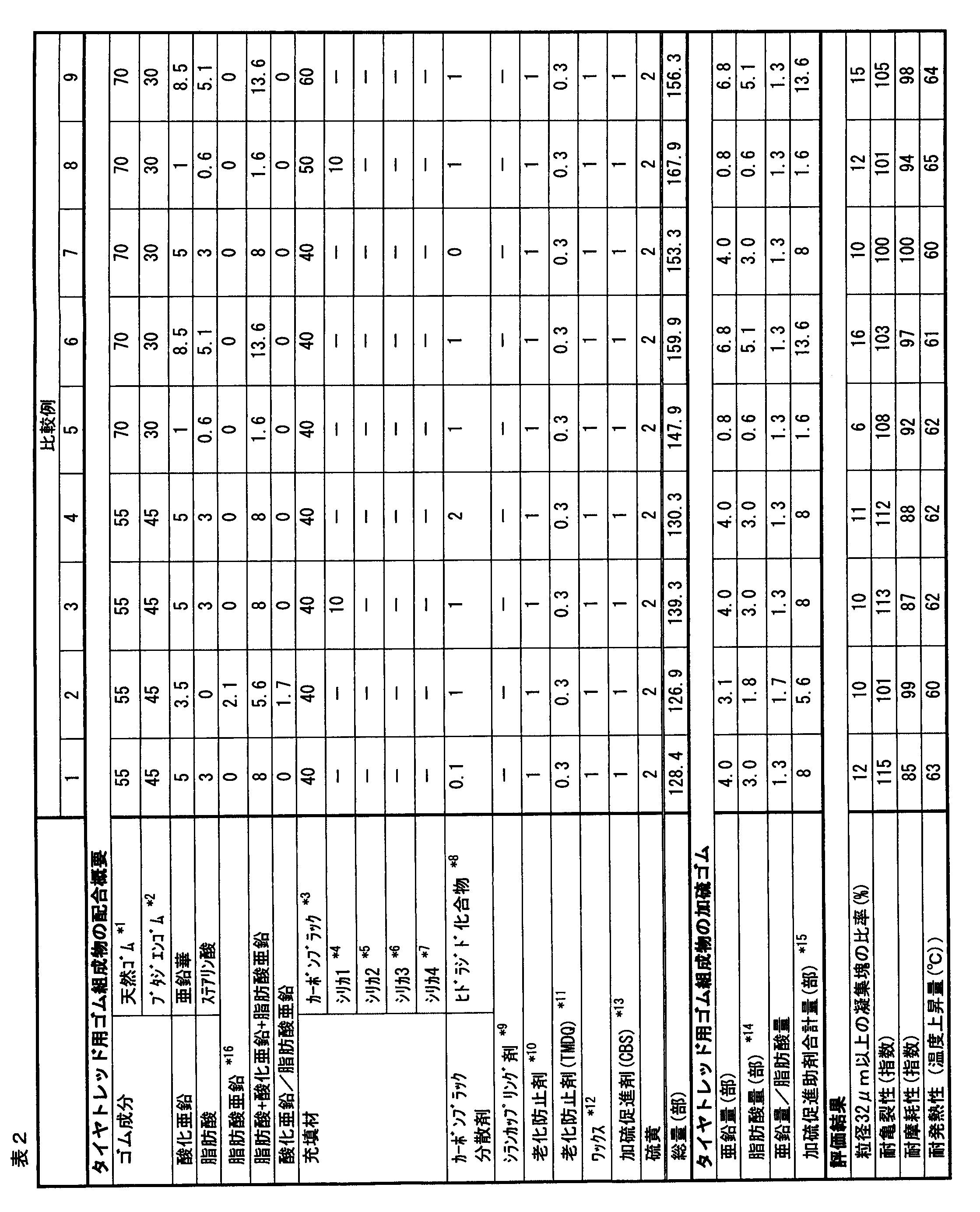
- Examples 1 to 13 and Comparative Examples 1 to 9 The rubber compositions of Examples 1 to 13 and Comparative Examples 1 to 9 were respectively prepared by kneading with a Banbury mixer according to the formulation shown in Tables 1 and 2 below, and the radial tire for aircraft (size: 50 ⁇ 20) .0R22_32PR) is manufactured.
- the ratio by the percentage of the area occupied by aggregates of 32 ⁇ m or more refers to (White Area%) ⁇ (White area integrated value of particle size of 32 ⁇ m or more) / (White area integrated value of 3 to 57 ⁇ m of particle size). .
- Fatty acid content refers to the fatty acid content of zinc fatty acid * 15 Vulcanization accelerating aid is the total content of zinc oxide, fatty acid and zinc fatty acid * 16 fatty acid zinc: manufactured by Rhine Chemie, trade name “Actiplast PP (main component is zinc oleate, zinc palmitate)
- Synthesis Example 1 Silica 2 In a 180 L jacketed stainless steel reaction vessel equipped with a stirrer, 89 L of water and 1.70 L of an aqueous solution of sodium silicate (SiO 2 160 g / L, SiO 2 / Na 2 O molar ratio 3.3) are heated to 75 ° C. . The concentration of Na 2 O in the solution produced is 0.015 mol / L. While maintaining the temperature of this solution at 75 ° C., the same sodium silicate aqueous solution as above is simultaneously added dropwise at a flow rate of 520 mL / min and sulfuric acid (18 mol / L) at a flow rate of 23 mL / min.
- sodium silicate aqueous solution is simultaneously added dropwise at a flow rate of 520 mL / min and sulfuric acid (18 mol / L) at a flow rate of 23 mL / min.
- the neutralization reaction is performed while maintaining the Na 2 O concentration in the reaction solution in the range of 0.005 to 0.035 mol / L.
- the reaction solution begins to become cloudy during the course of the reaction, and its viscosity rises after 46 minutes to form a gel-like solution. Further, the addition was continued to stop the reaction in 100 minutes.
- the concentration of silica in the resulting solution will be 60 g / L.
- the same sulfuric acid as above is added until the pH of the solution reaches 3, to obtain a siliceous slurry.
- the resulting silica slurry is filtered and washed with a filter press to obtain a wet cake.
- the wet cake is then dried as a slurry using an emulsifying device in a spray dryer to obtain silica 2.
- Synthesis Example 2 Silica 4 It jacketed stainless reactor of 180L with a stirrer, water 65L and sodium silicate aqueous solution (SiO 2 160g / L, SiO 2 / Na 2 O molar ratio 3.3) 1.25 L placed and heated to 96 ° C. .
- the concentration of Na 2 O in the solution produced is 0.015 mol / L.
- the same sodium silicate aqueous solution as above is added dropwise at a flow rate of 750 mL / min and sulfuric acid (18 mol / L) at a flow rate of 33 mL / min.
- the neutralization reaction is performed while maintaining the Na 2 O concentration in the reaction solution in the range of 0.005 to 0.035 mol / L.
- the reaction solution begins to become cloudy in the middle of the reaction, and the viscosity increases after 30 minutes to form a gel-like solution.
- the addition is continued to stop the reaction in 100 minutes.
- the concentration of silica in the resulting solution is 85 g / L.
- the same sulfuric acid as above is added until the pH of the solution reaches 3, to obtain a siliceous slurry.
- the resulting silica slurry is filtered and washed with a filter press to obtain a wet cake.
- the wet cake is then dried as a slurry using an emulsifying device in a spray dryer to obtain silica 4.
- the tires of Comparative Examples 1 to 4 are inferior in cracking resistance and wear resistance due to the content of natural rubber in the rubber composition for a tire tread being less than a specific range, and they are in the heat resistance test. It has been shown that the amount of temperature rise tends to be relatively high.
- the tire of Comparative Examples 5, 6, 8 and 9 is resistant to cracking due to the fact that the total amount of zinc oxide, fatty acid and zinc fatty acid in the rubber composition for a tire tread is outside a specific range. It is inferior to abrasion resistance, and the tendency for the temperature rise amount in the heat resistance test to be relatively high is shown.
- the tire of Comparative Example 7 is inferior in crack resistance and abrasion resistance due to the fact that the rubber composition for a tire tread does not contain a carbon black dispersant.
- the tires of Examples 1 to 13 contain at least a specific amount of a natural rubber in the rubber composition for a tire tread, and at least one selected from the group consisting of zinc oxide, fatty acid, and fatty acid zinc. It is shown that the crack resistance, the wear resistance, and the heat generation resistance are excellent due to containing the total amount in a specific amount and containing the carbon black dispersant.
Landscapes
- Chemical & Material Sciences (AREA)
- Health & Medical Sciences (AREA)
- Chemical Kinetics & Catalysis (AREA)
- Medicinal Chemistry (AREA)
- Polymers & Plastics (AREA)
- Organic Chemistry (AREA)
- Engineering & Computer Science (AREA)
- Mechanical Engineering (AREA)
- Compositions Of Macromolecular Compounds (AREA)
- Tires In General (AREA)
Abstract
天然ゴムを70質量%以上含むゴム成分と、前記ゴム成分100質量部に対して合計含有量が2質量部以上13質量部未満の、酸化亜鉛、脂肪酸、及び脂肪酸亜鉛からなる群より選択される少なくとも1つと、カーボンブラックを含む充填材と、カーボンブラック分散剤と、を含有するタイヤトレッド用ゴム組成物の加硫ゴムの、ASTM D7723に準拠した、ディスパーグレーダーによる断面の測定において、粒径32μm以上のWhite area積算値が、粒径3~57μmのWhite area積算値の15%以下である、タイヤトレッド用ゴム組成物。
Description
本発明は、タイヤトレッド用ゴム組成物及びタイヤに関する。
近年、タイヤの部位において路面に接触する唯一の部位であるトレッドゴムを、重荷重用タイヤに適用する場合、耐摩耗性及び耐発熱性の一層の向上が重要課題とされている。この課題を克服するためにトレッドゴムの研究開発が進められ、その実用化が推進されている。
特許文献1には、重荷重用タイヤを想定し、耐摩耗性と耐発熱性とを同時に向上させることを目的とし、酸化亜鉛、脂肪酸、及び/又は脂肪酸亜鉛とを含有するゴム組成物から成る、加硫ゴム中に含まれる脂肪酸亜鉛の融点が特定の温度以下(重量当たりの平均融点が105℃以下)となるタイヤトレッド用ゴム組成物が開示されている。
特許文献1に係るタイヤトレッド用ゴム組成物は、耐摩耗性及び耐発熱性の一層の向上が図られ、特に重荷重用タイヤのゴム組成物として優れたものである。しかしながら、重荷重用タイヤの中でも、特に、タイヤに負荷される荷重が一層高い航空機タイヤに適用する場合、耐摩耗性及び耐発熱性に加え、新たな課題を克服する必要がある。
航空機タイヤにおいては、着陸時に、タイヤのトレッドゴムが滑走路上に排水用に設けられた溝に重荷重下で高速接触する。このことに起因し、タイヤのトレッドゴムに、松かさ状又はささくれ状のシェブロンカットと呼ばれるカット傷が発生することがあるため、高度な耐亀裂性が求められており、更なる改善の余地がある。
そこで、本発明は、上記課題を解決するためになされたものであり、耐摩耗性及び耐発熱性を向上させ、更に耐亀裂性にも優れるタイヤ、及びこれが得られるタイヤトレッド用ゴム組成物を提供することを目的とするものである。
本発明者は、上記課題に鑑みて鋭意検討した結果、タイヤトレッド用ゴム組成物から成る加硫ゴム中に、凝集塊が存在すると、凝集塊が破壊核となり、凝集塊を起点として加硫ゴムに亀裂が生じ易くなることを見出した。
また、本発明者は、タイヤトレッド用ゴム組成物中に、天然ゴムを特定量以上含有させ、且つ、酸化亜鉛、脂肪酸、及び脂肪酸亜鉛からなる群より選択される少なくとも1つの合計量を特定量含有させ、且つ、カーボンブラック分散剤を含有させ、これによって凝集塊の生成を抑制し得ることを見出し、本発明を完成させるに至った。
すなわち、本発明は以下の通りである。
また、本発明者は、タイヤトレッド用ゴム組成物中に、天然ゴムを特定量以上含有させ、且つ、酸化亜鉛、脂肪酸、及び脂肪酸亜鉛からなる群より選択される少なくとも1つの合計量を特定量含有させ、且つ、カーボンブラック分散剤を含有させ、これによって凝集塊の生成を抑制し得ることを見出し、本発明を完成させるに至った。
すなわち、本発明は以下の通りである。
[1]天然ゴムを70質量%以上含むゴム成分と、前記ゴム成分100質量部に対して合計含有量が2質量部以上13質量部未満の、酸化亜鉛、脂肪酸、及び脂肪酸亜鉛からなる群より選択される少なくとも1つと、カーボンブラックを含む充填材と、カーボンブラック分散剤と、を含有するタイヤトレッド用ゴム組成物の加硫ゴムの、ASTM D7723に準拠した、ディスパーグレーダーによる断面の測定において、粒径32μm以上のWhite area積算値が、粒径3~57μmのWhite area積算値の15%以下である、タイヤトレッド用ゴム組成物。
[2]前記加硫ゴムの断面の測定において、(White Area%)×(粒径32μm以上のWhite area積算値)/(粒径3~57μmのWhite area積算値)の値が、0.2%以下である前記[1]に記載のタイヤトレッド用ゴム組成物。
[3]前記充填材の含有量が前記ゴム成分100質量部に対して1~60質量部であり、前記充填材中、セチルトリメチルアンモニウムブロミド吸着比表面積(CTAB)が50~350m2/gの範囲を有する無機粒子を1~20質量%含む、前記[1]又は[2]に記載のタイヤトレッド用ゴム組成物。
[4]前記無機粒子が、シリカを含む前記[3]に記載のタイヤトレッド用ゴム組成物。
[5]前記脂肪酸亜鉛の含有量が、前記ゴム成分100質量部に対して1質量部以上である前記[1]~[4]のいずれか1つに記載のタイヤトレッド用ゴム組成物。
[6]前記カーボンブラック分散剤が、ヒドラジド化合物である前記[1]~[5]のいずれか1つに記載のタイヤトレッド用ゴム組成物。
[7]前記ヒドラジド化合物の含有量が、前記ゴム成分100質量部に対して0.1~2.5質量部である前記[6]に記載のタイヤトレッド用ゴム組成物。
[8]前記脂肪酸亜鉛の含有量aに対する前記酸化亜鉛の含有量bの質量比b/aが、1.0~3.0である前記[1]~[7]のいずれか1つに記載のタイヤトレッド用ゴム組成物。
[9]前記加硫ゴム中に含まれる、脂肪酸量cに対する亜鉛量dの質量比d/cが、1.1以上2.0以下である前記[1]~[8]のいずれか1つに記載のタイヤトレッド用ゴム組成物。
[10]前記ゴム成分中の天然ゴムの含有量が、70~95質量%である前記[1]~[9]のいずれか1つに記載のタイヤトレッド用ゴム組成物。
[11]前記[1]~[10]のいずれか1つに記載のタイヤトレッド用ゴム組成物をトレッドに用いたタイヤ。
[2]前記加硫ゴムの断面の測定において、(White Area%)×(粒径32μm以上のWhite area積算値)/(粒径3~57μmのWhite area積算値)の値が、0.2%以下である前記[1]に記載のタイヤトレッド用ゴム組成物。
[3]前記充填材の含有量が前記ゴム成分100質量部に対して1~60質量部であり、前記充填材中、セチルトリメチルアンモニウムブロミド吸着比表面積(CTAB)が50~350m2/gの範囲を有する無機粒子を1~20質量%含む、前記[1]又は[2]に記載のタイヤトレッド用ゴム組成物。
[4]前記無機粒子が、シリカを含む前記[3]に記載のタイヤトレッド用ゴム組成物。
[5]前記脂肪酸亜鉛の含有量が、前記ゴム成分100質量部に対して1質量部以上である前記[1]~[4]のいずれか1つに記載のタイヤトレッド用ゴム組成物。
[6]前記カーボンブラック分散剤が、ヒドラジド化合物である前記[1]~[5]のいずれか1つに記載のタイヤトレッド用ゴム組成物。
[7]前記ヒドラジド化合物の含有量が、前記ゴム成分100質量部に対して0.1~2.5質量部である前記[6]に記載のタイヤトレッド用ゴム組成物。
[8]前記脂肪酸亜鉛の含有量aに対する前記酸化亜鉛の含有量bの質量比b/aが、1.0~3.0である前記[1]~[7]のいずれか1つに記載のタイヤトレッド用ゴム組成物。
[9]前記加硫ゴム中に含まれる、脂肪酸量cに対する亜鉛量dの質量比d/cが、1.1以上2.0以下である前記[1]~[8]のいずれか1つに記載のタイヤトレッド用ゴム組成物。
[10]前記ゴム成分中の天然ゴムの含有量が、70~95質量%である前記[1]~[9]のいずれか1つに記載のタイヤトレッド用ゴム組成物。
[11]前記[1]~[10]のいずれか1つに記載のタイヤトレッド用ゴム組成物をトレッドに用いたタイヤ。
本発明によれば、耐摩耗性及び耐発熱性を向上させ、更に耐亀裂性にも優れるタイヤ、及びこれが得られるタイヤトレッド用ゴム組成物を提供することができる。
[タイヤトレッド用ゴム組成物]
本発明に係るタイヤトレッド用ゴム組成物は、天然ゴムを70質量%以上含むゴム成分と、当該ゴム成分100質量部に対して合計含有量が2質量部以上13質量部未満の、酸化亜鉛、脂肪酸、及び脂肪酸亜鉛と、カーボンブラックを含む充填材と、カーボンブラック分散剤と、を含有する。
また、本発明に係るタイヤトレッド用ゴム組成物の加硫ゴムは、ASTM D7723に準拠した、ディスパーグレーダーによる断面の測定において、粒径32μm以上のWhite area積算値が、粒径3~57μmのWhite area積算値の15%以下であり、好ましくは12%以下、より好ましくは10%以下である。
更に、本発明に係るタイヤトレッド用ゴム組成物の加硫ゴムの断面の測定において、(White Area%)×(粒径32μm以上のWhite area積算値)/(粒径3~57μmのWhite area積算値)の値が、0.2%以下であることが好ましく、0.18%以下がより好ましく、0.15%以下が更に好ましい。
本発明に係るタイヤトレッド用ゴム組成物は、天然ゴムを70質量%以上含むゴム成分と、当該ゴム成分100質量部に対して合計含有量が2質量部以上13質量部未満の、酸化亜鉛、脂肪酸、及び脂肪酸亜鉛と、カーボンブラックを含む充填材と、カーボンブラック分散剤と、を含有する。
また、本発明に係るタイヤトレッド用ゴム組成物の加硫ゴムは、ASTM D7723に準拠した、ディスパーグレーダーによる断面の測定において、粒径32μm以上のWhite area積算値が、粒径3~57μmのWhite area積算値の15%以下であり、好ましくは12%以下、より好ましくは10%以下である。
更に、本発明に係るタイヤトレッド用ゴム組成物の加硫ゴムの断面の測定において、(White Area%)×(粒径32μm以上のWhite area積算値)/(粒径3~57μmのWhite area積算値)の値が、0.2%以下であることが好ましく、0.18%以下がより好ましく、0.15%以下が更に好ましい。
[凝集塊]
本発明において凝集塊とは、加硫ゴム中に存在する3μm以上の粒子径を有する凝集物のことを指していう。
ここで「凝集物」とは、加硫ゴムを構成するゴム組成物の成分が、1種又は2種以上で凝集したものを指していい、具体的には、脂肪酸亜鉛の凝集物、カーボンブラック等の充填材の凝集物、架橋剤及びその他の成分等の凝集物などが挙げられる。
以下、本発明に係るタイヤトレッド用ゴム組成物について説明する。
本発明において凝集塊とは、加硫ゴム中に存在する3μm以上の粒子径を有する凝集物のことを指していう。
ここで「凝集物」とは、加硫ゴムを構成するゴム組成物の成分が、1種又は2種以上で凝集したものを指していい、具体的には、脂肪酸亜鉛の凝集物、カーボンブラック等の充填材の凝集物、架橋剤及びその他の成分等の凝集物などが挙げられる。
以下、本発明に係るタイヤトレッド用ゴム組成物について説明する。
[ゴム成分]
本発明に係るタイヤトレッド用ゴム組成物は、天然ゴムを含むゴム成分を含有する。
ゴム成分中の天然ゴムの含有量は、70質量%以上である。
上記天然ゴムの含有量が、上記範囲未満である場合には、タイヤの耐摩耗性及び耐発熱性を向上させ、更に耐亀裂性にも優れる効果が発揮され難い場合がある。
また、ゴム成分中の天然ゴムの含有量は、タイヤの耐摩耗性の観点から、100質量%未満であることが好ましく、具体的には、70~95質量%であることが好ましく、80~95質量%がより好ましく、80質量%より多く95質量%以下がより好ましく、80質量85~93質量%が更に好ましい。
ゴム成分としては、天然ゴム(NR)の他には、例えば、ブタジエンゴム(ポリブタジエン、BR)、イソプレンゴム(IR)、スチレン-ブタジエンゴム(SBR)、アクリロニトリル-ブタジエンゴム(NBR)、クロロプレンゴム(CR)、ブチルゴム(IIR)、ハロゲン化ブチルゴム(X-IIR)、エチレン-プロピレンゴム(EPM)、エチレン-プロピレン-ジエン系共重合体ゴム(EPDM)、及びスチレン-イソプレン-ブタジエン共重合体ゴム(SIBR)等が挙げられる。
本発明に係るタイヤトレッド用ゴム組成物は、天然ゴムを含むゴム成分を含有する。
ゴム成分中の天然ゴムの含有量は、70質量%以上である。
上記天然ゴムの含有量が、上記範囲未満である場合には、タイヤの耐摩耗性及び耐発熱性を向上させ、更に耐亀裂性にも優れる効果が発揮され難い場合がある。
また、ゴム成分中の天然ゴムの含有量は、タイヤの耐摩耗性の観点から、100質量%未満であることが好ましく、具体的には、70~95質量%であることが好ましく、80~95質量%がより好ましく、80質量%より多く95質量%以下がより好ましく、80質量85~93質量%が更に好ましい。
ゴム成分としては、天然ゴム(NR)の他には、例えば、ブタジエンゴム(ポリブタジエン、BR)、イソプレンゴム(IR)、スチレン-ブタジエンゴム(SBR)、アクリロニトリル-ブタジエンゴム(NBR)、クロロプレンゴム(CR)、ブチルゴム(IIR)、ハロゲン化ブチルゴム(X-IIR)、エチレン-プロピレンゴム(EPM)、エチレン-プロピレン-ジエン系共重合体ゴム(EPDM)、及びスチレン-イソプレン-ブタジエン共重合体ゴム(SIBR)等が挙げられる。
[充填材]
本発明に係るタイヤトレッド用ゴム組成物は、充填材を含有する。
ゴム組成物中の充填材の含有量は、ゴム成分100質量部に対して、1~60質量部であることが好ましく、30~50質量部がより好ましく、40~50質量部が更に好ましい。
上記充填材の含有量が、上記範囲にある場合には、タイヤの耐摩耗性及び耐発熱性を向上させ、更に耐亀裂性にも優れる効果が発揮され易い。
本発明に係るタイヤトレッド用ゴム組成物は、充填材を含有する。
ゴム組成物中の充填材の含有量は、ゴム成分100質量部に対して、1~60質量部であることが好ましく、30~50質量部がより好ましく、40~50質量部が更に好ましい。
上記充填材の含有量が、上記範囲にある場合には、タイヤの耐摩耗性及び耐発熱性を向上させ、更に耐亀裂性にも優れる効果が発揮され易い。
<カーボンブラック>
充填材は、少なくともカーボンブラックを含有する。充填材中、カーボンブラックの含有量は、60~100質量%であることが好ましく、70~100質量%がより好ましく、80~100質量%が更に好ましい。
また、ゴム組成物中のカーボンブラックの含有量は、ゴム成分100質量部に対して、40~60質量部であることが好ましく、40~55質量部がより好ましく、40~50質量部が更に好ましい。
上記カーボンブラックの含有量が、上記範囲にある場合には、タイヤの耐摩耗性及び耐発熱性を向上させ、更に耐亀裂性にも優れる効果が発揮され易い。
カーボンブラックとしては、従来ゴムの補強用充填材として用いられるものであれば特に限定されず、GPF(N660)、FEF(N550)、SRF(N774)、HAF(N330)、ISAF(N220)、ISAF-HS(N234)、及びSAF(N110)等が挙げられる。
カーボンブラックは、市販品として入手することができ、例えば、Cabot社製の商品名「VULCAN 6 SHOBLACK」等が挙げられる。
充填材は、少なくともカーボンブラックを含有する。充填材中、カーボンブラックの含有量は、60~100質量%であることが好ましく、70~100質量%がより好ましく、80~100質量%が更に好ましい。
また、ゴム組成物中のカーボンブラックの含有量は、ゴム成分100質量部に対して、40~60質量部であることが好ましく、40~55質量部がより好ましく、40~50質量部が更に好ましい。
上記カーボンブラックの含有量が、上記範囲にある場合には、タイヤの耐摩耗性及び耐発熱性を向上させ、更に耐亀裂性にも優れる効果が発揮され易い。
カーボンブラックとしては、従来ゴムの補強用充填材として用いられるものであれば特に限定されず、GPF(N660)、FEF(N550)、SRF(N774)、HAF(N330)、ISAF(N220)、ISAF-HS(N234)、及びSAF(N110)等が挙げられる。
カーボンブラックは、市販品として入手することができ、例えば、Cabot社製の商品名「VULCAN 6 SHOBLACK」等が挙げられる。
<無機粒子>
充填材は、更に、セチルトリメチルアンモニウムブロミド吸着比表面積(CTAB)が50~350m2/gの範囲を有する無機粒子を含有することが好ましい。充填材中、当該無機粒子の含有量は、1~20質量%であることが好ましく、5~20質量%がより好ましく、10~20質量%が更に好ましい。
また、ゴム組成物中の無機粒子の含有量は、ゴム成分100質量部に対して、1~20質量部であることが好ましく、1~15質量部がより好ましく、5~15質量部が更に好ましい。
上記無機粒子の含有量が、上記範囲にある場合には、タイヤの耐摩耗性及び耐発熱性を向上させ、更に耐亀裂性にも優れる効果が発揮され易い。
充填材は、更に、セチルトリメチルアンモニウムブロミド吸着比表面積(CTAB)が50~350m2/gの範囲を有する無機粒子を含有することが好ましい。充填材中、当該無機粒子の含有量は、1~20質量%であることが好ましく、5~20質量%がより好ましく、10~20質量%が更に好ましい。
また、ゴム組成物中の無機粒子の含有量は、ゴム成分100質量部に対して、1~20質量部であることが好ましく、1~15質量部がより好ましく、5~15質量部が更に好ましい。
上記無機粒子の含有量が、上記範囲にある場合には、タイヤの耐摩耗性及び耐発熱性を向上させ、更に耐亀裂性にも優れる効果が発揮され易い。
充填材中に含有させる無機粒子としては、セチルトリメチルアンモニウムブロミド吸着比表面積(CTAB)が、50~350m2/gの範囲にあることが好ましく、70~330m2/gの範囲がより好ましく、90~300m2/gの範囲が更に好ましく、130~260m2/gの範囲がより更に好ましく、140~200m2/gの範囲が特に好ましい。
上記無機粒子のセチルトリメチルアンモニウムブロミド吸着比表面積(CTAB)が、上記範囲にある場合には、タイヤの耐摩耗性及び耐発熱性を向上させ、更に耐亀裂性にも優れる効果が発揮され易い。
CTABは、長期的な耐摩耗性の観点から、150~180m2/gの範囲が好ましい。
上記無機粒子のセチルトリメチルアンモニウムブロミド吸着比表面積(CTAB)が、上記範囲にある場合には、タイヤの耐摩耗性及び耐発熱性を向上させ、更に耐亀裂性にも優れる効果が発揮され易い。
CTABは、長期的な耐摩耗性の観点から、150~180m2/gの範囲が好ましい。
セチルトリメチルアンモニウムブロミド吸着比表面積(CTAB)が50~350m2/gの範囲を有する無機粒子としては、特に限定されず、例えば、シリカ、アルミナ、チタニア等が挙げられる。これらの中でもシリカは、亀裂が進展することを抑制する耐亀裂進展性の効果が発揮され易いことから好ましく用いられる。
また、充填材中に含有させる無機粒子としては、BET表面積が、40~350m2/gの範囲にあることが好ましく、80~320m2/gの範囲にあることがより好ましく、150~300m2/gの範囲にあることが更に好ましく、170~290m2/gの範囲にあることがより更に好ましく、190~280m2/gの範囲にあることがより更に好ましく、190~250m2/gの範囲にあることがより更に好ましく、190~230m2/gの範囲にあることが特に好ましい。
上記無機粒子のBET表面積が、上記範囲にある場合には、タイヤの耐摩耗性及び耐発熱性を向上させ、更に耐亀裂性にも優れる効果が発揮され易い。
上記無機粒子のBET表面積が、上記範囲にある場合には、タイヤの耐摩耗性及び耐発熱性を向上させ、更に耐亀裂性にも優れる効果が発揮され易い。
セチルトリメチルアンモニウムブロミド吸着比表面積(CTAB)が50~350m2/gの範囲を有するシリカは、市販品として入手することもでき、例えば、東ソー・シリカ社製の商品名「ニプシールKQ」、東ソー・シリカ社製の商品名「ニプシールAQ」、エボニック社製の商品名「ウルトラシール9000GR」等が挙げられる。
<シランカップリング剤>
セチルトリメチルアンモニウムブロミド吸着比表面積(CTAB)が50~350m2/gの範囲を有する無機粒子としてシリカを用いた場合、ゴム組成物中でのシリカの分散性を高める観点から、シランカップリング剤を用いることができる。
ゴム組成物中のシランカップリング剤の含有量は、シリカ100質量部に対して、1~20質量部であることが好ましく、1~15質量部がより好ましく、5~15質量部が更に好ましい。
上記シランカップリング剤の含有量が、上記範囲にある場合には、シリカが有する耐亀裂進展性の効果が好適に発揮される。
シランカップリング剤としては、特に限定されず、例えば、ビス(3-トリエトキシシリルプロピル)ポリスルフィド、γ-メルカプトプロピルトリエトキシシラン、γ-アミノプロピルトリエトキシシラン、N-フェニル-γ-アミノプロピルトリメトキシシラン、及びN-β-(アミノエチル)-γ-アミノプロピルトリメトキシシラン等が挙げられる。
シランカップリング剤は、市販品として入手することもでき、例えば、信越化学工業社製の商品名「ABC-856」等が挙げられる。
セチルトリメチルアンモニウムブロミド吸着比表面積(CTAB)が50~350m2/gの範囲を有する無機粒子としてシリカを用いた場合、ゴム組成物中でのシリカの分散性を高める観点から、シランカップリング剤を用いることができる。
ゴム組成物中のシランカップリング剤の含有量は、シリカ100質量部に対して、1~20質量部であることが好ましく、1~15質量部がより好ましく、5~15質量部が更に好ましい。
上記シランカップリング剤の含有量が、上記範囲にある場合には、シリカが有する耐亀裂進展性の効果が好適に発揮される。
シランカップリング剤としては、特に限定されず、例えば、ビス(3-トリエトキシシリルプロピル)ポリスルフィド、γ-メルカプトプロピルトリエトキシシラン、γ-アミノプロピルトリエトキシシラン、N-フェニル-γ-アミノプロピルトリメトキシシラン、及びN-β-(アミノエチル)-γ-アミノプロピルトリメトキシシラン等が挙げられる。
シランカップリング剤は、市販品として入手することもでき、例えば、信越化学工業社製の商品名「ABC-856」等が挙げられる。
〔酸化亜鉛、脂肪酸、及び脂肪酸亜鉛〕
本発明に係るタイヤトレッド用ゴム組成物は、酸化亜鉛、脂肪酸、及び脂肪酸亜鉛からなる群より選択される少なくとも1つを含有する。
酸化亜鉛、脂肪酸、及び脂肪酸亜鉛からなる群より選択される少なくとも1つの合計含有量は、ゴム成分100質量部に対して、2質量部以上13質量部未満であり、2質量部以上8質量部未満が好ましく、2質量部以上6質量部未満がより好ましい。
上記酸化亜鉛、脂肪酸、及び脂肪酸亜鉛からなる群より選択される少なくとも1つの合計含有量が、上記範囲未満である場合には、凝集塊の生成を抑制する効果が十分に発揮されず、タイヤの耐摩耗性及び耐亀裂性に劣るおそれがある。
一方、上記酸化亜鉛、脂肪酸、及び脂肪酸亜鉛からなる群より選択される少なくとも1つの合計含有量が、上記範囲を超える場合には、酸化亜鉛、脂肪酸、及び脂肪酸亜鉛からなる群より選択される少なくとも1つに起因する凝集物が生成され易く、タイヤの耐摩耗性及び耐亀裂性に劣るおそれがある。
本発明に係るタイヤトレッド用ゴム組成物は、酸化亜鉛、脂肪酸、及び脂肪酸亜鉛からなる群より選択される少なくとも1つを含有する。
酸化亜鉛、脂肪酸、及び脂肪酸亜鉛からなる群より選択される少なくとも1つの合計含有量は、ゴム成分100質量部に対して、2質量部以上13質量部未満であり、2質量部以上8質量部未満が好ましく、2質量部以上6質量部未満がより好ましい。
上記酸化亜鉛、脂肪酸、及び脂肪酸亜鉛からなる群より選択される少なくとも1つの合計含有量が、上記範囲未満である場合には、凝集塊の生成を抑制する効果が十分に発揮されず、タイヤの耐摩耗性及び耐亀裂性に劣るおそれがある。
一方、上記酸化亜鉛、脂肪酸、及び脂肪酸亜鉛からなる群より選択される少なくとも1つの合計含有量が、上記範囲を超える場合には、酸化亜鉛、脂肪酸、及び脂肪酸亜鉛からなる群より選択される少なくとも1つに起因する凝集物が生成され易く、タイヤの耐摩耗性及び耐亀裂性に劣るおそれがある。
<酸化亜鉛>
タイヤトレッド用ゴム組成物は、酸化亜鉛を含有する。
ここで「酸化亜鉛」とは、化学式ZnOで表される亜鉛の酸化物のことを指していう。
酸化亜鉛としては、特に限定されず、例えば、亜鉛華、活性酸化亜鉛(活性亜鉛華)等が挙げられる。
ゴム組成物中の酸化亜鉛の含有量は、加硫促進の観点から、ゴム成分100質量部に対して、0.5~8質量部であることが好ましく、2~8質量部がより好ましく、2~6質量部が更に好ましい。
酸化亜鉛の比表面積は、凝集塊の生成を抑制する観点から、2~120m2/g以上であることが好ましく、10~120m2/g以上がより好ましく、20~120m2/g以上が更に好ましい。
タイヤトレッド用ゴム組成物は、酸化亜鉛を含有する。
ここで「酸化亜鉛」とは、化学式ZnOで表される亜鉛の酸化物のことを指していう。
酸化亜鉛としては、特に限定されず、例えば、亜鉛華、活性酸化亜鉛(活性亜鉛華)等が挙げられる。
ゴム組成物中の酸化亜鉛の含有量は、加硫促進の観点から、ゴム成分100質量部に対して、0.5~8質量部であることが好ましく、2~8質量部がより好ましく、2~6質量部が更に好ましい。
酸化亜鉛の比表面積は、凝集塊の生成を抑制する観点から、2~120m2/g以上であることが好ましく、10~120m2/g以上がより好ましく、20~120m2/g以上が更に好ましい。
<脂肪酸>
タイヤトレッド用ゴム組成物は、脂肪酸を含有する。
ここで「脂肪酸」とは、化学式R-COOHで表される化合物自体を指していい、後述する脂肪酸亜鉛を構成する脂肪酸成分を指すものではない。
脂肪酸としては、脂肪族基Rの炭素数Cが8以上の直鎖又は分岐鎖脂肪酸が好ましく、中でも炭素数Cが8~18の直鎖脂肪酸が好ましい。
脂肪酸は、脂肪族基Rに単結合のみ有する飽和脂肪酸であってもよい。飽和脂肪酸としては、例えば、カプリル酸(C8)、ペラルゴン酸(C9)、カプリン酸(C10)、ラウリン酸(C12)、ミリスチン酸(C14)、ペンタデシル酸(C15)、パルミチン酸(C16)、パルミトレイン酸(C16)、マルガリン酸(C17)、及びステアリン酸(C18)等が挙げられる。
また、脂肪酸は、脂肪族基Rに二重結合又は三重結合を有する不飽和脂肪酸であってもよい。不飽和脂肪酸としては、例えば、ミリストレイン酸、パルミトレイン酸、サピエン酸、オレイン酸、エライジン酸、バクセン酸、ガドレイン酸、エイコセン酸、エルカ酸、及びネルボン酸等のモノ不飽和脂肪酸;リノール酸、エイコサジエン酸、及びドコサジエン酸等のジ不飽和脂肪酸;等が挙げられる。
ゴム組成物中の脂肪酸の含有量は、凝集塊の肥大化を抑制する観点から、ゴム成分100質量部に対して、5質量部以下であることが好ましく、4質量部以下がより好ましく、3質量部以下が更に好ましい。
脂肪酸の平均分子量は、凝集塊の肥大化を抑制する観点から、280以下である事が好ましく、250以下がより好ましく、230以下が更に好ましい。
タイヤトレッド用ゴム組成物は、脂肪酸を含有する。
ここで「脂肪酸」とは、化学式R-COOHで表される化合物自体を指していい、後述する脂肪酸亜鉛を構成する脂肪酸成分を指すものではない。
脂肪酸としては、脂肪族基Rの炭素数Cが8以上の直鎖又は分岐鎖脂肪酸が好ましく、中でも炭素数Cが8~18の直鎖脂肪酸が好ましい。
脂肪酸は、脂肪族基Rに単結合のみ有する飽和脂肪酸であってもよい。飽和脂肪酸としては、例えば、カプリル酸(C8)、ペラルゴン酸(C9)、カプリン酸(C10)、ラウリン酸(C12)、ミリスチン酸(C14)、ペンタデシル酸(C15)、パルミチン酸(C16)、パルミトレイン酸(C16)、マルガリン酸(C17)、及びステアリン酸(C18)等が挙げられる。
また、脂肪酸は、脂肪族基Rに二重結合又は三重結合を有する不飽和脂肪酸であってもよい。不飽和脂肪酸としては、例えば、ミリストレイン酸、パルミトレイン酸、サピエン酸、オレイン酸、エライジン酸、バクセン酸、ガドレイン酸、エイコセン酸、エルカ酸、及びネルボン酸等のモノ不飽和脂肪酸;リノール酸、エイコサジエン酸、及びドコサジエン酸等のジ不飽和脂肪酸;等が挙げられる。
ゴム組成物中の脂肪酸の含有量は、凝集塊の肥大化を抑制する観点から、ゴム成分100質量部に対して、5質量部以下であることが好ましく、4質量部以下がより好ましく、3質量部以下が更に好ましい。
脂肪酸の平均分子量は、凝集塊の肥大化を抑制する観点から、280以下である事が好ましく、250以下がより好ましく、230以下が更に好ましい。
<脂肪酸亜鉛>
タイヤトレッド用ゴム組成物は、脂肪酸亜鉛を含有する。
ここで「脂肪酸亜鉛」とは、化学式R-COOZnで表される化合物自体を指していう。
脂肪酸亜鉛を構成する脂肪酸成分としては、脂肪族基Rの炭素数Cが8以上の直鎖又は分岐鎖脂肪酸が好ましく、中でも炭素数Cが8~18の直鎖脂肪酸が好ましい。
また、脂肪酸亜鉛を構成する脂肪酸成分は、脂肪族基Rに単結合のみ有する飽和脂肪酸であってもよく、飽和脂肪酸としては、例えば、カプリル酸(C8)、ペラルゴン酸(C9)、カプリン酸(C10)、ラウリン酸(C12)、ミリスチン酸(C14)、ペンタデシル酸(C15)、パルミチン酸(C16)、パルミトレイン酸(C16)、マルガリン酸(C17)、及びステアリン酸(C18)等が挙げられる。
また、脂肪酸亜鉛を構成する脂肪酸成分である脂肪族基Rに二重結合又は三重結合を有する不飽和脂肪酸であってもよく、不飽和脂肪酸としては、例えば、ミリストレイン酸、パルミトレイン酸、サピエン酸、オレイン酸、エライジン酸、バクセン酸、ガドレイン酸、エイコセン酸、エルカ酸、及びネルボン酸等のモノ不飽和脂肪酸;リノール酸、エイコサジエン酸、及びドコサジエン酸等のジ不飽和脂肪酸;等が挙げられる。
ゴム組成物中の脂肪酸亜鉛の含有量は、凝集塊の肥大化を抑制する観点から、ゴム成分100質量部に対して、1質量部以上であることが好ましく、1.5質量部以上がより好ましく、2質量部以上が更に好ましい。
脂肪酸亜鉛を構成する脂肪酸成分の平均分子量は、凝集塊の肥大化を抑制する観点から、280以下であることが好ましく、250以下がより好ましく、230以下が更に好ましい。
脂肪酸亜鉛の含有量aに対する酸化亜鉛の含有量bの質量比b/aは、凝集塊の肥大化を抑制する観点から、1.0~3.0であることが好ましく、1.0~2.0がより好ましく、1.5~2.0が更に好ましい。
タイヤトレッド用ゴム組成物は、脂肪酸亜鉛を含有する。
ここで「脂肪酸亜鉛」とは、化学式R-COOZnで表される化合物自体を指していう。
脂肪酸亜鉛を構成する脂肪酸成分としては、脂肪族基Rの炭素数Cが8以上の直鎖又は分岐鎖脂肪酸が好ましく、中でも炭素数Cが8~18の直鎖脂肪酸が好ましい。
また、脂肪酸亜鉛を構成する脂肪酸成分は、脂肪族基Rに単結合のみ有する飽和脂肪酸であってもよく、飽和脂肪酸としては、例えば、カプリル酸(C8)、ペラルゴン酸(C9)、カプリン酸(C10)、ラウリン酸(C12)、ミリスチン酸(C14)、ペンタデシル酸(C15)、パルミチン酸(C16)、パルミトレイン酸(C16)、マルガリン酸(C17)、及びステアリン酸(C18)等が挙げられる。
また、脂肪酸亜鉛を構成する脂肪酸成分である脂肪族基Rに二重結合又は三重結合を有する不飽和脂肪酸であってもよく、不飽和脂肪酸としては、例えば、ミリストレイン酸、パルミトレイン酸、サピエン酸、オレイン酸、エライジン酸、バクセン酸、ガドレイン酸、エイコセン酸、エルカ酸、及びネルボン酸等のモノ不飽和脂肪酸;リノール酸、エイコサジエン酸、及びドコサジエン酸等のジ不飽和脂肪酸;等が挙げられる。
ゴム組成物中の脂肪酸亜鉛の含有量は、凝集塊の肥大化を抑制する観点から、ゴム成分100質量部に対して、1質量部以上であることが好ましく、1.5質量部以上がより好ましく、2質量部以上が更に好ましい。
脂肪酸亜鉛を構成する脂肪酸成分の平均分子量は、凝集塊の肥大化を抑制する観点から、280以下であることが好ましく、250以下がより好ましく、230以下が更に好ましい。
脂肪酸亜鉛の含有量aに対する酸化亜鉛の含有量bの質量比b/aは、凝集塊の肥大化を抑制する観点から、1.0~3.0であることが好ましく、1.0~2.0がより好ましく、1.5~2.0が更に好ましい。
本発明のタイヤトレッド用ゴム組成物は、所定の方法で調製し、調製したタイヤトレッド用ゴム組成物は、所定の加硫条件で加硫を行い、加硫ゴムを得る。
本発明において、加硫ゴム中に脂肪酸量cと亜鉛量dとが所定の質量比で含まれるとき、凝集塊の生成を抑制する効果が発揮され易く、耐摩耗性及び耐発熱性を向上させ、更に耐亀裂性にも優れる効果が発揮され易くなる。
加硫ゴム中に含まれる、脂肪酸量cに対する亜鉛量dの質量比d/cは、1.1以上2.0以下であることが好ましく、1.2以上1.9以下がより好ましく、1.3以上1.8以下が更に好ましい。
上記脂肪酸量cに対する亜鉛量dの質量比d/cが、上記範囲未満である場合には、脂肪酸量cが亜鉛量dに対して多過ぎ、凝集塊が生成され易く、生成した凝集塊が破壊核となり、凝集塊を起点として加硫ゴムに亀裂が生じ易くなるおそれがある。
一方、上記脂肪酸量cに対する亜鉛量dの質量比d/cが、上記範囲を超える場合には、脂肪酸量cが亜鉛量dに対して少な過ぎ、加硫反応が十分に進まず、加硫ゴムとして設計した諸物性が得られないおそれがある。
本発明において、加硫ゴム中に脂肪酸量cと亜鉛量dとが所定の質量比で含まれるとき、凝集塊の生成を抑制する効果が発揮され易く、耐摩耗性及び耐発熱性を向上させ、更に耐亀裂性にも優れる効果が発揮され易くなる。
加硫ゴム中に含まれる、脂肪酸量cに対する亜鉛量dの質量比d/cは、1.1以上2.0以下であることが好ましく、1.2以上1.9以下がより好ましく、1.3以上1.8以下が更に好ましい。
上記脂肪酸量cに対する亜鉛量dの質量比d/cが、上記範囲未満である場合には、脂肪酸量cが亜鉛量dに対して多過ぎ、凝集塊が生成され易く、生成した凝集塊が破壊核となり、凝集塊を起点として加硫ゴムに亀裂が生じ易くなるおそれがある。
一方、上記脂肪酸量cに対する亜鉛量dの質量比d/cが、上記範囲を超える場合には、脂肪酸量cが亜鉛量dに対して少な過ぎ、加硫反応が十分に進まず、加硫ゴムとして設計した諸物性が得られないおそれがある。
ここで、加硫ゴム中に含まれる脂肪酸量c及び亜鉛量dは、以下に示す計算式1及び2により、それぞれ算出される値である。
計算式1:
脂肪酸量c=(脂肪酸の含有量)+(脂肪酸亜鉛の含有量)×0.87
計算式2:
亜鉛量d=(酸化亜鉛の含有量)×0.8+(脂肪酸亜鉛の含有量)×0.13
なお、酸化亜鉛、脂肪酸、及び脂肪酸亜鉛のそれぞれの含有量は、タイヤトレッド用ゴム組成物に含有させる量のことを指していう。
計算式1:
脂肪酸量c=(脂肪酸の含有量)+(脂肪酸亜鉛の含有量)×0.87
計算式2:
亜鉛量d=(酸化亜鉛の含有量)×0.8+(脂肪酸亜鉛の含有量)×0.13
なお、酸化亜鉛、脂肪酸、及び脂肪酸亜鉛のそれぞれの含有量は、タイヤトレッド用ゴム組成物に含有させる量のことを指していう。
[カーボンブラック分散剤]
本発明に係るタイヤトレッド用ゴム組成物は、カーボンブラック分散剤を含有する。
カーボンブラック分散剤としては、ゴム組成物中のカーボンブラックの分散性を高める機能を有するものであれば特に制限されず、例えば、ヒドラジド化合物、不飽和脂肪酸エステル、及び不飽和アルコールエステル(特開平4-20579参照)等が挙げられる。これらの中でも、分子内官能基が、カーボンブラックとの高い親和性を有し、かつゴム成分とも高い親和性も有し、カーボンブラックを効率的に分散させる観点から、ヒドラジド化合物が好ましい。
カーボンブラック分散剤として用いるヒドラジド化合物は、特に限定されないが、下記式(I)又は式(II)で表される化合物であることが好ましい。
本発明に係るタイヤトレッド用ゴム組成物は、カーボンブラック分散剤を含有する。
カーボンブラック分散剤としては、ゴム組成物中のカーボンブラックの分散性を高める機能を有するものであれば特に制限されず、例えば、ヒドラジド化合物、不飽和脂肪酸エステル、及び不飽和アルコールエステル(特開平4-20579参照)等が挙げられる。これらの中でも、分子内官能基が、カーボンブラックとの高い親和性を有し、かつゴム成分とも高い親和性も有し、カーボンブラックを効率的に分散させる観点から、ヒドラジド化合物が好ましい。
カーボンブラック分散剤として用いるヒドラジド化合物は、特に限定されないが、下記式(I)又は式(II)で表される化合物であることが好ましい。

ここで、上記式(I)中、Aは、芳香族環、置換されているか置換されていないヒダントイン環、及び炭素数1~18の飽和又は不飽和直鎖状炭化水素からなる群より選択される少なくとも1種である。
Xは、下記式(I’)で表される基、ヒドロキシ基、及びアミノ基からなる群より選択される少なくとも1種である。
Xは、下記式(I’)で表される基、ヒドロキシ基、及びアミノ基からなる群より選択される少なくとも1種である。

また、上記式(I)及び上記式(I’)中、R1~R4は、水素原子、炭素数1~18の直鎖状又は分岐状のアルキル基、シクロアルキル基、及び芳香族環からなる群より選択され、それぞれ同じでも異なっていてもよい。
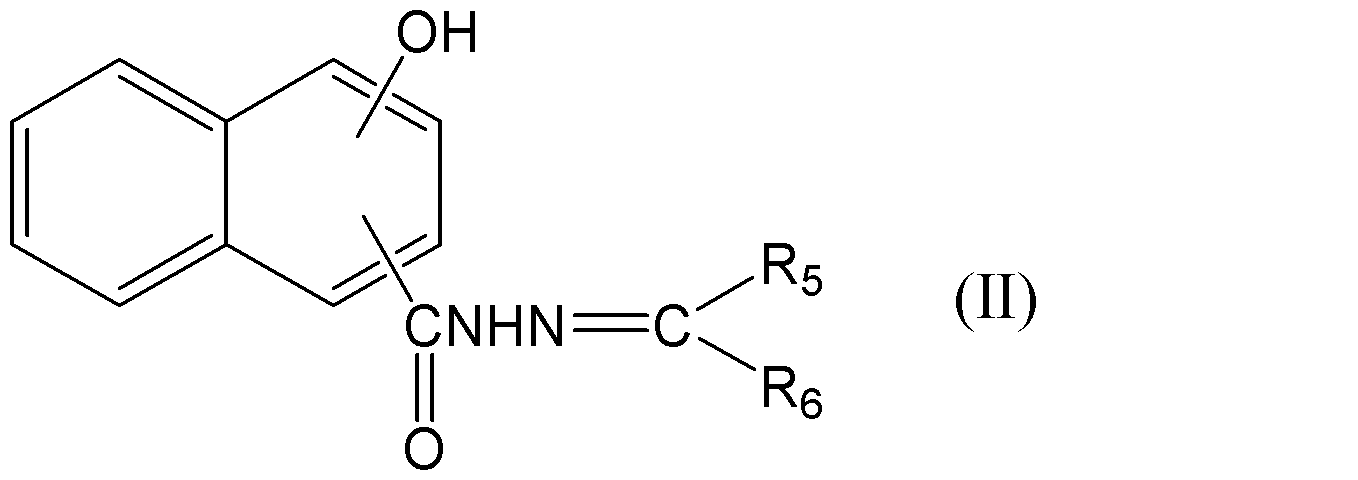
ここで、上記式(II)中、R5~R6は、炭素数1~18の直鎖状又は分岐状のアルキル基、シクロアルキル基、及びアリール基からなる群より選択される少なくとも1種であり、これらの基は、O、S、又はN原子を含んでもよい。
上記式(I)で表される化合物としては、具体的に、N2,N4-ジ(1-メチルエチリデン)イソフタル酸ジヒドラジド、N2,N4-ジ(1-メチルプロピリデン)イソフタル酸ジヒドラジド、N2,N4-ジ(1,3-ジメチルブチリデン)イソフタル酸ジヒドラジド、N′-(1-メチルエチリデン)サリチル酸ヒドラジド、N′-(1-メチルプロピリデン)サリチル酸ヒドラジド、N′-(1-メチルブチリデン)サリチル酸ヒドラジド、N′-(1,3-ジメチルブチリデン)サリチル酸ヒドラジド、及びN′-(2-フリルメチレン)サリチル酸ヒドラジド等が挙げられる。
また、上記式(II)で表される化合物としては、具体的に、1-ヒドロキシ-N′-(1-メチルエチリデン)-2-ナフトエ酸ヒドラジド、1-ヒドロキシ-N′-(1-メチルプロピリデン)-2-ナフトエ酸ヒドラジド、1-ヒドロキシ-N′-(1-メチルブチリデン)-2-ナフトエ酸ヒドラジド、1-ヒドロキシ-N′-(1,3-ジメチルブチリデン)-2-ナフトエ酸ヒドラジド、1-ヒドロキシ-N′-(2-フリルメチレン)-2-ナフトエ酸ヒドラジド、3-ヒドロキシ-N′-(1-メチルエチリデン)-2-ナフトエ酸ヒドラジド、3-ヒドロキシ-N′-(1-メチルプロピリデン)-2-ナフトエ酸ヒドラジド、3-ヒドロキシ-N′-(1-メチルブチリデン)-2-ナフトエ酸ヒドラジド、3-ヒドロキシ-N′-(1,3-ジメチルブチリデン)-2-ナフトエ酸ヒドラジド、及び3-ヒドロキシ-N′-(2-フリルメチレン)-2-ナフトエ酸ヒドラジド等が挙げられる。
上記式(I)又は式(II)で表される化学物は、原料となる3-ヒドロキシ-2-ナフトエ酸ヒドラジド等と、アセトン、メチルイソブチルケトン等とを加温して反応させることにより容易に合成することができる。
上記式(I)又は式(II)で表される化学物は、合成の容易性及びコスト面とカーボンブラックを効率的に分散させる観点から、上述した式(I)の具体例の中でも、N′-(1-メチルエチリデン)サリチル酸ヒドラジド、N′-(1-メチルプロピリデン)サリチル酸ヒドラジド、N′-(1,3-ジメチルブチリデン)サリチル酸ヒドラジド、N′-(2-フリルメチレン)サリチル酸ヒドラジドが好ましい。
また、上述した式(II)の具体例の中でも、1-ヒドロキシ-N′-(1-メチルエチリデン)-2-ナフトエ酸ヒドラジド、1-ヒドロキシ-N′-(1-メチルプロピリデン)-2-ナフトエ酸ヒドラジド、1-ヒドロキシ-N′-(1,3-ジメチルブチリデン)-2-ナフトエ酸ヒドラジド、1-ヒドロキシ-N′-(2-フリルメチレン)-2-ナフトエ酸ヒドラジド、3-ヒドロキシ-N′-(1-メチルエチリデン)-2-ナフトエ酸ヒドラジド、3-ヒドロキシ-N′-(1-メチルプロピリデン)-2-ナフトエ酸ヒドラジド、3-ヒドロキシ-N′-(1,3-ジメチルブチリデン)-2-ナフトエ酸ヒドラジド、及び3-ヒドロキシ-N′-(2-フリルメチレン)-2-ナフトエ酸ヒドラジドが好ましい。
上記式(I)又は式(II)で表される化合物は、単独で用いてもよく、或いは2種以上を併用してもよい。
また、上述した式(II)の具体例の中でも、1-ヒドロキシ-N′-(1-メチルエチリデン)-2-ナフトエ酸ヒドラジド、1-ヒドロキシ-N′-(1-メチルプロピリデン)-2-ナフトエ酸ヒドラジド、1-ヒドロキシ-N′-(1,3-ジメチルブチリデン)-2-ナフトエ酸ヒドラジド、1-ヒドロキシ-N′-(2-フリルメチレン)-2-ナフトエ酸ヒドラジド、3-ヒドロキシ-N′-(1-メチルエチリデン)-2-ナフトエ酸ヒドラジド、3-ヒドロキシ-N′-(1-メチルプロピリデン)-2-ナフトエ酸ヒドラジド、3-ヒドロキシ-N′-(1,3-ジメチルブチリデン)-2-ナフトエ酸ヒドラジド、及び3-ヒドロキシ-N′-(2-フリルメチレン)-2-ナフトエ酸ヒドラジドが好ましい。
上記式(I)又は式(II)で表される化合物は、単独で用いてもよく、或いは2種以上を併用してもよい。
ゴム組成物中のヒドラジド化合物の含有量は、分子内官能基が、カーボンブラックとの高い親和性を有し、かつゴム成分とも高い親和性も有し、カーボンブラックを効率的に分散させる観点から、ゴム成分100質量部に対して、0.1~2.5質量部であることが好ましく、0.1~2質量部がより好ましく、0.5~2質量部が更に好ましい。
上記ヒドラジド化合物の含有量が、上記範囲にある場合には、カーボンブラックを効率的に分散させる効果が発揮され易い。
上記ヒドラジド化合物の含有量が、上記範囲にある場合には、カーボンブラックを効率的に分散させる効果が発揮され易い。
[架橋剤]
タイヤトレッド用ゴム組成物中には、架橋剤を含有させることが好ましい。
架橋剤としては、例えば、硫黄系架橋剤(加硫剤)、有機過酸化物系架橋剤、無機架橋剤、ポリアミン架橋剤樹脂架橋剤、及びオキシム-ニトロソアミン系架橋剤等が挙げられる。これらの中でも、硫黄系架橋剤(加硫剤)が好ましく、硫黄がより好ましい。
架橋剤は、1種単独で使用してもよく、2種以上を併用してもよい。
ゴム組成物中の架橋剤の含有量は、架橋が十分に進行すると共に、混練り中の架橋を抑制する観点から、ゴム成分100質量部に対して、0.1~20質量部であることが好ましく、0.1~10質量部がより好ましく、0.5~5質量部が更に好ましい。
タイヤトレッド用ゴム組成物中には、架橋剤を含有させることが好ましい。
架橋剤としては、例えば、硫黄系架橋剤(加硫剤)、有機過酸化物系架橋剤、無機架橋剤、ポリアミン架橋剤樹脂架橋剤、及びオキシム-ニトロソアミン系架橋剤等が挙げられる。これらの中でも、硫黄系架橋剤(加硫剤)が好ましく、硫黄がより好ましい。
架橋剤は、1種単独で使用してもよく、2種以上を併用してもよい。
ゴム組成物中の架橋剤の含有量は、架橋が十分に進行すると共に、混練り中の架橋を抑制する観点から、ゴム成分100質量部に対して、0.1~20質量部であることが好ましく、0.1~10質量部がより好ましく、0.5~5質量部が更に好ましい。
[その他の成分]
タイヤトレッド用ゴム組成物は、上述した成分の他に、必要に応じて、加硫促進剤、ワックス、老化防止剤、補強剤、軟化剤、加硫助剤、着色剤、難燃剤、滑剤、発泡剤、可塑剤、加工助剤、酸化防止剤、スコーチ防止剤、紫外線吸収剤、帯電防止剤、及び着色防止剤等を適宜用い、目的に応じた量を含有させることができる。
タイヤトレッド用ゴム組成物は、上述した成分の他に、必要に応じて、加硫促進剤、ワックス、老化防止剤、補強剤、軟化剤、加硫助剤、着色剤、難燃剤、滑剤、発泡剤、可塑剤、加工助剤、酸化防止剤、スコーチ防止剤、紫外線吸収剤、帯電防止剤、及び着色防止剤等を適宜用い、目的に応じた量を含有させることができる。
[タイヤトレッド用ゴム組成物をトレッドに用いたタイヤ]
上述したように、タイヤトレッド用ゴム組成物は、天然ゴムを70質量%以上含むゴム成分と、当該ゴム成分100質量部に対して合計含有量が2質量部以上13質量部未満の、酸化亜鉛、脂肪酸、及び脂肪酸亜鉛からなる群より選択される1つと、カーボンブラックを含む充填材と、カーボンブラック分散剤と、必要に応じてその他の成分とを含有する。
そして、タイヤトレッド用ゴム組成物を、バンバリーミキサー、ロール、インターナルミキサー、及びニーダー等の混練機を用いて混練することにより、タイヤトレッド用ゴム組成物を調製する。なお、混練機による、混練温度、及び混練時間等の混練条件は、目的に応じて適宜選択することができる。
本発明のタイヤは、上述したように本発明で特定するタイヤトレッド用ゴム組成物をトレッド部の構造に用いたものである他は、特に制限されず、トレッド部以外の構造については、既知の構造を採用することができる。
また、本発明のタイヤの製造方法についても特に制限されず、通常の方法で製造することができる。
一例としては、ドラムの上にインナーライナー、カーカス、ビード部、及びベルト等の通常タイヤの製造に用いられる部材を順次貼り重ね、更にその上に本発明で特定するタイヤトレッド用ゴム組成物を用いて構成されるトレッド部を貼り重ね、ドラムを抜き去ってグリーンタイヤとする。
次いで、このグリーンタイヤを常法に従って加熱し、加硫することにより、所望のタイヤを製造することができる。
上述したように、タイヤトレッド用ゴム組成物は、天然ゴムを70質量%以上含むゴム成分と、当該ゴム成分100質量部に対して合計含有量が2質量部以上13質量部未満の、酸化亜鉛、脂肪酸、及び脂肪酸亜鉛からなる群より選択される1つと、カーボンブラックを含む充填材と、カーボンブラック分散剤と、必要に応じてその他の成分とを含有する。
そして、タイヤトレッド用ゴム組成物を、バンバリーミキサー、ロール、インターナルミキサー、及びニーダー等の混練機を用いて混練することにより、タイヤトレッド用ゴム組成物を調製する。なお、混練機による、混練温度、及び混練時間等の混練条件は、目的に応じて適宜選択することができる。
本発明のタイヤは、上述したように本発明で特定するタイヤトレッド用ゴム組成物をトレッド部の構造に用いたものである他は、特に制限されず、トレッド部以外の構造については、既知の構造を採用することができる。
また、本発明のタイヤの製造方法についても特に制限されず、通常の方法で製造することができる。
一例としては、ドラムの上にインナーライナー、カーカス、ビード部、及びベルト等の通常タイヤの製造に用いられる部材を順次貼り重ね、更にその上に本発明で特定するタイヤトレッド用ゴム組成物を用いて構成されるトレッド部を貼り重ね、ドラムを抜き去ってグリーンタイヤとする。
次いで、このグリーンタイヤを常法に従って加熱し、加硫することにより、所望のタイヤを製造することができる。
以下の実施例により、本発明をさらに具体的に説明するが、本発明はこれらの実施例に限定されるものではない。
[実施例1~13、及び比較例1~9]
下記表1及び表2に示す配合処方に従い、バンバリーミキサーで混練して、実施例1~13、及び比較例1~9のゴム組成物をそれぞれ調製し、航空機用ラジアルタイヤ(サイズ:50×20.0R22_32PR)を製造する。
下記表1及び表2に示す配合処方に従い、バンバリーミキサーで混練して、実施例1~13、及び比較例1~9のゴム組成物をそれぞれ調製し、航空機用ラジアルタイヤ(サイズ:50×20.0R22_32PR)を製造する。
[評価方法]
(1)凝集塊の測定
上記のようにして製造されるタイヤを、タイヤ円周方向に直交する方向に裁断し、ASTM D7723に準拠したディスパーグレーダーにより裁断面の凝集塊の存在量を測定する。
ディスパーグレーダーの解像度は3μmを選択するが、解像度以上の大きさの凝集塊が存在した部分は、凝集塊の大きさに応じた面積を有するWhite Areaとして観測する。
単位面積中、White Areaの占める面積の百分率による割合を、White Area%とする。
なお、32μm以上の凝集塊の占める面積の百分率による割合とは、(White Area%)×(粒径32μm以上のWhite area積算値)/(粒径3~57μmのWhite area積算値)を指していう。
(1)凝集塊の測定
上記のようにして製造されるタイヤを、タイヤ円周方向に直交する方向に裁断し、ASTM D7723に準拠したディスパーグレーダーにより裁断面の凝集塊の存在量を測定する。
ディスパーグレーダーの解像度は3μmを選択するが、解像度以上の大きさの凝集塊が存在した部分は、凝集塊の大きさに応じた面積を有するWhite Areaとして観測する。
単位面積中、White Areaの占める面積の百分率による割合を、White Area%とする。
なお、32μm以上の凝集塊の占める面積の百分率による割合とは、(White Area%)×(粒径32μm以上のWhite area積算値)/(粒径3~57μmのWhite area積算値)を指していう。
(2)耐摩耗性試験
上記のようにして製造される航空機用ラジアルタイヤのセンターリブから、厚さ5mmの板形状のゴム板を切り出して各試験片を作製する。
JIS K 6264-1993に準拠し、試験片表面の最高温度が220±10℃となる下記条件でランボーン摩耗試験を行い、各試験片の摩耗量をそれぞれ測定する。
試験片寸法:直径×厚さ=49.0mm×5.0mm
試験片回転速度:200rpm
試験路面回転速度:20rpm
試験荷重:7kgf
試験時間:16秒
雰囲気温度:25℃
比較例7の耐摩耗性指数を100とし、下記式により、各試験片の摩耗量および比較例7の試験片の摩耗量を代入し、各試験片の耐摩耗性指数をそれぞれ算出する。
耐摩耗性指数=(比較例7の試験片の摩耗量/その他試験片の摩耗量)×100
この耐摩耗性指数が大きいほど、タイヤは耐摩耗性に優れると評価できる。
上記のようにして製造される航空機用ラジアルタイヤのセンターリブから、厚さ5mmの板形状のゴム板を切り出して各試験片を作製する。
JIS K 6264-1993に準拠し、試験片表面の最高温度が220±10℃となる下記条件でランボーン摩耗試験を行い、各試験片の摩耗量をそれぞれ測定する。
試験片寸法:直径×厚さ=49.0mm×5.0mm
試験片回転速度:200rpm
試験路面回転速度:20rpm
試験荷重:7kgf
試験時間:16秒
雰囲気温度:25℃
比較例7の耐摩耗性指数を100とし、下記式により、各試験片の摩耗量および比較例7の試験片の摩耗量を代入し、各試験片の耐摩耗性指数をそれぞれ算出する。
耐摩耗性指数=(比較例7の試験片の摩耗量/その他試験片の摩耗量)×100
この耐摩耗性指数が大きいほど、タイヤは耐摩耗性に優れると評価できる。
(3)耐亀裂性試験
上記のようにして製造される航空機用ラジアルタイヤのセンターリブから、厚さ2mmの板状のシートを切り出して各試験片を作製する。
試験片の中央部に0.5mmの傷を入れ、試験片の両端を掴み、下記条件下で破断試験を行い、各試験片が破断するまでの回数をそれぞれ測定する。
試験片の形状:JIS5号ダンベル状
標点間距離:30.0mm
試験応力:1.5N(最大)、0N(最小)
周波数:5Hz
雰囲気温度:80℃
比較例7の耐亀裂性指数を100とし、下記式により、各試験片の破断回数および比較例7の試験片の破断回数をそれぞれ代入し、各試験片の耐亀裂性指数をそれぞれ算出する。
耐亀裂性指数=(比較例7の試験片が破断するまでの回数/その他試験片が破断するまでの回数)×100
この耐亀裂性指数が小さいほど、タイヤは耐亀裂性に優れると評価できる。
上記のようにして製造される航空機用ラジアルタイヤのセンターリブから、厚さ2mmの板状のシートを切り出して各試験片を作製する。
試験片の中央部に0.5mmの傷を入れ、試験片の両端を掴み、下記条件下で破断試験を行い、各試験片が破断するまでの回数をそれぞれ測定する。
試験片の形状:JIS5号ダンベル状
標点間距離:30.0mm
試験応力:1.5N(最大)、0N(最小)
周波数:5Hz
雰囲気温度:80℃
比較例7の耐亀裂性指数を100とし、下記式により、各試験片の破断回数および比較例7の試験片の破断回数をそれぞれ代入し、各試験片の耐亀裂性指数をそれぞれ算出する。
耐亀裂性指数=(比較例7の試験片が破断するまでの回数/その他試験片が破断するまでの回数)×100
この耐亀裂性指数が小さいほど、タイヤは耐亀裂性に優れると評価できる。
(4)耐発熱性試験
上記のようにして製造される航空機用ラジアルタイヤを、ホイールのリムに装着し、これをドラム試験機に取り付け、試験開始時の内圧を1530kPa、試験開始時の荷重を20870kgとし、下記に示す速度条件及び荷重条件を経た後の温度上昇量(℃)を測定する。
<速度条件>
速度条件を試験開始時0km/hから、65秒で360km/hとなるように加速させる。
<荷重条件>
荷重条件を航空機の離陸を想定し、試験開始から65秒後で荷重を0とする。
なお、温度上昇量(℃)の測定は、タイヤのショルダー部の幅方向の中央部にて深さ20mmの位置で行う。
この温度上昇量(℃)が小さいほど、タイヤは耐発熱性に優れると評価できる。
上記のようにして製造される航空機用ラジアルタイヤを、ホイールのリムに装着し、これをドラム試験機に取り付け、試験開始時の内圧を1530kPa、試験開始時の荷重を20870kgとし、下記に示す速度条件及び荷重条件を経た後の温度上昇量(℃)を測定する。
<速度条件>
速度条件を試験開始時0km/hから、65秒で360km/hとなるように加速させる。
<荷重条件>
荷重条件を航空機の離陸を想定し、試験開始から65秒後で荷重を0とする。
なお、温度上昇量(℃)の測定は、タイヤのショルダー部の幅方向の中央部にて深さ20mmの位置で行う。
この温度上昇量(℃)が小さいほど、タイヤは耐発熱性に優れると評価できる。

上記表1及び表2中の*1~*15は下記のとおりである。
*1 天然ゴム:RSS#3
*2 ブタジエンゴム:宇部興産社製、商品名「UBE POL-150L」
*3 カーボンブラック:Cabot社製、商品名「VULCAN 6 SHOBLACK」
*4 シリカ1:エボニック社製、商品名「ULTRASIL 9500GR」、CTAB;220m2/g
*5 シリカ2:以下に示す合成例1で得るシリカ、CTAB;191m2/g、BET表面積;245m2/g
*6 シリカ3:東ソー・シリカ社製、商品名「ニプシールAQ」、CTAB;165m2/g、BET表面積;195m2/g
*7 シリカ4:以下に示す合成例2で得るシリカ、CTAB;79m2/g
*8 ヒドラジド化合物:3-ヒドロキシ-N’-(1,3-ジメチルブチリデン)-2-ナフトエ酸ヒドラジド
*9 シランカップリング剤:信越化学工業社製、商品名「ABC-856」、ビストリエトキシシリルプロピルポリスルフィド
*10 老化防止剤:大内新興化学工業社製、商品名「ノクラック6C」
*11 老化防止剤(TMDQ):精工化学社製、商品名「ノンフレックスRD」
*12 ワックス:精工化学社製、商品名「サンタイトA」
*13 加硫促進剤(CBS):三新化学社製、商品名「サンセラーCM-G」
*14 脂肪酸量とは、脂肪酸亜鉛の脂肪酸成分も含む
*15 加硫促進助剤とは、酸化亜鉛、脂肪酸、及び脂肪酸亜鉛の合計含有量
*16 脂肪酸亜鉛:ラインケミー社製、商品名「アクチプラストPP」(主成分はオレイン酸亜鉛塩、パルミチン酸亜鉛塩)
*1 天然ゴム:RSS#3
*2 ブタジエンゴム:宇部興産社製、商品名「UBE POL-150L」
*3 カーボンブラック:Cabot社製、商品名「VULCAN 6 SHOBLACK」
*4 シリカ1:エボニック社製、商品名「ULTRASIL 9500GR」、CTAB;220m2/g
*5 シリカ2:以下に示す合成例1で得るシリカ、CTAB;191m2/g、BET表面積;245m2/g
*6 シリカ3:東ソー・シリカ社製、商品名「ニプシールAQ」、CTAB;165m2/g、BET表面積;195m2/g
*7 シリカ4:以下に示す合成例2で得るシリカ、CTAB;79m2/g
*8 ヒドラジド化合物:3-ヒドロキシ-N’-(1,3-ジメチルブチリデン)-2-ナフトエ酸ヒドラジド
*9 シランカップリング剤:信越化学工業社製、商品名「ABC-856」、ビストリエトキシシリルプロピルポリスルフィド
*10 老化防止剤:大内新興化学工業社製、商品名「ノクラック6C」
*11 老化防止剤(TMDQ):精工化学社製、商品名「ノンフレックスRD」
*12 ワックス:精工化学社製、商品名「サンタイトA」
*13 加硫促進剤(CBS):三新化学社製、商品名「サンセラーCM-G」
*14 脂肪酸量とは、脂肪酸亜鉛の脂肪酸成分も含む
*15 加硫促進助剤とは、酸化亜鉛、脂肪酸、及び脂肪酸亜鉛の合計含有量
*16 脂肪酸亜鉛:ラインケミー社製、商品名「アクチプラストPP」(主成分はオレイン酸亜鉛塩、パルミチン酸亜鉛塩)
(合成例1)シリカ2
撹拌機を備える180Lのジャケット付きステンレス反応槽に、水89L及びケイ酸ナトリウム水溶液(SiO2160g/L、SiO2/Na2Oモル比3.3)1.70Lを入れ、75℃に加熱する。生成される溶液中のNa2O濃度は0.015mol/Lとなる。
この溶液の温度を75℃に維持しながら、上記と同様のケイ酸ナトリウム水溶液を流量520mL/分で、硫酸(18mol/L)を流量23mL/分で、同時に滴下する。流量を調整しつつ、反応溶液中のNa2O濃度を0.005~0.035mol/Lの範囲に維持しながら中和反応を行う。反応途中から反応溶液は白濁をはじめ、46分経過時に粘度が上昇してゲル状溶液となる。さらに、添加を続けて100分で反応を停止した。生じた溶液中のシリカ濃度は60g/Lとなる。引き続いて、上記と同様の硫酸を溶液のpHが3になるまで添加してケイ酸スラリーを得る。得られるケイ酸スラリーをフィルタープレスで濾過、水洗を行って湿潤ケーキを得る。次いで湿潤ケーキを乳化装置を用いてスラリーとして、噴霧式乾燥機で乾燥し、シリカ2を得る。
撹拌機を備える180Lのジャケット付きステンレス反応槽に、水89L及びケイ酸ナトリウム水溶液(SiO2160g/L、SiO2/Na2Oモル比3.3)1.70Lを入れ、75℃に加熱する。生成される溶液中のNa2O濃度は0.015mol/Lとなる。
この溶液の温度を75℃に維持しながら、上記と同様のケイ酸ナトリウム水溶液を流量520mL/分で、硫酸(18mol/L)を流量23mL/分で、同時に滴下する。流量を調整しつつ、反応溶液中のNa2O濃度を0.005~0.035mol/Lの範囲に維持しながら中和反応を行う。反応途中から反応溶液は白濁をはじめ、46分経過時に粘度が上昇してゲル状溶液となる。さらに、添加を続けて100分で反応を停止した。生じた溶液中のシリカ濃度は60g/Lとなる。引き続いて、上記と同様の硫酸を溶液のpHが3になるまで添加してケイ酸スラリーを得る。得られるケイ酸スラリーをフィルタープレスで濾過、水洗を行って湿潤ケーキを得る。次いで湿潤ケーキを乳化装置を用いてスラリーとして、噴霧式乾燥機で乾燥し、シリカ2を得る。
(合成例2)シリカ4
撹拌機を備える180Lのジャケット付きステンレス反応槽に、水65L及びケイ酸ナトリウム水溶液(SiO2160g/L、SiO2/Na2Oモル比3.3)1.25Lを入れ、96℃に加熱する。生成される溶液中のNa2O濃度は0.015mol/Lとなる。
この溶液の温度を96℃に維持しながら、上記と同様のケイ酸ナトリウム水溶液を流量750mL/分で、硫酸(18mol/L)を流量33mL/分で、同時に滴下する。流量を調整しつつ、反応溶液中のNa2O濃度を0.005~0.035mol/Lの範囲に維持しながら中和反応を行う。反応途中から反応溶液は白濁をはじめ、30分経過時に粘度が上昇してゲル状溶液となる。さらに、添加を続けて100分で反応を停止する。生じた溶液中のシリカ濃度は85g/Lとなる。引き続いて、上記と同様の硫酸を溶液のpHが3になるまで添加してケイ酸スラリーを得る。得られるケイ酸スラリーをフィルタープレスで濾過、水洗を行って湿潤ケーキを得る。次いで湿潤ケーキを乳化装置を用いてスラリーとして、噴霧式乾燥機で乾燥し、シリカ4を得る。
撹拌機を備える180Lのジャケット付きステンレス反応槽に、水65L及びケイ酸ナトリウム水溶液(SiO2160g/L、SiO2/Na2Oモル比3.3)1.25Lを入れ、96℃に加熱する。生成される溶液中のNa2O濃度は0.015mol/Lとなる。
この溶液の温度を96℃に維持しながら、上記と同様のケイ酸ナトリウム水溶液を流量750mL/分で、硫酸(18mol/L)を流量33mL/分で、同時に滴下する。流量を調整しつつ、反応溶液中のNa2O濃度を0.005~0.035mol/Lの範囲に維持しながら中和反応を行う。反応途中から反応溶液は白濁をはじめ、30分経過時に粘度が上昇してゲル状溶液となる。さらに、添加を続けて100分で反応を停止する。生じた溶液中のシリカ濃度は85g/Lとなる。引き続いて、上記と同様の硫酸を溶液のpHが3になるまで添加してケイ酸スラリーを得る。得られるケイ酸スラリーをフィルタープレスで濾過、水洗を行って湿潤ケーキを得る。次いで湿潤ケーキを乳化装置を用いてスラリーとして、噴霧式乾燥機で乾燥し、シリカ4を得る。
(結果のまとめ)
表1及び表2に記載されている評価結果より、以下のことが分かる。
比較例1~4のタイヤは、タイヤトレッド用ゴム組成物中の天然ゴムの含有量が、特定の範囲未満であることに起因し、耐亀裂性及び耐摩耗性に劣り、耐発熱性試験における温度上昇量が比較的高くなる傾向が示されている。
また、比較例5、6、8、9のタイヤは、タイヤトレッド用ゴム組成物中の酸化亜鉛、脂肪酸、及び脂肪酸亜鉛の合計量が特定の範囲外であることに起因し、耐亀裂性及び耐摩耗性に劣り、耐発熱性試験における温度上昇量が比較的高くなる傾向が示されている。
また、比較例7のタイヤは、タイヤトレッド用ゴム組成物にカーボンブラック分散剤を含有しないことに起因し、耐亀裂性及び耐摩耗性に劣ることが示されている。
表1及び表2に記載されている評価結果より、以下のことが分かる。
比較例1~4のタイヤは、タイヤトレッド用ゴム組成物中の天然ゴムの含有量が、特定の範囲未満であることに起因し、耐亀裂性及び耐摩耗性に劣り、耐発熱性試験における温度上昇量が比較的高くなる傾向が示されている。
また、比較例5、6、8、9のタイヤは、タイヤトレッド用ゴム組成物中の酸化亜鉛、脂肪酸、及び脂肪酸亜鉛の合計量が特定の範囲外であることに起因し、耐亀裂性及び耐摩耗性に劣り、耐発熱性試験における温度上昇量が比較的高くなる傾向が示されている。
また、比較例7のタイヤは、タイヤトレッド用ゴム組成物にカーボンブラック分散剤を含有しないことに起因し、耐亀裂性及び耐摩耗性に劣ることが示されている。
これに対して、実施例1~13のタイヤは、タイヤトレッド用ゴム組成物に天然ゴムを特定量以上含有し、且つ、酸化亜鉛、脂肪酸、及び脂肪酸亜鉛からなる群より選択される少なくとも1つの合計量を特定量含有し、且つ、カーボンブラック分散剤を含有することに起因し、耐亀裂性、耐摩耗性、及び耐発熱性に優れることが示されている。
Claims (11)
- 天然ゴムを70質量%以上含むゴム成分と、
前記ゴム成分100質量部に対して合計含有量が2質量部以上13質量部未満の、酸化亜鉛、脂肪酸、及び脂肪酸亜鉛からなる群より選択される少なくとも1つと、
カーボンブラックを含む充填材と、
カーボンブラック分散剤と、
を含有するタイヤトレッド用ゴム組成物の加硫ゴムの、ASTM D7723に準拠した、ディスパーグレーダーによる断面の測定において、粒径32μm以上のWhite area積算値が、粒径3~57μmのWhite area積算値の15%以下である、タイヤトレッド用ゴム組成物。 - 前記加硫ゴムの断面の測定において、(White Area%)×(粒径32μm以上のWhite area積算値)/(粒径3~57μmのWhite area積算値)の値が、0.2%以下である請求項1に記載のタイヤトレッド用ゴム組成物。
- 前記充填材の含有量が前記ゴム成分100質量部に対して1~60質量部であり、
前記充填材中、セチルトリメチルアンモニウムブロミド吸着比表面積(CTAB)が50~350m2/gの範囲を有する無機粒子を1~20質量%含む、請求項1又は2に記載のタイヤトレッド用ゴム組成物。 - 前記無機粒子が、シリカを含む請求項3に記載のタイヤトレッド用ゴム組成物。
- 前記脂肪酸亜鉛の含有量が、前記ゴム成分100質量部に対して1質量部以上である請求項1~4のいずれか1項に記載のタイヤトレッド用ゴム組成物。
- 前記カーボンブラック分散剤が、ヒドラジド化合物である請求項1~5のいずれか1項に記載のタイヤトレッド用ゴム組成物。
- 前記ヒドラジド化合物の含有量が、前記ゴム成分100質量部に対して0.1~2.5質量部である請求項6に記載のタイヤトレッド用ゴム組成物。
- 前記脂肪酸亜鉛の含有量aに対する前記酸化亜鉛の含有量bの質量比b/aが、1.0~3.0である請求項1~7のいずれか1項に記載のタイヤトレッド用ゴム組成物。
- 前記加硫ゴム中に含まれる、脂肪酸量cに対する亜鉛量dの質量比d/cが、1.1以上2.0以下である請求項1~8のいずれか1項に記載のタイヤトレッド用ゴム組成物。
- 前記ゴム成分中の天然ゴムの含有量が、70~95質量%である請求項1~9のいずれか1項に記載のタイヤトレッド用ゴム組成物。
- 請求項1~10のいずれか1項に記載のタイヤトレッド用ゴム組成物をトレッドに用いたタイヤ。
Priority Applications (3)
| Application Number | Priority Date | Filing Date | Title |
|---|---|---|---|
| JP2019559660A JP7171613B2 (ja) | 2017-12-12 | 2018-12-11 | タイヤトレッド用ゴム組成物及びタイヤ |
| EP18888522.2A EP3725838A4 (en) | 2017-12-12 | 2018-12-11 | RUBBER COMPOSITION FOR TIRE TREAD AND TIRES |
| US16/897,495 US20200299490A1 (en) | 2017-12-12 | 2020-06-10 | Rubber composition for tire tread and tire |
Applications Claiming Priority (2)
| Application Number | Priority Date | Filing Date | Title |
|---|---|---|---|
| JP2017238055 | 2017-12-12 | ||
| JP2017-238055 | 2017-12-12 |
Related Child Applications (1)
| Application Number | Title | Priority Date | Filing Date |
|---|---|---|---|
| US16/897,495 Continuation US20200299490A1 (en) | 2017-12-12 | 2020-06-10 | Rubber composition for tire tread and tire |
Publications (1)
| Publication Number | Publication Date |
|---|---|
| WO2019117143A1 true WO2019117143A1 (ja) | 2019-06-20 |
Family
ID=66820867
Family Applications (1)
| Application Number | Title | Priority Date | Filing Date |
|---|---|---|---|
| PCT/JP2018/045503 Ceased WO2019117143A1 (ja) | 2017-12-12 | 2018-12-11 | タイヤトレッド用ゴム組成物及びタイヤ |
Country Status (4)
| Country | Link |
|---|---|
| US (1) | US20200299490A1 (ja) |
| EP (1) | EP3725838A4 (ja) |
| JP (1) | JP7171613B2 (ja) |
| WO (1) | WO2019117143A1 (ja) |
Cited By (1)
| Publication number | Priority date | Publication date | Assignee | Title |
|---|---|---|---|---|
| JP2021075642A (ja) * | 2019-11-11 | 2021-05-20 | 住友ゴム工業株式会社 | トレッド用ゴム組成物、及び空気入りタイヤ |
Citations (7)
| Publication number | Priority date | Publication date | Assignee | Title |
|---|---|---|---|---|
| JPH0420579A (ja) | 1990-05-15 | 1992-01-24 | Nippon Oil & Fats Co Ltd | ゴム用カーボンブラツク分散剤 |
| JP2004091715A (ja) * | 2002-09-03 | 2004-03-25 | Bridgestone Corp | タイヤ |
| JP2004123926A (ja) * | 2002-10-03 | 2004-04-22 | Bridgestone Corp | タイヤ |
| JP2005041975A (ja) * | 2003-07-28 | 2005-02-17 | Bridgestone Corp | ゴム組成物及びそれを用いた重荷重用空気入りタイヤ |
| JP2005232407A (ja) * | 2004-02-23 | 2005-09-02 | Bridgestone Corp | 重荷重用空気入りタイヤ |
| JP2009101920A (ja) * | 2007-10-24 | 2009-05-14 | Bridgestone Corp | タイヤ |
| JP2010265431A (ja) | 2009-05-18 | 2010-11-25 | Bridgestone Corp | ゴム組成物及びそれを用いた空気入りタイヤ |
Family Cites Families (1)
| Publication number | Priority date | Publication date | Assignee | Title |
|---|---|---|---|---|
| EP2336234A1 (en) * | 2002-09-03 | 2011-06-22 | Bridgestone Corporation | Tire |
-
2018
- 2018-12-11 EP EP18888522.2A patent/EP3725838A4/en active Pending
- 2018-12-11 JP JP2019559660A patent/JP7171613B2/ja active Active
- 2018-12-11 WO PCT/JP2018/045503 patent/WO2019117143A1/ja not_active Ceased
-
2020
- 2020-06-10 US US16/897,495 patent/US20200299490A1/en not_active Abandoned
Patent Citations (7)
| Publication number | Priority date | Publication date | Assignee | Title |
|---|---|---|---|---|
| JPH0420579A (ja) | 1990-05-15 | 1992-01-24 | Nippon Oil & Fats Co Ltd | ゴム用カーボンブラツク分散剤 |
| JP2004091715A (ja) * | 2002-09-03 | 2004-03-25 | Bridgestone Corp | タイヤ |
| JP2004123926A (ja) * | 2002-10-03 | 2004-04-22 | Bridgestone Corp | タイヤ |
| JP2005041975A (ja) * | 2003-07-28 | 2005-02-17 | Bridgestone Corp | ゴム組成物及びそれを用いた重荷重用空気入りタイヤ |
| JP2005232407A (ja) * | 2004-02-23 | 2005-09-02 | Bridgestone Corp | 重荷重用空気入りタイヤ |
| JP2009101920A (ja) * | 2007-10-24 | 2009-05-14 | Bridgestone Corp | タイヤ |
| JP2010265431A (ja) | 2009-05-18 | 2010-11-25 | Bridgestone Corp | ゴム組成物及びそれを用いた空気入りタイヤ |
Non-Patent Citations (1)
| Title |
|---|
| See also references of EP3725838A4 |
Cited By (1)
| Publication number | Priority date | Publication date | Assignee | Title |
|---|---|---|---|---|
| JP2021075642A (ja) * | 2019-11-11 | 2021-05-20 | 住友ゴム工業株式会社 | トレッド用ゴム組成物、及び空気入りタイヤ |
Also Published As
| Publication number | Publication date |
|---|---|
| EP3725838A4 (en) | 2021-09-08 |
| JPWO2019117143A1 (ja) | 2020-12-17 |
| EP3725838A1 (en) | 2020-10-21 |
| JP7171613B2 (ja) | 2022-11-15 |
| US20200299490A1 (en) | 2020-09-24 |
Similar Documents
| Publication | Publication Date | Title |
|---|---|---|
| JP5429320B2 (ja) | 加硫ゴムが有する粘弾性特性を改善させるためのs−(3−アミノプロピル)チオ硫酸および/またはその金属塩の使用 | |
| RU2461592C2 (ru) | Резиновая смесь и шина | |
| JP6538170B2 (ja) | ホエイタンパク質を含有するゴム組成物 | |
| US8536261B2 (en) | Rubber composition containing treated silica and products with component thereof | |
| KR20120058507A (ko) | 가황 고무 및 그 제조 방법 | |
| RU2587174C2 (ru) | Способ получения частиц | |
| US10947369B2 (en) | Rubber composition with precipitated silica partially pre-hydrophobated with alkylsilane coupled to an elastomer in situ within the rubber composition and tire with component | |
| WO2012002521A1 (ja) | 加硫ゴム組成物の製造方法 | |
| JP2012012457A (ja) | S−(3−アミノプロピル)チオ硫酸および/またはその塩の使用方法、並びに、加硫ゴム組成物の発熱抑制方法 | |
| JPWO2018128141A1 (ja) | 加硫後ゴム組成物及び空気入りタイヤ | |
| WO2024085032A1 (ja) | マスターバッチ、マスターバッチの製造方法、タイヤ用ゴム組成物、タイヤ用ゴム組成物の製造方法、タイヤ用ゴム材料およびタイヤ | |
| EP3842486A1 (en) | Rubber composition and tire | |
| JP7171613B2 (ja) | タイヤトレッド用ゴム組成物及びタイヤ | |
| JP5540534B2 (ja) | 空気入りタイヤ | |
| CN107636058A (zh) | 橡胶组合物和轮胎 | |
| JP2011046817A (ja) | タイヤトレッド用ゴム組成物 | |
| CN100528953C (zh) | 轮胎用橡胶组合物及具有使用该橡胶组合物的胎面的轮胎 | |
| US11318788B2 (en) | Rubber composition for tire tread, or rubber composition for tire sidewall | |
| JP5310609B2 (ja) | 加硫ゴムが有する粘弾性特性を改善させるためのs−(5−アミノペンチル)チオ硫酸またはその金属塩の使用 | |
| JP4844034B2 (ja) | ゴム組成物 | |
| JP2009256439A (ja) | ゴム組成物 | |
| JP2010144110A (ja) | ゴム組成物の製造法 | |
| WO2019031538A1 (ja) | ゴム組成物の製造方法 | |
| JP2018024844A (ja) | ゴム組成物及びそれを用いた更生タイヤ及びその更生タイヤの製造方法 | |
| JP2009035655A (ja) | ゴム組成物および空気入りタイヤ |
Legal Events
| Date | Code | Title | Description |
|---|---|---|---|
| 121 | Ep: the epo has been informed by wipo that ep was designated in this application |
Ref document number: 18888522 Country of ref document: EP Kind code of ref document: A1 |
|
| ENP | Entry into the national phase |
Ref document number: 2019559660 Country of ref document: JP Kind code of ref document: A |
|
| NENP | Non-entry into the national phase |
Ref country code: DE |
|
| ENP | Entry into the national phase |
Ref document number: 2018888522 Country of ref document: EP Effective date: 20200713 |