WO2019124349A1 - 有害生物防除用組成物及び有害生物の防除方法 - Google Patents
有害生物防除用組成物及び有害生物の防除方法 Download PDFInfo
- Publication number
- WO2019124349A1 WO2019124349A1 PCT/JP2018/046517 JP2018046517W WO2019124349A1 WO 2019124349 A1 WO2019124349 A1 WO 2019124349A1 JP 2018046517 W JP2018046517 W JP 2018046517W WO 2019124349 A1 WO2019124349 A1 WO 2019124349A1
- Authority
- WO
- WIPO (PCT)
- Prior art keywords
- compounds
- composition
- pest control
- limonene
- flonicamide
- Prior art date
- Legal status (The legal status is an assumption and is not a legal conclusion. Google has not performed a legal analysis and makes no representation as to the accuracy of the status listed.)
- Ceased
Links
Images

Classifications
-
- A—HUMAN NECESSITIES
- A01—AGRICULTURE; FORESTRY; ANIMAL HUSBANDRY; HUNTING; TRAPPING; FISHING
- A01N—PRESERVATION OF BODIES OF HUMANS OR ANIMALS OR PLANTS OR PARTS THEREOF; BIOCIDES, e.g. AS DISINFECTANTS, AS PESTICIDES OR AS HERBICIDES; PEST REPELLANTS OR ATTRACTANTS; PLANT GROWTH REGULATORS
- A01N47/00—Biocides, pest repellants or attractants, or plant growth regulators containing organic compounds containing a carbon atom not being member of a ring and having no bond to a carbon or hydrogen atom, e.g. derivatives of carbonic acid
- A01N47/40—Biocides, pest repellants or attractants, or plant growth regulators containing organic compounds containing a carbon atom not being member of a ring and having no bond to a carbon or hydrogen atom, e.g. derivatives of carbonic acid the carbon atom having a double or triple bond to nitrogen, e.g. cyanates, cyanamides
-
- A—HUMAN NECESSITIES
- A01—AGRICULTURE; FORESTRY; ANIMAL HUSBANDRY; HUNTING; TRAPPING; FISHING
- A01N—PRESERVATION OF BODIES OF HUMANS OR ANIMALS OR PLANTS OR PARTS THEREOF; BIOCIDES, e.g. AS DISINFECTANTS, AS PESTICIDES OR AS HERBICIDES; PEST REPELLANTS OR ATTRACTANTS; PLANT GROWTH REGULATORS
- A01N27/00—Biocides, pest repellants or attractants, or plant growth regulators containing hydrocarbons
Definitions
- the present invention relates to a pest control composition having a significantly improved pest control effect, in particular an insecticidal and acaricidal effect, and a pest control method using the composition.
- Flonicamide is a common name and its chemical name is N-cyanomethyl-4-trifluoromethyl-3-pyridinecarboxamide.
- This compound is a compound useful as an insecticide and is described in Patent Document 1 as Compound No. 1.
- Patent Document 2 it is described in patent document 2 that a high pest control effect can be obtained by combining flonicamide with another pest control component such as chlorfluazuron.
- D-limonene (D-limonene) is a natural compound obtained from citrus peel, and its chemical name is (4R) -p-menta-1,8-diene.
- Patent Document 3 mentions an insecticidal composition containing D-limonene, but does not describe its specific insecticidal effect, nor does it refer to combination with other insecticides.
- Patent Document 4 describes a composition containing a synergistically effective amount of a terpene mixture containing limonene and an insecticide such as flonicamide.
- Patent Document 5 describes a composition containing a terpene mixture containing limonene and a biopesticide etc. in a synergistically effective amount, and the composition may further contain an insecticide such as flonicamide. It is done.
- no pest control composition is known which combines D-limonene alone with flonicamide.
- Conventional pest control agents are characterized by their spectrum and effects, but their effects on specific pests are not sufficient, their residual effects are short, and their effects can not be expected for a certain period, Depending on the application scene, it may not show sufficient control effect practically. In addition, even if it is excellent in control effect, improvement is required from the viewpoint of safety to fish, crustaceans and livestock, and it is also required to achieve high control effect with a small treatment dose. Therefore, a number of pest control compositions are currently being developed and used, but may not necessarily be sufficient for pest control, and the emergence of more improved pest control compositions is desired. There is.
- the present inventors combined use of flonicamide and D-limonene at a specific mixing ratio, compared to the case where each active ingredient compound was used alone.
- the present invention has been accomplished with the finding that an effect more than expected can be obtained, such as the amount can be reduced or a specific pest can be controlled at one time.
- the present invention is a composition for controlling a harmful organism, which contains flonicamide and D-limonene as active ingredients, and the mixing ratio of flonicamide and D-limonene is 1: 150 to 1: 1 by weight ratio , Also referred to as the composition of the present invention).
- the present invention also relates to a method of controlling pests by applying an effective amount of the composition of the present invention.
- the composition of the present invention is stable against pests, above all insects, in particular, scale insects, and has a high pest control effect, and the composition can be used to control pests.
- FIG. 2 is a top view of the absorbent cotton sheet used in Test Examples 1 to 3 of the present invention. A cut is made in the solid line portion, the cut portion is bent downward at the broken line portion, passed through a hole in the center of the plastic cup, and dipped in tap water in the plastic cup.
- the composition of the present invention is, for example, a control agent for various pests that cause problems in the field of agriculture and horticulture, that is, a control agent for pests for agriculture and horticulture, a control agent for hygienic pests that harm human health, It is particularly useful as a control agent for pests that damage trees and turf, that is, a control agent for pests of trees and lawns, a control agent for pests that damage clothing and houses, that is, a control agent for clothing and house pests.
- the red spider mite (Tetranychus urticae), the female red spider mite (Tetranychus cinnabarinus), the kanzawa spider mite (Tetranychus kanzawai), the female red spider mite (Panonychus citri), the apple spider mite (Panonychus ulmi), the green spider mite (Polyphagotars mite mite Poly assi Poly)
- Plant parasitic mites such as (Rhizoglyphus echinopus); Diamondback moth (Plutella xylostella), Artemisia (Mamestra brassicae), Spodoptera litura (Spodoptera litura), codling moth (Laspeyresia pomonella), ballworm (Heliothis zea), tobacco budworm (Helio
- rice blast disease Paneoyzae
- sesame leaf blight Cochliobolus miyabeanus
- sheath blight Rizoctinia sorani
- powdery mildew of wheat and the like Blumeria graminis
- Fusarium head blight Gibberella zeae
- Rust Puccinia graminis
- snow blight Monographella nivalis
- bare broom Ustilago nuda
- eye blight Pseudocercosporella herpotrichoides
- leaf blight Septoria tritici
- blight Phaeosphaeria nodorum
- citrus Black spot disease Diaporthe citri
- scab disease Elsinoe fawcettii
- apple monilia disease Monilia disease
- Powdery mildew Podosphaera leucotricha
- hygienic pest control agents include E. cocci (Culex tritaeniorhynchus), Aedes aegypti, Anopheles (Anopheles), Aedhes albopictus (Aedes albopictus), Anopheles sinensis, and A.
- a clothing and house insect pest control agent for example, it is effective for controlling a moth (Tinea pellionella), a beetle (Anthrenus scrophularidae), a termite (Termitidae) and the like.
- agricultural and horticultural pest control agents are effective for controlling plant parasitic mites, agricultural pests, plant parasitic nematodes, various diseases, etc.
- scale insects, aphids, planthoppers and leafhoppers It has excellent effects on the control of species, whitefly, thrips and stink bugs.
- pest control agents for agriculture and horticulture are also effective in controlling various resistant pests against drugs such as organic phosphorus agents, carbamate agents, and synthetic pyrethroid agents.
- drugs such as organic phosphorus agents, carbamate agents, and synthetic pyrethroid agents.
- the composition of the present invention has excellent penetration and transferability, soil harmful insects, mites, nematodes, gastropods, etc. can be treated by treating agricultural and horticultural pest control agents to the soil. At the same time as controlling the isopods, it is also possible to control pests in the stem and leaves.
- the mixing ratio of flonicamide and D-limonene is 1: 150 to 1: 1 by weight, and more preferably 1:20 to 1: 1.
- the composition of the present invention is, as in the case of conventional pesticide formulations, a variety of emulsions, powders, granules, wettable powders, water dispersible granules, suspending agents, solutions, aerosols, pastes, etc. together with pesticide adjuvants. It can be formulated in the form of That is, the composition of the present invention may be formulated as a mixture of each active ingredient, or may be formulated as previously formulated for each active ingredient.
- the blending ratio thereof is usually 1 to 99.999 parts by weight of the agrochemical adjuvant with respect to 0.001 to 99 parts by weight of the active ingredient, and 5 the agrochemical adjuvant for the 0.01 to 95 parts by weight of the active ingredient. It is desirable that the amount is 99.99 parts by weight, and more preferably 20 to 99.99 parts by weight with respect to 0.01 to 80 parts by weight of the active ingredient. In actual use of these preparations, they can be used as they are or can be used after diluting them to a predetermined concentration with a diluent such as water.
- Pesticide adjuvants referred to here include carriers, emulsifiers, suspending agents, dispersing agents, spreading agents, penetrants, wetting agents, thickeners, antifoaming agents, stabilizers, antifreeze agents, etc. It may be added as appropriate according to Carriers are divided into solid carriers and liquid carriers, and solid carriers include starch, activated carbon, soy flour, flour, wood flour, fish flour, powdered milk and other animal and vegetable powders; talc, kaolin, bentonite, calcium carbonate, zeolite, Mineral powders such as diatomaceous earth, white carbon, clay, and alumina; sulfur powders; anhydrous sodium sulfate etc., and liquid carriers such as water; alcohols such as methyl alcohol and ethylene glycol; acetone, methyl ethyl ketone, N-methyl- Ketones such as 2-pyrrolidone; ethers such as dioxane and tetrahydrofuran; aliphatic hydrocarbons
- composition of the present invention is preferably in the range of 0.01 to 1,000 ppm, preferably 0.1 to 1,000 ppm, more preferably 10 to 160 ppm of flonicamide, and generally 0.1 to 50,000 ppm of D-limonene, preferably Is carried out at each active ingredient concentration of 1 to 20,000 ppm, more preferably 180 to 1,440 ppm.
- amount of water used for the dilution is 10 to 50,000 liters, preferably 25 to 10,000 liters, per 1 ha.
- the concentration of these active ingredients may deviate from these ranges depending on the form of the preparation and the method of application, purpose, time, place, occurrence of pests and the like.
- the control object is an aquatic harmful insect, it can be controlled even if the chemical solution in the above concentration range is sprayed to the generation location, so the active ingredient concentration range in water is lower than the above.
- the application amount per unit area is 0.0001 to 50,000 g, preferably 0.0025 to 10,000 g, more preferably 10 to 160 g of flonicamide as an active ingredient compound per ha, and the active ingredient of D-limonene Is from 0.001 to 50,000 g, preferably from 0.005 to 10,000 g, more preferably from 180 to 1,440 g.
- the application is usually carried out in the usual manner, that is, spraying (eg spraying, spraying, misting, atomizing, powdering, water application, etc.), soil application (contamination, irrigation etc.), surface application (application) , Coating, etc.), immersion bait etc.
- spraying eg spraying, spraying, misting, atomizing, powdering, water application, etc.
- soil application contamination, irrigation etc.
- surface application application
- Coating, etc. Coating, etc.
- immersion bait etc.
- it can also be applied by the so-called ultra low volume application method. In this method, it is also possible to contain 100% of the active ingredient.
- the composition of the present invention can be used in combination with or in combination with other pesticides, fertilizers, safeners and the like, and in this case, it may exhibit more excellent effects and activity.
- pesticides include insecticides, acaricides, nematocides, soil pests, fungicides, herbicides, antiviral agents, attractants, plant hormones, plant growth regulators and the like.
- the pest control agent composition in which the composition of the present invention and one or more of the active ingredient compounds of other agrochemicals are used in combination or in combination preferably has an application range, timing of drug treatment, control activity etc. It is possible to improve.
- each active ingredient compound may be used by mixing and mixing what was separately prepared at the time of spraying, and both may be prepared and used together.
- the present invention also includes such pest control compositions.
- Examples of the active ingredient compound of an insecticide, acaricide, nematocide or soil pest agent in the above other pesticides (general name; including some under application, or Japan Plant Protection Association Test Code), for example Profenofos (profenofos), dichlorvos, fenamiphos, fenitrothion, EPN, diazinon, chlorpyrifos (chlorpyrifos), chlorpyrifos-methyl, acephate, prothiophos Fosthiazate, cadusafos, disulfoton (dislufoton), isoxathion, isofenphos (isofenphos), ethion, ethion phos (etrimfos), quinalphos (quinalphos), dimethylvinphos (dimethylvinphos) ), Sulprofos (sulprofos), thiomethones ( thiometon), vamidothion, pyraclofos
- Cartap (cartop), thiocyclam (thiocyclam), bensultap (bensultap), thiosultap sodium (thiosultap-sodium), thiosultap disodium (thiosultap-disium), monosultap (monosultap), bisultap (bisultap), hydrogen oxalate thiocyclam Nereistoxin derivatives such as (thiocyclam hydrogen oxalate); Organochlorinated compounds such as dicofol, tetradiphone (tetradifon), endosulfan (endosulfan), dienochlor (dienochlor), dieldrin (dieldrin); Organometallic compounds such as fenbutatin oxide and cyhexatin; Fenvalerate (fenvalerate), permethrin (permethrin), cypermethrin (cypermethrin), deltamethrin (deltamethrin), cyhal
- Diflubenzuron (diflubenzuron), chlorfluazuron (chlorfluazuron), teflubenzuron (teflubenzuron), flufenoxuron (flufenoxuron), triflumuron (triflumuron), hexaflumuron (hexaflumuron), lufenuron (lufenuron), nobarron (novaluron) noviflumuron (noviflumuron)
- Benzoylurea compounds such as bistrifluron, fluazuron); Juvenile hormone-like compounds such as methoprene, pyriproxyfen, fenoxycarb, diofenolan; Pyridazinone compounds such as pyridaben (pyridaben); Pyrazole compounds such as fenpyroximate (fenpyroximate), fipronil (fipronil), tebufenpyrad (tebufenpyrad), e
- crystal protein toxins produced by Bacillus thuringiensis such as Bacillus thuringiensis aizawai, Bacillus thuringiensis kurstaki, Bacillus thuringiensis israelensis, Bacillus thuringiensis japonensis, Bacillus thuringiensis tenebrionis, etc., an insect pathogenic virus agent, an insect pathogenic filamentous agent, a nematode pathogenic filamentous agent
- Microbial pesticides such as avermectin (avermectin), emamectin benzoate (emamectin benzoate), milbemectin (milbemectin), milbemycin (milbemycin), spinosad (spinosad), ivermectin (ivermectin), lepimectin (lepimectin), DE-175, Antibiotics and semisynthetic antibiotics such as abamectin), em
- Examples of the active ingredient compound of a fungicide among the above other pesticides (general name; including some under application, or Japan Plant Protection Association Test Code), for example, mepanipyrim (mepanipyrim), pyrimethanil (pyrimethanil), cyprodinil (cyprodinil) ), Anilino pyrimidine compounds such as ferimzone (ferimzone); Tria like 5-chloro-7- (4-methylpiperidin-1-yl) -6- (2,4,6-trifluorophenyl) [1,2,4] triazolo [1,5-a] pyrimidine Zoropyrimidine compounds; Pyridinamine compounds such as fluazinam; Triadimefon (triadimefon), bitertanol (bitertanol), triflumizole (triflumizole), etaconazole (etaconazole), propiconazole (propiconazole), penconazole (penconazole), flusilazole (flu
- Anilide compounds such as sedaxane; Sulfamide compounds such as dichlofluanid; Copper compounds such as cupric hydroxide, organic copper (oxine copper); Isoxazole compounds such as hymexazol; Fosetyl aluminum (fosetyl-Al), tolclophos methyl (tolclofos-methyl), S-benzyl O, O-diisopropyl phosphorothioate, O-ethyl S, S-diphenyl phosphorodithioate, aluminum ethyl hydrogen phosphonate, edifenphos, iprobenphos Organophosphorus compounds such as (iprobenfos); Phthalimide compounds such as captan, captafol, folpet; Dicarboximide compounds such as procymidone, iprodione, vinclozolin; Benzanilide compounds such as flutolanil, mepronil; 3- (Diflu
- Acylaminoacid compounds such as methyl N- (isopropoxycarbonyl) -L-valyl- (3RS) -3- (4-chlorophenyl) - ⁇ -alaninate (valiphenalate); Imidazolinone-based compounds such as fenamidone; Hydroxyanilide-based compounds such as fenhexamid; Benzene sulfonamide type compounds such as flusulfamide (flusulfamide); Oxime ether compounds such as cyflufenamide; Atraquinone compounds; Crotonic acid compounds; Antibiotics such as validamycin (validamycin), kasugamycin (kasugamycin), polyoxins (polyoxins); Guanidine compounds such as iminoctadine, dodine; Quinoline compounds such as tebufloquin; Thiazolidine-based compounds such as flutianil (flutianil); Other compounds include pyribencarb, isoprothiolane, is
- a composition for controlling harmful organisms which comprises flonicamide and D-limonene as active ingredients, and the mixing ratio of flonicamide and D-limonene is 1: 150 to 1: 1 by weight.
- the composition according to (1), wherein the mixing ratio of flonicamide and D-limonene is 1:20 to 1: 1 by weight.
- the composition according to (1), wherein the mixing ratio of flonicamide and D-limonene is as described in (1) and exhibits a synergistic control effect.
- the composition according to (2), wherein the mixing ratio of flonicamide and D-limonene is as described in (2), and exhibits a synergistic control effect.
- composition according to any one of (1) to (7), wherein the composition for controlling a pest is an insecticide, acaricide, a nematode or a pesticide against soil.
- the pest control composition is an insecticide.
- the pests are controlled by applying a synergistically effective amount of the pest control composition, wherein the mixing ratio of flonicamide and D-limonene is 1:20 to 1: 1 by weight; 11).
- Test Example 1 (Effect test for mulberry meal scale) A plastic cup (diameter 9 cm ⁇ height 4 cm) filled with tap water is covered with a plastic lid (diameter 9 cm, with a 0.5 cm diameter hole in the center), and on top of that is the absorbent cotton sheet shown in Fig. ) Put. The cut portion of the absorbent cotton sheet was put into a plastic cup from the hole in the center of the lid and dipped in tap water. A filter paper (diameter 9 cm) was placed on a non-woven cotton sheet, and the top of the green bean leaves was placed on top of it. The kidney leaves were covered with filter paper (diameter 9 cm, center hole 3 cm in diameter) to make a leaf disc.
- Test example 2 The same test as in Test Example 1 was conducted except that the concentration of the flonicamide drug solution was different. The test was performed in triplicate and the results are shown in Table 2.
- Test Example 3 The same test as in Test Example 1 was conducted except that the concentrations of the drug solutions of flonicamide and D-limonene were different. The test was performed in triplicate and the results are shown in Table 3.
Landscapes
- Life Sciences & Earth Sciences (AREA)
- Agronomy & Crop Science (AREA)
- Pest Control & Pesticides (AREA)
- Plant Pathology (AREA)
- Health & Medical Sciences (AREA)
- Engineering & Computer Science (AREA)
- Dentistry (AREA)
- General Health & Medical Sciences (AREA)
- Wood Science & Technology (AREA)
- Zoology (AREA)
- Environmental Sciences (AREA)
- Agricultural Chemicals And Associated Chemicals (AREA)
Abstract
Description
カルバリル(carbaryl)、プロポキスル(propoxur)、アルジカルブ(aldicarb)、カルボフラン(carbofuran)、チオジカルブ(thiodicarb)、メソミル(methomyl)、オキサミル(oxamyl)、エチオフェンカルブ(ethiofencarb)、ピリミカルブ(pirimicarb)、フェノブカルブ(fenobucarb)、カルボスルファン(carbosulfan)、ベンフラカルブ(benfuracarb)、ベンダイオカルブ(bendiocarb)、フラチオカルブ(furathiocarb)、イソプロカルブ(isoprocarb)、メトルカルブ(metolcarb)、キシリルカルブ(xylylcarb)、XMC、フェノチオカルブ(fenothiocarb)のようなカーバメート系化合物;
ジコホル(dicofol)、テトラジホン(tetradifon)、エンドスルファン(endosulfan)、ジエノクロル(dienochlor)、ディルドリン(dieldrin)のような有機塩素系化合物;
酸化フェンブタスズ(fenbutatin oxide)、シヘキサチン(cyhexatin)のような有機金属系化合物;
フェンバレレート(fenvalerate)、ペルメトリン(permethrin)、シペルメトリン(cypermethrin)、デルタメトリン(deltamethrin)、シハロトリン(cyhalothrin)、テフルトリン(tefluthrin)、エトフェンプロックス(ethofenprox)、フルフェンプロックス(flufenprox)、シフルトリン(cyfluthrin)、フェンプロパトリン(fenpropathrin)、フルシトリネート(flucythrinate)、フルバリネート(fluvalinate)、シクロプロトリン(cycloprothrin)、ラムダシハロトリン(lambda-cyhalothrin)、ピレスリン(pyrethrins)、エスフェンバレレート(esfenvalerate)、テトラメスリン(tetramethrin)、レスメスリン(resmethrin)、プロトリフェンブト(protrifenbute)、ビフェントリン(bifenthrin)、ゼータシペルメトリン(zeta-cypermethrin)、アクリナトリン(acrinathrin)、アルファシペルメトリン(alpha-cypermethrin)、アレスリン(allethrin)、ガンマシハロトリン(gamma-cyhalothrin)、シータシペルメトリン(theta-cypermethrin)、タウフルバリネート(tau-fluvalinate)、トラロメスリン(tralomethrin)、プロフルスリン(profluthrin)、ベータシペルメトリン(beta-cypermethrin)、ベータシフルトリン(beta-cyfluthrin)、メトフルトリン(metofluthrin)、フェノトリン(phenothrin)、フルメトリン(flumethrin)、デカメトリン(decamethrin)のようなピレスロイド系化合物;
メトプレン(methoprene)、ピリプロキシフェン(pyriproxyfen)、フェノキシカルブ(fenoxycarb)、ジオフェノラン(diofenolan)のような幼若ホルモン様化合物;
ピリダベン(pyridaben)のようなピリダジノン系化合物;
フェンピロキシメート(fenpyroximate)、フィプロニル(fipronil)、テブフェンピラド(tebufenpyrad)、エチプロール(ethiprole)、トルフェンピラド(tolfenpyrad)、アセトプロール(acetoprole)、ピラフルプロール(pyrafluprole)、ピリプロール(pyriprole)のようなピラゾール系化合物;
イミダクロプリド(imidacloprid)、ニテンピラム(nitenpyram)、アセタミプリド(acetamiprid)、チアクロプリド(thiacloprid)、チアメトキサム(thiamethoxam)、クロチアニジン(clothianidin)、ニジノテフラン(nidinotefuran)、ジノテフラン(dinotefuran)、ニチアジン(nithiazine)のようなネオニコチノイド系化合物;
テブフェノジド(tebufenozide)、メトキシフェノジド(methoxyfenozide)、クロマフェノジド(chromafenozide)、ハロフェノジド(halofenozide)のようなヒドラジン系化合物;
ピリダリル(pyridalyl)、フロニカミド(flonicamid)のようなピリジン系化合物;
スピロジクロフェン(spirodiclofen)、スピロメシフェン(spiromesifen)、スピロテトラマト(spirotetramat)のような環状ケトエノール系化合物;
フルアクリピリム(fluacrypyrim)のようなストロビルリン系化合物;
フルフェネリム(flufenerim)のようなピリジナミン系化合物;
ジニトロ系化合物、有機硫黄化合物、尿素系化合物、トリアジン系化合物、ヒドラゾン系化合物、また、その他の化合物として、フロメトキン(flometoquin)、ブプロフェジン(buprofezin)、ヘキシチアゾクス(hexythiazox)、アミトラズ(amitraz)、クロルジメホルム(chlordimeform)、シラフルオフェン(silafluofen)、トリアザメイト(triazamate)、ピメトロジン(pymetrozine)、ピリミジフェン(pyrimidifen)、クロルフェナピル(chlorfenapyr)、インドキサカルブ(indoxacarb)、アセキノシル(acequinocyl)、エトキサゾール(etoxazole)、シロマジン(cyromazine)、1,3-ジクロロプロペン(1,3-dichloropropene)、ジアフェンチウロン(diafenthiuron)、ベンクロチアズ(benclothiaz)、ビフェナゼート(bifenazate)、プロパルギット(propargite)、クロフェンテジン(clofentezine)、メタフルミゾン(metaflumizone)、フルベンジアミド(flubendiamide)、シフルメトフェン(cyflumetofen)、クロラントラニリプロール(chlorantraniliprole)、シアントラニリプロール(cyantraniliprole)、シクラニリプロール(cyclaniliprole)、シエノピラフェン(cyenopyrafen)、ピリフルキナゾン(pyrifluquinazon)、フェナザキン(fenazaquin)、アミドフルメット(amidoflumet)、スルフルアミド(sulfluramid)、ヒドラメチルノン(hydramethylnon)、メタアルデヒド(metaldehyde)、リアノジン(ryanodine)、ベルブチン(verbutin)、クロロベンゾエート(chlorobenzoate)、チアゾリルシナノニトリル(thiazolylcinnanonitrile)、スルホキサフロル(sulfoxaflor)、フルエンスルホン(fluensulfone)、トリフルメゾピリム(triflumezopyrim)、アフィドピロペン(afidopyropen)、フルピラジフロン(flupyradifuron)、フルキサメタミド(fluxametamide)、テトラニリプロール(tetraniliprole)、フルララネル(fluralaner)、ブロフラニリド(broflanilide)、ピフルブミド(pyflubumide)、dicloromezotiaz、fluhexafon、チオキサザフェン(tioxazafen)、fluazaindolizine、NA-89、NNI-1501、S-1587のような化合物;等が挙げられる。
5-クロロ-7-(4-メチルピペリジン-1-イル)-6-(2,4,6-トリフルオロフェニル)[1,2,4]トリアゾロ[1,5-a]ピリミジンのようなトリアゾロピリミジン系化合物;
フルアジナム(fluazinam)のようなピリジナミン系化合物;
トリアジメホン(triadimefon)、ビテルタノール(bitertanol)、トリフルミゾール(triflumizole)、エタコナゾール(etaconazole)、プロピコナゾール(propiconazole)、ペンコナゾール(penconazole)、フルシラゾール(flusilazole)、マイクロブタニル(myclobutanil)、シプロコナゾール(cyproconazole)、テブコナゾール(tebuconazole)、ヘキサコナゾール(hexaconazole)、ファーコナゾールシス(furconazole‐cis)、プロクロラズ(prochloraz)、メトコナゾール(metconazole)、エポキシコナゾール(epoxiconazole)、テトラコナゾール(tetraconazole)、オキスポコナゾールフマル酸塩(oxpoconazole fumarate)、シプコナゾール(sipconazole)、プロチオコナゾール(prothioconazole)、トリアジメノール(triadimenol)、フルトリアホール(flutriafol)、ジフェノコナゾール(difenoconazole)、フルキンコナゾール(fluquinconazole)、フェンブコナゾール(fenbuconazole)、ブロムコナゾール(bromuconazole)、ジニコナゾール(diniconazole)、トリシクラゾール(tricyclazole)、プロベナゾール(probenazole)、シメコナゾール(simeconazole)、ペフラゾエート(pefurazoate)、イプコナゾール(ipconazole)、イミベンコナゾール(imibenconazole)のようなアゾール系化合物;
キノメチオネート(quinomethionate)のようなキノキサリン系化合物;
マンネブ(maneb)、ジネブ(zineb)、マンゼブ(mancozeb)、ポリカーバメート(polycarbamate)、メチラム(metiram)、プロピネブ(propineb)、チラム(thiram)のようなジチオカーバメート系化合物;
フサライド(fthalide)、クロロタロニル(chlorothalonil)、キントゼン(quintozene)のような有機塩素系化合物;
ベノミル(benomyl)、シアゾファミド(cyazofamid)、チオファネートメチル(thiophanate‐methyl)、カーベンダジム(carbendazim)、チアベンダゾール(thiabendazole)、フベリアゾール(fuberiazole)のようなイミダゾール系化合物;
シモキサニル(cymoxanil)のようなシアノアセトアミド系化合物;
メタラキシル(metalaxyl)、メタラキシル-M(metalaxyl-M)、メフェノキサム(mefenoxam)、オキサジキシル(oxadixyl)、オフレース(ofurace)、ベナラキシル(benalaxyl)、ベナラキシル-M(benalaxyl-M、別名キララキシル(kiralaxyl、chiralaxyl))、フララキシル(furalaxyl)、シプロフラム(cyprofuram)、カルボキシン(carboxin)、オキシカルボキシン(oxycarboxin)、チフルザミド(thifluzamide)、ボスカリド(boscalid)、ビキサフェン(bixafen)、イソチアニル(isothianil)、チアジニル(tiadinil)、セダキサン(sedaxane)のようなアニリド系化合物;
ジクロフルアニド(dichlofluanid)のようなスルファミド系化合物;
水酸化第二銅(cupric hydroxide)、有機銅(oxine copper)のような銅系化合物;
ヒメキサゾール(hymexazol)のようなイソキサゾール系化合物;
ホセチルアルミニウム(fosetyl‐Al)、トルクロホスメチル(tolclofos‐Methyl)、S-ベンジル O,O-ジイソプロピルホスホロチオエート、O-エチル S,S-ジフェニルホスホロジチオエート、アルミニウムエチルハイドロゲンホスホネート、エジフェンホス(edifenphos)、イプロベンホス(iprobenfos)のような有機リン系化合物;
キャプタン(captan)、キャプタホル(captafol)、フォルペット(folpet)のようなフタルイミド系化合物;
プロシミドン(procymidone)、イプロジオン(iprodione)、ビンクロゾリン(vinclozolin)のようなジカルボキシイミド系化合物;
フルトラニル(flutolanil)、メプロニル(mepronil)のようなベンズアニリド系化合物;
ペンチオピラド(penthiopyrad)、3-(ジフロロメチル)-1-メチル-N-[(1RS,4SR,9RS)-1,2,3,4-テトラヒドロ-9-イソプロピル-1,4-メタノナフタレン-5-イル]ピラゾール-4-カルボキサミドと3-(ジフロロメチル)-1-メチル-N-[(1RS,4SR,9SR)-1,2,3,4-テトラヒドロ-9-イソプロピル-1,4-メタノナフタレン-5-イル]ピラゾール-4-カルボキサミドの混合物(イソピラザム(isopyrazam))、シルチオファム(silthiopham)、フェノキサニル(fenoxanil)、フラメトピル(furametpyr)のようなアミド系化合物;
フルオピラム(fluopyram)、ゾキサミド(zoxamide)のようなベンズアミド系化合物;
トリホリン(triforine)のようなピペラジン系化合物;
ピリフェノックス(pyrifenox)のようなピリジン系化合物;
フェナリモル(fenarimol)のようなカルビノール系化合物;
フェンプロピディン(fenpropidin)のようなピペリジン系化合物;
フェンプロピモルフ(fenpropimorph)、トリデモルフ(tridemorph)のようなモルフォリン系化合物;
フェンチンヒドロキシド(fentin hydroxide)、フェンチンアセテート(fentin acetate)のような有機スズ系化合物;
ペンシキュロン(pencycuron)のような尿素系化合物;
ジメトモルフ(dimethomorph)、フルモルフ(flumorph)のようなシンナミック酸系化合物;
ジエトフェンカルブ(diethofencarb)のようなフェニルカーバメート系化合物;
フルジオキソニル(fludioxonil)、フェンピクロニル(fenpiclonil)のようなシアノピロール系化合物;
アゾキシストロビン(azoxystrobin)、クレソキシムメチル(kresoxim‐methyl)、メトミノストロビン(metominostrobin)、トリフロキシストロビン(trifloxystrobin)、ピコキシストロビン(picoxystrobin)、オリザストロビン(oryzastrobin)、ジモキシストロビン(dimoxystrobin)、ピラクロストロビン(pyraclostrobin)、フルオキサストロビン(fluoxastrobin)のようなストロビルリン系化合物;
ファモキサドン(famoxadone)のようなオキサゾリジノン系化合物;
エタボキサム(ethaboxam)のようなチアゾールカルボキサミド系化合物;
イプロバリカルブ(iprovalicarb)、ベンチアバリカルブ-イソプロピル(benthiavalicarb-isopropyl)のようなバリンアミド系化合物;
メチル N-(イソプロポキシカルボニル)-L-バリル-(3RS)-3-(4-クロロフェニル)-β-アラニナート(valiphenalate)のようなアシルアミノアシッド系化合物;
フェナミドン(fenamidone)のようなイミダゾリノン系化合物;
フェンヘキサミド(fenhexamid)のようなハイドロキシアニリド系化合物;
フルスルファミド(flusulfamide)のようなベンゼンスルホンアミド系化合物;
シフルフェナミド(cyflufenamid)のようなオキシムエーテル系化合物;
アトラキノン系化合物;
クロトン酸系化合物;
バリダマイシン(validamycin)、カスガマイシン(kasugamycin)、ポリオキシン(polyoxins)のような抗生物質;
イミノクタジン(iminoctadine)、ドディン(dodine)のようなグアニジン系化合物;
テブフロキン(tebufloquin)のようなキノリン系化合物;
フルチアニル(flutianil)のようなチアゾリジン系化合物;
その他の化合物として、ピリベンカルブ(pyribencarb)、イソプロチオラン(isoprothiolane)、ピロキロン(pyroquilon)、ジクロメジン(diclomezine)、キノキシフェン(quinoxyfen)、プロパモカルブ塩酸塩(propamocarb hydrochloride)クロルピクリン(chloropicrin)、ダゾメット(dazomet)、メタムナトリウム塩(metam‐sodium)、ニコビフェン(nicobifen)、メトラフェノン(metrafenone)、UBF-307、ジクロシメット(diclocymet)、プロキンアジド(proquinazid)、アミスルブロム(amisulbrom;別名アミブロドール(amibromdole))、ピリオフェノン(pyriofenone)、イソフェタミド(isofetamid)マンジプロパミド(mandipropamid)、フルオピコリド(fluopicolide)、カルプロパミド(carpropamid)、メプチルジノキャップ(meptyldinocap)、スピロキサミン(spiroxamine)、フェンピラザミン(fenpyrazamine)、マンデストロビン(mandestrobin)、ZF-9646、BCF-051、BCM-061、BCM-062等が挙げられる。
(1) フロニカミドとD-リモネンとを有効成分として含有し、フロニカミドとD-リモネンとの混合割合が重量比で1:150~1:1である、有害生物防除用組成物。
(2) フロニカミドとD-リモネンとの混合割合が、重量比で1:20~1:1である(1)に記載の組成物。
(3) フロニカミドとD-リモネンとの混合割合が(1)に記載のものであり、相乗的な防除効果を示す、(1)に記載の組成物。
(4) フロニカミドとD-リモネンとの混合割合が(2)に記載のものであり、相乗的な防除効果を示す、(2)に記載の組成物。
(5) 有害生物防除用有効成分としてはフロニカミドとD-リモネンのみを含有する、(1)~(4)のいずれか1項に記載の組成物。
(6) 殺虫有効量のフロニカミド、殺虫有効量のD-リモネン及び農薬補助剤のみからなる、(1)~(5)に記載の組成物。
(7) フロニカミドとD-リモネンとを含有する有効成分0.001~99重量部に対して、農薬補助剤の配合割合が1~99.999重量部である、(6)に記載の組成物。
(8) 有害生物防除用組成物が殺虫剤、殺ダニ剤、殺線虫剤又は、殺土壌害虫剤である、(1)~(7)のいずれか1項に記載の組成物。
(9) 有害生物防除用組成物が殺虫剤である、(1)~(8)のいずれか1項に記載の組成物。
(11) フロニカミドとD-リモネンとの混合割合が、重量比で1:20~1:1である、(10)に記載の方法。
(12) フロニカミドとD-リモネンとを有効成分として含有し、フロニカミドとD-リモネンとの混合割合が重量比で1:150~1:1である、有害生物防除用組成物の相乗的な有効量を施用して有害生物を防除する、(10)に記載の方法。
(13) フロニカミドとD-リモネンとの混合割合が、重量比で1:20~1:1である、有害生物防除用組成物の相乗的な有効量を施用して有害生物を防除する、(11)に記載の方法。
(14) 有害生物防除用有効成分としては有効量のフロニカミドとD-リモネンのみを施用する、(10)~(13)のいずれか1項に記載の方法。
(15) フロニカミドの施用量が0.0001~50,000g/haであり、D-リモネンの施用量が0.001~50,000g/haである、(10)~(14)に記載の方法。
(16) 有害生物防除用有効量のフロニカミド及びD-リモネン、並びに農薬補助剤のみからなる有害生物防除剤を施用して有害生物を防除する、(10)~(15)に記載の方法。
(17)前記有害生物防除剤において、フロニカミドとD-リモネンとを含有する有効成分0.001~99重量部に対して、農薬補助剤の配合割合が1~99.999重量部である、(16)に記載の方法。
(18) 有害生物が昆虫、ダニ、線虫又は土壌害虫である、(10)~(17)のいずれか1項に記載の方法。
(19) 有害生物が昆虫である、(10)~(18)のいずれか1項に記載の方法。
(20) 有害生物がカイガラムシ類である、(10)~(19)のいずれか1項に記載の方法。
水道水を満たしたプラスチックカップ(直径9cm×高さ4cm)に、プラスチックの蓋(直径9cm、中央部に直径0.5cmの穴あり)をし、その上に、図1に示す脱脂綿シート(直径9cm)を置いた。脱脂綿シートの切り込み部分は、蓋中央部の穴からプラスチックカップ中に入れ、水道水に浸した。脱脂綿シートの上にろ紙(直径9cm)を置き、さらにその上に、インゲン初生葉の葉裏を上にして置いた。そのインゲン葉をろ紙(直径9cm、中央部に直径3cmの穴あり)で覆い、リーフディスクを作成した。
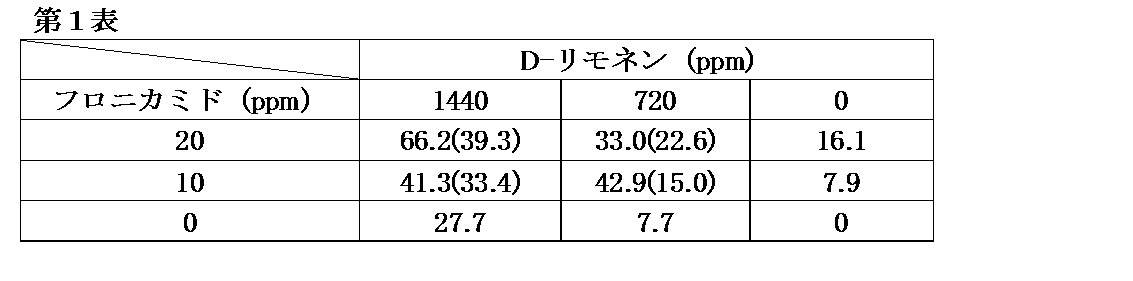
リーフディスク中央部の穴に、クワコナカイガラムシの一齢幼虫30頭を接種し、飼育室(25℃、湿度60%)に静置した。2日後にリーフディスクに定着した幼虫の生存虫数を調査した後、回転式散布装置(tower sprayers TS-301)にて所定濃度の薬液を100L/10a相当の散布水量で散布処理し、飼育室内に静置した。薬液処理7日後に生存虫数を調査し、薬液処理前の生存虫数との差を死虫数として死虫率を求めた。水道水を陰性対照区として、同様に試験を実施し、式1により補正死虫率(%)を算出し、結果を第1表に示した。また、得られた補正死虫率を基にコルビーの計算式により理論値(%)を算出し、第1表の( )中に示した。なお、補正死虫率がコルビーの式による理論値よりも高い場合に、本発明組成物は、有害生物の防除に関し相乗効果を有する。本試験は3反復で実施した。
式1
補正死虫率(%)=100×((処理区の死虫率-対照区の死虫率)/(100-対照区の死虫率))
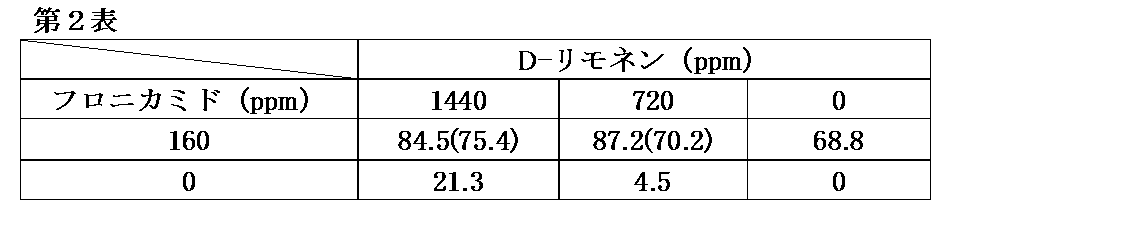
フロニカミドの薬液の濃度が異なること以外は、試験例1と同様の試験を行った。試験は3反復で実施し、結果を第2表に示した。
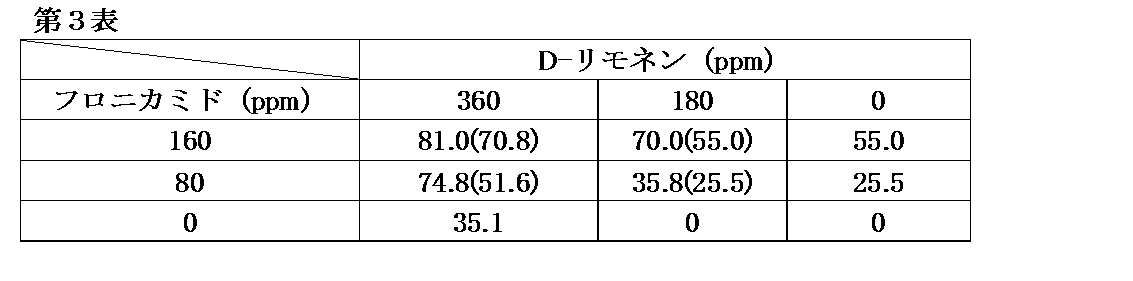
フロニカミドとD-リモネンの薬液の濃度が異なること以外は、試験例1と同様の試験を行った。試験は3反復で実施し、結果を第3表に示した。
なお、2017年12月20日に出願された日本特許出願2017-244321号の明細書、特許請求の範囲、要約書及び図面の全内容をここに引用し、本発明の明細書の開示として、取り入れるものである。
Claims (7)
- フロニカミドとD-リモネンとを有効成分として含有し、フロニカミドとD-リモネンとの混合割合が重量比で1:150~1:1である、有害生物防除用組成物。
- 有害生物防除用組成物が殺虫剤、殺ダニ剤、殺線虫剤又は、殺土壌害虫剤である、請求項1に記載の組成物。
- 有害生物防除用組成物が殺虫剤である、請求項1に記載の組成物。
- フロニカミドとD-リモネンとを有効成分として含有し、フロニカミドとD-リモネンとの混合割合が重量比で1:150~1:1である、有害生物防除用組成物の有効量を施用して有害生物を防除する方法。
- 有害生物が昆虫、ダニ、線虫又は土壌害虫である、請求項4に記載の方法。
- 有害生物が昆虫である、請求項4に記載の方法。
- 有害生物がカイガラムシ類である、請求項4に記載の方法。
Priority Applications (9)
| Application Number | Priority Date | Filing Date | Title |
|---|---|---|---|
| HRP20241580TT HRP20241580T1 (hr) | 2017-12-20 | 2018-12-18 | Pesticidni pripravak i metoda suzbijanja štetnika |
| EP18890432.0A EP3729965B1 (en) | 2017-12-20 | 2018-12-18 | Pesticidal composition and method for controlling pests |
| PL18890432.0T PL3729965T3 (pl) | 2017-12-20 | 2018-12-18 | Kompozycja do zwalczania szkodników i sposób zwalczania szkodników |
| MX2020006352A MX2020006352A (es) | 2017-12-20 | 2018-12-18 | Composicion pesticida y metodo para el control de plagas. |
| BR112020009585-0A BR112020009585B1 (pt) | 2017-12-20 | 2018-12-18 | Composição pesticida e método para controle de pestes |
| ES18890432T ES2992091T3 (es) | 2017-12-20 | 2018-12-18 | Composición plaguicida y procedimiento para controlar plagas |
| MA51330A MA51330B1 (fr) | 2017-12-20 | 2018-12-18 | Composition pesticide et méthode de lutte contre les parasites |
| US16/768,389 US10952438B2 (en) | 2017-12-20 | 2018-12-18 | Pesticidal composition and method for controlling pests |
| RS20241353A RS66260B1 (sr) | 2017-12-20 | 2018-12-18 | Pesticidna kompozicija i metoda suzbijanja štetočina |
Applications Claiming Priority (2)
| Application Number | Priority Date | Filing Date | Title |
|---|---|---|---|
| JP2017244321A JP2021035912A (ja) | 2017-12-20 | 2017-12-20 | 有害生物防除用組成物及び有害生物の防除方法 |
| JP2017-244321 | 2017-12-20 |
Publications (1)
| Publication Number | Publication Date |
|---|---|
| WO2019124349A1 true WO2019124349A1 (ja) | 2019-06-27 |
Family
ID=66994791
Family Applications (1)
| Application Number | Title | Priority Date | Filing Date |
|---|---|---|---|
| PCT/JP2018/046517 Ceased WO2019124349A1 (ja) | 2017-12-20 | 2018-12-18 | 有害生物防除用組成物及び有害生物の防除方法 |
Country Status (14)
| Country | Link |
|---|---|
| US (1) | US10952438B2 (ja) |
| EP (1) | EP3729965B1 (ja) |
| JP (1) | JP2021035912A (ja) |
| AR (1) | AR113957A1 (ja) |
| BR (1) | BR112020009585B1 (ja) |
| ES (1) | ES2992091T3 (ja) |
| HR (1) | HRP20241580T1 (ja) |
| HU (1) | HUE069595T2 (ja) |
| MA (1) | MA51330B1 (ja) |
| MX (1) | MX2020006352A (ja) |
| PL (1) | PL3729965T3 (ja) |
| RS (1) | RS66260B1 (ja) |
| TW (1) | TWI791712B (ja) |
| WO (1) | WO2019124349A1 (ja) |
Families Citing this family (1)
| Publication number | Priority date | Publication date | Assignee | Title |
|---|---|---|---|---|
| CN114651826B (zh) * | 2022-04-15 | 2023-05-09 | 广西壮族自治区农业科学院 | 一种防治芋田斜纹夜蛾的杀虫组合物 |
Citations (7)
| Publication number | Priority date | Publication date | Assignee | Title |
|---|---|---|---|---|
| EP0580374B1 (en) | 1992-07-23 | 1996-01-03 | Ishihara Sangyo Kaisha, Ltd. | Pyridine amides and their salts, processes for their production and pesticidal compositions containing them |
| WO1998048625A1 (en) | 1997-04-30 | 1998-11-05 | Tor Mcpartland | Ant spray containing d-limonene and methods of making and using same |
| WO2002034050A1 (en) | 2000-10-23 | 2002-05-02 | Ishihara Sangyo Kaisha, Ltd. | Pesticidal composition |
| JP2009522208A (ja) * | 2005-12-31 | 2009-06-11 | 天津天士力製薬株式会社 | アリタソウの抽出物、上記抽出物からなる組成物、それらの製造方法および使用 |
| WO2010144919A1 (en) * | 2009-06-12 | 2010-12-16 | Agraquest, Inc. | Methods of inhibiting, preventing, killing and/or repelling insects using simulated blends of chenopodium extracts |
| WO2014019983A1 (en) | 2012-07-31 | 2014-02-06 | Bayer Cropscience Ag | Compositions comprising a pesticidal terpene mixture and an insecticide |
| WO2014029747A1 (en) | 2012-08-24 | 2014-02-27 | Bayer Cropscience Ag | Composition comprising a pesticidal terpene mixture and a biological control agent |
Family Cites Families (3)
| Publication number | Priority date | Publication date | Assignee | Title |
|---|---|---|---|---|
| TW201603707A (zh) * | 2014-06-24 | 2016-02-01 | 陶氏農業科學公司 | 具有特定殺蟲效用之分子及與其相關之中間物、組成物和製程 |
| CN106614598A (zh) * | 2016-12-29 | 2017-05-10 | 浙江威尔达化工有限公司 | 一种杀虫剂及其应用 |
| CN109645002A (zh) * | 2018-12-13 | 2019-04-19 | 广东中迅农科股份有限公司 | 含有d-柠檬烯的增效农药组合物 |
-
2017
- 2017-12-20 JP JP2017244321A patent/JP2021035912A/ja active Pending
-
2018
- 2018-12-17 AR ARP180103683A patent/AR113957A1/es active IP Right Grant
- 2018-12-17 TW TW107145385A patent/TWI791712B/zh active
- 2018-12-18 PL PL18890432.0T patent/PL3729965T3/pl unknown
- 2018-12-18 BR BR112020009585-0A patent/BR112020009585B1/pt active IP Right Grant
- 2018-12-18 MX MX2020006352A patent/MX2020006352A/es unknown
- 2018-12-18 EP EP18890432.0A patent/EP3729965B1/en active Active
- 2018-12-18 RS RS20241353A patent/RS66260B1/sr unknown
- 2018-12-18 US US16/768,389 patent/US10952438B2/en active Active
- 2018-12-18 ES ES18890432T patent/ES2992091T3/es active Active
- 2018-12-18 HU HUE18890432A patent/HUE069595T2/hu unknown
- 2018-12-18 HR HRP20241580TT patent/HRP20241580T1/hr unknown
- 2018-12-18 WO PCT/JP2018/046517 patent/WO2019124349A1/ja not_active Ceased
- 2018-12-18 MA MA51330A patent/MA51330B1/fr unknown
Patent Citations (7)
| Publication number | Priority date | Publication date | Assignee | Title |
|---|---|---|---|---|
| EP0580374B1 (en) | 1992-07-23 | 1996-01-03 | Ishihara Sangyo Kaisha, Ltd. | Pyridine amides and their salts, processes for their production and pesticidal compositions containing them |
| WO1998048625A1 (en) | 1997-04-30 | 1998-11-05 | Tor Mcpartland | Ant spray containing d-limonene and methods of making and using same |
| WO2002034050A1 (en) | 2000-10-23 | 2002-05-02 | Ishihara Sangyo Kaisha, Ltd. | Pesticidal composition |
| JP2009522208A (ja) * | 2005-12-31 | 2009-06-11 | 天津天士力製薬株式会社 | アリタソウの抽出物、上記抽出物からなる組成物、それらの製造方法および使用 |
| WO2010144919A1 (en) * | 2009-06-12 | 2010-12-16 | Agraquest, Inc. | Methods of inhibiting, preventing, killing and/or repelling insects using simulated blends of chenopodium extracts |
| WO2014019983A1 (en) | 2012-07-31 | 2014-02-06 | Bayer Cropscience Ag | Compositions comprising a pesticidal terpene mixture and an insecticide |
| WO2014029747A1 (en) | 2012-08-24 | 2014-02-27 | Bayer Cropscience Ag | Composition comprising a pesticidal terpene mixture and a biological control agent |
Non-Patent Citations (3)
| Title |
|---|
| ANONYMOUS: "Material Safety Data Sheet BELEAF? 50 SG INSECTICIDE- Physical and chemical properties", FMC, 19 September 2005 (2005-09-19), pages 1 - 8, XP055620479, Retrieved from the Internet <URL:http://dunecoiv.com/msds/PH_A_C/Beleaf.pdf> * |
| HOLLINGSWORTH, R. G.: "Limonene, a Citrus Extract, for Control of Mealybugs and Scale Insects", J. ECON. ENTOMOL, vol. 98, no. 3, 2005, pages 772 - 779, XP009166714, doi:10.1603/0022-0493-98.3.772 * |
| See also references of EP3729965A4 |
Also Published As
| Publication number | Publication date |
|---|---|
| TW201940065A (zh) | 2019-10-16 |
| EP3729965C0 (en) | 2024-10-16 |
| JP2021035912A (ja) | 2021-03-04 |
| BR112020009585A2 (pt) | 2020-11-03 |
| EP3729965A4 (en) | 2021-09-08 |
| PL3729965T3 (pl) | 2025-03-03 |
| AR113957A1 (es) | 2020-07-01 |
| MA51330B1 (fr) | 2024-10-31 |
| HUE069595T2 (hu) | 2025-03-28 |
| EP3729965B1 (en) | 2024-10-16 |
| RS66260B1 (sr) | 2024-12-31 |
| EP3729965A1 (en) | 2020-10-28 |
| US10952438B2 (en) | 2021-03-23 |
| US20200329709A1 (en) | 2020-10-22 |
| HRP20241580T1 (hr) | 2025-01-31 |
| MA51330A (fr) | 2021-03-31 |
| MX2020006352A (es) | 2020-09-03 |
| TWI791712B (zh) | 2023-02-11 |
| BR112020009585B1 (pt) | 2024-01-23 |
| ES2992091T3 (es) | 2024-12-09 |
Similar Documents
| Publication | Publication Date | Title |
|---|---|---|
| US10039284B2 (en) | Pesticidal compositions | |
| CN108368063B (zh) | 吡嗪化合物和含有其的有害节肢动物防治剂 | |
| JP2013028588A (ja) | 有害生物防除剤 | |
| CN101557710A (zh) | 农药组合物 | |
| AU2012259756A1 (en) | Agricultural or horticultural fungicide composition and method for controlling plant pathogen | |
| EP2713754A2 (en) | Agricultural or horticultural fungicide composition and method for controlling plant pathogen | |
| US8829045B2 (en) | Agrochemical composition for pest control and pest control method | |
| KR20110041482A (ko) | 유해 생물 방제 조성물 | |
| TWI791712B (zh) | 有害生物防除用組成物及有害生物之防除方法 | |
| EP2451275B2 (en) | Agricultural or horticultural fungicide composition and its use for controlling plant pathogens | |
| JP2018197192A (ja) | チエノピロール系化合物又はその塩を有効成分として含有する有害生物防除剤 |
Legal Events
| Date | Code | Title | Description |
|---|---|---|---|
| 121 | Ep: the epo has been informed by wipo that ep was designated in this application |
Ref document number: 18890432 Country of ref document: EP Kind code of ref document: A1 |
|
| NENP | Non-entry into the national phase |
Ref country code: DE |
|
| ENP | Entry into the national phase |
Ref document number: 2018890432 Country of ref document: EP Effective date: 20200720 |
|
| REG | Reference to national code |
Ref country code: BR Ref legal event code: B01A Ref document number: 112020009585 Country of ref document: BR |
|
| ENP | Entry into the national phase |
Ref document number: 112020009585 Country of ref document: BR Kind code of ref document: A2 Effective date: 20200514 |
|
| NENP | Non-entry into the national phase |
Ref country code: JP |
|
| WWE | Wipo information: entry into national phase |
Ref document number: P-2024/1353 Country of ref document: RS |
|
| WWG | Wipo information: grant in national office |
Ref document number: P-2024/1353 Country of ref document: RS |
|
| WWG | Wipo information: grant in national office |
Ref document number: MX/A/2020/006352 Country of ref document: MX |