WO2019129692A1 - Fluorinate polyacrylate coating composition, the preparation method therefore and use thereof - Google Patents
Fluorinate polyacrylate coating composition, the preparation method therefore and use thereof Download PDFInfo
- Publication number
- WO2019129692A1 WO2019129692A1 PCT/EP2018/086524 EP2018086524W WO2019129692A1 WO 2019129692 A1 WO2019129692 A1 WO 2019129692A1 EP 2018086524 W EP2018086524 W EP 2018086524W WO 2019129692 A1 WO2019129692 A1 WO 2019129692A1
- Authority
- WO
- WIPO (PCT)
- Prior art keywords
- mixture
- coating composition
- polyol
- diol
- meth
- Prior art date
- Legal status (The legal status is an assumption and is not a legal conclusion. Google has not performed a legal analysis and makes no representation as to the accuracy of the status listed.)
- Ceased
Links
Classifications
-
- C—CHEMISTRY; METALLURGY
- C09—DYES; PAINTS; POLISHES; NATURAL RESINS; ADHESIVES; COMPOSITIONS NOT OTHERWISE PROVIDED FOR; APPLICATIONS OF MATERIALS NOT OTHERWISE PROVIDED FOR
- C09D—COATING COMPOSITIONS, e.g. PAINTS, VARNISHES OR LACQUERS; FILLING PASTES; CHEMICAL PAINT OR INK REMOVERS; INKS; CORRECTING FLUIDS; WOODSTAINS; PASTES OR SOLIDS FOR COLOURING OR PRINTING; USE OF MATERIALS THEREFOR
- C09D133/00—Coating compositions based on homopolymers or copolymers of compounds having one or more unsaturated aliphatic radicals, each having only one carbon-to-carbon double bond, and at least one being terminated by only one carboxyl radical, or of salts, anhydrides, esters, amides, imides, or nitriles thereof; Coating compositions based on derivatives of such polymers
- C09D133/04—Homopolymers or copolymers of esters
- C09D133/06—Homopolymers or copolymers of esters of esters containing only carbon, hydrogen and oxygen, the oxygen atom being present only as part of the carboxyl radical
- C09D133/08—Homopolymers or copolymers of acrylic acid esters
-
- C—CHEMISTRY; METALLURGY
- C08—ORGANIC MACROMOLECULAR COMPOUNDS; THEIR PREPARATION OR CHEMICAL WORKING-UP; COMPOSITIONS BASED THEREON
- C08G—MACROMOLECULAR COMPOUNDS OBTAINED OTHERWISE THAN BY REACTIONS ONLY INVOLVING UNSATURATED CARBON-TO-CARBON BONDS
- C08G18/00—Polymeric products of isocyanates or isothiocyanates
- C08G18/06—Polymeric products of isocyanates or isothiocyanates with compounds having active hydrogen
- C08G18/28—Polymeric products of isocyanates or isothiocyanates with compounds having active hydrogen characterised by the compounds used containing active hydrogen
- C08G18/40—High-molecular-weight compounds
- C08G18/48—Polyethers
- C08G18/50—Polyethers having heteroatoms other than oxygen
- C08G18/5003—Polyethers having heteroatoms other than oxygen having halogens
- C08G18/5015—Polyethers having heteroatoms other than oxygen having halogens having fluorine atoms
-
- C—CHEMISTRY; METALLURGY
- C08—ORGANIC MACROMOLECULAR COMPOUNDS; THEIR PREPARATION OR CHEMICAL WORKING-UP; COMPOSITIONS BASED THEREON
- C08F—MACROMOLECULAR COMPOUNDS OBTAINED BY REACTIONS ONLY INVOLVING CARBON-TO-CARBON UNSATURATED BONDS
- C08F2/00—Processes of polymerisation
- C08F2/04—Polymerisation in solution
-
- C—CHEMISTRY; METALLURGY
- C08—ORGANIC MACROMOLECULAR COMPOUNDS; THEIR PREPARATION OR CHEMICAL WORKING-UP; COMPOSITIONS BASED THEREON
- C08G—MACROMOLECULAR COMPOUNDS OBTAINED OTHERWISE THAN BY REACTIONS ONLY INVOLVING UNSATURATED CARBON-TO-CARBON BONDS
- C08G18/00—Polymeric products of isocyanates or isothiocyanates
- C08G18/06—Polymeric products of isocyanates or isothiocyanates with compounds having active hydrogen
- C08G18/08—Processes
- C08G18/16—Catalysts
- C08G18/22—Catalysts containing metal compounds
- C08G18/24—Catalysts containing metal compounds of tin
- C08G18/244—Catalysts containing metal compounds of tin tin salts of carboxylic acids
- C08G18/246—Catalysts containing metal compounds of tin tin salts of carboxylic acids containing also tin-carbon bonds
-
- C—CHEMISTRY; METALLURGY
- C08—ORGANIC MACROMOLECULAR COMPOUNDS; THEIR PREPARATION OR CHEMICAL WORKING-UP; COMPOSITIONS BASED THEREON
- C08G—MACROMOLECULAR COMPOUNDS OBTAINED OTHERWISE THAN BY REACTIONS ONLY INVOLVING UNSATURATED CARBON-TO-CARBON BONDS
- C08G18/00—Polymeric products of isocyanates or isothiocyanates
- C08G18/06—Polymeric products of isocyanates or isothiocyanates with compounds having active hydrogen
- C08G18/28—Polymeric products of isocyanates or isothiocyanates with compounds having active hydrogen characterised by the compounds used containing active hydrogen
- C08G18/30—Low-molecular-weight compounds
- C08G18/32—Polyhydroxy compounds; Polyamines; Hydroxyamines
- C08G18/3203—Polyhydroxy compounds
- C08G18/3206—Polyhydroxy compounds aliphatic
-
- C—CHEMISTRY; METALLURGY
- C08—ORGANIC MACROMOLECULAR COMPOUNDS; THEIR PREPARATION OR CHEMICAL WORKING-UP; COMPOSITIONS BASED THEREON
- C08G—MACROMOLECULAR COMPOUNDS OBTAINED OTHERWISE THAN BY REACTIONS ONLY INVOLVING UNSATURATED CARBON-TO-CARBON BONDS
- C08G18/00—Polymeric products of isocyanates or isothiocyanates
- C08G18/06—Polymeric products of isocyanates or isothiocyanates with compounds having active hydrogen
- C08G18/28—Polymeric products of isocyanates or isothiocyanates with compounds having active hydrogen characterised by the compounds used containing active hydrogen
- C08G18/30—Low-molecular-weight compounds
- C08G18/32—Polyhydroxy compounds; Polyamines; Hydroxyamines
- C08G18/3203—Polyhydroxy compounds
- C08G18/3212—Polyhydroxy compounds containing cycloaliphatic groups
-
- C—CHEMISTRY; METALLURGY
- C08—ORGANIC MACROMOLECULAR COMPOUNDS; THEIR PREPARATION OR CHEMICAL WORKING-UP; COMPOSITIONS BASED THEREON
- C08G—MACROMOLECULAR COMPOUNDS OBTAINED OTHERWISE THAN BY REACTIONS ONLY INVOLVING UNSATURATED CARBON-TO-CARBON BONDS
- C08G18/00—Polymeric products of isocyanates or isothiocyanates
- C08G18/06—Polymeric products of isocyanates or isothiocyanates with compounds having active hydrogen
- C08G18/28—Polymeric products of isocyanates or isothiocyanates with compounds having active hydrogen characterised by the compounds used containing active hydrogen
- C08G18/30—Low-molecular-weight compounds
- C08G18/38—Low-molecular-weight compounds having heteroatoms other than oxygen
- C08G18/3802—Low-molecular-weight compounds having heteroatoms other than oxygen having halogens
- C08G18/3804—Polyhydroxy compounds
- C08G18/3812—Polyhydroxy compounds having fluorine atoms
-
- C—CHEMISTRY; METALLURGY
- C08—ORGANIC MACROMOLECULAR COMPOUNDS; THEIR PREPARATION OR CHEMICAL WORKING-UP; COMPOSITIONS BASED THEREON
- C08G—MACROMOLECULAR COMPOUNDS OBTAINED OTHERWISE THAN BY REACTIONS ONLY INVOLVING UNSATURATED CARBON-TO-CARBON BONDS
- C08G18/00—Polymeric products of isocyanates or isothiocyanates
- C08G18/06—Polymeric products of isocyanates or isothiocyanates with compounds having active hydrogen
- C08G18/28—Polymeric products of isocyanates or isothiocyanates with compounds having active hydrogen characterised by the compounds used containing active hydrogen
- C08G18/40—High-molecular-weight compounds
- C08G18/42—Polycondensates having carboxylic or carbonic ester groups in the main chain
-
- C—CHEMISTRY; METALLURGY
- C08—ORGANIC MACROMOLECULAR COMPOUNDS; THEIR PREPARATION OR CHEMICAL WORKING-UP; COMPOSITIONS BASED THEREON
- C08G—MACROMOLECULAR COMPOUNDS OBTAINED OTHERWISE THAN BY REACTIONS ONLY INVOLVING UNSATURATED CARBON-TO-CARBON BONDS
- C08G18/00—Polymeric products of isocyanates or isothiocyanates
- C08G18/06—Polymeric products of isocyanates or isothiocyanates with compounds having active hydrogen
- C08G18/28—Polymeric products of isocyanates or isothiocyanates with compounds having active hydrogen characterised by the compounds used containing active hydrogen
- C08G18/40—High-molecular-weight compounds
- C08G18/42—Polycondensates having carboxylic or carbonic ester groups in the main chain
- C08G18/44—Polycarbonates
-
- C—CHEMISTRY; METALLURGY
- C08—ORGANIC MACROMOLECULAR COMPOUNDS; THEIR PREPARATION OR CHEMICAL WORKING-UP; COMPOSITIONS BASED THEREON
- C08G—MACROMOLECULAR COMPOUNDS OBTAINED OTHERWISE THAN BY REACTIONS ONLY INVOLVING UNSATURATED CARBON-TO-CARBON BONDS
- C08G18/00—Polymeric products of isocyanates or isothiocyanates
- C08G18/06—Polymeric products of isocyanates or isothiocyanates with compounds having active hydrogen
- C08G18/28—Polymeric products of isocyanates or isothiocyanates with compounds having active hydrogen characterised by the compounds used containing active hydrogen
- C08G18/40—High-molecular-weight compounds
- C08G18/48—Polyethers
-
- C—CHEMISTRY; METALLURGY
- C08—ORGANIC MACROMOLECULAR COMPOUNDS; THEIR PREPARATION OR CHEMICAL WORKING-UP; COMPOSITIONS BASED THEREON
- C08G—MACROMOLECULAR COMPOUNDS OBTAINED OTHERWISE THAN BY REACTIONS ONLY INVOLVING UNSATURATED CARBON-TO-CARBON BONDS
- C08G18/00—Polymeric products of isocyanates or isothiocyanates
- C08G18/06—Polymeric products of isocyanates or isothiocyanates with compounds having active hydrogen
- C08G18/28—Polymeric products of isocyanates or isothiocyanates with compounds having active hydrogen characterised by the compounds used containing active hydrogen
- C08G18/40—High-molecular-weight compounds
- C08G18/48—Polyethers
- C08G18/4825—Polyethers containing two hydroxy groups
-
- C—CHEMISTRY; METALLURGY
- C08—ORGANIC MACROMOLECULAR COMPOUNDS; THEIR PREPARATION OR CHEMICAL WORKING-UP; COMPOSITIONS BASED THEREON
- C08G—MACROMOLECULAR COMPOUNDS OBTAINED OTHERWISE THAN BY REACTIONS ONLY INVOLVING UNSATURATED CARBON-TO-CARBON BONDS
- C08G18/00—Polymeric products of isocyanates or isothiocyanates
- C08G18/06—Polymeric products of isocyanates or isothiocyanates with compounds having active hydrogen
- C08G18/28—Polymeric products of isocyanates or isothiocyanates with compounds having active hydrogen characterised by the compounds used containing active hydrogen
- C08G18/40—High-molecular-weight compounds
- C08G18/48—Polyethers
- C08G18/4833—Polyethers containing oxyethylene units
-
- C—CHEMISTRY; METALLURGY
- C08—ORGANIC MACROMOLECULAR COMPOUNDS; THEIR PREPARATION OR CHEMICAL WORKING-UP; COMPOSITIONS BASED THEREON
- C08G—MACROMOLECULAR COMPOUNDS OBTAINED OTHERWISE THAN BY REACTIONS ONLY INVOLVING UNSATURATED CARBON-TO-CARBON BONDS
- C08G18/00—Polymeric products of isocyanates or isothiocyanates
- C08G18/06—Polymeric products of isocyanates or isothiocyanates with compounds having active hydrogen
- C08G18/28—Polymeric products of isocyanates or isothiocyanates with compounds having active hydrogen characterised by the compounds used containing active hydrogen
- C08G18/67—Unsaturated compounds having active hydrogen
- C08G18/671—Unsaturated compounds having only one group containing active hydrogen
- C08G18/672—Esters of acrylic or alkyl acrylic acid having only one group containing active hydrogen
-
- C—CHEMISTRY; METALLURGY
- C08—ORGANIC MACROMOLECULAR COMPOUNDS; THEIR PREPARATION OR CHEMICAL WORKING-UP; COMPOSITIONS BASED THEREON
- C08G—MACROMOLECULAR COMPOUNDS OBTAINED OTHERWISE THAN BY REACTIONS ONLY INVOLVING UNSATURATED CARBON-TO-CARBON BONDS
- C08G18/00—Polymeric products of isocyanates or isothiocyanates
- C08G18/06—Polymeric products of isocyanates or isothiocyanates with compounds having active hydrogen
- C08G18/28—Polymeric products of isocyanates or isothiocyanates with compounds having active hydrogen characterised by the compounds used containing active hydrogen
- C08G18/67—Unsaturated compounds having active hydrogen
- C08G18/671—Unsaturated compounds having only one group containing active hydrogen
- C08G18/672—Esters of acrylic or alkyl acrylic acid having only one group containing active hydrogen
- C08G18/673—Esters of acrylic or alkyl acrylic acid having only one group containing active hydrogen containing two or more acrylate or alkylacrylate ester groups
-
- C—CHEMISTRY; METALLURGY
- C08—ORGANIC MACROMOLECULAR COMPOUNDS; THEIR PREPARATION OR CHEMICAL WORKING-UP; COMPOSITIONS BASED THEREON
- C08G—MACROMOLECULAR COMPOUNDS OBTAINED OTHERWISE THAN BY REACTIONS ONLY INVOLVING UNSATURATED CARBON-TO-CARBON BONDS
- C08G18/00—Polymeric products of isocyanates or isothiocyanates
- C08G18/06—Polymeric products of isocyanates or isothiocyanates with compounds having active hydrogen
- C08G18/70—Polymeric products of isocyanates or isothiocyanates with compounds having active hydrogen characterised by the isocyanates or isothiocyanates used
- C08G18/72—Polyisocyanates or polyisothiocyanates
- C08G18/73—Polyisocyanates or polyisothiocyanates acyclic
-
- C—CHEMISTRY; METALLURGY
- C08—ORGANIC MACROMOLECULAR COMPOUNDS; THEIR PREPARATION OR CHEMICAL WORKING-UP; COMPOSITIONS BASED THEREON
- C08G—MACROMOLECULAR COMPOUNDS OBTAINED OTHERWISE THAN BY REACTIONS ONLY INVOLVING UNSATURATED CARBON-TO-CARBON BONDS
- C08G18/00—Polymeric products of isocyanates or isothiocyanates
- C08G18/06—Polymeric products of isocyanates or isothiocyanates with compounds having active hydrogen
- C08G18/70—Polymeric products of isocyanates or isothiocyanates with compounds having active hydrogen characterised by the isocyanates or isothiocyanates used
- C08G18/72—Polyisocyanates or polyisothiocyanates
- C08G18/77—Polyisocyanates or polyisothiocyanates having heteroatoms in addition to the isocyanate or isothiocyanate nitrogen and oxygen or sulfur
- C08G18/78—Nitrogen
- C08G18/79—Nitrogen characterised by the polyisocyanates used, these having groups formed by oligomerisation of isocyanates or isothiocyanates
- C08G18/791—Nitrogen characterised by the polyisocyanates used, these having groups formed by oligomerisation of isocyanates or isothiocyanates containing isocyanurate groups
- C08G18/792—Nitrogen characterised by the polyisocyanates used, these having groups formed by oligomerisation of isocyanates or isothiocyanates containing isocyanurate groups formed by oligomerisation of aliphatic and/or cycloaliphatic isocyanates or isothiocyanates
-
- C—CHEMISTRY; METALLURGY
- C09—DYES; PAINTS; POLISHES; NATURAL RESINS; ADHESIVES; COMPOSITIONS NOT OTHERWISE PROVIDED FOR; APPLICATIONS OF MATERIALS NOT OTHERWISE PROVIDED FOR
- C09D—COATING COMPOSITIONS, e.g. PAINTS, VARNISHES OR LACQUERS; FILLING PASTES; CHEMICAL PAINT OR INK REMOVERS; INKS; CORRECTING FLUIDS; WOODSTAINS; PASTES OR SOLIDS FOR COLOURING OR PRINTING; USE OF MATERIALS THEREFOR
- C09D133/00—Coating compositions based on homopolymers or copolymers of compounds having one or more unsaturated aliphatic radicals, each having only one carbon-to-carbon double bond, and at least one being terminated by only one carboxyl radical, or of salts, anhydrides, esters, amides, imides, or nitriles thereof; Coating compositions based on derivatives of such polymers
- C09D133/04—Homopolymers or copolymers of esters
- C09D133/14—Homopolymers or copolymers of esters of esters containing halogen, nitrogen, sulfur or oxygen atoms in addition to the carboxy oxygen
-
- C—CHEMISTRY; METALLURGY
- C09—DYES; PAINTS; POLISHES; NATURAL RESINS; ADHESIVES; COMPOSITIONS NOT OTHERWISE PROVIDED FOR; APPLICATIONS OF MATERIALS NOT OTHERWISE PROVIDED FOR
- C09D—COATING COMPOSITIONS, e.g. PAINTS, VARNISHES OR LACQUERS; FILLING PASTES; CHEMICAL PAINT OR INK REMOVERS; INKS; CORRECTING FLUIDS; WOODSTAINS; PASTES OR SOLIDS FOR COLOURING OR PRINTING; USE OF MATERIALS THEREFOR
- C09D175/00—Coating compositions based on polyureas or polyurethanes; Coating compositions based on derivatives of such polymers
- C09D175/04—Polyurethanes
- C09D175/14—Polyurethanes having carbon-to-carbon unsaturated bonds
- C09D175/16—Polyurethanes having carbon-to-carbon unsaturated bonds having terminal carbon-to-carbon unsaturated bonds
-
- C—CHEMISTRY; METALLURGY
- C09—DYES; PAINTS; POLISHES; NATURAL RESINS; ADHESIVES; COMPOSITIONS NOT OTHERWISE PROVIDED FOR; APPLICATIONS OF MATERIALS NOT OTHERWISE PROVIDED FOR
- C09D—COATING COMPOSITIONS, e.g. PAINTS, VARNISHES OR LACQUERS; FILLING PASTES; CHEMICAL PAINT OR INK REMOVERS; INKS; CORRECTING FLUIDS; WOODSTAINS; PASTES OR SOLIDS FOR COLOURING OR PRINTING; USE OF MATERIALS THEREFOR
- C09D4/00—Coating compositions, e.g. paints, varnishes or lacquers, based on organic non-macromolecular compounds having at least one polymerisable carbon-to-carbon unsaturated bond ; Coating compositions, based on monomers of macromolecular compounds of groups C09D183/00 - C09D183/16
- C09D4/06—Organic non-macromolecular compounds having at least one polymerisable carbon-to-carbon unsaturated bond in combination with a macromolecular compound other than an unsaturated polymer of groups C09D159/00 - C09D187/00
Definitions
- the invention relates to a coating composition for preparing a durable, stain-resistant, and scratch-resistant coating.
- the coating composition comprises a fluorinated polyurethane acrylate resin (FPUA) and a polyurethane acrylate resin (PUA) that are curable with ultraviolet (UV) light radiation.
- FPUA fluorinated polyurethane acrylate resin
- PUA polyurethane acrylate resin
- UV ultraviolet
- the invention further relates to a method for preparing the coating composition, and the use thereof.
- WO 2015/038454 disclosed a poly fluorine-containing silicone coating for use on glass substrates, wherein a PFPE was added into a coating formulation to improve the lubricating performance and colloidal silica was added into the formulation to improve the anti-scratch performance.
- WO 2007/121110 disclosed a coating for use on a flooring substrate, comprising a PFPE component to provide the flooring substrate with repellence properties such as water, oil or stain repellence. It is mentioned that the reaction only took place at one end of the molecule chain of the PFPE.
- US 2013/0084458 disclosed a hard coat agent composition
- a hard coat agent composition comprising a urethane acrylate, a first fluorine-containing polyether compound having active energy ray reactive group via a urethane bond at each of both ends of molecular chain containing a PFPE group, a second fluorine-containing polyether compound having active energy ray reactive group via a urethane bond at one end of molecular chain containing a PFPE group.
- the hard coat film is excellent in transparency, anti-stain, lubricating, solvent resistance, scratch resistance and abrasion resistance, as well as in punchability.
- JP 2009256597 disclosed a urethane acrylate resin containing a PFPE group capable of imparting excellent transparency and anti-fouling properties to the cured film.
- the present invention provides for a fluorinated resin composition, which, upon curing, is durable and has anti-stain and anti-scratch properties.
- the composition generally comprises an oligomer prepared from an isocyanate, a diol or polyol, and a monomer that has at least one double bond and at least one hydroxyl group, and/or another oligomer prepared from an isocyanate, a diol or polyol, a fluorinated diol or polyol or a perfluoropolyether containing at least two hydroxyl groups, and a monomer that has at least one double bond and at least one hydroxyl group.
- the preparation of the fluorinated resin composition is conducted with a one-pot multicomponent synthesis process, wherein multiple components are put together to carry out reactions simultaneously.
- the process is especially suitable for industrial scale production, and open for adding additive components to further adjust the performance of the prepared composition.
- the present invention also provides for the relevant oligomers prepared in the synthesis process, as well as the use of said composition or oligomer to form a coating onto a substrate.
- a coating composition comprises at least two oligomers, wherein the first oligomer is prepared from an isocyanate, a diol or polyol, and a monomer that has at least one double bond and at least one hydroxyl group.
- the second oligomer is prepared from an isocyanate, a diol or polyol, a fluorinated diol or polyol or a perfluoropolyether containing at least two hydroxyl groups, and a monomer that has at least one double bond and at least one hydroxyl group.
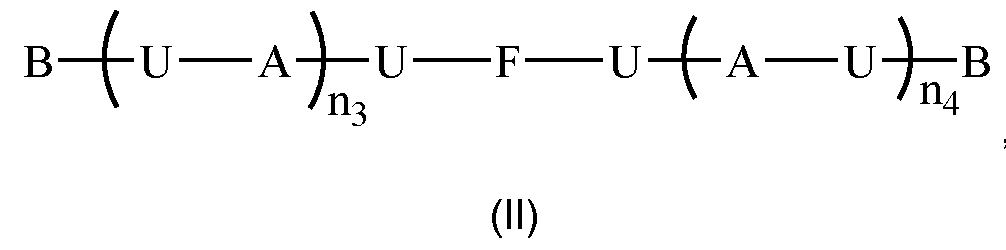
- the coating composition of the present invention comprises:
- A represents a diol or polyol structure
- F represents a fluorinated diol or polyol structure or a perfluoropolyether structure that contains at least two hydroxyl groups, or a mixture thereof
- B represents a monomer structure that has at least one double bond and at least one hydroxyl group
- ni, n 2 , n 3 and n 4 are integers, the sum of ni and n 2 is ranging from 0 to 20, the sum of n 3 and n 4 is ranging from 1 to 20.
- ni, n 2 , n 3 and n of structures (I) and (II) may independently represent any integer within the definition that the sum of ni and n 2 is ranging from 0 to 20, the sum of n 3 and n is ranging from 1 to 20.
- the weight ratio between the oligomers (I) and (II) in the composition is from 100-0.01 to 0-100, preferably from 90-10 to 10-90, more preferably from 70-30 to 30-70.
- a coating composition comprising oligomers of the following structures (III) and (IV) is provided.
- the weight ratio between the oligomers (III) and (IV) in the composition is from 100-0.01 to 0-100, preferably from 90-10 to 10-90, more preferably from 70-30 to 30-70.
- fluorinated polyacrylate oligomers having the above structures (II) and (IV) are provided.
- the composition of the present invention is prepared through a one-pot multicomponent synthesis process, and the obtained mixture of oligomers can be used in coating formulations directly, it is possible in some cases that the oligomers are isolated and provided in the form of a pure component, which can be further added into coating formulations, acting as either a main resin component, or an additive component.
- the double bond density of the monomer B structure may affect anti-stain and anti-scratch properties of the resulting coating.
- the double bond functionality of the monomer B structure is at least 1 , preferably 3 or 5, and more preferably 5, so as to achieve satisfying anti-stain and anti-scratch properties of the resulting coating.
- rigid and soft molecules may be introduced into the oligomers of the present invention during the synthesis process.
- rigid molecules may be added to increase the hardness and durability of the resulting coating film
- soft molecules may be added to increase the flexibility and elasticity of the coating film, and therefore increase the selfrecovery performance of the resulting coating film.
- the term“rigid” is meant to be the characteristic of a molecule, with which, the molecule does not tend to bend or flex when receiving a force
- the term“soft” is meant to be the characteristic of a molecule, with which, the molecule tends to bend or flex when receiving a force.
- rigid molecules suitable for use in the present invention can be selected from polyols that have a relatively low glass transmission temperature (Tg) value or diols that have a relatively long carbon chain structure; soft molecules suitable for use in the present invention can be selected from polyols that have relatively high Tg or diols that have a ring structure.
- Tg glass transmission temperature
- soft molecules suitable for use in the present invention can be selected from polyols that have relatively high Tg or diols that have a ring structure.
- a skilled person may select proper molecules by setting up standards of Tg values, chain length, etc., as per actual requirements.
- the isocyanate U structure that is suitable for the present invention is selected from, but not limited to the group consisting of 1 ,6-hexane diisocyanate (HDI), isophoron diisocyanate (IPDI), 4,4’-diphenyl-methane-diisocyanate (MDI), 4,4’-dicyclohexylmethane diisocyanate (HMDI), xylylene diisocyanate (XDI), Tolylene-2, 4-diisocyanate (TDI), and a mixture thereof;
- HDI 1 ,6-hexane diisocyanate
- IPDI isophoron diisocyanate
- MDI 4,4’-diphenyl-methane-diisocyanate
- HMDI 4,4’-dicyclohexylmethane diisocyanate
- XDI xylylene diisocyanate
- TKI 4-diisocyanate
- trimer Ui structure that is suitable for the present invention is selected from, but not limited to trimers of 1 ,6-hexane diisocyanate (HDI), isophoron diisocyanate (IPDI), and a mixture thereof.
- HDI 1 ,6-hexane diisocyanate
- IPDI isophoron diisocyanate
- the diol or polyol A structure that is suitable for the present invention is selected from, but not limited to the group consisting of glycols, ethylene glycol, diethylene glycol, neopentyl glycol, 1 ,6-hexanediol, cyclohexanedimethanol, polyester diols, polycarbonate diols, polyether diols, PEG200, PEG400, PEG600, PPG1000, etc., and a mixture thereof.
- the monomer B structure that is suitable for the present invention is selected from, but not limited to the group consisting of 2-hydroxyethyl(meth)acrylate, 2- hydroxypropyl(meth)acrylate, 2-hydroxybutyl(meth)acrylate, 1-hydroxybutyl(meth)acrylate, neopentylglycolmono(meth)acrylate, 1 ,6-hexanediolmono(meth)acrylate, polycarprolactone polyol mono(meth)acrylate, pentaerythritolpenta(meth)acrylate, dipentaerythritolpenta(meth)acrylate and a mixture thereof.
- the perfluoropolyether structure according to the present invention is a fluorine- containing polyether structure having at least two hydroxyl groups at each end of its molecule chain.
- the fluorine-containing polyether structure may be in the form of either straight chain or branched chain, for example, having structures of --[CF 2 0]--, --[CF 2 CF 2 0]--, --[CF 2 CF 2 CF 2 0]--, --[CF(CF 3 )CF 2 0]--, or the likes.
- the perfluoropolyether group may contain one or more types of perfluoropolyether units.
- the fluoropolyether units may be arranged in random or block form when there are two or more perfluoropolyether units in the perfluoropolyether chain.
- perfluoropolyether that is suitable for use in the present invention is selected from, but not limited to:
- n, p, q are integers, m is from 1 to 50, n is from 1 to 50, p is from 1 ⁇ 5, q is from 1 ⁇ 5.
- Fluorinated diol or polyol that is suitable for the present invention is selected from, but not limited to diols having the structure OHCH 2 (CF 2 ) r CH 2 OH, wherein r is from 2 to 10.
- r is from 2 to 10.
- they are selected from the group consisting of:
- the resin composition according to the present invention is generally prepared from a fluorinated diol or polyol and/or a perfluoropolyether with at least two hydroxyl groups at the ends of its molecule chain (hereinafter referred to as “fluorinated compound (F)”), an isocyanate (U) that has at least two isocyanate functional groups (hereinafter referred to as “isocyanate (U)”), a diol or polyol (A) that has at least two hydroxyl functional groups (hereinafter referred to as“diol or polyol (A)”), and a monomer (B) that has at least one double bond and at least one hydroxyl group (hereinafter referred to as “monomer (B)”).
- the preparation is conducted within a one-pot multicomponent synthesis system, wherein fluorinated polyurethane acrylate resin (FPUA) and polyurethane acrylate resin (PUA) are formed simultaneously from fluorinated compound (F), isocyanate (U), and diol or polyol (A), and then further reacted with monomer (B) for end-capping.
- FPUA fluorinated polyurethane acrylate resin
- POA polyurethane acrylate resin
- F fluorinated compound
- U isocyanate
- A diol or polyol
- B monomer
- the obtained product normally presents as a mixture of oligomers, which can be used to formulate a coating composition directly.
- this is an advantage of the present process in terms of industrial scale production and applications.
- it is also possible to isolate one or more of the oligomers from the product of the present process, to provide it (them) as pure resin component(s) for addition into coating formulations.
- Technology for isolation of the oligomers is well known in the art, thus it will not be discussed in detail in the present invention.
- the isocyanate (U) reacts with the fluorinated compound (F) which is a fluorinated diol or a polyol to form a structure of -U-F-U-.
- step b) dropping the solution of step a) into an isocyanate that has at least two isocyanate functional groups, with maintaining the temperature at 50 to 60 °C for 1 to 2 hours, preferably at 60 °C for 2 hours;
- step b) adding a diol that has at least two hydroxyl functional groups into the mixture of step b), with maintaining the temperature at 50 to 60 °C for 1 to 2 hours, preferably at 60 °C for 2 hours, to result in a proper chain extension through the formation of urethane bonds between (U) and (A);
- step c) adding a monomer that has at least one double bond and at least one hydroxyl group into the mixture of step c), with maintaining the temperature at 80 to 90 °C for 1 to 2 hours, preferably at 90 °C for 2 hours.
- each of n ⁇ n 2 , n 3 and n 4 in structures (I) and (II) may independently represent any integer within the definition that the sum of n 1 and n 2 is ranging from 0 to 20, the sum of n 3 and n 4 is ranging from 1 to 20.
- the ratio between the oligomers I and II in the composition is from 100-0.01 to 0-100.
- fluorinated compound (F) is added with a predetermined weight percentage such as 2 wt.%o, the other components are then further mixed into the composition according to a predetermined proportion relative to the amount of fluorinated compound (F).
- a predetermined weight percentage such as 2 wt.%o
- the other components are then further mixed into the composition according to a predetermined proportion relative to the amount of fluorinated compound (F).
- One of ordinary skill in the art may select proper relative proportions to achieve necessary characteristics of the composition such as the polymer length, the average number molecule weight, the number of repeat units in the molecule chain, etc.
- the average number molecular weight and chain length of the oligomers can be varied from hundreds to thousands, or even more by changing the molar ratio between isocyanate and diols or polyols, or type of diols or polyols.
- the inventors designed soft and rigid structures for PUA oligomers by introducing into the oligomers soft and rigid molecules respectively in the synthesis process, to form a structure as below:
- the fluorinated diol or polyol or perfluoropolyether for use in the present invention contains at least two hydroxyl groups at its chain ends.
- the hydroxyl groups may react with isocyanate, and thus make it possible for other chemical groups to be imbedded into the structure.
- the resulting structure is shown below.
- the oligomers of the coating composition of the present invention may also be prepared as branched structures based on trimers, as shown in the following structures (III) and (IV).
- Ui refers to an isocyanate trimer such as HDI trimer, IPDI trimer, etc.;
- the other components A, B, U, and F have the same meaning as discussed above.
- the reaction mechanisms are also similar to those discussed above.
- the method comprises steps of:
- step b) adding into the mixture of step a) a diol that has at least two hydroxyl functional groups, with maintaining the temperature at 50 to 60 °C for 1 to 2 hours, preferably at 60 °C for 2 hours;
- step c) dropping the solution of step c) into an isocyanate which is trimer of a diisocyanate, with maintaining the temperature at 50 to 60 °C for 1 to 2 hours;
- step e) adding the mixture of step b) into the mixture of step d), with maintaining the temperature at 80 to 90 °C for 1 to 2 hours.
- the fluorinated oligomer of the present invention may be added into coating compositions to improve the anti-stain, anti-scratch properties, and levelling effect of resulting coatings by virtue of its low surface energy, high cross-linking density, and the structural possibility for embedding rigid segments. Moreover, the fluorinated oligomer may also be helpful to improve the flexibility and self-recovery properties of the resulting coatings, where soft molecules like elastic diols or poly-diols exist in the structure of the oligomers.
- Oligomers of the present invention may be used as a resin component singularly, or together with other resins and/or monomers in a coating formulation.
- the oligomers of the present invention are compatible with most of other resins. Due to the unsaturated double bonds contained in their structures, they are curable with ultraviolet light. Therefore, the oligomers and compositions of the present invention may be widely used in the coatings industry.
- Figures 1 , 2, and 3 show the GPC spectrum obtained according to examples 1 , 2, and 3, respectively;
- Figures 4, 5, and 6 show the IR spectrum obtained according to examples 1 , 2, and 3, respectively;
- Figures 7, 8, and 9 show the NMR spectra obtained according to examples 1 , 2, and 3, respectively;
- Figure 10 shows the ccomparison of oil-based ink repellence on different UV resins.
- Perfluoropolyether E-10H, Solvay
- Dipentaerythritol hexaacrylate SR399, Sartomer
- Pentaerythritol acrylate SR444D, Sartomer
- Cyclohexanedimethanol CHDM, CAS No. 105-08-8, Sigma-Aldrich
- PEG600 600PU, Clariant
- Di-isocyanates HDI and IPDI, Wanhua
- Trimer of HDI HT100, Wanhua
- Number average molecular weight (Mn) and weight average molecular weight (Mw) of the resins were measured by gel permeation chromatography (GPC).
- GPC was conducted with a commercially available polymer weight measuring apparatus (apparatus name: Agilent 1200). GPC samples were prepared by diluting fluorinated resins with tetrahydrofuran (THF) to 0.1 wt.% and pass through 0.5 pm filter.
- THF tetrahydrofuran
- NMR testing samples were dissolved in a mixture solvent of CDCI3 and DMSO, and measured by NMR (Nuclear Magnetic Resonance) spectroscopy.
- the NMR data was obtained in a 400 MHz NMR system using a 5 mm probe at room temperature.
- the sample was measured by means of 1 D (1 H, 13C) and 2D (COSY, HMQC) experiment.
- HDI (30.86g) and dibutyl tin dilaurate (0.3g) and BHT (0.3g) were placed into a four-neck round bottom flask that was equipped with an agitator and a condenser.
- Perfluoropolyether diol (0.6g) was dissolved in methyl isobutyl ketone (MiBK) and added to the mixture and heated to 60
- the GPC results showed the distribution of the prepared resin, as seen in Figure 1.
- the IR spectra showed the functional groups of the prepared resin, as seen in Figure 4;
- the NMR spectra showed 1 H and 13 C of the prepared resin, as shown in Figure 7.
- HDI 50.37g
- dibutyl tin dilaurate 0.3g
- BHT 0.3g
- Perfluoropolyether diol 0.6g
- PEG600 79.89g
- PETA pentaerythritol acrylate
- the GPC results showed the distribution of the prepared resin, as seen in Figure 2.
- the IR spectra showed the functional groups of the prepared resin, as seen in Figure 5;
- the NMR spectra showed 1 H and 13 C of the prepared resin, as shown in Figure 8.
- IPDI (9.14g) and dibutyl tin dilaurate (0.1 g) and BHT (0.1 g) were placed into a four-neck round bottom flask that equipped with an agitator and a condenser.
- Pentaerythritol acrylate (PETA) (20.97g) was dropped into the mixture within 1 hour at 60 °C and the mixture was cooked at 60 °C for 1 hour.
- PETA Pentaerythritol acrylate
- Perfluoropolyether diol (69.89g) was dissolved in methyl isobutyl ketone (MiBK) and added to the mixture and heated to 80 °C. The mixture was cooked at 80 °C for 1 hour to form the pre fluorinated oligomer.
- MiBK methyl isobutyl ketone
- HDI trimer in BAc (90%) (88.65g) and dibutyl tin dilaurate (0.3g) and BHT (0.3g) were placed into a four-neck round bottom flask that was equipped with an agitator and a condenser.
- Pre fluorinated oligomer (0.86g) was added to the mixture and heated to 60 °C. The mixture was cooked at 60 °C for 1 hour. Then pentaerythritol acrylate (PETA) (211.32) was dropped into the mixture within 1 hour at 80 °C and the mixture was cooked at 90 °C for 1 hour or more until NCO group completely disappeared.
- PETA pentaerythritol acrylate
- Samples of the resin composition prepared according to example 1 were cured singly and mixed with other resin to form the coating films.
- a sample of the resin prepared according to example 1 was mixed with another UV resin
- composition of the present invention was capable of being cured by either exposure to ultraviolet light or heating at a temperature above 120 °C.
- the dual curing mechanism allows the composition of the present invention to mix with different types of other resins, including thermosetting resins and UV curable resins.
- Liquid contact angle tests were conducted for the fluorinated resins of the present invention.
- the water and oil contact angles of coating film surface were measured with a commercially available apparatus named Dataphysics OCA20/6.
- Two samples of coating-forming resins were prepared for comparison.
- Both of the samples were applied onto PC/ABS substrates and cured by exposure to ultraviolet light.
- n-Hexadecane contact angle was measured similarly with the same method.
- the droplets were set as 2 mI/droplet, and the measurement temperature was about 20 ° C .
- the test results are shown in the table 1 below as well.
- Example 6 Oil-based ink repellence and anti-scratch performance test
- Oil-based ink repellence tests were conducted for the fluorinated polymers of the present invention.
- Two samples of coating-forming resins were prepared for comparison.
- Both of the samples were applied onto PC/ABS substrates and cured by exposure to ultraviolet light.
- Pens with different colors of oil-based inks were used to write and draw on top of the cured coatings, respectively. Pictures were taken to show the different appearance of the inks wrote onto the cured coatings, see (a) and (b) of Figure 10. It was seen that the inks wrote on the cured coating of the common UV resin were well spread and shown as regular lines, and that the inks wrote on the cured coating of the composition prepared according to example 1 were barely spread, while instead, shrank into small liquid beads, indicating that the latter coating surface has strong repellence to the oil-based inks. The oil-based inks wrote on the cured coating formed with the composition prepared according to example 1 were easily wiped off, with substantially no stain remains (not shown in the picture).
Landscapes
- Chemical & Material Sciences (AREA)
- Organic Chemistry (AREA)
- Health & Medical Sciences (AREA)
- Chemical Kinetics & Catalysis (AREA)
- Medicinal Chemistry (AREA)
- Polymers & Plastics (AREA)
- Life Sciences & Earth Sciences (AREA)
- Engineering & Computer Science (AREA)
- Materials Engineering (AREA)
- Wood Science & Technology (AREA)
- Polyurethanes Or Polyureas (AREA)
- Paints Or Removers (AREA)
- Compositions Of Macromolecular Compounds (AREA)
- Macromonomer-Based Addition Polymer (AREA)
Abstract
Description



Claims



Priority Applications (9)
| Application Number | Priority Date | Filing Date | Title |
|---|---|---|---|
| PL18829856T PL3732221T3 (en) | 2017-12-26 | 2018-12-21 | Fluorinate polyacrylate coating composition, the preparation method therefore and use thereof |
| US16/955,685 US11613667B2 (en) | 2017-12-26 | 2018-12-21 | Fluorinate polyacrylate coating composition, the preparation method therefore and use thereof |
| RU2020123397A RU2795120C2 (en) | 2017-12-26 | 2018-12-21 | Composition for coatings based on fluorinated polyacrylate, method for producing it and its application |
| MX2020006583A MX2020006583A (en) | 2017-12-26 | 2018-12-21 | Fluorinate polyacrylate coating composition, the preparation method therefore and use thereof. |
| ES18829856T ES2913266T3 (en) | 2017-12-26 | 2018-12-21 | Fluorinated polyacrylate coating composition, the method of preparing the same and use thereof |
| BR112020012081-2A BR112020012081B1 (en) | 2017-12-26 | 2018-12-21 | COATING COMPOSITION, COATING COMPOSITION PREPARATION METHOD AND COATING COMPOSITION OR OLIGOMER USE METHOD |
| EP18829856.6A EP3732221B1 (en) | 2017-12-26 | 2018-12-21 | Fluorinate polyacrylate coating composition, the preparation method therefore and use thereof |
| CN201880082397.XA CN111511790B (en) | 2017-12-26 | 2018-12-21 | Fluorinated polyacrylate coating composition, process for its preparation and use thereof |
| KR1020207018891A KR102498083B1 (en) | 2017-12-26 | 2018-12-21 | Fluorinated polyacrylate coating composition, method for its preparation and use thereof |
Applications Claiming Priority (2)
| Application Number | Priority Date | Filing Date | Title |
|---|---|---|---|
| CNPCT/CN2017/118496 | 2017-12-26 | ||
| CN2017118496 | 2017-12-26 |
Publications (1)
| Publication Number | Publication Date |
|---|---|
| WO2019129692A1 true WO2019129692A1 (en) | 2019-07-04 |
Family
ID=64949293
Family Applications (1)
| Application Number | Title | Priority Date | Filing Date |
|---|---|---|---|
| PCT/EP2018/086524 Ceased WO2019129692A1 (en) | 2017-12-26 | 2018-12-21 | Fluorinate polyacrylate coating composition, the preparation method therefore and use thereof |
Country Status (10)
| Country | Link |
|---|---|
| US (1) | US11613667B2 (en) |
| EP (1) | EP3732221B1 (en) |
| KR (1) | KR102498083B1 (en) |
| CN (1) | CN111511790B (en) |
| BR (1) | BR112020012081B1 (en) |
| ES (1) | ES2913266T3 (en) |
| MX (1) | MX2020006583A (en) |
| PL (1) | PL3732221T3 (en) |
| TW (1) | TWI806951B (en) |
| WO (1) | WO2019129692A1 (en) |
Cited By (4)
| Publication number | Priority date | Publication date | Assignee | Title |
|---|---|---|---|---|
| WO2021074113A1 (en) * | 2019-10-15 | 2021-04-22 | Akzo Nobel Coatings International B.V. | Waterborne, uv curable coating composition for easy-clean coatings |
| KR20220137751A (en) * | 2020-02-18 | 2022-10-12 | 아크조노벨코팅스인터내셔널비.브이. | Water-Based UV Curable Coating Composition for Antifouling and Scratch Resistant Coatings |
| US11613667B2 (en) | 2017-12-26 | 2023-03-28 | Akzo Nobel Coatings International B.V. | Fluorinate polyacrylate coating composition, the preparation method therefore and use thereof |
| CN120309824A (en) * | 2025-05-12 | 2025-07-15 | 陕西科技大学 | A kind of polyurethane-polyacrylate hybrid emulsion and preparation method thereof |
Families Citing this family (3)
| Publication number | Priority date | Publication date | Assignee | Title |
|---|---|---|---|---|
| CN113061390A (en) * | 2021-04-30 | 2021-07-02 | 炫杰复合材料(上海)有限公司 | Anti-doodling and anti-sticking coating and preparation method thereof |
| CN113201111A (en) * | 2021-06-21 | 2021-08-03 | 东莞三桐材料科技有限公司 | Fluorine-containing polyurethane acrylate resin, preparation method and application thereof |
| CN115304995A (en) * | 2021-12-14 | 2022-11-08 | 中国电力科学研究院有限公司 | Ultraviolet-curing flame-retardant waterproof coating for cable and preparation method thereof |
Citations (8)
| Publication number | Priority date | Publication date | Assignee | Title |
|---|---|---|---|---|
| US6376572B1 (en) * | 1999-06-03 | 2002-04-23 | Ausimont S.P.A. | Compositions for films having a low refractive index |
| WO2007121110A2 (en) | 2006-04-13 | 2007-10-25 | 3M Innovative Properties Company | Flooring substrate having a coating of a curable composition |
| JP2009256597A (en) | 2008-03-26 | 2009-11-05 | Jsr Corp | Compound having perfluoropolyether group, urethane group and (meth) acryloyl group |
| US20110118405A1 (en) * | 2008-04-30 | 2011-05-19 | Dic Corporation | Active-energy-ray-curable coating composition, cured product thereof, and novel curable resin |
| US20130084458A1 (en) | 2011-09-30 | 2013-04-04 | Tdk Corporation | Hard coat agent composition and hard coat film using the same |
| US8552083B1 (en) * | 2009-12-03 | 2013-10-08 | Ovation Polymer Technology And Engineered Materials, Inc. | Ultra low refractive index curable coatings |
| WO2015038454A1 (en) | 2013-09-16 | 2015-03-19 | Honeywell International Inc. | Poly fluorine-containing siloxane coatings |
| US20160304743A1 (en) * | 2015-04-17 | 2016-10-20 | Daikin Industries, Ltd. | Surface treatment composition |
Family Cites Families (18)
| Publication number | Priority date | Publication date | Assignee | Title |
|---|---|---|---|---|
| CA1156795A (en) | 1979-04-11 | 1983-11-08 | Richard G. Newell | Curable fluorocarbon substituted polyetherurethaneacrylates |
| US4929692A (en) * | 1989-01-11 | 1990-05-29 | Ciba-Geigy Corporation | Crosslinked copolymers and ophthalmic devices made from vinylic macromers containing perfluoropolyalkyl ether and polyalkyl ether segments and minor amounts of vinylic comonomers |
| EP1291373A3 (en) | 1995-01-30 | 2004-01-07 | DSM IP Assets B.V. | Radiation curable composition comprising fluorinated urethaneoligomer |
| ITMI20011306A1 (en) | 2001-06-21 | 2002-12-21 | Ausimont Spa | VULCANIZABLE POLYURETHANE |
| KR100487025B1 (en) | 2002-02-28 | 2005-05-11 | 주식회사 루밴틱스 | Photo-curable resin composition for optical waveguide and optical waveguide prepared therefrom |
| ITMI20040106A1 (en) | 2004-01-27 | 2004-04-27 | Solvay Solexis Spa | POLIURETANI |
| US20080124555A1 (en) * | 2006-11-29 | 2008-05-29 | 3M Innovative Properties Company | Polymerizable composition comprising perfluoropolyether urethane having ethylene oxide repeat units |
| CN100500724C (en) * | 2006-12-27 | 2009-06-17 | 武汉工程大学 | High solid share fluorine-containing polyurethane preparation method |
| JP5218127B2 (en) | 2008-03-26 | 2013-06-26 | Jsr株式会社 | Curable composition, cured film and laminate |
| CN101367922A (en) | 2008-09-12 | 2009-02-18 | 中国科学技术大学 | A kind of fluorine-containing hyperbranched polyester acrylate and preparation method thereof |
| EP2412773B1 (en) | 2009-03-23 | 2016-06-29 | DIC Corporation | Adhesive protective film, screen panel, and portable electronic terminal |
| EP2478033A1 (en) * | 2009-09-16 | 2012-07-25 | 3M Innovative Properties Company | Fluorinated coating and phototools made therewith |
| JP5803260B2 (en) | 2011-05-17 | 2015-11-04 | 横浜ゴム株式会社 | Curable resin composition |
| EP2583986A1 (en) | 2011-10-17 | 2013-04-24 | Cytec Surface Specialties, S.A. | Fluorinated water-oil repellency agents |
| CN104736583B (en) | 2012-10-04 | 2017-03-15 | 巴斯夫涂料有限公司 | Fluorine-containing non-aqueous coating composition, coating method and use of coating composition |
| CN103980215B (en) | 2014-05-23 | 2016-07-06 | 中国科学院长春应用化学研究所 | A kind of aqueous polyurethane acrylate oligomer, its preparation method and UV-curable waterborne coatings |
| TWI688601B (en) * | 2014-07-04 | 2020-03-21 | 瑞士商亞克羅瑪智財公司 | Fluorine-containing water-repellent composition |
| CN111511790B (en) | 2017-12-26 | 2022-07-15 | 阿克佐诺贝尔国际涂料股份有限公司 | Fluorinated polyacrylate coating composition, process for its preparation and use thereof |
-
2018
- 2018-12-21 CN CN201880082397.XA patent/CN111511790B/en active Active
- 2018-12-21 BR BR112020012081-2A patent/BR112020012081B1/en not_active IP Right Cessation
- 2018-12-21 US US16/955,685 patent/US11613667B2/en active Active
- 2018-12-21 WO PCT/EP2018/086524 patent/WO2019129692A1/en not_active Ceased
- 2018-12-21 EP EP18829856.6A patent/EP3732221B1/en active Active
- 2018-12-21 MX MX2020006583A patent/MX2020006583A/en unknown
- 2018-12-21 ES ES18829856T patent/ES2913266T3/en active Active
- 2018-12-21 KR KR1020207018891A patent/KR102498083B1/en active Active
- 2018-12-21 PL PL18829856T patent/PL3732221T3/en unknown
- 2018-12-26 TW TW107147057A patent/TWI806951B/en not_active IP Right Cessation
Patent Citations (8)
| Publication number | Priority date | Publication date | Assignee | Title |
|---|---|---|---|---|
| US6376572B1 (en) * | 1999-06-03 | 2002-04-23 | Ausimont S.P.A. | Compositions for films having a low refractive index |
| WO2007121110A2 (en) | 2006-04-13 | 2007-10-25 | 3M Innovative Properties Company | Flooring substrate having a coating of a curable composition |
| JP2009256597A (en) | 2008-03-26 | 2009-11-05 | Jsr Corp | Compound having perfluoropolyether group, urethane group and (meth) acryloyl group |
| US20110118405A1 (en) * | 2008-04-30 | 2011-05-19 | Dic Corporation | Active-energy-ray-curable coating composition, cured product thereof, and novel curable resin |
| US8552083B1 (en) * | 2009-12-03 | 2013-10-08 | Ovation Polymer Technology And Engineered Materials, Inc. | Ultra low refractive index curable coatings |
| US20130084458A1 (en) | 2011-09-30 | 2013-04-04 | Tdk Corporation | Hard coat agent composition and hard coat film using the same |
| WO2015038454A1 (en) | 2013-09-16 | 2015-03-19 | Honeywell International Inc. | Poly fluorine-containing siloxane coatings |
| US20160304743A1 (en) * | 2015-04-17 | 2016-10-20 | Daikin Industries, Ltd. | Surface treatment composition |
Cited By (8)
| Publication number | Priority date | Publication date | Assignee | Title |
|---|---|---|---|---|
| US11613667B2 (en) | 2017-12-26 | 2023-03-28 | Akzo Nobel Coatings International B.V. | Fluorinate polyacrylate coating composition, the preparation method therefore and use thereof |
| WO2021074113A1 (en) * | 2019-10-15 | 2021-04-22 | Akzo Nobel Coatings International B.V. | Waterborne, uv curable coating composition for easy-clean coatings |
| CN114599748A (en) * | 2019-10-15 | 2022-06-07 | 阿克佐诺贝尔国际涂料股份有限公司 | Water-based UV-curable coating compositions for easy-to-clean coatings |
| CN114599748B (en) * | 2019-10-15 | 2023-09-15 | 阿克佐诺贝尔国际涂料股份有限公司 | Water-based UV curable coating composition for easy-to-clean coatings |
| US12312490B2 (en) | 2019-10-15 | 2025-05-27 | Akzo Nobel Coatings International B.V. | Waterborne, UV curable coating composition for easy-clean coatings |
| KR20220137751A (en) * | 2020-02-18 | 2022-10-12 | 아크조노벨코팅스인터내셔널비.브이. | Water-Based UV Curable Coating Composition for Antifouling and Scratch Resistant Coatings |
| KR102913970B1 (en) * | 2020-02-18 | 2026-01-16 | 아크조노벨코팅스인터내셔널비.브이. | Waterborne UV-curable coating composition for antifouling and scratch-resistant coating |
| CN120309824A (en) * | 2025-05-12 | 2025-07-15 | 陕西科技大学 | A kind of polyurethane-polyacrylate hybrid emulsion and preparation method thereof |
Also Published As
| Publication number | Publication date |
|---|---|
| BR112020012081B1 (en) | 2023-04-25 |
| ES2913266T3 (en) | 2022-06-01 |
| TWI806951B (en) | 2023-07-01 |
| BR112020012081A2 (en) | 2020-11-24 |
| CN111511790B (en) | 2022-07-15 |
| KR20200091439A (en) | 2020-07-30 |
| TW201934675A (en) | 2019-09-01 |
| US11613667B2 (en) | 2023-03-28 |
| US20200317950A1 (en) | 2020-10-08 |
| RU2020123397A (en) | 2022-01-27 |
| MX2020006583A (en) | 2020-09-09 |
| PL3732221T3 (en) | 2022-06-20 |
| EP3732221A1 (en) | 2020-11-04 |
| CN111511790A (en) | 2020-08-07 |
| EP3732221B1 (en) | 2022-02-23 |
| RU2020123397A3 (en) | 2022-01-27 |
| KR102498083B1 (en) | 2023-02-08 |
Similar Documents
| Publication | Publication Date | Title |
|---|---|---|
| EP3732221B1 (en) | Fluorinate polyacrylate coating composition, the preparation method therefore and use thereof | |
| JP6784257B2 (en) | Fluorine-containing compounds, photocurable compositions, coating liquids, hard coat layer forming compositions and articles | |
| WO2019199713A1 (en) | Methods for forming omniphobic thermoset compositions and related articles | |
| US11299586B2 (en) | Fluorinated ether polymer, the preparation method therefore and use thereof | |
| CN118652406A (en) | Preparation of Perfluoropolyether Modified Long Fluorinated Side Chain Polyurethane Acrylate | |
| EP4107200A1 (en) | Waterborne uv curable coating composition for anti-stain and anti-scratch coatings | |
| RU2795120C2 (en) | Composition for coatings based on fluorinated polyacrylate, method for producing it and its application | |
| HK40033438A (en) | Fluorinate polyacrylate coating composition, the preparation method therefore and use thereof | |
| HK40033438B (en) | Fluorinate polyacrylate coating composition, the preparation method therefore and use thereof | |
| JP2020132804A (en) | Surface protective resin member and liquid set | |
| JP7196158B2 (en) | Novel (per)fluoropolyether polymer and use thereof | |
| CN118652624B (en) | Self-cleaning wear-resistant UV (ultraviolet) photo-curing coating as well as preparation method and application thereof | |
| JP2021102742A (en) | Modified polyisocyanate composition | |
| TWI794381B (en) | A fluorinated ether polymer, the preparation method therefore and use thereof | |
| JP7852208B2 (en) | Modified polyisocyanate composition and paint composition using the same | |
| CN111683984B (en) | Coating composition | |
| JP2026066280A (en) | Modified polyisocyanate composition and paint composition using the same | |
| HK40036047B (en) | A fluorinated ether polymer, the preparation method therefore and use thereof | |
| HK40036047A (en) | A fluorinated ether polymer, the preparation method therefore and use thereof |
Legal Events
| Date | Code | Title | Description |
|---|---|---|---|
| 121 | Ep: the epo has been informed by wipo that ep was designated in this application |
Ref document number: 18829856 Country of ref document: EP Kind code of ref document: A1 |
|
| NENP | Non-entry into the national phase |
Ref country code: DE |
|
| ENP | Entry into the national phase |
Ref document number: 20207018891 Country of ref document: KR Kind code of ref document: A |
|
| ENP | Entry into the national phase |
Ref document number: 2018829856 Country of ref document: EP Effective date: 20200727 |
|
| REG | Reference to national code |
Ref country code: BR Ref legal event code: B01A Ref document number: 112020012081 Country of ref document: BR |
|
| ENP | Entry into the national phase |
Ref document number: 112020012081 Country of ref document: BR Kind code of ref document: A2 Effective date: 20200616 |