WO2019131723A1 - 薬物の投与方法 - Google Patents
薬物の投与方法 Download PDFInfo
- Publication number
- WO2019131723A1 WO2019131723A1 PCT/JP2018/047753 JP2018047753W WO2019131723A1 WO 2019131723 A1 WO2019131723 A1 WO 2019131723A1 JP 2018047753 W JP2018047753 W JP 2018047753W WO 2019131723 A1 WO2019131723 A1 WO 2019131723A1
- Authority
- WO
- WIPO (PCT)
- Prior art keywords
- nanobubble
- nanobubbles
- bbb
- present
- water
- Prior art date
- Legal status (The legal status is an assumption and is not a legal conclusion. Google has not performed a legal analysis and makes no representation as to the accuracy of the status listed.)
- Ceased
Links
Classifications
-
- A—HUMAN NECESSITIES
- A61—MEDICAL OR VETERINARY SCIENCE; HYGIENE
- A61M—DEVICES FOR INTRODUCING MEDIA INTO, OR ONTO, THE BODY; DEVICES FOR TRANSDUCING BODY MEDIA OR FOR TAKING MEDIA FROM THE BODY; DEVICES FOR PRODUCING OR ENDING SLEEP OR STUPOR
- A61M37/00—Other apparatus for introducing media into the body; Percutany, i.e. introducing medicines into the body by diffusion through the skin
- A61M37/0092—Other apparatus for introducing media into the body; Percutany, i.e. introducing medicines into the body by diffusion through the skin using ultrasonic, sonic or infrasonic vibrations, e.g. phonophoresis
-
- A—HUMAN NECESSITIES
- A61—MEDICAL OR VETERINARY SCIENCE; HYGIENE
- A61K—PREPARATIONS FOR MEDICAL, DENTAL OR TOILETRY PURPOSES
- A61K41/00—Medicinal preparations obtained by treating materials with wave energy or particle radiation ; Therapies using these preparations
- A61K41/0028—Disruption, e.g. by heat or ultrasounds, sonophysical or sonochemical activation, e.g. thermosensitive or heat-sensitive liposomes, disruption of calculi with a medicinal preparation and ultrasounds
-
- A—HUMAN NECESSITIES
- A61—MEDICAL OR VETERINARY SCIENCE; HYGIENE
- A61K—PREPARATIONS FOR MEDICAL, DENTAL OR TOILETRY PURPOSES
- A61K41/00—Medicinal preparations obtained by treating materials with wave energy or particle radiation ; Therapies using these preparations
- A61K41/0047—Sonopheresis, i.e. ultrasonically-enhanced transdermal delivery, electroporation of a pharmacologically active agent
-
- A—HUMAN NECESSITIES
- A61—MEDICAL OR VETERINARY SCIENCE; HYGIENE
- A61K—PREPARATIONS FOR MEDICAL, DENTAL OR TOILETRY PURPOSES
- A61K49/00—Preparations for testing in vivo
- A61K49/22—Echographic preparations; Ultrasonic imaging preparations
- A61K49/222—Echographic preparations; Ultrasonic imaging preparations characterised by a special physical form, e.g. emulsions, liposomes
- A61K49/223—Microbubbles, hollow microspheres, free gas bubbles, gas microspheres
-
- A—HUMAN NECESSITIES
- A61—MEDICAL OR VETERINARY SCIENCE; HYGIENE
- A61M—DEVICES FOR INTRODUCING MEDIA INTO, OR ONTO, THE BODY; DEVICES FOR TRANSDUCING BODY MEDIA OR FOR TAKING MEDIA FROM THE BODY; DEVICES FOR PRODUCING OR ENDING SLEEP OR STUPOR
- A61M2210/00—Anatomical parts of the body
- A61M2210/06—Head
- A61M2210/0693—Brain, cerebrum
Definitions
- the present invention is 1) an open system such as blood-brain barrier (hereinafter abbreviated as BBB) formed by combining nanobubble water or nanobubble aqueous solution containing nanobubbles having an average diameter of 200 nm or less and an ultrasonic wave generator, 2) average A method of opening the BBB or blood tissue barrier using nanobubble water or nanobubble aqueous solution containing nanobubbles having a diameter of 200 nm or less and ultrasound, and 3) nanobubble water or nanobubble aqueous solution containing nanobubbles having an average diameter of 200 nm or less
- BBB blood-brain barrier
- the present invention relates to a method for increasing the BBB or blood tissue barrier permeability of a drug using ultrasound and the like.
- Ultrasound has been used primarily as an ultrasound imaging device in medical settings. Microbubbles, which are ultrasound contrast agents, have made ground-breaking advances in ultrasound diagnosis.
- ultrasound can be used for purposes other than diagnosis, for example, noninvasive cancer thermotherapy by focusing ultrasound energy on the affected area and heating only the affected area, uterine fibroids and prostate It has been clinically applied.
- noninvasive cancer thermotherapy by focusing ultrasound energy on the affected area and heating only the affected area, uterine fibroids and prostate It has been clinically applied.
- DDS drug delivery system
- Non- Patent Document 1 So far, as a gene delivery system for skeletal muscle combining bubble liposome and ultrasound technology, bubble liposome in which perfluoropropane is encapsulated in polyethylene glycol modified liposome with particle size of about 100 to 200 nm has been reported (non- Patent Document 1).
- the morpholino oligomers are contained in muscle cells by ultrasonic irradiation of the muscle tissue from outside the body, containing a bubble liposome having a specific morpholino oligomer bound to the surface as an active ingredient, and administering it into the muscle tissue or blood vessel.
- the BBB is formed by tight junctions between brain capillary endothelial cells (tight junctions) and glial cells. Lipophilic drugs pass through the lipid membrane of endothelial cells passively, so they easily pass through the BBB, but proteins such as antibodies, nucleic acids, drugs that bind to plasma proteins, etc. do not easily pass through the BBB. Although various attempts have been made to increase the BBB permeability of drugs that are difficult to pass through the BBB, it has not been sufficient yet.
- Chemotherapeutic agents are injected into the bloodstream of patients with malignant brain tumors, then microbubbles smaller than red blood cells are injected, and blood vessels in the BBB area near the tumor are irradiated with low-intensity ultrasound to improve the drug's BBB permeability It has been reported that ultrasound can be used (non-patent document 2). It has also been reported that gas-filled microbubbles and ultrasound can be used for drug and gene delivery to the brain (Non-patent Document 3).
- Non-patent Document 4 It is also reported that in patients with recurrent glioblastoma, ultrasound irradiation is started at the start of bolus administration of SonoVue microbubbles (Bracco), and intravenous injection of carboplatin within 60 minutes after release of BBB (Non-patent Document 4) ).
- Non-patent Document 5 Nanobubbles (about 400 nm) smaller in size than those using perfluoropropane gas or nitrogen gas have been reported using phospholipid and perfluoropropane gas. Furthermore, it has been reported that 5-FU migration in brain was observed for at least 24 hours by administering nanobubbles and fluorouracil (5-FU) in combination to ddY mice and irradiating brain tissue with ultrasound. (Non-Patent Document 6).
- the above-mentioned nanobubbles also have an average diameter of about 400 nm, which is still not sufficient in view of the ability to reach deep tissue.
- an output intensity with concern about safety such as 1.5 to 2.5 W / cm 2 for ultrasonic diagnosis is used for ultrasonic irradiation, and there is a problem in terms of practicality.
- the use of bubble liposomes may cause antigenicity problems with lipids.
- nanobubble water containing 2.0 ⁇ 10 8 cells / mL or more of nanobubbles has an excellent antibacterial action (Patent Document 2).
- Patent Document 2 the action and effect of the combination of the nanobubble water and the ultrasonic wave were completely unknown.
- An object of the present invention is to provide a new safer and more versatile BBB release system and a means for improving the BBB permeability of drugs using it.
- the present inventors paid attention to the nano bubble water (refer the above-mentioned patent documents 2) excellent in the antibacterial action which the present inventors developed previously. Measurement of the average diameter of the nanobubbles contained in the nanobubble water revealed that it had an average diameter of 200 nm or less, which is smaller than the conventional one.
- the nanobubble water has an output intensity of 50 to 500 mW / cm 2 , which is extremely smaller than that of the prior art, regardless of the molecular weight of the drug It was also shown that the drug's BBB permeability can be significantly increased. As a result of further studies based on these findings, the present inventors have completed the present invention.
- An open system of BBB (also referred to as “the open system of BBB according to the present invention”), which is formed by combining nanobubble water or nanobubble aqueous solution containing nanobubbles having an average diameter of 200 nm or less and an ultrasonic wave generator.
- Nanobubbles are one or more surfactants selected from anionic surfactants, nonionic surfactants, cationic surfactants and amphoteric surfactants, and / or hydrophilic resins and gases And the system according to [1]; [3] The system according to [1], wherein the nanobubbles comprise a nonionic surfactant and / or a hydrophilic resin and a gas; [4] The system according to [2] or [3], wherein the gas is perfluorohydrocarbon or air; [5] The system according to any one of [1] to [4], wherein the average diameter of the nanobubbles is 50 nm to 200 nm; [6] The system according to any one of [1] to [5], wherein the d90 / d10 ratio of nanobubbles is 5 or less; [7] The system according to any one of [1] to [6], wherein the density of nanobubbles in the nanobubble water or nanobubble aqueous solution
- the BBB can be released by irradiating an ultrasonic wave with an output intensity that does not adversely affect the living body, so DDS into the brain with high safety can be provided.
- the BBB open system of the present invention contains nanobubbles having an average diameter of 200 nm or less, it can efficiently reach brain capillaries (4-7.5 ⁇ m) and can deliver nanobubbles to the deep brain.
- ultrasonic irradiation is performed using microbubbles, it takes a long time to rebuild the BBB tight junction, but in the present invention using nanobubbles with an average diameter of 200 nm or less, it is necessary to crack the BBB tight junction large. Because there is no, its reconstruction will be done promptly.
- the nanobubbles having an average diameter of 200 nm or less are stable for a long time in nanobubble water or nanobubble aqueous solution.
- a liposome since it is not necessary to use a liposome, there is no need to incorporate a special additive such as a phospholipid, so it can be manufactured inexpensively, and an antigenicity problem due to a phospholipid occurs. Absent.
- an open system (hereinafter, also referred to as “BBB or the like”) of a BBB or a cerebrospinal fluid brain barrier (hereinafter also referred to as “BBB or the like”) is formed by combining nanobubble water or nanobubble aqueous solution containing nanobubbles having an average diameter of 200 nm or less and an ultrasonic generator.
- BBB cerebrospinal fluid brain barrier
- release of BBB or the like refers to compounds that are inherently difficult to pass through BBB or the like (for example, compounds that are water soluble and difficult to passively diffuse, compounds with large molecular weight, selective transporters and receptors (Compounds that do not have) mean that they can pass BBB and the like to move from blood (or spinal fluid) to brain parenchyma.
- the system of the present invention may increase the permeability of a drug such as BBB by any mechanism, including, but not limited to, for example, prying tight junctions.
- the biological barriers to which the system of the present invention is applied include the BBB or the cerebrospinal fluid brain barrier, but in view of the feature of the system not to be spatially restricted, blood tissue barriers other than BBB (eg, The present invention is also applicable to the blood cerebrospinal fluid barrier, the blood-retinal barrier, the blood-spinal barrier, and the like.
- nano bubbles may contain a gas, and the inside of the nano bubbles may be vacuum.
- vacuum means the state of a space filled with a gas at a pressure lower than normal atmospheric pressure.
- the nanobubbles are, for example, 1) one or more surfactants selected from an anionic surfactant, a nonionic surfactant, a cationic surfactant and an amphoteric surfactant, 2) a hydrophilic resin and 3) It consists of one or more substances selected from electrolytes, and a gas.
- examples of the "anionic surfactant” include sodium lauryl sulfate and the like.
- examples of the "nonionic surfactant” include glycerin fatty acid ester (eg, glycerin monostearate etc.), sucrose fatty acid ester, sorbitan fatty acid ester (eg sorbitan monostearate, sorbitan monolaurate etc.) , Polyglycerin fatty acid ester, polyoxyethylene (hardened) castor oil, polyoxyethylene sorbitan fatty acid ester (eg, polyoxyethylene sorbitan laurate (eg, polysorbate 20 etc.), polyoxyethylene sorbitan oleate (eg, polysorbate) 80) etc.), polyethylene glycol fatty acid ester, polyoxyethylene alkyl ether (eg, polyoxyethylene lauryl ether etc.), polyoxyethylene polyoxypropylene alkyl ester (Eg, polyoxyethylene polyoxypropylene alkyl ester (
- polyoxyethylene sorbitan laurate eg, polysorbate 20 etc.
- polyoxyethylene sorbitan oleate eg, polysorbate 80 etc.
- it is polysorbate 20 or polysorbate 80.
- Particularly preferred is polysorbate 80.
- examples of the "cationic surfactant” include benzalkonium chloride, benzethonium chloride, cetyl pyridinium chloride, hexadecyltrimethyl ammonium bromide, and decarinium chloride.
- amphoteric surfactant for example, cocamidopropyl betaine, cocamidopropyl hydroxysultine and the like can be mentioned.
- the above surfactants may be used alone or in combination of two or more.
- hydrophilic resin for example, acrylic resin (eg, polyacrylamide, polyacrylic acid, polymethyl methacrylate), vinyl resin (eg, polyvinyl pyrrolidone, polyvinyl alcohol (PVA), polyvinyl ethyl ether) And polysaccharides (eg, tragacanth gum, karaya gum, methyl cellulose, hydroxypropyl cellulose, hydroxypropyl methyl cellulose, hyaluronic acid, agarose, curdlan etc.).
- acrylic resin eg, polyacrylamide, polyacrylic acid, polymethyl methacrylate
- vinyl resin eg, polyvinyl pyrrolidone, polyvinyl alcohol (PVA), polyvinyl ethyl ether
- polysaccharides eg, tragacanth gum, karaya gum, methyl cellulose, hydroxypropyl cellulose, hydroxypropyl methyl cellulose, hyaluronic acid, agarose, curd
- examples of the “electrolyte” include sodium salts (eg sodium chloride, sodium bromide, sodium iodide, sodium fluoride, sodium hydrogencarbonate, sodium bicarbonate, sodium percarbonate, sodium sulfite, sodium sulfite, sodium sulfate, thiosulfate) Sodium, etc., calcium salts (eg, calcium chloride, calcium sulfate, etc.), magnesium salts (eg, magnesium chloride, magnesium sulfate, magnesium oxide, magnesium peroxide, magnesium carbonate, etc.), etc. may be mentioned. Among these, sodium chloride, calcium chloride, sodium carbonate and the like are preferable. Particularly preferred is sodium chloride and the like. The above electrolytes may be used alone or in combination of two or more.
- sodium salts eg sodium chloride, sodium bromide, sodium iodide, sodium fluoride, sodium hydrogencarbonate, sodium bicarbonate, sodium percarbonate, sodium sulfite, sodium sul
- nanobubbles are preferably 1) one or more surfactants selected from anionic surfactants, nonionic surfactants, cationic surfactants and amphoteric surfactants, and And / or 2) nanobubbles and the like made of a hydrophilic resin and a gas.
- a nanobubble comprising a nonionic surfactant and / or a hydrophilic resin and a gas.
- nanobubbles and the like consisting of a nonionic surfactant and a gas are also preferable.
- nanobubbles composed of polyvinyl alcohol and gas, and the like can be mentioned.
- nanobubble etc. which consist of polysorbate 80 and / or polyvinyl alcohol and gas are mentioned.
- nanobubbles composed of polysorbate 80 and a gas are preferable.
- examples of the "gas” include perfluorohydrocarbons (eg, perfluoropropane (C 3 F 8 ), perfluorobutane and the like), air, nitrogen, ozone, oxygen, argon, carbon dioxide and helium
- perfluorohydrocarbons eg, perfluoropropane (C 3 F 8 ), perfluorobutane and the like
- air nitrogen, ozone, oxygen, argon, carbon dioxide and helium
- examples thereof include one or a mixture of two or more selected, but not limited thereto.
- preferred are perfluorohydrocarbons (eg, perfluoropropane, perfluorobutane and the like), air, nitrogen, ozone, oxygen, argon and the like.
- perfluorohydrocarbons eg, perfluoropropane, perfluorobutane and the like
- air and the like air and the like.
- nanobubbles can be produced inexpensively and easily. More preferably, perfluoropropane, perfluorobutane and the like can be mentioned.
- the “nanobubble” in the present invention comprises (A) a nonionic surfactant and / or a hydrophilic resin, and (B) a perfluorohydrocarbon, one or more gases selected from air, etc. Nano bubbles etc. are mentioned. More preferably, one or two and / or two selected from (A) 1) polysorbate 80 and polysorbate 20, and one or two gases selected from polyvinyl alcohol and (B) perfluorohydrocarbon and air. And nanobubbles, etc. More preferably, nanobubble etc.
- nanobubbles composed of polysorbate 80 and / or polyvinyl alcohol and perfluorohydrocarbon are preferable.
- nanobubbles in the present invention do not contain amphipathic phospholipids such as liposomes, and thus can provide a safer formulation without exhibiting antigenicity.
- the average diameter of the "nano bubbles" is about 200 nm or less.
- the preferable average diameter is, for example, 10 nm to 200 nm, more preferably 50 nm to 200 nm, and more preferably 100 nm to 180 nm.
- the “average diameter” means a particle diameter (mode diameter) corresponding to the mode (maximum value of the number%) of the distribution.
- “nanobubble water” or “nanobubble aqueous solution” means water or an aqueous solution in which gas particles (nanobubbles) having a diameter of 1000 nm or less are stably present.
- nanobubble water or nanobubble aqueous solution in the present invention is characterized by including nanobubbles having an average diameter of about 200 nm or less.
- the size of the nanobubbles be uniform.
- the d90 / d10 ratio is preferably 5 or less, more preferably 5 or less, where d10 and d90 represent nanobubble diameters corresponding to 10% and 90% cumulatively from the small diameter side of the nanobubble number basis distribution, respectively. It is 4.5 or less.
- the number of nanobubbles contained in nanobubble water etc. means the number of nanobubbles present in 1 mL of nanobubble water or nanobubble aqueous solution, and may be referred to as “nanobubble density” in the present specification.
- the number of nanobubbles contained in the nanobubble water etc. in the present invention is not particularly limited.
- the lower limit of the “nano bubble density” is, for example, 2.0 ⁇ 10 8 cells / mL or more, preferably 2.5 ⁇ 10 8 cells / mL or more.
- the upper limit of the “nano bubble density” is, for example, 2.0 ⁇ 10 9 cells / mL or less, preferably 1.0 ⁇ 10 9 cells / mL or less.
- the “nano bubble density” in the present invention is, for example, 2.0 ⁇ 10 8 to 2.0 ⁇ 10 9 cells / mL, preferably 2.0 ⁇ 10 8 to 1.0 ⁇ 10 9 cells / mL, more preferably Is 2.5 ⁇ 10 8 to 1.0 ⁇ 10 9 cells / mL.
- the nano bubble diameter (including nano bubble average diameter, the same as the following), nano bubble number standard distribution (including the d90 / d10 ratio, the same below), and the nano bubble number are methods using scattering of laser light based on Brownian motion (eg, nano Site company, LM20 and LM10, etc., methods based on changes in electrical resistance (eg, Beckman Coulter, Multisizer 4, etc.), methods based on laser diffraction scattering (eg, Shimadzu Corporation, SALD-7100H, etc.), using Mie scattering It can measure using the method (for example, Nippon Denshoku Industries, NP-500T etc.) etc.
- Brownian motion eg, nano Site company, LM20 and LM10, etc., methods based on changes in electrical resistance (eg, Beckman Coulter, Multisizer 4, etc.), methods based on laser diffraction scattering (eg, Shimadzu Corporation, SALD-7100H, etc.), using Mie scattering It can measure using the
- the nanobubble diameter and the nanobubble number standard distribution in the present invention are measured according to a tracking method (tracking method) using laser light scattering using Nanosite Nanodevices (apparatus name LM10), or according thereto The measured one is used.
- the values of the nanobubble diameter, the nanobubble number basis distribution, and the nanobubble number may generally be measured immediately after the production of nanobubble water or the like, or may be measured after long-term storage.
- the diameter of nanobubbles such as nanobubble water, the distribution based on the number of nanobubbles, and the number of nanobubbles are stably maintained for a very long time (for example, about 6 months to 2 years). It may be a value obtained by measuring the nanobubble diameter, the nanobubble number basis distribution, and the nanobubble number immediately before.
- the "water” containing nanobubbles in the present specification is not particularly limited, and for example, tap water, deionized water, distilled water, sterile distilled water, purified water for injection, ultrapure water, etc. can be used, When used for injection, sterile distilled water, purified water for injection, etc. are preferred.
- the "aqueous solution” containing nanobubbles includes, for example, water further containing any additive that can be usually used in the pharmaceutical preparation field.
- additive for example, one or more surfactants selected from anionic surfactants, nonionic surfactants, cationic surfactants and amphoteric surfactants, hydrophilic resins Electrolyte, excipient, lubricant, binder, disintegrant, solubilizer, suspending agent, dispersing agent, tonicity agent, buffer, soothing agent, preservative, antioxidant, coloring agent And sweeteners, pH adjusters, stabilizers, acidulants, flavors, fluidizers and the like.
- pharmacologically acceptable additives are included.
- one or more surfactants selected from anionic surfactants, nonionic surfactants, cationic surfactants and amphoteric surfactants, hydrophilic resins, electrolytes and the like can be mentioned. .
- one or more additives selected from a suspending agent, a stabilizing agent, a dispersing agent, an isotonizing agent and the like are used.
- the above-described additives may be used as a mixture of two or more at an appropriate ratio. These additives can be previously dissolved in water to be prepared directly as an aqueous solution of nanobubbles, as long as they do not affect the formation and stability of nanobubbles, etc.
- nanobubbles can be formed in water containing no additives to produce nanobubbles. After making into water, the additive at the time of use may be dissolved to make a nano bubble aqueous solution.
- aqueous solution either a positively charged nanobubble aqueous solution or a negatively charged nanobubble aqueous solution can be used.
- a positively charged nanobubble aqueous solution is preferable as the nanobubble aqueous solution.
- the pH of the aqueous solution of nanobubbles is preferably, for example, 1 to 4.
- a method for producing nanobubble water a method of simultaneously generating microbubbles (gas particles having a diameter of about 1 to 60 ⁇ m) and nanobubbles in water and then floating and separating the microbubbles so that only nanobubbles remain; Can be roughly divided into the method of directly producing, but at present the former is the mainstream.
- the gas is broken at high speed swirling to generate many microbubbles, the microbubbles are floated and separated, and the nanobubbles are left in water.
- the solution is rapidly depressurized to generate microbubbles and nanobubbles, and the microbubbles are floated and separated to leave the nanobubbles in water.
- a pressure dissolution method is preferably used.
- steps 1) to 3) can be mentioned; 1) in a pressure vessel pressurized to about 0.2 to 0.5 MPa by a pressure pump, (i) anionic surfactant, non-ionic surfactant In a solution in which one or more surfactants selected from ionic surfactants, cationic surfactants and amphoteric surfactants, (ii) hydrophilic resin and / or (iii) electrolyte are dissolved Force the gas to dissolve; 2) flush the water through the nozzle and release the depressurized and supersaturated gas into the waste water as microbubbles or nanobubbles to form a mixture of microbubble water and nanobubble water; 3 Stop the ventilation, let stand, and let the micro bubbles float and float naturally. As a result, clear nanobubble water in which only nanobubbles remain is generated.
- the nano bubble generator device used in the manufacture of nanobubbles water or nanobubbles solution in the present invention for example, pressure dissolution type device (e.g., IDEC Corporation NanoGALF TM, Aura Tech Co. OM4-MD5-045, Nikuni Co. microbubbles Generators, etc.), high-speed swirling liquid flow type devices (eg, YJ manufactured by Bai Clean, microbubble generator manufactured by AquaAir, microblades manufactured by Royal Electric Co., etc.), and the like.
- a nano bubble generator device is a pressure dissolution type device (e.g., IDEC Corporation nanoGALF TM).
- At least one surfactant selected from anionic surfactants, nonionic surfactants, cationic surfactants and amphoteric surfactants for producing nanobubble water or nanobubble aqueous solution, hydrophilic at least one surfactant selected from anionic surfactants, nonionic surfactants, cationic surfactants and amphoteric surfactants for producing nanobubble water or nanobubble aqueous solution, hydrophilic.
- the number of nanobubbles in the nanobubble water or the nanobubble aqueous solution can be increased by using a conductive resin and / or an electrolyte.
- the content in water is not particularly limited.
- the upper limit is preferably 50% (W / V) or less, more preferably 20% (W / V) or less, and still more preferably 10% (W / V) or less.
- the lower limit is preferably 0.01% (W / V) or more, more preferably 0.05% (W / V) or more, and still more preferably 0.1% (W / V) or more.
- (W / V) shall mean g / mL.
- the nanobubble water etc. in the present invention manufactured as described above is sealed and stored in a vial or an ampoule. Storage is preferably performed under light-shielded conditions.
- the storage temperature is preferably room temperature or less, more preferably 10 ° C. or less.
- the nanobubble water or nanobubble aqueous solution in the present invention is preferably at least one surfactant selected from anionic surfactants, nonionic surfactants, cationic surfactants and amphoteric surfactants, and hydrophilic. Since it is manufactured in the presence of a conductive resin and / or electrolyte, the effects of the nanobubble water etc. in the present invention (for example, the release effect of the BBB etc. when using the nanobubble water etc. in combination with the ultrasonic treatment, When used as a base for a drug that is desired to be delivered through, for example, a BBB, for a period required to maintain the BBB permeability of the drug using the sound wave, etc.
- a surfactant selected from anionic surfactants, nonionic surfactants, cationic surfactants and amphoteric surfactants, and hydrophilic. Since it is manufactured in the presence of a conductive resin and / or electrolyte, the effects of the nanobubble water etc. in the
- the number of nanobubbles such as nanobubble water is 2 for the effective period (for example, 3 months or more, more preferably 6 months or more, and even more preferably 1 year or more)). 0 ⁇ can be maintained above 10 8 / mL.
- the nanobubble water etc. in the present invention can be heat-sterilized, and the number of nanobubbles can be maintained at 2.0 ⁇ 10 8 cells / mL or more even after heat sterilization.
- the nanobubble water etc. when the nanobubble water etc. has a nanobubble number of 2.0 ⁇ 10 8 cells / mL or more, it exhibits excellent antibacterial action and storage efficiency thereby, so it is used multiple times repeatedly from the same container for a certain period of time
- Administration-type liquid pharmaceutical preparations such as injections (eg, subcutaneous injections, intravenous injections, intramuscular injections, intraperitoneal injections, drips, intracerebral injections, intracerebral injections, It is also useful as a base for intraocular injections and the like.
- the nanobubble water etc. in the present invention is preferably one or more surfactants (preferably polysorbate) selected from anionic surfactants, nonionic surfactants, cationic surfactants and amphoteric surfactants.
- surfactants preferably polysorbate
- the average diameter of nanobubbles is smaller and the size is more uniform (ie d90 / d10) Because the ratio is small, a safer BBB opening effect can be obtained in the BBB opening system of the present invention.
- ultrasonic generator used in the system of the present invention, when used in combination with the nanobubble water etc. in the present invention, as long as ultrasonic waves under conditions sufficient to open the BBB etc. can be generated, Anything can be used.
- any device conventionally used for ultrasonic diagnosis in a medical field a commercially available ultrasonic gene transfer device (eg, Sonitron GTS (manufactured by Nepagene), etc.), etc. can be used appropriately.
- the conditions of the “ultrasonic generator” in the present invention are, for example, 10 mW or more, preferably 10 mW or more of the output intensity of the ultrasonic wave (acoustic energy passing through a unit area (cm 2 ) perpendicular to the traveling direction of the sound wave in unit time). It is mentioned that it is 30 mW or more, more preferably 50 mW or more.
- the upper limit of the output intensity is no particular limitation on the upper limit of the output intensity, but considering that the system of the present invention aims to release BBB etc. in mammals including humans, a range that does not adversely affect animals (eg, cytotoxicity) is The upper limit is preferred.
- the requirements of “not exceeding 720 mW / cm 2 ” are added in the third party certification standard (2005) of the revised Pharmaceutical Affairs Law, and ultrasonic diagnosis in Japan Since the device is controlled not to exceed this upper limit, preferably, the upper limit of the output intensity of ultrasonic waves in the system of the present invention is 720 mW / cm 2 .
- the output intensity of ultrasonic waves is preferably 50 to 720 mW / cm 2 , more preferably 50 to 500 mW / cm 2 .
- the permeability of the drug such as BBB can be significantly increased regardless of the molecular weight of the drug at small output intensity (preferably 50 to 500 mW / cm 2 ) An extremely safe drug delivery system.
- the frequency of the ultrasonic wave is not particularly limited, and can be appropriately selected, for example, within the range of 0.5 to 10 MHz.
- the frequency widely adopted at present is about 1 MHz, but since higher frequencies are considered to have less adverse effects on the living body, it is preferably selected in the range of preferably 1 to 5 MHz, more preferably 1 to 3 MHz. It can be done.
- the irradiation time of the ultrasonic wave is not particularly limited as long as it is a time sufficient to open the BBB and the like, and varies depending on the output intensity of the ultrasonic wave.
- the permeability of the drug such as BBB can be increased with an irradiation time of 10 seconds.
- the irradiation time of ultrasonic waves for example, 1 to 60 seconds, preferably 1 to 30 seconds, more preferably 1 to 20 seconds can be mentioned.
- the conditions for using the “ultrasonic generator” in the present invention include, for example, (i) 50 to 720 mW / cm 2 (preferably 50 to 500 mW / cm 2 ) output intensity of ultrasonic waves, and (ii) ultrasonic waves. And a frequency of 0.5 to 10 MHz, and (iii) an irradiation time of ultrasonic waves of 1 to 60 seconds.
- a combination of (i) the output intensity of the ultrasonic wave of 50 to 500 mW / cm 2 , (ii) the frequency of the ultrasonic wave of 1 to 5 MHz, and (iii) the irradiation time of the ultrasonic wave of 1 to 60 seconds is preferred.
- the present invention also provides a method (hereinafter, also referred to as “the opening method of the present invention”) for releasing the BBB or the like by using nanobubble water or a nanobubble aqueous solution containing nanobubbles having an average diameter of 200 nm or less and ultrasonic waves.
- nanobubble water or the like in the present invention is administered to a subject for delivery to brain capillaries (or cerebrospinal fluid), and ultrasonication is applied to the brain capillaries (or cerebrospinal fluid). And the BBB etc. are opened.
- the BBB permeability enhancement method of the present invention also provide.
- the nanobubble water or the nanobubble aqueous solution used in the "opening method of the present invention” and the “method of increasing BBB permeability of the present invention” can be used.
- the ultrasonic irradiation in the "opening method of the present invention” and “the BBB permeability increasing method of the present invention” can be performed under the same conditions as the use of the ultrasonic generator in the system of the present invention described above. .
- the subject to which the "opening method of the present invention” and “the BBB permeability increasing method of the present invention” can be applied is not particularly limited as long as it is an animal having a biological barrier such as BBB, for example, human and other mammals (Eg, mice, rats, rabbits, dogs, cats, cows, horses, pigs, monkeys, etc.) can be mentioned.
- the means for administering nanobubble water or the like in the present invention to the subject is not particularly limited as long as it is a route of administration by which nanobubbles can be delivered to brain capillaries (or cerebrospinal fluid).
- brain capillaries or cerebrospinal fluid
- subcutaneous injection, intravenous injection, intramuscular injection, intraperitoneal injection, infusion, intracerebral injection, cerebrospinal fluid injection and the like can be mentioned.
- the dose of the nanobubble water etc. in the present invention is not particularly limited as long as it is an amount sufficient to release the BBB etc. by ultrasonic irradiation.
- the nanobubble density in the brain capillary (or cerebrospinal fluid) is The amount may be such that nanobubbles can be delivered to 1 ⁇ 10 8 to 10 ⁇ 10 8 cells / mL, preferably 2 ⁇ 10 8 to 5 ⁇ 10 8 cells / mL.
- the ultrasound irradiation can be carried out by the same method as that conventionally used for ultrasonic diagnosis, with the target site replaced with brain capillaries (or cerebrospinal fluid).
- the present invention also relates to the use of the system of the invention and the release method of the invention for increasing the permeability of the drug to BBB etc. (hereinafter both the "DDS of the invention” and the “delivery method of the invention” Also provide).
- Drugs including therapeutic agents and diagnostic agents
- Delivery method of the present invention are not particularly limited as long as they are compounds capable of exerting efficacy in brain parenchyma, for example Compounds having difficulty in passing through BBB and the like can be mentioned, and preferably, compounds in which it is difficult to deliver a therapeutically or diagnostically effective amount into brain parenchyma unless artificial means for passing through BBB and the like are taken. It is.
- Examples of the compound that can not easily pass through the BBB and the like include, for example, high molecular weight compounds [eg, nucleic acid (eg, siRNA (eg, FAM-siRNA, Nippon Gene), ssRNA, shRNA, miRNA, S-modified oligo DNA (phosphorothioate), etc.
- nucleic acid eg, siRNA (eg, FAM-siRNA, Nippon Gene), ssRNA, shRNA, miRNA, S-modified oligo DNA (phosphorothioate), etc.
- Genes eg, plasmid DNA, mRNA etc.
- proteins eg, antibodies (eg IgG (eg Alexa-IgG, Invitrogen)) etc., polysaccharides (eg dextran, fluorescein isothiocyanate dextran etc.) Etc.]
- peptides low molecular weight compounds (eg, fluorescein, fluorescein sodium etc.) and the like, but not limited thereto.
- preferred are high molecular weight compounds and low molecular weight compounds. More preferably, a high molecular compound etc. are mentioned. More preferably, nucleic acids, proteins and the like can be mentioned. Particularly preferred are nucleic acids and antibodies.
- the amount of drug used is such that the nanobubble density in the nanobubble water or the like falls within the range of the nanobubble density described for the "system of the present invention” above. It is not particularly limited, and can be appropriately selected according to the type of drug, disease, severity and the like.
- the above drug may be administered to the subject as a single preparation by mixing it with nanobubble water etc. in the present invention, or both of them may be simultaneously in brain capillaries (or cerebrospinal fluid). As long as they can coexist, each may be formulated separately, and may be administered by the same or different routes simultaneously or at different times.
- a pharmaceutically acceptable carrier can be blended with the drug in an amount that can be tolerated by humans or other mammals.
- Pharmaceutically acceptable carriers include pH adjusters such as monosodium phosphate, dipotassium phosphate, disodium phosphate, monopotassium phosphate, sodium hydroxide, hydrochloric acid, etc .; kanamycin sulfate, erythromycin lactobionate, penicillin G potassium etc. Antibiotics; stabilizers such as lactose, potassium glutamate, D-sorbitol, aminoacetic acid, human serum albumin and the like; coloring agents such as phenol red; isotonic agents such as sodium chloride and potassium chloride;
- a mixture of nanobubbles having different average diameters is administered, and the drug is allowed to pass through the cell barrier at another stage by combining multiple ultrasonic waves of different frequencies or intensities, and the purpose in the brain or tissue Can be delivered to
- a preparation having good retention of the nasal mucosal site for example, WO 2017/073798 A1 or the like
- the effect of enhancing drug absorbability and brain transferability is high.
- Another embodiment provides a method for improving drug delivery to nerve cells (including brain neurons after release of BBB) using nanobubble water or nanobubble aqueous solution containing nanobubbles having an average diameter of 200 nm or less and ultrasound.
- the method includes administering nanobubble water or the like according to the present invention to a subject to more efficiently deliver a drug to nerve cells, and performing ultrasound irradiation on nerve cells or the like.
- Membrane permeability may be improved in neurons.
- the cells include both in vivo and cultured cells.
- the nano bubble water etc. in the said invention can be used as a nano bubble water or nano bubble aqueous solution used in the said drug delivery property improvement method.
- the ultrasonic irradiation in the method for improving drug delivery performance can use the ultrasonic generator in the system of the present invention described above, and can be performed under the following conditions (i) to (iii).
- Output intensity of ultrasonic waves Not particularly limited, for example, it can be appropriately selected within the range of 720 mW / cm 2 or less, at least an output intensity of 50 to 500 mW / cm 2 .
- Frequency of ultrasonic wave Not particularly limited, for example, it may be appropriately selected within the range of 0.5 to 10 MHz, preferably 1 to 5 MHz, more preferably 1 to 3 MHz.
- Irradiation time of ultrasonic wave It may vary depending on the output intensity of ultrasonic wave, but it is not particularly limited, for example, 1 to 60 seconds, preferably 1 to 30 seconds, more preferably 1 to 20 seconds is there.
- Nano bubble water 2 g of polysorbate 80 is dissolved in 2 L of water for injection (0.2% polysorbate 80), and nano bubble water is prepared according to the following settings using a nano bubble generator (nanoGALF TM FZ1N-02) manufactured by IDEC. did.
- ⁇ Gas used in preparation C 3 F 8 ⁇ Bubbly water flow rate about 4.0 L / min ⁇ Dissolution pressure 300 KPa ⁇ 5%
- the prepared nanobubble water was optionally autoclaved at 121 to 124 ° C. for 30 minutes for high pressure steam sterilization.
- Nano bubble water 1 g of polysorbate 80 (0.05% polysorbate 80) and 1 g of PVA (0.05% PVA) are dissolved in 2 L of water for injection using a nanobubble generator manufactured by IDEC (nanoGALF TM FZ1N-02) , Nano bubble water was prepared according to the following settings. ⁇ Gas used in preparation: C 3 F 8 ⁇ Bubbly water flow rate about 4.0 L / min ⁇ Dissolution pressure 300 KPa ⁇ 5% The prepared nanobubble water was optionally autoclaved and autoclaved at 121 to 124 ° C. for 30 minutes for high pressure steam sterilization.
- the average diameter of nanobubbles, the number of nanobubbles, and the d90 / d10 ratio were measured using a tracking method (tracking method) using laser light scattering using Nanosite Inc., MS300. The results are shown in Table 2.
- Reference Example 3 Preparation of nanobubble water "Dissolved McIlvaine buffer pH 3.0" (product name) (Fujifilm Wako Pure Chemical Industries, Ltd.) 2 g (0.1% polysorbate 80) of Polysorbate 80 is dissolved in 2 L to generate nanobubbles manufactured by IDEC using apparatus (nanoGALF TM FZ1N-02), nanobubbles water was prepared by following settings. ⁇ Gas used in preparation: C 3 F 8 ⁇ Bubbly water flow rate about 4.0 L / min ⁇ Dissolution pressure 300 KPa ⁇ 5% The prepared nanobubble water was optionally autoclaved at 121 to 124 ° C. for 30 minutes for high pressure steam sterilization.
- the average diameter of nanobubbles, the number of nanobubbles, and the d90 / d10 ratio were measured using a tracking method (tracking method) using laser light scattering using Nanosite Inc., MS300. The results are shown in Table 3.
- Example 4 the nanobubble water prepared in Reference Example 2 described above was used, and in Example 5, the nanobubble water prepared in Reference Example 3 described above was used.
- Example 1 BBB kit fluorescein BBB penetration experiments using TM BBB kit TM (Fomakoseru Co., RBT-24H) was prepared D-PBS accessory protocol described.
- a fluorescein stock solution was prepared by dissolving fluorescein (sodium fluorescein manufactured by Wako Pure Chemical Industries, code No. 213-00092) using this D-PBS.
- the concentration of FITC dextran transferred to the in-well culture medium of the plate [brain parenchyma (outside of insert)] was measured with a microplate reader.
- the permeability coefficient (Papp) was calculated from the measured FITC dextran concentration, and the intracerebral transferability (BBB permeability) of FITC dextran was calculated.
- the permeability coefficient (Papp) was calculated from the measured FAM-siRNA concentration, and the brain migration (BBB permeability) of FAM-siRNA was calculated.
- a culture solution liquid volume: 500 ⁇ L
- a control culture solution was added to the blood vessel side insert of the BBB kit TM , and the same operation as above was performed, and the concentration of FAM-siRNA transferred to the brain side after 2 hours was calculated.
- Example 4 BBB kit TM fluorescein in BBB penetration experiment
- BBB kit using TM (Fomakoseru Co., RBT-24H) was prepared D-PBS accessory protocol described, fluorescein (manufactured by Wako Pure Chemical Industries, Ltd. fluorescein sodium, code No 213-20092) was dissolved to prepare a fluorescein stock solution.
- the culture solution A and the culture solution B respectively BBB Kit TM (Fomakoseru Co., RBT-24H) abluminal insert (inside: liquid volume: 500 [mu] L) was added to, entered the insert of D-PBS (liquid amount 1500MyuL)
- the permeability coefficient (Papp) was calculated from the measured fluorescein concentration, and the brain transferability (BBB permeability) of fluorescein was calculated.
- a culture solution volume: 500 ⁇ L
- the control culture solution was added to the blood vessel side insert of BBB kit TM , and operated in the same manner as described above, and the concentration of fluorescein transferred to the brain side after 2 hours was calculated.
- the concentration of Alexa-IgG transferred to the in-well culture medium of the plate was measured with a microplate reader.
- the permeability coefficient (Papp) was calculated from the measured Alexa-IgG concentration, and the brain transferability (BBB permeability) of Alexa-IgG was calculated.
- This culture solution was added to the blood vessel side insert of BBB kit TM , and the same operation as above was performed, and the concentration of Alexa-IgG transferred to the brain side after 2 hours was calculated.
- ultrasonic wave irradiation of 100 mW / cm 2 or more using the culture solution A confirmed BBB permeability enhancement of Alexa-IgG.
- Lysis buffer 0.1 M Tris-HCl (pH 7.8), 0.1% Triton X-100, and 2 mM EDTA
- the permeability coefficient (Papp) was calculated from the measured FITC dextran concentration, and the intracerebral transferability (BBB permeability) of FITC dextran was calculated.
- the control administration solution was manipulated as described above, and after 3 hours, the concentration of FITC dextran transferred to the brain was calculated.
- Example 7 Study of tight junction reconstruction using BBB kit TM
- the culture solution BBB kit TM (Fomakoseru Co., RBT-24H) abluminal insert (inside: liquid volume: 500 [mu] L) was added to put the insert to the wells of the plate containing the D-PBS (liquid amount 1500MyuL)
- Transepithelial electrical resistance (TEER) was measured at 0 minutes, 30 minutes, 60 minutes and 120 minutes, respectively, for evaluation of subsequent tight junction remodeling. An untreated group served as control.
- the test results are shown in Table 10.
- the BBB open system of the present invention can efficiently open the BBB by irradiating ultrasonic waves with low output intensity, and can provide DDS into the brain with high safety.
- the drug can be delivered to the deep brain.
- it since it is not necessary to use a liposome, it can be inexpensively manufactured and has high safety.
- the system of the present invention is extremely useful as a novel DDS of a drug that exerts a beneficial effect in brain parenchyma.
Landscapes
- Health & Medical Sciences (AREA)
- Life Sciences & Earth Sciences (AREA)
- Animal Behavior & Ethology (AREA)
- Veterinary Medicine (AREA)
- Public Health (AREA)
- General Health & Medical Sciences (AREA)
- Engineering & Computer Science (AREA)
- Dermatology (AREA)
- Epidemiology (AREA)
- Chemical & Material Sciences (AREA)
- Medicinal Chemistry (AREA)
- Pharmacology & Pharmacy (AREA)
- Anesthesiology (AREA)
- Hematology (AREA)
- Heart & Thoracic Surgery (AREA)
- Biomedical Technology (AREA)
- Medical Informatics (AREA)
- Biophysics (AREA)
- Physics & Mathematics (AREA)
- Acoustics & Sound (AREA)
- Nuclear Medicine, Radiotherapy & Molecular Imaging (AREA)
- Radiology & Medical Imaging (AREA)
- Medicinal Preparation (AREA)
- Pharmaceuticals Containing Other Organic And Inorganic Compounds (AREA)
- Surgical Instruments (AREA)
Abstract
本発明は、平均径が200nm以下であるナノバブルを含むナノバブル水もしくはナノバブル水溶液と、超音波発生装置とを組み合わせてなる、より安全かつ汎用性の高い新規な血液脳関門(BBB)の開放システム:該ナノバブル水もしくはナノバブル水溶液と、超音波とを用いて、BBBを開放させる方法:該ナノバブル水もしくはナノバブル水溶液と、超音波とを用いて、薬物のBBB透過性を増大させる方法を提供する。
Description
本発明は、1)平均径が200nm以下であるナノバブルを含むナノバブル水もしくはナノバブル水溶液と超音波発生装置とを組み合わせてなる血液脳関門(以下、BBBと略称する)等の開放システム、2)平均径が200nm以下であるナノバブルを含むナノバブル水もしくはナノバブル水溶液と超音波とを用いてBBBあるいは血液組織関門を開放させる方法、および3)平均径が200nm以下であるナノバブルを含むナノバブル水もしくはナノバブル水溶液と超音波とを用いて薬物のBBBあるいは血液組織関門透過性を増大させる方法等に関する。
(発明の背景)
超音波は、医療現場において主に超音波造影装置として利用されてきた。超音波造影剤であるマイクロバブルが超音波診断に画期的な進歩をもたらしている。一方、最近では、超音波を診断以外にも利用できるようになり、例えば、超音波エネルギーを患部に集束させて患部のみを加熱することによる非侵襲的がん温熱療法が、子宮筋腫や前立腺がんで臨床応用されている。また、非侵襲性と空間的・時間的制御が容易であることに着目して、超音波照射を、遺伝子や薬物を目的細胞に送達させるドラッグデリバリーシステム(DDS)の手段として利用する研究も進められている。
超音波は、医療現場において主に超音波造影装置として利用されてきた。超音波造影剤であるマイクロバブルが超音波診断に画期的な進歩をもたらしている。一方、最近では、超音波を診断以外にも利用できるようになり、例えば、超音波エネルギーを患部に集束させて患部のみを加熱することによる非侵襲的がん温熱療法が、子宮筋腫や前立腺がんで臨床応用されている。また、非侵襲性と空間的・時間的制御が容易であることに着目して、超音波照射を、遺伝子や薬物を目的細胞に送達させるドラッグデリバリーシステム(DDS)の手段として利用する研究も進められている。
これまでに、バブルリポソームと超音波技術を融合した骨格筋への遺伝子デリバリーシステムとして、粒子サイズ約100~200nmのポリエチレングリコール修飾リポソームに、パーフルオロプロパンを封入したバブルリポソームが報告されている(非特許文献1)。特定のモルフォリノオリゴマーを表面に結合させたバブルリポソームを有効成分として含有し、筋組織内または血管内に投与後、体外から筋組織に超音波照射することにより、筋細胞に該モルフォリノオリゴマーを高効率で導入させる用法で用いられるデュシェンヌ型筋ジストロフィー治療薬、前記バブルリポソームがPEG-リポソームの内部にパーフルオロ炭化水素を封入したものであり、かつ、平均粒子径50~500nmであることも報告されている(特許文献1)。
ところで、薬物が血中(もしくは脊髄液)から脳実質へと移行するためには、BBB(もしくは脊髄液脳関門)を通過しなければならない。BBBは脳毛細血管内皮細胞同士の強固な結合(タイトジャンクション)とグリア細胞とによって形成される。脂溶性薬剤は内皮細胞の脂質膜を受動的に通過するため、BBBを通過しやすいが、抗体等のタンパク質、核酸、血漿タンパク質に結合する薬剤等はBBBを通過しにくい。これまでにBBBの通過が困難な薬物のBBB透過性を増大させるための様々な試みがなされているが、未だ十分とは言えない。
悪性脳腫瘍患者の血流に、化学療法剤を注入し、次いで赤血球よりも小さなマイクロバブルを注入し、腫瘍近くのBBB領域の血管に低強度の超音波を照射し、薬物のBBB透過性向上に超音波を使用し得ることが報告されている(非特許文献2)。脳への薬物や遺伝子送達のために、ガス封入マイクロバブルおよび超音波が利用されうることも報告されている(非特許文献3)。再発性グリア芽細胞腫患者にSonoVue microbubbles(Bracco社)をボーラス投与開始時、超音波照射を開始し、BBB解放後60分以内にカルボプラチン静脈内注入することも報告されている(非特許文献4)。
しかしながら、従来のマイクロバブルは投与後に組織深部にまで到達させることは難しい。一方、リン脂質およびパーフルオロプロパンガスを用いて、パーフルオロプロパンガスまたは窒素ガスを用いたものよりも小さいサイズのナノバブル(約400nm)が報告されている(非特許文献5)。さらに、ddYマウスに対し、ナノバブルとフルオロウラシル(5-FU)を併用投与し、脳組織に対して超音波照射を行うことにより、5-FUの脳移行が少なくとも24時間みられたことが報告されている(非特許文献6)。
しかしながら、上記ナノバブルも平均径が約400nmであり組織深部への到達能力を考えると未だ十分とはいえない。また、超音波照射に1.5~2.5W/cm2といった超音波診断用として安全性に懸念がある出力強度が使用されており、実用性の面で問題がある。さらにバブルリポソームの使用は、脂質による抗原性の問題を引き起こす懸念がある。
本発明者らは、2.0×10⁸個/mL以上のナノバブルを含有するナノバブル水が、優れた抗菌作用を有することを明らかにしている(特許文献2)。しかしながら、該ナノバブル水と超音波とを組み合わせた場合の作用効果については全く不明であった。
YAKUGAKU ZASSHI 130(11) 1489-1496 (2010)
Sunnybrook (Web)、http://sunnybrook.ca/media/item.asp?i=1351
NATURE REVIEWS 12 161-174 (2016)
Science Translational Medicine 8(343) 343 (2016)
Drug Delivery 24(1) 320-327 (2017)
「超音波応答性ナノバブルによる脳指向DDSにおける脳内への薬物動態の評価」、渕上由貴ら、長崎大学、日本薬学会第137年会発表要旨(2017年3月)
本発明の目的は、より安全かつ汎用性の高い新規なBBBの開放システムおよびそれを用いて薬物のBBB透過性を向上させる手段を提供することである。
本発明者らは、上記の目的を達成すべく、本発明者らが以前に開発した抗菌作用に優れたナノバブル水(上記特許文献2を参照)に着目した。該ナノバブル水に含まれるナノバブルの平均径を測定したところ、200nm以下という、従来よりもさらに小さな平均径を有していることが明らかとなった。そこで、該ナノバブル水と超音波照射とを組み合わせて、薬物のBBB透過性について検討した結果、該ナノバブル水は、50~500mW/cm2という、従来より極めて小さな出力強度で、薬物の分子量を問わず、薬物のBBBの透過性を顕著に増大させ得ることが示された。
本発明者らは、これらの知見に基づいてさらに検討を重ねた結果、本発明を完成するに至った。
本発明者らは、これらの知見に基づいてさらに検討を重ねた結果、本発明を完成するに至った。
すなわち、本発明は、
[1]平均径が200nm以下であるナノバブルを含むナノバブル水もしくはナノバブル水溶液と、超音波発生装置とを組み合わせてなる、BBBの開放システム(本明細書中、「本発明のBBB開放システム」ともいう);
[2]ナノバブルが、アニオン性界面活性剤、非イオン性界面活性剤、カチオン性界面活性剤および両性界面活性剤から選ばれる1種または2種以上の界面活性剤および/または親水性樹脂と気体とからなる、[1]に記載のシステム;
[3]ナノバブルが、非イオン性界面活性剤および/または親水性樹脂と気体とからなる、[1]に記載のシステム;
[4]気体が、パーフルオロ炭化水素または空気である、[2]または[3]に記載のシステム;
[5]ナノバブルの平均径が、50nm~200nmである、[1]~[4]のいずれかに記載のシステム;
[6]ナノバブルのd90/d10比が5以下である、[1]~[5]のいずれかに記載のシステム;
[7]ナノバブル水もしくはナノバブル水溶液におけるナノバブルの密度が、2.0×10⁸個/mL以上である、[1]~[6]のいずれかに記載のシステム;
[8]超音波発生装置において超音波の出力強度が、720mW/cm2以下である、[1]~[7]のいずれかに記載のシステム;
[9]超音波発生装置において超音波の出力強度が50~500mW/cm2および超音波の周波数が0.5~10MHzである、[1]~[7]のいずれかに記載のシステム;
[10]薬物のBBB透過性を増大させるための、[1]~[9]のいずれかに記載のシステム;
[11]薬物がBBBの通過が困難な化合物である、[10]に記載のシステム;
[12]平均径が200nm以下であるナノバブルを含むナノバブル水もしくはナノバブル水溶液と、超音波とを用いて、BBBを開放させる方法;
[13]平均径が200nm以下であるナノバブルを含むナノバブル水もしくはナノバブル水溶液と、超音波とを用いて、薬物のBBB透過性を増大させる方法;
等に関する。
[1]平均径が200nm以下であるナノバブルを含むナノバブル水もしくはナノバブル水溶液と、超音波発生装置とを組み合わせてなる、BBBの開放システム(本明細書中、「本発明のBBB開放システム」ともいう);
[2]ナノバブルが、アニオン性界面活性剤、非イオン性界面活性剤、カチオン性界面活性剤および両性界面活性剤から選ばれる1種または2種以上の界面活性剤および/または親水性樹脂と気体とからなる、[1]に記載のシステム;
[3]ナノバブルが、非イオン性界面活性剤および/または親水性樹脂と気体とからなる、[1]に記載のシステム;
[4]気体が、パーフルオロ炭化水素または空気である、[2]または[3]に記載のシステム;
[5]ナノバブルの平均径が、50nm~200nmである、[1]~[4]のいずれかに記載のシステム;
[6]ナノバブルのd90/d10比が5以下である、[1]~[5]のいずれかに記載のシステム;
[7]ナノバブル水もしくはナノバブル水溶液におけるナノバブルの密度が、2.0×10⁸個/mL以上である、[1]~[6]のいずれかに記載のシステム;
[8]超音波発生装置において超音波の出力強度が、720mW/cm2以下である、[1]~[7]のいずれかに記載のシステム;
[9]超音波発生装置において超音波の出力強度が50~500mW/cm2および超音波の周波数が0.5~10MHzである、[1]~[7]のいずれかに記載のシステム;
[10]薬物のBBB透過性を増大させるための、[1]~[9]のいずれかに記載のシステム;
[11]薬物がBBBの通過が困難な化合物である、[10]に記載のシステム;
[12]平均径が200nm以下であるナノバブルを含むナノバブル水もしくはナノバブル水溶液と、超音波とを用いて、BBBを開放させる方法;
[13]平均径が200nm以下であるナノバブルを含むナノバブル水もしくはナノバブル水溶液と、超音波とを用いて、薬物のBBB透過性を増大させる方法;
等に関する。
本発明のBBB開放システムによれば、生体に悪影響を及ぼさない程度の出力強度の超音波を照射することでBBBを開放できるので、安全性の高い脳内へのDDSが提供され得る。
本発明のBBB開放システムは平均径200nm以下のナノバブルを含むので、脳の毛細血管(4~7.5μm)に効率よく到達することができ、脳深部までナノバブルを送達させることができる。
また、マイクロバブルを用いて超音波照射を行う場合、BBBタイトジャンクションを大きくこじ開けるため、その再構築に時間を要するが、平均径200nm以下のナノバブルを用いる本発明ではBBBタイトジャンクションを大きくこじ開ける必要がないため、その再構築が速やかに行われる。
さらに、該平均径200nm以下のナノバブルはナノバブル水もしくはナノバブル水溶液内で長期間安定である。
本発明のBBB開放システムでは、リポソームを用いる必要がないため、リン脂質のような特殊な添加剤を配合する必要がなく、安価に製造可能であり、かつ、リン脂質による抗原性の問題が生じない。
本発明のBBB開放システムは平均径200nm以下のナノバブルを含むので、脳の毛細血管(4~7.5μm)に効率よく到達することができ、脳深部までナノバブルを送達させることができる。
また、マイクロバブルを用いて超音波照射を行う場合、BBBタイトジャンクションを大きくこじ開けるため、その再構築に時間を要するが、平均径200nm以下のナノバブルを用いる本発明ではBBBタイトジャンクションを大きくこじ開ける必要がないため、その再構築が速やかに行われる。
さらに、該平均径200nm以下のナノバブルはナノバブル水もしくはナノバブル水溶液内で長期間安定である。
本発明のBBB開放システムでは、リポソームを用いる必要がないため、リン脂質のような特殊な添加剤を配合する必要がなく、安価に製造可能であり、かつ、リン脂質による抗原性の問題が生じない。
(発明の詳細な説明)
本発明は、平均径が200nm以下であるナノバブルを含むナノバブル水もしくはナノバブル水溶液と、超音波発生装置とを組み合わせた、BBBもしくは脊髄液脳関門(以下、「BBB等」ともいう)の開放システム(以下、「本発明のシステム」ともいう)を提供する。
本発明は、平均径が200nm以下であるナノバブルを含むナノバブル水もしくはナノバブル水溶液と、超音波発生装置とを組み合わせた、BBBもしくは脊髄液脳関門(以下、「BBB等」ともいう)の開放システム(以下、「本発明のシステム」ともいう)を提供する。
本明細書において「BBB等の開放」とは、本来BBB等を通過することが困難な化合物(例えば、水溶性で受動拡散しにくい化合物、分子量が大きい化合物、選択的なトランスポーターや受容体を持たない化合物)が、BBB等を通過して血液(もしくは脊髄液)から脳実質に移行し得る状態になることを意味する。従って、本発明のシステムは、いかなるメカニズムによって薬物のBBB等の透過性を増大させるものであってもよく、例えば、タイトジャンクションをこじ開けること等が挙げられるが、それに限定されない。
本発明のシステムが適用される生体バリアとしては、BBBもしくは脊髄液脳関門が挙げられるが、空間的な制限を受けないという当該システムの特徴を考慮すれば、BBB以外の血液組織関門(例、血液髄液関門、血液網膜関門、血液脊髄関門等)にも適用することが可能である。
本明細書において「ナノバブル」とは、気体を含んでいればよく、ナノバブル内が真空であってもよい。ここで、「真空」とは通常の大気圧より低い圧力の気体で満たされた空間の状態を意味する。ナノバブルは、例えば、1)アニオン性界面活性剤、非イオン性界面活性剤、カチオン性界面活性剤および両性界面活性剤から選ばれる1種または2種以上の界面活性剤、2)親水性樹脂および3)電解質から選ばれる1種または2種以上の物質と、気体とからなる。
本発明において「アニオン性界面活性剤」としては、例えば、ラウリル硫酸ナトリウム等が挙げられる。
本発明において「非イオン性界面活性剤」としては、例えば、グリセリン脂肪酸エステル(例、モノステアリン酸グリセリン等)、ショ糖脂肪酸エステル、ソルビタン脂肪酸エステル(例、モノステアリン酸ソルビタン、モノラウリン酸ソルビタン等)、ポリグリセリン脂肪酸エステル、ポリオキシエチレン(硬化)ヒマシ油、ポリオキシエチレンソルビタン脂肪酸エステル(例、ポリオキシエチレンソルビタンラウリン酸エステル(例、ポリソルベート20等)、ポリオキシエチレンソルビタンオレイン酸エステル(例、ポリソルベート80等)等)、ポリエチレングリコール脂肪酸エステル、ポリオキシエチレンアルキルエーテル(例、ポリオキシエチレンラウリルエーテル等)、ポリオキシエチレンポリオキシプロピレンアルキルエーテル(例、ポリオキシエチレンポリオキシプロピレンセチルエーテル等)、ポリオキシエチレンアルキルフェニルエーテル(例、ポリオキシエチレンノニルフェニルエーテル等)、マクロゴール類、ポリオキシエチレンポリオキシプロピレングリコール(例、ポロクサマー407、ポロクサマー235、ポロクサマー188、ポロキサミン等)等が挙げられる。中でも好ましくは、ポリオキシエチレンソルビタンラウリン酸エステル(例、ポリソルベート20等)、ポリオキシエチレンソルビタンオレイン酸エステル(例、ポリソルベート80等)等である。さらに好ましくはポリソルベート20またはポリソルベート80である。特に好ましくはポリソルベート80である。
本発明において「カチオン性界面活性剤」としては、例えば、塩化ベンザルコニウム、塩化ベンゼトニウム、塩化セチルピリジニウム、臭化ヘキサデシルトリメチルアンモニウム、塩化デカリニウム等が挙げられる。
本発明において「両性界面活性剤」としては、例えば、コカミドプロピルベタイン、コカミドプロピルヒドロキシスルタイン等が挙げられる。
上記界面活性剤は、単独で用いてもよいし、2種以上を組み合わせて用いてもよい。
本発明において「非イオン性界面活性剤」としては、例えば、グリセリン脂肪酸エステル(例、モノステアリン酸グリセリン等)、ショ糖脂肪酸エステル、ソルビタン脂肪酸エステル(例、モノステアリン酸ソルビタン、モノラウリン酸ソルビタン等)、ポリグリセリン脂肪酸エステル、ポリオキシエチレン(硬化)ヒマシ油、ポリオキシエチレンソルビタン脂肪酸エステル(例、ポリオキシエチレンソルビタンラウリン酸エステル(例、ポリソルベート20等)、ポリオキシエチレンソルビタンオレイン酸エステル(例、ポリソルベート80等)等)、ポリエチレングリコール脂肪酸エステル、ポリオキシエチレンアルキルエーテル(例、ポリオキシエチレンラウリルエーテル等)、ポリオキシエチレンポリオキシプロピレンアルキルエーテル(例、ポリオキシエチレンポリオキシプロピレンセチルエーテル等)、ポリオキシエチレンアルキルフェニルエーテル(例、ポリオキシエチレンノニルフェニルエーテル等)、マクロゴール類、ポリオキシエチレンポリオキシプロピレングリコール(例、ポロクサマー407、ポロクサマー235、ポロクサマー188、ポロキサミン等)等が挙げられる。中でも好ましくは、ポリオキシエチレンソルビタンラウリン酸エステル(例、ポリソルベート20等)、ポリオキシエチレンソルビタンオレイン酸エステル(例、ポリソルベート80等)等である。さらに好ましくはポリソルベート20またはポリソルベート80である。特に好ましくはポリソルベート80である。
本発明において「カチオン性界面活性剤」としては、例えば、塩化ベンザルコニウム、塩化ベンゼトニウム、塩化セチルピリジニウム、臭化ヘキサデシルトリメチルアンモニウム、塩化デカリニウム等が挙げられる。
本発明において「両性界面活性剤」としては、例えば、コカミドプロピルベタイン、コカミドプロピルヒドロキシスルタイン等が挙げられる。
上記界面活性剤は、単独で用いてもよいし、2種以上を組み合わせて用いてもよい。
本発明において「親水性樹脂」としては、例えば、アクリル系樹脂(例、ポリアクリルアミド、ポリアクリル酸、ポリメタクリル酸メチル)、ビニル系樹脂(例、ポリビニルピロリドン、ポリビニルアルコール(PVA)、ポリビニルエチルエーテル);多糖類(例、トラガントガム、カラヤガム、メチルセルロース、ヒドロキシプロピルセルロース、ヒドロキシプロピルメチルセルロース、ヒアルロン酸、アガロース、カードラン等)が挙げられる。中でも好ましくはポリビニルアルコール、ヒドロキシプロピルセルロース等が挙げられる。より好ましくはポリビニルアルコール等が挙げられる。
上記親水性樹脂は、単独で用いてもよいし、2種以上を組み合わせて用いてもよい。
上記親水性樹脂は、単独で用いてもよいし、2種以上を組み合わせて用いてもよい。
本発明において「電解質」としては、例えば、ナトリウム塩(例、塩化ナトリウム、臭化ナトリウム、ヨウ化ナトリウム、フッ化ナトリウム、炭酸水素ナトリウム、炭酸ナトリウム、過炭酸ナトリウム、亜硫酸ナトリウム、硫酸ナトリウム、チオ硫酸ナトリウム等)、カルシウム塩(例、塩化カルシウム、硫酸カルシウム等)、マグネシウム塩(例、塩化マグネシウム、硫酸マグネシウム、酸化マグネシウム、過酸化マグネシウム、炭酸マグネシウム等)等が挙げられる。中でも好ましくは、塩化ナトリウム、塩化カルシウム、炭酸ナトリウム等が挙げられる。特に好ましくは塩化ナトリウム等が挙げられる。
上記電解質は、単独で用いてもよいし、2種以上を組み合わせて用いてもよい。
上記電解質は、単独で用いてもよいし、2種以上を組み合わせて用いてもよい。
本発明における「ナノバブル」として好ましくは、1)アニオン性界面活性剤、非イオン性界面活性剤、カチオン性界面活性剤および両性界面活性剤から選ばれる1種または2種以上の界面活性剤、および/または2)親水性樹脂と、気体とからなるナノバブル等が挙げられる。中でも好ましくは、非イオン性界面活性剤および/または親水性樹脂と気体とからなるナノバブル等が挙げられる。または、非イオン性界面活性剤と気体とからなるナノバブル等も好ましい。さらに好ましくは、1)ポリソルベート80およびポリソルベート20から選ばれる1種または2種および/または2)ポリビニルアルコールと気体とからなるナノバブル等が挙げられる。さらに好ましくは、ポリソルベート80および/またはポリビニルアルコールと気体とからなるナノバブル等が挙げられる。とりわけ、ポリソルベート80と気体とからなるナノバブルが好ましい。
本発明において「気体」としては、例えば、パーフルオロ炭化水素(例、パーフルオロプロパン(C3F8)、パーフルオロブタン等)、空気、窒素、オゾン、酸素、アルゴン、二酸化炭素およびヘリウム等から選ばれる1種または2種以上の混合物等が挙げられるが、これらに限定されない。中でも好ましくは、パーフルオロ炭化水素(例、パーフルオロプロパン、パーフルオロブタン等)、空気、窒素、オゾン、酸素、アルゴン等が挙げられる。より好ましくは、パーフルオロ炭化水素(例、パーフルオロプロパン、パーフルオロブタン等)、空気等である。空気を用いる場合、安価で、かつ、容易にナノバブルを製造することができる。さらに好ましくはパーフルオロプロパン、パーフルオロブタン等が挙げられる。
本発明における「ナノバブル」として好ましくは、(A)非イオン性界面活性剤および/または親水性樹脂と(B)パーフルオロ炭化水素、空気等から選ばれる1種または2種以上の気体とからなるナノバブル等が挙げられる。さらに好ましくは、(A)1)ポリソルベート80およびポリソルベート20から選ばれる1種または2種および/または2)ポリビニルアルコールと(B)パーフルオロ炭化水素および空気から選ばれる1種または2種の気体とからなるナノバブル等が挙げられる。さらに好ましくは、(A)ポリソルベート80および/またはポリビニルアルコールと(B)パーフルオロ炭化水素および/または空気とからなるナノバブル等が挙げられる。とりわけ、ポリソルベート80および/またはポリビニルアルコールとパーフルオロ炭化水素とからなるナノバブルが好ましい。
本発明における「ナノバブル」として好ましくは、(A)非イオン性界面活性剤および/または親水性樹脂と(B)パーフルオロ炭化水素、空気等から選ばれる1種または2種以上の気体とからなるナノバブル等が挙げられる。さらに好ましくは、(A)1)ポリソルベート80およびポリソルベート20から選ばれる1種または2種および/または2)ポリビニルアルコールと(B)パーフルオロ炭化水素および空気から選ばれる1種または2種の気体とからなるナノバブル等が挙げられる。さらに好ましくは、(A)ポリソルベート80および/またはポリビニルアルコールと(B)パーフルオロ炭化水素および/または空気とからなるナノバブル等が挙げられる。とりわけ、ポリソルベート80および/またはポリビニルアルコールとパーフルオロ炭化水素とからなるナノバブルが好ましい。
本発明における「ナノバブル」は、リポソーム等の両親媒性リン脂質を含まないため、抗原性を示すことなく、より安全な製剤を提供し得る。
本発明において「ナノバブル」の平均径は約200nm以下である。好ましい平均径としては、例えば10nm~200nm、さらに好ましくは50nm~200nm、より好ましくは100nm~180nmである。
本明細書において「平均径」とは、分布の最頻値(個数%の極大値)に対応する粒子径(モード径)を意味する。
本明細書において「ナノバブル水」もしくは「ナノバブル水溶液」とは、1000nm以下の直径を有する気体粒子(ナノバブル)が安定に存在する水もしくは水溶液を意味する。本発明におけるナノバブル水もしくはナノバブル水溶液(以下、「本発明におけるナノバブル水等」ともいう)は、平均径が約200nm以下であるナノバブルを含むことを特徴とする。
本明細書において「平均径」とは、分布の最頻値(個数%の極大値)に対応する粒子径(モード径)を意味する。
本明細書において「ナノバブル水」もしくは「ナノバブル水溶液」とは、1000nm以下の直径を有する気体粒子(ナノバブル)が安定に存在する水もしくは水溶液を意味する。本発明におけるナノバブル水もしくはナノバブル水溶液(以下、「本発明におけるナノバブル水等」ともいう)は、平均径が約200nm以下であるナノバブルを含むことを特徴とする。
本発明において、ナノバブルのサイズは均一であることが望ましい。例えば、ナノバブル個数基準分布の小径側から累積10%および累積90%に相当するナノバブル径をそれぞれd10およびd90としたときの「d90/d10比」は、5以下であることが好ましく、さらに好ましくは4.5以下である。
本発明において、ナノバブル水等に含有されるナノバブル数とは、ナノバブル水もしくはナノバブル水溶液1mL中に存在するナノバブルの数を意味し、本明細書においては「ナノバブル密度」と称することもある。本発明におけるナノバブル水等に含まれるナノバブル数は特に制限されない。「ナノバブル密度」の下限として例えば、2.0×10⁸個/mL以上、好ましくは2.5×108個/mL以上である。「ナノバブル密度」の上限として例えば、2.0×109個/mL以下、好ましくは1.0×109個/mL以下である。本発明における「ナノバブル密度」としては、例えば、2.0×108~2.0×109個/mL、好ましくは2.0×108~1.0×109個/mL、さらに好ましくは2.5×108~1.0×109個/mLである。
ナノバブル径(ナノバブル平均径を含む。以下同じ)、ナノバブル個数基準分布(d90/d10比を含む。以下同じ)、およびナノバブル数は、ブラウン運動に基づくレーザー光の散乱を利用した方法(例、ナノサイト社、LM20やLM10等)、電気抵抗変化に基づく方法(例、ベックマン・コールター社、Multisizer4等)、レーザー回折散乱法に基づく方法(例、島津製作所、SALD-7100H等)、ミー散乱を利用した方法(例、日本電色工業、NP-500T等)等を用いて測定することができる。本発明におけるナノバブル径およびナノバブル個数基準分布は、ナノサイト社製ナノサイト(機器名LM10)を用いたレーザー光散乱を利用したトラッキング法(追尾法)を用いて測定されたもの、あるいはそれに準じて測定されたものが使用される。
ナノバブル径、ナノバブル個数基準分布およびナノバブル数の値は、通常、ナノバブル水等の製造直後に測定されてもよく、長期保管後に測定されてもよい。本発明におけるナノバブル水等のナノバブル径、ナノバブル個数基準分布およびナノバブル数は極めて長期間(例えば、6ヶ月~2年程度)安定に維持されるため、ナノバブル水を製造後に一定期間密閉保管後、使用直前にナノバブル径、ナノバブル個数基準分布およびナノバブル数を測定した値であってもよい。
ナノバブル径、ナノバブル個数基準分布およびナノバブル数の値は、通常、ナノバブル水等の製造直後に測定されてもよく、長期保管後に測定されてもよい。本発明におけるナノバブル水等のナノバブル径、ナノバブル個数基準分布およびナノバブル数は極めて長期間(例えば、6ヶ月~2年程度)安定に維持されるため、ナノバブル水を製造後に一定期間密閉保管後、使用直前にナノバブル径、ナノバブル個数基準分布およびナノバブル数を測定した値であってもよい。
本明細書における、ナノバブルを含む「水」としては、特に制限はなく、例えば水道水、脱イオン水、蒸留水、滅菌蒸留水、注射用精製水、超純水等を用いることができるが、注射剤に使用する場合は、滅菌蒸留水、注射用精製水等が好ましい。
本明細書における、ナノバブルを含む「水溶液」としては、例えば、医薬製剤分野で通常使用され得る任意の添加剤をさらに含有する水が挙げられる。該「添加剤」としては、例えば、アニオン性界面活性剤、非イオン性界面活性剤、カチオン性界面活性剤および両性界面活性剤から選ばれる1種または2種以上の界面活性剤、親水性樹脂、電解質、賦形剤、滑沢剤、結合剤、崩壊剤、溶解補助剤、懸濁化剤、分散剤、等張化剤、緩衝剤、無痛化剤、防腐剤、抗酸化剤、着色剤、甘味剤、pH調整剤、安定化剤、酸味料、香料、流動化剤等が挙げられる。好ましくは薬理学的に許容し得る添加剤が挙げられる。さらに好ましくは、アニオン性界面活性剤、非イオン性界面活性剤、カチオン性界面活性剤および両性界面活性剤から選ばれる1種または2種以上の界面活性剤、親水性樹脂、電解質等が挙げられる。これら添加剤の他に、好ましくは、懸濁化剤、安定化剤、分散剤、等張化剤等から選ばれる1種または2種以上の添加剤が用いられる。
上記した添加剤は、2種以上を適宜の割合で混合して用いてもよい。
これらの添加剤は、ナノバブルの生成および安定性等に影響を与えない限り、予め水に溶解して直接ナノバブル水溶液として調製することもでき、あるいは、添加剤を含まない水中にナノバブルを生成させナノバブル水とした後、用時添加剤を溶解しナノバブル水溶液としてもよい。
水溶液としては、プラスに帯電したナノバブル水溶液およびマイナスに帯電したナノバブル水溶液のどちらでも使用できる。本発明の、ナノバブル水溶液と超音波とを用いて薬物の血液組織関門透過性を増大させる方法において、薬物が高分子化合物の場合、ナノバブル水溶液としては、プラスに帯電したナノバブル水溶液が好ましい。また、薬物が高分子化合物の場合、ナノバブル水溶液のpHとしては、例えば1~4が好ましい。
上記した添加剤は、2種以上を適宜の割合で混合して用いてもよい。
これらの添加剤は、ナノバブルの生成および安定性等に影響を与えない限り、予め水に溶解して直接ナノバブル水溶液として調製することもでき、あるいは、添加剤を含まない水中にナノバブルを生成させナノバブル水とした後、用時添加剤を溶解しナノバブル水溶液としてもよい。
水溶液としては、プラスに帯電したナノバブル水溶液およびマイナスに帯電したナノバブル水溶液のどちらでも使用できる。本発明の、ナノバブル水溶液と超音波とを用いて薬物の血液組織関門透過性を増大させる方法において、薬物が高分子化合物の場合、ナノバブル水溶液としては、プラスに帯電したナノバブル水溶液が好ましい。また、薬物が高分子化合物の場合、ナノバブル水溶液のpHとしては、例えば1~4が好ましい。
ナノバブル水の製造方法としては、マイクロバブル(1~60μm程度の直径を有する気体粒子)とナノバブルとを水中に同時発生させた後、マイクロバブルを浮上分離させてナノバブルのみを残留させる方法と、ナノバブルを直接生成させる方法とに大別されるが、現状では前者が主流である。前者の方法としては、気体を高速旋回で破砕してマイクロバブルを多数発生させ、マイクロバブルを浮上分離してナノバブルを水中に残留させる高速旋回液流式、気体を加圧して過飽和で溶解させた液を急速減圧してマイクロバブルとナノバブルを発生させ、マイクロバブルを浮上分離してナノバブルを水中に残留させる加圧溶解式等がある。
本発明におけるナノバブル水もしくはナノバブル水溶液の製造方法として好ましくは、加圧溶解式が用いられる。例えば、以下の1)~3)の工程が挙げられる;1)加圧ポンプにより0.2~0.5MPa程度に加圧された加圧容器内で、(i)アニオン性界面活性剤、非イオン性界面活性剤、カチオン性界面活性剤および両性界面活性剤から選ばれる1種または2種以上の界面活性剤、(ii)親水性樹脂および/または(iii)電解質が溶解している液に強制的に気体を溶解させ;2)ノズルを通して水中にフラッシュ操作し、減圧され過飽和となった気体を排水中にマイクロバブルまたはナノバブルとして放出させ、マイクロバブル水およびナノバブル水の混合物を生成する;3)通気を停止して静置し、マイクロバブルを自然浮上離脱させる。これより、ナノバブルのみが残留した澄明なナノバブル水が生成される。
本発明におけるナノバブル水もしくはナノバブル水溶液の製造に用いられるナノバブル発生装置としては、例えば、加圧溶解式装置(例、IDEC社製nanoGALFTM、オーラテック社製OM4-MD5-045、ニクニ社製マイクロバブルジェネレータ等)、高速旋回液流式装置(例、バイ・クリーン社製YJ、アクアエアー社製マイクロバブル発生装置、ローヤル電機社製マイクロブレード等)等が挙げられる。ナノバブル発生装置として好ましくは、加圧溶解式装置(例、IDEC社製nanoGALFTM)である。
本発明において、ナノバブル水もしくはナノバブル水溶液の製造にアニオン性界面活性剤、非イオン性界面活性剤、カチオン性界面活性剤および両性界面活性剤から選ばれる1種または2種以上の界面活性剤、親水性樹脂および/または電解質を用いることにより、上記ナノバブル水もしくはナノバブル水溶液中のナノバブル数を増大させることができる。
本発明で用いられるアニオン性界面活性剤、非イオン性界面活性剤、カチオン性界面活性剤および両性界面活性剤から選ばれる1種または2種以上の界面活性剤、親水性樹脂および/または電解質の水への含有量は特に限定されるものではない。上限としては、好ましくは50%(W/V)以下、より好ましくは20%(W/V)以下、さらに好ましくは10%(W/V)以下である。下限としては、好ましくは0.01%(W/V)以上、より好ましくは0.05%(W/V)以上、さらに好ましくは0.1%(W/V)以上である。ここで、(W/V)は、g/mLを意味するものとする。
該界面活性剤、親水性樹脂および電解質を2種以上組み合わせて用いる場合は、その合計量を水への含有量とする。
該界面活性剤、親水性樹脂および電解質を2種以上組み合わせて用いる場合は、その合計量を水への含有量とする。
上記のようにして製造された本発明におけるナノバブル水等は、バイアルまたはアンプルに密封して保存する。保存は遮光条件下で行うのが好ましい。保存温度は室温以下が好ましく、10℃以下がより好ましい。
本発明におけるナノバブル水もしくはナノバブル水溶液は、好ましくはアニオン性界面活性剤、非イオン性界面活性剤、カチオン性界面活性剤および両性界面活性剤から選ばれる1種または2種以上の界面活性剤、親水性樹脂および/または電解質の存在下製造されるため、本発明におけるナノバブル水等の作用効果(例えば、ナノバブル水等と超音波処理とを併用した場合のBBB等の開放効果、ナノバブル水等と超音波とを用いて薬物のBBB透過性を増大させる効果等)が維持されることが要求される期間(例えば、BBB等を通過して送達されることが望まれる薬物の基剤として使用した場合には、その有効期間(例えば3ヶ月以上、より好ましくは6ヶ月以上、さらに好ましくは1年以上))、ナノバブル水等のナノバブル数を2.0×108個/mL以上に維持することができる。
本発明におけるナノバブル水等は加熱滅菌を行うことができ、加熱滅菌後もナノバブル数を2.0×10⁸個/mL以上に維持することができる。
本発明におけるナノバブル水等は加熱滅菌を行うことができ、加熱滅菌後もナノバブル数を2.0×10⁸個/mL以上に維持することができる。
本発明におけるナノバブル水等が2.0×10⁸個/mL以上のナノバブル数を有する場合、優れた抗菌作用とそれによる保存効力を示すので、一定期間、同一容器から繰り返して使用される複数回投与型の液体医薬製剤、例えば、注射剤(例、皮下注射剤、静脈内注射剤、筋肉内注射剤、腹腔内注射剤、点滴剤、脳内投与注射剤、脳脊髄液内投与注射剤、眼内投与注射剤等)の基剤としても有用である。
本発明におけるナノバブル水等は、好ましくはアニオン性界面活性剤、非イオン性界面活性剤、カチオン性界面活性剤および両性界面活性剤から選ばれる1種または2種以上の界面活性剤(好ましくはポリソルベート80および/またはポリソルベート20、さらに好ましくはポリソルベート80)の存在下で製造され、製造されたナノバブル水等では、ナノバブルの平均径がより小さく、また、そのサイズがより均一である(すなわちd90/d10比が小さい)ため、本発明のBBB開放システムにおいて、より安全なBBB開放効果が得られる。
本発明のシステムに使用される「超音波発生装置」としては、本発明におけるナノバブル水等と組み合わせて用いた場合に、BBB等を開放するのに十分な条件の超音波を発生させ得る限り、いかなるものでも使用することができる。例えば、従来より医療現場で超音波診断用に使用されている任意の装置や、市販の超音波遺伝子導入装置(例、Sonitron GTS(ネッパジーン社製)等)等を適宜用いることができる。
本発明における「超音波発生装置」の条件としては、例えば、超音波の出力強度(音波の進行方向に垂直な単位面積(cm2)を単位時間に通過する音響エネルギー)が10mW以上、好ましくは30mW以上、より好ましくは50mW以上であることが挙げられる。出力強度の上限に特に制限はないが、本発明のシステムがヒトを含む哺乳動物におけるBBB等の開放を目的とすることを考慮すれば、動物に悪影響(例、細胞毒性)を及ぼさない範囲を上限とすることが好ましい。例えば、改正薬事法の第3者認証基準(2005)において「720mW/cm2を超えない」(米国FDAのTrack 3の上限値と同じ)との要求事項が追加され、日本国内の超音波診断装置はこの上限を超えないよう制御されていることから、好ましくは、本発明のシステムにおける超音波の出力強度の上限は720mW/cm2である。超音波の出力強度として好ましくは、50~720mW/cm2、さらに好ましくは50~500mW/cm2である。従来の遺伝子導入やBBB開放のために使用されている超音波の出力強度は、超音波診断用途での上記基準を大幅に上回っており(例えば、1.5~2.5W/cm2)安全性に対するリスクが大きいが、本発明のシステムにおいては、小さな出力強度(好ましくは50~500mW/cm2)で薬物の分子量に関係なく、薬物のBBB等の透過性を顕著に増大させることができ、極めて安全な薬物送達システムである。
本発明における「超音波発生装置」の条件としては、超音波の周波数は特に制限されず、例えば、0.5~10MHzの範囲内で適宜選択することができる。現在広く採用されている周波数は約1MHzであるが、高周波数の方が生体への悪影響がより少ないと考えられることから、好ましくは1~5MHz、より好ましくは1~3MHzの範囲内で適宜選択され得る。
本発明における「超音波発生装置」を用いる条件としては、超音波の照射時間は、BBB等を開放するのに十分な時間であれば特に制限されず、超音波の出力強度に応じても変動し得るが、例えば、出力強度50mW/cm2であっても、10秒の照射時間で薬物のBBB等の透過性を増大させることができる。超音波の照射時間としては、例えば1~60秒、好ましくは1~30秒、より好ましくは1~20秒を挙げることができる。
本発明における「超音波発生装置」を用いる場合の条件としては、例えば、(i)超音波の出力強度が50~720mW/cm2(好ましくは50~500mW/cm2)、(ii)超音波の周波数が0.5~10MHzおよび(iii)超音波の照射時間が1~60秒の組み合わせが挙げられる。中でも好ましくは、(i)超音波の出力強度が50~500mW/cm2、(ii)超音波の周波数が1~5MHzおよび(iii)超音波の照射時間が1~60秒の組み合わせ等が挙げられる。
本発明における「超音波発生装置」を用いる場合の条件としては、例えば、(i)超音波の出力強度が50~720mW/cm2(好ましくは50~500mW/cm2)、(ii)超音波の周波数が0.5~10MHzおよび(iii)超音波の照射時間が1~60秒の組み合わせが挙げられる。中でも好ましくは、(i)超音波の出力強度が50~500mW/cm2、(ii)超音波の周波数が1~5MHzおよび(iii)超音波の照射時間が1~60秒の組み合わせ等が挙げられる。
本発明はまた、平均径が200nm以下であるナノバブルを含むナノバブル水もしくはナノバブル水溶液と、超音波とを用いて、BBB等を開放させる方法(以下、「本発明の開放方法」ともいう)も提供する。当該方法は、本発明におけるナノバブル水等を対象に投与して脳毛細血管(もしくは脳脊髄液)に送達させること、および該脳毛細血管(もしくは脳脊髄液)に対して超音波照射を行うことを含み、それによりBBB等が開放される。さらに、平均径が200nm以下であるナノバブルを含むナノバブル水もしくはナノバブル水溶液と、超音波とを用いて、薬物のBBB等の透過性を増大させる方法(以下、「本発明のBBB透過性増大方法」ともいう)も提供する。
「本発明の開放方法」および「本発明のBBB透過性増大方法」において使用されるナノバブル水もしくはナノバブル水溶液としては、上記の本発明におけるナノバブル水等を用いることができる。また、「本発明の開放方法」および「本発明のBBB透過性増大方法」における超音波照射は、上記の本発明のシステムにおける超音波発生装置の使用と同様の条件にて実施することができる。
「本発明の開放方法」および「本発明のBBB透過性増大方法」を適用し得る対象としては、BBB等の生体バリアを有する動物であれば特に制限はなく、例えば、ヒトおよびその他の哺乳動物(例、マウス、ラット、ウサギ、イヌ、ネコ、ウシ、ウマ、ブタ、サル等)を挙げることができる。対象に本発明におけるナノバブル水等を投与する手段としては、ナノバブルを脳毛細血管(もしくは脳脊髄液)に送達させることができる投与経路であれば特に制限はないが、例えば注射剤の形態で、例えば、皮下注射、静脈内注射、筋肉内注射、腹腔内注射、点滴、脳内投与注射、脳脊髄液内投与注射等を挙げることができる。
本発明におけるナノバブル水等の投与量は、超音波照射によりBBB等を開放させるのに十分な量であれば特に制限はないが、例えば、脳毛細血管(もしくは脳脊髄液)中のナノバブル密度が1×10⁸~10×108個/mL、好ましくは2×108~5×108個/mLとなるように、ナノバブルを送達させ得る量であればよい。
超音波照射は、従来より超音波診断に使用されている方法と同様の方法を、標的部位を脳毛細血管(もしくは脳脊髄液)に代えて実施することができる。
「本発明のシステム」、「本発明の開放方法」および「本発明のBBB透過性増大方法」は、非侵襲的かつ安全にBBB等を開放させることができるので、脳内へのドラッグデリバリーシステム(DDS)として特に有用である。従って、本発明はまた、薬物のBBB等の透過性を増大させるための本発明のシステムおよび本発明の開放方法の使用(以下、それぞれ「本発明のDDS」および「本発明の送達方法」ともいう)も提供する。
「本発明のDDS」および「本発明の送達方法」が適用され得る薬物(治療薬、診断薬を含む)は、脳実質内で薬効を発揮し得る化合物であれば特に制限はないが、例えばBBB等の通過が困難な化合物が挙げられ、好ましくは、BBB等を通過させるための人為的手段を講じなければ、治療上または診断上有効な量を脳実質内に送達させることが困難な化合物である。該BBB等の通過が困難な化合物としては、例えば、高分子化合物〔例えば、核酸(例、siRNA(例、FAM-siRNA、ニッポンジーン製)、ssRNA、shRNA、miRNA、S化オリゴDNA(ホスホロチオエート)等)、遺伝子(例、プラスミドDNA, mRNA等)、タンパク質(例、抗体(例、IgG(例、Alexa-IgG、インビトロジェン製))等)、多糖類(例、デキストラン、フルオレセインイソチオシアナートデキストラン等)等〕、ペプチド、低分子化合物(例、フルオレセイン、フルオレセインナトリウム等)等を挙げることができるが、それらに限定されない。中でも好ましくは高分子化合物および低分子化合物等が挙げられる。さらに好ましくは高分子化合物等が挙げられる。さらに好ましくは核酸およびタンパク質等が挙げられる。特に好ましくは核酸および抗体等が挙げられる。
「本発明のDDS」および「本発明の送達方法」において、薬物の使用量は、ナノバブル水等におけるナノバブル密度が上記「本発明のシステム」について説明したナノバブル密度の範囲内となる量であれば特に限定されず、薬物の種類、疾患、重篤度等に応じて適宜選択することができる。
「本発明のDDS」および「本発明の送達方法」において、薬物の使用量は、ナノバブル水等におけるナノバブル密度が上記「本発明のシステム」について説明したナノバブル密度の範囲内となる量であれば特に限定されず、薬物の種類、疾患、重篤度等に応じて適宜選択することができる。
本発明の送達方法において、上記薬物は、本発明におけるナノバブル水等と混合して単一の製剤として対象に投与してもよいし、あるいは、両者が同時に脳毛細血管(もしくは脳脊髄液)内に共存し得る限り、それぞれを別個に製剤化して、同時または時間差をおいて、同一または異なる経路で投与してもよい。
薬物と本発明におけるナノバブル水等とを別個に製剤化する場合、該薬物には、医薬上許容できる担体をヒトまたは他の哺乳動物が許容できる量配合することができる。
医薬上許容できる担体としては、リン酸一ナトリウム、リン酸二カリウム、リン酸二ナトリウム、リン酸一カリウム、水酸化ナトリウム、塩酸等のpH調節剤;硫酸カナマイシン、ラクトビオン酸エリスロマイシン、ペニシリンGカリウム等の抗生物質;乳糖、グルタミン酸カリウム、D-ソルビトール、アミノ酢酸、ヒト血清アルブミン等の安定剤;フェノールレッド等の着色剤;塩化ナトリウム、塩化カリウム等の等張化剤等が挙げられる。
医薬上許容できる担体としては、リン酸一ナトリウム、リン酸二カリウム、リン酸二ナトリウム、リン酸一カリウム、水酸化ナトリウム、塩酸等のpH調節剤;硫酸カナマイシン、ラクトビオン酸エリスロマイシン、ペニシリンGカリウム等の抗生物質;乳糖、グルタミン酸カリウム、D-ソルビトール、アミノ酢酸、ヒト血清アルブミン等の安定剤;フェノールレッド等の着色剤;塩化ナトリウム、塩化カリウム等の等張化剤等が挙げられる。
別の態様として、平均径が異なるナノバブルの混合液を投与して、異なる周波数あるいは強度の超音波を複数組み合わせることによって、薬物を他段階に細胞障壁を通過させて、脳内または組織内の目的とする場所へ送達させることができる。
別の態様として、鼻粘膜投与の場合に、ナノバブルと薬物を溶液あるいは懸濁液で(あるいは粉末でもよい)共存させて、超音波を適用することにより、薬物の鼻粘膜吸収性および脳移行性を向上させることもできる。特に、鼻粘膜部位の滞留性が良好な製剤(例えばWO2017/073798A1等)を用いた場合には、薬物の吸収性および脳移行性を高める効果は高い。
別の態様として、平均径が200nm以下であるナノバブルを含むナノバブル水もしくはナノバブル水溶液と、超音波とを用いて、神経細胞(BBB開放後の脳神経細胞を含む)等へ薬物送達性向上方法を提供することもできる。
当該方法は、本発明におけるナノバブル水等を対象に投与して、神経細胞に対し、より効率的に薬物を送達させること、および神経細胞等に対して超音波照射を行うことを含み、それにより神経細胞における膜透過性向上等が生じうる。当該細胞は、生体内および培養細胞のいずれも含む。
当該薬物送達性向上方法において使用されるナノバブル水もしくはナノバブル水溶液としては、上記の本発明におけるナノバブル水等を用いることができる。
また、当該薬物送達性向上方法における超音波照射は、上記の本発明のシステムにおける超音波発生装置を用いることができ、下記(i)~(iii)の条件にて実施することができる。
(i)超音波の出力強度:特に制限されず、例えば、720mW/cm2以下、少なくとも出力強度50~500mW/cm2の範囲内で適宜選択され得る。
(ii)超音波の周波数:特に制限されず、例えば、0.5~10MHzの範囲内、好ましくは1~5MHz、より好ましくは1~3MHzの範囲内で適宜選択され得る。
(iii)超音波の照射時間:超音波の出力強度に応じても変動し得るが、特に制限されず、例えば1~60秒、好ましくは1~30秒、より好ましくは、1~20秒である。
当該方法は、本発明におけるナノバブル水等を対象に投与して、神経細胞に対し、より効率的に薬物を送達させること、および神経細胞等に対して超音波照射を行うことを含み、それにより神経細胞における膜透過性向上等が生じうる。当該細胞は、生体内および培養細胞のいずれも含む。
当該薬物送達性向上方法において使用されるナノバブル水もしくはナノバブル水溶液としては、上記の本発明におけるナノバブル水等を用いることができる。
また、当該薬物送達性向上方法における超音波照射は、上記の本発明のシステムにおける超音波発生装置を用いることができ、下記(i)~(iii)の条件にて実施することができる。
(i)超音波の出力強度:特に制限されず、例えば、720mW/cm2以下、少なくとも出力強度50~500mW/cm2の範囲内で適宜選択され得る。
(ii)超音波の周波数:特に制限されず、例えば、0.5~10MHzの範囲内、好ましくは1~5MHz、より好ましくは1~3MHzの範囲内で適宜選択され得る。
(iii)超音波の照射時間:超音波の出力強度に応じても変動し得るが、特に制限されず、例えば1~60秒、好ましくは1~30秒、より好ましくは、1~20秒である。
以下、参考例および実施例により本発明をさらに説明するが、本発明はいかなる意味においてもこれらに限定されるものではない。
以下の参考例および実施例において、「%」は特記しない限り、重量/容量%を示す。
以下の参考例および実施例において、「%」は特記しない限り、重量/容量%を示す。
参考例1:ナノバブル水の調製
注射用水2Lにポリソルベート80を2g溶解させ(0.2% ポリソルベート80)、IDEC社製ナノバブル発生装置(nanoGALFTMFZ1N-02)を用いて、以下の設定によりナノバブル水を調製した。
・調製に用いたガス:C3F8
・気泡水流量 約4.0L/分
・溶解圧力 300KPa ± 5%
調製されたナノバブル水は、適宜、オートクレーブを用いて121~124℃ で 30分間高圧蒸気滅菌した。滅菌後にナノサイト社、LM10を用いたレーザー光散乱を利用したトラッキング法(追尾法)を用いてナノバブル平均径、ナノバブル数およびd90/d10比を測定した。
結果を表1に示す。
注射用水2Lにポリソルベート80を2g溶解させ(0.2% ポリソルベート80)、IDEC社製ナノバブル発生装置(nanoGALFTMFZ1N-02)を用いて、以下の設定によりナノバブル水を調製した。
・調製に用いたガス:C3F8
・気泡水流量 約4.0L/分
・溶解圧力 300KPa ± 5%
調製されたナノバブル水は、適宜、オートクレーブを用いて121~124℃ で 30分間高圧蒸気滅菌した。滅菌後にナノサイト社、LM10を用いたレーザー光散乱を利用したトラッキング法(追尾法)を用いてナノバブル平均径、ナノバブル数およびd90/d10比を測定した。
結果を表1に示す。

参考例2:ナノバブル水の調製
注射用水2Lにポリソルベート80を1g(0.05% ポリソルベート80)およびPVAを1g(0.05% PVA)溶解させ、IDEC社製ナノバブル発生装置(nanoGALFTMFZ1N-02)を用いて、以下の設定によりナノバブル水を調製した。
・調製に用いたガス:C3F8
・気泡水流量 約4.0L/分
・溶解圧力 300KPa ± 5%
調製されたナノバブル水は、適宜、オートクレーブを用いて121~124℃で 30分間高圧蒸気滅菌した。滅菌後にナノサイト社、MS300を用いたレーザー光散乱を利用したトラッキング法(追尾法)を用いてナノバブル平均径、ナノバブル数およびd90/d10比を測定した。
結果を表2に示す。
注射用水2Lにポリソルベート80を1g(0.05% ポリソルベート80)およびPVAを1g(0.05% PVA)溶解させ、IDEC社製ナノバブル発生装置(nanoGALFTMFZ1N-02)を用いて、以下の設定によりナノバブル水を調製した。
・調製に用いたガス:C3F8
・気泡水流量 約4.0L/分
・溶解圧力 300KPa ± 5%
調製されたナノバブル水は、適宜、オートクレーブを用いて121~124℃で 30分間高圧蒸気滅菌した。滅菌後にナノサイト社、MS300を用いたレーザー光散乱を利用したトラッキング法(追尾法)を用いてナノバブル平均径、ナノバブル数およびd90/d10比を測定した。
結果を表2に示す。

参考例3:ナノバブル水の調製
「薄めたMcIlvaine緩衝液pH 3.0」(製品名)(富士フィルム和光純薬製) 2Lに、ポリソルベート80を2g(0.1% ポリソルベート80)溶解させ、IDEC社製ナノバブル発生装置(nanoGALFTM FZ1N-02)を用いて、以下の設定によりナノバブル水を調製した。
・調製に用いたガス:C3F8
・気泡水流量 約4.0L/分
・溶解圧力 300KPa ± 5%
調製されたナノバブル水は、適宜、オートクレーブを用いて121~124℃ で 30分間高圧蒸気滅菌した。滅菌後にナノサイト社、MS300を用いたレーザー光散乱を利用したトラッキング法(追尾法)を用いてナノバブル平均径、ナノバブル数およびd90/d10比を測定した。
結果を表3に示す。
「薄めたMcIlvaine緩衝液pH 3.0」(製品名)(富士フィルム和光純薬製) 2Lに、ポリソルベート80を2g(0.1% ポリソルベート80)溶解させ、IDEC社製ナノバブル発生装置(nanoGALFTM FZ1N-02)を用いて、以下の設定によりナノバブル水を調製した。
・調製に用いたガス:C3F8
・気泡水流量 約4.0L/分
・溶解圧力 300KPa ± 5%
調製されたナノバブル水は、適宜、オートクレーブを用いて121~124℃ で 30分間高圧蒸気滅菌した。滅菌後にナノサイト社、MS300を用いたレーザー光散乱を利用したトラッキング法(追尾法)を用いてナノバブル平均径、ナノバブル数およびd90/d10比を測定した。
結果を表3に示す。

以下の実施例1~7では、上述の参考例1で調製したナノバブル水[ナノバブル水(PS80)]を使用した。加えて実施例4では上述の参考例2で調製したナノバブル水を、実施例5では上述の参考例3で調製したナノバブル水をそれぞれ使用した。
実施例1:BBBキットTM を用いたフルオレセインのBBB透過実験
BBBキットTM (フォーマコセル社製、RBT-24H)付属プロトコール記載のD-PBS を調製した。このD-PBSを用いて、フルオレセイン(和光純薬社製 フルオレセインナトリウム、コードNo. 213-00092)を溶解させ、フルオレセイン原液を調製した。フルオレセイン原液および参考例1で調製したナノバブル水(PS80)を用いて、フルオレセイン濃度およびナノバブル密度がそれぞれ1μMおよび2X10⁸個となるようにD-PBSを用いて希釈することで培養液(液量:500μL)を調製した(n = 3)。これら培養液をBBBキットTM (フォーマコセル社製、RBT-24H)の血管側インサート(内側:液量:500μL)に加え、このインサートをD-PBS(液量1500μL)の入ったプレートのウェルに入れた後、ネパジーン製超音波遺伝子導入装置 (Sonitron GTS) を用いて、周波数1MHzで、100 mW/cm2 (n = 3)、250 mW/cm2(n = 3)、および500 mW/cm2 (n = 3) の超音波強度で、10秒間照射した。2時間後にプレートのウェル内培養液〔脳実質側(インサートの外側)〕に移行したフルオレセイン濃度を、マイクロプレートリーダーで測定した。
測定したフルオレセイン濃度より透過係数(Papp)を算出し、フルオレセインの脳内移行性(BBB透過性)を算出した。一方、D-PBSを用いて、フルオレセイン濃度が1μMとなるように培養液(液量:500μL)を調製し(n = 3)、これをコントロールとした。この培養液をBBBキットTMの血管側インサートに加え、2時間後に脳側へ移行したフルオレセイン濃度を算出した。
プレートリーダーの測定条件
蛍光波長: 520 nm
励起波長: 480 nm
Flash回数:6回
試験結果を表4に示す。
BBBキットTM (フォーマコセル社製、RBT-24H)付属プロトコール記載のD-PBS を調製した。このD-PBSを用いて、フルオレセイン(和光純薬社製 フルオレセインナトリウム、コードNo. 213-00092)を溶解させ、フルオレセイン原液を調製した。フルオレセイン原液および参考例1で調製したナノバブル水(PS80)を用いて、フルオレセイン濃度およびナノバブル密度がそれぞれ1μMおよび2X10⁸個となるようにD-PBSを用いて希釈することで培養液(液量:500μL)を調製した(n = 3)。これら培養液をBBBキットTM (フォーマコセル社製、RBT-24H)の血管側インサート(内側:液量:500μL)に加え、このインサートをD-PBS(液量1500μL)の入ったプレートのウェルに入れた後、ネパジーン製超音波遺伝子導入装置 (Sonitron GTS) を用いて、周波数1MHzで、100 mW/cm2 (n = 3)、250 mW/cm2(n = 3)、および500 mW/cm2 (n = 3) の超音波強度で、10秒間照射した。2時間後にプレートのウェル内培養液〔脳実質側(インサートの外側)〕に移行したフルオレセイン濃度を、マイクロプレートリーダーで測定した。
測定したフルオレセイン濃度より透過係数(Papp)を算出し、フルオレセインの脳内移行性(BBB透過性)を算出した。一方、D-PBSを用いて、フルオレセイン濃度が1μMとなるように培養液(液量:500μL)を調製し(n = 3)、これをコントロールとした。この培養液をBBBキットTMの血管側インサートに加え、2時間後に脳側へ移行したフルオレセイン濃度を算出した。
プレートリーダーの測定条件
蛍光波長: 520 nm
励起波長: 480 nm
Flash回数:6回
試験結果を表4に示す。

コントロールと比較して、100 mW/cm2以上の超音波照射で明らかなBBB透過性亢進が認められた。
実施例2:BBBキットTM を用いたデキストランのBBB透過実験
BBBキットTM (フォーマコセル社製、RBT-24H)付属プロトコール記載のD-PBSを調製した。このD-PBSを用いて、フルオレセインイソチオシアナートデキストラン(東京化成工業製Cas No. 60842-46-8;FITCデキストラン)を溶解させ、FITCデキストラン原液を調製した。FITCデキストラン原液および参考例1で調製したナノバブル水(PS80)を用いてFITCデキストラン濃度およびナノバブル密度がそれぞれ1μMおよび2X10⁸個となるようにD-PBSを用いて希釈することで培養液(液量:500μL)を調製した(n = 3)。これら培養液をBBBキットTM (フォーマコセル社製、RBT-24H)の血管側インサート(内側:液量:500μL)に加え、このインサートをD-PBS(液量1500μL)の入ったプレートのウェルに入れた後、ネパジーン製超音波遺伝子導入装置 (Sonitron GTS) を用いて、周波数1MHzで、50 mW/cm2 (n = 3)、100 mW/cm2(n = 3)、および250 mW/cm2 (n = 3) の超音波強度で、10秒間照射した。2時間後にプレートのウェル内培養液〔脳実質側(インサートの外側)〕に移行したFITCデキストラン濃度を、マイクロプレートリーダーで測定した。
測定したFITCデキストラン濃度より透過係数(Papp)を算出し、FITCデキストランの脳内移行性(BBB透過性)を算出した。一方、D-PBSを用いて、FITCデキストラン濃度が1μMとなるように培養液(液量:500μL)を調製し(n = 3)、これをコントロールとした。この培養液をBBBキットTMの血管側インサートに添加し、上記同様に操作し、2時間後に脳側へ移行したフルオレセイン濃度を算出した。
プレートリーダーの測定条件
蛍光波長: 520 nm
励起波長: 494 nm
Flash回数:6回
試験結果を表5に示す。
BBBキットTM (フォーマコセル社製、RBT-24H)付属プロトコール記載のD-PBSを調製した。このD-PBSを用いて、フルオレセインイソチオシアナートデキストラン(東京化成工業製Cas No. 60842-46-8;FITCデキストラン)を溶解させ、FITCデキストラン原液を調製した。FITCデキストラン原液および参考例1で調製したナノバブル水(PS80)を用いてFITCデキストラン濃度およびナノバブル密度がそれぞれ1μMおよび2X10⁸個となるようにD-PBSを用いて希釈することで培養液(液量:500μL)を調製した(n = 3)。これら培養液をBBBキットTM (フォーマコセル社製、RBT-24H)の血管側インサート(内側:液量:500μL)に加え、このインサートをD-PBS(液量1500μL)の入ったプレートのウェルに入れた後、ネパジーン製超音波遺伝子導入装置 (Sonitron GTS) を用いて、周波数1MHzで、50 mW/cm2 (n = 3)、100 mW/cm2(n = 3)、および250 mW/cm2 (n = 3) の超音波強度で、10秒間照射した。2時間後にプレートのウェル内培養液〔脳実質側(インサートの外側)〕に移行したFITCデキストラン濃度を、マイクロプレートリーダーで測定した。
測定したFITCデキストラン濃度より透過係数(Papp)を算出し、FITCデキストランの脳内移行性(BBB透過性)を算出した。一方、D-PBSを用いて、FITCデキストラン濃度が1μMとなるように培養液(液量:500μL)を調製し(n = 3)、これをコントロールとした。この培養液をBBBキットTMの血管側インサートに添加し、上記同様に操作し、2時間後に脳側へ移行したフルオレセイン濃度を算出した。
プレートリーダーの測定条件
蛍光波長: 520 nm
励起波長: 494 nm
Flash回数:6回
試験結果を表5に示す。
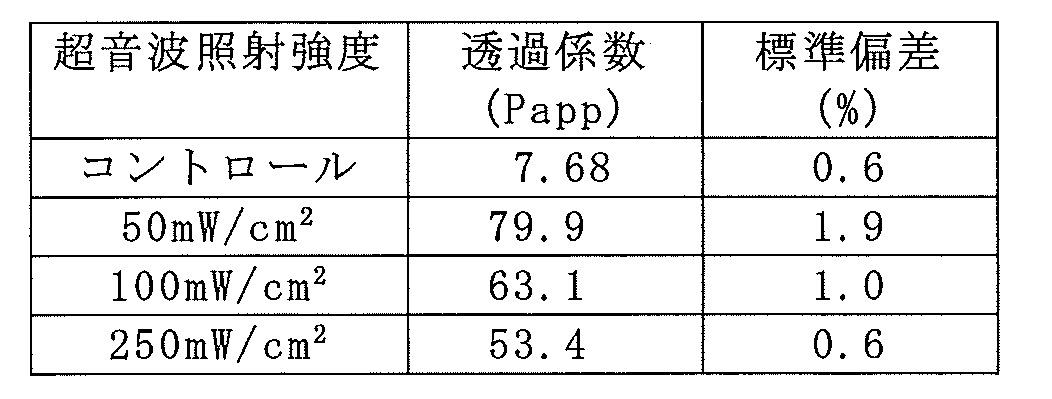
コントロールと比較して、50 mW/cm2 以上の超音波照射で明らかなBBB透過性亢進が認められた。
実施例3:BBBキットTM を用いた核酸のBBB透過実験
BBBキットTM (フォーマコセル社製、RBT-24H)付属プロトコール記載のD-PBSを調製し、FAM-siRNA(ニッポンジーン製)を溶解し、FAM-siRNA原液を調製した。FAM-siRNA原液および参考例1で調製したナノバブル水(PS80)を用いて、FAM-siRNAの濃度が1μMおよびナノバブル密度が2X10⁸個となるようにD-PBSを用いて希釈し、培養液(液量:500μL)を調製した(n = 2)。該培養液をBBBキットTM (フォーマコセル社製、RBT-24H)の血管側インサート(内側:液量:500μL)に加え、該インサートをD-PBS(液量1500μL)の入ったプレートのウェルに入れた後、ネパジーン製超音波遺伝子導入装置 (Sonitron GTS) を用いて、周波数1MHzおよび超音波強度100 mW/cm2 (n = 2)で10秒間照射した。2時間後にプレートのウェル内培養液〔脳実質側(インサートの外側)〕に移行したFAM-siRNA濃度をマイクロプレートリーダーで測定した。
測定したFAM-siRNA濃度より透過係数(Papp)を算出し、FAM-siRNAの脳内移行性(BBB透過性)を算出した。一方、D-PBSを用いて、FAM-siRNA濃度が1μMとなるように培養液(液量:500μL)を調製し(n = 2)、コントロールとした。コントロール培養液をBBBキットTMの血管側インサートに添加し、上記同様に操作し、2時間後に脳側へ移行したFAM-siRNA濃度を算出した。
プレートリーダーの測定条件
蛍光波長: 520 nm
励起波長: 494 nm
Flash回数:6回
試験結果を表6に示す。
BBBキットTM (フォーマコセル社製、RBT-24H)付属プロトコール記載のD-PBSを調製し、FAM-siRNA(ニッポンジーン製)を溶解し、FAM-siRNA原液を調製した。FAM-siRNA原液および参考例1で調製したナノバブル水(PS80)を用いて、FAM-siRNAの濃度が1μMおよびナノバブル密度が2X10⁸個となるようにD-PBSを用いて希釈し、培養液(液量:500μL)を調製した(n = 2)。該培養液をBBBキットTM (フォーマコセル社製、RBT-24H)の血管側インサート(内側:液量:500μL)に加え、該インサートをD-PBS(液量1500μL)の入ったプレートのウェルに入れた後、ネパジーン製超音波遺伝子導入装置 (Sonitron GTS) を用いて、周波数1MHzおよび超音波強度100 mW/cm2 (n = 2)で10秒間照射した。2時間後にプレートのウェル内培養液〔脳実質側(インサートの外側)〕に移行したFAM-siRNA濃度をマイクロプレートリーダーで測定した。
測定したFAM-siRNA濃度より透過係数(Papp)を算出し、FAM-siRNAの脳内移行性(BBB透過性)を算出した。一方、D-PBSを用いて、FAM-siRNA濃度が1μMとなるように培養液(液量:500μL)を調製し(n = 2)、コントロールとした。コントロール培養液をBBBキットTMの血管側インサートに添加し、上記同様に操作し、2時間後に脳側へ移行したFAM-siRNA濃度を算出した。
プレートリーダーの測定条件
蛍光波長: 520 nm
励起波長: 494 nm
Flash回数:6回
試験結果を表6に示す。

コントロールと比較して、100 mW/cm2以上の超音波照射で明らかなFAM-siRNAのBBB透過性亢進が認められた。
実施例4:BBBキットTM を用いたフルオレセインのBBB透過実験
BBBキットTM (フォーマコセル社製、RBT-24H)付属プロトコール記載のD-PBSを調製し、フルオレセイン(和光純薬社製 フルオレセインナトリウム、コードNo. 213-00092)を溶解させ、フルオレセイン原液を調製した。該フルオレセイン原液および参考例1で調製したナノバブル水を用いて、フルオレセインの濃度が1μMおよびナノバブル密度が2X10⁸個となるようにD-PBSを用いて希釈し、培養液A(液量:500μL)を調製した(n = 2)。また、該フルオレセイン原液および参考例2で調製したナノバブル水を用いて、フルオレセインの濃度が1μMおよびナノバブル密度が2X10⁸個となるようにD-PBSを用いて希釈し、培養液B(液量:500μL)を調製した(n = 2)。上記培養液Aおよび培養液BをそれぞれBBBキットTM (フォーマコセル社製、RBT-24H)の血管側インサート(内側:液量:500μL)に加え、このインサートをD-PBS(液量1500μL)の入ったプレートのウェルに入れた後、ネパジーン製超音波遺伝子導入装置(Sonitron GTS) を用いて、周波数1MHzで、100 mW/cm2 (n = 2)の超音波強度で、10秒間照射した。2時間後にプレートのウェル内培養液〔脳実質側(インサートの外側)〕に移行したFAM-siRNA濃度をマイクロプレートリーダーでそれぞれ測定した。
測定したフルオレセイン濃度より透過係数(Papp)を算出し、フルオレセインの脳内移行性(BBB透過性)を算出した。一方、D-PBSを用いて、フルオレセイン濃度が1μMとなるように培養液(液量:500μL)を調製し(n = 2)、これをコントロールとした。該コントロール培養液をBBBキットTMの血管側インサートに添加し、上記同様に操作し、2時間後に脳側へ移行したフルオレセイン濃度を算出した。
プレートリーダーの測定条件
蛍光波長: 520 nm
励起波長: 494 nm
Flash回数:6回
試験結果を表7に示す。
BBBキットTM (フォーマコセル社製、RBT-24H)付属プロトコール記載のD-PBSを調製し、フルオレセイン(和光純薬社製 フルオレセインナトリウム、コードNo. 213-00092)を溶解させ、フルオレセイン原液を調製した。該フルオレセイン原液および参考例1で調製したナノバブル水を用いて、フルオレセインの濃度が1μMおよびナノバブル密度が2X10⁸個となるようにD-PBSを用いて希釈し、培養液A(液量:500μL)を調製した(n = 2)。また、該フルオレセイン原液および参考例2で調製したナノバブル水を用いて、フルオレセインの濃度が1μMおよびナノバブル密度が2X10⁸個となるようにD-PBSを用いて希釈し、培養液B(液量:500μL)を調製した(n = 2)。上記培養液Aおよび培養液BをそれぞれBBBキットTM (フォーマコセル社製、RBT-24H)の血管側インサート(内側:液量:500μL)に加え、このインサートをD-PBS(液量1500μL)の入ったプレートのウェルに入れた後、ネパジーン製超音波遺伝子導入装置(Sonitron GTS) を用いて、周波数1MHzで、100 mW/cm2 (n = 2)の超音波強度で、10秒間照射した。2時間後にプレートのウェル内培養液〔脳実質側(インサートの外側)〕に移行したFAM-siRNA濃度をマイクロプレートリーダーでそれぞれ測定した。
測定したフルオレセイン濃度より透過係数(Papp)を算出し、フルオレセインの脳内移行性(BBB透過性)を算出した。一方、D-PBSを用いて、フルオレセイン濃度が1μMとなるように培養液(液量:500μL)を調製し(n = 2)、これをコントロールとした。該コントロール培養液をBBBキットTMの血管側インサートに添加し、上記同様に操作し、2時間後に脳側へ移行したフルオレセイン濃度を算出した。
プレートリーダーの測定条件
蛍光波長: 520 nm
励起波長: 494 nm
Flash回数:6回
試験結果を表7に示す。
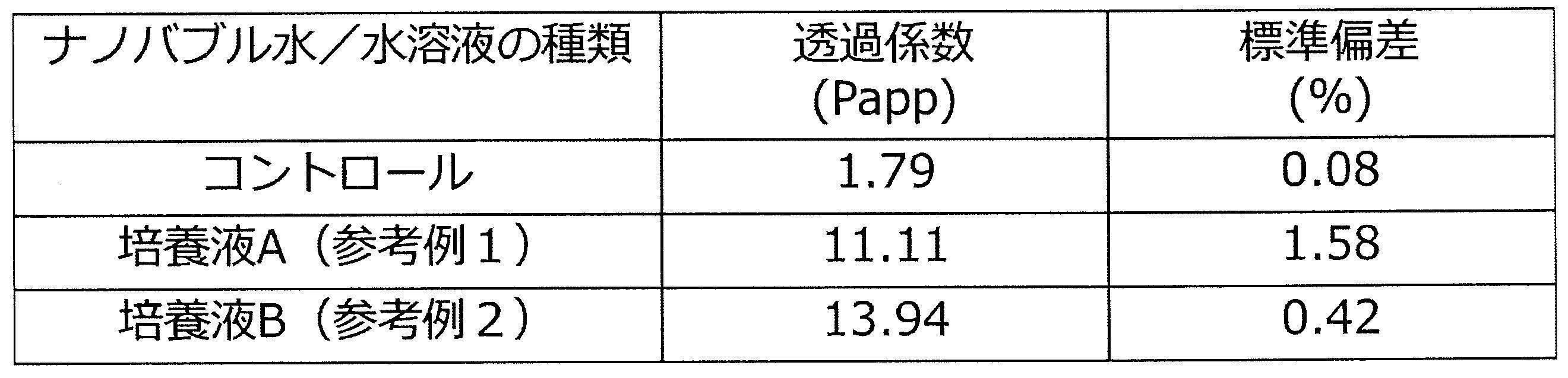
コントロールと比較して、培養液A(参考例1)および培養液B(参考例2)を用いて100 mW/cm2以上の超音波照射することで、明らかなフルオレセインのBBB透過性亢進が認められた。
実施例5:BBBキットTM を用いた抗体のBBB透過実験
BBBキットTM (フォーマコセル社製、RBT-24H)付属プロトコール記載のD-PBSを調製し、Alexa-IgG(インビトロジェン製)を溶解させ、Alexa-IgG原液を調製した。Alexa-IgG原液および参考例1で調製したナノバブル水を用いてAlexa-IgG濃度が1μMおよびナノバブル密度が2X10⁸個となるようにD-PBSを用いて希釈し、培養液A(液量:500μL)を調製した(n = 2)。また、Alexa-IgG原液および参考例3で調製したナノバブル水を用いてAlexa-IgG濃度が1μMおよびナノバブル密度が2X10⁸個となるようにD-PBSを用いて希釈し、培養液B(液量:500μL)を調製した(n = 2)上記培養液Aおよび培養液BをそれぞれBBBキットTM (フォーマコセル社製、RBT-24H)の血管側インサート(内側:液量:500μL)に加え、このインサートをD-PBS(液量1500μL)の入ったプレートのウェルに入れた後、ネパジーン製超音波遺伝子導入装置(Sonitron GTS) を用いて、周波数1MHzおよび超音波強度100 mW/cm2 (n = 2)で、10秒間照射した。2時間後にプレートのウェル内培養液〔脳実質側(インサートの外側)〕に移行したAlexa-IgG濃度をマイクロプレートリーダーでそれぞれ測定した。
測定したAlexa-IgG濃度より透過係数(Papp)を算出し、Alexa-IgGの脳内移行性(BBB透過性)を算出した。一方、D-PBSを用いて、Alexa-IgG濃度が1μMとなるように培養液(液量:500μL)を調製し(n = 2)、これをコントロールとした。この培養液をBBBキットTMの血管側インサートに添加し、上記同様に操作し、2時間後に脳側へ移行したAlexa-IgG濃度を算出した。
プレートリーダーの測定条件
蛍光波長: 520 nm
励起波長: 494 nm
Flash回数:6回
試験結果を表8に示す。
BBBキットTM (フォーマコセル社製、RBT-24H)付属プロトコール記載のD-PBSを調製し、Alexa-IgG(インビトロジェン製)を溶解させ、Alexa-IgG原液を調製した。Alexa-IgG原液および参考例1で調製したナノバブル水を用いてAlexa-IgG濃度が1μMおよびナノバブル密度が2X10⁸個となるようにD-PBSを用いて希釈し、培養液A(液量:500μL)を調製した(n = 2)。また、Alexa-IgG原液および参考例3で調製したナノバブル水を用いてAlexa-IgG濃度が1μMおよびナノバブル密度が2X10⁸個となるようにD-PBSを用いて希釈し、培養液B(液量:500μL)を調製した(n = 2)上記培養液Aおよび培養液BをそれぞれBBBキットTM (フォーマコセル社製、RBT-24H)の血管側インサート(内側:液量:500μL)に加え、このインサートをD-PBS(液量1500μL)の入ったプレートのウェルに入れた後、ネパジーン製超音波遺伝子導入装置(Sonitron GTS) を用いて、周波数1MHzおよび超音波強度100 mW/cm2 (n = 2)で、10秒間照射した。2時間後にプレートのウェル内培養液〔脳実質側(インサートの外側)〕に移行したAlexa-IgG濃度をマイクロプレートリーダーでそれぞれ測定した。
測定したAlexa-IgG濃度より透過係数(Papp)を算出し、Alexa-IgGの脳内移行性(BBB透過性)を算出した。一方、D-PBSを用いて、Alexa-IgG濃度が1μMとなるように培養液(液量:500μL)を調製し(n = 2)、これをコントロールとした。この培養液をBBBキットTMの血管側インサートに添加し、上記同様に操作し、2時間後に脳側へ移行したAlexa-IgG濃度を算出した。
プレートリーダーの測定条件
蛍光波長: 520 nm
励起波長: 494 nm
Flash回数:6回
試験結果を表8に示す。
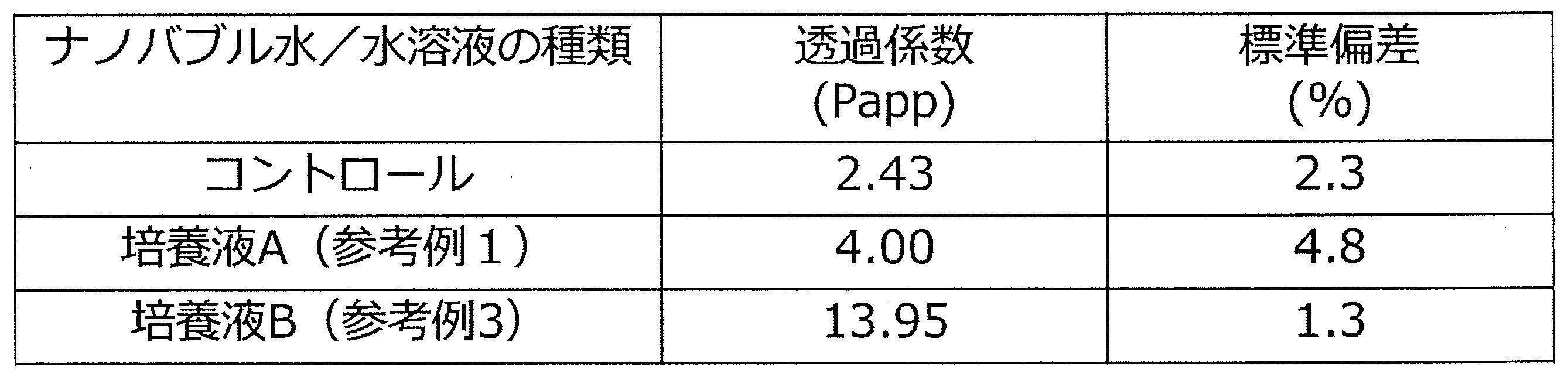
コントロールと比較して、培養液A(参考例1)を用いて100 mW/cm2以上の超音波照射することで、Alexa-IgGのBBB透過性亢進が認められた。培養液B(参考例3)を用いて100 mW/cm2以上の超音波照射することで、Alexa-IgGのより明らかなBBB透過性亢進が認められた。
実施例6:ラットを用いたFITCデキストランのBBB透過実験
注射用水を用いて、フルオレセインイソチオシアナートデキストラン(東京化成工業製Cas No. 60842-46-8;FITCデキストラン)を溶解させ、FITCデキストラン原液を調製した。該FITCデキストラン原液および参考例1で調製したナノバブル水(PS80)を用いてFITCデキストラン濃度が0.5mg/mLおよびナノバブル密度が2X108個となるよう投与液を調製した(n = 3)。
該投与液を適切な大きさの注射筒および注射針(いずれも滅菌済みディスポーザブル製品)を用いて、ラット尾静脈内へ1 mL/minの速度で0.4mL注入後、ネパジーン製超音波遺伝子導入装置 (Sonitron GTS) を用いて、周波数1MHzおよび超音波強度2W/cm2 (n = 3)で、60秒間照射した。その3時間後に脳を採取しLysis buffer(0.1M Tris-HCl (pH7.8), 0.1% Triton X-100, および2mM EDTA)中でホモジネートし、FITCデキストランを抽出した。該抽出液中のFITCデキストラン濃度をマイクロプレートリーダーで測定した。
測定したFITCデキストラン濃度より透過係数(Papp)を算出し、FITCデキストランの脳内移行性(BBB透過性)を算出した。一方、該FITCデキストラン原液中のFITCデキストラン濃度が0.5mg/mLの投与液を調製し、コントロールとした(n = 2)。該コントロール投与液を上記同様に操作し、3時間後に脳へ移行したFITCデキストラン濃度を算出した。
プレートリーダーの測定条件
蛍光波長: 520 nm
励起波長: 494 nm
Flash回数:6回
試験結果を表9に示す。
注射用水を用いて、フルオレセインイソチオシアナートデキストラン(東京化成工業製Cas No. 60842-46-8;FITCデキストラン)を溶解させ、FITCデキストラン原液を調製した。該FITCデキストラン原液および参考例1で調製したナノバブル水(PS80)を用いてFITCデキストラン濃度が0.5mg/mLおよびナノバブル密度が2X108個となるよう投与液を調製した(n = 3)。
該投与液を適切な大きさの注射筒および注射針(いずれも滅菌済みディスポーザブル製品)を用いて、ラット尾静脈内へ1 mL/minの速度で0.4mL注入後、ネパジーン製超音波遺伝子導入装置 (Sonitron GTS) を用いて、周波数1MHzおよび超音波強度2W/cm2 (n = 3)で、60秒間照射した。その3時間後に脳を採取しLysis buffer(0.1M Tris-HCl (pH7.8), 0.1% Triton X-100, および2mM EDTA)中でホモジネートし、FITCデキストランを抽出した。該抽出液中のFITCデキストラン濃度をマイクロプレートリーダーで測定した。
測定したFITCデキストラン濃度より透過係数(Papp)を算出し、FITCデキストランの脳内移行性(BBB透過性)を算出した。一方、該FITCデキストラン原液中のFITCデキストラン濃度が0.5mg/mLの投与液を調製し、コントロールとした(n = 2)。該コントロール投与液を上記同様に操作し、3時間後に脳へ移行したFITCデキストラン濃度を算出した。
プレートリーダーの測定条件
蛍光波長: 520 nm
励起波長: 494 nm
Flash回数:6回
試験結果を表9に示す。

コントロールと比較して、参考例1で調製されたナノバブル水を用いて超音波照射することで、フルオレセインイソチオシアナートデキストランの脳移行性亢進が認められた。
実施例7:BBBキットTMを用いたタイトジャンクション再構築検討
参考例1で調製したナノバブル水(PS80)を2X10⁸個となるようにD-PBSを用いて希釈し、培養液を調製した(n = 2)。該培養液をBBBキットTM (フォーマコセル社製、RBT-24H)の血管側インサート(内側:液量:500μL)に加え、このインサートをD-PBS(液量1500μL)の入ったプレートのウェルに入れた後、ネパジーン製超音波遺伝子導入装置 (Sonitron GTS) を用いて、周波数1MHzおよび超音波強度100 mW/cm2 (n = 2)で、10秒間照射した。その後のタイトジャンクション再構築の評価のため経上皮電気抵抗(TEER)を0分、30分、60分および120分にそれぞれ測定した。無処置群をコントロールとした。
試験結果を表10に示す。
参考例1で調製したナノバブル水(PS80)を2X10⁸個となるようにD-PBSを用いて希釈し、培養液を調製した(n = 2)。該培養液をBBBキットTM (フォーマコセル社製、RBT-24H)の血管側インサート(内側:液量:500μL)に加え、このインサートをD-PBS(液量1500μL)の入ったプレートのウェルに入れた後、ネパジーン製超音波遺伝子導入装置 (Sonitron GTS) を用いて、周波数1MHzおよび超音波強度100 mW/cm2 (n = 2)で、10秒間照射した。その後のタイトジャンクション再構築の評価のため経上皮電気抵抗(TEER)を0分、30分、60分および120分にそれぞれ測定した。無処置群をコントロールとした。
試験結果を表10に示す。

コントロールと比較して、参考例1で調製されたナノバブル水を用いて超音波照射することで、一過性のTEERの低下が見られたが、120分後にはコントロールと比較して同等になった。すなわち、本発明のBBB開放システムを用いる場合に、BBBタイトジャンクションの再構築が速やかに行われることが示された。
本発明のBBB開放システムは、低い出力強度の超音波を照射することで、効率よくBBBを開放できるので、安全性の高い脳内へのDDSを提供することができる。また、従来より平均径が小さいナノバブルを含むので、脳深部まで薬物を送達させることができる。さらに、リポソームを用いる必要がないので、安価に製造可能でかつ安全性も高い。以上より、本発明のシステムは、脳実質内で薬効を発揮する薬物の新規なDDSとして、きわめて有用である。
本出願は、日本で出願された特願2017-252531を基礎としており、その内容は本明細書にすべて包含されるものである。
Claims (13)
- 平均径が200nm以下であるナノバブルを含むナノバブル水もしくはナノバブル水溶液と、超音波発生装置とを組み合わせてなる、血液脳関門の開放システム。
- ナノバブルが、アニオン性界面活性剤、非イオン性界面活性剤、カチオン性界面活性剤および両性界面活性剤から選ばれる1種または2種以上の界面活性剤および/または親水性樹脂と気体とからなる、請求項1に記載のシステム。
- ナノバブルが、非イオン性界面活性剤および/または親水性樹脂と気体とからなる、請求項1に記載のシステム。
- 気体が、パーフルオロ炭化水素または空気である、請求項2に記載のシステム。
- ナノバブルの平均径が、50nm~200nmである、請求項1に記載のシステム。
- ナノバブルのd90/d10比が5以下である、請求項1に記載のシステム。
- ナノバブル水もしくはナノバブル水溶液におけるナノバブルの密度が、2.0×10⁸個/mL以上である、請求項1に記載のシステム。
- 超音波発生装置において超音波の出力強度が、720mW/cm2以下である、請求項1に記載のシステム。
- 超音波発生装置において超音波の出力強度が50~500mW/cm2および超音波の周波数が0.5~10MHzである、請求項1に記載のシステム。
- 薬物の血液脳関門透過性を増大させるための、請求項1に記載のシステム。
- 薬物が血液脳関門の通過が困難な化合物である、請求項10に記載のシステム。
- 平均径が200nm以下であるナノバブルを含むナノバブル水もしくはナノバブル水溶液と、超音波とを用いて、血液脳関門を開放させる方法。
- 平均径が200nm以下であるナノバブルを含むナノバブル水もしくはナノバブル水溶液と、超音波とを用いて、薬物の血液脳関門透過性を増大させる方法。
Priority Applications (3)
| Application Number | Priority Date | Filing Date | Title |
|---|---|---|---|
| US16/958,388 US12178981B2 (en) | 2017-12-27 | 2018-12-26 | Drug administration method |
| JP2019562079A JPWO2019131723A1 (ja) | 2017-12-27 | 2018-12-26 | 薬物の投与方法 |
| EP18895826.8A EP3733243A4 (en) | 2017-12-27 | 2018-12-26 | METHOD OF DRUG ADMINISTRATION |
Applications Claiming Priority (2)
| Application Number | Priority Date | Filing Date | Title |
|---|---|---|---|
| JP2017252531 | 2017-12-27 | ||
| JP2017-252531 | 2017-12-27 |
Publications (1)
| Publication Number | Publication Date |
|---|---|
| WO2019131723A1 true WO2019131723A1 (ja) | 2019-07-04 |
Family
ID=67067472
Family Applications (1)
| Application Number | Title | Priority Date | Filing Date |
|---|---|---|---|
| PCT/JP2018/047753 Ceased WO2019131723A1 (ja) | 2017-12-27 | 2018-12-26 | 薬物の投与方法 |
Country Status (4)
| Country | Link |
|---|---|
| US (1) | US12178981B2 (ja) |
| EP (1) | EP3733243A4 (ja) |
| JP (1) | JPWO2019131723A1 (ja) |
| WO (1) | WO2019131723A1 (ja) |
Cited By (2)
| Publication number | Priority date | Publication date | Assignee | Title |
|---|---|---|---|---|
| EP4126217A1 (fr) * | 2020-04-01 | 2023-02-08 | Brainwaves | Rupture sélective et réversible de la barrière hémato-encéphalique par émission d'ultrasons |
| JP2024053521A (ja) * | 2022-10-03 | 2024-04-15 | 睦月電機株式会社 | ナノバブル液剤の利用方法 |
Families Citing this family (1)
| Publication number | Priority date | Publication date | Assignee | Title |
|---|---|---|---|---|
| JP7620548B2 (ja) * | 2019-06-26 | 2025-01-23 | 武田薬品工業株式会社 | トランスフェクション方法 |
Citations (4)
| Publication number | Priority date | Publication date | Assignee | Title |
|---|---|---|---|---|
| WO2012153635A1 (ja) | 2011-05-09 | 2012-11-15 | ネッパジーン株式会社 | モルフォリノ搭載バブルリポソームを有効成分としてなる筋ジストロフィー治療薬 |
| WO2015182647A1 (ja) | 2014-05-28 | 2015-12-03 | 武田薬品工業株式会社 | 抗菌水 |
| WO2017073798A1 (ja) | 2015-10-30 | 2017-05-04 | 帝人ファーマ株式会社 | 鼻粘膜投与用医薬組成物 |
| WO2017178954A1 (en) * | 2016-04-11 | 2017-10-19 | Università Degli Studi Di Roma "La Sapienza" | Nanobubbles and uses thereof |
Family Cites Families (4)
| Publication number | Priority date | Publication date | Assignee | Title |
|---|---|---|---|---|
| RU2448685C2 (ru) * | 2009-11-30 | 2012-04-27 | Российская Федерация в лице Министерства промышленности и торговли Российской Федерации | Липосомы, содержащие олигопептиды - фрагменты основного белка миелина, фармацевтическая композиция и способ лечения рассеянного склероза |
| WO2014050910A1 (ja) | 2012-09-26 | 2014-04-03 | 武田薬品工業株式会社 | 固体粒子の製造方法 |
| US10322178B2 (en) * | 2013-08-09 | 2019-06-18 | The Trustees Of Columbia University In The City Of New York | Systems and methods for targeted drug delivery |
| US20190175766A1 (en) * | 2016-06-02 | 2019-06-13 | Case Western Reserve University | Stabilized crosslinked nanobubbles for diagnostic and therapeutic applications |
-
2018
- 2018-12-26 WO PCT/JP2018/047753 patent/WO2019131723A1/ja not_active Ceased
- 2018-12-26 US US16/958,388 patent/US12178981B2/en active Active
- 2018-12-26 EP EP18895826.8A patent/EP3733243A4/en active Pending
- 2018-12-26 JP JP2019562079A patent/JPWO2019131723A1/ja active Pending
Patent Citations (4)
| Publication number | Priority date | Publication date | Assignee | Title |
|---|---|---|---|---|
| WO2012153635A1 (ja) | 2011-05-09 | 2012-11-15 | ネッパジーン株式会社 | モルフォリノ搭載バブルリポソームを有効成分としてなる筋ジストロフィー治療薬 |
| WO2015182647A1 (ja) | 2014-05-28 | 2015-12-03 | 武田薬品工業株式会社 | 抗菌水 |
| WO2017073798A1 (ja) | 2015-10-30 | 2017-05-04 | 帝人ファーマ株式会社 | 鼻粘膜投与用医薬組成物 |
| WO2017178954A1 (en) * | 2016-04-11 | 2017-10-19 | Università Degli Studi Di Roma "La Sapienza" | Nanobubbles and uses thereof |
Non-Patent Citations (6)
| Title |
|---|
| CHEMICAL ABSTRACTS, Columbus, Ohio, US; abstract no. 60842-46-8 |
| DRUG DELIVERY, vol. 24, no. 1, 2017, pages 320 - 327 |
| NATURE REVIEWS, vol. 12, 2016, pages 161 - 174 |
| SCIENCE TRANSLATIONAL MEDICINE, vol. 8, no. 343, 2016, pages 343 |
| YAKUGAKU ZASSHI, vol. 130, no. 11, 2010, pages 1489 - 1496 |
| YUKI FUCHIGAMI ET AL.: "Abstracts of the 137th Annual Meeting of the Pharmaceutical Society of Japan", March 2017, NAGASAKI UNIVERSITY, article "Evaluation of pharmacokinetics in the brain by ultrasound-responsive nano-bubbles in brain-directed DDS" |
Cited By (4)
| Publication number | Priority date | Publication date | Assignee | Title |
|---|---|---|---|---|
| EP4126217A1 (fr) * | 2020-04-01 | 2023-02-08 | Brainwaves | Rupture sélective et réversible de la barrière hémato-encéphalique par émission d'ultrasons |
| EP4126217B1 (fr) * | 2020-04-01 | 2025-06-04 | Brainwaves | Rupture sélective et réversible de la barrière hémato-encéphalique par émission d'ultrasons |
| JP2024053521A (ja) * | 2022-10-03 | 2024-04-15 | 睦月電機株式会社 | ナノバブル液剤の利用方法 |
| JP7599079B2 (ja) | 2022-10-03 | 2024-12-13 | 睦月電機株式会社 | ナノバブル液剤を利用するための装置 |
Also Published As
| Publication number | Publication date |
|---|---|
| JPWO2019131723A1 (ja) | 2021-01-14 |
| US20210052872A1 (en) | 2021-02-25 |
| US12178981B2 (en) | 2024-12-31 |
| EP3733243A4 (en) | 2021-10-27 |
| EP3733243A1 (en) | 2020-11-04 |
Similar Documents
| Publication | Publication Date | Title |
|---|---|---|
| Fan et al. | Tumor-homing and immune-reprogramming cellular nanovesicles for photoacoustic imaging-guided phototriggered precise chemoimmunotherapy | |
| Zhang et al. | One-pot synthesis of hollow PDA@ DOX nanoparticles for ultrasound imaging and chemo-thermal therapy in breast cancer | |
| Zha et al. | Targeted delivery of CuS nanoparticles through ultrasound image-guided microbubble destruction for efficient photothermal therapy | |
| CN104162164B (zh) | 一种包含吲哚青绿的多聚体白蛋白纳米球及其制备方法和应用 | |
| Li et al. | Free radicals generated in perfluorocarbon–water (liquid–liquid) interfacial contact electrification and their application in cancer therapy | |
| Shinde et al. | Intra-articular delivery of a methotrexate loaded nanostructured lipid carrier based smart gel for effective treatment of rheumatic diseases | |
| Pu et al. | Ultrasound-responsive nanobubbles for breast cancer: synergistic sonodynamic, chemotherapy, and immune activation through the cGAS-STING pathway | |
| WO2010123547A1 (en) | Versatile nanoparticulate biomaterial for controlled delivery and/or containment of therapeutic and diagnostic material | |
| JP2019516789A (ja) | フルベストラント配合物およびその使用方法 | |
| Liu et al. | Transformable magnetic liquid-metal nanoplatform for intracellular drug delivery and MR imaging-guided microwave thermochemotherapy | |
| US12178981B2 (en) | Drug administration method | |
| Wang et al. | HA targeted-biodegradable nanocomposites responsive to endogenous and exogenous stimulation for multimodal imaging and chemo-/photothermal therapy | |
| Li et al. | Multifunctional size-expandable nanomedicines enhance tumor accumulation and penetration for synergistic chemo-photothermal therapy | |
| Lin et al. | Effects of focused ultrasound and microbubbles on the vascular permeability of nanoparticles delivered into mouse tumors | |
| Ciancone et al. | Liposomes containing nickel–bis (dithiolene) complexes for photothermal theranostics | |
| Heya et al. | Overcoming tumor and mucosal barriers through active-loaded nanocarriers: Nanoparticles and exosomes | |
| Wang et al. | Ultrasound-triggered cascade reaction via MnO2-CpG nanoparticles for boosting pyroptosis-mediated cancer immunotherapy | |
| Fernandes | Comprehensive review on bubbles: synthesis, modification, characterization and biomedical applications | |
| Kong et al. | Self-delivery photodynamic re-educator enhanced tumor treatment by inducing immunogenic cell death and improving immunosuppressive microenvironments | |
| JP7314270B2 (ja) | トランスフェクション方法 | |
| CN100427142C (zh) | 一种高强度聚焦超声治疗用助剂及其筛选方法 | |
| CN109620976B (zh) | 一种相变型纳米粒及其制备方法和应用 | |
| CN108245484B (zh) | 一种纳米药物组合物及其制备方法与应用 | |
| JP2008526786A (ja) | 高密度焦点式超音波療法のためのフッ化炭化水素乳濁液増強剤およびその使用 | |
| Gao et al. | An experimental study of ovarian cancer imaging and therapy by paclitaxel-loaded phase-transformation lipid nanoparticles combined with low-intensity focused ultrasound |
Legal Events
| Date | Code | Title | Description |
|---|---|---|---|
| 121 | Ep: the epo has been informed by wipo that ep was designated in this application |
Ref document number: 18895826 Country of ref document: EP Kind code of ref document: A1 |
|
| ENP | Entry into the national phase |
Ref document number: 2019562079 Country of ref document: JP Kind code of ref document: A |
|
| NENP | Non-entry into the national phase |
Ref country code: DE |
|
| ENP | Entry into the national phase |
Ref document number: 2018895826 Country of ref document: EP Effective date: 20200727 |