WO2019131952A1 - 地下処理用目止め材、地下処理方法及び坑井壁の目止め方法 - Google Patents
地下処理用目止め材、地下処理方法及び坑井壁の目止め方法 Download PDFInfo
- Publication number
- WO2019131952A1 WO2019131952A1 PCT/JP2018/048338 JP2018048338W WO2019131952A1 WO 2019131952 A1 WO2019131952 A1 WO 2019131952A1 JP 2018048338 W JP2018048338 W JP 2018048338W WO 2019131952 A1 WO2019131952 A1 WO 2019131952A1
- Authority
- WO
- WIPO (PCT)
- Prior art keywords
- pva
- resin
- water
- based resin
- vinyl
- Prior art date
- Legal status (The legal status is an assumption and is not a legal conclusion. Google has not performed a legal analysis and makes no representation as to the accuracy of the status listed.)
- Ceased
Links
Classifications
-
- C—CHEMISTRY; METALLURGY
- C09—DYES; PAINTS; POLISHES; NATURAL RESINS; ADHESIVES; COMPOSITIONS NOT OTHERWISE PROVIDED FOR; APPLICATIONS OF MATERIALS NOT OTHERWISE PROVIDED FOR
- C09K—MATERIALS FOR MISCELLANEOUS APPLICATIONS, NOT PROVIDED FOR ELSEWHERE
- C09K8/00—Compositions for drilling of boreholes or wells; Compositions for treating boreholes or wells, e.g. for completion or for remedial operations
- C09K8/50—Compositions for plastering borehole walls, i.e. compositions for temporary consolidation of borehole walls
- C09K8/504—Compositions based on water or polar solvents
- C09K8/506—Compositions based on water or polar solvents containing organic compounds
- C09K8/508—Compositions based on water or polar solvents containing organic compounds macromolecular compounds
- C09K8/5083—Compositions based on water or polar solvents containing organic compounds macromolecular compounds obtained by reactions only involving carbon-to-carbon unsaturated bonds
-
- E—FIXED CONSTRUCTIONS
- E21—EARTH OR ROCK DRILLING; MINING
- E21B—EARTH OR ROCK DRILLING; OBTAINING OIL, GAS, WATER, SOLUBLE OR MELTABLE MATERIALS OR A SLURRY OF MINERALS FROM WELLS
- E21B21/00—Methods or apparatus for flushing boreholes, e.g. by use of exhaust air from motor
- E21B21/003—Means for stopping loss of drilling fluid
-
- C—CHEMISTRY; METALLURGY
- C09—DYES; PAINTS; POLISHES; NATURAL RESINS; ADHESIVES; COMPOSITIONS NOT OTHERWISE PROVIDED FOR; APPLICATIONS OF MATERIALS NOT OTHERWISE PROVIDED FOR
- C09K—MATERIALS FOR MISCELLANEOUS APPLICATIONS, NOT PROVIDED FOR ELSEWHERE
- C09K8/00—Compositions for drilling of boreholes or wells; Compositions for treating boreholes or wells, e.g. for completion or for remedial operations
- C09K8/50—Compositions for plastering borehole walls, i.e. compositions for temporary consolidation of borehole walls
- C09K8/504—Compositions based on water or polar solvents
- C09K8/506—Compositions based on water or polar solvents containing organic compounds
- C09K8/508—Compositions based on water or polar solvents containing organic compounds macromolecular compounds
- C09K8/512—Compositions based on water or polar solvents containing organic compounds macromolecular compounds containing cross-linking agents
-
- C—CHEMISTRY; METALLURGY
- C09—DYES; PAINTS; POLISHES; NATURAL RESINS; ADHESIVES; COMPOSITIONS NOT OTHERWISE PROVIDED FOR; APPLICATIONS OF MATERIALS NOT OTHERWISE PROVIDED FOR
- C09K—MATERIALS FOR MISCELLANEOUS APPLICATIONS, NOT PROVIDED FOR ELSEWHERE
- C09K8/00—Compositions for drilling of boreholes or wells; Compositions for treating boreholes or wells, e.g. for completion or for remedial operations
- C09K8/56—Compositions for consolidating loose sand or the like around wells without excessively decreasing the permeability thereof
- C09K8/57—Compositions based on water or polar solvents
- C09K8/575—Compositions based on water or polar solvents containing organic compounds
- C09K8/5751—Macromolecular compounds
- C09K8/5756—Macromolecular compounds containing cross-linking agents
-
- E—FIXED CONSTRUCTIONS
- E21—EARTH OR ROCK DRILLING; MINING
- E21B—EARTH OR ROCK DRILLING; OBTAINING OIL, GAS, WATER, SOLUBLE OR MELTABLE MATERIALS OR A SLURRY OF MINERALS FROM WELLS
- E21B33/00—Sealing or packing boreholes or wells
- E21B33/10—Sealing or packing boreholes or wells in the borehole
- E21B33/13—Methods or devices for cementing, for plugging holes, crevices or the like
- E21B33/138—Plastering the borehole wall; Injecting into the formation
-
- E—FIXED CONSTRUCTIONS
- E21—EARTH OR ROCK DRILLING; MINING
- E21B—EARTH OR ROCK DRILLING; OBTAINING OIL, GAS, WATER, SOLUBLE OR MELTABLE MATERIALS OR A SLURRY OF MINERALS FROM WELLS
- E21B43/00—Methods or apparatus for obtaining oil, gas, water, soluble or meltable materials or a slurry of minerals from wells
- E21B43/25—Methods for stimulating production
- E21B43/26—Methods for stimulating production by forming crevices or fractures
Definitions
- the present invention relates to a filler for underground treatment and a method for filling a well wall, and more specifically, a filler for underground treatment used at the time of construction of a muddy water drilling method, and a filler for the underground treatment It relates to the method of closing the well wall.
- Hydrocarbon resources such as petroleum (including shale oil etc.) or natural gas (including shale gas etc.) (hereinafter sometimes collectively referred to as "petroleum etc.”) are porous and permeable. It has been mined and produced through wells with underground layers (oil wells or gas wells, hereinafter sometimes collectively referred to as "wells").
- Well construction (hereinafter also referred to as “well drilling”) is performed, for example, by the following steps. That is, the drilling process using a drill in the vertical direction from the ground surface and further horizontally if necessary, the drilling process of the wellbore, preventing the wellbore from collapsing, the inner wall of the wellbore (wellbore wall A casing process to prevent the fluid from leaking through), a cementing process to finish the wellbore wall, and a formation layer (a formation producing oil etc.). For example, in a drilling step of perforating a wellbore wall to recover oil etc.
- the removal of cuttings from the bottom (tip) of the wellbore and the area around the drill, raising the cuttings to the ground, cooling the drill and its surrounding members, providing lubricity, and pressure in the underground Mud water (sometimes referred to as "drilling fluid") is circulated to prevent blowout by suppressing the
- the muddy water is formulated with a lost circulation material (LCM) that seals the wellbore wall to prevent the escape of the mudwater from the wellbore wall.
- LCM lost circulation material
- Anti-sludge agents include cedar bark, sugarcane fibers, fibrous materials such as mineral fibers; limestone, marble, wood, walnut shells, cottonseed shells, corn cob, synthetic resin, etc.
- Various inorganic and organic substances are used, such as granular materials; flakes such as mica flakes, resin film flakes, cellophane flakes, etc.
- it is a fugitive agent introduced into drilling holes and grooves at the time of construction of a mud drilling method, and is formed by molding a mixture of (A) inorganic fine powder and (B) water absorbing resin into a desired shape.
- Anti-sludge agent formed by mixing highly absorbent synthetic resin with fibrous material such as anti-sludge agent (refer to Patent Document 1), pulp cotton, cotton, waste paper, waste pulp, asbestos, cotton waste and the like (Patent Document 2) Reference etc. are proposed.
- closed spaces are sequentially formed in the well bores using sealing members such as pre-placed flak plugs and slack sleeves, and the high pressure fluid injected into the closed spaces is used to Drill the well walls to further crack and magnify (possibly using explosives to drill holes). Therefore, if high pressure fluid may escape from the wellbore, the desired fluid pressure can not be obtained, and as a result, it becomes impossible to form the intended perforation or fissure. It is necessary to temporarily close the well wall. Resin particles or the like may be used as the filler. Furthermore, a fracturing method in which fracturing and temporary closing are sequentially repeated without using a sealing member such as a plug is also adopted. In addition, there is also adopted a method in which oil or the like can be recovered again by fracturing different places by temporarily closing open holes.
- sealing members such as pre-placed flak plugs and slack sleeves
- well treatment fluids such as mud fluid (drilling fluid), cementing fluid, drilling fluid, fracturing fluid or finishing fluid used in the above-described steps, together with various additives, may be used as anti-smud agents (LCM Temporary plugs, which temporarily close the well wall, including a diverting agent and a diverting agent.
- LCM Temporary plugs which temporarily close the well wall, including a diverting agent and a diverting agent.
- these temporary filling materials be removed from the wellbore wall so as not to prevent the exudation of oil or the like when the production of oil or the like is started.
- a liquid containing a material having a dissolving effect on the temporary filling material such as an acidic substance or an alkaline substance, may be injected into the wellbore.
- the present invention has excellent swelling performance and is effective in suppressing phenomena such as mud and the like, and improves the filling workability of the plugging material in the drilling portion of the well. It is an issue to provide a filler material for underground treatment.
- the present invention is characterized by the following (1) to (7).
- the polyvinyl alcohol resin containing at least one of a modified polyvinyl alcohol resin and a non-modified polyvinyl alcohol is contained, and the polyvinyl alcohol resin has a swelling ratio after being immersed in water at a temperature of 80 ° C. for 30 minutes.
- Sealing material for underground treatment which is 250 to 900%.
- the polyvinyl alcohol-based resin swelled by water absorption effectively has a gap such as a crack formed on the wall surface of a well such as a wellbore or a ditch because the water absorptivity is high. Since it can be blocked and it is excellent in the dispersibility to muddy water, the filling workability to the excavated part is improved. Therefore, the filler for underground treatment of the present invention is effective in the suppression of bleeding phenomenon and in the embolus.
- underground treatment refers to treatment for improving the wall condition of a well (hole) formed in the underground
- fill for underground treatment is a treatment of the underground well. It is a material to temporarily close gaps such as cracks made on the wall surface.
- the plugging material for underground treatment of the present invention contains at least one polyvinyl alcohol resin of the modified polyvinyl alcohol resin and the unmodified polyvinyl alcohol (hereinafter, also simply referred to as a PVA resin), and this PVA resin
- the resin is characterized by a swelling ratio (height swelling ratio) of 250 to 900% after immersion in water at a temperature of 80 ° C. for 30 minutes.
- the temperature at the site of underground closure rises above the temperature on the ground, and is assumed to be about 40 to 120 ° C., depending on the type and area of the well and the depth. Therefore, in the present invention, the swelling rate at 80 ° C., which is the intermediate temperature, is adopted. If the swelling ratio of the PVA-based resin after immersion in water at 80 ° C.
- the swelling ratio is preferably 350 to 900%, more preferably 400 to 900%, still more preferably 600 to 900%, and particularly preferably 700 to 900%. 850% is most preferred.
- the PVA-based resin does not swell rapidly in order to enhance the filling workability of the filler for underground treatment into the excavated part and to effectively perform the filling.
- a PVA-based resin that swells by 250 to 900% when immersed in water at a temperature of 80 ° C for 30 minutes swells because molecules are entangled around hydrogen bonding of hydroxyl groups and intermolecular bonding due to crosslinking. It does not swell in the early stage of flooding because it requires time and temperature to loosen the entanglement, but the entanglement is loosened, and sufficient swellability is exhibited when sufficiently combined with water to obtain the effect of the present invention be able to.
- the water separation rate of PVA-type resin is 40% or less.
- the water separation rate is more preferably 1 to 25%, further preferably 1 to 20%, and particularly preferably 2 to 20%.
- the content of the PVA-based resin in the filler for underground treatment of the present invention is preferably 0.01% by mass or more, more preferably 0.1% by mass or more, and further preferably 0.5% by mass or more It is further preferred that Moreover, an upper limit is not specifically limited, What is necessary is just 100 mass% or less.
- the PVA-based resin contained in the filler for underground treatment of the present invention may be unmodified or may be denatured.
- a PVA-type resin may be used individually by 1 type, and may be used in combination of 2 or more type.
- Unmodified polyvinyl alcohol (PVA) Unmodified polyvinyl alcohol (PVA) is obtained by saponifying a polymer obtained by polymerizing a vinyl ester monomer such as vinyl acetate.
- the saponification degree of unmodified PVA is preferably 75 to 100 mol%, more preferably 80 to 99.8 mol%, and still more preferably 85 to 99.5 mol%. preferable. If the degree of saponification is too low, the water absorbability may decrease.
- the degree of saponification can be measured in accordance with JIS K 6726: 1994, which is the content of structural units other than vinyl ester structural units in the PVA-based resin, and in the modified PVA-based resin described later The same is true.
- the average degree of polymerization of unmodified PVA is preferably 300 to 4,000, more preferably 1,000 to 3,500, and still more preferably 1,500 to 3,000.
- the average degree of polymerization can be measured in accordance with JIS K 6726: 1994, and the same applies to the modified PVA-based resin described later.
- the viscosity of a 4% by mass aqueous solution of unmodified PVA is preferably 2 to 80 mPa ⁇ s, more preferably 4 to 70 mPa ⁇ s, and still more preferably 10 to 60 mPa ⁇ s.
- the viscosity is too low, the water resistance tends to decrease, and when the viscosity is too high, the viscosity increases and handling and production tend to be difficult.
- 4 mass% aqueous solution viscosity of unmodified PVA is a viscosity in 20 degreeC which prepared 4 mass% aqueous solution of unmodified PVA, measured based on JIS K 6726: 1994, and also in below-mentioned modified PVA-type resin It is similar.
- the shape of the unmodified PVA is not particularly limited, but is preferably in the form of powder.
- the average particle size of the powder is preferably 10 to 2000 ⁇ m, more preferably 50 to 1000 ⁇ m, and still more preferably 100 to 500 ⁇ m.
- an average particle diameter is measured as a volume median diameter using a laser diffraction apparatus, and the same may be said of the below-mentioned modified PVA-type resin.
- the modified PVA-based resin is one obtained by introducing an arbitrary functional group into unmodified PVA.
- functional groups to be introduced anionic groups such as carboxyl group, sulfonic acid group, phosphoric acid group, cationic groups such as quaternary ammonium group, active methylene group-containing modifying group (acetoacetyl group, diacetone group, Diacetone acrylamide group etc.), carbonyl group, amino group, silanol group, oxyalkylene group, various functional groups including a mercapto group etc. are mentioned.
- PVA-based resins having a 1,2-diol structural unit in the side chain can also be mentioned.
- a modified PVA-based resin having a carboxyl group or an active methylene group-containing modifying group is preferable.
- the polyvinyl alcohol resin (A) having a carboxyl group (hereinafter sometimes abbreviated to a carboxyl group-containing PVA resin (A)) is a compound having a carboxyl group (monomer) and a vinyl ester compound (monomer) And a resin obtained by saponifying the copolymer and having a carboxyl group in the structure.
- the content (modification ratio) of the structural unit having a carboxyl group is preferably 0.1 to 10 mol%, more preferably 0.3 to 8 mol%, still more preferably 0.5 to 10 mol% of the whole structural unit. 6 mol%. If the modification rate is too small, the water resistance tends to decrease, and if it is too large, the water absorbability tends to decrease.
- the degree of saponification of the carboxyl group-containing PVA resin (A) is preferably 75 to 100 mol%, more preferably 80 to 99.8 mol%, and still more preferably 85 to 99.5 mol%. If the degree of saponification is too low, the water absorbability tends to decrease.
- the degree of saponification can be measured in accordance with JIS K 6726: 1994.
- the average degree of polymerization of the carboxyl group-containing PVA resin (A) is preferably 300 to 4,000, more preferably 1,000 to 3,500, and still more preferably 1,500 to 3,000.
- the average degree of polymerization can be measured in accordance with JIS K 6726: 1994.
- the viscosity of a 4% by mass aqueous solution of the carboxyl group-containing PVA resin (A) is preferably 2 to 80 mPa ⁇ s, more preferably 4 to 70 mPa ⁇ s, and still more preferably 10 to 60 mPa ⁇ s.
- the viscosity is too low, the water resistance tends to decrease, and when the viscosity is too high, the viscosity increases and handling and production tend to be difficult.
- aqueous solution viscosity of carboxyl group-containing PVA-type resin (A) prepares 4 mass% aqueous solution of carboxyl group-containing PVA-type resin (A), and it measures in 20 degreeC measured based on JISK6726: 1994. It is a viscosity.
- the shape of the carboxyl group-containing PVA-based resin (A) is not particularly limited, but is preferably in the form of powder.
- the average particle size of the powder is preferably 10 to 2000 ⁇ m, more preferably 50 to 1000 ⁇ m, and still more preferably 100 to 500 ⁇ m. When the average particle size is too large, the dispersibility tends to decrease, and when it is too small, the water resistance tends to decrease.
- the average particle diameter can be measured as a volume median diameter using a laser diffraction apparatus.
- a method for producing a carboxyl group-containing PVA resin (A) for example, (1) a method of saponifying the copolymer after obtaining a copolymer from a unsaturated monomer having a carboxyl group and a vinyl ester monomer And (2) an alkali metal hydroxide or the like after polymerizing a vinyl ester compound by causing an alcohol having a carboxyl group or a compound having a carboxyl group and having a functional group such as aldehyde or thiol to coexist as a chain transfer agent.
- the method (1) is practical from the viewpoint of resin production and performance.
- maleic acid-modified PVA resins and itaconic acid-modified PVA resins are preferable in that they are easily obtained with a high degree of polymerization with vinyl ester monomers. From the viewpoint of the properties, maleic acid-modified PVA-based resins are preferred.
- unsaturated monomers having a carboxyl group include, for example, ethylenically unsaturated dicarboxylic acids (maleic acid, fumaric acid, itaconic acid, etc.), or ethylenically unsaturated carboxylic acid monoesters (maleic acid monoalkyl ester, fumaric acid monoester).
- an ethylenically unsaturated carboxylic acid monoester is preferable in view of the reactivity with a vinyl ester type monomer, a monoalkyl ester of maleic acid and a monoalkyl ester itaconic acid are more preferable, and a monoalkyl ester of maleic acid is particularly preferable.
- vinyl ester type monomer for example, vinyl formate, vinyl acetate, vinyl propionate, vinyl butyrate, vinyl caprate, vinyl laurate, vinyl versatate, vinyl palmitate, vinyl stearate and the like are used singly or in combination.
- vinyl acetate is particularly preferred in view of practicality.
- the vinyl ester compound in addition to the unsaturated monomer having a carboxyl group as described above and the vinyl ester compound, it is copolymerizable with the vinyl ester monomer.
- a saponified product of a copolymer with a monomer having one or more of these, and as such a copolymerizable monomer for example, ethylene, propylene, isobutylene, ⁇ -octene, ⁇ -dodecene, an olefin such as ⁇ -octadecene, Hydroxy group-containing ⁇ -olefins such as buten-1-ol, 4-penten-1-ol, 5-hexen-1-ol, 3,4-dihydroxy-1-butene and derivatives thereof such as its acylate, acrylic acid Methacrylic acid, crotonic acid, maleic acid, maleic anhydride, itaconic acid, undecyl Unsaturated acids such as acid, their salts, monoesters, or dialkyl esters, nitriles such as acrylonitrile and methacrylonitrile, amides such as diacetone acrylamide, acrylamide, me
- polyoxyethylene (meth) allyl ether polyoxyethylene (meth) acrylamide, polyoxypropylene (meth) acrylamide, polyoxyethylene (meth) acrylate, polyoxypropylene (meth) acrylate, polyoxyethylene (1- ( Polyoxyalkylene groups such as (meth) acrylamide-1,1-dimethylpropyl) ester, polyoxyethylene vinyl ether, polyoxypropylene vinyl ether, polyoxyethylene allylamine, polyoxypropylene allylamine, polyoxyethylene vinylamine, polyoxypropylene vinylamine and the like Containing monomer, N-acrylamidomethyl trimethyl ammonium chloride, N-acrylamido ethyl trimethyl ammonium chloride, N-acrylic Luamidopropyl trimethyl ammonium chloride, 2-acryloxyethyl trimethyl ammonium chloride, 2-methacryloxy ethyl trimethyl ammonium chloride, 2-hydroxy-3-methacryloyloxypropyl
- (meth) acrylic means acrylic or methacrylic
- (meth) acrylate means acrylate or methacrylate
- the introduction amount of such a copolymerizable monomer is different depending on the kind of the monomer, it can not generally be mentioned, but is usually 10 mol% or less of the total structural units, particularly preferably 5 mol% or less. If the introduced amount of the copolymerizable monomer is too large, the water solubility tends to be impaired and the compatibility with the crosslinking agent tends to be lowered.
- Crosslinked product of carboxyl group-containing PVA-based resin (A) in order to enhance the effect of filling, it is preferable to use a crosslinked product obtained by crosslinking the carboxyl group-containing PVA-based resin (A).
- a method (crosslinking method) of forming the crosslinked product for example, heat treatment, crosslinking agent treatment, ultraviolet irradiation treatment, electron beam irradiation treatment and the like are used.
- a thermally crosslinked product (A1) crosslinked by heat treatment and a crosslinked material crosslinked product (A2) crosslinked by a crosslinking agent.
- the crosslinking method will be described.
- the crosslinking method by heat treatment will be described.
- a method of heat treatment a method of subjecting a carboxyl group-containing PVA-based resin (A) to a specific heat treatment is usually mentioned.
- the heat treatment temperature is usually 100 to 220 ° C., preferably 120 to 200 ° C., more preferably 130 to 150 ° C.
- the heat treatment time is usually 10 to 600 minutes, preferably 20 to 400 minutes, and more preferably 100 to 200 minutes.
- the heat treatment time is too short, the water resistance is lowered, and when too long, the resin tends to be decomposed. It is also possible to carry out heat treatment by melt extrusion or the like.
- the thermally crosslinked product (A1) of the carboxyl group-containing PVA resin (A) is heated at 100 to 220 ° C. for 10 to 600 minutes with the carboxyl group-containing PVA resin (A). It is preferable that
- the oxygen concentration in the above heat treatment is usually 3 to 25% by volume, preferably 5 to 23% by volume, more preferably 10 to 21% by volume.
- the oxygen concentration is too low, the water resistance tends to decrease, and when it is too high, the resin tends to be decomposed.
- the nitrogen concentration in the above heat treatment is usually 75 to 98% by volume, preferably 78 to 95% by volume, more preferably 80 to 90% by volume.
- the nitrogen concentration is too low, the resin tends to decompose, and when it is too high, the water resistance tends to decrease.
- the yellow index (YI) value representing the degree of yellowness of the thermally crosslinked product (A1) obtained by this heat treatment is usually 20 to 100, preferably 25 to 80, and more preferably 55 to 65. If the YI value is too low, the water resistance tends to decrease, and if it is too high, the water absorbability of the resin tends to decrease.
- the YI value can be determined by the method of JIS K 7373: 2006, and the same applies to the following PVA-based resin (B) having an active methylene group-containing modifying group.
- crosslinking agent used by a crosslinking agent process a well-known thing can be used as a crosslinking agent of PVA-type resin which has a carboxyl group.
- aldehyde compounds such as monoaldehyde compounds such as formaldehyde and acetaldehyde, polyvalent aldehyde compounds such as glyoxal, glutaraldehyde and dialdehyde starch, metaxylenediamine, norbornane diamine, 1,3-bisaminomethylcyclohexane, bisaminopropylpiperazine 3,3'-Dimethyl-4,4'-diaminodicyclohexylmethane, 4,4'-diaminodicyclohexylmethane, 4,4'-diaminodiphenylmethane, 3,3 ', 5,5'-tetramethyl-4,4 '-Diaminodiphenylmethane, 3,3', 5,5'-tetraethyl-4,4'-diaminodiphenylmethane, 3,3'-dimethyl-4,4'-diamino-5,5
- the content of the crosslinking agent is preferably 0.05 to 30 parts by mass, more preferably 0.5 to 20 parts by mass, and particularly preferably 1 to 100 parts by mass of the carboxyl group-containing PVA resin (A). 10 parts by mass.
- the content of the crosslinking agent is too small, the effect of the crosslinking agent tends to be poor, and when it is too large, the water absorbability of the resin tends to decrease.
- a method of mixing the PVA-based resin (A) having a carboxyl group and the crosslinking agent for example, (i) a method of mixing an aqueous solution of a PVA-based resin (A) having a carboxyl group and an aqueous crosslinking agent solution; Method of spraying aqueous solution of crosslinker on carboxyl group-containing PVA resin (A), powder, etc., (iii) Method of spraying aqueous solution of carboxyl group-containing PVA resin (A) on solid crosslinking agent, etc. Used. Among them, the method (ii) is preferable because a solid crosslinked product can be obtained in a short drying time.
- the average particle diameter of the thermally cross-linked product (A1) of the carboxyl group-containing PVA resin (A) and the cross-linking agent cross-linked product (A2), and the grinding method conform to the carboxyl group-containing PVA resin (A).
- Polyvinyl alcohol-based resin (B) having an active methylene group-containing modifying group a polyvinyl alcohol resin (B) having an active methylene group-containing modifying group (hereinafter, sometimes abbreviated as an active methylene group-containing PVA resin (B)) used in the present invention will be described.
- the active methylene group as referred to in the present invention is, for example, a methylene group adjacent to a carbonyl group, which is a methylene group with increased acidity. That is, the crosslinking reaction occurs in the portion which is resonance stabilized between the methylene group and the carbonyl group.
- the active methylene group-containing PVA resin (B) as described above is, for example, a PVA resin having a modifying group having a structure in which a carbonyl group and a methylene group are adjacent, such as ketone, carboxylic acid or carboxylic acid ester, Specifically, for example, a PVA-based resin having an acetoacetyl group or a diacetone group can be mentioned.
- acetoacetyl group-containing PVA-based resin hereinafter sometimes abbreviated as AA-PVA-based resin
- diacetone acrylamide structural unit-containing PVA-based resin are preferable, and further, AA-PVA-PVA in terms of crosslinkability. Resins are preferred.
- the average degree of polymerization of the active methylene group-containing PVA resin (B) is preferably 300 to 4000, more preferably 400 to 3000, and still more preferably 800 to 2000. If the average degree of polymerization is too low, the water resistance tends to decrease, and if it is too high, the viscosity increases and handling and production tend to be difficult.
- the average degree of polymerization is measured in accordance with JIS K 6726: 1994.
- the saponification degree of the active methylene group-containing PVA resin (B) is preferably 75 to 100 mol%, more preferably 80 to 99.9 mol%, still more preferably 85 to 99.8 mol% . If the degree of saponification is too low, the water absorbability tends to decrease. The degree of saponification is measured in accordance with JIS K 6726: 1994.
- the content (modification ratio) of the active methylene group-containing PVA resin (B) is preferably 0.1 to 10 mol%, more preferably 0.3 to 8 mol%, still more preferably 0.1 to 10 mol% of the whole structural unit. 0.5 to 6 mol%. If the content is too small, the water resistance tends to decrease, and if the content is too large, the water absorbability tends to decrease.
- the viscosity of the 4% by mass aqueous solution of the active methylene group-containing PVA resin (B) is preferably 2 to 80 mPa ⁇ s, more preferably 4 to 70 mPa ⁇ s, and still more preferably 10 to 60 mPa ⁇ s.
- the viscosity is too low, the water resistance tends to decrease, and when the viscosity is too high, the viscosity increases and handling and production tend to be difficult.
- aqueous solution viscosity of active methylene group containing PVA-type resin prepared 4 mass% aqueous solution of active methylene group containing PVA-type resin (B), and it measured according to JISK6726: 1994 20 It is a viscosity in ° C.
- the shape of the active methylene group-containing PVA resin (B) is not particularly limited, but is preferably in the form of powder.
- the average particle size of the powder is preferably 10 to 2000 ⁇ m, more preferably 50 to 1000 ⁇ m, and still more preferably 100 to 500 ⁇ m. When the average particle size is too large, the dispersibility tends to decrease, and when it is too small, the water resistance tends to decrease.
- the average particle size is measured as a volume median diameter using a laser diffraction apparatus.
- the AA-PVA-based resin (b) used in the present invention is a resin in which an acetoacetyl group (AA group) is bonded directly to the main chain of the PVA-based resin or via an oxygen atom or a linking group.
- the PVA-type resin containing the structural unit which has AA group represented by Formula (1) is mentioned.
- the AA-PVA-based resin has a vinyl alcohol structural unit in addition to a structural unit having an AA group, and may further have a vinyl ester structural unit of an unsaponifiable portion, if necessary.
- the content of the structural unit having an AA group (degree of AA conversion) is usually 0.1 to 10 mol%, preferably 0.3 to 8 mol%, particularly preferably 0.5 to 6 based on the whole structural unit. It is mol%.
- degree of AA conversion is too small, the water resistance tends to decrease, and when it is too large, the water absorbability tends to decrease.
- the degree of AA conversion can be determined from the difference between the total ester group weight and the acetate ester group weight of the AA-PVA-based resin.
- the preferable saponification degree, average polymerization degree, 4% by mass aqueous solution viscosity and shape of the AA-PVA-based resin (b) are as described above.
- the production method of the AA-PVA-based resin (b) is not particularly limited.
- the production process is simple and good quality AA-PVA can be obtained, it is preferable to produce by a method of reacting (1) PVA-based resin and diketene.
- the method (1) will be described.
- a saponified polymer of a vinyl ester-based monomer or a derivative thereof is used as a PVA-based resin to be a raw material.
- vinyl ester monomers include, for example, vinyl formate, vinyl acetate, vinyl propionate, vinyl valerate, vinyl butyrate, vinyl isobutyrate, vinyl pivalate, vinyl caprate, vinyl laurate, vinyl stearate, vinyl benzoate. And vinyl versatate, but vinyl acetate is preferably used from the viewpoint of economy.
- a saponified product of a copolymer of a vinyl ester monomer and a monomer copolymerizable with the vinyl ester monomer may be used, and examples of such a copolymer monomer include ethylene, propylene, isobutylene, ⁇ , and the like.
- Olefins such as octene, ⁇ -dodecene and ⁇ -octadecene, 3-buten-1-ol, 4-penten-1-ol, 5-hexen-1-ol, 3,4-dihydroxy-1-butene and the like Hydroxy group-containing ⁇ -olefins and derivatives thereof such as acylates thereof, unsaturated acids such as acrylic acid, methacrylic acid, crotonic acid, maleic acid, maleic anhydride, itaconic acid, undecylenic acid, salts thereof, monoesters, or dialkyls Nitrils such as ester, acrylonitrile and methacrylonitrile, diacetone Amides such as lylamide, acrylamide, methacrylamide, olefin sulfonic acids such as ethylene sulfonic acid, allyl sulfonic acid, methallyl sulfonic acid or salts thereof, alkyl vinyl ethers,
- polyoxyethylene (meth) allyl ether polyoxyethylene (meth) acrylamide, polyoxypropylene (meth) acrylamide, polyoxyethylene (meth) acrylate, polyoxypropylene (meth) acrylate, polyoxyethylene (1- ( Polyoxyalkylene groups such as (meth) acrylamide-1,1-dimethylpropyl) ester, polyoxyethylene vinyl ether, polyoxypropylene vinyl ether, polyoxyethylene allylamine, polyoxypropylene allylamine, polyoxyethylene vinylamine, polyoxypropylene vinylamine and the like Containing monomer, N-acrylamidomethyl trimethyl ammonium chloride, N-acrylamido ethyl trimethyl ammonium chloride, N-acrylic Luamidopropyl trimethyl ammonium chloride, 2-acryloxyethyl trimethyl ammonium chloride, 2-methacryloxy ethyl trimethyl ammonium chloride, 2-hydroxy-3-methacryloyloxypropyl
- (meth) acrylic means acrylic or methacrylic
- (meth) acrylate means acrylate or methacrylate
- the introduction amount of such a copolymerizable monomer is different depending on the kind of the monomer, it can not generally be mentioned, but is usually 10 mol% or less of the total structural units, particularly preferably 5 mol% or less. If the introduced amount of the copolymerizable monomer is too large, the water solubility tends to be impaired and the compatibility with the crosslinking agent tends to be lowered.
- the introduction of acetoacetyl group by the reaction of diketene with the PVA-based resin obtained by saponifying the polymer and copolymer of the vinyl ester-based monomer directly reacts the PVA-based resin with gaseous or liquid diketene. It is also preferable that after adsorbing and occluding the organic acid in advance to the PVA resin, the gaseous or liquid diketene is sprayed and reacted in an inert gas atmosphere, or a mixture of the organic acid and the liquid diketene in the PVA resin is reacted. Methods such as spraying, reacting, etc. are used.
- a kneader a Henschel mixer, a ribbon blender, various other blenders, and a stirring drying device can be used.
- the AA-PVA-based resin may be pulverized.
- a grinding method for example, a method such as a roller mill, bead mill, ball mill, jet mill, hammer mill, pin mill, grind grinding, impact grinding, freeze grinding, etc. is used.
- crosslinked product obtained by crosslinking the active methylene group-containing PVA-based resin (B).
- a method (crosslinking method) of forming the crosslinked product for example, heat treatment, crosslinking agent treatment, ultraviolet irradiation treatment, electron beam irradiation treatment and the like are used.
- a thermally crosslinked product (B1) crosslinked by heat treatment and a crosslinked material crosslinked product (B2) crosslinked by a crosslinking agent.
- the crosslinking method will be described.
- the crosslinking method by heat treatment As a crosslinking method by heat treatment, a method of subjecting the active methylene group-containing PVA-based resin (B) to a specific heat treatment is usually mentioned.
- the heat treatment temperature is usually 100 to 220 ° C., preferably 120 to 200 ° C., more preferably 130 to 150 ° C.
- the heat treatment time is usually 10 to 600 minutes, preferably 20 to 400 minutes, and more preferably 100 to 200 minutes.
- the heat treatment time is too short, the water resistance is lowered, and when too long, the resin tends to be decomposed. It is also possible to carry out heat treatment by melt extrusion or the like.
- the oxygen concentration in the above heat treatment is usually 3 to 25% by volume, preferably 5 to 23% by volume, more preferably 10 to 21% by volume. If the oxygen concentration is too low, the water resistance tends to decrease, and if it is too high, the PVA resin tends to be decomposed.
- the nitrogen concentration in the above heat treatment is usually 75 to 98% by volume, preferably 78 to 95% by volume, more preferably 80 to 90% by volume.
- the nitrogen concentration is too low, the PVA-based resin tends to be decomposed, and when it is too high, the water resistance tends to decrease.
- the YI value representing the degree of yellowness of the crosslinked product (B1) obtained by the above heat treatment is usually 20 to 100, preferably 25 to 80, and more preferably 30 to 40. If the YI value is too low, the water resistance tends to decrease, and if it is too high, the water absorbability of the resin tends to decrease.
- crosslinking agent used by a crosslinking agent process a well-known thing can be used as a crosslinking agent of active methylene group containing PVA-type resin, for example.
- inorganic crosslinking agents such as chromium compounds, aluminum compounds, zirconium compounds, boron compounds, glyoxal, glyoxylic acid and salts thereof, urea resins, polyamine polyamide epichlorohydrin, polyethyleneimine, carbodiimide compounds, oxazoline compounds, aziridine compounds
- Organic compounds such as hydrazine compounds, isocyanate compounds, melamine compounds, epoxy compounds, aldehyde compounds, N-methylol compounds, acryloyl compounds, active halogen compounds, ethyleneimino compounds, metals, Metal complex salts can be mentioned.
- glyoxylic acid and its metal salt particularly metal glyoxylate and further sodium glyoxylate are preferred.
- the content of the crosslinking agent is preferably 0.05 to 30 parts by mass, more preferably 0.5 to 20 parts by mass, particularly preferably 100 parts by mass of the active methylene group-containing PVA resin (B). It is 1 to 10 parts by mass.
- the content of the crosslinking agent is too small, the effect of the crosslinking agent tends to be poor, and when it is too large, the water absorbability of the resin tends to decrease.
- the method (i) As a method of mixing the active methylene group-containing PVA resin (B) and the crosslinking agent, for example, (i) a method of mixing the active methylene group-containing PVA resin (B) aqueous solution with the aqueous crosslinking agent solution; Method of spraying an aqueous solution of crosslinking agent on active methylene group-containing PVA resin (B) such as powder), (iii) method of spraying aqueous solution of active methylene group-containing PVA resin (B) on solid crosslinking agent, etc. Used. Among them, the method (ii) is preferable because a solid crosslinked product can be obtained in a short drying time.
- the average particle diameter of the thermally crosslinked product (B1) of the active methylene group-containing PVA resin (B) and the crosslinker crosslinked product (B2), and the pulverizing method are based on the active methylene group-containing PVA resin (B).
- one type of modified PVA-based resin and unmodified PVA may be used alone, or two or more types with different viscosity, average degree of polymerization, degree of saponification, or modification amount may be used in combination.
- two or more kinds are used in combination, it is preferable that the viscosity, the average degree of polymerization, the degree of saponification, and the average value of the amount of modification be within the ranges described above.
- a reinforcing agent for example, a reinforcing agent, a filler, a plasticizer, a pigment, a dye, a lubricant, an antioxidant, and an antistatic agent as long as the effects of the present invention are not impaired.
- Agent UV absorber, heat stabilizer, light stabilizer, surfactant, antibacterial agent, antistatic agent, desiccant, antiblocking agent, flame retardant, curing agent, foaming agent, crystal nucleating agent, etc. It is also good.
- the filler for underground treatment of the present invention When used as an anti-soiling agent, the filler for underground treatment of the present invention is usually added to running water (muddy water etc.) on site and used in the form of a mixture. That is, the filler for underground treatment of the present invention is contained in the liquid to be flowed into the well formed in the underground, and this is used for the underground treatment.
- the mixing ratio of the antisoiling agent is preferably 0.01 to 50% by mass, and more preferably 0.1 to 30% by mass from the viewpoint of the filling workability of the mixture.
- the present invention also provides a method for preventing the loss of mud using the above-mentioned filler for underground treatment.
- the filler for underground treatment of the present invention in muddy water in the vicinity of the ground where it is easy to generate mud, the PVA-based resin of the present invention contained in the filler for underground treatment swells, drilling holes and It is possible to effectively close (block) the gap formed on the wall surface of the well such as the digging groove and prevent mud loss.
- the filler for underground treatment of the present invention can be used without restriction at sites where mud drilling technology is used, such as well drilling and reverse method, and the method of use may be in accordance with the usual method.
- the average particle size, average polymerization degree, saponification degree, swelling rate (height swelling rate), water separation rate, and filling workability of the polyvinyl alcohol (PVA) resin or the crosslinked product thereof were measured by the following methods.
- Example 1 Thermal Cross-Linked Product of Maleic Acid-Modified PVA-Based Resin (PVA 1)> 100 parts of vinyl acetate, 26 parts of methanol and 0.1 parts of monomethyl maleate are charged into a reaction vessel equipped with a reflux condenser, a dropping funnel and a stirrer, and the temperature is raised to 60 ° C. under nitrogen stream while stirring, As a polymerization catalyst, 0.001 mol% (relative to the total amount of vinyl acetate) of t-butyl peroxy neodecanoate (temperature at which the half life becomes 1 hour is 65 ° C.) was added to initiate polymerization.
- PVA 1 Thermal Cross-Linked Product of Maleic Acid-Modified PVA-Based Resin
- the solution is diluted with methanol to adjust the concentration to 40%, and a 4% methanol solution of sodium hydroxide is mixed in a proportion of 30 mmol to 1 mol of vinyl acetate structural unit in the copolymer, and the temperature is
- the saponification reaction was carried out at 40 to 50 ° C. for 25 minutes.
- the resin solidified by the saponification reaction was cut to obtain a maleic acid-modified PVA-based resin.
- denaturation rate of the obtained maleic acid modified PVA-type resin was 2.1 mol%.
- the resulting maleic acid-modified PVA resin is vacuum dried for 5 hours in a heat-treated can at a jacket temperature of 130 to 135 ° C., and then nitrogen gas is flowed through the heat-treated can at a speed of 24 Nm 3 / h under normal pressure for 3 hours Heat treatment was carried out at 130 to 135 ° C. to obtain a thermally crosslinked product (PVA1) of a maleic acid-modified PVA resin.
- the average particle size of PVA 1 was 379 ⁇ m.
- Example 2 Thermal Cross-Linked Product of Maleic Acid-Modified PVA-Based Resin (PVA 2)> 7 parts of the thermally cross-linked product (PVA1) of the maleic acid-modified PVA-based resin obtained in Example 1 is placed in a sample cell for freeze grinding, and 10 cps, liquid for 100 seconds using Freezer / Mill (SPEX SamplePrep). The freeze-grinding was performed under nitrogen to obtain a thermally crosslinked product (PVA 2) of a maleic acid-modified PVA-based resin. The average particle size of PVA 2 was 204 ⁇ m.
- the solution is diluted with methanol to adjust the concentration to 43%, and a 4% methanol solution of sodium hydroxide is mixed at a ratio of 60 mmol to 1 mol of vinyl acetate structural unit in the copolymer,
- the saponification reaction was carried out at 40 to 50 ° C. for 25 minutes.
- the resin solidified by the saponification reaction was cut to obtain a maleic acid-modified PVA-based resin.
- denaturation rate of the obtained maleic acid modified PVA-type resin was 4.0 mol%.
- the obtained maleic acid-modified PVA-based resin was sieved, 200 parts were spread on an aluminum foil, and heat-treated at 140 ° C. for 4 hours in a drier.
- the resin was mixed with a spatula four times in total every one hour to obtain a thermally crosslinked product (PVA3) of a maleic acid-modified PVA-based resin.
- the average particle size of PVA 3 was 358 ⁇ m.
- Example 4 Crosslinking Agent Crosslinked Product of Maleic Acid-Modified PVA-Based Resin (PVA 4)> 100 parts of vinyl acetate, 26 parts of methanol and 0.1 parts of monomethyl maleate are charged into a reaction vessel equipped with a reflux condenser, a dropping funnel and a stirrer, and the temperature is raised to 60 ° C. under nitrogen stream while stirring, As a polymerization catalyst, 0.001 mol% (relative to the total amount of vinyl acetate) of t-butyl peroxy neodecanoate (temperature at which the half life becomes 1 hour is 65 ° C.) was added to initiate polymerization.
- the solution is diluted with methanol to adjust the concentration to 40%, and a 4% methanol solution of sodium hydroxide is mixed in a proportion of 30 mmol to 1 mol of vinyl acetate structural unit in the copolymer, and the temperature is
- the saponification reaction was carried out at 40 to 50 ° C. for 25 minutes.
- the resin solidified by the saponification reaction was cut to obtain a maleic acid-modified PVA-based resin.
- denaturation rate of the obtained maleic acid modified PVA-type resin was 2.1 mol%.
- Example 5 Crosslinking Agent Crosslinked Product of AA-PVA-Based Resin (PVA 7)> Fifty parts of the PVA 6 obtained in Comparative Example 2 were placed in a vinyl bag, and 25 parts of a 10% aqueous solution of sodium glyoxylate as a crosslinking agent was sprayed using a spray. Then, for 10 minutes, the mouth of the vinyl bag was held by hand and shaken to obtain a mixture. The mixture is spread on an aluminum tray and allowed to dry at 70 ° C. for 3 hours in a dryer, and then 7 parts are placed in a sample cell for freeze grinding, using Freezer / Mill (SPEX SamplePrep). Freeze-grinding was performed under liquid nitrogen for 10 seconds at 100 cps for 100 seconds to obtain a crosslinker crosslinked product (PVA7) of an AA-PVA-based resin. The average particle size of PVA 7 was 377 ⁇ m.
- Example 6 Unmodified PVA (PVA 8)> Using a BI mill (manufactured by Micro Powtech Co., Ltd.), collisional pulverization of PVA (saponification degree 99.7 mol%, polymerization degree 2600) is performed to a target size, and unmodified PVA having an average particle diameter of 62 ⁇ m is obtained. (PVA 8) was obtained.
- Example 7 Non-Modified PVA (PVA 9)> Two hundred parts of the unmodified PVA (PVA 8) obtained in Example 6 was spread on an aluminum foil, and heat-treated at 125 ° C. for 5 hours in a drier. During the heat treatment, the resin was mixed with a spatula four times in total every one hour to obtain unmodified PVA (PVA 9). The average particle size of PVA 9 was 61 ⁇ m.
- Example 8 Crosslinking Agent Crosslinked Product of AA-PVA-Based Resin (PVA 10)> 50 parts of the AA-PVA-based resin (PVA 6) obtained in Comparative Example 2 was placed in a vinyl bag, and 25 parts of a 10% aqueous solution of sodium glyoxylate as a crosslinking agent was sprayed using a spray. Then, for 10 minutes, the mouth of the vinyl bag was held by hand and shaken to obtain a mixture. The above mixture was spread on an aluminum tray and dried in a drier at 140 ° C. for 6 hours to obtain a crosslinker crosslinked product (PVA 10) of an AA-PVA-based resin.
- Comparative Example 3 Super Water Absorbent Resin
- the super absorbent polymer of Comparative Example 3 was used as the super absorbent polymer ("Super absorbent polymer (acrylate type)" (trade name)) purchased from Wako Pure Chemical Industries, Ltd.
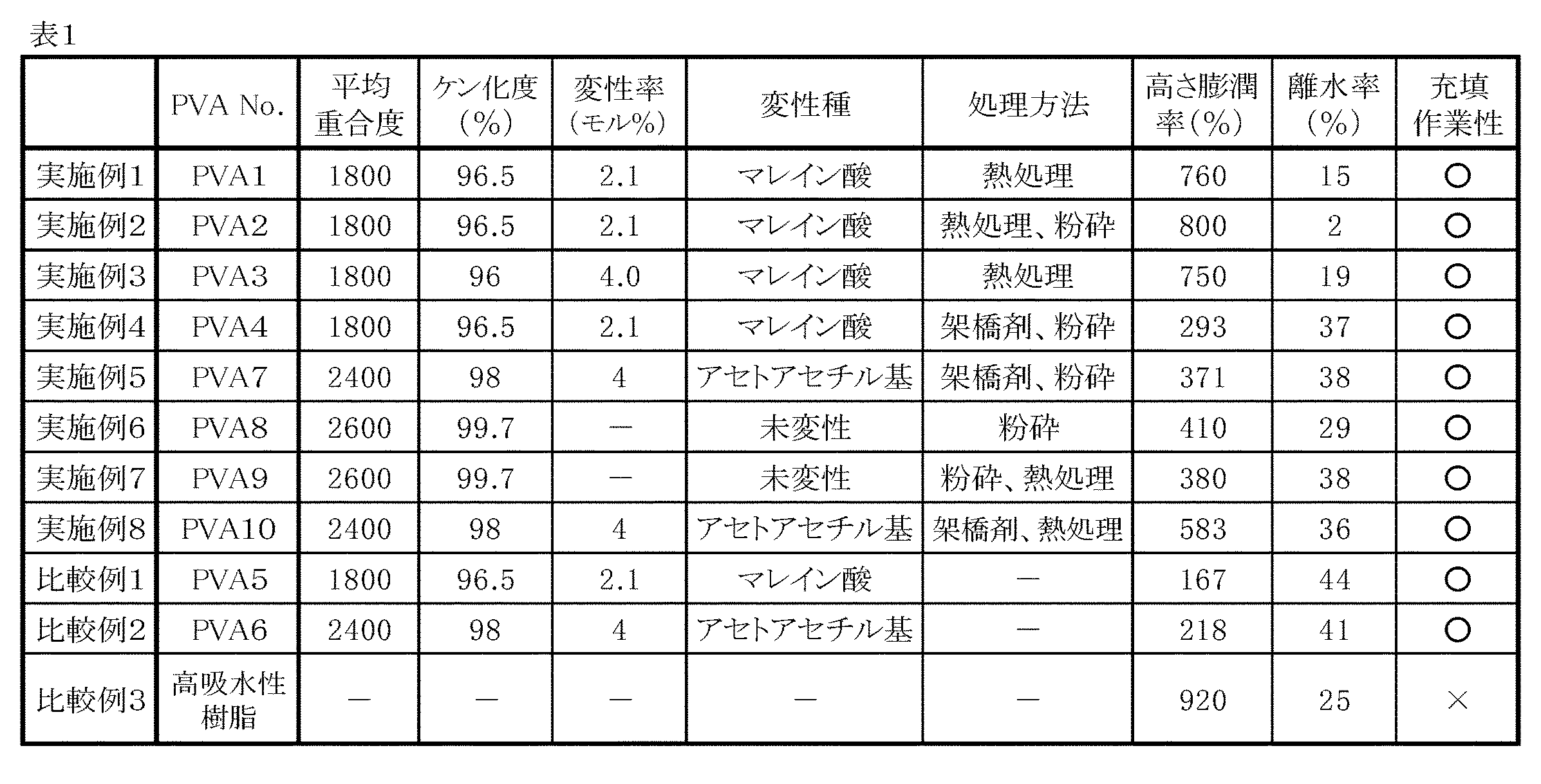
- Examples 1 to 8 have a swelling ratio (height swelling ratio) in the range of 250 to 900% after immersion in water at a temperature of 80 ° C. for 30 minutes, and effectively close the gap. It was found that it was possible to be used, and that the filling workability was also excellent. Further, in Examples 1 to 8, the water separation rate was 40% or less, and the leakage of water from the muddy water filtration tester was suppressed as compared with Comparative Examples 1 to 3. Among them, Examples 1 to 3 had high water absorbency, a height swelling ratio of 700% or more, and a water separation ratio of 20% or less.
Landscapes
- Life Sciences & Earth Sciences (AREA)
- Engineering & Computer Science (AREA)
- General Life Sciences & Earth Sciences (AREA)
- Geology (AREA)
- Mining & Mineral Resources (AREA)
- Chemical & Material Sciences (AREA)
- Fluid Mechanics (AREA)
- Environmental & Geological Engineering (AREA)
- Geochemistry & Mineralogy (AREA)
- Physics & Mathematics (AREA)
- Materials Engineering (AREA)
- Organic Chemistry (AREA)
- Chemical Kinetics & Catalysis (AREA)
- Mechanical Engineering (AREA)
- Compositions Of Macromolecular Compounds (AREA)
Abstract
Description
逸泥防止剤(LCM)としては、杉皮、サトウキビの繊維、鉱物繊維等の繊維状物;石灰岩、大理石、木、クルミの殻、綿の実の殻、トウモロコシの穂軸、合成樹脂等の粒状物;雲母片、樹脂フィルム片、セロファン小片等の薄片状物;など、種々の無機物質及び有機物質が使用されている。
(1)変性ポリビニルアルコール系樹脂及び未変性ポリビニルアルコールのうちの少なくとも1種のポリビニルアルコール系樹脂を含有し、前記ポリビニルアルコール系樹脂が、温度80℃の水中に30分間浸漬した後の膨潤率が250~900%である地下処理用目止め材。
(2)前記変性ポリビニルアルコール系樹脂が、カルボキシル基を有するポリビニルアルコール系樹脂(A)である、前記(1)に記載の地下処理用目止め材。
(3)前記変性ポリビニルアルコール系樹脂が、カルボキシル基を有するポリビニルアルコール系樹脂(A)の熱架橋物(A1)である、前記(1)に記載の地下処理用目止め材。
(4)前記変性ポリビニルアルコール系樹脂が、カルボキシル基を有するポリビニルアルコール系樹脂(A)の架橋剤架橋物(A2)である、前記(1)に記載の地下処理用目止め材。
(5)掘削用である、前記(1)~(4)のいずれか1つに記載の地下処理用目止め材。
(6)前記(1)~(5)のいずれか1つに記載の地下処理用目止め材を、地下に形成された坑井に流入させる液体に含有させる、地下処理方法。
(7)前記(1)~(5)のいずれか1つに記載の地下処理用目止め材を、逸泥を生じやすい地盤の付近の泥水に含有させる、坑井壁の目止め方法。
なお、用語「ポリビニルアルコール」は、単に「PVA」ということがある。
また、本明細書において、「質量」は「重量」と同義である。
前記膨潤率は、350~900%であることが好ましく、400~900%であることがより好ましく、600~900%であることが更に好ましく、700~900%であることが特に好ましく、750~850%が最も好ましい。
1.PVA系樹脂を0.5g秤量し、内径13.5mmの10mL容の試験管に入れ、このときのPVA系樹脂の試験管内の高さを初期高さとして測定する。
2.試験管に水7mLを入れ、撹拌し、水中にPVA系樹脂を分散させる。
3.80℃に温調しておいたウォーターバスに試験管を浸し、試験管内の水温が80℃に達してから30分間静置する。
4.30分後の試験管内のPVA系樹脂の高さを膨潤後高さとして測定する。
5.下記式に従って、PVA系樹脂の膨潤率(高さ膨潤率)を算出する。
膨潤率(%)=(膨潤後高さ/初期高さ)×100
高さ膨張率を上昇させるには、樹脂の粉末の粒子径を細かくする、架橋密度を下げる、イオン性官能基を導入する等の手段がある。
逆に高さ膨張率を低く調整するには、樹脂の粉末の粒子径を大きくする、架橋密度を上げる、疎水性官能基を導入する等の手段がある。
1.泥水濾過試験機のサンプルセルに精製水400質量部を投入し、500rpmで撹拌しながらPVA系樹脂3質量部を添加する。
2.30分間の撹拌を続けた後、撹拌を停止し、5分間静置する。
3.セル内を0.05MPaに加圧し、離水液を回収する。
4.測定は5分間行い、下記式に従って離水率を算出する。
離水率(%)=回収液(g)/(精製水(g)+樹脂(g))×100
未変性PVAは、酢酸ビニル等のビニルエステル系モノマーを重合し得られた重合体をケン化することによって得られる。本発明においては、未変性PVAのケン化度が75~100モル%であることが好ましく、80~99.8モル%であることがより好ましく、85~99.5モル%であることが更に好ましい。ケン化度が低すぎると吸水性が低下する場合がある。
なお、ケン化度はJIS K 6726:1994に準拠して測定することができるもので、PVA系樹脂中のビニルエステル構造単位以外の構造単位の含有率であって、後述の変性PVA系樹脂においても同様である。
なお、平均重合度はJIS K 6726:1994に準拠して測定することができ、後述の変性PVA系樹脂においても同様である。
なお、未変性PVAの4質量%水溶液粘度は、未変性PVAの4質量%水溶液を調製し、JIS K6726:1994に準拠して測定した20℃における粘度であり、後述の変性PVA系樹脂においても同様である。
なお、平均粒子径はレーザー回折装置を用いて、体積中位径として測定するものであり、後述の変性PVA系樹脂においても同様である。
変性PVA系樹脂は、未変性PVAに任意の官能基を導入したものである。導入される官能基としては、カルボキシル基、スルホン酸基、リン酸基をはじめとするアニオン性基、4級アンモニウム基等のカチオン性基、活性メチレン基含有変性基(アセトアセチル基、ジアセトン基、ジアセトンアクリルアミド基等)、カルボニル基、アミノ基、シラノール基、オキシアルキレン基、メルカプト基をはじめとする各種官能基等が挙げられる。また、側鎖に1,2-ジオール構造単位を含有するPVA系樹脂等を挙げることもできる。この中でも、架橋性の観点から、カルボキシル基、活性メチレン基含有変性基を有する変性PVA系樹脂が好ましい。
カルボキシル基を有するポリビニルアルコール系樹脂(A)(以下、カルボキシル基含有PVA系樹脂(A)と略記することがある。)は、カルボキシル基を有する化合物(モノマー)とビニルエステル系化合物(モノマー)とを共重合させて、その共重合体をケン化して得られる樹脂であり、その構造にカルボキシル基を有する。
なお、ケン化度はJIS K 6726:1994に準拠して測定することができる。
なお、平均重合度はJIS K 6726:1994に準拠して測定することができる。
なお、カルボキシル基含有PVA系樹脂(A)の4質量%水溶液粘度は、カルボキシル基含有PVA系樹脂(A)の4質量%水溶液を調製し、JIS K6726:1994に準拠して測定した20℃における粘度である。
なお、平均粒子径はレーザー回折装置を用いて、体積中位径として測定することができる。
上記カルボキシル基を有する不飽和モノマーとしては、例えば、エチレン性不飽和ジカルボン酸(マレイン酸、フマル酸、イタコン酸等)、又はエチレン性不飽和カルボン酸モノエステル(マレイン酸モノアルキルエステル、フマル酸モノアルキルエステル、イタコン酸モノアルキルエステル等)、又はエチレン性不飽和ジカルボン酸ジエステル(マレイン酸ジアルキルエステル、フマル酸ジアルキルエステル、イタコン酸ジアルキルエステル等)、又はエチレン性不飽和カルボン酸無水物(無水マレイン酸、無水イタコン酸等)、あるいは(メタ)アクリル酸等のモノマー、及びこれらの塩が挙げられ、エチレン性不飽和カルボン酸モノエステル又はその塩が好適に使用される。
中でも、ビニルエステル系モノマーとの反応性の点でエチレン性不飽和カルボン酸モノエステルが好ましく、更にはマレイン酸モノアルキルエステル、イタコン酸モノアルキルエステルが好ましく、特にはマレイン酸モノアルキルエステルが好ましい。
本発明においては、目止めの効果を高めるために、カルボキシル基含有PVA系樹脂(A)が架橋されてなる架橋物を使用することが好ましい。
前記架橋物を形成する方法(架橋方法)としては、例えば、熱処理、架橋剤処理、紫外線照射処理、電子線照射処理等が用いられる。中でも好ましくは、熱処理により架橋された熱架橋物(A1)や、架橋剤によって架橋処理された架橋剤架橋物(A2)である。以下、架橋方法について説明する。
熱処理の方法については、通常はカルボキシル基含有PVA系樹脂(A)を特定の熱処理に供する方法が挙げられる。熱処理条件として、熱処理温度は、通常、100~220℃であり、好ましくは120~200℃、より好ましくは130~150℃である。熱処理温度が低すぎると耐水性が低下し、温度が高すぎると樹脂が分解する傾向にある。
また、熱処理時間は、通常、10~600分であり、好ましくは20~400分、より好ましくは100~200分である。熱処理時間が少なすぎると耐水性が低下し、多すぎると樹脂が分解する傾向にある。
また、溶融押出等により、熱処理を施すことも可能である。
なお、YI値はJIS K 7373:2006の方法で求めることができ、以下の活性メチレン基含有変性基を有するPVA系樹脂(B)においても同様である。
架橋剤処理で用いる架橋剤としては、カルボキシル基を有するPVA系樹脂の架橋剤として公知のものを用いることができる。例えば、ホルムアルデヒド,アセトアルデヒド等のモノアルデヒド化合物、グリオキザール,グルタルアルデヒド,ジアルデヒド澱粉等の多価アルデヒド化合物などのアルデヒド化合物、メタキシレンジアミン、ノルボルナンジアミン、1,3-ビスアミノメチルシクロヘキサン、ビスアミノプロピルピペラジン、3,3’-ジメチル-4,4’-ジアミノジシクロヘキシルメタン、4,4’-ジアミノジシクロヘキシルメタン、4,4’-ジアミノジフェニルメタン、3,3’,5,5’-テトラメチル-4,4’-ジアミノジフェニルメタン、3,3’,5,5’-テトラエチル-4,4’-ジアミノジフェニルメタン、3,3’-ジメチル-4,4’-ジアミノ-5,5’-ジエチルジフェニルメタン、4,4’-ジアミノジフェニルエーテル、ジアミノジフェニルスルフォン、1,2-フェニレンジアミン、1,3-フェニレンジアミン、1,4-フェニレンジアミン、3-メチル-1,2-フェニレンジアミン、4-メチル-1,2-フェニレンジアミン、2-メチル-1,3-フェニレンジアミン、4-メチル-1,3-フェニレンジアミン、2-メチル-4,6-ジエチル-1,3-フェニレンジアミン、2,4-ジエチル-6-メチル-1,3-フェニレンジアミン、2,4,6-トリメチル-1,3-フェニレンジアミン、2-クロロ-1,4-フェニレンジアミン等のアミン系化合物、メチロール化尿素、メチロール化メラミンなどのメチロール化合物、ヘキサメチレンテトラミン等のアンモニアとホルムアルデヒドとの反応物、ホウ酸、ホウ砂などのホウ素化合物、塩基性塩化ジルコニル、硝酸ジルコニル、酢酸ジルコニウムアンモニウムなどのジルコニウム化合物、テトラメチルチタネートのようなチタンオルソエステル類、チタンエチルアセトアセトナートのようなチタンキレート類、ポリヒドロキシチタンステアレートのようなチタンアシレート類などのチタン化合物、アルミニウムアセチルアセトナートのようなアルミニウム有機酸キレート類などのアルミニウム化合物、シランカップリング剤などの有機反応性基を有するオルガノアルコキシシラン化合物、エチレングリコールジグリシジルエーテル、ポリエチレングリコールジグリシジルエーテル、グリセリンジグリシジルエーテル、グリセリントリグリシジルエーテル、ヘキサンジオールジグリシジルエーテル、トリメチロールプロパントリグリシジルエーテル等の多価エポキシ化合物、各種イソシアネート系化合物、ポリアミドポリアミン-エピクロロヒドリン系樹脂などのポリアミドポリアミン-エピハロヒドリン系樹脂などが挙げられる。とりわけ、ポリアミドポリアミン-エピクロロヒドリン系樹脂が好ましい。
次に、本発明で用いられる活性メチレン基含有変性基を有するポリビニルアルコール系樹脂(B)(以下、活性メチレン基含有PVA系樹脂(B)と略記することがある。)について説明する。
上記のような活性メチレン基含有PVA系樹脂(B)としては、例えば、ケトン、カルボン酸またはカルボン酸エステル等のカルボニル基とメチレン基が隣接した構造を有する変性基を有するPVA系樹脂であり、具体的には、例えば、アセトアセチル基やジアセトン基を有するPVA系樹脂が挙げられる。
なかでも、アセトアセチル基含有PVA系樹脂(以下、AA化PVA系樹脂と略記することがある。)や、ジアセトンアクリルアミド構造単位含有PVA系樹脂が好ましく、更には架橋性の点でAA化PVA系樹脂が好ましい。
なお、上記平均重合度は、JIS K 6726:1994に準拠して測定される。
なお、上記ケン化度は、JIS K 6726:1994に準拠して測定される。
なお、活性メチレン基含有PVA系樹脂(B)の4質量%水溶液粘度は、活性メチレン基含有PVA系樹脂(B)の4質量%水溶液を調製し、JIS K6726:1994に準拠して測定した20℃における粘度である。
なお、平均粒子径はレーザー回折装置を用いて、体積中位径として測定される。
本発明に用いられるAA化PVA系樹脂(b)は、PVA系樹脂の主鎖に直接、あるいは酸素原子や連結基を介してアセトアセチル基(AA基)が結合したもので、例えば、下記一般式(1)で表されるAA基を有する構造単位を含むPVA系樹脂が挙げられる。なお、かかるAA化PVA系樹脂は、AA基を有する構造単位以外にビニルアルコール構造単位を有し、必要に応じて更に未ケン化部分のビニルエステル構造単位を有するものである。

なお、AA化度は、AA化PVA系樹脂の総エステル基量と酢酸エステル基量との差から求めることができる。
以下、(1)の方法について説明する。
本発明においては、目止めの効果を高めるために、活性メチレン基含有PVA系樹脂(B)が架橋されてなる架橋物を使用することが好ましい。
前記架橋物を形成する方法(架橋方法)としては、例えば、熱処理、架橋剤処理、紫外線照射処理、電子線照射処理等が用いられる。中でも好ましくは、熱処理により架橋された熱架橋物(B1)や、架橋剤によって架橋処理された架橋剤架橋物(B2)である。以下、架橋方法について説明する。
熱処理による架橋方法については、通常は活性メチレン基含有PVA系樹脂(B)を特定の熱処理に供する方法が挙げられる。熱処理条件として、熱処理温度は、通常、100~220℃であり、好ましくは120~200℃、より好ましくは130~150℃である。熱処理温度が低すぎると耐水性が低下し、温度が高すぎると樹脂が分解する傾向にある。
また、熱処理時間は、通常、10~600分であり、好ましくは、20~400分、より好ましくは100~200分である。熱処理時間が少なすぎると耐水性が低下し、多すぎると樹脂が分解する傾向にある。
また、溶融押出等により、熱処理を施すことも可能である。
架橋剤処理で用いる架橋剤としては、例えば、活性メチレン基含有PVA系樹脂の架橋剤として公知のものを用いることができる。例えば、クロム化合物、アルミニウム化合物、ジルコニウム化合物、ホウ素化合物等の無機系架橋剤や、グリオキザール、グリオキシル酸及びその塩、尿素樹脂、ポリアミンポリアミドエピクロルヒドリン、ポリエチレンイミン、カルボジイミド系化合物、オキサゾリン系化合物、アジリジン系化合物、ヒドラジン系化合物、イソシアネート系化合物、メラミン系化合物、エポキシ系化合物、アルデヒド系化合物、N-メチロール系化合物、アクリロイル系化合物、活性ハロゲン系化合物、エチレンイミノ系化合物等の有機系架橋剤や、金属、金属錯塩を挙げることができる。特に、耐水性の点からグリオキシル酸及びその金属塩、とりわけ、グリオキシル酸金属塩、更にはグリオキシル酸ナトリウムが好ましい。
Malvern社製レーザー回折式粒度分布測定装置「マスターサイザー3000」にて乾式分散で体積分布を測定し、積算値が50%になる径を算出した。
JIS K6726:1994に基づいて測定した。
JIS K6726:1994に基づき、原料PVA系樹脂の残存酢酸エステル基の加水分解に要するアルカリ消費量で分析することにより求めた。
1.PVA系樹脂を0.5g秤量し、内径13.5mmの10mL容の試験管に入れ、このときのPVA系樹脂の試験管内の高さを初期高さとして測定した。
2.試験管に水7mLを入れ、撹拌し、水中にPVA系樹脂を分散させた。
3.80℃に温調しておいたウォーターバスに試験管を浸し、試験管内の水温が80℃に達してから30分間静置した。
4.30分後の試験管内のPVA系樹脂の高さを膨潤後高さとして測定した。
5.下記式に従って、PVA系樹脂の膨潤率(高さ膨潤率)を算出した。
膨潤率(%)=(膨潤後高さ/初期高さ)×100
S-250泥水濾過試験機(株式会社西日本試験機製)のサンプルセルに精製水400部を投入し、500rpmで撹拌しているところにPVA系樹脂3部を添加した。30分間の撹拌を続けた後、撹拌を停止し、5分間静置した。空気によりセル内を0.05MPaに加圧し、離水液を回収した。測定は5分間行い、下記式に従って離水率を決定した。
離水率(%)=回収液(g)/(精製水(g)+樹脂(g))×100
上記「(e)目止効果の評価(離水率)」において、液の撹拌の際の液の状態を目視で観察し、以下の基準で評価した。
〔評価基準〕
○(良好):PVA系樹脂が液中に均一に分散していた。
×(不良):PVA系樹脂が吸水しすぎて均一な撹拌が困難であった。
還流冷却器、滴下漏斗、撹拌機を備えた反応缶に、酢酸ビニル100部、メタノール26部、マレイン酸モノメチル0.1部を仕込み、撹拌しながら窒素気流下で60℃まで上昇させてから、重合触媒としてt-ブチルパーオキシネオデカノエート(半減期が1時間になる温度が65℃)を0.001モル%(酢酸ビニル総量に対して)投入し、重合を開始した。重合開始直後にマレイン酸モノメチル2.2部(酢酸ビニル総量に対して2モル%)、t-ブチルパーオキシネオデカノエート0.008モル%(酢酸ビニル総量に対して)を重合速度に合わせて連続追加し、酢酸ビニルの重合率が73%となった時点で、4-メトキシフェノールを0.01部及び希釈・冷却用メタノールを58部添加して重合を終了した。重合終了時における残存活性触媒量は、反応液総量に対して2ppmであった。
続いて、メタノール蒸気を吹き込む方法により未反応の酢酸ビニルモノマーを系外に除去し共重合体のメタノール溶液を得た。
得られたマレイン酸変性PVA系樹脂をジャケット温度130~135℃の熱処理缶内で5時間真空乾燥させた後、常圧状態で窒素ガスを24Nm3/hの速度で熱処理缶に流しながら3時間、130~135℃で熱処理を行い、マレイン酸変性PVA系樹脂の熱架橋物(PVA1)を得た。PVA1の平均粒子径は379μmであった。
実施例1で得られたマレイン酸変性PVA系樹脂の熱架橋物(PVA1)7部を凍結粉砕用のサンプルセルに入れ、Freezer/Mill(SPEX SamplePrep社)を用いて、100秒間、10cps、液体窒素下で凍結粉砕を行い、マレイン酸変性PVA系樹脂の熱架橋物(PVA2)を得た。PVA2の平均粒子径は204μmであった。
還流冷却器、滴下漏斗、撹拌機を備えた反応缶に、酢酸ビニル100部、メタノール30部、マレイン酸モノメチル0.28部を仕込み、撹拌しながら窒素気流下で60℃まで上昇させてから、重合触媒としてt-ブチルパーオキシネオデカノエート(半減期が1時間になる温度が65℃)を0.0014モル%(酢酸ビニル総量に対して)投入し、重合を開始した。重合開始直後にマレイン酸モノメチル5.4部(酢酸ビニル総量に対して4モル%)、t-ブチルパーオキシネオデカノエート0.013モル%(酢酸ビニル総量に対して)を重合速度に合わせて連続追加し、酢酸ビニルの重合率が80%となった時点で、4-メトキシフェノールを0.01部及び希釈・冷却用メタノールを60部添加して重合を終了した。重合終了時における残存活性触媒量は、反応液総量に対して2ppmであった。
続いて、メタノール蒸気を吹き込む方法により未反応の酢酸ビニルモノマーを系外に除去し共重合体のメタノール溶液を得た。
得られたマレイン酸変性PVA系樹脂をふるい分けし、200部をアルミホイルに広げて、乾燥機中で140℃、4時間熱処理を行った。熱処理途中、1時間おきに計4回スパチュラで樹脂の混合を行い、マレイン酸変性PVA系樹脂の熱架橋物(PVA3)を得た。PVA3の平均粒子径は358μmであった。
還流冷却器、滴下漏斗、撹拌機を備えた反応缶に、酢酸ビニル100部、メタノール26部、マレイン酸モノメチル0.1部を仕込み、撹拌しながら窒素気流下で60℃まで上昇させてから、重合触媒としてt-ブチルパーオキシネオデカノエート(半減期が1時間になる温度が65℃)を0.001モル%(酢酸ビニル総量に対して)投入し、重合を開始した。重合開始直後にマレイン酸モノメチル2.2部(酢酸ビニル総量に対して2モル%)、t-ブチルパーオキシネオデカノエート0.008モル%(酢酸ビニル総量に対して)を重合速度に合わせて連続追加し、酢酸ビニルの重合率が73%となった時点で、4-メトキシフェノールを0.01部及び希釈・冷却用メタノールを58部添加して重合を終了した。重合終了時における残存活性触媒量は、反応液総量に対して2ppmであった。
続いて、メタノール蒸気を吹き込む方法により未反応の酢酸ビニルモノマーを系外に除去し共重合体のメタノール溶液を得た。
アルミトレイに上記混合物を広げて、乾燥機中で70℃で、3時間放置し、乾燥した後、7部を凍結粉砕用のサンプルセルに入れ、Freezer/Mill(SPEX SamplePrep社)を用いて、100秒間、10cps、液体窒素下で凍結粉砕を行い、マレイン酸変性PVA系樹脂の架橋剤架橋物(PVA4)を得た。PVA4の平均粒子径は213μmであった。
実施例1において作製した熱処理前のマレイン酸変性PVA系樹脂を用い、ふるい分けにより平均粒子径358μmのマレイン酸変性PVA系樹脂(PVA5)を得た。
PVA(ケン化度98.0モル%、4%水溶液の粘度54mPa・s、平均重合度2400)を、ニーダーに100部仕込み、これに酢酸30部を入れ、膨潤させ、回転数20rpmで撹拌しながら、60℃に昇温後、ジケテン5部を5時間かけて滴下し、更に1時間反応させた。
反応終了後、メタノールで洗浄した後、70℃で12時間乾燥してAA化PVA系樹脂(PVA6)を得た。かかるPVA6のAA化度は4.0モル%であり、平均粒子径306μmであった。
比較例2で得られたPVA6の50部をビニル袋に入れ、架橋剤としてのグリオキシル酸ナトリウムの10%水溶液25部をスプレーで噴きつけた。次いで10分間、上記ビニル袋の口を手で握り、振り混ぜ、混合物を得た。
アルミトレイに上記混合物を広げて、乾燥機中で70℃で、3時間放置して、乾燥した後、7部を凍結粉砕用のサンプルセルに入れ、Freezer/Mill(SPEX SamplePrep社)を用いて、100秒間、10cps、液体窒素下で凍結粉砕を行い、AA化PVA系樹脂の架橋剤架橋物(PVA7)を得た。PVA7の平均粒子径は377μmであった。
PVA(ケン化度99.7モル%、重合度2600)を、BIミル(ミクロパウテック株式会社製)を用いて、目標の大きさになるまで衝突粉砕し、平均粒子径62μmの未変性PVA(PVA8)を得た。
実施例6で得られた未変性PVA(PVA8)の200部をアルミホイルに広げて、乾燥機中で125℃で、5時間熱処理を行った。熱処理途中、1時間おきに計4回スパチュラで樹脂の混合を行い、未変性PVA(PVA9)を得た。PVA9の平均粒子径は61μmであった。
比較例2で得られたAA化PVA系樹脂(PVA6)の50部をビニル袋に入れ、架橋剤としてのグリオキシル酸ナトリウムの10%水溶液25部をスプレーで噴きつけた。次いで10分間、上記ビニル袋の口を手で握り、振り混ぜ、混合物を得た。
アルミトレイに上記混合物を広げて、乾燥機中で140℃、6時間乾燥し、AA化PVA系樹脂の架橋剤架橋物(PVA10)を得た。
和光純薬工業株式会社より購入した高吸水性ポリマー(「高吸水性ポリマー(アクリル酸塩系)」(商品名))を比較例3の高吸水性樹脂とした。
Claims (7)
- 変性ポリビニルアルコール系樹脂及び未変性ポリビニルアルコールのうちの少なくとも1種のポリビニルアルコール系樹脂を含有し、
前記ポリビニルアルコール系樹脂が、温度80℃の水中に30分間浸漬した後の膨潤率が250~900%である地下処理用目止め材。 - 前記変性ポリビニルアルコール系樹脂が、カルボキシル基を有するポリビニルアルコール系樹脂(A)である、請求項1に記載の地下処理用目止め材。
- 前記変性ポリビニルアルコール系樹脂が、カルボキシル基を有するポリビニルアルコール系樹脂(A)の熱架橋物(A1)である、請求項1に記載の地下処理用目止め材。
- 前記変性ポリビニルアルコール系樹脂が、カルボキシル基を有するポリビニルアルコール系樹脂(A)の架橋剤架橋物(A2)である、請求項1に記載の地下処理用目止め材。
- 掘削用である、請求項1~4のいずれか1項に記載の地下処理用目止め材。
- 請求項1~5のいずれか1項に記載の地下処理用目止め材を、地下に形成された坑井に流入させる液体に含有させる、地下処理方法。
- 請求項1~5のいずれか1項に記載の地下処理用目止め材を、逸泥を生じやすい地盤の付近の泥水に含有させる、坑井壁の目止め方法。
Priority Applications (4)
| Application Number | Priority Date | Filing Date | Title |
|---|---|---|---|
| EP18896559.4A EP3733810A4 (en) | 2017-12-28 | 2018-12-27 | SEALING MATERIAL FOR UNDERGROUND TREATMENT, UNDERGROUND TREATMENT PROCESS AND PROCESS FOR SEALING A DRILLING WALL |
| CN201880083821.2A CN111527181A (zh) | 2017-12-28 | 2018-12-27 | 地下处理用填塞材料、地下处理方法及坑井壁的填塞方法 |
| JP2018568987A JPWO2019131952A1 (ja) | 2017-12-28 | 2018-12-27 | 地下処理用目止め材、地下処理方法及び坑井壁の目止め方法 |
| US16/910,172 US11230659B2 (en) | 2017-12-28 | 2020-06-24 | Filling material for underground treatment, underground treatment method and filling well wall method |
Applications Claiming Priority (2)
| Application Number | Priority Date | Filing Date | Title |
|---|---|---|---|
| JP2017254845 | 2017-12-28 | ||
| JP2017-254845 | 2017-12-28 |
Related Child Applications (1)
| Application Number | Title | Priority Date | Filing Date |
|---|---|---|---|
| US16/910,172 Continuation US11230659B2 (en) | 2017-12-28 | 2020-06-24 | Filling material for underground treatment, underground treatment method and filling well wall method |
Publications (1)
| Publication Number | Publication Date |
|---|---|
| WO2019131952A1 true WO2019131952A1 (ja) | 2019-07-04 |
Family
ID=67063858
Family Applications (1)
| Application Number | Title | Priority Date | Filing Date |
|---|---|---|---|
| PCT/JP2018/048338 Ceased WO2019131952A1 (ja) | 2017-12-28 | 2018-12-27 | 地下処理用目止め材、地下処理方法及び坑井壁の目止め方法 |
Country Status (5)
| Country | Link |
|---|---|
| US (1) | US11230659B2 (ja) |
| EP (1) | EP3733810A4 (ja) |
| JP (1) | JPWO2019131952A1 (ja) |
| CN (1) | CN111527181A (ja) |
| WO (1) | WO2019131952A1 (ja) |
Cited By (5)
| Publication number | Priority date | Publication date | Assignee | Title |
|---|---|---|---|---|
| JP2021134278A (ja) * | 2020-02-27 | 2021-09-13 | 株式会社クラレ | ポリビニルアルコール系樹脂及び地下処理用目止め剤 |
| WO2023038113A1 (ja) * | 2021-09-13 | 2023-03-16 | 株式会社クラレ | セメント組成物、脱水防止剤及びセメント脱水防止方法 |
| DE112021004264T5 (de) | 2020-08-12 | 2023-05-25 | Kuraray Co., Ltd. | Vinylalkoholpolymer und dessen Verwendung |
| JP2023143188A (ja) * | 2022-03-25 | 2023-10-06 | 三菱ケミカル株式会社 | アセト酢酸エステル基含有ポリビニルアルコール系樹脂 |
| CN117210208A (zh) * | 2023-11-08 | 2023-12-12 | 中石化西南石油工程有限公司 | 一种多重双效防塌环保高性能钻井液及其制备方法 |
Families Citing this family (5)
| Publication number | Priority date | Publication date | Assignee | Title |
|---|---|---|---|---|
| EP3666849A4 (en) | 2017-08-10 | 2020-08-12 | Mitsubishi Chemical Corporation | DEVIATION AGENT AND METHOD USING THE SAME TO FILL A DESCENT CRACK |
| JPWO2020138252A1 (ja) | 2018-12-27 | 2021-11-18 | 三菱ケミカル株式会社 | ダイバーティングエージェント及びこれを用いた坑井の亀裂の閉塞方法 |
| EP3904396A4 (en) * | 2018-12-27 | 2022-02-23 | Mitsubishi Chemical Corporation | Diverting agent and method for closing crack in well using same |
| CN112175594A (zh) * | 2020-09-22 | 2021-01-05 | 西南石油大学 | 一种调剖堵水用热塑性弹性体及其制备方法 |
| CN114085657B (zh) * | 2021-12-06 | 2023-01-31 | 中石化石油工程技术服务有限公司 | 用于页岩气井的暂堵材料及其制备方法 |
Citations (6)
| Publication number | Priority date | Publication date | Assignee | Title |
|---|---|---|---|---|
| JPS57205475A (en) * | 1981-06-09 | 1982-12-16 | Ohbayashigumi Ltd | Mud flush excavation of ground |
| JP2002161268A (ja) | 2000-11-29 | 2002-06-04 | Fujita Corp | 逸泥防止剤、及びこれを用いた逸泥防止方法 |
| JP2004099677A (ja) | 2002-09-06 | 2004-04-02 | Tachibana Material Co Ltd | 逸泥防止材及びこの逸泥防止材を用いた施工法 |
| US20110160096A1 (en) * | 2008-12-31 | 2011-06-30 | Halliburton Energy Services, Inc. | Methods and Compositions Comprising a Dual Oil/Water-Swellable Particle |
| US20160177693A1 (en) * | 2014-12-17 | 2016-06-23 | Baker Hughes Incorporated | Compositions and methods of improving hydraulic fracture network |
| WO2017099082A1 (ja) * | 2015-12-09 | 2017-06-15 | 日本合成化学工業株式会社 | セメント混和剤 |
Family Cites Families (9)
| Publication number | Priority date | Publication date | Assignee | Title |
|---|---|---|---|---|
| US4551256A (en) * | 1981-06-09 | 1985-11-05 | Ohbayashi-Gumi, Ltd. | Slurry excavating method |
| CN102432968B (zh) * | 2011-10-12 | 2013-08-28 | 江苏博特新材料有限公司 | 改性聚乙烯醇及其制备方法 |
| US9617462B2 (en) * | 2011-12-28 | 2017-04-11 | Schlumberger Technology Corporation | Degradable composite materials and uses |
| CN103087693B (zh) * | 2013-02-07 | 2015-04-15 | 中国海洋石油总公司 | 一种深水低温固井用降失水剂及其制备方法 |
| JP5718516B1 (ja) * | 2013-10-30 | 2015-05-13 | 日本合成化学工業株式会社 | アセトアセチル基含有ポリビニルアルコール系樹脂粉末およびその製造方法 |
| CN104263334B (zh) * | 2014-08-27 | 2017-07-11 | 中国石油集团渤海钻探工程有限公司 | 聚乙烯醇改性的降失水剂及其制备方法 |
| CN105924866B (zh) * | 2016-05-18 | 2018-07-03 | 成都慧成科技有限责任公司 | 一种具有高溶胀度的聚乙烯醇薄膜及其制备方法 |
| CN106967393A (zh) * | 2017-04-19 | 2017-07-21 | 中国石油集团川庆钻探工程有限公司工程技术研究院 | 一种可固化低密度堵漏工作液及其制备方法 |
| EP3666849A4 (en) * | 2017-08-10 | 2020-08-12 | Mitsubishi Chemical Corporation | DEVIATION AGENT AND METHOD USING THE SAME TO FILL A DESCENT CRACK |
-
2018
- 2018-12-27 JP JP2018568987A patent/JPWO2019131952A1/ja active Pending
- 2018-12-27 EP EP18896559.4A patent/EP3733810A4/en not_active Withdrawn
- 2018-12-27 WO PCT/JP2018/048338 patent/WO2019131952A1/ja not_active Ceased
- 2018-12-27 CN CN201880083821.2A patent/CN111527181A/zh active Pending
-
2020
- 2020-06-24 US US16/910,172 patent/US11230659B2/en active Active
Patent Citations (6)
| Publication number | Priority date | Publication date | Assignee | Title |
|---|---|---|---|---|
| JPS57205475A (en) * | 1981-06-09 | 1982-12-16 | Ohbayashigumi Ltd | Mud flush excavation of ground |
| JP2002161268A (ja) | 2000-11-29 | 2002-06-04 | Fujita Corp | 逸泥防止剤、及びこれを用いた逸泥防止方法 |
| JP2004099677A (ja) | 2002-09-06 | 2004-04-02 | Tachibana Material Co Ltd | 逸泥防止材及びこの逸泥防止材を用いた施工法 |
| US20110160096A1 (en) * | 2008-12-31 | 2011-06-30 | Halliburton Energy Services, Inc. | Methods and Compositions Comprising a Dual Oil/Water-Swellable Particle |
| US20160177693A1 (en) * | 2014-12-17 | 2016-06-23 | Baker Hughes Incorporated | Compositions and methods of improving hydraulic fracture network |
| WO2017099082A1 (ja) * | 2015-12-09 | 2017-06-15 | 日本合成化学工業株式会社 | セメント混和剤 |
Cited By (8)
| Publication number | Priority date | Publication date | Assignee | Title |
|---|---|---|---|---|
| JP2021134278A (ja) * | 2020-02-27 | 2021-09-13 | 株式会社クラレ | ポリビニルアルコール系樹脂及び地下処理用目止め剤 |
| US11851607B2 (en) | 2020-02-27 | 2023-12-26 | Kuraray Co., Ltd. | Polyvinyl alcohol-based resin and plugging agent for underground treatment |
| JP7471859B2 (ja) | 2020-02-27 | 2024-04-22 | 株式会社クラレ | ポリビニルアルコール系樹脂及び地下処理用目止め剤 |
| DE112021004264T5 (de) | 2020-08-12 | 2023-05-25 | Kuraray Co., Ltd. | Vinylalkoholpolymer und dessen Verwendung |
| WO2023038113A1 (ja) * | 2021-09-13 | 2023-03-16 | 株式会社クラレ | セメント組成物、脱水防止剤及びセメント脱水防止方法 |
| JP2023143188A (ja) * | 2022-03-25 | 2023-10-06 | 三菱ケミカル株式会社 | アセト酢酸エステル基含有ポリビニルアルコール系樹脂 |
| CN117210208A (zh) * | 2023-11-08 | 2023-12-12 | 中石化西南石油工程有限公司 | 一种多重双效防塌环保高性能钻井液及其制备方法 |
| CN117210208B (zh) * | 2023-11-08 | 2024-02-27 | 中石化西南石油工程有限公司 | 一种多重双效防塌环保高性能钻井液及其制备方法 |
Also Published As
| Publication number | Publication date |
|---|---|
| JPWO2019131952A1 (ja) | 2020-11-19 |
| US20200325383A1 (en) | 2020-10-15 |
| EP3733810A1 (en) | 2020-11-04 |
| CN111527181A (zh) | 2020-08-11 |
| US11230659B2 (en) | 2022-01-25 |
| EP3733810A4 (en) | 2021-03-10 |
Similar Documents
| Publication | Publication Date | Title |
|---|---|---|
| US11230659B2 (en) | Filling material for underground treatment, underground treatment method and filling well wall method | |
| JP6874374B2 (ja) | セメント混和剤 | |
| CN110997861B (zh) | 转向剂及使用其的坑井的龟裂的堵塞方法 | |
| Zhu et al. | Polymer gel systems for water management in high-temperature petroleum reservoirs: a chemical review | |
| JP7225719B2 (ja) | 有機/無機複合体粒子 | |
| US11851607B2 (en) | Polyvinyl alcohol-based resin and plugging agent for underground treatment | |
| JP2023153175A (ja) | ビニルアルコール系重合体及びその用途 | |
| CA2980919A1 (en) | Fracturing fluids and methods of treating hydrocarbon formations | |
| US20130233546A1 (en) | Degradable Fluid Sealing Compositions Having an Adjustable Degradation Rate and Methods for Use Thereof | |
| CN111527182A (zh) | 转向剂和使用其的坑井的龟裂的堵塞方法 | |
| SA519410356B1 (ar) | هلام بوليمر قابل للانتفاخ بالزيت مزال منه المذيب وطرق استخدامه | |
| JP7528936B2 (ja) | ダイバーティングエージェント及びこれを用いた坑井の亀裂の閉塞方法 | |
| NO20181279A1 (en) | Using borated galactomannan to enhance swelling of superabsorbents for fracturing applications | |
| US11549046B2 (en) | Particulate polyvinyl alcohol plugging agents | |
| CN113412285A (zh) | 转向剂及使用其的坑井的龟裂的堵塞方法 | |
| US11891569B2 (en) | Diverting agent and method of filling fracture in well using the same | |
| JP7363639B2 (ja) | コアシェル型複合粒子 | |
| CN113423741B (zh) | 转向剂及使用其的坑井的龟裂的堵塞方法 | |
| CN120665580B (zh) | 一种耐压差等密度球形暂堵剂及其制备方法 | |
| WO2020138251A1 (ja) | ダイバーティングエージェント及びこれを用いた坑井の亀裂の閉塞方法 | |
| JP2023171981A (ja) | ダイバーティングエージェント、これを用いた坑井の亀裂の一時閉塞方法、及びさらなる亀裂の形成方法 |
Legal Events
| Date | Code | Title | Description |
|---|---|---|---|
| ENP | Entry into the national phase |
Ref document number: 2018568987 Country of ref document: JP Kind code of ref document: A |
|
| 121 | Ep: the epo has been informed by wipo that ep was designated in this application |
Ref document number: 18896559 Country of ref document: EP Kind code of ref document: A1 |
|
| NENP | Non-entry into the national phase |
Ref country code: DE |
|
| ENP | Entry into the national phase |
Ref document number: 2018896559 Country of ref document: EP Effective date: 20200728 |
|
| WWW | Wipo information: withdrawn in national office |
Ref document number: 2018896559 Country of ref document: EP |