WO2019135372A1 - アルミニウム合金線、及びアルミニウム合金線の製造方法 - Google Patents
アルミニウム合金線、及びアルミニウム合金線の製造方法 Download PDFInfo
- Publication number
- WO2019135372A1 WO2019135372A1 PCT/JP2018/047383 JP2018047383W WO2019135372A1 WO 2019135372 A1 WO2019135372 A1 WO 2019135372A1 JP 2018047383 W JP2018047383 W JP 2018047383W WO 2019135372 A1 WO2019135372 A1 WO 2019135372A1
- Authority
- WO
- WIPO (PCT)
- Prior art keywords
- less
- alloy wire
- atomic
- compound
- wire
- Prior art date
- Legal status (The legal status is an assumption and is not a legal conclusion. Google has not performed a legal analysis and makes no representation as to the accuracy of the status listed.)
- Ceased
Links
Classifications
-
- B—PERFORMING OPERATIONS; TRANSPORTING
- B21—MECHANICAL METAL-WORKING WITHOUT ESSENTIALLY REMOVING MATERIAL; PUNCHING METAL
- B21C—MANUFACTURE OF METAL SHEETS, WIRE, RODS, TUBES, PROFILES OR LIKE SEMI-MANUFACTURED PRODUCTS OTHERWISE THAN BY ROLLING; AUXILIARY OPERATIONS USED IN CONNECTION WITH METAL-WORKING WITHOUT ESSENTIALLY REMOVING MATERIAL
- B21C1/00—Manufacture of metal sheets, wire, rods, tubes or like semi-manufactured products by drawing
-
- B—PERFORMING OPERATIONS; TRANSPORTING
- B21—MECHANICAL METAL-WORKING WITHOUT ESSENTIALLY REMOVING MATERIAL; PUNCHING METAL
- B21C—MANUFACTURE OF METAL SHEETS, WIRE, RODS, TUBES, PROFILES OR LIKE SEMI-MANUFACTURED PRODUCTS OTHERWISE THAN BY ROLLING; AUXILIARY OPERATIONS USED IN CONNECTION WITH METAL-WORKING WITHOUT ESSENTIALLY REMOVING MATERIAL
- B21C1/00—Manufacture of metal sheets, wire, rods, tubes or like semi-manufactured products by drawing
- B21C1/003—Drawing materials of special alloys so far as the composition of the alloy requires or permits special drawing methods or sequences
-
- B—PERFORMING OPERATIONS; TRANSPORTING
- B22—CASTING; POWDER METALLURGY
- B22D—CASTING OF METALS; CASTING OF OTHER SUBSTANCES BY THE SAME PROCESSES OR DEVICES
- B22D11/00—Continuous casting of metals, i.e. casting in indefinite lengths
- B22D11/001—Continuous casting of metals, i.e. casting in indefinite lengths of specific alloys
- B22D11/003—Aluminium alloys
-
- B—PERFORMING OPERATIONS; TRANSPORTING
- B22—CASTING; POWDER METALLURGY
- B22D—CASTING OF METALS; CASTING OF OTHER SUBSTANCES BY THE SAME PROCESSES OR DEVICES
- B22D11/00—Continuous casting of metals, i.e. casting in indefinite lengths
- B22D11/005—Continuous casting of metals, i.e. casting in indefinite lengths of wire
-
- B—PERFORMING OPERATIONS; TRANSPORTING
- B22—CASTING; POWDER METALLURGY
- B22D—CASTING OF METALS; CASTING OF OTHER SUBSTANCES BY THE SAME PROCESSES OR DEVICES
- B22D11/00—Continuous casting of metals, i.e. casting in indefinite lengths
- B22D11/06—Continuous casting of metals, i.e. casting in indefinite lengths into moulds with travelling walls, e.g. with rolls, plates, belts, caterpillars
- B22D11/0611—Continuous casting of metals, i.e. casting in indefinite lengths into moulds with travelling walls, e.g. with rolls, plates, belts, caterpillars formed by a single casting wheel, e.g. for casting amorphous metal strips or wires
-
- B—PERFORMING OPERATIONS; TRANSPORTING
- B22—CASTING; POWDER METALLURGY
- B22F—WORKING METALLIC POWDER; MANUFACTURE OF ARTICLES FROM METALLIC POWDER; MAKING METALLIC POWDER; APPARATUS OR DEVICES SPECIALLY ADAPTED FOR METALLIC POWDER
- B22F3/00—Manufacture of workpieces or articles from metallic powder characterised by the manner of compacting or sintering; Apparatus specially adapted therefor ; Presses and furnaces
- B22F3/02—Compacting only
-
- B—PERFORMING OPERATIONS; TRANSPORTING
- B22—CASTING; POWDER METALLURGY
- B22F—WORKING METALLIC POWDER; MANUFACTURE OF ARTICLES FROM METALLIC POWDER; MAKING METALLIC POWDER; APPARATUS OR DEVICES SPECIALLY ADAPTED FOR METALLIC POWDER
- B22F3/00—Manufacture of workpieces or articles from metallic powder characterised by the manner of compacting or sintering; Apparatus specially adapted therefor ; Presses and furnaces
- B22F3/12—Both compacting and sintering
- B22F3/14—Both compacting and sintering simultaneously
-
- B—PERFORMING OPERATIONS; TRANSPORTING
- B22—CASTING; POWDER METALLURGY
- B22F—WORKING METALLIC POWDER; MANUFACTURE OF ARTICLES FROM METALLIC POWDER; MAKING METALLIC POWDER; APPARATUS OR DEVICES SPECIALLY ADAPTED FOR METALLIC POWDER
- B22F5/00—Manufacture of workpieces or articles from metallic powder characterised by the special shape of the product
- B22F5/12—Manufacture of workpieces or articles from metallic powder characterised by the special shape of the product of wires
-
- B—PERFORMING OPERATIONS; TRANSPORTING
- B22—CASTING; POWDER METALLURGY
- B22F—WORKING METALLIC POWDER; MANUFACTURE OF ARTICLES FROM METALLIC POWDER; MAKING METALLIC POWDER; APPARATUS OR DEVICES SPECIALLY ADAPTED FOR METALLIC POWDER
- B22F9/00—Making metallic powder or suspensions thereof
- B22F9/02—Making metallic powder or suspensions thereof using physical processes
- B22F9/04—Making metallic powder or suspensions thereof using physical processes starting from solid material, e.g. by crushing, grinding or milling
-
- B—PERFORMING OPERATIONS; TRANSPORTING
- B22—CASTING; POWDER METALLURGY
- B22F—WORKING METALLIC POWDER; MANUFACTURE OF ARTICLES FROM METALLIC POWDER; MAKING METALLIC POWDER; APPARATUS OR DEVICES SPECIALLY ADAPTED FOR METALLIC POWDER
- B22F9/00—Making metallic powder or suspensions thereof
- B22F9/02—Making metallic powder or suspensions thereof using physical processes
- B22F9/06—Making metallic powder or suspensions thereof using physical processes starting from liquid material
- B22F9/08—Making metallic powder or suspensions thereof using physical processes starting from liquid material by casting, e.g. through sieves or in water, by atomising or spraying
- B22F9/082—Making metallic powder or suspensions thereof using physical processes starting from liquid material by casting, e.g. through sieves or in water, by atomising or spraying atomising using a fluid
-
- C—CHEMISTRY; METALLURGY
- C21—METALLURGY OF IRON
- C21D—MODIFYING THE PHYSICAL STRUCTURE OF FERROUS METALS; GENERAL DEVICES FOR HEAT TREATMENT OF FERROUS OR NON-FERROUS METALS OR ALLOYS; MAKING METAL MALLEABLE, e.g. BY DECARBURISATION OR TEMPERING
- C21D9/00—Heat treatment, e.g. annealing, hardening, quenching or tempering, adapted for particular articles; Furnaces therefor
- C21D9/52—Heat treatment, e.g. annealing, hardening, quenching or tempering, adapted for particular articles; Furnaces therefor for wires; for strips ; for rods of unlimited length
- C21D9/525—Heat treatment, e.g. annealing, hardening, quenching or tempering, adapted for particular articles; Furnaces therefor for wires; for strips ; for rods of unlimited length for wire, for rods
-
- C—CHEMISTRY; METALLURGY
- C22—METALLURGY; FERROUS OR NON-FERROUS ALLOYS; TREATMENT OF ALLOYS OR NON-FERROUS METALS
- C22C—ALLOYS
- C22C21/00—Alloys based on aluminium
-
- C—CHEMISTRY; METALLURGY
- C22—METALLURGY; FERROUS OR NON-FERROUS ALLOYS; TREATMENT OF ALLOYS OR NON-FERROUS METALS
- C22F—CHANGING THE PHYSICAL STRUCTURE OF NON-FERROUS METALS AND NON-FERROUS ALLOYS
- C22F1/00—Changing the physical structure of non-ferrous metals or alloys by heat treatment or by hot or cold working
- C22F1/02—Changing the physical structure of non-ferrous metals or alloys by heat treatment or by hot or cold working in inert or controlled atmosphere or vacuum
-
- C—CHEMISTRY; METALLURGY
- C22—METALLURGY; FERROUS OR NON-FERROUS ALLOYS; TREATMENT OF ALLOYS OR NON-FERROUS METALS
- C22F—CHANGING THE PHYSICAL STRUCTURE OF NON-FERROUS METALS AND NON-FERROUS ALLOYS
- C22F1/00—Changing the physical structure of non-ferrous metals or alloys by heat treatment or by hot or cold working
- C22F1/04—Changing the physical structure of non-ferrous metals or alloys by heat treatment or by hot or cold working of aluminium or alloys based thereon
-
- H—ELECTRICITY
- H01—ELECTRIC ELEMENTS
- H01B—CABLES; CONDUCTORS; INSULATORS; SELECTION OF MATERIALS FOR THEIR CONDUCTIVE, INSULATING OR DIELECTRIC PROPERTIES
- H01B1/00—Conductors or conductive bodies characterised by the conductive materials; Selection of materials as conductors
- H01B1/02—Conductors or conductive bodies characterised by the conductive materials; Selection of materials as conductors mainly consisting of metals or alloys
- H01B1/023—Alloys based on aluminium
-
- H—ELECTRICITY
- H01—ELECTRIC ELEMENTS
- H01B—CABLES; CONDUCTORS; INSULATORS; SELECTION OF MATERIALS FOR THEIR CONDUCTIVE, INSULATING OR DIELECTRIC PROPERTIES
- H01B13/00—Apparatus or processes specially adapted for manufacturing conductors or cables
-
- H—ELECTRICITY
- H01—ELECTRIC ELEMENTS
- H01B—CABLES; CONDUCTORS; INSULATORS; SELECTION OF MATERIALS FOR THEIR CONDUCTIVE, INSULATING OR DIELECTRIC PROPERTIES
- H01B5/00—Non-insulated conductors or conductive bodies characterised by their form
- H01B5/02—Single bars, rods, wires, or strips
-
- B—PERFORMING OPERATIONS; TRANSPORTING
- B22—CASTING; POWDER METALLURGY
- B22F—WORKING METALLIC POWDER; MANUFACTURE OF ARTICLES FROM METALLIC POWDER; MAKING METALLIC POWDER; APPARATUS OR DEVICES SPECIALLY ADAPTED FOR METALLIC POWDER
- B22F9/00—Making metallic powder or suspensions thereof
- B22F9/02—Making metallic powder or suspensions thereof using physical processes
- B22F9/04—Making metallic powder or suspensions thereof using physical processes starting from solid material, e.g. by crushing, grinding or milling
- B22F2009/048—Making metallic powder or suspensions thereof using physical processes starting from solid material, e.g. by crushing, grinding or milling by pulverising a quenched ribbon
-
- B—PERFORMING OPERATIONS; TRANSPORTING
- B22—CASTING; POWDER METALLURGY
- B22F—WORKING METALLIC POWDER; MANUFACTURE OF ARTICLES FROM METALLIC POWDER; MAKING METALLIC POWDER; APPARATUS OR DEVICES SPECIALLY ADAPTED FOR METALLIC POWDER
- B22F9/00—Making metallic powder or suspensions thereof
- B22F9/02—Making metallic powder or suspensions thereof using physical processes
- B22F9/06—Making metallic powder or suspensions thereof using physical processes starting from liquid material
- B22F9/08—Making metallic powder or suspensions thereof using physical processes starting from liquid material by casting, e.g. through sieves or in water, by atomising or spraying
- B22F9/082—Making metallic powder or suspensions thereof using physical processes starting from liquid material by casting, e.g. through sieves or in water, by atomising or spraying atomising using a fluid
- B22F2009/0824—Making metallic powder or suspensions thereof using physical processes starting from liquid material by casting, e.g. through sieves or in water, by atomising or spraying atomising using a fluid with a specific atomising fluid
-
- B—PERFORMING OPERATIONS; TRANSPORTING
- B22—CASTING; POWDER METALLURGY
- B22F—WORKING METALLIC POWDER; MANUFACTURE OF ARTICLES FROM METALLIC POWDER; MAKING METALLIC POWDER; APPARATUS OR DEVICES SPECIALLY ADAPTED FOR METALLIC POWDER
- B22F9/00—Making metallic powder or suspensions thereof
- B22F9/02—Making metallic powder or suspensions thereof using physical processes
- B22F9/06—Making metallic powder or suspensions thereof using physical processes starting from liquid material
- B22F9/08—Making metallic powder or suspensions thereof using physical processes starting from liquid material by casting, e.g. through sieves or in water, by atomising or spraying
- B22F9/082—Making metallic powder or suspensions thereof using physical processes starting from liquid material by casting, e.g. through sieves or in water, by atomising or spraying atomising using a fluid
- B22F2009/0824—Making metallic powder or suspensions thereof using physical processes starting from liquid material by casting, e.g. through sieves or in water, by atomising or spraying atomising using a fluid with a specific atomising fluid
- B22F2009/0828—Making metallic powder or suspensions thereof using physical processes starting from liquid material by casting, e.g. through sieves or in water, by atomising or spraying atomising using a fluid with a specific atomising fluid with water
-
- B—PERFORMING OPERATIONS; TRANSPORTING
- B22—CASTING; POWDER METALLURGY
- B22F—WORKING METALLIC POWDER; MANUFACTURE OF ARTICLES FROM METALLIC POWDER; MAKING METALLIC POWDER; APPARATUS OR DEVICES SPECIALLY ADAPTED FOR METALLIC POWDER
- B22F9/00—Making metallic powder or suspensions thereof
- B22F9/02—Making metallic powder or suspensions thereof using physical processes
- B22F9/06—Making metallic powder or suspensions thereof using physical processes starting from liquid material
- B22F9/08—Making metallic powder or suspensions thereof using physical processes starting from liquid material by casting, e.g. through sieves or in water, by atomising or spraying
- B22F9/082—Making metallic powder or suspensions thereof using physical processes starting from liquid material by casting, e.g. through sieves or in water, by atomising or spraying atomising using a fluid
- B22F2009/0848—Melting process before atomisation
-
- B—PERFORMING OPERATIONS; TRANSPORTING
- B22—CASTING; POWDER METALLURGY
- B22F—WORKING METALLIC POWDER; MANUFACTURE OF ARTICLES FROM METALLIC POWDER; MAKING METALLIC POWDER; APPARATUS OR DEVICES SPECIALLY ADAPTED FOR METALLIC POWDER
- B22F2301/00—Metallic composition of the powder or its coating
- B22F2301/05—Light metals
- B22F2301/052—Aluminium
-
- B—PERFORMING OPERATIONS; TRANSPORTING
- B22—CASTING; POWDER METALLURGY
- B22F—WORKING METALLIC POWDER; MANUFACTURE OF ARTICLES FROM METALLIC POWDER; MAKING METALLIC POWDER; APPARATUS OR DEVICES SPECIALLY ADAPTED FOR METALLIC POWDER
- B22F2998/00—Supplementary information concerning processes or compositions relating to powder metallurgy
- B22F2998/10—Processes characterised by the sequence of their steps
Definitions
- the present disclosure relates to an aluminum alloy wire and a method of manufacturing the aluminum alloy wire.
- This application claims the priority of Japanese Patent Application No. 2018-000768 filed on Jan. 05, 2018, and uses the entire contents described in the Japanese application.
- Patent Document 1 discloses an aluminum alloy wire having high strength and high toughness and high conductivity by softening the aluminum alloy with a specific composition.
- the aluminum alloy wire of the present disclosure is Containing at least 1.4 atomic% or more and 5.1 atomic% or less in total of at least one metal element selected from the group consisting of Fe, Cr, Ni, Co, Ti, Sc, Zr, Nb, Hf, and Ta , The remainder has a composition consisting of Al and unavoidable impurities, Tensile strength is 250MPa or more, The conductivity is 50% IACS or more.
- Another disclosed aluminum alloy wire is More than 1.4 atomic% and 5.1 atomic% or less of Fe, and 0.006 atomic% or more and 0.1 atomic% or less of Nd, and the rest has a composition of Al and unavoidable impurities, Tensile strength is 345MPa or more, The conductivity is 50% IACS or more.
- the method for producing an aluminum alloy wire of the present disclosure is Containing at least 1.4 atomic% or more and 5.1 atomic% or less in total of at least one metal element selected from the group consisting of Fe, Cr, Ni, Co, Ti, Sc, Zr, Nb, Hf, and Ta
- Another method of manufacturing an aluminum alloy wire of the present disclosure is It is made of an aluminum-based alloy having a composition containing more than 1.4 atomic% and 5.1 atomic% or less of Fe, 0.006 atomic% or more and 0.1 atomic% or less of Nd, and the balance being Al and unavoidable impurities, And a process of producing a first material in which Nd is solid-solved, A step of producing a drawn wire with a predetermined wire diameter by subjecting the first material to a second material processed on the condition of a temperature equal to or less than the precipitation temperature of Fe and Nd; Heat treating the drawn wire to precipitate a compound containing Al, Fe and Nd.
- the aluminum alloy wire described in Patent Document 1 has a breaking elongation of 10% or more and high toughness, but has a tensile strength of 200 MPa or less.
- a breaking elongation of 10% or more and high toughness but has a tensile strength of 200 MPa or less.
- it is desirable that the fatigue strength against repeated bending is high while satisfying 10% or more of breaking elongation so that cutting is not performed by sound vibration etc. in an ultra-fine wire (eg, wire diameter 100 ⁇ m or less) used for earphones etc.
- an ultra-fine wire eg, wire diameter 100 ⁇ m or less
- the fatigue strength also tends to be increased.
- content of Fe is 2.2 mass% or less, and there is a limit in improvement of intensity.
- an aluminum alloy wire having a higher tensile strength in particular, an aluminum alloy wire having a tensile strength of 250 MPa or more is desired.
- an aluminum alloy wire is preferred which is high in breaking elongation and the like and excellent in elongation and easy to bend and the like.
- the cast material and the like tend to contain the coarse particles described above.
- the coarse particles tend to be the starting point of breakage. Therefore, when the cast material or the like is subjected to wire drawing, the wire drawability is reduced, and the productivity of the wire drawn material is reduced.
- the coarse particles remain in the wire drawing material, or are stretched at the time of wire drawing, and longer particles are easily present. Therefore, when the conductor wire of the final product is pulled, bent or repeatedly bent during use, it tends to break from the coarse particles and the like as a starting point, resulting in a decrease in strength and fatigue strength.
- an object of the present disclosure is to provide an aluminum alloy wire having high strength and excellent conductivity. Another object of the present disclosure is to provide a method of manufacturing an aluminum alloy wire capable of manufacturing an aluminum alloy wire having high strength and excellent conductivity.
- the aluminum alloy wire of the present disclosure has high strength and excellent conductivity.
- the method for producing an aluminum alloy wire of the present disclosure can produce an aluminum alloy wire having high strength and excellent conductivity.
- An aluminum alloy wire according to an aspect of the present disclosure is Containing at least 1.4 atomic% or more and 5.1 atomic% or less in total of at least one metal element selected from the group consisting of Fe, Cr, Ni, Co, Ti, Sc, Zr, Nb, Hf, and Ta , The remainder has a composition consisting of Al and unavoidable impurities, Tensile strength is 250MPa or more, The conductivity is 50% IACS or more.
- the metal elements listed above are elements that are easily precipitated by forming a binary intermetallic compound with Al, as will be described in detail later.
- An aluminum-based alloy hereinafter sometimes referred to as an Al-based alloy
- an Al alloy wire hereinafter sometimes referred to as an Al alloy wire
- the above-mentioned Al-based alloy contains a relatively large amount of a first element such as Fe.
- the first element is mainly present as a precipitate. Therefore, the Al alloy wire of the present disclosure has high tensile strength of 250 MPa or more, high strength, high conductivity of 50% IACS or more, and excellent conductivity.
- the Al alloy wire of the present disclosure has high tensile strength as described above, the fatigue strength against repetitive bending is also high.
- the Al alloy wire of the present disclosure can reduce springback by suppressing excessive rigidity against bending.
- Such an Al alloy wire of the present disclosure can be suitably used as a wire conductor or the like.
- the Al alloy wire of the present disclosure when manufactured by the method for manufacturing an Al alloy wire according to one aspect of the present disclosure described later, is less likely to break during wire drawing and is excellent in productivity.
- the said metal element is a form which is Fe.
- the above-mentioned form is excellent not only in high strength and conductivity but also in manufacturability. It is because it is easy to produce a molten metal in a manufacturing process as a 1st element is Fe. Moreover, it is because it is easy to precipitate a precipitate appropriately by heat-processing after wire-drawing and it is excellent in industrial productivity. Furthermore, since Fe is a readily available element, the above form can reduce the manufacturing cost.
- the said metal element is Cr and content of Cr is a form which is 1.5 atomic% or more and 3.3 atomic% or less.
- the above-mentioned form is high in strength and excellent in conductivity. Moreover, the said form is excellent also in manufacturability. Cr is easy to use in terms of industrial productivity.
- the said metal element is Ni, and the form whose content of Ni is 1.6 atomic% or more and 2.4 atomic% or less is mentioned.
- the above-mentioned form is high in strength and excellent in conductivity. Moreover, the said form is excellent also in manufacturability. This is because Ni is easy to use in terms of industrial productivity.
- the metal element is Co
- the content of Co is 1.6 at% or more and 1.9 at% or less.
- the above-mentioned form is high in strength and excellent in conductivity. Moreover, the said form is excellent also in manufacturability. Co is easy to use in terms of industrial productivity.
- the said metal element is Ti, and the form whose content of Ti is 1.7 atomic% or more and 4.1 atomic% or less is mentioned.
- the above-mentioned form is high in strength and excellent in conductivity.
- compounds containing Al and Ti tend to be fine. Therefore, the form is more excellent in strength.
- Ti is easy to use in terms of industrial productivity, and the above embodiment is also excellent in manufacturability.
- the said metal element is Sc, and the form whose content of Sc is 1.5 atomic% or more and 3.1 atomic% or less is mentioned.
- the above-mentioned form is high in strength and excellent in conductivity.
- compounds containing Al and Sc tend to be fine. Therefore, the form is more excellent in strength.
- the said metal element is Zr, and the form whose content of Zr is 1.5 atomic% or more and 1.9 atomic% or less is mentioned.
- the above-mentioned form is high in strength and excellent in conductivity.
- compounds containing Al and Zr tend to be fine. Therefore, the form is more excellent in strength.
- the said metal element is Nb, and the form whose content of Nb is 1.5 atomic% or more and 3.2 atomic% or less is mentioned.
- the above-mentioned form is high in strength and excellent in conductivity.
- compounds containing Al and Nb tend to be fine. Therefore, the form is more excellent in strength.
- the said metal element is Hf, and the form whose content of Hf is 1.6 atomic% or more and 4.6 atomic% or less is mentioned.
- the above-mentioned form is high in strength and excellent in conductivity.
- compounds containing Al and Hf tend to be fine. Therefore, the form is more excellent in strength.
- the metal element is Ta, and the content of Ta is 1.5 atomic% or more and 3.6 atomic% or less.
- the above-mentioned form is high in strength and excellent in conductivity.
- compounds containing Al and Ta tend to be fine. Therefore, the form is more excellent in strength.
- the Al alloy wire of the present disclosure It has a structure including a matrix phase mainly composed of Al, and a compound particle which is present in the matrix phase and is composed of a compound including Al and the metal element, In a longitudinal section cut along a plane along the axial direction, a form satisfying at least one of the long axis length of the compound particle being 500 nm or less and the aspect ratio of the compound particle being 5 or less may be mentioned. .
- the method of measuring the long axis length and the aspect ratio will be described in Test Example 1 described later.
- the above form suitably has the effect of improving the strength by dispersion strengthening of the compound particle containing Al and the first element, and the effect of enhancing the conductivity by reducing the amount of the first element dissolved in the matrix phase, High strength and excellent conductivity.
- the major axis length of the compound particle is as short as 500 nm or less in the longitudinal cross section.
- the aspect ratio of the compound particle in the longitudinal cross-section is as small as 5 or less.
- the compound particles are nearly spherical. If the compound particles are short or close to spherical, they are easily dispersed uniformly in the matrix phase.
- the form is further enhanced in strength by the uniform dispersion of the compound particles.
- the said form reduces springback more and reduces inhibition of the electrically conductive path of Al by the said compound particle, and is excellent in electroconductivity.
- the compound particles are less likely to be the starting point of breakage when receiving a force from the direction intersecting the axial direction of the Al alloy wire. Therefore, the above-mentioned form is easy to be bent and excellent in flexibility and fatigue strength. These effects are easily obtained when the major axis length of the compound particle is 500 nm or less and the aspect ratio is 5 or less.
- the above-mentioned form in which the above-mentioned compound particles are appropriately present tends to have a high breaking elongation, and has high strength and high toughness.
- the Al alloy wire of the present disclosure has a structure including a matrix phase mainly composed of Al, and a compound particle which is present in the matrix phase and is composed of a compound including Al and the metal element, Taking a square measurement area having a side length of 5 ⁇ m from both the longitudinal cross section cut in a plane along the axial direction and the transverse cross section cut in a plane orthogonal to the axial direction,
- the number of the compound particles in the measurement area of the longitudinal section is 950 or more and 1500 or less, and the ratio of the total area of the compound particles to the area of the measurement area of the longitudinal section is 5% or more and 20% or less
- the number of the compound particles in the measurement area of the cross section is 950 or more and 4500 or less, and the ratio of the total area of the compound particles to the area of the measurement area of the cross section is 2.5% or more and 20% or less
- the form which is is mentioned. The method of measuring the number and the area ratio will be described in Test Example 1 described later.
- the above form suitably has the effect of improving the strength by dispersion strengthening of the compound particle containing Al and the first element, and the effect of enhancing the conductivity by reducing the amount of the first element dissolved in the matrix phase, Excellent in strength and conductivity.
- the abundance of compound particles in longitudinal and transverse sections is similar, and it can be said that the directionality (anisotropy) of the presence state of the compound particles is small. Therefore, the above-mentioned form is easy to bend, is excellent in flexibility, is more excellent in fatigue strength, and is hard to be work hardened against bending.
- the said form has the said compound particle finely present.
- the form can be further enhanced in strength by the dispersion of fine compound particles. Furthermore, the above-mentioned form is more excellent in conductivity by further reducing the springback or reducing the inhibition of the conductive path of Al by the above-mentioned compound particles. Thus, the above-mentioned form in which the compound particles are appropriately present tends to have a high breaking elongation, and has high strength and high toughness.
- the solid solution amount of the first element in the matrix is very small and the purity of Al in the matrix is high, the conductivity is more excellent.
- the first element exists mainly as compound particles. Therefore, the above-mentioned form is suitably acquired by the improvement effect of intensity by dispersion strengthening of the above-mentioned compound particle, and is more excellent in intensity.
- An aluminum alloy wire according to another aspect of the present disclosure (hereinafter sometimes referred to as a second Al alloy wire of the present disclosure) is: More than 1.4 atomic% and 5.1 atomic% or less of Fe, and 0.006 atomic% or more and 0.1 atomic% or less of Nd, and the rest has a composition of Al and unavoidable impurities, Tensile strength is 345MPa or more, The conductivity is 50% IACS or more.
- the inventors of the present invention found that the tensile strength is greatly improved and the strength is more excellent when a small amount of Nd is further contained with respect to the Al-based alloy containing Fe in the above-mentioned specific range.
- the second Al alloy wire of the present disclosure is based on this finding.
- the second Al alloy wire of the present disclosure is based on an Al-based alloy in which the first element is Fe, and contains a slight amount of Nd as the second element.
- This Al-based alloy contains a relatively large amount of Fe.
- Fe is mainly present as a precipitate.
- Nd is contained in the precipitate containing Fe (a compound containing Al and Fe).
- the precipitate containing Nd is finer as compared to the case where Nd is not contained.
- the second Al alloy wire of the present disclosure has a very high tensile strength of 345 MPa or more and a high strength due to the dispersion strengthening of fine precipitates.
- the precipitates are fine, it is difficult to inhibit the conductive path of Al.
- Such a second Al alloy wire of the present disclosure has a high conductivity of 50% IACS or more and is excellent in conductivity. Furthermore, the second Al alloy wire of the present disclosure has high tensile strength and therefore also has high fatigue strength against repeated bending. In addition, the second Al alloy wire of the present disclosure can reduce springback by suppressing excessive rigidity against bending. Such a second Al alloy wire of the present disclosure can be suitably used as a wire conductor or the like.
- the second Al alloy wire of the present disclosure when manufactured by the method for manufacturing an Al alloy wire according to another aspect of the present disclosure described later, is less likely to break during wire drawing, and is excellent in productivity.
- the second Al alloy wire of the present disclosure It has a structure including a matrix phase mainly composed of Al, and a compound particle which is present in the matrix phase and is made of a compound including Al, Fe and Nd, In a longitudinal section cut along a plane along the axial direction, the form satisfying at least one of the long axis length of the compound particle being 105 nm or less and the aspect ratio of the compound particle being less than 3.3 It can be mentioned.
- the above form suitably has the effect of improving the strength by dispersion strengthening of the compound particles containing Al, Fe and Nd, and the effect of achieving high conductivity by reducing the amount of solid solution of Fe and Nd in the matrix, High strength and excellent conductivity.
- the major axis length of the compound particle is as short as 105 nm or less in the longitudinal cross section.
- the aspect ratio of the compound particle in the longitudinal cross-section is as small as less than 3.3.
- the compound particles are nearly spherical. Such compound particles tend to be uniformly dispersed in the matrix as described above. Therefore, the said form is easy to acquire the effect by uniform dispersion
- the above effects include effects such as improvement in strength, reduction in springback, and improvement in conductivity. Moreover, the said form is easy to acquire the effect by the said compound particle being hard to become the origin of a fracture
- the above effects include effects such as good flexibility and improvement in fatigue strength. These effects are easily obtained when the major axis length of the compound particle is 105 nm or less and the aspect ratio is less than 3.3. Thus, the above-mentioned form in which the above-mentioned compound particles are appropriately present tends to have a high breaking elongation, and has high strength and high toughness.
- the second Al alloy wire of the present disclosure It has a structure including a matrix phase mainly composed of Al, and a compound particle which is present in the matrix phase and is made of a compound including Al, Fe and Nd, Taking a square measurement area having a side length of 5 ⁇ m from both the longitudinal cross section cut in a plane along the axial direction and the cross section cut in a plane orthogonal to the axial direction, the compound particles in each measurement area
- the number of particles is 2200 or more and 3800 or less, and the ratio of the total area of the compound particles to the area of each measurement area is 4.5% or more and 20% or less.
- the above form suitably has the effect of improving the strength by dispersion strengthening of the compound particles containing Al, Fe and Nd, and the effect of achieving high conductivity by reducing the amount of solid solution of Fe and Nd in the matrix, Excellent in strength and conductivity.
- the amount of compound particles present in both longitudinal and transverse sections is substantially the same, and the directionality (anisotropy) of the state of presence of compound particles is small or substantially absent. Therefore, it is easy to acquire the effect by the said anisotropy being small.
- the above effects include effects such as good flexibility, improvement in fatigue strength, and improvement in difficulty of work hardening due to bending.
- the said form can say that the said compound particle is finer compared with the case where it does not contain Nd. Therefore, the above-mentioned form is easy to acquire the effect by dispersion of fine compound particles.
- the above effects include effects such as improvement in strength, reduction in springback, and improvement in conductivity.
- the above-mentioned form in which the compound particles are appropriately present tends to have a high breaking elongation, and has high strength and high toughness.
- the above-mentioned form although the solid solution amount of Fe in the matrix is very small and the purity of Al in the matrix is high, the conductivity is more excellent. And in the said form, Fe exists mainly as a compound particle. Therefore, the above-mentioned form is suitably acquired by the improvement effect of intensity by dispersion strengthening of the above-mentioned compound particle, and is more excellent in intensity.
- the said form is excellent in the cutting durability in a real use environment.
- the tensile strength and the conductivity are high as described above, and the 0.2% proof stress is not as high as 100 MPa or less, or the breaking elongation is as high as 10% or more.
- Such a form is easy to bend, is excellent in flexibility, is superior in fatigue strength, and is difficult to break when it receives an impact.
- a crimped terminal or the like is attached by using an Al alloy wire having a 0.2% proof stress of 100 MPa or less as a conductor wire or the like of the terminal-attached electric wire, the connection strength with the terminal is excellent.
- a method of producing an aluminum alloy wire (Al alloy wire) according to an aspect of the present disclosure is Containing at least 1.4 atomic% or more and 5.1 atomic% or less in total of at least one metal element selected from the group consisting of Fe, Cr, Ni, Co, Ti, Sc, Zr, Nb, Hf, and Ta
- a step of producing a drawn wire with a predetermined wire diameter by subjecting the first material to a second material processed on the condition of a temperature equal to or less than the precipitation temperature of the metal element; And heat treating the drawn wire to precipitate a compound containing Al and the metal element.
- the inventors examined conditions under which Al alloy wire having a content of Fe larger than that of Patent Document 1 (2.2 mass%) is hard to break during wire drawing and can be manufactured with high productivity. .
- Fe solid solution is used by utilizing a method capable of quenching rather than the conventional continuous casting method using a movable mold or the conventional casting method using a fixed mold.
- heat treatment was performed after wire drawing to precipitate Fe, it was found that in addition to excellent conductivity, a high strength Al alloy wire can be obtained.
- the method for producing an Al alloy wire according to the present disclosure uses an Al-based alloy in which the content of the first element is as large as more than 1.4 atomic% (3 mass% or more when the first element is Fe).
- the first element is not substantially precipitated. Therefore, wire drawing can be performed well. Further, heat treatment is performed after drawing to precipitate the first element. Therefore, the compound containing Al and the first element can be dispersed as fine particles. Therefore, the manufacturing method of Al alloy wire of this indication can manufacture Al alloy wire which is excellent in strength by the improvement effect of intensity by dispersion strengthening of fine compound particles.
- the precipitation of the first element can reduce the amount of the solid solution of the first element in the matrix phase. Since the above-mentioned compound particles are fine, it is difficult to disturb the conductive path of Al. Therefore, the manufacturing method of Al alloy wire of this indication can manufacture Al alloy wire which is excellent in conductivity.
- an Al alloy wire having high strength and excellent conductivity typically an Al having a tensile strength of 250 MPa or more and a conductivity of 50% IACS or more Alloy wire can be manufactured with high productivity.
- a method of producing an aluminum alloy wire (Al alloy wire) according to another aspect of the present disclosure is It is made of an aluminum-based alloy having a composition containing more than 1.4 atomic% and 5.1 atomic% or less of Fe, 0.006 atomic% or more and 0.1 atomic% or less of Nd, and the balance being Al and unavoidable impurities, And a process of producing a first material in which Nd is solid-solved, A step of producing a drawn wire with a predetermined wire diameter by subjecting the first material to a second material processed on the condition of a temperature equal to or less than the precipitation temperature of Fe and Nd; Heat treating the drawn wire to precipitate a compound containing Al, Fe and Nd.
- the second production method of the present disclosure uses an Al-based alloy containing Nd as well as having a high Fe content of more than 1.4 atomic%.
- Fe and Nd are not substantially precipitated. Therefore, wire drawing can be performed well. After drawing, heat treatment is performed to precipitate Fe and Nd. Therefore, a compound containing Al, Fe and Nd can be dispersed as fine particles. Therefore, in the second production method, similarly to the above-described first production method, an Al alloy wire excellent in strength can be produced by the improvement effect of the strength by the dispersion strengthening of the fine compound particles. In particular, the inclusion of Nd tends to make the compound particles finer. Therefore, the second production method can produce an Al alloy wire which is more excellent in strength.
- the second production method can produce an Al alloy wire excellent in conductivity as in the above-mentioned first production method.
- an Al alloy wire having higher strength and excellent conductivity typically an Al alloy wire having a tensile strength of 345 MPa or more and a conductivity of 50% IACS or more, is produced. It can be manufactured sexually.
- the molten metal composed of the aluminum base alloy is quenched to produce the first material in the form of a thin strip or powder.
- the cooling rate of the above-mentioned molten metal shall be 10,000 ° C / s or more.
- the said form manufactures a 1st raw material using what is called a liquid rapid solidification method, the atomization method, etc.
- a liquid rapid solidification method the atomization method, etc.
- Such a form described above can appropriately obtain a material in which the first element or Fe and Nd are solid-solved.
- the heating temperature of the process of heat-processing to the said wire drawing material is a form which is 300 degreeC or more.
- the heating temperature in the heat treatment step by setting the heating temperature in the heat treatment step to 300 ° C. or higher, the first element or Fe and Nd can be easily precipitated even in a relatively short time.
- the above-described embodiment can produce an Al alloy wire having high strength and excellent conductivity with higher productivity.
- the Al-based alloy takes a stable crystal structure. Therefore, in the above-mentioned form, the aged deterioration of strength and conductivity does not easily occur even in a high temperature use environment, and an Al alloy wire having high strength and excellent conductivity can be manufactured over a long period of time.
- the aluminum alloy wire (Al alloy wire) of the embodiment is a wire made of an aluminum-based alloy (Al-based alloy).
- the Al alloy wire of the embodiment is typically used as a conductor or the like of a wire in the form of a single wire, a stranded wire, or a compressed stranded wire.
- the stranded wire is formed by twisting a plurality of Al alloy wires.
- the compression twisted wire is formed by compression molding the twisted wire into a predetermined shape.
- the Al alloy wire of the embodiment has a specific composition including a specific metal element, that is, the following first element, or the first element and the second element (Nd) in a specific range.
- the Al alloy wire of the embodiment is high in strength and excellent in conductivity because the specific metal element is mainly present as a precipitate.
- the first Al alloy wire of the embodiment contains a total of more than 1.4 atomic% and 5.1 atomic% or less of the following first elements, and the balance has a composition consisting of Al and unavoidable impurities.
- the tensile strength is 250 MPa or more
- the conductivity is 50% IACS or more.
- the first element is Fe (iron), Cr (chromium), Ni (nickel), Co (cobalt), Ti (titanium), Sc (scandium), Zr (zirconium), Nb (niobium), Hf (hafnium), And Ta (tantalum) is at least one metal element selected from the group consisting of
- the second Al alloy wire of the embodiment contains more than 1.4 atomic% and less than 5.1 atomic% of Fe, more than 0.006 atomic% and less than 0.1 atomic% of Nd (neodymium), and the balance is Al and It has a composition of unavoidable impurities, has a tensile strength of 345 MPa or more, and a conductivity of 50% IACS or more. A more detailed description will be given below.
- the Al-based alloy constituting the first Al alloy wire of the embodiment includes, for example, an Al-based alloy containing one first element as an additive element and being composed of a binary alloy of Al and one first element.
- the Al-based alloy constituting the second Al alloy wire of the embodiment contains Fe which is one of the first elements, is based on a binary alloy of Al and Fe, and further contains Nd as the second element. .
- Each first element satisfies the following conditions (I) and (II).
- the solid solution amount (equilibrium state) under the conditions of 660 ° C. and 1 atm is 0.5 mass% or less with respect to Al.
- a melting point or decomposition temperature of a binary metal compound which forms an intermetallic compound with Al and which has the lowest element ratio of the first element among the binary intermetallic compounds of Al and one kind of the first element Is 800 ° C. or higher.
- the Al-based alloy containing the first element satisfying the above conditions (I) and (II) in the above-mentioned specific range can be solid-solved in the matrix by quenching the molten metal in the manufacturing process as described later.
- the first element can be precipitated from the matrix as a compound containing Al and the first element.
- the melting point or decomposition temperature of this compound is higher than that of the parent phase, and the stability is excellent. From this, it is easy to produce the above-mentioned compound.
- the content of the first element in the Al-based alloy is larger, the amount of the above-described compound can be easily increased, and the strength can be easily improved. Quantitatively, it can have a tensile strength of 250 MPa or more. Moreover, even if the content of the first element is large, if the first element mainly exists as the above compound (if the amount of the above compound is large), the conductivity is excellent. This is because the solid solution amount of the first element in the matrix can be reduced to increase the purity of Al in the matrix. When the above compound is fine or nearly spherical, it is more difficult to inhibit the conductive path of Al, and the conductivity is more excellent.
- the content of the first element in the Al-based alloy is small to a certain extent, the inhibition of the conductive path of Al due to the presence of the above-mentioned compound is reduced and it is easy to ensure high conductivity. Quantitatively, it can have a conductivity of 50% IACS or more.
- substantially all of the first element contained in Al-based alloy is solid-solved, and the above-mentioned compound It is easy to produce one that is not substantially precipitated. It is easy to perform wire drawing etc. in this point, and it is excellent also in manufacturability.
- the content of the first element is made more than 1.4 atomic percent and 5.1 atomic percent or less in total, assuming that the Al-based alloy is 100 atomic percent.
- the content of each first element may be such that the following range is satisfied.
- the content of each first element may satisfy the following range and satisfy at least 1.4 atomic% and 5.1 atomic% or less in total It can be mentioned. Each element will be described below.
- the content of Fe is, for example, more than 1.4 atomic percent and 5.1 atomic percent or less. If the content of Fe is in the above range, the presence of Fe mainly as a compound with Al makes it possible to obtain an Al alloy wire having high strength and excellent conductivity. If the Fe content is 1.45 at% or more, further 1.7 at% or more, 1.9 at% or more, 2.0 at% or more, a higher strength Al alloy wire can be obtained. If the content of Fe is 5.0 atomic percent or less, further 4.8 atomic percent or less, and 4.6 atomic percent or less, an Al alloy wire having excellent conductivity can be obtained. For example, an Al alloy wire having a high conductivity of 55% IACS or more can be obtained.
- the form in which the first element is Fe is suitable for industrial mass production for the following reasons, and is excellent in productivity and preferred.
- Fe is easy to produce a molten metal containing Al and Fe in the production process.
- the melting point of a compound containing Fe and Al eg, Al 13 Fe 4 etc.
- the melting point of a compound containing Fe and Al is as high as 1100 ° C. or higher, and the stability is excellent. Therefore, the above-mentioned compound can be favorably precipitated by heat treatment after wire drawing.
- Fe is an element which is easy to obtain, and the manufacturing cost can also be reduced.
- a binary Al-based alloy containing 1.4 atomic% or more and 5.1 atomic% or less of Fe is binary containing 3 mass% or more and 10 mass% or less of Fe when the content of Fe is converted to a mass ratio. It roughly corresponds to an Al-based alloy. If the content of Fe is 3% by mass or more, it is more than 2.2% by mass of Patent Document 1.
- the form in which the first element is Fe is high in strength because it contains a large amount of Fe. If the content of Fe is 3.5 mass% or more, further 3.8 mass% or more, 4.0 mass% or more, a higher strength Al alloy wire can be obtained.
- the first element When the first element is Fe, it may further contain Nd.
- the content of Nd can be, for example, more than 0.006 atomic% and 0.1 atomic% or less based on 100 atomic% of the Al-based alloy. Alternatively, the content of Nd is, when the total amount of Al and Nd is 100 atomic%, more than 0.006 atomic% and 0.1 atomic% or less. If the content of Nd is in the above range, Nd is mainly contained in the compound of Al and Fe. Therefore, the increase in conductivity due to the inclusion of Nd is unlikely to occur. In addition, compounds containing Al, Fe and Nd tend to be finer than compounds containing Al and Fe.
- the form including Fe and Nd in the above-mentioned range is excellent in the conductivity and can be made a higher strength Al alloy wire.
- Al alloy wire having a high tensile strength of 350 MPa or more, and further 360 MPa or more can be obtained.
- Nd has a melting point lower than that of Fe, it is easy to produce a molten metal containing Al, Fe, and Nd in the production process.
- the embodiment including Fe and Nd in the above-described range is also excellent in manufacturability.
- Nd is 0.008 at% or more, further 0.010 at% or more, a higher strength Al alloy wire can be obtained. If the content of Nd is 0.099 atomic% or less, an Al alloy wire can be obtained which is more excellent in conductivity.
- the content of Cr may be 1.5 atomic% or more and 3.3 atomic% or less. If the content of Cr is in the above range, Cr is mainly present as a compound with Al, for example, to an Al alloy wire of excellent performance that achieves both tensile strength of 253 MPa or more and conductivity of 55% IACS or more. it can. If the content of Cr increases within the above range, an Al alloy wire having a high tensile strength of, for example, 300 MPa or more, and further 310 MPa or more can be obtained. If the content of Cr is reduced within the above range, for example, an Al alloy wire having a high conductivity of 57% IACS or more can be obtained. Cr is easy to use from the viewpoint of industrial productivity. In this respect, the embodiment in which the first element is Cr is also excellent in manufacturability.
- the content of Ni is, for example, 1.6 at% or more and 2.4 at% or less. If the content of Ni is in the above range, the presence of Ni mainly as a compound with Al provides, for example, an Al alloy wire of excellent performance in which tensile strength is 290 MPa or more and conductivity is 55% IACS or more. it can. If the content of Ni is increased within the above range, an Al alloy wire having a high tensile strength of, for example, 300 MPa or more, and further 320 MPa or more can be obtained. If the content of Ni decreases within the above range, for example, an Al alloy wire having a high conductivity of 56% IACS or more can be obtained. Ni is easy to use from the viewpoint of industrial productivity. In this respect, the embodiment in which the first element is Ni is also excellent in manufacturability.
- the content of Co is 1.6 at% or more and 1.9 at% or less. If the content of Co is in the above range, Co is present mainly as a compound with Al, for example, to an Al alloy wire of excellent performance which achieves both tensile strength of 250 MPa or more and conductivity of 52% IACS or more. it can. If the content of Co is increased within the above range, an Al alloy wire having a high tensile strength of, for example, 300 MPa or more, and further 310 MPa or more can be obtained. If the content of Co decreases within the above range, for example, an Al alloy wire having a high conductivity of 56% IACS or more, and further 58% IACS or more can be obtained. Co is easy to use from the viewpoint of industrial productivity. In this respect, the embodiment in which the first element is Ni is also excellent in manufacturability.
- the content of Ti is 1.7 at% or more and 4.1 at% or less. If the content of Ti is in the above-mentioned range, the Ti is mainly present as a compound with Al, for example, to an Al alloy wire of excellent performance in which the tensile strength is 270 MPa or more and the conductivity is 50% IACS or more. it can. If the content of Ti is increased within the above range, an Al alloy wire having a high tensile strength of, for example, 300 MPa or more, and further 340 MPa or more and 360 MPa or more can be obtained. If the content of Ti decreases within the above range, for example, an Al alloy wire having a high conductivity of 55% IACS or more can be obtained.
- the intermetallic compound of Al and Ti has a further high melting point of 1300 ° C. or higher, and is more excellent in stability. Therefore, the above-mentioned intermetallic compound tends to precipitate, and the precipitate tends to be fine.
- the form in which the first element is Ti is likely to increase the strength. Moreover, Ti is easy to use from the viewpoint of industrial productivity. In this respect, the form in which the first element is Ti is also excellent in manufacturability.
- the content of Sc may be 1.5 atomic% or more and 3.1 atomic% or less. If the content of Sc is in the above-mentioned range, for example, the tensile strength is 300 MPa or more, further 310 MPa or more, and the conductivity is 53% IACS or more, because the Sc exists mainly as a compound with Al. It can be made of Al alloy wire. If the content of Sc is increased within the above range, an Al alloy wire having a high tensile strength of, for example, 360 MPa or more, and further, 380 MPa or more and 390 MPa or more can be obtained.
- an Al alloy wire having a high conductivity of 55% IACS or more, and further 57% IACS or more can be obtained.
- the intermetallic compound of Al and Sc has a further higher melting point of 1300 ° C. or higher, and is more excellent in stability. Therefore, the above-mentioned intermetallic compound tends to precipitate, and the precipitate tends to be fine. In this respect, the form in which the first element is Sc is likely to increase the strength.
- the content of Zr may be 1.5 atomic percent or more and 1.9 atomic percent or less. If the content of Zr is in the above-mentioned range, the presence of Zr mainly as a compound with Al makes it possible to obtain an Al alloy wire of excellent performance that achieves, for example, a tensile strength of 270 MPa or more and a conductivity of 50% IACS or more. it can. If the content of Zr is increased within the above range, an Al alloy wire having a high tensile strength of, for example, 300 MPa or more, and further 340 MPa or more and 360 MPa or more can be obtained.
- an Al alloy wire having a high conductivity of 52% IACS or more can be obtained.
- the intermetallic compound of Al and Zr has a further high melting point of 1300 ° C. or higher, and is more excellent in stability. Therefore, the above-mentioned intermetallic compound tends to precipitate, and the precipitate tends to be fine. In this respect, the form in which the first element is Zr is likely to increase the strength.
- Nb When the first element is Nb, the content of Nb is 1.5 atomic% or more and 3.2 atomic% or less. If the content of Nb is in the above range, Nb mainly exists as a compound with Al, for example, to an Al alloy wire of excellent performance in which tensile strength is 260 MPa or more and conductivity is 50% IACS or more. it can. If the content of Nb is increased within the above range, an Al alloy wire having a high tensile strength of, for example, 300 MPa or more, and further 320 MPa or more can be obtained. If the content of Nb is reduced within the above range, for example, an Al alloy wire having a high conductivity of 53% IACS or more can be obtained.
- the intermetallic compound of Al and Nb has a further high melting point of 1300 ° C. or higher, and is more excellent in stability. Therefore, the above-mentioned intermetallic compound tends to precipitate, and the precipitate tends to be fine. In this respect, the embodiment in which the first element is Nb is likely to increase the strength.
- the Hf content is, for example, 1.6 at% or more and 4.6 at% or less. If the content of Hf is in the above range, the presence of Hf mainly as a compound with Al makes it possible, for example, to an Al alloy wire of excellent performance in which tensile strength is 280 MPa or more and conductivity is 52% IACS or more. it can. If the content of Hf is increased within the above range, an Al alloy wire having a high tensile strength of, for example, 300 MPa or more, further 340 MPa or more, and 360 MPa or more can be obtained.
- an Al alloy wire having a high conductivity of, for example, 54% IACS or more, and further 56% IACS or more can be obtained.
- the intermetallic compound of Al and Hf has a further high melting point of 1300 ° C. or higher, and is more excellent in stability. Therefore, the above-mentioned intermetallic compound tends to precipitate, and the precipitate tends to be fine. In this respect, the form in which the first element is Hf is likely to increase the strength.
- the content of Ta is, for example, 1.5 atomic percent or more and 3.6 atomic percent or less. If the content of Ta is in the above range, for example, the presence of Ta mainly as a compound with Al makes it possible to obtain an Al alloy wire of excellent performance that achieves both tensile strength of 260 MPa or more and conductivity of 50% IACS or more. it can. If the content of Ta is increased within the above range, an Al alloy wire having a high tensile strength of, for example, 300 MPa or more, and further 320 MPa or more can be obtained. If the content of Ta is reduced within the above range, for example, an Al alloy wire having a high conductivity of 53% IACS or more can be obtained.
- the intermetallic compound of Al and Ta has a further high melting point of 1300 ° C. or higher, and is more excellent in stability. Therefore, the above-mentioned intermetallic compound tends to precipitate, and the precipitate tends to be fine. In this respect, the form in which the first element is Ta is likely to increase the strength.
- the content of the first element and the content of Nd refer to the amount contained in the Al-based alloy forming the Al alloy wire.
- the total content of the first element is desirably in the range of more than 1.4 atomic% and 5.1 atomic% or less
- the addition amount of the first element to the raw material may be adjusted so as to obtain the amount.
- Nd is contained as an impurity.
- the first Al alloy wire of the embodiment has a structure including a matrix, which is typically composed mainly of Al, and a compound particle, which is present in the matrix and is made of a compound including Al and the first element.
- the second Al alloy wire of the embodiment containing Fe and Nd is a compound particle consisting of a compound containing Al, Fe and Nd, which is typically present in a parent phase mainly comprising Al and in the parent phase.
- the Al alloy wire of the embodiment has the effect of improving the strength by dispersion strengthening, and the high conductivity by reducing the solid solution of the first element and Nd in the matrix. You can get the benefits. Therefore, an Al alloy wire having a high tensile strength and a high conductivity in a well-balanced manner can be obtained.
- the matrix phase of the Al-based alloy is composed of Al, an element (a first element, Nd) that dissolves in Al, and unavoidable impurities. Typically, the matrix contains 99.4 at% or more of Al.
- the matrix phase is a phase other than the above-described compound in the Al-based alloy.
- the particle size of the compound is smaller, particularly when the particle size is as small as 1 ⁇ m or less, the effect of improving the strength by dispersion strengthening can be easily obtained.
- the major axis length of the compound particle is 500 nm or less a-1).
- the above-mentioned compound particles having a major axis length of 500 nm or less are not continuous long in the axial direction of the Al alloy wire, and can be said to be short particles.
- Short compound particles tend to be isolated and easily dispersed in the matrix. Therefore, it can be said that this form (a-1) has a structure in which short compound particles are dispersed. In addition, short compound particles are easily dispersed uniformly in the matrix phase as compared to long particles.
- the Al alloy wire of such a form (a-1) exhibits at least one of the following effects.
- the form (a-2) in which the major axis length of the above-mentioned compound particle is 500 nm or less in the cross section which cut the Al alloy wire in the plane orthogonal to the axial direction More preferable.
- the compound particles having the major axis length of 500 nm or less in the cross section are not continuous long in a direction (typically, the radial direction of the wire rod) orthogonal to the axial direction of the Al alloy wire, and can be said to be short particles.
- Form (a-2) has a texture in which short compound particles are dispersed in any direction, and it can be said that the directionality (anisotropy) of the size of the compound particles is small or substantially absent.
- Such an Al alloy wire exhibits at least one of the effects such as the above-described improvement in strength, reduction in springback, improvement in flexibility, improvement in breaking strength, and improvement in impact resistance.
- the conductive path of Al can be easily secured in any direction, and the conductivity is more excellent. These effects are easier to obtain as the length of the major axis in the cross section is shorter. Therefore, the major axis length is preferably 450 nm or less, more preferably 400 nm or less, and 350 nm or less.
- the major axis length in the cross section is 300 nm or less, further 280 nm or less, 250 nm or less, 150 nm or less, the effect of improving the strength by dispersion strengthening of fine compound particles and conductivity by securing Al conductive path It is easier to obtain the improvement effect.
- the major axis length of the above-mentioned Nd-containing compound particle is 105 nm or less (a-3)
- the major axis length of the compound particle is shorter than that of the form (a-1) described above.
- Such compound particles are easily dispersed more uniformly in the matrix phase. Therefore, the form (a-3) can well obtain the effects of the above (i) to (iv).
- the major axis length is 100 nm or less, and further 98 nm or less, the effects of the above (i) to (iv) can be obtained better.
- the long axis length of the above-mentioned Nd-containing compound particles is 105 nm or less in the cross section of the Al alloy wire for the same reason as the above-mentioned form (a-2) a-4) is more preferred.
- the major axis length in the cross section is preferably 100 nm or less, more preferably 90 nm or less, and 80 nm or less.
- the major axis length of the compound particle in the longitudinal section may be longer than the major axis length of the compound particle in the transverse section. Even in this case, the major axis length in the longitudinal section is more than 1 times and 5 times or less, further 4 times or less, 3 times or less, and 1.5 times or less of the major axis length in the transverse section.
- the above-mentioned compound particle is not likely to be a starting point of breakage when it is nearly spherical, and it is also preferable that the conductive path of Al is not easily inhibited.
- a form (b-1) in which the aspect ratio of the compound particle is 5 or less in the longitudinal section is mentioned.
- the above-mentioned compound particles having an aspect ratio of 5 or less are elliptical or the like whose major axis length is 5 times or less of the minor axis length, and can be said to be close to a sphere. Therefore, it can be said that this form (b-1) has a structure in which spherical compound particles are dispersed in the parent phase. Spherical compound particles are easily dispersed uniformly as compared to elongated particles. Therefore, the Al alloy wire of the form (b-1) exhibits at least one of the following effects.
- (V) It is more excellent in strength by strengthening dispersion of spherical compound particles.
- (Vii) If the compound particle is spherical, it is difficult to inhibit the conduction path of Al along the axial direction of the Al alloy wire as compared with the elongated particle, and the conductivity is more excellent.
- the form (b-2) in which the aspect ratio of the compound particles is 5 or less is more preferable in the cross section of the Al alloy wire.
- Compound particles having the aspect ratio of 5 or less in the cross section can be said to be nearly spherical as described above.
- the form (b-2) has a texture in which spherical compound particles are dispersed from any direction, and the directionality (anisotropy) of the shape of the compound particles can be said to be small or substantially absent.
- Such an Al alloy wire exhibits at least one of the effects such as the above-described improvement in strength, reduction in springback, improvement in flexibility, improvement in breaking strength, and improvement in impact resistance.
- the conductive path of Al can be easily secured in any direction, and the conductivity is more excellent.
- the aspect ratio in the cross section is closer to 1. Therefore, the aspect ratio is preferably 4.5 or less, more preferably 4.0 or less, and 3.5 or less.
- the aspect ratio in the cross section is 3.0 or less, further 2.9 or less, or 2.8 or less, the effect of improving the strength by dispersion strengthening of the spherical compound particles and the conductivity by securing the conductive path of Al It is easier to obtain the improvement effect of
- the aspect ratio may be more than 1, and further preferably 1.5 or more. This point is the same as in the modes (b-3) and (b-4) described later.
- the first Al alloy wire of the embodiment preferably satisfies at least one of the above-mentioned form (a-1) and the form (b-1), and more preferably both. It is further preferable to satisfy at least one of the above-mentioned form (a-2) and the form (b-2). In particular, it is even more preferable to satisfy both of the above-mentioned form (a-2) and form (b-2). This is because the above-mentioned compound particles are fine and close to spherical in an arbitrary cross section, and are more easily dispersed uniformly. Such an Al alloy wire is preferable because it is further easy to obtain the effect of improving the strength by dispersion strengthening of the compound particles and the effect of improving the conductivity by securing the conductive path of Al, and also excellent in the above-mentioned mechanical characteristics.
- the aspect ratio of the compound particle containing Nd described above is less than 3.3 (b-3)
- the aspect ratio of the above-mentioned compound particle is smaller than the above-mentioned form (b-1) and closer to a sphere.
- Such compound particles are easily dispersed more uniformly in the matrix phase. Therefore, the form (b-3) can well obtain the effects of (v) to (viii) described above.
- the effects of the above (v) to (viii) can be obtained better as the aspect ratio is 3.2 or less and further 3.1 or less, which is preferable.
- the aspect ratio of the above-mentioned Nd-containing compound particle in the cross section of the Al alloy wire is less than 3.3 (b -4) is more preferable.
- at least one of the effects such as improvement in strength, reduction in springback, improvement in flexibility, improvement in break strength, and improvement in impact resistance as the above aspect ratio in the cross section decreases. Play an effect.
- the aspect ratio in the cross section is preferably 2.5 or less, more preferably 2.3 or less.
- the second Al alloy wire of the embodiment preferably satisfies at least one of the above-described form (a-3) and form (b-3), and more preferably both. It is more preferable to satisfy at least one of the above-mentioned form (a-4) and the form (b-4). In particular, it is even more preferable to satisfy both of the above-mentioned form (a-4) and form (b-4). This is because the compound particles containing Nd described above are fine, close to spherical, and easily dispersed uniformly in any cross section. Such an Al alloy wire is better in obtaining the effect of improving the strength by dispersion strengthening of the compound particles and the effect of improving the conductivity by securing the conductive path of Al, and is further excellent in the above-mentioned mechanical characteristics. preferable.
- the aspect ratio of the compound particle in the longitudinal cross section may be larger than the aspect ratio of the compound particle in the transverse cross section.
- the aspect ratio in the longitudinal section is 1 or more and 2 or less, and further 1.9 or less, 1.8 or less, and 1.5 or less the aspect ratio in the transverse section.
- the amount of compound particles made of a compound containing Al and the first element be close in both the longitudinal cross section and the cross section of the Al alloy wire. This is because it is easy to more appropriately obtain the effect of improving the strength by dispersion strengthening of the compound particles and the effect of improving the conductivity by securing the conductive path of Al, and also it is excellent in mechanical characteristics.
- the following measurement region is taken from both the longitudinal cross-section and the cross-section, and the form (c) satisfying the following may be mentioned.
- the measurement area of the vertical cross section and the measurement area of the cross section are both square areas having a side length of 5 ⁇ m.
- the number of compound particles composed of a compound containing Al and the first element is 950 or more and 1500 or less.
- the ratio of the total area of the above-mentioned compound particles to the area of the measurement area of the longitudinal section is 5% or more and 20% or less.
- the number of the above-mentioned compound particles in the measurement area of the cross section is not less than 950 and not more than 4500.
- the ratio of the total area of the above-mentioned compound particles to the area of the measurement area of the cross section is 2.5% or more and 20% or less.
- the abundance of compound particles is similar from any direction, and it can be said that the directionality (anisotropy) of the presence state of the compound particles is small. Further, in the form (c), since both the number and the area ratio satisfy the above range, the area of one compound particle is small, and it can be said that this compound particle is fine.
- Such Al alloy wire is more excellent in strength.
- the Al alloy wire of the form (c) is reduced in spring back, improved in flexibility, improved in fatigue strength, difficult to work-harden against bending, reduced in breaking due to work-hardening, impact, etc. Among the effects such as breakage reduction, at least one effect is exerted. Furthermore, when the compound particles are fine, the compound particles are less likely to inhibit the conductive path of Al, and the conductivity is more excellent.
- the above-mentioned compound particles are appropriately present, and the mechanical characteristics are as described above. Excellent. This effect is easier to obtain as the number is larger and the area ratio is larger.
- the strength is more excellent.
- the number is 1000 or more, further 1050 or more, 1200 or more and 1400 or more, the strength is further excellent.
- the area ratio is 6% or more, and further 8% or more and 10% or more, the strength is more excellent.
- the area ratio is 14% or more, further 15% or more and 18% or more, the strength is further excellent.
- the compound particles when the number is 1,500 or less and the area ratio is 20% or less, the compound particles hardly inhibit the conductive path of Al, and the conductivity is excellent. This effect is easier to obtain as the number is smaller and the area ratio is smaller. For example, when the number is 1450 or less, further 1400 or less, and 1250 or less, the conductivity is excellent. Alternatively, for example, when the area ratio is 19% or less, further 18% or less, and 17% or less, the conductivity is more excellent.
- the compound particle when the number is 950 or more and the area ratio is 2.5% or more, the compound particle is appropriately present, and mechanical as described above Excellent in characteristics. This effect is easier to obtain as the number is larger and the area ratio is larger.
- the strength when the number is 1000 or more, the strength is more excellent. If the number is 1200 or more, further preferably 1300 or more, the strength is further improved.
- the area ratio is 2.7% or more, and further 3.0% or more, 3.2% or more, the strength is more excellent.
- the area ratio is 4.0% or more, further 4.5% or more, and 5.0% or more, the strength is further excellent.
- the number of the compound particles in the cross section tends to be large.
- the number is 2000 or more, further 2500 or more, and 3000 or more depending on the element. If the number of the compound particles is large and the area ratio is 2.5% or more, it can be said that the compound particles are finer and easily dispersed uniformly. Therefore, a higher strength Al alloy wire can be obtained.
- the compound particle when the number is 4,500 or less and the area ratio is 20% or less, the compound particle hardly inhibits the conductive path of Al, and the conductivity is excellent. This effect is easier to obtain as the number is smaller and the area ratio is smaller. For example, when the number is 4480 or less, further 4200 or less, or 4000 or less, the conductivity is excellent. Alternatively, for example, when the area ratio is 15% or less, further 14% or less, and 13% or less, the conductivity is more excellent.
- the above-mentioned form (a-1) and the form (b-1) is satisfied, and further, the above-mentioned form (a-2) and the form (b-2)
- the compound particles are fine and close to spherical in an arbitrary cross section, and are more easily dispersed uniformly.
- the amount of the above-mentioned compound particles is appropriate. Therefore, the effect of improving the strength by the dispersion strengthening of the compound particles and the effect of improving the conductivity by securing the conductive path of Al can be further easily obtained, and the above-mentioned mechanical properties are further excellent and preferable.
- the following measurement region is taken from both the longitudinal cross-section and the cross-section, and the form (d) satisfying the following may be mentioned.
- the measurement area of the vertical cross section and the measurement area of the cross section are both square areas having a side length of 5 ⁇ m.
- the number of compound particles composed of a compound containing Al, Fe and Nd is 2200 or more and 3800 or less.
- the ratio of the total area of the compound particles to the area of the measurement area of the longitudinal section and the measurement area of the transverse section is 4.5% or more and 20% or less.
- the amount of the compound particles is substantially the same in any direction, and the directionality (anisotropicity) of the state of presence of the compound particles is smaller than that of the form (c) or substantially absent It can be said.
- the area of one compound particle is smaller than that of the form (c) because both the number and the area ratio satisfy the above range. It can be said that such compound particles are finer. Therefore, the Al alloy wire of the form (d) is further excellent in strength.
- the Al alloy wire of the form (d) among the effects such as reduction of spring back, improvement of flexibility, improvement of fatigue strength, reduction of breakage due to the above-mentioned work hardening, reduction of breakage due to impact etc. Provides at least one effect. Furthermore, since the compound particles are finer, the compound particles are less likely to inhibit the conductive path of Al, and the conductivity is further excellent.
- the above-mentioned compound particles are appropriately present and the above-mentioned Excellent in mechanical properties as in This effect is easier to obtain as the number is larger and the area ratio is larger.
- the number is 2250 or more and further 2300 or more, the strength is more excellent.
- the area ratio is 4.6% or more, and further 4.7% or more and 5% or more, the strength is more excellent.
- the area ratio is 10% or more, further 12% or more, the strength is further excellent.
- the above-mentioned compound particles are hard to inhibit the conductive path of Al and conductive Excellent in quality. This effect is easier to obtain as the number is smaller and the area ratio is smaller. For example, when the number is 3750 or less, and further 3700 or less, the conductivity is more excellent. Alternatively, for example, when the area ratio is 19.5% or less, and further 19.0% or less, the conductivity is more excellent.
- the above-mentioned form (a-3) and the form (b-3) is satisfied, and further, the above-mentioned form (a-4) and the form (b-4)
- the above-mentioned compound particles are fine and closer to a sphere in any cross section, and are more easily dispersed uniformly.
- the amount of the above-mentioned compound particles is appropriate. Therefore, the effect of improving the strength by the dispersion strengthening of the compound particles and the effect of improving the conductivity by securing the conductive path of Al can be further easily obtained, and the above-mentioned mechanical properties are further excellent and preferable.
- the first element in the Al-based alloy forming the Al alloy wire of the embodiment is mainly present as a compound as described above, and the solid solution amount of the first element in the matrix is small.
- the total content (solid solution amount) of the first element in the matrix is less than 0.55 atomic%.
- the solid solution amount is an index in a quenching state (non-equilibrium state) described later. If the total amount of the solid solution of the first element is as small as 0.55 atomic% in total, the purity of Al in the matrix is high and the conductivity is excellent. The smaller the amount of solid solution, the higher the purity of Al, and the more excellent the conductivity.
- the first element in the Al-based alloy is present as compound particles, and the effect of improving the strength by the dispersion strengthening of the compound particles is appropriately obtained, and the strength is more excellent. If the total amount of the solid solutions is 0.53 atomic% or less in total, and further 0.52 atomic% or less, it is easier to obtain the effect of improving the conductivity and the effect of improving the strength. In addition, when the solid solution amount "0.55 atomic% or less" in case the first element is Fe is converted to a mass ratio, it corresponds to about 1 mass% or less.
- the content (solid solution amount) of Fe in the matrix is less than 0.28 atomic%.
- the solid solution amount is 0.25 atomic percent or less, and further 0.23 atomic percent or less, it is easier to obtain the effect of improving the conductivity and the effect of improving the strength.
- the first Al alloy wire of the embodiment has a tensile strength of 250 MPa or more and is excellent in strength.
- the second Al alloy wire of the embodiment containing Fe and Nd has a tensile strength of 345 MPa or more, and is more excellent in strength. Such an Al alloy wire is unlikely to be broken even if it is pulled, bent or repeatedly bent during use. In the first Al alloy wire of the embodiment, if the tensile strength is 255 MPa or more, further 260 MPa or more, and 265 MPa or more, the strength is more excellent. In the second Al alloy wire of the embodiment, when the tensile strength is 350 MPa or more, and further 360 MPa or more, 370 MPa or more, the strength is more excellent.
- the conductivity is 50% IACS or more, and the conductivity is excellent.
- Such Al alloy wire can be suitably used as a conductor wire. If the conductivity is 51% IACS or more, and further 52% IACS or more, the conductivity is more excellent. If the conductivity is 55% IACS or more, further 55.5% IACS or more, 55.8% IACS or more, 56% IACS or more, the conductivity is further excellent.
- a form having a 0.2% proof stress of 50 MPa or more can be mentioned.
- a form satisfying at least one of a 0.2% proof stress of 100 MPa or less and a breaking elongation of 10% or more, and a form satisfying both of them may be mentioned.
- the tensile strength and conductivity are high as described above, and the 0.2% proof stress is not too high at 100 MPa or less, or the breaking elongation is high at 10% or more, it is easy to bend and is more excellent in flexibility, or fatigue strength Or more difficult to break when impacted.
- the 0.2% proof stress is 100 MPa or less, breakage or the like in the vicinity of the terminal is easily reduced when a crimped terminal or the like is attached.
- connection strength with the terminal can be easily increased by causing an appropriate plastic deformation of the Al alloy wire under a pressure load. If the 0.2% proof stress is 98 MPa or less, further 95 MPa or less, and 90 MPa or less, it is easy to further improve the flexibility and the connection strength with the terminal. If the breaking elongation is 10.5% or more, and further 11.0% or more, 11.5% or more, bending or the like is easier to perform. For example, in the case of a higher strength Al alloy wire having a tensile strength of 400 MPa or more, if the breaking elongation is 7% or more, it is also excellent in elongation while having high strength.
- the major axis length, aspect ratio, number, area ratio, tensile strength of Al alloy wire, 0.2% proof stress, elongation at break, conductivity of the above-mentioned compound particles are, for example, types of first elements, first elements It can change by adjusting content of 2nd, content of 2nd element (Nd), manufacturing conditions (drawing conditions, heat treatment conditions, etc.). For example, when the amount of the first element is large, the major axis length, the aspect ratio, the number, and the area ratio tend to be large. If the amount of the first element is small, the opposite is true. In addition, for example, when the amount of the first element is large, the tensile strength and the 0.2% proof stress tend to be high. When the amount of the first element is small, the conductivity and the elongation at break tend to be high. When the first element is Fe and contains Nd, the number tends to be large, and the tensile strength and the 0.2% proof stress tend to be high.
- the cross-sectional shape of the Al alloy wire of the embodiment can be appropriately selected according to the application and the like.
- a round wire whose cross-sectional shape is a circle, a corner line whose cross-sectional shape is a rectangular shape, and others, a deformed wire whose cross-sectional shape is a polygonal shape such as an ellipse or a hexagon are listed.
- the Al alloy wire is a strand of the above-mentioned compressed stranded wire, it has a cross-sectional shape such that the circular shape is crushed.
- the shape of a wire drawing die, the shape of a die for compression molding, or the like may be selected so as to obtain a desired cross-sectional shape.
- the size (cross-sectional area, wire diameter, etc.) of the Al alloy wire of the embodiment can be appropriately selected according to the application and the like.
- a wire diameter 0.01 mm or more and 8 mm or less can be mentioned.
- the wire diameter here is the diameter if it is the above-mentioned round wire, and it is the diameter of the smallest circle which includes the cross-sectional shape if it is the above-mentioned deformed wire.
- the wire diameter may be about 0.2 mm or more and 1.5 mm or less.
- the wire diameter may be about 0.2 mm or more and 3.6 mm or less.
- the wire diameter may be 0.01 mm or more and 0.5 mm or less.
- Al alloy stranded wire The Al alloy wire of the embodiment can be used as a strand of a stranded wire including a compressed stranded wire as described above.
- the stranded wire provided with the Al alloy wire of the embodiment having high strength and excellent conductivity has high strength and excellent conductivity.
- the said twisted wire is excellent in flexibility compared with the single-wire Al alloy wire which has the same conductor cross-sectional area, and it is easy to bend it. Furthermore, even if each strand is thin, the above-mentioned stranded wire is excellent in strength as a whole of the stranded wire by being twisted together.
- each strand is unlikely to be broken, and is excellent in impact resistance and fatigue strength.
- a compressed stranded wire it is possible to make the wire diameter smaller than in a simply twisted state, or to make the outer shape into a desired shape (for example, a circular shape). The number of twists, the twist pitch, the compression shape and the like can be appropriately selected.
- the Al alloy wire of the embodiment and the stranded wire (may be a compressed stranded wire, hereinafter the same applies to this paragraph) including the Al alloy wire of the embodiment can be suitably used as the conductor of the electric wire.
- the above-mentioned electric wire may be in the following naked form or coated form. In the naked form, the outer periphery of the single wire or the stranded wire is not provided with the insulation coating, and the single wire or the stranded wire is used as it is.
- the coating form is provided with an insulating coating on the outer periphery of a single wire or a stranded wire.
- a wire provided with the Al alloy wire of the embodiment having high strength and excellent conductivity in a conductor has high strength and excellent conductivity.
- An appropriate insulating material can be used as a constituent material of the insulating coating.
- the insulating material include polyvinyl chloride (PVC) and non-halogen resins, and materials having excellent flame retardancy.
- PVC polyvinyl chloride
- Known insulating materials can be used.
- the thickness of the insulating coating can be appropriately selected within the range of having a predetermined insulating strength.
- the electric wire with a terminal can be set as the electric wire with a terminal provided with a terminal in the end part of the above-mentioned electric wire.
- the electric wire with a terminal can be used for a wire harness placed on a car, an airplane or the like, a wire harness used for an industrial robot or the like, and the like.
- mold terminal, can be utilized for a terminal.
- the specifications such as the composition, structure, mechanical characteristics and electrical characteristics of each of the Al alloy wires constituting the conductor of the coated wire and the stranded wire including the above-mentioned compressed stranded wire are typically, before twisting or insulation coating
- the first Al alloy wire of the embodiment is manufactured by, for example, the first method of manufacturing the Al alloy wire of the embodiment (first manufacturing method) including the following material preparation step, wire drawing step, and heat treatment step.
- first manufacturing method including the following material preparation step, wire drawing step, and heat treatment step.
- second Al alloy wire of the embodiment containing Fe and Nd can be produced, for example, by a method for producing a second Al alloy wire of the embodiment comprising the following material preparation step, wire drawing step, and heat treatment step Manufacturing method).
- (First production method) (Material preparation step) 1.4 atoms in total of at least one metal element (first element) selected from the group consisting of Fe, Cr, Ni, Co, Ti, Sc, Zr, Nb, Hf, and Ta And a step of producing a first material comprising an aluminum-based alloy containing a composition of at least 5.1 atomic% and the balance of Al and unavoidable impurities, and forming a solid solution of the first element.
- (Drawing step) A step of producing a drawn material of a predetermined wire diameter by subjecting the first material to a second material which has been processed under the condition of the deposition temperature of the first element or less.
- (Heat treatment step) A step of subjecting the drawn wire to a heat treatment to precipitate a compound containing Al and a first element.
- the material to be subjected to wire drawing does not substantially precipitate the first element.
- a second material processed on the condition that the first element does not substantially precipitate on the first material in which substantially all of the first element is substantially dissolved Use
- the second material is substantially free of a compound containing Al and the first element before wire drawing. Therefore, the above-mentioned compound particle does not start as a starting point at the time of wire drawing, and it is excellent in wire drawing workability. By subjecting such a second material to wire drawing, it is difficult to break during wire drawing, and the productivity of the wire drawing material is excellent.
- the above-mentioned compound can be precipitated as fine particles by heat treatment after drawing. Therefore, the first production method can form a structure in which fine compound particles are dispersed, and can reduce the solid solution amount of the first element in the matrix phase. Therefore, according to the first manufacturing method, an Al alloy wire having high strength and excellent conductivity, typically, the first Al alloy wire of the above-described embodiment can be manufactured with high productivity.
- the second production method can form a structure in which finer compound particles are dispersed, and can reduce the solid solution amount of Fe and Nd in the matrix phase. Therefore, the second production method can produce an Al alloy wire having higher strength and excellent conductivity, typically the second Al alloy wire of the above-described embodiment, with high productivity. Each step will be described in detail below.
- the molten metal composed of the above-described Al-based alloy is quenched to produce a first material.
- the first material is typically a supersaturated solid solution in which a first element or Fe and Nd (hereinafter, may be collectively referred to as a first element etc.) are solid-solved.
- the cooling rate of the molten metal at the time of casting is 1000 ° C./second or less, and practically about several hundred ° C./second or less. If a molten metal containing, for example, 3% by mass or more of Fe is solidified at such a cooling rate, a compound containing Al and Fe precipitates at the time of casting, and a cast material in which the above-described compound exists can be obtained. In particular, since the content of Fe is as large as 3% by mass or more, the above-mentioned compound is easily present as coarse particles or lumps.
- the cooling rate of the molten metal is faster than the above-mentioned conventional continuous casting method in view of containing the first element in excess of 1.4 atomic% (3 mass% or more in Fe). Do.
- the cooling rate of the molten metal is set such that the first element and the like do not substantially precipitate.
- the cooling rate of the molten metal is set to 10,000 ° C./second or more.
- the first element and the like are less likely to precipitate. Therefore, it is easy to obtain a supersaturated solid solution substantially free of precipitates composed of a compound containing Al and the first element and the like.
- XRD X-ray diffraction
- the denominator (the top peak intensity of the above compound) is very small compared to the molecule (the top peak intensity of Al), and the above ratio becomes large. That is, as the first material, it is easy to obtain a cast material having a large ratio. For example, it is easy to obtain a cast material in which the ratio is 10 times or more, 12 times or more, and 15 times or more the theoretical ratio. If the cooling rate of the molten metal is set to 15,000 ° C./sec or more, further 20,000 ° C./sec or more, and 50,000 ° C./sec or more, the precipitation of the above-mentioned compound can be more effectively reduced. Therefore, it is easy to increase the ratio in the first material.
- the cooling rate of the above-described molten metal may be adjusted based on the composition of the molten metal, the temperature of the molten metal, the size (thickness, particle diameter, etc.) of the solidifying material, and the like.
- the cooling rate can be measured, for example, using a sensitive infrared thermography camera (eg, A6750 manufactured by FLIR SYSTEMS, time resolution: 0.0002 sec) and contacting a mold (eg, a copper roll etc. in the melt span method described later) It can be obtained by observing the temperature of the molten metal. The time elapsed while cooling from the hot water temperature to 300 ° C.
- the cooling rate is t (seconds), and the cooling rate is determined by (hot water temperature-300) / t (° C./second). For example, if the water temperature is 700.degree. C., the cooling rate is determined by 400 / t (.degree. C./second).
- the first material is in the form of a thin strip or powder, it is easy to achieve a cooling rate of 10,000 ° C./sec or more by reducing the thickness or reducing the particle size of the powder.
- a melt span method can be mentioned.
- an atomizing method in particular, a gas atomizing method using argon gas or the like can be mentioned.
- manufacturing the thin-line-like 1st raw material using melt spinning method is mentioned.
- the melt span method is a method of producing a thin strip or a thin strip (a thin strip is broken) by injecting a molten metal of a raw material onto a cooling medium such as a metal roll or metal disk rotating at high speed and quenching.
- a cooling medium such as a metal roll or metal disk rotating at high speed and quenching.
- the cooling rate of the molten metal should be 100,000 ° C./sec or more, and further 1,000,000 ° C./sec or more. it can.
- the atomizing method is a method of producing powder by making molten metal of the raw material flow out from the small hole in the bottom of the crucible and injecting high pressure gas or water with high cooling capacity into this fine stream to disperse the molten metal and quench it. is there.
- the cooling rate of the molten metal may be 50,000 ° C./sec or more, and further 100,000 ° C./sec or more.
- the thickness of the above-mentioned thin ribbon or flake is, for example, 1 ⁇ m or more and 100 ⁇ m or less, and further 50 ⁇ m or less, 40 ⁇ m or less.
- the diameter of the atomized powder is, for example, 1 ⁇ m to 20 ⁇ m, and further 10 ⁇ m or less, 5 ⁇ m or less.
- wire drawing process In this step, first, processing is performed under the condition that the first element and the like are not substantially precipitated on the above-mentioned first material, that is, under the condition of the precipitation temperature of the first element and the like, and the second material is manufactured. And wire drawing processing is given to the 2nd material by which processing was given on the above-mentioned specific conditions, and a wire-drawn material is manufactured.
- the second material is preferably manufactured to have a relative density of at least 98%. The relative density is expressed by the apparent density to the true density. By densifying the relative density to 98% or more, the internal space of the second material can be reduced. As a result, it is difficult to cause breakage due to stress concentration in the void portion during wire drawing. As a result, it is easy to carry out wire drawing.
- ⁇ Material to be used for wire drawing> As an example of the above-mentioned 2nd raw material, the rolled material which rolled to the above-mentioned thin strip, and the rolled material which powder-rolled to the above-mentioned flakes and powder are mentioned.
- a long second material can be manufactured by rolling.
- minute 2nd raw material can be manufactured by plastic working called rolling. If it is a long and precise 2nd raw material, it is thought that it is easy to perform wire-drawing as mentioned above.
- the compression material is suitable, for example, as a material in the case of producing a thin wire having a small final wire diameter, particularly a thin wire having a wire diameter of 1 mm or less.
- the temperature depends on the kind of the first element and the like, but may be, for example, (heating temperature -50) ° C. or less, and (heating temperature -60) ° C.
- the temperature may be 300 ° C. or more and 400 ° C. or less, and further, may be 380 ° C. or less.
- the application pressure may be selected in the range where the relative density is, for example, 90% or more, and further 95% or more and 98% or more. Quantitatively, the applied pressure is, for example, 50 MPa or more, and further, 100 MPa or more, 700 MPa or more. The applied pressure may be 1500 MPa or less from the viewpoints of prevention of generation of cracks due to expansion of the internal void of the second material, improvement of the durability of the forming die, and the like.
- the compression material can be produced by performing so-called hot pressing under such conditions. In addition, the compression material is manufactured by using discharge plasma sintering (SPS sintering) in an argon atmosphere, hot isostatic pressing (HIP) or the like to form a solid phase sintered body.
- SPS sintering discharge plasma sintering
- HIP hot isostatic pressing
- the above-mentioned thin strip, flakes or powder, or the above-mentioned compressed material is accommodated in a metal tube, and the sealing material which sealed the both ends of the metal tube is mentioned. If it is a sealing material, scattering can be prevented even when powder or the like is used. In addition, the sealing material can easily maintain its shape and the like even if the stored item is fragile. Therefore, the sealing material is easy to be subjected to wire drawing processing, and is suitable for the above-described thin wire, in particular, a thin wire having a wire diameter of 1 mm or less.
- the metal tube is made of an appropriate metal having a processability that allows plastic working such as wire drawing and extrusion, which will be described later, and a strength that can prevent collapse of the sealing material during plastic working.
- metal tubes made of pure aluminum or aluminum alloy (eg, JIS standard, alloy No. A1070, etc.), pure copper or copper alloy, etc. may be mentioned.
- the surface layer based on the metal pipe may be removed after wire drawing or the like, or the surface layer may be left. In the case where the surface layer is left, a coated Al alloy wire having the surface layer as a coating layer, for example, a copper-coated Al alloy wire can be manufactured.
- the size of the metal tube may be selected according to the amount and size of the stored items, and in the case of using the surface layer as the covering layer, the thickness of the covering layer.
- the above-mentioned compressed material or an extruded material obtained by extruding the above-mentioned sealing material can be mentioned.
- Extrusion can be densified. Although depending on the material before extrusion, extrusion conditions, etc., for example, an extruded material having a relative density of 98% or more, further 99% or more, substantially 100% can be obtained. Such densification facilitates drawing of the extruded material, and is suitable for the above-described thin wire material.
- the extrusion material which extruded the sealing material which accommodated the above-mentioned compression material is more precise
- the extrusion temperature may be a temperature that does not substantially precipitate the first element and the like. Although depending on the type of the first element, for example, (heating temperature -20) ° C. or less, and further (heating temperature -30) ° C. or less can be mentioned with reference to the heating temperature of the heat treatment step described later.
- the extrusion temperature may be 300 ° C. or more and 400 ° C. or less, and further, may be 380 ° C. or less.
- Wire drawing Typically, wire drawing is performed by cold working and performed using a wire drawing die.
- the wire drawing conditions (working degree per pass, total working degree, etc.) depend on the composition, size, etc. of the above-mentioned first material or second material so as to obtain a drawn wire with a predetermined final wire diameter. The selection may be made accordingly. Reference may be made to known wire drawing conditions.
- Intermediate heat treatment can be performed during wire drawing until a wire drawing material having a predetermined final wire diameter is obtained.
- the intermediate heat treatment is mainly intended to remove the strain associated with wire drawing, and is performed to improve the wire drawability after the intermediate heat treatment.
- the intermediate heat treatment is also performed under the condition that the first element and the like are not substantially precipitated.
- the heating temperature of the intermediate heat treatment may be 300 ° C. or more and 400 ° C. or less, and further 380 ° C. or less .
- the holding time of the intermediate heat treatment may be 0.5 hours or more and 3 hours or less.
- Heat treatment process In this step, the above-described wire drawing material is subjected to heat treatment to precipitate a compound containing Al and a first element and the like, thereby producing an Al alloy wire having a structure in which the compound is dispersed.
- the heat treatment conditions in this heat treatment step are set to conditions in which the first element and the like can be precipitated.
- adjusting the above-mentioned heat treatment conditions so as to satisfy the tensile strength of 250 MPa or more and the conductivity of 50% IACS or more can be mentioned.
- adjusting the above-mentioned heat treatment conditions so as to satisfy tensile strength of 345 MPa or more and conductivity of 50% IACS or more can be mentioned.
- the above heat treatment conditions are adjusted so that the breaking elongation satisfies at least one of 10% or more and 0.2% proof stress of 50 MPa or more and 100 MPa or less It is preferable to do.
- the heat treatment may be either batch processing or continuous processing.
- Batch processing is processing which heats in the state which sealed heat-treatment object in heating containers, such as an atmosphere furnace.
- the heating temperature may be 300 ° C. or higher.
- the heating temperature may be adjusted according to the type and content of the first element or the like.
- the heating temperature may be set as follows.
- a binary Al-based alloy containing one of the first elements in the range of 1.5 atomic percent to 1.6 atomic percent is subjected to heat treatment at different heating temperatures after wire drawing.
- the conductivity and tensile strength of the Al-based alloy material after heat treatment are measured. Usually, the conductivity and tensile strength differ depending on the difference in heating temperature.
- the conductivity and the tensile strength are improved with the precipitation of the first element and the like. After a certain temperature, the conductivity takes a certain value, and the tensile strength softens and decreases.
- the heating temperature is set based on the temperature at which the conductivity improvement is saturated and the strength is the highest. The same applies to the case where Nd is included.
- the temperature can be more than 400 ° C., and further approximately 420 ° C. or more and 500 ° C. or less.
- the first element is Cr, Ni, or Ta, about 350 ° C. or more, and further about 370 ° C. or more and 450 ° C. or less can be mentioned.
- the first element is Co, about 400 ° C. or more, and further about 420 ° C. or more and 500 ° C. or less can be mentioned.
- the first element is Ti, about 475 ° C. or more, and further about 500 ° C. or more and 580 ° C. or less can be mentioned.
- the first element is Sc, about 300 ° C. to 500 ° C. may be mentioned.
- the first element is Zr, about 500 ° C. or more, and further about 520 ° C. or more and 600 ° C. or less can be mentioned.
- the first element is Nb, about 525 ° C. or more, and further about 550 ° C. or more and 600 ° C. or less can be mentioned.
- the first element is Hf, about 325 ° C. or more, and further about 350 ° C. or more and 500 ° C. or less can be mentioned.
- the holding time may be about 10 seconds to 6 hours. As the heating temperature is higher, it is easy to precipitate the first element and the like even if the holding time is short. The productivity can be improved by shortening the holding time.
- the heating temperature is more preferably 450 ° C. or higher, 460 ° C. or higher, and further 470 ° C. or higher from the viewpoint of improving productivity. Is preferred.
- the heating temperature is 450 ° C. or more
- the holding time is 3 hours or less, 2 hours or less, 1.5 hours (90 minutes) or less depending on the contents of Fe and Nd, the wire diameter and the like. Can be mentioned.
- the continuous process is a process of continuously supplying a heat treatment target to a heating vessel such as a pipe furnace or an electric furnace and heating it.
- parameters such as the current value, the linear velocity, and the size of the furnace may be adjusted so that the conductivity and the tensile strength of the wire after heat treatment satisfy the above-mentioned ranges.
- the atmosphere during the heat treatment includes, for example, an air atmosphere or a low oxygen atmosphere.
- the atmosphere control can be omitted and the heat treatment workability is excellent.
- the low oxygen atmosphere is an atmosphere having an oxygen content smaller than that of the air, and can reduce the surface oxidation of the Al-based alloy material.
- the low oxygen atmosphere includes a vacuum atmosphere (reduced pressure atmosphere), an inert gas atmosphere, a reducing gas atmosphere, and the like.
- the heat treatment material subjected to the above-mentioned heat treatment process is twisted or that the heat treatment of the above-mentioned heat treatment process is performed after the wire drawing material passed Be
- the heat treatment material is twisted and compressed, or the wire drawing material is twisted and then subjected to the heat treatment and then compressed, or the wire drawing material is compressed and compressed. Then, the above heat treatment may be performed.
- Tables 1 to 20 show samples containing Fe or Fe and Nd.
- Tables 3 and 4 show samples containing Cr.
- Tables 5 and 6 show samples containing Ni.
- Tables 7 and 8 show samples containing Co.
- Tables 9 and 10 show samples containing Ti.
- Tables 11 and 12 show samples containing Sc.
- Tables 13 and 14 show samples containing Zr.
- Tables 15 and 16 show samples containing Nb.
- Tables 17 and 18 show samples containing Hf.
- Tables 19 and 20 show samples containing Ta.
- the 114 Al alloy wire is produced as follows. Hereinafter, these samples may be referred to as a sample group of the quenching method.
- pure aluminum (purity 4N) and pure metal (purity 3N), or binary Al-based alloys (master alloy) of aluminum and pure metal are prepared.
- the pure metal is a metal element described in the columns of “first element type” and “second element type” in the odd numbered tables of Tables 1 to 20.
- the mother alloy can be manufactured by a known manufacturing method or the like using, for example, a graphite electric furnace, a high frequency melting furnace, an arc melting furnace or the like. Adjust the addition amount of pure metal or the addition amount of the master alloy so that the content of the first element becomes the amount (mass%, atomic%) shown in the above-mentioned odd numbered table, and prepare the molten metal of Al-based alloy .
- a molten metal of an Al-based alloy containing a first element, or a molten metal of an Al-based alloy containing a first element and a second element (Nd) is prepared.
- a thin strip (solid solution material) is produced by the melt span method (liquid quenching method) using the produced molten metal.
- the content (mass%, atomic%) of the first element is the content ratio of the first element when the Al-based alloy is 100 mass% or 100 atomic%.
- the content (% by mass) of the second element (Nd) is the content ratio of Nd when the Al-based alloy is 100% by mass.
- the content (atomic%) of Nd is the content of Nd when the total content of Al and Nd is 100 atomic%, and the content of Nd when the Al-based alloy is 100 atomic%. Show.
- the temperature is raised to 900 ° C. in a reduced pressure argon atmosphere ( ⁇ 0.02 MPa) to melt the above raw materials, and a molten metal is produced.
- the molten metal is jetted onto a copper roll rotating at a surface peripheral speed of 50 m / sec to produce a ribbon.
- the width of the ribbon is about 2 mm, and the thickness of the ribbon is about 30 ⁇ m.
- the length of the ribbon is indefinite.
- the cooling rate of the molten metal here is 80,000 ° C./second to 100,000 ° C./second ( ⁇ 10,000 ° C./second).
- sample no. 1 to No. 18 ribbons and No. In the samples of No. 31 and subsequent samples, although the lower digit of the sample number is 1 to 3, the thin strip is a substantially Al single phase although a peak of a compound containing Al and a first element or the like is observed.
- the so-called ribbons of these samples have the crystal structure of Al. Further, the peak of Al is at least 20 times the peak of the above compound.
- the specific compositions of the above compounds are shown in “Compound composition” in the even numbered tables of Tables 1 to 20.
- the peak of Al is 10 times or more the peak of the above compound
- the peak of the above compound is more than 5% of the peak of Al (7 % To about 10%).
- the content of the first element or the like exceeds the amount (for example, 10% by mass in Fe) that can be dissolved in Al, and it can be said that the first element or the like is precipitated.
- the first element etc. is not substantially precipitated, and the content of the first element etc. is substantially not It can be said that the first material (in this case, a thin strip) in which the entire amount is in solid solution is obtained.
- the above-mentioned thin ribbon is appropriately crushed into a powder, and the powder is heated and pressurized to prepare a compressed material.
- hot press molding is performed in an argon atmosphere under the conditions of an applied pressure of 0.1 GPa, a heating temperature of the following temperature (° C.), and a holding time of 60 minutes.
- the heating temperature of the sample in which the first element is Fe and the sample containing Fe and Nd is 350 ° C.
- the heating temperature of the other samples is (heating temperature of heat treatment ⁇ 60) ° C. This heat treatment is performed after wire drawing which will be described later.
- the relative density of the compression material of each sample is 95%. The relative density is determined from (apparent density / true density) ⁇ 100 using the apparent density and the true density of the compressed material.
- the compression material of these samples is substantially Al single phase although the peak of the compound containing Al and the first element and the like was observed. Further, the peak of Al is at least 15 times and at most 20 times the peak of the above compound. Furthermore, as a result of SEM observation of the cross section of the compressed materials of these samples, it can be said that they are substantially Al single phase also from the fact that the above-mentioned compound having a size exceeding 100 nm is not particularly observed.
- the first element or the like does not substantially precipitate, and substantially all of the first element or the like It can be said that it is in solid solution.
- each sample obtained is inserted into an aluminum pipe, and then the both ends of the pipe are sealed to produce a sealing material. Further, the sealing material is extruded to produce an extruded material.
- the aluminum pipe one having an inner diameter of 10 mm ⁇ and an outer diameter of 12 mm ⁇ and made of a 1000 series aluminum alloy (JIS standard, alloy No. A1070) is used. A1070 is more excellent in plastic workability than a thin strip made of the above-described Al-based alloy.
- the tube is sealed in an argon atmosphere.
- the extrusion is performed using a hydraulic extruder.
- the extrusion temperature of the sample in which the first element is Fe and the sample containing Fe and Nd is 400.degree.
- the extrusion temperature of the other samples is (heat treatment temperature -30) ° C. This heat treatment is performed after the following wire drawing.
- the extruded material is a round bar with a diameter of 3 mm ⁇ . After extrusion, the surface layer based on the aluminum tube is cut off. Also in the extruded material obtained under the above-described extrusion conditions, the first element and the like are not substantially precipitated, and substantially the entire amount of the first element and the like is solid-solved.
- the extruded material (second material) of each sample is subjected to wire drawing processing to produce a wire drawing material.
- cold working is performed using a wire drawing die, and a wire drawn material having a final wire diameter (0.5 mm ⁇ ) is produced.
- the drawn wire of each sample obtained is heat-treated.
- the heat treatment here is batch treatment, and a nitrogen atmosphere, a heating temperature of the following temperature (° C.), and a holding time of 60 minutes.
- ⁇ Heating temperature of heat treatment process of each sample> A sample in which the first element is Fe, and a sample containing Fe and Nd: 475 ° C. Sample in which the first element is Cr, Ni, Ta: 400 ° C. Sample in which the first element is Co: 450 ° C. Sample in which the first element is Ti: 525 ° C. Sample in which the first element is Sc: 300 ° C. Sample in which the first element is Zr: 550 ° C. Sample in which the first element is Nb: 575 ° C. Sample in which the first element is Hf: 375 ° C.
- the 118 Al alloy wire is produced as follows. Hereinafter, these samples may be referred to as a casting sample group.
- Sample No. A molten metal of an Al-based alloy containing a first element or the like is produced in the same manner as in 1st class, and a continuous casting material is produced using a known continuous casting method (mold casting method).
- a continuous casting method molding method
- a copper mold a round rod-shaped continuous cast material with a diameter of 10 mm and a length of 30 mm is produced.
- the obtained continuous casting material is extruded to produce an extruded material. Extrusion is carried out using a hydraulic extruder.
- the extruded material is a round bar with a diameter of 3 mm ⁇ .
- the extruded material is subjected to wire drawing to prepare a wire drawn material having a final wire diameter (0.5 mm ⁇ ).
- cold working is performed using a wire drawing die.
- the wire drawing materials of each of the obtained samples were subjected to sample no.
- Heat treatment is performed under the same conditions as 1st class. The heating temperature in this heat treatment step is adjusted according to the type of the first element or the like as described above.
- the conductivity (% IACS) is measured by the bridge method.
- Tensile strength (MPa), 0.2% proof stress (MPa), elongation at break (%) are measured using a general purpose tensile tester according to JIS Z 2241 (Metal material tensile test method, 1998) Do.
- the following cross sections of the heat-treated material (wire of 0.5 mm diameter) of each sample obtained are taken, and each cross section is observed with a microscope at an appropriate magnification (for example, 10,000 times).
- One cross section is a longitudinal cross section cut by a plane parallel to the axial direction (longitudinal direction) of the wire.
- Another cross section is a cross section cut in a plane perpendicular to the axial direction of the wire.
- an SEM is used for observation, but a metallurgical microscope may be used.
- the heat-treated material of any of the samples has a structure in which particles composed of a compound containing Al and a first element or the like (eg, Al 13 Fe 4 ) dispersed in a matrix phase in both longitudinal and transverse sections.
- the major axis length (nm), aspect ratio, number of compound particles and area ratio (%) in a predetermined measurement area are measured as follows. Do.
- the major axis length (nm) of the compound particle extracts all the compound particles present in the measurement region of the longitudinal cross section, and the maximum length of each compound particle is the major axis length of the compound particle.
- the major axis lengths of all the compound particles are determined, and the average value is further determined. This average value is taken as the major axis length in the longitudinal section.
- the major axis length in the cross section is determined. The results obtained are shown in the even numbered tables of Tables 1 to 20.
- the maximum length and the shortest length, the number, and the area ratio described later can be easily measured by using a commercially available image processing apparatus or the like. For example, measurement of the area ratio can be easily measured by performing appropriate processing such as binarization processing by the image processing apparatus.
- the aspect ratio of the compound particle is the ratio of the major axis length to the minor axis length of the compound particle, that is, the major axis length / minor axis length.
- the minor axis length (nm) is a line segment in a direction orthogonal to the straight line that takes the maximum length of each of the above-described compound particles, and is taken as the maximum value among the lengths of these line segments.
- the aspect ratio of each compound particle is determined using the minor axis length and the major axis length of each compound particle.
- the aspect ratio of all the compound particles present in the measurement area of the longitudinal section is determined, and the average value is further determined. This average value is taken as the aspect ratio in the longitudinal section.
- the aspect ratio in the cross section is determined. The results obtained are shown in the even numbered tables of Tables 1 to 20.
- the number of compound particles is obtained by calculating the number of all the compound particles present in the measurement region of the longitudinal cross section, and the average value is further obtained. The same applies to the number in the cross section. The results obtained are shown in the even numbered tables of Tables 1 to 20.
- the area ratio of the measurement area of the longitudinal section is determined, and the average value is further determined. This average value is taken as the area ratio in the longitudinal section. Similarly, the area ratio in the cross section is determined. The results obtained are shown in the even numbered tables of Tables 1 to 20.
- ⁇ Composition of compound> The structural analysis by XRD is conducted on the above-mentioned longitudinal or transverse section, the structure of the compound is examined, and the results are shown in the even-numbered tables of Tables 1 to 20. In addition, the constituent elements of the compound are identified. Identification includes using an apparatus capable of local component analysis such as a transmission electron microscope (TEM) to which a measurement apparatus by energy dispersive X-ray spectroscopy (EDX) is attached. Here, TEM-EDX is used. By this identification, it is possible to confirm that the compound containing Fe and Al contains Nd in the sample containing Fe and Nd.
- TEM transmission electron microscope
- EDX energy dispersive X-ray spectroscopy
- ⁇ Solid solution amount of first element About the heat processing material of each obtained sample, a longitudinal cross section or a cross section is taken, and content (mass%, atomic%) of the 1st element in a mother phase is measured.
- This measurement includes using an apparatus capable of local component analysis such as the above-mentioned TEM-EDX.
- the mother phase is extracted from the TEM image using TEM-EDX, and the content of the first element in the mother phase is measured.
- Ten or more measurement areas are taken from one cross section, the content of the first element is determined for each measurement area, and the average value is determined. This average value is defined as the content of the first element in the matrix and is shown in the odd-numbered tables of Tables 1 to 20.
- samples having the same first element are compared with each other.
- Composition and strength and conductivity As shown in the odd numbered tables in Tables 1 to 20, in the sample group of the rapid cooling method, the sample (No. 1, No. 31 etc.) having the least content of the first element and the content of the first element The sample with the largest amount (No. 19, No. 34 etc.) is compared with the other sample groups (No. 32-No. 33, No. 42-No. 43 etc.). For samples containing Fe, sample groups not containing Nd (No. 2, No. 7, No. 8, No. 13, No. 14) are compared.
- the Al alloy wire of the above-mentioned sample group has higher tensile strength and is excellent in strength than the sample with the minimum content of the first element. Further, the Al alloy wire of the above sample group has higher conductivity than the sample with the largest content of the first element, and is excellent in conductivity.
- the sample with the lowest content of the first element (No. 20, No. 35, etc.) and the sample with the highest content of the first element (No. 26, No. 38, etc.) Sample groups other than these (No. 21 to No. 25, No. 36 to No. 37, etc.) are compared.
- the Al alloy wire of the above sample group has higher tensile strength and superior strength than the sample having the minimum content of the first element, and is higher in conductivity than the sample having the largest content of the first element, and is conductive Excellent in quality.
- the first element contains more of the first element than the sample of the least.
- Fe is contained in an amount of more than 2% by mass, here 3% by mass or more.
- the Al alloy wire of the above-mentioned sample group is considered to be because the first element or the like is present as a compound with Al as in the above-mentioned SEM observation. It is thought that the improvement effect of the intensity
- the Al alloy wire of the above-mentioned sample group is highly conductive, it is conceivable that the first element is less in the first element than in the most sample.
- Fe is contained in a range of less than 12% by mass, here, 10% by mass or less (5.1 at% or less).
- the Al alloy wire of the above sample group is due to the presence of the first element or the like as the above compound as described above. If the first element is not too much and is present as the above compound, it is considered that the solid solution amount of the first element in the matrix can be reduced to increase the Al purity in the matrix.
- the amount of the above compound is too small, and the above compound hardly interferes with the conductive path of the parent phase. From these, it is considered that the conductivity is excellent.
- a sample group other than the sample having the minimum content of the first element and the largest sample (No. 32- Attention is focused on No. 33 and No. 36 to No. 37 (hereinafter referred to as specific sample group).
- specific sample group For samples containing Fe, a sample group not containing Nd (No. 2, No. 7, No. 8, No. 13, No. 14 and No. 21 to No. 25) is used as the specific sample group.
- samples having the same type of first element and having the same content of the first element are compared with each other.
- the tensile strength and the electrical conductivity differ between the Al alloy wire of the specific sample group of the quenching method and the Al alloy wire of the specific sample group of the casting method.
- the Al alloy wire of the specific sample group of the quenching method has higher tensile strength than the specific sample group of the casting method.
- the specific samples of the quenching method there are also samples having higher tensile strength and conductivity than the specific sample of the casting method.
- the Al alloy wire of the specific sample group of the quenching method has a tensile strength of 250 MPa or more, and a conductivity of 50% IACS or more, and has high strength and high conductivity in a well-balanced manner.
- the specific samples of the quenching method and the specific samples of the casting method are the presence of a compound containing Al and the first element. It is conceivable that the state is different.
- the Al alloy wire of the specific sample group of the quenching method has a shorter major axis length of the particles made of the compound than the specific sample group of the casting method.
- the major axis length of the compound particles in the specific sample group of the quenching method is 500 nm or less.
- the major axis length is 350 nm or less, and further 220 nm or less.
- the major axis length is 200 nm or less.
- the major axis length in the specific sample group of the quenching method is 1/2 or less of the major axis length in the specific sample group of the casting method, and many samples of 1/3 or less are also very fine.
- the Al alloy wire of the specific sample group of the quenching method has a smaller aspect ratio of particles made of the above compound than the specific sample group of the casting method. More specifically, the aspect ratio of the compound particles in the specific sample group of the quenching method is 5 or less. Here, the aspect ratio is 4 or less, and there are also samples having 3.5 or less, and further 3.2 or less and 3.0 or less. Further, the aspect ratio in the specific sample group of the quenching method is half or less of the aspect ratio (7.6 or more) in the specific sample group of the casting method, and many samples are 1/3 or less. Therefore, it can be said that the above-mentioned compound particles of the specific sample group of the quenching method are more spherical than the specific sample group of the casting method.
- the compound particles are easily dispersed uniformly by being fine or close to spherical. Therefore, the Al alloy wire of the specific sample group of the above-mentioned quenching method is considered to be able to obtain the following two effects well.
- (Effect 1) The effect of improving the strength by strengthening the dispersion of the compound particles.
- (Effect 2) A high electrical conductivity benefit effect based on the reduction of the solid solution amount of the first element in the matrix and the reduction of the conduction path inhibition of the matrix by the compound particles.
- the Al alloy wire of the specific sample group of the above-mentioned quenching method satisfies both of the major axis length of the compound particle of 500 nm or less and the aspect ratio of 5 or less. Therefore, in the Al alloy wire, the compound particles are more easily dispersed uniformly, and it is considered that the improvement effect of strength and the enhancement effect of high conductivity can be more easily obtained.
- the Al alloy wire of the specific sample group of the above-described quenching method has a major axis length of 500 nm of the compound particle in the cross section.
- the following conditions are satisfied and the aspect ratio is 5 or less.
- many of the samples in which the major axis length of the above-mentioned compound particles in the cross section is 160 nm or less and further 150 nm or less are finer.
- the aspect ratio of the above-mentioned compound particles in the cross section is 2.8 or less, and many samples of 2.6 or less are more nearly spherical.
- the anisotropy of the size of the compound particle is small, and it can be said that the particle is fine from any direction.
- the major axis length of the compound particle in the longitudinal section is 2.8 times or less, 2.5 times or less, further 2.0 times or less, 1.5 times or less of the major axis length of the compound particle in the transverse section There is also a sample. Also from this, it can be said that the above-mentioned anisotropy is small.
- the anisotropy of the shape of the compound particle is small, and it can be said that the particle is nearly spherical as viewed from an arbitrary direction.
- the aspect ratio of the compound particles in the longitudinal cross section is 1.8 times or less of the aspect ratio of the compound particles in the cross section, and many samples are 1.5 times or less. Also from this, it can be said that the above-mentioned anisotropy is small.
- the compound particle in addition to the anisotropy of the size of the compound particle and the anisotropy of the shape being small when viewed from any direction, the compound particle is fine and nearly spherical, thereby covering the whole of the Al alloy wire. It is likely to be uniformly dispersed. Therefore, it is considered that the Al alloy wire of the specific sample group of the above-mentioned quenching method is easier to obtain the above-mentioned strength improvement effect and high conductivity sufficient effect.
- the Al alloy wire of the specific sample group of the quenching method and the specific sample group of the casting method have the above-mentioned compound particles per unit area (here, 5 ⁇ m ⁇ 5 ⁇ m) in the longitudinal section and the transverse section. The number of and the area ratio of the compound particles are different.
- the Al alloy wire of the specific sample group of the quenching method satisfies the following.
- the above-described number satisfies 950 to 1500, and the above-mentioned area ratio satisfies 5% to 20%.
- the number is 960 or more and 1480 or less.
- the above-mentioned number satisfies 950 or more and 4500 or less, and the above-mentioned area ratio satisfies 2.5% or more and 20% or less.
- the number is 960 or more and 4480 or less.
- the Al alloy wire of the specific sample group of such quenching method has similar amounts of compound particles in any direction, and the anisotropy of the existing state of the compound particles is small. Furthermore, when the said number and the said area ratio satisfy the said range, it can be said that the area of one compound particle is small and fine. This is supported by the fact that the above-mentioned major axis length is as short as 500 nm or less.
- the Al alloy wire of the specific sample group of the quenching method has an appropriate amount of the compound containing the first element, and the above-mentioned fine compound particles are uniformly and uniformly over the entire line. It can be said that it exists. Therefore, it is considered that the Al alloy wire of the specific sample group of the quenching method can obtain the above-mentioned (effect 1) and (effect 2) well.
- the area ratio in the longitudinal cross-section and the area ratio in the cross-section are significantly different. Therefore, it can be said that the anisotropy of the existing state of the compound particle is large.
- the number of parts in the longitudinal cross-section is small and the area ratio is large or comparable to the specific sample group of the quenching method. Therefore, it can be said that the area of one compound particle is large and coarse particles. This is also supported by the fact that the major axis length in a specific sample group of the casting method is longer than that of the specific sample group of the quenching method.
- the Al alloy wire of the specific sample group of the casting method is also supported by the fact that there is a sample whose major axis length exceeds 500 nm.
- a sample whose major axis length exceeds 500 nm.
- the number of compound particles per unit area here, 5 ⁇ m ⁇ 5 ⁇ m
- the major axis length of the compound particle is 500 nm or less and the aspect ratio is 5 or less.
- the Al alloy wire of the specific sample group of the quenching method has the Al alloy wire.
- the fine, nearly spherical compound particles are uniformly dispersed throughout the above.
- the first element is mainly present as the above-mentioned compound particles and the compound particles are present in a large amount to some extent, it is considered that it is difficult to inhibit the conductive path of the matrix by the fineness as described above.
- the content of the first element in the matrix is as low as less than 0.55 atomic%, and the purity of Al in the matrix is enhanced. From these things, it is considered that the conductivity was further enhanced.
- the content of the first element in the matrix is equal to or less than that of the specific sample group of the quenching method.
- the compound particles having low conductivity are stretched in the axial direction of the wire and are continuously present in the axial direction, so that the conductive path of the matrix phase tends to be obstructed.
- the conductivity is considered to be low.
- the Al alloy wire of the above sample group has a tensile strength of 345 MPa or more and a higher strength.
- the Al alloy wire of the above sample group has a conductivity of 50% IACS or more, and is also excellent in conductivity.
- the major axis length of the compound particle is 105 nm or less in both the longitudinal cross-section and the cross-section, and there are many samples less than 100 nm. That is, the major axis length when containing Fe and Nd is smaller than when containing Fe and not containing Nd.
- the aspect ratio of the compound particle is less than 3.3 in both the longitudinal cross-section and the cross-section. In the Al alloy wire of such a sample group, it can be said that the compound particle is finer and closer to a sphere.
- the number of compound particles satisfies 2200 to 3800 in both longitudinal and transverse cross sections, and the area ratio satisfies 4.5% to 20%. Also from this, it can be said that the above-mentioned compound particles are fine in the Al alloy wire of the above-mentioned sample group. Therefore, it can be said that, in the Al alloy wire of the above-mentioned sample group, very fine compound particles are easily dispersed uniformly in the matrix phase.
- the solid solution content of Fe in the matrix is less than 0.28 atomic%.
- Such Al alloy wire of the above-mentioned sample group is considered to be able to obtain the above (Effect 1) and (Effect 2) much better.
- the sample having the minimum content of the above-mentioned first element and the sample having the largest content are compared with other sample groups (specific sample group).
- specific sample group For the sample containing Nd, the above-mentioned sample with the lowest Nd content and the highest sample are compared with other sample groups (referred to as specific sample groups).
- specific sample groups As shown in odd numbered tables among Tables 1 to 20, the Al alloy wire of the specific sample group of the quenching method also has high 0.2% proof stress and breaking elongation. Specifically, the 0.2% proof stress is 50 MPa or more, and further 65 MPa or more. Also from this, the Al alloy wire of the specific sample group of the quenching method is excellent in strength.
- the breaking elongation of many samples is 10% or more, and further 12% or more.
- the 0.2% proof stress is not too high, here 100 MPa or less, and many samples are 90 MPa or less. From this also, it can be said that the above-mentioned Al alloy wire is easy to be bent or repeatedly bent.
- an Al alloy wire composed of an Al-based alloy containing a total of 1.4 at% and 5.1 at% or less of the first element in total and having high tensile strength and high conductivity in a well-balanced manner is shown.
- the Al alloy wire having high strength and excellent conductivity has a texture in which the first element is substantially dispersed as compound particles in the matrix, and preferably fine and nearly spherical compound particles are uniform. It has been shown to have distributed tissue present.
- an Al alloy wire made of an Al-based alloy containing Fe in the above range and containing Nd more than 0.006 atomic% and 0.1 atomic% or less has higher tensile strength. The strength was shown to be superior. Further, it was shown that this Al-based alloy wire has a structure in which finer and more nearly spherical compound particles are dispersed in the matrix.
- the Al alloy wire having such high strength and high conductivity is subjected to wire drawing in a state in which the first element and the like are not substantially precipitated, and heat treatment is performed after the wire drawing to obtain the first element and the like. It was shown to be obtained by precipitation.
- the first element or the like does not substantially precipitate by making the cooling rate of the molten metal extremely fast to form a thin strip or the like.
- the obtained processed material can be favorably drawn.
- the first element and the like can be sufficiently precipitated by adjusting the heating temperature at the time of heat treatment according to the type of the first element.
- Test Example 1 the content of the additive element, the wire diameter, the manufacturing conditions (such as the temperature of the molten metal, the cooling rate during casting, the extrusion conditions, the heat treatment conditions), the form of the material to be subjected to wire drawing, A plurality of first elements may be included as an additive element of the Al-based alloy.
Landscapes
- Chemical & Material Sciences (AREA)
- Engineering & Computer Science (AREA)
- Mechanical Engineering (AREA)
- Organic Chemistry (AREA)
- Materials Engineering (AREA)
- Metallurgy (AREA)
- Thermal Sciences (AREA)
- Crystallography & Structural Chemistry (AREA)
- Physics & Mathematics (AREA)
- Manufacturing & Machinery (AREA)
- Conductive Materials (AREA)
- Manufacture Of Metal Powder And Suspensions Thereof (AREA)
- Powder Metallurgy (AREA)
Abstract
Fe,Cr,Ni,Co,Ti,Sc,Zr,Nb,Hf,及びTaからなる群より選択される少なくとも1種の金属元素を合計で1.4原子%超5.1原子%以下含有し、残部がAl及び不可避不純物からなる組成を有し、引張強さが250MPa以上であり、導電率が50%IACS以上である、アルミニウム合金線。
Description
本開示は、アルミニウム合金線、及びアルミニウム合金線の製造方法に関する。
本出願は、2018年01月05日付の日本国出願の特願2018-000768に基づく優先権を主張し、前記日本国出願に記載された全ての記載内容を援用するものである。
本出願は、2018年01月05日付の日本国出願の特願2018-000768に基づく優先権を主張し、前記日本国出願に記載された全ての記載内容を援用するものである。
電線用導体線として、特許文献1は、アルミニウム合金を特定の組成とすると共に軟化することで、高強度で高靭性であり、導電率も高いアルミニウム合金線を開示する。
本開示のアルミニウム合金線は、
Fe,Cr,Ni,Co,Ti,Sc,Zr,Nb,Hf,及びTaからなる群より選択される少なくとも1種の金属元素を合計で1.4原子%超5.1原子%以下含有し、残部がAl及び不可避不純物からなる組成を有し、
引張強さが250MPa以上であり、
導電率が50%IACS以上である。
Fe,Cr,Ni,Co,Ti,Sc,Zr,Nb,Hf,及びTaからなる群より選択される少なくとも1種の金属元素を合計で1.4原子%超5.1原子%以下含有し、残部がAl及び不可避不純物からなる組成を有し、
引張強さが250MPa以上であり、
導電率が50%IACS以上である。
別の本開示のアルミニウム合金線は、
Feを1.4原子%超5.1原子%以下、Ndを0.006原子%超0.1原子%以下含有し、残部がAl及び不可避不純物からなる組成を有し、
引張強さが345MPa以上であり、
導電率が50%IACS以上である。
Feを1.4原子%超5.1原子%以下、Ndを0.006原子%超0.1原子%以下含有し、残部がAl及び不可避不純物からなる組成を有し、
引張強さが345MPa以上であり、
導電率が50%IACS以上である。
本開示のアルミニウム合金線の製造方法は、
Fe,Cr,Ni,Co,Ti,Sc,Zr,Nb,Hf,及びTaからなる群より選択される少なくとも1種の金属元素を合計で1.4原子%超5.1原子%以下含有し、残部がAl及び不可避不純物からなる組成を有するアルミニウム基合金からなり、前記金属元素を固溶した第一の素材を製造する工程と、
前記第一の素材に前記金属元素の析出温度以下の条件で加工を施した第二の素材に伸線加工を施して、所定の線径の伸線材を製造する工程と、
前記伸線材に熱処理を施して、Alと前記金属元素とを含む化合物を析出させる工程とを備える。
Fe,Cr,Ni,Co,Ti,Sc,Zr,Nb,Hf,及びTaからなる群より選択される少なくとも1種の金属元素を合計で1.4原子%超5.1原子%以下含有し、残部がAl及び不可避不純物からなる組成を有するアルミニウム基合金からなり、前記金属元素を固溶した第一の素材を製造する工程と、
前記第一の素材に前記金属元素の析出温度以下の条件で加工を施した第二の素材に伸線加工を施して、所定の線径の伸線材を製造する工程と、
前記伸線材に熱処理を施して、Alと前記金属元素とを含む化合物を析出させる工程とを備える。
別の本開示のアルミニウム合金線の製造方法は、
Feを1.4原子%超5.1原子%以下、Ndを0.006原子%超0.1原子%以下含有し、残部がAl及び不可避不純物からなる組成を有するアルミニウム基合金からなり、Fe及びNdを固溶した第一の素材を製造する工程と、
前記第一の素材にFe及びNdの析出温度以下の条件で加工を施した第二の素材に伸線加工を施して、所定の線径の伸線材を製造する工程と、
前記伸線材に熱処理を施して、AlとFeとNdとを含む化合物を析出させる工程とを備える。
Feを1.4原子%超5.1原子%以下、Ndを0.006原子%超0.1原子%以下含有し、残部がAl及び不可避不純物からなる組成を有するアルミニウム基合金からなり、Fe及びNdを固溶した第一の素材を製造する工程と、
前記第一の素材にFe及びNdの析出温度以下の条件で加工を施した第二の素材に伸線加工を施して、所定の線径の伸線材を製造する工程と、
前記伸線材に熱処理を施して、AlとFeとNdとを含む化合物を析出させる工程とを備える。
[本開示が解決しようとする課題]
電線用導体線として、導電性に優れつつ、より高強度なアルミニウム合金線が望まれている。
電線用導体線として、導電性に優れつつ、より高強度なアルミニウム合金線が望まれている。
特許文献1に記載のアルミニウム合金線は、破断伸びが10%以上であり、高靭性であるものの、引張強さが200MPa以下である。例えば、イヤホン等に利用される極細線(例、線径100μm以下)では、音振動等によって切断しないように、破断伸びが10%以上を満たしつつ、繰り返しの屈曲に対する疲労強度が高いことが望まれる。引張強さを高めると疲労強度も高められる傾向にある。しかし、特許文献1では、Feの含有量を2.2質量%以下としており、強度の向上には限界がある。従って、引張強さがより高いアルミニウム合金線、特に250MPa以上の引張強さを有するアルミニウム合金線が望まれる。引張強さに加えて、破断伸び等も高く伸びにも優れ、曲げ等が行い易いアルミニウム合金線がより好ましい。
また、導体線という用途では、導電率が高いことが望まれる。一般に、合金中の添加元素の含有量を多くすれば、強度が向上する傾向にある。しかし、固溶強化型の添加元素であれば、添加元素の含有量の増加に伴って導電率の低下を招く。合金の母相中における添加元素の固溶量が多くなるからである。析出可能な添加元素であっても、析出物の状態によっては導電率の低下を招く場合がある。例えば、析出物が粗大粒子であったり、凝集して塊状になっていたり、連続した長いものであったりすると、Alの導電パスを妨げて、電気抵抗の増大を招く。ひいては、導電率が低下する。また、例えば、析出可能な添加元素を多く含む合金で特許文献1に記載の連続鋳造圧延材やビレット鋳造材を製造すれば、これらの鋳造材等は上述の粗大粒子を含み易い。上記粗大粒子は破断の起点となり易い。そのため、上記鋳造材等を伸線に供すると、伸線性の低下、ひいては伸線材の生産性の低下を招く。また、伸線材中に上記粗大粒子が残存したり、伸線時に引き伸ばされてより長い粒子が存在し易くなる。そのため、最終製品の導体線は、使用時等で引っ張られたり、曲げられたり、更には繰り返しの屈曲を受けたりすると上記粗大粒子等を起点として破断し易く、強度や疲労強度の低下を招く。
そこで、本開示は、高強度で導電性に優れるアルミニウム合金線を提供することを目的の一つとする。また、本開示は、高強度で導電性に優れるアルミニウム合金線を製造できるアルミニウム合金線の製造方法を提供することを別の目的の一つとする。
[本開示の効果]
本開示のアルミニウム合金線は、高強度で導電性に優れる。本開示のアルミニウム合金線の製造方法は、高強度で導電性に優れるアルミニウム合金線を製造できる。
本開示のアルミニウム合金線は、高強度で導電性に優れる。本開示のアルミニウム合金線の製造方法は、高強度で導電性に優れるアルミニウム合金線を製造できる。
[本開示の実施形態の説明]
最初に本開示の実施態様を列記して説明する。
(1)本開示の一態様に係るアルミニウム合金線は、
Fe,Cr,Ni,Co,Ti,Sc,Zr,Nb,Hf,及びTaからなる群より選択される少なくとも1種の金属元素を合計で1.4原子%超5.1原子%以下含有し、残部がAl及び不可避不純物からなる組成を有し、
引張強さが250MPa以上であり、
導電率が50%IACS以上である。
最初に本開示の実施態様を列記して説明する。
(1)本開示の一態様に係るアルミニウム合金線は、
Fe,Cr,Ni,Co,Ti,Sc,Zr,Nb,Hf,及びTaからなる群より選択される少なくとも1種の金属元素を合計で1.4原子%超5.1原子%以下含有し、残部がAl及び不可避不純物からなる組成を有し、
引張強さが250MPa以上であり、
導電率が50%IACS以上である。
上記に列挙する金属元素(以下、第一元素と呼ぶことがある)は、後段で詳細に説明するように、Alと二元の金属間化合物を形成して析出し易い元素である。本開示のアルミニウム合金線(以下、Al合金線と呼ぶことがある)をなすアルミニウム基合金(以下、Al基合金と呼ぶことがある)は、添加元素として第一元素を上述の特定の範囲で含む。
上述のAl基合金はFe等の第一元素を比較的多く含む。第一元素は主として析出物として存在する。そのため、本開示のAl合金線は、引張強さが250MPa以上と高く、高強度である上に、導電率が50%IACS以上と高く、導電性に優れる。また、本開示のAl合金線は、引張強さが上述のように高いため、繰り返しの屈曲に対する疲労強度も高い。更に、本開示のAl合金線は、曲げに対する剛性が高くなり過ぎることを抑制してスプリングバックを低減できる。このような本開示のAl合金線は、電線用導体等に好適に利用できる。
本開示のAl合金線は、後述する本開示の一態様に係るAl合金線の製造方法によって製造すると、伸線時に破断し難く、生産性に優れる。
(2)本開示のAl合金線の一例として、
前記金属元素は、Feである形態が挙げられる。
前記金属元素は、Feである形態が挙げられる。
上記形態は、高強度で導電性に優れる上に、製造性にも優れる。第一元素がFeであると、製造過程で溶湯を作製し易いからである。また、伸線後に熱処理を施すことで析出物を適切に析出し易く、工業的生産性に優れるからである。更に、Feは入手し易い元素であるため、上記形態は製造コストを低減できる。
(3)本開示のAl合金線の一例として、
前記金属元素は、Crであり、Crの含有量は、1.5原子%以上3.3原子%以下である形態が挙げられる。
前記金属元素は、Crであり、Crの含有量は、1.5原子%以上3.3原子%以下である形態が挙げられる。
上記形態は、高強度で導電性に優れる。また、上記形態は、製造性にも優れる。Crは工業的生産性の点で利用し易いからである。
(4)本開示のAl合金線の一例として、
前記金属元素は、Niであり、Niの含有量は、1.6原子%以上2.4原子%以下である形態が挙げられる。
前記金属元素は、Niであり、Niの含有量は、1.6原子%以上2.4原子%以下である形態が挙げられる。
上記形態は、高強度で導電性に優れる。また、上記形態は、製造性にも優れる。Niは工業的生産性の点で利用し易いからである。
(5)本開示のAl合金線の一例として、
前記金属元素は、Coであり、Coの含有量は、1.6原子%以上1.9原子%以下である形態が挙げられる。
前記金属元素は、Coであり、Coの含有量は、1.6原子%以上1.9原子%以下である形態が挙げられる。
上記形態は、高強度で導電性に優れる。また、上記形態は、製造性にも優れる。Coは工業的生産性の点で利用し易いからである。
(6)本開示のAl合金線の一例として、
前記金属元素は、Tiであり、Tiの含有量は、1.7原子%以上4.1原子%以下である形態が挙げられる。
前記金属元素は、Tiであり、Tiの含有量は、1.7原子%以上4.1原子%以下である形態が挙げられる。
上記形態は、高強度で導電性に優れる。特に、AlとTiとを含む化合物は微細になり易い。そのため、上記形態は強度により優れる。また、Tiは、工業的生産性の点で利用し易く、上記形態は製造性にも優れる。
(7)本開示のAl合金線の一例として、
前記金属元素は、Scであり、Scの含有量は、1.5原子%以上3.1原子%以下である形態が挙げられる。
前記金属元素は、Scであり、Scの含有量は、1.5原子%以上3.1原子%以下である形態が挙げられる。
上記形態は、高強度で導電性に優れる。特に、AlとScとを含む化合物は微細になり易い。そのため、上記形態は強度により優れる。
(8)本開示のAl合金線の一例として、
前記金属元素は、Zrであり、Zrの含有量は、1.5原子%以上1.9原子%以下である形態が挙げられる。
前記金属元素は、Zrであり、Zrの含有量は、1.5原子%以上1.9原子%以下である形態が挙げられる。
上記形態は、高強度で導電性に優れる。特に、AlとZrとを含む化合物は微細になり易い。そのため、上記形態は強度により優れる。
(9)本開示のAl合金線の一例として、
前記金属元素は、Nbであり、Nbの含有量は、1.5原子%以上3.2原子%以下である形態が挙げられる。
前記金属元素は、Nbであり、Nbの含有量は、1.5原子%以上3.2原子%以下である形態が挙げられる。
上記形態は、高強度で導電性に優れる。特に、AlとNbとを含む化合物は微細になり易い。そのため、上記形態は強度により優れる。
(10)本開示のAl合金線の一例として、
前記金属元素は、Hfであり、Hfの含有量は、1.6原子%以上4.6原子%以下である形態が挙げられる。
前記金属元素は、Hfであり、Hfの含有量は、1.6原子%以上4.6原子%以下である形態が挙げられる。
上記形態は、高強度で導電性に優れる。特に、AlとHfとを含む化合物は微細になり易い。そのため、上記形態は強度により優れる。
(11)本開示のAl合金線の一例として、
前記金属元素は、Taであり、Taの含有量は、1.5原子%以上3.6原子%以下である形態が挙げられる。
前記金属元素は、Taであり、Taの含有量は、1.5原子%以上3.6原子%以下である形態が挙げられる。
上記形態は、高強度で導電性に優れる。特に、AlとTaとを含む化合物は微細になり易い。そのため、上記形態は強度により優れる。
(12)本開示のAl合金線の一例として、
Alを主体とする母相と、前記母相中に存在し、Alと前記金属元素とを含む化合物からなる化合物粒子とを含む組織を有し、
軸方向に沿った平面で切断した縦断面において、前記化合物粒子の長軸長さが500nm以下であること、及び前記化合物粒子のアスペクト比が5以下であることの少なくとも一方を満たす形態が挙げられる。
上記長軸長さ、アスペクト比の測定方法は、後述の試験例1で説明する。
Alを主体とする母相と、前記母相中に存在し、Alと前記金属元素とを含む化合物からなる化合物粒子とを含む組織を有し、
軸方向に沿った平面で切断した縦断面において、前記化合物粒子の長軸長さが500nm以下であること、及び前記化合物粒子のアスペクト比が5以下であることの少なくとも一方を満たす形態が挙げられる。
上記長軸長さ、アスペクト比の測定方法は、後述の試験例1で説明する。
上記形態は、Alと第一元素とを含む化合物粒子の分散強化による強度の向上効果、及び母相への第一元素の固溶量の低減による高い導電率の具備効果を適切に有し、高強度で導電性に優れる。特に、上記形態は、縦断面において上記化合物粒子の長軸長さが500nm以下と短い。又は、上記形態は、縦断面において上記化合物粒子のアスペクト比が5以下と小さい。定性的には上記化合物粒子が球状に近い。上記化合物粒子が短かったり、球状に近かったりすると母相中に均一的に分散し易い。上記形態は、上記化合物粒子の均一的な分散によって強度をより高められる。また、上記形態は、スプリングバックをより低減したり、上記化合物粒子によるAlの導電パスの阻害を低減して、導電性により優れたりする。その上、上記形態は、Al合金線の軸方向に交差する方向から力を受けた場合に上記化合物粒子が破断の起点となり難い。そのため、上記形態は、曲げ易く屈曲性に優れたり、疲労強度により優れたりする。これらの効果は、上記化合物粒子の長軸長さが500nm以下であり、かつアスペクト比が5以下であると、得易い。このように上記化合物粒子が適切に存在する上記形態は、破断伸びも高い傾向にあり、高強度で高靭性である。
(13)本開示のAl合金線の一例として、
Alを主体とする母相と、前記母相中に存在し、Alと前記金属元素とを含む化合物からなる化合物粒子とを含む組織を有し、
軸方向に沿った平面で切断した縦断面、及び前記軸方向に直交する平面で切断した横断面の双方から一辺の長さが5μmである正方形の測定領域をとり、
前記縦断面の前記測定領域における前記化合物粒子の個数が950個以上1500個以下であり、前記縦断面の前記測定領域の面積に対する前記化合物粒子の合計面積の比率が5%以上20%以下であり、
前記横断面の前記測定領域における前記化合物粒子の個数が950個以上4500個以下であり、前記横断面の前記測定領域の面積に対する前記化合物粒子の合計面積の比率が2.5%以上20%以下である形態が挙げられる。
上記個数、面積比率の測定方法は、後述の試験例1で説明する。
Alを主体とする母相と、前記母相中に存在し、Alと前記金属元素とを含む化合物からなる化合物粒子とを含む組織を有し、
軸方向に沿った平面で切断した縦断面、及び前記軸方向に直交する平面で切断した横断面の双方から一辺の長さが5μmである正方形の測定領域をとり、
前記縦断面の前記測定領域における前記化合物粒子の個数が950個以上1500個以下であり、前記縦断面の前記測定領域の面積に対する前記化合物粒子の合計面積の比率が5%以上20%以下であり、
前記横断面の前記測定領域における前記化合物粒子の個数が950個以上4500個以下であり、前記横断面の前記測定領域の面積に対する前記化合物粒子の合計面積の比率が2.5%以上20%以下である形態が挙げられる。
上記個数、面積比率の測定方法は、後述の試験例1で説明する。
上記形態は、Alと第一元素とを含む化合物粒子の分散強化による強度の向上効果、及び母相への第一元素の固溶量の低減による高い導電率の具備効果を適切に有し、強度及び導電性により優れる。特に、上記形態は、縦断面及び横断面における化合物粒子の存在量が類似しており、化合物粒子の存在状態の方向性(異方性)が小さいといえる。そのため、上記形態は、曲げ易く屈曲性に優れたり、疲労強度により優れたり、曲げに対して加工硬化し難かったりする。また、上記形態は、上記化合物粒子が微細に存在するといえる。そのため、上記形態は、微細な化合物粒子の分散によって強度をより高められる。更に、上記形態は、スプリングバックをより低減したり、上記化合物粒子によるAlの導電パスの阻害を低減して、導電性により優れたりする。このように化合物粒子が適切に存在する上記形態は、破断伸びも高い傾向にあり、高強度で高靭性である。
(14)上記化合物粒子を含む組織を有するAl合金線の一例として、
前記母相中の前記金属元素の含有量が合計で0.55原子%未満である形態が挙げられる。
前記母相中の前記金属元素の含有量が合計で0.55原子%未満である形態が挙げられる。
上記形態は、母相中の第一元素の固溶量が非常に少なく、母相中のAlの純度が高いといえ、導電性により優れる。かつ、上記形態では、第一元素が主として化合物粒子として存在する。そのため、上記形態は、上記化合物粒子の分散強化による強度の向上効果を適切に得られて、強度により優れる。
(15)本開示の別の態様に係るアルミニウム合金線(以下、本開示の第二のAl合金線と呼ぶことがある)は、
Feを1.4原子%超5.1原子%以下、Ndを0.006原子%超0.1原子%以下含有し、残部がAl及び不可避不純物からなる組成を有し、
引張強さが345MPa以上であり、
導電率が50%IACS以上である。
Feを1.4原子%超5.1原子%以下、Ndを0.006原子%超0.1原子%以下含有し、残部がAl及び不可避不純物からなる組成を有し、
引張強さが345MPa以上であり、
導電率が50%IACS以上である。
本発明者らは、Feを上記の特定の範囲で含むAl基合金に対して、更に、微量のNdを含むと、引張強さが大きく向上し、強度により優れるとの知見を得た。本開示の第二のAl合金線は、この知見に基づくものである。
本開示の第二のAl合金線では、第一元素がFeであるAl基合金をベースとし、第二元素として微量のNdを含む。このAl基合金は、Feを比較的多く含む。Feは主として析出物として存在する。Ndは、このFeを含む析出物(AlとFeとを含む化合物)に含まれる。また、Ndを含む析出物(AlとFeとNdとを含む化合物)は、Ndを含まない場合に比較して微細である。本開示の第二のAl合金線は、微細な析出物の分散強化によって、引張強さが345MPa以上と非常に高く、高強度である。また、析出物が微細であるため、Alの導電パスを阻害し難い。更に、Ndの含有量が微量であり、Ndの含有による導電率の低下を抑制し易い。このような本開示の第二のAl合金線は、導電率が50%IACS以上と高く、導電性に優れる。更に、本開示の第二のAl合金線は、引張強さが高いことで、繰り返しの屈曲に対する疲労強度も高い。加えて、本開示の第二のAl合金線は、曲げに対する剛性が高くなり過ぎることを抑制してスプリングバックを低減できる。このような本開示の第二のAl合金線は、電線用導体等に好適に利用できる。
本開示の第二のAl合金線は、後述する本開示の別の態様に係るAl合金線の製造方法によって製造すると、伸線時に破断し難く、生産性に優れる。
(16)本開示の第二のAl合金線の一例として、
Alを主体とする母相と、前記母相中に存在し、AlとFeとNdとを含む化合物からなる化合物粒子とを含む組織を有し、
軸方向に沿った平面で切断した縦断面において、前記化合物粒子の長軸長さが105nm以下であること、及び前記化合物粒子のアスペクト比が3.3未満であることの少なくとも一方を満たす形態が挙げられる。
Alを主体とする母相と、前記母相中に存在し、AlとFeとNdとを含む化合物からなる化合物粒子とを含む組織を有し、
軸方向に沿った平面で切断した縦断面において、前記化合物粒子の長軸長さが105nm以下であること、及び前記化合物粒子のアスペクト比が3.3未満であることの少なくとも一方を満たす形態が挙げられる。
上記形態は、AlとFeとNdとを含む化合物粒子の分散強化による強度の向上効果、及び母相へのFe及びNdの固溶量の低減による高い導電率の具備効果を適切に有し、高強度で導電性に優れる。特に、上記形態は、縦断面において上記化合物粒子の長軸長さが105nm以下と短い。又は、上記形態は、縦断面において上記化合物粒子のアスペクト比が3.3未満と小さい。定性的には上記化合物粒子が球状に近い。このような上記化合物粒子は、上述のように母相中に均一的に分散し易い。そのため、上記形態は、上記化合物粒子の均一的な分散による効果を得易い。上記効果は、強度の向上、スプリングバックの低減、導電性の向上といった効果が挙げられる。また、上記形態は、上記化合物粒子が破断の起点になり難いことによる効果を得易い。上記効果は、良好な屈曲性、疲労強度の向上といった効果が挙げられる。これらの効果は、上記化合物粒子の長軸長さが105nm以下であり、かつアスペクト比が3.3未満であると、得易い。このように上記化合物粒子が適切に存在する上記形態は、破断伸びも高い傾向にあり、高強度で高靭性である。
(17)本開示の第二のAl合金線の一例として、
Alを主体とする母相と、前記母相中に存在し、AlとFeとNdとを含む化合物からなる化合物粒子とを含む組織を有し、
軸方向に沿った平面で切断した縦断面、及び前記軸方向に直交する平面で切断した横断面の双方から一辺の長さが5μmである正方形の測定領域をとり、各測定領域における前記化合物粒子の個数が2200個以上3800個以下であり、各測定領域の面積に対する前記化合物粒子の合計面積の比率が4.5%以上20%以下である形態が挙げられる。
Alを主体とする母相と、前記母相中に存在し、AlとFeとNdとを含む化合物からなる化合物粒子とを含む組織を有し、
軸方向に沿った平面で切断した縦断面、及び前記軸方向に直交する平面で切断した横断面の双方から一辺の長さが5μmである正方形の測定領域をとり、各測定領域における前記化合物粒子の個数が2200個以上3800個以下であり、各測定領域の面積に対する前記化合物粒子の合計面積の比率が4.5%以上20%以下である形態が挙げられる。
上記形態は、AlとFeとNdとを含む化合物粒子の分散強化による強度の向上効果、及び母相へのFe及びNdの固溶量の低減による高い導電率の具備効果を適切に有し、強度及び導電性により優れる。特に、上記形態は、縦断面及び横断面の双方における化合物粒子の存在量が概ね同様であり、化合物粒子の存在状態の方向性(異方性)が小さい又は実質的に無いといえる。そのため、上記異方性が小さいことによる効果を得易い。上記効果は、良好な屈曲性、疲労強度の向上、曲げによる加工硬化のし難さの向上といった効果が挙げられる。また、上記形態は、Ndを含まない場合と比較して、上記化合物粒子がより微細であるといえる。そのため、上記形態は、微細な化合物粒子の分散による効果を得易い。上記効果は、強度の向上、スプリングバックの低減、導電性の向上といった効果が挙げられる。このように化合物粒子が適切に存在する上記形態は、破断伸びも高い傾向にあり、高強度で高靭性である。
(18)本開示の第二のAl合金線の一例として、
前記母相中のFeの含有量が0.28原子%未満である形態が挙げられる。
前記母相中のFeの含有量が0.28原子%未満である形態が挙げられる。
上記形態は、母相中のFeの固溶量が非常に少なく、母相中のAlの純度が高いといえ、導電性により優れる。かつ、上記形態では、Feが主として化合物粒子として存在する。そのため、上記形態は、上記化合物粒子の分散強化による強度の向上効果を適切に得られて、強度により優れる。
(19)本開示のAl合金線の一例として、
0.2%耐力が50MPa以上である形態が挙げられる。
0.2%耐力が50MPa以上である形態が挙げられる。
上記形態は、実使用環境における切断耐久性に優れる。
(20)本開示のAl合金線の一例として、
0.2%耐力が100MPa以下であること、及び破断伸びが10%以上であることの少なくとも一方を満たす形態が挙げられる。
0.2%耐力が100MPa以下であること、及び破断伸びが10%以上であることの少なくとも一方を満たす形態が挙げられる。
上記形態は、上述のように引張強さ及び導電率が高い上に、0.2%耐力が100MPa以下と高過ぎなかったり、破断伸びが10%以上と高かったりする。このような上記形態は、曲げ易く屈曲性に優れたり、疲労強度により優れたり、衝撃を受けた場合に破断し難かったりする。また、0.2%耐力が100MPa以下であるAl合金線が端子付き電線の導体線等に利用されて圧着端子等が取り付けられた場合には、端子との接続強度に優れる。
(21)本開示の一態様に係るアルミニウム合金線(Al合金線)の製造方法(以下、第一の製法と呼ぶことがある)は、
Fe,Cr,Ni,Co,Ti,Sc,Zr,Nb,Hf,及びTaからなる群より選択される少なくとも1種の金属元素を合計で1.4原子%超5.1原子%以下含有し、残部がAl及び不可避不純物からなる組成を有するアルミニウム基合金からなり、前記金属元素を固溶した第一の素材を製造する工程と、
前記第一の素材に前記金属元素の析出温度以下の条件で加工を施した第二の素材に伸線加工を施して、所定の線径の伸線材を製造する工程と、
前記伸線材に熱処理を施して、Alと前記金属元素とを含む化合物を析出させる工程とを備える。
Fe,Cr,Ni,Co,Ti,Sc,Zr,Nb,Hf,及びTaからなる群より選択される少なくとも1種の金属元素を合計で1.4原子%超5.1原子%以下含有し、残部がAl及び不可避不純物からなる組成を有するアルミニウム基合金からなり、前記金属元素を固溶した第一の素材を製造する工程と、
前記第一の素材に前記金属元素の析出温度以下の条件で加工を施した第二の素材に伸線加工を施して、所定の線径の伸線材を製造する工程と、
前記伸線材に熱処理を施して、Alと前記金属元素とを含む化合物を析出させる工程とを備える。
本発明者らは、Feの含有量が特許文献1(2.2質量%)よりも多いAl基合金について、伸線時に断線し難く、Al合金線を生産性よく製造可能な条件を検討した。その結果、可動鋳型を利用する従来の連続鋳造法や固定鋳型を利用する従来の鋳造法よりも急冷が可能な方法を利用して、Feが固溶したものを用いれば断線し難く、伸線加工を良好に行えるとの知見を得た。また、伸線後に熱処理を施してFeを析出させれば、導電性に優れる上に、高強度なAl合金線が得られるとの知見を得た。上記熱処理によって伸線時の加工歪み等を除去できるため、導電性をより高められる上に、伸びも高められて曲げ等も行い易い。更に、Feが固溶しているため、上述の伸線時の析出物の引き伸ばしも生じない。この点から、長い析出物粒子による屈曲性の低下及び長い析出物粒子によるAlの導電パスの阻害等も防止できる。従って、屈曲性にも優れる上に導電性により優れるAl合金線が得られる。このFeに関する事項は、後述する特定の条件(I),(II)を満たす第一元素(Feを除く)についても同様にいえる。本開示のAl合金線の製造方法は、これらの知見に基づくものである。
本開示のAl合金線の製造方法は、第一元素の含有量が1.4原子%超(第一元素がFeの場合には3質量%以上)と多いAl基合金を用いる。但し、伸線加工に供する素材は、第一元素が実質的に析出していないものとする。そのため、伸線加工を良好に行える。また、伸線後に熱処理を行って第一元素を析出させる。そのため、Alと第一元素とを含む化合物を微細な粒子として分散させられる。従って、本開示のAl合金線の製造方法は、微細な化合物粒子の分散強化による強度の向上効果によって、強度に優れるAl合金線を製造できる。
また、第一元素の析出により、母相中の第一元素の固溶量を低減できる。上述の化合物粒子が微細であるためAlの導電パスを妨げ難い。従って、本開示のAl合金線の製造方法は、導電性に優れるAl合金線を製造できる。
このような本開示のAl合金線の製造方法によれば、高強度で導電性に優れるAl合金線、代表的には引張強さが250MPa以上であり、導電率が50%IACS以上であるAl合金線を生産性よく製造できる。
(22)本開示の別の態様に係るアルミニウム合金線(Al合金線)の製造方法(以下、第二の製法と呼ぶことがある)は、
Feを1.4原子%超5.1原子%以下、Ndを0.006原子%超0.1原子%以下含有し、残部がAl及び不可避不純物からなる組成を有するアルミニウム基合金からなり、Fe及びNdを固溶した第一の素材を製造する工程と、
前記第一の素材にFe及びNdの析出温度以下の条件で加工を施した第二の素材に伸線加工を施して、所定の線径の伸線材を製造する工程と、
前記伸線材に熱処理を施して、AlとFeとNdとを含む化合物を析出させる工程とを備える。
Feを1.4原子%超5.1原子%以下、Ndを0.006原子%超0.1原子%以下含有し、残部がAl及び不可避不純物からなる組成を有するアルミニウム基合金からなり、Fe及びNdを固溶した第一の素材を製造する工程と、
前記第一の素材にFe及びNdの析出温度以下の条件で加工を施した第二の素材に伸線加工を施して、所定の線径の伸線材を製造する工程と、
前記伸線材に熱処理を施して、AlとFeとNdとを含む化合物を析出させる工程とを備える。
本開示の第二の製法は、Feの含有量が1.4原子%超と多い上にNdを含むAl基合金を用いる。但し、伸線加工に供する素材は、Fe及びNdが実質的に析出していないものとする。そのため、伸線加工を良好に行える。また、伸線後に熱処理を行ってFe及びNdを析出させる。そのため、AlとFeとNdとを含む化合物を微細な粒子として分散させられる。従って、第二の製法は、上述の第一の製法と同様に、微細な化合物粒子の分散強化による強度の向上効果によって、強度に優れるAl合金線を製造できる。特に、Ndを含むことで、上記化合物粒子がより微細になり易い。そのため、第二の製法は、強度により優れるAl合金線を製造できる。
また、Fe及びNdの析出により、母相中のFe及びNdの固溶量を低減できる。更に、上述ように化合物粒子が微細であるため、Alの導電パスを妨げ難い。従って、第二の製法は、上述の第一の製法と同様に、導電性に優れるAl合金線を製造できる。
このような第二の製法によれば、より高強度で導電性に優れるAl合金線、代表的には引張強さが345MPa以上であり、導電率が50%IACS以上であるAl合金線を生産性よく製造できる。
(23)本開示のAl合金線の製造方法の一例として、
前記第一の素材を製造する工程では、前記アルミニウム基合金からなる溶湯を急冷して、薄帯状又は粉末状の前記第一の素材を製造する形態が挙げられる。ここでの急冷とは、上記溶湯の冷却速度を10,000℃/秒以上とする。
前記第一の素材を製造する工程では、前記アルミニウム基合金からなる溶湯を急冷して、薄帯状又は粉末状の前記第一の素材を製造する形態が挙げられる。ここでの急冷とは、上記溶湯の冷却速度を10,000℃/秒以上とする。
上記形態は、いわゆる液体急冷凝固法やアトマイズ法等を利用して第一の素材を製造する。このような上記形態は、第一元素、又はFe及びNdが固溶した素材を適切に得られる。
(24)本開示のAl合金線の製造方法の一例として、
前記伸線材に熱処理を施す工程の加熱温度は、300℃以上である形態が挙げられる。
前記伸線材に熱処理を施す工程の加熱温度は、300℃以上である形態が挙げられる。
上記形態は、熱処理工程での加熱温度を300℃以上とすることで、比較的短時間でも第一元素、又はFe及びNdを析出させ易い。熱処理時間の短縮によって、上記形態は、高強度で導電性に優れるAl合金線をより生産性よく製造できる。また、300℃以上の熱処理を行うことで、Al基合金が安定な結晶構造をとる。従って、上記形態は、高温使用環境でも強度や導電率の経年劣化が起こり難く、長期に亘り高強度で導電性に優れるAl合金線を製造できる。
[本開示の実施形態の詳細]
以下、本開示の実施の形態を詳細に説明する。
以下、本開示の実施の形態を詳細に説明する。
[アルミニウム合金線]
(概要)
実施形態のアルミニウム合金線(Al合金線)は、アルミニウム基合金(Al基合金)からなる線材である。実施形態のAl合金線は、代表的には、単線、撚線、又は圧縮撚線の状態で電線の導体等に利用される。上記撚線は、複数のAl合金線が撚り合されてなる。上記圧縮撚線は、上記撚線が所定の形状に圧縮成形されてなる。
(概要)
実施形態のアルミニウム合金線(Al合金線)は、アルミニウム基合金(Al基合金)からなる線材である。実施形態のAl合金線は、代表的には、単線、撚線、又は圧縮撚線の状態で電線の導体等に利用される。上記撚線は、複数のAl合金線が撚り合されてなる。上記圧縮撚線は、上記撚線が所定の形状に圧縮成形されてなる。
実施形態のAl合金線は、特定の金属元素、即ち以下の第一元素、又は第一元素及び第二元素(Nd)を特定の範囲で含むという特定の組成を有する。実施形態のAl合金線は、特定の金属元素が主として析出物として存在することで、高強度で導電性に優れる。具体的には、実施形態の第一のAl合金線は、以下の第一元素を合計で1.4原子%超5.1原子%以下含有し、残部がAl及び不可避不純物からなる組成を有し、引張強さが250MPa以上であり、導電率が50%IACS以上である。第一元素は、Fe(鉄),Cr(クロム),Ni(ニッケル),Co(コバルト),Ti(チタン),Sc(スカンジウム),Zr(ジルコニウム),Nb(ニオブ),Hf(ハフニウム),及びTa(タンタル)からなる群より選択される少なくとも1種の金属元素である。実施形態の第二のAl合金線は、Feを1.4原子%超5.1原子%以下、Nd(ネオジム)を0.006原子%超0.1原子%以下含有し、残部がAl及び不可避不純物からなる組成を有し、引張強さが345MPa以上であり、導電率が50%IACS以上である。
以下、より詳細に説明する。
以下、より詳細に説明する。
(組成)
実施形態の第一のAl合金線を構成するAl基合金は、例えば、添加元素として1種の第一元素を含み、Alと1種の第一元素との二元合金からなるものが挙げられる。実施形態の第二のAl合金線を構成するAl基合金は、第一元素の一つであるFeを含み、AlとFeとの二元合金をベースとし、更に、第二元素としてNdを含む。各第一元素は、以下の条件(I),(II)を満たす。
実施形態の第一のAl合金線を構成するAl基合金は、例えば、添加元素として1種の第一元素を含み、Alと1種の第一元素との二元合金からなるものが挙げられる。実施形態の第二のAl合金線を構成するAl基合金は、第一元素の一つであるFeを含み、AlとFeとの二元合金をベースとし、更に、第二元素としてNdを含む。各第一元素は、以下の条件(I),(II)を満たす。
(I)Alに対して、660℃、1気圧の条件での固溶量(平衡状態)が0.5質量%以下である。
(II)Alと金属間化合物を形成し、Alと1種の第一元素との二元の金属間化合物のうち、第一元素の元素比率が最も低い二元の金属化合物の融点又は分解温度が800℃以上である。
(II)Alと金属間化合物を形成し、Alと1種の第一元素との二元の金属間化合物のうち、第一元素の元素比率が最も低い二元の金属化合物の融点又は分解温度が800℃以上である。
上記条件(I),(II)を満たす第一元素を上述の特定の範囲で含むAl基合金を、例えば後述するように製造過程で溶湯を急冷すれば母相に第一元素を固溶できる。また、例えば、第一元素を固溶したAl基合金に対して、伸線前後に熱処理を施せば、第一元素を母相から、Alと第一元素とを含む化合物として析出できる。この化合物の融点又は分解温度は母相よりも高く、安定性に優れる。このことから、上記化合物を生成し易い。
Al基合金における第一元素の含有量が多いほど、上記化合物の量を多くし易く、強度を向上し易い。定量的には、250MPa以上の引張強さを有することができる。また、第一元素の含有量が多くても第一元素が主として上記化合物として存在すれば(上記化合物の量が多ければ)、導電性に優れる。母相中の第一元素の固溶量を低減して、母相中のAlの純度を高められるからである。上記化合物が微細であったり、球状に近かったりすれば、Alの導電パスをより阻害し難く、導電性により優れる。
一方、Al基合金における第一元素の含有量がある程度少なければ、上記化合物の存在によるAlの導電パスの阻害を低減して、高い導電性を確保し易い。定量的には、50%IACS以上の導電率を有することができる。また、実施形態のAl合金線を後述する実施形態のAl合金線の製造方法によって製造する場合には、Al基合金に含まれる第一元素の実質的に全量を固溶して、上記化合物が実質的に析出していないものを製造し易い。この点で伸線加工等を行い易く製造性にも優れる。
これらのことから、Al基合金を100原子%として、第一元素の含有量を合計で1.4原子%超5.1原子%以下とする。Al基合金の添加元素として1種の第一元素を含む二元合金である場合、各第一元素の含有量は、以下の範囲を満たすことが挙げられる。Al基合金の添加元素として複数種の第一元素を含む場合、各第一元素の含有量が以下の範囲を満たしつつ、合計で1.4原子%超5.1原子%以下を満たすことが挙げられる。以下、元素ごとに説明する。
〈Fe〉
第一元素がFeである場合、Feの含有量は、1.4原子%超5.1原子%以下が挙げられる。Feの含有量が上記範囲であれば、Feが主としてAlとの化合物として存在することで、高強度で導電性に優れるAl合金線にできる。Feの含有量が1.45原子%以上、更に1.7原子%以上、1.9原子%以上、2.0原子%以上であれば、より高強度なAl合金線にできる。Feの含有量が5.0原子%以下、更に4.8原子%以下、4.6原子%以下であれば、導電性により優れるAl合金線にできる。例えば、55%IACS以上という高い導電率を有するAl合金線にできる。
第一元素がFeである場合、Feの含有量は、1.4原子%超5.1原子%以下が挙げられる。Feの含有量が上記範囲であれば、Feが主としてAlとの化合物として存在することで、高強度で導電性に優れるAl合金線にできる。Feの含有量が1.45原子%以上、更に1.7原子%以上、1.9原子%以上、2.0原子%以上であれば、より高強度なAl合金線にできる。Feの含有量が5.0原子%以下、更に4.8原子%以下、4.6原子%以下であれば、導電性により優れるAl合金線にできる。例えば、55%IACS以上という高い導電率を有するAl合金線にできる。
第一元素がFeである形態は、以下の理由により、工業的量産に適しており、生産性に優れて好ましい。
(1)Feは、製造過程でAlとFeとを含む溶湯を作製し易い。
(2)FeとAlとを含む化合物(例、Al13Fe4等)の融点が1100℃以上と高く、安定性に優れる。そのため、伸線後に熱処理を施すことで、上記化合物を良好に析出できる。
(3)Feは入手し易い元素であり、製造コストも低減できる。
(1)Feは、製造過程でAlとFeとを含む溶湯を作製し易い。
(2)FeとAlとを含む化合物(例、Al13Fe4等)の融点が1100℃以上と高く、安定性に優れる。そのため、伸線後に熱処理を施すことで、上記化合物を良好に析出できる。
(3)Feは入手し易い元素であり、製造コストも低減できる。
Feを1.4原子%超5.1原子%以下含有する二元のAl基合金は、Feの含有量を質量割合に換算すると、Feを3質量%以上10質量%以下含有する二元のAl基合金に概ね相当する。Feの含有量が3質量%以上であれば、特許文献1の2.2質量%よりも多い。Feを多く含むため、第一元素がFeである形態は、高強度である。Feの含有量が3.5質量%以上、更に3.8質量%以上、4.0質量%以上であれば、より高強度なAl合金線にできる。Feの含有量が9.8質量%以下、更に9.5質量%以下、9.0質量%以下であれば、導電性により優れるAl合金線にできる。なお、上記の換算は、Alの原子量を26.98、Feの原子量を55.85として算出した。
〈Nd〉
第一元素がFeである場合に更にNdを含んでもよい。Ndの含有量は、Al基合金を100原子%として、0.006原子%超0.1原子%以下が挙げられる。又は、Ndの含有量は、AlとNdとの合計量を100原子%として、0.006原子%超0.1原子%以下が挙げられる。Ndの含有量が上記範囲であれば、Ndは、主として、AlとFeとの化合物に含まれて存在する。そのため、Ndの含有に起因する導電率の増大を招き難い。また、AlとFeとNdとを含む化合物は、AlとFeとを含む化合物よりも、微細になり易い。そのため、FeとNdとを上述の範囲で含む形態は、導電性に優れる上に、より高強度なAl合金線にできる。例えば、350MPa以上、更に360MPa以上という高い引張強さを有するAl合金線にできる。また、Ndは、融点がFeよりも低いため、製造過程でAlとFeとNdとを含む溶湯を作製し易い。この点で、FeとNdとを上述の範囲で含む形態は、製造性にも優れる。
第一元素がFeである場合に更にNdを含んでもよい。Ndの含有量は、Al基合金を100原子%として、0.006原子%超0.1原子%以下が挙げられる。又は、Ndの含有量は、AlとNdとの合計量を100原子%として、0.006原子%超0.1原子%以下が挙げられる。Ndの含有量が上記範囲であれば、Ndは、主として、AlとFeとの化合物に含まれて存在する。そのため、Ndの含有に起因する導電率の増大を招き難い。また、AlとFeとNdとを含む化合物は、AlとFeとを含む化合物よりも、微細になり易い。そのため、FeとNdとを上述の範囲で含む形態は、導電性に優れる上に、より高強度なAl合金線にできる。例えば、350MPa以上、更に360MPa以上という高い引張強さを有するAl合金線にできる。また、Ndは、融点がFeよりも低いため、製造過程でAlとFeとNdとを含む溶湯を作製し易い。この点で、FeとNdとを上述の範囲で含む形態は、製造性にも優れる。
Ndの含有量が0.008原子%以上、更に0.010原子%以上であれば、より高強度なAl合金線にできる。Ndの含有量が0.099原子%以下であれば、導電性により優れるAl合金線にできる。
〈Cr〉
第一元素がCrである場合、Crの含有量は、1.5原子%以上3.3原子%以下が挙げられる。Crの含有量が上記範囲であれば、Crが主としてAlとの化合物として存在することで、例えば引張強さが253MPa以上、導電率が55%IACS以上を両立する優れた性能のAl合金線にできる。上記範囲内で、Crの含有量が多くなれば、例えば300MPa以上、更に310MPa以上という高い引張強さを有するAl合金線にできる。上記範囲内で、Crの含有量が少なくなれば、例えば、57%IACS以上という高い導電率を有するAl合金線にできる。Crは、工業的生産性の観点から利用し易い。この点で、第一元素がCrである形態は、製造性にも優れる。
第一元素がCrである場合、Crの含有量は、1.5原子%以上3.3原子%以下が挙げられる。Crの含有量が上記範囲であれば、Crが主としてAlとの化合物として存在することで、例えば引張強さが253MPa以上、導電率が55%IACS以上を両立する優れた性能のAl合金線にできる。上記範囲内で、Crの含有量が多くなれば、例えば300MPa以上、更に310MPa以上という高い引張強さを有するAl合金線にできる。上記範囲内で、Crの含有量が少なくなれば、例えば、57%IACS以上という高い導電率を有するAl合金線にできる。Crは、工業的生産性の観点から利用し易い。この点で、第一元素がCrである形態は、製造性にも優れる。
〈Ni〉
第一元素がNiである場合、Niの含有量は、1.6原子%以上2.4原子%以下が挙げられる。Niの含有量が上記範囲であれば、Niが主としてAlとの化合物として存在することで、例えば引張強さが290MPa以上、導電率が55%IACS以上を両立する優れた性能のAl合金線にできる。上記範囲内で、Niの含有量が多くなれば、例えば300MPa以上、更に320MPa以上という高い引張強さを有するAl合金線にできる。上記範囲内で、Niの含有量が少なくなれば、例えば、56%IACS以上という高い導電率を有するAl合金線にできる。Niは、工業的生産性の観点から利用し易い。この点で、第一元素がNiである形態は、製造性にも優れる。
第一元素がNiである場合、Niの含有量は、1.6原子%以上2.4原子%以下が挙げられる。Niの含有量が上記範囲であれば、Niが主としてAlとの化合物として存在することで、例えば引張強さが290MPa以上、導電率が55%IACS以上を両立する優れた性能のAl合金線にできる。上記範囲内で、Niの含有量が多くなれば、例えば300MPa以上、更に320MPa以上という高い引張強さを有するAl合金線にできる。上記範囲内で、Niの含有量が少なくなれば、例えば、56%IACS以上という高い導電率を有するAl合金線にできる。Niは、工業的生産性の観点から利用し易い。この点で、第一元素がNiである形態は、製造性にも優れる。
〈Co〉
第一元素がCoである場合、Coの含有量は、1.6原子%以上1.9原子%以下が挙げられる。Coの含有量が上記範囲であれば、Coが主としてAlとの化合物として存在することで、例えば引張強さが250MPa以上、導電率が52%IACS以上を両立する優れた性能のAl合金線にできる。上記範囲内で、Coの含有量が多くなれば、例えば300MPa以上、更に310MPa以上という高い引張強さを有するAl合金線にできる。上記範囲内で、Coの含有量が少なくなれば、例えば、56%IACS以上、更に58%IACS以上という高い導電率を有するAl合金線にできる。Coは、工業的生産性の観点から利用し易い。この点で、第一元素がNiである形態は、製造性にも優れる。
第一元素がCoである場合、Coの含有量は、1.6原子%以上1.9原子%以下が挙げられる。Coの含有量が上記範囲であれば、Coが主としてAlとの化合物として存在することで、例えば引張強さが250MPa以上、導電率が52%IACS以上を両立する優れた性能のAl合金線にできる。上記範囲内で、Coの含有量が多くなれば、例えば300MPa以上、更に310MPa以上という高い引張強さを有するAl合金線にできる。上記範囲内で、Coの含有量が少なくなれば、例えば、56%IACS以上、更に58%IACS以上という高い導電率を有するAl合金線にできる。Coは、工業的生産性の観点から利用し易い。この点で、第一元素がNiである形態は、製造性にも優れる。
〈Ti〉
第一元素がTiである場合、Tiの含有量は、1.7原子%以上4.1原子%以下が挙げられる。Tiの含有量が上記範囲であれば、Tiが主としてAlとの化合物として存在することで、例えば引張強さが270MPa以上、導電率が50%IACS以上を両立する優れた性能のAl合金線にできる。上記範囲内で、Tiの含有量が多くなれば、例えば300MPa以上、更に340MPa以上、360MPa以上という高い引張強さを有するAl合金線にできる。上記範囲内で、Tiの含有量が少なくなれば、例えば、55%IACS以上という高い導電率を有するAl合金線にできる。AlとTiとの金属間化合物は、融点が1300℃以上と更に高く、安定性により優れる。そのため、上記金属間化合物は析出し易く、析出物は微細になり易い。この点で、第一元素がTiである形態は、強度をより高め易い。また、Tiは、工業的生産性の観点から利用し易い。この点で、第一元素がTiである形態は、製造性にも優れる。
第一元素がTiである場合、Tiの含有量は、1.7原子%以上4.1原子%以下が挙げられる。Tiの含有量が上記範囲であれば、Tiが主としてAlとの化合物として存在することで、例えば引張強さが270MPa以上、導電率が50%IACS以上を両立する優れた性能のAl合金線にできる。上記範囲内で、Tiの含有量が多くなれば、例えば300MPa以上、更に340MPa以上、360MPa以上という高い引張強さを有するAl合金線にできる。上記範囲内で、Tiの含有量が少なくなれば、例えば、55%IACS以上という高い導電率を有するAl合金線にできる。AlとTiとの金属間化合物は、融点が1300℃以上と更に高く、安定性により優れる。そのため、上記金属間化合物は析出し易く、析出物は微細になり易い。この点で、第一元素がTiである形態は、強度をより高め易い。また、Tiは、工業的生産性の観点から利用し易い。この点で、第一元素がTiである形態は、製造性にも優れる。
〈Sc〉
第一元素がScである場合、Scの含有量は、1.5原子%以上3.1原子%以下が挙げられる。Scの含有量が上記範囲であれば、Scが主としてAlとの化合物として存在することで、例えば引張強さが300MPa以上、更に310MPa以上、導電率が53%IACS以上を両立する優れた性能のAl合金線にできる。上記範囲内で、Scの含有量が多くなれば、例えば360MPa以上、更に380MPa以上、390MPa以上という高い引張強さを有するAl合金線にできる。上記範囲内で、Scの含有量が少なくなれば、例えば、55%IACS以上、更に57%IACS以上という高い導電率を有するAl合金線にできる。AlとScとの金属間化合物は、融点が1300℃以上と更に高く、安定性により優れる。そのため、上記金属間化合物は析出し易く、析出物は微細になり易い。この点で、第一元素がScである形態は、強度をより高め易い。
第一元素がScである場合、Scの含有量は、1.5原子%以上3.1原子%以下が挙げられる。Scの含有量が上記範囲であれば、Scが主としてAlとの化合物として存在することで、例えば引張強さが300MPa以上、更に310MPa以上、導電率が53%IACS以上を両立する優れた性能のAl合金線にできる。上記範囲内で、Scの含有量が多くなれば、例えば360MPa以上、更に380MPa以上、390MPa以上という高い引張強さを有するAl合金線にできる。上記範囲内で、Scの含有量が少なくなれば、例えば、55%IACS以上、更に57%IACS以上という高い導電率を有するAl合金線にできる。AlとScとの金属間化合物は、融点が1300℃以上と更に高く、安定性により優れる。そのため、上記金属間化合物は析出し易く、析出物は微細になり易い。この点で、第一元素がScである形態は、強度をより高め易い。
〈Zr〉
第一元素がZrである場合、Zrの含有量は、1.5原子%以上1.9原子%以下が挙げられる。Zrの含有量が上記範囲であれば、Zrが主としてAlとの化合物として存在することで、例えば引張強さが270MPa以上、導電率が50%IACS以上を両立する優れた性能のAl合金線にできる。上記範囲内で、Zrの含有量が多くなれば、例えば300MPa以上、更に340MPa以上、360MPa以上という高い引張強さを有するAl合金線にできる。上記範囲内で、Zrの含有量が少なくなれば、例えば、52%IACS以上という高い導電率を有するAl合金線にできる。AlとZrとの金属間化合物は、融点が1300℃以上と更に高く、安定性により優れる。そのため、上記金属間化合物は析出し易く、析出物は微細になり易い。この点で、第一元素がZrである形態は、強度をより高め易い。
第一元素がZrである場合、Zrの含有量は、1.5原子%以上1.9原子%以下が挙げられる。Zrの含有量が上記範囲であれば、Zrが主としてAlとの化合物として存在することで、例えば引張強さが270MPa以上、導電率が50%IACS以上を両立する優れた性能のAl合金線にできる。上記範囲内で、Zrの含有量が多くなれば、例えば300MPa以上、更に340MPa以上、360MPa以上という高い引張強さを有するAl合金線にできる。上記範囲内で、Zrの含有量が少なくなれば、例えば、52%IACS以上という高い導電率を有するAl合金線にできる。AlとZrとの金属間化合物は、融点が1300℃以上と更に高く、安定性により優れる。そのため、上記金属間化合物は析出し易く、析出物は微細になり易い。この点で、第一元素がZrである形態は、強度をより高め易い。
〈Nb〉
第一元素がNbである場合、Nbの含有量は、1.5原子%以上3.2原子%以下が挙げられる。Nbの含有量が上記範囲であれば、Nbが主としてAlとの化合物として存在することで、例えば引張強さが260MPa以上、導電率が50%IACS以上を両立する優れた性能のAl合金線にできる。上記範囲内で、Nbの含有量が多くなれば、例えば300MPa以上、更に320MPa以上という高い引張強さを有するAl合金線にできる。上記範囲内で、Nbの含有量が少なくなれば、例えば、53%IACS以上という高い導電率を有するAl合金線にできる。AlとNbとの金属間化合物は、融点が1300℃以上と更に高く、安定性により優れる。そのため、上記金属間化合物は析出し易く、析出物は微細になり易い。この点で、第一元素がNbである形態は、強度をより高め易い。
第一元素がNbである場合、Nbの含有量は、1.5原子%以上3.2原子%以下が挙げられる。Nbの含有量が上記範囲であれば、Nbが主としてAlとの化合物として存在することで、例えば引張強さが260MPa以上、導電率が50%IACS以上を両立する優れた性能のAl合金線にできる。上記範囲内で、Nbの含有量が多くなれば、例えば300MPa以上、更に320MPa以上という高い引張強さを有するAl合金線にできる。上記範囲内で、Nbの含有量が少なくなれば、例えば、53%IACS以上という高い導電率を有するAl合金線にできる。AlとNbとの金属間化合物は、融点が1300℃以上と更に高く、安定性により優れる。そのため、上記金属間化合物は析出し易く、析出物は微細になり易い。この点で、第一元素がNbである形態は、強度をより高め易い。
〈Hf〉
第一元素がHfである場合、Hfの含有量は、1.6原子%以上4.6原子%以下が挙げられる。Hfの含有量が上記範囲であれば、Hfが主としてAlとの化合物として存在することで、例えば引張強さが280MPa以上、導電率が52%IACS以上を両立する優れた性能のAl合金線にできる。上記範囲内で、Hfの含有量が多くなれば、例えば300MPa以上、更に340MPa以上、360MPa以上という高い引張強さを有するAl合金線にできる。上記範囲内で、Hfの含有量が少なくなれば、例えば、54%IACS以上、更に56%IACS以上という高い導電率を有するAl合金線にできる。AlとHfとの金属間化合物は、融点が1300℃以上と更に高く、安定性により優れる。そのため、上記金属間化合物は析出し易く、析出物は微細になり易い。この点で、第一元素がHfである形態は、強度をより高め易い。
第一元素がHfである場合、Hfの含有量は、1.6原子%以上4.6原子%以下が挙げられる。Hfの含有量が上記範囲であれば、Hfが主としてAlとの化合物として存在することで、例えば引張強さが280MPa以上、導電率が52%IACS以上を両立する優れた性能のAl合金線にできる。上記範囲内で、Hfの含有量が多くなれば、例えば300MPa以上、更に340MPa以上、360MPa以上という高い引張強さを有するAl合金線にできる。上記範囲内で、Hfの含有量が少なくなれば、例えば、54%IACS以上、更に56%IACS以上という高い導電率を有するAl合金線にできる。AlとHfとの金属間化合物は、融点が1300℃以上と更に高く、安定性により優れる。そのため、上記金属間化合物は析出し易く、析出物は微細になり易い。この点で、第一元素がHfである形態は、強度をより高め易い。
〈Ta〉
第一元素がTaである場合、Taの含有量は、1.5原子%以上3.6原子%以下が挙げられる。Taの含有量が上記範囲であれば、Taが主としてAlとの化合物として存在することで、例えば引張強さが260MPa以上、導電率が50%IACS以上を両立する優れた性能のAl合金線にできる。上記範囲内で、Taの含有量が多くなれば、例えば300MPa以上、更に320MPa以上という高い引張強さを有するAl合金線にできる。上記範囲内で、Taの含有量が少なくなれば、例えば、53%IACS以上という高い導電率を有するAl合金線にできる。AlとTaとの金属間化合物は、融点が1300℃以上と更に高く、安定性により優れる。そのため、上記金属間化合物は析出し易く、析出物は微細になり易い。この点で、第一元素がTaである形態は、強度をより高め易い。
第一元素がTaである場合、Taの含有量は、1.5原子%以上3.6原子%以下が挙げられる。Taの含有量が上記範囲であれば、Taが主としてAlとの化合物として存在することで、例えば引張強さが260MPa以上、導電率が50%IACS以上を両立する優れた性能のAl合金線にできる。上記範囲内で、Taの含有量が多くなれば、例えば300MPa以上、更に320MPa以上という高い引張強さを有するAl合金線にできる。上記範囲内で、Taの含有量が少なくなれば、例えば、53%IACS以上という高い導電率を有するAl合金線にできる。AlとTaとの金属間化合物は、融点が1300℃以上と更に高く、安定性により優れる。そのため、上記金属間化合物は析出し易く、析出物は微細になり易い。この点で、第一元素がTaである形態は、強度をより高め易い。
〈その他〉
ここでの第一元素の含有量及びNdの含有量とは、Al合金線をなすAl基合金に含まれる量をいう。製造過程において、原料(代表的にはアルミニウム地金)に不純物として第一元素を含む場合、第一元素の含有量の合計が1.4原子%超5.1原子%以下の範囲で所望の量となるように、原料への第一元素の添加量を調整するとよい。不純物としてNdを含む場合も同様である。
ここでの第一元素の含有量及びNdの含有量とは、Al合金線をなすAl基合金に含まれる量をいう。製造過程において、原料(代表的にはアルミニウム地金)に不純物として第一元素を含む場合、第一元素の含有量の合計が1.4原子%超5.1原子%以下の範囲で所望の量となるように、原料への第一元素の添加量を調整するとよい。不純物としてNdを含む場合も同様である。
(組織)
実施形態の第一のAl合金線は、代表的にはAlを主体とする母相と、母相中に存在し、Alと第一元素とを含む化合物からなる化合物粒子とを含む組織を有する。FeとNdとを含む実施形態の第二のAl合金線は、代表的にはAlを主体とする母相と、母相中に存在し、AlとFeとNdとを含む化合物からなる化合物粒子とを含む組織を有する。上記化合物粒子が母相に分散して存在することで、実施形態のAl合金線は、分散強化による強度の向上効果と、母相への第一元素、Ndの固溶低減による高い導電率の具備効果とを得られる。そのため、高い引張強さと高い導電率とをバランスよく有するAl合金線にできる。
実施形態の第一のAl合金線は、代表的にはAlを主体とする母相と、母相中に存在し、Alと第一元素とを含む化合物からなる化合物粒子とを含む組織を有する。FeとNdとを含む実施形態の第二のAl合金線は、代表的にはAlを主体とする母相と、母相中に存在し、AlとFeとNdとを含む化合物からなる化合物粒子とを含む組織を有する。上記化合物粒子が母相に分散して存在することで、実施形態のAl合金線は、分散強化による強度の向上効果と、母相への第一元素、Ndの固溶低減による高い導電率の具備効果とを得られる。そのため、高い引張強さと高い導電率とをバランスよく有するAl合金線にできる。
Al基合金の母相は、Alと、Alに固溶する元素(第一元素、Nd)と、不可避不純物とからなる。代表的には、母相はAlを99.4原子%以上含む。また、母相は、Al基合金における上述の化合物以外の相である。
〈化合物粒子の大きさ〉
上記化合物粒子は小さいほど、特に1μm以下といった微細粒子であると分散強化による強度の向上効果を得易い。一例として、実施形態の第一のAl合金線では、Al合金線の軸方向に沿った平面でAl合金線を切断した縦断面において、上記化合物粒子の長軸長さが500nm以下である形態(a-1)が挙げられる。
上記化合物粒子は小さいほど、特に1μm以下といった微細粒子であると分散強化による強度の向上効果を得易い。一例として、実施形態の第一のAl合金線では、Al合金線の軸方向に沿った平面でAl合金線を切断した縦断面において、上記化合物粒子の長軸長さが500nm以下である形態(a-1)が挙げられる。
上述の長軸長さが500nm以下である化合物粒子は、Al合金線の軸方向に長く連続しておらず、短い粒子といえる。短い化合物粒子は、孤立して存在し易く、母相に分散し易い。従って、この形態(a-1)は、短い化合物粒子が分散した組織を有するといえる。また、短い化合物粒子は、長い粒子に比較して母相に均一的に分散し易い。このような形態(a-1)のAl合金線は、以下の少なくとも一つの効果を奏する。
(i)微細な化合物粒子の分散強化によって強度により優れる。
(ii)線材における曲げに対する剛性が高くなり過ぎることを抑制してスプリングバックを低減できる。
(iii)化合物粒子が短いことで、Al合金線の軸方向に沿ったAlの導電パスを阻害し難く、導電性により優れる。
(iv)化合物粒子が短いことで、Al合金線の軸方向に交差する方向から力を受けた場合に化合物粒子が破断の起点となり難い。そのため、曲げ易く屈曲性に優れたり、繰り返しの屈曲によって破断し難く、疲労強度により優れたりする。
これらの効果は、上記長軸長さが短いほど得易く、上記長軸長さは450nm以下、更に400nm以下、380nm以下であることが好ましい。
(ii)線材における曲げに対する剛性が高くなり過ぎることを抑制してスプリングバックを低減できる。
(iii)化合物粒子が短いことで、Al合金線の軸方向に沿ったAlの導電パスを阻害し難く、導電性により優れる。
(iv)化合物粒子が短いことで、Al合金線の軸方向に交差する方向から力を受けた場合に化合物粒子が破断の起点となり難い。そのため、曲げ易く屈曲性に優れたり、繰り返しの屈曲によって破断し難く、疲労強度により優れたりする。
これらの効果は、上記長軸長さが短いほど得易く、上記長軸長さは450nm以下、更に400nm以下、380nm以下であることが好ましい。
上述の形態(a-1)に加えて、Al合金線をその軸方向に直交する平面で切断した横断面において、上記化合物粒子の長軸長さが500nm以下である形態(a-2)がより好ましい。横断面における上記長軸長さが500nm以下である化合物粒子は、Al合金線の軸方向に直交する方向(代表的には線材の径方向)に長く連続しておらず、短い粒子といえる。形態(a-2)は、任意の方向からみて短い化合物粒子が分散した組織を備えて、化合物粒子の大きさの方向性(異方性)が小さい又は実質的に無いといえる。このようなAl合金線は、上述の強度の向上、スプリングバックの低減、屈曲性の向上、破断強度の向上、耐衝撃性の向上といった効果のうち、少なくとも一つの効果を奏する。また、任意の方向においてAlの導電パスを確保し易く、導電性により優れる。これらの効果は、横断面における上記長軸長さが短いほど得易い。そのため、上記長軸長さは450nm以下、更に400nm以下、350nm以下であることが好ましい。特に、横断面における上記長軸長さが300nm以下、更に280nm以下、250nm以下、150nm以下であると、微細な化合物粒子の分散強化による強度の向上効果及びAlの導電パスの確保による導電性の向上効果を一層得易い。
FeとNdとを含む実施形態の第二のAl合金線の一例として、Al合金線の縦断面において、上述のNdを含む化合物粒子の長軸長さが105nm以下である形態(a-3)が挙げられる。形態(a-3)では、上記化合物粒子の長軸長さが上述の形態(a-1)よりも短い。このような化合物粒子は、母相により均一的に分散し易い。そのため、形態(a-3)は、上述の(i)から(iv)の効果を良好に得られる。形態(a-3)は、上記長軸長さが100nm以下、更に98nm以下であると、上記(i)から(iv)の効果を更に良好に得られて好ましい。
上記形態(a-3)も、上述の形態(a-2)と同様の理由により、Al合金線の横断面において、上述のNdを含む化合物粒子の長軸長さが105nm以下である形態(a-4)がより好ましい。形態(a-4)も、横断面における上記長軸長さが短いほど、強度の向上、スプリングバックの低減、屈曲性の向上、破断強度の向上、耐衝撃性の向上といった効果のうち、少なくとも一つの効果を奏する上に、導電性にもより優れる。そのため、横断面における上記長軸長さは、100nm以下、更に90nm以下、80nm以下が好ましい。
上記縦断面における化合物粒子の長軸長さは、上記横断面における化合物粒子の長軸長さよりも長いことが挙げられる。この場合でも、上記縦断面における上記長軸長さが上記横断面における上記長軸長さの1倍超5倍以下、更に4倍以下、3倍以下、1.5倍以下であると、上述の微細な化合物粒子の分散強化による強度の向上効果及びAlの導電パスの確保による導電性の向上効果を良好に得られる。
なお、上記縦断面における化合物粒子の長軸長さが上記横断面における化合物粒子の長軸長さよりも長くなる理由は定かではない。伸線前において化合物粒子の核となる合金化領域が原子レベル(ナノメートルオーダー)で針状に生じており、伸線時にこの針状の領域が伸線方向に整列するように塑性変形するためと推測される。この推測は、後述するアスペクト比についても同様である。
〈化合物粒子の形状〉
上記化合物粒子は球状に近いと破断の起点になり難い上に、Alの導電パスも阻害し難く好ましい。一例として、実施形態の第一のAl合金線では、上記縦断面において、化合物粒子のアスペクト比が5以下である形態(b-1)が挙げられる。
上記化合物粒子は球状に近いと破断の起点になり難い上に、Alの導電パスも阻害し難く好ましい。一例として、実施形態の第一のAl合金線では、上記縦断面において、化合物粒子のアスペクト比が5以下である形態(b-1)が挙げられる。
上述のアスペクト比が5以下である化合物粒子とは、長軸長さが短軸長さの5倍以下の楕円状等であり、球状に近いといえる。従って、この形態(b-1)は、球状の化合物粒子が母相に分散した組織を有するといえる。球状の化合物粒子は、細長い粒子に比較して均一的に分散し易い。そのため、形態(b-1)のAl合金線は、以下の少なくとも一つの効果を奏する。
(v)球状の化合物粒子の分散強化によって強度により優れる。
(vi)線材における曲げに対する剛性が高くなり過ぎることを抑制してスプリングバックを低減できる。
(vii)化合物粒子が球状であれば、細長い粒子に比較して、Al合金線の軸方向に沿ったAlの導電パスを阻害し難く、導電性により優れる。
(viii)化合物粒子が球状であれば、Al合金線の軸方向に交差する方向から力を受けた場合に化合物粒子が破断の起点となり難い。そのため、曲げ易く屈曲性に優れたり、繰り返しの屈曲によって破断し難く、疲労強度により優れたりする。
これらの効果は、上記アスペクト比が1に近いほど得易く、上記アスペクト比は4.5以下、更に4.0以下、3.5以下であることが好ましい。
(vi)線材における曲げに対する剛性が高くなり過ぎることを抑制してスプリングバックを低減できる。
(vii)化合物粒子が球状であれば、細長い粒子に比較して、Al合金線の軸方向に沿ったAlの導電パスを阻害し難く、導電性により優れる。
(viii)化合物粒子が球状であれば、Al合金線の軸方向に交差する方向から力を受けた場合に化合物粒子が破断の起点となり難い。そのため、曲げ易く屈曲性に優れたり、繰り返しの屈曲によって破断し難く、疲労強度により優れたりする。
これらの効果は、上記アスペクト比が1に近いほど得易く、上記アスペクト比は4.5以下、更に4.0以下、3.5以下であることが好ましい。
上述の形態(b-1)に加えて、Al合金線の横断面において、上記化合物粒子のアスペクト比が5以下である形態(b-2)がより好ましい。横断面における上記アスペクト比が5以下である化合物粒子は、上述のように球状に近いといえる。形態(b-2)は、任意の方向からみて球状の化合物粒子が分散した組織を備えて、化合物粒子の形状の方向性(異方性)が小さい又は実質的に無いといえる。このようなAl合金線は、上述の強度の向上、スプリングバックの低減、屈曲性の向上、破断強度の向上、耐衝撃性の向上といった効果のうち、少なくとも一つの効果を奏する。また、任意の方向においてAlの導電パスを確保し易く、導電性により優れる。これらの効果は、横断面における上記アスペクト比が1に近いほど得易い。そのため、上記アスペクト比は4.5以下、更に4.0以下、3.5以下であることが好ましい。特に、横断面における上記アスペクト比が3.0以下、更に2.9以下、2.8以下であると、球状の化合物粒子の分散強化による強度の向上効果及びAlの導電パスの確保による導電性の向上効果を一層得易い。
なお、形態(b-1)、(b-2)において、上記アスペクト比を1超、更に1.5以上としてもよい。この点は、後述する形態(b-3)、(b-4)も同様である。
実施形態の第一のAl合金線については、上述の形態(a-1)及び形態(b-1)の少なくとも一方を満たすことが好ましく、双方を満たすことがより好ましい。上述の形態(a-2)及び形態(b-2)の少なくとも一方を満たすことが更に好ましい。特に、上述の形態(a-2)及び形態(b-2)の双方を満たすと、より一層好ましい。任意の断面において上記化合物粒子が微細で球状に近く、より均一的に分散し易いからである。このようなAl合金線は、化合物粒子の分散強化による強度の向上効果及びAlの導電パスの確保による導電性の向上効果をより一層得易い上に、上述の機械的特性にも優れて好ましい。
FeとNdとを含む実施形態の第二のAl合金線の一例として、Al合金線の縦断面において、上述のNdを含む化合物粒子のアスペクト比が3.3未満である形態(b-3)が挙げられる。形態(b-3)では、上記化合物粒子のアスペクト比が上述の形態(b-1)よりも小さく、球状により近いといえる。このような化合物粒子は、母相により均一的に分散し易い。そのため、形態(b-3)は、上述の(v)から(viii)の効果を良好に得られる。形態(b-3)では、上記アスペクト比が3.2以下、更に3.1以下であると、上記(v)から(viii)の効果を更に良好に得られて好ましい。
上記形態(b-3)も、上述の形態(b-2)と同様の理由により、Al合金線の横断面における上述のNdを含む化合物粒子のアスペクト比が3.3未満である形態(b-4)がより好ましい。形態(b-4)も、横断面における上記アスペクト比が小さいほど、強度の向上、スプリングバックの低減、屈曲性の向上、破断強度の向上、耐衝撃性の向上といった効果のうち、少なくとも一つの効果を奏する。特に、横断面における上記アスペクト比は、2.5以下、更に2.3以下が好ましい。
実施形態の第二のAl合金線については、上述の形態(a-3)及び形態(b-3)の少なくとも一方を満たすことが好ましく、双方を満たすことがより好ましい。上述の形態(a-4)及び形態(b-4)の少なくとも一方を満たすことが更に好ましい。特に、上述の形態(a-4)及び形態(b-4)の双方を満たすと、より一層好ましい。任意の断面において上述のNdを含む化合物粒子が微細で球状により近く、更に均一的に分散し易いからである。このようなAl合金線は、化合物粒子の分散強化による強度の向上効果及びAlの導電パスの確保による導電性の向上効果をより良好に得られる上に、上述の機械的特性にもより優れて好ましい。
その他、上記縦断面における化合物粒子のアスペクト比は、上記横断面における化合物粒子のアスペクト比よりも大きいことが挙げられる。この場合でも、上記縦断面における上記アスペクト比が上記横断面における上記アスペクト比の1倍以上2倍以下、更に1.9倍以下、1.8倍以下、1.5倍以下であると、上述の球状の化合物粒子の分散強化による強度の向上効果及びAlの導電パスの確保による導電性の向上効果を良好に得られる。
〈化合物粒子の存在量〉
Al合金線の縦断面及び横断面の双方において、Alと第一元素とを含む化合物からなる化合物粒子の存在量が近いことが好ましい。化合物粒子の分散強化による強度の向上効果及びAlの導電パスの確保による導電性の向上効果をより適切に得易い上に、機械的特性にも優れるからである。一例として、実施形態の第一のAl合金線では、縦断面及び横断面の双方から以下の測定領域をとり、以下を満たす形態(c)が挙げられる。縦断面の測定領域、及び横断面の測定領域はいずれも、一辺の長さが5μmである正方形の領域とする。
Al合金線の縦断面及び横断面の双方において、Alと第一元素とを含む化合物からなる化合物粒子の存在量が近いことが好ましい。化合物粒子の分散強化による強度の向上効果及びAlの導電パスの確保による導電性の向上効果をより適切に得易い上に、機械的特性にも優れるからである。一例として、実施形態の第一のAl合金線では、縦断面及び横断面の双方から以下の測定領域をとり、以下を満たす形態(c)が挙げられる。縦断面の測定領域、及び横断面の測定領域はいずれも、一辺の長さが5μmである正方形の領域とする。
(形態c)
縦断面の測定領域において、Alと第一元素とを含む化合物からなる化合物粒子の個数が950個以上1500個以下である。縦断面の測定領域の面積に対する上述の化合物粒子の合計面積の比率が5%以上20%以下である。
横断面の測定領域における上述の化合物粒子の個数が950個以上4500個以下である。横断面の測定領域の面積に対する上述の化合物粒子の合計面積の比率が2.5%以上20%以下である。
縦断面の測定領域において、Alと第一元素とを含む化合物からなる化合物粒子の個数が950個以上1500個以下である。縦断面の測定領域の面積に対する上述の化合物粒子の合計面積の比率が5%以上20%以下である。
横断面の測定領域における上述の化合物粒子の個数が950個以上4500個以下である。横断面の測定領域の面積に対する上述の化合物粒子の合計面積の比率が2.5%以上20%以下である。
上記形態(c)は、任意の方向からみて化合物粒子の存在量が類似しており、化合物粒子の存在状態の方向性(異方性)が小さいといえる。また、形態(c)は、上記個数と上記面積比率との双方が上記の範囲を満たすため、一つの化合物粒子の面積が小さく、この化合物粒子は微細であるといえる。このようなAl合金線は、強度により優れる。また、形態(c)のAl合金線は、スプリングバックの低減、屈曲性の向上、疲労強度の向上、曲げに対して加工硬化し難く、加工硬化に起因する断線等の低減、衝撃等での破断低減といった効果のうち、少なくとも一つの効果を奏する。更に、化合物粒子が微細であることで、化合物粒子がAlの導電パスを阻害し難く、導電性により優れる。
上述の形態(c)の縦断面において、上記個数が950個以上であり、かつ上記面積比率が5%以上であれば、上記化合物粒子が適切に存在して、上述のように機械的特性に優れる。この効果は、上記個数が多いほど、また上記面積比率が大きいほど得易い。例えば上記個数が960個以上、更に970個以上であると強度により優れる。上記個数が1000個以上、更に1050個以上、1200個以上、1400個以上であると強度により一層優れる。又は、例えば上記面積比率が6%以上、更に8%以上、10%以上であると強度により優れる。特に上記面積比率が14%以上、更に15%以上、18%以上であると強度により一層優れる。
上述の形態(c)の縦断面において、上記個数が1500個以下であり、かつ上記面積比率が20%以下であれば、上記化合物粒子がAlの導電パスを阻害し難く導電性に優れる。この効果は、上記個数が少ないほど、また上記面積比率が小さいほど得易い。例えば上記個数は1450個以下、更に1400個以下、1250個以下であると、導電性により優れる。又は、例えば上記面積比率は19%以下、更に18%以下、17%以下であると、導電性により優れる。
上述の形態(c)の横断面において、上記個数が950個以上であり、かつ上記面積比率が2.5%以上であれば、上記化合物粒子が適切に存在して、上述のように機械的特性に優れる。この効果は、上記個数が多いほど、また上記面積比率が大きいほど得易い。例えば上記個数が1000個以上であると強度により優れる。上記個数が1200個以上、更に1300個以上であると強度により一層優れる。又は、例えば上記面積比率が2.7%以上、更に3.0%以上、3.2%以上であると強度により優れる。特に上記面積比率が4.0%以上、更に4.5%以上、5.0%以上であると強度により一層優れる。
第一元素がTi,Sc,Zr,Nb,Hf,及びTaからなる群より選択される1種の元素を含む場合、横断面における上記化合物粒子の個数が多くなり易い。例えば、上記個数は2000個以上、更に2500個以上、元素によって3000個以上が挙げられる。上記化合物粒子がこのように多く、かつ上記面積比が2.5%以上であれば、上記化合物粒子がより微細で、均一的に分散し易いといえる。そのため、より高強度なAl合金線にできる。
上述の形態(c)の横断面において、上記個数が4500個以下であり、かつ上記面積比率が20%以下であれば、上記化合物粒子がAlの導電パスを阻害し難く導電性に優れる。この効果は、上記個数が少ないほど、また上記面積比率が小さいほど得易い。例えば上記個数は4480個以下、更に4200個以下、4000個以下であると、導電性により優れる。又は、例えば上記面積比率は15%以下、更に14%以下、13%以下であると、導電性により優れる。
実施形態の第一のAl合金線については、上述の形態(a-1)及び形態(b-1)の少なくとも一方を満たすこと、更には上述の形態(a-2)及び形態(b-2)の少なくとも一方を満たすことに加えて、上記形態(c)を満たすことが好ましい。特に、上述の形態(a-2)及び形態(b-2)の双方と形態(c)とを満たすと、任意の断面において上記化合物粒子が微細で球状に近く、より均一的に分散し易い上に、上記化合物粒子の存在量が適切である。そのため、化合物粒子の分散強化による強度の向上効果及びAlの導電パスの確保による導電性の向上効果を更に得易い上に、上述の機械的特性にも更に優れて好ましい。
FeとNdとを含む実施形態の第二のAl合金線では、縦断面及び横断面の双方から、以下の測定領域をとり、以下を満たす形態(d)が挙げられる。縦断面の測定領域、及び横断面の測定領域はいずれも、一辺の長さが5μmである正方形の領域とする。
(形態d)
縦断面の測定領域及び横断面の測定領域において、AlとFeとNdとを含む化合物からなる化合物粒子の個数が2200個以上3800個以下である。
縦断面の測定領域及び横断面の測定領域の面積に対する上記化合物粒子の合計面積の比率が4.5%以上20%以下である。
縦断面の測定領域及び横断面の測定領域において、AlとFeとNdとを含む化合物からなる化合物粒子の個数が2200個以上3800個以下である。
縦断面の測定領域及び横断面の測定領域の面積に対する上記化合物粒子の合計面積の比率が4.5%以上20%以下である。
上記形態(d)では、任意の方向からみて化合物粒子の存在量が概ね同様であり、化合物粒子の存在状態の方向性(異方性)が形態(c)よりも小さい、又は実質的に無いといえる。また、形態(d)は、上記個数と上記面積比率との双方が上記の範囲を満たすため、一つの化合物粒子の面積が形態(c)に比較してより小さい。このような化合物粒子はより微細であるといえる。従って、形態(d)のAl合金線は、強度に更に優れる。また、形態(d)のAl合金線は、スプリングバックの低減、屈曲性の向上、疲労強度の向上、上述の加工硬化に起因する断線等の低減、衝撃等での破断低減といった効果のうち、少なくとも一つの効果を奏する。更に、化合物粒子がより微細であることで、化合物粒子がAlの導電パスを阻害し難く、導電性に更に優れる。
上述の形態(d)の縦断面及び横断面の双方において、上記個数が2200個以上であり、かつ上記面積比率が4.5%以上であれば、上記化合物粒子が適切に存在して、上述のように機械的特性に優れる。この効果は、上記個数が多いほど、また上記面積比率が大きいほど得易い。例えば上記個数が2250個以上、更に2300個以上であると強度により優れる。又は、例えば上記面積比率が4.6%以上、更に4.7%以上、5%以上であると強度により優れる。特に上記面積比率が10%以上、更に12%以上であると強度により一層優れる。
上述の形態(d)の縦断面及び横断面の双方において、上記個数が3800個以下であり、かつ上記面積比率が20%以下であれば、上記化合物粒子がAlの導電パスを阻害し難く導電性に優れる。この効果は、上記個数が少ないほど、また上記面積比率が小さいほど得易い。例えば上記個数は3750個以下、更に3700個以下であると、導電性により優れる。又は、例えば上記面積比率は19.5%以下、更に19.0%以下であると、導電性により優れる。
実施形態の第二のAl合金線については、上述の形態(a-3)及び形態(b-3)の少なくとも一方を満たすこと、更には上述の形態(a-4)及び形態(b-4)の少なくとも一方を満たすことに加えて、上記形態(d)を満たすことが好ましい。特に、上述の形態(a-4)及び形態(b-4)の双方と形態(d)とを満たすと、任意の断面において上記化合物粒子が微細で球状により近く、更に均一的に分散し易い上に、上記化合物粒子の存在量が適切である。そのため、化合物粒子の分散強化による強度の向上効果及びAlの導電パスの確保による導電性の向上効果をより一層得易い上に、上述の機械的特性にもより一層優れて好ましい。
〈第一元素の固溶量〉
実施形態のAl合金線をなすAl基合金における第一元素は、上述のように主として化合物として存在し、母相中の第一元素の固溶量が少ないことが好ましい。定量的には、実施形態の第一のAl合金線では、母相中の第一元素の含有量(固溶量)が合計で0.55原子%未満であることが挙げられる。ここでの固溶量とは、後述する急冷状態(非平衡状態)での指標である。上記第一元素の固溶量が合計で0.55原子%と非常に少なければ、母相中のAlの純度が高く、導電性に優れる。上記固溶量が少ないほど、Alの純度が高くなり、導電性により優れる。また、上記固溶量が少ないほど、Al基合金中の第一元素は化合物粒子として存在し、この化合物粒子の分散強化による強度の向上効果を適切に得られて、強度により優れる。上記固溶量が合計で0.53原子%以下、更に0.52原子%以下であれば、導電性の向上効果及び強度の向上効果をより得易い。なお、第一元素がFeである場合の固溶量「0.55原子%以下」を質量割合に換算すると、概ね1質量%以下に相当する。
実施形態のAl合金線をなすAl基合金における第一元素は、上述のように主として化合物として存在し、母相中の第一元素の固溶量が少ないことが好ましい。定量的には、実施形態の第一のAl合金線では、母相中の第一元素の含有量(固溶量)が合計で0.55原子%未満であることが挙げられる。ここでの固溶量とは、後述する急冷状態(非平衡状態)での指標である。上記第一元素の固溶量が合計で0.55原子%と非常に少なければ、母相中のAlの純度が高く、導電性に優れる。上記固溶量が少ないほど、Alの純度が高くなり、導電性により優れる。また、上記固溶量が少ないほど、Al基合金中の第一元素は化合物粒子として存在し、この化合物粒子の分散強化による強度の向上効果を適切に得られて、強度により優れる。上記固溶量が合計で0.53原子%以下、更に0.52原子%以下であれば、導電性の向上効果及び強度の向上効果をより得易い。なお、第一元素がFeである場合の固溶量「0.55原子%以下」を質量割合に換算すると、概ね1質量%以下に相当する。
FeとNdとを含む実施形態の第二のAl合金線では、母相中のFeの含有量(固溶量)が0.28原子%未満であることが挙げられる。上記Feの固溶量が少ないほど、上述のように導電性及び強度に優れる。上記固溶量は、0.25原子%以下、更に0.23原子%以下であれば、導電性の向上効果及び強度の向上効果をより得易い。
〈機械的特性、電気的特性〉
実施形態の第一のAl合金線は、引張強さが250MPa以上であり、強度に優れる。FeとNdとを含む実施形態の第二のAl合金線は、引張強さが345MPa以上であり、強度により優れる。このようなAl合金線は、使用時等で引っ張られたり、曲げられたり、繰り返しの屈曲を受けたり等しても破断し難い。実施形態の第一のAl合金線では、引張強さが255MPa以上、更に260MPa以上、265MPa以上であれば、強度により優れる。実施形態の第二のAl合金線では、引張強さが350MPa以上、更に360MPa以上、370MPa以上であれば、強度により優れる。
実施形態の第一のAl合金線は、引張強さが250MPa以上であり、強度に優れる。FeとNdとを含む実施形態の第二のAl合金線は、引張強さが345MPa以上であり、強度により優れる。このようなAl合金線は、使用時等で引っ張られたり、曲げられたり、繰り返しの屈曲を受けたり等しても破断し難い。実施形態の第一のAl合金線では、引張強さが255MPa以上、更に260MPa以上、265MPa以上であれば、強度により優れる。実施形態の第二のAl合金線では、引張強さが350MPa以上、更に360MPa以上、370MPa以上であれば、強度により優れる。
実施形態のAl合金線では、導電率が50%IACS以上であり、導電性に優れる。このようなAl合金線は導体線として好適に利用できる。導電率が51%IACS以上、更に52%IACS以上であれば、導電性により優れる。導電率が55%IACS以上、更に55.5%IACS以上、55.8%IACS以上、56%IACS以上であれば、導電性に更に優れる。
実施形態のAl合金線の一例として、0.2%耐力が50MPa以上である形態が挙げられる。0.2%耐力が大きいほど、強度に優れる。0.2%耐力が55MPa以上、更に58MPa以上、60MPa以上であれば、強度に更に優れる。
実施形態のAl合金線の一例として、0.2%耐力が100MPa以下であること、及び破断伸びが10%以上であることの少なくとも一方を満たす形態、更には双方を満たす形態が挙げられる。引張強さ及び導電率が上述のように高い上に、0.2%耐力が100MPa以下と高過ぎなかったり、破断伸びが10%以上と高かったりすると、曲げ易く屈曲性により優れたり、疲労強度により優れたり、衝撃を受けた場合により破断し難かったりする。また、0.2%耐力が100MPa以下であれば、圧着端子等が取り付けられた場合に端子近傍での破断等を低減し易い。Al合金線が圧着荷重下で適度な塑性変形を起こすことで、端子との接続強度を高め易いからである。0.2%耐力が98MPa以下、更に95MPa以下、90MPa以下であれば、屈曲性や端子との接続強度等をより高め易い。破断伸びが10.5%以上、更に11.0%以上、11.5%以上であれば、曲げ等をより行い易い。例えば引張強さが400MPa以上といった、より高強度なAl合金線である場合には、破断伸びが7%以上であれば、高強度でありながら伸びにも優れる。
上述の化合物粒子の長軸長さ、アスペクト比、個数、面積比率、Al合金線の引張強さ、0.2%耐力、破断伸び、導電率は、例えば、第一元素の種類、第一元素の含有量、第二元素(Nd)の含有量、製造条件(伸線条件、熱処理条件等)を調整することで変更できる。例えば、第一元素が多いと長軸長さ、アスペクト比、個数、面積比率が大きくなる傾向にある。第一元素が少ないとその逆の傾向にある。また、例えば、第一元素が多いと引張強さや0.2%耐力が高くなる傾向にある。第一元素が少ないと導電率や破断伸びが高くなる傾向にある。第一元素がFeであり、かつNdを含むと、個数が大きくなったり、引張強さや0.2%耐力が高くなったりする傾向にある。
(形状)
実施形態のAl合金線の横断面形状は、用途等に応じて適宜選択できる。例えば、横断面形状が円形である丸線、横断面形状が長方形状である角線、その他、横断面形状が楕円状や六角形等の多角形状である異形線等が挙げられる。Al合金線が上述の圧縮撚線の素線をなす場合には、円形が押し潰されたような横断面形状を有する。所望の横断面形状となるように、伸線ダイスの形状、圧縮成形用のダイスの形状等を選択するとよい。
実施形態のAl合金線の横断面形状は、用途等に応じて適宜選択できる。例えば、横断面形状が円形である丸線、横断面形状が長方形状である角線、その他、横断面形状が楕円状や六角形等の多角形状である異形線等が挙げられる。Al合金線が上述の圧縮撚線の素線をなす場合には、円形が押し潰されたような横断面形状を有する。所望の横断面形状となるように、伸線ダイスの形状、圧縮成形用のダイスの形状等を選択するとよい。
(大きさ)
実施形態のAl合金線の大きさ(横断面積、線径等)は、用途等に応じて適宜選択できる。線径の一例として、0.01mm以上8mm以下が挙げられる。ここでの線径は、上述の丸線であれば直径、上述の異形線であれば横断面形状を内包する最小円の直径とする。自動車用ワイヤーハーネス等の各種のワイヤーハーネスに備えられる電線の導体に実施形態のAl合金線を利用する場合には、線径は0.2mm以上1.5mm以下程度が挙げられる。建築物等の配線構造を構築する電線の導体に実施形態のAl合金線を利用する場合には、線径は0.2mm以上3.6mm以下程度が挙げられる。イヤホン等の信号線やマグネットワイヤーの導体線等に実施形態のAl合金線を利用する場合には、線径は0.01mm以上0.5mm以下が挙げられる。
実施形態のAl合金線の大きさ(横断面積、線径等)は、用途等に応じて適宜選択できる。線径の一例として、0.01mm以上8mm以下が挙げられる。ここでの線径は、上述の丸線であれば直径、上述の異形線であれば横断面形状を内包する最小円の直径とする。自動車用ワイヤーハーネス等の各種のワイヤーハーネスに備えられる電線の導体に実施形態のAl合金線を利用する場合には、線径は0.2mm以上1.5mm以下程度が挙げられる。建築物等の配線構造を構築する電線の導体に実施形態のAl合金線を利用する場合には、線径は0.2mm以上3.6mm以下程度が挙げられる。イヤホン等の信号線やマグネットワイヤーの導体線等に実施形態のAl合金線を利用する場合には、線径は0.01mm以上0.5mm以下が挙げられる。
[Al合金撚線]
実施形態のAl合金線は、上述のように圧縮撚線を含む撚線の素線に利用できる。高強度で導電性に優れる実施形態のAl合金線を備える撚線は、高強度で導電性に優れる。また、上記撚線は、同じ導体断面積を有する単線のAl合金線と比較して可撓性に優れて曲げ等を行い易い。更に、上記撚線は、各素線が細い場合でも撚り合せられることで撚線全体として強度に優れる。そのため、上記撚線は、衝撃や繰り返しの屈曲を受けた場合等でも各素線が破断し難く、耐衝撃性及び疲労強度に優れる。圧縮撚線であれば、単に撚り合せた状態よりも線径を小さくしたり、外形を所望の形状(例えば円形)にしたりすることができる。撚り合せ本数、撚りピッチ、圧縮形状等は適宜選択できる。
実施形態のAl合金線は、上述のように圧縮撚線を含む撚線の素線に利用できる。高強度で導電性に優れる実施形態のAl合金線を備える撚線は、高強度で導電性に優れる。また、上記撚線は、同じ導体断面積を有する単線のAl合金線と比較して可撓性に優れて曲げ等を行い易い。更に、上記撚線は、各素線が細い場合でも撚り合せられることで撚線全体として強度に優れる。そのため、上記撚線は、衝撃や繰り返しの屈曲を受けた場合等でも各素線が破断し難く、耐衝撃性及び疲労強度に優れる。圧縮撚線であれば、単に撚り合せた状態よりも線径を小さくしたり、外形を所望の形状(例えば円形)にしたりすることができる。撚り合せ本数、撚りピッチ、圧縮形状等は適宜選択できる。
[電線]
実施形態のAl合金線や、実施形態のAl合金線を含む撚線(圧縮撚線でもよい、以下この段落について同様)は、電線の導体に好適に利用できる。上記電線は、以下の裸形態、被覆形態が挙げられる。裸形態は、単線や撚線の外周に絶縁被覆を備えず、単線や撚線をそのまま利用する。被覆形態は、単線や撚線の外周に絶縁被覆を備える。高強度で導電性に優れる実施形態のAl合金線を導体に備える電線は、高強度で導電性に優れる。
実施形態のAl合金線や、実施形態のAl合金線を含む撚線(圧縮撚線でもよい、以下この段落について同様)は、電線の導体に好適に利用できる。上記電線は、以下の裸形態、被覆形態が挙げられる。裸形態は、単線や撚線の外周に絶縁被覆を備えず、単線や撚線をそのまま利用する。被覆形態は、単線や撚線の外周に絶縁被覆を備える。高強度で導電性に優れる実施形態のAl合金線を導体に備える電線は、高強度で導電性に優れる。
絶縁被覆の構成材料は適宜な絶縁材料が利用できる。絶縁材料は、例えばポリ塩化ビニル(PVC)やノンハロゲン樹脂、難燃性に優れる材料等が挙げられる。公知の絶縁材料が利用できる。絶縁被覆の厚さは所定の絶縁強度を有する範囲で適宜選択できる。
上記電線の端部に端子を備える端子付き電線とすることができる。この端子付き電線は、自動車や飛行機等に載置されるワイヤーハーネス、産業用ロボット等に利用されるワイハーネス等に利用できる。端子は、圧着端子や溶融型端子等、公知のものが利用できる。
上述の圧縮撚線を含む撚線や、被覆電線の導体を構成する各Al合金線の組成、組織、機械的特性及び電気的特性等の仕様は、代表的には、撚り合せ前や絶縁被覆の形成前等に用いた実施形態のAl合金線の仕様を実質的に維持する。
[Al合金線の製造方法]
(概要)
実施形態の第一のAl合金線は、例えば、以下の素材準備工程、伸線工程、及び熱処理工程を備える実施形態の第一のAl合金線の製造方法(第一の製法)によって製造することができる。FeとNdとを含む実施形態の第二のAl合金線は、例えば、以下の素材準備工程、伸線工程、及び熱処理工程を備える実施形態の第二のAl合金線の製造方法(第二の製法)によって製造することができる。
(概要)
実施形態の第一のAl合金線は、例えば、以下の素材準備工程、伸線工程、及び熱処理工程を備える実施形態の第一のAl合金線の製造方法(第一の製法)によって製造することができる。FeとNdとを含む実施形態の第二のAl合金線は、例えば、以下の素材準備工程、伸線工程、及び熱処理工程を備える実施形態の第二のAl合金線の製造方法(第二の製法)によって製造することができる。
(第一の製法)
(素材準備工程)Fe,Cr,Ni,Co,Ti,Sc,Zr,Nb,Hf,及びTaからなる群より選択される少なくとも1種の金属元素(第一元素)を合計で1.4原子%超5.1原子%以下含有し、残部がAl及び不可避不純物からなる組成を有するアルミニウム基合金からなり、第一元素を固溶した第一の素材を製造する工程。
(伸線工程)上記第一の素材に第一元素の析出温度以下の条件で加工を施した第二の素材に伸線加工を施して、所定の線径の伸線材を製造する工程。
(熱処理工程)上記伸線材に熱処理を施して、Alと第一元素とを含む化合物を析出させる工程。
(素材準備工程)Fe,Cr,Ni,Co,Ti,Sc,Zr,Nb,Hf,及びTaからなる群より選択される少なくとも1種の金属元素(第一元素)を合計で1.4原子%超5.1原子%以下含有し、残部がAl及び不可避不純物からなる組成を有するアルミニウム基合金からなり、第一元素を固溶した第一の素材を製造する工程。
(伸線工程)上記第一の素材に第一元素の析出温度以下の条件で加工を施した第二の素材に伸線加工を施して、所定の線径の伸線材を製造する工程。
(熱処理工程)上記伸線材に熱処理を施して、Alと第一元素とを含む化合物を析出させる工程。
(第二の製法)
(素材準備工程)Feを1.4原子%超5.1原子%以下、Ndを0.006原子%超0.1原子%以下含有し、残部がAl及び不可避不純物からなる組成を有するアルミニウム基合金からなり、Fe及びNdを固溶した第一の素材を製造する工程。
(伸線工程)上記第一の素材にFe及びNdの析出温度以下の条件で加工を施した第二の素材に伸線加工を施して、所定の線径の伸線材を製造する工程。
(熱処理工程)上記伸線材に熱処理を施して、AlとFeとNdとを含む化合物を析出させる工程。
(素材準備工程)Feを1.4原子%超5.1原子%以下、Ndを0.006原子%超0.1原子%以下含有し、残部がAl及び不可避不純物からなる組成を有するアルミニウム基合金からなり、Fe及びNdを固溶した第一の素材を製造する工程。
(伸線工程)上記第一の素材にFe及びNdの析出温度以下の条件で加工を施した第二の素材に伸線加工を施して、所定の線径の伸線材を製造する工程。
(熱処理工程)上記伸線材に熱処理を施して、AlとFeとNdとを含む化合物を析出させる工程。
第一の製法では、第一元素の含有量が合計で1.4原子%超と比較的多いものの、伸線加工に供する素材を第一元素が実質的に析出していないものとする。代表的には、伸線加工に供する素材として、第一元素の実質的に全量を固溶した第一の素材に、第一元素が実質的に析出しない条件で加工を施した第二の素材を利用する。第二の素材は、伸線前においてAlと第一元素とを含む化合物が実質的に存在しない。そのため、伸線時に上記化合物粒子が起点となって破断することが無く、伸線加工性に優れる。このような第二の素材を伸線加工に供することで、伸線時に断線し難く、伸線材の製造性に優れる。また、伸線後に熱処理を施すことで、上記化合物を微細な粒子として析出できる。そのため、第一の製法は、微細な化合物粒子が分散された組織を形成できると共に、母相中の第一元素の固溶量を低減できる。従って、第一の製法は、高強度で導電性に優れるAl合金線、代表的には上述の実施形態の第一のAl合金線を生産性よく製造できる。
第二の製法では、Feを1.4原子%超含むと共に、Ndを含むAl基合金を用いるものの、伸線加工に供する素材をFe及びNdの双方が実質的に析出していないものとする。代表的には、伸線加工に供する素材として、Fe及びNdの実質的に全量を固溶した第一の素材に、Fe及びNdが実質的に析出しない条件で加工を施した第二の素材を利用する。この第二の素材も、上述と同様の理由により、伸線加工性に優れる。また、伸線後に熱処理を施すことで、AlとFeとNdとを含む化合物を非常に微細な粒子として析出できる。そのため、第二の製法は、より微細な化合物粒子が分散された組織を形成できると共に、母相中のFe及びNdの固溶量を低減できる。従って、第二の製法は、より高強度で、導電性に優れるAl合金線、代表的には上述の実施形態の第二のAl合金線を生産性よく製造できる。
以下、各工程を詳細に説明する。
以下、各工程を詳細に説明する。
(素材準備工程)
この工程では、代表的には上述のAl基合金からなる溶湯を急冷して第一の素材を製造する。第一の素材は、代表的には、第一元素、又はFe及びNd(以下、まとめて第一元素等と呼ぶことがある)が固溶した過飽和固溶体である。
この工程では、代表的には上述のAl基合金からなる溶湯を急冷して第一の素材を製造する。第一の素材は、代表的には、第一元素、又はFe及びNd(以下、まとめて第一元素等と呼ぶことがある)が固溶した過飽和固溶体である。
ここで、特許文献1に記載されるような従来の連続鋳造法では、鋳造時の溶湯の冷却速度は1000℃/秒以下であり、実用的には数百℃/秒以下程度である。このような冷却速度で、例えばFeを3質量%以上含む溶湯を凝固すれば、鋳造時にAlとFeとを含む化合物が析出し、上記化合物が存在する鋳造材が得られる。特にFeの含有量が3質量%以上と多いため、上記化合物が粗大粒子であったり、塊状になったりして存在し易い。実施形態のAl合金線の製造方法では、第一元素を1.4原子%超(Feでは3質量%以上)含むことを鑑みて、溶湯の冷却速度を上記の従来の連続鋳造法よりも速くする。定性的には、溶湯の冷却速度を第一元素等が実質的に析出しない大きさとする。定量的には、溶湯の冷却速度を10,000℃/秒以上とする。
溶湯の冷却速度が速いほど、第一元素等が析出し難い。そのため、Alと第一元素等とを含む化合物からなる析出物を実質的に含まない過飽和固溶体を得易い。例えば、X線回折(XRD)による構造解析において、固溶元素(第一元素等)の全量が析出したと仮定したときのAlのトップピーク強度と上記化合物のトップピーク強度との比率(Alのトップピーク強度/上記化合物のトップピーク強度)は理論的には体積比に相当する。この理想的な比率では分母と分子との差がそれほど大きく無い。これに対し、第一の素材における上記比率では分母(上記化合物のトップピーク強度)が分子(Alのトップピーク強度)に比較して非常に小さく、上記比率が大きくなる。即ち、第一の素材として、上記比率が大きな鋳造材を得易い。例えば、上記比率が上記理論的な比率の10倍以上、更に12倍以上、15倍以上である鋳造材を得易い。溶湯の冷却速度を15,000℃/秒以上、更に20,000℃/秒以上、50,000℃/秒以上とすれば、上記化合物の析出をより効果的に低減できる。そのため、第一の素材における上記比率を大きくし易い。
上述の溶湯の冷却速度は、溶湯の組成、溶湯の温度、凝固材の大きさ(厚さや粒径等)等に基づいて調整することが挙げられる。冷却速度の測定は、例えば、好感度の赤外線サーモグラフィカメラ(例、フリアーシステムズ社製A6750、時間分解能:0.0002sec)を用いて、鋳型(例、後述するメルトスパン法では銅ロール等)に接した溶湯の温度を観測することで求めることが挙げられる。湯温から300℃まで冷却する間に経過する時間をt(秒)とし、冷却速度は、(湯温-300)/t(℃/秒)で求める。例えば、湯温が700℃であれば、冷却速度は400/t(℃/秒)で求める。
第一の素材を薄帯状又は粉末状とすれば、厚さが薄かったり、粉末粒径が小さかったりすることで、10,000℃/秒以上といった冷却速度を達成し易い。薄帯状の第一の素材を製造する方法として、例えばメルトスパン法が挙げられる。粉末状の第一の素材を製造する方法として、例えばアトマイズ法、特にアルゴンガス等を用いたガスアトマイズ法が挙げられる。その他、溶融紡糸法を利用して、細線状の第一の素材を製造することが挙げられる。
メルトスパン法は、高速回転する金属ロールや金属ディスクといった冷却媒体上に原料の溶湯を噴射して急冷することで薄帯や薄片(薄帯が短く砕かれたもの)を作製する方法である。メルトスパン法では、第一元素等の含有量、薄帯の厚さ等にもよるが、溶湯の冷却速度を100,000℃/秒以上、更に1,000,000℃/秒以上とすることができる。
アトマイズ法は、原料の溶湯をるつぼの底部の小孔から流出し、この細流に冷却能の高いガス、又は水を高圧噴射して溶湯を飛散させて急冷することで、粉末を作製する方法である。アトマイズ法では、第一元素等の含有量、ガス圧等にもよるが、溶湯の冷却速度を50,000℃/秒以上、更に100,000℃/秒以上とすることが挙げられる。
上述の薄帯や薄片の厚さは、例えば1μm以上100μm以下、更に50μm以下、40μm以下が挙げられる。アトマイズ粉の直径は、例えば1μm以上20μm以下、更に10μm以下、5μm以下が挙げられる。
(伸線工程)
この工程では、まず、上述の第一の素材に第一元素等を実質的に析出させない条件、即ち第一元素等の析出温度以下の条件で加工を施して第二の素材を製造する。そして、上記の特定の条件で加工が施された第二の素材に伸線加工を施して伸線材を製造することが挙げられる。第二の素材は、最終的に相対密度が98%以上となるように製造することが好ましい。相対密度は、真密度に対する見かけ密度で表される。相対密度を98%以上と緻密にすることで、第二の素材の内部空隙を低減できる。その結果、伸線加工時に空隙部分に応力集中することに起因する破断が生じ難い。ひいては、伸線加工を施し易い。
この工程では、まず、上述の第一の素材に第一元素等を実質的に析出させない条件、即ち第一元素等の析出温度以下の条件で加工を施して第二の素材を製造する。そして、上記の特定の条件で加工が施された第二の素材に伸線加工を施して伸線材を製造することが挙げられる。第二の素材は、最終的に相対密度が98%以上となるように製造することが好ましい。相対密度は、真密度に対する見かけ密度で表される。相対密度を98%以上と緻密にすることで、第二の素材の内部空隙を低減できる。その結果、伸線加工時に空隙部分に応力集中することに起因する破断が生じ難い。ひいては、伸線加工を施し易い。
〈伸線加工に供する素材〉
上述の第二の素材の一例として、上述の薄帯に圧延を施した圧延材、上述の薄片や粉末に粉末圧延を施した圧延材が挙げられる。圧延によって長尺な第二の素材を製造できる。また、圧延といった塑性加工によって緻密な第二の素材を製造できる。長尺で、緻密な第二の素材であれば、上述のように伸線加工を施し易いと考えられる。
上述の第二の素材の一例として、上述の薄帯に圧延を施した圧延材、上述の薄片や粉末に粉末圧延を施した圧延材が挙げられる。圧延によって長尺な第二の素材を製造できる。また、圧延といった塑性加工によって緻密な第二の素材を製造できる。長尺で、緻密な第二の素材であれば、上述のように伸線加工を施し易いと考えられる。
上述の第二の素材の別例として、薄片や粉末を第一元素等が実質的に析出しない範囲の温度に加熱しながら加圧した圧縮材が挙げられる。加圧による圧縮は、内部空隙を低減して緻密化できる。このような圧縮材は、上述のように伸線加工を施し易い。そのため、圧縮材は、例えば最終線径が小さい細線、特に線径1mm以下の細線を製造する場合の素材に適する。上記温度は、第一元素等の種類にもよるが、例えば、後述する熱処理工程の加熱温度を基準として、(加熱温度-50)℃以下、更に(加熱温度-60)℃以下が挙げられる。第一元素としてFeを含む場合、上記温度を300℃以上400℃以下、更に380℃以下としてもよい。印加圧力は、相対密度が例えば90%以上、更に95%以上、98%以上となる範囲で選択することが挙げられる。定量的には印加圧力は、例えば50MPa以上、更に100MPa以上、700MPa以上が挙げられる。第二の素材の内部空隙の膨張に起因する亀裂の発生防止、成形型の耐久性の向上等の観点から、印加圧力は1500MPa以下が挙げられる。圧縮材は、このような条件でいわゆるホットプレスを行うことで製造することが挙げられる。その他、圧縮材は、アルゴン雰囲気での放電プラズマ焼結(SPS焼結)、熱間等方圧加工(HIP)等を利用して製造して、固相焼結体とすることが挙げられる。
上述の第二の素材の別例として、上述の薄帯、薄片や粉末、又は上述の圧縮材を金属管に収納して、金属管の両端を封止した封止材が挙げられる。封止材であれば、粉末等を用いた場合でも飛散を防止できる。また、封止材は、収納物が脆弱であっても形状等を維持し易い。そのため、封止材は、伸線加工を施し易く、上述の細線、特に線径1mm以下の細線の素材に適する。金属管は、伸線加工や後述の押出加工といった塑性加工が可能な程度の加工性と、この塑性加工時に封止材の崩壊を防止可能な程度の強度とを有する適宜な金属からなるものを利用できる。例えば、純アルミニウム又はアルミニウム合金(例、JIS規格、合金番号A1070等)、純銅又は銅合金等からなる金属管が挙げられる。伸線後等に金属管に基づく表層を除去してもよいし、上記表層を残してもよい。上記表層を残す場合、上記表層を被覆層とする被覆Al合金線、例えば銅被覆Al合金線等を製造できる。金属管の大きさは、収納物の量や大きさ、上記表層を被覆層とする場合には被覆層の厚さ等に応じて選択するとよい。
上述の第二の素材の別例として、上述の圧縮材、又は上述の封止材を押出した押出材が挙げられる。押出は、緻密化できる。押出前の素材や押出条件等にもよるが、例えば相対密度が98%以上、更に99%以上、実質的に100%である押出材を得られる。このような緻密化によって押出材に伸線加工を施し易く、上述の細線の素材に適する。特に、上述の圧縮材を収納した封止材を押出した押出材は、より緻密であり、上述の細線の素材に好適である。押出温度は、第一元素等を実質的に析出させない温度であればよい。第一元素の種類にもよるが、例えば後述する熱処理工程の加熱温度を基準として、(加熱温度-20)℃以下、更に(加熱温度-30)℃以下が挙げられる。第一元素としてFeを含む場合、押出温度を300℃以上400℃以下、更に380℃以下としてもよい。
〈伸線加工〉
伸線加工は、代表的には冷間加工とし、伸線ダイスを用いて行うことが挙げられる。伸線条件(1パスあたりの加工度、総加工度等)は、所定の最終線径の伸線材が得られるように、上述の第一の素材又は第二の素材の組成や大きさ等に応じて適宜選択すればよい。公知の伸線条件を参照してもよい。
伸線加工は、代表的には冷間加工とし、伸線ダイスを用いて行うことが挙げられる。伸線条件(1パスあたりの加工度、総加工度等)は、所定の最終線径の伸線材が得られるように、上述の第一の素材又は第二の素材の組成や大きさ等に応じて適宜選択すればよい。公知の伸線条件を参照してもよい。
〈中間熱処理〉
所定の最終線径の伸線材が得られるまでの間、伸線加工の途中に中間熱処理を施すことができる。中間熱処理は、伸線加工に伴う歪みの除去を主目的とし、中間熱処理後の伸線加工性を高めるために行う。中間熱処理も第一元素等を実質的に析出させない条件とする。第一元素等の種類にもよるが、例えば、第一元素がFeであり、バッチ処理(後述)とする場合、中間熱処理の加熱温度は300℃以上400℃以下、更に380℃以下が挙げられる。中間熱処理の保持時間は0.5時間以上3時間以下が挙げられる。
所定の最終線径の伸線材が得られるまでの間、伸線加工の途中に中間熱処理を施すことができる。中間熱処理は、伸線加工に伴う歪みの除去を主目的とし、中間熱処理後の伸線加工性を高めるために行う。中間熱処理も第一元素等を実質的に析出させない条件とする。第一元素等の種類にもよるが、例えば、第一元素がFeであり、バッチ処理(後述)とする場合、中間熱処理の加熱温度は300℃以上400℃以下、更に380℃以下が挙げられる。中間熱処理の保持時間は0.5時間以上3時間以下が挙げられる。
(熱処理工程)
この工程では、上述の伸線材に熱処理を施して、Alと第一元素等とを含む化合物を析出させて、上記化合物が分散した組織をするAl合金線を製造する。この目的から、この熱処理工程での熱処理条件は、第一元素等が析出可能な条件とする。第一の製法では、引張強さが250MPa以上、かつ導電率が50%IACS以上を満たすように、上記熱処理条件を調整することが挙げられる。第二の製法では、引張強さが345MPa以上、かつ導電率が50%IACS以上を満たすように、上記熱処理条件を調整することが挙げられる。引張強さ及び導電率が上記の特定の範囲を満たすことに加えて、破断伸びが10%以上、及び0.2%耐力が50MPa以上100MPa以下の少なくとも一方を満たすように、上記熱処理条件を調整することが好ましい。熱処理は、バッチ処理でも連続処理でもいずれも利用できる。
この工程では、上述の伸線材に熱処理を施して、Alと第一元素等とを含む化合物を析出させて、上記化合物が分散した組織をするAl合金線を製造する。この目的から、この熱処理工程での熱処理条件は、第一元素等が析出可能な条件とする。第一の製法では、引張強さが250MPa以上、かつ導電率が50%IACS以上を満たすように、上記熱処理条件を調整することが挙げられる。第二の製法では、引張強さが345MPa以上、かつ導電率が50%IACS以上を満たすように、上記熱処理条件を調整することが挙げられる。引張強さ及び導電率が上記の特定の範囲を満たすことに加えて、破断伸びが10%以上、及び0.2%耐力が50MPa以上100MPa以下の少なくとも一方を満たすように、上記熱処理条件を調整することが好ましい。熱処理は、バッチ処理でも連続処理でもいずれも利用できる。
バッチ処理は、雰囲気炉等の加熱容器に熱処理対象を封入した状態で加熱する処理である。バッチ処理では、例えば加熱温度を300℃以上とすることが挙げられる。加熱温度は、第一元素等の種類、含有量に応じて調整するとよい。例えば、加熱温度は、以下のように設定することが挙げられる。1種の第一元素を1.5原子%から1.6原子%の範囲で含有する二元のAl基合金に対して、伸線加工後に、加熱温度を変更して熱処理を施す。熱処理後のAl基合金材の導電率及び引張強さを測定する。通常、加熱温度の相違によって導電率、引張強さが異なる。代表的には、加熱温度の上昇に伴い、第一元素等の固溶量が低減されて、導電率が向上する。また、第一元素等の析出に伴い、導電率及び引張強さが向上する。ある温度を過ぎると、導電率は一定の値をとり、引張強さは軟化されて低下する。導電率の向上が飽和し、かつ強度が最も高くなる温度を基準として、加熱温度を設定する。Ndを含む場合も同様である。
以下、加熱温度の一例を示す。
第一元素がFeである場合、又はFeとNdとを含む場合、400℃超、更に420℃以上500℃以下程度が挙げられる。
第一元素がCr,Ni,Taである場合、350℃以上、更に370℃以上450℃以下程度が挙げられる。
第一元素がCoである場合、400℃以上、更に420℃以上500℃以下程度が挙げられる。
第一元素がTiである場合、475℃以上、更に500℃以上580℃以下程度が挙げられる。
第一元素がScである場合、300℃以上500℃以下程度が挙げられる。
第一元素がZrである場合、500℃以上、更に520℃以上600℃以下程度が挙げられる。
第一元素がNbである場合、525℃以上、更に550℃以上600℃以下程度が挙げられる。
第一元素がHfである場合、325℃以上、更に350℃以上500℃以下程度が挙げられる。
第一元素がFeである場合、又はFeとNdとを含む場合、400℃超、更に420℃以上500℃以下程度が挙げられる。
第一元素がCr,Ni,Taである場合、350℃以上、更に370℃以上450℃以下程度が挙げられる。
第一元素がCoである場合、400℃以上、更に420℃以上500℃以下程度が挙げられる。
第一元素がTiである場合、475℃以上、更に500℃以上580℃以下程度が挙げられる。
第一元素がScである場合、300℃以上500℃以下程度が挙げられる。
第一元素がZrである場合、500℃以上、更に520℃以上600℃以下程度が挙げられる。
第一元素がNbである場合、525℃以上、更に550℃以上600℃以下程度が挙げられる。
第一元素がHfである場合、325℃以上、更に350℃以上500℃以下程度が挙げられる。
保持時間は10秒以上6時間以下程度が挙げられる。上記加熱温度が高いほど、保持時間が短くても第一元素等を析出させ易い。保持時間の短縮によって生産性を向上できる。
上記の加熱温度及び保持時間で熱処理を行うと、代表的には、引張強さ、導電率、破断伸び、及び0.2%耐力が上述の特定の範囲を満たすAl合金線を製造できる。
特に、第一元素がFeである場合、又はFeとNdとを含む場合、生産性の向上の観点から、上記加熱温度は450℃以上であることがより好ましく、460℃以上、更に470℃以上が好ましい。上記加熱温度が450℃以上である場合、Fe、Ndの含有量や線径等にもよるが、保持時間を3時間以下、更に2時間以下、1.5時間(90分)以下とすることが挙げられる。
連続処理は、パイプ炉や通電炉等の加熱容器に熱処理対象を連続的に供給して加熱する処理である。連続処理では、熱処理後の線材の導電率、引張強さが上述の範囲を満たすように、電流値、線速、炉の大きさ等のパラメータを調整するとよい。
熱処理中の雰囲気は、例えば、大気雰囲気、又は低酸素雰囲気が挙げられる。大気雰囲気とすると、雰囲気制御を不要にでき、熱処理作業性に優れる。低酸素雰囲気は、酸素含有量が大気よりも少ない雰囲気であり、Al基合金材の表面酸化を低減できる。低酸素雰囲気は、真空雰囲気(減圧雰囲気)、不活性ガス雰囲気、還元ガス雰囲気等が挙げられる。
上述の撚線を製造する場合には、上述の熱処理工程を経た熱処理材を撚り合せること、又は上述の伸線工程を経た伸線材を撚り合せた後に上述の熱処理工程の熱処理を施すことが挙げられる。圧縮撚線を製造する場合には、上記熱処理材を撚り合せて圧縮すること、又は上記伸線材を撚り合せた後に上記熱処理を施してから圧縮すること、又は上記伸線材を撚り合せた後に圧縮してから上記熱処理を施すことが挙げられる。
[試験例1]
以下の組成のAl合金線を以下の二つの条件で作製して、機械的特性、電気的特性及び組織を調べた。結果を表1~表20に示す。表1,表2は、Fe、又はFeとNdとを含む試料を示す。表3,表4は、Crを含む試料を示す。表5,表6は、Niを含む試料を示す。表7,表8は、Coを含む試料を示す。表9,表10は、Tiを含む試料を示す。表11,表12は、Scを含む試料を示す。表13,表14は、Zrを含む試料を示す。表15,表16は、Nbを含む試料を示す。表17,表18は、Hfを含む試料を示す。表19,表20は、Taを含む試料を示す。
以下の組成のAl合金線を以下の二つの条件で作製して、機械的特性、電気的特性及び組織を調べた。結果を表1~表20に示す。表1,表2は、Fe、又はFeとNdとを含む試料を示す。表3,表4は、Crを含む試料を示す。表5,表6は、Niを含む試料を示す。表7,表8は、Coを含む試料を示す。表9,表10は、Tiを含む試料を示す。表11,表12は、Scを含む試料を示す。表13,表14は、Zrを含む試料を示す。表15,表16は、Nbを含む試料を示す。表17,表18は、Hfを含む試料を示す。表19,表20は、Taを含む試料を示す。
(液体急冷法を利用する試料)
試料No.1~No.19,No.31~No.34,No.41~No.44,No.51~No.54,No.61~No.64,No.71~No.74,No.81~No.84,No.91~No.94,No.101~No.104,No.111~No.114のAl合金線は、以下のようにして作製する。以下、これらの試料を急冷法の試料群と呼ぶことがある。
試料No.1~No.19,No.31~No.34,No.41~No.44,No.51~No.54,No.61~No.64,No.71~No.74,No.81~No.84,No.91~No.94,No.101~No.104,No.111~No.114のAl合金線は、以下のようにして作製する。以下、これらの試料を急冷法の試料群と呼ぶことがある。
原料として、純アルミニウム(純度4N)と純金属(純度3N)、又はアルミニウムと純金属との二元のAl基合金(母合金)とを用意する。ここでの純金属とは、表1~表20のうち、奇数番号の表において「第一元素 種類」、「第二元素 種類」の欄に記載される金属元素である。母合金の製造には、例えば黒鉛電気炉、高周波溶解炉、アーク溶解炉等を利用して、公知の製造方法等によって製造できる。第一元素の含有量が上記奇数番号の表に示す量(質量%、原子%)となるように純金属の添加量、又は母合金の添加量を調整してAl基合金の溶湯を作製する。ここでは、第一元素を含むAl基合金の溶湯、又は第一元素と第二元素(Nd)とを含むAl基合金の溶湯を作製する。作製した溶湯を用いて、メルトスパン法(液体急冷法)によって薄帯(固溶素材)を作製する。
第一元素の含有量(質量%、原子%)は、Al基合金を100質量%又は100原子%とするときの第一元素の含有割合である。第二元素(Nd)の含有量(質量%)は、Al基合金を100質量%とするときのNdの含有割合である。Ndの含有量(原子%)は、AlとNdとの合計含有量を100原子%とするときのNdの含有割合と、Al基合金を100原子%とするときのNdの含有割合とをそれぞれ示す。
ここでは、減圧したアルゴン雰囲気(-0.02MPa)で900℃に昇温して上記の原料を溶解し、溶湯を作製する。表面周速50m/秒で回転する銅製ロールに上記溶湯を噴射して、薄帯を作製する。薄帯の幅は2mm程度、薄帯の厚さ30μm程度とする。薄帯の長さは不定とする。ここでの溶湯の冷却速度は80,000℃/秒~100,000℃/秒である(≧10,000℃/秒)。
得られた各試料の薄帯について、XRDによる構造解析と、走査型電子顕微鏡(SEM)による断面観察とを行った。
XRDによる構造解析の結果、試料No.1~No.18の薄帯と、No.31以降の試料では試料番号の下桁が1~3であるものの薄帯とは、Alと第一元素等とを含む化合物のピークが見られたものの実質的にAl単相である。いわばこれらの試料の薄帯はAlの結晶構造を有する。また、Alのピークは上記化合物のピークの20倍以上である。上記化合物の具体的な組成は、表1~表20のうち、偶数番号の表において「化合物 組成」に示すものである。また、これらの試料の薄帯について、断面をSEM観察した結果、特に100nmを超えるサイズの上記化合物が見られないことからも、実質的にAl単相といえる。
一方、XRDによる構造解析の結果、試料No.19の薄帯と、No.31以降の試料では試料番号の下桁が4であるものの薄帯とでは、Alのピークが上記化合物のピークの10倍以上であるものの、上記化合物のピークがAlのピークの5%超(7%~10%程度)である。これらの試料では、第一元素等の含有量がAlに対して固溶可能な量(例、Feでは10質量%)を超えており、第一元素等が析出しているといえる。
このことから、第一元素等の含有量が適切であり、かつメルトスパン法等の適宜な方法を用いれば、第一元素等が実質的に析出しておらず、第一元素等の実質的に全量が固溶した第一の素材(ここでは薄帯)が得られるといえる。
上記薄帯を適宜粉砕して粉末状とし、この粉末を加熱しながら加圧して圧縮材を作製する。ここでは、アルゴン雰囲気中、印加圧力を0.1GPa、加熱温度を以下の温度(℃)、保持時間を60分間という条件でホットプレス成形を行う。第一元素がFeである試料及びFeとNdとを含む試料の加熱温度は350℃とする。それ以外の試料の加熱温度は、(熱処理の加熱温度-60)℃とする。この熱処理は、後述する伸線後に行うものである。上記ホットプレス成形で、直径10mmφ、長さ10mmの円柱状の圧縮材を作製する。各試料の圧縮材の相対密度は95%である。相対密度は、圧縮材の見かけ密度と真密度とを用いて、(見かけ密度/真密度)×100から求める。
得られた各試料の圧縮材のうち、試料No.1~No.18と、No.31以降の試料では試料番号の下桁が1~3であるものとについてXRDによる構造解析を行った。その結果、これらの試料の圧縮材は、Alと第一元素等とを含む化合物のピークが見られたものの実質的にAl単相である。また、Alのピークは上記化合物のピークの15倍以上20倍以下である。更に、これらの試料の圧縮材について、断面をSEM観察した結果、特に100nmを超えるサイズの上記化合物が見られないことからも、実質的にAl単相といえる。このことから、上述の薄帯を第一元素等の析出温度以下の条件で加工した圧縮材は、第一元素等が実質的に析出しておらず、第一元素等の実質的に全量が固溶しているといえる。
得られた各試料の圧縮材をアルミニウム管に挿入した後に管の両端を封止して封止材を作製する。更に封止材を押出して押出材を作製する。ここでは、アルミニウム管として、内径10mmφ、外径12mmφであり、1000系アルミニウム合金(JIS規格、合金番号A1070)からなるものを用いる。なお、A1070は、上述のAl基合金からなる薄帯よりも塑性加工性に優れる。管の封止は、アルゴン雰囲気で行う。
上記押出は、油圧式押出機を用いて行う。第一元素がFeである試料及びFeとNdとを含む試料の押出温度は400℃とする。それ以外の試料の押出温度は、(熱処理の加熱温度-30)℃とする。この熱処理は、以下の伸線後に行うものである。押出材は、直径3mmφの丸棒である。押出後、アルミニウム管に基づく表層を切削除去する。上述の押出条件で得られた押出材も第一元素等が実質的に析出しておらず、第一元素等の実質的に全量が固溶する。
上述の表層の除去後、各試料の押出材(第二の素材)に伸線加工を施し、伸線材を作製する。ここでは、伸線ダイスを用いた冷間加工とし、最終線径(0.5mmφ)の伸線材を作製する。
得られた各試料の伸線材に熱処理を施す。ここでの熱処理は、バッチ処理とし、窒素雰囲気、加熱温度を以下の温度(℃)、保持時間を60分という条件とする。
〈各試料の熱処理工程の加熱温度〉
第一元素がFeである試料、及びFeとNdとを含む試料:475℃
第一元素がCr,Ni,Taである試料:400℃
第一元素がCoである試料:450℃
第一元素がTiである試料:525℃
第一元素がScである試料:300℃
第一元素がZrである試料:550℃
第一元素がNbである試料:575℃
第一元素がHfである試料:375℃
第一元素がFeである試料、及びFeとNdとを含む試料:475℃
第一元素がCr,Ni,Taである試料:400℃
第一元素がCoである試料:450℃
第一元素がTiである試料:525℃
第一元素がScである試料:300℃
第一元素がZrである試料:550℃
第一元素がNbである試料:575℃
第一元素がHfである試料:375℃
(モールド鋳造法を利用する試料)
試料No.20~No.26,No.35~No.38,No.45~No.48,No.55~No.58,No.65~No.68,No.75~No.78,No.85~No.88,No.95~No.98,No.105~No.108,No.115~No.118のAl合金線は、以下のようにして作製する。以下、これらの試料を鋳造法の試料群と呼ぶことがある。
試料No.20~No.26,No.35~No.38,No.45~No.48,No.55~No.58,No.65~No.68,No.75~No.78,No.85~No.88,No.95~No.98,No.105~No.108,No.115~No.118のAl合金線は、以下のようにして作製する。以下、これらの試料を鋳造法の試料群と呼ぶことがある。
試料No.1等と同様にして、第一元素等を含むAl基合金の溶湯を作製し、公知の連続鋳造法(モールド鋳造法)を用いて、連続鋳造材を作製する。ここでは、銅鋳型を利用し、直径10mmφ、長さ30mmの丸棒状の連続鋳造材を作製する。得られた連続鋳造材を押出して押出材を作製する。押出は、油圧式押出機を用いて行う。押出温度は、試料No.1等と同様に、第一元素の種類に応じて調整する(Feを含む試料:400℃、それ以外の試料:(上述の熱処理工程の加熱温度-30)℃)。押出材は、直径3mmφの丸棒である。この押出材に伸線加工を施し、最終線径(0.5mmφ)の伸線材を作製する。ここでは、伸線ダイスを用いた冷間加工とする。得られた各試料の伸線材に、試料No.1等と同様の条件で熱処理を施す。この熱処理工程の加熱温度は、上述のように第一元素等の種類に応じて調整している。
(機械的特性、電気的特性)
得られた各試料の熱処理材(0.5mmφの線材)について、導電率(%IACS)、引張強さ(MPa)、0.2%耐力(MPa)、破断伸び(%)を測定する。測定結果を表1~表20のうち、奇数番号の表に示す。
得られた各試料の熱処理材(0.5mmφの線材)について、導電率(%IACS)、引張強さ(MPa)、0.2%耐力(MPa)、破断伸び(%)を測定する。測定結果を表1~表20のうち、奇数番号の表に示す。
導電率(%IACS)は、ブリッジ法により測定する。引張強さ(MPa)、0.2%耐力(MPa)、破断伸び(%)は、JIS Z 2241(金属材料引張試験方法、1998年)に準拠して、汎用の引張試験機を用いて測定する。
(組織観察)
〈化合物粒子〉
得られた各試料の熱処理材(0.5mmφの線材)について、以下の各断面をとり、各断面を顕微鏡によって適宜な倍率(例、10,000倍)で観察する。一つの断面は、線材の軸方向(長手方向)に平行な平面で切断した縦断面である。別の断面は、線材の軸方向に直交する平面で切断した横断面である。ここでは、観察にSEMを用いるが、金属顕微鏡を用いてもよい。いずれの試料の熱処理材も、縦断面及び横断面の双方において、母相中にAlと第一元素等を含む化合物(例、Al13Fe4)からなる粒子が分散した組織を有する。
〈化合物粒子〉
得られた各試料の熱処理材(0.5mmφの線材)について、以下の各断面をとり、各断面を顕微鏡によって適宜な倍率(例、10,000倍)で観察する。一つの断面は、線材の軸方向(長手方向)に平行な平面で切断した縦断面である。別の断面は、線材の軸方向に直交する平面で切断した横断面である。ここでは、観察にSEMを用いるが、金属顕微鏡を用いてもよい。いずれの試料の熱処理材も、縦断面及び横断面の双方において、母相中にAlと第一元素等を含む化合物(例、Al13Fe4)からなる粒子が分散した組織を有する。
上述の縦断面及び横断面について、以下のようにして、上述の化合物粒子の長軸長さ(nm)、アスペクト比、所定の測定領域における上述の化合物粒子の個数及び面積比率(%)を測定する。
各試料の熱処理材に対して縦断面及び横断面をそれぞれ一つ以上とる。ここでは、縦断面及び横断面のそれぞれについて、一辺の長さが5μmである正方形の測定領域を10個以上とる。なお、縦断面及び横断面をそれぞれ複数とり、各断面から一つ又は複数の上記測定領域をとり、縦断面について合計10個以上の測定領域、及び横断面について合計10個以上の測定領域をそれぞれとってもよい。
化合物粒子の長軸長さ(nm)は、縦断面の測定領域に存在する全ての化合物粒子を抽出し、各化合物粒子の最大長さをその化合物粒子の長軸長さとする。全ての化合物粒子の長軸長さを求め、更にその平均値を求める。この平均値を縦断面における長軸長さとする。同様にして、横断面における長軸長さを求める。求めた結果を表1~表20のうち、偶数番号の表に示す。上記最大長さ及び後述する最短長さ、個数、面積比率は、市販の画像処理装置等を利用すると容易に測定できる。例えば、面積比率の測定は二値化処理等の適宜な処理を画像処理装置によって行わせると、容易に測定できる。
化合物粒子のアスペクト比は、化合物粒子の短軸長さに対する長軸長さの比、即ち長軸長さ/短軸長さとする。短軸長さ(nm)は、上述の各化合物粒子の最大長さをとる直線に対して直交する方向の線分をとり、これら線分の長さのうち、最大値とする。各化合物粒子の短軸長さ及び長軸長さを用いて、各化合物粒子のアスペクト比を求める。縦断面の測定領域に存在する全ての化合物粒子のアスペクト比を求め、更にその平均値を求める。この平均値を縦断面におけるアスペクト比とする。同様にして、横断面におけるアスペクト比を求める。求めた結果を表1~表20のうち、偶数番号の表に示す。
化合物粒子の個数は、縦断面の測定領域に存在する全ての化合物粒子の個数を求め、更にその平均値とする。横断面における個数についても同様に求める。求めた結果を表1~表20のうち、偶数番号の表に示す。
面積比率(%)は、一つの測定領域の面積(ここでは5μm×5μm=25μm2)に対する、この測定領域に存在する全ての化合物粒子の合計面積の百分率である。即ち、面積比率(%)は、(化合物粒子の合計面積/測定領域の面積)×100である。縦断面の測定領域の面積比率を求め、更にその平均値を求める。この平均値を縦断面における面積比率とする。同様にして、横断面における面積比率を求める。求めた結果を表1~表20のうち、偶数番号の表に示す。
〈化合物の組成〉
上述の縦断面又は横断面において、XRDによる構造解析を行い、化合物の構造を調べ、その結果を表1~表20のうち、偶数番号の表に示す。また、化合物の構成元素の同定を行う。同定には、エネルギー分散型X線分光法(EDX)による測定装置を付属する透過型電子顕微鏡(TEM)等の局所的な成分分析が可能な装置を用いることが挙げられる。ここでは、TEM-EDXを用いる。この同定により、Fe及びNdを含む試料では、FeとAlとを含む化合物に、Ndを含むことが確認できる。
上述の縦断面又は横断面において、XRDによる構造解析を行い、化合物の構造を調べ、その結果を表1~表20のうち、偶数番号の表に示す。また、化合物の構成元素の同定を行う。同定には、エネルギー分散型X線分光法(EDX)による測定装置を付属する透過型電子顕微鏡(TEM)等の局所的な成分分析が可能な装置を用いることが挙げられる。ここでは、TEM-EDXを用いる。この同定により、Fe及びNdを含む試料では、FeとAlとを含む化合物に、Ndを含むことが確認できる。
〈第一元素の固溶量〉
得られた各試料の熱処理材について、縦断面又は横断面をとり、母相中の第一元素の含有量(質量%、原子%)を測定する。この測定には、上述のTEM-EDX等の局所的な成分分析が可能な装置を用いることが挙げられる。ここでは、TEM-EDXを用い、TEM像から母相を抽出して、母相中の第一元素の含有量を測定する。一つの断面から10個以上の測定領域をとり、各測定領域について第一元素の含有量を求め、更にその平均値を求める。この平均値を母相中の第一元素の含有量とし、表1~表20のうち、奇数番号の表に示す。
得られた各試料の熱処理材について、縦断面又は横断面をとり、母相中の第一元素の含有量(質量%、原子%)を測定する。この測定には、上述のTEM-EDX等の局所的な成分分析が可能な装置を用いることが挙げられる。ここでは、TEM-EDXを用い、TEM像から母相を抽出して、母相中の第一元素の含有量を測定する。一つの断面から10個以上の測定領域をとり、各測定領域について第一元素の含有量を求め、更にその平均値を求める。この平均値を母相中の第一元素の含有量とし、表1~表20のうち、奇数番号の表に示す。

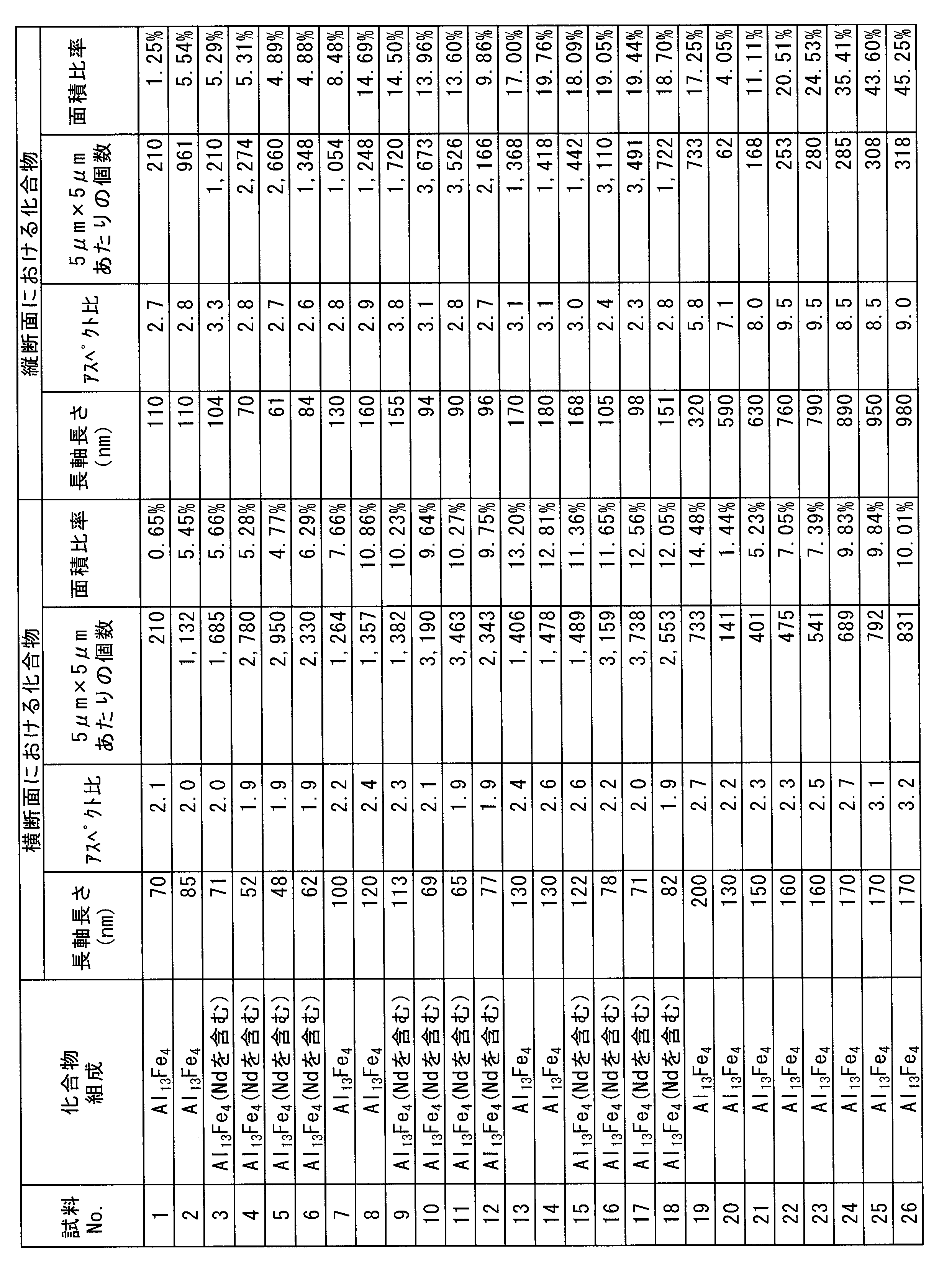
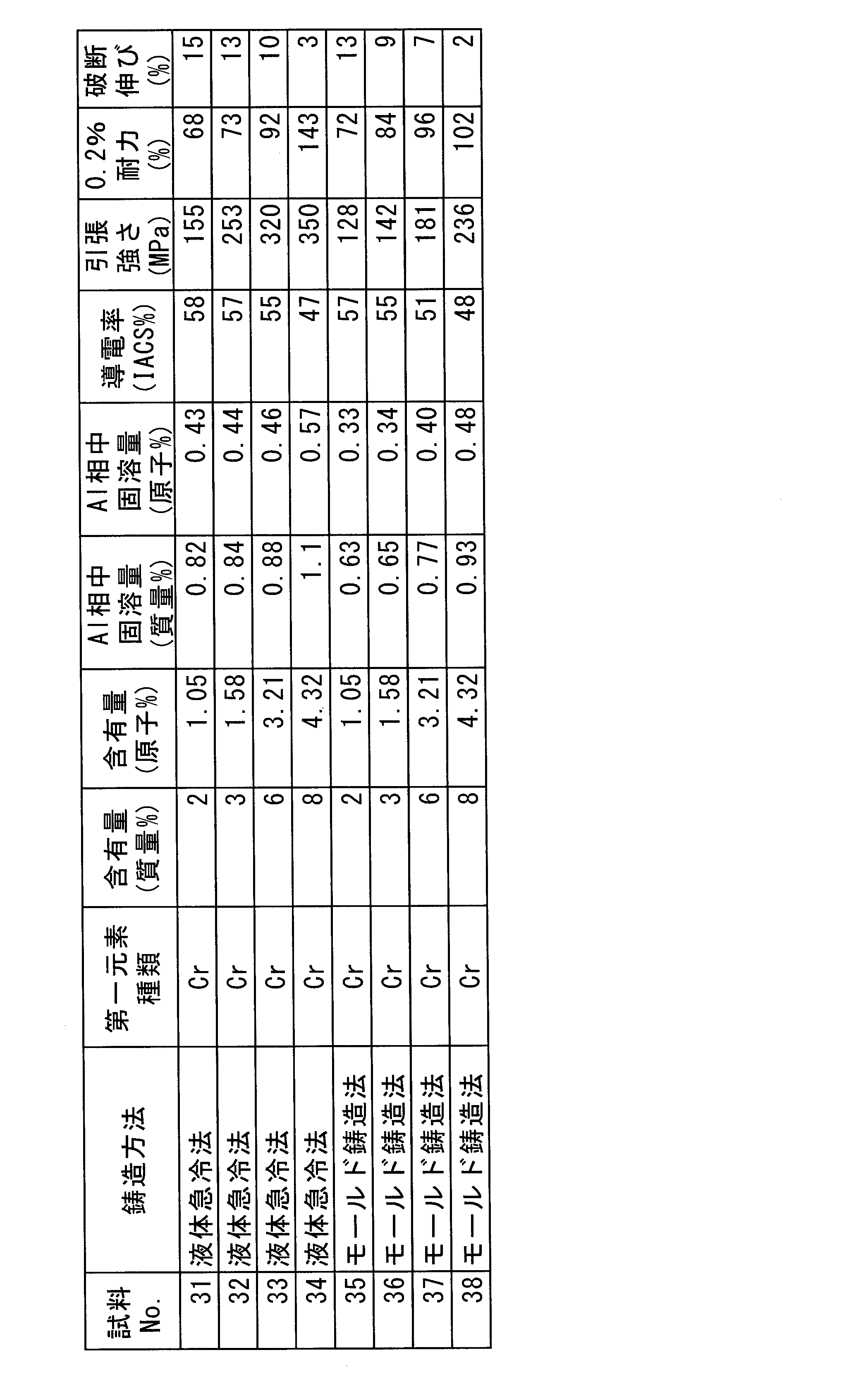
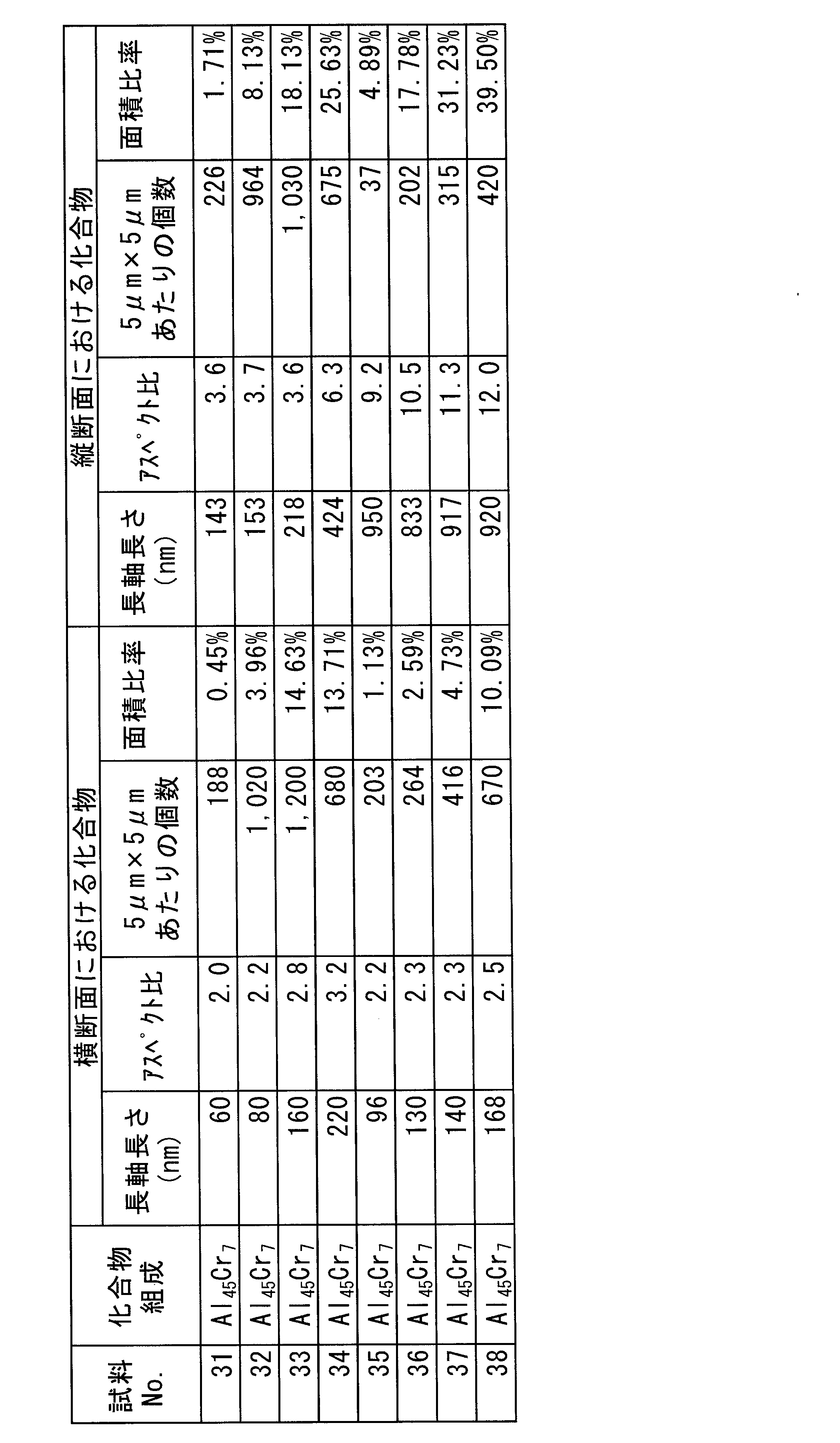


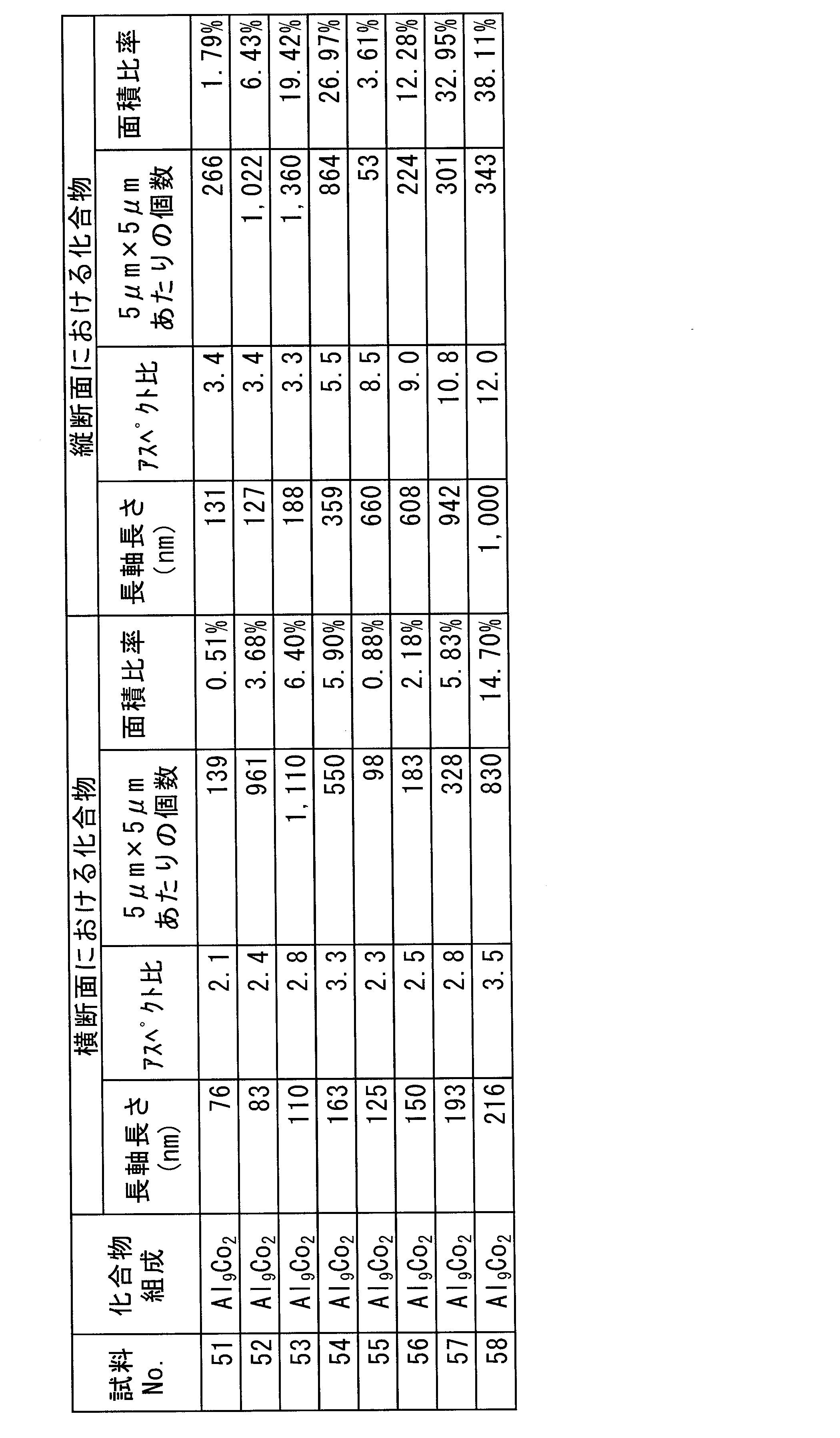

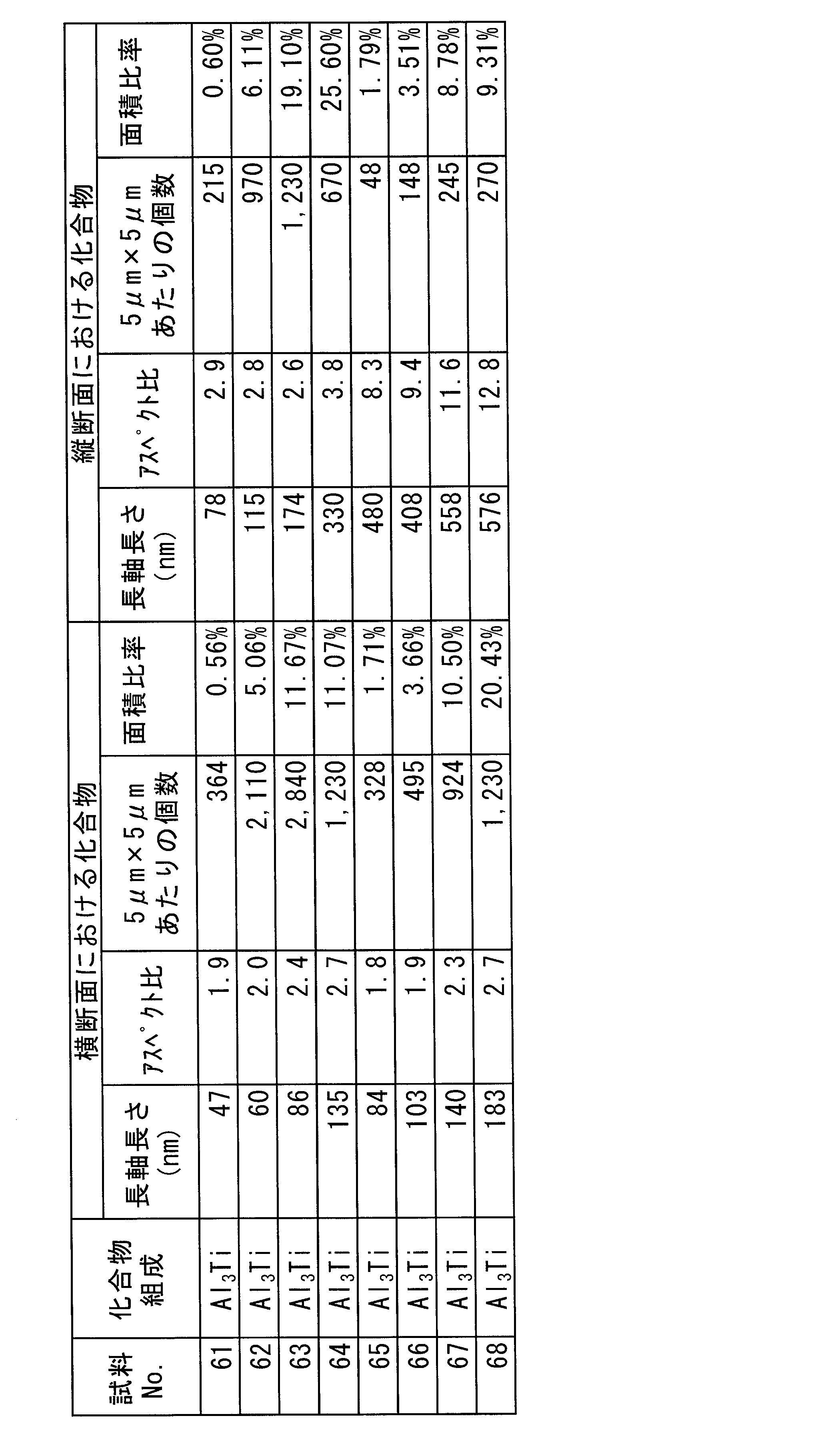

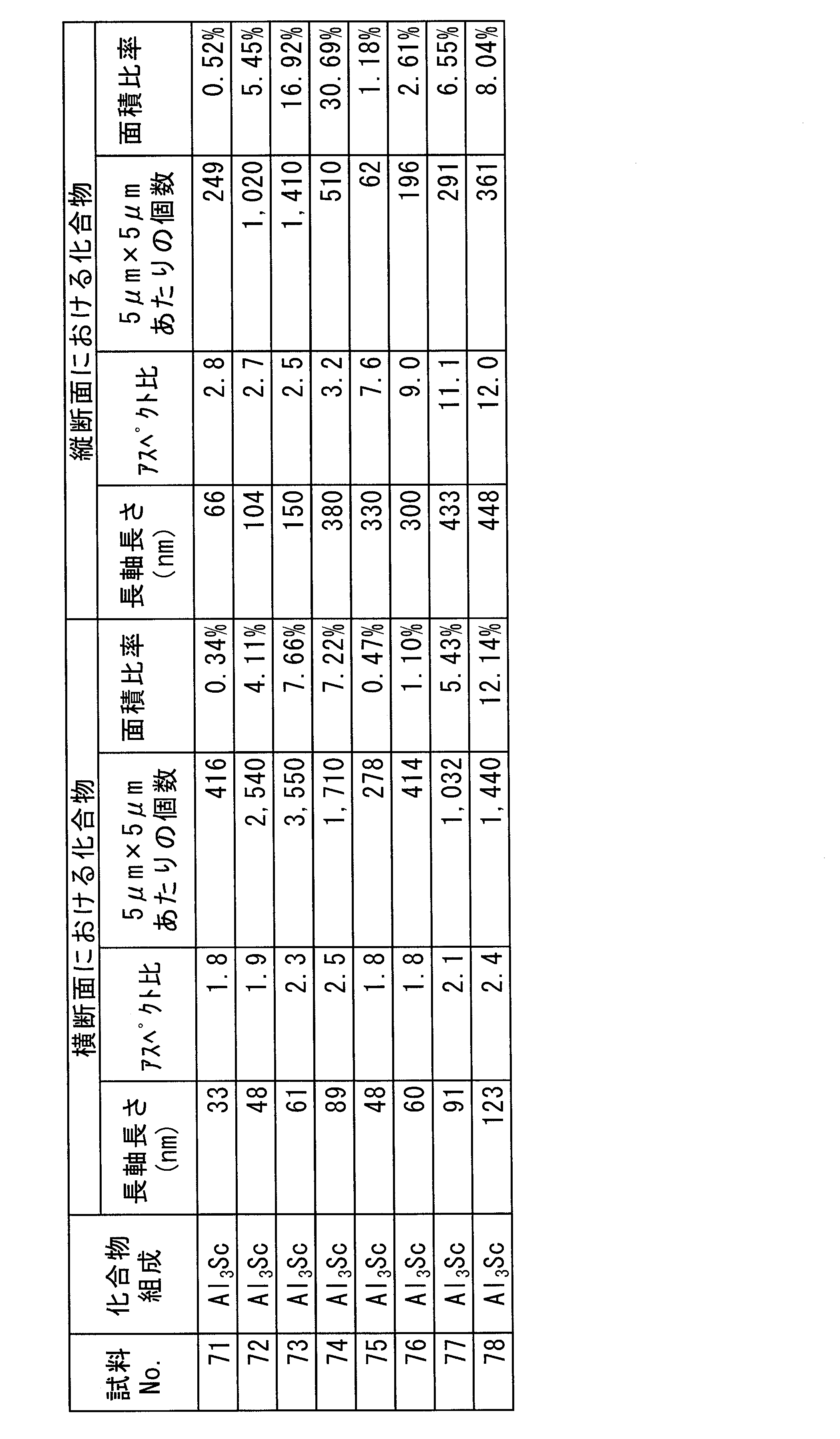
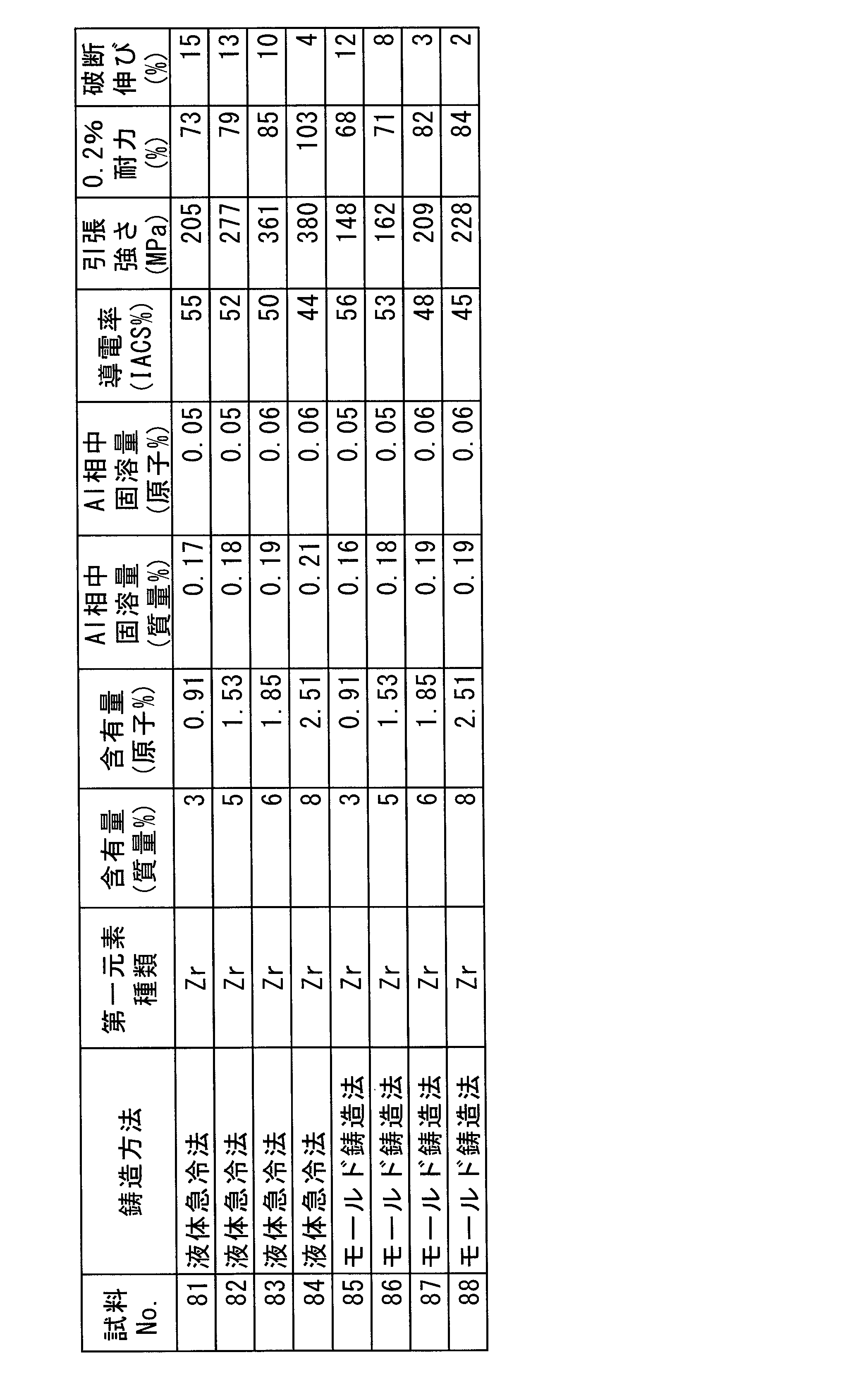
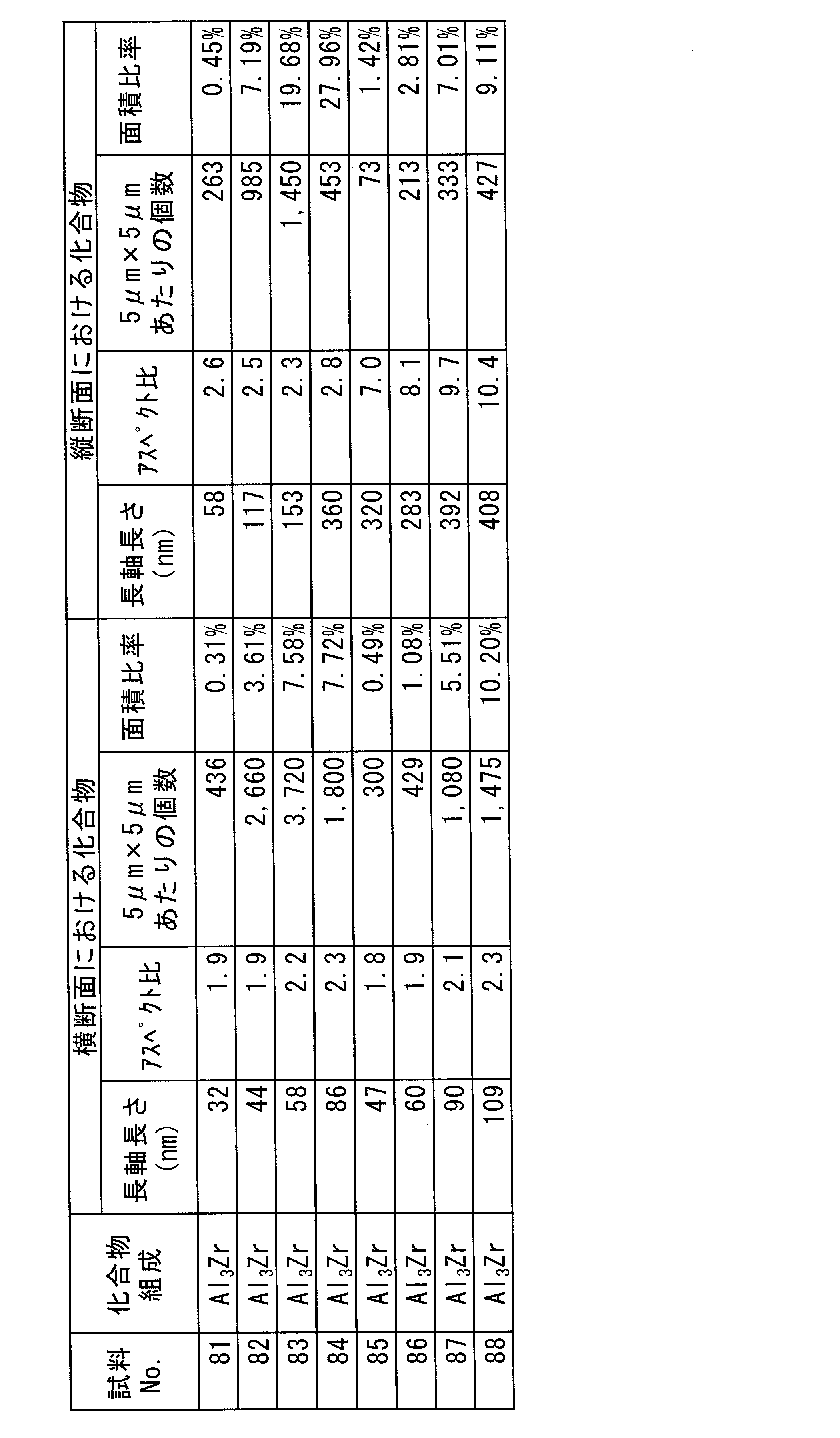

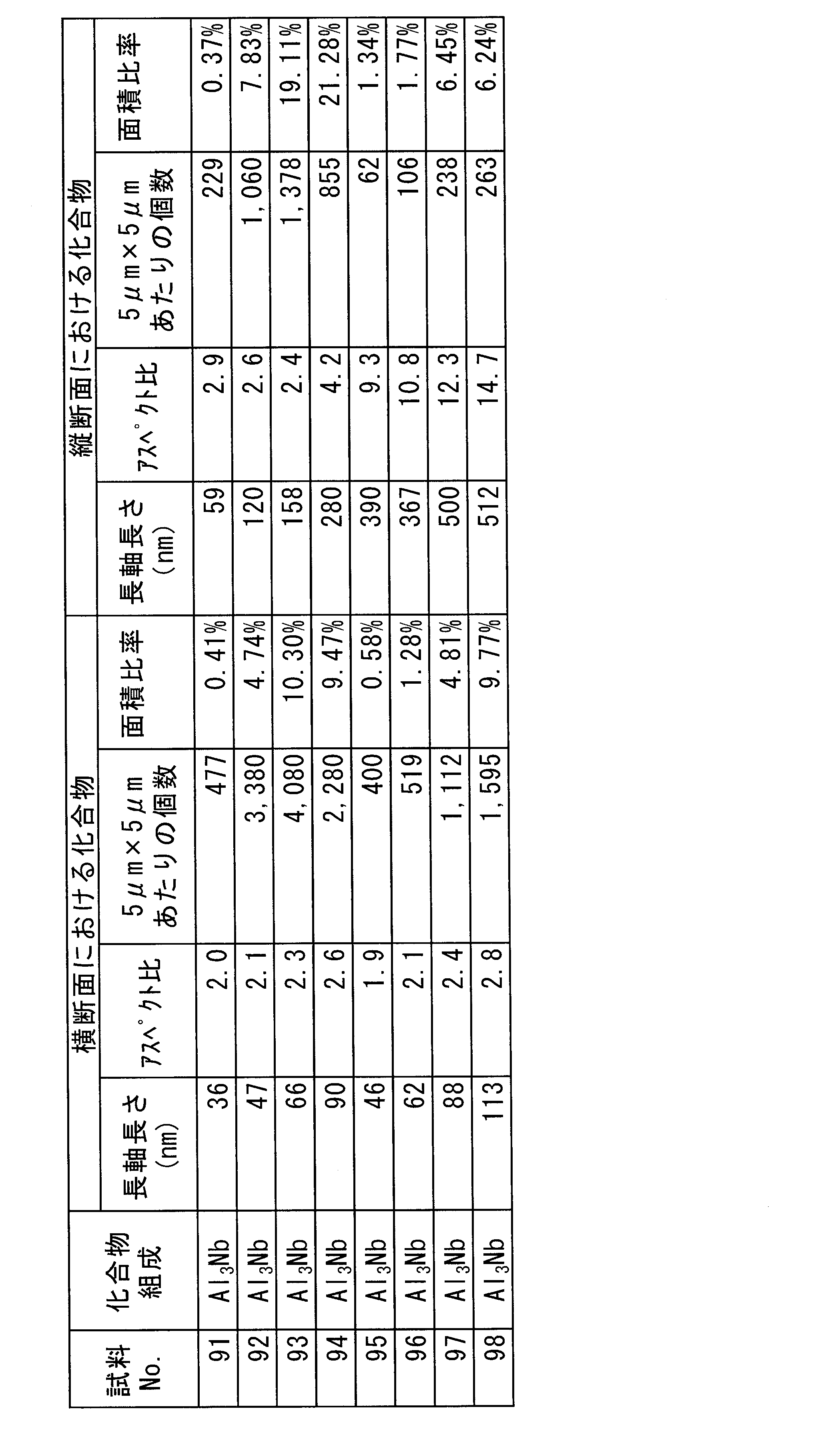


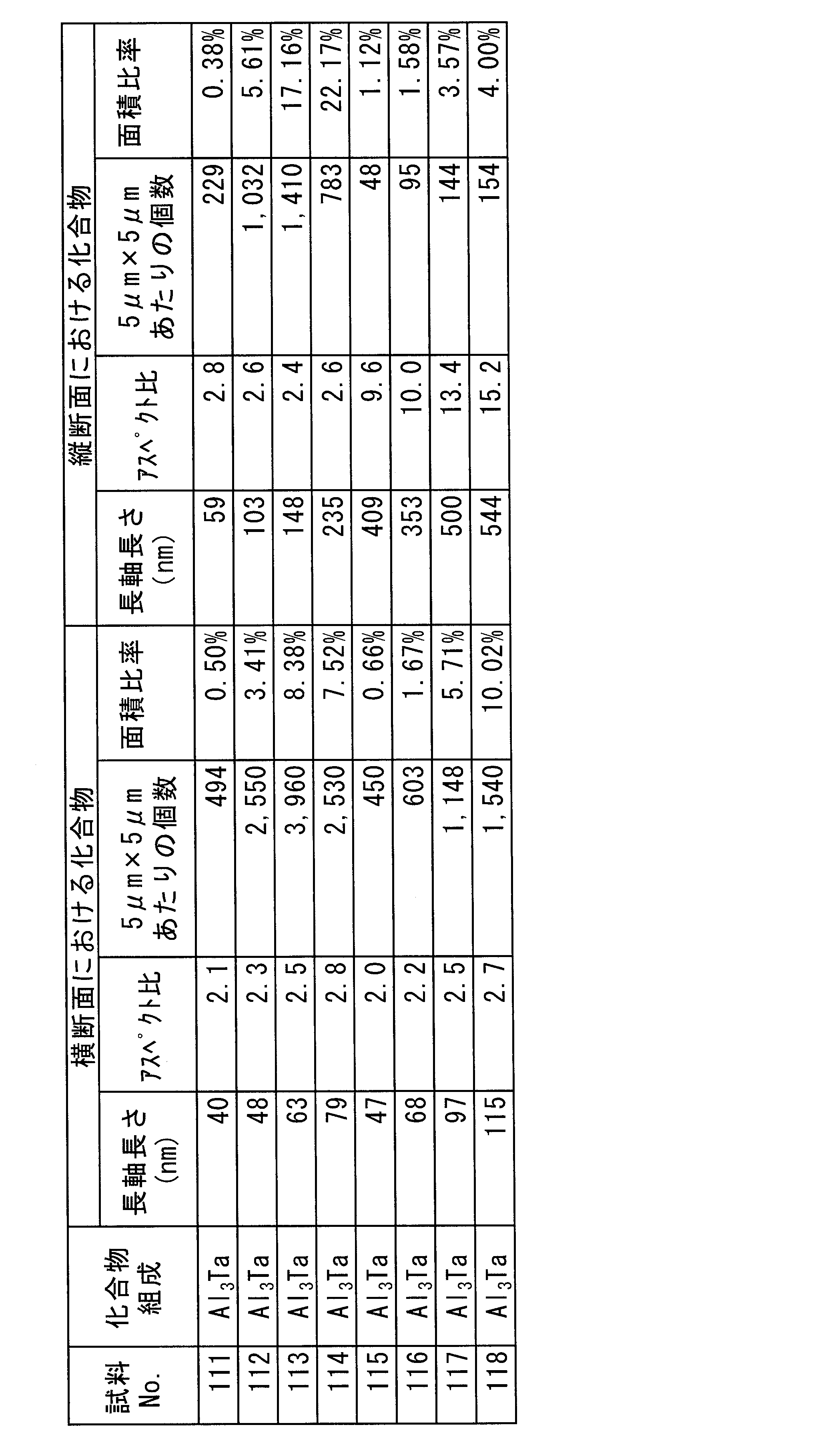
以下、特に断りが無い限り、第一元素が同じ試料同士を比較する。
(組成と強度及び導電率)
表1~表20のうち、奇数番号の表に示すように、急冷法の試料群において、第一元素の含有量が最も少ない試料(No.1,No.31等)及び第一元素の含有量が最も多い試料(No.19,No.34等)と、これらの以外の試料群(No.32~No.33,No.42~No.43等)とを比較する。Feを含む試料については、Ndを含んでいない試料群(No.2,No.7,No.8,No.13,No.14)を比較する。上記試料群のAl合金線は、第一元素の含有量が最少の試料よりも引張強さが高く、強度に優れる。また、上記試料群のAl合金線は、第一元素の含有量が最多の試料よりも導電率が高く、導電性に優れる。
(組成と強度及び導電率)
表1~表20のうち、奇数番号の表に示すように、急冷法の試料群において、第一元素の含有量が最も少ない試料(No.1,No.31等)及び第一元素の含有量が最も多い試料(No.19,No.34等)と、これらの以外の試料群(No.32~No.33,No.42~No.43等)とを比較する。Feを含む試料については、Ndを含んでいない試料群(No.2,No.7,No.8,No.13,No.14)を比較する。上記試料群のAl合金線は、第一元素の含有量が最少の試料よりも引張強さが高く、強度に優れる。また、上記試料群のAl合金線は、第一元素の含有量が最多の試料よりも導電率が高く、導電性に優れる。
鋳造法の試料群において、第一元素の含有量が最も少ない試料(No.20,No.35等)及び第一元素の含有量が最も多い試料(No.26,No.38等)と、これらの以外の試料群(No.21~No.25,No.36~No.37等)とを比較する。上記試料群のAl合金線は、第一元素の含有量が最少の試料よりも引張強さが高く、強度に優れると共に、第一元素の含有量が最多の試料よりも導電率が高く、導電性に優れる。
上記試料群のAl合金線が高強度である理由の一つとして、第一元素が最少の試料よりも第一元素を多く含むことが考えられる。例えば、Feを含む試料群のAl合金線では、Feを2質量%超、ここでは3質量%以上含む。また、上記試料群のAl合金線は、上述のSEM観察にあるように第一元素等がAlとの化合物として存在するためと考えられる。第一元素がある程度多いことで、上記化合物の分散強化による強度の向上効果を得易いと考えられる。
上記試料群のAl合金線が高導電性である理由の一つとして、第一元素が最多の試料よりも第一元素が少ないことが考えられる。例えば、Feを含む試料群のAl合金線では、12質量%未満、ここでは10質量%以下(5.1原子%以下)の範囲でFeを含む。また、上記試料群のAl合金線は、上述のように第一元素等が上記化合物として存在するためと考えられる。第一元素が多過ぎず、かつ上記化合物として存在すれば、母相中の第一元素の固溶量を低減して母相中のAl純度を高められると考えられる。また、上記化合物が多過ぎず、上記化合物が母相の導電パスを妨げ難いと考えられる。これらのことから、導電性に優れると考えられる。
(組織と強度及び導電率)
以下、急冷法の試料群のAl合金線と、鋳造法の試料群のAl合金線とについて、上述の第一元素の含有量が最少の試料及び最多の試料以外の試料群(No.32~No.33とNo.36~No.37等、以下、特定試料群と呼ぶ)に着目する。Feを含む試料については、Ndを含まない試料群(No.2,No.7,No.8,No.13,No.14とNo.21~No.25)を特定試料群とする。特定試料群では、第一元素の種類が同じ試料であって、第一元素の含有量が同じ試料同士で比較する。
以下、急冷法の試料群のAl合金線と、鋳造法の試料群のAl合金線とについて、上述の第一元素の含有量が最少の試料及び最多の試料以外の試料群(No.32~No.33とNo.36~No.37等、以下、特定試料群と呼ぶ)に着目する。Feを含む試料については、Ndを含まない試料群(No.2,No.7,No.8,No.13,No.14とNo.21~No.25)を特定試料群とする。特定試料群では、第一元素の種類が同じ試料であって、第一元素の含有量が同じ試料同士で比較する。
同じ組成であっても、急冷法の特定試料群のAl合金線と、鋳造法の特定試料群のAl合金線とでは、引張強さ及び導電率が異なる。急冷法の特定試料群のAl合金線は、鋳造法の特定試料群よりも引張強さが高い。急冷法の特定試料群のなかには、引張強さ及び導電率の双方が鋳造法の特定試料群よりも高い試料もある。定量的には、急冷法の特定試料群のAl合金線は、引張強さが250MPa以上、かつ導電率が50%IACS以上であり、高強度と高導電率とをバランスよく備える。この理由の一つとして、表1~表20のうち、偶数番号の表に示すように急冷法の特定試料群と鋳造法の特定試料群とは、Alと第一元素とを含む化合物の存在状態が異なることが考えられる。
〈化合物の大きさと形状〉
上記偶数番号の表の縦断面における化合物の欄に示すように、急冷法の特定試料群のAl合金線は、鋳造法の特定試料群よりも上記化合物からなる粒子の長軸長さが短い。詳しくは急冷法の特定試料群における上記化合物粒子の長軸長さは500nm以下である。ここでは上記長軸長さは350nm以下、更に220nm以下である。試料によっては、上記長軸長さは200nm以下である。また、急冷法の特定試料群における上記長軸長さは、鋳造法の特定試料群における長軸長さの1/2以下であり、1/3以下の試料も多く、非常に微細といえる。
上記偶数番号の表の縦断面における化合物の欄に示すように、急冷法の特定試料群のAl合金線は、鋳造法の特定試料群よりも上記化合物からなる粒子の長軸長さが短い。詳しくは急冷法の特定試料群における上記化合物粒子の長軸長さは500nm以下である。ここでは上記長軸長さは350nm以下、更に220nm以下である。試料によっては、上記長軸長さは200nm以下である。また、急冷法の特定試料群における上記長軸長さは、鋳造法の特定試料群における長軸長さの1/2以下であり、1/3以下の試料も多く、非常に微細といえる。
また、急冷法の特定試料群のAl合金線は、鋳造法の特定試料群よりも上記化合物からなる粒子のアスペクト比が小さい。詳しくは急冷法の特定試料群における上記化合物粒子のアスペクト比は5以下ある。ここでは上記アスペクト比は4以下であり、3.5以下、更に3.2以下、3.0以下の試料もある。また、急冷法の特定試料群における上記アスペクト比は、鋳造法の特定試料群におけるアスペクト比(7.6以上)の半分以下であり、1/3以下の試料も多い。そのため、急冷法の特定試料群の上記化合物粒子は、鋳造法の特定試料群よりも球状に近いといえる。
上記化合物粒子は、微細であったり、球状に近かったりすることで均一的に分散し易い。そのため、上述の急冷法の特定試料群のAl合金線は、以下の二つの効果を良好に得られると考えられる。
(効果1)上記化合物粒子の分散強化による強度の向上効果。
(効果2)母相への第一元素の固溶量の低減と上記化合物粒子による母相の導電パス阻害の低減とに基づく高い導電率の具備効果。
(効果1)上記化合物粒子の分散強化による強度の向上効果。
(効果2)母相への第一元素の固溶量の低減と上記化合物粒子による母相の導電パス阻害の低減とに基づく高い導電率の具備効果。
この試験では、上述の急冷法の特定試料群のAl合金線は、上記化合物粒子の長軸長さが500nm以下かつアスペクト比が5以下の双方を満たす。そのため、上記Al合金線は、上記化合物粒子が更に均一的に分散し易く、上述の強度の向上効果及び高い導電率の具備効果をより得易いと考えられる。
また、この試験では、上記偶数番号の表の横断面における化合物の欄に示すように、上述の急冷法の特定試料群のAl合金線は、横断面における上記化合物粒子の長軸長さが500nm以下かつアスペクト比が5以下の双方を満たす。ここでは、横断面における上記化合物粒子の長軸長さが160nm以下、更に150nm以下の試料も多く、より微細である。横断面における上記化合物粒子のアスペクト比は2.8以下であり、2.6以下の試料も多く、より球状に近い。
縦断面及び横断面の双方において、上記化合物粒子の長軸長さが500nm以下であれば、化合物粒子の大きさの異方性が小さく、任意の方向からみて微細な粒子といえる。縦断面における化合物粒子の長軸長さは、横断面における化合物粒子の長軸長さの2.8倍以下であり、2.5倍以下、更に2.0倍以下、1.5倍以下の試料もある。このことからも、上記異方性が小さいといえる。
縦断面及び横断面の双方において、上記化合物粒子のアスペクト比が5以下であれば、化合物粒子の形状の異方性が小さく、任意の方向からみて球状に近い粒子といえる。縦断面における化合物粒子のアスペクト比は、横断面における化合物粒子のアスペクト比の1.8倍以下であり、1.5倍以下の試料も多い。このことからも、上記異方性が小さいといえる。
このように任意の方向からみて上記化合物粒子の大きさの異方性、形状の異方性が小さいことに加えて、上記化合物粒子が微細で球状に近いことによってAl合金線の全体に亘って均一的に分散して存在し易い。そのため、上述の急冷法の特定試料群のAl合金線は、上述の強度の向上効果及び高い導電率の具備効果をより一層得易いと考えられる。
〈化合物の個数と面積〉
上記偶数番号の表に示すように、急冷法の特定試料群のAl合金線と鋳造法の特定試料群とは、縦断面及び横断面における単位面積当たり(ここでは5μm×5μm)の上記化合物粒子の個数及び上記化合物粒子の面積比率が異なる。
上記偶数番号の表に示すように、急冷法の特定試料群のAl合金線と鋳造法の特定試料群とは、縦断面及び横断面における単位面積当たり(ここでは5μm×5μm)の上記化合物粒子の個数及び上記化合物粒子の面積比率が異なる。
詳しくは、急冷法の特定試料群のAl合金線は、以下を満たす。
縦断面において上述の個数が950個以上1500個以下を満たすと共に、上述の面積比率が5%以上20%以下を満たす。ここでは上記個数は960個以上1480個以下である。
横断面において上述の個数が950個以上4500個以下を満たすと共に、上述の面積比率が2.5%以上20%以下を満たす。ここでは上記個数は960個以上4480個以下である。
縦断面において上述の個数が950個以上1500個以下を満たすと共に、上述の面積比率が5%以上20%以下を満たす。ここでは上記個数は960個以上1480個以下である。
横断面において上述の個数が950個以上4500個以下を満たすと共に、上述の面積比率が2.5%以上20%以下を満たす。ここでは上記個数は960個以上4480個以下である。
このような急冷法の特定試料群のAl合金線は、任意の方向からみて化合物粒子の存在量が類似しており、化合物粒子の存在状態の異方性が小さいといえる。更に、上記個数と上記面積比率とが上記範囲を満たすことで、一つの化合物粒子の面積が小さく、微細であるといえる。このことは、上述の長軸長さが500nm以下と短いことからも裏付けられる。
これらのことから、急冷法の特定試料群のAl合金線は、第一元素を含む化合物の量が適切である上に、線全体に亘って万遍無く均一的に、微細な上記化合物粒子が存在するといえる。そのため、急冷法の特定試料群のAl合金線は、上述の(効果1)及び(効果2)を良好に得られると考えられる。
これに対し、鋳造法の特定試料群のAl合金線は、特に縦断面における上記面積比率と横断面における上記面積比率とが大きく異なる。そのため、化合物粒子の存在状態の異方性が大きいといえる。特に、縦断面における個数が少ない上に、面積比率が大きい又は急冷法の特定試料群と同程度である。そのため、一つの化合物粒子の面積が大きく、粗大な粒子であるといえる。このことは、鋳造法の特定試料群における上記長軸長さが急冷法の特定試料群よりも長いことからも裏付けられる。また、鋳造法の特定試料群のAl合金線では、上記長軸長さが500nmを超える試料があることからも裏付けられる。鋳造法の特定試料群において化合物粒子が長い理由の一つとして、上述の鋳造時に第一元素の少なくとも一部が析出し、この第一元素を含む析出物が存在する鋳造材を伸線素材に用いたことが考えられる。伸線時に上記析出物が引き伸ばされて、上記長軸長さが長くなったと考えられる。
この試験では、急冷法の特定試料群のAl合金線は、縦断面及び横断面において、単位面積当たり(ここでは5μm×5μm)の上記化合物粒子の個数及び上記化合物粒子の面積比率が上述の範囲を満たすと共に、上記化合物粒子の長軸長さが500nm以下かつアスペクト比が5以下の双方を満たす。急冷法の特定試料群のAl合金線は、このように上記化合物粒子について、大きさの異方性、形状の異方性、かつ存在状態の異方性が小さいことに加えて、Al合金線の全体に亘って、微細で球状に近い上記化合物粒子が均一的に分散する。そのため、上述の高い引張強さと高い導電率とをより有し易いと考えられる。特に、第一元素が主として上記化合物粒子として存在し、この化合物粒子がある程度多く存在するものの上述のように微細であることで母相の導電パスを阻害し難いと考えられる。また、母相中の第一元素の含有量が0.55原子%未満と少なく、母相のAlの純度を高められたと考えられる。これらのことから、導電性をより高められたと考えられる。
鋳造法の特定試料群のAl合金線では、母相中の第一元素の含有量が急冷法の特定試料群と同等又はそれ以下である。しかし、鋳造法の特定試料群のAl合金線では、導電性が低い化合物粒子が線材の軸方向に引き伸ばされて、軸方向に連続して存在することで、母相の導電パスを阻害し易くなり、導電率が低いと考えられる。
〈第一元素の種類による比較〉
その他、この試験では、急冷法の特定試料群のAl合金線について、第一元素が異なる試料同士で比較すると、以下のことがいえる。
(1)第一元素がFe,Crであると、横断面及び縦断面の双方において、Alと第一元素とを含む化合物粒子の大きさ、形状、個数、面積比率が概ね等しい。そのため、化合物粒子の大きさ等に関する異方性がより小さい。
(2)第一元素がFe,Cr,Ni,Co,Ti,Sc,Hfであると、導電性により優れる。例えば、55%IACS以上という高い導電率を有する試料がある。更に、55%IACS以上という高い導電率と、280MPa以上、更に300MPa以上という高い引張強さとを有する試料がある。
(3)第一元素がTi,Sc,Zr,Nb,Hf,Taであると、Alと第一元素とを含む化合物粒子がより微細になり易い。このことは、例えば第一元素がFeやCrである場合に比較して、横断面における化合物粒子の面積比率が同等程度である場合に個数がより多いことから裏付けられる。
その他、この試験では、急冷法の特定試料群のAl合金線について、第一元素が異なる試料同士で比較すると、以下のことがいえる。
(1)第一元素がFe,Crであると、横断面及び縦断面の双方において、Alと第一元素とを含む化合物粒子の大きさ、形状、個数、面積比率が概ね等しい。そのため、化合物粒子の大きさ等に関する異方性がより小さい。
(2)第一元素がFe,Cr,Ni,Co,Ti,Sc,Hfであると、導電性により優れる。例えば、55%IACS以上という高い導電率を有する試料がある。更に、55%IACS以上という高い導電率と、280MPa以上、更に300MPa以上という高い引張強さとを有する試料がある。
(3)第一元素がTi,Sc,Zr,Nb,Hf,Taであると、Alと第一元素とを含む化合物粒子がより微細になり易い。このことは、例えば第一元素がFeやCrである場合に比較して、横断面における化合物粒子の面積比率が同等程度である場合に個数がより多いことから裏付けられる。
〈第二元素の含有〉
以下、表1,表2を参照し、第一元素がFeである試料に着目する。
Feを含み、Ndを含まない試料No.2,No.8,No.14と、Fe及びNdを含む試料No.3~No.6,No.9~No.12,No.15~No.18とについて、Feの含有量が同じ試料同士を比較する。この比較から、Ndを含む試料群は、引張強さがより高い傾向にあることが分かる。Ndの含有量が最も少ない試料(No.3,No.9,No.15)及びNdの含有量が最も多い試料(No.6,No.12,No.18)と、これら以外の試料群(No.4,No.5,No.10,No.11,No.16,No.17)とを比較する。この比較から、上記試料群のAl合金線は、引張強さが345MPa以上であり、強度がより高いといえる。上記試料群では、Feの含有量が多いほど、引張強さが高く、370MPa以上、更に400MPa以上である試料がある。また、上記試料群のAl合金線は、導電率が50%IACS以上であり、導電性にも優れる。
以下、表1,表2を参照し、第一元素がFeである試料に着目する。
Feを含み、Ndを含まない試料No.2,No.8,No.14と、Fe及びNdを含む試料No.3~No.6,No.9~No.12,No.15~No.18とについて、Feの含有量が同じ試料同士を比較する。この比較から、Ndを含む試料群は、引張強さがより高い傾向にあることが分かる。Ndの含有量が最も少ない試料(No.3,No.9,No.15)及びNdの含有量が最も多い試料(No.6,No.12,No.18)と、これら以外の試料群(No.4,No.5,No.10,No.11,No.16,No.17)とを比較する。この比較から、上記試料群のAl合金線は、引張強さが345MPa以上であり、強度がより高いといえる。上記試料群では、Feの含有量が多いほど、引張強さが高く、370MPa以上、更に400MPa以上である試料がある。また、上記試料群のAl合金線は、導電率が50%IACS以上であり、導電性にも優れる。
Ndを含む上述の試料群が高い導電率を有しつつ、強度により優れる理由の一つとして、AlとFeとNdとを含む化合物がより小さいことが考えられる。また、上記化合物からなる粒子の個数がより多いことが考えられる。更に、母相に対するFeの固溶量がより少ないことが考えられる。
詳しくは、上記試料群のAl合金線では、縦断面及び横断面の双方において、化合物粒子の長軸長さが105nm以下であり、100nm未満の試料も多い。即ち、Fe及びNdを含む場合の上記長軸長さは、Feを含み、Ndを含まない場合よりも小さい。また、上記試料群のAl合金線では、縦断面及び横断面の双方において、化合物粒子のアスペクト比が3.3未満である。このような上記試料群のAl合金線では、上記化合物粒子がより微細で、球状により近いといえる。
更に、上記試料群のAl合金線では、縦断面及び横断面の双方において化合物粒子の個数が2200個以上3800個以下を満たし、かつ面積比率が4.5%以上20%以下を満たす。このことからも、上記試料群のAl合金線では、上記化合物粒子が微細であるといえる。従って、上記試料群のAl合金線は、非常に微細な化合物粒子が母相により均一的に分散し易いといえる。
その上、上記試料群のAl合金線は、母相に対するFeの固溶量が0.28原子%未満である。このような上記試料群のAl合金線は、上述の(効果1)及び(効果2)をより一層良好に得られると考えられる。
〈その他の機械的特性〉
急冷法の試料群において、上述の第一元素の含有量が最少の試料及び最多の試料と、これらの以外の試料群(特定試料群)とを比較する。Ndを含む試料については、上述のNdの含有量が最少の試料及び最多の試料と、これらの以外の試料群(特定試料群と呼ぶ)とを比較する。表1~表20のうち、奇数番号の表に示すように急冷法の特定試料群のAl合金線は、0.2%耐力や破断伸びも高い。詳しくは、0.2%耐力が50MPa以上、更に65MPa以上である。このことからも急冷法の特定試料群のAl合金線は、強度に優れる。また、急冷法の特定試料群のAl合金線では、多くの試料の破断伸びが10%以上、更には12%以上である。400MPa以上というより高い引張強さを有する試料No.16,No.17でも、7%以上という高い破断伸びを有する。このことから、急冷法の特定試料群のAl合金線は、高強度でありながら靭性にも優れ、曲げや繰り返しの屈曲等が行い易いといえる。更に、急冷法の特定試料群のAl合金線では、0.2%耐力が高過ぎず、ここでは100MPa以下であり、90MPa以下の試料も多い。このことからも、上記Al合金線は、曲げや繰り返しの屈曲等が行い易いといえる。
急冷法の試料群において、上述の第一元素の含有量が最少の試料及び最多の試料と、これらの以外の試料群(特定試料群)とを比較する。Ndを含む試料については、上述のNdの含有量が最少の試料及び最多の試料と、これらの以外の試料群(特定試料群と呼ぶ)とを比較する。表1~表20のうち、奇数番号の表に示すように急冷法の特定試料群のAl合金線は、0.2%耐力や破断伸びも高い。詳しくは、0.2%耐力が50MPa以上、更に65MPa以上である。このことからも急冷法の特定試料群のAl合金線は、強度に優れる。また、急冷法の特定試料群のAl合金線では、多くの試料の破断伸びが10%以上、更には12%以上である。400MPa以上というより高い引張強さを有する試料No.16,No.17でも、7%以上という高い破断伸びを有する。このことから、急冷法の特定試料群のAl合金線は、高強度でありながら靭性にも優れ、曲げや繰り返しの屈曲等が行い易いといえる。更に、急冷法の特定試料群のAl合金線では、0.2%耐力が高過ぎず、ここでは100MPa以下であり、90MPa以下の試料も多い。このことからも、上記Al合金線は、曲げや繰り返しの屈曲等が行い易いといえる。
〈まとめ〉
以上のことから、第一元素を合計で1.4原子%超5.1原子%以下含むAl基合金からなり、高い引張強さと高い導電率とをバランスよく備えるAl合金線が示された。特に、高強度で導電性に優れるAl合金線は、第一元素が実質的に化合物粒子として母相に分散して存在する組織を有すること、好ましくは微細で球状に近い化合物粒子が均一的に分散して存在する組織を有することが示された。
以上のことから、第一元素を合計で1.4原子%超5.1原子%以下含むAl基合金からなり、高い引張強さと高い導電率とをバランスよく備えるAl合金線が示された。特に、高強度で導電性に優れるAl合金線は、第一元素が実質的に化合物粒子として母相に分散して存在する組織を有すること、好ましくは微細で球状に近い化合物粒子が均一的に分散して存在する組織を有することが示された。
第一元素がFeである場合、Feを上記範囲で含むと共に、Ndを0.006原子%超0.1原子%以下含むAl基合金からなるAl合金線は、更に高い引張強さを有し、強度により優れることが示された。また、このAl基合金線は、より微細で球状に近い化合物粒子が母相に分散する組織を有することが示された。
更に、このような高強度で高導電率を有するAl合金線は、第一元素等が実質的に析出していない状態で伸線加工を施し、伸線後に熱処理を施して第一元素等を析出させることで得られることが示された。特に、伸線加工に供する素材を製造する過程では、以下のことがいえる。
(1)溶湯の冷却速度を極めて速くして薄帯状等とすることで第一元素等が実質的に析出しない。
(2)上記薄帯等に第一元素等が実質的に析出しない条件で加工を行うことで、得られた加工材に伸線加工を良好に行える。
(3)第一元素の種類に応じて熱処理時の加熱温度を調整することで第一元素等を十分に析出できる。
(1)溶湯の冷却速度を極めて速くして薄帯状等とすることで第一元素等が実質的に析出しない。
(2)上記薄帯等に第一元素等が実質的に析出しない条件で加工を行うことで、得られた加工材に伸線加工を良好に行える。
(3)第一元素の種類に応じて熱処理時の加熱温度を調整することで第一元素等を十分に析出できる。
本発明はこれらの例示に限定されるものではなく、請求の範囲によって示され、請求の範囲と均等の意味及び範囲内での全ての変更が含まれることが意図される。
例えば、試験例1において、添加元素の含有量、線径、製造条件(湯温、鋳造時の冷却速度、押出条件、熱処理条件等)、伸線加工に供する素材の形態等を適宜変更できる。Al基合金の添加元素として複数種の第一元素を含んでもよい。
例えば、試験例1において、添加元素の含有量、線径、製造条件(湯温、鋳造時の冷却速度、押出条件、熱処理条件等)、伸線加工に供する素材の形態等を適宜変更できる。Al基合金の添加元素として複数種の第一元素を含んでもよい。
Claims (24)
- Fe,Cr,Ni,Co,Ti,Sc,Zr,Nb,Hf,及びTaからなる群より選択される少なくとも1種の金属元素を合計で1.4原子%超5.1原子%以下含有し、残部がAl及び不可避不純物からなる組成を有し、
引張強さが250MPa以上であり、
導電率が50%IACS以上である、
アルミニウム合金線。 - 前記金属元素は、Feである請求項1に記載のアルミニウム合金線。
- 前記金属元素は、Crであり、Crの含有量は、1.5原子%以上3.3原子%以下である請求項1に記載のアルミニウム合金線。
- 前記金属元素は、Niであり、Niの含有量は、1.6原子%以上2.4原子%以下である請求項1に記載のアルミニウム合金線。
- 前記金属元素は、Coであり、Coの含有量は、1.6原子%以上1.9原子%以下である請求項1に記載のアルミニウム合金線。
- 前記金属元素は、Tiであり、Tiの含有量は、1.7原子%以上4.1原子%以下である請求項1に記載のアルミニウム合金線。
- 前記金属元素は、Scであり、Scの含有量は、1.5原子%以上3.1原子%以下である請求項1に記載のアルミニウム合金線。
- 前記金属元素は、Zrであり、Zrの含有量は、1.5原子%以上1.9原子%以下である請求項1に記載のアルミニウム合金線。
- 前記金属元素は、Nbであり、Nbの含有量は、1.5原子%以上3.2原子%以下である請求項1に記載のアルミニウム合金線。
- 前記金属元素は、Hfであり、Hfの含有量は、1.6原子%以上4.6原子%以下である請求項1に記載のアルミニウム合金線。
- 前記金属元素は、Taであり、Taの含有量は、1.5原子%以上3.6原子%以下である請求項1に記載のアルミニウム合金線。
- Alを主体とする母相と、前記母相中に存在し、Alと前記金属元素とを含む化合物からなる化合物粒子とを含む組織を有し、
軸方向に沿った平面で切断した縦断面において、前記化合物粒子の長軸長さが500nm以下であること、及び前記化合物粒子のアスペクト比が5以下であることの少なくとも一方を満たす請求項1から請求項11のいずれか1項に記載のアルミニウム合金線。 - Alを主体とする母相と、前記母相中に存在し、Alと前記金属元素とを含む化合物からなる化合物粒子とを含む組織を有し、
軸方向に沿った平面で切断した縦断面、及び前記軸方向に直交する平面で切断した横断面の双方から一辺の長さが5μmである正方形の測定領域をとり、
前記縦断面の前記測定領域における前記化合物粒子の個数が950個以上1500個以下であり、前記縦断面の前記測定領域の面積に対する前記化合物粒子の合計面積の比率が5%以上20%以下であり、
前記横断面の前記測定領域における前記化合物粒子の個数が950個以上4500個以下であり、前記横断面の前記測定領域の面積に対する前記化合物粒子の合計面積の比率が2.5%以上20%以下である請求項1から請求項12のいずれか1項に記載のアルミニウム合金線。 - 前記母相中の前記金属元素の含有量が合計で0.55原子%未満である請求項12又は請求項13に記載のアルミニウム合金線。
- Feを1.4原子%超5.1原子%以下、Ndを0.006原子%超0.1原子%以下含有し、残部がAl及び不可避不純物からなる組成を有し、
引張強さが345MPa以上であり、
導電率が50%IACS以上である、
アルミニウム合金線。 - Alを主体とする母相と、前記母相中に存在し、AlとFeとNdとを含む化合物からなる化合物粒子とを含む組織を有し、
軸方向に沿った平面で切断した縦断面において、前記化合物粒子の長軸長さが105nm以下であること、及び前記化合物粒子のアスペクト比が3.3未満であることの少なくとも一方を満たす請求項15に記載のアルミニウム合金線。 - Alを主体とする母相と、前記母相中に存在し、AlとFeとNdとを含む化合物からなる化合物粒子とを含む組織を有し、
軸方向に沿った平面で切断した縦断面、及び前記軸方向に直交する平面で切断した横断面の双方から一辺の長さが5μmである正方形の測定領域をとり、各測定領域における前記化合物粒子の個数が2200個以上3800個以下であり、各測定領域の面積に対する前記化合物粒子の合計面積の比率が4.5%以上20%以下である請求項15又は請求項16に記載のアルミニウム合金線。 - 前記母相中のFeの含有量が0.28原子%未満である請求項16又は請求項17に記載のアルミニウム合金線。
- 0.2%耐力が50MPa以上である請求項1から請求項18のいずれか1項に記載のアルミニウム合金線。
- 0.2%耐力が100MPa以下であること、及び破断伸びが10%以上であることの少なくとも一方を満たす請求項1から請求項19のいずれか1項に記載のアルミニウム合金線。
- Fe,Cr,Ni,Co,Ti,Sc,Zr,Nb,Hf,及びTaからなる群より選択される少なくとも1種の金属元素を合計で1.4原子%超5.1原子%以下含有し、残部がAl及び不可避不純物からなる組成を有するアルミニウム基合金からなり、前記金属元素を固溶した第一の素材を製造する工程と、
前記第一の素材に前記金属元素の析出温度以下の条件で加工を施した第二の素材に伸線加工を施して、所定の線径の伸線材を製造する工程と、
前記伸線材に熱処理を施して、Alと前記金属元素とを含む化合物を析出させる工程とを備える、
アルミニウム合金線の製造方法。 - Feを1.4原子%超5.1原子%以下、Ndを0.006原子%超0.1原子%以下含有し、残部がAl及び不可避不純物からなる組成を有するアルミニウム基合金からなり、Fe及びNdを固溶した第一の素材を製造する工程と、
前記第一の素材にFe及びNdの析出温度以下の条件で加工を施した第二の素材に伸線加工を施して、所定の線径の伸線材を製造する工程と、
前記伸線材に熱処理を施して、AlとFeとNdとを含む化合物を析出させる工程とを備える、
アルミニウム合金線の製造方法。 - 前記第一の素材を製造する工程では、前記アルミニウム基合金からなる溶湯を急冷して、薄帯状又は粉末状の前記第一の素材を製造する請求項21又は請求項22に記載のアルミニウム合金線の製造方法。
- 前記伸線材に熱処理を施す工程の加熱温度は、300℃以上である請求項21から請求項23のいずれか1項に記載のアルミニウム合金線の製造方法。
Priority Applications (4)
| Application Number | Priority Date | Filing Date | Title |
|---|---|---|---|
| US16/958,001 US20200362441A1 (en) | 2018-01-05 | 2018-12-21 | Aluminum alloy wire and method for producing aluminum alloy wire |
| CN201880085326.5A CN111556902B (zh) | 2018-01-05 | 2018-12-21 | 铝合金线及铝合金线的制造方法 |
| EP18898401.7A EP3736352A4 (en) | 2018-01-05 | 2018-12-21 | ALUMINUM ALLOY WIRE, AND METHOD OF MANUFACTURING THE SAME |
| JP2019563969A JP7205803B2 (ja) | 2018-01-05 | 2018-12-21 | アルミニウム合金線、及びアルミニウム合金線の製造方法 |
Applications Claiming Priority (2)
| Application Number | Priority Date | Filing Date | Title |
|---|---|---|---|
| JP2018000768 | 2018-01-05 | ||
| JP2018-000768 | 2018-01-05 |
Publications (1)
| Publication Number | Publication Date |
|---|---|
| WO2019135372A1 true WO2019135372A1 (ja) | 2019-07-11 |
Family
ID=67143631
Family Applications (1)
| Application Number | Title | Priority Date | Filing Date |
|---|---|---|---|
| PCT/JP2018/047383 Ceased WO2019135372A1 (ja) | 2018-01-05 | 2018-12-21 | アルミニウム合金線、及びアルミニウム合金線の製造方法 |
Country Status (5)
| Country | Link |
|---|---|
| US (1) | US20200362441A1 (ja) |
| EP (1) | EP3736352A4 (ja) |
| JP (1) | JP7205803B2 (ja) |
| CN (2) | CN111556902B (ja) |
| WO (1) | WO2019135372A1 (ja) |
Cited By (2)
| Publication number | Priority date | Publication date | Assignee | Title |
|---|---|---|---|---|
| WO2020170589A1 (ja) * | 2019-02-20 | 2020-08-27 | 住友電気工業株式会社 | アルミニウム合金材 |
| CN111945088A (zh) * | 2020-08-14 | 2020-11-17 | 福建祥鑫股份有限公司 | 一种低合金化Al-Mg-Si合金的热处理方法 |
Families Citing this family (3)
| Publication number | Priority date | Publication date | Assignee | Title |
|---|---|---|---|---|
| EP3933060A4 (en) * | 2019-05-29 | 2022-05-11 | Sumitomo Electric Industries, Ltd. | Aluminum alloy, aluminum alloy wire, and method for manufacturing aluminum alloy |
| KR20220033650A (ko) * | 2020-09-09 | 2022-03-17 | 삼성디스플레이 주식회사 | 반사 전극 및 이를 포함하는 표시 장치 |
| CN113832372B (zh) * | 2021-08-19 | 2022-10-21 | 马鞍山市申马机械制造有限公司 | 一种合金粉末及其制备方法和应用以及应用方法 |
Citations (7)
| Publication number | Priority date | Publication date | Assignee | Title |
|---|---|---|---|---|
| JPS60247443A (ja) * | 1984-05-21 | 1985-12-07 | Sumitomo Electric Ind Ltd | アルミ合金細線の製造方法 |
| JPH06184712A (ja) * | 1992-12-22 | 1994-07-05 | Toyota Motor Corp | 高強度アルミニウム合金の製造方法 |
| JPH06235040A (ja) * | 1992-12-17 | 1994-08-23 | Yoshida Kogyo Kk <Ykk> | 高強度、耐熱性アルミニウム合金及びその集成固化材並びにその製造方法 |
| JP2010067591A (ja) | 2008-08-11 | 2010-03-25 | Sumitomo Electric Ind Ltd | アルミニウム合金線 |
| JP2014194078A (ja) * | 2013-02-28 | 2014-10-09 | Daiden Co Ltd | アルミニウム合金導体及びそれを用いた電線 |
| JP2018000768A (ja) | 2016-07-07 | 2018-01-11 | 株式会社バンダイナムコエンターテインメント | プログラム及びサーバ |
| JP2018012869A (ja) * | 2016-07-21 | 2018-01-25 | 日本軽金属株式会社 | アルミニウム合金の導電線、およびアルミニウム合金の導電部材の製造方法 |
Family Cites Families (6)
| Publication number | Priority date | Publication date | Assignee | Title |
|---|---|---|---|---|
| EG10355A (en) * | 1970-07-13 | 1976-05-31 | Southwire Co | Aluminum alloy used for electrical conductors and other articles and method of making same |
| US5509978A (en) * | 1992-08-05 | 1996-04-23 | Yamaha Corporation | High strength and anti-corrosive aluminum-based alloy |
| US5858131A (en) * | 1994-11-02 | 1999-01-12 | Tsuyoshi Masumoto | High strength and high rigidity aluminum-based alloy and production method therefor |
| JP4777487B1 (ja) * | 2008-08-11 | 2011-09-21 | 住友電気工業株式会社 | アルミニウム合金線の製造方法 |
| CN102978457B (zh) * | 2012-11-09 | 2014-10-01 | 安徽欣意电缆有限公司 | Al-Fe-Nb-RE铝合金及其制备方法和电力电缆 |
| CN106555083B (zh) * | 2016-12-05 | 2018-03-20 | 合肥工业大学 | 一种全铝合金架空导线及其制备方法 |
-
2018
- 2018-12-21 CN CN201880085326.5A patent/CN111556902B/zh not_active Expired - Fee Related
- 2018-12-21 EP EP18898401.7A patent/EP3736352A4/en not_active Withdrawn
- 2018-12-21 WO PCT/JP2018/047383 patent/WO2019135372A1/ja not_active Ceased
- 2018-12-21 US US16/958,001 patent/US20200362441A1/en not_active Abandoned
- 2018-12-21 JP JP2019563969A patent/JP7205803B2/ja active Active
- 2018-12-21 CN CN202111010931.6A patent/CN113755720A/zh active Pending
Patent Citations (7)
| Publication number | Priority date | Publication date | Assignee | Title |
|---|---|---|---|---|
| JPS60247443A (ja) * | 1984-05-21 | 1985-12-07 | Sumitomo Electric Ind Ltd | アルミ合金細線の製造方法 |
| JPH06235040A (ja) * | 1992-12-17 | 1994-08-23 | Yoshida Kogyo Kk <Ykk> | 高強度、耐熱性アルミニウム合金及びその集成固化材並びにその製造方法 |
| JPH06184712A (ja) * | 1992-12-22 | 1994-07-05 | Toyota Motor Corp | 高強度アルミニウム合金の製造方法 |
| JP2010067591A (ja) | 2008-08-11 | 2010-03-25 | Sumitomo Electric Ind Ltd | アルミニウム合金線 |
| JP2014194078A (ja) * | 2013-02-28 | 2014-10-09 | Daiden Co Ltd | アルミニウム合金導体及びそれを用いた電線 |
| JP2018000768A (ja) | 2016-07-07 | 2018-01-11 | 株式会社バンダイナムコエンターテインメント | プログラム及びサーバ |
| JP2018012869A (ja) * | 2016-07-21 | 2018-01-25 | 日本軽金属株式会社 | アルミニウム合金の導電線、およびアルミニウム合金の導電部材の製造方法 |
Non-Patent Citations (1)
| Title |
|---|
| See also references of EP3736352A4 |
Cited By (5)
| Publication number | Priority date | Publication date | Assignee | Title |
|---|---|---|---|---|
| WO2020170589A1 (ja) * | 2019-02-20 | 2020-08-27 | 住友電気工業株式会社 | アルミニウム合金材 |
| JPWO2020170589A1 (ja) * | 2019-02-20 | 2021-11-11 | 住友電気工業株式会社 | アルミニウム合金材 |
| JP7100832B2 (ja) | 2019-02-20 | 2022-07-14 | 住友電気工業株式会社 | アルミニウム合金材 |
| CN111945088A (zh) * | 2020-08-14 | 2020-11-17 | 福建祥鑫股份有限公司 | 一种低合金化Al-Mg-Si合金的热处理方法 |
| CN111945088B (zh) * | 2020-08-14 | 2021-08-13 | 福建祥鑫股份有限公司 | 一种低合金化Al-Mg-Si合金的热处理方法 |
Also Published As
| Publication number | Publication date |
|---|---|
| EP3736352A1 (en) | 2020-11-11 |
| JP7205803B2 (ja) | 2023-01-17 |
| JPWO2019135372A1 (ja) | 2021-01-28 |
| EP3736352A4 (en) | 2020-12-02 |
| CN111556902B (zh) | 2021-11-05 |
| US20200362441A1 (en) | 2020-11-19 |
| CN111556902A (zh) | 2020-08-18 |
| CN113755720A (zh) | 2021-12-07 |
Similar Documents
| Publication | Publication Date | Title |
|---|---|---|
| JP7205803B2 (ja) | アルミニウム合金線、及びアルミニウム合金線の製造方法 | |
| CN109923227B (zh) | 铝合金线、铝合金绞合线、包覆电线以及带端子电线 | |
| CN104769140B (zh) | 铜合金及其制造方法 | |
| EP3086327A1 (en) | Aluminum electric wire for an automobile and a method for producing the same | |
| KR20190068916A (ko) | 하이엔트로피 합금 및 그 제조 방법 | |
| JP7158658B2 (ja) | アルミニウム合金、アルミニウム合金線、及びアルミニウム合金の製造方法 | |
| KR20190080878A (ko) | 알루미늄 합금선, 알루미늄 합금 연선, 피복 전선, 및 단자 부착 전선 | |
| Zhou et al. | Comparative study on the microstructural evolution and performance of Cu-5Ag wires during cold-drawing from powder metallurgy and cast states | |
| CN109790612B (zh) | 由铝基合金生产变形的半成品的方法 | |
| CN109906281B (zh) | 铝合金线、铝合金绞合线、包覆电线以及带端子电线 | |
| JP2018012869A (ja) | アルミニウム合金の導電線、およびアルミニウム合金の導電部材の製造方法 | |
| JP7100832B2 (ja) | アルミニウム合金材 | |
| CN117242198A (zh) | 铝合金、铝合金热加工材料及其制造方法 | |
| JP7068674B2 (ja) | アルミニウム合金材 | |
| EP3819392A1 (en) | Aluminum alloy material and method for manufacturing aluminum alloy material | |
| JP5308683B2 (ja) | ブロンズ法Nb3Sn超電導線材製造用NbまたはNb基合金棒、Nb3Sn超電導線材製造用前駆体およびその製造方法、並びにNb3Sn超電導線材 | |
| CN109906280B (zh) | 铝合金线、铝合金绞合线、包覆电线以及带端子电线 | |
| WO2022244315A1 (ja) | アルミニウム合金板、端子、端子付き電線、及びバスバ | |
| CN121938685A (zh) | 超细晶高塑性铜银合金绞线及其制备方法 |
Legal Events
| Date | Code | Title | Description |
|---|---|---|---|
| 121 | Ep: the epo has been informed by wipo that ep was designated in this application |
Ref document number: 18898401 Country of ref document: EP Kind code of ref document: A1 |
|
| ENP | Entry into the national phase |
Ref document number: 2019563969 Country of ref document: JP Kind code of ref document: A |
|
| NENP | Non-entry into the national phase |
Ref country code: DE |
|
| ENP | Entry into the national phase |
Ref document number: 2018898401 Country of ref document: EP Effective date: 20200805 |