WO2019137305A1 - 收发信息的方法、终端设备及网络设备 - Google Patents
收发信息的方法、终端设备及网络设备 Download PDFInfo
- Publication number
- WO2019137305A1 WO2019137305A1 PCT/CN2019/070364 CN2019070364W WO2019137305A1 WO 2019137305 A1 WO2019137305 A1 WO 2019137305A1 CN 2019070364 W CN2019070364 W CN 2019070364W WO 2019137305 A1 WO2019137305 A1 WO 2019137305A1
- Authority
- WO
- WIPO (PCT)
- Prior art keywords
- terminal device
- information
- uplink
- repetitions
- preamble
- Prior art date
- Legal status (The legal status is an assumption and is not a legal conclusion. Google has not performed a legal analysis and makes no representation as to the accuracy of the status listed.)
- Ceased
Links
Images




Classifications
-
- H—ELECTRICITY
- H04—ELECTRIC COMMUNICATION TECHNIQUE
- H04L—TRANSMISSION OF DIGITAL INFORMATION, e.g. TELEGRAPHIC COMMUNICATION
- H04L5/00—Arrangements affording multiple use of the transmission path
- H04L5/003—Arrangements for allocating sub-channels of the transmission path
- H04L5/0048—Allocation of pilot signals, i.e. of signals known to the receiver
-
- H—ELECTRICITY
- H04—ELECTRIC COMMUNICATION TECHNIQUE
- H04W—WIRELESS COMMUNICATION NETWORKS
- H04W76/00—Connection management
- H04W76/10—Connection setup
- H04W76/11—Allocation or use of connection identifiers
-
- H—ELECTRICITY
- H04—ELECTRIC COMMUNICATION TECHNIQUE
- H04L—TRANSMISSION OF DIGITAL INFORMATION, e.g. TELEGRAPHIC COMMUNICATION
- H04L1/00—Arrangements for detecting or preventing errors in the information received
- H04L1/12—Arrangements for detecting or preventing errors in the information received by using return channel
- H04L1/16—Arrangements for detecting or preventing errors in the information received by using return channel in which the return channel carries supervisory signals, e.g. repetition request signals
- H04L1/18—Automatic repetition systems, e.g. Van Duuren systems
- H04L1/1829—Arrangements specially adapted for the receiver end
- H04L1/1864—ARQ related signaling
-
- H—ELECTRICITY
- H04—ELECTRIC COMMUNICATION TECHNIQUE
- H04L—TRANSMISSION OF DIGITAL INFORMATION, e.g. TELEGRAPHIC COMMUNICATION
- H04L1/00—Arrangements for detecting or preventing errors in the information received
- H04L1/0001—Systems modifying transmission characteristics according to link quality, e.g. power backoff
- H04L1/0036—Systems modifying transmission characteristics according to link quality, e.g. power backoff arrangements specific to the receiver
- H04L1/0038—Blind format detection
-
- H—ELECTRICITY
- H04—ELECTRIC COMMUNICATION TECHNIQUE
- H04L—TRANSMISSION OF DIGITAL INFORMATION, e.g. TELEGRAPHIC COMMUNICATION
- H04L1/00—Arrangements for detecting or preventing errors in the information received
- H04L1/08—Arrangements for detecting or preventing errors in the information received by repeating transmission, e.g. Verdan system
-
- H—ELECTRICITY
- H04—ELECTRIC COMMUNICATION TECHNIQUE
- H04L—TRANSMISSION OF DIGITAL INFORMATION, e.g. TELEGRAPHIC COMMUNICATION
- H04L5/00—Arrangements affording multiple use of the transmission path
-
- H—ELECTRICITY
- H04—ELECTRIC COMMUNICATION TECHNIQUE
- H04W—WIRELESS COMMUNICATION NETWORKS
- H04W24/00—Supervisory, monitoring or testing arrangements
- H04W24/10—Scheduling measurement reports ; Arrangements for measurement reports
-
- H—ELECTRICITY
- H04—ELECTRIC COMMUNICATION TECHNIQUE
- H04W—WIRELESS COMMUNICATION NETWORKS
- H04W4/00—Services specially adapted for wireless communication networks; Facilities therefor
- H04W4/06—Selective distribution of broadcast services, e.g. multimedia broadcast multicast service [MBMS]; Services to user groups; One-way selective calling services
-
- H—ELECTRICITY
- H04—ELECTRIC COMMUNICATION TECHNIQUE
- H04W—WIRELESS COMMUNICATION NETWORKS
- H04W4/00—Services specially adapted for wireless communication networks; Facilities therefor
- H04W4/12—Messaging; Mailboxes; Announcements
-
- H—ELECTRICITY
- H04—ELECTRIC COMMUNICATION TECHNIQUE
- H04W—WIRELESS COMMUNICATION NETWORKS
- H04W48/00—Access restriction; Network selection; Access point selection
- H04W48/08—Access restriction or access information delivery, e.g. discovery data delivery
- H04W48/10—Access restriction or access information delivery, e.g. discovery data delivery using broadcasted information
-
- H—ELECTRICITY
- H04—ELECTRIC COMMUNICATION TECHNIQUE
- H04W—WIRELESS COMMUNICATION NETWORKS
- H04W72/00—Local resource management
- H04W72/20—Control channels or signalling for resource management
- H04W72/23—Control channels or signalling for resource management in the downlink direction of a wireless link, i.e. towards a terminal
-
- H—ELECTRICITY
- H04—ELECTRIC COMMUNICATION TECHNIQUE
- H04W—WIRELESS COMMUNICATION NETWORKS
- H04W74/00—Wireless channel access
- H04W74/002—Transmission of channel access control information
- H04W74/004—Transmission of channel access control information in the uplink, i.e. towards network
-
- H—ELECTRICITY
- H04—ELECTRIC COMMUNICATION TECHNIQUE
- H04W—WIRELESS COMMUNICATION NETWORKS
- H04W74/00—Wireless channel access
- H04W74/08—Non-scheduled access, e.g. ALOHA
- H04W74/0833—Random access procedures, e.g. with 4-step access
-
- H—ELECTRICITY
- H04—ELECTRIC COMMUNICATION TECHNIQUE
- H04W—WIRELESS COMMUNICATION NETWORKS
- H04W74/00—Wireless channel access
- H04W74/002—Transmission of channel access control information
- H04W74/006—Transmission of channel access control information in the downlink, i.e. towards the terminal
Definitions
- the present disclosure relates to the field of communications technologies, and in particular, to a method for transmitting and receiving information, a terminal device, and a network device.
- the physical downlink shared channel (PDSCH) and the physical uplink shared channel (Physical Uplink Shared Channel, PUSCH) The repetition mechanism is introduced, that is, the data block corresponding to each PDSCH or PUSCH is repeatedly transmitted, and the number of repetitions may be 1, 2, 4 or 8 times.
- the transmission reliability is improved on the terminal side by combining and demodulating the received duplicate data.
- New Radio proposes to classify system information into two categories, one is minimum system information (minimum SI).
- mini SI minimum system information
- other SI other system information
- the minimum SI includes a Master Information Block (MIB) and Remaining Minimum SI (RMSI).
- MIB Master Information Block
- RMSI Remaining Minimum SI
- Other SI is divided into Common SI and Cell specific SI according to the effective range. The former is shared among several cell cells and needs to be consistent. The latter is in the range of one Cell.
- the minimum SI is sent to the terminal UE in a periodic broadcast manner.
- Other SI includes all system information except minimum SI.
- Other SI can contain multiple System Information Blocks (SIBs) like 4G and Long Term Evolution (LTE).
- SIBs System Information Blocks
- Other SI also known as On-demand SI, is requested by the UE to the base station based on the needs of the UE. It has been determined in the related art that the UE requests the on demand SI through the MSG1 or the MSG3 of the Random Access Channel (RACH) process, and can determine whether to send the MSG1 or the MSG3 according to the configuration of the base station or the type of the SI. SI request.
- the base station may send the on demand SI to the UE through the dedicated signal (Dedicated signaling), and may broadcast through the idle mode or the inactive state. The mode sends the corresponding on demand SI to the UE.
- Dedicated signaling dedicated signaling
- Both LTE and NR need to achieve multiple purposes by supporting the RACH process.
- the purpose of the NR by supporting the RACH process may be: supporting the initial idle state UE to connect to the network; radio resource control (RRC) reconstruction; handover; downlink data arrives but uplink is out of step; uplink data reaches but uplink loss Step; the UE moves from the inactive state to the active state; supports the uplink synchronization acquisition of the secondary cell; and the like.
- RRC radio resource control
- the RACH process can be divided into a competitive RACH process and a non-competitive RACH process.
- the competitive RACH process is divided into four steps of Message 1 to message 4, and the non-competitive RACH process is divided into two steps of message 1 and message 2.
- Both the contention of the RACH process and the message 2 in the non-contention RACH process are both transmitting RARs, and the UE listens to the RAR of the corresponding RA-RNTI in the RAR window.
- the content of the same preamble is sent by the UE in the same PRACH resource. Therefore, after receiving the message 2, the UE needs to send the message 3 according to the UL grant in the message2, and the UE carries the identifier of the UE on the message3.
- the contention timer timer is started simultaneously when message 3 is sent. If the message 4 sent by the base station is received before the contention timer expires, the UE is successfully resolved. The UE can determine whether it is a message4 according to the UE identifier carried in the message4, so as to determine whether the competition is successful.
- the repeated mechanism is introduced for the PDSCH and the PUSCH.
- the UE and the network side cannot clarify the repetition of the uplink information and the downlink information in the RACH process. frequency.
- a method of determining the number of repetitions of uplink and downlink information in a RACH process has not been disclosed.
- an embodiment of the present disclosure provides a method for transmitting and receiving information, which is applied to a terminal device, including:
- the uplink information is sent by using the repeated number of times, or uplink information is received and downlink information is received.
- an embodiment of the present disclosure provides a method for transmitting and receiving information, which is applied to a network device, and includes:
- downlink information and uplink information are transmitted according to the repetition number determined according to the RACH procedure of the terminal device.
- an embodiment of the present disclosure further provides a terminal device, including:
- a first determining module configured to determine a repetition quantity of an uplink channel or an uplink and downlink channel of the terminal device in the RACH process
- the first transceiver module is configured to send the uplink information by using the repeated number of times in the RACH process, or send the uplink information and receive the downlink information.
- the embodiment of the present disclosure further provides a network device, including:
- a sending module configured to send a broadcast message to the terminal device, where the broadcast message is used by the terminal device to determine the number of repetitions of the uplink channel or the uplink and downlink channels in the RACH process;
- a second determining module configured to determine, according to the RACH procedure of the terminal device, a repetition quantity of uplink and downlink channels of the terminal device in a RACH process
- a second transceiver module configured to send downlink information and receive uplink information according to a repetition quantity determined according to the RACH process of the terminal device in the RACH process.
- an embodiment of the present disclosure further provides a terminal device, including a memory, a processor, and a computer program stored on the memory and operable on the processor, wherein the computer program is The steps of the method for transmitting and receiving information described above when the processor executes.
- an embodiment of the present disclosure further provides a network device, including a memory, a processor, and a computer program stored on the memory and executable on the processor, wherein the computer program is The steps of the method for transmitting and receiving information described above when the processor executes.
- an embodiment of the present disclosure further provides a computer readable storage medium having stored thereon a computer program, wherein the computer program is executed by a processor to implement the steps of the method for transmitting and receiving information.
- FIG. 1 is a flowchart of a method for transmitting and receiving information according to an embodiment of the present disclosure
- FIG. 2 is a flowchart of another method for transmitting and receiving information according to an embodiment of the present disclosure
- FIG. 3 is a flowchart of another method for transmitting and receiving information according to an embodiment of the present disclosure
- FIG. 5 is a flowchart of another method for transmitting and receiving information according to an embodiment of the present disclosure
- FIG. 6 is a flowchart of another method for transmitting and receiving information according to an embodiment of the present disclosure.
- FIG. 7 is a schematic structural diagram of a terminal device according to an embodiment of the present disclosure.
- FIG. 8 is a second schematic structural diagram of a terminal device according to an embodiment of the present disclosure.
- FIG. 9 is a third schematic structural diagram of a terminal device according to an embodiment of the present disclosure.
- FIG. 10 is a fourth schematic structural diagram of a terminal device according to an embodiment of the present disclosure.
- FIG. 11 is a schematic structural diagram of a network device according to an embodiment of the present disclosure.
- FIG. 12 is a fifth schematic structural diagram of a terminal device according to an embodiment of the present disclosure.
- FIG. 13 is a second schematic structural diagram of a network device according to an embodiment of the present disclosure.
- an embodiment of the present disclosure provides a method for transmitting and receiving information, which is applied to a terminal device, and includes the following steps:
- Step 101 Determine the number of repetitions of the uplink channel or the uplink and downlink channels of the terminal device in the RACH process.
- the uplink channel of the terminal device may be a physical uplink shared channel (PUSCH), a physical uplink control channel (PUCCH), or the like.
- the downlink channel of the terminal device may be a Physical Downlink Shared Channel (PDSCH), a Physical Downlink Control Channel (PDCCH), or the like.
- the number of repetitions of the uplink channel or the downlink channel is, for example, 1, 2, 4 or 8 times.
- step 101 may include:
- Step 1011 Receive indication information sent by the network device.
- Step 1012 Determine, according to the indication information, the number of repetitions of the uplink channel or the uplink and downlink channels of the terminal device in the RACH process.
- the indication information may be used to indicate the number of repetitions of the uplink and downlink channels of the terminal device in the RACH process.
- the 2 bit indication information is used to indicate the PDSCH and PUSCH of the terminal device, and the number of repetitions of possible PUCCH and PDCCH in the future.
- the indication information may include first indication information and a second indication information, where the first indication information is used to indicate the number of repetitions of the uplink channel of the terminal device in the RACH process, and the second indication information is used to indicate the terminal device in the RACH process.
- the number of repetitions of the downlink channel For example, the number of repetitions of the PDSCH (or PDCCH) of the terminal device is indicated by the 2bit indication information, and the number of repetitions of the PUSCH (or PUCCH) of the terminal device is indicated by using the 2bit indication information, that is, each channel uses the Nbit indication information to indicate the corresponding number of repetitions. .
- the broadcast message may carry the identifier information of the terminal device or the identifier information of the group where the terminal device is located, and the corresponding terminal device determines the number of repetitions by using the indication information in the broadcast message.
- the broadcast message received by a UE carries the identifier information or the identifier information of the group in which the UE is located, the UE may use the indication information in the broadcast message to determine the corresponding number of repetitions.
- the indication information may be included in at least one of the following information of the broadcast message: the main system information block MIB, the system information block SIB1, the remaining minimum system information RMSI or Other system information OSI.
- Applicable scenarios of the embodiments of the present disclosure are, for example, 5G, eLTE, or other scenarios with similar configurations.
- Step 102 Send the uplink information by using the repetition quantity in the RACH process, or send the uplink information and receive the downlink information.
- the downlink information may be received by the same number of repetitions as the uplink channel, or the downlink information may be blindly detected.
- the uplink information may be an uplink control signal or uplink data
- the downlink information may be a downlink control signal or downlink data.
- the uplink information and the downlink information may correspond to msg.1, 2, 3, 4, 5 messages in the RACH procedure.
- the method for transmitting and receiving information in the embodiment of the present disclosure by determining the number of repetitions of the uplink channel or the uplink and downlink channels of the terminal device in the RACH process, using the repeated number of times to send uplink information, or sending uplink information and receiving downlink information, in the RACH process, Therefore, it is possible to determine how to determine the number of repetitions of uplink and downlink information in the RACH process.
- the indication information may be used to indicate the number of repetitions used by different preamble groups, in addition to the manner of indicating the number of repetitions. That is, the number of repetitions of the uplink channel or the uplink and downlink channels of the terminal device indicating the preamble in the preamble group A and the terminal device using the preamble in the preamble group B in the RACH procedure.
- the preamble for random access is grouped into a preamble group A (group A) and a preamble group B (group B).
- the group A and group B can respectively represent different path loss or channel conditions.
- the indication information when the indication information indicates the number of repetitions used by different preamble groups, separate coding or joint coding may be employed.
- the indication information may include third indication information and fourth indication information, where the third indication information is used to indicate an uplink and downlink channel of the terminal device that uses the preamble in the preamble group A in the RACH procedure.
- the number of repetitions is used to indicate the number of repetitions of the uplink and downlink channels of the terminal device using the preamble in the preamble group B in the RACH procedure.
- the third indication information may be 2 bit information, when it is 0, it corresponds to 1 & 1 times, when it is 1, it corresponds to 2 & 4 times;
- the fourth indication information may be 2 bit information, when it is 0, it corresponds to 2 & 2 times, when When it is 1, it corresponds to 4 & 8 times (where "&" precedes the number of repetitions of the uplink channel, and "&" corresponds to the number of repetitions of the downlink channel).
- the indication information may include fifth indication information, sixth indication information, seventh indication information, and eighth indication information, where the fifth indication information is used to indicate that the preamble group A is used in the RACH process.
- the number of repetitions of the uplink channel of the terminal device of the preamble is used to indicate the number of repetitions of the downlink channel of the terminal device using the preamble in the preamble group A in the RACH procedure
- the seventh indication information is used for Deriving the number of repetitions of the uplink channel of the terminal device using the preamble in the preamble group B in the RACH procedure
- the eighth indication information being used to indicate the downlink channel of the terminal device using the preamble in the preamble group B in the RACH procedure repeat times.
- the fifth, sixth, seventh, and eighth indication information may be 2 bits of information, respectively.
- the indication information may be used to indicate the number of repetitions of the uplink and downlink channels of the terminal device using the preamble in the preamble group A in the RACH procedure, and the terminal using the preamble in the preamble group B in the RACH procedure.
- the indication information may be 1, 2, 3 or 4 bit information.
- the indicated repetition number combination may be as follows: 1&1, 1&2, 2&2, 2&4, 2&8, 4&4, 4&8, and 8&8 (wherein “&” precedes the number of repetitions of the uplink and downlink channels of the terminal device using the preamble in the preamble group A, and "&" corresponds to the repetition of the uplink and downlink channels of the terminal device using the preamble in the preamble group B Number of times); when it is 2 bits of information, the combination of the number of repetitions indicated may be 4 of the above 8 types, such as 1&1, 1&2, 2&4, and 4&8, which are more important; when 1 bit of information is used, the combination of the number of repetitions indicated may be the above 8 types. Two of them, such as 2&4 and 4&8.
- the indication information may include ninth indication information and tenth indication information, where the ninth indication information is used to indicate an uplink channel of the terminal device that uses the preamble in the preamble group A in the RACH procedure.
- the number of repetitions and the number of repetitions of the uplink channel of the terminal device using the preamble in the preamble group B in the RACH procedure, the tenth indication information being used to indicate the downlink of the terminal device using the preamble in the preamble group A in the RACH procedure The number of repetitions of the channel and the number of repetitions of the downlink channel of the terminal device using the preamble in the preamble group B in the RACH procedure.
- the ninth indication information may be 1, 2, 3 or 4 bit information, and when it is 3 bit information, the indicated repetition number combination may be as follows: 1&1, 1&2, 2&2, 2&4, 2&8, 4&4, 4&8, and 8&8 (where “&” precedes the number of repetitions of the uplink channel of the terminal device using the preamble in the preamble group A, and "&" corresponds to the repetition of the uplink channel of the terminal device using the preamble in the preamble group B Number of times); when it is 2 bits of information, the combination of the number of repetitions indicated may be 4 of the above 8 types, such as 1&1, 1&2, 2&4, and 4&8, which are more important; when 1 bit of information is used, the combination of the number of repetitions indicated may be the above 8 types.
- the two types, such as 2&4 and 4&8; the indication manner of the tenth indication information may be the same as the indication manner of the ninth indication information, and details are not described herein again.
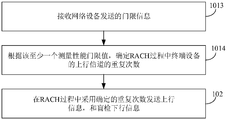
- step 101 may include:
- Step 1013 Receive threshold information sent by the network device, where the threshold information includes at least one measurement performance threshold for determining a repetition frequency or a frequency level of the uplink channel of the terminal device in the RACH process; The number of repetitions is divided into one-to-one correspondences, or divided according to the number of repetitions.
- the threshold information may be sent by the network side to the terminal through a broadcast message or an RRC message (such as an RRC configuration message or an RRC reconstruction message). device;
- Step 1014 Determine, according to the at least one measurement performance threshold, the number of repetitions of the uplink channel of the terminal device in the RACH process.
- the number of times determined in step 1014 may be directly determined by the terminal device according to the at least one measurement performance threshold, or determined by the terminal device according to the determined number of times, the determined number of times is determined by the terminal device.
- At least one measurement performance threshold is determined.
- the measurement performance involved in this embodiment may include: Reference Signal Receiving Power (RSRP), RSRQ (Reference Signal Receiving Quality), reference signal reception quality, and signal to interference plus noise ratio (Signal to Interference plus Noise Ratio) , SINR), Channel Quality Indicator (CQI), etc.
- RSRP Reference Signal Receiving Power
- RSRQ Reference Signal Receiving Quality
- SINR Signal to Interference plus Noise Ratio
- CQI Channel Quality Indicator
- the corresponding measurement performance threshold can be set according to the actual situation, so as to accurately determine the repetition number of the corresponding uplink channel according to the measurement performance threshold.
- step 102 specifically includes:
- uplink information is transmitted using a determined number of repetitions, and downlink information is blindly detected.
- the network side does not know the number of times the terminal device uses the repetition. Therefore, when the terminal device sends the uplink information, the network side directly detects the uplink control signal or the uplink data.
- the terminal device may further receive the indication information sent by the network device on the premise that the number of repetitions of the uplink channel is determined according to the measurement performance threshold value, and the indication information is used by the indication information.
- the preamble in the preamble group corresponding to the number of repetitions is randomly accessed, and the network side determines the number of repetitions used by the terminal device according to the preamble group in which the preamble used by the terminal device is located.
- the method may further include:
- Step 103 Receive indication information sent by the network device, where the indication information is used to indicate an uplink channel of the terminal device that uses the preamble in the preamble group A and the terminal device that uses the preamble in the preamble group B in the RACH process. Or the number of repetitions of the uplink and downlink channels; this step 103 may be before or after step 1013 and step 1014;
- Step 104 Select, according to the indication information, a preamble in the preamble group corresponding to the repetition quantity of the uplink channel.
- step 102 is specifically:
- the selected preamble is used in the RACH process, and the uplink information is transmitted by using the repetition number of the uplink channel, and the downlink information is received.
- the network side may send downlink information and receive uplink information according to the determined number of repetitions of the terminal device used (by the preamble group in which the preamble used by the terminal device is located). In this way, the number of repetitions of synchronization use between the terminal device and the network side can be achieved.
- the terminal device may also receive the PRACH resource configuration sent by the network device on the premise that the number of repetitions of the uplink channel is determined according to the measurement performance threshold value.
- the PRACH resource configuration information includes the PRACH resource group corresponding to the repetition number or the number of times of the uplink and downlink channels, so that the terminal device selects the PRACH resource corresponding to the determined number of repetitions of the uplink channel for random access, and the network side
- the number of repetitions used by the terminal device is determined according to the PRACH resource used by the terminal device.
- the PRACH resource configuration information may be sent by the network side to the terminal device by using a broadcast message or an RRC message, such as an RRC configuration message or an RRC reconfiguration message.
- the PRACH resource is divided according to the repetition number or the number of times of the uplink and downlink channels, and may include a preamble codeword resource, a time domain resource, a frequency domain resource, a spatial resource beam, and a bandwidth part bandwidth part (BWP) resource.
- BWP bandwidth part bandwidth part
- the method may further include:
- Step 105 Receive PRACH resource configuration information sent by the network device, where the PRACH resource configuration information includes PRACH resource packets corresponding to different repetition times or times of different uplink and downlink channels; this step 105 may be before step 1013 and step 1014. Or after;
- Step 106 Select a PRACH resource corresponding to the determined number of repetitions of the uplink channel.
- step 102 is specifically:
- the selected PRACH resource is used in the RACH process, and the uplink information is transmitted by using the repetition number of the uplink channel, and the downlink information is received.
- the network side may send downlink information and receive uplink information according to the determined number of repetitions of the terminal device used (by the PRACH resource used by the terminal device). In this way, the number of repetitions of synchronization use between the terminal device and the network side can be achieved.
- step 101 may include:
- the terminal device determines the maximum number of repetitions in the preset number of repetitions as the number of repetitions of the uplink channel in the RACH process.
- step 102 may include:
- the terminal device uses the repeated number of times of the uplink channel to send uplink information, and blindly detects downlink information.
- the terminal device may further determine the number of repetitions of the uplink and downlink channels in the RACH process according to a preset manner.
- the preset mode is any one of the following methods:
- the number of repetitions configured for the terminal device by RRC signaling before the RACH process including the number of repetitions for at least one of the following messages: msg.1, 2, 3, 4, 5;
- Pre-defined or default number of repetitions this predefined or default number of repetitions can be a protocol convention or pre-configured on the network side.
- the RACH process may determine the number of repetitions of the uplink and downlink channels by using the foregoing preset manner.
- an embodiment of the present disclosure further provides a method for transmitting and receiving information, which is applied to a network device, and includes the following steps:
- Step 601 Send a broadcast message to the terminal device, where the broadcast message is used by the terminal device to determine the number of repetitions of the uplink channel or the uplink and downlink channels in the RACH process;
- Step 602 Determine, according to the RACH procedure of the terminal device, the number of repetitions of the uplink and downlink channels of the terminal device in the RACH process.
- Step 603 In the RACH process, the downlink information is received and the uplink information is received according to the repetition quantity determined according to the RACH procedure of the terminal device.
- the method for transmitting and receiving information in the embodiment of the present disclosure by sending a broadcast message to the terminal device, determines the number of repetitions of the uplink and downlink channels of the terminal device in the RACH process according to the RACH procedure of the terminal device, and uses the repetition number to transmit the downlink in the RACH process.
- Information and receiving uplink information can clarify how to determine the number of repetitions of uplink and downlink information in the RACH process.
- the broadcast message includes indication information, where the indication information is used to indicate an uplink of a terminal device that uses a preamble in the preamble group A in the RACH procedure and a terminal device that uses a preamble in the preamble group B.
- the broadcast message may further include threshold information, where the threshold information includes at least one measurement performance for determining a repetition frequency or a frequency level of the uplink channel of the terminal device in the RACH process. Threshold.
- the broadcast message includes threshold information and PRACH resource configuration information, where the threshold information includes at least one measurement performance threshold for determining a repetition frequency or a frequency level of an uplink channel of the terminal device in the RACH process.
- the PRACH resource configuration information includes a PRACH resource packet corresponding to a repetition number or a level of repetition of different uplink and downlink channels; step 602 may include:
- the number of repetitions is a PRACH used by the network device according to the terminal device.
- the resource is directly determined or determined by the network device according to the determined number of times, and the determined number of times is determined by the network device according to the PRACH resource used by the terminal device.
- an embodiment of the present disclosure further provides a terminal device, where the terminal device includes:
- the first determining module 71 is configured to determine the number of repetitions of the uplink channel or the uplink and downlink channels of the terminal device in the RACH process;
- the first transceiver module 72 is configured to send uplink information, or send uplink information, and receive downlink information by using the repeated number of times in the RACH process.
- the terminal device of the embodiment of the present disclosure can use the repeated number of times to send uplink information, or send uplink information and receive downlink information, in the RACH process, by determining the number of repetitions of the uplink channel or the uplink and downlink channels of the terminal device in the RACH process. It is clear how to determine the number of repetitions of uplink and downlink information in the RACH process.
- the first determining module 71 includes:
- the first receiving unit 711 is configured to receive indication information sent by the network device.
- the first determining unit 712 is configured to determine, according to the indication information, the number of repetitions of the uplink channel or the uplink and downlink channels of the terminal device in the RACH process.
- the indication information is used to indicate the number of repetitions of the uplink and downlink channels of the terminal device in the RACH process.
- the indication information includes first indication information and second indication information, where the first indication information is used to indicate the number of repetitions of the uplink channel of the terminal device in the RACH process, and the second indication information is used to indicate the RACH process. The number of repetitions of the downlink channel of the terminal device.
- the first receiving unit 711 is specifically configured to:
- the indication information that is sent by the network device, where the broadcast message carries the identifier information of the terminal device or the identifier information of the group where the terminal device is located, and is used by the corresponding terminal device to use the broadcast message.
- the indication information determines the number of repetitions.
- the first determining module 71 includes:
- the second receiving unit 713 is configured to receive the threshold information that is sent by the network device, where the threshold information includes at least one measurement performance threshold for determining a repetition quantity or a frequency level of the uplink channel of the terminal device in the RACH process;
- a second determining unit 714 configured to determine, according to the at least one measurement performance threshold, a repetition quantity of an uplink channel of the terminal device in a RACH process
- the number of repetitions is directly determined by the terminal device according to the at least one measurement performance threshold value, or is determined by the terminal device according to the determined number of times, the determined number of times is determined by the The terminal device is determined according to the at least one measurement performance threshold.
- the first transceiver module 72 is specifically configured to:
- the uplink information is sent by using the repetition number corresponding to the repetition quantity, and the downlink information is blindly detected.
- the terminal device further includes:
- the first receiving module 73 is configured to receive the indication information sent by the network device, where the indication information is used to indicate the terminal device that uses the preamble in the preamble group A in the RACH procedure and use the preamble in the preamble group B The number of repetitions of the uplink channel or the uplink and downlink channels of the terminal device;
- the first selection module 74 is configured to select, according to the indication information, a preamble in the preamble group corresponding to the repetition quantity of the uplink channel;
- the first transceiver module 72 is specifically configured to:
- the selected preamble is used in the RACH process, and the uplink information is sent by using the repetition number of the uplink channel, and the downlink information is received.
- the indication information includes third indication information and fourth indication information, where the third indication information is used to indicate an uplink and downlink channel of a terminal device that uses a preamble in the preamble group A in the RACH process.
- the number of repetitions the fourth indication information is used to indicate the number of repetitions of the uplink and downlink channels of the terminal device using the preamble in the preamble group B in the RACH procedure; or
- the indication information includes fifth indication information, sixth indication information, seventh indication information, and eighth indication information, where the fifth indication information is used to indicate a terminal that uses a preamble in the preamble group A in the RACH procedure.
- the number of repetitions of the uplink channel of the device is used to indicate the number of repetitions of the downlink channel of the terminal device using the preamble in the preamble group A in the RACH process
- the seventh indication information is used to indicate the RACH process.
- the number of repetitions of the uplink channel of the terminal device using the preamble in the preamble group B, the eighth indication information being used to indicate the number of repetitions of the downlink channel of the terminal device using the preamble in the preamble group B in the RACH procedure ;or
- the indication information is used to indicate the number of repetitions of the uplink and downlink channels of the terminal device using the preamble in the preamble group A in the RACH procedure, and the uplink and downlink channels of the terminal device using the preamble in the preamble group B in the RACH procedure. Number of repetitions; or
- the indication information includes ninth indication information and a tenth indication information, where the ninth indication information is used to indicate the number of repetitions of the uplink channel and the RACH procedure of the terminal device using the preamble in the preamble group A in the RACH procedure.
- the number of repetitions of the uplink channel of the terminal device using the preamble in the preamble group B, the tenth indication information being used to indicate the number of repetitions of the downlink channel of the terminal device using the preamble in the preamble group A in the RACH procedure And the number of repetitions of the downlink channel of the terminal device using the preamble in the preamble group B in the RACH procedure.
- the terminal device further includes:
- the second receiving module 75 is configured to receive PRACH resource configuration information that is sent by the network device, where the PRACH resource configuration information includes a PRACH resource packet corresponding to a repetition number or a number of times of different uplink and downlink channels;
- a second selection module 76 configured to select a PRACH resource corresponding to the determined number of repetitions of the uplink channel
- the first transceiver module 72 is specifically configured to:
- the determined PRACH resource is used in the RACH process, and the uplink information is sent by using the repeated number of times of the uplink channel, and the downlink information is received.
- the first receiving unit or the first receiving module is specifically configured to:
- the indication information is included in at least one of the following information of the broadcast message: a primary system information block MIB, a system information block SIB1, a remaining minimum system information RMSI, or other system information OSI.
- the first determining module 71 is specifically configured to:
- the maximum number of repetitions in the preset number of repetitions is determined as the number of repetitions of the uplink channel of the terminal device in the RACH process.
- the first determining module 71 is specifically configured to:
- the preset mode is any one of the following modes:
- the number of repetitions configured for the terminal device by RRC signaling before the RACH procedure is configured for the terminal device by RRC signaling before the RACH procedure
- an embodiment of the present disclosure further provides a network device, including:
- the sending module 111 is configured to send a broadcast message to the terminal device, where the broadcast message is used by the terminal device to determine the number of repetitions of the uplink channel or the uplink and downlink channels in the RACH process;
- a second determining module 112 configured to determine, according to the RACH procedure of the terminal device, a repetition quantity of uplink and downlink channels of the terminal device in a RACH process
- the second transceiver module 113 is configured to send downlink information and receive uplink information according to the repetition number determined according to the RACH procedure of the terminal device in the RACH process.
- the network device of the embodiment of the present disclosure by sending a broadcast message to the terminal device, determines the number of repetitions of the uplink and downlink channels of the terminal device in the RACH process according to the RACH procedure of the terminal device, and uses the repeated number of times to send downlink information and Receiving the uplink information, it is possible to determine how to determine the number of repetitions of the uplink and downlink information in the RACH process.
- the broadcast message includes indication information, where the indication information is used to indicate an uplink of a terminal device that uses a preamble in the preamble group A in the RACH procedure and a terminal device that uses a preamble in the preamble group B.
- the number of repetitions of the channel or the uplink and downlink channels; the second determining module 112 is specifically configured to:
- the broadcast message may further include threshold information, where the threshold information includes at least one measurement performance for determining a repetition frequency or a frequency level of the uplink channel of the terminal device in the RACH process. Threshold.
- the broadcast message includes threshold information and PRACH resource configuration information, where the threshold information includes at least one measurement performance threshold for determining a repetition frequency or a frequency level of an uplink channel of the terminal device in the RACH process.
- the PRACH resource configuration information includes a PRACH resource packet corresponding to a repetition number or a number of times of the uplink and downlink channels; the second determining module 112 is specifically configured to:
- the number of repetitions is determined by the network device according to the PRACH resource used by the terminal device, or is determined by the network device according to the determined number of times, the determined number of times is determined by the The network device determines according to the PRACH resource used by the terminal device.
- Embodiments of the present disclosure also provide a terminal device including a processor, a memory, a computer program stored on the memory and executable on the processor, wherein the computer program is implemented by the processor.
- FIG. 12 is a schematic diagram of a hardware structure of a terminal device that implements various embodiments of the present disclosure.
- the terminal device 1200 includes but is not limited to: a radio frequency unit 1201, a network module 1202, an audio output unit 1203, an input unit 1204, and a sensor 1205.
- the terminal structure shown in FIG. 12 does not constitute a limitation to the terminal, and the terminal device may include more or less components than those illustrated, or may combine some components, or different component arrangements.
- the terminal device includes, but is not limited to, a mobile phone, a tablet computer, a notebook computer, a palmtop computer, a vehicle-mounted terminal, a wearable device, a pedometer, and the like.
- the processor 1210 is configured to determine the number of repetitions of the uplink channel or the uplink and downlink channels of the terminal device in the RACH process.
- the radio unit 1201 is configured to send uplink information, or send uplink information, and receive downlink information by using the repetition quantity in the RACH process.
- the terminal device 1200 of the embodiment of the present disclosure by determining the number of repetitions of the uplink channel or the uplink and downlink channels of the terminal device in the RACH process, uses the repeated number of times to send uplink information, or sends uplink information and receives downlink information, in the RACH process, thereby It is possible to determine how to determine the number of repetitions of uplink and downlink information in the RACH process.
- the radio frequency unit 1201 may be used for receiving and transmitting signals during and after receiving or transmitting information or a call, and specifically, receiving downlink data from the base station, and then processing the processor 1210; The uplink data is sent to the base station.
- radio frequency unit 1201 includes, but is not limited to, an antenna, at least one amplifier, a transceiver, a coupler, a low noise amplifier, a duplexer, and the like.
- the radio unit 1201 can also communicate with the network and other devices through a wireless communication system.
- the terminal device provides the user with wireless broadband Internet access through the network module 1202, such as helping the user to send and receive emails, browse web pages, and access streaming media.
- the audio output unit 1203 may convert audio data received by the radio frequency unit 1201 or the network module 1202 or stored in the memory 1209 into an audio signal and output as sound. Moreover, the audio output unit 1203 may also provide audio output (eg, call signal reception sound, message reception sound, etc.) related to a specific function performed by the terminal device 1200.
- the audio output unit 1203 includes a speaker, a buzzer, a receiver, and the like.
- the input unit 1204 is for receiving an audio or video signal.
- the input unit 1204 may include a graphics processing unit (GPU) 12041 and a microphone 12042, and the graphics processor 12041 images an still picture or video obtained by an image capturing device (such as a camera) in a video capturing mode or an image capturing mode.
- the data is processed.
- the processed image frame can be displayed on the display unit 1206.
- the image frames processed by the graphics processor 12041 may be stored in the memory 1209 (or other storage medium) or transmitted via the radio frequency unit 1201 or the network module 1202.
- the microphone 12042 can receive sound and can process such sound as audio data.
- the processed audio data can be converted to a format output that can be transmitted to the mobile communication base station via the radio frequency unit 1201 in the case of a telephone call mode.
- Terminal device 1200 also includes at least one type of sensor 1205, such as a light sensor, motion sensor, and other sensors.
- the light sensor includes an ambient light sensor and a proximity sensor, wherein the ambient light sensor can adjust the brightness of the display panel 12061 according to the brightness of the ambient light, and the proximity sensor can close the display panel 12061 when the terminal device 1200 moves to the ear. / or backlight.
- the accelerometer sensor can detect the magnitude of acceleration in all directions (usually three axes). When it is stationary, it can detect the magnitude and direction of gravity.
- sensor 1205 may also include fingerprint sensor, pressure sensor, iris sensor, molecular sensor, gyroscope, barometer, hygrometer, thermometer, infrared Sensors, etc., will not be described here.
- the display unit 1206 is for displaying information input by the user or information provided to the user.
- the display unit 1206 can include a display panel 12061, and the display panel 12061 can be configured in the form of a liquid crystal display (LCD), an organic light-emitting diode (OLED), or the like.
- LCD liquid crystal display
- OLED organic light-emitting diode
- the user input unit 1207 can be configured to receive input numeric or character information and to generate key signal inputs related to user settings and function control of the terminal.
- the user input unit 1207 includes a touch panel 12071 and other input devices 12072.
- the touch panel 12071 also referred to as a touch screen, can collect touch operations on or near the user (such as the user using a finger, a stylus, or the like on the touch panel 12071 or near the touch panel 12071. operating).
- the touch panel 12071 may include two parts of a touch detection device and a touch controller.
- the touch detection device detects the touch orientation of the user, and detects a signal brought by the touch operation, and transmits the signal to the touch controller; the touch controller receives the touch information from the touch detection device, converts the touch information into contact coordinates, and sends the touch information.
- the processor 1210 receives commands from the processor 1210 and executes them.
- the touch panel 12071 can be implemented in various types such as resistive, capacitive, infrared, and surface acoustic waves.
- the user input unit 1207 can also include other input devices 12072.
- other input devices 12072 may include, but are not limited to, a physical keyboard, function keys (such as a volume control button, a switch button, etc.), a trackball, a mouse, and a joystick, which are not described herein.
- the touch panel 12071 can be overlaid on the display panel 12061.
- the touch panel 12071 detects a touch operation thereon or nearby, the touch panel 12071 transmits to the processor 1210 to determine the type of the touch event, and then the processor 1210 according to the touch.
- the type of event provides a corresponding visual output on display panel 12061.
- the touch panel 12071 and the display panel 12061 are used as two independent components to implement the input and output functions of the terminal, in some embodiments, the touch panel 12071 and the display panel 12061 may be integrated.
- the input and output functions of the terminal are implemented, and are not limited herein.
- the interface unit 1208 is an interface in which an external device is connected to the terminal device 1200.
- the external device may include a wired or wireless headset port, an external power (or battery charger) port, a wired or wireless data port, a memory card port, a port for connecting a device having an identification module, and an audio input/output. (I/O) port, video I/O port, headphone port, and more.
- the interface unit 1208 can be configured to receive input from an external device (eg, data information, power, etc.) and transmit the received input to one or more components within the terminal device 1200 or can be used at the terminal device 1200 and externally Data is transferred between devices.
- Memory 1209 can be used to store software programs as well as various data.
- the memory 1209 may mainly include a storage program area and a storage data area, wherein the storage program area may store an operating system, an application required for at least one function (such as a sound playing function, an image playing function, etc.), and the like; the storage data area may be stored according to Data created by the use of the mobile phone (such as audio data, phone book, etc.).
- memory 1209 can include high speed random access memory, and can also include non-volatile memory, such as at least one magnetic disk storage device, flash memory device, or other volatile solid state storage device.
- the processor 1210 is a control center of the terminal device that connects various portions of the entire terminal using various interfaces and lines, by running or executing software programs and/or modules stored in the memory 1209, and recalling data stored in the memory 1209, Perform various functions and processing data of the terminal to monitor the terminal as a whole.
- the processor 1210 may include one or more processing units; optionally, the processor 1210 may integrate an application processor and a modem processor, wherein the application processor mainly processes an operating system, a user interface, an application, etc., and a modulation solution
- the processor mainly handles wireless communication. It will be appreciated that the above described modem processor may also not be integrated into the processor 1210.
- the terminal device 1200 may further include a power source 1211 (such as a battery) for supplying power to various components.
- a power source 1211 such as a battery
- the power source 1211 may be logically connected to the processor 1210 through a power management system to manage charging, discharging, and power consumption through the power management system. Management and other functions.
- terminal device 1200 may further include some functional modules not shown, which are not described herein again.
- Embodiments of the present disclosure also provide a network device including a processor, a memory, and a computer program stored on the memory and executable on the processor, wherein the computer program is executed by the processor.
- FIG. 13 is a schematic diagram of a hardware structure of a network device that implements various embodiments of the present disclosure, including but not limited to: a bus 131, a transceiver 132, an antenna 133, a bus interface 134, a processor 135, and Memory 136.
- the network device 130 further includes a computer program stored on the memory 136 and operable on the processor 135.
- the computer program When the computer program is executed by the processor 135, the following steps are implemented:
- downlink information and uplink information are transmitted according to the repetition number determined according to the RACH procedure of the terminal device.
- the transceiver 132 is configured to receive and transmit data under the control of the processor 135.
- bus 131 may include any number of interconnected buses and bridges, and bus 131 will include one or more processors represented by processor 135 and memory represented by memory 136. The various circuits are linked together. The bus 131 can also link various other circuits, such as peripherals, voltage regulators, and power management circuits, as is known in the art, and therefore, will not be further described herein.
- Bus interface 134 provides an interface between bus 131 and transceiver 132.
- Transceiver 132 can be an element or a plurality of elements, such as a plurality of receivers and transmitters, providing means for communicating with various other devices on a transmission medium.
- Data processed by processor 135 is transmitted over wireless medium via antenna 133. Further, antenna 133 also receives the data and transmits the data to processor 135.
- the processor 135 is responsible for managing the bus 131 and the usual processing, and can also provide various functions including timing, peripheral interfaces, voltage regulation, power management, and other control functions.
- the memory 136 can be used to store data used by the processor 135 when performing operations.
- the processor 135 can be a CPU, an ASIC, an FPGA, or a CPLD.
- the embodiment of the present disclosure further provides a computer readable storage medium, where the computer readable storage medium stores a computer program, and when the computer program is executed by the processor, implements various processes of the method embodiment for transmitting and receiving information, and can achieve the same Technical effects, to avoid repetition, will not be repeated here.
- the computer readable storage medium is, for example, a read-only memory (ROM), a random access memory (RAM), a magnetic disk, or an optical disk.
- the foregoing embodiment method can be implemented by means of software plus a necessary general hardware platform, and of course, can also be through hardware, but in many cases, the former is better.
- Implementation Based on such understanding, the technical solution of the present disclosure, which is essential or contributes to the related art, may be embodied in the form of a software product stored in a storage medium (such as ROM/RAM, disk, CD-ROM).
- the instructions include a number of instructions for causing a terminal (which may be a cell phone, computer, server, air conditioner, or network device, etc.) to perform the methods described in various embodiments of the present disclosure.
Landscapes
- Engineering & Computer Science (AREA)
- Signal Processing (AREA)
- Computer Networks & Wireless Communication (AREA)
- Multimedia (AREA)
- Quality & Reliability (AREA)
- Computer Security & Cryptography (AREA)
- Mobile Radio Communication Systems (AREA)
Abstract
Description
Claims (29)
- 一种收发信息的方法,应用于终端设备,包括:确定随机接入RACH过程中终端设备的上行信道或者上下行信道的重复次数;在RACH过程中采用所述重复次数发送上行信息,或者发送上行信息和接收下行信息。
- 根据权利要求1所述的方法,其中,所述确定随机接入RACH过程中终端设备的上行信道或者上下行信道的重复次数,包括:接收网络设备发送的指示信息;根据所述指示信息,确定RACH过程中所述终端设备的上行信道或者上下行信道的重复次数。
- 根据权利要求2所述的方法,其中,所述指示信息用于指示RACH过程中终端设备的上下行信道的重复次数;或者所述指示信息包括第一指示信息和第二指示信息,其中,所述第一指示信息用于指示RACH过程中终端设备的上行信道的重复次数,所述第二指示信息用于指示RACH过程中终端设备的下行信道的重复次数。
- 根据权利要求2所述的方法,其中,所述接收网络设备发送的指示信息,包括:通过广播消息,接收所述网络设备发送的所述指示信息;其中,所述广播消息中携带有终端设备的标识信息或者终端设备所在组的标识信息,用于对应终端设备使用所述广播消息中的指示信息确定重复次数。
- 根据权利要求1所述的方法,其中,所述确定随机接入RACH过程中终端设备的上行信道或者上下行信道的重复次数,包括:接收网络设备发送的门限信息,其中,所述门限信息中包括用于确定RACH过程中终端设备的上行信道的重复次数或次数等级的至少一个测量性能门限值;根据所述至少一个测量性能门限值,确定RACH过程中所述终端设备的 上行信道的重复次数;其中,所述重复次数是由所述终端设备根据所述至少一个测量性能门限值直接确定,或者是由所述终端设备根据已确定的次数等级确定,所述已确定的次数等级是由所述终端设备根据所述至少一个测量性能门限值确定。
- 根据权利要求1所述的方法,其中,所述在RACH过程中采用所述重复次数发送上行信息,或者发送上行信息和接收下行信息,包括:在RACH过程中采用所述重复次数发送上行信息,和盲检下行信息。
- 根据权利要求5所述的方法,其中,所述在RACH过程中采用所述重复次数发送上行信息,或者发送上行信息和接收下行信息之前,所述方法还包括:接收网络设备发送的指示信息,其中,所述指示信息用于指示RACH过程中使用前导码组A中的前导码的终端设备和使用前导码组B中的前导码的终端设备的上行信道或者上下行信道的重复次数;根据所述指示信息,选择所述上行信道的重复次数对应的前导码组中的前导码;所述在RACH过程中采用所述重复次数发送上行信息,或者发送上行信息和接收下行信息,包括:在RACH过程中利用选择出的所述前导码,并采用所述上行信道的重复次数发送上行信息,和接收下行信息。
- 根据权利要求2或7所述的方法,其中,所述指示信息包括第三指示信息和第四指示信息,其中,所述第三指示信息用于指示RACH过程中使用前导码组A中的前导码的终端设备的上下行信道的重复次数,所述第四指示信息用于指示RACH过程中使用前导码组B中的前导码的终端设备的上下行信道的重复次数;或者所述指示信息包括第五指示信息、第六指示信息、第七指示信息和第八指示信息,其中,所述第五指示信息用于指示RACH过程中使用前导码组A中的前导码的终端设备的上行信道的重复次数,所述第六指示信息用于指示RACH过程中使用前导码组A中的前导码的终端设备的下行信道的重复次数,所述第七指示信息用于指示RACH过程中使用前导码组B中的前导码的终端 设备的上行信道的重复次数,所述第八指示信息用于指示RACH过程中使用前导码组B中的前导码的终端设备的下行信道的重复次数;或者所述指示信息用于指示RACH过程中使用前导码组A中的前导码的终端设备的上下行信道的重复次数,以及RACH过程中使用前导码组B中的前导码的终端设备的上下行信道的重复次数;或者所述指示信息包括第九指示信息和第十指示信息,其中,所述第九指示信息用于指示RACH过程中使用前导码组A中的前导码的终端设备的上行信道的重复次数和RACH过程中使用前导码组B中的前导码的终端设备的上行信道的重复次数,所述第十指示信息用于指示RACH过程中使用前导码组A中的前导码的终端设备的下行信道的重复次数和RACH过程中使用前导码组B中的前导码的终端设备的下行信道的重复次数。
- 根据权利要求5所述的方法,其中,所述在RACH过程中采用所述重复次数发送上行信息,或者发送上行信息和接收下行信息之前,所述方法还包括:接收所述网络设备发送的随机接入PRACH资源配置信息,其中,所述PRACH资源配置信息中包括对应于不同上下行信道的重复次数或次数等级的PRACH资源分组;选择确定的所述上行信道的重复次数对应的PRACH资源;所述在RACH过程中采用所述重复次数发送上行信息,或者发送上行信息和接收下行信息,包括:在RACH过程中利用确定出的PRACH资源,并采用所述上行信道的重复次数发送上行信息,和接收下行信息。
- 根据权利要求2或7所述的方法,其中,所述接收网络设备发送的指示信息,包括:通过广播消息,接收所述网络设备发送的所述指示信息。
- 根据权利要求10所述的方法,其中,所述指示信息包括在所述广播消息的如下信息中的至少一项信息中:主系统信息块MIB、系统信息块SIB1、剩余最小系统信息RMSI或其他系统信息OSI。
- 根据权利要求1所述的方法,其中,所述确定随机接入RACH过程中终端设备的上行信道或者上下行信道的重复次数,包括:将预设重复次数中的最大重复次数确定为RACH过程中所述终端设备的上行信道的重复次数。
- 根据权利要求1所述的方法,其中,所述确定随机接入RACH过程中终端设备的上行信道或者上下行信道的重复次数,包括:根据预设方式,确定RACH过程中所述终端设备的上下行信道的重复次数;其中,所述预设方式为如下方式中任意一种:终端设备在RACH过程之前的连接态配置的重复次数;在RACH过程之前通过RRC信令为终端设备配置的重复次数;预定义的或者默认的重复次数。
- 一种收发信息的方法,应用于网络设备,包括:向终端设备发送广播消息,其中,所述广播消息用于所述终端设备确定RACH过程中上行信道或者上下行信道的重复次数;根据所述终端设备的RACH过程,确定RACH过程中所述终端设备的上下行信道的重复次数;在RACH过程中采用根据所述终端设备的RACH过程确定的重复次数发送下行信息和接收上行信息。
- 根据权利要求14所述的方法,其中,所述广播消息中包括指示信息,所述指示信息用于指示RACH过程中使用前导码组A中的前导码的终端设备和使用前导码组B中的前导码的终端设备的上行信道或者上下行信道的重复次数;所述根据所述终端设备的RACH过程,确定RACH过程中所述终端设备的上下行信道的重复次数,包括:根据所述终端设备在RACH过程中使用的前导码所在的前导码组,确定RACH过程中所述终端设备的上下行信道的重复次数。
- 根据权利要求15所述的方法,其中,所述广播消息中还包括门限信息,所述门限信息中包括用于确定RACH过程中终端设备的上行信道的重复次数或次数等级的至少一个测量性能门限值。
- 根据权利要求14所述的方法,其中,所述广播消息中包括门限信息和PRACH资源配置信息,其中,所述门限信息中包括用于确定RACH过程中终端设备的上行信道的重复次数或次数等级的至少一个测量性能门限值,所述PRACH资源配置信息中包括对应于不同上下行信道的重复次数或次数等级的PRACH资源分组;所述根据所述终端设备的RACH过程,确定RACH过程中所述终端设备的上下行信道的重复次数,包括:根据所述终端设备在RACH过程中使用的PRACH资源,确定RACH过程中所述终端设备的上下行信道的重复次数;其中,所述重复次数是由所述网络设备根据所述终端设备使用的PRACH资源直接确定,或者是由所述网络设备根据已确定的次数等级确定,所述已确定的次数等级是由所述网络设备根据所述终端设备使用的PRACH资源确定。
- 一种终端设备,包括:第一确定模块,用于确定RACH过程中终端设备的上行信道或者上下行信道的重复次数;第一收发模块,用于在RACH过程中采用所述重复次数发送上行信息,或者发送上行信息和接收下行信息。
- 根据权利要求18所述的终端设备,其中,所述第一确定模块包括:第一接收单元,用于接收网络设备发送的指示信息;第一确定单元,用于根据所述指示信息,确定RACH过程中所述终端设备的上行信道或者上下行信道的重复次数。
- 根据权利要求19所述的终端设备,其中,所述第一接收单元具体用于:通过广播消息,接收所述网络设备发送的所述指示信息;其中,所述广播消息中携带有终端设备的标识信息或者终端设备所在组的标识信息,用于对应终端设备使用所述广播消息中的指示信息确定重复次数。
- 根据权利要求18所述的终端设备,其中,所述第一确定模块包括:第二接收单元,用于接收网络设备发送的门限信息,其中,所述门限信息中包括用于确定RACH过程中终端设备的上行信道的重复次数或次数等级的至少一个测量性能门限值;第二确定单元,用于根据所述至少一个测量性能门限值,确定RACH过程中所述终端设备的上行信道的重复次数;其中,所述重复次数是由所述终端设备根据所述至少一个测量性能门限值直接确定,或者是由所述终端设备根据已确定的次数等级确定,所述已确定的次数等级是由所述终端设备根据所述至少一个测量性能门限值确定。
- 根据权利要求18所述的终端设备,其中,所述第一收发模块具体用于:在RACH过程中采用所述重复次数发送上行信息,和盲检下行信息。
- 根据权利要求21所述的终端设备,还包括:第一接收模块,用于接收网络设备发送的指示信息,其中,所述指示信息用于指示RACH过程中使用前导码组A中的前导码的终端设备和使用前导码组B中的前导码的终端设备的上行信道或者上下行信道的重复次数;第一选择模块,用于根据所述指示信息,选择所述上行信道的重复次数对应的前导码组中的前导码;所述第一收发模块具体用于:在RACH过程中利用选择出的所述前导码,并采用所述上行信道的重复次数发送上行信息,和接收下行信息。
- 根据权利要求21所述的终端设备,还包括:第二接收模块,用于接收所述网络设备发送的PRACH资源配置信息,其中,所述PRACH资源配置信息中包括对应于不同上下行信道的重复次数或次数等级的PRACH资源分组;第二选择模块,用于选择确定的所述上行信道的重复次数对应的PRACH资源;所述第一收发模块具体用于:在RACH过程中利用确定出的PRACH资源,并采用所述上行信道的重复次数发送上行信息,和接收下行信息。
- 一种网络设备,包括:发送模块,用于向终端设备发送广播消息,其中,所述广播消息用于所述终端设备确定RACH过程中上行信道或者上下行信道的重复次数;第二确定模块,用于根据所述终端设备的RACH过程,确定RACH过程中所述终端设备的上下行信道的重复次数;第二收发模块,用于在RACH过程中采用根据所述终端设备的RACH过程确定的重复次数发送下行信息和接收上行信息。
- 根据权利要求25所述的网络设备,其中,所述广播消息中包括指示信息,所述指示信息用于指示RACH过程中使用前导码组A中的前导码的终端设备和使用前导码组B中的前导码的终端设备的上行信道或者上下行信道的重复次数;所述第二确定模块具体用于:根据所述终端设备在RACH过程中使用的前导码所在的前导码组,确定RACH过程中所述终端设备的上下行信道的重复次数。
- 一种终端设备,包括存储器、处理器及存储在所述存储器上并可在所述处理器上运行的计算机程序,其中,所述计算机程序被所述处理器执行时实现如权利要求1至13中任一项所述的收发信息的方法的步骤。
- 一种网络设备,包括存储器、处理器及存储在所述存储器上并可在所述处理器上运行的计算机程序,其中,所述计算机程序被所述处理器执行时实现如权利要求14至17中任一项所述的收发信息的方法的步骤。
- 一种计算机可读存储介质,其上存储有计算机程序,其中,所述计算机程序被处理器执行时实现如权利要求1至17中任一项所述的收发信息的方法的步骤。
Priority Applications (4)
| Application Number | Priority Date | Filing Date | Title |
|---|---|---|---|
| KR1020207023067A KR102349766B1 (ko) | 2018-01-10 | 2019-01-04 | 정보 송수신 방법, 단말기 및 네트워크 기기 |
| EP19738387.0A EP3740003A4 (en) | 2018-01-10 | 2019-01-04 | PROCEDURES FOR TRANSMISSION AND RECEIVING OF INFORMATION, TERMINAL DEVICE AND NETWORK DEVICE |
| JP2020538702A JP2021510279A (ja) | 2018-01-10 | 2019-01-04 | 情報送受信方法、端末機器及びネットワーク機器 |
| US16/961,613 US11234275B2 (en) | 2018-01-10 | 2019-01-04 | Method for receiving and sending information, user equipment and network device |
Applications Claiming Priority (2)
| Application Number | Priority Date | Filing Date | Title |
|---|---|---|---|
| CN201810023325.XA CN110022610A (zh) | 2018-01-10 | 2018-01-10 | 一种收发信息的方法、终端设备及网络设备 |
| CN201810023325.X | 2018-01-10 |
Publications (1)
| Publication Number | Publication Date |
|---|---|
| WO2019137305A1 true WO2019137305A1 (zh) | 2019-07-18 |
Family
ID=67188090
Family Applications (1)
| Application Number | Title | Priority Date | Filing Date |
|---|---|---|---|
| PCT/CN2019/070364 Ceased WO2019137305A1 (zh) | 2018-01-10 | 2019-01-04 | 收发信息的方法、终端设备及网络设备 |
Country Status (6)
| Country | Link |
|---|---|
| US (1) | US11234275B2 (zh) |
| EP (1) | EP3740003A4 (zh) |
| JP (1) | JP2021510279A (zh) |
| KR (1) | KR102349766B1 (zh) |
| CN (1) | CN110022610A (zh) |
| WO (1) | WO2019137305A1 (zh) |
Families Citing this family (15)
| Publication number | Priority date | Publication date | Assignee | Title |
|---|---|---|---|---|
| CN107734175B (zh) * | 2017-10-25 | 2020-06-30 | 维沃移动通信有限公司 | 一种通知消息的提示方法及移动终端 |
| CN118631407A (zh) * | 2018-08-10 | 2024-09-10 | 苹果公司 | 用于新无线电超可靠低延时通信的物理上行链路共享信道增强 |
| CN112825584B (zh) * | 2019-11-20 | 2022-06-14 | 上海华为技术有限公司 | 一种空闲态终端设备检测方法以及相关设备 |
| CN114731700A (zh) * | 2019-11-28 | 2022-07-08 | 高通股份有限公司 | Nr-轻型随机接入响应重复 |
| WO2021109101A1 (en) * | 2019-12-06 | 2021-06-10 | Qualcomm Incorporated | Pusch opportunity repetitions for rach procedure |
| CN114902592B (zh) | 2019-12-31 | 2024-04-12 | 华为技术有限公司 | 传输初始接入配置信息的方法和装置 |
| US12108438B2 (en) * | 2020-05-06 | 2024-10-01 | Qualcomm Incorporated | Dynamic slot aggregation indication for random access procedure |
| US12245178B2 (en) * | 2020-05-14 | 2025-03-04 | Sony Group Corporation | Coverage enhancement in a wireless network |
| CN114070513B (zh) * | 2020-08-06 | 2023-08-25 | 大唐移动通信设备有限公司 | 下行信道的传输方法、装置及存储介质 |
| EP4197273A4 (en) | 2020-10-09 | 2024-01-17 | Apple Inc. | Rach procedure coverage enhancement and recovery |
| US12096487B2 (en) * | 2021-01-15 | 2024-09-17 | FG Innovation Company Limited | Method related to PUSCH repetitions, user equipment, and network device |
| US12219609B2 (en) | 2021-03-03 | 2025-02-04 | Samsung Electronics Co., Ltd. | Resource selection for uplink channels during initial access |
| CN116686379A (zh) * | 2021-12-28 | 2023-09-01 | 北京小米移动软件有限公司 | 物理随机接入信道prach的传输方法和装置 |
| US20240267953A1 (en) * | 2023-02-08 | 2024-08-08 | Qualcomm Incorporated | Differentiating physical random access channel repetition numbers |
| WO2026000389A1 (en) * | 2024-06-28 | 2026-01-02 | Nec Corporation | Devices and methods for communication |
Citations (3)
| Publication number | Priority date | Publication date | Assignee | Title |
|---|---|---|---|---|
| CN104812082A (zh) * | 2014-01-23 | 2015-07-29 | 上海贝尔股份有限公司 | 用于用户设备高效随机接入的方法及装置 |
| WO2017030485A1 (en) * | 2015-08-14 | 2017-02-23 | Telefonaktiebolaget Lm Ericsson (Publ) | Random access procedure for mtc operation |
| CN106912109A (zh) * | 2013-08-08 | 2017-06-30 | 英特尔Ip公司 | 用于覆盖有限设备的覆盖扩展水平 |
Family Cites Families (23)
| Publication number | Priority date | Publication date | Assignee | Title |
|---|---|---|---|---|
| CN104254135B (zh) | 2013-06-27 | 2020-03-31 | 夏普株式会社 | 基站和用户设备及其方法 |
| US9451639B2 (en) * | 2013-07-10 | 2016-09-20 | Samsung Electronics Co., Ltd. | Method and apparatus for coverage enhancement for a random access process |
| WO2015012654A1 (en) * | 2013-07-25 | 2015-01-29 | Lg Electronics Inc. | Method and apparatus for coverage enhancement |
| US9572171B2 (en) * | 2013-10-31 | 2017-02-14 | Intel IP Corporation | Systems, methods, and devices for efficient device-to-device channel contention |
| US9955508B2 (en) * | 2013-12-04 | 2018-04-24 | Lg Electronics Inc. | Method and apparatus for performing random access procedure for coverage enhancement user equipments in wireless communication system |
| CN104812084A (zh) | 2014-01-28 | 2015-07-29 | 中兴通讯股份有限公司 | 配置信息的发送、获取方法、接入方法、通信节点及系统 |
| MX381591B (es) * | 2014-01-29 | 2025-03-12 | Interdigital Patent Holdings Inc | Método de acceso y adaptación de enlace para transmisiones inalámbricas mejoradas en cobertura. |
| EP2919534B1 (en) * | 2014-03-12 | 2019-03-06 | Panasonic Intellectual Property Corporation of America | Power headroom reporting for MTC devices in enhanced coverage mode |
| US10764922B2 (en) * | 2015-01-08 | 2020-09-01 | Sharp Kabushiki Kaisha | Terminal device, base station device, radio communication method, and integrated circuit |
| WO2016111591A1 (ko) * | 2015-01-08 | 2016-07-14 | 엘지전자(주) | 무선 통신 시스템에서 페이징 전송 방법 및 이를 위한 장치 |
| US10595280B2 (en) * | 2015-03-06 | 2020-03-17 | Qualcomm Incorporated | Repetition level coverage enhancement techniques for physical random access channel transmissions |
| JP2018093250A (ja) * | 2015-04-03 | 2018-06-14 | シャープ株式会社 | 無線通信システム、端末装置、基地局装置、無線通信方法および集積回路 |
| GB2537181A (en) * | 2015-04-10 | 2016-10-12 | Nec Corp | Communication system |
| WO2016190711A1 (en) * | 2015-05-27 | 2016-12-01 | Samsung Electronics Co., Ltd. | Method of managing indication of coverage extension (ce) level |
| WO2017014549A1 (ko) * | 2015-07-20 | 2017-01-26 | 엘지전자 주식회사 | 하향링크 제어 정보 수신 방법 및 사용자기기와, 하향링크 제어 정보 전송 방법 및 기지국 |
| RU2693269C1 (ru) * | 2015-09-25 | 2019-07-01 | Телефонактиеболагет Лм Эрикссон (Пабл) | Способы, обеспечивающие предоставления восходящего канала, в том числе конфигурацию во временной области, и соответствующие беспроводные терминалы и сетевые узлы |
| WO2017065468A1 (en) * | 2015-10-14 | 2017-04-20 | Lg Electronics Inc. | Method and apparatus for controlling backoff procedure for coverage enhancement in wireless communication system |
| US11277866B2 (en) * | 2016-05-27 | 2022-03-15 | Ntt Docomo, Inc. | Communication device and random access control method |
| US11140634B2 (en) * | 2017-03-23 | 2021-10-05 | Apple Inc. | Narrowband internet-of-things (NB-IOT) enhancements |
| US11350445B2 (en) * | 2017-08-10 | 2022-05-31 | Kyocera Corporation | Communication control method for controlling a user equipment to perform early data transmission |
| WO2019051373A1 (en) * | 2017-09-11 | 2019-03-14 | Intel IP Corporation | PHYSICAL RANDOM ACCESS CHANNEL FORMAT (PRACH) CONFIGURATION |
| US11831436B2 (en) * | 2017-09-28 | 2023-11-28 | Comcast Cable Communications, Llc | HARQ feedback for grant-free transmission |
| CA3028778A1 (en) * | 2017-12-29 | 2019-06-29 | Comcast Cable Communications, Llc | Selection of grant and csi |
-
2018
- 2018-01-10 CN CN201810023325.XA patent/CN110022610A/zh active Pending
-
2019
- 2019-01-04 KR KR1020207023067A patent/KR102349766B1/ko active Active
- 2019-01-04 WO PCT/CN2019/070364 patent/WO2019137305A1/zh not_active Ceased
- 2019-01-04 EP EP19738387.0A patent/EP3740003A4/en not_active Withdrawn
- 2019-01-04 US US16/961,613 patent/US11234275B2/en active Active
- 2019-01-04 JP JP2020538702A patent/JP2021510279A/ja active Pending
Patent Citations (3)
| Publication number | Priority date | Publication date | Assignee | Title |
|---|---|---|---|---|
| CN106912109A (zh) * | 2013-08-08 | 2017-06-30 | 英特尔Ip公司 | 用于覆盖有限设备的覆盖扩展水平 |
| CN104812082A (zh) * | 2014-01-23 | 2015-07-29 | 上海贝尔股份有限公司 | 用于用户设备高效随机接入的方法及装置 |
| WO2017030485A1 (en) * | 2015-08-14 | 2017-02-23 | Telefonaktiebolaget Lm Ericsson (Publ) | Random access procedure for mtc operation |
Non-Patent Citations (1)
| Title |
|---|
| See also references of EP3740003A4 * |
Also Published As
| Publication number | Publication date |
|---|---|
| KR20200108037A (ko) | 2020-09-16 |
| JP2021510279A (ja) | 2021-04-15 |
| CN110022610A (zh) | 2019-07-16 |
| EP3740003A4 (en) | 2021-03-03 |
| US11234275B2 (en) | 2022-01-25 |
| KR102349766B1 (ko) | 2022-01-10 |
| US20200359425A1 (en) | 2020-11-12 |
| EP3740003A1 (en) | 2020-11-18 |
Similar Documents
| Publication | Publication Date | Title |
|---|---|---|
| WO2019137305A1 (zh) | 收发信息的方法、终端设备及网络设备 | |
| CN110769505B (zh) | 随机接入方法、终端及网络设备 | |
| CN113259973B (zh) | 波束失败恢复方法、终端及网络设备 | |
| CN111278122A (zh) | 波束失败恢复方法、处理方法、终端及网络侧设备 | |
| US12114200B2 (en) | Sidelink connection control method, terminal, and network side device | |
| US11259323B2 (en) | Random access method and user equipment | |
| US11910431B2 (en) | Transmission method and related devices | |
| WO2020248930A1 (zh) | 随机接入方法、响应方法、终端及网络设备 | |
| WO2021023259A1 (zh) | 随机接入方法、配置方法、终端及网络侧设备 | |
| WO2021109954A1 (zh) | 波束失败恢复方法、终端及网络侧设备 | |
| WO2019214499A1 (zh) | 随机接入方法及通信设备 | |
| CN111278032B (zh) | Pucch的发送方法、接收方法、终端和网络侧设备 | |
| CN113453374A (zh) | 随机接入方法、随机接入处理方法、终端及网络设备 | |
| US11503574B2 (en) | Information interaction method and terminal | |
| CN113473605A (zh) | 一种冲突资源确定方法和终端 | |
| WO2019242678A1 (zh) | 测量方法及终端 | |
| KR102851913B1 (ko) | 랜덤 액세스 요청 자원의 선택 방법, 단말 및 네트워크 기기 | |
| RU2777610C1 (ru) | Способ передачи и связанные с ним устройства |
Legal Events
| Date | Code | Title | Description |
|---|---|---|---|
| 121 | Ep: the epo has been informed by wipo that ep was designated in this application |
Ref document number: 19738387 Country of ref document: EP Kind code of ref document: A1 |
|
| ENP | Entry into the national phase |
Ref document number: 2020538702 Country of ref document: JP Kind code of ref document: A |
|
| NENP | Non-entry into the national phase |
Ref country code: DE |
|
| ENP | Entry into the national phase |
Ref document number: 20207023067 Country of ref document: KR Kind code of ref document: A |
|
| ENP | Entry into the national phase |
Ref document number: 2019738387 Country of ref document: EP Effective date: 20200810 |