WO2019142894A1 - 無溶剤型硬化性シリコーン剥離剤組成物及び剥離シート - Google Patents
無溶剤型硬化性シリコーン剥離剤組成物及び剥離シート Download PDFInfo
- Publication number
- WO2019142894A1 WO2019142894A1 PCT/JP2019/001407 JP2019001407W WO2019142894A1 WO 2019142894 A1 WO2019142894 A1 WO 2019142894A1 JP 2019001407 W JP2019001407 W JP 2019001407W WO 2019142894 A1 WO2019142894 A1 WO 2019142894A1
- Authority
- WO
- WIPO (PCT)
- Prior art keywords
- sio
- mass
- parts
- component
- independently
- Prior art date
- Legal status (The legal status is an assumption and is not a legal conclusion. Google has not performed a legal analysis and makes no representation as to the accuracy of the status listed.)
- Ceased
Links
Classifications
-
- C—CHEMISTRY; METALLURGY
- C09—DYES; PAINTS; POLISHES; NATURAL RESINS; ADHESIVES; COMPOSITIONS NOT OTHERWISE PROVIDED FOR; APPLICATIONS OF MATERIALS NOT OTHERWISE PROVIDED FOR
- C09J—ADHESIVES; NON-MECHANICAL ASPECTS OF ADHESIVE PROCESSES IN GENERAL; ADHESIVE PROCESSES NOT PROVIDED FOR ELSEWHERE; USE OF MATERIALS AS ADHESIVES
- C09J7/00—Adhesives in the form of films or foils
- C09J7/40—Adhesives in the form of films or foils characterised by release liners
- C09J7/405—Adhesives in the form of films or foils characterised by release liners characterised by the substrate of the release liner
-
- C—CHEMISTRY; METALLURGY
- C09—DYES; PAINTS; POLISHES; NATURAL RESINS; ADHESIVES; COMPOSITIONS NOT OTHERWISE PROVIDED FOR; APPLICATIONS OF MATERIALS NOT OTHERWISE PROVIDED FOR
- C09J—ADHESIVES; NON-MECHANICAL ASPECTS OF ADHESIVE PROCESSES IN GENERAL; ADHESIVE PROCESSES NOT PROVIDED FOR ELSEWHERE; USE OF MATERIALS AS ADHESIVES
- C09J7/00—Adhesives in the form of films or foils
- C09J7/40—Adhesives in the form of films or foils characterised by release liners
- C09J7/401—Adhesives in the form of films or foils characterised by release liners characterised by the release coating composition
-
- B—PERFORMING OPERATIONS; TRANSPORTING
- B32—LAYERED PRODUCTS
- B32B—LAYERED PRODUCTS, i.e. PRODUCTS BUILT-UP OF STRATA OF FLAT OR NON-FLAT, e.g. CELLULAR OR HONEYCOMB, FORM
- B32B27/00—Layered products comprising a layer of synthetic resin
-
- C—CHEMISTRY; METALLURGY
- C08—ORGANIC MACROMOLECULAR COMPOUNDS; THEIR PREPARATION OR CHEMICAL WORKING-UP; COMPOSITIONS BASED THEREON
- C08L—COMPOSITIONS OF MACROMOLECULAR COMPOUNDS
- C08L83/00—Compositions of macromolecular compounds obtained by reactions forming in the main chain of the macromolecule a linkage containing silicon with or without sulfur, nitrogen, oxygen or carbon only; Compositions of derivatives of such polymers
- C08L83/04—Polysiloxanes
-
- C—CHEMISTRY; METALLURGY
- C08—ORGANIC MACROMOLECULAR COMPOUNDS; THEIR PREPARATION OR CHEMICAL WORKING-UP; COMPOSITIONS BASED THEREON
- C08L—COMPOSITIONS OF MACROMOLECULAR COMPOUNDS
- C08L83/00—Compositions of macromolecular compounds obtained by reactions forming in the main chain of the macromolecule a linkage containing silicon with or without sulfur, nitrogen, oxygen or carbon only; Compositions of derivatives of such polymers
- C08L83/04—Polysiloxanes
- C08L83/06—Polysiloxanes containing silicon bound to oxygen-containing groups
-
- C—CHEMISTRY; METALLURGY
- C09—DYES; PAINTS; POLISHES; NATURAL RESINS; ADHESIVES; COMPOSITIONS NOT OTHERWISE PROVIDED FOR; APPLICATIONS OF MATERIALS NOT OTHERWISE PROVIDED FOR
- C09D—COATING COMPOSITIONS, e.g. PAINTS, VARNISHES OR LACQUERS; FILLING PASTES; CHEMICAL PAINT OR INK REMOVERS; INKS; CORRECTING FLUIDS; WOODSTAINS; PASTES OR SOLIDS FOR COLOURING OR PRINTING; USE OF MATERIALS THEREFOR
- C09D183/00—Coating compositions based on macromolecular compounds obtained by reactions forming in the main chain of the macromolecule a linkage containing silicon, with or without sulfur, nitrogen, oxygen, or carbon only; Coating compositions based on derivatives of such polymers
- C09D183/04—Polysiloxanes
-
- C—CHEMISTRY; METALLURGY
- C09—DYES; PAINTS; POLISHES; NATURAL RESINS; ADHESIVES; COMPOSITIONS NOT OTHERWISE PROVIDED FOR; APPLICATIONS OF MATERIALS NOT OTHERWISE PROVIDED FOR
- C09D—COATING COMPOSITIONS, e.g. PAINTS, VARNISHES OR LACQUERS; FILLING PASTES; CHEMICAL PAINT OR INK REMOVERS; INKS; CORRECTING FLUIDS; WOODSTAINS; PASTES OR SOLIDS FOR COLOURING OR PRINTING; USE OF MATERIALS THEREFOR
- C09D7/00—Features of coating compositions, not provided for in group C09D5/00; Processes for incorporating ingredients in coating compositions
- C09D7/40—Additives
-
- C—CHEMISTRY; METALLURGY
- C09—DYES; PAINTS; POLISHES; NATURAL RESINS; ADHESIVES; COMPOSITIONS NOT OTHERWISE PROVIDED FOR; APPLICATIONS OF MATERIALS NOT OTHERWISE PROVIDED FOR
- C09J—ADHESIVES; NON-MECHANICAL ASPECTS OF ADHESIVE PROCESSES IN GENERAL; ADHESIVE PROCESSES NOT PROVIDED FOR ELSEWHERE; USE OF MATERIALS AS ADHESIVES
- C09J133/00—Adhesives based on homopolymers or copolymers of compounds having one or more unsaturated aliphatic radicals, each having only one carbon-to-carbon double bond, and at least one being terminated by only one carboxyl radical, or of salts, anhydrides, esters, amides, imides, or nitriles thereof; Adhesives based on derivatives of such polymers
- C09J133/04—Homopolymers or copolymers of esters
-
- C—CHEMISTRY; METALLURGY
- C08—ORGANIC MACROMOLECULAR COMPOUNDS; THEIR PREPARATION OR CHEMICAL WORKING-UP; COMPOSITIONS BASED THEREON
- C08G—MACROMOLECULAR COMPOUNDS OBTAINED OTHERWISE THAN BY REACTIONS ONLY INVOLVING UNSATURATED CARBON-TO-CARBON BONDS
- C08G77/00—Macromolecular compounds obtained by reactions forming a linkage containing silicon with or without sulfur, nitrogen, oxygen or carbon in the main chain of the macromolecule
- C08G77/04—Polysiloxanes
- C08G77/12—Polysiloxanes containing silicon bound to hydrogen
-
- C—CHEMISTRY; METALLURGY
- C08—ORGANIC MACROMOLECULAR COMPOUNDS; THEIR PREPARATION OR CHEMICAL WORKING-UP; COMPOSITIONS BASED THEREON
- C08G—MACROMOLECULAR COMPOUNDS OBTAINED OTHERWISE THAN BY REACTIONS ONLY INVOLVING UNSATURATED CARBON-TO-CARBON BONDS
- C08G77/00—Macromolecular compounds obtained by reactions forming a linkage containing silicon with or without sulfur, nitrogen, oxygen or carbon in the main chain of the macromolecule
- C08G77/04—Polysiloxanes
- C08G77/14—Polysiloxanes containing silicon bound to oxygen-containing groups
- C08G77/16—Polysiloxanes containing silicon bound to oxygen-containing groups to hydroxyl groups
-
- C—CHEMISTRY; METALLURGY
- C08—ORGANIC MACROMOLECULAR COMPOUNDS; THEIR PREPARATION OR CHEMICAL WORKING-UP; COMPOSITIONS BASED THEREON
- C08G—MACROMOLECULAR COMPOUNDS OBTAINED OTHERWISE THAN BY REACTIONS ONLY INVOLVING UNSATURATED CARBON-TO-CARBON BONDS
- C08G77/00—Macromolecular compounds obtained by reactions forming a linkage containing silicon with or without sulfur, nitrogen, oxygen or carbon in the main chain of the macromolecule
- C08G77/04—Polysiloxanes
- C08G77/20—Polysiloxanes containing silicon bound to unsaturated aliphatic groups
-
- C—CHEMISTRY; METALLURGY
- C08—ORGANIC MACROMOLECULAR COMPOUNDS; THEIR PREPARATION OR CHEMICAL WORKING-UP; COMPOSITIONS BASED THEREON
- C08G—MACROMOLECULAR COMPOUNDS OBTAINED OTHERWISE THAN BY REACTIONS ONLY INVOLVING UNSATURATED CARBON-TO-CARBON BONDS
- C08G77/00—Macromolecular compounds obtained by reactions forming a linkage containing silicon with or without sulfur, nitrogen, oxygen or carbon in the main chain of the macromolecule
- C08G77/80—Siloxanes having aromatic substituents, e.g. phenyl side groups
-
- C—CHEMISTRY; METALLURGY
- C08—ORGANIC MACROMOLECULAR COMPOUNDS; THEIR PREPARATION OR CHEMICAL WORKING-UP; COMPOSITIONS BASED THEREON
- C08L—COMPOSITIONS OF MACROMOLECULAR COMPOUNDS
- C08L2205/00—Polymer mixtures characterised by other features
- C08L2205/02—Polymer mixtures characterised by other features containing two or more polymers of the same C08L -group
- C08L2205/025—Polymer mixtures characterised by other features containing two or more polymers of the same C08L -group containing two or more polymers of the same hierarchy C08L, and differing only in parameters such as density, comonomer content, molecular weight, structure
-
- C—CHEMISTRY; METALLURGY
- C09—DYES; PAINTS; POLISHES; NATURAL RESINS; ADHESIVES; COMPOSITIONS NOT OTHERWISE PROVIDED FOR; APPLICATIONS OF MATERIALS NOT OTHERWISE PROVIDED FOR
- C09J—ADHESIVES; NON-MECHANICAL ASPECTS OF ADHESIVE PROCESSES IN GENERAL; ADHESIVE PROCESSES NOT PROVIDED FOR ELSEWHERE; USE OF MATERIALS AS ADHESIVES
- C09J2203/00—Applications of adhesives in processes or use of adhesives in the form of films or foils
- C09J2203/334—Applications of adhesives in processes or use of adhesives in the form of films or foils as a label
-
- C—CHEMISTRY; METALLURGY
- C09—DYES; PAINTS; POLISHES; NATURAL RESINS; ADHESIVES; COMPOSITIONS NOT OTHERWISE PROVIDED FOR; APPLICATIONS OF MATERIALS NOT OTHERWISE PROVIDED FOR
- C09J—ADHESIVES; NON-MECHANICAL ASPECTS OF ADHESIVE PROCESSES IN GENERAL; ADHESIVE PROCESSES NOT PROVIDED FOR ELSEWHERE; USE OF MATERIALS AS ADHESIVES
- C09J2301/00—Additional features of adhesives in the form of films or foils
- C09J2301/30—Additional features of adhesives in the form of films or foils characterized by the chemical, physicochemical or physical properties of the adhesive or the carrier
- C09J2301/312—Additional features of adhesives in the form of films or foils characterized by the chemical, physicochemical or physical properties of the adhesive or the carrier parameters being the characterizing feature
-
- C—CHEMISTRY; METALLURGY
- C09—DYES; PAINTS; POLISHES; NATURAL RESINS; ADHESIVES; COMPOSITIONS NOT OTHERWISE PROVIDED FOR; APPLICATIONS OF MATERIALS NOT OTHERWISE PROVIDED FOR
- C09J—ADHESIVES; NON-MECHANICAL ASPECTS OF ADHESIVE PROCESSES IN GENERAL; ADHESIVE PROCESSES NOT PROVIDED FOR ELSEWHERE; USE OF MATERIALS AS ADHESIVES
- C09J2301/00—Additional features of adhesives in the form of films or foils
- C09J2301/40—Additional features of adhesives in the form of films or foils characterized by the presence of essential components
- C09J2301/416—Additional features of adhesives in the form of films or foils characterized by the presence of essential components use of irradiation
-
- C—CHEMISTRY; METALLURGY
- C09—DYES; PAINTS; POLISHES; NATURAL RESINS; ADHESIVES; COMPOSITIONS NOT OTHERWISE PROVIDED FOR; APPLICATIONS OF MATERIALS NOT OTHERWISE PROVIDED FOR
- C09J—ADHESIVES; NON-MECHANICAL ASPECTS OF ADHESIVE PROCESSES IN GENERAL; ADHESIVE PROCESSES NOT PROVIDED FOR ELSEWHERE; USE OF MATERIALS AS ADHESIVES
- C09J2483/00—Presence of polysiloxane
- C09J2483/005—Presence of polysiloxane in the release coating
Definitions
- the present invention relates to a solventless curable silicone release agent composition characterized by low release force at low speed and high speed, especially when removing unused scrap around the label at high speed after label production.
- the present invention relates to a solventless curable silicone release agent composition and a release sheet which give a cured film having a low release force which enables smooth removal without being caught by the residue.
- a cured film of a silicone composition is formed on the surface of the substrate to impart release properties.
- the following method is known as a method of forming a silicone cured film on the above-mentioned base material surface.
- Patent Document 1 JP-A-47-32072
- Patent Document 2 Japanese Patent Publication No. 35-13709
- Patent Document 3 JP-A-54-162787
- the releasable film by the addition reaction of (1) which is excellent in curability and can meet the requirements of various peeling properties from low speed peeling to high speed peeling
- the formation method is widely used.
- a type in which a silicone composition is dissolved in an organic solvent a type in which it is dispersed in water using an emulsifier to form an emulsion
- a solventless type consisting only of silicone
- the solvent type is harmful to the human body and the environment, the switch from the solvent type to the non-solvent type is in progress from the viewpoint of safety.
- the emulsion type requires high energy to remove water, and a large amount of emulsifier remains, making it difficult to reduce the peel strength.
- the solvent-free type comprises a base oil (vinyl group-containing siloxane), a crosslinking agent (SiH group-containing siloxane), a control agent (acetylene compound) and a platinum catalyst as a basic composition.
- the crosslink density (the density of silethylene bonds formed by the reaction of vinyl and SiH groups of the base oil and crosslinker The lower the meaning is, the better. Further, it is possible to further reduce the peeling force by adding a non-reactive silicone oil.
- release sheets such as silicone-coated release paper and release film
- the unnecessary adhesive paper other than the part used for the labels is wound up
- machines have been improved in order to reduce time and labor costs, and scrap removal has come to be performed at high speed.
- release sheets such as release paper and release film generally have such a property that the release force increases as they are removed at a high speed, so if removal of waste is performed at high speed, peeling can not be performed well and the waste may be cut off or entangled. It is often necessary to stop work.
- Patent Document 4 Japanese Patent Publication No. 3-52498.
- a phenyl group-containing non-functional organopolysiloxane to the composition for forming a peelable film reduces the peel strength not only at high speed but also at low speed, the residual adhesion ratio is reduced by bleeding of non-functional organopolysiloxane. It will drop significantly.
- the peeling power is too high to cope with the waste removal operation in which the peeling speed has been further increased in recent years.
- Patent Document 5 Japanese Patent Publication No. 7-91518
- Patent Document 6 Patent No. 3198926
- Patent Document 7 Japanese Patent Application Publication No. 2003-3183
- Patent Document 8 Patent Document 8: Patent Document 2946963
- Japanese Patent Publication No. 7-91518 is a composition comprising a component A; a branched-end alkenyl group-containing organopolysiloxane, a component B; an organohydrogenpolysiloxane, a component C; a platinum-based catalyst, and an unreacted reactive group. It is stated that the stability is improved due to the decrease of the amount of carbon and the excellent releasability can be obtained over a long period of time.
- the high-speed peeling force (50 m / min) in the examples is the lowest, 58 gf / 50 mm, and it is preferable that the peeling force is even lower.
- JP-A 2003-3183 discloses (A) branched organopolysiloxane containing alkenyl group, (B) organohydrogenpolysiloxane, (C) platinum catalyst, (D) addition reaction control agent, (E) A solvent-borne silicone composition for mold release agent comprising an organic solvent is described. However, since it is a solvent type release paper silicone, high-speed peeling (60 m / min) is as high as 2.6 to 5 N / 50 mm.
- Japanese Patent No. 2946963 (A) contains 0.5 to 10 mol% of an alkenyl group in one molecule, and a 30% by weight toluene solution has a viscosity of 1000 cp or more and a diorganopolysiloxane, and (B) contains a hydroxyl group.
- the peeling force at 60 m / min is 70 to 80 m / min, and it is necessary to further lower the peeling force.
- the present invention has been made in view of the above circumstances, and has a solventless curable silicone release agent composition which gives a release sheet not only low speed but also very low release force at high speed, and a cured film of the composition.
- the purpose is to provide a release sheet.
- the present inventors have found that at least a specific amount of components (A), (B), (C), (D) and (E) described later does not contain
- a solvent-type curable silicone release agent composition is applied to a sheet-like substrate such as paper or a plastic film and heat cured, it is excellent in curability and adhesion to the substrate, and not only at low speed but also at high speed. It has been found that a release sheet having a very low peel strength can be obtained, and the present invention has been achieved.
- a solventless curable silicone release agent composition containing at least the following components (A), (B), (C), (D) and (E).
- ⁇ and ⁇ is independently 0 or a positive number, 2 ⁇ ⁇ + ⁇ , and ⁇ is a positive number satisfying 10 ⁇ ⁇ ⁇ 100.
- M ⁇ M H ⁇ D H ⁇ D ⁇ (6) (Wherein, M is R 3 SiO 1/2 , M H is R 2 HSiO 1/2 , D H is RHSiO 2/2 , D is R 2 SiO 2/2 , and R is each independently an aliphatic non- And C 1 to C 12 unsubstituted or substituted monovalent hydrocarbon groups containing no saturated bond, and ⁇ and ⁇ each independently represent 0 or a positive number, 2 ⁇ ⁇ + ⁇ , and ⁇ and ⁇ are 5 It is a positive number which satisfies ⁇ ⁇ ⁇ 60 and 10 ⁇ 50 ⁇ 50.) [4] Furthermore, an organopolysiloxane having an aryl group represented by the following general formula (8) as component (F) is contained in an amount of 0.1 to 5 parts by
- the solventless curable silicone release agent composition according to any one of 3). (Wherein R 2 is each independently an unsubstituted or substituted aliphatic saturated monovalent hydrocarbon group having 1 to 12 carbon atoms, R 3 is an aryl group, f is an integer of 1 to 30, g Is an integer of 5 to 400, and R 3 / (R 2 + R 3 ) is 1 to 25% by mole.) [5] A solventless curable silicone release agent composition was coated on a polyethylene laminated paper to a coating weight of 0.8 to 1.2 g / m 2 and cured by heat at 140 ° C. for 30 seconds.
- the film surface is coated with BPW-6111A (emulsion-type acrylic pressure-sensitive adhesive) as a pressure-sensitive adhesive, dried at 100 ° C. for 180 seconds, and then aged for 5 hours at 25 ° C.
- Low-speed peel force (0.3 m / min, 180 ° peel) of the sample piece is 0.01 to 0.2 N / 5 cm
- high-speed peel force (60 m / min, 180 ° peel) is 0.1 to
- the solventless curable silicone release agent composition according to any one of [1] to [4], which is 0.5 N / 5 cm.
- a release sheet comprising a sheet-like substrate and a cured film of the solventless curable silicone release agent composition according to any one of [1] to [5] formed on one side of the substrate.
- the solvent-free curable silicone release agent composition of the present invention is excellent in curability and adhesion to a substrate when coated and cured on a sheet-like substrate such as paper or plastic film, and has a low-speed peel force and It becomes a coating film with a low high-speed peeling force, and a favorable peeling sheet can be obtained.
- the high-speed peeling force mentioned here means peeling at a speed of 30 m / min or more.
- Component (A) has a vinyl value of 0.016 mol / 100 g or more and 0.05 mol / 100 g or less, a kinematic viscosity at 25 ° C. of 80 mm 2 / s or more and 450 mm 2 / s or less, and 2 or more in 1 molecule Organopolysiloxanes containing preferably 2 to 12 alkenyl groups.
- the component (A) may be used alone or in combination of two or more kinds, and in the case of using two or more kinds in combination, the mixture of two or more kinds of organopolysiloxanes has the above-mentioned vinyl value And those having a kinematic viscosity.
- the vinyl value of the component (A) is 0.016 mol / 100 g or more and 0.05 mol / 100 g or less, preferably 0.0165 mol / 100 g or more and 0.049 mol / 100 g or less. If the vinyl value is less than 0.016 mol / 100 g, the crosslink density of the cured film after the reaction becomes too low to soften the film after curing, and the high-speed peel strength becomes high. On the other hand, when it exceeds 0.05 mol / 100 g, the crosslink density of the cured film after the reaction becomes too high, and the low-speed peeling force becomes high.
- the kinematic viscosity of the component (A) at 25 ° C. is 80 mm 2 / s or more and 450 mm 2 / s or less, preferably 100 mm 2 / s or more and 400 mm 2 / s or less, more preferably 150 mm 2 / s or more It is 350 mm 2 / s or less.
- the kinematic viscosity of the component (A) is lower than 80 mm 2 / s, the wettability is so high that the coating is likely to spread and the coating amount on the surface of the substrate becomes insufficient.
- the kinematic viscosity can be measured by an Ostwald viscometer (hereinafter the same).
- the organopolysiloxane containing two or more alkenyl groups in one molecule may be linear or branched, and a preferable structure is represented by the following average composition formula (7) And organopolysiloxanes.
- M is R 3 SiO 1/2
- M Vi is R 2 PSiO 1/2
- D is R 2 SiO 2/2
- D Vi is RPSiO 2/2
- T is RSiO 3/2
- Q is SiO
- R is each independently an aliphatic unsaturated bond-free unsubstituted or substituted monovalent hydrocarbon group having 1 to 12 carbon atoms
- the ⁇ , ⁇ , ⁇ , ⁇ , ⁇ , ⁇ is, 0 ⁇ ⁇ ⁇ 12,0 ⁇ ⁇ ⁇ 12,2 ⁇ ⁇ + ⁇ , 10 ⁇ ⁇ ⁇ 300, 0 ⁇ ⁇ ⁇ 10, 2 ⁇ ⁇ + ⁇ ⁇ 12, 0 ⁇ ⁇ ⁇ 10, 0 ⁇ ⁇ ⁇ 5)
- R each independently represents an unsubstituted or substituted monovalent hydrocarbon group having 1 to 12 carbon atoms which does not contain an aliphatic unsaturated bond, and has 1 to 10 carbon atoms
- alkyl groups such as methyl, ethyl, propyl, butyl and octyl, cycloalkyl groups such as cyclohexyl, and phenyl are preferred.
- aryl groups such as tolyl group, aralkyl groups such as benzyl group and phenethyl group, etc., and a chloropropyl group, trifluoropropyl group, etc.
- halogen atom-substituted alkyl group may be mentioned, and among them, 80 mol% or more is a methyl group from the viewpoint of low curability of the composition and a low peel strength of the resulting cured product It is preferred.
- ⁇ , ⁇ , ⁇ , ⁇ , ⁇ are numbers satisfying 0 ⁇ 7 ⁇ 12, preferably 0 ⁇ ⁇ ⁇ 6, and 0 ⁇ ⁇ ⁇ 12, preferably 0 ⁇ ⁇ ⁇ . It is a number which satisfies 6 and which satisfies 2 ⁇ ⁇ + ⁇ , preferably 2 ⁇ ⁇ + ⁇ ⁇ 18, 10 ⁇ ⁇ ⁇ 300, preferably 20 ⁇ ⁇ ⁇ 280, more preferably 50 ⁇ ⁇ ⁇ 250.
- ⁇ , ⁇ , ⁇ , and ⁇ are the same as ⁇ , ⁇ , ⁇ , and ⁇ in the above-mentioned equation (7).
- (Lambda) in Formula (7) and (4) is 10 or more and 300 or less positive number, Preferably it is 20 or more and 280 or less, More preferably, it is 50 or more and 250 or less.
- ⁇ is less than 10
- the crosslink density becomes too dense
- the hardness of the cured film becomes high, and there is a possibility that the peeling force in the case of a low speed peeling test may become high.
- ⁇ is more than 300, the viscosity of the solvent-free curable silicone release agent composition of the organopolysiloxane and, consequently, the composition is too high, and the coatability may be lowered.
- ⁇ in the formulas (7) and (4) is a number of 0 or more and 10 or less, preferably 0 or more and 5 or less.
- ⁇ is larger than 10
- the crosslink density becomes too high
- the hardness of the cured film becomes high, and there is a possibility that the peel strength in the case of a low speed peel test may become high.
- ⁇ is a number of 0 or more and 10 or less, preferably 0 or more and 3 or less. If ⁇ is larger than 10, the crosslink density becomes too high, the hardness of the cured film becomes high, and there is a possibility that the peeling force in the low speed peeling test may be high.
- ⁇ is a number of 0 or more and 5 or less, preferably 0 or more and 3 or less. If the number of wrinkles is 5 or more, the viscosity of the solvent-free curable silicone release agent composition of the organopolysiloxane and that of the composition are too high, and the coatability may be lowered.
- Component (B) comprises an organohydrogenpolysiloxane (B-1) represented by the following average composition formula (1) and an organohydrogenpolysiloxane (B-2) represented by the following average composition formula (2):
- B-1) :( B-2) 100: 5 to 100: 200
- the amount of hydrogen atoms bonded to a silicon atom is 0.016 mol / 100 g or more and 0.5 mol / 100 g or less It is an organohydrogenpolysiloxane mixture.
- M ⁇ M H ⁇ D H ⁇ T ⁇ Q ⁇ (1) (Wherein, M is R 3 SiO 1/2 , M H is R 2 HSiO 1/2 , D H is RHSiO 2/2 , T is RSiO 3/2 , Q is SiO 4/2 , and R is each Independently an aliphatic unsaturated bond-free unsubstituted or substituted monovalent hydrocarbon group having 1 to 12 carbon atoms, and ⁇ and ⁇ each independently represent 0 or a positive number, and 2 ⁇ ⁇ + ⁇ , ⁇ , ⁇ , ⁇ are numbers satisfying 10 ⁇ ⁇ ⁇ 100, 0 ⁇ ⁇ ⁇ 10, 0 ⁇ ⁇ 10) M ⁇ M H ⁇ D H ⁇ D ⁇ T ⁇ Q ⁇ (2) (Wherein, M is R 3 SiO 1/2 , M H is R 2 HSiO 1/2 , D H is RHSiO 2/2 , D is R 2 SiO 2/2 , T is RSiO 3/2 ,
- 2 ⁇ ⁇ + ⁇ , and ⁇ , ⁇ , ⁇ , ⁇ are 5 ⁇ ⁇ ⁇ 60, 10 ⁇ ⁇ ⁇ 50, 0.1 ⁇ ⁇ / ⁇ 5, 0 ⁇ ⁇ ⁇ 10, 0 ⁇ ⁇ ⁇ 10 Is a number that satisfies
- R can be exemplified by the same as R in the above formulas (7) and (4), and among them, R is one having 1 to 8 carbon atoms, 80 It is preferable that mol% or more is a methyl group.
- ⁇ and ⁇ in the formulas (1) and (2) are each independently 0 or a positive number, ⁇ is preferably 0 to 12, ⁇ is preferably 0 to 12, 2 ⁇ ⁇ + ⁇ , Preferably, it is a positive number of 2 ⁇ ⁇ + ⁇ ⁇ 12, a positive number of 10 ⁇ ⁇ ⁇ 100, preferably 20 ⁇ ⁇ ⁇ 80, and a number of 0 ⁇ ⁇ ⁇ 10, preferably 0 ⁇ ⁇ ⁇ 6, It is a positive number of 0 ⁇ ⁇ 10, preferably 0 ⁇ ⁇ ⁇ 5, 5 ⁇ ⁇ 60, preferably 10 ⁇ ⁇ ⁇ 50, 10 ⁇ ⁇ ⁇ 50, preferably 20 ⁇ ⁇ ⁇ 50.
- (Gamma) in Formula (1) is a positive number which satisfy
- the organohydrogenpolysiloxane of the formula (1) which is the component (B-1) is a component which shows an effect on adhesion to the substrate
- the organohydrogenpolypropylene of the formula (2) which is the component (B-2) Siloxane has the effect of accelerating the curing rapidly with the reactivity with the alkenyl group. For this reason, it is possible to achieve both adhesion and curing by balancing the amounts of the components (B-1) and (B-2). Further, since the component (B-2) has high reactivity, the crosslink density can be increased. By this, the surface layer part of a hardened film becomes hard, and high-speed peeling force can be made low.
- the component (B-1) is preferably an organohydrogenpolysiloxane represented by the following average composition formula (5).
- Specific structures of the component (B-1) include M 2 D H 15 , M 2 D H 80 , M 3 D H 80 T 1 , M 4 D H 90 T 2 , M 4 D H 80 Q 1 , Although M H 2 D H 80 (M, M H , D H , T, and Q are the same as above) can be mentioned, the present invention is not limited to these structures.
- the component (B-2) is preferably an organohydrogenpolysiloxane further represented by the following average composition formula (6).
- M ⁇ M H ⁇ D H ⁇ D ⁇ (6) (Wherein, M, M H , D H , D, ⁇ , ⁇ , ⁇ , ⁇ are as defined above)
- Component (B) (a mixture of components (B-1) and (B-2)) is such that the amount of hydrogen atoms (SiH groups) bonded to silicon atoms is 0.016 mol / 100 g or more and 0.5 mol / 100 g or less
- an organohydrogenpolysiloxane of 0.018 mol / 100 g or more and 0.1 mol / 100 g or less is used.
- the amount of SiH groups is too small, the curability and adhesion decrease, and when too large, the low speed peeling force becomes high.
- Component (B) (a mixture of components (B-1) and (B-2)) is used in an amount of 2 to 8 parts by mass, preferably 2 to 6 parts by mass, per 100 parts by mass of component (A). It is a department. When the amount of the component (B) is too small, the curability and adhesion decrease and the high-speed peel strength becomes high, and when too large, the low-speed peel strength becomes high. In the present invention, it is preferable to have 1 to 3 moles, preferably 1.2 to 2.4 moles of hydrogen atoms (SiH groups) bonded to a silicon atom with respect to 1 mole of the alkenyl group in the composition. Is more preferred.
- the component (C) is a high molecular weight linear organopolysiloxane represented by the following general formula (3).
- M 1 2 D ⁇ (3) (Wherein, M 1 is R 1 3 SiO 1/2, D is R 2 SiO 2/2, R is as defined above, R 1 is 1 carbon atoms containing no aliphatic unsaturated bond- 12 unsubstituted or substituted monovalent hydrocarbon groups or hydroxyl groups, and ⁇ is a positive number of 300 or more and 3,000 or less.)
- R can be exemplified by the same as R in the above formulas (7) and (4), and among these, one having 1 to 8 carbon atoms and 80 mol% or more of which is a methyl group Is preferred.
- R 1 is an unsubstituted or substituted monovalent hydrocarbon group having 1 to 12 carbon atoms which does not contain an aliphatic unsaturated bond, or a hydroxyl group, and which has 1 to 12 carbon atoms which does not contain an aliphatic unsaturated bond
- Examples of the unsubstituted or substituted monovalent hydrocarbon group include those similar to R in the above formulas (7) and (4), and R 1 is preferably a methyl group and a hydroxyl group.
- ⁇ in the above formula (3) is a positive number of 300 or more and 3,000 or less, preferably 300 or more and 2,000 or less. If the angle ⁇ is less than 300, the molecular weight is small, so it tends to be a transition component, the residual adhesion rate is poor (low), and the adhesion of the label peeled off from the release paper is lowered. Conversely, when ⁇ exceeds 3,000, it takes a long time to dissolve other components (for example, the above-mentioned components (A) and (B) and components (D) and (E) described later) because of high viscosity. The viscosity of the final composition mixed becomes too high, the coating amount varies depending on the place, and a large amount of mist is generated when coating is performed at high speed.
- the component (C) By blending the component (C), the component (C) entangles in the film of a moderate crosslink density, so that it is possible to form a surface which has a small amount of transition component but a low coefficient of friction.
- Component (C) is compounded in an amount of 0.1 to 20 parts by weight, preferably 1 to 10 parts by weight, per 100 parts by weight of component (A). If the amount of the component (C) is too small, the coefficient of dynamic friction becomes high, the slip becomes worse, the high-speed peeling force becomes high, and if too large, the dynamic viscosity becomes high and handling becomes difficult.
- the addition reaction control agent of the component (D) controls the catalytic activity of the platinum group metal catalyst, and includes various organic nitrogen compounds, organic phosphorus compounds, acetylene compounds, oxime compounds, organic chloro compounds and the like.
- the compounding amount of the addition reaction control agent (D) is an effective amount, as long as good processing bath stability can be obtained, generally 0.01 to 5 parts by mass, preferably 100 parts by mass of the component (A). 0.1 to 3 parts by mass.
- the catalyst for addition reaction of the component (E) is a catalyst for promoting the addition reaction of the component (A) and the component (B), and any catalyst known to those skilled in the art as promoting so-called hydrosilylation reaction Can also be used.
- a platinum group metal-based catalyst can be used as such an addition reaction catalyst, and examples of the platinum group metal-based catalyst include platinum-based, palladium-based and rhodium-based catalysts. In particular, platinum-based catalysts are preferable in that they have high reactivity. Examples of the platinum-based catalyst include chloroplatinic acid, alcohol solution or aldehyde solution of chloroplatinic acid, and complexes of chloroplatinic acid with various olefins or vinyl siloxane.
- the compounding amount of the component (E) may be a so-called effective amount as a catalyst. Specifically, it is preferable to set the mass of the platinum group metal in the range of 1 to 1,000 ppm with respect to the total mass of the components (A) to (D) from the economical viewpoint while obtaining a good cured film.
- the solvent-free curable silicone release agent composition of the present invention can be obtained by blending predetermined amounts of the above components (A) to (E), but the other components may be used according to the purpose and effect of the present invention. Can be added in the range which does not impair. Those which are known to be commonly used in silicone release agent compositions can be added in conventional amounts. However, although the solventless curable silicone release agent composition of the present invention is used as a solventless in consideration of environmental safety, its properties do not deteriorate even when it is diluted with an organic solvent.
- alkenyl group-containing branched organopolysiloxanes can be added as required.
- a mist inhibitor it is preferable to use a mist inhibitor.
- the addition amount of an arbitrary component can be made into a normal amount in the range which does not prevent the effect of this invention.
- the organopolysiloxane having an aryl group (F) is preferably one represented by the following general formula (8). (Wherein R 2 is each independently an unsubstituted or substituted aliphatic saturated monovalent hydrocarbon group having 1 to 12 carbon atoms, R 3 is an aryl group, f is an integer of 1 to 30, g Is an integer of 5 to 400, and R 3 / (R 2 + R 3 ) is 1 to 25% by mole.)
- R 2 is each independently an unsubstituted or substituted aliphatic saturated monovalent hydrocarbon group having 1 to 12 carbon atoms, and specifically, a methyl group, an ethyl group, a propyl group, Alkyl groups such as butyl group and octyl group, cycloalkyl groups such as cyclohexyl group, halogen atom substituted alkyl groups such as chloropropyl group and trifluoropropyl group in which a part or all of these hydrogen atoms are substituted with halogen atoms and the like Among these, methyl is preferred.
- R 3 is an aryl group, and specifically, those having 6 to 12 carbon atoms such as phenyl group, tolyl group, xylyl group, and naphthyl group are preferable, and among these, phenyl group is preferable.
- f is 1 to 30, preferably 5 to 25 integer
- g is 5-400, and preferably from 100 to 400 integer
- R 3 total in R 2 and R 3 (R 3 / (R 2 + R 3 ) Is 1 to 25 mol%, preferably 1 to 10 mol%.
- the blending amount of the organopolysiloxane (F) having an aryl group is preferably 0.1 to 5 parts by mass, more preferably 0.3 to 3 parts by mass with respect to 100 parts by mass of the component (A). is there.
- the solvent-free curable silicone release agent composition of the present invention is prepared by uniformly mixing the above-mentioned components (A), (B), (C), (D) and optional components in advance and then mixing the components (E). Is preferably added. Each component may be used alone or in combination of two or more.
- the kinematic viscosity at 25 ° C. of the solvent-free curable silicone release agent composition of the present invention is preferably 100 to 500 mm 2 / s, and more preferably 200 to 400 mm 2 / s. If the kinematic viscosity is too low, the coating amount may decrease, and if it is too high, the difference in the coating amount may increase depending on the coating site.
- the solventless curable silicone release agent composition of the present invention thus prepared is applied to a sheet-like substrate such as paper, plastic film or the like by a coating roll or the like and then heat cured by a conventional method.
- a sheet in which the cured film of the solventless curable silicone release agent composition of the present invention is formed on one side of a sheet-like substrate in this way is suitably used as a release sheet or the like.
- a plastic film the film of plastics, such as polyethylene, a polypropylene, a polyethylene terephthalate, is mentioned, for example.
- the solventless curable silicone release agent composition of the present invention is uniformly cured on the surface of the substrate described above and then heat cured.
- the coating amount may be an amount sufficient to form a cured film on the surface of the substrate, and is, for example, about 0.1 to 5.0 g / m 2 .
- the application of too much amount may conversely lead to a decrease in peeling performance.
- the temperature at the time of heat curing varies depending on the type of the substrate and the coating amount, but it may be suitably used in the range of about 60 seconds at 100 ° C. to about 2 seconds at 200 ° C.
- a solventless curable silicone release agent composition was coated on polyethylene laminated paper at a coating amount of 0.8 to 1.2 g / m 2 and thermally cured at 140 ° C. for 30 seconds.
- Apply BPW-6111A manufactured by Toyo Ink Co., Ltd., emulsion-type acrylic pressure-sensitive adhesive
- BPW-6111A manufactured by Toyo Ink Co., Ltd., emulsion-type acrylic pressure-sensitive adhesive
- the sample pieces of 5 cm ⁇ 23 cm in size are aged at 25 ° C.
- the low-speed peeling force (0.3 m / min, 180 ° peel) of the sample pieces is 0.01 to 0.2 N / 5 cm, particularly It is preferably 0.05 to 0.2 N / 5 cm, and the high-speed peeling force (60 m / min, 180 ° peel) is 0.1 to 0.5 N / 5 cm, particularly 0.2 to 0.5 N / 5 cm There it is preferable.
- the low-speed peeling force can be measured using a tensile tester (Shimadzu Corporation AGS-50G type), and the high-speed peeling force is a high-speed peeling tester (high-speed peeling tester manufactured by Tester Sangyo Co., Ltd.) It can be used to measure.
- the silicone release agent composition is applied onto a metal roll of RI tester (manufactured by IHI Machinery System Co., Ltd.), and then the metal roll is brought into contact with the rubber roll and rotated for 40 seconds to uniformly transfer to the rubber roll.
- the silicone release agent composition was transferred to paper.
- the silicone release agent composition application amount on polyethylene laminated paper was 1.0 g / m 2 .
- the polyethylene laminated paper to which the silicone release agent composition was transferred was heated in a hot air dryer at 140 ° C. for 30 seconds to obtain a release sheet on which a silicone cured film having a coating amount of 1.0 g / m 2 was formed.
- BPW-6111A manufactured by Toyo Ink Co., Ltd., an emulsion-type acrylic adhesive
- 100 After drying at .degree. C. for 180 seconds, high-quality paper was attached to the surface of the pressure-sensitive adhesive, cut into a size of 5 cm.times.23 cm, and a 2 kg roller was reciprocated thereon to form a test piece. After aging this at 25 ° C.
- test piece for 20 to 24 hours, one end of the test piece is peeled off, and the pressure-sensitive adhesive high-quality paper end is peeled off at an angle of 180 ° to the polyethylene laminate paper as the substrate.
- peel force The force required to pull at 0.3 m / min and peel at that time (that is, "peel force") (N / 50 mm) was measured using a tensile tester (AGS-50G, Shimadzu Corporation) .
- peel force (N / 50 mm) required to pull at 60 m / min and peel at that time was measured using a high-speed peel tester (high-speed peel tester manufactured by Tester Sangyo Co., Ltd.) .
- a release sheet having a 1.0 g / m 2 coated amount of a silicone cured film was formed on polyethylene laminated paper in the same manner as the peel strength test, and after aging for 1 day under 25 ° C. conditions, the release sheet was cured on the silicone cured film surface.
- No. Nitto Denko Corporation No. A 31B polyester pressure-sensitive adhesive tape (hereinafter referred to as 31B tape) was applied and pressure-bonded at 20 g / cm 2 pressure in a 70 ° C. dryer for 20 hours. Thereafter, the 31B tape was peeled off, this 31B tape was attached to a stainless steel (SUS 304) plate, and a 2 kg roller was made to reciprocate to apply a load.
- SUS 304 stainless steel
- a release sheet having a coating of 1.0 g / m 2 was formed on a polyethylene laminated paper in the same manner as in the peel strength test, and after aging for 1 day under 25 ° C. conditions, the release sheet was cured on the silicone cured surface. Then place a 200 g weight of 38 ⁇ m thick polyethylene terephthalate film (PET film) laminated so that the polyethylene terephthalate film is on the surface of the silicone cured film, and use a tensile tester (AGS-50G type manufactured by Shimadzu Corporation) And the tensile speed was measured at 130 mm / min. The dynamic friction coefficient was determined by a tensile force of 200 g.
- PET film polyethylene terephthalate film
- a polyethylene laminate paper coated with a silicone release agent composition by RI tester (made by IHI Machinery System) is heated in a hot air dryer at 140 ° C. for 30 seconds to cure a silicone having a coating weight of 1.0 g / m 2
- the release sheet on which the film is formed is taken out after aging for 1 day under 25 ° C. conditions, and the surface of the cured silicone film of the release sheet is rubbed back and forth 10 times with the inside of a finger, so that it does not fall off The thing was evaluated as x.
- Example 1 73.84 parts by mass of methyl vinyl polysiloxane (1) as component (A) and 26.16 parts by mass of methyl vinyl polysiloxane (2), 1.88 parts by mass of methyl hydrogen polysiloxane (5) as component (B), 0.55 parts by mass of methyl hydrogen polysiloxane (6), 1.5 parts by mass of high molecular weight linear organopolysiloxane (7) as component (C), 1-ethynyl-1 as component (D) addition reaction control agent -0.3 parts by mass of cyclohexanol, 0.13 parts by mass of 1,1-dimethylpropynyloxytrimethylsilane, and 0.3 parts by mass of organopolysiloxane (10) having (F) aryl group are added and stirred until uniform (E) Addition reaction catalyst of platinum and vinylsiloxane complex as the above (A), (B), (C), (D) and (F) Was added to a 100ppm in terms of platinum relative to the total
- Example 2 29.91 parts by mass of methyl vinyl polysiloxane (1) as component (A), 12.89 parts by mass of methyl vinyl polysiloxane (2) and 57.19 parts by mass of methyl vinyl polysiloxane (3), methyl as component (B) 4.89 parts by mass of hydrogenpolysiloxane (5) and 0.55 parts by mass of methylhydrogenpolysiloxane (6), 1.5 parts by mass of high molecular weight linear organopolysiloxane (7) as component (C), D) 0.27 parts by mass of 1-ethynyl-1-cyclohexanol as an addition reaction control agent component and 0.19 parts by mass of 1,1-dimethylpropynyloxytrimethylsilane, (F) Organopolysiloxane having aryl group (10) After 0.4 parts by mass is added and stirred until uniform, (E) platinum and vinyl siloxane as an addition reaction catalyst Complex above (A), (B), (C), (D) and was added to
- Example 3 37.14 parts by mass of methyl vinyl polysiloxane (1) as component (A), 44.38 parts by mass of methyl vinyl polysiloxane (2) and 14.00 parts by mass of methyl vinyl polysiloxane (3), methyl as component (B) 1.70 parts by weight of hydrogen polysiloxane (5) and 2.90 parts by weight of methyl hydrogen polysiloxane (6), 1.2 parts by weight of high molecular weight linear organopolysiloxane (8) as component (C) Molecular weight linear organopolysiloxane (9) 3.0 parts by weight, (D) Addition reaction control agent component 0.25 parts by weight 1-ethynyl-1-cyclohexanol and 1,1-dimethylpropynyloxytrimethylsilane 0.
- Comparative Example 1 73.84 parts by mass of methylvinylpolysiloxane (1) as component (A) and 26.16 parts by mass of methylvinylpolysiloxane (2), 2.20 parts by mass of methylhydrogenpolysiloxane (5) as component (B), 1.5 parts by mass of a high molecular weight linear organopolysiloxane (7) as the component (C), 0.3 parts by mass of 1-ethynyl-1-cyclohexanol as the component (D) addition reaction control agent, and 1,1-dimethyl After adding 0.13 parts by mass of propynyloxytrimethylsilane and 0.3 parts by mass of organopolysiloxane (10) having an aryl group (F) and stirring until uniform, (E) platinum and vinyl siloxane as an addition reaction catalyst Of the complex with (H) in an amount of 100 ppm in terms of platinum based on the total of (A), (B), (C), (D) and (F) Degree
- Comparative Example 2 73.84 parts by mass of methyl vinyl polysiloxane (1) as component (A) and 26.16 parts by mass of methyl vinyl polysiloxane (2), 3.72 parts by mass of methyl hydrogen polysiloxane (6) as component (B), 1.5 parts by mass of a high molecular weight linear organopolysiloxane (7) as the component (C), 0.3 parts by mass of 1-ethynyl-1-cyclohexanol as the component (D) addition reaction control agent, and 1,1-dimethyl After adding 0.13 parts by mass of propynyloxytrimethylsilane and 0.3 parts by mass of organopolysiloxane (10) having an aryl group (F) and stirring until uniform, (E) platinum and vinyl siloxane as an addition reaction catalyst Of the complex with (H) in an amount of 100 ppm in terms of platinum based on the total of (A), (B), (C), (D) and (F) Degrees to prepare a silicone release composition
- Comparative Example 3 100 parts by mass of methyl vinyl polysiloxane (4) as component (A), 5.88 parts by mass of methyl hydrogen polysiloxane (5) as component (B) and 1.72 parts by mass of methyl hydrogen polysiloxane (6), 1.5 parts by mass of high molecular weight linear organopolysiloxane (7) as component C), 0.3 parts by mass of 1-ethynyl-1-cyclohexanol as component (D) addition reaction control agent, and 1,1-dimethylpropynyl After 0.13 parts by mass of oxytrimethylsilane and 0.3 parts by mass of organopolysiloxane (10) having (F) aryl group are added and stirred until uniform, (E) platinum and vinyl siloxane as an addition reaction catalyst The complex of (A), (B), (C), (D) and (F) is added so as to be 100 ppm in terms of platinum, Viscosity was prepared silicone release composition is 64 mm 2 / s.
- Comparative Example 4 73.84 parts by mass of methyl vinyl polysiloxane (1) as component (A) and 26.16 parts by mass of methyl vinyl polysiloxane (2), 1.88 parts by mass of methyl hydrogen polysiloxane (5) as component (B), 0.55 parts by mass of methyl hydrogen polysiloxane (6), 1.5 parts by mass of high molecular weight linear organopolysiloxane (7) as component (C), organopolysiloxane (10) having an aryl group (F) 0 .3 parts by mass of (E) an addition reaction catalyst containing a complex of platinum and vinylsiloxane to be 100 ppm in terms of platinum based on the total of (A), (B), (C) and (F) Then, a silicone release agent composition having a kinematic viscosity of 259 mm 2 / s was prepared.
- Comparative Example 6 100 parts by mass of methyl vinyl polysiloxane (3) as component (A), 6.64 parts by mass of methyl hydrogen polysiloxane (5) as component (B) and 1.94 parts by mass of methyl hydrogen polysiloxane (6), 1.5 parts by mass of high molecular weight linear organopolysiloxane (7) as component C), 0.3 parts by mass of 1-ethynyl-1-cyclohexanol as component (D) addition reaction control agent, and 1,1-dimethylpropynyl After 0.13 parts by mass of oxytrimethylsilane and 0.3 parts by mass of organopolysiloxane (10) having (F) aryl group are added and stirred until uniform, (E) platinum and vinyl siloxane as an addition reaction catalyst The complex of (A), (B), (C), (D) and (F) is added so as to be 100 ppm in terms of platinum, Viscosity was prepared silicone release composition is 210 mm 2 / s.
- Methyl vinyl polysiloxane (2) Both ends of the molecular chain are capped with a dimethylvinylsiloxy group, and a polysiloxane having a vinyl number of 0.029 mol / 100 g and a kinematic viscosity of 120 mm 2 / s consisting of (CH 3 ) 2 SiO units except for both ends is ⁇ (CH 2 CH) (CH 3 ) 2 SiO 1/2 ⁇ 2 ⁇ (CH 3 ) 2 SiO ⁇ 90
- Methyl hydrogen polysiloxane (5) A methylhydrogenpolysiloxane which is blocked at both ends by a trimethylsiloxy group in molecular chain and has an SiH group content of 1.61 mol / 100 g and a dynamic viscosity of 38 mm 2 / s consisting of (CH 3 ) HSiO units except for both ends. ⁇ (CH 3) 3 SiO 1/2 ⁇ 2 ⁇ (CH 3) HSiO ⁇ 77
- Methyl hydrogen polysiloxane (6) Both ends of the molecular chain are blocked with a trimethylsiloxy group, the siloxane chain is composed of (CH 3 ) HSiO units and (CH 3 ) 2 SiO units, and the (CH 3 ) HSiO units are (CH 3 ) 2 SiO units.
- Methyl hydrogenpolysiloxane ⁇ (CH 3 ) 3 SiO 1/2 ⁇ 2 ⁇ (CH 3 ) 2 SiO ⁇ having a doubled SiH content of 1.0 mol / 100 g and a kinematic viscosity of 35 mm 2 / s 12 ⁇ (CH 3 ) HSiO ⁇ 26.4
- Tables 1 and 2 below show the results of the above-mentioned property evaluation of the silicone release agent compositions of the above-mentioned Examples and Comparative Examples.
Landscapes
- Chemical & Material Sciences (AREA)
- Organic Chemistry (AREA)
- Chemical Kinetics & Catalysis (AREA)
- Life Sciences & Earth Sciences (AREA)
- Engineering & Computer Science (AREA)
- Materials Engineering (AREA)
- Wood Science & Technology (AREA)
- Health & Medical Sciences (AREA)
- Medicinal Chemistry (AREA)
- Polymers & Plastics (AREA)
- Compositions Of Macromolecular Compounds (AREA)
- Paints Or Removers (AREA)
- Laminated Bodies (AREA)
Abstract
Description
(2)有機金属塩を触媒として、水酸基やアルコキシ基といった官能基を有するオルガノポリシロキサンを縮合反応させて剥離性皮膜を形成する方法(特許文献2:特公昭35-13709号公報)。
(3)紫外線や電子線を用いて、アクリル基を含有するオルガノポリシロキサンと光反応開始剤とをラジカル重合させて剥離性皮膜を形成する方法(特許文献3:特開昭54-162787号公報)が知られている。
しかし、剥離紙や剥離フィルム等の剥離シートは一般に高速で剥がすほど剥離力が大きくなる特性があるため、高速でカス取りを行うと剥離が上手くできず、カスが途中で切れたり、カスが絡まり作業を停止させなければならない場合が多い。
〔1〕
少なくとも下記(A)、(B)、(C)、(D)及び(E)成分を含有する無溶剤型硬化性シリコーン剥離剤組成物。
(A)ビニル価が0.016mol/100g以上0.05mol/100g以下であり、25℃における動粘度が80mm2/s以上450mm2/s以下であり、1分子中に2個以上のアルケニル基を含有するオルガノポリシロキサン: 100質量部、
(B)下記平均組成式(1)で表されるオルガノハイドロジェンポリシロキサン(B-1)と下記平均組成式(2)で表されるオルガノハイドロジェンポリシロキサン(B-2)とを、(B-1):(B-2)=100:5~100:200の質量割合で併用してなるケイ素原子に結合する水素原子量が0.016mol/100g以上0.5mol/100g以下であるオルガノハイドロジェンポリシロキサン混合物: 2~8質量部、
MαMH βDH γTδQε (1)
(式中、MはR3SiO1/2、MHはR2HSiO1/2、DHはRHSiO2/2、TはRSiO3/2、QはSiO4/2であり、Rはそれぞれ独立に脂肪族不飽和結合を含有しない炭素原子数1~12の非置換又は置換の一価炭化水素基である。またα、βはそれぞれ独立に0又は正数で、2≦α+βであり、γ、δ、εは10≦γ≦100、0≦δ≦10、0≦ε≦10を満たす数である。)
MαMH βDH ζDηTδQε (2)
(式中、MはR3SiO1/2、MHはR2HSiO1/2、DHはRHSiO2/2、DはR2SiO2/2、TはRSiO3/2、QはSiO4/2であり、Rはそれぞれ独立に脂肪族不飽和結合を含有しない炭素原子数1~12の非置換又は置換の一価炭化水素基である。またα、βはそれぞれ独立に0又は正数で、2≦α+βであり、ζ、η、δ、εは5≦ζ≦60、10≦η≦50、0≦δ≦10、0≦ε≦10を満たす数である。)
(C)下記一般式(3)で表される高分子量直鎖型オルガノポリシロキサン: 0.1~20質量部、
M1 2Dθ (3)
(式中、M1はR1 3SiO1/2、DはR2SiO2/2であり、Rはそれぞれ独立に脂肪族不飽和結合を含有しない炭素原子数1~12の非置換又は置換の一価炭化水素基であり、R1は脂肪族不飽和結合を含有しない炭素原子数1~12の非置換又は置換の一価炭化水素基又は水酸基であり、θは300以上3,000以下の正数である。)
(D)付加反応制御剤: 有効量、
(E)付加反応用触媒: 有効量。
〔2〕
(A)成分が、下記平均組成式(4)で表されるオルガノポリシロキサンである〔1〕記載の無溶剤型硬化性シリコーン剥離剤組成物。
MιMVi κDλDVi μ (4)
(式中、MはR3SiO1/2、MViはR2PSiO1/2、DはR2SiO2/2、DViはRPSiO2/2であり、Rはそれぞれ独立に脂肪族不飽和結合を含有しない炭素原子数1~12の非置換又は置換の一価炭化水素基であり、Pは-(CH2)a-CH=CH2(aは0~6の整数)で表されるアルケニル基である。またι、κ、λ、μは、0≦ι≦2、0≦κ≦2、ι+κ=2、10≦λ≦300、0≦μ≦10を満たす数である。)
〔3〕
(B-1)成分が、下記平均組成式(5)で表されるオルガノハイドロジェンポリシロキサンであり、(B-2)成分が、下記平均組成式(6)で表されるオルガノハイドロジェンポリシロキサンである〔1〕又は〔2〕記載の無溶剤型硬化性シリコーン剥離剤組成物。
MαMH βDH γ (5)
(式中、MはR3SiO1/2、MHはR2HSiO1/2、DHはRHSiO2/2であり、Rはそれぞれ独立に脂肪族不飽和結合を含有しない炭素原子数1~12の非置換又は置換の一価炭化水素基である。またα、βはそれぞれ独立に0又は正数で、2≦α+βであり、γは10≦γ≦100を満たす正数である。)
MαMH βDH ζDη (6)
(式中、MはR3SiO1/2、MHはR2HSiO1/2、DHはRHSiO2/2、DはR2SiO2/2であり、Rはそれぞれ独立に脂肪族不飽和結合を含有しない炭素原子数1~12の非置換又は置換の一価炭化水素基である。またα、βはそれぞれ独立に0又は正数で、2≦α+βであり、ζ、ηは5≦ζ≦60、10≦η≦50を満たす正数である。)
〔4〕
さらに、(F)成分として、下記一般式(8)で表されるアリール基を有するオルガノポリシロキサンを(A)成分100質量部に対して0.1~5質量部含有する〔1〕~〔3〕のいずれかに記載の無溶剤型硬化性シリコーン剥離剤組成物。

〔5〕
無溶剤型硬化性シリコーン剥離剤組成物をポリエチレンラミネート紙に0.8~1.2g/m2の塗布量となるように塗工し、140℃で30秒間熱硬化させた該組成物の硬化皮膜表面に、粘着剤としてBPW-6111A(エマルジョン型アクリル系粘着剤)を塗布し、100℃で180秒間乾燥後、上質紙を貼り合わせた5cm×23cmサイズのサンプル片を25℃で20時間エージングし、該サンプル片の低速剥離力(0.3m/min、180°ピール)が0.01~0.2N/5cmであり、高速剥離力(60m/min、180°ピール)が0.1~0.5N/5cmであることを特徴とする〔1〕~〔4〕のいずれかに記載の無溶剤型硬化性シリコーン剥離剤組成物。
〔6〕
シート状基材と、該基材の片面に形成された〔1〕~〔5〕のいずれかに記載の無溶剤型硬化性シリコーン剥離剤組成物の硬化皮膜とを有する剥離シート。
<(A)成分>
(A)成分は、ビニル価が0.016mol/100g以上0.05mol/100g以下であり、25℃における動粘度が80mm2/s以上450mm2/s以下であり、1分子中に2個以上、好ましくは2~12個のアルケニル基を含有するオルガノポリシロキサンである。本発明において、(A)成分は一種を単独で用いても、二種以上を組み合わせて用いてもよく、二種以上を組み合わせて用いる場合、二種以上のオルガノポリシロキサン混合物が、上記ビニル価及び動粘度を有するものであればよい。
MιMVi κDλDVi μTνQξ (7)
(式中、MはR3SiO1/2、MViはR2PSiO1/2、DはR2SiO2/2、DViはRPSiO2/2、TはRSiO3/2、QはSiO4/2であり、Rはそれぞれ独立に脂肪族不飽和結合を含有しない炭素原子数1~12の非置換又は置換の一価炭化水素基である。またPは-(CH2)a-CH=CH2(aは0~6の整数)で表されるアルケニル基である。またι、κ、λ、μ、ν、ξは、0≦ι≦12、0≦κ≦12、2≦ι+κ、10≦λ≦300、0≦μ≦10、2≦κ+μ≦12、0≦ν≦10、0≦ξ≦5を満たす数である。)
MιMVi κDλDVi μ (4)
(式中、MはR3SiO1/2、MViはR2PSiO1/2、DはR2SiO2/2、DViはRPSiO2/2であり、Rはそれぞれ独立に脂肪族不飽和結合を含有しない炭素原子数1~12の非置換又は置換の一価炭化水素基であり、Pは-(CH2)a-CH=CH2(aは0~6の整数)で表されるアルケニル基である。またι、κ、λ、μは、0≦ι≦2、0≦κ≦2、ι+κ=2、10≦λ≦300、0≦μ≦10を満たす数である。)
式(4)におけるι、κ、λ、μは、上記式(7)のι、κ、λ、μと同じである。
式(7)及び(4)におけるμは0以上10以下の数であり、好ましくは0以上5以下である。μが10より大きい場合、架橋密度が高くなりすぎ、硬化皮膜の硬度が高くなり、低速で剥離試験をした場合の剥離力が高くなるおそれがある。
式(7)におけるξは0以上5以下の数であり、好ましくは0以上3以下である。
ξが5以上の場合、該オルガノポリシロキサンの、ひいては本無溶剤型硬化性シリコーン剥離剤組成物の粘度が高くなりすぎ、塗工性が低下するおそれがある。
(B)成分は、下記平均組成式(1)で表されるオルガノハイドロジェンポリシロキサン(B-1)と下記平均組成式(2)で表されるオルガノハイドロジェンポリシロキサン(B-2)とを、(B-1):(B-2)=100:5~100:200の質量割合で併用してなるケイ素原子に結合する水素原子量が0.016mol/100g以上0.5mol/100g以下であるオルガノハイドロジェンポリシロキサン混合物である。
(式中、MはR3SiO1/2、MHはR2HSiO1/2、DHはRHSiO2/2、TはRSiO3/2、QはSiO4/2であり、Rはそれぞれ独立に脂肪族不飽和結合を含有しない炭素原子数1~12の非置換又は置換の一価炭化水素基である。またα、βはそれぞれ独立に0又は正数で、2≦α+βであり、γ、δ、εは10≦γ≦100、0≦δ≦10、0≦ε≦10を満たす数である。)
MαMH βDH ζDηTδQε (2)
(式中、MはR3SiO1/2、MHはR2HSiO1/2、DHはRHSiO2/2、DはR2SiO2/2、TはRSiO3/2、QはSiO4/2であり、Rはそれぞれ独立に脂肪族不飽和結合を含有しない炭素原子数1~12の非置換又は置換の一価炭化水素基である。またα、βはそれぞれ独立に0又は正数で、2≦α+βであり、ζ、η、δ、εは5≦ζ≦60、10≦η≦50、0.1≦ζ/η≦5、0≦δ≦10、0≦ε≦10を満たす数である。)
式(1)におけるγは10≦γ≦100を満たす正数であり、γが10未満の場合、揮発性があるため乾燥炉中で揮発してしまう。またγが100を超えるものは合成が難しい。
また(B-2)成分は、反応性が高いため架橋密度を高くすることができる。このことにより硬化皮膜表層部が硬くなり、高速剥離力を低くすることができる。
MαMH βDH γ (5)
(式中、M、MH、DH、α、β、γは上記と同じである。)
MαMH βDH ζDη (6)
(式中、M、MH、DH、D、α、β、ζ、ηは上記と同じである。)
なお、本発明においては、組成物中のアルケニル基1モルに対してケイ素原子に結合した水素原子(SiH基)を、1~3モル有することが好ましく、1.2~2.4モル有することがより好ましい。
(C)成分は、下記一般式(3)で表される高分子量直鎖型オルガノポリシロキサンである。
M1 2Dθ (3)
(式中、M1はR1 3SiO1/2、DはR2SiO2/2であり、Rは上記と同じであり、R1は脂肪族不飽和結合を含有しない炭素原子数1~12の非置換又は置換の一価炭化水素基又は水酸基であり、θは300以上3,000以下の正数である。)
(D)成分の付加反応制御剤は、白金族金属系触媒の触媒活性を制御するものであり、各種有機窒素化合物、有機リン化合物、アセチレン系化合物、オキシム化合物、有機クロロ化合物等が挙げられる。具体的には、1-エチニル-1-シクロヘキサノール、3-メチル-1-ブチン-3-オール、3,5-ジメチル-1-ヘキシン-3-オール、3-メチル-1-ペンテン-3-オール、フェニルブチノール等のアセチレン系アルコール、3-メチル-3-1-ペンテン-1-イン、3,5-ジメチル-1-ヘキシン-3-イン等のアセチレン系化合物、1,1-ジメチルプロピニルオキシトリメチルシラン等のアセチレン系化合物とアルコキシシランもしくはシロキサン又はハイドロジェンシランもしくはシロキサンとの反応物、テトラメチルビニルシロキサン環状体等のビニルシロキサン、ベンゾトリアゾール等の有機窒素化合物及びその他の有機リン化合物、オキシム化合物、有機クロム化合物等が挙げられる。
(E)成分の付加反応用触媒は、(A)成分と(B)成分との付加反応を促進するための触媒であり、所謂ヒドロシリル化反応を促進するものとして当業者に公知のものはいずれも使用することができる。このような付加反応用触媒としては白金族金属系触媒を用いることができ、該白金族金属系触媒としては、例えば、白金系、パラジウム系、ロジウム系などの触媒が挙げられ、これらの中で特に白金系触媒が、反応性が高い点で好ましい。この白金系触媒としては、例えば、塩化白金酸、塩化白金酸のアルコール溶液又はアルデヒド溶液、塩化白金酸の各種オレフィン又はビニルシロキサンとの錯体等が挙げられる。
本発明の無溶剤型硬化性シリコーン剥離剤組成物は、上記(A)~(E)成分の所定量を配合することによって得られるが、その他の成分を必要に応じて本発明の目的、効果を損なわない範囲で添加することができる。シリコーン剥離剤組成物に通常使用されるものとして公知のものを通常の配合量で添加することができる。しかし、本発明の無溶剤型硬化性シリコーン剥離剤組成物は、環境に対する安全性を考え無溶剤で使われるものであるが、有機溶剤に希釈した場合もその特性は低下するものではない。
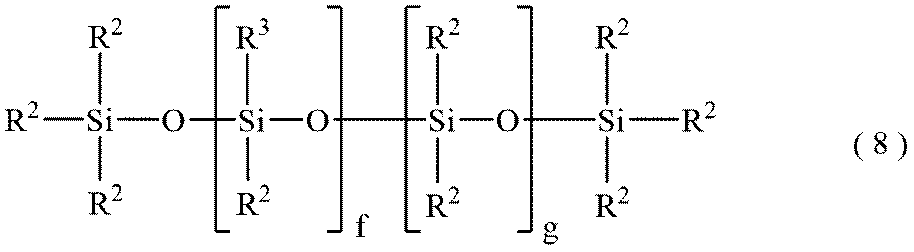
R3はアリール基であり、具体的には、フェニル基、トリル基、キシリル基、ナフチル基等の炭素原子数6~12のものが好ましく、これらの中でもフェニル基が好ましい。
fは1~30、好ましくは5~25の整数、gは5~400、好ましくは100~400の整数であり、R2とR3の合計中のR3(R3/(R2+R3))が1~25モル%、好ましくは1~10モル%を満たすものである。
本発明の無溶剤型硬化性シリコーン剥離剤組成物の調製は、上述した(A)、(B)、(C)、(D)成分及び任意成分を予め均一に混合した後、(E)成分を添加することが好ましい。各成分は単一種類で使用しても二種類以上を併用してもよい。
このようにして調製された本発明の無溶剤型硬化性シリコーン剥離剤組成物は、例えば紙、プラスチックフィルムなどのシート状基材に塗工ロール等により塗布した後、常法によって加熱硬化される。こうしてシート状基材の片面に本発明の無溶剤型硬化性シリコーン剥離剤組成物の硬化皮膜が形成されたものは、剥離シートなどとして好適に使用される。プラスチックフィルムとしては、例えば、ポリエチレン、ポリプロピレン、ポリエチレンテレフタレート等のプラスチックのフィルムが挙げられる。
また、シリコーン剥離剤組成物又はその硬化物の低速及び高速剥離力、残留接着率、動摩擦係数、密着性、ポットライフは下記の方法により測定した。いずれのシリコーン剥離剤組成物も硬化性に問題ない状態であった。
[低速剥離試験]
シリコーン剥離剤組成物をRIテスター(株式会社IHI機械システム製)の金属ロール上に塗布後、金属ロールにゴムロールを接触させて40秒間回転させ、均一にゴムロールに転写した後、さらにゴムロールからポリエチレンラミネート紙へシリコーン剥離剤組成物を転写した。ポリエチレンラミネート紙上のシリコーン剥離剤組成物塗布量は1.0g/m2であった。シリコーン剥離剤組成物を転写したポリエチレンラミネート紙を、140℃の熱風式乾燥機中で30秒間加熱して、塗布量1.0g/m2のシリコーン硬化皮膜を形成した剥離シートを得た。この状態で、25℃で1日間エージングを行った後、この剥離シートのシリコーン硬化皮膜表面に、粘着剤としてBPW-6111A(東洋インキ株式会社製、エマルジョン型アクリル系粘着剤)を塗布し、100℃×180秒で乾燥した後、該粘着剤表面に上質紙を貼り合わせ、5cm×23cmの大きさに切断し、その上に2kgのローラーを往復させて圧着して試験片を作製した。これを25℃で20~24時間エージングさせた後、該試験片の一端を剥がし、該粘着剤付き上質紙端部を基材であるポリエチレンラミネート紙に対して180°の角度の方向に剥離速度0.3m/minで引張り、その際に剥離するのに要する力(即ち、「剥離力」)(N/50mm)を、引張試験機(株式会社島津製作所AGS-50G型)を用いて測定した。
上記低速剥離試験と同様の方法で、上質紙を貼り合わせ、5cm×23cmの大きさに切断し、その上に2kgのローラーを往復させて圧着して試験片を作製した。これを25℃で20~24時間エージングさせた後、該試験片の一端を剥がし、該粘着剤付き上質紙端部を基材であるポリエチレンラミネート紙に対して180°の角度の方向に剥離速度60m/minで引張り、その際に剥離するのに要する力(即ち、「剥離力」)(N/50mm)を、高速剥離試験機(テスター産業株式会社製高速剥離試験機)を用いて測定した。
剥離力の試験と同じ方法でポリエチレンラミネート紙上に塗布量1.0g/m2のシリコーン硬化皮膜を形成した剥離シートを作り、25℃条件下1日エージング後に、この剥離シートのシリコーン硬化皮膜表面に、日東電工株式会社製No.31Bポリエステル粘着テープ(以下31Bテープと記載する)を貼り、70℃乾燥機中20g/cm2圧で20時間圧着した。
その後、31Bテープを剥がし、この31Bテープをステンレス(SUS304)板に貼り付け、2kgのローラーを往復させて荷重を加えた。30分放置後、31Bテープの一端を剥がし、その端部をステンレス板に対して180°の角度の方向に引張り、剥離速度0.3m/minで剥がした。その際に剥離するのに要する力:剥離力A(N/25mm)を測定した。
またブランクとして、テフロン(登録商標)板に31Bテープを貼り合わせ、上記と同様に70℃乾燥機中20g/cm2圧で20時間圧着した後、31Bテープを剥がし、この31Bテープをステンレス(SUS304)板に貼り付け、2kgのローラーを往復させて荷重を加えた。30分放置後、31Bテープの一端を剥がし、その端部をステンレス板に対して180°の角度の方向に引張り、剥離速度0.3m/minで剥がした。その際に剥離するのに要する力:剥離力B(N/25mm)を測定した。
そして、残留接着率(%)を、(A/B)×100で求めた。
剥離力の試験と同じ方法でポリエチレンラミネート紙上に塗布量1.0g/m2のシリコーン硬化皮膜を形成した剥離シートを作り、25℃条件下1日エージング後に、この剥離シートのシリコーン硬化皮膜表面上に、38μm厚のポリエチレンテレフタレートフィルム(PETフィルム)を貼り合わせた200gの錘をポリエチレンテレフタレートフィルムがシリコーン硬化膜表面側になるように置き、引張試験機(株式会社島津製作所AGS-50G型)を用いて引張り速度130mm/minで測定した。動摩擦係数は、引張る力÷200gで求めた。
シリコーン剥離剤組成物をRIテスター(株式会社IHI機械システム製)により塗工したポリエチレンラミネート紙を、140℃の熱風式乾燥機中で30秒間加熱して塗布量1.0g/m2のシリコーン硬化皮膜を形成した剥離シートを、25℃条件下1日エージング後に取り出し、該剥離シートのシリコーン硬化皮膜表面を指の腹で10往復擦り、脱落(皮膜が剥げ落ちること)しないものは○、脱落するものは×と評価した。
シリコーン剥離剤組成物を25℃下1日置き、変色や増粘していないものは○、変色、増粘又はゲル化しているものは×と評価した。
(A)成分としてメチルビニルポリシロキサン(1)73.84質量部及びメチルビニルポリシロキサン(2)26.16質量部、(B)成分としてメチルハイドロジェンポリシロキサン(5)1.88質量部及びメチルハイドロジェンポリシロキサン(6)0.55質量部、(C)成分として高分子量直鎖状オルガノポリシロキサン(7)1.5質量部、(D)付加反応制御剤成分として1-エチニル-1-シクロヘキサノール0.3質量部及び1,1-ジメチルプロピニルオキシトリメチルシラン0.13質量部、(F)アリール基を有するオルガノポリシロキサン(10)0.3質量部を加え、均一となるまで攪拌した後、(E)付加反応触媒として白金とビニルシロキサンとの錯体を上記(A)、(B)、(C)、(D)及び(F)の合計に対して白金換算で100ppmになるように添加し、動粘度が251mm2/sであるシリコーン剥離剤組成物を調製した。
(A)成分としてメチルビニルポリシロキサン(1)29.91質量部、メチルビニルポリシロキサン(2)12.89質量部及びメチルビニルポリシロキサン(3)57.19質量部、(B)成分としてメチルハイドロジェンポリシロキサン(5)4.89質量部及びメチルハイドロジェンポリシロキサン(6)0.55質量部、(C)成分として高分子量直鎖状オルガノポリシロキサン(7)1.5質量部、(D)付加反応制御剤成分として1-エチニル-1-シクロヘキサノール0.27質量部及び1,1-ジメチルプロピニルオキシトリメチルシラン0.19質量部、(F)アリール基を有するオルガノポリシロキサン(10)0.4質量部を加え、均一となるまで攪拌した後、(E)付加反応触媒として白金とビニルシロキサンとの錯体を上記(A)、(B)、(C)、(D)及び(F)の合計に対して白金換算で100ppmになるように添加し、動粘度が370mm2/sであるシリコーン剥離剤組成物を調製した。
(A)成分としてメチルビニルポリシロキサン(1)37.14質量部、メチルビニルポリシロキサン(2)44.38質量部及びメチルビニルポリシロキサン(3)14.00質量部、(B)成分としてメチルハイドロジェンポリシロキサン(5)1.70質量部及びメチルハイドロジェンポリシロキサン(6)2.90質量部、(C)成分として高分子量直鎖状オルガノポリシロキサン(8)1.2質量部及び高分子量直鎖状オルガノポリシロキサン(9)3.0質量部、(D)付加反応制御剤成分として1-エチニル-1-シクロヘキサノール0.25質量部及び1,1-ジメチルプロピニルオキシトリメチルシラン0.25質量部を加え、均一となるまで攪拌した後、(E)付加反応触媒として白金とビニルシロキサンとの錯体を上記(A)、(B)、(C)及び(D)の合計に対して白金換算で100ppmになるように添加し、動粘度が298mm2/sであるシリコーン剥離剤組成物を調製した。
(A)成分としてメチルビニルポリシロキサン(1)73.84質量部及びメチルビニルポリシロキサン(2)26.16質量部、(B)成分としてメチルハイドロジェンポリシロキサン(5)2.20質量部、(C)成分として高分子量直鎖状オルガノポリシロキサン(7)1.5質量部、(D)付加反応制御剤成分として1-エチニル-1-シクロヘキサノール0.3質量部及び1,1-ジメチルプロピニルオキシトリメチルシラン0.13質量部、(F)アリール基を有するオルガノポリシロキサン(10)0.3質量部を加え、均一となるまで攪拌した後、(E)付加反応触媒として白金とビニルシロキサンとの錯体を上記(A)、(B)、(C)、(D)及び(F)の合計に対して白金換算で100ppmになるように添加し、動粘度が253mm2/sであるシリコーン剥離剤組成物を調製した。
(A)成分としてメチルビニルポリシロキサン(1)73.84質量部及びメチルビニルポリシロキサン(2)26.16質量部、(B)成分としてメチルハイドロジェンポリシロキサン(6)3.72質量部、(C)成分として高分子量直鎖状オルガノポリシロキサン(7)1.5質量部、(D)付加反応制御剤成分として1-エチニル-1-シクロヘキサノール0.3質量部及び1,1-ジメチルプロピニルオキシトリメチルシラン0.13質量部、(F)アリール基を有するオルガノポリシロキサン(10)0.3質量部を加え、均一となるまで攪拌した後、(E)付加反応触媒として白金とビニルシロキサンとの錯体を上記(A)、(B)、(C)、(D)及び(F)の合計に対して白金換算で100ppmになるように添加し、動粘度が248mm2/sであるシリコーン剥離剤組成物を調製した。
(A)成分としてメチルビニルポリシロキサン(4)100質量部、(B)成分としてメチルハイドロジェンポリシロキサン(5)5.88質量部及びメチルハイドロジェンポリシロキサン(6)1.72質量部、(C)成分として高分子量直鎖状オルガノポリシロキサン(7)1.5質量部、(D)付加反応制御剤成分として1-エチニル-1-シクロヘキサノール0.3質量部及び1,1-ジメチルプロピニルオキシトリメチルシラン0.13質量部、(F)アリール基を有するオルガノポリシロキサン(10)0.3質量部を加え、均一となるまで攪拌した後、(E)付加反応触媒として白金とビニルシロキサンとの錯体を上記(A)、(B)、(C)、(D)及び(F)の合計に対して白金換算で100ppmになるように添加し、動粘度が64mm2/sであるシリコーン剥離剤組成物を調製した。
(A)成分としてメチルビニルポリシロキサン(1)73.84質量部及びメチルビニルポリシロキサン(2)26.16質量部、(B)成分としてメチルハイドロジェンポリシロキサン(5)1.88質量部及びメチルハイドロジェンポリシロキサン(6)0.55質量部、(C)成分として高分子量直鎖状オルガノポリシロキサン(7)1.5質量部、(F)アリール基を有するオルガノポリシロキサン(10)0.3質量部、(E)付加反応触媒として白金とビニルシロキサンとの錯体を上記(A)、(B)、(C)及び(F)の合計に対して白金換算で100ppmになるように添加し、動粘度が259mm2/sであるシリコーン剥離剤組成物を調製した。
(A)成分としてメチルビニルポリシロキサン(1)73.84質量部及びメチルビニルポリシロキサン(2)26.16質量部、(B)成分としてメチルハイドロジェンポリシロキサン(5)1.88質量部及びメチルハイドロジェンポリシロキサン(6)0.55質量部、(D)付加反応制御剤成分として1-エチニル-1-シクロヘキサノール0.3質量部及び1,1-ジメチルプロピニルオキシトリメチルシラン0.13質量部、(F)アリール基を有するオルガノポリシロキサン(10)0.3質量部を加え、均一となるまで攪拌した後、(E)付加反応触媒として白金とビニルシロキサンとの錯体を上記(A)、(B)、(D)及び(F)の合計に対して白金換算で100ppmになるように添加し、動粘度が209mm2/sであるシリコーン剥離剤組成物を調製した。
(A)成分としてメチルビニルポリシロキサン(3)100質量部、(B)成分としてメチルハイドロジェンポリシロキサン(5)6.64質量部及びメチルハイドロジェンポリシロキサン(6)1.94質量部、(C)成分として高分子量直鎖状オルガノポリシロキサン(7)1.5質量部、(D)付加反応制御剤成分として1-エチニル-1-シクロヘキサノール0.3質量部及び1,1-ジメチルプロピニルオキシトリメチルシラン0.13質量部、(F)アリール基を有するオルガノポリシロキサン(10)0.3質量部を加え、均一となるまで攪拌した後、(E)付加反応触媒として白金とビニルシロキサンとの錯体を上記(A)、(B)、(C)、(D)及び(F)の合計に対して白金換算で100ppmになるように添加し、動粘度が210mm2/sであるシリコーン剥離剤組成物を調製した。
(A)成分としてメチルビニルポリシロキサン(1)73.84質量部及びメチルビニルポリシロキサン(2)26.16質量部、(B)成分としてメチルハイドロジェンポリシロキサン(5)2.20質量部、(C)成分として高分子量直鎖状オルガノポリシロキサン(7)1.5質量部、(D)付加反応制御剤成分として1-エチニル-1-シクロヘキサノール0.3質量部及び1,1-ジメチルプロピニルオキシトリメチルシラン0.13質量部を加え、均一となるまで攪拌した後、(E)付加反応触媒として白金とビニルシロキサンとの錯体を上記(A)、(B)、(C)及び(D)の合計に対して白金換算で100ppmになるように添加し、動粘度が251mm2/sであるシリコーン剥離剤組成物を調製した。
メチルビニルポリシロキサン(1)
分子鎖両末端がジメチルビニルシロキシ基で封鎖され、両末端以外は全て(CH3)2SiO単位からなるビニル価が0.0166mol/100g、動粘度450mm2/sのポリシロキサン
{(CH2=CH)(CH3)2SiO1/2}2{(CH3)2SiO}160
分子鎖両末端がジメチルビニルシロキシ基で封鎖され、両末端以外は全て(CH3)2SiO単位からなるビニル価が0.029mol/100g、動粘度120mm2/sのポリシロキサン
{(CH2=CH)(CH3)2SiO1/2}2{(CH3)2SiO}90
分子鎖末端がトリメチルシロキシ基で封鎖され、シロキサン鎖が(CH3)(CH2=CH)SiO単位と(CH3)2SiO単位から構成されたビニル価が0.07mol/100g、動粘度97mm2/sのポリシロキサン
{(CH3)3SiO1/2}2{(CH3)2SiO}70{(CH2=CH)(CH3)SiO}4
分子鎖末端がジメチルビニルシロキシ基で封鎖され、両末端以外は全て(CH3)2SiO単位からなるビニル価が0.062mol/100g、動粘度60mm2/sのポリシロキサン
{(CH2=CH)(CH3)2SiO1/2}2{(CH3)2SiO}41
分子鎖両末端がトリメチルシロキシ基で封鎖され、両末端以外は全て(CH3)HSiO単位からなるSiH基含有量が1.61mol/100gで動粘度が38mm2/sであるメチルハイドロジェンポリシロキサン
{(CH3)3SiO1/2}2{(CH3)HSiO}77
分子鎖両末端がトリメチルシロキシ基で封鎖され、シロキサン鎖が(CH3)HSiO単位と(CH3)2SiO単位から構成され、(CH3)HSiO単位が(CH3)2SiO単位の2.2倍であり、SiH基含有量が1.0mol/100gで動粘度が35mm2/sであるメチルハイドロジェンポリシロキサン
{(CH3)3SiO1/2}2{(CH3)2SiO}12{(CH3)HSiO}26.4
{HO(CH3)2SiO1/2}2{(CH3)2SiO2/2)}1600
{HO(CH3)2SiO1/2}2{(CH3)2SiO2/2)}2000
{HO(CH3)2SiO1/2}2{(CH3)2SiO2/2)}400
{(CH3)3SiO1/2}2{(CH3)2SiO}400{Ph2SiO}21
(式中、Phはフェニル基を表す。)
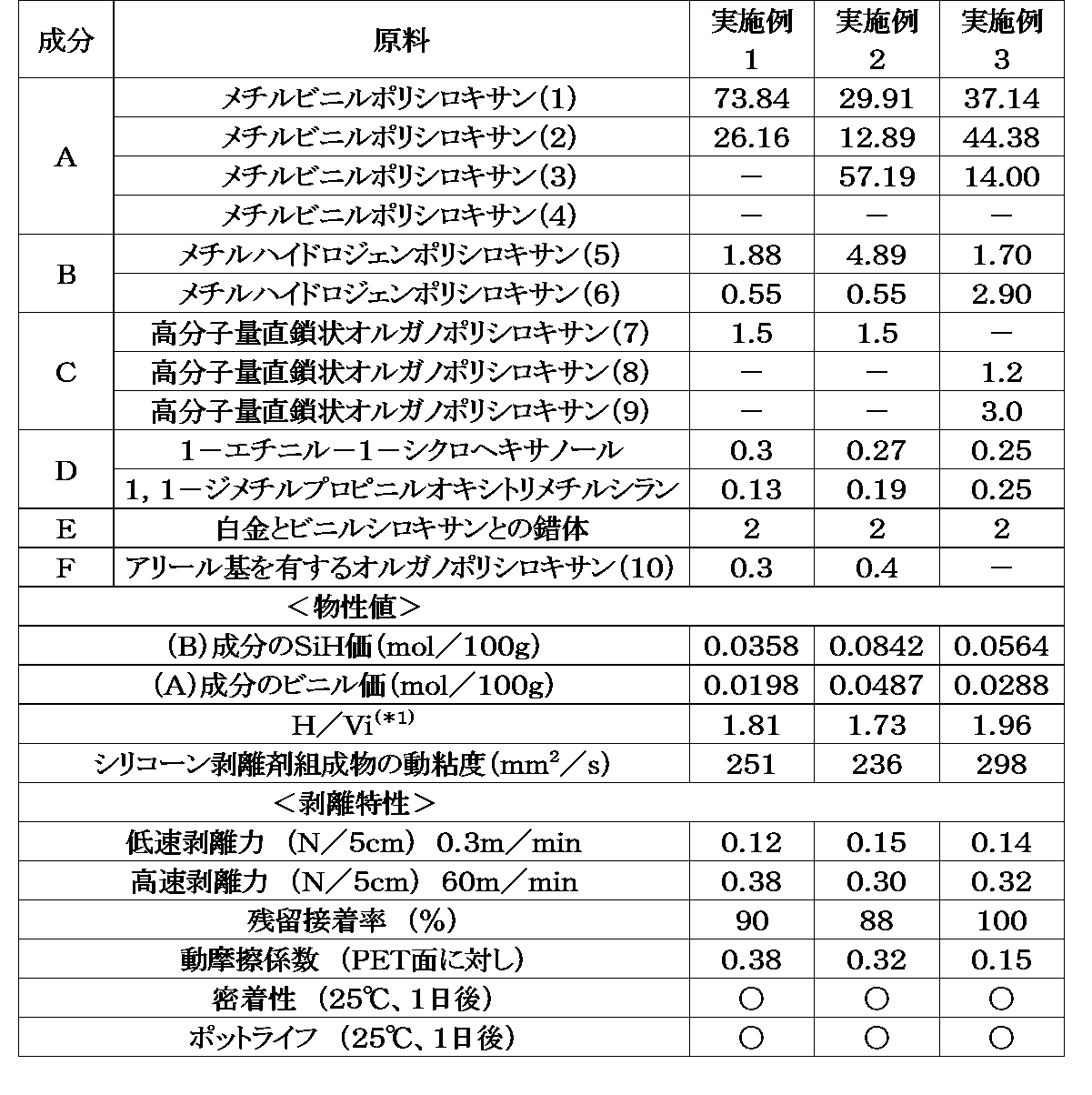
(*1):組成物中のアルケニル基に対する組成物中のSiH基の割合

Claims (6)
- 少なくとも下記(A)、(B)、(C)、(D)及び(E)成分を含有する無溶剤型硬化性シリコーン剥離剤組成物。
(A)ビニル価が0.016mol/100g以上0.05mol/100g以下であり、25℃における動粘度が80mm2/s以上450mm2/s以下であり、1分子中に2個以上のアルケニル基を含有するオルガノポリシロキサン: 100質量部、
(B)下記平均組成式(1)で表されるオルガノハイドロジェンポリシロキサン(B-1)と下記平均組成式(2)で表されるオルガノハイドロジェンポリシロキサン(B-2)とを、(B-1):(B-2)=100:5~100:200の質量割合で併用してなるケイ素原子に結合する水素原子量が0.016mol/100g以上0.5mol/100g以下であるオルガノハイドロジェンポリシロキサン混合物: 2~8質量部、
MαMH βDH γTδQε (1)
(式中、MはR3SiO1/2、MHはR2HSiO1/2、DHはRHSiO2/2、TはRSiO3/2、QはSiO4/2であり、Rはそれぞれ独立に脂肪族不飽和結合を含有しない炭素原子数1~12の非置換又は置換の一価炭化水素基である。またα、βはそれぞれ独立に0又は正数で、2≦α+βであり、γ、δ、εは10≦γ≦100、0≦δ≦10、0≦ε≦10を満たす数である。)
MαMH βDH ζDηTδQε (2)
(式中、MはR3SiO1/2、MHはR2HSiO1/2、DHはRHSiO2/2、DはR2SiO2/2、TはRSiO3/2、QはSiO4/2であり、Rはそれぞれ独立に脂肪族不飽和結合を含有しない炭素原子数1~12の非置換又は置換の一価炭化水素基である。またα、βはそれぞれ独立に0又は正数で、2≦α+βであり、ζ、η、δ、εは5≦ζ≦60、10≦η≦50、0≦δ≦10、0≦ε≦10を満たす数である。)
(C)下記一般式(3)で表される高分子量直鎖型オルガノポリシロキサン: 0.1~20質量部、
M1 2Dθ (3)
(式中、M1はR1 3SiO1/2、DはR2SiO2/2であり、Rはそれぞれ独立に脂肪族不飽和結合を含有しない炭素原子数1~12の非置換又は置換の一価炭化水素基であり、R1は脂肪族不飽和結合を含有しない炭素原子数1~12の非置換又は置換の一価炭化水素基又は水酸基であり、θは300以上3,000以下の正数である。)
(D)付加反応制御剤: 有効量、
(E)付加反応用触媒: 有効量。 - (A)成分が、下記平均組成式(4)で表されるオルガノポリシロキサンである請求項1記載の無溶剤型硬化性シリコーン剥離剤組成物。
MιMVi κDλDVi μ (4)
(式中、MはR3SiO1/2、MViはR2PSiO1/2、DはR2SiO2/2、DViはRPSiO2/2であり、Rはそれぞれ独立に脂肪族不飽和結合を含有しない炭素原子数1~12の非置換又は置換の一価炭化水素基であり、Pは-(CH2)a-CH=CH2(aは0~6の整数)で表されるアルケニル基である。またι、κ、λ、μは、0≦ι≦2、0≦κ≦2、ι+κ=2、10≦λ≦300、0≦μ≦10を満たす数である。) - (B-1)成分が、下記平均組成式(5)で表されるオルガノハイドロジェンポリシロキサンであり、(B-2)成分が、下記平均組成式(6)で表されるオルガノハイドロジェンポリシロキサンである請求項1又は2記載の無溶剤型硬化性シリコーン剥離剤組成物。
MαMH βDH γ (5)
(式中、MはR3SiO1/2、MHはR2HSiO1/2、DHはRHSiO2/2であり、Rはそれぞれ独立に脂肪族不飽和結合を含有しない炭素原子数1~12の非置換又は置換の一価炭化水素基である。またα、βはそれぞれ独立に0又は正数で、2≦α+βであり、γは10≦γ≦100を満たす正数である。)
MαMH βDH ζDη (6)
(式中、MはR3SiO1/2、MHはR2HSiO1/2、DHはRHSiO2/2、DはR2SiO2/2であり、Rはそれぞれ独立に脂肪族不飽和結合を含有しない炭素原子数1~12の非置換又は置換の一価炭化水素基である。またα、βはそれぞれ独立に0又は正数で、2≦α+βであり、ζ、ηは5≦ζ≦60、10≦η≦50を満たす正数である。) - さらに、(F)成分として、下記一般式(8)で表されるアリール基を有するオルガノポリシロキサンを(A)成分100質量部に対して0.1~5質量部含有する請求項1~3のいずれか1項に記載の無溶剤型硬化性シリコーン剥離剤組成物。

- 無溶剤型硬化性シリコーン剥離剤組成物をポリエチレンラミネート紙に0.8~1.2g/m2の塗布量となるように塗工し、140℃で30秒間熱硬化させた該組成物の硬化皮膜表面に、粘着剤としてBPW-6111A(エマルジョン型アクリル系粘着剤)を塗布し、100℃で180秒間乾燥後、上質紙を貼り合わせた5cm×23cmサイズのサンプル片を25℃で20時間エージングし、該サンプル片の低速剥離力(0.3m/min、180°ピール)が0.01~0.2N/5cmであり、高速剥離力(60m/min、180°ピール)が0.1~0.5N/5cmであることを特徴とする請求項1~4のいずれか1項に記載の無溶剤型硬化性シリコーン剥離剤組成物。
- シート状基材と、該基材の片面に形成された請求項1~5のいずれか1項に記載の無溶剤型硬化性シリコーン剥離剤組成物の硬化皮膜とを有する剥離シート。
Priority Applications (5)
| Application Number | Priority Date | Filing Date | Title |
|---|---|---|---|
| CN201980009451.2A CN111655816A (zh) | 2018-01-22 | 2019-01-18 | 无溶剂型固化性有机硅剥离剂组合物和剥离片 |
| EP19740984.0A EP3744805A4 (en) | 2018-01-22 | 2019-01-18 | SOLVENT-FREE CURABLE SILICONE RELEASE AGENT COMPOSITION AND RELEASE FILM |
| KR1020207024015A KR20200110405A (ko) | 2018-01-22 | 2019-01-18 | 무용제형 경화성 실리콘 박리제 조성물 및 박리 시트 |
| JP2019566517A JPWO2019142894A1 (ja) | 2018-01-22 | 2019-01-18 | 無溶剤型硬化性シリコーン剥離剤組成物及び剥離シート |
| US16/963,587 US20210054245A1 (en) | 2018-01-22 | 2019-01-18 | Solvent-free curable silicone releasing agent composition and release sheet |
Applications Claiming Priority (2)
| Application Number | Priority Date | Filing Date | Title |
|---|---|---|---|
| JP2018-007987 | 2018-01-22 | ||
| JP2018007987 | 2018-01-22 |
Publications (1)
| Publication Number | Publication Date |
|---|---|
| WO2019142894A1 true WO2019142894A1 (ja) | 2019-07-25 |
Family
ID=67302332
Family Applications (1)
| Application Number | Title | Priority Date | Filing Date |
|---|---|---|---|
| PCT/JP2019/001407 Ceased WO2019142894A1 (ja) | 2018-01-22 | 2019-01-18 | 無溶剤型硬化性シリコーン剥離剤組成物及び剥離シート |
Country Status (7)
| Country | Link |
|---|---|
| US (1) | US20210054245A1 (ja) |
| EP (1) | EP3744805A4 (ja) |
| JP (1) | JPWO2019142894A1 (ja) |
| KR (1) | KR20200110405A (ja) |
| CN (1) | CN111655816A (ja) |
| TW (1) | TW201940613A (ja) |
| WO (1) | WO2019142894A1 (ja) |
Cited By (1)
| Publication number | Priority date | Publication date | Assignee | Title |
|---|---|---|---|---|
| WO2025079459A1 (ja) * | 2023-10-13 | 2025-04-17 | 信越化学工業株式会社 | 剥離シート用硬化性オルガノポリシロキサン組成物、及び剥離シート |
Families Citing this family (4)
| Publication number | Priority date | Publication date | Assignee | Title |
|---|---|---|---|---|
| KR102742117B1 (ko) * | 2018-08-01 | 2024-12-16 | 신에쓰 가가꾸 고교 가부시끼가이샤 | 실리콘 점착제 조성물 및 이것을 사용한 점착 테이프 또는 점착 필름 |
| KR102611667B1 (ko) * | 2022-03-28 | 2023-12-07 | 도레이첨단소재 주식회사 | 이형 필름용 조성물 및 이를 이용한 이형 필름 |
| CN119866269A (zh) * | 2022-09-16 | 2025-04-22 | 东洋纺株式会社 | 脱模薄膜及其制造方法 |
| CN120648379B (zh) * | 2025-06-23 | 2026-01-30 | 杭州崇耀科技发展有限公司 | 一种乳液型离型剂及其制备方法 |
Citations (18)
| Publication number | Priority date | Publication date | Assignee | Title |
|---|---|---|---|---|
| JPS54162787A (en) | 1978-06-12 | 1979-12-24 | Union Carbide Corp | Radiationncurable silicone release composition |
| JPS60133051A (ja) * | 1983-12-21 | 1985-07-16 | Dow Corning Kk | 剥離性被膜形成用組成物 |
| JPH0420570A (ja) * | 1990-05-15 | 1992-01-24 | Shin Etsu Chem Co Ltd | 剥離性に優れたシリコーン組成物 |
| JPH0791518B2 (ja) | 1987-04-09 | 1995-10-04 | ダウコーニングアジア株式会社 | 剥離性組成物 |
| JPH08176448A (ja) * | 1994-12-22 | 1996-07-09 | Shin Etsu Chem Co Ltd | オルガノポリシロキサン組成物 |
| JPH08217980A (ja) * | 1995-02-13 | 1996-08-27 | Toshiba Silicone Co Ltd | 剥離用組成物 |
| JP2946963B2 (ja) | 1992-09-09 | 1999-09-13 | 信越化学工業株式会社 | 剥離性皮膜形成用シリコーン組成物及び剥離性皮膜 |
| JP3198926B2 (ja) | 1995-07-11 | 2001-08-13 | 信越化学工業株式会社 | 硬化性シリコーン剥離剤組成物及び剥離紙 |
| JP2002161208A (ja) * | 2000-11-28 | 2002-06-04 | Shin Etsu Chem Co Ltd | シリコーン剥離剤組成物及び剥離紙 |
| JP2002356667A (ja) * | 2001-05-31 | 2002-12-13 | Shin Etsu Chem Co Ltd | 硬化性シリコーン剥離剤組成物 |
| JP2003003183A (ja) | 2001-06-18 | 2003-01-08 | Shin Etsu Chem Co Ltd | 離型剤用溶剤型シリコーン組成物 |
| JP2003128925A (ja) * | 2001-10-24 | 2003-05-08 | Shin Etsu Chem Co Ltd | 硬化性シリコ−ン剥離剤組成物及び剥離紙 |
| WO2006070947A1 (ja) * | 2004-12-28 | 2006-07-06 | Dow Corning Toray Co., Ltd. | 無溶剤型剥離性硬化皮膜形成性オルガノポリシロキサン組成物 |
| JP2007186804A (ja) * | 2006-01-11 | 2007-07-26 | Shin Etsu Chem Co Ltd | 無溶剤型硬化性シリコ−ン剥離剤組成物 |
| JP2009292883A (ja) * | 2008-06-03 | 2009-12-17 | Shin-Etsu Chemical Co Ltd | 無溶剤型剥離紙用シリコーン組成物 |
| JP2011132524A (ja) * | 2009-11-30 | 2011-07-07 | Adoweru:Kk | 剥離剤組成物、およびこれを用いた剥離ライナー |
| WO2016006252A1 (ja) * | 2014-07-10 | 2016-01-14 | 東レ・ダウコーニング株式会社 | 剥離コントロール剤、それを含むシリコーン剥離剤組成物、剥離シート、及び積層体 |
| JP2020032072A (ja) | 2018-08-31 | 2020-03-05 | キヤノン株式会社 | 画像処理装置、画像処理方法、及びプログラム |
Family Cites Families (3)
| Publication number | Priority date | Publication date | Assignee | Title |
|---|---|---|---|---|
| US6093183A (en) * | 1998-08-07 | 2000-07-25 | Pavkovich; Mary | Safety Intravenous connector |
| US8176448B2 (en) * | 2009-06-05 | 2012-05-08 | Empire Technology Development Llc | Method for N-variant integrated circuit (IC) design, and IC having N-variant circuits implemented therein |
| JP3198926U (ja) | 2015-05-18 | 2015-07-30 | ふくみ 早川 | 下着 |
-
2019
- 2019-01-18 WO PCT/JP2019/001407 patent/WO2019142894A1/ja not_active Ceased
- 2019-01-18 EP EP19740984.0A patent/EP3744805A4/en not_active Withdrawn
- 2019-01-18 US US16/963,587 patent/US20210054245A1/en not_active Abandoned
- 2019-01-18 KR KR1020207024015A patent/KR20200110405A/ko not_active Withdrawn
- 2019-01-18 CN CN201980009451.2A patent/CN111655816A/zh active Pending
- 2019-01-18 JP JP2019566517A patent/JPWO2019142894A1/ja active Pending
- 2019-01-22 TW TW108102345A patent/TW201940613A/zh unknown
Patent Citations (19)
| Publication number | Priority date | Publication date | Assignee | Title |
|---|---|---|---|---|
| JPS54162787A (en) | 1978-06-12 | 1979-12-24 | Union Carbide Corp | Radiationncurable silicone release composition |
| JPS60133051A (ja) * | 1983-12-21 | 1985-07-16 | Dow Corning Kk | 剥離性被膜形成用組成物 |
| JPH0352498B2 (ja) | 1983-12-21 | 1991-08-12 | Dow Corning Kk | |
| JPH0791518B2 (ja) | 1987-04-09 | 1995-10-04 | ダウコーニングアジア株式会社 | 剥離性組成物 |
| JPH0420570A (ja) * | 1990-05-15 | 1992-01-24 | Shin Etsu Chem Co Ltd | 剥離性に優れたシリコーン組成物 |
| JP2946963B2 (ja) | 1992-09-09 | 1999-09-13 | 信越化学工業株式会社 | 剥離性皮膜形成用シリコーン組成物及び剥離性皮膜 |
| JPH08176448A (ja) * | 1994-12-22 | 1996-07-09 | Shin Etsu Chem Co Ltd | オルガノポリシロキサン組成物 |
| JPH08217980A (ja) * | 1995-02-13 | 1996-08-27 | Toshiba Silicone Co Ltd | 剥離用組成物 |
| JP3198926B2 (ja) | 1995-07-11 | 2001-08-13 | 信越化学工業株式会社 | 硬化性シリコーン剥離剤組成物及び剥離紙 |
| JP2002161208A (ja) * | 2000-11-28 | 2002-06-04 | Shin Etsu Chem Co Ltd | シリコーン剥離剤組成物及び剥離紙 |
| JP2002356667A (ja) * | 2001-05-31 | 2002-12-13 | Shin Etsu Chem Co Ltd | 硬化性シリコーン剥離剤組成物 |
| JP2003003183A (ja) | 2001-06-18 | 2003-01-08 | Shin Etsu Chem Co Ltd | 離型剤用溶剤型シリコーン組成物 |
| JP2003128925A (ja) * | 2001-10-24 | 2003-05-08 | Shin Etsu Chem Co Ltd | 硬化性シリコ−ン剥離剤組成物及び剥離紙 |
| WO2006070947A1 (ja) * | 2004-12-28 | 2006-07-06 | Dow Corning Toray Co., Ltd. | 無溶剤型剥離性硬化皮膜形成性オルガノポリシロキサン組成物 |
| JP2007186804A (ja) * | 2006-01-11 | 2007-07-26 | Shin Etsu Chem Co Ltd | 無溶剤型硬化性シリコ−ン剥離剤組成物 |
| JP2009292883A (ja) * | 2008-06-03 | 2009-12-17 | Shin-Etsu Chemical Co Ltd | 無溶剤型剥離紙用シリコーン組成物 |
| JP2011132524A (ja) * | 2009-11-30 | 2011-07-07 | Adoweru:Kk | 剥離剤組成物、およびこれを用いた剥離ライナー |
| WO2016006252A1 (ja) * | 2014-07-10 | 2016-01-14 | 東レ・ダウコーニング株式会社 | 剥離コントロール剤、それを含むシリコーン剥離剤組成物、剥離シート、及び積層体 |
| JP2020032072A (ja) | 2018-08-31 | 2020-03-05 | キヤノン株式会社 | 画像処理装置、画像処理方法、及びプログラム |
Non-Patent Citations (1)
| Title |
|---|
| See also references of EP3744805A4 |
Cited By (1)
| Publication number | Priority date | Publication date | Assignee | Title |
|---|---|---|---|---|
| WO2025079459A1 (ja) * | 2023-10-13 | 2025-04-17 | 信越化学工業株式会社 | 剥離シート用硬化性オルガノポリシロキサン組成物、及び剥離シート |
Also Published As
| Publication number | Publication date |
|---|---|
| KR20200110405A (ko) | 2020-09-23 |
| CN111655816A (zh) | 2020-09-11 |
| EP3744805A4 (en) | 2021-10-20 |
| US20210054245A1 (en) | 2021-02-25 |
| TW201940613A (zh) | 2019-10-16 |
| EP3744805A1 (en) | 2020-12-02 |
| JPWO2019142894A1 (ja) | 2021-02-04 |
Similar Documents
| Publication | Publication Date | Title |
|---|---|---|
| TWI567137B (zh) | A polyethylene oxide composition for a stripping sheet and a release sheet, and a release sheet | |
| WO2019142894A1 (ja) | 無溶剤型硬化性シリコーン剥離剤組成物及び剥離シート | |
| JP4524549B2 (ja) | シリコーン粘着剤用離型剤組成物及びそれを用いた離型シート | |
| CN111433286B (zh) | 硅酮组合物、硬化皮膜及其制造方法 | |
| JP4190336B2 (ja) | 硬化性シリコ−ン剥離剤組成物 | |
| JP3813467B2 (ja) | 硬化性シリコーン剥離剤組成物 | |
| JP7103375B2 (ja) | 無溶剤型シリコーン剥離剤組成物、剥離シート及びその製造方法 | |
| JP5101888B2 (ja) | 無溶剤型剥離性硬化皮膜形成性オルガノポリシロキサン組成物 | |
| WO2018190012A1 (ja) | 剥離紙又は剥離フィルム製造用シリコーン組成物 | |
| JP3891260B2 (ja) | 硬化性シリコ−ン剥離剤組成物及び剥離紙 | |
| JP3048470B2 (ja) | 剥離紙用硬化性シリコーン組成物 | |
| JP2915778B2 (ja) | 離型紙用シリコーン組成物 | |
| JP5138205B2 (ja) | 無溶剤型剥離紙用シリコーン組成物 | |
| JPH0319268B2 (ja) | ||
| JP5550001B2 (ja) | 硬化性シリコーン剥離剤組成物 | |
| JP2007284685A (ja) | シリコーン剥離剤組成物及び剥離紙 | |
| JP4093542B2 (ja) | 硬化性シリコーン剥離剤組成物及びそれを使用してなる剥離紙 | |
| JP3985995B2 (ja) | 離型剤用溶剤型シリコーン組成物 | |
| JP2002161208A (ja) | シリコーン剥離剤組成物及び剥離紙 | |
| JP4753023B2 (ja) | シリコーン剥離剤組成物及び粘着紙の製造方法 | |
| JP2508898B2 (ja) | 剥離紙の製造方法 | |
| JP2007308865A (ja) | 剥離用シリコーン組成物 | |
| JP2007211186A (ja) | 剥離性硬化皮膜形成性オルガノポリシロキサン組成物、剥離性硬化皮膜を有するシート状基材およびその製造方法 | |
| WO2024241954A1 (ja) | 剥離剤組成物及び剥離シート |
Legal Events
| Date | Code | Title | Description |
|---|---|---|---|
| 121 | Ep: the epo has been informed by wipo that ep was designated in this application |
Ref document number: 19740984 Country of ref document: EP Kind code of ref document: A1 |
|
| ENP | Entry into the national phase |
Ref document number: 2019566517 Country of ref document: JP Kind code of ref document: A |
|
| NENP | Non-entry into the national phase |
Ref country code: DE |
|
| ENP | Entry into the national phase |
Ref document number: 20207024015 Country of ref document: KR Kind code of ref document: A |
|
| ENP | Entry into the national phase |
Ref document number: 2019740984 Country of ref document: EP Effective date: 20200824 |