WO2019143924A1 - Method of treating galectin-3 dependent disorders - Google Patents
Method of treating galectin-3 dependent disorders Download PDFInfo
- Publication number
- WO2019143924A1 WO2019143924A1 PCT/US2019/014176 US2019014176W WO2019143924A1 WO 2019143924 A1 WO2019143924 A1 WO 2019143924A1 US 2019014176 W US2019014176 W US 2019014176W WO 2019143924 A1 WO2019143924 A1 WO 2019143924A1
- Authority
- WO
- WIPO (PCT)
- Prior art keywords
- polysaccharide
- gal
- galectin
- side chain
- backbone
- Prior art date
- Legal status (The legal status is an assumption and is not a legal conclusion. Google has not performed a legal analysis and makes no representation as to the accuracy of the status listed.)
- Ceased
Links
Classifications
-
- A—HUMAN NECESSITIES
- A61—MEDICAL OR VETERINARY SCIENCE; HYGIENE
- A61K—PREPARATIONS FOR MEDICAL, DENTAL OR TOILETRY PURPOSES
- A61K31/00—Medicinal preparations containing organic active ingredients
- A61K31/70—Carbohydrates; Sugars; Derivatives thereof
- A61K31/715—Polysaccharides, i.e. having more than five saccharide radicals attached to each other by glycosidic linkages; Derivatives thereof, e.g. ethers, esters
-
- A—HUMAN NECESSITIES
- A61—MEDICAL OR VETERINARY SCIENCE; HYGIENE
- A61K—PREPARATIONS FOR MEDICAL, DENTAL OR TOILETRY PURPOSES
- A61K36/00—Medicinal preparations of undetermined constitution containing material from algae, lichens, fungi or plants, or derivatives thereof, e.g. traditional herbal medicines
- A61K36/18—Magnoliophyta (angiosperms)
- A61K36/185—Magnoliopsida (dicotyledons)
- A61K36/42—Cucurbitaceae (Cucumber family)
-
- C—CHEMISTRY; METALLURGY
- C08—ORGANIC MACROMOLECULAR COMPOUNDS; THEIR PREPARATION OR CHEMICAL WORKING-UP; COMPOSITIONS BASED THEREON
- C08B—POLYSACCHARIDES; DERIVATIVES THEREOF
- C08B37/00—Preparation of polysaccharides not provided for in groups C08B1/00 - C08B35/00; Derivatives thereof
- C08B37/006—Heteroglycans, i.e. polysaccharides having more than one sugar residue in the main chain in either alternating or less regular sequence; Gellans; Succinoglycans; Arabinogalactans; Tragacanth or gum tragacanth or traganth from Astragalus; Gum Karaya from Sterculia urens; Gum Ghatti from Anogeissus latifolia; Derivatives thereof
Definitions
- Galectin-3 (also referred to herein as gal-3, formerly known as the Mac-2 antigen) is a protein belonging to a specific sub-family of carbohydrate binding proteins (lectins) that recognize b-galactosides. Galectin-3 is the only family member that is composed of a glycine/proline rich N-terminal repeated sequence and a C-terminal carbohydrate- binding domain. Galectin-3 is a pleiotropic lectin that plays an important role in cell proliferation, adhesion, differentiation, angiogenesis, and apoptosis. Galectins possess a carbohydrate recognition domain (CRD).
- CCD carbohydrate recognition domain
- the CRDs of various galectins differ in amino acid sequence outside of the conserved residues mediating specificity to different glycan ligands between galectins.
- Galectin-3 has both intracellular functions and extracellular functions and is actively secreted via a non-canonical pathway into the extracellular space and into circulation. Binding of carbohydrates to the CRD can result in modulation of galectin-3 activity in-vitro and in-vivo.
- Galectin-3 has key roles in fibrogenesis affecting various organ systems including renal, pulmonary and cardiovascular systems. Fibrosis plays a key role in diseases such as heart failure, chronic kidney disease, chronic lung disease, and chronic vascular disease including abdominal arterial aneurysm and vascular stiffening. Galeclin-3 is expressed in a variety of cell types as an immune response to microbial invasion that may also include inflammation as a response affecting the brain, eye, skin, joints and other organs of the body. Studies have also revealed that galectin-3 has a role in cancer.
- Some embodiments of the present disclosure are directed to a therapeutic composition including a polysaccharide having a backbone including alternating a-L- rhamnosyl (a-L-Rha/i) and a-D-galactopyranosyluronic acid (a-D-Gal/iA) residues, and a side chain attached to the backbone including b-D-galactan (b-D-Gal/i), a-L- arabinofuranosyl (a-L-Ara /), or combinations thereof, and a pharmaceutically acceptable excipient.
- a polysaccharide having a backbone including alternating a-L- rhamnosyl (a-L-Rha/i) and a-D-galactopyranosyluronic acid (a-D-Gal/iA) residues, and a side chain attached to the backbone including b-D-galactan (b-D-Gal/i), a-L- arabinof
- a b-D-Galp side chain is attached to the backbone at the C-4 carbon of at least one a-L-Rhap of the backbone. In some embodiments, at least one a-L-Araf is attached to the b-D-Galp side chain. In some embodiments, the a-L-Araf is attached to the b-D-Galp side chain via the C-3 carbon of the b-D-Galp. In some embodiments, the polysaccharide isolated from a member of the genus Cucurbita.
- Some embodiments of the present disclosure are directed to a method of treating a galectin-3 dependent disorder including determining that a patient has a galectin-3 dependent disorder and administering to the patient a therapeutically effective dose of the therapeutic composition.
- the galectin-3 dependent disorder includes galectin-3 -mediated diseases and disorders including fibrosis, inflammation, organ damage, impaired organ function, cardiovascular disease, kidney disease, lung disease, cancers, heart disease, elevated blood galectin-3 level, elevated levels of the one or more collagen turnover markers, or combinations thereof.
- Some embodiments of the present disclosure include a method of isolating a polysaccharide including suspending an amount of plant material in an alkali hydroxide solution, heating the suspension, and isolating a polysaccharide-including supernatant layer from the suspension.
- FIG. l is a schematic drawing of a polysaccharide according to some embodiments of the present disclosure.
- FIG. 2 is a chart of a method for isolating a polysaccharide according to some embodiments of the present disclosure
- FIG. 3 is a chart of a method for treating a galectin-3 dependent disorder according to some embodiments of the present disclosure
- FIG. 4 portrays a monosaccharide composition determined by reversed-phase high-performance liquid chromatography for a polysaccharide according to some embodiments of the present disclosure
- FIG. 5 portrays an 1H NMR spectrum for a polysaccharide according to some embodiments of the present disclosure
- FIG. 6 portrays an 13 C NMR spectrum for a polysaccharide according to some embodiments of the present disclosure
- FIG. 7 portrays a heteronuclear single quantum correlation for a polysaccharide according to some embodiments of the present disclosure
- FIG. 8 portrays a 1H-1H correlation (COSY) spectrum for a polysaccharide according to some embodiments of the present disclosure
- FIG. 9 portrays a heteronuclear multiple bond correlation (HMBC) for a polysaccharide according to some embodiments of the present disclosure
- FIG. 10 portrays a surface plasmon resonance (SPR) sensorgram of pectic polysaccharide and Ricnus Communis Agglutinin I (RCA l20 ) binding showing a smooth binding curve between pectin polysaccharide and RCA l20
- FIG. 11 portrays an SPR sensorgram of pectic polysaccharide and RCA ⁇ o binding with pectic polysaccharide concentrations.
- SPR surface plasmon resonance
- Some aspects of the disclosed subject matter include a therapeutic composition including a polysaccharide effective to bind to and inhibit the activity of a galectin-3 protein.
- the polysaccharide is a compound including a plurality of long chains of sugar units linked together by glycosidic linkages, which after breakdown or hydrolysis yields one or more fragments that bind to the galectin-3 carbohydrate recognition domain resulting in inhibition of galectin-3 activity.
- a “compound” refers to the compound itself and its pharmaceutically acceptable salts, hydrates and esters, unless otherwise understood from the context of the description or expressly limited to one particular form of the compound, i.e., the compound itself, or a pharmaceutically acceptable salt, hydrate or ester thereof.
- the polysaccharide in the therapeutic composition is in long chain form to be broken- down/hydrolyzed subsequent to administration to a patient.
- the polysaccharide in the therapeutic composition is broken-down/hydrolyzed prior to administration to the patient.
- the therapeutic composition also includes pharmaceutically acceptable adjuvants, diluents, excipients, carriers, or combinations thereof.
- the therapeutic composition includes one or more additional active ingredients, e.g., angiotensin-converting enzyme (ACE) inhibitors, antiplatelet agents, angiotensin II receptor blockers, beta blockers, calcium channel blockers, diuretics, vasodilators, digitalis preparations, statins, or combinations thereof.
- additional active ingredients e.g., angiotensin-converting enzyme (ACE) inhibitors, antiplatelet agents, angiotensin II receptor blockers, beta blockers, calcium channel blockers, diuretics, vasodilators, digitalis preparations, statins, or combinations thereof.
- ACE angiotensin-converting enzyme
- the therapeutic composition is configured for administration enterally or parenterally, e.g., oral, sublingual, rectal, intravenous, subcutaneous, topical, transdermal, intradermal, transmucosal, intraperitoneal, intramuscular, intracapsular, intraorbital, intracardiac, transtracheal, subcutaneous, subcuticular, intraarticular, subcapsular, subarachnoid, intraspinal, epidural and intrasternal injection, infusion, etc., or combinations thereof.
- parenterally e.g., oral, sublingual, rectal, intravenous, subcutaneous, topical, transdermal, intradermal, transmucosal, intraperitoneal, intramuscular, intracapsular, intraorbital, intracardiac, transtracheal, subcutaneous, subcuticular, intraarticular, subcapsular, subarachnoid, intraspinal, epidural and intrasternal injection, infusion, etc., or combinations thereof.
- the polysaccharide 100 has a backbone 102 including an rhamnogalacturonan I (RG-I) domain 102 A.
- the backbone 102 includes RG-I domain 102 A and a homogalacturonan (HG) domain 102B.
- RG-I domain 102A includes a-L-rhamnosyl (a-L-Rha/;) and a-D-galactopyranosyluronic acid (a-D-Gal A) residues.
- RG-I domain 102 A includes alternating a-L-Rha/; and a-D-Gal A residues.
- RG-I domain 102 A includes alternating blocks of a-L-Rha/3 and a-D-Gal A residues. In some embodiments, the HG domain is comprised substantially of l,4-a-D-Gal/>A residues. In some embodiments, the HG domain includes one or more functional group substitutions.
- a side chain 104 is attached to the backbone. In some embodiments, a plurality of side chains 104 are attached to the backbone. In some embodiments, side chains 104 are attached to RG-I domain 102A of the backbone 102. In some embodiments, side chains 104 include b-D-galactan (b-D-Gal f), a-L- arabinofuranosyl (a-L-Ara /), or combinations thereof. In some embodiments, side chain 104 is attached to the backbone 102 at the C-4 carbon of at least one a-L-Rha/; residue. In some embodiments, the side chain is a b-D-Gal/3 side chain.
- one or more a-L-Ara / residues are attached to the b-D-Gal/3 side chain. In some embodiments, the one or more a-L-Ara / residues are attached to the b-D-Gal/3 side chain via the C-3 carbon of the b-D-Gal/>.
- the polysaccharide has a structure according to the following Formula I:
- the molecular weight of polysaccharide 100 is about 5 kDa to about 70 kDa. In some embodiments, the molecular weight of polysaccharide 100 is about 20 kDa to about 30 kDa. In some embodiments, the molecular weight of polysaccharide 100 is about 20 kDa to about 25 kDa. In some embodiments, the molecular weight of polysaccharide 100 is about 5 kDa to about 25 kDa. In some embodiments, the molecular weight of polysaccharide 100 is about 17 kDa to about 23 kDa. In some embodiments, the molecular weight of polysaccharide 100 is 17.5 kDa.
- polysaccharide 100 is isolated from a plant material, as will be discussed in greater detail below.
- the plant material is a member of the genus Cucurbita.
- polysaccharide 100 is isolated from C. moschata , C. argyrosperma, C. fwifolia , C. maxima , and C. pepo.
- polysaccharide 100 is produced by a chemical processing method, enzymatic processing method, physical processing method, chemical synthesis, recombinant DNA technology, or combinations thereof.
- the recombinant DNA technology involves fungi, bacteria, algae, another suitable host, or combinations thereof.
- polysaccharide 100 has a galentin-3 binding affinity greater than that of potato galactan. In some embodiments, polysaccharide 100 inhibits galectin-3 activity at concentrations of the polysaccharide below 2 mM. In some embodiments, polysaccharide 100 inhibits galectin-3 activity at concentrations of the polysaccharide at about 1.26 mM. In some embodiments, polysaccharide 100 is given one or more modifications concurrent with or subsequent to isolation from the plant material.
- the one or more modifications include alkylation, amidation, quaternization, thiolation, sulfation, oxidation, chain elongation, e.g., cross-linking, grafting, etc., depolymerization by chemical, physical, or biological processes including enzymatic process, etc., or combinations thereof.
- some aspects of the disclosed subject matter include a method 200 of isolating a polysaccharide.
- an amount of plant material is suspended in an alkali hydroxide solution.
- the alkali hydroxide is NaOH, KOH, or combinations thereof.
- the suspension is heated, e.g., to about 50°C.
- a polysaccharide-including supernatant layer is isolated from the suspension, e.g., via centrifugation.
- some aspects of the disclosed subject matter include a method 300 of treating a galectin-3 dependent disorder in a patient.
- a therapeutically effective dose of the therapeutic composition is administered to the patient.
- the therapeutically effective dose includes sufficient polysaccharide to inhibit galectin-3 activity.
- the polysaccharide inhibits and can thus prevent, arrest, reduce, and/or treat galentin-3 dependent disorders.
- an effective dosage can vary depending upon many factors such as the particular compound or therapeutic composition utilized, the mode of administration, and severity of the condition being treated, various physical factors related to the individual being treated, etc.
- a compound or therapeutic composition of the present disclosure can be provided to a patient already suffering from a disease, for example, heart failure, in an amount sufficient to at least partially ameliorate the symptoms of the disease and its complications and halt or slow down the disease’s progression. If administered to a human suffering from the condition prior to clinical manifestation, the administration of a therapeutic composition may prevent the first clinical manifestation or delay its onset.
- the galectin-3 dependent disorder includes galectin-3 - mediated diseases and disorders including fibrosis, inflammation, organ damage, impaired organ function, cardiovascular disease, kidney disease, lung disease, cancers, heart disease, elevated blood galectin-3 level, elevated levels of the one or more collagen turnover markers, or combinations thereof.
- the galectin-3 - mediated diseases and disorders include heart failure; chronic kidney disease; chronic lung disease; chronic vascular disease, e.g., abdominal arterial aneurysm and/or vascular stiffening; neurological or neurodegenerative disease or conditions, e.g., Alzheimer's disease, Amyotrophic Lateral Sclerosis (ALS), Parkinson's disease, or Multiple Sclerosis; ischemia; reperfusion; hypoxia; atherosclerosis; ureteral obstruction; diabetes;
- nephropathy acute renal injury; chronic renal injury; acute or chronic renal injury due to exposure to radio contrast dyes or any such agents; metabolic syndromes; an ophthalmic disease or condition, e.g., dry eye, diabetic retinopathy, cataracts, retinitis pigmentosa, glaucoma, macular degeneration, choroidal neovascularization, retinal degeneration, oxygen-induced retinopathy, cardiomyopathy, ischemic heart disease, heart failure, hypertensive cardiomyopathy, vessel occlusion, vessel occlusion injury, myocardial infarction, coronary artery disease, or oxidative damage.
- an ophthalmic disease or condition e.g., dry eye, diabetic retinopathy, cataracts, retinitis pigmentosa, glaucoma, macular degeneration, choroidal neovascularization, retinal degeneration, oxygen-induced retinopathy, cardiomyopathy, ischemic heart disease, heart failure, hypertensive cardiomyopathy
- the collagen-tum-over marker includes at least one of Collagen type I C-terminal propeptide (CICP), Collagen type I C-terminal telopeptide (ICTP), Collagen type I N-terminal propeptide (PINP), and Collagen type III N-terminal propeptide (PIIINP), or a dependent or related marker.
- the disorder may also be present in an early or subclinical form.
- the method includes reducing one or more collagen-tum-over markers.
- polysaccharide was applied to a Diethylaminoethanol (DEAE) Sepharose Fast Flow gel column (2.5 x 8 cm) and eluted by three column volumes of 0, 0.1, 0.2, 0.3, 0.5 M NaCl. Each fraction was collected and precipitated with ethanol, dialyzed (membrane cut-off of 1000 Da) and then lyophilized.
- DEAE Diethylaminoethanol
- polysaccharide was determined following hydrolysis and pre-column derivatization by RP-HPLC.
- Nine standard monosaccharides were separated within 50 min on the XDB- C18 column.
- the monosaccharide species in the polysaccharide were identified by matching their retention times with those of standard monosaccharides.
- the results showed that the polysaccharide was composed of rhamnose, galacturonic acid, glucose, galactose and arabinose with a molar ratio of about 2.6: 40.1 : 9.8: 16.7: 6.1.
- the proportion was calculated using the peak area of each monosaccharide, corrected by corresponding standards (see Table 1).
- GalA was the most abundant monosaccharide in the polysaccharide, followed by Gal, Glc, Ara and Rha.
- Table 1 Molar ratio of rhamnose, galacturonic acid, glucose, galactose and arabinose in the polysaccharide.
- NMR spectroscopy [0034] The NMR spectra of the polysaccharides were obtained on a Bruker 800 MHz
- heteronuclear single quantum coherence spectroscopy (HSQC), and 1H- 13 C heteronuclear multiple bond correlation spectroscopy (HMBC) experiments were all carried out at 298 K.
- the rhamnose signals appeared as two doublets, centered at 1.16 and 1.22 ppm, respectively, which were assigned to the l,2-linked and 1,2,4- linked L-rhamnosyl residues.
- the C-6 signals at 16.63 and 16.91 ppm were found in HSQC.
- the anomeric Hl/Cl were assigned at 5.32/99.60 ppm by HSQC.
- the distinct C-l signal (-109 ppm) in the anomeric field was ascribed to nonreducing terminals and l,5-linked L-arabinosyl residues.
- H-l downfield signals of arabinosyl residues at 5.18, 5.17 ppm indicated that they were a-linked residues.
- the anomeric Hl/Cl was confirmed by HSQC.
- the 1H anomeric signals at 4.56 and 4.55 ppm indicated that the galactosyl residues were b-linked, which were further corroborated by the C-l chemical shift at 104.32 ppm.
- Galectin-3 binding character of polysaccharide composition [0040] RCA120 can be used as a tool to detect b-D-galactose residues.
- FIG. 10 the results of SPR analysis show a smooth binding curve between the polysaccharide composition and RCA120, confirming the presence of b-D-galactose in the polysaccharide composition, consistent with the NMR data.
- the binding kinetics of polysaccharide and galectin-3 interaction were performed by SPR using a sensor chip with immobilized galectin-3 lectin. Sensor grams of galectin-3 binding to different polysaccharide composition dilutions are shown in FIG. 11. Non-specific binding was eliminated by a control flow cell without immobilized galectin-3.
- the specific binding curves fit well to a 1 : 1 Langmuir binding model, consistent with a monophasic-binding process.
Landscapes
- Health & Medical Sciences (AREA)
- Life Sciences & Earth Sciences (AREA)
- Natural Medicines & Medicinal Plants (AREA)
- Chemical & Material Sciences (AREA)
- Medicinal Chemistry (AREA)
- General Health & Medical Sciences (AREA)
- Pharmacology & Pharmacy (AREA)
- Epidemiology (AREA)
- Animal Behavior & Ethology (AREA)
- Public Health (AREA)
- Veterinary Medicine (AREA)
- Engineering & Computer Science (AREA)
- Molecular Biology (AREA)
- Mycology (AREA)
- Biotechnology (AREA)
- Botany (AREA)
- Medical Informatics (AREA)
- Microbiology (AREA)
- Alternative & Traditional Medicine (AREA)
- Biochemistry (AREA)
- Materials Engineering (AREA)
- Chemical Kinetics & Catalysis (AREA)
- Polymers & Plastics (AREA)
- Organic Chemistry (AREA)
- Pharmaceuticals Containing Other Organic And Inorganic Compounds (AREA)
Abstract
A therapeutic composition includes a polysaccharide, isolated from a member of the genus Cucurbita, e.g., pumpkin, having a backbone including alternating α-L-rhamnosyl (α-L-Rhap) and α-D-galactopyranosyluronic acid (α-D-GalpA) residues, and a side chain attached to the backbone including β-D-galactan (β-D-Galp), α-L-arabinofuranosyl (α-L-Araf), or combinations thereof, and a pharmaceutically acceptable excipient. A β-D-Galp side chain is attached to the backbone at the C-4 carbon of at least one α-L-Rhap of the backbone. At least one α-L-Araf is attached to the β-D-Galp side chain. The a-L-Araf is attached to the β-D-Galp side chain via the C-3 carbon of the β-D-Galp. The polysaccharide is effective for treating a galectin-3 dependent disorder by binding to the carbohydrate recognition domain of galectin-3, resulting in inhibition of galectin-3 activity.
Description
METHOD OF TREATING GALECTIN-3 DEPENDENT DISORDERS
CROSS REFERENCE TO RELATED APPLICATION(S)
[0001] This application claims the benefit of U.S. Provisional Application Nos.
62/619,857, filed January 21, 2018, and 62/792,931, filed January 16, 2019, which are incorporated by reference as if disclosed herein in their entireties.
STATEMENT REGARDING FEDERALLY SPONSORED RESEARCH OR
DEVELOPMENT
[0002] This invention was made with government support under grant nos. 6910301-17- 0009 awarded by the National Institutes of Health. The government has certain rights in the invention.
BACKGROUND
[0003] Galectin-3 (also referred to herein as gal-3, formerly known as the Mac-2 antigen) is a protein belonging to a specific sub-family of carbohydrate binding proteins (lectins) that recognize b-galactosides. Galectin-3 is the only family member that is composed of a glycine/proline rich N-terminal repeated sequence and a C-terminal carbohydrate- binding domain. Galectin-3 is a pleiotropic lectin that plays an important role in cell proliferation, adhesion, differentiation, angiogenesis, and apoptosis. Galectins possess a carbohydrate recognition domain (CRD). The CRDs of various galectins differ in amino acid sequence outside of the conserved residues mediating specificity to different glycan ligands between galectins. Galectin-3 has both intracellular functions and extracellular functions and is actively secreted via a non-canonical pathway into the extracellular space and into circulation. Binding of carbohydrates to the CRD can result in modulation of galectin-3 activity in-vitro and in-vivo.
[0004] Galectin-3 has key roles in fibrogenesis affecting various organ systems including renal, pulmonary and cardiovascular systems. Fibrosis plays a key role in diseases such as heart failure, chronic kidney disease, chronic lung disease, and chronic vascular disease including abdominal arterial aneurysm and vascular stiffening. Galeclin-3 is expressed in a variety of cell types as an immune response to microbial invasion that may also include inflammation as a response affecting the brain, eye, skin, joints and other
organs of the body. Studies have also revealed that galectin-3 has a role in cancer.
Currently, there are no approved therapeutic agents targeting galectin-3 for the prevention or treatment of diseases and disorders that include cardiovascular and renal diseases affecting a large part of the population. There exists a serious gap in the therapeutic strategy against galectin-3 -medialed diseases and disorders. Hence, there is a need for a promising therapeutic strategy against galectin-3 -mediated diseases and disorders.
SUMMARY
[0005] Some embodiments of the present disclosure are directed to a therapeutic composition including a polysaccharide having a backbone including alternating a-L- rhamnosyl (a-L-Rha/i) and a-D-galactopyranosyluronic acid (a-D-Gal/iA) residues, and a side chain attached to the backbone including b-D-galactan (b-D-Gal/i), a-L- arabinofuranosyl (a-L-Ara /), or combinations thereof, and a pharmaceutically acceptable excipient. In some embodiments, a b-D-Galp side chain is attached to the backbone at the C-4 carbon of at least one a-L-Rhap of the backbone. In some embodiments, at least one a-L-Araf is attached to the b-D-Galp side chain. In some embodiments, the a-L-Araf is attached to the b-D-Galp side chain via the C-3 carbon of the b-D-Galp. In some embodiments, the polysaccharide isolated from a member of the genus Cucurbita.
[0006] Some embodiments of the present disclosure are directed to a method of treating a galectin-3 dependent disorder including determining that a patient has a galectin-3 dependent disorder and administering to the patient a therapeutically effective dose of the therapeutic composition. In some embodiments, the galectin-3 dependent disorder includes galectin-3 -mediated diseases and disorders including fibrosis, inflammation, organ damage, impaired organ function, cardiovascular disease, kidney disease, lung disease, cancers, heart disease, elevated blood galectin-3 level, elevated levels of the one or more collagen turnover markers, or combinations thereof. Some embodiments of the present disclosure include a method of isolating a polysaccharide including suspending an amount of plant material in an alkali hydroxide solution, heating the suspension, and isolating a polysaccharide-including supernatant layer from the suspension.
BRIEF DESCRIPTION OF THE DRAWINGS
[0007] The drawings show embodiments of the disclosed subject matter for the purpose of illustrating the invention. However, it should be understood that the present application is not limited to the precise arrangements and instrumentalities shown in the drawings, wherein:
[0008] FIG. l is a schematic drawing of a polysaccharide according to some embodiments of the present disclosure;
[0009] FIG. 2 is a chart of a method for isolating a polysaccharide according to some embodiments of the present disclosure; [0010] FIG. 3 is a chart of a method for treating a galectin-3 dependent disorder according to some embodiments of the present disclosure;
[0011] FIG. 4 portrays a monosaccharide composition determined by reversed-phase high-performance liquid chromatography for a polysaccharide according to some embodiments of the present disclosure; [0012] FIG. 5 portrays an 1H NMR spectrum for a polysaccharide according to some embodiments of the present disclosure;
[0013] FIG. 6 portrays an 13C NMR spectrum for a polysaccharide according to some embodiments of the present disclosure;
[0014] FIG. 7 portrays a heteronuclear single quantum correlation for a polysaccharide according to some embodiments of the present disclosure;
[0015] FIG. 8 portrays a 1H-1H correlation (COSY) spectrum for a polysaccharide according to some embodiments of the present disclosure;
[0016] FIG. 9 portrays a heteronuclear multiple bond correlation (HMBC) for a polysaccharide according to some embodiments of the present disclosure; [0017] FIG. 10 portrays a surface plasmon resonance (SPR) sensorgram of pectic polysaccharide and Ricnus Communis Agglutinin I (RCAl20) binding showing a smooth binding curve between pectin polysaccharide and RCAl20; and
[0018] FIG. 11 portrays an SPR sensorgram of pectic polysaccharide and RCA^o binding with pectic polysaccharide concentrations.
DETAILED DESCRIPTION
[0019] Some aspects of the disclosed subject matter include a therapeutic composition including a polysaccharide effective to bind to and inhibit the activity of a galectin-3 protein. In some embodiments, the polysaccharide is a compound including a plurality of long chains of sugar units linked together by glycosidic linkages, which after breakdown or hydrolysis yields one or more fragments that bind to the galectin-3 carbohydrate recognition domain resulting in inhibition of galectin-3 activity. As used herein, a “compound” refers to the compound itself and its pharmaceutically acceptable salts, hydrates and esters, unless otherwise understood from the context of the description or expressly limited to one particular form of the compound, i.e., the compound itself, or a pharmaceutically acceptable salt, hydrate or ester thereof. In some embodiments, the polysaccharide in the therapeutic composition is in long chain form to be broken- down/hydrolyzed subsequent to administration to a patient. In some embodiments, the polysaccharide in the therapeutic composition is broken-down/hydrolyzed prior to administration to the patient. In some embodiments, the therapeutic composition also includes pharmaceutically acceptable adjuvants, diluents, excipients, carriers, or combinations thereof. In some embodiments, the therapeutic composition includes one or more additional active ingredients, e.g., angiotensin-converting enzyme (ACE) inhibitors, antiplatelet agents, angiotensin II receptor blockers, beta blockers, calcium channel blockers, diuretics, vasodilators, digitalis preparations, statins, or combinations thereof.
In some embodiments, the therapeutic composition is configured for administration enterally or parenterally, e.g., oral, sublingual, rectal, intravenous, subcutaneous, topical, transdermal, intradermal, transmucosal, intraperitoneal, intramuscular, intracapsular, intraorbital, intracardiac, transtracheal, subcutaneous, subcuticular, intraarticular, subcapsular, subarachnoid, intraspinal, epidural and intrasternal injection, infusion, etc., or combinations thereof.
[0020] Referring now to FIG. 1, in some embodiments of the present disclosure, the polysaccharide 100 has a backbone 102 including an rhamnogalacturonan I (RG-I) domain 102 A. In some embodiments, the backbone 102 includes RG-I domain 102 A and a homogalacturonan (HG) domain 102B. In some embodiments, RG-I domain 102A
includes a-L-rhamnosyl (a-L-Rha/;) and a-D-galactopyranosyluronic acid (a-D-Gal A) residues. In some embodiments, RG-I domain 102 A includes alternating a-L-Rha/; and a-D-Gal A residues. In some embodiments, RG-I domain 102 A includes alternating blocks of a-L-Rha/3 and a-D-Gal A residues. In some embodiments, the HG domain is comprised substantially of l,4-a-D-Gal/>A residues. In some embodiments, the HG domain includes one or more functional group substitutions.
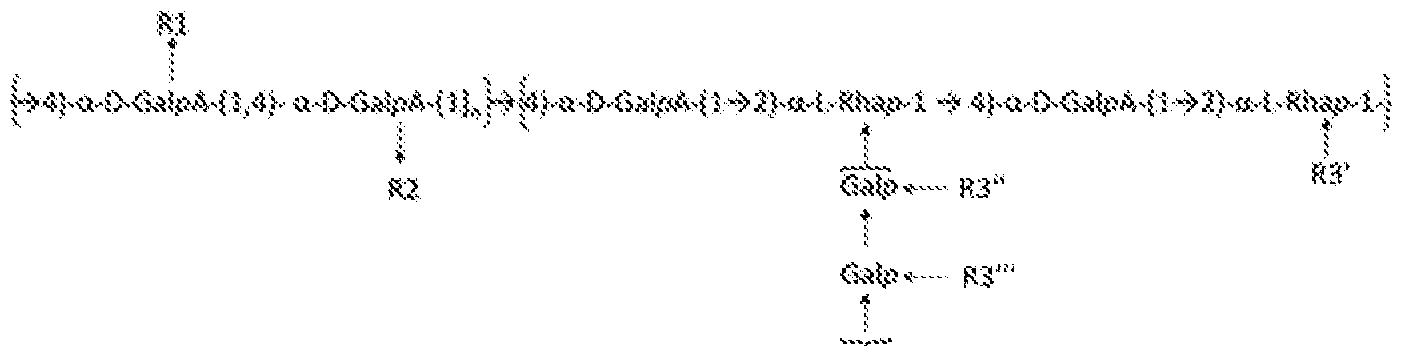
[0021] In some embodiments, a side chain 104 is attached to the backbone. In some embodiments, a plurality of side chains 104 are attached to the backbone. In some embodiments, side chains 104 are attached to RG-I domain 102A of the backbone 102. In some embodiments, side chains 104 include b-D-galactan (b-D-Gal f), a-L- arabinofuranosyl (a-L-Ara /), or combinations thereof. In some embodiments, side chain 104 is attached to the backbone 102 at the C-4 carbon of at least one a-L-Rha/; residue. In some embodiments, the side chain is a b-D-Gal/3 side chain. In some embodiments, one or more a-L-Ara / residues are attached to the b-D-Gal/3 side chain. In some embodiments, the one or more a-L-Ara / residues are attached to the b-D-Gal/3 side chain via the C-3 carbon of the b-D-Gal/>. In some embodiments, the polysaccharide has a structure according to the following Formula I:
[0022] In some embodiments, the molecular weight of polysaccharide 100 is about 5 kDa to about 70 kDa. In some embodiments, the molecular weight of polysaccharide 100 is about 20 kDa to about 30 kDa. In some embodiments, the molecular weight of polysaccharide 100 is about 20 kDa to about 25 kDa. In some embodiments, the molecular weight of polysaccharide 100 is about 5 kDa to about 25 kDa. In some embodiments, the molecular weight of polysaccharide 100 is about 17 kDa to about 23 kDa. In some embodiments, the molecular weight of polysaccharide 100 is 17.5 kDa.
[0023] In some embodiments, polysaccharide 100 is isolated from a plant material, as will be discussed in greater detail below. In some embodiments, the plant material is a member of the genus Cucurbita. In some embodiments, polysaccharide 100 is isolated from C. moschata , C. argyrosperma, C. fwifolia , C. maxima , and C. pepo. In some embodiments, polysaccharide 100 is produced by a chemical processing method, enzymatic processing method, physical processing method, chemical synthesis, recombinant DNA technology, or combinations thereof. In some embodiments, the recombinant DNA technology involves fungi, bacteria, algae, another suitable host, or combinations thereof.
[0024] In some embodiments, polysaccharide 100 has a galentin-3 binding affinity greater than that of potato galactan. In some embodiments, polysaccharide 100 inhibits galectin-3 activity at concentrations of the polysaccharide below 2 mM. In some embodiments, polysaccharide 100 inhibits galectin-3 activity at concentrations of the polysaccharide at about 1.26 mM. In some embodiments, polysaccharide 100 is given one or more modifications concurrent with or subsequent to isolation from the plant material. In some embodiments, the one or more modifications include alkylation, amidation, quaternization, thiolation, sulfation, oxidation, chain elongation, e.g., cross-linking, grafting, etc., depolymerization by chemical, physical, or biological processes including enzymatic process, etc., or combinations thereof.
[0025] Referring now to FIG. 2, some aspects of the disclosed subject matter include a method 200 of isolating a polysaccharide. At 202, an amount of plant material is suspended in an alkali hydroxide solution. In some embodiments, the alkali hydroxide is NaOH, KOH, or combinations thereof. At 204, the suspension is heated, e.g., to about 50°C. At 206, a polysaccharide-including supernatant layer is isolated from the suspension, e.g., via centrifugation.
[0026] Referring now to FIG. 3, some aspects of the disclosed subject matter include a method 300 of treating a galectin-3 dependent disorder in a patient. At 302, it is determined that the patient has a galectin-3 dependent disorder. At 304, a therapeutically effective dose of the therapeutic composition is administered to the patient. In some embodiments, the therapeutically effective dose includes sufficient polysaccharide to inhibit galectin-3 activity. By inhibiting galectin-3 activity, the polysaccharide inhibits and can thus prevent, arrest, reduce, and/or treat galentin-3 dependent disorders. When
administered for the treatment or inhibition of a particular galectin-3 dependent disorder, it is understood that an effective dosage can vary depending upon many factors such as the particular compound or therapeutic composition utilized, the mode of administration, and severity of the condition being treated, various physical factors related to the individual being treated, etc. In therapeutic applications, a compound or therapeutic composition of the present disclosure can be provided to a patient already suffering from a disease, for example, heart failure, in an amount sufficient to at least partially ameliorate the symptoms of the disease and its complications and halt or slow down the disease’s progression. If administered to a human suffering from the condition prior to clinical manifestation, the administration of a therapeutic composition may prevent the first clinical manifestation or delay its onset.
[0027] In some embodiments, the galectin-3 dependent disorder includes galectin-3 - mediated diseases and disorders including fibrosis, inflammation, organ damage, impaired organ function, cardiovascular disease, kidney disease, lung disease, cancers, heart disease, elevated blood galectin-3 level, elevated levels of the one or more collagen turnover markers, or combinations thereof. In some embodiments, the galectin-3 - mediated diseases and disorders include heart failure; chronic kidney disease; chronic lung disease; chronic vascular disease, e.g., abdominal arterial aneurysm and/or vascular stiffening; neurological or neurodegenerative disease or conditions, e.g., Alzheimer's disease, Amyotrophic Lateral Sclerosis (ALS), Parkinson's disease, or Multiple Sclerosis; ischemia; reperfusion; hypoxia; atherosclerosis; ureteral obstruction; diabetes;
complications of diabetes; arthritis; liver damage; insulin resistance; diabetic
nephropathy; acute renal injury; chronic renal injury; acute or chronic renal injury due to exposure to radio contrast dyes or any such agents; metabolic syndromes; an ophthalmic disease or condition, e.g., dry eye, diabetic retinopathy, cataracts, retinitis pigmentosa, glaucoma, macular degeneration, choroidal neovascularization, retinal degeneration, oxygen-induced retinopathy, cardiomyopathy, ischemic heart disease, heart failure, hypertensive cardiomyopathy, vessel occlusion, vessel occlusion injury, myocardial infarction, coronary artery disease, or oxidative damage. In some embodiments, the collagen-tum-over marker includes at least one of Collagen type I C-terminal propeptide (CICP), Collagen type I C-terminal telopeptide (ICTP), Collagen type I N-terminal propeptide (PINP), and Collagen type III N-terminal propeptide (PIIINP), or a dependent
or related marker. The disorder may also be present in an early or subclinical form. In an embodiment, the method includes reducing one or more collagen-tum-over markers.
EXAMPLES
[0028] Preparation of the polysaccharide composition [0029] Pumpkin residue (50 g) was suspended in 1 M NaOH solution as extracting agent with a solid-liquid ratio of 1/30 (w/v). The mixture was warmed at 50°C for 4 hours with stirring. The supernatant layer was obtained by centrifugation at 8000 x g for 15 min, neutralized, and then concentrated to 200-300 mL by evaporation. The protein in the extract was removed by Sevag reagent. Ethanol was then added to the solution to obtain a final concentration of 80 vol% and the polysaccharide was precipitated at 4°C for 12 h. The polysaccharide precipitate was recovered by centrifugation at 8000 c g for 25 min, dialyzed (membrane cut-off of 1000 Da) and lyophilized. The precipitated
polysaccharide was applied to a Diethylaminoethanol (DEAE) Sepharose Fast Flow gel column (2.5 x 8 cm) and eluted by three column volumes of 0, 0.1, 0.2, 0.3, 0.5 M NaCl. Each fraction was collected and precipitated with ethanol, dialyzed (membrane cut-off of 1000 Da) and then lyophilized.
[0030] Size exclusion Chromatography (SEC) using TSK-GEL G4000SWXL (30 cm x 7.8 mm) and G3000SWXL (30 cm x 7.8 mm) in series and a refractive index (RI) detector was utilized for evaluation of the homogeneity and average molecular weight (Mw) of pumpkin pectic polysaccharide. The mobile phase was 7.71 g ammonia acetate and 0.2 g sodium azide in 1 L water and a flow rate of 0.6 mL/min (400 C) was used in SEC. Pumpkin pectic polysaccharide was dissolved in mobile phase (5 mg/mL) and filtered through a 0.45 pm membrane filter. A series of molecular weight standards (1, 5, 10, 25, and 50 kDa) were used. Sample (20 pL) was injected and the data obtained were analyzed by HPLC using LC solution Software (Shimadzu Scientific Instruments, MA, EISA). The yields of the crude polysaccharide and the 0.2 M NaCl fraction were 5 g and 1.25 g from 100 g of pumpkin residue. The purity was evidenced by the elution of a single symmetrical peak in SEC at ~25 min.
[0031] Monosaccharide composition of isolated polysaccharide
[0032] Referring now to FIG. 4, the monosaccharide composition of isolated
polysaccharide was determined following hydrolysis and pre-column derivatization by RP-HPLC. Nine standard monosaccharides were separated within 50 min on the XDB- C18 column. The monosaccharide species in the polysaccharide were identified by matching their retention times with those of standard monosaccharides. The results showed that the polysaccharide was composed of rhamnose, galacturonic acid, glucose, galactose and arabinose with a molar ratio of about 2.6: 40.1 : 9.8: 16.7: 6.1. The proportion was calculated using the peak area of each monosaccharide, corrected by corresponding standards (see Table 1). GalA was the most abundant monosaccharide in the polysaccharide, followed by Gal, Glc, Ara and Rha.
Rha GalA Glc Gal Ara peak area of standards 10217717 8998508 5951305 8928712 9165314 peak area of polysaccharide 268709 3608830 586019 1495086 560792 Peak area
(polysaccharide/Standards) 0.0262983 0.4010476 0.098469 0.167447 0.0611863 Molar ratio 2.6 40.1 9.8 16.7 6.1
Table 1 : Molar ratio of rhamnose, galacturonic acid, glucose, galactose and arabinose in the polysaccharide.
[0033] NMR spectroscopy [0034] The NMR spectra of the polysaccharides were obtained on a Bruker 800 MHz
(18.8T) standard-bore NMR spectrometer equipped with a 1H/2H/13C/15N cryoprobe with z-axis gradients. A sample (10 mg) was dissolved in 400 pL of 99.6% D20 and lyophilized, then repeated twice. 1H spectroscopy, 13C spectroscopy, 1H-1H correlated spectroscopy (COSY), 1H-1H total correlation spectroscopy (TOCSY), 1H-13C
heteronuclear single quantum coherence spectroscopy (HSQC), and 1H-13C heteronuclear multiple bond correlation spectroscopy (HMBC) experiments were all carried out at 298 K.
[0035] NMR spectroscopy analysis
[0036] Referring now to FIG. 5, chemical shifts in the 1H NMR spectrum between d 4.50 ppm and 5.30 ppm were recognized as anomeric protons region (4.50-5.20 ppm). Other proton peaks were found in the region of 3.30-4.30 ppm. Referring now to FIG. 6, in the 13C NMR spectrum, the polysaccharide gave anomeric carbon signals from 97.50 ppm to 108.00 ppm and non-anomeric carbon signals in a broad region from 50.00 ppm to 84.00 ppm. In the 13C NMR of the polysaccharide, the signals present at low field 175.08- 175.38 ppm were assigned to the carboxyl carbons of Gal/; A. The signal at 170.76 ppm and that at 52.80 ppm suggested that partial GalA residue might exist as a methyl ester.
In 1H NMR of the polysaccharide, the chemical shifts at d 3.72 and -1.99 ppm attributed to methoxyl and acetyl groups, respectively, indicated that the polysaccharide contain methyl esterified and O-acetylated homogalacturonans. In addition, referring now to FIG. 7, the correlation signals 2.10/20.45 ppm and 2.00/20.15 ppm in the HSQC spectrum confirmed the existence of O-acetyl groups in the polysaccharide. The two doublets suggested that the polysaccharide contained two kinds of -acetyl groups at the different positions (0-2 and 0-3) of Gal/>A linked residues. The less prominent peaks at the high field (1.23-1.17 ppm) were assigned to the -CH3 (C6) of rhamnose, indicating a low content of rhamnose in the polysaccharide. The corresponding peak areas in the 1D and 2D NMR spectrum confirmed the presence of homogalacturonan as well as
rhamnogal acturonan .
[0037] A complete assignment of the signals of non-esterified and esterified carboxyl groups of l,4-D-Gal ?A residues is summarized in Table 2. The signals at d 4.88/100.38 and 5.01/99.43 ppm were assigned to non-methyl and methyl esterified H-l/C-l of (1,4)- linked Gal/iA, which also indicated that the Gal/iA residues possessed an a configuration. Referring now to FIG. 8, the chemical shift of H-2 (3.64 ppm and 3.63 ppm, non-methyl and methyl esterified, respectively) was obtained from the 1H-1H correlation (COSY) spectrum. In the same way, H-3 and H-4 can readily be assigned. The signals at 4.82 and 5.07 ppm were attributed to non-methyl and methyl esterified H-5 of (l,4)-linked Gal/; A All the 13C chemical shifts were obtained from the HSQC spectrum. Referring now to FIG. 9, the a- 1, 4-linkage between Gal/; A in the main chain was confirmed by a cross peak of H-l and C-4 at 4.88/79.03 ppm in HMBC spectrum. The chemical shifts at 4.32/77.87 and 4.30/78.71 ppm were assigned to H-4/C-4 of acetyl Gal/; A
Residue atom 13C/ppm IH/ppm
GalpA Nah-meihyl esterifie ! 1 100.38 4.88
67.90 3.64
68.47 3.92
4 78.72 4.39

6 175.03
Esterified 1 99.43 5.01

3 67.85 3.92
4 79.03 4,37
5 70.45 5.07
6 170.77
OCH3
 3.72
3.72
O-Ac 1.99/2.10
Table 2: Assignment of Gal/iA carbon/hydrogen signals of polysaccharide
[0038] In the proton spectrum, the rhamnose signals appeared as two doublets, centered at 1.16 and 1.22 ppm, respectively, which were assigned to the l,2-linked and 1,2,4- linked L-rhamnosyl residues. The C-6 signals at 16.63 and 16.91 ppm were found in HSQC. The anomeric Hl/Cl were assigned at 5.32/99.60 ppm by HSQC. The distinct C-l signal (-109 ppm) in the anomeric field was ascribed to nonreducing terminals and l,5-linked L-arabinosyl residues. In addition, the H-l downfield signals of arabinosyl residues at 5.18, 5.17 ppm indicated that they were a-linked residues. The anomeric Hl/Cl was confirmed by HSQC. The 1H anomeric signals at 4.56 and 4.55 ppm indicated that the galactosyl residues were b-linked, which were further corroborated by the C-l chemical shift at 104.32 ppm.
[0039] Galectin-3 binding character of polysaccharide composition [0040] RCA120 can be used as a tool to detect b-D-galactose residues. Referring now to
FIG. 10, the results of SPR analysis show a smooth binding curve between the polysaccharide composition and RCA120, confirming the presence of b-D-galactose in the polysaccharide composition, consistent with the NMR data. The binding kinetics of polysaccharide and galectin-3 interaction were performed by SPR using a sensor chip with immobilized galectin-3 lectin. Sensor grams of galectin-3 binding to different
polysaccharide composition dilutions are shown in FIG. 11. Non-specific binding was eliminated by a control flow cell without immobilized galectin-3. The specific binding curves fit well to a 1 : 1 Langmuir binding model, consistent with a monophasic-binding process. The apparent on (ka) and off (kd) rates for the binding are calculated as 550 (l/ms) and 6.95 x 10⁻⁴ (l/s), respectively, suggesting quick association and slow dissociation. The binding affinity KD (kd/ka) was calculated to be 1.26 mM, indicating a moderate binding affinity for compound to galectin-3. This gal-3-binding affinity is between that of potato galactan (2.59 pM), and an RG-I domain isolated from ginseng pectin (22.2 nM). [0041] Methods and systems of the present disclosure advantageously provide an agent to inhibit gal-3 binding to cell receptors, blocking its ability to send destructive molecular signals in cancer and other diseases. The pectic polysaccharide in the agent is
conveniently isolated from easily and readily available pumpkins, and represents a safe, non-toxic gal-3 inhibitor useful in preventing or reducing galectin-3 -mediated diseases and disorders including cardiovascular and renal diseases, cancer, carcinogenesis, fibrosis, and the like.
[0042] Although the disclosed subject matter has been described and illustrated with respect to embodiments thereof, it should be understood by those skilled in the art that features of the disclosed embodiments can be combined, rearranged, etc., to produce additional embodiments within the scope of the invention, and that various other changes, omissions, and additions may be made therein and thereto, without parting from the spirit and scope of the present invention.
Claims
1. A method of treating a galectin-3 dependent disorder, comprising: determining that a patient has a galectin-3 dependent disorder; and administering to the patient a therapeutically effective dose of a therapeutic composition, the therapeutic composition including: a polysaccharide having a backbone including alternating a-L- rhamnosyl (a-L-Rha/i) and a-D-galactopyranosyluronic acid (a-D-Gal/iA) residues, and a side chain attached to the backbone including b-D-galactan (b-D-Gal/i), a-L-arabinofuranosyl (a-L-Ara /), or combinations thereof.
2. The method according to claim 1, wherein the therapeutically effective dose of the therapeutic composition is administered enterally, parenterally, or combinations thereof.
3. The method according to claim 1, wherein the therapeutically effective dose
includes sufficient polysaccharide to inhibit galectin-3 activity, wherein galectin-3 is inhibited at concentrations of the polysaccharide below 2mM.
4. The method according to claim 1, wherein a b-D-Gal/i side chain is attached to the backbone at the C-4 carbon of at least one a-L-Rha/i of the backbone.
5. The method according to claim 4, where at least one a-L-Ara/is attached to the b- D-Gal/i side chain.
6. The method according to claim 5, wherein the a-L-Ara/is attached to the b-D- Gal p side chain via the C-3 carbon of the P-D-Gal/r
7. The method according to claim 1, wherein the polysaccharide has a structure according to the following Formula I:
 (Formula I) wherein Rl is an H or O-alkyl group, R2 is an H or O-acetyl group, and R31, R31 and R31" are H, a-L-Ara f or combinations thereof.
8. The method according to claim 1, wherein the polysaccharide is isolated from a member of the genus Cucurbita.
9. The method according to claim 8, wherein the polysaccharide is isolated from C. moschata , C. argyrosperma, C. fwifolia , C. maxima , and C. pepo.
10. The method according to claim 1, wherein the galectin-3 dependent disorder includes galectin-3 -mediated diseases and disorders including fibrosis, inflammation, organ damage, impaired organ function, cardiovascular disease, kidney disease, lung disease, cancers, heart disease, elevated blood galectin-3 level, elevated levels of the one or more collagen turnover markers, or combinations thereof.
11. A method of isolating a polysaccharide comprising: suspending an amount of plant material in an alkali hydroxide solution; heating the suspension; isolating a polysaccharide-including supernatant layer from the suspension, wherein the polysaccharide has a backbone including alternating a-L- rhamnosyl (a-L-Rhap) and a-D-galactopyranosyluronic acid (a-D-Gal/iA) residues, and a side chain attached to the backbone including b-D-galactan (b-D-Gal/fl, a-L-arabinofuranosyl (a-L-Ara /), or combinations thereof.
12. The method according to claim 11, wherein a b-D-Gal^ side chain is attached to the backbone at the C-4 carbon of at least one a-L-Rha/i residue of the backbone.
13. The method according to claim 12, further comprising an a-L-Ara / attached to the b-D-Gal/ side chain.
14. The method according to claim 13, wherein the a-L-Ara/is attached to the b-D- Gal p side chain via the C-3 carbon of the b-D-Gal/l
15. The method according to claim 11, wherein the polysaccharide has a structure according to the following Formula I:

16. The method according to claim 11, wherein the plant material is a member of the genus Cucurbita.
17. A therapeutic composition comprising: a polysaccharide having a backbone including alternating a-L-rhamnosyl (a-L-Rha/ri and a-D-galactopyranosyluronic acid (a-D-Gal A) residues, and a side chain attached to the backbone including b-D-galactan (b-D- Gal/ri, a-L-arabinofuranosyl (a-L-Ara /), or combinations thereof; and a pharmaceutically acceptable excipient, wherein the polysaccharide isolated from a member of the genus Cucurbita.
18. The therapeutic composition according to claim 18, wherein the polysaccharide has a structure according to the following Formula I:
 (Formula I) wherein Rl is an H or O-alkyl group, R2 is an H or O-acetyl group, and R31, R3", and R31" are H, a-L-Ara ( or combinations thereof.
19. The therapeutic composition according to claim 18, wherein the molecular weight of the polysaccharide is about 5 kDa to about 25 kDa.
20. The therapeutic composition according to claim 18, wherein the polysaccharide is produced by a chemical processing method, enzymatic processing method, physical processing method, chemical synthesis, recombinant DNA technology, or combinations thereof.
Priority Applications (3)
| Application Number | Priority Date | Filing Date | Title |
|---|---|---|---|
| EP19741945.0A EP3740214A4 (en) | 2018-01-21 | 2019-01-18 | METHOD OF TREATMENT FOR GALECTIN-3 DEPENDENT DISORDERS |
| CA3088736A CA3088736A1 (en) | 2018-01-21 | 2019-01-18 | Method of treating galectin-3 dependent disorders |
| US16/933,043 US20200345759A1 (en) | 2018-01-21 | 2020-07-20 | Methods of treating galectin-3 dependent disorders |
Applications Claiming Priority (4)
| Application Number | Priority Date | Filing Date | Title |
|---|---|---|---|
| US201862619857P | 2018-01-21 | 2018-01-21 | |
| US62/619,857 | 2018-01-21 | ||
| US201962792931P | 2019-01-16 | 2019-01-16 | |
| US62/792,931 | 2019-01-16 |
Related Child Applications (1)
| Application Number | Title | Priority Date | Filing Date |
|---|---|---|---|
| US16/933,043 Continuation US20200345759A1 (en) | 2018-01-21 | 2020-07-20 | Methods of treating galectin-3 dependent disorders |
Publications (2)
| Publication Number | Publication Date |
|---|---|
| WO2019143924A1 true WO2019143924A1 (en) | 2019-07-25 |
| WO2019143924A9 WO2019143924A9 (en) | 2020-05-22 |
Family
ID=67301193
Family Applications (1)
| Application Number | Title | Priority Date | Filing Date |
|---|---|---|---|
| PCT/US2019/014176 Ceased WO2019143924A1 (en) | 2018-01-21 | 2019-01-18 | Method of treating galectin-3 dependent disorders |
Country Status (4)
| Country | Link |
|---|---|
| US (1) | US20200345759A1 (en) |
| EP (1) | EP3740214A4 (en) |
| CA (1) | CA3088736A1 (en) |
| WO (1) | WO2019143924A1 (en) |
Cited By (2)
| Publication number | Priority date | Publication date | Assignee | Title |
|---|---|---|---|---|
| WO2021195020A1 (en) * | 2020-03-23 | 2021-09-30 | G3 Pharmaceuticals, Inc. | Methods and compositions for preventing and treating fibrosis resulting from a coronavirus infection |
| WO2021207312A1 (en) * | 2020-04-07 | 2021-10-14 | G3 Pharmaceuticals, Inc. | Methods and compositions for preventing and treating retinal nerve damage |
Families Citing this family (1)
| Publication number | Priority date | Publication date | Assignee | Title |
|---|---|---|---|---|
| CN116334166B (en) * | 2023-03-31 | 2025-09-12 | 重庆三峡学院 | A kind of D-galacturonan homogeneous pectin polysaccharide and its preparation method and application |
Citations (3)
| Publication number | Priority date | Publication date | Assignee | Title |
|---|---|---|---|---|
| US20030004132A1 (en) * | 2001-06-22 | 2003-01-02 | Yan Chang | Method and material for treating immune diseases |
| US20140148404A1 (en) * | 2003-04-07 | 2014-05-29 | La Jolla Pharmaceutical Company | Composition and uses of galectin antagonists |
| US20170349619A1 (en) * | 2015-01-30 | 2017-12-07 | Galecto Biotech Ab | Alpha-d-galactoside inhibitors of galectins |
Family Cites Families (3)
| Publication number | Priority date | Publication date | Assignee | Title |
|---|---|---|---|---|
| WO2008011216A2 (en) * | 2006-05-16 | 2008-01-24 | Pro-Pharmaceuticals, Inc. | Galactose-pronged polysaccharides in a formulation for antifibrotic therapies |
| AR086543A1 (en) * | 2011-05-25 | 2014-01-08 | Bg Medicine Inc | GALECTIN-3 INHIBITORS AND METHODS OF USE OF THE SAME, PHARMACEUTICAL COMPOSITION |
| GB201502668D0 (en) * | 2015-02-17 | 2015-04-01 | Glycomar Ltd And Albert Bartlett & Sons Airdrie Ltd | Method for isolation of polysaccharides |
-
2019
- 2019-01-18 CA CA3088736A patent/CA3088736A1/en active Pending
- 2019-01-18 EP EP19741945.0A patent/EP3740214A4/en not_active Ceased
- 2019-01-18 WO PCT/US2019/014176 patent/WO2019143924A1/en not_active Ceased
-
2020
- 2020-07-20 US US16/933,043 patent/US20200345759A1/en not_active Abandoned
Patent Citations (3)
| Publication number | Priority date | Publication date | Assignee | Title |
|---|---|---|---|---|
| US20030004132A1 (en) * | 2001-06-22 | 2003-01-02 | Yan Chang | Method and material for treating immune diseases |
| US20140148404A1 (en) * | 2003-04-07 | 2014-05-29 | La Jolla Pharmaceutical Company | Composition and uses of galectin antagonists |
| US20170349619A1 (en) * | 2015-01-30 | 2017-12-07 | Galecto Biotech Ab | Alpha-d-galactoside inhibitors of galectins |
Non-Patent Citations (2)
| Title |
|---|
| See also references of EP3740214A4 * |
| ZHAO ET AL.: "Isolation of a Lectin Binding Rhammogalacturonan-I Containing Pectic Polysaccharide From Pumpkin", CARBOHYDRATE POLYMERS, vol. 163, 2017, pages 330 - 336, XP055626470 * |
Cited By (3)
| Publication number | Priority date | Publication date | Assignee | Title |
|---|---|---|---|---|
| WO2021195020A1 (en) * | 2020-03-23 | 2021-09-30 | G3 Pharmaceuticals, Inc. | Methods and compositions for preventing and treating fibrosis resulting from a coronavirus infection |
| WO2021207312A1 (en) * | 2020-04-07 | 2021-10-14 | G3 Pharmaceuticals, Inc. | Methods and compositions for preventing and treating retinal nerve damage |
| EP4132537A4 (en) * | 2020-04-07 | 2024-05-15 | G3P, Inc. | METHODS AND COMPOSITIONS FOR PREVENTING AND TREATING RETINAL NERVE DAMAGE |
Also Published As
| Publication number | Publication date |
|---|---|
| WO2019143924A9 (en) | 2020-05-22 |
| US20200345759A1 (en) | 2020-11-05 |
| CA3088736A1 (en) | 2019-07-25 |
| EP3740214A1 (en) | 2020-11-25 |
| EP3740214A4 (en) | 2021-10-27 |
Similar Documents
| Publication | Publication Date | Title |
|---|---|---|
| Zhao et al. | Isolation of a lectin binding rhamnogalacturonan-I containing pectic polysaccharide from pumpkin | |
| Jiang et al. | Structure elucidation and antitumor activity of a water soluble polysaccharide from Hemicentrotus pulcherrimus | |
| Tian et al. | Structural characterization of a novel neutral polysaccharide from Lentinus giganteus and its antitumor activity through inducing apoptosis | |
| Yang et al. | Isolation, purification, structural characterization, and hypoglycemic activity assessment of polysaccharides from Hovenia dulcis (Guai Zao) | |
| Cai et al. | Structure-activity relationship of low molecular weight Astragalus membranaceus polysaccharides produced by Bacteroides | |
| Zhang et al. | Characterization of a bioactive polysaccharide from Ganoderma atrum: Re-elucidation of the fine structure | |
| Yu et al. | Structure, chain conformation and antitumor activity of a novel polysaccharide from Lentinus edodes | |
| Samuelsen et al. | Structural features and anti-complementary activity of some heteroxylan polysaccharide fractions from the seeds of Plantago major L. | |
| AU2005223923B2 (en) | Algin oligosaccharides and the derivatives thereof as well as the manufacture and the use of the same | |
| KR101974675B1 (en) | Galacto-rhamnogalacturonate compositions for the treatment of non-alcoholic steatohepatitis and non-alcoholic fatty liver disease | |
| US20200345759A1 (en) | Methods of treating galectin-3 dependent disorders | |
| JPH01503548A (en) | heparin derivative | |
| CN109251255B (en) | A kind of fucosylated chondroitin sulfate FCShm and its preparation method and application | |
| KR102082276B1 (en) | High purity heparin and production method therefor | |
| US10723811B2 (en) | Homogeneous polysaccharide with immunoregulation activity and preparation method thereof | |
| CN102477103A (en) | Platycodon grandiflorum polysaccharide, and degradation product, preparation method and application thereof | |
| Redgwell et al. | Cell wall polysaccharides of Chinese Wolfberry (Lycium barbarum): Part 1. Characterisation of soluble and insoluble polymer fractions | |
| KR102533822B1 (en) | Polypentoic acid and medicaments containing polypentoic acid | |
| CN114349876A (en) | A Lycium barbarum polysaccharide for resisting retina injury caused by high sugar and hydrogen peroxide | |
| CN117510676A (en) | A new homogeneous polysaccharide GFP-Z from Grifola frondosa and its simple and rapid preparation method and use | |
| JP2790447B2 (en) | Complex polysaccharide extracted from Mycobacterium tuberculosis and method for producing the same | |
| CN112480284B (en) | A kind of polysaccharide SPS-F2, polysaccharide SPS-F3 and preparation method and application thereof | |
| AU2015203727B2 (en) | High Purity Heparin and Production Method Therefor | |
| CN105399870B (en) | A kind of low-anticoagulant heparin, its oligosaccharide and preparation method thereof and the application in the medicine for preparing anti-alzheimer's disease | |
| Paulose et al. | Sulfated glycosaminoglycan CIP-3 from edible marine octopus Cistopus indicus: A promising bioactive with anti-hyperglycemic effects in 3T3-L1 adipocytes for functional food applications |
Legal Events
| Date | Code | Title | Description |
|---|---|---|---|
| 121 | Ep: the epo has been informed by wipo that ep was designated in this application |
Ref document number: 19741945 Country of ref document: EP Kind code of ref document: A1 |
|
| ENP | Entry into the national phase |
Ref document number: 3088736 Country of ref document: CA |
|
| NENP | Non-entry into the national phase |
Ref country code: DE |
|
| ENP | Entry into the national phase |
Ref document number: 2019741945 Country of ref document: EP Effective date: 20200821 |