WO2019146484A1 - 強化繊維マットならびに繊維強化樹脂成形材料およびその製造方法 - Google Patents
強化繊維マットならびに繊維強化樹脂成形材料およびその製造方法 Download PDFInfo
- Publication number
- WO2019146484A1 WO2019146484A1 PCT/JP2019/001219 JP2019001219W WO2019146484A1 WO 2019146484 A1 WO2019146484 A1 WO 2019146484A1 JP 2019001219 W JP2019001219 W JP 2019001219W WO 2019146484 A1 WO2019146484 A1 WO 2019146484A1
- Authority
- WO
- WIPO (PCT)
- Prior art keywords
- reinforcing fiber
- fiber bundle
- bundle
- less
- molding material
- Prior art date
- Legal status (The legal status is an assumption and is not a legal conclusion. Google has not performed a legal analysis and makes no representation as to the accuracy of the status listed.)
- Ceased
Links
Images




Classifications
-
- D—TEXTILES; PAPER
- D04—BRAIDING; LACE-MAKING; KNITTING; TRIMMINGS; NON-WOVEN FABRICS
- D04H—MAKING TEXTILE FABRICS, e.g. FROM FIBRES OR FILAMENTARY MATERIAL; FABRICS MADE BY SUCH PROCESSES OR APPARATUS, e.g. FELTS, NON-WOVEN FABRICS; COTTON-WOOL; WADDING ; NON-WOVEN FABRICS FROM STAPLE FIBRES, FILAMENTS OR YARNS, BONDED WITH AT LEAST ONE WEB-LIKE MATERIAL DURING THEIR CONSOLIDATION
- D04H1/00—Non-woven fabrics formed wholly or mainly of staple fibres or like relatively short fibres
- D04H1/40—Non-woven fabrics formed wholly or mainly of staple fibres or like relatively short fibres from fleeces or layers composed of fibres without existing or potential cohesive properties
- D04H1/42—Non-woven fabrics formed wholly or mainly of staple fibres or like relatively short fibres from fleeces or layers composed of fibres without existing or potential cohesive properties characterised by the use of certain kinds of fibres insofar as this use has no preponderant influence on the consolidation of the fleece
- D04H1/4209—Inorganic fibres
- D04H1/4242—Carbon fibres
-
- B—PERFORMING OPERATIONS; TRANSPORTING
- B29—WORKING OF PLASTICS; WORKING OF SUBSTANCES IN A PLASTIC STATE IN GENERAL
- B29C—SHAPING OR JOINING OF PLASTICS; SHAPING OF MATERIAL IN A PLASTIC STATE, NOT OTHERWISE PROVIDED FOR; AFTER-TREATMENT OF THE SHAPED PRODUCTS, e.g. REPAIRING
- B29C70/00—Shaping composites, i.e. plastics material comprising reinforcements, fillers or preformed parts, e.g. inserts
- B29C70/04—Shaping composites, i.e. plastics material comprising reinforcements, fillers or preformed parts, e.g. inserts comprising reinforcements only, e.g. self-reinforcing plastics
- B29C70/06—Fibrous reinforcements only
- B29C70/10—Fibrous reinforcements only characterised by the structure of fibrous reinforcements, e.g. hollow fibres
- B29C70/12—Fibrous reinforcements only characterised by the structure of fibrous reinforcements, e.g. hollow fibres using fibres of short length, e.g. in the form of a mat
-
- C—CHEMISTRY; METALLURGY
- C08—ORGANIC MACROMOLECULAR COMPOUNDS; THEIR PREPARATION OR CHEMICAL WORKING-UP; COMPOSITIONS BASED THEREON
- C08J—WORKING-UP; GENERAL PROCESSES OF COMPOUNDING; AFTER-TREATMENT NOT COVERED BY SUBCLASSES C08B, C08C, C08F, C08G or C08H
- C08J5/00—Manufacture of articles or shaped materials containing macromolecular substances
- C08J5/04—Reinforcing macromolecular compounds with loose or coherent fibrous material
- C08J5/06—Reinforcing macromolecular compounds with loose or coherent fibrous material using pretreated fibrous materials
-
- D—TEXTILES; PAPER
- D04—BRAIDING; LACE-MAKING; KNITTING; TRIMMINGS; NON-WOVEN FABRICS
- D04H—MAKING TEXTILE FABRICS, e.g. FROM FIBRES OR FILAMENTARY MATERIAL; FABRICS MADE BY SUCH PROCESSES OR APPARATUS, e.g. FELTS, NON-WOVEN FABRICS; COTTON-WOOL; WADDING ; NON-WOVEN FABRICS FROM STAPLE FIBRES, FILAMENTS OR YARNS, BONDED WITH AT LEAST ONE WEB-LIKE MATERIAL DURING THEIR CONSOLIDATION
- D04H1/00—Non-woven fabrics formed wholly or mainly of staple fibres or like relatively short fibres
- D04H1/40—Non-woven fabrics formed wholly or mainly of staple fibres or like relatively short fibres from fleeces or layers composed of fibres without existing or potential cohesive properties
-
- D—TEXTILES; PAPER
- D04—BRAIDING; LACE-MAKING; KNITTING; TRIMMINGS; NON-WOVEN FABRICS
- D04H—MAKING TEXTILE FABRICS, e.g. FROM FIBRES OR FILAMENTARY MATERIAL; FABRICS MADE BY SUCH PROCESSES OR APPARATUS, e.g. FELTS, NON-WOVEN FABRICS; COTTON-WOOL; WADDING ; NON-WOVEN FABRICS FROM STAPLE FIBRES, FILAMENTS OR YARNS, BONDED WITH AT LEAST ONE WEB-LIKE MATERIAL DURING THEIR CONSOLIDATION
- D04H1/00—Non-woven fabrics formed wholly or mainly of staple fibres or like relatively short fibres
- D04H1/40—Non-woven fabrics formed wholly or mainly of staple fibres or like relatively short fibres from fleeces or layers composed of fibres without existing or potential cohesive properties
- D04H1/42—Non-woven fabrics formed wholly or mainly of staple fibres or like relatively short fibres from fleeces or layers composed of fibres without existing or potential cohesive properties characterised by the use of certain kinds of fibres insofar as this use has no preponderant influence on the consolidation of the fleece
- D04H1/4209—Inorganic fibres
- D04H1/4218—Glass fibres
-
- D—TEXTILES; PAPER
- D04—BRAIDING; LACE-MAKING; KNITTING; TRIMMINGS; NON-WOVEN FABRICS
- D04H—MAKING TEXTILE FABRICS, e.g. FROM FIBRES OR FILAMENTARY MATERIAL; FABRICS MADE BY SUCH PROCESSES OR APPARATUS, e.g. FELTS, NON-WOVEN FABRICS; COTTON-WOOL; WADDING ; NON-WOVEN FABRICS FROM STAPLE FIBRES, FILAMENTS OR YARNS, BONDED WITH AT LEAST ONE WEB-LIKE MATERIAL DURING THEIR CONSOLIDATION
- D04H1/00—Non-woven fabrics formed wholly or mainly of staple fibres or like relatively short fibres
- D04H1/40—Non-woven fabrics formed wholly or mainly of staple fibres or like relatively short fibres from fleeces or layers composed of fibres without existing or potential cohesive properties
- D04H1/54—Non-woven fabrics formed wholly or mainly of staple fibres or like relatively short fibres from fleeces or layers composed of fibres without existing or potential cohesive properties by welding together the fibres, e.g. by partially melting or dissolving
- D04H1/558—Non-woven fabrics formed wholly or mainly of staple fibres or like relatively short fibres from fleeces or layers composed of fibres without existing or potential cohesive properties by welding together the fibres, e.g. by partially melting or dissolving in combination with mechanical or physical treatments other than embossing
-
- D—TEXTILES; PAPER
- D04—BRAIDING; LACE-MAKING; KNITTING; TRIMMINGS; NON-WOVEN FABRICS
- D04H—MAKING TEXTILE FABRICS, e.g. FROM FIBRES OR FILAMENTARY MATERIAL; FABRICS MADE BY SUCH PROCESSES OR APPARATUS, e.g. FELTS, NON-WOVEN FABRICS; COTTON-WOOL; WADDING ; NON-WOVEN FABRICS FROM STAPLE FIBRES, FILAMENTS OR YARNS, BONDED WITH AT LEAST ONE WEB-LIKE MATERIAL DURING THEIR CONSOLIDATION
- D04H1/00—Non-woven fabrics formed wholly or mainly of staple fibres or like relatively short fibres
- D04H1/40—Non-woven fabrics formed wholly or mainly of staple fibres or like relatively short fibres from fleeces or layers composed of fibres without existing or potential cohesive properties
- D04H1/58—Non-woven fabrics formed wholly or mainly of staple fibres or like relatively short fibres from fleeces or layers composed of fibres without existing or potential cohesive properties by applying, incorporating or activating chemical or thermoplastic bonding agents, e.g. adhesives
- D04H1/60—Non-woven fabrics formed wholly or mainly of staple fibres or like relatively short fibres from fleeces or layers composed of fibres without existing or potential cohesive properties by applying, incorporating or activating chemical or thermoplastic bonding agents, e.g. adhesives the bonding agent being applied in dry state, e.g. thermo-activatable agents in solid or molten state, and heat being applied subsequently
-
- B—PERFORMING OPERATIONS; TRANSPORTING
- B29—WORKING OF PLASTICS; WORKING OF SUBSTANCES IN A PLASTIC STATE IN GENERAL
- B29B—PREPARATION OR PRETREATMENT OF THE MATERIAL TO BE SHAPED; MAKING GRANULES OR PREFORMS; RECOVERY OF PLASTICS OR OTHER CONSTITUENTS OF WASTE MATERIAL CONTAINING PLASTICS
- B29B15/00—Pretreatment of the material to be shaped, not covered by groups B29B7/00 - B29B13/00
- B29B15/08—Pretreatment of the material to be shaped, not covered by groups B29B7/00 - B29B13/00 of reinforcements or fillers
- B29B15/10—Coating or impregnating independently of the moulding or shaping step
- B29B15/12—Coating or impregnating independently of the moulding or shaping step of reinforcements of indefinite length
-
- C—CHEMISTRY; METALLURGY
- C08—ORGANIC MACROMOLECULAR COMPOUNDS; THEIR PREPARATION OR CHEMICAL WORKING-UP; COMPOSITIONS BASED THEREON
- C08J—WORKING-UP; GENERAL PROCESSES OF COMPOUNDING; AFTER-TREATMENT NOT COVERED BY SUBCLASSES C08B, C08C, C08F, C08G or C08H
- C08J2323/00—Characterised by the use of homopolymers or copolymers of unsaturated aliphatic hydrocarbons having only one carbon-to-carbon double bond; Derivatives of such polymers
- C08J2323/02—Characterised by the use of homopolymers or copolymers of unsaturated aliphatic hydrocarbons having only one carbon-to-carbon double bond; Derivatives of such polymers not modified by chemical after treatment
- C08J2323/10—Homopolymers or copolymers of propene
- C08J2323/12—Polypropene
-
- C—CHEMISTRY; METALLURGY
- C08—ORGANIC MACROMOLECULAR COMPOUNDS; THEIR PREPARATION OR CHEMICAL WORKING-UP; COMPOSITIONS BASED THEREON
- C08J—WORKING-UP; GENERAL PROCESSES OF COMPOUNDING; AFTER-TREATMENT NOT COVERED BY SUBCLASSES C08B, C08C, C08F, C08G or C08H
- C08J2363/00—Characterised by the use of epoxy resins; Derivatives of epoxy resins
-
- C—CHEMISTRY; METALLURGY
- C08—ORGANIC MACROMOLECULAR COMPOUNDS; THEIR PREPARATION OR CHEMICAL WORKING-UP; COMPOSITIONS BASED THEREON
- C08J—WORKING-UP; GENERAL PROCESSES OF COMPOUNDING; AFTER-TREATMENT NOT COVERED BY SUBCLASSES C08B, C08C, C08F, C08G or C08H
- C08J2377/00—Characterised by the use of polyamides obtained by reactions forming a carboxylic amide link in the main chain; Derivatives of such polymers
-
- C—CHEMISTRY; METALLURGY
- C08—ORGANIC MACROMOLECULAR COMPOUNDS; THEIR PREPARATION OR CHEMICAL WORKING-UP; COMPOSITIONS BASED THEREON
- C08J—WORKING-UP; GENERAL PROCESSES OF COMPOUNDING; AFTER-TREATMENT NOT COVERED BY SUBCLASSES C08B, C08C, C08F, C08G or C08H
- C08J2463/00—Characterised by the use of epoxy resins; Derivatives of epoxy resins
-
- C—CHEMISTRY; METALLURGY
- C08—ORGANIC MACROMOLECULAR COMPOUNDS; THEIR PREPARATION OR CHEMICAL WORKING-UP; COMPOSITIONS BASED THEREON
- C08J—WORKING-UP; GENERAL PROCESSES OF COMPOUNDING; AFTER-TREATMENT NOT COVERED BY SUBCLASSES C08B, C08C, C08F, C08G or C08H
- C08J2477/00—Characterised by the use of polyamides obtained by reactions forming a carboxylic amide link in the main chain; Derivatives of such polymers
Definitions
- the present invention relates to a reinforced fiber mat and a fiber-reinforced resin molding material which are excellent in mechanical properties, complex shape moldability and productivity.
- CFRPs Carbon fiber reinforced composite materials
- CFRP As an application example of CFRP to a car, a prepreg, a resin transfer molding (RTM), and a member by filament winding (FW) using thermosetting resin which has been proven in aircraft and sports materials are put on the market.
- CFRP using a thermoplastic resin can be molded at high speed and has excellent recyclability, and therefore, it is attracting attention as a material for mass production vehicles.
- press forming has high productivity and can cope with forming of complicated shapes and large areas, so that it is expected to be an alternative to metal forming.
- a sheet-like material using discontinuous reinforcing fibers is mainly used as an intermediate base material for press molding.
- SMC sheet molding compound
- GTT glass mat thermoplastic
- Any intermediate base material is used for so-called flow stamping, in which the material is fluidly filled in the mold cavity, and relatively long reinforcing fibers are chopped strands and / or swirls into the thermoplastic resin. It takes a dispersed form. Since the fiber bundle is composed of a large number of single yarns, the flowability at the time of molding is excellent, but the mechanical properties of the molded article tend to be inferior.
- continuous production of an intermediate base material is required to continuously supply reinforcing fiber bundles in order to reduce production costs and improve productivity.
- a molding material having a multilayer structure composed of sheets having different fiber length and concentration parameters has been proposed as a combination of mechanical properties and fluidity.
- fiber bundles (a patent document 4) including a separation processing section and an undivision processing section, which are constituent materials of a molding material having excellent mechanical properties and fluidity.
- pattern 5 which improved mechanical characteristics by adjusting thickness, width, etc. of a fiber bundle.
- the present invention is a fiber-reinforced resin molding material excellent in productivity, which can impart high mechanical properties to a molded body using such a fiber-reinforced resin molding material, and further, fluidity in molding It is an object of the present invention to provide a reinforced fiber mat and a fiber-reinforced resin molding material excellent in the above.
- the present inventors came to invent the reinforced fiber mat and the fiber reinforced resin molding material which can solve the said subject. That is, the present invention is configured as follows. [1] The reinforcing fiber bundle having an average fiber length of 5 mm or more and 100 mm or less, and the weight ratio of the bundle of fibers in the bundle of 86 or more of the reinforcing fiber bundle is more than 99% by weight and 100% by weight or less Characterized by a reinforced fiber mat.
- the reinforcing fiber mat characterized in that the number of single yarns per unit width of the reinforcing fiber bundle is 500 / mm to 1,600 / mm, and the drape value is 120 mm to 240 mm.
- bundle hardness of the reinforcing fiber bundle is 39 g or more and 200 g or less.
- thermoplastic resin and a reinforcing fiber bundle Containing a thermoplastic resin and a reinforcing fiber bundle, the porosity is 5% by volume or more and 30% by volume or less, and the reinforcing fiber bundle has a number of single yarns per unit width of 500 / mm or more and 1600 / mm or less And a fiber-reinforced resin molding material characterized in that the reinforcing fiber bundle has a drape value of 120 mm or more and 240 mm or less.
- a method for producing a fiber-reinforced thermoplastic resin molding material comprising the following steps [A] to [D].
- B spreading or laminating a thermoplastic resin on the mat substrate.
- C A step of melting the thermoplastic resin.
- D A step of cooling and solidifying the melted thermoplastic resin between the plate surfaces that are 5% or more thicker than the substrate thickness at the time of complete resin impregnation.
- the reinforced fiber mat and the fiber reinforced resin molding material which are excellent in a dynamic characteristic, the fluidity
- carbon fiber is preferable.
- the carbon fiber is not particularly limited.
- carbon fibers such as polyacrylonitrile (PAN) -based, pitch-based and rayon-based carbon fibers can be preferably used from the viewpoint of improvement of mechanical properties and weight reduction effect of fiber reinforced resin. You may use together 1 type or 2 types or more. Among them, PAN-based carbon fibers are more preferable from the viewpoint of the balance between the strength and elastic modulus of the obtained fiber reinforced resin.
- PAN polyacrylonitrile
- the single fiber diameter of the reinforcing fiber is preferably 0.5 ⁇ m or more, more preferably 2 ⁇ m or more, and still more preferably 4 ⁇ m or more. Moreover, 20 micrometers or less are preferable, as for the single fiber diameter of a reinforced fiber, 15 micrometers or less are more preferable, and 10 micrometers or less are more preferable.
- the strand strength of the reinforcing fiber is preferably 3.0 GPa or more, more preferably 4.0 GPa or more, and still more preferably 4.5 GPa or more. 200 GPa or more is preferable, as for the strand elasticity modulus of a reinforced fiber, 220 GPa or more is more preferable, and 240 GPa or more is more preferable. If the strand strength or elastic modulus of the reinforcing fiber is in this range, respectively, the mechanical properties of the molded article made of the reinforcing fiber mat of the present invention and the resin can be enhanced.
- the upper limit of the average number of fibers in the discontinuous reinforcing fiber bundle constituting the reinforcing fiber mat of the present invention is preferably 4,000 or less, more preferably 3,000 or less, still more preferably 2,000 or less. Within this range, the mechanical properties of the reinforcing fiber mat can be enhanced.
- the lower limit of the number of fibers in the bundle is preferably 50 or more, more preferably 100 or more, and still more preferably 200 or more. Within this range, the flowability of the molding material comprising the reinforcing fiber mat of the present invention and the resin can be enhanced. The method of deriving the average number of fibers will be described later.
- the sizing agent attached to the reinforcing fibers constituting the reinforcing fiber mat of the present invention is not particularly limited, but compounds having functional groups such as epoxy group, urethane group, amino group and carboxyl group can be used, and one or more of these may be used. Two or more may be used in combination.
- the water-soluble polyamide is polycondensed from a diamine having a tertiary amino group and / or an oxyethylene group in the main chain and a carboxylic acid
- the polyamide resin is obtained by the following method: N, N'-bis (.gamma.-aminopropyl) piperazine having a piperazine ring, N-(.
- Alkyl diamines containing oxyethylene groups in the main chain of monomers, oxyethylene alkylamines and the like are useful.
- dicarboxylic acids include adipic acid and sebacic acid.
- the water soluble polyamide may be a copolymer.
- the copolymerization component include lactams such as ⁇ -pyrrolidone, ⁇ -piperidone, ⁇ -caprolactam, ⁇ -methyl- ⁇ -caprolactam, ⁇ -methyl- ⁇ -caprolactam, ⁇ -laurolactam, etc.
- lactams such as ⁇ -pyrrolidone, ⁇ -piperidone, ⁇ -caprolactam, ⁇ -methyl- ⁇ -caprolactam, ⁇ -methyl- ⁇ -caprolactam, ⁇ -laurolactam, etc.
- the copolymerization ratio is determined within a range that does not interfere with the physical property of water solubility.
- the polymer does not completely dissolve in water unless the proportion of copolymerization components having a lactam ring is within 30% by weight.
- the solubility is increased when the solution is made acidic using an organic and inorganic acid, and it becomes water soluble and can be used.
- organic acid include acetic acid, chloracetic acid, propionic acid, maleic acid, oxalic acid and fluoroacetic acid
- inorganic acid include common mineral acids such as hydrochloric acid, sulfuric acid and phosphoric acid.
- This water-soluble polyamide may be used as a primary sizing agent for reinforcing fibers to which no sizing agent has been applied, or may be used as a secondary sizing agent for reinforcing fibers to which a sizing agent has been applied beforehand.
- the amount of adhesion of the sizing agent is preferably 5% by weight or less, more preferably 4% by weight or less, and still more preferably 3% by weight or less, based on 100% by weight of the reinforcing fiber bundle to which the sizing agent is attached. If the adhesion amount of the sizing agent exceeds 5% by weight, the flexibility of the fiber bundle is lacking and the fiber bundle becomes too hard, and the bobbin may not be smoothly wound and unwound. In addition, single yarn breakage may occur at the time of cutting, which may result in the failure to obtain an ideal chopped fiber form.
- 0.1 weight% or more is preferable, as for the adhesion amount of a sizing agent, 0.3 weight% or more is more preferable, and 0.5 weight% or more is more preferable. If the adhesion amount of the sizing agent is less than 0.1% by weight, the adhesion between the matrix and the reinforcing fibers tends to be reduced, and the mechanical properties of the molded article may be lowered, when trying to produce the molded article . In addition, since the filament is broken and fluff is generated, the unwinding property from the bobbin may be reduced, and winding on the nip roller and the cutter blade may occur. The method for deriving the adhesion amount of the sizing agent will be described later.
- the adhesion amount of the sizing agent in the above range, when cutting the fiber bundle with, for example, a cutter, the effect of improving the unwinding property from the bobbin and reducing the winding on the nip roller and the cutter blade can be obtained. It is possible to improve the sex. Furthermore, it is possible to suppress breakage of the cut fiber bundle and dispersion of single yarn, and the retention of the predetermined bundle form is improved.
- the distribution of the number of single yarns forming the discontinuous reinforcing fiber bundle is narrowed by the reinforcing fiber mat consisting of the discontinuous reinforcing fiber bundle to which the cut fiber bundle is dispersed, and the uniform and optimal form discontinuous reinforcing fiber bundle It is possible to get As a result, the fiber bundle is plane-oriented, and mechanical characteristics can be further improved. Furthermore, it is possible to reduce variations in mechanical properties of a molded article.
- These sizing agents are preferably uniformly attached to the surface of the reinforcing fiber.
- these sizing agents may be used in concentrations of 0.1% by weight or more, preferably 1% by weight to 20% by weight of water or alcohol, acidic aqueous solution.
- a method of dissolving and immersing the fiber bundle in the sizing agent treatment liquid through the roller in the polymer solution, a method of contacting the fiber bundle with the roller to which the sizing agent treatment liquid is attached, and making the sizing agent treatment liquid into a mist There are methods such as spraying on a bundle.
- the sizing agent treatment liquid concentration, temperature, yarn tension and the like so that the adhesion amount of the sizing agent active component to the fiber bundle is uniformly adhered within an appropriate range.
- any method such as heat treatment, air drying, or centrifugation may be used, and among them, heat treatment is preferable from the viewpoint of cost.
- heat treatment for example, hot air, a hot plate, a roller, an infrared heater or the like can be used.
- the heat treatment conditions are also important, and are related to the handling and the adhesion to the matrix material. That is, the heat treatment temperature and time after applying the sizing agent to the fiber bundle should be adjusted according to the components of the sizing agent and the adhesion amount.
- the water-soluble polyamide In the case of the water-soluble polyamide, from the viewpoint of preventing heat deterioration, it is dried at room temperature to 180 ° C. to remove moisture, and then heat-treated. 130 degreeC or more is preferable and, as for the minimum of heat processing temperature, 200 degreeC or more is more preferable. 350 degrees C or less is preferable and, as for the upper limit of heat processing temperature, 280 degrees C or less is more preferable.
- the heat treatment temperature is a temperature at which the water-soluble polyamide self-crosslinks or loses water solubility by oxygen in air.
- the water-soluble polymer becomes insoluble and loses hygroscopicity, so that the filament-concentrated strand is not sticky and the post-processing workability is improved, and the adhesion to the matrix material is improved and the handling is easy. It can provide a fiber bundle. Moreover, it is also possible to add a crosslinking accelerator to the solvent to lower the heat treatment temperature or shorten the time. Moreover, the hardness of a fiber bundle can also be raised by performing an aging process in 23 +/- 5 degreeC atmosphere.
- Sizing agents using this water-soluble polyamide resin are excellent in affinity with various matrix materials and can significantly improve the composite physical properties, but in particular, polyamide resins, polyimide resins, polyamideimide resins, and polyetheramideimide resins It has the effect of improving adhesion in resin.
- the reinforcing fiber to which the primary sizing agent is applied may be applied in the same manner as the above method, or may be applied in the process of producing a reinforcing fiber bundle.
- the sizing agent is contained in a solvent (including a dispersion medium in the case of dispersion).
- a sizing agent is applied to a fiber bundle by preparing a dissolved (including dispersed) sizing agent treatment liquid and applying the sizing agent treatment liquid to a fiber bundle, followed by drying, evaporation and removal of a solvent. Generally done.
- partial separation processing or fiber bundle widening processing may be performed between the coating step and the drying step.
- 200 degreeC or more is preferable, as for the thermal decomposition start temperature of the sizing agent in this invention, 250 degreeC or more is more preferable, and 300 degreeC or more is more preferable.
- the method of deriving the thermal decomposition start temperature will be described later.
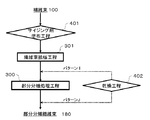
- FIG. 3 shows an example of the timing of the sizing agent application process in the process of manufacturing the reinforcing fiber bundle in the method of manufacturing the reinforcing fiber bundle constituting the reinforcing fiber mat according to the present invention.
- the sizing agent applying step 400 is performed prior to the partially divided fiber processing step 300.
- a pattern A and a pattern B to be performed after the partial separation processing step 300 are shown. Both timings of pattern A and pattern B are possible.
- FIG. 4 shows a timing example of the sizing agent application process 400 during the process of manufacturing the reinforcing fiber bundle in the method of manufacturing a reinforcing fiber bundle including the fiber bundle widening process 301 according to the present invention.
- the sizing agent applying step 400 A pattern C performed before the step 301, a pattern D performed between the fiber bundle widening step 301 and the partial separation treatment step 300, and a pattern E performed after the partial separation treatment step 300 are shown. It is done.
- the timing of the pattern D is most preferable from the viewpoint of achieving the optimum partial separation processing.
- FIG. 5 shows a timing example of a sizing agent application process including a sizing agent application process and a drying process in the manufacturing process of the reinforcing fiber bundle in the method of manufacturing the reinforcing fiber bundle constituting the reinforcing fiber mat according to the present invention
- the sizing agent application process 400 includes a sizing agent application process 401 and a drying process 402.
- the sizing agent application process 400 including the sizing agent application process 401 and the drying process 402 is described.
- a pattern F performed before the partially divided fiber step 300 and a pattern G performed after the partially divided fiber step 300 It is shown. Either timing of pattern F or pattern G is possible.
- the pattern F is substantially the same as the pattern A in FIG. 3 and the pattern G is substantially the same as the pattern B in FIG.
- FIG. 6 shows another timing example of the sizing agent application process including the sizing agent application process and the drying process in the manufacturing process of the reinforcing fiber bundle in the method of manufacturing the reinforcing fiber bundle constituting the reinforcing fiber mat according to the present invention. It shows.
- the sizing agent application process 401 and the drying process 402 in the sizing agent application process 400 are separated and performed at different timings.
- the sizing agent application process 401 is performed before the partial separation treatment process 300, and the drying process 402 is performed after the partial separation treatment process 300.
- FIG. 7 shows a timing example of a sizing agent application process including a sizing agent application process and a drying process in the method for producing a reinforced fiber bundle including the fiber bundle widening process according to the present invention, and the fiber bundle 100 is fiber bundle widening.
- the sizing agent application step 401 of the sizing agent application step is performed before the fiber bundle widening step 301.
- the drying step 402 a pattern I performed between the fiber bundle widening step 301 and the partial separation treatment step 300 and a pattern J performed after the partial separation treatment step 300 are shown.
- FIG. 8 shows another timing example of the sizing agent application process including the sizing agent application process and the drying process in the method for producing a reinforced fiber bundle including the fiber bundle widening process according to the present invention
- the fiber bundle 100 is a fiber
- the sizing agent application step 401 of the sizing agent application step includes the fiber bundle widening step 301 and the partial portion A pattern K is shown which is performed between the fiber treatment process 300 and the drying process 402 is performed after the partial separation process 300.
- the weight ratio of the bundle having 86 or more fibers in the bundle is preferably more than 99% by weight and not more than 100% by weight. If the weight ratio of the bundle with 86 or more fibers is 99% by weight or less, there is a concern that the flowability of the molding material may be inferior.
- the drape value of the reinforced fiber bundle which comprises the reinforced fiber mat of this invention 145 mm or more is more preferable, and 170 mm or more is more preferable. If the drape value is smaller than 120 mm, the filament may be broken and fluff may occur, resulting in a decrease in the unwinding property from the bobbin and winding on the nip roller and the cutter blade. It is preferable that it is 240 mm or less, 230 mm or less is more preferable, and 220 mm or less is more preferable. When the drape value exceeds 240 mm, the flexibility of the fiber bundle is lacking and the fiber bundle becomes too hard, and the bobbin may not be smoothly wound and unwound. In addition, single yarn breakage may occur at the time of cutting, which may result in failure to obtain an ideal chopped fiber bundle form. The method of deriving the drape value of the reinforcing fiber bundle constituting the reinforcing fiber mat will be described later.
- the bundle hardness of the reinforcing fiber bundle constituting the reinforcing fiber mat of the present invention is preferably 39 g or more, more preferably 70 g or more, and still more preferably 120 g or more. If the hardness is less than 39 g, the filament may be broken and fuzz may be generated to reduce the unwinding property from the bobbin and to cause winding on the nip roller and the cutter blade.
- the bundle hardness of the reinforcing fiber bundle constituting the reinforcing fiber mat is preferably 200 g or less, more preferably 190 g or less, and still more preferably 180 g or less.
- the number of single yarns per unit width of the discontinuous reinforcing fiber bundle constituting the reinforcing fiber mat of the present invention is preferably 500 yarns / mm or more, more preferably 600 yarns / mm or more, and still more preferably 700 yarns / mm or more. If it is less than 500 / mm, there is a concern that the flowability of the molding material may be poor.
- the number is preferably 1,600 or less, more preferably 1,400 or less, and still more preferably 1,200 or less. If it exceeds 1,600 / mm, there is a concern that the mechanical properties of the molded article may be inferior.
- the method of deriving the number of single yarns per unit width of the discontinuous reinforcing fiber bundle constituting the reinforcing fiber mat will be described later.
- the weight average fiber length of the discontinuous reinforcing fiber bundle constituting the reinforcing fiber mat of the present invention is preferably 5 mm or more, preferably 7 mm or more, and more preferably 10 mm or more.
- the weight average fiber length of the discontinuous reinforcing fiber bundle is preferably 100 mm or less, preferably 50 mm or less, and more preferably 25 mm or less. If the weight average fiber length of the reinforcing fiber bundle is less than 5 mm, the mechanical properties of the molded article are degraded. On the other hand, when the weight average fiber length of the reinforcing fiber bundle exceeds 100 mm, the formability is reduced.
- the weight average fiber length is an average value of the fiber length Lf shown in FIG.
- the angle (cutting angle ⁇ ) of the cut surface with respect to the fiber direction of the reinforcing fiber bundle 102 is preferably 3 ° or more, more preferably 4 ° or more, and still more preferably 5 ° or more. Within this range, the fiber bundle can be cut stably. Moreover, 30 degrees or less are preferable, 25 degrees or less are more preferable, and 15 degrees or less are more preferable. Within this range, good fluidity in molding and high mechanical properties of the molded article can be realized. Note that ⁇ is represented by an absolute value.
- 0.01 mm or more is preferable, as for the thickness of the discontinuous reinforcing fiber bundle which comprises the reinforcing fiber mat of this invention, 0.03 mm or more is more preferable, and 0.05 mm or more is more preferable. If it is less than 0.01 mm, there is a concern that the flowability of the molding material may be poor.
- the thickness of the discontinuous reinforcing fiber bundle constituting the reinforcing fiber mat is preferably 0.2 mm or less, more preferably 0.18 mm or less, and still more preferably 0.16 mm or less. If it exceeds 0.2 mm, there is a concern that the mechanical properties of the molded article may be inferior.
- the number average bundle width of the discontinuous reinforcing fiber bundles constituting the reinforcing fiber mat of the present invention is preferably 0.03 mm or more, more preferably 0.05 mm or more, and still more preferably 0.07 mm or more. If it is less than 0.03 mm, there is a concern that the flowability of the molding material may be poor.
- the average bundle width of the discontinuous reinforcing fiber bundle constituting the reinforcing fiber mat is preferably 3 mm or less, more preferably 2 mm or less, and still more preferably 1 mm or less. If it exceeds 3 mm, there is a concern that the mechanical properties of the molded article may be inferior.
- the reinforcing fiber bundle After immersing the discontinuous reinforcing fiber bundle constituting the reinforcing fiber mat of the present invention in water before immersion in water, the reinforcing fiber bundle is immersed in water at 25 ° C. for 5 minutes, then taken out and drained for 1 minute.
- the width of the reinforcing fiber bundle is W2
- the width change ratio W2 / W1 of the reinforcing fiber bundle is preferably 0.5 or more, more preferably 0.6 or more, and still more preferably 0.7 or more. If the width change ratio W2 / W1 of the discontinuous reinforcing fiber bundle to which the sizing agent is applied is smaller than 0.5, the water-soluble physical properties of the sizing agent attached to the discontinuous reinforcing fiber bundle remain.
- the separated fiber bundle may reaggregate, and when it is reaggregated, it becomes difficult to maintain the form of the fiber bundle adjusted to the optimum number of single yarns.
- the split fiber bundle is cut / dispersed for producing a molding material used for forming a composite material, and is used as an intermediate base of the discontinuous fiber bundle. In such a case, it becomes difficult to make the intermediate base material of the optimum form, and it becomes difficult to achieve well-balanced flowability in molding and mechanical properties of the molded article.
- the width change rate W2 / W1 is preferably 1.1 or less.
- width change ratio W2 / W1 exceeds 1.1, the flexibility of the fiber bundle is lacking and it becomes too hard, and there is a possibility that the winding and unwinding of the bobbin may not be smooth. In addition, single yarn breakage may occur at the time of cutting, which may result in failure to obtain an ideal chopped fiber bundle form.
- the method of deriving the width change ratio W2 / W1 of the reinforcing fiber bundle will be described later.
- the matrix thermoplastic resin [M] to be impregnated into the reinforcing fiber mat of the discontinuous reinforcing fiber bundle is not particularly limited.
- PBT butylene terephthalate
- PET polyethylene terephthalate
- PPS polyphenylene sulfide
- PEEK polyetheretherketone
- liquid crystal polymer polyvinyl chloride
- fluorine resin such as polytetrafluoroethylene, silicone, etc.
- thermoplastic polyamide resin used in the present invention can be obtained, for example, by polycondensation of nylon 6, nylon 11, nylon 12 or diamine and diamine with dicarboxylic acid obtained by ring-opening polymerization of cyclic lactam or polycondensation of ⁇ -aminocarboxylic acid.
- Copolymerized nylon such as 12 can be suitably used.
- nylon 6, 66, 610 is preferred in view of mechanical properties and cost.
- copper halide or derivatives thereof used in the present invention copper iodide, copper bromide, copper chloride, a complex salt of mercaptobenzimidazole and copper iodide, and the like can be mentioned. Among them, copper iodide and a complex salt of mercaptobenzimidazole and copper iodide can be suitably used.
- the addition amount of the copper halide or its derivative is preferably in the range of 0.001 to 5 parts by weight with respect to 100 parts by weight of the thermoplastic polyamide resin.
- the addition amount is less than 0.001 part, it is not possible to suppress resin decomposition, smoke and odor during preheating, and if it is 5 parts by weight or more, improvement of the improvement effect can not be observed. Furthermore, 0.002 to 1 part by weight is preferable because of the balance between the heat stabilization effect and the cost.
- the method for impregnating the reinforcing fiber mat of the discontinuous reinforcing fiber bundle with the matrix resin is not particularly limited, and the method for impregnating the thermoplastic resin may be, for example, a reinforcing fiber mat containing thermoplastic resin fibers.
- the thermoplastic resin fibers contained in the reinforcing fiber mat may be used as they are as a matrix resin, or any step of manufacturing the reinforcing fiber mat using the reinforcing fiber mat containing no thermoplastic resin fiber as a raw material
- the matrix resin may be impregnated with
- the matrix resin can be impregnated at any stage of producing the reinforcing fiber mat.
- the resin constituting the thermoplastic resin fiber and the matrix resin may be the same resin or different resins.
- the resin constituting the thermoplastic resin fiber is different from the matrix resin, it is preferable that the two have compatibility or high affinity.
- the fiber-reinforced resin molding material of the present invention mainly comprises a reinforcing fiber bundle and a thermoplastic resin, and has a void of 5% by volume or more. 7 volume% or more is preferable and 10 volume% or more of a porosity is more preferable. If the porosity is less than 5% by volume, the base material of the reinforcing fiber bundle may flow and high-speed production may not be possible. On the other hand, although the upper limit of the porosity is 30 volume%, 25 volume% or less is preferable and 20 volume% or less is more preferable. When it exceeds 30% by volume, it means that the impregnation property of the thermoplastic resin is deteriorated and the mechanical properties may be deteriorated. The method of deriving the porosity will be described later.
- the mechanical properties, flowability, and productivity can be significantly improved by simultaneously setting the void ratio of the fiber-reinforced resin molding material, the number of single yarns per unit width of the reinforcing fiber bundle, and the drape value described above. it can.
- thermoplastic resin which is a matrix resin
- the press is not particularly limited as long as it can realize the temperature and pressure necessary for the impregnation of the matrix resin, and a normal press having a flat platen which moves up and down, and a mechanism on which a pair of endless steel belts travel So-called double belt presses can be used.
- the matrix resin is formed into a sheet form such as a film, nonwoven fabric or woven fabric and then laminated with a discontinuous fiber mat, and the matrix resin can be melted and impregnated using the above-mentioned press or the like in that state.
- the particulate matrix resin may be sprayed onto the reinforcing fiber mat to form a laminate, or the discontinuous reinforcing fiber bundle may be sprayed at the same time as the dispersion and dispersed into the reinforcing fiber mat.
- the fiber-reinforced thermoplastic resin molding material of the present invention configured as described above is produced, for example, by the following steps [A] to [D].
- [A] A step of producing a mat substrate of a reinforcing fiber bundle having a number of single yarns per unit width of 500 / mm to 1600 / mm and a drape value of 120 mm to 240 mm.
- [B] spreading or laminating a thermoplastic resin on the mat substrate.
- [C] A step of melting a thermoplastic resin.
- [D] A step of cooling and solidifying the melted thermoplastic resin between the plate surfaces that are 5% or more thicker than the substrate thickness at the time of complete resin impregnation.
- the reinforcing fiber bundle having the physical properties as described above is cut, for example, to a desired length, and dispersed in a sheet form, thereby forming a mat substrate comprising the reinforcing fiber bundle of discontinuous fibers Do.
- step [B] particles of a thermoplastic resin to be a matrix resin are dispersed on the mat substrate obtained in the step [A], or a sheet-like thermoplastic resin such as a film, nonwoven fabric or fabric is mat It laminates on a substrate.
- a sheet-like thermoplastic resin such as a film, nonwoven fabric or fabric is mat It laminates on a substrate.
- particles of the thermoplastic resin may be sprayed at the same time, and the thermoplastic resin may be mixed inside the mat substrate.
- the said process [C] and [D] can be performed using a press, and the mat
- the press is not particularly limited as long as it can realize the temperature and pressure necessary for the impregnation of the matrix resin, and a normal press having a flat platen which moves up and down, and a mechanism on which a pair of endless steel belts travel So-called double belt presses can be used.
- the gap between the board surfaces should be at least 5% greater than the thickness of the substrate upon complete resin impregnation. The substrate thickness at the time of complete resin impregnation will be described later.
- the fiber-reinforced thermoplastic resin molding material obtained by the above-described series of steps uses a reinforcing fiber bundle having specific physical properties, and since the porosity in the molding material is in the above-mentioned range, the productivity is improved. In addition to being able to be enhanced, as a molded body using such a molding material, it is possible to exhibit high mechanical properties and also to be excellent in fluidity at the time of molding.
- the porosity of the fiber-reinforced resin molding material is an average value of 10 samples derived from the following formula (4) according to JIS K-7075 (1991).
- the fiber mass content Wf (%) is measured by a combustion method under nitrogen atmosphere conditions at 500 ° C. for 15 minutes, and can be derived by the following equation (1).
- the specific gravity cc of the fiber-reinforced resin molding material is measured according to method A (underwater substitution method) of JIS K-7112 (1999).
- the substrate thickness at the time of complete resin impregnation of fiber reinforced resin molding material is mass P (per unit area of fiber reinforced resin molding material) / M 2 ), fiber volume content Vf of fiber reinforced resin molding material at the time of complete resin impregnation, resin volume content Vr of fiber reinforced resin molding material at the time of complete resin impregnation, specific gravity ⁇ f of reinforcing fiber, specific gravity of thermoplastic resin It is derived from the following equation (5) including r r and is an average value of 10 samples.
- the weight a (mg / m) per 1 m of filaments is derived from the weight of the reinforcing fiber bundle per 1 m and the number of filaments constituting the reinforcing fiber bundle.
- the fiber length c (mm) and the weight b (mg) of the reinforcing fiber bundle cut to a length of about 10 mm are measured, and the number of fibers constituting the bundle is derived by the following formula (6).
- the thermal decomposition start temperature of the sizing agent is measured as follows. First, about 5 mg of a reinforcing fiber bundle coated with a sizing agent is collected, dried at 110 ° C. for 2 hours, and cooled in a desiccator at room temperature for 1 hour. Then, weigh and measure TGA in an air atmosphere. The air flow rate is 50 ml / min, the heating rate is 10 ° C./min, and the weight loss from room temperature to 650 ° C. is measured.
- the weight ratio (%) of the size yarn to the initial weight on the vertical axis and the TGA curve on the horizontal axis as temperature (° C), the temperature at which the rate of weight loss (% / ° C) is maximum and the closest to the lower temperature side
- the temperature at which the rate of weight loss is minimized is searched for, and the intersection of each tangent is defined as the thermal decomposition initiation temperature.
- the definition of the thermal decomposition initiation temperature is applied to the state before the matrix resin impregnation after chemical modification of the sizing agent. If the thermal decomposition onset temperature of the reinforcing fiber bundle to which the sizing agent has been applied can not be measured, the sizing agent can be used instead of the reinforcing fiber bundle.
- the reinforcing fiber bundle cut to 30 cm is fixed to the end of the rectangular base, and at this time, the reinforcing fiber bundle is fixed so as to project 25 cm from the end of the base That is, the portion 5 cm from the end of the reinforcing fiber is placed at the end of the table, and after standing for 5 minutes in this state, the tip of the reinforcing fiber bundle not fixed to the table and the side of the table
- the measured value of the shortest distance was taken as the drape value.
- the hardness of the reinforcing fiber bundle is measured using HANDLE-O-Meter ("CAN-1 MCB" manufactured by Daiei Kagaku Seiki, Ltd.) according to JIS L-1096 E method (handle ohm method). did.
- the reinforcing fiber bundle was opened and adjusted so that the length of the test piece used for measuring the bundle hardness was 10 cm and the width was 1 mm with 1600 filaments.
- the slit width was set to 20 mm.
- One reinforcing fiber bundle as a test piece was placed on the test stand provided with the slit grooves, and the resistance (g) generated when the test piece was pushed into the groove to a predetermined depth (8 mm) with a blade was measured. .
- the hardness of the reinforcing fiber bundle was obtained from the average value of three measurements.
- the bundle thickness was measured at about 20 points at intervals of 30 cm in the fiber bundle longitudinal direction (fiber direction), and the average value was taken as the average fiber bundle thickness, and the variation coefficient was taken as the bundle thickness irregularity.
- Step Passability The step of separating the reinforcing fiber bundle and the step of continuously cutting and dispersing the divided reinforcing fiber bundle were judged as in the following A to C.
- C The reinforcing fiber bundle can not be separated. Alternatively, separation fibers can be used, but the separated reinforcing fiber bundle is wound eight times or more in 1000 m by a bobbin or a cutter.
- the reinforcing fiber mat was molded by a method described later to obtain a flat molded article of 500 ⁇ 400 mm. With the flat plate longitudinal direction set to 0 °, 16 test pieces (total 32 pieces) of 100 ⁇ 25 ⁇ 2 mm are cut out from the obtained flat plate from 0 ° and 90 ° directions, respectively, according to JIS K 7074 (1988) The measurement was performed. As mechanical properties, flexural strength, flexural modulus, CV value (%) of flexural strength, and CV value (%) of flexural modulus were determined (CV: coefficient of variation). The bending strength was determined to be less than 200 MPa as C, 200 MPa or more and less than 350 MPa as B, and 350 MPa or more as A. When the CV value (%) of flexural strength exceeded 15%, C was determined, 10% or more and 15% or less as B, and less than 10% as A.
- Reinforcing fiber bundle 1 A carbon fiber bundle ("PX35” manufactured by ZOLTEK, 50,000 single yarns, "13" sizing agent) was used.
- Reinforcing fiber bundle 2 A glass fiber bundle (240 TEX manufactured by Nitto Boshoku, 1,600 single yarns) was used.
- Resin Sheet 1 A sheet was produced using a polyamide masterbatch consisting of polyamide 6 resin ("Amilan” (registered trademark) CM1001 manufactured by Toray Industries, Inc.).
- Resin sheet 2 90% by mass of unmodified polypropylene resin (Prime Polymer Co., Ltd., “Prime Polypro” (registered trademark) J106MG) and acid-modified polypropylene resin (Mitsui Chemical Co., Ltd., “Admer” (registered Sheets were made using a polypropylene masterbatch consisting of 10% by weight of trademark QE800.
- Sizing agent 1 Water-soluble polyamide ("T-70” manufactured by Toray Industries, Inc.) was used.
- Sizing agent 2 Water-soluble polyamide (Toray Industries, Inc., "A-90") was used.
- Sizing Agent 3 A water-soluble polyamide ("P-70” manufactured by Toray Industries, Inc.) was used.
- Sizing agent 4 A water-soluble polyamide ("P-95” manufactured by Toray Industries, Inc.) was used.
- the fiber bundle was unwound at a constant speed of 10 m / min using a winder, passed through a vibration widening roll oscillating in an axial direction at 10 Hz, subjected to a widening treatment, and then widened to an arbitrary width by passing through a width regulating roll A broadened fiber bundle was obtained.
- the spread fiber bundle was continuously immersed in a sizing agent diluted with purified water. Then, the spread fiber bundle coated with the sizing agent in a hot roller at 250 ° C. and a drying furnace at 250 ° C. (under the atmosphere) was dried, dried to remove water, and heat-treated for 1.5 minutes.
- An iron plate for separation processing having a projecting shape with a thickness of 0.2 mm, a width of 3 mm and a height of 20 mm is set parallel to the obtained widening fiber bundle at equal intervals in the width direction of the reinforcing fiber bundle
- the separation processing means was prepared. This separation processing means was intermittently pulled out and inserted from the widening fiber bundle to obtain a reinforcing fiber bundle having an arbitrary number of divisions.
- the separation processing means pierces the separation processing means for 3 seconds against the widening fiber bundle traveling at a constant speed of 10 m / min to generate a separation processing section, and the separation processing means is removed in 0.2 seconds. , Repeated the operation to pierce again.
- the fiber bundle is divided in the width direction in the separation processing section so that the targeted average number of fibers is obtained, and at least one end of at least one distribution processing section There was an entanglement storage portion in which entangled portions in which single yarns are entangled are accumulated. Subsequently, the obtained reinforcing fiber bundle is continuously inserted into a rotary cutter, and the fiber bundle is cut into an arbitrary fiber length and dispersed so as to be uniformly dispersed, thereby reinforcing fibers having isotropic fiber orientation. I got a mat.
- a molding material was obtained by sandwiching the resin sheet from above and below of the reinforcing fiber mat with a double belt press having an arbitrary gap, and impregnating the resin.
- the state in which the resin of the surface layer is not impregnated into the substrate, or the state in which the fibers of the surface layer are twisted is C, and the resin of the surface layer is impregnated into the substrate. A state was determined to be not present.
- the average number of fibers in the split fiber bundle is 990
- the number of fibers per unit width is 1,540
- the total sizing agent adhesion amount including the sizing agent 1 is 3.2% by weight
- the number of fibers in the bundle is A reinforcing fiber mat consisting of the reinforcing fiber bundle 1 having a weight ratio of bundles of 86 or more was 99.5% by weight was produced.
- the average number of fibers in the bundle is 1030
- the number of fibers per unit width is 1,480
- the total sizing agent adhesion amount including the sizing agent 1 is 4.0% by weight
- the number of fibers in the bundle is 86.
- a reinforcing fiber bundle consisting of the reinforcing fiber bundle 1 having a weight ratio of the above bundle of 99.7% by weight was produced.
- the average number of fibers in the bundle is 1,880
- the number of fibers per unit width is 1,220
- the total sizing agent adhesion amount including the sizing agent 1 is 3.1% by weight
- the number of fibers in the bundle is A reinforcing fiber mat consisting of the reinforcing fiber bundle 1 having a weight ratio of bundles of 86 or more was 99.8% by weight was produced.
- the average number of fibers in the bundle is 5,230
- the number of fibers per unit width is 1,540
- the total sizing agent adhesion amount including the sizing agent 2 is 2.8% by weight
- the number of fibers in the bundle is A reinforcing fiber mat consisting of the reinforcing fiber bundle 1 having a weight ratio of bundles of 86 or more was 99.6% by weight was produced.
- the average number of fibers in the bundle is 410
- the number of fibers per unit width is 550
- the total sizing agent adhesion amount including the sizing agent 2 is 3.3% by weight
- the number of fibers in the bundle is 86 or more.
- a reinforcing fiber mat consisting of the reinforcing fiber bundle 2 was prepared in which the weight ratio of one bundle is 99.7% by weight.
- the average number of fibers in the bundle is 1,120
- the number of fibers per unit width is 3,940
- the total sizing agent adhesion amount including the sizing agent 4 is 4.7% by weight
- the number of fibers in the bundle is A reinforcing fiber mat consisting of the reinforcing fiber bundle 1 having a weight ratio of bundles of 86 or more was 99.2% by weight was produced.
- the average number of fibers in the bundle is 930
- the number of fibers per unit width is 4,380
- the total sizing agent adhesion amount including the sizing agent 4 is 3.1% by weight
- the number of fibers in the bundle is 86.
- a reinforcing fiber mat consisting of the reinforcing fiber bundle 1 having a weight ratio of the above bundle of 99.4% by weight was produced.
- the average number of fibers in the bundle is 1070
- the number of fibers per unit width is 1510 / mm
- the total sizing agent adhesion amount including the sizing agent 4 is 2.4% by mass
- the number of fibers in the bundle is 86 or more
- a reinforcing fiber bundle consisting of the reinforcing fiber bundle 1 having a weight ratio of the bundle of 99.7% by weight was produced.
- the average number of fibers in the bundle is 1030
- the number of fibers per unit width is 1490 / mm
- the total sizing agent adhesion amount including the sizing agent 4 is 1.7% by mass
- the number of fibers in the bundle is 86 or more
- a reinforcing fiber bundle consisting of the reinforcing fiber bundle 1 having a weight ratio of the bundle of 99.8% by weight was produced.
- the average number of fibers in the bundle is 300
- the number of fibers per unit width is 400 / mm
- the total sizing agent adhesion amount including the sizing agent 2 is 3.0% by mass
- the number of fibers in the bundle is 86 or more
- a reinforcing fiber bundle consisting of the reinforcing fiber bundle 2 having a weight ratio of the bundle of 99.6% by weight was produced.
- the average number of fibers in the bundle is 1,010
- the number of fibers per unit width is 1,510
- the total sizing agent adhesion amount including the sizing agent 1 is 4.0% by weight
- the number of fibers in the bundle is A reinforcing fiber bundle consisting of the reinforcing fiber bundle 1 having a weight ratio of bundles of 86 or more was 95.0% by weight was produced.
- the average number of fibers in the bundle is 930
- the number of fibers per unit width is 1,480
- the total sizing agent adhesion amount including the sizing agent 3 is 5.5% by weight
- the number of fibers in the bundle is 86.
- a reinforcing fiber mat consisting of the reinforcing fiber bundle 1 having a weight ratio of the above bundle of 99.2% by weight was produced.
- Example 1 The reinforcing fiber mat produced in Reference Example 1 and the resin sheet 1 were set in a thickness-controlled mold at 280 ° C., and held for 5 minutes at a surface pressure of 1 MPa. Thereafter, while applying a surface pressure, cooling was performed at ⁇ 20 ° C./min to less than 100 ° C. to prepare a fiber-reinforced resin molding material.
- the thickness of the molding material corresponding to the distance between the plate surfaces was about 8.7% thicker than the thickness when completely impregnated with resin.
- the mechanical properties and fluidity of the molding material were evaluated, and the results are shown in Table 2.
- Example 2 The reinforcing fiber mat produced in Reference Example 2 and the resin sheet 2 were set in a mold of 220 ° C. whose thickness was controlled, and held for 5 minutes under a surface pressure of 1 MPa. Thereafter, while applying a surface pressure, cooling was performed at ⁇ 20 ° C./min to less than 100 ° C. to prepare a fiber-reinforced resin molding material.
- the thickness of the molding material corresponding to the distance between the plate surfaces was about 13.6% thicker than the thickness when completely impregnated with resin.
- the mechanical properties and fluidity of the molding material were evaluated, and the results are shown in Table 2.
- Example 3 The reinforcing fiber mat produced in Reference Example 3 and the resin sheet 1 were set in a thickness-controlled mold at 280 ° C., and held for 5 minutes under a surface pressure of 1 MPa. Thereafter, while applying a surface pressure, cooling was performed at ⁇ 20 ° C./min to less than 100 ° C. to prepare a fiber-reinforced resin molding material.
- the thickness of the molding material corresponding to the distance between the plate surfaces was about 28.2% thicker than the thickness when fully impregnated with resin.
- the mechanical properties and fluidity of the molding material were evaluated, and the results are shown in Table 2.
- Example 4 The reinforcing fiber mat produced in Reference Example 4 and the resin sheet 1 were set in a thickness-controlled mold at 280 ° C., and held for 5 minutes at a surface pressure of 1 MPa. Thereafter, while applying a surface pressure, cooling was performed at ⁇ 20 ° C./min to less than 100 ° C. to prepare a fiber-reinforced resin molding material.
- the thickness of the molding material corresponding to the distance between the plate surfaces was about 22.0% thicker than the thickness when completely impregnated with resin.
- the mechanical properties and fluidity of the molding material were evaluated, and the results are shown in Table 2.
- Example 5 The reinforcing fiber mat produced in Reference Example 5 and the resin sheet 1 were set in a thickness-controlled mold at 280 ° C., and held for 5 minutes under a contact pressure of 1 MPa. Thereafter, while applying a surface pressure, cooling was performed at ⁇ 20 ° C./min to less than 100 ° C. to prepare a fiber-reinforced resin molding material.
- the thickness of the molding material corresponding to the distance between the plate surfaces was about 16.3% thicker than the thickness at the time of complete resin impregnation.
- the mechanical properties and fluidity of the molding material were evaluated, and the results are shown in Table 2.
- the reinforcing fiber mat of the present invention is a material of a discontinuous reinforcing fiber composite, and the discontinuous reinforcing fiber composite is suitably used for automobile interior and exterior, electric and electronic equipment casings, bicycles, aircraft interior materials, transport box etc. be able to.
Landscapes
- Chemical & Material Sciences (AREA)
- Engineering & Computer Science (AREA)
- Textile Engineering (AREA)
- Materials Engineering (AREA)
- Manufacturing & Machinery (AREA)
- Health & Medical Sciences (AREA)
- Chemical Kinetics & Catalysis (AREA)
- Medicinal Chemistry (AREA)
- Polymers & Plastics (AREA)
- Organic Chemistry (AREA)
- Inorganic Chemistry (AREA)
- Mechanical Engineering (AREA)
- Composite Materials (AREA)
- Reinforced Plastic Materials (AREA)
- Treatments For Attaching Organic Compounds To Fibrous Goods (AREA)
Abstract
Description
[1] 平均繊維長が5mm以上100mm以下の強化繊維束からなり、前記強化繊維束の束内繊維数が86本以上の束の重量割合が99重量%を超え100重量%以下であることを特徴とする、強化繊維マット。
[2]前記強化繊維束の単位幅あたりの単糸数が500本/mm以上1,600本/mm以下、ドレープ値が120mm以上240mm以下であることを特徴とする、前記強化繊維マット。
[3] 前記強化繊維束にエポキシ樹脂が被覆されていることを特徴とする、前記強化繊維マット。
[4] 前記強化繊維束にポリアミド樹脂が被覆されていることを特徴とする、前記いずれかに記載の強化繊維マット。
[5] 前記強化繊維束の束硬度が39g以上200g以下であることを特徴とする、前記いずれかに記載の強化繊維マット。
[6] 前記強化繊維束の平均束厚みが0.01mm以上0.2mm以下であることを特徴とする、前記いずれかに記載の強化繊維マット。
[7] 前記強化繊維束の平均束幅が0.03mm以上3mm以下であることを特徴とする、前記いずれかに記載の強化繊維マット。
[8] 前記強化繊維束の幅変化率W2/W1が0.5以上1.1以下であることを特徴とする、前記いずれかに記載の強化繊維マット。
[9] 前記強化繊維束のサイジング剤付着量が0.1重量%以上5重量%以下であることを特徴とする、前記いずれかに記載の強化繊維マット。
[10] 前記強化繊維束の束内平均繊維数が50本以上4,000本以下であることを特徴とする、前記いずれかに記載の強化繊維マット。
[11] 前記強化繊維束の切断角度θが、3°以上30°以下であることを特徴とする、前記いずれかに記載の強化繊維マット。
[12] 前記いずれかに記載の強化繊維マットおよび熱可塑性樹脂からなることを特徴とする、繊維強化樹脂成形材料。
[13] 熱可塑性樹脂および強化繊維束を含み、空隙率が5体積%以上30体積%以下であり、前記強化繊維束は、単位幅あたりの単糸数が500本/mm以上1600本/mm以下、ドレープ値が120mm以上240mm以下の強化繊維束であることを特徴とする、繊維強化樹脂成形材料。
[14] 下記工程[A]~[D]を含むことを特徴とする、繊維強化熱可塑性樹脂成形材料の製造方法。
[A]単位幅あたりの単糸数が500本/mm以上1600本/mm以下、ドレープ値が120mm以上240mm以下の強化繊維束のマット基材を作製する工程。
[B]熱可塑性樹脂を前記マット基材上に散布、あるいは、積層する工程。
[C]前記熱可塑性樹脂を溶融する工程。
[D]溶融した前記熱可塑性樹脂を、完全樹脂含浸時の基材厚みより5%以上厚い盤面間で冷却・固化する工程。
図3は、本発明に係る強化繊維マットを構成する強化繊維束の製造方法において、強化繊維束の製造工程中におけるサイジング剤付与工程のタイミング例を示している。図3には、繊維束100が部分分繊処理工程300を経て部分分繊繊維束180に形成される工程中において、サイジング剤付与工程400が、部分分繊処理工程300よりも前に行われるパターンAと、部分分繊処理工程300よりも後に行われるパターンBとが示されている。パターンA、パターンBのいずれのタイミングも可能である。
また、図1、2に示すように、強化繊維束102の繊維方向に対する切断面の角度(切断角度θ)は、3°以上が好ましく、4°以上がより好ましく、5°以上がさらに好ましい。この範囲であれば、安定的に繊維束を切断できる。また、30°以下が好ましく、25°以下がより好ましく、15°以下がさらに好ましい。この範囲であれば、成形の際の良好な流動性と成形品の高い力学特性を実現できる。なお、θは絶対値で表される。
[A]単位幅あたりの単糸数が500本/mm以上1600本/mm以下、ドレープ値が120mm以上240mm以下の強化繊維束のマット基材を作製する工程。
[B]熱可塑性樹脂を前記マット基材に散布、あるいは、積層する工程。
[C]熱可塑性樹脂を溶融する工程。
[D]溶融した前記熱可塑性樹脂を、完全樹脂含浸時の基材厚みより5%以上厚い盤面間で冷却・固化する工程。
繊維強化樹脂成形材料の空隙率はJIS K-7075(1991年)に準じて下記数式(4)より導出される10サンプルの平均値とする。なお、繊維質量含有率Wf(%)は500℃、15分、窒素雰囲気条件の燃焼法により測定され下記数式(1)で導出できる。また繊維強化樹脂成形材料の比重ρcはJIS K-7112(1999年)のA法(水中置換法)に準じ測定される。
数式(1)
Wf=M1/M0×100(質量%)
(M1:燃焼後の強化繊維質量(mg)、M0:燃焼前の繊維強化樹脂成形材料の質量(mg))
数式(2)
Vf=(Wf/ρf)/(Wf/ρf+(100-Wf)/ρr)×100(%)
(Vf:完全含浸時の繊維強化樹脂成形材料の繊維体積含有率、ρf:強化繊維の比重、ρr:熱可塑性樹脂の比重)
数式(3)
Vr=100-Vf(%)
(Vr:完全含浸時の繊維強化樹脂成形材料の樹脂体積含有率、ρr:熱可塑性樹脂の比重)
数式(4)
空隙率=(1-100×ρc/(ρf×Vf+ρr×Vr))×100(%)
繊維強化樹脂成形材料の完全樹脂含浸時の基材厚みは、繊維強化樹脂成形材料の単位面積あたりの質量P(g/m2)、完全樹脂含浸時の繊維強化樹脂成形材料の繊維体積含有率Vf、完全樹脂含浸時の繊維強化樹脂成形材料の樹脂体積含有率Vr、強化繊維の比重ρf、熱可塑性樹脂の比重ρrを含む下記数式(5)より導出され、10サンプルの平均値とする。なお、繊維強化樹脂成形材料の単位面積あたりの質量P(g/m2)は100mm角の成形材料から導出する。
数式(5)
繊維強化樹脂成形材料の完全含浸厚み=P/(ρf×Vf+ρr×Vr)
1mあたりの強化繊維束の重量と強化繊維束を構成するフィラメント数からフィラメント1mあたりの重量a(mg/m)を導出する。次に、10mm程度の長さにカットした強化繊維束の繊維長さc(mm)と重量b(mg)を測定し、下記数式(6)により束を構成する繊維数を導出する。平均繊維数は計20個のカットした強化繊維束の繊維数の平均値とする。
数式(6)
強化繊維束の繊維数=(b×1,000/(a×c))
サイジング剤が付着している強化繊維束を5gほど採取し、耐熱製の容器に投入した。次にこの容器を80℃、真空条件下で24時間乾燥し、吸湿しないように注意しながら室温まで冷却後、秤量した強化繊維束の重量をm1(g)とし、続いて容器ごと、窒素雰囲気中、500℃、15分間の灰化処理を行った。吸湿しないように注意しながら室温まで冷却し、秤量した強化繊維束の重量をm2(g)とした。以上の処理を経て、強化繊維束へのサイジング剤の付着量を下記数式(7)により求めた。測定は10本の繊維束について行い、その平均値を算出した。
数式(7)
付着量(重量%)=100×{(m1-m2)/m1}
サイジング剤の熱分解開始温度は下記のように測定される。まず、サイジング剤が塗布された強化繊維束を5mgほど採取し、110℃で2時間乾燥後、デシケーター内で室温で1時間、冷却する。その後、秤量し、空気雰囲気中でTGA測定する。空気流量を50ml/分、昇温速度を10℃/分とし、室温から650℃までの重量減少を測定する。縦軸を初期重量に対するサイズ糸の重量比(%)、横軸を温度(℃)とするTGA曲線において、重量減少速度(%/℃)の最大となる温度及びそれより低温側で最も隣接する、重量減少速度が極小となる温度を探し、各々の接線の交点を熱分解開始温度と定義する。
30cmに切断した強化繊維束をまっすぐ伸ばして平らな台に載せ、湾曲したり撚れたりしないことを確認する。湾曲あるいは撚れが発生した場合、100℃以下の加熱、あるいは、0.1MPa以下の加圧によって除くことが好ましい。図9に示すように、23±5℃の雰囲気下、直方体の台の端に、30cmに切断した強化繊維束を固定し、この時、強化繊維束は台の端から25cm突き出るように固定、すなわち、強化繊維の端から5cmの部分が、台の端に来るようにし、この状態で5分間静置した後、台に固定していない方の強化繊維束の先端と、台の側面との最短距離を測定した値をドレープ値とした。測定本数はn=5とし、平均値を採用した。
強化繊維束の硬度は、JIS L-1096 E法(ハンドルオメータ法)に準じ、HANDLE-O-Meter(大栄科学精機製作所製「CAN-1MCB」)を用いて測定した。束硬度測定に用いる試験片の長さは10cm、幅はフィラメント数1600本で1mmとなるように強化繊維束を開繊調整した。また、スリット幅は20mmに設定した。このスリット溝が設けられた試験台に試験片となる強化繊維束を1本乗せ、ブレードにて溝の一定深さ(8mm)まで試験片を押し込むときに発生する抵抗力(g)を測定した。強化繊維束の硬度は3回の測定の平均値から得た。
束厚みを繊維束長手方向(繊維方向)に30cm間隔で20点ほど測定し、その平均値を平均繊維束厚み、変動係数を束厚み斑とした。
束幅を繊維束長手方向(繊維方向)に30cm間隔で20点ほど測定し、その平均値を平均繊維束幅、変動係数を束幅斑とした。
平均繊維数を平均繊維束幅で割ることで単位幅あたりの単糸数とした。
強化繊維束の分繊処理を施す前の幅40mmから50mmに拡幅されサイジング剤が塗布された炭素繊維束を長さ230mmにカットし、その一端を端から30mmの位置をクリップで挟み、逆端から100mmの間で幅を5点測定し、その平均値を浸漬前におけるW1した。その後、25℃の水に、5分間浸漬した後、取り出し、クリップで挟んだ側が上に来るように吊るした状態で1分間水を切った後、クリップで挟んだ逆端から100mmの間における幅を5点測定し、その平均値を浸漬後におけるW2とした。以上の処理を経て、サイジング剤が塗布された強化繊維束の幅変化率を下記数式(8)により求めた。
数式(8)
幅変化率=W2/W1
強化繊維束を分繊する工程、および、分繊した強化繊維束を連続でカットし散布する工程通過性について下記A~Cの通り判定した。
A:強化繊維束を分繊できる。分繊した強化繊維束をボビンから巻き出し、問題なくカット、散布できる。
B:強化繊維束を分繊できる。しかし、分繊した強化繊維束がボビンやカッター部で1000mに1~7回、巻き付く。
C:強化繊維束を分繊できない。あるいは、分繊繊維できるが、分繊した強化繊維束がボビンやカッター部で1000mに8回以上巻き付く。
強化繊維マットを後記する方法により成形し、500×400mmの平板成形品を得た。平板長手方向を0°とし、得られた平板より0°と90°方向から、それぞれ100×25×2mmの16個の試験片(合計32片)を切り出し、JIS K7074(1988年)に準拠し測定を実施した。力学特性としては、曲げ強度、曲げ弾性率、曲げ強度のCV値(%)、曲げ弾性率のCV値(%)を求めた(CV:変動係数)。曲げ強度が200MPa未満をC、200MPa以上350MPa未満をB、350MPa以上をAと判定した。曲げ強度のCV値(%)15%を超える場合をC、10%以上15%以下をB、10%未満をAと判定した。
・樹脂シート1の場合
寸法150mm×150mm×2mmの成形材料を2枚重ねた状態で、基材中心温度(二枚重ねた間の温度)が260℃となるように予熱後、150℃に昇温したプレス盤に配し、10MPaで30秒間加圧した。この圧縮後の面積A2(mm2)と、プレス前の基材の面積A1(mm2)を測定し、A2/A1×100を流動率(%)とした。流動率が200%未満をC、200%以上300%未満をB、300%以上をAと判定した。
寸法150mm×150mm×2mmの成形材料を2枚重ねた状態で、基材中心温度(二枚重ねた間の温度)が220℃となるように予熱後、120℃に昇温したプレス盤に配し、10MPaで30秒間加圧した。この圧縮後の面積A2(mm2)と、プレス前の基材の面積A1(mm2)を測定し、A2/A1×100を流動率(%)とした。流動率が200%未満をC、200%以上300%未満をB、300%以上をAと判定した。
・強化繊維束1:炭素繊維束(ZOLTEK社製“PX35”、単糸数50,000本、“13”サイジング剤)を用いた。
・強化繊維束2:ガラス繊維束(日東紡績製240TEX、単糸数1,600本)を用いた。
・樹脂シート1: ポリアミド6樹脂(東レ(株)社製、“アミラン”(登録商標)CM1001)からなるポリアミドマスターバッチを用いて、シートを作製した。
・樹脂シート2: 未変性ポリプロピレン樹脂(プライムポリマー(株)社製、“プライムポリプロ”(登録商標)J106MG)90質量%と、酸変性ポリプロピレン樹脂(三井化学(株)製、“アドマー”(登録商標)QE800)10質量%とからなるポリプロピレンマスターバッチを用いて、シートを作製した。
・サイジング剤1: 水溶性ポリアミド(東レ(株)社製、“T-70”)を用いた。
・サイジング剤2: 水溶性ポリアミド(東レ(株)社製、“A-90”)を用いた。
・サイジング剤3: 水溶性ポリアミド(東レ(株)社製、“P-70”)を用いた。
・サイジング剤4: 水溶性ポリアミド(東レ(株)社製、“P-95”)を用いた。
繊維束を、ワインダーを用いて一定速度10m/分で巻き出し、10Hzで軸方向へ振動する振動拡幅ロールに通し、拡幅処理を施した後に、幅規制ロールを通すことで任意の幅へ拡幅した拡幅繊維束を得た。
表1に示す通り、割繊束内平均繊維数990本、単位幅あたりの繊維数1,540本/mm、サイジング剤1を含むトータルサイジング剤付着量3.2重量%、束内繊維数が86本以上である束の重量割合が99.5重量%である、強化繊維束1からなる強化繊維マットを作製した。
表1に示す通り、束内平均繊維数1030本、単位幅あたりの繊維数1,480本/mm、サイジング剤1を含むトータルサイジング剤付着量4.0重量%、束内繊維数が86本以上である束の重量割合が99.7重量%である、強化繊維束1からなる強化繊維束を作製した。
表1に示す通り、束内平均繊維数1,880本、単位幅あたりの繊維数1,220本/mm、サイジング剤1を含むトータルサイジング剤付着量3.1重量%、束内繊維数が86本以上である束の重量割合が99.8重量%である、強化繊維束1からなる強化繊維マットを作製した。
表1に示す通り、束内平均繊維数5,230本、単位幅あたりの繊維数1,540本/mm、サイジング剤2を含むトータルサイジング剤付着量2.8重量%、束内繊維数が86本以上である束の重量割合が99.6重量%である、強化繊維束1からなる強化繊維マットを作製した。
表1に示す通り、束内平均繊維数410本、単位幅あたりの繊維数550本/mm、サイジング剤2を含むトータルサイジング剤付着量3.3重量%、束内繊維数が86本以上である束の重量割合が99.7重量%である、強化繊維束2からなる強化繊維マットを作製した。
表1に示す通り、束内平均繊維数1,540本、単位幅あたりの繊維数2,580本/mm、サイジング剤3を含むトータルサイジング剤付着量3.3重量%、束内繊維数が86本以上である束の重量割合が99.3重量%である、強化繊維束1からなる強化繊維マットを作製した。
表1に示す通り、束内平均繊維数1,120本、単位幅あたりの繊維数3,940本/mm、サイジング剤4を含むトータルサイジング剤付着量4.7重量%、束内繊維数が86本以上である束の重量割合が99.2重量%である、強化繊維束1からなる強化繊維マットを作製した。
表1に示す通り、束内平均繊維数930本、単位幅あたりの繊維数4,380本/mm、サイジング剤4を含むトータルサイジング剤付着量3.1重量%、束内繊維数が86本以上である束の重量割合が99.4重量%である、強化繊維束1からなる強化繊維マットを作製した。
表に示す通り、束内平均繊維数1070本、単位幅あたりの繊維数1510本/mm、サイジング剤4を含むトータルサイジング剤付着量2.4質量%、束内繊維数が86本以上である束の重量割合が99.7重量%である、強化繊維束1からなる強化繊維束を作製した。
表に示す通り、束内平均繊維数1030本、単位幅あたりの繊維数1490本/mm、サイジング剤4を含むトータルサイジング剤付着量1.7質量%、束内繊維数が86本以上である束の重量割合が99.8重量%である、強化繊維束1からなる強化繊維束を作製した。
表に示す通り、束内平均繊維数300本、単位幅あたりの繊維数400本/mm、サイジング剤2を含むトータルサイジング剤付着量3.0質量%、束内繊維数が86本以上である束の重量割合が99.6重量%である、強化繊維束2からなる強化繊維束を作製した。
表1に示す通り、束内平均繊維数1,010本、単位幅あたりの繊維数1,510本/mm、サイジング剤1を含むトータルサイジング剤付着量4.0重量%、束内繊維数が86本以上である束の重量割合が95.0重量%である、強化繊維束1からなる強化繊維束を作製した。
表1に示す通り、束内平均繊維数930本、単位幅あたりの繊維数1,480本/mm、サイジング剤3を含むトータルサイジング剤付着量5.5重量%、束内繊維数が86本以上である束の重量割合が99.2重量%である、強化繊維束1からなる強化繊維マットを作製した。
参考例1で作製した強化繊維マットと樹脂シート1を厚み制御された、280℃の金型にセットし、1MPaの面圧で5分間ホールドした。その後、面圧をかけながら、-20℃/分で100℃未満になるまで冷却し、繊維強化樹脂成形材料を作製した。盤面間の距離に相当する成形材料の厚みは、完全樹脂含浸時の厚みより8.7%ほど厚かった。成形材料の力学特性、流動性を評価し、結果を表2に示す。
参考例2で作製した強化繊維マットと樹脂シート2を厚み制御された、220℃の金型にセットし、1MPaの面圧で5分間ホールドした。その後、面圧をかけながら、-20℃/分で100℃未満になるまで冷却し、繊維強化樹脂成形材料を作製した。盤面間の距離に相当する成形材料の厚みは、完全樹脂含浸時の厚みより13.6%ほど厚かった。成形材料の力学特性、流動性を評価し、結果を表2に示す。
参考例3で作製した強化繊維マットと樹脂シート1を厚み制御された、280℃の金型にセットし、1MPaの面圧で5分間ホールドした。その後、面圧をかけながら、-20℃/分で100℃未満になるまで冷却し、繊維強化樹脂成形材料を作製した。盤面間の距離に相当する成形材料の厚みは、完全樹脂含浸時の厚みより28.2%ほど厚かった。成形材料の力学特性、流動性を評価し、結果を表2に示す。
参考例4で作製した強化繊維マットと樹脂シート1を厚み制御された、280℃の金型にセットし、1MPaの面圧で5分間ホールドした。その後、面圧をかけながら、-20℃/分で100℃未満になるまで冷却し、繊維強化樹脂成形材料を作製した。盤面間の距離に相当する成形材料の厚みは、完全樹脂含浸時の厚みより22.0%ほど厚かった。成形材料の力学特性、流動性を評価し、結果を表2に示す。
参考例5で作製した強化繊維マットと樹脂シート1を厚み制御された、280℃の金型にセットし、1MPaの面圧で5分間ホールドした。その後、面圧をかけながら、-20℃/分で100℃未満になるまで冷却し、繊維強化樹脂成形材料を作製した。盤面間の距離に相当する成形材料の厚みは、完全樹脂含浸時の厚みより16.3%ほど厚かった。成形材料の力学特性、流動性を評価し、結果を表2に示す。
(比較例1)
参考例6で作製した強化繊維束と樹脂シート1を厚み制御された、280℃の金型にセットし、1MPaの面圧で5分間ホールドした。その後、面圧をかけながら、-20℃/分で100℃未満になるまで冷却し、繊維強化樹脂成形材料を作製した。盤面間の距離に相当する成形材料の厚みは、完全樹脂含浸時の厚みより4.2%ほど厚かった。成形材料の力学特性、流動性を評価し、結果を表2に示す。
参考例7で作製した強化繊維束と樹脂シート1を厚み制御された、280℃の金型にセットし、1MPaの面圧で5分間ホールドした。その後、面圧をかけながら、-20℃/分で100℃未満になるまで冷却し、繊維強化樹脂成形材料を作製した。盤面間の距離に相当する成形材料の厚みは、完全樹脂含浸時の厚みより66.7%ほど厚かった。成形材料の力学特性、流動性を評価し、結果を表2に示す。
参考例8で作製した強化繊維束と樹脂シート2を厚み制御された、280℃の金型にセットし、1MPaの面圧で5分間ホールドした。その後、面圧をかけながら、-20℃/分で100℃未満になるまで冷却し、繊維強化樹脂成形材料を作製した。盤面間の距離に相当する成形材料の厚みは、完全樹脂含浸時の厚みより16.3%ほど厚かった。成形材料の力学特性、流動性を評価し、結果を表2に示す。
参考例9で作製した強化繊維束と樹脂シート2を厚み制御された、280℃の金型にセットし、1MPaの面圧で5分間ホールドした。その後、面圧をかけながら、-20℃/分で100℃未満になるまで冷却し、繊維強化樹脂成形材料を作製した。盤面間の距離に相当する成形材料の厚みは、完全樹脂含浸時の厚みより26.3%ほど厚かった。成形材料の力学特性、流動性を評価し、結果を表2に示す。
参考例10で作製した強化繊維束と樹脂シート2を厚み制御された、280℃の金型にセットし、1MPaの面圧で5分間ホールドした。その後、面圧をかけながら、-20℃/分で100℃未満になるまで冷却し、繊維強化樹脂成形材料を作製した。盤面間の距離に相当する成形材料の厚みは、完全樹脂含浸時の厚みより31.3%ほど厚かった。成形材料の力学特性、流動性を評価し、結果を表2に示す。
参考例11で作製した強化繊維束と樹脂シート1を厚み制御された、280℃の金型にセットし、1MPaの面圧で5分間ホールドした。その後、面圧をかけながら、-20℃/分で100℃未満になるまで冷却し、繊維強化樹脂成形材料を作製した。盤面間の距離に相当する成形材料の厚みは、完全樹脂含浸時の厚みより17.6%ほど厚かった。成形材料の力学特性、流動性を評価し、結果を表2に示す。
参考例12で作製した強化繊維マットと樹脂シート2を厚み制御された、220℃の金型にセットし、1MPaの面圧で5分間ホールドした。その後、面圧をかけながら、-20℃/分で100℃未満になるまで冷却し、繊維強化樹脂成形材料を作製した。盤面間の距離に相当する成形材料の厚みは、完全樹脂含浸時の厚みより13.6%ほど厚かった。成形材料の力学特性、流動性を評価し、結果を表2に示す。
参考例13で作製した強化繊維マットと樹脂シート2を厚み制御された、280℃の金型にセットし、1MPaの面圧で5分間ホールドした。その後、面圧をかけながら、-20℃/分で100℃未満になるまで冷却し、繊維強化樹脂成形材料を作製した。盤面間の距離に相当する成形材料の厚みは、完全樹脂含浸時の厚みより16.3%ほど厚かった。成形材料の力学特性、流動性を評価し、結果を表2に示す。


102 強化繊維束
180 分繊繊維束
300 部分分繊処理工程
301 繊維束拡幅工程
400 サイジング剤付与工程
401 サイジング剤塗布工程
402 乾燥工程
A~K パターン
Claims (14)
- 平均繊維長が5mm以上100mm以下の強化繊維束からなり、前記強化繊維束の束内繊維数が86本以上の束の重量割合が99重量%を超え100重量%以下であることを特徴とする、強化繊維マット。
- 前記強化繊維束の単位幅あたりの単糸数が500本/mm以上1,600本/mm以下、ドレープ値が120mm以上240mm以下であることを特徴とする、請求項1に記載の強化繊維マット。
- 前記強化繊維束にエポキシ樹脂が被覆されていることを特徴とする、請求項1または2に記載の強化繊維マット。
- 前記強化繊維束にポリアミド樹脂が被覆されていることを特徴とする、請求項1~3のいずれかに記載の強化繊維マット。
- 前記強化繊維束の束硬度が39g以上200g以下であることを特徴とする、請求項1~4のいずれかに記載の強化繊維マット。
- 前記強化繊維束の平均束厚みが0.01mm以上0.2mm以下であることを特徴とする、請求項1~5のいずれかに記載の強化繊維マット。
- 前記強化繊維束の平均束幅が0.03mm以上3mm以下であることを特徴とする、請求項1~6のいずれかに記載の強化繊維マット。
- 前記強化繊維束の幅変化率W2/W1が0.5以上1.1以下であることを特徴とする、請求項1~7のいずれかに記載の強化繊維マット。
- 前記強化繊維束のサイジング剤付着量が0.1重量%以上5重量%以下であることを特徴とする、請求項1~8のいずれかに記載の強化繊維マット。
- 前記強化繊維束の束内平均繊維数が50本以上4,000本以下であることを特徴とする、請求項1~9のいずれかに記載の強化繊維マット。
- 前記強化繊維束の切断角度θが、3°以上30°以下である、請求項1~10のいずれかに記載の強化繊維マット。
- 請求項1~11のいずれかに記載の強化繊維マットおよび熱可塑性樹脂からなることを特徴とする、繊維強化樹脂成形材料。
- 熱可塑性樹脂および強化繊維束を含み、空隙率が5体積%以上30体積%以下であり、前記強化繊維束は、単位幅あたりの単糸数が500本/mm以上1600本/mm以下、ドレープ値が120mm以上240mm以下の強化繊維束であることを特徴とする、繊維強化樹脂成形材料。
- 下記工程[A]~[D]を含むことを特徴とする、繊維強化熱可塑性樹脂成形材料の製造方法。
工程[A] 単位幅あたりの単糸数が500本/mm以上1600本/mm以下、ドレープ値が120mm以上240mm以下の強化繊維束のマット基材を作製する工程
工程[B] 熱可塑性樹脂を前記マット基材上に散布、あるいは、積層する工程
工程[C] 前記熱可塑性樹脂を溶融する工程
工程[D] 溶融した前記熱可塑性樹脂を、完全樹脂含浸時の基材厚みより5%以上厚い盤面間で冷却・固化する工程
Priority Applications (5)
| Application Number | Priority Date | Filing Date | Title |
|---|---|---|---|
| JP2019512690A JP7259739B2 (ja) | 2018-01-26 | 2019-01-17 | 強化繊維マットならびに繊維強化樹脂成形材料およびその製造方法 |
| EP19744140.5A EP3744768B1 (en) | 2018-01-26 | 2019-01-17 | Reinforcing fiber mat, and fiber-reinforced resin molding material and method for producing same |
| KR1020207015153A KR102728937B1 (ko) | 2018-01-26 | 2019-01-17 | 강화 섬유 매트 및 섬유 강화 수지 성형 재료 및 그 제조 방법 |
| CN201980007386.XA CN111587269A (zh) | 2018-01-26 | 2019-01-17 | 增强纤维毡、纤维增强树脂成型材料及其制造方法 |
| US16/962,263 US11377528B2 (en) | 2018-01-26 | 2019-01-17 | Reinforcing fiber mat, and fiber-reinforced resin forming material and method of producing same |
Applications Claiming Priority (4)
| Application Number | Priority Date | Filing Date | Title |
|---|---|---|---|
| JP2018011449 | 2018-01-26 | ||
| JP2018-011437 | 2018-01-26 | ||
| JP2018-011449 | 2018-01-26 | ||
| JP2018011437 | 2018-01-26 |
Publications (1)
| Publication Number | Publication Date |
|---|---|
| WO2019146484A1 true WO2019146484A1 (ja) | 2019-08-01 |
Family
ID=67395361
Family Applications (1)
| Application Number | Title | Priority Date | Filing Date |
|---|---|---|---|
| PCT/JP2019/001219 Ceased WO2019146484A1 (ja) | 2018-01-26 | 2019-01-17 | 強化繊維マットならびに繊維強化樹脂成形材料およびその製造方法 |
Country Status (6)
| Country | Link |
|---|---|
| US (1) | US11377528B2 (ja) |
| EP (1) | EP3744768B1 (ja) |
| JP (1) | JP7259739B2 (ja) |
| KR (1) | KR102728937B1 (ja) |
| CN (1) | CN111587269A (ja) |
| WO (1) | WO2019146484A1 (ja) |
Cited By (3)
| Publication number | Priority date | Publication date | Assignee | Title |
|---|---|---|---|---|
| WO2020090488A1 (ja) * | 2018-10-31 | 2020-05-07 | 東レ株式会社 | 繊維強化樹脂材料およびその製造方法 |
| WO2022203046A1 (ja) * | 2021-03-26 | 2022-09-29 | 三菱ケミカル株式会社 | 炭素繊維束 |
| JP2023554435A (ja) * | 2020-12-17 | 2023-12-27 | アルケマ フランス | 連続繊維から作製され、熱可塑性樹脂ポリマーを含浸させた繊維材料の製造方法 |
Families Citing this family (2)
| Publication number | Priority date | Publication date | Assignee | Title |
|---|---|---|---|---|
| ES2975187T3 (es) * | 2017-02-02 | 2024-07-03 | Toray Industries | Haz de fibras parcialmente separadas y método para fabricar el mismo, haz de fibras cortadas usando el mismo, y material de formación de resina reforzada con fibra |
| CN114921093B (zh) * | 2022-04-29 | 2024-02-13 | 上海品诚控股集团有限公司 | 一种纤维增强复合材料及其制备方法 |
Citations (12)
| Publication number | Priority date | Publication date | Assignee | Title |
|---|---|---|---|---|
| JPS5512908B1 (ja) | 1971-07-23 | 1980-04-04 | ||
| JP2000141502A (ja) | 1998-09-10 | 2000-05-23 | Asahi Fiber Glass Co Ltd | 長繊維強化熱可塑性樹脂シ―トの製造方法及び長繊維強化熱可塑性樹脂シ―ト |
| JP2003080519A (ja) | 2001-09-11 | 2003-03-19 | Nippon Gmt Kk | ガラス繊維強化スタンパブルシート用ガラス繊維複合マット及びその製造方法、ガラス繊維強化スタンパブルシート及びその製造方法並びに成形品 |
| JP2003127240A (ja) * | 2001-10-25 | 2003-05-08 | Central Glass Co Ltd | チョップドストランドマット |
| WO2011089929A1 (ja) * | 2010-01-20 | 2011-07-28 | 東レ株式会社 | 炭素繊維束 |
| JP2013104156A (ja) * | 2011-11-15 | 2013-05-30 | Sumitomo Seika Chem Co Ltd | 炭素繊維束 |
| WO2013115337A1 (ja) * | 2012-01-31 | 2013-08-08 | 帝人株式会社 | ランダムマットおよび繊維強化複合材料 |
| JP2014205354A (ja) * | 2011-05-31 | 2014-10-30 | 帝人株式会社 | 等方性を維持した成形体 |
| WO2016104154A1 (ja) | 2014-12-26 | 2016-06-30 | 東レ株式会社 | 部分分繊繊維束の製造方法および製造装置、部分分繊繊維束 |
| JP5985085B2 (ja) | 2014-01-31 | 2016-09-06 | 帝人株式会社 | 多層構造の成形材料及び多層構造の成形体 |
| WO2017221657A1 (ja) * | 2016-06-21 | 2017-12-28 | 東レ株式会社 | 部分分繊繊維束とその製造方法、および部分分繊繊維束を用いた繊維強化樹脂成形材料とその製造方法 |
| WO2018143067A1 (ja) * | 2017-02-02 | 2018-08-09 | 東レ株式会社 | 部分分繊繊維束およびその製造方法、ならびにそれを用いたチョップド繊維束および繊維強化樹脂成形材料 |
Family Cites Families (11)
| Publication number | Priority date | Publication date | Assignee | Title |
|---|---|---|---|---|
| JPS5985085U (ja) | 1983-09-29 | 1984-06-08 | ソニー株式会社 | 電源回路 |
| EP2674447B1 (en) * | 2011-02-07 | 2016-10-05 | Teijin Limited | Molded object with thickness gradient and process for producing same |
| EP2682429B1 (en) * | 2011-03-03 | 2019-04-24 | Mitsubishi Chemical Corporation | Method for producing a prepreg |
| JP5737168B2 (ja) | 2011-12-19 | 2015-06-17 | 株式会社島津製作所 | 液体クロマトグラフ及びその制御プログラム |
| US10738168B2 (en) | 2012-08-01 | 2020-08-11 | Teijin Limited | Random mat and fiber-reinforced composite material shaped product |
| KR101981837B1 (ko) * | 2012-12-21 | 2019-05-23 | 도레이 카부시키가이샤 | 섬유 강화 열가소성 수지 성형품, 섬유 강화 열가소성 수지 성형 재료, 및 섬유 강화 열가소성 수지 성형 재료의 제조 방법 |
| US9909253B2 (en) * | 2013-06-26 | 2018-03-06 | Teijin Limited | Random mat, shaped product of fiber reinforced composite material, and carbon fiber mat |
| JPWO2015194457A1 (ja) * | 2014-06-16 | 2017-04-20 | 帝人株式会社 | 強化繊維束およびその製造方法 |
| KR102478812B1 (ko) * | 2015-03-30 | 2022-12-19 | 도레이 카부시키가이샤 | 섬유 강화 수지 성형 재료 및 그 제조 방법 |
| HUE054377T2 (hu) * | 2016-10-12 | 2021-09-28 | Toray Industries | Kéveszõnyeg és eljárás elõállítására, továbbá kéveszõnyeg szálerõsítésû formázott gyanta |
| JP7310602B2 (ja) * | 2018-01-26 | 2023-07-19 | 東レ株式会社 | 強化繊維束基材およびその製造方法、ならびにそれを用いた繊維強化熱可塑性樹脂材料およびその製造方法 |
-
2019
- 2019-01-17 WO PCT/JP2019/001219 patent/WO2019146484A1/ja not_active Ceased
- 2019-01-17 JP JP2019512690A patent/JP7259739B2/ja active Active
- 2019-01-17 US US16/962,263 patent/US11377528B2/en active Active
- 2019-01-17 EP EP19744140.5A patent/EP3744768B1/en active Active
- 2019-01-17 KR KR1020207015153A patent/KR102728937B1/ko active Active
- 2019-01-17 CN CN201980007386.XA patent/CN111587269A/zh active Pending
Patent Citations (12)
| Publication number | Priority date | Publication date | Assignee | Title |
|---|---|---|---|---|
| JPS5512908B1 (ja) | 1971-07-23 | 1980-04-04 | ||
| JP2000141502A (ja) | 1998-09-10 | 2000-05-23 | Asahi Fiber Glass Co Ltd | 長繊維強化熱可塑性樹脂シ―トの製造方法及び長繊維強化熱可塑性樹脂シ―ト |
| JP2003080519A (ja) | 2001-09-11 | 2003-03-19 | Nippon Gmt Kk | ガラス繊維強化スタンパブルシート用ガラス繊維複合マット及びその製造方法、ガラス繊維強化スタンパブルシート及びその製造方法並びに成形品 |
| JP2003127240A (ja) * | 2001-10-25 | 2003-05-08 | Central Glass Co Ltd | チョップドストランドマット |
| WO2011089929A1 (ja) * | 2010-01-20 | 2011-07-28 | 東レ株式会社 | 炭素繊維束 |
| JP2014205354A (ja) * | 2011-05-31 | 2014-10-30 | 帝人株式会社 | 等方性を維持した成形体 |
| JP2013104156A (ja) * | 2011-11-15 | 2013-05-30 | Sumitomo Seika Chem Co Ltd | 炭素繊維束 |
| WO2013115337A1 (ja) * | 2012-01-31 | 2013-08-08 | 帝人株式会社 | ランダムマットおよび繊維強化複合材料 |
| JP5985085B2 (ja) | 2014-01-31 | 2016-09-06 | 帝人株式会社 | 多層構造の成形材料及び多層構造の成形体 |
| WO2016104154A1 (ja) | 2014-12-26 | 2016-06-30 | 東レ株式会社 | 部分分繊繊維束の製造方法および製造装置、部分分繊繊維束 |
| WO2017221657A1 (ja) * | 2016-06-21 | 2017-12-28 | 東レ株式会社 | 部分分繊繊維束とその製造方法、および部分分繊繊維束を用いた繊維強化樹脂成形材料とその製造方法 |
| WO2018143067A1 (ja) * | 2017-02-02 | 2018-08-09 | 東レ株式会社 | 部分分繊繊維束およびその製造方法、ならびにそれを用いたチョップド繊維束および繊維強化樹脂成形材料 |
Non-Patent Citations (1)
| Title |
|---|
| See also references of EP3744768A4 |
Cited By (8)
| Publication number | Priority date | Publication date | Assignee | Title |
|---|---|---|---|---|
| WO2020090488A1 (ja) * | 2018-10-31 | 2020-05-07 | 東レ株式会社 | 繊維強化樹脂材料およびその製造方法 |
| JPWO2020090488A1 (ja) * | 2018-10-31 | 2021-10-07 | 東レ株式会社 | 繊維強化樹脂材料およびその製造方法 |
| JP7329193B2 (ja) | 2018-10-31 | 2023-08-18 | 東レ株式会社 | 繊維強化樹脂材料およびその製造方法 |
| US11873376B2 (en) | 2018-10-31 | 2024-01-16 | Toray Industries, Inc. | Fiber-reinforced resin material and production method therefor |
| JP2023554435A (ja) * | 2020-12-17 | 2023-12-27 | アルケマ フランス | 連続繊維から作製され、熱可塑性樹脂ポリマーを含浸させた繊維材料の製造方法 |
| WO2022203046A1 (ja) * | 2021-03-26 | 2022-09-29 | 三菱ケミカル株式会社 | 炭素繊維束 |
| JPWO2022203046A1 (ja) * | 2021-03-26 | 2022-09-29 | ||
| JP7740330B2 (ja) | 2021-03-26 | 2025-09-17 | 三菱ケミカル株式会社 | 炭素繊維束 |
Also Published As
| Publication number | Publication date |
|---|---|
| CN111587269A (zh) | 2020-08-25 |
| EP3744768A1 (en) | 2020-12-02 |
| EP3744768B1 (en) | 2025-09-17 |
| EP3744768A4 (en) | 2021-10-06 |
| JPWO2019146484A1 (ja) | 2020-11-19 |
| KR102728937B1 (ko) | 2024-11-12 |
| KR20200107933A (ko) | 2020-09-16 |
| US20200354532A1 (en) | 2020-11-12 |
| US11377528B2 (en) | 2022-07-05 |
| JP7259739B2 (ja) | 2023-04-18 |
Similar Documents
| Publication | Publication Date | Title |
|---|---|---|
| JP7259739B2 (ja) | 強化繊維マットならびに繊維強化樹脂成形材料およびその製造方法 | |
| US11230630B2 (en) | Partially separated fiber bundle and method of manufacturing same, chopped fiber bundle using same, and fiber-reinforced resin forming material | |
| JP7384197B2 (ja) | 繊維強化樹脂材料、巻取体、成形品および繊維強化樹脂材料の製造方法 | |
| JP7310602B2 (ja) | 強化繊維束基材およびその製造方法、ならびにそれを用いた繊維強化熱可塑性樹脂材料およびその製造方法 | |
| WO2018143068A1 (ja) | 繊維強化樹脂成形材料 | |
| US11499022B2 (en) | Material, method for producing the material, partially welded material, composite material, and method of producing molded product | |
| JP7329193B2 (ja) | 繊維強化樹脂材料およびその製造方法 | |
| WO2019131125A1 (ja) | 繊維強化熱可塑性樹脂成形材料 | |
| JP7259740B2 (ja) | 強化繊維束およびその製造方法、ならびにそれを用いたチョップド繊維束および繊維強化樹脂成形材料 | |
| JP7236057B2 (ja) | 強化繊維束 | |
| JP7363482B2 (ja) | 繊維強化樹脂成形材料及び成形品の製造方法 | |
| JPWO2020085079A5 (ja) |
Legal Events
| Date | Code | Title | Description |
|---|---|---|---|
| ENP | Entry into the national phase |
Ref document number: 2019512690 Country of ref document: JP Kind code of ref document: A |
|
| 121 | Ep: the epo has been informed by wipo that ep was designated in this application |
Ref document number: 19744140 Country of ref document: EP Kind code of ref document: A1 |
|
| ENP | Entry into the national phase |
Ref document number: 20207015153 Country of ref document: KR Kind code of ref document: A |
|
| NENP | Non-entry into the national phase |
Ref country code: DE |
|
| ENP | Entry into the national phase |
Ref document number: 2019744140 Country of ref document: EP Effective date: 20200826 |
|
| WWG | Wipo information: grant in national office |
Ref document number: 2019744140 Country of ref document: EP |