WO2019165795A1 - 锂离子二次电池及其制备方法 - Google Patents
锂离子二次电池及其制备方法 Download PDFInfo
- Publication number
- WO2019165795A1 WO2019165795A1 PCT/CN2018/112959 CN2018112959W WO2019165795A1 WO 2019165795 A1 WO2019165795 A1 WO 2019165795A1 CN 2018112959 W CN2018112959 W CN 2018112959W WO 2019165795 A1 WO2019165795 A1 WO 2019165795A1
- Authority
- WO
- WIPO (PCT)
- Prior art keywords
- lithium
- negative electrode
- unit area
- per unit
- ion secondary
- Prior art date
- Legal status (The legal status is an assumption and is not a legal conclusion. Google has not performed a legal analysis and makes no representation as to the accuracy of the status listed.)
- Ceased
Links
Images
Classifications
-
- H—ELECTRICITY
- H01—ELECTRIC ELEMENTS
- H01M—PROCESSES OR MEANS, e.g. BATTERIES, FOR THE DIRECT CONVERSION OF CHEMICAL ENERGY INTO ELECTRICAL ENERGY
- H01M4/00—Electrodes
- H01M4/02—Electrodes composed of, or comprising, active material
- H01M4/36—Selection of substances as active materials, active masses, active liquids
- H01M4/58—Selection of substances as active materials, active masses, active liquids of inorganic compounds other than oxides or hydroxides, e.g. sulfides, selenides, tellurides, halogenides or LiCoFy; of polyanionic structures, e.g. phosphates, silicates or borates
- H01M4/583—Carbonaceous material, e.g. graphite-intercalation compounds or CFx
- H01M4/587—Carbonaceous material, e.g. graphite-intercalation compounds or CFx for inserting or intercalating light metals
-
- H—ELECTRICITY
- H01—ELECTRIC ELEMENTS
- H01M—PROCESSES OR MEANS, e.g. BATTERIES, FOR THE DIRECT CONVERSION OF CHEMICAL ENERGY INTO ELECTRICAL ENERGY
- H01M10/00—Secondary cells; Manufacture thereof
- H01M10/05—Accumulators with non-aqueous electrolyte
- H01M10/052—Li-accumulators
- H01M10/0525—Rocking-chair batteries, i.e. batteries with lithium insertion or intercalation in both electrodes; Lithium-ion batteries
-
- H—ELECTRICITY
- H01—ELECTRIC ELEMENTS
- H01M—PROCESSES OR MEANS, e.g. BATTERIES, FOR THE DIRECT CONVERSION OF CHEMICAL ENERGY INTO ELECTRICAL ENERGY
- H01M10/00—Secondary cells; Manufacture thereof
- H01M10/05—Accumulators with non-aqueous electrolyte
- H01M10/054—Accumulators with insertion or intercalation of metals other than lithium, e.g. with magnesium or aluminium
-
- H—ELECTRICITY
- H01—ELECTRIC ELEMENTS
- H01M—PROCESSES OR MEANS, e.g. BATTERIES, FOR THE DIRECT CONVERSION OF CHEMICAL ENERGY INTO ELECTRICAL ENERGY
- H01M10/00—Secondary cells; Manufacture thereof
- H01M10/05—Accumulators with non-aqueous electrolyte
- H01M10/056—Accumulators with non-aqueous electrolyte characterised by the materials used as electrolytes, e.g. mixed inorganic/organic electrolytes
- H01M10/0564—Accumulators with non-aqueous electrolyte characterised by the materials used as electrolytes, e.g. mixed inorganic/organic electrolytes the electrolyte being constituted of organic materials only
- H01M10/0566—Liquid materials
- H01M10/0568—Liquid materials characterised by the solutes
-
- H—ELECTRICITY
- H01—ELECTRIC ELEMENTS
- H01M—PROCESSES OR MEANS, e.g. BATTERIES, FOR THE DIRECT CONVERSION OF CHEMICAL ENERGY INTO ELECTRICAL ENERGY
- H01M10/00—Secondary cells; Manufacture thereof
- H01M10/05—Accumulators with non-aqueous electrolyte
- H01M10/056—Accumulators with non-aqueous electrolyte characterised by the materials used as electrolytes, e.g. mixed inorganic/organic electrolytes
- H01M10/0564—Accumulators with non-aqueous electrolyte characterised by the materials used as electrolytes, e.g. mixed inorganic/organic electrolytes the electrolyte being constituted of organic materials only
- H01M10/0566—Liquid materials
- H01M10/0569—Liquid materials characterised by the solvents
-
- H—ELECTRICITY
- H01—ELECTRIC ELEMENTS
- H01M—PROCESSES OR MEANS, e.g. BATTERIES, FOR THE DIRECT CONVERSION OF CHEMICAL ENERGY INTO ELECTRICAL ENERGY
- H01M10/00—Secondary cells; Manufacture thereof
- H01M10/05—Accumulators with non-aqueous electrolyte
- H01M10/058—Construction or manufacture
-
- H—ELECTRICITY
- H01—ELECTRIC ELEMENTS
- H01M—PROCESSES OR MEANS, e.g. BATTERIES, FOR THE DIRECT CONVERSION OF CHEMICAL ENERGY INTO ELECTRICAL ENERGY
- H01M10/00—Secondary cells; Manufacture thereof
- H01M10/42—Methods or arrangements for servicing or maintenance of secondary cells or secondary half-cells
-
- H—ELECTRICITY
- H01—ELECTRIC ELEMENTS
- H01M—PROCESSES OR MEANS, e.g. BATTERIES, FOR THE DIRECT CONVERSION OF CHEMICAL ENERGY INTO ELECTRICAL ENERGY
- H01M4/00—Electrodes
- H01M4/02—Electrodes composed of, or comprising, active material
- H01M4/04—Processes of manufacture in general
- H01M4/0402—Methods of deposition of the material
- H01M4/0404—Methods of deposition of the material by coating on electrode collectors
-
- H—ELECTRICITY
- H01—ELECTRIC ELEMENTS
- H01M—PROCESSES OR MEANS, e.g. BATTERIES, FOR THE DIRECT CONVERSION OF CHEMICAL ENERGY INTO ELECTRICAL ENERGY
- H01M4/00—Electrodes
- H01M4/02—Electrodes composed of, or comprising, active material
- H01M4/04—Processes of manufacture in general
- H01M4/0438—Processes of manufacture in general by electrochemical processing
- H01M4/044—Activating, forming or electrochemical attack of the supporting material
- H01M4/0445—Forming after manufacture of the electrode, e.g. first charge, cycling
-
- H—ELECTRICITY
- H01—ELECTRIC ELEMENTS
- H01M—PROCESSES OR MEANS, e.g. BATTERIES, FOR THE DIRECT CONVERSION OF CHEMICAL ENERGY INTO ELECTRICAL ENERGY
- H01M4/00—Electrodes
- H01M4/02—Electrodes composed of, or comprising, active material
- H01M4/04—Processes of manufacture in general
- H01M4/0438—Processes of manufacture in general by electrochemical processing
- H01M4/044—Activating, forming or electrochemical attack of the supporting material
- H01M4/0445—Forming after manufacture of the electrode, e.g. first charge, cycling
- H01M4/0447—Forming after manufacture of the electrode, e.g. first charge, cycling of complete cells or cells stacks
-
- H—ELECTRICITY
- H01—ELECTRIC ELEMENTS
- H01M—PROCESSES OR MEANS, e.g. BATTERIES, FOR THE DIRECT CONVERSION OF CHEMICAL ENERGY INTO ELECTRICAL ENERGY
- H01M4/00—Electrodes
- H01M4/02—Electrodes composed of, or comprising, active material
- H01M4/04—Processes of manufacture in general
- H01M4/0438—Processes of manufacture in general by electrochemical processing
- H01M4/0459—Electrochemical doping, intercalation, occlusion or alloying
-
- H—ELECTRICITY
- H01—ELECTRIC ELEMENTS
- H01M—PROCESSES OR MEANS, e.g. BATTERIES, FOR THE DIRECT CONVERSION OF CHEMICAL ENERGY INTO ELECTRICAL ENERGY
- H01M4/00—Electrodes
- H01M4/02—Electrodes composed of, or comprising, active material
- H01M4/13—Electrodes for accumulators with non-aqueous electrolyte, e.g. for lithium-accumulators; Processes of manufacture thereof
- H01M4/133—Electrodes based on carbonaceous material, e.g. graphite-intercalation compounds or CFx
-
- H—ELECTRICITY
- H01—ELECTRIC ELEMENTS
- H01M—PROCESSES OR MEANS, e.g. BATTERIES, FOR THE DIRECT CONVERSION OF CHEMICAL ENERGY INTO ELECTRICAL ENERGY
- H01M4/00—Electrodes
- H01M4/02—Electrodes composed of, or comprising, active material
- H01M4/13—Electrodes for accumulators with non-aqueous electrolyte, e.g. for lithium-accumulators; Processes of manufacture thereof
- H01M4/139—Processes of manufacture
- H01M4/1393—Processes of manufacture of electrodes based on carbonaceous material, e.g. graphite-intercalation compounds or CFx
-
- H—ELECTRICITY
- H01—ELECTRIC ELEMENTS
- H01M—PROCESSES OR MEANS, e.g. BATTERIES, FOR THE DIRECT CONVERSION OF CHEMICAL ENERGY INTO ELECTRICAL ENERGY
- H01M4/00—Electrodes
- H01M4/02—Electrodes composed of, or comprising, active material
- H01M4/36—Selection of substances as active materials, active masses, active liquids
- H01M4/58—Selection of substances as active materials, active masses, active liquids of inorganic compounds other than oxides or hydroxides, e.g. sulfides, selenides, tellurides, halogenides or LiCoFy; of polyanionic structures, e.g. phosphates, silicates or borates
- H01M4/5825—Oxygenated metallic salts or polyanionic structures, e.g. borates, phosphates, silicates, olivines
-
- H—ELECTRICITY
- H01—ELECTRIC ELEMENTS
- H01M—PROCESSES OR MEANS, e.g. BATTERIES, FOR THE DIRECT CONVERSION OF CHEMICAL ENERGY INTO ELECTRICAL ENERGY
- H01M4/00—Electrodes
- H01M4/02—Electrodes composed of, or comprising, active material
- H01M4/36—Selection of substances as active materials, active masses, active liquids
- H01M4/58—Selection of substances as active materials, active masses, active liquids of inorganic compounds other than oxides or hydroxides, e.g. sulfides, selenides, tellurides, halogenides or LiCoFy; of polyanionic structures, e.g. phosphates, silicates or borates
- H01M4/583—Carbonaceous material, e.g. graphite-intercalation compounds or CFx
-
- H—ELECTRICITY
- H01—ELECTRIC ELEMENTS
- H01M—PROCESSES OR MEANS, e.g. BATTERIES, FOR THE DIRECT CONVERSION OF CHEMICAL ENERGY INTO ELECTRICAL ENERGY
- H01M4/00—Electrodes
- H01M4/02—Electrodes composed of, or comprising, active material
- H01M4/62—Selection of inactive substances as ingredients for active masses, e.g. binders, fillers
-
- H—ELECTRICITY
- H01—ELECTRIC ELEMENTS
- H01M—PROCESSES OR MEANS, e.g. BATTERIES, FOR THE DIRECT CONVERSION OF CHEMICAL ENERGY INTO ELECTRICAL ENERGY
- H01M4/00—Electrodes
- H01M4/02—Electrodes composed of, or comprising, active material
- H01M2004/026—Electrodes composed of, or comprising, active material characterised by the polarity
- H01M2004/027—Negative electrodes
-
- H—ELECTRICITY
- H01—ELECTRIC ELEMENTS
- H01M—PROCESSES OR MEANS, e.g. BATTERIES, FOR THE DIRECT CONVERSION OF CHEMICAL ENERGY INTO ELECTRICAL ENERGY
- H01M4/00—Electrodes
- H01M4/02—Electrodes composed of, or comprising, active material
- H01M2004/026—Electrodes composed of, or comprising, active material characterised by the polarity
- H01M2004/028—Positive electrodes
-
- H—ELECTRICITY
- H01—ELECTRIC ELEMENTS
- H01M—PROCESSES OR MEANS, e.g. BATTERIES, FOR THE DIRECT CONVERSION OF CHEMICAL ENERGY INTO ELECTRICAL ENERGY
- H01M10/00—Secondary cells; Manufacture thereof
- H01M10/42—Methods or arrangements for servicing or maintenance of secondary cells or secondary half-cells
- H01M2010/4292—Aspects relating to capacity ratio of electrodes/electrolyte or anode/cathode
-
- H—ELECTRICITY
- H01—ELECTRIC ELEMENTS
- H01M—PROCESSES OR MEANS, e.g. BATTERIES, FOR THE DIRECT CONVERSION OF CHEMICAL ENERGY INTO ELECTRICAL ENERGY
- H01M2300/00—Electrolytes
- H01M2300/0017—Non-aqueous electrolytes
- H01M2300/0025—Organic electrolyte
- H01M2300/0028—Organic electrolyte characterised by the solvent
Definitions
- the invention relates to the field of batteries, and in particular to a lithium ion secondary battery and a preparation method thereof.
- lithium ion secondary batteries have a higher energy density advantage than other types of secondary batteries, making them dominant in the market.
- lithium ion secondary batteries with lithium iron phosphate as a positive electrode active material are widely used in electric bus power systems due to their high safety, low cost and long life, and have broad application prospects in large-scale energy storage.
- lithium iron phosphate has high structural stability, the dissolution-repair balance of the solid-electrolyte interface film (SEI film) occurs on the surface of the graphite negative electrode, resulting in a decrease in active lithium ions that can be used for shuttle between the positive and negative electrodes. Therefore, capacity loss inevitably occurs.
- SEI film solid-electrolyte interface film
- a lithium ion secondary battery using lithium titanate as a negative electrode active material and lithium iron phosphate as a positive electrode active material can avoid a capacity loss caused by a negative electrode side reaction caused by a dissolution-repair balance of the SEI film because no SEI film is formed.
- the higher voltage platform of lithium titanate leads to lower discharge voltage platform of lithium ion secondary battery, lower energy density, and the expensive unit price of lithium titanate leads to excessive cost of unit Wh. Therefore, effective technology is needed to solve lithium ion II. The long life of the secondary battery.
- the main means to improve the life of lithium ion secondary batteries are: selection of lithium iron phosphate type and graphite type with good cycle performance and storage performance, optimization of electrolyte formulation (changing organic solvents, additives), optimization of positive and negative membrane formulations Optimize the film forming conditions of the SEI film. These methods all have a limited effect on the reduction of active lithium ions by suppressing the negative side reaction caused by the dissolution-repair balance of the SEI film, and the lithium ion secondary battery has the highest cycle life. It can be achieved from 5,000 to 6,000 times, and there is still a big gap between the long-life electric bus and the large-scale energy storage system with a cycle life of more than 10,000 cycles.
- an object of the present invention is to provide a lithium ion secondary battery having a good cycle performance and storage performance, and a method of producing the same.
- the present invention provides a lithium ion secondary battery comprising: an electric cell; an electrolyte, an impregnated cell; and a package.
- the battery cell includes a negative electrode sheet including a negative electrode current collector, and a negative electrode film disposed on a surface of the negative electrode current collector and containing a negative electrode active material, the positive electrode plate including a positive electrode current collector and being disposed on the positive electrode A positive electrode membrane having a surface of the current collector and containing a positive electrode active material, the separator being spaced between the adjacent negative electrode sheets and the positive electrode sheets.
- the negative electrode sheet is a lithium plated negative electrode piece
- the negative electrode active material is a carbon-based negative electrode material
- capacity per unit area of negative electrode active material / capacity per unit area of positive electrode active material 1.2 to 2.1
- the amount of active lithium that can be deintercalated is ⁇ 1.10.
- the present invention provides a method for producing a lithium ion secondary battery for preparing a lithium ion secondary battery according to an aspect of the present invention, comprising the steps of: coating a positive electrode slurry on a surface of a positive electrode current collector After drying, a positive electrode sheet is obtained; a negative electrode slurry is coated on the surface of the negative electrode current collector, and after drying, a metal lithium layer is disposed on the surface of the negative electrode film, and then assembled into a battery core with the separator and the positive electrode sheet; The core is placed in the package shell, and the electrolyte is injected and encapsulated.
- the metal lithium layer is lithiated by the electrolyte and the carbon-based anode material in the anode active material is lithiated into a pre-lithium compound LiC x , and then pre-charged to obtain a finished product.
- Lithium ion secondary battery Lithium ion secondary battery.
- the present invention at least includes the following beneficial effects:
- the negative electrode active material may have sufficient vacancies to receive all lithium ions from the positive active material, and store excess lithium ions in the negative electrode after being fully discharged, thereby enabling The lithium ion secondary battery is effectively reduced in capacity loss, and the lithium ion secondary battery has better cycle performance and storage performance.
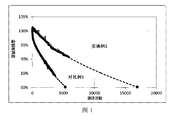
- Example 1 is a graph showing the normal temperature cycle performance curves of Example 1 and Comparative Example 1.
- a lithium ion secondary battery includes: an electric cell; an electrolyte, an impregnated cell; and a package.
- the battery cell includes a negative electrode sheet including a negative electrode current collector, and a negative electrode film disposed on a surface of the negative electrode current collector and containing a negative electrode active material, the positive electrode plate including a positive electrode current collector and being disposed on the positive electrode A positive electrode membrane having a surface of the current collector and containing a positive electrode active material, the separator being spaced between the adjacent negative electrode sheets and the positive electrode sheets.
- the negative electrode sheet is a lithium plated negative electrode piece
- the negative electrode active material is a carbon-based negative electrode material
- the capacity per unit area of the negative electrode active material / the capacity of the positive electrode active material per unit area 1.2 to 2.1, the unit The area of the negative electrode active material capacity / (the positive electrode active material capacity per unit area + the amount of active lithium per unit lithium-releasable LiC x deintercalated in the negative electrode film per unit area) ⁇ 1.10.
- the capacity of the negative electrode active material per unit area is based on the reversible capacity of the negative electrode active material (ie, the carbon-based negative electrode material) which has not been lithiated (or has not been intercalated with lithium), and the positive electrode active material capacity per unit area is calculated as the reversible gram capacity of the positive electrode active material.
- the lithium ion secondary battery can be completely discharged and then disassembled to obtain a positive electrode sheet and a negative electrode sheet, and a positive electrode sheet per unit area and a negative electrode sheet per unit area are respectively cut out to perform the following tests:
- the positive electrode piece per unit area and the lithium metal piece per unit area are combined into a button type half-cell, and fully charged at a rate of not more than 0.1 C, and the charging capacity is obtained, that is, the amount of active lithium which can be deintercalated per unit area of the positive electrode film;
- the half-cell is allowed to stand for a period of time (preferably not less than 5 min, more preferably 5 to 30 min), and then fully discharged at a rate of not more than 0.1 C (preferably the same as the charging magnification) to obtain a discharge capacity, that is, a positive electrode membrane per unit area
- the amount of active lithium embedded is not less than 5 min, more preferably 5 to 30 min
- the negative electrode piece per unit area and the lithium metal piece per unit area are combined into a button type half-cell, and fully charged at a rate of not more than 0.1 C, and the charging capacity is obtained, that is, the amount of active lithium that can be deintercalated per unit area of the negative electrode film.
- the cutting position of the positive electrode sheet and the negative electrode sheet is not particularly limited as long as the positive electrode film and the negative electrode film are completely covered.
- the charge and discharge voltage interval is determined according to the specific type of the positive electrode active material and the negative electrode active material, that is, according to the recommended voltage of the commercially available positive and negative active material manufacturers, the charge and discharge voltages of the different positive and negative active materials are slightly different. difference.
- the composition of the electrolyte and the type of the separator in the assembled button half-cell are not particularly limited in selection, and it is preferable to carry out the test under the same conditions as the lithium ion secondary battery, and the specific The type change has negligible effect on the calculated amount of active lithium of the pre-calium compound LiC x deintercalable in the negative electrode film per unit area.
- the calculation method and test method for the amount of active lithium deintercalated by the lithium compound LiC x in the negative electrode film per unit area described above are applicable to the newly prepared lithium ion secondary battery, and also to the lithium ion which has been circulated several times.
- a secondary battery especially a lithium ion secondary battery having a small capacity attenuation in the early stage, for example, a capacity retention rate of ⁇ 98% after the first 100 cycles).
- the capacity per unit area of the negative electrode active material/the capacity of the positive electrode active material per unit area 1.2 to 2.1, the capacity of the negative electrode active material per unit area / (the capacity per unit area of the positive electrode active material + the negative electrode per unit area)
- the amount of active lithium in which the lithium compound LiC x can be deintercalated in the film is ⁇ 1.10, so that when the lithium ion secondary battery is fully charged during use, the negative electrode active material can have sufficient vacancies to receive all the positive electrode active material.
- Lithium ion and excessive lithium ions are stored in the negative electrode after being fully discharged, thereby effectively reducing the capacity loss of the lithium ion secondary battery and improving the cycle performance and storage performance of the lithium ion secondary battery.
- the capacity per unit area of the negative electrode active material / the capacity of the positive electrode active material per unit area 1.3 to 2.1.
- the degree of pre-intercalation of lithium is high, and lithium metal residue is liable to occur on the surface of the negative electrode, thereby causing a safety hazard;
- x 12 to 50 in the lithium intercalation compound LiC x .
- the anode film may be disposed on one surface of the anode current collector or may be disposed on both surfaces of the anode current collector.
- the carbon-based negative electrode material is one or more selected from the group consisting of natural graphite, artificial graphite, soft carbon, hard carbon, mesocarbon microbeads, nanocarbon, and carbon fiber.
- the carbon-based anode material is selected from natural graphite, artificial graphite or a mixture of the two.
- the negative electrode film further includes a binder and a conductive agent.
- the types of the binder and the conductive agent are not particularly limited and can be selected according to actual needs.
- the binder may be selected from one or more of styrene-butadiene rubber emulsion (SBR), sodium carboxymethyl cellulose (CMC).
- the conductive agent may be selected from one or more of conductive carbon black, superconducting carbon black, conductive graphite, acetylene black, ketjen black, graphene, and carbon nanotubes.
- the positive electrode film may be disposed on one surface of the positive electrode current collector or may be disposed on both surfaces of the positive electrode current collector.
- the positive electrode active material may be selected from materials capable of accepting and extracting lithium ions.
- the positive active material may be selected from one or more of a lithium transition metal oxide, a lithium transition metal oxide, another transition metal or a non-transition metal or a non-metal derived compound.
- the positive active material may be selected from the group consisting of lithium cobalt oxide, lithium nickel oxide, lithium manganese oxide, lithium nickel manganese oxide, lithium nickel cobalt manganese oxide, lithium nickel cobalt aluminum oxide, and olivine structure.
- lithium-containing phosphates One or more of lithium-containing phosphates.
- the positive electrode active material is a lithium-containing phosphate having an olivine structure. This is because the lithium-containing phosphate of the olivine structure itself has high structural stability, and does not cause structural loss like structural changes of other positive active materials in the lithium ion secondary battery cycle, so the olivine structure is used.
- the capacity decay of a lithium ion secondary battery containing lithium phosphate is mainly derived from the active lithium ion loss between the positive and negative electrodes (for example, participation in forming a negative SEI film), whereby the positive active material is olivine
- the structure contains lithium phosphate, the capacity loss of the lithium ion secondary battery can be effectively reduced, and the cycle performance and storage performance of the lithium ion secondary battery are greatly improved.
- the lithium-containing phosphate of the olivine structure has the formula of LiFe 1-xy Mn x M' y PO 4 , 0 ⁇ x ⁇ 1, 0 ⁇ y ⁇ 0.1, 0 ⁇ x+y ⁇ 1, M'
- One or more of other transition metal elements or non-transition metal elements other than Fe, Mn, M' is preferably selected from one or more of Cr, Mg, Ti, Al, Zn, W, Nb, Zr .
- the lithium-containing phosphate of the olivine structure is selected from one or more of lithium iron phosphate, lithium manganese phosphate, and lithium iron manganese phosphate.
- the positive electrode film further includes a conductive agent and a binder.
- the type of the binder and the conductive agent are not particularly limited and can be selected according to actual needs.
- the binder may be selected from the group consisting of polyvinylidene fluoride (PVDF), polytetrafluoroethylene, vinylidene fluoride-tetrafluoroethylene-propylene terpolymer, vinylidene fluoride-hexafluoropropylene-tetrafluoroethylene One or more of a meta-copolymer, a tetrafluoroethylene-hexafluoropropylene copolymer, and a fluorine-containing acrylate resin.
- the conductive agent may be selected from one or more of conductive carbon black, superconducting carbon black, conductive graphite, acetylene black, ketjen black, graphene, and carbon nanotubes.
- the electrolytic solution includes a lithium salt, an organic solvent, and an optional additive.
- the lithium salt may be an organic lithium salt or an inorganic lithium salt.
- the lithium salt may contain at least one of a fluorine element, a boron element, and a phosphorus element.
- the lithium salt may be selected from lithium hexafluorophosphate, lithium tetrafluoroborate, lithium perchlorate, lithium hexafluoroarsenate, lithium tetrafluorooxalate phosphate, LiN(SO 2 R F ) 2 , LiN(SO 2 F) ( One or more of SO 2 R F ), bistrifluoromethanesulfonimide, lithium bis(fluorosulfonyl)imide, lithium bis(oxalate)borate, and lithium difluorooxalate borate, preferably LiPF 6 , LiN ( One or more of SO 2 R F ) 2 wherein the substituent R F is represented by C n F 2n+1 and n is an integer of from 1 to 10.
- the organic solvent may include: dimethyl carbonate, diethyl carbonate, ethyl methyl carbonate, methyl propyl carbonate, methyl formate, ethyl formate, methyl acetate, ethyl acetate, propyl propionate, butyric acid. One or more of ethyl ester, ethyl propionate, and propyl butyrate; and ethylene carbonate, propylene carbonate, butylene carbonate, vinylene carbonate, vinyl sulfite, propylene sulfite, ⁇ One or more of butyrolactone and tetrahydrofuran. Further, the organic solvent may further include different classes of ionic liquids and the like. In addition, the organic solvent used in the present application may be used alone or in combination of two or more kinds in any combination and in any ratio depending on the application.
- the kind of the separator is not particularly limited, and may be any separator material used in the existing lithium ion secondary battery, such as polyethylene, polypropylene, poly Vinylidene fluoride and their multilayer composite films are not limited to these.
- a method for preparing a lithium ion secondary battery according to a second aspect of the present invention for preparing the lithium ion secondary battery of the first aspect of the present invention includes the steps of: coating a positive electrode slurry on the surface of the positive electrode current collector, and drying A positive electrode sheet is obtained; a negative electrode slurry is coated on the surface of the negative electrode current collector, and after drying, a layer of metallic lithium is disposed on the surface of the negative electrode film, and then assembled with the separator and the positive electrode sheet into a battery core; In the package shell, the electrolyte is injected and encapsulated, and the lithium metal is converted into a pre-lithium compound LiC x by the lithiation of the carbon-based anode material in the anode active material under the action of the electrolyte, and then pre-charged to obtain the finished lithium ion twice. battery.
- the metal lithium has a weight of 0.5% to 5% based on the total weight of the negative electrode film.
- the content of lithium metal is too high, which tends to cause lithium precipitation in the negative electrode.
- the metal lithium may be disposed on the surface of the negative electrode membrane by roll pressing, using a molecule of a lithium metal and an anode active material such as graphite.
- the intervening force will stably fix the metallic lithium on the surface of the negative electrode diaphragm.
- the form of metallic lithium may be selected from one or more of lithium powder, lithium ingot, and lithium sheet.
- the lithium ion secondary batteries of Examples 1 to 11 and Comparative Examples 1 to 7 were each prepared according to the following procedure:
- the positive electrode active material lithium iron phosphate (reversible gram capacity is 139 mAh/g), the conductive agent acetylene black, and the binder PVDF are mixed at a weight ratio of 94:4:2, and the solvent N-methylpyrrolidone is added thereto, and the mixture is uniformly stirred and uniformly obtained.
- the positive electrode slurry was then coated on both surfaces of a positive electrode current collector aluminum foil, and then dried and cold pressed to obtain a positive electrode sheet.
- the negative electrode active material artificial graphite (reversible gram capacity is 340 mAh/g), the conductive agent acetylene black, and the binder SBR+CMC are mixed at a weight ratio of 95:1.5:3.1:0.4, and the solvent deionized water is added, and the mixture is thoroughly stirred and uniformly mixed.
- the negative electrode slurry is obtained, and then coated on both surfaces of the negative electrode current collector copper foil, and after drying and cold pressing, an anode film is obtained, and then the lithium piece (the theoretical gram capacity is 3861.3 mAh/g) is rolled.
- the film was laminated to the surface of the negative electrode film to obtain a negative electrode sheet.
- EC:PC:DMC 3:3:3
- a polyethylene porous film having a thickness of 20 ⁇ m was used as a separator.
- the positive electrode sheet, the separator film and the negative electrode sheet are stacked in this order, so that the separator is in the middle of the positive and negative electrodes to function as an isolation, and is wound up to obtain a battery core.
- the battery cell is placed in a package, and the prepared electrolyte is injected and packaged, and then pre-filled to obtain a finished lithium ion secondary battery.
- the lithium ion secondary battery S1 was prepared by the above method, wherein the coating weight of the negative electrode slurry was 0.120 g / 1540.25 mm 2 (based on the weight excluding the solvent), and the coating weight of the positive electrode slurry was 0.198 g / 1540.25 mm. 2 (based on the weight excluding the solvent), the weight of the lithium sheet was 3.05 mg / 1540.25 mm 2 .
- the lithium ion secondary battery S2 was prepared by the above method, wherein the coating weight of the negative electrode slurry was 0.136 g / 1540.25 mm 2 , the coating weight of the positive electrode slurry was 0.198 g / 1540.25 mm 2 , and the lithium film on the surface of the negative electrode film was used.
- the weight is 3.05mg / 1540.25mm 2 .
- the lithium ion secondary battery S3 was prepared by the above method, wherein the coating weight of the negative electrode slurry was 0.104 g / 1540.25 mm 2 , the coating weight of the positive electrode slurry was 0.198 g / 1540.25 mm 2 , and the lithium film on the surface of the negative electrode film was used.
- the weight is 1.52mg / 1540.25mm 2 .
- the lithium ion secondary battery S6 is prepared by the above method, wherein the coating weight of the negative electrode slurry is 0.136 g / 1540.25 mm 2 , the coating weight of the positive electrode slurry is 0.177 g / 1540.25 mm 2 , and the weight of the lithium piece on the surface of the negative electrode film. It is 3.45 mg / 1540.25 mm 2 .
- the lithium ion secondary battery S7 was prepared by the above method, wherein the coating weight of the negative electrode slurry was 0.136 g / 1540.25 mm 2 , the coating weight of the positive electrode slurry was 0.259 g / 1540.25 mm 2 , and the lithium film on the surface of the negative electrode film was used. The weight is 1.99mg / 1540.25mm 2 .
- the lithium ion secondary battery S8 was prepared by the above method, wherein the coating weight of the negative electrode slurry was 0.136 g / 1540.25 mm 2 , the coating weight of the positive electrode slurry was 0.177 g / 1540.25 mm 2 , and the surface of the negative electrode film was lithium. The weight is 5.44 mg / 1540.25 mm 2 .
- the lithium ion secondary battery S9 is prepared by the above method, wherein the coating weight of the negative electrode slurry is 0.136 g / 1540.25 mm 2 , the coating weight of the positive electrode slurry is 0.160 g / 1540.25 mm 2 , and the surface of the negative electrode film is lithium. The weight is 6.16 mg / 1540.25 mm 2 .
- the lithium ion secondary battery S10 was prepared by the above method, wherein the coating weight of the negative electrode slurry was 0.136 g / 1540.25 mm 2 , the coating weight of the positive electrode slurry was 0.280 g / 1540.25 mm 2 , and the lithium film on the surface of the negative electrode film was used. The weight is 1.10 mg / 1540.25 mm 2 .
- the lithium ion secondary battery S11 was prepared by the above method, wherein the coating weight of the negative electrode slurry was 0.136 g / 1540.25 mm 2 , the coating weight of the positive electrode slurry was 0.280 g / 1540.25 mm 2 , and the lithium film on the surface of the negative electrode film was used. The weight is 0.68mg / 1540.25mm 2 .
- the lithium ion secondary battery DS1 is prepared by the above method, wherein the surface of the negative electrode film is not provided with a lithium sheet, the coating weight of the negative electrode slurry is 0.120 g/1540.25 mm 2 , and the coating weight of the positive electrode slurry is 0.198 g/1540.25. Mm 2 .
- the lithium ion secondary battery DS2 was prepared by the above method, wherein the surface of the negative electrode film was not provided with a lithium sheet, the coating weight of the negative electrode slurry was 0.094 g/1540.25 mm 2 , and the coating weight of the positive electrode slurry was 0.198 g/1540.25. Mm 2 .
- the lithium ion secondary battery DS3 is prepared by the above method, wherein the surface of the negative electrode film is not provided with a lithium sheet, the coating weight of the negative electrode slurry is 0.136 g / 1540.25 mm 2 , and the coating weight of the positive electrode slurry is 0.224 g / 1540.25. Mm 2 .
- the lithium ion secondary battery DS4 was prepared by the above method, wherein the surface of the negative electrode film was not provided with a lithium sheet, the coating weight of the negative electrode slurry was 0.136 g / 1540.25 mm 2 , and the coating weight of the positive electrode slurry was 0.287 g / 1540.25. Mm 2 .
- the lithium ion secondary battery DS5 was prepared by the above method, wherein the coating weight of the negative electrode slurry was 0.136 g / 1540.25 mm 2 , the coating weight of the positive electrode slurry was 0.280 g / 1540.25 mm 2 , and the lithium film on the surface of the negative electrode film was used. The weight is 1.99mg / 1540.25mm 2 .
- the lithium ion secondary battery DS6 was prepared by the above method, wherein the coating weight of the negative electrode slurry was 0.104 g / 1540.25 mm 2 , the coating weight of the positive electrode slurry was 0.198 g / 1540.25 mm 2 , and the lithium film on the surface of the negative electrode film was used. The weight is 3.05mg / 1540.25mm 2 .
- the lithium ion secondary battery DS7 was prepared by the above method, wherein the coating weight of the negative electrode slurry was 0.136 g / 1540.25 mm 2 , the coating weight of the positive electrode slurry was 0.287 g / 1540.25 mm 2 , and the surface of the negative electrode film was lithium. The weight is 3.45 mg / 1540.25 mm 2 .
- the finished lithium ion secondary batteries pre-filled with Examples 1-11 and Comparative Examples 1-7 were fully disassembled at a nominal magnification of 1 C (that is, the current value of the theoretical capacity was completely discharged within 1 h), and then the positive electrode sheets were obtained.
- the negative electrode sheets were cut out, and the positive electrode sheets per unit area and the negative electrode sheets per unit area were respectively cut and tested.
- the positive electrode sheets of the cut unit area were the same as the electrolytic solution (the same as Examples 1-11 and Comparative Examples 1-7), the separator (the same as Examples 1-11 and Comparative Examples 1-7), and the unit area.
- the lithium metal sheet is composed of a button type half-cell, and is fully charged to 3.75V at a rate of 0.1 C to obtain a charging capacity, that is, an amount of active lithium that can be deintercalated per unit area of the positive electrode diaphragm. After that, the button half-cell was allowed to stand for 30 min, and then discharged to 2.0 V at a rate of 0.1 C to obtain a discharge capacity, that is, the amount of active lithium that can be embedded in the positive electrode membrane per unit area.
- the cut negative electrode sheet per unit area was the same as the electrolytic solution (the same as Examples 1 to 11 and Comparative Examples 1 to 7), the separator (the same as Examples 1 to 11 and Comparative Examples 1 to 7), and the unit area.
- the lithium metal sheet is composed of a button type half-cell, and is fully charged to 1.0V at a rate of 0.1 C to obtain a charging capacity, that is, an amount of active lithium that can be deintercalated per unit area of the negative electrode diaphragm.
- the sum of the amount of active lithium that can be deintercalated per unit area of the positive electrode diaphragm and the amount of active lithium that can be deintercalated per unit area of the negative electrode film minus the amount of active lithium that can be embedded in the positive electrode film per unit area is pre-embedded in the negative electrode film per unit area.
- the amount of active lithium that the lithium compound LiC x can deintercalate.
- the finished lithium ion secondary battery in which Example 1 and Comparative Example 1 were pre-filled at 25 ° C was first tested at a nominal magnification of 1 C.
- the test process is as follows: the lithium ion secondary battery is charged at a constant current of 1 C to a voltage of 3.65 V, and then charged at a constant voltage of 3.65 V until the current is 0.05 C. After standing for 5 min, the lithium ion secondary battery is discharged at a constant current of 1 C. The voltage is 2.5V, which is a charge and discharge cycle. The discharge capacity of this time is the discharge capacity of the first cycle.
- the lithium ion secondary battery was subjected to a plurality of cycles of charge and discharge tests as described above until the discharge capacity of the lithium ion secondary battery was attenuated to 80%, and the number of cycles of the lithium ion secondary battery was recorded.
- the finished lithium ion secondary batteries pre-filled with Examples 1-11 and Comparative Examples 1-7 at 60 ° C were first tested at a nominal full rate of 1 C.
- the test process is as follows: the lithium ion secondary battery is charged at a constant current of 1 C to a voltage of 3.65 V, and then charged at a constant voltage of 3.65 V until the current is 0.05 C. After standing for 5 min, the lithium ion secondary battery is discharged at a constant current of 1 C.
- the voltage is 2.5V, which is a charge and discharge cycle.
- the discharge capacity of this time is the discharge capacity of the first cycle.
- the lithium ion secondary battery was subjected to a plurality of cycles of charge and discharge tests as described above, and the discharge capacity at the 500th cycle was detected.
- the capacity retention ratio of the lithium ion secondary battery after 500 cycles at 60 ° C (discharge capacity at the 500th cycle / discharge capacity at the first cycle) ⁇ 100%.
- the finished lithium ion secondary batteries which were pre-charged in Examples 1 to 11 and Comparative Examples 1 to 7 were filled at a nominal magnification of 1 C at 25 ° C, and then tested.
- the test process is as follows: the lithium ion secondary battery is charged at a constant current of 0.5 C to a voltage of 3.65 V, and then charged at a constant voltage of 3.65 V until the current is 0.05 C. After standing for 5 min, the lithium ion secondary battery is kept at 0.5 C constant.
- the discharge discharge voltage is 2.5V, and the discharge capacity of this time is the discharge capacity before storage; then the lithium ion secondary battery is fully charged with a charging current of 0.5C, and is allowed to stand at 60 ° C for 90 days, after which the juxtaposition is taken out.
- the capacity retention ratio of the lithium ion secondary battery after storage at 60 ° C for 90 days (discharge capacity after 90 days of storage / discharge capacity before storage) ⁇ 100%.
- Formula 1 capacity per unit area of negative electrode active material / capacity of positive electrode active material per unit area.
- Formula 2 capacity per unit area of the negative electrode active material / (the capacity of the positive electrode active material per unit area + the amount of active lithium of the pre-calium compound LiC x deintercalable in the negative electrode film per unit area).
- Example 1 is a graph showing the normal temperature cycle performance curves of Example 1 and Comparative Example 1.
- the lithium ion secondary battery of Comparative Example 1 is expected to be cycled up to about 6000 times when the capacity is attenuated to 80% in a normal temperature environment, and the lithium ion secondary battery of Example 1 is further recycled after 6000 cycles.
- 90% reversible discharge capacity, and expected to cycle about 16,000 times when the capacity is attenuated to 80% it can meet the needs of long-life electric buses and large-scale energy storage systems.
- Button to change the following half-cell electrolyte and an isolation film composition, their influence on the amount of active lithium LiC x Example 1 may deintercalation embodiment.
- the sufficiently dried lithium salt LiN(SO 2 CF 3 ) 2 was dissolved in the above mixed organic solvent, and after stirring uniformly, an electrolytic solution was obtained in which the concentration of LiN(SO 2 CF 3 ) 2 was 1 mol/L.
- the separator was made of a polypropylene porous film having a thickness of 20 ⁇ m as a separator.
- the sufficiently dried lithium salt LiPF 6 was dissolved in the above mixed organic solvent, and after stirring uniformly, an electrolytic solution was obtained in which the concentration of LiPF 6 was 1 mol/L.
- the separator was made of a polypropylene porous film having a thickness of 20 ⁇ m as a separator.
- the sufficiently dried lithium salt LiPF 6 was dissolved in the above mixed organic solvent, and after stirring uniformly, an electrolytic solution was obtained in which the concentration of LiPF 6 was 1 mol/L.
- the separator was made of a polypropylene porous film having a thickness of 20 ⁇ m as a separator.
- the sufficiently dried lithium salt LiPF 6 was dissolved in the above mixed organic solvent, and after stirring uniformly, an electrolytic solution was obtained in which the concentration of LiPF 6 was 0.8 mol/L.
- the separator was made of a polyethylene porous film having a thickness of 20 ⁇ m as a separator.
- the sufficiently dried lithium salt LiPF 6 was dissolved in the above mixed organic solvent, and after stirring uniformly, an electrolytic solution was obtained in which the concentration of LiPF 6 was 1.2 mol/L.
- the separator was made of a polyethylene porous film having a thickness of 20 ⁇ m as a separator.
- the composition of the electrolyte and the type of the separator change the amount of active lithium that can be deintercalated per unit area of the positive electrode membrane, the amount of active lithium that can be deintercalated per unit area of the negative membrane, and the positive diaphragm per unit area.
- the amount of active lithium that can be embedded and the amount of active lithium that can be deintercalated by the pre-calium compound LiC x per unit area of the negative electrode film are negligible.
- the composition of the electrolyte and the separator is the same as that of the whole battery.
Landscapes
- Chemical & Material Sciences (AREA)
- Engineering & Computer Science (AREA)
- Chemical Kinetics & Catalysis (AREA)
- Electrochemistry (AREA)
- General Chemical & Material Sciences (AREA)
- Manufacturing & Machinery (AREA)
- Materials Engineering (AREA)
- Inorganic Chemistry (AREA)
- Physics & Mathematics (AREA)
- Condensed Matter Physics & Semiconductors (AREA)
- General Physics & Mathematics (AREA)
- Crystallography & Structural Chemistry (AREA)
- Secondary Cells (AREA)
- Battery Electrode And Active Subsutance (AREA)
Abstract
Description

| 60℃循环500次后的容量保持率 | 60℃存储90天后的容量保持率 | |
| 对比例1 | 86.9% | 84.8% |
| 对比例2 | 84.6% | 85.1% |
| 对比例3 | 85.6% | 84.7% |
| 对比例4 | 85.5% | 85.7% |
| 对比例5 | N/A(跳水) | N/A(跳水) |
| 对比例6 | N/A(跳水) | N/A(跳水) |
| 对比例7 | N/A(跳水) | N/A(跳水) |
| 实施例1 | 98.3% | 97.7% |
| 实施例2 | 98.0% | 98.1% |
| 实施例3 | 91.0% | 92.3% |
| 实施例4 | 98.0% | 97.3% |
| 实施例5 | 97.4% | 97.8% |
| 实施例6 | 97.1% | 98.1% |
| 实施例7 | 90.1% | 91.2% |
| 实施例8 | 101.0% | 102.2% |
| 实施例9 | 101.1% | 102.4% |
| 实施例10 | 88.4% | 88.7% |
| 实施例11 | 87.2% | 86.2% |

Claims (10)
- 一种锂离子二次电池,包括:电芯;电解液,浸渍电芯;以及包装壳;其中,电芯包括:负极片,包括负极集流体以及设置在负极集流体的表面且含有负极活性物质的负极膜片;正极片,包括正极集流体以及设置在正极集流体的表面且含有正极活性物质的正极膜片;以及隔离膜,间隔于相邻负极片和正极片之间;其特征在于,所述负极片为预嵌锂的负极片,负极活性物质为碳基负极材料,且所述碳基负极材料与负极片中预嵌入的锂金属锂化形成预嵌锂化合物LiC x,x=12~150;单位面积负极活性物质容量/单位面积正极活性物质容量=1.2~2.1;单位面积负极活性物质容量/(单位面积正极活性物质容量+单位面积负极膜片中预嵌锂化合物LiC x可脱嵌的活性锂量)≥1.10。
- 根据权利要求1所述的锂离子二次电池,其特征在于,单位面积负极膜片中预嵌锂化合物LiC x可脱嵌的活性锂量=单位面积正极膜片可脱嵌的活性锂量+单位面积负极膜片可脱嵌的活性锂量-单位面积正极膜片可嵌入的活性锂量。
- 根据权利要求2所述的锂离子二次电池,其特征在于,将锂离子二次电池完全放电后拆解得到正极片、负极片,并分别裁切出单位面积的正极片和单位面积的负极片进行下述测试:将单位面积的正极片与单位面积的锂金属片组成扣式半电池,以不大于0.1C倍率满充,得到充电容量,即为单位面积正极膜片可脱嵌的活性锂量;之后将扣式半电池静置一段时间,再以不大于0.1C倍率满放,得到放电容量,即为单位面积正极膜片可嵌入的活性锂量;将单位面积的负极片与单位面积的锂金属片组成扣式半电池,以不大于 0.1C倍率满充,得到充电容量,即为单位面积负极膜片可脱嵌的活性锂量。
- 根据权利要求1所述的锂离子二次电池,其特征在于,所述碳基负极材料选自天然石墨、人造石墨、软碳、硬碳、中间相碳微球、纳米碳、碳纤维中的一种或几种,优选地,所述碳基负极材料选自天然石墨、人造石墨或二者的混合物。
- 根据权利要求1所述的锂离子二次电池,其特征在于,所述正极活性物质选自锂钴氧化物、锂镍氧化物、锂锰氧化物、锂镍锰氧化物、锂镍钴锰氧化物、锂镍钴铝氧化物、橄榄石结构的含锂磷酸盐中的一种或几种,优选地,所述正极活性物质为橄榄石结构的含锂磷酸盐。
- 根据权利要求1所述的锂离子二次电池,其特征在于,预嵌锂化合物LiC x中x=12~50。
- 根据权利要求1所述的锂离子二次电池,其特征在于,单位面积负极活性物质容量/单位面积正极活性物质容量=1.3~2.1。
- 一种锂离子二次电池的制备方法,用于制备权利要求1-7中任一项所述的锂离子二次电池,其特征在于,包括步骤:在正极集流体的表面涂覆正极浆料,干燥后,得到正极片;在负极集流体的表面涂覆负极浆料,干燥后,再在负极膜片的表面设置一层金属锂,之后与隔离膜、正极片组装成电芯;将电芯置于包装壳中,注入电解液并封装,金属锂在电解液作用下与负极活性物质中的碳基负极材料锂化转变为预嵌锂化合物LiC x,之后再经过预充化成,得到成品锂离子二次电池。
- 根据权利要求8所述的锂离子二次电池的制备方法,其特征在于,所述金属锂的重量为所述负极膜片的总重量的0.5%~5%。
- 根据权利要求8所述的锂离子二次电池的制备方法,其特征在于,金属锂的形式选自锂粉、锂锭、锂片中的一种或几种。
Priority Applications (5)
| Application Number | Priority Date | Filing Date | Title |
|---|---|---|---|
| JP2020545286A JP7104163B2 (ja) | 2018-02-28 | 2018-10-31 | リチウムイオン二次電池及びその製造方法 |
| KR1020207026062A KR102463995B1 (ko) | 2018-02-28 | 2018-10-31 | 리튬 이온 이차 전지 및 그 제조 방법 |
| EP18907863.7A EP3761436B1 (en) | 2018-02-28 | 2018-10-31 | Lithium ion secondary battery and manufacturing method therefor |
| PL18907863T PL3761436T3 (pl) | 2018-02-28 | 2018-10-31 | Akumulator litowo-jonowy i sposób jego wytwarzania |
| US16/976,633 US20210050617A1 (en) | 2018-02-28 | 2018-10-31 | Lithium-ion secondary battery and manufacturing method thereof |
Applications Claiming Priority (2)
| Application Number | Priority Date | Filing Date | Title |
|---|---|---|---|
| CN201810168626.1A CN110212193B (zh) | 2018-02-28 | 2018-02-28 | 锂离子二次电池及其制备方法 |
| CN201810168626.1 | 2018-02-28 |
Publications (1)
| Publication Number | Publication Date |
|---|---|
| WO2019165795A1 true WO2019165795A1 (zh) | 2019-09-06 |
Family
ID=67778732
Family Applications (1)
| Application Number | Title | Priority Date | Filing Date |
|---|---|---|---|
| PCT/CN2018/112959 Ceased WO2019165795A1 (zh) | 2018-02-28 | 2018-10-31 | 锂离子二次电池及其制备方法 |
Country Status (8)
| Country | Link |
|---|---|
| US (1) | US20210050617A1 (zh) |
| EP (1) | EP3761436B1 (zh) |
| JP (1) | JP7104163B2 (zh) |
| KR (1) | KR102463995B1 (zh) |
| CN (1) | CN110212193B (zh) |
| HU (1) | HUE058747T2 (zh) |
| PL (1) | PL3761436T3 (zh) |
| WO (1) | WO2019165795A1 (zh) |
Cited By (2)
| Publication number | Priority date | Publication date | Assignee | Title |
|---|---|---|---|---|
| CN114747047A (zh) * | 2020-11-02 | 2022-07-12 | 株式会社Lg新能源 | 包含预锂化层的锂金属电池用负极、其制造方法以及包含其的锂金属电池 |
| CN115036444A (zh) * | 2021-03-03 | 2022-09-09 | 厦门稀土材料研究所 | 一种预锂化、预钠化复合负极材料及其制备方法和应用 |
Families Citing this family (22)
| Publication number | Priority date | Publication date | Assignee | Title |
|---|---|---|---|---|
| CN112563559A (zh) | 2019-09-26 | 2021-03-26 | 宁德时代新能源科技股份有限公司 | 二次电池及含有该二次电池的电池模块、电池包、装置 |
| CN110729529A (zh) * | 2019-10-21 | 2020-01-24 | 中国科学院电工研究所 | 具有复合电极结构的储能电芯及电芯预嵌锂的方法 |
| JP7349580B2 (ja) * | 2020-03-11 | 2023-09-22 | 寧徳新能源科技有限公司 | リチウムイオン電池及び電子装置 |
| CN111856293B (zh) * | 2020-06-03 | 2022-12-06 | 天津力神电池股份有限公司 | 一种锂离子电池硅负极材料容量的测试方法 |
| EP4191725A4 (en) * | 2020-09-11 | 2023-12-27 | Ningde Amperex Technology Limited | ELECTROCHEMICAL DEVICE AND ELECTRONIC DEVICE |
| CN113036069B (zh) * | 2021-02-25 | 2022-07-12 | 湖北亿纬动力有限公司 | 一种提升锂电池容量和稳定性的方法、涂覆装置和用途 |
| CN113097438B (zh) * | 2021-03-31 | 2022-08-12 | 宁德新能源科技有限公司 | 电化学装置和电子装置 |
| CN113793979B (zh) * | 2021-08-18 | 2022-06-24 | 江苏正力新能电池技术有限公司 | 一种二次电池及用电装置 |
| CN114545236B (zh) * | 2021-08-25 | 2025-11-04 | 万向一二三股份公司 | 一种用扣式半电池评估软包锂离子全电池性能的方法 |
| CN114335429B (zh) * | 2021-12-31 | 2025-03-07 | 柯良节 | 一种锂电池负极及其制备方法、锂电池 |
| CN114497498B (zh) * | 2022-01-26 | 2024-03-26 | 宁德新能源科技有限公司 | 电化学装置和电子装置 |
| CN115312774B (zh) * | 2022-07-26 | 2025-03-18 | 南昌大学 | 一种负极补锂极片预锂量确定及控制方法 |
| CN115458797A (zh) * | 2022-10-27 | 2022-12-09 | 欣旺达电动汽车电池有限公司 | 一种二次电池及用电设备 |
| CN115632158B (zh) * | 2022-10-27 | 2023-10-13 | 欣旺达动力科技股份有限公司 | 二次电池及用电装置 |
| NO20221238A1 (en) * | 2022-11-17 | 2024-05-20 | Beyonder As | Method for re-lithiating a de-lithiated lfp cathode |
| CN115754727B (zh) * | 2022-11-23 | 2026-01-23 | 蜂巢能源科技(马鞍山)有限公司 | 一种锂离子电池定量析锂的控制方法 |
| WO2024183043A1 (zh) * | 2023-03-09 | 2024-09-12 | 宁德时代新能源科技股份有限公司 | 锂二次电池和用电装置 |
| WO2024197745A1 (zh) * | 2023-03-30 | 2024-10-03 | 宁德时代新能源科技股份有限公司 | 锂二次电池和用电装置 |
| CN120015893A (zh) * | 2023-11-15 | 2025-05-16 | 宁德时代新能源科技股份有限公司 | 锂离子电池及用电装置 |
| CN120727742A (zh) * | 2024-03-29 | 2025-09-30 | 宁德时代新能源科技股份有限公司 | 负极极片、负极极片的制备方法、电池和用电设备 |
| CN118040014B (zh) * | 2024-04-10 | 2025-04-29 | 瑞浦兰钧能源股份有限公司 | 一种二次电池及其制备方法与应用 |
| CN121862812A (zh) * | 2024-10-11 | 2026-04-14 | 宁德时代新能源科技股份有限公司 | 一种二次电池、负极极片和制备方法、用电装置 |
Citations (4)
| Publication number | Priority date | Publication date | Assignee | Title |
|---|---|---|---|---|
| CN105047986A (zh) * | 2015-07-04 | 2015-11-11 | 广东烛光新能源科技有限公司 | 一种电化学储能器件及其制备方法 |
| US20150340691A1 (en) * | 2014-05-23 | 2015-11-26 | Semiconductor Energy Laboratory Co., Ltd. | Negative electrode active material and power storage device |
| CN105609318A (zh) * | 2016-01-07 | 2016-05-25 | 上海展枭新能源科技有限公司 | 一种预嵌锂负极片的制备方法及所得预嵌锂负极片 |
| CN106663775A (zh) * | 2014-02-13 | 2017-05-10 | 罗克伍德锂有限责任公司 | 具有提高的容量的原电池和(部分)锂化的锂电池组阳极和制造合成石墨嵌入化合物的方法 |
Family Cites Families (15)
| Publication number | Priority date | Publication date | Assignee | Title |
|---|---|---|---|---|
| JPH11219730A (ja) * | 1998-02-03 | 1999-08-10 | Fuji Photo Film Co Ltd | 非水電解液二次電池 |
| EP1170816A2 (en) * | 2000-07-06 | 2002-01-09 | Japan Storage Battery Company Limited | Non-aqueous electrolyte secondary battery and process for the preparation thereof |
| US20050130043A1 (en) * | 2003-07-29 | 2005-06-16 | Yuan Gao | Lithium metal dispersion in electrodes |
| CN101609908A (zh) * | 2008-06-16 | 2009-12-23 | 东莞新能源科技有限公司 | 一种锂离子电池 |
| CN101510597B (zh) * | 2008-12-05 | 2011-02-09 | 东莞新能源科技有限公司 | 锂离子电池及其隔离膜 |
| JP2012065474A (ja) * | 2010-09-16 | 2012-03-29 | Nissan Motor Co Ltd | 電気自動車の制御装置 |
| JP6294348B2 (ja) * | 2013-03-11 | 2018-03-14 | エルジー・ケム・リミテッド | リチウムのプレドーピング方法、この方法を含むリチウム二次電池の製造方法、及びこの製造方法により製造されたリチウム二次電池 |
| KR101820463B1 (ko) * | 2013-07-30 | 2018-01-19 | 주식회사 엘지화학 | 음극 전극의 전리튬화 방법 |
| BR112016018553B1 (pt) * | 2014-02-13 | 2021-07-06 | Rockwood Lithium GmbH | método de fabricação de pó de grafite litiado revestido, uso de pó de grafite litiado, escoável e revestido, e método de fabricação de ânodo de bateria de lítio |
| US20150280278A1 (en) * | 2014-03-27 | 2015-10-01 | E I Du Pont De Nemours And Company | Amorphous polyamide derived from aromatic dicarboxylic acid as a binder for lithium ion battery electrode |
| TW201628971A (zh) * | 2015-02-13 | 2016-08-16 | 洛克伍德鋰公司 | 電解電池及具高容量的(部分)鋰化鋰電池陽極以及製造合成石墨夾層連接部的方法 |
| CN106848270B (zh) * | 2015-12-07 | 2019-12-10 | 微宏动力系统(湖州)有限公司 | 负极补锂浆料、负极及锂二次电池 |
| CN106848209B (zh) * | 2015-12-07 | 2019-12-10 | 微宏动力系统(湖州)有限公司 | 锂二次电池用电极浆料、电极及锂二次电池 |
| CN107732163B (zh) * | 2016-08-12 | 2021-08-10 | 微宏动力系统(湖州)有限公司 | 一种锂离子二次电池 |
| CN107093710B (zh) * | 2017-03-31 | 2019-10-08 | 宁夏博尔特科技有限公司 | 双包覆层锂离子电池负极材料及其制备方法和锂离子电池 |
-
2018
- 2018-02-28 CN CN201810168626.1A patent/CN110212193B/zh active Active
- 2018-10-31 JP JP2020545286A patent/JP7104163B2/ja active Active
- 2018-10-31 US US16/976,633 patent/US20210050617A1/en active Pending
- 2018-10-31 KR KR1020207026062A patent/KR102463995B1/ko active Active
- 2018-10-31 PL PL18907863T patent/PL3761436T3/pl unknown
- 2018-10-31 WO PCT/CN2018/112959 patent/WO2019165795A1/zh not_active Ceased
- 2018-10-31 EP EP18907863.7A patent/EP3761436B1/en active Active
- 2018-10-31 HU HUE18907863A patent/HUE058747T2/hu unknown
Patent Citations (4)
| Publication number | Priority date | Publication date | Assignee | Title |
|---|---|---|---|---|
| CN106663775A (zh) * | 2014-02-13 | 2017-05-10 | 罗克伍德锂有限责任公司 | 具有提高的容量的原电池和(部分)锂化的锂电池组阳极和制造合成石墨嵌入化合物的方法 |
| US20150340691A1 (en) * | 2014-05-23 | 2015-11-26 | Semiconductor Energy Laboratory Co., Ltd. | Negative electrode active material and power storage device |
| CN105047986A (zh) * | 2015-07-04 | 2015-11-11 | 广东烛光新能源科技有限公司 | 一种电化学储能器件及其制备方法 |
| CN105609318A (zh) * | 2016-01-07 | 2016-05-25 | 上海展枭新能源科技有限公司 | 一种预嵌锂负极片的制备方法及所得预嵌锂负极片 |
Non-Patent Citations (1)
| Title |
|---|
| See also references of EP3761436A4 * |
Cited By (2)
| Publication number | Priority date | Publication date | Assignee | Title |
|---|---|---|---|---|
| CN114747047A (zh) * | 2020-11-02 | 2022-07-12 | 株式会社Lg新能源 | 包含预锂化层的锂金属电池用负极、其制造方法以及包含其的锂金属电池 |
| CN115036444A (zh) * | 2021-03-03 | 2022-09-09 | 厦门稀土材料研究所 | 一种预锂化、预钠化复合负极材料及其制备方法和应用 |
Also Published As
| Publication number | Publication date |
|---|---|
| KR102463995B1 (ko) | 2022-11-04 |
| HUE058747T2 (hu) | 2022-09-28 |
| JP2021516417A (ja) | 2021-07-01 |
| JP7104163B2 (ja) | 2022-07-20 |
| CN110212193A (zh) | 2019-09-06 |
| EP3761436A4 (en) | 2021-04-21 |
| PL3761436T3 (pl) | 2022-06-13 |
| US20210050617A1 (en) | 2021-02-18 |
| EP3761436A1 (en) | 2021-01-06 |
| CN110212193B (zh) | 2020-10-13 |
| EP3761436B1 (en) | 2022-04-20 |
| KR20200118193A (ko) | 2020-10-14 |
Similar Documents
| Publication | Publication Date | Title |
|---|---|---|
| CN110212193B (zh) | 锂离子二次电池及其制备方法 | |
| CN110208716B (zh) | 电池及电池放电后负极极片中剩余活性锂容量的测试方法 | |
| CN110896143B (zh) | 锂离子电池 | |
| KR20220036961A (ko) | 이차 전지, 이차 전지를 포함하는 전지 모듈, 전지 팩 및 장치 | |
| CN111628218A (zh) | 一种锂离子电池及其制备方法 | |
| JP2021536112A (ja) | リチウムイオン二次電池 | |
| WO2020133671A1 (zh) | 电极组件以及锂离子电池 | |
| CN110875499B (zh) | 电池补锂的方法 | |
| WO2020088231A1 (zh) | 一种负极极片、二次电池、电池模块、电池包及装置 | |
| CN110212247B (zh) | 电芯 | |
| JP2023522136A (ja) | 正極片、当該正極片を含む電気化学装置及び電子装置 | |
| CN111640984A (zh) | 一种锂离子成品电池及其制备方法 | |
| WO2020103923A1 (zh) | 一种非水电解液及锂离子电池 | |
| US20250201804A1 (en) | Electrochemical device and electronic device having same | |
| CN116231105A (zh) | 一种电池 | |
| EP4528868A1 (en) | Battery | |
| WO2023070992A1 (zh) | 电化学装置及包括其的电子装置 | |
| CN115336068A (zh) | 电化学装置及包括其的电子装置 | |
| JP7771368B2 (ja) | 電気化学装置及び電子装置 | |
| JP7715845B2 (ja) | 電気化学装置及び当該電気化学装置を含む電子装置 | |
| CN102280662B (zh) | 一种非水电解液电池 | |
| WO2024255698A1 (zh) | 二次电池和装置 | |
| CN116666759A (zh) | 一种电解液、电化学装置以及电子设备 | |
| EP4492498A1 (en) | Lithium-ion battery and application thereof | |
| US20260058211A1 (en) | Electrolyte and battery including the same |
Legal Events
| Date | Code | Title | Description |
|---|---|---|---|
| 121 | Ep: the epo has been informed by wipo that ep was designated in this application |
Ref document number: 18907863 Country of ref document: EP Kind code of ref document: A1 |
|
| ENP | Entry into the national phase |
Ref document number: 2020545286 Country of ref document: JP Kind code of ref document: A |
|
| NENP | Non-entry into the national phase |
Ref country code: DE |
|
| ENP | Entry into the national phase |
Ref document number: 20207026062 Country of ref document: KR Kind code of ref document: A |
|
| ENP | Entry into the national phase |
Ref document number: 2018907863 Country of ref document: EP Effective date: 20200928 |