WO2019173533A1 - Compositions and methods for treating hyperproliferative skin disorders - Google Patents

Compositions and methods for treating hyperproliferative skin disorders Download PDF

Info

Publication number
WO2019173533A1
WO2019173533A1 PCT/US2019/021037 US2019021037W WO2019173533A1 WO 2019173533 A1 WO2019173533 A1 WO 2019173533A1 US 2019021037 W US2019021037 W US 2019021037W WO 2019173533 A1 WO2019173533 A1 WO 2019173533A1
Authority
WO
WIPO (PCT)
Prior art keywords
compound
retinoid
composition
vitamin
analog
Prior art date
Legal status (The legal status is an assumption and is not a legal conclusion. Google has not performed a legal analysis and makes no representation as to the accuracy of the status listed.)
Ceased
Application number
PCT/US2019/021037
Other languages
French (fr)
Inventor
Johnson Yiu-Nam Lau
Alissa Rae VERONE-BOYLE
Chun-Ho Wong
Yahao BU
Murray John CUTLER
Krista Elizabeth BELKO
Min-fun Rudolf Kwan
Current Assignee (The listed assignees may be inaccurate. Google has not performed a legal analysis and makes no representation or warranty as to the accuracy of the list.)
Avalon Biomedical (management) Ltd
Athenex HK Innovative Ltd
Original Assignee
Avalon Biomedical (management) Ltd
Athenex HK Innovative Ltd
Priority date (The priority date is an assumption and is not a legal conclusion. Google has not performed a legal analysis and makes no representation as to the accuracy of the date listed.)
Filing date
Publication date
Application filed by Avalon Biomedical (management) Ltd, Athenex HK Innovative Ltd filed Critical Avalon Biomedical (management) Ltd
Priority to CA3092939A priority Critical patent/CA3092939C/en
Priority to AU2019231706A priority patent/AU2019231706B2/en
Priority to US16/978,037 priority patent/US11752156B2/en
Priority to CN202311611667.0A priority patent/CN117599189A/en
Priority to EP19763753.1A priority patent/EP3761988A4/en
Priority to CN201980029339.5A priority patent/CN112805007B/en
Publication of WO2019173533A1 publication Critical patent/WO2019173533A1/en
Anticipated expiration legal-status Critical
Priority to AU2025202271A priority patent/AU2025202271A1/en
Ceased legal-status Critical Current

Links

Classifications

    • AHUMAN NECESSITIES
    • A61MEDICAL OR VETERINARY SCIENCE; HYGIENE
    • A61PSPECIFIC THERAPEUTIC ACTIVITY OF CHEMICAL COMPOUNDS OR MEDICINAL PREPARATIONS
    • A61P17/00Drugs for dermatological disorders
    • AHUMAN NECESSITIES
    • A61MEDICAL OR VETERINARY SCIENCE; HYGIENE
    • A61KPREPARATIONS FOR MEDICAL, DENTAL OR TOILETRY PURPOSES
    • A61K31/00Medicinal preparations containing organic active ingredients
    • A61K31/33Heterocyclic compounds
    • A61K31/395Heterocyclic compounds having nitrogen as a ring hetero atom, e.g. guanethidine or rifamycins
    • A61K31/435Heterocyclic compounds having nitrogen as a ring hetero atom, e.g. guanethidine or rifamycins having six-membered rings with one nitrogen as the only ring hetero atom
    • A61K31/44Non condensed pyridines; Hydrogenated derivatives thereof
    • A61K31/4427Non condensed pyridines; Hydrogenated derivatives thereof containing further heterocyclic ring systems
    • A61K31/4436Non condensed pyridines; Hydrogenated derivatives thereof containing further heterocyclic ring systems containing a heterocyclic ring having sulfur as a ring hetero atom
    • AHUMAN NECESSITIES
    • A61MEDICAL OR VETERINARY SCIENCE; HYGIENE
    • A61KPREPARATIONS FOR MEDICAL, DENTAL OR TOILETRY PURPOSES
    • A61K31/00Medicinal preparations containing organic active ingredients
    • A61K31/33Heterocyclic compounds
    • A61K31/395Heterocyclic compounds having nitrogen as a ring hetero atom, e.g. guanethidine or rifamycins
    • A61K31/535Heterocyclic compounds having nitrogen as a ring hetero atom, e.g. guanethidine or rifamycins having six-membered rings with at least one nitrogen and one oxygen as the ring hetero atoms, e.g. 1,2-oxazines
    • A61K31/53751,4-Oxazines, e.g. morpholine
    • A61K31/53771,4-Oxazines, e.g. morpholine not condensed and containing further heterocyclic rings, e.g. timolol
    • AHUMAN NECESSITIES
    • A61MEDICAL OR VETERINARY SCIENCE; HYGIENE
    • A61KPREPARATIONS FOR MEDICAL, DENTAL OR TOILETRY PURPOSES
    • A61K31/00Medicinal preparations containing organic active ingredients
    • A61K31/59Compounds containing 9, 10- seco- cyclopenta[a]hydrophenanthrene ring systems
    • A61K31/5939,10-Secocholestane derivatives, e.g. cholecalciferol, i.e. vitamin D3
    • AHUMAN NECESSITIES
    • A61MEDICAL OR VETERINARY SCIENCE; HYGIENE
    • A61KPREPARATIONS FOR MEDICAL, DENTAL OR TOILETRY PURPOSES
    • A61K45/00Medicinal preparations containing active ingredients not provided for in groups A61K31/00 - A61K41/00
    • A61K45/06Mixtures of active ingredients without chemical characterisation, e.g. antiphlogistics and cardiaca
    • AHUMAN NECESSITIES
    • A61MEDICAL OR VETERINARY SCIENCE; HYGIENE
    • A61KPREPARATIONS FOR MEDICAL, DENTAL OR TOILETRY PURPOSES
    • A61K9/00Medicinal preparations characterised by special physical form
    • A61K9/0012Galenical forms characterised by the site of application
    • A61K9/0014Skin, i.e. galenical aspects of topical compositions
    • AHUMAN NECESSITIES
    • A61MEDICAL OR VETERINARY SCIENCE; HYGIENE
    • A61NELECTROTHERAPY; MAGNETOTHERAPY; RADIATION THERAPY; ULTRASOUND THERAPY
    • A61N5/00Radiation therapy
    • A61N5/06Radiation therapy using light
    • A61N5/0613Apparatus adapted for a specific treatment
    • A61N5/0616Skin treatment other than tanning
    • AHUMAN NECESSITIES
    • A61MEDICAL OR VETERINARY SCIENCE; HYGIENE
    • A61NELECTROTHERAPY; MAGNETOTHERAPY; RADIATION THERAPY; ULTRASOUND THERAPY
    • A61N5/00Radiation therapy
    • A61N5/06Radiation therapy using light
    • A61N5/0613Apparatus adapted for a specific treatment
    • A61N5/062Photodynamic therapy, i.e. excitation of an agent
    • AHUMAN NECESSITIES
    • A61MEDICAL OR VETERINARY SCIENCE; HYGIENE
    • A61PSPECIFIC THERAPEUTIC ACTIVITY OF CHEMICAL COMPOUNDS OR MEDICINAL PREPARATIONS
    • A61P17/00Drugs for dermatological disorders
    • A61P17/06Antipsoriatics
    • AHUMAN NECESSITIES
    • A61MEDICAL OR VETERINARY SCIENCE; HYGIENE
    • A61NELECTROTHERAPY; MAGNETOTHERAPY; RADIATION THERAPY; ULTRASOUND THERAPY
    • A61N5/00Radiation therapy
    • A61N5/06Radiation therapy using light
    • A61N2005/065Light sources therefor
    • A61N2005/0651Diodes
    • AHUMAN NECESSITIES
    • A61MEDICAL OR VETERINARY SCIENCE; HYGIENE
    • A61NELECTROTHERAPY; MAGNETOTHERAPY; RADIATION THERAPY; ULTRASOUND THERAPY
    • A61N5/00Radiation therapy
    • A61N5/06Radiation therapy using light
    • A61N2005/0658Radiation therapy using light characterised by the wavelength of light used
    • A61N2005/0661Radiation therapy using light characterised by the wavelength of light used ultraviolet
    • AHUMAN NECESSITIES
    • A61MEDICAL OR VETERINARY SCIENCE; HYGIENE
    • A61NELECTROTHERAPY; MAGNETOTHERAPY; RADIATION THERAPY; ULTRASOUND THERAPY
    • A61N5/00Radiation therapy
    • A61N5/06Radiation therapy using light
    • A61N2005/0658Radiation therapy using light characterised by the wavelength of light used
    • A61N2005/0662Visible light
    • A61N2005/0663Coloured light

Definitions

  • the field of the invention is combination therapies for treating hyperproliferative skin disorders.
  • Phototherapy is used to treat skin proliferation disorders, and can be used in combination with pharmaceutical interventions.
  • Phototherapy typically involves exposure to UVB and/or UVA light, and can include treatment with photosensitizers (e.g. using psoralen in combination with exposure to UVA light).
  • biologies have been used to treat skin proliferative disorders. These are typically monoclonal antibodies or antibody fragments that target specific components of the immune system or cytokines involved in inflammation. Examples of such biologies include HumiraTM, AmeviveTM, ABT-874, EnbrelTM, RemicadeTM, and StelaraTM. Unfortunately such biologies are and expensive, and the use of such biologies is associated with increased incidence of cancer and certain types of infection.
  • Actinic keratoses are common pre-cancerous skin lesions that show excessive
  • Calcipotriol is an FDA-approved topical medication for treatment of skin
  • TSLP thymic stromal lymphopoietin
  • the immune effects of TSLP expression have been shown to include antitumor immunity in barrier-defective skin (seeTrevor J. Cunningham et ah, Randomized trial of calcipotriol combined with 5-fluorouracil for skin cancer precursor immunotherapy, 127(1) J. Clinical Investigation 106-16 (2017)).
  • Ah publications identified herein are incorporated by reference to the same extent as if each individual publication or patent application were specifically and individually indicated to be incorporated by reference. Where a definition or use of a term in an incorporated reference is inconsistent or contrary to the definition of that term provided herein, the definition of that term provided herein applies and the definition of that term in the reference does not apply.
  • Calcipotriol has been used in combination with other drugs.
  • treatment with calcipotriol ointment combined with 5-fluorouracil cream can decrease the number of actinic keratoses compared to treatment with 5-fluorouracil alone.
  • the combined use of calcipotriol ointment and 5-fluorouracil cream on face, scalp, or upper extremities has been found to induce TSLP, HLA class II, and natural killer cell group 2D ligand expression in keratinocytes of these lesions.
  • Calcipotriol and 5- fluorouracil are thought to activate a CD4+ T cell-mediated immunity against actinic keratosis.
  • this treatment regiment maintains the limitations of 5- fluorouracil, including side effects that limit patient compliance.
  • inventive subject matter provides apparatus, systems and methods in which a—
  • One embodiment of the inventive concept is a pharmaceutical composition that includes a first compound having an SRC -kinase inhibition activity, an inhibition of tubulin polymerization activity, a cell cycle arrest at G2/M activity, and/or a induction of apoptosis activity, and a second compound this is a vitamin D analog or a retinoid, where the first compound and the second compound are present in amounts sufficient to treat a hyperproliferative disorder in an affected area.
  • Such composition can be formulated for topical application, for example as a foam, a cream, a paste, an ointment, a gel, a solution, a liquid suspension, a droplet suspension, an aerosol, and/or a powder.
  • the vitamin D analog can also have a G0/G1 arrest activity, an anti-proliferation activity, an anti-inflammation activity, an induction of keratinocyte
  • the first compound can have a structure according to Formula I.
  • Formula I or a salt, solvate, hydrate, or prodrug thereof, wherein: T is a bond;
  • Xy is CZ, CY, N, or N— O
  • Xz is CZ, CY, N, or N— O
  • At least one of Xy and Xz is CZ
  • Y is selected from hydrogen, hydroxyl, halogen, (Ci, C 2 , C 3 , C 4 , C 5 , or C 6 ) alkyl, Ci, C 2 , C 3 , C 4 , C 5 , or C 6 alkoxy, O- (Ci, C 2 , C 3 , C 4 , C 5 , or C 6 ) alkylaryl, and O-benzyl;
  • Xa is CRa or N, or N— O;
  • Xb is CRb, N, or N— O
  • Xc is CRc or N, or N— O;
  • Xd is CRd or N, or N— O
  • Xe is CRe, N, or N— O
  • Ra, Rb, Rc, Rd, Re, R 4 , R 5 , and R 6 are, independently, hydrogen, hydroxyl, halogen, Ci, C 2 , C 3 , C 4 , C 5 , or C 6 alkoxy, O-lower (Ci, C 2 , C 3 , C 4 , C 5 , or C 6 ) alkyl-aryl, O-benzyl, Ci, C 2 , C 3 , C 4 , C 5 , or C 6 alkyl-OH, Ci, C 2 , C 3 , C 4 , C 5 , or C 6 alkyl-0- (Ci, C 2 , C 3 , C 4 , C 5 , or C 6 ) alkyl, COOH, COO- (Ci, C 2 , C 3 , C 4 , C 5 , or C 6 ) alkyl, S0 2 H, S0 2 (Ci, C 2 , C 3 , C 4 , C 5 , or C 6
  • W is H, or , C 2 , C 3 , C 4 , C 5 , or C 6 alkyl, Ci, C 2 , C 3 , C 4 , C 5 , or C 6 alkyl-aryl;
  • V is a bond,— CH 2— ,— CH 2 CH 2— ,— CH 2 CH 2 CH 2— ,— O— CH 2— ,— OCH 2 CH 2— or— OCH 2 CH 2 CH 2— ;
  • R12, R13, R14, R15, Ri 6 , R17, and R i8 are, independently, H or Ci, C 2 , C 3 , C 4 , C 5 , or C 6 alkyl;
  • Z is: (CHRi) n— C(O)— NR 2 (CHR 3 ) m— Ar, where Ar is a substituted or unsubstituted aryl or nitrogen-containing heteroaryl group, Ri, R 2 , and R 3 are independently H or Ci, C 2 , C 3 , C 4 , C 5 , or C 6 alkyl; n is 0, 1, or 2; and
  • m is 1 or 2, wherein at least one of Xa, Xb, Xc, Xd and Xe is N.
  • the first compound can be KX01, which has the structure shown in Formula 2.
  • the second compound can be a vitamin D3 analog, such as calcipotriol (calipotriene).
  • the composition can be formulated to provide a molar ratio of the first compound to the second compound of from 160:3 to 5:243 at the affected area. In some embodiments the composition this molar ratio is selected to provide an effect at the affected area that exceeds the additive effect of the first compound and the second compound when applied individually at corresponding concentrations.
  • the second compound is a retinoid, such as an acetylenic retinoid or tazarotene.
  • the second compound is a vitamin D analog, and the composition also includes a retinoid.
  • Another embodiment of the inventive concept is a method of treating a skin condition (such as actinic keratosis or psoriasis) by providing a topical preparation (e.g. a foam, a cream, a paste, an ointment, a gel, a solution, a liquid suspension, a droplet suspension, an aerosol, and/or a powder) that includes a first compound and a second compound, where the first compound has at least two of an SRC-kinase inhibiting activity, a tubulin polymerization inhibiting activity, a cell cycle arrest at G2/M activity, and/or an activity that induces apoptosis, and where the second compound includes a vitamin D analog (such as a vitamin D3 analog or calcipotriol) or a retinoid (such as an acetylenic retinoid or tazarotene), where the first compound and the second compound are present in amounts sufficient to provide a reduction or elimination of a hyperprolife
  • the molar ratio molar ratio of the first compound to the second compound can range from 160:3 to 5:243 or from 1:1 to 1:2,500 at the affected area.
  • the first compound can be KX01 (as described above).
  • the second compound is a vitamin D3 analog or calcipotriol (calcipotriene).
  • the second compound is a vitamin D analog
  • the topical composition also includes a retinoid.
  • the method also includes a step of applying the topical preparation to an area affected by the skin condition on a schedule that is effective to treat the skin condition (e.g. from once a week to four times a day). Skin conditions that can be treated in this fashion include actinic keratosis and psoriasis.
  • the vitamin D analog can have a G0/G1 arresting activity, an anti-proliferation activity, an anti-inflammatory activity, an activity that induces keratinocyte differentiation, an activity that decreases the number of pro -inflammatory T-cells, and/or an activity that induces apoptosis.
  • the retinoid can have an activity that induces keratinocytes proliferation, modulates epidermal differentiation, stimulates extracellular matrix production, and/or alters sebocyte differentiation.
  • the first topical composition includes the first compound in a first amount and the second topical composition comprises the second compound in a second amount, where the first amount and the second amount are selected to provide a combined therapeutic effect. This combined therapeutic effect is greater than the sum of the therapeutic effects provided by application of the first compound at the first amount and by application of the second compound at the second amount.
  • Another embodiment of the inventive concept is a kit for treating a skin cell
  • the hyperproliferation disorder having a first topical composition that includes a first compound (such as KX01, as shown above) with two or more of a SRC -kinase inhibiting activity, a tubulin polymerization inhibiting activity, an activity that arrests the cell cycle at G2/M, and an activity that induces apoptosis, along with a second topical composition that includes a second compound such as a vitamin D analog (such as a vitamin D3 analog and/or calcipotriol) or a retinoid (such as an acetylenic retinoid and/or tazarotene).
  • the kit includes both a vitamin D analog and a retinoid.
  • the first compound and the second compound are present in their respective topical compositions in amounts sufficient to provide a reduction or elimination of the skin cell hyperproliferation disorder when the first and second topical compositions are applied individually according to schedule.
  • the molar ratio molar ratio of the first compound to the second compound can range from 160:3 to 5:243 or from 1:1 to 1:2,500.
  • Such topical compositions can be provided as a foam, a cream, a paste, an ointment, a gel, a solution, a liquid suspension, a droplet suspension, an aerosol, and/or a powder.
  • the first topical composition includes the first compound in a first amount and the second topical composition comprises the second compound in a second amount, where the first amount and the second amount are selected to provide a combined therapeutic effect.
  • This combined therapeutic effect is greater than the sum of the therapeutic effects provided by application of the first compound at the first amount and by application of the second compound at the second amount.
  • Another embodiment of the inventive concept is a method of increasing two or more of a SRC -kinase inhibiting activity, a tubulin polymerization inhibition activity, an activity that arrests the cell cycle at G2/M, and an activity that induces apoptosis produced by a first compound in a pharmaceutical composition.
  • This is accomplished by including a second compound (such as a vitamin D analog or a retinoid) in the pharmaceutical composition, where the molar ratio of the first compound and the second compound is selected to enhance the activities in more than an additive manner.
  • the molar ratio molar ratio of the first compound to the second compound can range from 160:3 to 5:243 or from 1:1 to 1:2,500.
  • the first compound can be KX01 (as shown above).
  • the vitamin D analog can be a vitamin D3 analog and/or calcipotriol.
  • the retinoid can be an acetylenic retinoid and/or tazarotene.
  • the composition can further include a retinoid.
  • a first compound such as Kx)l, as shown above
  • a second compound in preparing an medicament for treating a skin condition (such as actinic keratosis and/or psoriasis)
  • the first compound has two or more of a SRC-kinase inhibiting activity, a tubulin polymerization activity, an activity that arrests the cell cycle at G2/M, and an activity that induces apoptosis
  • the second compound includes a vitamin D analog (e.g. a vitamin D3 analog and/or calcipotriol) or a retinoid (e.g. an acetylenic retinoid and/or tazarotene).
  • the first compound and the second compound are present in the medicament in amounts sufficient to provide a reduction or elimination of a
  • the hyperproliferative disorder by applying the medicament to an area affected by the skin condition on a schedule effective to treat the skin condition (e.g. at a frequency of once a week to four times a day).
  • the molar ratio molar ratio of the first compound to the second compound can range from 160:3 to 5:243 or from 1:1 to 1:2,500.
  • the vitamin D analog can be selected to have a G0/G1 arresting activity, an anti-proliferation activity, an anti-inflammation activity, an activity that induces keratinocyte differentiation, an activity that decreases the number of pro- inflammatory T-cells, and/or an activity that induces of apoptosis.
  • the medicament can further include a retinoid.
  • Such a medicament can be formulated to be used for topical application, for example as a foam, a cream, a paste, an ointment, a gel, a solution, a liquid suspension, a droplet suspension, an aerosol, and/or a powder.
  • the medicament includes the first compound in a first amount and the second compound in a second amount, where the first amount and the second amount are selected to provide a combined therapeutic effect. This combined therapeutic effect is greater than the sum of the therapeutic effects provided by application of the first compound at the first amount and by application of the second compound at the second amount.
  • Another embodiment of the inventive concept is a method of treating a proliferative condition (e.g. actinic keratosis and/or psoriasis) by providing a topical preparation that includes a first compound, where the first compound (e.g. KX01, as shown above) has two or more of a SRC -kinase inhibiting activity, a tubulin polymerization inhibiting activity, an activity that arrests the cell cycle at G2/M, and an activity that induces apoptosis and applying the topical preparation to an area affected by the skin condition on a schedule effective to treat the skin condition, in combination with directing a blue light (e.g.
  • a proliferative condition e.g. actinic keratosis and/or psoriasis
  • a topical preparation that includes a first compound, where the first compound (e.g. KX01, as shown above) has two or more of a SRC -kinase inhibiting activity,
  • the topical preparation can be formulated as formulated as a foam, a cream, a paste, an ointment, a gel, a solution, a liquid suspension, a droplet suspension, an aerosol, and/or a powder.
  • the topical preparation further includes a vitamin D analog (e.g.
  • the topical preparation includes the first compound (and second compound, if present) in an amount(s) that provides a first therapeutic effect and the specified light flux and exposure time are provided that can produce a second therapeutic effect, however the method provides a third therapeutic effect that is greater than the sum of a first therapeutic effect and the second therapeutic effect.
  • FIG. 1 Results of an experiment comparing cell growth in response to KX01
  • FIG. 2 Results of an experiment comparing cell growth in response to KX01
  • FIG. 3 Results from two experiments comparing cell growth in response to KX01, Calcipotriol, and KX01 + calcipotriol at a 2:1 ratio.
  • FIG. 4 Inhibition of human keratinocyte growth versus KX01 concentration (treatment duration: 72 hours; cell growth measured using the MTT assay).
  • the IC50 of KX01 41.9 nM.
  • FIG.5 Inhibition of human keratinocyte growth versus calcipotriol concentration (treatment duration: 72 hours; cell growth measured using the MTT assay).
  • the IC50 of calcipotriol 95.5 nM.
  • FIG. 6 Dose response surface of cell viability versus calcipotriol concentration versus KX01 concentration. Synergistic combinations of calcipotriol and KXOlare below the surface of additivity (indicating enhanced inhibition of growth), and antagonistic combinations are above the surface of additivity (indicative of reduced inhibition of growth).
  • FIG. 7 Inhibition of CCD 1106 KERTr keratinocyte growth by tazarotene, as determined by staining.
  • FIG. 8 Inhibition of A431 cell growth by tazarotenee, as determined by staining.
  • FIG. 9 Results of exposure of keratinocytes to a light source providing primarily visible blue light (top left) or to a light source providing primarily UVB light (top right).
  • FIG. 10 Improved reduction in viability of keratinocytes at increased blue light intensity.
  • FIG. 11 Effects of blue light exposure in combination with either KX01 or calcipotriol for from 0 hours (no blue light exposure) to 6 hours on keratinocyte proliferation.
  • FIG. 12 PSI values determined for combined effects of treatment with blue light, KX01, and/or calcipotriol on skin cell proliferation.
  • a vitamin D analog synergistically enhances the antiproliferative effects of an antiproliferative compound for the treatment of cell hyperproliferation disorders, particularly dermatological disorders characterized by increased proliferation of skin cells (e.g. psoriasis, actinic keratosis, etc.).
  • Imax refers to the maximal inhibitory concentration of a compound or therapy
  • IC50 refers to a value at which 50% of the maximum inhibitory effect realized is achieved
  • H is related to the steepness of the slope of a calculated curve or surface derived from a mathematical model.
  • compositions that include a first compound that exhibits at least two of: SRC -kinase inhibition, inhibition of tubulin
  • the pharmaceutical composition further includes a second compound that is a vitamin D analog and/or a retinoid (i.e. a retinoid or retinoid analog).
  • the first and second compounds are present in the pharmaceutical composition in amounts sufficient to treat a cell hyperproliferation disorder, such actinic keratosis or psoriasis.
  • the first and second compounds are present in amounts that provide a synergistic effect on inhibition of proliferation/growth of skin cells relative to their individual contributions.
  • drug combinations can be used in combination with controlled exposure to light, for example blue light (e.g. 280nm to 500 nm light), UV/A light, and/or UV/B light.
  • the first compound can be an antiproliferative compound as described in U.S. 8,003,641 to David G. Hangauer, Jr., filed Apr. 26, 2007, which is incorporated herein by reference.
  • Suitable compounds include those having Formula I:
  • Formula I or a salt, solvate, hydrate, or prodrug thereof, wherein: T is a bond;
  • Xy is CZ, CY, N, or N— O;
  • Xz is CZ, CY, N, or N— O;
  • At least one of Xy and Xz is CZ
  • Y is selected from hydrogen, hydroxyl, halogen, (Ci, C 2 , C 3 , C 4 , C 5 , or C 6 ) alkyl, Ci, C 2 , C 3 , C 4 , C 5 , or C 6 alkoxy, O- (Ci, C 2 , C 3 , C 4 , C 5 , or C 6 ) alkylaryl, and O-benzyl;
  • Xa is CRa or N, or N— O;
  • Xb is CRb, N, or N— O
  • Xc is CRc or N, or N— O
  • Xd is CRd or N, or N— O
  • Xe is CRe, N, or N— O
  • Ra, Rb, Rc, Rd, Re, R 4 , R5, and R 6 are, independently, hydrogen, hydroxyl, halogen, Ci, C 2 , C 3 , C 4 , C5, or C 6 alkoxy, O-lower (Ci, C 2 , C 3 , C 4 , C5, or C 6 ) alkyl-aryl, O-benzyl, Ci, C 2 , C 3 , C 4 , C5, or C 6 alkyl-OH, , C 2 , C 3 , C 4 , C 5 , or C 6 alkyl-0- (Ci, C 2 , C 3 , C 4 , C 5 , or C 6 ) alkyl, COOH, COO- (Ci, C 2 , C 3 , C 4 , C 5 , or C 6 ) alkyl, S0 2 H, S0 2 (Ci, C 2 , C 3 , C 4 , C 5 , or C 6 ) alkyl,
  • W is H, or Ci, C 2 , C 3 , C 4 , C 5 , or C 6 alkyl, Ci, C 2 , C 3 , C 4 , C 5 , or C 6 alkyl-aryl;
  • V is a bond,— CH 2— ,— CH 2 CH 2— ,— CH 2 CH 2 CH 2— ,— O— CH 2— ,— OCH 2 CH 2— or— OCH 2 CH 2 CH 2— ;
  • R 12 , Ri3, Ri4, Ri5, Ri6, Ri7, and R i8 are, independently, H or C C 2 , C 3 , C 4 , C 5 , or C 6 alkyl;
  • Z is: (CHRi) n— C(O)— NR 2 (CHR 3 ) m— Ar, where Ar is a substituted or unsubstituted aryl or nitrogen-containing heteroaryl group, Ri, R 2 , and R 3 are independently H or Ci, C 2 , C 3 , C 4 , C5, or C 6 alkyl;
  • n 0, 1, or 2;
  • n 1 or 2
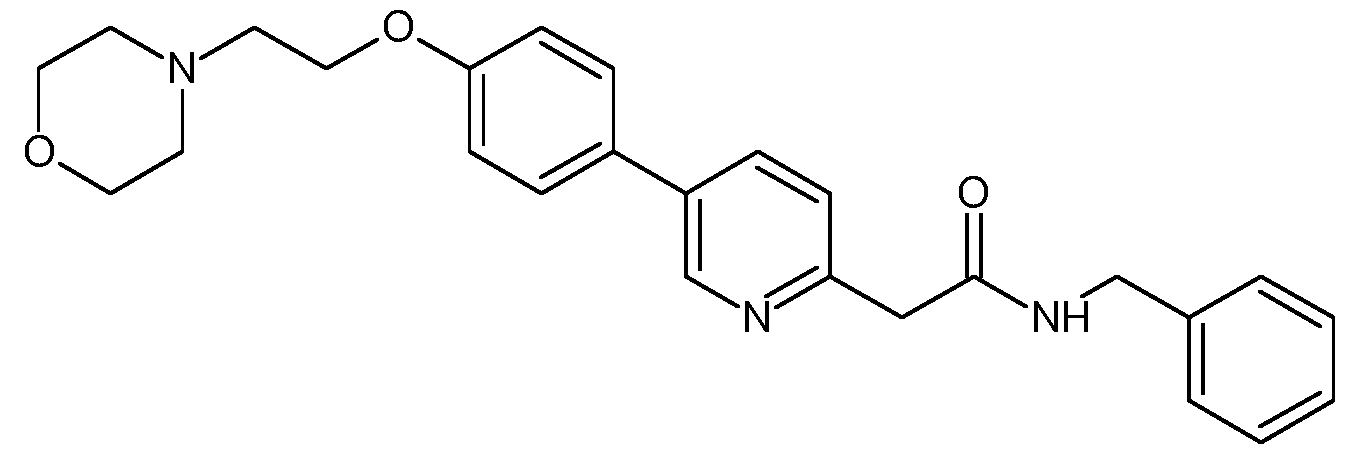
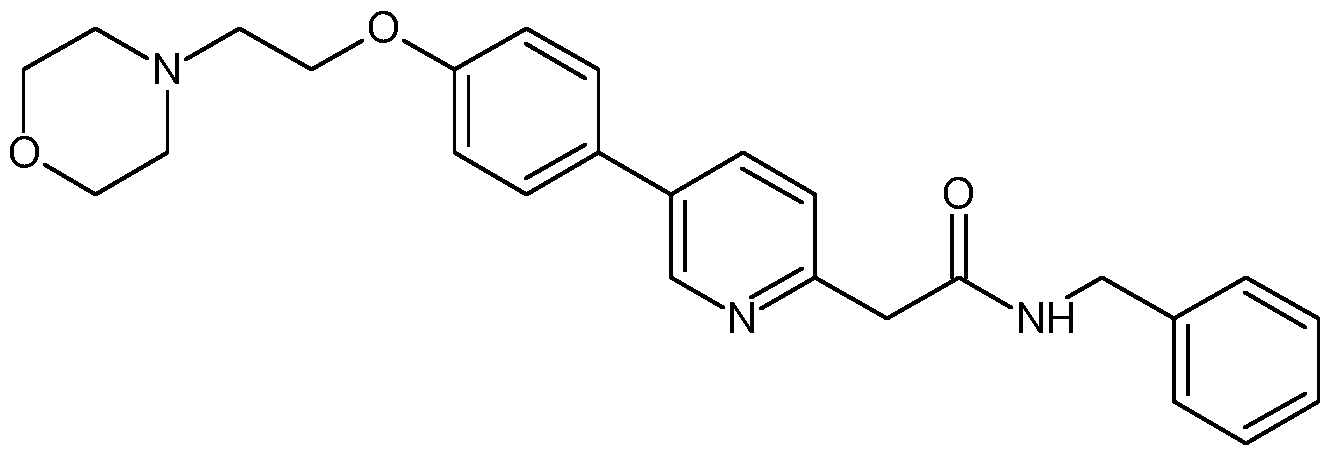
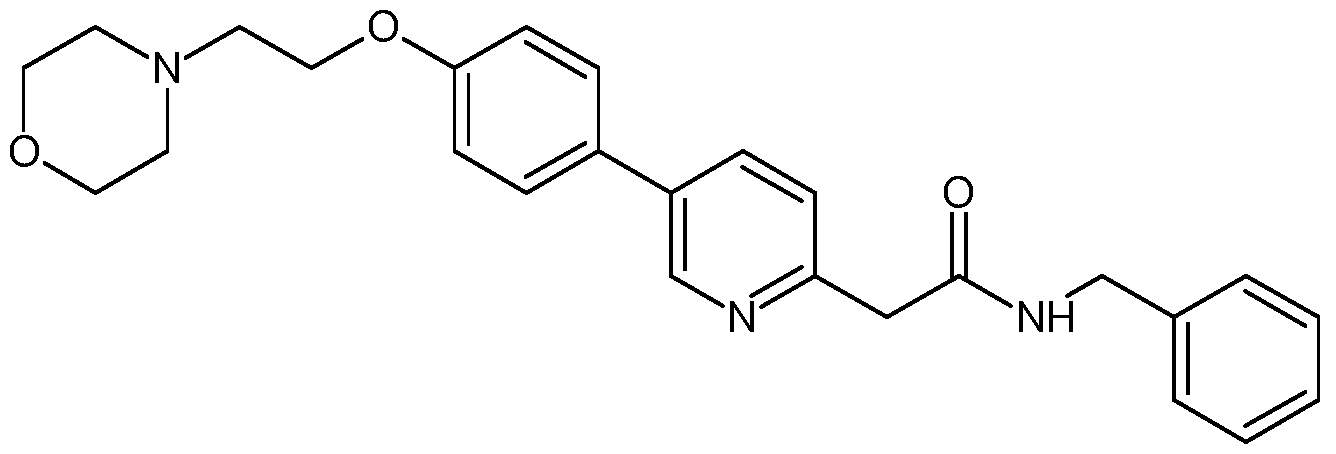
  • the first compound is KX01 (N-benzyl-2-(5- ⁇ 4-[2-(morpholine-4-yl)ethoxy]phenyl ⁇ pyridine-2-yl)acetamide.
  • the chemical structure of KX01 is represented by Formula 2:
  • Formula 2 KX01 has been shown to inhibit SRC -kinase, inhibits tubulin polymerization, and induces apoptosis by G2/M arrest.
  • Suitable vitamin D analogs include calcipotriol in preferred embodiments of the inventive subject matter.
  • Calcipotriol is a vitamin D3 analog that has been observed to induce apoptosis in a variety of cell types.
  • the inventors hypothesize that the combination of an antiproliferative compound with a vitamin D analog is beneficial, because they have different mechanisms of action that target two different phases of the cell cycle.
  • the inventors identified synergistic (e.g., more than additive) effects in regards to inhibition of skin cell proliferation/growth when such compounds are used together.
  • synergistic effects e.g., more than additive
  • combining KX01 and calcipotriol expands the clinical utility of KX01 ointment to the treatment of hyperproliferative skin disorders, while synergistic effects can provide for increased effectiveness and/or reduced dosages.
  • FIG. 1 and Tables 1 and 2 show the degree of growth inhibition found in a typical study performed with KX01 and calcipotriol at a 1:5 ratio.
  • Table 1 shows the results of cell viability studies comparing cell growth in response to KX01, calcipotriol, and KX01 + calcipotriol at a 1:5 ratio, as graphically depicted in FIG. 1A.
  • Table 2 shows typical GI50 and combination index (Cl) values for KX01 and calcipotriol (1:5) derived from such studies.
  • FIG. 2 shows typical results of similar studies in which KX01 and calcipotriol are used in a 1:2 ratio. Typical numerical data from such a study is shown in Table 3. Table 4 shows typical GI50 and combination index (Cl) values for KX01 and calcipotriol (1:2) derived from such studies.
  • FIG. 3 shows typical results of studies in which KX01 and calcipotriol are used in a 2:1 ratio. Typical numerical data from such a study is shown in Table 5. Table 6 shows typical GI50 and combination index (Cl) values for KX01 and calcipotriol (1:5) derived from such studies.
  • a PSI value of 1 corresponds to an additive effect.
  • a PSI value of less than 1 indicates a synergistic effect, and a PSI value of greater than 1 indicates an antagonistic effect.
  • Tables 7, 8, and 9 show the results for determination of individual IC50 and maximum inhibitory concentration values for KX01 and calcipotriol, as well as the PSI value for the drug combination.
  • Table 7 shows values derived from the study depicted in FIG. 6.
  • Tables 8 and 9 show values derived from subsequent replicate studies.
  • Such formulation can provide KX01 (or a similar compound) and calcipotriol (or a similar vitamin D derivative) in amounts that provide a ratio of these active compounds that in turn provides a synergistic effect in regards to inhibition of keratinocyte growth.
  • retinoid and/or retinoid analog can be combined with a synergistic (i.e. greater than additive) effect in the inhibition of cell proliferation/growth that is characteristic of hyperproliferative disorders.
  • suitable retinoids include retinol, retinal, retinoic acid isotretinoin, alitreninoin, etretinate, acitretin, adapalene, bexarotene, and/or tazarotene.
  • FIGs. 7 and 8 show the effects of tazarotene on growth of cells in culture, including CCD- 1106 KERTr keratinocytes (FIG.
  • Inventors investigated the effect of KX01 on apoptosis in keratinocytes.
  • CCD-l 106 KERTr cells (lxlO 6 ) were seeded in 60 mm dishes and treated with test compounds at varying concentrations (e.g. KX01: 20 to 500nM; calcipotriol 50 to lOOOnM) for 24 hours.
  • Cell apoptosis was assessed by using a FITC annexin V apoptosis detection kit (BD BiosciencesTM) according to manufacturer’s instruction.
  • the inventive subject matter also includes using blue light (e.g. 280 nm to 500 nm),
  • UV/A light, and/or UV/B light to illuminate skin during, prior to, or following treatment with KX01 (either alone or in combination with other compounds), particularly where synergistic effects permit reduction in blue light exposure and/or drug dosage relative to either light exposure or chemotherapy alone.
  • Any suitable source of blue light can be used. Suitable sources of blue light include incandescent bulbs, fluorescent lights, LED light sources, and laser light sources. Such a light source can be a broad spectrum light sources (i.e. providing a range of wavelengths exceeding 20 nm in width) or a narrow spectrum light source (i.e. providing a range of wavelengths spanning 20 nm or less). In some embodiments the light source can produce primarily (i.e. >90%) blue light.
  • the light source can produce both blue, and non-blue light, with non-blue light selectively blocked by an optical filter.
  • the light source for visible blue light is a panel or fluorescent light emitting a narrow bandwidth light centered at 460nm.
  • the light sources for UVB light is a fluorescent and/or LED/LCD panel light emitting a narrow bandwidth centered at 31 lnm.
  • UVB light is significantly more effective in reducing keratinocyte viability relative to visible blue light, although both are effective.
  • the overall effectiveness (in terms of absolute reduction in cell viability) of light sources providing primarily visible blue light can be improved by increasing its intensity.
  • the effects of combined treatment with KX01, a vitamin D derivative, and/or blue/UV light exposure were characterized using a cell proliferation assay.
  • Cell proliferation was assessed by using an MTT assay.
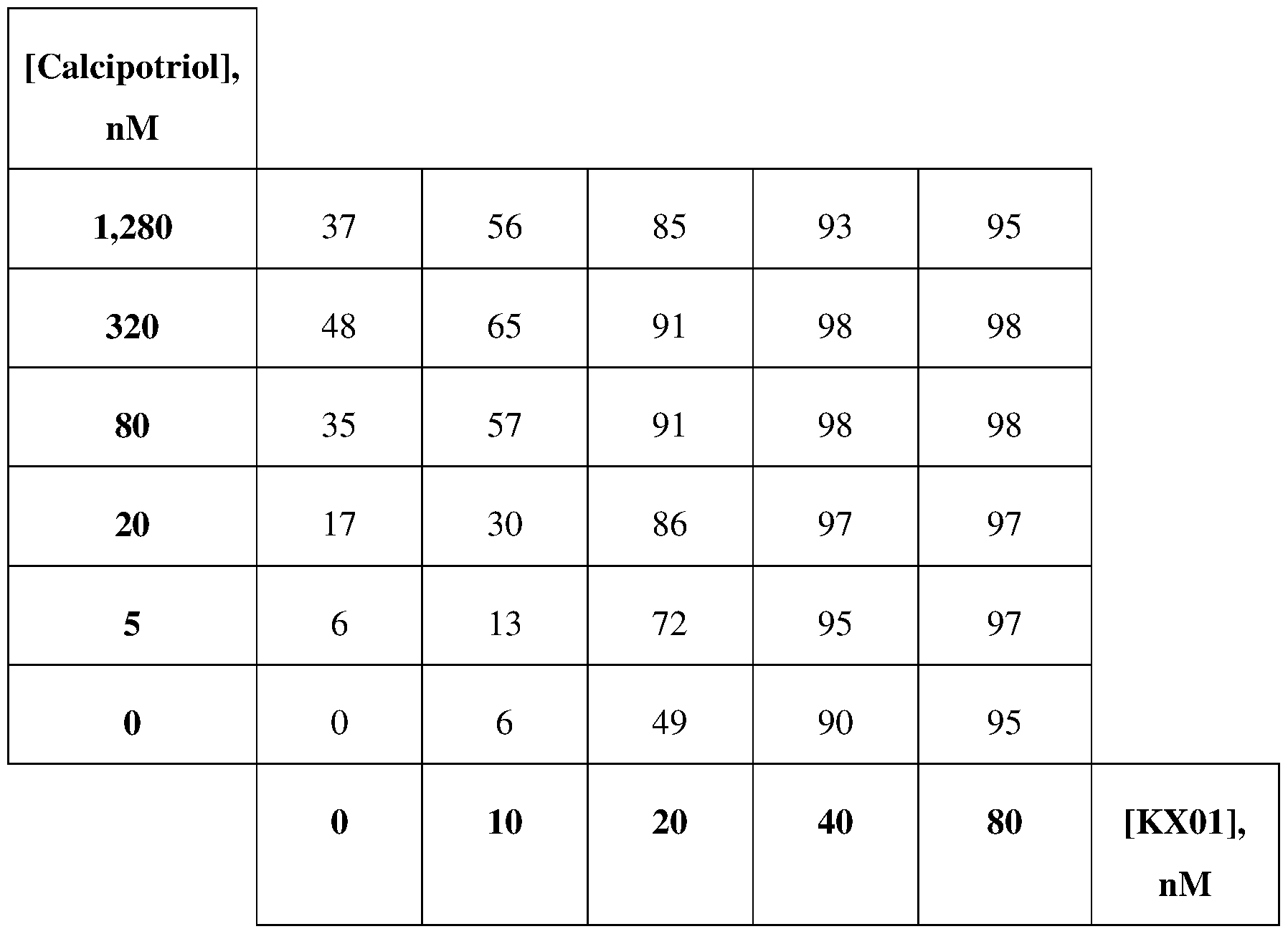
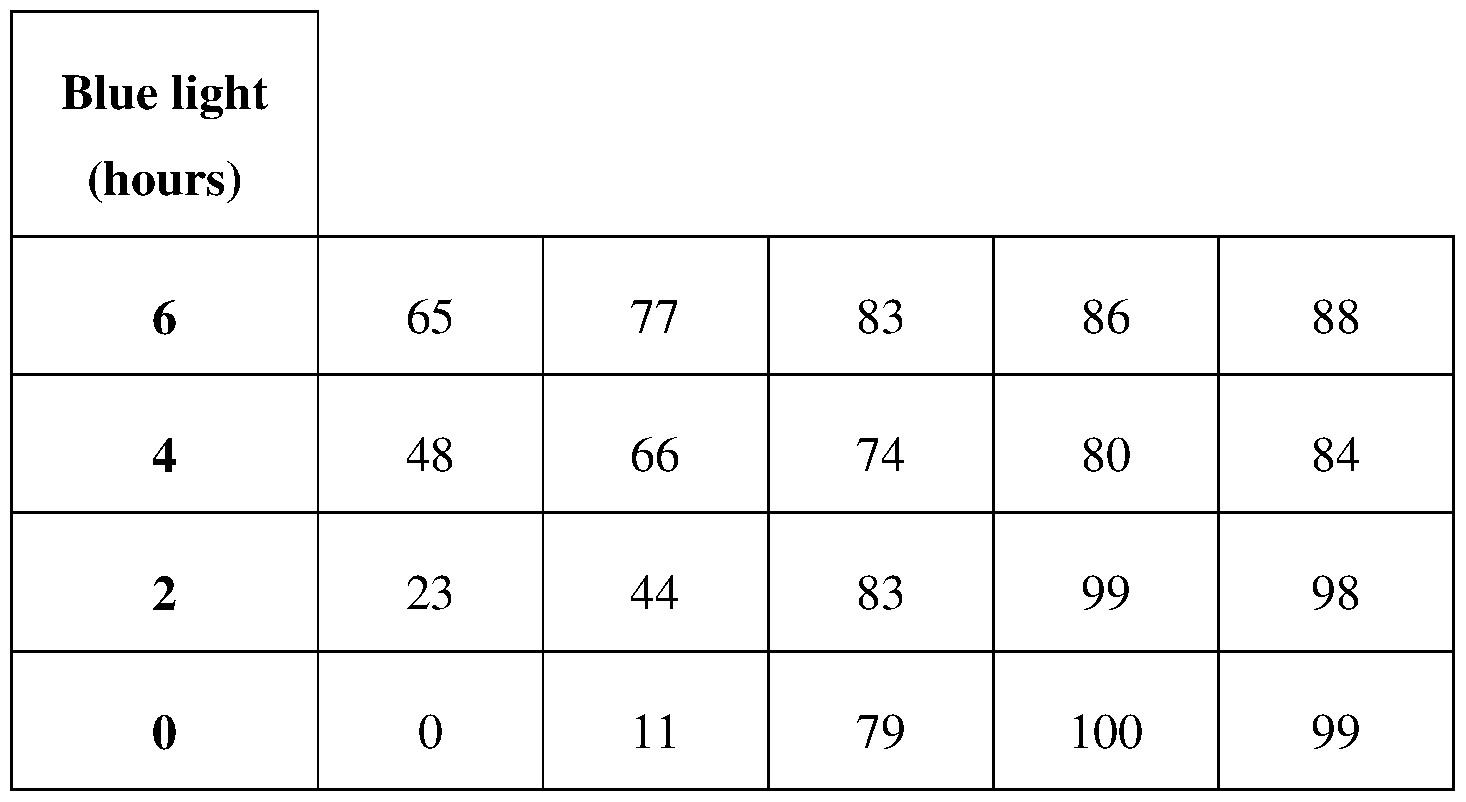
  • Cells were seeded in 96-well plate (3,000-5,000 cells per well) and treated with test compounds at varying concentrations (e.g. KX01: 5 to 80 nM; calcipotriol 5 to 1,280 nM) for 72 hours, either in the dark or exposed to blue light irradiation (for 2, 4, or 6 hours).
  • Tables 13 and 14 show the results of cell growth inhibition studies (expressed as a percentage relative to control cell growth) for treatment with either KX01 or calcipotriol in combination with exposure to blue light.
  • Table 13 shows the results of a cell proliferation assay performed using KX01 and blue light and the CCD 1106 KERTr human keratinocyte cell line. The percentage of growth inhibition relative to untreated control is shown.
  • Table 14 shows the results of a cell proliferation assay performed using calcipotriol and blue light and the CCD 1106 KERTr human keratinocyte cell line. The percentage of growth inhibition relative to untreated control is shown.
  • Table 19 shows the results of a cell proliferation assay performed using KX01 and blue light and a squamous cell human carcinoma cell line (SCC A431). The percentage of growth inhibition relative to untreated control is shown.
  • KX01 and calcipotriol in combination exhibit synergistic inhibition of cell growth in keratinocytes in vitro , for example within the range of 1 to 30 nM KX01 and 3 to 300 nM calcipotriol.
  • evidence suggests that at least part of this apparent growth inhibition is due to induction of apoptosis by KX01 and calcipotriol.
  • blue light shows additive effect on cell growth inhibition in keratinocytes in vitro that are exposed to KX01, calcipotriol, and/or a combination of KX01 and calcipotriol, indicating that controlled exposure to blue light can serve as a valuable adjunct to chemotherapies.
  • FIG. 11 shows results of keratinocyte cell proliferation on exposure to either KX01 or calcipotriol at various concentrations and exposure to blue light for from 0 to 6 hours.
  • FIG. 12 shows the results of calculations of PSI values for combined treatment with KX01, calcipotriol, and blue light exposure, where a value of less than 1 indicates a synergistic effect. Synergy between KX01 and calcipotriol is evident in the absence of blue light (0 hours), but additional synergy (as indicated by a further reduced psi value) is seen on exposure to blue light with this drug combination. This is particularly evident at 2 hours of blue light exposure. Table 37 provides a summary of the numeric data presented in FIG. 12.
  • inventive compositions and methods can treat dermatological hyperproliferative conditions, including malignant or benign hyperproliferative disorders. Malignant
  • hyperproliferative epidermal pathologies include: squamous-cell carcinoma (SCC), basal-cell carcinoma (BCC) and other non-melanoma skin cancers (NMSCs).
  • Benign hyperproliferative epidermal pathologies include psoriasis, other disturbances of keratinization, common warts, keratoacanthoma, seborrhoeic keratosis, seborrhea and ichthyosis.
  • Contemplated conditions that may be treated using compositions and method according to the inventive subject matter includes: solar keratosis, ichthyosis, Grover's disease, common warts, keratoacanthoma, seborrhoeic keratosis, scleroderma,, seborrhea, HIV-associated dermatoses, hyperproliferation associated with wound healing, chronic dermatoses of autoimmune type (e.g., scleroderma and pemphigus vulgaris), alopecia, skin atrophy, photoageing, keratodermos, acne vulgaris, acne rosacea, lichen planus, cutaneous lupus erythematosus, pre-malignant conditions (e.g., melanocytic naevus, myelodysplastic syndrome, among others), Danders disease, palmoplanter keratodermas, pityriasis rubra pilaris, epidermal na

Landscapes

  • Health & Medical Sciences (AREA)
  • Life Sciences & Earth Sciences (AREA)
  • Veterinary Medicine (AREA)
  • Public Health (AREA)
  • General Health & Medical Sciences (AREA)
  • Animal Behavior & Ethology (AREA)
  • Chemical & Material Sciences (AREA)
  • Medicinal Chemistry (AREA)
  • Pharmacology & Pharmacy (AREA)
  • Engineering & Computer Science (AREA)
  • Epidemiology (AREA)
  • Biomedical Technology (AREA)
  • Nuclear Medicine, Radiotherapy & Molecular Imaging (AREA)
  • Dermatology (AREA)
  • Biophysics (AREA)
  • Pathology (AREA)
  • Radiology & Medical Imaging (AREA)
  • Organic Chemistry (AREA)
  • General Chemical & Material Sciences (AREA)
  • Chemical Kinetics & Catalysis (AREA)
  • Bioinformatics & Cheminformatics (AREA)
  • Pharmaceuticals Containing Other Organic And Inorganic Compounds (AREA)
  • Acyclic And Carbocyclic Compounds In Medicinal Compositions (AREA)
  • Medicines That Contain Protein Lipid Enzymes And Other Medicines (AREA)

Abstract

Compositions and methods are provided that are effective in treating skin hyperproliferative disorders. These include a topical pharmaceutical preparation that includes a compound that has two or more of a SRC-kinase inhibiting activity, a tubulin polymerization inhibiting activity, an activity that arrests the cell cycle at G2/M, and an activity that induces apoptosis. The compound KX01 is provided as an example of such a compound. The topical pharmaceutical preparation further includes a vitamin D derivative or a retinoid, where the combination provides a synergistic effect. Use of the topical pharmaceutical preparation can be combined with exposure to blue, UVA, or UVB light, which provides a synergistic effect.

Description

COMPOSITIONS AND METHODS FOR TREATING HYPERPROLIFERATIVE SKIN
DISORDERS
[0001] This application claims the benefit of United States Provisional Application
No. 62/639,742 filed on March 7, 2018. These and all other referenced extrinsic materials are incorporated herein by reference in their entirety. Where a definition or use of a term in a reference that is incorporated by reference is inconsistent or contrary to the definition of that term provided herein, the definition of that term provided herein is deemed to be controlling.
Field of the Invention
[0002] The field of the invention is combination therapies for treating hyperproliferative skin disorders.
Background
[0003] The following description includes information that may be useful in understanding the present invention. It is not an admission that any of the information provided herein is prior art or relevant to the presently claimed invention, or that any publication specifically or implicitly referenced is prior art.
[0004] The background description includes information that may be useful in understanding the present invention. It is not an admission that any of the information provided herein is prior art or relevant to the presently claimed invention, or that any publication specifically or implicitly referenced is prior art.
[0005] Cell proliferation disorders of the skin such as psoriasis, actinic keratosis, and non melanoma skin cancers (e.g., basal cell carcinoma and squamous cell carcinoma) are common, but treatments often lack the desired effectiveness, have inconvenient dosing regimens, and/or have severe side effects.
[0006] Current pharmaceutical approaches to treating skin proliferation disorders (such as psoriasis) include the use of corticosteroids, vitamin D analogs, and retinoids. In some instances phototherapy is used to treat skin proliferation disorders, and can be used in combination with pharmaceutical interventions. Phototherapy typically involves exposure to UVB and/or UVA light, and can include treatment with photosensitizers (e.g. using psoralen in combination with exposure to UVA light).
[0007] More recently, biologies have been used to treat skin proliferative disorders. These are typically monoclonal antibodies or antibody fragments that target specific components of the immune system or cytokines involved in inflammation. Examples of such biologies include Humira™, Amevive™, ABT-874, Enbrel™, Remicade™, and Stelara™. Unfortunately such biologies are and expensive, and the use of such biologies is associated with increased incidence of cancer and certain types of infection.
[0008] Actinic keratoses are common pre-cancerous skin lesions that show excessive
proliferation of skin cells, and are the third most common reason for consulting a dermatologist. These can be treated by excision, freezing, and/or the application of pharmaceutical agents to the lesion. Drugs used to treat these lesions include 5-fluorouracil (5-FU), diclofenac, ingenol, and imiquimod, Unfortunately, side effects (which include discomfort, redness, and blistering) and/or inconvenient dosing regimens limit patient compliance, and therefore, the efficacy of these approaches.
[0009] Calcipotriol is an FDA-approved topical medication for treatment of skin
hyperproliferative disorders, and is hypothesized to act via induction of thymic stromal lymphopoietin ("TSLP") expression. The immune effects of TSLP expression have been shown to include antitumor immunity in barrier-defective skin (seeTrevor J. Cunningham et ah, Randomized trial of calcipotriol combined with 5-fluorouracil for skin cancer precursor immunotherapy, 127(1) J. Clinical Investigation 106-16 (2017)). Ah publications identified herein are incorporated by reference to the same extent as if each individual publication or patent application were specifically and individually indicated to be incorporated by reference. Where a definition or use of a term in an incorporated reference is inconsistent or contrary to the definition of that term provided herein, the definition of that term provided herein applies and the definition of that term in the reference does not apply.
[0010] Calcipotriol has been used in combination with other drugs. For example, treatment with calcipotriol ointment combined with 5-fluorouracil cream can decrease the number of actinic keratoses compared to treatment with 5-fluorouracil alone. The combined use of calcipotriol ointment and 5-fluorouracil cream on face, scalp, or upper extremities has been found to induce TSLP, HLA class II, and natural killer cell group 2D ligand expression in keratinocytes of these lesions. Calcipotriol and 5- fluorouracil are thought to activate a CD4+ T cell-mediated immunity against actinic keratosis. However, this treatment regiment maintains the limitations of 5- fluorouracil, including side effects that limit patient compliance.
[0011] Thus, there is still a need for treatments for cell hyperproliferation disorders that are both effective and well tolerated.
Summary of The Invention
[0012] The inventive subject matter provides apparatus, systems and methods in which a—
[0013] One embodiment of the inventive concept is a pharmaceutical composition that includes a first compound having an SRC -kinase inhibition activity, an inhibition of tubulin polymerization activity, a cell cycle arrest at G2/M activity, and/or a induction of apoptosis activity, and a second compound this is a vitamin D analog or a retinoid, where the first compound and the second compound are present in amounts sufficient to treat a hyperproliferative disorder in an affected area. Such composition can be formulated for topical application, for example as a foam, a cream, a paste, an ointment, a gel, a solution, a liquid suspension, a droplet suspension, an aerosol, and/or a powder. The vitamin D analog can also have a G0/G1 arrest activity, an anti-proliferation activity, an anti-inflammation activity, an induction of keratinocyte
differentiation activity, an activity that decreases the number of pro-inflammatory T-cells, an apoptosis inducing activity.
[0014] In such a compositions the first compound can have a structure according to Formula I.
Figure imgf000005_0001
Formula I or a salt, solvate, hydrate, or prodrug thereof, wherein: T is a bond;
Xy is CZ, CY, N, or N— O; Xz is CZ, CY, N, or N— O;
at least one of Xy and Xz is CZ;
Y is selected from hydrogen, hydroxyl, halogen, (Ci, C2, C3, C4, C5, or C6) alkyl, Ci, C2, C3, C4, C5, or C6 alkoxy, O- (Ci, C2, C3, C4, C5, or C6) alkylaryl, and O-benzyl;
Xa is CRa or N, or N— O;
Xb is CRb, N, or N— O;
Xc is CRc or N, or N— O;
Xd is CRd or N, or N— O;
Xe is CRe, N, or N— O
Ra, Rb, Rc, Rd, Re, R4, R5, and R6 are, independently, hydrogen, hydroxyl, halogen, Ci, C2, C3, C4, C5, or C6 alkoxy, O-lower (Ci, C2, C3, C4, C5, or C6) alkyl-aryl, O-benzyl, Ci, C2, C3, C4, C5, or C6 alkyl-OH, Ci, C2, C3, C4, C5, or C6alkyl-0- (Ci, C2, C3, C4, C5, or C6) alkyl, COOH, COO- (Ci, C2, C3, C4, C5, or C6) alkyl, S02H, S02 (Ci, C2, C3, C4, C5, or C6) alkyl,
Figure imgf000006_0001
where W is H, or , C2, C3, C4, C5, or C6 alkyl, Ci, C2, C3, C4, C5, or C6 alkyl-aryl;
V is a bond,— CH2— ,— CH2CH2— ,— CH2CH2CH2— ,— O— CH2— ,— OCH2CH2— or— OCH2CH2CH2— ;
R12, R13, R14, R15, Ri6, R17, and Ri8, are, independently, H or Ci, C2, C3, C4, C5, or C6 alkyl;
Z is: (CHRi)n— C(O)— NR2(CHR3)m— Ar, where Ar is a substituted or unsubstituted aryl or nitrogen-containing heteroaryl group, Ri, R2, and R3 are independently H or Ci, C2, C3, C4, C5, or C6 alkyl; n is 0, 1, or 2; and
m is 1 or 2, wherein at least one of Xa, Xb, Xc, Xd and Xe is N.
[0015] In a preferred embodiment the first compound can be KX01, which has the structure shown in Formula 2.
Figure imgf000007_0001
Formula 2
[0016] In such a composition the second compound can be a vitamin D3 analog, such as calcipotriol (calipotriene). The composition can be formulated to provide a molar ratio of the first compound to the second compound of from 160:3 to 5:243 at the affected area. In some embodiments the composition this molar ratio is selected to provide an effect at the affected area that exceeds the additive effect of the first compound and the second compound when applied individually at corresponding concentrations. In other embodiments the second compound is a retinoid, such as an acetylenic retinoid or tazarotene. In some embodiments the second compound is a vitamin D analog, and the composition also includes a retinoid.
[0017] Another embodiment of the inventive concept is a method of treating a skin condition (such as actinic keratosis or psoriasis) by providing a topical preparation (e.g. a foam, a cream, a paste, an ointment, a gel, a solution, a liquid suspension, a droplet suspension, an aerosol, and/or a powder) that includes a first compound and a second compound, where the first compound has at least two of an SRC-kinase inhibiting activity, a tubulin polymerization inhibiting activity, a cell cycle arrest at G2/M activity, and/or an activity that induces apoptosis, and where the second compound includes a vitamin D analog (such as a vitamin D3 analog or calcipotriol) or a retinoid (such as an acetylenic retinoid or tazarotene), where the first compound and the second compound are present in amounts sufficient to provide a reduction or elimination of a hyperproliferative disorder in an affected area. The molar ratio molar ratio of the first compound to the second compound can range from 160:3 to 5:243 or from 1:1 to 1:2,500 at the affected area. In some embodiments the first compound can be KX01 (as described above). In some embodiments the second compound is a vitamin D3 analog or calcipotriol (calcipotriene). In some embodiments the second compound is a vitamin D analog, and the topical composition also includes a retinoid. The method also includes a step of applying the topical preparation to an area affected by the skin condition on a schedule that is effective to treat the skin condition (e.g. from once a week to four times a day). Skin conditions that can be treated in this fashion include actinic keratosis and psoriasis. The vitamin D analog can have a G0/G1 arresting activity, an anti-proliferation activity, an anti-inflammatory activity, an activity that induces keratinocyte differentiation, an activity that decreases the number of pro -inflammatory T-cells, and/or an activity that induces apoptosis. The retinoid can have an activity that induces keratinocytes proliferation, modulates epidermal differentiation, stimulates extracellular matrix production, and/or alters sebocyte differentiation. In a preferred embodiment the first topical composition includes the first compound in a first amount and the second topical composition comprises the second compound in a second amount, where the first amount and the second amount are selected to provide a combined therapeutic effect. This combined therapeutic effect is greater than the sum of the therapeutic effects provided by application of the first compound at the first amount and by application of the second compound at the second amount.
[0018] Another embodiment of the inventive concept is a kit for treating a skin cell
hyperproliferation disorder, having a first topical composition that includes a first compound (such as KX01, as shown above) with two or more of a SRC -kinase inhibiting activity, a tubulin polymerization inhibiting activity, an activity that arrests the cell cycle at G2/M, and an activity that induces apoptosis, along with a second topical composition that includes a second compound such as a vitamin D analog (such as a vitamin D3 analog and/or calcipotriol) or a retinoid (such as an acetylenic retinoid and/or tazarotene). In some embodiments the kit includes both a vitamin D analog and a retinoid. The first compound and the second compound are present in their respective topical compositions in amounts sufficient to provide a reduction or elimination of the skin cell hyperproliferation disorder when the first and second topical compositions are applied individually according to schedule. The molar ratio molar ratio of the first compound to the second compound can range from 160:3 to 5:243 or from 1:1 to 1:2,500. Such topical compositions can be provided as a foam, a cream, a paste, an ointment, a gel, a solution, a liquid suspension, a droplet suspension, an aerosol, and/or a powder. In a preferred embodiment the first topical composition includes the first compound in a first amount and the second topical composition comprises the second compound in a second amount, where the first amount and the second amount are selected to provide a combined therapeutic effect. This combined therapeutic effect is greater than the sum of the therapeutic effects provided by application of the first compound at the first amount and by application of the second compound at the second amount.
[0019] Another embodiment of the inventive concept is a method of increasing two or more of a SRC -kinase inhibiting activity, a tubulin polymerization inhibition activity, an activity that arrests the cell cycle at G2/M, and an activity that induces apoptosis produced by a first compound in a pharmaceutical composition. This is accomplished by including a second compound (such as a vitamin D analog or a retinoid) in the pharmaceutical composition, where the molar ratio of the first compound and the second compound is selected to enhance the activities in more than an additive manner. The molar ratio molar ratio of the first compound to the second compound can range from 160:3 to 5:243 or from 1:1 to 1:2,500. The first compound can be KX01 (as shown above). The vitamin D analog can be a vitamin D3 analog and/or calcipotriol. The retinoid can be an acetylenic retinoid and/or tazarotene. In embodiments where the second compound is a vitamin D analog the composition can further include a retinoid.
[0020] Another embodiment of the inventive concept is the use of a first compound (such as Kx)l, as shown above) and a second compound in preparing an medicament for treating a skin condition (such as actinic keratosis and/or psoriasis), where the first compound has two or more of a SRC-kinase inhibiting activity, a tubulin polymerization activity, an activity that arrests the cell cycle at G2/M, and an activity that induces apoptosis, and where the second compound includes a vitamin D analog (e.g. a vitamin D3 analog and/or calcipotriol) or a retinoid (e.g. an acetylenic retinoid and/or tazarotene). The first compound and the second compound are present in the medicament in amounts sufficient to provide a reduction or elimination of a
hyperproliferative disorder by applying the medicament to an area affected by the skin condition on a schedule effective to treat the skin condition (e.g. at a frequency of once a week to four times a day). The molar ratio molar ratio of the first compound to the second compound can range from 160:3 to 5:243 or from 1:1 to 1:2,500. The vitamin D analog can be selected to have a G0/G1 arresting activity, an anti-proliferation activity, an anti-inflammation activity, an activity that induces keratinocyte differentiation, an activity that decreases the number of pro- inflammatory T-cells, and/or an activity that induces of apoptosis. In embodiments where the second compound is a vitamin D analog the medicament can further include a retinoid. Such a medicament can be formulated to be used for topical application, for example as a foam, a cream, a paste, an ointment, a gel, a solution, a liquid suspension, a droplet suspension, an aerosol, and/or a powder. In a preferred embodiment the medicament includes the first compound in a first amount and the second compound in a second amount, where the first amount and the second amount are selected to provide a combined therapeutic effect. This combined therapeutic effect is greater than the sum of the therapeutic effects provided by application of the first compound at the first amount and by application of the second compound at the second amount.
[0021] Another embodiment of the inventive concept is a method of treating a proliferative condition (e.g. actinic keratosis and/or psoriasis) by providing a topical preparation that includes a first compound, where the first compound (e.g. KX01, as shown above) has two or more of a SRC -kinase inhibiting activity, a tubulin polymerization inhibiting activity, an activity that arrests the cell cycle at G2/M, and an activity that induces apoptosis and applying the topical preparation to an area affected by the skin condition on a schedule effective to treat the skin condition, in combination with directing a blue light (e.g. having a wavelength from 280nm to 500 nm, which can be provided as either a narrow or broad band emission) onto the area affected by the skin condition at a specified light flux and for a specified exposure time. Suitable light sources include LED/LCD and fluorescent lights, and can emit visible blue light (e.g. 311 nm to 460 nm), UVA, and/or UVB). The topical preparation can be formulated as formulated as a foam, a cream, a paste, an ointment, a gel, a solution, a liquid suspension, a droplet suspension, an aerosol, and/or a powder. In some embodiments the topical preparation further includes a vitamin D analog (e.g. a vitamin D3 analog and/or calcipotriol) and/or a retinoid (e.g. an acetylenic retinoid and/or tazarotene). In such embodiments the retinoid can have an activity that induces keratinocytes to proliferate, an activity that modulates epidermal differentiation, an activity that stimulates extracellular matrix production, and/or an activity that alters of sebocyte differentiation. In some embodiments the topical preparation includes the first compound (and second compound, if present) in an amount(s) that provides a first therapeutic effect and the specified light flux and exposure time are provided that can produce a second therapeutic effect, however the method provides a third therapeutic effect that is greater than the sum of a first therapeutic effect and the second therapeutic effect. [0022] Various objects, features, aspects and advantages of the inventive subject matter will become more apparent from the following detailed description of preferred embodiments, along with the accompanying drawing figures in which like numerals represent like components.
Brief Description of The Drawings
[0023] FIG. 1: Results of an experiment comparing cell growth in response to KX01,
Calcipotriol, and KX01 + calcipotriol at a 1:5 ratio.
[0024] FIG. 2: Results of an experiment comparing cell growth in response to KX01,
Calcipotriol, and KX01 + calcipotriol at a 1:2 ratio.
[0025] FIG. 3: Results from two experiments comparing cell growth in response to KX01, Calcipotriol, and KX01 + calcipotriol at a 2:1 ratio.
[0026] FIG. 4: Inhibition of human keratinocyte growth versus KX01 concentration (treatment duration: 72 hours; cell growth measured using the MTT assay). The IC50 of KX01 = 41.9 nM.
[0027] FIG.5: Inhibition of human keratinocyte growth versus calcipotriol concentration (treatment duration: 72 hours; cell growth measured using the MTT assay). The IC50 of calcipotriol = 95.5 nM.
[0028] FIG. 6: Dose response surface of cell viability versus calcipotriol concentration versus KX01 concentration. Synergistic combinations of calcipotriol and KXOlare below the surface of additivity (indicating enhanced inhibition of growth), and antagonistic combinations are above the surface of additivity (indicative of reduced inhibition of growth).
[0029] FIG. 7: Inhibition of CCD 1106 KERTr keratinocyte growth by tazarotene, as determined by staining.
[0030] FIG. 8: Inhibition of A431 cell growth by tazarotenee, as determined by staining.
[0031] FIG. 9: Results of exposure of keratinocytes to a light source providing primarily visible blue light (top left) or to a light source providing primarily UVB light (top right). [0032] FIG. 10: Improved reduction in viability of keratinocytes at increased blue light intensity.
[0033] FIG. 11 : Effects of blue light exposure in combination with either KX01 or calcipotriol for from 0 hours (no blue light exposure) to 6 hours on keratinocyte proliferation.
[0034] FIG. 12: PSI values determined for combined effects of treatment with blue light, KX01, and/or calcipotriol on skin cell proliferation.
Detailed Description
[0035] The inventive subject matter provides compositions and methods in which a vitamin D analog synergistically enhances the antiproliferative effects of an antiproliferative compound for the treatment of cell hyperproliferation disorders, particularly dermatological disorders characterized by increased proliferation of skin cells (e.g. psoriasis, actinic keratosis, etc.).
[0036] Within the context of this application the term Imax refers to the maximal inhibitory concentration of a compound or therapy, the term IC50 refers to a value at which 50% of the maximum inhibitory effect realized is achieved, and the term H is related to the steepness of the slope of a calculated curve or surface derived from a mathematical model.
[0037] Various objects, features, aspects and advantages of the inventive subject matter will become more apparent from the following detailed description of preferred embodiments, along with the accompanying drawing figures.
[0038] The inventive subject matter includes pharmaceutical compositions that include a first compound that exhibits at least two of: SRC -kinase inhibition, inhibition of tubulin
polymerization, cell cycle arrest at G2/M, and induction of apoptosis. The pharmaceutical composition further includes a second compound that is a vitamin D analog and/or a retinoid (i.e. a retinoid or retinoid analog). The first and second compounds are present in the pharmaceutical composition in amounts sufficient to treat a cell hyperproliferation disorder, such actinic keratosis or psoriasis. In preferred embodiments the first and second compounds are present in amounts that provide a synergistic effect on inhibition of proliferation/growth of skin cells relative to their individual contributions. In some embodiments such drug combinations can be used in combination with controlled exposure to light, for example blue light (e.g. 280nm to 500 nm light), UV/A light, and/or UV/B light.
[0039] The recitation of ranges of values herein is merely intended to serve as a shorthand method of referring individually to each separate value falling within the range. Unless otherwise indicated herein, each individual value is incorporated into the specification as if it were individually recited herein. All methods described herein can be performed in any suitable order unless otherwise indicated herein or otherwise clearly contradicted by context. The use of any and all examples, or exemplary language (e.g. "such as") provided with respect to certain embodiments herein is intended merely to better illuminate the invention and does not pose a limitation on the scope of the invention otherwise claimed. No language in the specification should be construed as indicating any non-claimed element essential to the practice of the invention.
[0040] In some embodiments, the numbers expressing quantities of ingredients, properties such as concentration, reaction conditions, and so forth, used to describe and claim certain
embodiments of the invention are to be understood as being modified in some instances by the term "about." Accordingly, in some embodiments, the numerical parameters set forth in the written description and attached claims are approximations that can vary depending upon the desired properties sought to be obtained by a particular embodiment. In some embodiments, the numerical parameters should be construed in light of the number of reported significant digits and by applying ordinary rounding techniques. Notwithstanding that the numerical ranges and parameters setting forth the broad scope of some embodiments of the invention are
approximations, the numerical values set forth in the specific examples are reported as precisely as practicable. The numerical values presented in some embodiments of the invention may contain certain errors necessarily resulting from the standard deviation found in their respective testing measurements.
[0041] Unless the context dictates the contrary, all ranges set forth herein should be interpreted as being inclusive of their endpoints and open-ended ranges should be interpreted to include only commercially practical values. Similarly, all lists of values should be considered as inclusive of intermediate values unless the context indicates the contrary. [0042] As used in the description herein and throughout the claims that follow, the meaning of "a," "an," and "the" includes plural reference unless the context clearly dictates otherwise. Also, as used in the description herein, the meaning of "in" includes "in" and "on" unless the context clearly dictates otherwise.
[0043] Groupings of alternative elements or embodiments of the invention disclosed herein are not to be construed as limitations. Each group member can be referred to and claimed individually or in any combination with other members of the group or other elements found herein. One or more members of a group can be included in, or deleted from, a group for reasons of convenience and/or patentability. When any such inclusion or deletion occurs, the
specification is herein deemed to contain the group as modified thus fulfilling the written description of all Markush groups used in the appended claims.
[0044] The first compound can be an antiproliferative compound as described in U.S. 8,003,641 to David G. Hangauer, Jr., filed Apr. 26, 2007, which is incorporated herein by reference.
Exemplary compounds have the structure(s) shown below. Specifically, suitable compounds include those having Formula I:
Figure imgf000014_0001
Formula I or a salt, solvate, hydrate, or prodrug thereof, wherein: T is a bond;
Xy is CZ, CY, N, or N— O;
Xz is CZ, CY, N, or N— O;
at least one of Xy and Xz is CZ;
Y is selected from hydrogen, hydroxyl, halogen, (Ci, C2, C3, C4, C5, or C6) alkyl, Ci, C2, C3, C4, C5, or C6 alkoxy, O- (Ci, C2, C3, C4, C5, or C6) alkylaryl, and O-benzyl;
Xa is CRa or N, or N— O;
Xb is CRb, N, or N— O;
Xc is CRc or N, or N— O; Xd is CRd or N, or N— O;
Xe is CRe, N, or N— O
Ra, Rb, Rc, Rd, Re, R4, R5, and R6 are, independently, hydrogen, hydroxyl, halogen, Ci, C2, C3, C4, C5, or C6 alkoxy, O-lower (Ci, C2, C3, C4, C5, or C6) alkyl-aryl, O-benzyl, Ci, C2, C3, C4, C5, or C6 alkyl-OH, , C2, C3, C4, C5, or C6alkyl-0- (Ci, C2, C3, C4, C5, or C6) alkyl, COOH, COO- (Ci, C2, C3, C4, C5, or C6) alkyl, S02H, S02 (Ci, C2, C3, C4, C5, or C6) alkyl,
Figure imgf000015_0001
where W is H, or Ci, C2, C3, C4, C5, or C6 alkyl, Ci, C2, C3, C4, C5, or C6 alkyl-aryl;
V is a bond,— CH2— ,— CH2CH2— ,— CH2CH2CH2— ,— O— CH2— ,— OCH2CH2— or— OCH2CH2CH2— ;
R12, Ri3, Ri4, Ri5, Ri6, Ri7, and Ri8, are, independently, H or C C2, C3, C4, C5, or C6 alkyl;
Z is: (CHRi)n— C(O)— NR2(CHR3)m— Ar, where Ar is a substituted or unsubstituted aryl or nitrogen-containing heteroaryl group, Ri, R2, and R3 are independently H or Ci, C2, C3, C4, C5, or C6 alkyl;
n is 0, 1, or 2; and
m is 1 or 2,
wherein at least one of Xa, Xb, Xc, Xd and Xe is N.
[0045] In a preferred embodiment of the inventive subject matter, the first compound is KX01 (N-benzyl-2-(5-{4-[2-(morpholine-4-yl)ethoxy]phenyl}pyridine-2-yl)acetamide. The chemical structure of KX01 is represented by Formula 2:
Figure imgf000015_0002
Formula 2 KX01 has been shown to inhibit SRC -kinase, inhibits tubulin polymerization, and induces apoptosis by G2/M arrest.
[0046] Suitable vitamin D analogs include calcipotriol in preferred embodiments of the inventive subject matter. Calcipotriol is a vitamin D3 analog that has been observed to induce apoptosis in a variety of cell types. Without wishing to be bound by a particular theory, the inventors hypothesize that the combination of an antiproliferative compound with a vitamin D analog is beneficial, because they have different mechanisms of action that target two different phases of the cell cycle.
[0047] Surprisingly, the inventors identified synergistic (e.g., more than additive) effects in regards to inhibition of skin cell proliferation/growth when such compounds are used together. Advantageously, combining KX01 and calcipotriol expands the clinical utility of KX01 ointment to the treatment of hyperproliferative skin disorders, while synergistic effects can provide for increased effectiveness and/or reduced dosages.
[0048] Typical data from studies of the effects of compound KX01 provided in combination with calcipotriol on growth of human keratinocytes in culture (cell line CCD- 1106 KERTr) are shown in FIGs. 1 to 3 and Tables 1 to 6. FIG. 1 and Tables 1 and 2 show the degree of growth inhibition found in a typical study performed with KX01 and calcipotriol at a 1:5 ratio.
Figure imgf000016_0001
Figure imgf000017_0001
Table 1
Table 1 shows the results of cell viability studies comparing cell growth in response to KX01, calcipotriol, and KX01 + calcipotriol at a 1:5 ratio, as graphically depicted in FIG. 1A. Table 2 shows typical GI50 and combination index (Cl) values for KX01 and calcipotriol (1:5) derived from such studies.
Figure imgf000017_0002
Table 2
[0049] FIG. 2 shows typical results of similar studies in which KX01 and calcipotriol are used in a 1:2 ratio. Typical numerical data from such a study is shown in Table 3. Table 4 shows typical GI50 and combination index (Cl) values for KX01 and calcipotriol (1:2) derived from such studies.
Figure imgf000018_0001
Table 3
Figure imgf000018_0002
Table 4
[0050] FIG. 3 shows typical results of studies in which KX01 and calcipotriol are used in a 2:1 ratio. Typical numerical data from such a study is shown in Table 5. Table 6 shows typical GI50 and combination index (Cl) values for KX01 and calcipotriol (1:5) derived from such studies.
Figure imgf000019_0001
Table 5
Figure imgf000019_0002
Table 6
[0051] In order to determine the range of concentrations over which compounds such as KX01 and calciptriol can inhibit keratinocyte growth and subsequent combinatorial effects, individual dose response curves were determined using a 72 hour exposure to either KX01 or calcipotriol in order to determine individual IC50 values. Results are shown in FIG. 4 (which shows typical results for KX01) and FIG. 5 (which shows typical results for calcipotriol). A human keratinocyte cell line was used in these studies. The IC50 for KX01 was determined to be 41.9 nM; the IC50 for calcipotriol was determined to be 95.5 nM.
[0052] Individual dose response curves for KX01 and calcipotriol as determined above can be used to generate dose response surfaces representative of the additive effects of these compounds on keratinocyte growth. Such dose response surfaces can be utilized in detailed combinatorial studies in order to determine if the effects such compounds in combination is antagonistic, merely additive, or showed positive synergistic effects. Synergistic effects can be expressed as "PSI" or Y, which has been used as a measure of synergy (see Ariens EJ, Van Rossum JM and Simonis AM, Affinity, intrinsic activity and drug interactions, Pharmacol Rev. 1957 Jun. 9(2): 218-36; Chakraborty A and Jusko WJ, Pharmacodynamic interaction of recombinant human interleukin- 10 and prednisolone using in vitro whole blood lymphocyte proliferation, J. Pharm. Sci. 2002, 91: 1334). A PSI value of 1 corresponds to an additive effect. A PSI value of less than 1 indicates a synergistic effect, and a PSI value of greater than 1 indicates an antagonistic effect.
[0053] Cell viability was measured in a number of experiments. In Experiment 1, the concentrations of calcipotriol were: 0, 3, 9, 27, 81, and 243 nM, and the concentrations of KX01 were: 0, 5, 10, 20, 40, 60, 80, and 160 nM. In Experiment 2, the concentrations of calcipotriol were: 0, 5, 10, 20, 40, 80, 160, 320, and 1280 nM, and the concentrations of KX01 were: 1, 3, 9, 27, and 81 nM. The results are shown in FIG. 6, which shows the calculated additive response surface derived from individual dose response curves for each compound and individual data points representing the results of individual combinations. Synergistic effects are indicated when the observed response lies below the additive response surface; antagonistic effects are indicated when the observed response lies above the additive response surface. It is notable that unexpected synergy is observed across a range of concentrations and combinations.
[0054] Tables 7, 8, and 9 show the results for determination of individual IC50 and maximum inhibitory concentration values for KX01 and calcipotriol, as well as the PSI value for the drug combination. Table 7 shows values derived from the study depicted in FIG. 6. Tables 8 and 9 show values derived from subsequent replicate studies.
Figure imgf000021_0001
Table 7
Figure imgf000021_0002
Table 8
Figure imgf000021_0003
Table 9 [0055] As shown above, a significant synergistic effect in inhibition of keratinocyte growth is consistently found when KX01 and calcipotriol are used in combination. In some embodiments such synergy is observed when the concentration of KX01 is about 1 to about 30 nM and the concentration of calcipotriol is about 3 to about 300 nM, and is present when KX01 (or a related compound) and calcipotriol (or a similar vitamin D derivative) are provided in a suitable formulation in amounts sufficient to generate such concentrations in the tissue to be treated.
Such formulation can provide KX01 (or a similar compound) and calcipotriol (or a similar vitamin D derivative) in amounts that provide a ratio of these active compounds that in turn provides a synergistic effect in regards to inhibition of keratinocyte growth.
[0056] Inventors have also found that treatment with KX01 can be combined with a retinoid and/or retinoid analog to provide a synergistic (i.e. greater than additive) effect in the inhibition of cell proliferation/growth that is characteristic of hyperproliferative disorders. Examples of suitable retinoids include retinol, retinal, retinoic acid isotretinoin, alitreninoin, etretinate, acitretin, adapalene, bexarotene, and/or tazarotene. FIGs. 7 and 8 show the effects of tazarotene on growth of cells in culture, including CCD- 1106 KERTr keratinocytes (FIG. 7) and A431 cells (epidermoid cells obtained from a human squamous cell carcinoma, FIG. 8). Numerical data from these studies is provided in Table 10, which shows data derived from CCD- 1106 KERTr keratinocytes and from A431 cells.
Figure imgf000022_0001
Table 10
[0057] Studies on the effects of combined treatment with KX01 and tazarotene were performed, and showed a clear and unexpected synergistic effect. Typical results are shown in Table 11.
Figure imgf000023_0001
Table 11
[0058] In addition to growth inhibition, Inventors also investigated the effect of KX01 on apoptosis in keratinocytes. CCD-l 106 KERTr cells (lxlO6) were seeded in 60 mm dishes and treated with test compounds at varying concentrations (e.g. KX01: 20 to 500nM; calcipotriol 50 to lOOOnM) for 24 hours. Cell apoptosis was assessed by using a FITC annexin V apoptosis detection kit (BD Biosciences™) according to manufacturer’s instruction. Briefly, cells were collected in lx binding buffer and incubated with fluorescein isothiocyanate (FITC)-conjugated annexin V and propidium iodide (PI) for 15 minutes at room temperature in the dark, followed by flow cytometry analysis using a FSRFortessa™ flow cytometer (BD Biosciences™). Results are summarized in Table 12, which shows the percentage of late apoptic cells identified for various KX01 and calcipitriol combinations.
Figure imgf000023_0002
Figure imgf000024_0001
Table 12
[0059] Synergy between KX01 and calcipotriol in regards to increasing the number of keratinocytes undergoing apoptosis is evident. For example the effect of 200 nm calcipotriol is not distinguishable from that of control cells receiving no drug treatment, however the same concentration of calcipotriol enhances the effect of KX01 by approximately 40%.
[0060] The inventive subject matter also includes using blue light (e.g. 280 nm to 500 nm),
UV/A light, and/or UV/B light to illuminate skin during, prior to, or following treatment with KX01 (either alone or in combination with other compounds), particularly where synergistic effects permit reduction in blue light exposure and/or drug dosage relative to either light exposure or chemotherapy alone. Any suitable source of blue light can be used. Suitable sources of blue light include incandescent bulbs, fluorescent lights, LED light sources, and laser light sources. Such a light source can be a broad spectrum light sources (i.e. providing a range of wavelengths exceeding 20 nm in width) or a narrow spectrum light source (i.e. providing a range of wavelengths spanning 20 nm or less). In some embodiments the light source can produce primarily (i.e. >90%) blue light. In other embodiments the light source can produce both blue, and non-blue light, with non-blue light selectively blocked by an optical filter. In a preferred embodiment the light source for visible blue light is a panel or fluorescent light emitting a narrow bandwidth light centered at 460nm. In another preferred embodiment the light sources for UVB light is a fluorescent and/or LED/LCD panel light emitting a narrow bandwidth centered at 31 lnm. [0061] It should be appreciated that exposure to blue light alone can reduce cell viability, and that different sources of blue light can provide different effects. An example of this is provided in FIG. 9, which shows the results of exposure of CCD 1106 KERTr human keratinocytes cells to different blue light sources (i.e. blue visible light or UVB) for 72 hours. It is apparent that UVB light is significantly more effective in reducing keratinocyte viability relative to visible blue light, although both are effective. As shown in FIG. 10, the overall effectiveness (in terms of absolute reduction in cell viability) of light sources providing primarily visible blue light can be improved by increasing its intensity.
[0062] The effects of combined treatment with KX01, a vitamin D derivative, and/or blue/UV light exposure were characterized using a cell proliferation assay. Cell proliferation was assessed by using an MTT assay. Cells were seeded in 96-well plate (3,000-5,000 cells per well) and treated with test compounds at varying concentrations (e.g. KX01: 5 to 80 nM; calcipotriol 5 to 1,280 nM) for 72 hours, either in the dark or exposed to blue light irradiation (for 2, 4, or 6 hours). To each well, 10 pl of 3-(4,5-dimethylthiazol-2-yl)-2,5-diphenyltetrazolium bromide (MTT) (RPI Corporation™) solution (5 mg/ml in PBS) was added and incubated at 37 °C for 3 hours. Next, 100 mΐ of 20% SDS was added to each well. After overnight incubation at 37 °C, the absorbance in each well was measured at 570 nm in a microplate reader (Molecular Devices™). The cell growth curve and GRos were calculate using GraphPad Prism™ 5 software.
[0063] Tables 13 and 14 show the results of cell growth inhibition studies (expressed as a percentage relative to control cell growth) for treatment with either KX01 or calcipotriol in combination with exposure to blue light.
Figure imgf000025_0001
Figure imgf000026_0001
Table 13
Table 13 shows the results of a cell proliferation assay performed using KX01 and blue light and the CCD 1106 KERTr human keratinocyte cell line. The percentage of growth inhibition relative to untreated control is shown.
Figure imgf000026_0002
Table 14
Table 14 shows the results of a cell proliferation assay performed using calcipotriol and blue light and the CCD 1106 KERTr human keratinocyte cell line. The percentage of growth inhibition relative to untreated control is shown. [0064] Tables 15 to 18 show the effects of combined treatment with KX01, calcipotriol, and exposure to blue light at 0 hours, 2 hours, 4 hours, and 6 hours of light exposure (respectively). Values are expressed as the percentage of growth inhibition relative to cells grown under control conditions (0 hours blue light, [KX01] = 0, [calcipotriol] = 0). It should be appreciated that synergy (i.e. greater than additive) effects between blue light exposure and combined KX01 and calcipotriol treatement are observed, for example at 2 hours of blue light exposure and combined treatment with 10 nM KX01 and 20 nM calcipotriol.
Figure imgf000027_0001
Table 15
Figure imgf000027_0002
Figure imgf000028_0001
Table 16
Figure imgf000028_0002
Table 17
Figure imgf000029_0001
Table 18
[0065] Similar studies were performed using a squamous cell carcinoma cell line (SCC A431). Tables 19 and 20 show the results of cell growth inhibition studies (expressed as a percentage relative to control cell growth) for treatment with either KX01 or calcipotriol in combination with exposure to blue light.
Figure imgf000029_0002
Figure imgf000030_0001
Table 19
Table 19 shows the results of a cell proliferation assay performed using KX01 and blue light and a squamous cell human carcinoma cell line (SCC A431). The percentage of growth inhibition relative to untreated control is shown.
Figure imgf000030_0002
Table 20
[0066] Tables 21 to 24 show the effects of combined treatment with KX01, calcipotriol, and exposure to blue light at 0 hours, 2 hours, 4 hours, and 6 hours of light exposure (respectively) on human squamous cell carcinoma cells. Values are expressed as the percentage of growth inhibition relative to cells grown under control conditions (0 hours blue light, [KX01] = 0, [calcipotriol] = 0). The percentage of growth inhibition relative to an untreated control is shown. It should be appreciated that synergy (i.e. greater than additive) effects between blue light exposure and combined KX01 and calcipotriol treatement are observed, for example at 2 to 6 hours of blue light exposure and combined treatment with 10 nM KX01 and 5 nM calcipotriol, and at 2 hours of exposure to blue light and combined treatment with 10 nM KX01 and from 5 to 1,280 nM calcipotriol.
Figure imgf000031_0001
Table 21
Figure imgf000031_0002
Figure imgf000032_0001
Table 22
Figure imgf000032_0002
Table 23
Figure imgf000033_0001
Table 24
[0067] As shown, KX01 and calcipotriol in combination exhibit synergistic inhibition of cell growth in keratinocytes in vitro , for example within the range of 1 to 30 nM KX01 and 3 to 300 nM calcipotriol. Without wishing to be bound by theory, evidence suggests that at least part of this apparent growth inhibition is due to induction of apoptosis by KX01 and calcipotriol. In addition, blue light shows additive effect on cell growth inhibition in keratinocytes in vitro that are exposed to KX01, calcipotriol, and/or a combination of KX01 and calcipotriol, indicating that controlled exposure to blue light can serve as a valuable adjunct to chemotherapies.
[0068] Additional studies were performed to evaluate potential synergistic effects of cell growth inhibition of human keratinocytes on exposure to blue light and to KX01 or calcipotriol. Results are shown below in Table 25 and Table 26.
Figure imgf000033_0002
Figure imgf000034_0001
Table 25
Figure imgf000034_0002
Table 26
Synergistic effects between blue light exposure and KXOlor calcipotriol on cell growth inhibition in human keratinocytes were observed. For example, synergy is evident at 6 hours of blue light exposure in combination with 10 nm KX01.
[0069] Studies were also performed to evaluate potential synergistic effects of cell growth inhibition of human keratinocytes on exposure to blue light and to KX01 in combination with calcipotriol. Results are shown below in Tables 27 to Table 30, which show results from 0, 2, 4, and 6 hours of blue light exposure (respectively). Values are expressed as the percentage of growth inhibition relative to cells grown under control conditions (0 hours blue light, [KX01] = 0, [calcipotriol] = 0). It should be appreciated that synergy (i.e. greater than additive) effects between blue light exposure and combined KX01 and calcipotriol treatement are observed, and that the synergistic effect observed at 2 hours of blue light exposure and combined treatment with 10 nM KX01 and 20 nM calcipotriol is confirmed.
Figure imgf000035_0001
Table 27
Figure imgf000035_0002
Figure imgf000036_0001
Table 28
Figure imgf000036_0002
Table 29
Figure imgf000036_0003
Figure imgf000037_0001
Table 30
[0070] Similar studies were performed to determine the synergistic effects on cell growth inhibition of squamous cell carcinoma cells (SCC A431) on exposure to blue light and KX01 or calcipotriol. Results are shown below in Tables 31 and 32, which show results for KX01 and calipotriol (respectively). Values are expressed as the percentage of growth inhibition relative to cells grown under control conditions (0 hours blue light, [KX01] = 0, [calcipotriol] = 0).
Figure imgf000037_0002
Figure imgf000038_0001
Table 31
Figure imgf000038_0002
Table 32
Synergistic effects between blue light exposure and KXOlon cell growth inhibition in squamous cell carcinoma cells are evident, for example at 10 nM KX01.
[0071] Studies were also performed to evaluate potential synergistic effects of cell growth inhibition of human squamous cell carcinoma cells on exposure to blue light and to KX01 in combination with calcipotriol. Results are shown below in Tables 33 to Table 36, which show results from 0, 2, 4, and 6 hours of blue light exposure (respectively). Values are expressed as the percentage of growth inhibition relative to cells grown under control conditions (0 hours blue light, [KX01] = 0, [calcipotriol] = 0). It should be appreciated that synergy (i.e. greater than additive) effects between blue light exposure and combined KX01 and calcipotriol treatement are observed, for example at 2 to 6 hours of blue light exposure and combined treatment with 10 nM KX01 and 5 nM calcipotriol, and at 2 hours of exposure to blue light and combined treatment with 10 nM KX01 and from 5 to 1,280 nM calcipotriol are confirmed.
Figure imgf000039_0001
Table 33
Figure imgf000039_0002
Figure imgf000040_0001
Table 34
Figure imgf000040_0002
Table 35
Figure imgf000040_0003
Figure imgf000041_0001
Table 36
[0072] Additional studies were performed to determine PSI values for the inhibition of skin cell proliferation by blue light exposure in combination with KX01 and/or calcipotriol exposure. FIG. 11 shows results of keratinocyte cell proliferation on exposure to either KX01 or calcipotriol at various concentrations and exposure to blue light for from 0 to 6 hours. FIG. 12 shows the results of calculations of PSI values for combined treatment with KX01, calcipotriol, and blue light exposure, where a value of less than 1 indicates a synergistic effect. Synergy between KX01 and calcipotriol is evident in the absence of blue light (0 hours), but additional synergy (as indicated by a further reduced psi value) is seen on exposure to blue light with this drug combination. This is particularly evident at 2 hours of blue light exposure. Table 37 provides a summary of the numeric data presented in FIG. 12.
Figure imgf000041_0002
Table 37 [0073] Inventors believe that additional synergistic effects between exposure to blue light and KX01 and/or calcipotriol can be realized through optimization of the wavelength of blue light utilized, spectral range of the blue light utilized, and/or light intensity.
[0074] The inventive compositions and methods can treat dermatological hyperproliferative conditions, including malignant or benign hyperproliferative disorders. Malignant
hyperproliferative epidermal pathologies include: squamous-cell carcinoma (SCC), basal-cell carcinoma (BCC) and other non-melanoma skin cancers (NMSCs). Benign hyperproliferative epidermal pathologies include psoriasis, other disturbances of keratinization, common warts, keratoacanthoma, seborrhoeic keratosis, seborrhea and ichthyosis. Contemplated conditions that may be treated using compositions and method according to the inventive subject matter includes: solar keratosis, ichthyosis, Grover's disease, common warts, keratoacanthoma, seborrhoeic keratosis, scleroderma,, seborrhea, HIV-associated dermatoses, hyperproliferation associated with wound healing, chronic dermatoses of autoimmune type (e.g., scleroderma and pemphigus vulgaris), alopecia, skin atrophy, photoageing, keratodermos, acne vulgaris, acne rosacea, lichen planus, cutaneous lupus erythematosus, pre-malignant conditions (e.g., melanocytic naevus, myelodysplastic syndrome, among others), Danders disease, palmoplanter keratodermas, pityriasis rubra pilaris, epidermal naevoid syndromes, erythrokeratoderma variabilis, epidermolytic hyperkeratoses, non-bullous ichthyosiform erythroderma, cutaneous lupus erythematosus, and lichen planus.
[0075] It should be apparent to those skilled in the art that many more modifications besides those already described are possible without departing from the inventive concepts herein. The inventive subject matter, therefore, is not to be restricted except in the spirit of the appended claims. Moreover, in interpreting both the specification and the claims, all terms should be interpreted in the broadest possible manner consistent with the context. In particular, the terms “comprises” and“comprising” should be interpreted as referring to elements, components, or steps in a non-exclusive manner, indicating that the referenced elements, components, or steps may be present, or utilized, or combined with other elements, components, or steps that are not expressly referenced. Where the specification claims refers to at least one of something selected from the group consisting of A, B, C .... and N, the text should be interpreted as requiring only one element from the group, not A plus N, or B plus N, etc.

Claims

What is claimed is:
1. A pharmaceutical composition comprising:
a first compound having an activity comprising two or more of the group consisting of SRC -kinase inhibition, inhibition of tubulin polymerization, cell cycle arrest at G2/M, and induction of apoptosis; and
a second compound comprising a vitamin D analog or a retinoid,
wherein the first compound and the second compound are present in amounts sufficient to treat a hyperproliferative disorder in an affected area.
2. The composition of claim 1, wherein the composition is formulated for topical application.
3. The composition of claim 1 or 2, wherein the composition is formulated as one of the group consisting of a foam, a cream, a paste, an ointment, a gel, a solution, a liquid suspension, a droplet suspension, an aerosol, and a powder.
4. The composition of one of claims 1 to 3, wherein the vitamin D analog has at least one activity selected from the group consisting of G0/G1 arrest, anti-proliferation, anti-inflammation, induction of keratinocyte differentiation, decreasing the number of pro -inflammatory T-cells, and induction of apoptosis.
5. The composition of one of claims 1 to 4, wherein the first compound comprises a compound according to formula I.
6. The composition of one of claims 1 to 5, wherein the first compound is KX01 and has the formula:
Figure imgf000043_0001
7. The composition of one of claims 1 to 6, wherein the second compound is a vitamin D3 analog.
8. The composition of one of claims 1 to 7, wherein the second compound is calcipotriol (calcipotriene).
9. The composition of one of claims 1 to 8, wherein the composition is formulated to provide a molar ratio of the first compound to the second compound of from 160:3 to 5:243 at the affected area.
10. The composition of claim 9, wherein the molar ratio is selected to provide an effect at the affected area that exceeds the additive effect of the first compound and the second compound when applied individually at corresponding concentrations.
11. The composition of one of claims 1 to 10, wherein the first compound is KX01 and the second compound is calcipotriol.
12. The composition of one of claims 1 to 10, wherein the first compound is KX01 and the second compound is the retinoid.
13. The composition of one of claims 1 to 10, wherein the second compound is the vitamin D analog, wherein the composition further comprises the retinoid.
14. The composition of claim 13, wherein the first compound is KX01, the second compound is calcipotriol (calcipotriene).
15. The composition of one of claims 1 to 13, wherein the retinoid is an acetylenic retinoid.
16. The composition of one of claims 1 to 14, wherein the retinoid is tazarotene.
17. The composition of one of claims 1 to 16, wherein the first compound is present in a first amount and the second compound is present in a second amount, wherein the first amount and the second amount are selected to provide a first therapeutic effect, wherein the first therapeutic effect is greater than the sum of a second effect provided by application of the first compound at the first amount and a third effect provided by application of the second compound at the second amount.
18. A method of treating a skin condition, comprising:
providing a topical preparation comprising a first compound and a second compound, wherein the first compound has an activity comprising two or more of the group consisting of SRC -kinase inhibition, inhibition of tubulin polymerization, cell cycle arrest at G2/M, and induction of apoptosis, and the second compound comprises a vitamin D analog or a retinoid, wherein the first compound and the second compound are present in amounts sufficient to provide a reduction or elimination of a hyperproliferative disorder in an affected area; and applying the topical preparation to an area affected by the skin condition on a schedule effective to treat the skin condition.
19. The method of claim 18, wherein the skin condition is selected from the group consisting of actinic keratosis and psoriasis.
20. The method of claim 18 or 19, wherein the schedule comprises application of the topical preparation to the area affected by the skin condition at a frequency of from once a week to four times a day.
21. The method of one of claims 18 to 20, wherein the topical composition is formulated as one of the group consisting of a foam, a cream, a paste, an ointment, a gel, a solution, a liquid suspension, a droplet suspension, an aerosol, and a powder.
22. The method of one of claims 18 to 21, wherein the vitamin D analog has at least one activity selected from the group consisting of G0/G1 arrest, anti-proliferation, anti-inflammation, induction of keratinocyte differentiation, decreasing the number of pro -inflammatory T-cells, and induction of apoptosis.
23. The method of one of claims 18 to 22, wherein the first compound is KX01 having the following structure:
Figure imgf000046_0001
24. The method of one of claims 18 to 23, wherein the second compound is a vitamin D3 analog.
25. The method of one of claims 18 to 24, wherein the second compound is calcipotriol
(calcipotriene).
26. The method of one of claims 18 to 25, wherein the topical composition is formulated to provide a molar ratio of the first compound to the second compound of from 160:3 to 5:243 at the affected area.
27. The method of claim 18, wherein the topical preparation comprises the first compound in a first amount and the second compound in a second amount, wherein the first amount and the second amount are selected to provide a first therapeutic effect, wherein the first therapeutic effect is greater than the sum of a second effect provided by application of the first compound at the first amount and a third effect provided by application of the second compound at the second amount.
28. The method of one of claims 18 to 27, wherein the second compound is a vitamin D analog, and wherein the topical composition further comprises the retinoid.
29. The composition of one of claims 18 to 28, wherein the retinoid is an acetylenic retinoid.
30. The composition of one of claims 18 to 14, wherein the retinoid is tazarotene.
31. A method of treating a skin condition, comprising:
providing a topical preparation comprising a first compound and a second compound, wherein the first compound has an activity comprising two or more of the group consisting of SRC -kinase inhibition, inhibition of tubulin polymerization, cell cycle arrest at G2/M, and induction of apoptosis, and the second compound comprises a vitamin D analog or a retinoid, wherein the first compound and the second compound are present in amounts sufficient to provide a reduction or elimination of a hyperproliferative disorder in an affected area; and applying the topical preparation to an area affected by the skin condition on a schedule effective to treat the skin condition.
32. The method of claim 31, wherein the skin condition is selected from the group consisting of actinic keratosis and psoriasis.
33. The method of claim 31 or 32, wherein the schedule comprises application of the topical preparation to the area affected by the skin condition at a frequency of once a week to four times a day.
34. The method of one of claims 31 to 33, wherein the topical composition is formulated as one of the group consisting of a foam, a cream, a paste, an ointment, a gel, a solution, a liquid suspension, a droplet suspension, an aerosol, and a powder.
35. The method of one of claims 31 to 34, wherein the retinoid has at least one activity selected from the group consisting of induction of keratinocytes proliferation, modulation of epidermal differentiation, stimulation of extracellular matrix production, and alteration of sebocyte differentiation.
36. The method of one of claims 31 to 35, wherein the first compound is KX01 having the formula:
Figure imgf000047_0001
37. The method of one of claims 31 to 35, wherein the second compound is an acetylenic retinoid.
38. The method of one of claims 31 to 37, wherein the second compound is tazarotene.
39. The method of one of claims 31 to 36, wherein the second compound is calcipotriol
(calcipotriene).
40. The method of one of claims 31 to 39, wherein the topical composition is formulated to provide a molar ratio of the first compound to the second compound of from 1:1 to 1:2,500 at the affected area.
41. The method of one of claims 31 to 40, wherein the topical preparation comprises the first compound in a first amount and the second compound in a second amount, wherein the first amount and the second amount are selected to provide a first therapeutic effect, wherein the first therapeutic effect is greater than the sum of a second effect provided by application of the first compound at the first amount and a third effect provided by application of the second compound at the second amount.
42. The method of one of claims 31 to 41, wherein the second compound is the retinoid and the topical preparation further comprises the vitamin D analog.
43. The method of claim 45, wherein the vitamin D analog is calcipotriol.
44. A kit for treating a skin cell hyperproliferation disorder comprising:
a first topical composition comprising a first compound, wherein the first compound has an activity comprising two or more of the group consisting of SRC-kinase inhibition, inhibition of tubulin polymerization, cell cycle arrest at G2/M, and induction of apoptosis; and
a second topical composition comprising a second compound, wherein the second
compound comprises a vitamin D analog or a retinoid,
wherein the first compound is present in the first topical composition, and the second compound is present in the second topical composition in amounts sufficient to provide a reduction or elimination of the skin cell hyperproliferation disorder in response to applying the first and second topical compositions individually according to schedule.
45. The kit of claim 44, wherein the first topical composition is formulated as one of the group consisting of a foam, a cream, a paste, an ointment, a gel, a solution, a liquid suspension, a droplet suspension, an aerosol, and a powder.
46. The kit of claim 44 or 45, wherein the first compound is KX01 having the formula:
Figure imgf000049_0001
47. The kit of one of claims 44 to 46, wherein the vitamin D analog comprises calcipotriol.
48. The kit of one of claims 44 to 47, wherein the retinoid is an acetylenic retinoid.
49. The composition of one of claims 44 to 48, wherein the retinoid is tazarotene.
50. The kit of one of claims 44 to 49, wherein the first and second topical compositions are formulated to provide a molar ratio of the first compound to the second compound of from 160:3 to 5:243 at the affected area when the first and second topical compositions are applied to the affected area according to the schedule.
51. The kit of one of claims 44 to 50, wherein the first topical composition comprises the first compound in a first amount and the second topical composition comprises the second compound in a second amount, wherein the first amount and the second amount are selected to provide a first therapeutic effect, wherein the first therapeutic effect is greater than the sum of a second effect provided by application of the first compound at the first amount and a third effect provided by application of the second compound at the second amount.
52. The kit of one of claims 44 to 51, wherein the second composition comprises the vitamin D analog, and wherein the kit further comprises the retinoid.
53. A method of increasing an activity comprising two or more of the group consisting of SRC- kinase inhibition, inhibition of tubulin polymerization, cell cycle arrest at G2/M, and induction of apoptosis of a first compound in a pharmaceutical composition, the method comprising:
including in the pharmaceutical composition second compound comprising a vitamin D analog or a retinoid, wherein the molar ratio of the first compound and the second compound is selected to enhance the activity in more than an additive manner.
54. The method of claim 53, wherein the first compound comprises KX01 having the formula:
Figure imgf000050_0001
55. The method of claim 53 or 54, wherein the vitamin D analog comprises calcipotriol.
56. The method of one of claims 53 to 55, wherein the pharmaceutical composition is formulated to provide a molar ratio of the first compound to the second compound of from 160:3 to 5:243 at the affected area.
57. The method of one of claims 53 to 56 wherein the second compound comprises the vitamin D analog, and wherein pharmaceutical composition further comprises the retinoid.
58. The method of one of claims 53 to 56 wherein the vitamin D analog is calcipotriol
(calcipotriene).
59. The method of one of claims 53 to 57, wherein the retinoid is an acetylenic retinoid.
60. The method of one of claims 53 to 57, wherein the retinoid is tazarotene.
61. Use of a first compound and a second compound in preparing an medicament for treating a skin condition, wherein the first compound has an activity comprising two or more of the group consisting of SRC -kinase inhibition, inhibition of tubulin polymerization, cell cycle arrest at G2/M, and induction of apoptosis, and the second compound comprises a vitamin D analog or a retinoid, wherein the first compound and the second compound are present a topical preparation in amounts sufficient to provide a reduction or elimination of a hyperproliferative disorder in an affected area in response to applying the topical preparation to an area affected by the skin condition on a schedule effective to treat the skin condition.
62. The use of claim 61, wherein the skin condition is selected from the group consisting of actinic keratosis and psoriasis.
63. The use of claim 61 or 62, wherein the schedule comprises application of the topical preparation to the area affected by the skin condition at a frequency of once a week to four times a day.
64. The use one of claims 61 to 63, wherein the topical composition is formulated as one of the group consisting of a foam, a cream, a paste, an ointment, a gel, a solution, a liquid suspension, a droplet suspension, an aerosol, and a powder.
65. The use of one of claims 61 to 64, wherein the vitamin D analog has at least one activity selected from the group consisting of G0/G1 arrest, anti-proliferation, anti-inflammation, induction of keratinocyte differentiation, decreasing the number of pro -inflammatory T-cells, and induction of apoptosis.
66. The use of one of claims 61 to 65, wherein the first compound is KX01 having the formula:
Figure imgf000051_0001
67. The use one of claims 61 to 66, wherein the vitamin D analog is a vitamin D3 analog.
68. The use one claims 61 to 67, wherein the vitamin D3 analog is calcipotriol.
69. The use of one of claims 61 to 65, wherein the retinoid is an acetylenic retinoid.
70. The use of one of claims 61 to 65, wherein the retinoid is tazarotene.
71. The use of one of claims 61 to 70, wherein the topical composition is formulated to provide a molar ratio of the first compound to the second compound of from 160:3 to 5:243 at the affected area.
72. The use of one of claims 61 to 71, wherein the wherein the first compound is in a first amount and the second compound in a second amount, wherein the first amount and the second amount are selected to provide a first therapeutic effect, wherein the first therapeutic effect is greater than the sum of a second effect provided by application of the first compound at the first amount and a third effect provided by application of the second compound at the second amount.
73. The use of one of claims 60 to 69, wherein the second compound is the vitamin D analog, wherein the topical composition further comprises the retinoid.
74. A method of treating a proliferative condition, comprising:
providing a topical preparation comprising a first compound, wherein the first compound has an activity comprising two or more of the group consisting of SRC -kinase inhibition, inhibition of tubulin polymerization, cell cycle arrest at G2/M, and induction of apoptosis;
applying the topical preparation to an area affected by the skin condition on a schedule effective to treat the skin condition;
and directing a blue light comprising a wavelength from 280nm to 500 nm onto the area affected by the skin condition at a specified light flux and for a specified exposure time.
75. The method of claim 74, wherein the blue light is provided by a light source comprising a narrow band emission.
76. The method of claim 74, wherein the blue light is provided by a light source comprising a broad band emission.
77. The method of claim 75 or 76, wherein the light source comprises an LED/LCD or fluorescent light.
78. The method of one of claims 74 to 77, wherein the blue light comprises a wavelength selected from the group consisting of visible blue light, UVA, and UVB.
79. The method of one of claims 74 to 78, wherein the blue light has a peak wavelength of 3l lnm or 460 nm.
80. The method of one of claims 74 to 79, wherein the skin condition is selected from the group consisting of actinic keratosis and psoriasis.
81. The method of one of claims 74 to 80, wherein the topical composition is formulated as one of the group consisting of a foam, a cream, a paste, an ointment, a gel, a solution, a liquid suspension, a droplet suspension, an aerosol, and a powder.
82. The method of one of claims 74 to 81, wherein the topical composition further comprises a second compound selected from the group consisting of a vitamin D analog or a retinoid.
83. The method of claim 82, wherein the retinoid has at least one activity selected from the group consisting of induction of keratinocytes proliferation, modulation of epidermal differentiation, stimulation of extracellular matrix production, and alteration of sebocyte differentiation.
84. The method of claim 82 or 83, wherein the retinoid is an acetylenic retinoid.
84. The method of one of claims 82 to 84, wherein the retinoid is tazarotene.
86. The method of one of claims 74 to 82, wherein the vitamin D analog is a vitamin D3 analog.
87. The method of claim 86, wherein the vitamin D3 analog is calcipotriol.
88. The method of one of claims 82 to 87, wherein the second compound is the retinoid and the topical composition further comprises the vitamin D analog.
89. The method of one of claims 74 to 88, wherein the first compound is KX01 having the formula:
Figure imgf000054_0001
90. The method of one of claims 74 to 89, wherein the topical preparation comprises the first compound in a first amount that provides a first therapeutic effect, wherein the specified light flux and exposure time provide a second therapeutic effect, wherein the method provides a third therapeutic effect that is greater than the sum of a first therapeutic effect and the second therapeutic effect.
PCT/US2019/021037 2018-03-07 2019-03-06 Compositions and methods for treating hyperproliferative skin disorders Ceased WO2019173533A1 (en)

Priority Applications (7)

Application Number Priority Date Filing Date Title
CA3092939A CA3092939C (en) 2018-03-07 2019-03-06 Use of combination of kx01 and a vitamin d for treating hyperproliferative skin disorders
AU2019231706A AU2019231706B2 (en) 2018-03-07 2019-03-06 Compositions and methods for treating hyperproliferative skin disorders
US16/978,037 US11752156B2 (en) 2018-03-07 2019-03-06 Compositions and methods for treating hyperproliferative skin disorders
CN202311611667.0A CN117599189A (en) 2018-03-07 2019-03-06 Compositions and methods for treating hyperproliferative skin disorders
EP19763753.1A EP3761988A4 (en) 2018-03-07 2019-03-06 Compositions and methods for treating hyperproliferative skin disorders
CN201980029339.5A CN112805007B (en) 2018-03-07 2019-03-06 Compositions and methods for treating hyperproliferative skin disorders
AU2025202271A AU2025202271A1 (en) 2018-03-07 2025-03-31 Compositions and methods for treating hyperproliferative skin disorders

Applications Claiming Priority (2)

Application Number Priority Date Filing Date Title
US201862639742P 2018-03-07 2018-03-07
US62/639,742 2018-03-07

Publications (1)

Publication Number Publication Date
WO2019173533A1 true WO2019173533A1 (en) 2019-09-12

Family

ID=67846292

Family Applications (1)

Application Number Title Priority Date Filing Date
PCT/US2019/021037 Ceased WO2019173533A1 (en) 2018-03-07 2019-03-06 Compositions and methods for treating hyperproliferative skin disorders

Country Status (7)

Country Link
US (1) US11752156B2 (en)
EP (1) EP3761988A4 (en)
CN (2) CN117599189A (en)
AU (2) AU2019231706B2 (en)
CA (1) CA3092939C (en)
TW (1) TWI856955B (en)
WO (1) WO2019173533A1 (en)

Cited By (1)

* Cited by examiner, † Cited by third party
Publication number Priority date Publication date Assignee Title
WO2025147179A1 (en) * 2024-01-05 2025-07-10 주식회사 큐피크바이오 Composition for preventing or treating skin diseases using combination therapy comprising tubulin inhibitor

Families Citing this family (2)

* Cited by examiner, † Cited by third party
Publication number Priority date Publication date Assignee Title
CN113461665B (en) * 2020-03-31 2023-05-19 成都赜灵生物医药科技有限公司 Diaryl derivatives and their preparation and use
KR20260040031A (en) * 2023-07-14 2026-03-23 후베이 바이오-파마슈티컬 인더스트리얼 테크놀로지컬 인스티튜트 인크. Crystalline-form tubulin-SRC dual-target inhibitor, method of preparation, and use thereof

Citations (1)

* Cited by examiner, † Cited by third party
Publication number Priority date Publication date Assignee Title
US7939529B2 (en) * 2007-05-17 2011-05-10 Kinex Pharmaceuticals, Llc Process for the preparation of compositions for modulating a kinase cascade and methods of use thereof

Family Cites Families (8)

* Cited by examiner, † Cited by third party
Publication number Priority date Publication date Assignee Title
JPH01252229A (en) * 1988-03-31 1989-10-06 Yoshiatsu Miura Culture of foliar organ of catharanthus roseus with high alkaloid productivity
US20010002396A1 (en) 1998-07-16 2001-05-31 Charles Achkar Compositions and methods of treating skin conditions
US7968574B2 (en) 2004-12-28 2011-06-28 Kinex Pharmaceuticals, Llc Biaryl compositions and methods for modulating a kinase cascade
CN112156097A (en) * 2013-05-29 2021-01-01 博格有限责任公司 Use of vitamin D for preventing or reducing chemotherapy-induced alopecia
WO2015160529A1 (en) * 2014-04-02 2015-10-22 Marshall University Research Corportion Cardiotonic steroid antagonists and related methods
CN106535926B (en) * 2014-06-04 2022-02-01 戴尔米德医疗公司 Novel compositions for antigen-based therapy
EP3303566B1 (en) * 2015-06-03 2020-10-14 Takara Bio Europe AB Maturation of mammalian hepatocytes
FI3592355T3 (en) * 2017-03-10 2026-02-13 Atnx Spv Llc Kx2-391/kx-01 for use in the treatment of actinic keratosis

Patent Citations (1)

* Cited by examiner, † Cited by third party
Publication number Priority date Publication date Assignee Title
US7939529B2 (en) * 2007-05-17 2011-05-10 Kinex Pharmaceuticals, Llc Process for the preparation of compositions for modulating a kinase cascade and methods of use thereof

Non-Patent Citations (4)

* Cited by examiner, † Cited by third party
Title
DUBERTRET L; WALLACH D; SOUTEYRAND P; PERUSSEL M; KALIS B; MEYNADIER J; CHEVRANT-BRETON J; BEYLOT C; BAZEX J A; JURGENSEN H J: "Efficacy and safety of calcipotriol ( MC 903) ointment in psoriasis vulgaris", JOURNAL OF THE AMERICAN ACADEMY OF DERMATOLOGY, vol. 27, no. 6, 31 December 1992 (1992-12-31), pages 983 - 988, XP023982714, ISSN: 0190-9622, DOI: :10.1016/0190-9622(92)70299-U *
KINEX PHARMACEUTICALS: "Kinex Pharmceuticals announces allowance of the Investigational New Drug (IND) application for KX2-391 ointment by the United States Food and Drug Administration (FDA)", 24 July 2014 (2014-07-24), pages 1 - 3, XP055642704, Retrieved from the Internet <URL:https://www.prnewswire.com/news-releases/kinex-pharmaceuticals-announces-allowance-of-the-investigational-new-drug-ind-application-for-kx2-391-ointment-by-the-united-states-food-and-drug-administration-fda-268466522.html> *
KNUD KEAGBALLE : "Treatment of psoriasis by the topical application of the novel cholecalciferol analogue calcipotriol (MC 903)", ARCHIVES OF DERMATOLOGY, vol. 125, no. 12, 31 December 1989 (1989-12-31), pages 1647 - 1652, XP009027910, ISSN: 0003-987X, DOI: 10.1001/archderm.1989.01670240047011 *
LESLEY J SCOTT , CHRISTOPHER J DUNN , KAREN L GOA : "Calcipotriol ointment", AMERICAN JOURNAL OF CLINICAL DERMATOLOGY, vol. 2, no. 2, 22 August 2012 (2012-08-22), pages 95 - 120, XP009522812, DOI: 10.2165/00128071-200102020-00008 *

Cited By (1)

* Cited by examiner, † Cited by third party
Publication number Priority date Publication date Assignee Title
WO2025147179A1 (en) * 2024-01-05 2025-07-10 주식회사 큐피크바이오 Composition for preventing or treating skin diseases using combination therapy comprising tubulin inhibitor

Also Published As

Publication number Publication date
CA3092939A1 (en) 2019-09-12
US11752156B2 (en) 2023-09-12
AU2025202271A1 (en) 2025-04-17
CN112805007A (en) 2021-05-14
CA3092939C (en) 2024-10-08
CN117599189A (en) 2024-02-27
TW202017572A (en) 2020-05-16
US20210038608A1 (en) 2021-02-11
EP3761988A1 (en) 2021-01-13
AU2019231706B2 (en) 2025-01-23
AU2019231706A1 (en) 2020-09-24
CN112805007B (en) 2023-12-15
EP3761988A4 (en) 2021-12-29
TWI856955B (en) 2024-10-01

Similar Documents

Publication Publication Date Title
AU2025202271A1 (en) Compositions and methods for treating hyperproliferative skin disorders
DK2026778T3 (en) RAR ANTAGONIST OR INVERSE AGONIST FOR USE IN THE TREATMENT OF CHEMOTHERAPY AND / OR RADIATION THERAPY SIDE EFFECTS
Serwin et al. Selenium supplementation, soluble tumor necrosis factor-α receptor type 1, and C-reactive protein during psoriasis therapy with narrowband ultraviolet B
CN113438947A (en) Combination therapy of DON prodrugs and immune checkpoint inhibitors
MX2025005597A (en) Novel anti-senescence compounds
Junita et al. The effect of glutathione as adjuvant therapy on levels of TNF-α and IL-10 in wistar rat peritonitis model
Zhu et al. CACA guidelines for holistic integrative management of anticancer treatment-induced cutaneous adverse events
Martin et al. Treatment of cutaneous lymphoid hyperplasia with the monoclonal anti-CD20 antibody rituximab
Stadler et al. Therapeutic advances in cutaneous T-cell lymphoma (CTCL): from retinoids to rexinoids
Berk et al. 593 Krafft temperature of surfactants in vehicles for roflumilast and pimecrolimus cream and effects on skin tolerability
HK40045591A (en) Compositions and methods for treating hyperproliferative skin disorders
HK40109392A (en) Compositions and methods for treating hyperproliferative skin disorders
CN112121034A (en) Use of lutein for the treatment of cancer
HK40045591B (en) Compositions and methods for treating hyperproliferative skin disorders
Gadaldi et al. Successful treatment of recalcitrant prurigo with alitretinoin
Chartier et al. Healing of ulcers due to cryofibrinogenemia with colchicine and high-dose pentoxifylline
Schroeder et al. Treatment of MDS, AML and CMML relapse after allogeneic blood stem cell transplantation with azacitidine, lenalidomide and donor lymphocyte infusions-final results of the prospective azalena-trial (NCT02472691)
Kadu Topical non-steroidal Immunomodulators in dermatology
CN104606203B (en) It is a kind of to be used to treat externally-applied liniment of alopecia areata and preparation method thereof
Puisys Postoperative healing assessment using cannabinoids in oral surgery
EP3164110B1 (en) Pharmaceutical compositions for the treatment of psoriasis
Sticherling Dermatology Part 2: Ichthyoses and Psoriasis
Roy et al. 591 Dual targeting mTOR and autophagy by fisetin alleviates psoriasis-like responses induced by TNF-α and IL-17A in vitro and imiquimod-induced dermatitis in vivo
Lotti et al. New winning strategies for vitiligo: the low dose cytokines therapy approach
Chhabra et al. Ixazomib for Chronic Graft-Versus-Host Disease (cGVHD) Prophylaxis in Patients Undergoing Allogeneic Transplantation (alloHCT): Preliminary Results of a Phase I/II Study

Legal Events

Date Code Title Description
121 Ep: the epo has been informed by wipo that ep was designated in this application

Ref document number: 19763753

Country of ref document: EP

Kind code of ref document: A1

ENP Entry into the national phase

Ref document number: 3092939

Country of ref document: CA

NENP Non-entry into the national phase

Ref country code: DE

ENP Entry into the national phase

Ref document number: 2019231706

Country of ref document: AU

Date of ref document: 20190306

Kind code of ref document: A

ENP Entry into the national phase

Ref document number: 2019763753

Country of ref document: EP

Effective date: 20201007