WO2019175476A1 - Method and apparatus for producing carbon monoxide - Google Patents
Method and apparatus for producing carbon monoxide Download PDFInfo
- Publication number
- WO2019175476A1 WO2019175476A1 PCT/FI2019/050204 FI2019050204W WO2019175476A1 WO 2019175476 A1 WO2019175476 A1 WO 2019175476A1 FI 2019050204 W FI2019050204 W FI 2019050204W WO 2019175476 A1 WO2019175476 A1 WO 2019175476A1
- Authority
- WO
- WIPO (PCT)
- Prior art keywords
- reactor
- carbon dioxide
- stream
- hydrogen
- gaseous feed
- Prior art date
- Legal status (The legal status is an assumption and is not a legal conclusion. Google has not performed a legal analysis and makes no representation as to the accuracy of the status listed.)
- Ceased
Links
Classifications
-
- C—CHEMISTRY; METALLURGY
- C10—PETROLEUM, GAS OR COKE INDUSTRIES; TECHNICAL GASES CONTAINING CARBON MONOXIDE; FUELS; LUBRICANTS; PEAT
- C10K—PURIFYING OR MODIFYING THE CHEMICAL COMPOSITION OF COMBUSTIBLE GASES CONTAINING CARBON MONOXIDE
- C10K3/00—Modifying the chemical composition of combustible gases containing carbon monoxide to produce an improved fuel, e.g. one of different calorific value, which may be free from carbon monoxide
- C10K3/02—Modifying the chemical composition of combustible gases containing carbon monoxide to produce an improved fuel, e.g. one of different calorific value, which may be free from carbon monoxide by catalytic treatment
- C10K3/026—Increasing the carbon monoxide content, e.g. reverse water-gas shift [RWGS]
-
- C—CHEMISTRY; METALLURGY
- C01—INORGANIC CHEMISTRY
- C01B—NON-METALLIC ELEMENTS; COMPOUNDS THEREOF; METALLOIDS OR COMPOUNDS THEREOF NOT COVERED BY SUBCLASS C01C
- C01B32/00—Carbon; Compounds thereof
- C01B32/40—Carbon monoxide
-
- B—PERFORMING OPERATIONS; TRANSPORTING
- B01—PHYSICAL OR CHEMICAL PROCESSES OR APPARATUS IN GENERAL
- B01J—CHEMICAL OR PHYSICAL PROCESSES, e.g. CATALYSIS OR COLLOID CHEMISTRY; THEIR RELEVANT APPARATUS
- B01J8/00—Chemical or physical processes in general, conducted in the presence of fluids and solid particles; Apparatus for such processes
- B01J8/02—Chemical or physical processes in general, conducted in the presence of fluids and solid particles; Apparatus for such processes with stationary particles, e.g. in fixed beds
- B01J8/04—Chemical or physical processes in general, conducted in the presence of fluids and solid particles; Apparatus for such processes with stationary particles, e.g. in fixed beds the fluid passing successively through two or more beds
- B01J8/0492—Feeding reactive fluids
-
- B—PERFORMING OPERATIONS; TRANSPORTING
- B01—PHYSICAL OR CHEMICAL PROCESSES OR APPARATUS IN GENERAL
- B01J—CHEMICAL OR PHYSICAL PROCESSES, e.g. CATALYSIS OR COLLOID CHEMISTRY; THEIR RELEVANT APPARATUS
- B01J8/00—Chemical or physical processes in general, conducted in the presence of fluids and solid particles; Apparatus for such processes
- B01J8/02—Chemical or physical processes in general, conducted in the presence of fluids and solid particles; Apparatus for such processes with stationary particles, e.g. in fixed beds
- B01J8/06—Chemical or physical processes in general, conducted in the presence of fluids and solid particles; Apparatus for such processes with stationary particles, e.g. in fixed beds in tube reactors; the solid particles being arranged in tubes
-
- C—CHEMISTRY; METALLURGY
- C01—INORGANIC CHEMISTRY
- C01B—NON-METALLIC ELEMENTS; COMPOUNDS THEREOF; METALLOIDS OR COMPOUNDS THEREOF NOT COVERED BY SUBCLASS C01C
- C01B3/00—Hydrogen; Gaseous mixtures containing hydrogen; Separation of hydrogen from mixtures containing it; Purification of hydrogen; Reversible storage of hydrogen
- C01B3/02—Production of hydrogen; Production of gaseous mixtures containing hydrogen
- C01B3/06—Production of hydrogen; Production of gaseous mixtures containing hydrogen by reaction of inorganic compounds containing electro-positively bound hydrogen with inorganic reducing agents
- C01B3/12—Production of hydrogen; Production of gaseous mixtures containing hydrogen by reaction of inorganic compounds containing electro-positively bound hydrogen with inorganic reducing agents by reaction of water vapour with carbon monoxide
- C01B3/16—Production of hydrogen; Production of gaseous mixtures containing hydrogen by reaction of inorganic compounds containing electro-positively bound hydrogen with inorganic reducing agents by reaction of water vapour with carbon monoxide using catalysts
-
- C—CHEMISTRY; METALLURGY
- C01—INORGANIC CHEMISTRY
- C01B—NON-METALLIC ELEMENTS; COMPOUNDS THEREOF; METALLOIDS OR COMPOUNDS THEREOF NOT COVERED BY SUBCLASS C01C
- C01B3/00—Hydrogen; Gaseous mixtures containing hydrogen; Separation of hydrogen from mixtures containing it; Purification of hydrogen; Reversible storage of hydrogen
- C01B3/02—Production of hydrogen; Production of gaseous mixtures containing hydrogen
- C01B3/32—Production of hydrogen; Production of gaseous mixtures containing hydrogen by reaction of gaseous or liquid organic compounds with gasifying agents, e.g. water, carbon dioxide or air
- C01B3/34—Production of hydrogen; Production of gaseous mixtures containing hydrogen by reaction of gaseous or liquid organic compounds with gasifying agents, e.g. water, carbon dioxide or air by reaction of hydrocarbons with gasifying agents
- C01B3/38—Production of hydrogen; Production of gaseous mixtures containing hydrogen by reaction of gaseous or liquid organic compounds with gasifying agents, e.g. water, carbon dioxide or air by reaction of hydrocarbons with gasifying agents using catalysts
- C01B3/382—Processes with two or more reaction steps, of which at least one is catalytic, e.g. steam reforming and partial oxidation
-
- C—CHEMISTRY; METALLURGY
- C01—INORGANIC CHEMISTRY
- C01B—NON-METALLIC ELEMENTS; COMPOUNDS THEREOF; METALLOIDS OR COMPOUNDS THEREOF NOT COVERED BY SUBCLASS C01C
- C01B3/00—Hydrogen; Gaseous mixtures containing hydrogen; Separation of hydrogen from mixtures containing it; Purification of hydrogen; Reversible storage of hydrogen
- C01B3/02—Production of hydrogen; Production of gaseous mixtures containing hydrogen
- C01B3/32—Production of hydrogen; Production of gaseous mixtures containing hydrogen by reaction of gaseous or liquid organic compounds with gasifying agents, e.g. water, carbon dioxide or air
- C01B3/34—Production of hydrogen; Production of gaseous mixtures containing hydrogen by reaction of gaseous or liquid organic compounds with gasifying agents, e.g. water, carbon dioxide or air by reaction of hydrocarbons with gasifying agents
- C01B3/38—Production of hydrogen; Production of gaseous mixtures containing hydrogen by reaction of gaseous or liquid organic compounds with gasifying agents, e.g. water, carbon dioxide or air by reaction of hydrocarbons with gasifying agents using catalysts
- C01B3/386—Catalytic partial combustion
-
- C—CHEMISTRY; METALLURGY
- C10—PETROLEUM, GAS OR COKE INDUSTRIES; TECHNICAL GASES CONTAINING CARBON MONOXIDE; FUELS; LUBRICANTS; PEAT
- C10G—CRACKING HYDROCARBON OILS; PRODUCTION OF LIQUID HYDROCARBON MIXTURES, e.g. BY DESTRUCTIVE HYDROGENATION, OLIGOMERISATION, POLYMERISATION; RECOVERY OF HYDROCARBON OILS FROM OIL-SHALE, OIL-SAND, OR GASES; REFINING MIXTURES MAINLY CONSISTING OF HYDROCARBONS; REFORMING OF NAPHTHA; MINERAL WAXES
- C10G2/00—Production of liquid hydrocarbon mixtures of undefined composition from oxides of carbon
- C10G2/30—Production of liquid hydrocarbon mixtures of undefined composition from oxides of carbon from carbon monoxide with hydrogen
- C10G2/32—Production of liquid hydrocarbon mixtures of undefined composition from oxides of carbon from carbon monoxide with hydrogen with the use of catalysts
-
- C—CHEMISTRY; METALLURGY
- C10—PETROLEUM, GAS OR COKE INDUSTRIES; TECHNICAL GASES CONTAINING CARBON MONOXIDE; FUELS; LUBRICANTS; PEAT
- C10G—CRACKING HYDROCARBON OILS; PRODUCTION OF LIQUID HYDROCARBON MIXTURES, e.g. BY DESTRUCTIVE HYDROGENATION, OLIGOMERISATION, POLYMERISATION; RECOVERY OF HYDROCARBON OILS FROM OIL-SHALE, OIL-SAND, OR GASES; REFINING MIXTURES MAINLY CONSISTING OF HYDROCARBONS; REFORMING OF NAPHTHA; MINERAL WAXES
- C10G2/00—Production of liquid hydrocarbon mixtures of undefined composition from oxides of carbon
- C10G2/40—Production of liquid hydrocarbon mixtures of undefined composition from oxides of carbon from carbon monoxide with water vapor
-
- C—CHEMISTRY; METALLURGY
- C10—PETROLEUM, GAS OR COKE INDUSTRIES; TECHNICAL GASES CONTAINING CARBON MONOXIDE; FUELS; LUBRICANTS; PEAT
- C10G—CRACKING HYDROCARBON OILS; PRODUCTION OF LIQUID HYDROCARBON MIXTURES, e.g. BY DESTRUCTIVE HYDROGENATION, OLIGOMERISATION, POLYMERISATION; RECOVERY OF HYDROCARBON OILS FROM OIL-SHALE, OIL-SAND, OR GASES; REFINING MIXTURES MAINLY CONSISTING OF HYDROCARBONS; REFORMING OF NAPHTHA; MINERAL WAXES
- C10G2/00—Production of liquid hydrocarbon mixtures of undefined composition from oxides of carbon
- C10G2/50—Production of liquid hydrocarbon mixtures of undefined composition from oxides of carbon from carbon dioxide with hydrogen
-
- B—PERFORMING OPERATIONS; TRANSPORTING
- B01—PHYSICAL OR CHEMICAL PROCESSES OR APPARATUS IN GENERAL
- B01J—CHEMICAL OR PHYSICAL PROCESSES, e.g. CATALYSIS OR COLLOID CHEMISTRY; THEIR RELEVANT APPARATUS
- B01J2208/00—Processes carried out in the presence of solid particles; Reactors therefor
- B01J2208/00008—Controlling the process
- B01J2208/00017—Controlling the temperature
-
- B—PERFORMING OPERATIONS; TRANSPORTING
- B01—PHYSICAL OR CHEMICAL PROCESSES OR APPARATUS IN GENERAL
- B01J—CHEMICAL OR PHYSICAL PROCESSES, e.g. CATALYSIS OR COLLOID CHEMISTRY; THEIR RELEVANT APPARATUS
- B01J2208/00—Processes carried out in the presence of solid particles; Reactors therefor
- B01J2208/00008—Controlling the process
- B01J2208/00539—Pressure
-
- B—PERFORMING OPERATIONS; TRANSPORTING
- B01—PHYSICAL OR CHEMICAL PROCESSES OR APPARATUS IN GENERAL
- B01J—CHEMICAL OR PHYSICAL PROCESSES, e.g. CATALYSIS OR COLLOID CHEMISTRY; THEIR RELEVANT APPARATUS
- B01J2208/00—Processes carried out in the presence of solid particles; Reactors therefor
- B01J2208/00008—Controlling the process
- B01J2208/00548—Flow
-
- C—CHEMISTRY; METALLURGY
- C01—INORGANIC CHEMISTRY
- C01B—NON-METALLIC ELEMENTS; COMPOUNDS THEREOF; METALLOIDS OR COMPOUNDS THEREOF NOT COVERED BY SUBCLASS C01C
- C01B2203/00—Integrated processes for the production of hydrogen or synthesis gas
- C01B2203/04—Integrated processes for the production of hydrogen or synthesis gas containing a purification step for the hydrogen or the synthesis gas
- C01B2203/0465—Composition of the impurity
- C01B2203/0495—Composition of the impurity the impurity being water
-
- C—CHEMISTRY; METALLURGY
- C01—INORGANIC CHEMISTRY
- C01B—NON-METALLIC ELEMENTS; COMPOUNDS THEREOF; METALLOIDS OR COMPOUNDS THEREOF NOT COVERED BY SUBCLASS C01C
- C01B2203/00—Integrated processes for the production of hydrogen or synthesis gas
- C01B2203/06—Integration with other chemical processes
- C01B2203/061—Methanol production
-
- C—CHEMISTRY; METALLURGY
- C01—INORGANIC CHEMISTRY
- C01B—NON-METALLIC ELEMENTS; COMPOUNDS THEREOF; METALLOIDS OR COMPOUNDS THEREOF NOT COVERED BY SUBCLASS C01C
- C01B2203/00—Integrated processes for the production of hydrogen or synthesis gas
- C01B2203/06—Integration with other chemical processes
- C01B2203/062—Hydrocarbon production, e.g. Fischer-Tropsch process
-
- C—CHEMISTRY; METALLURGY
- C01—INORGANIC CHEMISTRY
- C01B—NON-METALLIC ELEMENTS; COMPOUNDS THEREOF; METALLOIDS OR COMPOUNDS THEREOF NOT COVERED BY SUBCLASS C01C
- C01B2203/00—Integrated processes for the production of hydrogen or synthesis gas
- C01B2203/08—Methods of heating or cooling
- C01B2203/0872—Methods of cooling
-
- C—CHEMISTRY; METALLURGY
- C01—INORGANIC CHEMISTRY
- C01B—NON-METALLIC ELEMENTS; COMPOUNDS THEREOF; METALLOIDS OR COMPOUNDS THEREOF NOT COVERED BY SUBCLASS C01C
- C01B2203/00—Integrated processes for the production of hydrogen or synthesis gas
- C01B2203/10—Catalysts for performing the hydrogen forming reactions
- C01B2203/1041—Composition of the catalyst
- C01B2203/1047—Group VIII metal catalysts
- C01B2203/1052—Nickel or cobalt catalysts
- C01B2203/1058—Nickel catalysts
-
- C—CHEMISTRY; METALLURGY
- C01—INORGANIC CHEMISTRY
- C01B—NON-METALLIC ELEMENTS; COMPOUNDS THEREOF; METALLOIDS OR COMPOUNDS THEREOF NOT COVERED BY SUBCLASS C01C
- C01B2203/00—Integrated processes for the production of hydrogen or synthesis gas
- C01B2203/10—Catalysts for performing the hydrogen forming reactions
- C01B2203/1041—Composition of the catalyst
- C01B2203/1047—Group VIII metal catalysts
- C01B2203/1064—Platinum group metal catalysts
-
- C—CHEMISTRY; METALLURGY
- C01—INORGANIC CHEMISTRY
- C01B—NON-METALLIC ELEMENTS; COMPOUNDS THEREOF; METALLOIDS OR COMPOUNDS THEREOF NOT COVERED BY SUBCLASS C01C
- C01B2203/00—Integrated processes for the production of hydrogen or synthesis gas
- C01B2203/14—Details of the flowsheet
- C01B2203/148—Details of the flowsheet involving a recycle stream to the feed of the process for making hydrogen or synthesis gas
-
- Y—GENERAL TAGGING OF NEW TECHNOLOGICAL DEVELOPMENTS; GENERAL TAGGING OF CROSS-SECTIONAL TECHNOLOGIES SPANNING OVER SEVERAL SECTIONS OF THE IPC; TECHNICAL SUBJECTS COVERED BY FORMER USPC CROSS-REFERENCE ART COLLECTIONS [XRACs] AND DIGESTS
- Y02—TECHNOLOGIES OR APPLICATIONS FOR MITIGATION OR ADAPTATION AGAINST CLIMATE CHANGE
- Y02P—CLIMATE CHANGE MITIGATION TECHNOLOGIES IN THE PRODUCTION OR PROCESSING OF GOODS
- Y02P20/00—Technologies relating to chemical industry
- Y02P20/50—Improvements relating to the production of bulk chemicals
- Y02P20/52—Improvements relating to the production of bulk chemicals using catalysts, e.g. selective catalysts
-
- Y—GENERAL TAGGING OF NEW TECHNOLOGICAL DEVELOPMENTS; GENERAL TAGGING OF CROSS-SECTIONAL TECHNOLOGIES SPANNING OVER SEVERAL SECTIONS OF THE IPC; TECHNICAL SUBJECTS COVERED BY FORMER USPC CROSS-REFERENCE ART COLLECTIONS [XRACs] AND DIGESTS
- Y02—TECHNOLOGIES OR APPLICATIONS FOR MITIGATION OR ADAPTATION AGAINST CLIMATE CHANGE
- Y02P—CLIMATE CHANGE MITIGATION TECHNOLOGIES IN THE PRODUCTION OR PROCESSING OF GOODS
- Y02P30/00—Technologies relating to oil refining and petrochemical industry
Definitions
- the application relates to a method defined in claim 1 and an apparatus defined in claim 12 for producing carbon monoxide. Further, the application relates to a use of the method defined in claim 17.
- Fischer- Tropsch synthesis requires a mixture of 3 ⁇ 4 and CO as feed .
- the objective is to disclose a new type meth od and apparatus for producing carbon monoxide from carbon dioxide. Further, the objective is to disclose a new type method and apparatus for treating carbon dioxide streams. Further, the objective is to improve a Fischer-Tropsch synthesis.
- Fig. 1 is a flow chart illustration of a pro- cess according to one embodiment
- Fig. 2 is a flow chart illustration of a pro cess according to another embodiment.
- a method for producing carbon monoxide (CO) wherein the carbon monoxide is formed from a gaseous feed (1) which comprises at least carbon diox ide
- the method comprises supplying oxygen (2) to a carbon dioxide stream (3) for forming a carbon dioxide based mixture (4), supplying the carbon diox ide based mixture (4) to a hydrogen based stream (5) to form the gaseous feed (1), supplying a hydrocarbon containing stream (6) to the hydrogen based stream (5) before the supply of the carbon dioxide based mixture (4), feeding the gaseous feed into a reactor (7) which comprises at least one catalyst, treating the gaseous feed by means of a partial oxidation in the reactor
- An apparatus for producing carbon monoxide comprises feeding devices for supplying oxygen (2) to a carbon dioxide stream (3) for forming a carbon diox ide based mixture (4), for supplying the carbon diox ide based mixture (4) to a hydrogen based stream (5) to form the gaseous feed (1) and for supplying a hy- drocarbon containing stream (6) to the hydrogen based stream (5) before the supply of the carbon dioxide based mixture (4) and for feeding the gaseous feed (1) into a reactor (7), at least one reactor (7) which comprises at least one catalyst and to which the gase ous feed (1) is supplied and in which the gaseous feed is treated by means of a partial oxidation so that carbon dioxide reacts with hydrogen in the reactor in presence of oxygen and heat is formed during the reac tion, and at least one recovering device for recover ing a product composition (8) comprising at least car bon monoxide and hydrogen from the reactor (7) .
- FIG. 1 One embodiment of the method and the apparatus is shown in Fig 1.
- FIG. 2 Another embodiment of the method and the apparatus is shown in Fig 2.
- the feed of the reactor (7) is in gaseous form.
- the gaseous feed (1) comprises at least carbon dioxide, oxygen, hydrogen and hydrocarbons.
- the gaseous feed (1) may contain al so other compounds.
- the gaseous feed (1) means any feed into the reactor (7) in which a partial oxidation is carried out and carbon dioxide is converted to carbon monoxide.
- the gaseous feed (1) can be supplied to a catalyst bed of the reactor (7) .
- the gaseous feed is treated before the supply into the reactor.
- the hydrocarbon containing stream (6) means any stream which comprises at least hydrocarbons.
- the hydrocarbon con taining stream (6) comprises light hydrocarbons, pref erably C1-C6 hydrocarbons.
- the hy drocarbon containing stream (6) comprises hydrocarbons which are C1-C30 hydrocarbons.
- the hydrocarbon containing stream (6) comprises hydrocar bons and, further, hydrogen, carbon monoxide and/or carbon dioxide.
- the gaseous feed (1) comprises carbon dioxide, i.e. carbon dioxide stream (3) .
- the carbon dioxide stream (3) means any carbon dioxide stream or carbon dioxide based stream.
- the carbon dioxide stream (3) con tains at least carbon dioxide, and it may contain also a little amount of hydrocarbons.
- the gaseous feed (1) comprises ox ygen (2) .
- an amount of the oxygen (2) which is supplied to the carbon dioxide stream (3) is based on process conditions and/or a desired prod uct distribution.
- the hydrogen based stream (5) means any stream which comprises hydrogen.
- the hydrogen based stream comprises mainly hy drogen, i.e. it mainly consists of hydrogen.
- the hydrocarbon containing stream (6) is mixed with the hydrogen based stream (5) and to this feed the carbon dioxide based mixture (4) is added for forming the gaseous feed (1) .
- the whole gaseous feed (1) is fed to the reactor (7) .
- the gaseous feed (1) is fed with high velocity to the reactor (7), such as to a catalyst bed of the reactor (7), such that the ve locity of the gaseous feed, i.e. gas stream, is 3 0.5 m/s .
- the velocity of the gas stream is about 1 m/s .
- the velocity of the gas stream is over 1 m/s .
- the reactor (7) is a tube reactor or tubular reactor.
- the re actor is a partial oxidation reactor in which the par tial oxidation is carried out.
- the reactor is a catalytic partial oxidation (CPOX) reac- tor.
- CPOX catalytic partial oxidation
- carbon dioxide is converted to carbon monoxide in the reactor.
- the reac tor is a CPOX reactor in which RWGS reaction (reverse water gas shift reaction) is also carried out.
- hydrogen rich syngas is formed in the re actor, such as in the CPOX reactor.
- the reactor (7) is surrounded by an insulating cover ing, preferably for maintaining heat in the reactor.
- the treatment temperature is 800 - 1500 °C in the reactor (7) . In one embodi ment, the treatment temperature is preferably over 800 °C. In one embodiment, the treatment temperature is 800 - 1000 °C, and in one embodiment 800 - 950 °C.
- the heat is formed during the partial oxi dation reaction in the reactor (7) . In one embodiment, the reaction is started by heating, e.g. by means of an external heat device, in the reactor (7) .
- pressure in the reactor (7) is 15 - 30 bar, and in one embodiment 17 - 25 bar. In one embodiment, the pressure is preferably about 20 bar .
- the catalyst comprises at least one catalyst agent on a carrier material, and the catalyst agent is selected from a metal of the no ble metal group, e.g. Rh, and/or a transition metal group, e.g. Fe, Co, Ni.
- the carrier material can be any suitable carrier material, e.g. A1 2 0 3 , or Zr0 2 based carrier material or other suitable carrier material which endures high temperatures.
- the catalyst is Rh/Al 2 0 3 catalyst.
- the catalyst is NiRh/Al 2 0 3 catalyst.
- the catalyst is Ni/Al 2 0 3 catalyst.
- the catalyst is selected from Rh/Al 2 0 3 catalyst, NiRh/Al 2 0 3 catalyst and Ni/Al 2 0 3 catalyst. Al ternatively other suitable catalyst can be used.
- the catalyst is arranged as a coating on a substrate, e.g. as a washcoating, onto a metal surface, such as metal monolith, or ceramic surface, such as ceramic monolith.
- the partial oxidation is carried out in the reactor (7) .
- the partial oxidation is an exothermic reaction.
- the carbon mon oxide is formed from carbon dioxide in the reactor (7) .
- a reverse water gas shift (RWGS) reaction is carried out in the reactor in order to convert carbon dioxide to carbon monoxide.
- the re verse water gas shift (RWGS) reaction is an endother mic reaction.
- the partial oxidation reac tion brings the necessary heat for the reaction in which carbon dioxide is converted to carbon monoxide.
- the invention is based on the combination of the partial oxidation reaction and the reaction for converting carbon dioxide to carbon monoxide.
- the invention is based on a combined CPOX and RWGS reactor.
- the product composition (8) means any product from the reactor (7) .
- the product composition comprises one or more product components, e.g. carbon monoxide, hydrogen, water and/or other components.
- the product composition con- tains at least carbon monoxide and hydrogen.
- the product composition contains also wa ter.
- the product composition may contain also other components.
- the product composition mainly consists of carbon monoxide and hydrogen.
- the product composition can be post- treated after the reactor (7) .
- the product composition can be supplied to a desired treatment process, e.g. to a Fischer-Tropsch process.
- the product composition is a syngas which can be supplied to the Fischer-Tropsch (FT) pro- cess.
- water may be removed from the product composition after the reactor (7) .
- the product distribution of the product composition (8) is adjusted by means of the components in the gaseous feed (1) and amounts of said components.
- the product dis tribution is adjusted based on a synthesis after the reactor (7), for example for adjusting suitable feed to the synthesis or for adjusting H 2 /CO ratio.
- the product composition (8) is cooled after the reactor (7) .
- the product composition (8) is cooled to temper ature of 4 - 300 °C, and in one embodiment to about 250 °C.
- water of the product compo sition (8) may be condensed in a condenser.
- the product composition in one embodiment, is the product composition
- (8) is used as a feed to a synthesis process, such as to a Fischer-Tropsch (FT) process, or a methanation, or a production of methanol, or to another suitable process .
- a synthesis process such as to a Fischer-Tropsch (FT) process, or a methanation, or a production of methanol, or to another suitable process .
- FT Fischer-Tropsch
- the apparatus comprises at least one Fischer-Tropsch reactor (9), i.e. FT reactor
- the product composition in one embodiment, is the product composition
- a Fischer-Tropsch step such as to a Fischer-Tropsch reactor (9) .
- carbon monoxide and hydrogen are supplied from the reactor (7) to the Fischer-Tropsch reactor
- the product composition (8) can be treated before the supply to the Fischer- Tropsch reactor (9) .
- the Fischer-Tropsch (FT) reaction is an exothermic reaction in which carbon monoxide re- acts with hydrogen.
- paraffin-rich hydrocarbons which can be considered as heavy hydro carbons are formed from the carbon monoxide and hydro gen in the Fischer-Tropsch (FT) reaction.
- the Fischer-Tropsch reaction is carried out by means of Co-based catalyst or Fe-based catalyst in the Fischer-Tropsch (FT) reactor (9).
- the FT reaction can be made with other suitable cata lyst.
- the Fischer-Tropsch reac tion is carried out at temperature which is 150 - 350 °C, in one embodiment 200 - 300 °C.
- pressure is 15 - 25 bar, in one embodiment about 20 bar, during the FT reaction.
- the Fischer-Tropsch reaction takes place at around 20 bar pressure and around 200 - 300 °C.
- the product (10) of the Fischer-Tropsch (FT) step is a mixture of hydrocar bons.
- the product of the FT com prises at least hydrocarbons, e.g. C5 - C60 hydrocar bons.
- the product of the FT com prises desired components, such as oil and wax compo nents, and undesired components, such as water, light hydrocarbons, unreacted feed components and/or non condensable components or their combinations.
- the non-condensable components are dis charged as an off-gas stream (11) from the FT step, e.g. from the FT reactor.
- the prod uct of the FT comprises also other organic compounds.
- H 2 /CO ratio in the FT re action can be adjusted by means of an amount of hydro gen feed to the FT reactor and/or by means of the com ponents and the amount of the components in the gase ous feed to the partial oxidation reactor.
- the off-gas stream (11) comprising at least hydrocarbons from the FT step or FT reactor (9) is recycled and is used as the hydro carbon containing stream (6) in the feed of the par tial oxidation reactor (7) .
- the off gas stream means any off-gas or tail gas or other un desired gas from the FT step or FT reactor.
- the off-gas stream comprises undesired components, such as light hydrocarbons, unreacted feed components, non-condensable components or their combinations, of the FT process product.
- the off-gas stream can comprise water.
- the off-gas stream comprises light hydrocarbons, preferably C1-C6 hydrocarbons.
- the off-gas stream comprises hydrocarbons and, further, hydrogen, carbon monoxide and/or carbon dioxide.
- the apparatus comprises at least one recirculation device for recycling the off-gas stream (11) comprising at least hydrocarbons from the Fischer-Tropsch step and for using the off-gas stream as the hydrocarbon containing stream (6).
- the off-gas stream (11) of the FT reactor (9) is recycled and is used as the hy drocarbon containing stream (6) in the feed of the partial oxidation reactor (7), such as catalytic par tial oxidation reactor (CPOX) , and the product compo sition (8) from the partial oxidation reactor (7) is supplied to the FT reactor (9) .
- the off-gases of the FT reactor can be recirculated to the partial oxi dation reactor in which the off-gases can be processed to syngas, such as carbon monoxide.
- the partial oxidation reactor (7), such CPOX reactor is operated at the same pressure as the FT reactor (9) wherein the off-gas recirculation can be utilized bet ter .
- the method comprises more than one partial oxidation steps. In one embodiment, the apparatus comprises more than one partial oxida- tion reactors (7) . In one embodiment, the method com prises one partial oxidation step. In one embodiment, the apparatus comprises one partial oxidation reactor (7) . In one embodiment, at least two reactors (7) are arranged in parallel. In one embodiment, at least two reactors (7) are arranged sequentially.
- the method comprises more than one Fischer-Tropsch process steps.
- the apparatus comprises more than one FT reac tors (9) .
- the method comprises one Fischer-Tropsch process step.
- the apparatus comprises one FT reactor (9) .
- at least two reactors (9) are arranged in paral lel. In one embodiment, at least two reactors (9) are arranged sequentially.
- the apparatus comprises at least one outlet for discharging the product composi tion (8) out from the reactor (7) .
- the apparatus comprises at least one feed inlet for supplying the gaseous feed (1) into the reactor (7) .
- the apparatus comprises at least one outlet of the FT reactor for discharging the product (10) of the FT reactor (9) out from the FT re actor ( 9) .
- the apparatus comprises at least one feed inlet of the FT reactor for supplying the product composition (8) of the reactor (7) into the FT reactor (9) .
- the feed inlet may be any suitable inlet known per se, e.g. pipe, port or the like.
- the product outlet may be any suitable outlet known per se, e.g. pipe, outlet port or the like.
- the apparatus comprises at least one feeding device.
- the feeding de vice can be any feeding device, equipment or other suitable device.
- the feeding device is selected from the group comprising pump, compres sor, tube, pipe, other suitable feeding device and their combinations.
- the method is based on a continuous process. In one embodiment, the apparatus is a continuous apparatus. In one embodiment, the method is based on a batch process. In one embodiment, the apparatus is a batch apparatus.
- the apparatus and the method is used and utilized in a production of hydro carbons, Fischer-Tropsch (FT) process, treatment of carbon dioxide, carbon dioxide capture process, cata lytic partial oxidation (CPOX) process, methanation process, production of methanol, or their combina tions .
- FT Fischer-Tropsch
- CPOX cata lytic partial oxidation
- methanation process production of methanol, or their combina tions .
- carbon dioxide based feed can be treated and converted easily and effec tively.
- the partial oxidation also brings the neces sary heat for the reaction in which carbon dioxide is converted to carbon monoxide.
- the reaction of the oxygen and the burning can be prevented such that the reac tions do not take place too quickly. Then it can be ensured that the reactions take place with the cata lyst in the reactor, not before the catalyst. It is desirable that the oxygen does not react until in con nection with the catalyst in the reactor.
- carbon dioxide can be used as a feed for a FT process.
- non-condensable products, such as off-gases, of the FT process can be utilized and recirculated to the partial oxidation process.
- the in vention helps controlling the carbon or coke formation by using oxygen to partially oxidate the hydrocarbons.
- the method and apparatus offers a possibility to treat carbon dioxide and carbon monoxide easily, and energy- and cost-effectively.
- the present inven tion provides an industrially applicable, simple and affordable way to produce carbon monoxide, and further to produce desired hydrocarbons by means of the FT re action.
- the method and apparatus are easy and simple to realize in connection with production processes.
- Figure 1 presents the method and also the ap paratus for producing carbon monoxide (CO) from carbon dioxide (C0 2) .
- the carbon monoxide is formed from a gaseous feed (1) which comprises at least carbon dioxide.
- Oxy gen (2) is supplied to a carbon dioxide stream (3) for forming a carbon dioxide based mixture (4) .
- the carbon dioxide based mixture (4) is supplied to a hydrogen based stream (5) to form the gaseous feed (1) .
- a hy drocarbon containing stream (6) is supplied to the hy drogen based stream (5) before the supply of the car bon dioxide based mixture (4) to the hydrogen based stream.
- the gaseous feed (1) is fed into a reactor (7) which comprises at least one catalyst.
- the gaseous feed is treated by means of a partial oxidation reac tion in the reactor (7) with the catalyst so that car bon dioxide reacts with hydrogen in the reactor in presence of oxygen and heat is formed during the reac tion. Simultaneously carbon dioxide is converted to carbon monoxide in the reactor.
- Product composition (8) comprising at least carbon monoxide and hydrogen is discharged from the reactor (7) and is recovered.
- Figure 2 presents the method and also the ap paratus for producing carbon monoxide (CO) from carbon dioxide (C0 2) and hydrocarbons from the carbon monox- ide .
- CO carbon monoxide
- the carbon monoxide is formed from a gaseous feed (1) which comprises at least carbon dioxide.
- Oxy gen (2) is supplied to a carbon dioxide stream (3) for forming a carbon dioxide based mixture (4) .
- the carbon dioxide based mixture (4) is supplied to a hydrogen based stream (5) to form the gaseous feed (1) .
- a hy drocarbon containing stream (6) is supplied to the hy drogen based stream (5) before the supply of the car bon dioxide based mixture (4) .
- the gaseous feed (1) is fed into a partial oxidation reactor (7), such as cat alytic partial oxidation reactor (CPOX) , which com prises at least one catalyst which may be Rh/Al 2 0 3 cat alyst or other suitable catalyst.
- CPOX cat alytic partial oxidation reactor
- the Rh/Al 2 0 3 has been washcoated on metal monolith.
- the gaseous feed (1) is fed with high velocity to the cat alyst bed of the reactor (7) such that the velocity of the gas stream is about 1 m/s or over 1 m/s .
- the reac tor (7) is a tubular reactor which is surrounded by an insulating covering. The gaseous feed is treated by means of a partial oxidation reaction in the reactor
- the product composition (8) is supplied as the feed to a Fischer-Tropsch (FT) reactor (9) .
- the product composition may be cooled and water may be re moved from the product composition before the FT reac tor, e.g. by a condenser at pressure of about 20 bar.
- the temperature is 200 - 300 °C after the cooling.
- the Fischer-Tropsch (FT) reaction is an exothermic reac tion in which carbon monoxide reacts with hydrogen and paraffin-rich hydrocarbons can be formed. Temperature is preferably 200 - 300 °C and pressure is about 20 bar in the FT reactor (9) .
- a product (10) of the FT reactor (9) is a mixture of hydrocarbons comprising C5 - C60 hydrocar bons.
- the product of FT comprises desired components, such as oil and wax components, and undesired compo nents, such as light hydrocarbons, unreacted feed com ponents and/or non-condensable components or their combinations.
- An off-gas stream (11) comprising unde sired components from the FT reactor (9) is recycled and is used as the hydrocarbon containing stream (6) in the feed of the partial oxidation reactor (7) .
- the off-gas stream (11) comprises at least hydrocarbons, and it may comprise at least light hydrocarbons, pref erably C1-C6 hydrocarbons.
- the pressure in the partial oxi dation reactor (7) is same than the pressure in the FT reactor (9) .
- the off-gases of the FT reactor can be recirculated to the partial oxidation reactor in which the off-gases can be processed to carbon monox ide .
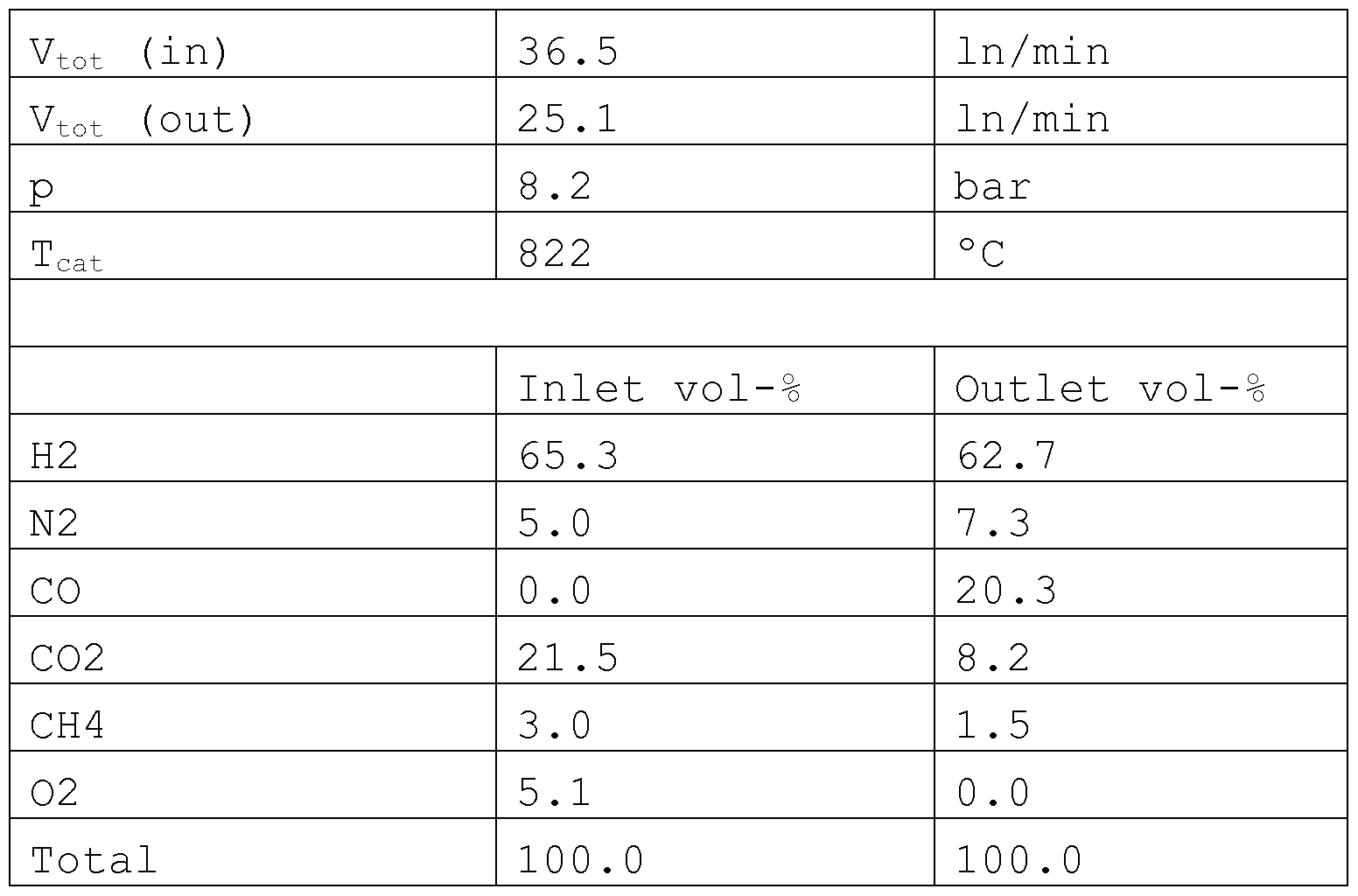
- the RWGS was studied in a pilot scale process with 37 1/min.
- a reactor of the pilot scale process corresponded to the reactor (7) of Fig. 1.
- the gaseous feed was supplied to the reactor.
- the equilibrium com position was achieved at temperature range 800 to 850 °C with linear flow velocity of 1 m/s using Rh/Al 2 0 3 catalyst.
- the results are presented in Table 1.
- the method and apparatus are suitable in dif ferent embodiments for treating carbon dioxide and for forming carbon monoxide from different kinds of feeds.
Landscapes
- Chemical & Material Sciences (AREA)
- Chemical Kinetics & Catalysis (AREA)
- Organic Chemistry (AREA)
- Engineering & Computer Science (AREA)
- Combustion & Propulsion (AREA)
- Inorganic Chemistry (AREA)
- Oil, Petroleum & Natural Gas (AREA)
- General Health & Medical Sciences (AREA)
- Health & Medical Sciences (AREA)
- General Chemical & Material Sciences (AREA)
- Organic Low-Molecular-Weight Compounds And Preparation Thereof (AREA)
- Low-Molecular Organic Synthesis Reactions Using Catalysts (AREA)
- Carbon And Carbon Compounds (AREA)
- Production Of Liquid Hydrocarbon Mixture For Refining Petroleum (AREA)
Abstract
The invention relates to a method and apparatus for producing carbon monoxide, wherein the carbon monoxide is formed from a gaseous feed (1) which comprises at least carbon dioxide. The method comprises supplying oxygen (2) to a carbon dioxide stream (3) for forming a carbon dioxide based mixture (4), supplying the carbon dioxide based mixture (4) to a hydrogen based stream (5) to form the gaseous feed (1), supplying a hydrocarbon containing stream (6) to the hydrogen based stream (5) before the supply of the carbon dioxide based mixture (4), feeding the gaseous feed (1) into a reactor (7) which comprises at least one catalyst, treating the gaseous feed (1) by means of a partial oxidation in the reactor (7) so that carbon dioxide reacts with hydrogen in the reactor in presence of oxygen and heat is formed during the reaction, and recovering a product composition (8) comprising at least carbon monoxide and hydrogen from the reactor (7). Further, the invention relates to the use of the method.
Description
METHOD AND APPARATUS FOR PRODUCING CARBON MONOXIDE
FIELD
The application relates to a method defined in claim 1 and an apparatus defined in claim 12 for producing carbon monoxide. Further, the application relates to a use of the method defined in claim 17.
BACKGROUND
Known from the prior art is to produce hydro carbons by a Fischer-Tropsch synthesis. The Fischer- Tropsch synthesis requires a mixture of ¾ and CO as feed .
Further, it is known from the prior art that carbon dioxide may be converted to carbon monoxide by RWGS (reverse water gas shift) reaction
OBJECTIVE
The objective is to disclose a new type meth od and apparatus for producing carbon monoxide from carbon dioxide. Further, the objective is to disclose a new type method and apparatus for treating carbon dioxide streams. Further, the objective is to improve a Fischer-Tropsch synthesis.
SUMMARY
The method and apparatus and use are charac terized by what are presented in the claims.
BRIEF DESCRIPTION OF THE DRAWINGS
The accompanying drawings, which are included to provide a further understanding of the invention and constitutes a part of this specification, illus-
trate some embodiments of the invention and together with the description help to explain the principles of the invention. In the drawings:
Fig. 1 is a flow chart illustration of a pro- cess according to one embodiment, and
Fig. 2 is a flow chart illustration of a pro cess according to another embodiment.
DETAILED DESCRIPTION
In a method for producing carbon monoxide (CO) , wherein the carbon monoxide is formed from a gaseous feed (1) which comprises at least carbon diox ide, wherein the method comprises supplying oxygen (2) to a carbon dioxide stream (3) for forming a carbon dioxide based mixture (4), supplying the carbon diox ide based mixture (4) to a hydrogen based stream (5) to form the gaseous feed (1), supplying a hydrocarbon containing stream (6) to the hydrogen based stream (5) before the supply of the carbon dioxide based mixture (4), feeding the gaseous feed into a reactor (7) which comprises at least one catalyst, treating the gaseous feed by means of a partial oxidation in the reactor
(7) so that carbon dioxide reacts with hydrogen in the reactor in presence of oxygen and heat is formed dur ing the reaction, and recovering a product composition
(8) comprising at least carbon monoxide and hydrogen from the reactor (7) . Preferably carbon dioxide is converted to carbon monoxide during the reaction in the reactor (7) .
An apparatus for producing carbon monoxide comprises feeding devices for supplying oxygen (2) to a carbon dioxide stream (3) for forming a carbon diox ide based mixture (4), for supplying the carbon diox ide based mixture (4) to a hydrogen based stream (5) to form the gaseous feed (1) and for supplying a hy-
drocarbon containing stream (6) to the hydrogen based stream (5) before the supply of the carbon dioxide based mixture (4) and for feeding the gaseous feed (1) into a reactor (7), at least one reactor (7) which comprises at least one catalyst and to which the gase ous feed (1) is supplied and in which the gaseous feed is treated by means of a partial oxidation so that carbon dioxide reacts with hydrogen in the reactor in presence of oxygen and heat is formed during the reac tion, and at least one recovering device for recover ing a product composition (8) comprising at least car bon monoxide and hydrogen from the reactor (7) .
One embodiment of the method and the apparatus is shown in Fig 1. Another embodiment of the method and the apparatus is shown in Fig 2.
Preferably, the feed of the reactor (7) is in gaseous form. In one embodiment, the gaseous feed (1) comprises at least carbon dioxide, oxygen, hydrogen and hydrocarbons. The gaseous feed (1) may contain al so other compounds. In this context, the gaseous feed (1) means any feed into the reactor (7) in which a partial oxidation is carried out and carbon dioxide is converted to carbon monoxide. The gaseous feed (1) can be supplied to a catalyst bed of the reactor (7) . In one embodiment, the gaseous feed is treated before the supply into the reactor.
In this context, the hydrocarbon containing stream (6) means any stream which comprises at least hydrocarbons. In one embodiment, the hydrocarbon con taining stream (6) comprises light hydrocarbons, pref erably C1-C6 hydrocarbons. In one embodiment, the hy drocarbon containing stream (6) comprises hydrocarbons which are C1-C30 hydrocarbons. In one embodiment, the hydrocarbon containing stream (6) comprises hydrocar bons and, further, hydrogen, carbon monoxide and/or carbon dioxide.
Preferably the gaseous feed (1) comprises carbon dioxide, i.e. carbon dioxide stream (3) . In this context, the carbon dioxide stream (3) means any carbon dioxide stream or carbon dioxide based stream. In one embodiment, the carbon dioxide stream (3) con tains at least carbon dioxide, and it may contain also a little amount of hydrocarbons.
Preferably the gaseous feed (1) comprises ox ygen (2) . In one embodiment, an amount of the oxygen (2) which is supplied to the carbon dioxide stream (3) is based on process conditions and/or a desired prod uct distribution.
In this context, the hydrogen based stream (5) means any stream which comprises hydrogen. Prefer ably, the hydrogen based stream comprises mainly hy drogen, i.e. it mainly consists of hydrogen.
In one embodiment, the hydrocarbon containing stream (6) is mixed with the hydrogen based stream (5) and to this feed the carbon dioxide based mixture (4) is added for forming the gaseous feed (1) . The whole gaseous feed (1) is fed to the reactor (7) .
In one embodiment, the gaseous feed (1) is fed with high velocity to the reactor (7), such as to a catalyst bed of the reactor (7), such that the ve locity of the gaseous feed, i.e. gas stream, is ³ 0.5 m/s . In one embodiment the velocity of the gas stream is about 1 m/s . In one embodiment the velocity of the gas stream is over 1 m/s . Then the hotpots are pre vented in the reactor feed and in the reactor. Fur ther, it is important to feed the oxygen together with carbon dioxide.
In one embodiment, the reactor (7) is a tube reactor or tubular reactor. In one embodiment, the re actor is a partial oxidation reactor in which the par tial oxidation is carried out. In one embodiment, the reactor is a catalytic partial oxidation (CPOX) reac-
tor. Preferably, carbon dioxide is converted to carbon monoxide in the reactor. In one embodiment, the reac tor is a CPOX reactor in which RWGS reaction (reverse water gas shift reaction) is also carried out. In one embodiment, hydrogen rich syngas is formed in the re actor, such as in the CPOX reactor. In one embodiment, the reactor (7) is surrounded by an insulating cover ing, preferably for maintaining heat in the reactor.
In one embodiment, the treatment temperature is 800 - 1500 °C in the reactor (7) . In one embodi ment, the treatment temperature is preferably over 800 °C. In one embodiment, the treatment temperature is 800 - 1000 °C, and in one embodiment 800 - 950 °C. Preferably, the heat is formed during the partial oxi dation reaction in the reactor (7) . In one embodiment, the reaction is started by heating, e.g. by means of an external heat device, in the reactor (7) .
In one embodiment, pressure in the reactor (7) is 15 - 30 bar, and in one embodiment 17 - 25 bar. In one embodiment, the pressure is preferably about 20 bar .
In one embodiment, the catalyst comprises at least one catalyst agent on a carrier material, and the catalyst agent is selected from a metal of the no ble metal group, e.g. Rh, and/or a transition metal group, e.g. Fe, Co, Ni. In one embodiment, the carrier material can be any suitable carrier material, e.g. A1203, or Zr02 based carrier material or other suitable carrier material which endures high temperatures. In one embodiment, the catalyst is Rh/Al203 catalyst. In one embodiment, the catalyst is NiRh/Al203 catalyst. In one embodiment, the catalyst is Ni/Al203 catalyst. In one embodiment, the catalyst is selected from Rh/Al203 catalyst, NiRh/Al203 catalyst and Ni/Al203 catalyst. Al ternatively other suitable catalyst can be used. In one embodiment, the catalyst is arranged as a coating
on a substrate, e.g. as a washcoating, onto a metal surface, such as metal monolith, or ceramic surface, such as ceramic monolith.
The partial oxidation is carried out in the reactor (7) . Preferably, the partial oxidation is an exothermic reaction. Preferably, also the carbon mon oxide is formed from carbon dioxide in the reactor (7) . In one embodiment, also a reverse water gas shift (RWGS) reaction is carried out in the reactor in order to convert carbon dioxide to carbon monoxide. The re verse water gas shift (RWGS) reaction is an endother mic reaction. Preferably, the partial oxidation reac tion brings the necessary heat for the reaction in which carbon dioxide is converted to carbon monoxide. Preferably, the invention is based on the combination of the partial oxidation reaction and the reaction for converting carbon dioxide to carbon monoxide. In one embodiment, the invention is based on a combined CPOX and RWGS reactor.
In this context, the product composition (8) means any product from the reactor (7) . The product composition comprises one or more product components, e.g. carbon monoxide, hydrogen, water and/or other components. Preferably the product composition con- tains at least carbon monoxide and hydrogen. In one embodiment, the product composition contains also wa ter. The product composition may contain also other components. In one embodiment, the product composition mainly consists of carbon monoxide and hydrogen. In one embodiment, the product composition can be post- treated after the reactor (7) . In one embodiment, the product composition can be supplied to a desired treatment process, e.g. to a Fischer-Tropsch process. In one embodiment, the product composition is a syngas which can be supplied to the Fischer-Tropsch (FT) pro-
cess. In one embodiment, water may be removed from the product composition after the reactor (7) .
In one embodiment, the product distribution of the product composition (8) is adjusted by means of the components in the gaseous feed (1) and amounts of said components. In one embodiment, the product dis tribution is adjusted based on a synthesis after the reactor (7), for example for adjusting suitable feed to the synthesis or for adjusting H2/CO ratio.
In one embodiment, the product composition (8) is cooled after the reactor (7) . In one embodi ment, the product composition (8) is cooled to temper ature of 4 - 300 °C, and in one embodiment to about 250 °C. In one embodiment, water of the product compo sition (8) may be condensed in a condenser.
In one embodiment, the product composition
(8) is used as a feed to a synthesis process, such as to a Fischer-Tropsch (FT) process, or a methanation, or a production of methanol, or to another suitable process .
In one embodiment, the apparatus comprises at least one Fischer-Tropsch reactor (9), i.e. FT reactor
(9), into which the product composition (8) is sup plied. Any suitable Fischer-Tropsch (FT) reactor known per se can be used as the Fischer-Tropsch reactor in the apparatus .
In one embodiment, the product composition
(8) is supplied as the feed to a Fischer-Tropsch step, such as to a Fischer-Tropsch reactor (9) . In one em bodiment, carbon monoxide and hydrogen are supplied from the reactor (7) to the Fischer-Tropsch reactor
(9) . In one embodiment, the product composition (8) can be treated before the supply to the Fischer- Tropsch reactor (9) .
Preferably, the Fischer-Tropsch (FT) reaction is an exothermic reaction in which carbon monoxide re-
acts with hydrogen. In one embodiment, paraffin-rich hydrocarbons which can be considered as heavy hydro carbons are formed from the carbon monoxide and hydro gen in the Fischer-Tropsch (FT) reaction. In one em bodiment, the Fischer-Tropsch reaction is carried out by means of Co-based catalyst or Fe-based catalyst in the Fischer-Tropsch (FT) reactor (9). Alternatively, the FT reaction can be made with other suitable cata lyst.
In one embodiment, the Fischer-Tropsch reac tion is carried out at temperature which is 150 - 350 °C, in one embodiment 200 - 300 °C. In one embodiment, pressure is 15 - 25 bar, in one embodiment about 20 bar, during the FT reaction. In one embodiment, the Fischer-Tropsch reaction takes place at around 20 bar pressure and around 200 - 300 °C.
In one embodiment, the product (10) of the Fischer-Tropsch (FT) step is a mixture of hydrocar bons. In one embodiment, the product of the FT com prises at least hydrocarbons, e.g. C5 - C60 hydrocar bons. In one embodiment, the product of the FT com prises desired components, such as oil and wax compo nents, and undesired components, such as water, light hydrocarbons, unreacted feed components and/or non condensable components or their combinations. In one embodiment, the non-condensable components are dis charged as an off-gas stream (11) from the FT step, e.g. from the FT reactor. In one embodiment, the prod uct of the FT comprises also other organic compounds.
In one embodiment, H2/CO ratio in the FT re action can be adjusted by means of an amount of hydro gen feed to the FT reactor and/or by means of the com ponents and the amount of the components in the gase ous feed to the partial oxidation reactor.
In one embodiment, the off-gas stream (11) comprising at least hydrocarbons from the FT step or
FT reactor (9) is recycled and is used as the hydro carbon containing stream (6) in the feed of the par tial oxidation reactor (7) . In this context, the off gas stream means any off-gas or tail gas or other un desired gas from the FT step or FT reactor. Preferably the off-gas stream comprises undesired components, such as light hydrocarbons, unreacted feed components, non-condensable components or their combinations, of the FT process product. Further, the off-gas stream can comprise water. In one embodiment, the off-gas stream comprises light hydrocarbons, preferably C1-C6 hydrocarbons. In one embodiment, the off-gas stream comprises hydrocarbons and, further, hydrogen, carbon monoxide and/or carbon dioxide.
In one embodiment, the apparatus comprises at least one recirculation device for recycling the off-gas stream (11) comprising at least hydrocarbons from the Fischer-Tropsch step and for using the off-gas stream as the hydrocarbon containing stream (6).
In one embodiment, the off-gas stream (11) of the FT reactor (9) is recycled and is used as the hy drocarbon containing stream (6) in the feed of the partial oxidation reactor (7), such as catalytic par tial oxidation reactor (CPOX) , and the product compo sition (8) from the partial oxidation reactor (7) is supplied to the FT reactor (9) . Then the off-gases of the FT reactor can be recirculated to the partial oxi dation reactor in which the off-gases can be processed to syngas, such as carbon monoxide. In one embodiment, the partial oxidation reactor (7), such CPOX reactor, is operated at the same pressure as the FT reactor (9) wherein the off-gas recirculation can be utilized bet ter .
In one embodiment, the method comprises more than one partial oxidation steps. In one embodiment, the apparatus comprises more than one partial oxida-
tion reactors (7) . In one embodiment, the method com prises one partial oxidation step. In one embodiment, the apparatus comprises one partial oxidation reactor (7) . In one embodiment, at least two reactors (7) are arranged in parallel. In one embodiment, at least two reactors (7) are arranged sequentially.
In one embodiment, the method comprises more than one Fischer-Tropsch process steps. In one embodi ment, the apparatus comprises more than one FT reac tors (9) . In one embodiment, the method comprises one Fischer-Tropsch process step. In one embodiment, the apparatus comprises one FT reactor (9) . In one embodi ment, at least two reactors (9) are arranged in paral lel. In one embodiment, at least two reactors (9) are arranged sequentially.
In one embodiment, the apparatus comprises at least one outlet for discharging the product composi tion (8) out from the reactor (7) .
In one embodiment, the apparatus comprises at least one feed inlet for supplying the gaseous feed (1) into the reactor (7) .
In one embodiment, the apparatus comprises at least one outlet of the FT reactor for discharging the product (10) of the FT reactor (9) out from the FT re actor ( 9) .
In one embodiment, the apparatus comprises at least one feed inlet of the FT reactor for supplying the product composition (8) of the reactor (7) into the FT reactor (9) .
The feed inlet may be any suitable inlet known per se, e.g. pipe, port or the like. The product outlet may be any suitable outlet known per se, e.g. pipe, outlet port or the like.
Preferably, the apparatus comprises at least one feeding device. In this context, the feeding de vice can be any feeding device, equipment or other
suitable device. In one embodiment, the feeding device is selected from the group comprising pump, compres sor, tube, pipe, other suitable feeding device and their combinations.
In one embodiment, the method is based on a continuous process. In one embodiment, the apparatus is a continuous apparatus. In one embodiment, the method is based on a batch process. In one embodiment, the apparatus is a batch apparatus.
In one embodiment, the apparatus and the method is used and utilized in a production of hydro carbons, Fischer-Tropsch (FT) process, treatment of carbon dioxide, carbon dioxide capture process, cata lytic partial oxidation (CPOX) process, methanation process, production of methanol, or their combina tions .
Thanks to the invention carbon dioxide based feed can be treated and converted easily and effec tively. The partial oxidation also brings the neces sary heat for the reaction in which carbon dioxide is converted to carbon monoxide. When the oxygen is fed to carbon dioxide stream, the reaction of the oxygen and the burning can be prevented such that the reac tions do not take place too quickly. Then it can be ensured that the reactions take place with the cata lyst in the reactor, not before the catalyst. It is desirable that the oxygen does not react until in con nection with the catalyst in the reactor. By means of the invention carbon dioxide can be used as a feed for a FT process. Further, non-condensable products, such as off-gases, of the FT process can be utilized and recirculated to the partial oxidation process. By means of said recirculation the yield of oils and wax es can be improved in the FT process. Further, the in vention helps controlling the carbon or coke formation by using oxygen to partially oxidate the hydrocarbons.
The method and apparatus offers a possibility to treat carbon dioxide and carbon monoxide easily, and energy- and cost-effectively. The present inven tion provides an industrially applicable, simple and affordable way to produce carbon monoxide, and further to produce desired hydrocarbons by means of the FT re action. The method and apparatus are easy and simple to realize in connection with production processes.
EXAMPLES
Example 1
Figure 1 presents the method and also the ap paratus for producing carbon monoxide (CO) from carbon dioxide (C02) .
The carbon monoxide is formed from a gaseous feed (1) which comprises at least carbon dioxide. Oxy gen (2) is supplied to a carbon dioxide stream (3) for forming a carbon dioxide based mixture (4) . The carbon dioxide based mixture (4) is supplied to a hydrogen based stream (5) to form the gaseous feed (1) . A hy drocarbon containing stream (6) is supplied to the hy drogen based stream (5) before the supply of the car bon dioxide based mixture (4) to the hydrogen based stream. The gaseous feed (1) is fed into a reactor (7) which comprises at least one catalyst. The gaseous feed is treated by means of a partial oxidation reac tion in the reactor (7) with the catalyst so that car bon dioxide reacts with hydrogen in the reactor in presence of oxygen and heat is formed during the reac tion. Simultaneously carbon dioxide is converted to carbon monoxide in the reactor. Product composition (8) comprising at least carbon monoxide and hydrogen is discharged from the reactor (7) and is recovered.
Example 2
Figure 2 presents the method and also the ap paratus for producing carbon monoxide (CO) from carbon dioxide (C02) and hydrocarbons from the carbon monox- ide .
The carbon monoxide is formed from a gaseous feed (1) which comprises at least carbon dioxide. Oxy gen (2) is supplied to a carbon dioxide stream (3) for forming a carbon dioxide based mixture (4) . The carbon dioxide based mixture (4) is supplied to a hydrogen based stream (5) to form the gaseous feed (1) . A hy drocarbon containing stream (6) is supplied to the hy drogen based stream (5) before the supply of the car bon dioxide based mixture (4) . The gaseous feed (1) is fed into a partial oxidation reactor (7), such as cat alytic partial oxidation reactor (CPOX) , which com prises at least one catalyst which may be Rh/Al203 cat alyst or other suitable catalyst. Preferably, the Rh/Al203 has been washcoated on metal monolith. The gaseous feed (1) is fed with high velocity to the cat alyst bed of the reactor (7) such that the velocity of the gas stream is about 1 m/s or over 1 m/s . The reac tor (7) is a tubular reactor which is surrounded by an insulating covering. The gaseous feed is treated by means of a partial oxidation reaction in the reactor
(7) with the catalyst so that carbon dioxide reacts with hydrogen in the reactor in presence of oxygen and heat is formed during the reaction. Simultaneously carbon dioxide is converted to carbon monoxide in the reactor. Temperature is preferably 800 - 950 °C and pressure is about 20 bar in the reactor (7) . Product composition (8) comprising at least carbon monoxide and hydrogen is discharged from the reactor (7) and is recovered .
The product composition (8) is supplied as the feed to a Fischer-Tropsch (FT) reactor (9) . The
product composition may be cooled and water may be re moved from the product composition before the FT reac tor, e.g. by a condenser at pressure of about 20 bar. The temperature is 200 - 300 °C after the cooling. The Fischer-Tropsch (FT) reaction is an exothermic reac tion in which carbon monoxide reacts with hydrogen and paraffin-rich hydrocarbons can be formed. Temperature is preferably 200 - 300 °C and pressure is about 20 bar in the FT reactor (9) .
A product (10) of the FT reactor (9) is a mixture of hydrocarbons comprising C5 - C60 hydrocar bons. The product of FT comprises desired components, such as oil and wax components, and undesired compo nents, such as light hydrocarbons, unreacted feed com ponents and/or non-condensable components or their combinations. An off-gas stream (11) comprising unde sired components from the FT reactor (9) is recycled and is used as the hydrocarbon containing stream (6) in the feed of the partial oxidation reactor (7) . The off-gas stream (11) comprises at least hydrocarbons, and it may comprise at least light hydrocarbons, pref erably C1-C6 hydrocarbons.
Preferably, the pressure in the partial oxi dation reactor (7) is same than the pressure in the FT reactor (9) . Then the off-gases of the FT reactor can be recirculated to the partial oxidation reactor in which the off-gases can be processed to carbon monox ide .
Example 3
The RWGS was studied in a pilot scale process with 37 1/min. A reactor of the pilot scale process corresponded to the reactor (7) of Fig. 1. The gaseous feed was supplied to the reactor. The equilibrium com position was achieved at temperature range 800 to 850
°C with linear flow velocity of 1 m/s using Rh/Al203 catalyst. The results are presented in Table 1.
Table 1
The devices and equipments of the process used in these examples are known per se in the art, and therefore they are not described in any more de tail in this context.
The method and apparatus are suitable in dif ferent embodiments for treating carbon dioxide and for forming carbon monoxide from different kinds of feeds.
The invention is not limited merely to the examples referred to above; instead many variations are possible within the scope of the inventive idea defined by the claims.
Claims
1. A method for producing carbon monoxide, wherein the carbon monoxide is formed from a gaseous feed (1) which comprises at least carbon dioxide, cha r a c t e r i z e d in that the method comprises
- supplying oxygen (2) to a carbon dioxide stream
(3) for forming a carbon dioxide based mixture
(4) ,
- supplying the carbon dioxide based mixture (4) to a hydrogen based stream (5) to form the gaseous feed ( 1 ) ,
- supplying a hydrocarbon containing stream (6) to the hydrogen based stream (5) before the supply of the carbon dioxide based mixture (4),
- feeding the gaseous feed (1) into a reactor (7) which comprises at least one catalyst,
- treating the gaseous feed (1) by means of a par tial oxidation in the reactor (7) so that carbon dioxide reacts with hydrogen in the reactor in presence of oxygen and heat is formed during the reaction, and
- recovering a product composition (8) comprising at least carbon monoxide and hydrogen from the reactor ( 7 ) .
2. The method according to claim 1, cha r a c t e r i z e d in that the gaseous feed (1) is fed with high velocity to the reactor (7) such that the velocity of the gas stream is ³ 0.5 m/s.
3. The method according to claim 1 or 2, cha r a c t e r i z e d in that a treatment temperature is 800 - 1500 °C in the reactor (7) .
4. The method according to any one of claims 1 to 3, cha r a c t e r i z e d in that a treatment temperature is 800 - 950 °C in the reactor (7) .
5. The method according to any one of claims 1 to 4, c h a r a c t e r i z e d in a pressure is 15 - 30 bar in the reactor (7) .
6. The method according to any one of claims 1 to 5, c h a r a c t e r i z e d in that the catalyst is selected from Rh/Al203 catalyst, NiRh/Al203 catalyst and Ni/Al203 catalyst.
7. The method according to any one of claims 1 to 6, c h a r a c t e r i z e d in that the product composition (8) is cooled after the reactor (7).
8. The method according to any one of claims 1 to 7, c h a r a c t e r i z e d in that the product composition (8) is supplied as the feed to a Fischer- Tropsch step.
9. The method according to claim 8, c h a r a c t e r i z e d in that the Fischer-Tropsch reaction is carried out at temperature which is 150 - 350 °C.
10. The method according to claim 8 or 9, c h a r a c t e r i z e d in that pressure is 15 - 25 bar during the Fischer-Tropsch reaction.
11. The method according to any one of claims 8 to 10, c h a r a c t e r i z e d in that an off-gas stream (11) comprising at least hydrocarbons is recycled from the Fischer-Tropsch step to be used as the hydro carbon containing stream (6).
12. An apparatus for producing carbon monox ide, wherein the carbon monoxide is formed from a gas eous feed (1) which comprises at least carbon dioxide, c h a r a c t e r i z e d in that the apparatus comprises
- feeding devices for supplying oxygen (2) to a carbon dioxide stream (3) for forming a carbon dioxide based mixture (4), for supplying the car bon dioxide based mixture (4) to a hydrogen based stream (5) to form the gaseous feed (1) and for supplying a hydrocarbon containing stream (6) to the hydrogen based stream (5) before the supply
1 of the carbon dioxide based mixture (4) and for feeding the gaseous feed (1) into a reactor (7),
- at least one reactor (7) which comprises at least one catalyst and to which the gaseous feed (1) is supplied and in which the gaseous feed is treated by means of a partial oxidation so that carbon dioxide reacts with hydrogen in the reactor in presence of oxygen and heat is formed during the reaction, and
- at least one recovering device for recovering a product composition (8) comprising at least car bon monoxide and hydrogen from the reactor (7) .
13. The apparatus according to claim 12, cha r a c t e r i z e d in that the reactor (7) is a tube reactor or a tubular reactor.
14. The apparatus according to claim 12 or
13, cha r a c t e r i z e d in that the reactor (7) is a catalytic partial oxidation (CPOX) reactor.
15. The apparatus according to any one of claims 12 to 14, cha r a c t e r i z e d in that the apparatus comprises at least one Fischer-Tropsch reac tor (9) into which the product composition (8) is sup plied .
16. The apparatus according to claim 15, cha r a c t e r i z e d in that the apparatus comprises at least one recirculation device for recycling an off gas stream (11) comprising at least hydrocarbons from the Fischer-Tropsch step to be used as the hydrocarbon containing stream (6).
17. A use of the method according to any one of claims 1 to 11, cha r a c t e r i z e d in that the method is used in a production of hydrocarbons, Fisch er-Tropsch process, treatment of carbon dioxide, car bon dioxide capture process, catalytic partial oxida tion process, methanation process, production of meth anol, or their combinations.
Priority Applications (5)
| Application Number | Priority Date | Filing Date | Title |
|---|---|---|---|
| PL19767777.6T PL3765404T3 (en) | 2018-03-13 | 2019-03-12 | Method for producing carbon monoxide |
| ES19767777T ES3014249T3 (en) | 2018-03-13 | 2019-03-12 | Method for producing carbon monoxide |
| CA3093759A CA3093759A1 (en) | 2018-03-13 | 2019-03-12 | Method and apparatus for producing carbon monoxide |
| US16/980,132 US20210246034A1 (en) | 2018-03-13 | 2019-03-12 | Method and apparatus for producing carbon monoxide |
| EP19767777.6A EP3765404B1 (en) | 2018-03-13 | 2019-03-12 | Method for producing carbon monoxide |
Applications Claiming Priority (2)
| Application Number | Priority Date | Filing Date | Title |
|---|---|---|---|
| FI20185232 | 2018-03-13 | ||
| FI20185232A FI127925B (en) | 2018-03-13 | 2018-03-13 | Method and apparatus for producing carbon monoxide |
Publications (1)
| Publication Number | Publication Date |
|---|---|
| WO2019175476A1 true WO2019175476A1 (en) | 2019-09-19 |
Family
ID=66853896
Family Applications (1)
| Application Number | Title | Priority Date | Filing Date |
|---|---|---|---|
| PCT/FI2019/050204 Ceased WO2019175476A1 (en) | 2018-03-13 | 2019-03-12 | Method and apparatus for producing carbon monoxide |
Country Status (7)
| Country | Link |
|---|---|
| US (1) | US20210246034A1 (en) |
| EP (1) | EP3765404B1 (en) |
| CA (1) | CA3093759A1 (en) |
| ES (1) | ES3014249T3 (en) |
| FI (1) | FI127925B (en) |
| PL (1) | PL3765404T3 (en) |
| WO (1) | WO2019175476A1 (en) |
Cited By (7)
| Publication number | Priority date | Publication date | Assignee | Title |
|---|---|---|---|---|
| GB202016417D0 (en) | 2020-10-16 | 2020-12-02 | Johnson Matthey Davy Technologies Ltd | Process for producing a gas stream comprising carbon monoxide |
| GB2593179A (en) * | 2020-03-17 | 2021-09-22 | Nordic Blue Crude As | Production of hydrocarbons |
| WO2021244980A1 (en) * | 2020-06-01 | 2021-12-09 | Shell Internationale Research Maatschappij B.V. | A flexible process for converting carbon dioxide, hydrogen, and methane into synthesis gas |
| WO2021244975A1 (en) * | 2020-06-01 | 2021-12-09 | Shell Internationale Research Maatschappij B.V. | A process and reactor for converting carbon dioxide into carbon monoxide, involving a catalyst |
| WO2022069800A1 (en) * | 2020-10-01 | 2022-04-07 | Teknologian Tutkimuskeskus Vtt Oy | Method and apparatus for producing product gas and use |
| WO2023204877A3 (en) * | 2022-04-20 | 2024-04-04 | Infinium Technology, Llc | Process for production of syngas and fuels from carbon dioxide using oxyfuel combustion |
| DE102024136913A1 (en) | 2024-12-10 | 2026-06-11 | Ineratec Gmbh | Pretreatment of FT exhaust gas for recirculation into a conversion reactor |
Families Citing this family (6)
| Publication number | Priority date | Publication date | Assignee | Title |
|---|---|---|---|---|
| EP3891098B1 (en) | 2018-12-03 | 2024-05-01 | Shell Internationale Research Maatschappij B.V. | A process and reactor for converting carbon dioxide into carbon monoxide |
| FI131405B1 (en) * | 2023-03-06 | 2025-04-04 | Neste Oyj | Method and system for producing an aviation fuel component |
| WO2025114448A1 (en) | 2023-11-29 | 2025-06-05 | Topsoe A/S | Efficient use of renewable feeds and reduction of emissions in e-fuel plant |
| FI132031B1 (en) * | 2024-01-18 | 2026-04-27 | Neste Oyj | A process for producing sustainable aviation fuel |
| FI132030B1 (en) * | 2024-01-18 | 2026-04-27 | Neste Oyj | Integrated process for the production of renewable aviation fuel |
| WO2026044293A2 (en) * | 2024-08-23 | 2026-02-26 | Koloma, Inc. | Systems and methods for production of low carbon intensity hydrogen from geologic sources |
Citations (8)
| Publication number | Priority date | Publication date | Assignee | Title |
|---|---|---|---|---|
| EP0645344A1 (en) * | 1993-09-23 | 1995-03-29 | Shell Internationale Researchmaatschappij B.V. | Process for the preparation of carbon monoxide and hydrogen |
| US5500449A (en) | 1986-05-08 | 1996-03-19 | Rentech, Inc. | Process for the production of hydrocarbons |
| US6254807B1 (en) * | 1998-01-12 | 2001-07-03 | Regents Of The University Of Minnesota | Control of H2 and CO produced in partial oxidation process |
| US6492290B1 (en) | 2000-08-22 | 2002-12-10 | Air Products And Chemicals, Inc. | Mixed conducting membranes for syngas production |
| EP1433746A2 (en) * | 2002-12-23 | 2004-06-30 | The Boc Group, Inc. | Catalytic partial oxidation method |
| WO2007114250A1 (en) | 2006-03-30 | 2007-10-11 | Nippon Steel Engineering Co., Ltd. | Liquid fuel synthesis system |
| US20110240924A1 (en) | 2010-04-02 | 2011-10-06 | Air Products And Chemicals, Inc. | Operation of Staged Membrane Oxidation Reactor Systems |
| WO2015061915A1 (en) * | 2013-11-04 | 2015-05-07 | Me Resource Corp. | Method and apparatus for producing chemicals from a methane-containing gas |
Family Cites Families (2)
| Publication number | Priority date | Publication date | Assignee | Title |
|---|---|---|---|---|
| US7261751B2 (en) * | 2004-08-06 | 2007-08-28 | Conocophillips Company | Synthesis gas process comprising partial oxidation using controlled and optimized temperature profile |
| IT1400492B1 (en) * | 2010-06-03 | 2013-06-11 | Eni Spa | CATALYTIC SYSTEM FOR LOW-TIME CATALYTIC PARTIAL OXIDATION PROCESSES |
-
2018
- 2018-03-13 FI FI20185232A patent/FI127925B/en active IP Right Grant
-
2019
- 2019-03-12 ES ES19767777T patent/ES3014249T3/en active Active
- 2019-03-12 WO PCT/FI2019/050204 patent/WO2019175476A1/en not_active Ceased
- 2019-03-12 CA CA3093759A patent/CA3093759A1/en active Pending
- 2019-03-12 EP EP19767777.6A patent/EP3765404B1/en active Active
- 2019-03-12 PL PL19767777.6T patent/PL3765404T3/en unknown
- 2019-03-12 US US16/980,132 patent/US20210246034A1/en not_active Abandoned
Patent Citations (8)
| Publication number | Priority date | Publication date | Assignee | Title |
|---|---|---|---|---|
| US5500449A (en) | 1986-05-08 | 1996-03-19 | Rentech, Inc. | Process for the production of hydrocarbons |
| EP0645344A1 (en) * | 1993-09-23 | 1995-03-29 | Shell Internationale Researchmaatschappij B.V. | Process for the preparation of carbon monoxide and hydrogen |
| US6254807B1 (en) * | 1998-01-12 | 2001-07-03 | Regents Of The University Of Minnesota | Control of H2 and CO produced in partial oxidation process |
| US6492290B1 (en) | 2000-08-22 | 2002-12-10 | Air Products And Chemicals, Inc. | Mixed conducting membranes for syngas production |
| EP1433746A2 (en) * | 2002-12-23 | 2004-06-30 | The Boc Group, Inc. | Catalytic partial oxidation method |
| WO2007114250A1 (en) | 2006-03-30 | 2007-10-11 | Nippon Steel Engineering Co., Ltd. | Liquid fuel synthesis system |
| US20110240924A1 (en) | 2010-04-02 | 2011-10-06 | Air Products And Chemicals, Inc. | Operation of Staged Membrane Oxidation Reactor Systems |
| WO2015061915A1 (en) * | 2013-11-04 | 2015-05-07 | Me Resource Corp. | Method and apparatus for producing chemicals from a methane-containing gas |
Non-Patent Citations (1)
| Title |
|---|
| See also references of EP3765404A4 |
Cited By (18)
| Publication number | Priority date | Publication date | Assignee | Title |
|---|---|---|---|---|
| JP2023517755A (en) * | 2020-03-17 | 2023-04-26 | ノルディック エレクトロフューエル エーエス | Hydrocarbon production |
| GB2593179A (en) * | 2020-03-17 | 2021-09-22 | Nordic Blue Crude As | Production of hydrocarbons |
| WO2021185869A1 (en) * | 2020-03-17 | 2021-09-23 | Nordic Blue Crude As | Production of hydrocarbons |
| US12643789B2 (en) | 2020-03-17 | 2026-06-02 | Nordic Electrofuel As | Production of hydrocarbons |
| GB2593179B (en) * | 2020-03-17 | 2022-04-27 | Nordic Electrofuel As | Production of hydrocarbons |
| JP7528243B2 (en) | 2020-03-17 | 2024-08-05 | ノルディック エレクトロフューエル エーエス | Hydrocarbon Production |
| WO2021244980A1 (en) * | 2020-06-01 | 2021-12-09 | Shell Internationale Research Maatschappij B.V. | A flexible process for converting carbon dioxide, hydrogen, and methane into synthesis gas |
| WO2021244975A1 (en) * | 2020-06-01 | 2021-12-09 | Shell Internationale Research Maatschappij B.V. | A process and reactor for converting carbon dioxide into carbon monoxide, involving a catalyst |
| WO2022069800A1 (en) * | 2020-10-01 | 2022-04-07 | Teknologian Tutkimuskeskus Vtt Oy | Method and apparatus for producing product gas and use |
| GB2602695A (en) | 2020-10-16 | 2022-07-13 | Johnson Matthey Davy Technologies Ltd | Process for producing a gas stream comprising carbon monoxide |
| CN116249671A (en) * | 2020-10-16 | 2023-06-09 | 庄信万丰戴维科技有限公司 | Process for producing a gas stream comprising carbon monoxide |
| JP2023544950A (en) * | 2020-10-16 | 2023-10-26 | ジョンソン マッセイ デイヴィー テクノロジーズ リミテッド | Process for producing gas streams containing carbon monoxide |
| GB202016417D0 (en) | 2020-10-16 | 2020-12-02 | Johnson Matthey Davy Technologies Ltd | Process for producing a gas stream comprising carbon monoxide |
| JP7795524B2 (en) | 2020-10-16 | 2026-01-07 | ジョンソン マッセイ デイヴィー テクノロジーズ リミテッド | Process for producing a gas stream containing carbon monoxide - Patent Application 20070122997 |
| WO2022079408A1 (en) | 2020-10-16 | 2022-04-21 | Johnson Matthey Davy Technologies Limited | Process for producing a gas stream comprising carbon monoxide |
| WO2023204877A3 (en) * | 2022-04-20 | 2024-04-04 | Infinium Technology, Llc | Process for production of syngas and fuels from carbon dioxide using oxyfuel combustion |
| DE102024136913A1 (en) | 2024-12-10 | 2026-06-11 | Ineratec Gmbh | Pretreatment of FT exhaust gas for recirculation into a conversion reactor |
| WO2026124934A1 (en) | 2024-12-10 | 2026-06-18 | Ineratec Gmbh | Pretreatment of ft off-gas for recirculation into a conversion reactor |
Also Published As
| Publication number | Publication date |
|---|---|
| EP3765404A1 (en) | 2021-01-20 |
| EP3765404B1 (en) | 2025-03-05 |
| US20210246034A1 (en) | 2021-08-12 |
| EP3765404C0 (en) | 2025-03-05 |
| FI127925B (en) | 2019-05-31 |
| ES3014249T3 (en) | 2025-04-21 |
| FI20185232A1 (en) | 2019-05-31 |
| CA3093759A1 (en) | 2019-09-19 |
| PL3765404T3 (en) | 2025-06-09 |
| EP3765404A4 (en) | 2021-12-08 |
Similar Documents
| Publication | Publication Date | Title |
|---|---|---|
| EP3765404A1 (en) | Method and apparatus for producing carbon monoxide | |
| US5026934A (en) | Method for converting light hydrocarbons to olefins, gasoline and methanol | |
| CA2977330C (en) | Process for the production of formaldehyde | |
| CN1048009C (en) | Improved gas conversion process | |
| JP2925963B2 (en) | Method and apparatus for oxidative coupling of methane | |
| EP3132009B1 (en) | Process | |
| KR102027913B1 (en) | Co-production of methanol and urea | |
| GB2559825B (en) | Process | |
| GB2585478A (en) | Process for synthesising methanol | |
| WO2019239009A1 (en) | Method and apparatus for forming hydrocarbons and use | |
| GB2606855A (en) | Process for synthesising methanol | |
| WO2016139452A1 (en) | Process for producing a substitute natural gas | |
| US20220081380A1 (en) | Methanol production process from syngas produced by catalytic partial oxidation integrated with cracking | |
| EP3169663B1 (en) | Method for revamping a urea production complex | |
| JPS59167527A (en) | Methanol manufacturing method | |
| KR102772890B1 (en) | Method and catalysts for the production of ammonia synthesis gas | |
| WO2020142487A1 (en) | Methanol production process | |
| KR20080096687A (en) | Use of pre-dehydration towers in the oxidation process of ethane to acetic acid / ethylene | |
| FI20205961A1 (en) | Method and apparatus for producing product gas and use | |
| CA3039787C (en) | Process for the production of formaldehyde-stabilised urea | |
| WO2017093130A1 (en) | Process for the preparation of syngas |
Legal Events
| Date | Code | Title | Description |
|---|---|---|---|
| 121 | Ep: the epo has been informed by wipo that ep was designated in this application |
Ref document number: 19767777 Country of ref document: EP Kind code of ref document: A1 |
|
| ENP | Entry into the national phase |
Ref document number: 3093759 Country of ref document: CA |
|
| NENP | Non-entry into the national phase |
Ref country code: DE |
|
| ENP | Entry into the national phase |
Ref document number: 2019767777 Country of ref document: EP Effective date: 20201013 |