WO2019176916A1 - 体内における薬物動態を制御する組成物 - Google Patents
体内における薬物動態を制御する組成物 Download PDFInfo
- Publication number
- WO2019176916A1 WO2019176916A1 PCT/JP2019/009919 JP2019009919W WO2019176916A1 WO 2019176916 A1 WO2019176916 A1 WO 2019176916A1 JP 2019009919 W JP2019009919 W JP 2019009919W WO 2019176916 A1 WO2019176916 A1 WO 2019176916A1
- Authority
- WO
- WIPO (PCT)
- Prior art keywords
- drug
- blood
- administered
- composition according
- hours
- Prior art date
- Legal status (The legal status is an assumption and is not a legal conclusion. Google has not performed a legal analysis and makes no representation as to the accuracy of the status listed.)
- Ceased
Links
Images






Classifications
-
- A—HUMAN NECESSITIES
- A61—MEDICAL OR VETERINARY SCIENCE; HYGIENE
- A61K—PREPARATIONS FOR MEDICAL, DENTAL OR TOILETRY PURPOSES
- A61K31/00—Medicinal preparations containing organic active ingredients
- A61K31/74—Synthetic polymeric materials
-
- A—HUMAN NECESSITIES
- A61—MEDICAL OR VETERINARY SCIENCE; HYGIENE
- A61K—PREPARATIONS FOR MEDICAL, DENTAL OR TOILETRY PURPOSES
- A61K9/00—Medicinal preparations characterised by special physical form
- A61K9/10—Dispersions; Emulsions
- A61K9/107—Emulsions ; Emulsion preconcentrates; Micelles
- A61K9/1075—Microemulsions or submicron emulsions; Preconcentrates or solids thereof; Micelles, e.g. made of phospholipids or block copolymers
-
- A—HUMAN NECESSITIES
- A61—MEDICAL OR VETERINARY SCIENCE; HYGIENE
- A61K—PREPARATIONS FOR MEDICAL, DENTAL OR TOILETRY PURPOSES
- A61K31/00—Medicinal preparations containing organic active ingredients
- A61K31/21—Esters, e.g. nitroglycerine, selenocyanates
- A61K31/215—Esters, e.g. nitroglycerine, selenocyanates of carboxylic acids
- A61K31/25—Esters, e.g. nitroglycerine, selenocyanates of carboxylic acids with polyoxyalkylated alcohols, e.g. esters of polyethylene glycol
-
- A—HUMAN NECESSITIES
- A61—MEDICAL OR VETERINARY SCIENCE; HYGIENE
- A61K—PREPARATIONS FOR MEDICAL, DENTAL OR TOILETRY PURPOSES
- A61K47/00—Medicinal preparations characterised by the non-active ingredients used, e.g. carriers or inert additives; Targeting or modifying agents chemically bound to the active ingredient
-
- A—HUMAN NECESSITIES
- A61—MEDICAL OR VETERINARY SCIENCE; HYGIENE
- A61K—PREPARATIONS FOR MEDICAL, DENTAL OR TOILETRY PURPOSES
- A61K47/00—Medicinal preparations characterised by the non-active ingredients used, e.g. carriers or inert additives; Targeting or modifying agents chemically bound to the active ingredient
- A61K47/50—Medicinal preparations characterised by the non-active ingredients used, e.g. carriers or inert additives; Targeting or modifying agents chemically bound to the active ingredient the non-active ingredient being chemically bound to the active ingredient, e.g. polymer-drug conjugates
- A61K47/51—Medicinal preparations characterised by the non-active ingredients used, e.g. carriers or inert additives; Targeting or modifying agents chemically bound to the active ingredient the non-active ingredient being chemically bound to the active ingredient, e.g. polymer-drug conjugates the non-active ingredient being a modifying agent
- A61K47/54—Medicinal preparations characterised by the non-active ingredients used, e.g. carriers or inert additives; Targeting or modifying agents chemically bound to the active ingredient the non-active ingredient being chemically bound to the active ingredient, e.g. polymer-drug conjugates the non-active ingredient being a modifying agent the modifying agent being an organic compound
- A61K47/549—Sugars, nucleosides, nucleotides or nucleic acids
-
- A—HUMAN NECESSITIES
- A61—MEDICAL OR VETERINARY SCIENCE; HYGIENE
- A61K—PREPARATIONS FOR MEDICAL, DENTAL OR TOILETRY PURPOSES
- A61K47/00—Medicinal preparations characterised by the non-active ingredients used, e.g. carriers or inert additives; Targeting or modifying agents chemically bound to the active ingredient
- A61K47/50—Medicinal preparations characterised by the non-active ingredients used, e.g. carriers or inert additives; Targeting or modifying agents chemically bound to the active ingredient the non-active ingredient being chemically bound to the active ingredient, e.g. polymer-drug conjugates
- A61K47/51—Medicinal preparations characterised by the non-active ingredients used, e.g. carriers or inert additives; Targeting or modifying agents chemically bound to the active ingredient the non-active ingredient being chemically bound to the active ingredient, e.g. polymer-drug conjugates the non-active ingredient being a modifying agent
- A61K47/56—Medicinal preparations characterised by the non-active ingredients used, e.g. carriers or inert additives; Targeting or modifying agents chemically bound to the active ingredient the non-active ingredient being chemically bound to the active ingredient, e.g. polymer-drug conjugates the non-active ingredient being a modifying agent the modifying agent being an organic macromolecular compound, e.g. an oligomeric, polymeric or dendrimeric molecule
- A61K47/59—Medicinal preparations characterised by the non-active ingredients used, e.g. carriers or inert additives; Targeting or modifying agents chemically bound to the active ingredient the non-active ingredient being chemically bound to the active ingredient, e.g. polymer-drug conjugates the non-active ingredient being a modifying agent the modifying agent being an organic macromolecular compound, e.g. an oligomeric, polymeric or dendrimeric molecule obtained otherwise than by reactions only involving carbon-to-carbon unsaturated bonds, e.g. polyureas or polyurethanes
- A61K47/60—Medicinal preparations characterised by the non-active ingredients used, e.g. carriers or inert additives; Targeting or modifying agents chemically bound to the active ingredient the non-active ingredient being chemically bound to the active ingredient, e.g. polymer-drug conjugates the non-active ingredient being a modifying agent the modifying agent being an organic macromolecular compound, e.g. an oligomeric, polymeric or dendrimeric molecule obtained otherwise than by reactions only involving carbon-to-carbon unsaturated bonds, e.g. polyureas or polyurethanes the organic macromolecular compound being a polyoxyalkylene oligomer, polymer or dendrimer, e.g. PEG, PPG, PEO or polyglycerol
-
- A—HUMAN NECESSITIES
- A61—MEDICAL OR VETERINARY SCIENCE; HYGIENE
- A61K—PREPARATIONS FOR MEDICAL, DENTAL OR TOILETRY PURPOSES
- A61K47/00—Medicinal preparations characterised by the non-active ingredients used, e.g. carriers or inert additives; Targeting or modifying agents chemically bound to the active ingredient
- A61K47/50—Medicinal preparations characterised by the non-active ingredients used, e.g. carriers or inert additives; Targeting or modifying agents chemically bound to the active ingredient the non-active ingredient being chemically bound to the active ingredient, e.g. polymer-drug conjugates
- A61K47/51—Medicinal preparations characterised by the non-active ingredients used, e.g. carriers or inert additives; Targeting or modifying agents chemically bound to the active ingredient the non-active ingredient being chemically bound to the active ingredient, e.g. polymer-drug conjugates the non-active ingredient being a modifying agent
- A61K47/62—Medicinal preparations characterised by the non-active ingredients used, e.g. carriers or inert additives; Targeting or modifying agents chemically bound to the active ingredient the non-active ingredient being chemically bound to the active ingredient, e.g. polymer-drug conjugates the non-active ingredient being a modifying agent the modifying agent being a protein, peptide or polyamino acid
- A61K47/64—Drug-peptide, drug-protein or drug-polyamino acid conjugates, i.e. the modifying agent being a peptide, protein or polyamino acid which is covalently bonded or complexed to a therapeutically active agent
- A61K47/645—Polycationic or polyanionic oligopeptides, polypeptides or polyamino acids, e.g. polylysine, polyarginine, polyglutamic acid or peptide TAT
- A61K47/6455—Polycationic oligopeptides, polypeptides or polyamino acids, e.g. for complexing nucleic acids
-
- A—HUMAN NECESSITIES
- A61—MEDICAL OR VETERINARY SCIENCE; HYGIENE
- A61K—PREPARATIONS FOR MEDICAL, DENTAL OR TOILETRY PURPOSES
- A61K47/00—Medicinal preparations characterised by the non-active ingredients used, e.g. carriers or inert additives; Targeting or modifying agents chemically bound to the active ingredient
- A61K47/50—Medicinal preparations characterised by the non-active ingredients used, e.g. carriers or inert additives; Targeting or modifying agents chemically bound to the active ingredient the non-active ingredient being chemically bound to the active ingredient, e.g. polymer-drug conjugates
- A61K47/69—Medicinal preparations characterised by the non-active ingredients used, e.g. carriers or inert additives; Targeting or modifying agents chemically bound to the active ingredient the non-active ingredient being chemically bound to the active ingredient, e.g. polymer-drug conjugates the conjugate being characterised by physical or galenical forms, e.g. emulsion, particle, inclusion complex, stent or kit
- A61K47/6905—Medicinal preparations characterised by the non-active ingredients used, e.g. carriers or inert additives; Targeting or modifying agents chemically bound to the active ingredient the non-active ingredient being chemically bound to the active ingredient, e.g. polymer-drug conjugates the conjugate being characterised by physical or galenical forms, e.g. emulsion, particle, inclusion complex, stent or kit the form being a colloid or an emulsion
- A61K47/6907—Medicinal preparations characterised by the non-active ingredients used, e.g. carriers or inert additives; Targeting or modifying agents chemically bound to the active ingredient the non-active ingredient being chemically bound to the active ingredient, e.g. polymer-drug conjugates the conjugate being characterised by physical or galenical forms, e.g. emulsion, particle, inclusion complex, stent or kit the form being a colloid or an emulsion the form being a microemulsion, nanoemulsion or micelle
-
- A—HUMAN NECESSITIES
- A61—MEDICAL OR VETERINARY SCIENCE; HYGIENE
- A61K—PREPARATIONS FOR MEDICAL, DENTAL OR TOILETRY PURPOSES
- A61K9/00—Medicinal preparations characterised by special physical form
- A61K9/0012—Galenical forms characterised by the site of application
- A61K9/0019—Injectable compositions; Intramuscular, intravenous, arterial, subcutaneous administration; Compositions to be administered through the skin in an invasive manner
Definitions
- the present invention relates to a composition for controlling pharmacokinetics in the body (for example, a composition for changing the distribution of a drug, suppressing the metabolism of the drug, or suppressing the excretion of the drug), in particular, the similar endothelium of the liver
- a composition for controlling pharmacokinetics in the body for example, a composition for changing the distribution of a drug, suppressing the metabolism of the drug, or suppressing the excretion of the drug
- the present invention relates to an agent for suppressing clearance of a drug (for example, a pharmaceutically active ingredient or a carrier for drug delivery) from blood by cells.
- the present invention also relates to an inhibitor of clearance of a drug from the blood by the kidney.
- the invention also relates to a composition for increasing drug delivery to the spleen.
- Blood drug concentration is important in order to exert the effect of a pharmaceutical product.
- Blood drug concentration is determined by four processes: drug absorption, distribution, metabolism, and excretion.
- drug metabolism and drug excretion are important determinants of blood drug concentration.
- Non-patent Document 1 a terpolymer comprising a hydrophilic block, a temperature-responsive block, and a polycationic block.
- This terpolymer forms micelles when mixed with plasmid DNA at low temperature.
- the plasmid DNA forms a complex with the polycationic block of the terpolymer.
- the temperature-responsive block changes from hydrophilic to hydrophobic, thereby forming a hydrophobic intermediate layer covering the plasmid DNA, which is used as a DNA protective layer.
- a micelle preparation technology that greatly improves the blood stability of mRNA has not yet been known.
- a method in which a copolymer of a hydrophilic segment and a cationic segment and a nucleic acid are combined to neutralize the charge Patent Document 1.
- the present invention relates to a composition for controlling pharmacokinetics (for example, a composition for changing the distribution of a drug, suppressing the metabolism of the drug, or suppressing the excretion of the drug).
- a composition for controlling pharmacokinetics for example, a composition for changing the distribution of a drug, suppressing the metabolism of the drug, or suppressing the excretion of the drug.
- an agent for suppressing the excretion of drugs for example, pharmaceutically active ingredients and carriers for drug delivery
- the present invention also provides an inhibitor of the ability of the kidney to excrete drugs from the blood.
- polyvalent cations especially polyvalent cations modified with polyethylene glycol to enhance biocompatibility
- polyethylene glycol especially polyethylene glycol to enhance biocompatibility
- multivalent cations increase the amount of drug delivery to various organs or tissues including the spleen. The present invention is based on such knowledge.
- a composition comprising a polyvalent cation as an active ingredient for use in controlling pharmacokinetics in the body ⁇ wherein the polyvalent cation may be a cationic polymer ⁇ .
- (5A) The composition according to any one of (1A) to (4A) above, wherein the control of pharmacokinetics is control of clearance from blood.
- (6A) The composition according to any one of the above (1A) to (5A), wherein the control of pharmacokinetics is a reduction in the ability of the liver's homologous endothelial cells to excrete the drug from the blood.
- (7A) The composition according to any one of (1A) to (5A) above, wherein the control of pharmacokinetics is a reduction in the ability of the kidney to excrete the drug from the blood.
- (8A) The composition according to any one of (1A) to (6A) above, wherein the control of pharmacokinetics is an increase in the amount delivered to a target organ or tissue.
- the present invention also provides the following inventions.
- a cationic polymer as an active ingredient.
- FIG. 1 is a graph showing the effect of a cationic polymer on carrier accumulation (ion complex) in the liver and kidney.
- FIG. 2 shows the effect of multivalent cations on drug accumulation in the brain.
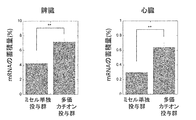
- FIG. 2A is a diagram showing that mRNA accumulation increases in organs other than the liver and kidney.
- FIG. 3 shows the effect of multivalent cations on carrier accumulation (lipoplex) in the liver (upper panel) and kidney (lower panel).
- FIG. 3A shows that mRNA accumulation increases in organs other than the liver and kidney.
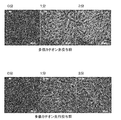
- FIG. 4 is a diagram showing accumulation of polyvalent cations on the inner surface of blood vessels of liver-like endothelial cells. In particular, it is shown that polyvalent cations coat the inner surface of similar endothelial cells.
- FIG. 4 is a diagram showing accumulation of polyvalent cations on the inner surface of blood vessels of liver-like endothelial cells. In particular, it is shown that polyvalent cations coat the inner surface of similar endo
- FIG. 5 is a diagram showing accumulation of polyvalent cations on the inner surface of blood vessels of peripheral (ear) vascular endothelial cells. Substantial multivalent cation coverage or accumulation is not observed in peripheral vascular endothelial cells.
- FIG. 6 is a diagram showing the effect of a polyvalent cation on the retention in blood of a nucleic acid-containing carrier.
- FIG. 7 is a graph showing the effect of polyvalent cations on the accumulation of nucleic acid-encapsulating carriers on the blood vessel inner surface of liver endothelial cells.
- FIG. 8 is a diagram showing that the multivalent cation of the present invention does not substantially interact with albumin.
- FIG. 9 is a graph showing the effect of polyvalent cations on the accumulation of mRNA in the spleen of lipoplexes.
- FIG. 10 is a diagram showing blood retention of bPEG-PLL, PEG-PLL, and bPEG.
- FIG. 11 is a diagram showing the change over time of the abundance of bPEG-PLL in the luminal wall of the hepatoid endothelial cells.
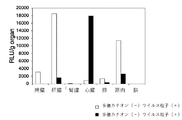
- FIG. 12 is a diagram showing the influence of multivalent cations on the accumulation properties of virus particles in each organ.
- FIG. 13 is a diagram showing the influence of multivalent cations on the accumulation properties of virus particles in each organ.
- subject refers to mammals including humans.
- the subject may be a healthy subject or a subject suffering from some disease.
- the subject is a mammal, eg, a human, and in particular can be a mammal, eg, a human, for whom administration of micelles of the invention is beneficial.
- “for drug delivery” means being biocompatible and capable of encapsulating a drug in a carrier.
- “for drug delivery” means a use for prolonging the blood remaining time of a drug in comparison with the blood remaining time of a naked drug, or a delivery amount of a drug to a predetermined tissue. It may mean an improved use.
- carrier refers to fine particles or hollow fine particles that can contain a substance.
- the carrier preferably has a biocompatible shell or modification.
- a liposome and a micelle are mentioned, Especially the liposome comprised by a phospholipid etc. is mentioned.
- micelle means a carrier formed by aggregation of molecules such as polymers.
- examples of micelles include micelles formed from amphiphilic molecules such as surfactants, and micelles formed from polyion complexes (PIC micelles).
- the micelle is preferably modified on the outer surface with an uncharged hydrophilic chain from the viewpoint of improving bioavailability.
- average molecular weight means number average molecular weight unless otherwise specified.
- degree of polymerization means the number of monomer units in the polymer
- average degree of polymerization means the number average degree of polymerization unless otherwise specified.
- the “cationic block” and the “cationic polymer” are obtained by polymerizing a monomer unit including a cationic monomer, respectively.
- the cationic polymer include a homocationic polymer, a polymer in which a homocationic polymer and an uncharged hydrophilic chain are linked, and the like.
- the cationic polymer portion may be referred to as a cationic block.
- a cationic polymer is a pharmaceutically acceptable cationic polymer.
- the “multivalent cation” refers to a molecule having a plurality of groups having a cationic property among the molecules that are cationic.
- a “multivalent cation” can be cationic as a whole molecule in the blood environment.
- Multivalent cations include molecules that are cationic in the blood environment, such as cationic polymers and cationic dendrimers.
- the polyvalent cation is a polyvalent cation having biocompatibility.
- “dendrimer” refers to a molecule having a plurality of stages of branching from one core atom.
- the “hydrophilic block” means a polymer chain that is soluble in an aqueous medium, and is sometimes referred to as a hydrophilic polymer block.
- the uncharged hydrophilic chain is a pharmaceutically acceptable uncharged hydrophilic chain.
- Such hydrophilic chains include polyethylene glycol (PEG) and poly (2-ethyl-2-oxazoline).
- the non-charged hydrophilic chain may have a polar atom as long as the charge is neutralized locally and entirely.
- the hydrophilic block may or may not contain a branch. If the hydrophilic block has branch points, the number of branch points may be one or more.
- temperature-responsive block and “temperature-responsive polymer” mean a polymer block and a polymer that can change from hydrophilic to hydrophobic depending on temperature, respectively.
- Various substances that change from hydrophilic to hydrophobic depending on temperature are known.
- a temperature-responsive polymer has a lower critical solution temperature (LCST), is hydrophilic below LCST, and hydrophobic above LCST.
- the temperature responsive polymer comprises a temperature responsive block.
- the temperature responsive polymer includes a temperature responsive block and a hydrophilic block.
- the temperature responsive polymer does not have a cationic block.
- the temperature-responsive polymer may be a polymer consisting essentially of a temperature-responsive block or a polymer consisting of a temperature-responsive block.
- the lower critical solution temperature (LCST) can be preferably 4 ° C. or higher and 40 ° C. or lower, and can be lower than the body temperature of a subject such as a human.
- ternary copolymer or “triblock copolymer” means a block copolymer containing three different polymer blocks. Each block may be connected via a linker or a spacer.
- a terpolymer may be denoted as “ABC” if it contains three different blocks, A, B and C, in this order. The symbol “-” can be a bond or a linker or spacer.
- the terpolymer may contain other different polymer blocks as long as it contains three different polymer blocks.
- the terpolymer may consist essentially of three different polymer blocks “ABC” or may consist of “ABC”.
- outer shell means a protective layer that wraps RNA.
- the outer shell does not necessarily mean to exist in the outermost shell.
- the “protective layer” can protect RNA from degradation by a degrading enzyme such as RNase as compared to the case where it does not exist.
- “comprise” is used to mean “consisting of” and “essentially consistent”. “Contains” means that a component other than the target component may be included, and “consists of” does not include any component other than the target component. means. In this specification, “consisting essentially of” means that a component other than the target component is not included in a mode that exhibits a special function (such as a mode that completely loses the effect of the invention). To do.
- administering A and B separately means that A and B are administered separately in time, and that A and B are not mixed together at the same time. Used to mean administration.
- “clearance” refers to drug metabolism and drug excretion.
- clearance can be a decrease in drug due to metabolism or a decrease in drug excreted from the blood. It is known that the drug reduces the retention in the blood by clearance.
- target organ or tissue refers to an organ or tissue to which a drug to be administered is to be delivered.
- the target organ or tissue will vary depending on the type of drug being administered and the type of patient being administered.
- target organ or tissue is not meant to mean delivering a drug only to the organ or tissue, but to any organ or tissue other than the organ or tissue as long as the drug is delivered to the target organ or tissue. It shall mean that the drug may be delivered. Delivery of the drug to the “target organ or tissue” is preferably selective to the target organ or tissue.
- selective means that the drug accumulates more in the target organ or tissue than in other organs or tissues.
- the polyvalent cation represented by the cationic polymer can be used to control the pharmacokinetics in the body.
- the cationic polymer can also be used to control pharmacokinetics in the body.
- control of pharmacokinetics is improvement or change of pharmacokinetics.
- Control of pharmacokinetics includes control of clearance. More specifically, the control of pharmacokinetics includes a reduction in the ability of the liver to excrete the drug by the same endothelial cells. Control of pharmacokinetics also includes reducing the ability of the kidneys to excrete drugs from the blood. Control of pharmacokinetics further includes increasing the amount delivered to the target organ. Control of pharmacokinetics further includes increasing the amount of drug delivered to the spleen. Further control of pharmacokinetics includes an increase in drug retention in the blood.
- a polyvalent cation such as a cationic polymer
- the metabolism of blood drug by the liver's homologous endothelial cells or the excretion through the same is suppressed, and the metabolism or excretion by the kidney is suppressed.
- a polyvalent cation such as a cationic polymer controls the dynamics in the body of other pharmaceutically active ingredients (drugs) administered simultaneously or separately.
- a polyvalent cation such as a cationic polymer need not be a pharmaceutically active ingredient.
- a polyvalent cation such as a cationic polymer does not need to form a complex with a pharmaceutically active ingredient (that is, it may be in a free form).
- the polyvalent cation may be modified with a hydrophilic polymer from the viewpoint of improving the bioavailability of the cation itself.
- the cationic polymer may be, for example, in the form of a copolymer of a cationic block and a hydrophilic polymer block.
- hydrophilic polymer block for example, an uncharged hydrophilic polymer block can be used.
- Uncharged hydrophilic polymer blocks are pharmaceutically acceptable polymers.
- Such a polymer is not particularly limited.
- non-charged hydrophilic polymer polyalkylene glycol and poly (2-oxazoline) are preferably used, and polyalkylene glycol can be particularly preferably used.
- polyalkylene glycol polyethylene glycol (PEG) can be preferably used.
- the average molecular weight of the PEG portion can be, for example, 10 kD or more, 15 kD or more, 20 kD or more, 30 kD or more, or 40 kD or more (for example, 80 kD or more).
- it may be 70 kD or less, 60 kD or less, or 50 kD or less), preferably 20 kD or more, more preferably 30 kD or more.
- the cationic polymer may have an average degree of polymerization of 15 or more, 20 or more, 30 or more, or 40 or more (for example, 80 or less, 70 or less, 60 or less Or may be 50 or less).
- the PEG moiety may have a high average molecular weight, for example, 40 kD or more, 50 kD or more, 60 kD or more, or 70 kD or more (eg, 80 kD or less, 70 kD or less, 60 kD or less, or 50 kD or less.
- a branched PEG having a plurality of can also be used. From the viewpoint of increasing the bulk of the PEG moiety, branched PEG can be preferably used.
- the copolymer comprising a cationic polymer moiety and a PEG moiety is a branched PEG wherein the PEG moiety has multiple PEG chains of 10 kD or more, 15 kD or more, 20 kD or more, 30 kD or more, or 40 kD or more,
- the cationic polymer portion can have an average degree of polymerization of 15 or more, 20 or more, 30 or more, or 40 or more.
- the copolymer comprising a cationic polymer and PEG is a branched PEG in which the PEG moiety has multiple PEG chains of 20 kD or greater, 30 kD or greater, or 40 kD or greater, and the cationic polymer moiety is an average polymerized
- the degree can be 20 or more, 30 or more, or 40 or more.
- the copolymer comprising a cationic polymer moiety and a PEG moiety is a single-chain PEG having a PEG moiety of 40 kD or more, and the cationic polymer moiety has an average degree of polymerization of 15 or more, 20 or more, 30 or more, It may be 40 or more, 50 or more, 60 or more, or 70 or more (for example, 80 or less, 70 or less, 60 or less, or 50 or less.
- the higher the average molecular weight the more the blood stays. The effect of improving the sex is great).
- the cationic polymer block has an average degree of polymerization of 15-30, the cationic polymer block is linked to a branched PEG, and the branched PEG has a total average molecular weight of the PEG moiety of 40 kD to 100 kD, It can be 50 kD to 90 kD, or 60 kD to 80 kD.
- a branched PEG has one branch, and the average molecular weight of each PEG chain extending from the branch can be independently, for example, 20 kD to 60 kD, 25 kD to 50 kD, or 30 kD to 40 kD.
- such a copolymer of a branched PEG and a cationic polymer can be administered as the polyvalent cation of the present invention.
- the cationic polymer block has an average degree of polymerization of 15 to 30, the cationic polymer block is linked to a branched PEG, and the branched PEG has one branch and extends from the branch.
- the average molecular weight of each PEG chain can independently be, for example, 20 kD to 60 kD, 25 kD to 50 kD, or 30 kD to 40 kD.
- a copolymer of such a branched PEG and a cationic polymer Can be administered as the multivalent cation of the present invention.
- the cationic polymer or cationic polymer moiety includes, for example, cationic natural amino acids and cationic unnatural amino acids, for example, cationic natural amino acids such as histidine, tryptophan, ornithine, arginine and lysine, and / or A group represented by — (NH— (CH 2 ) 2 ) p —NH 2 , wherein p is an integer of 1 to 5; ⁇
- a side chain for example, a cationic non-natural amino acid polymer block having the cationic side chain, for example, a cationic non-natural amino acid such as aspartic acid or glutamic acid having the cationic side chain. Examples include polymer blocks.
- the polycation block is a group represented by — (NH— (CH 2 ) 2 ) p —NH 2 , where p is an integer of 1 to 5.
- p is an integer of 1 to 5.
- the cationic natural amino acid is preferably histidine, tryptophan, ornithine, arginine and lysine, more preferably arginine, ornithine and lysine, still more preferably ornithine and lysine, and still more preferably. Includes lysine.
- the cationic polymer or cationic polymer portion can be polylysine or polyornithine.
- the polycation block In the polycation block, a cationic amino acid and an amino acid having a cationic side chain may be mixed. That is, in one embodiment of the present invention, the polycation block is a polymer of monomer units containing a cationic natural amino acid, a cationic unnatural amino acid, or a cationic natural amino acid and a cationic unnatural amino acid. In some embodiments of the invention, the bond between monomer units in the polycation block is a peptide bond.
- the cationic unnatural amino acid is a group represented by — (NH— (CH 2 ) 2 ) p —NH 2 as a side chain ⁇ where p is an integer of 1 to 5 ⁇ It is an amino acid having
- the polycation block includes a cationic natural amino acid and a group represented by — (NH— (CH 2 ) 2 ) p —NH 2 , where p is an integer of 1 to 5. is there.
- 40%, 50%, 60%, 70%, 80%, 90%, 95%, 98%, or 100% of the monomer units in the polymer have-(NH- (CH 2 2 ) a group represented by p -NH 2 (where p is an integer of 1 to 5). ⁇ .
- polylysine or polyornithine having a branched PEG wherein the PEG moiety is a branched PEG having two PEGs having an average molecular weight of 20 to 50 kD
- ornithine include polylysine or polyornithine having a branched PEG having an average degree of polymerization of 20 to 70, or 30 to 60.
- the PEG or branched PEG can be linked to the end of the cationic polymer.
- Another embodiment is a polymer having a main skeleton of a cationic monomer such as lysine and ornithine, and 5% to 80%, or 20% to 50% of the side chain of the monomer unit is hydrophilic such as PEG or branched PEG.
- the polymer may be modified with a conductive polymer (that is, a graft copolymer).
- the polyvalent cation of the present invention can reduce the clearance function of the endothelial cells themselves by coating the blood vessel inner surface of the liver similar endothelial cells and the blood vessel inner surface of the kidney vascular endothelial cells.
- the multivalent cation of the present invention can be administered before, simultaneously with, or after administration of various drugs. In either case, when the multivalent cation and the drug are administered separately, the pharmacokinetics can be controlled when both are present in the blood simultaneously ⁇ the multivalent cation prior to drug administration.
- the multivalent cation is administered while the drug remains in the blood ⁇ .
- the multivalent cation can be administered, for example, immediately prior to drug administration, for example, can be administered 30 seconds or more before, 1 minute or more, 2 minutes or more, 3 minutes or more, 4 minutes or more. Or 5 minutes or more before.
- the multivalent cation can be administered, for example, within 60 minutes, within 50 minutes, within 40 minutes, within 30 minutes, within 20 minutes, or within 10 minutes prior to drug administration.
- the drug can be administered 10 minutes, 5 minutes, 4 minutes, 3 minutes, 2 minutes, 1 minute, 30 seconds, or just before the administration of the multivalent cation, A short period from administration to administration of polyvalent cation is preferred.
- the drug and polyvalent cation can be mixed in the infusion bag and administered.
- the cationic polymer of the present invention can reduce the clearance function of the endothelial cells themselves by coating the blood vessel inner surface of the liver similar endothelial cells and the blood vessel inner surface of the kidney vascular endothelial cells.
- the cationic polymers of the present invention can be administered before, simultaneously with, or after administration of various drugs.
- the pharmacokinetics can be controlled when both are present in the blood simultaneously ⁇ the cationic polymer prior to drug administration.
- the cationic polymer When the cationic polymer is retained in the blood or while remaining on the blood vessel inner surface of the similar endothelial cell of the liver or while remaining on the blood vessel inner surface of the renal endothelial cell, When a drug is administered and a cationic polymer is administered after the drug is administered, the cationic polymer is administered while the drug remains in the blood ⁇ .
- the cationic polymer can be administered, for example, immediately prior to drug administration, for example, can be administered 30 seconds or more before, 1 minute or more, 2 minutes or more, 3 minutes or more, 4 minutes or more. Or 5 minutes or more before.
- the cationic polymer can be administered, for example, within 60 minutes, within 50 minutes, within 40 minutes, within 30 minutes, within 20 minutes, or within 10 minutes prior to drug administration.
- the drug can be administered 10 minutes, 5 minutes, 4 minutes, 3 minutes, 2 minutes, 1 minute, 30 seconds, or just prior to administration of the cationic polymer, A shorter time from administration to administration of the cationic polymer is better.
- simultaneous administration for example, the drug and the cationic polymer can be mixed in the infusion bag and administered.
- the multivalent cation of the present invention can be administered at a dosage and frequency so that the clearance of the administered drug is reduced by a necessary time in combination with (or before and after) the administration time of the drug. Can be determined. In certain embodiments of the invention, the multivalent cation of the invention may be administered in a single dose or multiple doses to reduce the clearance of the administered drug by the required time in conjunction with (or before or after) the administration of the drug. Can be administered. In certain embodiments of the invention, depending on the purpose, the administration can be bolus administration or infusion administration.
- the drug delivery carriers (micelles and liposomes) encapsulating nucleic acids are reduced in the accumulation in the liver's homologous endothelial cells and in the kidney's endothelial cells by the polyvalent cations. Therefore, the polyvalent cation of the present invention can be used particularly for controlling the pharmacokinetics of a drug delivery carrier encapsulating a nucleic acid. According to the present invention, the drug delivery carriers (micelles and liposomes) encapsulating nucleic acids have reduced accumulation in liver similar endothelial cells and kidney endothelial cells by the cationic polymer.
- the cationic polymer of the present invention can be used particularly for controlling the pharmacokinetics of a drug delivery carrier encapsulating a nucleic acid.
- nucleic acids include deoxyribonucleic acid (DNA) and ribonucleic acid (RNA), modified nucleic acids such as Locked nucleic acid (LNA) and cross-linked nucleic acid (BNA), or hybrids thereof.
- LNA Locked nucleic acid
- BNA cross-linked nucleic acid
- DNA include, but are not limited to, linear double-stranded DNA, linear single-stranded DNA, circular double-stranded DNA, and circular single-stranded DNA.
- RNA examples include, but are not limited to, siRNA, shRNA, micro RNA, messenger RNA (mRNA), transfer RNA (tRNA), ribosomal RNA (rRNA), non-coding RNA (ncRNA), and double-stranded RNA, and These RNA derivatives are mentioned.
- Multivalent cations can be present in free form when administered with drug delivery carriers (micelles or liposomes) encapsulating nucleic acids. That is, it is known that a polyvalent cation can form a complex directly with a nucleic acid. However, in the present invention, the polyvalent cation coats the vascular endothelial cells of the liver and kidney. Is preferably present in free form (i.e., not in complex with nucleic acid).
- the drug delivery carrier encapsulating the nucleic acid may be a lipid complex such as a lipoplex instead of an ion complex.
- the cationic polymer can be present in a free form when administered together with a drug delivery carrier (micelle or liposome) encapsulating nucleic acid.
- a cationic polymer can directly form a complex with a nucleic acid.
- the cationic polymer coats vascular endothelial cells of the liver and kidney.
- the cationic polymer can be present in free form (ie, not complexed with nucleic acid).
- a cationic polymer different from the cationic polymer used for producing a drug delivery carrier encapsulating a nucleic acid can be used.
- the drug delivery carrier encapsulating the nucleic acid may be a lipid complex such as a lipoplex instead of an ion complex.
- a virus may be used as a carrier in order to increase the efficiency of introducing a nucleic acid into a cell.
- Carriers for increasing the efficiency of introducing nucleic acid into cells include retroviral vectors, lentiviral vectors, adenoviral vectors, adeno-associated viral vectors (AAV1, AAV2, AAV3, AAV4, AAV5, AAV6, AAV7, AAV8, AAV9, and Virus vectors such as AAV10), Sendai virus vectors, measles virus vectors, vaccinia virus vectors, herpes virus vectors and the like can be used.
- These vectors may have, for example, an expression unit (for example, a nucleic acid operably linked to a promoter or an enhancer) that expresses the nucleic acid to be delivered in the cell.
- a method for administering a drug to a subject comprising administering a multivalent cation to the subject and administering the drug to the subject.
- the multivalent cation and RNA are administered separately.
- the multivalent cation can be administered to the subject simultaneously with the drug, or prior to or after the drug.
- the multivalent cation may be administered at a dose that is biocompatible but does not exhibit dose limiting toxicity (DLT).
- a method of administering a drug to a subject comprising administering a cationic polymer to the subject and administering a drug to the subject.
- the cationic polymer and RNA are administered separately.
- the cationic polymer can be administered to the subject simultaneously with the drug, or prior to or after the drug.
- Cationic polymers can be administered at doses that are biocompatible but do not exhibit dose limiting toxicity (DLT).
- a method for administering a drug delivery carrier encapsulating a nucleic acid in a subject comprising administering a multivalent cation to the subject and administering a drug delivery carrier encapsulating the nucleic acid in the subject.
- a method of delivering a nucleic acid to a tissue of a subject comprising administering a polyvalent cation to the subject and administering a drug delivery carrier encapsulating the nucleic acid to the subject.
- the multivalent cation can be administered to the subject simultaneously with the drug delivery carrier encapsulating the nucleic acid, or before or after the drug.
- a method for administering a drug delivery carrier encapsulating a nucleic acid to a subject comprising administering a cationic polymer to the subject and administering a drug delivery carrier encapsulating the nucleic acid to the subject.
- a method for delivering a nucleic acid to a tissue of a subject comprising administering a cationic polymer to the subject and administering a drug delivery carrier encapsulating the nucleic acid to the subject.
- the cationic polymer can be administered to the subject simultaneously with, or before or after the drug delivery carrier encapsulating the nucleic acid.
- micelles formed by terpolymers comprising a hydrophilic block, a temperature responsive block and a cationic block dramatically improve the blood stability of nucleic acids, eg, brain tissue It was found that nucleic acids can be delivered in large quantities. Therefore, according to the present invention, for example, an organ or tissue comprising a nucleic acid, a terpolymer comprising a hydrophilic block, a temperature-responsive block, and a cationic block, and a micelle whose surface is modified with glucose.
- Compositions are provided for use in delivering nucleic acids, particularly to the brain.
- Such micelles can be prepared by the following procedure.
- a terpolymer containing a hydrophilic block, a temperature-responsive block and a cationic block, and RNA are mixed in an aqueous solution at a temperature lower than LCST so that micelles can be formed.
- the temperature of the aqueous solution is raised above the LCST to change the temperature responsive block from hydrophilic to hydrophobic.
- the micelles thus obtained are considered to have a state in which the nucleic acid is encapsulated and has a hydrophobic protective layer as its outer shell, and the encapsulated nucleic acid can be stably maintained in the blood. it can. That is, in this micelle, the nucleic acid is covered with an outer shell formed of a temperature-responsive block that has changed to hydrophobicity.
- the LCST of the terpolymer is preferably 35 ° C. or lower. By doing so, the micelle state is maintained in the blood after administration.
- LCST is preferably 5 ° C. or higher. Note that it is preferable to set an appropriate LCST in consideration of various other situations.
- the LCST can be 5 ° C. to 35 ° C., 10 ° C. to 32 ° C., or 25 ° C. to 32 ° C.
- water soluble polymers have LCST.
- any polymer having LCST within the above temperature range can be appropriately used as a temperature-responsive block.
- the hydrophilic block of the terpolymer can be polyethylene glycol or poly (2-ethyl-2-oxazoline).
- the average molecular weight of the hydrophilic block can be, for example, 10 kD or more, 15 kD or more, 20 kD or more, 30 kD or more, or 40 kD or more.
- the hydrophilic block can also have an average molecular weight of, for example, 20 kD or less, 30 kD or less, 40 kD or less, or 50 kD or less.
- the temperature responsive block of the terpolymer is poly (N-isopropylacrylamide), poly (2-n-propyl-2-oxazoline), or poly (2-isopropyl-2oxazoline). It can be.
- the average molecular weight of the temperature-responsive block can be, for example, 3 kD or more, 5 kD or more, 7 kD or more, or 10 kD or more.
- the average molecular weight of the temperature responsive block can also be, for example, 10 kD or less, 15 kD or less, or 20 kD or less.
- the polycationic block of the terpolymer may be a peptide containing a natural or non-natural cationic amino acid as a monomer unit.
- the polycationic block of the terpolymer can be, for example, a peptide containing natural cationic amino acids such as lysine and ornithine as monomer units, such as polylysine or polyornithine.
- the polycationic block of the terpolymer is, for example, a peptide containing, for example, aspartic acid or glutamic acid having a carboxyl group modified with diethylenetriamine or triethylenetetraamine as a monomer unit, such as a homopolymer.
- the average degree of polymerization of the polycationic block can be, for example, 30 or more, 40 or more, 50 or more, 60 or more, or 70 or more.
- the average degree of polymerization of the polycationic block can also be 70 or less, 80 or less, 90 or less, or 100 or less.
- the terpolymer has a hydrophilic block of polyethylene glycol or poly (2-ethyl-2-oxazoline) and a temperature-responsive block of poly (2-n-propyl-2- Oxazoline) and the polycationic block is polylysine or polyornithine.
- the terpolymer has a hydrophilic block of polyethylene glycol, the temperature-responsive block is poly (2-n-propyl-2-oxazoline), and the polycationic block is Polylysine.
- the drug delivery carrier encapsulating the nucleic acid may be a micelle in which the nucleic acid encapsulated by the hydrophobic protective layer, such as the terpolymer, is stabilized.
- the carrier for drug delivery including the nucleic acid also includes vesicles, for example, lipid-based vesicles, for example, liposomes, for example, lipid-based vesicles such as Invivofectamine TM (for example, lipoplexes). ) Can be used. These vesicles preferably have a hydrophilic polymer coating on their surface.
- a carrier whose outer surface is coated with a GLUT1 ligand such as glucose can be used (for details, see WO2015 / 075942A1).
- This carrier improves brain accumulation when administered according to the following regimen. That is, the dosing regimen includes administering the composition to a subject that has been fasted or has induced hypoglycemia and inducing an increase in blood glucose levels in the subject.
- the nucleic acid delivered to the spleen is not particularly limited, and examples thereof include a nucleic acid encoding a factor that enhances the function of the spleen (for example, immune function).
- nucleic acids encoding factors that enhance immune function include nucleic acids encoding peptides and proteins that serve as antigens of immune cells.
- nucleic acids encoding peptides and proteins that serve as antigens of immune cells include, for example, peptide vaccines, particularly peptides used as tumor-specific peptide vaccines (for example, HLA-restricted peptides such as HLA-A24 and HLA-A2 And a nucleic acid encoding a restriction peptide (for example, HLA-A2: 01 and HLA-A24: 01 restriction peptide). Many such peptides have already been developed and many have undergone clinical studies, and those skilled in the art will be able to select them appropriately and use them in the present invention.
- AAV8 for delivery of nucleic acids to the spleen.
- AAV8 in the manufacture of a medicament for use in delivering nucleic acids to the spleen.
- the use of a combination of AAV8 and a multivalent cation for the delivery of nucleic acids to the spleen there is provided the use of a combination of AAV8 and a multivalent cation in the manufacture of a medicament for use in delivering a nucleic acid to the spleen.
- the use of a multivalent cation for use in delivering AAV8 to the spleen there is provided the use of a multivalent cation for use in delivering AAV8 to the spleen.
- a multivalent cation in the manufacture of a medicament for use in delivering AAV8 to the spleen there is provided the use of a medicament for use in delivering AAV8 to the spleen comprising a multivalent cation is provided.
- the heart disease or disorder to be treated includes, for example, myocardial infarction, but is not limited thereto.
- a method of treating these heart diseases or disorders in a subject in need thereof comprising administering AAV used in combination with a multivalent cation of the present invention.
- AAV9 can be used as AAV.
- AAV9 may have a gene encoding a factor having a cardiac regeneration effect such as vascular endothelial growth factor (VEGF).
- VEGF vascular endothelial growth factor
- the use of a combination of AAV9 and a multivalent cation in the manufacture of a medicament for use in delivering a nucleic acid to the heart According to the present invention there is provided the use of AAV9 for delivery of nucleic acids to the heart. According to the present invention there is provided the use of a combination of AAV9 and a multivalent cation in the manufacture of a medicament for use in delivering a nucleic acid to the heart. According to the present invention there is provided the use of a multivalent cation for use in delivering AAV9 to the heart. According to the present invention there is provided the use of a multivalent cation in the manufacture of a medicament for use in delivering AAV9 to the heart. According to the present invention, a medicament for use in delivering AAV9 to the heart comprising a multivalent cation is provided.
- GLUT1 ligand means a substance that specifically binds to GLUT1.
- Various ligands are known as GLUT1 ligands, including, but not limited to, molecules such as glucose and hexose, both of which are used in the present invention for the preparation of carriers or conjugates instead of glucose. be able to.
- the GLUT1 ligand preferably has an affinity for GLUT1 that is equal to or greater than that of glucose.
- inducing hypoglycemia means lowering the blood glucose level in the subject than the blood glucose that should have been shown if the treatment was not performed.
- examples of a method for inducing hypoglycemia include administration of a diabetic drug.
- in inducing hypoglycemia as long as the purpose of inducing hypoglycemia is achieved, for example, taking other drugs or drinking a drink such as water is acceptable.
- Inducing hypoglycemia may involve other treatments that do not substantially affect blood glucose.
- fasting means fasting a subject, for example, 3 hours or more, 4 hours or more, 5 hours or more, 6 hours or more, 7 hours or more, 8 hours or more, 9 hours or more, 10 hours or more, 11 hours or more, 12 hours or more, 13 hours or more, 14 hours or more, 15 hours or more, 16 hours or more, 17 hours or more, 18 hours or more, 19 hours or more, 20 hours or more, 21 hours or more, 22 hours or more, 23 hours Or more, 24 hours or more, 25 hours or more, 26 hours or more, 27 hours or more, 28 hours or more, 29 hours or more, 30 hours or more, 31 hours or more, 32 hours or more, 33 hours or more, 34 hours or more, 35 hours or more, 36 hours or more, 37 hours or more, 38 hours or more, 39 hours or more, 40 hours or more, 41 hours or more, 42 hours or more, 43 hours or more, 44 hours or more, 45 hours or more, 46 hours or more, 47 hours It means to the upper or fasted at least 48 hours.
- the fasting period is determined by a doctor or the like in view of the health condition of the subject. For example, it is preferable that the fasting period be a period of time longer than the time for the subject to reach fasting blood glucose.
- the fasting period may be, for example, a period of time beyond which the expression of GLUT1 on the intravascular surface of cerebral vascular endothelial cells increases or reaches a plateau.
- the fasting period can be, for example, the above period that is 12 hours or more, 24 hours or more, or 36 hours or more. Fasting may also involve other treatments that do not substantially affect blood glucose levels or the expression of GLUT1 on the intravascular surface.
- “inducing an increase in blood glucose level” means increasing the blood glucose level in a subject in which hypoglycemia is induced or in a subject in which a hypoglycemic state is maintained.
- the blood glucose level can be increased by various methods well known to those skilled in the art.
- administration of an agent that induces an increase in blood glucose level for example, an increase in blood glucose level such as glucose, fructose (fructose), galactose, etc.
- administration of a simple sugar administration of a polysaccharide that induces an increase in blood sugar level such as maltose, intake of a carbohydrate that induces an increase in blood sugar level such as starch, or diet.
- blood glucose manipulation refers to inducing hypoglycemia in a subject and then raising the blood glucose level. After inducing hypoglycemia in the subject, the subject's blood glucose level can be maintained at the hypoglycemia.
- the time for maintaining the subject's blood sugar level at low blood sugar is, for example, 0 hour or more, 1 hour or more, 2 hours or more, 3 hours or more, 4 hours or more, 5 hours or more, 6 hours or more, 7 hours or more, 8 hours or more 9 hours or more, 10 hours or more, 11 hours or more, 12 hours or more, 13 hours or more, 14 hours or more, 15 hours or more, 16 hours or more, 17 hours or more, 18 hours or more, 19 hours or more, 20 hours or more, 21 More than time, more than 22 hours, more than 23 hours, more than 24 hours, more than 25 hours, more than 26 hours, more than 27 hours, more than 28 hours, more than 29 hours, more than 30 hours, more than 31 hours, more than 32 hours, more than 33 hours 34 hours or more, 35 hours or more, 36 hours or more, 37 hours or more, 38 hours or more, 39 hours or more, 40 hours or more, 41 hours or more, 42 hours or more, 43 hours or more, 44 hours or more, 45 hours or less , 46 hours or more
- the blood sugar level can be raised.
- “maintaining blood glucose” is permitted to take other drugs or drink beverages such as water, for example, as long as the purpose of maintaining hypoglycemia in the subject is achieved. Inducing hypoglycemia may involve other treatments that do not substantially affect blood glucose.
- the composition may be administered to the subject simultaneously, sequentially or sequentially with the induction of an increase in blood glucose level in the subject.
- the dosing schedule may or may not have an interval between administration of the composition to the subject and induction of an increase in blood glucose level in the subject.
- the composition When the composition is administered concurrently with inducing an increase in blood glucose level in the subject, the composition may be administered to the subject in a form mixed with an agent that causes an increase in blood glucose level.
- the agent may be administered in a form other than the drug that induces an increase in blood glucose level in the subject.
- the composition also induces an increase in blood glucose level in the subject and, if administered continuously or sequentially to the subject, the composition precedes the induction of an increase in blood glucose level in the subject.
- the composition can be administered to the subject prior to inducing an increase in blood glucose levels in the subject.
- the composition is administered to the subject within 15 minutes, within 10 minutes.
- the composition is administered to the subject within 6 hours, within 4 hours, within 2 hours.
- the above regimen cycle may be performed more than once.
- the context of glucose administration and sample administration can be determined by the timing of passage through the blood brain barrier.
- the micelle in which the nucleic acid encapsulated by the hydrophobic protective layer, such as the terpolymer of the present invention is stabilized can be used for delivery to cerebral vascular endothelial cells.
- the role of glucose in the present invention is also the same in the blood nerve barrier, blood retinal barrier and blood cerebrospinal fluid barrier.
- GLUT1 is also expressed in vascular endothelial cells during hypoglycemia at the blood nerve barrier, blood retina barrier and blood cerebrospinal fluid barrier.
- the above-described ternary copolymer or the like of the present invention which is a stabilized micelle of a nucleic acid encapsulated by a hydrophobic protective layer, is used to pass through the blood nerve barrier, blood retinal barrier and blood cerebrospinal fluid barrier.
- Micelles stabilized by nucleic acid encapsulated by a hydrophobic protective layer, such as the above terpolymers of the present invention are also delivered to vascular endothelial cells present at the blood nerve barrier, blood retinal barrier and blood cerebrospinal fluid barrier It can also be used to do.
- Example 1 Effect of multivalent cation administration on accumulation of drug delivery micelles in liver
- micelles having glucose modification on the surface of triblock polymer micelles of PEG (molecular weight 11k) -b-PnPrOx (molecular weight 8k) -b-PLys (polymerization degree 43) were used.
- Surface glucose modification is a modification for facilitating delivery of micelles to the brain.
- glucose-modified micelles are administered to a fasted subject, and the blood glucose level of the subject before and after this is administered. As the blood glucose level rises, the micelles are remarkably taken up by the brain.
- DIG-PEG glucose derivative DIG at the PEG side end
- a copolymer of DIG-PEG, PnPrOx, and PLys was obtained by linking PnPrOx-b-PLys synthesized according to the description in European Polymer Journal, 2017, 88, 553-561 and Glc-PEG.
- the synthesis scheme of the triblock copolymer was as shown in Schemes 1 to 4 below.
- Alkyne-PnPrOx-b-PLys was synthesized as follows. First, the polymerization initiator propargyl p-toluenesulfonate (61 mg, 0.29 mmol) was dissolved in 7 mL of acetonitrile, and 2-n-propyl-2-oxazoline (2.5 g, 22 mmol) was added. After reacting the reaction solution at 42 ° C.
- Acetonitrile as a reaction solvent was purchased from wako, and used after being purified by distillation using calcium hydride as a dehydrating agent. Sodium azide was purchased from Wako and used as it was. After the polymerization reaction, the reaction solution was dialyzed 5 times against water and freeze-dried to obtain alkyne-PnPrOx-N 3 having an azide end. The obtained PnPrOx was found to have a molecular weight of 8.3 k from analysis by MALDI-TOF MS (UltraFlextreme, Bruker) and 1 H-NMR (ESC400, JEOL).
- alkyne-PnPrOx-N 3 was converted to the amine end by the Staudinger reaction.
- alkyne-PnPrOx-N 3 (830 mg, 0.10 mmol) was dissolved in 20 mL of methanol, triphenylphosphine (530 mg, 2.0 mmol) was added, and the mixture was stirred at 40 ° C. for 3 hours.
- 20 mL of pure water was added and ice-cooled, and unreacted triphenylphosphine and the like were removed by filtration. The obtained solution was dialyzed 3 times against pure water and then recovered by freeze-drying.
- alkyne-PnPrOx-NH 2 was further purified using an open column using CM-Sephadex C50 purchased from GE-health care as a column filler. Methanol and triphenylphosphine used here were purchased from Sigma-Aldrich and Tokyo Kasei, respectively.
- Lys (TFA) -NCA was polymerized from alkyne-PnPrOx-NH 2 purified and recovered as described above, and then alkyne-PnPrOx-b-PLys was obtained by deprotecting the TFA group with a base.
- Alkyne-PnPrOx-NH 2 (330 mg, 0.040 mmol) was lyophilized using dioxane.
- Lys (TFA) -NCA 480 mg, 1.8 mmol was measured in a flask in an Ar bag and dissolved in 6 mL of DMF (1M TU). The prepared Lys (TFA) -NCA solution was added to the initiator solution under an Ar atmosphere, and the polymerization reaction was carried out by stirring at 25 ° C. for 3 days.
- the reaction solution was dialyzed 5 times against water and then freeze-dried to obtain PnPrOx-b-Poly (L-Lysine) (TFA) (PLys (TFA)). Subsequently, 500 mg of the obtained alkyne-PnPrOx-b-PLys (TFA) was measured and dissolved in 25 mL of methanol. To this, 7.5 mL of 1M NaOH solution was added and reacted at 35 ° C. for 12 hours. After the reaction, dialysis was performed 3 times against 0.01 M HCl and then 3 times against water, and PnPrOx-b-PLys was recovered by lyophilization.
- the recovered product was confirmed to have a unimodal molecular weight distribution by SEC (AKTAexplorer, GE Helthcere) using GE Healthcare column Superdex 200.
- the obtained polymer was found to have Lys of 43 from analysis by 1 H-NMR (ESC400, JEOL).
- Lys (TFA) -NCA was synthesized by the Fuchs-Farthing method according to non-patent literature (J. Polym. Sci. Part A Polym. Chem. 2003, 41 1167-1187).
- Dioxane was purchased from Wako.
- DMF (1M TU) was prepared by dissolving thiourea purchased from Sigma-Aldrich in a dehydrated solvent purchased from Kanto Chemical.
- a 1M NaOH solution was prepared by diluting a 5M NaOH solution purchased from Nakarai with pure water. 0.01 M HCl was prepared by diluting concentrated hydrochloric acid purchased from Inusha with pure water.
- the OH terminal of DIG-PEG-OH was converted to an azide group.
- DIG-PEG-OH 550 mg, 0.050 mmol was lyophilized with benzene. This was dissolved in 20 mL of THF, and triethylamine (25 ⁇ L, 0.20 mmol) was added to form a PEG solution.
- methanesulfonyl chloride (16 ⁇ L, 0.20 mmol) was measured and diluted with 5 mL of THF. Under water cooling, the above-prepared PEG solution was added to this methanesulfonyl chloride diluted solution and allowed to react overnight. The reaction was performed in an Ar atmosphere. The reaction product was recovered by reprecipitation with 500 mL of diethyl ether. From the analysis by 1 H-NMR (ESC400, JEOL), it was found that the collected sample was DIG-PEG-Ms whose end was mesylated.
- DIG-PEG-Ms (440 mg, 0.044 mmol) was dissolved in 20 mL of DMF, sodium azide (286 mg, 4.4 mmol) was added, and the mixture was stirred at 50 ° C. for 3 days.
- ultra-dehydrated solvent purchased from Kanto Chemical was used.
- Triethylamine was purchased from Wako and used after being purified by distillation using calcium hydride as a dehydrating agent.
- Mesyl chloride was purchased from Nacalai and distilled using diphosphorus pentoxide as a dehydrating agent.
- Sodium azide purchased from Wako was used as it was.
- Alkyne-PnPrOx-PLys and DIG-PEG-N 3 were coupled by Click Chemistry.
- Alkyne-PnPrOx-PLys 31 mg, 0.0020 mmol was dissolved in 2 mL of water, and 20 ⁇ L each of 1M CuSO 4 solution and 1M sodium ascorbate solution were added and stirred.
- DIG-PEG-N 3 110 mg, 0.01 mmol was dissolved in 2 mL of water and added to the Alkyne-PnPrOx-PLys solution. This was left at -20 ° C overnight and melted at 4 ° C over 2 hours.
- the product was recovered by dialyzing the reaction solution 5 times against water and lyophilizing.
- the recovered material contains Glc-PEG-N 3 added in excess to react all of the Alkyne-PnPrOx-PLys and unreacted Alkyne-PnPrOx-PLys. . Focusing on the difference in molecular weight between these unreacted products and the resulting triblock copolymer, purification was performed by SEC. Finally, as described in WO2015075942A1, DIG was converted to glucose using TFA to obtain Glc-PEG-b-PnPrOx-b-PLys.
- a cationic polymer was synthesized in which hydrophilic blocks were connected to improve biocompatibility.
- branched poly (ethylene glycol) -b-poly (L-lysine) polymerization degree 20
- PEG-b-PLL branched poly (ethylene glycol) -b-poly (L-lysine)
- PEG-b-PLL block cationomer having branched PEG (molecular weight 37000 ⁇ 2)
- Non-patent literature J. Polym. Sci. Part A Polym. Chem.
- branched polyethylene glycol (molecular weight 37000 ⁇ 2) with a primary amine structure purchased from NOF as an initiator.
- bPEG branched polyethylene glycol
- -1187 is obtained by polymerizing Lysine (TFA) -NCA synthesized by the Fuchs-Farthing method and then treating with a base.
- bPEG-PLL first, bPEG having a primary amine (740 mg, 0.010 mmol) was freeze-dried with benzene purchased from Nacalai.
- DMF (1M TU) prepared by dissolving thiourea (TU) purchased from Sigma Aldrich in dehydrated N, N-dimethylformamide (DMF) purchased from Kanto Chemical Co. as a reaction solvent.
- Lyophilized bPEG was dissolved in 10 mL DMF (1M TU).
- Lys (TFA) -NCA was measured in a 59 mg (0.22 mmol) flask in an Ar bag and dissolved in 2 mL of DMF.
- the prepared Lys (TFA) -NCA solution was added to the bPEG solution under an Ar atmosphere and stirred at 25 ° C. for 3 days.
- the reaction solution was titrated against 300 mL of a 1: 9 mixed solution of methanol (Sigma Aldrich) and diethyl ether (Showa Ether) to reprecipitate the copolymer bPEG-PLL (TFA).
- the resulting bPEG-PLL (TFA) was collected by filtration and dried in vacuo. 500 mg of the obtained bPEG-PLL (TFA) was measured and dissolved in 25 mL of methanol. Subsequently, 7.5 mL of 1M NaOH was added to this bPEG-PLL (TFA) solution and stirred at 35 ° C. for 12 hours to deprotect the TFA group.
- bPEG-PLL was recovered by lyophilization.
- SEC LC2000 system, JASCO Corporation
- 1 H-NMR ESC400, JEOL
- Polyplex micelles were formed from the obtained triblock polymer and mRNA. Specifically, the mixture was mixed with mRNA at a charge ratio of 2 at 4 ° C., and then allowed to stand at 37 ° C. to form a hydrophobic layer so as to wrap the mRNA in the triblock polymer. Polyplex micelles having a protective layer for mRNA were obtained.
- mRNA is prepared by in vitro transcription of template DNA using mMESSAGE mMACHINE T7 Ultra Kit (Ambion) and poly (A) modification using poly (A) tail kit (Ambion) did.
- template DNA pCMV-Gluc control plasmid purchased from New England Biolabs was used.
- pDNA pCAG-Luc2 encoded by luciferase provided by RIKEN BioResource Center and having a CAG promoter was used.
- the whole collected organ is ground using Lysis buffer (promega) and multi-bead shocker (Yasui Kikai), and Cy5 fluorescence of this suspension is measured with a plate reader (Infinite M100 Pro, TECAN).
- the organ distribution was evaluated. The total dose was 100%, and the amount (%) accumulated in the organ was determined. The results were as shown in FIGS.
- the amount of mRNA accumulated in the liver was less than 30% in the micelle-administered group, whereas the amount accumulated in the polyvalent cation-administered group was about 10%. It was shown that the amount accumulated in the liver was reduced to less than half. As shown in FIG. 1, the amount of mRNA accumulated in the kidney was about 7% in the micelle-administered group, but about 5% in the polyvalent cation-administered group. It has been shown that the amount accumulated in has decreased to about 70%.
- the accumulated amount of mRNA in other organs such as the spleen and the heart was evaluated, as shown in FIG. 2A, in the polyvalent cation administration group, the accumulated amount of mRNA in the spleen was also accumulated in the heart. The amount also increased significantly.
- the decrease in the amount of mRNA accumulated in the liver and kidney was related to the excretion ability of mRNA from the blood in the liver and kidney. Therefore, the polyvalent cation has the effect of decreasing the mRNA excretion ability from the blood in the liver and kidney, thereby increasing the distribution of mRNA, that is, the drug to organs other than the liver and kidney. Became clear.
- blood glucose manipulation fasting and glucose administration
- micelle coating with glucose were performed to promote selective accumulation in the brain. Therefore, in such a system aimed at selective delivery of mRNA, a decrease in the excretion ability of mRNA and an increase in retention in blood enhanced the accumulation of selective mRNA in the brain.
- Invivofectamine TM is a reagent for systemic administration of lipid-based mRNA and is particularly suitable for delivery of mRNA to the liver.
- Invivofectamine TM and mRNA were mixed according to the manufacturer's protocol to form a lipid-based mRNA complex.
- the mRNA used in this experiment was fluorescently labeled in advance with Label IT Tracker Cy5 Kit (Mirus Bio).
- mice were intravenously administered with 100 ⁇ L of a PEGasus-PLL solution adjusted to a concentration of 12.5 mg / mL. Five minutes later, 200 ⁇ L of the in vivofectamine solution prepared above was administered iv. After 30 minutes, whole blood was collected and perfused with PBS, and then the mouse was dissected to remove organs (liver and kidney). As a negative control group for observing the effect of polymer addition, mice were compared with a group in which 200 ⁇ L of the solution prepared above was intravenously administered without prior administration of the polymer additive.
- the collected organs were ground using Lysis buffer (promega) and multi-bead shocker (Yasui Kikai), and the Cy5 fluorescence of this suspension was measured with a plate reader (Infinite M100 Pro, TECAN). Distribution was evaluated.
- the amount of mRNA accumulated in other organs such as the spleen and heart was evaluated. As shown in FIG. 3A, the amount of mRNA accumulated in the spleen was also increased in the spleen in the polyvalent cation administration group. The amount of mRNA accumulated in the heart and the amount of mRNA accumulated in the heart increased significantly. From this, it was suggested that the delivery of mRNA, that is, a drug to various organs was promoted by the decrease in the ability to excrete mRNA from blood.
- Example 2 Pharmacokinetics of polyvalent cations
- the pharmacokinetics of polyvalent cations were elucidated in order to investigate the cause of the above function.
- mice were intravenously injected with 100 ⁇ L of PEGasus-PLL (37 ⁇ 2-20) at a concentration of 12.5 ⁇ mg / mL, which was fluorescently labeled using Alexa Fluor 594-NHS Ester purchased from Thermo-Fisher Scientific. Thereafter, the blood vessels of the liver were observed with an in vivo confocal microscope. Intravascular polymer accumulation can be assessed by fluorescence.
- an ear blood vessel was observed as an example of a peripheral blood vessel.
- FIG. 5 it was confirmed that the polyvalent cation flows in the blood vessel, but accumulation of the ear vascular endothelial cells on the inner surface of the blood vessel was not observed.
- liver and kidney are organs that greatly affect the ability of drugs to be excreted from the blood in pharmacokinetics.
- Multivalent cations adsorb to the surface of similar endothelial cells and physically coat the inner surface of blood vessels to reduce the excretion of blood from similar endothelial cells of the liver and kidneys, and drugs from the blood It was found that it has an action of lowering the excretion ability.
- This coating was also specific for liver homologous endothelial cells and kidney vascular endothelial cells.
- Example 3 Effect of Improving Micellar Retention in Blood by Multivalent Cations
- the polyvalent cation has an action of decreasing the ability of the liver to excrete drugs from the blood by similar endothelial cells and kidneys. It has been made clear. In this example, it was confirmed whether the decrease in the excretion ability contributes to the improvement of the retention of the drug in the blood.
- mice were intravenously administered with 100 ⁇ L of a PEGasus-PLL solution adjusted to a concentration of 12.5 mg / mL as a polyvalent cation.
- 200 ⁇ L of plasmid DNA (pDNA) -encapsulating polymer micelle solution prepared by the method of Biomaterial, 2017, 126, 31-38 was administered.
- the pDNA used in this experiment was fluorescently labeled in advance with Label IT Tracker Cy5 Kit (Mirus Bio). Thereafter, the retention of pDNA in blood was confirmed. The maximum value of fluorescence intensity was set to 100%, and the retention of pDNA in blood was evaluated by the change in fluorescence intensity over time.
- As a control group a group in which 200 ⁇ L of the solution prepared above was intravenously administered without prior administration of the polyvalent cation to mice was also observed.
- the cause of the decrease in the drug excretion ability from the blood observed in Examples 1 and 2 is that the polyvalent cation coats the inner surface of the blood vessel of the liver's similar endothelial cells. It was considered that the accumulation of the drug in the cells was inhibited, and that the excretion of the drug via the glomeruli was inhibited by covering the inner surface of the vascular endothelial cells of the kidney with the cationic polymer. In this way, the polyvalent cation has the effect of reducing the ability of the drug to be excreted from the blood and improving its retention in the blood, even when administered alone (ie, in free form). Thus, it was considered that the amount of drug delivered to the target organ could be improved.
- the interaction between the polyvalent cation and albumin was confirmed. Specifically, the amount of heat generated when albumin and PEGasus-PLL were mixed was measured using Malvern's isothermal titration calorimeter, Microcal® PEAQ-ITC. 200 ⁇ L of an albumin solution in which albumin was dissolved in PBS at a concentration of 33.3 ⁇ M was prepared as a cell side sample, and a PEGasus-PLL solution in which PEGasus-PLL was dissolved in PBS at a concentration of 313 ⁇ M was prepared as a syringe side sample.
- Example 4 Improvement of gene expression in spleen of lipoplex by polyvalent cations
- Invivofectamine TM is commercially available from Invitrogen as a reagent for delivering RNA to the liver.
- Invivofectamine TM is a reagent for systemic administration of lipid-based mRNA, and is said to be particularly suitable for delivery of mRNA to the liver.
- Invivofectamine TM and mRNA were mixed according to the manufacturer's protocol to form a lipid-based mRNA complex (lipoplex).
- Mice were intravenously administered with 100 ⁇ L of PEGasus-PLL solution adjusted to a concentration of 12.5 mg / mL as a polyvalent cation. Five minutes later, 200 ⁇ L of the in vivofectamine solution prepared above was administered iv.
- mice were compared with a group in which 200 ⁇ L of the solution prepared above was administered intravenously without prior administration of a polyvalent cation.
- the collected organ was ground using a Lysis buffer (promega) and a multi-bead shocker (Yasui Kikai). From this suspension, the Luciferase assay kit purchased from promega was used according to the manufacturer's protocol, and the luciferase luminescence was measured with a luminometer (Lumat LB9507, Berthold) to evaluate the gene expression level in the liver and spleen did. The result was as shown in FIG.
- gene expression in the spleen of Lipoplex could be increased 100 times or more by adding polyvalent cations.
- the addition of a polyvalent cation suppresses the uptake of the drug by the liver's similar endothelial cells and the kidney's endothelial cells and enhances the drug's retention in the blood, thereby allowing the drug to be used in organs other than the liver and kidney. Proved to increase the accumulation of.
- FIG. 9 and FIG. 3A is that in FIG. 3A, the amount of Cy5 fluorescence is evaluated, whereas in FIG. 9, the expression level of the administered mRNA is evaluated.
- mRNA can be effectively delivered to the spleen.
- the spleen is an organ from which immune cells are produced, and achieving delivery and expression of mRNA into the spleen is a major achievement that leads to the development of vaccines such as RNA vaccines and peptide vaccines.
- Example 5 Discharge characteristics of bPEG-PLL from the body In this example, the discharge of polyvalent cations from the body was examined.
- bPEG-PLL (TFA) and PEG-PLL (TFA) were converted to bPEG-PLL and PEG-PLL fluorescently labeled by deprotecting the TFA protecting group with a base as described above.
- bPEG-PLL and PEG-PLL to which lysine having a polymerization degree of 20 which is a polyvalent cation is bound, have a higher blood retention than bPEG having no cationic block.
- bPEG-PLL it was almost excreted from the blood after 10 hours (FIG. 10). From this, it was suggested that the cationic block has an action of reducing the blood retention of bPEG.
- bPEG-PLL when administered alone in free form, coats the luminal inner wall of endothelial cells for a sufficient amount of time to deliver the drug while reducing drug clearance. It was thought that it could disappear after a while.
- the polyvalent cation of the present invention is used in a single time so that the clearance of the administered drug is reduced by a necessary time together with (or before and after) the administration time of the drug. It was suggested that it could be administered or administered multiple times.
- the polyvalent cation of the present invention can be administered in such a manner that it is excreted from the body after the drug is delivered (administration frequency, dosage, etc.). It has been suggested.
- Example 6 Delivery Experiment Using Virus Particles
- the effect of multivalent cation administration on gene delivery by virus particles was examined.
- AAV8 adeno-associated virus
- AAV8 was purchased from Vector Biolabs with a gene encoding firefly luciferase under the CMV promoter (Catalog #: VB1473).
- AAV8 (1 ⁇ 10 10 viral genome / mouse) was administered from the tail vein of a mouse (Balb / c, female, 6 weeks old). Twenty-one days after administration, mice were sacrificed and organ (liver, pancreas, quadriceps, thigh) tissues were collected, and 100 mg of tissue was homogenized in 1 mL of passive lysis buffer.
- the homogenate was centrifuged at 18,000 g for 10 minutes at 4 ° C., and luminescence from luciferase was detected in 20 ⁇ L of the supernatant.
- a BCA assay was performed to determine protein concentration. Luciferase activity was expressed in relative optical units (RLU) normalized to protein content. The result was as shown in FIG.
- the polyvalent cation decreased the luciferase introduction efficiency into the liver by AAV8 and enhanced the luciferase expression in the pancreas, quadriceps, and thigh tissues. It is assumed that the accumulation in the liver was decreased and the accumulation in multiple organs was increased. From this, it was confirmed that the effect of changing the kinetics of the administered drug and reducing the clearance by the polycation of the present invention is also exerted on the virus particles.
- AAV9 capable of carrying a gene to the myocardium was used instead of AAV8.
- AAV9 was purchased from SignaGen Laboratories (Catalog #: SL101494) with a gene encoding firefly luciferase under the CMV promoter.
- the dose was 5 ⁇ 10 10 viral genome / mouse, and the mice were sacrificed 2 days after administration.
- the polyvalent cation decreased the accumulation of AAV9 in the liver and decreased the gene transfer efficiency into the liver, while increasing the accumulation in the heart, Increased gene transfer efficiency to the heart.
- the cationic polymer blocks the surface of the liver's homologous endothelial cells. This will reduce the clearance in the liver of particulate matter such as virus particles, not limited to micelles, and as a result, or at the same time, enhance the organ or tissue specificity of the virus itself It became clear to do.
Landscapes
- Health & Medical Sciences (AREA)
- Chemical & Material Sciences (AREA)
- Life Sciences & Earth Sciences (AREA)
- Public Health (AREA)
- Veterinary Medicine (AREA)
- Medicinal Chemistry (AREA)
- Pharmacology & Pharmacy (AREA)
- Epidemiology (AREA)
- Animal Behavior & Ethology (AREA)
- General Health & Medical Sciences (AREA)
- Engineering & Computer Science (AREA)
- Bioinformatics & Cheminformatics (AREA)
- Molecular Biology (AREA)
- Biochemistry (AREA)
- Dispersion Chemistry (AREA)
- Proteomics, Peptides & Aminoacids (AREA)
- Emergency Medicine (AREA)
- Nanotechnology (AREA)
- Biophysics (AREA)
- Dermatology (AREA)
- Medicinal Preparation (AREA)
- Pharmaceuticals Containing Other Organic And Inorganic Compounds (AREA)
- Medicines Containing Material From Animals Or Micro-Organisms (AREA)
- Medicines That Contain Protein Lipid Enzymes And Other Medicines (AREA)
Abstract
Description
本発明は、このような知見に基づくものである。
(2A)多価カチオンが、親水性ポリマーブロックとの結合体の形態である、上記(1A)に記載の組成物。
(3A)多価カチオンが、2本以上の親水性ポリマー鎖を有するカチオン性ポリマーである、上記(1A)に記載の組成物。
(4A)多価カチオンが、カチオン性ポリマーブロックと分岐ポリエチレングリコールとのブロック共重合体である、上記(2A)に記載の組成物。
(5A)薬物動態の制御が、血中からのクリアランスの制御である、上記(1A)~(4A)のいずれかに記載の組成物。
(6A)薬物動態の制御が、肝臓の類同内皮細胞による血中からの薬物の排泄能の低減である、上記(1A)~(5A)のいずれかに記載の組成物。
(7A)薬物動態の制御が、腎臓による血中からの薬物の排泄能の低減である、上記(1A)~(5A)のいずれかに記載の組成物。
(8A)薬物動態の制御が、標的臓器または組織への送達量の増加である、上記(1A)~(6A)のいずれかに記載の組成物。
(9A)薬物動態の制御が、脾臓への送達量の増加である、上記(1A)~(6A)のいずれかに記載の組成物。
(10A)薬物動態の制御が、薬物の血中滞留性の増大である、上記(1A)~(4A)のいずれかに記載の組成物。
(11A)動態が制御される薬物よりも先に投与される、上記(1A)~(10A)のいずれかに記載の組成物。
(12A)動態が制御される薬物と同時に投与される、上記(1A)~(10A)のいずれかに記載の組成物。
(13A)動態が制御される薬物よりも後に投与される、上記(1A)~(10A)のいずれかに記載の組成物{但し、前記投与は、前記薬物が血中に滞留している間に行われることを条件とする}。
(14A)多価カチオンが、遊離形態である、または遊離形態で投与される、上記(1A)~(13A)のいずれかに記載の組成物。
(15A)動態が制御される薬物が、薬物送達用キャリアに内包された薬物である、上記(1A)~(14A)のいずれかに記載の組成物。
(16A)(1A)~(15A)のいずれかに記載の組成物を使用することを特徴とする薬物動態の制御方法。
(1B)カチオン性ポリマーを有効成分として含む、体内の薬物動態を制御することに用いるための組成物。
(2B)カチオン性ポリマーが、親水性ポリマーブロックとの結合体(例えば、共重合体)の形態である、上記(1B)に記載の組成物。
(3B)カチオン性ポリマーが、2本以上の親水性ポリマー鎖を有するカチオン性ポリマーである、上記(1B)に記載の組成物。
(4B)カチオン性ポリマーが、カチオン性ポリマーブロックと分岐ポリエチレングリコールとのブロック共重合体である、上記(2B)に記載の組成物。
(5B)薬物動態の制御が、血中からのクリアランスの制御である、上記(1B)~(4B)のいずれかに記載の組成物。
(6B)薬物動態の制御が、肝臓の類同内皮細胞による血中からの薬物の排泄能の低減である、上記(1B)~(5B)のいずれかに記載の組成物。
(7B)薬物動態の制御が、腎臓による血中からの薬物の排泄能の低減である、上記(1B)~(5B)のいずれかに記載の組成物。
(8B)薬物動態の制御が、標的臓器または組織への送達量の増加である、上記(1B)~(6B)のいずれかに記載の組成物。
(9B)薬物動態の制御が、脾臓への送達量の増加である、上記(1B)~(6B)のい
ずれかに記載の組成物。
(10B)薬物動態の制御が、薬物の血中滞留性の増大である、上記(1B)~(4B)のいずれかに記載の組成物。
(11B)動態が制御される薬物よりも先に投与される、上記(1B)~(10B)のいずれかに記載の組成物。
(12B)動態が制御される薬物と同時に投与される、上記(1B)~(10B)のいずれかに記載の組成物。
(13B)動態が制御される薬物よりも後に投与される、上記(1B)~(10B)のいずれかに記載の組成物{但し、前記投与は、前記薬物が血中に滞留している間に行われることを条件とする}。
(14B)カチオン性ポリマーが、遊離形態である、または遊離形態で投与される、上記(1B)~(13B)のいずれかに記載の組成物。
(15B)動態が制御される薬物が、薬物送達用キャリアに内包された薬物である、上記(1B)~(14B)のいずれかに記載の組成物。
(16B)(1B)~(15B)のいずれかに記載の組成物を使用することを特徴とする薬物動態の制御方法。
本発明によればまた、カチオン性ポリマーは、体内の薬物動態を制御することに用いることができる。
ここで、薬物動態の制御とは、薬物動態の改善または変更である。薬物動態の制御としては、クリアランスの制御が挙げられる。薬物動態の制御は、より具体的には、肝臓の類同内皮細胞による血中からの薬物の排泄能の低減が挙げられる。薬物動態の制御としてはまた、腎臓による血中からの薬物の排泄能の低減が挙げられる。薬物動態の制御としてはさらに、標的臓器への送達量の増加が挙げられる。薬物動態の制御としてはさらにまた、脾臓への薬物の送達量の増加が挙げられる。薬物動態の制御としてはさらにまた、薬物の血中滞留性の増大が挙げられる。
このように、本発明では、カチオン性ポリマーなどの多価カチオンを用いることにより、血中の薬物の肝臓の類同内皮細胞による代謝またはそれを通しての排泄を抑制し、腎臓による代謝または排泄を抑制し、薬物の血中滞留性を高め、および/または、標的臓器若しくは組織(例えば、脳、肺、心臓、および脾臓など臓器または組織、並びに腫瘍など)への薬物の送達量を向上させることができる。すなわち、本発明によれば、カチオン性ポリマーなどの多価カチオンは、同時にまたは別々に投与される他の医薬有効成分(薬物)の体内の動態を制御するものである。従って、本発明によれば、カチオン性ポリマーなどの多価カチオンは医薬有効成分である必要がない。また、カチオン性ポリマーなどの多価カチオンは、医薬有効成分と複合体を形成している必要は無い(すなわち、遊離形態でよい)。
カチオン性ポリマーは、当該ポリマー自体の生物学的利用能を向上させる観点で、例えば、カチオン性ブロックと親水性ポリマーブロックとの共重合体の形態であってもよい。
このようにすることで、カチオン性ポリマーの生物学的利用能が向上し、肝臓の類同内皮細胞による血中からの薬物の排泄能の低減効果、または腎臓による血中からの薬物の排泄能の低減効果が増大することが期待できる。
ある態様では、カチオン性ポリマー部分とPEG部分とを含む共重合体は、PEG部分が、10kD以上、15kD以上、20kD以上、30kD以上、または40kD以上のPEG鎖を複数本有する分岐PEGであり、カチオン性ポリマー部分が平均重合度15以上、20以上、30以上、または40以上であり得る。この特定の態様において、カチオン性ポリマーとPEGを含む共重合体は、PEG部分が、20kD以上、30kD以上、または40kD以上のPEG鎖を複数本有する分岐PEGであり、カチオン性ポリマー部分が平均重合度20以上、30以上、または40以上であり得る。
ある態様では、カチオン性ポリマー部分とPEG部分とを含む共重合体は、PEG部分が、40kD以上の一本鎖PEGであり、カチオン性ポリマー部分が平均重合度15以上、20以上、30以上、40以上、50以上、60以上または70以上であり得る(例えば、80以下、70以下、60以下、または50以下であり得る。特に一本鎖PEGの場合は、平均分子量が大きいほど血中滞留性の改善効果が大きい)。
ある特定の態様では、カチオン性ポリマーブロックの平均重合度が15~30であり、カチオン性ポリマーブロックが分岐PEGと連結しており、分岐PEGは、PEG部分の総平均分子量が、40kD~100kD、50kD~90kD、または60kD~80kDであり得る。また、例えば、分岐PEGは1箇所の分岐を有し、当該分岐から伸びるそれぞれのPEG鎖の平均分子量が独立して、例えば、20kD~60kD、25kD~50kD、または30kD~40kDであり得る。本発明によれば、このような分岐PEGとカチオン性ポリマーとの共重合体を本発明の多価カチオンとして投与することができる。
さらなる特定の態様では、カチオン性ポリマーブロックの平均重合度が15~30であり、カチオン性ポリマーブロックが分岐PEGと連結しており、分岐PEGは、1箇所の分岐を有し、当該分岐から伸びるそれぞれのPEG鎖の平均分子量が独立して、例えば、20kD~60kD、25kD~50kD、または30kD~40kDであり得、本発明によれば、このような分岐PEGとカチオン性ポリマーとの共重合体を本発明の多価カチオンとして投与することができる。
本発明のカチオン性ポリマーは、肝臓の類同内皮細胞の血管内面や腎臓の血管内皮細胞の血管内面を被覆することにより、内皮細胞自体のクリアランス機能を低下させ得る。従って、本発明のカチオン性ポリマーは、様々な薬物の投与の前に、同時に、または、後に投与することができる。いずれの場合であっても、カチオン性ポリマーと薬物とを別々に投与する場合には、双方が同時に血中に存在するときに薬物動態の制御が可能である{薬物投与の前にカチオン性ポリマーを投与する場合は、カチオン性ポリマーが血中に滞留している間または肝臓の類同内皮細胞の血管内面に残存している間若しくは腎臓の内皮細胞の血管内面に残存している間に前記薬物を投与し、薬物の投与後にカチオン性ポリマーを投与する場合は、前記薬物が血中に滞留している間にカチオン性ポリマーを投与する}。ある態様では、カチオン性ポリマーは、例えば、薬物投与の直前に投与することができ、例えば、30秒以上前に投与することができ、1分以上、2分以上、3分以上、4分以上、または5分以上前に投与することができる。ある態様では、カチオン性ポリマーは、例えば、薬物投与前60分以内、50分以内、40分以内、30分以内、20分以内、または10分以内に投与することができる。ある態様では、薬物は、カチオン性ポリマーの投与10分前、5分前、4分前、3分前、2分前、1分前、30秒前、または直前に投与することができ、薬物投与からカチオン性ポリマーの投与までは短い方がよい。同時に投与する場合には、例えば、輸液バックに薬物とカチオン性ポリマーを混入させて投与することができる。
本発明によれば、核酸を内包した薬物送達用キャリア(ミセルやリポソーム)が、カチオン性ポリマーによって肝臓の類同内皮細胞への蓄積や腎臓の内皮細胞への蓄積が低減された。従って、本発明のカチオン性ポリマーは、特に核酸を内包した薬物送達用キャリアの薬物動態の制御に用いることができる。
核酸としては、例えば、デオキシリボ核酸(DNA)およびリボ核酸(RNA)、並びにLocked核酸(LNA)および架橋核酸(BNA)などの修飾核酸、またはこれらのハイブリッドが挙げられる。DNAとしては、特に限定されないが、直鎖状二本鎖DNA、直鎖状一本鎖DNA、環状二本鎖DNAおよび環状一本鎖DNAが挙げられる。RNAとしては、特に限定されないが、例えば、siRNA、shRNA、マイクロRNA、メッセンジャーRNA(mRNA)、トランスファーRNA(tRNA)、リボソームRNA(rRNA)、ノンコーディングRNA(ncRNA)、および二本鎖RNA、並びにこれらのRNAの誘導体が挙げられる。
カチオン性ポリマーは、核酸を内包した薬物送達用キャリア(ミセルやリポソーム)と一緒に投与する場合には、遊離形態で存在させ得る。すなわち、カチオン性ポリマーは、核酸と直接複合体を形成し得ることが知られているが、本発明では、カチオン性ポリマーは肝臓や腎臓の血管内皮細胞を被覆するものであると考えられることから、カチオン性ポリマーは、遊離形態(すなわち、核酸と複合体を形成していない状態)で存在させることができる。カチオン性ポリマーとしては、核酸を内包した薬物送達用キャリアを製造するときに用いるカチオン性ポリマーとは異なるカチオン性ポリマーを用いることができる。核酸を内包した薬物送達用キャリアは、イオンコンプレックスではなく、リポプレックスなどの脂質複合体としてもよい。
本発明のある態様では、細胞への核酸導入効率を高めるためにキャリアとしてウイルスを用いてもよい。細胞への核酸導入効率を高めるためにキャリアとしては、レトロウイルスベクター、レンチウイルスベクター、アデノウイルスベクター、アデノ随伴ウイルスベクター(AAV1、AAV2、AAV3、AAV4、AAV5、AAV6、AAV7、AAV8、AAV9、およびAAV10など)、センダイウイルスベクター、麻疹ウイルスベクター、ワクシニアウイルスベクター、ヘルペスウイルスベクター等のウイルスベクターを用い得る。これらのベクターは、例えば、送達する核酸を細胞内で発現させる発現ユニット(例えば、プロモーターまたはエンハンサーに核酸が作動可能に連結されたもの)を有してもよい。
本発明のある側面では、対象に薬物を投与する方法であって、対象にカチオン性ポリマーを投与することと、対象に薬物を投与することとを含む、方法が提供される。本発明のある態様では、カチオン性ポリマーとRNAとは別々に投与される。本発明のある態様では、カチオン性ポリマーは、薬物と同時に、または薬物よりも先に若しくは後に対象に投与され得る。カチオン性ポリマーは、生体適合性を有するが、用量制限毒性(DLT)を奏さないような用量で投与され得る。
本発明のある側面では、対象に核酸を内包した薬物送達用キャリアを投与する方法であって、対象にカチオン性ポリマーを投与することと、対象に核酸を内包した薬物送達用キャリアを投与することとを含む、方法が提供される。本発明のある側面では、対象の組織に核酸を送達する方法であって、対象にカチオン性ポリマーを投与することと、対象に核酸を内包した薬物送達用キャリアを投与することとを含む、方法が提供される。本発明のある態様では、カチオン性ポリマーは、核酸を内包した薬物送達用キャリアと同時に、または薬物よりも先に若しくは後に対象に投与され得る。
このようなミセルは、以下の手順で調製することができる。すなわち、親水性ブロックと温度応答性ブロックとカチオン性ブロックを含む三元共重合体と、RNAとをミセルを形成できるようにLCST未満の温度の水溶液中で混合する。ミセルが得られたら、水溶液の温度をLCST以上に上昇させ、温度応答性ブロックを親水性から疎水性に変化させる。このようにして得られるミセルは、核酸を内部に内包してその外殻として疎水性の保護層を有する状態となっていると考えられ、内包した核酸を血中で安定的に維持することができる。すなわち、このミセルでは、核酸は、疎水性に変化した温度応答性ブロックで形成される外殻によって覆われている。
薬剤送達用ミセルとしては、PEG(分子量11k)-b-PnPrOx(分子量8k)-b-PLys(重合度43)のトリブロック重合体ミセルの表面にグルコース修飾を有するミセルを用いた。表面のグルコース修飾は、ミセルを脳へ送達し易くするための修飾であり、WO2015075942A1の開示によれば、絶食状態の対象にグルコース修飾をしたミセルを投与し、これに前後して対象の血糖値を上昇させると、血糖値の上昇に伴って当該ミセルが顕著に脳に取り込まれる。
グルコース誘導体DIGをPEG側末端に有するポリマー(DIG-PEG)の合成は、WO2015075942A1に記載の通りに行った。また、DIG-PEGとPnPrOx、PLysの共重合体は、European Polymer Journal, 2017, 88, 553-561の記載に従って合成したPnPrOx-b-PLysと、Glc-PEGとを
連結させて得た。トリブロック共重合体の合成スキームは以下スキーム1~4に示される通りであった。


まず重合開始剤p-トルエンスルホン酸プロパルギル(61 mg, 0.29 mmol)をアセトニトリル 7 mLに溶解させ、2-n-プロピル-2-オキサゾリン(2.5 g, 22 mmol)を加えた。反応溶液を42℃で6日間反応させた後、アジ化ナトリウム(380 mg, 5.8 mmol)を加えて70℃で一時間撹拌して、重合反応を停止させた。上記のプロセスは全てAr雰囲気化で行った。ここで用いたp-トルエンスルホン酸プロパルギルは東京化成より購入し、Wako社より購入した五酸化ニリンを脱水剤として用いて蒸留精製して使用した。2-n-プロピル-2-オキサゾリンは東京化成より購入し、シグマアルドリッチ社より購入したカルシウムハイドライドを脱水剤として用いて蒸留精製して使用した。反応溶媒のアセトニトリルはwako社より購入し、カルシウムハイドライドを脱水剤として用いて蒸留精製して使用した。アジ化ナトリウムはWako社より購入し、そのまま用いた。重合反応後、反応溶液を水に対して5回透析し、凍結乾燥することでアジド末端を持つalkyne-PnPrOx-N3を得た。得られたPnPrOxは、MALDI-TOF MS(UltraFlextreme, Bruker社)と1H-NMR(ESC400, JEOL)による解析から、分子量が8.3kであることが分かった。
続いてalkyne-PnPrOx-N3のアジド末端をスタウディンガー反応により、アミン末端に変換した。alkyne-PnPrOx-N3(830 mg, 0.10 mmol)をメタノール20 mLに溶解し、トリフェニルホスフィン(530 mg, 2.0 mmol)加えて40℃で三時間撹拌した。続いて純水20 mLを加えて氷冷し、未反応のトリフェニルホスフィン等を濾過で取り除いた。得られた溶液は純水に対して3回透析した後、凍結乾燥により回収した。得られたalkyne-PnPrOx-NH2はGE-health care社より購入したCM-Sephadex C50をカラム充填剤としたオープンカラムを用いて更に精製した。ここで用いたメタノール、トリフェニルホスフィンは、それぞれシグマアルドリッチ社、東京化成より購入した。
上述で精製・回収したalkyne-PnPrOx-NH2よりLys(TFA)-NCAを重合し、その後塩基によるTFA基の脱保護により、alkyne-PnPrOx-b-PLysを得た。alkyne-PnPrOx-NH2 (330 mg, 0.040 mmol )を、ジオキサンを用いて凍結乾燥した。これを1Mの濃度でチオウレアを溶かしたDMF (DMF (1M TU)) 2 mLに溶解させて、開始剤溶液とした。別途Arバック中でLys(TFA)-NCA(480 mg, 1.8 mmol)をフラスコに測りとり、6 mLのDMF(1M TU)に溶解させた。調製したLys(TFA)-NCA溶液を、Ar雰囲気下で開始剤溶液に加え、25℃で3日間撹拌して重合反応を行った。反応溶液を水に対して5回透析したのち、凍結乾燥することでPnPrOx-b-Poly(L-Lysine)(TFA) (PLys(TFA))を得た。続いて得られたalkyne-PnPrOx-b-PLys(TFA)を500 mg測りとり、25 mLのメタノールに溶解させた。これに対して、7.5 mLの1M NaOH溶液を加え、35℃で12時間反応させた。反応後は、0.01 M HClに対して3回透析を行った後、水に対して3回透析を行い、凍結乾燥によりPnPrOx-b-PLysを回収した。回収物はGEヘルスケア社のカラムSuperdex 200を用いたSEC(AKTAexplorer, GE Helthcere)によって単峰性の分子量分布を持つことが確認された。また得られたポリマーは、1H-NMR(ESC400, JEOL)による解析から、Lysが43であることが分かった。ここでLys(TFA)-NCAは非特許文献(J. Polym. Sci. Part A Polym. Chem. 2003, 41 1167-1187)に則りFuchs-Farthing法により合成した。ジオキサンはWako社より購入したものを用いた。DMF(1M TU)は関東化学より購入した脱水溶媒にシグマアルドリッチ社より購入したチオウレアを溶解させて調整した。1M NaOH溶液はナカライ社より購入した5M NaOH溶液を純水で薄めて用意した。0.01 M HClは犬印社より購入した濃塩酸を純水で薄めて用意した。
また文献Bioconjugate, 2007, 18, 2191-2196にある通り、DIG-PEG-OHのOH末端をアジド基に変換した。まず、DIG-PEG-OH(550 mg, 0.050 mmol)をベンゼン凍結乾燥した。これを20 mLのTHFに溶かし、トリエチルアミン(25 μL, 0.20 mmol)加えてPEG溶液とした。別のフラスコに、メタンスルホニルクロリド(16 μL, 0.20 mmol)を測りとり、THF 5 mLで希釈した。水冷下で、このメタンスルホニルクロリド希釈液に上述で調整したPEG溶液を加え、一晩反応させた。反応はAr雰囲気下で行った。反応物は、ジエチルエーテル 500 mLにより再沈殿することで回収した。1H-NMR(ESC400, JEOL)による解析から、回収したサンプルは末端がメシル化されたDIG-PEG-Msであることが分かった。得られたDIG-PEG-Ms(440 mg, 0.044 mmol)をDMFに20 mLに溶かし、アジ化ナトリウム(286 mg, 4.4 mmol)を加え、50℃で三日間撹拌した。THFおよびDMFは関東化学より購入した超脱水溶媒を用いた。トリエチルアミンはWako社より購入し、カルシウムハイドライドを脱水剤として用いて蒸留精製して使用した。メシルクロライドはナカライ社より購入し、五酸化二リンを脱水剤として蒸留したものを用いた。アジ化ナトリウムはWako社より購入したものをそのまま用いた。
続いて、Alkyne-PnPrOx-PLysとDIG-PEG-N3をClick Chemistryによりカップリングした。Alkyne-PnPrOx-PLys (31 mg, 0.0020 mmol)を水2 mLに溶解し、1M のCuSO4溶液と1Mのアスコルビン酸ナトリウム溶液を20 μLずつ加え、撹拌した。別途、DIG-PEG- N3(110 mg, 0.01 mmol)を水2 mLに溶解し、Alkyne-PnPrOx-PLys溶液に加えた。これを-20℃で一晩静置し、4℃で2時間かけて融解させた。生成物は、反応溶液を水に対して5回透析し、凍結乾燥することで回収した。ここでの回収物はトリブロック共重合体の他に、Alkyne-PnPrOx-PLysを全て反応させるために過剰に加えたGlc-PEG-N3および未反応のAlkyne-PnPrOx-PLysも含まれている。これら未反応物と生成物のトリブロック共重合体の分子量の違いに着目し、SECにより精製作業を行った。最後にWO2015075942A1に記載の通りにTFAを用いてDIGをグルコースに変換し、Glc-PEG-b-PnPrOx-b-PLysとした。
カップリングの進行の確認や、SECによる精製作業はGEヘルスケア社のカラムSuperdex 200を用いたSEC(AKTAexplorer, GE Helthcere)を用いた。
本トリブロック共重合体の下限臨界共溶温度(LCST)は約30℃であった。
日油より購入した末端に一級アミンの構造を持つ分岐ポリエチレングリコール(bPEG)(分子量37000×2)を開始剤として、非特許文献(J. Polym. Sci. Part A Polym. Chem. 2003, 41 1167-1187)に則りFuchs-Farthing法により合成したLysine(TFA)-NCAを重合した後、塩基で処理することで得られる。
具体的には、bPEG-PLLの合成では、まず一級アミンを持つbPEG(740 mg, 0.010mmol)をナカライ社より購入したベンゼンにより凍結乾燥した。続いて反応溶媒として、シグマアルドリッチ社より購入したチオウレア(TU)を関東化学社より購入した脱水N,N-ジメチルホルムアミド(DMF)に溶解させて1Mの濃度に調製したDMF(1M TU)を用意した。凍結乾燥させたbPEGは10 mLのDMF (1M TU)に溶解させた。続いて、Lys(TFA)-NCAをArバック中で59 mg (0.22 mmol)フラスコに測り、DMF 2 mLに溶解させた。調製したLys(TFA)-NCA溶液をAr雰囲気下でbPEG溶液に加え、25℃で3日間撹拌した。反応溶液は、メタノール(シグマアルドリッチ社)とジエチルエーテル(昭和エーテル社)の1:9混合溶液300 mLに対して滴定し、共重合体bPEG-PLL(TFA)を再沈殿させた。 得られたbPEG-PLL(TFA)を濾過によって回収し、真空乾燥した。得られたbPEG-PLL(TFA)を500 mg測りとり、25 mLのメタノールに溶解させた。続いてこのbPEG-PLL(TFA)溶液に1M NaOH を7.5 mL加えて35℃で12時間撹拌し、TFA基の脱保護を行った。反応後は、0.01 M HClに対して3回透析を行った後、水に対して3回透析を行い、凍結乾燥によりbPEG-PLLを回収した。得られたbPEG-PLLはGEヘルスケア社のカラムsuperdex 200を用いた SEC(LC2000 system, 日本分光社)、1H-NMR(ESC400, JEOL)により解析した。
pDNAは理研バイオリソースセンターより提供されたルシフェラーゼがコードされCAGプロモーターを持つpCAG-Luc2を用いた。
[実験]
実験では、絶食マウスに対して、上記グルコース修飾ポリプレックスミセルを単独で投与した場合(ミセル単独投与群)と、同量の上記グルコース修飾ポリプレックスミセルに加えてカチオン性ポリマー(PEGasus-PLL)と投与した場合(多価カチオン投与群)とで、mRNAの体内動態を比較した。この実験で用いるmRNAはあらかじめLabel IT Tracker Cy5 Kit(Mirus Bio社)で蛍光ラベル化した。
具体的には、一晩マウスを絶食し、飢餓状態にした。このマウスに対して、20%グルコース溶液をi.p.投与した。30分後、ミセル単独投与群には、200 ng/μLのmRNA濃度に調整したポリプレックスミセル溶液200 μLに100 μLのHEPES bufferを加えた300 μLを投与し、多価カチオン投与群には、200 ng/μLのmRNA濃度に調整したポリプレックスミセル溶液200 μLに加えて、投与するmRNAに対して電荷比3となるよう濃度を調整したPEGasus-PLL溶液を100 μL(計300 μL)を投与した。投与30分後に全血を回収してPBSにより灌流した後、マウスを解剖して、臓器(肝臓、腎臓および脳)を摘出した。回収した臓器の全体はLysis buffer (promega社)とマルチビーズショッカー(安井器械社)を用いてすりつぶし、この懸濁液のCy5蛍光量をプレートリーダー (Infinite M100 Pro, TECAN社) で測定し、ミセルの臓器分布を評価した。全投与量を100%とし、臓器に蓄積した量(%)を求めた。結果は、図1および2に示される通りであった。
肝臓にRNAを送達する試薬としてInvivofectamine(商標)がインビトロジェン社より市販されている。Invivofectamine(商標)は脂質ベースのmRNAを全身投与するための試薬であり、特に肝臓へのmRNAの送達に適している。
ここでは、Invivofectamine(商標)とmRNAを製造者プロトコルに従って混合し、脂質ベースのmRNA複合体を形成させた。この実験で用いるmRNAはあらかじめLabel IT Tracker Cy5 Kit(Mirus Bio社)で蛍光ラベル化した。
マウスに対して、12.5 mg/mLの濃度に調整したPEGasus-PLL溶液100 μLを静脈投与した。5分後に、上述で調整したinvivofectamine溶液200 μLをi.v.投与した。30分後に全血を回収してPBSにより灌流した後、マウスを解剖して臓器(肝臓および腎臓)を摘出した。ポリマー添加の効果を見る陰性対照の群として、マウスに対してポリマー添加剤の先行投与を行わずに上述で調整した溶液200 μLを静脈投与した群と比較した。回収した臓器はLysis buffer (promega社)とマルチビーズショッカー(安井器械社)を用いてすりつぶし、この懸濁液のCy5蛍光量をプレートリーダー (Infinite M100 Pro, TECAN社) で測定し、ミセルの臓器分布を評価した。
また、図3下パネルに示されるように、腎臓へのmRNAの蓄積量は、単独投与の場合8%弱であったのに対して、多価カチオンを事前に投与した場合には蓄積量は4%弱であった。このことから、多価カチオンは、mRNA複合体の腎臓への蓄積も減少させることが明らかとなった。
本実施例では、上記機能が発揮される原因を追及するため、多価カチオンの体内動態を解明した。
上記実施例では、多価カチオンが、肝臓の類同内皮細胞や腎臓による血中からの薬物の排泄能の低下作用を有することを明らかにしてきた。
本実施例では、これら排泄能の低下が、薬剤の血中滞留性の向上に寄与しているかを確認した。
また、一本鎖PEGを用いた実験では、PEG部分の平均分子量は大きい方が血中滞留性は向上した(例えば、50kDより60kD、70kDのほうが血中滞留性が向上)。
ここでは、Invivofectamine(商標)とmRNAを製造者プロトコルに従って混合し、脂質ベースのmRNA複合体(lipoplex)を形成させた。
マウスに対して、多価カチオンとして12.5 mg/mLの濃度に調整したPEGasus-PLL溶液100μLを静脈投与した。5分後に、上述で調整したinvivofectamine溶液200 μLをi.v.投与した。24時間後に臓器(肝臓および脾臓)を摘出した。ポリマー添加の効果を見る陰性対照の群として、マウスに対して多価カチオンの先行投与を行わずに上述で調製した溶液200 μLを静脈投与した群と比較した。回収した臓器はLysis buffer (promega社)とマルチビーズショッカー(安井器械社)を用いてすりつぶした。この懸濁液より、promega社より購入したLuciferase assay kitを製造者プロトコルに従って用いて、luciferaseの発光量をルミノメーター (Lumat LB9507, ベルトールド社) で測定し、肝臓と脾臓での遺伝子発現量を評価した。結果は、図9に示される通りであった。
本実施例では、多価カチオンの体内からの排出を調べた。
また、bPEG-PLL についてはin vivo共焦点顕微鏡で肝臓の類同内皮細胞の管腔側内壁を観察した。結果は、図11に示される通りであった。
本実施例では、多価カチオンの投与が、ウイルス粒子による遺伝子の送達に及ぼす影響を調べた。
Claims (15)
- 多価カチオンを有効成分として含む、体内の薬物動態を制御することに用いるための組成物。
- 多価カチオンが、親水性ポリマーブロックとの結合体の形態である、請求項1に記載の組成物。
- 多価カチオンが、2本以上の親水性ポリマー鎖を有するカチオン性ポリマーである、請求項1に記載の組成物。
- 多価カチオンが、カチオン性ポリマーブロックと分岐ポリエチレングリコールとのブロック共重合体である、請求項2に記載の組成物。
- 薬物動態の制御が、血中からのクリアランスの制御である、請求項1~4のいずれか一項に記載の組成物。
- 薬物動態の制御が、肝臓の類同内皮細胞による血中からの薬物の排泄能の低減である、請求項1~5のいずれか一項に記載の組成物。
- 薬物動態の制御が、腎臓による血中からの薬物の排泄能の低減である、請求項1~5のいずれか一項に記載の組成物。
- 薬物動態の制御が、標的臓器または組織への送達量の増加である、請求項1~6のいずれか一項に記載の組成物。
- 薬物動態の制御が、脾臓への送達量の増加である、請求項1~6に記載の組成物。
- 薬物動態の制御が、薬物の血中滞留性の増大である、請求項1~4のいずれか一項に記載の組成物。
- 動態が制御される薬物よりも先に投与される、請求項1~10のいずれか一項に記載の組成物。
- 動態が制御される薬物と同時に投与される、請求項1~10のいずれか一項に記載の組成物。
- 動態が制御される薬物よりも後に投与される、請求項1~10のいずれか一項に記載の組成物{但し、前記投与は、前記薬物が血中に滞留している間に行われることを条件とする}。
- 多価カチオンが、遊離形態である、または遊離形態で投与される、請求項1~13のいずれか一項に記載の組成物。
- 動態が制御される薬物が、薬物送達用キャリアに内包された薬物である、請求項1~14のいずれか一項に記載の組成物。
Priority Applications (5)
| Application Number | Priority Date | Filing Date | Title |
|---|---|---|---|
| US16/980,063 US11957708B2 (en) | 2017-10-05 | 2019-03-12 | Composition controlling pharmacokinetics in the body |
| CN201980018952.7A CN111918673B (zh) | 2017-10-05 | 2019-03-12 | 控制体内的药物动态的组合物 |
| JP2020506543A JP7434145B2 (ja) | 2017-10-05 | 2019-03-12 | 体内における薬物動態を制御する組成物 |
| EP19768480.6A EP3766519B1 (en) | 2017-10-05 | 2019-03-12 | Composition controlling pharmacokinetics in the body |
| US18/594,618 US12582669B2 (en) | 2017-10-05 | 2024-03-04 | Composition controlling pharmacokinetics in the body |
Applications Claiming Priority (3)
| Application Number | Priority Date | Filing Date | Title |
|---|---|---|---|
| JP2017195061 | 2017-10-05 | ||
| JP2018-043880 | 2018-03-12 | ||
| JP2018043880A JP2019069933A (ja) | 2017-10-05 | 2018-03-12 | 体内における薬物動態を制御する組成物 |
Related Child Applications (2)
| Application Number | Title | Priority Date | Filing Date |
|---|---|---|---|
| US16/980,063 A-371-Of-International US11957708B2 (en) | 2017-10-05 | 2019-03-12 | Composition controlling pharmacokinetics in the body |
| US18/594,618 Division US12582669B2 (en) | 2017-10-05 | 2024-03-04 | Composition controlling pharmacokinetics in the body |
Publications (1)
| Publication Number | Publication Date |
|---|---|
| WO2019176916A1 true WO2019176916A1 (ja) | 2019-09-19 |
Family
ID=66441009
Family Applications (1)
| Application Number | Title | Priority Date | Filing Date |
|---|---|---|---|
| PCT/JP2019/009919 Ceased WO2019176916A1 (ja) | 2017-10-05 | 2019-03-12 | 体内における薬物動態を制御する組成物 |
Country Status (5)
| Country | Link |
|---|---|
| US (2) | US11957708B2 (ja) |
| EP (1) | EP3766519B1 (ja) |
| JP (2) | JP2019069933A (ja) |
| CN (1) | CN111918673B (ja) |
| WO (1) | WO2019176916A1 (ja) |
Cited By (1)
| Publication number | Priority date | Publication date | Assignee | Title |
|---|---|---|---|---|
| WO2024262593A1 (ja) | 2023-06-22 | 2024-12-26 | 公益財団法人川崎市産業振興財団 | 核酸の血中安定性を向上させ、標的化効率を向上させる方法 |
Citations (4)
| Publication number | Priority date | Publication date | Assignee | Title |
|---|---|---|---|---|
| WO2013162041A1 (ja) | 2012-04-27 | 2013-10-31 | 国立大学法人 東京大学 | 核酸デリバリー用ユニット構造型医薬組成物 |
| WO2015075942A1 (ja) | 2013-11-22 | 2015-05-28 | 国立大学法人 東京大学 | 薬剤送達用のキャリア、コンジュゲートおよびこれらを含んでなる組成物並びにこれらの投与方法 |
| WO2016178431A1 (ja) * | 2015-05-07 | 2016-11-10 | 国立大学法人 東京大学 | ポリイオンコンプレックス型ポリマーソームを用いたナノリアクタとその製造方法 |
| WO2018038155A1 (ja) * | 2016-08-23 | 2018-03-01 | 国立大学法人東京大学 | ミセル及びその使用 |
Family Cites Families (15)
| Publication number | Priority date | Publication date | Assignee | Title |
|---|---|---|---|---|
| JP2008201673A (ja) | 2005-05-16 | 2008-09-04 | Kyushu Univ | Rna含有組成物 |
| JP5989294B2 (ja) * | 2006-01-20 | 2016-09-07 | スターファーマ・プロプライエタリー・リミテッドStarpharma Pty Ltd | 修飾高分子 |
| WO2007099660A1 (ja) * | 2006-03-01 | 2007-09-07 | The University Of Tokyo | 核酸内包高分子ミセル複合体 |
| WO2008062909A1 (en) * | 2006-11-22 | 2008-05-29 | The University Of Tokyo | ENVIRONMENT-RESPONDING siRNA CARRIER USING DISULFIDE-BRIDGED POLYMERIC MICELLE |
| KR101564796B1 (ko) * | 2008-03-10 | 2015-10-30 | 고쿠리츠다이가쿠호우진 도쿄다이가쿠 | 비하전성 친수성 블록 및 측사슬의 일부에 소수성 기가 도입된 카티온성 폴리아미노산 블록을 포함하여 이루어지는 공중합체, 그 사용 |
| JP5472288B2 (ja) * | 2009-03-17 | 2014-04-16 | 国立大学法人 東京大学 | タンパク質の電荷調節剤、及びタンパク質内包高分子ミセル複合体 |
| JP5463531B2 (ja) * | 2009-07-22 | 2014-04-09 | 国立大学法人 東京大学 | Phd2発現抑制物質搭載ポリイオンコンプレックス |
| CN102971002B (zh) * | 2010-07-09 | 2019-04-05 | 国立大学法人东京大学 | 核酸递送用组合物及载体组合物、使用其的药物组合物以及核酸递送方法 |
| CN102727907B (zh) | 2011-04-13 | 2015-03-11 | 苏州瑞博生物技术有限公司 | 一种小干扰rna药物的给药系统和制剂 |
| JP6049854B2 (ja) * | 2013-03-01 | 2016-12-27 | 国立研究開発法人科学技術振興機構 | 物質内包ベシクル及びその製造方法 |
| US10232054B2 (en) * | 2014-02-12 | 2019-03-19 | Accurna, Inc. | Composition for mRNA delivery |
| EP3299020A4 (en) * | 2015-05-21 | 2019-01-23 | The University Of Tokyo | MICROM COMPOSITION FOR NUCLEIC ACID RELIEF WITH TEMPERATURE-PERMANENT POLYMER AND METHOD FOR THE PRODUCTION THEREOF |
| EP3329925B1 (en) | 2015-07-31 | 2021-01-13 | NanoCarrier Co., Ltd. | Polyion complex capable of delivering mrna into living body for treating arthropathy |
| DK3378482T5 (da) | 2015-11-19 | 2024-09-30 | Univ Nagoya City Public Univ Corp | Formulering til administration af antitumorlægemiddel |
| JPWO2019240223A1 (ja) | 2018-06-13 | 2021-07-01 | 公益財団法人川崎市産業振興財団 | 数平均分子量が3kDa〜10kDaであるPEGブロックとカチオン性ポリマーとのブロックコポリマーと、アンチセンスオリゴヌクレオチドとを含む、ポリイオンコンプレックスミセル |
-
2018
- 2018-03-12 JP JP2018043880A patent/JP2019069933A/ja active Pending
-
2019
- 2019-03-12 EP EP19768480.6A patent/EP3766519B1/en active Active
- 2019-03-12 JP JP2020506543A patent/JP7434145B2/ja active Active
- 2019-03-12 US US16/980,063 patent/US11957708B2/en active Active
- 2019-03-12 CN CN201980018952.7A patent/CN111918673B/zh active Active
- 2019-03-12 WO PCT/JP2019/009919 patent/WO2019176916A1/ja not_active Ceased
-
2024
- 2024-03-04 US US18/594,618 patent/US12582669B2/en active Active
Patent Citations (5)
| Publication number | Priority date | Publication date | Assignee | Title |
|---|---|---|---|---|
| WO2013162041A1 (ja) | 2012-04-27 | 2013-10-31 | 国立大学法人 東京大学 | 核酸デリバリー用ユニット構造型医薬組成物 |
| WO2015075942A1 (ja) | 2013-11-22 | 2015-05-28 | 国立大学法人 東京大学 | 薬剤送達用のキャリア、コンジュゲートおよびこれらを含んでなる組成物並びにこれらの投与方法 |
| JP2017105802A (ja) * | 2013-11-22 | 2017-06-15 | 国立大学法人 東京大学 | 薬剤送達用のキャリア、コンジュゲートおよびこれらを含んでなる組成物並びにこれらの投与方法 |
| WO2016178431A1 (ja) * | 2015-05-07 | 2016-11-10 | 国立大学法人 東京大学 | ポリイオンコンプレックス型ポリマーソームを用いたナノリアクタとその製造方法 |
| WO2018038155A1 (ja) * | 2016-08-23 | 2018-03-01 | 国立大学法人東京大学 | ミセル及びその使用 |
Non-Patent Citations (8)
| Title |
|---|
| "Part A Polym. Chem.", J. POLYM. SCI., vol. 41, 2003, pages 1167 - 1187 |
| BIOCONJUGATE, vol. 18, 2007, pages 2191 - 2196 |
| BIOMATERIAL, vol. 126, 2017, pages 31 - 38 |
| EUROPEAN POLYMER JOURNAL, vol. 88, 2017, pages 553 - 561 |
| MINCHIN, RODNEY F. ET AL.: "Polyinosinic Acid and Polycationic Liposomes Attenuate the Hepatic Clearance of Circulating Plasmid DNA", THE JOURNAL OF PHARMACOLOGY AND EXPERIMENTAL THERAPEUTICS, vol. 296, 2001, pages 1006 - 1012, XP055636124 * |
| OSAWA S. ET AL., BIOMACROMOLECULE, vol. 17, no. 1, 2016, pages 354 - 361 |
| See also references of EP3766519A4 |
| ZHENG, MENGYAO ET AL.: "Enhancing in vivo circulation and siRNA deli very with biodegradable polyethylenimine-graft-polycaprolactone-block- poly(ethylene glycol) copolymers", BIOMATERIALS, vol. 33, 2012, pages 6551 - 6558, XP028401114 * |
Cited By (1)
| Publication number | Priority date | Publication date | Assignee | Title |
|---|---|---|---|---|
| WO2024262593A1 (ja) | 2023-06-22 | 2024-12-26 | 公益財団法人川崎市産業振興財団 | 核酸の血中安定性を向上させ、標的化効率を向上させる方法 |
Also Published As
| Publication number | Publication date |
|---|---|
| US20210038634A1 (en) | 2021-02-11 |
| JP2019069933A (ja) | 2019-05-09 |
| CN111918673B (zh) | 2024-09-06 |
| JP7434145B2 (ja) | 2024-02-20 |
| EP3766519A1 (en) | 2021-01-20 |
| JPWO2019176916A1 (ja) | 2021-02-25 |
| EP3766519A4 (en) | 2021-12-01 |
| EP3766519B1 (en) | 2026-02-25 |
| US20240207306A1 (en) | 2024-06-27 |
| US12582669B2 (en) | 2026-03-24 |
| US11957708B2 (en) | 2024-04-16 |
| CN111918673A (zh) | 2020-11-10 |
Similar Documents
| Publication | Publication Date | Title |
|---|---|---|
| Miyata et al. | Rational design of smart supramolecular assemblies for gene delivery: chemical challenges in the creation of artificial viruses | |
| Wagner | Polymers for siRNA delivery: inspired by viruses to be targeted, dynamic, and precise | |
| Fan et al. | Recent progress of crosslinking strategies for polymeric micelles with enhanced drug delivery in cancer therapy | |
| Ji et al. | Development of self-assembled multi-arm polyrotaxanes nanocarriers for systemic plasmid delivery in vivo | |
| JP2015515530A (ja) | インビボ核酸送達のためのポリ(アクリラート)ポリマー | |
| David-Naim et al. | Polymeric nanoparticles of siRNA prepared by a double-emulsion solvent-diffusion technique: Physicochemical properties, toxicity, biodistribution and efficacy in a mammary carcinoma mice model | |
| US11793764B2 (en) | siRNA nanocapsule and preparation method and use thereof | |
| US20230157969A1 (en) | POLYMERIC NANOPARTICLES PROVIDING NUCLEIC ACIDS ENCODING TNF-a | |
| JP6853924B2 (ja) | 温度感受性重合体を用いた核酸の送達用ミセル組成物およびその製造方法 | |
| CN107530439B (zh) | 用于治疗癌症的对人抗原R表达的siRNA抑制 | |
| Schwerdt et al. | Hyperthermia-induced targeting of thermosensitive gene carriers to tumors | |
| Kozlu et al. | An aquaporin 4 antisense oligonucleotide loaded, brain targeted nanoparticulate system design | |
| Sarisozen et al. | Lipid-based siRNA delivery systems: challenges, promises and solutions along the long journey | |
| WO2018213361A1 (en) | LONG-CIRCULATING ZWITTERIONIC POLYPLEXES FOR siRNA DELIVERY | |
| US12201644B2 (en) | Conjugation of lipophilic albumin-binding moiety to RNA for improved carrier-free in vivo pharmacokinetics and gene silencing | |
| US12582669B2 (en) | Composition controlling pharmacokinetics in the body | |
| CN108126210B (zh) | 一种单靶向还原响应囊泡纳米药物在制备脑肿瘤治疗药物中的应用 | |
| US8791086B2 (en) | Polyion complex comprising PHD2 expression inhibiting substance | |
| US9579394B2 (en) | Polyanion nanocomplexes for therapeutic applications | |
| CN107998081A (zh) | 一种靶向还原响应囊泡纳米药物在制备脑肿瘤治疗药物中的应用 | |
| WO2018038155A1 (ja) | ミセル及びその使用 | |
| JP7471373B2 (ja) | 血中で安定なmRNA内包ミセル | |
| WO2018216792A1 (ja) | 血中におけるrnaの安定性の改善剤および投与方法 | |
| Liu et al. | Emerging biotechnological strategies for non-viral antiangiogenic gene therapy | |
| Werfel | Strategies to'Hydrophobize'Systemic siRNA Vectors and Selectively Inhibit mTORC2 in Breast Tumors Through RNA Interference |
Legal Events
| Date | Code | Title | Description |
|---|---|---|---|
| 121 | Ep: the epo has been informed by wipo that ep was designated in this application |
Ref document number: 19768480 Country of ref document: EP Kind code of ref document: A1 |
|
| ENP | Entry into the national phase |
Ref document number: 2020506543 Country of ref document: JP Kind code of ref document: A |
|
| NENP | Non-entry into the national phase |
Ref country code: DE |
|
| ENP | Entry into the national phase |
Ref document number: 2019768480 Country of ref document: EP Effective date: 20201012 |
|
| WWG | Wipo information: grant in national office |
Ref document number: 2019768480 Country of ref document: EP |