WO2019181277A1 - リチウム二次電池 - Google Patents
リチウム二次電池 Download PDFInfo
- Publication number
- WO2019181277A1 WO2019181277A1 PCT/JP2019/004946 JP2019004946W WO2019181277A1 WO 2019181277 A1 WO2019181277 A1 WO 2019181277A1 JP 2019004946 W JP2019004946 W JP 2019004946W WO 2019181277 A1 WO2019181277 A1 WO 2019181277A1
- Authority
- WO
- WIPO (PCT)
- Prior art keywords
- lithium
- negative electrode
- secondary battery
- mass
- lithium secondary
- Prior art date
- Legal status (The legal status is an assumption and is not a legal conclusion. Google has not performed a legal analysis and makes no representation as to the accuracy of the status listed.)
- Ceased
Links
Images
Classifications
-
- H—ELECTRICITY
- H01—ELECTRIC ELEMENTS
- H01M—PROCESSES OR MEANS, e.g. BATTERIES, FOR THE DIRECT CONVERSION OF CHEMICAL ENERGY INTO ELECTRICAL ENERGY
- H01M10/00—Secondary cells; Manufacture thereof
- H01M10/05—Accumulators with non-aqueous electrolyte
- H01M10/052—Li-accumulators
- H01M10/0525—Rocking-chair batteries, i.e. batteries with lithium insertion or intercalation in both electrodes; Lithium-ion batteries
-
- H—ELECTRICITY
- H01—ELECTRIC ELEMENTS
- H01M—PROCESSES OR MEANS, e.g. BATTERIES, FOR THE DIRECT CONVERSION OF CHEMICAL ENERGY INTO ELECTRICAL ENERGY
- H01M10/00—Secondary cells; Manufacture thereof
- H01M10/04—Construction or manufacture in general
- H01M10/049—Processes for forming or storing electrodes in the battery container
-
- H—ELECTRICITY
- H01—ELECTRIC ELEMENTS
- H01M—PROCESSES OR MEANS, e.g. BATTERIES, FOR THE DIRECT CONVERSION OF CHEMICAL ENERGY INTO ELECTRICAL ENERGY
- H01M10/00—Secondary cells; Manufacture thereof
- H01M10/05—Accumulators with non-aqueous electrolyte
- H01M10/056—Accumulators with non-aqueous electrolyte characterised by the materials used as electrolytes, e.g. mixed inorganic/organic electrolytes
- H01M10/0564—Accumulators with non-aqueous electrolyte characterised by the materials used as electrolytes, e.g. mixed inorganic/organic electrolytes the electrolyte being constituted of organic materials only
- H01M10/0566—Liquid materials
- H01M10/0567—Liquid materials characterised by the additives
-
- H—ELECTRICITY
- H01—ELECTRIC ELEMENTS
- H01M—PROCESSES OR MEANS, e.g. BATTERIES, FOR THE DIRECT CONVERSION OF CHEMICAL ENERGY INTO ELECTRICAL ENERGY
- H01M10/00—Secondary cells; Manufacture thereof
- H01M10/05—Accumulators with non-aqueous electrolyte
- H01M10/056—Accumulators with non-aqueous electrolyte characterised by the materials used as electrolytes, e.g. mixed inorganic/organic electrolytes
- H01M10/0564—Accumulators with non-aqueous electrolyte characterised by the materials used as electrolytes, e.g. mixed inorganic/organic electrolytes the electrolyte being constituted of organic materials only
- H01M10/0566—Liquid materials
- H01M10/0568—Liquid materials characterised by the solutes
-
- H—ELECTRICITY
- H01—ELECTRIC ELEMENTS
- H01M—PROCESSES OR MEANS, e.g. BATTERIES, FOR THE DIRECT CONVERSION OF CHEMICAL ENERGY INTO ELECTRICAL ENERGY
- H01M4/00—Electrodes
- H01M4/02—Electrodes composed of, or comprising, active material
- H01M4/04—Processes of manufacture in general
- H01M4/0438—Processes of manufacture in general by electrochemical processing
- H01M4/044—Activating, forming or electrochemical attack of the supporting material
- H01M4/0445—Forming after manufacture of the electrode, e.g. first charge, cycling
- H01M4/0447—Forming after manufacture of the electrode, e.g. first charge, cycling of complete cells or cells stacks
-
- H—ELECTRICITY
- H01—ELECTRIC ELEMENTS
- H01M—PROCESSES OR MEANS, e.g. BATTERIES, FOR THE DIRECT CONVERSION OF CHEMICAL ENERGY INTO ELECTRICAL ENERGY
- H01M4/00—Electrodes
- H01M4/02—Electrodes composed of, or comprising, active material
- H01M4/13—Electrodes for accumulators with non-aqueous electrolyte, e.g. for lithium-accumulators; Processes of manufacture thereof
- H01M4/134—Electrodes based on metals, Si or alloys
-
- H—ELECTRICITY
- H01—ELECTRIC ELEMENTS
- H01M—PROCESSES OR MEANS, e.g. BATTERIES, FOR THE DIRECT CONVERSION OF CHEMICAL ENERGY INTO ELECTRICAL ENERGY
- H01M4/00—Electrodes
- H01M4/02—Electrodes composed of, or comprising, active material
- H01M4/36—Selection of substances as active materials, active masses, active liquids
- H01M4/38—Selection of substances as active materials, active masses, active liquids of elements or alloys
- H01M4/381—Alkaline or alkaline earth metals elements
- H01M4/382—Lithium
-
- H—ELECTRICITY
- H01—ELECTRIC ELEMENTS
- H01M—PROCESSES OR MEANS, e.g. BATTERIES, FOR THE DIRECT CONVERSION OF CHEMICAL ENERGY INTO ELECTRICAL ENERGY
- H01M4/00—Electrodes
- H01M4/02—Electrodes composed of, or comprising, active material
- H01M4/64—Carriers or collectors
- H01M4/66—Selection of materials
- H01M4/661—Metal or alloys, e.g. alloy coatings
-
- H—ELECTRICITY
- H01—ELECTRIC ELEMENTS
- H01M—PROCESSES OR MEANS, e.g. BATTERIES, FOR THE DIRECT CONVERSION OF CHEMICAL ENERGY INTO ELECTRICAL ENERGY
- H01M2300/00—Electrolytes
- H01M2300/0017—Non-aqueous electrolytes
- H01M2300/0025—Organic electrolyte
-
- H—ELECTRICITY
- H01—ELECTRIC ELEMENTS
- H01M—PROCESSES OR MEANS, e.g. BATTERIES, FOR THE DIRECT CONVERSION OF CHEMICAL ENERGY INTO ELECTRICAL ENERGY
- H01M4/00—Electrodes
- H01M4/02—Electrodes composed of, or comprising, active material
- H01M4/36—Selection of substances as active materials, active masses, active liquids
- H01M4/48—Selection of substances as active materials, active masses, active liquids of inorganic oxides or hydroxides
- H01M4/52—Selection of substances as active materials, active masses, active liquids of inorganic oxides or hydroxides of nickel, cobalt or iron
- H01M4/525—Selection of substances as active materials, active masses, active liquids of inorganic oxides or hydroxides of nickel, cobalt or iron of mixed oxides or hydroxides containing iron, cobalt or nickel for inserting or intercalating light metals, e.g. LiNiO2, LiCoO2 or LiCoOxFy
-
- Y—GENERAL TAGGING OF NEW TECHNOLOGICAL DEVELOPMENTS; GENERAL TAGGING OF CROSS-SECTIONAL TECHNOLOGIES SPANNING OVER SEVERAL SECTIONS OF THE IPC; TECHNICAL SUBJECTS COVERED BY FORMER USPC CROSS-REFERENCE ART COLLECTIONS [XRACs] AND DIGESTS
- Y02—TECHNOLOGIES OR APPLICATIONS FOR MITIGATION OR ADAPTATION AGAINST CLIMATE CHANGE
- Y02E—REDUCTION OF GREENHOUSE GAS [GHG] EMISSIONS, RELATED TO ENERGY GENERATION, TRANSMISSION OR DISTRIBUTION
- Y02E60/00—Enabling technologies; Technologies with a potential or indirect contribution to GHG emissions mitigation
- Y02E60/10—Energy storage using batteries
-
- Y—GENERAL TAGGING OF NEW TECHNOLOGICAL DEVELOPMENTS; GENERAL TAGGING OF CROSS-SECTIONAL TECHNOLOGIES SPANNING OVER SEVERAL SECTIONS OF THE IPC; TECHNICAL SUBJECTS COVERED BY FORMER USPC CROSS-REFERENCE ART COLLECTIONS [XRACs] AND DIGESTS
- Y02—TECHNOLOGIES OR APPLICATIONS FOR MITIGATION OR ADAPTATION AGAINST CLIMATE CHANGE
- Y02P—CLIMATE CHANGE MITIGATION TECHNOLOGIES IN THE PRODUCTION OR PROCESSING OF GOODS
- Y02P70/00—Climate change mitigation technologies in the production process for final industrial or consumer products
- Y02P70/50—Manufacturing or production processes characterised by the final manufactured product
Definitions
- the present invention relates to a lithium secondary battery using lithium metal as a negative electrode active material.
- Nonaqueous electrolyte secondary batteries are widely used for ICT, in-vehicle use, power storage, etc. for personal computers and smartphones. Non-aqueous electrolyte secondary batteries used for such applications are required to have higher capacities.
- a lithium ion battery is known as a high capacity non-aqueous electrolyte secondary battery.
- the increase in capacity of the lithium ion battery can be achieved by using, for example, graphite and an alloy active material such as a silicon compound in combination as the negative electrode active material.
- the increase in capacity of lithium ion batteries is reaching its limit.
- a lithium secondary battery is promising as a high-capacity nonaqueous electrolyte secondary battery exceeding the lithium ion battery.
- lithium metal is deposited on the negative electrode during charging, and the lithium metal is dissolved in the electrolyte during discharge.
- Patent Document 1 proposes to use an electrolytic solution containing an oxalate complex as an anion for a secondary battery using lithium metal as an anode.
- Patent Document 1 capacity attenuation due to cycle operation is suppressed. However, the effect is not enough.
- One aspect of the present invention includes a positive electrode, a separator, a negative electrode facing the positive electrode with the separator interposed therebetween, and an electrolyte solution.
- Lithium metal is deposited on the negative electrode by charging.
- an oxalate salt having an oxalate complex as an anion and a lithium ion as a cation, and a dicarboxylic acid diester compound, and the dicarboxylic acid diester compound is contained in the electrolyte in an amount of 0.1% by mass or more and less than 10% by mass.
- the present invention relates to a lithium secondary battery.
- the lithium secondary battery of the present invention is excellent in cycle characteristics.
- the lithium secondary battery according to the present embodiment includes a positive electrode, a separator, a negative electrode facing the positive electrode through the separator, and an electrolytic solution. Lithium metal is deposited on the negative electrode by charging. The lithium metal deposited on the negative electrode is dissolved as lithium ions in the electrolytic solution by discharge.
- lithium metal tends to precipitate in a dendrite shape on the negative electrode.
- side reactions increase, charge and discharge efficiency may decrease, and cycle characteristics may deteriorate.
- the electrolytic solution contains an oxalate salt having an oxalate complex as an anion and a lithium ion as a cation
- the lithium metal easily precipitates in fine particles uniformly due to the interaction between the anion that is the oxalate complex and lithium. Therefore, the generation of dendrite is easily suppressed.
- the dicarboxylic acid diester compound is added to the electrolytic solution together with the oxalate salt in the range of 0.1% by mass or more and less than 10% by mass. Thereby, the production
- the mechanism by which the formation of dendrites is further suppressed by the dicarboxylic acid diester compound is not clear, it is considered that one or more dicarboxylic acid diester compounds are further coordinated around the lithium ion to which the oxalate complex is coordinated. .
- the lithium ions are apparently more bulky. Therefore, the proximity of lithium ions is prevented and the negative electrode is reached over time. Therefore, lithium metal tends to deposit uniformly on the negative electrode.
- the dicarboxylic acid diester compound enhances the action of the oxalate salt on lithium ions. It is believed that the dicarboxylic acid diester compound can also coordinate to a single lithium ion. However, only the dicarboxylic acid diester compound has an extremely low dendrite formation suppressing effect.
- a side reaction product can be generated at the interface between the deposited lithium metal and the electrolytic solution.
- the contact area between the deposited lithium metal and the electrolytic solution is small, and the amount of by-products generated is reduced. Even when a by-product is generated, since the lithium metal is uniformly deposited, the by-product is generated uniformly without unevenness.
- a side reaction product is generated, a void may be formed inside. Since the side reaction product is formed homogeneously, uneven distribution of the voids can be suppressed and the size deviation can also be suppressed.
- the oxalate salt uses an oxalate complex as an anion and lithium ion as a cation.
- the oxalate salt is not particularly limited, and may include, for example, at least one of boron (B) and phosphorus (P).
- oxalate salts include lithium difluorooxalate borate (LiBF 2 (C 2 O 4 ), LiFOB), lithium bisoxalate borate (LiB (C 2 O 4 ) 2 , LiBOB), LiB (CN) 2 ( C 2 O 4), LiPF 4 (C 2 O 4), LiPF 2 (C 2 O 4) 2 and the like.
- LiFOB may be sufficient as an oxalate salt at the point with the high inhibitory effect of the production
- the concentration of the oxalate salt in the electrolytic solution is preferably 0.1% by mass or more and 20% by mass or less (0.01 mol / liter or more and 2 mol / liter or less), and more preferably 3% by mass or more and 10% by mass or less. It is preferably 3% by mass or more and 8% by mass or less.
- concentration of the oxalate salt is within this range, lithium metal is easily suppressed from being precipitated in a dendrite shape.
- the dicarboxylic acid diester compound is not particularly limited as long as it has two esterified carboxy groups. Considering the viscosity of the electrolytic solution, the molecular weight of the dicarboxylic acid diester compound is preferably 100 to 230.
- dicarboxylic acid constituting the dicarboxylic acid diester compound examples include oxalic acid, malonic acid, maleic acid, aspartic acid, succinic acid, and phthalic acid.
- the dicarboxylic acid diester compound preferably has a structure with little steric hindrance, such as a chain structure. At this time, each carboxy group is preferably located at the end of the chain structure. Furthermore, the structure of the dicarboxylic acid diester compound is preferably axisymmetric.
- Preferred dicarboxylic acid diester compounds include, for example, the following formula (1):
- R 1 is a single bond or a hydrocarbon group having 1 to 3 carbon atoms.
- R 1 may be a hydrocarbon group having a saturated bond or a hydrocarbon group having an unsaturated bond.
- R 1 has an unsaturated bond in the main chain, the two carboxy groups are preferably located in the cis position. This is because coordination with lithium ions is facilitated.
- R 1 is preferably a saturated hydrocarbon group having 1 to 2 carbon atoms (methylene group or ethylene group).
- At least one hydrogen atom contained in R 1 which is a hydrocarbon group may be substituted with another functional group.
- the hydrogen atom is preferably substituted with an electron-donating functional group.
- the electron donating functional group include a hydroxyl group, an alkyl group, an alkoxy group, and an amino group.
- R a and R b are each a hydrocarbon group having 1 to 4 carbon atoms. Of these, R a and R b are preferably a methyl group or an ethyl group. R a and R b may be the same or different. It is preferable that R a and R b are the same because the structure of the dicarboxylic acid diester compound is axisymmetric.
- a particularly preferable dicarboxylic acid constituting the dicarboxylic acid diester compound is malonic acid.
- a particularly preferred dicarboxylic acid diester compound is diethyl malonate.
- the concentration of the dicarboxylic acid diester compound in the electrolytic solution is 0.1% by mass or more and less than 10% by mass. When the concentration of the dicarboxylic acid diester compound is within this range, the formation of dendrites is further suppressed.
- the concentration of the dicarboxylic acid diester compound is preferably 0.5% by mass or more and 8% by mass or less, and more preferably 0.8% by mass or more and 6% by mass or less.
- the mass ratio of the oxalate salt and the dicarboxylic acid diester compound in the electrolytic solution is not particularly limited.
- the mass ratio of the dicarboxylic acid diester compound to the oxalate salt in the electrolytic solution: the dicarboxylic acid diester compound / oxalate salt is preferably 0.01 to 50, more preferably 0.5 to 10, 0.1 to 5 is particularly preferable.
- the lithium secondary battery includes, for example, the following negative electrode, separator, positive electrode, and electrolytic solution.
- the negative electrode is an electrode on which lithium metal is deposited during charging.
- the deposited lithium metal is derived from lithium ions in the electrolytic solution, and is dissolved again in the electrolytic solution by discharge.
- the lithium ions contained in the electrolytic solution may be derived from the lithium salt added to the electrolytic solution, may be supplied from the positive electrode active material by charging, or may be both of these. .
- the negative electrode is made of, for example, metallic lithium and / or a lithium alloy.
- the negative electrode may include a negative electrode current collector made of a metal material that does not react with lithium metal.
- a negative electrode active material layer containing lithium metal may be formed on the negative electrode current collector.
- the negative electrode active material layer is formed, for example, by attaching foil-like lithium metal, electrodeposition or vapor deposition of lithium metal, or the like.
- the negative electrode may not have substantially dischargeable lithium metal. This is because the volume energy density of the battery is increased. That is, the negative electrode includes the negative electrode current collector, but does not need to include the negative electrode active material layer in the complete discharge state. In this case, after the battery is discharged, the negative electrode is composed only of the negative electrode current collector, and by charging, lithium metal is deposited on the surface of the negative electrode current collector to form a negative electrode active material layer (lithium metal layer).
- the fully discharged state of the battery is a state in which the lithium secondary battery is discharged to the lowest voltage in a predetermined voltage range in the field of equipment in which the lithium secondary battery is used. Whether or not the negative electrode has substantially no dischargeable lithium metal in the fully discharged state can be examined as follows. For example, a fully discharged lithium secondary battery is disassembled, the negative electrode is taken out, washed with a nonaqueous solvent such as ester, and dried. When a test battery including the obtained negative electrode and lithium metal as a counter electrode is prepared and the negative electrode cannot be discharged, it can be said that the negative electrode is in a completely discharged state.
- the metal material constituting the negative electrode current collector examples include copper (Cu), nickel (Ni), iron (Fe), and alloys containing these metal elements.
- As the alloy a copper alloy, stainless steel (SUS) or the like is preferable.
- the metal material is preferably copper and / or a copper alloy in terms of conductivity.
- the copper content in the negative electrode current collector is preferably 50% by mass or more, and may be 80% by mass or more.
- the form of the metal material is, for example, a foil shape.
- the thickness of the negative electrode current collector is not particularly limited, and is, for example, 5 ⁇ m to 20 ⁇ m.
- the positive electrode includes, for example, a positive electrode current collector and a positive electrode mixture layer formed on the surface of the positive electrode current collector.
- the positive electrode mixture layer can be formed by applying a positive electrode slurry, in which a positive electrode mixture containing a positive electrode active material, a binder, a conductive agent, and the like is dispersed in a dispersion medium, and drying it on the surface of the positive electrode current collector. You may roll the coating film after drying as needed.
- the positive electrode mixture layer may be formed on one surface of the positive electrode current collector, or may be formed on both surfaces.
- a layered rock salt type complex oxide can be used as the positive electrode active material.
- a 0 to 1.2
- b 0 to 0.9
- c 2.0 to 2.3.
- a value which shows the molar ratio of lithium is a value immediately after active material preparation, and increases / decreases by charging / discharging.
- a layered rock salt type complex oxide containing nickel element is preferable.
- Such a composite oxide is Li a Ni b M 1-b O 2 (M is at least one selected from the group consisting of Mn, Co, and Al, and 0 ⁇ a ⁇ 1.2, 0.3 ⁇ b ⁇ 1.) From the viewpoint of increasing the capacity, it is more preferable to satisfy 0.85 ⁇ b ⁇ 1. Further, from the viewpoint of the stability of the crystal structure, lithium-nickel-cobalt-aluminum composite oxide (NCA) containing Co and Al as M: Li a Ni b Co c Al d O 2 (0 ⁇ a ⁇ 1.
- NCA LiNi 0.8 Co 0.15 Al 0.05 O 2 , LiNi 0.8 Co 0.18 Al 0.02 O 2 , LiNi 0.9 Co 0.05 Al 0.05 O. 2 etc. are mentioned.
- layered rock salt type complex oxides containing nickel elements other than NCA include lithium-nickel-cobalt-manganese complex oxides (LiNi 0.5 Co 0.2 Mn 0.3 O 2 , LiNi 1/3 Co 1/3 Mn 1/3 O 2 , LiNi 0.4 Co 0.2 Mn 0.4 O 2, etc.), lithium-nickel-manganese composite oxide (LiNi 0.5 Mn 0.5 O 2 etc.), Examples thereof include lithium-nickel-cobalt composite oxide (LiNi 0.8 Co 0.2 O 2 and the like).
- resin materials for example, fluorine resins such as polytetrafluoroethylene and polyvinylidene fluoride (PVDF); polyolefin resins such as polyethylene and polypropylene; polyamide resins such as aramid resin; polyimide resins such as polyimide and polyamideimide Acrylic resins such as polyacrylic acid, polymethyl acrylate and ethylene-acrylic acid copolymer; vinyl resins such as polyacrylonitrile and polyvinyl acetate; polyvinylpyrrolidone; polyethersulfone; styrene-butadiene copolymer rubber (SBR) Examples thereof include rubber-like materials. These may be used individually by 1 type and may be used in combination of 2 or more type.
- PVDF polytetrafluoroethylene and polyvinylidene fluoride
- polyamide resins such as aramid resin
- polyimide resins such as polyimide and polyamideimide
- Acrylic resins such as polyacrylic acid, polymethyl
- Examples of the conductive agent include graphite such as natural graphite and artificial graphite; carbon blacks such as acetylene black; conductive fibers such as carbon fiber and metal fiber; carbon fluoride; metal powder such as aluminum; Examples include conductive whiskers such as potassium titanate; conductive metal oxides such as titanium oxide; and organic conductive materials such as phenylene derivatives. These may be used individually by 1 type and may be used in combination of 2 or more type.
- the shape and thickness of the positive electrode current collector can be selected from shapes and ranges according to the negative electrode current collector, respectively.
- Examples of the material of the positive electrode current collector include stainless steel, aluminum, aluminum alloy, and titanium.
- the electrolytic solution includes a non-aqueous solvent, a lithium salt dissolved in the non-aqueous solvent, and a dicarboxylic acid diester compound.
- the lithium salt includes the oxalate salt described above.
- the concentration of the total lithium salt including the oxalate salt in the electrolytic solution is preferably 5% by mass or more and 20% by mass or less (0.5 mol / liter or more and 2 mol / liter or less), for example.
- the total lithium salt concentration is not limited to the above.
- lithium salts other than oxalate salts include lithium salts of chlorine-containing acids (LiClO 4 , LiAlCl 4 , LiB 10 Cl 10, etc.), lithium salts of fluorine-containing acids (LiPF 6 , LiBF 4 , LiSbF 6 , LiAsF 6 , LiCF 3 SO 3 , LiCF 3 CO 2, etc.), lithium salt of fluorine-containing acid imide (LiN (FSO 2 ) 2 , LiN (CF 3 SO 2 ) 2 , LiN (CF 3 SO 2 ) (C 4 F 9 SO 2 ), LiN (C 2 F 5 SO 2 ) 2 ), lithium salt of fluorosulfonic acid (such as LiSO 3 F 2 ), lithium salt of monofluorophosphoric acid or difluorophosphoric acid (such as LiPO 2 F 2 ), lithium halide (LiCl, LiBr, LiI, etc.) can be used. These 1 type may be used independently and may be used in combination of 2 or
- the ratio of the oxalate salt to the total of the oxalate salt and LiPF 6 is preferably 1% by mass or more and 60% by mass or less, more preferably 10% by mass or more, It is 40 mass% or less.
- the proportion of the total amount of the oxalate salt and LiPF 6 occupying the lithium salt is preferably at least 80 mass%, more not less than 90 mass% preferable.
- the non-aqueous solvent is not particularly limited, and examples thereof include cyclic carbonates, chain carbonates, cyclic carboxylic acid esters, cyclic sulfones, cyclic ethers, and chain ethers.
- examples of the cyclic carbonate include propylene carbonate and ethylene carbonate.
- Examples of the chain carbonate include diethyl carbonate, ethyl methyl carbonate (EMC), dimethyl carbonate (DMC) and the like.
- EMC ethyl methyl carbonate
- DMC dimethyl carbonate
- Examples of the cyclic carboxylic acid ester include ⁇ -butyrolactone and ⁇ -valerolactone.
- Examples of the cyclic sulfone include sulfolane and methyl sulfolane.
- Examples of the cyclic ether include 1,3-dioxolane.
- Examples of the chain ether include 1,2-dimethoxyethane, 1,2-diethoxyethane
- the cyclic carbonate containing a fluorine is preferable at the point which charging / discharging efficiency improves.
- the fluorine-containing cyclic carbonate include fluoroethylene carbonate (FEC), difluoroethylene carbonate, trifluoroethylene carbonate, and the like.
- chain carbonate is preferable and DMC and EMC are more preferable in that the distribution of the electrolytic solution on the negative electrode current collector is likely to be uniform.
- the non-aqueous solvent is particularly preferably a mixed solvent of a fluorine-containing cyclic carbonate and a chain carbonate.
- a particularly preferable electrolytic solution contains, for example, a nonaqueous solvent containing FEC, EMC, or DMC, the dicarboxylic acid diester compound, and LiPF 6 and an oxalate salt as electrolyte salts.
- a separator is interposed between the positive electrode and the negative electrode.
- the separator has a high ion permeability and appropriate mechanical strength and insulation.
- a microporous thin film, a woven fabric, a non-woven fabric, or the like can be used.
- polyolefin such as polypropylene and polyethylene is preferable.
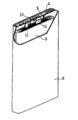
- FIG. 1 is a schematic perspective view in which a part of a prismatic lithium secondary battery according to an embodiment of the present invention is cut away.
- the battery includes a bottomed rectangular battery case 6, an electrode group 9 accommodated in the battery case 6, and an electrolytic solution (not shown).
- the electrode group 9 has a long strip-shaped negative electrode, a long strip-shaped positive electrode, and a separator that is interposed between these and prevents direct contact.
- the electrode group 9 is formed by winding a negative electrode, a positive electrode, and a separator around a flat core and extracting the core.
- An example of the structure of a lithium secondary battery is a structure in which an electrode group in which a positive electrode and a negative electrode are wound via a separator, and an electrolytic solution are housed in an outer package.
- another form of electrode group such as a stacked electrode group in which a positive electrode and a negative electrode are stacked via a separator may be applied.
- the lithium secondary battery may be in any form such as a cylindrical type, a square type, a coin type, a button type, and a laminate type.
- One end of the negative electrode lead 11 is attached to the negative electrode current collector of the negative electrode by welding or the like.
- One end of the positive electrode lead 14 is attached to the positive electrode current collector of the positive electrode by welding or the like.
- the other end of the negative electrode lead 11 is electrically connected to a negative electrode terminal 13 provided on the sealing plate 5.
- the other end of the positive electrode lead 14 is electrically connected to the battery case 6 that also serves as a positive electrode terminal.
- a resin frame 4 that separates the electrode group 9 from the sealing plate 5 and separates the negative electrode lead 11 from the battery case 6 is disposed above the electrode group 9. The opening of the battery case 6 is sealed with a sealing plate 5.
- Example 1 (1) Production of Positive Electrode A lithium nickel composite oxide (LiNi 0.8 Co 0.18 Al 0.02 O 2 ), acetylene black, and polyvinylidene fluoride in a mass of 95: 2.5: 2.5 After mixing at a ratio and adding N-methyl-2-pyrrolidone (NMP), the mixture was stirred using a mixer (Primix Co., Ltd., TK Hibismix) to prepare a positive electrode slurry. Next, the positive electrode slurry is applied to the surface of the aluminum foil, and after the coating film is dried, the positive electrode having a positive electrode mixture layer with a density of 3.6 g / cm 3 formed on both sides of the aluminum foil is rolled. Produced.
- NMP N-methyl-2-pyrrolidone
- a tab made of Al was attached to the positive electrode obtained above.
- a tab made of Ni was attached to the negative electrode obtained above.
- the positive electrode and the negative electrode were wound in a spiral shape through a polyethylene thin film (separator) to produce a wound electrode body.
- the obtained electrode body was accommodated in a bag-shaped exterior body formed of a laminate sheet having an Al layer, and after the electrolyte solution was injected, the exterior body was sealed to produce a lithium secondary battery T1.
- Example 2 A lithium secondary battery T2 was produced in the same manner as in Example 1 except that 5% by mass of dimethyl malonate was added in the preparation of the electrolytic solution (3).
- Example 3 A lithium secondary battery T3 was produced in the same manner as in Example 1 except that in the preparation of the electrolytic solution (3), 5% by mass of diethyl malonate was added instead of dimethyl malonate.
- a lithium secondary battery R1 was produced in the same manner as in Example 1 except that in the preparation of the electrolytic solution (3), dimethyl malonate was not added.
- a lithium secondary battery R2 was produced in the same manner as in Example 1 except that 10% by mass of dimethyl malonate was added in the preparation of the electrolytic solution (3).
- a lithium secondary battery R3 was produced in the same manner as in Example 1 except that 20% by mass of dimethyl malonate was added in the preparation of the electrolytic solution (3).
- a lithium secondary battery R4 was produced in the same manner as in Example 1 except that in the preparation of the electrolytic solution (3), the oxalate salt was not added.
- the battery was charged under the following conditions in a constant temperature bath at 25 ° C., then rested for 20 minutes, and discharged under the following conditions.
- the charge and discharge tests were performed for 50 cycles with the above charge and discharge as one cycle.
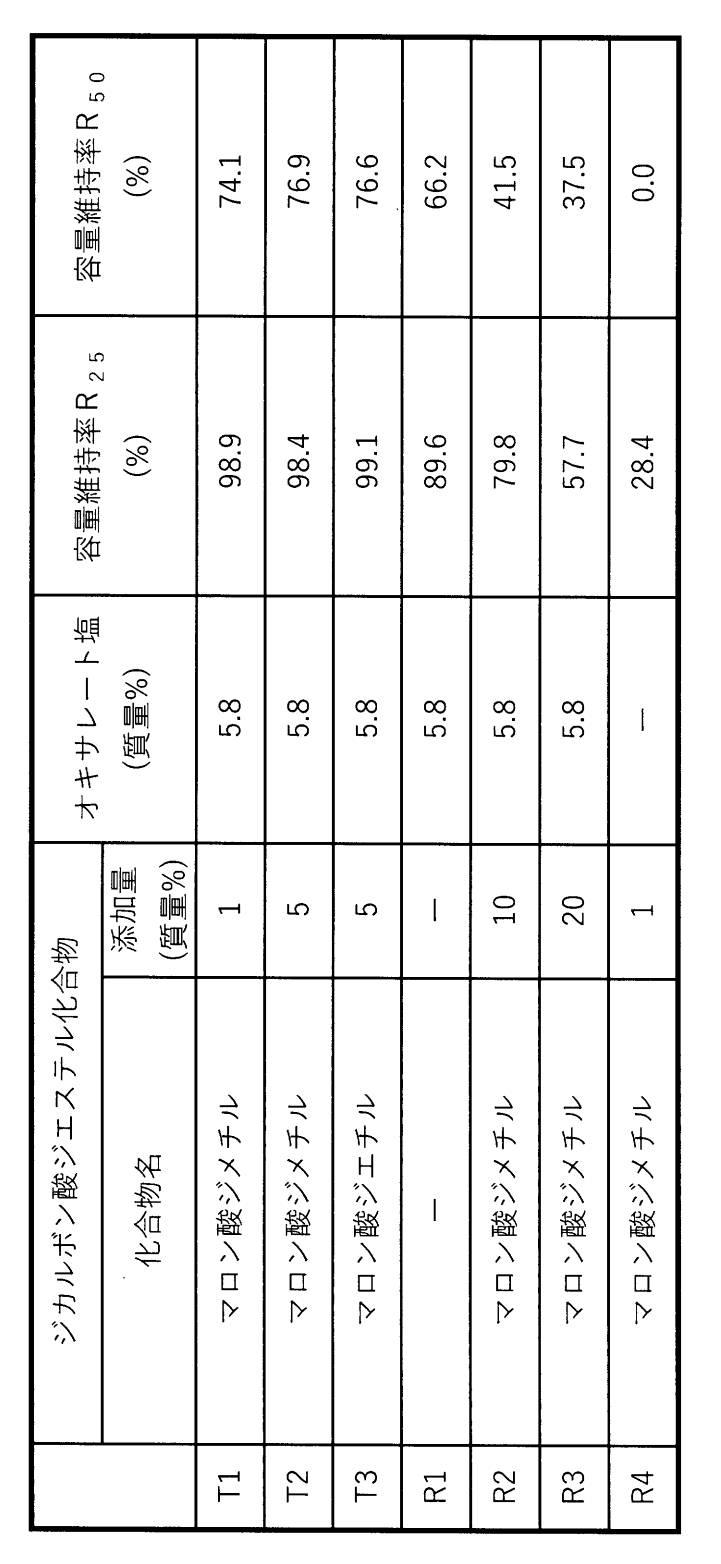
- a value obtained by dividing the discharge capacity at the 25th cycle by the discharge capacity at the 1st cycle is defined as a capacity maintenance rate R 25 (%), and a value obtained by dividing the discharge capacity at the 50th cycle by the discharge capacity at the 1st cycle is indicated by the capacity maintenance rate R 50 (%).
- the evaluation results are shown in Table 1.
- the batteries T1 to T3 are all excellent in cycle characteristics as compared with the batteries R1 to R4.
- lithium secondary battery of the present invention is excellent in discharge capacity and cycle characteristics
- electronic devices such as mobile phones, smartphones, tablet terminals, hybrids, electric vehicles including plug-in hybrids, household storage batteries combined with solar cells, etc. Can be used.
Landscapes
- Chemical & Material Sciences (AREA)
- Engineering & Computer Science (AREA)
- General Chemical & Material Sciences (AREA)
- Chemical Kinetics & Catalysis (AREA)
- Electrochemistry (AREA)
- Materials Engineering (AREA)
- Manufacturing & Machinery (AREA)
- General Physics & Mathematics (AREA)
- Inorganic Chemistry (AREA)
- Condensed Matter Physics & Semiconductors (AREA)
- Physics & Mathematics (AREA)
- Secondary Cells (AREA)
- Cell Electrode Carriers And Collectors (AREA)
Abstract
Description
オキサレート塩は、オキサレート錯体をアニオンとし、リチウムイオンをカチオンとする。
ジカルボン酸ジエステル化合物は、エステル化された2つのカルボキシ基を有する限り、特に限定されない。電解液の粘度を考慮すると、ジカルボン酸ジエステル化合物の分子量は、100~230であることが好ましい。

負極は、充電時にリチウム金属が析出する電極である。析出するリチウム金属は電解液中のリチウムイオンに由来し、放電により、再び電解液に溶解する。電解液に含まれるリチウムイオンは、電解液に添加したリチウム塩に由来するものであってもよく、充電により正極活物質から供給されるものであってもよく、これらの双方であってもよい。
正極は、例えば、正極集電体と、正極集電体の表面に形成された正極合剤層とを具備する。正極合剤層は、正極活物質、結着剤および導電剤などを含む正極合剤を分散媒に分散させた正極スラリーを、正極集電体の表面に塗布し、乾燥させることにより形成できる。乾燥後の塗膜を、必要により圧延してもよい。正極合剤層は、正極集電体の一方の表面に形成してもよく、両方の表面に形成してもよい。
電解液は、非水溶媒と、非水溶媒に溶解したリチウム塩と、ジカルボン酸ジエステル化合物と、を含む。リチウム塩は、上記のオキサレート塩を含む。
正極と負極との間には、セパレータを介在させる。セパレータは、イオン透過度が高く、適度な機械的強度および絶縁性を備えている。セパレータとしては、微多孔薄膜、織布、不織布などを用いることができる。セパレータの材質としては、ポリプロピレン、ポリエチレンなどのポリオレフィンが好ましい。
以下、本実施形態にかかるリチウム二次電池の構成を、図面を参照しながら説明する。図1は、本発明の一実施形態に係る角形のリチウム二次電池の一部を切欠いた概略斜視図である。
(1)正極の作製
リチウムニッケル複合酸化物(LiNi0.8Co0.18Al0.02O2)と、アセチレンブラックと、ポリフッ化ビニリデンとを、95:2.5:2.5の質量比で混合し、N-メチル-2-ピロリドン(NMP)を添加した後、混合機(プライミクス社製、T.K.ハイビスミックス)を用いて攪拌し、正極スラリーを調製した。次に、アルミニウム箔の表面に正極スラリーを塗布し、塗膜を乾燥させた後、圧延して、アルミニウム箔の両面に、密度3.6g/cm3の正極合剤層が形成された正極を作製した。
電解銅箔(厚み10μm)を所定の電極サイズに切断して、負極とした。
FECとEMCとDMCとを、FEC:EMC:DMC=20:5:75の容積比で混合した。得られた混合溶媒に、LiFOBを5.8質量%、マロン酸ジメチルを1質量%、LiPF6を12.2質量%となるようにそれぞれ溶解させて、電解液を調製した。
上記で得られた正極に、Al製のタブを取り付けた。上記で得られた負極に、Ni製のタブを取り付けた。不活性ガス雰囲気中で、正極と負極とをポリエチレン薄膜(セパレータ)を介して渦巻状に捲回し、捲回型の電極体を作製した。得られた電極体を、Al層を備えるラミネートシートで形成される袋状の外装体に収容し、上記電解液を注入した後、外装体を封止してリチウム二次電池T1を作製した。
電解液の調製(3)において、マロン酸ジメチルを5質量%添加したこと以外は、実施例1と同様にしてリチウム二次電池T2を作製した。
電解液の調製(3)において、マロン酸ジメチルに替えて、マロン酸ジエチルを5質量%添加したこと以外は、実施例1と同様にしてリチウム二次電池T3を作製した。
電解液の調製(3)において、マロン酸ジメチルを添加しなかったこと以外は、実施例1と同様にしてリチウム二次電池R1を作製した。
電解液の調製(3)において、マロン酸ジメチルを10質量%添加したこと以外は、実施例1と同様にしてリチウム二次電池R2を作製した。
電解液の調製(3)において、マロン酸ジメチルを20質量%添加したこと以外は、実施例1と同様にしてリチウム二次電池R3を作製した。
電解液の調製(3)において、オキサレート塩を添加しなかったこと以外は、実施例1と同様にしてリチウム二次電池R4を作製した。
得られた電池T1~T3、R1~R4について、充放電試験を行い、充放電特性を評価した。
5 封口板
6 電池ケース
9 電極群
11 負極リード
13 負極端子
14 正極リード
Claims (6)
- 正極と、セパレータと、前記セパレータを介して前記正極と対向する負極と、電解液と、を有し、
前記負極には、充電によりリチウム金属が析出し、
前記電解液は、
オキサレート錯体をアニオンとし、リチウムイオンをカチオンとするオキサレート塩と、
ジカルボン酸ジエステル化合物と、を含み、
前記ジカルボン酸ジエステル化合物は、前記電解液に0.1質量%以上、10質量%未満含まれる、リチウム二次電池。 - 前記オキサレート塩は、前記電解液に0.1質量%以上、20質量%以下含まれる、請求項1に記載のリチウム二次電池。
- 前記ジカルボン酸ジエステル化合物が、下記式(1):

で表される、請求項1または2に記載のリチウム二次電池。 - 前記オキサレート塩は、リチウムジフルオロオキサレートボレートを含む、請求項1~3のいずれか一項に記載のリチウム二次電池。
- 前記負極は、負極集電体を備え、
前記負極集電体は、リチウム金属と反応しない金属材料を備える、請求項1~4のいずれか一項に記載のリチウム二次電池。 - 前記金属材料は、銅または銅合金である、請求項5に記載のリチウム二次電池。
Priority Applications (4)
| Application Number | Priority Date | Filing Date | Title |
|---|---|---|---|
| JP2020507422A JP7262060B2 (ja) | 2018-03-23 | 2019-02-13 | リチウム二次電池 |
| EP19770967.8A EP3771016B1 (en) | 2018-03-23 | 2019-02-13 | Lithium secondary battery |
| CN201980020027.8A CN111868995A (zh) | 2018-03-23 | 2019-02-13 | 锂二次电池 |
| US16/981,502 US20210013501A1 (en) | 2018-03-23 | 2019-02-13 | Lithium secondary battery |
Applications Claiming Priority (2)
| Application Number | Priority Date | Filing Date | Title |
|---|---|---|---|
| JP2018-057010 | 2018-03-23 | ||
| JP2018057010 | 2018-03-23 |
Publications (1)
| Publication Number | Publication Date |
|---|---|
| WO2019181277A1 true WO2019181277A1 (ja) | 2019-09-26 |
Family
ID=67986941
Family Applications (1)
| Application Number | Title | Priority Date | Filing Date |
|---|---|---|---|
| PCT/JP2019/004946 Ceased WO2019181277A1 (ja) | 2018-03-23 | 2019-02-13 | リチウム二次電池 |
Country Status (5)
| Country | Link |
|---|---|
| US (1) | US20210013501A1 (ja) |
| EP (1) | EP3771016B1 (ja) |
| JP (1) | JP7262060B2 (ja) |
| CN (1) | CN111868995A (ja) |
| WO (1) | WO2019181277A1 (ja) |
Cited By (5)
| Publication number | Priority date | Publication date | Assignee | Title |
|---|---|---|---|---|
| WO2020202844A1 (ja) * | 2019-03-29 | 2020-10-08 | パナソニックIpマネジメント株式会社 | リチウム二次電池 |
| CN113299888A (zh) * | 2020-02-21 | 2021-08-24 | 国家能源投资集团有限责任公司 | 锂金属负极、锂电池电解液以及锂电池 |
| WO2022209601A1 (ja) * | 2021-03-30 | 2022-10-06 | パナソニックIpマネジメント株式会社 | リチウム二次電池 |
| WO2026029032A1 (ja) * | 2024-07-31 | 2026-02-05 | パナソニックIpマネジメント株式会社 | リチウム二次電池 |
| JP7905582B2 (ja) | 2021-03-30 | 2026-08-17 | パナソニックIpマネジメント株式会社 | リチウム二次電池 |
Families Citing this family (1)
| Publication number | Priority date | Publication date | Assignee | Title |
|---|---|---|---|---|
| CN112652817B (zh) * | 2021-01-04 | 2022-09-16 | 吴翠云 | 一种锂离子电池电解液及锂离子电池 |
Citations (7)
| Publication number | Priority date | Publication date | Assignee | Title |
|---|---|---|---|---|
| JPH0896849A (ja) * | 1994-09-22 | 1996-04-12 | Matsushita Electric Ind Co Ltd | 非水電解質二次電池 |
| JP2004172117A (ja) * | 2002-11-15 | 2004-06-17 | Samsung Sdi Co Ltd | 有機電解液及びこれを採用したリチウム電池 |
| JP2007258103A (ja) * | 2006-03-24 | 2007-10-04 | Mitsubishi Chemicals Corp | 非水系電解液及び非水系電解液電池 |
| JP2014026932A (ja) * | 2012-07-30 | 2014-02-06 | Toyota Motor Corp | 非水電解液二次電池及びその製造方法 |
| WO2017169771A1 (ja) * | 2016-03-31 | 2017-10-05 | 日立マクセル株式会社 | 非水電解液二次電池およびその製造方法 |
| JP2018501615A (ja) | 2014-12-12 | 2018-01-18 | ペリオン テクノロジーズ インク. | 電気化学セル及びその作製方法 |
| WO2018179782A1 (ja) * | 2017-03-28 | 2018-10-04 | パナソニックIpマネジメント株式会社 | 非水電解質二次電池 |
Family Cites Families (16)
| Publication number | Priority date | Publication date | Assignee | Title |
|---|---|---|---|---|
| JP3438364B2 (ja) * | 1994-11-24 | 2003-08-18 | ソニー株式会社 | 非水電解液 |
| WO1998041476A1 (en) * | 1997-03-14 | 1998-09-24 | Eveready Battery Company, Inc. | Lithiated metal oxides |
| JP4086444B2 (ja) * | 2000-03-08 | 2008-05-14 | 三洋電機株式会社 | リチウム二次電池 |
| DE60237441D1 (de) * | 2001-04-20 | 2010-10-07 | Gs Yuasa Corp | Ür, anode zur benutzung in einer sekundärbatterie mit wasserfreiem elektrolyt und sekundärbatterie mit wasserfreiem elektrolyt |
| JP4934914B2 (ja) * | 2001-06-11 | 2012-05-23 | 三菱化学株式会社 | 電解液及び二次電池 |
| US20080026297A1 (en) * | 2005-01-11 | 2008-01-31 | Air Products And Chemicals, Inc. | Electrolytes, cells and methods of forming passivaton layers |
| CN1956251A (zh) * | 2005-10-26 | 2007-05-02 | 比亚迪股份有限公司 | 一种锂离子二次电池的添加剂与气体混合的电解液 |
| CN101209961B (zh) * | 2006-12-30 | 2011-04-06 | 比亚迪股份有限公司 | 一种草酸亚铁水合盐晶体的制备方法 |
| KR20100119760A (ko) * | 2008-02-04 | 2010-11-10 | 스미또모 가가꾸 가부시키가이샤 | 복합 금속 산화물 및 나트륨 이차 전지 |
| CN101521297A (zh) * | 2008-02-26 | 2009-09-02 | 三洋电机株式会社 | 非水电解质二次电池 |
| JP6089487B2 (ja) | 2012-08-09 | 2017-03-08 | 三菱化学株式会社 | 非水系電解質、およびそれを用いた非水系電解質二次電池 |
| JP2017511588A (ja) | 2014-04-17 | 2017-04-20 | ビーエーエスエフ ソシエタス・ヨーロピアBasf Se | ジカルボン酸エステル含有の電解質組成物 |
| JP2016091785A (ja) * | 2014-11-04 | 2016-05-23 | 旭化成株式会社 | 非水電解液及び非水電解液二次電池 |
| JP6507677B2 (ja) * | 2015-01-29 | 2019-05-08 | 三菱ケミカル株式会社 | 非水系電解液、及びそれを用いた非水系電解液二次電池 |
| CN108475814A (zh) * | 2015-09-23 | 2018-08-31 | 深圳新宙邦科技股份有限公司 | Lto型锂离子电池电解液 |
| CN108475822B (zh) * | 2015-12-25 | 2022-03-11 | 斯泰拉化工公司 | 二次电池用非水电解液及具备其的二次电池 |
-
2019
- 2019-02-13 CN CN201980020027.8A patent/CN111868995A/zh active Pending
- 2019-02-13 EP EP19770967.8A patent/EP3771016B1/en active Active
- 2019-02-13 WO PCT/JP2019/004946 patent/WO2019181277A1/ja not_active Ceased
- 2019-02-13 US US16/981,502 patent/US20210013501A1/en not_active Abandoned
- 2019-02-13 JP JP2020507422A patent/JP7262060B2/ja active Active
Patent Citations (7)
| Publication number | Priority date | Publication date | Assignee | Title |
|---|---|---|---|---|
| JPH0896849A (ja) * | 1994-09-22 | 1996-04-12 | Matsushita Electric Ind Co Ltd | 非水電解質二次電池 |
| JP2004172117A (ja) * | 2002-11-15 | 2004-06-17 | Samsung Sdi Co Ltd | 有機電解液及びこれを採用したリチウム電池 |
| JP2007258103A (ja) * | 2006-03-24 | 2007-10-04 | Mitsubishi Chemicals Corp | 非水系電解液及び非水系電解液電池 |
| JP2014026932A (ja) * | 2012-07-30 | 2014-02-06 | Toyota Motor Corp | 非水電解液二次電池及びその製造方法 |
| JP2018501615A (ja) | 2014-12-12 | 2018-01-18 | ペリオン テクノロジーズ インク. | 電気化学セル及びその作製方法 |
| WO2017169771A1 (ja) * | 2016-03-31 | 2017-10-05 | 日立マクセル株式会社 | 非水電解液二次電池およびその製造方法 |
| WO2018179782A1 (ja) * | 2017-03-28 | 2018-10-04 | パナソニックIpマネジメント株式会社 | 非水電解質二次電池 |
Non-Patent Citations (1)
| Title |
|---|
| See also references of EP3771016A4 |
Cited By (7)
| Publication number | Priority date | Publication date | Assignee | Title |
|---|---|---|---|---|
| WO2020202844A1 (ja) * | 2019-03-29 | 2020-10-08 | パナソニックIpマネジメント株式会社 | リチウム二次電池 |
| US12542299B2 (en) | 2019-03-29 | 2026-02-03 | Panasonic Intellectual Property Management Co., Ltd. | Lithium secondary battery |
| CN113299888A (zh) * | 2020-02-21 | 2021-08-24 | 国家能源投资集团有限责任公司 | 锂金属负极、锂电池电解液以及锂电池 |
| WO2022209601A1 (ja) * | 2021-03-30 | 2022-10-06 | パナソニックIpマネジメント株式会社 | リチウム二次電池 |
| JPWO2022209601A1 (ja) * | 2021-03-30 | 2022-10-06 | ||
| JP7905582B2 (ja) | 2021-03-30 | 2026-08-17 | パナソニックIpマネジメント株式会社 | リチウム二次電池 |
| WO2026029032A1 (ja) * | 2024-07-31 | 2026-02-05 | パナソニックIpマネジメント株式会社 | リチウム二次電池 |
Also Published As
| Publication number | Publication date |
|---|---|
| EP3771016B1 (en) | 2026-05-13 |
| EP3771016A4 (en) | 2021-05-26 |
| EP3771016A1 (en) | 2021-01-27 |
| JP7262060B2 (ja) | 2023-04-21 |
| US20210013501A1 (en) | 2021-01-14 |
| JPWO2019181277A1 (ja) | 2021-03-11 |
| CN111868995A (zh) | 2020-10-30 |
Similar Documents
| Publication | Publication Date | Title |
|---|---|---|
| CN110785886B (zh) | 锂二次电池 | |
| JP5166356B2 (ja) | リチウム電池 | |
| TWI487172B (zh) | 提升速率能力之鋰二次電池 | |
| CN110754009A (zh) | 锂二次电池 | |
| JP7262061B2 (ja) | リチウム二次電池 | |
| JP7262060B2 (ja) | リチウム二次電池 | |
| CN110323485A (zh) | 二次电池 | |
| JP7519635B2 (ja) | リチウム二次電池 | |
| JPWO2016010090A1 (ja) | 電解液及びそれを用いた二次電池 | |
| US10513604B2 (en) | Binder resin composition, electrode for lithium ion secondary battery and lithium ion secondary battery | |
| CN113632258A (zh) | 锂二次电池 | |
| JP7580051B2 (ja) | リチウム二次電池 | |
| JP2019009113A (ja) | リチウム二次電池 | |
| JP2018535535A (ja) | 3次元網状構造の電極集電体を含む電極 | |
| JP2012252951A (ja) | 非水電解質二次電池 | |
| CN111052486B (zh) | 非水电解质二次电池 | |
| JP7182198B2 (ja) | 非水電解質二次電池、電解液及び非水電解質二次電池の製造方法 | |
| US9172089B2 (en) | Anode active material, method of preparing the same, anode including the anode active material, and lithium battery including the anode | |
| JPWO2019193635A1 (ja) | 電極、非水電解質電池及び電池パック | |
| US9105371B2 (en) | Cathode active material and lithium secondary battery comprising the same | |
| US20240063437A1 (en) | Organic electrolyte and secondary battery comprising same |
Legal Events
| Date | Code | Title | Description |
|---|---|---|---|
| 121 | Ep: the epo has been informed by wipo that ep was designated in this application |
Ref document number: 19770967 Country of ref document: EP Kind code of ref document: A1 |
|
| ENP | Entry into the national phase |
Ref document number: 2020507422 Country of ref document: JP Kind code of ref document: A |
|
| NENP | Non-entry into the national phase |
Ref country code: DE |
|
| WWE | Wipo information: entry into national phase |
Ref document number: 2019770967 Country of ref document: EP |
|
| WWG | Wipo information: grant in national office |
Ref document number: 2019770967 Country of ref document: EP |