WO2019181402A1 - プリプレグおよび繊維強化複合材料 - Google Patents
プリプレグおよび繊維強化複合材料 Download PDFInfo
- Publication number
- WO2019181402A1 WO2019181402A1 PCT/JP2019/007549 JP2019007549W WO2019181402A1 WO 2019181402 A1 WO2019181402 A1 WO 2019181402A1 JP 2019007549 W JP2019007549 W JP 2019007549W WO 2019181402 A1 WO2019181402 A1 WO 2019181402A1
- Authority
- WO
- WIPO (PCT)
- Prior art keywords
- prepreg
- resin composition
- resin
- component
- fiber
- Prior art date
- Legal status (The legal status is an assumption and is not a legal conclusion. Google has not performed a legal analysis and makes no representation as to the accuracy of the status listed.)
- Ceased
Links
Classifications
-
- C—CHEMISTRY; METALLURGY
- C08—ORGANIC MACROMOLECULAR COMPOUNDS; THEIR PREPARATION OR CHEMICAL WORKING-UP; COMPOSITIONS BASED THEREON
- C08G—MACROMOLECULAR COMPOUNDS OBTAINED OTHERWISE THAN BY REACTIONS ONLY INVOLVING UNSATURATED CARBON-TO-CARBON BONDS
- C08G59/00—Polycondensates containing more than one epoxy group per molecule; Macromolecules obtained by polymerising compounds containing more than one epoxy group per molecule using curing agents or catalysts which react with the epoxy groups
- C08G59/18—Macromolecules obtained by polymerising compounds containing more than one epoxy group per molecule using curing agents or catalysts which react with the epoxy groups ; e.g. general methods of curing
- C08G59/20—Macromolecules obtained by polymerising compounds containing more than one epoxy group per molecule using curing agents or catalysts which react with the epoxy groups ; e.g. general methods of curing characterised by the epoxy compounds used
- C08G59/32—Epoxy compounds containing three or more epoxy groups
- C08G59/3227—Compounds containing acyclic nitrogen atoms
-
- C—CHEMISTRY; METALLURGY
- C08—ORGANIC MACROMOLECULAR COMPOUNDS; THEIR PREPARATION OR CHEMICAL WORKING-UP; COMPOSITIONS BASED THEREON
- C08J—WORKING-UP; GENERAL PROCESSES OF COMPOUNDING; AFTER-TREATMENT NOT COVERED BY SUBCLASSES C08B, C08C, C08F, C08G or C08H
- C08J5/00—Manufacture of articles or shaped materials containing macromolecular substances
- C08J5/24—Impregnating materials with prepolymers which can be polymerised in situ, e.g. manufacture of prepregs
-
- C—CHEMISTRY; METALLURGY
- C08—ORGANIC MACROMOLECULAR COMPOUNDS; THEIR PREPARATION OR CHEMICAL WORKING-UP; COMPOSITIONS BASED THEREON
- C08G—MACROMOLECULAR COMPOUNDS OBTAINED OTHERWISE THAN BY REACTIONS ONLY INVOLVING UNSATURATED CARBON-TO-CARBON BONDS
- C08G59/00—Polycondensates containing more than one epoxy group per molecule; Macromolecules obtained by polymerising compounds containing more than one epoxy group per molecule using curing agents or catalysts which react with the epoxy groups
- C08G59/18—Macromolecules obtained by polymerising compounds containing more than one epoxy group per molecule using curing agents or catalysts which react with the epoxy groups ; e.g. general methods of curing
- C08G59/20—Macromolecules obtained by polymerising compounds containing more than one epoxy group per molecule using curing agents or catalysts which react with the epoxy groups ; e.g. general methods of curing characterised by the epoxy compounds used
- C08G59/22—Di-epoxy compounds
- C08G59/24—Di-epoxy compounds carbocyclic
- C08G59/245—Di-epoxy compounds carbocyclic aromatic
-
- C—CHEMISTRY; METALLURGY
- C08—ORGANIC MACROMOLECULAR COMPOUNDS; THEIR PREPARATION OR CHEMICAL WORKING-UP; COMPOSITIONS BASED THEREON
- C08G—MACROMOLECULAR COMPOUNDS OBTAINED OTHERWISE THAN BY REACTIONS ONLY INVOLVING UNSATURATED CARBON-TO-CARBON BONDS
- C08G59/00—Polycondensates containing more than one epoxy group per molecule; Macromolecules obtained by polymerising compounds containing more than one epoxy group per molecule using curing agents or catalysts which react with the epoxy groups
- C08G59/18—Macromolecules obtained by polymerising compounds containing more than one epoxy group per molecule using curing agents or catalysts which react with the epoxy groups ; e.g. general methods of curing
- C08G59/20—Macromolecules obtained by polymerising compounds containing more than one epoxy group per molecule using curing agents or catalysts which react with the epoxy groups ; e.g. general methods of curing characterised by the epoxy compounds used
- C08G59/22—Di-epoxy compounds
- C08G59/28—Di-epoxy compounds containing acyclic nitrogen atoms
-
- C—CHEMISTRY; METALLURGY
- C08—ORGANIC MACROMOLECULAR COMPOUNDS; THEIR PREPARATION OR CHEMICAL WORKING-UP; COMPOSITIONS BASED THEREON
- C08G—MACROMOLECULAR COMPOUNDS OBTAINED OTHERWISE THAN BY REACTIONS ONLY INVOLVING UNSATURATED CARBON-TO-CARBON BONDS
- C08G59/00—Polycondensates containing more than one epoxy group per molecule; Macromolecules obtained by polymerising compounds containing more than one epoxy group per molecule using curing agents or catalysts which react with the epoxy groups
- C08G59/18—Macromolecules obtained by polymerising compounds containing more than one epoxy group per molecule using curing agents or catalysts which react with the epoxy groups ; e.g. general methods of curing
- C08G59/40—Macromolecules obtained by polymerising compounds containing more than one epoxy group per molecule using curing agents or catalysts which react with the epoxy groups ; e.g. general methods of curing characterised by the curing agents used
- C08G59/4007—Curing agents not provided for by the groups C08G59/42 - C08G59/66
- C08G59/4014—Nitrogen containing compounds
- C08G59/4021—Ureas; Thioureas; Guanidines; Dicyandiamides
-
- C—CHEMISTRY; METALLURGY
- C08—ORGANIC MACROMOLECULAR COMPOUNDS; THEIR PREPARATION OR CHEMICAL WORKING-UP; COMPOSITIONS BASED THEREON
- C08J—WORKING-UP; GENERAL PROCESSES OF COMPOUNDING; AFTER-TREATMENT NOT COVERED BY SUBCLASSES C08B, C08C, C08F, C08G or C08H
- C08J5/00—Manufacture of articles or shaped materials containing macromolecular substances
- C08J5/04—Reinforcing macromolecular compounds with loose or coherent fibrous material
-
- C—CHEMISTRY; METALLURGY
- C08—ORGANIC MACROMOLECULAR COMPOUNDS; THEIR PREPARATION OR CHEMICAL WORKING-UP; COMPOSITIONS BASED THEREON
- C08J—WORKING-UP; GENERAL PROCESSES OF COMPOUNDING; AFTER-TREATMENT NOT COVERED BY SUBCLASSES C08B, C08C, C08F, C08G or C08H
- C08J5/00—Manufacture of articles or shaped materials containing macromolecular substances
- C08J5/24—Impregnating materials with prepolymers which can be polymerised in situ, e.g. manufacture of prepregs
- C08J5/241—Impregnating materials with prepolymers which can be polymerised in situ, e.g. manufacture of prepregs using inorganic fibres
- C08J5/243—Impregnating materials with prepolymers which can be polymerised in situ, e.g. manufacture of prepregs using inorganic fibres using carbon fibres
-
- C—CHEMISTRY; METALLURGY
- C08—ORGANIC MACROMOLECULAR COMPOUNDS; THEIR PREPARATION OR CHEMICAL WORKING-UP; COMPOSITIONS BASED THEREON
- C08J—WORKING-UP; GENERAL PROCESSES OF COMPOUNDING; AFTER-TREATMENT NOT COVERED BY SUBCLASSES C08B, C08C, C08F, C08G or C08H
- C08J5/00—Manufacture of articles or shaped materials containing macromolecular substances
- C08J5/24—Impregnating materials with prepolymers which can be polymerised in situ, e.g. manufacture of prepregs
- C08J5/249—Impregnating materials with prepolymers which can be polymerised in situ, e.g. manufacture of prepregs characterised by the additives used in the prepolymer mixture
-
- C—CHEMISTRY; METALLURGY
- C08—ORGANIC MACROMOLECULAR COMPOUNDS; THEIR PREPARATION OR CHEMICAL WORKING-UP; COMPOSITIONS BASED THEREON
- C08K—Use of inorganic or non-macromolecular organic substances as compounding ingredients
- C08K5/00—Use of organic ingredients
- C08K5/04—Oxygen-containing compounds
- C08K5/06—Ethers; Acetals; Ketals; Ortho-esters
-
- C—CHEMISTRY; METALLURGY
- C08—ORGANIC MACROMOLECULAR COMPOUNDS; THEIR PREPARATION OR CHEMICAL WORKING-UP; COMPOSITIONS BASED THEREON
- C08L—COMPOSITIONS OF MACROMOLECULAR COMPOUNDS
- C08L63/00—Compositions of epoxy resins; Compositions of derivatives of epoxy resins
-
- C—CHEMISTRY; METALLURGY
- C08—ORGANIC MACROMOLECULAR COMPOUNDS; THEIR PREPARATION OR CHEMICAL WORKING-UP; COMPOSITIONS BASED THEREON
- C08J—WORKING-UP; GENERAL PROCESSES OF COMPOUNDING; AFTER-TREATMENT NOT COVERED BY SUBCLASSES C08B, C08C, C08F, C08G or C08H
- C08J2363/00—Characterised by the use of epoxy resins; Derivatives of epoxy resins
-
- C—CHEMISTRY; METALLURGY
- C08—ORGANIC MACROMOLECULAR COMPOUNDS; THEIR PREPARATION OR CHEMICAL WORKING-UP; COMPOSITIONS BASED THEREON
- C08K—Use of inorganic or non-macromolecular organic substances as compounding ingredients
- C08K5/00—Use of organic ingredients
- C08K5/16—Nitrogen-containing compounds
- C08K5/20—Carboxylic acid amides
-
- C—CHEMISTRY; METALLURGY
- C08—ORGANIC MACROMOLECULAR COMPOUNDS; THEIR PREPARATION OR CHEMICAL WORKING-UP; COMPOSITIONS BASED THEREON
- C08K—Use of inorganic or non-macromolecular organic substances as compounding ingredients
- C08K5/00—Use of organic ingredients
- C08K5/36—Sulfur-, selenium-, or tellurium-containing compounds
- C08K5/41—Compounds containing sulfur bound to oxygen
-
- C—CHEMISTRY; METALLURGY
- C08—ORGANIC MACROMOLECULAR COMPOUNDS; THEIR PREPARATION OR CHEMICAL WORKING-UP; COMPOSITIONS BASED THEREON
- C08L—COMPOSITIONS OF MACROMOLECULAR COMPOUNDS
- C08L2205/00—Polymer mixtures characterised by other features
- C08L2205/02—Polymer mixtures characterised by other features containing two or more polymers of the same C08L -group
Definitions
- the present invention relates to a prepreg excellent in tackiness, resin strength after curing and non-fiber direction strength, and a fiber-reinforced composite material using the prepreg.
- Fiber reinforced composite materials using carbon fibers, aramid fibers, etc. as reinforcing fibers make use of their high specific strength and specific elastic modulus to make structural materials such as aircraft and automobiles, tennis rackets, golf shafts, fishing rods, bicycles, Widely used for sports such as housing, general industrial use.
- the fiber-reinforced composite material manufacturing method includes a method of laminating a plurality of prepregs, which are sheet-like molding materials in which reinforcing fibers are impregnated with an uncured resin composition, and then heat-curing, or a reinforcement placed in a mold. For example, a resin transfer molding method in which a liquid resin is poured into a fiber and heat-cured is used.
- the method using a prepreg has an advantage that it is easy to obtain a high-performance fiber-reinforced composite material because the orientation of the reinforcing fibers can be strictly controlled and the design freedom of the laminated structure is high.
- a thermosetting resin is mainly used from the viewpoint of heat resistance and productivity, and an epoxy resin is preferably used from the viewpoint of mechanical properties such as adhesion to reinforcing fibers.
- dicyandiamide is often used as a curing agent because the resulting cured product is excellent in mechanical properties and heat resistance.
- a prepreg used for a cylindrical molded body such as a golf shaft or a fishing rod is required to have high tackiness on the surface in order to prevent the prepreg from being peeled off when formed into a cylindrical shape.
- the tackiness of such a prepreg is influenced by the viscosity characteristics of the resin composition used in combination with the reinforcing fiber, and the viscosity of the resin composition needs to be adjusted to a certain value or more in order to exhibit good tackiness.
- the fiber-reinforced composite material to be used needs a high non-fiber direction strength (hereinafter sometimes referred to as “90 ° tensile strength”),
- the strength of the resin cured product itself greatly affects the non-fiber direction strength.
- Patent Document 1 discloses a prepreg that uses a resin composition using dicyandiamide as a curing agent and has good tackiness.
- the resin composition used in Patent Document 1 has a high viscosity and loses fluidity before the dicyandiamide used as a curing agent completely dissolves when the resin is cured, so that dicyandiamide remains in the cured product. It was sometimes a defect. As a result, the cured product of the resin composition has low strength, and as a result, the strength in the non-fiber direction of the obtained fiber-reinforced composite material may be impaired. In addition, when trying to reduce the viscosity of the resin composition to reduce the undissolved residue of the curing agent in the cured product, the tackiness of the obtained prepreg is lower than the desired tackiness and handling properties may be inferior. It was. Thus, conventionally, it has been extremely difficult to achieve both excellent tackiness of the prepreg, resin strength after curing, and strength in the non-fiber direction.
- An object of the present invention is to provide a prepreg having high tackiness and excellent strength and non-fiber direction strength of a cured resin and a fiber-reinforced composite material using the prepreg.
- the prepreg of the present invention is a prepreg composed of reinforcing fibers and a resin composition
- the resin composition includes the following constituent elements [A] to [C], and the viscosity of the resin composition at 25 ° C.
- the material is a fiber reinforced composite material obtained by curing the prepreg.
- a prepreg excellent in tackiness, cured resin strength and non-fiber direction strength, and a fiber-reinforced composite material using the prepreg can be obtained.
- Preferred examples of the reinforcing fiber used in the prepreg and fiber-reinforced composite material of the present invention include carbon fiber, graphite fiber, aramid fiber, and glass fiber, and carbon fiber is particularly preferable.
- the form and arrangement of the reinforcing fibers are not limited, and for example, fiber structures such as long fibers arranged in one direction, a single tow, a woven fabric, a knit, and a braid are used.
- Two or more types of carbon fibers, glass fibers, aramid fibers, boron fibers, PBO fibers, high-strength polyethylene fibers, alumina fibers, and silicon carbide fibers may be used in combination as the reinforcing fibers.
- carbon fibers include acrylic, pitch, and rayon carbon fibers, and acrylic carbon fibers having particularly high tensile strength are preferably used.
- twisted yarn, untwisted yarn, untwisted yarn, etc. can be used, but in the case of twisted yarn, the orientation of the filaments constituting the carbon fiber is not parallel, so the carbon fiber reinforced composite material obtained Therefore, an untwisted yarn or a non-twisted yarn having a good balance between formability and strength properties of the carbon fiber reinforced composite material is preferably used.
- the carbon fiber preferably has a tensile modulus in the range of 200 to 440 GPa.
- the tensile elastic modulus of the carbon fiber is affected by the crystallinity of the graphite structure constituting the carbon fiber, and the elastic modulus increases as the crystallinity increases. This range is preferable because the rigidity and strength of the carbon fiber reinforced composite material are balanced at a high level.
- a more preferable elastic modulus is in the range of 230 to 400 GPa, and further preferably in the range of 260 to 370 GPa.
- the tensile elastic modulus of the carbon fiber is a value measured according to JIS R7601 (2006).
- the resin composition contained in the prepreg of the present invention contains the constituent elements [A] to [C] as essential components.
- component means a compound contained in the composition.
- the component [A] in the present invention is an epoxy resin contained in the resin composition constituting the prepreg of the present invention.
- the component [A] is an epoxy resin having two or more epoxy groups in one molecule, it is preferable because the glass transition temperature of a cured product obtained by heat curing the resin composition is increased and the heat resistance is increased. . You may mix
- epoxy resins examples include diaminodiphenylmethane type, diaminodiphenylsulfone type, aminophenol type, metaxylenediamine type, 1,3-bisaminomethylcyclohexane type, isocyanurate type and hydantoin type epoxy resins, phenol novolac type, and the like. And epoxy resins such as ortho-cresol novolac type, trishydroxyphenylmethane type and tetraphenylolethane type. Among these, diaminodiphenylmethane type and aminophenol type epoxy resins are particularly preferably used because of a good balance of physical properties.
- epoxy resins may be used singly or may be appropriately mixed and used.
- the component [A] in the present invention preferably contains 40 to 90 parts by mass of a tri- or higher functional epoxy resin having a nitrogen atom in the molecule out of 100 parts by mass of the component [A].
- a cured product having excellent elastic modulus and heat resistance can be obtained.
- strength, and toughness is obtained by making the compounding quantity of the trifunctional or more than trifunctional epoxy resin which has a nitrogen atom into a molecule into 90 mass parts or less.
- trifunctional or higher functional epoxy resins having nitrogen atoms in the molecule examples include isocyanuric acid type epoxy resins, aminophenol type epoxy resins, diaminophenylmethane type epoxy resins, diaminodiphenylsulfone type epoxy resins, metaxylenediamine type epoxy resins, Examples thereof include aminomethylcyclohexane type epoxy resins.
- isocyanuric acid type epoxy resins include “TEPIC (registered trademark)” S (manufactured by Nissan Chemical Industries, Ltd.), G (manufactured by Nissan Chemical Industries, Ltd.), Araldite (registered trademark) “PT9810 (Huntsman Advanced Materials Co., Ltd.).
- aminophenol-type epoxy resins include ELM120 (manufactured by Sumitomo Chemical Co., Ltd.), ELM100 (manufactured by Sumitomo Chemical Co., Ltd.), “jER (registered trademark)” 630 (manufactured by Mitsubishi Chemical Corporation), and “ Araldite (registered trademark) “MY0510 (manufactured by Huntsman Advanced Materials Co., Ltd.),“ Araldite (registered trademark) ”MY0600 (manufactured by Huntsman Advanced Materials Co., Ltd.), and the like.
- diaminodiphenylmethane type epoxy resins include ELM434 (manufactured by Sumitomo Chemical Co., Ltd.), "Araldite (registered trademark)” MY720 (manufactured by Huntsman Advanced Materials), and “Araldite (registered trademark)” MY721. (Manufactured by Huntsman Advanced Materials), “Araldite (registered trademark)” MY9512 (manufactured by Huntsman Advanced Materials), “Araldite (registered trademark)” MY9663 (Huntsman Advanced Materials ( And “Epototo (registered trademark)” YH-434 (manufactured by Toto Kasei Co., Ltd.).
- Examples of commercially available diaminodiphenylsulfone type epoxy resins include TG3DAS (Mitsui Chemical Fine Co., Ltd.).
- TTRAD registered trademark
- X manufactured by Mitsubishi Gas Chemical Co., Inc.
- Examples of commercially available aminomethylcyclohexane type epoxy resins include “TETRAD (registered trademark)”-C (manufactured by Mitsubishi Gas Chemical Co., Inc.).
- the component [B] of the present invention is dicyandiamide.
- Dicyandiamide is excellent in terms of imparting high mechanical properties and heat resistance to the cured epoxy resin, and is widely used as a curing agent for various epoxy resins. Moreover, since it is excellent in the storage stability of an epoxy resin composition, it can be used conveniently. Examples of such commercially available dicyandiamide include DICY7 (manufactured by Mitsubishi Chemical Corporation) and DICY15 (manufactured by Mitsubishi Chemical Corporation).
- the component [B] is preferably contained in an amount of 4 to 16 parts by mass, more preferably 6 to 10 parts by mass with respect to 100 parts by mass of the component [A].
- the component [C] in the present invention is a compound having a solubility parameter having a melting point of 130 ° C. or lower and a difference from the solubility parameter of the component [B] within 8 or less. Due to the small difference in solubility parameter, dissolution of dicyandiamide, which is the constituent element [B], is promoted. By blending component [C], the solubility of dicyandiamide is improved. Undissolved dicyandiamide is reduced, and defects are reduced. As a result, a cured resin and a fiber-reinforced composite material having excellent strength can be obtained.
- the melting point of the constituent element [C] of the present invention is 130 ° C. or less, more preferably 100 ° C.
- the curing reaction of the resin composition starts at 80 ° C. to 130 ° C. Therefore, if the melting point of the component [C] is within such a temperature range, the resin composition or prepreg is cured. In this case, the component [C] is present in a liquid state in the resin composition, so that the solubility of dicyandiamide is improved.
- the lower the melting point of the constituent element [C] the more preferable is that the constituent element [C] becomes liquid from a lower temperature when the resin composition is cured, and an excellent dissolution effect of dicyandiamide is obtained.
- solubility parameter B SP of the component [B] of the present invention is within 8, more preferably within 6 and even more preferably within 4.
- the solubility parameter is a value at 25 ° C., and the unit is (cal / cm 3 ) 1/2 . Note that 1.00 (cal / cm 3 ) 1/2 is 2.05 (J / cm 3 ) 1/2 .
- solubility parameter is calculated from the chemical structure of component [B] or component [C] by using the computer software Hansen Solubility Parameter in Practice (HSPiP) (http://www.hansen-solubility.com).
- HSPiP Hansen Solubility Parameter in Practice
- the value at 25 ° C. can be uniquely calculated.
- HSPiPver. 5.0.06 components using (video studio question Co. sold products) [B] and respectively calculates the solubility parameter B SP and C SP at 25 ° C. from the chemical structure of the components [C].
- ethers such as diethylene glycol monoethyl ether, ethyl phenyl ether, ethylene glycol diethyl ether, amides such as dimethylformamide, sulfoxides such as dimethyl sulfoxide, imides such as succinimide, etc. Can be mentioned. These may be used alone or in combination of two or more.
- the resin composition of the present invention preferably contains 1 to 10 parts by mass, more preferably 2 to 8 parts by mass, and further preferably 3 to 6 parts by mass of the component [C] with respect to 100 parts by mass of the component [A]. Part by mass.
- the curing reaction is inhibited due to a decrease in the concentration of the epoxy resin and the curing agent in the resin composition Can be prevented, and the elastic modulus and heat resistance of the cured product can be suppressed.
- the component [C] is preferably contained in an amount of 30 to 250 parts by mass, more preferably 50 to 150 parts by mass, and still more preferably 60 to 100 parts per 100 parts by mass of the component [B]. Part by mass.
- the dicyandiamide dissolution effect effectively acts and becomes an undissolved matter that becomes a defect in the cured product. Dicyandiamide can be reduced, and a cured product having excellent strength can be obtained. Further, by setting the amount of the component [B] to be equal to or less than the upper limit of the compound [C] described above with respect to 100 parts by mass of the component [B], inhibition of the curing reaction due to a decrease in the concentration of the epoxy resin and the curing agent in the resin composition is prevented. Moreover, the elasticity modulus and heat resistance fall of hardened
- the boiling points of all the constituent elements [C] contained in the resin composition of the present invention are preferably 125 ° C. or higher, more preferably 150 ° C. or higher.
- the constituent element [C] is less likely to volatilize when the prepreg is cured, and a cured product with less voids and excellent mechanical strength can be obtained. Even if the amount of C] is small, the effect of improving the strength of the cured product can be obtained.
- the average epoxy equivalent of the epoxy resin as the constituent element [A] is preferably in the range of 115 to 200 g / eq, more preferably in the range of 115 to 150 g / eq.
- the epoxy resin is less likely to run out of reaction at the time of curing, so the reduction in mechanical strength of the resulting cured product can be suppressed, and carbon fiber reinforcement with stable quality A composite material is obtained.
- cured material excellent in the elasticity modulus and heat resistance is obtained by making an average epoxy equivalent below into the value of the preferable upper limit demonstrated above.
- the component [C] of the present invention is particularly suitable when combined with the component [A] having an average epoxy equivalent of 200 g / eq or less.
- the average epoxy equivalent of component [A] is 200 g / eq or less
- the preferable blending amount of dicyandiamide as a curing agent also increases. Therefore, undissolved dicyandiamide that becomes a defect in the cured product is likely to be generated, but by adding the component [C], undissolved dicyandiamide can be reduced, compared to the case where the component [C] is not blended.
- a remarkable strength improvement effect of the cured resin and the fiber-reinforced composite material can be obtained.
- the resin composition used for the prepreg of the present invention may contain a curing accelerator from the viewpoint of controlling the curing rate.
- the curing accelerator include urea compounds and imidazole compounds. From the viewpoint of storage stability of the epoxy resin composition, a urea compound can be particularly preferably used.
- urea compound examples include 3- (3,4-dichlorophenyl) -1,1-dimethylurea, 3- (4-chlorophenyl) -1,1-dimethylurea, phenyldimethylurea, and toluenebisdimethylurea.
- DCMU99 manufactured by Hodogaya Chemical Co., Ltd.
- Omicure registered trademark
- the resin composition used for the prepreg of the present invention may contain a thermoplastic resin.
- a thermoplastic resin By blending a thermoplastic resin in the resin composition, without impairing the heat resistance of the fiber reinforced composite material, the viscosity of the resin composition, the tackiness of the prepreg, and the resin composition when the prepreg is heat-cured Fluidity can be controlled.
- a thermoplastic resin a thermoplastic resin having a hydrogen bonding functional group that is highly compatible with an epoxy resin and can improve the adhesion between the resin and the reinforcing fiber is preferably used.
- the viscosity at 25 ° C. of the resin composition in the prepreg of the present invention is 1000 Pa ⁇ s or more, more preferably 10,000 Pa ⁇ s or more, and further preferably 25000 Pa ⁇ s or more.
- the viscosity is a dynamic viscoelasticity measuring device (for example, rheometer RDA2 (manufactured by Rheometrics), rheometer ARES (manufactured by TA Instruments)), a parallel plate having a diameter of 40 mm, and a frequency of 0. This refers to the complex viscosity ⁇ * measured at 5 Hz and Gap 1 mm.
- the prepreg has a tackiness suitable for handling during molding, in addition to making it difficult for the resin to flow at room temperature and suppressing variations in reinforcing fiber content. can get.
- the tackiness is the tackiness when used as a prepreg. It is preferable that the tackiness is sufficiently high because peeling can be suppressed when the prepreg is adhered to the mold or when the prepregs are adhered to each other, and the handleability is excellent. Moreover, since it is hard to generate
- the prepreg of the present invention can be produced by various known methods.
- a prepreg can be produced by a method such as a hot melt method in which a resin composition is reduced in viscosity by heating and impregnated into a reinforcing fiber without using an organic solvent.
- the hot melt method is preferable because voids are less likely to be generated in the molded product than the wet method using an organic solvent.
- a resin composition whose viscosity has been reduced by heating is impregnated directly into a reinforcing fiber, or a release paper sheet with a resin film (hereinafter simply referred to as a resin film once coated with a resin composition on release paper).
- a resin film is prepared, and then a resin film is superimposed on the reinforcing fiber side from both sides or one side of the reinforcing fiber, and a method of impregnating the reinforcing fiber with the resin composition by heating and pressing is used. Can do.
- the content of the reinforcing fiber in the prepreg is preferably 30 to 90% by mass, more preferably 35 to 85% by mass, and further preferably 65 to 85% by mass.
- the fiber mass content is small, the amount of the resin is too large, and it is difficult to obtain the advantages of the fiber-reinforced composite material having excellent specific strength and specific elastic modulus.
- the fiber-reinforced composite material is molded, the amount of heat generated during curing may be too high.
- the fiber mass content is too large, resin impregnation failure occurs, and the resulting composite material may have many voids. In addition, the tackiness of the prepreg may be impaired.
- the fiber-reinforced composite material of the present invention can be manufactured by taking, as an example, a method of laminating the above-described prepreg of the present invention in a predetermined form and curing the resin by applying pressure and heating.
- a method for applying heat and pressure a press molding method, an autoclave molding method, a bagging molding method, a wrapping tape method, an internal pressure molding method, or the like is employed.
- the fiber-reinforced composite material of the present invention can be widely used for general industrial applications and sports applications. More specifically, in general industrial applications, it is suitably used for structures such as automobiles, ships and railway vehicles. In sports applications, it is suitably used for golf shafts, fishing rods, tennis and badminton rackets.
- the unit “part” of the composition ratio means part by mass unless otherwise specified.
- Various characteristics (physical properties) were measured in an environment of a temperature of 23 ° C. and a relative humidity of 50% unless otherwise specified.
- Curing accelerator 2,4-toluenebis (dimethylurea) (“Omicure (registered trademark)” 24, manufactured by Emerald Performance Materials, LLC, melting point 188 ° C.).
- Viscosity Measurement of Resin Composition The viscosity of the resin composition was measured using a dynamic viscoelastic device ARES-2KFRTN1-FCO-STD (manufactured by TA Instruments). A flat parallel plate having a diameter of 25 mm was used for the upper and lower measuring jigs, and the epoxy resin composition was set so that the distance between the upper and lower jigs was 1 mm, and then measured in the torsion mode (measurement frequency: 0.5 Hz). . The temperature was raised from 20 ° C. to 30 ° C. at a rate of 1 ° C./min, and the complex viscoelastic modulus at 25 ° C. was taken as the viscosity at 25 ° C. of the resin composition.
- the intersection temperature value between the tangent in the glass state and the tangent in the transition state was defined as the glass transition temperature.
- the measurement was performed at a heating rate of 5 ° C./min and a frequency of 1 Hz.
- the tack property of the prepreg was measured using a tack tester (PICMA tack tester II: manufactured by Toyo Seiki Co., Ltd.). An 18 mm ⁇ 18 mm cover glass was pressure-bonded to the prepreg for 5 seconds with a force of 0.4 kgf (3.9 N), pulled vertically at a speed of 30 mm / min, and the resistance when peeled was taken as the tack value.
- a tack tester PICMA tack tester II: manufactured by Toyo Seiki Co., Ltd.
- An 18 mm ⁇ 18 mm cover glass was pressure-bonded to the prepreg for 5 seconds with a force of 0.4 kgf (3.9 N), pulled vertically at a speed of 30 mm / min, and the resistance when peeled was taken as the tack value.
- a unidirectional 90 ° tensile test piece having a length of 150 ⁇ 0.4 mm, a width of 20 ⁇ 0.2 mm, and a thickness of 2 ⁇ 0.2 mm was produced from the cured plate.
- the crosshead speed of the test piece tensile tester was measured as 1 mm / min.
- thermoplastic resin corresponding to the constituent element [A] shown in Table 1 are put into a kneading apparatus, the temperature is raised to 150 ° C., and the mixture is heated and kneaded at a temperature of 150 ° C. for 1 hour. Dissolved. Next, the temperature is lowered to a temperature of 55 to 65 ° C. while kneading is continued, and the component [B], component [C] and curing accelerator shown in Table 1 are added and stirred for 30 minutes to obtain a resin composition. It was.
- the resin composition obtained above was applied onto release paper using a knife coater to prepare two resin films having a resin basis weight of 21 g / m 2 .
- two obtained resin films are stacked from both sides of the carbon fiber, the temperature is 110 ° C., and the maximum pressure is 1 MPa.
- the prepreg was obtained by impregnating the epoxy resin composition by heating and pressing under the conditions described above.
- the component [C] was 5 parts by mass with respect to 100 parts by mass of the component [A], and the component [C] was 63 parts by mass with respect to 100 parts by mass of the component [B].
- the average epoxy equivalent of component [A] was 135 g / eq, and among 100 parts by mass of [A], the blending amount of the trifunctional or higher functional epoxy resin having a nitrogen atom in the molecule was 70 parts by mass.
- the obtained resin composition was measured in accordance with “(1) Viscosity measurement of resin composition” of the various evaluation methods described above. As a result, the viscosity at 25 ° C. of the resin composition was 54200 Pa ⁇ s.
- the obtained resin composition was measured according to “(2) Three-point bending measurement of cured resin” in the various evaluation methods described above, the bending elastic modulus was 5.3 GPa and the bending strength was 187 MPa. Excellent resin bending strength was obtained without impairing the elastic modulus as compared with Comparative Example 1 (component [C] not blended) described later. Moreover, when it measured according to "(3) Glass transition temperature measurement of resin hardened
- the tack value of the prepreg was 0.30 kgf / cm 2 (0.029 MPa), and good tackiness was obtained. was gotten.
- the prepregs were laminated, the prepregs were moderately easily stuck together, and the handleability was good.
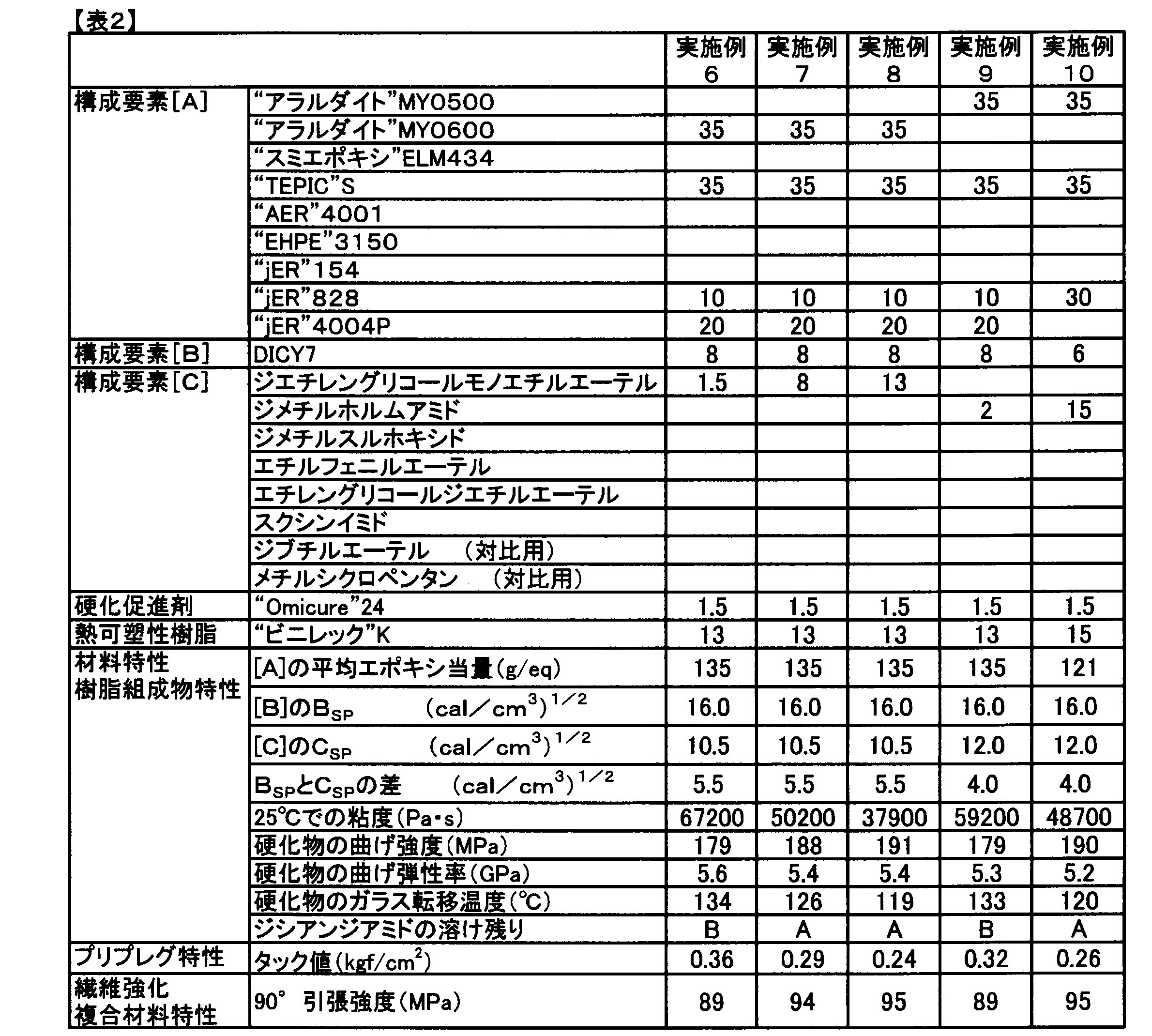
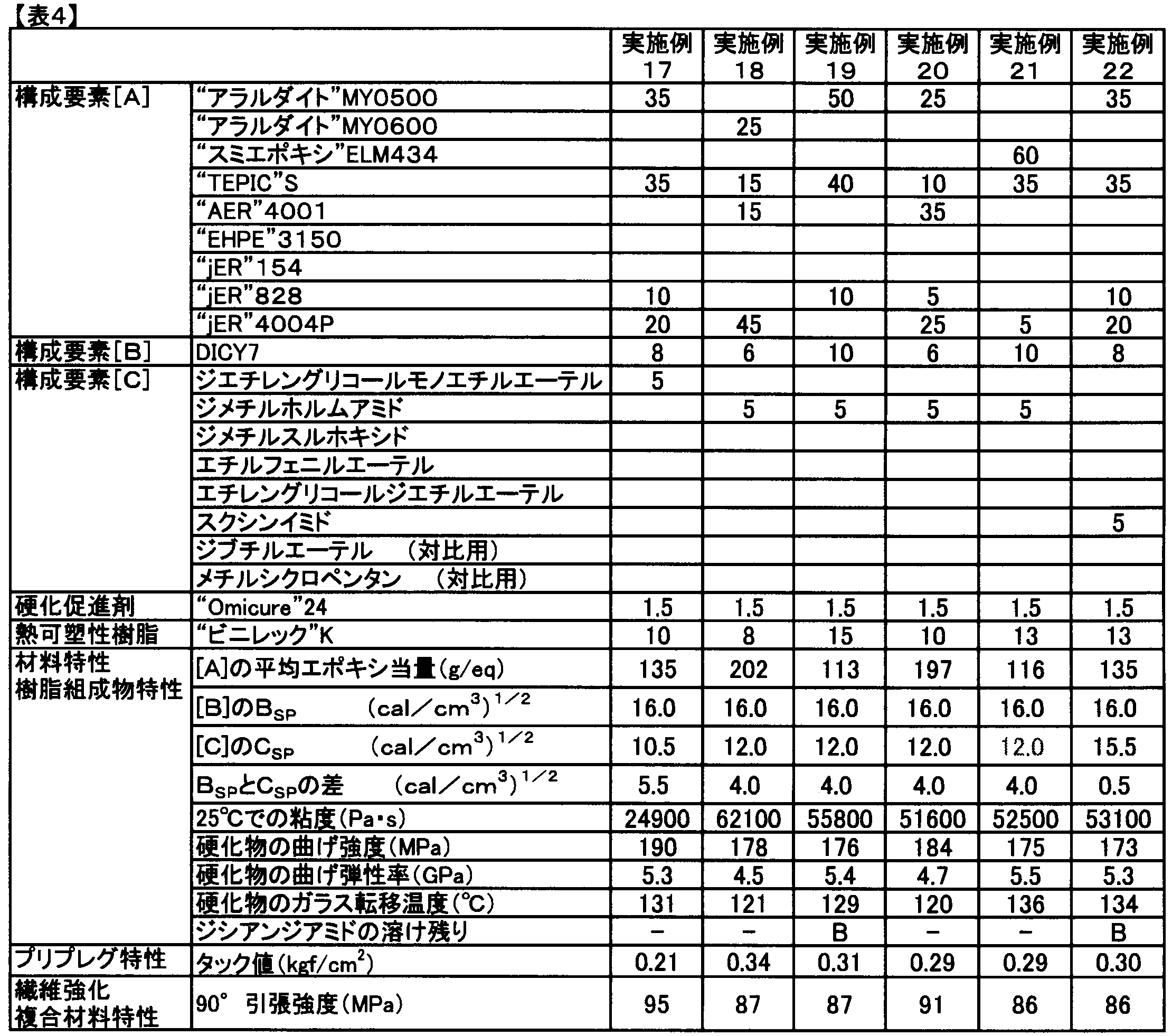
- Examples 2 to 22 Resin compositions and prepregs were obtained in the same procedure as in Example 1 according to the blending ratios in Tables 1 to 4. Using the obtained resin composition and prepreg, the above-mentioned “(1) Viscosity measurement of resin composition”, “(2) Three-point bending measurement of cured resin”, “(3) Glass transition of cured resin” “Temperature measurement”, “(4) Tack property measurement of prepreg”, “(6) 90 ° tensile strength measurement of fiber reinforced composite material”. Various measurement results of the examples are as shown in Tables 1 and 2. Even when the composition of the resin composition is changed as in Examples 2 to 22, excellent bending strength of the cured resin, tackiness of the prepreg And 90 ° tensile strength of the fiber reinforced composite material was obtained.
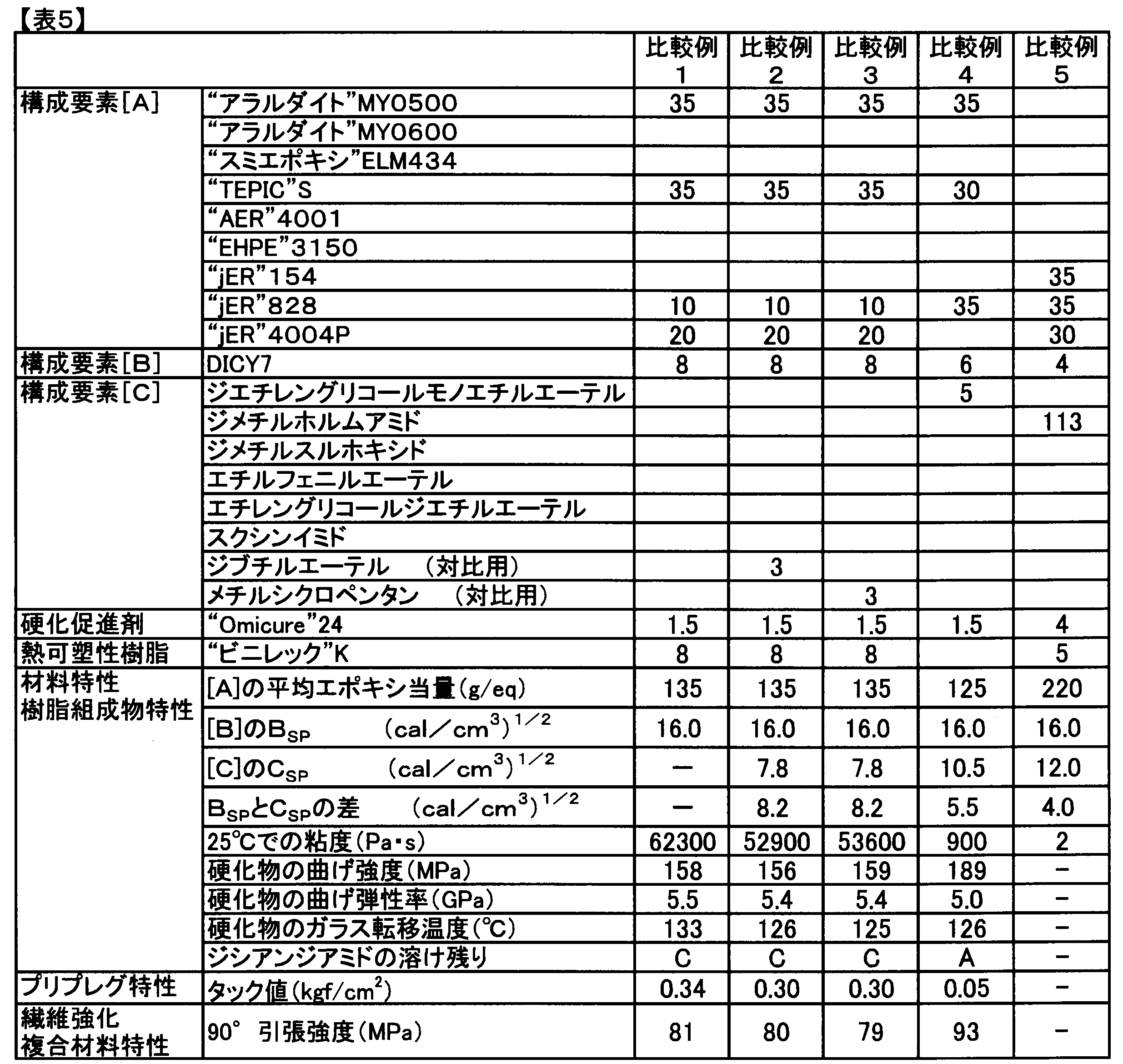
- a resin composition and a prepreg were obtained in the same procedure as in Example 1 according to the blending ratio in Table 5. Using the obtained resin composition and prepreg, the above-mentioned “(1) Viscosity measurement of resin composition”, “(2) Three-point bending measurement of cured resin”, “(3) Glass transition of cured resin” “Temperature measurement”, “(4) Tack property measurement of prepreg”, “(6) 90 ° tensile strength measurement of fiber reinforced composite material”.
- Comparative Example 1 a component corresponding to the component [C] is not blended. Comparing Comparative Example 1 and Example 1, by adding the component [C], the undissolved residue of dicyandiamide is reduced, and the bending strength of the cured resin and the 90 ° tensile strength of the fiber-reinforced composite material are dramatically increased. It can be seen that it has improved. In Comparative Example 2 and Comparative Example 3, dibutyl ether and methylcyclopentane were blended in place of the constituent element [C], respectively. These compounds do not have a solubility parameter whose difference from the solubility parameter of [B] is within 8.
- component [C] has a solubility parameter whose difference from the solubility parameter of [B] is within 8 so that undissolved dicyandiamide remains. It can be seen that the bending strength of the cured resin and the 90 ° tensile strength of the fiber-reinforced composite material are dramatically improved.
- Comparative Examples 4 and 5 the viscosity of the resin composition at 25 ° C. is low.
- the tack value of the prepreg obtained in Comparative Example 4 was low, and when the prepregs were laminated, the prepregs were difficult to adhere to each other, and the handleability was poor. From this, it turns out that the tack property excellent in the prepreg obtained by satisfy
- the amount of component [C] is excessive. Therefore, the gelation of the resin did not proceed sufficiently under the same curing conditions as in Example 1, and it was impossible to measure various physical properties. Moreover, since the viscosity of the resin composition was low and a resin film could not be produced, the prepreg characteristics could not be measured.
Landscapes
- Chemical & Material Sciences (AREA)
- Health & Medical Sciences (AREA)
- Chemical Kinetics & Catalysis (AREA)
- Medicinal Chemistry (AREA)
- Polymers & Plastics (AREA)
- Organic Chemistry (AREA)
- Engineering & Computer Science (AREA)
- Materials Engineering (AREA)
- Manufacturing & Machinery (AREA)
- Inorganic Chemistry (AREA)
- Reinforced Plastic Materials (AREA)
- Epoxy Resins (AREA)
Abstract
Description
[A]:エポキシ樹脂
[B]:ジシアンジアミド
[C]:融点が130℃以下であり、[B]の溶解度パラメータとの差が8以内である溶解度パラメータを有する化合物
また、本発明の繊維強化複合材料は、上記プリプレグが硬化されてなる繊維強化複合材料である。
本発明の樹脂組成物において、構成要素[A]100質量部に対し、構成要素[B]を4~16質量部含むことが好ましく、より好ましくは6~10質量部である。構成要素[B]の配合量をかかる範囲とすることで、耐熱性と機械特性のバランスに優れたエポキシ樹脂硬化物を得ることができる。

(1)強化繊維
・“トレカ(登録商標)” T1100G-24K(繊維数24000本、引張弾性率:324GPa、密度1.8g/cm3、東レ(株)製)。
・“アラルダイト(登録商標)”MY0500(アミノフェノール型エポキシ樹脂、エポキシ当量:118g/eq、官能基数:3、ハンツマン・アドバンスト・マテリアルズ(株)製)
・“アラルダイト(登録商標)”MY0600(アミノフェノール型エポキシ樹脂、エポキシ当量:118g/eq、官能基数:3、ハンツマン・アドバンスト・マテリアルズ(株)製)
・“スミエポキシ(登録商標)”ELM434(ジアミノジフェニルメタン型エポキシ樹脂、エポキシ当量:120g/eq、官能基数:4、住友化学工業(株)製)
・“TEPIC(登録商標)”S(イソシアヌル酸型エポキシ樹脂、エポキシ当量:100g/eq、官能基数:3、日産化学工業(株)製)
・“AER(登録商標)”4001(イソシアネート変性エポキシ樹脂、エポキシ当量:290g/eq、旭化成イーマテリアルズ(株)製)
・“EHPE(登録商標)”3150(脂環式エポキシ樹脂、エポキシ当量:180g/eq、(株)ダイセル製)
・“jER(商標登録)”828(ビスフェノールA型エポキシ樹脂、エポキシ当量:170g/eq、三菱ケミカル(株)製)
・“jER(商標登録)”4004P(ビスフェノールF型エポキシ樹脂、エポキシ当量:550g/eq、三菱ケミカル(株)製)。
・DICY7(ジシアンジアミド、BSP:16.0、三菱ケミカル(株)製)。
・ジエチレングリコールモノエチルエーテル(融点:-80℃、沸点:196℃、CSP:10.5、東京化成工業(株)製)
・ジメチルホルムアミド(融点:-61℃、沸点:153℃、CSP:12.0、東京化成工業(株)製)
・ジメチルスルホキシド(融点:19℃、沸点:189℃、CSP:12.1、ナカライテスク(株)製)
・エチルフェニルエーテル(融点:-30℃、沸点:173℃、CSP:9.4、東京化成工業(株)製)
・エチレングリコールジエチルエーテル(融点:-74℃、沸点:121℃、CSP:8.3、東京化成工業(株)製)
・スクシンイミド(融点:124℃、沸点:287℃、CSP:15.5、東京化成工業(株)製)。
・ジブチルエーテル(融点:-98℃、沸点:141℃、CSP:7.8、東京化成工業(株)製)(対比用。本発明で特定する構成要素[C]には属しない。)
・メチルシクロペンタン(融点:-142℃、沸点:72℃、CSP:7.8、東京化成工業(株)製)(対比用。本発明の構成要素[C]には属しない。)。
・2,4-トルエンビス(ジメチルウレア)(“Omicure(登録商標)”24、Emerald Performance Materials,LLC製、融点188℃)。
・“ビニレック(登録商標)”K(ポリビニルホルマール、JNC(株)製)。
以下の測定方法を使用し、各実施例のエポキシ樹脂組成物およびプリプレグを測定した。
樹脂組成物の粘度は、動的粘弾性装置ARES-2KFRTN1-FCO-STD(ティー・エイ・インスツルメント社製)を用いて測定した。上下部測定冶具に直径25mmの平板のパラレルプレートを用い、上部と下部の冶具間距離が1mmとなるように該エポキシ樹脂組成物をセット後、ねじりモード(測定周波数:0.5Hz)で測定した。20℃から30℃まで速度1℃/分で昇温し、25℃での複素粘弾性率を樹脂組成物の25℃での粘度とした。
未硬化の樹脂組成物を真空中で脱泡した後、2mm厚の“テフロン(登録商標)”製スペーサーにより厚み2mmになるように設定したモールド中で、30℃から速度1.7℃/分で昇温して90℃の温度で60分間保持した後、速度2.0℃/分で昇温して135℃の温度で120分間硬化させ、厚さ2mmの板状の樹脂硬化物を得た。この樹脂硬化物から、幅10mm、長さ60mmの試験片を切り出し、インストロン万能試験機(インストロン社製)を用い、スパンを32mm、クロスヘッドスピードを100mm/分、サンプル数n=6とし、JIS K7171(1994)に従って3点曲げを実施し、強度および弾性率の平均値をそれぞれ樹脂硬化物の曲げ強度、樹脂硬化物の曲げ弾性率とした。
エポキシ樹脂組成物をモールドに注入した後、熱風乾燥機中で30℃から速度1.7℃/分で昇温して90℃の温度で60分間保持した後、速度2.0℃/分で昇温して135℃の温度で120分間硬化させ、厚さ2mmの樹脂硬化板を作製した。作製した樹脂硬化板から幅12.7mm、長さ55mmの試験片を切り出した後、SACMA SRM18R-94に従い、DMA法によりガラス転移温度を求めた。貯蔵弾性率G’曲線において、ガラス状態での接線と転移状態での接線との交点温度値をガラス転移温度とした。ここでは、昇温速度5℃/分、周波数1Hzで測定した。
プリプレグのタック性を、タックテスタ(PICMAタックテスタII:東洋精機(株)製)を用いて測定した。18mm×18mmのカバーガラスを0.4kgf(3.9N)の力で5秒間プリプレグに圧着し、30mm/分の速度にて垂直に引張り、剥がれる際の抵抗力をタック値とした。
JIS K7017(1999)に記載されているとおり、一方向繊維強化複合材料の繊維方向を軸方向とし、軸方向を0°軸と定義したときの軸直交方向を90°と定義した。
一方向プリプレグの繊維方向を揃えて20プライ積層し、オートクレーブにて0.7MPaの圧力下、30℃から速度1.7℃/分で昇温して90℃の温度で60分間保持した後、速度2.0℃/分で昇温して135℃の温度で120分間成形して、厚み2mmの一方向材のCFRPを作製した。90°引張強度は、JIS K7073(1988)に従い測定した。硬化板から、長さ150±0.4mm、幅20±0.2mm、厚さ2±0.2mmの一方向90゜引張試験片を作製した。試験片引張試験機のクロスヘッドスピードは1mm/分として測定した。サンプル数n=5として測定し、平均値を90°引張強度とした
(7)樹脂硬化物の偏光顕微鏡観察
未硬化の樹脂組成物を真空中で脱泡した後、2mm厚の“テフロン(登録商標)”製スペーサーにより厚み2mmになるように設定したモールド中で、30℃から速度1.7℃/分で昇温して90℃の温度で60分間保持した後、速度2.0℃/分で昇温して135℃の温度で120分間硬化させ、厚さ2mmの板状の観察用樹脂硬化物を得た。偏光光学顕微鏡(キーエンス(株)製;VHX-5000、偏光フィルター付き)にて樹脂硬化物の偏光透過観察を行い、複屈折を有する3μm以上の結晶性固形物をジシアンジアミドと見なしてその残存量を評価した。ジシアンジアミドの溶け残りの評価は3段階で判定し、1mm×1mmの観察範囲に残存するジシアンジアミドが0~60個であれば「A」、61~120個であれば「B」、121個以上であれば「C」とした。
(樹脂組成物の作製)
次の手法にて、樹脂組成物を作製した。
前記にて得られた樹脂組成物を、ナイフコーターを用いて離型紙上に塗布して、樹脂目付が21g/m2の樹脂フィルムを2枚作製した。次に、繊維目付が125g/m2のシート状となるように一方向に配列させた炭素繊維に、得られた樹脂フィルムを2枚、炭素繊維の両面から重ねて温度110℃、最大圧力1MPaの条件で加熱加圧してエポキシ樹脂組成物を含浸させ、プリプレグを得た。
・構成要素[A];
“アラルダイト(登録商標)”MY0500:35部
“TEPIC(登録商標)”S:35部
“jER(商標登録)”828:10部
“jER(商標登録)”4004P:20部
・構成要素[B];
DICY7:8.0部
・構成要素[C];
ジエチレングリコールモノエチルエーテル:5部。
表1~4の配合比に従って上記実施例1と同様の手順で樹脂組成物およびプリプレグを得た。得られた樹脂組成物とプリプレグを用いて、上記の「(1)樹脂組成物の粘度測定」、「(2)樹脂硬化物の3点曲げ測定」、「(3)樹脂硬化物のガラス転移温度測定」、「(4)プリプレグのタック性測定」、「(6)繊維強化複合材料の90°引張強度測定」行った。実施例の各種測定結果は表1、2に示す通りであり、実施例2~22のように樹脂組成物の配合を変更した場合においても、優れた樹脂硬化物の曲げ強度、プリプレグのタック性、および繊維強化複合材料の90°引張強度が得られた。
表5の配合比に従って上記実施例1と同様の手順で樹脂組成物およびプリプレグを得た。得られた樹脂組成物とプリプレグを用いて、上記の「(1)樹脂組成物の粘度測定」、「(2)樹脂硬化物の3点曲げ測定」、「(3)樹脂硬化物のガラス転移温度測定」、「(4)プリプレグのタック性測定」、「(6)繊維強化複合材料の90°引張強度測定」行った。


Claims (7)
- 強化繊維と樹脂組成物とからなるプリプレグであって、該樹脂組成物が下記[A]~[C]を含み、該樹脂組成物の25℃での粘度が1000Pa・s以上であるプリプレグ。
[A]:エポキシ樹脂
[B]:ジシアンジアミド
[C]:融点が130℃以下であり、[B]の溶解度パラメータとの差が8以内である溶解度パラメータを有する化合物 - 該樹脂組成物において、構成要素[A]100質量部に対し構成要素[C]を1~10質量部含む請求項1に記載のプリプレグ。
- 該樹脂組成物において、構成要素[B]100質量部に対し構成要素[C]を30~250質量部含む請求項1または2に記載のプリプレグ。
- 該樹脂組成物に含まれる全ての構成要素[C]の沸点が125℃以上である請求項1~3のいずれかに記載のプリプレグ。
- 構成要素[A]の平均エポキシ当量が115~200g/eqである請求項1~4のいずれかに記載のプリプレグ。
- 構成要素[A]100質量部のうち、分子内に窒素原子を有する3官能以上のエポキシ樹脂を40~90質量部含む請求項1~5のいずれかに記載のプリプレグ。
- 請求項1~6のいずれかに記載のプリプレグが硬化されてなる繊維強化複合材料。
Priority Applications (5)
| Application Number | Priority Date | Filing Date | Title |
|---|---|---|---|
| EP19772576.5A EP3766926B1 (en) | 2018-03-20 | 2019-02-27 | Prepreg and fiber-reinforced composite material |
| CN201980019577.8A CN111902469B (zh) | 2018-03-20 | 2019-02-27 | 预浸料坯及纤维增强复合材料 |
| KR1020207026161A KR102642515B1 (ko) | 2018-03-20 | 2019-02-27 | 프리프레그 및 섬유 강화 복합재료 |
| US16/980,988 US11505641B2 (en) | 2018-03-20 | 2019-02-27 | Prepreg and fiber-reinforced composite material |
| JP2019514131A JP7172995B2 (ja) | 2018-03-20 | 2019-02-27 | プリプレグおよび繊維強化複合材料 |
Applications Claiming Priority (2)
| Application Number | Priority Date | Filing Date | Title |
|---|---|---|---|
| JP2018-052156 | 2018-03-20 | ||
| JP2018052156 | 2018-03-20 |
Publications (1)
| Publication Number | Publication Date |
|---|---|
| WO2019181402A1 true WO2019181402A1 (ja) | 2019-09-26 |
Family
ID=67987065
Family Applications (1)
| Application Number | Title | Priority Date | Filing Date |
|---|---|---|---|
| PCT/JP2019/007549 Ceased WO2019181402A1 (ja) | 2018-03-20 | 2019-02-27 | プリプレグおよび繊維強化複合材料 |
Country Status (7)
| Country | Link |
|---|---|
| US (1) | US11505641B2 (ja) |
| EP (1) | EP3766926B1 (ja) |
| JP (1) | JP7172995B2 (ja) |
| KR (1) | KR102642515B1 (ja) |
| CN (1) | CN111902469B (ja) |
| TW (1) | TWI816760B (ja) |
| WO (1) | WO2019181402A1 (ja) |
Cited By (8)
| Publication number | Priority date | Publication date | Assignee | Title |
|---|---|---|---|---|
| WO2021095629A1 (ja) | 2019-11-15 | 2021-05-20 | 東レ株式会社 | エポキシ樹脂組成物、プリプレグおよび繊維強化複合材料 |
| WO2021095631A1 (ja) | 2019-11-15 | 2021-05-20 | 東レ株式会社 | エポキシ樹脂組成物、プリプレグおよび繊維強化複合材料 |
| WO2021095627A1 (ja) | 2019-11-15 | 2021-05-20 | 東レ株式会社 | エポキシ樹脂組成物、プリプレグおよび繊維強化複合材料 |
| WO2021095628A1 (ja) | 2019-11-15 | 2021-05-20 | 東レ株式会社 | エポキシ樹脂組成物、プリプレグおよび繊維強化複合材料 |
| WO2021153584A1 (ja) * | 2020-01-30 | 2021-08-05 | 東レ株式会社 | エポキシ樹脂組成物、繊維強化複合材料用成形材料および繊維強化複合材料 |
| JPWO2021177089A1 (ja) * | 2020-03-06 | 2021-09-10 | ||
| JPWO2022113976A1 (ja) * | 2020-11-27 | 2022-06-02 | ||
| WO2023157507A1 (ja) * | 2022-02-16 | 2023-08-24 | 東レ株式会社 | プリプレグ、繊維強化複合材料、繊維強化複合材料製管状体、ゴルフクラブシャフトおよび釣り竿 |
Families Citing this family (1)
| Publication number | Priority date | Publication date | Assignee | Title |
|---|---|---|---|---|
| CN117866432B (zh) * | 2024-01-10 | 2024-06-25 | 常州融信复合材料有限公司 | 一种耐高温氰酸酯树脂及其制备的预浸料 |
Citations (6)
| Publication number | Priority date | Publication date | Assignee | Title |
|---|---|---|---|---|
| JPH11302412A (ja) * | 1998-04-16 | 1999-11-02 | Toray Ind Inc | プリプレグおよび繊維強化複合材料 |
| JP2007297487A (ja) * | 2006-04-28 | 2007-11-15 | Fuji Heavy Ind Ltd | ヤーンプリプレグ、繊維強化複合材料、自動積層成形方法及び繊維強化複合材料の製造方法 |
| JP2007537331A (ja) * | 2004-05-14 | 2007-12-20 | サイテク・テクノロジー・コーポレーシヨン | 自己接着性プリプレグ |
| JP2014122312A (ja) * | 2012-12-21 | 2014-07-03 | Toray Ind Inc | プリプレグおよび炭素繊維強化複合材料 |
| JP2017020004A (ja) | 2015-07-09 | 2017-01-26 | 東レ株式会社 | エポキシ樹脂組成物、プリプレグおよび繊維強化複合材料 |
| JP2017226745A (ja) * | 2016-06-22 | 2017-12-28 | 三菱ケミカル株式会社 | エポキシ樹脂組成物、並びにこれを用いたフィルム、プリプレグ及び繊維強化プラスチック |
Family Cites Families (19)
| Publication number | Priority date | Publication date | Assignee | Title |
|---|---|---|---|---|
| KR101398731B1 (ko) * | 2006-09-29 | 2014-05-27 | 히타치가세이가부시끼가이샤 | 열경화성 수지 조성물 및 이것을 이용한 프리프레그 및 적층판 |
| TWI435887B (zh) * | 2008-02-26 | 2014-05-01 | Toray Industries | 環氧樹脂組成物、預浸透物及纖維強化複合材料 |
| JP5136573B2 (ja) * | 2009-02-24 | 2013-02-06 | 日立化成工業株式会社 | ワニス、プリプレグ、樹脂付きフィルム、金属箔張積層板、プリント配線板 |
| EP2518115B1 (en) * | 2009-12-25 | 2017-10-18 | Hitachi Chemical Company, Ltd. | Thermosetting resin composition, method for producing resin composition varnish, prepreg and laminate |
| CN109535926B (zh) * | 2010-02-24 | 2021-06-22 | 昭和电工材料株式会社 | 清漆、预浸料片、含有树脂的膜、被覆金属箔的层叠板、印制电路布线板 |
| CN104487495B (zh) * | 2012-07-25 | 2016-09-07 | 东丽株式会社 | 预浸料坯及碳纤维增强复合材料 |
| GB2515323A (en) * | 2013-06-19 | 2014-12-24 | Hexcel Composites Ltd | Improvements in or relating to epoxy resin formulations |
| JP6180204B2 (ja) * | 2013-07-02 | 2017-08-16 | ダンロップスポーツ株式会社 | ゴルフクラブシャフト |
| GB201313420D0 (en) * | 2013-07-26 | 2013-09-11 | Hexcel Composites Ltd | Improvements in or relating to fibre reinforced composites |
| CN103554844B (zh) * | 2013-10-29 | 2016-02-17 | 广东生益科技股份有限公司 | 一种热固性树脂组合物及其用途 |
| JP6011644B2 (ja) * | 2013-12-02 | 2016-10-19 | 三菱レイヨン株式会社 | エポキシ樹脂組成物、並びにこれを用いたフィルム、プリプレグ及び繊維強化プラスチック |
| WO2016002241A1 (ja) * | 2014-06-30 | 2016-01-07 | Dic株式会社 | エポキシ樹脂、硬化性樹脂組成物、硬化物、半導体封止材料、半導体装置、プレプリグ、回路基板、ビルドアップフィルム、ビルドアップ基板、繊維強化複合材料、及び繊維強化成形品 |
| CN107001592B (zh) * | 2014-11-17 | 2020-05-22 | 东丽株式会社 | 环氧树脂组合物、预浸料坯、树脂固化物及纤维增强复合材料 |
| JP6156569B2 (ja) * | 2014-12-25 | 2017-07-05 | 三菱ケミカル株式会社 | 炭素繊維強化プラスチック用エポキシ樹脂組成物、並びにこれを用いたフィルム、プリプレグ及び炭素繊維強化プラスチック |
| RU2712217C2 (ru) * | 2015-06-19 | 2020-01-27 | Торэй Индастриз, Инк. | Композиция эпоксидной смолы, препрег и армированный волокном композиционный материал |
| US10316159B2 (en) * | 2015-09-17 | 2019-06-11 | Toray Industries, Inc. | Epoxy resin composition, prepreg, and fiber reinforced material |
| WO2017163129A1 (en) * | 2016-03-24 | 2017-09-28 | Toray Industries, Inc. | Epoxy resin composition, prepreg, and fiber reinforced plastic material |
| CN109642019A (zh) * | 2016-08-26 | 2019-04-16 | 东丽株式会社 | 环氧树脂组合物、预浸料坯和纤维增强塑料材料 |
| CN109111739B (zh) * | 2017-06-26 | 2020-12-01 | 中山台光电子材料有限公司 | 树脂组合物及由其制成的物品 |
-
2019
- 2019-02-27 JP JP2019514131A patent/JP7172995B2/ja active Active
- 2019-02-27 EP EP19772576.5A patent/EP3766926B1/en active Active
- 2019-02-27 CN CN201980019577.8A patent/CN111902469B/zh active Active
- 2019-02-27 WO PCT/JP2019/007549 patent/WO2019181402A1/ja not_active Ceased
- 2019-02-27 KR KR1020207026161A patent/KR102642515B1/ko active Active
- 2019-02-27 US US16/980,988 patent/US11505641B2/en active Active
- 2019-03-11 TW TW108108077A patent/TWI816760B/zh active
Patent Citations (6)
| Publication number | Priority date | Publication date | Assignee | Title |
|---|---|---|---|---|
| JPH11302412A (ja) * | 1998-04-16 | 1999-11-02 | Toray Ind Inc | プリプレグおよび繊維強化複合材料 |
| JP2007537331A (ja) * | 2004-05-14 | 2007-12-20 | サイテク・テクノロジー・コーポレーシヨン | 自己接着性プリプレグ |
| JP2007297487A (ja) * | 2006-04-28 | 2007-11-15 | Fuji Heavy Ind Ltd | ヤーンプリプレグ、繊維強化複合材料、自動積層成形方法及び繊維強化複合材料の製造方法 |
| JP2014122312A (ja) * | 2012-12-21 | 2014-07-03 | Toray Ind Inc | プリプレグおよび炭素繊維強化複合材料 |
| JP2017020004A (ja) | 2015-07-09 | 2017-01-26 | 東レ株式会社 | エポキシ樹脂組成物、プリプレグおよび繊維強化複合材料 |
| JP2017226745A (ja) * | 2016-06-22 | 2017-12-28 | 三菱ケミカル株式会社 | エポキシ樹脂組成物、並びにこれを用いたフィルム、プリプレグ及び繊維強化プラスチック |
Non-Patent Citations (1)
| Title |
|---|
| See also references of EP3766926A4 |
Cited By (21)
| Publication number | Priority date | Publication date | Assignee | Title |
|---|---|---|---|---|
| WO2021095629A1 (ja) | 2019-11-15 | 2021-05-20 | 東レ株式会社 | エポキシ樹脂組成物、プリプレグおよび繊維強化複合材料 |
| WO2021095631A1 (ja) | 2019-11-15 | 2021-05-20 | 東レ株式会社 | エポキシ樹脂組成物、プリプレグおよび繊維強化複合材料 |
| WO2021095627A1 (ja) | 2019-11-15 | 2021-05-20 | 東レ株式会社 | エポキシ樹脂組成物、プリプレグおよび繊維強化複合材料 |
| WO2021095628A1 (ja) | 2019-11-15 | 2021-05-20 | 東レ株式会社 | エポキシ樹脂組成物、プリプレグおよび繊維強化複合材料 |
| CN114729106B (zh) * | 2019-11-15 | 2024-03-05 | 东丽株式会社 | 环氧树脂组合物、预浸料及纤维增强复合材料 |
| EP4059974A4 (en) * | 2019-11-15 | 2023-09-06 | Toray Industries, Inc. | EPOXY RESIN COMPOSITION, PRE-PREG, AND FIBER REINFORCED COMPOSITE MATERIAL |
| CN114729106A (zh) * | 2019-11-15 | 2022-07-08 | 东丽株式会社 | 环氧树脂组合物、预浸料及纤维增强复合材料 |
| WO2021153584A1 (ja) * | 2020-01-30 | 2021-08-05 | 東レ株式会社 | エポキシ樹脂組成物、繊維強化複合材料用成形材料および繊維強化複合材料 |
| JPWO2021153584A1 (ja) * | 2020-01-30 | 2021-08-05 | ||
| JP7622627B2 (ja) | 2020-01-30 | 2025-01-28 | 東レ株式会社 | エポキシ樹脂組成物、繊維強化複合材料用成形材料および繊維強化複合材料 |
| CN115210318A (zh) * | 2020-03-06 | 2022-10-18 | 东丽株式会社 | 环氧树脂组合物、预浸料及纤维增强复合材料 |
| WO2021177089A1 (ja) * | 2020-03-06 | 2021-09-10 | 東レ株式会社 | エポキシ樹脂組成物、プリプレグおよび繊維強化複合材料 |
| JPWO2021177089A1 (ja) * | 2020-03-06 | 2021-09-10 | ||
| JP7775710B2 (ja) | 2020-03-06 | 2025-11-26 | 東レ株式会社 | エポキシ樹脂組成物、プリプレグおよび繊維強化複合材料 |
| JPWO2022113976A1 (ja) * | 2020-11-27 | 2022-06-02 | ||
| EP4253039A4 (en) * | 2020-11-27 | 2024-10-23 | Toray Industries, Inc. | PREPREG AND PREPREG PRODUCTION METHOD |
| US12528925B2 (en) | 2020-11-27 | 2026-01-20 | Toray Industries, Inc. | Prepreg and method for producing prepreg |
| WO2023157507A1 (ja) * | 2022-02-16 | 2023-08-24 | 東レ株式会社 | プリプレグ、繊維強化複合材料、繊維強化複合材料製管状体、ゴルフクラブシャフトおよび釣り竿 |
| JPWO2023157507A1 (ja) * | 2022-02-16 | 2023-08-24 | ||
| KR20240151748A (ko) | 2022-02-16 | 2024-10-18 | 도레이 카부시키가이샤 | 프리프레그, 섬유 강화 복합 재료, 섬유 강화 복합 재료제 관상체, 골프 클럽 샤프트 및 낚싯대 |
| JP7666581B2 (ja) | 2022-02-16 | 2025-04-22 | 東レ株式会社 | プリプレグ、繊維強化複合材料、繊維強化複合材料製管状体、ゴルフクラブシャフトおよび釣り竿 |
Also Published As
| Publication number | Publication date |
|---|---|
| JP7172995B2 (ja) | 2022-11-16 |
| CN111902469B (zh) | 2023-04-14 |
| KR20200133738A (ko) | 2020-11-30 |
| US20210371613A1 (en) | 2021-12-02 |
| CN111902469A (zh) | 2020-11-06 |
| EP3766926B1 (en) | 2025-07-02 |
| US11505641B2 (en) | 2022-11-22 |
| TW201940564A (zh) | 2019-10-16 |
| EP3766926A4 (en) | 2022-01-26 |
| JPWO2019181402A1 (ja) | 2021-02-04 |
| TWI816760B (zh) | 2023-10-01 |
| KR102642515B1 (ko) | 2024-02-29 |
| EP3766926A1 (en) | 2021-01-20 |
Similar Documents
| Publication | Publication Date | Title |
|---|---|---|
| JP7172995B2 (ja) | プリプレグおよび繊維強化複合材料 | |
| JP6771884B2 (ja) | エポキシ樹脂組成物、プリプレグおよび繊維強化複合材料 | |
| CN108026251A (zh) | 环氧树脂组合物、预浸料坯及纤维增强复合材料 | |
| WO2016080202A1 (ja) | エポキシ樹脂組成物、プリプレグ、樹脂硬化物および繊維強化複合材料 | |
| JP6771885B2 (ja) | エポキシ樹脂組成物、プリプレグおよび繊維強化複合材料 | |
| JP4428978B2 (ja) | エポキシ樹脂組成物 | |
| JP4821163B2 (ja) | 繊維強化複合材料用エポキシ樹脂組成物 | |
| WO2022039050A1 (ja) | エポキシ樹脂組成物、プリプレグおよび繊維強化複合材料 | |
| JP7775710B2 (ja) | エポキシ樹脂組成物、プリプレグおよび繊維強化複合材料 | |
| WO2020217894A1 (ja) | エポキシ樹脂組成物、中間基材および繊維強化複合材料 | |
| JP2020007409A (ja) | エポキシ樹脂組成物、プリプレグおよび繊維強化複合材料 | |
| WO2022201890A1 (ja) | エポキシ樹脂組成物、プリプレグおよび繊維強化複合材料 | |
| JP2020158594A (ja) | トウプレグおよびその製造方法、圧力容器の製造方法 | |
| TW202409189A (zh) | 預浸體、纖維強化複合材料、纖維強化複合材料製管狀體、高爾夫球桿桿身及釣竿 | |
| TW201908406A (zh) | 環氧樹脂組成物、預浸體及纖維強化複合材料 | |
| JP7707805B2 (ja) | プリプレグおよび繊維強化複合材料 | |
| JP7622436B2 (ja) | エポキシ樹脂組成物、プリプレグおよび繊維強化複合材料 | |
| TWI912578B (zh) | 預浸體、纖維強化複合材料、纖維強化複合材料製管狀體、高爾夫球桿桿身及釣竿 | |
| JP7622437B2 (ja) | エポキシ樹脂組成物、プリプレグおよび繊維強化複合材料 | |
| JP2025086937A (ja) | 繊維強化複合材料用エポキシ樹脂組成物、繊維強化複合材料用エポキシ樹脂フィルム、プリプレグおよび繊維強化複合材料 | |
| WO2019111747A1 (ja) | プリプレグおよび繊維強化複合材料 | |
| WO2018207509A1 (ja) | エポキシ樹脂組成物、プリプレグ、繊維強化複合材料およびその製造方法 | |
| JP2024049345A (ja) | 繊維強化複合材料用エポキシ樹脂組成物および繊維強化複合材料 | |
| JP2023067809A (ja) | エポキシ樹脂組成物、プリプレグおよび繊維強化複合材料 | |
| JP2023140493A (ja) | 織物プリプレグ、繊維強化複合材料および自動車用構造材料 |
Legal Events
| Date | Code | Title | Description |
|---|---|---|---|
| ENP | Entry into the national phase |
Ref document number: 2019514131 Country of ref document: JP Kind code of ref document: A |
|
| 121 | Ep: the epo has been informed by wipo that ep was designated in this application |
Ref document number: 19772576 Country of ref document: EP Kind code of ref document: A1 |
|
| DPE1 | Request for preliminary examination filed after expiration of 19th month from priority date (pct application filed from 20040101) | ||
| NENP | Non-entry into the national phase |
Ref country code: DE |
|
| ENP | Entry into the national phase |
Ref document number: 2019772576 Country of ref document: EP Effective date: 20201016 |
|
| WWG | Wipo information: grant in national office |
Ref document number: 2019772576 Country of ref document: EP |