WO2019183284A1 - Sulfur- and phosphorus-containing polymers, and methods of producing thereof - Google Patents

Sulfur- and phosphorus-containing polymers, and methods of producing thereof Download PDF

Info

Publication number
WO2019183284A1
WO2019183284A1 PCT/US2019/023262 US2019023262W WO2019183284A1 WO 2019183284 A1 WO2019183284 A1 WO 2019183284A1 US 2019023262 W US2019023262 W US 2019023262W WO 2019183284 A1 WO2019183284 A1 WO 2019183284A1
Authority
WO
WIPO (PCT)
Prior art keywords
formula
compound
alkyl
produce
polymer
Prior art date
Legal status (The legal status is an assumption and is not a legal conclusion. Google has not performed a legal analysis and makes no representation as to the accuracy of the status listed.)
Ceased
Application number
PCT/US2019/023262
Other languages
French (fr)
Inventor
Han Lee
Alexander Tseitlin
Sadesh H. SOOKRAJ
Current Assignee (The listed assignees may be inaccurate. Google has not performed a legal analysis and makes no representation or warranty as to the accuracy of the list.)
Novomer Inc
Original Assignee
Novomer Inc
Priority date (The priority date is an assumption and is not a legal conclusion. Google has not performed a legal analysis and makes no representation as to the accuracy of the date listed.)
Filing date
Publication date
Application filed by Novomer Inc filed Critical Novomer Inc
Priority to US16/981,437 priority Critical patent/US11685809B2/en
Priority to JP2020542376A priority patent/JP2021516269A/en
Priority to CN201980021149.9A priority patent/CN111954686A/en
Priority to EP19771680.6A priority patent/EP3768742A4/en
Publication of WO2019183284A1 publication Critical patent/WO2019183284A1/en
Anticipated expiration legal-status Critical
Ceased legal-status Critical Current

Links

Classifications

    • CCHEMISTRY; METALLURGY
    • C08ORGANIC MACROMOLECULAR COMPOUNDS; THEIR PREPARATION OR CHEMICAL WORKING-UP; COMPOSITIONS BASED THEREON
    • C08GMACROMOLECULAR COMPOUNDS OBTAINED OTHERWISE THAN BY REACTIONS ONLY INVOLVING UNSATURATED CARBON-TO-CARBON BONDS
    • C08G63/00Macromolecular compounds obtained by reactions forming a carboxylic ester link in the main chain of the macromolecule
    • C08G63/68Polyesters containing atoms other than carbon, hydrogen and oxygen
    • C08G63/688Polyesters containing atoms other than carbon, hydrogen and oxygen containing sulfur
    • C08G63/6884Polyesters containing atoms other than carbon, hydrogen and oxygen containing sulfur derived from polycarboxylic acids and polyhydroxy compounds
    • C08G63/6886Dicarboxylic acids and dihydroxy compounds
    • CCHEMISTRY; METALLURGY
    • C08ORGANIC MACROMOLECULAR COMPOUNDS; THEIR PREPARATION OR CHEMICAL WORKING-UP; COMPOSITIONS BASED THEREON
    • C08GMACROMOLECULAR COMPOUNDS OBTAINED OTHERWISE THAN BY REACTIONS ONLY INVOLVING UNSATURATED CARBON-TO-CARBON BONDS
    • C08G63/00Macromolecular compounds obtained by reactions forming a carboxylic ester link in the main chain of the macromolecule
    • C08G63/02Polyesters derived from hydroxycarboxylic acids or from polycarboxylic acids and polyhydroxy compounds
    • C08G63/06Polyesters derived from hydroxycarboxylic acids or from polycarboxylic acids and polyhydroxy compounds derived from hydroxycarboxylic acids
    • C08G63/08Lactones or lactides
    • CCHEMISTRY; METALLURGY
    • C07ORGANIC CHEMISTRY
    • C07CACYCLIC OR CARBOCYCLIC COMPOUNDS
    • C07C315/00Preparation of sulfones; Preparation of sulfoxides
    • CCHEMISTRY; METALLURGY
    • C07ORGANIC CHEMISTRY
    • C07CACYCLIC OR CARBOCYCLIC COMPOUNDS
    • C07C319/00Preparation of thiols, sulfides, hydropolysulfides or polysulfides
    • C07C319/14Preparation of thiols, sulfides, hydropolysulfides or polysulfides of sulfides
    • CCHEMISTRY; METALLURGY
    • C07ORGANIC CHEMISTRY
    • C07CACYCLIC OR CARBOCYCLIC COMPOUNDS
    • C07C67/00Preparation of carboxylic acid esters
    • C07C67/03Preparation of carboxylic acid esters by reacting an ester group with a hydroxy group
    • CCHEMISTRY; METALLURGY
    • C08ORGANIC MACROMOLECULAR COMPOUNDS; THEIR PREPARATION OR CHEMICAL WORKING-UP; COMPOSITIONS BASED THEREON
    • C08GMACROMOLECULAR COMPOUNDS OBTAINED OTHERWISE THAN BY REACTIONS ONLY INVOLVING UNSATURATED CARBON-TO-CARBON BONDS
    • C08G63/00Macromolecular compounds obtained by reactions forming a carboxylic ester link in the main chain of the macromolecule
    • C08G63/68Polyesters containing atoms other than carbon, hydrogen and oxygen
    • C08G63/688Polyesters containing atoms other than carbon, hydrogen and oxygen containing sulfur
    • C08G63/6882Polyesters containing atoms other than carbon, hydrogen and oxygen containing sulfur derived from hydroxy carboxylic acids
    • CCHEMISTRY; METALLURGY
    • C08ORGANIC MACROMOLECULAR COMPOUNDS; THEIR PREPARATION OR CHEMICAL WORKING-UP; COMPOSITIONS BASED THEREON
    • C08GMACROMOLECULAR COMPOUNDS OBTAINED OTHERWISE THAN BY REACTIONS ONLY INVOLVING UNSATURATED CARBON-TO-CARBON BONDS
    • C08G63/00Macromolecular compounds obtained by reactions forming a carboxylic ester link in the main chain of the macromolecule
    • C08G63/68Polyesters containing atoms other than carbon, hydrogen and oxygen
    • C08G63/692Polyesters containing atoms other than carbon, hydrogen and oxygen containing phosphorus
    • CCHEMISTRY; METALLURGY
    • C08ORGANIC MACROMOLECULAR COMPOUNDS; THEIR PREPARATION OR CHEMICAL WORKING-UP; COMPOSITIONS BASED THEREON
    • C08GMACROMOLECULAR COMPOUNDS OBTAINED OTHERWISE THAN BY REACTIONS ONLY INVOLVING UNSATURATED CARBON-TO-CARBON BONDS
    • C08G63/00Macromolecular compounds obtained by reactions forming a carboxylic ester link in the main chain of the macromolecule
    • C08G63/68Polyesters containing atoms other than carbon, hydrogen and oxygen
    • C08G63/692Polyesters containing atoms other than carbon, hydrogen and oxygen containing phosphorus
    • C08G63/6922Polyesters containing atoms other than carbon, hydrogen and oxygen containing phosphorus derived from hydroxy carboxylic acids
    • CCHEMISTRY; METALLURGY
    • C08ORGANIC MACROMOLECULAR COMPOUNDS; THEIR PREPARATION OR CHEMICAL WORKING-UP; COMPOSITIONS BASED THEREON
    • C08GMACROMOLECULAR COMPOUNDS OBTAINED OTHERWISE THAN BY REACTIONS ONLY INVOLVING UNSATURATED CARBON-TO-CARBON BONDS
    • C08G63/00Macromolecular compounds obtained by reactions forming a carboxylic ester link in the main chain of the macromolecule
    • C08G63/78Preparation processes
    • CCHEMISTRY; METALLURGY
    • C08ORGANIC MACROMOLECULAR COMPOUNDS; THEIR PREPARATION OR CHEMICAL WORKING-UP; COMPOSITIONS BASED THEREON
    • C08GMACROMOLECULAR COMPOUNDS OBTAINED OTHERWISE THAN BY REACTIONS ONLY INVOLVING UNSATURATED CARBON-TO-CARBON BONDS
    • C08G75/00Macromolecular compounds obtained by reactions forming a linkage containing sulfur with or without nitrogen, oxygen, or carbon in the main chain of the macromolecule
    • C08G75/02Polythioethers
    • C08G75/04Polythioethers from mercapto compounds or metallic derivatives thereof
    • CCHEMISTRY; METALLURGY
    • C08ORGANIC MACROMOLECULAR COMPOUNDS; THEIR PREPARATION OR CHEMICAL WORKING-UP; COMPOSITIONS BASED THEREON
    • C08GMACROMOLECULAR COMPOUNDS OBTAINED OTHERWISE THAN BY REACTIONS ONLY INVOLVING UNSATURATED CARBON-TO-CARBON BONDS
    • C08G75/00Macromolecular compounds obtained by reactions forming a linkage containing sulfur with or without nitrogen, oxygen, or carbon in the main chain of the macromolecule
    • C08G75/02Polythioethers
    • C08G75/10Polythioethers from sulfur or sulfur-containing compounds and aldehydes or ketones
    • CCHEMISTRY; METALLURGY
    • C08ORGANIC MACROMOLECULAR COMPOUNDS; THEIR PREPARATION OR CHEMICAL WORKING-UP; COMPOSITIONS BASED THEREON
    • C08GMACROMOLECULAR COMPOUNDS OBTAINED OTHERWISE THAN BY REACTIONS ONLY INVOLVING UNSATURATED CARBON-TO-CARBON BONDS
    • C08G75/00Macromolecular compounds obtained by reactions forming a linkage containing sulfur with or without nitrogen, oxygen, or carbon in the main chain of the macromolecule
    • C08G75/20Polysulfones
    • C08G75/23Polyethersulfones
    • CCHEMISTRY; METALLURGY
    • C08ORGANIC MACROMOLECULAR COMPOUNDS; THEIR PREPARATION OR CHEMICAL WORKING-UP; COMPOSITIONS BASED THEREON
    • C08KUse of inorganic or non-macromolecular organic substances as compounding ingredients
    • C08K3/00Use of inorganic substances as compounding ingredients
    • C08K3/30Sulfur-, selenium- or tellurium-containing compounds
    • CCHEMISTRY; METALLURGY
    • C08ORGANIC MACROMOLECULAR COMPOUNDS; THEIR PREPARATION OR CHEMICAL WORKING-UP; COMPOSITIONS BASED THEREON
    • C08KUse of inorganic or non-macromolecular organic substances as compounding ingredients
    • C08K5/00Use of organic ingredients
    • C08K5/49Phosphorus-containing compounds
    • C08K5/5399Phosphorus bound to nitrogen
    • CCHEMISTRY; METALLURGY
    • C08ORGANIC MACROMOLECULAR COMPOUNDS; THEIR PREPARATION OR CHEMICAL WORKING-UP; COMPOSITIONS BASED THEREON
    • C08KUse of inorganic or non-macromolecular organic substances as compounding ingredients
    • C08K3/00Use of inorganic substances as compounding ingredients
    • C08K3/30Sulfur-, selenium- or tellurium-containing compounds
    • C08K2003/3009Sulfides
    • CCHEMISTRY; METALLURGY
    • C08ORGANIC MACROMOLECULAR COMPOUNDS; THEIR PREPARATION OR CHEMICAL WORKING-UP; COMPOSITIONS BASED THEREON
    • C08KUse of inorganic or non-macromolecular organic substances as compounding ingredients
    • C08K3/00Use of inorganic substances as compounding ingredients
    • C08K3/30Sulfur-, selenium- or tellurium-containing compounds
    • C08K2003/309Sulfur containing acids

Definitions

  • the present disclosure relates generally to sulfur- and phosphorus-containing polymers, and more specifically to sulfur- and phosphorus-containing polymers that may be produced from beta-lactones.
  • Polymers are generally used in various applications, including textiles, fabrics, automotive applications, carpets, and coatings.
  • Sulfur- and phosphorus-containing polymers may be used, for example, for high elasticity thermoplastic polymers, and fire resistant polymers.
  • Various methods are known in the art to industrially synthesize such polymers.
  • sulfur-containing polymers such as polyphenylene sulfides
  • phosphorus-containing polymers such as polyphosphoesters
  • ring opening polymerization of phosphonates See e.g., Encyclopedia of Polymer Science and Technology; and Iliescu et al, Chemistry Central Journal 2012, 6:132.
  • the sulfur- and phosphorus-containing polymers may be produced from beta-propiolactone, which can be obtained from bio-based ethylene oxide and/or bio-based carbon monoxide.
  • the method comprises: combining a beta-lactone with a dithionite compound to produce a sulfonyl-dialkanoic acid; and combining the sulfonyl-dialkanoic acid with a diol compound to produce the polymer by condensation polymerization.
  • the beta-lactone combined with the dithionite compound produce a salt of the sulfonyl-dialkanoic acid
  • the method further includes neutralizing the salt of the sulfonyl-dialkanoic acid before combining with the diol compound to produce the polymer.
  • a method of producing a sulfur-containing polymer comprising: combining a beta-lactone with (i) hydrogen sulfide or a salt thereof, or (ii) a thiol compound to produce a sulfur-containing alkanoic acid; and polymerizing the sulfur-containing alkanoic acid to produce the sulfur-containing polymer.
  • a method of producing a phosphorus-containing polyester comprising: combining a beta-lactone with a diol compound to produce an alkanoate compound having two terminal hydroxy groups; and combining the alkanoate compound with a phosphanediamine or phosphanetriamine compound to produce the phosphorus-containing polyester.
  • FIGS. 1A and IB depict exemplary reaction schemes to produce sulfur-containing polymers from beta-lactones using a dithionite compound.
  • FIGS. 2A and 2B depict exemplary reaction schemes to produce sulfur-containing polymers from beta-lactones using a dithiol compound.
  • FIGS. 3A and 3B depict exemplary reaction schemes to produce phosphorus- containing polymers from beta-lactones using a diol compound.
  • provided herein are methods to produce sulfur- and phosphorus-containing polymers from beta-lactones.
  • methods of producing sulfur- containing polymers from beta-lactones using dithionite compounds, hydrogen sulfide or a salt thereof, and thiol compounds are provided.
  • methods of producing phosphorus-containing polymers from beta-lactones using phosphanediamine and phosphanetriamine compounds are provided.
  • the sulfur- containing polymer comprises repeating sulfonyl-dialkanoic acid moieties.
  • the method comprises: combining a beta-lactone with a dithionite compound to produce a sulfonyl-dialkanoic acid; and combining the sulfonyl-dialkanoic acid with a diol compound to produce the polymer by condensation polymerization.
  • a salt of the sulfonyl-dialkanoic acid may be produced.
  • the method further comprises neutralizing the salt of the sulfonyl-dialkanoic acid to produce the sulfonyl-dialkanoic acid, before the condensation polymerization step.
  • the salt of the sulfonyl-dialkanoic acid may be neutralized by an acidic workup.
  • the beta-lactone is a compound of formula (1): wherein each R la , R lb , R lc and R ld is independently H or alkyl.
  • the compound of formula (1) is combined with a dithionite compound to produce a compound of formula (3):
  • R la , R lb , R lc and R ld are as defined for formula (1) above.
  • the compound of formula (3) may be isolated, and optionally purified, before undergoing condensation polymerization to produce the sulfur-containing polymer.
  • the compound of formula (3) is neither isolated nor purified before further use.
  • R 4 is -alkyl-, -cycloalkyl-, -aryl-, -heteroaryl-, -ether-, or -arylalkyl-.
  • the compound of formula (3) and the diol compound are combined under conditions suitable for condensation polymerization to produce the sulfur-containing polymer.
  • the sulfur-containing polymer comprises repeating units of formula:
  • R la , R lb , R lc and R ld are as defined above for formula (3), and R 4 is defined above for formula (4).
  • the compound of formula (3) is 3,3’-sulfonyldipropionic acid, which can then be combined with ethylene glycol to produce a polymer comprising repeating units having the structure:
  • the compound of formula (1) is , wherein each R la , R lb , R lc and R ld is independently H or alkyl.
  • R la is H.
  • R la is alkyl.
  • R la is Ci_ 6 alkyl.
  • R la is methyl, ethyl or propyl.
  • R lb is H.
  • R lb is alkyl.
  • R lb is Ci_ 6 alkyl.
  • R lb is methyl, ethyl or propyl.
  • R lc is H. In other variations, R lc is alkyl.
  • R lc is _ 6 alkyl. In another variation, R lc is methyl, ethyl or propyl. In one variation, R ld is H. In other variations, R ld is alkyl. In certain variations, R ld is Ci_ 6 alkyl. In another variation, R ld is methyl, ethyl or propyl.
  • alkyl refers to a monoradical unbranched or branched saturated hydrocarbon chain.
  • alkyl has 1 to 20 carbon atoms (i.e., Ci_2o alkyl), 1 to 10 carbon atoms (i.e., Ci_io alkyl), 1 to 6 carbon atoms (i.e., Ci_ 6 alkyl), 1 to 5 carbon atoms (i.e., Ci_s alkyl), 1 to 4 carbon atoms (i.e., Ci_ 4 alkyl), 1 to 3 carbon atoms (i.e., Ci_3 alkyl), or 1 to 2 carbon atoms (i.e., Ci_2 alkyl).
  • alkyl groups may include methyl, ethyl, propyl, isopropyl, n-butyl, sec-butyl, tert-butyl, pentyl, 2-pentyl, isopentyl, neopentyl, hexyl, 2-hexyl, 3-hexyl, and 3-methylpentyl.
  • the compound of formula (1) is I— I (also referred to as beta-propiolactone), in which R la , R lb , R lc and R ld are all H.
  • R la , R lb , R lc and R ld are all H.
  • the compound of formula (1) is (also referred to as beta- butyrolactone), in which R la or R lb is methyl, and the other R la or R lb is H, and R lc and R ld
  • the compound of formula (also referred to as beta-valerolactone), in which R la or R lb is ethyl, and the other R la or R lb is H, and R lc and R ld are also both H.
  • beta-lactone such as the compound of formula (1)
  • beta-propiolactone may be obtained by reacting ethylene oxide and carbon monoxide under suitable conditions.
  • the beta-lactone such as the compound of formula (1)
  • beta-propiolactone is produced from ethylene oxide and carbon monoxide
  • either or both the ethylene oxide and carbon monoxide may be obtained from renewable feedstock using methods known in the art.
  • the beta-lactone, such as the compound of formula (1) is obtained in part or completely from renewable feedstock, the polymer produced according to the methods described herein from such beta- lactone has a biocontent greater than 0%.
  • biocontent of a material may be measured using the ASTM D6866 method, which allows the determination of the biocontent of materials using radiocarbon analysis by accelerator mass spectrometry, liquid scintillation counting, and isotope mass spectrometry.
  • a biocontent result may be derived by assigning 100% equal to 107.5 pMC (percent modern carbon) and 0% equal to 0 pMC. For example, a sample measuring 99 pMC will give an equivalent biocontent result of 93%.
  • biocontent may be determined in accordance with ASTM D6866 revision 12 (i.e., ASTM D6866-12).
  • biocontent may be determined in accordance with the procedures of Method B of ASTM-D6866-12.
  • Other techniques for assessing the biocontent of materials are described in U.S. Patent Nos. 3,885,155, 4,427,884, 4,973,841, 5,438,194, and 5,661,299, as well as W02009/155086.
  • the dithionite compound comprises a moiety of formula (2):
  • the dithionite compound is sodium dithionite or potassium dithionite. A mixture of dithionite compounds may also be used.
  • the dithionite compound may be obtained from any commercially available sources or produced according to any methods known in the art.
  • the compound of formula (3) is:
  • each R la , R lb , R lc and R ld is independently H or alkyl.
  • R la is H. In other variations, R la is alkyl. In certain variations, R la is Ci -6 alkyl. In another variation, R la is methyl, ethyl or propyl.
  • R lb is H. In other variations, R lb is alkyl. In certain variations, R lb is Ci_ 6 alkyl. In another variation, R lb is methyl, ethyl or propyl.
  • R lc is H. In other variations, R lc is alkyl. In certain variations, R lc is Ci_ 6 alkyl.
  • R lc is methyl, ethyl or propyl.
  • R ld is H.
  • R ld is alkyl.
  • R ld is Ci_ 6 alkyl.
  • R ld is methyl, ethyl or propyl.
  • propiolactone the compound of formula (3) produced is O (also referred to as 3,3'-sulfonyldipropionic acid).
  • the diol compound is a compound of formula (4):
  • R 4 is -alkyl-, -cycloalkyl-, -aryl-, -heteroaryl-, -ether-, or -arylalkyl-.
  • R 4 is -alkyl-.
  • R 4 is -Ci -6 alkyl-.
  • R 4 is - methyl-.
  • R 4 is -ethyl-.
  • “-moiety-” refers to the same residues as the moiety described, but having bivalency.
  • “-alkyl-” refers to the same residues as alkyl, but having bivalency.
  • Examples of -alkyl- include methylene (-CH 2 -), ethylene (-CH 2 CH 2 -), propylene (-CH 2 CH 2 CH 2 -), butylene (-CH 2 CH 2 CH 2 CH 2 -).
  • “-cycloalkyl-” refers to the same residues as cycloalkyl, but having bivalency.
  • “cycloalkyl” includes a carbocyclic, non aromatic group that is connected via a ring carbon atom, which contains only C and Fl when unsubstituted.
  • the cycloalkyl can consist of one ring or multiple rings.
  • a cycloalkyl with more than one ring may be linked together by a C-C bond, fused, spiro or bridged, or combinations thereof.
  • cycloalkyl groups include cyclopropyl, cyclobutyl, cyclopentyl, cyclohexyl, bicyclohexyl, adamantyl, and decahydronaphthalenyl.
  • “-aryl-” refers to the same residues as aryl, but having bivalency.
  • “aryl” refers to an unsaturated aromatic carbocyclic group having a single ring or multiple condensed rings. When there are multiple condensed rings, at least one of the rings is aromatic, but not all rings need to be aromatic. In some variations, an aryl with more than one ring may be linked together by a C-C bond, fused, spiro or bridged, or combinations thereof. Aryl contains only C and H when unsubstituted.
  • An aryl group having more than one ring where at least one ring is non-aromatic may be connected to the parent structure at either an aromatic ring position or at a non-aromatic ring position. In one variation, an aryl group having more than one ring where at least one ring is non-aromatic is connected to the parent structure at an aromatic ring position. Examples of aryl may include phenyl and biphenyl.
  • heteroaryl- refers to the same residues as heteroaryl, but having bivalency.
  • heteroaryl refers to an unsaturated aromatic carbocyclic group having at least one annular heteroatom, including but not limited to heteroatoms such as nitrogen, oxygen and sulfur.
  • a heteroaryl group may have a single ring or multiple condensed rings. When there are multiple condensed rings, at least one of the rings is aromatic, but not all rings need to be aromatic.
  • a heteroaryl with more than one ring may be linked together by a C-C bond, fused, spiro or bridged, or combinations thereof.
  • a heteroaryl group having more than one ring where at least one ring is non-aromatic may be connected to the parent structure at either an aromatic ring position or at a non-aromatic ring position.
  • a heteroaryl group having more than one ring where at least one ring is non-aromatic is connected to the parent structure at an aromatic ring position.
  • heteroaryls may include pyridyl, pyridinyl, imidazolyl, thiazolyl, and bipyridyl.
  • -ether- refers to bivalent moieties comprising one or more -O- groups.
  • Examples of -ether- may include , and
  • -arylalkyl- refers to bivalent moieties comprising an -aryl- group linked to an -alkyl- group.
  • Examples of -arylalkyl- may include
  • condensation polymerization is performed at a temperature between 180°C and 240°C.
  • a method of producing sulfur-containing polymers comprising combining a sulfonyl-dialkanoic acid with a diol compound to produce a polymer by condensation polymerization, wherein the polymer comprises repeating sulfonyl- dialkanoic acid moieties.
  • Any of the sulfonyl-dialkanoic acids, including the compound of formula (3), and diol compounds, including the compound of formula (4), described above may be used to produce the sulfur-containing polymers.
  • the hydrogen sulfide or a salt thereof is hydrogen sulfide, sodium hydrogen sulfide, or potassium hydrogen sulfide, or any combinations thereof.
  • the method comprises: combining a beta-lactone with hydrogen sulfide or a salt thereof to produce a sulfur-containing alkanoic acid; and polymerizing the sulfur-containing alkanoic acid to produce a sulfur-containing polymer.
  • the sulfur-containing alkanoic acid may be isolated, and optionally purified, before undergoing condensation polymerization to produce the sulfur- containing polymer. In other embodiments, the sulfur-containing alkanoic acid is neither isolated nor purified before further use.
  • the beta-lactone may be a compound of formula (1) as described herein. Any of the variations of the compound of formula (1) as described herein, e.g., with respect to the production of sulfur-containing polymers using dithionite compounds may be employed for production of sulfur-containing polymers using hydrogen sulfide or a salt thereof. [0048] In other variations, the resulting sulfur-containing polymer comprises repeating 1 G R 1 d
  • the resulting sulfur-containing polymer comprises repeating units of formula
  • a method of producing sulfur-containing polymers from beta-lactones and thiol compounds comprises: combining a beta-lactone with a thiol compound to produce a sulfur-containing alkanoic acid; and polymerizing the sulfur-containing alkanoic acid to produce a sulfur-containing polymer ( e.g ., a polythioester).
  • the thiol compound is an organosulfur compound comprising at least one thiol functional group. In certain embodiments, the thiol compound comprises two or more thiol functional groups.
  • the thiol compound comprises one thiol functional group.
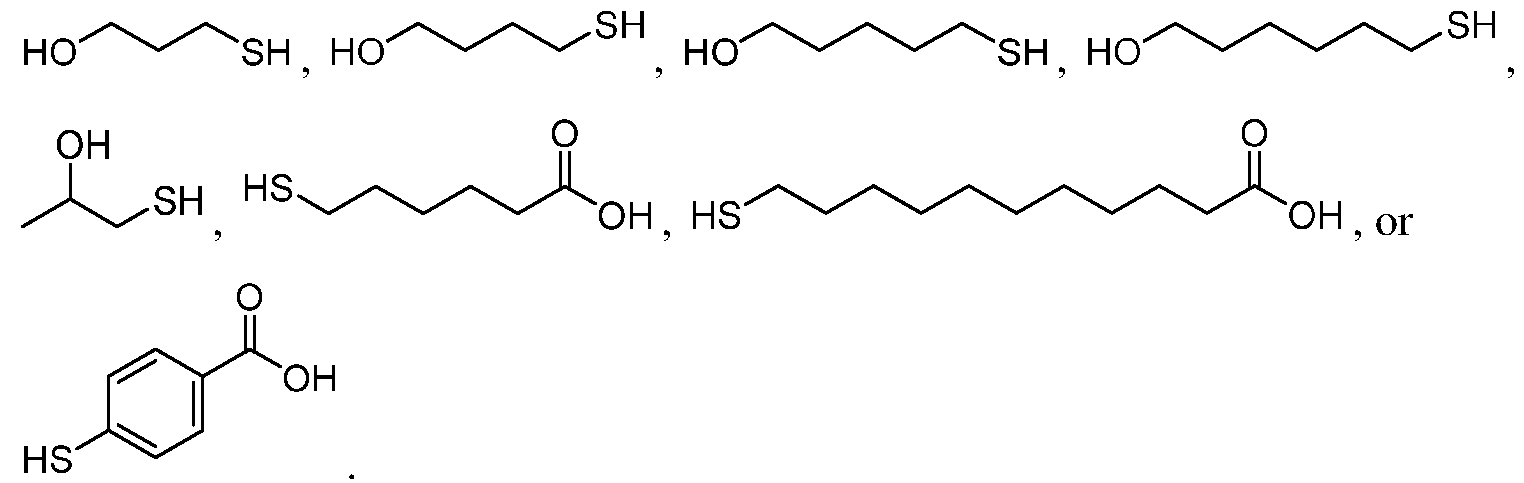
  • the thiol compound is a compound of formula (B):
  • R v is alkyl, cycloalkyl, aryl or heteroaryl, each of which is optionally substituted with one or more substituents selected from the group consisting of -OH and -COOH.
  • R v is unsubstituted -alkyl-. In other variations, R v is -alkyl- substituted with one or more substituents selected from the group consisting of -OH and - COOH. In some variations of the foregoing, R v is -Ci_2o alkyl-, -C MS alkyl-, -C HO alkyl-, - Ci_ 6 alkyl-, or -Ci_4 alkyl-. [0053] In some variations, R v is unsubstituted -aryl-. In other variations, R v is -aryl- substituted with one or more substituents selected from the group consisting of -OH and - COOH.
  • the compound of formula (B) is: HO
  • the thiol compound comprises two thiol functional groups.
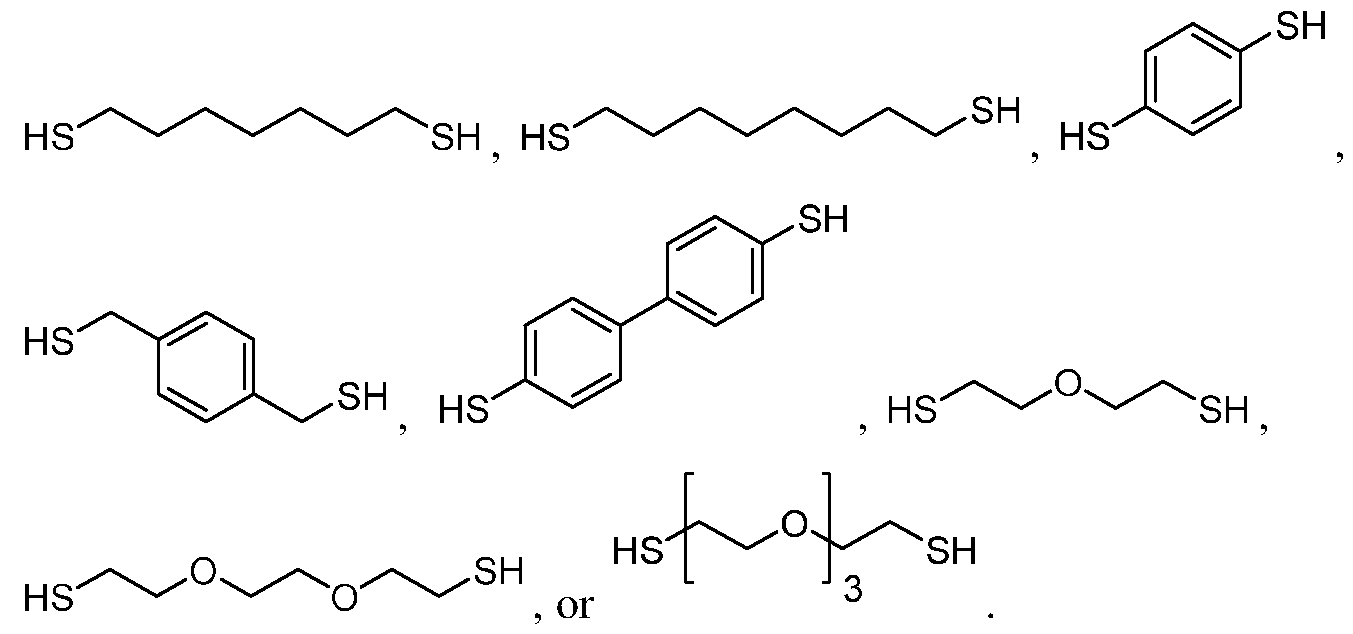
  • the thiol compound is a compound of formula (A):
  • HS-R W -SH (A), wherein R w is -alkyl-, -cycloalkyl-, -aryl-, -heteroaryl-, -ether-, or -arylalkyl-.
  • R w is -alkyl-. In certain variations, R w is -Ci_2o alkyl-, -C MS alkyl-, -C MO alkyl-, -Ci -6 alkyl-, or -Ci_4 alkyl-.
  • R w is -aryl-. In certain variations, R w is -phenyl- or -biphenyl-.
  • R w is -ether-.
  • R w is , wherein k is an integer greater than or equal to 1. In one variation, k is 1 to 10; 1 to 6; or 1 to
  • the -alkyl-, -cycloalkyl-, -aryl-, -heteroaryl-, - ether-, and -arylalkyl- is unsubstituted.
  • the compound of formula (A) is: .
  • the beta-lactone is a compound of formula (1): wherein each R la , R lb , R lc and R ld is independently H or alkyl.
  • the compound of formula (1) is combined with a thiol of formula (A):
  • the compound of formula (5) may be isolated, and optionally purified, before undergoing condensation polymerization to produce the sulfur-containing polymer.
  • the compound of formula (5) may be isolated, and optionally purified, before undergoing condensation polymerization to produce the sulfur-containing polymer.
  • the compound of formula (5) is neither isolated nor purified before further use.
  • the compound of formula (5) is polymerized to produce the sulfur-containing polymer.
  • the sulfur-containing polymer comprises repeating units of formula: wherein R la , R lb , R lc , R ld and R w are as defined above for formula (5).
  • R la , R lb , R lc , R ld and R w are as defined above for formula (5).
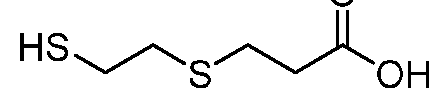
  • the compound of formula (5) is 3-((2- mercaptoethyl)thio)propanoic acid, which can then be polymerized to produce a polymer comprising repeating units having the structure:
  • the compound of formula (5) is: wherein: each R la , R lb , R lc and R ld is independently H or alkyl, and
  • R w is -alkyl-, -cycloalkyl-, -aryl-, -heteroaryl-, -ether-, or -arylalkyl-.
  • R la is H. In other variations, R la is alkyl. In certain variations, R la is Ci_ 6 alkyl. In another variation, R la is methyl, ethyl or propyl. In one variation, R lb is H. In other variations, R lb is alkyl. In certain variations, R lb is Ci_ 6 alkyl. In another variation, R lb is methyl, ethyl or propyl. In one variation, R lc is H. In other variations, R lc is alkyl. In certain variations, R lc is Ci_ 6 alkyl. In another variation, R lc is methyl, ethyl or propyl. In one variation, R ld is H. In other variations, R ld is alkyl. In certain variations, R ld is Ci_ 6 alkyl. In another variation, R ld is methyl, ethyl or propyl. In one variation, R ld is H. In other variations, R l
  • R w is -alkyl-.
  • R w is -Ci -2 o alkyl-, -C MS alkyl-, -C MO alkyl-, -Ci -6 alkyl-, or -Ci_4 alkyl-.
  • R w is -aryl-.
  • R w is -phenyl- or -biphenyl-.
  • R w is -ether-.
  • R w is , wherein k is an integer greater than or equal to 1. In one variation, k is 1 to 10; 1 to 6; or 1 to 4.
  • the -alkyl-, - cycloalkyl-, -aryl-, -heteroaryl-, -ether-, and -arylalkyl- is unsubstituted.
  • Any suitable conditions to convert the compound of formula (5) to the sulfur- containing polymer may be employed.
  • the conversion is performed at a temperature between 180°C and 240°C.
  • a method of producing sulfur-containing polymers comprising polymerizing a sulfur-containing alkanoic acid to produce the sulfur-containing polymer. Any of the sulfur-containing alkanoic acids, including the compound of formula (5), described above may be used to produce the sulfur-containing polymers.
  • a method of producing phosphorus-containing polymers from beta-lactones comprises: combining a beta-lactone with a diol compound to produce an alkanoate compound having two terminal hydroxy groups; and combining the alkanoate compound with a phosphanediamine or phosphanetriamine compound to produce a phosphorus-containing polyester.
  • the beta-lactone is a compound of formula (1): wherein each R la , R lb , R lc and R ld is independently Fl or alkyl.
  • the compound of formula (1) is combined with a diol of formula (4):
  • the compound of formula (7) may be isolated, and optionally purified, before undergoing condensation polymerization to produce the sulfur-containing polymer.
  • the compound of formula (7) may be isolated, and optionally purified, before undergoing condensation polymerization to produce the sulfur-containing polymer.
  • the compound of formula (7) is neither isolated nor purified before further use.
  • each R zl , R z2 , R z3 and R z4 is independently alkyl
  • R y is alkyl or OR yl , wherein R yl is alkyl.
  • the compound of formula (7) may be combined with a phosphanetriamine, as described in further detail herein.
  • the phosphorus-containing polyester comprises repeating units of formula: wherein R la , R lb , R lc , R ld and R 4 are as defined above for formula (7), and R y is as defined above for formula (C-l).
  • R la , R lb , R lc , R ld and R 4 are as defined above for formula (7)
  • R y is as defined above for formula (C-l).
  • the compound of formula (7) is 2-hydroxyethyl 3-hydroxypropanoate, which can then be
  • any of the variations of the compound of formula (1) as described herein, e.g., with respect to the production of sulfur-containing polymers using dithionite compounds may be employed for production of phosphorus-containing polyesters.
  • any of the variations of the diol of formula (4) as described herein, e.g., with respect to the production of sulfur-containing polymers using dithionite compounds may be employed for production of phosphorus-containing polyesters.
  • the compound of formula (7) is:
  • each R la , R lb , R lc and R ld is independently H or alkyl
  • R 4 is -alkyl-, -cycloalkyl-, -aryl-, -heteroaryl-, -ether-, or -arylalkyl-.
  • R la is H. In other variations, R la is alkyl. In certain variations,
  • R la is Ci_ 6 alkyl. In another variation, R la is methyl, ethyl or propyl. In one variation, R lb is H. In other variations, R lb is alkyl. In certain variations, R lb is Ci- 6 alkyl. In another variation, R lb is methyl, ethyl or propyl. In one variation, R lc is H. In other variations, R lc is alkyl. In certain variations, R lc is Ci_ 6 alkyl. In another variation, R lc is methyl, ethyl or propyl. In one variation, R ld is H. In other variations, R ld is alkyl. In certain variations, R ld is C j-6 alkyl. In another variation, R ld is methyl, ethyl or propyl.
  • R 4 is -alkyl-. In certain variations, R 4 is -Ci -6 alkyl-. In one variation, R 4 is methyl. In another variation, R 4 is ethyl.
  • R la , R lb , R lc and R ld is as defined above for formula (1)
  • R 4 is as defined above for formula (4).
  • the compound of formula (1) is beta-propiolactone and the diol compound is ethylene glycol
  • the compound of formula (7) is 2-hydroxyethyl 3-hydroxypropanoate.
  • a phosphanediamine compound is used to produce the phosphorus-containing compound.
  • the phosphanediamine compound is a compound of formula (C-l):
  • each R zl , R z2 , R z3 and R z4 is independently alkyl
  • R y is alkyl or OR yl , wherein R yl is alkyl.
  • R zl is Ci_ 6 alkyl. In another variation, R zl is methyl, ethyl or propyl. In one variation, R z2 is C j-6 alkyl. In another variation, R z2 is methyl, ethyl or propyl. In one variation, R z3 is Ci_ 6 alkyl. In another variation, R z3 is methyl, ethyl or propyl. In other variations, R z4 is Ci_ 6 alkyl. In another variation, R z4 is methyl, ethyl or propyl.
  • R y is alkyl. In one variation, R y is Ci_ 6 alkyl. In another variation, R y is methyl, ethyl or propyl.
  • R y is OR yl , wherein R yl is alkyl. In certain variations, R yl is Ci_ 6 alkyl. In another variation, R yl is methyl, ethyl or propyl.
  • R zl , R z2 , R z3 , R z4 and R y described herein may be combined the same as if each and every combination were individually listed.
  • the phosphanediamine compound is which R zl , R z2 , R z3 , R z4 and R y are all methyl. In another embodiments, the
  • R zl , R z2 , R z3 and R z4 are all ethyl, and R y is OR yl , wherein R yl is butyl.
  • a phosphanetriamine is used to produce the phosphorus- containing compound.
  • the phosphanetriamine is a compound of formula (C-2):
  • each R zl , R z2 , R z3 , R z4 , R z5 and R z6 is independently alkyl.
  • R zl is Ci_ 6 alkyl. In another variation, R zl is methyl, ethyl or propyl. In one variation, R z2 is Ci_ 6 alkyl. In another variation, R z2 is methyl, ethyl or propyl. In one variation, R z3 is Ci_ 6 alkyl. In another variation, R z3 is methyl, ethyl or propyl. In other variations, R z4 is Ci- 6 alkyl. In another variation, R z4 is methyl, ethyl or propyl. In one variation, R is Ci_ 6 alkyl. In another variation, R is methyl, ethyl or propyl. In other variations, R z6 is Ci- 6 alkyl. In another variation, R z6 is methyl, ethyl or propyl.
  • the phosphanetriamine compound is N-(2-aminoethyl)-2-aminoethyl-N-(2-aminoethyl)-2-aminoethyl-N-(2-aminoethyl)-2-aminoethyl-N-(2-aminoethyl)-2-aminoethyl-N-(2-aminoethyl)-2-aminoethyl-N-(2-aminoethyl)-2-aminoethyl-N-(2-aminoethyl)-2-aminoethyl-N-(2-aminoethyl)-2-aminoethyl-N-(2-aminoethyl)-2-aminoethyl-N-(2-aminoethyl)-2-aminoethyl-N-(2-aminoethyl)-2-aminoethyl-N
  • R zl , R z2 , R z3 , R z4 , R z5 and R z6 are all ethyl.
  • the phosphanediamine and phosphanetriamine compounds may be obtained from any commercially available sources or produced according to any methods known in the art.
  • a method of producing phosphorus-containing polymers comprising combining an alkanoate compound having two terminal hydroxy groups with a phosphanediamine or phosphanetriamine compound to produce a polymer, wherein the polymer is a phosphorus-containing polyester.
  • Any of the alkanoate compounds, including the compound of formula (7), and the phosphanediamine or phosphanetriamine compounds, including the compounds of formulae (C-l) and (C-2), may be used to produce the phosphorus-containing polymers.
  • sulfur-containing polymers comprising repeating sulfonyl-dialkanoic acid moieties.
  • the sulfur-containing polymer comprises repeating units of formula:
  • each R la , R lb , R lc and R ld is independently H or alkyl
  • R 4 is -alkyl-, -cycloalkyl-, -aryl-, -heteroaryl-, -ether-, or -arylalkyl-.
  • sulfur-containing polymer is produced from the methods described herein.
  • R la , R lb , R lc and R ld are as defined for formula (3), and R 4 is defined for formula (4).
  • the sulfur-containing polymer comprises repeating units of formula:
  • each R la , R lb , R lc and R ld is independently H or alkyl
  • R w is -alkyl-, -cycloalkyl-, -aryl-, -heteroaryl-, -ether-, or -arylalkyl-.
  • such sulfur-containing polymer is produced from the methods described herein.
  • R la , R lb , R lc , R ld and R w are as defined for formula (5).
  • a sulfur-containing polymer having a biocontent of at least 10%, at least 20%, at least 30%, at least 40%, at least 50%, at least 60%, at least 70%, at least 80%, at least 90%, at least 95% or about 100%.
  • reference to“about” a value or parameter herein includes (and describes) embodiments that are directed to that value or parameter per se.
  • description referring to“about x” includes description of“x” per se.
  • the term“about” when used in association with other measurements, or used to modify a value, a unit, a constant, or a range of values refers to variations of +/- 10%.
  • the phosphorus-containing polymer comprises repeating units of formula: wherein: each R la , R lb , R lc and R ld is independently H or alkyl;
  • R 4 is -alkyl-, -cycloalkyl-, -aryl-, -heteroaryl-, -ether-, or -arylalkyl-;
  • R y is alkyl or OR yl , wherein R yl is alkyl.
  • the phosphorus-containing polymer is produced from the methods described herein.
  • R la , R lb , R lc , R ld and R 4 are as defined for formula (7)
  • R y is as defined for formula (C-l).
  • a sulfur-containing polymer having a biocontent of at least 10%, at least 20%, at least 30%, at least 40%, at least 50%, at least 60%, at least 70%, at least 80%, at least 90%, at least 95% or about 100%.
  • composition comprising a sulfonyl-dialkanoic acid; and a diol compound.
  • a composition comprising:
  • R lc and R ld is independently H or alkyl; and a compound of formula (4) is HO-R 4 -OH , wherein R 4 is -alkyl-, -cycloalkyl-, -aryl-, - heteroaryl-, -ether-, or -arylalkyl-.
  • the composition further comprises a sulfur- containing polymer comprising repeating sulfonyl-dialkanoic acid moieties.
  • the composition further comprises: a polymer comprising repeating units of formula , wherein R la , R lb , R lc and R ld are as defined above for formula (3), and R 4 is defined above for formula (4).
  • composition comprising a sulfur-containing alkanoic acid; and a sulfur-containing polymer.
  • a composition comprising:
  • each R la , R lb , R lc and R ld is independently H or alkyl
  • R w is -alkyl-, -cycloalkyl-, -aryl-, -heteroaryl-, -ether-, or -arylalkyl-;
  • R lc , R ld and R w are as defined above for formula (5).
  • composition comprising an alkanoate compound having two terminal hydroxy groups; and a phosphanediamine or phosphanetriamine compound.
  • composition comprising:
  • each R la , R lb , R lc and R ld is independently H or alkyl
  • R 4 is -alkyl-, -cycloalkyl-, -aryl-, -heteroaryl-, -ether-, or -arylalkyl-;
  • each R zl , R z2 , R z3 and R z4 is independently alkyl
  • R y is alkyl or OR yl , wherein R yl is alkyl, or a compound of formula wherein each R zl , R z2 , R z3 ,
  • R z4 , R z5 and R z6 is independently alkyl.
  • composition further comprises:
  • R la , R l b , R lc , R ld and R 4 are as defined above for formula (7), and R y is as defined above for formula (C-l).

Landscapes

  • Chemical & Material Sciences (AREA)
  • Organic Chemistry (AREA)
  • Health & Medical Sciences (AREA)
  • Chemical Kinetics & Catalysis (AREA)
  • Medicinal Chemistry (AREA)
  • Polymers & Plastics (AREA)
  • Polyesters Or Polycarbonates (AREA)
  • Polymers With Sulfur, Phosphorus Or Metals In The Main Chain (AREA)

Abstract

Provided are methods of producing sulfur- and phosphorus-containing polymers from beta-lactones. The sulfur- and phosphorus-containing polymers include bio-based sulfur- and phosphorus-containing polymers that may be obtained from renewable sources.

Description
SULFUR- AND PHOSPHORUS-CONTAINING POLYMERS, AND METHODS OF
PRODUCING THEREOF
CROSS-REFERENCE TO RELATED APPLICATIONS
[0001] This application claims priority to U.S. Provisional Patent Application No.
62/646,806, filed March 22, 2018, which is incorporated herein by reference in its entirety.
FIELD
[0002] The present disclosure relates generally to sulfur- and phosphorus-containing polymers, and more specifically to sulfur- and phosphorus-containing polymers that may be produced from beta-lactones.
BACKGROUND
[0003] Polymers are generally used in various applications, including textiles, fabrics, automotive applications, carpets, and coatings. Sulfur- and phosphorus-containing polymers may be used, for example, for high elasticity thermoplastic polymers, and fire resistant polymers. Various methods are known in the art to industrially synthesize such polymers.
For example, sulfur-containing polymers, such as polyphenylene sulfides, can be synthesized from reaction of sodium sulfide and organic halogen compounds; and phosphorus-containing polymers, such as polyphosphoesters, can be synthesized from ring opening polymerization of phosphonates. See e.g., Encyclopedia of Polymer Science and Technology; and Iliescu et al, Chemistry Central Journal 2012, 6:132.
[0004] Alternative methods of producing sulfur- and phosphorus-containing polymers are desired in the art, including methods of producing bio-based sulfur- and phosphorus- containing polymers that can be obtained, either in part or completely, from renewable sources.
BRIEF SUMMARY
[0005] Provided herein are methods of producing sulfur- and phosphorus-containing polymers that can be obtained from renewable sources. For example, in some aspects, the sulfur- and phosphorus-containing polymers may be produced from beta-propiolactone, which can be obtained from bio-based ethylene oxide and/or bio-based carbon monoxide. [0006] In some aspects, provided is a method of producing a polymer comprising repeating sulfonyl-dialkanoic acid moieties, or a salt thereof. In some embodiments, the method comprises: combining a beta-lactone with a dithionite compound to produce a sulfonyl-dialkanoic acid; and combining the sulfonyl-dialkanoic acid with a diol compound to produce the polymer by condensation polymerization. In some variations, the beta-lactone combined with the dithionite compound produce a salt of the sulfonyl-dialkanoic acid, and the method further includes neutralizing the salt of the sulfonyl-dialkanoic acid before combining with the diol compound to produce the polymer.
[0007] In other aspects, provided is a method of producing a sulfur-containing polymer, the method comprising: combining a beta-lactone with (i) hydrogen sulfide or a salt thereof, or (ii) a thiol compound to produce a sulfur-containing alkanoic acid; and polymerizing the sulfur-containing alkanoic acid to produce the sulfur-containing polymer.
[0008] In yet other aspects, provided is a method of producing a phosphorus-containing polyester, the method comprising: combining a beta-lactone with a diol compound to produce an alkanoate compound having two terminal hydroxy groups; and combining the alkanoate compound with a phosphanediamine or phosphanetriamine compound to produce the phosphorus-containing polyester.
[0009] In yet other aspects, provided are sulfur- and phosphorus-containing polymers produced according to any of the methods described herein.
DESCRIPTION OF THE FIGURES
[0010] The present application can be best understood by reference to the following description taken in conjunction with the accompanying figures, in which like parts may be referred to by like numerals.
[0011] FIGS. 1A and IB depict exemplary reaction schemes to produce sulfur-containing polymers from beta-lactones using a dithionite compound.
[0012] FIGS. 2A and 2B depict exemplary reaction schemes to produce sulfur-containing polymers from beta-lactones using a dithiol compound.
[0013] FIGS. 3A and 3B depict exemplary reaction schemes to produce phosphorus- containing polymers from beta-lactones using a diol compound. DETAILED DESCRIPTION
[0014] The following description sets forth exemplary methods, parameters and the like.
It should be recognized, however, that such description is not intended as a limitation on the scope of the present disclosure but is instead provided as a description of exemplary embodiments.
[0015] Provided herein are methods to produce sulfur- and phosphorus-containing polymers from beta-lactones. In some aspects, provided are methods of producing sulfur- containing polymers from beta-lactones using dithionite compounds, hydrogen sulfide or a salt thereof, and thiol compounds. In other aspects, provided are methods of producing phosphorus-containing polymers from beta-lactones using phosphanediamine and phosphanetriamine compounds.
[0016] Each of these methods is explored in further detail below, along with the sulfur- and phosphorus-containing polymers produced from such methods.
Production of Sulfur-Containing Polymers using Dithionite Compounds
[0017] In some aspects, provided is a method of producing sulfur-containing polymers from beta-lactones and dithionite compounds. When such method is employed, the sulfur- containing polymer comprises repeating sulfonyl-dialkanoic acid moieties. In some embodiments, the method comprises: combining a beta-lactone with a dithionite compound to produce a sulfonyl-dialkanoic acid; and combining the sulfonyl-dialkanoic acid with a diol compound to produce the polymer by condensation polymerization. When the beta-lactone is combined with the dithionite compound, a salt of the sulfonyl-dialkanoic acid may be produced. As such, in some variations, the method further comprises neutralizing the salt of the sulfonyl-dialkanoic acid to produce the sulfonyl-dialkanoic acid, before the condensation polymerization step. For example, the salt of the sulfonyl-dialkanoic acid may be neutralized by an acidic workup.
[0018] With reference to FIG. 1A, an exemplary method to produce a sulfur-containing polymer comprising repeating sulfonyl-dialkanoic acid moieties is provided. In FIG. 1A, the beta-lactone is a compound of formula (1):
Figure imgf000005_0001
wherein each Rla, Rlb, Rlc and Rld is independently H or alkyl. The compound of formula (1) is combined with a dithionite compound to produce a compound of formula (3):
Figure imgf000005_0002
wherein Rla, Rlb, Rlc and Rld are as defined for formula (1) above.
[0019] In some embodiments of the exemplary method depicted in FIG. 1A, the compound of formula (3) may be isolated, and optionally purified, before undergoing condensation polymerization to produce the sulfur-containing polymer. In other
embodiments, the compound of formula (3) is neither isolated nor purified before further use.
[0020] With reference again to FIG. 1A, the compound of formula (3) is then combined with a diol of formula (4):
HO-R4-OH (4) wherein R4 is -alkyl-, -cycloalkyl-, -aryl-, -heteroaryl-, -ether-, or -arylalkyl-. The compound of formula (3) and the diol compound are combined under conditions suitable for condensation polymerization to produce the sulfur-containing polymer.
[0021] In some variations, the sulfur-containing polymer comprises repeating units of formula:
Figure imgf000005_0003
wherein Rla, Rlb, Rlc and Rld are as defined above for formula (3), and R4 is defined above for formula (4). For example, with reference to FIG. IB, when beta-propiolactone is used, the compound of formula (3) is 3,3’-sulfonyldipropionic acid, which can then be combined with ethylene glycol to produce a polymer comprising repeating units having the structure:
Figure imgf000006_0001
[0022] The reagents and products described in the exemplary method in FIG. 1A are described in further detail below.
Compound of Formula (1)
[0023] In some embodiments, the compound of formula (1) is
Figure imgf000006_0002
, wherein each Rla, Rlb, Rlc and Rld is independently H or alkyl. In one variation, Rla is H. In other variations, Rla is alkyl. In certain variations, Rla is Ci_6 alkyl. In another variation, Rla is methyl, ethyl or propyl. In one variation, Rlb is H. In other variations, Rlb is alkyl. In certain variations, Rlb is Ci_6 alkyl. In another variation, Rlb is methyl, ethyl or propyl. In one variation, Rlc is H. In other variations, Rlc is alkyl. In certain variations, Rlc is _6 alkyl. In another variation, Rlc is methyl, ethyl or propyl. In one variation, Rld is H. In other variations, Rld is alkyl. In certain variations, Rld is Ci_6 alkyl. In another variation, Rld is methyl, ethyl or propyl.
[0024] “Alkyl” refers to a monoradical unbranched or branched saturated hydrocarbon chain. In some embodiments, alkyl has 1 to 20 carbon atoms (i.e., Ci_2o alkyl), 1 to 10 carbon atoms (i.e., Ci_io alkyl), 1 to 6 carbon atoms (i.e., Ci_6 alkyl), 1 to 5 carbon atoms (i.e., Ci_s alkyl), 1 to 4 carbon atoms (i.e., Ci_4 alkyl), 1 to 3 carbon atoms (i.e., Ci_3 alkyl), or 1 to 2 carbon atoms (i.e., Ci_2 alkyl). In certain variations, alkyl groups may include methyl, ethyl, propyl, isopropyl, n-butyl, sec-butyl, tert-butyl, pentyl, 2-pentyl, isopentyl, neopentyl, hexyl, 2-hexyl, 3-hexyl, and 3-methylpentyl. When an alkyl residue having a specific number of carbons is named, all geometric isomers having that number of carbons may be encompassed; thus, for example,“butyl” can include n-butyl, sec-butyl, isobutyl and t-butyl;“propyl” can include n-propyl and isopropyl. [0025] It should generally be understood that any description of Rla, Rlb, Rlc and Rld described herein may be combined the same as if each and every combination were
O
O
individually listed. For example, in one embodiment, the compound of formula (1) is I— I (also referred to as beta-propiolactone), in which Rla, Rlb, Rlc and Rld are all H. In another
embodiment, the compound of formula (1) is
Figure imgf000007_0001
(also referred to as beta- butyrolactone), in which Rla or Rlb is methyl, and the other Rla or Rlb is H, and Rlc and Rld
are also both H. In yet another embodiment, the compound of formula
Figure imgf000007_0002
(also referred to as beta-valerolactone), in which Rla or Rlb is ethyl, and the other Rla or Rlb is H, and Rlc and Rld are also both H.
[0026] The beta-lactone, such as the compound of formula (1), may be obtained from any commercially available sources or produced according to any methods known in the art. For example, beta-propiolactone may be obtained by reacting ethylene oxide and carbon monoxide under suitable conditions.
[0027] The beta-lactone, such as the compound of formula (1), may be obtained from renewable feedstock. For example, when beta-propiolactone is produced from ethylene oxide and carbon monoxide, either or both the ethylene oxide and carbon monoxide may be obtained from renewable feedstock using methods known in the art. When the beta-lactone, such as the compound of formula (1), is obtained in part or completely from renewable feedstock, the polymer produced according to the methods described herein from such beta- lactone has a biocontent greater than 0%.
[0028] Various techniques are known in the art to determine biocontent of a material.
For example, in some variations, biocontent of a material may be measured using the ASTM D6866 method, which allows the determination of the biocontent of materials using radiocarbon analysis by accelerator mass spectrometry, liquid scintillation counting, and isotope mass spectrometry. A biocontent result may be derived by assigning 100% equal to 107.5 pMC (percent modern carbon) and 0% equal to 0 pMC. For example, a sample measuring 99 pMC will give an equivalent biocontent result of 93%. In one variation, biocontent may be determined in accordance with ASTM D6866 revision 12 (i.e., ASTM D6866-12). In another variation, biocontent may be determined in accordance with the procedures of Method B of ASTM-D6866-12. Other techniques for assessing the biocontent of materials are described in U.S. Patent Nos. 3,885,155, 4,427,884, 4,973,841, 5,438,194, and 5,661,299, as well as W02009/155086.
Dithionite Compounds
[0029] As depicted in FIG. 1A, the dithionite compound comprises a moiety of formula (2):
Figure imgf000008_0001
[0030] In some variations, the dithionite compound is sodium dithionite or potassium dithionite. A mixture of dithionite compounds may also be used.
[0031] The dithionite compound may be obtained from any commercially available sources or produced according to any methods known in the art.
Compound of Formula (3)
[0032] In some embodiments, the compound of formula (3) is:
Figure imgf000008_0002
wherein each Rla, Rlb, Rlc and Rld is independently H or alkyl. In one variation, Rla is H. In other variations, Rla is alkyl. In certain variations, Rla is Ci-6 alkyl. In another variation, Rla is methyl, ethyl or propyl. In one variation, Rlb is H. In other variations, Rlb is alkyl. In certain variations, Rlb is Ci_6 alkyl. In another variation, Rlb is methyl, ethyl or propyl. In one variation, Rlc is H. In other variations, Rlc is alkyl. In certain variations, Rlc is Ci_6 alkyl. In another variation, Rlc is methyl, ethyl or propyl. In one variation, Rld is H. In other variations, Rld is alkyl. In certain variations, Rld is Ci_6 alkyl. In another variation, Rld is methyl, ethyl or propyl. [0033] When the compound of formula (3) is derived from the compound of formula (1), as depicted in FIG. 1A, Rla, Rlb, Rlc and Rld are as defined above for formula (1). For example, with reference to FIG. IB, when the compound of formula (1) is beta-
O
Figure imgf000009_0001
propiolactone, the compound of formula (3) produced is O (also referred to as 3,3'-sulfonyldipropionic acid).
Diol Compounds
[0034] In some embodiments, the diol compound is a compound of formula (4):
HO-R4-OH (4) wherein R4 is -alkyl-, -cycloalkyl-, -aryl-, -heteroaryl-, -ether-, or -arylalkyl-. In some variations, R4 is -alkyl-. In certain variations, R4 is -Ci-6 alkyl-. In one variation, R4 is - methyl-. In another variation, R4 is -ethyl-.
[0035] As used generally herein,“-moiety-” refers to the same residues as the moiety described, but having bivalency.
[0036] It should be understood that“-alkyl-” refers to the same residues as alkyl, but having bivalency. Examples of -alkyl- include methylene (-CH2-), ethylene (-CH2CH2-), propylene (-CH2CH2CH2-), butylene (-CH2CH2CH2CH2-).
[0037] It should be understood that“-cycloalkyl-” refers to the same residues as cycloalkyl, but having bivalency. As used herein,“cycloalkyl” includes a carbocyclic, non aromatic group that is connected via a ring carbon atom, which contains only C and Fl when unsubstituted. The cycloalkyl can consist of one ring or multiple rings. In some variations, a cycloalkyl with more than one ring may be linked together by a C-C bond, fused, spiro or bridged, or combinations thereof. Examples of cycloalkyl groups include cyclopropyl, cyclobutyl, cyclopentyl, cyclohexyl, bicyclohexyl, adamantyl, and decahydronaphthalenyl.
[0038] It should be understood that“-aryl-” refers to the same residues as aryl, but having bivalency. As used herein,“aryl” refers to an unsaturated aromatic carbocyclic group having a single ring or multiple condensed rings. When there are multiple condensed rings, at least one of the rings is aromatic, but not all rings need to be aromatic. In some variations, an aryl with more than one ring may be linked together by a C-C bond, fused, spiro or bridged, or combinations thereof. Aryl contains only C and H when unsubstituted. An aryl group having more than one ring where at least one ring is non-aromatic may be connected to the parent structure at either an aromatic ring position or at a non-aromatic ring position. In one variation, an aryl group having more than one ring where at least one ring is non-aromatic is connected to the parent structure at an aromatic ring position. Examples of aryl may include phenyl and biphenyl.
[0039] It should be understood that“-heteroaryl-” refers to the same residues as heteroaryl, but having bivalency. As used herein,“heteroaryl” refers to an unsaturated aromatic carbocyclic group having at least one annular heteroatom, including but not limited to heteroatoms such as nitrogen, oxygen and sulfur. A heteroaryl group may have a single ring or multiple condensed rings. When there are multiple condensed rings, at least one of the rings is aromatic, but not all rings need to be aromatic. In some variations, a heteroaryl with more than one ring may be linked together by a C-C bond, fused, spiro or bridged, or combinations thereof. A heteroaryl group having more than one ring where at least one ring is non-aromatic may be connected to the parent structure at either an aromatic ring position or at a non-aromatic ring position. In one variation, a heteroaryl group having more than one ring where at least one ring is non-aromatic is connected to the parent structure at an aromatic ring position. Examples of heteroaryls may include pyridyl, pyridinyl, imidazolyl, thiazolyl, and bipyridyl.
[0040] As used herein,“-ether-” refers to bivalent moieties comprising one or more -O- groups. Examples of -ether- may include
Figure imgf000010_0001
, and
Figure imgf000010_0002
[0041] As used herein,“-arylalkyl-” refers to bivalent moieties comprising an -aryl- group linked to an -alkyl- group. Examples of -arylalkyl- may include
Figure imgf000010_0003
Figure imgf000010_0004
Condensation Polymerization
[0042] Any suitable conditions to convert the compound of formula (3) via condensation polymerization to the sulfur-containing polymer may be employed. For example, in some variations, condensation polymerization is performed at a temperature between 180°C and 240°C.
[0043] In other aspects, provided is a method of producing sulfur-containing polymers, comprising combining a sulfonyl-dialkanoic acid with a diol compound to produce a polymer by condensation polymerization, wherein the polymer comprises repeating sulfonyl- dialkanoic acid moieties. Any of the sulfonyl-dialkanoic acids, including the compound of formula (3), and diol compounds, including the compound of formula (4), described above may be used to produce the sulfur-containing polymers.
Production of Sulfur-Containing Polymers using Hydrogen Sulfide or Salts Thereof
[0044] In some aspects, provided is a method of producing sulfur-containing polymers from beta-lactones and hydrogen sulfide or a salt thereof. In some embodiments, the hydrogen sulfide or a salt thereof is hydrogen sulfide, sodium hydrogen sulfide, or potassium hydrogen sulfide, or any combinations thereof.
[0045] In some embodiments, the method comprises: combining a beta-lactone with hydrogen sulfide or a salt thereof to produce a sulfur-containing alkanoic acid; and polymerizing the sulfur-containing alkanoic acid to produce a sulfur-containing polymer.
[0046] In some embodiments, the sulfur-containing alkanoic acid may be isolated, and optionally purified, before undergoing condensation polymerization to produce the sulfur- containing polymer. In other embodiments, the sulfur-containing alkanoic acid is neither isolated nor purified before further use.
[0047] In some variations, the beta-lactone may be a compound of formula (1) as described herein. Any of the variations of the compound of formula (1) as described herein, e.g., with respect to the production of sulfur-containing polymers using dithionite compounds may be employed for production of sulfur-containing polymers using hydrogen sulfide or a salt thereof. [0048] In other variations, the resulting sulfur-containing polymer comprises repeating 1 G R1 d
-^SY°¾ 3¾ p1
units of formula O . in certain variations, for example, when the compound of formula (1) is
Figure imgf000012_0001
, the resulting sulfur-containing polymer comprises repeating units of formula
Figure imgf000012_0002
Production of Sulfur-Containing Polymers using Thiol Compounds
[0049] In some aspects, provided is a method of producing sulfur-containing polymers from beta-lactones and thiol compounds. In some embodiments, the method comprises: combining a beta-lactone with a thiol compound to produce a sulfur-containing alkanoic acid; and polymerizing the sulfur-containing alkanoic acid to produce a sulfur-containing polymer ( e.g ., a polythioester).
Thiol Compounds
[0050] In some embodiments, the thiol compound is an organosulfur compound comprising at least one thiol functional group. In certain embodiments, the thiol compound comprises two or more thiol functional groups.
[0051] In some embodiments, the thiol compound comprises one thiol functional group. In some embodiments, the thiol compound is a compound of formula (B):
RV-SH (B),
wherein Rv is alkyl, cycloalkyl, aryl or heteroaryl, each of which is optionally substituted with one or more substituents selected from the group consisting of -OH and -COOH.
[0052] In some variations, Rv is unsubstituted -alkyl-. In other variations, Rv is -alkyl- substituted with one or more substituents selected from the group consisting of -OH and - COOH. In some variations of the foregoing, Rv is -Ci_2o alkyl-, -CMS alkyl-, -CHO alkyl-, - Ci_6 alkyl-, or -Ci_4 alkyl-. [0053] In some variations, Rv is unsubstituted -aryl-. In other variations, Rv is -aryl- substituted with one or more substituents selected from the group consisting of -OH and - COOH.
^^^SH
[0054] In some embodiments, the compound of formula (B) is: HO
Figure imgf000013_0001
[0055] In other embodiments, the thiol compound comprises two thiol functional groups. For example, as depicted in FIG. 2A, the thiol compound is a compound of formula (A):
HS-RW-SH (A), wherein Rw is -alkyl-, -cycloalkyl-, -aryl-, -heteroaryl-, -ether-, or -arylalkyl-.
[0056] In some variations, Rw is -alkyl-. In certain variations, Rw is -Ci_2o alkyl-, -CMS alkyl-, -CMO alkyl-, -Ci-6 alkyl-, or -Ci_4 alkyl-.
[0057] In other variations, Rw is -aryl-. In certain variations, Rw is -phenyl- or -biphenyl-.
[0058] In yet other variations, Rw is -ether-. In certain variations, Rw is
Figure imgf000013_0002
, wherein k is an integer greater than or equal to 1. In one variation, k is 1 to 10; 1 to 6; or 1 to
4.
[0059] In some variations of the foregoing, the -alkyl-, -cycloalkyl-, -aryl-, -heteroaryl-, - ether-, and -arylalkyl- is unsubstituted.
[0060] In some embodiments, the compound of formula (A) is:
Figure imgf000013_0003
.
Figure imgf000013_0004
Figure imgf000014_0001
[0061] In variations where a dithiol compound, such as a compound of formula (A) is used, with reference to FIG. 2A, an exemplary method to produce a sulfur-containing polymer from beta-lactone is provided.
[0062] In FIG. 2A, the beta-lactone is a compound of formula (1):
Figure imgf000014_0002
wherein each Rla, Rlb, Rlc and Rld is independently H or alkyl. The compound of formula (1) is combined with a thiol of formula (A):
HS-RW-SH (A), wherein Rw is -alkyl-, -cycloalkyl-, -aryl-, -heteroaryl-, -ether-, or -arylalkyl-. The combining of the compound of formula (1) with the thiol of formula (A) produces a compound of formula (5):
Figure imgf000014_0003
wherein Rla, Rlb, Rlc and Rld are as defined above for formula (1), and Rw is as defined above for formula (A).
[0063] In some embodiments of the exemplary method depicted in FIG. 2A, the compound of formula (5) may be isolated, and optionally purified, before undergoing condensation polymerization to produce the sulfur-containing polymer. In other
embodiments, the compound of formula (5) is neither isolated nor purified before further use.
[0064] With reference again to FIG. 2A, the compound of formula (5) is polymerized to produce the sulfur-containing polymer.
[0065] In some variations, the sulfur-containing polymer comprises repeating units of formula:
Figure imgf000015_0001
wherein Rla, Rlb, Rlc, Rld and Rw are as defined above for formula (5). For example, with reference to FIG. 2B, when beta-propiolactone is used, the compound of formula (5) is 3-((2- mercaptoethyl)thio)propanoic acid, which can then be polymerized to produce a polymer comprising repeating units having the structure:
Figure imgf000015_0002
[0066] The reagents and products described in the exemplary method in FIG. 2A are described in further detail below.
Compound of Formula (1)
[0067] Any of the variations of the compound of formula (1) as described herein, e.g., with respect to the production of sulfur-containing polymers using dithionite compounds may be employed for production of sulfur-containing polymers using thiol compounds.
Compound of Formula (5)
[0068] In some embodiments, the compound of formula (5) is:
Figure imgf000015_0003
wherein: each Rla, Rlb, Rlc and Rld is independently H or alkyl, and
Rw is -alkyl-, -cycloalkyl-, -aryl-, -heteroaryl-, -ether-, or -arylalkyl-.
[0069] In one variation, Rla is H. In other variations, Rla is alkyl. In certain variations, Rla is Ci_6 alkyl. In another variation, Rla is methyl, ethyl or propyl. In one variation, Rlb is H. In other variations, Rlb is alkyl. In certain variations, Rlb is Ci_6 alkyl. In another variation, Rlb is methyl, ethyl or propyl. In one variation, Rlc is H. In other variations, Rlc is alkyl. In certain variations, R lc is Ci_6 alkyl. In another variation, R lc is methyl, ethyl or propyl. In one variation, Rld is H. In other variations, Rld is alkyl. In certain variations, Rld is Ci_6 alkyl. In another variation, Rld is methyl, ethyl or propyl.
[0070] In one variation, Rw is -alkyl-. In certain variations, Rw is -Ci-2o alkyl-, -CMS alkyl-, -CMO alkyl-, -Ci-6 alkyl-, or -Ci_4 alkyl-. In other variations, Rw is -aryl-. In certain variations, Rw is -phenyl- or -biphenyl-. In yet other variations, Rw is -ether-. In certain variations, Rw is
Figure imgf000016_0001
, wherein k is an integer greater than or equal to 1. In one variation, k is 1 to 10; 1 to 6; or 1 to 4. In some variations of the foregoing, the -alkyl-, - cycloalkyl-, -aryl-, -heteroaryl-, -ether-, and -arylalkyl- is unsubstituted.
[0071] When the compound of formula (5) is derived from the compound of formula (1) and the thiol of formula (A), as depicted in FIG. 2A, Rla, Rlb, Rlc and Rld are as defined above for formula (1), and Rw is as defined above for formula (A). For example, with reference to FIG. 2B, when the compound of formula (1) is beta-propiolactone and the thiol compound is ethane- 1, 2-dithiol, the compound of formula (5) produced is
0
Figure imgf000016_0002
(also referred to as 3-((2-mercaptoethyl)thio)propanoic acid).
Polymerization
[0072] Any suitable conditions to convert the compound of formula (5) to the sulfur- containing polymer may be employed. For example, in some variations, the conversion is performed at a temperature between 180°C and 240°C.
[0073] In other aspects, provided is a method of producing sulfur-containing polymers, comprising polymerizing a sulfur-containing alkanoic acid to produce the sulfur-containing polymer. Any of the sulfur-containing alkanoic acids, including the compound of formula (5), described above may be used to produce the sulfur-containing polymers.
Production of Phosphorus-Containing Polymers using Phosphanediamine and
Phosphanetriamine Compounds
[0074] In other aspects, provided is a method of producing phosphorus-containing polymers from beta-lactones. In some embodiments, the method comprises: combining a beta-lactone with a diol compound to produce an alkanoate compound having two terminal hydroxy groups; and combining the alkanoate compound with a phosphanediamine or phosphanetriamine compound to produce a phosphorus-containing polyester.
[0075] With reference to FIG. 3A, an exemplary method to produce a phosphorus- containing polyester is provided. In FIG. 1A, the beta-lactone is a compound of formula (1):
Figure imgf000017_0001
wherein each Rla, Rlb, Rlc and Rld is independently Fl or alkyl. The compound of formula (1) is combined with a diol of formula (4):
HO-R4-OH wherein R4 is -alkyl-, -cycloalkyl-, -aryl-, -heteroaryl-, -ether-, or -arylalkyl-. The combining of the compound of formula (1) with the diol of formula (4) produces a compound of formula (7):
Figure imgf000017_0002
wherein Rla, Rlb, Rlc and Rld are as defined above for formula (1), and R4 is as defined above for formula (4).
[0076] In some embodiments of the exemplary method depicted in FIG. 3A, the compound of formula (7) may be isolated, and optionally purified, before undergoing condensation polymerization to produce the sulfur-containing polymer. In other
embodiments, the compound of formula (7) is neither isolated nor purified before further use.
[0077] With reference again to FIG. 3A, the compound of formula (7) is then combined with a phosphanediamine of formula (C-l):
Figure imgf000018_0001
wherein:
each Rzl, Rz2, Rz3 and Rz4 is independently alkyl; and
Ry is alkyl or ORyl, wherein Ryl is alkyl.
[0078] In other variations, the compound of formula (7) may be combined with a phosphanetriamine, as described in further detail herein.
[0079] The compound of formula (7) and the phosphanediamine compound are combined under conditions suitable for polymerization to produce the phosphorus-containing polyester.
[0080] In some variations, the phosphorus-containing polyester comprises repeating units of formula:
Figure imgf000018_0002
wherein Rla, Rlb, Rlc, Rld and R4 are as defined above for formula (7), and Ry is as defined above for formula (C-l). For example, with reference to FIG. 3B, when beta-propiolactone is used and the diol of formula (4) is ethane- l,2-diol (also known in the art as ethylene glycol), the compound of formula (7) is 2-hydroxyethyl 3-hydroxypropanoate, which can then be
\
N—
Figure imgf000018_0003
N—
combined with a phosphanediamine compound such as to produce a polymer comprising repeating units having the structure:
Figure imgf000019_0001
wherein Rla, Rlb, Rlc, Rld and R4 are as defined above for formula (7), and Ry is as defined above for formula (C-l).
[0081] The reagents and products described in the exemplary method in FIG. 3A are described in further detail below.
Compound of Formula (1)
[0082] Any of the variations of the compound of formula (1) as described herein, e.g., with respect to the production of sulfur-containing polymers using dithionite compounds may be employed for production of phosphorus-containing polyesters.
Diol Compounds
[0083] Any of the variations of the diol of formula (4) as described herein, e.g., with respect to the production of sulfur-containing polymers using dithionite compounds may be employed for production of phosphorus-containing polyesters.
Compound of Formula (7)
[0084] In some embodiments, the compound of formula (7) is:
Figure imgf000019_0002
wherein:
each Rla, Rlb, Rlc and Rld is independently H or alkyl, and
R4 is -alkyl-, -cycloalkyl-, -aryl-, -heteroaryl-, -ether-, or -arylalkyl-.
[0085] In one variation, Rla is H. In other variations, Rla is alkyl. In certain variations,
R la is Ci_6 alkyl. In another variation, R la is methyl, ethyl or propyl. In one variation, R lb is H. In other variations, Rlb is alkyl. In certain variations, Rlb is Ci-6 alkyl. In another variation, Rlb is methyl, ethyl or propyl. In one variation, Rlc is H. In other variations, Rlc is alkyl. In certain variations, Rlc is Ci_6 alkyl. In another variation, Rlc is methyl, ethyl or propyl. In one variation, Rld is H. In other variations, Rld is alkyl. In certain variations, Rld is Cj-6 alkyl. In another variation, Rld is methyl, ethyl or propyl.
[0086] In some variations, R4 is -alkyl-. In certain variations, R4 is -Ci-6 alkyl-. In one variation, R4 is methyl. In another variation, R4 is ethyl.
[0087] When the compound of formula (7) is derived from the compound of formula (1) and the diol of formula (4), as depicted in FIG. 3A, Rla, Rlb, Rlc and Rld is as defined above for formula (1), and R4 is as defined above for formula (4). For example, with reference to FIG. 3B, when the compound of formula (1) is beta-propiolactone and the diol compound is ethylene glycol, the compound of formula (7) is 2-hydroxyethyl 3-hydroxypropanoate.
Phosphanediamine or Phosphanetriamine Compounds
[0088] In some embodiments, a phosphanediamine compound is used to produce the phosphorus-containing compound. In certain embodiments, the phosphanediamine compound is a compound of formula (C-l):
Figure imgf000020_0001
wherein:
each Rzl, Rz2, Rz3 and Rz4 is independently alkyl; and
Ry is alkyl or ORyl, wherein Ryl is alkyl.
[0089] In one variation, Rzl is Ci_6 alkyl. In another variation, Rzl is methyl, ethyl or propyl. In one variation, R z2 is Cj-6 alkyl. In another variation, R z2 is methyl, ethyl or propyl. In one variation, Rz3 is Ci_6 alkyl. In another variation, Rz3 is methyl, ethyl or propyl. In other variations, Rz4 is Ci_6 alkyl. In another variation, Rz4 is methyl, ethyl or propyl.
[0090] In other variations, Ry is alkyl. In one variation, Ry is Ci_6 alkyl. In another variation, Ry is methyl, ethyl or propyl.
[0091] In yet other variations, Ry is ORyl, wherein Ryl is alkyl. In certain variations, Ryl is Ci_6 alkyl. In another variation, Ryl is methyl, ethyl or propyl. [0092] It should generally be understood that any description of Rzl, Rz2, Rz3, Rz4 and Ry described herein may be combined the same as if each and every combination were individually listed. For example, in one embodiment, the phosphanediamine compound is
Figure imgf000021_0001
which Rzl, Rz2, Rz3, Rz4 and Ry are all methyl. In another embodiments, the
phosphanediamine compound
Figure imgf000021_0002
which Rzl, Rz2, Rz3 and Rz4 are all ethyl, and Ry is ORyl, wherein Ryl is butyl.
[0093] In other embodiments, a phosphanetriamine is used to produce the phosphorus- containing compound. In certain embodiments, the phosphanetriamine is a compound of formula (C-2):
Figure imgf000021_0003
wherein each Rzl, Rz2, Rz3, Rz4, Rz5 and Rz6 is independently alkyl.
[0094] In one variation, Rzl is Ci_6 alkyl. In another variation, Rzl is methyl, ethyl or propyl. In one variation, R z2 is Ci_6 alkyl. In another variation, R z2 is methyl, ethyl or propyl. In one variation, Rz3 is Ci_6 alkyl. In another variation, Rz3 is methyl, ethyl or propyl. In other variations, Rz4 is Ci-6 alkyl. In another variation, Rz4 is methyl, ethyl or propyl. In one variation, R is Ci_6 alkyl. In another variation, R is methyl, ethyl or propyl. In other variations, Rz6 is Ci-6 alkyl. In another variation, Rz6 is methyl, ethyl or propyl.
[0095] It should generally be understood that any description of Rzl, Rz2, Rz3, Rz4, Rz5 and z 6
R described herein may be combined the same as if each and every combination were individually listed. For example, in one embodiment, the phosphanetriamine compound is
Figure imgf000022_0001
which Rzl, Rz2, Rz3, Rz4, Rz5 and Rz6 are all ethyl.
[0096] The phosphanediamine and phosphanetriamine compounds may be obtained from any commercially available sources or produced according to any methods known in the art.
Polymerization
[0097] Any suitable conditions to convert the compound of formula (7) to the phosphorus-containing polymer may be employed.
[0098] In other aspects, provided is a method of producing phosphorus-containing polymers, comprising combining an alkanoate compound having two terminal hydroxy groups with a phosphanediamine or phosphanetriamine compound to produce a polymer, wherein the polymer is a phosphorus-containing polyester. Any of the alkanoate compounds, including the compound of formula (7), and the phosphanediamine or phosphanetriamine compounds, including the compounds of formulae (C-l) and (C-2), may be used to produce the phosphorus-containing polymers.
Sulfur-Containing Polymers
[0099] In some aspects, provided are sulfur-containing polymers comprising repeating sulfonyl-dialkanoic acid moieties. In some embodiments, the sulfur-containing polymer comprises repeating units of formula:
Figure imgf000022_0002
wherein:
each Rla, Rlb, Rlc and Rld is independently H or alkyl; and
R4 is -alkyl-, -cycloalkyl-, -aryl-, -heteroaryl-, -ether-, or -arylalkyl-. [0100] In some variations, such sulfur-containing polymer is produced from the methods described herein. For example, when the sulfur-containing polymer is produced from the compound of formula (3) and the diol of formula (4) as described herein, Rla, Rlb, Rlc and Rld are as defined for formula (3), and R4 is defined for formula (4).
[0101] In other aspects, the sulfur-containing polymer comprises repeating units of formula:
Figure imgf000023_0001
wherein:
each Rla, Rlb, Rlc and Rld is independently H or alkyl; and
Rw is -alkyl-, -cycloalkyl-, -aryl-, -heteroaryl-, -ether-, or -arylalkyl-.
[0102] In some variations, such sulfur-containing polymer is produced from the methods described herein. For example, when the sulfur-containing polymer is produced from the compound of formula (5) as described herein, Rla, Rlb, Rlc, Rld and Rw are as defined for formula (5).
[0103] In some embodiments, provided is a sulfur-containing polymer having a biocontent of at least 10%, at least 20%, at least 30%, at least 40%, at least 50%, at least 60%, at least 70%, at least 80%, at least 90%, at least 95% or about 100%.
[0104] It should be understood that reference to“about” a value or parameter herein includes (and describes) embodiments that are directed to that value or parameter per se. For example, description referring to“about x” includes description of“x” per se. In other instances, the term“about” when used in association with other measurements, or used to modify a value, a unit, a constant, or a range of values, refers to variations of +/- 10%.
Phosphorus-Containing Polymers
[0105] In some aspects, provided are phosphorus-containing polyesters. In some embodiments, the phosphorus-containing polymer comprises repeating units of formula:
Figure imgf000024_0001
wherein: each Rla, Rlb, Rlc and Rld is independently H or alkyl;
R4 is -alkyl-, -cycloalkyl-, -aryl-, -heteroaryl-, -ether-, or -arylalkyl-; and
Ry is alkyl or ORyl, wherein Ryl is alkyl.
[0106] In some variations, the phosphorus-containing polymer is produced from the methods described herein. For example, when the phosphorus-containing polymer is produced from the compound of formula (7) and the phosphanediamine of formula (C-l) as described herein, Rla, Rlb, Rlc, Rld and R4 are as defined for formula (7), and Ry is as defined for formula (C-l).
[0107] In some embodiments, provided is a sulfur-containing polymer having a biocontent of at least 10%, at least 20%, at least 30%, at least 40%, at least 50%, at least 60%, at least 70%, at least 80%, at least 90%, at least 95% or about 100%.
Compositions
[0108] In some aspects, provided is a composition comprising a sulfonyl-dialkanoic acid; and a diol compound. In some embodiments, provided is a composition comprising:
a compound of formula (
Figure imgf000024_0002
, wherein each Rla, Rlb,
Rlc and Rld is independently H or alkyl; and a compound of formula (4) is HO-R4-OH , wherein R4 is -alkyl-, -cycloalkyl-, -aryl-, - heteroaryl-, -ether-, or -arylalkyl-.
[0109] In some variations of the foregoing, the composition further comprises a sulfur- containing polymer comprising repeating sulfonyl-dialkanoic acid moieties. For example, in one variation, the composition further comprises: a polymer comprising repeating units of formula
Figure imgf000025_0001
, wherein Rla, Rlb, Rlc and Rld are as defined above for formula (3), and R4 is defined above for formula (4).
[0110] In other aspects, provided is a composition comprising a sulfur-containing alkanoic acid; and a sulfur-containing polymer. In some embodiments, provided is a composition comprising:
a compound of formula (5) is
Figure imgf000025_0002
, wherein: each Rla, Rlb, Rlc and Rld is independently H or alkyl, and
Rw is -alkyl-, -cycloalkyl-, -aryl-, -heteroaryl-, -ether-, or -arylalkyl-; and
a polymer comprising repeating units of formula
Figure imgf000025_0003
, wherein Rla, Rlb,
Rlc, Rld and Rw are as defined above for formula (5).
[0111] In yet other aspects, provided is a composition comprising an alkanoate compound having two terminal hydroxy groups; and a phosphanediamine or phosphanetriamine compound. In some embodiments, provided is a composition comprising:
a compound of formula (7) is
Figure imgf000025_0004
, wherein: each Rla, Rlb, Rlc and Rld is independently H or alkyl, and
R4 is -alkyl-, -cycloalkyl-, -aryl-, -heteroaryl-, -ether-, or -arylalkyl-; and
a compound of formula
Figure imgf000025_0005
wherein:
each Rzl, Rz2, Rz3 and Rz4 is independently alkyl, and
Ry is alkyl or ORyl, wherein Ryl is alkyl, or a compound of formula
Figure imgf000026_0001
wherein each Rzl, Rz2, Rz3,
Rz4, Rz5 and Rz6 is independently alkyl.
[0112] In some variations of the foregoing when a compound of formula (C-l) is used, the composition further comprises:
a polymer comprising repeating units of formula
Figure imgf000026_0002
, wherein
Rla, Rl b, Rlc, Rld and R4 are as defined above for formula (7), and Ry is as defined above for formula (C-l).

Claims

What is claimed is:
1. A method, comprising:
combining a beta-lactone with a dithionite compound to produce a sulfonyl-dialkanoic acid; and
combining the sulfonyl-dialkanoic acid with a diol compound to produce a polymer by condensation polymerization, wherein the polymer comprises repeating sulfonyl- dialkanoic acid moieties.
2. The method of claim 1, wherein the beta-lactone combined with the dithionite compound produces a salt of the sulfonyl-dialkanoic acid, and the method further comprises neutralizing the salt of the sulfonyl-dialkanoic acid to produce the sulfonyl-dialkanoic acid.
3. The method of claim 1 or 2, wherein the beta- lactone is beta-propiolactone, beta- butyrolactone, or beta-valerolactone.
4. The method of any one of claims 1 to 2, wherein the dithionite compound is sodium dithionite or potassium dithionite.
5. A method, comprising:
combining a sulfonyl-dialkanoic acid with a diol compound to produce a polymer by condensation polymerization, wherein the polymer comprises repeating sulfonyl-dialkanoic acid moieties.
6. The method of any one of claims 1 to 5, wherein the diol compound is ethylene glycol.
7. A method, comprising: combining a compound of formula (3) with a compound of formula (4) to produce a polymer by condensation polymerization, wherein:
the compound of formula (
Figure imgf000027_0001
, wherein each
Rla, Rlb, Rlc and Rld is independently H or alkyl, and the compound of formula (4) is , wherein R 4 is -alkyl-, -cycloalkyl-,
-aryl-, -heteroaryl-, -ether-, or -arylalkyl-, and the polymer comprises repeating units of formula
Figure imgf000028_0001
, wherein Rla, Rlb, Rlc and Rld are as defined above for formula (3), and R4 is defined above for formula
(4).
A method, comprising: a) combining a compound of formula (1) with a dithionite to produce a compound of formula (3), wherein:
the compound of formula (1) is
Figure imgf000028_0002
, wherein each Rla, Rlb, Rlc and
Rld is independently H or alkyl, and
. the compound of formula (
Figure imgf000028_0004
, wherein R ,
Rlb, Rlc and Rld are as defined above for formula (1); and b) combining the compound of formula (3) with a compound of formula (4) to produce a polymer by condensation polymerization, wherein: the compound of formula (4) is HO-R OH , wherein R4 is -alkyl-, -cycloalkyl-, -aryl-, -heteroaryl-, -ether-, or -arylalkyl-, and the polymer comprises repeating units of formula
Figure imgf000028_0003
, wherein Rla, Rlb, Rlc and Rld are as defined above for formula (3), and R4 is defined above for formula
(4).
9. The method of claim 8, wherein Rla, Rlb, Rlc and Rld are all H.
10. The method of claim 8, wherein Rla is alkyl, and Rlb, Rlc and Rld are all H.
11. The method of claim 10, wherein Rla is methyl or ethyl.
12. The method of any one of claims 7 to 11, wherein R4 is -alkyl-.
13. The method of any one of claims 7 to 11, wherein R4 is -Ci_6 alkyl-.
14. A method, comprising:
combining a beta-lactone with (i) hydrogen sulfide or a salt thereof, or (ii) a thiol compound to produce a sulfur-containing alkanoic acid; and
polymerizing the sulfur-containing alkanoic acid to produce a sulfur-containing polymer.
15. The method of claim 14, wherein the hydrogen sulfide or a salt thereof is hydrogen sulfide, sodium hydrogen sulfide, or potassium hydrogen sulfide, or any combinations thereof.
16. The method of claim 14, wherein the thiol compound is:
a compound of formula (A): HS-RW-SH (A),
wherein Rw is -alkyl-, -cycloalkyl-, -aryl-, -heteroaryl-, -ether-, or -arylalkyl-; or a compound of formula (B): RV-SH (B),
wherein Rv is alkyl, cycloalkyl, aryl or heteroaryl, each of which is optionally substituted with one or more substituents selected from the group consisting of -OH and -COOH.
17. A method, comprising:
polymerizing a compound of formula (5) to produce a polymer, wherein:
the compound of formula (5) is
Figure imgf000029_0001
, wherein: each Rla, Rlb, Rlc and Rld is independently H or alkyl, and
Rw is -alkyl-, -cycloalkyl-, -aryl-, -heteroaryl-, -ether-, or -arylalkyl-;
the polymer comprising repeating units of formula
Figure imgf000030_0001
wherein Rla, Rlb, Rlc, Rld and Rw are as defined above for formula (5).
18. A method, comprising:
a) combining a compound of formula (1) with a compound of formula (A) to produce a compound of formula (5), wherein:
the compound of formula (1) is
Figure imgf000030_0002
, wherein each Rla, Rlb, Rlc and
Rld is independently H or alkyl, the compound of formula (A) is HS-RW-SH , wherein Rw is -alkyl-, - cycloalkyl-, -aryl-, -heteroaryl-, -ether-, or -arylalkyl-, and
R-l b R1a O
V U
HS'R'S^S T>H
the compound of formula (5) is R1d R1 c , wherein Rla, Rlb, Rlc and Rld are as defined above for formula (1), and Rw is as defined above for formula (A); and
b) polymerizing the compound of formula (5) to produce a polymer, wherein:
the polymer comprising repeating units of formula
Figure imgf000030_0003
,
wherein Rla, Rlb, Rlc, Rld and Rw are as defined above for formula (5).
19. The method of claim 18, wherein Rla, Rlb, Rlc and Rld are all H.
20. The method of claim 18, wherein Rla is alkyl, and Rlb, Rlc and Rld are all H.
21. The method of claim 20, wherein Rla is methyl or ethyl.
22. The method of any one of claims 16 to 21, wherein Rw is -Ci_2o alkyl-.
23. The method of any one of claims 16 to 21, wherein Rw is -phenyl- or -biphenyl-.
24. The method of any one of claims 16 to 21, wherein Rw is
Figure imgf000031_0001
, wherein k is an integer greater than or equal to 1.
25. The method of claim 24, wherein k is 1 to 10.
26. The method of claim 16, wherein Rv is: unsubstituted -alkyl-; or
-alkyl- substituted with one or more substituents selected from the group consisting of -OH and -COOH.
27. The method of claim 16, wherein Rv is: unsubstituted -aryl-; or
-aryl- substituted with one or more substituents selected from the group consisting of - OH and -COOH.
28. The method of claim 16, wherein Rv is -Ci_2o alkyl-.
29. The method of claim 16 or 18 to 21, wherein the compound of formula (A) is
Figure imgf000031_0002
30. The method of claim 16 or 18 to 21, wherein the compound of formula (A) is
Figure imgf000031_0003
Figure imgf000032_0001
,^SH
31. The method of claim 16, wherein the compound of formula (B) is HO
Figure imgf000032_0002
32. The method of claim 16, wherein the compound of formula (B) is
Figure imgf000032_0003
Figure imgf000032_0004
33. A method, comprising:
combining a beta-lactone with a diol compound to produce an alkanoate compound having two terminal hydroxy groups; and
combining the alkanoate compound with a phosphanediamine compound or a phosphanetriamine compound to produce a phosphorus-containing polyester.
34. The method of claim 33, wherein the beta-lactone is beta-propiolactone, beta- butyrolactone, or beta-valerolactone.
35. The method of claim 33 or 34, wherein the diol is ethylene glycol.
36. A method, comprising: combining an alkanoate compound having two terminal hydroxy groups with a phosphanediamine compound or a phosphanetriamine compound to produce a polymer, wherein the polymer is a phosphorus-containing polyester.
37. The method of any one of claims 33 to 36, wherein
the phosphanediamine compound is a compound of formula (C-l):
Figure imgf000033_0001
wherein:
each Rzl, Rz2, Rz3 and Rz4 is independently alkyl; and
Ry is alkyl or ORyl, wherein R yyii is alkyl; and the phosphanetriamine compound is a compound of formula (C-2):
wherein each
Figure imgf000033_0002
independently alkyl.
38. A method, comprising:
combining a compound of formula (7) with a compound of formula (C-l) to produce a polymer, wherein:
the compound of formula (7) is
Figure imgf000033_0003
, wherein:
each Rla, Rlb, Rlc and Rld is independently H or alkyl, and
R4 is -alkyl-, -cycloalkyl-, -aryl-, -heteroaryl-, -ether-, or -arylalkyl-,
the compound of formula
Figure imgf000033_0004
wherein:
each Rzl, Rz2, Rz3 and Rz4 is independently alkyl, and
Ry is alkyl or ORyl, wherein Ryl is alkyl, and the polymer comprises repeating units of formula
Figure imgf000034_0001
, wherein Rla, Rlb, Rlc, Rld and R4 are as defined above for formula (7), and Ry is as defined above for formula (C-l).
39. A method, comprising:
a) combining a compound of formula (1) with a compound of formula (4) to produce a compound of formula (7), wherein:
the compound of formula (1) is
Figure imgf000034_0002
, wherein each R > lla, R l1bB, Rlc and
Rld is independently H or alkyl, the compound of formula (4) is HO-R OR , wherein R4 is -alkyl-, -cycloalkyl-, -aryl-, -heteroaryl-, -ether-, or -arylalkyl-, and
the compound of formula (7) is
Figure imgf000034_0003
, wherein Rla, Rlb, Rlc and Rld is as defined above for formula (1), and R4 is as defined above for formula (4); and b) combining the compound of formula (7) with a compound of formula (C-l) to produce a polymer, wherein:
the compound of formula
Figure imgf000034_0004
wherein:
each Rzl, Rz2, Rz3 and Rz4 is independently alkyl, and
Ry is alkyl or ORyl, wherein Ryl is alkyl, and
O ia i b
70' RTA<V'V- the polymer comprises repeating units of formula R1c R1d , wherein Rla, Rlb, Rlc, Rld and R4 are as defined above for formula (7), and Ry is as defined above for formula (C-l).
40. The method of claim 39, wherein Rla, Rlb, Rlc and Rld are all H.
41. The method of claim 39, wherein Rla is alkyl, and Rlb, Rlc and Rld are all H.
42. The method of claim 41, wherein Rla is methyl or ethyl.
43. The method of any one of claims 38 to 42, wherein R4 is -alkyl-.
44. The method of any one of claims 38 to 42, wherein R4 is -Ci-6 alkyl-.
45. The method of any one of claims 37 to 44, wherein the compound of formula (C-l) is
Figure imgf000035_0001
46. The method of claim 45, wherein the compound of formula (
Figure imgf000035_0002
47. A polymer produced according to the method of any one of claims 1 to 46.
PCT/US2019/023262 2018-03-22 2019-03-20 Sulfur- and phosphorus-containing polymers, and methods of producing thereof Ceased WO2019183284A1 (en)

Priority Applications (4)

Application Number Priority Date Filing Date Title
US16/981,437 US11685809B2 (en) 2018-03-22 2019-03-20 Phosphorus-containing polymers, and methods of producing thereof
JP2020542376A JP2021516269A (en) 2018-03-22 2019-03-20 Sulfur and phosphorus-containing polymers and their production methods
CN201980021149.9A CN111954686A (en) 2018-03-22 2019-03-20 Sulfur-containing polymers and phosphorus-containing polymers, and methods for their production
EP19771680.6A EP3768742A4 (en) 2018-03-22 2019-03-20 POLYMERS CONTAINING SULFUR AND PHOSPHORUS AND METHODS FOR THE PRODUCTION THEREOF

Applications Claiming Priority (2)

Application Number Priority Date Filing Date Title
US201862646806P 2018-03-22 2018-03-22
US62/646,806 2018-03-22

Publications (1)

Publication Number Publication Date
WO2019183284A1 true WO2019183284A1 (en) 2019-09-26

Family

ID=67987976

Family Applications (1)

Application Number Title Priority Date Filing Date
PCT/US2019/023262 Ceased WO2019183284A1 (en) 2018-03-22 2019-03-20 Sulfur- and phosphorus-containing polymers, and methods of producing thereof

Country Status (5)

Country Link
US (1) US11685809B2 (en)
EP (1) EP3768742A4 (en)
JP (1) JP2021516269A (en)
CN (1) CN111954686A (en)
WO (1) WO2019183284A1 (en)

Cited By (3)

* Cited by examiner, † Cited by third party
Publication number Priority date Publication date Assignee Title
US10683390B2 (en) 2015-02-13 2020-06-16 Novomer, Inc. Systems and processes for polymer production
US10974234B2 (en) 2014-07-25 2021-04-13 Novomer, Inc. Synthesis of metal complexes and uses thereof
US11420177B2 (en) 2015-02-13 2022-08-23 Novomer, Inc. Flexible chemical production method

Citations (4)

* Cited by examiner, † Cited by third party
Publication number Priority date Publication date Assignee Title
US2510567A (en) * 1946-11-02 1950-06-06 Wingfoot Corp Polythioesters and preparation thereof
US3006963A (en) * 1959-12-22 1961-10-31 Gen Aniline & Film Corp Production of sulfoxides and sulfones
US3033822A (en) * 1959-06-29 1962-05-08 Eastman Kodak Co Linear polyesters of 1, 4-cyclohexane-dimethanol and hydroxycarboxylic acids
US3732293A (en) * 1968-03-15 1973-05-08 Sterling Drug Inc Iodinated bis(aminobenzoic acids) and esters thereof

Family Cites Families (12)

* Cited by examiner, † Cited by third party
Publication number Priority date Publication date Assignee Title
US2449989A (en) 1945-10-05 1948-09-28 Goodrich Co B F Preparation of beta-thio carboxylic acids
US3885155A (en) 1973-11-01 1975-05-20 Stanford Research Inst Mass spectrometric determination of carbon 14
JP2551950B2 (en) * 1987-09-29 1996-11-06 三菱化学株式会社 Copolyester
US4973841A (en) 1990-02-02 1990-11-27 Genus, Inc. Precision ultra-sensitive trace detector for carbon-14 when it is at concentration close to that present in recent organic materials
US5438194A (en) 1993-07-30 1995-08-01 High Voltage Engineering Europa B.V. Ultra-sensitive molecular identifier
JP3780554B2 (en) * 1995-03-15 2006-05-31 大日本インキ化学工業株式会社 Active energy ray-curable resin composition, liquid crystal device and method for producing the same
US5661299A (en) 1996-06-25 1997-08-26 High Voltage Engineering Europa B.V. Miniature AMS detector for ultrasensitive detection of individual carbon-14 and tritium atoms
US6495152B2 (en) * 2000-08-18 2002-12-17 Tepha, Inc. Sulfur containing polyhydroxyalkanoate compositions and method of production
FR2912751B1 (en) * 2007-02-16 2012-07-13 Arkema France PROCESS FOR THE PREPARATION OF POLYLACTONES AND POLYLACTAMES
WO2009155086A2 (en) 2008-05-30 2009-12-23 E. I. Du Pont De Nemours And Company Renewably resourced chemicals and intermediates
US9187597B1 (en) * 2014-10-21 2015-11-17 International Business Machines Corporation Flame-retardant polylactic acid (PLA) by grafting through of phosphorus-containing polymers directly to PLA backbone
US10308875B2 (en) * 2017-05-08 2019-06-04 International Business Machines Corporation Flame retardant polycaprolactone

Patent Citations (4)

* Cited by examiner, † Cited by third party
Publication number Priority date Publication date Assignee Title
US2510567A (en) * 1946-11-02 1950-06-06 Wingfoot Corp Polythioesters and preparation thereof
US3033822A (en) * 1959-06-29 1962-05-08 Eastman Kodak Co Linear polyesters of 1, 4-cyclohexane-dimethanol and hydroxycarboxylic acids
US3006963A (en) * 1959-12-22 1961-10-31 Gen Aniline & Film Corp Production of sulfoxides and sulfones
US3732293A (en) * 1968-03-15 1973-05-08 Sterling Drug Inc Iodinated bis(aminobenzoic acids) and esters thereof

Non-Patent Citations (1)

* Cited by examiner, † Cited by third party
Title
See also references of EP3768742A4 *

Cited By (5)

* Cited by examiner, † Cited by third party
Publication number Priority date Publication date Assignee Title
US10974234B2 (en) 2014-07-25 2021-04-13 Novomer, Inc. Synthesis of metal complexes and uses thereof
US12377405B2 (en) 2014-07-25 2025-08-05 Novomer, Inc. Synthesis of metal complexes and uses thereof
US10683390B2 (en) 2015-02-13 2020-06-16 Novomer, Inc. Systems and processes for polymer production
US11420177B2 (en) 2015-02-13 2022-08-23 Novomer, Inc. Flexible chemical production method
US12037447B2 (en) 2015-02-13 2024-07-16 Novomer, Inc. Systems and processes for polymer production

Also Published As

Publication number Publication date
EP3768742A4 (en) 2022-04-06
JP2021516269A (en) 2021-07-01
US20210009753A1 (en) 2021-01-14
US11685809B2 (en) 2023-06-27
EP3768742A1 (en) 2021-01-27
CN111954686A (en) 2020-11-17

Similar Documents

Publication Publication Date Title
US12209165B2 (en) Polyamides, and methods of producing thereof
EP3768742A1 (en) Sulfur- and phosphorus-containing polymers, and methods of producing thereof
JP2020531431A (en) Manufacturing method of thiocarbonate
JP2017186324A (en) Method for producing rosin ester and rosin ester
JP7625570B2 (en) Method for producing methylene disulfonate compounds
Galli et al. Ring-closure reactions. 12. gem-dimethyl effect in some medium and large rings
EP1991605B1 (en) Process for preparing polysulfides, polysulfides, and their use
FR2748750A1 (en) Copolymer of ethylene@] sulphide and sulphur and its preparation
EP4188989B1 (en) Process for preparing a hydroxy group functionalized thioether
DE102007036068A1 (en) Process for the preparation of alkylmethoxymethyltrimethylsilanylmethylamines
US12479871B2 (en) Method of preparing symmetrical phosphate-based compound
JP7627257B2 (en) Method for producing alkanedisulfonic acid compound
JP5118854B2 (en) Method for producing thiol compound derivative
EP3190141B1 (en) Polymer
US3466322A (en) Alkyl trialkylvinyl sulfides
EP3969499A1 (en) Process for the synthesis of polycarbonates from cyclic monothiocarbonates
US20250197594A1 (en) Polyether ether ketone decomposition method and novel substance made by using decomposition product obtained by this decomposition method as raw material
JP7627256B2 (en) Method for producing alkanedisulfonic acid compound
JP2020023456A (en) Ester composition, (meth)acrylate composition, manufacturing method of ester composition, and manufacturing method of (meth)acrylate composition
US3644243A (en) Thiaspiroacetal polymers
JP6307245B2 (en) Epoxy resin composition
US3235604A (en) Process of making vinylthioethers
EP3159330A1 (en) Sulfonate-based compound and method for preparing same
PL230566B1 (en) Sulfur-organosilicon compounds and new selective method for obtaining the sulfur-organosilicon compounds
JP2011105628A (en) Method of producing n-(2-alkoxymethyl)triethylenediamine

Legal Events

Date Code Title Description
121 Ep: the epo has been informed by wipo that ep was designated in this application

Ref document number: 19771680

Country of ref document: EP

Kind code of ref document: A1

ENP Entry into the national phase

Ref document number: 2020542376

Country of ref document: JP

Kind code of ref document: A

NENP Non-entry into the national phase

Ref country code: DE

WWE Wipo information: entry into national phase

Ref document number: 2019771680

Country of ref document: EP

ENP Entry into the national phase

Ref document number: 2019771680

Country of ref document: EP

Effective date: 20201022

WWW Wipo information: withdrawn in national office

Ref document number: 2019771680

Country of ref document: EP