WO2019188426A1 - 音響波プローブ用樹脂材料、音響レンズ、音響波プローブ、音響波測定装置、超音波診断装置、光音響波測定装置及び超音波内視鏡、並びに、音響レンズの製造方法 - Google Patents
音響波プローブ用樹脂材料、音響レンズ、音響波プローブ、音響波測定装置、超音波診断装置、光音響波測定装置及び超音波内視鏡、並びに、音響レンズの製造方法 Download PDFInfo
- Publication number
- WO2019188426A1 WO2019188426A1 PCT/JP2019/010883 JP2019010883W WO2019188426A1 WO 2019188426 A1 WO2019188426 A1 WO 2019188426A1 JP 2019010883 W JP2019010883 W JP 2019010883W WO 2019188426 A1 WO2019188426 A1 WO 2019188426A1
- Authority
- WO
- WIPO (PCT)
- Prior art keywords
- acoustic wave
- acoustic
- polymer
- resin material
- bond
- Prior art date
- Legal status (The legal status is an assumption and is not a legal conclusion. Google has not performed a legal analysis and makes no representation as to the accuracy of the status listed.)
- Ceased
Links
Images

Classifications
-
- A—HUMAN NECESSITIES
- A61—MEDICAL OR VETERINARY SCIENCE; HYGIENE
- A61B—DIAGNOSIS; SURGERY; IDENTIFICATION
- A61B8/00—Diagnosis using ultrasonic, sonic or infrasonic waves
- A61B8/42—Details of probe positioning or probe attachment to the patient
- A61B8/4272—Details of probe positioning or probe attachment to the patient involving the acoustic interface between the transducer and the tissue
- A61B8/4281—Details of probe positioning or probe attachment to the patient involving the acoustic interface between the transducer and the tissue characterised by sound-transmitting media or devices for coupling the transducer to the tissue
-
- A—HUMAN NECESSITIES
- A61—MEDICAL OR VETERINARY SCIENCE; HYGIENE
- A61B—DIAGNOSIS; SURGERY; IDENTIFICATION
- A61B5/00—Measuring for diagnostic purposes; Identification of persons
- A61B5/0093—Detecting, measuring or recording by applying one single type of energy and measuring its conversion into another type of energy
- A61B5/0095—Detecting, measuring or recording by applying one single type of energy and measuring its conversion into another type of energy by applying light and detecting acoustic waves, i.e. photoacoustic measurements
-
- A—HUMAN NECESSITIES
- A61—MEDICAL OR VETERINARY SCIENCE; HYGIENE
- A61B—DIAGNOSIS; SURGERY; IDENTIFICATION
- A61B8/00—Diagnosis using ultrasonic, sonic or infrasonic waves
- A61B8/44—Constructional features of the ultrasonic, sonic or infrasonic diagnostic device
- A61B8/4444—Constructional features of the ultrasonic, sonic or infrasonic diagnostic device related to the probe
-
- A—HUMAN NECESSITIES
- A61—MEDICAL OR VETERINARY SCIENCE; HYGIENE
- A61B—DIAGNOSIS; SURGERY; IDENTIFICATION
- A61B8/00—Diagnosis using ultrasonic, sonic or infrasonic waves
- A61B8/44—Constructional features of the ultrasonic, sonic or infrasonic diagnostic device
- A61B8/4444—Constructional features of the ultrasonic, sonic or infrasonic diagnostic device related to the probe
- A61B8/445—Details of catheter construction
-
- B—PERFORMING OPERATIONS; TRANSPORTING
- B06—GENERATING OR TRANSMITTING MECHANICAL VIBRATIONS IN GENERAL
- B06B—METHODS OR APPARATUS FOR GENERATING OR TRANSMITTING MECHANICAL VIBRATIONS OF INFRASONIC, SONIC, OR ULTRASONIC FREQUENCY, e.g. FOR PERFORMING MECHANICAL WORK IN GENERAL
- B06B1/00—Methods or apparatus for generating mechanical vibrations of infrasonic, sonic, or ultrasonic frequency
- B06B1/02—Methods or apparatus for generating mechanical vibrations of infrasonic, sonic, or ultrasonic frequency making use of electrical energy
- B06B1/06—Methods or apparatus for generating mechanical vibrations of infrasonic, sonic, or ultrasonic frequency making use of electrical energy operating with piezoelectric effect or with electrostriction
- B06B1/0644—Methods or apparatus for generating mechanical vibrations of infrasonic, sonic, or ultrasonic frequency making use of electrical energy operating with piezoelectric effect or with electrostriction using a single piezoelectric element
- B06B1/0662—Methods or apparatus for generating mechanical vibrations of infrasonic, sonic, or ultrasonic frequency making use of electrical energy operating with piezoelectric effect or with electrostriction using a single piezoelectric element with an electrode on the sensitive surface
- B06B1/067—Methods or apparatus for generating mechanical vibrations of infrasonic, sonic, or ultrasonic frequency making use of electrical energy operating with piezoelectric effect or with electrostriction using a single piezoelectric element with an electrode on the sensitive surface which is used as, or combined with, an impedance matching layer
-
- C—CHEMISTRY; METALLURGY
- C08—ORGANIC MACROMOLECULAR COMPOUNDS; THEIR PREPARATION OR CHEMICAL WORKING-UP; COMPOSITIONS BASED THEREON
- C08F—MACROMOLECULAR COMPOUNDS OBTAINED BY REACTIONS ONLY INVOLVING CARBON-TO-CARBON UNSATURATED BONDS
- C08F212/00—Copolymers of compounds having one or more unsaturated aliphatic radicals, each having only one carbon-to-carbon double bond, and at least one being terminated by an aromatic carbocyclic ring
- C08F212/02—Monomers containing only one unsaturated aliphatic radical
- C08F212/04—Monomers containing only one unsaturated aliphatic radical containing one ring
- C08F212/06—Hydrocarbons
- C08F212/08—Styrene
-
- C—CHEMISTRY; METALLURGY
- C08—ORGANIC MACROMOLECULAR COMPOUNDS; THEIR PREPARATION OR CHEMICAL WORKING-UP; COMPOSITIONS BASED THEREON
- C08F—MACROMOLECULAR COMPOUNDS OBTAINED BY REACTIONS ONLY INVOLVING CARBON-TO-CARBON UNSATURATED BONDS
- C08F220/00—Copolymers of compounds having one or more unsaturated aliphatic radicals, each having only one carbon-to-carbon double bond, and only one being terminated by only one carboxyl radical or a salt, anhydride ester, amide, imide or nitrile thereof
- C08F220/02—Monocarboxylic acids having less than ten carbon atoms; Derivatives thereof
- C08F220/10—Esters
- C08F220/12—Esters of monohydric alcohols or phenols
- C08F220/14—Methyl esters, e.g. methyl (meth)acrylate
-
- C—CHEMISTRY; METALLURGY
- C08—ORGANIC MACROMOLECULAR COMPOUNDS; THEIR PREPARATION OR CHEMICAL WORKING-UP; COMPOSITIONS BASED THEREON
- C08F—MACROMOLECULAR COMPOUNDS OBTAINED BY REACTIONS ONLY INVOLVING CARBON-TO-CARBON UNSATURATED BONDS
- C08F283/00—Macromolecular compounds obtained by polymerising monomers on to polymers provided for in subclass C08G
- C08F283/12—Macromolecular compounds obtained by polymerising monomers on to polymers provided for in subclass C08G on to polysiloxanes
-
- C—CHEMISTRY; METALLURGY
- C08—ORGANIC MACROMOLECULAR COMPOUNDS; THEIR PREPARATION OR CHEMICAL WORKING-UP; COMPOSITIONS BASED THEREON
- C08F—MACROMOLECULAR COMPOUNDS OBTAINED BY REACTIONS ONLY INVOLVING CARBON-TO-CARBON UNSATURATED BONDS
- C08F290/00—Macromolecular compounds obtained by polymerising monomers on to polymers modified by introduction of aliphatic unsaturated end or side groups
- C08F290/02—Macromolecular compounds obtained by polymerising monomers on to polymers modified by introduction of aliphatic unsaturated end or side groups on to polymers modified by introduction of unsaturated end groups
- C08F290/06—Polymers provided for in subclass C08G
- C08F290/068—Polysiloxanes
-
- C—CHEMISTRY; METALLURGY
- C08—ORGANIC MACROMOLECULAR COMPOUNDS; THEIR PREPARATION OR CHEMICAL WORKING-UP; COMPOSITIONS BASED THEREON
- C08G—MACROMOLECULAR COMPOUNDS OBTAINED OTHERWISE THAN BY REACTIONS ONLY INVOLVING UNSATURATED CARBON-TO-CARBON BONDS
- C08G18/00—Polymeric products of isocyanates or isothiocyanates
- C08G18/06—Polymeric products of isocyanates or isothiocyanates with compounds having active hydrogen
- C08G18/28—Polymeric products of isocyanates or isothiocyanates with compounds having active hydrogen characterised by the compounds used containing active hydrogen
- C08G18/2805—Compounds having only one group containing active hydrogen
- C08G18/285—Nitrogen containing compounds
- C08G18/2865—Compounds having only one primary or secondary amino group; Ammonia
-
- C—CHEMISTRY; METALLURGY
- C08—ORGANIC MACROMOLECULAR COMPOUNDS; THEIR PREPARATION OR CHEMICAL WORKING-UP; COMPOSITIONS BASED THEREON
- C08G—MACROMOLECULAR COMPOUNDS OBTAINED OTHERWISE THAN BY REACTIONS ONLY INVOLVING UNSATURATED CARBON-TO-CARBON BONDS
- C08G18/00—Polymeric products of isocyanates or isothiocyanates
- C08G18/06—Polymeric products of isocyanates or isothiocyanates with compounds having active hydrogen
- C08G18/28—Polymeric products of isocyanates or isothiocyanates with compounds having active hydrogen characterised by the compounds used containing active hydrogen
- C08G18/40—High-molecular-weight compounds
- C08G18/61—Polysiloxanes
-
- C—CHEMISTRY; METALLURGY
- C08—ORGANIC MACROMOLECULAR COMPOUNDS; THEIR PREPARATION OR CHEMICAL WORKING-UP; COMPOSITIONS BASED THEREON
- C08G—MACROMOLECULAR COMPOUNDS OBTAINED OTHERWISE THAN BY REACTIONS ONLY INVOLVING UNSATURATED CARBON-TO-CARBON BONDS
- C08G18/00—Polymeric products of isocyanates or isothiocyanates
- C08G18/06—Polymeric products of isocyanates or isothiocyanates with compounds having active hydrogen
- C08G18/70—Polymeric products of isocyanates or isothiocyanates with compounds having active hydrogen characterised by the isocyanates or isothiocyanates used
- C08G18/702—Isocyanates or isothiocyanates containing compounds having carbon-to-carbon double bonds; Telomers thereof
-
- C—CHEMISTRY; METALLURGY
- C08—ORGANIC MACROMOLECULAR COMPOUNDS; THEIR PREPARATION OR CHEMICAL WORKING-UP; COMPOSITIONS BASED THEREON
- C08G—MACROMOLECULAR COMPOUNDS OBTAINED OTHERWISE THAN BY REACTIONS ONLY INVOLVING UNSATURATED CARBON-TO-CARBON BONDS
- C08G18/00—Polymeric products of isocyanates or isothiocyanates
- C08G18/06—Polymeric products of isocyanates or isothiocyanates with compounds having active hydrogen
- C08G18/70—Polymeric products of isocyanates or isothiocyanates with compounds having active hydrogen characterised by the isocyanates or isothiocyanates used
- C08G18/72—Polyisocyanates or polyisothiocyanates
- C08G18/74—Polyisocyanates or polyisothiocyanates cyclic
- C08G18/76—Polyisocyanates or polyisothiocyanates cyclic aromatic
- C08G18/7657—Polyisocyanates or polyisothiocyanates cyclic aromatic containing two or more aromatic rings
- C08G18/7664—Polyisocyanates or polyisothiocyanates cyclic aromatic containing two or more aromatic rings containing alkylene polyphenyl groups
- C08G18/7671—Polyisocyanates or polyisothiocyanates cyclic aromatic containing two or more aromatic rings containing alkylene polyphenyl groups containing only one alkylene bisphenyl group
-
- C—CHEMISTRY; METALLURGY
- C09—DYES; PAINTS; POLISHES; NATURAL RESINS; ADHESIVES; COMPOSITIONS NOT OTHERWISE PROVIDED FOR; APPLICATIONS OF MATERIALS NOT OTHERWISE PROVIDED FOR
- C09D—COATING COMPOSITIONS, e.g. PAINTS, VARNISHES OR LACQUERS; FILLING PASTES; CHEMICAL PAINT OR INK REMOVERS; INKS; CORRECTING FLUIDS; WOODSTAINS; PASTES OR SOLIDS FOR COLOURING OR PRINTING; USE OF MATERIALS THEREFOR
- C09D125/00—Coating compositions based on homopolymers or copolymers of compounds having one or more unsaturated aliphatic radicals, each having only one carbon-to-carbon double bond, and at least one being terminated by an aromatic carbocyclic ring; Coating compositions based on derivatives of such polymers
- C09D125/02—Homopolymers or copolymers of hydrocarbons
- C09D125/04—Homopolymers or copolymers of styrene
- C09D125/08—Copolymers of styrene
- C09D125/14—Copolymers of styrene with unsaturated esters
-
- G—PHYSICS
- G10—MUSICAL INSTRUMENTS; ACOUSTICS
- G10K—SOUND-PRODUCING DEVICES; METHODS OR DEVICES FOR PROTECTING AGAINST, OR FOR DAMPING, NOISE OR OTHER ACOUSTIC WAVES IN GENERAL; ACOUSTICS NOT OTHERWISE PROVIDED FOR
- G10K11/00—Methods or devices for transmitting, conducting or directing sound in general; Methods or devices for protecting against, or for damping, noise or other acoustic waves in general
- G10K11/02—Mechanical acoustic impedances; Impedance matching, e.g. by horns; Acoustic resonators
-
- G—PHYSICS
- G10—MUSICAL INSTRUMENTS; ACOUSTICS
- G10K—SOUND-PRODUCING DEVICES; METHODS OR DEVICES FOR PROTECTING AGAINST, OR FOR DAMPING, NOISE OR OTHER ACOUSTIC WAVES IN GENERAL; ACOUSTICS NOT OTHERWISE PROVIDED FOR
- G10K11/00—Methods or devices for transmitting, conducting or directing sound in general; Methods or devices for protecting against, or for damping, noise or other acoustic waves in general
- G10K11/18—Methods or devices for transmitting, conducting or directing sound
- G10K11/26—Sound-focusing or directing, e.g. scanning
- G10K11/30—Sound-focusing or directing, e.g. scanning using refraction, e.g. acoustic lenses
-
- A—HUMAN NECESSITIES
- A61—MEDICAL OR VETERINARY SCIENCE; HYGIENE
- A61B—DIAGNOSIS; SURGERY; IDENTIFICATION
- A61B2562/00—Details of sensors; Constructional details of sensor housings or probes; Accessories for sensors
- A61B2562/02—Details of sensors specially adapted for in-vivo measurements
- A61B2562/0204—Acoustic sensors
-
- C—CHEMISTRY; METALLURGY
- C08—ORGANIC MACROMOLECULAR COMPOUNDS; THEIR PREPARATION OR CHEMICAL WORKING-UP; COMPOSITIONS BASED THEREON
- C08F—MACROMOLECULAR COMPOUNDS OBTAINED BY REACTIONS ONLY INVOLVING CARBON-TO-CARBON UNSATURATED BONDS
- C08F230/00—Copolymers of compounds having one or more unsaturated aliphatic radicals, each having only one carbon-to-carbon double bond, and containing phosphorus, selenium, tellurium or a metal
- C08F230/04—Copolymers of compounds having one or more unsaturated aliphatic radicals, each having only one carbon-to-carbon double bond, and containing phosphorus, selenium, tellurium or a metal containing a metal
- C08F230/08—Copolymers of compounds having one or more unsaturated aliphatic radicals, each having only one carbon-to-carbon double bond, and containing phosphorus, selenium, tellurium or a metal containing a metal containing silicon
-
- H—ELECTRICITY
- H04—ELECTRIC COMMUNICATION TECHNIQUE
- H04R—LOUDSPEAKERS, MICROPHONES, GRAMOPHONE PICK-UPS OR LIKE ACOUSTIC ELECTROMECHANICAL TRANSDUCERS; ELECTRIC HEARING AIDS; PUBLIC ADDRESS SYSTEMS
- H04R17/00—Piezoelectric transducers; Electrostrictive transducers
- H04R17/005—Piezoelectric transducers; Electrostrictive transducers using a piezoelectric polymer
Definitions
- the present invention relates to a resin material for an acoustic wave probe, an acoustic lens, an acoustic wave probe, an acoustic wave measuring device, an ultrasonic diagnostic device, a photoacoustic wave measuring device and an ultrasonic endoscope, and an acoustic lens manufacturing method.
- an acoustic wave probe that irradiates an object to be examined or a part (hereinafter also simply referred to as an object), receives the reflected wave (echo), and outputs a signal is used.
- the electric signal converted from the reflected wave received by the acoustic wave probe is displayed as an image. Thereby, the inside of the test object is visualized and observed.
- the acoustic wave one having an appropriate frequency such as an ultrasonic wave and a photoacoustic wave is selected according to a test object and / or measurement conditions.
- the ultrasonic diagnostic apparatus transmits an ultrasonic wave toward the inside of the subject, receives the ultrasonic wave reflected by the tissue inside the subject, and displays it as an image.
- the photoacoustic wave measuring apparatus receives an acoustic wave radiated from the inside of the subject to be examined by the photoacoustic effect and displays it as an image.
- the photoacoustic effect means that when a test object is irradiated with an electromagnetic pulse such as visible light, near-infrared light, or microwave, the test object absorbs the electromagnetic wave, generates heat, and thermally expands. This is a phenomenon in which ultrasonic waves are typically generated. Since the acoustic wave measuring apparatus transmits and receives acoustic waves to and from the living body to be examined, requirements such as acoustic impedance matching with a living body (typically a human body) and reduction of acoustic wave attenuation are required. It is required to satisfy.
- an electromagnetic pulse such as visible light, near-infrared light, or microwave
- a probe for an ultrasonic diagnostic apparatus which is a kind of acoustic wave probe, includes a piezoelectric element that transmits and receives ultrasonic waves and an acoustic lens that is a part that contacts a living body.
- the ultrasonic wave oscillated from the piezoelectric element passes through the acoustic lens and enters the living body. If the difference between the acoustic impedance (density x speed of sound) of the acoustic lens and the acoustic impedance of the living body is large, the ultrasonic waves are reflected on the surface of the living body, so that the ultrasonic waves are not efficiently incident on the living body.
- the acoustic lens has a small ultrasonic attenuation.
- the acoustic wave probe is required to have sufficient mechanical strength in addition to the acoustic characteristics described above. That is, since the acoustic wave probe is used by being rubbed against a living body and sometimes pressed, the mechanical strength (for example, hardness and tear strength) of the acoustic lens directly affects the product life of the acoustic probe.
- Silicone resin or rubber (hereinafter referred to as “silicone resin and the like” together with silicone resin and rubber) is an acoustic impedance of a living body (in the case of a human body, 1.40 to 1.70 ⁇ 10 6 kg / m 2 / sec). Since the ultrasonic attenuation is small, it has been conventionally used as one of acoustic lens materials.
- an inorganic filler also referred to as an inorganic filler
- Patent Document 1 describes a silicone rubber composition containing an organopolysiloxane containing a halogen-substituted alkyl group.
- Patent Document 1 by using the silicone rubber composition, the acoustic impedance is close to that of a living body and the acoustic wave attenuation is reduced with a smaller amount of inorganic filler than the conventional silicone rubber composition using dimethylpolysiloxane. It is stated that a sheet is obtained.
- Patent Document 2 describes a resin composition for an acoustic wave probe containing a polymer having a structural unit having a siloxane bond and a structural unit having a urea bond.
- Patent Document 2 discloses that, without using an inorganic filler, the acoustic impedance is close to that of a living body, the acoustic attenuation is reduced even at high frequencies, and excellent tearing is achieved from the resin composition for acoustic wave probes. It is described that a resin sheet having strength can be obtained.
- the composition described in Patent Document 1 can reduce the amount of inorganic filler added to some extent. However, since the inorganic filler is contained even in a small amount, the sheet obtained from this composition easily scatters ultrasonic waves at a high frequency, and the acoustic wave attenuation increases.
- the composition described in Patent Document 2 is intended to improve the tear strength of the resin sheet. However, in view of the mechanical strength of the acoustic wave probe recently required, the resin sheet is further improved in tear strength. Is required.
- the present invention realizes an acoustic impedance close to the value of a living body, the acoustic wave attenuation is reduced even at a high frequency (for example, 10 MHz), and a resin molded product having excellent hardness and tear strength (for example, It is an object of the present invention to provide a resin material suitable as a lens material for an acoustic wave probe from which a resin sheet) can be obtained. Another object of the present invention is to provide an acoustic lens, an acoustic wave probe, an acoustic wave measuring device, an ultrasonic diagnostic device, a photoacoustic wave measuring device, and an ultrasonic endoscope using the resin material as a constituent material. To do. Moreover, this invention makes it a subject to provide the manufacturing method of the said acoustic lens.
- the present inventors have obtained a structure part having a polysiloxane bond and a structure part having at least one of an ester bond, an amide bond, a urethane bond, a urea bond and a structure derived from vinyl aromatic ring.
- the present inventors have found that a resin material containing a crosslinked product of a specific polymer can solve the above-mentioned problems, and based on this finding, have reached the present invention.
- the above problem has been solved by the following means.
- the gel fraction including (a) a structural part having a polysiloxane bond and (b) a structural part having at least one of an ester bond, an amide bond, a urethane bond, a urea bond, and a structure derived from vinyl aromatic ring is 60 mass.
- Resin material for acoustic wave probe containing at least% polymer.
- the structural part (a) is represented by the following formula (1)
- the acryloyloxy structural unit (b1) is represented by the following formula (2)
- the acrylamide structural unit (b2) is represented by the following formula (3).
- the resin material for acoustic wave probes according to ⁇ 3>, wherein the styrene structural unit of (b3) is represented by the following formula (4).
- each of R 1 to R 6 independently represents a hydrogen atom or a monovalent organic group
- L 1 represents a divalent linking group
- n1 represents an integer of 3 to 10,000.
- R 7 and Ra each independently represent a hydrogen atom or a monovalent organic group.
- R 8 , Rb 1 and Rb 2 each independently represent a hydrogen atom or a monovalent organic group.
- R 9 and Rc 1 to Rc 5 each independently represent a hydrogen atom, a halogen atom or a monovalent organic group.
- ⁇ 5> The acoustic wave according to any one of ⁇ 1> to ⁇ 4>, wherein at least a part of the structural part (b) in the polymer has at least one of an ester bond and a structure derived from vinyl aromatic ring.
- Resin material for wave probes ⁇ 6> The resin material for an acoustic wave probe according to any one of ⁇ 1> to ⁇ 5>, wherein the polymer contains a fluorine atom.
- ⁇ 7> The resin material for an acoustic wave probe according to any one of ⁇ 1> to ⁇ 6>, wherein the structural part (b) has 5 or more fluorine atoms.
- ⁇ 8> An acoustic lens comprising the acoustic wave probe resin material according to any one of ⁇ 1> to ⁇ 7>.
- ⁇ 9> An acoustic wave probe having the acoustic lens according to ⁇ 8>.
- ⁇ 10> An acoustic wave measuring apparatus provided with the acoustic wave probe as described in ⁇ 9>.
- ⁇ 11> An ultrasonic diagnostic apparatus comprising the acoustic wave probe according to ⁇ 9>.
- ⁇ 12> A photoacoustic wave measurement apparatus comprising the acoustic lens according to ⁇ 8>.
- ⁇ 13> An ultrasonic endoscope comprising the acoustic lens according to ⁇ 8>.
- a polymer containing (a) a structural part having a polysiloxane bond and (b) a structural part having at least one of an ester bond, an amide bond, a urethane bond, a urea bond, and a structure derived from vinyl aromatic ring by heat or radiation.
- the manufacturing method of the acoustic lens as described in ⁇ 8> including the process made to bridge
- a plurality of groups having the same sign when they may be the same or different from each other, and are specified by each group.
- a group for example, an alkyl group
- a group may further have a substituent.
- Si—H group means a group having three bonds in addition to —H on a silicon atom, but the description of these bonds is omitted to simplify the notation.
- acrylic or acryloyl refers to a structural group having an acryloyl group, and includes a structure having a substituent (for example, an alkyl group) at the ⁇ -position.
- the mass average molecular weight in this specification is a measurement value (polystyrene conversion) of gel permeation chromatography (GPC).
- GPC gel permeation chromatography
- the GPC apparatus HLC-8220 manufactured by Tosoh Corporation
- the tetrahydrofuran (Wako Pure Chemical Industries, Ltd.) is used as an eluent
- TSKgel registered trademark
- G3000HXL + TSKgel registered trademark
- the resin material for an acoustic wave probe of the present invention is a resin that realizes an acoustic impedance close to that of a living body by molding the resin material, and also reduces the attenuation of acoustic waves even at a high frequency, thereby improving hardness and tear strength. Enables provision of molded products.
- an acoustic lens, an acoustic wave probe, an acoustic wave measuring device, an ultrasonic diagnostic device, a photoacoustic wave measuring device, and an ultrasonic endoscope having excellent acoustic wave transmission / reception performance and excellent mechanical characteristics are provided. Is possible.
- the acoustic lens, acoustic wave probe, acoustic wave measuring device, ultrasonic diagnostic device, photoacoustic wave measuring device, and ultrasonic endoscope of the present invention are members formed using the resin material for acoustic wave probes of the present invention.
- the acoustic impedance is close to that of a living body, the acoustic wave attenuation can be effectively suppressed, and the mechanical strength is also excellent.
- the acoustic lens can be obtained by the acoustic lens manufacturing method of the present invention.
- FIG. 1 is a perspective transparent view of an example of a convex ultrasonic probe that is an embodiment of an acoustic wave probe.
- the resin material for an acoustic wave probe of the present invention includes (a) a structural portion having a polysiloxane bond, (b) an ester bond, A gel fraction including an amide bond, a urethane bond, a urea bond, and a structural part having at least one kind of a structure derived from vinyl aromatic ring is 60% by mass or more (preferably 70% by mass or more, more preferably 80% by mass or more, More preferably, it contains 85% by mass or more of a polymer (hereinafter also referred to as “polymer (A)”).
- the gel fraction may be 100% by mass.
- a gel fraction is a value calculated
- the structure derived from an aromatic ring vinyl means a constituent component of a polymer formed by addition polymerization of a vinyl group of an aromatic ring vinyl compound.
- structure part (a) the structure part having a polysiloxane bond is also simply referred to as “structure part (a)”.
- (b) a structural part having at least one of an ester bond, an amide bond, a urethane bond, a urea bond, and a structure derived from vinyl aromatic ring is also simply referred to as “structure part (b)”.
- the “ester bond, amide bond, urethane bond and urea bond” may be contained in a monovalent group.
- the specific structure of the polymer (A) is not particularly limited, and examples thereof include random, block or graft polymers.
- the acoustic wave probe resin material of the present invention may be in the form of the polymer (A), or in addition to the polymer (A), organosiloxanes such as vinyl silicone and hydrosilicon described below within a range not impairing the effects of the present invention. , Fillers, catalysts, solvents, dispersants, pigments, dyes, antistatic agents, flame retardants, thermal conductivity improvers, etc. Also good. Moreover, when the resin material for acoustic wave probes of this invention is comprised from 2 or more types of components, it is preferable that each component is a form of the composition mixed homogeneously.
- the resin material for acoustic wave probes of the present invention may be in the form of fluidity mixed with a solvent or the like, or in the form of pellets molded into a predetermined shape.
- any of acoustic impedance close to the value of a living body, reduction of acoustic wave attenuation (especially acoustic wave attenuation at high frequencies), hardness and tear strength can be obtained. It has excellent characteristics and can be suitably used as a constituent material of members constituting the acoustic wave probe.
- the silicone resin alone had good attenuation of acoustic wave attenuation, but had low hardness and tear strength. This low hardness is considered to be because the resin does not have a filler or a high hardness structure.
- the polymer (A) used in the present invention introduces a hard segment into the polymer and further crosslinks the polymers (A) within the structure of the polymer (A) (gel fraction 60). (Mass% or more) can effectively improve the hardness and tear strength of the resin molded product obtained without containing a filler or the like in the resin. That is, it is possible to achieve both reduction in acoustic wave attenuation and high hardness and tear strength. Moreover, the polymer (A) used in the present invention can introduce an element or structure having a high specific gravity into the hard segment of the polymer.
- the acoustic impedance of the resin molded product formed by processing the resin material for acoustic wave probes of the present invention can be set to a value close to that of a living body. Therefore, even when the resin material for acoustic wave probes of the present invention does not contain an inorganic filler, a resin molded product exhibiting the above-described excellent characteristics can be produced.
- the polymer (A) may have a polysiloxane bond in either the main chain or the side chain, and preferably has a side chain.
- the “main chain” means that all the molecular chains (long molecular chain and / or short molecular chain) other than the side chain among all the molecular chains in the polymer (A) can be regarded as pendants for the main chain.
- the longest chain among the molecular chains constituting the polymer (A) is the main chain.
- polymer 1 which is a product in the polymerization reaction formula (1) described later, the repetition of the ethylene chain enclosed in parentheses is the main chain and the other structure is the side chain.
- the structural unit (a) is not particularly limited as long as it is a structural part having a polysiloxane bond.
- the structural part (a) is preferably a structural unit represented by the following formula (1).
- the structure part having a polysiloxane bond has a structure derived from an ester bond, an amide bond, a urethane bond, a urea bond or an aromatic ring vinyl, not the structure part (b), It is classified into the structure part (a).
- R 1 to R 6 each independently represents a hydrogen atom or a monovalent organic group
- L 1 represents a divalent linking group
- n1 is preferably an integer of 3 to 10,000, preferably 10 to 500 Is more preferable, and an integer of 50 to 300 is particularly preferable. This is because when n1 is in the above range, the mobility with respect to the acoustic wave is low, or the compatibility with the hard segment is high, so that the phase separation can be suppressed, and the reduction of the acoustic wave attenuation is good.
- Examples of the monovalent organic group represented by R 1 to R 6 include an alkyl group, a cycloalkyl group, an alkenyl group, an aryl group, a heteroaryl group, an alkoxy group, an aryloxy group, a heteroaryloxy group, an alkylthio group, and an arylthio group.
- the alkyl group represented by R 1 to R 5 preferably has 1 to 10 carbon atoms, more preferably 1 to 4, more preferably 1 or 2, and particularly preferably 1.
- the alkyl group represented by R 6 preferably has 1 to 10 carbon atoms, more preferably 1 to 8 carbon atoms, and particularly preferably 1 to 4 carbon atoms.
- Examples of the alkyl group include methyl, ethyl, n-propyl, isopropyl, n-butyl, isobutyl, n-hexyl, n-octyl, 2-ethylhexyl and n-decyl.
- the cycloalkyl group preferably has 3 to 10 carbon atoms, more preferably 5 to 10 carbon atoms, and still more preferably 5 or 6.
- the cycloalkyl group is preferably a 3-membered ring, 5-membered ring or 6-membered ring, more preferably a 5-membered ring or 6-membered ring.
- Examples of the cycloalkyl group include cyclopropyl, cyclopentyl, and cyclohexyl.
- the alkenyl group preferably has 2 to 10 carbon atoms, more preferably 2 to 4 carbon atoms, and still more preferably 2.
- Examples of the alkenyl group include vinyl, allyl and butenyl.
- the aryl group preferably has 6 to 12 carbon atoms, more preferably 6 to 10 carbon atoms, and still more preferably 6 to 8 carbon atoms. Examples of the aryl group include phenyl, tolyl, and naphthyl.
- alkyl group, cycloalkyl group, alkenyl group and aryl group may have a substituent.
- a substituent includes, for example, a halogen atom (for example, fluorine atom, chlorine atom, bromine atom, iodine atom), alkyl group, cycloalkyl group, alkenyl group, aryl group, alkoxy group, aryloxy group, alkylthio group, An arylthio group, a silyl group, and a cyano group are mentioned.
- Examples of the group having a substituent include a fluorinated alkyl group.
- R 1 to R 6 are preferably an alkyl group, an alkenyl group or an aryl group, more preferably an alkyl group having 1 to 4 carbon atoms, and R 1 to R 5 are particularly preferably a methyl group from the viewpoint of reducing acoustic attenuation.
- R 6 is preferably a butyl group.
- the divalent linking group in L 1 is not particularly limited as long as the effects of the present invention are exerted, but a single bond, an ester group (ester bond), an alkylene group (the number of carbon atoms is preferably 1 to 12, and preferably 1 to 8). More preferably, it is more preferably 1 to 6, and particularly preferably 1 to 3. Specific examples include methylene, ethylene, n-propylene, isopropylene, n-butylene, t-butylene and n-octylene. ), An arylene group (the number of carbon atoms is preferably 6 to 18, more preferably 6 to 14, and particularly preferably 6 to 12.
- phenylene, tolylene and naphthylene examples include phenylene, tolylene and naphthylene), oxyalkylene group (The carbon number is preferably 1 to 12, more preferably 1 to 8, still more preferably 1 to 6, particularly preferably 1 to 3.
- oxyalkylene group The carbon number is preferably 1 to 12, more preferably 1 to 8, still more preferably 1 to 6, particularly preferably 1 to 3.
- oxyarylene groups examples thereof include oxyphenylene, oxytolylene (tolylene is divalent toluene) and oxynaphthylene, and combinations thereof, and include ester groups, alkylene groups, oxyalkylene groups, and these A combination is preferred.
- a specific example of the above combination is “-carbonyloxy-alkylene group-”.
- the oxyalkylene group and oxyarylene group may be bonded to adjacent Si on either side, but the alkylene group of the oxyalkylene group and the arylene group of the oxyarylene group are preferably bonded to adjacent Si.
- Ethylene group, propylene group and phenylene group are more preferable.
- the “-carbonyloxy-alkylene group-” is preferably bonded to adjacent Si by an alkylene group.
- the polymer (A) has a structure part (b) having at least one of an ester bond, an amide bond, a urethane bond, a urea bond, and a structure derived from vinyl aromatic ring.
- the structural part (b) is preferably (b1) an acryloyloxy structural unit, (b2) an acrylamide structural unit, or (b3) a styrene structural unit.
- the polymer (A) since the polymer (A) usually has a plurality of structural parts (b) in its structure, at least a part of the structural part (b) present in the polymer (A) is (b1) an acryloyloxy structural unit. (B2) acrylamide structural unit or (b3) styrene structural unit. Moreover, it is preferable that at least a part of the structural part (b) present in the polymer (A) is at least one of (b1) acryloyloxy structural unit and (b3) styrene structural unit.
- the structural part (b) is composed of (b3) a styrene structural unit or a combination of (b1) an acryloyloxy structural unit and (b3) a styrene structural unit.
- the structure part (b) preferably has at least one of an ester bond and a structure derived from vinyl aromatic ring.
- the (b1) acryloyloxy structural unit is also simply referred to as “structural unit (b1)”.
- the (b2) acrylamide structural unit is also simply referred to as “structural unit (b2)”.
- the (b3) styrene structural unit is also simply referred to as “structural unit (b3)”.
- the structural unit (b1) is preferably a structural unit represented by the following formula (2).
- R 7 and Ra each independently represent a hydrogen atom or a monovalent organic group.
- R 7 examples include the monovalent organic group represented by R 1 in the above formula (1).
- R 7 is preferably a hydrogen atom or an alkyl group, and the alkyl group preferably has 1 to 10 carbon atoms, more preferably 1 to 4, more preferably 1 or 2, and particularly preferably 1.
- the alkyl group include methyl, ethyl, n-propyl, isopropyl, n-butyl, isobutyl, n-hexyl, n-octyl, 2-ethylhexyl and n-decyl.
- Ra is preferably a hydrogen atom, an alkyl group or an aryl group.
- the alkyl group preferably has 1 to 10 carbon atoms, and more preferably 1 to 6 carbon atoms.
- Examples of the alkyl group include methyl, ethyl, n-propyl, isopropyl, n-butyl, isobutyl, n-hexyl, n-octyl, 2-ethylhexyl and n-decyl.
- the aryl group preferably has 6 to 12 carbon atoms, more preferably 6 to 10 carbon atoms, still more preferably 6 to 8 carbon atoms, and particularly preferably 6 carbon atoms.
- Examples of the aryl group include phenyl, tolyl, and naphthyl.
- the monovalent organic group represented by R 7 and Ra may have a substituent.
- a substituent includes, for example, a halogen atom (for example, fluorine atom, chlorine atom, bromine atom, iodine atom), alkyl group, cycloalkyl group, alkenyl group (preferably vinyl group), aryl group, alkoxy group, aryl Examples thereof include an oxy group, an alkylthio group, an arylthio group, a silyl group, a cyano group, an epoxy group, and a ureido group, and combinations thereof.
- a halogen atom for example, fluorine atom, chlorine atom, bromine atom, iodine atom
- alkyl group cycloalkyl group
- alkenyl group preferably vinyl group
- aryl group alkoxy group
- aryl Examples thereof include an oxy group, an alkylthio group, an arylthio group, a
- Halogen atoms are preferable, and among them, fluorine atoms are more preferable from the viewpoint of reducing acoustic wave attenuation and achieving acoustic impedance closer to that of a living body.
- the group having a substituent include an alkylureidoalkyl group, an alkyl group having a fluorine atom, and an aryl group having a fluorine atom.
- the structural unit (b2) is preferably a structural unit represented by the following formula (3).
- R 8 , Rb 1 and Rb 2 each independently represent a hydrogen atom or a monovalent organic group.
- R 8 examples include a monovalent organic group represented by R 1 in the above formula (1).
- R 8 is preferably a hydrogen atom or an alkyl group, and more preferably an alkyl group.
- the alkyl group preferably has 1 to 10 carbon atoms, more preferably 1 to 4, more preferably 1 or 2, and particularly preferably 1.
- Examples of the alkyl group include methyl, ethyl, n-propyl, isopropyl, n-butyl, isobutyl, n-hexyl, n-octyl, 2-ethylhexyl and n-decyl.
- the monovalent organic group represented by R 8 , Rb 1 and Rb 2 may have a substituent.
- a substituent include a halogen atom, an alkyl group, a cycloalkyl group, an alkenyl group, an aryl group, an alkoxy group, an aryloxy group, an alkylthio group, an arylthio group, a silyl group, and a cyano group.
- Examples of the group having a substituent include an alkyl group having a fluorine atom and a perfluoroaryl group.
- the structural unit (b3) is preferably a structural unit represented by the following formula (4).
- R 9 and Rc 1 to Rc 5 each independently represent a hydrogen atom, a halogen atom or a monovalent organic group.
- R 9 examples include the monovalent organic group represented by R 1 in the above formula (1).
- R 9 is preferably a hydrogen atom.
- Rc 1 to Rc 5 include the monovalent organic group represented by R 1 in the above formula (1).
- Rc 1 to Rc 5 are preferably a hydrogen atom or a halogen atom.
- the alkyl group preferably has 1 to 10 carbon atoms, more preferably 1 to 4, more preferably 1 or 2, and particularly preferably 1.
- Examples of the alkyl group include methyl, ethyl, n-propyl, isopropyl, n-butyl, isobutyl, n-hexyl, n-octyl, 2-ethylhexyl and n-decyl.
- As the halogen atom a fluorine atom or a bromine atom is preferable, and a fluorine atom is more preferable.
- the monovalent organic groups represented by R 9 and Rc 1 to Rc 5 may have a substituent.
- a substituent include a halogen atom, an alkyl group, a cycloalkyl group, an alkenyl group, an aryl group, an alkoxy group, an aryloxy group, an alkylthio group, an arylthio group, a silyl group, and a cyano group.
- Examples of the group having a substituent include an alkyl group having a fluorine atom and an aryl group having a fluorine atom.
- the structural part (a) is represented by the above formula (1)
- the structural unit (b1) is represented by the above formula (2)
- the structural unit (b2) is represented by the above formula ( 3)
- the structural unit (b3) is preferably represented by the above formula (4). Since the polymer (A) has a structure that is difficult to respond to acoustic waves, the attenuation of acoustic waves is excellent, and the polymer (A) has a rigid structure, so that the mechanical strength (hardness) is increased. It is.
- the polymer (A) used in the present invention is a block polymer composed of at least one block composed of a structural part (a) and a block composed of a structural part (b). It is preferable because it decreases and the mechanical strength (hardness) is high.
- the structural part (a) is represented by the following formula (5) and the structural part (b) is represented by the above formula (4) because of high hardness. Furthermore, the structural unit represented by the formula (5) and the structural unit represented by the formula (4) are highly compatible, which is preferable because the phase separation is suppressed and the acoustic wave attenuation is excellent.
- R 10 and R 11 each independently represent a hydrogen atom or a monovalent organic group
- L 2 and L 3 each independently represent a divalent linking group
- m represents 3 to 10,000. Indicates an integer.
- the organic group represented by R 10 and R 11 is synonymous with the monovalent organic group represented by R 1 in the above formula (1), and the preferred range is also the same.
- the linking group represented by L 2 and L 3 has the same meaning as the linking group represented by L 1 in the above formula (1), and the preferred range is also the same. However, “—O—O—” is not included in the structural unit represented by the formula (5).
- M is preferably an integer of 10 to 1000, more preferably an integer of 50 to 300.
- the polymer (A) used in the present invention preferably has a fluorine atom from the viewpoint of reducing the attenuation amount of acoustic wave and increasing the impedance of acoustic wave, and in particular, the structural part (b) preferably has a fluorine atom. .
- the structural part (b) preferably has 5 or more fluorine atoms, and (b1) an acryloyloxy structural unit, (b2) an acrylamide structural unit, and (b3) a styrene structural unit, respectively. It preferably has at least one fluorine atom.
- the content of fluorine atoms in the polymer (A) is preferably 1 to 100 mmol / g, more preferably 2 to 50 mmol / g, further preferably 3 to 20 mmol / g.
- the fluorine atom content in the polymer (A) can be calculated by analyzing the composition ratio in the polymer by NMR.
- the fluorine atom content of the polymer (A) present in the acoustic lens or the like can also be measured by an analytical method such as NMR or elemental analysis.
- structural unit having a fluorine atom that can be adopted as the structural part (b) include the following compounds.
- acryloyloxy structural units include pentafluorophenyl methacrylate, 2,2,2-trifluoroethyl methacrylate, 2,2,2-trifluoropropyl methacrylate, 2,2,3,3,3-penta.
- Examples of the (b2) acrylamide structural unit include structural units derived from N, N-bis (perfluoromethyl) acrylamide, N- (perfluoroisopropyl) acrylamide, and N- (perfluorot-butyl) acrylamide.
- Examples of (b3) styrene structural units include structural units derived from p-fluorostyrene, pentafluorostyrene, or 3,5-bis (trifluoromethyl) styrene.
- the structural part (b) is an acryloyloxy structural unit
- the interaction between the polymers is increased by the dipolar interaction between the esters of the acryloyloxy structure, and the hardness is increased.
- the copolymerizability with the structural part (a) is improved, so that the compatibility between the structural part (a) and the acryloyloxy structural unit is improved, and acoustic wave attenuation is further improved.
- the structure (b) is a styrene structural unit, so that a nonpolar structure is obtained. Therefore, the compatibility with the structure part (a) is increased, and the reduction of the acoustic wave attenuation is improved. From this viewpoint, it is preferable that the structural part (b) includes (b3) a styrene structural unit.
- the type of the structural part (b) present in the polymer (A) may be one type or two or more types.
- the polymer (A) may have one of the structural units (b1) to (b3), or may have two or more in combination.
- the polymer (A) used in the present invention preferably contains a high Tg structure (structure having a high glass transition temperature (Tg)) in order to increase mechanical strength.
- a high Tg structure structure having a high glass transition temperature (Tg)
- Tg glass transition temperature
- the high Tg structure is a polymer structure. Assuming a homopolymer composed of only this structural unit, the structural unit of the polymer structure having a high Tg structure preferably has a Tg of 60 ° C. or higher, more preferably 80 ° C. or higher. . The upper limit of Tg of this homopolymer is practically 200 ° C. or less.
- the degree of polymerization of the homopolymer assumed above is set to 300.
- the high Tg structural unit include a methacrylic acid ester structural unit, a styrene structural unit, a methacrylamide structural unit, a structural unit having an alicyclic structure, and a structural unit having an aromatic ring.
- the proportion of the structural part (a) having a polysiloxane bond is preferably 20% by mass or more from the viewpoint of bringing the acoustic impedance close to the value of the living body and reducing the acoustic wave attenuation. 90 mass% is more preferred, 30-80 mass% is more preferred, and 40-60 mass% is even more preferred. Further, it is also preferably 40 to 90% by mass.
- the proportion of the structural part (b) is preferably 10 to 80% by mass, and 20 to 80% by mass from the viewpoint of imparting high hardness and bringing the acoustic impedance close to the value of the living body.
- the content of the structural part (a) and the structural part (b) in the polymer (A) can be calculated, for example, from the charged amount (mass ratio) of the monomer at the time of synthesis.
- the mass average molecular weight of the structural part (a) is preferably 4,000 or more, and more preferably 8,000 or more. Although there is no restriction
- the mass average molecular weight in the polymer (A) can be measured by, for example, NMR analysis of the polymer (A) or GPC measurement after hydrolyzing the polymer (A).
- the acoustic impedance of the resin material for acoustic wave probes of the present invention is preferably close to the value of a living body, and more preferably 1.3 Mrayls, that is, 1.30 ⁇ 10 6 kg / m 2 / s or more.
- the density of a) is 1.05 g / cm 3 or more, and more preferably 1.10 g / cm 3 or more.
- the upper limit of the density is preferably at 1.90 g / cm 3 or less, more preferably 1.60 g / cm 3 or less.
- the density value is a value obtained by rounding off the third decimal place.
- the density of the polymer (A) can be measured, for example, by the method described in Examples described later, or can be calculated from the density of each monomer.
- the content of the polymer (A) in the resin material for acoustic wave probes is preferably 50 to 100% by mass, more preferably 80 to 100% by mass, and further preferably 90 to 100% by mass.
- the polymer (A) used in the present invention preferably has a structural part other than the structural part (a) and a structural part other than the structural part (b) (hereinafter referred to as “other structural part”).
- the other structural part can be introduced without particular limitation as long as the effects of the present invention are exhibited, and examples thereof include a structural part having at least one of an imide bond and an ether bond.
- the proportion of the other structural parts is preferably 0 to 30% by mass, more preferably 0 to 20% by mass, from the viewpoint of reducing the acoustic wave attenuation.
- the polymer (A) used in the present invention can be synthesized by a conventional method.
- a monomer capable of constituting or forming the structural part (a) and a monomer capable of constituting or forming the structural part (b) It can be obtained by crosslinking a polymer for forming a polymer (A) obtained by reacting with a conventional method.
- the polymerization reaction may be any of anionic polymerization, cationic polymerization, radical polymerization, polyaddition, polycondensation and the like.
- the structural part having a urethane bond is obtained, for example, from a polyaddition reaction of a diisocyanate compound and a diol compound.
- the structural part having a urea bond is obtained by a polyaddition reaction of a diisocyanate compound and a diamine compound.
- an acrylic compound having a urethane bond or a urea bond in a side chain obtained by reacting an isocyanate group of an acrylic compound having an isocyanato group in the side chain with a hydroxy group of an alcohol compound or an amino group of an amine compound is linked.
- a structure having a urethane bond or a urea bond in the side chain can be obtained.
- the structural part having an ester bond is obtained, for example, from a polycondensation reaction between a dicarboxylic acid compound and a diol compound.
- the polymer (A) forming polymer may be synthesized using a monomer having a function of a polymerization initiator and capable of constituting the structural unit (a) or a monomer capable of constituting the structural unit (b). Examples thereof include a polydimethylsiloxane unit-containing polymer azo polymerization initiator VPS-1001 (trade name, manufactured by Wako Pure Chemical Industries, Ltd.).
- the polymer (A) used for this invention may be used individually by 1 type, and may be used in combination of 2 or more type.
- the resin material for an acoustic wave probe of the present invention is an organosiloxane such as vinyl silicone or hydrosilicone, filler, catalyst, solvent, dispersant, pigment, dye, antistatic agent, flame retardant, thermal conductivity.
- organosiloxane such as vinyl silicone or hydrosilicone
- filler such as vinyl silicone or hydrosilicone
- solvent such as 1,3-butane
- dispersant such as sodium bicarbonate
- pigment such as sodium bicarbonate
- dye such as sodium bicarbonate
- antistatic agent such as sodium bicarbonate
- flame retardant such as sodium bicarbonate
- the resin material for an acoustic wave probe of the present invention may be the polymer (A) itself. Moreover, when it contains the said component other than a polymer (A), it is possible to prepare by a normal method. For example, the polymer (A) before cross-linking and the other components that may be contained are kneaded with a kneader, a pressure kneader, a Banbury mixer (continuous kneader), a two-roll kneader, and then molded. It can be obtained by introducing a crosslinked structure. The mixing order of each component is not particularly limited.
- the resin material for an acoustic wave probe of the present invention includes, for example, at least a polymer (A) -forming polymer and an organic peroxide before being crosslinked and mixed, and the resin material is formed into a desired shape by a molding method such as hot pressing.
- the polymer for forming the polymer (A) can be cross-linked to obtain a resin material (molded product) for acoustic wave probes.
- a hot press using a device such as Mini Test Press-10 (trade name, manufactured by Toyo Seiki Co., Ltd.) at 50 to 200 ° C.
- the polymer (A) forming polymer is hot-pressed to have a desired shape, the polymer (A) forming polymer is cross-linked by irradiating with radiation, and the resin material (molded product) of the present invention ) Can be obtained.
- radiation include electron beams and ⁇ rays.
- a polymerization initiator for example, a cationic polymerization initiator
- the resin material can be formed into a desired shape, and the polymers (A) can be cross-linked to obtain a resin molded product for an acoustic wave probe.
- the gel fraction of the resin material for acoustic probe of the present invention can be adjusted by the content of organic peroxide, heating temperature, radiation dose, the content of crosslinkable reactive groups in the structural unit (b), and the like. .
- the resin material for acoustic wave probes of the present invention is useful for medical members, and can be preferably used for, for example, acoustic wave probes and acoustic wave measuring devices.
- the acoustic wave measuring device of the present invention is not limited to an ultrasonic diagnostic device or a photoacoustic wave measuring device, but refers to a device that receives an acoustic wave reflected or generated by an object and displays it as an image or signal intensity.
- the resin material for an acoustic wave probe according to the present invention is provided between the acoustic lens of the ultrasonic diagnostic apparatus or the piezoelectric element and the acoustic lens, and has a role of matching the acoustic impedance between the piezoelectric element and the acoustic lens.
- Acoustic matching layer material, acoustic lens material in a photoacoustic wave measuring device or ultrasonic endoscope, and acoustic in an ultrasonic probe comprising a capacitive micromachined ultrasonic transducer (cMUT) as an ultrasonic transducer array It can be suitably used for a lens material or the like.
- the resin material for an acoustic wave probe of the present invention is, for example, an ultrasonic diagnostic apparatus described in JP-A-2005-253751, JP-A-2003-169802, and JP-A-2013-202050.
- Preferred for acoustic wave measuring devices such as the photoacoustic wave measuring devices described in Japanese Patent Laid-Open Nos. 2013-188465, 2013-180330, 2013-158435, 2013-154139, etc. Applied.
- an ultrasonic probe is a probe which uses an ultrasonic wave especially as an acoustic wave in an acoustic wave probe. Therefore, the basic structure of the ultrasonic probe can be applied to the acoustic wave probe as it is.
- the ultrasonic probe 10 is a main component of the ultrasonic diagnostic apparatus, and has a function of generating ultrasonic waves and transmitting / receiving ultrasonic beams. As shown in FIG. 1, the configuration of the ultrasonic probe 10 is provided in the order of the acoustic lens 1, the acoustic matching layer 2, the piezoelectric element layer 3, and the backing material 4 from the tip (surface contacting the living body to be examined). ing. In recent years, for the purpose of receiving high-order harmonics, a transmitting ultrasonic transducer (piezoelectric element) and a receiving ultrasonic transducer (piezoelectric element) are made of different materials to form a laminated structure. Has also been proposed.
- the piezoelectric element layer 3 is a part that generates ultrasonic waves, and electrodes are attached to both sides of the piezoelectric element. When a voltage is applied, the piezoelectric element repeatedly vibrates and expands and expands to generate ultrasonic waves. To do.
- a material constituting the piezoelectric element As a material constituting the piezoelectric element, a crystal, a single crystal such as LiNbO 3 , LiTaO 3 and KNbO 3, a thin film such as ZnO and AlN, and a sintered body such as a Pb (Zr, Ti) O 3 system were subjected to polarization treatment, So-called ceramic inorganic piezoelectric materials are widely used. In general, piezoelectric ceramics such as PZT: lead zirconate titanate with high conversion efficiency are used. In addition, a piezoelectric element that detects a received wave on the high frequency side needs sensitivity with a wider bandwidth.
- an organic piezoelectric body using an organic polymer material such as polyvinylidene fluoride (PVDF) is used as a piezoelectric element suitable for a high frequency and a wide band.
- PVDF polyvinylidene fluoride
- Japanese Patent Application Laid-Open No. 2011-071842 uses MEMS (Micro Electro Mechanical Systems) technology, which exhibits an excellent short pulse characteristic and wide band characteristic, is excellent in mass production, and provides an array structure with little characteristic variation.
- cMUT is described.
- any piezoelectric element material can be preferably used.
- the backing material 4 is provided on the back surface of the piezoelectric element layer 3, and reduces the pulse width of the ultrasonic wave by suppressing excessive vibration, thereby contributing to the improvement of the distance resolution in the ultrasonic diagnostic image.
- the acoustic matching layer 2 is provided in order to reduce the difference in acoustic impedance between the piezoelectric element layer 3 and the test object and to efficiently transmit and receive ultrasonic waves.
- the resin material for an acoustic wave probe of the present invention is preferably used as a material for an acoustic matching layer because the difference from the acoustic impedance of a living body (1.40 to 1.70 ⁇ 10 6 kg / m 2 / sec) is small. Can do.
- the acoustic matching layer preferably contains 10% by mass or more of the resin material for acoustic wave probes of the present invention.
- the acoustic lens 1 is provided to focus the ultrasonic wave in the slice direction using refraction and improve the resolution.
- the ultrasonic wave is brought into close contact with the living body to be examined, the ultrasonic wave is matched with the acoustic impedance of the living body (1.40 to 1.70 ⁇ 10 6 kg / m 2 / sec in the human body), and the acoustic lens 1
- the ultrasonic attenuation amount of the device itself is required to be small. That is, the acoustic lens 1 is made of a material whose sound velocity is sufficiently smaller than the sound velocity of the human body, the attenuation of the ultrasonic wave is small, and the acoustic impedance is close to the value of the human skin. Sensitivity is improved.
- the resin material for acoustic wave probes of the present invention can be preferably used as an acoustic lens material.
- the operation of the ultrasonic probe 10 having such a configuration will be described.
- a voltage is applied to the electrodes provided on both sides of the piezoelectric element to resonate the piezoelectric element layer 3, and an ultrasonic signal is transmitted from the acoustic lens to the object to be examined.
- the piezoelectric element layer 3 is vibrated by a reflected signal (echo signal) from the subject to be examined, and this vibration is electrically converted into a signal to obtain an image.
- the acoustic lens obtained from the resin material for acoustic wave probes of the present invention can confirm a remarkable sensitivity improvement effect at an ultrasonic transmission frequency of about 5 MHz or more as a general medical ultrasonic transducer. Particularly significant sensitivity improvement effect can be expected at an ultrasonic transmission frequency of 10 MHz or more.
- an apparatus in which the acoustic lens obtained from the resin material for an acoustic wave probe of the present invention exhibits a function with respect to conventional problems will be described in detail.
- the resin material for acoustic wave probes of the present invention exhibits an excellent effect even for apparatuses other than those described below.
- an amplifier circuit, an AD conversion IC, etc. can be installed at the tip of the transducer.
- an ultrasonic endoscope since an ultrasonic endoscope is used by being inserted into the body, the installation space for the transducer is narrow, and it is difficult to install an amplifier circuit, an AD conversion IC, or the like at the tip of the transducer.
- the piezoelectric single crystal employed in the transducer in the ultrasonic diagnostic apparatus for the body surface is difficult to apply to a transducer having an ultrasonic transmission frequency of 7 to 8 MHz or more due to its physical characteristics and process suitability. .
- ultrasound for endoscopes is generally a probe having an ultrasonic transmission frequency of 7 to 8 MHz or more, it is difficult to improve sensitivity using a piezoelectric single crystal material.
- the sensitivity of the ultrasonic transducer for endoscope can be improved by using the acoustic lens obtained from the resin material for acoustic wave probes of the present invention.
- the present invention is particularly effective when an acoustic lens obtained from the resin material for an acoustic wave probe of the present invention is used in an ultrasonic transducer for an endoscope. Demonstrated.
- the present invention will be described in more detail based on examples using ultrasonic waves as acoustic waves.
- the present invention is not limited to ultrasonic waves, and an acoustic wave having an audible frequency may be used as long as an appropriate frequency is selected according to the subject to be examined, measurement conditions, and the like.
- X represents a monovalent organic group.
- Polymers 5 to 12, 14, 15, 20 to 24 and c3 used for the production of resin sheets 5 to 12, 14, 15, 20 to 24 and c3
- Polymers 5 to 12, 14, 15, 20 were prepared in the same manner as in the synthesis of Polymer 1 except that the composition of the monomer for forming the structural part (a) and the monomer for forming the structural part (b) shown in Table 1 below was changed. ⁇ 24 and c3 were synthesized. As described in Table 1 below, in some polymers, two or more types of monomers for forming the structure (b) were used.
- X 2 and X 3 represent a divalent organic group.
- Resin sheet 2 is the same as Resin sheet 1 except that polymers 2 to 20 and c1 to c3 were used instead of polymer 1 and that perbutyl D was changed to the amount (parts by mass) shown in Table 1 below. ⁇ 20 and c1 ⁇ c3 were prepared. In addition, perbutyl D was not used in manufacture of the resin sheets c1 and c3.
- the polymer 23 was used to perform the same hot press treatment as that of the resin sheet 1 to produce a sheet having a length of 60 mm, a width of 60 mm, and a thickness of 2 mm.
- the resin sheet 23 was manufactured by irradiating this sheet with an electron beam at an acceleration voltage of 2 MeV and a dose of 300 kGy.
- the same hot press treatment as that of the resin sheet 1 was performed using the polymer 24, and a sheet having a length of 60 mm, a width of 60 mm, and a thickness of 2 mm was produced.
- the resin sheet 24 was manufactured by irradiating this sheet with ⁇ rays at a dose of 300 kGy using Co60 as a radiation source.
- the gel fraction and density of the polymer (A) constituting the produced resin sheets 1 to 24 and the polymers constituting the resin sheets c1 to c5 were measured as follows. The results are shown in Table 1 below.
- polydimethylsiloxane unit-containing polymer azo polymerization initiator polysiloxane unit mass average molecular weight 10,000 KF-6000: trade name, both-end hydroxy-modified silicone oil manufactured by Shin-Etsu Silicone, mass average molecular weight 940 * KF-8010: trade name, both ends amino-modified silicone oil manufactured by Shin-Etsu Silicone, mass average molecular weight 860 -Perbutyl D: trade name, the amount of organic peroxide "quantity" manufactured by NOF Corporation is parts by mass.
- a 10 MHz sine wave signal (1 wave) output from an ultrasonic oscillator (Iwatsu Measurement Co., Ltd., function generator, product name “FG-350”) is input to an ultrasonic probe (Japan Probe Co., Ltd.).
- An ultrasonic pulse wave having a center frequency of 10 MHz was generated from the ultrasonic probe in water.
- the amplitude of the generated ultrasonic wave before and after passing through the obtained resin sheet having a thickness of 2 mm is measured by an ultrasonic receiver (Matsushita Electric Industrial Co., Ltd., oscilloscope, trade name “VP-5204A”).
- the attenuation of the acoustic wave (ultrasonic wave) of each material was compared by measuring in an environment with a water temperature of 25 ° C. and comparing the acoustic wave (ultrasonic wave) sensitivity.
- the acoustic wave (ultrasonic wave) sensitivity is a numerical value given by the following calculation formula.
- Vin represents a voltage peak value of an input wave generated by the ultrasonic oscillator and having a half-value width of 50 nsec or less.
- Vs represents a voltage value obtained when the generated acoustic wave (ultrasonic wave) passes through the sheet and the ultrasonic oscillator receives the acoustic wave (ultrasonic wave) reflected from the facing surface of the sheet.
- the acoustic wave (ultrasonic wave) sensitivity was evaluated according to the following evaluation criteria. In this test, an evaluation “C” or higher is an acceptable level. (Evaluation criteria) A: -66 dB or more B: -68 dB or more and less than -66 dB C: -70 dB or more and less than -68 dB D: -72 dB or more and less than -70 E: less than -72 dB
- the resin sheets c11 to c4 made of a resin material that does not satisfy the provisions of the present invention have extremely inferior tear strength.
- the resin sheet c5 made of a resin material containing a filler that does not satisfy the provisions of the present invention was extremely inferior in acoustic wave sensitivity.
- the resin sheets 1 to 24 made of the resin material of the present invention have sufficient acoustic properties and are excellent in tear strength.
Landscapes
- Health & Medical Sciences (AREA)
- Chemical & Material Sciences (AREA)
- Life Sciences & Earth Sciences (AREA)
- Organic Chemistry (AREA)
- Physics & Mathematics (AREA)
- Polymers & Plastics (AREA)
- Medicinal Chemistry (AREA)
- Chemical Kinetics & Catalysis (AREA)
- Engineering & Computer Science (AREA)
- Acoustics & Sound (AREA)
- Public Health (AREA)
- Medical Informatics (AREA)
- Molecular Biology (AREA)
- Surgery (AREA)
- Animal Behavior & Ethology (AREA)
- General Health & Medical Sciences (AREA)
- Heart & Thoracic Surgery (AREA)
- Veterinary Medicine (AREA)
- Biomedical Technology (AREA)
- Biophysics (AREA)
- Pathology (AREA)
- Nuclear Medicine, Radiotherapy & Molecular Imaging (AREA)
- Radiology & Medical Imaging (AREA)
- Multimedia (AREA)
- Materials Engineering (AREA)
- Wood Science & Technology (AREA)
- Mechanical Engineering (AREA)
- Ultra Sonic Daignosis Equipment (AREA)
- Transducers For Ultrasonic Waves (AREA)
- Polyurethanes Or Polyureas (AREA)
- Addition Polymer Or Copolymer, Post-Treatments, Or Chemical Modifications (AREA)
- Macromonomer-Based Addition Polymer (AREA)
Abstract
生体の値に近い音響インピーダンスを実現し、高周波数(例えば10MHz)においても音響波減衰量が低減され、優れた硬度及び引裂強度を有する樹脂成型品(例えば、樹脂シート)を得ることができる、音響波プローブのレンズ材料として好適な樹脂材料、上記樹脂材料を構成材料として用いた音響レンズ、音響波プローブ、音響波測定装置、超音波診断装置、光音響波測定装置及び超音波内視鏡、並びに、上記音響レンズの製造方法を提供する。
Description
本発明は、音響波プローブ用樹脂材料、音響レンズ、音響波プローブ、音響波測定装置、超音波診断装置、光音響波測定装置及び超音波内視鏡、並びに、音響レンズの製造方法に関する。
音響波測定装置においては、音響波を被検対象若しくは部位(以下、単に対象物ともいう)に照射し、その反射波(エコー)を受信して信号を出力する音響波プローブが用いられる。この音響波プローブで受信した反射波から変換された電気信号を画像として表示する。これにより、被検対象内部が映像化して観察される。
音響波としては、超音波及び光音響波など、被検対象及び/又は測定条件などに応じて適切な周波数を有するものが選択される。
例えば、超音波診断装置は、被検対象内部に向けて超音波を送信し、被検対象内部の組織で反射された超音波を受信し、画像として表示する。光音響波測定装置は、光音響効果によって被検対象内部から放射される音響波を受信し、画像として表示する。光音響効果とは、可視光、近赤外光又はマイクロ波等の電磁波パルスを被検対象に照射した際に、被検対象が電磁波を吸収して発熱し熱膨張することにより、音響波(典型的には超音波)が発生する現象である。
音響波測定装置は、被検対象である生体との間で音響波の送受信を行うため、生体(典型的には人体)との音響インピーダンスの整合性及び音響波減衰量の低減等の要件を満たすことが求められる。
例えば、超音波診断装置は、被検対象内部に向けて超音波を送信し、被検対象内部の組織で反射された超音波を受信し、画像として表示する。光音響波測定装置は、光音響効果によって被検対象内部から放射される音響波を受信し、画像として表示する。光音響効果とは、可視光、近赤外光又はマイクロ波等の電磁波パルスを被検対象に照射した際に、被検対象が電磁波を吸収して発熱し熱膨張することにより、音響波(典型的には超音波)が発生する現象である。
音響波測定装置は、被検対象である生体との間で音響波の送受信を行うため、生体(典型的には人体)との音響インピーダンスの整合性及び音響波減衰量の低減等の要件を満たすことが求められる。
例えば、音響波プローブの1種である超音波診断装置用探触子(超音波プローブとも称される)は、超音波を送受信する圧電素子と生体に接触する部分である音響レンズを備える。圧電素子から発振される超音波は音響レンズを透過して生体に入射される。音響レンズの音響インピーダンス(密度×音速)と生体の音響インピーダンスとの差が大きいと、超音波が生体表面で反射されるため、超音波が効率良く生体内に入射されない。そのため、良好な分解能を得ることが困難である。また、超音波を高感度で送受信するためには、音響レンズの超音波減衰量は小さいことが望まれる。さらに、音響波プローブには上述した音響特性に加え、十分な機械強度も求められる。すなわち、音響波プローブは生体にこすり付け、ときには押圧して使用されるものであるため、音響レンズの機械強度(例えば、硬度及び引裂強度)は音響波プローブの製品寿命に直接影響する。
シリコーン樹脂又はゴム(以下、シリコーン樹脂及びゴムを合わせて「シリコーン樹脂等」とも称する。)は、生体の音響インピーダンス(人体の場合、1.40~1.70×10⁶kg/m2/sec)に近く、超音波減衰量が小さいため、音響レンズの材料の1つとして従来から用いられている。このシリコーン樹脂等に無機フィラー(無機充填剤とも称される)を含ませることにより、シリコーン樹脂等の比重を高め、シリコーン樹脂等の音響インピーダンスを生体のものにより近づけることが可能となる。しかし、必要とされる音響インピーダンスを達成しようとすると、シリコーン樹脂等に対する無機フィラーの添加量は必然的に多くなる。そのため、超音波が散乱されて音響波減衰量が増加してしまうという問題がある。
この問題に対処する技術として、例えば、特許文献1には、ハロゲン置換アルキル基を含有するオルガノポリシロキサンを含有するシリコーンゴム組成物が記載されている。特許文献1には、上記シリコーンゴム組成物を用いることにより、従来のジメチルポリシロキサンを用いたシリコーンゴム組成物よりも少量の無機フィラーで、音響インピーダンスが生体に近く音響波減衰量を低減させたシートが得られると記載されている。一方、特許文献2には、シロキサン結合を有する構造単位とウレア結合を有する構造単位とを有してなるポリマーを含有する音響波プローブ用樹脂組成物が記載されている。特許文献2には、無機フィラーを用いなくても、上記音響波プローブ用樹脂組成物から、音響インピーダンスが生体の値に近く、高周波数においても音響波減衰量が低減され、かつ、優れた引裂強度を有する樹脂シートを得ることができると記載されている。
特許文献1に記載の上記組成物は、無機フィラーの添加量を一定程度低減することはできる。しかし、少量であっても無機フィラーを含むため、この組成物から得られるシートは、高周波数において超音波が散乱しやすく、音響波減衰量が増加してしまう。一方、特許文献2に記載の上記組成物は、樹脂シートの引裂強度を向上させるものであるが、近時求められる音響波プローブの機械強度に照らすと、樹脂シートにはさらなる、引裂強度の向上が求められる。
上記状況に鑑み、本発明は、生体の値に近い音響インピーダンスを実現し、高周波数(例えば10MHz)においても音響波減衰量が低減され、優れた硬度及び引裂強度を有する樹脂成型品(例えば、樹脂シート)を得ることができる、音響波プローブのレンズ材料として好適な樹脂材料を提供することを課題とする。
また、本発明は、上記樹脂材料を構成材料として用いた音響レンズ、音響波プローブ、音響波測定装置、超音波診断装置、光音響波測定装置及び超音波内視鏡を提供することを課題とする。また、本発明は、上記音響レンズの製造方法を提供することを課題とする。
また、本発明は、上記樹脂材料を構成材料として用いた音響レンズ、音響波プローブ、音響波測定装置、超音波診断装置、光音響波測定装置及び超音波内視鏡を提供することを課題とする。また、本発明は、上記音響レンズの製造方法を提供することを課題とする。
本発明者らは、鋭意検討を重ねた結果、ポリシロキサン結合を有する構造部と、エステル結合、アミド結合、ウレタン結合、ウレア結合及び芳香環ビニル由来の構造の少なくとも1種を有する構造部とを有してなる特定のポリマーの架橋体を含有する樹脂材料が、上記課題を解決できることを見出し、この知見に基づき本発明をなすに至った。
上記の課題は以下の手段により解決された。
<1>
(a)ポリシロキサン結合を有する構造部と、(b)エステル結合、アミド結合、ウレタン結合、ウレア結合及び芳香環ビニル由来の構造の少なくとも1種を有する構造部とを含むゲル分率が60質量%以上のポリマーを含有する音響波プローブ用樹脂材料。
<2>
上記ポリマーの側鎖に、エステル結合、アミド結合、ウレタン結合、ウレア結合及び芳香環のいずれか1種を有する、<1>に記載の音響波プローブ用樹脂材料。
<3>
上記ポリマー中、上記(b)の構造部のうち少なくとも一部が、(b1)アクリロイルオキシ構造単位、(b2)アクリルアミド構造単位又は(b3)スチレン構造単位である、<1>又は<2>に記載の音響波プローブ用樹脂材料。
<1>
(a)ポリシロキサン結合を有する構造部と、(b)エステル結合、アミド結合、ウレタン結合、ウレア結合及び芳香環ビニル由来の構造の少なくとも1種を有する構造部とを含むゲル分率が60質量%以上のポリマーを含有する音響波プローブ用樹脂材料。
<2>
上記ポリマーの側鎖に、エステル結合、アミド結合、ウレタン結合、ウレア結合及び芳香環のいずれか1種を有する、<1>に記載の音響波プローブ用樹脂材料。
<3>
上記ポリマー中、上記(b)の構造部のうち少なくとも一部が、(b1)アクリロイルオキシ構造単位、(b2)アクリルアミド構造単位又は(b3)スチレン構造単位である、<1>又は<2>に記載の音響波プローブ用樹脂材料。
<4>
上記(a)の構造部が下記式(1)で表され、上記(b1)のアクリロイルオキシ構造単位が下記式(2)で表され、上記(b2)のアクリルアミド構造単位が下記式(3)で表され、上記(b3)のスチレン構造単位が下記式(4)で表される、<3>に記載の音響波プローブ用樹脂材料。

式中、R1~R6は各々独立に、水素原子又は1価の有機基を示し、L1は2価の連結基を示し、n1は3~10,000の整数を示す。

式中、R7及びRaは各々独立に、水素原子又は1価の有機基を示す。

式中、R8、Rb1及びRb2は各々独立に、水素原子又は1価の有機基を示す。

式中、R9及びRc1~Rc5は各々独立に、水素原子、ハロゲン原子又は1価の有機基を示す。
上記(a)の構造部が下記式(1)で表され、上記(b1)のアクリロイルオキシ構造単位が下記式(2)で表され、上記(b2)のアクリルアミド構造単位が下記式(3)で表され、上記(b3)のスチレン構造単位が下記式(4)で表される、<3>に記載の音響波プローブ用樹脂材料。
<5>
上記ポリマー中、上記(b)の構造部のうち少なくとも一部が、エステル結合及び芳香環ビニル由来の構造の少なくとも1種を有する、<1>~<4>のいずれか1つに記載の音響波プローブ用樹脂材料。
<6>
上記ポリマーがフッ素原子を含有する、<1>~<5>のいずれか1つに記載の音響波プローブ用樹脂材料。
<7>
上記(b)の構造部が5個以上のフッ素原子を有する、<1>~<6>のいずれか1つに記載の音響波プローブ用樹脂材料。
上記ポリマー中、上記(b)の構造部のうち少なくとも一部が、エステル結合及び芳香環ビニル由来の構造の少なくとも1種を有する、<1>~<4>のいずれか1つに記載の音響波プローブ用樹脂材料。
<6>
上記ポリマーがフッ素原子を含有する、<1>~<5>のいずれか1つに記載の音響波プローブ用樹脂材料。
<7>
上記(b)の構造部が5個以上のフッ素原子を有する、<1>~<6>のいずれか1つに記載の音響波プローブ用樹脂材料。
<8>
<1>~<7>のいずれか1つに記載の音響波プローブ用樹脂材料を含んでなる音響レンズ。
<9>
<8>に記載の音響レンズを有する音響波プローブ。
<10>
<9>に記載の音響波プローブを備える音響波測定装置。
<11>
<9>に記載の音響波プローブを備える超音波診断装置。
<12>
<8>に記載の音響レンズを備える光音響波測定装置。
<13>
<8>に記載の音響レンズを備える超音波内視鏡。
<14>
(a)ポリシロキサン結合を有する構造部と、(b)エステル結合、アミド結合、ウレタン結合、ウレア結合及び芳香環ビニル由来の構造の少なくとも1種を有する構造部とを含むポリマーを熱又は放射線により架橋させる工程を含む、<8>に記載の音響レンズの製造方法。
<1>~<7>のいずれか1つに記載の音響波プローブ用樹脂材料を含んでなる音響レンズ。
<9>
<8>に記載の音響レンズを有する音響波プローブ。
<10>
<9>に記載の音響波プローブを備える音響波測定装置。
<11>
<9>に記載の音響波プローブを備える超音波診断装置。
<12>
<8>に記載の音響レンズを備える光音響波測定装置。
<13>
<8>に記載の音響レンズを備える超音波内視鏡。
<14>
(a)ポリシロキサン結合を有する構造部と、(b)エステル結合、アミド結合、ウレタン結合、ウレア結合及び芳香環ビニル由来の構造の少なくとも1種を有する構造部とを含むポリマーを熱又は放射線により架橋させる工程を含む、<8>に記載の音響レンズの製造方法。
本明細書の説明において、特に断りがない限り、化合物を示す一般式に複数の同一符号の基が存在する場合、これらは互いに同一であっても異なってもよく、また、各基で特定する基(例えば、アルキル基)はさらに置換基を有していてもよい。また、「Si-H基」はケイ素原子上に-Hの他に3つの結合手を有する基を意味するが、この結合手の記載を省き、表記を簡略化している。
本明細書において、「アクリル又はアクリロイル」というときにはアクリロイル基を有する構造群を広く指し、α位に置換基(例えば、アルキル基)を有する構造を含むものとする。
また、本明細書において「~」とは、その前後に記載される数値を下限値及び上限値として含む意味で使用される。
なお、本明細書における質量平均分子量は、特に断りがない限り、ゲル透過クロマトグラフィー(Gel Permeation Chromatography:GPC)の測定値(ポリスチレン換算)である。
質量平均分子量は、具体的にはGPC装置HLC-8220(東ソー株式会社製)を用意し、溶離液としてテトラヒドロフラン(和光純薬株式会社製)を用い、カラムとしてTSKgel(登録商標)G3000HXL+TSKgel(登録商標)G2000HXLを用い、温度23℃、流量1mL/minの条件下、RI検出器を用いて測定することができる。
本明細書において、「アクリル又はアクリロイル」というときにはアクリロイル基を有する構造群を広く指し、α位に置換基(例えば、アルキル基)を有する構造を含むものとする。
また、本明細書において「~」とは、その前後に記載される数値を下限値及び上限値として含む意味で使用される。
なお、本明細書における質量平均分子量は、特に断りがない限り、ゲル透過クロマトグラフィー(Gel Permeation Chromatography:GPC)の測定値(ポリスチレン換算)である。
質量平均分子量は、具体的にはGPC装置HLC-8220(東ソー株式会社製)を用意し、溶離液としてテトラヒドロフラン(和光純薬株式会社製)を用い、カラムとしてTSKgel(登録商標)G3000HXL+TSKgel(登録商標)G2000HXLを用い、温度23℃、流量1mL/minの条件下、RI検出器を用いて測定することができる。
本発明の音響波プローブ用樹脂材料は、これを成形することにより、生体に近い音響インピーダンスを実現し、また高周波数においても音響波減衰量を低減し、硬度及び引裂強度の向上を実現した樹脂成型品の提供を可能にする。これにより、音響波の送受信性能に優れ、機械的特性にも優れた音響レンズ、音響波プローブ、音響波測定装置、超音波診断装置、光音響波測定装置及び超音波内視鏡を提供することを可能とする。
また、本発明の音響レンズ、音響波プローブ、音響波測定装置、超音波診断装置、光音響波測定装置及び超音波内視鏡は、本発明の音響波プローブ用樹脂材料を用いて形成した部材を有し、音響インピーダンスが生体の値に近く、また音響波減衰量も効果的に抑えることができ、さらに機械強度にも優れる。
また、本発明の音響レンズの製造方法により、上記音響レンズを得ることができる。
また、本発明の音響レンズ、音響波プローブ、音響波測定装置、超音波診断装置、光音響波測定装置及び超音波内視鏡は、本発明の音響波プローブ用樹脂材料を用いて形成した部材を有し、音響インピーダンスが生体の値に近く、また音響波減衰量も効果的に抑えることができ、さらに機械強度にも優れる。
また、本発明の音響レンズの製造方法により、上記音響レンズを得ることができる。
<音響波プローブ用樹脂材料>
本発明の音響波プローブ用樹脂材料(以下、単に「樹脂材料」と、さらに略して「樹脂」とも、称す。)は、(a)ポリシロキサン結合を有する構造部と、(b)エステル結合、アミド結合、ウレタン結合、ウレア結合及び芳香環ビニル由来の構造の少なくとも1種を有する構造部とを含むゲル分率が60質量%以上(好ましくは70質量%以上、より好ましくは80質量%以上、さらに好ましくは85質量%以上)のポリマー(以下、「ポリマー(A)」とも称す。)を含有する。ゲル分率は100質量%であってもよい。
ゲル分率は、実施例の項に記載の算出方法により求められる値である。なお、このゲル分率は、ポリマーないしポリマーの架橋体の質量から算出される。
本発明の説明において、芳香環ビニル由来の構造とは、芳香環ビニル化合物のビニル基が付加重合して形成されるポリマーの構成成分を意味する。
以下、(a)ポリシロキサン結合を有する構造部を、単に「構造部(a)」とも称する。また、(b)エステル結合、アミド結合、ウレタン結合、ウレア結合及び芳香環ビニル由来の構造の少なくとも1種を有する構造部を、単に「構造部(b)」とも称する。
なお、「エステル結合、アミド結合、ウレタン結合及びウレア結合」は、1価の基に含まれていてもよい。
本発明の音響波プローブ用樹脂材料(以下、単に「樹脂材料」と、さらに略して「樹脂」とも、称す。)は、(a)ポリシロキサン結合を有する構造部と、(b)エステル結合、アミド結合、ウレタン結合、ウレア結合及び芳香環ビニル由来の構造の少なくとも1種を有する構造部とを含むゲル分率が60質量%以上(好ましくは70質量%以上、より好ましくは80質量%以上、さらに好ましくは85質量%以上)のポリマー(以下、「ポリマー(A)」とも称す。)を含有する。ゲル分率は100質量%であってもよい。
ゲル分率は、実施例の項に記載の算出方法により求められる値である。なお、このゲル分率は、ポリマーないしポリマーの架橋体の質量から算出される。
本発明の説明において、芳香環ビニル由来の構造とは、芳香環ビニル化合物のビニル基が付加重合して形成されるポリマーの構成成分を意味する。
以下、(a)ポリシロキサン結合を有する構造部を、単に「構造部(a)」とも称する。また、(b)エステル結合、アミド結合、ウレタン結合、ウレア結合及び芳香環ビニル由来の構造の少なくとも1種を有する構造部を、単に「構造部(b)」とも称する。
なお、「エステル結合、アミド結合、ウレタン結合及びウレア結合」は、1価の基に含まれていてもよい。
ポリマー(A)の具体的な構造は、特に限定されず、ランダム、ブロックもしくはグラフトポリマーなどが挙げられる。
本発明の音響波プローブ用樹脂材料は、ポリマー(A)からなる形態でもよいし、ポリマー(A)に加えて、本発明の効果を損なわない範囲で後述するビニルシリコーン、ハイドロシリコーンなどのオルガノシロキサン、フィラー、触媒、溶媒、分散剤、顔料、染料、耐電防止剤、難燃剤、熱伝導性向上剤等の、慣用添加物ないしは付加的な作用を発現する任意成分が配合された形態であってもよい。また、本発明の音響波プローブ用樹脂材料が2種以上の成分から構成される場合、各成分が均質に混合された組成物の形態であることが好ましい。
本発明の音響波プローブ用樹脂材料は、溶媒等と混合されて流動性を有する形態であってもよく、また所定の形状に成形されたペレットの形態であってもよい。
本発明の音響波プローブ用樹脂材料は、溶媒等と混合されて流動性を有する形態であってもよく、また所定の形状に成形されたペレットの形態であってもよい。
本発明の音響波プローブ用樹脂材料は、これを成形することにより、生体の値に近い音響インピーダンス、音響波減衰量(特に高周波数における音響波減衰量)の低減並びに硬度及び引裂強度のいずれの特性にも優れ、音響波プローブを構成する部材の構成材料として好適に用いることができる。
シリコーン樹脂単体では、音響波減衰の低減が良好な反面、硬度及び引裂強度が低かった。この硬度の低さは、樹脂中にフィラーや、高硬度構造を有していないためと考えられる。これに対して、本発明に用いられるポリマー(A)は、ポリマー中にハードセグメントを導入し、さらにポリマー(A)の構造内で、またポリマー(A)同士を架橋させること(ゲル分率60質量%以上にすること)により、樹脂中にフィラー等を含有させなくても、得られる樹脂成型品の硬度及び引裂強度を効果的に向上させることができる。すなわち、音響波減衰量の低減と高い硬度及び引裂強度を両立することができる。しかも、本発明に用いられるポリマー(A)は、ポリマーのハードセグメントに高比重の元素や構造を導入することができる。そのため、本発明の音響波プローブ用樹脂材料を加工してなる樹脂成型品の音響インピーダンスを、生体に近い値とすることも可能となる。
よって、本発明の音響波プローブ用樹脂材料は、無機フィラーを含有しない場合にも、上記の優れた特性を示す樹脂成型品を作製することができる。
シリコーン樹脂単体では、音響波減衰の低減が良好な反面、硬度及び引裂強度が低かった。この硬度の低さは、樹脂中にフィラーや、高硬度構造を有していないためと考えられる。これに対して、本発明に用いられるポリマー(A)は、ポリマー中にハードセグメントを導入し、さらにポリマー(A)の構造内で、またポリマー(A)同士を架橋させること(ゲル分率60質量%以上にすること)により、樹脂中にフィラー等を含有させなくても、得られる樹脂成型品の硬度及び引裂強度を効果的に向上させることができる。すなわち、音響波減衰量の低減と高い硬度及び引裂強度を両立することができる。しかも、本発明に用いられるポリマー(A)は、ポリマーのハードセグメントに高比重の元素や構造を導入することができる。そのため、本発明の音響波プローブ用樹脂材料を加工してなる樹脂成型品の音響インピーダンスを、生体に近い値とすることも可能となる。
よって、本発明の音響波プローブ用樹脂材料は、無機フィラーを含有しない場合にも、上記の優れた特性を示す樹脂成型品を作製することができる。
エステル結合、アミド結合、ウレタン結合、ウレア結合及び芳香環は、ポリマーの主鎖上よりも側鎖上に位置した方が、分子運動性が下がり、音響波減衰量を低減できるため、ポリマー(A)は、側鎖に、エステル結合、アミド結合、ウレタン結合、ウレア結合及び芳香環のいずれか1種を有することが好ましい。
なお、ポリマー(A)は、ポリシロキサン結合を主鎖及び側鎖のいずれに有していてもよく、側鎖に有することが好ましい。
なお、ポリマー(A)は、ポリシロキサン結合を主鎖及び側鎖のいずれに有していてもよく、側鎖に有することが好ましい。
ここで、「主鎖」とは、ポリマー(A)における全ての分子鎖のうち、側鎖以外のすべての分子鎖(長分子鎖及び/又は短分子鎖)が、主鎖に対するペンダントとみなし得る線状分子鎖を意味する。典型的には、ポリマー(A)を構成する分子鎖のうち最長鎖が主鎖である。例えば、後記重合反応式(1)において生成物であるポリマー1中、括弧で括られたエチレン鎖の繰り返しが主鎖であり他の構造が側鎖である。また、後記重合反応式(2)において生成物であるポリマー13中、括弧で括られたエチレン鎖及び「-[-X2-(-Si-O-)-X3-]-」が主鎖であり、他の構造が側鎖である。
((a)ポリシロキサン結合を有する構造部)
本発明に用いられるポリマー(A)において、構造単位(a)はポリシロキサン結合を有する構造部であれば特に制限されない。構造部(a)は下記式(1)で表される構造単位であることが好ましい。
なお、本発明の説明において、ポリシロキサン結合を有する構造部が、エステル結合、アミド結合、ウレタン結合、ウレア結合又は芳香環ビニル由来の構造を有している場合、構造部(b)ではなく、構造部(a)に分類される。
本発明に用いられるポリマー(A)において、構造単位(a)はポリシロキサン結合を有する構造部であれば特に制限されない。構造部(a)は下記式(1)で表される構造単位であることが好ましい。
なお、本発明の説明において、ポリシロキサン結合を有する構造部が、エステル結合、アミド結合、ウレタン結合、ウレア結合又は芳香環ビニル由来の構造を有している場合、構造部(b)ではなく、構造部(a)に分類される。

式中、R1~R6は各々独立に、水素原子又は1価の有機基を示し、L1は2価の連結基を示し、n1は3~10,000の整数が好ましく、10~500の整数がより好ましく、50~300の整数が特に好ましい。n1が上記範囲にあることにより、音響波に対する運動性が低く、又はハードセグメントに対する相溶性も高く相分離を抑制することができ、音響波減衰量の低減が良好であるからである。
R1~R6で示される1価の有機基としては、アルキル基、シクロアルキル基、アルケニル基、アリール基、ヘテロアリール基、アルコキシ基、アリールオキシ基、ヘテロアリールオキシ基、アルキルチオ基、アリールチオ基、ヘテロアリールチオ基、アルキルアミノ基、アリールアミノ基、ヘテロアリールアミノ基、アルキルオキシカルボニル基、アリールオキシカルボニル基、ヘテロアリールオキシカルボニル基、アルキルアミノカルボニル基、アリールアミノカルボニル基、ヘテロアリールアミノカルボニル基、ハロゲン基が挙げられ、アルキル基、シクロアルキル基、アルケニル基及びアリール基のいずれかが好ましい。以下、詳細を記載する。
R1~R5で示されるアルキル基の炭素数は1~10が好ましく、1~4がより好ましく、1又は2がさらに好ましく、1が特に好ましい。R6で示されるアルキル基の炭素数は1~10が好ましく、1~8がより好ましく、1~4が特に好ましい。アルキル基は、例えば、メチル、エチル、n-プロピル、イソプロピル、n-ブチル、イソブチル、n-ヘキシル、n-オクチル、2-エチルへキシル及びn-デシルが挙げられる。
シクロアルキル基の炭素数は3~10が好ましく、5~10がより好ましく、5又は6がさらに好ましい。また、シクロアルキル基は、3員環、5員環又は6員環が好ましく、5員環又は6員環がより好ましい。シクロアルキル基は、例えば、シクロプロピル、シクロペンチル及びシクロへキシルが挙げられる。
アルケニル基の炭素数は2~10が好ましく、2~4がより好ましく、2がさらに好ましい。アルケニル基は、例えば、ビニル、アリル及びブテニルが挙げられる。
アリール基の炭素数は6~12が好ましく、6~10がより好ましく、6~8がさらに好ましい。アリール基は、例えば、フェニル、トリル及びナフチルが挙げられる。
R1~R5で示されるアルキル基の炭素数は1~10が好ましく、1~4がより好ましく、1又は2がさらに好ましく、1が特に好ましい。R6で示されるアルキル基の炭素数は1~10が好ましく、1~8がより好ましく、1~4が特に好ましい。アルキル基は、例えば、メチル、エチル、n-プロピル、イソプロピル、n-ブチル、イソブチル、n-ヘキシル、n-オクチル、2-エチルへキシル及びn-デシルが挙げられる。
シクロアルキル基の炭素数は3~10が好ましく、5~10がより好ましく、5又は6がさらに好ましい。また、シクロアルキル基は、3員環、5員環又は6員環が好ましく、5員環又は6員環がより好ましい。シクロアルキル基は、例えば、シクロプロピル、シクロペンチル及びシクロへキシルが挙げられる。
アルケニル基の炭素数は2~10が好ましく、2~4がより好ましく、2がさらに好ましい。アルケニル基は、例えば、ビニル、アリル及びブテニルが挙げられる。
アリール基の炭素数は6~12が好ましく、6~10がより好ましく、6~8がさらに好ましい。アリール基は、例えば、フェニル、トリル及びナフチルが挙げられる。
これらのアルキル基、シクロアルキル基、アルケニル基及びアリール基は置換基を有していてもよい。このような置換基は、例えば、ハロゲン原子(例えば、フッ素原子、塩素原子、臭素原子、ヨウ素原子)、アルキル基、シクロアルキル基、アルケニル基、アリール基、アルコキシ基、アリールオキシ基、アルキルチオ基、アリールチオ基、シリル基及びシアノ基が挙げられる。
置換基を有する基としては、例えば、フッ化アルキル基が挙げられる。
置換基を有する基としては、例えば、フッ化アルキル基が挙げられる。
R1~R6は、アルキル基、アルケニル基又はアリール基が好ましく、炭素数1~4のアルキル基がより好ましく、R1~R5は、音響波減衰量低減の観点からメチル基が特に好ましく、R6は、ブチル基が好ましい。
L1における2価の連結基としては、本発明の効果を奏する限り特に制限されないが、単結合、エステル基(エステル結合)、アルキレン基(炭素数は、1~12が好ましく、1~8がより好ましく、1~6がさらに好ましく、1~3が特に好ましい。具体的には、例えば、メチレン、エチレン、n-プロピレン、イソプロピレン、n-ブチレン、t-ブチレン及びn-オクチレンが挙げられる。)、アリーレン基(炭素数は、6~18が好ましく、6~14がより好ましく、6~12が特に好ましい。具体的には、例えば、フェニレン、トリレン及びナフチレンが挙げられる。)、オキシアルキレン基(炭素数は、1~12が好ましく、1~8がより好ましく、1~6がさらに好ましく、1~3が特に好ましい。具体的には、例えば、オキシメチレン、オキシエチレン、オキシプロピレン、及び、オキシジメチルエチレンが挙げられる。)、及び、オキシアリーレン基(炭素数は、6~18が好ましく、6~14がより好ましく、6~12が特に好ましい。具体的には、例えば、オキシフェニレン、オキシトリレン(トリレンは2価のトルエン)及びオキシナフチレンが挙げられる。)、並びにこれらの組合せ等が挙げられ、エステル基、アルキレン基、及び、オキシアルキレン基、並びにこれらの組合せが好ましい。上記組合せの具体例として、「-カルボニルオキシ-アルキレン基-」が挙げられる。
上記オキシアルキレン基及びオキシアリーレン基は、隣接するSiといずれの側で結合してもよいが、上記オキシアルキレン基のアルキレン基及び上記オキシアリーレン基のアリーレン基が隣接するSiと結合することが好ましく、エチレン基、プロピレン基、フェニレン基がより好ましい。また、上記「-カルボニルオキシ-アルキレン基-」は、アルキレン基で隣接するSiと結合することが好ましい。
上記オキシアルキレン基及びオキシアリーレン基は、隣接するSiといずれの側で結合してもよいが、上記オキシアルキレン基のアルキレン基及び上記オキシアリーレン基のアリーレン基が隣接するSiと結合することが好ましく、エチレン基、プロピレン基、フェニレン基がより好ましい。また、上記「-カルボニルオキシ-アルキレン基-」は、アルキレン基で隣接するSiと結合することが好ましい。
((b)エステル結合、アミド結合、ウレタン結合、ウレア結合及び芳香環ビニル由来の構造の少なくとも1種を有する構造部)
ポリマー(A)は、構造部(a)に加え、エステル結合、アミド結合、ウレタン結合、ウレア結合及び芳香環ビニル由来の構造の少なくとも1種を有する構造部(b)を有する。構造部(b)は、(b1)アクリロイルオキシ構造単位、(b2)アクリルアミド構造単位又は(b3)スチレン構造単位であることが好ましい。すなわち、ポリマー(A)はその構造中に構造部(b)を通常は複数有するため、ポリマー(A)中に存在する構造部(b)のうち少なくとも一部が、(b1)アクリロイルオキシ構造単位、(b2)アクリルアミド構造単位又は(b3)スチレン構造単位であることが好ましい。また、ポリマー(A)中に存在する構造部(b)のうち少なくとも一部が、(b1)アクリロイルオキシ構造単位又は(b3)スチレン構造単位の少なくとも1種であることが好ましい。
また、音響特性及び機械強度の少なくとも一方をより向上させるため、構造部(b)が、(b3)スチレン構造単位、又は、(b1)アクリロイルオキシ構造単位と(b3)スチレン構造単位との組合せであることが好ましい。
ポリマー(A)は構造部(b)において、硬度及び引裂強度が向上するため、構造部(b)はエステル結合及び芳香環ビニル由来の構造の少なくとも1種を有することも好ましい。
以下、(b1)アクリロイルオキシ構造単位を、単に「構造単位(b1)」とも称する。また、(b2)アクリルアミド構造単位を、単に「構造単位(b2)」とも称する。また、(b3)スチレン構造単位を、単に「構造単位(b3)」とも称する。
ポリマー(A)は、構造部(a)に加え、エステル結合、アミド結合、ウレタン結合、ウレア結合及び芳香環ビニル由来の構造の少なくとも1種を有する構造部(b)を有する。構造部(b)は、(b1)アクリロイルオキシ構造単位、(b2)アクリルアミド構造単位又は(b3)スチレン構造単位であることが好ましい。すなわち、ポリマー(A)はその構造中に構造部(b)を通常は複数有するため、ポリマー(A)中に存在する構造部(b)のうち少なくとも一部が、(b1)アクリロイルオキシ構造単位、(b2)アクリルアミド構造単位又は(b3)スチレン構造単位であることが好ましい。また、ポリマー(A)中に存在する構造部(b)のうち少なくとも一部が、(b1)アクリロイルオキシ構造単位又は(b3)スチレン構造単位の少なくとも1種であることが好ましい。
また、音響特性及び機械強度の少なくとも一方をより向上させるため、構造部(b)が、(b3)スチレン構造単位、又は、(b1)アクリロイルオキシ構造単位と(b3)スチレン構造単位との組合せであることが好ましい。
ポリマー(A)は構造部(b)において、硬度及び引裂強度が向上するため、構造部(b)はエステル結合及び芳香環ビニル由来の構造の少なくとも1種を有することも好ましい。
以下、(b1)アクリロイルオキシ構造単位を、単に「構造単位(b1)」とも称する。また、(b2)アクリルアミド構造単位を、単に「構造単位(b2)」とも称する。また、(b3)スチレン構造単位を、単に「構造単位(b3)」とも称する。
((b1)アクリロイルオキシ構造単位)
本発明に用いられるポリマー(A)において、構造単位(b1)が下記式(2)で表される構造単位であることが好ましい。
本発明に用いられるポリマー(A)において、構造単位(b1)が下記式(2)で表される構造単位であることが好ましい。

式中、R7及びRaは各々独立に、水素原子又は1価の有機基を示す。
R7で示される1価の有機基としては、上記式(1)におけるR1で示される1価の有機基が挙げられる。
R7は、水素原子又はアルキル基が好ましく、アルキル基の炭素数は1~10が好ましく、1~4がより好ましく、1又は2がさらに好ましく、1が特に好ましい。アルキル基は、例えば、メチル、エチル、n-プロピル、イソプロピル、n-ブチル、イソブチル、n-ヘキシル、n-オクチル、2-エチルへキシル及びn-デシルが挙げられる。
R7は、水素原子又はアルキル基が好ましく、アルキル基の炭素数は1~10が好ましく、1~4がより好ましく、1又は2がさらに好ましく、1が特に好ましい。アルキル基は、例えば、メチル、エチル、n-プロピル、イソプロピル、n-ブチル、イソブチル、n-ヘキシル、n-オクチル、2-エチルへキシル及びn-デシルが挙げられる。
Raで示される1価の有機基の具体例としては、上記式(1)におけるR1で示される1価の有機基が挙げられる。
Raは、水素原子、アルキル基又はアリール基が好ましい。
アルキル基の炭素数は1~10が好ましく、1~6がより好ましい。アルキル基は、例えば、メチル、エチル、n-プロピル、イソプロピル、n-ブチル、イソブチル、n-ヘキシル、n-オクチル、2-エチルへキシル及びn-デシルが挙げられる。
アリール基の炭素数は6~12が好ましく、6~10がより好ましく、6~8がさらに好ましく、6が特に好ましい。アリール基は、例えば、フェニル、トリル及びナフチルが挙げられる。
Raは、水素原子、アルキル基又はアリール基が好ましい。
アルキル基の炭素数は1~10が好ましく、1~6がより好ましい。アルキル基は、例えば、メチル、エチル、n-プロピル、イソプロピル、n-ブチル、イソブチル、n-ヘキシル、n-オクチル、2-エチルへキシル及びn-デシルが挙げられる。
アリール基の炭素数は6~12が好ましく、6~10がより好ましく、6~8がさらに好ましく、6が特に好ましい。アリール基は、例えば、フェニル、トリル及びナフチルが挙げられる。
R7及びRaで示される1価の有機基は置換基を有していてもよい。このような置換基は、例えば、ハロゲン原子(例えば、フッ素原子、塩素原子、臭素原子、ヨウ素原子)、アルキル基、シクロアルキル基、アルケニル基(好ましくはビニル基)、アリール基、アルコキシ基、アリールオキシ基、アルキルチオ基、アリールチオ基、シリル基、シアノ基、エポキシ基、及び、ウレイド基、並びにこれらの組合せが挙げられる。
音響波減衰量の低減及びより生体の値に近い音響インピーダンスを実現する点から、ハロゲン原子が好ましく、その中でもフッ素原子がより好ましい。
置換基を有する基としては、例えば、アルキルウレイドアルキル基、フッ素原子を有するアルキル基及びフッ素原子を有するアリール基が挙げられる。
音響波減衰量の低減及びより生体の値に近い音響インピーダンスを実現する点から、ハロゲン原子が好ましく、その中でもフッ素原子がより好ましい。
置換基を有する基としては、例えば、アルキルウレイドアルキル基、フッ素原子を有するアルキル基及びフッ素原子を有するアリール基が挙げられる。
((b2)アクリルアミド構造単位)
本発明に用いられるポリマー(A)において、構造単位(b2)が下記式(3)で表される構造単位であることが好ましい。
本発明に用いられるポリマー(A)において、構造単位(b2)が下記式(3)で表される構造単位であることが好ましい。

式中、R8、Rb1及びRb2は各々独立に、水素原子又は1価の有機基を示す。
R8で示される1価の有機基の具体例としては、上記式(1)におけるR1で示される1価の有機基が挙げられる。
R8は、水素原子又はアルキル基が好ましく、アルキル基がより好ましい。アルキル基の炭素数は1~10が好ましく、1~4がより好ましく、1又は2がさらに好ましく、1が特に好ましい。アルキル基は、例えば、メチル、エチル、n-プロピル、イソプロピル、n-ブチル、イソブチル、n-ヘキシル、n-オクチル、2-エチルへキシル及びn-デシルが挙げられる。
R8は、水素原子又はアルキル基が好ましく、アルキル基がより好ましい。アルキル基の炭素数は1~10が好ましく、1~4がより好ましく、1又は2がさらに好ましく、1が特に好ましい。アルキル基は、例えば、メチル、エチル、n-プロピル、イソプロピル、n-ブチル、イソブチル、n-ヘキシル、n-オクチル、2-エチルへキシル及びn-デシルが挙げられる。
R8、Rb1及びRb2で示される1価の有機基は置換基を有していてもよい。このような置換基は、例えば、ハロゲン原子、アルキル基、シクロアルキル基、アルケニル基、アリール基、アルコキシ基、アリールオキシ基、アルキルチオ基、アリールチオ基、シリル基及びシアノ基が挙げられる。
置換基を有する基としては、例えば、フッ素原子を有するアルキル基及びパーフルオロアリール基が挙げられる。
置換基を有する基としては、例えば、フッ素原子を有するアルキル基及びパーフルオロアリール基が挙げられる。
((b3)スチレン構造単位)
本発明に用いられるポリマー(A)において、構造単位(b3)が下記式(4)で表される構造単位であることが好ましい。
本発明に用いられるポリマー(A)において、構造単位(b3)が下記式(4)で表される構造単位であることが好ましい。

式中、R9及びRc1~Rc5は各々独立に、水素原子、ハロゲン原子又は1価の有機基を示す。
R9で示される1価の有機基の具体例としては、上記式(1)におけるR1で示される1価の有機基が挙げられる。R9は、水素原子が好ましい。
Rc1~Rc5で示される1価の有機基の具体例としては、上記式(1)におけるR1で示される1価の有機基が挙げられる。
Rc1~Rc5は、水素原子又はハロゲン原子が好ましい。
アルキル基の炭素数は1~10が好ましく、1~4がより好ましく、1又は2がさらに好ましく、1が特に好ましい。アルキル基は、例えば、メチル、エチル、n-プロピル、イソプロピル、n-ブチル、イソブチル、n-ヘキシル、n-オクチル、2-エチルへキシル及びn-デシルが挙げられる。
ハロゲン原子としてはフッ素原子又は臭素原子が好ましく、フッ素原子がより好ましい。
Rc1~Rc5は、水素原子又はハロゲン原子が好ましい。
アルキル基の炭素数は1~10が好ましく、1~4がより好ましく、1又は2がさらに好ましく、1が特に好ましい。アルキル基は、例えば、メチル、エチル、n-プロピル、イソプロピル、n-ブチル、イソブチル、n-ヘキシル、n-オクチル、2-エチルへキシル及びn-デシルが挙げられる。
ハロゲン原子としてはフッ素原子又は臭素原子が好ましく、フッ素原子がより好ましい。
R9及びRc1~Rc5で示される1価の有機基は置換基を有していてもよい。このような置換基は、例えば、ハロゲン原子、アルキル基、シクロアルキル基、アルケニル基、アリール基、アルコキシ基、アリールオキシ基、アルキルチオ基、アリールチオ基、シリル基及びシアノ基が挙げられる。
置換基を有する基としては、例えば、フッ素原子を有するアルキル基及びフッ素原子を有するアリール基が挙げられる。
置換基を有する基としては、例えば、フッ素原子を有するアルキル基及びフッ素原子を有するアリール基が挙げられる。
本発明に用いられるポリマー(A)において、構造部(a)が上記式(1)で表され、構造単位(b1)が上記式(2)で表され、構造単位(b2)が上記式(3)で表され、構造単位(b3)が上記式(4)で表されることが好ましい。ポリマー(A)が音響波に対して応答しにくい構造となり、音響波減衰量の低減が良好であり、さらに、ポリマー(A)が剛直な構造であるため、機械強度(硬度)が高められるからである。
本発明に用いられるポリマー(A)は、構造部(a)からなるブロックと、構造部(b)からなるブロックの少なくとも1種と、からなるブロックポリマーであることも、ポリマー全体の運動性が低下し、機械強度(硬度)が高いため好ましい。
上記ブロックポリマーは、構造部(a)が下記式(5)で表され、構造部(b)が上記式(4)で表されることが、硬度が高いため好ましい。さらに、式(5)で表される構造単位と、式(4)で表される構造単位との相溶性が高く相分離が抑制され音響波減衰量の低減が良好であるため好ましい。

式中、R10及びR11は各々独立に、水素原子又は1価の有機基を示し、L2及びL3は各々独立に、2価の連結基を示し、mは3~10,000の整数を示す。
R10及びR11で示される有機基は、上記式(1)におけるR1で示される1価の有機基と同義であり、好ましい範囲も同じである。
L2及びL3で示される連結基は、上記式(1)におけるL1で示される連結基と同義であり、好ましい範囲も同じである。ただし、式(5)で表される構造単位中「-O-O-」は含まれない。
mは10~1000の整数が好ましく、50~300の整数がより好ましい。
本発明に用いられるポリマー(A)は、音響波減衰量を低減し、音響波インピーダンスを高める点から、フッ素原子を有することが好ましく、特に、構造部(b)がフッ素原子を有することが好ましい。また、さらに密度を高めるため、構造部(b)が5個以上のフッ素原子を有することが好ましく、(b1)アクリロイルオキシ構造単位、(b2)アクリルアミド構造単位及び(b3)スチレン構造単位がそれぞれ5個以上のフッ素原子を有することが好ましい。
ポリマー(A)中のフッ素原子の含有量は、1~100mmol/gが好ましく、2~50mmol/gがより好ましく、3~20mmol/gがさらに好ましい。
ここで、ポリマー(A)中のフッ素原子の含有量は、NMRによりポリマー中の組成比を解析することにより算出することができる。
なお、音響レンズなどの中に存在するポリマー(A)のフッ素原子の含有量も、NMR、元素分析等の分析方法により測定することができる。
ポリマー(A)中のフッ素原子の含有量は、1~100mmol/gが好ましく、2~50mmol/gがより好ましく、3~20mmol/gがさらに好ましい。
ここで、ポリマー(A)中のフッ素原子の含有量は、NMRによりポリマー中の組成比を解析することにより算出することができる。
なお、音響レンズなどの中に存在するポリマー(A)のフッ素原子の含有量も、NMR、元素分析等の分析方法により測定することができる。
構造部(b)として採り得る、フッ素原子を有する構造単位の具体例としては以下の化合物が挙げられる。
(b1)アクリロイルオキシ構造単位としては、例えば、ペンタフルオロフェニルメタクリレート、2,2,2-トリフルオロエチルメタクリレート、2,2,2-トリフルオロプロピルメタクリレート、2,2,3,3,3-ペンタフルオロプロピルメタクリレート、1H,1H,2H,2H-ノナフルオロヘキシルメタクリレート、2-(パーフルオロブチル)エチルメタクリレート、3-(パーフルオロブチル)-2-ヒドロキシプロピルメタクリレート、2-(パーフルオロオクチル)エチルメタクリレート、3-(パーフルオロオクチル)-2-ヒドロキシプロピルメタクリレート、2-(パーフルオロデシル)エチルメタクリレート、2-(パーフルオロ-3-メチルブチル)エチルメタクリレート、3-(パーフルオロ-3-メチルブチル)-2-ヒドロキシプロピルメタクリレート、2-(パーフルオロ-5-メチルヘキシル)エチルメタクリレート、3-(パーフルオロ-5-メチルヘキシル)-2-ヒドロキシプロピルメタクリレート、2-(パーフルオロ-7-メチルオクチル)エチルメタクリレート、3-(パーフルオロ-7-メチルオクチル)エチルメタクリレート、テトラフルオロプロピルメタクリレート、オクタフルオロペンチルメタクリレート、ドデカフルオロヘプチルメタクリレート、ヘキサデカフルオロノニルメタクリレート、1-(トリフルオロメチル)トリフルオロエチルメタクリレート、ヘキサフルオロブチルメタクリレート、ペンタフルオロフェノキシメタクリレート、メタクリル酸1,1,1,3,3,3-ヘキサフルオロイソプロピル、メタクリル酸ペンタフルオロベンジル、α-トリフルオロメチルメタクリル酸メチル、2,2,2-トリフルオロエチルアクリレート、2,2,3,3,3-ペンタフロオロプロピルアクリレート、2-(パーフルオロブチル)エチルアクリレート、3-(パーフルオロブチル)-2-ヒドロキシプロピルアクリレート、2-(パーフルオロヘキシル)エチルアクリレート、3-(パーフルオロヘキシル)-2-ヒドロキシプロピルアクリレート、2-(パーフルオロオクチル)エチルアクリレート、3-(パーフルオロオクチル)-2-ヒドロキシプロピルアクリレート、2-(パーフルオロデシル)エチルアクリレート、2-(パーフルオロ-3-メチルブチル)エチルアクリレート、3-(パーフルオロ-3-メトキシブチル)-2-ヒドロキシプロピルアクリレート、2-(パーフルオロ-5-メチルヘキシル)エチルアクリレート、3-(パーフルオロ-5-メチルヘキシル)-2-ヒドロキシプロピルアクリレート、2-(パーフルオロ-7-メチルオクチル)-2-ヒドロキシプロピルアクリレート、テトラフルオロプロピルアクリレート、オクタフルオロペンチルアクリレート又はドデカフルオロヘプチルアクリレート由来の構造単位が挙げられる。
(b2)アクリルアミド構造単位としては、例えば、N,N-ビス(パーフルオロメチル)アクリルアミド、N-(パーフルオロイソプロピル)アクリルアミド及びN-(パーフルオロt-ブチル)アクリルアミド由来の構造単位が挙げられる。
(b3)スチレン構造単位としては、例えば、p-フルオロスチレン、ペンタフルオロスチレン又は3,5-ビス(トリフルオロメチル)スチレン由来の構造単位が挙げられる。
(b1)アクリロイルオキシ構造単位としては、例えば、ペンタフルオロフェニルメタクリレート、2,2,2-トリフルオロエチルメタクリレート、2,2,2-トリフルオロプロピルメタクリレート、2,2,3,3,3-ペンタフルオロプロピルメタクリレート、1H,1H,2H,2H-ノナフルオロヘキシルメタクリレート、2-(パーフルオロブチル)エチルメタクリレート、3-(パーフルオロブチル)-2-ヒドロキシプロピルメタクリレート、2-(パーフルオロオクチル)エチルメタクリレート、3-(パーフルオロオクチル)-2-ヒドロキシプロピルメタクリレート、2-(パーフルオロデシル)エチルメタクリレート、2-(パーフルオロ-3-メチルブチル)エチルメタクリレート、3-(パーフルオロ-3-メチルブチル)-2-ヒドロキシプロピルメタクリレート、2-(パーフルオロ-5-メチルヘキシル)エチルメタクリレート、3-(パーフルオロ-5-メチルヘキシル)-2-ヒドロキシプロピルメタクリレート、2-(パーフルオロ-7-メチルオクチル)エチルメタクリレート、3-(パーフルオロ-7-メチルオクチル)エチルメタクリレート、テトラフルオロプロピルメタクリレート、オクタフルオロペンチルメタクリレート、ドデカフルオロヘプチルメタクリレート、ヘキサデカフルオロノニルメタクリレート、1-(トリフルオロメチル)トリフルオロエチルメタクリレート、ヘキサフルオロブチルメタクリレート、ペンタフルオロフェノキシメタクリレート、メタクリル酸1,1,1,3,3,3-ヘキサフルオロイソプロピル、メタクリル酸ペンタフルオロベンジル、α-トリフルオロメチルメタクリル酸メチル、2,2,2-トリフルオロエチルアクリレート、2,2,3,3,3-ペンタフロオロプロピルアクリレート、2-(パーフルオロブチル)エチルアクリレート、3-(パーフルオロブチル)-2-ヒドロキシプロピルアクリレート、2-(パーフルオロヘキシル)エチルアクリレート、3-(パーフルオロヘキシル)-2-ヒドロキシプロピルアクリレート、2-(パーフルオロオクチル)エチルアクリレート、3-(パーフルオロオクチル)-2-ヒドロキシプロピルアクリレート、2-(パーフルオロデシル)エチルアクリレート、2-(パーフルオロ-3-メチルブチル)エチルアクリレート、3-(パーフルオロ-3-メトキシブチル)-2-ヒドロキシプロピルアクリレート、2-(パーフルオロ-5-メチルヘキシル)エチルアクリレート、3-(パーフルオロ-5-メチルヘキシル)-2-ヒドロキシプロピルアクリレート、2-(パーフルオロ-7-メチルオクチル)-2-ヒドロキシプロピルアクリレート、テトラフルオロプロピルアクリレート、オクタフルオロペンチルアクリレート又はドデカフルオロヘプチルアクリレート由来の構造単位が挙げられる。
(b2)アクリルアミド構造単位としては、例えば、N,N-ビス(パーフルオロメチル)アクリルアミド、N-(パーフルオロイソプロピル)アクリルアミド及びN-(パーフルオロt-ブチル)アクリルアミド由来の構造単位が挙げられる。
(b3)スチレン構造単位としては、例えば、p-フルオロスチレン、ペンタフルオロスチレン又は3,5-ビス(トリフルオロメチル)スチレン由来の構造単位が挙げられる。
本発明に用いられるポリマー(A)において、構造部(b)がアクリロイルオキシ構造単位であることにより、アクリロイルオキシ構造のエステル間の双極子相互作用によりポリマー間の相互作用が増加し硬度が高くなる。また、構造部(a)との共重合性が向上することにより、構造部(a)とアクリロイルオキシ構造単位との相溶性が向上し、音響波減衰がより向上する。
本発明に用いられるポリマー(A)において、構造部(b)がスチレン構造単位であることにより、非極性の構造となる。それゆえ、構造部(a)との相溶性が高くなり、音響波減衰量の低減が良好となる。この観点から、構造部(b)が、(b3)スチレン構造単位を含むことが好ましい。
ポリマー(A)中に存在する構造部(b)の種類は1種でもよく、2種以上でもよい。また、ポリマー(A)は構造単位(b1)~(b3)のうち1種を有してもよく、2種以上を組合わせて有してもよい。
ポリマー(A)中に存在する構造部(b)の種類は1種でもよく、2種以上でもよい。また、ポリマー(A)は構造単位(b1)~(b3)のうち1種を有してもよく、2種以上を組合わせて有してもよい。
本発明に用いられるポリマー(A)は、機械強度を上げるために、高Tg構造(ガラス転移温度(Tg)が高い構造)を含有することが好ましい。フッ素含有構造単位と高Tg構造との組み合わせを用いると、音響特性と機械強度とを両立して効果的に向上させることができる。高Tg構造はポリマー構造である。高Tg構造であるポリマー構造の構成単位は、この構成単位のみからなるホモポリマーを想定した場合に、このホモポリマーのTgが60℃以上となるものが好ましく、80℃以上となるものがさらに好ましい。このホモポリマーのTgの上限は200℃以下が実際的である。Tgの算出に当たり上記で想定したホモポリマーの重合度は300とする。高Tg構造の構成単位として、メタクリル酸エステル構造単位、スチレン構造単位、メタクリルアミド構造単位、脂環構造を有する構造単位及び芳香族環を有する構造単位などが挙げられる。
ポリマー(A)中、ポリシロキサン結合を有する構造部(a)の割合は、音響インピーダンスを生体の値に近づけ、かつ、音響波減衰量を低減させる点から、20質量%以上が好ましく、20~90質量%がより好ましく、30~80質量%がより好ましく、40~60質量%がさらに好ましい。また、40~90質量%であることも好ましい。
また、ポリマー(A)中、構造部(b)の割合は、高い硬度を付与する点及び音響インピーダンスを生体の値に近づける点から、10~80質量%であることが好ましく、20~80質量%であることがより好ましく、20~70質量%であることが好ましく、30~60質量%であることが更に好ましい。また、10~60質量%であることも好ましい。
ここで、ポリマー(A)中の、構造部(a)及び構造部(b)の含有量は、例えば、合成時のモノマーの仕込み量(質量比)から、算出することができる。
また、ポリマー(A)中、構造部(b)の割合は、高い硬度を付与する点及び音響インピーダンスを生体の値に近づける点から、10~80質量%であることが好ましく、20~80質量%であることがより好ましく、20~70質量%であることが好ましく、30~60質量%であることが更に好ましい。また、10~60質量%であることも好ましい。
ここで、ポリマー(A)中の、構造部(a)及び構造部(b)の含有量は、例えば、合成時のモノマーの仕込み量(質量比)から、算出することができる。
ポリマー(A)中、構造部(a)の質量平均分子量が4,000以上であることが好ましく、8,000以上であることがより好ましい。上限に特に制限はないが、50,000以下であることが好ましく、30,000以下であることがより好ましい。
構造部(a)の質量平均分子量が上記範囲内にあることにより、音響波減衰量をより効果的に低減できるからである。
ここで、ポリマー(A)中の質量平均分子量は、例えば、ポリマー(A)のNMR解析やポリマー(A)に対し加水分解処理をしてGPC測定するなどにより、測定することができる。
構造部(a)の質量平均分子量が上記範囲内にあることにより、音響波減衰量をより効果的に低減できるからである。
ここで、ポリマー(A)中の質量平均分子量は、例えば、ポリマー(A)のNMR解析やポリマー(A)に対し加水分解処理をしてGPC測定するなどにより、測定することができる。
本発明の音響波プローブ用樹脂材料の音響インピーダンスは、生体の値に近いことが好ましく、1.3Mraylsすなわち1.30×10⁶kg/m2/s以上であることがより好ましいため、ポリマー(A)の密度は1.05g/cm3以上であることが好ましく、1.10g/cm3以上であることがより好ましい。密度の上限に特に制限はないが、1.90g/cm3以下であることが好ましく、1.60g/cm3以下であることがより好ましい。
ここで、密度の値は、小数点以下第3位を四捨五入した値である。ポリマー(A)の密度は、例えば、後述の実施例に記載の方法で測定したり、各モノマーの密度から算出することができる。
ここで、密度の値は、小数点以下第3位を四捨五入した値である。ポリマー(A)の密度は、例えば、後述の実施例に記載の方法で測定したり、各モノマーの密度から算出することができる。
音響波プローブ用樹脂材料中の、ポリマー(A)の含有量は、50~100質量%が好ましく、80~100質量%がより好ましく、90~100質量%がさらに好ましい。
本発明に用いられるポリマー(A)は、上記構造部(a)以外で、かつ構造部(b)以外の構造部(以下、「その他の構造部」と称す。)を有することも好ましい。
その他の構造部としては、本発明の効果を奏する限り特に制限されることなく導入することができるが、例えば、イミド結合及びエーテル結合の少なくともいずれかの結合を有する構造部が挙げられる。
ポリマー(A)中、その他の構造部の割合は、音響波減衰量を低減する点から、0~30質量%であることが好ましく、0~20質量%であることがより好ましい。
その他の構造部としては、本発明の効果を奏する限り特に制限されることなく導入することができるが、例えば、イミド結合及びエーテル結合の少なくともいずれかの結合を有する構造部が挙げられる。
ポリマー(A)中、その他の構造部の割合は、音響波減衰量を低減する点から、0~30質量%であることが好ましく、0~20質量%であることがより好ましい。
本発明に用いられるポリマー(A)は、常法により合成することができ、例えば、上記構造部(a)を構成又は形成し得るモノマーと、構造部(b)を構成又は形成し得るモノマーとを常法により反応させて得られるポリマー(A)形成用ポリマーを常法により架橋させることで得られる。重合反応はアニオン重合、カチオン重合、ラジカル重合、重付加及び重縮合等のいずれでもよい。
ウレタン結合を有する構造部は、例えば、ジイソシアネート化合物とジオール化合物との重付加反応から得られる。ウレア結合を有する構造部は、ジイソシアネート化合物とジアミン化合物との重付加反応により得られる。また、例えば、側鎖にイソシアナト基を有するアクリル化合物のイソシアナト基とアルコール化合物のヒドロキシ基又はアミン化合物のアミノ基とを反応させて得られる、側鎖にウレタン結合又はウレア結合を有するアクリル化合物を連鎖重合させることにより、ウレタン結合又はウレア結合を側鎖に有する構造部を得ることができる。
エステル結合を有する構造部は、例えば、ジカルボン酸化合物とジオール化合物との重縮合反応から得られる。また、例えば、側鎖にカルボキシ基を有するアクリル化合物のカルボキシ基とアルコール化合物のヒドロキシ基とを反応させ、側鎖にエステル結合を有するアクリル化合物を連鎖重合させることにより、エステル結合を側鎖に有する構造部を得ることができる。
また、重合開始剤の機能を有し、上記構造単位(a)を構成し得るモノマー又は構造単位(b)を構成し得るモノマーを用いてポリマー(A)形成用ポリマーを合成してもよく、例えば、ポリジメチルシロキサンユニット含有高分子アゾ重合開始剤 VPS-1001(商品名、和光純薬工業社製)が挙げられる。
本発明に用いられるポリマー(A)は、1種のみを単独で用いてもよいし、2種以上を組み合わせて用いてもよい。
ウレタン結合を有する構造部は、例えば、ジイソシアネート化合物とジオール化合物との重付加反応から得られる。ウレア結合を有する構造部は、ジイソシアネート化合物とジアミン化合物との重付加反応により得られる。また、例えば、側鎖にイソシアナト基を有するアクリル化合物のイソシアナト基とアルコール化合物のヒドロキシ基又はアミン化合物のアミノ基とを反応させて得られる、側鎖にウレタン結合又はウレア結合を有するアクリル化合物を連鎖重合させることにより、ウレタン結合又はウレア結合を側鎖に有する構造部を得ることができる。
エステル結合を有する構造部は、例えば、ジカルボン酸化合物とジオール化合物との重縮合反応から得られる。また、例えば、側鎖にカルボキシ基を有するアクリル化合物のカルボキシ基とアルコール化合物のヒドロキシ基とを反応させ、側鎖にエステル結合を有するアクリル化合物を連鎖重合させることにより、エステル結合を側鎖に有する構造部を得ることができる。
また、重合開始剤の機能を有し、上記構造単位(a)を構成し得るモノマー又は構造単位(b)を構成し得るモノマーを用いてポリマー(A)形成用ポリマーを合成してもよく、例えば、ポリジメチルシロキサンユニット含有高分子アゾ重合開始剤 VPS-1001(商品名、和光純薬工業社製)が挙げられる。
本発明に用いられるポリマー(A)は、1種のみを単独で用いてもよいし、2種以上を組み合わせて用いてもよい。
本発明の音響波プローブ用樹脂材料は、ポリマー(A)に加え、ビニルシリコーン、ハイドロシリコーンなどのオルガノシロキサン、フィラー、触媒、溶媒、分散剤、顔料、染料、耐電防止剤、難燃剤、熱伝導性向上剤などを適宜配合することができる。
<音響波プローブ用樹脂材料の製造方法>
本発明の音響波プローブ用樹脂材料は、ポリマー(A)そのものであってもよい。また、ポリマー(A)以外に、上記成分を含有する場合、通常の方法で調製することが可能である。
例えば、架橋形成前のポリマー(A)と、含有してもよい上記その他の成分を、ニーダー、加圧ニーダー、バンバリーミキサー(連続ニーダー)、2本ロールの混練装置で混練し、その後成形し、架橋構造を導入することにより得ることができる。各成分の混合順序は特に限定されない。
本発明の音響波プローブ用樹脂材料は、ポリマー(A)そのものであってもよい。また、ポリマー(A)以外に、上記成分を含有する場合、通常の方法で調製することが可能である。
例えば、架橋形成前のポリマー(A)と、含有してもよい上記その他の成分を、ニーダー、加圧ニーダー、バンバリーミキサー(連続ニーダー)、2本ロールの混練装置で混練し、その後成形し、架橋構造を導入することにより得ることができる。各成分の混合順序は特に限定されない。
本発明の音響波プローブ用樹脂材料は、例えば、少なくとも架橋形成前の、ポリマー(A)形成用ポリマーと有機過酸化物とを添加混合し、熱プレスなどの成形方法により樹脂材料を所望の形状にするとともに、ポリマー(A)形成用ポリマー同士を架橋させ、音響波プローブ用樹脂材料(成型品)を得ることができる。熱プレスの方法としては、特に制限はなく、常法により行うことができる。例えば、ミニテストプレス-10(東洋精機社製、商品名)等の装置を用いて、50~200℃で1~10分、5~30MPaの圧力で熱プレスする態様が挙げられる。
また、例えば、少なくともポリマー(A)形成用ポリマーを熱プレスして所望の形状にした後、放射線を照射することによりポリマー(A)形成用ポリマー同士を架橋させ、本発明の樹脂材料(成型品)を得ることができる。放射線としては、例えば、電子線及びγ線が挙げられる。
また、例えば、構造部(b)が架橋性反応性基(例えば、エポキシ基、ビニル基)を有する場合、樹脂材料に重合開始剤(例えば、カチオン重合開始剤)を添加混合後、熱プレスすることにより樹脂材料を所望の形状にするとともに、ポリマー(A)同士を架橋させ、音響波プローブ用樹脂成型品を得ることができる。
本発明の音響波プローブ用樹脂材料のゲル分率は、有機過酸化物の含有量、加熱温度、放射線の線量、構造単位(b)の架橋性反応基の含有量等により調整することができる。
また、例えば、少なくともポリマー(A)形成用ポリマーを熱プレスして所望の形状にした後、放射線を照射することによりポリマー(A)形成用ポリマー同士を架橋させ、本発明の樹脂材料(成型品)を得ることができる。放射線としては、例えば、電子線及びγ線が挙げられる。
また、例えば、構造部(b)が架橋性反応性基(例えば、エポキシ基、ビニル基)を有する場合、樹脂材料に重合開始剤(例えば、カチオン重合開始剤)を添加混合後、熱プレスすることにより樹脂材料を所望の形状にするとともに、ポリマー(A)同士を架橋させ、音響波プローブ用樹脂成型品を得ることができる。
本発明の音響波プローブ用樹脂材料のゲル分率は、有機過酸化物の含有量、加熱温度、放射線の線量、構造単位(b)の架橋性反応基の含有量等により調整することができる。
本発明の音響波プローブ用樹脂材料は、医療用部材に有用であり、例えば、音響波プローブ及び音響波測定装置に好ましく用いることができる。なお、本発明の音響波測定装置とは、超音波診断装置又は光音響波測定装置に限らず、対象物で反射又は発生した音響波を受信し、画像又は信号強度として表示する装置を称する。
特に、本発明の音響波プローブ用樹脂材料は、超音波診断装置の音響レンズ、あるいは圧電素子と音響レンズの間に設けられて圧電素子と音響レンズとの間の音響インピーダンスを整合させる役割を有する音響整合層の材料、光音響波測定装置又は超音波内視鏡における音響レンズの材料ならびに超音波トランスデューサアレイとして容量性マイクロマシン超音波振動子(cMUT:Capacitive Micromachined Ultrasonic Transducers)を備える超音波プローブにおける音響レンズの材料等に好適に用いることができる。
本発明の音響波プローブ用樹脂材料は、具体的には、例えば、特開2005-253751号公報、特開2003-169802号公報などに記載の超音波診断装置、及び、特開2013-202050号公報、特開2013-188465号公報、特開2013-180330号公報、特開2013-158435号公報、特開2013-154139号公報などに記載の光音響波測定装置などの音響波測定装置に好ましく適用される。
特に、本発明の音響波プローブ用樹脂材料は、超音波診断装置の音響レンズ、あるいは圧電素子と音響レンズの間に設けられて圧電素子と音響レンズとの間の音響インピーダンスを整合させる役割を有する音響整合層の材料、光音響波測定装置又は超音波内視鏡における音響レンズの材料ならびに超音波トランスデューサアレイとして容量性マイクロマシン超音波振動子(cMUT:Capacitive Micromachined Ultrasonic Transducers)を備える超音波プローブにおける音響レンズの材料等に好適に用いることができる。
本発明の音響波プローブ用樹脂材料は、具体的には、例えば、特開2005-253751号公報、特開2003-169802号公報などに記載の超音波診断装置、及び、特開2013-202050号公報、特開2013-188465号公報、特開2013-180330号公報、特開2013-158435号公報、特開2013-154139号公報などに記載の光音響波測定装置などの音響波測定装置に好ましく適用される。
<<音響波探触子(プローブ)>>
本発明の音響波プローブの構成を、図1に記載する、超音波診断装置における超音波プローブの構成に基づき、以下により詳細に説明する。なお、超音波プローブとは、音響波プローブにおける音響波として、特に超音波を使用するプローブである。そのため、超音波プローブの基本的な構造は音響波プローブにそのまま適用することができる。
本発明の音響波プローブの構成を、図1に記載する、超音波診断装置における超音波プローブの構成に基づき、以下により詳細に説明する。なお、超音波プローブとは、音響波プローブにおける音響波として、特に超音波を使用するプローブである。そのため、超音波プローブの基本的な構造は音響波プローブにそのまま適用することができる。
- 超音波プローブ -
超音波プローブ10は、超音波診断装置の主要構成部品であって、超音波を発生するとともに、超音波ビームを送受信する機能を有するものである。超音波プローブ10の構成は、図1に示すように、先端(被検対象である生体に接する面)部分から音響レンズ1、音響整合層2、圧電素子層3、バッキング材4の順に設けられている。なお、近年、高次高調波を受信することを目的に、送信用超音波振動子(圧電素子)と、受信用超音波振動子(圧電素子)を異なる材料で構成し、積層構造としたものも提案されている。
超音波プローブ10は、超音波診断装置の主要構成部品であって、超音波を発生するとともに、超音波ビームを送受信する機能を有するものである。超音波プローブ10の構成は、図1に示すように、先端(被検対象である生体に接する面)部分から音響レンズ1、音響整合層2、圧電素子層3、バッキング材4の順に設けられている。なお、近年、高次高調波を受信することを目的に、送信用超音波振動子(圧電素子)と、受信用超音波振動子(圧電素子)を異なる材料で構成し、積層構造としたものも提案されている。
<圧電素子層>
圧電素子層3は、超音波を発生する部分であって、圧電素子の両側に電極が貼り付けられており、電圧を加えると圧電素子が伸縮と膨張を繰り返し振動することにより、超音波が発生する。
圧電素子層3は、超音波を発生する部分であって、圧電素子の両側に電極が貼り付けられており、電圧を加えると圧電素子が伸縮と膨張を繰り返し振動することにより、超音波が発生する。
圧電素子を構成する材料としては、水晶、LiNbO3、LiTaO3及びKNbO3などの単結晶、ZnO及びAlNなどの薄膜ならびにPb(Zr,Ti)O3系などの焼結体を分極処理した、いわゆるセラミックスの無機圧電体が広く利用されている。一般的には、変換効率のよいPZT:チタン酸ジルコン酸鉛等の圧電セラミックスが使用されている。
また、高周波側の受信波を検知する圧電素子には、より広い帯域幅の感度が必要である。このため、高周波、広帯域に適した圧電素子として、ポリフッ化ビニリデン(PVDF)などの有機系高分子物質を利用した有機圧電体が使用されている。
さらに、特開2011-071842号公報等には、優れた短パルス特性及び広帯域特性を示し、量産性に優れ、特性ばらつきの少ないアレイ構造が得られる、MEMS(Micro Electro Mechanical Systems)技術を利用したcMUTが記載されている。
本発明においては、いずれの圧電素子材料も好ましく用いることができる。
また、高周波側の受信波を検知する圧電素子には、より広い帯域幅の感度が必要である。このため、高周波、広帯域に適した圧電素子として、ポリフッ化ビニリデン(PVDF)などの有機系高分子物質を利用した有機圧電体が使用されている。
さらに、特開2011-071842号公報等には、優れた短パルス特性及び広帯域特性を示し、量産性に優れ、特性ばらつきの少ないアレイ構造が得られる、MEMS(Micro Electro Mechanical Systems)技術を利用したcMUTが記載されている。
本発明においては、いずれの圧電素子材料も好ましく用いることができる。
<バッキング材>
バッキング材4は、圧電素子層3の背面に設けられており、余分な振動を抑制することにより超音波のパルス幅を短くし、超音波診断画像における距離分解能の向上に寄与する。
バッキング材4は、圧電素子層3の背面に設けられており、余分な振動を抑制することにより超音波のパルス幅を短くし、超音波診断画像における距離分解能の向上に寄与する。
<音響整合層>
音響整合層2は、圧電素子層3と被検対象間での音響インピーダンスの差を小さくし、超音波を効率よく送受信するために設けられる。
本発明の音響波プローブ用樹脂材料は、生体の音響インピーダンス(1.40~1.70×10⁶kg/m2/sec)との差が小さいことから、音響整合層の材料として好ましく用いることができる。音響整合層は、本発明の音響波プローブ用樹脂材料を10質量%以上含むことが好ましい。
音響整合層2は、圧電素子層3と被検対象間での音響インピーダンスの差を小さくし、超音波を効率よく送受信するために設けられる。
本発明の音響波プローブ用樹脂材料は、生体の音響インピーダンス(1.40~1.70×10⁶kg/m2/sec)との差が小さいことから、音響整合層の材料として好ましく用いることができる。音響整合層は、本発明の音響波プローブ用樹脂材料を10質量%以上含むことが好ましい。
音響レンズ1は、屈折を利用して超音波をスライス方向に集束し、分解能を向上させるために設けられる。また、被検対象である生体と密着し、超音波を生体の音響インピーダンス(人体では、1.40~1.70×10⁶kg/m2/sec)と整合させること、及び、音響レンズ1自体の超音波減衰量が小さいことが求められている。
すなわち、音響レンズ1の材料としては、音速が人体の音速よりも十分小さく、超音波の減衰が少なく、また、音響インピーダンスが人体の皮膚の値に近い材料を使用することで、超音波の送受信感度がよくなる。
本発明の音響波プローブ用樹脂材料は、音響レンズ材としても、好ましく用いることができる。
すなわち、音響レンズ1の材料としては、音速が人体の音速よりも十分小さく、超音波の減衰が少なく、また、音響インピーダンスが人体の皮膚の値に近い材料を使用することで、超音波の送受信感度がよくなる。
本発明の音響波プローブ用樹脂材料は、音響レンズ材としても、好ましく用いることができる。
このような構成の超音波プローブ10の動作を説明する。圧電素子の両側に設けられた電極に電圧を印加して圧電素子層3を共振させ、超音波信号を音響レンズから被検対象に送信する。受信時には、被検対象からの反射信号(エコー信号)によって圧電素子層3を振動させ、この振動を電気的に変換して信号とし、画像を得る。
特に、本発明の音響波プローブ用樹脂材料から得られる音響レンズは、一般的な医療用超音波トランスデューサとしては、およそ5MHz以上の超音波の送信周波数で、顕著な感度改善効果を確認できる。特に10MHz以上の超音波の送信周波数で、特に顕著な感度改善効果が期待できる。
以下、本発明の音響波プローブ用樹脂材料から得られる音響レンズが、従来の課題に対し特に機能を発揮する装置について、詳細に記載する。
なお、下記に記載する以外の装置に対しても、本発明の音響波プローブ用樹脂材料は優れた効果を示す。
以下、本発明の音響波プローブ用樹脂材料から得られる音響レンズが、従来の課題に対し特に機能を発揮する装置について、詳細に記載する。
なお、下記に記載する以外の装置に対しても、本発明の音響波プローブ用樹脂材料は優れた効果を示す。
- cMUT(容量性マイクロマシン超音波振動子)を備える超音波プローブ -
特開2006-157320号公報、特開2011-71842号公報などに記載のcMUTデバイスを超音波トランスデューサアレイに用いる場合、一般的な圧電セラミックス(PZT)を用いたトランスデューサと比較して、一般的には、その感度が低くなる。
しかし、本発明の音響波プローブ用樹脂材料から得られる音響レンズを用いることで、cMUTの感度不足を補うことが可能である。これにより、cMUTの感度を、従来のトランスデューサの性能に近づけることができる。
なお、cMUTデバイスはMEMS技術により作製されるため、圧電セラミックスプローブよりも量産性が高く、低コストな超音波プローブを市場に提供することができる。
特開2006-157320号公報、特開2011-71842号公報などに記載のcMUTデバイスを超音波トランスデューサアレイに用いる場合、一般的な圧電セラミックス(PZT)を用いたトランスデューサと比較して、一般的には、その感度が低くなる。
しかし、本発明の音響波プローブ用樹脂材料から得られる音響レンズを用いることで、cMUTの感度不足を補うことが可能である。これにより、cMUTの感度を、従来のトランスデューサの性能に近づけることができる。
なお、cMUTデバイスはMEMS技術により作製されるため、圧電セラミックスプローブよりも量産性が高く、低コストな超音波プローブを市場に提供することができる。
- 光超音波イメージングを用いる光音響波測定装置 -
特開2013-158435号公報などに記載の光超音波イメージング(PAI:Photo Acoustic Imaging)は、人体内部へ光(電磁波)を照射し、照射した光によって人体組織が断熱膨張する際に発生する超音波を画像化したもの、又は超音波の信号強度を表示する。
ここで、光照射によって発生する超音波の音圧は微量であるため、人体深部の観察が困難であるという課題がある。
しかし、本発明の音響波プローブ用樹脂材料から得られる音響レンズを用いることで、この課題に対して有効な効果を発揮することができる。
特開2013-158435号公報などに記載の光超音波イメージング(PAI:Photo Acoustic Imaging)は、人体内部へ光(電磁波)を照射し、照射した光によって人体組織が断熱膨張する際に発生する超音波を画像化したもの、又は超音波の信号強度を表示する。
ここで、光照射によって発生する超音波の音圧は微量であるため、人体深部の観察が困難であるという課題がある。
しかし、本発明の音響波プローブ用樹脂材料から得られる音響レンズを用いることで、この課題に対して有効な効果を発揮することができる。
- 超音波内視鏡 -
特開2008-311700号公報などに記載の超音波内視鏡における超音波は、その構造上、信号線ケーブルが体表用トランスデューサと比較して長いため、ケーブル損失に伴い、トランスデューサの感度向上が課題である。また、この課題に対しては、下記の理由により、効果的な感度向上手段がないと言われている。
特開2008-311700号公報などに記載の超音波内視鏡における超音波は、その構造上、信号線ケーブルが体表用トランスデューサと比較して長いため、ケーブル損失に伴い、トランスデューサの感度向上が課題である。また、この課題に対しては、下記の理由により、効果的な感度向上手段がないと言われている。
第一に、体表用の超音波診断装置であれば、トランスデューサ先端にアンプ回路、AD変換IC等の設置が可能である。これに対して、超音波内視鏡は体内に挿入して使用するため、トランスデューサの設置スペースが狭く、トランスデューサ先端へのアンプ回路、AD変換IC等の設置は困難である。
第二に、体表用の超音波診断装置におけるトランスデューサで採用されている圧電単結晶は、その物理特性及びプロセス適性上、超音波の送信周波数7~8MHz以上のトランスデューサへの適用は困難である。しかしながら、内視鏡用超音波は概して超音波の送信周波数7~8MHz以上のプローブであるため、圧電単結晶材を用いた感度向上も困難である。
第二に、体表用の超音波診断装置におけるトランスデューサで採用されている圧電単結晶は、その物理特性及びプロセス適性上、超音波の送信周波数7~8MHz以上のトランスデューサへの適用は困難である。しかしながら、内視鏡用超音波は概して超音波の送信周波数7~8MHz以上のプローブであるため、圧電単結晶材を用いた感度向上も困難である。
しかし、本発明の音響波プローブ用樹脂材料から得られる音響レンズを用いることで、内視鏡用超音波トランスデューサの感度を向上させることが可能である。
また、同一の超音波の送信周波数(例えば10MHz)を使用する場合でも、内視鏡用超音波トランスデューサにおいて本発明の音響波プローブ用樹脂材料から得られる音響レンズ用いる場合には、特に有効性が発揮される。
また、同一の超音波の送信周波数(例えば10MHz)を使用する場合でも、内視鏡用超音波トランスデューサにおいて本発明の音響波プローブ用樹脂材料から得られる音響レンズ用いる場合には、特に有効性が発揮される。
以下に本発明を、音響波として超音波を用いた実施例に基づいてさらに詳細に説明する。なお、本発明は超音波に限定されるものではなく、被検対象及び測定条件等に応じて適切な周波数を選択してさえいれば、可聴周波数の音響波を用いてもよい。
[実施例]
(樹脂シート1~4、c1及びc2の製造に用いるポリマー1~4、c1及びc2の合成)
片末端メタクリル変性シリコーン(商品名:KF-2012、信越シリコーン社製)50質量部、スチレン50質量部、プロピレングリコール-1-モノメチルエーテル-2-アセテート100質量部に対して、80℃、窒素雰囲気下にて、ジメチル1,1'-アゾビス(1-シクロヘキサンカルボキシレート)(和光純薬社製)0.1質量部を添加し、80℃で2時間反応させた。その後、ジメチル1,1'-アゾビス(1-シクロヘキサンカルボキシレート)(和光純薬社製)0.1質量部を添加し、80℃で2時間反応させた。さらに、ジメチル1,1'-アゾビス(1-シクロヘキサンカルボキシレート)(和光純薬社製)0.1質量部を添加し、80℃で2時間反応させた。反応溶液をイソプロピルアルコール1000mL、メタノール200mLに添加することで、白色固体が生じた。生じた白色固体を、メタノール洗いし、乾燥させることにより、ポリマー1~4、c1及びc2を得た。重合反応式を以下に示した。
下記重合反応式(1)中、括弧で括る構造が、繰り返し構造である。
(樹脂シート1~4、c1及びc2の製造に用いるポリマー1~4、c1及びc2の合成)
片末端メタクリル変性シリコーン(商品名:KF-2012、信越シリコーン社製)50質量部、スチレン50質量部、プロピレングリコール-1-モノメチルエーテル-2-アセテート100質量部に対して、80℃、窒素雰囲気下にて、ジメチル1,1'-アゾビス(1-シクロヘキサンカルボキシレート)(和光純薬社製)0.1質量部を添加し、80℃で2時間反応させた。その後、ジメチル1,1'-アゾビス(1-シクロヘキサンカルボキシレート)(和光純薬社製)0.1質量部を添加し、80℃で2時間反応させた。さらに、ジメチル1,1'-アゾビス(1-シクロヘキサンカルボキシレート)(和光純薬社製)0.1質量部を添加し、80℃で2時間反応させた。反応溶液をイソプロピルアルコール1000mL、メタノール200mLに添加することで、白色固体が生じた。生じた白色固体を、メタノール洗いし、乾燥させることにより、ポリマー1~4、c1及びc2を得た。重合反応式を以下に示した。
下記重合反応式(1)中、括弧で括る構造が、繰り返し構造である。

(樹脂シート5~12、14、15、20~24及びc3の製造に用いるポリマー5~12、14、15、20~24及びc3の合成)
後記表1に記載の構造部(a)形成用モノマー及び構造部(b)形成用モノマーの組成に変えた以外は、ポリマー1の合成と同様にして、ポリマー5~12、14、15、20~24及びc3を合成した。後記表1に記載のように、一部のポリマーでは、構造部(b)形成用モノマーを2種類以上用いた。
後記表1に記載の構造部(a)形成用モノマー及び構造部(b)形成用モノマーの組成に変えた以外は、ポリマー1の合成と同様にして、ポリマー5~12、14、15、20~24及びc3を合成した。後記表1に記載のように、一部のポリマーでは、構造部(b)形成用モノマーを2種類以上用いた。
(樹脂シート13の製造に用いるポリマー13の合成)
ポリジメチルシロキサンユニット含有高分子アゾ重合開始剤(商品名:VPS-1001、信越シリコーン社製)50質量部、スチレン20質量部、ペンタフルオロスチレン30質量部、プロピレングリコール-1-モノメチルエーテル-2-アセテート100質量部を混合し、75℃、窒素雰囲気下にて、4時間反応させた。反応溶液をメタノール1000mLに添加することで、白色固体が生じた。生じた白色固体を、メタノール洗いし、乾燥させることにより、ポリマー13を得た。重合反応式を以下に示した。
下記重合反応式(1)中、括弧で括る構造が、繰り返し構造である。
ポリジメチルシロキサンユニット含有高分子アゾ重合開始剤(商品名:VPS-1001、信越シリコーン社製)50質量部、スチレン20質量部、ペンタフルオロスチレン30質量部、プロピレングリコール-1-モノメチルエーテル-2-アセテート100質量部を混合し、75℃、窒素雰囲気下にて、4時間反応させた。反応溶液をメタノール1000mLに添加することで、白色固体が生じた。生じた白色固体を、メタノール洗いし、乾燥させることにより、ポリマー13を得た。重合反応式を以下に示した。
下記重合反応式(1)中、括弧で括る構造が、繰り返し構造である。
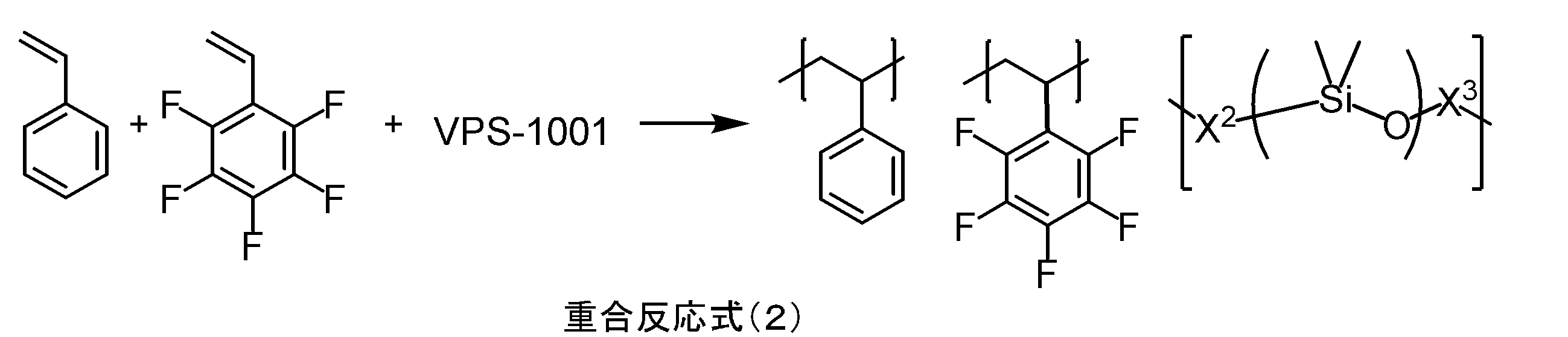
式中、X2、X3は、2価の有機基を示す。
(樹脂シート16の製造に用いるポリマー16の合成)
両末端ヒドロキシ変性シリコーン(商品名:KF-6000、信越シリコーン社製)79質量部、テトラヒドロフラン50質量部、N-メチルピロリドン50質量部に対して、4,4’-ジフェニルメタンジイソシアネート21質量部、K-KAT348(商品名、楠本化成社製)0.1質量部を添加し、70℃で1時間反応させた。その後、反応溶液をメタノール500mLに添加することで、白色固体が生じた。生じた白色固体を、水洗、メタノール洗いし、乾燥させることにより、ポリマー16を得た。
両末端ヒドロキシ変性シリコーン(商品名:KF-6000、信越シリコーン社製)79質量部、テトラヒドロフラン50質量部、N-メチルピロリドン50質量部に対して、4,4’-ジフェニルメタンジイソシアネート21質量部、K-KAT348(商品名、楠本化成社製)0.1質量部を添加し、70℃で1時間反応させた。その後、反応溶液をメタノール500mLに添加することで、白色固体が生じた。生じた白色固体を、水洗、メタノール洗いし、乾燥させることにより、ポリマー16を得た。
(樹脂シート17の製造に用いるポリマー17の合成)
両末端アミノ変性シリコーンKF-8010(商品名、信越シリコーン社製)77質量部、テトラヒドロフラン50質量部、N-メチルピロリドン50質量部に対して、4,4’-ジフェニルメタンジイソシアネート23質量部を添加し、室温で1時間反応させた。その後、反応溶液をメタノール500mLに添加することで、白色固体が生じた。生じた白色固体を、水洗、メタノール洗いし、乾燥させることにより、ポリマー17を得た。
両末端アミノ変性シリコーンKF-8010(商品名、信越シリコーン社製)77質量部、テトラヒドロフラン50質量部、N-メチルピロリドン50質量部に対して、4,4’-ジフェニルメタンジイソシアネート23質量部を添加し、室温で1時間反応させた。その後、反応溶液をメタノール500mLに添加することで、白色固体が生じた。生じた白色固体を、水洗、メタノール洗いし、乾燥させることにより、ポリマー17を得た。
(樹脂シート18の製造に用いるポリマー18の合成)
後記表1に記載の構造単位(a)形成用モノマー及び構造単位(b)形成用モノマーの組成に変えたこと以外は、ポリマー16の合成と同様にして、ポリマー18を合成した。
後記表1に記載の構造単位(a)形成用モノマー及び構造単位(b)形成用モノマーの組成に変えたこと以外は、ポリマー16の合成と同様にして、ポリマー18を合成した。
(樹脂シート19の製造に用いるポリマー19の合成)
2-メタクリルオキシエチルイソシアネートとエチルアミンを反応させ、下記式にしたがって2-(3-プロピルウレイド)エチルメタクリレートを得た。構造単位(a)形成用モノマー及び構造単位(b)形成用モノマーの組成に変えたこと以外は、ポリマー1の合成と同様にして、ポリマー19を合成した。
2-メタクリルオキシエチルイソシアネートとエチルアミンを反応させ、下記式にしたがって2-(3-プロピルウレイド)エチルメタクリレートを得た。構造単位(a)形成用モノマー及び構造単位(b)形成用モノマーの組成に変えたこと以外は、ポリマー1の合成と同様にして、ポリマー19を合成した。

(樹脂シート1の製造)
ポリマー1 100質量部とパーブチルD 0.3質量部とを混合し、150℃で10分熱プレス処理(圧力10MPa)を施し、縦60mm、横60mm、厚みが2mmの樹脂シート1を製造した。
ポリマー1 100質量部とパーブチルD 0.3質量部とを混合し、150℃で10分熱プレス処理(圧力10MPa)を施し、縦60mm、横60mm、厚みが2mmの樹脂シート1を製造した。
(樹脂シート2~20及びc1~c3の製造)
ポリマー1に代えてポリマー2~20及びc1~c3を用いたこと、パーブチルDを後記表1に記載の量(質量部)に変えたこと以外は、樹脂シート1と同様にして、樹脂シート2~20及びc1~c3を製造した。なお、樹脂シートc1及びc3の製造において、パーブチルDを用いなかった。
ポリマー1に代えてポリマー2~20及びc1~c3を用いたこと、パーブチルDを後記表1に記載の量(質量部)に変えたこと以外は、樹脂シート1と同様にして、樹脂シート2~20及びc1~c3を製造した。なお、樹脂シートc1及びc3の製造において、パーブチルDを用いなかった。
(樹脂シート21及び22の製造)
ポリマー1に代えてポリマー21及び22を用いたこと、バーブチルDに代えて後記表1に記載の添加剤(c)を後記表1に記載の量で用いたこと以外は、樹脂シート1と同様にして、樹脂シート21及び22を製造した。
ポリマー1に代えてポリマー21及び22を用いたこと、バーブチルDに代えて後記表1に記載の添加剤(c)を後記表1に記載の量で用いたこと以外は、樹脂シート1と同様にして、樹脂シート21及び22を製造した。
(樹脂シート23の製造)
ポリマー23を用いて樹脂シート1と同じ熱プレス処理を施し、縦60mm、横60mm、厚みが2mmのシートを製造した。このシートに対して、加速電圧2MeV、線量300kGyで電子線照射を行うことにより、樹脂シート23を製造した。
ポリマー23を用いて樹脂シート1と同じ熱プレス処理を施し、縦60mm、横60mm、厚みが2mmのシートを製造した。このシートに対して、加速電圧2MeV、線量300kGyで電子線照射を行うことにより、樹脂シート23を製造した。
(樹脂シート24の製造)
ポリマー24を用いて樹脂シート1と同じ熱プレス処理を施し、縦60mm、横60mm、厚みが2mmのシートを製造した。このシートに対して、Co60を線源として、線量300kGyでγ線照射を行うことにより、樹脂シート24を製造した。
ポリマー24を用いて樹脂シート1と同じ熱プレス処理を施し、縦60mm、横60mm、厚みが2mmのシートを製造した。このシートに対して、Co60を線源として、線量300kGyでγ線照射を行うことにより、樹脂シート24を製造した。
(樹脂シートc4の製造)
ビニル末端ポリジメチルシロキサン DMS-V41(商品名、Gelest社製)96質量部、メチルヒドロシロキサン-ジメチルシロキサンコポリマーHMS-301(商品名、Gelest社製)4質量部、白金触媒SIP6830.3(商品名、Gelest社製)0.03質量部を混合し、150℃、5分熱硬化することにより、縦60mm、横60mm、厚み2mmの樹脂シートc4を製造した。
ビニル末端ポリジメチルシロキサン DMS-V41(商品名、Gelest社製)96質量部、メチルヒドロシロキサン-ジメチルシロキサンコポリマーHMS-301(商品名、Gelest社製)4質量部、白金触媒SIP6830.3(商品名、Gelest社製)0.03質量部を混合し、150℃、5分熱硬化することにより、縦60mm、横60mm、厚み2mmの樹脂シートc4を製造した。
(樹脂シートc5の製造)
ビニル末端ポリジメチルシロキサン DMS-V41(商品名、Gelest社製)67質量部、メチルヒドロシロキサン-ジメチルシロキサンコポリマー HMS-301(商品名、Gelest社製)3質量部、フュームドシリカ アエロジルR974(商品名、日本アエロジル社製、平均一次粒子径12nm、ジメチルジクロロシラン表面処理)30質量部、白金触媒SIP6830.3(Gelest社製)0.05質量部を混合し、150℃、5分熱硬化し、縦60mm、横60mm、厚み2mmの樹脂シートc5を作製した。
ビニル末端ポリジメチルシロキサン DMS-V41(商品名、Gelest社製)67質量部、メチルヒドロシロキサン-ジメチルシロキサンコポリマー HMS-301(商品名、Gelest社製)3質量部、フュームドシリカ アエロジルR974(商品名、日本アエロジル社製、平均一次粒子径12nm、ジメチルジクロロシラン表面処理)30質量部、白金触媒SIP6830.3(Gelest社製)0.05質量部を混合し、150℃、5分熱硬化し、縦60mm、横60mm、厚み2mmの樹脂シートc5を作製した。
上記製造した樹脂シート1~24を構成するポリマー(A)及び樹脂シートc1~c5を構成するポリマーのゲル分率及び密度を以下のようにして測定した。結果を後記表1に示す。
[ゲル分率]
樹脂シートから切り出した1gのサンプルをテトラヒドロフラン10gに25℃で24時間浸漬させた後にサンプルを取り出し、100℃で2時間乾燥した。浸漬前のサンプル質量m0と、浸漬、乾燥後のサンプル質量m24から下記式によりゲル分率を算出した。
樹脂シートから切り出した1gのサンプルをテトラヒドロフラン10gに25℃で24時間浸漬させた後にサンプルを取り出し、100℃で2時間乾燥した。浸漬前のサンプル質量m0と、浸漬、乾燥後のサンプル質量m24から下記式によりゲル分率を算出した。
ゲル分率(質量%)=(m24/m0)×100
[密度]
得られた厚み2mmの樹脂シートについて、25℃における密度をJIS K7112(1999)に記載のA法(水中置換法)の密度測定方法に準じて、電子比重計(アルファミラージュ社製、商品名「SD-200L」)を用いて測定した。
得られた厚み2mmの樹脂シートについて、25℃における密度をJIS K7112(1999)に記載のA法(水中置換法)の密度測定方法に準じて、電子比重計(アルファミラージュ社製、商品名「SD-200L」)を用いて測定した。
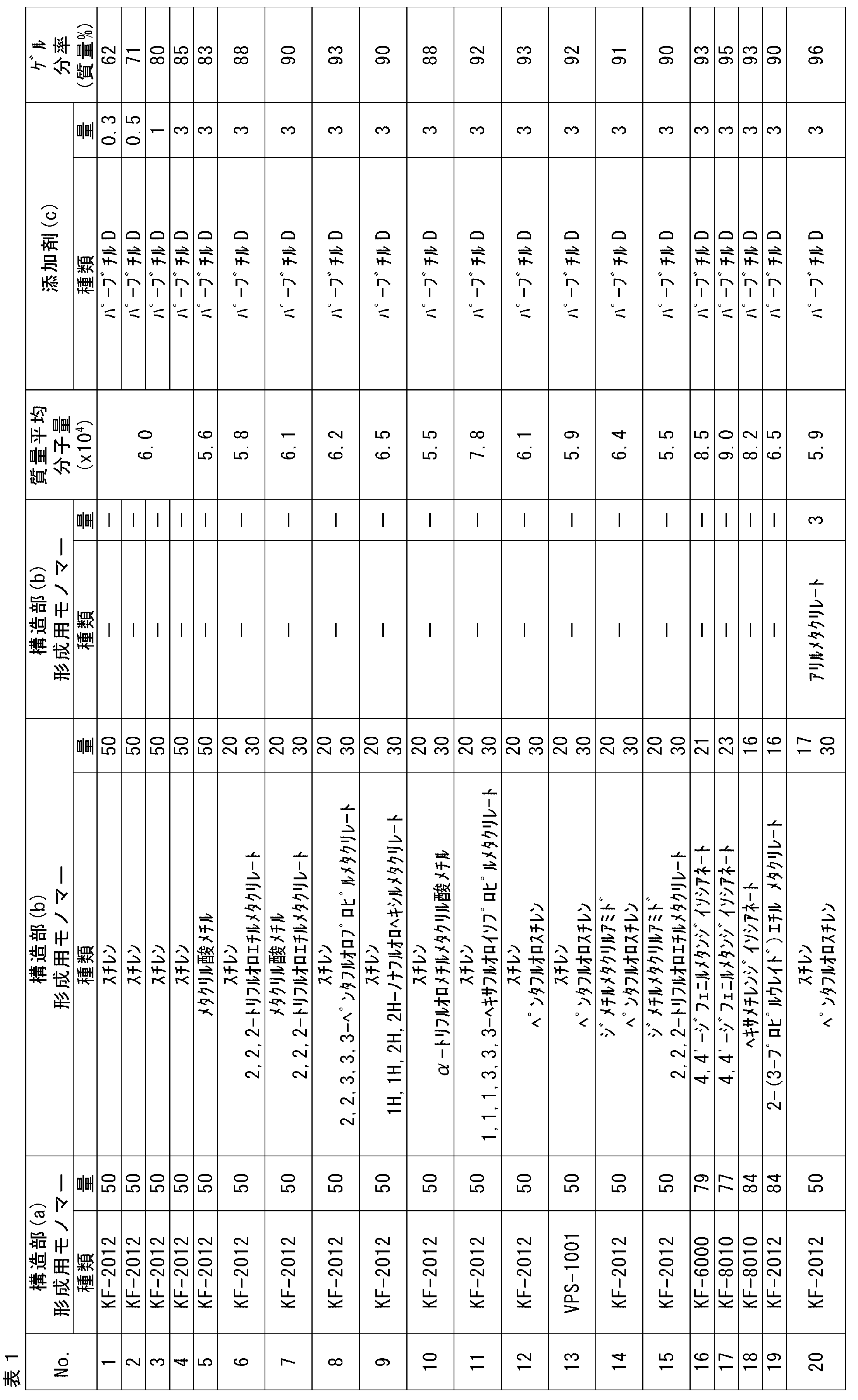
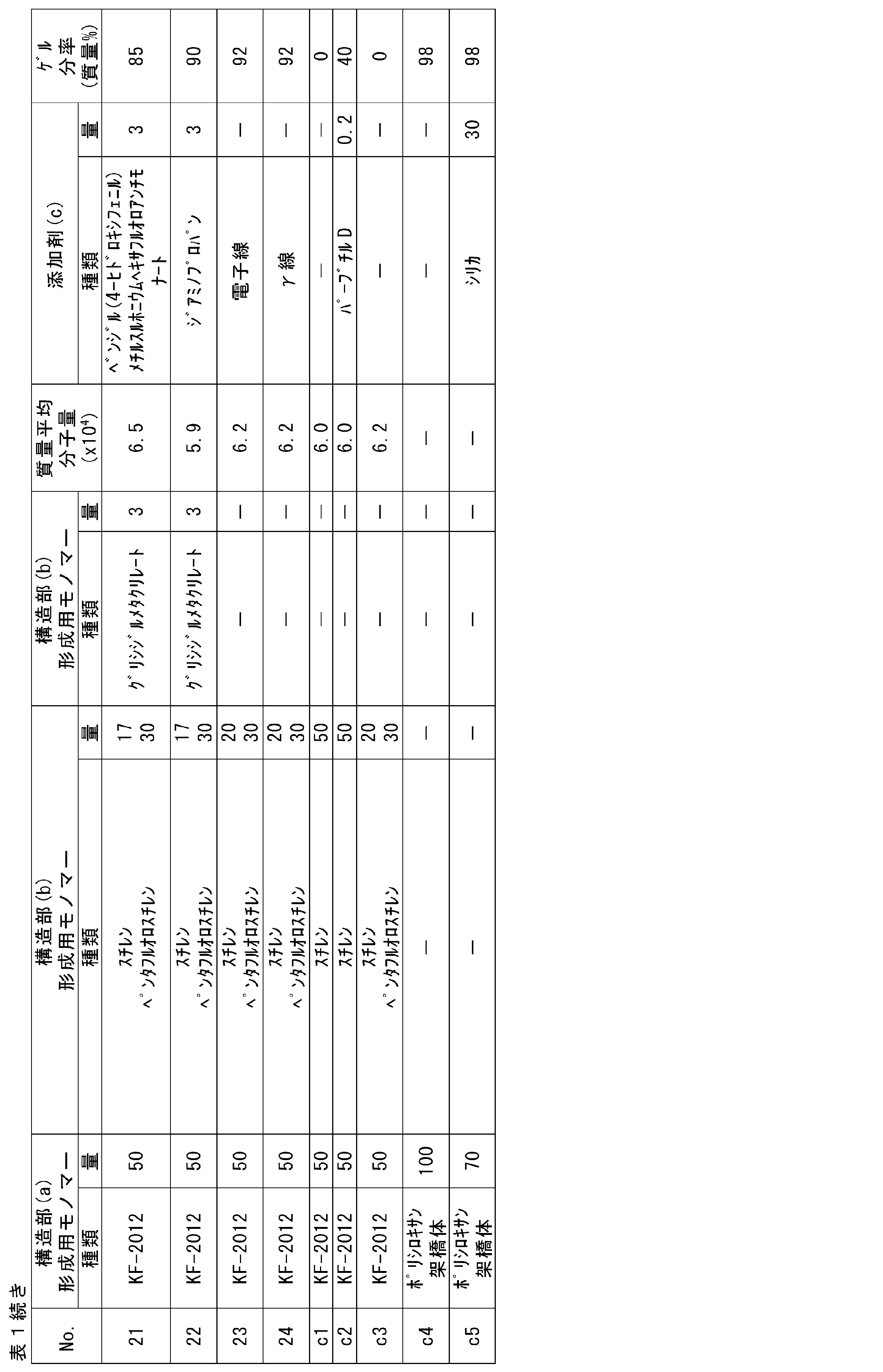
<表1の注>
・KF-2012:商品名、信越シリコーン社製片末端メタクリル変性シリコーン、質量平均分子量4,600
・VPS-1001:商品名、和光純薬工業社製ポリジメチルシロキサンユニット含有高分子アゾ重合開始剤、ポリシロキサンユニットの質量平均分子量10,000
・KF-6000:商品名、信越シリコーン社製両末端ヒドロキシ変性シリコーンオイル、質量平均分子量940
・KF-8010:商品名、信越シリコーン社製両末端アミノ変性シリコーンオイル、質量平均分子量860
・パーブチルD:商品名、日本油脂社製有機過酸化物
「量」は質量部である。
・KF-2012:商品名、信越シリコーン社製片末端メタクリル変性シリコーン、質量平均分子量4,600
・VPS-1001:商品名、和光純薬工業社製ポリジメチルシロキサンユニット含有高分子アゾ重合開始剤、ポリシロキサンユニットの質量平均分子量10,000
・KF-6000:商品名、信越シリコーン社製両末端ヒドロキシ変性シリコーンオイル、質量平均分子量940
・KF-8010:商品名、信越シリコーン社製両末端アミノ変性シリコーンオイル、質量平均分子量860
・パーブチルD:商品名、日本油脂社製有機過酸化物
「量」は質量部である。
上記製造した樹脂シート1~24及びc1~c5の音響特性及び機械強度を以下のようにして試験した。結果を後記表2に示す。
[音響波(超音波)感度]
超音波発振器(岩通計測株式会社製、ファンクション・ジェネレータ、商品名「FG-350」)から出力された10MHzの正弦波信号(1波)を超音波プローブ(ジャパンプローブ株式会社製)に入力し、超音波プローブから中心周波数が10MHzの超音波パルス波を水中に発生させた。発生させた超音波が、得られた厚み2mmの樹脂シートを通過する前と後の振幅の大きさを超音波受信機(松下電器産業株式会社製、オシロスコープ、商品名「VP-5204A」)により、水温25℃の環境で測定し、音響波(超音波)感度を比較することで、各素材の音響波(超音波)減衰量を比較した。
なお、音響波(超音波)感度とは、下記計算式で与えられる数値とする。
下記計算式において、Vinは、超音波発振器が発生させる、半値幅50nsec以下の入力波の電圧ピーク値を表す。Vsは、発生させた音響波(超音波)がシートを通過し、シートの対面から反射してきた音響波(超音波)を超音波発振器が受信したときに得られる電圧値を表す。音響波(超音波)感度が高い程、音響波(超音波)減衰量が小さいことを意味する。
超音波発振器(岩通計測株式会社製、ファンクション・ジェネレータ、商品名「FG-350」)から出力された10MHzの正弦波信号(1波)を超音波プローブ(ジャパンプローブ株式会社製)に入力し、超音波プローブから中心周波数が10MHzの超音波パルス波を水中に発生させた。発生させた超音波が、得られた厚み2mmの樹脂シートを通過する前と後の振幅の大きさを超音波受信機(松下電器産業株式会社製、オシロスコープ、商品名「VP-5204A」)により、水温25℃の環境で測定し、音響波(超音波)感度を比較することで、各素材の音響波(超音波)減衰量を比較した。
なお、音響波(超音波)感度とは、下記計算式で与えられる数値とする。
下記計算式において、Vinは、超音波発振器が発生させる、半値幅50nsec以下の入力波の電圧ピーク値を表す。Vsは、発生させた音響波(超音波)がシートを通過し、シートの対面から反射してきた音響波(超音波)を超音波発振器が受信したときに得られる電圧値を表す。音響波(超音波)感度が高い程、音響波(超音波)減衰量が小さいことを意味する。
音響波(超音波)感度=20×Log(Vs/Vin)
下記評価基準により音響波(超音波)感度を評価した。本試験においては、評価「C」以上が合格レベルである。
(評価基準)
A:-66dB以上
B:-68dB以上-66dB未満
C:-70dB以上-68dB未満
D:-72dB以上-70未満
E:-72dB未満
(評価基準)
A:-66dB以上
B:-68dB以上-66dB未満
C:-70dB以上-68dB未満
D:-72dB以上-70未満
E:-72dB未満
[音響インピーダンス]
得られた厚み2mmの樹脂シートについて、25℃における密度をJIS K7112(1999)に記載のA法(水中置換法)の密度測定方法に準じて、電子比重計(アルファミラージュ社製、商品名「SD-200L」)を用いて測定した。超音波音速は、JIS Z2353(2003)に従い、シングアラウンド式音速測定装置(超音波工業株式会社製、商品名「UVM-2型」)を用いて25℃において測定し、測定した密度と音速の積から音響インピーダンスを求めた。下記評価基準により音響インピーダンスを評価した。本試験においては、評価「C」以上が合格レベルである。
得られた厚み2mmの樹脂シートについて、25℃における密度をJIS K7112(1999)に記載のA法(水中置換法)の密度測定方法に準じて、電子比重計(アルファミラージュ社製、商品名「SD-200L」)を用いて測定した。超音波音速は、JIS Z2353(2003)に従い、シングアラウンド式音速測定装置(超音波工業株式会社製、商品名「UVM-2型」)を用いて25℃において測定し、測定した密度と音速の積から音響インピーダンスを求めた。下記評価基準により音響インピーダンスを評価した。本試験においては、評価「C」以上が合格レベルである。
(評価基準)
A:1.30×10⁶kg/m2/s以上1.70×106kg/m2/s未満
B:1.20×10⁶kg/m2/s以上1.30×106kg/m2/s未満
C:1.10×10⁶kg/m2/s以上1.20×106kg/m2/s未満
D:1.10×10⁶kg/m2/s未満
A:1.30×10⁶kg/m2/s以上1.70×106kg/m2/s未満
B:1.20×10⁶kg/m2/s以上1.30×106kg/m2/s未満
C:1.10×10⁶kg/m2/s以上1.20×106kg/m2/s未満
D:1.10×10⁶kg/m2/s未満
[硬度]
得られた厚み2mmのシリコーン樹脂シートについて、JIS K6253-3(2012)に従い、タイプAデュロメータ硬さを、ゴム硬度計(エクセル社製、商品名「RH-201A」)を用いて測定した。評価「C」以上が合格レベルである。
得られた厚み2mmのシリコーン樹脂シートについて、JIS K6253-3(2012)に従い、タイプAデュロメータ硬さを、ゴム硬度計(エクセル社製、商品名「RH-201A」)を用いて測定した。評価「C」以上が合格レベルである。
(評価基準)
A:40度以上
B:30度以上40度未満
C:20度以上30度未満
D:10度以上20度未満
E:5度以上10度未満
F:5度未満
A:40度以上
B:30度以上40度未満
C:20度以上30度未満
D:10度以上20度未満
E:5度以上10度未満
F:5度未満
[引裂強度試験]
得られた厚み2mmの樹脂シートについて、JIS K6252(2007)に従い、トラウザー型試験片を作製し、引裂強度を測定し、下記評価基準により引裂強度を評価した。本試験においては、評価「D」以上が合格レベルである。
得られた厚み2mmの樹脂シートについて、JIS K6252(2007)に従い、トラウザー型試験片を作製し、引裂強度を測定し、下記評価基準により引裂強度を評価した。本試験においては、評価「D」以上が合格レベルである。
(評価基準)
A:10N/cm以上
B:5N/cm以上10N/cm未満
C:1N/cm以上5N/cm未満
D:0.5N/cm以上1N/cm未満
E:0.1N/cm以上0.5N/cm未満
F:0.1N/cm未満
A:10N/cm以上
B:5N/cm以上10N/cm未満
C:1N/cm以上5N/cm未満
D:0.5N/cm以上1N/cm未満
E:0.1N/cm以上0.5N/cm未満
F:0.1N/cm未満
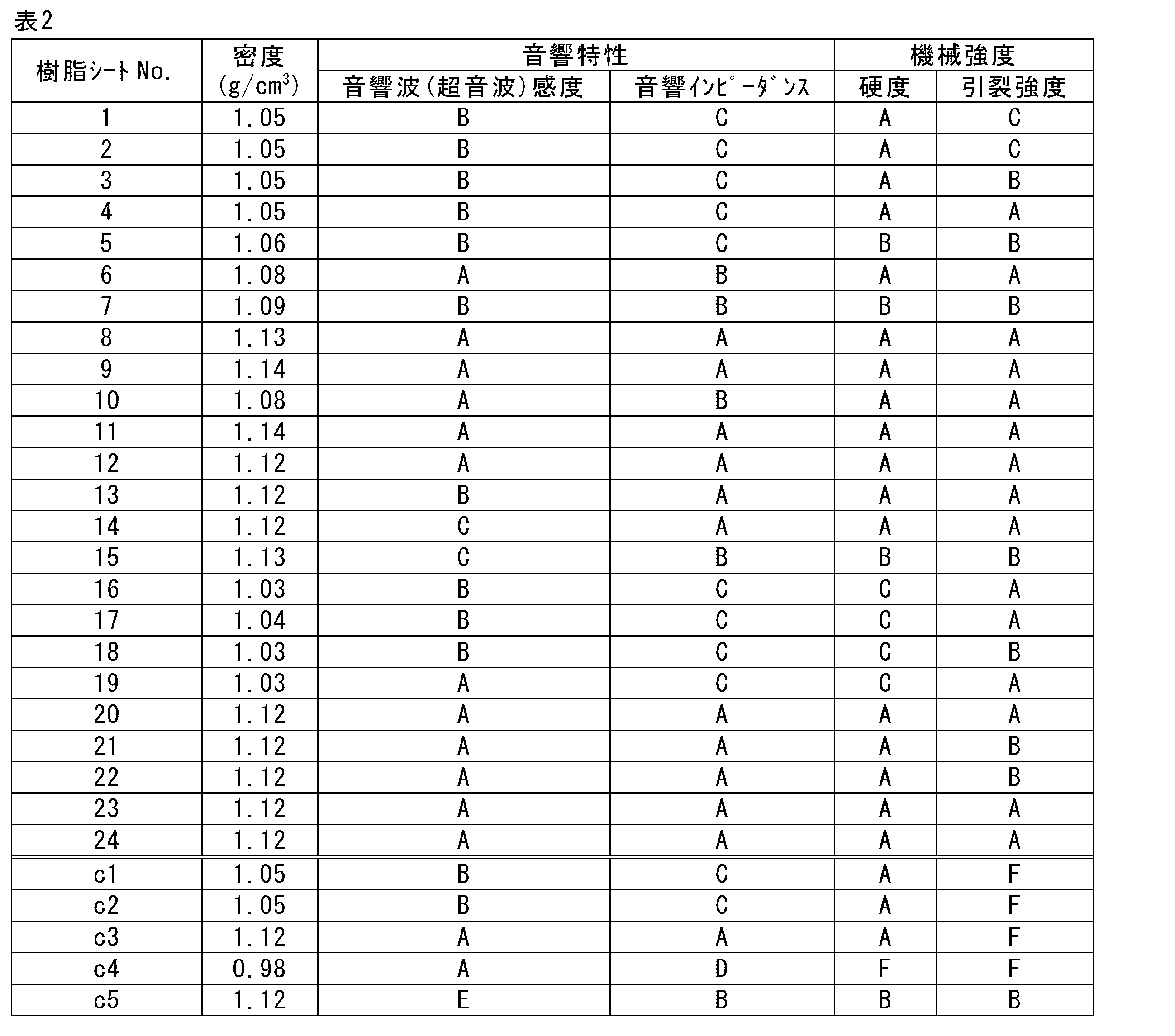
表2から明らかなように、本発明の規定を満たさない樹脂材料からなる樹脂シートc11~c4の樹脂シートは引裂強度が著しく劣った。また、本発明の規定を満たさず、フィラーを含有する樹脂材料からなる樹脂シートc5は音響波感度が著しく劣った。
これに対し、本発明の樹脂材料からなる樹脂シート1~24は、十分な音響特性を有し、さらに、引裂強度に優れることもわかる。
これに対し、本発明の樹脂材料からなる樹脂シート1~24は、十分な音響特性を有し、さらに、引裂強度に優れることもわかる。
本発明をその実施態様とともに説明したが、我々は特に指定しない限り我々の発明を説明のどの細部においても限定しようとするものではなく、添付の請求の範囲に示した発明の精神と範囲に反することなく幅広く解釈されるべきであると考える。
本願は、2018年3月26日に日本国で特許出願された特願2018-058355に基づく優先権を主張するものであり、これはここに参照してその内容を本明細書の記載の一部として取り込む。
1 音響レンズ
2 音響整合層
3 圧電素子層
4 バッキング材
7 筐体
9 コード
10 超音波探触子(プローブ)
2 音響整合層
3 圧電素子層
4 バッキング材
7 筐体
9 コード
10 超音波探触子(プローブ)
Claims (14)
- (a)ポリシロキサン結合を有する構造部と、(b)エステル結合、アミド結合、ウレタン結合、ウレア結合及び芳香環ビニル由来の構造の少なくとも1種を有する構造部とを含むゲル分率が60質量%以上のポリマーを含有する音響波プローブ用樹脂材料。
- 前記ポリマーの側鎖に、エステル結合、アミド結合、ウレタン結合、ウレア結合及び芳香環のいずれか1種を有する、請求項1に記載の音響波プローブ用樹脂材料。
- 前記ポリマー中、前記(b)の構造部のうち少なくとも一部が、(b1)アクリロイルオキシ構造単位、(b2)アクリルアミド構造単位又は(b3)スチレン構造単位である、請求項1又は2に記載の音響波プローブ用樹脂材料。
- 前記(a)の構造部が下記式(1)で表され、前記(b1)のアクリロイルオキシ構造単位が下記式(2)で表され、前記(b2)のアクリルアミド構造単位が下記式(3)で表され、前記(b3)のスチレン構造単位が下記式(4)で表される、請求項3に記載の音響波プローブ用樹脂材料。




- 前記ポリマー中、前記(b)の構造部のうち少なくとも一部が、エステル結合及び芳香環ビニル由来の構造の少なくとも1種を有する、請求項1~4のいずれか1項に記載の音響波プローブ用樹脂材料。
- 前記ポリマーがフッ素原子を含有する、請求項1~5のいずれか1項に記載の音響波プローブ用樹脂材料。
- 前記(b)の構造部が5個以上のフッ素原子を有する、請求項1~6のいずれか1項に記載の音響波プローブ用樹脂材料。
- 請求項1~7のいずれか1項に記載の音響波プローブ用樹脂材料を含んでなる音響レンズ。
- 請求項8に記載の音響レンズを有する音響波プローブ。
- 請求項9に記載の音響波プローブを備える音響波測定装置。
- 請求項9に記載の音響波プローブを備える超音波診断装置。
- 請求項8に記載の音響レンズを備える光音響波測定装置。
- 請求項8に記載の音響レンズを備える超音波内視鏡。
- (a)ポリシロキサン結合を有する構造部と、(b)エステル結合、アミド結合、ウレタン結合、ウレア結合及び芳香環ビニル由来の構造の少なくとも1種を有する構造部とを含むポリマーを熱又は放射線により架橋させる工程を含む、請求項8に記載の音響レンズの製造方法。
Priority Applications (4)
| Application Number | Priority Date | Filing Date | Title |
|---|---|---|---|
| JP2020510657A JP6912657B2 (ja) | 2018-03-26 | 2019-03-15 | 音響レンズ用又は音響整合層用樹脂材料、音響レンズ、音響整合シート、音響波プローブ、音響波測定装置、超音波診断装置、光音響波測定装置及び超音波内視鏡、並びに、音響レンズ及び音響整合シートの製造方法 |
| EP19774623.3A EP3777696B1 (en) | 2018-03-26 | 2019-03-15 | Acoustic wave probe resin material, acoustic lens, acoustic wave probe, acoustic wave measuring apparatus, ultrasonic diagnostic apparatus, photoacoustic wave measuring apparatus, ultrasonic endoscope, and method for manufacturing acoustic lens |
| CN201980012777.0A CN111698946B (zh) | 2018-03-26 | 2019-03-15 | 声透镜、声波探头、声波以及相关树脂材料、测定装置、诊断装置、内窥镜、以及制造方法 |
| US16/941,678 US11992367B2 (en) | 2018-03-26 | 2020-07-29 | Acoustic-wave-probe resin material, acoustic lens, acoustic wave probe, acoustic wave determination device, ultrasound diagnostic apparatus, photo-acoustic wave determination device, ultrasonic endoscope, and method for producing acoustic lens |
Applications Claiming Priority (2)
| Application Number | Priority Date | Filing Date | Title |
|---|---|---|---|
| JP2018058355 | 2018-03-26 | ||
| JP2018-058355 | 2018-03-26 |
Related Child Applications (1)
| Application Number | Title | Priority Date | Filing Date |
|---|---|---|---|
| US16/941,678 Continuation US11992367B2 (en) | 2018-03-26 | 2020-07-29 | Acoustic-wave-probe resin material, acoustic lens, acoustic wave probe, acoustic wave determination device, ultrasound diagnostic apparatus, photo-acoustic wave determination device, ultrasonic endoscope, and method for producing acoustic lens |
Publications (1)
| Publication Number | Publication Date |
|---|---|
| WO2019188426A1 true WO2019188426A1 (ja) | 2019-10-03 |
Family
ID=68059980
Family Applications (1)
| Application Number | Title | Priority Date | Filing Date |
|---|---|---|---|
| PCT/JP2019/010883 Ceased WO2019188426A1 (ja) | 2018-03-26 | 2019-03-15 | 音響波プローブ用樹脂材料、音響レンズ、音響波プローブ、音響波測定装置、超音波診断装置、光音響波測定装置及び超音波内視鏡、並びに、音響レンズの製造方法 |
Country Status (5)
| Country | Link |
|---|---|
| US (1) | US11992367B2 (ja) |
| EP (1) | EP3777696B1 (ja) |
| JP (1) | JP6912657B2 (ja) |
| CN (1) | CN111698946B (ja) |
| WO (1) | WO2019188426A1 (ja) |
Families Citing this family (4)
| Publication number | Priority date | Publication date | Assignee | Title |
|---|---|---|---|---|
| CN113429694B (zh) * | 2021-06-15 | 2022-07-26 | 广汽本田汽车有限公司 | 一种树脂组合物及其制备方法和应用 |
| CN115975384B (zh) * | 2022-12-26 | 2024-05-14 | 武汉联影医疗科技有限公司 | 改性硅橡胶、原料组合物及其制备方法和含其的声透镜、探头、超声诊断设备 |
| JP2024141332A (ja) * | 2023-03-29 | 2024-10-10 | セイコーエプソン株式会社 | 超音波プローブ |
| CN119735730B (zh) * | 2024-12-11 | 2026-01-09 | 武汉联影医疗科技有限公司 | 声匹配材料及其制备方法、超声换能器、超声探头和超声成像装置 |
Citations (3)
| Publication number | Priority date | Publication date | Assignee | Title |
|---|---|---|---|---|
| JP2005532871A (ja) * | 2002-07-12 | 2005-11-04 | アイサイエンス サージカル コーポレイション | 組織画像形成用の超音波インタフェース接続デバイス |
| US20100256496A1 (en) * | 2006-07-19 | 2010-10-07 | Quing Zhu | Method and apparatus for medical imaging using combined near-infrared optical tomography, fluorescent tomography and ultrasound |
| WO2015159603A1 (ja) * | 2014-04-14 | 2015-10-22 | オリンパス株式会社 | 樹脂組成物、超音波振動子用バッキング材、超音波振動子及び超音波内視鏡 |
Family Cites Families (7)
| Publication number | Priority date | Publication date | Assignee | Title |
|---|---|---|---|---|
| JPS6289765A (ja) | 1985-10-16 | 1987-04-24 | Shin Etsu Chem Co Ltd | 音響媒体用シリコ−ンゴム組成物 |
| FR2603590B1 (fr) * | 1986-02-25 | 1991-05-24 | Kansai Paint Co Ltd | Procede de preparation d'une resine contenant un polysiloxane |
| JPH07163560A (ja) * | 1993-07-30 | 1995-06-27 | Ge Yokogawa Medical Syst Ltd | 超音波診断用補助シート、カプラントおよび超音波探触子 |
| JPH10253604A (ja) * | 1997-03-07 | 1998-09-25 | Matsushita Electric Ind Co Ltd | 超音波探触子 |
| JP5520960B2 (ja) * | 2008-11-11 | 2014-06-11 | ダイキン工業株式会社 | 撥水撥油防汚性組成物の製造方法 |
| JP6569003B2 (ja) * | 2016-03-29 | 2019-08-28 | 富士フイルム株式会社 | 音響波プローブ用樹脂組成物、ならびに、これを用いた音響レンズ、音響波プローブ、音響波測定装置、超音波診断装置、光音響波測定装置および超音波内視鏡 |
| EP3522565B1 (en) * | 2016-09-27 | 2021-03-17 | FUJIFILM Corporation | Resin material for acoustic wave probe, acoustic lens, acoustic wave probe, acoustic wave measurement apparatus, ultrasound diagnostic apparatus, photoacoustic wave measurement apparatus, and ultrasound endoscope |
-
2019
- 2019-03-15 CN CN201980012777.0A patent/CN111698946B/zh active Active
- 2019-03-15 EP EP19774623.3A patent/EP3777696B1/en active Active
- 2019-03-15 JP JP2020510657A patent/JP6912657B2/ja active Active
- 2019-03-15 WO PCT/JP2019/010883 patent/WO2019188426A1/ja not_active Ceased
-
2020
- 2020-07-29 US US16/941,678 patent/US11992367B2/en active Active
Patent Citations (3)
| Publication number | Priority date | Publication date | Assignee | Title |
|---|---|---|---|---|
| JP2005532871A (ja) * | 2002-07-12 | 2005-11-04 | アイサイエンス サージカル コーポレイション | 組織画像形成用の超音波インタフェース接続デバイス |
| US20100256496A1 (en) * | 2006-07-19 | 2010-10-07 | Quing Zhu | Method and apparatus for medical imaging using combined near-infrared optical tomography, fluorescent tomography and ultrasound |
| WO2015159603A1 (ja) * | 2014-04-14 | 2015-10-22 | オリンパス株式会社 | 樹脂組成物、超音波振動子用バッキング材、超音波振動子及び超音波内視鏡 |
Non-Patent Citations (1)
| Title |
|---|
| See also references of EP3777696A4 * |
Also Published As
| Publication number | Publication date |
|---|---|
| EP3777696A1 (en) | 2021-02-17 |
| CN111698946A (zh) | 2020-09-22 |
| CN111698946B (zh) | 2023-07-18 |
| US11992367B2 (en) | 2024-05-28 |
| US20200352449A1 (en) | 2020-11-12 |
| JP6912657B2 (ja) | 2021-08-04 |
| EP3777696B1 (en) | 2024-02-28 |
| EP3777696A4 (en) | 2021-05-26 |
| JPWO2019188426A1 (ja) | 2020-12-17 |
Similar Documents
| Publication | Publication Date | Title |
|---|---|---|
| JP6912657B2 (ja) | 音響レンズ用又は音響整合層用樹脂材料、音響レンズ、音響整合シート、音響波プローブ、音響波測定装置、超音波診断装置、光音響波測定装置及び超音波内視鏡、並びに、音響レンズ及び音響整合シートの製造方法 | |
| EP3522565B1 (en) | Resin material for acoustic wave probe, acoustic lens, acoustic wave probe, acoustic wave measurement apparatus, ultrasound diagnostic apparatus, photoacoustic wave measurement apparatus, and ultrasound endoscope | |
| US10660611B2 (en) | Composition for acoustic wave probe, silicone resin for acoustic wave probe using the same, acoustic wave probe, ultrasound probe, acoustic wave measurement apparatus, ultrasound diagnostic apparatus, photoacoustic wave measurement apparatus, and ultrasound endoscope | |
| WO2017002746A1 (ja) | 音響波プローブ用組成物、これを用いた音響波プローブ用シリコーン樹脂、音響波プローブおよび超音波プローブならびに音響波測定装置、超音波診断装置、光音響波測定装置および超音波内視鏡 | |
| JP6912270B2 (ja) | 音響波プローブ用樹脂、音響波プローブ用樹脂材料、音響波プローブ用樹脂材料の製造方法、音響レンズ、音響波プローブ、超音波プローブ、音響波測定装置、超音波診断装置、光音響波測定装置および超音波内視鏡 | |
| US11610576B2 (en) | Resin material for acoustic lens, acoustic lens, acoustic wave probe, acoustic wave measurement apparatus, ultrasound diagnostic apparatus, photoacoustic wave measurement apparatus, and ultrasound endoscope | |
| JPWO2019049984A1 (ja) | 音響波プローブ用組成物、音響波プローブ用シリコーン樹脂、音響波プローブ、超音波プローブ、音響波測定装置、超音波診断装置、光音響波測定装置および超音波内視鏡 | |
| US10729405B2 (en) | Composition for acoustic wave probe, silicone resin for acoustic wave probe using same, acoustic wave probe, ultrasonic probe, acoustic wave measurement apparatus, ultrasonic diagnostic apparatus, photoacoustic wave measurement apparatus and ultrasound endoscope | |
| JP6738295B2 (ja) | 音響波プローブ用樹脂材料、音響波プローブ用樹脂混合物、音響レンズ、音響波プローブ、音響波測定装置、超音波診断装置、光音響波測定装置および超音波内視鏡 | |
| JP2016108395A (ja) | 音響波プローブ用組成物、これを用いた音響波プローブ用シリコーン樹脂、音響波プローブおよび超音波プローブ、ならびに、音響波測定装置、超音波診断装置、光音響波測定装置および超音波内視鏡 | |
| US10716540B2 (en) | Resin composition for acoustic wave probe, and acoustic lens using the same, acoustic wave probe, acoustic wave measurement apparatus, ultrasound diagnostic apparatus, photoacoustic wave measurement apparatus, and ultrasound endoscope | |
| JP2020048794A (ja) | 音響波プローブ用組成物、この組成物を用いた音響レンズ、音響波プローブ、音響波測定装置、超音波診断装置、光音響波測定装置及び超音波内視鏡 | |
| JP6817140B2 (ja) | 音響波プローブ用樹脂、音響波プローブ用樹脂材料、音響波プローブ用樹脂材料の製造方法、音響レンズ、音響波プローブ、超音波プローブ、音響波測定装置、超音波診断装置、光音響波測定装置および超音波内視鏡 | |
| JP6491853B2 (ja) | 音響波プローブ用組成物、これを用いた音響波プローブ用シリコーン樹脂、音響波プローブおよび超音波プローブ、音響波測定装置、超音波診断装置、光音響波測定装置および超音波内視鏡ならびに音響波プローブ用シリコーン樹脂の製造方法 | |
| JP6660990B2 (ja) | 音響波プローブ用組成物、これを用いた音響波プローブ用シリコーン樹脂、音響波プローブおよび超音波プローブ、音響波測定装置、超音波診断装置、光音響波測定装置および超音波内視鏡ならびに音響波プローブ用シリコーン樹脂の製造方法 | |
| JP6649219B2 (ja) | 音響波プローブ用樹脂材料、音響レンズ、音響波プローブ、音響波測定装置、超音波診断装置、光音響波測定装置および超音波内視鏡 |
Legal Events
| Date | Code | Title | Description |
|---|---|---|---|
| 121 | Ep: the epo has been informed by wipo that ep was designated in this application |
Ref document number: 19774623 Country of ref document: EP Kind code of ref document: A1 |
|
| ENP | Entry into the national phase |
Ref document number: 2020510657 Country of ref document: JP Kind code of ref document: A |
|
| NENP | Non-entry into the national phase |
Ref country code: DE |
|
| ENP | Entry into the national phase |
Ref document number: 2019774623 Country of ref document: EP Effective date: 20201026 |