WO2019189269A1 - 波長変換部材、バックライトユニット、及び画像表示装置 - Google Patents
波長変換部材、バックライトユニット、及び画像表示装置 Download PDFInfo
- Publication number
- WO2019189269A1 WO2019189269A1 PCT/JP2019/013024 JP2019013024W WO2019189269A1 WO 2019189269 A1 WO2019189269 A1 WO 2019189269A1 JP 2019013024 W JP2019013024 W JP 2019013024W WO 2019189269 A1 WO2019189269 A1 WO 2019189269A1
- Authority
- WO
- WIPO (PCT)
- Prior art keywords
- meth
- wavelength conversion
- conversion member
- quantum dot
- acrylate
- Prior art date
- Legal status (The legal status is an assumption and is not a legal conclusion. Google has not performed a legal analysis and makes no representation as to the accuracy of the status listed.)
- Ceased
Links
Images

Classifications
-
- G—PHYSICS
- G02—OPTICS
- G02F—OPTICAL DEVICES OR ARRANGEMENTS FOR THE CONTROL OF LIGHT BY MODIFICATION OF THE OPTICAL PROPERTIES OF THE MEDIA OF THE ELEMENTS INVOLVED THEREIN; NON-LINEAR OPTICS; FREQUENCY-CHANGING OF LIGHT; OPTICAL LOGIC ELEMENTS; OPTICAL ANALOGUE/DIGITAL CONVERTERS
- G02F1/00—Devices or arrangements for the control of the intensity, colour, phase, polarisation or direction of light arriving from an independent light source, e.g. switching, gating or modulating; Non-linear optics
- G02F1/01—Devices or arrangements for the control of the intensity, colour, phase, polarisation or direction of light arriving from an independent light source, e.g. switching, gating or modulating; Non-linear optics for the control of the intensity, phase, polarisation or colour
- G02F1/13—Devices or arrangements for the control of the intensity, colour, phase, polarisation or direction of light arriving from an independent light source, e.g. switching, gating or modulating; Non-linear optics for the control of the intensity, phase, polarisation or colour based on liquid crystals, e.g. single liquid crystal display cells
- G02F1/133—Constructional arrangements; Operation of liquid crystal cells; Circuit arrangements
- G02F1/1333—Constructional arrangements; Manufacturing methods
- G02F1/1335—Structural association of cells with optical devices, e.g. polarisers or reflectors
- G02F1/1336—Illuminating devices
- G02F1/133624—Illuminating devices characterised by their spectral emissions
-
- G—PHYSICS
- G02—OPTICS
- G02B—OPTICAL ELEMENTS, SYSTEMS OR APPARATUS
- G02B5/00—Optical elements other than lenses
- G02B5/20—Filters
- G02B5/206—Filters comprising particles embedded in a solid matrix
-
- C—CHEMISTRY; METALLURGY
- C08—ORGANIC MACROMOLECULAR COMPOUNDS; THEIR PREPARATION OR CHEMICAL WORKING-UP; COMPOSITIONS BASED THEREON
- C08K—Use of inorganic or non-macromolecular organic substances as compounding ingredients
- C08K3/00—Use of inorganic substances as compounding ingredients
- C08K3/10—Metal compounds
-
- C—CHEMISTRY; METALLURGY
- C09—DYES; PAINTS; POLISHES; NATURAL RESINS; ADHESIVES; COMPOSITIONS NOT OTHERWISE PROVIDED FOR; APPLICATIONS OF MATERIALS NOT OTHERWISE PROVIDED FOR
- C09K—MATERIALS FOR MISCELLANEOUS APPLICATIONS, NOT PROVIDED FOR ELSEWHERE
- C09K11/00—Luminescent materials, e.g. electroluminescent or chemiluminescent
- C09K11/02—Use of particular materials as binders, particle coatings or suspension media therefor
-
- C—CHEMISTRY; METALLURGY
- C09—DYES; PAINTS; POLISHES; NATURAL RESINS; ADHESIVES; COMPOSITIONS NOT OTHERWISE PROVIDED FOR; APPLICATIONS OF MATERIALS NOT OTHERWISE PROVIDED FOR
- C09K—MATERIALS FOR MISCELLANEOUS APPLICATIONS, NOT PROVIDED FOR ELSEWHERE
- C09K11/00—Luminescent materials, e.g. electroluminescent or chemiluminescent
- C09K11/08—Luminescent materials, e.g. electroluminescent or chemiluminescent containing inorganic luminescent materials
- C09K11/0883—Arsenides; Nitrides; Phosphides
-
- C—CHEMISTRY; METALLURGY
- C09—DYES; PAINTS; POLISHES; NATURAL RESINS; ADHESIVES; COMPOSITIONS NOT OTHERWISE PROVIDED FOR; APPLICATIONS OF MATERIALS NOT OTHERWISE PROVIDED FOR
- C09K—MATERIALS FOR MISCELLANEOUS APPLICATIONS, NOT PROVIDED FOR ELSEWHERE
- C09K11/00—Luminescent materials, e.g. electroluminescent or chemiluminescent
- C09K11/08—Luminescent materials, e.g. electroluminescent or chemiluminescent containing inorganic luminescent materials
- C09K11/70—Luminescent materials, e.g. electroluminescent or chemiluminescent containing inorganic luminescent materials containing phosphorus
- C09K11/701—Chalcogenides
- C09K11/703—Chalcogenides with zinc or cadmium
-
- C—CHEMISTRY; METALLURGY
- C09—DYES; PAINTS; POLISHES; NATURAL RESINS; ADHESIVES; COMPOSITIONS NOT OTHERWISE PROVIDED FOR; APPLICATIONS OF MATERIALS NOT OTHERWISE PROVIDED FOR
- C09K—MATERIALS FOR MISCELLANEOUS APPLICATIONS, NOT PROVIDED FOR ELSEWHERE
- C09K11/00—Luminescent materials, e.g. electroluminescent or chemiluminescent
- C09K11/08—Luminescent materials, e.g. electroluminescent or chemiluminescent containing inorganic luminescent materials
- C09K11/88—Luminescent materials, e.g. electroluminescent or chemiluminescent containing inorganic luminescent materials containing selenium, tellurium or unspecified chalcogen elements
- C09K11/881—Chalcogenides
- C09K11/883—Chalcogenides with zinc or cadmium
-
- G—PHYSICS
- G02—OPTICS
- G02B—OPTICAL ELEMENTS, SYSTEMS OR APPARATUS
- G02B1/00—Optical elements characterised by the material of which they are made; Optical coatings for optical elements
- G02B1/04—Optical elements characterised by the material of which they are made; Optical coatings for optical elements made of organic materials, e.g. plastics
-
- G—PHYSICS
- G02—OPTICS
- G02B—OPTICAL ELEMENTS, SYSTEMS OR APPARATUS
- G02B5/00—Optical elements other than lenses
- G02B5/20—Filters
-
- G—PHYSICS
- G02—OPTICS
- G02B—OPTICAL ELEMENTS, SYSTEMS OR APPARATUS
- G02B6/00—Light guides; Structural details of arrangements comprising light guides and other optical elements, e.g. couplings
- G02B6/0001—Light guides; Structural details of arrangements comprising light guides and other optical elements, e.g. couplings specially adapted for lighting devices or systems
- G02B6/0011—Light guides; Structural details of arrangements comprising light guides and other optical elements, e.g. couplings specially adapted for lighting devices or systems the light guides being planar or of plate-like form
- G02B6/0013—Means for improving the coupling-in of light from the light source into the light guide
- G02B6/0023—Means for improving the coupling-in of light from the light source into the light guide provided by one optical element, or plurality thereof, placed between the light guide and the light source, or around the light source
- G02B6/0026—Wavelength selective element, sheet or layer, e.g. filter or grating
-
- G—PHYSICS
- G02—OPTICS
- G02B—OPTICAL ELEMENTS, SYSTEMS OR APPARATUS
- G02B6/00—Light guides; Structural details of arrangements comprising light guides and other optical elements, e.g. couplings
- G02B6/0001—Light guides; Structural details of arrangements comprising light guides and other optical elements, e.g. couplings specially adapted for lighting devices or systems
- G02B6/0011—Light guides; Structural details of arrangements comprising light guides and other optical elements, e.g. couplings specially adapted for lighting devices or systems the light guides being planar or of plate-like form
- G02B6/0033—Means for improving the coupling-out of light from the light guide
- G02B6/005—Means for improving the coupling-out of light from the light guide provided by one optical element, or plurality thereof, placed on the light output side of the light guide
-
- G—PHYSICS
- G02—OPTICS
- G02F—OPTICAL DEVICES OR ARRANGEMENTS FOR THE CONTROL OF LIGHT BY MODIFICATION OF THE OPTICAL PROPERTIES OF THE MEDIA OF THE ELEMENTS INVOLVED THEREIN; NON-LINEAR OPTICS; FREQUENCY-CHANGING OF LIGHT; OPTICAL LOGIC ELEMENTS; OPTICAL ANALOGUE/DIGITAL CONVERTERS
- G02F1/00—Devices or arrangements for the control of the intensity, colour, phase, polarisation or direction of light arriving from an independent light source, e.g. switching, gating or modulating; Non-linear optics
- G02F1/01—Devices or arrangements for the control of the intensity, colour, phase, polarisation or direction of light arriving from an independent light source, e.g. switching, gating or modulating; Non-linear optics for the control of the intensity, phase, polarisation or colour
- G02F1/13—Devices or arrangements for the control of the intensity, colour, phase, polarisation or direction of light arriving from an independent light source, e.g. switching, gating or modulating; Non-linear optics for the control of the intensity, phase, polarisation or colour based on liquid crystals, e.g. single liquid crystal display cells
- G02F1/133—Constructional arrangements; Operation of liquid crystal cells; Circuit arrangements
- G02F1/1333—Constructional arrangements; Manufacturing methods
- G02F1/1335—Structural association of cells with optical devices, e.g. polarisers or reflectors
- G02F1/133509—Filters, e.g. light shielding masks
- G02F1/133514—Colour filters
-
- G—PHYSICS
- G02—OPTICS
- G02F—OPTICAL DEVICES OR ARRANGEMENTS FOR THE CONTROL OF LIGHT BY MODIFICATION OF THE OPTICAL PROPERTIES OF THE MEDIA OF THE ELEMENTS INVOLVED THEREIN; NON-LINEAR OPTICS; FREQUENCY-CHANGING OF LIGHT; OPTICAL LOGIC ELEMENTS; OPTICAL ANALOGUE/DIGITAL CONVERTERS
- G02F1/00—Devices or arrangements for the control of the intensity, colour, phase, polarisation or direction of light arriving from an independent light source, e.g. switching, gating or modulating; Non-linear optics
- G02F1/01—Devices or arrangements for the control of the intensity, colour, phase, polarisation or direction of light arriving from an independent light source, e.g. switching, gating or modulating; Non-linear optics for the control of the intensity, phase, polarisation or colour
- G02F1/13—Devices or arrangements for the control of the intensity, colour, phase, polarisation or direction of light arriving from an independent light source, e.g. switching, gating or modulating; Non-linear optics for the control of the intensity, phase, polarisation or colour based on liquid crystals, e.g. single liquid crystal display cells
- G02F1/133—Constructional arrangements; Operation of liquid crystal cells; Circuit arrangements
- G02F1/1333—Constructional arrangements; Manufacturing methods
- G02F1/1335—Structural association of cells with optical devices, e.g. polarisers or reflectors
- G02F1/1336—Illuminating devices
- G02F1/133614—Illuminating devices using photoluminescence, e.g. phosphors illuminated by UV or blue light
-
- H—ELECTRICITY
- H10—SEMICONDUCTOR DEVICES; ELECTRIC SOLID-STATE DEVICES NOT OTHERWISE PROVIDED FOR
- H10H—INORGANIC LIGHT-EMITTING SEMICONDUCTOR DEVICES HAVING POTENTIAL BARRIERS
- H10H20/00—Individual inorganic light-emitting semiconductor devices having potential barriers, e.g. light-emitting diodes [LED]
- H10H20/80—Constructional details
- H10H20/85—Packages
- H10H20/851—Wavelength conversion means
-
- H—ELECTRICITY
- H10—SEMICONDUCTOR DEVICES; ELECTRIC SOLID-STATE DEVICES NOT OTHERWISE PROVIDED FOR
- H10H—INORGANIC LIGHT-EMITTING SEMICONDUCTOR DEVICES HAVING POTENTIAL BARRIERS
- H10H20/00—Individual inorganic light-emitting semiconductor devices having potential barriers, e.g. light-emitting diodes [LED]
- H10H20/80—Constructional details
- H10H20/85—Packages
- H10H20/851—Wavelength conversion means
- H10H20/8511—Wavelength conversion means characterised by their material, e.g. binder
- H10H20/8512—Wavelength conversion materials
-
- B—PERFORMING OPERATIONS; TRANSPORTING
- B82—NANOTECHNOLOGY
- B82Y—SPECIFIC USES OR APPLICATIONS OF NANOSTRUCTURES; MEASUREMENT OR ANALYSIS OF NANOSTRUCTURES; MANUFACTURE OR TREATMENT OF NANOSTRUCTURES
- B82Y20/00—Nanooptics, e.g. quantum optics or photonic crystals
-
- G—PHYSICS
- G02—OPTICS
- G02F—OPTICAL DEVICES OR ARRANGEMENTS FOR THE CONTROL OF LIGHT BY MODIFICATION OF THE OPTICAL PROPERTIES OF THE MEDIA OF THE ELEMENTS INVOLVED THEREIN; NON-LINEAR OPTICS; FREQUENCY-CHANGING OF LIGHT; OPTICAL LOGIC ELEMENTS; OPTICAL ANALOGUE/DIGITAL CONVERTERS
- G02F2202/00—Materials and properties
- G02F2202/36—Micro- or nanomaterials
Definitions
- the present invention relates to a wavelength conversion member, a backlight unit, and an image display device.
- the wavelength conversion member including the quantum dot phosphor is disposed, for example, in the backlight unit of the image display device.
- a wavelength conversion member including a quantum dot phosphor that emits red light and a quantum dot phosphor that emits green light is used, when the wavelength conversion member is irradiated with blue light as excitation light, the quantum dot phosphor emits light.
- White light can be obtained by the red light and green light that have been generated and the blue light that has passed through the wavelength conversion member.
- quantum dot phosphors can change various optical characteristics such as light absorption wavelength and light emission wavelength by changing the size of the quantum dot phosphor itself. By utilizing this property and appropriately selecting the optical characteristics of the quantum dot phosphor, it is considered that the obtained white light can be designed to have high luminance or excellent color reproducibility.
- a wavelength conversion member using a quantum dot phosphor tends to improve color reproducibility when the emission center wavelength (peak wavelength) is on the long wavelength side in the same color range (green or red).
- the emission center wavelength is required to be on the low wavelength side.
- the improvement in color reproducibility of the wavelength conversion member and the increase in luminance are in a contradictory relationship, and therefore a technique for comprehensively improving these is required.
- an object of the present invention is to provide a wavelength conversion member that has an excellent balance between color reproducibility and luminance. Another object of the present invention is to provide a backlight unit and an image display device that are excellent in balance between color reproducibility and luminance.
- ⁇ 1> It includes a quantum dot phosphor, and can convert incident light into green light and red light.
- the half-value width (FWHM-G) of the emission spectrum of the green light and the half-value width of the emission spectrum of the red light (FWHM-R) satisfies the following condition A and is a wavelength conversion member.
- Condition A ′ 0.40 ⁇ (FWHM-G) / (FWHM-R) ⁇ 0.70 ⁇ 3>
- ⁇ 4> The wavelength conversion member according to any one of ⁇ 1> to ⁇ 3>, wherein a half-value width (FWHM-R) of an emission spectrum of the red light is 40 nm or more.
- ⁇ 5> Any one of ⁇ 1> to ⁇ 4>, wherein a peak wavelength of the emission spectrum of the green light is in a range of 530 ⁇ 20 nm, and a peak wavelength of the emission spectrum of the red light is in a range of 630 ⁇ 20 nm.
- the wavelength conversion member according to item. ⁇ 6> The wavelength conversion member according to any one of ⁇ 1> to ⁇ 5>, wherein the quantum dot phosphor includes a compound containing at least one of Cd and In.
- the quantum dot phosphor includes a quantum dot phosphor that emits green light and a quantum dot phosphor that emits red light, and the quantum dot phosphor that emits green light includes a compound containing Cd,
- ⁇ 10> The wavelength conversion member according to ⁇ 9>, wherein the coating material has a barrier property against at least one of oxygen and water.
- a backlight unit comprising the wavelength conversion member according to any one of ⁇ 1> to ⁇ 10> and a light source.
- An image display device comprising the backlight unit according to ⁇ 11>.
- a wavelength conversion member having an excellent balance between color reproducibility and luminance is provided.
- the present invention also provides a backlight unit and an image display device that are excellent in color reproducibility and brightness balance.
- the present invention is not limited to the following embodiments.
- the components including element steps and the like are not essential unless otherwise specified.
- the term “process” includes a process that is independent of other processes and includes the process if the purpose of the process is achieved even if it cannot be clearly distinguished from the other processes.
- numerical ranges indicated using “to” include numerical values described before and after “to” as the minimum value and the maximum value, respectively.
- each component may contain a plurality of corresponding substances.
- the content of each component means the total content of the plurality of substances present in the composition unless otherwise specified.
- a plurality of particles corresponding to each component may be included.
- the particle diameter of each component means a value for a mixture of the plurality of particles present in the composition unless otherwise specified.
- the term “layer” or “film” includes only a part of the region in addition to the case where the layer or film is formed over the entire region. The case where it is formed is also included.
- the term “lamination” indicates that layers are stacked, and two or more layers may be combined, or two or more layers may be detachable.
- the average thickness of the laminated body or the layers constituting the laminated body is an arithmetic average value of thicknesses at arbitrary three positions measured using a micrometer or the like.
- (meth) acryloyl group means at least one of acryloyl group and methacryloyl group
- (meth) acryl means at least one of acryl and methacryl
- “(meth) acrylate” means acrylate
- at least one of methacrylate and “(meth) allyl” means at least one of allyl and methallyl.
- the (meth) allyl compound means a compound having a (meth) allyl group in the molecule
- the (meth) acrylic compound means a compound having a (meth) acryloyl group in the molecule.
- the wavelength conversion member of the present disclosure includes a quantum dot phosphor, and can convert incident light into green light and red light.
- the half-value width (FWHM-G) of the emission spectrum of the green light and the red light The full width at half maximum (FWHM-R) of the emission spectrum satisfies the following condition A.
- the wavelength conversion member of the present disclosure sets the ratio of the half-value width (FWHM-G) of the emission spectrum of green light and the half-value width (FWHM-R) of the emission spectrum of red light to a specific range (0.70 or less).
- FWHM-G half-value width of the emission spectrum of green light
- FWHM-R half-value width of the emission spectrum of red light
- the half-value width (FWHM-G) of the emission spectrum of green light and the half-value width (FWHM-R) of the emission spectrum of red light satisfy the following condition A ′. .
- the “half-value width of the emission spectrum” means the width of the emission spectrum at a location where the peak height of the emission spectrum is 1 ⁇ 2, and means the full width at half maximum (FWHM). To do.
- the method for examining the half-value width of the emission spectrum is not particularly limited, and a known method can be employed. For example, it can be calculated from an emission spectrum measured using a luminance meter.
- the half-value width increases, the color reproducibility deteriorates, but green light is more affected than red light.
- the full width at half maximum decreases, the luminance tends to decrease due to a shift in the peak position or the like. Red light has less influence on the color reproducibility due to the half-value width than green light. For this reason, even if the half width is relatively wide, a decrease in luminance can be suppressed without significantly degrading color reproducibility compared with green light.
- the wavelength conversion member of the present disclosure pays attention to this tendency, and relatively widens the emission wavelength peak of red light while improving color reproducibility by relatively narrowing the emission wavelength peak width of green light. By suppressing the decrease in luminance, the overall color reproducibility and luminance balance is achieved.
- the bottom of the emission wavelength peak of green light is located on the shorter wavelength side.
- quantum dot phosphors using In tend to have a wider emission wavelength peak width than quantum dot phosphors using Cd. Therefore, quantum dot phosphors that emit red light have a higher priority than green light. Cd can be replaced with one using In.
- the half-value width of the emission wavelength peak of green light is smaller, the amount of quantum dot phosphors necessary for green light emission can be reduced, and the amount of Cd used in the wavelength conversion member can be reduced.
- the amount of Cd used in electronic and electrical equipment is set to 100 ppm or less by the RoHS (Restriction on Hazardous Substances) directive.
- the ratio (FWHM-G) / (FWHM-R) of the half-value width (FWHM-G) of the emission spectrum of green light and the half-value width (FWHM-R) of the emission spectrum of red light is 0.70 or less. Although not limited, it is preferably 0.65 or less, more preferably 0.60 or less, more preferably 0.55 or less, and more preferably 0.50 or less.
- the ratio of the half-value width (FWHM-G) of the emission spectrum of green light to the half-value width (FWHM-R) of the emission spectrum of red light (FWHM-G) / (FWHM- R) is preferably 0.40 or more, more preferably 0.45 or more, and further preferably 0.50 or more.
- the half width of the emission spectrum of green light converted by the wavelength conversion member of the present disclosure is not particularly limited, but is preferably 40 nm or less, more preferably 35 nm or less from the viewpoint of improving color reproducibility, More preferably, it is 30 nm or less, and more preferably 25 nm or less.
- the half width of the emission spectrum of green light is preferably 20 nm or more.
- the wavelength of green light converted by the wavelength conversion member of the present disclosure is not particularly limited, but preferably has an emission spectrum peak in the range of 530 ⁇ 20 nm.
- the full width at half maximum of the emission spectrum of red light converted by the wavelength conversion member of the present disclosure is not particularly limited, but is preferably 50 nm or less and more preferably 47 nm or less from the viewpoint of improving color reproducibility.
- the half-value width of the emission spectrum of red light is preferably 40 nm or more, and more preferably 42 nm or more.
- the wavelength of red light converted by the wavelength conversion member of the present disclosure is not particularly limited, but preferably has an emission spectrum peak in the range of 630 ⁇ 20 nm.
- the method for adjusting the emission wavelengths of the green light and red light converted by the wavelength conversion member and the half-value width of the emission spectrum is not particularly limited. For example, it can be adjusted according to the material of the quantum dot phosphor contained in the wavelength conversion member, the particle diameter, the particle size distribution, the state of the core-shell structure, and the like. Even if each of the quantum dot phosphor emitting green light and the quantum dot phosphor emitting red light contained in the wavelength conversion member is only one type, a combination of two or more different at least one of the above items It may be.
- the quantum dot phosphor include particles of a compound containing at least one selected from the group consisting of II-VI group compounds, III-V group compounds, IV-VI group compounds, and IV group compounds.
- the quantum dot phosphor preferably contains a compound containing at least one of Cd and In.
- the quantum dot phosphor using Cd those using CdSe are preferable, and as the quantum dot phosphor using In, those using InP are preferable.
- the quantum dot phosphor that emits green light includes a compound containing Cd
- the quantum dot phosphor that emits red light includes a compound containing In
- the quantum dot phosphor that emits green light includes CdSe
- the quantum dot phosphor that emits red light includes InP.
- II-VI group compounds include CdSe, CdTe, CdS, ZnS, ZnSe, ZnTe, ZnO, HgS, HgSe, HgTe, CdSeS, CdSeTe, CdSTe, ZnSeS, ZnSeTe, ZnSTe, HgSeS, HgSeS, HgSeT, CdZnSe, CdZnTe, CdHgS, CdHgSe, CdHgTe, HgZnS, HgZnSe, HgZnTe, CdZnSeS, CdZnSeTe, CdZnSTe, CdHgSeS, CdHgSeTe, GdHgSe, ST
- III-V group compounds include GaN, GaP, GaAs, GaSb, AlN, AlP, AlAs, AlSb, InN, InP, InAs, InSb, GNP, GANAS, GaNSb, GaPAs, GaPSb, AlNP, AlNAs, AlNSb.
- IV-VI group compounds include SnS, SnSe, SnTe, PbS, PbSe, PbTe, SnSeS, SnSeTe, SnSTe, PbSeS, PbSeTe, PbSTe, SnPbS, SnPbSe, SnPbSe, SnPbTe, Sn, etc. .
- group IV compound examples include Si, Ge, SiC, SiGe and the like.
- the quantum dot phosphor may have a core-shell structure.
- the quantum efficiency of the quantum dot phosphor can be further improved.
- Examples of the combination of core and shell (core / shell) include CdSe / ZnS, InP / ZnS, PbSe / PbS, CdSe / CdS, CdTe / CdS, CdTe / ZnS, and the like.
- the quantum dot phosphor may have a so-called core multishell structure in which the shell has a multilayer structure.
- the quantum efficiency of the quantum dot phosphor can be further improved. Is possible.
- the wavelength conversion member contains a quantum dot phosphor
- two or more types of quantum dot phosphors having different components, average particle diameters, layer structures, and the like may be combined.
- the emission center wavelength of the entire wavelength conversion member can be adjusted to a desired value.
- the quantum dot phosphor may include a quantum dot phosphor that emits blue light in addition to a quantum dot phosphor that emits green light and a quantum dot phosphor that emits red light.
- the quantum dot phosphor may be used in the state of a dispersion liquid dispersed in a dispersion medium.
- the dispersion medium for dispersing the quantum dot phosphor include various organic solvents, silicone compounds, and monofunctional (meth) acrylate compounds.
- the organic solvent that can be used as the dispersion medium is not particularly limited as long as the precipitation and aggregation of the quantum dot phosphor is not confirmed.
- silicone compounds that can be used as a dispersion medium include straight silicone oils such as dimethyl silicone oil, methylphenyl silicone oil, and methylhydrogen silicone oil; amino-modified silicone oil, epoxy-modified silicone oil, carboxy-modified silicone oil, and carbinol-modified silicone. Oil, mercapto modified silicone oil, heterogeneous functional group modified silicone oil, polyether modified silicone oil, methylstyryl modified silicone oil, hydrophilic special modified silicone oil, higher alkoxy modified silicone oil, higher fatty acid modified silicone oil, fluorine modified silicone oil, etc. And modified silicone oil.
- straight silicone oils such as dimethyl silicone oil, methylphenyl silicone oil, and methylhydrogen silicone oil
- amino-modified silicone oil such as dimethyl silicone oil, methylphenyl silicone oil, and methylhydrogen silicone oil
- amino-modified silicone oil such as dimethyl silicone oil, methylphenyl silicone oil, and methylhydrogen silicone oil
- amino-modified silicone oil such as dimethyl silicone oil, methylphenyl silicone
- the monofunctional (meth) acrylate compound that can be used as the dispersion medium is not particularly limited as long as it is liquid at room temperature (25 ° C.), and is preferably a monofunctional (meth) acrylate compound having an alicyclic structure (preferably Examples include isobornyl (meth) acrylate and dicyclopentanyl (meth) acrylate, methoxypolyethylene glycol (meth) acrylate, phenoxypolyethylene glycol (meth) acrylate, and ethoxylated o-phenylphenol (meth) acrylate.
- the dispersion may contain a dispersant as required. Examples of the dispersant include polyetheramine (JEFFAMINE M-1000, HUNTSMAN).
- the dispersion medium in which the quantum dot phosphor is dispersed may be phase-separated from other components contained in the quantum dot phosphor or may not be phase-separated.
- a silicone compound is used as a dispersion medium for dispersing the quantum dot phosphor, and a structure in which the silicone compound is phase-separated and dispersed in the form of droplets when used in combination with the polymerizable compound described later is a cured product of the polymerizable compound Can be formed inside.
- the content of the quantum dot phosphor in the wavelength conversion member is, for example, 0.01% by mass to 1.0% by mass with respect to the entire wavelength conversion member (excluding the coating material when a coating material is further provided). It is preferably 0.05% by mass to 0.5% by mass, more preferably 0.1% by mass to 0.5% by mass.
- the content of the quantum dot phosphor is 0.01% by mass or more, a sufficient wavelength conversion function tends to be obtained, and when the content of the quantum dot phosphor is 1.0% by mass or less, the quantum dot It tends to suppress aggregation of the phosphor.
- the wavelength conversion member may further include a cured resin, or may be in a state where the quantum dot phosphor is included in the cured resin.
- the resin cured product may be obtained, for example, by curing a composition (resin composition) containing a quantum dot phosphor, a polymerizable compound, and a photopolymerization initiator.
- the cured resin preferably contains a sulfide structure.
- the cured resin containing a sulfide structure is obtained by, for example, curing a resin composition containing a thiol compound described later and a polymerizable compound having a carbon-carbon double bond that causes an enethiol reaction with a thiol group of the thiol compound. Obtainable.
- the cured resin preferably contains an alicyclic structure or an aromatic ring structure.
- the resin cured product having an alicyclic structure or an aromatic ring structure can be obtained, for example, by curing a resin composition containing a compound having an alicyclic structure or an aromatic ring structure as a polymerizable compound described later.
- the cured resin contains an alkyleneoxy group.
- the resin cured product contains an alkyleneoxy group, the polarity of the resin cured product increases, and nonpolar oxygen tends to be difficult to dissolve in the components in the cured product. Further, the flexibility of the cured resin product tends to increase and the adhesion to the coating material tends to improve.
- the cured resin containing an alkyleneoxy group can be obtained, for example, by curing a resin composition containing an alkyleneoxy group as a polymerizable compound described later.
- the polymerizable compound contained in the resin composition is not particularly limited, and examples thereof include thiol compounds, (meth) acrylic compounds, (meth) allyl compounds, and the like.
- the resin composition is at least selected from the group consisting of a thiol compound, a (meth) acrylic compound, and a (meth) allyl compound as a polymerizable compound. 1 type is preferably included.
- a cured resin obtained by curing a resin composition containing a thiol compound as a polymerizable compound and at least one selected from the group consisting of a (meth) acrylic compound and a (meth) allyl compound is a thiol group.
- the thiol compound may be a monofunctional thiol compound having one thiol group in one molecule or a polyfunctional thiol compound having two or more thiol groups in one molecule. Good.
- the thiol compound contained in the resin composition may be one type or two or more types.
- the thiol compound may or may not have a polymerizable group (for example, a (meth) acryloyl group or a (meth) allyl group) other than a thiol group in the molecule.
- a compound containing a thiol group and a polymerizable group other than a thiol group in the molecule is classified as a “thiol compound”.
- monofunctional thiol compounds include hexanethiol, 1-heptanethiol, 1-octanethiol, 1-nonanethiol, 1-decanethiol, 3-mercaptopropionic acid, methyl mercaptopropionate, methoxybutyl mercaptopropionate, Examples include octyl mercaptopropionate, tridecyl mercaptopropionate, 2-ethylhexyl-3-mercaptopropionate, n-octyl-3-mercaptopropionate, and the like.
- polyfunctional thiol compound examples include ethylene glycol bis (3-mercaptopropionate), diethylene glycol bis (3-mercaptopropionate), tetraethylene glycol bis (3-mercaptopropionate), 1,2- Propylene glycol bis (3-mercaptopropionate), diethylene glycol bis (3-mercaptobutyrate), 1,4-butanediol bis (3-mercaptopropionate), 1,4-butanediol bis (3-mercaptobutyrate) Rate), 1,8-octanediol bis (3-mercaptopropionate), 1,8-octanediol bis (3-mercaptobutyrate), hexanediol bisthioglycolate, trimethylolpropane tris (3-mercaptopropiate) Onee ), Trimethylolpropane tris (3-mercaptobutyrate), trimethylolpropane tris (3-mercaptoisobutyrate), trimethylol
- the thiol compound preferably contains a polyfunctional thiol compound.
- the ratio of the polyfunctional thiol compound to the total amount of the thiol compound is, for example, preferably 80% by mass or more, more preferably 90% by mass or more, and further preferably 100% by mass.
- the thiol compound may be in the form of a thioether oligomer reacted with a (meth) acrylic compound.
- the thioether oligomer can be obtained by addition polymerization of a thiol compound and a (meth) acrylic compound in the presence of a polymerization initiator.
- the content of the thiol compound in the resin composition is preferably 5% by mass to 80% by mass with respect to the total amount of the resin composition, for example, 15% by mass. More preferably, it is ⁇ 70% by mass, and further preferably 20% by mass to 60% by mass.
- the content of the thiol compound is 5% by mass or more, the adhesiveness of the cured resin product to the coating material tends to be further improved, and when the content of the thiol compound is 80% by mass or less, There exists a tendency for heat resistance and heat-and-moisture resistance to improve more.
- the (meth) acrylic compound may be a monofunctional (meth) acrylic compound having one (meth) acryloyl group in one molecule, and two or more in one molecule.
- a polyfunctional (meth) acrylic compound having a (meth) acryloyl group may be used. 1 type or 2 types or more may be sufficient as the (meth) acryl compound contained in a resin composition.
- monofunctional (meth) acrylic compounds include (meth) acrylic acid; methyl (meth) acrylate, n-butyl (meth) acrylate, isobutyl (meth) acrylate, 2-ethylhexyl (meth) acrylate, isononyl (meth) ) Acrylate, n-octyl (meth) acrylate, lauryl (meth) acrylate, stearyl (meth) acrylate, etc.
- alkyl (meth) acrylates having 1 to 18 carbon atoms benzyl (meth) acrylate, phenoxyethyl ( (Meth) acrylate compounds having an aromatic ring such as (meth) acrylate; alkoxyalkyl (meth) acrylates such as butoxyethyl (meth) acrylate; aminoalkyl (meth) acrylates such as N, N-dimethylaminoethyl (meth) acrylate
- G Diethylene glycol monoethyl ether (meth) acrylate, triethylene glycol monobutyl ether (meth) acrylate, tetraethylene glycol monomethyl ether (meth) acrylate, hexaethylene glycol monomethyl ether (meth) acrylate, octaethylene glycol monomethyl ether (meth) acrylate , Polyalkylene glycol monoalkyl ethers such as nonaethylene glycol monomethyl ether (meth) acrylate
- polyfunctional (meth) acrylic compound examples include 1,4-butanediol di (meth) acrylate, 1,6-hexanediol di (meth) acrylate, 1,9-nonanediol di (meth) acrylate, and the like.
- the (meth) acrylic compound is preferably a (meth) acrylate compound having an alicyclic structure or an aromatic ring structure from the viewpoint of further improving the heat resistance and heat and moisture resistance of the cured resin.
- the alicyclic structure or aromatic ring structure include an isobornyl skeleton, a tricyclodecane skeleton, and a bisphenol skeleton.
- the (meth) acrylic compound may have an alkyleneoxy group or a bifunctional (meth) acrylic compound having an alkyleneoxy group.
- alkyleneoxy group for example, an alkyleneoxy group having 2 to 4 carbon atoms is preferable, an alkyleneoxy group having 2 or 3 carbon atoms is more preferable, and an alkyleneoxy group having 2 carbon atoms is more preferable. 1 type or 2 types or more may be sufficient as the alkyleneoxy group which a (meth) acryl compound has.
- the alkyleneoxy group-containing compound may be a polyalkyleneoxy group-containing compound having a polyalkyleneoxy group containing a plurality of alkyleneoxy groups.
- the number of alkyleneoxy groups in one molecule is preferably 2 to 30, more preferably 2 to 20, and more preferably 3 to The number is more preferably 10, and particularly preferably 3 to 5.
- the (meth) acrylic compound has an alkyleneoxy group
- it preferably has a bisphenol structure.
- the bisphenol structure include a bisphenol A structure and a bisphenol F structure, and among them, the bisphenol A structure is preferable.
- the (meth) acrylic compound having an alkyleneoxy group include alkoxyalkyl (meth) acrylates such as butoxyethyl (meth) acrylate; diethylene glycol monoethyl ether (meth) acrylate, triethylene glycol monobutyl ether (meth) acrylate, Tetraethylene glycol monomethyl ether (meth) acrylate, hexaethylene glycol monomethyl ether (meth) acrylate, octaethylene glycol monomethyl ether (meth) acrylate, nonaethylene glycol monomethyl ether (meth) acrylate, dipropylene glycol monomethyl ether (meth) acrylate, Heptapropylene glycol monomethyl ether (meth) acrylate, tetraethylene glycol Polyalkylene glycol monoalkyl ether (meth) acrylate such as monoethyl ether (meth) acrylate; Polyalkylene glycol monoaryl ether (meth) acrylate such
- (Meth) acrylate compounds having a hydroxyl group (meth) acrylate compounds having a glycidyl group such as glycidyl (meth) acrylate; poly Polyalkylene glycol di (meth) acrylates such as tylene glycol di (meth) acrylate and polypropylene glycol di (meth) acrylate; Tri (meth) acrylate compounds such as ethylene oxide-added trimethylolpropane tri (meth) acrylate; ethylene oxide-added pentaerythritol tetra Tetra (meth) acrylate compounds such as (meth) acrylate; bisphenols such as ethoxylated bisphenol A type di (meth) acrylate, propoxylated bisphenol A type di (meth) acrylate, propoxylated ethoxylated bisphenol A type di (meth) acrylate Type di (meth) acrylate compound; and the like.
- alkyleneoxy group-containing compounds ethoxylated bisphenol A type di (meth) acrylate, propoxylated bisphenol A type di (meth) acrylate and propoxylated ethoxylated bisphenol A type di (meth) acrylate are preferred, and ethoxylated bisphenol.
- a type di (meth) acrylate is more preferable.
- the content of the (meth) acrylic compound in the resin composition is, for example, 40% by mass to 90% by mass with respect to the total amount of the resin composition. It may be 50% by mass to 80% by mass.
- the (meth) allyl compound may be a monofunctional (meth) allyl compound having one (meth) allyl group in one molecule, or two or more in one molecule.
- a polyfunctional (meth) allyl compound having a (meth) allyl group may be used. 1 type or 2 types or more may be sufficient as the (meth) allyl compound contained in a resin composition.
- the (meth) allyl compound may or may not have a polymerizable group (for example, (meth) acryloyl group) other than the (meth) allyl group in the molecule.
- a compound having a polymerizable group other than a (meth) allyl group in the molecule is classified as a “(meth) allyl compound”.
- monofunctional (meth) allyl compounds include (meth) allyl acetate, (meth) allyl n-propionate, (meth) allyl benzoate, (meth) allylphenyl acetate, (meth) allylphenoxyacetate, (meth) Examples include allyl methyl ether and (meth) allyl glycidyl ether.
- polyfunctional (meth) allyl compounds include di (meth) allyl benzenedicarboxylate, di (meth) allyl cyclohexanedicarboxylate, di (meth) allyl maleate, di (meth) allyl adipate, di (meth) Allyl phthalate, di (meth) allyl isophthalate, di (meth) allyl terephthalate, glycerin di (meth) allyl ether, trimethylolpropane di (meth) allyl ether, pentaerythritol di (meth) allyl ether, 1,3-di (Meth) allyl-5-glycidyl isocyanurate, tri (meth) allyl cyanurate, tri (meth) allyl isocyanurate, tri (meth) allyl trimellitate, tetra (meth) allyl pyromellitate, 1,3,4
- a compound having an isocyanurate skeleton such as tri (meth) allyl isocyanurate, tri (meth) allyl cyanurate, benzenedicarboxylic acid di ( At least one selected from the group consisting of (meth) allyl and di (meth) allyl cyclohexanedicarboxylate is preferred, a compound having an isocyanurate skeleton is more preferred, and tri (meth) allyl isocyanurate is more preferred.
- the content of the (meth) allyl compound in the resin composition is, for example, 10% by mass to 50% by mass with respect to the total amount of the resin composition. It may be 15% by mass to 45% by mass.
- the polymerizable compound may include a thioether oligomer as a thiol compound and a (meth) allyl compound (preferably a polyfunctional (meth) allyl compound).
- the quantum dot phosphor used in combination is preferably in the state of a dispersion dispersed in a silicone compound as a dispersion medium.
- the polymerizable compound is not a thioether oligomer as a thiol compound, and a (meth) acrylic compound (preferably a polyfunctional (meth) acrylic compound, more preferably a bifunctional (meth) acrylic compound). It may be included.
- the wavelength conversion material used in combination is a (meth) acrylic compound as a dispersion medium, preferably a monofunctional (meth) It is preferably in the state of a dispersion dispersed in an acrylic compound, more preferably isobornyl (meth) acrylate.
- the photopolymerization initiator contained in the resin composition is not particularly limited, and examples thereof include compounds that generate radicals upon irradiation with active energy rays such as ultraviolet rays.
- the photopolymerization initiator include benzophenone, N, N′-tetraalkyl-4,4′-diaminobenzophenone, 2-benzyl-2-dimethylamino-1- (4-morpholinophenyl) -butanone-1, 2-methyl-1- [4- (methylthio) phenyl] -2-morpholino-propanone-1,4,4′-bis (dimethylamino) benzophenone (also referred to as “Michler ketone”), 4,4′-bis (Diethylamino) benzophenone, 4-methoxy-4′-dimethylaminobenzophenone, 1-hydroxycyclohexyl phenyl ketone, 1- (4-isopropylphenyl) -2-hydroxy-2-methylpropan-1-one, 1- (4- (2-hydroxyethoxy) -phenyl) -2-hydroxy-2-methyl-1-propane-1 Aromatic ketone compounds such as ON and 2-hydroxy-2-methyl
- the photopolymerization initiator is preferably at least one selected from the group consisting of an acylphosphine oxide compound, an aromatic ketone compound, and an oxime ester compound from the viewpoint of curability, and includes an acylphosphine oxide compound and an aromatic ketone compound. More preferably, at least one selected from the group consisting of acylphosphine oxide compounds is more preferable.
- the content of the photopolymerization initiator in the resin composition is, for example, preferably 0.1% by mass to 5% by mass, and preferably 0.1% by mass to 3% by mass with respect to the total amount of the resin composition. More preferably, it is 0.1 to 1.5% by mass. If the content of the photopolymerization initiator is 0.1% by mass or more, the sensitivity of the resin composition tends to be sufficient, and if the content of the photopolymerization initiator is 5% by mass or less, the resin There exists a tendency for the influence on the hue of a composition and the fall of storage stability to be suppressed.
- the resin composition may further contain other components such as a liquid medium (such as an organic solvent), a polymerization inhibitor, a silane coupling agent, a surfactant, an adhesion promoter, and an antioxidant.
- a liquid medium such as an organic solvent
- a polymerization inhibitor such as an organic solvent
- a silane coupling agent such as an organic solvent
- a surfactant such as an adhesion promoter
- an adhesion promoter such as an organic solvent
- antioxidant such as an organic solvent
- the resin composition may contain one kind of each of the other components, or may contain two or more kinds in combination.
- the wavelength conversion member may further contain a light diffusing material.
- the light diffusing material include titanium oxide, barium sulfate, zinc oxide, calcium carbonate and the like. Among these, titanium oxide is preferable from the viewpoint of light scattering efficiency.
- the titanium oxide may be rutile titanium oxide or anatase titanium oxide, but is preferably rutile titanium oxide.
- the average particle size of the light diffusing material is preferably 0.1 ⁇ m to 1 ⁇ m, more preferably 0.2 ⁇ m to 0.8 ⁇ m, and further preferably 0.2 ⁇ m to 0.5 ⁇ m.
- the average particle size of the light diffusing material can be measured as follows. When the light diffusing material is contained in the resin composition, the extracted light diffusing material is dispersed in purified water containing a surfactant to obtain a dispersion.
- the value when the integration from the small diameter side is 50% ( The median diameter (D50)) is defined as the average particle diameter of the light diffusing material.
- D50 The median diameter
- a method for extracting the light diffusing material from the resin composition for example, it can be obtained by diluting the resin composition with a liquid medium, precipitating the light diffusing material by a centrifugal treatment or the like, and collecting it.
- the average particle diameter of the light diffusing material in the cured resin obtained by curing the resin composition containing the light diffusing material is the equivalent circle diameter (major diameter) of 50 particles by observing the particles using a scanning electron microscope.
- the geometrical average of the minor axis) can be calculated as the arithmetic average value.
- the light diffusing material When the light diffusing material is contained in the resin composition, the light diffusing material has an organic material layer containing an organic substance on at least a part of the surface from the viewpoint of suppressing the aggregation of the light diffusing material in the resin composition. It is preferable.
- Organic substances contained in the organic layer include organic silane, organosiloxane, fluorosilane, organic phosphonate, organic phosphoric acid compound, organic phosphinate, organic sulfonic acid compound, carboxylic acid, carboxylic acid ester, carboxylic acid derivative, amide, hydrocarbon Examples thereof include waxes, polyolefins, polyolefin copolymers, polyols, polyol derivatives, alkanolamines, alkanolamine derivatives, and organic dispersants.
- the organic material contained in the organic material layer preferably contains a polyol, an organic silane, or the like, and more preferably contains at least one of a polyol or an organic silane.
- organic silane examples include octyltriethoxysilane, nonyltriethoxysilane, decyltriethoxysilane, dodecyltriethoxysilane, tridecyltriethoxysilane, tetradecyltriethoxysilane, pentadecyltriethoxysilane, hexadecyltriethoxy Silane, heptadecyltriethoxysilane, octadecyltriethoxysilane, etc. are mentioned.
- organosiloxane examples include polydimethylsiloxane terminated with a trimethylsilyl group (PDMS), polymethylhydrosiloxane (PMHS), polysiloxane derived by functionalization of PMHS with an olefin (by hydrosilylation), and the like.
- organic phosphonate examples include, for example, n-octyl phosphonic acid and its ester, n-decyl phosphonic acid and its ester, 2-ethylhexyl phosphonic acid and its ester, and camphyl phosphonic acid and its ester.
- organic phosphate compound examples include organic acidic phosphates, organic pyrophosphates, organic polyphosphates, organic metaphosphates, salts thereof, and the like.
- organic phosphinate examples include n-hexylphosphinic acid and its ester, n-octylphosphinic acid and its ester, di-n-hexylphosphinic acid and its ester, and di-n-octylphosphinic acid and its ester. Can be mentioned.
- organic sulfonic acid compound examples include hexyl sulfonic acid, octyl sulfonic acid, alkyl sulfonic acid such as 2-ethylhexyl sulfonic acid, these alkyl sulfonic acids and metal ions such as sodium, calcium, magnesium, aluminum and titanium, ammonium And salts with organic ammonium ions such as ions and triethanolamine.
- carboxylic acid include maleic acid, malonic acid, fumaric acid, benzoic acid, phthalic acid, stearic acid, oleic acid, linoleic acid and the like.
- carboxylic acid ester examples include the above carboxylic acid and ethylene glycol, propylene glycol, trimethylolpropane, diethanolamine, triethanolamine, glycerol, hexanetriol, erythritol, mannitol, sorbitol, pentaerythritol, bisphenol A, hydroquinone, furoquinone, Examples thereof include esters and partial esters formed by reaction with hydroxy compounds such as loglucinol.
- Specific examples of the amide include stearic acid amide, oleic acid amide, erucic acid amide and the like.
- polyolefin and its copolymer examples include a copolymer of polyethylene, polypropylene, ethylene and one or more compounds selected from propylene, butylene, vinyl acetate, acrylate, acrylamide, and the like.
- polyol examples include glycerol, trimethylol ethane, trimethylol propane and the like.
- alkanolamine examples include diethanolamine and triethanolamine.
- organic dispersants include citric acid, polyacrylic acid, polymethacrylic acid, high molecular organic dispersants having functional groups such as anionic, cationic, zwitterionic, and nonionic.
- the light diffusing material may have a metal oxide layer containing a metal oxide on at least a part of the surface.
- the metal oxide contained in the metal oxide layer include silicon dioxide, aluminum oxide, zirconia, phosphoria, and boria.
- the metal oxide layer may be a single layer or two or more layers.
- the light diffusing material preferably includes a first metal oxide layer containing silicon dioxide and a second metal oxide layer containing aluminum oxide.
- the dispersibility of the light diffusing material in the cured resin tends to be improved.
- the metal oxide layer and the organic layer are preferably provided on the surface of the light diffusing material in the order of the metal oxide layer and the organic layer.
- the light diffusing material has an organic material layer and two metal oxide layers, a first metal oxide layer containing silicon dioxide and a second metal oxide layer containing aluminum oxide are formed on the surface of the light diffusing material.
- the organic material layer is preferably provided in the order of the first metal oxide layer, the second metal oxide layer, and the organic material layer (the organic material layer becomes the outermost layer).
- the content of the light diffusing material in the wavelength converting member (excluding these when a member such as a coating material is included) is, for example, 0 relative to the total amount of the wavelength converting member It is preferably 1% by mass to 1.0% by mass, more preferably 0.2% by mass to 1.0% by mass, and further preferably 0.3% by mass to 1.0% by mass. preferable.
- the cured resin may be a cured one resin composition or a cured two or more resin compositions.
- the wavelength conversion member when the wavelength conversion member is in the form of a film, the wavelength conversion member includes a first cured product layer obtained by curing a resin composition containing the first quantum dot phosphor, and the first quantum dot phosphor. It may be a laminate of a second cured product layer obtained by curing a resin composition containing second quantum dot phosphors having different emission characteristics.
- the cured resin in the wavelength conversion member has a loss tangent (tan ⁇ ) measured by dynamic viscoelasticity measurement at a frequency of 10 Hz and a temperature of 25 ° C. from 0.4 to 1.5 from the viewpoint of further improving the adhesion. It is preferably 0.4 to 1.2, more preferably 0.4 to 0.6.
- the loss tangent (tan ⁇ ) of the cured resin can be measured using a dynamic viscoelasticity measuring apparatus (for example, Rheometric Scientific, Solid Analyzer RSA-III).
- the cured resin product preferably has a glass transition temperature (Tg) of 85 ° C. or higher, more preferably 85 ° C. to 160 ° C., from the viewpoint of further improving adhesion, heat resistance, and moist heat resistance. More preferably, the temperature is 90 ° C to 120 ° C.
- the glass transition temperature (Tg) of the cured resin can be measured using a dynamic viscoelasticity measuring apparatus (for example, Rheometric Scientific, Solid Analyzer RSA-III) under the condition of a frequency of 10 Hz.
- the cured resin has a storage elastic modulus of 1 ⁇ 10 7 Pa to 1 ⁇ 10 10 Pa measured under conditions of a frequency of 10 Hz and a temperature of 25 ° C. from the viewpoint of further improving adhesion, heat resistance, and moist heat resistance. It is preferably 5 ⁇ 10 7 Pa to 1 ⁇ 10 10 Pa, more preferably 5 ⁇ 10 7 Pa to 5 ⁇ 10 9 Pa.
- the storage elastic modulus of the cured resin can be measured using a dynamic viscoelasticity measuring apparatus (for example, Rheometric Scientific, Solid Analyzer RSA-III).
- the shape of the wavelength conversion member is not particularly limited, and examples thereof include a film shape and a lens shape.
- the wavelength conversion member is preferably a film.
- the average thickness of the wavelength conversion member is preferably, for example, 50 ⁇ m to 500 ⁇ m.
- the average thickness of the wavelength conversion member is 50 ⁇ m or more, the wavelength conversion efficiency tends to be further improved, and when the average thickness is 500 ⁇ m or less, when the wavelength conversion member is applied to a backlight unit described later, the backlight There is a tendency to make the unit thinner.
- the average thickness of the film-like wavelength conversion member is obtained as an arithmetic average value of thicknesses at arbitrary three locations measured using, for example, a micrometer.
- the wavelength conversion member of this indication may have a resin hardened material containing quantum dot fluorescent substance, and a covering material which coats at least a part of a resin hardened material.
- a resin hardened material containing quantum dot fluorescent substance e.g., gold, silver, copper, silver, copper, magnesium, magnesium, magnesium, magnesium, magnesium, magnesium, magnesium, magnesium, magnesium, magnesium, magnesium, magnesium, magnesium, magnesium, magnesium, magnesium, magnesium, magnesium, magnesium magnesium magnesium magnesium magnesium magnesium magnesium magnesium magnesium magnesium magnesium magnesium magnesium magnesium magnesium magnesium magnesium magnesium magnesium magnesium magnesium magnesium magnesium magnesium magnesium magnesium magnesium magnesium magnesium magnesium magnesium magnesium magnesium magnesium magnesium magnesium magnesium magnesium magnesium magnesium magnesium magnesium magnesium magnesium magnesium magnesium magnesium magnesium magnesium magnesium magnesium magnesium magnesium magnesium magnesium magnesium magnesium magnesium magnesium magnesium magnesium magnesium magnesium magnesium magnesium magnesium magnesium magnesium magnesium magnesium magnesium magnesium magnesium magnesium magnesium magnesium magnesium magnesium magnesium magnesium magnesium magnesium magnesium magnesium magnesium magnesium magnesium magnesium magnesium magnesium magnesium magnesium magnesium magnesium magnesium magnesium magnesium magnesium magnesium magnesium magnesium magnesium magnesium magnesium magnesium magnesium magnesium magnesium magnesium magnesium magnesium magnesium magnesium magnesium magnesium magnesium magnesium magnesium magnesium magnesium magnesium magnesium magnesium magnesium magnesium magnesium magnesium magnesium magnesium magnesium magnesium magnesium magnesium magnesium magnesium magnesium magnesium magnesium magnesium magnesium magnesium magnesium magnesium
- the covering material preferably has a barrier property against at least one of oxygen and water, and more preferably has a barrier property against at least oxygen, from the viewpoint of suppressing a decrease in light emission efficiency of the quantum dot phosphor.
- the material of the coating material is not particularly limited.
- resin is mentioned.
- the type of resin is not particularly limited, polyester such as polyethylene terephthalate (PET) and polyethylene naphthalate (PEN), polyolefin such as polyethylene (PE) and polypropylene (PP), polyamide such as nylon, and ethylene-vinyl alcohol copolymer (EVOH) and the like.
- the covering material may include a barrier layer for improving the barrier function (barrier film). Examples of the barrier layer include inorganic layers containing inorganic substances such as alumina and silica.
- the covering material may be a single layer structure or a multilayer structure. In the case of a multilayer structure, a combination of two or more layers having different materials may be used.
- the average thickness of the covering material is preferably 20 ⁇ m or more, and more preferably 50 ⁇ m or more. When the average thickness is 20 ⁇ m or more, functions such as barrier properties tend to be sufficient.
- the average thickness of the covering material is, for example, preferably 150 ⁇ m or less, and more preferably 125 ⁇ m or more. When the average thickness is 150 ⁇ m or less and 150 ⁇ m or less, a decrease in light transmittance tends to be suppressed.
- the average thickness of the covering material is obtained as an arithmetic average value of the thicknesses of three arbitrary positions measured using a micrometer.
- the oxygen permeability of the covering material is, for example, preferably 0.5 cm 3 / (m 2 ⁇ day ⁇ atm) or less, and more preferably 0.3 cm 3 / (m 2 ⁇ day ⁇ atm) or less. More preferably, it is 0.1 cm 3 / (m 2 ⁇ day ⁇ atm) or less.
- the oxygen permeability of the coating material can be measured under the conditions of 20 ° C. and 65% relative humidity using an oxygen permeability measuring device (for example, MOCON, OX-TRAN).
- an oxygen permeability measuring device for example, MOCON, OX-TRAN.
- the upper limit value of the water vapor transmission rate of the coating material is not particularly limited, but may be, for example, 1.0 ⁇ 10 ⁇ 1 g / (m 2 ⁇ day) or less.
- the water vapor transmission rate of the coating material can be measured in an environment of 40 ° C. and 90% relative humidity using a water vapor transmission rate measuring device (for example, MOCON, AQUATRAN).
- a water vapor transmission rate measuring device for example, MOCON, AQUATRAN.
- the wavelength conversion member of the present disclosure has a total light transmittance of preferably 55% or more, more preferably 60% or more, and more preferably 65% or more from the viewpoint of further improving the light utilization efficiency. Further preferred.
- the total light transmittance of the wavelength conversion member can be measured in accordance with the measurement method of JIS K 7136: 2000.
- the haze is preferably 95% or more, more preferably 97% or more, and further preferably 99% or more.
- the haze of the wavelength conversion member can be measured in accordance with the measurement method of JIS K 7136: 2000.
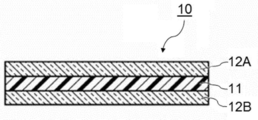
- the wavelength conversion member of the present disclosure is not limited to the configuration of FIG.
- covering material in FIG. 1 is notional, The relative relationship of a magnitude
- symbol is attached
- the wavelength conversion member 10 shown in FIG. 1 has a cured product layer 11 that is a cured resin product in film form, and film-shaped coating materials 12A and 12B provided on both surfaces of the cured product layer 11.
- the types and average thicknesses of the covering material 12A and the covering material 12B may be the same or different.
- 1 can be manufactured by, for example, the following known manufacturing method.
- a resin composition described later is applied to the surface of a film-like coating material (hereinafter also referred to as “first coating material”) that is continuously conveyed to form a coating film.
- first coating material a film-like coating material
- the application method of the resin composition is not particularly limited, and examples thereof include a die coating method, a curtain coating method, an extrusion coating method, a rod coating method, and a roll coating method.
- a continuously conveyed film-like coating material (hereinafter also referred to as “second coating material”) is bonded onto the coating film of the resin composition.
- the coating film is cured to form a cured product layer.
- the wavelength conversion member of the structure shown in FIG. 1 can be obtained by cutting out to a regular size.
- the wavelength and irradiation amount of the active energy ray can be appropriately set according to the composition of the resin composition.
- the ultraviolet light source include a low-pressure mercury lamp, a medium-pressure mercury lamp, a high-pressure mercury lamp, an ultrahigh-pressure mercury lamp, a carbon arc lamp, a metal halide lamp, a xenon lamp, a chemical lamp, a black light lamp, and a microwave-excited mercury lamp.
- the coating layer is irradiated with active energy rays before the second coating material is bonded to the cured product layer. May be formed.
- the backlight unit of the present disclosure includes the above-described wavelength conversion member of the present disclosure and a light source.
- the light source of the backlight unit for example, a light source that emits blue light having an emission center wavelength in a wavelength region of 430 nm to 480 nm can be used.
- the light source include an LED (Light Emitting Diode) and a laser.
- the wavelength conversion member preferably includes at least a quantum dot phosphor R that emits red light and a quantum dot phosphor G that emits green light. Thereby, white light can be obtained from the red light and green light emitted from the wavelength conversion member and the blue light transmitted through the wavelength conversion member.
- the light source of the backlight unit for example, a light source that emits ultraviolet light having an emission center wavelength in a wavelength region of 300 nm to 430 nm can be used.
- the light source include an LED and a laser.
- the wavelength conversion member preferably includes a quantum dot phosphor B that emits blue light when excited by excitation light, together with the quantum dot phosphor R and the quantum dot phosphor G. Thereby, white light can be obtained from the red light, the green light, and the blue light emitted from the wavelength conversion member.
- the backlight unit of the present disclosure may be an edge light type or a direct type.
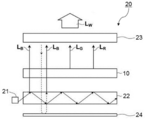
- FIG. 2 An example of a schematic configuration of an edge light type backlight unit is shown in FIG.
- the backlight unit of the present disclosure is not limited to the configuration of FIG.
- size of the member in FIG. 2 is notional, The relative relationship of the magnitude
- the backlight unit 20 shown in FIG. 2 includes a light source 21 for emitting the blue light L B, a light guide plate 22 to be emitted guiding the blue light L B emitted from the light source 21, the light guide plate 22 and disposed to face A wavelength conversion member 10, a retroreflective member 23 disposed opposite to the light guide plate 22 via the wavelength conversion member 10, and a reflection plate 24 disposed opposite to the wavelength conversion member 10 via the light guide plate 22.
- Wavelength conversion member 10 emits the red light L R and the green light L G part of the blue light L B as the excitation light, the red light L and R and the green light L G, the blue light was not the excitation light L B is emitted.
- the red light L R, the green light L G, and the blue light L B, the white light L W is emitted from the retroreflective member 23.
- An image display device includes the above-described backlight unit according to the present disclosure.
- the image display device is not particularly limited, and examples thereof include a liquid crystal display device.
- FIG. 3 An example of a schematic configuration of the liquid crystal display device is shown in FIG.
- the liquid crystal display device of the present disclosure is not limited to the configuration of FIG.
- size of the member in FIG. 3 is notional, The relative relationship of the magnitude
- the liquid crystal display device 30 shown in FIG. 3 includes a backlight unit 20 and a liquid crystal cell unit 31 disposed to face the backlight unit 20.
- the liquid crystal cell unit 31 is configured such that the liquid crystal cell 32 is disposed between the polarizing plate 33A and the polarizing plate 33B.
- the driving method of the liquid crystal cell 32 is not particularly limited, and is a TN (Twisted Nematic) method, a STN (Super Twisted Nematic) method, a VA (Vertical Alignment) method, an IPS (In-Plane-Switching) method, an OCB (Optically Certified). The method etc. are mentioned.
- Photopolymerization initiator 2,4,6-trimethylbenzoyl-diphenyl-phosphine oxide
- Light diffusing material first metal oxide layer containing silicon oxide, second metal oxide layer containing aluminum oxide, and organic material layer containing polyol compound
- the titanium oxide particles volume average particle diameter: 0.36 ⁇ m provided in the order of the first metal oxide layer, the second metal oxide layer, and the organic material layer
- Quantum dot phosphor G1 Quantum dot phosphor having a core made of CdSe that emits green light and a shell made of ZnS (peak wavelength: 524 nm, half width: 30 nm, dispersion medium: amino-modified silicone, quantum dot phosphor concentration) : 10% by mass)
- Quantum dot phosphor G2 Quantum dot phosphor having a core made of InP that emits green light and a shell made of ZnS (peak wavelength: 526 nm, half width: 38 nm, dispersion medium: isobornyl acrylate, quantum dot phosphor (Concentration: 10% by mass)
- Quantum dot phosphor G3 Quantum dot phosphor having a core made of CdSe emitting green light and a shell made of ZnS (peak wavelength: 526 nm, half-value width: 21 nm, dispersion medium: isobornyl acrylate, quantum dot phosphor (Concent
- Quantum dot phosphor R1 Quantum dot phosphor having a core made of CdSe that emits red light and a shell made of ZnS (peak wavelength: 625 nm, half width: 36 nm, dispersion medium: amino-modified silicone, quantum dot phosphor concentration) : 10% by mass)
- Quantum dot phosphor R2 Quantum dot phosphor having a core made of CdSe that emits red light and a shell made of ZnS (peak wavelength: 640 nm, half width: 37 nm, dispersion medium: amino-modified silicone, quantum dot phosphor concentration) : 10% by mass)
- Quantum dot phosphor R3 Quantum dot phosphor having a core made of InP emitting red light and a shell made of ZnS (peak wavelength: 625 nm, half width: 46 nm, dispersion medium: isobornyl acrylate, quantum dot phosphor (Concentration: 10% by mass)
- the resin composition obtained above was applied to one side of a 125 ⁇ m-thick barrier film (PET) as a coating material to form a coating film.
- PET 125 ⁇ m-thick barrier film
- the same barrier film as described above was disposed on this coating film.
- the wavelength conversion member was produced by irradiating an ultraviolet-ray using the ultraviolet irradiation device (eye graphics, Inc.) (irradiation amount: 1000 mJ / cm ⁇ 2 >), hardening the resin composition.
- Each wavelength conversion member obtained above was cut into a size of 100 mm in width and 100 mm in length to produce a measurement sample.
- the emission spectrum was measured using a luminance meter (PR-655, Photo Research).
- the luminance meter has a camera unit for recognizing optical characteristics at the top, and has a black mask, a BEF (brightness enhancement film) plate, a diffusion plate, and an LED light source at a location below the lens.
- a measurement sample was set between the BEF plate and the diffusion plate, and the emission peak wavelength, half width, luminance, and color gamut (Rec 2020 coverage according to CIE 1931 color coordinates) were calculated from the obtained emission spectrum. The results are shown in Table 1.
- the wavelength conversion materials of Examples 1 to 3 in which the value of FWHM-G / FWHM-R is 0.70 or less have high Rec2020 coverage and luminance evaluation, and FWHM-G / FWHM.
- the wavelength conversion materials of Comparative Examples 1 and 2 in which the value of -R exceeded 0.70 the color reproducibility and brightness were excellent.
- SYMBOLS 10 Wavelength conversion member, 11 ... Hardened material layer, 12A ... Coating
Landscapes
- Physics & Mathematics (AREA)
- Chemical & Material Sciences (AREA)
- General Physics & Mathematics (AREA)
- Optics & Photonics (AREA)
- Organic Chemistry (AREA)
- Engineering & Computer Science (AREA)
- Materials Engineering (AREA)
- Nonlinear Science (AREA)
- Inorganic Chemistry (AREA)
- Mathematical Physics (AREA)
- Crystallography & Structural Chemistry (AREA)
- Polymers & Plastics (AREA)
- Health & Medical Sciences (AREA)
- Chemical Kinetics & Catalysis (AREA)
- Medicinal Chemistry (AREA)
- Spectroscopy & Molecular Physics (AREA)
- Liquid Crystal (AREA)
- Optical Filters (AREA)
- Planar Illumination Modules (AREA)
- Led Device Packages (AREA)
Abstract
Description
<1>量子ドット蛍光体を含み、入射光を緑色光と赤色光とに変換することができ、前記緑色光の発光スペクトルの半値幅(FWHM-G)と前記赤色光の発光スペクトルの半値幅(FWHM-R)とが下記条件Aを満たす、波長変換部材。
条件A:(FWHM-G)/(FWHM-R)≦0.70
<2>前記緑色光の発光スペクトルの半値幅(FWHM-G)と前記赤色光の発光スペクトルの半値幅(FWHM-R)とが下記条件A’を満たす、<1>に記載の波長変換部材。
条件A’:0.40≦(FWHM-G)/(FWHM-R)≦0.70
<3>前記緑色光の発光スペクトルの半値幅(FWHM-G)が40nm以下である、<1>又は<2>に記載の波長変換部材。
<4>前記赤色光の発光スペクトルの半値幅(FWHM-R)が40nm以上である、<1>~<3>のいずれか1項に記載の波長変換部材。
<5>前記緑色光の発光スペクトルのピーク波長が530±20nmの範囲にあり、前記赤色光の発光スペクトルのピーク波長が630±20nmの範囲にある、<1>~<4>のいずれか1項に記載の波長変換部材。
<6>前記量子ドット蛍光体がCd及びInの少なくとも一方を含む化合物を含む、<1>~<5>のいずれか1項に記載の波長変換部材。
<7>前記量子ドット蛍光体が緑色光を発光する量子ドット蛍光体と赤色光を発光する量子ドット蛍光体とを含み、前記緑色光を発光する量子ドット蛍光体がCdを含む化合物を含み、前記赤色光を発光する量子ドット蛍光体がInを含む化合物を含む、<1>~<6>のいずれか1項に記載の波長変換部材。
<8>樹脂硬化物をさらに含む、<1>~<7>のいずれか1項に記載の波長変換部材。
波長変換部材。
<9>前記樹脂硬化物の少なくとも一部を被覆する被覆材をさらに含む、<8>に記載の波長変換部材。
<10>前記被覆材が酸素及び水の少なくとも一方に対するバリア性を有する、<9>に記載の波長変換部材。
<11><1>~<10>のいずれか1項に記載の波長変換部材と、光源とを備えるバックライトユニット。
<12><11>に記載のバックライトユニットを備える画像表示装置。
本開示において「工程」との語には、他の工程から独立した工程に加え、他の工程と明確に区別できない場合であってもその工程の目的が達成されれば、当該工程も含まれる。
本開示において「~」を用いて示された数値範囲には、「~」の前後に記載される数値がそれぞれ最小値及び最大値として含まれる。
本開示中に段階的に記載されている数値範囲において、一つの数値範囲で記載された上限値又は下限値は、他の段階的な記載の数値範囲の上限値又は下限値に置き換えてもよい。また、本開示中に記載されている数値範囲において、その数値範囲の上限値又は下限値は、実施例に示されている値に置き換えてもよい。
本開示において各成分は該当する物質を複数種含んでいてもよい。組成物中に各成分に該当する物質が複数種存在する場合、各成分の含有率は、特に断らない限り、組成物中に存在する当該複数種の物質の合計の含有率を意味する。
本開示において各成分に該当する粒子は複数種含んでいてもよい。組成物中に各成分に該当する粒子が複数種存在する場合、各成分の粒子径は、特に断らない限り、組成物中に存在する当該複数種の粒子の混合物についての値を意味する。
本開示において「層」又は「膜」との語には、当該層又は膜が存在する領域を観察したときに、当該領域の全体に形成されている場合に加え、当該領域の一部にのみ形成されている場合も含まれる。
本開示において「積層」との語は、層を積み重ねることを示し、二以上の層が結合されていてもよく、二以上の層が着脱可能であってもよい。
本開示において積層体又はこれを構成する層の平均厚みは、マイクロメータ等を用いて測定した任意の3箇所の厚みの算術平均値とする。
本開示において「(メタ)アクリロイル基」とは、アクリロイル基及びメタクリロイル基の少なくとも一方を意味し、「(メタ)アクリル」はアクリル及びメタクリルの少なくとも一方を意味し、「(メタ)アクリレート」はアクリレート及びメタクリレートの少なくとも一方を意味し、「(メタ)アリル」はアリル及びメタリルの少なくとも一方を意味する。
本開示において(メタ)アリル化合物は、分子中に(メタ)アリル基を有する化合物を意味し、(メタ)アクリル化合物は、分子中に(メタ)アクリロイル基を有する化合物を意味する。
本開示の波長変換部材は、量子ドット蛍光体を含み、入射光を緑色光と赤色光とに変換することができ、前記緑色光の発光スペクトルの半値幅(FWHM-G)と前記赤色光の発光スペクトルの半値幅(FWHM-R)とが下記条件Aを満たす。
条件A:(FWHM-G)/(FWHM-R)≦0.70
条件A’:0.40≦(FWHM-G)/(FWHM-R)≦0.70
発光スペクトルの半値幅を調べる方法は特に制限されず、公知の手法を採用できる。例えば、輝度計を用いて測定される発光スペクトルから算出することができる。
また赤色光は、半値幅による色再現性への影響が緑色光よりも少ない。このため、相対的に半値幅を広くしても、緑色光に比べると色再現性を大きく悪化させることなく、輝度の低下を抑えることが出来る。
本開示の波長変換部材はこの傾向に着目し、緑色光の発光波長ピークの幅を相対的に狭くすることで色再現性を高めつつ、赤色光の発光波長ピークの幅を相対的に広くして輝度の低下を抑えることで、全体として優れた色再現性と輝度のバランスを達成している。
本開示の波長変換部材により変換される緑色光の波長は特に制限されないが、530±20nmの範囲に発光スペクトルのピークを有することが好ましい。
本開示の波長変換部材により変換される赤色光の波長は特に制限されないが、630±20nmの範囲に発光スペクトルのピークを有することが好ましい。
分散媒体として使用可能な有機溶剤としては、量子ドット蛍光体の沈降及び凝集が確認されなければ特に限定されるものではなく、アセトニトリル、メタノール、エタノール、アセトン、1-プロパノール、酢酸エチル、酢酸ブチル、トルエン、ヘキサン等が挙げられる。
分散媒体として使用可能なシリコーン化合物としては、ジメチルシリコーンオイル、メチルフェニルシリコーンオイル、メチルハイドロジェンシリコーンオイル等のストレートシリコーンオイル;アミノ変性シリコーンオイル、エポキシ変性シリコーンオイル、カルボキシ変性シリコーンオイル、カルビノール変性シリコーンオイル、メルカプト変性シリコーンオイル、異種官能基変性シリコーンオイル、ポリエーテル変性シリコーンオイル、メチルスチリル変性シリコーンオイル、親水性特殊変性シリコーンオイル、高級アルコキシ変性シリコーンオイル、高級脂肪酸変性シリコーンオイル、フッ素変性シリコーンオイル等の変性シリコーンオイルなどが挙げられる。
分散媒体として使用可能な単官能(メタ)アクリレート化合物としては、室温(25℃)において液体であれば特に限定されるものではなく、脂環式構造を有する単官能(メタ)アクリレート化合物(好ましくはイソボルニル(メタ)アクリレート及びジシクロペンタニル(メタ)アクリレート、メトキシポリエチレングリコール(メタ)アクリレート、フェノキシポリエチレングリコール(メタ)アクリレート、エトキシ化o-フェニルフェノール(メタ)アクリレート等が挙げられる。
分散液は、必要に応じて分散剤を含んでもよい。分散剤としては、ポリエーテルアミン(JEFFAMINE M-1000、HUNTSMAN社)等が挙げられる。
波長変換部材は、樹脂硬化物をさらに含んでもよく、量子ドット蛍光体が樹脂硬化物に含まれた状態であってもよい。樹脂硬化物は、例えば、量子ドット蛍光体と、重合性化合物と、光重合開始剤とを含む組成物(樹脂組成物)を硬化して得られるものであってもよい。
チオール化合物は、1分子中に1個のチオール基を有する単官能チオール化合物であってもよく、1分子中に2個以上のチオール基を有する多官能チオール化合物であってもよい。樹脂組成物に含まれるチオール化合物は、1種のみでも2種以上であってもよい。
本開示において分子中にチオール基と、チオール基以外の重合性基を含む化合物は、「チオール化合物」に分類するものとする。
チオール化合物の含有率が5質量%以上であると、樹脂硬化物の被覆材との密着性がより向上する傾向にあり、チオール化合物の含有率が80質量%以下であると、樹脂硬化物の耐熱性及び耐湿熱性がより向上する傾向にある。
(メタ)アクリル化合物は、1分子中に1個の(メタ)アクリロイル基を有する単官能(メタ)アクリル化合物であってもよく、1分子中に2個以上の(メタ)アクリロイル基を有する多官能(メタ)アクリル化合物であってもよい。樹脂組成物に含まれる(メタ)アクリル化合物は、1種でも2種以上であってもよい。
(メタ)アクリル化合物が有するアルキレンオキシ基は、1種でも2種以上であってもよい。
アルキレンオキシ基含有化合物としては、中でも、エトキシ化ビスフェノールA型ジ(メタ)アクリレート、プロポキシ化ビスフェノールA型ジ(メタ)アクリレート及びプロポキシ化エトキシ化ビスフェノールA型ジ(メタ)アクリレートが好ましく、エトキシ化ビスフェノールA型ジ(メタ)アクリレートがより好ましい。
(メタ)アリル化合物は、1分子中に1個の(メタ)アリル基を有する単官能(メタ)アリル化合物であってもよく、1分子中に2個以上の(メタ)アリル基を有する多官能(メタ)アリル化合物であってもよい。樹脂組成物に含まれる(メタ)アリル化合物は、1種のみでも2種以上であってもよい。
本開示において分子中に(メタ)アリル基以外の重合性基を有する化合物(ただし、チオール化合物を除く)は、「(メタ)アリル化合物」に分類するものとする。
樹脂組成物に含まれる光重合開始剤は特に制限されず、紫外線等の活性エネルギー線の照射によりラジカルを発生する化合物が挙げられる。
樹脂組成物は、液状媒体(有機溶媒等)、重合禁止剤、シランカップリング剤、界面活性剤、密着付与剤、酸化防止剤などのその他の成分をさらに含有していてもよい。樹脂組成物は、その他の成分のそれぞれについて、1種類を単独で含有していてもよく、2種類以上を組み合わせて含有していてもよい。
光変換効率向上の観点から、波長変換部材は、光拡散材をさらに含有していてもよい。
光拡散材の具体例としては、酸化チタン、硫酸バリウム、酸化亜鉛、炭酸カルシウム等が挙げられる。これらの中でも、光散乱効率の観点から酸化チタンであることが好ましい。酸化チタンはルチル型酸化チタンであってもアナターゼ型酸化チタンであってもよいが、ルチル型酸化チタンであることが好ましい。
本開示において光拡散材の平均粒子径は、以下のようにして測定することができる。
光拡散材が樹脂組成物に含まれている場合、抽出した光拡散材を、界面活性剤を含んだ精製水に分散させ、分散液を得る。この分散液を用いてレーザー回折式粒度分布測定装置(例えば、株式会社島津製作所、SALD-3000J)で測定される体積基準の粒度分布において、小径側からの積算が50%となるときの値(メジアン径(D50))を光拡散材の平均粒子径とする。樹脂組成物から光拡散材を抽出する方法としては、例えば、樹脂組成物を液状媒体で希釈し、遠心分離処理等により光拡散材を沈澱させて分収することで得ることができる。
光拡散材を含む樹脂組成物を硬化して得られる樹脂硬化物中における光拡散材の平均粒子径は、走査型電子顕微鏡を用いた粒子の観察により、50個の粒子について円相当径(長径と短径の幾何平均)を算出し、その算術平均値として求めることができる。
有機物層に含まれる有機物は、ポリオール、有機シラン等を含むことが好ましく、ポリオール又は有機シランの少なくとも一方を含むことがより好ましい。
有機シランの具体例としては、オクチルトリエトキシシラン、ノニルトリエトキシシラン、デシルトリエトキシシラン、ドデシルトリエトキシシラン、トリデシルトリエトキシシラン、テトラデシルトリエトキシシラン、ペンタデシルトリエトキシシラン、ヘキサデシルトリエトキシシラン、ヘプタデシルトリエトキシシラン、オクタデシルトリエトキシシラン等が挙げられる。
オルガノシロキサンの具体例としては、トリメチルシリル基で終端されたポリジメチルシロキサン(PDMS)、ポリメチルヒドロシロキサン(PMHS)、PMHSのオレフィンによる官能化(ヒドロシリル化による)により誘導されるポリシロキサン等が挙げられる。
有機ホスホネートの具体例としては、例えば、n-オクチルホスホン酸及びそのエステル、n-デシルホスホン酸及びそのエステル、2-エチルヘキシルホスホン酸及びそのエステル並びにカンフィル(camphyl)ホスホン酸及びそのエステルが挙げられる。
有機リン酸化合物の具体例としては、有機酸性ホスフェート、有機ピロホスフェート、有機ポリホスフェート、有機メタホスフェート、これらの塩等が挙げられる。
有機ホスフィネートの具体例としては、例えば、n-ヘキシルホスフィン酸及びそのエステル、n-オクチルホスフィン酸及びそのエステル、ジ-n-ヘキシルホスフィン酸及びそのエステル並びにジ-n-オクチルホスフィン酸及びそのエステルが挙げられる。
有機スルホン酸化合物の具体例としては、ヘキシルスルホン酸、オクチルスルホン酸、2-エチルヘキシルスルホン酸等のアルキルスルホン酸、これらアルキルスルホン酸と、ナトリウム、カルシウム、マグネシウム、アルミニウム、チタン等の金属イオン、アンモニウムイオン、トリエタノールアミン等の有機アンモニウムイオンなどとの塩が挙げられる。
カルボン酸の具体例としては、マレイン酸、マロン酸、フマル酸、安息香酸、フタル酸、ステアリン酸、オレイン酸、リノール酸等が挙げられる。
カルボン酸エステルの具体例としては、上記カルボン酸と、エチレングリコール、プロピレングリコール、トリメチロールプロパン、ジエタノールアミン、トリエタノールアミン、グリセロール、ヘキサントリオール、エリトリトール、マンニトール、ソルビトール、ペンタエリトリトール、ビスフェノールA、ヒドロキノン、フロログルシノール等のヒドロキシ化合物との反応により生成するエステル及び部分エステルが挙げられる。
アミドの具体例としては、ステアリン酸アミド、オレイン酸アミド、エルカ酸アミド等が挙げられる。
ポリオレフィン及びそのコポリマーの具体例としては、ポリエチレン、ポリプロピレン、エチレンと、プロピレン、ブチレン、酢酸ビニル、アクリレート、アクリルアミド等から選択される1種又は2種以上の化合物との共重合体などが挙げられる。
ポリオールの具体例としては、グリセロール、トリメチロールエタン、トリメチロールプロパン等が挙げられる。
アルカノールアミンの具体例としては、ジエタノールアミン、トリエタノールアミン等が挙げられる。
有機分散剤の具体例としては、クエン酸、ポリアクリル酸、ポリメタクリル酸、陰イオン性、陽イオン性、双性、非イオン性等の官能基をもつ高分子有機分散剤などが挙げられる。
樹脂組成物中における光拡散材の凝集が抑制されると、樹脂硬化物中における光拡散材の分散性が向上する傾向にある。
光拡散材が金属酸化物層を有することで、樹脂硬化物中における光拡散材の分散性が向上する傾向にある。
光拡散材が有機物層と二層の金属酸化物層とを有するものである場合、光拡散材の表面に、二酸化ケイ素を含む第一金属酸化物層、酸化アルミニウムを含む第二金属酸化物層及び有機物層が、第一金属酸化物層、第二金属酸化物層及び有機物層の順に設けられる(有機物層が最外層となる)ことが好ましい。
フィルム状の波長変換部材の平均厚みは、例えば、マイクロメータを用いて測定した任意の3箇所の厚みの算術平均値として求められる。
本開示の波長変換部材は、量子ドット蛍光体を含む樹脂硬化物と、樹脂硬化物の少なくとも一部を被覆する被覆材とを有していてもよい。例えば、樹脂硬化物がフィルム状である場合、フィルム状の樹脂硬化物の片面又は両面がフィルム状の被覆材によって被覆されていてもよい。
被覆材の平均厚みは、例えば、150μm以下であることが好ましく、125μm以上であることがより好ましい。平均厚みが150μm150μm以下であると、光透過率の低下が抑えられる傾向にある。
被覆材の平均厚みは、例えば、マイクロメータを用いて測定した任意の3箇所の厚みの算術平均値として求められる。
本開示のバックライトユニットは、上述した本開示の波長変換部材と、光源とを備える。
本開示の画像表示装置は、上述した本開示のバックライトユニットを備える。画像表示装置としては特に制限されず、例えば、液晶表示装置が挙げられる。
下記成分を表1に示す配合量(単位:質量部)で混合し、樹脂組成物を調製した。表1中の「-」は未配合を意味する。
(メタ)アリル化合物…トリアリルイソシアヌレート
チオール化合物1…ペンタエリスリトールテトラキス(3-メルカプトプロピオネート)
チオール化合物2…ペンタエリスリトールテトラキス(3-メルカプトプロピオネート)48.69質量部と、トリス(2-ヒドロキシエチル)イソシアヌレートトリアクリレート7.27質量部とを混合し、ペンタエリスリトールテトラキス(3-メルカプトプロピオネート)のチオール基の一部をトリス(2-ヒドロキシエチル)イソシアヌレートトリアクリレートのエチレン性不飽和基と反応させたチオエーテルオリゴマー
光拡散材…酸化ケイ素を含む第一金属酸化物層、酸化アルミニウムを含む第二金属酸化物層及びポリオール化合物を含む有機物層が、第一金属酸化物層、第二金属酸化物層及び有機物層の順に設けられている酸化チタン粒子(体積平均粒子径:0.36μm)
量子ドット蛍光体G2…緑色光を発光するInPからなるコアとZnSからなるシェルとを有する量子ドット蛍光体(ピーク波長:526nm、半値幅:38nm、分散媒体:イソボルニルアクリレート、量子ドット蛍光体濃度:10質量%)
量子ドット蛍光体G3…緑色光を発光するCdSeからなるコアとZnSからなるシェルとを有する量子ドット蛍光体(ピーク波長:526nm、半値幅:21nm、分散媒体:イソボルニルアクリレート、量子ドット蛍光体濃度:10質量%)
量子ドット蛍光体G4…緑色光を発光するCdSeからなるコアとZnSからなるシェルとを有する量子ドット蛍光体(ピーク波長:526nm、半値幅:25nm、分散媒体:イソボルニルアクリレート、量子ドット蛍光体濃度:10質量%)
量子ドット蛍光体R2…赤色光を発光するCdSeからなるコアとZnSからなるシェルとを有する量子ドット蛍光体(ピーク波長:640nm、半値幅:37nm、分散媒体:アミノ変性シリコーン、量子ドット蛍光体濃度:10質量%)
量子ドット蛍光体R3…赤色光を発光するInPからなるコアとZnSからなるシェルとを有する量子ドット蛍光体(ピーク波長:625nm、半値幅:46nm、分散媒体:イソボルニルアクリレート、量子ドット蛍光体濃度:10質量%)
上記で得られた樹脂組成物を、被覆材として厚み125μmのバリアフィルム(PET)の片面に塗布して塗膜を形成した。この塗膜上に、上記と同じバリアフィルムを配置した。次いで、紫外線照射装置(アイグラフィックス株式会社)を用いて紫外線を照射し(照射量:1000mJ/cm2)、樹脂組成物を硬化させて波長変換部材を作製した。
上記で得られた各波長変換部材を、幅100mm、長さ100mmの寸法に裁断して測定サンプルを作製した。これに対し、輝度計(PR-655、フォトリサーチ社)を用いて発光スペクトルを測定した。輝度計は、上部に光学特性を認識するカメラユニットが設置され、レンズ下の箇所に、ブラックマスク、BEF(輝度上昇フィルム)板、拡散板、LED光源を有している。BEF板と拡散板との間に測定サンプルをセットして、得られた発光スペクトルから、発光ピーク波長、半値幅、輝度及び色域(CIE1931色座標に準拠するRec2020カバー率)を算出した。結果を表1に示す。
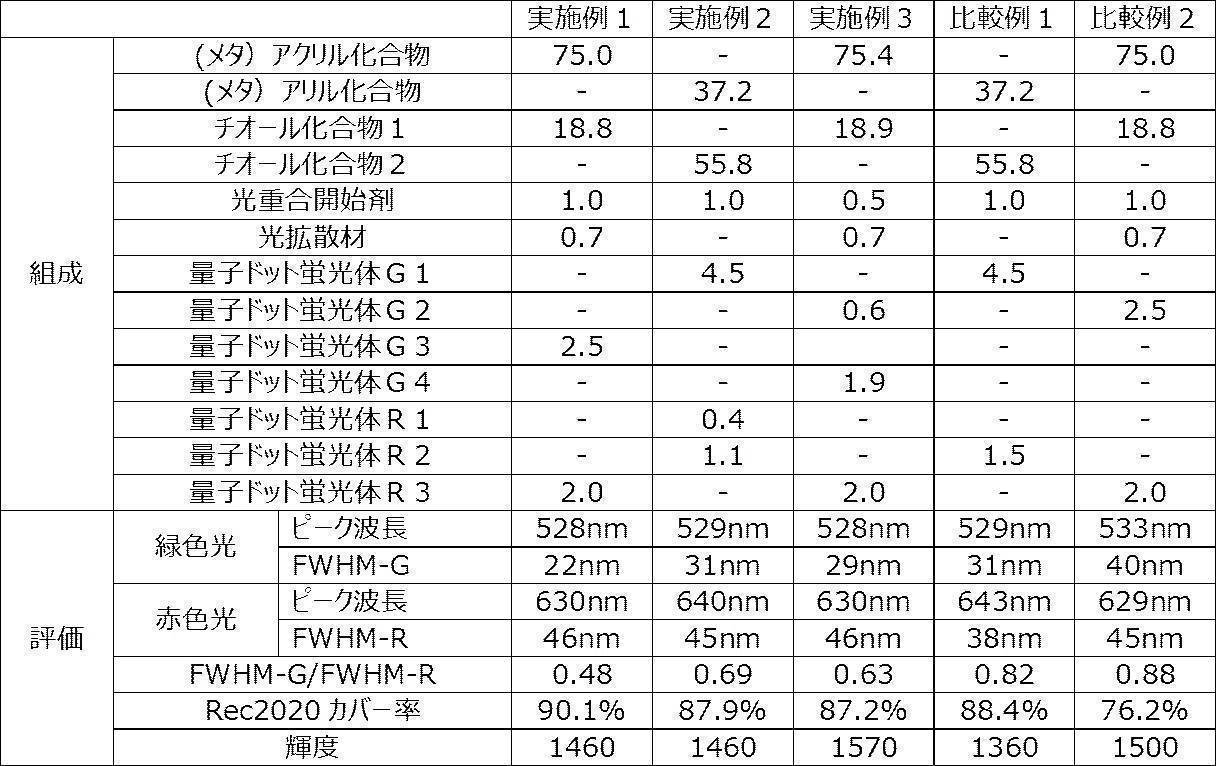
Claims (12)
- 量子ドット蛍光体を含み、入射光を緑色光と赤色光とに変換することができ、前記緑色光の発光スペクトルの半値幅(FWHM-G)と前記赤色光の発光スペクトルの半値幅(FWHM-R)とが下記条件Aを満たす、波長変換部材。
条件A:(FWHM-G)/(FWHM-R)≦0.70 - 前記緑色光の発光スペクトルの半値幅(FWHM-G)と前記赤色光の発光スペクトルの半値幅(FWHM-R)とが下記条件A’を満たす、請求項1に記載の波長変換部材。
条件A’:0.40≦(FWHM-G)/(FWHM-R)≦0.70 - 前記緑色光の発光スペクトルの半値幅(FWHM-G)が40nm以下である、請求項1又は請求項2に記載の波長変換部材。
- 前記赤色光の発光スペクトルの半値幅(FWHM-R)が40nm以上である、請求項1~請求項3のいずれか1項に記載の波長変換部材。
- 前記緑色光の発光スペクトルのピーク波長が530±20nmの範囲にあり、前記赤色光の発光スペクトルのピーク波長が630±20nmの範囲にある、請求項1~請求項4のいずれか1項に記載の波長変換部材。
- 前記量子ドット蛍光体がCd及びInの少なくとも一方を含む化合物を含む、請求項1~請求項5のいずれか1項に記載の波長変換部材。
- 前記量子ドット蛍光体が緑色光を発光する量子ドット蛍光体と赤色光を発光する量子ドット蛍光体とを含み、前記緑色光を発光する量子ドット蛍光体がCdを含む化合物を含み、前記赤色光を発光する量子ドット蛍光体がInを含む化合物を含む、請求項1~請求項6のいずれか1項に記載の波長変換部材。
- 樹脂硬化物をさらに含む、請求項1~請求項7のいずれか1項に記載の波長変換部材。
波長変換部材。 - 前記樹脂硬化物の少なくとも一部を被覆する被覆材をさらに含む、請求項8に記載の波長変換部材。
- 前記被覆材が酸素及び水の少なくとも一方に対するバリア性を有する、請求項9に記載の波長変換部材。
- 請求項1~請求項10のいずれか1項に記載の波長変換部材と、光源とを備えるバックライトユニット。
- 請求項11に記載のバックライトユニットを備える画像表示装置。
Priority Applications (5)
| Application Number | Priority Date | Filing Date | Title |
|---|---|---|---|
| US17/041,456 US20210040384A1 (en) | 2018-03-27 | 2019-03-26 | Wavelength conversion member, backlight unit and image display device |
| EP19775854.3A EP3761079A4 (en) | 2018-03-27 | 2019-03-26 | WAVELENGTH CONVERSION ELEMENT, BACKLIGHT UNIT AND IMAGE DISPLAY DEVICE |
| KR1020207028312A KR20200135974A (ko) | 2018-03-27 | 2019-03-26 | 파장 변환 부재, 백 라이트 유닛, 및 화상 표시 장치 |
| JP2020510969A JPWO2019189269A1 (ja) | 2018-03-27 | 2019-03-26 | 波長変換部材、バックライトユニット、及び画像表示装置 |
| CN201980022177.2A CN111919145A (zh) | 2018-03-27 | 2019-03-26 | 波长变换构件、背光单元以及图像显示装置 |
Applications Claiming Priority (2)
| Application Number | Priority Date | Filing Date | Title |
|---|---|---|---|
| PCT/JP2018/012581 WO2019186726A1 (ja) | 2018-03-27 | 2018-03-27 | 波長変換部材、バックライトユニット、及び画像表示装置 |
| JPPCT/JP2018/012581 | 2018-03-27 |
Publications (1)
| Publication Number | Publication Date |
|---|---|
| WO2019189269A1 true WO2019189269A1 (ja) | 2019-10-03 |
Family
ID=68059560
Family Applications (2)
| Application Number | Title | Priority Date | Filing Date |
|---|---|---|---|
| PCT/JP2018/012581 Ceased WO2019186726A1 (ja) | 2018-03-27 | 2018-03-27 | 波長変換部材、バックライトユニット、及び画像表示装置 |
| PCT/JP2019/013024 Ceased WO2019189269A1 (ja) | 2018-03-27 | 2019-03-26 | 波長変換部材、バックライトユニット、及び画像表示装置 |
Family Applications Before (1)
| Application Number | Title | Priority Date | Filing Date |
|---|---|---|---|
| PCT/JP2018/012581 Ceased WO2019186726A1 (ja) | 2018-03-27 | 2018-03-27 | 波長変換部材、バックライトユニット、及び画像表示装置 |
Country Status (7)
| Country | Link |
|---|---|
| US (1) | US20210040384A1 (ja) |
| EP (1) | EP3761079A4 (ja) |
| JP (1) | JPWO2019189269A1 (ja) |
| KR (1) | KR20200135974A (ja) |
| CN (1) | CN111919145A (ja) |
| TW (1) | TW201943101A (ja) |
| WO (2) | WO2019186726A1 (ja) |
Cited By (1)
| Publication number | Priority date | Publication date | Assignee | Title |
|---|---|---|---|---|
| JP2024149460A (ja) * | 2023-04-06 | 2024-10-18 | 三星電子株式会社 | 量子ドット組成物、その製造方法、その硬化物、及びそれを含む表示装置 |
Families Citing this family (2)
| Publication number | Priority date | Publication date | Assignee | Title |
|---|---|---|---|---|
| CN116323827A (zh) * | 2020-11-19 | 2023-06-23 | Dic株式会社 | 墨液组合物、光转换层及滤色器 |
| CN115141359B (zh) * | 2022-06-30 | 2023-06-16 | 江西师范大学 | 一种固体荧光材料及其合成方法与在led器件中的应用 |
Citations (8)
| Publication number | Priority date | Publication date | Assignee | Title |
|---|---|---|---|---|
| JP2010080935A (ja) * | 2008-08-28 | 2010-04-08 | Panasonic Corp | 半導体発光装置及びこれを用いたバックライト光源、バックライト光源システム、表示装置、電子機器 |
| JP2016507165A (ja) * | 2013-02-08 | 2016-03-07 | スリーエム イノベイティブ プロパティズ カンパニー | 高色域量子ドットディスプレイ |
| WO2016052625A1 (ja) | 2014-09-30 | 2016-04-07 | 富士フイルム株式会社 | バックライトユニット、液晶表示装置、波長変換部材、および光硬化性組成物 |
| JP2016167041A (ja) * | 2015-03-03 | 2016-09-15 | 大日本印刷株式会社 | 高演色液晶表示装置およびカラーフィルタ |
| JP2016181550A (ja) * | 2015-03-23 | 2016-10-13 | 三菱化学株式会社 | 発光装置、照明装置及び画像表示装置 |
| JP2017125898A (ja) * | 2016-01-12 | 2017-07-20 | 大日本印刷株式会社 | 高演色液晶表示装置およびカラーフィルタ |
| WO2017154747A1 (ja) * | 2016-03-10 | 2017-09-14 | シャープ株式会社 | 液晶表示装置及び配向膜 |
| WO2017159720A1 (ja) * | 2016-03-18 | 2017-09-21 | 日東電工株式会社 | 光学部材、ならびに、該光学部材を用いたバックライトユニットおよび液晶表示装置 |
Family Cites Families (11)
| Publication number | Priority date | Publication date | Assignee | Title |
|---|---|---|---|---|
| CN100504543C (zh) * | 2007-03-06 | 2009-06-24 | 孙润光 | 显示装置以及含有该显示装置的手机、计算机和电视机 |
| KR102496406B1 (ko) | 2010-11-10 | 2023-02-06 | 나노시스, 인크. | 양자 도트 필름들, 조명 디바이스들, 및 조명 방법들 |
| KR101822537B1 (ko) * | 2011-03-31 | 2018-01-29 | 삼성디스플레이 주식회사 | 발광 다이오드 패키지, 이의 제조 방법, 및 이를 갖는 표시 장치 |
| TWI442139B (zh) * | 2011-07-21 | 2014-06-21 | 友達光電股份有限公司 | 液晶顯示裝置 |
| US20130335677A1 (en) * | 2012-06-15 | 2013-12-19 | Apple Inc. | Quantum Dot-Enhanced Display Having Dichroic Filter |
| KR20150033198A (ko) * | 2013-09-23 | 2015-04-01 | 삼성디스플레이 주식회사 | 양자점 발광 소자 및 표시 장치 |
| KR101879016B1 (ko) * | 2014-11-21 | 2018-07-16 | 동우 화인켐 주식회사 | 자발광 감광성 수지 조성물, 이로부터 제조된 컬러필터 및 상기 컬러필터를 포함하는 화상표시장치 |
| KR101686713B1 (ko) * | 2014-12-08 | 2016-12-14 | 엘지전자 주식회사 | 양자점-고분자 복합체의 제조 방법, 양자점-고분자 복합체, 이를 포함하는 광 변환 필름, 백라이트 유닛 및 표시장치 |
| CN107430303B (zh) * | 2015-04-02 | 2021-03-09 | 凸版印刷株式会社 | 量子点保护膜以及使用其而得到的波长变换片及背光单元 |
| US20170125650A1 (en) * | 2015-11-02 | 2017-05-04 | Nanoco Technologies Ltd. | Display devices comprising green-emitting quantum dots and red KSF phosphor |
| CN105446003B (zh) * | 2015-12-01 | 2017-06-09 | 苏州星烁纳米科技有限公司 | 一种量子点分散体、背光模组和显示装置 |
-
2018
- 2018-03-27 WO PCT/JP2018/012581 patent/WO2019186726A1/ja not_active Ceased
-
2019
- 2019-03-26 WO PCT/JP2019/013024 patent/WO2019189269A1/ja not_active Ceased
- 2019-03-26 US US17/041,456 patent/US20210040384A1/en not_active Abandoned
- 2019-03-26 KR KR1020207028312A patent/KR20200135974A/ko not_active Withdrawn
- 2019-03-26 EP EP19775854.3A patent/EP3761079A4/en not_active Withdrawn
- 2019-03-26 CN CN201980022177.2A patent/CN111919145A/zh active Pending
- 2019-03-26 JP JP2020510969A patent/JPWO2019189269A1/ja not_active Withdrawn
- 2019-03-27 TW TW108110777A patent/TW201943101A/zh unknown
Patent Citations (8)
| Publication number | Priority date | Publication date | Assignee | Title |
|---|---|---|---|---|
| JP2010080935A (ja) * | 2008-08-28 | 2010-04-08 | Panasonic Corp | 半導体発光装置及びこれを用いたバックライト光源、バックライト光源システム、表示装置、電子機器 |
| JP2016507165A (ja) * | 2013-02-08 | 2016-03-07 | スリーエム イノベイティブ プロパティズ カンパニー | 高色域量子ドットディスプレイ |
| WO2016052625A1 (ja) | 2014-09-30 | 2016-04-07 | 富士フイルム株式会社 | バックライトユニット、液晶表示装置、波長変換部材、および光硬化性組成物 |
| JP2016167041A (ja) * | 2015-03-03 | 2016-09-15 | 大日本印刷株式会社 | 高演色液晶表示装置およびカラーフィルタ |
| JP2016181550A (ja) * | 2015-03-23 | 2016-10-13 | 三菱化学株式会社 | 発光装置、照明装置及び画像表示装置 |
| JP2017125898A (ja) * | 2016-01-12 | 2017-07-20 | 大日本印刷株式会社 | 高演色液晶表示装置およびカラーフィルタ |
| WO2017154747A1 (ja) * | 2016-03-10 | 2017-09-14 | シャープ株式会社 | 液晶表示装置及び配向膜 |
| WO2017159720A1 (ja) * | 2016-03-18 | 2017-09-21 | 日東電工株式会社 | 光学部材、ならびに、該光学部材を用いたバックライトユニットおよび液晶表示装置 |
Non-Patent Citations (1)
| Title |
|---|
| See also references of EP3761079A4 |
Cited By (1)
| Publication number | Priority date | Publication date | Assignee | Title |
|---|---|---|---|---|
| JP2024149460A (ja) * | 2023-04-06 | 2024-10-18 | 三星電子株式会社 | 量子ドット組成物、その製造方法、その硬化物、及びそれを含む表示装置 |
Also Published As
| Publication number | Publication date |
|---|---|
| CN111919145A (zh) | 2020-11-10 |
| JPWO2019189269A1 (ja) | 2021-05-13 |
| TW201943101A (zh) | 2019-11-01 |
| KR20200135974A (ko) | 2020-12-04 |
| EP3761079A4 (en) | 2021-04-28 |
| EP3761079A1 (en) | 2021-01-06 |
| WO2019186726A1 (ja) | 2019-10-03 |
| US20210040384A1 (en) | 2021-02-11 |
Similar Documents
| Publication | Publication Date | Title |
|---|---|---|
| WO2019189270A1 (ja) | 波長変換部材、バックライトユニット、及び画像表示装置 | |
| KR102225709B1 (ko) | 파장 변환 부재, 백라이트 유닛, 화상 표시 장치, 파장 변환용 수지 조성물 및 파장 변환용 수지 경화물 | |
| WO2019064589A1 (ja) | 波長変換部材、バックライトユニット、画像表示装置、波長変換用樹脂組成物及び波長変換用樹脂硬化物 | |
| CN111971591A (zh) | 波长变换构件、背光单元、图像显示装置及硬化性组合物 | |
| CN111919142A (zh) | 波长转换构件、背光单元、图像显示装置、固化性组合物和固化物 | |
| WO2019189269A1 (ja) | 波長変換部材、バックライトユニット、及び画像表示装置 | |
| WO2021029240A1 (ja) | 波長変換材、波長変換材の製造方法、積層体、バックライトユニット、及び画像表示装置 | |
| WO2019186728A1 (ja) | 波長変換部材、バックライトユニット、及び画像表示装置 | |
| JP6733833B2 (ja) | 積層体、波長変換部材、バックライトユニット、及び画像表示装置 | |
| WO2019189496A1 (ja) | 波長変換部材、バックライトユニット、画像表示装置及び硬化性組成物 | |
| CN111902744A (zh) | 波长转换构件、背光单元、图像显示装置和固化性组合物 | |
| WO2020208754A1 (ja) | 波長変換部材、バックライトユニット、及び画像表示装置 | |
| JP2023028515A (ja) | 波長変換部材及びその製造方法、バックライトユニット、画像表示装置、光散乱部材、並びに、光散乱層形成用組成物 | |
| JP2020196264A (ja) | 積層体、波長変換部材、バックライトユニット、及び画像表示装置 | |
| KR20210137043A (ko) | 파장 변환 부재, 백 라이트 유닛, 화상 표시 장치 및 파장 변환용 수지 조성물 | |
| WO2019189498A1 (ja) | 波長変換部材、バックライトユニット、画像表示装置及び硬化性組成物 | |
| JP2022174609A (ja) | 波長変換部材、バックライトユニット、及び画像表示装置 | |
| JP2021015284A (ja) | 波長変換部材、バックライトユニット、画像表示装置、波長変換用樹脂組成物及び波長変換用樹脂硬化物 |
Legal Events
| Date | Code | Title | Description |
|---|---|---|---|
| 121 | Ep: the epo has been informed by wipo that ep was designated in this application |
Ref document number: 19775854 Country of ref document: EP Kind code of ref document: A1 |
|
| ENP | Entry into the national phase |
Ref document number: 2020510969 Country of ref document: JP Kind code of ref document: A |
|
| ENP | Entry into the national phase |
Ref document number: 20207028312 Country of ref document: KR Kind code of ref document: A |
|
| NENP | Non-entry into the national phase |
Ref country code: DE |
|
| ENP | Entry into the national phase |
Ref document number: 2019775854 Country of ref document: EP Effective date: 20200930 |