WO2019189695A1 - ポリビニルアルコールフィルム、及び偏光フィルムの製造方法 - Google Patents
ポリビニルアルコールフィルム、及び偏光フィルムの製造方法 Download PDFInfo
- Publication number
- WO2019189695A1 WO2019189695A1 PCT/JP2019/013876 JP2019013876W WO2019189695A1 WO 2019189695 A1 WO2019189695 A1 WO 2019189695A1 JP 2019013876 W JP2019013876 W JP 2019013876W WO 2019189695 A1 WO2019189695 A1 WO 2019189695A1
- Authority
- WO
- WIPO (PCT)
- Prior art keywords
- film
- component
- pva
- polyvinyl alcohol
- mass
- Prior art date
- Legal status (The legal status is an assumption and is not a legal conclusion. Google has not performed a legal analysis and makes no representation as to the accuracy of the status listed.)
- Ceased
Links
Classifications
-
- G—PHYSICS
- G02—OPTICS
- G02B—OPTICAL ELEMENTS, SYSTEMS OR APPARATUS
- G02B5/00—Optical elements other than lenses
- G02B5/30—Polarising elements
- G02B5/3025—Polarisers, i.e. arrangements capable of producing a definite output polarisation state from an unpolarised input state
- G02B5/3033—Polarisers, i.e. arrangements capable of producing a definite output polarisation state from an unpolarised input state in the form of a thin sheet or foil, e.g. Polaroid
-
- B—PERFORMING OPERATIONS; TRANSPORTING
- B29—WORKING OF PLASTICS; WORKING OF SUBSTANCES IN A PLASTIC STATE IN GENERAL
- B29C—SHAPING OR JOINING OF PLASTICS; SHAPING OF MATERIAL IN A PLASTIC STATE, NOT OTHERWISE PROVIDED FOR; AFTER-TREATMENT OF THE SHAPED PRODUCTS, e.g. REPAIRING
- B29C55/00—Shaping by stretching, e.g. drawing through a die; Apparatus therefor
- B29C55/02—Shaping by stretching, e.g. drawing through a die; Apparatus therefor of plates or sheets
-
- C—CHEMISTRY; METALLURGY
- C08—ORGANIC MACROMOLECULAR COMPOUNDS; THEIR PREPARATION OR CHEMICAL WORKING-UP; COMPOSITIONS BASED THEREON
- C08F—MACROMOLECULAR COMPOUNDS OBTAINED BY REACTIONS ONLY INVOLVING CARBON-TO-CARBON UNSATURATED BONDS
- C08F116/00—Homopolymers of compounds having one or more unsaturated aliphatic radicals, each having only one carbon-to-carbon double bond, and at least one being terminated by an alcohol, ether, aldehydo, ketonic, acetal or ketal radical
- C08F116/02—Homopolymers of compounds having one or more unsaturated aliphatic radicals, each having only one carbon-to-carbon double bond, and at least one being terminated by an alcohol, ether, aldehydo, ketonic, acetal or ketal radical by an alcohol radical
- C08F116/04—Acyclic compounds
- C08F116/06—Polyvinyl alcohol ; Vinyl alcohol
-
- C—CHEMISTRY; METALLURGY
- C08—ORGANIC MACROMOLECULAR COMPOUNDS; THEIR PREPARATION OR CHEMICAL WORKING-UP; COMPOSITIONS BASED THEREON
- C08F—MACROMOLECULAR COMPOUNDS OBTAINED BY REACTIONS ONLY INVOLVING CARBON-TO-CARBON UNSATURATED BONDS
- C08F216/00—Copolymers of compounds having one or more unsaturated aliphatic radicals, each having only one carbon-to-carbon double bond, and at least one being terminated by an alcohol, ether, aldehydo, ketonic, acetal or ketal radical
- C08F216/02—Copolymers of compounds having one or more unsaturated aliphatic radicals, each having only one carbon-to-carbon double bond, and at least one being terminated by an alcohol, ether, aldehydo, ketonic, acetal or ketal radical by an alcohol radical
- C08F216/04—Acyclic compounds
- C08F216/06—Polyvinyl alcohol ; Vinyl alcohol
-
- C—CHEMISTRY; METALLURGY
- C08—ORGANIC MACROMOLECULAR COMPOUNDS; THEIR PREPARATION OR CHEMICAL WORKING-UP; COMPOSITIONS BASED THEREON
- C08F—MACROMOLECULAR COMPOUNDS OBTAINED BY REACTIONS ONLY INVOLVING CARBON-TO-CARBON UNSATURATED BONDS
- C08F8/00—Chemical modification by after-treatment
- C08F8/12—Hydrolysis
-
- C—CHEMISTRY; METALLURGY
- C08—ORGANIC MACROMOLECULAR COMPOUNDS; THEIR PREPARATION OR CHEMICAL WORKING-UP; COMPOSITIONS BASED THEREON
- C08J—WORKING-UP; GENERAL PROCESSES OF COMPOUNDING; AFTER-TREATMENT NOT COVERED BY SUBCLASSES C08B, C08C, C08F, C08G or C08H
- C08J5/00—Manufacture of articles or shaped materials containing macromolecular substances
- C08J5/18—Manufacture of films or sheets
-
- C—CHEMISTRY; METALLURGY
- C08—ORGANIC MACROMOLECULAR COMPOUNDS; THEIR PREPARATION OR CHEMICAL WORKING-UP; COMPOSITIONS BASED THEREON
- C08K—Use of inorganic or non-macromolecular organic substances as compounding ingredients
- C08K5/00—Use of organic ingredients
- C08K5/04—Oxygen-containing compounds
- C08K5/05—Alcohols; Metal alcoholates
- C08K5/053—Polyhydroxylic alcohols
-
- C—CHEMISTRY; METALLURGY
- C08—ORGANIC MACROMOLECULAR COMPOUNDS; THEIR PREPARATION OR CHEMICAL WORKING-UP; COMPOSITIONS BASED THEREON
- C08L—COMPOSITIONS OF MACROMOLECULAR COMPOUNDS
- C08L29/00—Compositions of homopolymers or copolymers of compounds having one or more unsaturated aliphatic radicals, each having only one carbon-to-carbon double bond, and at least one being terminated by an alcohol, ether, aldehydo, ketonic, acetal or ketal radical; Compositions of hydrolysed polymers of esters of unsaturated alcohols with saturated carboxylic acids; Compositions of derivatives of such polymers
- C08L29/02—Homopolymers or copolymers of unsaturated alcohols
- C08L29/04—Polyvinyl alcohol; Partially hydrolysed homopolymers or copolymers of esters of unsaturated alcohols with saturated carboxylic acids
-
- G—PHYSICS
- G02—OPTICS
- G02B—OPTICAL ELEMENTS, SYSTEMS OR APPARATUS
- G02B1/00—Optical elements characterised by the material of which they are made; Optical coatings for optical elements
- G02B1/04—Optical elements characterised by the material of which they are made; Optical coatings for optical elements made of organic materials, e.g. plastics
-
- C—CHEMISTRY; METALLURGY
- C08—ORGANIC MACROMOLECULAR COMPOUNDS; THEIR PREPARATION OR CHEMICAL WORKING-UP; COMPOSITIONS BASED THEREON
- C08J—WORKING-UP; GENERAL PROCESSES OF COMPOUNDING; AFTER-TREATMENT NOT COVERED BY SUBCLASSES C08B, C08C, C08F, C08G or C08H
- C08J2329/00—Characterised by the use of homopolymers or copolymers of compounds having one or more unsaturated aliphatic radicals, each having only one carbon-to-carbon double bond, and at least one being terminated by an alcohol, ether, aldehydo, ketonic, acetal, or ketal radical; Hydrolysed polymers of esters of unsaturated alcohols with saturated carboxylic acids; Derivatives of such polymer
- C08J2329/02—Homopolymers or copolymers of unsaturated alcohols
- C08J2329/04—Polyvinyl alcohol; Partially hydrolysed homopolymers or copolymers of esters of unsaturated alcohols with saturated carboxylic acids
-
- C—CHEMISTRY; METALLURGY
- C08—ORGANIC MACROMOLECULAR COMPOUNDS; THEIR PREPARATION OR CHEMICAL WORKING-UP; COMPOSITIONS BASED THEREON
- C08J—WORKING-UP; GENERAL PROCESSES OF COMPOUNDING; AFTER-TREATMENT NOT COVERED BY SUBCLASSES C08B, C08C, C08F, C08G or C08H
- C08J2471/00—Characterised by the use of polyethers obtained by reactions forming an ether link in the main chain; Derivatives of such polymers
- C08J2471/02—Polyalkylene oxides
Definitions
- the present invention relates to a polyvinyl alcohol film used for forming a polarizing film, for example, and a manufacturing method for forming a polarizing film from the polyvinyl alcohol film.
- a polarizing film formed of a polyvinyl alcohol (hereinafter sometimes referred to as “PVA”) film has been widely used.
- the polarizing film is generally obtained by stretching a PVA film by uniaxial stretching and dyeing and fixing the dyeing with a boron compound or the like.
- the film width is 2 m or more
- the retardation difference between two points 1 cm apart in the width direction is 5 nm or less
- the retardation difference between two points 1 m apart in the width direction is A PVA film for polarizing film that is 50 nm or less.
- the degree of saponification of PVA is preferably 95 mol% or more, and most preferably 99.5 mol% or more from the viewpoint of polarization performance and durability.
- the PVA film described in Patent Document 1 improves the polarizing performance of the polarizing film by increasing the degree of saponification.
- the PVA film has problems such as wrinkles and film adhesion in the process of producing a polarizing film, particularly in a stretching process in water (wet stretching process). Accordingly, the PVA film is required to be further improved.
- this invention makes it a subject to provide the manufacturing method of the PVA film which makes it difficult to produce a wrinkle and coalescence at the time of manufacture of a polarizing film, and the polarizing film using this PVA film, while making polarizing performance favorable.
- the present invention provides the following [1] to [8].
- [1] A polyvinyl alcohol film containing a vinyl alcohol polymer, Measured by Solid Echo method at 80 ° C. using pulsed NMR, and the free induction decay curve of spin-spin relaxation of 1H is derived from three components derived from the three components A component, B component, and C component in order of decreasing relaxation time.
- [5] The polyvinyl alcohol film according to any one of [1] to [4], which is for a polarizing film.
- [6] A method for producing a polarizing film, comprising producing a polarizing film using the polyvinyl alcohol film described in any one of [1] to [5] above.
- the polarizing film according to [6] comprising a step of dyeing the polyvinyl alcohol film, a step of stretching the polyvinyl alcohol film, and a step of fixing the dyed polyvinyl alcohol film.
- Manufacturing method [8] The method for producing a polarizing film according to [7], wherein the fixing treatment is performed after stretching the polyvinyl alcohol film.
- the PVA film of the present invention has a relaxation time of A component of 0.0083 milliseconds to 0.0093 milliseconds measured at 80 ° C. using pulse NMR at 80 ° C., and the component ratio of A component is 10 % To 35%.
- a PVA film has a free induction decay curve of 1H spin-spin relaxation as measured by pulse NMR.
- the obtained free induction decay curve can be waveform-separated into three curves derived from the three components of the A component, the B component, and the C component in order of decreasing relaxation time. That is, the actually measured free induction decay curve is obtained by superposing the free induction decay curves derived from the three components of the A component, the B component, and the C component.
- Such a technique of separating and analyzing into three components using pulsed NMR is known, and examples of the literature include JP-A-2018-2983.
- a component is a component having a short relaxation time in pulse NMR measurement, and means a hard component with low molecular mobility.
- the C component is a component having a long relaxation time in the pulse NMR measurement, and means a soft component having high molecular mobility.
- the B component has a relaxation time in the pulse NMR measurement between the A component and the C component, so that the molecular mobility is also between the A component and the C component.
- a component ratio is a ratio with respect to the total amount of A component, B component, and C component.
- the relaxation time and the component ratio of the component A are within the above-mentioned predetermined ranges, so that the polarizing performance of the polarizing film manufactured from the PVA film is improved, and the film is attached and attached to the film at the time of manufacturing the polarizing film. Can be prevented from occurring.
- the relaxation time is less than 0.0083 milliseconds and the component ratio of the A component exceeds 35%, the A component becomes too hard or the amount of the A component becomes too large to stretch the PVA film. hardly breaks.
- the relaxation time exceeds 0.0093 milliseconds and the component ratio of the A component is less than 10%, the A component becomes too soft or the A component amount becomes too small. In this case, at the time of manufacturing a polarizing film, wrinkles and coalescence are likely to occur in the film, and the polarizing performance is likely to be lowered.
- the relaxation time is preferably 0.0092 milliseconds or less, more preferably 0.0089 milliseconds or less, 0 More preferred is 0087 milliseconds or less.
- the relaxation time is preferably 0.0084 seconds or longer.
- the component ratio of the component A is preferably 32% or less, and more preferably 30% or less, from the viewpoint of making it difficult to break during stretching of the PVA film. Further, from the viewpoint of suppressing the occurrence of wrinkles and coalescence, the component ratio of the component A is preferably 15% or more, more preferably 18% or more, and further preferably 20% or more.
- the PVA film in the pulsed NMR measurement, was cured in a constant temperature room at 23 ° C. and 50% RH for 48 hours in order to suppress the deviation of the evaluation result due to the change in the moisture content, and then the pulsed NMR measurement. To do. Further, when the PVA film is cured alone, the end portion may be bent. When bending occurs, when the film sample is rolled and introduced into the NMR tube for measurement, the uniformity of the sample is greatly impaired, and an error occurs due to a decrease in apparent relaxation time due to magnetic field inhomogeneity and introduction of a measurement region. There is a problem that the amount decreases.
- the PVA film is cured after being fixed with a specific UV peeling tape (trade name “SELFA-SE” manufactured by Sekisui Chemical Co., Ltd.).
- SELFA-SE trade name “SELFA-SE” manufactured by Sekisui Chemical Co., Ltd.
- the PVA film and the UV release tape can be fixed using a laminator.
- the PVA film and the UV release tape are made of a hard substrate such as a SUS plate or cardboard having a thickness of 1 mm or less, and a base material.
- a PVA film and a release film that does not stick to the UV release tape are used.
- the UV peeling tape roll is bonded so that the width direction of the roll and the longitudinal direction of the PVA film are perpendicular to each other.
- wrinkles may approach. If wrinkles occur after curing, after peeling off the UV release tape through the irradiation process, stretch the wrinkles of the PVA film once with a laminator, and then bond and fix it again using a new SELFA-SE. This evaluation can be carried out by repeating this operation until there are no wrinkles. Details of the method for measuring the relaxation time and component ratio of the component A are as described in the examples.
- the PVA film of the present invention contains a vinyl alcohol polymer (also referred to as “PVA polymer”).
- the PVA polymer is obtained by polymerizing a vinyl ester and saponifying, ie, hydrolyzing, the obtained polymer.
- the saponification degree of the PVA polymer used in the present invention is preferably 99 mol% or more. When the degree of saponification is 99 mol% or more, the strength of the PVA film is increased, and the PVA film is not easily dissolved in a dyeing solution or a fixing treatment solution used in the process of producing the polarizing film, so that polarized light with high polarization performance is obtained. It becomes easy to obtain a film.
- the saponification degree is preferably 99.2 mol% or more, more preferably 99.4 mol% or more.
- the saponification degree may be 100 mol% or less, but is preferably 99.9 mol% or less, more preferably 99.7 mol% or less from the viewpoint of the handleability of the PVA film.
- the method for adjusting the degree of saponification is not particularly limited, but can be appropriately adjusted depending on saponification, that is, hydrolysis conditions.
- the saponification degree is a value obtained by measurement according to JIS K 6726.
- a PVA film can measure the saponification degree of a PVA-type polymer by wash
- Vinyl esters include vinyl acetate, vinyl formate, vinyl propionate, vinyl butyrate, vinyl isoenthalate, vinyl pivalate, vinyl versatate, vinyl caproate, vinyl caprylate, vinyl laurate, vinyl palmitate, stearic acid Vinyl, vinyl oleate, vinyl benzoate and the like can be used. Of these, vinyl acetate is preferred.
- the PVA polymer may be unmodified PVA or modified PVA, but unmodified PVA is preferred.
- a polymer obtained by polymerizing the above vinyl ester may be a copolymer of the vinyl ester and another monomer.
- Examples of other monomers used here, that is, comonomers to be copolymerized include, for example, olefins such as ethylene, propylene, 1-butene, and isobutene, (meth) acrylic acid and salts thereof, methyl (meth) acrylate, ( (Meth) acrylic acid esters such as ethyl (meth) acrylate, n-propyl (meth) acrylate, i-propyl (meth) acrylate, n-butyl (meth) acrylate, 2-ethylhexyl (meth) acrylate , Acrylamide, n-methylacrylamide, N-ethylacrylamide, N, N-dimethylacrylamide, (meth) acrylamide derivatives such as (meth) acrylamidepropanesulfonic acid and its salts, N-vinylamides such as N-vinylpyrrolidone, methyl Vinyl ether, ethyl vinyl ether
- These comonomers may be used individually by 1 type, and may use 2 or more types together.
- the amount of modification is preferably 15 mol% or less, more preferably 5 mol% or less.
- the degree of polymerization of the PVA polymer is preferably 2000 or more and 4000 or less.
- the degree of polymerization is within the above range, the relaxation time of the A component and the component ratio of the A component can be easily adjusted within the predetermined range described above.
- a PVA film becomes difficult to melt
- it becomes easy to obtain a polarizing film with high polarization performance Moreover, by setting it as an upper limit or less, the solubility with respect to the solvent of PVA becomes high and it becomes easy to form into a film.
- the degree of polymerization of the PVA polymer is more preferably 2300 or more, further preferably 2500 or more, more preferably 3500 or less, and still more preferably 3000 or less.
- the degree of polymerization of the PVA polymer can be measured according to JIS K 6726.
- the PVA film can measure the polymerization degree of a PVA-type polymer by wash
- the content of the PVA polymer in the PVA film is preferably 50% by mass or more, more preferably 60% by mass or more, and further preferably 75% by mass or more based on the total amount of the PVA film.
- the content of the PVA polymer may be 100% by mass or less, but preferably 97% by mass or less, more preferably 95% by mass or less in order to contain a certain amount or more of the plasticizer. It is.
- the PVA film may contain components other than the PVA polymer, and may contain additives such as a plasticizer, a surfactant, an antiseptic, an antifoaming agent, and preferably contains a plasticizer. .
- a plasticizer By containing a plasticizer, it becomes easy to make the component ratio of the said A component in a PVA film below the upper limit mentioned above.
- polyhydric alcohol is preferably used as the plasticizer.
- the polyhydric alcohol include ethylene glycol, glycerin, propylene glycol, diethylene glycol, diglycerin, triethylene glycol, tetraethylene glycol, dipropylene glycol, tripropylene glycol, trimethylolpropane, polyethylene glycol, and polypropylene glycol.
- polyethylene glycol and polypropylene glycol those having an average molecular weight of 200 to 600, preferably an average molecular weight of 250 to 500 can be used.
- polyhydric alcohol used as a plasticizer only 1 type may be added and 2 or more types may be added.
- glycerin, polyethylene glycol, polypropylene glycol, trimethylolpropane, diethylene glycol, diglycerin, triethylene glycol, and tetraethylene glycol are preferable, glycerin, polyethylene glycol, and trimethylolpropane are more preferable, and polyethylene glycol and trimethylolpropane are preferable. Is particularly preferred.
- the content of the plasticizer in the PVA film is preferably 1 part by mass or more and 25 parts by mass or less with respect to 100 parts by mass of the PVA polymer.
- the content of the plasticizer is within the above range, the component ratio of the component A can be easily adjusted within a predetermined range. Moreover, dyeability and stretchability become favorable by setting it as more than a lower limit. On the other hand, by setting it as the upper limit value or less, the PVA film is prevented from becoming too flexible, and for example, the handling property during dyeing or stretching is prevented from being lowered.
- the content of the plasticizer is more preferably 3 parts by mass or more, still more preferably 4 parts by mass or more, still more preferably 6 parts by mass or more, more preferably 100 parts by mass of the PVA polymer. It is 20 mass parts or less, More preferably, it is 16 mass parts or less.
- the content of the surfactant in the PVA film is, for example, from 0.1 parts by mass to 1 part by mass with respect to 100 parts by mass of the PVA polymer.
- preservatives include isothiazolone compounds, glutaraldehyde, and quaternary ammonium compounds.
- preservative in a PVA film is 0.1 mass part or more and 1 mass part or less with respect to 100 mass parts of PVA-type polymers, for example.
- the thickness of the PVA film is not particularly limited, but is, for example, 5 ⁇ m or more and 200 ⁇ m or less, and preferably 10 ⁇ m or more and 40 ⁇ m or less so as to have an appropriate thickness as a polarizing film after stretching.
- the thickness is not particularly limited, but can be measured by taking an average value in the measurement range with a micrometer “MDH-25M” manufactured by Mitutoyo Corporation.
- MDH-25M micrometer
- the PVA film of this invention can be used for various uses, it is preferable for polarizing films so that it may mention later.
- the PVA film of the present invention can be obtained by forming a film of the PVA polymer or a PVA composition obtained by adding an additive such as a plasticizer to the PVA polymer. More specifically, the PVA film can be obtained by applying a PVA solution obtained by diluting a PVA polymer or PVA composition with a solvent onto the support and drying it.
- the solvent used here is not particularly limited as long as the PVA polymer can be dissolved.
- the solvent include water, dimethyl sulfoxide, dimethylformamide, dimethylacetamide, N-methylpyrrolidone, ethylenediamine, diethylenetriamine and the like.
- the concentration of the PVA polymer in the PVA solution is not particularly limited, but is preferably 3% by mass or more and 40% by mass or less, and more preferably 7% by mass or more and 20% by mass or less.
- the amount of water used is preferably 1.1 times or more and 30 times or less, more preferably 4 times or more and 15 times or less, on a mass basis with respect to the PVA polymer.
- the PVA solution is prepared by blending a PVA polymer and an additive such as a plasticizer used as necessary in a solvent, heating the mixture, and maintaining the heated environment for a certain period of time.
- an additive such as a PVA polymer and an appropriately blended plasticizer is dissolved.
- the temperature of the heated solution should just be the temperature below the boiling point of a solvent, for example, 80 to 100 degreeC is preferable and 90 to 97 degreeC is preferable.
- the time for which the PVA solution is held at these temperatures is preferably 15 minutes or more, more preferably 30 minutes or more, and preferably 2 hours or less, more preferably 1 hour 30 minutes or less.
- the PVA solution is cooled after being held at a predetermined temperature for a certain time as described above.
- the cooling rate during cooling is preferably 0.2 ° C./min or more and 1.5 ° C./min or less, more preferably 0.3 ° C./min or more and 1.2 ° C./min or less, and more preferably 0.000 / min or less. It is 3 ° C./min or more and 0.8 ° C./min or less.
- the PVA solution is cooled to, for example, 20 ° C. to 60 ° C., preferably 20 ° C. to 50 ° C., more preferably 30 ° C. to 50 ° C., and further preferably 30 ° C. to 40 ° C.
- the PVA polymer, or the PVA polymer and the plasticizer are appropriately dissolved in the solvent by holding the PVA solution at a predetermined temperature for a certain time.
- the solution is cooled at the above temperature decrease rate, moderate crystallization of the PVA polymer is promoted, and it becomes easy to adjust the relaxation time of the A component and the component ratio of the A component within the above-described certain ranges.
- the PVA solution cooled to the above temperature is applied on the support.
- coating to the support body of PVA solution should just be performed with a well-known coating method, and may be performed by casting etc.
- the support is not particularly limited as long as the applied PVA solution is maintained on the surface and the PVA film obtained by film formation can be supported.
- Such a support may be, for example, a resin film such as polyethylene, polypropylene, polyethylene terephthalate, or an acrylic resin, or a support other than a resin film such as a glass plate or a metal plate.
- the PVA solution coated on the support is heated and dried to form a PVA film.
- the heat drying is performed, for example, at a temperature of 60 ° C. to 80 ° C. for 1 hour to 3 hours, preferably at a temperature of 65 ° C. to 75 ° C. for 1 hour 30 minutes to 2 hours 30 minutes.
- the PVA film formed on the support is preferably peeled off from the support as appropriate.
- the PVA film for example, by adjusting the raw material of the PVA film, specifically, the saponification degree of the PVA polymer, the polymerization degree, the presence or absence of the plasticizer, the amount of the plasticizer, the kind of the plasticizer, etc.
- the relaxation time of the A component and the component ratio of the A component can be adjusted.
- the production conditions are also adjusted, so that the relaxation time of the A component and the component ratio of the A component can be within the predetermined ranges described above. Specifically, after maintaining the PVA solution at a relatively high temperature for a certain period of time as described above, the PVA solution is cooled and applied at a relatively slow temperature-decreasing rate.
- the relaxation time of the A component and the component ratio of the A component can be set within the predetermined ranges described above.
- the method for producing the PVA film appropriately promotes the crystallization of the PVA polymer and appropriately adjusts the degree to which the crystallization is promoted, so that the relaxation time of the A component and the component ratio of the A component are as described above.
- it can be within the predetermined range, it is not limited to the above-described method.
- the relaxation time of the A component, and the A component The component ratio can be within the predetermined range described above.
- the manufacturing method of the polarizing film of this invention is a method of manufacturing a polarizing film using an above described PVA film.
- the method includes a dyeing process for dyeing the PVA film, a stretching process for stretching the PVA film, and a fixing process process for fixing the dyed PVA film.
- the stretching of the PVA film may be performed after dyeing the PVA film, may be performed while dyeing, or may be performed before dyeing, but is preferably performed while dyeing.
- the fixing process is a process performed after dyeing, but it may be performed simultaneously with stretching or may be performed after stretching, but is preferably performed after stretching.
- the PVA film may be dyed using a dye.
- a dye a mixture of iodine and potassium, direct black 17, 19, 154, direct brown 44, 106, 195, 210, 223, direct red 2, 23, 28, 31, 37, 39, 79, 81, 210 , 242,247, direct blue 1,15,22,78,90,08,151,158,202,236,249,270, direct violet 9,12,51,98, direct green 1,85, direct yellow 8 , 12, 44, 86, 87 and direct orange 26, 39, 106, 107, etc. can be used. Only 1 type may be used for the said dye and it may use 2 or more types of dye together.
- Dyeing may be performed by a method of immersing the PVA film in a dye solution containing the above dye, a method of applying the dye solution to the PVA film, or the like, but a method of immersing in the dye solution is preferable.
- the solvent for diluting the dye is only required to dissolve the dye, but is preferably water.
- concentration of the dye in a dye solution is 0.5 to 20 mass%, for example, Preferably it is 1 to 10 mass%.
- Dyeing is preferably performed after the PVA film formed on the support is peeled from the support in the method for producing PVA, but the PVA film formed on the support is not peeled off. You may go as it is.
- the PVA film is stretched by uniaxially stretching the PVA film.
- the uniaxial stretching method may be either a wet stretching method or a dry heat stretching method, but a wet stretching method is preferred.
- the wet stretching method is a method of stretching in warm water, and may be performed while dyeing in the dye solution described above, or may be performed while being fixed in a fixing processing solution described later, It is preferable to carry out with.
- the dry heat stretching method is a method of stretching in the air if it is heated by radiation heating, hot air heating, hot plate heating, roll heating or the like. Even when the wet stretching method is applied to the PVA film of the present invention, wrinkles and coalescence hardly occur, and productivity is improved.
- the stretching of the PVA film is preferably performed on the single PVA film by peeling the PVA film formed on the support in the method for producing PVA from the support.
- the stretching may be performed on the laminate of the support and PVA without peeling the PVA film from the support.
- the temperature (stretching temperature) of the PVA film at the time of stretching varies depending on the stretching method or the like, it may be performed at 20 ° C. or higher and 180 ° C. or lower, for example.
- unit it is preferable to carry out at the temperature of 20 to 80 degreeC, for example.
- the stretching ratio of the PVA film is preferably 4 times or more, and more preferably 5 times or more. By increasing the draw ratio, the polarizing performance of the polarizing film can be increased.
- the draw ratio of the PVA film is preferably 8 times or less, and more preferably 7 times or less. By setting it as these upper limit values or less, the PVA film can be stretched uniformly without breaking.
- the fixing process may be performed by a known method, for example, by immersing the PVA film in a fixing process liquid containing at least one of boric acid and a boron compound.
- the fixing treatment liquid include a solution in which at least one of boric acid and a boron compound is dissolved in water.
- the concentration of the total amount of boric acid and boron compound is, for example, 0.5% by mass or more and 20% by mass or less, and preferably 1% by mass or more and 10% by mass or less.
- the temperature of the fixing treatment liquid in the fixing treatment is not particularly limited, and is, for example, 20 to 90 ° C.
- the fixing treatment may be performed simultaneously with stretching after dyeing or may be performed after stretching, but is preferably performed after stretching.
- a polarizing film is obtained by performing the dyeing, stretching, and fixing processes as described above, but the PVA film may be dried after the dyeing, stretching, and fixing processes. Moreover, the PVA film may be washed with water as necessary before drying. Drying may be performed by natural drying, but may be heat-dried to increase the drying rate.
- the polarizing film of the present invention is used as a polarizing plate by, for example, laminating protective films on both sides or one side of the polarizing film.
- a cellulose triacetate (TEC) film, an acetic acid / cellulose butyrate (CEB) film, an acrylic film, a polyester film, or the like can be used.
- TEC cellulose triacetate
- CEB acetic acid / cellulose butyrate
- acrylic film a polyester film, or the like
- an adhesive for attaching the protective film to the polarizing film a PVA adhesive or a urethane adhesive can be used, and a PVA adhesive is preferable.
- a polarizing film can be used for various uses, for example, can be used for a liquid crystal display device use etc.
- the relaxation time of the A component and the component ratio of the A component are within a predetermined range, so that wrinkles and coalescence hardly occur in the manufacturing process of the polarizing film. Moreover, the polarizing performance of the polarizing film obtained becomes favorable because the relaxation time of A component and the component ratio of A component become in a predetermined range.
- the measurement method and evaluation method in this example are as follows.
- the film sample of the PVA film obtained in the examples and comparative examples uses a laminator (Laminator HOTDOG Leon 13DX manufactured by Lamy Corporation), a set temperature of 60 ° C, and a speed. It was set to 5 and bonded and fixed to a UV release tape (manufactured by Sekisui Chemical Co., Ltd., trade name “SELFA-SE”). Next, the fixed PVA film was cured for 48 hours in a thermostatic chamber at 23 ° C. and 50% RH.
- the PVA film and the UV release tape were fixed with a laminator by sandwiching them between a SUS plate having a thickness of 1 mm or less and a release-treated PET film having a thickness of 50 ⁇ m.
- a laminator when fixing, it bonded together so that the width direction of the roll of a UV peeling tape and the longitudinal direction of a PVA film might become perpendicular
- the longitudinal direction of the PVA film is the same direction as the cut direction (longitudinal direction of the tubular film) when the PVA film is rolled into a cylindrical shape when introduced into the NMR tube.
- the fixed film sample is wavelength 365 nm so that the energy on the irradiated surface becomes 1000 mJ / cm 2.
- the UV peeling tape was peeled from the film sample by irradiating the ultraviolet rays.
- wrinkles may approach. If wrinkles occur after curing, peel off the UV release tape once through the irradiation process, then stretch the wrinkles of the PVA film once with a laminator, and bond and fix again using new SELFA-SE. And repeat this operation until there are no more wrinkles.
- the film sample peeled from the UV release tape is rounded to about 700 mg into a cylindrical shape so that the glass sample tube with a diameter of 10 mm (BRUKER, product number 1824511, 10 mm diameter length 180 mm, flat bottom) is 15 mm high. Introduced. The sample was placed in a pulse NMR apparatus (“the minispec mq20” manufactured by BRUKER), 25 ° C. (40 minutes hold), 40 ° C. (40 minutes hold), 60 ° C. (40 minutes hold), 80 ° C. (10 minutes hold) The temperature was raised stepwise.
- the measurement was performed by Solid Echo method at 80 ° C., and the obtained free induction decay curve of 1H spin-spin relaxation was separated into three curves derived from the three components of the A component, the B component, and the C component. Waveform separation was performed by fitting using both a Gaussian type and an exponential type. From the curves derived from the three components obtained in each measurement, the ratio of each component was determined. In addition, the same kind of measurement was performed twice and the ratio of each component was calculated
- TD-NMRA Very 4.3 Rev 0.8
- fitting was performed with a Gaussian type for the A component and an exponential type for the B and C components according to the product manual. In the analysis, fitting was performed using points up to 0.6 msec of the relaxation curve.
- Y A1 * exp (-1 / w1 * (t / T2A) ⁇ w1) + B1 * exp (-1 / w2 * (t / T2B) ⁇ w2) + C1 * exp (-1 / w3 * (t / T2C) ⁇ w3)
- w1 to w3 are Weibull coefficients
- w1 takes a value of 2
- w2 and w3 take a value of 1.
- A1 is the component ratio of B component
- B1 is the component ratio of B component
- C1 is the component ratio of C component
- T2A is the A component
- T2B is the B component
- T2C is the relaxation time of the C component.
- t is time.
- the A component, the B component, and the C component are components defined in the order of short relaxation time in pulse NMR measurement, and the value of each relaxation time is not particularly limited.
- the range is less than 0.02 milliseconds
- the B component is 0.02 milliseconds to less than 0.1 milliseconds
- the C component is 0.1 milliseconds or more.
- Example 1 Manufacture of PVA film
- 1000 parts by mass of water was added at 25 ° C.
- the mixed solution was cooled to 35 ° C. at a temperature lowering rate of 0.5 ° C./min.
- the PVA solution cooled to 35 ° C. was applied onto a 7 mm thick glass plate, dried at 70 ° C.
- the obtained PVA film was stretched at a stretch ratio of 5 while being immersed in an aqueous solution in which iodine (I 2 ) and potassium iodide (KI) were dissolved at 25 ° C. for 60 seconds.
- iodine, potassium iodide and water were 0.4 parts by mass, 40 parts by mass and 1000 parts by mass, respectively.
- the PVA film is immersed in an aqueous boric acid solution having a concentration of 4.0% by mass at 25 ° C. for 5 minutes, pulled up from the aqueous solution, washed with water, and then dried in a drying oven set at 70 ° C. A film was obtained.
- Example 2 Manufacture of PVA film
- a reactor equipped with a thermometer, a stirrer, and a cooling tube 1000 parts by mass of water was added at 25 ° C., 100 parts by mass of PVA1 and 10 parts by mass of trimethylolpropane were added while stirring, and the mixture was heated to 95 ° C. And maintained at 95 ° C. for 60 minutes to dissolve PVA1 and trimethylolpropane in water. Thereafter, the mixed solution (PVA solution) was cooled to 35 ° C. at a temperature lowering rate of 0.5 ° C./min. The PVA solution cooled to 35 ° C. was applied onto a 7 mm thick glass plate, dried at 70 ° C.
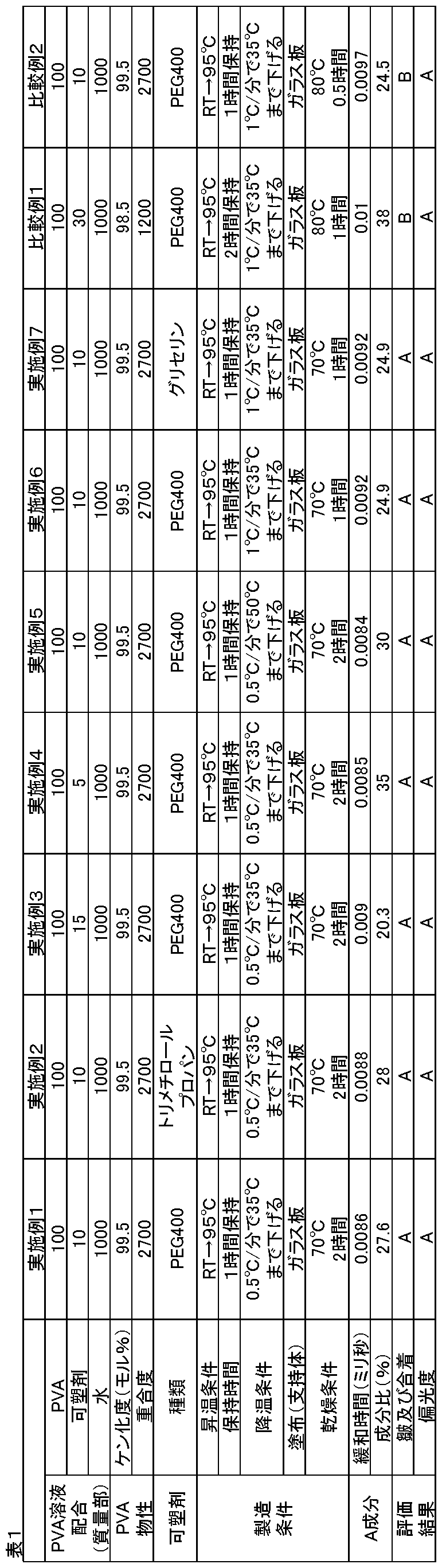
- Examples 3 and 4 The same operation as in Example 1 was carried out except that the amount of polyethylene glycol was changed as shown in Table 1.
- Example 5 The PVA solution was cooled to 50 ° C. at a temperature lowering rate of 0.5 ° C./min, and the same procedure as in Example 1 was performed except that the PVA solution cooled to 50 ° C. was coated on a 7 mm thick glass plate.
- Example 6 The PVA solution was cooled to 35 ° C. The cooling rate was changed to 1 ° C./min, and the PVA solution applied on the glass plate was dried at 70 ° C. for 1 hour, and was carried out in the same manner as in Example 1.
- Example 7 The same procedure as in Example 6 was performed except that 10 parts by mass of glycerin was charged into the reactor instead of 10 parts by mass of polyethylene glycol.
Landscapes
- Chemical & Material Sciences (AREA)
- Chemical Kinetics & Catalysis (AREA)
- Medicinal Chemistry (AREA)
- Polymers & Plastics (AREA)
- Organic Chemistry (AREA)
- Physics & Mathematics (AREA)
- Health & Medical Sciences (AREA)
- Engineering & Computer Science (AREA)
- Manufacturing & Machinery (AREA)
- Optics & Photonics (AREA)
- General Physics & Mathematics (AREA)
- Materials Engineering (AREA)
- Mechanical Engineering (AREA)
- General Chemical & Material Sciences (AREA)
- Polarising Elements (AREA)
- Manufacture Of Macromolecular Shaped Articles (AREA)
- Compositions Of Macromolecular Compounds (AREA)
- Addition Polymer Or Copolymer, Post-Treatments, Or Chemical Modifications (AREA)
- Shaping By String And By Release Of Stress In Plastics And The Like (AREA)
Abstract
Description
そこで、本発明は、偏光性能を良好にしつつ、偏光フィルムの製造時に皺及び合着が生じ難いPVAフィルム、及び該PVAフィルムを用いた偏光フィルムの製造方法を提供することを課題とする。
本発明は、次の[1]~[8]を提供するものである。
[1]ビニルアルコール系重合体を含むポリビニルアルコールフィルムであって、
パルスNMRを用いて80℃でSolid Echo法で測定し、1Hのスピン-スピン緩和の自由誘導減衰曲線を、緩和時間の短い順にA成分、B成分、及びC成分の3成分に由来する3つの曲線に波形分離して得た、A成分の緩和時間が0.0083ミリ秒以上0.0093ミリ秒以下であり、A成分の成分比が10%以上35%以下であるポリビニルアルコールフィルム。
[2]前記ビニルアルコール系重合体のけん化度が99モル%以上である上記[1]に記載のポリビニルアルコールフィルム。
[3]前記ビニルアルコール系重合体の重合度が2000以上4000以下である上記[1]又は[2]に記載のポリビニルアルコールフィルム。
[4]可塑剤を含有する上記[1]~[3]のいずれか1項に記載のポリビニルアルコールフィルム。
[5]偏光フィルム用である上記[1]~[4]のいずれか1項に記載のポリビニルアルコールフィルム。
[6]上記[1]~[5]のいずれか1項に記載のポリビニルアルコールフィルムを用いて偏光フィルムを製造する偏光フィルムの製造方法。
[7]前記ポリビニルアルコールフィルムを染色する工程と、前記ポリビニルアルコールフィルムを延伸する工程と、染色した前記ポリビニルアルコールフィルムに対して固定処理を行う工程とを備える、上記[6]に記載の偏光フィルムの製造方法。
[8]前記ポリビニルアルコールフィルムを延伸した後に、前記固定処理を行う、上記[7]に記載の偏光フィルムの製造方法。
[PVAフィルム]
本発明のPVAフィルムは、パルスNMRを用いて80℃でSolid Echo法で測定した、A成分の緩和時間が0.0083ミリ秒以上0.0093ミリ秒以下であり、A成分の成分比が10%以上35%以下となる。
一方、緩和時間が0.0083ミリ秒未満、また、A成分の成分比が35%を超えると、A成分が硬くなりすぎたり、A成分量が多くなりすぎて、PVAフィルムを延伸等する場合に破断しやすくなる。
また、緩和時間が0.0093ミリ秒を超え、また、A成分の成分比が10%未満になると、A成分が柔らかくなりすぎたり、A成分量が少なくなりすぎたりする。この場合は、偏光フィルム製造時に、フィルムに皺及び合着が発生しやすくなり、さらには偏光性能が低下しやすくなる。
A成分の成分比は、PVAフィルムの延伸時等において破断し難くする観点から、32%以下が好ましく、30%以下がより好ましい。また、皺及び合着の発生を抑制する観点から、A成分の成分比は、15%以上が好ましく、18%以上がより好ましく、20%以上がさらに好ましい。
また、PVAフィルムは、単体で養生すると端部の湾曲が発生することがある。湾曲が発生すると、フィルムサンプルを丸めて測定用のNMR管に導入する際、サンプルの均一性が大きく損なわれ、磁場の不均一性による見かけの緩和時間の減少による誤差の発生や測定領域の導入量が少なくなるという問題がある。その問題を回避するため、PVAフィルムは、特定のUV剥離テープ(積水化学工業株式会社製、商品名「SELFA-SE」)で固定したうえで養生する。特定のUV剥離テープに固定したうえで養生することで、高い固定性と低糊残り性及び易剥離性が得られ、評価結果のバラつきを抑えることができる。
PVAフィルムとUV剥離テープの固定は、ラミネーターを用いて行うことができる。この際、ラミネーターロールへのPVAフィルム及びUV剥離テープの貼り付きや巻き込みによる破損を防止するため、PVAフィルム及びUV剥離テープを厚み1ミリ以下のSUS板、ボール紙などの硬い基板と、基材に挟みこんでラミネートするとよい。基材としては、PVAフィルム及びUV剥離テープに貼りつかない剥離フィルムなどを用いる。また、固定の際、皺および湾曲を低減する目的のため、UV剥離テープのロールの幅方向とPVAフィルムの長手方向とが垂直になるように貼り合わせる。
なお、含水量の低いフィルムサンプルは、UV剥離テープで固定して養生すると、皺が寄ることがある。養生後に皺が発生した場合はUV剥離テープを照射工程を経てはがした後、一度ラミネーターでPVAフィルムの皺を伸ばし、再度新しいSELFA-SEを用いて貼りあわせて固定し、上記の養生工程を行い、皺がなくなるまでこの操作を繰り返すことで本評価を実施することができる。
A成分の緩和時間及び成分比の測定方法の詳細は、実施例で説明するとおりである。
本発明のPVAフィルムは、ビニルアルコール系重合体(「PVA系重合体」ともいう)を含む。PVA系重合体は、ビニルエステルを重合し、得られたポリマーをけん化、すなわち加水分解することにより得られる。本発明に用いるPVA系重合体のけん化度は、99モル%以上であることが好ましい。
けん化度を99モル%以上とすると、PVAフィルムの強度が高くなり、また、偏光フィルムを製造する工程において使用される染色溶液、固定処理液などにPVAフィルムが溶けにくくなり、偏光性能の高い偏光フィルムを得やすくなる。
これら観点からけん化度は、99.2モル%以上が好ましく、99.4モル%以上が好ましい。また、けん化度は、100モル%以下であればよいが、PVAフィルムの取り扱い性の観点から99.9モル%以下がより好ましく、99.7モル%以下がさらに好ましい。
けん化度の調整方法は特に限定されないが、けん化、すなわち加水分解条件により適宜調整することができる。なお、けん化度とは、JIS K 6726に準拠して測定することにより得られた値である。なお、PVAフィルムは、例えばメタノールでのソックスレー抽出を複数サイクル(例えば、100サイクル)行うことで、可塑剤等を洗浄することでPVA系重合体のけん化度を測定できる。
これらコモノマーを共重合し、変性PVAとする場合、変性量は15モル%以下であることが好ましく、より好ましくは5モル%以下である。
PVA系重合体の重合度は、上記した観点から、より好ましくは2300以上、さらに好ましくは2500以上であり、また、より好ましくは3500以下、さらに好ましくは3000以下である。なお、PVA系重合体の重合度は、JIS K 6726に準拠して測定できる。なお、PVAフィルムは、例えばメタノールでのソックスレー抽出を複数サイクル(例えば、100サイクル)行うことで、可塑剤等を洗浄することでPVA系重合体の重合度を測定できる。
また、PVAフィルムにおけるPVA系重合体の含有量は、100質量%以下であればよいが、一定量以上の可塑剤を含有させるために、好ましくは97質量%以下、より好ましくは95質量%以下である。
可塑剤としては、多価アルコールが好適に用いられる。多価アルコールとしては、エチレングリコール、グリセリン、プロピレングリコール、ジエチレングリコール、ジグリセリン、トリエチレングリコール、テトラエチレングリコール、ジプロピレングリコール、トリプロピレングリコール、トリメチロールプロパン、ポリエチレングリコール、ポリプロピレングリコールなどを挙げることができる。ここで、ポリエチレングリコール、ポリプロピレングリコールとしては、平均分子量200以上600以下、好ましくは平均分子量250以上500以下のものを使用できる。
可塑剤の含有量は、PVA系重合体100質量部に対して、より好ましくは3質量部以上、更に好ましくは4質量部以上であり、より更に好ましくは6質量部以上であり、より好ましくは20質量部以下、更に好ましくは16質量部以下である。
防腐剤としては、イソチアゾロン化合物、グルタルアルデヒド及び第四級アンモニウム化合物等が挙げられる。PVAフィルムにおける防腐剤の配合量は、PVA系重合体100質量部に対して、例えば0.1質量部以上1質量部以下である。
本発明のPVAフィルムは、様々な用途に使用可能であるが、後述するように、偏光フィルム用であることが好ましい。
本発明のPVAフィルムは、上記PVA系重合体を、又は上記PVA系重合体に可塑剤などの添加剤を加えたPVA組成物を、成膜することで得ることができる。PVAフィルムは、より具体的には、PVA系重合体又はPVA組成物を溶媒により希釈して得たPVA溶液を、支持体上に塗布などして、乾燥することで得ることができる。
ここで、加熱された溶液の温度は、溶媒の沸点未満の温度であればよく、例えば、80℃以上100℃未満が好ましく、90℃以上97℃以下が好ましい。また、これら温度にPVA溶液が保持される時間は、好ましくは15分以上、より好ましくは30分以上であり、また、好ましくは2時間以下、より好ましくは1時間30分以下である。
本発明においては、所定の温度でPVA溶液を一定時間保持することで、PVA系重合体、又はPVA系重合体及び可塑剤が溶媒中に適切に溶解される。そして、その溶液を上記の降温速度で冷却すると、PVA系重合体の適度な結晶化が促進され、A成分の緩和時間及びA成分の成分比を上記した一定の範囲内に調整しやすくなる。
PVAフィルムの製造方法は、PVA系重合体の結晶化を適度に促進させ、かつその結晶化が促進される程度などを適宜調整して、A成分の緩和時間、及びA成分の成分比を上記所定範囲内にできる限り、上記した方法に限定されない。例えば、製造方法の別の具体例として、押出機を用いた押出成形によりPVAフィルムを成膜する際には、押出機における製造条件を調整することで、A成分の緩和時間、及びA成分の成分比を上記した所定の範囲内にすることができる。
本発明の偏光フィルムの製造方法は、上記したPVAフィルムを用いて偏光フィルムを製造する方法である。具体的には、上記PVAフィルムを染色する染色工程と、PVAフィルムを延伸する延伸工程と、染色したPVAフィルムに対して固定処理を行う固定処理工程とを備える。
本製造方法では、PVAフィルムの延伸は、PVAフィルムを染色した後に行ってもよいし、染色しながら行ってもよいし、染色する前に行ってもよいが、染色しながら行うことが好ましい。また、固定処理は、染色後に行う処理であるが、延伸と同時に行ってもよいし、延伸した後に行ってもよいが、延伸した後に行うことが好ましい。
PVAフィルムの染色は、染料を用いて行うとよい。染料としては、ヨウ素とヨウカリウムの混合物、ダイレクトブラック17,19,154、ダイレクトブラウン44,106,195,210,223、ダイレクトレッド2,23,28,31,37,39,79,81,210,242,247、ダイレクトブルー1,15,22,78,90,08,151,158,202,236,249,270、ダイレクトバイオレット9,12,51,98、ダイレクトグリーン1,85、ダイレクトイエロー8,12,44,86,87、ダイレクトオレンジ26,39,106,107などの二色性染料を用いることができる。上記染料は1種のみを用いてもよく、2種以上の染料を併用してもよい。
染色は、上記PVAの製造方法において支持体上に形成されたPVAフィルムを、支持体から剥離してから行うことが好ましいが、支持体上に形成されたPVAフィルムに対して、剥離せずにそのまま行ってもよい。
PVAフィルムの延伸は、PVAフィルムを一軸延伸することにより行う。一軸延伸の方法は、湿式延伸法または乾熱延伸法のいずれあってもよいが、湿式延伸法が好ましい。
湿式延伸法は、温水中で延伸を行う方法であり、上記した染料溶液中で染色しながら行ってもよいし、後述する固定処理液中で固定処理しながら行ってもよいが、染色溶液中で行うことが好ましい。乾熱延伸法は、空気中で輻射加熱、熱風加熱、熱板加熱、ロール加熱などにより加熱しなら延伸する方法である。
本発明のPVAフィルムは、湿式延伸法を適用しても、皺及び合着が生じ難く、生産性が良好となる。
延伸するときのPVAフィルムの温度(延伸温度)は、延伸方式などにより異なるが、例えば20℃以上180℃以下で行うとよい。
中でも、PVAフィルム単体を、湿式延伸する場合には、例えば20℃以上80℃以下の温度で行うことが好ましい。また、PVAフィルム単体を乾熱延伸する場合は、例えば50℃以上180℃以下の範囲の温度で行うとよい。一方で、樹脂フィルムからなる支持体に支持された状態で(すなわち、支持体とPVAフィルムの積層体を)延伸する場合、樹脂フィルムが延伸される温度以上であり、かつ、支持体の劣化や分解が起こらない温度以下で行うとよい。
PVAフィルムの延伸倍率は、8倍以下が好ましく、7倍以下がより好ましい。これら上限値以下とすることで、PVAフィルムを破断することなく、均一に延伸することができる。
偏光フィルムの製造においては、PVAフィルムを染色した後に、染料をPVAフィルムに確実に固定化するための固定処理を行う。固定処理は、公知の方法で行うとよく、例えば、ホウ酸及びホウ素化合物の少なくとも1種を含有する固定処理液中にPVAフィルムを浸漬することにより行うとよい。固定処理液は、ホウ酸及びホウ素化合物の少なくとも1種を水に溶解した溶液などが挙げられる。固定処理液において、ホウ酸及びホウ素化合物の合計量の濃度は、例えば、0.5質量%以上20質量%以下、好ましくは1質量%以上10質量%以下である。
固定処理における固定処理液の温度は、特に限定されず、例えば、20~90℃である。固定処理は、染色後に延伸と同時に行ってもよいし、延伸後に行ってもよいが、延伸後に行うことが好ましい。
(1)A成分の緩和時間及び成分比の測定
実施例、比較例で得られたPVAフィルムのフィルムサンプルは、ラミネーター(ラミーコーポレーション製のラミネーターHOTDOG Leon13DX)を用いて、設定温度を60℃、速度5に設定して、UV剥離テープ(積水化学工業株式会社製、商品名「SELFA-SE」)に貼りあわせて固定した。次いで、該固定したPVAフィルムを23℃、50%RHの恒温室で48時間養生した。ラミネーターによるPVAフィルムとUV剥離テープとの固定は、両者を厚み1ミリ以下のSUS板と厚み50μmの離形処理PETフィルムで挟んで実施した。
なお、固定の際、UV剥離テープのロールの幅方向とPVAフィルムの長手方向とが垂直になるように貼り合わせた。なお、PVAフィルムの長手方向は、PVAフィルムをNMR管へ導入する際に筒状に丸めるときのカット方向(筒状のフィルムの長手方向)と同じ方向である。
固定したフィルムサンプルをUV照射装置「株式会社オーク製作所製、装置型式:JL-4300-3、ランプ型式:IML-4000」を用いて照射面でのエネルギーが1000mJ/cm2になるように波長365nmの紫外線を照射することで、UV剥離テープをフィルムサンプルから剥離させた。
なお、含水量の低いフィルムサンプルは、UV剥離テープで固定して養生すると、皺が寄ることがある。養生後に皺が発生した場合は一度UV剥離テープを照射工程を経てはがした後、一度ラミネーターでPVAフィルムの皺を伸ばし、再度新しいSELFA-SEを用いて貼りあわせて固定し、上記の養生工程を行い、皺がなくなるまでこの操作を繰り返せばよい。
なお、BRUKER社製の解析ソフトウェア「TD-NMRA(Version 4.3 Rev 0.8)」を用い製品マニュアルに従って、A成分はガウシアン型、B成分およびC成分はエクスポーネンシャル型でフィッティングを行った。また、解析には緩和曲線の0.6msecまでのポイントを用いてフィッティングを行った。
Y=A1*exp(-1/w1*(t/T2A)^w1)+B1*exp(-1/w2*(t/T2B)^w2)+C1*exp(-1/w3*(t/T2C)^w3)
ここで、w1~w3はワイブル係数であり、w1は2、w2およびw3は1の値を取る。A1はA成分の、B1はB成分の、C1はC成分のそれぞれ成分比であり、T2AはA成分の、T2BはB成分の、T2CはC成分のそれぞれ緩和時間を示す。tは時間である。
A成分、B成分、C成分は、パルスNMR測定における緩和時間の短い順に定義された成分であり、個々の緩和時間の値は特に限定されるものではないが、通常の緩和時間はA成分が0.02ミリ秒未満、B成分が0.02ミリ秒以上~0.1ミリ秒未満、C成分が0.1ミリ秒以上の範囲となる。
<Solid Echo法>
Scans:128times
Recycle Deray:1sec
Acquisition scale:1ms
各実施例、比較例で得られたPVAフィルムを30℃の水中に1分間浸漬し取り出した際のPVAフィルムの皺及び合着の有無を評価した。
[皺及び合着の判定基準]
A:皺及び合着がない
B:皺はあるが、合着はない
C:皺及び合着がある
各実施例、比較例で得られた偏光フィルムの偏光度Pを、株式会社島津製作所製の分光光度計「UV-3101PC」を用いて下記式にて評価した。YP(パラレル透過率)及びYC(クロス透過率)は、フィルムの伸長方向に平行及び垂直に互いに重ね合わせたフィルムの透過率である。
偏光度P(%)={(YP-YC)/(YP+YC)}1/2×100
[偏光度の判定基準]
A:偏光度が99以上
B:偏光度が90以上、99未満
C:偏光度が90未満
[PVA1(けん化度99.5モル%、重合度2700)]
温度計、攪拌機及び冷却管を備えた反応器内に、酢酸ビニルモノマー2000質量部及びメタノール200質量部を加え、窒素ガスを30分間吹き込んで窒素置換した後、反応器を60℃にて30分間加熱した。次いで、重合開始剤である2,2’-アゾビスイソブチロニトリル0.4質量部を添加した後、60℃にて4時間反応させた。反応時間終了後、反応液を冷却した。冷却後に重合率を測定したところ、重合率は29%であった。次いで、減圧下で、残留する酢酸ビニルモノマーをメタノールとともに除去する操作を、メタノールを追加しながら行い、ポリ酢酸ビニル50質量%を含むメタノール溶液を得た。このメタノール溶液に、酢酸ビニルに対して0.08mol%の水酸化ナトリウム量となるように水酸化ナトリウムのメタノール溶液を加え、40℃でけん化を行った。得られた固形分を粉砕し、メタノールによる洗浄を行った後、乾燥することによりPVA1を得た。得られたPVA1をJIS K6726に準拠してけん化度及び重合度を測定したところ、99.5モル%および2700であった。
[PVA2(けん化度98.5モル%、重合度1200)]
温度計、攪拌機及び冷却管を備えた反応器内に、酢酸ビニルモノマー2000質量部及びメタノール200質量部を加え、窒素ガスを30分間吹き込んで窒素置換した後、反応器を60℃にて30分間加熱した。次いで、重合開始剤である2,2’-アゾビスイソブチロニトリル0.65質量部を添加した後、60℃にて4時間反応させた。反応時間終了後、反応液を冷却した。冷却後に重合率を測定したところ、重合率は35%であった。次いで、減圧下で、残留する酢酸ビニルモノマーをメタノールとともに除去する操作を、メタノールを追加しながら行い、ポリ酢酸ビニル50質量%を含むメタノール溶液を得た。このメタノール溶液に、酢酸ビニルに対して0.07mol%の水酸化ナトリウム量となるように水酸化ナトリウムのメタノール溶液を加え、40℃でけん化を行った。得られた固形分を粉砕し、メタノールによる洗浄を行った後、乾燥することによりPVA2を得た。得られたPVA2をJIS K6726に準拠してけん化度及び重合度を測定したところ、98.5モル%および1200であった。
(PVAフィルムの製造)
温度計、攪拌機及び冷却管を備えた反応器内に25℃で水1000質量部投入し攪拌しながらPVA1を100質量部、平均分子量400のポリエチレングリコール10質量部を投入し、混合液を95℃まで昇温し、95℃で60分間維持して、PVA1とポリエチレングリコールを水に溶解させた。その後、0.5℃/分の降温速度で混合液(PVA溶液)を、35℃まで冷却した。35℃に冷却したPVA溶液を厚み7mmのガラス板上に塗布し、70℃で2時間乾燥させた後、ガラス板から剥離し厚さが15μmのPVAフィルムを得た。得られたフィルムを10g切り出し、メタノールでのソックスレー抽出を100サイクル行った後、得られた樹脂をJIS K6726に準拠してけん化度及び重合度を測定したところ、99.5モル%および2700であった。
次に、得られたPVAフィルムを、25℃にて60秒間、ヨウ素(I2)及びヨウ化カリウム(KI)を溶解した水溶液中に浸漬しつつ延伸倍率5倍で延伸した。水溶液においてヨウ素、ヨウ化カリウム及び水はそれぞれ、0.4質量部、40質量部及び1000質量部であった。その後、PVAフィルムを、25℃で5分間、濃度4.0質量%のホウ酸水溶液に浸漬し、水溶液から引き上げた後、水洗をし、次いで、70℃設定の乾燥オーブンで乾燥を行い、偏光フィルムを得た。
(PVAフィルムの製造)
温度計、攪拌機及び冷却管を備えた反応器内に25℃で水1000質量部投入し攪拌しながらPVA1を100質量部、トリメチロールプロパン10質量部を投入し、混合液を95℃まで昇温し、95℃で60分間維持して、PVA1とトリメチロールプロパンを水に溶解させた。その後、0.5℃/分の降温速度で混合液(PVA溶液)を35℃まで冷却した。35℃に冷却したPVA溶液を厚み7mmのガラス板上に塗布し、70℃で2時間乾燥させた後、ガラス板から剥離し厚さが15μmのPVAフィルムを得た。得られたフィルムを10g切り出し、メタノールでのソックスレー抽出を100サイクル行った後、得られた樹脂をJIS K6726に準拠してけん化度及び重合度を測定したところ、99.5モル%および2700であった。
(偏光フィルムの製造)
次に、得られたフィルムを用いて実施例1と同様に偏光フィルムを製造した。
ポリエチレングリコールの投入量を表1に記載の通りに変更した以外は、実施例1と同様に実施した。
PVA溶液を0.5℃/分の降温速度で50℃まで冷却し、50℃に冷却したPVA溶液を厚み7mmのガラス板上に塗布した以外は実施例1と同様に実施した。
PVA溶液の35℃まで冷却する降温速度を1℃/分に変更し、かつガラス板上に塗布したPVA溶液の乾燥を、70℃で1時間行った以外は実施例1と同様に実施した。
ポリエチレングリコール10質量部の代わりにグリセリン10質量部を反応器内に投入した以外は実施例6と同様に実施した。
(PVAフィルムの製造)
温度計、攪拌機及び冷却管を備えた反応器内に25℃で水1000質量部投入し攪拌しながらPVA2を100質量部、平均分子量400のポリエチレングリコール30質量部を投入し、混合液を95℃まで昇温し、95℃で120分間維持して、PVA2とポリエチレングリコールを水に溶解させた。その後、1℃/分の降温速度で混合液(PVA溶液)を、35℃まで冷却した。35℃に冷却したPVA溶液を厚み7mmのガラス板上に塗布し、80℃で1時間乾燥させた後、ガラス板から剥離し厚さが15μmのPVAフィルムを得た。得られたフィルムを10g切り出し、メタノールでのソックスレー抽出を100サイクル行った後、得られた樹脂をJIS K6726に準拠してけん化度及び重合度を測定したところ、98.5モル%および1200であった。
(偏光フィルムの製造)
次に、得られたフィルムを用いて実施例1と同様に偏光フィルムを製造した。
PVA溶液の35℃まで冷却する降温速度を1℃/分に変更し、かつガラス板上に塗布したPVA溶液の乾燥を80℃で30分間行った以外は実施例1と同様に実施した。
Claims (8)
- ビニルアルコール系重合体を含むポリビニルアルコールフィルムであって、
パルスNMRを用いて80℃でSolid Echo法で測定し、1Hのスピン-スピン緩和の自由誘導減衰曲線を、緩和時間の短い順にA成分、B成分、及びC成分の3成分に由来する3つの曲線に波形分離して得た、A成分の緩和時間が0.0083ミリ秒以上0.0093ミリ秒以下であり、A成分の成分比が10%以上35%以下であるポリビニルアルコールフィルム。 - 前記ビニルアルコール系重合体のけん化度が99モル%以上である請求項1に記載のポリビニルアルコールフィルム。
- 前記ビニルアルコール系重合体の重合度が2000以上4000以下である請求項1又は2に記載のポリビニルアルコールフィルム。
- 可塑剤を含有する請求項1~3のいずれか1項に記載のポリビニルアルコールフィルム。
- 偏光フィルム用である請求項1~4のいずれか1項に記載のポリビニルアルコールフィルム。
- 請求項1~5のいずれか1項に記載のポリビニルアルコールフィルムを用いて偏光フィルムを製造する偏光フィルムの製造方法。
- 前記ポリビニルアルコールフィルムを染色する工程と、前記ポリビニルアルコールフィルムを延伸する工程と、染色した前記ポリビニルアルコールフィルムに対して固定処理を行う工程とを備える、請求項6に記載の偏光フィルムの製造方法。
- 前記ポリビニルアルコールフィルムを延伸した後に、前記固定処理を行う、請求項7に記載の偏光フィルムの製造方法。
Priority Applications (5)
| Application Number | Priority Date | Filing Date | Title |
|---|---|---|---|
| US17/041,585 US12084552B2 (en) | 2018-03-30 | 2019-03-28 | Poly(vinyl alcohol) film and production method for polarizing film |
| JP2019523132A JP6918934B2 (ja) | 2018-03-30 | 2019-03-28 | ポリビニルアルコールフィルム、及び偏光フィルムの製造方法 |
| KR1020207027699A KR102735583B1 (ko) | 2018-03-30 | 2019-03-28 | 폴리비닐알코올 필름, 및 편광 필름의 제조 방법 |
| CN201980022204.6A CN111936899B (zh) | 2018-03-30 | 2019-03-28 | 聚乙烯醇膜及偏光膜的制造方法 |
| EP19775346.0A EP3779533A4 (en) | 2018-03-30 | 2019-03-28 | POLY (VINYL ALCOHOL) FILM AND THE MANUFACTURING PROCESS FOR POLARIZING FILM |
Applications Claiming Priority (2)
| Application Number | Priority Date | Filing Date | Title |
|---|---|---|---|
| JP2018070357 | 2018-03-30 | ||
| JP2018-070357 | 2018-03-30 |
Publications (1)
| Publication Number | Publication Date |
|---|---|
| WO2019189695A1 true WO2019189695A1 (ja) | 2019-10-03 |
Family
ID=68061887
Family Applications (1)
| Application Number | Title | Priority Date | Filing Date |
|---|---|---|---|
| PCT/JP2019/013876 Ceased WO2019189695A1 (ja) | 2018-03-30 | 2019-03-28 | ポリビニルアルコールフィルム、及び偏光フィルムの製造方法 |
Country Status (7)
| Country | Link |
|---|---|
| US (1) | US12084552B2 (ja) |
| EP (1) | EP3779533A4 (ja) |
| JP (1) | JP6918934B2 (ja) |
| KR (1) | KR102735583B1 (ja) |
| CN (1) | CN111936899B (ja) |
| TW (1) | TWI801543B (ja) |
| WO (1) | WO2019189695A1 (ja) |
Cited By (5)
| Publication number | Priority date | Publication date | Assignee | Title |
|---|---|---|---|---|
| JP2021143297A (ja) * | 2020-03-12 | 2021-09-24 | 積水化学工業株式会社 | ポリビニルアルコールフィルム、及びパッケージ材料 |
| JP2021143296A (ja) * | 2020-03-12 | 2021-09-24 | 積水化学工業株式会社 | ポリビニルアルコールフィルム、及びパッケージ材料 |
| WO2023277025A1 (ja) * | 2021-06-29 | 2023-01-05 | 株式会社クラレ | 偏光板、及びそれからなる熱成形体、並びに熱成形体の製造方法 |
| KR20230027003A (ko) | 2020-06-30 | 2023-02-27 | 주식회사 쿠라레 | 폴리비닐알코올 필름 및 그것을 사용한 편광 필름 |
| US12570780B2 (en) * | 2022-01-14 | 2026-03-10 | Sekisui Specialty Chemicals America, Llc | Modified polyvinyl alcohol resin with improved solubility in alcohol mixtures |
Families Citing this family (1)
| Publication number | Priority date | Publication date | Assignee | Title |
|---|---|---|---|---|
| WO2019189687A1 (ja) * | 2018-03-30 | 2019-10-03 | 積水化学工業株式会社 | ポリビニルアルコールフィルム、及び偏光フィルムの製造方法 |
Citations (8)
| Publication number | Priority date | Publication date | Assignee | Title |
|---|---|---|---|---|
| JPH06136151A (ja) * | 1992-10-27 | 1994-05-17 | Kuraray Co Ltd | フィルム及び偏光膜 |
| JP2002236214A (ja) * | 2001-02-08 | 2002-08-23 | Nitto Denko Corp | 偏光フィルム及びそれを用いた偏光板、液晶表示装置 |
| JP3422759B2 (ja) | 2000-07-17 | 2003-06-30 | 株式会社クラレ | ポリビニルアルコール系重合体フィルムとその製造法および偏光フィルム |
| JP2012082313A (ja) * | 2010-10-12 | 2012-04-26 | Kuraray Co Ltd | ポリビニルアルコール系重合体フィルムの製造方法 |
| WO2015020046A1 (ja) * | 2013-08-09 | 2015-02-12 | 株式会社クラレ | ビニルアルコール系重合体フィルム |
| WO2018003671A1 (ja) * | 2016-06-27 | 2018-01-04 | 日本合成化学工業株式会社 | 偏光膜用ポリビニルアルコール系フィルム、およびその製造方法、ならびにその偏光膜用ポリビニルアルコール系フィルムを用いた偏光膜 |
| JP2018002983A (ja) | 2016-07-08 | 2018-01-11 | 旭化成株式会社 | ポリアセタール樹脂、及びその製造方法 |
| JP2018028662A (ja) * | 2016-08-10 | 2018-02-22 | 住友化学株式会社 | 偏光フィルム |
Family Cites Families (14)
| Publication number | Priority date | Publication date | Assignee | Title |
|---|---|---|---|---|
| US7083849B1 (en) | 1999-06-04 | 2006-08-01 | 3M Innovative Properties Company | Breathable polymer foams |
| CN1196718C (zh) | 2000-11-30 | 2005-04-13 | 住友化学工业株式会社 | 烯烃聚合物和热塑性树脂组合物 |
| JP2004279651A (ja) | 2003-03-14 | 2004-10-07 | Nitto Denko Corp | 偏光子の製造方法、偏光子、偏光板、光学フィルム、及び画像表示装置 |
| JP4968669B2 (ja) | 2005-07-28 | 2012-07-04 | 日本合成化学工業株式会社 | 偏光膜用ポリビニルアルコール系フィルム及びそれを用いた偏光膜、偏光板 |
| KR100993896B1 (ko) * | 2006-12-15 | 2010-11-11 | 코오롱인더스트리 주식회사 | 반응성 이색성 염료를 포함하는 폴리비닐알코올계 필름 및편광필름 |
| JP5059794B2 (ja) | 2008-02-19 | 2012-10-31 | 株式会社クラレ | ビニルアルコール系重合体フィルム |
| EP2336198A1 (de) | 2009-12-18 | 2011-06-22 | Kuraray Europe GmbH | Polyvinylacetal mit hoher Fließfähigkeit und hiermit hergestellte weichmacherhaltige Folie |
| KR101463799B1 (ko) | 2012-03-22 | 2014-11-20 | 에스케이씨 주식회사 | 폴리비닐알코올계 중합체 필름 및 이의 제조방법 |
| JP2013242342A (ja) | 2012-05-17 | 2013-12-05 | Sekisui Chem Co Ltd | ポリビニルアルコール樹脂フィルム材料、偏光フィルム及び偏光フィルムの製造方法 |
| JP6282059B2 (ja) | 2013-08-19 | 2018-02-21 | 日本合成化学工業株式会社 | ポリビニルアルコール系樹脂組成物 |
| BR112017000444B1 (pt) * | 2014-07-11 | 2022-02-08 | Kuraray Co., Ltd | Composição de resina, filme, filme depositado por vapor, estrutura de multicamadas, recipiente termoformado, produto moldado por sopro, e recipiente de combustível |
| JP6461986B2 (ja) * | 2014-09-26 | 2019-01-30 | 株式会社クラレ | 変性ポリビニルアルコールおよび水溶性フィルム |
| JP2017040880A (ja) | 2015-08-21 | 2017-02-23 | 住友化学株式会社 | 偏光フィルムの製造方法 |
| JP2018070357A (ja) | 2016-11-01 | 2018-05-10 | 株式会社オメガ | 廃棄物の処理装置 |
-
2019
- 2019-03-28 CN CN201980022204.6A patent/CN111936899B/zh active Active
- 2019-03-28 JP JP2019523132A patent/JP6918934B2/ja active Active
- 2019-03-28 EP EP19775346.0A patent/EP3779533A4/en active Pending
- 2019-03-28 KR KR1020207027699A patent/KR102735583B1/ko active Active
- 2019-03-28 US US17/041,585 patent/US12084552B2/en active Active
- 2019-03-28 WO PCT/JP2019/013876 patent/WO2019189695A1/ja not_active Ceased
- 2019-03-29 TW TW108111177A patent/TWI801543B/zh active
Patent Citations (8)
| Publication number | Priority date | Publication date | Assignee | Title |
|---|---|---|---|---|
| JPH06136151A (ja) * | 1992-10-27 | 1994-05-17 | Kuraray Co Ltd | フィルム及び偏光膜 |
| JP3422759B2 (ja) | 2000-07-17 | 2003-06-30 | 株式会社クラレ | ポリビニルアルコール系重合体フィルムとその製造法および偏光フィルム |
| JP2002236214A (ja) * | 2001-02-08 | 2002-08-23 | Nitto Denko Corp | 偏光フィルム及びそれを用いた偏光板、液晶表示装置 |
| JP2012082313A (ja) * | 2010-10-12 | 2012-04-26 | Kuraray Co Ltd | ポリビニルアルコール系重合体フィルムの製造方法 |
| WO2015020046A1 (ja) * | 2013-08-09 | 2015-02-12 | 株式会社クラレ | ビニルアルコール系重合体フィルム |
| WO2018003671A1 (ja) * | 2016-06-27 | 2018-01-04 | 日本合成化学工業株式会社 | 偏光膜用ポリビニルアルコール系フィルム、およびその製造方法、ならびにその偏光膜用ポリビニルアルコール系フィルムを用いた偏光膜 |
| JP2018002983A (ja) | 2016-07-08 | 2018-01-11 | 旭化成株式会社 | ポリアセタール樹脂、及びその製造方法 |
| JP2018028662A (ja) * | 2016-08-10 | 2018-02-22 | 住友化学株式会社 | 偏光フィルム |
Non-Patent Citations (2)
| Title |
|---|
| BRUKER, TD-NMRA (VERSION 4.3, REV. 0.8 |
| See also references of EP3779533A4 |
Cited By (8)
| Publication number | Priority date | Publication date | Assignee | Title |
|---|---|---|---|---|
| JP2021143297A (ja) * | 2020-03-12 | 2021-09-24 | 積水化学工業株式会社 | ポリビニルアルコールフィルム、及びパッケージ材料 |
| JP2021143296A (ja) * | 2020-03-12 | 2021-09-24 | 積水化学工業株式会社 | ポリビニルアルコールフィルム、及びパッケージ材料 |
| JP7431627B2 (ja) | 2020-03-12 | 2024-02-15 | 積水化学工業株式会社 | ポリビニルアルコールフィルム、及びパッケージ材料 |
| JP7431626B2 (ja) | 2020-03-12 | 2024-02-15 | 積水化学工業株式会社 | ポリビニルアルコールフィルム、及びパッケージ材料 |
| KR20230027003A (ko) | 2020-06-30 | 2023-02-27 | 주식회사 쿠라레 | 폴리비닐알코올 필름 및 그것을 사용한 편광 필름 |
| WO2023277025A1 (ja) * | 2021-06-29 | 2023-01-05 | 株式会社クラレ | 偏光板、及びそれからなる熱成形体、並びに熱成形体の製造方法 |
| JPWO2023277025A1 (ja) * | 2021-06-29 | 2023-01-05 | ||
| US12570780B2 (en) * | 2022-01-14 | 2026-03-10 | Sekisui Specialty Chemicals America, Llc | Modified polyvinyl alcohol resin with improved solubility in alcohol mixtures |
Also Published As
| Publication number | Publication date |
|---|---|
| KR102735583B1 (ko) | 2024-11-29 |
| KR20200139147A (ko) | 2020-12-11 |
| EP3779533A1 (en) | 2021-02-17 |
| JP6918934B2 (ja) | 2021-08-11 |
| JPWO2019189695A1 (ja) | 2020-04-30 |
| TWI801543B (zh) | 2023-05-11 |
| TW201942150A (zh) | 2019-11-01 |
| CN111936899A (zh) | 2020-11-13 |
| EP3779533A4 (en) | 2021-12-22 |
| US20210032421A1 (en) | 2021-02-04 |
| US12084552B2 (en) | 2024-09-10 |
| CN111936899B (zh) | 2022-12-02 |
Similar Documents
| Publication | Publication Date | Title |
|---|---|---|
| JP6918934B2 (ja) | ポリビニルアルコールフィルム、及び偏光フィルムの製造方法 | |
| CN111868584B (zh) | 聚乙烯醇膜及偏振膜的制造方法 | |
| JP6918933B2 (ja) | ポリビニルアルコールフィルム、及び偏光フィルムの製造方法 | |
| JP6918935B2 (ja) | ポリビニルアルコールフィルム、及び偏光フィルムの製造方法 | |
| JP5735302B2 (ja) | 偏光フィルムの製造方法、偏光フィルム及び偏光フィルム用pva系樹脂 | |
| JP6484374B1 (ja) | ポリビニルアルコールフィルム、及び偏光フィルムの製造方法 | |
| JP2019184992A (ja) | ポリビニルアルコールフィルム、及び偏光フィルムの製造方法 |
Legal Events
| Date | Code | Title | Description |
|---|---|---|---|
| ENP | Entry into the national phase |
Ref document number: 2019523132 Country of ref document: JP Kind code of ref document: A |
|
| 121 | Ep: the epo has been informed by wipo that ep was designated in this application |
Ref document number: 19775346 Country of ref document: EP Kind code of ref document: A1 |
|
| ENP | Entry into the national phase |
Ref document number: 20207027699 Country of ref document: KR Kind code of ref document: A |
|
| WWE | Wipo information: entry into national phase |
Ref document number: 2019775346 Country of ref document: EP |