WO2019192018A1 - Physical downlink control channelcandidate selection method and system - Google Patents
Physical downlink control channelcandidate selection method and system Download PDFInfo
- Publication number
- WO2019192018A1 WO2019192018A1 PCT/CN2018/082094 CN2018082094W WO2019192018A1 WO 2019192018 A1 WO2019192018 A1 WO 2019192018A1 CN 2018082094 W CN2018082094 W CN 2018082094W WO 2019192018 A1 WO2019192018 A1 WO 2019192018A1
- Authority
- WO
- WIPO (PCT)
- Prior art keywords
- search space
- resources
- space set
- aggregation level
- pdcch candidates
- Prior art date
- Legal status (The legal status is an assumption and is not a legal conclusion. Google has not performed a legal analysis and makes no representation as to the accuracy of the status listed.)
- Ceased
Links
Images




Classifications
-
- H—ELECTRICITY
- H04—ELECTRIC COMMUNICATION TECHNIQUE
- H04L—TRANSMISSION OF DIGITAL INFORMATION, e.g. TELEGRAPHIC COMMUNICATION
- H04L5/00—Arrangements affording multiple use of the transmission path
- H04L5/003—Arrangements for allocating sub-channels of the transmission path
- H04L5/0058—Allocation criteria
- H04L5/0064—Rate requirement of the data, e.g. scalable bandwidth, data priority
-
- H—ELECTRICITY
- H04—ELECTRIC COMMUNICATION TECHNIQUE
- H04L—TRANSMISSION OF DIGITAL INFORMATION, e.g. TELEGRAPHIC COMMUNICATION
- H04L1/00—Arrangements for detecting or preventing errors in the information received
- H04L1/0001—Systems modifying transmission characteristics according to link quality, e.g. power backoff
- H04L1/0036—Systems modifying transmission characteristics according to link quality, e.g. power backoff arrangements specific to the receiver
- H04L1/0038—Blind format detection
-
- H—ELECTRICITY
- H04—ELECTRIC COMMUNICATION TECHNIQUE
- H04L—TRANSMISSION OF DIGITAL INFORMATION, e.g. TELEGRAPHIC COMMUNICATION
- H04L5/00—Arrangements affording multiple use of the transmission path
- H04L5/0001—Arrangements for dividing the transmission path
- H04L5/0003—Two-dimensional division
- H04L5/0005—Time-frequency
- H04L5/0007—Time-frequency the frequencies being orthogonal, e.g. OFDM(A) or DMT
- H04L5/001—Time-frequency the frequencies being orthogonal, e.g. OFDM(A) or DMT the frequencies being arranged in component carriers
-
- H—ELECTRICITY
- H04—ELECTRIC COMMUNICATION TECHNIQUE
- H04L—TRANSMISSION OF DIGITAL INFORMATION, e.g. TELEGRAPHIC COMMUNICATION
- H04L5/00—Arrangements affording multiple use of the transmission path
- H04L5/003—Arrangements for allocating sub-channels of the transmission path
- H04L5/0053—Allocation of signalling, i.e. of overhead other than pilot signals
-
- H—ELECTRICITY
- H04—ELECTRIC COMMUNICATION TECHNIQUE
- H04L—TRANSMISSION OF DIGITAL INFORMATION, e.g. TELEGRAPHIC COMMUNICATION
- H04L1/00—Arrangements for detecting or preventing errors in the information received
- H04L1/004—Arrangements for detecting or preventing errors in the information received by using forward error control
- H04L1/0056—Systems characterized by the type of code used
- H04L1/0071—Use of interleaving
-
- H—ELECTRICITY
- H04—ELECTRIC COMMUNICATION TECHNIQUE
- H04L—TRANSMISSION OF DIGITAL INFORMATION, e.g. TELEGRAPHIC COMMUNICATION
- H04L5/00—Arrangements affording multiple use of the transmission path
- H04L5/003—Arrangements for allocating sub-channels of the transmission path
- H04L5/0032—Distributed allocation, i.e. involving a plurality of allocating devices, each making partial allocation
-
- H—ELECTRICITY
- H04—ELECTRIC COMMUNICATION TECHNIQUE
- H04L—TRANSMISSION OF DIGITAL INFORMATION, e.g. TELEGRAPHIC COMMUNICATION
- H04L5/00—Arrangements affording multiple use of the transmission path
- H04L5/003—Arrangements for allocating sub-channels of the transmission path
- H04L5/0078—Timing of allocation
- H04L5/0087—Timing of allocation when data requirements change
-
- H—ELECTRICITY
- H04—ELECTRIC COMMUNICATION TECHNIQUE
- H04L—TRANSMISSION OF DIGITAL INFORMATION, e.g. TELEGRAPHIC COMMUNICATION
- H04L5/00—Arrangements affording multiple use of the transmission path
- H04L5/0091—Signalling for the administration of the divided path, e.g. signalling of configuration information
Definitions
- This document generally relates to wireless communications.
- Wireless communication technologies are moving the world toward an increasingly connected and networked society.
- the rapid growth of wireless communications and advances in technology has led to greater demand for capacity and connectivity.
- Other aspects, such as energy consumption, device cost, spectral efficiency, and latency are also important to meeting the needs of various communication scenarios.
- next generation systems and wireless communication techniques need to provide the reliable communication of control information to support enhanced services and applications.
- This document relates to methods, systems, and devices forphysical downlink control channel (PDCCH) candidate selection.
- PDCCH physical downlink control channel
- embodiments are able to perform PDCCH candidate selection by reducing the number of blind detection attempts that have to be performed in current implementations of Long Term Evolution (LTE) and New Radio (NR) devices.
- LTE Long Term Evolution
- NR New Radio
- a wireless communication method includes performing a communication operation in one or more of a first set of resources, where the resources of the first set of resources are selected in a selection order from a second set of resources that is larger than the first set of resources, and where the selection order for the first set of resources is based on at least one of a period of a search space set, a downlink control information (DCI) format of the search space set, a starting symbol of the search space set, a component carrier type, a component carrier index or an occasion index.
- DCI downlink control information
- a wireless communication method includes performing a communication operation in one or more of a first set of resources, where a second set of resources includes the first set of resources and a third set of resources, and the resources of the first set of resources are non-overlapping with the resources of the third set of resources, where the resources of the third set of resources are selected in a selection order from the second set of resources, and where the selection order for the third set of resources is based on at least one of a period of a search space set, a downlink control information (DCI) format of the search space set, a starting symbol of the search space set, a component carrier type, a component carrier index or an occasion index.
- DCI downlink control information
- the above-described methods are embodied in the form of processor-executable code and stored in a computer-readable program medium.
- a device that is configured or operable to perform the above-described methods is disclosed.
- FIG. 1 shows an example of a base station (BS) and user equipment (UE) in wireless communication, in accordance with some embodiments of the presently disclosed technology.
- BS base station
- UE user equipment
- FIG. 2 shows an example of an overloaded search space set.
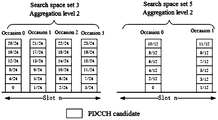
- FIGS. 3A and 3B show an example of the organization of PDCCH candidates in search space sets, aggregation levels, occasions and slots.
- FIG. 4 shows an example calculation of values for priority levels for PDCCH candidate selectionin a single search space set and at a single aggregation level.
- FIG. 5 shows an example of computed priority levels for PDCCH candidates for multiple search space sets in a single aggregation level.
- FIG. 6 shows an example procedure for PDCCH candidate selection at a base station.
- FIG. 7 shows an example procedure for PDCCH candidate selection at a terminal.
- FIGS. 8A and 8B show an example of PDCCH candidate selection.
- FIGS. 9A and 9B show another example of PDCCH candidate selection.
- FIGS. 10A and 10B show yet another example of PDCCH candidate selection.
- FIG. 11 shows an example of PDCCH candidates with interleaved indexes in a single search space set and at a single aggregation level in one occasion.
- FIGS. 12A and 12B show an example of computed priority levels for PDCCH candidates for multiple search space sets and multiple aggregation levels.
- FIGS. 13A and 13B show an example of PDCCH candidate selection based on priority levels.
- FIG. 14 an example calculation of interleaved values for priority levels for PDCCH candidate selectionin a single search space set and at a single aggregation level.
- FIGS. 15A and 15B an example of interleaved priority levels for PDCCH candidates for multiple search space sets in multiple aggregation levels.
- FIGS. 16A and 16B show another example of PDCCH candidate selection based on priority levels.
- FIG. 17 shows another example of priority levels for PDCCH candidate selection in a single search space set and at a single aggregation level.
- FIG. 18 shows another example of PDCCH candidate selection based on priority levels.
- FIG. 19 shows an example of a wireless communication method for PDCCH candidate selection.
- FIG. 20 is a block diagram representation of a portion of an apparatusthat may implement a method or technique described in this patent document.
- downlink control information is carried by a Physical Downlink Control Channel (PDCCH) , and in general, the base station selects one PDCCH candidate among multiple PDCCH candidates as the final PDCCH channel.
- the terminal does not know which among the multiple PDCCH candidates is selected by the base station, e.g. which PDCCH candidate is finally selected to transmit the downlink control information.
- the terminal needs to try PDCCH demodulation and decoding, one by one, over the multiple PDCCH candidates.
- FIG. 1 shows an example of a wireless communication system that includes a BS 120 and one or more user equipment (UE) 111, 112 and 113.
- the BS may transmit DCI over the PDCCH (141, 142, 143) to the UEs, which blindly detect the various PDCCH candidates in order to receive the DCI.
- the UEs may then transmit information (131, 132, 133) to the BS.
- the UE may be, for example, a smartphone, a tablet, a mobile computer, a machine to machine (M2M) device, an Internet of Things (IoT) device, and so on.
- M2M machine to machine
- IoT Internet of Things
- the multiple PDCCH candidates are usually distributed at multiple aggregation levels, and each aggregation level usually includes multiple PDCCH candidates.
- Aggregation level refers to the number of control channel elements (CCEs) that a PDCCH candidate contains. For example, if the aggregation level is 4, then each PDCCH candidate on this aggregation level consists of 4 CCEs.
- CCE control channel elements
- a CCE consists of 6 Resource Element Groups (REGs)
- each REG consists of 12 Resource Elements (REs) .
- CORESET Control Resource Set
- search space collection is mainly used to determine the frequency domain range in which the base station transmits the PDCCH and the terminal detects the PDCCH, and the number of symbols occupied by the PDCCH channel.
- CORESET can also include the following parameters:
- the search space set is mainly used to determine which aggregation levels the PDCCH channel can use, and the number of PDCCH candidates at a specific aggregation level, as well as information such as PDCCH period and time domain location.
- Search space collection can contain the following parameters:
- one base station can transmit control and/or data information to one user equipment in different carriers at the same time, wherein each of these carriers is called a component carrier.
- one component carrier may include multiple bandwidth parts (BWPs) .
- BWPs bandwidth parts
- the base station usually sends control information and/or data information to the user equipment only on one of the these bandwidth part of one component carrier.
- the BWP that is actually used to send control information and/or data information is called an active BWP.
- BWPs used for initial access and for future communications may be referred to as initial access and target bandwidth parts, respectively.
- the maximum number of CORESETs in a BWP may be 3, the maximum number of search space sets in a BWP may be 10, and that there is a searchspace set that corresponds to a CORESET.
- the PDCCH periods in different search space sets may be different.
- the total number of PDCCH candidates on the slot will be significantly increased, as will the number of PDCCH blind detections.
- FIG. 2 shows certain slots that are overloaded since the same slot is being searched by the terminal in search space 1 and search space 2. This results in a significant increase in the number of channel estimation CCEs.
- the number of PDCCH candidates in each search space and/or the number of CCEs required for channel estimation may exceed the capabilities of the user equipment (UE) support.
- UE user equipment
- Embodiments of the disclosed technology provide implementations of a selection order for selecting PDCCH candidates to ensure that the number of PDCCH candidates and/or the number of CCEs that the terminal needs to perform channel estimation do not exceed the capabilities of the UE.
- Section headings are used in the present document to improve readability of the description and do not in any way limit the discussion or the embodiments to the respective sections only.
- the number of PDCCH candidates configured by the base station may exceed the UE capability (e.g., 44 PDCCH blind detections) , or the number of CCEs corresponding to the number of PDCCH candidates configured by the base station may exceed the capability of the UE (e.g., the channel estimation of the UE supporting 48 CCEs at most) .
- the UE capability e.g., 44 PDCCH blind detections
- the number of CCEs corresponding to the number of PDCCH candidates configured by the base station may exceed the capability of the UE (e.g., the channel estimation of the UE supporting 48 CCEs at most) .
- the base station and the terminal both discard some PDCCH candidates according to one rule, so that the number of PDCCH candidates that are retained does not exceed the first threshold value, and the number of CCEs corresponding to the retained PDCCH candidates does not exceed the second threshold value.
- the base station may select one or more PDCCH candidates among the remaining PDCCH candidates for transmitting the PDCCH.
- the base station and the terminal may re-determine the position of the CCE of the PDCCH candidate in the CCE set corresponding to the reserved PDCCH candidate according to a certain rule. Then, one or more PDCCH candidates are selected from among the excluded PDCCH candidates (PDCCH candidates that were not reserved) for transmitting the downlink control information.
- the selection order for PDCCH candidates is defined as:
- the PDCCH candidates are selected in ascending order of the search space set identifiers (or IDs) .
- PDCCH candidates are selected, as described above, until the first threshold value is exceeded, which may correspond to the maximum capabilities of the terminal or UE.
- the search space may correspond to two search space sets, as shown in FIGS. 3A and 3B, both in slot n.
- the configuration of the search space is as follows:
- the number of PDCCH candidates configured at aggregation level ⁇ 1, 2, 4, 8, 16 ⁇ is ⁇ 6, 6, 0, 0, 0 ⁇ , respectively, and which corresponds to 4 occasions on slot n, as shown in the left-hand portions of FIGS. 3A and 3B.
- the number of PDCCH candidates configured at aggregation level ⁇ 1, 2, 4, 8, 16 ⁇ is ⁇ 6, 6, 0, 0, 0 ⁇ , respectively, and which corresponds to 2 occasions on slot n, as shown in the right-hand portions of FIGS. 3A and 3B.
- the order in which PDCCH candidates are selected (or equivalent, “added” ) in a search space set type may be determined.
- the candidates that are selected from the original set of PDCCH candidates by the base station in a slot are called reserved candidates.
- the remaining PDCCH candidates, which are not selected, are referred to as excluded PDCCH candidates.
- the base station may select some or all of the excluded PDCCH candidates, upon determining that some of the excluded PDCCH candidates correspond to CCEs that are in the new Control Channel Element (CCE) set.
- CCE Control Channel Element
- the base station selects some or all of the reserved PDCCH candidates, and sends downlink control information to the terminal on one or more physical downlink control channels using the selected reserved PDCCH candidates, or
- the base station selects some or all of the reserved PDCCH candidates, and selects some or all of the previously excluded PDCCH candidates that correspond to CCEs in the new CCE set, and sends downlink control information to the terminal on one or more physical downlink control channels using the selected reserved PDCCH candidates and the selected previously excluded PDCCH candidates.
- the order of the PDCCH candidates added (or equivalently, the selection order of the PDCCH candidates) at the aggregation level L of the search space set s may further be based on:
- the order of the PDCCH candidates added to a certain occasion in the slot n at aggregation level L of the search space set s may further be based on:
- the selection order of the PDCCH candidates may be based on priority value.
- the priority for a PDCCH candidate is defined as where is the number of candidates configured for aggregation level L in search space set s, and O s is the number of occasions in the slot for the search space set s. According to this definition, the priority values for PDCCH candidates in a single aggregation level and in two different search space sets is shown in FIG. 5. In an example, the PDCCH candidates may be selected in ascending order of the priority values.
- PDCCH candidates may be added to multiple occasions on the aggregation level L in the same search space set s. However, this may result in the addition of the PDCCH candidates no longer being continuous with respect to their indexes, since they may be added according to the reordering discussed above.
- the remaining PDCCH candidates are called excluded PDCCH candidates.
- the excluded PDCCH candidates may include CCEs that are part of the reserved PDCCH candidates (for example, 48 CCEs) , and thus the CCEs may be re-determined.
- the CCEs of the excluded PDCCH candidates are reselected using one of the following criteria:
- the CCE set composed of the reserved PDCCH candidates is divided into a plurality of resources, each including L CCEs, and the UE selects a resource with the least degree of overlap with the CCEs of the excluded PDCCH candidates.
- the CCE set composed of the reserved PDCCH candidates is divided into a plurality of resources, each including L CCEs, and the UE selects resources with the lowest level of overlap with the CCEs of the excluded PDCCH candidates with other aggregation levels L.
- the CCE set composed of the reserved PDCCH candidates is divided into a plurality of resources, each including L CCEs, and the UE selects the resource with the greatest PDCCH candidate distance from the aggregation levels L of the excluded PDCCH candidates.
- the base station selects some or all PDCCH candidates among the reserved PDCCH candidates, selects one or more physical downlink control channel candidates from these PDCCH candidates, and sends downlink control information to the terminal on the one or more selected physical downlink control channels.
- the base station selects part or all of the reserved PDCCH candidates and the excluded PDCCH candidates, selects one or more physical downlink control channel candidates from these PDCCH candidates, and sends downlink control information to the terminal on the one or more selected physical downlink control channels.
- Base station side An example method of the process on the base station side in shown in FIG. 6. As shown therein, the base station determines the PDCCH candidate set of slot n according to the configuration of the high layer parameters of the base station (block 610) . For example, the base station may configure a plurality of search space sets, and the configuration parameters of each search space set have the following parameters:
- the base station determines a physical downlink control channel (PDCCH) candidate set corresponding to the search space sets that the terminal needs to detect on the slot n.
- PDCCH physical downlink control channel
- the base station selects reserved PDCCH candidates from the PDCCH candidate set according to a predefined sequence. These number of reserved PDCCH candidates are restricted from exceeding the first threshold value (block 620) .
- the base station selects reserved PDCCH candidates according to the following predefined sequence:
- the base station selects some or all of the excluded PDCCH candidates, and re-selects the CCEs for the excluded PDCCH candidates (block 630) .
- the base station selects one or more PDCCH candidates from among the reserved PDCCH candidates and the excluded PDCCH candidates for re-determining the CCEs (block 640) , and sends the downlink control information to the terminal (block 660) .
- the base station selects one or more PDCCH candidates from among the reserved PDCCH candidates (block 650) and sends downlink control information to the terminal (block 660) .
- Terminal side An example method of the process on the terminal side in shown in FIG. 7.
- the terminal determines the PDCCH candidate set of slot n according to the configuration of the high layer parameters of the base station (block 710) .
- the base station may configure a plurality of search space sets, and the configuration parameters of each search space set may include the following:
- the terminal determines a physical downlink control channel (PDCCH) candidate set corresponding to the search space sets that the terminal needs to detect on the slot n.
- PDCCH physical downlink control channel
- the terminal determines reserved PDCCH candidates from the PDCCH candidate set in a predefined order. These number of reserved PDCCH candidates are restricted from exceeding the first threshold value (block 720) .
- the terminal selects reserved PDCCH candidates according to the following predefined sequence:
- the terminal selects some or all of the excluded PDCCH candidates, and re-selects the CCEs for the excluded PDCCH candidates (block 730) .
- the terminal detects downlink control information carried on one or more PDCCH candidates from among the reserved PDCCH candidates and the excluded PDCCH candidates for re-determining the CCEs (block 740) .
- the terminal detects DCI among the reserved PDCCH candidates (block 750) .
- Example Embodiment 1 Multi-occasion; one occasion adds one PDCCH at a time
- the base station determines the reserved PDCCH candidate set as follows:
- the base station determines the PDCCH candidate set for slot n according to the configuration of the high layer parameters of the base station.
- the terminal may have multiple search space sets that require monitoring, and the base station determines a PDCCH candidate set corresponding to these same search space sets.
- the selection of the reserved PDCCH candidates by the base station according to condition (A) (as specified as part of Method 1 previously in this document) in this embodiment is specifically conducted according to a predefined sequence of the aggregation level L in the search space s, where the number of reserved PDCCH candidates that have been selected does not exceed the threshold value
- ⁇ is the ratio of the number of channel estimations that can be performed by the terminal to the number of CCEs that are present in the current time slot, indicates an upward rounding
- O s is the number of occasions in the time slot for the search space set s.
- O s is the number of PDCCH candidate monitoring times (occasions) in the time slot n of the search space set s, wherein one PDCCH candidate monitoring time includes one or more time domain symbols, and there may be overlapping time domain symbols between different PDCCH candidate monitoring times.
- the search space set type may be divided into a common search space (CSS) type and a UE-specific search space (USS) type.
- the search space collection type can be divided into multiple CSS types and one USS type. If one base station can send one DCI to multiple UE through one PDCCH candidate in one search space set, the search space set is called as a common search space (CSS) set. Otherwise, the search space set is called as one UE (user equipment) specific search space (USS) set.
- one base station can send DCI for the scheduling system information, paging information, information of slot frame format indication, and/or information of TPC (transmitter power control) commands.
- the base station selects reserved PDCCH candidates according to the search space set type.
- the reserved PDCCH candidates may be selected in the order of CSS and then USS.
- the reserved PDCCH candidates may be selected in the order of CSS0, CSS of Configuration 2-0, other CSS, USS.
- the base station selects all reserved PDCCH candidates of the previous search space set type, it selects a PDCCH candidate to be reserved for the next search space set type.
- the base station selects a reserved PDCCH candidate for an i-th UE in the order of CSS and USS according to the search space type. After selecting all reserved PDCCH candidates for CSS, it selects the reserved PDCCH candidate for USS. In an example, assuming that all reserved PDCCH candidates are selected for the CSS, the number of CCEs corresponding to selecting all the reserved PDCCH candidates may be 20.
- the search space set may include two search space sets: search space set 3 and search space set 5, as shown in FIGS. 3A and 3B, both in slot n.
- search space set 3 search space set 5
- search space set 5 search space set 5
- search space set 5 search space set 5
- search space set 5 search space set 5
- search space set 5 search space set 5
- search space set 5 search space set 5
- search space set 5 search space set 5
- search space set 5 search space set 5
- the number of PDCCH candidates configured at aggregation level ⁇ 1, 2, 4, 8, 16 ⁇ is ⁇ 6, 6, 0, 0, 0 ⁇ , respectively, and which corresponds to 4 occasions on slot n, as shown in the left-hand portions of FIGS. 3A and 3B.
- the number of PDCCH candidates configured at aggregation level ⁇ 1, 2, 4, 8, 16 ⁇ is ⁇ 6, 6, 0, 0, 0 ⁇ , respectively, and which corresponds to 2 occasions on slot n, as shown in the right-hand portions of FIGS. 3A and 3B.
- the selection order, or order of adding PDCCH candidates, in the USS search space type is shown in FIGS. 8A and 8B, wherein the numbers in shaded PDCCH candidates in FIGS. 8A and 8B indicate successive reserved PDCCH candidates added in the USS search space type in the following order:
- the first round of selecting the reserved PDCCH candidates in descending order of aggregation level is as follows:
- the search space sets where the number of reserved PDCCH candidates added in this round is less than the threshold O s are selected.
- the search space sets satisfying this condition are search space set 3 and search space set 5.
- One reserved PDCCH candidate is added to each selected search space set in ascending order of search space set number.
- the first reserved PDCCH candidate is added to search space set 3, and the second is added to search space set 5.
- the search space sets where the number of reserved PDCCH candidates added in this round is less than the threshold O s are selected.
- the search space sets satisfying this condition are search space set 3 and search space set 5.
- One reserved PDCCH candidate is added to each selected search space set in ascending order of search space set number.
- the third reserved PDCCH candidate is added to search space set 3, and the fourth to search space set 5.
- the search space sets where the number of reserved PDCCH candidates added in this round is less than the threshold O s are selected.
- the search space set satisfying this condition is search space set 3.
- One reserved PDCCH candidate is added to each selected search space set in ascending order of search space set number.
- the fifth reserved PDCCH candidate is added to search space set 3.
- the search space sets where the number of reserved PDCCH candidates added in this round is less than the threshold O s are selected.
- the search space set satisfying this condition is search space set 3.
- One reserved PDCCH candidate is added to each selected search space set in ascending order of search space set number.
- the sixth reserved PDCCH candidate is added to search space set 3.
- the number of reserved PDCCH candidates added reaches the threshold value of 6.
- the threshold value is the sum of the number of occurrences of each search space set in slot n in the set of search spaces in the USS type.
- the search space sets where the number of reserved PDCCH candidates added in this round is less than the threshold O s are selected.
- the search space sets satisfying this condition are search space set 3 and search space set 5.
- One reserved PDCCH candidate is added to each selected search space set in ascending order of search space set number.
- the seventh PDCCH candidate is added to search space set 3, and the eighth to search space set 5.
- the search space sets where the number of reserved PDCCH candidates added in this round is less than the threshold O s are selected.
- the search space sets satisfying this condition are search space set 3 and search space set 5.
- One reserved PDCCH candidate is added to each selected search space set in ascending order of search space set number.
- the ninth reserved PDCCH candidate is added to search space set 3, and the tenth to search space set 5.
- the search space sets where the number of reserved PDCCH candidates added in this round is less than the threshold O s are selected.
- the search space set satisfying this condition is search space set 3.
- One reserved PDCCH candidate is added to each selected search space set in ascending order of search space set number.
- the eleventh reserved PDCCH candidate is added to search space set 3.
- the search space sets where the number of reserved PDCCH candidates added in this round is less than the threshold O s are selected.
- the search space set satisfying this condition is search space set 3.
- One reserved PDCCH candidate is added to each selected search space set in ascending order of search space set number.
- the 12th reserved PDCCH candidate is added to search space set 3.
- the number of reserved PDCCH candidates added reaches the threshold value of 6.
- the threshold value is the sum of the number of occurrences of each search space set in slot n in the set of search spaces in the USS type.
- the second round selects the reserved PDCCH candidates in descending order of aggregation level as follows:
- the search space sets where the number of reserved PDCCH candidates added in this round is less than the threshold O s are selected.
- the search space sets satisfying this condition are search space set 3 and search space set 5.
- One reserved PDCCH candidate is added to each selected search space set in ascending order of search space set number.
- the thirteenth reserved PDCCH candidate is added to search space set 3, and the fourteenth is added to search space set 5.
- the search space sets where the number of reserved PDCCH candidates added in this round is less than the threshold O s are selected.
- the search space sets satisfying this condition are search space set 3 and search space set 5.
- One reserved PDCCH candidate is added to each selected search space set in ascending order of search space set number.
- the fifteenth reserved PDCCH candidate is added to search space set 3, and the sixteenth is added to search space set 5.
- the search space sets where the number of reserved PDCCH candidates added in this round is less than the threshold O s are selected.
- the search space set satisfying this condition is search space set 3.
- One reserved PDCCH candidate is added to each selected search space set in ascending order of search space set number.
- the seventeenth reserved PDCCH candidate is added to search space set 3, exhausting the USS search space set type.
- the Physical Downlink Control Channel (PDCCH) candidates selected from an original set of PDCCH candidates by a base station according to high-layer configuration parameters in a time slot n are referred to as reserved PDCCH candidates.
- the remaining PDCCH candidates, which are not selected by the base station, are referred to as excluded PDCCH candidates.
- the base station selects some or all of the excluded PDCCH candidates and re-selects the CCEs for the excluded PDCCH candidates.
- the base station selects one or more PDCCH candidates from among the reserved PDCCH candidates and the excluded PDCCH candidates for re-determining the CCEs, and sends the downlink control information to the terminal.
- the base station selects one or more PDCCH candidates from among the reserved PDCCH candidates and sends downlink control information to the terminal.
- the terminal determines the reserved PDCCH candidate set as follows:
- the terminal determines the PDCCH candidate set for slot n according to the configuration of the high layer parameters of the base station.
- the terminal may have multiple search space sets that require monitoring, and the base station determines a PDCCH candidate set corresponding to these same search space sets.
- the selection of the reserved PDCCH candidates by the terminal according to condition (A) (as specified as part of Method 1 previously in this document) in this embodiment is specifically conducted according to a predefined sequence of the aggregation level L in the search space s, where the number of reserved PDCCH candidates that have been selected does not exceed the threshold value
- ⁇ is the ratio of the number of channel estimations that can be performed by the terminal to the number of CCEs that are present in the current time slot, indicates an upward rounding
- O s is the number of occasions in the time slot for the search space set s.
- O s is the number of PDCCH candidate monitoring times in the time slot n of the search space set s, wherein one PDCCH candidate monitoring time includes one or more time domain symbols, and there may be overlapping time domain symbols between different PDCCH candidate monitoring times.
- the search space set type may be divided into a common search space (CSS) type and a UE-specific search space (USS) type.
- the search space collection type can be divided into multiple CSS types and one USS type.
- the terminal selects reserved PDCCH candidates according to the search space set type. For example, the reserved PDCCH candidates may be selected in the order of CSS and then USS. Alternatively, the reserved PDCCH candidates may be selected in the order of CSS0, CSS of Configuration 2-0, other CSS, USS. After the base station selects all reserved PDCCH candidates of the previous search space set type, it selects a PDCCH candidate to be reserved for the next search space set type.
- the terminal selects a reserved PDCCH candidate for an i-th UE in the order of CSS and USS according to the search space type. After selecting all reserved PDCCH candidates for CSS, it selects the reserved PDCCH candidate for USS. In an example, assuming that all reserved PDCCH candidates are selected for the CSS, the number of CCEs corresponding to selecting all the reserved PDCCH candidates may be 20.
- the search space set may include two search space sets: search space set 3 and search space set 5, as shown in FIGS. 3A and 3B, both in slot n.
- search space set 3 search space set 5
- search space set 5 search space set 5
- search space set 5 search space set 5
- search space set 5 search space set 5
- search space set 5 search space set 5
- search space set 5 search space set 5
- search space set 5 search space set 5
- search space set 5 search space set 5
- the number of PDCCH candidates configured at aggregation level ⁇ 1, 2, 4, 8, 16 ⁇ is ⁇ 6, 6, 0, 0, 0 ⁇ , respectively, and which corresponds to 4 occasions on slot n, as shown in the left-hand portions of FIGS. 3A and 3B.
- the number of PDCCH candidates configured at aggregation level ⁇ 1, 2, 4, 8, 16 ⁇ is ⁇ 6, 6, 0, 0, 0 ⁇ , respectively, and which corresponds to 2 occasions on slot n, as shown in the right-hand portions of FIGS. 3A and 3B.
- the selection order, or order of adding PDCCH candidates, in the USS search space type is shown in FIGS. 8A and 8B, wherein the numbers in shaded PDCCH candidates in FIGS. 8A and 8B indicate successive reserved PDCCH candidates added in the USS search space type in the following order:
- the first round of selecting the reserved PDCCH candidates in descending order of aggregation level is as follows:
- the search space sets where the number of reserved PDCCH candidates added in this round is less than the threshold O s are selected.
- the search space sets satisfying this condition are search space set 3 and search space set 5.
- One reserved PDCCH candidate is added to each selected search space set in ascending order of search space set number.
- the first reserved PDCCH candidate is added to search space set 3, and the second is added to search space set 5.
- the search space sets where the number of reserved PDCCH candidates added in this round is less than the threshold O s are selected.
- the search space sets satisfying this condition are search space set 3 and search space set 5.
- One reserved PDCCH candidate is added to each selected search space set in ascending order ofsearch space set number.
- the third reserved PDCCH candidate is added to search space set 3, and the fourth to search space set 5.
- the search space sets where the number of reserved PDCCH candidates added in this round is less than the threshold O s are selected.
- the search space set satisfying this condition is search space set 3.
- One reserved PDCCH candidate is added to each selected search space set in ascending order of search space set number.
- the fifth reserved PDCCH candidate is added to search space set 3.
- the search space sets where the number of reserved PDCCH candidates added in this round is less than the threshold O s are selected.
- the search space set satisfying this condition is search space set 3.
- One reserved PDCCH candidate is added to each selected search space set in ascending order of search space set number.
- the sixth reserved PDCCH candidate is added to search space set 3.
- the number of reserved PDCCH candidates added reaches the threshold value of 6.
- the threshold value is the sum of the number of occurrences of each search space set in slot n in the set of search spaces in the USS type.
- the search space sets where the number of reserved PDCCH candidates added in this round is less than the threshold O s are selected.
- the search space sets satisfying this condition are search space set 3 and search space set 5.
- One reserved PDCCH candidate is added to each selected search space set in ascending order of search space set number.
- the seventh PDCCH candidate is added to search space set 3, and the eighth to search space set 5.
- the search space sets where the number of reserved PDCCH candidates added in this round is less than the threshold O s are selected.
- the search space sets satisfying this condition are search space set 3 and search space set 5.
- One reserved PDCCH candidate is added to each selected search space set in ascending order of search space set number.
- the ninth reserved PDCCH candidate is added to search space set 3, and the tenth to search space set 5.
- the search space sets where the number of reserved PDCCH candidates added in this round is less than the threshold O s are selected.
- the search space set satisfying this condition is search space set 3.
- One reserved PDCCH candidate is added to each selected search space set in ascending order of search space set number.
- the eleventh reserved PDCCH candidate is added to search space set 3.
- the search space sets where the number of reserved PDCCH candidates added in this round is less than the threshold O s are selected.
- the search space set satisfying this condition is search space set 3.
- One reserved PDCCH candidate is added to each selected search space set in ascending order of search space set number.
- the 12th reserved PDCCH candidate is added to search space set 3.
- the number of reserved PDCCH candidates added reaches the threshold value of 6.
- the threshold value is the sum of the number of occurrences of each search space set in slot n in the set of search spaces in the USS type.
- the second round selects the reserved PDCCH candidates in descending order of aggregation level as follows:
- the search space sets where the number of reserved PDCCH candidates added in this round is less than the threshold O s are selected.
- the search space sets satisfying this condition are search space set 3 and search space set 5.
- One reserved PDCCH candidate is added to each selected search space set in ascending order of search space set number.
- the thirteenth reserved PDCCH candidate is added to search space set 3, and the fourteenth is added to search space set 5.
- the search space sets where the number of reserved PDCCH candidates added in this round is less than the threshold O s are selected.
- the search space sets satisfying this condition are search space set 3 and search space set 5.
- One reserved PDCCH candidate is added to each selected search space set in ascending order of search space set number.
- the fifteenth reserved PDCCH candidate is added to search space set 3, and the sixteenth is added to search space set 5.
- the search space sets where the number of reserved PDCCH candidates added in this round is less than the threshold O s are selected.
- the search space set satisfying this condition is search space set 3.
- One reserved PDCCH candidate is added to each selected search space set in ascending order of search space set number.
- the seventeenth reserved PDCCH candidate is added to search space set 3, exhausting the USS search space set type.
- the terminal in the physical downlink control channel (PDCCH) candidates selected from an original set of PDCCH candidatesby the terminal according to high-layer configuration parameters in the slot n are referred to as reserved PDCCH candidates.
- the terminal selects partially or completely excluded PDCCH candidates and reselects the CCEs for the excluded PDCCH candidates.
- the terminal may detect the DCI carried on the physical downlink control message of the reserved PDCCH candidate and the excluded PDCCH candidates.
- Example Embodiment 2 Multi-occasion; one occasion adds all PDCCH at one time
- the base station determines the reserved PDCCH candidate set as follows:
- the PDCCH candidates are selected in ascending order of the search space set identifier.
- one space search set is selecting (or adding) candidates, multiple PDCCH candidates may be selected at that time.
- the base station determines the PDCCH candidate set for slot n according to the configuration of the high layer parameters of the base station.
- the terminal may have multiple search space sets that require monitoring, and the base station determines a PDCCH candidate set corresponding to these same search space sets.
- the selection of the reserved PDCCH candidates by the base station according to condition (A) (as specified as part of Method 1 previously in this document) in this embodiment is specifically conducted according to a predefined sequence of the aggregation level L in the search space s, where the number of reserved PDCCH candidates that have been selected does not exceed the threshold value
- ⁇ is the ratio of the number of channel estimations that can be performed by the terminal to the number of CCEs that are present in the current time slot, indicates an upward rounding
- O s is the number of occasions in the time slot for the search space set s.
- the search space set type may be divided into a common search space (CSS) type and a UE-specific search space (USS) type.
- the search space collection type can be divided into multiple CSS types and one USS type.
- the base station selects reserved PDCCH candidates according to the search space set type. For example, the reserved PDCCH candidates may be selected in the order of CSS and then USS. Alternatively, the reserved PDCCH candidates may be selected in the order of CSS0, CSS of Configuration 2-0, other CSS, USS. After the base station selects all reserved PDCCH candidates of the previous search space set type, it selects a PDCCH candidate to be reserved for the next search space set type.
- the search space set type may be divided into a common search space (CSS) type and a UE-specific search space (USS) type.
- the search space collection type can be divided into multiple CSS types and one USS type.
- the base station selects reserved PDCCH candidates according to the search space set type. For example, the reserved PDCCH candidates may be selected in the order of CSS and then USS. Alternatively, the reserved PDCCH candidates may be selected in the order of CSS0, CSS of Configuration 2-0, other CSS, USS. After the base station selects all reserved PDCCH candidates of the previous search space set type, it selects a PDCCH candidate to be reserved for the next search space set type.
- the base station selects a reserved PDCCH candidate for an i-th UE in the order of CSS and USS according to the search space type. After selecting all reserved PDCCH candidates for CSS, it selects the reserved PDCCH candidate for USS. In an example, assuming that all reserved PDCCH candidates are selected for the CSS, the number of CCEs corresponding to selecting all the reserved PDCCH candidates may be 20.
- the search space set may include two search space sets: search space set 3 and search space set 5, as shown in FIGS. 3A and 3B, both in slot n.
- search space set 3 search space set 5
- search space set 5 search space set 5
- search space set 5 search space set 5
- search space set 5 search space set 5
- search space set 5 search space set 5
- search space set 5 search space set 5
- search space set 5 search space set 5
- search space set 5 search space set 5
- the number of PDCCH candidates configured at aggregation level ⁇ 1, 2, 4, 8, 16 ⁇ is ⁇ 6, 6, 0, 0, 0 ⁇ , respectively, and which corresponds to 4 occasions on slot n, as shown in the left-hand portions of FIGS. 3A and 3B.
- the number of PDCCH candidates configured at aggregation level ⁇ 1, 2, 4, 8, 16 ⁇ is ⁇ 6, 6, 0, 0, 0 ⁇ , respectively, and which corresponds to 2 occasions on slot n, as shown in the right-hand portions of FIGS. 3A and 3B.
- the selection order, or order of adding PDCCH candidates, in the USS search space type is shown in FIGS. 9A and 9B, wherein the numbers in shaded PDCCH candidates in FIGS. 9A and 9B indicate successive reserved PDCCH candidates added in the USS search space type in the following order:
- the first round of selecting the reserved PDCCH candidates in descending order of aggregation level is as follows:
- the search space sets where the number of reserved PDCCH candidates added in this round is less than the threshold O s are selected.
- the search space sets satisfying this condition are search space set 3 and search space set 5.
- Add X 4 PDCCH candidates for search space set 3; thus, add the first to the fourth PDCCH candidates.
- Add X 2 PDCCH candidates for search space set 5; thus, add the fifth and sixth PDCCH candidates.
- the search space sets where the number of reserved PDCCH candidates added in this round is less than the threshold O s are selected.
- the search space sets satisfying this condition are search space set 3 and search space set 5.
- Add X 4 PDCCH candidates for search space set 3; thus, add the seventh to the tenth PDCCH candidates.
- Add X 2 PDCCH candidates for search space set 5; thus, add the eleventh and twelfth PDCCH candidates.
- the second round of selecting the reserved PDCCH candidates in descending order of aggregation level is as follows:
- the search space sets where the number of reserved PDCCH candidates added in this round is less than the threshold O s are selected.
- the search space sets satisfying this condition are search space set 3 and search space set 5.
- Add X 4 PDCCH candidates for search space set 3; thus, add the thirteenth to the sixteenth PDCCH candidates.
- Add X 1 PDCCH candidate for search space set 5; thus, add the seventeenth PDCCH candidate.
- the Physical Downlink Control Channel (PDCCH) candidates selected from an original set of PDCCH candidates by a base station according to high-layer configuration parameters in a time slot n are referred to as reserved PDCCH candidates.
- the remaining PDCCH candidates, which are not selected by the base station, are referred to as excluded PDCCH candidates.
- the base station selects some or all of the excluded PDCCH candidates and re-selects the CCEs for the excluded PDCCH candidates.
- the base station selects one or more PDCCH candidates from among the reserved PDCCH candidates and the excluded PDCCH candidates for re-determining the CCEs, and sends the downlink control information to the terminal.
- the base station selects one or more PDCCH candidates from among the reserved PDCCH candidates and sends downlink control information to the terminal.
- the terminal determines the reserved PDCCH candidate set as follows:
- the PDCCH candidates are selected in ascending order of the search space set identifier.
- one space search set is selecting (or adding) candidates, multiple PDCCH candidates may be selected at that time.
- the terminal determines the PDCCH candidate set for slot n according to the configuration of the high layer parameters of the base station.
- the terminal may have multiple search space sets that require monitoring, and the base station determines a PDCCH candidate set corresponding to these same search space sets.
- the selection of the reserved PDCCH candidates by the terminal according to condition (A) (as specified as part of Method 1 previously in this document) in this embodiment is specifically conducted according to a predefined sequence of the aggregation level L in the search space s, where the number of reserved PDCCH candidates that have been selected does not exceed the threshold value
- ⁇ is the ratio of the number of channel estimations that can be performed by the terminal to the number of CCEs that are present in the current time slot, indicates an upward rounding
- O s is the number of occasions in the time slot for the search space set s.
- the search space set type may be divided into a common search space (CSS) type and a UE-specific search space (USS) type.
- the search space collection type can be divided into multiple CSS types and one USS type.
- the terminal selects reserved PDCCH candidates according to the search space set type. For example, the reserved PDCCH candidates may be selected in the order of CSS and then USS. Alternatively, the reserved PDCCH candidates may be selected in the order of CSS0, CSS of Configuration 2-0, other CSS, USS. After the terminal selects all reserved PDCCH candidates of the previous search space set type, it selects a PDCCH candidate to be reserved for the next search space set type.
- the search space set type may be divided into a common search space (CSS) type and a UE-specific search space (USS) type.
- the search space collection type can be divided into multiple CSS types and one USS type.
- the base station selects reserved PDCCH candidates according to the search space set type. For example, the reserved PDCCH candidates may be selected in the order of CSS and then USS. Alternatively, the reserved PDCCH candidates may be selected in the order of CSS0, CSS of Configuration 2-0, other CSS, USS. After the base station selects all reserved PDCCH candidates of the previous search space set type, it selects a PDCCH candidate to be reserved for the next search space set type.
- the terminal selects a reserved PDCCH candidate for an i-th UE in the order of CSS and USS according to the search space type. After selecting all reserved PDCCH candidates for CSS, it selects the reserved PDCCH candidate for USS. In an example, assuming that all reserved PDCCH candidates are selected for the CSS, the number of CCEs corresponding to selecting all the reserved PDCCH candidates may be 20.
- the search space set may include two search space sets: search space set 3 and search space set 5, as shown in FIGS. 3A and 3B, both in slot n.
- search space set 3 search space set 5
- search space set 5 search space set 5
- search space set 5 search space set 5
- search space set 5 search space set 5
- search space set 5 search space set 5
- search space set 5 search space set 5
- search space set 5 search space set 5
- search space set 5 search space set 5
- the number of PDCCH candidates configured at aggregation level ⁇ 1, 2, 4, 8, 16 ⁇ is ⁇ 6, 6, 0, 0, 0 ⁇ , respectively, and which corresponds to 4 occasions on slot n, as shown in the left-hand portions of FIGS. 3A and 3B.
- the number of PDCCH candidates configured at aggregation level ⁇ 1, 2, 4, 8, 16 ⁇ is ⁇ 6, 6, 0, 0, 0 ⁇ , respectively, and which corresponds to 2 occasions on slot n, as shown in the right-hand portions of FIGS. 3A and 3B.
- the selection order, or order of adding PDCCH candidates, in the USS search space type is shown in FIGS. 9A and 9B, wherein the numbers in shaded PDCCH candidates in FIGS. 9A and 9B indicate successive reserved PDCCH candidates added in the USS search space type in the following order:
- the first round of selecting the reserved PDCCH candidates in descending order of aggregation level is as follows:
- the search space sets where the number of reserved PDCCH candidates added in this round is less than the threshold O s are selected.
- the search space sets satisfying this condition are search space set 3 and search space set 5.
- Add X 4 PDCCH candidates for search space set 3; thus, add the first to the fourth PDCCH candidates.
- Add X 2 PDCCH candidates for search space set 5; thus, add the fifth and sixth PDCCH candidates.
- the search space sets where the number of reserved PDCCH candidates added in this round is less than the threshold O s are selected.
- the search space sets satisfying this condition are search space set 3 and search space set 5.
- Add X 4 PDCCH candidates for search space set 3; thus, add the seventh to the tenth PDCCH candidates.
- Add X 2 PDCCH candidates for search space set 5; thus, add the eleventh and twelfth PDCCH candidates.
- the second round of selecting the reserved PDCCH candidates in descending order of aggregation level is as follows:
- the search space sets where the number of reserved PDCCH candidates added in this round is less than the threshold O s are selected.
- the search space sets satisfying this condition are search space set 3 and search space set 5.
- Add X 4 PDCCH candidates for search space set 3; thus, add the thirteenth to the sixteenth PDCCH candidates.
- Add X 1 PDCCH candidate for search space set 5; thus, add the seventeenth PDCCH candidate.
- the terminal in the physical downlink control channel (PDCCH) candidates selected from an original set of PDCCH candidatesby the terminal according to high-layer configuration parameters in the slot n are referred to as reserved PDCCH candidates.
- the terminal selects partially or completely excluded PDCCH candidates and reselects the CCEs for the excluded PDCCH candidates.
- the terminal may detect the DCI carried on the physical downlink control message of the reserved PDCCH candidate and the excluded PDCCH candidates.
- Example Embodiment 3 Occasions add PDCCH according to an interleaving matrix
- the occasion (PDCCH candidate monitoring times) indexes in the slots may be reordered using an interleaving matrix, and PDCCH candidates may be selected at each time in one occasion according to the interleaved occasion index order (and until all PDCCH candidates at an aggregation level L of a search space set s have been selected) .
- the base station determines the reserved PDCCH candidate set as follows:
- the PDCCH candidates are selected in descending order of the search space set identifier.
- one space search set is selecting (or adding) candidates, multiple PDCCH candidates may be selected at that time.
- the base station determines the PDCCH candidate set for slot n according to the configuration of the high layer parameters of the base station.
- the base station selects a reserved PDCCH candidate for an i-th UE in the order of CSS and USS according to the search space type. After selecting all reserved PDCCH candidates for CSS, it selects the reserved PDCCH candidate for USS. In an example, assuming that all reserved PDCCH candidates are selected for the CSS, the number of CCEs corresponding to selecting all the reserved PDCCH candidates may be 20.
- the base station selects PDCCH candidates in descending order of aggregation level (AL) for N ⁇ 1 rounds.
- A aggregation level
- the PDCCH candidates are selected in descending order of the search space set identifier.
- multiple PDCCH candidates may be selected at that time.
- the search space set may include two search space sets: search space set 3 and search space set 5, as shown in FIGS. 3A and 3B, both in slot n.
- search space set 3 search space set 5
- search space set 5 search space set 5
- search space set 5 search space set 5
- search space set 5 search space set 5
- search space set 5 search space set 5
- search space set 5 search space set 5
- search space set 5 search space set 5
- search space set 5 search space set 5
- the number of PDCCH candidates configured at aggregation level ⁇ 1, 2, 4, 8, 16 ⁇ is ⁇ 6, 6, 0, 0, 0 ⁇ , respectively, and which corresponds to 4 occasions on slot n, as shown in the left-hand portions of FIGS. 3A and 3B.
- the number of PDCCH candidates configured at aggregation level ⁇ 1, 2, 4, 8, 16 ⁇ is ⁇ 6, 6, 0, 0, 0 ⁇ , respectively, and which corresponds to 2 occasions on slot n, as shown in the right-hand portions of FIGS. 3A and 3B.
- the occasion indexes 1-4 are read into an interleaver matrix row by row, to derive the following:
- the output of the interleaver matrix is ⁇ 1, 3, 2, 4 ⁇ .
- the output of the interleaver matrix is ⁇ 1, 2 ⁇ .
- FIGS. 10A and 10B the selection order, or order of adding PDCCH candidates, in the USS search space type is shown in FIGS. 10A and 10B, wherein the numbers in shaded PDCCH candidates in FIGS. 10A and 10B indicate successive reserved PDCCH candidates added in the USS search space type in the following order:
- the first round of selecting the reserved PDCCH candidates in descending order of aggregation level is as follows:
- the search space sets where the number of reserved PDCCH candidates added in this round is less than the threshold O s are selected.
- the search space sets satisfying this condition are search space set 3 and search space set 5.
- search space set 3 one PDCCH candidate is added to each occasion in the order ⁇ 1, 3, 2, 4 ⁇ based on the output of the interleaver matrix, and thus, the first to the fourth PDCCH candidates are added.
- search space set 5 and based on the order ⁇ 1, 2 ⁇ the fifth and sixth PDCCH candidates are added.
- the search space sets where the number of reserved PDCCH candidates added in this round is less than the threshold are selected.
- the search space sets satisfying this condition are search space set 3 and search space set 5.
- search space set 3 one PDCCH candidate is added to each occasion in the order ⁇ 1, 3, 2, 4 ⁇ based on the output of the interleaver matrix, and thus, the seventh to the tenth PDCCH candidates.
- search space set 5 and based on the order ⁇ 1, 2 ⁇ the eleventh and twelfth PDCCH candidates are added.
- the second round of selecting the reserved PDCCH candidates in descending order of aggregation level is as follows:
- the search space sets where the number of reserved PDCCH candidates added in this round is less than the threshold O s are selected.
- the search space sets satisfying this condition are search space set 3 and search space set 5.
- search space set 3 one PDCCH candidate is added to each occasion in the order ⁇ 1, 3, 2, 4 ⁇ based on the output of the interleaver matrix, and thus, the thirteenth to the sixteenth PDCCH candidates.
- search space set 5 and based on the order ⁇ 1, 2 ⁇ the seventeenth PDCCH candidate is added.
- the Physical Downlink Control Channel (PDCCH) candidates selected from an original set of PDCCH candidates by a base station according to high-layer configuration parameters in a time slot n are referred to as reserved PDCCH candidates.
- the remaining PDCCH candidates, which are not selected by the base station, are referred to as excluded PDCCH candidates.
- the base station selects some or all of the excluded PDCCH candidates and re-selects the CCEs for the excluded PDCCH candidates.
- the base station selects one or more PDCCH candidates from among the reserved PDCCH candidates and the excluded PDCCH candidates for re-determining the CCEs, and sends the downlink control information to the terminal.
- the base station selects one or more PDCCH candidates from among the reserved PDCCH candidates and sends downlink control information to the terminal.
- Example Embodiment 4 Occasions add PDCCH according to an interleaving matrix within one intra-occasion
- the occasion (PDCCH candidate monitoring times) indexes in the slots may be reordered using an interleaving matrix, and PDCCH candidates may be selected at each time in one occasion according to the interleaved occasion index order (and until all PDCCH candidates at an aggregation level L of a search space set s have been selected) .
- the PDCCH candidate indexes (denoted m) in the search space s and aggregation level L in slot n are shown in FIG. 11.
- the PDDCH candidate index are read into an interleaver matrix row by row, to derive the following:
- the output of the interleaver matrix is read column by column, where the ordering of the columns is Thus, the ordering of the PDCCH candidate indexes after the interleaving matrix is ⁇ 0, 4, 2, 6, 1, 5, 3, 7 ⁇ .
- the intra-slot index of the search space set s in the slot n is used for cyclically shifting the PDCCH candidate index output after the interleaving matrix has been used to reorder the indexes.
- the PDCCH candidate index output of the interleaving matrix may be cyclically shifted to the left, by a shift of Os mod where O s is the index of the search space set s in slot n.
- the base station may add PDCCH candidates to the occasion on the time slot n according to the cyclically-shifted PDCCH candidate index order.
- Example Embodiment 5 Occasions add PDCCH based on priority values
- the base station may define a priority value for the PDCCH candidates based on their indexes (m) , the occasion index (O) and The priority values may be used to determine the order of selecting the PDCCH candidates.
- the base station determines the PDCCH candidate set for slot n according to the configuration of the high layer parameters of the base station.
- the base station selects a reserved PDCCH candidate for an i-th UE in the order of CSS and USS according to the search space type. After selecting all reserved PDCCH candidates for CSS, it selects the reserved PDCCH candidate for USS.
- the search space set may include two search space sets: search space set 3 and search space set 5, as shown in FIGS. 3A and 3B, both in slot n.
- search space set 3 search space set 5
- search space set 5 search space set 5
- search space set 5 search space set 5
- search space set 5 search space set 5
- search space set 5 search space set 5
- search space set 5 search space set 5
- search space set 5 search space set 5
- search space set 5 search space set 5
- the number of PDCCH candidates configured at aggregation level ⁇ 1, 2, 4, 8, 16 ⁇ is ⁇ 6, 6, 0, 0, 0 ⁇ , respectively, and which corresponds to 4 occasions on slot n, as shown in the left-hand portions of FIGS. 3A and 3B.
- the number of PDCCH candidates configured at aggregation level ⁇ 1, 2, 4, 8, 16 ⁇ is ⁇ 6, 6, 0, 0, 0 ⁇ , respectively, and which corresponds to 2 occasions on slot n, as shown in the right-hand portions of FIGS. 3A and 3B.
- the priority is defined as: where is the number of PDCCH candidates configured for the base station for the aggregation level L in the search space set s.
- FIG. 4 shows the value I for a search space set s and aggregation level L.
- the base station may select PDCCH candidates in descending order of priority values. For the same priority values, the reserved PDCCH candidates are selected in descending order of aggregation levels. For the same priority values and the same aggregation level, the PDCCH candidates are selected in descending order of the search space set identifier. Based on these rules, and with the base station selecting 17 PDCCH candidates, the selected PDCCH candidates are shown in FIGS. 13A and 13B.
- the total number of selected PDCCH candidates and/or the number of CCEs corresponding to the selected PDCCH candidates reaches their respective threshold values, and the selection of reserved PDCCH candidates is terminated.
- Example Embodiment 6 Occasions add PDCCH based on interleaved priority values
- the base station may select PDCCH candidates using an ordering that is based on the PDCCH candidate index (m) , the occasion index (O) , and
- the priority values may be used to determine the order of selecting the PDCCH candidates, but after they have been interleaved.
- O’ is the occasion index for the interleaved set of occasion indexes.
- the priority is defined as: where is the number of PDCCH candidates configured for the base station for the aggregation level L in the search space set s.
- the base station determines the PDCCH candidate set for slot n according to the configuration of the high layer parameters of the base station.
- the base station selects a reserved PDCCH candidate for an i-th UE in the order of CSS and USS according to the search space type. After selecting all reserved PDCCH candidates for CSS, it selects the reserved PDCCH candidate for USS.
- the search space set may include two search space sets: search space set 3 and search space set 5, as shown in FIGS. 3A and 3B, both in slot n.
- search space set 3 search space set 5
- search space set 5 search space set 5
- search space set 5 search space set 5
- search space set 5 search space set 5
- search space set 5 search space set 5
- search space set 5 search space set 5
- search space set 5 search space set 5
- search space set 5 search space set 5
- the number of PDCCH candidates configured at aggregation level ⁇ 1, 2, 4, 8, 16 ⁇ is ⁇ 6, 6, 0, 0, 0 ⁇ , respectively, and which corresponds to 4 occasions on slot n, as shown in the left-hand portions of FIGS. 3A and 3B.
- the number of PDCCH candidates configured at aggregation level ⁇ 1, 2, 4, 8, 16 ⁇ is ⁇ 6, 6, 0, 0, 0 ⁇ , respectively, and which corresponds to 2 occasions on slot n, as shown in the right-hand portions of FIGS. 3A and 3B.
- the occasion indexes 1-4 are read into an interleaver matrix row by row, to derive the following:
- the output of the interleaver matrix is read column by column, where the ordering of the columns is 1, 1+O s /2, 2, 2+O s /2, Vietnamese, O s /2, O s .
- the output of the interleaver matrix is ⁇ 0, 2, 1, 3 ⁇ .
- FIG. 14 shows the value I computed for the PDCCH candidates in search space set s and aggregation level L in slot n, and according to the priority and interleaving examples described above.
- the base station may select PDCCH candidates in descending order of priority values. For the same priority values, the reserved PDCCH candidates are selected in descending order of aggregation levels. For the same priority values and the same aggregation level, the PDCCH candidates are selected in descending order of the search space set identifier. Based on these rules, and with the base station selecting 17 PDCCH candidates, the selected PDCCH candidates are shown in FIGS. 16A and 16B.
- the total number of selected PDCCH candidates and/or the number of CCEs corresponding to the selected PDCCH candidates reaches their respective threshold values, and the selection of reserved PDCCH candidates is terminated.
- Example Embodiment 7 Occasions add PDCCH based on priority values and ⁇ s, L ⁇
- the base station may select PDCCH candidates using an ordering that is based on the PDCCH candidate index (m) , the occasion index (O) , and
- the priority value of ⁇ s, L ⁇ may be defined as the minimum value of the priority values corresponding to all the PDCCH candidates in the aggregation level L in the search space s, and is the priority of ⁇ s, L ⁇ .
- the base station selects ⁇ s, L ⁇ in descending order of the priority values of ⁇ s, L ⁇ , and selects PDCCH candidates of aggregation level L in the search space set s. After ⁇ s, L ⁇ is selected as a reserved PDCCH candidate, the minimum priority value is deleted from ⁇ s, L, and the minimum priority value corresponding to the PDCCH candidate with all non-deleted priority values in ⁇ s, L ⁇ is selected as the new (or updated) priority value for ⁇ s, L ⁇ . The base station continues to select ⁇ s, L ⁇ in descending order of priority values of ⁇ s, L ⁇ , and selects PDCCH candidates with aggregation level L in the search space set s.
- the reserved PDCCH candidates are selected in descending order of the aggregation level L.
- the PDCCH candidates are selected in descending order of the search space set identifier.
- the search space set may include two search space sets: search space set 3 and search space set 5, as shown in FIGS. 3A and 3B, both in slot n.
- search space set 3 search space set 5
- search space set 5 search space set 5
- search space set 5 search space set 5
- search space set 5 search space set 5
- search space set 5 search space set 5
- search space set 5 search space set 5
- search space set 5 search space set 5
- search space set 5 search space set 5
- the number of PDCCH candidates configured at aggregation level ⁇ 1, 2, 4, 8, 16 ⁇ is ⁇ 6, 6, 0, 0, 0 ⁇ , respectively, and which corresponds to 4 occasions on slot n, as shown in the left-hand portions of FIGS. 3A and 3B.
- the number of PDCCH candidates configured at aggregation level ⁇ 1, 2, 4, 8, 16 ⁇ is ⁇ 6, 6, 0, 0, 0 ⁇ , respectively, and which corresponds to 2 occasions on slot n, as shown in the right-hand portions of FIGS. 3A and 3B.
- the priority is defined as: where is the number of PDCCH candidates configured for the base station for the aggregation level L in the search space set s.
- FIG. 4 shows the value I for a search space set s and aggregation level L.
- the priority value of ⁇ s, L ⁇ is the minimum value of the priority values corresponding to all the PDCCH candidates in the aggregation level L in the search space s, and is the priority of ⁇ s, L ⁇ .
- the priority values in the search space set s and aggregation level L are:
- the reserved PDCCH candidates are selected in ascending order of aggregation level L.
- the PDCCH candidates are selected in ascending order of the search space set identifier s.
- the order in which to add the PDCCH candidates, with respect to the occasion index is ⁇ 0, 2, 1, 3 ⁇ .
- the order of occasion indexes in which to add the PDCCH candidates is ⁇ 0, 1 ⁇ .
- FIG. 19 shows an example of a wireless communication method 1900 for PDCCH candidate selection.
- the method 1900 includes, at step 910, performing a communication operation in one or more of a first set of resources.
- a second set of resources may comprise the first set of resources and a third set of resources such that resources of the first set of resources are non-overlapping with resources of the third set of resources.
- resources of the sets of resources may include sub-resources.
- the resources may correspond to PDCCH candidates and the sub-resources may corresponds to CCEs.
- the second set of resources may correspond to PDCCH candidates, the first set of resources may correspond to reserved PDCCH candidates, and the third set of resources may correspond to excluded PDCCH candidates, as described in Example Embodiments 1-7.
- the resources of the first set of resources are selected in a selection order from a second set of resources. In other embodiments, the resources of the third set of resources are selected in a selection order from the second set of resources.
- the selection order is based on at least one of a period of a search space set, a DCI format of the search space set, a starting symbol of the search space set, a component carrier type, a component carrier index or an occasion index. In other embodiments, the selection order is further based on at least one of an aggregation level, a number of resources in the second set of resources, a search space set identifier, a control resource set identifier, a number of blind decoding operations, a number of sub-resources, a search space set type and an index of resources in the second set of resources.
- the second set of resources may correspond to resources in a bandwidth part (BWP) of a component carrier in one slot.
- BWP bandwidth part
- the bandwidth part may be an active bandwidth part, a target bandwidth part or an initial access bandwidth part.
- a number of the first, second and third resources may be less than respective thresholds.
- the thresholds may be known a priori to the terminal and the base station. In another example, the thresholds may be predetermined or may be indicated to the terminal via signaling from the base station.
- the third threshold may be based on at least and O s , wherein is a number of resources in the single search space set and the single aggregation level in one occasion, and wherein O s is in a number of occasions of the single search space set.
- the selection order may be based on the rules specified in Example Embodiments 1-7. In an example, the selection order may be based on an ascending or a descending order of one or more parameters. In another example, the selection order may be based on an interleaved order of the one of more parameters. In the context of Example Embodiments 1-7, the selection order for multiple parameters may be nested, e.g. the selection of PDCCH candidates may be based on a first parameter, and for identical values of the first parameter, the selection may be based on a second parameter.
- the selection of PDCCH candidates may be made in multiple selection steps. For example, a first selection step may be based on a type of the search space set (CSS or USS) , a second selection step, subsequent to the first selection step and within the type of the search space set, may be based on a type of cell in which the wireless node is operating (aprimary cell or one or more secondary cells) , a third selection step, subsequent to the second selection step and within the cell type, may be based on an ascending order of the component carrier index (associated with the BWP) , a fourth selection step, subsequent to the third selection step and for a given value of the component carrier index, may be based on a search space set period and a number of occasions of the search space set in one slot, and a fifth selection step, subsequent to the fourth selection step and for given values of the search space set period and the number of occasions of the search space set, may be based on a descending order of an aggregation level.
- a first selection step may be based
- the selection order may be based on an interleaving step that precedes or follows the selection based on a parameter. Examples of selecting PDCCH candidates based on interleaving, which may be implemented using an interleaving matrix, are described above in Example Embodiments 3, 4 and 6.
- the interleaved output may be cyclically shifted by a value that is based on other parameters.
- the sub-resources (e.g. CCEs) in excluded resources may be compared to the sub-resources of reserved resources, and those excluded resources reincorporated into the set of resources that may subsequently be used to communication DCI information.
- the selection of PDCCH candidates may be sequential with respect to certain parameters, and may specifically be an ascending order, a descending order, or an interleaved order, as described in the various examples in this document.
- the selection order may be based on priority values that are computed for PDCCH candidates as a function of the search space set, aggregation level and occasion index that the PDCCH candidate is located in, as described in Example Embodiments 5-7 in the present document.
- the priority values may be optionally interleaved prior to the selection of resources based on the priority values.
- FIG. 20 is a block diagram representation of a portion of an apparatus, in accordance with some embodiments of the presently disclosed technology.
- Anapparatus2005 such as a base station or a wireless device (or UE)
- can include processor electronics 2010 such as a microprocessor that implements one or more of the techniques presented in this document.
- the apparatus2005 can include transceiver electronics 2015 to send and/or receive wireless signals over one or more communication interfaces such as antenna (s) 2020.
- the apparatus2005 can include other communication interfaces for transmitting and receiving data.
- Apparatus2005 can include one or more memories (not explicitly shown) configured to store information such as data and/or instructions.
- the processor electronics 2010 can include at least a portion of the transceiver electronics 2015.
- at least some of the disclosed techniques, modules or functions, including method 1900, are implemented using the apparatus2005.
- a computer-readable medium may include removable and non-removable storage devices including, but not limited to, Read Only Memory (ROM) , Random Access Memory (RAM) , compact discs (CDs) , digital versatile discs (DVD) , etc. Therefore, the computer-readable media can include a non-transitory storage media.
- program modules may include routines, programs, objects, components, data structures, etc. that perform particular tasks or implement particular abstract data types.
- Computer-or processor-executable instructions, associated data structures, and program modules represent examples of program code for executing steps of the methods disclosed herein. The particular sequence of such executable instructions or associated data structures represents examples of corresponding acts for implementing the functions described in such steps or processes.
- a hardware circuit implementation can include discrete analog and/or digital components that are, for example, integrated as part of a printed circuit board.
- the disclosed components or modules can be implemented as an Application Specific Integrated Circuit (ASIC) and/or as a Field Programmable Gate Array (FPGA) device.
- ASIC Application Specific Integrated Circuit
- FPGA Field Programmable Gate Array
- DSP digital signal processor
- the various components or sub-components within each module may be implemented in software, hardware or firmware.
- the connectivity between the modules and/or components within the modules may be provided using any one of the connectivity methods and media that is known in the art, including, but not limited to, communications over the Internet, wired, or wireless networks using the appropriate protocols.
Landscapes
- Engineering & Computer Science (AREA)
- Signal Processing (AREA)
- Computer Networks & Wireless Communication (AREA)
- Quality & Reliability (AREA)
- Mobile Radio Communication Systems (AREA)
Abstract
Disclosed are methods, systems and devices for physical downlink control channel (PDCCH) candidate selection. One example method includes performing a communication operation in one or more of a first set of resources, where the resources of the first set of resources are selected in a selection order from a second set of resources that is larger than the first set of resources, and where the selection order for the first set of resources is based on at least one of a period of a search space set, a downlink control information (DCI) format of the search space set, a starting symbol of the search space set, a component carrier type, a component carrier index or an occasion index.
Description
This document generally relates to wireless communications.
Wireless communication technologies are moving the world toward an increasingly connected and networked society. The rapid growth of wireless communications and advances in technology has led to greater demand for capacity and connectivity. Other aspects, such as energy consumption, device cost, spectral efficiency, and latency are also important to meeting the needs of various communication scenarios. In comparison with the existing wireless networks, next generation systems and wireless communication techniques need to provide the reliable communication of control information to support enhanced services and applications.
SUMMARY
This document relates to methods, systems, and devices forphysical downlink control channel (PDCCH) candidate selection. Using the disclosed technology, embodiments are able to perform PDCCH candidate selection by reducing the number of blind detection attempts that have to be performed in current implementations of Long Term Evolution (LTE) and New Radio (NR) devices.
In one exemplary aspect, a wireless communication method is disclosed. The method, which may be implemented at a base station (BS) or a user equipment (UE) , includes performing a communication operation in one or more of a first set of resources, where the resources of the first set of resources are selected in a selection order from a second set of resources that is larger than the first set of resources, and where the selection order for the first set of resources is based on at least one of a period of a search space set, a downlink control information (DCI) format of the search space set, a starting symbol of the search space set, a component carrier type, a component carrier index or an occasion index.
In another exemplary aspect, a wireless communication method is disclosed. The method, which may be implemented at a base station (BS) or a user equipment (UE) , includes performing a communication operation in one or more of a first set of resources, where a second set of resources includes the first set of resources and a third set of resources, and the resources of the first set of resources are non-overlapping with the resources of the third set of resources, where the resources of the third set of resources are selected in a selection order from the second set of resources, and where the selection order for the third set of resources is based on at least one of a period of a search space set, a downlink control information (DCI) format of the search space set, a starting symbol of the search space set, a component carrier type, a component carrier index or an occasion index.
In yet another exemplary aspect, the above-described methods are embodied in the form of processor-executable code and stored in a computer-readable program medium.
In yet another exemplary embodiment, a device that is configured or operable to perform the above-described methods is disclosed.
The above and other aspects and their implementations are described in greater detail in the drawings, the descriptions, and the claims.
FIG. 1 shows an example of a base station (BS) and user equipment (UE) in wireless communication, in accordance with some embodiments of the presently disclosed technology.
FIG. 2 shows an example of an overloaded search space set.
FIGS. 3A and 3B show an example of the organization of PDCCH candidates in search space sets, aggregation levels, occasions and slots.
FIG. 4 shows an example calculation of values for priority levels for PDCCH candidate selectionin a single search space set and at a single aggregation level.
FIG. 5 shows an example of computed priority levels for PDCCH candidates for multiple search space sets in a single aggregation level.
FIG. 6 shows an example procedure for PDCCH candidate selection at a base station.
FIG. 7 shows an example procedure for PDCCH candidate selection at a terminal.
FIGS. 8A and 8Bshow an example of PDCCH candidate selection.
FIGS. 9A and 9B show another example of PDCCH candidate selection.
FIGS. 10A and 10B show yet another example of PDCCH candidate selection.
FIG. 11 shows an example of PDCCH candidates with interleaved indexes in a single search space set and at a single aggregation level in one occasion.
FIGS. 12A and 12B show an example of computed priority levels for PDCCH candidates for multiple search space sets and multiple aggregation levels.
FIGS. 13A and 13B show an example of PDCCH candidate selection based on priority levels.
FIG. 14 an example calculation of interleaved values for priority levels for PDCCH candidate selectionin a single search space set and at a single aggregation level.
FIGS. 15A and 15B an example of interleaved priority levels for PDCCH candidates for multiple search space sets in multiple aggregation levels.
FIGS. 16A and 16Bshow another example of PDCCH candidate selection based on priority levels.
FIG. 17 shows another example of priority levels for PDCCH candidate selection in a single search space set and at a single aggregation level.
FIG. 18 shows another example of PDCCH candidate selection based on priority levels.
FIG. 19 shows an example of a wireless communication method for PDCCH candidate selection.
FIG. 20 is a block diagram representation of a portion of an apparatusthat may implement a method or technique described in this patent document.
In LTE and NR, downlink control information (DCI) is carried by a Physical Downlink Control Channel (PDCCH) , and in general, the base station selects one PDCCH candidate among multiple PDCCH candidates as the final PDCCH channel. The terminal does not know which among the multiple PDCCH candidates is selected by the base station, e.g. which PDCCH candidate is finally selected to transmit the downlink control information. Thus, the terminal needs to try PDCCH demodulation and decoding, one by one, over the multiple PDCCH candidates.
FIG. 1 shows an example of a wireless communication system that includes a BS 120 and one or more user equipment (UE) 111, 112 and 113. In some embodiments, the BS may transmit DCI over the PDCCH (141, 142, 143) to the UEs, which blindly detect the various PDCCH candidates in order to receive the DCI. Upon establishing the connection, the UEs may then transmit information (131, 132, 133) to the BS. The UE may be, for example, a smartphone, a tablet, a mobile computer, a machine to machine (M2M) device, an Internet of Things (IoT) device, and so on.
The multiple PDCCH candidates are usually distributed at multiple aggregation levels, and each aggregation level usually includes multiple PDCCH candidates. Aggregation level (AL) refers to the number of control channel elements (CCEs) that a PDCCH candidate contains. For example, if the aggregation level is 4, then each PDCCH candidate on this aggregation level consists of 4 CCEs. In NR, a CCE consists of 6 Resource Element Groups (REGs) , and each REG consists of 12 Resource Elements (REs) .
Related concepts to the PDCCH, which provide context for embodiments of the disclosed technology, include the Control Resource Set (CORESET) and the search space collection. CORESET is mainly used to determine the frequency domain range in which the base station transmits the PDCCH and the terminal detects the PDCCH, and the number of symbols occupied by the PDCCH channel. CORESET can also include the following parameters:
· Control resource ID
· Frequency-domain resources
· Time-duration (1, 2, or 3)
· REG bundle size (2, 3, or 6)
· Precoder-granularity (REG bundle size or contiguous Resource Blocks (RBs) within the CORESET)
· CCE-to-REG mapping type (interleaved or non-interleaved)
· Interleaver-rows (2, 3, or 6)
· Shift index for Interleaver (0-274)
· TCI states PDCCH (list of K ≤ MTCI-RS set configuration)
· DMRS scrambling sequence initialization value
The search space set is mainly used to determine which aggregation levels the PDCCH channel can use, and the number of PDCCH candidates at a specific aggregation level, as well as information such as PDCCH period and time domain location. Search space collection can contain the following parameters:
· A CORESET ID
· Flag of CSS
· DCI format parameter
· Monitoring periodicity of slot (s)
· Monitoring offset of slot (s) ( (0, 1, ..., N-1) for monitoring periodicity of N)
· Monitoring symbol within a slot (14-bit bit-map)
· Number of candidates for AL=1 (0, 1, 2, 3, 4, 5, 6, 8)
· Number of candidates for AL=2 (0, 1, 2, 3, 4, 5, 6, 8)
· Number of candidates for AL=4 (0, 1, 2, 3, 4, 5, 6, 8)
· Number of candidates for AL=8 (0, 1, 2, 3, 4, 5, 6, 8)
· Number of candidates for AL=16 (0, 1, 2, 3, 4, 5, 6, 8)
In LTE and NR systems, which are examples of carrier aggregated systems, one base station can transmit control and/or data information to one user equipment in different carriers at the same time, wherein each of these carriers is called a component carrier. For one UE, one component carrier may include multiple bandwidth parts (BWPs) . However, the base station usually sends control information and/or data information to the user equipment only on one of the these bandwidth part of one component carrier. For a given time, the BWP that is actually used to send control information and/or data information is called an active BWP. Similarly, BWPs used for initial access and for future communications may be referred to as initial access and target bandwidth parts, respectively.
In exemplary implementations, the maximum number of CORESETs in a BWPmay be 3, the maximum number of search space sets in a BWP may be 10, and that there is a searchspace set that corresponds to a CORESET.
In some embodiments, the PDCCH periods in different search space sets may be different. When multiple search space sets are located in the same slot, as shown in FIG. 2, the total number of PDCCH candidates on the slot will be significantly increased, as will the number of PDCCH blind detections. FIG. 2 shows certain slots that are overloaded since the same slot is being searched by the terminal in search space 1 and search space 2. This results in a significant increase in the number of channel estimation CCEs. Thus, the number of PDCCH candidates in each search space and/or the number of CCEs required for channel estimation may exceed the capabilities of the user equipment (UE) support.
Embodiments of the disclosed technology provide implementations of a selection order for selecting PDCCH candidates to ensure that the number of PDCCH candidates and/or the number of CCEs that the terminal needs to perform channel estimation do not exceed the capabilities of the UE. Section headings are used in the present document to improve readability of the description and do not in any way limit the discussion or the embodiments to the respective sections only.
A Brief Summary of Exemplary Embodiments of the Disclosed Technology
In an example, the number of PDCCH candidates configured by the base station may exceed the UE capability (e.g., 44 PDCCH blind detections) , or the number of CCEs corresponding to the number of PDCCH candidates configured by the base station may exceed the capability of the UE (e.g., the channel estimation of the UE supporting 48 CCEs at most) .
In one slot, if the number of PDCCH candidates configured by the base station exceeds a first threshold value, or if the number of CCEs corresponding to the number of PDCCH candidates configured by the base station exceeds a second threshold value, then the base station and the terminal both discard some PDCCH candidates according to one rule, so that the number of PDCCH candidates that are retained does not exceed the first threshold value, and the number of CCEs corresponding to the retained PDCCH candidates does not exceed the second threshold value.
The base station may select one or more PDCCH candidates among the remaining PDCCH candidates for transmitting the PDCCH.
Alternatively, the base station and the terminal may re-determine the position of the CCE of the PDCCH candidate in the CCE set corresponding to the reserved PDCCH candidate according to a certain rule. Then, one or more PDCCH candidates are selected from among the excluded PDCCH candidates (PDCCH candidates that were not reserved) for transmitting the downlink control information.
Example Embodiments for Selecting the Order of Reserved PDCCH Candidates
(1) Sort by search space set type;
(2) Within a search space set type, select the PDCCH candidates in descending order of aggregation level (AL) for N ≥ 1 rounds; and
(3) Within the same aggregation level, the PDCCH candidates are selected in ascending order of the search space set identifiers (or IDs) .
PDCCH candidates are selected, as described above, until the first threshold value is exceeded, which may correspond to the maximum capabilities of the terminal or UE.
As an example, and assuming a UE-specific search space (USS) set type, the search space may correspond to two search space sets, as shown in FIGS. 3A and 3B, both in slot n. For an i-th UE, the configuration of the search space is as follows:
· For search space set 3, the number of PDCCH candidates configured at aggregation level {1, 2, 4, 8, 16} is {6, 6, 0, 0, 0} , respectively, and which corresponds to 4 occasions on slot n, as shown in the left-hand portions of FIGS. 3A and 3B.
· For search space set 5, the number of PDCCH candidates configured at aggregation level {1, 2, 4, 8, 16} is {6, 6, 0, 0, 0} , respectively, and which corresponds to 2 occasions on slot n, as shown in the right-hand portions of FIGS. 3A and 3B.
According to the rules defined in Method 1, the order in which PDCCH candidates are selected (or equivalent, “added” ) in a search space set type (such as USS type search space set) may be determined.
The candidates that are selected from the original set of PDCCH candidates by the base station in a slot are called reserved candidates. The remaining PDCCH candidates, which are not selected, are referred to as excluded PDCCH candidates.
The base station may select some or all of the excluded PDCCH candidates, upon determining that some of the excluded PDCCH candidates correspond to CCEs that are in the new Control Channel Element (CCE) set. In these cases, one of the following procedures is used:
(A) The base station selects some or all of the reserved PDCCH candidates, and sends downlink control information to the terminal on one or more physical downlink control channels using the selected reserved PDCCH candidates, or
(B) The base station selects some or all of the reserved PDCCH candidates, and selects some or all of the previously excluded PDCCH candidates that correspond to CCEs in the new CCE set, and sends downlink control information to the terminal on one or more physical downlink control channels using the selected reserved PDCCH candidates and the selected previously excluded PDCCH candidates.
In some embodiments, in either of the two embodiments described above, the order of the PDCCH candidates added (or equivalently, the selection order of the PDCCH candidates) at the aggregation level L of the search space set s may further be based on:
· Reordering the occasion indexes (PDCCH candidate monitoring times) in the slot using an interleaving matrix, and/or
· Adding one PDCCH candidate to each occasion at each time, using the reordering rules described above, until all PDCCH candidates at the aggregation level L of the search space set s are added.
In some embodiments, in either of the two embodiments described above, the order of the PDCCH candidates added to a certain occasion in the slot n at aggregation level L of the search space set s may further be based on:
· Reordering PDCCH candidate indexes on this occasion using the interleaving matrix, and/or
· Adding the PDCCH candidates after they have been reordered.
The priority for a PDCCH candidate is defined as
 where
where
 is the number of candidates configured for aggregation level L in search space set s, and O
s is the number of occasions in the slot for the search space set s. According to this definition, the priority values for PDCCH candidates in a single aggregation level and in two different search space sets is shown in FIG. 5. In an example, the PDCCH candidates may be selected in ascending order of the priority values.
is the number of candidates configured for aggregation level L in search space set s, and O
s is the number of occasions in the slot for the search space set s. According to this definition, the priority values for PDCCH candidates in a single aggregation level and in two different search space sets is shown in FIG. 5. In an example, the PDCCH candidates may be selected in ascending order of the priority values.
In some embodiments, and based on the prioritization, PDCCH candidates may be added to multiple occasions on the aggregation level L in the same search space set s. However, this may result in the addition of the PDCCH candidates no longer being continuous with respect to their indexes, since they may be added according to the reordering discussed above.
Example Embodiments for PDCCH Candidate Reselection based on CCE Locations
In some embodiments, after the reserved PDCCH candidates are determined, the remaining PDCCH candidates are called excluded PDCCH candidates. The excluded PDCCH candidates may include CCEs that are part of the reserved PDCCH candidates (for example, 48 CCEs) , and thus the CCEs may be re-determined.
For an excluded PDCCH candidate, assuming that it belongs to search space set s and its aggregation level is L, the CCEs of the excluded PDCCH candidates are reselected using one of the following criteria:
· The CCE set composed of the reserved PDCCH candidates is divided into a plurality of resources, each including L CCEs, and the UE selects a resource with the least degree of overlap with the CCEs of the excluded PDCCH candidates.
· The CCE set composed of the reserved PDCCH candidates is divided into a plurality of resources, each including L CCEs, and the UE selects resources with the lowest level of overlap with the CCEs of the excluded PDCCH candidates with other aggregation levels L.
· The CCE set composed of the reserved PDCCH candidates is divided into a plurality of resources, each including L CCEs, and the UE selects the resource with the greatest PDCCH candidate distance from the aggregation levels L of the excluded PDCCH candidates.
The base station selects some or all PDCCH candidates among the reserved PDCCH candidates, selects one or more physical downlink control channel candidates from these PDCCH candidates, and sends downlink control information to the terminal on the one or more selected physical downlink control channels.
Alternatively, the base station selects part or all of the reserved PDCCH candidates and the excluded PDCCH candidates, selects one or more physical downlink control channel candidates from these PDCCH candidates, and sends downlink control information to the terminal on the one or more selected physical downlink control channels.
An Example Embodiment
Base station side: An example method of the process on the base station side in shown in FIG. 6. As shown therein, the base station determines the PDCCH candidate set of slot n according to the configuration of the high layer parameters of the base station (block 610) . For example, the base station may configure a plurality of search space sets, and the configuration parameters of each search space set have the following parameters:
· A CORESET ID
· Flag of CSS
· DCI format parameter
· Monitoring periodicity of slot (s)
· Monitoring offset of slot (s) ( (0, 1, ..., N-1) for monitoring periodicity of N)
· Monitoring symbol within a slot (14-bit bit-map)
· Number of candidates for AL=1 (0, 1, 2, 3, 4, 5, 6, 8)
· Number of candidates for AL=2 (0, 1, 2, 3, 4, 5, 6, 8)
· Number of candidates for AL=4 (0, 1, 2, 3, 4, 5, 6, 8)
· Number of candidates for AL=8 (0, 1, 2, 3, 4, 5, 6, 8)
· Number of candidates for AL=16 (0, 1, 2, 3, 4, 5, 6, 8)
The base station determines a physical downlink control channel (PDCCH) candidate set corresponding to the search space sets that the terminal needs to detect on the slot n.
The base station then selects reserved PDCCH candidates from the PDCCH candidate set according to a predefined sequence. These number of reserved PDCCH candidates are restricted from exceeding the first threshold value (block 620) .
In some embodiments, the base station selects reserved PDCCH candidates according to the following predefined sequence:
(1) Select PDCCH candidates by search space set type;
(2) Within a search space set type, select the PDCCH candidates in descending order of aggregation level (AL) for N ≥ 1 rounds; and
(3) For the nth round (1<=n<=N) , when the aggregation level is selected in descending order, select PDCCH candidates with aggregation levels less than L. The search space set under the threshold O
s adds one reserved PDCCH candidate to each occasion of each search space set in descending order of the search space set identifier in the search space set, and the aggregation level L as the nth round proceeds. If the number of PDCCH candidate is less than the first threshold value, this process is repeated.
In some embodiments, the base station selects some or all of the excluded PDCCH candidates, and re-selects the CCEs for the excluded PDCCH candidates (block 630) .
In some embodiments, the base station selects one or more PDCCH candidates from among the reserved PDCCH candidates and the excluded PDCCH candidates for re-determining the CCEs (block 640) , and sends the downlink control information to the terminal (block 660) .
In some embodiments, the base station selects one or more PDCCH candidates from among the reserved PDCCH candidates (block 650) and sends downlink control information to the terminal (block 660) .
Terminal side: An example method of the process on the terminal side in shown in FIG. 7. As shown therein, the terminal determines the PDCCH candidate set of slot n according to the configuration of the high layer parameters of the base station (block 710) . For example, the base station may configure a plurality of search space sets, and the configuration parameters of each search space set may include the following:
· A CORESET ID
· Flag of CSS
· DCI format parameter
· Monitoring periodicity of slot (s)
· Monitoring offset of slot (s) ( (0, 1, ..., N-1) for monitoring periodicity of N)
· Monitoring symbol within a slot (14-bit bit-map)
· Number of candidates for AL=1 (0, 1, 2, 3, 4, 5, 6, 8)
· Number of candidates for AL=2 (0, 1, 2, 3, 4, 5, 6, 8)
· Number of candidates for AL=4 (0, 1, 2, 3, 4, 5, 6, 8)
· Number of candidates for AL=8 (0, 1, 2, 3, 4, 5, 6, 8)
· Number of candidates for AL=16 (0, 1, 2, 3, 4, 5, 6, 8)
The terminal determines a physical downlink control channel (PDCCH) candidate set corresponding to the search space sets that the terminal needs to detect on the slot n.
The terminal then determines reserved PDCCH candidates from the PDCCH candidate set in a predefined order. These number of reserved PDCCH candidates are restricted from exceeding the first threshold value (block 720) .
In some embodiments, the terminal selects reserved PDCCH candidates according to the following predefined sequence:
(1) Select PDCCH candidates by search space set type;
(2) Within a search space set type, select the PDCCH candidates in descending order of aggregation level (AL) for N ≥ 1 rounds; and
(3) For the nth round (1<=n<=N) , when the aggregation level is selected in descending order, select PDCCH candidates with aggregation levels less than L. The search space set under the threshold O
s adds one reserved PDCCH candidate to each occasion of each search space set in descending order of the search space set identifier in the search space set, and the aggregation level L as the nth round proceeds. If the number of PDCCH candidate is less than the first threshold value, this process is repeated.
In some embodiments, the terminal selects some or all of the excluded PDCCH candidates, and re-selects the CCEs for the excluded PDCCH candidates (block 730) .
In some embodiments, the terminal detects downlink control information carried on one or more PDCCH candidates from among the reserved PDCCH candidates and the excluded PDCCH candidates for re-determining the CCEs (block 740) .
In some embodiments, the terminal detects DCI among the reserved PDCCH candidates (block 750) .
Example Embodiment 1: Multi-occasion; one occasion adds one PDCCH at a time
Base station side: In some embodiments, the base station determines the reserved PDCCH candidate set as follows:
(1) Select PDCCH candidates by search space set type;
(2) Within a search space set type, select the PDCCH candidates in descending order of aggregation level (AL) for N ≥ 1 rounds; and
(3) For the nth round (1<=n<=N) , when the aggregation level is selected in descending order, select PDCCH candidates with aggregation levels less than L. The search space set under the threshold O
s adds one reserved PDCCH candidate to each occasion of each search space set in ascending order of the search space set identifier in the search space set, and the aggregation level L as the nth round proceeds. If the number of PDCCH candidate is less than the first threshold value, this process is repeated.
The base station determines the PDCCH candidate set for slot n according to the configuration of the high layer parameters of the base station.
At slot n, the terminal may have multiple search space sets that require monitoring, and the base station determines a PDCCH candidate set corresponding to these same search space sets. The selection of the reserved PDCCH candidates by the base station according to condition (A) (as specified as part of Method 1 previously in this document) in this embodiment is specifically conducted according to a predefined sequence of the aggregation level L in the search space s, where the number of reserved PDCCH candidates that have been selected does not exceed the threshold value

where α is the ratio of the number of channel estimations that can be performed by the terminal to the number of CCEs that are present in the current time slot,
 indicates an upward rounding,
 is the number of PDCCH candidates corresponding to an aggregation level L in the search space set s configured by the base station for the terminal, and O
s is the number of occasions in the time slot for the search space set s.
is the number of PDCCH candidates corresponding to an aggregation level L in the search space set s configured by the base station for the terminal, and O
s is the number of occasions in the time slot for the search space set s.
O
s is the number of PDCCH candidate monitoring times (occasions) in the time slot n of the search space set s, wherein one PDCCH candidate monitoring time includes one or more time domain symbols, and there may be overlapping time domain symbols between different PDCCH candidate monitoring times.
In some embodiments, the search space set type may be divided into a common search space (CSS) type and a UE-specific search space (USS) type. Alternatively, the search space collection type can be divided into multiple CSS types and one USS type. If one base station can send one DCI to multiple UE through one PDCCH candidate in one search space set, the search space set is called as a common search space (CSS) set. Otherwise, the search space set is called as one UE (user equipment) specific search space (USS) set. In one common search space set, one base station can send DCI for the scheduling system information, paging information, information of slot frame format indication, and/or information of TPC (transmitter power control) commands.
In some embodiments, the base station selects reserved PDCCH candidates according to the search space set type. For example, the reserved PDCCH candidates may be selected in the order of CSS and then USS. Alternatively, the reserved PDCCH candidates may be selected in the order of CSS0, CSS of Configuration 2-0, other CSS, USS. After the base station selects all reserved PDCCH candidates of the previous search space set type, it selects a PDCCH candidate to be reserved for the next search space set type.
In some embodiments, the base station selects a reserved PDCCH candidate for an i-th UE in the order of CSS and USS according to the search space type. After selecting all reserved PDCCH candidates for CSS, it selects the reserved PDCCH candidate for USS. In an example, assuming that all reserved PDCCH candidates are selected for the CSS, the number of CCEs corresponding to selecting all the reserved PDCCH candidates may be 20.
In an example, and assuming the USS set type, the search space set may include two search space sets: search space set 3 and search space set 5, as shown in FIGS. 3A and 3B, both in slot n. For an i-th UE, the configuration of the search space is as follows:
· For search space set 3, the number of PDCCH candidates configured at aggregation level {1, 2, 4, 8, 16} is {6, 6, 0, 0, 0} , respectively, and which corresponds to 4 occasions on slot n, as shown in the left-hand portions of FIGS. 3A and 3B.
· For search space set 5, the number of PDCCH candidates configured at aggregation level {1, 2, 4, 8, 16} is {6, 6, 0, 0, 0} , respectively, and which corresponds to 2 occasions on slot n, as shown in the right-hand portions of FIGS. 3A and 3B.
In some embodiments, the selection order, or order of adding PDCCH candidates, in the USS search space type is shown in FIGS. 8A and 8B, wherein the numbers in shaded PDCCH candidates in FIGS. 8A and 8B indicate successive reserved PDCCH candidates added in the USS search space type in the following order:

* Select PDCCH candidates for aggregation level (AL) L = 2:
· In the first round of selection, the search space sets where the number of reserved PDCCH candidates added in this round is less than the threshold O
s are selected. The search space sets satisfying this condition are search space set 3 and search space set 5. One reserved PDCCH candidate is added to each selected search space set in ascending order of search space set number. Thus, the first reserved PDCCH candidate is added to search space set 3, and the second is added to search space set 5.
· In the first round of selection, the search space sets where the number of reserved PDCCH candidates added in this round is less than the threshold O
s are selected. The search space sets satisfying this condition are search space set 3 and search space set 5. One reserved PDCCH candidate is added to each selected search space set in ascending order of search space set number. Thus, the third reserved PDCCH candidate is added to search space set 3, and the fourth to search space set 5.
· In the first round of selection, the search space sets where the number of reserved PDCCH candidates added in this round is less than the threshold O
s are selected. The search space set satisfying this condition is search space set 3. One reserved PDCCH candidate is added to each selected search space set in ascending order of search space set number. Thus, the fifth reserved PDCCH candidate is added to search space set 3.
· In the first round of selection, the search space sets where the number of reserved PDCCH candidates added in this round is less than the threshold O
s are selected. The search space set satisfying this condition is search space set 3. One reserved PDCCH candidate is added to each selected search space set in ascending order of search space set number. Thus, the sixth reserved PDCCH candidate is added to search space set 3.
· In this example, the number of reserved PDCCH candidates added reaches the threshold value of 6. The threshold value is the sum of the number of occurrences of each search space set in slot n in the set of search spaces in the USS type.
* Select PDCCH candidates for aggregation level (AL) L = 1:
· In the first round of selection, the search space sets where the number of reserved PDCCH candidates added in this round is less than the threshold O
s are selected. The search space sets satisfying this condition are search space set 3 and search space set 5. One reserved PDCCH candidate is added to each selected search space set in ascending order of search space set number. Thus, the seventh PDCCH candidate is added to search space set 3, and the eighth to search space set 5.
· In the first round of selection, the search space sets where the number of reserved PDCCH candidates added in this round is less than the threshold O
s are selected. The search space sets satisfying this condition are search space set 3 and search space set 5. One reserved PDCCH candidate is added to each selected search space set in ascending order of search space set number. Thus, the ninth reserved PDCCH candidate is added to search space set 3, and the tenth to search space set 5.
· In the first round of selection, the search space sets where the number of reserved PDCCH candidates added in this round is less than the threshold O
s are selected. The search space set satisfying this condition is search space set 3. One reserved PDCCH candidate is added to each selected search space set in ascending order of search space set number. Thus, the eleventh reserved PDCCH candidate is added to search space set 3.
· In the first round of selection, the search space sets where the number of reserved PDCCH candidates added in this round is less than the threshold O
s are selected. The search space set satisfying this condition is search space set 3. One reserved PDCCH candidate is added to each selected search space set in ascending order of search space set number. Thus, the 12th reserved PDCCH candidate is added to search space set 3.
· In this example, the number of reserved PDCCH candidates added reaches the threshold value of 6. The threshold value is the sum of the number of occurrences of each search space set in slot n in the set of search spaces in the USS type.

* Select PDCCH candidates for aggregation level (AL) L = 2:
· In the second round of selection, the search space sets where the number of reserved PDCCH candidates added in this round is less than the threshold O
s are selected. The search space sets satisfying this condition are search space set 3 and search space set 5. One reserved PDCCH candidate is added to each selected search space set in ascending order of search space set number. Thus, the thirteenth reserved PDCCH candidate is added to search space set 3, and the fourteenth is added to search space set 5.
· In the second round of selection, the search space sets where the number of reserved PDCCH candidates added in this round is less than the threshold O
s are selected. The search space sets satisfying this condition are search space set 3 and search space set 5. One reserved PDCCH candidate is added to each selected search space set in ascending order of search space set number. Thus, the fifteenth reserved PDCCH candidate is added to search space set 3, and the sixteenth is added to search space set 5.
· In the second round of selection, the search space sets where the number of reserved PDCCH candidates added in this round is less than the threshold O
s are selected. The search space set satisfying this condition is search space set 3. One reserved PDCCH candidate is added to each selected search space set in ascending order of search space set number. Thus, the seventeenth reserved PDCCH candidate is added to search space set 3, exhausting the USS search space set type.

In some embodiments, the Physical Downlink Control Channel (PDCCH) candidates selected from an original set of PDCCH candidates by a base station according to high-layer configuration parameters in a time slot n are referred to as reserved PDCCH candidates. The remaining PDCCH candidates, which are not selected by the base station, are referred to as excluded PDCCH candidates. The base station selects some or all of the excluded PDCCH candidates and re-selects the CCEs for the excluded PDCCH candidates.
In some embodiments, the base station selects one or more PDCCH candidates from among the reserved PDCCH candidates and the excluded PDCCH candidates for re-determining the CCEs, and sends the downlink control information to the terminal.
In some embodiments, the base station selects one or more PDCCH candidates from among the reserved PDCCH candidates and sends downlink control information to the terminal.
Terminal side: In some embodiments, the terminal determines the reserved PDCCH candidate set as follows:
(1) Select PDCCH candidates by search space set type;
(2) Within a search space set type, select the PDCCH candidates in descending order of aggregation level (AL) for N ≥ 1 rounds; and
(3) For the nth round (1<=n<=N) , when the aggregation level is selected in descending order, select PDCCH candidates with aggregation levels less than L. The search space set under the threshold O
s adds one reserved PDCCH candidate to each occasion of each search space set in ascending order of the search space set identifier in the search space set, and the aggregation level L as the nth round proceeds. If the number of PDCCH candidate is less than the first threshold value, this process is repeated.
The terminal determines the PDCCH candidate set for slot n according to the configuration of the high layer parameters of the base station.
At slot n, the terminal may have multiple search space sets that require monitoring, and the base station determines a PDCCH candidate set corresponding to these same search space sets. The selection of the reserved PDCCH candidates by the terminal according to condition (A) (as specified as part of Method 1 previously in this document) in this embodiment is specifically conducted according to a predefined sequence of the aggregation level L in the search space s, where the number of reserved PDCCH candidates that have been selected does not exceed the threshold value

where α is the ratio of the number of channel estimations that can be performed by the terminal to the number of CCEs that are present in the current time slot,
 indicates an upward rounding,
 is the number of PDCCH candidates corresponding to an aggregation level L in the search space set s configured by the base station for the terminal, and O
s is the number of occasions in the time slot for the search space set s.
is the number of PDCCH candidates corresponding to an aggregation level L in the search space set s configured by the base station for the terminal, and O
s is the number of occasions in the time slot for the search space set s.
O
s is the number of PDCCH candidate monitoring times in the time slot n of the search space set s, wherein one PDCCH candidate monitoring time includes one or more time domain symbols, and there may be overlapping time domain symbols between different PDCCH candidate monitoring times.
In some embodiments, the search space set type may be divided into a common search space (CSS) type and a UE-specific search space (USS) type. Alternatively, the search space collection type can be divided into multiple CSS types and one USS type. In these embodiments, the terminal selects reserved PDCCH candidates according to the search space set type. For example, the reserved PDCCH candidates may be selected in the order of CSS and then USS. Alternatively, the reserved PDCCH candidates may be selected in the order of CSS0, CSS of Configuration 2-0, other CSS, USS. After the base station selects all reserved PDCCH candidates of the previous search space set type, it selects a PDCCH candidate to be reserved for the next search space set type.
In some embodiments, the terminal selects a reserved PDCCH candidate for an i-th UE in the order of CSS and USS according to the search space type. After selecting all reserved PDCCH candidates for CSS, it selects the reserved PDCCH candidate for USS. In an example, assuming that all reserved PDCCH candidates are selected for the CSS, the number of CCEs corresponding to selecting all the reserved PDCCH candidates may be 20.
In an example, and assuming the USS set type, the search space set may include two search space sets: search space set 3 and search space set 5, as shown in FIGS. 3A and 3B, both in slot n. For an i-th UE, the configuration of the search space is as follows:
· For search space set 3, the number of PDCCH candidates configured at aggregation level {1, 2, 4, 8, 16} is {6, 6, 0, 0, 0} , respectively, and which corresponds to 4 occasions on slot n, as shown in the left-hand portions of FIGS. 3A and 3B.
· For search space set 5, the number of PDCCH candidates configured at aggregation level {1, 2, 4, 8, 16} is {6, 6, 0, 0, 0} , respectively, and which corresponds to 2 occasions on slot n, as shown in the right-hand portions of FIGS. 3A and 3B.
In some embodiments, the selection order, or order of adding PDCCH candidates, in the USS search space type is shown in FIGS. 8A and 8B, wherein the numbers in shaded PDCCH candidates in FIGS. 8A and 8B indicate successive reserved PDCCH candidates added in the USS search space type in the following order:

* Select PDCCH candidates for aggregation level (AL) L = 2:
· In the first round of selection, the search space sets where the number of reserved PDCCH candidates added in this round is less than the threshold O
s are selected. The search space sets satisfying this condition are search space set 3 and search space set 5. One reserved PDCCH candidate is added to each selected search space set in ascending order of search space set number. Thus, the first reserved PDCCH candidate is added to search space set 3, and the second is added to search space set 5.
· In the first round of selection, the search space sets where the number of reserved PDCCH candidates added in this round is less than the threshold O
s are selected. The search space sets satisfying this condition are search space set 3 and search space set 5. One reserved PDCCH candidate is added to each selected search space set in ascending order ofsearch space set number. Thus, the third reserved PDCCH candidate is added to search space set 3, and the fourth to search space set 5.
· In the first round of selection, the search space sets where the number of reserved PDCCH candidates added in this round is less than the threshold O
s are selected. The search space set satisfying this condition is search space set 3. One reserved PDCCH candidate is added to each selected search space set in ascending order of search space set number. Thus, the fifth reserved PDCCH candidate is added to search space set 3.
· In the first round of selection, the search space sets where the number of reserved PDCCH candidates added in this round is less than the threshold O
s are selected. The search space set satisfying this condition is search space set 3. One reserved PDCCH candidate is added to each selected search space set in ascending order of search space set number. Thus, the sixth reserved PDCCH candidate is added to search space set 3.
· In this example, the number of reserved PDCCH candidates added reaches the threshold value of 6. The threshold value is the sum of the number of occurrences of each search space set in slot n in the set of search spaces in the USS type.
* Select PDCCH candidates for aggregation level (AL) L = 1:
· In the first round of selection, the search space sets where the number of reserved PDCCH candidates added in this round is less than the threshold O
s are selected. The search space sets satisfying this condition are search space set 3 and search space set 5. One reserved PDCCH candidate is added to each selected search space set in ascending order of search space set number. Thus, the seventh PDCCH candidate is added to search space set 3, and the eighth to search space set 5.
· In the first round of selection, the search space sets where the number of reserved PDCCH candidates added in this round is less than the threshold O
s are selected. The search space sets satisfying this condition are search space set 3 and search space set 5. One reserved PDCCH candidate is added to each selected search space set in ascending order of search space set number. Thus, the ninth reserved PDCCH candidate is added to search space set 3, and the tenth to search space set 5.
· In the first round of selection, the search space sets where the number of reserved PDCCH candidates added in this round is less than the threshold O
s are selected. The search space set satisfying this condition is search space set 3. One reserved PDCCH candidate is added to each selected search space set in ascending order of search space set number. Thus, the eleventh reserved PDCCH candidate is added to search space set 3.
· In the first round of selection, the search space sets where the number of reserved PDCCH candidates added in this round is less than the threshold O
s are selected. The search space set satisfying this condition is search space set 3. One reserved PDCCH candidate is added to each selected search space set in ascending order of search space set number. Thus, the 12th reserved PDCCH candidate is added to search space set 3.
· In this example, the number of reserved PDCCH candidates added reaches the threshold value of 6. The threshold value is the sum of the number of occurrences of each search space set in slot n in the set of search spaces in the USS type.

* Select PDCCH candidates for aggregation level (AL) L = 2:
· In the second round of selection, the search space sets where the number of reserved PDCCH candidates added in this round is less than the threshold O
s are selected. The search space sets satisfying this condition are search space set 3 and search space set 5. One reserved PDCCH candidate is added to each selected search space set in ascending order of search space set number. Thus, the thirteenth reserved PDCCH candidate is added to search space set 3, and the fourteenth is added to search space set 5.
· In the second round of selection, the search space sets where the number of reserved PDCCH candidates added in this round is less than the threshold O
s are selected. The search space sets satisfying this condition are search space set 3 and search space set 5. One reserved PDCCH candidate is added to each selected search space set in ascending order of search space set number. Thus, the fifteenth reserved PDCCH candidate is added to search space set 3, and the sixteenth is added to search space set 5.
· In the second round of selection, the search space sets where the number of reserved PDCCH candidates added in this round is less than the threshold O
s are selected. The search space set satisfying this condition is search space set 3. One reserved PDCCH candidate is added to each selected search space set in ascending order of search space set number. Thus, the seventeenth reserved PDCCH candidate is added to search space set 3, exhausting the USS search space set type.

In some embodiments, in the physical downlink control channel (PDCCH) candidates selected from an original set of PDCCH candidatesby the terminal according to high-layer configuration parameters in the slot n are referred to as reserved PDCCH candidates. The remaining PDCCH candidates, which are not selected by the terminal, are referred to as excluded PDCCH candidates. The terminal selects partially or completely excluded PDCCH candidates and reselects the CCEs for the excluded PDCCH candidates.
The terminal may detect the DCI carried on the physical downlink control message of the reserved PDCCH candidate and the excluded PDCCH candidates.
Example Embodiment 2: Multi-occasion; one occasion adds all PDCCH at one time
Base station side: In some embodiments, the base station determines the reserved PDCCH candidate set as follows:
(1) Select PDCCH candidates by search space set type;
(2) Within a search space set type, select the PDCCH candidates in descending order of aggregation level (AL) for N ≥ 1 rounds; and
(3) For the nth round (1<=n<=N) , when the aggregation level is selected in descending order, and for any aggregation level in the n-th round, the PDCCH candidates are selected in ascending order of the search space set identifier. When one space search set is selecting (or adding) candidates, multiple PDCCH candidates may be selected at that time.
The base station determines the PDCCH candidate set for slot n according to the configuration of the high layer parameters of the base station.
At slot n, the terminal may have multiple search space sets that require monitoring, and the base station determines a PDCCH candidate set corresponding to these same search space sets. The selection of the reserved PDCCH candidates by the base station according to condition (A) (as specified as part of Method 1 previously in this document) in this embodiment is specifically conducted according to a predefined sequence of the aggregation level L in the search space s, where the number of reserved PDCCH candidates that have been selected does not exceed the threshold value

where α is the ratio of the number of channel estimations that can be performed by the terminal to the number of CCEs that are present in the current time slot,
 indicates an upward rounding,
 is the number of PDCCH candidates corresponding to an aggregation level L in the search space set s configured by the base station for the terminal, and O
s is the number of occasions in the time slot for the search space set s.
is the number of PDCCH candidates corresponding to an aggregation level L in the search space set s configured by the base station for the terminal, and O
s is the number of occasions in the time slot for the search space set s.
In some embodiments, the search space set type may be divided into a common search space (CSS) type and a UE-specific search space (USS) type. Alternatively, the search space collection type can be divided into multiple CSS types and one USS type. In these embodiments, the base station selects reserved PDCCH candidates according to the search space set type. For example, the reserved PDCCH candidates may be selected in the order of CSS and then USS. Alternatively, the reserved PDCCH candidates may be selected in the order of CSS0, CSS of Configuration 2-0, other CSS, USS. After the base station selects all reserved PDCCH candidates of the previous search space set type, it selects a PDCCH candidate to be reserved for the next search space set type.
In some embodiments, the base station selects PDCCH candidates in descending order of aggregation level for N ≥ 1 rounds. For the nth round (1<=n<=N) , when the aggregation level is selected in descending order, and for any aggregation level in the n-th round, the PDCCH candidates are selected in ascending order of the search space set identifier. When one space search set is selecting (or adding) candidates, multiple PDCCH candidates may be selected at that time.
In some embodiments, the search space set type may be divided into a common search space (CSS) type and a UE-specific search space (USS) type. Alternatively, the search space collection type can be divided into multiple CSS types and one USS type. In these embodiments, the base station selects reserved PDCCH candidates according to the search space set type. For example, the reserved PDCCH candidates may be selected in the order of CSS and then USS. Alternatively, the reserved PDCCH candidates may be selected in the order of CSS0, CSS of Configuration 2-0, other CSS, USS. After the base station selects all reserved PDCCH candidates of the previous search space set type, it selects a PDCCH candidate to be reserved for the next search space set type.
In some embodiments, the base station selects a reserved PDCCH candidate for an i-th UE in the order of CSS and USS according to the search space type. After selecting all reserved PDCCH candidates for CSS, it selects the reserved PDCCH candidate for USS. In an example, assuming that all reserved PDCCH candidates are selected for the CSS, the number of CCEs corresponding to selecting all the reserved PDCCH candidates may be 20.
In an example, and assuming the USS set type, the search space set may include two search space sets: search space set 3 and search space set 5, as shown in FIGS. 3A and 3B, both in slot n. For an i-th UE, the configuration of the search space is as follows:
· For search space set 3, the number of PDCCH candidates configured at aggregation level {1, 2, 4, 8, 16} is {6, 6, 0, 0, 0} , respectively, and which corresponds to 4 occasions on slot n, as shown in the left-hand portions of FIGS. 3A and 3B.
· For search space set 5, the number of PDCCH candidates configured at aggregation level {1, 2, 4, 8, 16} is {6, 6, 0, 0, 0} , respectively, and which corresponds to 2 occasions on slot n, as shown in the right-hand portions of FIGS. 3A and 3B.
In some embodiments, the selection order, or order of adding PDCCH candidates, in the USS search space type is shown in FIGS. 9A and 9B, wherein the numbers in shaded PDCCH candidates in FIGS. 9A and 9B indicate successive reserved PDCCH candidates added in the USS search space type in the following order:

* Select PDCCH candidates for aggregation level (AL) L = 2:
· In the first round of selection, the search space sets where the number of reserved PDCCH candidates added in this round is less than the threshold O
s are selected. The search space sets satisfying this condition are search space set 3 and search space set 5. Add PDCCH candidates for search space set 3 and search space set 5 in descending order of search space set identifiers. Add X=4 PDCCH candidates for search space set 3; thus, add the first to the fourth PDCCH candidates. Add X=2 PDCCH candidates for search space set 5; thus, add the fifth and sixth PDCCH candidates.
* Select PDCCH candidates for aggregation level (AL) L = 1:
· In the first round of selection, the search space sets where the number of reserved PDCCH candidates added in this round is less than the threshold O
s are selected. The search space sets satisfying this condition are search space set 3 and search space set 5. Add PDCCH candidates for search space set 3 and search space set 5 in descending order of search space set identifiers. Add X=4 PDCCH candidates for search space set 3; thus, add the seventh to the tenth PDCCH candidates. Add X=2 PDCCH candidates for search space set 5; thus, add the eleventh and twelfth PDCCH candidates.

* Select PDCCH candidates for aggregation level (AL) L = 2:
· In the second round of selection, the search space sets where the number of reserved PDCCH candidates added in this round is less than the threshold O
s are selected. The search space sets satisfying this condition are search space set 3 and search space set 5. Add PDCCH candidates for search space set 3 and search space set 5 in descending order of search space set identifiers. Add X=4 PDCCH candidates for search space set 3; thus, add the thirteenth to the sixteenth PDCCH candidates. Add X=1 PDCCH candidate for search space set 5; thus, add the seventeenth PDCCH candidate.

In some embodiments, the Physical Downlink Control Channel (PDCCH) candidates selected from an original set of PDCCH candidates by a base station according to high-layer configuration parameters in a time slot n are referred to as reserved PDCCH candidates. The remaining PDCCH candidates, which are not selected by the base station, are referred to as excluded PDCCH candidates. The base station selects some or all of the excluded PDCCH candidates and re-selects the CCEs for the excluded PDCCH candidates.
In some embodiments, the base station selects one or more PDCCH candidates from among the reserved PDCCH candidates and the excluded PDCCH candidates for re-determining the CCEs, and sends the downlink control information to the terminal.
In some embodiments, the base station selects one or more PDCCH candidates from among the reserved PDCCH candidates and sends downlink control information to the terminal.
Terminal side: In some embodiments, the terminal determines the reserved PDCCH candidate set as follows:
(1) Select PDCCH candidates by search space set type;
(2) Within a search space set type, select the PDCCH candidates in descending order of aggregation level (AL) for N ≥ 1 rounds; and
(3) For the nth round (1<=n<=N) , when the aggregation level is selected in descending order, and for any aggregation level in the n-th round, the PDCCH candidates are selected in ascending order of the search space set identifier. When one space search set is selecting (or adding) candidates, multiple PDCCH candidates may be selected at that time.
The terminal determines the PDCCH candidate set for slot n according to the configuration of the high layer parameters of the base station.
At slot n, the terminal may have multiple search space sets that require monitoring, and the base station determines a PDCCH candidate set corresponding to these same search space sets. The selection of the reserved PDCCH candidates by the terminal according to condition (A) (as specified as part of Method 1 previously in this document) in this embodiment is specifically conducted according to a predefined sequence of the aggregation level L in the search space s, where the number of reserved PDCCH candidates that have been selected does not exceed the threshold value

where α is the ratio of the number of channel estimations that can be performed by the terminal to the number of CCEs that are present in the current time slot,
 indicates an upward rounding,
 is the number of PDCCH candidates corresponding to an aggregation level L in the search space set s configured by the base station for the terminal, and O
s is the number of occasions in the time slot for the search space set s.
is the number of PDCCH candidates corresponding to an aggregation level L in the search space set s configured by the base station for the terminal, and O
s is the number of occasions in the time slot for the search space set s.
In some embodiments, the search space set type may be divided into a common search space (CSS) type and a UE-specific search space (USS) type. Alternatively, the search space collection type can be divided into multiple CSS types and one USS type. In these embodiments, the terminal selects reserved PDCCH candidates according to the search space set type. For example, the reserved PDCCH candidates may be selected in the order of CSS and then USS. Alternatively, the reserved PDCCH candidates may be selected in the order of CSS0, CSS of Configuration 2-0, other CSS, USS. After the terminal selects all reserved PDCCH candidates of the previous search space set type, it selects a PDCCH candidate to be reserved for the next search space set type.
In some embodiments, the terminal selects PDCCH candidates in descending order of aggregation level for N ≥ 1 rounds. For the nth round (1<=n<=N) , when the aggregation level is selected in descending order, and for any aggregation level in the n-th round, the PDCCH candidates are selected in ascending order of the search space set identifier. When one space search set is selecting (or adding) candidates, multiple PDCCH candidates may be selected at that time.
In some embodiments, the search space set type may be divided into a common search space (CSS) type and a UE-specific search space (USS) type. Alternatively, the search space collection type can be divided into multiple CSS types and one USS type. In these embodiments, the base station selects reserved PDCCH candidates according to the search space set type. For example, the reserved PDCCH candidates may be selected in the order of CSS and then USS. Alternatively, the reserved PDCCH candidates may be selected in the order of CSS0, CSS of Configuration 2-0, other CSS, USS. After the base station selects all reserved PDCCH candidates of the previous search space set type, it selects a PDCCH candidate to be reserved for the next search space set type.
In some embodiments, the terminal selects a reserved PDCCH candidate for an i-th UE in the order of CSS and USS according to the search space type. After selecting all reserved PDCCH candidates for CSS, it selects the reserved PDCCH candidate for USS. In an example, assuming that all reserved PDCCH candidates are selected for the CSS, the number of CCEs corresponding to selecting all the reserved PDCCH candidates may be 20.
In an example, and assuming the USS set type, the search space set may include two search space sets: search space set 3 and search space set 5, as shown in FIGS. 3A and 3B, both in slot n. For an i-th UE, the configuration of the search space is as follows:
· For search space set 3, the number of PDCCH candidates configured at aggregation level {1, 2, 4, 8, 16} is {6, 6, 0, 0, 0} , respectively, and which corresponds to 4 occasions on slot n, as shown in the left-hand portions of FIGS. 3A and 3B.
· For search space set 5, the number of PDCCH candidates configured at aggregation level {1, 2, 4, 8, 16} is {6, 6, 0, 0, 0} , respectively, and which corresponds to 2 occasions on slot n, as shown in the right-hand portions of FIGS. 3A and 3B.
In some embodiments, the selection order, or order of adding PDCCH candidates, in the USS search space type is shown in FIGS. 9A and 9B, wherein the numbers in shaded PDCCH candidates in FIGS. 9A and 9B indicate successive reserved PDCCH candidates added in the USS search space type in the following order:

* Select PDCCH candidates for aggregation level (AL) L = 2:
· In the first round of selection, the search space sets where the number of reserved PDCCH candidates added in this round is less than the threshold O
s are selected. The search space sets satisfying this condition are search space set 3 and search space set 5. Add PDCCH candidates for search space set 3 and search space set 5 in descending order of search space set identifiers. Add X=4 PDCCH candidates for search space set 3; thus, add the first to the fourth PDCCH candidates. Add X=2 PDCCH candidates for search space set 5; thus, add the fifth and sixth PDCCH candidates.
* Select PDCCH candidates for aggregation level (AL) L = 1:
· In the first round of selection, the search space sets where the number of reserved PDCCH candidates added in this round is less than the threshold O
s are selected. The search space sets satisfying this condition are search space set 3 and search space set 5. Add PDCCH candidates for search space set 3 and search space set 5 in descending order of search space set identifiers. Add X=4 PDCCH candidates for search space set 3; thus, add the seventh to the tenth PDCCH candidates. Add X=2 PDCCH candidates for search space set 5; thus, add the eleventh and twelfth PDCCH candidates.

* Select PDCCH candidates for aggregation level (AL) L = 2:
· In the second round of selection, the search space sets where the number of reserved PDCCH candidates added in this round is less than the threshold O
s are selected. The search space sets satisfying this condition are search space set 3 and search space set 5. Add PDCCH candidates for search space set 3 and search space set 5 in descending order of search space set identifiers. Add X=4 PDCCH candidates for search space set 3; thus, add the thirteenth to the sixteenth PDCCH candidates. Add X=1 PDCCH candidate for search space set 5; thus, add the seventeenth PDCCH candidate.

In some embodiments, in the physical downlink control channel (PDCCH) candidates selected from an original set of PDCCH candidatesby the terminal according to high-layer configuration parameters in the slot n are referred to as reserved PDCCH candidates. The remaining PDCCH candidates, which are not selected by the terminal, are referred to as excluded PDCCH candidates. The terminal selects partially or completely excluded PDCCH candidates and reselects the CCEs for the excluded PDCCH candidates.
The terminal may detect the DCI carried on the physical downlink control message of the reserved PDCCH candidate and the excluded PDCCH candidates.
Example Embodiment 3: Occasions add PDCCH according to an interleaving matrix
Base station side: In some embodiments, the occasion (PDCCH candidate monitoring times) indexes in the slots may be reordered using an interleaving matrix, and PDCCH candidates may be selected at each time in one occasion according to the interleaved occasion index order (and until all PDCCH candidates at an aggregation level L of a search space set s have been selected) .
In some embodiments, the base station determines the reserved PDCCH candidate set as follows:
(1) Select PDCCH candidates by search space set type;
(2) Within a search space set type, select the PDCCH candidates in descending order of aggregation level (AL) for N ≥ 1 rounds; and
(3) For the nth round (1<=n<=N) , when the aggregation level is selected in descending order, and for any aggregation level in the n-th round, the PDCCH candidates are selected in descending order of the search space set identifier. When one space search set is selecting (or adding) candidates, multiple PDCCH candidates may be selected at that time.
The base station determines the PDCCH candidate set for slot n according to the configuration of the high layer parameters of the base station.
In some embodiments, the base station selects a reserved PDCCH candidate for an i-th UE in the order of CSS and USS according to the search space type. After selecting all reserved PDCCH candidates for CSS, it selects the reserved PDCCH candidate for USS. In an example, assuming that all reserved PDCCH candidates are selected for the CSS, the number of CCEs corresponding to selecting all the reserved PDCCH candidates may be 20.
Within a search space set type, the base station selects PDCCH candidates in descending order of aggregation level (AL) for N ≥ 1 rounds. For the nth round (1<=n<=N) , when the aggregation level is selected in descending order, and for any aggregation level in the n-th round, the PDCCH candidates are selected in descending order of the search space set identifier. When one space search set is selecting (or adding) candidates, multiple PDCCH candidates may be selected at that time.
In an example, and assuming the USS set type, the search space set may include two search space sets: search space set 3 and search space set 5, as shown in FIGS. 3A and 3B, both in slot n. For an i-th UE, the configuration of the search space is as follows:
· For search space set 3, the number of PDCCH candidates configured at aggregation level {1, 2, 4, 8, 16} is {6, 6, 0, 0, 0} , respectively, and which corresponds to 4 occasions on slot n, as shown in the left-hand portions of FIGS. 3A and 3B.
· For search space set 5, the number of PDCCH candidates configured at aggregation level {1, 2, 4, 8, 16} is {6, 6, 0, 0, 0} , respectively, and which corresponds to 2 occasions on slot n, as shown in the right-hand portions of FIGS. 3A and 3B.
In some embodiments, for search space set 3, the occasion indexes 1-4 are read into an interleaver matrix row by row, to derive the following:
| 1 | 2 |
| 3 | 4 |
The output of the interleaver matrix is read column by column, where the ordering of the columns is 1, 1+O
s/2, 2, 2+O
s/2, ....., O
s/2, O
s, where O
s = 4 in this example. Thus, the output of the interleaver matrix is {1, 3, 2, 4 } . Similarly, for search space set 5, the output of the interleaver matrix is {1, 2 } .
Thus, the selection order, or order of adding PDCCH candidates, in the USS search space type is shown in FIGS. 10A and 10B, wherein the numbers in shaded PDCCH candidates in FIGS. 10A and 10B indicate successive reserved PDCCH candidates added in the USS search space type in the following order:

* Select PDCCH candidates for aggregation level (AL) L = 2:
· In the first round of selection, the search space sets where the number of reserved PDCCH candidates added in this round is less than the threshold O
s are selected. The search space sets satisfying this condition are search space set 3 and search space set 5. Add PDCCH candidates for search space set 3 and search space set 5 in descending order of search space set identifiers. For search space set 3, one PDCCH candidate is added to each occasion in the order {1, 3, 2, 4 } based on the output of the interleaver matrix, and thus, the first to the fourth PDCCH candidates are added. For search space set 5, and based on the order {1, 2 } , the fifth and sixth PDCCH candidates are added.
* Select PDCCH candidates for aggregation level (AL) L = 1:
· In the first round of selection, the search space sets where the number of reserved PDCCH candidates added in this round is less than the threshold
 are selected. The search space sets satisfying this condition are
 search space set 3 and search space set 5. Add PDCCH candidates for search space set 3 and search space set 5 in descending order of search space set identifiers. For search space set 3, one PDCCH candidate is added to each occasion in the order {1, 3, 2, 4 } based on the output of the interleaver matrix, and thus, the seventh to the tenth PDCCH candidates. For search space set 5, and based on the order {1, 2 } , the eleventh and twelfth PDCCH candidates are added.

* Select PDCCH candidates for aggregation level (AL) L = 2:
· In the second round of selection, the search space sets where the number of reserved PDCCH candidates added in this round is less than the threshold O
s are selected. The search space sets satisfying this condition are search space set 3 and search space set 5. Add PDCCH candidates for search space set 3 and search space set 5 in descending order of search space set identifiers. For search space set 3, one PDCCH candidate is added to each occasion in the order {1, 3, 2, 4 } based on the output of the interleaver matrix, and thus, the thirteenth to the sixteenth PDCCH candidates. For search space set 5, and based on the order {1, 2 } , the seventeenth PDCCH candidate is added.

In some embodiments, the Physical Downlink Control Channel (PDCCH) candidates selected from an original set of PDCCH candidates by a base station according to high-layer configuration parameters in a time slot n are referred to as reserved PDCCH candidates. The remaining PDCCH candidates, which are not selected by the base station, are referred to as excluded PDCCH candidates. The base station selects some or all of the excluded PDCCH candidates and re-selects the CCEs for the excluded PDCCH candidates.
In some embodiments, the base station selects one or more PDCCH candidates from among the reserved PDCCH candidates and the excluded PDCCH candidates for re-determining the CCEs, and sends the downlink control information to the terminal.
In some embodiments, the base station selects one or more PDCCH candidates from among the reserved PDCCH candidates and sends downlink control information to the terminal.
Example Embodiment 4: Occasions add PDCCH according to an interleaving matrix within one intra-occasion
Base station side: In some embodiments, the occasion (PDCCH candidate monitoring times) indexes in the slots may be reordered using an interleaving matrix, and PDCCH candidates may be selected at each time in one occasion according to the interleaved occasion index order (and until all PDCCH candidates at an aggregation level L of a search space set s have been selected) .
 denotes the number of physical downlink control channel candidates corresponding to the aggregation level L in the search space set s configured by the base station for the terminal. In this example,
 and the PDCCH candidate indexes (denoted m) in the search space s and aggregation level L in slot n are shown in FIG. 11.
In this embodiments, the PDDCH candidate index are read into an interleaver matrix row by row, to derive the following:
| 0 | 1 | 2 | 3 |
| 4 | 5 | 6 | 7 |
The output of the interleaver matrix is read column by column, where the ordering of the columns is
 Thus, the ordering of the PDCCH candidate indexes after the interleaving matrix is {0, 4, 2, 6, 1, 5, 3, 7 } .
This is the order used to select PDCCH candidates from a search space set s and aggregation level L in slot n. For example, if only 6 PDCCH candidates were to be selected, then the indexes for the reserved PDCCH candidates would be {0, 4, 2, 6, 1, 5 } .
In some embodiments, the intra-slot index of the search space set s in the slot n is used for cyclically shifting the PDCCH candidate index output after the interleaving matrix has been used to reorder the indexes. In an example, the PDCCH candidate index output of the interleaving matrix may be cyclically shifted to the left, by a shift of Os mod
 where O
s is the index of the search space set s in slot n. Thus, the base station may add PDCCH candidates to the occasion on the time slot n according to the cyclically-shifted PDCCH candidate index order.
where O
s is the index of the search space set s in slot n. Thus, the base station may add PDCCH candidates to the occasion on the time slot n according to the cyclically-shifted PDCCH candidate index order.
Example Embodiment 5: Occasions add PDCCH based on priority values
Base station side: In some embodiments, the base station may define a priority value for the PDCCH candidates based on their indexes (m) , the occasion index (O) and
 The priority values may be used to determine the order of selecting the PDCCH candidates.
The base station determines the PDCCH candidate set for slot n according to the configuration of the high layer parameters of the base station.
In some embodiments, the base station selects a reserved PDCCH candidate for an i-th UE in the order of CSS and USS according to the search space type. After selecting all reserved PDCCH candidates for CSS, it selects the reserved PDCCH candidate for USS.
In an example, and assuming the USS set type, the search space set may include two search space sets: search space set 3 and search space set 5, as shown in FIGS. 3A and 3B, both in slot n. For an i-th UE, the configuration of the search space is as follows:
· For search space set 3, the number of PDCCH candidates configured at aggregation level {1, 2, 4, 8, 16} is {6, 6, 0, 0, 0} , respectively, and which corresponds to 4 occasions on slot n, as shown in the left-hand portions of FIGS. 3A and 3B.
· For search space set 5, the number of PDCCH candidates configured at aggregation level {1, 2, 4, 8, 16} is {6, 6, 0, 0, 0} , respectively, and which corresponds to 2 occasions on slot n, as shown in the right-hand portions of FIGS. 3A and 3B.
In some embodiments, for an aggregation level L and search space set s, all the PDCCH candidates of interest are numbered. A value for each of the PDCCH candidate indexes may be computed as I=O
s×m+O , where O is the occasion index, O
s is the number of occasions in the search space set s, and m is the PDCCH candidate number in the search space set on the occasion with index O. In some embodiments, the priority is defined as:
 where
where
 is the number of PDCCH candidates configured for the base station for the aggregation level L in the search space set s.
FIG. 4 shows the value I for a search space set s and aggregation level L.
FIGS. 12A and 12B show the priority values for search space set 3 and search space set 5 for aggregation levels L=2 and L=1.
In some embodiments, the base station may select PDCCH candidates in descending order of priority values. For the same priority values, the reserved PDCCH candidates are selected in descending order of aggregation levels. For the same priority values and the same aggregation level, the PDCCH candidates are selected in descending order of the search space set identifier. Based on these rules, and with the base station selecting 17 PDCCH candidates, the selected PDCCH candidates are shown in FIGS. 13A and 13B.
After having selected 17 PDCCH candidates, the total number of selected PDCCH candidates and/or the number of CCEs corresponding to the selected PDCCH candidates reaches their respective threshold values, and the selection of reserved PDCCH candidates is terminated.
Example Embodiment 6: Occasions add PDCCH based on interleaved priority values
Base station side: In some embodiments, the base station may select PDCCH candidates using an ordering that is based on the PDCCH candidate index (m) , the occasion index (O) , and
 The priority values may be used to determine the order of selecting the PDCCH candidates, but after they have been interleaved. In other words, O’is the occasion index for the interleaved set of occasion indexes. Thus, a value for each of the PDCCH candidate indexes may be computed as I=O
s×m+O′, where O’is the occasion index, O
s is the number of occasions in the search space set s, and m is the PDCCH candidate number in the search space set on the occasion with index O. In some embodiments, the priority is defined as:
The priority values may be used to determine the order of selecting the PDCCH candidates, but after they have been interleaved. In other words, O’is the occasion index for the interleaved set of occasion indexes. Thus, a value for each of the PDCCH candidate indexes may be computed as I=O
s×m+O′, where O’is the occasion index, O
s is the number of occasions in the search space set s, and m is the PDCCH candidate number in the search space set on the occasion with index O. In some embodiments, the priority is defined as:
 where
where
 is the number of PDCCH candidates configured for the base station for the aggregation level L in the search space set s.
The base station determines the PDCCH candidate set for slot n according to the configuration of the high layer parameters of the base station.
In some embodiments, the base station selects a reserved PDCCH candidate for an i-th UE in the order of CSS and USS according to the search space type. After selecting all reserved PDCCH candidates for CSS, it selects the reserved PDCCH candidate for USS.
In an example, and assuming the USS set type, the search space set may include two search space sets: search space set 3 and search space set 5, as shown in FIGS. 3A and 3B, both in slot n. For an i-th UE, the configuration of the search space is as follows:
· For search space set 3, the number of PDCCH candidates configured at aggregation level {1, 2, 4, 8, 16} is {6, 6, 0, 0, 0} , respectively, and which corresponds to 4 occasions on slot n, as shown in the left-hand portions of FIGS. 3A and 3B.
· For search space set 5, the number of PDCCH candidates configured at aggregation level {1, 2, 4, 8, 16} is {6, 6, 0, 0, 0} , respectively, and which corresponds to 2 occasions on slot n, as shown in the right-hand portions of FIGS. 3A and 3B.
In some embodiments, for search space set s in slot n, the occasion indexes 1-4 are read into an interleaver matrix row by row, to derive the following:
| 0 | 1 |
| 2 | 3 |
The output of the interleaver matrix is read column by column, where the ordering of the columns is 1, 1+O
s/2, 2, 2+O
s/2, ....., O
s/2, O
s. Thus, for an input of {0, 1, 2, 3 } , the output of the interleaver matrix is {0, 2, 1, 3 } .
FIG. 14 shows the value I computed for the PDCCH candidates in search space set s and aggregation level L in slot n, and according to the priority and interleaving examples described above.
FIGS. 15A and 15B show the priority values for search space set 3 and search space set 5 for aggregation levels L=2 and L=1.
In some embodiments, the base station may select PDCCH candidates in descending order of priority values. For the same priority values, the reserved PDCCH candidates are selected in descending order of aggregation levels. For the same priority values and the same aggregation level, the PDCCH candidates are selected in descending order of the search space set identifier. Based on these rules, and with the base station selecting 17 PDCCH candidates, the selected PDCCH candidates are shown in FIGS. 16A and 16B.
After having selected 17 PDCCH candidates, the total number of selected PDCCH candidates and/or the number of CCEs corresponding to the selected PDCCH candidates reaches their respective threshold values, and the selection of reserved PDCCH candidates is terminated.
Example Embodiment 7: Occasions add PDCCH based on priority values and {s, L}
Base station side: In some embodiments, the base station may select PDCCH candidates using an ordering that is based on the PDCCH candidate index (m) , the occasion index (O) , and
 For search space set s and aggregation level L, the priority value of {s, L} may be defined as the minimum value of the priority values corresponding to all the PDCCH candidates in the aggregation level L in the search space s, and is the priority of {s, L} .
The base station selects {s, L} in descending order of the priority values of {s, L} , and selects PDCCH candidates of aggregation level L in the search space set s. After {s, L} is selected as a reserved PDCCH candidate, the minimum priority value is deleted from {s, L, and the minimum priority value corresponding to the PDCCH candidate with all non-deleted priority values in {s, L} is selected as the new (or updated) priority value for {s, L} . The base station continues to select {s, L} in descending order of priority values of {s, L} , and selects PDCCH candidates with aggregation level L in the search space set s.
In some embodiments, for {s, L} with the same priority value, the reserved PDCCH candidates are selected in descending order of the aggregation level L. For the same priority values {s, L} and the same aggregation level L, the PDCCH candidates are selected in descending order of the search space set identifier.
In an example, and assuming the USS set type, the search space set may include two search space sets: search space set 3 and search space set 5, as shown in FIGS. 3A and 3B, both in slot n. For an i-th UE, the configuration of the search space is as follows:
· For search space set 3, the number of PDCCH candidates configured at aggregation level {1, 2, 4, 8, 16} is {6, 6, 0, 0, 0} , respectively, and which corresponds to 4 occasions on slot n, as shown in the left-hand portions of FIGS. 3A and 3B.
· For search space set 5, the number of PDCCH candidates configured at aggregation level {1, 2, 4, 8, 16} is {6, 6, 0, 0, 0} , respectively, and which corresponds to 2 occasions on slot n, as shown in the right-hand portions of FIGS. 3A and 3B.
In some embodiments, for an aggregation level L and search space set s, all the PDCCH candidates of interest are numbered. A value for each of the PDCCH candidate indexes may be computed as I=O
s×m+O, where O is the occasion index, O
s is the number of occasions in the search space set s, and m is the PDCCH candidate number in the search space set on the occasion with index O. In some embodiments, the priority is defined as:
 where
where
 is the number of PDCCH candidates configured for the base station for the aggregation level L in the search space set s.
FIG. 4 shows the value I for a search space set s and aggregation level L.
In some embodiments, for the search space set s and aggregation level L, the priority value of {s, L} is the minimum value of the priority values corresponding to all the PDCCH candidates in the aggregation level L in the search space s, and is the priority of {s, L} . Thus, the priority values in the search space set s and aggregation level L are:
· {s, L} = {3, 2} has a priority value of 0;
· {s, L} = {5, 2} has a priority value of 0;
· {s, L} = {3, 1} has a priority value of 0; and
· {s, L} = {5, 1} has a priority value of 0.
In some embodiments, for {s, L} of the same priority value, the reserved PDCCH candidates are selected in ascending order of aggregation level L. For the same priority values {s, L} , and if the aggregation level L is also the same, the PDCCH candidatesare selected in ascending order of the search space set identifier s.
According to the rule defined above, {s, L} = {3, 2} is first selected. After {s, L} = {3, 2} is selected, one PDCCH candidate is added to {s, L} = {3, 2} . In this example, one PDCCH candidate is added in the interleaved order of 0, 2, 1, 3 for the occasion indexes of {s, L} = {3, 2} . After adding a PDCCH candidate, the priority value of {s, L} = {3, 2} , which is 0, is removed, and all undeleted priorities in {s, L} are selected. The minimum priority value 1/24 corresponding to the value of the PDCCH candidate is the new priority value of {s, L} = {3, 2} . After deleting the lowest priority value 0 of {s, L} = {3, 2} , the priority values of each PDCCH candidate on {s, L} = {3, 2} are shown in FIG 17.
Next, continue to select the reserved PDCCH candidates according to the above rules, and assume that at the aggregation level in the search space set 3, the order in which to add the PDCCH candidates, with respect to the occasion index, is {0, 2, 1, 3} . Similarly, for aggregation levels in the search space set 5, the order of occasion indexes in which to add the PDCCH candidatesis {0, 1} .
Assuming the USS set type described above, 18 PDCCH candidates are selected, and their locations are shown in FIG. 18.
FIG. 19 shows an example of a wireless communication method 1900 for PDCCH candidate selection. The method 1900 includes, at step 910, performing a communication operation in one or more of a first set of resources. A second set of resources may comprise the first set of resources and a third set of resources such that resources of the first set of resources are non-overlapping with resources of the third set of resources. Furthermore, resources of the sets of resources may include sub-resources. In some embodiments, the resources may correspond to PDCCH candidates and the sub-resources may corresponds to CCEs. In other embodiments, the second set of resources may correspond to PDCCH candidates, the first set of resources may correspond to reserved PDCCH candidates, and the third set of resources may correspond to excluded PDCCH candidates, as described in Example Embodiments 1-7.
In some embodiments, the resources of the first set of resources are selected in a selection order from a second set of resources. In other embodiments, the resources of the third set of resources are selected in a selection order from the second set of resources.
In some embodiments, the selection order is based on at least one of a period of a search space set, a DCI format of the search space set, a starting symbol of the search space set, a component carrier type, a component carrier index or an occasion index. In other embodiments, the selection order is further based on at least one of an aggregation level, a number of resources in the second set of resources, a search space set identifier, a control resource set identifier, a number of blind decoding operations, a number of sub-resources, a search space set type and an index of resources in the second set of resources.
In some embodiments, the second set of resources may correspond to resources in a bandwidth part (BWP) of a component carrier in one slot. In an example, the bandwidth part may be an active bandwidth part, a target bandwidth part or an initial access bandwidth part.
In some embodiments, a number of the first, second and third resources may be less than respective thresholds. In an example, the thresholds may be known a priori to the terminal and the base station. In another example, the thresholds may be predetermined or may be indicated to the terminal via signaling from the base station. In some embodiments, the third threshold may be based on at least
 and O
s, wherein
and O
s, wherein
 is a number of resources in the single search space set and the single aggregation level in one occasion, and wherein O
s is in a number of occasions of the single search space set.
is a number of resources in the single search space set and the single aggregation level in one occasion, and wherein O
s is in a number of occasions of the single search space set.
In some embodiments, the selection order may be based on the rules specified in Example Embodiments 1-7. In an example, the selection order may be based on an ascending or a descending order of one or more parameters. In another example, the selection order may be based on an interleaved order of the one of more parameters. In the context of Example Embodiments 1-7, the selection order for multiple parameters may be nested, e.g. the selection of PDCCH candidates may be based on a first parameter, and for identical values of the first parameter, the selection may be based on a second parameter.
In some embodiments, the selection of PDCCH candidates may be made in multiple selection steps. For example, a first selection step may be based on a type of the search space set (CSS or USS) , a second selection step, subsequent to the first selection step and within the type of the search space set, may be based on a type of cell in which the wireless node is operating (aprimary cell or one or more secondary cells) , a third selection step, subsequent to the second selection step and within the cell type, may be based on an ascending order of the component carrier index (associated with the BWP) , a fourth selection step, subsequent to the third selection step and for a given value of the component carrier index, may be based on a search space set period and a number of occasions of the search space set in one slot, and a fifth selection step, subsequent to the fourth selection step and for given values of the search space set period and the number of occasions of the search space set, may be based on a descending order of an aggregation level.
In some embodiments, the selection order may be based on an interleaving step that precedes or follows the selection based on a parameter. Examples of selecting PDCCH candidates based on interleaving, which may be implemented using an interleaving matrix, are described above in Example Embodiments 3, 4 and 6. In an example, the interleaved output may be cyclically shifted by a value that is based on other parameters.
In some embodiments, and based on the description in the “Example Embodiments for PDCCH Candidate Reselection based on CCE Locations” section, the sub-resources (e.g. CCEs) in excluded resources may be compared to the sub-resources of reserved resources, and those excluded resources reincorporated into the set of resources that may subsequently be used to communication DCI information.
In some embodiments, the selection of PDCCH candidates may be sequential with respect to certain parameters, and may specifically be an ascending order, a descending order, or an interleaved order, as described in the various examples in this document.
In some embodiments, the selection order may be based on priority values that are computed for PDCCH candidates as a function of the search space set, aggregation level and occasion index that the PDCCH candidate is located in, as described in Example Embodiments 5-7 in the present document. In some the examples described, the priority values may be optionally interleaved prior to the selection of resources based on the priority values.
FIG. 20 is a block diagram representation of a portion of an apparatus, in accordance with some embodiments of the presently disclosed technology. Anapparatus2005, such as a base station or a wireless device (or UE) , can include processor electronics 2010 such as a microprocessor that implements one or more of the techniques presented in this document. The apparatus2005 can include transceiver electronics 2015 to send and/or receive wireless signals over one or more communication interfaces such as antenna (s) 2020. The apparatus2005 can include other communication interfaces for transmitting and receiving data. Apparatus2005 can include one or more memories (not explicitly shown) configured to store information such as data and/or instructions. In some implementations, the processor electronics 2010 can include at least a portion of the transceiver electronics 2015. In some embodiments, at least some of the disclosed techniques, modules or functions, including method 1900, are implemented using the apparatus2005.
It is intended that the specification, together with the drawings, be considered exemplary only, where exemplary means an example and, unless otherwise stated, does not imply an ideal or a preferred embodiment. As used herein, the singular forms “a” , “an” and “the” are intended to include the plural forms as well, unless the context clearly indicates otherwise. Additionally, the use of “or” is intended to include “and/or” , unless the context clearly indicates otherwise.
Some of the embodiments described herein are described in the general context of methods or processes, which may be implemented in one embodiment by a computer program product, embodied in a computer-readable medium, including computer-executable instructions, such as program code, executed by computers in networked environments. A computer-readable medium may include removable and non-removable storage devices including, but not limited to, Read Only Memory (ROM) , Random Access Memory (RAM) , compact discs (CDs) , digital versatile discs (DVD) , etc. Therefore, the computer-readable media can include a non-transitory storage media. Generally, program modules may include routines, programs, objects, components, data structures, etc. that perform particular tasks or implement particular abstract data types. Computer-or processor-executable instructions, associated data structures, and program modules represent examples of program code for executing steps of the methods disclosed herein. The particular sequence of such executable instructions or associated data structures represents examples of corresponding acts for implementing the functions described in such steps or processes.
Some of the disclosed embodiments can be implemented as devices or modules using hardware circuits, software, or combinations thereof. For example, a hardware circuit implementation can include discrete analog and/or digital components that are, for example, integrated as part of a printed circuit board. Alternatively, or additionally, the disclosed components or modules can be implemented as an Application Specific Integrated Circuit (ASIC) and/or as a Field Programmable Gate Array (FPGA) device. Some implementations may additionally or alternatively include a digital signal processor (DSP) that is a specialized microprocessor with an architecture optimized for the operational needs of digital signal processing associated with the disclosed functionalities of this application. Similarly, the various components or sub-components within each module may be implemented in software, hardware or firmware. The connectivity between the modules and/or components within the modules may be provided using any one of the connectivity methods and media that is known in the art, including, but not limited to, communications over the Internet, wired, or wireless networks using the appropriate protocols.
While this document contains many specifics, these should not be construed as limitations on the scope of an invention that is claimed or of what may be claimed, but rather as descriptions of features specific to particular embodiments. Certain features that are described in this document in the context of separate embodiments can also be implemented in combination in a single embodiment. Conversely, various features that are described in the context of a single embodiment can also be implemented in multiple embodiments separately or in any suitable sub-combination. Moreover, although features may be described above as acting in certain combinations and even initially claimed as such, one or more features from a claimed combination can in some cases be excised from the combination, and the claimed combination may be directed to a sub-combination or a variation of a sub-combination. Similarly, while operations are depicted in the drawings in a particular order, this should not be understood as requiring that such operations be performed in the particular order shown or in sequential order, or that all illustrated operations be performed, to achieve desirable results.
Only a few implementations and examples are described and other implementations, enhancements and variations can be made based on what is described and illustrated in this disclosure.
Claims (66)
- A method for wireless communication, implemented at a wireless node, comprising:performing a communication operation in one or more of a first set of resources,wherein the resources of the first set of resources are selected in a selection order from a second set of resources that is larger than the first set of resources, andwherein the selection order for the first set of resources is based on at least one of a period of a search space set, a downlink control information (DCI) format of the search space set, a starting symbol of the search space set, a component carrier type, a component carrier index or an occasion index.
- A method for wireless communication, implemented at a wireless node, comprising:performing a communication operation in one or more of a first set of resources,wherein a second set of resources comprises the first set of resources and a third set of resources, wherein resources of the first set of resources are non-overlapping with resources of the third set of resources,wherein the resources of the third set of resources are selected in a selection order from the second set of resources, andwherein the selection order for the third set of resources is based on at least one of a period of a search space set, a downlink control information (DCI) format of the search space set, a starting symbol of the search space set, a component carrier type, a component carrier index or an occasion index.
- The method of claim 1 or 2, wherein the selection order is further based on at least one of an aggregation level, a number of resources in the second set of resources, a search space set identifier, a control resource set identifier, a number of blind decoding operations, a number of sub-resources, a search space set type and an index of resources in the second set of resources.
- The method of claim 1 or 2, wherein the second set of resources corresponds to resources in a bandwidth part of a component carrier in one slot.
- The method of claim 4, wherein the bandwidth part is one of an active bandwidth part, a target bandwidth part or an initial access bandwidth part.
- The method of claim 1 or 2, wherein the selection order is based on an ascending order of the component carrier index.
- The method of claim 1 or 2, wherein a number of the first set of resources is less than a first thresholdthat is known a priori to the wireless node.
- The method of claim 1 or 2, wherein each of the first set of resources comprises sub-resources, and wherein a number of sub-resources of the first set of resources is less than a second threshold that is known a priori to the wireless node.
- The method of claim 1 or 2, wherein a number of the first set of resources within a single search space set and a single aggregation level is less than a third threshold.
- The method of claim 9, wherein the third threshold is based on at leastand O s, wherein
 is a number of resources in the single search space set and the single aggregation level in one occasion, and wherein O s is in a number of occasions of the single search space set.
- The method of claim 1 or 2, wherein the second set of resources correspond to resources in both a primary cell for the wireless node and one or more secondary cells for the wireless node.
- The method of claim 1 or 2, wherein the selection order is based on a descending order of a number of occasions in the search space set in a slot.
- The method of claim 1 or 2, wherein the selection order is based on a descending order of the period of the search space set.
- The method of claim 1 or 2, wherein the selection order is based on an ascending order of a starting symbol index of the search space set.
- The method of claim 1 or 2, wherein the selection order is based on the period of the search space set and a number of occasions in the search space set in a slot.
- The method of claim 1 or 2, wherein the selection order is based on a type of the search space set.
- The method of claim 16, wherein the selection order is further based on (a) the period of the search space set and (b) a number of occasions of the search space set in a slot, within the selected type of the search space set.
- The method of claim 17, wherein the selection order is further based on a descending order of an aggregation level, for the selected period of the search space set and the selected number of occasions of the search space set.
- The method of claim 16, wherein the selection order is further based on a descending order of an aggregation level, within the selected type of the search space set.
- The method of claim 19, wherein the selection order is further based on an ascending order of search space set identifier within the selected aggregation level.
- The method of claim 16, wherein the type of the search space set is selected from the group consisting of a common search space set comprising downlink control information (DCI) format 0-0 and DCI format 1-0, a common search space set comprising DCI format 2-0, a common search space format comprising other DCI format, and one or more user equipment (UE) specific search space sets.
- The method of claim 1 or 2, wherein the selecting according to the selection order comprises:a first selection step based on a type of the search space set;a second selection step, subsequent to the first selection step and within the type of the search space set, based on a type of cell in which the wireless node is operating;a third selection step, subsequent to the second selection stepand within the cell type, based on an ascending order of the component carrier index;a fourth selection step, subsequent to the third selection step and for a given value of the component carrier index, based on a search space set period and a number of occasions of the search space set in one slot; anda fifth selection step, subsequent to the fourth selection step and for given values of the search space set period and the number of occasions of the search space set, based on a descending order of an aggregation level.
- The method of claim 1 or 2, wherein the selecting according to the selection order comprises:a first selection step based on a common search space set comprising downlink control information (DCI) format 0-0 and DCI format 1-0.
- The method of claim 23, further comprising:a second selection step, subsequent to the first selection step, based on another common search space set comprising DCI format 2-0 and excluding DCI format 0-0 and DCI format 1-0.
- The method of claim 24, further comprising:a third selection step, subsequent to the second selection step, based on a common search space comprising other DCI formats.
- The method of claim 25, further comprising:a fourth selection step, subsequent to the third selection step, based on a user equipment (UE) specific search space set.
- The method of claim 1 or 2, wherein the selection order is further based on a descending order of the aggregation level.
- The method of claim 27, wherein for a given aggregation level the selection order is further based on an ascending order of the search space set identifier.
- The method of claim 1 or 2, wherein the selection order is further based on an ascending order of a search space set identifier.
- The method of claim 1 or 2, wherein the selection order is further based on an ascending order of indexes of resources of the second set of resources for each occasion in a single search space set and an aggregation level.
- The method of claim 1, wherein a subset of the first set of resources is sequentially selected from multiple occasions within a single search space set and a single aggregation level, and wherein occasion indexes of the multiple occasions are interleaved prior to the sequential selection.
- The method of claim 2, wherein a subset of the third set of resources is sequentially selected from multiple occasions within a single search space set and a single aggregation level, and wherein occasion indexes of the multiple occasions are interleaved prior to the sequential selection.
- The method of claim 31 or 32, wherein the interleaving is based on an interleaver matrix with two rows and ceil (O s/2) columns, wherein Os is a number of occasions of the single search space set in a slot, and wherein ceil (x) returns a smallest integer greater than x.
- The method of claim 31 or 32, wherein the interleaving is based on an interleaver matrix, wherein the occasion indexes 0, 1, ..., O s are written into the interleaver matrix by rows, wherein the occasion indexes are read out of the interleaver matrix by columns in a column order defined as 1, 1+ceil (O s/2) , 2, 2+ceil (O s/2) , ....., floor (O s/2) , floor (O s/2) + ceil (O s/2) , floor (O s/2) +1, and wherein O s is a number of occasions of the single search space setin a slot.
- The method of claim 31 or 32, wherein the interleaving is based on an interleaver matrix, wherein the occasion indexes 0, 1, ..., Os are written into the interleaver matrix by rows, wherein the occasion indexes are read out of the interleaver matrix by columns in a column order defined as 1, 1+O s/2, 2, 2+O s/2, ....., O s/2, O s, and wherein O s is a number of occasions of the single search space setin a slot.
- The method of claim 31 or 32, wherein the interleaving is based on an identity matrix.
- The method of claim 31 or 32, wherein the interleaving is based on an ordering of the occasion indexes defined as 0, ceil (O s/2) , 1, 1+ceil (O s/2) , ....., wherein O s is a number of occasions of the single search space setin a slot.
- The method of claim 31 or 32, wherein the interleaving is based on an ordering of the occasion indexes defined as 0, O s, 2, O s-1, .., and wherein O s is a number of occasions of the single search space setin a slot.
- The method of claim 1, wherein a subset of the first set of resources is sequentially selected from within a single search space set and a single aggregation level and in one slot, and wherein resources in each occasion in the single search space set and the single aggregation level are reordered prior to the sequential selection.
- The method of claim 2, wherein a subset of the third set of resources is sequentially selected from within a single search space set and a single aggregation level, and wherein resources in each occasion in the single search space set and the single aggregation level are reordered prior to the sequential selection.
- The method of claim 39 or 40, wherein the reordering comprises an ascending order of indexes of the resources in each occasion.
- The method of claim 39 or 40, wherein the reordering comprises an interleaving of indexes of the resources in each occasion.
- The method of claim 42, wherein the interleaving is based on an interleaver matrix with two rows andcolumns, wherein
 is a number of resources in the single search space set and the single aggregation level and in each occasion, and wherein ceil (x) returns a smallest integer greater than x.
- The method of claim 49, wherein a cyclic shift of an output of the interleaving is performed prior to the sequential selection, and wherein the cyclic shift is based the occasion index.
- The method of claim 42, wherein the interleaving is based on an interleaver matrix, wherein the indexes of the resourcesare written into the interleaver matrix by rows, wherein the indexes of the resources are read out of the interleaver matrix by columns in a column order defined as

 wherein
 is a number of resources in the single search space set and the single aggregation level and in each occasion.
- The method of claim 42, wherein the interleaving is based on an interleaver matrix, wherein the indexes of the resourcesare written into the interleaver matrix by rows, wherein the indexes of the resources are read out of the interleaver matrix by columns in a column order defined as
 wherein
 is a number of resources in the single search space set and the single aggregation level and in each occasion) .
- The method of claim 42, wherein the interleaving is based on an ordering of the indexes of the resources defined aswherein
 is a number of resources in the single search space set and the single aggregation level and in each occasion) .
- The method of claim 42, wherein the interleaving is based on an ordering of the indexes of the resources defined aswherein
 is a number of resources in the single search space set and the single aggregation level and in each occasion) .
- The method of claim 42, wherein the interleaving is based on an ordering of the indexes of the resources defined aswherein
 is a number of resources in the single search space set and the single aggregation level and in each occasion) .
- The method of claim 42, wherein the interleaving is based on an ordering of the indexes of the resources defined aswherein
 is a number of resources in the single search space set and the single aggregation level and in each occasion) .
- The method of claim 1 or 2, wherein the selection order is further based on an ascending order ofwherein
 is a number of resources in a single search space set and a single aggregation level in an occasion) .
- The method of claim 1 or 2, wherein the selection order is further based on a descending order ofwherein
 is a number of resources in a single search space set and a single aggregation level in an occasion.
- The method of claim 1 or 2, wherein the selection order is further based on a descending order of a degree of overlap of the sub-resources for each of the selected resources.
- The method of claim 2, wherein the resources selected from the third set of resources comprise sub-resources that comprise a minimal degree of overlap with sub-resources of one or more resources from the first set of resources.
- The method of claim 54, wherein an aggregation level of the resources selected from the third set of resources is identical to an aggregation level of the one or more resources of the first set of resources that comprise the minimal degree of overlap.
- The method of claim 2, further comprising:determining a subset of resources from the third set of resources, wherein the each of the subset of resources comprises sub-resources that are farthest from sub-resources of one or more resources from the first set of resources, and wherein a pair of sub-resources are farthest when an interval between their corresponding frequency domain positions are greater than intervals of other pairs of sub-resources; andadding, subsequent to the determination, the subset of resources to the first set of resources.
- The method of claim 1 or 2, wherein a priority value is assigned to one or more resources of the second set of resources, and wherein the selection order is based on an ascending, a descending or an interleaved order of the priority value.
- The method of claim 57, wherein the priority value is based on at leastand O s, wherein
 is a number of resources in the single search space set and the single aggregation level and in an occasion, and wherein O s is a number of occasions of the single search space setin a slot.
- The method of claim 57 or 58, wherein the priority value for a first subset of the second set of resources is identical, and wherein the first set of resources is selected from the first subset of the second set of resources in a descending order of the aggregation level.
- The method of claim 59, wherein the aggregation level for a second subset of the second set of resources is identical, and wherein the first set of resources is selected from the second subset of the second set of resources in an ascending order of the search space set identifier.
- The method of claim 1 or 2, wherein the starting symbol index of the search space set for different occasion indexes are different from each other within the search space set.
- The method of any of claims 1 to 61, wherein the first set of resources corresponds to reserved physical control channel (PDCCH) candidates.
- The method of claim 1 or 2, wherein the resources of first set of resources correspond to reserved physical control channel (PDCCH) candidates, wherein each resource of the first set of resources comprise one or more sub-resources, and wherein the one or more sub-resources correspond to control channel elements (CCEs) . 64. The method of any of claims 1 to 63, wherein the wireless node is a base station, and wherein performing the communication operation comprises transmitting control information in one or more of the first set of resources.
- The method of any of claims 1 to 63, wherein the wireless node is a user equipment, and wherein performing the communication operation comprises performing a detection in one or more of the first set of resources.
- A wireless communications apparatus comprising a processor, wherein the processor is configured to implement a method recited in any of claims 1 to 64.
- A computer program product comprising a computer-readable program medium code stored thereupon, the code, when executed by a processor, causing the processor to implement a method recited in any of claims 1 to 64.
Priority Applications (3)
| Application Number | Priority Date | Filing Date | Title |
|---|---|---|---|
| EP18913949.6A EP3777417A4 (en) | 2018-04-06 | 2018-04-06 | CANDIDATE PHYSICAL DOWNLINK CONTROL CHANNEL SELECTION METHOD AND SYSTEM |
| PCT/CN2018/082094 WO2019192018A1 (en) | 2018-04-06 | 2018-04-06 | Physical downlink control channelcandidate selection method and system |
| CN201880091487.5A CN111869300B (en) | 2018-04-06 | 2018-04-06 | Physical downlink control channel candidate selection method and system |
Applications Claiming Priority (1)
| Application Number | Priority Date | Filing Date | Title |
|---|---|---|---|
| PCT/CN2018/082094 WO2019192018A1 (en) | 2018-04-06 | 2018-04-06 | Physical downlink control channelcandidate selection method and system |
Publications (1)
| Publication Number | Publication Date |
|---|---|
| WO2019192018A1 true WO2019192018A1 (en) | 2019-10-10 |
Family
ID=68100070
Family Applications (1)
| Application Number | Title | Priority Date | Filing Date |
|---|---|---|---|
| PCT/CN2018/082094 Ceased WO2019192018A1 (en) | 2018-04-06 | 2018-04-06 | Physical downlink control channelcandidate selection method and system |
Country Status (3)
| Country | Link |
|---|---|
| EP (1) | EP3777417A4 (en) |
| CN (1) | CN111869300B (en) |
| WO (1) | WO2019192018A1 (en) |
Cited By (6)
| Publication number | Priority date | Publication date | Assignee | Title |
|---|---|---|---|---|
| CN114286427A (en) * | 2020-09-28 | 2022-04-05 | 中国移动通信有限公司研究院 | A control channel processing method, apparatus, device and readable storage medium |
| WO2022077278A1 (en) * | 2020-10-14 | 2022-04-21 | Apple Inc. | Pdcch transmission in wireless communications |
| WO2022150979A1 (en) * | 2021-01-12 | 2022-07-21 | 捷开通讯(深圳)有限公司 | Transmission enhancement method and communication device |
| CN115053488A (en) * | 2020-02-12 | 2022-09-13 | 高通股份有限公司 | Controlling resource sets for new radios |
| EP4072213A4 (en) * | 2019-12-30 | 2022-12-07 | Huawei Technologies Co., Ltd. | COMMUNICATION METHOD AND COMMUNICATION DEVICE |
| EP4113874A4 (en) * | 2020-02-24 | 2023-08-23 | Vivo Mobile Communication Co., Ltd. | INFORMATION DETECTION METHOD, INFORMATION TRANSMISSION METHOD, TERMINAL AND NETWORK DEVICE |
Families Citing this family (2)
| Publication number | Priority date | Publication date | Assignee | Title |
|---|---|---|---|---|
| US11985659B2 (en) | 2021-04-05 | 2024-05-14 | Apple Inc. | Control channel and reference signal transmission in wireless networks |
| WO2024031637A1 (en) * | 2022-08-12 | 2024-02-15 | Apple Inc. | Terminal, system, and method for indexing resources in sidelink communication procedures |
Citations (3)
| Publication number | Priority date | Publication date | Assignee | Title |
|---|---|---|---|---|
| CN103098398A (en) * | 2010-07-22 | 2013-05-08 | Lg电子株式会社 | Apparatus and method for transmitting uplink control information in a multiple carrier system |
| CN103179673A (en) * | 2011-12-26 | 2013-06-26 | 中兴通讯股份有限公司 | Resource scheduling method and device |
| WO2014166045A1 (en) * | 2013-04-08 | 2014-10-16 | 华为技术有限公司 | Sending method and receiving method for control channel, user equipment and base station |
Family Cites Families (3)
| Publication number | Priority date | Publication date | Assignee | Title |
|---|---|---|---|---|
| US9166718B2 (en) * | 2012-05-11 | 2015-10-20 | Intel Corporation | Downlink control indication for a stand-alone new carrier type (NCT) |
| EP2768174B1 (en) * | 2012-10-31 | 2018-12-05 | LG Electronics Inc. -1- | Method for transceiving control information and apparatus therefor |
| CN110383729B (en) * | 2017-12-08 | 2022-02-25 | Lg电子株式会社 | Method for transmitting or receiving signal in wireless communication system and apparatus therefor |
-
2018
- 2018-04-06 EP EP18913949.6A patent/EP3777417A4/en active Pending
- 2018-04-06 CN CN201880091487.5A patent/CN111869300B/en active Active
- 2018-04-06 WO PCT/CN2018/082094 patent/WO2019192018A1/en not_active Ceased
Patent Citations (3)
| Publication number | Priority date | Publication date | Assignee | Title |
|---|---|---|---|---|
| CN103098398A (en) * | 2010-07-22 | 2013-05-08 | Lg电子株式会社 | Apparatus and method for transmitting uplink control information in a multiple carrier system |
| CN103179673A (en) * | 2011-12-26 | 2013-06-26 | 中兴通讯股份有限公司 | Resource scheduling method and device |
| WO2014166045A1 (en) * | 2013-04-08 | 2014-10-16 | 华为技术有限公司 | Sending method and receiving method for control channel, user equipment and base station |
Non-Patent Citations (6)
| Title |
|---|
| CATT: "Remaining issues on PDCCH search space", 3GPP DRAFT RL-1801728 |
| OPPO: "Discussion of search space design", 3GPP DRAFT RL-1718043 |
| See also references of EP3777417A4 |
| ZTE ET AL.: "Consideration on Search Space Design for NR-PDCCH", 3GPP TSG RAN WGI MEETING #88, RL-1701586, 17 February 2017 (2017-02-17), XP051208753 * |
| ZTE ET AL.: "Resource sharing between PDCCH and PDSCH", 3GPP DRAFT RL-1715557 |
| ZTE ET AL.: "Search space design and related issues", 3GPP DRAFT RL-1801622 |
Cited By (9)
| Publication number | Priority date | Publication date | Assignee | Title |
|---|---|---|---|---|
| EP4072213A4 (en) * | 2019-12-30 | 2022-12-07 | Huawei Technologies Co., Ltd. | COMMUNICATION METHOD AND COMMUNICATION DEVICE |
| US12356400B2 (en) | 2019-12-30 | 2025-07-08 | Huawei Technologies Co., Ltd. | Communication method and communication apparatus |
| CN115053488A (en) * | 2020-02-12 | 2022-09-13 | 高通股份有限公司 | Controlling resource sets for new radios |
| US12501463B2 (en) | 2020-02-12 | 2025-12-16 | Qualcomm Incorporated | Control resource set for new radio |
| EP4113874A4 (en) * | 2020-02-24 | 2023-08-23 | Vivo Mobile Communication Co., Ltd. | INFORMATION DETECTION METHOD, INFORMATION TRANSMISSION METHOD, TERMINAL AND NETWORK DEVICE |
| CN114286427A (en) * | 2020-09-28 | 2022-04-05 | 中国移动通信有限公司研究院 | A control channel processing method, apparatus, device and readable storage medium |
| WO2022077278A1 (en) * | 2020-10-14 | 2022-04-21 | Apple Inc. | Pdcch transmission in wireless communications |
| US12063532B2 (en) | 2020-10-14 | 2024-08-13 | Apple Inc. | PDCCH transmission in wireless communications |
| WO2022150979A1 (en) * | 2021-01-12 | 2022-07-21 | 捷开通讯(深圳)有限公司 | Transmission enhancement method and communication device |
Also Published As
| Publication number | Publication date |
|---|---|
| EP3777417A1 (en) | 2021-02-17 |
| CN111869300A (en) | 2020-10-30 |
| CN111869300B (en) | 2023-04-07 |
| EP3777417A4 (en) | 2022-03-16 |
Similar Documents
| Publication | Publication Date | Title |
|---|---|---|
| WO2019192018A1 (en) | Physical downlink control channelcandidate selection method and system | |
| US11323201B2 (en) | Apparatus and method for encoding and decoding channel in communication or broadcasting system | |
| EP3487110B1 (en) | Managing control channel blind searches between search spaces in new radio | |
| CN109673056B (en) | Adaptive blind detection method of PDCCH based on power measurement in 5G system | |
| US12095706B2 (en) | Information determination method and device, information adjustment method, threshold usage method, terminal, and storage medium | |
| CN109495234B (en) | Method and device for detecting physical downlink control channel | |
| KR101886397B1 (en) | PDCCH blind detection method and system | |
| US20240147476A1 (en) | Method and device apparatus for transmitting paging message and monitoring paging message | |
| CN110351010B (en) | Channel blind detection method, signal transmission method and related equipment | |
| US11765755B2 (en) | Method and apparatus for transmitting and receiving control channel in wireless communication system | |
| US20190215098A1 (en) | Apparatuses and methods for managing blind searches | |
| CN110166203B (en) | Determination and detection method and device of physical downlink control channel, base station and terminal | |
| EP2485553A1 (en) | System and method for signaling configuration of sounding reference signals | |
| US11985616B2 (en) | Method and device for indicating synchronization signal block in wireless communication system | |
| CN111901083B (en) | A quasi-co-location information acquisition method, communication node and storage medium | |
| CN107046722A (en) | Method and device for determining scheduling timing interval | |
| CN104811263A (en) | Control information transmitting method and apparatus | |
| KR20230159845A (en) | Method and apparatus for basic beam operation of PUSCH for FeMIMO | |
| CN104969502A (en) | Processing ePDCCH information including sets of PRB pairs | |
| CN111034289A (en) | Method and apparatus for controlling resource mapping | |
| US11743776B2 (en) | Resource allocation for configurable bandwidths | |
| CN113016220B (en) | Method, system and apparatus for digital wireless communication | |
| WO2017125090A1 (en) | Method of transmitting reference signal and network equipment | |
| CN109041243B (en) | Sending method and receiving method of physical downlink control channel and related equipment | |
| US10178659B2 (en) | Device and method of handling shortened enhanced physical downlink control channel transmission |
Legal Events
| Date | Code | Title | Description |
|---|---|---|---|
| 121 | Ep: the epo has been informed by wipo that ep was designated in this application |
Ref document number: 18913949 Country of ref document: EP Kind code of ref document: A1 |
|
| NENP | Non-entry into the national phase |
Ref country code: DE |
|
| ENP | Entry into the national phase |
Ref document number: 2018913949 Country of ref document: EP Effective date: 20201106 |
|
| WWW | Wipo information: withdrawn in national office |
Ref document number: 2018913949 Country of ref document: EP |