WO2019208497A1 - 新規複合体および乳化組成物 - Google Patents
新規複合体および乳化組成物 Download PDFInfo
- Publication number
- WO2019208497A1 WO2019208497A1 PCT/JP2019/017030 JP2019017030W WO2019208497A1 WO 2019208497 A1 WO2019208497 A1 WO 2019208497A1 JP 2019017030 W JP2019017030 W JP 2019017030W WO 2019208497 A1 WO2019208497 A1 WO 2019208497A1
- Authority
- WO
- WIPO (PCT)
- Prior art keywords
- oil
- emulsion
- acid
- hydrocarbon group
- group
- Prior art date
- Legal status (The legal status is an assumption and is not a legal conclusion. Google has not performed a legal analysis and makes no representation as to the accuracy of the status listed.)
- Ceased
Links
Images



Classifications
-
- A—HUMAN NECESSITIES
- A61—MEDICAL OR VETERINARY SCIENCE; HYGIENE
- A61K—PREPARATIONS FOR MEDICAL, DENTAL OR TOILETRY PURPOSES
- A61K8/00—Cosmetics or similar toiletry preparations
- A61K8/02—Cosmetics or similar toiletry preparations characterised by special physical form
- A61K8/04—Dispersions; Emulsions
- A61K8/06—Emulsions
- A61K8/062—Oil-in-water emulsions
-
- A—HUMAN NECESSITIES
- A61—MEDICAL OR VETERINARY SCIENCE; HYGIENE
- A61K—PREPARATIONS FOR MEDICAL, DENTAL OR TOILETRY PURPOSES
- A61K8/00—Cosmetics or similar toiletry preparations
- A61K8/02—Cosmetics or similar toiletry preparations characterised by special physical form
- A61K8/04—Dispersions; Emulsions
- A61K8/06—Emulsions
- A61K8/064—Water-in-oil emulsions, e.g. Water-in-silicone emulsions
-
- A—HUMAN NECESSITIES
- A61—MEDICAL OR VETERINARY SCIENCE; HYGIENE
- A61K—PREPARATIONS FOR MEDICAL, DENTAL OR TOILETRY PURPOSES
- A61K8/00—Cosmetics or similar toiletry preparations
- A61K8/18—Cosmetics or similar toiletry preparations characterised by the composition
- A61K8/19—Cosmetics or similar toiletry preparations characterised by the composition containing inorganic ingredients
-
- A—HUMAN NECESSITIES
- A61—MEDICAL OR VETERINARY SCIENCE; HYGIENE
- A61K—PREPARATIONS FOR MEDICAL, DENTAL OR TOILETRY PURPOSES
- A61K8/00—Cosmetics or similar toiletry preparations
- A61K8/18—Cosmetics or similar toiletry preparations characterised by the composition
- A61K8/30—Cosmetics or similar toiletry preparations characterised by the composition containing organic compounds
- A61K8/31—Hydrocarbons
-
- A—HUMAN NECESSITIES
- A61—MEDICAL OR VETERINARY SCIENCE; HYGIENE
- A61K—PREPARATIONS FOR MEDICAL, DENTAL OR TOILETRY PURPOSES
- A61K8/00—Cosmetics or similar toiletry preparations
- A61K8/18—Cosmetics or similar toiletry preparations characterised by the composition
- A61K8/30—Cosmetics or similar toiletry preparations characterised by the composition containing organic compounds
- A61K8/33—Cosmetics or similar toiletry preparations characterised by the composition containing organic compounds containing oxygen
- A61K8/34—Alcohols
- A61K8/345—Alcohols containing more than one hydroxy group
-
- A—HUMAN NECESSITIES
- A61—MEDICAL OR VETERINARY SCIENCE; HYGIENE
- A61K—PREPARATIONS FOR MEDICAL, DENTAL OR TOILETRY PURPOSES
- A61K8/00—Cosmetics or similar toiletry preparations
- A61K8/18—Cosmetics or similar toiletry preparations characterised by the composition
- A61K8/30—Cosmetics or similar toiletry preparations characterised by the composition containing organic compounds
- A61K8/33—Cosmetics or similar toiletry preparations characterised by the composition containing organic compounds containing oxygen
- A61K8/36—Carboxylic acids; Salts or anhydrides thereof
- A61K8/361—Carboxylic acids having more than seven carbon atoms in an unbroken chain; Salts or anhydrides thereof
-
- A—HUMAN NECESSITIES
- A61—MEDICAL OR VETERINARY SCIENCE; HYGIENE
- A61K—PREPARATIONS FOR MEDICAL, DENTAL OR TOILETRY PURPOSES
- A61K8/00—Cosmetics or similar toiletry preparations
- A61K8/18—Cosmetics or similar toiletry preparations characterised by the composition
- A61K8/30—Cosmetics or similar toiletry preparations characterised by the composition containing organic compounds
- A61K8/33—Cosmetics or similar toiletry preparations characterised by the composition containing organic compounds containing oxygen
- A61K8/37—Esters of carboxylic acids
-
- A—HUMAN NECESSITIES
- A61—MEDICAL OR VETERINARY SCIENCE; HYGIENE
- A61K—PREPARATIONS FOR MEDICAL, DENTAL OR TOILETRY PURPOSES
- A61K8/00—Cosmetics or similar toiletry preparations
- A61K8/18—Cosmetics or similar toiletry preparations characterised by the composition
- A61K8/30—Cosmetics or similar toiletry preparations characterised by the composition containing organic compounds
- A61K8/40—Cosmetics or similar toiletry preparations characterised by the composition containing organic compounds containing nitrogen
- A61K8/42—Amides
-
- A—HUMAN NECESSITIES
- A61—MEDICAL OR VETERINARY SCIENCE; HYGIENE
- A61K—PREPARATIONS FOR MEDICAL, DENTAL OR TOILETRY PURPOSES
- A61K8/00—Cosmetics or similar toiletry preparations
- A61K8/18—Cosmetics or similar toiletry preparations characterised by the composition
- A61K8/72—Cosmetics or similar toiletry preparations characterised by the composition containing organic macromolecular compounds
- A61K8/81—Cosmetics or similar toiletry preparations characterised by the composition containing organic macromolecular compounds obtained by reactions involving only carbon-to-carbon unsaturated bonds
- A61K8/8123—Compositions of homopolymers or copolymers of compounds having one carbon-to-carbon double bond, and at least one being terminated by a halogen; Compositions of derivatives of such polymers, e.g. PVC, PTFE
-
- A—HUMAN NECESSITIES
- A61—MEDICAL OR VETERINARY SCIENCE; HYGIENE
- A61K—PREPARATIONS FOR MEDICAL, DENTAL OR TOILETRY PURPOSES
- A61K8/00—Cosmetics or similar toiletry preparations
- A61K8/18—Cosmetics or similar toiletry preparations characterised by the composition
- A61K8/72—Cosmetics or similar toiletry preparations characterised by the composition containing organic macromolecular compounds
- A61K8/81—Cosmetics or similar toiletry preparations characterised by the composition containing organic macromolecular compounds obtained by reactions involving only carbon-to-carbon unsaturated bonds
- A61K8/8141—Compositions of homopolymers or copolymers of compounds having one or more unsaturated aliphatic radicals, each having only one carbon-to-carbon double bond, and at least one being terminated by only one carboxyl radical, or of salts, anhydrides, esters, amides, imides or nitriles thereof; Compositions of derivatives of such polymers
- A61K8/8152—Homopolymers or copolymers of esters, e.g. (meth)acrylic acid esters; Compositions of derivatives of such polymers
-
- A—HUMAN NECESSITIES
- A61—MEDICAL OR VETERINARY SCIENCE; HYGIENE
- A61K—PREPARATIONS FOR MEDICAL, DENTAL OR TOILETRY PURPOSES
- A61K8/00—Cosmetics or similar toiletry preparations
- A61K8/18—Cosmetics or similar toiletry preparations characterised by the composition
- A61K8/92—Oils, fats or waxes; Derivatives thereof, e.g. hydrogenation products thereof
- A61K8/922—Oils, fats or waxes; Derivatives thereof, e.g. hydrogenation products thereof of vegetable origin
-
- A—HUMAN NECESSITIES
- A61—MEDICAL OR VETERINARY SCIENCE; HYGIENE
- A61Q—SPECIFIC USE OF COSMETICS OR SIMILAR TOILETRY PREPARATIONS
- A61Q1/00—Make-up preparations; Body powders; Preparations for removing make-up
- A61Q1/02—Preparations containing skin colorants, e.g. pigments
-
- A—HUMAN NECESSITIES
- A61—MEDICAL OR VETERINARY SCIENCE; HYGIENE
- A61Q—SPECIFIC USE OF COSMETICS OR SIMILAR TOILETRY PREPARATIONS
- A61Q17/00—Barrier preparations; Preparations brought into direct contact with the skin for affording protection against external influences, e.g. sunlight, X-rays or other harmful rays, corrosive materials, bacteria or insect stings
- A61Q17/04—Topical preparations for affording protection against sunlight or other radiation; Topical sun tanning preparations
-
- A—HUMAN NECESSITIES
- A61—MEDICAL OR VETERINARY SCIENCE; HYGIENE
- A61Q—SPECIFIC USE OF COSMETICS OR SIMILAR TOILETRY PREPARATIONS
- A61Q19/00—Preparations for care of the skin
-
- A—HUMAN NECESSITIES
- A61—MEDICAL OR VETERINARY SCIENCE; HYGIENE
- A61Q—SPECIFIC USE OF COSMETICS OR SIMILAR TOILETRY PREPARATIONS
- A61Q19/00—Preparations for care of the skin
- A61Q19/007—Preparations for dry skin
-
- A—HUMAN NECESSITIES
- A61—MEDICAL OR VETERINARY SCIENCE; HYGIENE
- A61Q—SPECIFIC USE OF COSMETICS OR SIMILAR TOILETRY PREPARATIONS
- A61Q19/00—Preparations for care of the skin
- A61Q19/02—Preparations for care of the skin for chemically bleaching or whitening the skin
-
- A—HUMAN NECESSITIES
- A61—MEDICAL OR VETERINARY SCIENCE; HYGIENE
- A61Q—SPECIFIC USE OF COSMETICS OR SIMILAR TOILETRY PREPARATIONS
- A61Q5/00—Preparations for care of the hair
-
- A—HUMAN NECESSITIES
- A61—MEDICAL OR VETERINARY SCIENCE; HYGIENE
- A61K—PREPARATIONS FOR MEDICAL, DENTAL OR TOILETRY PURPOSES
- A61K2800/00—Properties of cosmetic compositions or active ingredients thereof or formulation aids used therein and process related aspects
- A61K2800/10—General cosmetic use
-
- A—HUMAN NECESSITIES
- A61—MEDICAL OR VETERINARY SCIENCE; HYGIENE
- A61K—PREPARATIONS FOR MEDICAL, DENTAL OR TOILETRY PURPOSES
- A61K2800/00—Properties of cosmetic compositions or active ingredients thereof or formulation aids used therein and process related aspects
- A61K2800/20—Chemical, physico-chemical or functional or structural properties of the composition as a whole
- A61K2800/30—Characterized by the absence of a particular group of ingredients
- A61K2800/33—Free of surfactant
-
- A—HUMAN NECESSITIES
- A61—MEDICAL OR VETERINARY SCIENCE; HYGIENE
- A61K—PREPARATIONS FOR MEDICAL, DENTAL OR TOILETRY PURPOSES
- A61K2800/00—Properties of cosmetic compositions or active ingredients thereof or formulation aids used therein and process related aspects
- A61K2800/40—Chemical, physico-chemical or functional or structural properties of particular ingredients
- A61K2800/42—Colour properties
- A61K2800/43—Pigments; Dyes
-
- A—HUMAN NECESSITIES
- A61—MEDICAL OR VETERINARY SCIENCE; HYGIENE
- A61K—PREPARATIONS FOR MEDICAL, DENTAL OR TOILETRY PURPOSES
- A61K2800/00—Properties of cosmetic compositions or active ingredients thereof or formulation aids used therein and process related aspects
- A61K2800/40—Chemical, physico-chemical or functional or structural properties of particular ingredients
- A61K2800/48—Thickener, Thickening system
Definitions
- the present invention relates to a novel composite having emulsifying properties, a water-in-oil emulsion composition, and an oil-in-water composition.
- creams, milky lotions, cosmetic liquids and the like emulsified various oily and aqueous raw materials are widely used as cosmetic emulsified compositions.
- a surfactant should be used not only to treat the raw material under various strictly set conditions, but also to ensure the stability of the emulsified composition over time. Was required.
- even higher safety is expected for cosmetics, and the presence of a surfactant may be a problem from this viewpoint.
- a water-in-oil emulsion composition not using a surfactant for example, one or more oils selected from the group consisting of fatty acids and higher alcohols, one or more soluble in the oils
- Proposed water-in-oil emulsion composition comprising a polymer and one or more compounds selected from the group consisting of inorganic salts, organic acid salts, amino acids and salts thereof, and no surfactant.
- PVP polyvinylpyrrolidone
- the present condition is that the emulsifier which can provide a water-in-oil type emulsion with a favorable usability
- Secondary amides including amide alcohols have been studied as agents imparting moisture resistance, and are used together with hydrophilic acrylic polymers (carboxy group-containing polymers) as thickeners in compositions using them.
- a prescription has been prepared (Patent Document 2).
- the secondary amide used in the emulsion prepared in the same document does not contain amide alcohol, and in the preparation method described in the same document, no complex is formed, and for the preparation of the emulsion composition. Requires the use of a general emulsifier (surfactant).
- an object of the present invention is to provide an agent and a composite that exhibit water-in-oil type or oil-in-water type emulsifying power without using a general emulsifier (surfactant). And Furthermore, another object of the present invention is to provide a water-in-oil type or oil-in-water type emulsion using such water-in-oil type or oil-in-water type emulsifying power. Another object of the present invention is to provide an emulsifier capable of obtaining a water-in-oil or oil-in-water emulsion excellent in stability and a stable water-in-oil or oil-in-water emulsion.
- the present invention provides an emulsifier capable of obtaining a water-in-oil or oil-in-water emulsion excellent in use feeling for skin and hair, and a water-in-oil or oil-in-water emulsion excellent in use feeling. It is also intended to provide.
- the present inventor has made extensive studies and can use amide alcohol and a polymer containing a carboxy group to enable emulsification, and further to add a polyhydric alcohol. As a result of discovering that the emulsifiability is increased by use and further researching, the present invention has been completed.
- the present invention relates to the following (1) to (12).
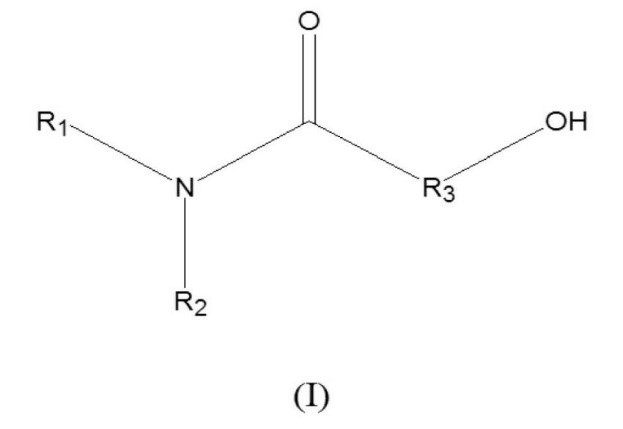
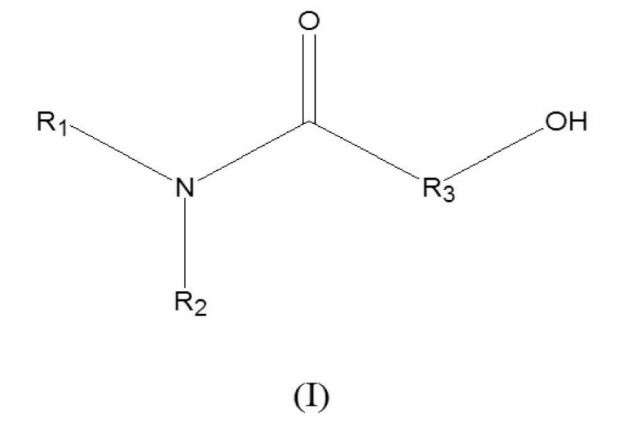
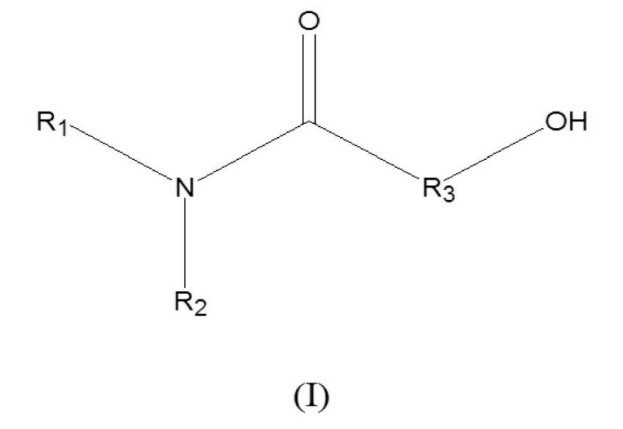
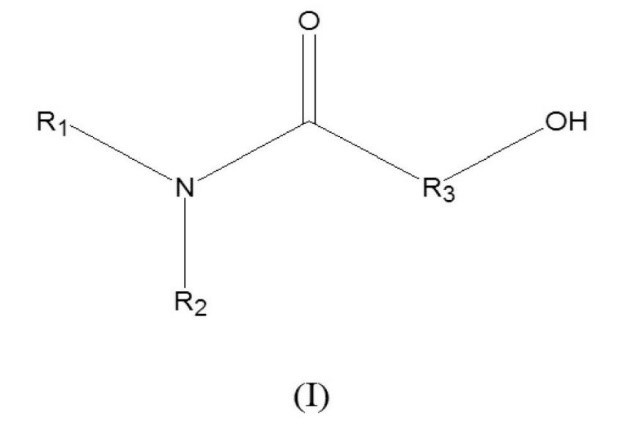
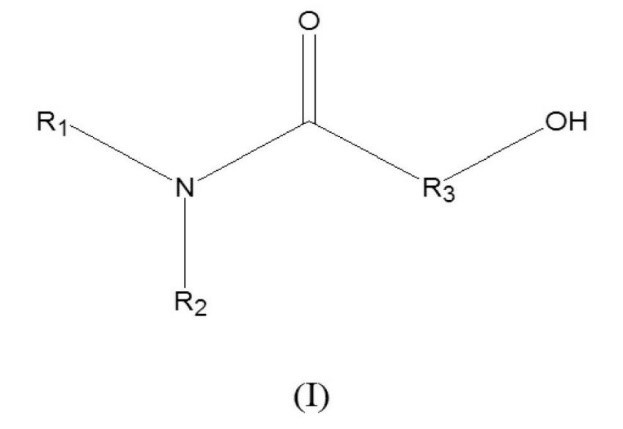
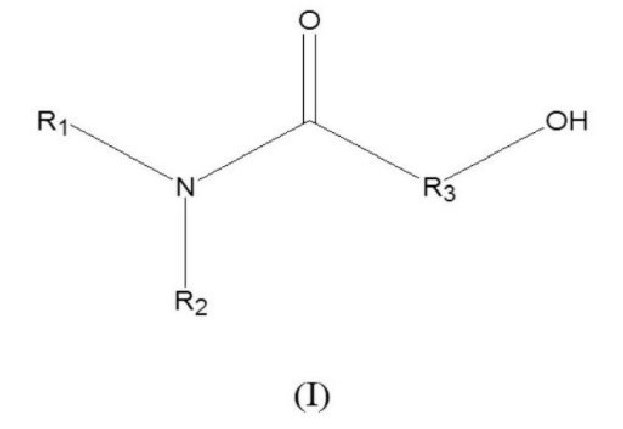
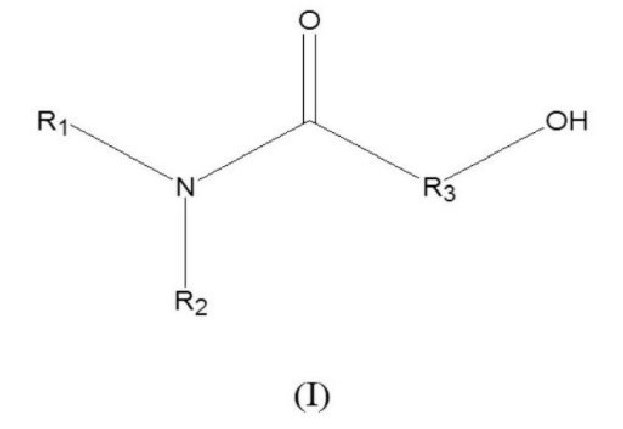
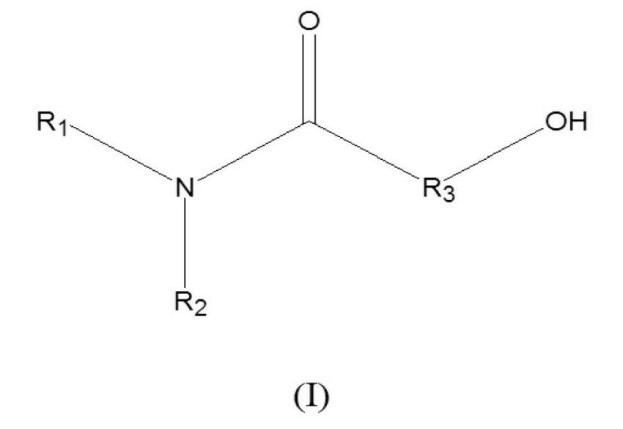
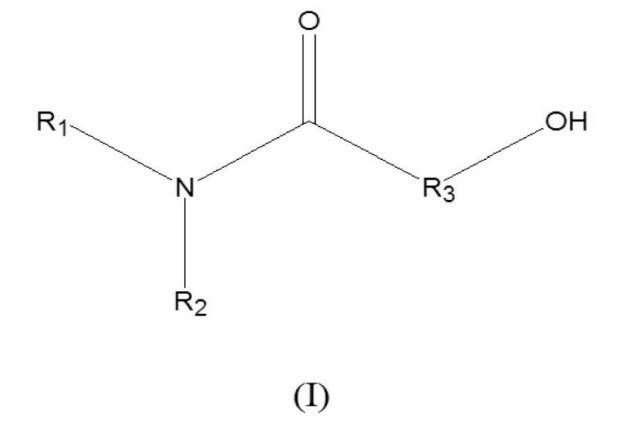
- (1) Formula (I) Where R 1 is a C6-C22 hydrocarbon group, R 2 is H or a C6-C22 hydrocarbon group, R 3 is a linear or branched C2-C21 hydrocarbon group, An emulsified composition comprising an amide alcohol represented by formula (II) and a carboxy group-containing polymer.
- (2) Furthermore, the emulsion composition as described in (1) containing 1 or more types of polyhydric alcohol.
- (3) The emulsion composition according to (2), wherein the polyhydric alcohol is pentylene glycol and / or 2-ethyl-1,3-hexanediol.
- the present invention relates to the following [1] to [21].
- [1] Formula (I) Where R 1 is a C6-C22 hydrocarbon group, R 2 is H or a C6-C22 hydrocarbon group, R 3 is a linear or branched C2-C21 hydrocarbon group,
- the manufacturing method of a W / O type emulsion which mixes the oil phase containing amide alcohol represented by these, and the water phase containing a carboxy-group containing polymer.
- the method according to [1] comprising neutralizing by adding a neutralizing agent.
- [3] The method according to [2], wherein the water phase is neutralized by adding a neutralizing agent, and the water phase and the oil phase are mixed.
- R 1 is a C6-C22 hydrocarbon group
- R 2 is H or a C6-C22 hydrocarbon group
- R 3 is a linear or branched C2-C21 hydrocarbon group
- R 1 is a C6-C22 hydrocarbon group
- R 2 is H or a C6-C22 hydrocarbon group
- R 3 is a linear or branched C2-C21 hydrocarbon group
- R 1 is a C6-C22 hydrocarbon group
- R 2 is H or a C6-C22 hydrocarbon group
- R 3 is a linear or branched C2-C21 hydrocarbon group
- R 1 is a C6-C22 hydrocarbon group
- R 2 is H or a C6-C22 hydrocarbon group
- R 3 is a linear or branched C2-C21 hydrocarbon group
- the present invention further relates to [A1] to [A7].
- [A1] Carboxy group-containing polymer, formula (I) Where R 1 is a C6-C22 hydrocarbon group, R 2 is H or a C6-C22 hydrocarbon group, R 3 is a linear or branched C2-C21 hydrocarbon group, The O / W type emulsion composition containing the amide alcohol represented by these, and 1 or more types of polyhydric alcohol.
- [A3] The O / W emulsion composition according to [A1] or [A2], wherein the polyhydric alcohol is a diol.
- [A4] The O / W emulsion composition according to any one of [A1] to [A3], wherein the polyhydric alcohol is pentylene glycol and / or 2-ethyl-1,3-hexanediol.
- [A5] The O / W emulsion composition according to any one of [A1] to [A4], further comprising a higher fatty acid.
- the present invention provides novel compositions and novel composites that can be used as emulsifiers.
- the agent and complex of the present invention exhibit water-in-oil type or oil-in-water type emulsifying power.
- a water-in-oil type or an oil-in-water type emulsion that exhibits high emulsifying power by hydrogen bonding of a polyhydric alcohol with a carboxy group-containing polymer, amide alcohol, and higher fatty acid, and has excellent stability.
- the present invention can provide a stable water-in-oil type or oil-in-water type emulsion without using a surfactant.
- the present invention can provide a water-in-oil type or water-in-oil type emulsion that is excellent in use feeling and can be used as a cosmetic.
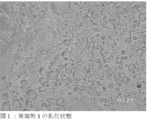
- FIG. 1 is a diagram showing an emulsified state of Example 1.
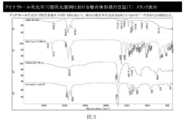
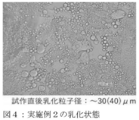
- FIG. It is a figure which shows the FT-IR measurement result of an amide alcohol, a carboxy group containing polymer, isostearic acid, and a combination preparation. It is the figure which accumulated each FT-IR measurement result. It is a figure which shows the emulsified state of Example 2.
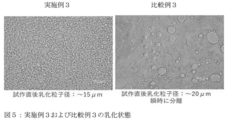
- FIG. It is a figure which shows the emulsified state of Example 3 and Comparative Example 3.
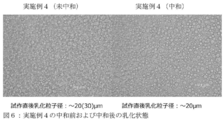
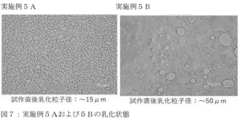
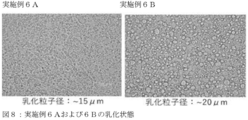
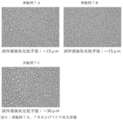
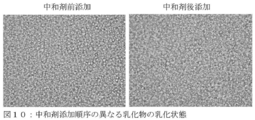
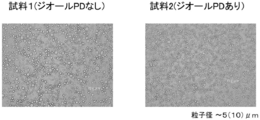
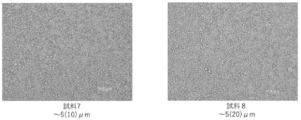
- Example 15 It is a figure which shows the emulsification state before neutralization of Example 4 and after neutralization. It is a figure which shows the emulsified state of Example 5A and 5B. It is a figure which shows the emulsified state of Example 6A and 6B. It is a figure which shows the emulsified state of Example 7A, 7B, and 7C. It is a figure which shows the emulsified state of Example 8A (pre-addition) and Example 8B (post-addition). It is a figure which shows the result of Example 15. It is a figure which shows the result of Example 16. It is a figure which shows the result of Example 17. It is a figure which shows the result of Example 18.
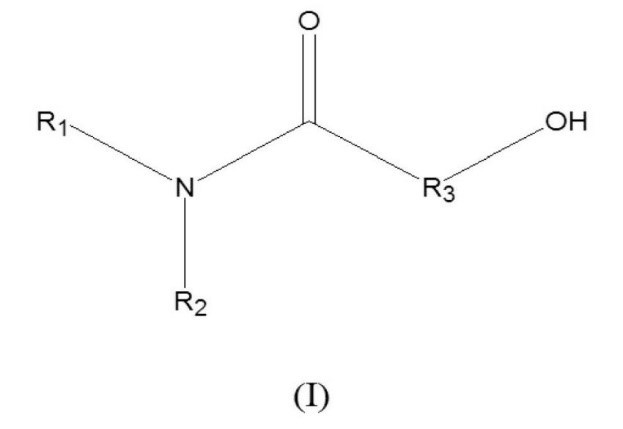
- the amide alcohol used in the present invention is represented by the following formula (I): In the formula R 1 is a C6-C22 hydrocarbon group, R 2 is H or a C6-C22 hydrocarbon group, R 3 is a linear or branched C2-C21 hydrocarbon group.
- amide alcohol of formula (I) wherein R 1 is a C10-C22 hydrocarbon group, R 2 is H, and R 3 is a C3-C12 hydrocarbon group
- R 1 is a C12-18 hydrocarbon group
- R 2 is H
- R 3 is a C3-C5 hydrocarbon group
- R 1 is a linear or branched unsaturated C10-C22 hydrocarbon group; or a cyclic C6-C22 hydrocarbon group; or a benzyl group or a phenylethyl group
- the amido alcohol of I) is preferred.
- the amide alcohol of formula (I) has a structure of the following formulas (I-1) to (I-4):
- the “hydrocarbon group” may be saturated or unsaturated, linear, branched or cyclic, or a linear or branched and cyclic combination, for example, A hydrocarbon group composed of a linear or branched hydrocarbon moiety such as a benzyl group or a phenylethyl group and a cyclic hydrocarbon moiety is included. That is, the C6-C22 hydrocarbon group in R 1 and R 2 is composed of a linear, branched or cyclic C6-C22 hydrocarbon group, or a linear or branched hydrocarbon moiety and a cyclic hydrocarbon moiety.
- Examples include C6-C22 hydrocarbon groups such as cyclohexyl, decahydronaphthyl, tetrahydrodicyclopentadiene, sterol, phenyl, naphthyl, anthracenyl and the like, branched alkyl groups such as ethylhexyl, isostearyl, octyldodecyl, and dimethyl And a branched alkyl group such as trimethyl and tetramethyl, a linear alkyl group such as hexyl, octyl, lauryl, myristyl, cetyl, stearyl, aralkyl and behenyl, and an alkenyl group such as oleyl and elaidyl.
- C6-C22 hydrocarbon groups such as cyclohexyl, decahydronaphthyl, tetrahydrodicyclopentadiene, ste
- R 1 is preferably cyclohexyl, ethylhexyl, octyl, lauryl, myristyl, stearyl, oleyl, benzyl or phenylethyl, particularly preferably lauryl and oleyl.
- R 2 is preferably H.
- the hydrocarbon group in R 3 is a linear or branched C2-C21 hydrocarbon group having no cyclic structure, and examples thereof include alkyl groups such as propyl, butyl, pentyl, hexyl, heptyl, octyl, ethylhexyl, butylene Alkenyl groups such as pentylene, hexylene and heptylene.
- R 3 is preferably propylene, butylene, pentylene or hexylene.
- Amide alcohols can be produced using known synthetic methods. For example, Aminolysis reaction between acid chloride and amine (Schotten-Baumann reaction), Aminolysis reaction of anhydrous fatty acid and amine, Aminolysis reaction of methyl ester and amine, Aminolysis of fatty acids and amines, Aminolysis reaction of lactone and amine, Etc. Specifically, for example, it can be synthesized by the method described in Japanese Patent Application No. 2016-114276.
- the carboxy group-containing polymer that can be used in the present invention is not particularly limited as long as it is a polymer having a carboxy group in the molecule, but typically has a weight average molecular weight of 500,000- A polymer having a molecular weight of 3 million and a polymer having a carboxy group content in the molecular weight of about 50 to 70% is preferable.
- “The carboxy group content in the molecular weight is 50 to 70%” means that 50 to 70% of carboxy groups are present in the unit portion of the repeating unit portion that is supposed to contain a carboxy group in the basic skeleton of the polymer. Means.
- the carboxy group-containing polymer becomes water-soluble by neutralization with an alkaline substance, and is generally used as a thickener.
- carboxy group-containing polymer examples include carboxyvinyl polymer, alkyl-modified carboxyvinyl polymer such as acrylic acid / alkyl methacrylate copolymer, alkyl acrylate / alkyl methacrylate polyoxyethylene ester copolymer, alkyl acrylate. -Itaconic acid alkylpolyoxyethylene ester copolymer, stearless-10 allyl ether / acrylic acid copolymer such as alkyl acrylate copolymer, and non-acrylic polymer such as methyl vinyl ether / maleic anhydride / decadiene copolymer .
- carboxy group-containing polymer a carboxyvinyl polymer and an alkyl-modified carboxyvinyl polymer are particularly preferable.
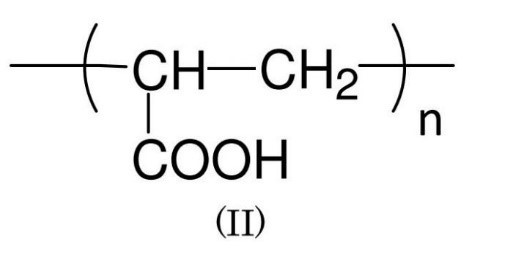
- the carboxyvinyl polymer is also called a carbomer (INCI name: Carbomer), and is a polymer having a structure represented by the following formula (II): Where n is an integer, typically 40 to 100.
- Acritamer 934 (Rita Corporation) Acritamer 940 (Rita Corporation) Acritamer 941 (Rita Corporation) Acritamer 990 (Rita Corporation) Acritamer 501E (Rita Corporation) Acritamer 504E (Rita Corporation) Acritamer 505E (Rita Corporation) AEC Carbomer 940 (A & E Connock (Perfumery & Cosmetics) Ltd.) Aqupec HV-501 (Sumitomo Seika Chemicals Co., Ltd.) Aqupec HV-504 (Sumitomo Seika Chemicals Co., Ltd.) Aqupec HV-505 (Sumitomo Seika Chemicals Co., Ltd.) Aqupec HV-501E (Sumitomo Seika Chemicals Co., Ltd.) Aqupec HV-504E (Sumitomo Seika Chemicals Co., Ltd.) Aqupec HV-505E (Sumitomomo
- Carbopol Clear Polymer (Lubrizol Advanced Materials, Inc.) Carbopol ETD 2050 Polymer (Lubrizol Advanced Materials, Inc.) Carbopol 934 Polymer (Lubrizol Advanced Materials, Inc.) Carbopol 940 Polymer (Lubrizol Advanced Materials, Inc.) Carbopol 941 Polymer (Lubrizol Advanced Materials, Inc.) Carbopol 980 Polymer (Lubrizol Advanced Materials, Inc.) Carbopol 981 Polymer (Lubrizol Advanced Materials, Inc.) Carbopol 2984 Polymer (Lubrizol Advanced Materials, Inc.) Carbopol 5984 Polymer (Lubrizol Advanced Materials, Inc.) Carbopol Ultrez 10 Polymer (Lubrizol Advanced Materials, Inc.) Carbopol Ultrez 30 Polymer (Lubrizol Advanced Materials, Inc.) CustoPoly J 100 (Custom Ingredients, Inc.) CustoPoly J 300 (Custom Ingredients, Inc.) CustoPoly J 400 (Custom
- the alkyl-modified carboxyvinyl polymer is a copolymer of acrylic acid and / or methacrylic acid and their alkyl acrylate and / or alkyl methacrylate.
- Acritamer 501ED (Rita Corporation) Acritamer 505ED (Rita Corporation) Aqupec HV-701EDR (Sumitomo Seika Chemicals Co., Ltd.) Aqupec HV-501ER (Sumitomo Seika Chemicals Co., Ltd.) Aqupec SER W-150C (Sumitomo Seika Chemicals Co., Ltd.) Aqupec SER W-300C (Sumitomo Seika Chemicals Co., Ltd.) Carbopol ETD 2020 Polymer (Lubrizol Advanced Materials, Inc.) Carbopol 1342 Polymer (Lubrizol Advanced Materials, Inc.) Carbopol 1382 Polymer (Lubrizol Advanced Materials, Inc.) Carbopol SC 200 (Lubrizol Advanced Materials, Inc.) Carbopol SC 500 Polymer (Lubrizol Advanced Materials, Inc.) Carbopol Ultrez 20 Polymer (Lubrizol Advanced Materials, Inc.) Carbopol Ultrez 20
- the polyhydric alcohol used in the present invention is not particularly limited as long as it is a compound having a plurality of hydroxy groups in the molecule, but is typically carbon from the viewpoint of providing appropriate emulsifying ability.
- the number of hydroxy groups in the polyhydric alcohol molecule is 2 to 4, preferably 2.
- polyhydric alcohol examples include, for example, pentylene glycol, 2-ethyl-1,3-hexanediol, 1,2-pentanediol, 1,3-butylene glycol, propane-1,2,3-triol, Examples include propane, 1,2-diol, 1,2-octanediol, 1,2-hexanediol, and the like, preferably pentylene glycol and 2-ethyl-1,3-hexanediol.
- Polyhydric alcohols can be used alone or in combination of two or more.
- the content of the polyhydric alcohol is 0.1 to 20% by weight, preferably 1.0 to 15% by weight, and most preferably 3.0 to 10% by weight.
- the polyhydric alcohol can be expected to contribute to improving the emulsifying power by stabilizing the complex by hydrogen bonding with the amide alcohol, the carboxy group-containing polymer, and / or the higher fatty acid.
- the higher fatty acid used in the present invention is not particularly limited as long as it is a component generally used in cosmetics and the like.
- the general formula (G) R 3 COOH (G) R 3 is a linear or branched, saturated or unsaturated hydrocarbon having an average carbon number of 7 to 25 and having a hydroxyl group.
- the higher fatty acid represented by these is mentioned, These can be used individually or in combination of 2 or more types.
- R 3 is preferably a linear or branched higher fatty acid having an average carbon number of 11 to 21.
- saturated fatty acids such as lauric acid, myristic acid, palmitic acid, stearic acid, arachidic acid, and behenic acid; 2-palmitoleic acid, petrothelic acid, oleic acid, elaidic acid, ricinoleic acid, linoleic acid, linoelaidic acid And unsaturated fatty acids such as linolenic acid and arachidonic acid, branched fatty acids such as isostearic acid, and hydroxycarboxylic acids such as 12-hydroxystearic acid.
- saturated fatty acids such as lauric acid, myristic acid, palmitic acid, stearic acid, arachidic acid, and behenic acid
- 2-palmitoleic acid petrothelic acid
- oleic acid elaidic acid
- ricinoleic acid ricinoleic acid
- linoleic acid linoelaidic acid
- unsaturated fatty acids such
- a saturated fatty acid having 18 carbon atoms is preferable, among them, one having a branch is preferable, and a saturated fatty acid having 18 carbon atoms having a methyl branch is more preferable.
- Commercially available products include, for example, isostearic acid (trade name: isostearic acid EX, HAIMARIC-MKH (R), manufactured by Higher Alcohol Industry Co., Ltd.), SR PRISMINE 3505 (manufactured by Croda Japan), isostearic acid, isostearic acid T (Nissan) Chemical Industry Co., Ltd.).
- “complex” means a complex formed by an amide alcohol and at least one selected from the group consisting of a carboxy group-containing polymer, a polyhydric alcohol, and a higher fatty acid.
- the composite can be formed by adding a carboxy group-containing polymer to the oil phase part containing amide alcohol and higher fatty acid, and further by neutralizing with an alkali. A complex with high emulsifying power can be formed.
- the composite in the W / O type emulsion, is obtained by adding a water phase part containing a carboxy group-containing polymer and an alkali to an oil phase part containing an amide alcohol and a higher fatty acid, Can be formed.
- the composite is prepared by adding an oil phase containing an amide alcohol and a higher fatty acid to an aqueous phase containing a carboxy group-containing polymer and a polyhydric alcohol, and then neutralizing with an alkali.
- a complex with higher emulsifying power can be formed.
- the amide bond part of the amide alcohol and the carbonyl group of the polymer and higher fatty acid form a hydrogen bond, and a part of the carboxy group becomes COO 2 ⁇ and has hydrophilicity, so It is thought that it demonstrates.
- the amide bond portion of the amide alcohol, the hydroxy group of the polyhydric alcohol, the carboxy group-containing polymer and the carboxy group of the higher fatty acid form a hydrogen bond, and a part of the carboxy group COO - by having a next hydrophilic believed to exert emulsifying capacity.
- the complex of the present invention has a structure in which the amide bond part of the amide alcohol is bonded to the carbonyl group of the polymer and the carbonyl group of the higher fatty acid, or the amide bond part of the amide alcohol,
- the amide bond part of the amide alcohol is bonded to the carbonyl group of the polymer and the carbonyl group of the higher fatty acid, or the amide bond part of the amide alcohol
- a partner one or more selected from the group consisting of a hydroxy group of a polyhydric alcohol, a carbonyl group of a carboxy group-containing polymer and a carboxy group of a higher fatty acid is bonded, more specifically, a hydrogen bond is formed to form a complex. it seems to do.
- the “emulsion” means both a W / O type emulsion and an O / W type emulsion unless otherwise specified.
- the “W / O type emulsion” is a water-in-oil type emulsion, that is, an emulsion in which an aqueous component is dispersed in a continuous phase containing an oily component.
- the W / O emulsion can be prepared by dispersing an aqueous phase containing a carboxy group-containing polymer in an oil phase containing amide alcohol and neutralizing with an alkali.
- the “O / W emulsion” is an oil-in-water emulsion, that is, an emulsion in which an oil component is dispersed in a continuous phase containing an aqueous component.
- the O / W emulsion can be prepared by dispersing an oil phase containing amide alcohol in an aqueous phase containing a carboxy group-containing polymer and neutralizing with an alkali.
- the emulsion can be used for any application, but can be typically used for external preparations such as pharmaceuticals, quasi drugs, and cosmetics.
- the emulsion of the present invention is a pharmaceutical product such as a skin external preparation containing a drug; a quasi-drug product such as a medicated cosmetic; a skin care cosmetic product such as a gel lotion, milky lotion, cream, serum, sunscreen, daytime moisturizer, etc.
- a pharmaceutical product such as a skin external preparation containing a drug
- a quasi-drug product such as a medicated cosmetic
- a skin care cosmetic product such as a gel lotion, milky lotion, cream, serum, sunscreen, daytime moisturizer, etc.
- Cosmetics such as foundations, makeup bases, eye shadows and mascaras
- hair care cosmetics such as hair treatments.
- the oily component used in the emulsion of the present invention is not particularly limited as long as it is a component generally used in cosmetics and the like. Examples thereof include animal and vegetable oils, hydrocarbon oils, higher fatty acids, higher alcohols, ester oils, silicones. Oil agents such as oil can be mentioned, and these can be used alone or in combination of two or more.
- Animal and vegetable oils or hydrogenated animal and vegetable oils include, for example, avocado oil, eno oil, olive oil, cacao butter, kaya oil, kyounin oil, hydrogenated oil, wheat germ oil, sesame oil, rice germ oil, rice bran oil, sugar cane wax, southern oil , Safflower oil, shea butter, cinnamon oil, cinnamon oil, soybean oil, tea seed oil, camellia oil, evening primrose oil, corn oil, rapeseed oil, germ oil, palm oil, palm kernel oil, castor oil, hydrogenated castor oil, Sunflower oil, grape oil, jojoba oil, macadamia nut oil, beeswax, cottonseed oil, cotton wax, owl, montan wax, coconut oil, hydrogenated coconut oil, peanut oil, lanolin, liquid lanolin, reduced lanolin, lanolin alcohol, hard lanolin, lanolin acetate, Examples include lanolin fatty acid isopropyl and hexyl laurate.
- hydrocarbon oils examples include ozokerite, squalane, squalene, ceresin, paraffin, isoparaffin, paraffin wax, liquid paraffin (mineral oil), pristane, polyisobutylene, polyisobutene, hydrogenated polyisobutene, microcrystalline wax, polyethylene wax, and petroleum jelly. Is mentioned.
- Examples of the higher fatty acid include lauric acid, myristic acid, palmitic acid, stearic acid, isostearic acid, oleic acid, behenic acid, undecylenic acid, oleic acid, linoleic acid, linolenic acid, arachidonic acid, eicosapentaenoic acid (EPA), Examples thereof include docosahexaenoic acid (DHA).
- Examples of the higher alcohol include myristyl alcohol, cetanol, stearyl alcohol, arachidyl alcohol, behenyl alcohol, hydrogenated rapeseed oil alcohol, and the like.
- ester oils include, for example, isononanoic acid isononanoate, isononanoic acid isononyl ester, isononanoic acid isodecyl, isononanoic acid isotridecyl, isononanoic acid tricyclodecane methyl, isononanoic acid ethylhexyl, etc.
- Palmitate ester isopropyl palmitate Other examples include octyldodecyl neodecanoate, octyldodecyl ricinoleate, oleyl erucate, octyldodecyl erucate, lauroyl sarcosine isopropyl, and the like.
- Diester oils include diisobutyl adipate, diisopropyl adipate, diethylhexyl succinate, neopentyl glycol diisononanoate, neopentyl glycol diethylhexanoate, neopentyl glycol dicaprate, diisostearyl malate, diisopropyl dilinoleate, ethylene dioctanoate Glycol, stearoyloxystearate octyldodecyl, diisopropyl sebacate, lauroylglutamate di (cholesteryl / octyldodecyl), lauroylglutamate di (phytosteryl / octyldodecyl), and the like.
- Examples of the triester oil include triethylhexanoin, triethylhexanoic acid trimethylolpropane, tri (caprylic acid / capric acid) glyceryl, triisostearin, triisostearic acid trimethylolpropane, and the like.
- Examples of the tetraester oil include pentaerythrityl tetraethylhexanoate and pentaerythrityl tetraisostearate.
- polyester oil examples include polyglyceryl fatty acid esters such as polyglyceryl-2 isostearate, polyglyceryl-2 diisostearate, polyglyceryl-2 triisostearate, and polyglyceryl-2 tetraisostearate.
- High viscosity ester oils include isostearic acid hydrogenated castor oil, dimer dilinoleic acid hydrogenated castor oil, (polyglyceryl-2 isostearate / dimer dilinoleic acid) copolymer, dimer dilinoleic acid (phytosteryl / isostearyl / cetyl / Stearyl / behenyl), dimer dilinoleic acid dimer dilinoleyl bis (phytosteryl / behenyl / isostearyl), dimer dilinoleic acid di (isostearyl / phytosteryl), dimer dilinoleyl hydrogenated rosin condensate, diiso stearic acid dimer dilino Rail, dimer dilinoleate dimer dilinoleyl, lauroyl glutamate di (cholesteryl / behenyl / octyldodecy
- silicone oil examples include dimethylpolysiloxane, methylphenylpolysiloxane, alkyl-modified organopolysiloxane, terminal-modified organopolysiloxane, fluorine-modified organopolysiloxane, amodimethicone, amino-modified organopolysiloxane, volatile silicone, alkyl dimethicone, cyclohexane. Examples include pentasiloxane.
- the blending amount of the oil component in the W / O emulsion is not particularly limited, but is 30.0 to 80.0% by mass, preferably 40.0 to 70.0% from the viewpoint of usability. It may be 5% by mass, more preferably 50.0-60.0% by mass. In one embodiment of the present invention, the blending amount of the oil component in the O / W emulsion is not particularly limited, but from the viewpoint of usability, it is 1.0 to 40.0% by mass, preferably 3.0 to 30.0. It may be mass%, more preferably 5.0-20.0 mass%.
- the ratio of nonpolar oils, such as hydrocarbon oil and silicone oil, in an oil-based component is high from a viewpoint of providing a stable emulsion for a long term.
- the mass ratio of nonpolar oil / (nonpolar oil + polar oil) preferably exceeds 0.5.
- the aqueous component used in the mold emulsion of the present invention is not particularly limited as long as it is a component generally used in cosmetics and the like. Examples thereof include water such as purified water and ion-exchanged water; BG (1,3- Butylene glycol), PG (propylene glycol), lower alcohols such as glycerin and ethanol, and the like. These can be used alone or in combination of two or more.
- the blending amount of the aqueous component in the W / O emulsion is not particularly limited, but is 10.0 to 70.0% by mass, preferably 15.0 to 65.0 from the viewpoint of usability.
- the mass may be 20.0 mass%, more preferably 20.0-60.0 mass%.
- the amount of the aqueous component in the O / W emulsion is not particularly limited, but is 50.0 to 90.0% by mass, preferably 55.0 to 85.0, from the viewpoint of usability. It may be mass%, more preferably 60.0-80.0 mass%.
- the neutralizing agent used for the preparation of the emulsion of the present invention is not particularly limited as long as it is an alkaline component generally used in cosmetics and the like. Examples thereof include potassium hydroxide, triethanolamine, sodium hydroxide, Examples thereof include basic amino acids such as L-arginine and L-lysine, and 2-amino-2-methyl-1-propanol, and these can be used alone or in combination of two or more.
- the blending amount of the neutralizing agent can be appropriately selected depending on the type of the neutralizing agent and the composition of the whole emulsion, but is typically about 0.01 to 1.0% by mass.
- the neutralizing agent may be an active ingredient such as tranexamic acid or carnosine.
- the “surfactant” means a compound having both a hydrophilic group and a hydrophobic group in one molecule, and can be appropriately added to an emulsion as necessary.
- the emulsion preferably does not substantially contain a surfactant. Thereby, an emulsifier with less irritation can be provided.
- substantially free means that the surfactant is not contained in an amount sufficient for emulsification of the entire emulsion.
- substantially free of surfactant means that the surfactant is not contained at all or is contained in an amount that does not emulsify.
- the amount that is not emulsified can be appropriately determined by those skilled in the art according to the composition.
- the amount is less than 2.0% by weight, and in another embodiment, less than 0.2% by weight. It may be less than 02% by mass.
- the conditioning composition is an emulsion composition that is substantially free of surfactants such as cationic surfactants.
- the emulsion of the present invention may contain all components used for cosmetics and the like in external preparations such as cosmetics.
- additional ingredients include UV absorbers such as ethylhexyl methoxycinnamate and hexyl diethylaminohydroxybenzoyl benzoate; thickeners and gelling agents such as dextrin palmitate and xanthan gum; qualities such as antioxidants and preservatives Retaining ingredients; emollients; medicinal and active ingredients such as whitening agents, anti-wrinkle agents and antioxidants; and coloring agents such as fragrances, pigments and pigments.
- UV absorbers such as ethylhexyl methoxycinnamate and hexyl diethylaminohydroxybenzoyl benzoate
- thickeners and gelling agents such as dextrin palmitate and xanthan gum
- qualities such as antioxidants and preservatives Retaining ingredients
- emollients medicinal and active ingredients such as
- the outer oil layer is oil-gelled with an oil gelling agent
- the inner oil layer is oil-gelled with an oil gelling agent.
- Oil gel can be made.
- an organically modified clay mineral and / or a polymer ester of sugar and fatty acid can be used as a component used for oil gelation.
- the organically modified clay mineral used in the preparation of the emulsion of the present invention and the polymer ester of sugar and fatty acid are not particularly limited as long as they are components generally used in cosmetics and the like.
- organically modified clay mineral examples include a convertible cation interposed between crystal layers of a water-swellable clay mineral (for example, montmorillonite, saponite, hectorite, bentonite, etc.), an organic polar compound or an organic cation (for example, a quaternary ammonium salt type). And those substituted with a cationic surfactant).
- a water-swellable clay mineral for example, montmorillonite, saponite, hectorite, bentonite, etc.
- an organic polar compound or an organic cation for example, a quaternary ammonium salt type
- BENTONE 27V stearalkonium hectorite
- BENTONE 27VCG stearalkonium hectorite
- BENTONE 38V diseardimonium hectorite
- BENTONE 38VCG diseardimonium hectorite
- the organically modified clay mineral is also commercially available as a premix product dissolved in silicone oil, ester oil and / or other oils, and the premix may be used in the present invention.
- BENTONE GEL 1002V cyclopentasiloxane, disteardimonium hectorite, propylene carbonate
- BENTONE GEL ABO V cranbeavicinica seed oil, stearalkonium hectorite, propylene carbonate
- BENTONE GEL CAO V (castor oil, steer) Larconium hectorite, propylene carbonate
- BENTONE GEL EUG V octyldodecanol, disteardimonium hectorite, propylene carbonate
- BENTONE GTCC V tri (caprylic acid / capric acid) glyceryl, stearalkonium hectorite, carbonic acid Propylene
- BENTONE HSO V tri (caprylic acid / capric
- the blending amount of the organically modified clay mineral in the W / O emulsion can be appropriately adjusted depending on the type and amount of the oil component and the viscosity required for the emulsion, and is not particularly limited, but is 0.5-8. It may be 0% by mass, preferably 0.7-6.0% by mass, more preferably 1.0-5.0% by mass.
- the blending amount of the organically modified clay mineral in the O / W emulsion can be appropriately adjusted according to the type and amount of the oil component and the viscosity required for the emulsion, and is not particularly limited. It may be 0% by mass, preferably 0.1-2.0% by mass, more preferably 0.1-1.0% by mass.
- Examples of the polymer ester based on sugar and fatty acid include those marketed by Chiba Flour Milling Co., Ltd. under the following trade names.
- Lion KL (dextrin palmitate), Leopard TL2 (dextrin palmitate), Leopard MKL (dextrin myristic acid),
- Lion TT2 [(palmitic acid / ethylhexanoic acid dextrin)]
- Lion WX [(palmitic acid / hexyldecanoic acid) dextrin ]
- Leopard ISL2 inulin stearate
- Leopard ISK2 (inulin stearate).
- the blending amount of the high-molecular ester based on sugar and fatty acid in the W / O emulsion can be appropriately adjusted depending on the type and amount of the oil component and the viscosity required for the emulsion, and is not particularly limited. It can be ⁇ 8.0 mass%, preferably 0.7 to 6.0 mass%, more preferably 1.0 to 5.0 mass%.
- the blending amount of the polymer ester of sugar and fatty acid in the O / W emulsion can be appropriately adjusted depending on the type and amount of the oil component and the viscosity required for the emulsion, and is not particularly limited. It can be -3.0 mass%, preferably 0.1-2.0 mass%, more preferably 0.1-1.0 mass%.
- the emulsifiability as an emulsion can be further improved by blending a polyhydric alcohol such as pentylene glycol or octylene glycol.
- a polyhydric alcohol such as pentylene glycol or octylene glycol.
- the improvement of emulsification by blending polyhydric alcohol is due to the formation of a complex by hydrogen bonding between the hydroxyl group in the polyhydric alcohol molecule and the amide bond carbonyl group in the amide alcohol molecule. It is thought that.
- the present invention also provides a complex formed from an amide alcohol, a carboxy group-containing polymer, a higher fatty acid, and a polyhydric alcohol.
- Pentylene glycol has a moisturizing action and an antibacterial action, and can be said to be a preferred component for using the emulsion as an external preparation such as cosmetics.
- pentylene glycol is commercially available under the following trade name. Examples include Diol PD (manufactured by Higher Alcohol Industry Co., Ltd.) and Diol PD-V (manufactured by Higher Alcohol Industry Co., Ltd.).
- Diol PD manufactured by Higher Alcohol Industry Co., Ltd.
- Diol PD-V manufactured by Higher Alcohol Industry Co., Ltd.
- octylene glycol specifically, it is marketed with the following brand names. Audio Eight (manufactured by Kogyo Co., Ltd.).
- the blending amount of the component (A) in the emulsion can be appropriately selected depending on the type and amount of the oil used, the required viscosity, etc., but is typically 0.1 to 15.0% by mass. Yes, preferably 0.5 to 10.0% by mass, and more preferably 1.0 to 8.0% by mass.
- the amount of component (B) in the emulsion can be appropriately selected depending on the type and amount of the oil used, the viscosity required for the emulsion composition, etc., but typically 0.01-5. It is 0% by mass, preferably 0.05 to 3.0% by mass, and more preferably 0.1 to 2.0% by mass. By setting it as the said compounding quantity, it will be sufficient quantity to obtain the emulsification composition with favorable usability and stability of the composite_body
- higher fatty acids may be added to the emulsion.
- the blending amount of the higher fatty acid can be appropriately selected depending on the type and amount of the oil used, the required viscosity, and the like, but typically 0.1 to 7. 0% by mass, more preferably 0.5 to 5.0% by mass, and typically in an O / W emulsion, 0.1 to 3.0% by mass, more preferably 0.1 to 2%. 0.0% by mass. Suitable for obtaining an emulsified composition having good usability and stability of a water-in-oil type composite of the amide alcohol, carboxy group-containing polymer, and higher fatty acid in the present invention by using the above blending amount. Amount.
- the pH of the emulsion of the present invention can be appropriately selected, but in the case of a W / O type emulsion, the pH is preferably about 5.0 to 10.0, and preferably about 5.0 to 8.0. More preferably, in the case of an O / W emulsion, the pH is preferably about 5.0 to 8.0, and more preferably about 5.0 to 7.0. Without being bound by any theory, by setting the pH within this range, Component A and Component B (and higher fatty acids) will be appropriately hydrogen bonded to form a complex, and the dissociation of the carboxy group will be moderate. It is thought that excellent emulsifying ability is brought about.
- the viscosity of the emulsion of the present invention can be appropriately selected depending on the properties of the target product.
- the viscosity is preferably higher than 10,000 mP ⁇ s from the viewpoint of obtaining a creamy emulsion, and from the viewpoint of obtaining an emulsion in the form of an emulsion, about 300 to 100,000 mP ⁇ s. It is preferable to have a viscosity of In one embodiment of the present invention, from the viewpoint of using the emulsion as a cosmetic, the viscosity of the emulsion can be appropriately selected within the range of 300 to 1,000,000 mP ⁇ s.
- the present invention also provides an agent containing an amide alcohol, a carboxy group-containing polymer, or a higher fatty acid used for emulsification.
- agents can be used in the production of the emulsion.
- ⁇ 30 (50) means that the average is 30 ⁇ m or less, and there are scattered about 50 ⁇ m in places.
- component A an amide alcohol having the following structure (I-4) in which R 1 is unsaturated C18 alkyl (oleyl), R 2 is H, and R 3 is C5 in the formula (I) was used.
- the amide alcohol is also referred to as “amide alcohol OLH”.
- component B PEMULEN TR-2 ((Acrylates / alkyl acrylate (C10-30)) crosspolymer) was used.
- viscosity Two types of SPINDLE, Brookfield viscometer, S63 and S64, were appropriately used according to the viscosity, and the rotational speed was measured at 12 rpm. The viscosity was 942,000 mPa ⁇ s. It can be said that an emulsion having a viscosity suitable for a creamy cosmetic composition or the like can be provided.
- Example 2 In order to observe the emulsion of the basic formulation, a formulation (AMO-54) described in Table 2 below was prepared.
- Amide alcohol, carboxyl group-containing polymer, and isostearic acid were analyzed with a Fourier transform infrared spectrometer (hereinafter referred to as FT-) using an infrared spectrometer (Thermo Fisher Scientific, Nicolet IS10). IR) was measured.
- FT- Fourier transform infrared spectrometer
- IR infrared spectrometer
- FIG. 2 shows the measurement result of the W / O type emulsion composition (Example 2 (AMO-54, dried for 2 weeks at room temperature)), and FIG. 3 shows an enlarged portion of 1300 to 2000 cm ⁇ 1.
- the natural drying of the W / O emulsion composition masks the absorption of the complex formation by OH stretching (3300-2500 cm -1 ), OH deformation (1000-850 cm -1 ) due to water molecules. Therefore, the treatment was performed to eliminate the absorption of water molecules as much as possible.
- the absorption spectrum of the complex is as follows: amide alcohol alone, carboxyl group-containing polymer (trade name: PEMULEN TR-2 Polymer, Lubrizol Advanced Materials, Inc), isostearic acid (trade name: isostearic acid EX, higher alcohol) It can be understood that it is different from those obtained by overlapping those of Kogyo Co., Ltd.).
- amide I near 1530 cm ⁇ 1 (C ⁇ O stretching) and the amide II near 1630 cm ⁇ 1 (NH deformation angle) can be confirmed to shift to the higher wavelength side, while 1700 cm.
- N in the amide bond portion of amide alcohol and the carboxyl group of carbomer form a hydrogen bond and exerts emulsifying ability in both unneutralized and neutralized states.
- the carboxyl group of the alkyl-modified carbomer and isostearic acid is —COOH, at which time it forms a hydrogen bond with the carbonyl group of the amide bond of the amide alcohol, complex is hydrophobic and which gradually neutralized, some of the carboxyl groups COO - dissociated into, regain hydrophilic, as a complex, to have a hydrophobic portion and a hydrophilic portion It is considered that the higher emulsifying ability is exhibited.
- Example 2 containing isostearic acid was a more stable W / O emulsion as compared with Example 1 not containing isostearic acid.
- the emulsified state is shown in FIG. Even when not using isostearic acid, it can be understood that a complex is formed with an amide alcohol and a carboxylic acid-containing polymer, but by using isostearic acid, it is more hydrophilic and has a higher W / O emulsifying ability. It is thought that a complex is formed.
- Example 3 and Comparative formulation 3 were prepared in the same manner as in Example 1, and the emulsified particle size and viscosity were measured. The emulsified state is shown in FIG. In Comparative Example 3 lacking amide alcohol, emulsification was observed immediately after production, but separation proceeded immediately and an emulsion could not be obtained. On the other hand, in Example 3 containing amide alcohol, a long-term stable emulsion was obtained.
- Example 4 Manufacturing method and evaluation
- Example 4 was prepared, and the emulsified particle size and viscosity were measured.
- the emulsified state before and after neutralization is shown in FIG. Emulsification was observed even before the addition of the neutralizing agent, and the addition of the neutralizing agent resulted in a more uniform emulsifying property.
- Example 5A and Example 5B having different compounding ratios of amide alcohol and carboxyl group-containing polymer were prepared, and the emulsion particle size and viscosity were measured.
- the emulsified state is shown in FIG.
- Example 4B having a high ratio of amide alcohol was an emulsion having a larger emulsified particle size compared to Example 4A. From this, it can be understood that increasing the ratio of amide alcohol increases the hydrophobicity, and increasing the ratio of the carboxyl group-containing polymer increases the hydrophilicity.
- Example 6A (containing pentylene glycol) and Example 6B (containing no pentylene glycol) were prepared in the same manner as in Example 1, and the emulsion particle size and viscosity were measured. The emulsified state is shown in FIG. It can be understood that an emulsion exhibiting better emulsifiability can be obtained by blending pentylene glycol.
- Example 7A nonpolar oil only
- Example 7B nonpolar oil + polar oil
- Example 7C nonpolar oil + polar oil
- the final emulsified composition was prepared by stirring and emulsifying the aqueous phase and the oil phase and then neutralizing by adding a neutralizing agent and further stirring.
- a process of adding a neutralizing agent after emulsification (hereinafter referred to as post-addition) and an aqueous phase containing a carboxyl-containing polymer are neutralized with an alkali, and after adding an oil phase to this, stirring and emulsification are performed to obtain an emulsion.
- the difference in emulsified state was examined in the process of preparation (hereinafter referred to as pre-addition).
- the emulsified particle size and viscosity were measured in the same manner as in Example 1.
- the emulsified state is shown in FIG. Although a slight difference was observed in the emulsified state due to the difference in the addition timing of the neutralizing agent, it is understood that a good W / O emulsion can be prepared by any of the pre-addition and post-addition methods.
- ⁇ Production method> (4) to (9) and (12) are uniformly mixed at 80 ° C. (oil phase). On the other hand, (1) to (3), (10), (11) and (14) are uniformly mixed at 80 ° C. (aqueous phase). Stir with a disper while adding the aqueous phase to the oil phase. Next, (13) is added and emulsified. When emulsification was completed, (15) was added and cooled to room temperature to obtain the desired viscosity of 220,000 mPa ⁇ s.
- ⁇ Production method> (1) to (4), (6) to (8), and (11) to (14) are uniformly dispersed at 80 ° C. (oil phase).
- the aqueous phases (5), (9) and (15) are uniformly dissolved and mixed at 80 ° C. and stirred with a disper while being gradually added to the previously prepared oil phase.
- the solution prepared by (9) and a part of (10) is added and emulsified.
- the emulsion is cooled to room temperature to obtain a target W / O emulsified foundation having a viscosity of 450,000 mPa ⁇ s.
- ⁇ Production method> (1) to (7), (27) and (28) are heated to 80 ° C. and mixed uniformly (oil phase). On the other hand, (8) to (26) are uniformly mixed at 80 ° C. (aqueous phase). The aqueous phase is stirred with a disper while being slowly added to the oil phase prepared at 80 ° C. Furthermore, the solution prepared by (26) and a part of (25) is added and emulsified. When the emulsification is completed, the emulsion is cooled to room temperature to obtain a target W / O emulsified emollient cream having a viscosity of 280000 mPa ⁇ s.
- ⁇ Production method> (1) to (8), (21) and (22) are uniformly mixed at 80 ° C. (oil phase). On the other hand, (9) to (20) are heated to 80 ° C. and mixed evenly (the aqueous phase and tranexamic acid have the effect of raising the pH, so it is very stable without the addition of an alkaline agent. The resulting emulsion). The aqueous phase is stirred with a disper while being slowly added to the oil phase prepared at 80 ° C. When the emulsification is completed, the emulsion is cooled to room temperature to obtain a target W / O-type emulsified whitening cream having a viscosity of 254000 mPa ⁇ s.
- formulations of Examples 9 to 11, 13 and 14 can also be prepared by adding a neutralizing agent such as potassium hydroxide, triethanolamine, sodium hydroxide or the like to the aqueous phase.
- a neutralizing agent such as potassium hydroxide, triethanolamine, sodium hydroxide or the like
- Example 15 Comparison of emulsifiability with and without pentylene glycol The emulsifiability of oil-in-water emulsion compositions using pentylene glycol was compared using particle size.
- each raw material used in the examples is as follows: Squalane: Trade name Olive Squalane, manufactured by Higher Alcohol Industry Co., Ltd. Hydrogenated rapeseed oil Alcohol: Trade name: Alcohol No.
- amide alcohol OLH manufactured by Higher Alcohol Industry Co., Ltd . amide alcohol represented by formula (I-4) (manufactured by Higher Alcohol Industry Co., Ltd.) Pentylene glycol: (Brand name: Diol PD, manufactured by Higher Alcohol Industry Co., Ltd.) Glycerin (trade name: Triol VE, manufactured by Higher Alcohol Industry Co., Ltd.) 1,3-butanediol (trade name: High Sugar Cane BG, manufactured by Higher Alcohol Industry Co., Ltd.) Carboxyvinyl polymer (trade name: Carbopol ETD2050 polymer, manufactured by Lubrizol) Preparation method (1) Oil phase and water phase are each uniformly dissolved at 80 ° C (2) Oil phase is added while stirring water phase with agitator (800 rpm) (3) After emulsification, stirring with an agitator (2000 rpm, 3 min) (4) Potassium hydroxide is added and further stirred (2000 rpm, 3 min) (5) Slow cooling to room temperature
- Example 16 Comparison of emulsifiability by content of pentylene glycol
- the preparation method was the same as in Example 14.
- Each raw material having the same name as in Example 15 is the same product as that described in Example 1.
- trade name: High Coal K-230 manufactured by Kaneda Corporation
- Results The results are shown in FIG. It was found that the larger the pentylene glycol content, the smaller the particle size, and in particular, the 5% emulsification rate was improved. From this result, there is a high possibility that diol PD interacts with amide alcohol.
- Example 17 Comparison of emulsifiability by type of polyhydric alcohol
- the preparation method was the same as in Example 14.
- Each raw material having the same name as Example 15 or 16 is the same product as that described in Example 14 or 15.
- Example 18 Example of emulsifying effect of higher fatty acid (Manufacturing method) The manufacturing method is the same as that described above. Results: The results are shown in FIG.
- This invention can provide the composite_body
Landscapes
- Health & Medical Sciences (AREA)
- Life Sciences & Earth Sciences (AREA)
- Veterinary Medicine (AREA)
- Animal Behavior & Ethology (AREA)
- General Health & Medical Sciences (AREA)
- Public Health (AREA)
- Birds (AREA)
- Epidemiology (AREA)
- Chemical & Material Sciences (AREA)
- Emergency Medicine (AREA)
- Oil, Petroleum & Natural Gas (AREA)
- Dispersion Chemistry (AREA)
- Dermatology (AREA)
- Inorganic Chemistry (AREA)
- Cosmetics (AREA)
Abstract
本発明は、乳化剤として用いることができる新規複合体、または乳化組成物を提供することを目的とする。 アミドアルコールと、カルボキシ基含有高分子とが結合してなる複合体は、油中水型または水中油型の乳化力を発揮する。
Description
本発明は、乳化特性を有する新規複合体、油中水型乳化組成物および水中油型組成物に関する。
従来より、化粧料の乳化組成物としては、各種の油性および水性の原料を乳化したクリーム、乳液、美容液などが広く用いられている。このような乳化組成物の製造にあたっては、厳密に設定した各種条件のもとに、原料を処理するだけでなく、乳化組成物の経時安定性を保証するために、界面活性剤を使用することが必須とされていた。しかしながら、近年、化粧料についても、より一層高い安全性が期待されており、この観点から界面活性剤の存在が問題とされることがある。
このような問題に対して、界面活性剤を用いない油中水型乳化組成物として、例えば、脂肪酸および高級アルコールからなる群から選択された一種以上の油分、前記油分に可溶な一種以上の高分子、ならびに無機塩、有機酸塩、アミノ酸およびその塩からなる群から選択された一種以上の化合物を含み、かつ界面活性剤を含まないことを特徴とする油中水型乳化組成物が提案されている(特許文献1)。しかしながら、油分に可溶な一種以上の高分子として用いられるPVP(ポリビニルピロリドン)はベタツキを生じ、使用感に問題がある。
界面活性剤を用いることなく、使用感の良好な油中水型乳化物を提供することのできる乳化剤は未だ得られていないのが現状である。
界面活性剤を用いることなく、使用感の良好な油中水型乳化物を提供することのできる乳化剤は未だ得られていないのが現状である。
なお、アミドアルコールを包含する第2級アミドは、耐湿性を付与する剤として検討され、これを用いた組成物において、増粘剤として親水性アクリル性ポリマー(カルボキシ基含有高分子)と共に用いられた処方が調製されている(特許文献2)。しかしながら、同文献において調製された乳化物において用いられる第2級アミドはアミドアルコールを含まず、また、同文献に記載の調製方法では、複合体は形成されず、乳化組成物の調製のためには一般的な乳化剤(界面活性剤)の使用が必要となっている。
上述の従来技術における問題に鑑み、本発明は、一般的な乳化剤(界面活性剤)を用いずに油中水型または水中油型の乳化力を発揮する剤および複合体を提供することを目的とする。さらに、本発明は、かかる油中水型または水中油型の乳化力を利用した、油中水型または水中油型乳化物を提供することもまた、目的とする。また、本発明は、安定性に優れた油中水型または水中油型乳化物を得ることができる乳化剤をおよび安定な油中水型または水中油型乳化物を提供することを目的とする。さらに、本発明は、皮膚や毛髪に対して使用感に優れた油中水型または水中油型乳化物を得ることができる乳化剤および使用感に優れた油中水型または水中油型乳化物を提供することも目的とする。
本発明者は、前記課題を解決するため、鋭意研究を重ねる中で、アミドアルコールと、カルボキシ基を含有する高分子とを用いることにより、乳化が可能であること、また、さらに多価アルコールを用いることにより乳化性が高まることを発見し、さらに研究を進めた結果、本発明を完成するに至った。
すなわち、本発明は、以下(1)~(12)に関する。
(1)
式(I)
式中、
R1は、C6~C22炭化水素基であり、
R2は、H、またはC6~C22炭化水素基であり、
R3は、直鎖または分岐鎖C2~C21炭化水素基である、
で表されるアミドアルコール、およびカルボキシ基含有高分子を含む、乳化組成物。
(2)
さらに1種以上の多価アルコールを含む、(1)に記載の乳化組成物。
(3)
多価アルコールがペンチレングリコールおよび/または2-エチル-1,3-ヘキサンジオールである、(2)に記載の乳化組成物。
(4)
さらに高級脂肪酸を含む、(1)~(3)のいずれかに記載の乳化組成物。
(5)
油ゲル化剤をさらに含む、(1)~(4)のいずれかに記載の乳化組成物。
(6)
W/O型である、(1)~(5)のいずれかに記載の乳化組成物。
(7)
O/W型である、(1)~(6)のいずれかに記載の乳化組成物。
(8)
式(I)
式中、
R1は、C6~C22炭化水素基であり、
R2は、H、またはC6~C22炭化水素基であり、
R3は、直鎖または分岐鎖C2~C21炭化水素基である、
で表されるアミドアルコールと、
カルボキシ基含有高分子と、
高級脂肪酸とが結合してなる、複合体。
(9)
さらに1種以上の多価アルコールを含む、(8)に記載の複合体。
(10)
式(I)
式中、
R1は、C6~C22炭化水素基であり、
R2は、H、またはC6~C22炭化水素基であり、
R3は、直鎖または分岐鎖C2~C21炭化水素基である、
で表されるアミドアルコールを含む油相と、カルボキシ基含有高分子を含む水相とを混合する、(1)に記載の乳化組成物の製造方法。
(11)
乳化組成物がW/O型である、(10)に記載の乳化組成物の製造方法。
(12)
乳化組成物がO/W型である、(11)に記載の乳化組成物の製造方法。
(1)
式(I)
R1は、C6~C22炭化水素基であり、
R2は、H、またはC6~C22炭化水素基であり、
R3は、直鎖または分岐鎖C2~C21炭化水素基である、
で表されるアミドアルコール、およびカルボキシ基含有高分子を含む、乳化組成物。
(2)
さらに1種以上の多価アルコールを含む、(1)に記載の乳化組成物。
(3)
多価アルコールがペンチレングリコールおよび/または2-エチル-1,3-ヘキサンジオールである、(2)に記載の乳化組成物。
(4)
さらに高級脂肪酸を含む、(1)~(3)のいずれかに記載の乳化組成物。
(5)
油ゲル化剤をさらに含む、(1)~(4)のいずれかに記載の乳化組成物。
(6)
W/O型である、(1)~(5)のいずれかに記載の乳化組成物。
(7)
O/W型である、(1)~(6)のいずれかに記載の乳化組成物。
(8)
式(I)
R1は、C6~C22炭化水素基であり、
R2は、H、またはC6~C22炭化水素基であり、
R3は、直鎖または分岐鎖C2~C21炭化水素基である、
で表されるアミドアルコールと、
カルボキシ基含有高分子と、
高級脂肪酸とが結合してなる、複合体。
(9)
さらに1種以上の多価アルコールを含む、(8)に記載の複合体。
(10)
式(I)
R1は、C6~C22炭化水素基であり、
R2は、H、またはC6~C22炭化水素基であり、
R3は、直鎖または分岐鎖C2~C21炭化水素基である、
で表されるアミドアルコールを含む油相と、カルボキシ基含有高分子を含む水相とを混合する、(1)に記載の乳化組成物の製造方法。
(11)
乳化組成物がW/O型である、(10)に記載の乳化組成物の製造方法。
(12)
乳化組成物がO/W型である、(11)に記載の乳化組成物の製造方法。
すなわち、本発明は、以下[1]~[21]に関する。
[1]
式(I)
式中、
R1は、C6~C22炭化水素基であり、
R2は、H、またはC6~C22炭化水素基であり、
R3は、直鎖または分岐鎖C2~C21炭化水素基である、
で表されるアミドアルコールを含む油相と、カルボキシ基含有高分子を含む水相とを混合する、W/O型乳化物の製造方法。
[2]
中和剤を添加して中和することを含む、[1]に記載の方法。
[3]
水相に中和剤を添加して中和し、水相と油相とを混合する、[2]に記載の方法。
[4]
油相と水相を混合した後に、混合物に中和剤を添加して中和する、[2]に記載の方法。
[5]
油相が高級脂肪酸をさらに含む、[1]~[4]のいずれかに記載の方法。
[6]
カルボキシ基含有高分子が、分子量50万~300万であり、カルボキシ基含有量が50~70%である、[1]~[5]のいずれかに記載の方法。
[7]
カルボキシ基含有高分子が、カルボキシビニルポリマーおよび/またはアルキル変性カルボキシビニルポリマーである、[1]~[6]のいずれかに記載の方法。
[8]
油相が高級脂肪酸をさらに含む、[1]~[7]のいずれかに記載の方法。
[1]
式(I)
R1は、C6~C22炭化水素基であり、
R2は、H、またはC6~C22炭化水素基であり、
R3は、直鎖または分岐鎖C2~C21炭化水素基である、
で表されるアミドアルコールを含む油相と、カルボキシ基含有高分子を含む水相とを混合する、W/O型乳化物の製造方法。
[2]
中和剤を添加して中和することを含む、[1]に記載の方法。
[3]
水相に中和剤を添加して中和し、水相と油相とを混合する、[2]に記載の方法。
[4]
油相と水相を混合した後に、混合物に中和剤を添加して中和する、[2]に記載の方法。
[5]
油相が高級脂肪酸をさらに含む、[1]~[4]のいずれかに記載の方法。
[6]
カルボキシ基含有高分子が、分子量50万~300万であり、カルボキシ基含有量が50~70%である、[1]~[5]のいずれかに記載の方法。
[7]
カルボキシ基含有高分子が、カルボキシビニルポリマーおよび/またはアルキル変性カルボキシビニルポリマーである、[1]~[6]のいずれかに記載の方法。
[8]
油相が高級脂肪酸をさらに含む、[1]~[7]のいずれかに記載の方法。
[9]
式(I)
式中、
R1は、C6~C22炭化水素基であり、
R2は、H、またはC6~C22炭化水素基であり、
R3は、直鎖または分岐鎖C2~C21炭化水素基である、
で表されるアミドアルコール、およびカルボキシ基含有高分子を含む、W/O型乳化組成物。
[10]
界面活性剤を含まないか、2.0質量%未満の界面活性剤を含む、[9]に記載のW/O型乳化組成物。
[11]
高級脂肪酸をさらに含む、[9]または[10]に記載のW/O型乳化組成物。
[12]
油ゲル化剤をさらに含む、[9]~[11]のいずれかに記載のW/O型乳化組成物。
[13]
油ゲル化剤が、有機変性粘土鉱物および/または糖と脂肪酸との高分子エステルである、[12]に記載のW/O型乳化組成物。
[14]
ペンチレングリコールをさらに含む、[9]~[13]のいずれかに記載のW/O型乳化組成物。
[15]
非極性油/(非極性油+極性油)の重量比が0.5より大きい、[9]~[14]のいずれかに記載のW/O型乳化組成物。
式(I)
R1は、C6~C22炭化水素基であり、
R2は、H、またはC6~C22炭化水素基であり、
R3は、直鎖または分岐鎖C2~C21炭化水素基である、
で表されるアミドアルコール、およびカルボキシ基含有高分子を含む、W/O型乳化組成物。
[10]
界面活性剤を含まないか、2.0質量%未満の界面活性剤を含む、[9]に記載のW/O型乳化組成物。
[11]
高級脂肪酸をさらに含む、[9]または[10]に記載のW/O型乳化組成物。
[12]
油ゲル化剤をさらに含む、[9]~[11]のいずれかに記載のW/O型乳化組成物。
[13]
油ゲル化剤が、有機変性粘土鉱物および/または糖と脂肪酸との高分子エステルである、[12]に記載のW/O型乳化組成物。
[14]
ペンチレングリコールをさらに含む、[9]~[13]のいずれかに記載のW/O型乳化組成物。
[15]
非極性油/(非極性油+極性油)の重量比が0.5より大きい、[9]~[14]のいずれかに記載のW/O型乳化組成物。
[16]
式(I)
式中、
R1は、C6~C22炭化水素基であり、
R2は、H、またはC6~C22炭化水素基であり、
R3は、直鎖または分岐鎖C2~C21炭化水素基である、
で表されるアミドアルコールと、
カルボキシ基含有高分子と、
高級脂肪酸とが結合してなる、複合体。
[17]
式(I)

式中、
R1は、C6~C22炭化水素基であり、
R2は、H、またはC6~C22炭化水素基であり、
R3は、直鎖または分岐鎖C2~C21炭化水素基である、
で表されるアミドアルコールを含有する剤であって、
カルボキシ基含有高分子と複合体を形成し、W/O乳化のために用いられる、前記剤。
[18]
式(I)
式中、
R1は、C6~C22炭化水素基であり、
R2は、H、またはC6~C22炭化水素基であり、
R3は、直鎖または分岐鎖C2~C21炭化水素基である、
で表されるアミドアルコールを含有する剤であって、
カルボキシ基含有高分子と複合体を形成し、W/O乳化のために用いられる、前記剤。
[19]
カルボキシ基含有高分子を含有する剤であって、
式(I)
式中、
R1は、C6~C22炭化水素基であり、
R2は、H、またはC6~C22炭化水素基であり、
R3は、直鎖または分岐鎖C2~C21炭化水素基である、
で表されるアミドアルコールと複合体を形成し、W/O乳化のために用いられる、前記剤。
[20]
さらに高級脂肪酸と複合体を形成し、W/O乳化のために用いられる、[18]または[19]に記載の剤。
[21]
高級脂肪酸を含有する剤であって、
式(I)
式中、
R1は、C6~C22炭化水素基であり、
R2は、H、またはC6~C22炭化水素基であり、
R3は、直鎖または分岐鎖C2~C21炭化水素基である、
で表されるアミドアルコール、およびカルボキシ基含有高分子と複合体を形成し、W/O乳化のために用いられる前記剤。
式(I)
R1は、C6~C22炭化水素基であり、
R2は、H、またはC6~C22炭化水素基であり、
R3は、直鎖または分岐鎖C2~C21炭化水素基である、
で表されるアミドアルコールと、
カルボキシ基含有高分子と、
高級脂肪酸とが結合してなる、複合体。
[17]
式(I)
R1は、C6~C22炭化水素基であり、
R2は、H、またはC6~C22炭化水素基であり、
R3は、直鎖または分岐鎖C2~C21炭化水素基である、
で表されるアミドアルコールを含有する剤であって、
カルボキシ基含有高分子と複合体を形成し、W/O乳化のために用いられる、前記剤。
[18]
式(I)
R1は、C6~C22炭化水素基であり、
R2は、H、またはC6~C22炭化水素基であり、
R3は、直鎖または分岐鎖C2~C21炭化水素基である、
で表されるアミドアルコールを含有する剤であって、
カルボキシ基含有高分子と複合体を形成し、W/O乳化のために用いられる、前記剤。
[19]
カルボキシ基含有高分子を含有する剤であって、
式(I)
R1は、C6~C22炭化水素基であり、
R2は、H、またはC6~C22炭化水素基であり、
R3は、直鎖または分岐鎖C2~C21炭化水素基である、
で表されるアミドアルコールと複合体を形成し、W/O乳化のために用いられる、前記剤。
[20]
さらに高級脂肪酸と複合体を形成し、W/O乳化のために用いられる、[18]または[19]に記載の剤。
[21]
高級脂肪酸を含有する剤であって、
式(I)
R1は、C6~C22炭化水素基であり、
R2は、H、またはC6~C22炭化水素基であり、
R3は、直鎖または分岐鎖C2~C21炭化水素基である、
で表されるアミドアルコール、およびカルボキシ基含有高分子と複合体を形成し、W/O乳化のために用いられる前記剤。
本発明はさらに[A1]~[A7]にも関する。
[A1]
カルボキシ基含有高分子、式(I)

式中、
R1は、C6~C22炭化水素基であり、
R2は、H、またはC6~C22炭化水素基であり、
R3は、直鎖または分岐鎖C2~C21炭化水素基である、
で表されるアミドアルコール、および1種以上の多価アルコールを含む、O/W型乳化組成物。
[A2]
カルボキシ基含有高分子が、重量平均分子量50万~300万であり、カルボキシ基含有量が50~70%である、[A1]に記載のO/W型乳化組成物。
[A3]
多価アルコールがジオールである、[A1]または[A2]に記載のO/W型乳化組成物。
[A4]
多価アルコールがペンチレングリコールおよび/または2-エチル-1,3-ヘキサンジオールである、[A1]~[A3]のいずれかに記載のO/W型乳化組成物。
[A5]
高級脂肪酸をさらに含む、[A1]~[A4]のいずれかに記載のO/W型乳化組成物。
[A6]
カルボキシ基含有高分子と、式(I)
式中、
R1は、C6~C22炭化水素基であり、
R2は、H、またはC6~C22炭化水素基であり、
R3は、直鎖または分岐鎖C2~C21炭化水素基である、
で表されるアミドアルコールと、多価アルコールとが結合してなる、O/W乳化のために用いられる複合体。
[A7]
高級脂肪酸をさらに含む、[A6]に記載のO/W乳化のために用いられる複合体。
[A1]
カルボキシ基含有高分子、式(I)
R1は、C6~C22炭化水素基であり、
R2は、H、またはC6~C22炭化水素基であり、
R3は、直鎖または分岐鎖C2~C21炭化水素基である、
で表されるアミドアルコール、および1種以上の多価アルコールを含む、O/W型乳化組成物。
[A2]
カルボキシ基含有高分子が、重量平均分子量50万~300万であり、カルボキシ基含有量が50~70%である、[A1]に記載のO/W型乳化組成物。
[A3]
多価アルコールがジオールである、[A1]または[A2]に記載のO/W型乳化組成物。
[A4]
多価アルコールがペンチレングリコールおよび/または2-エチル-1,3-ヘキサンジオールである、[A1]~[A3]のいずれかに記載のO/W型乳化組成物。
[A5]
高級脂肪酸をさらに含む、[A1]~[A4]のいずれかに記載のO/W型乳化組成物。
[A6]
カルボキシ基含有高分子と、式(I)
R1は、C6~C22炭化水素基であり、
R2は、H、またはC6~C22炭化水素基であり、
R3は、直鎖または分岐鎖C2~C21炭化水素基である、
で表されるアミドアルコールと、多価アルコールとが結合してなる、O/W乳化のために用いられる複合体。
[A7]
高級脂肪酸をさらに含む、[A6]に記載のO/W乳化のために用いられる複合体。
本発明は、乳化剤として用いることができる新規組成物、および新規複合体を提供する。本発明の剤および複合体は、油中水型、または水中油型の乳化力を発揮する。
また多価アルコールが、カルボキシ基含有高分子、アミドアルコールおよび高級脂肪酸と水素結合することにより高い乳化力を発揮し、安定性に優れた油中水型、または水中油型乳化物を提供することができる。さらに、本発明は、界面活性剤を使用することなく安定な油中水型、または水中油型乳化物を提供することができる。さらにまた、本発明は、使用感に優れ、化粧料として利用できる、油中水型または油中水型乳化物を提供することができる。
また多価アルコールが、カルボキシ基含有高分子、アミドアルコールおよび高級脂肪酸と水素結合することにより高い乳化力を発揮し、安定性に優れた油中水型、または水中油型乳化物を提供することができる。さらに、本発明は、界面活性剤を使用することなく安定な油中水型、または水中油型乳化物を提供することができる。さらにまた、本発明は、使用感に優れ、化粧料として利用できる、油中水型または油中水型乳化物を提供することができる。
成分(A):アミドアルコール
本発明において用いられるアミドアルコールは、以下の式(I)で表される:
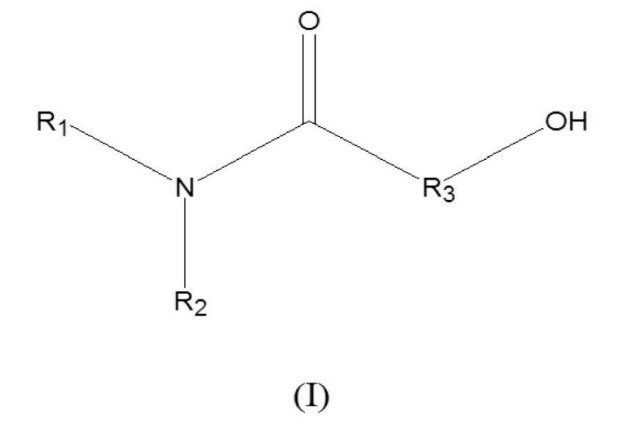
式中
R1は、C6~C22炭化水素基であり、
R2は、H、またはC6~C22炭化水素基であり、
R3は、直鎖または分岐鎖C2~C21炭化水素基である。
本発明において用いられるアミドアルコールは、以下の式(I)で表される:
R1は、C6~C22炭化水素基であり、
R2は、H、またはC6~C22炭化水素基であり、
R3は、直鎖または分岐鎖C2~C21炭化水素基である。
本発明の一態様において、式中、R1がC10~C22炭化水素基であり、R2がHであり、R3がC3~C12炭化水素基である式(I)のアミドアルコールが好ましく、R1がC12~18炭化水素基であり、R2がHであり、R3がC3~C5炭化水素基である式(I)のアミドアルコールが特に好ましい。
本発明の別の態様において、式中、R1が直鎖または分岐鎖の不飽和のC10~C22炭化水素基;または環状C6~C22炭化水素基;またはベンジル基またはフェニルエチル基である式(I)のアミドアルコールが好ましい。
本発明の好ましい態様において、式(I)のアミドアルコールは、下記式(I-1)~(I-4)の構造を有する:
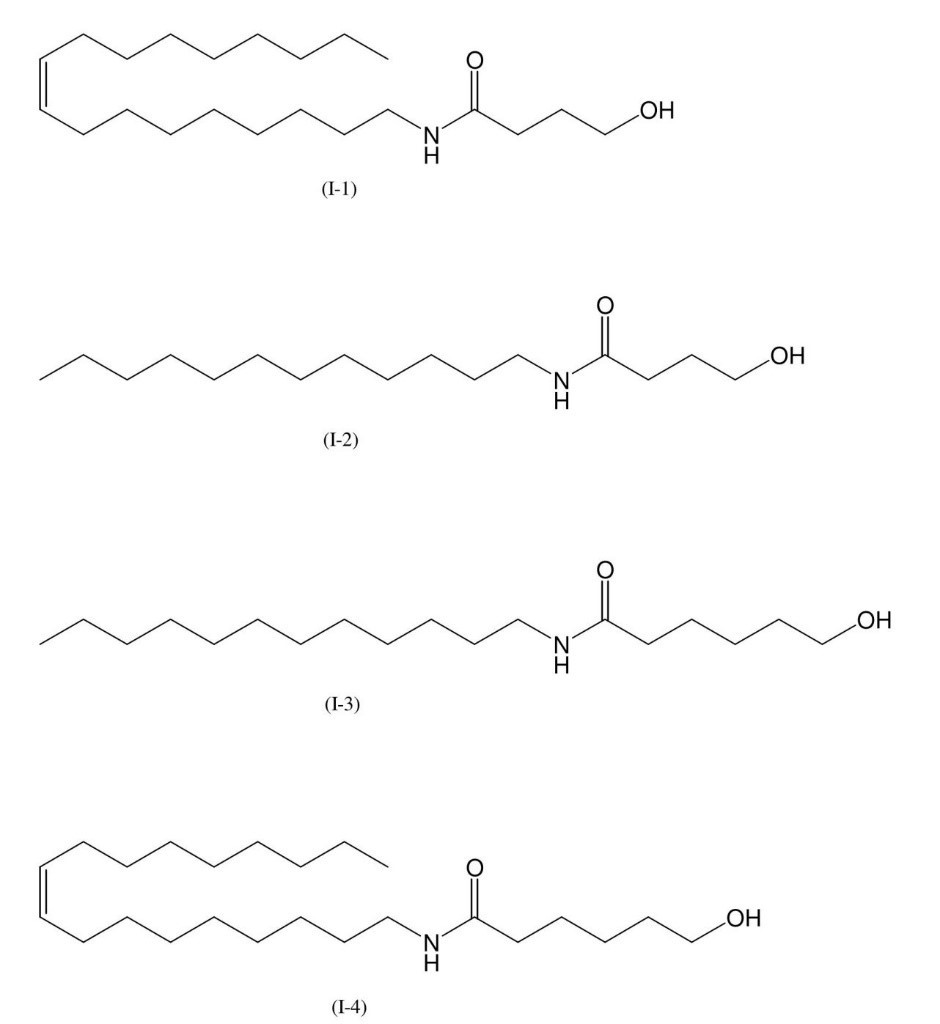
本発明の好ましい態様において、式(I)のアミドアルコールは、下記式(I-1)~(I-4)の構造を有する:
本明細書において「炭化水素基」は特別の定めのない限り、飽和または不飽和の、直鎖、分岐鎖または環状であるか、または直鎖または分岐鎖と環状の組み合わせであり得、例えば、ベンジル基、フェニルエチル基などの直鎖または分岐鎖の炭化水素部分および環状の炭化水素部分とからなる炭化水素基を含む。
すなわち、R1およびR2における、C6~C22炭化水素基は、直鎖、分岐鎖または環状のC6~C22炭化水素基、または直鎖または分岐鎖の炭化水素部分および環状の炭化水素部分とからなるC6~C22炭化水素基を含み、例として、シクロヘキシル、デカヒドロナフチル、テトラヒドロジシクロペンタジエン、ステロール、フェニル、ナフチル、アントラセニルなどの環状基、エチルヘキシル、イソステアリル、オクチルドデシルなどの分岐アルキル基やジメチル、トリメチル、テトラメチルなどの多分岐アルキル基、ヘキシル、オクチル、ラウリル、ミリスチル、セチル、ステアリル、アラキル、ベヘニルなどの直鎖アルキル基、オレイル、エライジルなどのアルケニル基などが挙げられる。
すなわち、R1およびR2における、C6~C22炭化水素基は、直鎖、分岐鎖または環状のC6~C22炭化水素基、または直鎖または分岐鎖の炭化水素部分および環状の炭化水素部分とからなるC6~C22炭化水素基を含み、例として、シクロヘキシル、デカヒドロナフチル、テトラヒドロジシクロペンタジエン、ステロール、フェニル、ナフチル、アントラセニルなどの環状基、エチルヘキシル、イソステアリル、オクチルドデシルなどの分岐アルキル基やジメチル、トリメチル、テトラメチルなどの多分岐アルキル基、ヘキシル、オクチル、ラウリル、ミリスチル、セチル、ステアリル、アラキル、ベヘニルなどの直鎖アルキル基、オレイル、エライジルなどのアルケニル基などが挙げられる。
本発明の一態様において、R1は、シクロヘキシル、エチルヘキシル、オクチル、ラウリル、ミリスチル、ステアリル、オレイル、ベンジルまたはフェニルエチルであることが好ましく、ラウリルおよびオレイルが特に好ましい。
本発明の一態様において、R2はHであることが好ましい。
本発明の一態様において、R2はHであることが好ましい。
R3における炭化水素基は環状構造を有しない、直鎖または分岐鎖C2~C21炭化水素基であり、例としては、プロピル、ブチル、ペンチル、へキシル、ヘプチル、オクチル、エチルヘキシルなどアルキル基、ブチレン、ペンチレン、ヘキシレン、ヘプチレンなどのアルケニル基が挙げられる。
本発明の一態様において、R3は、プロピレン、ブチレン、ペンチレンまたはへキシレンであることが好ましい。
本発明の一態様において、R3は、プロピレン、ブチレン、ペンチレンまたはへキシレンであることが好ましい。
アミドアルコールは、公知の合成方法を使用して製造することができる。
例えば、
酸塩化物とアミンのアミノリシス反応(ショッテン・バウマン反応)、
無水脂肪酸とアミンのアミノリシス反応、
メチルエステルとアミンのアミノリシス反応、
脂肪酸とアミンのアミノリシス反応、
ラクトンとアミンのアミノリシス反応、
等が挙げられる。
具体的には例えば特願2016-114276に記載されている方法により合成することができる。
例えば、
酸塩化物とアミンのアミノリシス反応(ショッテン・バウマン反応)、
無水脂肪酸とアミンのアミノリシス反応、
メチルエステルとアミンのアミノリシス反応、
脂肪酸とアミンのアミノリシス反応、
ラクトンとアミンのアミノリシス反応、
等が挙げられる。
具体的には例えば特願2016-114276に記載されている方法により合成することができる。
成分(B):カルボキシ基含有高分子
本発明において用いらえるカルボキシ基含有高分子は、分子中にカルボキシ基を有する高分子であれば特に限定されないが、適度な乳化能をもたらす観点から、典型的には重量平均分子量が50万~300万である高分子、分子量中カルボキシ基含有量が50~70%程度である高分子であることが好ましい。「分子量中カルボキシ基含有量が50~70%」とは、高分子の基本骨格においてカルボキシ基を含有するとされる繰り返し単位部分のうち、50~70%の当該単位部分にカルボキシ基が存在することを意味する。
カルボキシ基含有高分子は、アルカリ性物質で中和することにより水溶性となり、一般的には増粘剤として使用されている。
本発明において用いらえるカルボキシ基含有高分子は、分子中にカルボキシ基を有する高分子であれば特に限定されないが、適度な乳化能をもたらす観点から、典型的には重量平均分子量が50万~300万である高分子、分子量中カルボキシ基含有量が50~70%程度である高分子であることが好ましい。「分子量中カルボキシ基含有量が50~70%」とは、高分子の基本骨格においてカルボキシ基を含有するとされる繰り返し単位部分のうち、50~70%の当該単位部分にカルボキシ基が存在することを意味する。
カルボキシ基含有高分子は、アルカリ性物質で中和することにより水溶性となり、一般的には増粘剤として使用されている。
カルボキシ基含有高分子の例としては、カルボキシビニルポリマー、およびアクリル酸・メタクリル酸アルキル共重合体等のアルキル変性カルボキシビニルポリマー、アクリル酸アルキル・メタクリル酸アルキルポリオキシエチレンエステル共重合体、アクリル酸アルキル・イタコン酸アルキルポリオキシエチレンエステル共重合体、ステアレス-10アリルエーテル・アクリル酸アルキル共重合体等のアクリル系ポリマー、メチルビニルエーテル・無水マレイン酸・デカジエン共重合体等の非アクリル系ポリマーが挙げられる。
カルボキシ基含有高分子として、カルボキシビニルポリマーおよびアルキル変性カルボキシビニルポリマーが特に好ましい。
カルボキシ基含有高分子として、カルボキシビニルポリマーおよびアルキル変性カルボキシビニルポリマーが特に好ましい。
カルボキシビニルポリマーは、カルボマー(INCI名:Carbomer)とも呼ばれ、以下の式(II)で表される構造を有するポリマーである:
式中、
nは整数であり、典型的には40~100である。
nは整数であり、典型的には40~100である。
具体的には、
Acritamer 934 (Rita Corporation)
Acritamer 940 (Rita Corporation)
Acritamer 941 (Rita Corporation)
Acritamer 990 (Rita Corporation)
Acritamer 501E (Rita Corporation)
Acritamer 504E (Rita Corporation)
Acritamer 505E (Rita Corporation)
AEC Carbomer 940 (A & E Connock (Perfumery & Cosmetics) Ltd.)
Aqupec HV-501 (Sumitomo Seika Chemicals Co., Ltd.)
Aqupec HV-504 (Sumitomo Seika Chemicals Co., Ltd.)
Aqupec HV-505 (Sumitomo Seika Chemicals Co., Ltd.)
Aqupec HV-501E (Sumitomo Seika Chemicals Co., Ltd.)
Aqupec HV-504E (Sumitomo Seika Chemicals Co., Ltd.)
Aqupec HV-505E (Sumitomo Seika Chemicals Co., Ltd.)
Aqupec HV-801E (Sumitomo Seika Chemicals Co., Ltd.)
Aqupec HV-805E (Sumitomo Seika Chemicals Co., Ltd.)
Aqupec HV-505ED (Sumitomo Seika Chemicals Co., Ltd.)
Aqupec HV-801EG (Sumitomo Seika Chemicals Co., Ltd.)
Aqupec HV-805EG (Sumitomo Seika Chemicals Co., Ltd.)
Carbopol Clear Polymer (Lubrizol Advanced Materials, Inc.)
Carbopol ETD 2050 Polymer (Lubrizol Advanced Materials, Inc.)
Carbopol 934 Polymer (Lubrizol Advanced Materials, Inc.)
Carbopol 940 Polymer (Lubrizol Advanced Materials, Inc.)
Carbopol 941 Polymer (Lubrizol Advanced Materials, Inc.)
Carbopol 980 Polymer (Lubrizol Advanced Materials, Inc.)
Carbopol 981 Polymer (Lubrizol Advanced Materials, Inc.)
Carbopol 2984 Polymer (Lubrizol Advanced Materials, Inc.)
Carbopol 5984 Polymer (Lubrizol Advanced Materials, Inc.)
Carbopol Ultrez 10 Polymer (Lubrizol Advanced Materials, Inc.)
Carbopol Ultrez 30 Polymer (Lubrizol Advanced Materials, Inc.)
CustoPoly J 100 (Custom Ingredients, Inc.)
CustoPoly J 300 (Custom Ingredients, Inc.)
CustoPoly J 400 (Custom Ingredients, Inc.)
Easygel DO (3V Sigma USA Inc.)
Flogel 700 (SNF SAS)
Flogel 1000 (SNF SAS)
Junlon PW-110 (Nihon Junyaku Company, Ltd.)
Junlon PW-111 (Nihon Junyaku Company, Ltd.)
Junlon PW-302S (Nihon Junyaku Company, Ltd.)
Polacril 40 (Lehvoss Italia s.r.l.)
Polygel CA (3V Sigma USA Inc.)
Polygel CB (3V Sigma USA Inc.)
Polygel CS (3V Sigma USA Inc.)
Polygel DV (3V Sigma USA Inc.)
Polygel TG (3V Sigma USA Inc.)
SuperGel CE (Sino Lion USA)
Synthalen K (3V Sigma USA Inc.)
Synthalen L (3V Sigma USA Inc.)
Synthalen M (3V Sigma USA Inc.)
Tego Carbomer 134 (Evonik Nutrition & Care GmbH)
Tego Carbomer 140 (Evonik Nutrition & Care GmbH)
Tego Carbomer 141 (Evonik Nutrition & Care GmbH)
Tego Carbomer 340 FD (Evonik Nutrition & Care GmbH)
の商品名で市販されているカルボキシビニルポリマーが挙げられる。
アルキル変性カルボキシビニルポリマーは、アクリル酸および/またはメタクリル酸と、それらのアクリル酸アルキルおよび/またはメタクリル酸アルキルとの共重合体である。
アルキル変性カルボキシビニルポリマーの具体例としては、アクリレーツ/アクリル酸アルキル(C10-30))クロスポリマー(INCI名:Acrylates/C10-30Alkyl Acrylates Cross polymer、アクリル酸・メタクリル酸アルキル共重合体とも呼ばれる)、以下の式(III)で表される構造を有するポリマーが挙げられる:
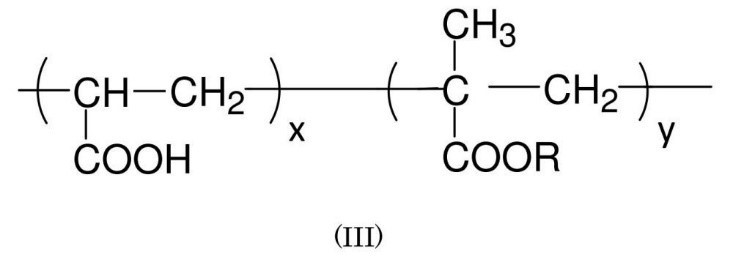
式中、
RはC10~30アルキル基であり、
xおよびyは整数であり、それぞれ任意に1以上の整数から選択することができ、典型的には、x+y=40~100であり、
yが2以上である場合には、Rは同一であっても、異なっていてもよい。
アルキル変性カルボキシビニルポリマーの具体例としては、アクリレーツ/アクリル酸アルキル(C10-30))クロスポリマー(INCI名:Acrylates/C10-30Alkyl Acrylates Cross polymer、アクリル酸・メタクリル酸アルキル共重合体とも呼ばれる)、以下の式(III)で表される構造を有するポリマーが挙げられる:
RはC10~30アルキル基であり、
xおよびyは整数であり、それぞれ任意に1以上の整数から選択することができ、典型的には、x+y=40~100であり、
yが2以上である場合には、Rは同一であっても、異なっていてもよい。
具体的には、
Acritamer 501ED (Rita Corporation)
Acritamer 505ED (Rita Corporation)
Aqupec HV-701EDR (Sumitomo Seika Chemicals Co., Ltd.)
Aqupec HV-501ER (Sumitomo Seika Chemicals Co., Ltd.)
Aqupec SER W-150C (Sumitomo Seika Chemicals Co., Ltd.)
Aqupec SER W-300C (Sumitomo Seika Chemicals Co., Ltd.)
Carbopol ETD 2020 Polymer (Lubrizol Advanced Materials, Inc.)
Carbopol 1342 Polymer (Lubrizol Advanced Materials, Inc.)
Carbopol 1382 Polymer (Lubrizol Advanced Materials, Inc.)
Carbopol SC 200 (Lubrizol Advanced Materials, Inc.)
Carbopol SC 500 Polymer (Lubrizol Advanced Materials, Inc.)
Carbopol Ultrez 20 Polymer (Lubrizol Advanced Materials, Inc.)
Carbopol Ultrez 21 Polymer (Lubrizol Advanced Materials, Inc.)
Carbopol Xtra-11 Polymer (Lubrizol Advanced Materials, Inc.)
Pemulen EZ-4U Polymeric Emulsifier (Lubrizol Advanced Materials, Inc.)
Pemulen TR-1 Polymer (Lubrizol Advanced Materials, Inc.)
Pemulen TR-2 Polymer (Lubrizol Advanced Materials, Inc.)
Tego Carbomer 341 ER (Evonik Nutrition & Care GmbH)
TEGO Carbomer 750 HD (Evonik Nutrition & Care GmbH)
の商品名で市販されているアルキル変性カルボキシビニルポリマーが挙げられる。
成分(C):多価アルコール
本発明において用いられる多価アルコールは、分子中に複数のヒドロキシ基を有する化合物であれば特に限定されないが、適度な乳化能をもたらす観点から、典型的には炭素数が3~10、好ましくは5~8である多価アルコールである。また多価アルコールの分子中のヒドロキシ基の数は2~4、好ましくは2である。
本発明において用いられる多価アルコールは、分子中に複数のヒドロキシ基を有する化合物であれば特に限定されないが、適度な乳化能をもたらす観点から、典型的には炭素数が3~10、好ましくは5~8である多価アルコールである。また多価アルコールの分子中のヒドロキシ基の数は2~4、好ましくは2である。
多価アルコールの具体例としては、例えば、ペンチレングリコール、2-エチル-1,3-ヘキサンジオール、1,2-ペンタンジオール、1,3-ブチレングリコール、プロパン-1,2,3-トリオール、プロパン、1,2-ジオール、1,2-オクタンジオール、1,2-ヘキサンジオール等が挙げられ、好ましくは、ペンチレングリコール、2-エチル-1,3-ヘキサンジオールである。
多価アルコールは単独で用いることもできるが、2種以上を組み合わせて用いることもできる。
多価アルコールの含有量は、0.1~20重量%、好ましくは1.0~15重量%であり、最も好ましくは3.0~10重量%である。
多価アルコールは、アミドアルコール、カルボキシ基含有高分子、および/または高級脂肪酸と水素結合することにより、複合体を安定化させ、乳化力を向上させることに寄与することが期待できる。
多価アルコールは単独で用いることもできるが、2種以上を組み合わせて用いることもできる。
多価アルコールの含有量は、0.1~20重量%、好ましくは1.0~15重量%であり、最も好ましくは3.0~10重量%である。
多価アルコールは、アミドアルコール、カルボキシ基含有高分子、および/または高級脂肪酸と水素結合することにより、複合体を安定化させ、乳化力を向上させることに寄与することが期待できる。
<高級脂肪酸>
本発明に用いられる高級脂肪酸は、化粧品などに一般的に用いられる成分であれば特に限定されないが、例えば、一般式(G)
R3COOH …(G)
式中、R3は、平均炭素数7~25の、水酸基を有し得る直鎖または分岐鎖の、飽和または不飽和炭化水素である、
で表される高級脂肪酸が挙げられ、これらを単独でまたは2種以上組み合わせて用いることができる。
乳化に適した複合体を形成する観点から、上記一般式(G)中、R3が、平均炭素数11~21の直鎖または分岐鎖の高級脂肪酸が好ましい。
本発明に用いられる高級脂肪酸は、化粧品などに一般的に用いられる成分であれば特に限定されないが、例えば、一般式(G)
R3COOH …(G)
式中、R3は、平均炭素数7~25の、水酸基を有し得る直鎖または分岐鎖の、飽和または不飽和炭化水素である、
で表される高級脂肪酸が挙げられ、これらを単独でまたは2種以上組み合わせて用いることができる。
乳化に適した複合体を形成する観点から、上記一般式(G)中、R3が、平均炭素数11~21の直鎖または分岐鎖の高級脂肪酸が好ましい。
具体例としては、ラウリン酸、ミリスチン酸、パルミチン酸、ステアリン酸、アラキン酸、ベヘン酸等の飽和脂肪酸;2-パルミトレイン酸、ペトロセリン酸、オレイン酸、エライジン酸、リシノール酸、リノール酸、リノエライジン酸、リノレン酸、アラキドン酸等の不飽和脂肪酸、イソステアリン酸等の分岐脂肪酸;12-ヒドロキシステアリン酸等のヒドロキシカルボン酸等が挙げられる。これらのうち、安定性及び皮膚刺激性の観点から、炭素数18の飽和脂肪酸が好ましく、中でも分岐を有するものが好ましく、さらに好ましくはメチル分岐を有する炭素数18の飽和脂肪酸がよい。市販品としては、例えば、イソステアリン酸(商品名:イソステアリン酸EX,HAIMARIC-MKH(R),高級アルコール工業株式会社製)、SR PRISORINE 3505(クローダジャパン社製),イソステアリン酸、イソステアリン酸T(日産化学工業株式社製)などが挙げられる。
高級脂肪酸は、乳化物において油剤としての機能に加え、複合体の一部としても機能すると考えられる。
本発明の一態様において、「複合体」は、アミドアルコールと、カルボキシ基含有高分子、多価アルコール、および高級脂肪酸からなる群から選択される1種以上とにより形成される複合体を意味する。
W/O型乳化物において、複合体は、アミドアルコールおよび高級脂肪酸を含有する油相部に、カルボキシ基含有高分子を添加することで形成することができ、さらにアルカリで中和させることでより乳化力の高い複合体を形成することができる。本発明の別の態様において、W/O型乳化物において、複合体は、アミドアルコールおよび高級脂肪酸を含有する油相部に、カルボキシ基含有高分子およびアルカリを含有する水相部を添加し、形成することができる。
O/W型乳化物において、複合体は、カルボキシ基含有高分子および多価アルコールを含有する水相部に、アミドアルコールおよび高級脂肪酸を含有した油相を添加し、次いでアルカリで中和させることでより乳化力の高い複合体を形成することができる。
本発明における乳化物は、アミドアルコールのアミド結合部と、高分子および高級脂肪酸のカルボニル基とが水素結合を形成し、カルボキシ基の一部がCOO-となり親水性を有することにより、乳化能を発揮すると考えられる。さらに、本発明の一態様において、アミドアルコールのアミド結合部と、多価アルコールのヒドロキシ基と、カルボキシ基含有高分子および高級脂肪酸のカルボキシ基とが水素結合を形成し、カルボキシ基の一部がCOO-となり親水性を有することにより、乳化能を発揮すると考えられる。
したがって、いかなる理論にも拘束されないが、本発明の複合体は、アミドアルコールのアミド結合部分と、高分子のカルボニル基および高級脂肪酸のカルボニル基とが結合、またはアミドアルコールのアミド結合部分と、その相手として多価アルコールのヒドロキシ基、カルボキシ基含有高分子のカルボニル基および高級脂肪酸のカルボキシ基からなる群から選択される1種以上とが結合、より具体的には水素結合して複合体を形成していると考えられる。
したがって、いかなる理論にも拘束されないが、本発明の複合体は、アミドアルコールのアミド結合部分と、高分子のカルボニル基および高級脂肪酸のカルボニル基とが結合、またはアミドアルコールのアミド結合部分と、その相手として多価アルコールのヒドロキシ基、カルボキシ基含有高分子のカルボニル基および高級脂肪酸のカルボキシ基からなる群から選択される1種以上とが結合、より具体的には水素結合して複合体を形成していると考えられる。
本発明において「乳化物」とは、特別の定めのない限り、W/O型乳化物およびO/W型乳化物の両方を意味する。
本発明において「W/O型乳化物」とは、油中水型の乳化物、すなわち油性成分を含む連続相に、水性成分が分散した乳化物である。
W/O型乳化物は、アミドアルコールを含む油相に、カルボキシ基含有高分子を含む水相を分散させ、アルカリで中和することにより調製することができる。
本発明において「O/W型乳化物」とは、水中油型の乳化物、すなわち水性成分を含む連続相に、油性成分が分散した乳化物である。
O/W型乳化物は、アミドアルコールを含む油相を、カルボキシ基含有高分子を含む水相に分散させ、アルカリで中和することにより調製することができる。
本発明において「W/O型乳化物」とは、油中水型の乳化物、すなわち油性成分を含む連続相に、水性成分が分散した乳化物である。
W/O型乳化物は、アミドアルコールを含む油相に、カルボキシ基含有高分子を含む水相を分散させ、アルカリで中和することにより調製することができる。
本発明において「O/W型乳化物」とは、水中油型の乳化物、すなわち水性成分を含む連続相に、油性成分が分散した乳化物である。
O/W型乳化物は、アミドアルコールを含む油相を、カルボキシ基含有高分子を含む水相に分散させ、アルカリで中和することにより調製することができる。
本発明の一態様において、乳化物は、あらゆる用途に用いることができるが、典型的には、医薬品、医薬部外品、化粧品などの外用剤に用いることができる。
本発明の乳化物は、薬剤を含む皮膚外用剤などの医薬品;薬用化粧品などの医薬部外品;ゲル状化粧水、乳液、クリーム、美容液、日焼け止め、日中用保湿剤などのスキンケア化粧品;ファンデーション、メーキャップ下地、アイシャドウ、マスカラ、などのメイクアップ化粧品、ヘアトリートメントなどのヘアケア化粧品などの様々な形態の製品に使用することができる。
本発明の乳化物は、薬剤を含む皮膚外用剤などの医薬品;薬用化粧品などの医薬部外品;ゲル状化粧水、乳液、クリーム、美容液、日焼け止め、日中用保湿剤などのスキンケア化粧品;ファンデーション、メーキャップ下地、アイシャドウ、マスカラ、などのメイクアップ化粧品、ヘアトリートメントなどのヘアケア化粧品などの様々な形態の製品に使用することができる。
<油性成分>
本発明の乳化物に用いられる油性成分は、化粧品などに一般的に用いられる成分であれば特に限定されないが、例としては、動植物油脂、炭化水素油、高級脂肪酸、高級アルコール、エステル油、シリコーン油などの油剤が挙げられ、これらを単独で、または2種以上組み合わせて用いることができる。
本発明の乳化物に用いられる油性成分は、化粧品などに一般的に用いられる成分であれば特に限定されないが、例としては、動植物油脂、炭化水素油、高級脂肪酸、高級アルコール、エステル油、シリコーン油などの油剤が挙げられ、これらを単独で、または2種以上組み合わせて用いることができる。
動植物油脂または水添動植物油脂としては、例えば、アボガド油、エノ油、オリーブ油、カカオ脂、カヤ油、キョウニン油、硬化油、小麦胚芽油、ゴマ油、コメ胚芽油、コメヌカ油、サトウキビロウ、サザンカ油、サフラワー油、シアバター、シナギリ油、シナモン油、大豆油、茶実油、ツバキ油、月見草油、トウモロコシ油、ナタネ油、胚芽油、パーム油、パーム核油、ヒマシ油、硬化ヒマシ油、ヒマワリ油、ブドウ油、ホホバ油、マカデミアナッツ油、ミツロウ、綿実油、綿ロウ、モクロウ、モンタンロウ、ヤシ油、硬化ヤシ油、落花生油、ラノリン、液状ラノリン、還元ラノリン、ラノリンアルコール、硬質ラノリン、酢酸ラノリン、ラノリン脂肪酸イソプロピル、ラウリン酸ヘキシルなどが挙げられる。
炭化水素油としては、例えば、オゾケライト、スクワラン、スクワレン、セレシン、パラフィン、イソパラフィン、パラフィンワックス、流動パラフィン(ミネラルオイル)、プリスタン、ポリイソブチレン、ポリイソブテン、水添ポリイソブテン、マイクロクリスタリンワックス、ポリエチレンワックス、ワセリンなどが挙げられる。
高級脂肪酸としては、例えば、ラウリン酸、ミリスチン酸、パルミチン酸、ステアリン酸、イソステアリン酸、オレイン酸、ベヘニン酸、ウンデシレン酸、オレイン酸、リノール酸、リノレン酸、アラキドン酸、エイコサペンタエン酸(EPA)、ドコサヘキサエン酸(DHA)などが挙げられる。
高級アルコールとしては、例えば、ミリスチルアルコール、セタノール、ステアリルアルコール、アラキジルアルコール、ベヘニルアルコール、水添ナタネ油アルコールなどが挙げられる。
高級脂肪酸としては、例えば、ラウリン酸、ミリスチン酸、パルミチン酸、ステアリン酸、イソステアリン酸、オレイン酸、ベヘニン酸、ウンデシレン酸、オレイン酸、リノール酸、リノレン酸、アラキドン酸、エイコサペンタエン酸(EPA)、ドコサヘキサエン酸(DHA)などが挙げられる。
高級アルコールとしては、例えば、ミリスチルアルコール、セタノール、ステアリルアルコール、アラキジルアルコール、ベヘニルアルコール、水添ナタネ油アルコールなどが挙げられる。
エステル油としては、例えば、モノエステルではイソノナン酸エステルであるイソノナン酸イソノニル、イソノナン酸イソデシル、イソノナン酸イソトリデシル、イソノナン酸トリシクロデカンメチル、イソノナン酸エチルヘキシルなど、2-エチルヘキサン酸であるエチルヘキサン酸セチル、エチルヘキサン酸ヘキシルデシルなど、ミリスチン酸エステルであるミリスチン酸イソプロピル、ミリスチン酸イソセチル、ミリスチン酸オクチルドデシルなど、イソステアリン酸エステルであるイソステアリン酸エチル、イソステアリン酸イソプロピル、イソステアリン酸ヘキシルデシル、イソステアリン酸イソステアリル、イソステアリン酸コレステリル、イソステアリン酸フィトステリルなど、乳酸エステルである乳酸イソステアリル、乳酸オクチルドデシルなど、オレイン酸エステルであるオレイン酸オレイル、オレイン酸フィトステリル、オレイン酸オクチルドデシルなど、ネオペンタン酸エステルであるネオペンタン酸イソデシル、ネオペンタン酸イソステアリルなど、パルミチン酸エステルであるパルミチン酸イソプロピル、パルミチン酸エチルヘキシルなど、その他にはネオデカン酸オクチルドデシル、リシノレイン酸オクチルドデシル、エルカ酸オレイル、エルカ酸オクチルドデシル、ラウロイルサルコシンイソプロピルなどが挙げられる。
ジエステル油としては、アジピン酸ジイソブチル、アジピン酸ジイソプロピル、コハク酸ジエチルヘキシル、ジイソノナン酸ネオペンチルグリコール、ジエチルヘキサン酸ネオペンチルグリコール、ジカプリン酸ネオペンチルグリコール、リンゴ酸ジイソステアリル、ジリノール酸ジイソプロピル、ジオクタン酸エチレングリコール、ステアロイルオキシステアリン酸オクチルドデシル、セバシン酸ジイソプロピル、ラウロイルグルタミン酸ジ(コレステリル/オクチルドデシル)、ラウロイルグルタミン酸ジ(フィトステリル/オクチルドデシル)などが挙げられる。
トリエステル油としては、トリエチルヘキサノイン、トリエチルヘキサン酸トリメチロールプロパン、トリ(カプリル酸/カプリン酸)グリセリル、トリイソステアリン、トリイソステアリン酸トリメチロールプロパンなどが挙げられる。
テトラエステル油としては、テトラエチルヘキサン酸ペンタエリスリチル、テトライソステアリン酸ペンタエリスリチルなどが挙げられる。
トリエステル油としては、トリエチルヘキサノイン、トリエチルヘキサン酸トリメチロールプロパン、トリ(カプリル酸/カプリン酸)グリセリル、トリイソステアリン、トリイソステアリン酸トリメチロールプロパンなどが挙げられる。
テトラエステル油としては、テトラエチルヘキサン酸ペンタエリスリチル、テトライソステアリン酸ペンタエリスリチルなどが挙げられる。
ポリエステル油としては、ポリグリセリン脂肪酸エステルであるイソステアリン酸ポリグリセリル-2、ジイソステアリン酸ポリグリセリル-2、トリイソステアリン酸ポリグリセリル-2、テトライソステアリン酸ポリグリセリル-2などが挙げられる。
高粘性のエステル油としては、イソステアリン酸水添ヒマシ油、ダイマージリノール酸水添ヒマシ油、(イソステアリン酸ポリグリセリル-2/ダイマージリノール酸)コポリマー、ダイマージリノール酸(フィトステリル/イソステアリル/セチル/ステアリル/ベヘニル)、ダイマージリノール酸ダイマージリノレイルビス(フィトステリル/ベヘニル/イソステアリル)、ダイマージリノール酸ジ(イソステアリル/フィトステリル)、ダイマージリノレイル水添ロジン縮合物、ジイソステアリン酸ダイマージリノレイル、ダイマージリノール酸ダイマージリノレイル、ラウロイルグルタミン酸ジ(コレステリル/ベヘニル/オクチルドデシル)、ラウロイルグルタミン酸ジ(オクチルドデシル/フィトステリル/ベヘニル)、ミリストイルメチルアラニン(フィトステリル/デシルテトラデシル)などが挙げられる。
高粘性のエステル油としては、イソステアリン酸水添ヒマシ油、ダイマージリノール酸水添ヒマシ油、(イソステアリン酸ポリグリセリル-2/ダイマージリノール酸)コポリマー、ダイマージリノール酸(フィトステリル/イソステアリル/セチル/ステアリル/ベヘニル)、ダイマージリノール酸ダイマージリノレイルビス(フィトステリル/ベヘニル/イソステアリル)、ダイマージリノール酸ジ(イソステアリル/フィトステリル)、ダイマージリノレイル水添ロジン縮合物、ジイソステアリン酸ダイマージリノレイル、ダイマージリノール酸ダイマージリノレイル、ラウロイルグルタミン酸ジ(コレステリル/ベヘニル/オクチルドデシル)、ラウロイルグルタミン酸ジ(オクチルドデシル/フィトステリル/ベヘニル)、ミリストイルメチルアラニン(フィトステリル/デシルテトラデシル)などが挙げられる。
シリコーン油としては、例えば、ジメチルポリシロキサン、メチルフェニルポリシロキサン、アルキル変性オルガノポリシロキサン、末端変性オルガノポリシロキサン、フッ素変性オルガノポリシロキサン、アモジメチコーン、アミノ変性オルガノポリシロキサン、揮発性シリコーン、アルキルジメチコン、シクロペンタシロキサンなどが挙げられる。
本発明の一態様において、W/O型乳化物における油性成分の配合量は特に限定されないが、使用性の観点から、30.0~80.0質量%、好ましくは40.0~70.0質量%、より好ましくは50.0~60.0質量%であり得る。
本発明の一態様において、O/W型乳化物における油性成分の配合量は特に限定されないが、使用性の観点から、1.0~40.0質量%、好ましくは3.0~30.0質量%、より好ましくは5.0~20.0質量%であり得る。
本発明において、より長期に安定な乳化物を提供する観点から油性成分における、炭化水素油、シリコーン油などの非極性油の割合が高いことが好ましい。
界面活性剤を用いずに長期安定な乳化物を得る観点から、非極性油/(非極性油+極性油)の質量比が0.5を超えることが好ましい。
本発明の一態様において、O/W型乳化物における油性成分の配合量は特に限定されないが、使用性の観点から、1.0~40.0質量%、好ましくは3.0~30.0質量%、より好ましくは5.0~20.0質量%であり得る。
本発明において、より長期に安定な乳化物を提供する観点から油性成分における、炭化水素油、シリコーン油などの非極性油の割合が高いことが好ましい。
界面活性剤を用いずに長期安定な乳化物を得る観点から、非極性油/(非極性油+極性油)の質量比が0.5を超えることが好ましい。
<水性成分>
本発明の型乳化物に用いられる水性成分は、化粧品などに一般的に用いられる成分であれば特に限定されないが、例としては、精製水、イオン交換水などの水;BG(1,3-ブチレングリコール)、PG(プロピレングリコール)、グリセリン、エタノールなどの低級アルコールなどが挙げられ、これらを単独で、または2種以上組み合わせて用いることができる。
本発明の一態様において、W/O型乳化物における水性成分の配合量は特に限定されないが、使用性の観点から、10.0~70.0質量%、好ましくは15.0~65.0質量%、より好ましくは20.0~60.0質量%であり得る。
本発明の一態様において、O/W型乳化物における水性成分の配合量は特に限定されないが、使用性の観点から、50.0~90.0質量%、好ましくは55.0~85.0質量%、より好ましくは60.0~80.0質量%であり得る。
<中和剤>
本発明の乳化物の調製に用いられる中和剤は、化粧品などに一般的に用いられるアルカリ性の成分であれば特に限定されないが、例としては、水酸化カリウム、トリエタノールアミン、水酸化ナトリウム、L-アルギニン、L-リシンなどの塩基性アミノ酸、2-アミノ-2-メチル-1-プロパノールなどが挙げられ、これらを単独で、または2種以上組み合わせて用いることができる。
中和剤の配合量は、中和剤の種類および乳化物全体の組成により適宜選択できるが、典型的には、0.01~1.0質量%程度である。
また、中和剤は、トラネキサム酸、カルノシン等の有効成分であってもよい。
本発明の乳化物の調製に用いられる中和剤は、化粧品などに一般的に用いられるアルカリ性の成分であれば特に限定されないが、例としては、水酸化カリウム、トリエタノールアミン、水酸化ナトリウム、L-アルギニン、L-リシンなどの塩基性アミノ酸、2-アミノ-2-メチル-1-プロパノールなどが挙げられ、これらを単独で、または2種以上組み合わせて用いることができる。
中和剤の配合量は、中和剤の種類および乳化物全体の組成により適宜選択できるが、典型的には、0.01~1.0質量%程度である。
また、中和剤は、トラネキサム酸、カルノシン等の有効成分であってもよい。
<界面活性剤>
本明細書において「界面活性剤」とは、一分子の中に親水基および疎水基の両方を有する化合物を意味し、必要に応じて乳化物にも適宜添加することができる。
本発明の一態様において、本発明の複合体が乳化能を有することから、好ましくは乳化物は界面活性剤を実質的に含まない。これにより、刺激の少ない乳化剤を提供することができる。
ここで、「実質的に含まない」とは、乳化物全体の乳化に十分な量で界面活性剤を含まないことを意味する。また、本発明において「界面活性剤を実質的に含まない」とは、界面活性剤を全く含まないか、乳化しない量で含むこと意味する。乳化しない量は、当業者が組成にしたがって、適宜決定することができ、例えば、一態様においては、2.0質量%未満であり、別の態様においては、0.2質量%未満、0.02質量%未満などであり得る。
本発明の特別な態様において、コンディショニング用組成物はカチオン界面活性剤などの界面活性剤を実質的に含まない乳化組成物である。
<その他の成分>
本発明の乳化物は、化粧品などの外用剤に化粧品などに用いられるあらゆる成分を含み得る。
これらの追加の成分の例としては、メトキシケイヒ酸エチルヘキシル、ジエチルアミノヒドロキシベンゾイル安息香酸ヘキシルなどの紫外線吸収剤;パルミチン酸デキストリン、キサンタンガムなど増粘剤・ゲル化剤;酸化防止剤、防腐剤などの品質保持成分;皮膚軟化剤(エモリエント);美白剤、抗シワ剤、抗酸化剤などの薬用成分・有効成分;香料、顔料、色素などの着色剤などが挙げられる。
本発明の乳化物は、化粧品などの外用剤に化粧品などに用いられるあらゆる成分を含み得る。
これらの追加の成分の例としては、メトキシケイヒ酸エチルヘキシル、ジエチルアミノヒドロキシベンゾイル安息香酸ヘキシルなどの紫外線吸収剤;パルミチン酸デキストリン、キサンタンガムなど増粘剤・ゲル化剤;酸化防止剤、防腐剤などの品質保持成分;皮膚軟化剤(エモリエント);美白剤、抗シワ剤、抗酸化剤などの薬用成分・有効成分;香料、顔料、色素などの着色剤などが挙げられる。
本発明の一態様において、安定性向上のために、W/O型乳化物において、外油層を油ゲル化剤でオイルゲル化、あるいはO/W型乳化物において、内油層を油ゲル化剤でオイルゲル化させることができる。
オイルゲル化のために用いる成分としては、有機変性粘土鉱物および/または糖と脂肪酸による高分子エステルを用いることができる。
本発明の乳化物の調製において用いられる有機変性粘土鉱物および糖と脂肪酸による高分子エステルは、化粧品などに一般的に用いられる成分であれば特に限定されない。
有機変性粘土鉱物としては、水膨潤性粘土鉱物(例えばモンモリロナイト、サポナイト、ヘクトライト、ベントナイトなど)の結晶層間に介在する変換性カチオンを、有機極性化合物や有機カチオン(例えば、第4級アンモニウム塩型カチオン性界面活性剤)で置換したものが挙げられる。
本発明において、例えば、Elementis Specialties社から、BENTONE 27V(ステアラルコニウムヘクトライト)、BENTONE 27VCG(ステアラルコニウムヘクトライト)、BENTONE 38V(ジステアルジモニウムヘクトライト)、BENTONE 38VCG(ジステアルジモニウムヘクトライト)などの商品名で市販されている有機変性粘土鉱物を用いることができる。
また、有機変性粘土鉱物はシリコーン油、エステル油および/またはその他の油剤に溶解したプレミックス品としても市販されており、本発明においてもプレミックスを用いてもよく、これは例えば、Elementis Specialties社から以下の商品名で市販されている。
BENTONE GEL 1002V(シクロペンタシロキサン、ジステアルジモニウムヘクトライト、炭酸プロピレン)、BENTONE GEL ABO V(クランベアビシニカ種子油、ステアラルコニウムヘクトライト、炭酸プロピレン)、BENTONE GEL CAO V(ヒマシ油、ステアラルコニウムヘクトライト、炭酸プロピレン)、BENTONE GEL EUG V(オクチルドデカノール、ジステアルジモニウムヘクトライト、炭酸プロピレン)、BENTONE GTCC V(トリ(カプリル酸/カプリン酸)グリセリル、ステアラルコニウムヘクトライト、炭酸プロピレン)、BENTONE HSO V(トリ(カプリル酸/カプリン酸)グリセリル、ステアラルコニウムヘクトライト、炭酸プロピレン)、BENTONE IHD V(イソヘキサデカン、ジステアルジモニウムヘクトライト、炭酸プロピレン)、BENTONE IPM V(ミリスチン酸イソプロピル、ステアラルコニウムヘクトライト、炭酸プロピレン)、BENTONE ISD V(イソドデカン、ジステアルジモニウムヘクトライト、炭酸プロピレン)、BENTONE LOI V(液状ラノリン、パルミチン酸イソプロピル、ステアラルコニウムヘクトライト、炭酸プロピレン)、BENTONE MSO(V)(メドウフォーム油、ジステアルジモニウムヘクトライト、炭酸プロピレン)、BENTONENGD V(ジヘプタン酸ネオペンチルグリコール、ジステアルジモニウムヘクトライト、炭酸プロピレン)、BENTONE OLV V(オリーブ果実油、ステアラルコニウムヘクトライト、炭酸プロピレン)、BENTONE OMS V((C11,12)イソパラフィン、ジステアルジモニウムヘクトライト、変性アルコール)、BENTONE PTIS V(テトライソステアリン酸ペンタエリスリチル、ジステアルジモニウムヘクトライト、炭酸プロピレン)、BENTONE SS71V(石油揮発物、ジステアルジモニウムヘクトライト、炭酸プロピレン)BENTONE TMF V(メチルトリメチコン、ジステアルジモニウムヘクトライト、クエン酸トリエチル)、BENTONE TNV(安息香酸アルキル(C12-15)、ステアラルコニウムヘクトライト、炭酸プロピレン)、BENTONE VS-5V(V)(シクロペンタシロキサン、ジステアルジモニウムヘクトライト、変性アルコール)、BENTONE VS-5PC V(HV)(シクロペンタシロキサン、ジステアルジモニウムヘクトライト、炭酸プロピレン)。
BENTONE GEL 1002V(シクロペンタシロキサン、ジステアルジモニウムヘクトライト、炭酸プロピレン)、BENTONE GEL ABO V(クランベアビシニカ種子油、ステアラルコニウムヘクトライト、炭酸プロピレン)、BENTONE GEL CAO V(ヒマシ油、ステアラルコニウムヘクトライト、炭酸プロピレン)、BENTONE GEL EUG V(オクチルドデカノール、ジステアルジモニウムヘクトライト、炭酸プロピレン)、BENTONE GTCC V(トリ(カプリル酸/カプリン酸)グリセリル、ステアラルコニウムヘクトライト、炭酸プロピレン)、BENTONE HSO V(トリ(カプリル酸/カプリン酸)グリセリル、ステアラルコニウムヘクトライト、炭酸プロピレン)、BENTONE IHD V(イソヘキサデカン、ジステアルジモニウムヘクトライト、炭酸プロピレン)、BENTONE IPM V(ミリスチン酸イソプロピル、ステアラルコニウムヘクトライト、炭酸プロピレン)、BENTONE ISD V(イソドデカン、ジステアルジモニウムヘクトライト、炭酸プロピレン)、BENTONE LOI V(液状ラノリン、パルミチン酸イソプロピル、ステアラルコニウムヘクトライト、炭酸プロピレン)、BENTONE MSO(V)(メドウフォーム油、ジステアルジモニウムヘクトライト、炭酸プロピレン)、BENTONENGD V(ジヘプタン酸ネオペンチルグリコール、ジステアルジモニウムヘクトライト、炭酸プロピレン)、BENTONE OLV V(オリーブ果実油、ステアラルコニウムヘクトライト、炭酸プロピレン)、BENTONE OMS V((C11,12)イソパラフィン、ジステアルジモニウムヘクトライト、変性アルコール)、BENTONE PTIS V(テトライソステアリン酸ペンタエリスリチル、ジステアルジモニウムヘクトライト、炭酸プロピレン)、BENTONE SS71V(石油揮発物、ジステアルジモニウムヘクトライト、炭酸プロピレン)BENTONE TMF V(メチルトリメチコン、ジステアルジモニウムヘクトライト、クエン酸トリエチル)、BENTONE TNV(安息香酸アルキル(C12-15)、ステアラルコニウムヘクトライト、炭酸プロピレン)、BENTONE VS-5V(V)(シクロペンタシロキサン、ジステアルジモニウムヘクトライト、変性アルコール)、BENTONE VS-5PC V(HV)(シクロペンタシロキサン、ジステアルジモニウムヘクトライト、炭酸プロピレン)。
W/O型乳化物における有機変性粘土鉱物の配合量は、油性成分の種類や量、および乳化物に求められる粘度などにより適宜調整することができ、特に限定されないが、0.5~8.0質量%、好ましくは0.7~6.0質量%、より好ましくは1.0~5.0質量%であり得る。
O/W型乳化物における有機変性粘土鉱物の配合量は、油性成分の種類や量、および乳化物に求められる粘度などにより適宜調整することができ、特に限定されないが、0.1~3.0質量%、好ましくは0.1~2.0質量%、より好ましくは0.1~1.0質量%であり得る。
O/W型乳化物における有機変性粘土鉱物の配合量は、油性成分の種類や量、および乳化物に求められる粘度などにより適宜調整することができ、特に限定されないが、0.1~3.0質量%、好ましくは0.1~2.0質量%、より好ましくは0.1~1.0質量%であり得る。
糖と脂肪酸による高分子エステルとしては、千葉製粉株式会社より以下の商品名で市販されているものが挙げられる。
レオパールKL(パルミチン酸デキストリン)、レオパールTL2(パルミチン酸デキストリン)、レオパールMKL(ミリスチン酸デキストリン)、レオパールTT2[(パルミチン酸/エチルヘキサン酸)デキストリン)]、レオパールWX[(パルミチン酸/ヘキシルデカン酸)デキストリン]、レオパールISL2(ステアリン酸イヌリン)、レオパールISK2(ステアリン酸イヌリン)。
W/O型乳化物における糖と脂肪酸による高分子エステルの配合量は、油性成分の種類や量、および乳化物に求められる粘度などにより適宜調整することができ、特に限定されないが、0.5~8.0質量%、好ましくは0.7~6.0質量%、より好ましくは1.0~5.0質量%であり得る。
O/W型乳化物における糖と脂肪酸による高分子エステルの配合量は、油性成分の種類や量、および乳化物に求められる粘度などにより適宜調整することができ、特に限定されないが、0.1~3.0質量%、好ましくは0.1~2.0質量%、より好ましくは0.1~1.0質量%であり得る。
また、本発明の一態様において、ペンチレングリコール、オクチレングリコール等の多価アルコールを配合することにより、乳化物としての乳化性をさらに向上させることができる。
いかなる理論にも限定されないが、多価アルコールの配合による乳化性の向上は、多価アルコールの分子中の水酸基と、アミドアルコール分子中のアミド結合のカルボニル基とによる水素結合による複合体形成によるものであると考えられる。
したがって、本発明は、アミドアルコール、カルボキシ基含有高分子、高級脂肪酸および多価アルコールから形成される複合体も提供する。
なお、ペンチレングリコールは、保湿作用および抗菌作用を有しており、乳化物を化粧品などの外用剤として使用するために、好ましい成分であると言える。
ペンチレングリコールは、具体的には、以下の商品名で市販されている。
ジオールPD(高級アルコール工業株式会社製)、ジオールPD-V(高級アルコール工業株式会社製)が挙げられる。
また、オクチレングリコールとしては、具体的には、以下の商品名で市販されている。
オーディーエイト(株式会社 感光社製)が挙げられる。
乳化物における成分(A)の配合量は、使用する油剤の種類や量、求められる粘度等に依存して適宜選択することができるが、典型的には0.1~15.0質量%であり、好ましくは、0.5~10.0質量%、さらに好ましくは、1.0~8.0質量%である。
乳化物における成分(B)の配合量は、使用する油剤の種類や量、乳化組成物に求める粘度等に依存して適宜選択することができるが、典型的には、0.01~5.0質量%であり、好ましくは、0.05~3.0質量%、さらに好ましくは、0.1~2.0質量%である。
上記配合量とすることにより、本発明における成分Aと成分Bとからなる複合体の使用性と安定性が良好な乳化組成物を得るのに、十分な量となる。
乳化物における成分(B)の配合量は、使用する油剤の種類や量、乳化組成物に求める粘度等に依存して適宜選択することができるが、典型的には、0.01~5.0質量%であり、好ましくは、0.05~3.0質量%、さらに好ましくは、0.1~2.0質量%である。
上記配合量とすることにより、本発明における成分Aと成分Bとからなる複合体の使用性と安定性が良好な乳化組成物を得るのに、十分な量となる。
乳化組成物において、アミドアルコール(成分(A))と、カルボキシ基含有高分子(成分(B))との乳化組成物中の重量%の比率は、好ましくはアミドアルコール/カルボキシ基含有高分子=10~110であり、より好ましくは15~100、さらに好ましくは20~80である。
これらの比率とすることで、親水性・疎水性のバランスが乳化物に適したものとなり、細かな乳化粒子を有し、安定性の高い乳化物を提供することができる。
これらの比率とすることで、親水性・疎水性のバランスが乳化物に適したものとなり、細かな乳化粒子を有し、安定性の高い乳化物を提供することができる。
さらに、乳化物において、高級脂肪酸を加えてもよい。高級脂肪酸の配合量は、使用する油剤の種類や量、求められる粘度等に依存して適宜選択することができるが、W/O型乳化物においては、典型的には0.1~7.0質量%、より好ましくは0.5~5.0質量%であり、O/W型乳化物においては、典型的には0.1~3.0質量%、より好ましくは0.1~2.0質量%である。
上記配合量とすることにより、本発明におけるアミドアルコール、カルボキシ基含有高分子、高級脂肪酸とからなる複合体の油中水型の使用性と安定性が良好な乳化組成物を得るのに、適切な量となる。
上記配合量とすることにより、本発明におけるアミドアルコール、カルボキシ基含有高分子、高級脂肪酸とからなる複合体の油中水型の使用性と安定性が良好な乳化組成物を得るのに、適切な量となる。
なお、本発明の乳化物のpHは適宜選択できるが、W/O型乳化物においては、pH5.0~10.0程度であることが好ましく、pH5.0~8.0程度であることがより好ましく、O/W型乳化物においては、pH5.0~8.0程度であることが好ましく、pH5.0~7.0程度であることがより好ましい。いかなる理論にも拘束されないが、pHをこの範囲内とすることにより、成分Aおよび成分B(および高級脂肪酸)とが適度に水素結合して複合体が形成され、かつカルボキシ基の解離が適度となり、優れた乳化能がもたらされると考えられる。
本発明の乳化物の粘度は、目的とする製品の特性に依存して適宜選択できる。
本発明の一態様において、クリーム状の乳化物を得る観点から、10,000mP・sより高い粘度を有することが好ましく、乳液状の乳化物を得る観点からは、300~100,000mP・s程度の粘度を有することが好ましい。
本発明の一態様において、乳化物を化粧料として使用する観点から、乳化物の粘度は、300~1,000,000mP・sの範囲内で適宜選択できる。
本発明の乳化物の粘度は、目的とする製品の特性に依存して適宜選択できる。
本発明の一態様において、クリーム状の乳化物を得る観点から、10,000mP・sより高い粘度を有することが好ましく、乳液状の乳化物を得る観点からは、300~100,000mP・s程度の粘度を有することが好ましい。
本発明の一態様において、乳化物を化粧料として使用する観点から、乳化物の粘度は、300~1,000,000mP・sの範囲内で適宜選択できる。
本発明は、乳化のために用いられる、アミドアルコール、カルボキシ基含有高分子、または高級脂肪酸を含有する剤も提供する。かかる剤を、乳化物の製造の際に使用することができる。
以下、本発明を実施例に基づいて、更に詳細に説明するが、本発明は、これらの実施例に限定されるものではなく、本発明の技術的な思想を逸脱しない範囲で種々の変更が可能である。なお、本明細書において、特に明示しない場合には、%は質量%を意味する。
<W/O型乳化物>
実施例1
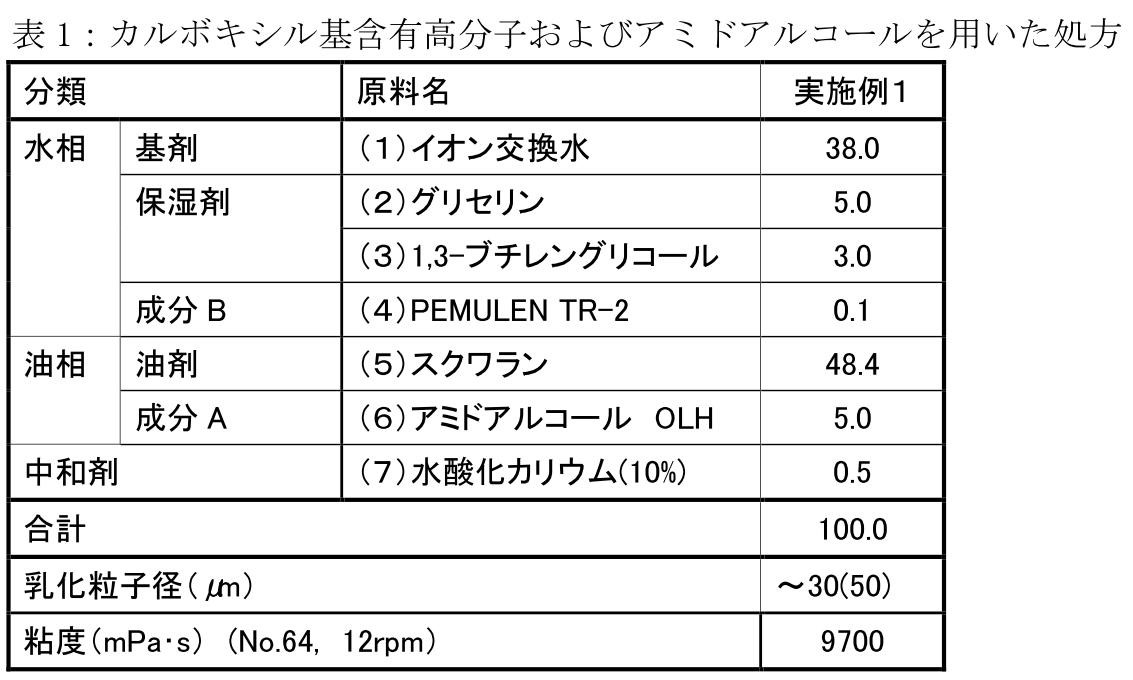
実施例1
乳化粒子径の表記の仕方であるが、~30(50)とは、平均的には30μm以下であり、所々に50μm程度のものが点在するという意味である。以下、同様な意味合いで表記する。
成分Aとして、式(I)中、R1が不飽和C18アルキル(オレイル)、R2がH、R3がC5である、下記構造(I-4)を有するアミドアルコールを使用した。
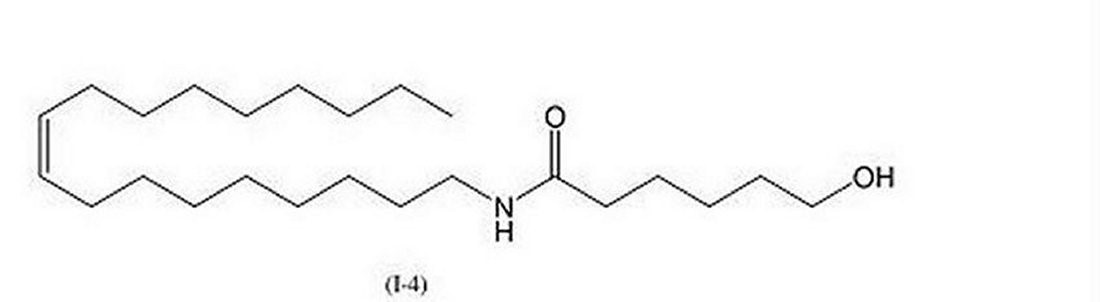
本明細書において上記アミドアルコールを「アミドアルコールOLH」とも称する。
成分Bとして、PEMULEN TR-2((アクリレーツ/アクリル酸アルキル(C10-30))クロスポリマー)を使用した。
成分Aとして、式(I)中、R1が不飽和C18アルキル(オレイル)、R2がH、R3がC5である、下記構造(I-4)を有するアミドアルコールを使用した。
成分Bとして、PEMULEN TR-2((アクリレーツ/アクリル酸アルキル(C10-30))クロスポリマー)を使用した。
(製法)
(1)~(4)を80℃で均一に撹拌溶解し水相を得た。一方で、(5)~(6)を80℃で均一に撹拌溶解し、油相を得た。得られた水相および油相を混合して均一に溶解し、80℃で、ディスパーにて撹拌し混合物を調製した。混合物を撹拌しながら(7)を添加し、油中水型の乳化組成物を得た。
(1)~(4)を80℃で均一に撹拌溶解し水相を得た。一方で、(5)~(6)を80℃で均一に撹拌溶解し、油相を得た。得られた水相および油相を混合して均一に溶解し、80℃で、ディスパーにて撹拌し混合物を調製した。混合物を撹拌しながら(7)を添加し、油中水型の乳化組成物を得た。
(評価)
1.顕微鏡観察による乳化粒子径の測定
オリンパス社製「BX-51」用いて400倍で観察し、中和後の乳化物の乳化粒子径をそれぞれ評価した。結果を図1に示す。
1.顕微鏡観察による乳化粒子径の測定
オリンパス社製「BX-51」用いて400倍で観察し、中和後の乳化物の乳化粒子径をそれぞれ評価した。結果を図1に示す。
2.粘度
ブルックフィールド粘度計、S63、S64の2種類のSPINDLEを粘度に応じて適宜使用し、回転速度は12rpmにて測定した。粘度は942,000mPa・sであった。クリーム状の化粧組成物等に適した粘度の乳化物を提供することができると言える。
ブルックフィールド粘度計、S63、S64の2種類のSPINDLEを粘度に応じて適宜使用し、回転速度は12rpmにて測定した。粘度は942,000mPa・sであった。クリーム状の化粧組成物等に適した粘度の乳化物を提供することができると言える。
実施例2
基本処方の乳化物を観察するために、下記表2に記載の処方(AMO-54)を調製した。
基本処方の乳化物を観察するために、下記表2に記載の処方(AMO-54)を調製した。

アミドアルコール、カルボキシル基含有高分子、およびイソステアリン酸を、赤外分光分析装置(サーモフィッシャーサイエンティフィック社製,Nicolet IS10)で、フーリエ変換赤外分光光度計(Fourier transform infrared spectrometer: 以下、FT-IR)測定した。アミドアルコール(OLH)、カルボキシル基含有高分子(商品名:PEMULEN TR-2 Polymer,Lubrizol Advanced Materials,Inc)、イソステアリン酸(商品名:イソステアリン酸EX,高級アルコール工業株式会社製)、および本発明によるW/O型乳化組成物(実施例2(AMO-54,常温で2週間乾燥物))の測定結果を図2に、さらに、1300~2000cm-1部分を拡大したものを図3として示す。
W/O型乳化組成物の自然乾燥は、水分子によるO-H伸縮(3300~2500cm-1)、O-H変角(1000~850cm-1)などにより、複合体形成の吸収をマスキングしてしまうため、極力、水分子の吸収を排除するために行った処理である。
W/O型乳化組成物の自然乾燥は、水分子によるO-H伸縮(3300~2500cm-1)、O-H変角(1000~850cm-1)などにより、複合体形成の吸収をマスキングしてしまうため、極力、水分子の吸収を排除するために行った処理である。
これらの結果より、複合体の吸収スペクトルは、アミドアルコール単独、カルボキシル基含有高分子(商品名:PEMULEN TR-2 Polymer,Lubrizol Advanced Materials,Inc)、イソステアリン酸(商品名:イソステアリン酸EX,高級アルコール工業株式会社製)のそれを重ねたものとは異なったものとなっていることが理解できる。
特に、図3においては、1530cm-1付近のアミドI(C=O伸縮)、1630cm-1付近のアミドII(N-H変角)が高波長側へのシフトが確認でき、一方で、1700cm-1付近のカルボキシル基含有高分子(商品名:PEMULEN TR-2 Polymer,Lubrizol Advanced Materials,Inc)のカルボン酸のC=O伸縮、およびイソステアリン酸(商品名:イソステアリン酸EX,高級アルコール工業株式会社製)のC=O伸縮バンドが高波長側へシフトしていることが確認できる。これは、アミドアルコールのアミド結合部とカルボキシル基含有高分子のカルボキシル基、およびアミドアルコールのアミド結合部とイソステアリン酸のカルボキシル基がそれぞれ水素結合して、複合体を形成していることを示していると考えられる。
特に、図3においては、1530cm-1付近のアミドI(C=O伸縮)、1630cm-1付近のアミドII(N-H変角)が高波長側へのシフトが確認でき、一方で、1700cm-1付近のカルボキシル基含有高分子(商品名:PEMULEN TR-2 Polymer,Lubrizol Advanced Materials,Inc)のカルボン酸のC=O伸縮、およびイソステアリン酸(商品名:イソステアリン酸EX,高級アルコール工業株式会社製)のC=O伸縮バンドが高波長側へシフトしていることが確認できる。これは、アミドアルコールのアミド結合部とカルボキシル基含有高分子のカルボキシル基、およびアミドアルコールのアミド結合部とイソステアリン酸のカルボキシル基がそれぞれ水素結合して、複合体を形成していることを示していると考えられる。
いかなる理論にも拘束されず、未中和および中和のいずれの状態においてもアミドアルコールのアミド結合部のNとカルボマーのカルボキシル基、およびとは水素結合を形成し、乳化能を発揮すると考えられる。
いかなる理論にも拘束されないが、未中和の状態では、アルキル変性カルボマーおよびイソステアリン酸のカルボキシル基は、-COOHとなっており、この時にアミドアルコールのアミド結合のカルボニル基と水素結合を形成し、複合体は疎水性であり、これを徐々に中和していくと、カルボキシル基の一部がCOO-へと解離し、親水性を取り戻し、複合体としては、疎水部と親水部を有するようになり、より高い乳化能を発揮すると考えられる。
いかなる理論にも拘束されないが、未中和の状態では、アルキル変性カルボマーおよびイソステアリン酸のカルボキシル基は、-COOHとなっており、この時にアミドアルコールのアミド結合のカルボニル基と水素結合を形成し、複合体は疎水性であり、これを徐々に中和していくと、カルボキシル基の一部がCOO-へと解離し、親水性を取り戻し、複合体としては、疎水部と親水部を有するようになり、より高い乳化能を発揮すると考えられる。
なお、イソステアリン酸を含む実施例2は、イソステアリン酸を含まない実施例1と比較して、より安定なW/O乳化物となっていた。乳化状態を図4に示す。
イソステアリン酸を用いない場合でも、アミドアルコールおよびカルボン酸含有ポリマーとで複合体を形成することが理解できるが、イソステアリン酸も用いることにより、より親水性が高く、より高いW/O乳化能を有する複合体が形成されると考えられる。
イソステアリン酸を用いない場合でも、アミドアルコールおよびカルボン酸含有ポリマーとで複合体を形成することが理解できるが、イソステアリン酸も用いることにより、より親水性が高く、より高いW/O乳化能を有する複合体が形成されると考えられる。
各表に記載の異なる処方の乳化物の調製を行った。
実施例3および比較例3
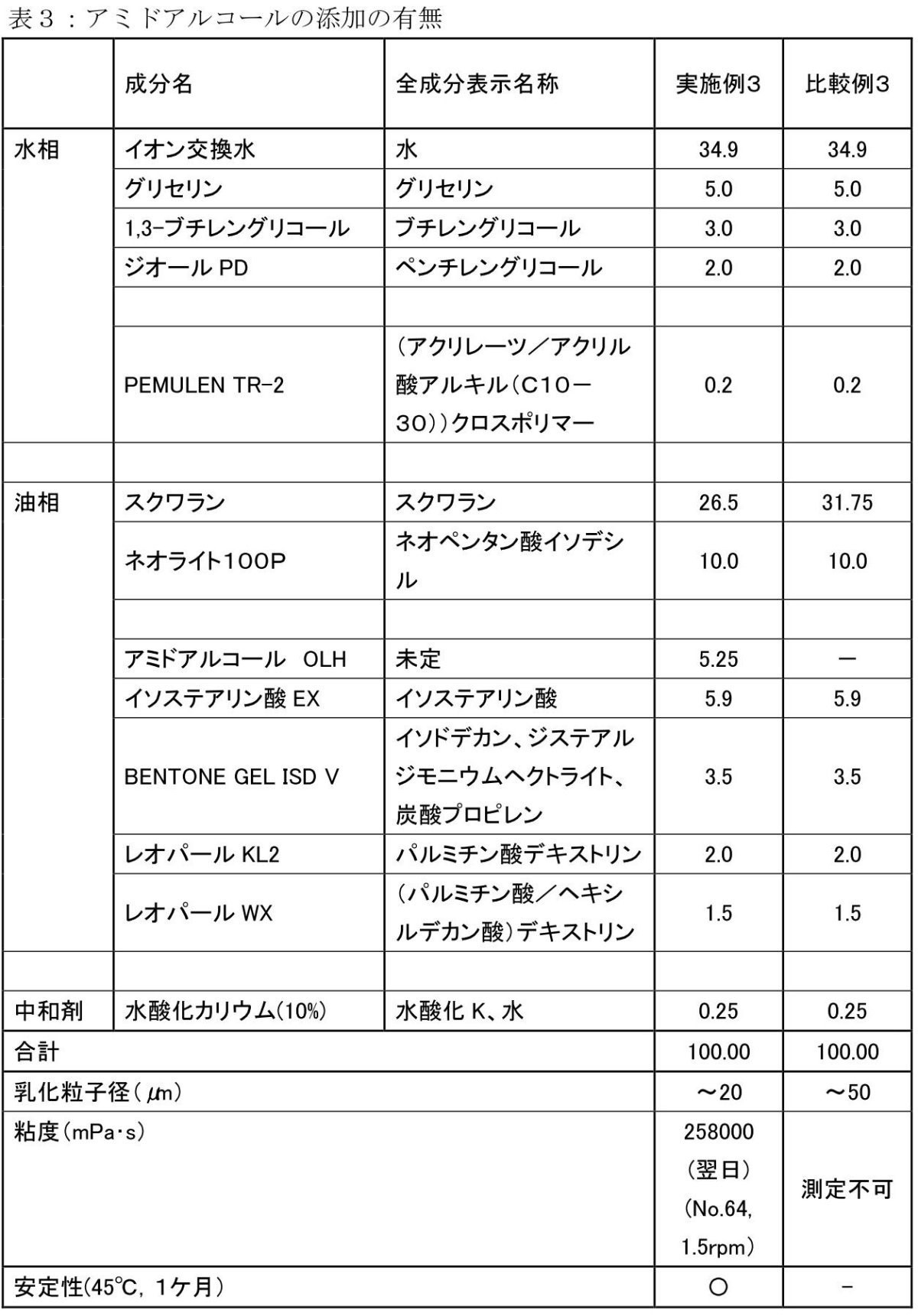
(製法および評価)
実施例1と同様の方法で、実施例3および比較処方3をそれぞれ調製し、乳化粒子径および粘度を測定した。乳化状態を図5に示す。
アミドアルコールを欠いた比較例3は、製造直後の乳化性は認められるが、直ぐに分離が進み、乳化物を得ることができなかった。一方、アミドアルコールを含む実施例3では長期的にも安定した乳化物が得られた。
実施例1と同様の方法で、実施例3および比較処方3をそれぞれ調製し、乳化粒子径および粘度を測定した。乳化状態を図5に示す。
アミドアルコールを欠いた比較例3は、製造直後の乳化性は認められるが、直ぐに分離が進み、乳化物を得ることができなかった。一方、アミドアルコールを含む実施例3では長期的にも安定した乳化物が得られた。
実施例4
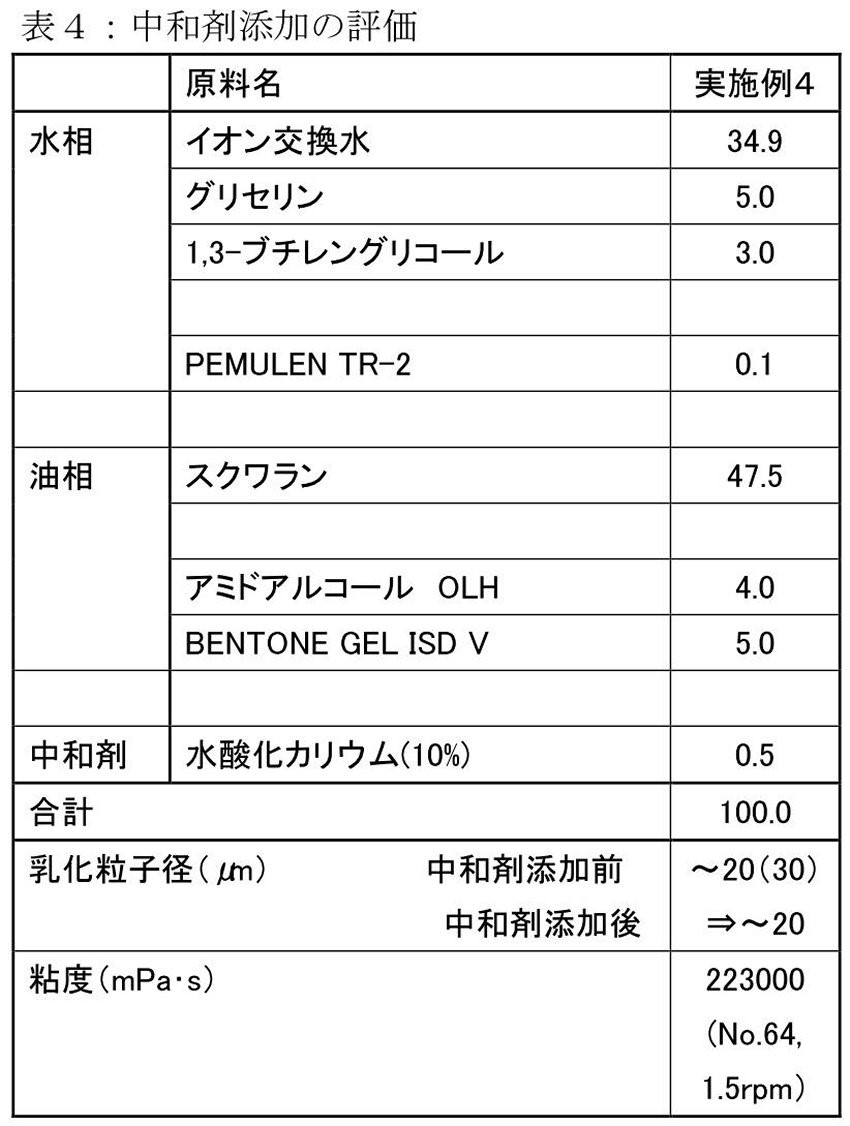
(製法および評価)
実施例1と同様の方法で、実施例4を調製し乳化粒子径および粘度を測定した。中和前および中和後の乳化状態を図6に示す。
中和剤添加前においても乳化性が認められ、中和剤を添加することで、より均質な乳化性がもたらされた。
実施例1と同様の方法で、実施例4を調製し乳化粒子径および粘度を測定した。中和前および中和後の乳化状態を図6に示す。
中和剤添加前においても乳化性が認められ、中和剤を添加することで、より均質な乳化性がもたらされた。
実施例5Aおよび5B

(製法および評価)
実施例1と同様の方法で、アミドアルコールとカルボキシル基含有高分子との配合比の異なる、実施例5Aおよび実施例5Bをそれぞれ調製し、乳化粒子径および粘度を測定した。乳化状態を図6に示す。
実施例1と同様の方法で、アミドアルコールとカルボキシル基含有高分子との配合比の異なる、実施例5Aおよび実施例5Bをそれぞれ調製し、乳化粒子径および粘度を測定した。乳化状態を図6に示す。
アミドアルコールの比率の高い実施例4Bは、実施例4Aと比較して乳化粒子径が大きい乳化物となった。このことから、アミドアルコールの比率を高めることで疎水性が強くなり、カルボキシル基含有高分子の割合が高くなると、親水性が強くなることが理解できる。
実施例6Aおよび6B
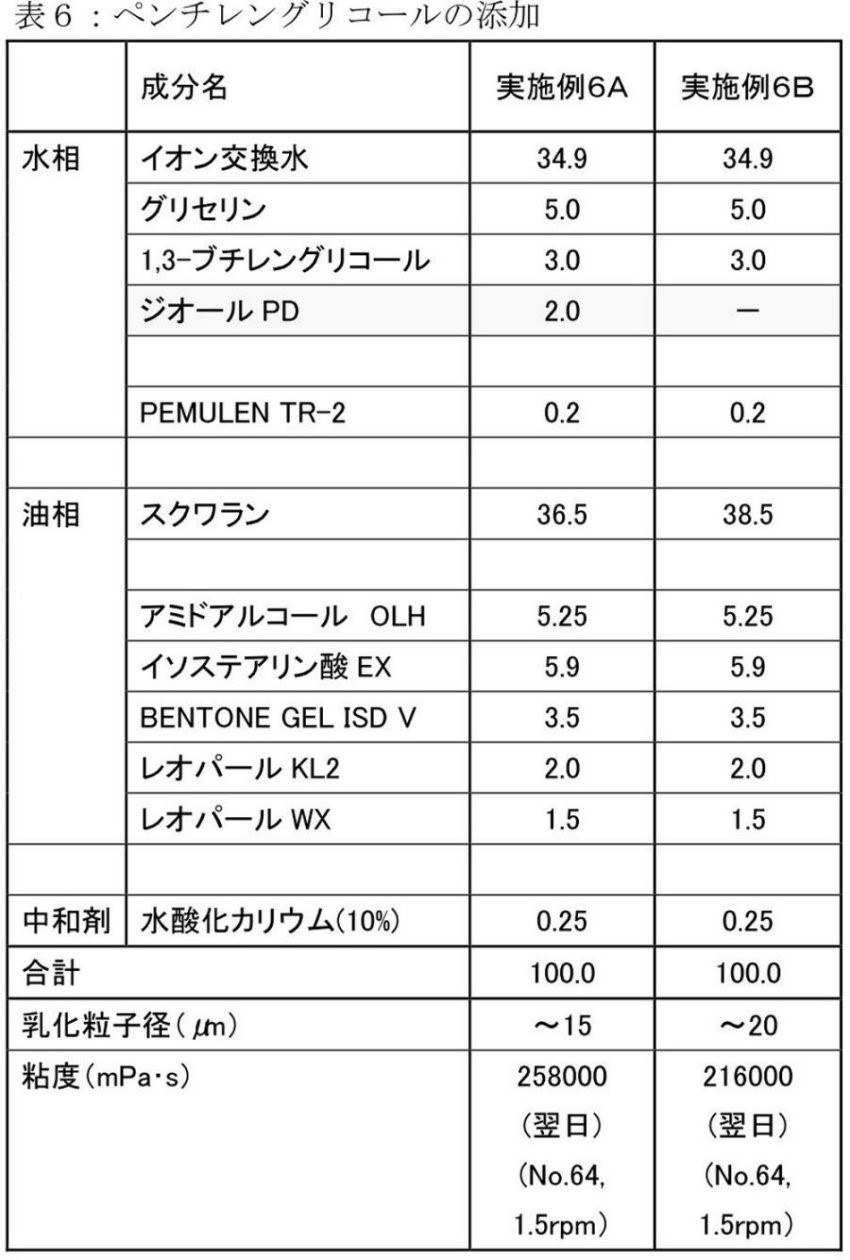
(製法および評価)
実施例1と同様の方法で、実施例6A(ペンチレングリコール配合)および実施例6B(ペンチレングリコール無配合)をそれぞれ調製し、乳化粒子径および粘度を測定した。乳化状態を図6に示す。
ペンチレングリコールを配合することで、より良好な乳化性を示す乳化物が得られることが理解できる。
実施例1と同様の方法で、実施例6A(ペンチレングリコール配合)および実施例6B(ペンチレングリコール無配合)をそれぞれ調製し、乳化粒子径および粘度を測定した。乳化状態を図6に示す。
ペンチレングリコールを配合することで、より良好な乳化性を示す乳化物が得られることが理解できる。
実施例7A、7Bおよび7C
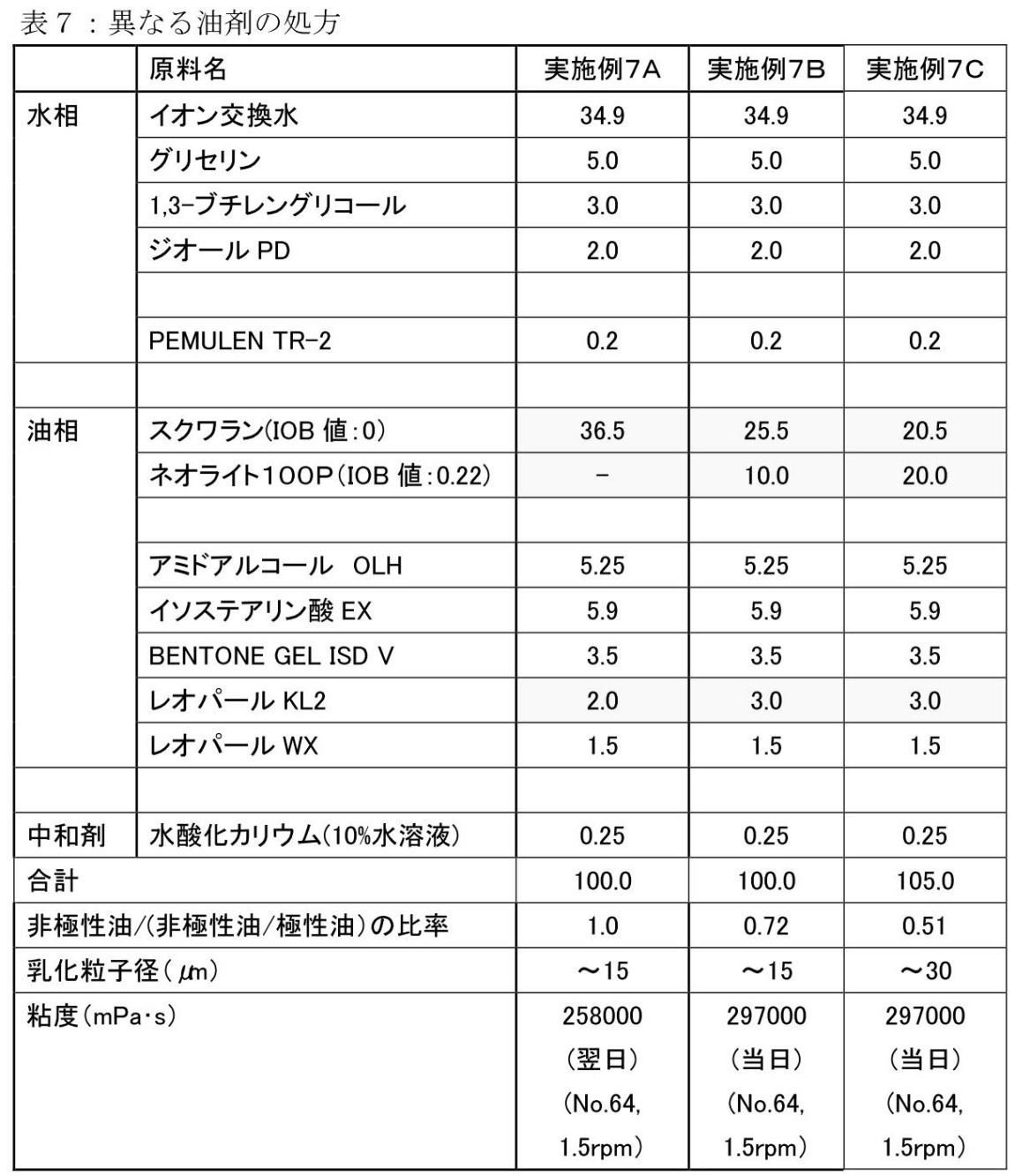
(製法および評価)
実施例1と同様の方法で、実施例7A(非極性油のみ)、実施例7B(非極性油+極性油)、および実施例7C(非極性油+極性油)をそれぞれ調製し、乳化粒子径および粘度を測定した。乳化状態を図7に示す。
極性油の割合が高くなると、乳化粒子径が大きくなること、すなわち非極性油の割合が高いほど、より安定な乳化物が得られることが理解できる。
実施例1と同様の方法で、実施例7A(非極性油のみ)、実施例7B(非極性油+極性油)、および実施例7C(非極性油+極性油)をそれぞれ調製し、乳化粒子径および粘度を測定した。乳化状態を図7に示す。
極性油の割合が高くなると、乳化粒子径が大きくなること、すなわち非極性油の割合が高いほど、より安定な乳化物が得られることが理解できる。
上記各実施例においては、水相と油相とを撹拌・乳化した後に中和剤を添加して中和し、さらに撹拌することで最終的な乳化組成物を調製したが、以下の同様に中和剤を乳化後に添加するプロセス(以下、後添加という)と、カルボキシル含有ポリマーを含有する水相をアルカリで中和し、これに油相を添加した後に撹拌・乳化を行って乳化物を調製するプロセス(以下、前添加という)とで、乳化状態の違いを検討した。
実施例8Aおよび8B

実施例1と同様の方法で、乳化粒子径および粘度を測定した。乳化状態を図9に示す。
中和剤の添加タイミングが異なることにより、乳化状態に若干の差異が認められたが、前添加・後添加のいずれの方法によっても、良好なW/O乳化物を調製できることが理解される。
中和剤の添加タイミングが異なることにより、乳化状態に若干の差異が認められたが、前添加・後添加のいずれの方法によっても、良好なW/O乳化物を調製できることが理解される。
本発明の複合体を利用した、W/O乳化化粧組成物の例を以下に示す。
[実施例9]ヘアトリートメントクリーム
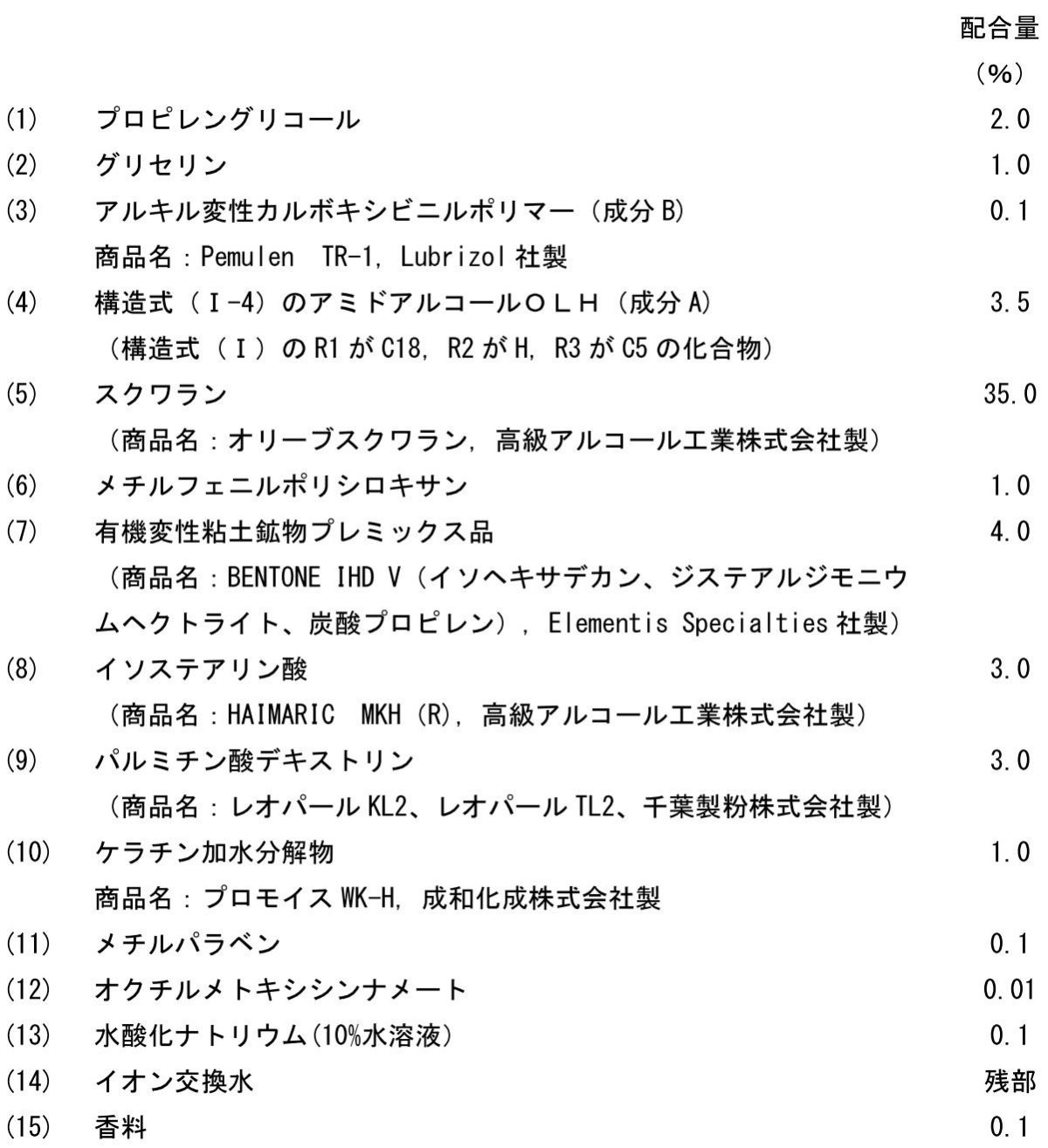
<製法>
(4)~(9)、(12)を80℃で均一に混合する(油相)。
一方で、(1)~(3)、(10)、(11)、(14)を80℃で均一に混合する(水相)。
油相に水相を添加しながら、ディスパーで撹拌する。
次いで、(13)を添加して、乳化する。乳化が完了したら、(15)を添加し、常温まで冷却して、目的の粘度220000mPa・sを得た。
(4)~(9)、(12)を80℃で均一に混合する(油相)。
一方で、(1)~(3)、(10)、(11)、(14)を80℃で均一に混合する(水相)。
油相に水相を添加しながら、ディスパーで撹拌する。
次いで、(13)を添加して、乳化する。乳化が完了したら、(15)を添加し、常温まで冷却して、目的の粘度220000mPa・sを得た。
[実施例10]W/O型乳化ファンデーション
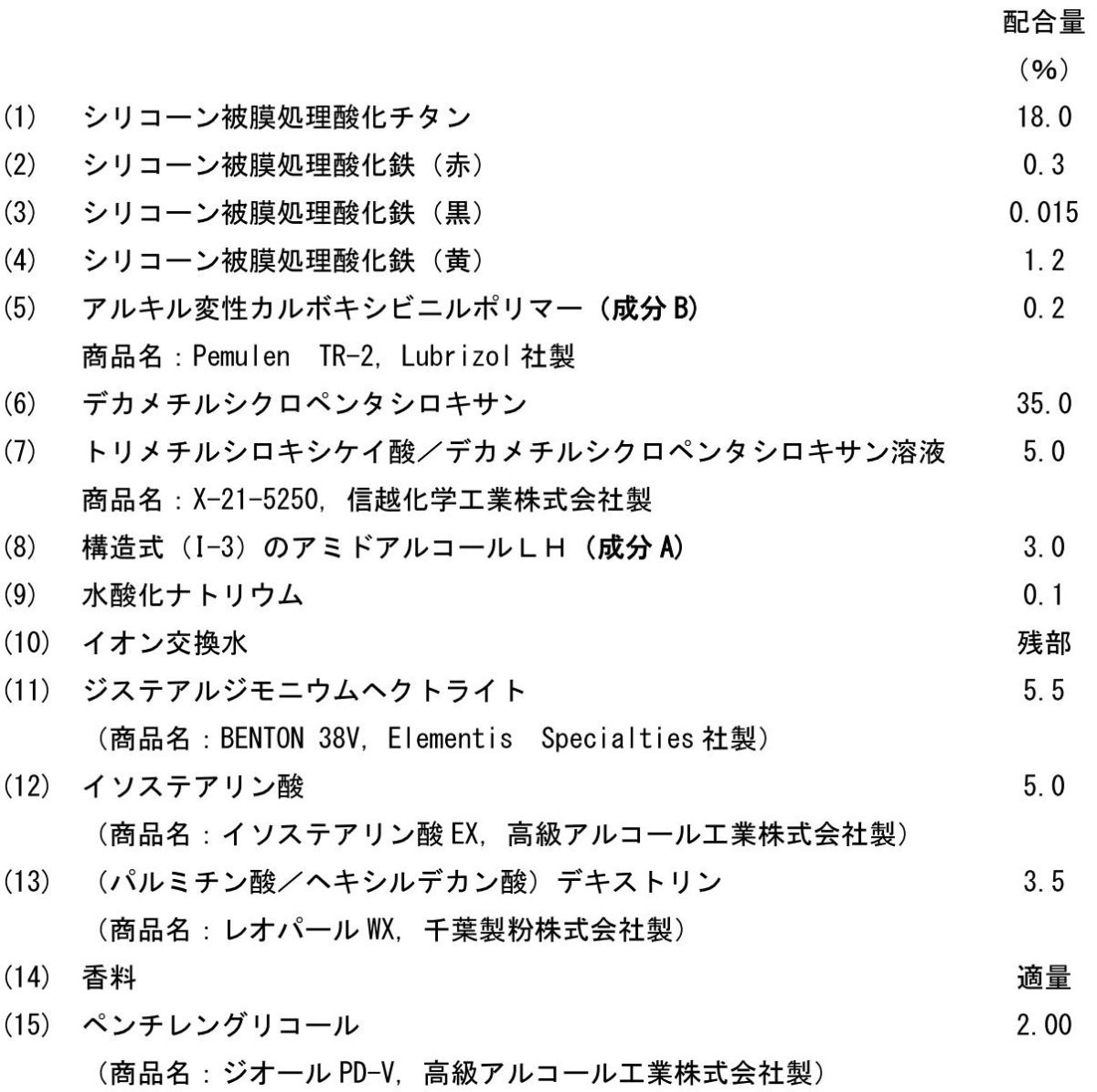
<製法>
(1)~(4)、(6)~(8)、(11)~(14)を80℃で均一に分散する(油相)。
一方、(5)、(9)、(15)の水相を80℃で均一に溶解混合し、先に調製した油相に徐添しながら、ディスパーで撹拌する。
さらに、(9)と一部の(10)により調製した溶液を加えて乳化する。乳化が完了したら、常温まで冷却して、目的の粘度450000mPa・sのW/O型乳化ファンデーションを得る。
(1)~(4)、(6)~(8)、(11)~(14)を80℃で均一に分散する(油相)。
一方、(5)、(9)、(15)の水相を80℃で均一に溶解混合し、先に調製した油相に徐添しながら、ディスパーで撹拌する。
さらに、(9)と一部の(10)により調製した溶液を加えて乳化する。乳化が完了したら、常温まで冷却して、目的の粘度450000mPa・sのW/O型乳化ファンデーションを得る。
[実施例11]エモリエントクリーム
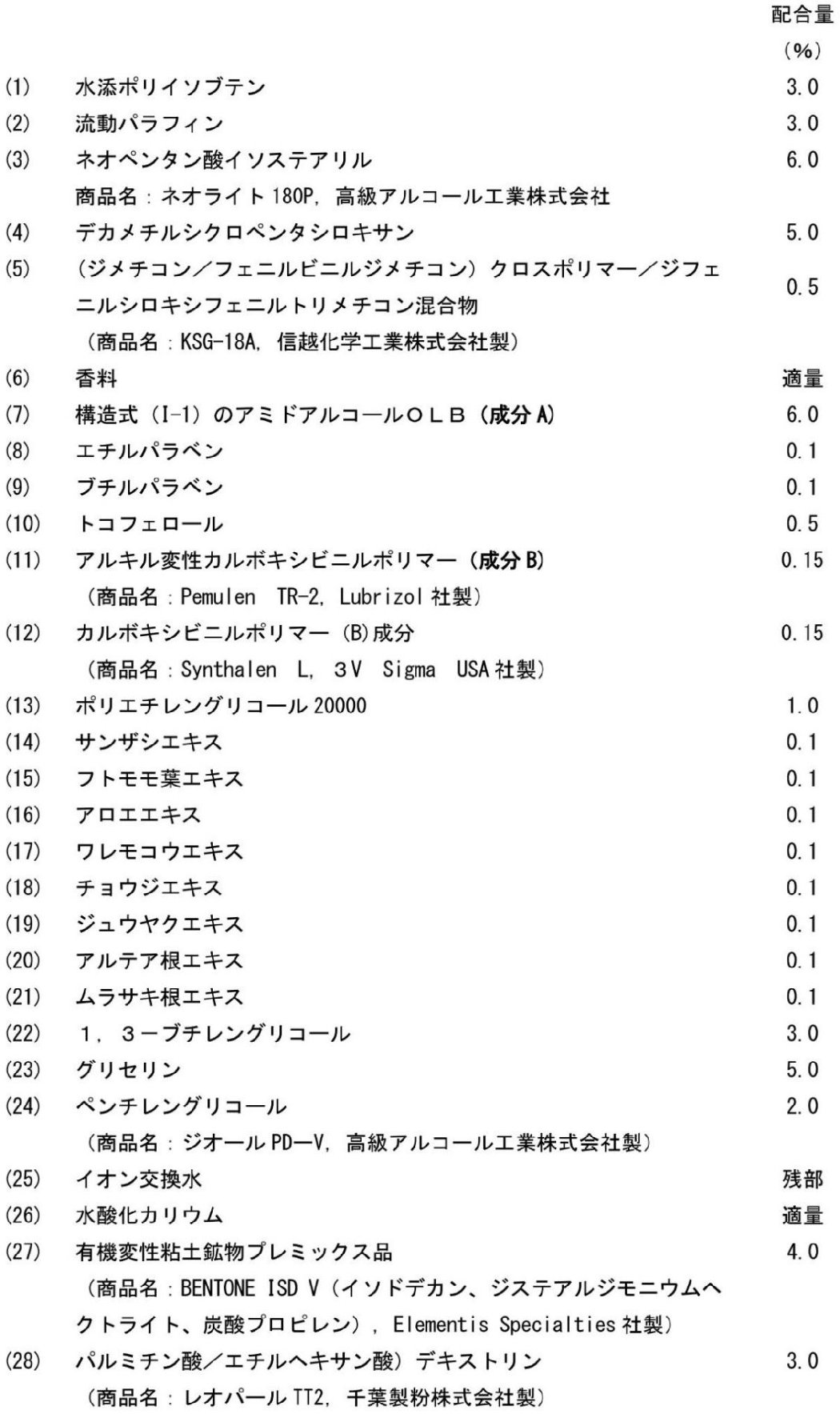
<製法>
(1)~(7)、(27)、(28)を80℃に加熱し、均一に混合する(油相)。
一方で、(8)~(26)を80℃で均一に混合する(水相)。
水相を先に調製した80℃の油相に徐添しながら、ディスパーで撹拌する。
さらに、(26)と一部の(25)により調製した溶液を加えて乳化する。乳化が完了したら、常温まで冷却して、目的の粘度280000mPa・sのW/O型乳化エモリエントクリームを得る。
(1)~(7)、(27)、(28)を80℃に加熱し、均一に混合する(油相)。
一方で、(8)~(26)を80℃で均一に混合する(水相)。
水相を先に調製した80℃の油相に徐添しながら、ディスパーで撹拌する。
さらに、(26)と一部の(25)により調製した溶液を加えて乳化する。乳化が完了したら、常温まで冷却して、目的の粘度280000mPa・sのW/O型乳化エモリエントクリームを得る。
[実施例12]美白クリーム
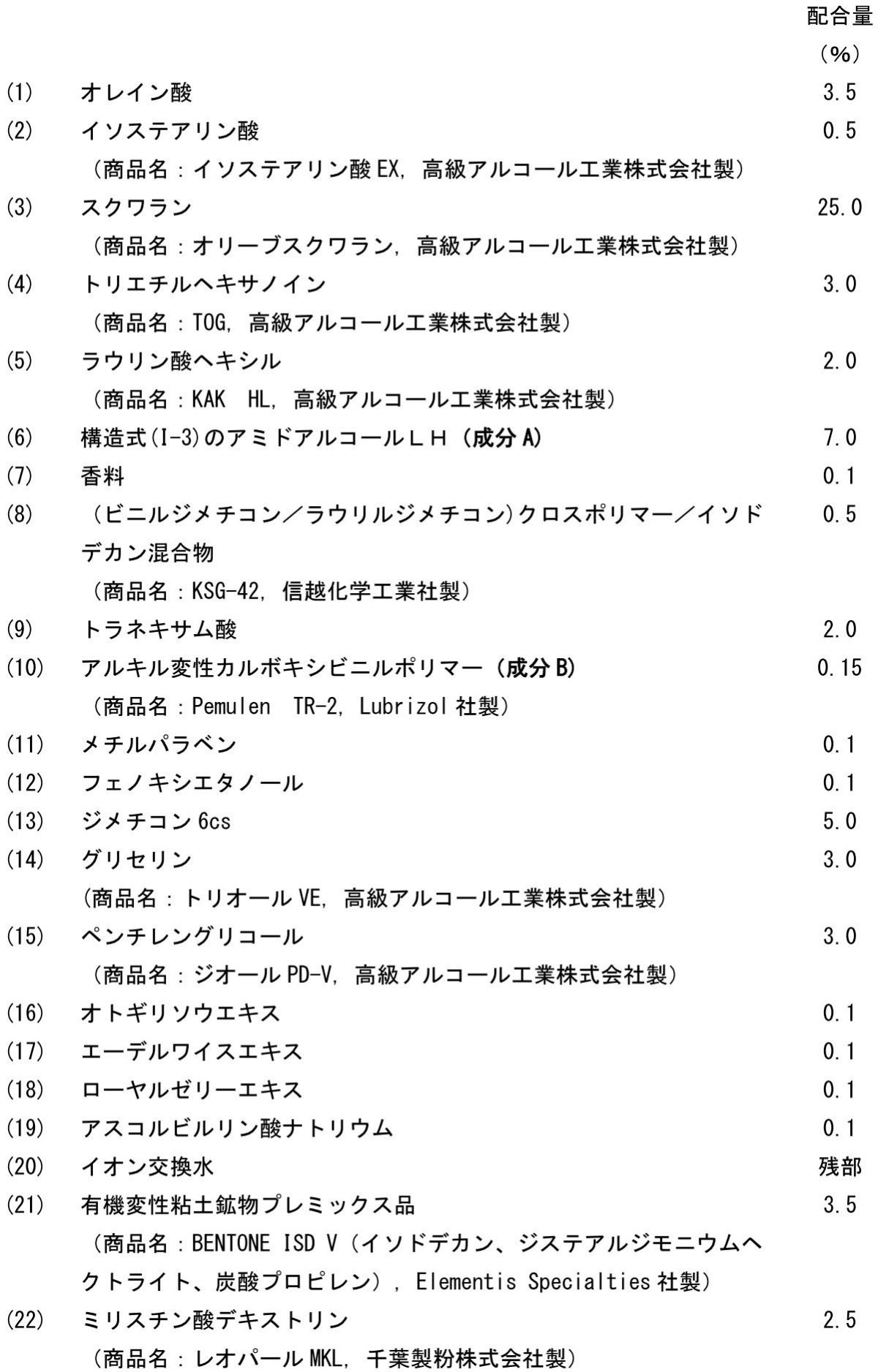
<製法>
(1)~(8)、(21)、(22)を80℃で均一に混合する(油相)。
一方で、(9)~(20)を80℃に加熱し、均一の混合する(水相,トラネキサム酸は、pHを上げる作用があるため、別途、アルカリ剤を配合しなくとも、非常に安定な乳化物となる)。
水相を先に調製した80℃の油相に徐添しながら、ディスパーで撹拌する。
乳化が完了したら、常温まで冷却して、目的の粘度254000mPa・sのW/O型乳化美白クリームを得る。
(1)~(8)、(21)、(22)を80℃で均一に混合する(油相)。
一方で、(9)~(20)を80℃に加熱し、均一の混合する(水相,トラネキサム酸は、pHを上げる作用があるため、別途、アルカリ剤を配合しなくとも、非常に安定な乳化物となる)。
水相を先に調製した80℃の油相に徐添しながら、ディスパーで撹拌する。
乳化が完了したら、常温まで冷却して、目的の粘度254000mPa・sのW/O型乳化美白クリームを得る。
[実施例13]美白美容液
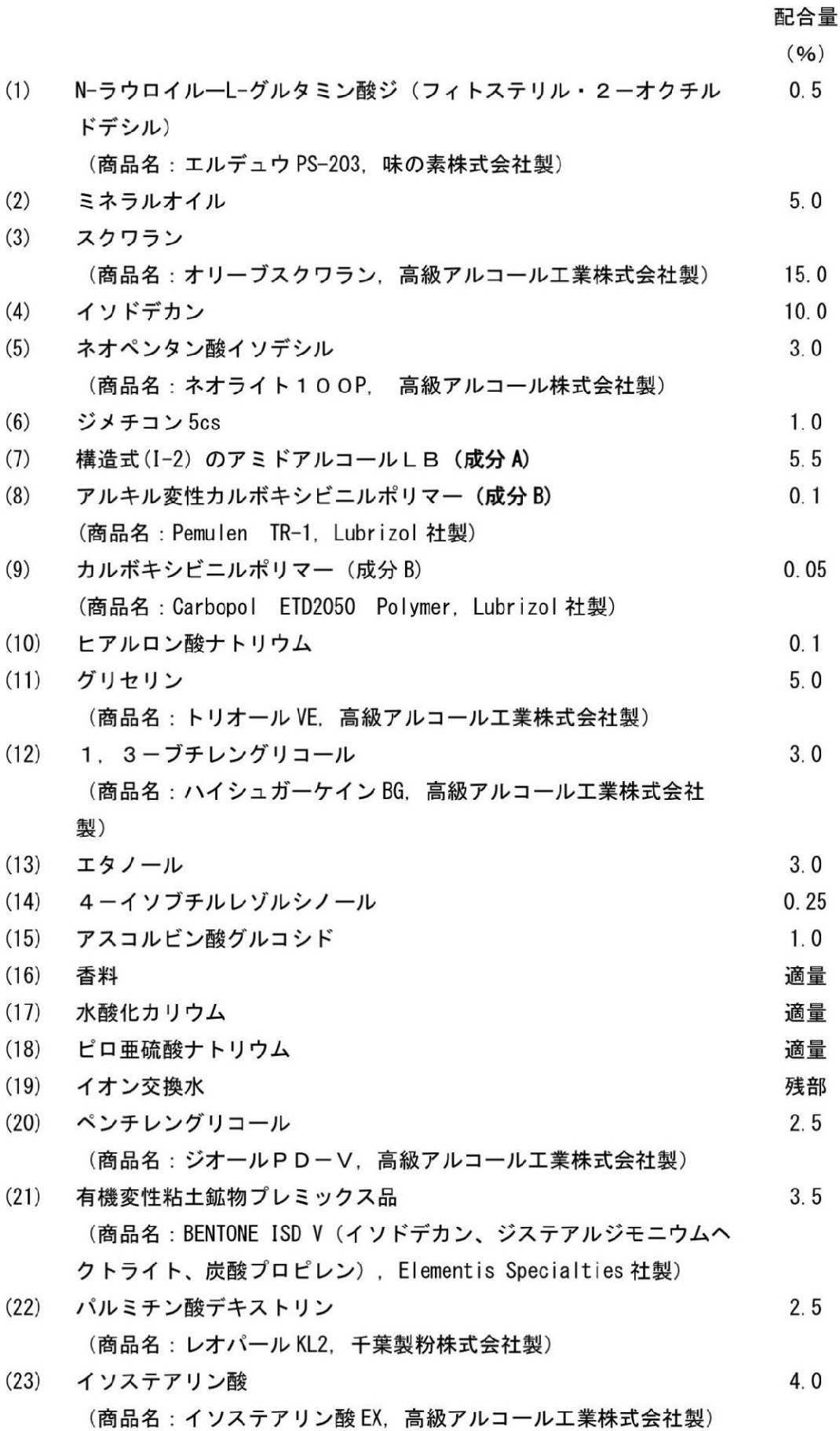
<製法>
(1)~(7)、(16)、(21)~(23)を80℃で均一に溶解する(油相)。
一方、(8)~(21)を80℃で均一に溶解する(水相)。先の80℃の油相に80℃の水相を添加して、ディスパーで撹拌する。
これに、一部の(19)に(17)を溶かした水溶液を添加して、ディスパーで撹拌して乳化する。乳化が完了したら、(13)と(10)の混液を添加して、常温まで冷却して、目的の粘度157000mPa・sの美白美容液を得る。
(1)~(7)、(16)、(21)~(23)を80℃で均一に溶解する(油相)。
一方、(8)~(21)を80℃で均一に溶解する(水相)。先の80℃の油相に80℃の水相を添加して、ディスパーで撹拌する。
これに、一部の(19)に(17)を溶かした水溶液を添加して、ディスパーで撹拌して乳化する。乳化が完了したら、(13)と(10)の混液を添加して、常温まで冷却して、目的の粘度157000mPa・sの美白美容液を得る。
[実施例14]W/O乳化型サンスクリーン

<製法>
(1)~(8)、(14)、(17)~(19)を80℃で均一に溶解する(油相)。
一方で、(9)~(13)、(16)を80℃で均一に混合溶解する(水相)。
この水相を先の80℃に加熱した油相に徐添して、ディスパーで撹拌する。
さらに、(15)を加え、乳化を行う。乳化が完了したら、常温まで冷却し、目的の粘度221000mPa・sのW/O乳化型サンスクリーンを得る。
(1)~(8)、(14)、(17)~(19)を80℃で均一に溶解する(油相)。
一方で、(9)~(13)、(16)を80℃で均一に混合溶解する(水相)。
この水相を先の80℃に加熱した油相に徐添して、ディスパーで撹拌する。
さらに、(15)を加え、乳化を行う。乳化が完了したら、常温まで冷却し、目的の粘度221000mPa・sのW/O乳化型サンスクリーンを得る。
なお、実施例9~11、13および14の処方を、水酸化カリウム、トリエタノールアミン、水酸化ナトリウム等の中和剤を水相に前添加することにより調製することも可能である。
<O/W型乳化物>
実施例15.ペンチレングリコールの有無による乳化性の比較
ペンチレングリコールを用いて水中油型の乳化組成物における乳化性を、粒子径を用いて比較した。
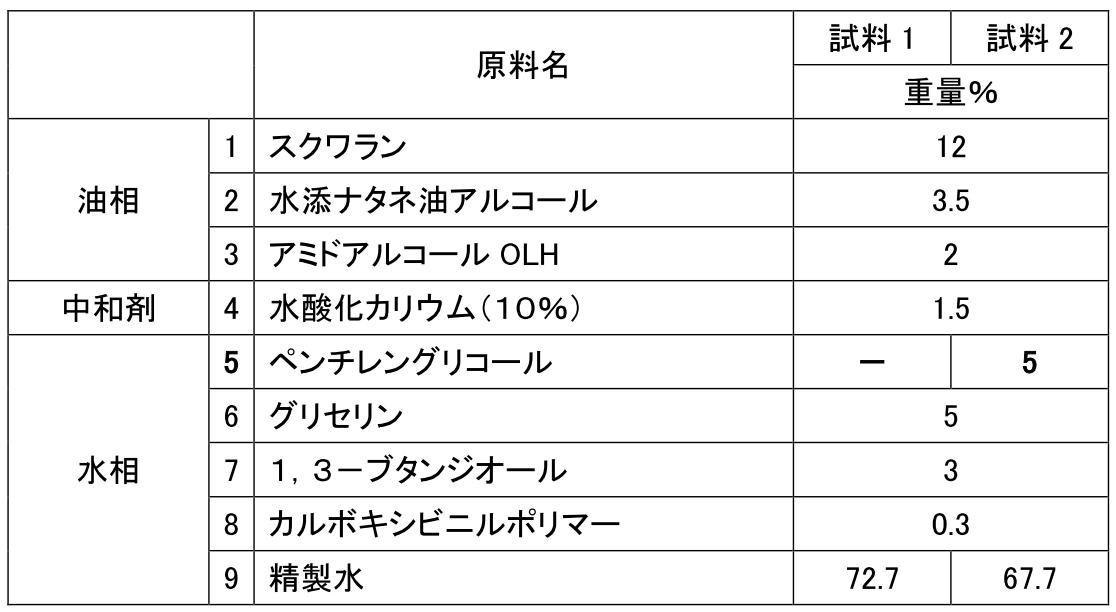
ここで、実施例において用いた各原料は以下のとおりである;
スクワラン:商品名オリーブスクワラン、高級アルコール工業株式会社製
水添ナタネ油アルコール:商品名:アルコールNo.20-B、高級アルコール工業株式会社製
アミドアルコールOLH:式(I-4)で表されるアミドアルコール(高級アルコール工業株式会社製)
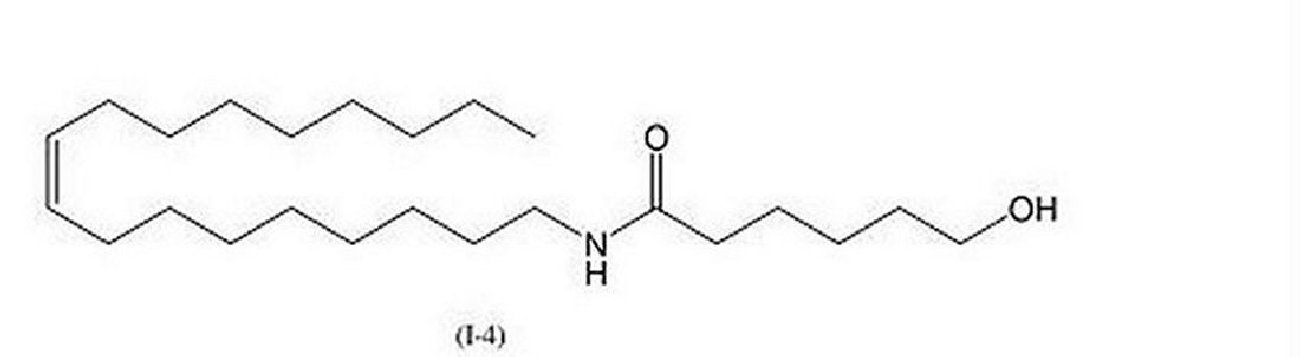
ペンチレングリコール:(商品名:ジオールPD、高級アルコール工業株式会社製)
グリセリン(商品名:トリオールVE、高級アルコール工業株式会社製)
1,3-ブタンジオール(商品名:ハイシュガーケインBG、高級アルコール工業株式会社製)
カルボキシビニルポリマー(商品名:Carbopol ETD2050 polymer、Lubrizol社製)
調製方法
(1)油相、水相をそれぞれ80℃で均一溶解
(2)水相をアジターで撹拌しながら、油相を添加(800rpm)
(3)乳化後、アジターで撹拌(2000rpm、3min)
(4)水酸化カリウムを添加し、さらに撹拌(2000rpm、3min)
(5)手撹拌しながら室温まで徐冷
結果:結果を図11に示す。ジオールPDを含む乳化物は、ジオールPDを含まない乳化物と比較して、粒子径が小さくなり、乳化性が向上した。
実施例15.ペンチレングリコールの有無による乳化性の比較
ペンチレングリコールを用いて水中油型の乳化組成物における乳化性を、粒子径を用いて比較した。
スクワラン:商品名オリーブスクワラン、高級アルコール工業株式会社製
水添ナタネ油アルコール:商品名:アルコールNo.20-B、高級アルコール工業株式会社製
アミドアルコールOLH:式(I-4)で表されるアミドアルコール(高級アルコール工業株式会社製)
グリセリン(商品名:トリオールVE、高級アルコール工業株式会社製)
1,3-ブタンジオール(商品名:ハイシュガーケインBG、高級アルコール工業株式会社製)
カルボキシビニルポリマー(商品名:Carbopol ETD2050 polymer、Lubrizol社製)
調製方法
(1)油相、水相をそれぞれ80℃で均一溶解
(2)水相をアジターで撹拌しながら、油相を添加(800rpm)
(3)乳化後、アジターで撹拌(2000rpm、3min)
(4)水酸化カリウムを添加し、さらに撹拌(2000rpm、3min)
(5)手撹拌しながら室温まで徐冷
結果:結果を図11に示す。ジオールPDを含む乳化物は、ジオールPDを含まない乳化物と比較して、粒子径が小さくなり、乳化性が向上した。
実施例16.ペンチレングリコールの含有量による乳化性の比較
ペンチレングリコールの含有量を変えて、各水中油型の乳化組成物における乳化性を、粒子径を用いて比較した。なお、調製方法は実施例14と同様の方法を用いた。
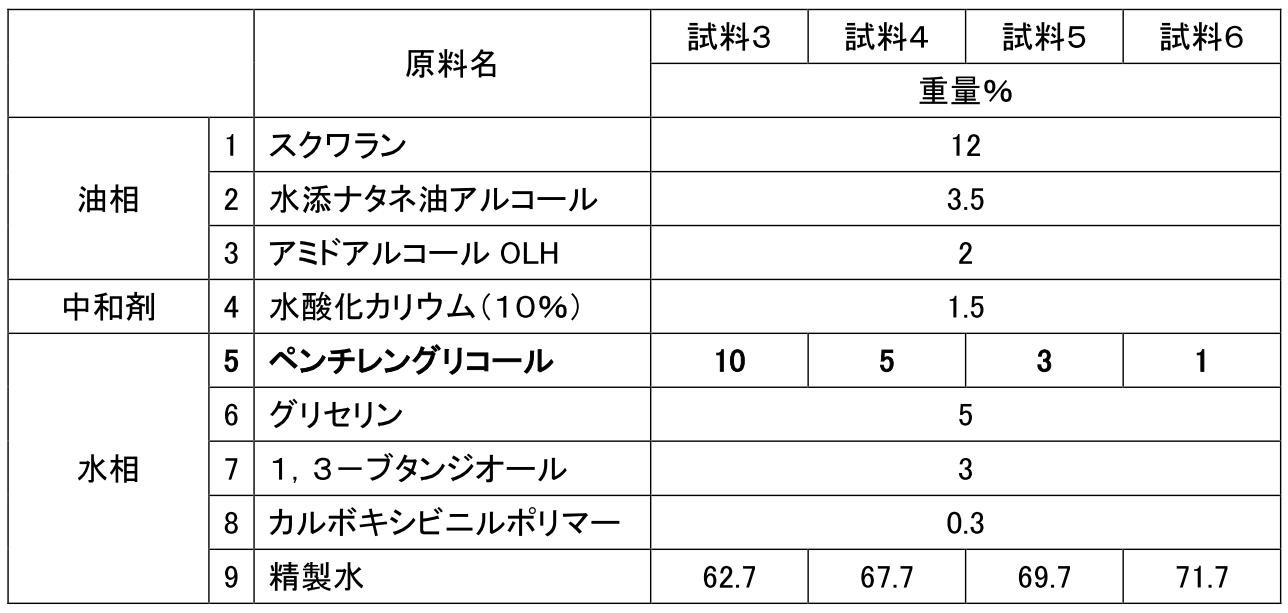
実施例15と同一名称の各原料は、実施例1に記載したものと同一の商品である。また、ミネラルオイルは、商品名:ハイコールK-230(カネダ株式会社製)を使用した。
結果:結果を図12に示す。ペンチレングリコールの含有量が多いほど粒子径は小さくなり、特に5%乳化率が向上することがわかった。
この結果からジオールPDがアミドアルコールと相互作用している可能性が高い。
ペンチレングリコールの含有量を変えて、各水中油型の乳化組成物における乳化性を、粒子径を用いて比較した。なお、調製方法は実施例14と同様の方法を用いた。
結果:結果を図12に示す。ペンチレングリコールの含有量が多いほど粒子径は小さくなり、特に5%乳化率が向上することがわかった。
この結果からジオールPDがアミドアルコールと相互作用している可能性が高い。
実施例17.多価アルコールの種類による乳化性の比較
多価アルコールの種類を変えて、各水中油型の乳化組成物における乳化性を、粒子径を用いて比較した。なお、調製方法は実施例14と同様の方法を用いた。

実施例15または16と同一名称の各原料は、実施例14または15に記載したものと同一の商品である。
結果:結果を図13に示す。
この結果から、ペンチレングリコールまたは2-エチル-1,3-ヘキサンジオールを用いた場合に粒子径は小さくなり、乳化率が向上することがわかった。
多価アルコールの種類を変えて、各水中油型の乳化組成物における乳化性を、粒子径を用いて比較した。なお、調製方法は実施例14と同様の方法を用いた。
結果:結果を図13に示す。
この結果から、ペンチレングリコールまたは2-エチル-1,3-ヘキサンジオールを用いた場合に粒子径は小さくなり、乳化率が向上することがわかった。
実施例18.高級脂肪酸の乳化性向上効果の実施例
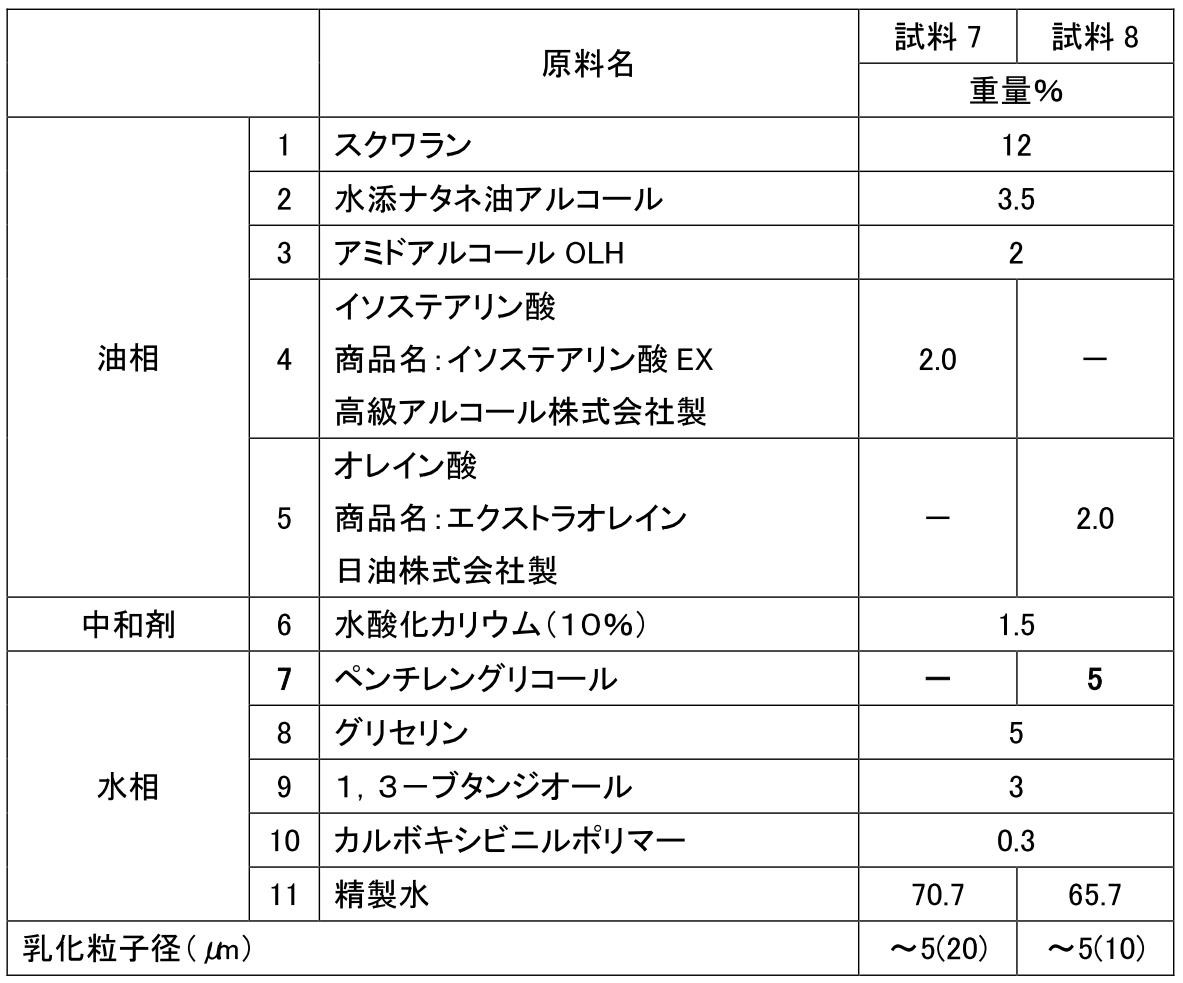
(製法)
製法は、上述の製法と同様である。
結果:結果を図14に示す。
製法は、上述の製法と同様である。
結果:結果を図14に示す。
本発明は、アミドアルコールと、カルボキシ基含有高分子とを組み合わせることで、乳化物を調製することできる、複合体およびこれを利用した乳化物を提供することができる。
かかる乳化物は、化粧品などの用途に使用することが可能である。
かかる乳化物は、化粧品などの用途に使用することが可能である。
Claims (12)
- 式(I)

R1は、C6~C22炭化水素基であり、
R2は、H、またはC6~C22炭化水素基であり、
R3は、直鎖または分岐鎖C2~C21炭化水素基である、
で表されるアミドアルコール、およびカルボキシ基含有高分子を含む、乳化組成物。 - さらに1種以上の多価アルコールを含む、請求項1に記載の乳化組成物。
- 多価アルコールがペンチレングリコールおよび/または2-エチル-1,3-ヘキサンジオールである、請求項2に記載の乳化組成物。
- さらに高級脂肪酸を含む、請求項1~3のいずれか一項に記載の乳化組成物。
- 油ゲル化剤をさらに含む、請求項1~4のいずれか一項に記載の乳化組成物。
- W/O型である、請求項1~5のいずれか一項に記載の乳化組成物。
- O/W型である、請求項1~6のいずれか一項に記載の乳化組成物。
- 式(I)
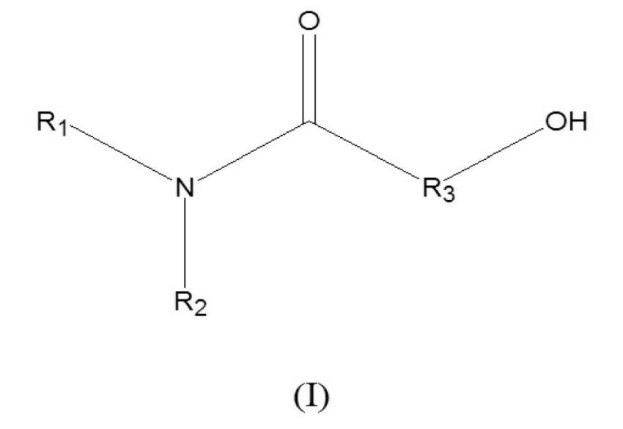
R1は、C6~C22炭化水素基であり、
R2は、H、またはC6~C22炭化水素基であり、
R3は、直鎖または分岐鎖C2~C21炭化水素基である、
で表されるアミドアルコールと、
カルボキシ基含有高分子と、
高級脂肪酸とが結合してなる、複合体。 - さらに1種以上の多価アルコールを含む、請求項8に記載の複合体。
- 式(I)
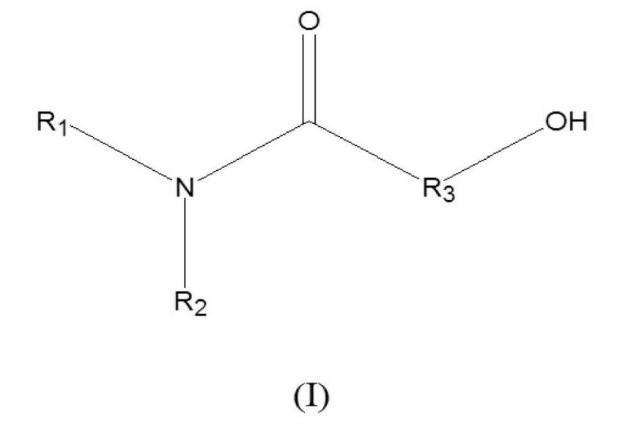
R1は、C6~C22炭化水素基であり、
R2は、H、またはC6~C22炭化水素基であり、
R3は、直鎖または分岐鎖C2~C21炭化水素基である、
で表されるアミドアルコールを含む油相と、カルボキシ基含有高分子を含む水相とを混合する、請求項1に記載の乳化組成物の製造方法。 - 乳化組成物がW/O型である、請求項10に記載の乳化組成物の製造方法。
- 乳化組成物がO/W型である、請求項11に記載の乳化組成物の製造方法。
Priority Applications (4)
| Application Number | Priority Date | Filing Date | Title |
|---|---|---|---|
| KR1020197030254A KR20210005507A (ko) | 2018-04-27 | 2019-04-22 | 신규 복합체 및 유화 조성물 |
| US16/605,243 US20210401680A1 (en) | 2018-04-27 | 2019-04-22 | Novel complex and emulsified composition |
| EP19782462.6A EP3597691A4 (en) | 2018-04-27 | 2019-04-22 | NEW COMPOSITION AND EMULSIFIED COMPOSITION |
| CN201980026877.9A CN112041377A (zh) | 2018-04-27 | 2019-04-22 | 新型复合物及乳化组合物 |
Applications Claiming Priority (4)
| Application Number | Priority Date | Filing Date | Title |
|---|---|---|---|
| JP2018-086864 | 2018-04-27 | ||
| JP2018086864A JP6368064B1 (ja) | 2018-04-27 | 2018-04-27 | 新規複合体および油中水型乳化組成物 |
| JP2018-225690 | 2018-11-30 | ||
| JP2018225690A JP2020083861A (ja) | 2018-11-30 | 2018-11-30 | 水中油型乳化組成物 |
Publications (1)
| Publication Number | Publication Date |
|---|---|
| WO2019208497A1 true WO2019208497A1 (ja) | 2019-10-31 |
Family
ID=68295013
Family Applications (1)
| Application Number | Title | Priority Date | Filing Date |
|---|---|---|---|
| PCT/JP2019/017030 Ceased WO2019208497A1 (ja) | 2018-04-27 | 2019-04-22 | 新規複合体および乳化組成物 |
Country Status (6)
| Country | Link |
|---|---|
| US (1) | US20210401680A1 (ja) |
| EP (1) | EP3597691A4 (ja) |
| KR (1) | KR20210005507A (ja) |
| CN (1) | CN112041377A (ja) |
| TW (1) | TW202003447A (ja) |
| WO (1) | WO2019208497A1 (ja) |
Cited By (1)
| Publication number | Priority date | Publication date | Assignee | Title |
|---|---|---|---|---|
| WO2026048232A1 (ja) * | 2024-08-29 | 2026-03-05 | 高級アルコール工業株式会社 | 顔料用分散剤 |
Families Citing this family (2)
| Publication number | Priority date | Publication date | Assignee | Title |
|---|---|---|---|---|
| US20240009109A1 (en) * | 2021-01-05 | 2024-01-11 | Cargill, Incorporated | Natural oil-based petrolatum and method of making same |
| WO2022150814A1 (en) * | 2021-01-05 | 2022-07-14 | Cargill, Incorporated | Natural oil-based petrolatum and method of making same |
Citations (7)
| Publication number | Priority date | Publication date | Assignee | Title |
|---|---|---|---|---|
| JPS479589U (ja) * | 1971-03-01 | 1972-10-04 | ||
| JPS502116A (ja) | 1973-05-14 | 1975-01-10 | ||
| JPH01502116A (ja) * | 1986-12-08 | 1989-07-27 | チヤールズ オブ ザ リッツ グループ リミテット | 耐湿性皮膚トリートメント組成物 |
| JPH0829934A (ja) * | 1994-07-20 | 1996-02-02 | Konica Corp | ハロゲン化銀カラー写真感光材料 |
| JP2003252723A (ja) | 2002-03-01 | 2003-09-10 | Dai Ichi Kogyo Seiyaku Co Ltd | 油中水型乳化組成物 |
| JP2016114276A (ja) | 2014-12-12 | 2016-06-23 | 荏原冷熱システム株式会社 | 吸収ヒートポンプ |
| JP2017218419A (ja) * | 2016-06-08 | 2017-12-14 | 高級アルコール工業株式会社 | アミドアルコールを含む化粧用基剤および化粧品 |
Family Cites Families (3)
| Publication number | Priority date | Publication date | Assignee | Title |
|---|---|---|---|---|
| JP5277011B2 (ja) * | 2008-02-13 | 2013-08-28 | 株式会社 資生堂 | 水中油型乳化白濁皮膚化粧料 |
| JP5568159B1 (ja) * | 2013-05-13 | 2014-08-06 | ジェイオーコスメティックス株式会社 | 水中油型乳化化粧料 |
| CN108601722B (zh) * | 2016-02-15 | 2021-06-11 | 高丝股份有限公司 | 油包水型乳化化妆品 |
-
2019
- 2019-04-22 CN CN201980026877.9A patent/CN112041377A/zh active Pending
- 2019-04-22 WO PCT/JP2019/017030 patent/WO2019208497A1/ja not_active Ceased
- 2019-04-22 EP EP19782462.6A patent/EP3597691A4/en not_active Withdrawn
- 2019-04-22 KR KR1020197030254A patent/KR20210005507A/ko not_active Withdrawn
- 2019-04-22 US US16/605,243 patent/US20210401680A1/en not_active Abandoned
- 2019-04-26 TW TW108114713A patent/TW202003447A/zh unknown
Patent Citations (7)
| Publication number | Priority date | Publication date | Assignee | Title |
|---|---|---|---|---|
| JPS479589U (ja) * | 1971-03-01 | 1972-10-04 | ||
| JPS502116A (ja) | 1973-05-14 | 1975-01-10 | ||
| JPH01502116A (ja) * | 1986-12-08 | 1989-07-27 | チヤールズ オブ ザ リッツ グループ リミテット | 耐湿性皮膚トリートメント組成物 |
| JPH0829934A (ja) * | 1994-07-20 | 1996-02-02 | Konica Corp | ハロゲン化銀カラー写真感光材料 |
| JP2003252723A (ja) | 2002-03-01 | 2003-09-10 | Dai Ichi Kogyo Seiyaku Co Ltd | 油中水型乳化組成物 |
| JP2016114276A (ja) | 2014-12-12 | 2016-06-23 | 荏原冷熱システム株式会社 | 吸収ヒートポンプ |
| JP2017218419A (ja) * | 2016-06-08 | 2017-12-14 | 高級アルコール工業株式会社 | アミドアルコールを含む化粧用基剤および化粧品 |
Non-Patent Citations (1)
| Title |
|---|
| See also references of EP3597691A4 |
Cited By (1)
| Publication number | Priority date | Publication date | Assignee | Title |
|---|---|---|---|---|
| WO2026048232A1 (ja) * | 2024-08-29 | 2026-03-05 | 高級アルコール工業株式会社 | 顔料用分散剤 |
Also Published As
| Publication number | Publication date |
|---|---|
| CN112041377A (zh) | 2020-12-04 |
| KR20210005507A (ko) | 2021-01-14 |
| EP3597691A4 (en) | 2021-01-06 |
| EP3597691A1 (en) | 2020-01-22 |
| TW202003447A (zh) | 2020-01-16 |
| US20210401680A1 (en) | 2021-12-30 |
Similar Documents
| Publication | Publication Date | Title |
|---|---|---|
| US20210197154A1 (en) | Novel complex and emulsion composition | |
| JP6368064B1 (ja) | 新規複合体および油中水型乳化組成物 | |
| US20210401680A1 (en) | Novel complex and emulsified composition | |
| US10729629B2 (en) | Complex and emulsion composition | |
| US10328006B2 (en) | W/O type emulsion and a premix for producing the same | |
| JP2021147379A (ja) | 油中水型乳化物 | |
| JP2020125374A (ja) | 乳化組成物および複合体 | |
| JP6469286B1 (ja) | 新規複合体および乳化組成物 | |
| JP2023178977A (ja) | 油中水型乳化物 | |
| JP6824544B1 (ja) | 油中水型乳化物 | |
| JP2020083861A (ja) | 水中油型乳化組成物 | |
| JP6736190B1 (ja) | O/w乳化組成物 | |
| JP2018203741A (ja) | W/o型乳化物およびこれを製造するためのプレミックス |
Legal Events
| Date | Code | Title | Description |
|---|---|---|---|
| ENP | Entry into the national phase |
Ref document number: 20197030254 Country of ref document: KR Kind code of ref document: A |
|
| ENP | Entry into the national phase |
Ref document number: 2019782462 Country of ref document: EP Effective date: 20191014 |
|
| 121 | Ep: the epo has been informed by wipo that ep was designated in this application |
Ref document number: 19782462 Country of ref document: EP Kind code of ref document: A1 |
|
| NENP | Non-entry into the national phase |
Ref country code: DE |