WO2019208683A1 - ハイドロキシアパタイト - Google Patents
ハイドロキシアパタイト Download PDFInfo
- Publication number
- WO2019208683A1 WO2019208683A1 PCT/JP2019/017578 JP2019017578W WO2019208683A1 WO 2019208683 A1 WO2019208683 A1 WO 2019208683A1 JP 2019017578 W JP2019017578 W JP 2019017578W WO 2019208683 A1 WO2019208683 A1 WO 2019208683A1
- Authority
- WO
- WIPO (PCT)
- Prior art keywords
- hydroxyapatite
- present
- mass
- mineral
- biological material
- Prior art date
- Legal status (The legal status is an assumption and is not a legal conclusion. Google has not performed a legal analysis and makes no representation as to the accuracy of the status listed.)
- Ceased
Links
Images
Classifications
-
- A—HUMAN NECESSITIES
- A61—MEDICAL OR VETERINARY SCIENCE; HYGIENE
- A61L—METHODS OR APPARATUS FOR STERILISING MATERIALS OR OBJECTS IN GENERAL; DISINFECTION, STERILISATION OR DEODORISATION OF AIR; CHEMICAL ASPECTS OF BANDAGES, DRESSINGS, ABSORBENT PADS OR SURGICAL ARTICLES; MATERIALS FOR BANDAGES, DRESSINGS, ABSORBENT PADS OR SURGICAL ARTICLES
- A61L27/00—Materials for grafts or prostheses or for coating grafts or prostheses
- A61L27/36—Materials for grafts or prostheses or for coating grafts or prostheses containing ingredients of undetermined constitution or reaction products thereof, e.g. transplant tissue, natural bone, extracellular matrix
- A61L27/3637—Materials for grafts or prostheses or for coating grafts or prostheses containing ingredients of undetermined constitution or reaction products thereof, e.g. transplant tissue, natural bone, extracellular matrix characterised by the origin of the biological material other than human or animal, e.g. plant extracts, algae
-
- C—CHEMISTRY; METALLURGY
- C01—INORGANIC CHEMISTRY
- C01B—NON-METALLIC ELEMENTS; COMPOUNDS THEREOF; METALLOIDS OR COMPOUNDS THEREOF NOT COVERED BY SUBCLASS C01C
- C01B25/00—Phosphorus; Compounds thereof
- C01B25/16—Oxyacids of phosphorus; Salts thereof
- C01B25/26—Phosphates
- C01B25/32—Phosphates of magnesium, calcium, strontium, or barium
-
- C—CHEMISTRY; METALLURGY
- C01—INORGANIC CHEMISTRY
- C01B—NON-METALLIC ELEMENTS; COMPOUNDS THEREOF; METALLOIDS OR COMPOUNDS THEREOF NOT COVERED BY SUBCLASS C01C
- C01B25/00—Phosphorus; Compounds thereof
- C01B25/16—Oxyacids of phosphorus; Salts thereof
- C01B25/26—Phosphates
- C01B25/32—Phosphates of magnesium, calcium, strontium, or barium
- C01B25/34—Magnesium phosphates
-
- A—HUMAN NECESSITIES
- A61—MEDICAL OR VETERINARY SCIENCE; HYGIENE
- A61L—METHODS OR APPARATUS FOR STERILISING MATERIALS OR OBJECTS IN GENERAL; DISINFECTION, STERILISATION OR DEODORISATION OF AIR; CHEMICAL ASPECTS OF BANDAGES, DRESSINGS, ABSORBENT PADS OR SURGICAL ARTICLES; MATERIALS FOR BANDAGES, DRESSINGS, ABSORBENT PADS OR SURGICAL ARTICLES
- A61L2430/00—Materials or treatment for tissue regeneration
- A61L2430/02—Materials or treatment for tissue regeneration for reconstruction of bones; weight-bearing implants
-
- C—CHEMISTRY; METALLURGY
- C01—INORGANIC CHEMISTRY
- C01B—NON-METALLIC ELEMENTS; COMPOUNDS THEREOF; METALLOIDS OR COMPOUNDS THEREOF NOT COVERED BY SUBCLASS C01C
- C01B25/00—Phosphorus; Compounds thereof
- C01B25/16—Oxyacids of phosphorus; Salts thereof
- C01B25/26—Phosphates
- C01B25/45—Phosphates containing plural metal, or metal and ammonium
-
- C—CHEMISTRY; METALLURGY
- C01—INORGANIC CHEMISTRY
- C01P—INDEXING SCHEME RELATING TO STRUCTURAL AND PHYSICAL ASPECTS OF SOLID INORGANIC COMPOUNDS
- C01P2002/00—Crystal-structural characteristics
- C01P2002/50—Solid solutions
- C01P2002/52—Solid solutions containing elements as dopants
Definitions
- the present invention relates to hydroxyapatite having high biocompatibility.
- Hydroxyapatite (Ca 10 (PO 4 ) 6 (OH) 2 ) is a biomaterial that is a main component of bones and teeth, has high biocompatibility, is neutral in pH, and has high safety. Used for raw materials, food additives, cosmetic raw materials, pharmaceutical raw materials, biomaterials such as artificial bones, and the like.
- the method for producing hydroxyapatite relates to a hydroxyapatite crystal on the surface of the base material by immersing the base material into which a hydroxyapatite crystal is deposited in an aqueous solution containing a hydroxyapatite component.
- a method of precipitating Patent Document 1.
- the solvent contained in the hydroxyapatite dispersion liquid is evaporated from the base material to generate low crystalline hydroxyapatite particles on the surface of the base material.
- Patent Document 2 There is a method (Patent Document 2).
- JP 2001-31409 A Japanese Unexamined Patent Publication No. 2016-147799
- Hydroxyapatite has high biocompatibility as described above. However, in applications such as food additives, cosmetic raw materials, pharmaceutical raw materials, and artificial bones, the demand for high biocompatibility has not stopped. . Therefore, an object of the present invention is to provide hydroxyapatite having higher biocompatibility than before.
- the inventors of the present invention have made extensive studies in order to solve the above-mentioned problems, and have found that hydroxyapatite containing Mg has high biocompatibility, leading to the present invention.
- the present invention [1] Hydroxyapatite containing Mg, [2] Hydroxyapatite according to [1], including microcrystalline hydroxyapatite, [3] Chemical formula (Ca: Mg) 10 (PO 4 ) 6 (OH) 2 (In the above formula, (Ca: Mg) 10 means that the total number of elements of Ca and Mg is 10, Ca is 9 to 7, and Mg is 1 to 3.) [1] or [2] hydroxyapatite represented by: [4] Hydroxyapatite according to any one of [1] to [3], which comprises a biological material. [5] The hydroxyapatite according to any one of [1] to [4], further comprising at least one mineral selected from Na, K and Si It is.
- the hydroxyapatite of the present invention has high biocompatibility by containing Mg.
- the hydroxyapatite of the present invention contains Mg (magnesium).
- Mg is a kind of mineral contained in living bones. In living bones, Mg has an action of activating osteoblasts and osteoclasts and promoting bone cells.
- the hydroxyapatite of the present invention containing Mg having such an action has a higher biocompatibility in applications of biomaterials such as food additives, cosmetic raw materials, pharmaceutical raw materials, and artificial bones compared to conventional hydroxyapatite. It has sex.
- the Mg content is preferably in the range of about 100 to 20000 mass ppm within the range that can be included in the chemical formula described below. When the Mg content is 100 mass ppm or more, the effect of containing Mg appears well.
- the upper limit of the Mg content is not particularly limited, but about 20000 mass ppm is sufficient from the viewpoint of biocompatibility.
- the Mg content is more preferably 500 to 6000 mass ppm.
- the hydroxyapatite of the present invention preferably contains microcrystalline hydroxyapatite.
- the microcrystalline hydroxyapatite is only a small crystallized hydroxyapatite, or the crystallized hydroxyapatite and the crystal shape are distorted, the crystal is distorted, etc. It means that it is a mixture of low and low crystalline hydroxyapatite.
- “microcrystalline hydroxyapatite” is not limited to a mode of only microcrystalline hydroxyapatite, and includes a mode in which low crystallized hydroxyapatite is mixed with microcrystalline hydroxyapatite. Is.
- the low crystalline hydroxyapatite can be contained in the hydroxyapatite of the present invention at a ratio of about 50% by mass or less.
- Hydroxyapatite containing Mg and containing microcrystals is flexible and reacts with other substances because each molecule is aggregated and not tightly bonded. Bigger than the mold. In addition, the particles are fine and the touch is smooth and does not irritate.
- microcrystalline hydroxyapatite that is, only a microcrystalline hydroxyapatite, or a mixture of a microcrystalline hydroxyapatite and a low crystalline hydroxyapatite with a low degree of crystallization.
- the crystallite size is a numerical value that represents the size of crystal grains and serves as a standard for expressing crystallinity.
- the larger the crystallite size value the higher the crystallinity of the substance to be measured. Conversely, it means that the smaller the crystallite size value, the lower the crystallinity of hydroxyapatite or the crystallized crystallites.
- the crystallite size can be measured by, for example, model number: RINT2200V / PC, which is an X-ray analyzer manufactured by Rigaku Corporation.
- the crystallite size of the peak at which 2 ⁇ appears at 31.500 to 32.500 ° is 30 to 150 ⁇ , more preferably 50 to 120 ⁇ .
- the surface of hydroxyapatite is complicated and has a surface potential due to the hydroxyapatite having a crystallite size of 2 ⁇ in the range of 31.500 to 32.500 ° within the above range. .
- the adsorptive power is large, and it is suitable for use as a filter because of its excellent adsorption rate for proteins, lipids, bacteria, pollen, etc., and it is effective for whitening teeth because it adsorbs pigments.
- Hydroxyapatite having a crystallite size within the above range can be made into hydroxyapatite with fine particles, smooth touch and little irritation.
- Hydroxyapatite containing Mg has the chemical formula (Ca: Mg) 10 (PO 4 ) 6 (OH) 2 (In the above formula, (Ca: Mg) 10 means that the total number of elements of Ca and Mg is 10, Ca is 9 to 7, and Mg is 1 to 3.) It is preferable that it is represented by these. That is, it is preferable that a part of Ca constituting hydroxyapatite is substituted with Mg.
- the hydroxyapatite of the present invention is preferably made of a biological material.
- Conventionally known hydroxyapatite is synthesized and produced by various production methods using slaked lime derived from mineral as a main raw material.
- the hydroxyapatite which used the mineral origin slaked lime as a main raw material does not contain the mineral component which makes Mg a representative example, Therefore, biocompatibility is lower than the hydroxyapatite of this invention.
- the hydroxyapatite of the present invention made of a biological material can contain Mg in an appropriate amount, and the above-described effects of the hydroxyapatite of the present invention can be obtained.
- the hydroxyapatite of the present invention can be obtained by calcining a biological material to obtain calcium oxide and treating it with the method described below.
- the firing conditions are not particularly limited, and known conditions can be adopted. Examples of the firing conditions include firing at a temperature of 900 to 1300 ° C. for 1 to 72 hours using an electric furnace or the like.
- it can be made into a hydroxyapatite that is safe for the human body for oral use and edible use, such as use as a calcium supplement, by using a biological material.
- biological materials include eggshells and corals. Of these, eggshell is more preferable because it has a higher Mg content than other biomaterials.
- the hydroxyapatite of the present invention preferably further contains at least one mineral selected from Na, K, and Si.
- Na (sodium) is a mineral involved in bone metabolism and resorption processes, cell adhesion
- K (potassium) is a mineral involved in many functions in biochemical reactions
- Si (silicon) is It is a mineral that acts on metabolic mechanisms involved in bone formation and is involved in the expression of bone cells and engaging cells. Accordingly, hydroxyapatite containing at least one of these minerals has a higher biocompatibility.
- Hydroxyapatite made of a biological material contains Mg and contains at least one mineral selected from Na, K, and Si. Therefore, it is estimated that the hydroxyapatite containing 100 ppm by mass or more of Mg and containing at least one mineral selected from Na, K, and Si is made of the above-described biological material.
- Na, K, and Si are not particularly limited.
- Na may contain about 100 to 5000 ppm by mass
- K may contain about 10 to 100 ppm by mass
- Si may contain about 10 to 100 ppm by mass. It is preferable because the above effect can be sufficiently obtained.
- hydroxyapatite made of biological material can contain at least one of Na, K, and Si in the above range with respect to the Mg content due to mineral balance, so that the above effect can be sufficiently obtained. This is also a preferable material.
- At least one mineral selected from Na, K, and Si can be included in hydroxyapatite, for example, by producing hydroxyapatite using the above-described biological material containing Na, K, and Si. .
- the method for producing hydroxyapatite according to the present invention is not particularly limited.
- water or an alcohol solution of phosphoric acid is added to water or an alcohol suspension of calcium oxide obtained by firing the above-mentioned biological material.
- a hydroxyapatite slurry is obtained, and this hydroxyapatite slurry is applied to or printed on a substrate and evaporated, or the slurry As a result, the hydroxyapatite particles can be obtained.
- hydroxyapatite containing Mg can be easily produced by using a biological material as a raw material of calcium oxide in the calcium oxide suspension.
- the ratio of the total amount of calcium oxide in the calcium oxide suspension and the total amount of phosphoric acid in the phosphoric acid solution may be, for example, such that the calcium ion: phosphate ion is 10: 6 in molar ratio.
- the adjustment of the molar ratio can be adjusted by adjusting the concentration and amount of the additive liquid and the liquid to be added.
- the temperature condition for adding the additive solution to the solution to be added is, for example, preferably the temperature of the additive solution and the solution to be added is in the range of 5 to 90 ° C., more preferably in the range of 15 to 60 ° C. More preferably, the temperature is in the range of 20 to 40 ° C.
- the temperature of the additive liquid and the liquid to be added By setting the temperature of the additive liquid and the liquid to be added within such a range, it is possible to suppress the crystallization of hydroxyapatite and to smoothly advance the reaction for obtaining hydroxyapatite. It is also possible to add the additive liquid while stirring the liquid to be added.
- the substrate or slurry may be heated during and / or after evaporation of the solvent. good.
- the heating temperature for heating the substrate is preferably 40 to 300 ° C, more preferably 40 to 180 ° C, and further preferably 80 to 150 ° C.
- the heating time is not particularly limited, and may be performed until low crystalline hydroxyapatite particles are generated on the substrate surface. However, if the substrate after coating or printing is excessively heated, the low crystalline hydroxyapatite may be changed to crystalline hydroxyapatite. Low crystalline hydroxyapatite is superior to crystalline hydroxyapatite in its ability to adsorb minute biological substances such as bacteria and pollen, heavy metal substances, and the like. In the case of heating at a temperature of °C or higher, it is preferable to suppress the change of the low crystalline hydroxyapatite to crystalline hydroxyapatite by setting the heating time to 720 minutes or less.
- Test 1 Hydroxyapatite produced using a CaO raw material calcined for 20 hours at 1000 ° C. and hydroxyapatite produced using a coral calcined for 20 hours at 1000 ° C. were prepared.
- a commercially available hydroxyapatite (reagent) was prepared. These hydroxyapatites were analyzed for trace elements using an ICP emission analyzer (ICPS-8100, manufactured by Shimadzu Corporation). In the analysis, 1000 ppm each of standard solutions Mg, Na, and K manufactured by Wako Pure Chemical Industries, Ltd. were used as reagents.
- each sample was measured by taking 1.00 g into a 50 mL volumetric flask, dissolving with a small amount of hydrochloric acid, and measuring up to 50 mL.
- the analysis results are shown in Table 1.
- the numerical value in Table 1 has shown mass ppm (mg / kg).
- hydroxyapatite made of biological material contains Mg, and especially hydroxyapatite derived from eggshell has a high Mg content and is close to 5500 ppm, which is an example of the Mg content in human bones. It is presumed that the biocompatibility is high.
- Example 2 Bioactivity evaluation using simulated body fluid (SBF) was performed on hydroxyapatite derived from eggshell.
- the sample was immersed in simulated body fluid (SBF), and the amount of hydroxyapatite produced on the sample surface was measured after a certain time.
- the simulated body fluid has an inorganic ion concentration almost equal to that of human body fluid, and was prepared with the following components.
- hydroxyapatite As a hydroxyapatite for bioactivity evaluation, a slurry of hydroxyapatite (hydroxyapatite A. containing 1974 ppm of Mg) produced by baking eggshells as a CaO raw material at 1000 ° C. for 20 hours, and a reagent as a raw material for CaO A slurry of hydroxyapatite (hydroxyapatite B. does not contain Mg) prepared by baking 20% of Ca (OH) 2 (manufactured by Wako Pure Chemical, purity 99%) at 1000 ° C. for 20 hours was prepared.
- Ca (OH) 2 manufactured by Wako Pure Chemical, purity 99%
- a slurry of hydroxyapatite A and hydroxyapatite B was applied to each of six pieces of felt cloth each having a size of 1 cm ⁇ 5 cm, and dried at 120 ° C. for 2 hours to produce hydroxyapatite particles on the felt cloth. It was. The mass of the produced hydroxyapatite particles was calculated by measuring the mass of the felt cloth before and after the production.
- Each sample was immersed one by one in 50 mL of simulated body fluid and placed at 37 ° C. for 7 days. Thereafter, the sample was taken out from the simulated body fluid, dried at 130 ° C. for 2 hours, and then stored in a desiccator. Then, the mass of each sample was measured and the mass increase amount of the hydroxyapatite was calculated.
- the measurement results of hydroxyapatite A are shown in Table 2.
- the percentage of increase in mass after immersion with respect to the mass of hydroxyapatite before immersion is defined as the increase rate.
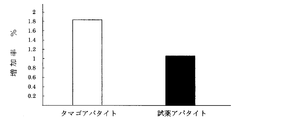
- the eggshell-derived hydroxyapatite A shown in Table 2 has an average increase rate of 1.84%, and the average increase rate of hydroxyapatite B shown in Table 3 is 1.06% in simulated body fluid.
- the amount of hydroxyapatite produced was large. This means that hydroxyapatite A containing Mg has higher biocompatibility than hydroxyapatite B containing no Mg.
- Table 2 and Table 3 are shown graphically in FIG.
Landscapes
- Chemical & Material Sciences (AREA)
- Organic Chemistry (AREA)
- Health & Medical Sciences (AREA)
- Inorganic Chemistry (AREA)
- Life Sciences & Earth Sciences (AREA)
- Botany (AREA)
- Engineering & Computer Science (AREA)
- Biomedical Technology (AREA)
- Chemical Kinetics & Catalysis (AREA)
- Epidemiology (AREA)
- Biotechnology (AREA)
- Dermatology (AREA)
- Medicinal Chemistry (AREA)
- Oral & Maxillofacial Surgery (AREA)
- Transplantation (AREA)
- Molecular Biology (AREA)
- Animal Behavior & Ethology (AREA)
- General Health & Medical Sciences (AREA)
- Public Health (AREA)
- Veterinary Medicine (AREA)
- Materials For Medical Uses (AREA)
- Cosmetics (AREA)
- Pharmaceuticals Containing Other Organic And Inorganic Compounds (AREA)
Abstract
Description
そこで本発明は、従来よりも生体親和性が高いハイドロキシアパタイトを提供することを目的とするものである。
[1]Mgを含有するハイドロキシアパタイト、
[2]微小結晶のハイドロキシアパタイトを含む、[1]のハイドロキシアパタイト、
[3]化学式(Ca:Mg)10(PO4)6(OH)2
(上式において、(Ca:Mg)10はCaとMgとの合計元素数が10であることを意味し、Caは9~7、Mgは1~3である。)
で表される、[1]又は[2]のハイドロキシアパタイト、
[4]生物由来の材料からなる、[1]~[3]のいずれかのハイドロキシアパタイト、
[5]さらに、Na、K及びSiから選ばれる少なくとも一種のミネラルを含む、[1]~[4]のいずれかのハイドロキシアパタイト、
である。
本発明のハイドロキシアパタイトは、Mg(マグネシウム)を含む。Mgは、生体骨に含まれているミネラルの一種であり、生体骨においてMgは、骨芽細胞や破骨細胞を活性化し、骨細胞を促進させる作用を有している。このような作用を有するMgを含んでいる本発明のハイドロキシアパタイトは、従来のハイドロキシアパタイトに比べて、食品添加物、化粧品原料、医薬品原料、人工骨などの生体材料の用途において、より高い生体親和性を有しているのである。
具体的にX線構造解析において、2θが31.500~32.500°に現れるピークにおける結晶子サイズが10~200Åであるハイドロキシアパタイトは、微小な結晶化したハイドロキシアパタイトのみのものであること、又は微小な結晶したハイドロキシアパタイトと結晶化の程度が低い、低結晶型ハイドロキシアパタイトとが混合されたものであるといえる。
なお、結晶子サイズとは、結晶粒の大きさを表し、結晶性を表す目安となる数値である。結晶子サイズの数値が大きいほど、測定対象である物質の結晶性が高いことを意味する。逆に言えば、結晶子サイズの数値が小さいほど、ハイドロキシアパタイトは低結晶又は微小な結晶化したものであることを意味する。結晶子サイズは、例えば、株式会社リガク社製のX線解析装置である、型番:RINT2200V/PCにより測定できる。
好ましくは、2θが31.500~32.500°に現れるピークの結晶子サイズが30~150Å、より好ましくは50~120Åである。
(Ca:Mg)10(PO4)6(OH)2
(上式において、(Ca:Mg)10はCaとMgとの合計元素数が10であることを意味し、Caは9~7、Mgは1~3である。)
で表されるものであることが好ましい。つまり、ハイドロキシアパタイトを構成するCaの一部がMgと置換された構造のものであることが好ましい。
また、生物由来の材料からなることにより、カルシウム補給剤として用途のような、経口して服用する用途や食用としても人体に安全なハイドロキシアパタイトとすることができる。
CaOの原料として卵殻を1000℃で20時間焼成したものを用いて製造したハイドロキシアパタイトとCaOの原料としてサンゴを1000℃で20時間焼成したものを用いて製造したハイドロキシアパタイトを用意した。また、比較のために市販のハイドロキシアパタイト(試薬)を用意した。これらのハイドロキシアパタイトをICP発光分析装置(島津製作所(株)製 ICPS-8100)を用いて微量元素の分析を行った。分析に当たって、試薬には和光純薬社製の標準液 Mg、Na、Kのそれぞれ1000ppmのものを用いた。また、各試料は1.00gを50mLメスフラスコにとり、少量の塩酸で溶かしたのち、50mLにメスアップしたものを測定した。
分析結果を表1に示す。なお、表1中の数値は、質量ppm(mg/kg)を示している。

卵殻由来のハイドロキシアパタイトについて、疑似体液(SBF)を用いた生体活性評価を行った。この評価は、試料を疑似体液(SBF)中に浸漬し、一定時間後試料表面へのハイドロキシアパタイト生成量を測定したものである。ここに、疑似体液は、ヒトの体液とほぼ等しい無機イオン濃度を有するものであり、以下の成分により調製された。
その後、各試料の質量を測定して、ハイドロキシアパタイトの質量増加量を計算した。
ハイドロキシアパタイトAの測定結果を表2に示す。

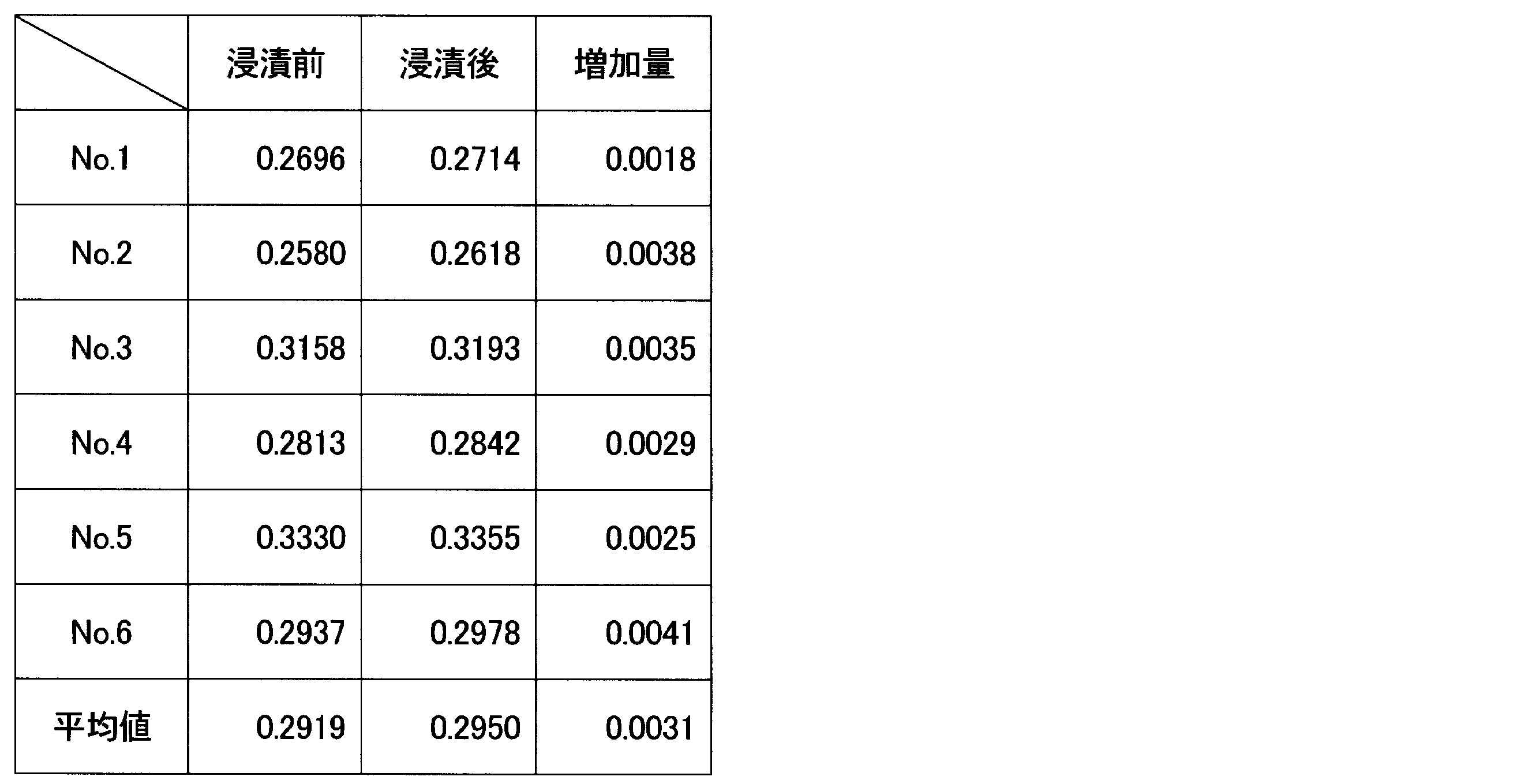
表2及び表3の結果を図1にグラフで示す。
Claims (5)
- Mgを含有するハイドロキシアパタイト。
- 微小結晶のハイドロキシアパタイトを含む請求項1記載のハイドロキシアパタイト。
- 化学式(Ca:Mg)10(PO4)6(OH)2
(上式において、(Ca:Mg)10はCaとMgとの合計元素数が10であることを意味し、Caは9~7、Mgは1~3である。)
で表される請求項1又は2記載のハイドロキシアパタイト。 - 生物由来の材料からなる請求項1~3のいずれか一項に記載のハイドロキシアパタイト。
- さらに、Na、K及びSiから選ばれる少なくとも一種のミネラルを含む請求項1~4のいずれか一項に記載のハイドロキシアパタイト。
Priority Applications (5)
| Application Number | Priority Date | Filing Date | Title |
|---|---|---|---|
| EP19792871.6A EP3786109A4 (en) | 2018-04-27 | 2019-04-25 | HYDROXYLAPATITE |
| US17/050,752 US20210094825A1 (en) | 2018-04-27 | 2019-04-25 | Hydroxyapatite |
| CN201980028726.7A CN112041265A (zh) | 2018-04-27 | 2019-04-25 | 羟基磷灰石 |
| JP2020515552A JP7713702B2 (ja) | 2018-04-27 | 2019-04-25 | ハイドロキシアパタイト |
| JP2023220019A JP2024028331A (ja) | 2018-04-27 | 2023-12-26 | ハイドロキシアパタイト |
Applications Claiming Priority (2)
| Application Number | Priority Date | Filing Date | Title |
|---|---|---|---|
| JP2018087430 | 2018-04-27 | ||
| JP2018-087430 | 2018-04-27 |
Publications (1)
| Publication Number | Publication Date |
|---|---|
| WO2019208683A1 true WO2019208683A1 (ja) | 2019-10-31 |
Family
ID=68295420
Family Applications (1)
| Application Number | Title | Priority Date | Filing Date |
|---|---|---|---|
| PCT/JP2019/017578 Ceased WO2019208683A1 (ja) | 2018-04-27 | 2019-04-25 | ハイドロキシアパタイト |
Country Status (6)
| Country | Link |
|---|---|
| US (1) | US20210094825A1 (ja) |
| EP (1) | EP3786109A4 (ja) |
| JP (2) | JP7713702B2 (ja) |
| CN (1) | CN112041265A (ja) |
| TW (1) | TWI911139B (ja) |
| WO (1) | WO2019208683A1 (ja) |
Cited By (2)
| Publication number | Priority date | Publication date | Assignee | Title |
|---|---|---|---|---|
| WO2025037574A1 (ja) * | 2023-08-14 | 2025-02-20 | 株式会社バイオアパタイト | 粘膜アジュバント、及び粘膜アジュバントの製造方法 |
| JP2025027431A (ja) * | 2023-08-14 | 2025-02-27 | 株式会社バイオアパタイト | 粘膜アジュバント、及び粘膜アジュバントの製造方法 |
Families Citing this family (1)
| Publication number | Priority date | Publication date | Assignee | Title |
|---|---|---|---|---|
| CN116990513B (zh) * | 2023-09-26 | 2023-12-26 | 北京美联泰科生物技术有限公司 | 胃蛋白酶原1的化学发光检测方法 |
Citations (8)
| Publication number | Priority date | Publication date | Assignee | Title |
|---|---|---|---|---|
| JP2001031409A (ja) | 1999-07-22 | 2001-02-06 | Agency Of Ind Science & Technol | 水酸アパタイト皮膜の製造方法 |
| JP2003210567A (ja) * | 2002-01-21 | 2003-07-29 | Toshiyuki Akazawa | 生体組織由来吸収性リン酸カルシウム傾斜機能複合材料とその作製方法 |
| JP2004532172A (ja) * | 2001-03-06 | 2004-10-21 | ルトガーズ、ザ ステイト ユニバーシティ | マグネシウム置換ハイドロキシアパタイト |
| JP2009511420A (ja) * | 2005-10-18 | 2009-03-19 | フィン−セラミカ ファエンツァ エス.ピー.エー. | 多置換されたヒドロキシアパタイトと、天然および/または合成ポリマーとの複合体と、それらの生成および使用 |
| JP2011512959A (ja) * | 2008-02-29 | 2011-04-28 | スミス アンド ネフュー インコーポレーテッド | コーティングおよびコーティング方法 |
| CN103991856A (zh) * | 2014-06-13 | 2014-08-20 | 淮海工学院 | 一种羟基磷灰石纳米片的制备方法 |
| JP2016147799A (ja) | 2015-01-08 | 2016-08-18 | 合同会社トレスバイオ技研 | ハイドロキシアパタイト粒子を含む基材の製造方法 |
| JP2018123040A (ja) * | 2017-02-03 | 2018-08-09 | 株式会社日本バリアフリー | 生体親和性材料用ハイドロキシアパタイトの製造方法 |
Family Cites Families (8)
| Publication number | Priority date | Publication date | Assignee | Title |
|---|---|---|---|---|
| JPH0624964B2 (ja) * | 1985-09-23 | 1994-04-06 | 東燃株式会社 | リン酸カルシウム系ヒドロキシアパタイト及びその製造方法 |
| KR100786312B1 (ko) * | 2006-05-03 | 2007-12-17 | 박진우 | 칼슘 포스페이트의 제조 방법 및 이에 의해 제조된 칼슘포스페이트 |
| GB0609815D0 (en) * | 2006-05-18 | 2006-06-28 | Univ Belfast | Process for preparing hydroxylapatite |
| CN101837147B (zh) * | 2010-05-13 | 2013-06-05 | 四川大学 | 掺杂微量元素的羟基磷灰石生物活性涂层的制备方法 |
| CN102070131A (zh) * | 2010-11-16 | 2011-05-25 | 中国矿业大学 | 一种蛋壳水热合成高纯度羟基磷灰石的方法 |
| CN107161974B (zh) * | 2016-03-07 | 2019-05-14 | 中国科学院上海硅酸盐研究所 | 一种多元离子共掺杂羟基磷灰石粉体材料的制备方法 |
| KR101907408B1 (ko) * | 2016-08-31 | 2018-10-12 | 목포대학교산학협력단 | 난각과 인산-암모니아 용액을 이용한 인산칼슘계 물질의 제조방법 |
| EP3544641B1 (en) * | 2016-10-29 | 2021-12-08 | Farhad Bakhshi | Biomimetic apatite nanopowder composition |
-
2019
- 2019-04-25 JP JP2020515552A patent/JP7713702B2/ja active Active
- 2019-04-25 EP EP19792871.6A patent/EP3786109A4/en not_active Withdrawn
- 2019-04-25 US US17/050,752 patent/US20210094825A1/en active Pending
- 2019-04-25 WO PCT/JP2019/017578 patent/WO2019208683A1/ja not_active Ceased
- 2019-04-25 CN CN201980028726.7A patent/CN112041265A/zh active Pending
- 2019-04-26 TW TW108114703A patent/TWI911139B/zh active
-
2023
- 2023-12-26 JP JP2023220019A patent/JP2024028331A/ja not_active Withdrawn
Patent Citations (8)
| Publication number | Priority date | Publication date | Assignee | Title |
|---|---|---|---|---|
| JP2001031409A (ja) | 1999-07-22 | 2001-02-06 | Agency Of Ind Science & Technol | 水酸アパタイト皮膜の製造方法 |
| JP2004532172A (ja) * | 2001-03-06 | 2004-10-21 | ルトガーズ、ザ ステイト ユニバーシティ | マグネシウム置換ハイドロキシアパタイト |
| JP2003210567A (ja) * | 2002-01-21 | 2003-07-29 | Toshiyuki Akazawa | 生体組織由来吸収性リン酸カルシウム傾斜機能複合材料とその作製方法 |
| JP2009511420A (ja) * | 2005-10-18 | 2009-03-19 | フィン−セラミカ ファエンツァ エス.ピー.エー. | 多置換されたヒドロキシアパタイトと、天然および/または合成ポリマーとの複合体と、それらの生成および使用 |
| JP2011512959A (ja) * | 2008-02-29 | 2011-04-28 | スミス アンド ネフュー インコーポレーテッド | コーティングおよびコーティング方法 |
| CN103991856A (zh) * | 2014-06-13 | 2014-08-20 | 淮海工学院 | 一种羟基磷灰石纳米片的制备方法 |
| JP2016147799A (ja) | 2015-01-08 | 2016-08-18 | 合同会社トレスバイオ技研 | ハイドロキシアパタイト粒子を含む基材の製造方法 |
| JP2018123040A (ja) * | 2017-02-03 | 2018-08-09 | 株式会社日本バリアフリー | 生体親和性材料用ハイドロキシアパタイトの製造方法 |
Non-Patent Citations (3)
| Title |
|---|
| BOGDANOVICIENE, I. ET AL.: "Synthesis of bio- cation-substituted Ca-apatites by precipitation", KEY ENGINEERING MATERIALS, vol. 617, June 2014 (2014-06-01), pages 229 - 232, XP055647849, DOI: 10.4028/www.scientific.net/KEM.617.229 * |
| KIM, S. R. ET AL.: "Synthesis of Si, Mg substituted hydroxyapatites and their sintering behaviors", BIOMATERIALS, vol. 24, April 2003 (2003-04-01), pages 1389 - 1398, XP004401472, DOI: 10.1016/S0142-9612(02)00523-9 * |
| See also references of EP3786109A4 |
Cited By (3)
| Publication number | Priority date | Publication date | Assignee | Title |
|---|---|---|---|---|
| WO2025037574A1 (ja) * | 2023-08-14 | 2025-02-20 | 株式会社バイオアパタイト | 粘膜アジュバント、及び粘膜アジュバントの製造方法 |
| JP2025027431A (ja) * | 2023-08-14 | 2025-02-27 | 株式会社バイオアパタイト | 粘膜アジュバント、及び粘膜アジュバントの製造方法 |
| JP7682480B2 (ja) | 2023-08-14 | 2025-05-26 | 株式会社バイオアパタイト | 粘膜アジュバント、及び粘膜アジュバントの製造方法 |
Also Published As
| Publication number | Publication date |
|---|---|
| TW201945278A (zh) | 2019-12-01 |
| CN112041265A (zh) | 2020-12-04 |
| EP3786109A1 (en) | 2021-03-03 |
| JP7713702B2 (ja) | 2025-07-28 |
| TWI911139B (zh) | 2026-01-11 |
| JPWO2019208683A1 (ja) | 2021-05-20 |
| JP2024028331A (ja) | 2024-03-04 |
| US20210094825A1 (en) | 2021-04-01 |
| EP3786109A4 (en) | 2022-01-19 |
Similar Documents
| Publication | Publication Date | Title |
|---|---|---|
| JP2024028331A (ja) | ハイドロキシアパタイト | |
| Medvecký et al. | Influence of manganese on stability and particle growth of hydroxyapatite in simulated body fluid | |
| Cox et al. | Preparation and characterisation of nanophase Sr, Mg, and Zn substituted hydroxyapatite by aqueous precipitation | |
| Ibrahim et al. | Synthesis of rod-like hydroxyapatite with high surface area and pore volume from eggshells for effective adsorption of aqueous Pb (II) | |
| CN102079514B (zh) | 一种羟基磷灰石纳米晶的制备方法 | |
| Miller et al. | Testing of Brushite (CaHPO 4· 2 H 2 O) in Synthetic Biomineralization Solutions and In Situ Crystallization of Brushite Micro‐Granules | |
| CN107161974A (zh) | 一种多元离子共掺杂羟基磷灰石粉体材料的制备方法 | |
| Carbajal et al. | Design and processing of ZnO doped tricalcium phosphate based materials: Influence of β/α polymorph phase assemblage on microstructural evolution | |
| WO2007045954A1 (en) | A plurisubstituted hydroxyapatite and the composite thereof with a natural and/or synthetic polymer, their preparation and uses thereof | |
| Chajri et al. | Studies on preparation and characterization of SiO2–CaO–P2O5 and SiO2–CaO–P2O5–Na2O bioglasses subtituted with ZnO | |
| Ijaz et al. | Zinc-substituted hydroxyapatite | |
| CN103086708B (zh) | 硅磷酸钙生物材料及其制备方法和用途 | |
| JP7244901B2 (ja) | ハイドロキシアパタイト、その製造方法及びβ-TCPの製造方法 | |
| Golovanova et al. | Targeted synthesis of octacalcium phosphate and a study of its properties | |
| Ma et al. | In vitro degradation and apatite-formation of ZnO–CaO–SiO2–P2O5 glass–ceramics by substitution of zinc for calcium | |
| Lopera et al. | Orthophosphates Synthetized from Calcium and Calcium Magnesium Phosphates, Types of Resources and Applications: A Review | |
| JP2018123040A (ja) | 生体親和性材料用ハイドロキシアパタイトの製造方法 | |
| CN101642586A (zh) | 一种制备含硅羟基磷酸钙涂层的仿生溶液及仿生方法 | |
| Jamil et al. | Effects of ions traces on the dissolution of bioceramics composed of hydroxyapatite and β-tricalcium phosphate | |
| JP5083748B2 (ja) | 炭酸カルシウム・ゼオライト系化合物複合体の製造方法 | |
| KR101034207B1 (ko) | 유/무기 용매에 분산 가능한 수산화 아파타이트 제조 방법 | |
| Lafta et al. | SBF Immersion Time Effects on Sol-Gel Phosphate Glass-Ceramic Structure | |
| JP2015086084A (ja) | (炭酸)ストロンチウムアパタイトおよびその微粒子の製造方法 | |
| Abdel-Fattah et al. | Nano-beta-tricalcium phosphates synthesis and biodegradation: 2. Biodegradation and apatite layer formation on nano-β-TCP synthesized via microwave treatment | |
| Miller et al. | Maturation of Brushite (CaHPO4· 2H2O) and In Situ Crystallization of Brushite Micro‐Granules |
Legal Events
| Date | Code | Title | Description |
|---|---|---|---|
| 121 | Ep: the epo has been informed by wipo that ep was designated in this application |
Ref document number: 19792871 Country of ref document: EP Kind code of ref document: A1 |
|
| ENP | Entry into the national phase |
Ref document number: 2020515552 Country of ref document: JP Kind code of ref document: A |
|
| NENP | Non-entry into the national phase |
Ref country code: DE |
|
| WWE | Wipo information: entry into national phase |
Ref document number: 2019792871 Country of ref document: EP |
|
| WWW | Wipo information: withdrawn in national office |
Ref document number: 2019792871 Country of ref document: EP |