WO2019216110A1 - 加硫ゴム組成物、タイヤトレッド及びタイヤ - Google Patents
加硫ゴム組成物、タイヤトレッド及びタイヤ Download PDFInfo
- Publication number
- WO2019216110A1 WO2019216110A1 PCT/JP2019/015828 JP2019015828W WO2019216110A1 WO 2019216110 A1 WO2019216110 A1 WO 2019216110A1 JP 2019015828 W JP2019015828 W JP 2019015828W WO 2019216110 A1 WO2019216110 A1 WO 2019216110A1
- Authority
- WO
- WIPO (PCT)
- Prior art keywords
- group
- rubber composition
- vulcanized rubber
- component
- unit
- Prior art date
- Legal status (The legal status is an assumption and is not a legal conclusion. Google has not performed a legal analysis and makes no representation as to the accuracy of the status listed.)
- Ceased
Links
Images


Classifications
-
- B—PERFORMING OPERATIONS; TRANSPORTING
- B60—VEHICLES IN GENERAL
- B60C—VEHICLE TYRES; TYRE INFLATION; TYRE CHANGING; CONNECTING VALVES TO INFLATABLE ELASTIC BODIES IN GENERAL; DEVICES OR ARRANGEMENTS RELATED TO TYRES
- B60C1/00—Tyres characterised by the chemical composition or the physical arrangement or mixture of the composition
- B60C1/0016—Compositions of the tread
-
- C—CHEMISTRY; METALLURGY
- C08—ORGANIC MACROMOLECULAR COMPOUNDS; THEIR PREPARATION OR CHEMICAL WORKING-UP; COMPOSITIONS BASED THEREON
- C08F—MACROMOLECULAR COMPOUNDS OBTAINED BY REACTIONS ONLY INVOLVING CARBON-TO-CARBON UNSATURATED BONDS
- C08F210/00—Copolymers of unsaturated aliphatic hydrocarbons having only one carbon-to-carbon double bond
- C08F210/02—Ethene
-
- C—CHEMISTRY; METALLURGY
- C08—ORGANIC MACROMOLECULAR COMPOUNDS; THEIR PREPARATION OR CHEMICAL WORKING-UP; COMPOSITIONS BASED THEREON
- C08F—MACROMOLECULAR COMPOUNDS OBTAINED BY REACTIONS ONLY INVOLVING CARBON-TO-CARBON UNSATURATED BONDS
- C08F236/00—Copolymers of compounds having one or more unsaturated aliphatic radicals, at least one having two or more carbon-to-carbon double bonds
- C08F236/02—Copolymers of compounds having one or more unsaturated aliphatic radicals, at least one having two or more carbon-to-carbon double bonds the radical having only two carbon-to-carbon double bonds
- C08F236/04—Copolymers of compounds having one or more unsaturated aliphatic radicals, at least one having two or more carbon-to-carbon double bonds the radical having only two carbon-to-carbon double bonds conjugated
- C08F236/06—Butadiene
-
- C—CHEMISTRY; METALLURGY
- C08—ORGANIC MACROMOLECULAR COMPOUNDS; THEIR PREPARATION OR CHEMICAL WORKING-UP; COMPOSITIONS BASED THEREON
- C08L—COMPOSITIONS OF MACROMOLECULAR COMPOUNDS
- C08L15/00—Compositions of rubber derivatives
-
- C—CHEMISTRY; METALLURGY
- C08—ORGANIC MACROMOLECULAR COMPOUNDS; THEIR PREPARATION OR CHEMICAL WORKING-UP; COMPOSITIONS BASED THEREON
- C08L—COMPOSITIONS OF MACROMOLECULAR COMPOUNDS
- C08L9/00—Compositions of homopolymers or copolymers of conjugated diene hydrocarbons
-
- B—PERFORMING OPERATIONS; TRANSPORTING
- B60—VEHICLES IN GENERAL
- B60C—VEHICLE TYRES; TYRE INFLATION; TYRE CHANGING; CONNECTING VALVES TO INFLATABLE ELASTIC BODIES IN GENERAL; DEVICES OR ARRANGEMENTS RELATED TO TYRES
- B60C11/00—Tyre tread bands; Tread patterns; Anti-skid inserts
- B60C11/14—Anti-skid inserts, e.g. vulcanised into the tread band
- B60C2011/145—Discontinuous fibres
-
- B—PERFORMING OPERATIONS; TRANSPORTING
- B60—VEHICLES IN GENERAL
- B60C—VEHICLE TYRES; TYRE INFLATION; TYRE CHANGING; CONNECTING VALVES TO INFLATABLE ELASTIC BODIES IN GENERAL; DEVICES OR ARRANGEMENTS RELATED TO TYRES
- B60C11/00—Tyre tread bands; Tread patterns; Anti-skid inserts
- B60C11/14—Anti-skid inserts, e.g. vulcanised into the tread band
- B60C2011/147—Foamed rubber or sponge rubber on the tread band
-
- C—CHEMISTRY; METALLURGY
- C08—ORGANIC MACROMOLECULAR COMPOUNDS; THEIR PREPARATION OR CHEMICAL WORKING-UP; COMPOSITIONS BASED THEREON
- C08F—MACROMOLECULAR COMPOUNDS OBTAINED BY REACTIONS ONLY INVOLVING CARBON-TO-CARBON UNSATURATED BONDS
- C08F212/00—Copolymers of compounds having one or more unsaturated aliphatic radicals, each having only one carbon-to-carbon double bond, and at least one being terminated by an aromatic carbocyclic ring
- C08F212/02—Monomers containing only one unsaturated aliphatic radical
- C08F212/04—Monomers containing only one unsaturated aliphatic radical containing one ring
- C08F212/06—Hydrocarbons
- C08F212/08—Styrene
-
- Y—GENERAL TAGGING OF NEW TECHNOLOGICAL DEVELOPMENTS; GENERAL TAGGING OF CROSS-SECTIONAL TECHNOLOGIES SPANNING OVER SEVERAL SECTIONS OF THE IPC; TECHNICAL SUBJECTS COVERED BY FORMER USPC CROSS-REFERENCE ART COLLECTIONS [XRACs] AND DIGESTS
- Y02—TECHNOLOGIES OR APPLICATIONS FOR MITIGATION OR ADAPTATION AGAINST CLIMATE CHANGE
- Y02T—CLIMATE CHANGE MITIGATION TECHNOLOGIES RELATED TO TRANSPORTATION
- Y02T10/00—Road transport of goods or passengers
- Y02T10/80—Technologies aiming to reduce greenhouse gasses emissions common to all road transportation technologies
- Y02T10/86—Optimisation of rolling resistance, e.g. weight reduction
Definitions
- the present invention relates to a vulcanized rubber composition, a tire tread and a tire.
- studless tires with softened tread rubber have been used as tires for safe driving on ice in addition to normal road surfaces.
- the on-ice performance of the tire can be improved.
- a tire including a soft tread rubber has a problem of poor wear resistance on a normal road surface, and the on-ice performance and the wear resistance of the tire are in a trade-off relationship.
- Patent Document 1 discloses that 0.5 to 20 parts by weight of potassium titanate fiber is used with respect to 100 parts by weight of a rubber component made of natural rubber and butadiene rubber.
- a rubber composition containing 5 to 200 parts by weight of carbon black having an iodine adsorption amount of 100 to 300 mg / g which is a tread having a two-layer structure comprising a cap tread and a base tread. It is known that the performance on ice (performance on ice and snow) is improved while suppressing a decrease in wear resistance.
- Patent Document 1 Although the effect of improving the performance on ice (coefficient of friction on ice) of the tire can be expected by blending a specific amount of potassium titanate fiber (see Table 1 of Patent Document 1), the anti-resistance. Abrasion tends to be slightly reduced, and it has been difficult to achieve both high performance on ice and wear resistance.
- an object of the present invention is to provide a vulcanized rubber composition that solves the above-described problems of the prior art and can achieve both high performance on ice and wear resistance of a tire. Moreover, an object of this invention is to provide the tire tread and tire which are excellent in both on-ice performance and abrasion resistance.
- the gist configuration of the present invention for solving the above-described problems is as follows.
- the vulcanized rubber composition of the present invention is a vulcanized rubber composition, wherein the rubber component includes a multi-component copolymer containing a conjugated diene unit, a non-conjugated olefin unit, and an aromatic vinyl unit,
- the vulcanized rubber composition has a plurality of voids, and the average diameter of the voids is 10 to 300 ⁇ m.
- the porosity of the vulcanized rubber composition is preferably 10 to 80%. In this case, the on-ice performance and wear resistance of the vulcanized rubber composition can be achieved at a higher level.
- the multi-component copolymer has a content of the conjugated diene unit of 1 to 50 mol%, a content of the non-conjugated olefin unit of 40 to 97 mol%, and the aromatic
- the group vinyl unit content is preferably 2 to 35 mol%. In this case, the wear resistance and weather resistance of the vulcanized rubber composition can be further improved.
- the multi-component copolymer preferably has a melting point of 30 to 130 ° C. measured with a differential scanning calorimeter (DSC).
- DSC differential scanning calorimeter
- the multi-component copolymer preferably has an endothermic peak energy measured by a differential scanning calorimeter (DSC) at 0 to 120 ° C. of 10 to 150 J / g.
- DSC differential scanning calorimeter
- the multi-component copolymer preferably has a glass transition temperature of 0 ° C. or less as measured by a differential scanning calorimeter (DSC). In this case, the performance on ice of the vulcanized rubber composition can be further improved.
- DSC differential scanning calorimeter
- the multi-component copolymer preferably has a crystallinity of 0.5 to 50%. In this case, the on-ice performance and abrasion resistance of the vulcanized rubber composition can be further improved.
- the multi-component copolymer is preferably such that the non-conjugated olefin unit is an acyclic non-conjugated olefin unit, and the non-cyclic non-conjugated olefin unit is composed only of ethylene units. More preferably. In this case, the weather resistance of the vulcanized rubber composition can be improved.
- the aromatic vinyl unit includes a styrene unit.
- the weather resistance of the vulcanized rubber composition can be further improved.
- the conjugated diene unit includes a 1,3-butadiene unit and / or an isoprene unit.
- the wear resistance of the vulcanized rubber composition can be further improved.
- the content of the multi-component copolymer in the rubber component is preferably 5 to 100% by mass. In this case, the on-ice performance and abrasion resistance of the vulcanized rubber composition can be further improved.
- the vulcanized rubber composition preferably further contains a void introducing agent, and the void introducing agent is a foaming agent, a hydrophilic short fiber, a metal sulfate salt, a thermally expandable microcapsule. And at least one selected from the group consisting of porous cellulose particles. In this case, the performance on ice of the vulcanized rubber composition can be further improved.
- the tire tread of the present invention is characterized by using the above vulcanized rubber composition. By providing the above configuration, the tire tread of the present invention is excellent in both on-ice performance and wear resistance.
- a tire according to the present invention includes the above-described tire tread.
- the tire of the present invention is excellent in both on-ice performance and wear resistance.
- the vulcanized rubber composition which can make the performance on ice and abrasion resistance of a tire compatible on a high level can be provided. Moreover, according to this invention, the tire tread and tire which are excellent in both on-ice performance and abrasion resistance can be provided.
- the vulcanized rubber composition of the present invention is a vulcanized rubber composition comprising a multi-component copolymer in which a rubber component contains a conjugated diene unit, a non-conjugated olefin unit, and an aromatic vinyl unit.
- the vulcanized rubber composition 10 has a plurality of voids 20, and the average diameter of the voids 20 is 10 to 300 ⁇ m.
- the multi-component copolymer contained as a rubber component of the vulcanized rubber composition of the present invention as one of its characteristics, microcrystals in which non-conjugated olefin units are chained in the molecule collapse under high strain. There is energy dissipation due to melting energy.
- the vulcanized rubber composition since the vulcanized rubber composition has a plurality of voids, water generated from melted ice can be taken into and escaped from the voids, and a scratching effect due to the voids can be obtained. .
- the vulcanized rubber composition 10 of the present invention as shown in FIG.
- the vulcanized rubber composition 10 includes the above-described multi-component copolymer and a plurality of voids 20 having a specific size (average diameter: 10 to 300 ⁇ m).
- a large strain is locally applied, so that the energy dissipation due to the melting energy described above can be effectively exhibited.
- the contact area between the tire and the ice surface can be increased, and therefore there is a gap inside.
- the plurality of voids in the vulcanized rubber composition of the present invention requires an average diameter of 10 to 300 ⁇ m, preferably 100 to 270 ⁇ m, and more preferably 135 to 250 ⁇ m.
- the average diameter of the voids is less than 10 ⁇ m, the voids are too small, so that sufficient performance on ice cannot be obtained when used in a tire, and the energy dissipation effect due to melting energy is also small. Abrasion resistance is not obtained.
- the average diameter of the voids is preferably 100 ⁇ m or more, and more preferably 135 ⁇ m or more.
- the average diameter of the voids exceeds 300 ⁇ m, sufficient wear resistance cannot be obtained.
- the average diameter of the voids is preferably 270 ⁇ m or less, and more preferably 250 ⁇ m or less.
- the void diameter in the vulcanized rubber composition of the present invention is the largest diameter D of the void 20 (if the void is not spherical, as shown in FIG. The maximum distance D) among the distances between two points.
- D the average diameter of the said space
- it is an average value of the diameter D of the space
- the cross section of the vulcanized rubber composition is observed with a digital microscope (“VHX-100” manufactured by Keyence Corporation), and all voids existing in one visual field (2.5 mm ⁇ 2.5 mm) are observed. The average diameter is used.
- the average value of voids in one field of view is the average of voids. It can be a diameter.
- the porosity of the vulcanized rubber composition of the present invention is preferably 10 to 80%.
- the porosity is preferably 15% or more, and more preferably 20% or more.
- the porosity is preferably 60% or less, and more preferably 40% or less.
- the porosity is a volume ratio (volume%) of the voids in the vulcanized rubber composition of the present invention.
- the method for measuring the porosity is not particularly limited, and can be measured, for example, using a hydrometer (ViBRA hydrometer “DMA-220” manufactured by Shinko Denshi Co., Ltd.).
- the vulcanized rubber composition of the present invention has a plurality of voids
- the method of providing the voids is not particularly limited, and the conditions for the voids, equipment for producing the vulcanized rubber composition, etc.
- known techniques can be used.
- a vulcanized rubber composition is prepared by blending a foaming agent, hydrophilic short fibers, metal sulfate, thermally expandable microcapsules, porous cellulose particles, etc., into the rubber composition before vulcanization.
- a method of providing a void in the object is mentioned.
- the vulcanized rubber composition is a vulcanized rubber obtained by vulcanizing an unvulcanized rubber composition. Further, the vulcanization conditions (temperature, time) are not particularly limited, and the vulcanization treatment can be performed under arbitrary conditions according to the required performance.
- the unvulcanized rubber composition (hereinafter sometimes simply referred to as “rubber composition”), which is the basis of the vulcanized rubber composition of the present invention, will be described below.
- the rubber composition includes a rubber component (a), and the rubber component (a) includes a multi-component copolymer (a1) containing a conjugated diene unit, a non-conjugated olefin unit, and an aromatic vinyl unit.
- the multi-component copolymer (a1) contains at least a conjugated diene unit, a non-conjugated olefin unit, and an aromatic vinyl unit, and includes a conjugated diene unit, a non-conjugated olefin unit, and an aromatic vinyl unit. It may consist of only, and can also contain another monomer unit.
- the conjugated diene unit is a structural unit derived from a conjugated diene compound as a monomer.
- the conjugated diene compound preferably has 4 to 8 carbon atoms.
- Specific examples of the conjugated diene compound include 1,3-butadiene, isoprene, 1,3-pentadiene, 2,3-dimethyl-1,3-butadiene and the like.
- the conjugated diene compound may be a single kind or a combination of two or more kinds.
- the conjugated diene compound as a monomer of the multi-component copolymer is 1, 3 from the viewpoint of effectively improving the wear resistance of a vulcanized rubber composition or a tire using the obtained multi-component copolymer.
- the -It preferably contains butadiene and / or isoprene, more preferably consists only of 1,3-butadiene and / or isoprene, and more preferably consists only of 1,3-butadiene.
- the conjugated diene unit in the multi-component copolymer preferably contains 1,3-butadiene units and / or isoprene units, and more preferably consists only of 1,3-butadiene units and / or isoprene units. Preferably, it consists of only 1,3-butadiene units.
- the content of the conjugated diene unit is preferably 1 mol% or more, more preferably 3 mol% or more, and preferably 50 mol% or less, % Or less, more preferably 30 mol% or less, even more preferably 25 mol% or less, and even more preferably 15 mol% or less.
- the content of the conjugated diene unit is 1 mol% or more of the whole multi-component copolymer, a vulcanized rubber composition and a rubber product excellent in elongation can be obtained, and when it is 50 mol% or less, weather resistance is excellent.
- the content of the conjugated diene unit is preferably in the range of 1 to 50 mol%, more preferably in the range of 3 to 40 mol%, based on the whole multi-component copolymer.
- the non-conjugated olefin unit is a structural unit derived from a non-conjugated olefin compound as a monomer.
- the non-conjugated olefin compound preferably has 2 to 10 carbon atoms.
- Specific examples of such non-conjugated olefin compounds include ethylene, propylene, 1-butene, 1-pentene, 1-hexene, 1-heptene, 1-octene and other ⁇ -olefins, vinyl pivalate, 1-phenylthioethene.
- heteroatom-substituted alkene compounds such as N-vinylpyrrolidone.
- the non-conjugated olefin compound may be a single kind or a combination of two or more kinds.
- the non-conjugated olefin compound as a monomer of the multi-component copolymer further reduces the crystallinity of the resulting multi-component copolymer, and weather resistance of vulcanized rubber compositions and tires using such a multi-component copolymer.
- it is preferably an acyclic non-conjugated olefin compound, and the acyclic non-conjugated olefin compound is more preferably an ⁇ -olefin, which is an ⁇ -olefin containing ethylene.
- the non-conjugated olefin unit in the multi-component copolymer is preferably an acyclic non-conjugated olefin unit, and the acyclic non-conjugated olefin unit is preferably an ⁇ -olefin unit. More preferably, it is more preferably an ⁇ -olefin unit containing an ethylene unit, and further preferably only an ethylene unit.
- the content of the non-conjugated olefin unit is preferably 40 mol% or more, more preferably 45 mol% or more, and even more preferably 55 mol% or more, It is particularly preferably 60 mol% or more, more preferably 97 mol% or less, still more preferably 95 mol% or less, and even more preferably 90 mol% or less.
- the content of the non-conjugated olefin unit is 40 mol% or more of the entire multi-polymer, the content of the conjugated diene unit or the aromatic vinyl unit is decreased as a result, and the weather resistance is improved or the resistance at room temperature is increased.
- Breakability (particularly, breaking strength (Tb)) is improved.
- the content of the non-conjugated olefin unit is 97 mol% or less, the content of the conjugated diene unit or the aromatic vinyl unit increases as a result, and fracture resistance at high temperature (particularly, elongation at break (Eb)) Will improve.
- the content of the non-conjugated olefin unit is preferably in the range of 40 to 97 mol%, more preferably in the range of 45 to 95 mol%, and still more preferably in the range of 55 to 90 mol% with respect to the entire multi-component copolymer.
- the aromatic vinyl unit is a structural unit derived from an aromatic vinyl compound as a monomer.
- the aromatic vinyl compound preferably has 8 to 10 carbon atoms.
- Examples of such aromatic vinyl compounds include styrene, o-methylstyrene, m-methylstyrene, p-methylstyrene, o, p-dimethylstyrene, o-ethylstyrene, m-ethylstyrene, p-ethylstyrene, and the like.
- the aromatic vinyl compound may be a single type or a combination of two or more types.
- the aromatic vinyl compound as a monomer of the multi-component copolymer further reduces the crystallinity of the resulting multi-component copolymer, and weather resistance of vulcanized rubber compositions and tires using such a multi-component copolymer. From the viewpoint of further improving the properties, it is preferable that styrene is included, and it is more preferable that the styrene only be included.
- the aromatic vinyl unit in the multi-component copolymer preferably includes a styrene unit, and more preferably includes only a styrene unit.
- the aromatic ring in the aromatic vinyl unit is not included in the main chain of the multi-component copolymer unless it is bonded to an adjacent unit.
- the content of the aromatic vinyl unit is preferably 2 mol% or more, more preferably 3 mol% or more, and preferably 35 mol% or less, More preferably, it is 30 mol% or less, and further more preferably 25 mol% or less.
- the content of the aromatic vinyl unit is 2 mol% or more, the fracture resistance at high temperatures is improved.
- the effect by a conjugated diene unit and a nonconjugated olefin unit becomes remarkable as content of an aromatic vinyl unit is 35 mol% or less.
- the content of the aromatic vinyl unit is preferably in the range of 2 to 35 mol%, more preferably in the range of 3 to 30 mol%, still more preferably in the range of 3 to 25 mol% with respect to the entire multi-component copolymer.
- the number of types of monomers of the multi-component copolymer (a1) is not particularly limited as long as the multi-component copolymer contains a conjugated diene unit, a non-conjugated olefin unit, and an aromatic vinyl unit.
- the multi-component copolymer (a1) may have other structural units other than the conjugated diene unit, the non-conjugated olefin unit, and the aromatic vinyl unit, but the content of the other structural unit is desired. From the viewpoint of obtaining the effect of the above, it is preferably 30 mol% or less, more preferably 20 mol% or less, still more preferably 10 mol% or less, and not contained, that is, the content of the entire multi-component copolymer. Is particularly preferably 0 mol%.
- the multi-component copolymer (a1) has a kind of conjugated diene compound, a kind of non-conjugated olefin compound, and a kind of aromatic as a monomer from the viewpoint of preferable wear resistance, weather resistance and crystallinity.
- a polymer obtained by polymerization using at least a vinyl compound is preferable.
- the multi-component copolymer (a1) is preferably a multi-component copolymer containing one kind of conjugated diene unit, one kind of non-conjugated olefin unit, and one kind of aromatic vinyl unit.
- it is a terpolymer comprising only a conjugated diene unit, a non-conjugated olefin unit, and a single aromatic vinyl unit, and is composed only of a 1,3-butadiene unit, an ethylene unit, and a styrene unit. More preferably, it is a terpolymer.
- the “one type of conjugated diene unit” includes conjugated diene units having different bonding modes.
- the multi-component copolymer (a1) has a content of the conjugated diene unit of 1 to 50 mol%, a content of the non-conjugated olefin unit of 40 to 97 mol%, and a content of the aromatic vinyl unit.
- the amount is preferably 2 to 35 mol%.
- the abrasion resistance of the vulcanized rubber composition is further improved, and the weather resistance is also improved.
- the multi-component copolymer (a1) preferably has a polystyrene-equivalent weight average molecular weight (Mw) of 10,000 to 10,000,000, more preferably 100,000 to 9,000,000. 150,000 to 8,000,000 is more preferable.
- Mw polystyrene-equivalent weight average molecular weight
- the multi-component copolymer (a1) preferably has a polystyrene-equivalent number average molecular weight (Mn) of 10,000 to 10,000,000, more preferably 50,000 to 9,000,000. More preferably, it is 100,000 to 8,000,000.
- Mn polystyrene-equivalent number average molecular weight
- the Mn of the multi-component copolymer is 10,000 or more, the mechanical strength of the vulcanized rubber composition can be sufficiently secured, and the Mn is 10,000,000 or less. High workability can be maintained.
- the multi-component copolymer (a1) preferably has a molecular weight distribution [Mw / Mn (weight average molecular weight / number average molecular weight)] of 1.00 to 4.00, preferably 1.50 to 3.50. Is more preferable, and is more preferably 1.80 to 3.00. If the molecular weight distribution of the multi-component copolymer is 4.00 or less, sufficient homogeneity can be brought about in the physical properties of the multi-component copolymer.
- Mw / Mn weight average molecular weight / number average molecular weight
- Mw weight average molecular weight
- Mn number average molecular weight
- Mw / Mn molecular weight distribution
- the multi-component copolymer (a1) preferably has a melting point measured by a differential scanning calorimeter (DSC) of 30 to 130 ° C., more preferably 30 to 110 ° C. If the melting point of the multi-component copolymer (a1) is 30 ° C. or higher, the crystallinity of the multi-component copolymer (a1) is increased, the wear resistance of the vulcanized rubber composition is further improved, and 130 ° C. or lower. If so, the performance on ice is further improved.
- fusing point is the value measured by the method as described in an Example.
- the multi-component copolymer (a1) preferably has an endothermic peak energy measured by a differential scanning calorimeter (DSC) at 0 to 120 ° C. of 10 to 150 J / g, preferably 30 to 120 J / g. Is more preferable. If the endothermic peak energy of the multi-component copolymer (a1) is 10 J / g or more, the crystallinity of the multi-component copolymer (a1) is increased, and the wear resistance of the vulcanized rubber composition is further improved. If it is 150 J / g or less, the performance on ice will further improve.
- the endothermic peak energy is a value measured by the method described in Examples.
- the multi-component copolymer (a1) preferably has a glass transition temperature (Tg) measured by a differential scanning calorimeter (DSC) of 0 ° C. or lower, more preferably ⁇ 100 to ⁇ 10 ° C. .
- Tg glass transition temperature measured by a differential scanning calorimeter
- DSC differential scanning calorimeter
- the glass transition temperature of the multi-component copolymer (A1) is 0 ° C. or lower, the performance on ice of the vulcanized rubber composition is further improved.
- the said glass transition temperature is the value measured by the method as described in an Example.
- the multi-component copolymer (a1) preferably has a crystallinity of 0.5 to 50%, more preferably 3 to 45%, and even more preferably 5 to 45%. .
- the degree of crystallinity of the multi-component copolymer (a1) is 0.5% or more, sufficient crystallinity due to the non-conjugated olefin unit is secured, and the wear resistance of the vulcanized rubber composition is further improved.
- the crystallinity of the multi-component copolymer (a1) is 50% or less, the workability during kneading of the rubber composition is improved, and the performance on ice of the vulcanized rubber composition is also improved.
- the crystallinity is a value measured by the method described in Examples.
- the multi-component copolymer (a1) preferably has a main chain consisting only of an acyclic structure. This is because the wear resistance can be further improved.
- NMR is used as a main measuring means for confirming whether or not the main chain of the copolymer has a cyclic structure. Specifically, when a peak derived from a cyclic structure existing in the main chain (for example, a peak appearing at 10 to 24 ppm for a three-membered ring to a five-membered ring) is not observed, the main chain of the copolymer is It shows that it consists only of an acyclic structure.
- the multi-component copolymer (a1) can be produced through a polymerization process using a conjugated diene compound, a non-conjugated olefin compound, and an aromatic vinyl compound as monomers, and, if necessary, a coupling process. , A cleaning process, and other processes may be performed.
- the reactivity of the conjugated diene compound is higher than that of the non-conjugated olefin compound and the aromatic vinyl compound, so that the non-conjugated olefin compound and / or the aromatic compound is present in the presence of the conjugated diene compound. It is difficult to polymerize the group vinyl compound. In addition, it is easy to polymerize the conjugated diene compound first, and then additionally polymerize the non-conjugated olefin compound and the aromatic vinyl compound later due to the characteristics of the catalyst.
- any method such as a solution polymerization method, a suspension polymerization method, a liquid phase bulk polymerization method, an emulsion polymerization method, a gas phase polymerization method, and a solid phase polymerization method can be used.
- a solvent is not particularly limited as long as it is inert in the polymerization reaction, and examples thereof include toluene, cyclohexane, and normal hexane.
- the polymerization process may be performed in one stage, or may be performed in two or more stages.
- the one-step polymerization process means all kinds of monomers to be polymerized, that is, conjugated diene compounds, non-conjugated olefin compounds, aromatic vinyl compounds, and other monomers, preferably conjugated diene compounds, non-conjugated.
- the olefin compound and the aromatic vinyl compound are polymerized by reacting simultaneously.
- the multi-stage polymerization process means that a polymer is formed by first reacting part or all of one or two kinds of monomers (first polymerization stage), and then the remaining kinds of monomers.
- a step of polymerizing by performing one or more stages (second polymerization stage to final polymerization stage) in which the remainder of the one or two kinds of monomers is added and polymerized.
- second polymerization stage to final polymerization stage in which the remainder of the one or two kinds of monomers is added and polymerized.
- the polymerization reaction is preferably performed in an atmosphere of an inert gas, preferably nitrogen gas or argon gas.
- the polymerization temperature of the polymerization reaction is not particularly limited, but is preferably in the range of ⁇ 100 ° C. to 200 ° C., for example, and can be about room temperature.
- the pressure for the polymerization reaction is preferably in the range of 0.1 to 10.0 MPa in order to sufficiently incorporate the conjugated diene compound into the polymerization reaction system.
- the reaction time of the above polymerization reaction is not particularly limited and is preferably in the range of, for example, 1 second to 10 days, but can be appropriately selected depending on conditions such as the type of polymerization catalyst and polymerization temperature.
- the polymerization may be stopped using a polymerization terminator such as methanol, ethanol, isopropanol or the like.
- the polymerization process is preferably performed in multiple stages. More preferably, a first step of obtaining a polymerization mixture by mixing a first monomer raw material containing at least an aromatic vinyl compound and a polymerization catalyst, and a conjugated diene compound, a non-conjugated olefin compound, and It is preferable to carry out the second step of introducing the second monomer raw material containing at least one selected from the group consisting of aromatic vinyl compounds. Furthermore, it is more preferable that the first monomer raw material does not contain a conjugated diene compound, and the second monomer raw material contains a conjugated diene compound.
- the first monomer raw material used in the first step may contain a non-conjugated olefin compound together with the aromatic vinyl compound. Moreover, the 1st monomer raw material may contain the whole quantity of the aromatic vinyl compound to be used, and may contain only one part.
- the non-conjugated olefin compound is contained in at least one of the first monomer raw material and the second monomer raw material.
- the first step is preferably performed in an atmosphere of an inert gas, preferably nitrogen gas or argon gas, in the reactor.
- the temperature (reaction temperature) in the first step is not particularly limited, but is preferably in the range of ⁇ 100 ° C. to 200 ° C., for example, and can be about room temperature.
- the pressure in the first step is not particularly limited, but is preferably in the range of 0.1 to 10.0 MPa in order to sufficiently incorporate the aromatic vinyl compound into the polymerization reaction system.
- the time spent in the first step can be appropriately selected depending on conditions such as the type of polymerization catalyst and reaction temperature. For example, when the reaction temperature is 25 to 80 ° C., 5 minutes A range of ⁇ 500 minutes is preferred.
- the polymerization method for obtaining the polymerization mixture may be any method such as a solution polymerization method, a suspension polymerization method, a liquid phase bulk polymerization method, an emulsion polymerization method, a gas phase polymerization method, and a solid phase polymerization method. Can be used. Further, when a solvent is used for the polymerization reaction, such a solvent may be any inactive in the polymerization reaction, and examples thereof include toluene, cyclohexanone, normal hexane and the like.
- the second monomer raw material used in the second step is a conjugated diene compound only, or a conjugated diene compound and a non-conjugated olefin compound, or a conjugated diene compound and an aromatic vinyl compound, or a conjugated diene compound or a non-conjugated olefin. It is preferable that they are a compound and an aromatic vinyl compound.
- the second monomer raw material includes at least one selected from the group consisting of a non-conjugated olefin compound and an aromatic vinyl compound in addition to the conjugated diene compound, these monomer raw materials are preliminarily used as a solvent or the like.
- each monomer raw material may be introduced into the polymerization mixture, or each monomer raw material may be introduced from a single state. Moreover, each monomer raw material may be added simultaneously, and may be added sequentially.
- the method for introducing the second monomer raw material into the polymerization mixture is not particularly limited, but it is continuously added to the polymerization mixture by controlling the flow rate of each monomer raw material. It is preferable to perform (so-called metering).
- a monomer raw material that is a gas under the conditions of the polymerization reaction system for example, ethylene as a non-conjugated olefin compound under the conditions of room temperature and atmospheric pressure
- the polymerization reaction system is used at a predetermined pressure. Can be introduced.
- the second step is preferably performed in an atmosphere of an inert gas, preferably nitrogen gas or argon gas, in the reactor.
- the temperature (reaction temperature) in the second step is not particularly limited, but is preferably in the range of ⁇ 100 ° C. to 200 ° C., for example, and can be about room temperature. When the reaction temperature is raised, the selectivity of cis-1,4 bond in the conjugated diene unit may be lowered.
- the pressure in the second step is not particularly limited, but is preferably in the range of 0.1 to 10.0 MPa in order to sufficiently incorporate monomers such as a conjugated diene compound into the polymerization reaction system.
- reaction time can be appropriately selected depending on conditions such as the type of polymerization catalyst and reaction temperature, but is preferably in the range of 0.1 hour to 10 days, for example.
- the polymerization reaction may be stopped using a polymerization terminator such as methanol, ethanol, or isopropanol.
- the polymerization step of the non-conjugated olefin compound, aromatic vinyl compound, and conjugated diene compound preferably includes a step of polymerizing various monomers in the presence of the catalyst component described below.
- the catalyst component include components (A) to (F).
- One or more of each component can be used, and a combination of two or more of the following components (A) to (F) More preferably, it is used as a product.
- components (A) to (F) will be described in detail.
- Examples of the rare earth element compound or a reaction product of the rare earth element compound and a Lewis base include a rare earth element compound having a rare earth element-carbon bond, or a reaction product of the rare earth element compound and a Lewis base (hereinafter referred to as a rare earth element compound).
- component (A-1) a rare earth element compound having no rare earth element-carbon bond, or a reaction product of the rare earth element compound and a Lewis base
- component (A-2) Say).
- the rare earth element compound or reactant having a rare earth element-carbon bond As the component (A-1), for example, the following general formula (I): (wherein M represents a lanthanoid element, scandium or yttrium, Cp R each independently represents an unsubstituted or substituted indenyl group, and R a to R f each independently represents an alkyl having 1 to 3 carbon atoms.
- M represents a lanthanoid element, scandium or yttrium
- Cp R each independently represents an unsubstituted or substituted indenyl group
- X ′ represents a hydrogen atom, a halogen atom, an alkoxy group, a thiolate group, an amino group.
- M represents a lanthanoid element, scandium or yttrium
- Cp R ′ represents unsubstituted or substituted cyclopentadienyl, indenyl or fluorenyl
- X represents a hydrogen atom, a halogen atom, an alkoxy group or a thiolate group.
- Cp R in the formula is unsubstituted indenyl or substituted indenyl.
- Cp R having an indenyl ring as a basic skeleton can be represented by C 9 H 7-x R x or C 9 H 11-x R x .
- X is an integer of 0 to 7 or 0 to 11.
- each R is preferably independently a hydrocarbyl group or a metalloid group. The number of carbon atoms in the hydrocarbyl group is preferably 1-20, more preferably 1-10, and even more preferably 1-8.
- hydrocarbyl group examples include a methyl group, an ethyl group, a phenyl group, and a benzyl group.
- examples of the metalloid of the metalloid group include germyl Ge, stannyl Sn, silyl Si, and the metalloid group preferably has a hydrocarbyl group, and the hydrocarbyl group of the metalloid group is It is the same.
- Specific examples of the metalloid group include a trimethylsilyl group.
- substituted indenyl examples include 2-phenylindenyl, 2-methylindenyl and the like. Note that the two Cp Rs in the general formulas (I) and (II) may be the same or different from each other.
- Cp R ′ in the formula is unsubstituted or substituted cyclopentadienyl, indenyl or fluorenyl, and among these, unsubstituted or substituted indenyl It is preferable that
- Cp R ′ having the cyclopentadienyl ring as a basic skeleton is represented by C 5 H 5-x R x .
- X is an integer of 0 to 5.
- each R is preferably independently a hydrocarbyl group or a metalloid group.
- the number of carbon atoms in the hydrocarbyl group is preferably 1-20, more preferably 1-10, and even more preferably 1-8.
- Specific examples of the hydrocarbyl group include a methyl group, an ethyl group, a phenyl group, and a benzyl group.
- examples of the metalloid of the metalloid group include germyl Ge, stannyl Sn, silyl Si, and the metalloid group preferably has a hydrocarbyl group, and the hydrocarbyl group of the metalloid group is It is the same.
- Specific examples of the metalloid group include a trimethylsilyl group.
- Specific examples of Cp R ′ having a cyclopentadienyl ring as a basic skeleton include the following. (In the formula, R represents a hydrogen atom, a methyl group or an ethyl group.)
- Cp R ′ having the indenyl ring as a basic skeleton is defined in the same manner as Cp R in the general formulas (I) and (II), and preferred examples thereof are also the same.
- Cp R ′ having the fluorenyl ring as a basic skeleton can be represented by C 13 H 9-x R x or C 13 H 17-x R x .
- X is an integer of 0 to 9 or 0 to 17.
- each R is preferably independently a hydrocarbyl group or a metalloid group.
- the number of carbon atoms in the hydrocarbyl group is preferably 1-20, more preferably 1-10, and even more preferably 1-8.
- Specific examples of the hydrocarbyl group include a methyl group, an ethyl group, a phenyl group, and a benzyl group.
- examples of the metalloid of the metalloid group include germyl Ge, stannyl Sn, silyl Si, and the metalloid group preferably has a hydrocarbyl group, and the hydrocarbyl group of the metalloid group is It is the same.
- Specific examples of the metalloid group include a trimethylsilyl group.
- the central metal M in the general formulas (I), (II) and (III) is a lanthanoid element, scandium or yttrium.
- the lanthanoid elements include 15 elements having atomic numbers of 57 to 71, and any of these may be used.
- Preferred examples of the central metal M include samarium Sm, neodymium Nd, praseodymium Pr, gadolinium Gd, cerium Ce, holmium Ho, scandium Sc, and yttrium Y.
- the metallocene complex represented by the general formula (I) includes a silylamide ligand [—N (SiR 3 ) 2 ].
- the R groups contained in the silylamide ligand (R a to R f in the general formula (I)) are each independently an alkyl group having 1 to 3 carbon atoms or a hydrogen atom.
- at least one of R a to R f is preferably a hydrogen atom.
- the alkyl group is preferably a methyl group.
- the metallocene complex represented by the general formula (II) contains a silyl ligand [—SiX ′ 3 ].
- X ′ contained in the silyl ligand [—SiX ′ 3 ] is a group defined in the same manner as X in the general formula (III) described below, and preferred groups are also the same.
- X is a group selected from the group consisting of a hydrogen atom, a halogen atom, an alkoxy group, a thiolate group, an amino group, a silyl group, and a monovalent hydrocarbon group having 1 to 20 carbon atoms.
- the halogen atom represented by X may be any of a fluorine atom, a chlorine atom, a bromine atom or an iodine atom, but is preferably a chlorine atom or a bromine atom.
- the alkoxy group represented by X is an aliphatic alkoxy group such as a methoxy group, an ethoxy group, a propoxy group, an n-butoxy group, an isobutoxy group, a sec-butoxy group, or a tert-butoxy group; a phenoxy group 2,6-di-tert-butylphenoxy group, 2,6-diisopropylphenoxy group, 2,6-dineopentylphenoxy group, 2-tert-butyl-6-isopropylphenoxy group, 2-tert-butyl-6 Examples include aryloxy groups such as -neopentylphenoxy group and 2-isopropyl-6-neopentylphenoxy group. Among these, 2,6-di-tert-butylphenoxy group is preferable.
- the thiolate group represented by X includes a thiomethoxy group, a thioethoxy group, a thiopropoxy group, a thio n-butoxy group, a thioisobutoxy group, a thiosec-butoxy group, a thiotert-butoxy group and the like Group thiolate group; thiophenoxy group, 2,6-di-tert-butylthiophenoxy group, 2,6-diisopropylthiophenoxy group, 2,6-dineopentylthiophenoxy group, 2-tert-butyl-6-isopropyl Arylthiolate groups such as thiophenoxy group, 2-tert-butyl-6-thioneopentylphenoxy group, 2-isopropyl-6-thioneopentylphenoxy group, 2,4,6-triisopropylthiophenoxy group, etc.
- the amino group represented by X is an aliphatic amino group such as a dimethylamino group, a diethylamino group or a diisopropylamino group; a phenylamino group, a 2,6-di-tert-butylphenylamino group, 2 , 6-diisopropylphenylamino group, 2,6-dineopentylphenylamino group, 2-tert-butyl-6-isopropylphenylamino group, 2-tert-butyl-6-neopentylphenylamino group, 2-isopropyl-
- arylamino groups such as 6-neopentylphenylamino group and 2,4,6-tri-tert-butylphenylamino group
- bistrialkylsilylamino groups such as bistrimethylsilylamin
- examples of the silyl group represented by X include trimethylsilyl group, tris (trimethylsilyl) silyl group, bis (trimethylsilyl) methylsilyl group, trimethylsilyl (dimethyl) silyl group, triisopropylsilyl (bistrimethylsilyl) silyl group, and the like.
- a tris (trimethylsilyl) silyl group is preferable.
- X is preferably a bistrimethylsilylamino group or
- the non-coordinating anion represented by, for example, a tetravalent boron anion.
- tetravalent boron anion include tetraphenyl borate, tetrakis (monofluorophenyl) borate, tetrakis (difluorophenyl) borate, tetrakis (trifluorophenyl) borate, tetrakis (tetrafluorophenyl) borate, tetrakis ( Pentafluorophenyl) borate, tetrakis (tetrafluoromethylphenyl) borate, tetra (tolyl) borate, tetra (xylyl) borate, (triphenyl, pentafluorophenyl) borate, [tris (pentafluorophenyl), phenyl] borate, tri Decahydride-7,8-dica
- the metallocene complex represented by the above general formulas (I) and (II) and the half metallocene cation complex represented by the above general formula (III) may further have 0 to 3, preferably 0 to 1, neutral Lewis Contains base L.
- examples of the neutral Lewis base L include tetrahydrofuran, diethyl ether, dimethylaniline, trimethylphosphine, lithium chloride, neutral olefins, neutral diolefins, and the like.
- the neutral Lewis bases L may be the same or different.
- metallocene complex represented by the general formulas (I) and (II) and the half metallocene cation complex represented by the general formula (III) may exist as a monomer, or a dimer. Or it may exist as a multimer more than that.
- the metallocene complex represented by the general formula (I) includes, for example, a lanthanoid trishalide, scandium trishalide or yttrium trishalide in a solvent, an indenyl salt (for example, potassium salt or lithium salt) and bis (trialkylsilyl). It can be obtained by reacting with an amine salt (for example, potassium salt or lithium salt). In addition, since reaction temperature should just be about room temperature, it can manufacture on mild conditions. The reaction time is arbitrary, but is about several hours to several tens of hours.
- the reaction solvent is not particularly limited, but is preferably a solvent that dissolves the raw material and the product. For example, toluene may be used. Below, the reaction example for obtaining the metallocene complex represented by general formula (I) is shown. (In the formula, X ′′ represents a halide.)
- the metallocene complex represented by the general formula (II) includes, for example, a lanthanide trishalide, scandium trishalide or yttrium trishalide in a solvent, an indenyl salt (for example, potassium salt or lithium salt), and a silyl salt (for example, potassium). Salt or lithium salt).
- reaction temperature should just be about room temperature, it can manufacture on mild conditions.
- the reaction time is arbitrary, but it is about several hours to several tens of hours.
- the reaction solvent is not particularly limited, but is preferably a solvent that dissolves the raw material and the product. For example, toluene may be used.
- the example of reaction for obtaining the metallocene complex represented by general formula (II) is shown. (In the formula, X ′′ represents a halide.)
- the half metallocene cation complex represented by the general formula (III) can be obtained, for example, by the following reaction.
- M represents a lanthanoid element, scandium or yttrium, and Cp R ′ independently represents unsubstituted or substituted cyclopentadienyl, indenyl or fluorenyl.
- X represents a hydrogen atom, a halogen atom, an alkoxy group, a thiolate group, an amino group, a silyl group, or a monovalent hydrocarbon group having 1 to 20 carbon atoms
- L represents a neutral Lewis base
- w represents An integer from 0 to 3 is shown.
- [A] + [B] ⁇ [A] + represents a cation
- [B] ⁇ represents a non-coordinating anion.
- Examples of the cation represented by + include a carbonium cation, an oxonium cation, an amine cation, a phosphonium cation, a cycloheptatrienyl cation, and a ferrocenium cation having a transition metal.
- Examples of the carbonium cation include trisubstituted carbonium cations such as a triphenylcarbonium cation and a tri (substituted phenyl) carbonium cation.
- the tri (substituted phenyl) carbonyl cation specifically, tri (methylphenyl) ) Carbonium cation and the like.
- amine cations include trialkylammonium cations such as trimethylammonium cation, triethylammonium cation, tripropylammonium cation, and tributylammonium cation; N, N-dimethylanilinium cation, N, N-diethylanilinium cation, N, N— N, N-dialkylanilinium cations such as 2,4,6-pentamethylanilinium cation; dialkylammonium cations such as diisopropylammonium cation and dicyclohexylammonium cation.
- trialkylammonium cations such as trimethylammonium cation, triethylammonium cation, tripropylammonium cation, and tributylammonium cation
- Examples of the phosphonium cation include triarylphosphonium cations such as triphenylphosphonium cation, tri (methylphenyl) phosphonium cation, and tri (dimethylphenyl) phosphonium cation.
- triarylphosphonium cations such as triphenylphosphonium cation, tri (methylphenyl) phosphonium cation, and tri (dimethylphenyl) phosphonium cation.
- N, N-dialkylanilinium cation or carbonium cation is preferable, and N, N-dialkylanilinium cation is particularly preferable.
- the ionic compound represented by the general formula [A] + [B] ⁇ used in the above reaction is a compound selected and combined from the above non-coordinating anions and cations, and is an N, N-dimethylaniline. Preference is given to nium tetrakis (pentafluorophenyl) borate, triphenylcarbonium tetrakis (pentafluorophenyl) borate and the like.
- the ionic compound represented by the general formula [A] + [B] ⁇ is preferably added in an amount of 0.1 to 10 times mol, more preferably about 1 time mol based on the metallocene complex.
- the half metallocene cation complex represented by the general formula (III) may be provided as it is in the polymerization reaction system, or compounds of the general formula represented by the general formula (IV) used in the reaction [a] + [B] - provides separately into the polymerization reaction system an ionic compound represented by the general formula in the reaction system (III You may form the half metallocene cation complex represented by this.
- a half metallocene cation complex represented by (III) can also be formed.
- the structures of the metallocene complexes represented by the general formulas (I) and (II) and the half metallocene cation complex represented by the general formula (III) are preferably determined by X-ray structural analysis. Furthermore, as another (A-1) component, The following general formula (V): R a MX b QY b (V) (In the formula, each R independently represents unsubstituted or substituted indenyl, the R is coordinated to M, M represents a lanthanoid element, scandium or yttrium, and each X independently represents carbon.
- 1 represents a monovalent hydrocarbon group of 1 to 20, wherein X is ⁇ -coordinated to M and Q, Q represents a group 13 element of the periodic table, and Y represents each independently a carbon number 1 to 20 monovalent hydrocarbon groups or hydrogen atoms, wherein Y is coordinated to Q, and a and b are 2).
- metallocene composite catalyst In a preferred example of the metallocene composite catalyst, the following general formula (VI): (wherein M 1 represents a lanthanoid element, scandium or yttrium, Cp R each independently represents an unsubstituted or substituted indenyl group, and R A and R B each independently have 1 to 20 carbon atoms. R A and R B are ⁇ -coordinated to M 1 and Al, and R C and R D each independently represents a hydrocarbon group having 1 to 20 carbon atoms or a hydrogen atom.
- the metallocene composite catalyst for example, a catalyst previously combined with an aluminum catalyst, it is possible to reduce or eliminate the amount of alkylaluminum used during the synthesis of the multi-component copolymer.
- a conventional catalyst system it is necessary to use a large amount of alkylaluminum at the time of synthesizing the multi-component copolymer.
- the metal M in the general formula (V) is a lanthanoid element, scandium or yttrium.
- the lanthanoid elements include 15 elements having atomic numbers of 57 to 71, and any of these may be used.
- Preferred examples of the metal M include samarium Sm, neodymium Nd, praseodymium Pr, gadolinium Gd, cerium Ce, holmium Ho, scandium Sc, and yttrium Y.
- each R is independently an unsubstituted indenyl or a substituted indenyl, and the R is coordinated to the metal M.
- substituted indenyl include, for example, 1,2,3-trimethylindenyl group, heptamethylindenyl group, 1,2,4,5,6,7-hexamethylindenyl group, and the like.
- Q represents a group 13 element in the periodic table, and specific examples include boron, aluminum, gallium, indium, thallium and the like.
- each X independently represents a monovalent hydrocarbon group having 1 to 20 carbon atoms, and X is ⁇ -coordinated to M and Q.
- the monovalent hydrocarbon group having 1 to 20 carbon atoms includes methyl group, ethyl group, propyl group, butyl group, pentyl group, hexyl group, heptyl group, octyl group, decyl group, dodecyl group, tridecyl group. Tetradecyl group, pentadecyl group, hexadecyl group, heptadecyl group, stearyl group and the like.
- the ⁇ coordination is a coordination mode having a crosslinked structure.
- each Y independently represents a monovalent hydrocarbon group having 1 to 20 carbon atoms or a hydrogen atom, and the Y is coordinated to Q.
- the monovalent hydrocarbon group having 1 to 20 carbon atoms includes methyl group, ethyl group, propyl group, butyl group, pentyl group, hexyl group, heptyl group, octyl group, decyl group, dodecyl group, tridecyl group. Tetradecyl group, pentadecyl group, hexadecyl group, heptadecyl group, stearyl group and the like.
- the metal M 1 is a lanthanoid element, scandium, or yttrium.
- the lanthanoid elements include 15 elements having atomic numbers of 57 to 71, and any of these may be used.
- As the metal M 1 is samarium Sm, neodymium Nd, praseodymium Pr, gadolinium Gd, cerium Ce, holmium Ho, scandium Sc and yttrium Y is preferably exemplified.
- Cp R is unsubstituted indenyl or substituted indenyl.
- Cp R having an indenyl ring as a basic skeleton can be represented by C 9 H 7X R X or C 9 H 11X R X.
- X is an integer of 0 to 7 or 0 to 11.
- each R is preferably independently a hydrocarbyl group or a metalloid group.
- the number of carbon atoms in the hydrocarbyl group is preferably 1-20, more preferably 1-10, and even more preferably 1-8.
- Specific examples of the hydrocarbyl group include a methyl group, an ethyl group, a phenyl group, and a benzyl group.
- examples of the metalloid of the metalloid group include germyl Ge, stannyl Sn, silyl Si, and the metalloid group preferably has a hydrocarbyl group, and the hydrocarbyl group of the metalloid group is It is the same.
- Specific examples of the metalloid group include a trimethylsilyl group.
- Specific examples of the substituted indenyl include 2-phenylindenyl, 2-methylindenyl and the like.
- the two Cp R in the formula (VI) may each be the same or different from each other.
- R A and R B each independently represent a monovalent hydrocarbon group having 1 to 20 carbon atoms, and R A and R B are ⁇ -coordinated to M 1 and Al. is doing.
- the monovalent hydrocarbon group having 1 to 20 carbon atoms includes a methyl group, an ethyl group, a propyl group, a butyl group, a pentyl group, a hexyl group, a heptyl group, an octyl group, a decyl group, a dodecyl group, and a tridecyl group. Tetradecyl group, pentadecyl group, hexadecyl group, heptadecyl group, stearyl group and the like.
- the ⁇ coordination is a coordination mode having a crosslinked structure.
- R C and R D are each independently a monovalent hydrocarbon group having 1 to 20 carbon atoms or a hydrogen atom.
- the monovalent hydrocarbon group having 1 to 20 carbon atoms includes a methyl group, an ethyl group, a propyl group, a butyl group, a pentyl group, a hexyl group, a heptyl group, an octyl group, a decyl group, a dodecyl group, and a tridecyl group. Tetradecyl group, pentadecyl group, hexadecyl group, heptadecyl group, stearyl group and the like.
- the metallocene composite catalyst is, for example, in a solvent in the following general formula (VII):
- M 2 represents a lanthanoid element, scandium or yttrium
- Cp R independently represents unsubstituted or substituted indenyl
- R E to R J each independently represents 1 to 3 carbon atoms.
- L represents a neutral Lewis base
- w represents an integer of 0 to 3
- a metallocene complex represented by AlR K R L R M Obtained by reacting with since reaction temperature should just be about room temperature, it can manufacture on mild conditions.
- the reaction time is arbitrary, but it is about several hours to several tens of hours.
- the reaction solvent is not particularly limited, but is preferably a solvent that dissolves the raw material and the product.
- a solvent that dissolves the raw material and the product For example, toluene or hexane may be used.
- the structure of the metallocene composite catalyst is preferably determined by 1 H- NMR or X-ray structural analysis.
- Cp R is unsubstituted indenyl or substituted indenyl, and has the same meaning as Cp R in the general formula (VI).
- the metal M 2 is a lanthanoid element, scandium or yttrium, and has the same meaning as the metal M 1 in the above formula (VI).
- the metallocene complex represented by the general formula (VII) includes a silylamide ligand [—N (SiR 3 ) 2 ].
- the R groups (R E to R J groups) contained in the silylamide ligand are each independently an alkyl group having 1 to 3 carbon atoms or a hydrogen atom. Further, it is preferable that at least one of R E to R J is a hydrogen atom. By making at least one of R E to R J a hydrogen atom, the synthesis of the catalyst becomes easy. Further, the alkyl group is preferably a methyl group.
- the metallocene complex represented by the general formula (VII) further contains 0 to 3, preferably 0 to 1 neutral Lewis base L.
- the neutral Lewis base L include tetrahydrofuran, diethyl ether, dimethylaniline, trimethylphosphine, lithium chloride, neutral olefins, neutral diolefins, and the like.
- the neutral Lewis bases L may be the same or different.
- the metallocene complex represented by the general formula (VII) may exist as a monomer, or may exist as a dimer or a higher multimer.
- the organoaluminum compound used for producing the metallocene composite catalyst is represented by AlR K R L R M , where R K and R L are each independently a monovalent carbon atom having 1 to 20 carbon atoms. hydrogen group or a hydrogen atom, R M is a monovalent hydrocarbon group having 1 to 20 carbon atoms, provided that, R M may be the same or different and the R K or R L.
- Examples of the monovalent hydrocarbon group having 1 to 20 carbon atoms include methyl group, ethyl group, propyl group, butyl group, pentyl group, hexyl group, heptyl group, octyl group, decyl group, dodecyl group, tridecyl group, tetradecyl group , Pentadecyl group, hexadecyl group, heptadecyl group, stearyl group and the like.
- organoaluminum compound examples include trimethylaluminum, triethylaluminum, tri-n-propylaluminum, triisopropylaluminum, tri-n-butylaluminum, triisobutylaluminum, tri-t-butylaluminum, tripentylaluminum, tri Hexyl aluminum, tricyclohexyl aluminum, trioctyl aluminum; diethyl aluminum hydride, di-n-propyl aluminum hydride, di-n-butyl aluminum hydride, diisobutyl aluminum hydride, dihexyl aluminum hydride, diisohexyl aluminum hydride , Dioctylaluminum hydride, diisooctylaluminum hydride; ethylaluminum dihydride, n-propylaluminum Muzi hydride, isobutylaluminum dihydride and the like.
- triethylaluminum, triisobutylaluminum, hydrogenated diethylaluminum, hydrogenated diisobutylaluminum are preferred.
- these organoaluminum compounds can be used individually by 1 type, or 2 or more types can be mixed and used for them.
- the amount of the organoaluminum compound used for producing the metallocene composite catalyst is preferably 1 to 50 times mol, more preferably about 10 times mol to the metallocene complex.
- the rare earth element compound or reactant having no rare earth element-carbon bond (A-2)
- the component is a rare earth element compound or a reactant of the rare earth element compound and a Lewis base, where The rare earth element compound and the reaction product of the rare earth element compound and the Lewis base do not have a bond between the rare earth element and carbon.
- the rare earth element compound and the reactant do not have a rare earth element-carbon bond, the compound is stable and easy to handle.
- the rare earth element compound is a rare earth element (M), that is, a lanthanoid element composed of elements having atomic numbers 57 to 71 in the periodic table, or a compound containing scandium or yttrium.
- the lanthanoid element examples include lanthanum, cerium, praseodymium, neodymium, promethium, samarium, europium, gadolinium, terbium, dysprosium, holmium, erbium, thulium, ytterbium, and lutetium.
- the said component may be used individually by 1 type, and may be used in combination of 2 or more type.
- the rare earth element compound is preferably a rare earth metal divalent or trivalent salt or complex compound, and one or more coordinations selected from a hydrogen atom, a halogen atom and an organic compound residue. More preferably, the rare earth element compound contains a child.
- reaction product of the rare earth element compound or the rare earth element compound and a Lewis base is represented by the following general formula (VIII) or (IX): M 11 X 11 2 ⁇ L 11 w (VIII) M 11 X 11 3 ⁇ L 11 w (IX)
- M11 is a lanthanoid element, scandium or yttrium
- X 11 are each independently a hydrogen atom, a halogen atom, an alkoxy group, a thiolate group, an amino group, a silyl group, an aldehyde residue, ketone A residue, a carboxylic acid residue, a thiocarboxylic acid residue or a phosphorus compound residue
- L 11 represents a Lewis base
- w represents 0 to 3.
- Examples of the group (ligand) bonded to the rare earth element of the rare earth element compound include a hydrogen atom, a halogen atom, an alkoxy group (a group in which an alcohol hydroxyl group is removed, and forms a metal alkoxide), a thiolate group ( A group obtained by removing hydrogen from a thiol group of a thiol compound and forming a metal thiolate), an amino group (a group obtained by removing one hydrogen atom bonded to a nitrogen atom of ammonia, a primary amine, or a secondary amine) And forms a metal amide), silyl group, aldehyde residue, ketone residue, carboxylic acid residue, thiocarboxylic acid residue, and phosphorus compound residue.
- the group (ligand) include a hydrogen atom; an aliphatic alkoxy group such as a methoxy group, an ethoxy group, a propoxy group, an n-butoxy group, an isobutoxy group, a sec-butoxy group, and a tert-butoxy group; Phenoxy group, 2,6-di-tert-butylphenoxy group, 2,6-diisopropylphenoxy group, 2,6-dineopentylphenoxy group, 2-tert-butyl-6-isopropylphenoxy group, 2-tert-butyl -6-neopentylphenoxy group, 2-isopropyl-6-neopentylphenoxy group; thiomethoxy group, thioethoxy group, thiopropoxy group, thio n-butoxy group, thioisobutoxy group, thiosec-butoxy group, thiotert-butoxy Aliphatic thiolate groups such as thiolate
- a residue of an aldehyde such as salicylaldehyde, 2-hydroxy-1-naphthaldehyde, 2-hydroxy-3-naphthaldehyde; 2′-hydroxyacetophenone, 2′-hydroxybutyrophenone Residues of hydroxyphenone such as 2′-hydroxypropiophenone; Ketone residues (especially diketone residues) such as acetylacetone, benzoylacetone, propionylacetone, isobutylacetone, valerylacetone, ethylacetylacetone; Herbic acid, caprylic acid, octanoic acid, lauric acid, myristic acid, palmitic acid, stearic acid, isostearic acid, oleic acid, linoleic acid, cyclopentanecarboxylic acid, naphthenic acid, ethylhexanoic acid, pivalic acid, versatic acid [shell chemistry ( Made
- Lewis base examples include tetrahydrofuran, diethyl ether, dimethylaniline, trimethylphosphine, lithium chloride, neutral olefins, neutral diolefins, and the like.
- the Lewis base L 11 may be the same. May be different.
- the rare earth element compound has the following general formula (X): M- (AQ 1 ) (AQ 2 ) (AQ 3 ) (X) [Wherein M is a scandium, yttrium or lanthanoid element; AQ 1 , AQ 2 and AQ 3 are functional groups which may be the same or different; A is nitrogen, oxygen or sulfur; Yes; provided that it has at least one MA bond].
- X general formula
- the lanthanoid element is specifically lanthanum, cerium, praseodymium, neodymium, promethium, samarium, europium, gadolinium, terbium, dysprosium, holmium, erbium, thulium, ytterbium, and lutetium.
- the compound is a component that can improve the catalytic activity in the reaction system, shorten the reaction time, and increase the reaction temperature.
- gadolinium is particularly preferable from the viewpoint of enhancing catalyst activity and reaction controllability.
- examples of the functional group represented by AQ 1 , AQ 2 and AQ 3 include an amino group. And in this case, it has three MN bonds.
- amino group examples include aliphatic amino groups such as dimethylamino group, diethylamino group, and diisopropylamino group; phenylamino group, 2,6-di-tert-butylphenylamino group, 2,6-diisopropylphenylamino group, 2,6-dineopentylphenylamino group, 2-tert-butyl-6-isopropylphenylamino group, 2-tert-butyl-6-neopentylphenylamino group, 2-isopropyl-6-neopentylphenylamino group, Examples include arylamino groups such as 2,4,6-tri-tert-butylphenylamino group; bistrialkylsilylamino groups such as bistrimethylsilylamino group, and are particularly soluble in aliphatic hydrocarbons and aromatic hydrocarbons.
- the component (A-2) can be a compound having three MN bonds, each bond is chemically equivalent, and the structure of the compound is stable. Become. Moreover, if it is set as the said structure, the catalyst activity in a reaction system can further be improved. Therefore, the reaction time can be further shortened and the reaction temperature can be further increased.
- the rare earth element-containing compound represented by the general formula (X) (that is, M- (OQ 1 ) (OQ 2 ) (OQ 3 )) is particularly limited.
- R may be the same or different and is an alkyl group having 1 to 10 carbon atoms.
- the compound (XI) or the compound (XII) described above can be preferably used because it preferably has no bond between rare earth elements and carbon.
- the rare earth element-containing compound represented by the general formula (X) (that is, M- (SQ 1 ) (SQ 2 ) (SQ 3 )) is particularly limited.
- R may be the same or different and is an alkyl group having 1 to 10 carbon atoms.
- the above-described compound (XIII) or compound (XIV) can be suitably used.
- (B) Organometallic compound About the said (B) component, following general formula (XV): YR 1 a R 2 b R 3 c (XV) (In the formula, Y is a metal selected from Group 1, Group 2, Group 12 and Group 13 of the Periodic Table, and R 1 and R 2 are monovalent hydrocarbons having 1 to 10 carbon atoms.
- R 3 is a monovalent hydrocarbon group having 1 to 10 carbon atoms
- R 1 , R 2 and R 3 may be the same or different from each other
- Y is a periodic rule When it is a metal selected from group 1 of the table, a is 1 and b and c are 0, and when Y is a metal selected from groups 2 and 12 of the periodic table , A and b are 1 and c is 0, and a, b and c are 1 when Y is a metal selected from Group 13 of the Periodic Table)
- XVI AlR 1 R 2 R 3 (XVI) (In the formula, R 1 and R 2 are monovalent hydrocarbon groups or hydrogen atoms having 1 to 10 carbon atoms, R 3 is a monovalent hydrocarbon group having 1 to 10 carbon atoms, and R 1 , R 2 and R 3 may be the same or different from each other).
- organoaluminum compound of the general formula (XVI) examples include trimethylaluminum, triethylaluminum, tri-n-propylaluminum, triisopropylaluminum, tri-n-butylaluminum, triisobutylaluminum, tri-t-butylaluminum, and tripentyl.
- the component (B) can be used singly or in combination of two or more.
- the amount is preferably 1 to 50 times mol, more preferably about 10 times mol to the component (A). preferable.
- the component (C) is a compound obtained by bringing an organoaluminum compound and a condensing agent into contact with each other.
- the catalytic activity in the polymerization reaction system can be further improved. Therefore, the reaction time can be further shortened and the reaction temperature can be further increased.
- examples of the organoaluminum compound include trialkylaluminum such as trimethylaluminum, triethylaluminum, and triisobutylaluminum, and mixtures thereof. Particularly, trimethylaluminum, and a mixture of trimethylaluminum and tributylaluminum are preferable.
- examples of the condensing agent include water.
- component (C) examples include the following formula (XVII): -(Al (R 7 ) O) n- (XVII) (Wherein, R 7 is a hydrocarbon group having 1 to 10 carbon atoms, wherein a portion of the hydrocarbon group may be substituted by halogen and / or alkoxy group; R 7 is between the repeating units And may be the same or different; n is 5 or more).
- the molecular structure of the aluminoxane may be linear or cyclic.
- N in the formula (XVII) is preferably 10 or more.
- examples of the hydrocarbon group include a methyl group, an ethyl group, a propyl group, an isobutyl group, and the like, and a methyl group is particularly preferable.
- the hydrocarbon group may be one kind or a combination of two or more kinds.
- the hydrocarbon group is preferably a combination of a methyl group and an isobutyl group.
- the aluminoxane preferably has high solubility in aliphatic hydrocarbons, and preferably has low solubility in aromatic hydrocarbons.
- aluminoxane marketed as a hexane solution is preferable.
- examples of the aliphatic hydrocarbon include hexane and cyclohexane.
- the component (C) is particularly represented by the following formula (XVIII): -(Al (CH 3 ) x (iC 4 H 9 ) y O) m- (XVIII) (Wherein, x + y is 1; m is 5 or more), and may be a modified aluminoxane (hereinafter also referred to as “TMAO”).
- TMAO modified aluminoxane
- An example of TMAO is a product name “TMAO341” manufactured by Tosoh Fine Chemical Co., Ltd.
- component (C) is particularly represented by the following formula (XIX): -(Al (CH 3 ) 0.7 (iC 4 H 9 ) 0.3 O) k- (XIX) (wherein k is 5 or more) , Also referred to as “MMAO”).
- MMAO is a product name “MMAO-3A” manufactured by Tosoh Fine Chemical Co., Ltd.
- the component (C) is particularly represented by the following formula (XX): -[(CH 3 ) AlO] i- (XX) (Wherein i is 5 or more), a modified aluminoxane (hereinafter also referred to as “PMAO”).
- XX -[(CH 3 ) AlO] i- (XX) (Wherein i is 5 or more), a modified aluminoxane (hereinafter also referred to as “PMAO”).
- An example of PMAO is a product name “TMAO-211” manufactured by Tosoh Fine Chemical Co., Ltd.
- the component (C) is preferably MMAO or TMAO among the MMAO, TMAO, and PMAO from the viewpoint of enhancing the effect of improving the catalyst activity, and particularly from the viewpoint of further enhancing the effect of improving the catalyst activity. More preferably, it is TMAO.
- the component (C) can be used singly or in combination of two or more. Further, from the viewpoint of improving the catalytic activity, the component (C), when used together with the component (A), is 10 mol of aluminum in the component (C) with respect to 1 mol of the rare earth element in the component (A). It is preferably used so as to be above, more preferably used so as to be 100 mol or more, and preferably used so as to be 1000 mol or less, and used so as to be 800 mol or less. More preferably.
- the component (D) comprises a non-coordinating anion and a cation.
- examples of the component (D) include ionic compounds that can react with the component (A) to form a cationic transition metal compound.
- non-coordinating anion for example, tetraphenyl borate, tetrakis (monofluorophenyl) borate, tetrakis (difluorophenyl) borate, tetrakis (trifluorophenyl) borate, tetrakis (tetrafluorophenyl) borate, tetrakis ( Pentafluorophenyl) borate, tetrakis (tetrafluoromethylphenyl) borate, tetra (tolyl) borate, tetra (xylyl) borate, (triphenyl, pentafluorophenyl) borate, [tris (pentafluorophenyl), phenyl] borate, tri Decahydride-7,8-dicarboundeborate and the like can be mentioned, and among these, tetrakis (pentafluorophenyl) borate is preferable.
- examples of the cation include a carbonium cation, an oxonium cation, an amine cation, a phosphonium cation, a cycloheptatrienyl cation, and a ferrocenium cation having a transition metal.
- Specific examples of the carbonium cation include trisubstituted carbonium cations such as triphenylcarbonium cation and tri (substituted phenyl) carbonium cation, and more specifically, as tri (substituted phenyl) carbonyl cation, Examples include tri (methylphenyl) carbonium cation, tri (dimethylphenyl) carbonium cation, and the like.
- Examples of amine cations include ammonium cations. Specific examples of ammonium cations include trimethylammonium cations, triethylammonium cations, tripropylammonium cations, tributylammonium cations (for example, tri (n-butyl) ammonium cations). N, N-dimethylanilinium cation, N, N-diethylanilinium cation, N, N-2,4,6-pentamethylanilinium cation and the like N, N-dialkylanilinium cation; diisopropylammonium Examples thereof include dialkylammonium cations such as cations and dicyclohexylammonium cations.
- the phosphonium cation include triarylphosphonium cations such as triphenylphosphonium cation, tri (methylphenyl) phosphonium cation, and tri (dimethylphenyl) phosphonium cation.
- triarylphosphonium cations such as triphenylphosphonium cation, tri (methylphenyl) phosphonium cation, and tri (dimethylphenyl) phosphonium cation.
- N, N-dialkylanilinium cation or carbonium cation is preferable, and N, N-dialkylanilinium cation is particularly preferable.
- the ionic compound (component (D)) is preferably a compound selected and combined from the above-mentioned non-coordinating anions and cations, specifically, N, N-dimethylanilinium tetrakis (pentafluoro). Phenyl) borate, triphenylcarbonium tetrakis (pentafluorophenyl) borate and the like are preferable.
- the component (D) can be used singly or in combination of two or more.
- the amount used is preferably 0.1 to 10 times mol and about 1 times mol to the component (A). Is more preferable.
- the component (E) is a halogen-containing compound which is a Lewis acid (hereinafter also referred to as “(E-1) component”), a complex compound of a metal halide and a Lewis base (hereinafter referred to as “(E -2) component ”) and an organic compound containing an active halogen (hereinafter also referred to as“ component (E-3) ”), for example, the rare earth element compound or component (A) above
- a cationic transition metal compound, a halogenated transition metal compound, or a compound in which the transition metal center is insufficiently charged can be produced.
- halogen compound containing for example, an element of Group 3, Group 4, Group 5, Group 6, Group 8, Group 13, Group 14 or Group 15 in the Periodic Table
- a halogen compound containing can be used.
- aluminum halide or organometallic halide is used.
- a halogen element chlorine or bromine is preferable.
- halogen-containing compound that is the Lewis acid examples include methylaluminum dibromide, methylaluminum dichloride, ethylaluminum dibromide, ethylaluminum dichloride, butylaluminum dibromide, butylaluminum dichloride, dimethylaluminum bromide, dimethylaluminum chloride, Diethylaluminum bromide, diethylaluminum chloride, dibutylaluminum bromide, dibutylaluminum chloride, methylaluminum sesquibromide, methylaluminum sesquichloride, ethylaluminum sesquichloride, ethylaluminum sesquichloride, dibutyltin dichloride, aluminum tribromide, tri (pentafluorophenyl) Luminium, tri (pentafluorophenyl) borate, antimony trichloride, antimony pent
- Examples of the metal halide constituting the component (E-2) include beryllium chloride, beryllium bromide, beryllium iodide, magnesium chloride, magnesium bromide, magnesium iodide, calcium chloride, calcium bromide, calcium iodide, and chloride.
- phosphorus compounds, carbonyl compounds, nitrogen compounds, ether compounds, alcohols and the like are preferable.
- the Lewis base is reacted at a ratio of 0.01 to 30 mol, preferably 0.5 to 10 mol, per 1 mol of the metal halide.
- the component (E-2) may be used alone or in combination of two or more.
- Examples of the component (E-3) include benzyl chloride.
- the component (E) can be used singly or as a mixture of two or more.
- the amount used is preferably 0 to 5 times mol, more preferably 1 to 5 times mol relative to the component (A). preferable.
- the cyclopentadiene skeleton-containing compound (component (F)) has a group selected from a cyclopentadienyl group, an indenyl group, and a fluorenyl group, and the cyclopentadiene skeleton-containing compound (F) is substituted or unsubstituted. It is at least one compound selected from the group consisting of cyclopentadiene, substituted or unsubstituted indene, substituted or unsubstituted fluorene.
- the said (F) component may be used individually by 1 type, and may be used in combination of 2 or more type.
- substituted or unsubstituted cyclopentadiene examples include cyclopentadiene, pentamethylcyclopentadiene, tetramethylcyclopentadiene, isopropylcyclopentadiene, trimethylsilyl-tetramethylcyclopentadiene, (1-benzyldimethylsilyl) cyclopenta [l] phenanthrene, and the like. Is mentioned.
- Examples of the substituted or unsubstituted indene include indene, 2-phenyl-1H-indene, 3-benzyl-1H-indene, 3-methyl-2-phenyl-1H-indene, and 3-benzyl-2-phenyl- 1H-indene, 1-benzyl-1H-indene, 1-methyl-3-dimethylbenzylsilyl-indene, 1,3-bis (t-butyldimethylsilyl) -indene, (1-benzyldimethylsilyl-3-cyclopentyl) Indene, (1-benzyl-3-t-butyldimethylsilyl) indene and the like can be mentioned, and 3-benzyl-1H-indene and 1-benzyl-1H-indene are particularly preferable from the viewpoint of reducing the molecular weight distribution.
- substituted or unsubstituted fluorene examples include fluorene, trimethylsilylfluorene, isopropylfluorene, and the like.
- the cyclopentadiene skeleton-containing compound (component (F)) is preferably a substituted cyclopentadiene, a substituted indene or a substituted fluorene, and more preferably a substituted indene.
- examples of the substituent of the substituted cyclopentadiene, substituted indene, and substituted fluorene include a hydrocarbyl group and a metalloid group, and the hydrocarbyl group preferably has 1 to 20 carbon atoms, and more preferably 1 to 10 carbon atoms. It is preferably 1 to 8, and more preferably.
- Specific examples of the hydrocarbyl group include a methyl group, an ethyl group, a phenyl group, and a benzyl group.
- metalloid group metalloids include germyl Ge, stannyl Sn, and silyl Si, and the metalloid group preferably has a hydrocarbyl group, and the hydrocarbyl group that the metalloid group has is the same as the above hydrocarbyl group. is there.
- Specific examples of the metalloid group include a trimethylsilyl group.
- the component (F) can be used alone or in combination of two or more.
- the amount of the component (F) used is preferably more than 0 as a molar ratio with respect to the component (A) when used together with the component (A). More preferably, it is more preferably 1, or more, more preferably 3 or less, further preferably 2.5 or less, and particularly preferably 2.2 or less.
- Suitable catalyst compositions include the following first catalyst composition and second catalyst composition.
- the first catalyst composition includes the component (A-1), the component (B), and the component (D), and further includes the component (C) and the component (E) as optional components. It is preferable to include one or more components.
- the component (A-1) is a metallocene composite catalyst represented by the general formula (V)
- the component (B) is also an optional component.
- the second catalyst composition includes the component (A-2), the component (B), and the component (D), and further includes the component (C) and the component (E) as optional components. ) Component and at least one of the component (F). In addition, when a 2nd catalyst composition contains (F) component, catalyst activity improves.
- the coupling step is a step of performing a reaction (coupling reaction) for modifying at least a part (for example, terminal) of the polymer chain of the multi-component copolymer obtained in the polymerization step.
- the coupling reaction is preferably performed when the polymerization reaction reaches 100%.
- the coupling agent used in the coupling reaction is not particularly limited and may be appropriately selected depending on the intended purpose.
- a tin-containing compound such as bis (-1-octadecyl maleate) dioctyl tin (IV);
- examples include isocyanate compounds such as 4,4′-diphenylmethane diisocyanate; alkoxysilane compounds such as glycidylpropyltrimethoxysilane, and the like. These may be used individually by 1 type and may use 2 or more types together.
- bis (-1-octadecyl maleate) dioctyltin (IV) is preferable from the viewpoint of reaction efficiency and low gel formation.
- the number average molecular weight (Mn) can be increased by performing a coupling reaction.
- the washing step is a step of washing the multi-component copolymer obtained in the polymerization step.
- the medium used for washing is not particularly limited and may be appropriately selected depending on the intended purpose. Examples thereof include methanol, ethanol, isopropanol and the like.
- a catalyst derived from a Lewis acid is used as a polymerization catalyst.
- the amount of the acid to be added is preferably 15 mol% or less with respect to the solvent. Above this, the acid remains in the copolymer, which may adversely affect the reaction during kneading and vulcanization.
- the amount of catalyst residue in the copolymer can be suitably reduced.
- the content of the multi-component copolymer (a1) in the rubber component (a) is preferably in the range of 5 to 100% by mass, more preferably in the range of 10 to 100% by mass, and 15 to 100% by mass. The range of is more preferable. If the content of the multi-component copolymer (a1) in the rubber component (a) is 10% by mass or more, the effect of the multi-component copolymer (a1) is sufficiently exhibited, and the abrasion resistance of the vulcanized rubber composition. The nature is further improved.
- rubber components other than the said multicomponent copolymer (a1) in the said rubber component (a) there is no restriction
- rubber components other than the said multicomponent copolymer (a1) in the said rubber component (a) According to the objective, it can select suitably, For example, natural rubber (NR), isoprene rubber (IR), butadiene rubber (BR), acrylonitrile-butadiene rubber (NBR), chloroprene rubber, ethylene-propylene rubber (EPM), ethylene-propylene-diene rubber (EPDM), polysulfide rubber, silicone rubber, fluorine rubber, urethane rubber Etc. These may be used individually by 1 type, and 2 or more types may be mixed and used for them.
- NR natural rubber
- IR isoprene rubber
- BR butadiene rubber
- NBR acrylonitrile-butadiene rubber
- the rubber composition preferably contains a void introducing agent (b) from the viewpoint of providing a plurality of voids in the vulcanized rubber composition of the present invention.
- the rubber composition contains the void introducing agent (b)
- the vulcanized rubber composition of the present invention can have a plurality of voids having an average diameter of 10 to 300 ⁇ m.
- Examples of the void introducing agent (b) include foaming agents, hydrophilic short fibers, metal sulfate salts, thermally expandable microcapsules, and porous cellulose particles. Among these, it is preferable to use a foaming agent from the viewpoint of more reliably adjusting the average diameter of the voids of the vulcanized rubber composition.
- gap introducing agents (b) may be used individually by 1 type, and may mix and use 2 or more types.
- the foaming agent when the rubber composition is vulcanized, bubbles derived from the foaming agent are formed in the vulcanized rubber composition, and a void can be provided in the vulcanized rubber composition.
- the performance on ice can be further improved.
- blowing agent examples include azodicarbonamide (ADCA), dinitrosopentamethylenetetramine (DNPT), dinitrosopentastyrenetetramine, benzenesulfonyl hydrazide derivative, p, p'-oxybisbenzenesulfonylhydrazide (OBSH), ammonium bicarbonate.
- ADCA azodicarbonamide
- DNPT dinitrosopentamethylenetetramine
- OBSH p'-oxybisbenzenesulfonylhydrazide
- DNPT dinitrosopentamethylenetetramine
- the blending amount of the foaming agent is not particularly limited, but is preferably 0.5 to 50 parts by weight, and preferably 0.5 to 30 parts by weight with respect to 100 parts by weight of the rubber component.
- the content is more preferably 1 to 20 parts by mass. If the content of the foaming agent is 0.5 parts by mass or more with respect to 100 parts by mass of the rubber component (a), the air gap can be sufficiently formed and the on-ice performance of the tire can be further improved. Since the distortion at the time of receiving increases and the effect of the above-mentioned multi-component copolymer (a1) increases, the wear resistance of the tire can be further improved.
- the content of the foaming agent is 50 parts by mass or less with respect to 100 parts by mass of the rubber component (a)
- the foamed rubber to be generated has sufficient strength, so that the wear resistance of the tire is further improved. And a sufficient ground contact area can be secured.
- urea, zinc stearate, zinc benzenesulfinate, zinc white, etc. are used in combination with the foaming agent.
- foaming aids may be used alone or in combination of two or more.
- the blending amount of the foaming aid is not particularly limited, but is preferably in the range of 1 to 30 parts by mass with respect to 100 parts by mass of the rubber component.
- a gas generated from a foaming agent or the like during the vulcanization of the rubber composition enters the inside of the hydrophilic short fibers and has a shape (void) having a shape corresponding to the shape of the hydrophilic short fibers. Since the predetermined void can be provided in the vulcanized rubber composition, the on-ice performance of the tire can be further improved.
- the wall of the void is made hydrophilic by being covered with a resin derived from hydrophilic short fibers.
- a vulcanized rubber composition comprising a rubber composition containing hydrophilic short fibers and a foaming agent
- the wall surface of the bubbles is exposed on the tread surface, so that the affinity for water is improved and the bubbles are Can actively take in water, imparts excellent drainage to the tire, and can significantly improve the on-ice performance of the tire.
- hydrophilic resin used as the raw material for the hydrophilic short fibers include resins having a hydrophilic group in the molecule.
- a resin containing at least one selected from an oxygen atom, a nitrogen atom, and a sulfur atom is preferable.
- —OH, —COOH, —OCOR R is an alkyl group
- a resin containing at least one substituent selected from the group consisting of —NCO and —SH are preferable.
- ethylene-vinyl alcohol copolymer, vinyl alcohol homopolymer, poly (meth) acrylic acid or its ester polyethylene glycol, carboxyvinyl copolymer, styrene-maleic acid copolymer, polyvinyl pyrrolidone, vinyl pyrrolidone-acetic acid
- vinyl copolymer and mercaptoethanol examples thereof include a vinyl copolymer and mercaptoethanol.
- an ethylene-vinyl alcohol copolymer, a vinyl alcohol homopolymer, and poly (meth) acrylic acid are preferable, and an ethylene-vinyl alcohol copolymer is particularly preferable.
- the affinity between the hydrophilic layer and the rubber component (a) is good while effectively maintaining the affinity of the hydrophilic short fiber with water. Dispersibility in a) is improved.
- the low melting point resin melts at the time of vulcanization to form a fluidized coating layer that contributes to adhesion between the rubber component (a) and the hydrophilic short fibers, and has good drainage and durability. It is possible to easily realize a tire imparted with characteristics.
- the thickness of the coating layer may vary depending on the blending amount and average diameter of the hydrophilic short fibers, but is usually 0.001 to 10 ⁇ m, preferably 0.001 to 5 ⁇ m.
- the melting point of the low melting point resin used for the coating layer is preferably lower than the maximum temperature for vulcanization of the rubber composition.
- the maximum temperature for vulcanization means the maximum temperature that the rubber composition reaches when vulcanizing the rubber composition. For example, in the case of mold vulcanization, it means the maximum temperature that the rubber composition reaches from the time when the rubber composition enters the mold to the time when the rubber composition exits the mold and cools. It can be measured by embedding a thermocouple in the rubber composition.
- the upper limit of the melting point of the low-melting resin is not particularly limited, but is preferably selected in consideration of the above points. Generally, it is 10 ° C. lower than the maximum vulcanization temperature of the rubber composition. Is preferable, and it is more preferably lower by 20 ° C. or more.
- the industrial vulcanization temperature of the rubber composition is generally about 190 ° C. at the maximum. For example, when the maximum vulcanization temperature is set to 190 ° C., the low melting point resin The melting point is usually selected within a range of less than 190 ° C, preferably 180 ° C or less, and more preferably 170 ° C or less.
- the low melting point resin is preferably a polyolefin resin, and examples include polyethylene, polypropylene, polybutene, polystyrene, ethylene-propylene copolymer, ethylene-methacrylic acid copolymer, ethylene-ethyl acrylate copolymer, ethylene- Examples thereof include propylene-diene terpolymers, ethylene-vinyl acetate copolymers, and ionomer resins thereof.
- the content of the hydrophilic short fibers is preferably in the range of 0.1 to 100 parts by mass, more preferably in the range of 1 to 50 parts by mass with respect to 100 parts by mass in total of the rubber components.
- the metal sulfate is dissolved upon contact with snow or ice, and a plurality of voids can be formed on the surface of the tire tread.
- a plurality of voids can be formed on the surface of the tire tread.
- the metal of the sulfate metal salt is not particularly limited, but is preferably an alkali metal and / or an alkaline earth metal from the viewpoint of reliably dissolving at the time of contact with an icy and snowy road surface, for example, potassium,
- alkali metal and / or an alkaline earth metal from the viewpoint of reliably dissolving at the time of contact with an icy and snowy road surface
- potassium examples include magnesium, calcium, and barium.
- the content of the metal sulfate salt is preferably in the range of 5 to 40 parts by mass, more preferably in the range of 10 to 35 parts by mass with respect to 100 parts by mass in total of the rubber component (a).
- the thermally expandable microcapsule has a property of being vaporized or expanded by heat, and when the vulcanized rubber composition is used for a tire, a plurality of voids can be formed inside the vulcanized rubber composition. By exposing the formed voids to the tread surface, the affinity with water is improved, and air bubbles can actively take in water, giving the tire excellent drainage, The performance can be greatly improved.
- the thermally expandable microcapsule has a configuration in which a thermally expandable substance is encapsulated in a shell formed of a thermoplastic resin.
- the shell material of the thermally expandable microcapsule can be formed of a nitrile polymer.
- the thermally expandable substance encapsulated in the shell of the microcapsule has a property of being vaporized or expanded by heat. For example, at least one selected from the group consisting of hydrocarbons such as isoalkane and normal alkane is exemplified. Is done.
- isoalkanes examples include isobutane, isopentane, 2-methylpentane, 2-methylhexane, 2,2,4-trimethylpentane, etc.
- normal alkanes include n-butane, n-propane, n-hexane, Examples thereof include n-heptane and n-octane.
- These hydrocarbons may be used alone or in combination.
- a substance obtained by dissolving a hydrocarbon which is gaseous at normal temperature in a hydrocarbon which is liquid at normal temperature is preferable.
- heat-expandable microcapsules include trade names “EXPANCEL 091DU-80” and “EXPANEL 092DU-120” manufactured by Expancel, Sweden, or trade names “Matsumoto Micro, manufactured by Matsumoto Yushi Seiyaku Co., Ltd. "Sphere F-85D” or “Matsumoto Microsphere F-100D” can be used.
- the content of the thermally expandable microcapsule is preferably in the range of 0.5 to 20 parts by mass with respect to 100 parts by mass in total of the rubber components.
- the porous cellulose particles have voids inside, and a plurality of voids can be provided in the vulcanized rubber composition by being contained in the vulcanized rubber composition.
- the porous cellulose particles refer to cellulose particles having a porous structure with a porosity of 75 to 95%.
- the porosity is more preferably 80 to 90%.
- the particle size of the porous cellulose particles is not particularly limited, but those having an average particle size of 1000 ⁇ m or less are preferably used from the viewpoint of wear resistance. Although the minimum of an average particle diameter is not specifically limited, It is preferable that it is 5 micrometers or more. The average particle diameter is more preferably 100 to 800 ⁇ m, and further preferably 200 to 800 ⁇ m.
- porous cellulose particles spherical particles having a major axis / minor axis ratio of 1 to 2 are preferably used.
- the ratio of major axis / minor axis is more preferably 1.0 to 1.5.
- the average particle diameter of the porous cellulose particles and the ratio of major axis / minor axis can be obtained, for example, from an image obtained by observing the porous cellulose particles with a microscope.
- the major axis and minor axis of the particles are measured for 100 particles, and the average value is calculated.
- the average particle diameter can be obtained, and the ratio of the major axis / minor axis can be obtained by the average value obtained by dividing the major axis by the minor axis.
- Such porous cellulose particles are commercially available, for example, as “Visco Pearl” from Rengo Co., and are described in JP-A No. 2001-323095 and JP-A No. 2004-115284. It can be used suitably.
- the content of the porous cellulose particles is preferably in the range of 0.3 to 20 parts by mass with respect to 100 parts by mass of the rubber component (a).
- the content is 0.3 parts by mass or more, the effect of improving the performance on ice can be enhanced, and when the content is 20 parts by mass or less, the rubber hardness can be prevented from becoming excessively high. Abrasion deterioration can also be suppressed.
- the content of the porous cellulose particles is more preferably 1 to 15 parts by mass, and further preferably 3 to 15 parts by mass.
- the rubber composition preferably further contains a softening agent (c).
- a softening agent (c) When the rubber composition contains the resin component (c), the workability of the rubber composition is further improved.
- the rubber composition contains the resin component (c) together with the multi-component copolymer (a1), high wear resistance derived from the multi-component copolymer (a1) is maintained, and molding of a tire or the like is performed. In some cases, it is possible to provide a rubber composition having excellent tackiness when bonded to other members, leading to an improvement in productivity of tires and the like.
- resin component (c) various natural resins and synthetic resins can be used. Specifically, rosin resins, terpene resins, petroleum resins, phenol resins, coal resins, xylene resins. It is preferable to use a resin or the like. These resin components (c) may be used individually by 1 type, and may use 2 or more types together.
- examples of the rosin resin include gum rosin, tall oil rosin, wood rosin, hydrogenated rosin, disproportionated rosin, polymerized rosin, modified rosin glycerin, and pentaerythritol ester.
- examples of the terpene resin include ⁇ -pinene-based, ⁇ -pinene-based, dipentene-based terpene resins, aromatic modified terpene resins, terpene phenol resins, hydrogenated terpene resins, and the like.
- these natural resins polymerized rosin, terpene phenol resin, and hydrogenated terpene resin are preferable from the viewpoint of wear resistance of the vulcanized rubber composition.
- the petroleum-based resin is a cracked oil fraction containing unsaturated hydrocarbons such as olefins and diolefins by-produced together with petrochemical basic raw materials such as ethylene and propylene by, for example, thermal decomposition of naphtha in the petrochemical industry. Is obtained by polymerizing with a Friedel-Crafts catalyst in the form of a mixture.
- Examples of the petroleum-based resin a C 5 fraction obtained by thermal cracking of naphtha (co) polymer obtained by aliphatic petroleum resin (hereinafter sometimes referred to as “C 5 resins”.), Naphtha of the C 9 fraction obtained by thermal decomposition (co) polymer obtained by aromatic petroleum resin (hereinafter sometimes referred to as “C 9 resins”.), wherein the C 5 fraction and C 9 fraction Copolymer petroleum resin obtained by copolymerization of the components (hereinafter sometimes referred to as “C 5 -C 9 resin”), alicyclic compound petroleum resin such as hydrogenated or dicyclopentadiene Styrene resin such as styrene, substituted styrene, or a copolymer of styrene and another monomer.
- C 5 resins a C 5 fraction obtained by thermal cracking of naphtha (co) polymer obtained by aliphatic petroleum resin
- C 9 resins Naphtha of the C 9 fraction obtained by thermal decom
- C 5 fractions obtained by thermal decomposition of naphtha are usually olefins such as 1-pentene, 2-pentene, 2-methyl-1-butene, 2-methyl-2-butene and 3-methyl-1-butene.
- olefins such as 1-pentene, 2-pentene, 2-methyl-1-butene, 2-methyl-2-butene and 3-methyl-1-butene.
- hydrocarbons such as 2-methyl-1,3-butadiene, 1,2-pentadiene, 1,3-pentadiene, 3-methyl-1,2-butadiene and the like.
- Specific examples of the C 9 fraction obtained include styrene homologues such as ⁇ -methylstyrene, ⁇ -methylstyrene, and ⁇ -methylstyrene, and indene homologues such as indene and coumarone.
- Trade names include Petrogin made by Mitsui Petrochemical, Petlite made by Mikuni Chemical, Neopolymer made by Nippon Petrochemical, Petol made by Toyo Soda, etc.
- modified petroleum resin modified petroleum resin comprising the C 9 fraction.
- modified petroleum resin an unsaturated alicyclic compound modified with C 9 petroleum resins, C 9 petroleum resins modified with a compound having a hydroxyl group, C 9 petroleum resins modified with an unsaturated carboxylic acid compound can be mentioned.
- Preferred unsaturated alicyclic compounds include cyclopentadiene, methylcyclopentadiene and the like. Further, as the unsaturated alicyclic compound, a Diels-Alder reaction product of alkylcyclopentadiene is also preferable. And tricyclopentadiene. As the unsaturated alicyclic compound, dicyclopentadiene is particularly preferable. Dicyclopentadiene-modified C 9 petroleum resin in the presence of dicyclopentadiene and C 9 fraction both can be obtained by thermal polymerization or the like. Examples of the dicyclopentadiene-modified C 9 petroleum resin, for example, Neo polymer 130S (manufactured by Nippon Petrochemicals).
- Examples of the compound having a hydroxyl group include alcohol compounds and phenol compounds.
- Specific examples of the alcohol compound include alcohol compounds having a double bond such as allyl alcohol and 2-butene-1,4 diol.
- As the phenol compound alkylphenols such as phenol, cresol, xylenol, p-tert-butylphenol, p-octylphenol and p-nonylphenol can be used. These compounds having a hydroxyl group may be used alone or in combination of two or more.
- the C 9 petroleum resin having a hydroxyl group after introduction of the ester group in the petroleum resin by thermal polymerization with petroleum distillate (meth) acrylic acid alkyl ester, a method of reducing the ester group, petroleum resin It can be produced by a method of hydrating the double bond after remaining or introducing the double bond therein.
- the C 9 petroleum resin having a hydroxyl group can be used those obtained by the various methods as, Performance, viewed from the manufacturing aspect, it is preferred to use a phenol-modified petroleum resins.
- the phenol-modified petroleum resins, obtained by cationic polymerization of the C 9 fraction in the presence of phenol, modified is easy and low cost. Examples of the phenol-modified C 9 petroleum resin, for example, Neo polymer -E-130 (manufactured by Nippon Petrochemicals).
- the modified C 9 petroleum resin with an unsaturated carboxylic acid compound is capable of modifying the C 9 petroleum resin in an ethylenically unsaturated carboxylic acid.
- ethylenically unsaturated carboxylic acids include (anhydrous) maleic acid, fumaric acid, itaconic acid, tetrahydro (anhydrous) phthalic acid, (meth) acrylic acid or citraconic acid.
- Unsaturated carboxylic acid-modified C 9 petroleum resin can be obtained by thermally polymerizing C 9 petroleum resin and ethylenically unsaturated carboxylic acid.
- maleic acid-modified C 9 petroleum resin is preferable.
- the unsaturated carboxylic acid-modified C 9 petroleum resin for example, Neo Polymer 160 (manufactured by Nippon Petrochemicals).
- the C 9 fraction is not particularly limited, it is preferably a C 9 fraction obtained by thermal cracking of naphtha.
- Specific examples include TS30, TS30-DL, TS35, TS35-DL, etc., from the STRILL series manufactured by SCHILL & SEILACHER.
- examples of the phenolic resin include alkylphenol formaldehyde resins and rosin-modified products thereof, alkylphenolacetylene resins, modified alkylphenol resins, terpenephenol resins, and the like. Hitachi Chemical Co., Ltd.), and p-tert-butylphenol acetylene resin colesin (BASF).
- the coal-based resin includes coumarone indene resin and the like
- the xylene-based resin in the synthetic resin includes xylene formaldehyde resin and the like.
- Other polybutenes can also be used as the resin component.
- aromatic from the viewpoint of abrasion resistance of the compounded rubber composition C 5 fraction and C 9 fraction copolymer resin, obtained by a C 9 fraction (co) polymerizing Group petroleum resins, phenolic resins and coumarone indene resins are preferred.
- the resin component (c) preferably has an SP value of 4 or less, and more preferably 3 or less. If the SP value of the resin component (c) is 4 or less, it can be suppressed that the resin component (c) is locally present in the rubber composition and becomes a fracture nucleus, and the abrasion resistance of the vulcanized rubber composition The nature is further improved.
- the lower limit of the SP value of the resin component (c) is not particularly limited, but is preferably 0.01 or more.
- the SP value of the resin component (c) means a solubility parameter calculated using Hansen's formula, and more specifically, among the three parameters of Hansen, the dipole mutual relationship between molecules. A numerical value calculated from the energy of action and the energy of hydrogen bonds.
- the resin component (c) preferably has a weight average molecular weight (Mw) of 2000 or less, and more preferably 1500 or less. If the weight average molecular weight (Mw) of the resin component (c) is 2000 or less, it can be suppressed that the resin component (c) is locally present in the rubber composition and becomes a fracture nucleus. Abrasion resistance is further improved.
- the lower limit of the weight average molecular weight (Mw) of the resin component (c) is not particularly limited, but is preferably 400 or more.
- the weight average molecular weight (Mw) of the resin component (c) is a value in terms of polystyrene measured by gel permeation chromatography (GPC).
- the resin component (c) is preferably a resin having a softening point of 200 ° C. (measurement method: ASTM E28-58-T) or less, more preferably in the range of 80 ° C. to 150 ° C., 90 The range of from 0 to 120 ° C. is even more preferable.
- the softening point is 200 ° C. or less, the temperature dependence of the hysteresis loss characteristic is small, and the workability is further improved.
- the resin component (c) is preferably contained in an amount of 5 to 150 parts by weight, more preferably 5 to 100 parts by weight, based on 100 parts by weight of the rubber component (a).
- the content is more preferably 80 parts by mass, and particularly preferably 10 to 50 parts by mass.
- the content of the resin component (c) is 5 parts by mass or more with respect to 100 parts by mass of the rubber component (a)
- the tackiness of the rubber composition and the wear resistance of the vulcanized rubber composition are further improved.
- it is 150 mass parts or less, workability
- the rubber composition preferably further contains a softening agent (d). It is because workability
- the softener examples include mineral-derived mineral oil, petroleum-derived aromatic oil, paraffinic oil, naphthenic oil, and natural product-derived palm oil. Among these, from the viewpoint of crack resistance of the rubber composition, a mineral-derived softener and a petroleum-derived softener are preferable.
- the softener is particularly preferably a mixture of naphthenic oil and asphalt or paraffinic oil.
- the naphthenic oil may be a hydrogenated naphthenic oil, and the hydrogenated naphthenic oil is preliminarily hydrogenated by a high-temperature high-pressure hydrorefining technique. It can be obtained by chemical purification.
- the asphalt content is preferably 5% by mass or less from the viewpoint of compatibility with the rubber component (a) and the effect as a softening agent.
- an asphaltene component is quantified from the composition analysis measured based on JPI method (Japan Petroleum Institute method).
- the softener (d) preferably has an SP value of 4 or less, and more preferably 3 or less. If the SP value of the softening agent (d) is 4 or less, the softening agent (d) is locally present in the rubber composition and can be prevented from becoming a fracture nucleus, and the crack resistance of the rubber composition can be reduced. Further improvement is achieved, and the fracture resistance is also improved.
- the SP value of the softening agent (d) means a solubility parameter calculated using Hansen's formula, and more specifically, among the three parameters of Hansen, the dipolar interaction between molecules. A numerical value calculated from the energy of action and the energy of hydrogen bonds.
- the softener (d) preferably has a weight average molecular weight (Mw) of 2000 or less, more preferably 1500 or less. If the weight average molecular weight (Mw) of the softening agent (d) is 2000 or less, it is possible to suppress the softening agent (d) from being locally present in the rubber composition and becoming a fracture nucleus, and the rubber composition The crack resistance of the object is further improved. In addition, although it does not specifically limit as a minimum of the weight average molecular weight (Mw) of a softening agent (d), It is preferable that it is 400 or more.
- the weight average molecular weight (Mw) of the softening agent (d) is a value in terms of polystyrene measured by gel permeation chromatography (GPC).
- the content of the softening agent (d) is preferably 0.1 to 150 parts by weight, more preferably 1 to 130 parts by weight with respect to 100 parts by weight of the rubber component (a). 5 to 110 parts by mass is even more preferable.
- the content of the softening agent (d) is 0.1 parts by mass or more with respect to 100 parts by mass of the rubber component (a)
- the workability of the rubber composition is further improved, and at 150 parts by mass or less. If present, the crack resistance of the rubber composition is further improved.
- the rubber composition preferably further contains a filler (e).
- a filler (e) When the rubber composition contains a filler (e), the reinforcing property and wear resistance of the vulcanized rubber composition of the present invention can be improved.
- the filler (e) is not particularly limited, and carbon black, silica, aluminum hydroxide, clay, alumina, talc, mica, kaolin, glass balloon, glass beads, calcium carbonate, magnesium carbonate, magnesium hydroxide, oxidation Magnesium, titanium oxide, potassium titanate, barium sulfate, and the like can be mentioned. Among these, carbon black, silica, and aluminum hydroxide are preferable, and carbon black and silica are more preferable. These may be used alone or in combination of two or more.
- Examples of the carbon black include GPF, FEF, HAF, ISAF, and SAF grade carbon black.
- Examples of the silica include wet silica (hydrous silicic acid), dry silica (anhydrous silicic acid), calcium silicate, aluminum silicate, and the like. Among these, wet silica is preferable.
- As said aluminum hydroxide it is preferable to use Popelite (trademark, product made by Showa Denko) etc.
- the content of the filler (e) is not particularly limited and may be appropriately selected depending on the intended purpose, but is preferably 10 to 120 parts by mass with respect to 100 parts by mass of the rubber component (a), Is more preferably from 100 to 100 parts by weight, particularly preferably from 30 to 80 parts by weight.
- the content of the filler is 10 parts by mass or more, the effect of improving the reinforcing property by the filler can be sufficiently obtained, and when it is 120 parts by mass or less, good workability can be maintained. it can.
- the rubber composition preferably further contains a silane coupling agent in order to improve the compounding effect of the silica.
- the silane coupling agent is not particularly limited, and examples thereof include bis (3-triethoxysilylpropyl) tetrasulfide, bis (3-triethoxysilylpropyl) trisulfide, and bis (3-triethoxysilylpropyl).
- Disulfide bis (2-triethoxysilylethyl) tetrasulfide, bis (3-trimethoxysilylpropyl) tetrasulfide, bis (2-trimethoxysilylethyl) tetrasulfide, 3-mercaptopropyltrimethoxysilane, 3-mercapto Propyltriethoxysilane, 2-mercaptoethyltrimethoxysilane, 2-mercaptoethyltriethoxysilane, 3-trimethoxysilylpropyl-N, N-dimethylthiocarbamoyl tetrasulfide, 3-triethoxysilylpro -N, N-dimethylthiocarbamoyl tetrasulfide, 2-triethoxysilylethyl-N, N-dimethylthiocarbamoyl tetrasulfide, 3-trimethoxysilylpropyl-
- the content of the silane coupling agent is preferably in the range of 2 to 20 parts by mass, more preferably in the range of 5 to 15 parts by mass with respect to 100 parts by mass of the silica.
- the content of the silane coupling agent is 2 parts by mass or more with respect to 100 parts by mass of silica, the effect of silica is sufficiently improved, and the content of the silane coupling agent is 20 with respect to 100 parts by mass of silica. If it is below mass parts, the possibility of gelation of the rubber component (a) is low.
- the rubber composition contains a crosslinking agent.
- a crosslinking agent there is no restriction
- examples thereof include a sulfur-based crosslinking agent, an organic peroxide-based crosslinking agent, an inorganic crosslinking agent, a polyamine crosslinking agent, a resin crosslinking agent, a sulfur compound-based crosslinking agent, and an oxime-nitrosamine-based crosslinking agent.
- a sulfur type crosslinking agent vulcanizing agent
- the content of the crosslinking agent is not particularly limited and may be appropriately selected depending on the intended purpose, but is preferably 0.1 to 20 parts by mass with respect to 100 parts by mass of the rubber component (a).
- a vulcanization accelerator When using the vulcanizing agent, a vulcanization accelerator can be used in combination.
- the vulcanization accelerator include guanidine, aldehyde-amine, aldehyde-ammonia, thiazole, sulfenamide, thiourea, thiuram, dithiocarbamate, and xanthate compounds.
- the rubber composition may include a vulcanization aid, a colorant, a flame retardant, a lubricant, a plasticizer, a processing aid, an antioxidant, an anti-aging agent, an anti-scorch agent, an anti-UV agent, if necessary.
- a vulcanization aid such as an antistatic agent, an anti-coloring agent, and other compounding agents can be contained depending on the purpose of use.
- the tire tread of the present invention is characterized by using the above-described vulcanized rubber composition of the present invention. Since the tire tread of the present invention uses the vulcanized rubber composition described above, when applied to a tire, the tire tread is excellent in both on-ice performance and abrasion resistance of the tire.
- the tire of the present invention includes the above-described tire tread of the present invention. Since the tire of the present invention uses the above-described tire tread, it is excellent in both on-ice performance and wear resistance.
- the tire of the present invention is particularly useful as a winter tire such as a studless tire because it is excellent in both on-ice performance and wear resistance.
- the tire of the present invention may be obtained by vulcanization after molding using an unvulcanized rubber composition according to the type and member of the tire to be applied, or semi-vulcanized rubber that has undergone a preliminary vulcanization process or the like. It may be obtained by further vulcanization after use.
- inert gas such as nitrogen, argon, helium other than the air which adjusted normal or oxygen partial pressure, can be used.
- Tm Melting point
- the glass transition temperature (Tg) of the copolymer was measured in accordance with JIS K 7121-1987 using a differential scanning calorimeter (DSC, “DSCQ2000” manufactured by TA Instruments Japan).
- Crystallinity The crystal melting energy of 100% crystalline polyethylene and the melting peak energy of the obtained copolymer were measured, and the crystallinity was calculated from the energy ratio of polyethylene and copolymer.
- the melting peak energy was measured with a differential scanning calorimeter (DSC, manufactured by TA Instruments Japan, “DSCQ2000”).
- the catalyst solution was added to the pressure resistant stainless steel reactor and heated to 70 ° C.
- ethylene was charged into the pressure resistant stainless steel reactor at a pressure of 1.5 MPa, and further 80 mL of a toluene solution containing 20 g of 1,3-butadiene was charged into the pressure resistant stainless steel reactor over 8 hours. Copolymerization was carried out for 5 hours.
- 1 ml of 2,2′-methylene-bis (4-ethyl-6-tert-butylphenol) (NS-5) 5 mass% isopropanol solution was added to the pressure resistant stainless steel reactor to stop the reaction.
- the copolymer was separated using a large amount of methanol and vacuum-dried at 50 ° C.
- a terpolymer About the obtained terpolymer, number average molecular weight (Mn), weight average molecular weight (Mw), molecular weight distribution (Mw / Mn), butadiene unit, ethylene unit, styrene unit content, melting point (T m ), Endothermic peak energy, glass transition temperature (Tg), and crystallinity were measured by the above methods. The results are shown in Table 1. Further, when the main chain structure of the obtained terpolymer was confirmed by the above method, no peak was observed at 10 to 24 ppm in the 13 C-NMR spectrum chart. The polymer was confirmed to have a main chain consisting only of an acyclic structure.
- a rubber composition was produced using a normal Banbury mixer.
- the obtained rubber composition was vulcanized at 160 ° C. for 15 minutes to prepare samples of vulcanized rubber compositions of Comparative Examples 1 to 5 and Examples 1 to 5.
- a rubber composition is manufactured using a normal Banbury mixer.
- the obtained rubber composition is vulcanized at 160 ° C. for 15 minutes to prepare samples of the vulcanized rubber compositions of Comparative Examples 6 and 7.
- the average diameter and void ratio of the voids were measured by the following method, and the wear resistance and the performance on ice were evaluated. The results are shown in Table 2.
- the weight of each sample of the cut vulcanized rubber composition was measured using a dense electronic balance, and the difference from the theoretical weight ((theoretical weight ⁇ measured weight) ⁇ 100) was defined as the porosity (%).
- the samples of the vulcanized rubber compositions of Comparative Examples 6 and 7 were cut at an arbitrary position, and then the cut surface was magnified 50 times using a digital microscope (“VHX-100” manufactured by Keyence Corporation). Make observations. For all the voids in the observation field (2.5 mm ⁇ 2.5 mm), the diameter (longest diameter) is measured, and the average of the diameters of all the voids is calculated to obtain the average diameter of the voids. Furthermore, the weight of each sample of the vulcanized rubber composition thus cut was measured using a dense electronic balance, and the difference from the theoretical weight ((theoretical weight ⁇ measured weight) ⁇ 100) was defined as the porosity (%).
- Natural rubber TSR20 * 2 Butadiene rubber: Product name “BR01” manufactured by JSR Corporation * 3 Ternary copolymer: Ternary copolymer synthesized by the above method * 4 Binary copolymer: Binary copolymer synthesized by the above method * 5 Carbon black: SAF grade carbon black, Asahi Carbon Product name "ASAHI # 105" * 6 Process oil: Petroleum hydrocarbon process oil, manufactured by Idemitsu Kosan Co., Ltd., trade name "DAIAANA PROCESS OIL NS-28" * 7 Silica: Tosoh Silica Industry Co., Ltd., trade name “Nipsil AQ” * 8 Silane coupling agent: Bistriethoxysilylpropyl polysulfide, manufactured by Shin-Etsu Chemical Co., Ltd.
- Hydrophilic short fibers Hydrophilic short fibers produced by the following method In accordance with Production Example 3 disclosed in JP2012-219245A, two twin screw extruders were used and polyethylene was used as a hopper [manufactured by Nippon Polyethylene, Novatec.
- Vulcanization accelerator CZ N-cyclohexyl-2-benzothiazolylsulfenamide, manufactured by Ouchi Shinsei Chemical Co., Ltd., trade name “Noxeller CZ” * 15 Vulcanization accelerator MBTS: Di-2-benzothiazolyl disulfide, manufactured by Ouchi Shinsei Chemical Industry Co., Ltd., trade name “Noxeller DM-P” * 16 Foaming agent: dinitrosopentamethylenetetramine, manufactured by Sankyo Kasei Co., Ltd., trade name "Cermic AN"
- the vulcanized rubber composition which can make the performance on ice and abrasion resistance of a tire compatible on a high level can be provided. Moreover, according to this invention, the tire tread and tire which are excellent in both on-ice performance and abrasion resistance can be provided.
- Vulcanized rubber composition 20 Void
Landscapes
- Chemical & Material Sciences (AREA)
- Health & Medical Sciences (AREA)
- Chemical Kinetics & Catalysis (AREA)
- Medicinal Chemistry (AREA)
- Polymers & Plastics (AREA)
- Organic Chemistry (AREA)
- Engineering & Computer Science (AREA)
- Mechanical Engineering (AREA)
- Compositions Of Macromolecular Compounds (AREA)
- Tires In General (AREA)
- Manufacture Of Porous Articles, And Recovery And Treatment Of Waste Products (AREA)
- Addition Polymer Or Copolymer, Post-Treatments, Or Chemical Modifications (AREA)
Abstract
Description
そのため、かかる問題を解決するタイヤ用のゴム組成物として、例えば特許文献1には、天然ゴム及びブタジエンゴムからなるゴム成分100重量部に対して、チタン酸カリウム繊維を0.5~20重量部、ならびにヨウ素吸着量が100~300mg/gであるカーボンブラックを5~200重量部配合したゴム組成物が開示されており、該ゴム組成物を、キャップトレッド及びベーストレッドからなる2層構造のトレッドのキャップトレッドに使用することで、耐摩耗性の低下を抑制しつつ、氷上性能(氷雪上性能)が向上することが知られている。
また、本発明は、氷上性能と耐摩耗性との両方に優れるタイヤトレッド及びタイヤを提供することを目的とする。
本発明の加硫ゴム組成物は、ゴム成分が、共役ジエン単位と、非共役オレフィン単位と、芳香族ビニル単位とを含有する多元共重合体を含む、加硫ゴム組成物であって、該加硫ゴム組成物が、複数の空隙を有し、該空隙の平均径が、10~300μmであることを特徴とする。
上記構成を具えることで、本発明の加硫ゴム組成物をタイヤに用いた際、氷上性能と耐摩耗性とを高いレベルで両立できる。
上記構成を具えることで、本発明のタイヤトレッドは、氷上性能及び耐摩耗性の両方に優れる。
上記構成を具えることで、本発明のタイヤは、氷上性能及び耐摩耗性の両方に優れる。
また、本発明によれば、氷上性能と耐摩耗性との両方に優れるタイヤトレッド及びタイヤを提供することができる。
本発明の加硫ゴム組成物は、ゴム成分が、共役ジエン単位と、非共役オレフィン単位と、芳香族ビニル単位と、を含有する多元共重合体を含む加硫ゴム組成物であって、図1に示すように、加硫ゴム組成物10が、複数の空隙20を有し、該空隙20の平均径が、10~300μmであることを特徴とする。
そして、本発明の加硫ゴム組成物10では、図1に示すように、上述した多元共重合体を含むとともに、特定の大きさ(平均径:10~300μm)の空隙20を複数有することによって、タイヤに適用した際、氷上性能を高めることができることに加え、局所的に大きな歪みがかかることから、上述した融解エネルギーに起因したエネルギー散逸を効果的に発揮できる。
その結果、本発明の加硫ゴム組成物をタイヤとして用いた際にかかる摩擦エネルギーを分散できることに加えて、タイヤと氷面との接触面積を大きくできるため、内部に空隙を有する場合であっても、氷上性能と耐摩耗性との高いレベルでの両立が可能になる。
前記空隙の平均径については、本発明の加硫ゴム組成物中に存在する空隙20の径Dの平均値である。本発明では、デジタルマイクロスコープ(株式会社キーエンス製 「VHX-100」)によって、加硫ゴム組成物の断面を観察し、一つの視野(2.5mm×2.5mm)に存在する全ての空隙の径の平均値としている。なお、本発明の加硫ゴム組成物では、前記空隙の形状や大きさが、一つの加硫ゴム組成物の中で大きく変わることがないため、一視野における空隙の平均値を、空隙の平均径とすることができる。
前記空隙率は、本発明の加硫ゴム組成物における前記空隙の体積の割合(体積%)のことである。前記空隙率の測定方法については、特に限定はされず、例えば、比重計(新光電子株式会社製ViBRA比重計「DMA-220」)等を用いて測定できる。
例えば、後述するように、加硫前のゴム組成物中に、発泡剤、親水性短繊維、硫酸金属塩、熱膨張性マイクロカプセル、多孔質セルロース粒子等を配合することによって、加硫ゴム組成物中に空隙を設ける方法が挙げられる。
本発明の加硫ゴム組成物の元となる、未加硫のゴム組成物(以下、単に「ゴム組成物」ということがある。)について、以下に説明する。
ここで、前記多元共重合体(a1)は、共役ジエン単位と、非共役オレフィン単位と、芳香族ビニル単位と、を少なくとも含有し、共役ジエン単位と、非共役オレフィン単位と、芳香族ビニル単位のみからなってもよいし、さらに他の単量体単位を含有することもできる。
なお、芳香族ビニル単位における芳香族環は、隣接する単位と結合しない限り、多元共重合体の主鎖には含まれない。
ここで、前記融点は、実施例に記載の方法で測定した値である。
ここで、前記吸熱ピークエネルギーは、実施例に記載の方法で測定した値である。
ここで、前記ガラス転移温度は、実施例に記載の方法で測定した値である。
ここで、前記結晶化度は、実施例に記載の方法で測定した値である。
ここで、前記多元共重合体(a1)の製造においては、触媒存在下で、共役ジエン化合物を添加せずに非共役オレフィン化合物及び芳香族ビニル化合物のみを添加し、これらを重合させることが好ましい。特に後述の重合触媒組成物を使用する場合には、非共役オレフィン化合物及び芳香族ビニル化合物より共役ジエン化合物の反応性が高いことから、共役ジエン化合物の存在下で非共役オレフィン化合物及び/又は芳香族ビニル化合物を重合させることが困難となり易い。また、先に共役ジエン化合物を重合させ、後に非共役オレフィン化合物及び芳香族ビニル化合物を付加的に重合させることも、触媒の特性上困難となり易い。
また、前記共役ジエン化合物の重合工程においては、メタノール、エタノール、イソプロパノール等の重合停止剤を用いて、重合を停止させてもよい。
なお、第2単量体原料が、共役ジエン化合物以外に非共役オレフィン化合物及び芳香族ビニル化合物よりなる群から選択される少なくとも1つを含む場合には、予めこれらの単量体原料を溶媒等と共に混合した後に重合混合物に導入してもよく、各単量体原料を単独の状態から導入してもよい。また、各単量体原料は、同時に添加してもよく、逐次添加してもよい。第2工程において、重合混合物に対して第2単量体原料を導入する方法としては、特に制限はないが、各単量体原料の流量を制御して、重合混合物に対して連続的に添加すること(所謂、ミータリング)が好ましい。ここで、重合反応系の条件下で気体である単量体原料(例えば、室温、常圧の条件下における非共役オレフィン化合物としてのエチレン等)を用いる場合には、所定の圧力で重合反応系に導入することができる。
また、第2工程においては、メタノール、エタノール、イソプロパノール等の重合停止剤を用いて、重合反応を停止させてもよい。
触媒成分としては、例えば、(A)~(F)の成分が挙げられ、各成分を1種以上用いることができ、下記(A)~(F)成分の2種以上を組み合わせて、触媒組成物として用いることがより好ましい。
(A)成分:希土類元素化合物又は該希土類元素化合物とルイス塩基との反応物
(B)成分:有機金属化合物
(C)成分:アルミノキサン
(D)成分:イオン性化合物
(E)成分:ハロゲン化合物
(F)成分:置換又は無置換のシクロペンタジエン(シクロペンタジエニル基を有する化合物)、置換又は無置換のインデン(インデニル基を有する化合物)、及び、置換又は無置換のフルオレン(フルオレニル基を有する化合物)から選択されるシクロペンタジエン骨格含有化合物(以下、単に「シクロペンタジエン骨格含有化合物」と称することがある。)
前記希土類元素化合物又は該希土類元素化合物とルイス塩基との反応物((A)成分)としては、希土類元素-炭素結合を有する、希土類元素化合物又は該希土類元素化合物とルイス塩基との反応物(以下、「(A-1)成分」ともいう。)、希土類元素-炭素結合を有しない、希土類元素化合物又は該希土類元素化合物とルイス塩基との反応物(以下、「(A-2)成分」ともいう。)が挙げられる。
前記(A-1)成分としては、例えば、下記一般式(I):
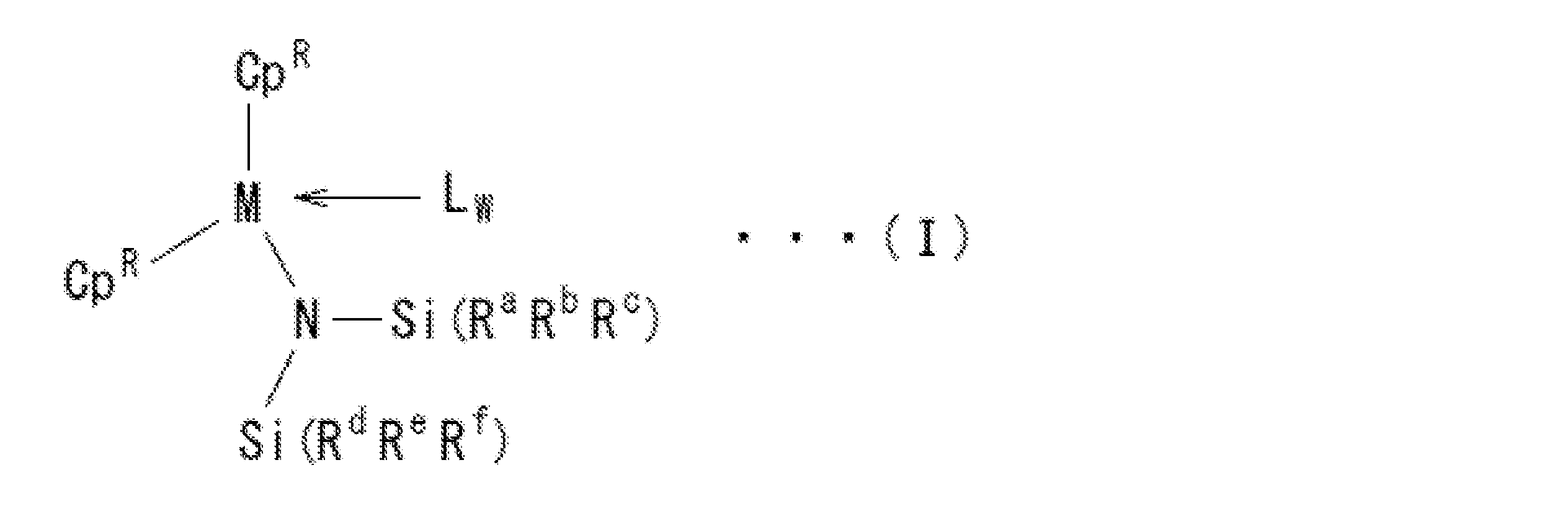
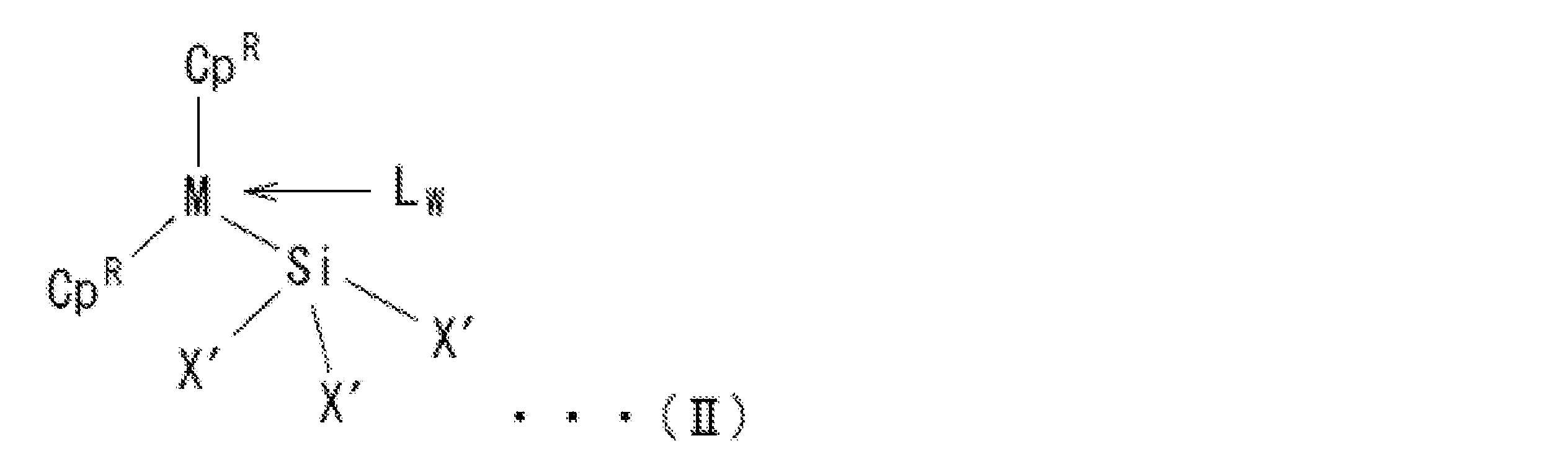
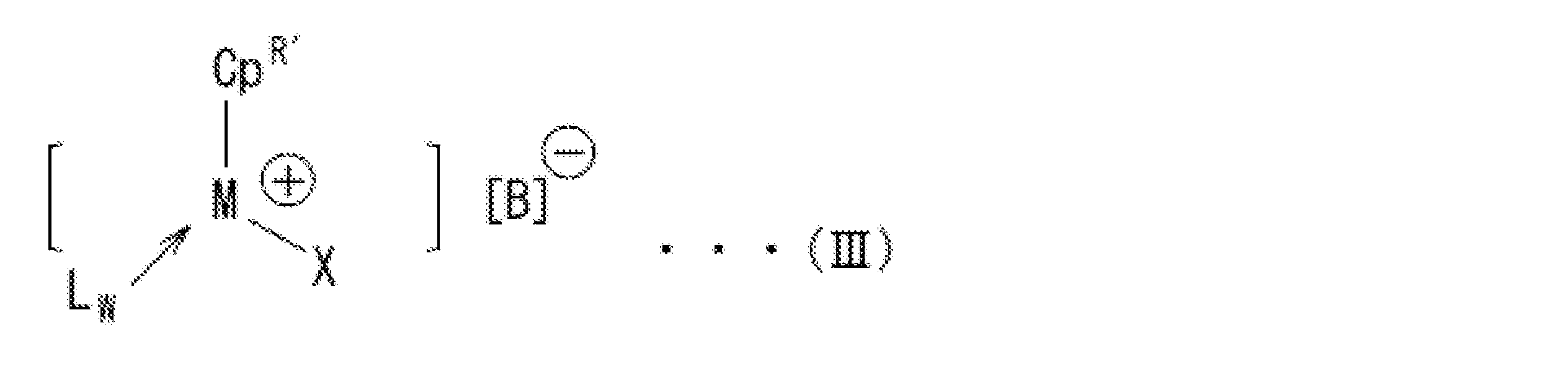
からなる群より選択される少なくとも1種類の錯体を含む。
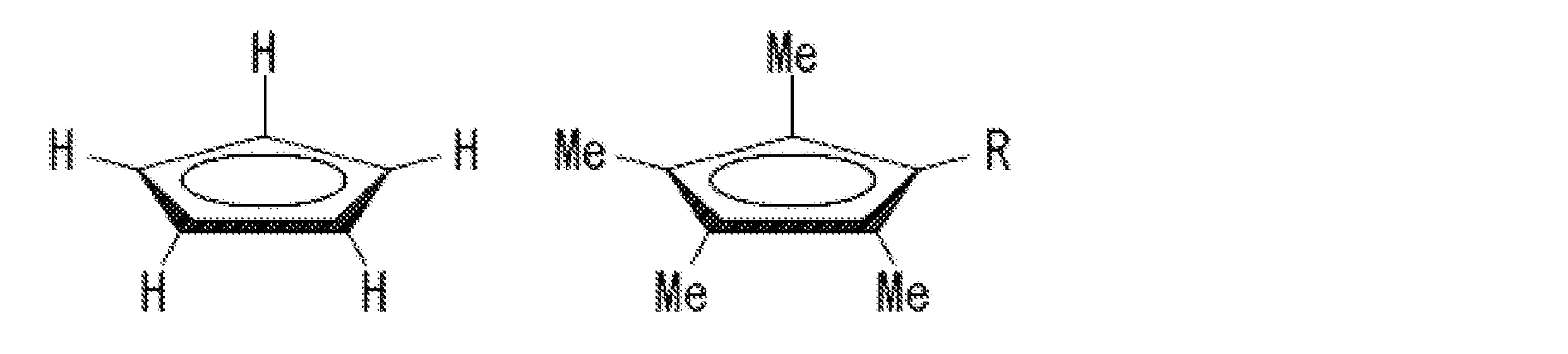
一般式(III)において、Xが表すアミノ基としては、ジメチルアミノ基、ジエチルアミノ基、ジイソプロピルアミノ基等の脂肪族アミノ基;フェニルアミノ基、2,6-ジ-tert-ブチルフェニルアミノ基、2,6-ジイソプロピルフェニルアミノ基、2,6-ジネオペンチルフェニルアミノ基、2-tert-ブチル-6-イソプロピルフェニルアミノ基、2-tert-ブチル-6-ネオペンチルフェニルアミノ基、2-イソプロピル-6-ネオペンチルフェニルアミノ基、2,4,6-トリ-tert-ブチルフェニルアミノ基等のアリールアミノ基;ビストリメチルシリルアミノ基等のビストリアルキルシリルアミノ基が挙げられ、これらの中でも、ビストリメチルシリルアミノ基が好ましい。
また、上記一般式(I)及び(II)で表されるメタロセン錯体、並びに上記一般式(III)で表されるハーフメタロセンカチオン錯体は、単量体として存在していてもよく、二量体又はそれ以上の多量体として存在していてもよい。
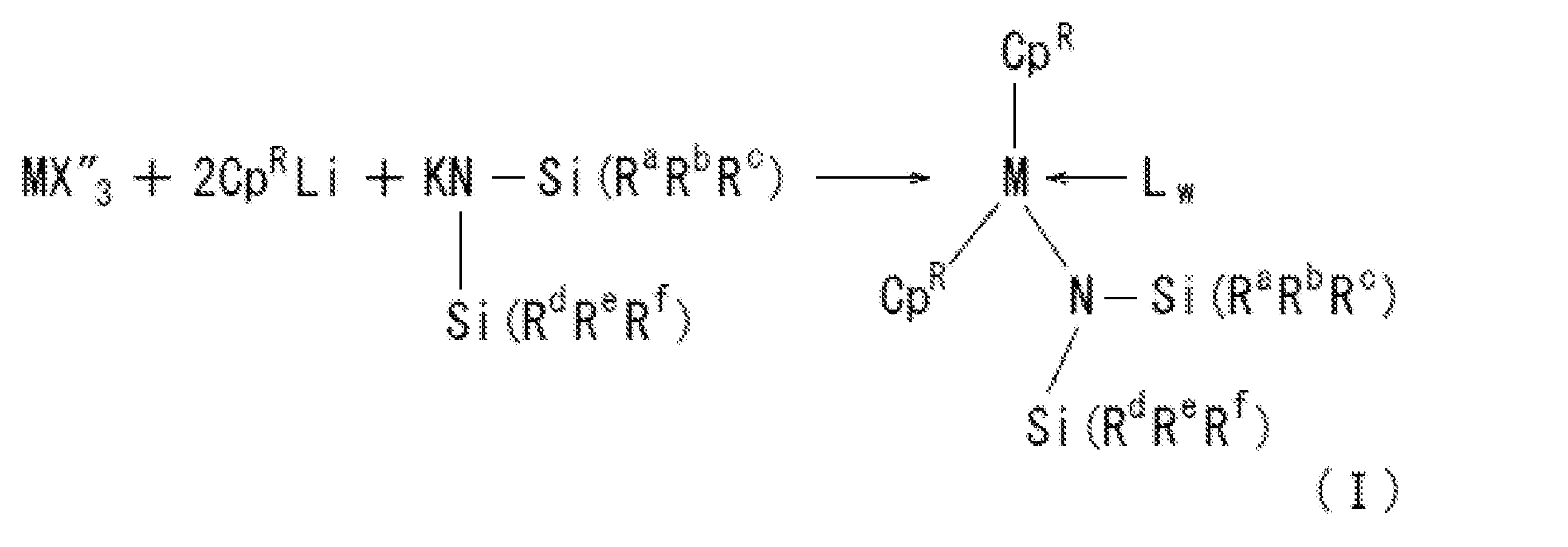

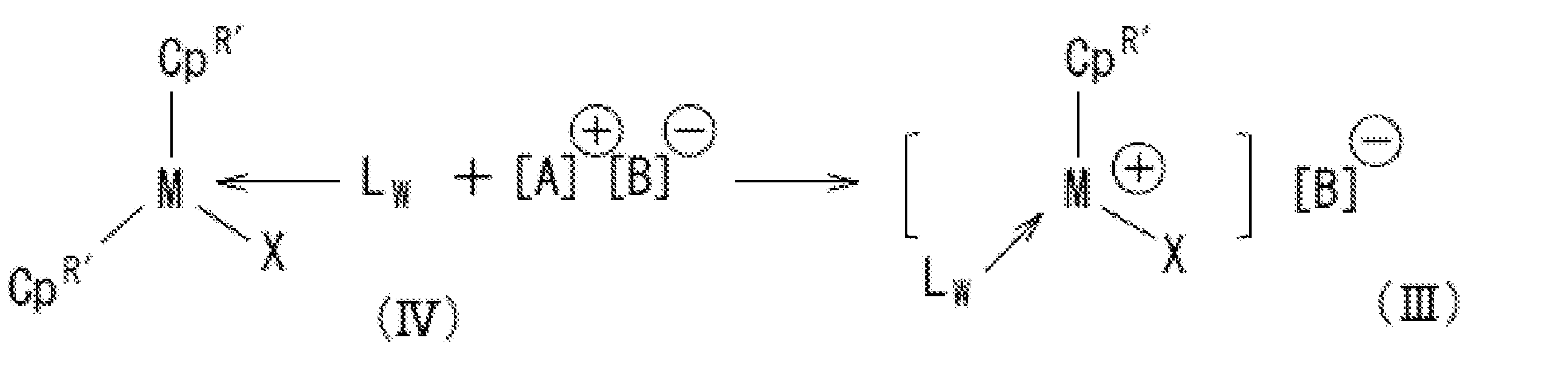
さらに、別の(A-1)成分としては、
下記一般式(V):
RaMXbQYb・・・(V)
(式中、Rは、それぞれ独立して無置換もしくは置換インデニルを示し、該RはMに配位しており、Mは、ランタノイド元素、スカンジウム又はイットリウムを示し、Xは、それぞれ独立して炭素数1~20の一価の炭化水素基を示し、該XはM及びQにμ配位しており、Qは、周期律表第13族元素を示し、Yは、それぞれ独立して炭素数1~20の一価の炭化水素基又は水素原子を示し、該YはQに配位しており、a及びbは、2である)で表されるメタロセン系複合触媒が挙げられる。
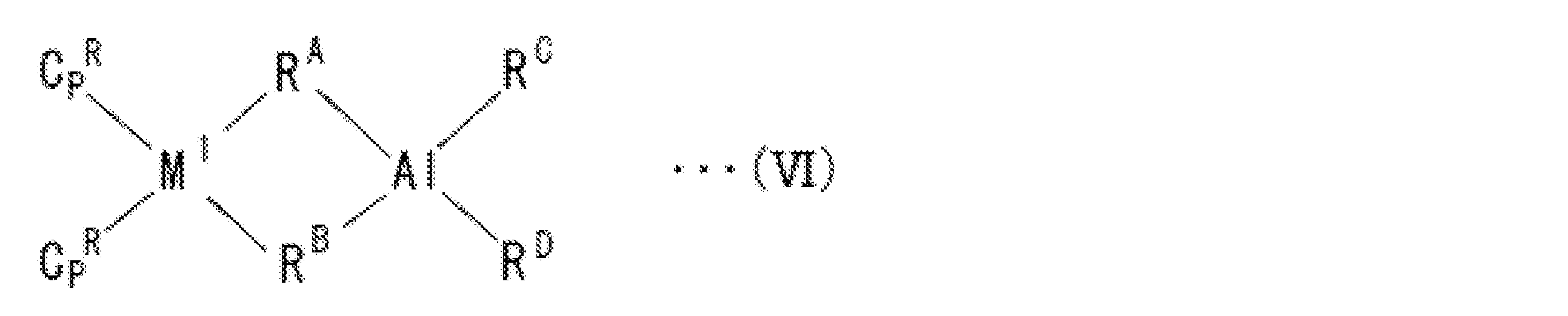
上記メタロセン系重合触媒を用いることで、多元共重合体を製造することができる。また、上記メタロセン系複合触媒、例えば予めアルミニウム触媒と複合させてなる触媒を用いることで、多元共重合体合成時に使用されるアルキルアルミニウムの量を低減したり、無くしたりすることが可能となる。なお、従来の触媒系を用いると、多元共重合体合成時に大量のアルキルアルミニウムを用いる必要がある。例えば、従来の触媒系では、金属触媒に対して10モル当量以上のアルキルアルミニウムを用いる必要があるところ、上記メタロセン系複合触媒であれば、5モル当量程度のアルキルアルミニウムを加えることで、優れた触媒作用が発揮される。
置換インデニルとして、具体的には、2-フェニルインデニル、2-メチルインデニル等が挙げられる。なお、式(VI)における二つのCpRは、それぞれ互いに同一でも異なっていてもよい。
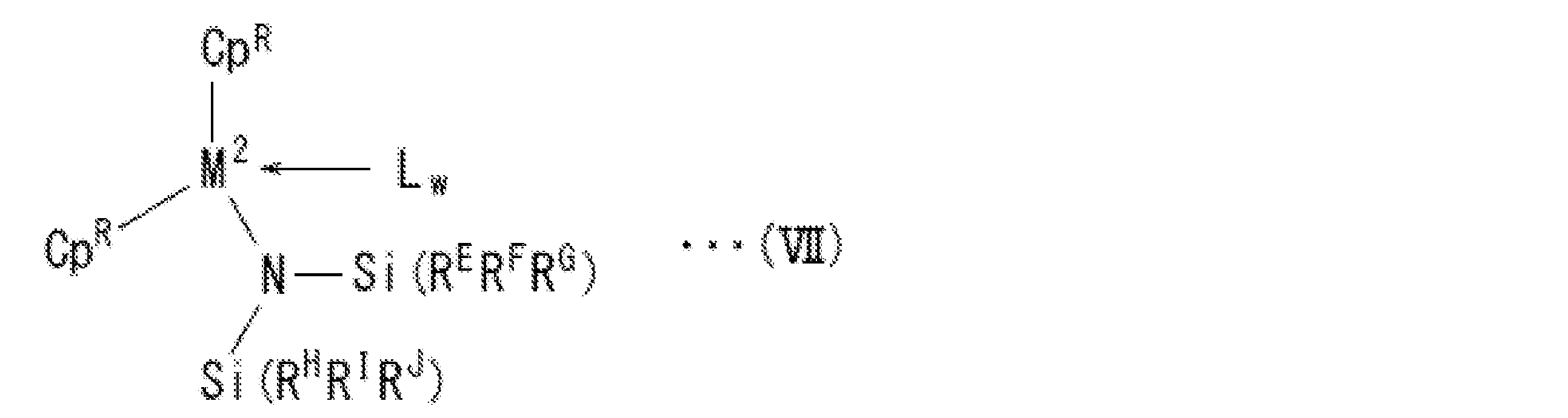
(A-2)成分は、希土類元素化合物又は該希土類元素化合物とルイス塩基との反応物であり、ここで、希土類元素化合物及び該希土類元素化合物とルイス塩基との反応物は、希土類元素と炭素との結合を有さない。該希土類元素化合物及び反応物が希土類元素-炭素結合を有さない場合、化合物が安定であり、取り扱い易い。ここで、希土類元素化合物とは、希土類元素(M)、即ち、周期律表中の原子番号57~71の元素から構成されるランタノイド元素、又はスカンジウム若しくはイットリウムを含有する化合物である。
なお、ランタノイド元素の具体例としては、ランタン、セリウム、プラセオジム、ネオジム、プロメチウム、サマリウム、ユウロピウム、ガドリニウム、テルビウム、ジスプロシウム、ホルミウム、エルビウム、ツリウム、イッテルビウム、ルテチウムを挙げることができる。なお、上記成分は、一種単独で用いてもよいし、二種以上を組み合わせて用いてもよい。
M11X11 2・L11 w ・・・ (VIII)
M11X11 3・L11 w ・・・ (IX)
(それぞれの式中、M11は、ランタノイド元素、スカンジウム又はイットリウムを示し、X11は、それぞれ独立して、水素原子、ハロゲン原子、アルコキシ基、チオラート基、アミノ基、シリル基、アルデヒド残基、ケトン残基、カルボン酸残基、チオカルボン酸残基又はリン化合物残基を示し、L11は、ルイス塩基を示し、wは、0~3を示す)で表されることが好ましい。
該基(配位子)として、具体的には、水素原子;メトキシ基、エトキシ基、プロポキシ基、n-ブトキシ基、イソブトキシ基、sec-ブトキシ基、tert-ブトキシ基等の脂肪族アルコキシ基;フェノキシ基、2,6-ジ-tert-ブチルフェノキシ基、2,6-ジイソプロピルフェノキシ基、2,6-ジネオペンチルフェノキシ基、2-tert-ブチル-6-イソプロピルフェノキシ基、2-tert-ブチル-6-ネオペンチルフェノキシ基、2-イソプロピル-6-ネオペンチルフェノキシ基;チオメトキシ基、チオエトキシ基、チオプロポキシ基、チオn-ブトキシ基、チオイソブトキシ基、チオsec-ブトキシ基、チオtert-ブトキシ基等の脂肪族チオラート基;チオフェノキシ基、2,6-ジ-tert-ブチルチオフェノキシ基、2,6-ジイソプロピルチオフェノキシ基、2,6-ジネオペンチルチオフェノキシ基、2-tert-ブチル-6-イソプロピルチオフェノキシ基、2-tert-ブチル-6-チオネオペンチルフェノキシ基、2-イソプロピル-6-チオネオペンチルフェノキシ基、2,4,6-トリイソプロピルチオフェノキシ基等のアリールチオラート基;ジメチルアミノ基、ジエチルアミノ基、ジイソプロピルアミノ基等の脂肪族アミノ基;フェニルアミノ基、2,6-ジ-tert-ブチルフェニルアミノ基、2,6-ジイソプロピルフェニルアミノ基、2,6-ジネオペンチルフェニルアミノ基、2-tert-ブチル-6-イソプロピルフェニルアミノ基、2-tert-ブチル-6-ネオペンチルフェニルアミノ基、2-イソプロピル-6-ネオペンチルフェニルアミノ基、2,4,6-トリ-tert-ブチルフェニルアミノ基等のアリールアミノ基;ビストリメチルシリルアミノ基等のビストリアルキルシリルアミノ基;トリメチルシリル基、トリス(トリメチルシリル)シリル基、ビス(トリメチルシリル)メチルシリル基、トリメチルシリル(ジメチル)シリル基、トリイソプロピルシリル(ビストリメチルシリル)シリル基等のシリル基;フッ素原子、塩素原子、臭素原子、ヨウ素原子等のハロゲン原子等が挙げられる。
該基(配位子)として、さらには、サリチルアルデヒド、2-ヒドロキシ-1-ナフトアルデヒド、2-ヒドロキシ-3-ナフトアルデヒド等のアルデヒドの残基;2’-ヒドロキシアセトフェノン、2’-ヒドロキシブチロフェノン、2’-ヒドロキシプロピオフェノン等のヒドロキシフェノンの残基;アセチルアセトン、ベンゾイルアセトン、プロピオニルアセトン、イソブチルアセトン、バレリルアセトン、エチルアセチルアセトン等のケトン残基(特には、ジケトンの残基);イソ吉草酸、カプリル酸、オクタン酸、ラウリン酸、ミリスチン酸、パルミチン酸、ステアリン酸、イソステアリン酸、オレイン酸、リノール酸、シクロペンタンカルボン酸、ナフテン酸、エチルヘキサン酸、ピバル酸、バーサチック酸[シェル化学(株)製の商品名、C10モノカルボン酸の異性体の混合物から構成される合成酸]、フェニル酢酸、安息香酸、2-ナフトエ酸、マレイン酸、コハク酸等のカルボン酸の残基;ヘキサンチオ酸、2,2-ジメチルブタンチオ酸、デカンチオ酸、チオ安息香酸等のチオカルボン酸の残基;リン酸ジブチル、リン酸ジペンチル、リン酸ジヘキシル、リン酸ジヘプチル、リン酸ジオクチル、リン酸ビス(2-エチルヘキシル)、リン酸ビス(1-メチルヘプチル)、リン酸ジラウリル、リン酸ジオレイル、リン酸ジフェニル、リン酸ビス(p-ノニルフェニル)、リン酸ビス(ポリエチレングリコール-p-ノニルフェニル)、リン酸(ブチル)(2-エチルヘキシル)、リン酸(1-メチルヘプチル)(2-エチルヘキシル)、リン酸(2-エチルヘキシル)(p-ノニルフェニル)等のリン酸エステルの残基;2-エチルヘキシルホスホン酸モノブチル、2-エチルヘキシルホスホン酸モノ-2-エチルヘキシル、フェニルホスホン酸モノ-2-エチルヘキシル、2-エチルヘキシルホスホン酸モノ-p-ノニルフェニル、ホスホン酸モノ-2-エチルヘキシル、ホスホン酸モノ-1-メチルヘプチル、ホスホン酸モノ-p-ノニルフェニル等のホスホン酸エステルの残基;ジブチルホスフィン酸、ビス(2-エチルヘキシル)ホスフィン酸、ビス(1-メチルヘプチル)ホスフィン酸、ジラウリルホスフィン酸、ジオレイルホスフィン酸、ジフェニルホスフィン酸、ビス(p-ノニルフェニル)ホスフィン酸、ブチル(2-エチルヘキシル)ホスフィン酸、(2-エチルヘキシル)(1-メチルヘプチル)ホスフィン酸、(2-エチルヘキシル)(p-ノニルフェニル)ホスフィン酸、ブチルホスフィン酸、2-エチルヘキシルホスフィン酸、1-メチルヘプチルホスフィン酸、オレイルホスフィン酸、ラウリルホスフィン酸、フェニルホスフィン酸、p-ノニルフェニルホスフィン酸等のホスフィン酸の残基等を挙げることもできる。
なお、これらの基(配位子)は、一種単独で用いてもよいし、二種以上を組み合わせて用いてもよい。
M-(AQ1)(AQ2)(AQ3) ・・・ (X)
[式中、Mは、スカンジウム、イットリウム又はランタノイド元素であり;AQ1、AQ2及びAQ3は、同一であっても異なっていてもよい官能基であり;Aは、窒素、酸素又は硫黄であり;但し、少なくとも1つのM-A結合を有する]で表される化合物が好ましい。ここで、ランタノイド元素とは、具体的には、ランタン、セリウム、プラセオジム、ネオジム、プロメチウム、サマリウム、ユウロピウム、ガドリニウム、テルビウム、ジスプロシウム、ホルミウム、エルビウム、ツリウム、イッテルビウム、ルテチウムである。該化合物は、反応系における触媒活性を向上させることができ、反応時間を短くし、反応温度を高くすることが可能な成分である。
アミノ基としては、例えば、ジメチルアミノ基、ジエチルアミノ基、ジイソプロピルアミノ基等の脂肪族アミノ基;フェニルアミノ基、2,6-ジ-tert-ブチルフェニルアミノ基、2,6-ジイソプロピルフェニルアミノ基、2,6-ジネオペンチルフェニルアミノ基、2-tert-ブチル-6-イソプロピルフェニルアミノ基、2-tert-ブチル-6-ネオペンチルフェニルアミノ基、2-イソプロピル-6-ネオペンチルフェニルアミノ基、2,4,6-トリ-tert-ブチルフェニルアミノ基等のアリールアミノ基;ビストリメチルシリルアミノ基等のビストリアルキルシリルアミノ基が挙げられ、特に、脂肪族炭化水素及び芳香族炭化水素に対する溶解性の観点から、ビストリメチルシリルアミノ基が好ましい。上記アミノ基は、1種単独で用いてもよく、2種以上を組み合わせて用いてもよい。
上記構成によれば、(A-2)成分を3つのM-N結合を有する化合物とすることができ、各結合が化学的に等価となり、化合物の構造が安定となるため、取り扱いが容易となる。
また、上記構成とすれば、反応系における触媒活性をさらに向上させることができる。そのため、反応時間をさらに短くし、反応温度をさらに高くすることができる。
(RO)3M ・・・ (XI)
で表される希土類アルコラートや、下記一般式(XII):
(R-CO2)3M・・・ (XII)
で表される希土類カルボキシレート等が挙げられる。ここで、上記一般式(XI)及び(XII)中、Rは、同一であっても異なっていてもよく、炭素数1~10のアルキル基である。
なお、(A-2)成分としては、希土類元素と炭素との結合を有しないことが好ましいため、上述した化合物(XI)又は化合物(XII)を好適に使用できる。
(RS)3M ・・・ (XIII)
で表される希土類アルキルチオラートや、下記一般式(XIV):
(R-CS2)3M ・・・ (XIV))
で表される化合物、等が挙げられる。ここで、上記一般式(XIII)及び(XIV)中、Rは、同一であっても異なっていてもよく、炭素数1~10のアルキル基である。
前記(B)成分については、下記一般式(XV):
YR1 aR2 bR3 c ・・・ (XV)
(式中、Yは、周期律表第1族、第2族、第12族及び第13族から選択される金属であり、R1及びR2は炭素数1~10の一価の炭化水素基又は水素原子であり、R3は炭素数1~10の一価の炭化水素基であり、R1、R2、R3はそれぞれ互いに同一又は異なっていてもよく、また、Yが周期律表第1族から選択される金属である場合には、aは1で且つb及びcは0であり、Yが周期律表第2族及び第12族から選択される金属である場合には、a及びbは1で且つcは0であり、Yが周期律表第13族から選択される金属である場合には、a、b及びcは1である)で表される有機金属化合物であり、下記一般式(XVI):
AlR1R2R3 ・・・ (XVI)
(式中、R1及びR2は炭素数1~10の一価の炭化水素基又は水素原子であり、R3は炭素数1~10の一価の炭化水素基であり、R1、R2、R3はそれぞれ互いに同一又は異なっていてもよい)で表される有機アルミニウム化合物であることが好ましい。
前記(C)成分は、有機アルミニウム化合物と縮合剤とを接触させることによって得られる化合物である。
(C)成分を用いることによって、重合反応系における触媒活性をさらに向上させることができる。そのため、反応時間をさらに短くし、反応温度をさらに高くすることができる。
一方、縮合剤としては、例えば、水等が挙げられる。
-(Al(R7)O)n- ・・・ (XVII)
(式中、R7は、炭素数1~10の炭化水素基であり、ここで、炭化水素基の一部はハロゲン及び/又はアルコキシ基で置換されてもよく;R7は、繰り返し単位間で同一であっても異なっていてもよく;nは5以上である)で表されるアルミノキサンを挙げることができる。
上記アルミノキサンの分子構造は、直鎖状であっても環状であってもよい。
また、上記式(XVII)中のR7に関して、炭化水素基としては、例えば、メチル基、エチル基、プロピル基、イソブチル基等が挙げられ、特に、メチル基が好ましい。該炭化水素基は、1種でもよいし、2種以上を組み合わせでもよい。式(XVII)中のR7に関して、炭化水素基としては、メチル基とイソブチル基との組み合わせが好ましい。
ここで、脂肪族炭化水素とは、ヘキサン、シクロヘキサン等が挙げられる。
-(Al(CH3)x(i-C4H9)yO)m- ・・・ (XVIII)
(式中、x+yは1であり;mは5以上である)で表される修飾アルミノキサン(以下、「TMAO」ともいう)としてもよい。TMAOとしては、例えば、東ソー・ファインケミカル社製の製品名「TMAO341」が挙げられる。
-(Al(CH3)0.7(i-C4H9)0.3O)k- ・・・ (XIX)(式中、kは5以上である)で表される修飾アルミノキサン(以下、「MMAO」ともいう)としてもよい。MMAOとしては、例えば、東ソー・ファインケミカル社製の製品名「MMAO-3A」が挙げられる。
-[(CH3)AlO]i- ・・・ (XX)
(式中、iは5以上である)で表される修飾アルミノキサン(以下、「PMAO」ともいう)としてもよい。PMAOとしては、例えば、東ソー・ファインケミカル社製の製品名「TMAO-211」が挙げられる。
前記(D)成分は、非配位性アニオンとカチオンとからなる。該(D)成分を上述の(A)成分と共に用いる場合、(D)成分としては、前記(A)成分と反応してカチオン性遷移金属化合物を生成できるイオン性化合物等を挙げることができる。
一方、カチオンとしては、カルボニウムカチオン、オキソニウムカチオン、アミンカチオン、ホスホニウムカチオン、シクロヘプタトリエニルカチオン、遷移金属を有するフェロセニウムカチオン等を挙げることができる。カルボニウムカチオンの具体例としては、トリフェニルカルボニウムカチオン、トリ(置換フェニル)カルボニウムカチオン等の三置換カルボニウムカチオン等が挙げられ、トリ(置換フェニル)カルボニルカチオンとして、より具体的には、トリ(メチルフェニル)カルボニウムカチオン、トリ(ジメチルフェニル)カルボニウムカチオン等が挙げられる。アミンカチオンとしては、アンモニウムカチオンが挙げられ、アンモニウムカチオンの具体例としては、トリメチルアンモニウムカチオン、トリエチルアンモニウムカチオン、トリプロピルアンモニウムカチオン、トリブチルアンモニウムカチオン(例えば、トリ(n-ブチル)アンモニウムカチオン)等のトリアルキルアンモニウムカチオン;N,N-ジメチルアニリニウムカチオン、N,N-ジエチルアニリニウムカチオン、N,N-2,4,6-ペンタメチルアニリニウムカチオン等のN,N-ジアルキルアニリニウムカチオン;ジイソプロピルアンモニウムカチオン、ジシクロヘキシルアンモニウムカチオン等のジアルキルアンモニウムカチオン等が挙げられる。ホスホニウムカチオンの具体例としては、トリフェニルホスホニウムカチオン、トリ(メチルフェニル)ホスホニウムカチオン、トリ(ジメチルフェニル)ホスホニウムカチオン等のトリアリールホスホニウムカチオン等が挙げられる。これらカチオンの中でも、N,N-ジアルキルアニリニウムカチオン又はカルボニウムカチオンが好ましく、N,N-ジアルキルアニリニウムカチオンが特に好ましい。
前記(E)成分は、ルイス酸であるハロゲン含有化合物(以下、「(E-1)成分」ともいう)、金属ハロゲン化物とルイス塩基との錯化合物(以下、「(E-2)成分」ともいう)及び活性ハロゲンを含む有機化合物(以下、「(E-3)成分」ともいう)のうち少なくとも一種からなり、例えば、上記(A)成分である希土類元素化合物又はそのルイス塩基との反応物と反応して、カチオン性遷移金属化合物やハロゲン化遷移金属化合物や遷移金属中心が電荷不足の化合物を生成することができる。
上記ルイス酸であるハロゲン含有化合物として、具体的には、メチルアルミニウムジブロマイド、メチルアルミニウムジクロライド、エチルアルミニウムジブロマイド、エチルアルミニウムジクロライド、ブチルアルミニウムジブロマイド、ブチルアルミニウムジクロライド、ジメチルアルミニウムブロマイド、ジメチルアルミニウムクロライド、ジエチルアルミニウムブロマイド、ジエチルアルミニウムクロライド、ジブチルアルミニウムブロマイド、ジブチルアルミニウムクロライド、メチルアルミニウムセスキブロマイド、メチルアルミニウムセスキクロライド、エチルアルミニウムセスキブロマイド、エチルアルミニウムセスキクロライド、ジブチル錫ジクロライド、アルミニウムトリブロマイド、トリ(ペンタフルオロフェニル)アルミニウム、トリ(ペンタフルオロフェニル)ボレート、三塩化アンチモン、五塩化アンチモン、三塩化リン、五塩化リン、四塩化錫、四塩化チタン、六塩化タングステン等が挙げられ、これらの中でも、ジエチルアルミニウムクロライド、エチルアルミニウムセスキクロライド、エチルアルミニウムジクロライド、ジエチルアルミニウムブロマイド、エチルアルミニウムセスキブロマイド、エチルアルミニウムジブロマイドが特に好ましい。
上記(E-1)成分は、1種単独で用いてもよく、2種以上を組み合わせて用いてもよい。
また、上記(E-2)成分を構成するルイス塩基としては、リン化合物、カルボニル化合物、窒素化合物、エーテル化合物、アルコール等が好ましい。具体的には、リン酸トリブチル、リン酸トリ-2-エチルヘキシル、リン酸トリフェニル、リン酸トリクレジル、トリエチルホスフィン、トリブチルホスフィン、トリフェニルホスフィン、ジエチルホスフィノエタン、ジフェニルホスフィノエタン、アセチルアセトン、ベンゾイルアセトン、プロピオニトリルアセトン、バレリルアセトン、エチルアセチルアセトン、アセト酢酸メチル、アセト酢酸エチル、アセト酢酸フェニル、マロン酸ジメチル、マロン酸ジエチル、マロン酸ジフェニル、酢酸、オクタン酸、2-エチル-ヘキサン酸、オレイン酸、ステアリン酸、安息香酸、ナフテン酸、バーサチック酸、トリエチルアミン、N,N-ジメチルアセトアミド、テトラヒドロフラン、ジフェニルエーテル、2-エチル-ヘキシルアルコール、オレイルアルコール、ステアリルアルコール、フェノール、ベンジルアルコール、1-デカノール、ラウリルアルコール等が挙げられ、これらの中でも、リン酸トリ-2-エチルヘキシル、リン酸トリクレジル、アセチルアセトン、2-エチルヘキサン酸、バーサチック酸、2-エチルヘキシルアルコール、1-デカノール、ラウリルアルコールが好ましい。
上記ルイス塩基は、上記金属ハロゲン化物1mol当り、0.01~30mol、好ましくは0.5~10molの割合で反応させる。このルイス塩基との反応物を使用すると、ポリマー中に残存する金属を低減することができる。
上記(E-2)成分は、1種単独で用いてもよく、2種以上を組み合わせて用いてもよい。
前記カップリング工程において、重合反応が100%に達した際にカップリング反応を行うことが好ましい。
前記カップリング反応に用いるカップリング剤としては、特に制限はなく、目的に応じて適宜選択することができ、例えば、ビス(マレイン酸-1-オクタデシル)ジオクチルスズ(IV)等のスズ含有化合物;4,4’-ジフェニルメタンジイソシアネート等のイソシアネート化合物;グリシジルプロピルトリメトキシシラン等のアルコキシシラン化合物、などが挙げられる。これらは、1種単独で使用してもよいし、2種以上を併用してもよい。
これらの中でも、ビス(マレイン酸-1-オクタデシル)ジオクチルスズ(IV)が、反応効率と低ゲル生成の点で、好ましい。
なお、カップリング反応を行うことにより、数平均分子量(Mn)の増加を行うことができる。
この洗浄工程により、共重合体中の触媒残渣量を好適に低下させることができる。
前記発泡助剤の配合量は、特に限定されるものではないが、前記ゴム成分100質量部に対して1~30質量部の範囲が好ましい。
前記被覆層に用いる低融点樹脂の融点は、ゴム組成物の加硫の最高温度よりも低いことが好ましい。なお、加硫の最高温度とは、ゴム組成物の加硫時にゴム組成物が達する最高温度を意味する。例えば、モールド加硫の場合には、上記ゴム組成物がモールド内に入ってからモールドを出て冷却されるまでに該ゴム組成物が達する最高温度を意味し、かかる加硫最高温度は、例えば、ゴム組成物中に熱電対を埋め込むこと等により測定することができる。低融点樹脂の融点の上限としては、特に制限はないものの、以上の点を考慮して択することが好ましく、一般的には、ゴム組成物の加硫最高温度よりも、10℃以上低いことが好ましく、20℃以上低いことがより好ましい。なお、ゴム組成物の工業的な加硫温度は、一般的には最高で約190℃程度であるが、例えば、加硫最高温度がこの190℃に設定されている場合には、低融点樹脂の融点としては、通常190℃未満の範囲で選択され、180℃以下が好ましく、170℃以下がより好ましい。
前記低融点樹脂としては、ポリオレフィン系樹脂が好ましく、例としては、ポリエチレン、ポリプロピレン、ポリブテン、ポリスチレン、エチレン-プロピレン共重合体、エチレン-メタクリル酸共重合体、エチレン-エチルアクリレート共重合体、エチレン-プロピレン-ジエン三元共重合体、エチレン-酢酸ビニル共重合体、並びにこれらのアイオノマー樹脂等が挙げられる。
またマイクロカプセルの殻材中に内包する熱膨張性物質は、熱によって気化又は膨張する特性を有するものであり、例えば、イソアルカン、ノルマルアルカン等の炭化水素からなる群から選ばれる少なくとも1種類が例示される。イソアルカンとしては、イソブタン、イソペンタン、2-メチルペンタン、2-メチルヘキサン、2,2,4-トリメチルペンタン等を挙げることができ、ノルマルアルカンとしては、n-ブタン、n-プロパン、n-ヘキサン、n-ヘプタン、n-オクタン等を挙げることができる。これらの炭化水素は、それぞれ単独で使用しても複数を組み合わせて使用してもよい。熱膨張性物質の好ましい形態としては、常温で液体の炭化水素に、常温で気体の炭化水素を溶解させたものがよい。このような炭化水素の混合物を使用することにより、未加硫タイヤの加硫成形温度域(150℃~190℃)において、低温領域から高温領域にかけて十分な膨張力を得ることができる。
このような熱膨張性マイクロカプセルとしては、例えば、スウェーデン国エクスパンセル社製の商品名「EXPANCEL 091DU-80」または「EXPANCEL 092DU-120」等、或いは松本油脂製薬社製の商品名「マツモトマイクロスフェアー F-85D」または「マツモトマイクロスフェアー F-100D」等を使用することができる。
なお、多孔性セルロース粒子の空隙率は、一定質量の試料(即ち、多孔性セルロース粒子)の体積をメスシリンダーで測定し、嵩比重を求めて、下記式から求めることができる。
空隙率[%]={1-(試料の嵩比重[g/ml])/(試料の真比重[g/ml])}×100
なお、セルロースの真比重は1.5である。
多孔性セルロース粒子の平均粒径と、長径/短径の比は、例えば、多孔性セルロース粒子を顕微鏡で観察した画像から得ることができる。観察画像では、粒子の長径と短径(長径と短径が同じ場合には、ある軸方向の長さとこれに直交する軸方向の長さ)を100個の粒子について測定し、その平均値を算出することで平均粒径が得られ、また、長径を短径で割った値の平均値により長径/短径の比が得られる。
このような多孔性セルロース粒子は、例えば、レンゴー社から「ビスコパール」として市販されており、また、特開2001-323095号公報や特開2004-115284号公報等に記載されており、それらを好適に用いることができる。
これら天然樹脂の中でも、加硫ゴム組成物の耐摩耗性の観点から、重合ロジン、テルペンフェノール樹脂、水素添加テルペン樹脂が好ましい。
ここで、樹脂成分(c)のSP値は、ハンセン(Hansen)の数式を用いて算出される溶解度パラメータを意味し、より具体的には、ハンセンの3つのパラメータのうち分子間の双極子相互作用エネルギーと水素結合によるエネルギーから算出した数値を意味する。
ここで、前記樹脂成分(c)の重量平均分子量(Mw)は、ゲルパーミエーションクロマトグラフィー(GPC)で測定した、ポリスチレン換算の値である。
ここで、ナフテン系オイルとアスファルトとの混合物において、ナフテン系オイルは、水添ナフテン系オイルであってもよく、該水添ナフテン系オイルは、予め高温高圧水素化精製技術によりナフテン系オイルを水素化精製することにより得ることができる。一方、アスファルトは、ゴム成分(a)との相溶性や、軟化剤としての効果の点から、アスファルテン成分が5質量%以下であることが好ましい。なお、アスファルテン成分は、JPI法(日本石油学会法)に準拠して測定した組成分析より定量する。
ここで、軟化剤(d)のSP値は、ハンセン(Hansen)の数式を用いて算出される溶解度パラメータを意味し、より具体的には、ハンセンの3つのパラメータのうち分子間の双極子相互作用エネルギーと水素結合によるエネルギーから算出した数値を意味する。
ここで、軟化剤(d)の重量平均分子量(Mw)は、ゲルパーミエーションクロマトグラフィー(GPC)で測定した、ポリスチレン換算の値である。
また、前記シリカとしては、例えば、湿式シリカ(含水ケイ酸)、乾式シリカ(無水ケイ酸)、ケイ酸カルシウム、ケイ酸アルミニウム等が挙げられ、これらの中でも、湿式シリカが好ましい。
また、前記水酸化アルミニウムとしては、ハイジライト(登録商標、昭和電工製)等を用いることが好ましい。
前記架橋剤の含有量としては、特に制限はなく、目的に応じて適宜選択することができるが、前記ゴム成分(a)100質量部に対し、0.1~20質量部が好ましい。
本発明のタイヤトレッドは、上述した本発明の加硫ゴム組成物を用いたことを特徴とする。かかる本発明のタイヤトレッドは、上述した加硫ゴム組成物を用いているため、タイヤに適用した際、タイヤの氷上性能と耐摩耗性との両方に優れる。
本発明のタイヤは、上述した本発明のタイヤトレッドを備えることを特徴とする。かかる本発明のタイヤは、上述したタイヤトレッドを用いているため、氷上性能と耐摩耗性との両方に優れる。なお、本発明のタイヤは、氷上性能と耐摩耗性との両方に優れるため、スタッドレスタイヤ等の冬用タイヤとして特に有用である。
本発明のタイヤは、適用するタイヤの種類や部材に応じ、未加硫のゴム組成物を用いて成形後に加硫して得てもよく、又は予備加硫工程等を経た半加硫ゴムを用いて成形後、さらに本加硫して得てもよい。なお、タイヤに充填する気体としては、通常の或いは酸素分圧を調整した空気の他、窒素、アルゴン、ヘリウム等の不活性ガスを用いることができる。
以下の方法で、後述のようにして合成した共重合体の数平均分子量(Mn)、重量平均分子量(Mw)及び分子量分布(Mw/Mn)、ブタジエン単位、エチレン単位及びスチレン単位の含有量、融点、吸熱ピークエネルギー、ガラス転移温度、結晶化度を測定し、主鎖構造を確認した。
ゲルパーミエーションクロマトグラフィー[GPC:東ソー社製HLC-8121GPC/HT、カラム:東ソー社製GMHHR-H(S)HT×2本、検出器:示差屈折率計(RI)]で単分散ポリスチレンを基準として、共重合体のポリスチレン換算の数平均分子量(Mn)、重量平均分子量(Mw)及び分子量分布(Mw/Mn)を求めた。なお、測定温度は40℃である。
共重合体中のブタジエン単位、エチレン単位、スチレン単位の含有量(mol%)を、1H-NMRスペクトル(100℃、d-テトラクロロエタン標準:6ppm)の各ピークの積分比より求めた。
示差走査熱量計(DSC、ティー・エイ・インスツルメント・ジャパン社製、「DSCQ2000」)を用い、JIS K 7121-1987に準拠して、共重合体の融点を測定した。
示差走査熱量計(DSC、ティー・エイ・インスツルメント・ジャパン社製、「DSCQ2000」)を用い、JIS K 7121-1987に準拠して、10℃/分の昇温速度で-150℃から150℃まで昇温し、その時(1st run)の0~120℃における吸熱ピークエネルギーを測定した。
示差走査熱量計(DSC、ティー・エイ・インスツルメント・ジャパン社製、「DSCQ2000」)を用い、JIS K 7121-1987に準拠して、共重合体のガラス転移温度(Tg)を測定した。
100%結晶成分のポリエチレンの結晶融解エネルギーと、得られた共重合体の融解ピークエネルギーを測定し、ポリエチレンと共重合体とのエネルギー比率から、結晶化度を算出した。なお、融解ピークエネルギーは、示差走査熱量計(DSC、ティー・エイ・インスツルメント・ジャパン社製、「DSCQ2000」)で測定した。
合成した共重合体について、13C-NMRスペクトルを測定した。
十分に乾燥した1000mLの耐圧ステンレス反応器に、スチレン160gと、トルエン600mLを加えた。
窒素雰囲気下のグローブボックス中で、ガラス製容器にモノ(ビス(1,3-tert-ブチルジメチルシリル)インデニル)ビス(ビス(ジメチルシリル)アミドガドリニウム錯体{1,3-[(t-Bu)Me2Si]2C9H5Gd[N(SiHMe2)2]2}0.25mmol、ジメチルアニリニウムテトラキス(ペンタフルオロフェニル)ボレート[Me2NHPhB(C6F5)4]0.275mmol、及びジイソブチルアルミニウムハイドライド1.1mmolを仕込み、トルエン40mLに溶解させて触媒溶液とした。
該触媒溶液を、前記耐圧ステンレス反応器に加え、70℃に加温した。
次いで、エチレンを圧力1.5MPaで、該耐圧ステンレス反応器に投入し、更に1,3-ブタジエン20gを含むトルエン溶液80mLを8時間かけて該耐圧ステンレス反応器に投入し、70℃で計8.5時間共重合を行った。
次いで、2,2’-メチレン-ビス(4-エチル-6-t-ブチルフェノール)(NS-5)5質量%のイソプロパノール溶液1mlを、該耐圧ステンレス反応器に加えて反応を停止させた。
次いで、大量のメタノールを用いて共重合体を分離し、50℃で真空乾燥し、三元共重合体を得た。
得られた三元共重合体について、数平均分子量(Mn)、重量平均分子量(Mw)、分子量分布(Mw/Mn)、ブタジエン単位、エチレン単位、スチレン単位の含有量、融点(Tm)、吸熱ピークエネルギー、ガラス転移温度(Tg)、結晶化度を、上記の方法で測定した。結果を表1に示す。
また、得られた三元共重合体について、上記の方法で主鎖構造を確認したところ、13C-NMRスペクトルチャートにおいて、10~24ppmにピークが観測されなかったことから、合成した三元共重合体は、主鎖が非環状構造のみからなることを確認した。
十分に乾燥した4Lステンレス反応器に、1,3-ブタジエン120g(2.22mol)を含むトルエン溶液2,000gを添加した後、エチレンを1.72MPaで導入した。一方、窒素雰囲気下のグローブボックス中で、ガラス製容器にビス(2-フェニルインデニル)ガドリニウムビス(ジメチルシリルアミド)[(2-PhC9H6)2GdN(SiHMe2)2]28.5μmol、ジメチルアニリニウムテトラキス(ペンタフルオロフェニル)ボレート[Me2NHPhB(C6F5)4]28.5μmol、及びジイソブチルアルミニウムハイドライド2.00mmolを仕込み、トルエン40mlに溶解させて触媒溶液とする。その後、グローブボックスから触媒溶液を取り出し、ガドリニウム換算で25.0μmolとなる量をモノマー溶液へ添加し、50℃で90分間重合を行う。重合後、2,2’メチレン-ビス(4-エチル-6-t-ブチルフェノール)(NS-5)5質量%のイソプロパノール溶液5mlを加えて反応を停止させ、さらに大量のメタノールで共重合体を分離し、70℃で真空乾燥し二元共重合体を得る。
得られた二元共重合体について、数平均分子量(Mn)、重量平均分子量(Mw)、分子量分布(Mw/Mn)、エチレン単位、ブタジエン単位の含有量、融点(Tm)、吸熱ピークエネルギー、ガラス転移温度(Tg)、結晶化度を、上記の方法で測定する。結果を表1に示す。

表2に示す配合処方に従い、通常のバンバリーミキサーを用いて、ゴム組成物を製造した。得られたゴム組成物を、160℃にて15分間加硫して、比較例1~5及び実施例1~5の加硫ゴム組成物のサンプルを作製した。
また、表2に示す配合処方に従い、通常のバンバリーミキサーを用いて、ゴム組成物を製造する。得られたゴム組成物を、160℃にて15分間加硫して、比較例6及び7の加硫ゴム組成物のサンプルを作製する。
得られた各サンプルに対して、下記の方法で、空隙の平均径及び空隙率を測定し、さらに、耐摩耗性及び氷上性能の評価を行った。結果を表2に示す。
比較例1~5及び実施例1~5の加硫ゴム組成物のサンプルについて、任意の箇所で切断した後、切断面について、デジタルマイクロスコープ(株式会社キーエンス製 「VHX-100」)を用いて、50倍で観察を行った。観察視野(2.5mm×2.5mm)内の全ての空隙について、径(最長径)を測定し、全ての空隙の径の平均を算出し、空隙の平均径とした。また、切断した加硫ゴム組成物の各サンプルについて、密電子天秤を用いて重量を測定し、理論重量との差異((理論重量-測定重量)×100)を空隙率(%)とした。
さらに、比較例6及び7の加硫ゴム組成物のサンプルについて、任意の箇所で切断した後、切断面について、デジタルマイクロスコープ(株式会社キーエンス製 「VHX-100」)を用いて、50倍で観察を行う。観察視野(2.5mm×2.5mm)内の全ての空隙について、径(最長径)を測定し、全ての空隙の径の平均を算出し、空隙の平均径とする。さらにまた、切断した加硫ゴム組成物の各サンプルについて、密電子天秤を用いて重量を測定し、理論重量との差異((理論重量-測定重量)×100)を空隙率(%)とする。
比較例1~5及び実施例1~5の加硫ゴム組成物のサンプルについて、JIS K 7218(1986年)の滑り摩耗試験のB法に準じて、摩耗量を測定した。なお、測定温度は室温(23℃)、荷重は16Nとした。
また、比較例6及び7の加硫ゴム組成物のサンプルについて、JIS K 7218(1986年)の滑り摩耗試験のB法に準じて、摩耗量を測定する。なお、測定温度は室温(23℃)、荷重は16Nとする。
評価は、比較例5の加硫ゴムの摩耗量の逆数を100として、指数表示した。指数値が大きい程、摩耗量が少なく、耐摩耗性が良好であることを示す。
比較例1~5及び実施例1~5の加硫ゴム組成物のサンプルについて、直径50mm、厚さ10mmの試験片に成形した後、固定した氷上に押しつけて回転させるときに発生する摩擦力をロードセルで検出し、動摩擦係数μを算出した。なお、測定温度は-2℃、面圧は12kgf/cm2、サンプル回転周速度は20cm/secとした。
また、比較例6及び7の加硫ゴム組成物のサンプルについて、直径50mm、厚さ10mmの試験片に成形した後、固定した氷上に押しつけて回転させるときに発生する摩擦力をロードセルで検出し、動摩擦係数μを算出する。なお、測定温度は-2℃、面圧は12kgf/cm2、サンプル回転周速度は20cm/secとする。
評価は、比較例5の動摩擦係数μを100として、指数表示した。指数値が大きい程、動摩擦係数μが大きく、氷上性能が良好であることを示す。

*2 ブタジエンゴム: JSR社製、商品名「BR01」
*3 三元共重合体: 上記の方法で合成した三元共重合体
*4 二元共重合体: 上記の方法で合成した二元共重合体
*5 カーボンブラック: SAF級カーボンブラック、旭カーボン社製、商品名「ASAHI#105」
*6 プロセスオイル: 石油系炭化水素プロセスオイル、出光興産社製、商品名「DAIANA PROCESS OIL NS-28」
*7 シリカ: 東ソー・シリカ工業社製、商品名「Nipsil AQ」
*8 シランカップリング剤: ビストリエトキシシリルプロピルポリスルフィド、信越化学工業社製
*9 ワックス: マイクロクリスタリンワックス、精工化学社製
*10 老化防止剤: 大内新興化学工業社製、商品名「ノクラック6C」
*11 樹脂: 脂肪族炭化水素樹脂、三井石油化学社製、商品名「HI-REZ G-100X」
*12 親水性短繊維: 以下の方法で作製した親水性短繊維
特開2012-219245号公報に開示の製造例3に従い、二軸押出機を2台用い、ホッパーにポリエチレン[日本ポリエチレン製、ノバテックHJ360(MFR5.5、融点132℃)]40質量部と、エチレン-ビニルアルコール共重合体[クラレ製、エバールF104B(MFR4.4、融点183℃)]40質量部とを投入し、ダイ出口から各々同時に押し出して、常法に従って得られた繊維を長さ2mmにカットして、エチレン-ビニルアルコール共重合体からなるコアの表面にポリエチレンからなる被覆層が形成された親水性短繊維を作製した。
*13 酸化亜鉛: ハクスイテック社製
*14 加硫促進剤CZ: N-シクロヘキシル-2-ベンゾチアゾリルスルフェンアミド、大内新興化学工業社製、商品名「ノクセラーCZ」
*15 加硫促進剤MBTS: ジ-2-ベンゾチアゾリルジスルフィド、大内新興化学工業社製、商品名「ノクセラーDM-P」
*16 発泡剤: ジニトロソペンタメチレンテトラミン、三協化成社製、商品名「セルマイクAN」
また、本発明によれば、氷上性能と耐摩耗性との両方に優れるタイヤトレッド及びタイヤを提供することができる。
20 空隙
Claims (16)
- ゴム成分が、共役ジエン単位と、非共役オレフィン単位と、芳香族ビニル単位とを含有する多元共重合体を含む、加硫ゴム組成物であって、
該加硫ゴム組成物が、複数の空隙を有し、該空隙の平均径が、10~300μmであることを特徴とする、加硫ゴム組成物。 - 前記加硫ゴム組成物の空隙率が、10~80%であることを特徴とする、請求項1に記載のゴム組成物。
- 前記多元共重合体は、前記共役ジエン単位の含有量が1~50mol%で、前記非共役オレフィン単位の含有量が40~97mol%で、且つ、前記芳香族ビニル単位の含有量が2~35mol%であることを特徴とする、請求項1又は2に記載の加硫ゴム組成物。
- 前記多元共重合体は、示差走査熱量計(DSC)で測定した融点が30~130℃であることを特徴とする、請求項1~3のいずれか1項に記載の加硫ゴム組成物。
- 前記多元共重合体は、0~120℃における示差走査熱量計(DSC)で測定した吸熱ピークエネルギーが10~150J/gであることを特徴とする、請求項1~4のいずれか1項に記載の加硫ゴム組成物。
- 前記多元共重合体は、示差走査熱量計(DSC)で測定したガラス転移温度が0℃以下であることを特徴とする、請求項1~5のいずれか1項に記載の加硫ゴム組成物。
- 前記多元共重合体は、結晶化度が0.5~50%であることを特徴とする、請求項1~6のいずれか1項に記載の加硫ゴム組成物。
- 前記多元共重合体は、前記非共役オレフィン単位が非環状の非共役オレフィン単位であることを特徴とする、請求項1~7のいずれか1項に記載の加硫ゴム組成物。
- 前記多元共重合体は、前記非環状の非共役オレフィン単位がエチレン単位のみからなることを特徴とする、請求項8に記載の加硫ゴム組成物。
- 前記多元共重合体は、前記芳香族ビニル単位がスチレン単位を含むことを特徴とする、請求項1~9のいずれか1項に記載の加硫ゴム組成物。
- 前記多元共重合体は、前記共役ジエン単位が1,3-ブタジエン単位及び/又はイソプレン単位を含むことを特徴とする、請求項1~10のいずれか1項に記載の加硫ゴム組成物。
- 前記ゴム成分中の、前記多元共重合体の含有量が5~100質量%であることを特徴とする、請求項1~11のいずれか1項に記載の加硫ゴム組成物。
- 前記加硫ゴム組成物が、空隙導入剤をさらに含むことを特徴とする、請求項1~12のいずれか1項に記載の加硫ゴム組成物。
- 前記空隙導入剤が、発泡剤、親水性短繊維、硫酸金属塩、熱膨張性マイクロカプセル及び多孔質セルロース粒子からなる群より選択される少なくとも一種であることを特徴とする、請求項13に記載の加硫ゴム組成物。
- 請求項1~14のいずれか1項に記載の加硫ゴム組成物を用いたことを特徴とする、タイヤトレッド。
- 請求項15に記載のタイヤトレッドを備えることを特徴とする、タイヤ。
Priority Applications (3)
| Application Number | Priority Date | Filing Date | Title |
|---|---|---|---|
| JP2020518210A JP7217744B2 (ja) | 2018-05-08 | 2019-04-11 | 加硫ゴム組成物、タイヤトレッド及びタイヤ |
| EP19800144.8A EP3792307B1 (en) | 2018-05-08 | 2019-04-11 | Vulcanized rubber composition, tire tread and tire |
| CN201980030938.9A CN112105688A (zh) | 2018-05-08 | 2019-04-11 | 硫化橡胶组合物、轮胎胎面和轮胎 |
Applications Claiming Priority (2)
| Application Number | Priority Date | Filing Date | Title |
|---|---|---|---|
| JP2018-089772 | 2018-05-08 | ||
| JP2018089772 | 2018-05-08 |
Publications (1)
| Publication Number | Publication Date |
|---|---|
| WO2019216110A1 true WO2019216110A1 (ja) | 2019-11-14 |
Family
ID=68467961
Family Applications (1)
| Application Number | Title | Priority Date | Filing Date |
|---|---|---|---|
| PCT/JP2019/015828 Ceased WO2019216110A1 (ja) | 2018-05-08 | 2019-04-11 | 加硫ゴム組成物、タイヤトレッド及びタイヤ |
Country Status (4)
| Country | Link |
|---|---|
| EP (1) | EP3792307B1 (ja) |
| JP (1) | JP7217744B2 (ja) |
| CN (1) | CN112105688A (ja) |
| WO (1) | WO2019216110A1 (ja) |
Cited By (5)
| Publication number | Priority date | Publication date | Assignee | Title |
|---|---|---|---|---|
| JPWO2022050175A1 (ja) * | 2020-09-01 | 2022-03-10 | ||
| JP2022165204A (ja) * | 2021-04-19 | 2022-10-31 | ブリヂストンスポーツ株式会社 | ゴルフボール用材料及びゴルフボール |
| WO2022254751A1 (ja) * | 2021-05-31 | 2022-12-08 | 株式会社ブリヂストン | ゴム組成物及びタイヤ |
| WO2022254749A1 (ja) * | 2021-05-31 | 2022-12-08 | 株式会社ブリヂストン | 加硫ゴム組成物及びタイヤ |
| WO2022254750A1 (ja) * | 2021-05-31 | 2022-12-08 | 株式会社ブリヂストン | ゴム組成物及びタイヤ |
Citations (13)
| Publication number | Priority date | Publication date | Assignee | Title |
|---|---|---|---|---|
| JP2001323095A (ja) | 2000-05-12 | 2001-11-20 | Rengo Co Ltd | 多孔性セルロース粒子、機能性粒子及びこれらを用いた化粧品 |
| JP2004115284A (ja) | 2002-09-24 | 2004-04-15 | Rengo Co Ltd | セラミックス多孔化材及びこれを用いたセラミックスの多孔化方法 |
| JP2004323757A (ja) * | 2003-04-25 | 2004-11-18 | Sekisui Plastics Co Ltd | スチレンブタジエン系軟質樹脂架橋発泡体の製造方法 |
| JP2006052263A (ja) * | 2004-08-10 | 2006-02-23 | Sekisui Chem Co Ltd | ポリオレフィン系樹脂発泡シート |
| JP2006265341A (ja) * | 2005-03-23 | 2006-10-05 | Sekisui Plastics Co Ltd | スチレンブタジエン系軟質樹脂架橋発泡体 |
| WO2006121069A1 (ja) * | 2005-05-10 | 2006-11-16 | Asics Corporation | 靴底用部材 |
| JP2008290282A (ja) * | 2007-05-23 | 2008-12-04 | Kaneka Corp | ポリプロピレン系樹脂射出発泡成形体 |
| JP2008303334A (ja) | 2007-06-08 | 2008-12-18 | Sumitomo Rubber Ind Ltd | キャップトレッド用ゴム組成物およびそれを用いたキャップトレッドを有するタイヤ |
| JP2012219245A (ja) | 2011-04-13 | 2012-11-12 | Bridgestone Corp | ゴム組成物、加硫ゴム、及びそれらを用いたタイヤ |
| WO2014024466A1 (ja) * | 2012-08-08 | 2014-02-13 | 株式会社ブリヂストン | タイヤ |
| JP2015137332A (ja) * | 2014-01-23 | 2015-07-30 | 横浜ゴム株式会社 | タイヤ用加硫ゴム組成物 |
| WO2016039005A1 (ja) * | 2014-09-08 | 2016-03-17 | 住友ゴム工業株式会社 | 空気入りタイヤ |
| WO2017014064A1 (ja) * | 2015-07-23 | 2017-01-26 | 松本油脂製薬株式会社 | 加硫成形用ゴム組成物、その製造方法及び用途 |
Family Cites Families (5)
| Publication number | Priority date | Publication date | Assignee | Title |
|---|---|---|---|---|
| WO2004090028A1 (ja) * | 2003-04-10 | 2004-10-21 | Asahi Kasei Chemicals Corporation | 水添共重合体を含有するポリマー発泡体 |
| EP1535959B1 (en) * | 2003-11-28 | 2012-09-05 | Sumitomo Rubber Industries, Ltd. | Rubber composition for a tire and tire using the same |
| CN108137746B (zh) * | 2015-10-16 | 2021-04-06 | 株式会社普利司通 | 多元共聚物、橡胶组合物、交联橡胶组合物、橡胶制品和轮胎 |
| JP6920217B2 (ja) * | 2016-01-19 | 2021-08-18 | 株式会社ブリヂストン | ゴム組成物及びタイヤ |
| JP6240732B1 (ja) * | 2016-09-30 | 2017-11-29 | 住友ゴム工業株式会社 | スタッドレスタイヤ |
-
2019
- 2019-04-11 JP JP2020518210A patent/JP7217744B2/ja active Active
- 2019-04-11 CN CN201980030938.9A patent/CN112105688A/zh active Pending
- 2019-04-11 EP EP19800144.8A patent/EP3792307B1/en active Active
- 2019-04-11 WO PCT/JP2019/015828 patent/WO2019216110A1/ja not_active Ceased
Patent Citations (13)
| Publication number | Priority date | Publication date | Assignee | Title |
|---|---|---|---|---|
| JP2001323095A (ja) | 2000-05-12 | 2001-11-20 | Rengo Co Ltd | 多孔性セルロース粒子、機能性粒子及びこれらを用いた化粧品 |
| JP2004115284A (ja) | 2002-09-24 | 2004-04-15 | Rengo Co Ltd | セラミックス多孔化材及びこれを用いたセラミックスの多孔化方法 |
| JP2004323757A (ja) * | 2003-04-25 | 2004-11-18 | Sekisui Plastics Co Ltd | スチレンブタジエン系軟質樹脂架橋発泡体の製造方法 |
| JP2006052263A (ja) * | 2004-08-10 | 2006-02-23 | Sekisui Chem Co Ltd | ポリオレフィン系樹脂発泡シート |
| JP2006265341A (ja) * | 2005-03-23 | 2006-10-05 | Sekisui Plastics Co Ltd | スチレンブタジエン系軟質樹脂架橋発泡体 |
| WO2006121069A1 (ja) * | 2005-05-10 | 2006-11-16 | Asics Corporation | 靴底用部材 |
| JP2008290282A (ja) * | 2007-05-23 | 2008-12-04 | Kaneka Corp | ポリプロピレン系樹脂射出発泡成形体 |
| JP2008303334A (ja) | 2007-06-08 | 2008-12-18 | Sumitomo Rubber Ind Ltd | キャップトレッド用ゴム組成物およびそれを用いたキャップトレッドを有するタイヤ |
| JP2012219245A (ja) | 2011-04-13 | 2012-11-12 | Bridgestone Corp | ゴム組成物、加硫ゴム、及びそれらを用いたタイヤ |
| WO2014024466A1 (ja) * | 2012-08-08 | 2014-02-13 | 株式会社ブリヂストン | タイヤ |
| JP2015137332A (ja) * | 2014-01-23 | 2015-07-30 | 横浜ゴム株式会社 | タイヤ用加硫ゴム組成物 |
| WO2016039005A1 (ja) * | 2014-09-08 | 2016-03-17 | 住友ゴム工業株式会社 | 空気入りタイヤ |
| WO2017014064A1 (ja) * | 2015-07-23 | 2017-01-26 | 松本油脂製薬株式会社 | 加硫成形用ゴム組成物、その製造方法及び用途 |
Non-Patent Citations (1)
| Title |
|---|
| See also references of EP3792307A4 |
Cited By (13)
| Publication number | Priority date | Publication date | Assignee | Title |
|---|---|---|---|---|
| WO2022050175A1 (ja) * | 2020-09-01 | 2022-03-10 | 株式会社ブリヂストン | 樹脂組成物及び成形体 |
| JPWO2022050175A1 (ja) * | 2020-09-01 | 2022-03-10 | ||
| JP7632023B2 (ja) | 2021-04-19 | 2025-02-19 | ブリヂストンスポーツ株式会社 | ゴルフボール用材料及びゴルフボール |
| JP2022165204A (ja) * | 2021-04-19 | 2022-10-31 | ブリヂストンスポーツ株式会社 | ゴルフボール用材料及びゴルフボール |
| WO2022254751A1 (ja) * | 2021-05-31 | 2022-12-08 | 株式会社ブリヂストン | ゴム組成物及びタイヤ |
| WO2022254750A1 (ja) * | 2021-05-31 | 2022-12-08 | 株式会社ブリヂストン | ゴム組成物及びタイヤ |
| JPWO2022254750A1 (ja) * | 2021-05-31 | 2022-12-08 | ||
| JPWO2022254749A1 (ja) * | 2021-05-31 | 2022-12-08 | ||
| JPWO2022254751A1 (ja) * | 2021-05-31 | 2022-12-08 | ||
| WO2022254749A1 (ja) * | 2021-05-31 | 2022-12-08 | 株式会社ブリヂストン | 加硫ゴム組成物及びタイヤ |
| JP7774048B2 (ja) | 2021-05-31 | 2025-11-20 | 株式会社ブリヂストン | 加硫ゴム組成物及びタイヤ |
| JP7774049B2 (ja) | 2021-05-31 | 2025-11-20 | 株式会社ブリヂストン | ゴム組成物及びタイヤ |
| JP7774050B2 (ja) | 2021-05-31 | 2025-11-20 | 株式会社ブリヂストン | ゴム組成物及びタイヤ |
Also Published As
| Publication number | Publication date |
|---|---|
| EP3792307B1 (en) | 2025-12-10 |
| EP3792307A4 (en) | 2022-02-23 |
| JP7217744B2 (ja) | 2023-02-03 |
| CN112105688A (zh) | 2020-12-18 |
| JPWO2019216110A1 (ja) | 2021-06-10 |
| EP3792307A1 (en) | 2021-03-17 |
Similar Documents
| Publication | Publication Date | Title |
|---|---|---|
| JP7217744B2 (ja) | 加硫ゴム組成物、タイヤトレッド及びタイヤ | |
| WO2019216109A1 (ja) | 加硫ゴム組成物、タイヤトレッド及びタイヤ | |
| JP5909121B2 (ja) | タイヤ用ゴム組成物 | |
| JP6637716B2 (ja) | 多元共重合体、ゴム組成物、架橋ゴム組成物及びゴム物品 | |
| JP2017075286A (ja) | 多元共重合体、ゴム組成物、架橋ゴム組成物、及びゴム物品 | |
| JP2017075285A (ja) | 多元共重合体、ゴム組成物、架橋ゴム組成物、及びゴム物品 | |
| WO2019216100A1 (ja) | ゴム組成物、発泡ゴム、タイヤトレッド及びタイヤ | |
| JP5735886B2 (ja) | ゴム支承被覆用ゴム組成物及びそれを用いたゴム支承被覆用ゴム | |
| JP2013079338A (ja) | クローラ用ゴム組成物及びそれを用いたゴムクローラ | |
| JP5973735B2 (ja) | タイヤ用ゴム組成物及び該タイヤ用ゴム組成物を具えたタイヤ | |
| WO2017064860A1 (ja) | 多元共重合体、ゴム組成物、架橋ゴム組成物及びゴム物品 | |
| JP2019214680A (ja) | ゴム組成物、タイヤ及びゴム物品 | |
| JP5722663B2 (ja) | ゴム積層体 | |
| JP2016128552A (ja) | ゴム組成物及びそれを用いたタイヤ | |
| US12122861B2 (en) | Multi-component copolymer, rubber composition, resin composition, tire, and resin product | |
| JP5973737B2 (ja) | タイヤ用ゴム組成物、タイヤ用架橋ゴム組成物、及びタイヤ | |
| JP5856494B2 (ja) | 空気入りタイヤ | |
| JP5917814B2 (ja) | ゴム組成物、タイヤサイド用ゴム組成物、架橋ゴム組成物、及びタイヤ | |
| JP2013159631A (ja) | ゴム組成物、タイヤトレッド用ゴム組成物、架橋ゴム、及びタイヤ | |
| JP5973736B2 (ja) | タイヤ用ゴム組成物、タイヤ用架橋ゴム組成物、及びタイヤ | |
| JP2013155360A (ja) | 空気入りタイヤ | |
| WO2017064858A1 (ja) | 多元共重合体、ゴム組成物、架橋ゴム組成物及びゴム物品 | |
| JP2012197420A (ja) | ゴム組成物の製造方法 | |
| JP5798941B2 (ja) | ゴム組成物及び空気入りタイヤ | |
| JP2012197422A (ja) | ゴム組成物及びタイヤ |
Legal Events
| Date | Code | Title | Description |
|---|---|---|---|
| 121 | Ep: the epo has been informed by wipo that ep was designated in this application |
Ref document number: 19800144 Country of ref document: EP Kind code of ref document: A1 |
|
| ENP | Entry into the national phase |
Ref document number: 2020518210 Country of ref document: JP Kind code of ref document: A |
|
| NENP | Non-entry into the national phase |
Ref country code: DE |
|
| ENP | Entry into the national phase |
Ref document number: 2019800144 Country of ref document: EP Effective date: 20201208 |
|
| WWG | Wipo information: grant in national office |
Ref document number: 2019800144 Country of ref document: EP |