WO2019225659A1 - ポリカーボネート樹脂組成物及びその成形体 - Google Patents
ポリカーボネート樹脂組成物及びその成形体 Download PDFInfo
- Publication number
- WO2019225659A1 WO2019225659A1 PCT/JP2019/020308 JP2019020308W WO2019225659A1 WO 2019225659 A1 WO2019225659 A1 WO 2019225659A1 JP 2019020308 W JP2019020308 W JP 2019020308W WO 2019225659 A1 WO2019225659 A1 WO 2019225659A1
- Authority
- WO
- WIPO (PCT)
- Prior art keywords
- resin composition
- mass
- polycarbonate resin
- polymer
- epoxy group
- Prior art date
- Legal status (The legal status is an assumption and is not a legal conclusion. Google has not performed a legal analysis and makes no representation as to the accuracy of the status listed.)
- Ceased
Links
- 0 *[N+]([O-])ONC1OC1 Chemical compound *[N+]([O-])ONC1OC1 0.000 description 1
Images
Classifications
-
- C—CHEMISTRY; METALLURGY
- C08—ORGANIC MACROMOLECULAR COMPOUNDS; THEIR PREPARATION OR CHEMICAL WORKING-UP; COMPOSITIONS BASED THEREON
- C08G—MACROMOLECULAR COMPOUNDS OBTAINED OTHERWISE THAN BY REACTIONS ONLY INVOLVING UNSATURATED CARBON-TO-CARBON BONDS
- C08G64/00—Macromolecular compounds obtained by reactions forming a carbonic ester link in the main chain of the macromolecule
- C08G64/04—Aromatic polycarbonates
-
- C—CHEMISTRY; METALLURGY
- C08—ORGANIC MACROMOLECULAR COMPOUNDS; THEIR PREPARATION OR CHEMICAL WORKING-UP; COMPOSITIONS BASED THEREON
- C08L—COMPOSITIONS OF MACROMOLECULAR COMPOUNDS
- C08L63/00—Compositions of epoxy resins; Compositions of derivatives of epoxy resins
-
- C—CHEMISTRY; METALLURGY
- C08—ORGANIC MACROMOLECULAR COMPOUNDS; THEIR PREPARATION OR CHEMICAL WORKING-UP; COMPOSITIONS BASED THEREON
- C08G—MACROMOLECULAR COMPOUNDS OBTAINED OTHERWISE THAN BY REACTIONS ONLY INVOLVING UNSATURATED CARBON-TO-CARBON BONDS
- C08G63/00—Macromolecular compounds obtained by reactions forming a carboxylic ester link in the main chain of the macromolecule
- C08G63/02—Polyesters derived from hydroxycarboxylic acids or from polycarboxylic acids and polyhydroxy compounds
- C08G63/12—Polyesters derived from hydroxycarboxylic acids or from polycarboxylic acids and polyhydroxy compounds derived from polycarboxylic acids and polyhydroxy compounds
- C08G63/16—Dicarboxylic acids and dihydroxy compounds
- C08G63/18—Dicarboxylic acids and dihydroxy compounds the acids or hydroxy compounds containing carbocyclic rings
- C08G63/181—Acids containing aromatic rings
- C08G63/183—Terephthalic acids
-
- C—CHEMISTRY; METALLURGY
- C08—ORGANIC MACROMOLECULAR COMPOUNDS; THEIR PREPARATION OR CHEMICAL WORKING-UP; COMPOSITIONS BASED THEREON
- C08L—COMPOSITIONS OF MACROMOLECULAR COMPOUNDS
- C08L23/00—Compositions of homopolymers or copolymers of unsaturated aliphatic hydrocarbons having only one carbon-to-carbon double bond; Compositions of derivatives of such polymers
- C08L23/02—Compositions of homopolymers or copolymers of unsaturated aliphatic hydrocarbons having only one carbon-to-carbon double bond; Compositions of derivatives of such polymers not modified by chemical after-treatment
- C08L23/04—Homopolymers or copolymers of ethene
-
- C—CHEMISTRY; METALLURGY
- C08—ORGANIC MACROMOLECULAR COMPOUNDS; THEIR PREPARATION OR CHEMICAL WORKING-UP; COMPOSITIONS BASED THEREON
- C08L—COMPOSITIONS OF MACROMOLECULAR COMPOUNDS
- C08L69/00—Compositions of polycarbonates; Compositions of derivatives of polycarbonates
-
- C—CHEMISTRY; METALLURGY
- C08—ORGANIC MACROMOLECULAR COMPOUNDS; THEIR PREPARATION OR CHEMICAL WORKING-UP; COMPOSITIONS BASED THEREON
- C08L—COMPOSITIONS OF MACROMOLECULAR COMPOUNDS
- C08L2203/00—Applications
- C08L2203/30—Applications used for thermoforming
-
- C—CHEMISTRY; METALLURGY
- C08—ORGANIC MACROMOLECULAR COMPOUNDS; THEIR PREPARATION OR CHEMICAL WORKING-UP; COMPOSITIONS BASED THEREON
- C08L—COMPOSITIONS OF MACROMOLECULAR COMPOUNDS
- C08L2205/00—Polymer mixtures characterised by other features
- C08L2205/03—Polymer mixtures characterised by other features containing three or more polymers in a blend
-
- C—CHEMISTRY; METALLURGY
- C08—ORGANIC MACROMOLECULAR COMPOUNDS; THEIR PREPARATION OR CHEMICAL WORKING-UP; COMPOSITIONS BASED THEREON
- C08L—COMPOSITIONS OF MACROMOLECULAR COMPOUNDS
- C08L2205/00—Polymer mixtures characterised by other features
- C08L2205/03—Polymer mixtures characterised by other features containing three or more polymers in a blend
- C08L2205/035—Polymer mixtures characterised by other features containing three or more polymers in a blend containing four or more polymers in a blend
Definitions
- the present invention relates to a polycarbonate resin composition and a molded body thereof.
- a copolymer mainly composed of an ⁇ -olefin and a glycidyl ester of an ⁇ , ⁇ -unsaturated acid is blended in the resin composition.
- a copolymer mainly composed of an ⁇ -olefin and a glycidyl ester of an ⁇ , ⁇ -unsaturated acid is blended in the resin composition.
- a polycarbonate resin composition containing an aromatic polycarbonate as a main component may be deficient in scratch recovery and hydrolysis resistance. Further improvement in impact resistance is also desired. These characteristics tend to be improved by, for example, blending of a soft resin, but in that case, the elastic modulus tends to greatly decrease.
- An object of one aspect of the present invention is to improve impact resistance, scratch recovery and hydrolysis resistance of a polycarbonate resin composition containing an aromatic polycarbonate as a main component while maintaining a relatively high elastic modulus. There is.
- One aspect of the present invention is: (A) an aromatic polycarbonate; (B) polyester, (C) a polymer having an epoxy group; A polycarbonate resin composition is provided.
- This polycarbonate resin composition has the following requirements: (1) The content of (a) aromatic polycarbonate is 75% by mass or more based on the mass of the polycarbonate resin composition, (2) The mass ratio of the content of the polymer having (c) epoxy group to the content of (b) polyester is 0.8 or more, and (3) The total content of (b) polyester and (c) polymer having an epoxy group is 25 parts by mass or less with respect to 100 parts by mass of (a) aromatic polycarbonate. Meet.
- Another aspect of the present invention provides a molded body formed by molding the polycarbonate resin composition.
- the polycarbonate resin composition and the molded product can have excellent impact resistance, scratch recovery property, and hydrolysis resistance while maintaining a moderately large elastic modulus.
- the present invention can provide a polycarbonate resin composition having excellent impact resistance, scratch recovery, and hydrolysis resistance, and a molded article thereof while maintaining a moderately large elastic modulus.
- the polycarbonate resin composition according to an embodiment is a thermoplastic resin composition containing (a) an aromatic polycarbonate, (b) a polyester, and (c) a polymer having an epoxy group.
- the polycarbonate resin composition according to an embodiment satisfies the following requirements (1), (2), and (3).
- the content of (a) aromatic polycarbonate is 75% by mass or more based on the mass of the polycarbonate resin composition.
- the mass ratio of the content of (c) the polymer having an epoxy group to the content of (b) polyester is 0.8 or more.
- the total content of (b) polyester and (c) polymer having an epoxy group is 25 parts by mass or less with respect to 100 parts by mass of (a) aromatic polycarbonate.
- the polycarbonate resin composition according to the present embodiment has excellent impact resistance, scratch resilience, and resistance while maintaining a moderately large elastic modulus. It can have hydrolyzability.
- Requirement (1) means, from one viewpoint, that the polycarbonate resin composition contains an aromatic polycarbonate as a main component.
- the polycarbonate resin composition and the molded body thereof can easily maintain a moderately high elastic modulus.
- the tensile elastic modulus of the polycarbonate resin composition may be, for example, 1300 MPa or more, 1400 MPa or more, or 1500 MPa or more. From the viewpoint of maintaining such an elastic modulus, the content of the aromatic polycarbonate may be 80% by mass or more based on the mass of the polycarbonate resin composition.
- the content of (a) aromatic polycarbonate is 80% by mass or more based on the mass of the polycarbonate resin composition when the polycarbonate resin composition does not contain (d) an ethylene polymer described later, and the polycarbonate resin composition When (d) contains an ethylene polymer, it may be 75% by mass or more based on the mass of the polycarbonate resin composition.
- the content of the aromatic polycarbonate may be 98% by mass or less based on the mass of the polycarbonate resin composition.
- the mass ratio ((c) / (b)) of the content of the polymer having (c) epoxy group to the content of (b) polyester in requirement (2) is from the viewpoint of hydrolysis resistance and impact resistance. , 1.0 may be exceeded, and 2.0 may be exceeded. In particular, when the polycarbonate resin composition does not contain (d) an ethylene polymer described later, (c) / (b) may exceed 1.0 or may exceed 2.0.
- the upper limit of (c) / (b) is not particularly limited, but may be, for example, 20 or less, 15 or less, or 10 or less.
- the total content ((b) + (c)) of (b) polyester and (c) epoxy group-containing polymer of requirement (3) is (a) aromatic polycarbonate from the viewpoint of maintaining a high elastic modulus. 20 mass parts or less, 18 mass parts or less, or 12 mass parts or less may be sufficient with respect to 100 mass parts, 1.0 mass part or more, 2.0 mass parts or more, or 3.0 mass parts or more There may be.
- the contents of (b) polyester and (c) polymer having an epoxy group are adjusted so that the above requirements (1), (2) and (3) are satisfied.
- the content of (b) polyester may be 0.01 parts by mass or more, 0.5 parts by mass or more, or 1 part by mass or more, and 13 parts by mass or less with respect to 100 parts by mass of the aromatic polycarbonate. It may be 12.5 parts by mass or less, 10 parts by mass or less, 7 parts by mass or less, or 5 parts by mass or less.
- (C) 0.1 mass part or more, 0.5 mass part or more, or 1 mass part or more may be sufficient as content of the polymer which has an epoxy group, 24 mass parts or less, or 20 mass parts or less There may be.
- the polycarbonate resin composition according to an embodiment may further contain (d) an ethylene-based polymer.
- the combination of (b) polyester, (c) polymer having an epoxy group, and (d) ethylene polymer specifically improves the impact resistance and hydrolysis resistance of the polycarbonate resin composition and its molded product. Is done.
- (D) Content of ethylene polymer is 0.1 mass part or more, 1 mass part or more, 2 mass parts or more with respect to 100 mass parts of aromatic polycarbonate from a viewpoint of impact resistance and an elasticity modulus, or It may be 3 parts by mass or more, 32 parts by mass or less, 30 parts by mass or less, 20 parts by mass or less, or 10 parts by mass or less.
- An aromatic polycarbonate is a linear or branched polymer containing a monomer unit derived from an aromatic dihydroxy compound and a carbonyl group.
- the aromatic polycarbonate is generally produced by a polymerization reaction between an aromatic dihydroxy compound and carbonyl chloride (phosgene), a carbonic acid diester (for example, dimethyl carbonate, diphenyl carbonate), or carbon monoxide or carbon dioxide.
- the aromatic dihydroxy compound constituting the aromatic polycarbonate is, for example, bis (hydroxyaryl) alkane, bis (hydroxyaryl) cycloalkane, cardo structure-containing bisphenol, dihydroxydiaryl ether, dihydroxydiarylsulfide, dihydroxydiarylsulfoxide, dihydroxydiarylsulfone, It may be 4,4′-dihydroxydiphenyl, hydroquinone, resorcin, or a combination thereof.
- bis (hydroxyaryl) alkanes examples include 2,2-bis (4-hydroxyphenyl) propane, 2,2-bis (3,5-dibromo-4-hydroxyphenyl) propane, bis (4-hydroxyphenyl) Methane, 1,1-bis (4-hydroxyphenyl) ethane, 2,2-bis (4-hydroxyphenyl) butane, 2,2-bis (4-hydroxyphenyl) octane, 2,2-bis (4-hydroxy) -3-methylphenyl) propane, 1,1-bis (3-tert-butyl-4-hydroxyphenyl) propane, 2,2-bis (4-hydroxy-3,5-dimethylphenyl) propane, 2,2- Bis (3-bromo-4-hydroxyphenyl) propane, 2,2-bis (3,5-dichloro-4-hydroxyphenyl) propane, 2 2-bis (3-phenyl-4-hydroxyphenyl) propane, 2,2-bis (3-cyclohexyl-4-hydroxyphenyl) propane, 1,1-bis (4-hydroxyphenyl) -1-phenylethane
- bis (hydroxyaryl) cycloalkanes examples include 1,1-bis (4-hydroxyphenyl) cyclopentane, 1,1-bis (4-hydroxyphenyl) cyclohexane, and 1,1-bis (4-hydroxyphenyl) ) -3,3,5-trimethylcyclohexane.
- cardo structure-containing bisphenols examples include 9,9-bis (4-hydroxyphenyl) fluorene and 9,9-bis (4-hydroxy-3-methylphenyl) fluorene.
- dihydroxy diaryl ethers examples include 4,4'-dihydroxydiphenyl ether and 4,4'-dihydroxy-3,3'-dimethyldiphenyl ether.
- dihydroxydiaryl sulfide examples include 4,4'-dihydroxydiphenyl sulfide and 4,4'-dihydroxy-3,3'-dimethyldiphenyl sulfide.
- dihydroxydiaryl sulfoxide examples include 4,4'-dihydroxydiphenyl sulfoxide and 4,4'-dihydroxy-3,3'-dimethyldiphenyl sulfoxide.
- dihydroxydiaryl sulfone examples include 4,4'-dihydroxydiphenyl sulfone and 4,4'-dihydroxy-3,3'-dimethyldiphenyl sulfone.
- the aromatic polycarbonate may contain a monomer unit derived from one or more aromatic dihydroxy compounds selected from these.
- the aromatic polycarbonate may contain monomer units derived in particular from 2,2-bis (4-hydroxyphenyl) propane.
- branched aromatic polycarbonates examples include phloroglysin, 2,6-dimethyl-2,4,6-tris (4-hydroxyphenyl) -3-heptene, 4,6-dimethyl-2,4,6-tris ( 4-hydroxyphenyl) -2-heptene, 1,3,5-tris (2-hydroxyphenyl) benzol, 1,1,1-tris (4-hydroxyphenyl) ethane, 2,6-bis (2-hydroxy- 5-methylbenzyl) -4-methylphenol, and polyhydroxy compounds such as ⁇ , ⁇ ′, ⁇ ′′ -tris (4-hydroxyphenyl) -1,3,5-triisopropylbenzene, or 3,3-bis (4-Hydroxyaryl) oxindole (Isatin bisphenol), 5-Chloruisatin bisphenol, 5,7-dichlorosatin bisphenol Chromatography including Le, or a monomer unit derived from 5-bromo isatin bisphenol.
- the viscosity average molecular weight of the aromatic polycarbonate may be 10,000 to 100,000.
- the viscosity average molecular weight here is a conversion value from melt viscosity measured at a temperature of 20 ° C. using methylene chloride as a solvent.
- the aromatic polycarbonate can be synthesized by an ordinary method such as an interfacial polymerization method, a pyridine method, or a transesterification method. Commercial products of aromatic polycarbonate can also be used.
- the polyester may be an aromatic polyester that is a condensation polymer of an aromatic dicarboxylic acid and a saturated dihydric alcohol.
- aromatic polyesters include polyethylene terephthalate, polypropylene terephthalate, polytetramethylene terephthalate (also referred to as “polybutylene terephthalate”), polyhexamethylene terephthalate, polycyclohexane-1,4-dimethylol terephthalate, and polyneopentyl terephthalate. Is mentioned.
- the polyester may contain polybutylene terephthalate, polyethylene terephthalate, or a combination thereof from the viewpoints of hydrolysis resistance and damage recovery properties of the polycarbonate resin composition and the molded body.
- the polybutylene terephthalate may further contain a monomer unit derived from an aromatic dicarboxylic acid other than terephthalic acid. Examples thereof include polybutylene (terephthalate / adipate), polybutylene (terephthalate / sebacate), and polybutylene (terephthalate / dephthalate).
- Candicarboxylate polybutylene (terephthalate / naphthalate), and poly (butylene / ethylene) terephthalate.
- Polyethylene terephthalate may further contain a monomer unit derived from an aromatic dicarboxylic acid other than terephthalic acid. Examples thereof include polyethylene (terephthalate / adipate), polyethylene (terephthalate / sebacate), polyethylene (terephthalate / decanedi). Carboxylate), polyethylene (terephthalate / naphthalate), and poly (butylene / ethylene) terephthalate.
- the intrinsic viscosity of the polyester may be 0.50 to 2.00 dl / g.
- the intrinsic viscosity here is a value obtained by measuring the viscosity of a solution in which a polyester is dissolved in a mixed solvent of phenol and tetrachloroethane (mass ratio 5: 5) at 30 ° C.
- Polyester can be synthesized by a normal polymerization method using, for example, an aromatic dicarboxylic acid and a saturated dihydric alcohol. A commercially available product of polyester can also be used.
- the polymer having an epoxy group is generally a thermoplastic resin, and may be, for example, a copolymer including a monomer unit derived from a monomer having an epoxy group.
- Examples of the monomer having an epoxy group include ⁇ , ⁇ -unsaturated carboxylic acid glycidyl ester and glycidyl ether having an unsaturated group.
- the unsaturated carboxylic acid glycidyl ester may be a compound represented by the following formula (1).
- R 1 represents an alkenyl group having 2 to 18 carbon atoms which may have one or more substituents.
- Examples of the compound represented by the formula (1) include glycidyl acrylate, glycidyl methacrylate, and itaconic acid glycidyl ester.
- the glycidyl ether having an unsaturated group may be a compound represented by the following formula (2).
- R 2 represents an alkenyl group having 2 to 18 carbon atoms which may have one or more substituents
- X represents CH 2 —O (CH 2 is bonded to R 2. Or an oxygen atom.
- Examples of the compound represented by the formula (2) include allyl glycidyl ether, 2-methylallyl glycidyl ether, and styrene-p-glycidyl ether.
- Copolymerized monomers copolymerized with monomers having an epoxy group include, for example, ethylene, ⁇ -olefin, styrene, acrylonitrile, unsaturated carboxylic acid esters (ethyl acrylate, methyl methacrylate, butyl acrylate, etc.), acrylic acid , Unsaturated vinyl esters (vinyl acetate, vinyl propionate, etc.), or combinations thereof.
- the polymer having an epoxy group may be an olefin copolymer including a monomer unit having an epoxy group and a monomer unit derived from ethylene or ⁇ -olefin (such as propylene).
- the proportion of monomer units derived from ethylene or ⁇ -olefin is based on the mass of the polymer having an epoxy group. It may be 50 to 99.9% by mass.
- Examples of the olefin copolymer having an epoxy group include ethylene-glycidyl (meth) acrylate copolymer, ethylene-glycidyl (meth) acrylate-methyl (meth) acrylate copolymer, ethylene-glycidyl (meth) acrylate- Ethyl (meth) acrylate copolymer, ethylene-glycidyl (meth) acrylate-normal propyl (meth) acrylate copolymer, ethylene-glycidyl (meth) acrylate-isopropyl (meth) acrylate copolymer, ethylene-glycidyl (meth) Acrylate-normal butyl (meth) acrylate copolymer, ethylene-glycidyl (meth) acrylate-isobutyl (meth) acrylate copolymer, ethylene-glycidyl (meth) acrylate-2-ethylhexyl (
- an ethylene-glycidyl (meth) acrylate copolymer may be selected.
- An example of a commercially available ethylene-glycidyl (meth) acrylate copolymer is “Bond First” (trade name) manufactured by Sumitomo Chemical.
- copolymer containing monomer units having an epoxy group examples include glycidyl methacrylate-styrene copolymer, glycidyl methacrylate-acrylonitrile-styrene copolymer, and glycidyl methacrylate-propylene copolymer. It is done.
- the polymer having an epoxy group includes a polymer chain composed of polyethylene, polypropylene, polystyrene, an ethylene- ⁇ -olefin copolymer, or a hydrogenated or non-hydrogenated styrene-conjugated diene polymer, and a polymer chain. And a graft chain containing a monomer having an epoxy group bonded thereto.
- the monomer having an epoxy group can be graft-polymerized by, for example, a solution or melt kneading.
- the ratio of the monomer unit having an epoxy group in the polymer having an epoxy group is 0.1% by mass or more, 0.5% by mass or more, 1% by mass or more, or 3 based on the mass of the polymer having an epoxy group. It may be greater than or equal to mass%.
- the proportion of the monomer unit having an epoxy group may be 30% by mass or less, 20% by mass or less, 15% by mass or less, or 10% by mass or less based on the mass of the polymer having an epoxy group, and from 6% by mass. There may be many. When the ratio of the monomer unit having an epoxy group is high, the hydrolysis resistance of the polycarbonate resin composition and the molded product tends to be further improved.
- Examples of the method for producing a polymer having an epoxy group include a method of copolymerizing a monomer having an epoxy group with another monomer by a high-pressure radical polymerization method, a solution polymerization method, an emulsion polymerization method, and the like. Examples thereof include a method in which a monomer having an epoxy group is graft polymerized to a polymer or the like.
- the ethylene-based polymer is a polymer having no epoxy group, and is a homopolymer or copolymer containing a monomer unit derived from ethylene as a main monomer unit.
- the proportion of monomer units derived from ethylene in the ethylene polymer usually exceeds 50% by mass based on the mass of the ethylene polymer.
- the ethylene polymer may be low density polyethylene, linear low density polyethylene, linear ultra low density polyethylene, medium density polyethylene, or high density polyethylene.
- the density of the ethylene-based polymer from the viewpoint of hydrolysis resistance and scratch recovery, etc. of the polycarbonate resin composition and moldings, less than 0.930g / cm 3, 0.900g / cm 3 or less, or 0.870g / Cm 3 or less.
- the lower limit of the density of the ethylene-based polymer is not particularly limited, but is usually 0.855 g / cm 3 or more.
- the ethylene polymer is one or more comonomer selected from the group consisting of ethylene, ⁇ -olefin, vinyl ester, unsaturated carboxylic acid ester and its ionomer, vinyl aromatic compound, diene compound, and cyclic olefin. Or a hydrogenated product thereof.
- ⁇ -olefins examples include propylene, butene-1, pentene-1, hexene-1, heptene-1, octene-1, nonene-1, decene-1, undecene-1, dodecene-1, tridecene-1, Tetradecene-1, pentadecene-1, hexadecene-1, heptadecene-1, octadecene-1, nonadecene-1, eicosene-1, 3-methyl-1-butene, 3-methyl-1-pentene, 3-ethyl-1- Pentene, 4-methyl-1-pentene, 4-methyl-1-hexene, 4,4-dimethyl-1-hexene, 4,4-dimethyl-1-pentene, 4-ethyl-1-hexene, 3-ethyl- Examples include 1-hexene, 9-methyl-1-decene, 11-methyl-1-dodecen
- Examples of vinyl esters include vinyl acetate and vinyl propionate.
- Examples of unsaturated carboxylic acid esters include methyl acrylate, ethyl acrylate, methyl methacrylate, and ethyl methacrylate.
- Examples of vinyl aromatic compounds include styrene and ⁇ -methylstyrene.
- Examples of diene compounds include butadiene, isoprene, 1,3-pentadiene, and 2,5-norbornadiene.
- Examples of cyclic olefins include 2-norbornene and 5-methyl-2-norbornene.
- the ethylene-based polymer may be an ethylene- ⁇ -olefin copolymer from the viewpoint of the impact resistance and hydrolysis resistance of the polycarbonate resin composition and the molded product.
- the ⁇ -olefin may have 3 to 8 carbon atoms.
- the proportion of monomer units derived from ⁇ -olefin in the ethylene- ⁇ -olefin copolymer is 4 to 25 mol%, 7 to 25 mol% based on the whole monomer unit constituting the ethylene- ⁇ -olefin copolymer. Or 12 to 22 mol%.
- the ethylene-based polymer can be synthesized, for example, by an ordinary polymerization method using an olefin polymerization catalyst. Commercial products of ethylene polymers can also be used.
- the polycarbonate resin composition includes other components in the spirit of the present invention. It can further be contained in the range which does not deviate from. Examples of other ingredients include various additives such as heat stabilizers, antioxidants, colorants, mold release agents, softeners, antistatic agents, impact modifiers, fillers, lubricants, dyes, flame retardants, etc. Is mentioned.
- the polycarbonate resin composition may further contain a polymer other than the component (a), the component (b), the component (c), and the component (d).
- the content of the flame retardant may be 0 to 20 parts by mass, and (b) polyester, (c) heavy weight having an epoxy group.
- the total content of the coalescence and the flame retardant may be less than 25 parts by mass with respect to 100 parts by mass of the (a) aromatic polycarbonate.
- the content of Ti (titanium) in the polycarbonate resin composition may be 0.01 to 30 ppm based on the mass of the polycarbonate resin composition. When the content of Ti is within this range, the hydrolysis resistance and scratch recovery properties of the polycarbonate resin composition and the molded product tend to be further improved.
- Ti may be a trace component derived from a polyester polymerization catalyst, for example.
- the polycarbonate resin composition can be obtained, for example, by a method including melting and kneading each component.
- the polycarbonate resin composition may be in the form of pellets.
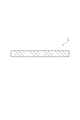
- FIG. 1 is a cross-sectional view showing an embodiment of a molded article of a polycarbonate resin composition.
- the molded body 1 made of a polycarbonate resin composition can be produced, for example, by a method including molding a pellet-shaped polycarbonate resin composition into a desired shape by a usual means such as injection molding.
- the shape of the molded body is not particularly limited.
- the molded body can be used for applications such as electrical / electronic equipment, communication equipment, precision machinery, and automobile parts.
- Aromatic polycarbonate PC SD POLYCA200-13 (trade name, manufactured by Sumika Polycarbonate Co., Ltd., viscosity average molecular weight: 21000)
- PET Polyethylene terephthalate
- Viropet EMC-500 (trade name, manufactured by Toyobo Co., Ltd., intrinsic viscosity: 0.69)
- C Polymer having epoxy group: E-GMA-1: Bond First E (trade name, manufactured by Sumitomo Chemical Co., Ltd., copolymer of 88 parts by mass of ethylene and 12 parts by mass of glycidyl methacrylate)
- E-GMA-2 Bond First 7M (trade name, manufactured by Sumitomo Chemical Co., Ltd.
- Example 1 Polycarbonate resin composition and molded body Example 1 A same-direction biaxial kneading extruder (KZW20TW, manufactured by Technobel) having a main feeder and a sub-feeder and a nozzle head provided on the extruder side was prepared. This twin-screw kneading extruder has nine barrels C1 to C9 provided along the extrusion direction from the hopper side. The temperature of each barrel was set as follows.
- C1 100 ° C C2: 260 ° C C3 to C9: 280 ° C 100 parts by mass of PC from the main feeder and 10 parts by mass of E-GMA-1 and 1.1 parts by mass of PBT from the sub-feeder are fed into the hopper port provided in the barrel C1 of the twin-screw kneading extruder. did.
- the nozzle head temperature was set to 280 ° C.
- the screw rotation speed was set to 300 rpm
- the discharge rate was set to 5 kg / hour
- PC, E-GMA-1 and PBT were melt-kneaded.
- the melt-kneaded material discharged from the twin-screw extruder was cut with a pelletizer to obtain a pellet-shaped polycarbonate resin composition.
- the obtained pellet-shaped polycarbonate resin composition was injection molded under conditions of a mold temperature of 90 ° C., a cylinder temperature of 300 ° C., and an injection speed of 20 mm / sec using an injection molding machine (manufactured by Nippon Steel Works, J150EV-C5). To form a molded body having a thickness of 3.2 mm.
- Examples 2-4 A pellet-like polycarbonate resin composition and a molded body were produced under the same conditions as in Example 1 except that the blending ratio of E-GMA-1 and PBT was changed as shown in Table 1.
- Example 5 A pellet-shaped resin composition and a molded body were produced under the same conditions as in Example 1 except that E-GMA-1 was changed to E-GMA-2.
- Comparative Example 1 A molded body was produced by molding PC alone under the same conditions as in Example 1.
- Comparative Examples 2-5 A pellet-like polycarbonate resin composition and a molded body were produced under the same conditions as in Example 1 except that the blending ratio of E-GMA-1 and PBT was changed as shown in Table 1.
- Comparative Example 6 100 parts by mass of PC from the main feeder and 11.1 parts by mass of MBS from the sub-feeder were introduced into a hopper port provided in the barrel C1 of the twin-screw kneading extruder. Except for this, a pellet-shaped polycarbonate resin composition was produced under the same conditions as in Example 1. A molded body was produced under the same conditions as in Example 1 using the obtained polycarbonate resin composition.
- Example 6 100 parts by mass of PC from the main feeder, 4.4 parts by mass of E-GMA-1, 1.1 parts by mass of PBT from the sub-feeder at the hopper port provided in the barrel C1 of the twin-screw kneading extruder And 5.6 parts by mass of EOR were added. Except for this, a pellet-shaped polycarbonate resin composition was produced under the same conditions as in Example 1. A molded body was produced under the same conditions as in Example 1 using the obtained polycarbonate resin composition.
- a polycarbonate resin composition in the form of pellets obtained by biaxial extrusion kneading is pressure-molded under a condition of a molding temperature of 260 ° C. and a pressure of 10 MPa using a vacuum press machine to form a molded body having a thickness of 2 mm Produced.
- a scratch having a length of 30 mm was formed on the surface of the obtained molded body with a scratching needle (made of sapphire at the tip) according to JIS K6718. Scratching was performed using HEIDON-14S under the conditions of a load of 200 gf and a speed of 200 mm / min.
- the depth D1 of the wound on the day when the scratch was formed and the depth D2 of the wound after the molded body was left for 1 week were measured with a contact-type surface roughness meter. Scratch resilience was evaluated based on the value of D1-D2 (recovery amount). A large amount of recovery means that the restoring force when the molded body is damaged is high, that is, the damage recovery property is excellent.
- a pellet-like polycarbonate resin composition obtained by biaxial extrusion kneading was subjected to a test cooker (Espec, EHS-221 (M)) under conditions of a test temperature of 120 ° C. and a humidity of 100% RH. Stored for 72 hours.
- the melt flow index (MFR) of the pellets before and after storage was measured using a melt flow tester.
- the melt flow index was measured under the conditions of a temperature of 280 ° C. and a load of 2.16 kgf.
- the presence or absence of an increase in the MFR of the pellets after storage by the pressure cooker relative to the MFR of the pellets before storage, and the increase rate of the MFR were measured. If the increase in MFR is not observed or the rate of increase is small, it can be said that the polycarbonate resin composition has excellent hydrolysis resistance.
- Tables 1 and 2 show the blending ratio (parts by mass) of each polycarbonate resin composition and the evaluation results.
- the polycarbonate resin composition of each example containing an aromatic polycarbonate as a main component had an aromatic polycarbonate content ((a) / total) of 75% by mass or more and an epoxy group.
- the mass ratio of the polymer content to the polyester content ((C) / (b)) is 0.8 or more, and the total content of the polymer having a polyester and an epoxy group ((b) + (C)) satisfies the requirement of 25 parts by mass or less with respect to 100 parts by mass of the aromatic polycarbonate. It was confirmed that the polycarbonate resin composition of each example exhibited excellent characteristics in terms of impact resistance, scratch recovery, and hydrolysis resistance while maintaining a relatively high elastic modulus.
Landscapes
- Chemical & Material Sciences (AREA)
- Health & Medical Sciences (AREA)
- Chemical Kinetics & Catalysis (AREA)
- Medicinal Chemistry (AREA)
- Polymers & Plastics (AREA)
- Organic Chemistry (AREA)
- Compositions Of Macromolecular Compounds (AREA)
Abstract
(a)芳香族ポリカーボネートと、(b)ポリエステルと、(c)エポキシ基を有する重合体とを含有するポリカーボネート樹脂組成物が開示される。以下の要件が満たされる。 (1)(a)芳香族ポリカーボネートの含有量が、当該ポリカーボネート樹脂組成物の質量を基準として75質量%以上である。 (2)(b)ポリエステルの含有量に対する(c)エポキシ基を有する重合体の含有量の質量比が0.8以上である。 (3)(b)ポリエステル及び(c)エポキシ基を有する重合体の合計の含有量が、(a)芳香族ポリカーボネート100質量部に対して25質量部以下である。
Description
本発明は、ポリカーボネート樹脂組成物及びその成形体に関する。
芳香族ポリカーボネートを含有する樹脂組成物の耐衝撃性を改善するために、例えば、α-オレフィンとα,β-不飽和酸のグリシジルエステルとから主として成る共重合体が樹脂組成物に配合されることがある(例えば、特許文献1)。
芳香族ポリカーボネートを主成分として含有するポリカーボネート樹脂組成物は、傷付き復元性、耐加水分解性が不足する場合がある。また、耐衝撃性の更なる向上も望まれる。これらの特性は、例えば軟質樹脂の配合によって改善される傾向があるが、その場合は弾性率が大きく低下し易い傾向がある。
本発明の一側面の目的は、芳香族ポリカーボネートを主成分として含有するポリカーボネート樹脂組成物の耐衝撃性、傷付き復元性、及び耐加水分解性を、比較的高い弾性率を維持しながら改善することにある。
本発明の一側面は、
(a)芳香族ポリカーボネートと、
(b)ポリエステルと、
(c)エポキシ基を有する重合体と、
を含有する、ポリカーボネート樹脂組成物を提供する。このポリカーボネート樹脂組成物は、以下の要件:
(1)(a)芳香族ポリカーボネートの含有量が、当該ポリカーボネート樹脂組成物の質量を基準として75質量%以上である、
(2)(b)ポリエステルの含有量に対する(c)エポキシ基を有する重合体の含有量の質量比が0.8以上である、及び、
(3)(b)ポリエステル及び(c)エポキシ基を有する重合体の合計の含有量が、(a)芳香族ポリカーボネート100質量部に対して25質量部以下である、
を満たす。
(a)芳香族ポリカーボネートと、
(b)ポリエステルと、
(c)エポキシ基を有する重合体と、
を含有する、ポリカーボネート樹脂組成物を提供する。このポリカーボネート樹脂組成物は、以下の要件:
(1)(a)芳香族ポリカーボネートの含有量が、当該ポリカーボネート樹脂組成物の質量を基準として75質量%以上である、
(2)(b)ポリエステルの含有量に対する(c)エポキシ基を有する重合体の含有量の質量比が0.8以上である、及び、
(3)(b)ポリエステル及び(c)エポキシ基を有する重合体の合計の含有量が、(a)芳香族ポリカーボネート100質量部に対して25質量部以下である、
を満たす。
本発明の別の一側面は、上記ポリカーボネート樹脂組成物を成形することにより形成される成形体を提供する。
上記ポリカーボネート樹脂組成物及び成形体は、適度に大きな弾性率を維持しながら、優れた耐衝撃性、傷付き復元性、及び耐加水分解性を有することができる。
本発明は、適度に大きな弾性率を維持しながら、優れた耐衝撃性、傷付き復元性、及び耐加水分解性を有するポリカーボネート樹脂組成物及びその成形体を提供することができる。
以下、本発明のいくつかの実施形態について詳細に説明する。ただし、本発明は以下の実施形態に限定されるものではない。
一実施形態に係るポリカーボネート樹脂組成物は、(a)芳香族ポリカーボネートと、(b)ポリエステルと、(c)エポキシ基を有する重合体とを含有する熱可塑性樹脂組成物である。
一実施形態に係るポリカーボネート樹脂組成物は、以下の(1)、(2)及び(3)の要件を満たす。
(1)(a)芳香族ポリカーボネートの含有量が、ポリカーボネート樹脂組成物の質量を基準として75質量%以上である。
(2)(b)ポリエステルの含有量に対する(c)エポキシ基を有する重合体の含有量の質量比が0.8以上である。
(3)(b)ポリエステル及び(c)エポキシ基を有する重合体の合計の含有量が、(a)芳香族ポリカーボネート100質量部に対して25質量部以下である。
(1)(a)芳香族ポリカーボネートの含有量が、ポリカーボネート樹脂組成物の質量を基準として75質量%以上である。
(2)(b)ポリエステルの含有量に対する(c)エポキシ基を有する重合体の含有量の質量比が0.8以上である。
(3)(b)ポリエステル及び(c)エポキシ基を有する重合体の合計の含有量が、(a)芳香族ポリカーボネート100質量部に対して25質量部以下である。
要件(1)、(2)及び(3)の組み合わせにより、本実施形態に係るポリカーボネート樹脂組成物は、適度に大きな弾性率を維持しながら、優れた耐衝撃性、傷付き復元性、及び耐加水分解性を有することができる。
要件(1)は、一つの見方では、当該ポリカーボネート樹脂組成物が、芳香族ポリカーボネートを主成分として含有することを意味する。芳香族ポリカーボネートの含有量が75質量%以上であると、ポリカーボネート樹脂組成物及びその成形体が、適度に高い弾性率を容易に維持することができる。ポリカーボネート樹脂組成物の引張弾性率は、例えば1300MPa以上、1400MPa以上、又は1500MPa以上であってもよい。このような弾性率を維持する観点から、芳香族ポリカーボネートの含有量は、ポリカーボネート樹脂組成物の質量を基準として、80質量%以上であってもよい。特に、(a)芳香族ポリカーボネートの含有量は、ポリカーボネート樹脂組成物が後述の(d)エチレン系重合体を含有しないときにはポリカーボネート樹脂組成物の質量を基準として80質量%以上で、ポリカーボネート樹脂組成物が(d)エチレン系重合体を含有するときにはポリカーボネート樹脂組成物の質量を基準として75質量%以上であってもよい。芳香族ポリカーボネートの含有量は、ポリカーボネート樹脂組成物の質量を基準として、98質量%以下であってもよい。
要件(2)の(b)ポリエステルの含有量に対する(c)エポキシ基を有する重合体の含有量の質量比((c)/(b))は、耐加水分解性、耐衝撃性の観点から、1.0を超えていてもよく、2.0を超えていてもよい。特に、ポリカーボネート樹脂組成物が後述の(d)エチレン系重合体を含有しないときに、(c)/(b)が1.0を超えていてもよく、2.0を超えていてもよい。(c)/(b)の上限は、特に制限されないが、例えば20以下、15以下、又は10以下であってもよい。
要件(3)の(b)ポリエステル及び(c)エポキシ基を有する重合体の合計の含有量((b)+(c))は、高い弾性率の維持の観点から、(a)芳香族ポリカーボネート100質量部に対して、20質量部以下、18質量部以下、又は12質量部以下であってもよく、1.0質量部以上、2.0質量部以上、又は3.0質量部以上であってもよい。
(b)ポリエステル及び(c)エポキシ基を有する重合体それぞれの含有量は、上記要件(1)、(2)及び(3)が満たされるように、調整される。例えば、(b)ポリエステルの含有量は、芳香族ポリカーボネート100質量部に対して、0.01質量部以上、0.5質量部以上、又は1質量部以上であってもよく、13質量部以下、12.5質量部以下、10質量部以下、7質量部以下又は5質量部以下であってもよい。(c)エポキシ基を有する重合体の含有量は、0.1質量部以上、0.5質量部以上、又は1質量部以上であってもよく、24質量部以下、又は20質量部以下であってもよい。
一実施形態に係るポリカーボネート樹脂組成物は、(d)エチレン系重合体を更に含有してもよい。(b)ポリエステル、(c)エポキシ基を有する重合体、及び(d)エチレン系重合体の組み合わせにより、ポリカーボネート樹脂組成物及びその成形体の耐衝撃性及び耐加水分解性が特異的により一層改善される。
(d)エチレン系重合体の含有量は、耐衝撃性、弾性率の観点から、芳香族ポリカーボネート100質量部に対して、0.1質量部以上、1質量部以上、2質量部以上、又は3質量部以上であってもよく、32質量部以下、30質量部以下、20質量部以下、又は10質量部以下であってもよい。
以下、ポリカーボネート樹脂組成物を構成する各成分の詳細について説明する。
(a)芳香族ポリカーボネートは、芳香族ジヒドロキシ化合物に由来するモノマー単位及びカルボニル基を含む、直鎖状又は分岐していてもよい重合体である。芳香族ポリカーボネートは、一般に、芳香族ジヒドロキシ化合物と、塩化カルボニル(ホスゲン)、炭酸ジエステル(例えばジメチルカーボネート、ジフェニルカーボネート)、又は一酸化炭素若しくは二酸化炭素との重合反応により生成する。
芳香族ポリカーボネートを構成する芳香族ジヒドロキシ化合物は、例えば、ビス(ヒドロキシアリール)アルカン、ビス(ヒドロキシアリール)シクロアルカン、カルド構造含有ビスフェノール、ジヒドロキシジアリールエーテル、ジヒドロキシジアリールスルフィド、ジヒドロキシジアリールスルホキシド、ジヒドロキシジアリールスルホン、4,4’-ジヒドロキシジフェニル、ハイドロキノン、レゾルシン又はこれらの組み合わせであってもよい。
ビス(ヒドロキシアリール)アルカンの例としては、2,2-ビス(4-ヒドロキシフェニル)プロパン、2,2-ビス(3,5-ジブロモ-4-ヒドロキシフェニル)プロパン、ビス(4-ヒドロキシフェニル)メタン、1,1-ビス(4-ヒドロキシフェニル)エタン、2,2-ビス(4-ヒドロキシフェニル)ブタン、2,2-ビス(4-ヒドロキシフェニル)オクタン、2,2-ビス(4-ヒドロキシ-3-メチルフェニル)プロパン、1,1-ビス(3-tert-ブチル-4-ヒドロキシフェニル)プロパン、2,2-ビス(4-ヒドロキシ-3,5-ジメチルフェニル)プロパン、2,2-ビス(3-ブロモ-4-ヒドロキシフェニル)プロパン、2,2-ビス(3,5-ジクロロ-4-ヒドロキシフェニル)プロパン、2,2-ビス(3-フェニル-4-ヒドロキシフェニル)プロパン、2,2-ビス(3-シクロヘキシル-4-ヒドロキシフェニル)プロパン、1,1-ビス(4-ヒドロキシフェニル)-1-フェニルエタン、ビス(4-ヒドロキシフェニル)ジフェニルメタン、2,2-ビス(4-ヒドロキシフェニル)-1,1,1-トリクロロプロパン、2,2-ビス(4-ヒドロキシフェニル)-1,1,1,3,3,3-ヘキサクロロプロパン、2,2-ビス(4-ヒドロキシフェニル)-1,1,1,3,3,3-ヘキサフルオロプロパン、1,1-ビス(4-ヒドロキシ-3-tert-ブチルフェニル)プロパン、2,2-ビス(4-ヒドロキシ-3-ブロモフェニル)プロパン、及び2,2-ビス(4-ヒドロキシ-3、5-ジブロモフェニル)プロパンが挙げられる。2,2-ビス(4-ヒドロキシフェニル)プロパン、及び2,2-ビス(3,5-ジブロモ-4-ヒドロキシフェニル)プロパンは、それぞれ、ビスフェノールA及びテトラブロモビスフェノールAと称されることもある。
ビス(ヒドロキシアリール)シクロアルカンの例としては、1,1-ビス(4-ヒドロキシフェニル)シクロペンタン、1,1-ビス(4-ヒドロキシフェニル)シクロヘキサン、及び1,1-ビス(4-ヒドロキシフェニル)-3,3,5-トリメチルシクロヘキサンが挙げられる。
カルド構造含有ビスフェノールの例としては、9,9-ビス(4-ヒドロキシフェニル)フルオレン、及び9,9-ビス(4-ヒドロキシ-3-メチルフェニル)フルオレンが挙げられる。
ジヒドロキシジアリールエーテルの例としては、4,4’-ジヒドロキシジフェニルエーテル、及び4,4’-ジヒドロキシ-3,3’-ジメチルジフェニルエーテルが挙げられる。
ジヒドロキシジアリールスルフィドの例としては、4,4’-ジヒドロキシジフェニルスルフィド、及び4,4’-ジヒドロキシ-3,3’-ジメチルジフェニルスルフィドが挙げられる。
ジヒドロキシジアリールスルホキシドの例としては、4,4’-ジヒドロキシジフェニルスルホキシド、及び4,4’-ジヒドロキシ-3,3’-ジメチルジフェニルスルホキシドが挙げられる。
ジヒドロキシジアリールスルホンの例としては、4,4’-ジヒドロキシジフェニルスルホン、及び4,4’-ジヒドロキシ-3,3’-ジメチルジフェニルスルホンが挙げられる。
芳香族ポリカーボネートは、これらから選ばれる1種又は2種以上の芳香族ジヒドロキシ化合物に由来するモノマー単位を含んでいてもよい。芳香族ポリカーボネートは、特に2,2-ビス(4-ヒドロキシフェニル)プロパンに由来するモノマー単位を含んでいてもよい。
分岐した芳香族ポリカーボネートは、例えば、フロログリシン、2,6-ジメチル-2,4,6-トリス(4-ヒドロキシフェニル)-3-ヘプテン、4,6-ジメチル-2,4,6-トリス(4-ヒドロキシフェニル)-2-ヘプテン、1,3,5-トリス(2-ヒドロキシフェニル)ベンゾール、1,1,1-トリス(4-ヒドロキシフェニル)エタン、2,6-ビス(2-ヒドロキシ-5-メチルベンジル)-4-メチルフェノール、及びα,α’,α’’-トリス(4-ヒドロキシフェニル)-1,3,5-トリイソプロピルベンゼン等のポリヒドロキシ化合物、又は3,3-ビス(4-ヒドロキシアリール)オキシインドール(イサチンビスフェノール)、5-クロルイサチンビスフェノール、5,7-ジクロルイサチンビスフェノール、若しくは5-ブロムイサチンビスフェノールに由来するモノマー単位を含む。
芳香族ポリカーボネートの粘度平均分子量が、10000~100000であってもよい。ここでの粘度平均分子量は、溶媒としてメチレンクロライドを用い、温度20℃で測定された溶融粘度からの換算値である。
芳香族ポリカーボネートは、界面重合法、ピリジン法、エステル交換法等の通常の方法により合成することができる。芳香族ポリカーボネートの市販品を用いることもできる。
(b)ポリエステルは、特に、芳香族ジカルボン酸と飽和二価アルコールとの縮合重合体である芳香族ポリエステルであってもよい。芳香族ポリエステルの例としては、ポリエチレンテレフタレート、ポリプロピレンテレフタレート、ポリテトラメチレンテレフタレート(「ポリブチレンテレフタレート」ともいう。)、ポリヘキサメチレンテレフタレート、ポリシクロヘキサン-1,4-ジメチロールテレフタレート、及びポリネオペンチルテレフタレートが挙げられる。
(b)ポリエステルは、ポリカーボネート樹脂組成物及び成形体の耐加水分解性及び傷付き復元性等の観点から、ポリブチレンテレフタレート、ポリエチレンテレフタレート、又はこれらの組み合わせを含んでいてもよい。ポリブチレンテレフタレートは、テレフタル酸以外の芳香族ジカルボン酸に由来するモノマー単位を更に含んでいてもよく、その例としては、ポリブチレン(テレフタレート/アジペート)、ポリブチレン(テレフタレート/セバケート)、ポリブチレン(テレフタレート/デカンジカルボキシレート)、ポリブチレン(テレフタレート/ナフタレート)、及びポリ(ブチレン/エチレン)テレフタレートが挙げられる。ポリエチレンテレフタレートは、テレフタル酸以外の芳香族ジカルボン酸に由来するモノマー単位を更に含んでいてもよく、その例としては、ポリエチレン(テレフタレート/アジペート)、ポリエチレン(テレフタレート/セバケート)、ポリエチレン(テレフタレート/デカンジカルボキシレート)、ポリエチレン(テレフタレート/ナフタレート)、及びポリ(ブチレン/エチレン)テレフタレートが挙げられる。
ポリエステルの固有粘度が、0.50~2.00dl/gであってもよい。ここでの固有粘度は、フェノールとテトラクロロエタンの混合溶媒(質量比5:5)中にポリエステルが溶解した溶液の粘度を30℃で測定することにより求められる値である。
ポリエステルは、例えば、芳香族ジカルボン酸及び飽和二価アルコールを用いた通常の重合方法で合成することができる。ポリエステルの市販品を用いることもできる。
(c)エポキシ基を有する重合体は、一般に熱可塑性樹脂であり、例えば、エポキシ基を有するモノマーに由来するモノマー単位を含む共重合体であってもよい。エポキシ基を有するモノマーの例としては、α,β-不飽和カルボン酸グリシジルエステル、及び不飽和基を有するグリシジルエーテルが挙げられる。
不飽和カルボン酸グリシジルエステルは、下記式(1)で表される化合物であってもよい。式(1)中、R1は、1以上の置換基を有していてもよい炭素原子数2~18のアルケニル基を示す。式(1)で表される化合物としては、例えば、グリシジルアクリレート、グリシジルメタクリレート及びイタコン酸グリシジルエステルが挙げられる。

不飽和基を有するグリシジルエーテルは、下記式(2)で表される化合物であってもよい。式(2)中、R2は、1以上の置換基を有していてもよい炭素原子数2~18のアルケニル基を示し、XはCH2-O(CH2がR2に結合している。)又は酸素原子を示す。式(2)で表される化合物としては、例えば、アリルグリシジルエーテル、2-メチルアリルグリシジルエーテル及びスチレン-p-グリシジルエーテルが挙げられる。

エポキシ基を有するモノマーと共重合している共重合モノマーは、例えば、エチレン、α-オレフィン、スチレン、アクリロニトリル、不飽和カルボン酸エステル(アクリル酸エチル、メタクリル酸メチル、アクリル酸ブチル等)、アクリル酸、不飽和ビニルエステル(酢酸ビニル、プロピオン酸ビニル等)、又はこれらの組み合わせであってもよい。
エポキシ基を有する重合体は、エポキシ基を有するモノマー単位と、エチレン又はα-オレフィン(プロピレン等)から誘導されるモノマー単位とを含むオレフィン系共重合体であってもよい。エチレン又はα-オレフィンから誘導されるモノマー単位の割合(エチレンから誘導されるモノマー単位及びα-オレフィンから誘導されるモノマー単位の合計の割合)は、エポキシ基を有する重合体の質量を基準として、50~99.9質量%であってもよい。
エポキシ基を有するオレフィン系共重合体の例としては、エチレン-グリシジル(メタ)アクリレート共重合体、エチレン-グリシジル(メタ)アクリレート-メチル(メタ)アクリレート共重合体、エチレン-グリシジル(メタ)アクリレート-エチル(メタ)アクリレート共重合体、エチレン-グリシジル(メタ)アクリレート-ノルマルプロピル(メタ)アクリレート共重合体、エチレン-グリシジル(メタ)アクリレート-イソプロピル(メタ)アクリレート共重合体、エチレン-グリシジル(メタ)アクリレート-ノルマルブチル(メタ)アクリレート共重合体、エチレン-グリシジル(メタ)アクリレート-イソブチル(メタ)アクリレート共重合体、エチレン-グリシジル(メタ)アクリレート-2-エチルへキシル(メタ)アクリレート共重合体、及びエチレン-グリシジル(メタ)アクリレート-酢酸ビニル共重合体が挙げられる。特に、エチレン-グリシジル(メタ)アクリレート共重合体を選択してもよい。エチレン-グリシジル(メタ)アクリレート共重合体の市販品の例として、住友化学製「ボンドファースト」(商品名)がある。
エポキシ基を有するモノマー単位を含む共重合体のその他の例としては、グリシジルメタアクリレート-スチレン共重合体、グリシジルメタアクリレート-アクリロニトリル-スチレン共重合体、及びグリシジルメタアクリルレート-プロピレン共重合体が挙げられる。
エポキシ基を有する重合体は、ポリエチレン、ポリプロピレン、ポリスチレン、エチレン-α-オレフィン共重合体、又は水添若しくは非水添のスチレン-共役ジエン系重合体からなる重合体鎖と、この重合体鎖に結合した、エポキシ基を有する単量体を含むグラフト鎖とを有していてもよい。エポキシ基を有する単量体は、例えば、溶液若しくは溶融混練によってグラフト重合させることができる。
エポキシ基を有する重合体における、エポキシ基を有するモノマー単位の割合は、エポキシ基を有する重合体の質量を基準として0.1質量%以上、0.5質量%以上、1質量%以上、又は3質量%以上であってもよい。エポキシ基を有するモノマー単位の割合は、エポキシ基を有する重合体の質量を基準として30質量%以下、20質量%以下、15質量%以下又は10質量%以下であってもよく、6質量%より多くてもよい。エポキシ基を有するモノマー単位の割合が高いと、ポリカーボネート樹脂組成物及び成形体の耐加水分解性がより向上する傾向がある。
エポキシ基を有する重合体の製造方法としては、例えば、高圧ラジカル重合法、溶液重合法、乳化重合法等により、エポキシ基を有する単量体と他の単量体とを共重合する方法、エチレン系重合体等にエポキシ基を有する単量体をグラフト重合させる方法等を挙げることができる。
(d)エチレン系重合体は、エポキシ基を有しない重合体であり、エチレンに由来するモノマー単位を主なモノマー単位として含む単独重合体又は共重合体である。エチレン系重合体におけるエチレンに由来するモノマー単位の割合は、エチレン系重合体の質量を基準として、通常50質量%を超える。エチレン系重合体は、低密度ポリエチレン、線状低密度ポリエチレン、線状超低密度ポリエチレン、中密度ポリエチレン、又は高密度ポリエチレンであってもよい。
エチレン系重合体の密度は、ポリカーボネート樹脂組成物及び成形体の耐加水分解性及び傷付き復元性等の観点から、0.930g/cm3未満、0.900g/cm3以下、又は0.870g/cm3以下であってもよい。エチレン系重合体の密度の下限は、特に制限されないが、通常、0.855g/cm3以上である。
(d)エチレン系重合体は、エチレンと、α-オレフィン、ビニルエステル、不飽和カルボン酸エステル及びそのアイオノマー、ビニル芳香族化合物、ジエン化合物、並びに環状オレフィンからなる群より選ばれる1種以上のコモノマーとの共重合体、又はその水素添加物であってもよい。α-オレフィンの例としては、プロピレン、ブテン-1、ペンテン-1、ヘキセン-1、ヘプテン-1、オクテン-1、ノネン-1、デセン-1、ウンデセン-1、ドデセン-1、トリデセン-1、テトラデセン-1、ペンタデセン-1、ヘキサデセン-1、ヘプタデセン-1、オクタデセン-1、ノナデセン-1、エイコセン-1、3-メチル-1-ブテン、3-メチル-1-ペンテン、3-エチル-1-ペンテン、4-メチル-1-ペンテン、4-メチル-1-ヘキセン、4,4-ジメチル-1-ヘキセン、4,4-ジメチル-1-ペンテン、4-エチル-1-ヘキセン、3-エチル-1-ヘキセン、9-メチル-1-デセン、11-メチル-1-ドデセン、及び12-エチル-1-テトラデセンが挙げられる。ビニルエステルの例としては、酢酸ビニル、及びプロピオン酸ビニルが挙げられる。不飽和カルボン酸エステルの例としては、アクリル酸メチル、アクリル酸エチル、メタクリル酸メチル、及びメタクリル酸エチルが挙げられる。ビニル芳香族化合物の例としては、スチレン、及びα-メチルスチレンが挙げられる。ジエン化合物の例としては、ブタジエン、イソプレン、1,3-ペンタジエン、及び2,5-ノルボルナジエンが挙げられる。環状オレフィンの例としては、2-ノルボルネン、及び5-メチル-2-ノルボルネンが挙げられる。
(d)エチレン系重合体は、ポリカーボネート樹脂組成物及び成形体の耐衝撃性及び耐加水分解性等の観点から、エチレン-α-オレフィン共重合体であってもよい。α-オレフィンの炭素数が3~8であってもよい。エチレン-α-オレフィン共重合体におけるα-オレフィンに由来するモノマー単位の割合は、エチレン-α-オレフィン共重合体を構成するモノマー単位全体を基準として、4~25モル%、7~25モル%、又は12~22モル%であってもよい。
(d)エチレン系重合体は、例えば、オレフィン重合用触媒を用いた通常の重合方法により合成することができる。エチレン系重合体の市販品を用いることもできる。
一実施形態に係るポリカーボネート樹脂組成物は、以上説明した(a)成分、(b)成分、(c)成分及び場合により用いられる(d)成分に加えて、その他の成分を、本発明の趣旨を逸脱しない範囲で更に含有することができる。その他の成分の例としては、熱安定剤、酸化防止剤、着色剤、離型剤、軟化剤、帯電防止剤、耐衝撃性改良剤、充填剤、滑剤、染料、難燃剤等の各種添加剤が挙げられる。ポリカーボネート樹脂組成物が、(a)成分、(b)成分、(c)成分及び(d)成分以外のポリマーを更に含有してもよい。難燃性の重要度が高くない用途に用いられるポリカーボネート樹脂組成物の場合、難燃剤の含有量が0~20質量部であってもよく、(b)ポリエステル、(c)エポキシ基を有する重合体及び難燃剤の合計の含有量が、(a)芳香族ポリカーボネート100質量部に対して25質量部未満であってもよい。
ポリカーボネート樹脂組成物におけるTi(チタン)の含有量が、ポリカーボネート樹脂組成物の質量を基準として、0.01~30ppmであってもよい。Tiの含有量がこの範囲にあると、ポリカーボネート樹脂組成物及び成形体の耐加水分解性及び傷付き復元性がより向上する傾向がある。Tiは、例えば、ポリエステルの重合触媒に由来する微量成分であり得る。
ポリカーボネート樹脂組成物は、例えば、各成分を溶融混錬することを含む方法により、得ることができる。ポリカーボネート樹脂組成物はペレット状であってもよい。
図1は、ポリカーボネート樹脂組成物の成形体の一実施形態を示す断面図である。ポリカーボネート樹脂組成物からなる成形体1は、例えば、ペレット状のポリカーボネート樹脂組成物を射出成形等の通常の手段で所望の形状に成形することを含む方法により、製造することができる。成形体の形状は特に制限されない。成形体は、例えば、電気・電子機器、通信機器、精密機械、自動車部品等の用途に用いることができる。
以下、実施例を挙げて本発明についてさらに具体的に説明する。ただし、本発明はこれら実施例に限定されるものではない。
1.原材料
ポリカーボネート樹脂組成物を調製するための原材料として以下を準備した。
(a)芳香族ポリカーボネート
・PC:SD POLYCA200-13(商品名、住化ポリカーボネート株式会社製、粘度平均分子量:21000)
(b)ポリエステル
・ポリブチレンテレフタレート(PBT):トレコン1401 X06(商品名、東レ株式会社製、固有粘度:1.74)
・ポリエチレンテレフタレート(PET):バイロペットEMC-500(商品名、東洋紡株式会社製、固有粘度:0.69)
(c)エポキシ基を有する重合体
・E-GMA-1:ボンドファーストE(商品名、住友化学株式会社製、エチレン88質量部とグリシジルメタクリレート12質量部との共重合体)
・E-GMA-2:ボンドファースト7M(商品名、住友化学株式会社製、エチレン67質量部とグリシジルメタクリレート6質量部とメチルアクリレート27質量部の共重合体)
(d)エチレン系重合体
・EOR:Engage 8842(商品名、ダウ・ケミカル・カンパニー製、エチレン-オクテン-1共重合体、密度:0.857g/cm3)
(その他)
・メタクリレート-ブタジエン-スチレン共重合体(MBS):カネエースM570(商品名、株式会社カネカ製)
ポリカーボネート樹脂組成物を調製するための原材料として以下を準備した。
(a)芳香族ポリカーボネート
・PC:SD POLYCA200-13(商品名、住化ポリカーボネート株式会社製、粘度平均分子量:21000)
(b)ポリエステル
・ポリブチレンテレフタレート(PBT):トレコン1401 X06(商品名、東レ株式会社製、固有粘度:1.74)
・ポリエチレンテレフタレート(PET):バイロペットEMC-500(商品名、東洋紡株式会社製、固有粘度:0.69)
(c)エポキシ基を有する重合体
・E-GMA-1:ボンドファーストE(商品名、住友化学株式会社製、エチレン88質量部とグリシジルメタクリレート12質量部との共重合体)
・E-GMA-2:ボンドファースト7M(商品名、住友化学株式会社製、エチレン67質量部とグリシジルメタクリレート6質量部とメチルアクリレート27質量部の共重合体)
(d)エチレン系重合体
・EOR:Engage 8842(商品名、ダウ・ケミカル・カンパニー製、エチレン-オクテン-1共重合体、密度:0.857g/cm3)
(その他)
・メタクリレート-ブタジエン-スチレン共重合体(MBS):カネエースM570(商品名、株式会社カネカ製)
2.ポリカーボネート樹脂組成物及び成形体
実施例1
主フィーダー及び副フィーダーと、押出機側に設けられたノズルヘッドとを有する同方向二軸混練押出機(KZW20TW、テクノベル社製)を準備した。この二軸混練押出機は、ホッパー側から押出方向に沿って設けられた9個のバレルC1~C9を有する。各バレルの温度を以下のように設定した。
C1:100℃
C2:260℃
C3~C9:280℃
二軸混練押出機のバレルC1に設けられたホッパー口に、主フィーダーからは100質量部のPCを、副フィーダーからは10質量部のE-GMA-1及び1.1質量部のPBTを投入した。ノズルヘッドの温度を280℃に、スクリューの回転数を300rpmに、吐出量を5kg/時間にそれぞれ設定し、PC、E-GMA-1及びPBTを溶融混練した。二軸押出機から吐出された溶融混錬物をペレタイザで切断して、ペレット状のポリカーボネート樹脂組成物を得た。
得られたペレット状のポリカーボネート樹脂組成物を、射出成形機(日本製鋼所製、J150EV-C5)を用いて、金型温度90℃、シリンダー温度300℃、射出速度20mm/秒の条件の射出成形により成形して、厚み3.2mmの成形体を作製した。
実施例1
主フィーダー及び副フィーダーと、押出機側に設けられたノズルヘッドとを有する同方向二軸混練押出機(KZW20TW、テクノベル社製)を準備した。この二軸混練押出機は、ホッパー側から押出方向に沿って設けられた9個のバレルC1~C9を有する。各バレルの温度を以下のように設定した。
C1:100℃
C2:260℃
C3~C9:280℃
二軸混練押出機のバレルC1に設けられたホッパー口に、主フィーダーからは100質量部のPCを、副フィーダーからは10質量部のE-GMA-1及び1.1質量部のPBTを投入した。ノズルヘッドの温度を280℃に、スクリューの回転数を300rpmに、吐出量を5kg/時間にそれぞれ設定し、PC、E-GMA-1及びPBTを溶融混練した。二軸押出機から吐出された溶融混錬物をペレタイザで切断して、ペレット状のポリカーボネート樹脂組成物を得た。
得られたペレット状のポリカーボネート樹脂組成物を、射出成形機(日本製鋼所製、J150EV-C5)を用いて、金型温度90℃、シリンダー温度300℃、射出速度20mm/秒の条件の射出成形により成形して、厚み3.2mmの成形体を作製した。
実施例2~4
E-GMA-1とPBTの配合量比を表1に示すように変更したこと以外は、実施例1と同様の条件で、ペレット状のポリカーボネート樹脂組成物及び成形体を作製した。
E-GMA-1とPBTの配合量比を表1に示すように変更したこと以外は、実施例1と同様の条件で、ペレット状のポリカーボネート樹脂組成物及び成形体を作製した。
実施例5
E-GMA-1をE-GMA-2に変更したこと以外は、実施例1と同様の条件で、ペレット状の樹脂組成物及び成形体を作製した。
E-GMA-1をE-GMA-2に変更したこと以外は、実施例1と同様の条件で、ペレット状の樹脂組成物及び成形体を作製した。
比較例1
PCを単独で実施例1と同様の条件で成形して成形体を作製した。
PCを単独で実施例1と同様の条件で成形して成形体を作製した。
比較例2~5
E-GMA-1とPBTの配合量比を表1に示すように変更したこと以外は、実施例1と同様の条件で、ペレット状のポリカーボネート樹脂組成物及び成形体を作製した。
E-GMA-1とPBTの配合量比を表1に示すように変更したこと以外は、実施例1と同様の条件で、ペレット状のポリカーボネート樹脂組成物及び成形体を作製した。
比較例6
二軸混練押出機のバレルC1に設けられたホッパー口に、主フィーダーからは100質量部のPCを、副フィーダーからは11.1質量部のMBSを投入した。これ以外は実施例1と同様の条件でペレット状のポリカーボネート樹脂組成物を作製した。得られたポリカーボネート樹脂組成物を用いて、実施例1と同様の条件で成形体を作製した。
二軸混練押出機のバレルC1に設けられたホッパー口に、主フィーダーからは100質量部のPCを、副フィーダーからは11.1質量部のMBSを投入した。これ以外は実施例1と同様の条件でペレット状のポリカーボネート樹脂組成物を作製した。得られたポリカーボネート樹脂組成物を用いて、実施例1と同様の条件で成形体を作製した。
実施例6
二軸混練押出機のバレルC1に設けられたホッパー口に、主フィーダーからは100質量部のPCを、副フィーダーからは4.4質量部のE-GMA-1、1.1質量部のPBT、及び5.6質量部のEORを投入した。これ以外は実施例1と同様の条件でペレット状のポリカーボネート樹脂組成物を作製した。得られたポリカーボネート樹脂組成物を用いて、実施例1と同様の条件で成形体を作製した。
二軸混練押出機のバレルC1に設けられたホッパー口に、主フィーダーからは100質量部のPCを、副フィーダーからは4.4質量部のE-GMA-1、1.1質量部のPBT、及び5.6質量部のEORを投入した。これ以外は実施例1と同様の条件でペレット状のポリカーボネート樹脂組成物を作製した。得られたポリカーボネート樹脂組成物を用いて、実施例1と同様の条件で成形体を作製した。
実施例7~10、比較例7~10
E-GMA-1、PBT及びEORの配合量比を表2に示すように変更したこと以外は、実施例6と同様の条件で、ペレット状のポリカーボネート樹脂組成物及び成形体を作製した。
E-GMA-1、PBT及びEORの配合量比を表2に示すように変更したこと以外は、実施例6と同様の条件で、ペレット状のポリカーボネート樹脂組成物及び成形体を作製した。
3.評価
Izod衝撃試験
各成形体から、長さ63.5mm、幅12.7mm、厚さ3.2mmのノッチ付試験片を作製した。この試験片を用い、ASTM D-256に準拠したIzod衝撃試験により、Izod衝撃強度(kJ/m2)を測定した。Izod衝撃試験は、23℃の雰囲気下、試験片温度-40℃の条件で行った。
Izod衝撃試験
各成形体から、長さ63.5mm、幅12.7mm、厚さ3.2mmのノッチ付試験片を作製した。この試験片を用い、ASTM D-256に準拠したIzod衝撃試験により、Izod衝撃強度(kJ/m2)を測定した。Izod衝撃試験は、23℃の雰囲気下、試験片温度-40℃の条件で行った。
引張試験
各成形体から、ASTM-D638 Type1に準拠した引張試験用の試験片を作製した。この試験片を用いた引張試験を、23℃の雰囲気下、引張速度1mm/分で行い、引張弾性率を測定した。
各成形体から、ASTM-D638 Type1に準拠した引張試験用の試験片を作製した。この試験片を用いた引張試験を、23℃の雰囲気下、引張速度1mm/分で行い、引張弾性率を測定した。
傷付き復元性
二軸押出混練により得られたペレット状のポリカーボネート樹脂組成物を、真空プレス機を用いて、成形温度260℃、圧力10MPaの条件で加圧成形して、厚み2mmの成形体を作製した。得られた成形体の表面に、JIS K6718に準拠した引掻き針(先端サファイア製)で長さ30mmの傷を形成した。引掻きは、HEIDON-14Sを用いて、荷重200gf、速度200mm/分の条件で行った。傷を形成した当日の傷の深さD1と、成形体を1週間放置後の傷の深さD2を、接触式表面粗さ計で測定した。D1-D2の値(回復量)に基づいて傷付き復元性を評価した。この回復量が大きいことは、成形体が傷付いたときの復元力が高い、すなわち傷付き復元性が優れていることを意味する。
二軸押出混練により得られたペレット状のポリカーボネート樹脂組成物を、真空プレス機を用いて、成形温度260℃、圧力10MPaの条件で加圧成形して、厚み2mmの成形体を作製した。得られた成形体の表面に、JIS K6718に準拠した引掻き針(先端サファイア製)で長さ30mmの傷を形成した。引掻きは、HEIDON-14Sを用いて、荷重200gf、速度200mm/分の条件で行った。傷を形成した当日の傷の深さD1と、成形体を1週間放置後の傷の深さD2を、接触式表面粗さ計で測定した。D1-D2の値(回復量)に基づいて傷付き復元性を評価した。この回復量が大きいことは、成形体が傷付いたときの復元力が高い、すなわち傷付き復元性が優れていることを意味する。
耐加水分解性
二軸押出混練により得られたペレット状のポリカーボネート樹脂組成物を、プレッシャークッカー(エスペック製、EHS-221(M))を用いて、試験温度120℃、湿度100%RHの条件で、72時間保管した。保管前及び保管後のペレットのメルトフローインデックス(MFR)を、メルトフローテスターを用いて測定した。メルトフローインデックスは、温度280℃、荷重2.16kgfの条件で測定した。プレッシャークッカーによる保管後のペレットのMFRの、保管前のペレットのMFRに対する増加の有無、及びMFRの増加率を測定した。MFRの増加が認められない、又は増加率が小さければ、ポリカーボネート樹脂組成物が優れた耐加水分解性を有するといえる。
二軸押出混練により得られたペレット状のポリカーボネート樹脂組成物を、プレッシャークッカー(エスペック製、EHS-221(M))を用いて、試験温度120℃、湿度100%RHの条件で、72時間保管した。保管前及び保管後のペレットのメルトフローインデックス(MFR)を、メルトフローテスターを用いて測定した。メルトフローインデックスは、温度280℃、荷重2.16kgfの条件で測定した。プレッシャークッカーによる保管後のペレットのMFRの、保管前のペレットのMFRに対する増加の有無、及びMFRの増加率を測定した。MFRの増加が認められない、又は増加率が小さければ、ポリカーボネート樹脂組成物が優れた耐加水分解性を有するといえる。
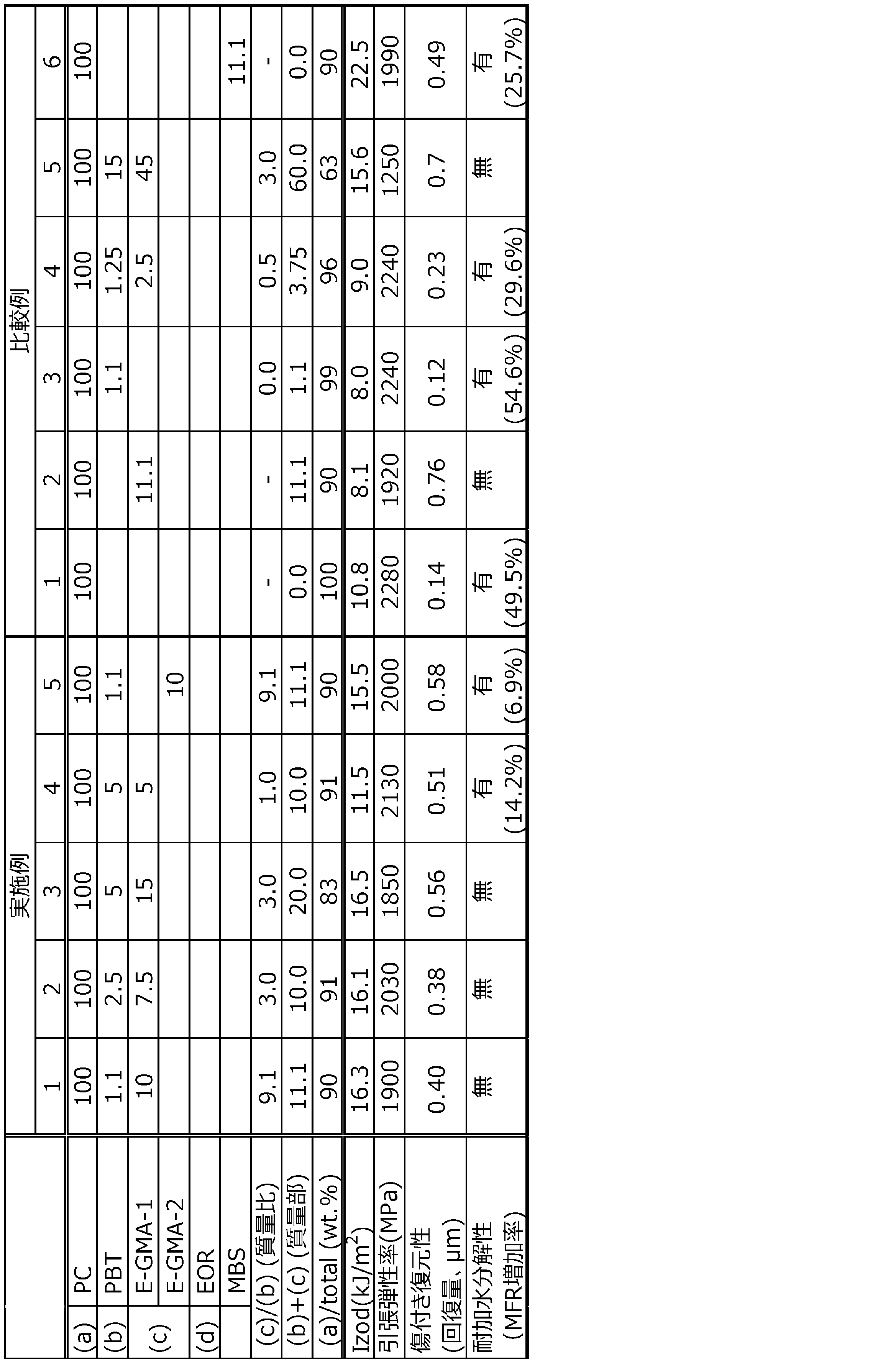
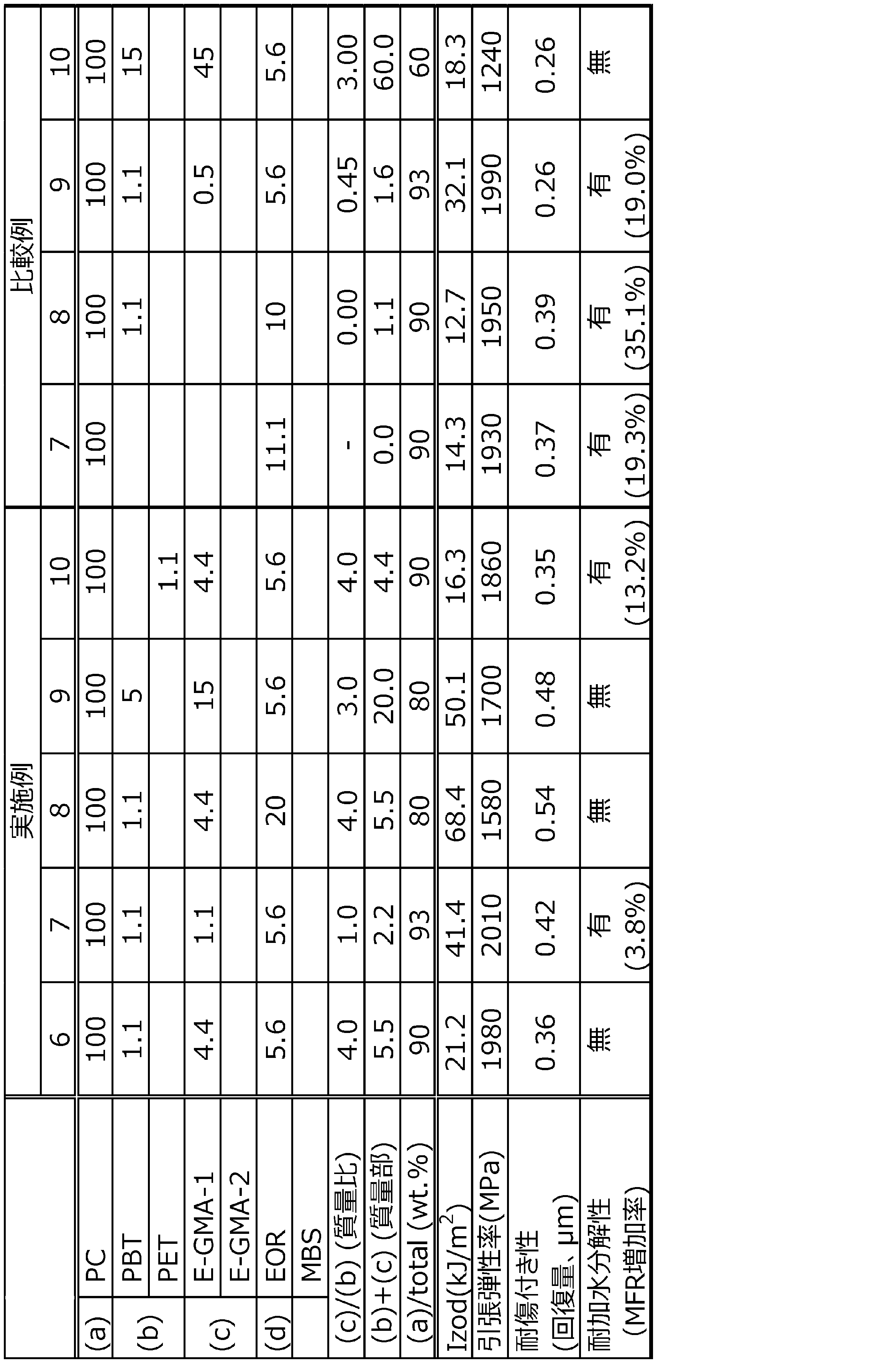
表1及び表2に、各ポリカーボネート樹脂組成物の配合量比(質量部)、及び評価結果を示す。これら表に示されるように、芳香族ポリカーボネートを主成分として含有する各実施例のポリカーボネート樹脂組成物は、芳香族ポリカーボネートの含有量((a)/total)が75質量%以上で、エポキシ基を有する重合体の含有量のポリエステルの含有量に対する質量比率((C)/(b))が0.8以上で、且つ、ポリエステル及びエポキシ基を有する重合体の合計の含有量((b)+(c))が芳香族ポリカーボネート100質量部に対して25質量部以下という要件を満たしている。各実施例のポリカーボネート樹脂組成物は、比較的高い弾性率を維持しながら、耐衝撃性、傷付き復元性、及び耐加水分解性の点で優れた特性を示すことが確認された。
1…成形体。
Claims (7)
- (a)芳香族ポリカーボネートと、
(b)ポリエステルと、
(c)エポキシ基を有する重合体と、
を含有する、ポリカーボネート樹脂組成物であって、
当該ポリカーボネート樹脂組成物が、以下の要件:
(1)(a)芳香族ポリカーボネートの含有量が、当該ポリカーボネート樹脂組成物の質量を基準として75質量%以上である、
(2)(b)ポリエステルの含有量に対する(c)エポキシ基を有する重合体の含有量の質量比が0.8以上である、及び、
(3)(b)ポリエステル及び(c)エポキシ基を有する重合体の合計の含有量が、(a)芳香族ポリカーボネート100質量部に対して25質量部以下である、
を満たす、ポリカーボネート樹脂組成物。 - (b)ポリエステルの含有量に対する(c)エポキシ基を有する重合体の含有量の質量比が2.0を超える、請求項1に記載のポリカーボネート樹脂組成物。
- (d)エチレン系重合体を更に含有する、請求項1又は2に記載のポリカーボネート樹脂組成物。
- (d)エチレン系重合体の密度が0.930g/cm3未満である、請求項3に記載のポリカーボネート樹脂組成物。
- (b)ポリエステルがポリブチレンテレフタレートを含む、請求項1~4のいずれか一項に記載のポリカーボネート樹脂組成物。
- (b)ポリエステルがポリエチレンテレフタレートを含む、請求項1~4のいずれか一項に記載のポリカーボネート樹脂組成物。
- 請求項1~6のいずれか一項に記載のポリカーボネート樹脂組成物を含む成形体。
Priority Applications (4)
| Application Number | Priority Date | Filing Date | Title |
|---|---|---|---|
| JP2019540468A JP6646186B1 (ja) | 2018-05-23 | 2019-05-22 | ポリカーボネート樹脂組成物及びその成形体 |
| US17/056,577 US12104014B2 (en) | 2018-05-23 | 2019-05-22 | Polycarbonate resin composition and molded body of same |
| EP19807200.1A EP3798266B1 (en) | 2018-05-23 | 2019-05-22 | Polycarbonate resin composition and molded body of same |
| CN201980033708.8A CN112105693B (zh) | 2018-05-23 | 2019-05-22 | 聚碳酸酯树脂组合物及其成形体 |
Applications Claiming Priority (2)
| Application Number | Priority Date | Filing Date | Title |
|---|---|---|---|
| JP2018098849 | 2018-05-23 | ||
| JP2018-098849 | 2018-05-23 |
Publications (1)
| Publication Number | Publication Date |
|---|---|
| WO2019225659A1 true WO2019225659A1 (ja) | 2019-11-28 |
Family
ID=68616163
Family Applications (1)
| Application Number | Title | Priority Date | Filing Date |
|---|---|---|---|
| PCT/JP2019/020308 Ceased WO2019225659A1 (ja) | 2018-05-23 | 2019-05-22 | ポリカーボネート樹脂組成物及びその成形体 |
Country Status (5)
| Country | Link |
|---|---|
| US (1) | US12104014B2 (ja) |
| EP (1) | EP3798266B1 (ja) |
| JP (1) | JP6646186B1 (ja) |
| CN (1) | CN112105693B (ja) |
| WO (1) | WO2019225659A1 (ja) |
Families Citing this family (2)
| Publication number | Priority date | Publication date | Assignee | Title |
|---|---|---|---|---|
| KR102278714B1 (ko) * | 2019-03-28 | 2021-07-16 | 롯데케미칼 주식회사 | 열가소성 수지 조성물 및 이로부터 형성된 성형품 |
| EP4098701B1 (en) * | 2021-04-23 | 2025-06-18 | Lg Chem, Ltd. | Composite resin composition for automobile interior materials and automobile interior material manufactured using the same |
Citations (10)
| Publication number | Priority date | Publication date | Assignee | Title |
|---|---|---|---|---|
| JPS61252268A (ja) * | 1985-05-02 | 1986-11-10 | Toray Ind Inc | ポリカ−ボネ−ト組成物 |
| JPH11116782A (ja) * | 1997-10-21 | 1999-04-27 | Kanegafuchi Chem Ind Co Ltd | 熱可塑性樹脂組成物 |
| JP2893185B2 (ja) | 1989-01-31 | 1999-05-17 | 日本ジーイープラスチックス株式会社 | ポリカーボネート・ポリエステル樹脂組成物 |
| JP2000159994A (ja) * | 1998-11-25 | 2000-06-13 | Kanegafuchi Chem Ind Co Ltd | 難燃性熱可塑性樹脂組成物 |
| JP2004143282A (ja) * | 2002-10-24 | 2004-05-20 | Mitsubishi Engineering Plastics Corp | ポリカーボネート樹脂組成物 |
| JP2005054033A (ja) * | 2003-08-01 | 2005-03-03 | Mitsubishi Engineering Plastics Corp | ポリカーボネート樹脂組成物 |
| JP2008088334A (ja) * | 2006-10-04 | 2008-04-17 | Mitsubishi Engineering Plastics Corp | 熱可塑性樹脂組成物 |
| JP2012077240A (ja) * | 2010-10-05 | 2012-04-19 | Mitsubishi Engineering Plastics Corp | 溶融張力改善剤、ポリカーボネート−ポリエステル複合樹脂組成物及び成形品 |
| JP2012077241A (ja) * | 2010-10-05 | 2012-04-19 | Mitsubishi Engineering Plastics Corp | ガスインジェクション用ポリカーボネート−ポリエステル複合樹脂組成物及び成形品 |
| JP2017082062A (ja) * | 2015-10-26 | 2017-05-18 | 富士ゼロックス株式会社 | 樹脂組成物及び樹脂成形体 |
Family Cites Families (4)
| Publication number | Priority date | Publication date | Assignee | Title |
|---|---|---|---|---|
| JP5547959B2 (ja) | 2009-12-22 | 2014-07-16 | 出光興産株式会社 | ポリカーボネート樹脂組成物及びその成形体 |
| JP5360259B2 (ja) | 2012-04-23 | 2013-12-04 | 三菱エンジニアリングプラスチックス株式会社 | 芳香族ポリカーボネート系複合樹脂組成物及び成形品 |
| JP2014001374A (ja) | 2012-05-25 | 2014-01-09 | Toray Ind Inc | ポリブチレンテレフタレート樹脂組成物 |
| JP2016050297A (ja) | 2014-09-02 | 2016-04-11 | 富士ゼロックス株式会社 | 樹脂組成物及び樹脂成形体 |
-
2019
- 2019-05-22 EP EP19807200.1A patent/EP3798266B1/en active Active
- 2019-05-22 CN CN201980033708.8A patent/CN112105693B/zh active Active
- 2019-05-22 JP JP2019540468A patent/JP6646186B1/ja active Active
- 2019-05-22 US US17/056,577 patent/US12104014B2/en active Active
- 2019-05-22 WO PCT/JP2019/020308 patent/WO2019225659A1/ja not_active Ceased
Patent Citations (10)
| Publication number | Priority date | Publication date | Assignee | Title |
|---|---|---|---|---|
| JPS61252268A (ja) * | 1985-05-02 | 1986-11-10 | Toray Ind Inc | ポリカ−ボネ−ト組成物 |
| JP2893185B2 (ja) | 1989-01-31 | 1999-05-17 | 日本ジーイープラスチックス株式会社 | ポリカーボネート・ポリエステル樹脂組成物 |
| JPH11116782A (ja) * | 1997-10-21 | 1999-04-27 | Kanegafuchi Chem Ind Co Ltd | 熱可塑性樹脂組成物 |
| JP2000159994A (ja) * | 1998-11-25 | 2000-06-13 | Kanegafuchi Chem Ind Co Ltd | 難燃性熱可塑性樹脂組成物 |
| JP2004143282A (ja) * | 2002-10-24 | 2004-05-20 | Mitsubishi Engineering Plastics Corp | ポリカーボネート樹脂組成物 |
| JP2005054033A (ja) * | 2003-08-01 | 2005-03-03 | Mitsubishi Engineering Plastics Corp | ポリカーボネート樹脂組成物 |
| JP2008088334A (ja) * | 2006-10-04 | 2008-04-17 | Mitsubishi Engineering Plastics Corp | 熱可塑性樹脂組成物 |
| JP2012077240A (ja) * | 2010-10-05 | 2012-04-19 | Mitsubishi Engineering Plastics Corp | 溶融張力改善剤、ポリカーボネート−ポリエステル複合樹脂組成物及び成形品 |
| JP2012077241A (ja) * | 2010-10-05 | 2012-04-19 | Mitsubishi Engineering Plastics Corp | ガスインジェクション用ポリカーボネート−ポリエステル複合樹脂組成物及び成形品 |
| JP2017082062A (ja) * | 2015-10-26 | 2017-05-18 | 富士ゼロックス株式会社 | 樹脂組成物及び樹脂成形体 |
Non-Patent Citations (1)
| Title |
|---|
| See also references of EP3798266A4 |
Also Published As
| Publication number | Publication date |
|---|---|
| EP3798266A4 (en) | 2022-02-09 |
| EP3798266A1 (en) | 2021-03-31 |
| JP6646186B1 (ja) | 2020-02-14 |
| CN112105693A (zh) | 2020-12-18 |
| EP3798266B1 (en) | 2024-08-14 |
| US12104014B2 (en) | 2024-10-01 |
| JPWO2019225659A1 (ja) | 2020-05-28 |
| US20210253789A1 (en) | 2021-08-19 |
| CN112105693B (zh) | 2023-02-17 |
Similar Documents
| Publication | Publication Date | Title |
|---|---|---|
| US6048931A (en) | Polycarbonate resin composition | |
| KR20140141208A (ko) | 전기전도성이 우수한 캐리어 테이프용 폴리카보네이트계 수지 조성물 | |
| CN102124055A (zh) | 抗冲改性的聚碳酸酯-聚乳酸组合物 | |
| JP5058878B2 (ja) | 熱可塑性樹脂組成物及び鏡筒用射出成形体 | |
| JP6646186B1 (ja) | ポリカーボネート樹脂組成物及びその成形体 | |
| TW201615745A (zh) | 熱塑性樹脂組成物及使用此組成物之成形體 | |
| US9499693B2 (en) | Clean polycarbonate material for use in hard disk drive and semiconductor applications | |
| KR101664843B1 (ko) | 내화학성이 우수한 폴리카보네이트 수지 조성물 | |
| CN112771109B (zh) | 热塑性树脂组合物及由其生产的模制品 | |
| JP4170848B2 (ja) | ポリカーボネート樹脂組成物 | |
| JP7591877B2 (ja) | ポリカーボネート樹脂組成物及びポリカーボネート樹脂組成物の製造方法 | |
| KR102175715B1 (ko) | 폴리카보네이트계 수지 조성물 | |
| JP5366250B2 (ja) | 導電性ポリカーボネート樹脂組成物およびそれからなる成形品 | |
| JPH11116782A (ja) | 熱可塑性樹脂組成物 | |
| US12371547B2 (en) | Inorganic-reinforced thermoplastic polyester resin composition and molded products comprising same | |
| CN111801372A (zh) | 无机强化热塑性聚酯树脂组合物 | |
| JP4021741B2 (ja) | ポリカーボネート樹脂組成物 | |
| JP3623607B2 (ja) | ポリカーボネート樹脂組成物 | |
| JP7479862B2 (ja) | ポリカーボネート樹脂組成物及び成形品 | |
| JP2014047346A (ja) | 樹脂組成物、成形体、家電用筐体及び自動車用内層部材 | |
| JP2014136782A (ja) | 樹脂組成物、成形体、積層体及び食品包装容器 | |
| JP2000160001A (ja) | 液晶枠体用帯電防止性樹脂組成物および該樹脂組成物からなる液晶用枠体 | |
| JP2013106622A (ja) | 遊技機用電飾部品の照明カバー | |
| JP2011137116A (ja) | 導電性ポリカーボネート樹脂組成物およびそれからなる成形品 | |
| CN111511558A (zh) | 多层体 |
Legal Events
| Date | Code | Title | Description |
|---|---|---|---|
| ENP | Entry into the national phase |
Ref document number: 2019540468 Country of ref document: JP Kind code of ref document: A |
|
| 121 | Ep: the epo has been informed by wipo that ep was designated in this application |
Ref document number: 19807200 Country of ref document: EP Kind code of ref document: A1 |
|
| NENP | Non-entry into the national phase |
Ref country code: DE |
|
| ENP | Entry into the national phase |
Ref document number: 2019807200 Country of ref document: EP Effective date: 20201223 |