WO2020004235A1 - トリアリールアミン構造を有する化合物および有機エレクトロルミネッセンス素子 - Google Patents
トリアリールアミン構造を有する化合物および有機エレクトロルミネッセンス素子 Download PDFInfo
- Publication number
- WO2020004235A1 WO2020004235A1 PCT/JP2019/024590 JP2019024590W WO2020004235A1 WO 2020004235 A1 WO2020004235 A1 WO 2020004235A1 JP 2019024590 W JP2019024590 W JP 2019024590W WO 2020004235 A1 WO2020004235 A1 WO 2020004235A1
- Authority
- WO
- WIPO (PCT)
- Prior art keywords
- group
- compound
- structural formula
- substituted
- organic
- Prior art date
- Legal status (The legal status is an assumption and is not a legal conclusion. Google has not performed a legal analysis and makes no representation as to the accuracy of the status listed.)
- Ceased
Links
Images

Classifications
-
- C—CHEMISTRY; METALLURGY
- C07—ORGANIC CHEMISTRY
- C07C—ACYCLIC OR CARBOCYCLIC COMPOUNDS
- C07C211/00—Compounds containing amino groups bound to a carbon skeleton
- C07C211/43—Compounds containing amino groups bound to a carbon skeleton having amino groups bound to carbon atoms of six-membered aromatic rings of the carbon skeleton
- C07C211/54—Compounds containing amino groups bound to a carbon skeleton having amino groups bound to carbon atoms of six-membered aromatic rings of the carbon skeleton having amino groups bound to two or three six-membered aromatic rings
-
- C—CHEMISTRY; METALLURGY
- C07—ORGANIC CHEMISTRY
- C07D—HETEROCYCLIC COMPOUNDS
- C07D307/00—Heterocyclic compounds containing five-membered rings having one oxygen atom as the only ring hetero atom
- C07D307/77—Heterocyclic compounds containing five-membered rings having one oxygen atom as the only ring hetero atom ortho- or peri-condensed with carbocyclic rings or ring systems
- C07D307/93—Heterocyclic compounds containing five-membered rings having one oxygen atom as the only ring hetero atom ortho- or peri-condensed with carbocyclic rings or ring systems condensed with a ring other than six-membered
-
- C—CHEMISTRY; METALLURGY
- C07—ORGANIC CHEMISTRY
- C07C—ACYCLIC OR CARBOCYCLIC COMPOUNDS
- C07C211/00—Compounds containing amino groups bound to a carbon skeleton
- C07C211/43—Compounds containing amino groups bound to a carbon skeleton having amino groups bound to carbon atoms of six-membered aromatic rings of the carbon skeleton
- C07C211/57—Compounds containing amino groups bound to a carbon skeleton having amino groups bound to carbon atoms of six-membered aromatic rings of the carbon skeleton having amino groups bound to carbon atoms of six-membered aromatic rings being part of condensed ring systems of the carbon skeleton
- C07C211/58—Naphthylamines; N-substituted derivatives thereof
-
- C—CHEMISTRY; METALLURGY
- C07—ORGANIC CHEMISTRY
- C07C—ACYCLIC OR CARBOCYCLIC COMPOUNDS
- C07C211/00—Compounds containing amino groups bound to a carbon skeleton
- C07C211/43—Compounds containing amino groups bound to a carbon skeleton having amino groups bound to carbon atoms of six-membered aromatic rings of the carbon skeleton
- C07C211/57—Compounds containing amino groups bound to a carbon skeleton having amino groups bound to carbon atoms of six-membered aromatic rings of the carbon skeleton having amino groups bound to carbon atoms of six-membered aromatic rings being part of condensed ring systems of the carbon skeleton
- C07C211/61—Compounds containing amino groups bound to a carbon skeleton having amino groups bound to carbon atoms of six-membered aromatic rings of the carbon skeleton having amino groups bound to carbon atoms of six-membered aromatic rings being part of condensed ring systems of the carbon skeleton with at least one of the condensed ring systems formed by three or more rings
-
- C—CHEMISTRY; METALLURGY
- C07—ORGANIC CHEMISTRY
- C07C—ACYCLIC OR CARBOCYCLIC COMPOUNDS
- C07C255/00—Carboxylic acid nitriles
- C07C255/49—Carboxylic acid nitriles having cyano groups bound to carbon atoms of six-membered aromatic rings of a carbon skeleton
- C07C255/58—Carboxylic acid nitriles having cyano groups bound to carbon atoms of six-membered aromatic rings of a carbon skeleton containing cyano groups and singly-bound nitrogen atoms, not being further bound to other hetero atoms, bound to the carbon skeleton
-
- C—CHEMISTRY; METALLURGY
- C07—ORGANIC CHEMISTRY
- C07D—HETEROCYCLIC COMPOUNDS
- C07D209/00—Heterocyclic compounds containing five-membered rings, condensed with other rings, with one nitrogen atom as the only ring hetero atom
- C07D209/56—Ring systems containing three or more rings
- C07D209/80—[b, c]- or [b, d]-condensed
- C07D209/82—Carbazoles; Hydrogenated carbazoles
- C07D209/86—Carbazoles; Hydrogenated carbazoles with only hydrogen atoms, hydrocarbon or substituted hydrocarbon radicals, directly attached to carbon atoms of the ring system
-
- C—CHEMISTRY; METALLURGY
- C07—ORGANIC CHEMISTRY
- C07D—HETEROCYCLIC COMPOUNDS
- C07D213/00—Heterocyclic compounds containing six-membered rings, not condensed with other rings, with one nitrogen atom as the only ring hetero atom and three or more double bonds between ring members or between ring members and non-ring members
- C07D213/02—Heterocyclic compounds containing six-membered rings, not condensed with other rings, with one nitrogen atom as the only ring hetero atom and three or more double bonds between ring members or between ring members and non-ring members having three double bonds between ring members or between ring members and non-ring members
- C07D213/04—Heterocyclic compounds containing six-membered rings, not condensed with other rings, with one nitrogen atom as the only ring hetero atom and three or more double bonds between ring members or between ring members and non-ring members having three double bonds between ring members or between ring members and non-ring members having no bond between the ring nitrogen atom and a non-ring member or having only hydrogen or carbon atoms directly attached to the ring nitrogen atom
- C07D213/06—Heterocyclic compounds containing six-membered rings, not condensed with other rings, with one nitrogen atom as the only ring hetero atom and three or more double bonds between ring members or between ring members and non-ring members having three double bonds between ring members or between ring members and non-ring members having no bond between the ring nitrogen atom and a non-ring member or having only hydrogen or carbon atoms directly attached to the ring nitrogen atom containing only hydrogen and carbon atoms in addition to the ring nitrogen atom
- C07D213/16—Heterocyclic compounds containing six-membered rings, not condensed with other rings, with one nitrogen atom as the only ring hetero atom and three or more double bonds between ring members or between ring members and non-ring members having three double bonds between ring members or between ring members and non-ring members having no bond between the ring nitrogen atom and a non-ring member or having only hydrogen or carbon atoms directly attached to the ring nitrogen atom containing only hydrogen and carbon atoms in addition to the ring nitrogen atom containing only one pyridine ring
-
- C—CHEMISTRY; METALLURGY
- C07—ORGANIC CHEMISTRY
- C07D—HETEROCYCLIC COMPOUNDS
- C07D263/00—Heterocyclic compounds containing 1,3-oxazole or hydrogenated 1,3-oxazole rings
- C07D263/52—Heterocyclic compounds containing 1,3-oxazole or hydrogenated 1,3-oxazole rings condensed with carbocyclic rings or ring systems
- C07D263/54—Benzoxazoles; Hydrogenated benzoxazoles
- C07D263/56—Benzoxazoles; Hydrogenated benzoxazoles with only hydrogen atoms, hydrocarbon or substituted hydrocarbon radicals, directly attached in position 2
- C07D263/57—Aryl or substituted aryl radicals
-
- C—CHEMISTRY; METALLURGY
- C07—ORGANIC CHEMISTRY
- C07D—HETEROCYCLIC COMPOUNDS
- C07D307/00—Heterocyclic compounds containing five-membered rings having one oxygen atom as the only ring hetero atom
- C07D307/77—Heterocyclic compounds containing five-membered rings having one oxygen atom as the only ring hetero atom ortho- or peri-condensed with carbocyclic rings or ring systems
- C07D307/91—Dibenzofurans; Hydrogenated dibenzofurans
-
- C—CHEMISTRY; METALLURGY
- C07—ORGANIC CHEMISTRY
- C07D—HETEROCYCLIC COMPOUNDS
- C07D333/00—Heterocyclic compounds containing five-membered rings having one sulfur atom as the only ring hetero atom
- C07D333/02—Heterocyclic compounds containing five-membered rings having one sulfur atom as the only ring hetero atom not condensed with other rings
- C07D333/04—Heterocyclic compounds containing five-membered rings having one sulfur atom as the only ring hetero atom not condensed with other rings not substituted on the ring sulphur atom
- C07D333/06—Heterocyclic compounds containing five-membered rings having one sulfur atom as the only ring hetero atom not condensed with other rings not substituted on the ring sulphur atom with only hydrogen atoms, hydrocarbon or substituted hydrocarbon radicals, directly attached to the ring carbon atoms
- C07D333/08—Hydrogen atoms or radicals containing only hydrogen and carbon atoms
-
- C—CHEMISTRY; METALLURGY
- C09—DYES; PAINTS; POLISHES; NATURAL RESINS; ADHESIVES; COMPOSITIONS NOT OTHERWISE PROVIDED FOR; APPLICATIONS OF MATERIALS NOT OTHERWISE PROVIDED FOR
- C09K—MATERIALS FOR MISCELLANEOUS APPLICATIONS, NOT PROVIDED FOR ELSEWHERE
- C09K11/00—Luminescent materials, e.g. electroluminescent or chemiluminescent
- C09K11/06—Luminescent materials, e.g. electroluminescent or chemiluminescent containing organic luminescent materials
-
- H—ELECTRICITY
- H10—SEMICONDUCTOR DEVICES; ELECTRIC SOLID-STATE DEVICES NOT OTHERWISE PROVIDED FOR
- H10K—ORGANIC ELECTRIC SOLID-STATE DEVICES
- H10K50/00—Organic light-emitting devices
- H10K50/10—OLEDs or polymer light-emitting diodes [PLED]
- H10K50/11—OLEDs or polymer light-emitting diodes [PLED] characterised by the electroluminescent [EL] layers
-
- H—ELECTRICITY
- H10—SEMICONDUCTOR DEVICES; ELECTRIC SOLID-STATE DEVICES NOT OTHERWISE PROVIDED FOR
- H10K—ORGANIC ELECTRIC SOLID-STATE DEVICES
- H10K50/00—Organic light-emitting devices
- H10K50/10—OLEDs or polymer light-emitting diodes [PLED]
- H10K50/14—Carrier transporting layers
- H10K50/15—Hole transporting layers
-
- H—ELECTRICITY
- H10—SEMICONDUCTOR DEVICES; ELECTRIC SOLID-STATE DEVICES NOT OTHERWISE PROVIDED FOR
- H10K—ORGANIC ELECTRIC SOLID-STATE DEVICES
- H10K50/00—Organic light-emitting devices
- H10K50/10—OLEDs or polymer light-emitting diodes [PLED]
- H10K50/17—Carrier injection layers
-
- H—ELECTRICITY
- H10—SEMICONDUCTOR DEVICES; ELECTRIC SOLID-STATE DEVICES NOT OTHERWISE PROVIDED FOR
- H10K—ORGANIC ELECTRIC SOLID-STATE DEVICES
- H10K50/00—Organic light-emitting devices
- H10K50/10—OLEDs or polymer light-emitting diodes [PLED]
- H10K50/18—Carrier blocking layers
- H10K50/181—Electron blocking layers
-
- H—ELECTRICITY
- H10—SEMICONDUCTOR DEVICES; ELECTRIC SOLID-STATE DEVICES NOT OTHERWISE PROVIDED FOR
- H10K—ORGANIC ELECTRIC SOLID-STATE DEVICES
- H10K85/00—Organic materials used in the body or electrodes of devices covered by this subclass
- H10K85/60—Organic compounds having low molecular weight
- H10K85/615—Polycyclic condensed aromatic hydrocarbons, e.g. anthracene
-
- H—ELECTRICITY
- H10—SEMICONDUCTOR DEVICES; ELECTRIC SOLID-STATE DEVICES NOT OTHERWISE PROVIDED FOR
- H10K—ORGANIC ELECTRIC SOLID-STATE DEVICES
- H10K85/00—Organic materials used in the body or electrodes of devices covered by this subclass
- H10K85/60—Organic compounds having low molecular weight
- H10K85/615—Polycyclic condensed aromatic hydrocarbons, e.g. anthracene
- H10K85/626—Polycyclic condensed aromatic hydrocarbons, e.g. anthracene containing more than one polycyclic condensed aromatic rings, e.g. bis-anthracene
-
- H—ELECTRICITY
- H10—SEMICONDUCTOR DEVICES; ELECTRIC SOLID-STATE DEVICES NOT OTHERWISE PROVIDED FOR
- H10K—ORGANIC ELECTRIC SOLID-STATE DEVICES
- H10K85/00—Organic materials used in the body or electrodes of devices covered by this subclass
- H10K85/60—Organic compounds having low molecular weight
- H10K85/631—Amine compounds having at least two aryl rest on at least one amine-nitrogen atom, e.g. triphenylamine
-
- H—ELECTRICITY
- H10—SEMICONDUCTOR DEVICES; ELECTRIC SOLID-STATE DEVICES NOT OTHERWISE PROVIDED FOR
- H10K—ORGANIC ELECTRIC SOLID-STATE DEVICES
- H10K85/00—Organic materials used in the body or electrodes of devices covered by this subclass
- H10K85/60—Organic compounds having low molecular weight
- H10K85/631—Amine compounds having at least two aryl rest on at least one amine-nitrogen atom, e.g. triphenylamine
- H10K85/633—Amine compounds having at least two aryl rest on at least one amine-nitrogen atom, e.g. triphenylamine comprising polycyclic condensed aromatic hydrocarbons as substituents on the nitrogen atom
-
- H—ELECTRICITY
- H10—SEMICONDUCTOR DEVICES; ELECTRIC SOLID-STATE DEVICES NOT OTHERWISE PROVIDED FOR
- H10K—ORGANIC ELECTRIC SOLID-STATE DEVICES
- H10K85/00—Organic materials used in the body or electrodes of devices covered by this subclass
- H10K85/60—Organic compounds having low molecular weight
- H10K85/631—Amine compounds having at least two aryl rest on at least one amine-nitrogen atom, e.g. triphenylamine
- H10K85/636—Amine compounds having at least two aryl rest on at least one amine-nitrogen atom, e.g. triphenylamine comprising heteroaromatic hydrocarbons as substituents on the nitrogen atom
-
- C—CHEMISTRY; METALLURGY
- C07—ORGANIC CHEMISTRY
- C07B—GENERAL METHODS OF ORGANIC CHEMISTRY; APPARATUS THEREFOR
- C07B2200/00—Indexing scheme relating to specific properties of organic compounds
- C07B2200/05—Isotopically modified compounds, e.g. labelled
-
- C—CHEMISTRY; METALLURGY
- C07—ORGANIC CHEMISTRY
- C07C—ACYCLIC OR CARBOCYCLIC COMPOUNDS
- C07C2602/00—Systems containing two condensed rings
- C07C2602/02—Systems containing two condensed rings the rings having only two atoms in common
- C07C2602/04—One of the condensed rings being a six-membered aromatic ring
- C07C2602/10—One of the condensed rings being a six-membered aromatic ring the other ring being six-membered, e.g. tetraline
-
- C—CHEMISTRY; METALLURGY
- C07—ORGANIC CHEMISTRY
- C07C—ACYCLIC OR CARBOCYCLIC COMPOUNDS
- C07C2602/00—Systems containing two condensed rings
- C07C2602/02—Systems containing two condensed rings the rings having only two atoms in common
- C07C2602/14—All rings being cycloaliphatic
- C07C2602/26—All rings being cycloaliphatic the ring system containing ten carbon atoms
- C07C2602/28—Hydrogenated naphthalenes
-
- C—CHEMISTRY; METALLURGY
- C07—ORGANIC CHEMISTRY
- C07C—ACYCLIC OR CARBOCYCLIC COMPOUNDS
- C07C2603/00—Systems containing at least three condensed rings
- C07C2603/02—Ortho- or ortho- and peri-condensed systems
- C07C2603/04—Ortho- or ortho- and peri-condensed systems containing three rings
- C07C2603/06—Ortho- or ortho- and peri-condensed systems containing three rings containing at least one ring with less than six ring members
- C07C2603/10—Ortho- or ortho- and peri-condensed systems containing three rings containing at least one ring with less than six ring members containing five-membered rings
- C07C2603/12—Ortho- or ortho- and peri-condensed systems containing three rings containing at least one ring with less than six ring members containing five-membered rings only one five-membered ring
- C07C2603/18—Fluorenes; Hydrogenated fluorenes
-
- C—CHEMISTRY; METALLURGY
- C07—ORGANIC CHEMISTRY
- C07C—ACYCLIC OR CARBOCYCLIC COMPOUNDS
- C07C2603/00—Systems containing at least three condensed rings
- C07C2603/02—Ortho- or ortho- and peri-condensed systems
- C07C2603/04—Ortho- or ortho- and peri-condensed systems containing three rings
- C07C2603/22—Ortho- or ortho- and peri-condensed systems containing three rings containing only six-membered rings
- C07C2603/24—Anthracenes; Hydrogenated anthracenes
-
- C—CHEMISTRY; METALLURGY
- C07—ORGANIC CHEMISTRY
- C07C—ACYCLIC OR CARBOCYCLIC COMPOUNDS
- C07C2603/00—Systems containing at least three condensed rings
- C07C2603/02—Ortho- or ortho- and peri-condensed systems
- C07C2603/04—Ortho- or ortho- and peri-condensed systems containing three rings
- C07C2603/22—Ortho- or ortho- and peri-condensed systems containing three rings containing only six-membered rings
- C07C2603/26—Phenanthrenes; Hydrogenated phenanthrenes
-
- C—CHEMISTRY; METALLURGY
- C07—ORGANIC CHEMISTRY
- C07C—ACYCLIC OR CARBOCYCLIC COMPOUNDS
- C07C2603/00—Systems containing at least three condensed rings
- C07C2603/93—Spiro compounds
- C07C2603/94—Spiro compounds containing "free" spiro atoms
-
- C—CHEMISTRY; METALLURGY
- C09—DYES; PAINTS; POLISHES; NATURAL RESINS; ADHESIVES; COMPOSITIONS NOT OTHERWISE PROVIDED FOR; APPLICATIONS OF MATERIALS NOT OTHERWISE PROVIDED FOR
- C09K—MATERIALS FOR MISCELLANEOUS APPLICATIONS, NOT PROVIDED FOR ELSEWHERE
- C09K2211/00—Chemical nature of organic luminescent or tenebrescent compounds
- C09K2211/10—Non-macromolecular compounds
- C09K2211/1003—Carbocyclic compounds
- C09K2211/1011—Condensed systems
-
- H—ELECTRICITY
- H10—SEMICONDUCTOR DEVICES; ELECTRIC SOLID-STATE DEVICES NOT OTHERWISE PROVIDED FOR
- H10K—ORGANIC ELECTRIC SOLID-STATE DEVICES
- H10K50/00—Organic light-emitting devices
- H10K50/10—OLEDs or polymer light-emitting diodes [PLED]
- H10K50/18—Carrier blocking layers
-
- H—ELECTRICITY
- H10—SEMICONDUCTOR DEVICES; ELECTRIC SOLID-STATE DEVICES NOT OTHERWISE PROVIDED FOR
- H10K—ORGANIC ELECTRIC SOLID-STATE DEVICES
- H10K85/00—Organic materials used in the body or electrodes of devices covered by this subclass
- H10K85/60—Organic compounds having low molecular weight
- H10K85/649—Aromatic compounds comprising a hetero atom
- H10K85/654—Aromatic compounds comprising a hetero atom comprising only nitrogen as heteroatom
-
- H—ELECTRICITY
- H10—SEMICONDUCTOR DEVICES; ELECTRIC SOLID-STATE DEVICES NOT OTHERWISE PROVIDED FOR
- H10K—ORGANIC ELECTRIC SOLID-STATE DEVICES
- H10K85/00—Organic materials used in the body or electrodes of devices covered by this subclass
- H10K85/60—Organic compounds having low molecular weight
- H10K85/649—Aromatic compounds comprising a hetero atom
- H10K85/655—Aromatic compounds comprising a hetero atom comprising only sulfur as heteroatom
-
- H—ELECTRICITY
- H10—SEMICONDUCTOR DEVICES; ELECTRIC SOLID-STATE DEVICES NOT OTHERWISE PROVIDED FOR
- H10K—ORGANIC ELECTRIC SOLID-STATE DEVICES
- H10K85/00—Organic materials used in the body or electrodes of devices covered by this subclass
- H10K85/60—Organic compounds having low molecular weight
- H10K85/649—Aromatic compounds comprising a hetero atom
- H10K85/657—Polycyclic condensed heteroaromatic hydrocarbons
- H10K85/6572—Polycyclic condensed heteroaromatic hydrocarbons comprising only nitrogen in the heteroaromatic polycondensed ring system, e.g. phenanthroline or carbazole
-
- H—ELECTRICITY
- H10—SEMICONDUCTOR DEVICES; ELECTRIC SOLID-STATE DEVICES NOT OTHERWISE PROVIDED FOR
- H10K—ORGANIC ELECTRIC SOLID-STATE DEVICES
- H10K85/00—Organic materials used in the body or electrodes of devices covered by this subclass
- H10K85/60—Organic compounds having low molecular weight
- H10K85/649—Aromatic compounds comprising a hetero atom
- H10K85/657—Polycyclic condensed heteroaromatic hydrocarbons
- H10K85/6574—Polycyclic condensed heteroaromatic hydrocarbons comprising only oxygen in the heteroaromatic polycondensed ring system, e.g. cumarine dyes
Definitions
- the present invention relates to a compound and an element suitable for an organic electroluminescence element (hereinafter, abbreviated as an organic EL element) which is a self-luminous element suitable for various display devices, and more particularly to a compound having a triarylamine structure. And an organic EL device using the compound.
- an organic electroluminescence element hereinafter, abbreviated as an organic EL element
- organic EL elements are self-luminous elements, they are brighter and have better visibility than liquid crystal elements, and clear display is possible. Therefore, active research has been made.
- each layer in the laminated structure is further subdivided, and an anode, a hole injection layer, a hole transport layer, and a light emitting layer are sequentially formed on a substrate.
- an electroluminescent element provided with an electron transport layer, an electron injection layer, and a cathode, high efficiency and durability have been achieved (for example, see Non-Patent Document 1).
- Non-Patent Document 2 use of triplet excitons has been attempted for the purpose of further improving luminous efficiency, and use of phosphorescent compounds has been studied (for example, see Non-Patent Document 2). Further, an element utilizing light emission by thermally activated delayed fluorescence (TADF) has been developed. In 2011, Adachi et al. Of Kyushu University realized an external quantum efficiency of 5.3% by using a device using a thermally activated delayed fluorescent material (for example, see Non-Patent Document 3).
- TADF thermally activated delayed fluorescence
- the light-emitting layer can also be prepared by doping a charge-transporting compound generally called a host material with a fluorescent compound, a phosphorescent compound, or a material that emits delayed fluorescence.
- a charge-transporting compound generally called a host material
- a fluorescent compound for example, a phosphorescent compound
- a material that emits delayed fluorescence for example, a fluorescent compound, a phosphorescent compound, or a material that emits delayed fluorescence.
- the charge injected from both electrodes is recombined in the light emitting layer to obtain light emission.However, it is important how to efficiently transfer both charges of holes and electrons to the light emitting layer, It is necessary to make the element excellent in carrier balance.
- the hole transport material is important, and there is a need for a hole transport material having high hole injection properties, high hole mobility, high electron blocking properties, and high electron durability. I have.
- the heat resistance and amorphous nature of the material are also important.
- thermal decomposition occurs even at a low temperature due to heat generated when the element is driven, and the material deteriorates.
- the material to be used is required to have high heat resistance and good amorphous properties.
- NPD N, N'-diphenyl-N, N'-di ( ⁇ -naphthyl) benzidine
- various aromatic amines have been used as hole transporting materials in organic EL devices.
- Derivatives have been known (for example, see Patent Documents 1 and 2).
- NPD has good hole transporting ability, but has a low glass transition point (Tg) of 96 ° C., which is an index of heat resistance, and under high-temperature conditions, the device characteristics are degraded due to crystallization.
- arylamine compounds having a substituted carbazole structure have been proposed (for example, see Patent Documents 4 and 5).
- the heat resistance, the luminous efficiency, and the like are improved, but are still insufficient. Therefore, a hole transporting material having a high hole injection property, a high hole mobility, a high electron blocking property, and a high durability against electrons is required for further lowering the driving voltage and increasing the luminous efficiency. Is required.
- An object of the present invention is to provide a highly efficient and highly durable organic EL element material having excellent hole injection / transport performance, electron blocking ability, and high stability in a thin film state. It is another object of the present invention to provide a compound, and to provide a highly efficient and highly durable organic EL device using the compound.
- the physical properties of the organic compound to be provided by the present invention include (1) good hole injection properties, (2) high hole mobility, and (3) electron blocking ability. (4) that the thin film state is stable, and (5) that it is excellent in heat resistance.
- the physical characteristics of the organic EL element to be provided by the present invention include (1) high luminous efficiency and high power efficiency, (2) low luminescence starting voltage, and (3) practical driving. Low voltage and (4) long life.
- a triarylamine compound having a specific structure has excellent hole injection / transport ability, and excellent thin film stability and durability.
- they have found that they have excellent electron blocking properties, and have completed the present invention.
- A, B and C may be the same or different from each other, and include a group represented by the following structural formula (B-1), a substituted or unsubstituted aromatic hydrocarbon group, a substituted or unsubstituted aromatic group.
- B-1 a substituted or unsubstituted aromatic hydrocarbon group
- R represents a hydrogen atom, a deuterium atom, a fluorine atom, a chlorine atom, a cyano group, a nitro group, a linear or branched alkyl group having 1 to 6 carbon atoms which may have a substituent or a substituent.
- a cycloalkyl group having 5 to 10 carbon atoms which may have a linear or branched alkenyl group having 2 to 6 carbon atoms which may have a substituent A linear or branched alkyloxy group having 1 to 6 carbon atoms, a cycloalkyloxy group having 5 to 10 carbon atoms which may have a substituent, a substituted or unsubstituted aromatic hydrocarbon A substituted or unsubstituted aromatic heterocyclic group, a substituted or unsubstituted fused polycyclic aromatic group or a substituted or unsubstituted aryloxy group, n is the number of R, and an integer of 0 to 3 Represent.
- a plurality of Rs bonded to the same benzene ring may be the same or different from each other, and may be mutually connected via a single bond, a substituted or unsubstituted methylene group, an oxygen atom, or a sulfur atom. They may combine to form a ring.
- L represents a substituted or unsubstituted aromatic hydrocarbon group, a substituted or unsubstituted aromatic heterocyclic group, or a substituted or unsubstituted condensed polycyclic aromatic group, and m represents an integer of 1 to 3. When m is 2 or 3, L may be the same or different from each other.
- Ar 1 and Ar 2 may be the same or different from each other, and represent a substituted or unsubstituted aromatic hydrocarbon group, a substituted or unsubstituted aromatic heterocyclic group, or a substituted or unsubstituted fused polycyclic aromatic group. . )
- a compound having a triarylamine structure wherein the group represented by the structural formula (B-1) described in the above 1) is a group represented by the following structural formula (B-2).
- L in the group represented by the structural formula (B-2) described in 2) above is an unsubstituted aromatic hydrocarbon group, an unsubstituted aromatic heterocyclic group, or an unsubstituted fused polycyclic aromatic group A compound having a triarylamine structure as a group.
- n in the structural formula (B-5) according to the above 6) is 0 or 1.
- a compound having a triarylamine structure wherein the group represented by the structural formula (B-3) described in the above 4) is a group represented by the following structural formula (B-6).
- An organic EL device having a pair of electrodes and at least one organic layer interposed therebetween, wherein the compound having a triarylamine structure according to any one of 1) to 11) is at least one compound.
- An organic EL device which is used as a constituent material of an organic layer.
- the "aromatic hydrocarbon group”, “aromatic heterocyclic group” or “fused polycyclic aromatic group” in the "unsubstituted fused polycyclic aromatic group” specifically, a phenyl group, a biphenylyl group, a terphenylyl group , Naphthyl, anthracenyl, phenanthrenyl, fluorenyl, spirobifluorenyl, indenyl, pyrenyl, perylenyl, fluoranthenyl, triphenylenyl, pyridyl, pyrimidinyl, triazinyl, furyl, pyrrolyl Group, thienyl group
- aryl group having 6 to 30 carbon atoms and a heteroaryl group having 2 to 30 carbon atoms.
- a linear or branched alkyl group having 1 to 6 carbon atoms which may have a substituent represented by R in the structural formulas (B-1) to (B-6), "C5 to C10 cycloalkyl group optionally having a group” or “linear or branched alkenyl group having 2 to 6 carbon atoms which may have a substituent” "A linear or branched alkyl group having 1 to 6 carbon atoms", “a cycloalkyl group having 5 to 10 carbon atoms", or "a linear or branched alkenyl group having 2 to 6 carbon atoms” Specific examples include methyl, ethyl, n-propyl, isopropyl, n-butyl, isobutyl, tert-butyl, n-pentyl, isopentyl, neopentyl, n-hexyl, Cyclo pliers Group, a cyclohexyl group, 1-adamantyl, 2-
- a linear or branched alkyloxy group having 1 to 6 carbon atoms which may have a substituent represented by R in structural formulas (B-1) to (B-6), or "A linear or branched alkyloxy group having 1 to 6 carbon atoms” in "a cycloalkyloxy group having 5 to 10 carbon atoms which may be substituted", or "a cycloalkyloxy group having 5 to 10 carbon atoms”.
- cycloalkyloxy groups include methyloxy, ethyloxy, n-propyloxy, isopropyloxy, n-butyloxy, tert-butyloxy, n-pentyloxy, n-hexyl Oxy group, cyclopentyloxy group, cyclohexyloxy group, cycloheptyloxy group, cyclooctyloxy group, 1-adamantyloxy group, 2-adaman Or the like can be mentioned aryloxy group.
- Substituted aromatic hydrocarbon group “substituted aromatic heterocyclic group”, “substituted condensed polycyclic aromatic group”, “substituted” represented by R in structural formulas (B-1) to (B-6)
- Specific examples of the “substituent” in the “alkyloxy group” or the “optionally substituted cycloalkyloxy group having 5 to 10 carbon atoms” include a deuterium atom, a cyano group, and a nitro group; Halogen atoms such as fluorine, chlorine, bromine and iodine
- Aromatic hydrocarbon group Condensed polycyclic aromatic group; pyridyl group, thienyl group, furyl group, pyrrolyl group, quinolyl group, isoquinolyl group, benzofuranyl group, benzothienyl group, indolyl group, carbazolyl group, benzoxazolyl group, benzothiazolyl group, quinoxalinyl group, Examples thereof include groups such as an aromatic heterocyclic group such as a benzoimidazolyl group, a pyrazolyl group, a dibenzofuranyl group, a dibenzothienyl group, and a carbolinyl group.These substituents are further substituted with the above-described substituents. May be.
- substituents and the benzene ring substituted by the substituent and the plurality of substituents substituted on the same benzene ring may be a single bond, a substituted or unsubstituted methylene group, a substituted or unsubstituted May be bonded to each other via an amino group, an oxygen atom or a sulfur atom to form a ring.
- the “aromatic hydrocarbon group”, the “aromatic heterocyclic group” or the “condensed polycyclic aromatic group” in the “substituted or unsubstituted fused polycyclic aromatic group” include the structural formulas (B-1) to (B-1). And the same as those described for the "aromatic hydrocarbon group", “aromatic heterocyclic group” or “condensed polycyclic aromatic group” represented by R in (B-5), Possible embodiments include similar ones.
- Substituted aromatic hydrocarbon group “substituted aromatic heterocyclic group”, or “substituted fused polycyclic aromatic” represented by Ar 1 and Ar 2 in structural formulas (B-1) to (B-6)
- Examples of the “substituent” in the “group” include the same as those described for the “substituent” represented by R in the structural formulas (B-1) to (B-5).
- the mode of obtaining the same thing can be mentioned.
- the “aromatic hydrocarbon group”, the “aromatic heterocyclic group” or the “condensed polycyclic aromatic group” in the “condensed polycyclic aromatic group” include those in the aforementioned structural formulas (B-1) to (B-6).
- the same as those described for the "aromatic hydrocarbon group”, “aromatic heterocyclic group” or “condensed polycyclic aromatic group” represented by R can be given. Can be mentioned.
- the “aromatic hydrocarbon group”, the “aromatic heterocyclic group” or the “condensed polycyclic aromatic group” in the “substituted condensed polycyclic aromatic group” include the structural formulas (B-1) to (B-6). )), The same as those described for the “aromatic hydrocarbon group”, “aromatic heterocyclic group” or “condensed polycyclic aromatic group” represented by R, and possible embodiments And the like.
- Substituted aromatic hydrocarbon group “substituted aromatic heterocyclic group”, or “substituted condensed polycyclic aromatic group” represented by L in structural formulas (B-1) to (B-6)
- Examples of the “substituent” include the same as those described for the “substituent” represented by R in the structural formulas (B-1) to (B-6). Similar ones can be mentioned.
- a in the structural formula (A-1) is preferably a group represented by the structural formula (B-1).
- B and C may be the same or different from each other, and are preferably groups represented by the following structural formula (C-1) or (C-2).
- R 1 and R 2 may be the same or different from each other and represent a linear or branched alkyl group having 1 to 6 carbon atoms
- j is the number of R 1 and 0 to 2 represents an integer
- k is the number of R 2
- 0 ⁇ represents an integer 2
- j + k If .j + k is 2 is 0 or 2, R 1 together, R 2 s or R 1 and R 2, Are adjacent to each other and combine with each other to form a ring.
- R 3 may be the same or different from each other and represents a linear or branched alkyl group having 1 to 6 carbon atoms, 1 is the number of R 3 , and 0, 2 or 4 is When 1 is 2 or 4, R 3 are adjacent to each other and are bonded to each other to form a ring.
- the compound having a triarylamine structure represented by the structural formula (A-1), which is preferably used for the organic EL device of the present invention, is a compound having a hole injection layer, a hole transport layer, and an electron blocking layer of the organic EL device. Can be used as a material.
- the compound is a preferable compound as a material for the hole injection layer and the hole transport layer.
- the organic EL device of the present invention uses a material for an organic EL device that is excellent in hole injection / transport performance, electron blocking performance, and thin film stability and durability. In comparison with this, the hole transport efficiency from the hole transport layer to the light emitting layer is improved, the luminous efficiency is improved, the driving voltage is reduced, and the durability is improved.
- the compound having a triarylamine structure represented by the structural formula (A-1) an organic EL device having high efficiency, low driving voltage, and long life can be realized.
- the organic EL device of the present invention can efficiently transfer holes from the hole transport layer to the light emitting layer by selecting a compound having a specific triarylamine structure capable of effectively expressing the role of hole injection / transport. Since injection and transport can be performed, an organic EL element having excellent hole injection / transport performance, thin film stability and durability, high efficiency, low driving voltage, and long life can be realized. According to the present invention, the luminous efficiency, the driving voltage, and the durability of the organic EL element can be improved.
- FIG. 1 is a schematic diagram illustrating a configuration of an organic EL device of the present invention.
- the compound having a triarylamine structure represented by the general formula (A-1) is purified by column chromatography, adsorption and purification by silica gel, activated carbon, activated clay, etc., recrystallization and crystallization by a solvent, and sublimation purification.
- a known method used for purification of an organic compound can be used.
- the compound can be identified by NMR analysis or the like.
- As physical properties it is preferable to measure a melting point, a glass transition point (Tg) and a work function.
- the melting point is an index of the vapor deposition property
- the glass transition point (Tg) is an index of stability of the thin film state
- the work function is an index of the hole transport property and the electron blocking property.
- the melting point and glass transition point (Tg) can be measured, for example, by using a powder with a high-sensitivity differential scanning calorimeter (DSC3100SA, manufactured by Bruker AXS).
- DSC3100SA high-sensitivity differential scanning calorimeter
- the work function can be determined, for example, by preparing a 100 nm thin film on an ITO substrate and using an ionization potential measurement device (PYS-202, manufactured by Sumitomo Heavy Industries, Ltd.).
- the structure of the organic EL device of the present invention includes a structure in which an anode, a hole injection layer, a hole transport layer, a light emitting layer, an electron transport layer, an electron injection layer, and a cathode are sequentially formed on a substrate.
- one organic layer can also serve as several layers.
- one organic layer has a structure that also serves as a hole injection layer and a hole transport layer, A configuration in which an injection layer and an electron transport layer are combined can be employed.
- a structure in which two or more organic layers having the same function are stacked can be used.
- a structure in which two hole transport layers are stacked, a structure in which two light-emitting layers are stacked, and an electron transport layer Can be configured to be laminated in two layers.
- an anode 2 a hole injection layer 3, a hole transport layer 4, an electron blocking layer 5, an emission layer 6, an electron transport layer 7, an electron injection layer 8 and a cathode 9 are formed on a glass substrate 1.
- the layer structure of the organic EL element formed in order is shown.
- each layer constituting the organic EL device of the present invention will be described.
- an electrode material having a large work function such as ITO or gold, is used.
- a known compound such as a porphyrin compound typified by copper phthalocyanine, a star burst type triphenylamine derivative, Arylamine compounds having two or more structures or carbazolyl structures, each having a single bond or a structure linked by a divalent group not containing a hetero atom, can be used, and an acceptor complex such as hexacyanoazatriphenylene can be used.
- PEDOT poly (3,4-ethylenedioxythiophene)
- PSS poly (styrenesulfonate)
- These compounds and materials may be used alone for film formation, or a plurality of types may be mixed for film formation.
- a plurality of kinds are mixed and provided for film formation, one of them is P-doped with trisbromophenylamine hexachloroantimony, a radialene derivative (for example, see Patent Document 5), or N, N'- A high molecular compound having a partial structure of a benzidine derivative such as diphenyl-N, N′-di (m-tolyl) -benzidine (hereinafter abbreviated as TPD) may be used.
- TPD diphenyl-N, N′-di (m-tolyl) -benzidine
- These compounds and materials can be formed into a thin film by a known method such as a spin coating method and an ink jet method, in addition to a vapor deposition method.
- TAPC Cyclohexane
- a coating-type polymer material such as PEDOT or PSS can also be used. These may be formed alone, but may be formed by mixing a plurality of types, and each may be used as a single layer.
- a layered structure of layers formed by forming the compound or material alone, a layered structure of layers formed by mixing a plurality of types, or a layer formed by forming the compound or material alone and the plurality of types A stacked structure with a layer formed by mixing may be used.
- These compounds and materials can be formed into a thin film by a known method such as a spin coating method and an ink jet method, in addition to a vapor deposition method.
- the hole transport layer 4 may be a compound or a material commonly used, further doped with trisbromophenylamine hexachloroantimony or a radialene derivative (for example, see Patent Document 5), or benzidine such as TPD.
- a high molecular compound having a derivative structure in its partial structure can be used.
- Electrode blocking layer 5 For the electron blocking layer 5, in addition to the compound having a triarylamine structure of the present invention, a known compound having an electron blocking effect can also be used.
- Known compounds having an electron blocking action include 4,4 ′, 4 ′′ -tri (N-carbazolyl) triphenylamine (hereinafter abbreviated as TCTA), 9,9-bis [4- (carbazole-9).
- mCP 1,3-bis (carbazol-9-yl) benzene
- Ad- A carbazole derivative such as Cz 2,2-bis (4-carbazol-9-ylphenyl) adamantane
- a triphenylsilyl group represented by 9- [4- (carbazol-9-yl) phenyl] -9- [4- (triphenylsilyl) phenyl] -9H-fluorene
- Compounds having an electron blocking effect such as compounds having a triarylamine structure, can be mentioned.
- These may be formed alone, or may be formed by mixing a plurality of types, and each may be used as a single layer.
- a stacked structure with a formed layer may be employed.
- These compounds can be formed into a thin film by a known method such as a spin coating method and an ink jet method, in addition to a vapor deposition method.
- Light-emitting layer 6 For the light emitting layer 6, a known light emitting material can be used in addition to the compound having a triarylamine structure of the present invention.
- the known light emitting material may include metal complexes of quinolinol derivatives, including Alq 3, various metal complexes, anthracene derivatives, bisstyrylbenzene derivatives, pyrene derivatives, oxazole derivatives, polyparaphenylene vinylene derivatives and the like.
- the light emitting layer 6 may be composed of a host material and a dopant material.
- Anthracene derivatives are preferably used as the host material.
- a heterocyclic compound having an indole ring as a partial structure of a condensed ring, a carbazole ring A heterocyclic compound having a partial structure of a condensed ring, a carbazole derivative, a thiazole derivative, a benzimidazole derivative, a polydialkylfluorene derivative, or the like can be used.
- Examples of the dopant material include quinacridone, coumarin, rubrene, perylene and derivatives thereof, benzopyran derivatives, rhodamine derivatives, and aminostyryl derivatives. These may be formed alone, but may be formed by mixing a plurality of types, and each may be used as a single layer.
- a stacked structure with a layer formed by mixing may be used.
- a phosphorescent emitter as a light emitting material.
- a phosphorescent emitter of a metal complex such as iridium or platinum can be used.
- a green phosphorescent material such as Ir (ppy) 3
- a blue phosphorescent material such as FIrpic and FIr6
- a red phosphorescent material such as Btp 2 Ir (acac)
- a carbazole derivative such as 4,4′-di (N-carbazolyl) biphenyl (hereinafter abbreviated as CBP), TCTA, mCP, and a benzoazole Compounds having a ring structure and a pyridoindole ring structure can be exemplified.
- CBP 4,4′-di (N-carbazolyl) biphenyl
- TCTA 4,4′-di (N-carbazolyl) biphenyl
- mCP mCP
- a benzoazole Compounds having a ring structure and a pyridoindole ring structure can be exemplified.
- an electron transporting host material p-bis (triphenylsilyl) benzene (hereinafter abbreviated as UGH2) or 2,2 ′, 2 ′′-(1,3,5-phenylene) -tris (1 -Phenyl-1H-benzimidazole)
- the doping of the phosphorescent light emitting material into the host material is preferably in the range of 1 to 30% by weight based on the whole light emitting layer in order to avoid concentration quenching, and is preferably performed by co-evaporation.
- a material that emits delayed fluorescence such as a CDCB derivative such as PIC-TRZ, CC2TA, PXZ-TRZ, or 4CzIPN can be used as a light-emitting material (for example, see Non-Patent Document 3).
- a CDCB derivative such as PIC-TRZ, CC2TA, PXZ-TRZ, or 4CzIPN
- These materials can be formed into a thin film by a known method such as a spin coating method and an inkjet method, in addition to the vapor deposition method.
- a hole blocking layer (not shown in FIG. 1) can be provided between the light emitting layer 6 and the electron transport layer 7.
- a known compound having a hole blocking effect can be used for the hole blocking layer.
- Known compounds having a hole-blocking action include phenanthroline derivatives such as bathocuproin (hereinafter abbreviated as BCP) and aluminum (III) bis (2-methyl-8-quinolinate) -4-phenylphenolate (hereinafter BAlq).
- BCP bathocuproin
- BAlq aluminum (III) bis (2-methyl-8-quinolinate) -4-phenylphenolate
- These compounds may also serve as the material of the electron transport layer. These may be formed alone, but may be formed by mixing a plurality of types, and each may be used as a single layer. A layered structure of layers formed by mixing the compound alone, a layered structure of layers formed by mixing the plurality of types, or a layer formed by mixing a plurality of layers with the layer formed of the compound alone It may have a laminated structure with layers. These materials can be formed into a thin film by a known method such as a spin coating method and an inkjet method, in addition to the vapor deposition method.
- Electrode transport layer 7 For the electron transporting layer 7, a known compound having an electron transporting property can be used.
- Known compounds having an electron transporting property include metal complexes of quinolinol derivatives such as Alq 3 and BAlq, various metal complexes, triazole derivatives, triazine derivatives, pyrimidine derivatives, oxadiazole derivatives, pyridine derivatives, benzimidazole derivatives, Examples include benzoazole derivatives, thiadiazole derivatives, anthracene derivatives, carbodiimide derivatives, quinoxaline derivatives, pyridoindole derivatives, phenanthroline derivatives, and silole derivatives.
- These may be formed alone, but may be formed by mixing a plurality of types, and each may be used as a single layer.
- a layered structure of layers formed by mixing the compound alone, a layered structure of layers formed by mixing the plurality of types, or a layer formed by mixing a plurality of layers with the layer formed of the compound alone It may have a laminated structure with layers.
- These materials can be formed into a thin film by a known method such as a spin coating method and an inkjet method, in addition to the vapor deposition method.
- an alkali metal salt such as lithium fluoride and cesium fluoride, an alkaline earth metal salt such as magnesium fluoride, a metal complex of a quinolinol derivative such as lithium quinolinol, a metal oxide such as aluminum oxide, or Metals such as ytterbium (Yb), samarium (Sm), calcium (Ca), strontium (Sr), and cesium (Cs) can be used.
- Yb ytterbium
- Sm samarium
- Ca calcium
- Cs cesium
- the electron injection layer 8 and the electron transport layer 7 can be made of a material obtained by doping a metal such as cesium with N with respect to a material generally used for the layers.
- the cathode 9 has an electrode material having a low work function such as aluminum, an alloy having a lower work function such as a magnesium silver alloy, a magnesium calcium alloy, a magnesium indium alloy, and an aluminum magnesium alloy, and an electrode material such as ITO and IZO. Is used.
- the solid was purified by column chromatography using a mixed solvent of n-heptane / dichloromethane, and the concentrated solid was dissolved in 22 ml of dichloromethane. And 220 ml of n-heptane were added to carry out a crystallization operation, and the same crystallization operation was carried out again to obtain N-([1,1′-biphenyl] -4-yl) -9,9-dimethyl-N- ( 2.2 g (yield 19%) of 5'-phenyl- [1,1 ': 2', 1 "-triphenyl] -4-yl) -9H-fluoren-2-amine (compound-2) as a white solid Got.
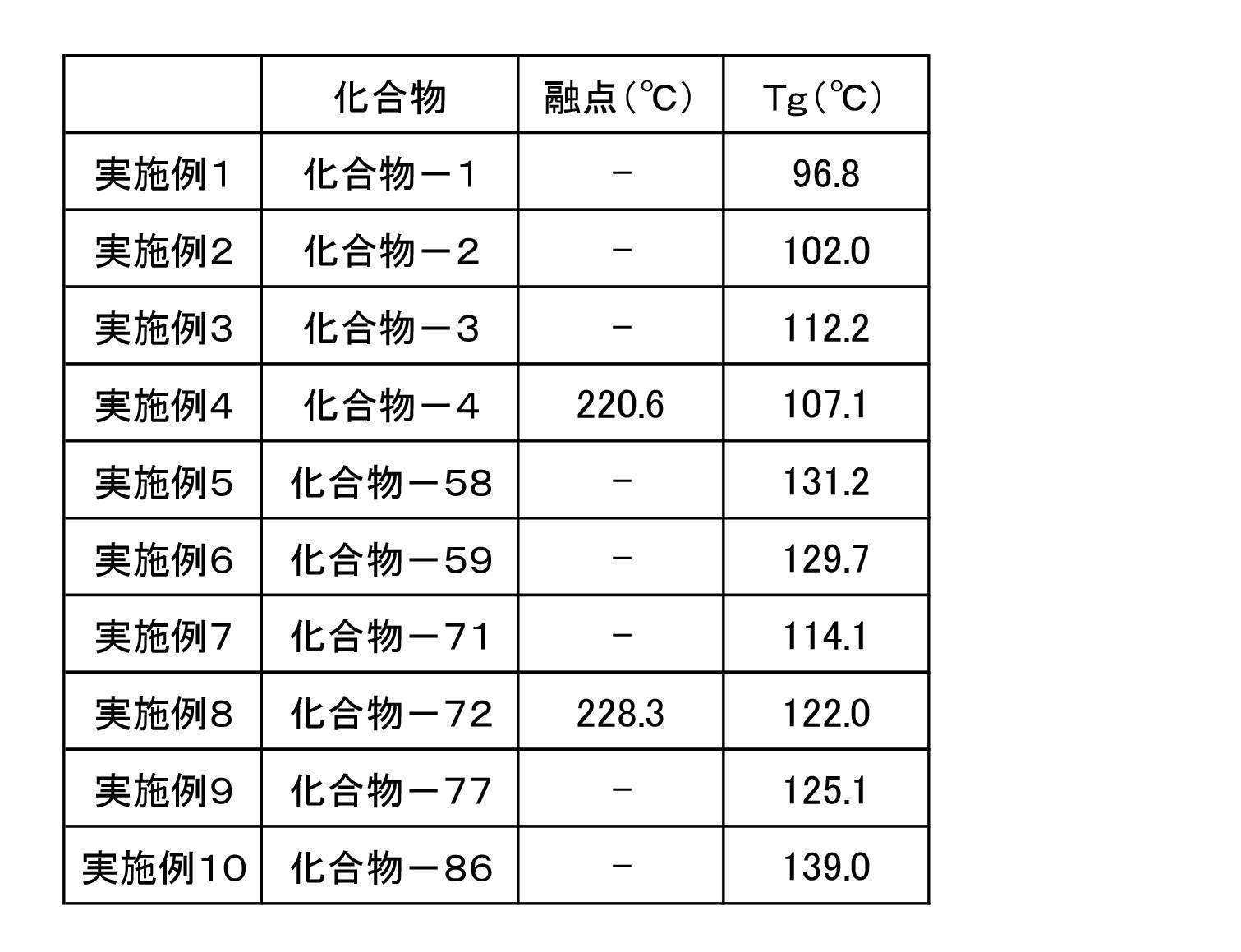
- the melting point and the glass transition point (Tg) were measured by a high sensitivity differential scanning calorimeter (manufactured by Bruker AXS, DSC3100SA). ) was measured. Table 1 shows the results.
- the compounds having a triarylamine structure represented by the structural formula (A-1) synthesized in Examples 1 to 10 have a glass transition point of 95 ° C. or higher, and are stable in a thin film state. It indicates that.
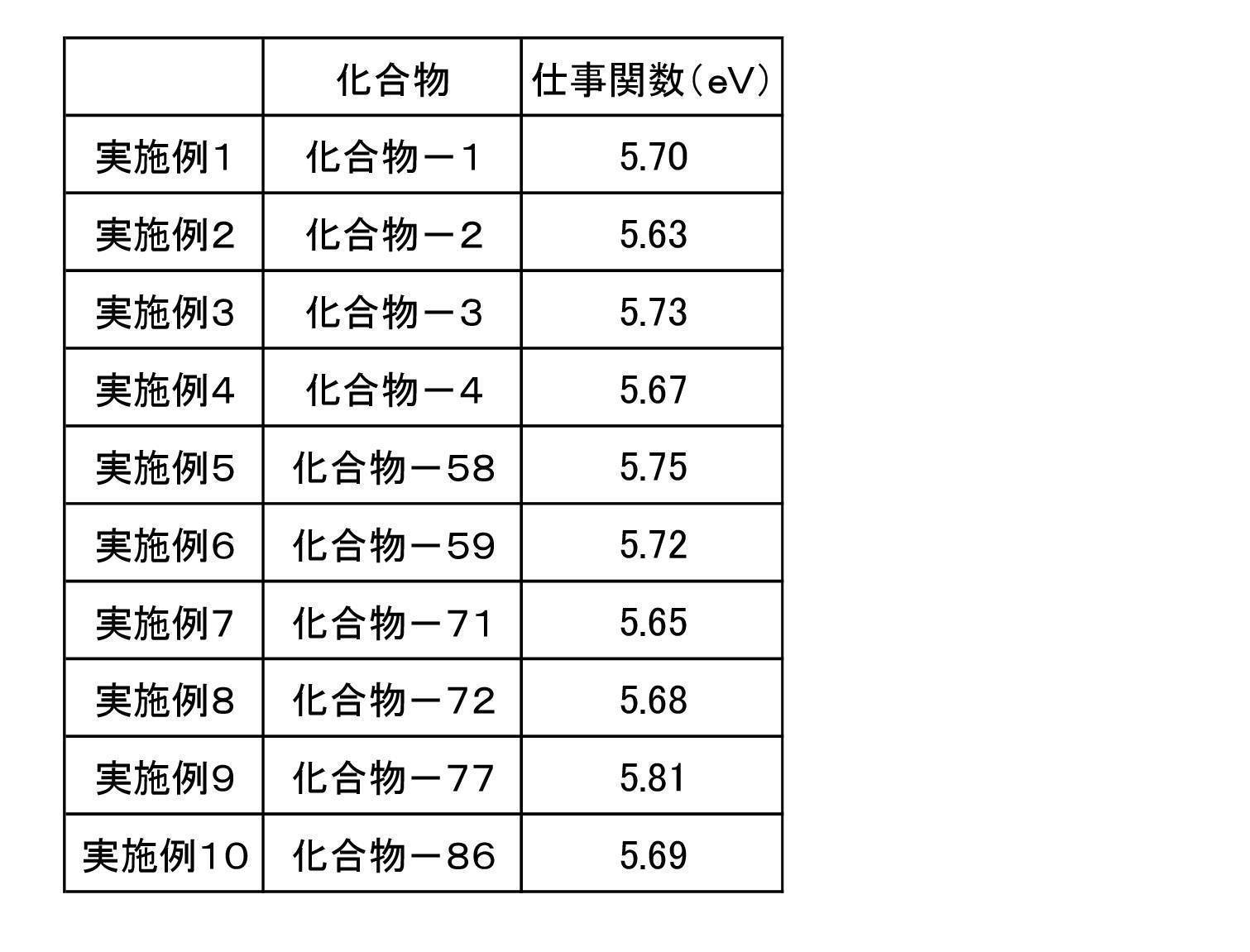
- a 100 nm-thick deposited film was formed on an ITO substrate using the compound having a triarylamine structure represented by the structural formula (A-1) synthesized in the above example, and an ionization potential measurement device (Sumitomo Heavy Industries, Ltd.)
- the work function was measured by PYS-202 manufactured by Kogyo Co., Ltd.). Table 2 shows the results.
- the compounds having a triarylamine structure represented by the structural formula (A-1) synthesized in Examples 1 to 10 were compared with the work function of a common hole transport material such as NPD and TPD, which was 5.4 eV. And thus showed a high energy level and a good hole transporting ability.
- the work function of these compounds is between the work function of ITO used as the anode (5.0 eV) and the work function of the compound (EMH-1) used as the light emitting layer in the examples (6.0 eV), and is good. Hole injection ability.
- An organic EL device was produced using the compound of Example 1 (Compound-1).
- the organic EL device has the configuration shown in FIG. 1, in which a hole injection layer 3, a hole transport layer 4, an electron blocking layer 5, and a light emitting layer are formed on a glass substrate 1 on which an ITO electrode is previously formed as an anode 2.
- Layer 6, electron transport layer 7, electron injection layer 8, and cathode (aluminum electrode) 9 were formed by vapor deposition in this order.
- the glass substrate 1 on which a 150-nm-thick ITO film was formed was subjected to ultrasonic cleaning in isopropyl alcohol for 20 minutes, and then dried on a hot plate heated to 200 ° C. for 10 minutes. Then, after performing UV ozone treatment for 15 minutes, this glass substrate with ITO was mounted in a vacuum evaporation machine, and the pressure was reduced to 0.001 Pa or less. Subsequently, an electron acceptor (Acceptor-1) having the following structural formula and a compound (HTM-1) having the following structural formula are formed as the hole injection layer 3 so as to cover the anode 2 with a deposition rate ratio of Acceptor-1: HTM-1.
- Acceptor-1 electron acceptor
- HTM-1 compound having the following structural formula
- a compound (HTM-1) was formed as a hole transport layer 4 so as to have a thickness of 40 nm.
- the compound of Example 1 (Compound-1) was formed as an electron blocking layer 5 to a thickness of 5 nm.
- Binary deposition was performed at a speed to form a film with a thickness of 20 nm.
- An organic EL device was fabricated under the same conditions as in Example 13 except that the compound of Example 2 (Compound-2) was used instead of the compound of Example 1 (Compound-1) as the material for the electron blocking layer 5. .
- the characteristics of the manufactured organic EL device were measured at room temperature in the air. Table 3 summarizes the measurement results of the light emission characteristics when a DC voltage was applied to the manufactured organic EL device.
- An organic EL device was produced under the same conditions as in Example 13 except that the compound of Example 3 (Compound-3) was used instead of the compound of Example 1 (Compound-1) as the material of the electron blocking layer 5. .
- the characteristics of the manufactured organic EL device were measured at room temperature in the air. Table 3 summarizes the measurement results of the light emission characteristics when a DC voltage was applied to the manufactured organic EL device.
- An organic EL device was produced under the same conditions as in Example 13 except that the compound of Example 4 (Compound-4) was used instead of the compound of Example 1 (Compound-1) as the material for the electron blocking layer 5. .
- the characteristics of the manufactured organic EL device were measured at room temperature in the air. Table 3 summarizes the measurement results of the light emission characteristics when a DC voltage was applied to the manufactured organic EL device.
- An organic EL device was manufactured under the same conditions as in Example 13 except that the compound of Example 5 (Compound-58) was used instead of the compound of Example 1 (Compound-1) as the material for the electron blocking layer 5. .
- the characteristics of the manufactured organic EL device were measured at room temperature in the air. Table 3 summarizes the measurement results of the light emission characteristics when a DC voltage was applied to the manufactured organic EL device.
- An organic EL device was produced under the same conditions as in Example 13 except that the compound of Example 6 (Compound-59) was used instead of the compound of Example 1 (Compound-1) as the material of the electron blocking layer 5. .
- the characteristics of the manufactured organic EL device were measured at room temperature in the air. Table 3 summarizes the measurement results of the light emission characteristics when a DC voltage was applied to the manufactured organic EL device.
- An organic EL device was manufactured under the same conditions as in Example 13 except that the compound (Compound-71) of Example 7 was used instead of the compound (Compound-1) of Example 1 as a material for the electron blocking layer 5. .
- the characteristics of the manufactured organic EL device were measured at room temperature in the air. Table 3 summarizes the measurement results of the light emission characteristics when a DC voltage was applied to the manufactured organic EL device.
- An organic EL device was produced under the same conditions as in Example 13 except that the compound of Example 8 (Compound-72) was used instead of the compound of Example 1 (Compound-1) as the material for the electron blocking layer 5. .
- the characteristics of the manufactured organic EL device were measured at room temperature in the air. Table 3 summarizes the measurement results of the light emission characteristics when a DC voltage was applied to the manufactured organic EL device.
- An organic EL device was manufactured under the same conditions as in Example 13 except that the compound of Example 9 (Compound-77) was used instead of the compound of Example 1 (Compound-1) as the material for the electron blocking layer 5. .
- the characteristics of the manufactured organic EL device were measured at room temperature in the air. Table 3 summarizes the measurement results of the light emission characteristics when a DC voltage was applied to the manufactured organic EL device.
- An organic EL device was produced under the same conditions as in Example 13 except that the compound of Example 10 (Compound-86) was used instead of the compound of Example 1 (Compound-1) as the material of the electron blocking layer 5. .
- the characteristics of the manufactured organic EL device were measured at room temperature in the air. Table 3 summarizes the measurement results of the light emission characteristics when a DC voltage was applied to the manufactured organic EL device.
- Example 1 For comparison, the same conditions as in Example 13 were used except that HTM-1 was used as the material of the electron blocking layer 5 instead of the compound (Compound-1) of Example 1 to form a film having a thickness of 5 nm.
- HTM-1 was used as the material of the electron blocking layer 5 instead of the compound (Compound-1) of Example 1 to form a film having a thickness of 5 nm.
- To produce an organic EL device The characteristics of the produced organic EL device were measured at room temperature in the air. Table 3 summarizes the measurement results of the light emission characteristics when a DC voltage was applied to the manufactured organic EL device.
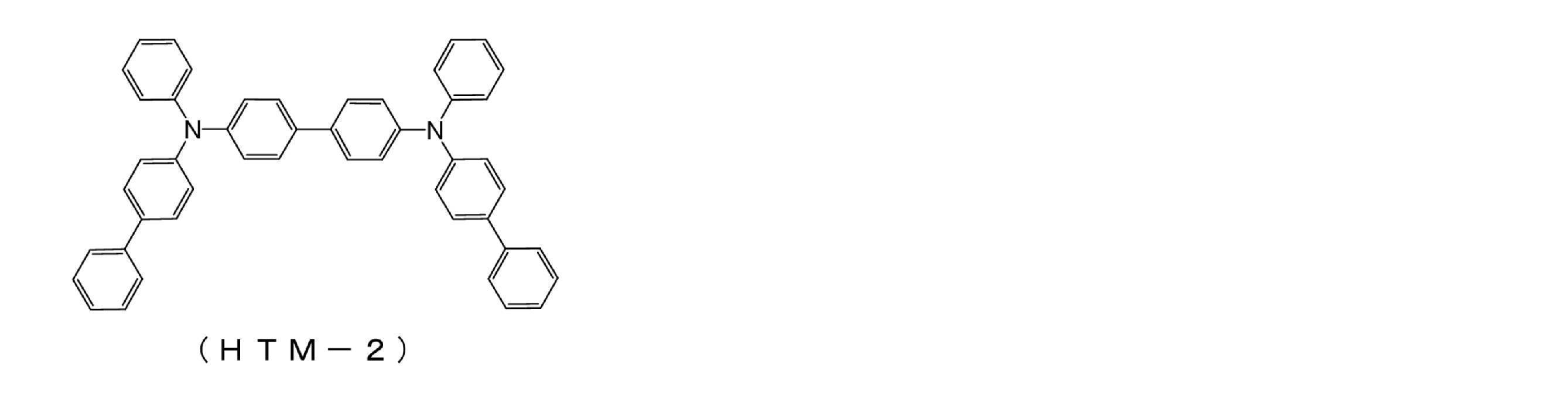
- Example 2 For comparison, an organic EL device was prepared under the same conditions as in Example 13 except that the compound (HTM-2) having the following structural formula was used as the material of the electron blocking layer 5 instead of the compound (Compound-1) of Example 1. An element was manufactured. The characteristics of the produced organic EL device were measured at room temperature in the air. Table 3 summarizes the measurement results of the light emission characteristics when a DC voltage was applied to the manufactured organic EL device.
- Table 3 summarizes the results of measuring the device life using the organic EL devices manufactured in Examples 13 to 22 and Comparative Examples 1 and 2.
- the element life is 1900 cd / m 2 when the constant-current drive is performed with the light emission luminance (initial luminance) at the start of light emission being 2000 cd / m 2 (corresponding to 95% when the initial luminance is 100%: (95% decay).
- the organic EL device of the present invention has an improved carrier balance inside the organic EL device by selecting a compound having a specific triarylamine structure as a material for the electron blocking layer, and has a higher efficiency than a conventional organic EL device. Thus, it was found that high luminous efficiency and long life can be realized.
- the compound having a triarylamine structure of the present invention is used as a constituent material of a hole injection layer, a hole transport layer, and a light emitting layer.
- the organic EL device using the compound having a specific triarylamine structure of the present invention has improved luminous efficiency and improved durability, so that it can be used in a wide range of applications such as home appliances and lighting. Deployment became possible.
Landscapes
- Chemical & Material Sciences (AREA)
- Organic Chemistry (AREA)
- Physics & Mathematics (AREA)
- Engineering & Computer Science (AREA)
- Materials Engineering (AREA)
- Spectroscopy & Molecular Physics (AREA)
- Optics & Photonics (AREA)
- Electroluminescent Light Sources (AREA)
- Organic Low-Molecular-Weight Compounds And Preparation Thereof (AREA)
Abstract
Description
そして、熱活性化遅延蛍光(TADF)による発光を利用する素子も開発されている。2011年に九州大学の安達らは、熱活性化遅延蛍光材料を用いた素子によって5.3%の外部量子効率を実現させた(例えば、非特許文献3参照)。
また、本発明が提供しようとする有機EL素子が具備すべき物理的な特性としては、(1)発光効率および電力効率が高いこと、(2)発光開始電圧が低いこと、(3)実用駆動電圧が低いこと、(4)長寿命であること、を挙げることができる。
1)下記構造式(A-1)で表される、トリアリールアミン構造を有する化合物。

(式中、A、BおよびCは相互に同一でも異なってもよく、下記構造式(B-1)で表される基、置換もしくは無置換の芳香族炭化水素基、置換もしくは無置換の芳香族複素環基、または置換もしくは無置換の縮合多環芳香族基を表す。但し、A、BおよびCのうち、少なくとも1つは下記構造式(B-1)で表される基でない。)

(式中、破線部は結合部位である。
Rは水素原子、重水素原子、フッ素原子、塩素原子、シアノ基、ニトロ基、置換基を有していてもよい炭素原子数1ないし6の直鎖状もしくは分岐状のアルキル基、置換基を有していてもよい炭素原子数5ないし10のシクロアルキル基、置換基を有していてもよい炭素原子数2ないし6の直鎖状もしくは分岐状のアルケニル基、置換基を有していてもよい炭素原子数1ないし6の直鎖状もしくは分岐状のアルキルオキシ基、置換基を有していてもよい炭素原子数5ないし10のシクロアルキルオキシ基、置換もしくは無置換の芳香族炭化水素基、置換もしくは無置換の芳香族複素環基、置換もしくは無置換の縮合多環芳香族基または置換もしくは無置換のアリールオキシ基を表し、nはRの個数であり、0~3の整数を表す。nが2~3である場合、同一のベンゼン環に複数個結合するRは相互に同一でも異なってもよく、単結合、置換もしくは無置換のメチレン基、酸素原子、または硫黄原子を介して互いに結合して環を形成してもよい。
Lは置換もしくは無置換の芳香族炭化水素基、置換もしくは無置換の芳香族複素環基または置換もしくは無置換の縮合多環芳香族基を表し、mは1~3の整数を表す。mが2または3である場合、Lは相互に同一でも異なってもよい。
Ar1、Ar2は相互に同一でも異なってもよく、置換もしくは無置換の芳香族炭化水素基、置換もしくは無置換の芳香族複素環基または置換もしくは無置換の縮合多環芳香族基を表す。)

(式中、Ar1、Ar2、L、m、n及びRは、前記構造式(B-1)と同一定義である。)

(式中、Ar1、Ar2、n及びRは、前記構造式(B-1)と同一定義である。)

(式中、Ar1、Ar2、n及びRは、前記構造式(B-1)と同一定義である。)

(式中、Ar1、Ar2、n及びRは、前記構造式(B-1)と同一定義である。)

(式中、Ar1、Ar2、n及びRは、前記(B-1)と同一定義である。)

(式中、R1およびR2は相互に同一でも異なってもよく、炭素原子数1ないし6の直鎖状もしくは分岐状のアルキル基を表し、jはR1の個数であり、0~2の整数を表し、kはR2の個数であり、0~2の整数を表し、j+kは0または2である。j+kが2の場合、R1同士、R2同士、またはR1およびR2は隣り合っており、互いに結合して環を形成している。)

(式中、R3は相互に同一でも異なってもよく、炭素原子数1ないし6の直鎖状もしくは分岐状のアルキル基を表し、lはR3の個数であり、0、2または4を表す。lが2または4の場合、R3同士は隣り合っており、互いに結合して環を形成している。)
本発明によれば、有機EL素子の発光効率および駆動電圧、そして耐久性を改良することができる。
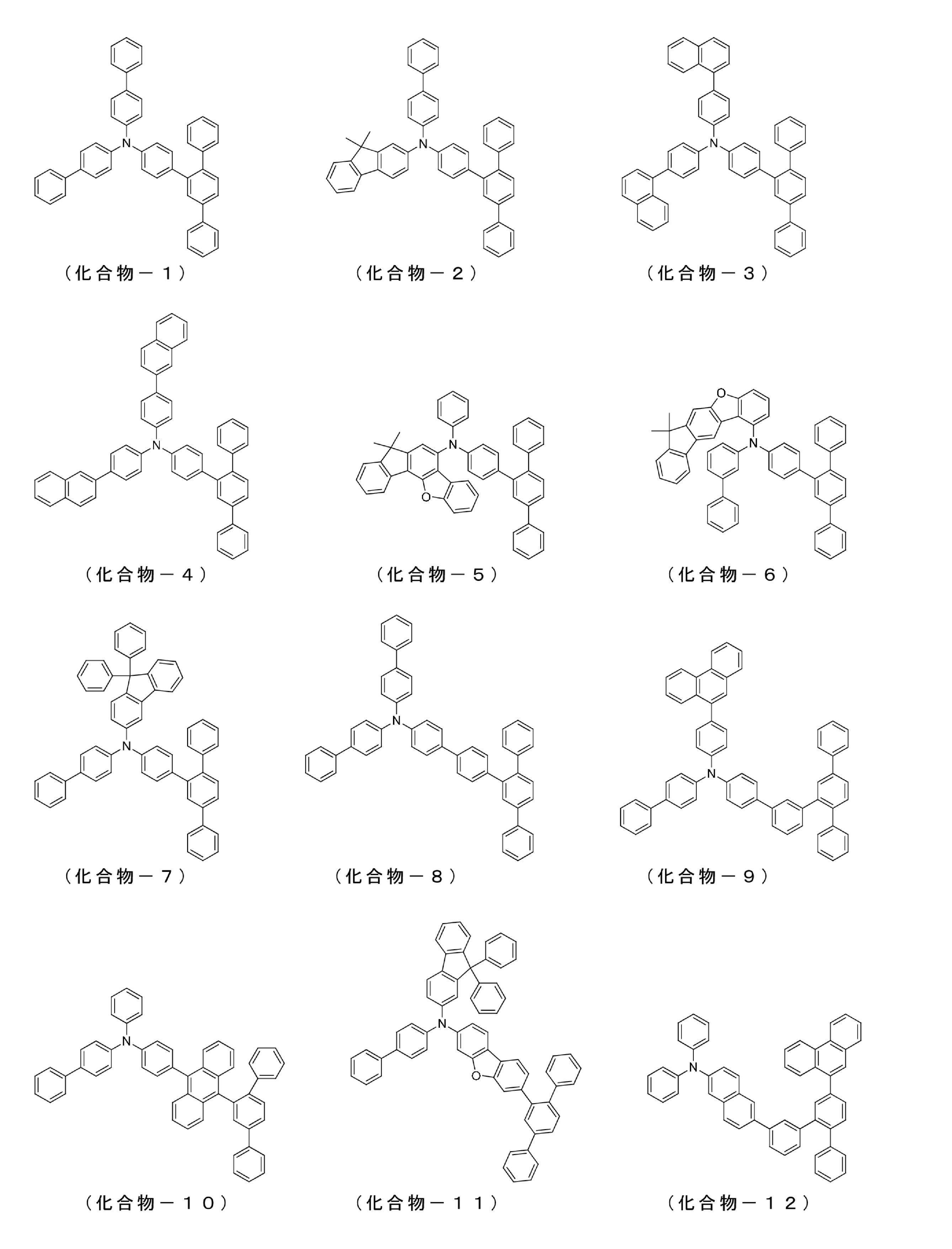


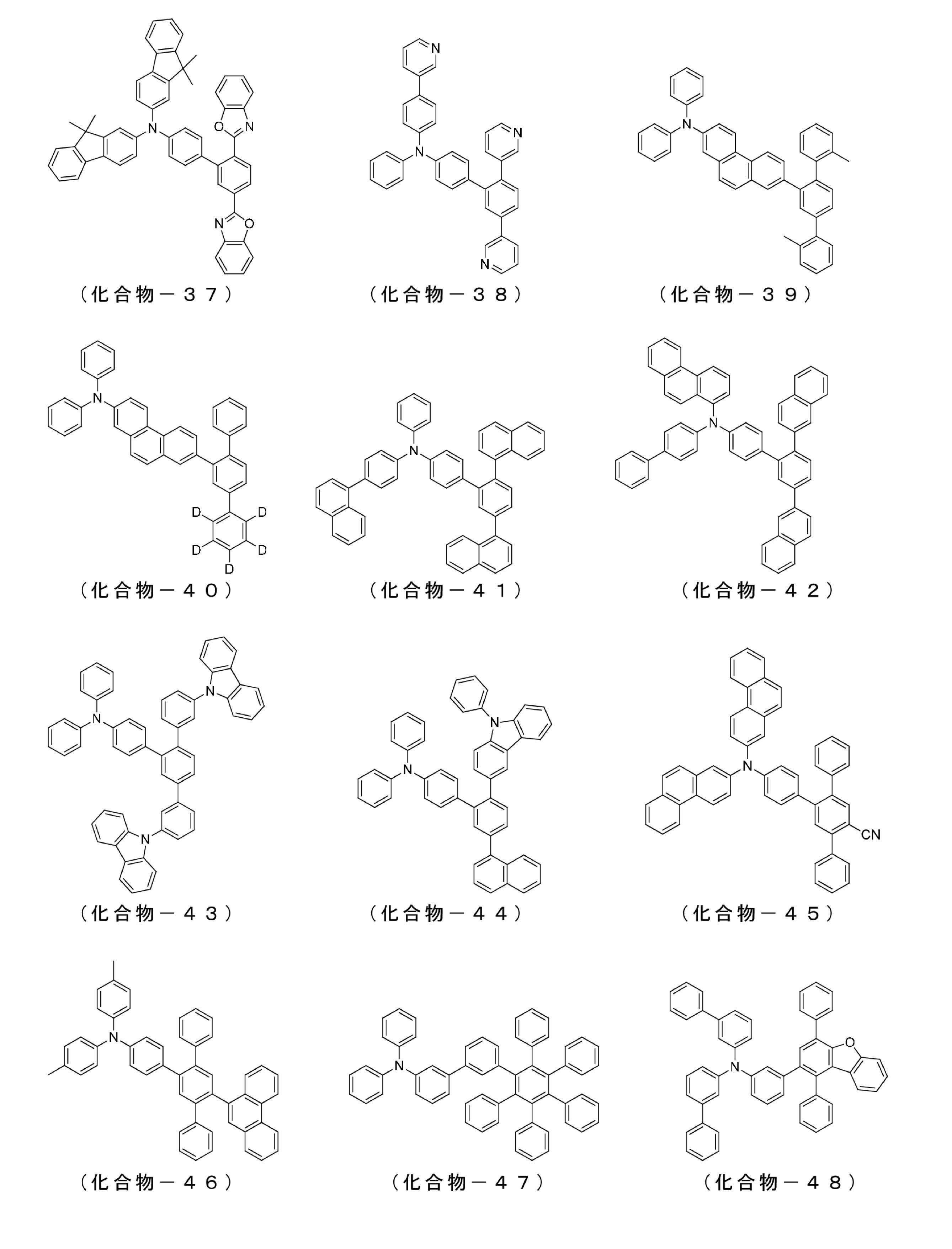


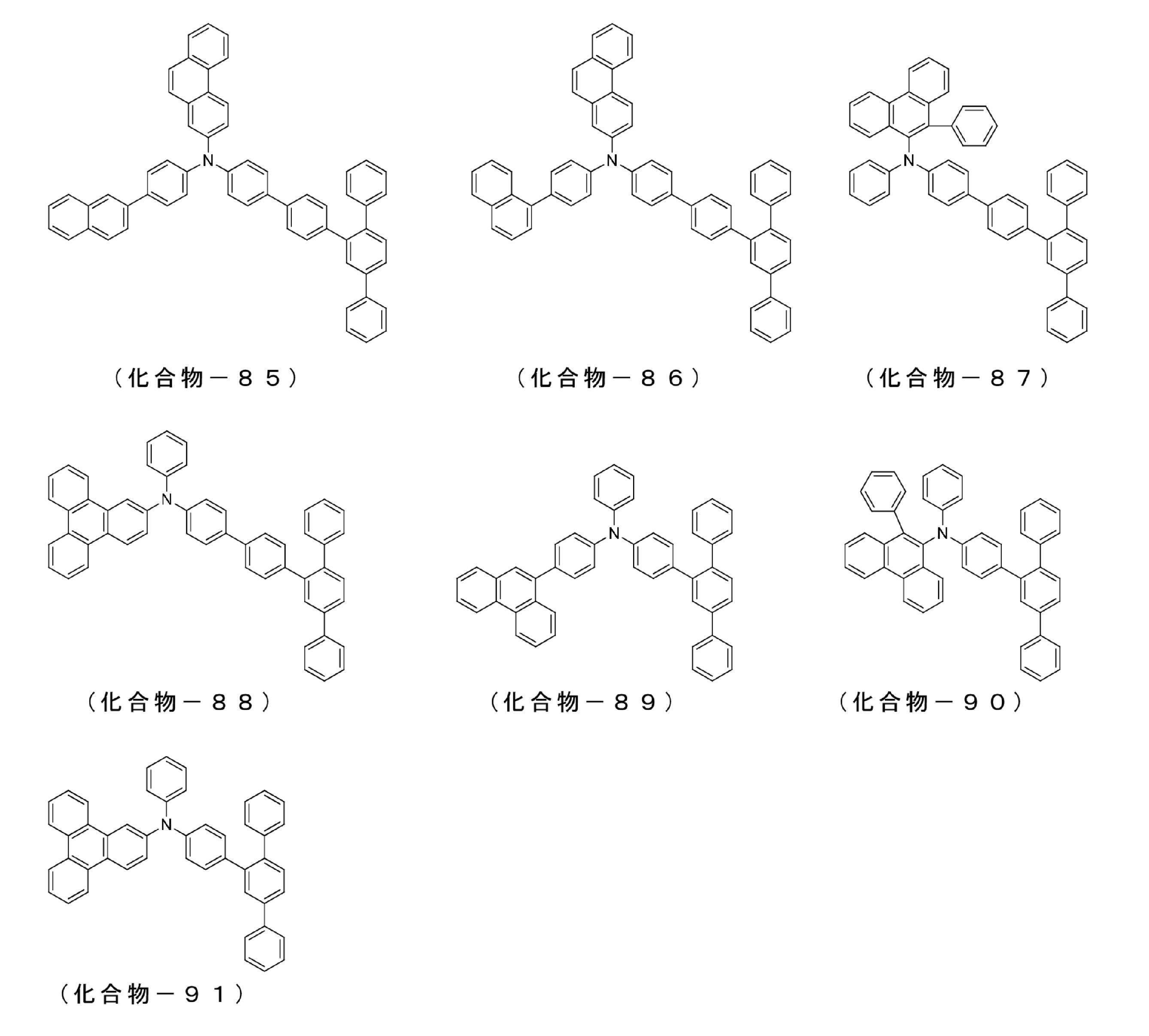
陽極2には、ITOや金のような仕事関数の大きな電極材料が用いられる。
正孔注入層3には、本発明のトリアリールアミン構造を有する化合物のほか、公知の化合物、例えば銅フタロシアニンに代表されるポルフィリン化合物、スターバースト型のトリフェニルアミン誘導体、分子中にトリフェニルアミン構造またはカルバゾリル構造を2個以上有し、それぞれが単結合またはヘテロ原子を含まない2価基で連結した構造を有するアリールアミン化合物などを用いることができ、ヘキサシアノアザトリフェニレンのようなアクセプター性の複素環化合物やポリ(3,4-エチレンジオキシチオフェン)(以後、PEDOTと略称する)/ポリ(スチレンスルフォネート)(以後、PSSと略称する)などの塗布型の高分子材料を用いることもできる。
正孔輸送層4には、本発明のトリアリールアミン構造を有する化合物のほか、正孔輸送性を有する公知の化合物を用いることもできる。正孔輸送性を有する公知の化合物としては、TPDやNPD、N,N,N’,N’-テトラビフェニリルベンジジンなどのベンジジン誘導体、1,1-ビス[(ジ-4-トリルアミノ)フェニル]シクロヘキサン(以後、TAPCと略称する)、分子中にトリフェニルアミン構造またはカルバゾリル構造を2個以上有し、それぞれが単結合またはヘテロ原子を含まない2価基で連結した構造を有するアリールアミン化合物などを挙げることができる。また、上記PEDOTやPSSなどの塗布型の高分子材料を用いることもできる。これらは、単独で成膜してもよいが、複数種を混合して成膜することもでき、それぞれを単層として使用できる。上記の化合物または材料を単独で成膜した層同士の積層構造、複数種を混合して成膜した層同士の積層構造、または上記の化合物または材料を単独で成膜した層と上記複数種を混合して成膜した層との積層構造としてもよい。これらの化合物および材料は、蒸着法の他、スピンコート法やインクジェット法などの公知の方法によって薄膜形成を行うことができる。
電子阻止層5には、本発明のトリアリールアミン構造を有する化合物のほか、公知の電子阻止作用を有する化合物を用いることもできる。公知の電子阻止作用を有する化合物としては、4,4’,4’’-トリ(N-カルバゾリル)トリフェニルアミン(以後、TCTAと略称する)、9,9-ビス[4-(カルバゾール-9-イル)フェニル]フルオレン、1,3-ビス(カルバゾール-9-イル)ベンゼン(以後、mCPと略称する)、2,2-ビス(4-カルバゾール-9-イルフェニル)アダマンタン(以後、Ad-Czと略称する)などのカルバゾール誘導体、9-[4-(カルバゾール-9-イル)フェニル]-9-[4-(トリフェニルシリル)フェニル]-9H-フルオレンに代表されるトリフェニルシリル基とトリアリールアミン構造を有する化合物などの電子阻止作用を有する化合物を挙げることができる。これらは、単独で成膜してもよいが、複数種を混合して成膜することもでき、それぞれ単層として使用できる。上記の材料を単独で成膜した層同士の積層構造、上記複数種を混合して成膜した層同士の積層構造、または上記の材料を単独で成膜した層と上記複数種を混合して成膜した層との積層構造としてもよい。これらの化合物は、蒸着法の他、スピンコート法やインクジェット法などの公知の方法によって薄膜形成を行うことができる。
発光層6には、本発明のトリアリールアミン構造を有する化合物のほか、公知の発光材料を用いることもできる。公知の発光材料としては、Alq3をはじめとするキノリノール誘導体の金属錯体、各種の金属錯体、アントラセン誘導体、ビススチリルベンゼン誘導体、ピレン誘導体、オキサゾール誘導体、ポリパラフェニレンビニレン誘導体などを挙げることができる。また、発光層6は、ホスト材料とドーパント材料とで構成されていてもよい。ホスト材料としてアントラセン誘導体が好ましく用いられるが、そのほか、本発明のトリアリールアミン構造を有する化合物を初めとする前記発光材料に加え、インドール環を縮合環の部分構造として有する複素環化合物、カルバゾール環を縮合環の部分構造として有する複素環化合物、カルバゾール誘導体、チアゾール誘導体、ベンズイミダゾール誘導体、ポリジアルキルフルオレン誘導体などを用いることができる。また、ドーパント材料としては、キナクリドン、クマリン、ルブレン、ペリレンおよびそれらの誘導体、ベンゾピラン誘導体、ローダミン誘導体、アミノスチリル誘導体などが挙げられる。これらは、単独で成膜してもよいが、複数種を混合して成膜することもでき、それぞれを単層として使用しできる。上記の化合物または材料を単独で成膜した層同士の積層構造、上記複数種を混合して成膜した層同士の積層構造、または上記の化合物または材料を単独で成膜した層と複数種を混合して成膜した層との積層構造としてもよい。
発光層6と電子輸送層7との間には、正孔阻止層(図1には示していない)を設けることができる。正孔阻止層には、公知の正孔阻止作用を有する化合物を用いることができる。公知の正孔阻止作用を有する化合物としては、バソクプロイン(以後、BCPと略称する)などのフェナントロリン誘導体、アルミニウム(III)ビス(2-メチル-8-キノリナート)-4-フェニルフェノレート(以後、BAlqと省略する)などのキノリノール誘導体の金属錯体、各種の希土類錯体、オキサゾール誘導体、トリアゾール誘導体、トリアジン誘導体、ピリミジン誘導体、オキサジアゾール誘導体、ベンゾアゾール誘導体などを挙げることができる。これらの化合物は電子輸送層の材料を兼ねてもよい。これらは、単独で成膜してもよいが、複数種を混合して成膜することもでき、それぞれを単層として使用できる。上記化合物を単独で成膜した層同士の積層構造、上記複数種を混合して成膜した層同士の積層構造、または上記化合物を単独で成膜した層と複数種を混合して成膜した層との積層構造としてもよい。これらの材料は、蒸着法の他、スピンコート法やインクジェット法などの公知の方法によって薄膜形成を行うことができる。
電子輸送層7には、電子輸送性を有する公知の化合物を用いることができる。電子輸送性を有する公知の化合物としては、Alq3、BAlqをはじめとするキノリノール誘導体の金属錯体、各種金属錯体、トリアゾール誘導体、トリアジン誘導体、ピリミジン誘導体、オキサジアゾール誘導体、ピリジン誘導体、ベンズイミダゾール誘導体、ベンゾアゾール誘導体、チアジアゾール誘導体、アントラセン誘導体、カルボジイミド誘導体、キノキサリン誘導体、ピリドインドール誘導体、フェナントロリン誘導体、シロール誘導体などを挙げることができる。これらは、単独で成膜してもよいが、複数種を混合して成膜することもでき、それぞれを単層として使用できる。上記化合物を単独で成膜した層同士の積層構造、上記複数種を混合して成膜した層同士の積層構造、または上記化合物を単独で成膜した層と複数種を混合して成膜した層との積層構造としてもよい。これらの材料は、蒸着法の他、スピンコート法やインクジェット法などの公知の方法によって薄膜形成を行うことができる。
電子注入層8には、フッ化リチウム、フッ化セシウムなどのアルカリ金属塩、フッ化マグネシウムなどのアルカリ土類金属塩、リチウムキノリノールなどのキノリノール誘導体の金属錯体、酸化アルミニウムなどの金属酸化物、あるいはイッテルビウム(Yb)、サマリウム(Sm)、カルシウム(Ca)、ストロンチウム(Sr)、セシウム(Cs)などの金属を用いることができる。電子輸送層と陰極との好ましい組み合わせを選択することによって、電子注入層8は省略することができる。
陰極9には、アルミニウムのような仕事関数の低い電極材料や、マグネシウム銀合金、マグネシウムカルシウム合金、マグネシウムインジウム合金、アルミニウムマグネシウム合金のような、より仕事関数の低い合金およびITO、IZOなどの電極材料が用いられる。
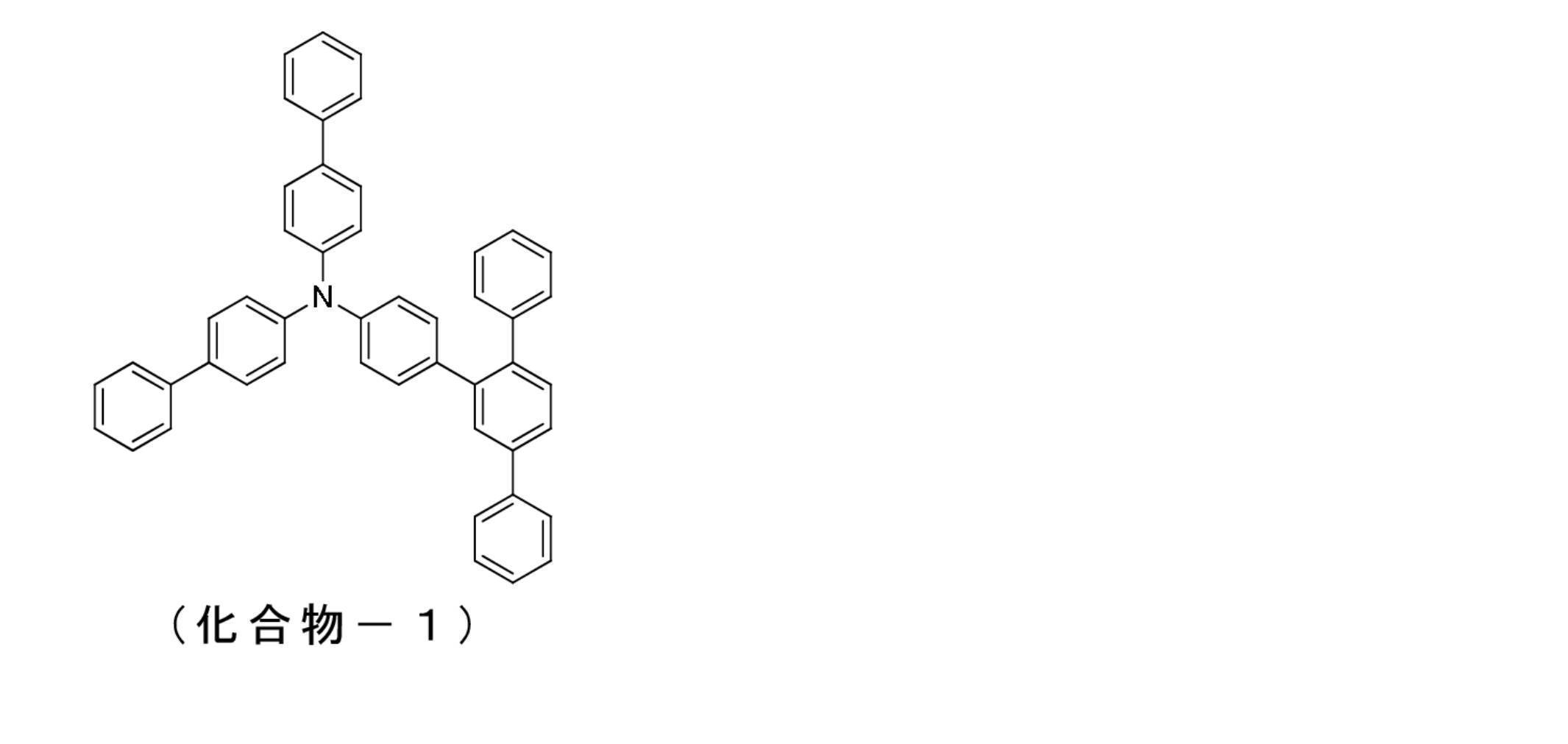
窒素置換した反応容器に、ビス(4-ビフェニリル)アミン5.00g、4-ブロモ-5’-フェニル-1,1’:2’,1”-ターフェニル6.59g、トルエン50ml、t-ブトキシナトリウム1.79g、t-ブチルホスフィン(50wt%トルエン溶液)0.13g、酢酸パラジウム(II)0.07gを加えて加熱還流下で3時間撹拌した。反応液にシリカゲルと活性白土をそれぞれ10gずつ加え、10分間撹拌した後、80℃にてセライト濾過を行なった。濃縮した濾液に、アセトン180mlを加えて晶析を行ない、固体を得た。得られた固体をn-ヘプタン/ジクロロメタン混合溶媒を用いて、カラムクロマトグラフィーによって精製した。濃縮した固体をジクロロメタン20mlに溶解後、n-ヘプタン200mlを加えて晶析操作を行ない、N,N-ビス([1,1’-ビフェニル]-4-イル)-5’-フェニル-(1,1’:2’,1”-トリフェニル)-4-アミン(化合物-1)の白色固体5.4g(収率56%)を得た。
1H-NMR(DMSO-d6)で以下の35個の水素のシグナルを検出した。
δ(ppm)=7.80-7.72(4H)、7.67-7.62(8H)、7.53-7.40(8H)、7.36-7.28(5H)、7.21-7.09(8H)、6.98(2H)
窒素置換した反応容器に、2-(4-ビフェニリル)アミノ-9,9-ジメチルフルオレン6.10g、4-ブロモ-5’-フェニル-1,1’:2’,1”-ターフェニル7.15g、トルエン61ml、t-ブトキシナトリウム1.95g、t-ブチルホスフィン(50wt%トルエン溶液)0.14g、酢酸パラジウム(II)0.08gを加えて加熱還流下で3時間撹拌した。反応液にシリカゲルと活性白土をそれぞれ10gずつ加え、10分間撹拌した後、80℃にてセライト濾過を行なった。濃縮した濾液に、アセトン220mlを加えて晶析操作を行ない、固体を得た。得られた固体をn-ヘプタン/ジクロロメタン混合溶媒を用いて、カラムクロマトグラフィーによって精製した。濃縮した固体をジクロロメタン22mlに溶解後、n-ヘプタン220mlを加えて晶析操作を行なった。同様の晶析操作を再度行い、N-([1,1’-ビフェニル]-4-イル)-9,9-ジメチル-N-(5’-フェニル-[1,1’:2’,1”-トリフェニル]-4-イル)-9H-フルオレン-2-アミン(化合物-2)の白色固体2.2g(収率19%)を得た。

1H-NMR(DMSO-d6)で以下の39個の水素のシグナルを検出した。
δ(ppm)=7.73-7.56(10H)、7.49-7.42(10H)、7.35-7.22(6H)、7.11-7.07(4H)、6.98-6.96(3H)
窒素置換した反応容器に、N,N-ビス[4-(ナフタレン-1-イル)フェニル]アミン9.00g、4-ブロモ-5’-フェニル-1,1’:2’,1”-ターフェニル9.87g、トルエン90ml、t-ブトキシナトリウム2.46g、t-ブチルホスフィン(50wt%トルエン溶液)0.17g、酢酸パラジウム(II)0.10gを加えて加熱還流下で3時間撹拌した。反応液にシリカゲルと活性白土をそれぞれ15gずつ加え、10分間撹拌した後、80℃にてセライト濾過を行なった。濾液を濃縮し、n-ヘプタン/ジクロロメタン混合溶媒を用いて、カラムクロマトグラフィーによって精製した。濃縮した固体をジクロロメタン30mlに溶解後、メタノール300mlに滴下し、固体を得た。得られた固体を同様の方法で精製し、N,N-ビス(4-[ナフタレン-1-イル]フェニル)-5’-フェニル-(1,1’:2’,1”-トリフェニル)-4-アミン(化合物-3)の白色固体13.0g(収率83.9%)を得た。
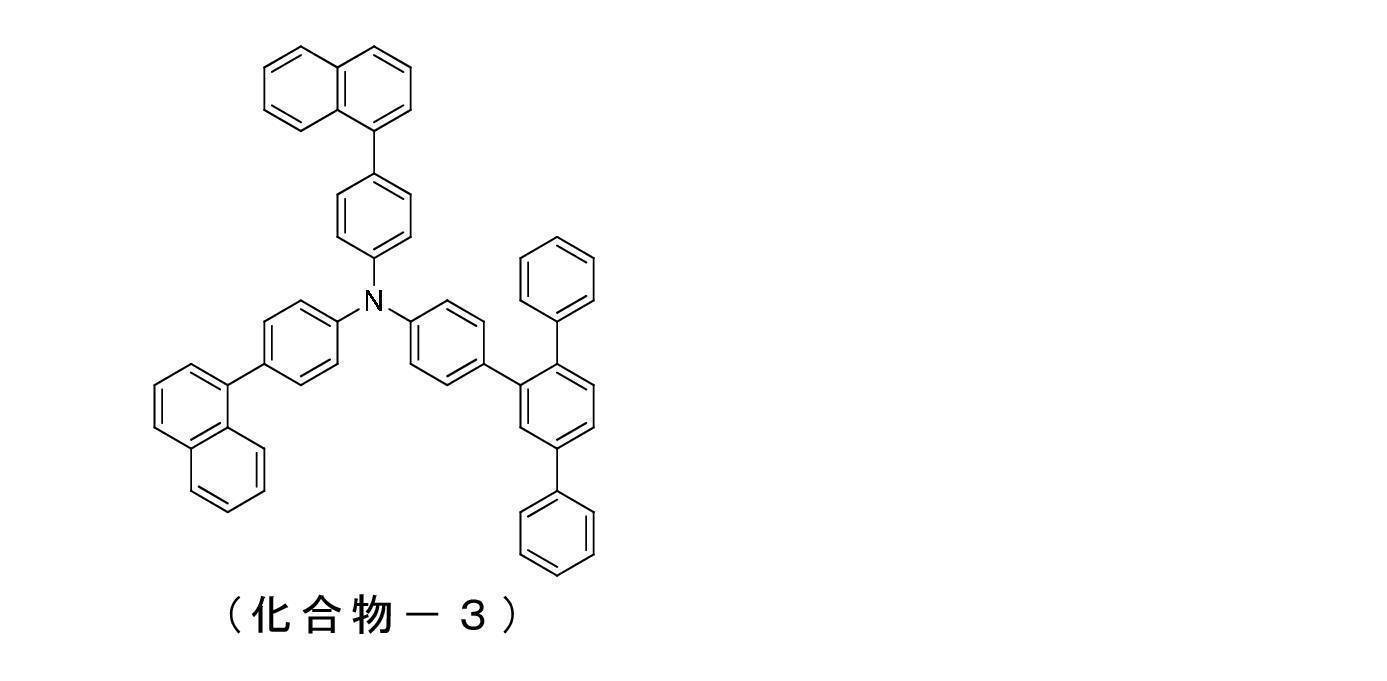
1H-NMR(DMSO-d6)で以下の39個の水素のシグナルを検出した。
δ(ppm)=8.02-7.94(6H)、7.82-7.75(4H)、7.64-7.47(15H)、7.43-7.21(12H)、7.16-7.10(2H)
窒素置換した反応容器に、N,N-ビス[4-(ナフタレン-2-イル)フェニル]アミン10.00g、4-ブロモ-5’-フェニル-1,1’:2’,1”-ターフェニル10.97g、トルエン100ml、t-ブトキシナトリウム2.74g、t-ブチルホスフィン(50wt%トルエン溶液)0.19g、酢酸パラジウム(II)0.11gを加えて加熱還流下で3時間撹拌した。反応液にシリカゲルと活性白土をそれぞれ17gずつ加え、10分間撹拌した後、80℃にてセライト濾過を行なった。濃縮した濾液に、アセトン340mlを加えて晶析操作を行ない、固体を得た。得られた固体をトルエン34mlに溶解後、アセトン340mlを加えて晶析操作を行ない、N,N-ビス(4-[ナフタレン-2-イル]フェニル)-5’-フェニル-(1,1’:2’,1”-トリフェニル)-4-アミン(化合物-4)の白色固体8.3g(収率48%)を得た。
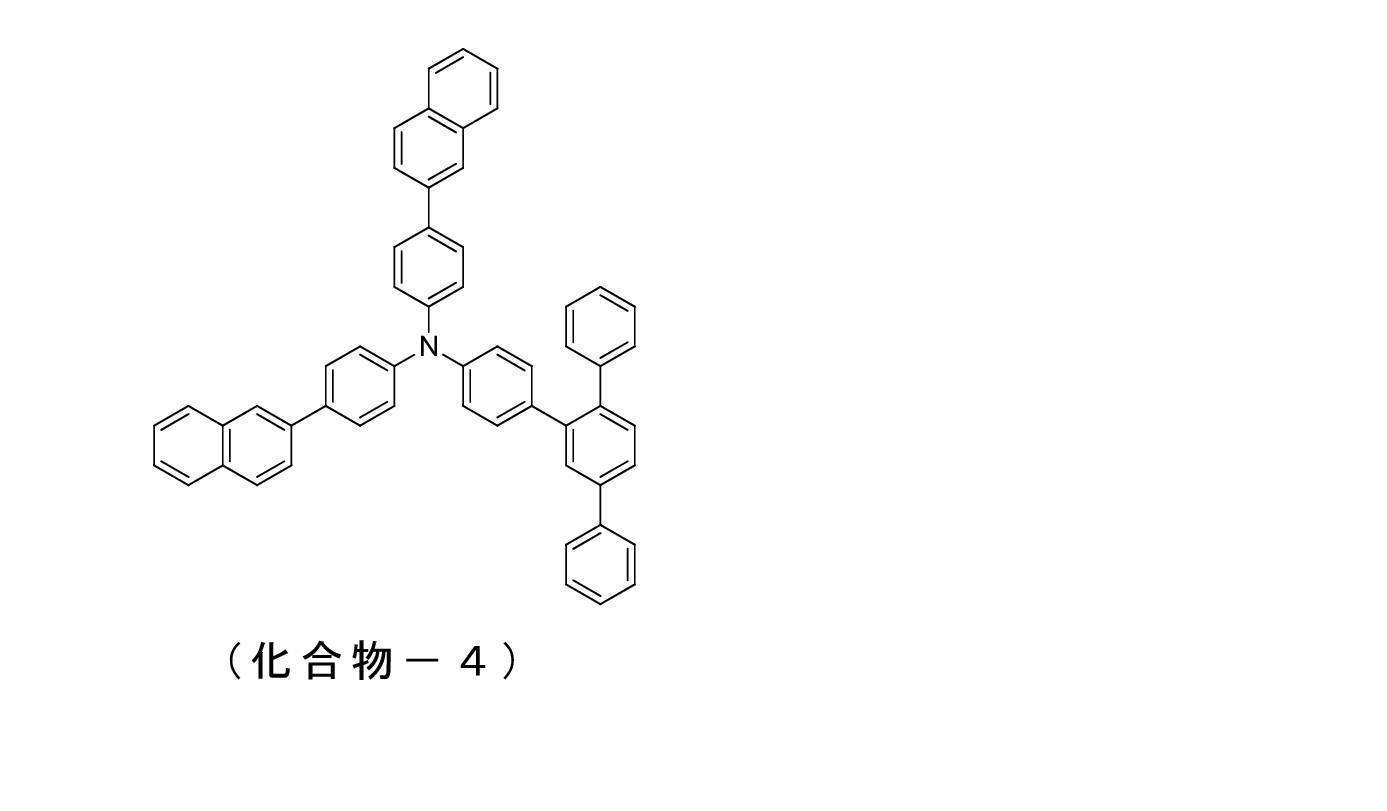
1H-NMR(DMSO-d6)で以下の39個の水素のシグナルを検出した。
δ(ppm)=8.21(2H)、8.01-7.92(6H)、7.88-7.74(10H)、7.57-7.48(7H)、7.43-7.30(4H)、7.28-7.17(8H)、7.03(2H)
窒素置換した反応容器にN-(4-(ナフタレン-1-イル)フェニル)-N-(5’-フェニル[1,1’:2’,1’’-ターフェニル]-4-アミン8.5g、9-ブロモフェナントレン4.8g、トルエン85ml、t-ブトキシナトリウム2.3g、t-ブチルホスフィン(50wt%トルエン溶液)0.3g、酢酸パラジウム(II)0.1gを加えて加熱還流下で3時間撹拌した。80℃でセライト濾過を行った。濾液に活性白土とシリカゲルを加え、吸着精製を行った。濾液を濃縮し、残渣をアセトンにより晶析し、N-(4-(ナフタレン-1-イル)フェニル)-N-(5’-フェニル[1,1’:2’,1’’-ターフェニル]-4-イル)フェナントレン-9-アミン(化合物-58)の白色固体8.3g(収率73%)を得た。

1H-NMR(CDCl3)で以下の37個の水素のシグナルを検出した。
δ(ppm)=8.75-8.84(2H)、8.16-8.20(1H)、8.05-8.09(1H)、7.91-7.95(3H)、7.12-7.78(30H)
窒素置換した反応容器にN-(4-(ナフタレン-2-イル)フェニル)-N-(5’-フェニル[1,1’:2’,1’’-ターフェニル]-4-アミン8.0g、9-ブロモフェナントレン4.5g、トルエン80ml、t-ブトキシナトリウム2.2g、t-ブチルホスフィン(50wt%トルエン溶液)0.2g、酢酸パラジウム(II)0.1gを加えて加熱還流下で3時間撹拌した。80℃でセライト濾過を行った。濾液に活性白土とシリカゲルを加え、吸着精製を行った。濾液を濃縮し、残渣をトルエン-アセトンにより晶析し、N-((4-ナフタレン-2-イル)フェニル)-N-(5’-フェニル[1,1’:2’,1’’-ターフェニル]-4-イル)フェナントレン-9-アミン(化合物-59)の白色固体6.6g(収率62%)を得た。

1H-NMR(CDCl3)で以下の37個の水素のシグナルを検出した。
δ(ppm)=8.74-8.83(2H)、8.12-8.17(1H)、8.30(1H)、7.21-7.94(29H)、7.08-7.14(4H)
窒素置換した反応容器に9,9-ジメチル-N-フェニル-9H-フルオレン-2-アミン4.5g、4’’-ブロモ4’-フェニル-[1,1’:2’,1’’:4’’,1’’’-クォーターフェニル]7.6g、トルエン45ml、t-ブトキシナトリウム1.8g、t-ブチルホスフィン(50wt%トルエン溶液)0.13g、酢酸パラジウム(II)0.07gを加えて加熱還流下で終夜撹拌した。室温まで冷却し、水洗浄を行い、無水硫酸マグネシウムで乾燥した。乾燥剤を濾過で除き、濾液を濃縮した。残渣をカラムクロマトグラフィーで精製し、9,9-ジメチル-N-フェニル-N-(4’-フェニル[1,1’:2’,1’’:4’’,1’’’-クォーターフェニル]-4’’-イル)-9H-フルオレン-2-アミン(化合物-71)の白色固体6.5g(収率62%)を得た。
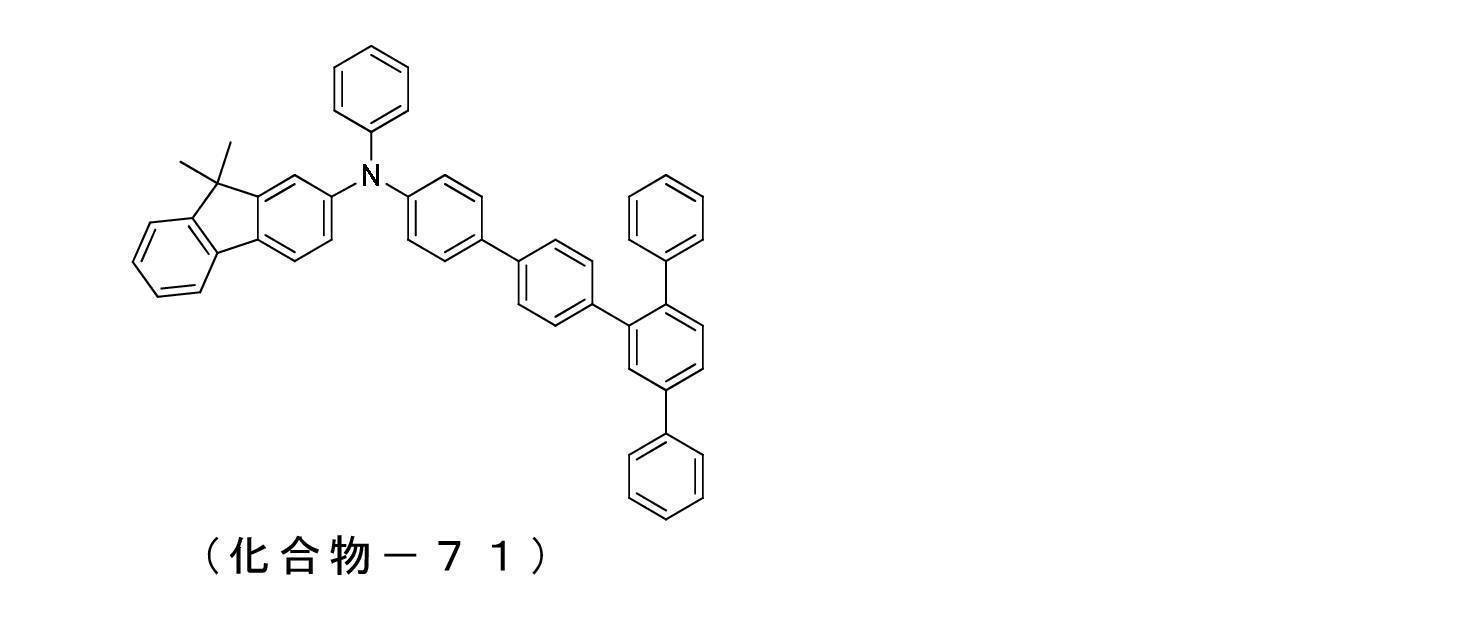
1H-NMR(CDCl3)で以下の39個の水素のシグナルを検出した。
δ(ppm)=7.51-7.80(13H)、7.22-7.48(18H)、7.08-7.16(2H)、1.50(6H)
窒素置換した反応容器にN-(4-(ナフタレン-2-イル)フェニル)-[1,1’-ビフェニル]-4-アミン5.1g、4’’-ブロモ4’-フェニル-[1,1’:2’,1’’:4’’,1’’’-クォーターフェニル]6.7g、トルエン51ml、t-ブトキシナトリウム1.6g、t-ブチルホスフィン(50wt%トルエン溶液)0.11g、酢酸パラジウム(II)0.06gを加えて加熱還流下で終夜撹拌した。室温まで冷却し、セライト濾過で不溶物を除いた。濾液に活性炭を加え、吸着精製を行った。濾液を濃縮し、残渣をトルエン-アセトンにより晶析し、N-([1,1’-ビフェニル]-4-イル)-N-(4-(ナフタレン-2-イル)フェニル)-4’-フェニル-[1,1’:2’,1’’:4’’,1’’’-クォーターフェニル]-4’’’-アミン(化合物-72)の白色固体7.6g(収率74%)を得た。
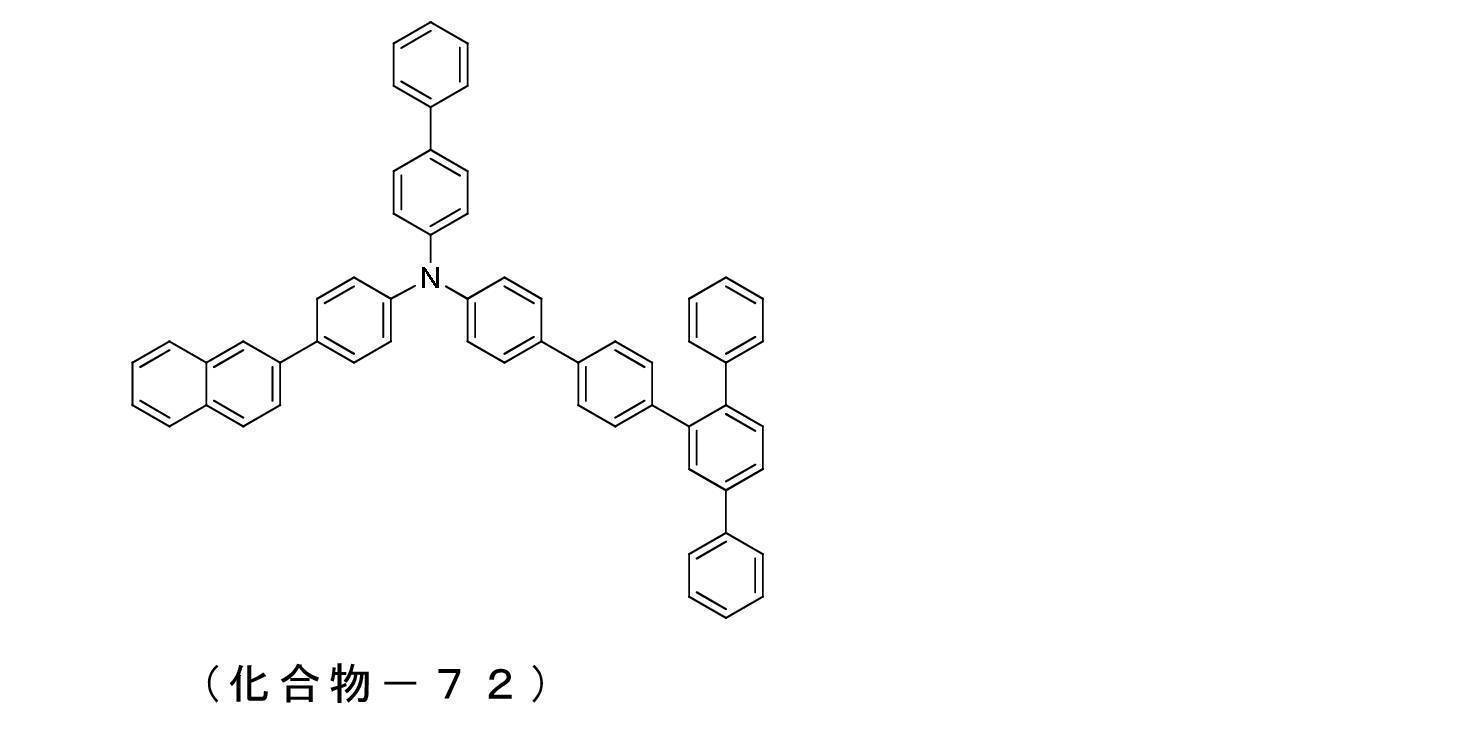
1H-NMR(CDCl3)で以下の41個の水素のシグナルを検出した。
δ(ppm)=8.11(1H)、7.91-7.98(3H)、7.65-7.83(9H)、7.28-7.62(28H)
窒素置換した反応容器にN-フェニル-フェナントレン-9-アミン5.0g、4’’-ブロモ4’-フェニル-[1,1’:2’,1’’:4’’,1’’’-クォーターフェニル]9.4g、トルエン50ml、t-ブトキシナトリウム2.1g、t-ブチルホスフィン(50wt%トルエン溶液)0.15g、酢酸パラジウム(II)0.08gを加えて加熱還流下で終夜撹拌した。80℃まで冷却し、セライト濾過で不溶物を除いた。濾液を濃縮し、残渣をカラムクロマトグラフィーで精製し、N-フェニル-N-(4’-フェニル-[1,1’:2’,1’’:4’’,1’’’-クォーターフェニル]-4’’’-イル)フェナントレン-9-アミン(化合物-77)の白色固体3.8g(収率32%)を得た。
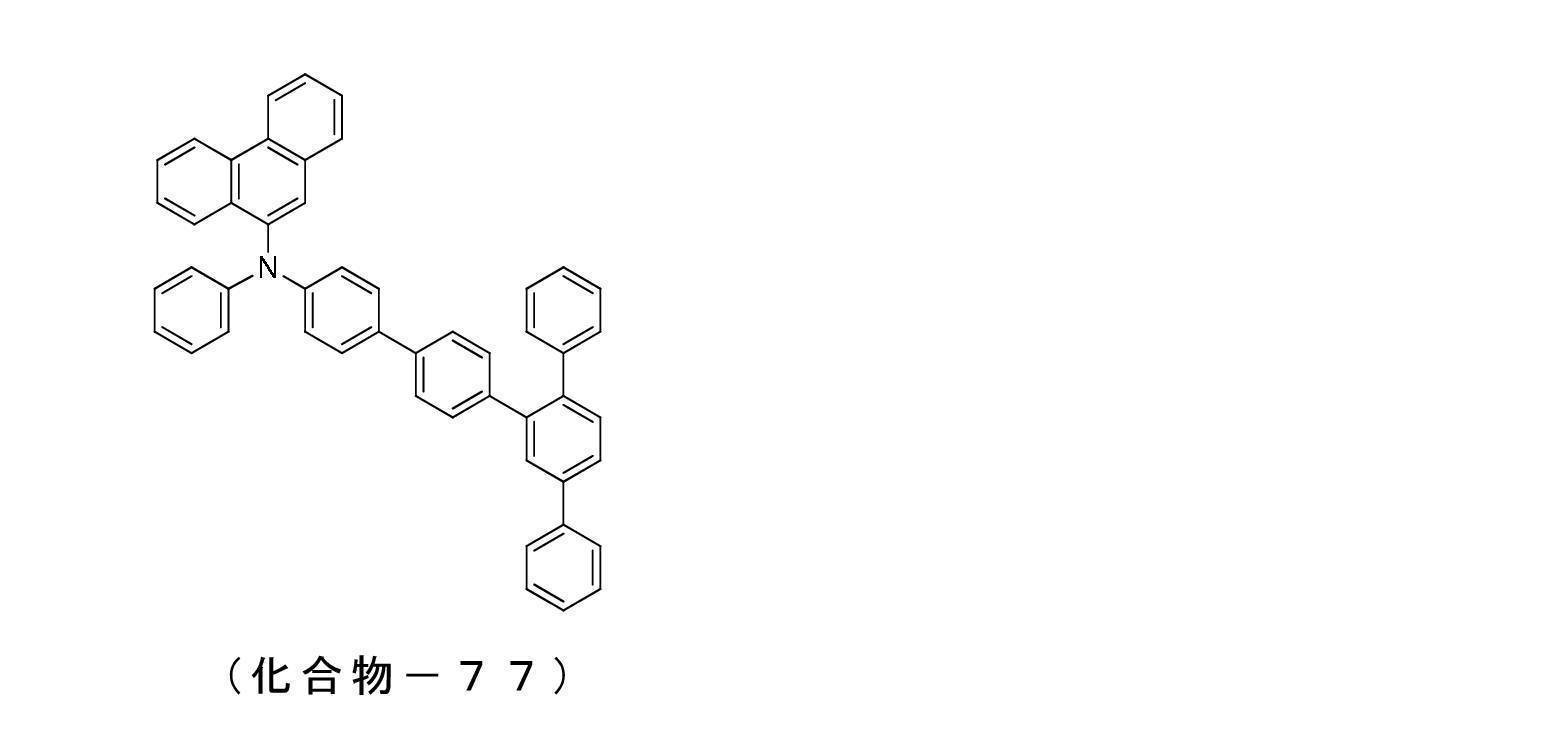
1H-NMR(CDCl3)で以下の35個の水素のシグナルを検出した。
δ(ppm)=8.73-8.82(2H)、8.12-8.16(1H)、7.40-7.83(18H)、7.18-7.32(13H)、7.02-7.08(1H)
窒素置換した反応容器にN-(4-(ナフタレン-1-イル)フェニル)-フェナントレン-2-アミン6.0g、4’’-ブロモ4’-フェニル-[1,1’:2’,1’’:4’’,1’’’-クォーターフェニル]7.3g、トルエン60ml、t-ブトキシナトリウム1.7g、t-ブチルホスフィン(50wt%トルエン溶液)0.12g、酢酸パラジウム(II)0.07gを加えて加熱還流下で終夜撹拌した。80℃まで冷却し、セライト濾過で不溶物を除いた。濾液を濃縮し、残渣をカラムクロマトグラフィーで精製し、N-(4-(ナフタレン-1-イル)フェニル)-N-(4’-フェニル-[1,1’:2’,1’’:4’’,1’’’-クォーターフェニル]-4’’’-イル)フェナントレン-2-アミン(化合物-86)の黄白色固体8.0g(収率68%)を得た。

1H-NMR(CDCl3)で以下の41個の水素のシグナルを検出した。
δ(ppm)=8.62-8.67(2H)、8.11-8.16(1H)、7.88-7.99(3H)、7.27-7.79(35H)

比較のために、電子阻止層5の材料として実施例1の化合物(化合物-1)に代えてHTM-1を用い、膜厚5nmとなるように形成した以外は、実施例13と同様の条件で有機EL素子を作製した。作製した有機EL素子について、大気中、常温で特性測定を行った。作製した有機EL素子に直流電圧を印加したときの発光特性の測定結果を表3にまとめて示した。
比較のために、電子阻止層5の材料として実施例1の化合物(化合物-1)に代えて下記構造式の化合物(HTM-2)を用いた以外は、実施例13同様の条件で有機EL素子を作製した。作製した有機EL素子について、大気中、常温で特性測定を行った。作製した有機EL素子に直流電圧を印加したときの発光特性の測定結果を表3にまとめて示した。

2 陽極
3 正孔注入層
4 正孔輸送層
5 電子阻止層
6 発光層
7 電子輸送層
8 電子注入層
9 陰極
Claims (16)
- 下記構造式(A-1)で表される、トリアリールアミン構造を有する化合物。

(式中、A、BおよびCは相互に同一でも異なってもよく、下記構造式(B-1)で表される基、置換もしくは無置換の芳香族炭化水素基、置換もしくは無置換の芳香族複素環基、または置換もしくは無置換の縮合多環芳香族基を表す。但し、A、BおよびCのうち、少なくとも1つは下記構造式(B-1)で表される基でない。)
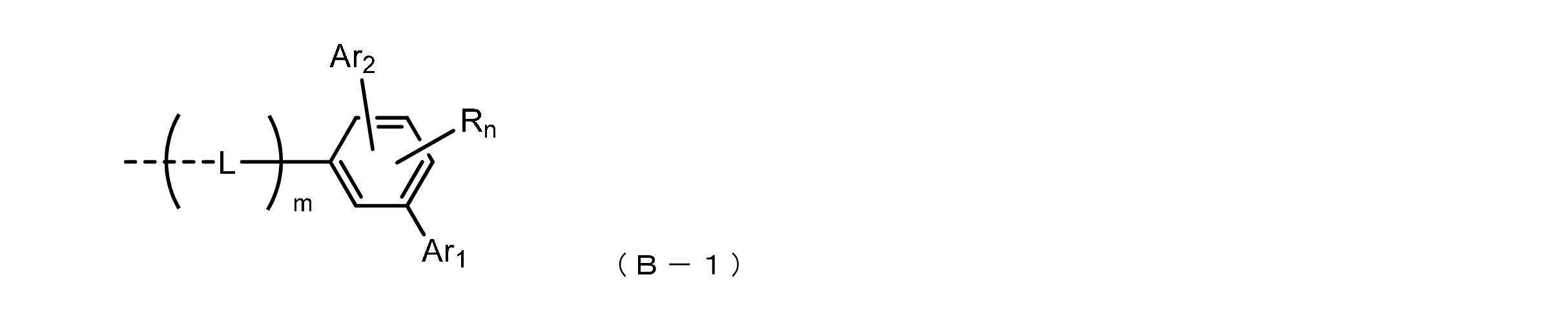
(式中、破線部は結合部位である。
Rは水素原子、重水素原子、フッ素原子、塩素原子、シアノ基、ニトロ基、置換基を有していてもよい炭素原子数1ないし6の直鎖状もしくは分岐状のアルキル基、置換基を有していてもよい炭素原子数5ないし10のシクロアルキル基、置換基を有していてもよい炭素原子数2ないし6の直鎖状もしくは分岐状のアルケニル基、置換基を有していてもよい炭素原子数1ないし6の直鎖状もしくは分岐状のアルキルオキシ基、置換基を有していてもよい炭素原子数5ないし10のシクロアルキルオキシ基、置換もしくは無置換の芳香族炭化水素基、置換もしくは無置換の芳香族複素環基、置換もしくは無置換の縮合多環芳香族基または置換もしくは無置換のアリールオキシ基を表し、nはRの個数であり、0~3の整数を表す。nが2~3である場合、同一のベンゼン環に複数個結合するRは相互に同一でも異なってもよく、単結合、置換もしくは無置換のメチレン基、酸素原子、または硫黄原子を介して互いに結合して環を形成してもよい。
Lは置換もしくは無置換の芳香族炭化水素基、置換もしくは無置換の芳香族複素環基または置換もしくは無置換の縮合多環芳香族基を表し、mは1~3の整数を表す。mが2または3である場合、Lは相互に同一でも異なってもよい。
Ar1、Ar2は相互に同一でも異なってもよく、置換もしくは無置換の芳香族炭化水素基、置換もしくは無置換の芳香族複素環基または置換もしくは無置換の縮合多環芳香族基を表す。) - 請求項1記載の前記構造式(B-1)で表される基が、下記構造式(B-2)で表される基である、トリアリールアミン構造を有する化合物。

(式中、Ar1、Ar2、L、m、n及びRは、前記構造式(B-1)と同一定義である。) - 請求項2記載の前記構造式(B-2)で表される基におけるLが、無置換の芳香族炭化水素基、無置換の芳香族複素環基または無置換の縮合多環芳香族基である、トリアリールアミン構造を有する化合物。
- 請求項3記載の前記構造式(B-2)で表される基が下記構造式(B-3)で表される基である、トリアリールアミン構造を有する化合物。

(式中、Ar1、Ar2、n及びRは、前記構造式(B-1)と同一定義である。) - 請求項3記載の前記構造式(B-2)で表される基が下記構造式(B-4)で表される基である、トリアリールアミン構造を有する化合物。

(式中、Ar1、Ar2、n及びRは、前記構造式(B-1)と同一定義である。) - 請求項5記載の前記構造式(B-4)で表される基が下記構造式(B-5)で表される基である、トリアリールアミン構造を有する化合物。
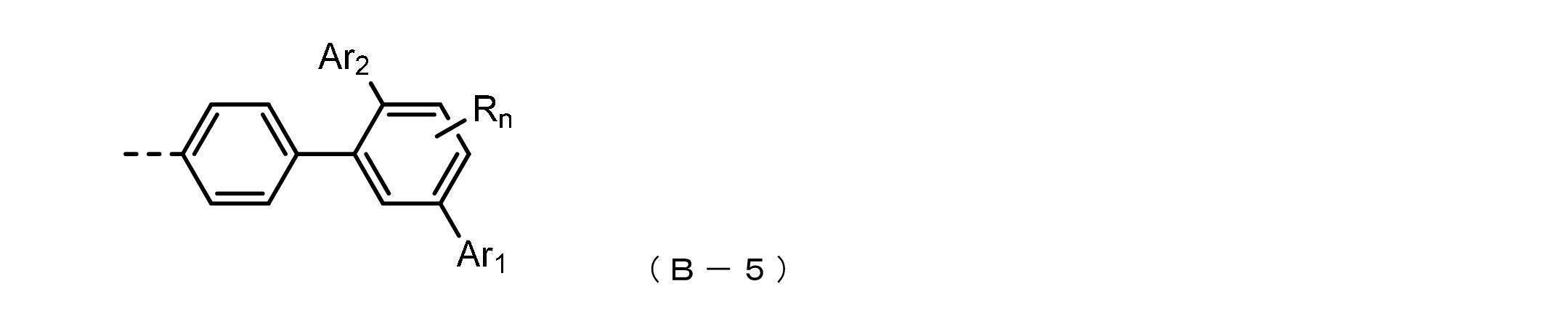
(式中、Ar1、Ar2、n及びRは、前記構造式(B-1)と同一定義である。) - 請求項6記載の前記構造式(B-5)におけるnが0または1である、トリアリールアミン構造を有する化合物。
- 請求項6記載の前記構造式(B-5)におけるnが0である、トリアリールアミン構造を有する化合物。
- 請求項4記載の前記構造式(B-3)で表される基が下記構造式(B-6)で表される基である、トリアリールアミン構造を有する化合物。
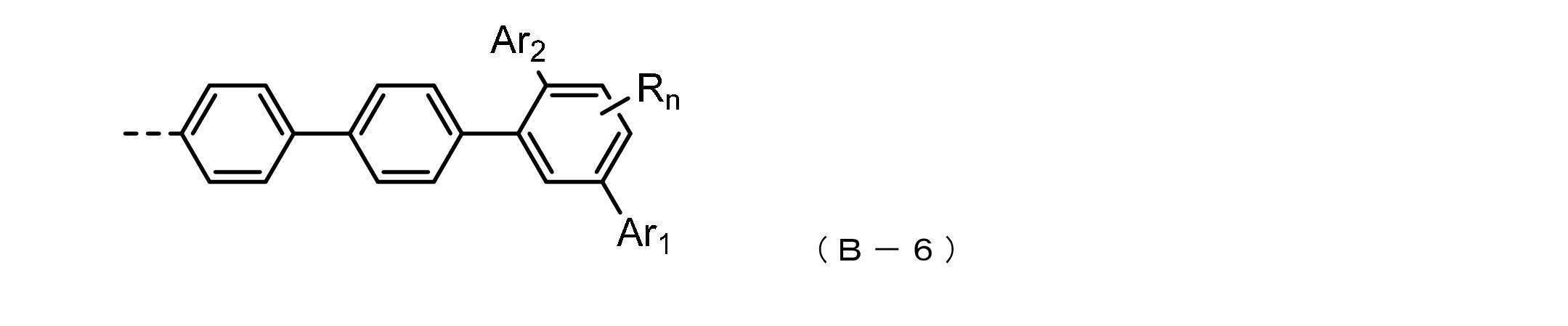
(式中、Ar1、Ar2、n及びRは、前記(B-1)と同一定義である。) - 請求項9記載の前記構造式(B-6)におけるnが0または1である、トリアリールアミン構造を有する化合物。
- 請求項9記載の前記構造式(B-6)におけるnが0である、トリアリールアミン構造を有する化合物。
- 一対の電極とその間に挟まれた少なくとも一層の有機層を有する有機EL素子であって、請求項1から11のいずれか1項記載のトリアリールアミン構造を有する化合物が、少なくとも1つの有機層の構成材料として用いられていることを特徴とする有機EL素子。
- 前記有機層が正孔輸送層である請求項12記載の有機EL素子。
- 前記有機層が電子阻止層である請求項12記載の有機EL素子。
- 前記有機層が正孔注入層である請求項12記載の有機EL素子。
- 前記有機層が発光層である請求項12記載の有機EL素子。
Priority Applications (5)
| Application Number | Priority Date | Filing Date | Title |
|---|---|---|---|
| JP2020527465A JP7406486B2 (ja) | 2018-06-25 | 2019-06-20 | トリアリールアミン構造を有する化合物および有機エレクトロルミネッセンス素子 |
| CN201980033912.XA CN112154136B (zh) | 2018-06-25 | 2019-06-20 | 具有三芳基胺结构的化合物及有机电致发光元件 |
| EP19824793.4A EP3812367B1 (en) | 2018-06-25 | 2019-06-20 | Compound having triarylamine structure and electroluminescence device |
| KR1020207031632A KR102813012B1 (ko) | 2018-06-25 | 2019-06-20 | 트리아릴아민 구조를 갖는 화합물 및 유기 일렉트로 루미네선스 소자 |
| US17/057,040 US11925108B2 (en) | 2018-06-25 | 2019-06-20 | Compound having triarylamine structure and organic electroluminescence device |
Applications Claiming Priority (2)
| Application Number | Priority Date | Filing Date | Title |
|---|---|---|---|
| JP2018-120071 | 2018-06-25 | ||
| JP2018120071 | 2018-06-25 |
Publications (1)
| Publication Number | Publication Date |
|---|---|
| WO2020004235A1 true WO2020004235A1 (ja) | 2020-01-02 |
Family
ID=68984979
Family Applications (1)
| Application Number | Title | Priority Date | Filing Date |
|---|---|---|---|
| PCT/JP2019/024590 Ceased WO2020004235A1 (ja) | 2018-06-25 | 2019-06-20 | トリアリールアミン構造を有する化合物および有機エレクトロルミネッセンス素子 |
Country Status (7)
| Country | Link |
|---|---|
| US (1) | US11925108B2 (ja) |
| EP (1) | EP3812367B1 (ja) |
| JP (1) | JP7406486B2 (ja) |
| KR (1) | KR102813012B1 (ja) |
| CN (1) | CN112154136B (ja) |
| TW (1) | TWI841572B (ja) |
| WO (1) | WO2020004235A1 (ja) |
Cited By (9)
| Publication number | Priority date | Publication date | Assignee | Title |
|---|---|---|---|---|
| JPWO2021177022A1 (ja) * | 2020-03-03 | 2021-09-10 | ||
| CN113493389A (zh) * | 2020-04-03 | 2021-10-12 | 株式会社半导体能源研究所 | 芳基胺化合物、空穴传输层和空穴注入层用材料、发光器件和装置、电子设备及照明装置 |
| JPWO2021256515A1 (ja) * | 2020-06-19 | 2021-12-23 | ||
| JPWO2022030438A1 (ja) * | 2020-08-05 | 2022-02-10 | ||
| CN114206826A (zh) * | 2020-03-31 | 2022-03-18 | 出光兴产株式会社 | 化合物、有机电致发光元件用材料、有机电致发光元件和电子设备 |
| WO2022260118A1 (ja) * | 2021-06-10 | 2022-12-15 | 出光興産株式会社 | 有機エレクトロルミネッセンス素子、有機エレクトロルミネッセンス表示装置及び電子機器 |
| WO2022260117A1 (ja) * | 2021-06-10 | 2022-12-15 | 出光興産株式会社 | 有機エレクトロルミネッセンス素子、有機エレクトロルミネッセンス表示装置及び電子機器 |
| KR20240019764A (ko) | 2021-06-09 | 2024-02-14 | 이데미쓰 고산 가부시키가이샤 | 화합물, 유기 전기발광 소자용 재료, 유기 전기발광 소자 및 전자 기기 |
| KR20240128838A (ko) | 2021-12-24 | 2024-08-27 | 이데미쓰 고산 가부시키가이샤 | 화합물, 유기 전기발광 소자용 재료, 유기 전기발광 소자 및 전자 기기 |
Families Citing this family (1)
| Publication number | Priority date | Publication date | Assignee | Title |
|---|---|---|---|---|
| EP3605638B1 (en) * | 2017-03-28 | 2023-11-08 | Hodogaya Chemical Co., Ltd. | Organic electroluminescent device |
Citations (29)
| Publication number | Priority date | Publication date | Assignee | Title |
|---|---|---|---|---|
| US5639914A (en) | 1993-11-01 | 1997-06-17 | Hodogaya Chemical Co., Ltd. | Tetraaryl benzidines |
| US5792557A (en) | 1994-02-08 | 1998-08-11 | Tdk Corporation | Organic EL element |
| JP2005015418A (ja) * | 2003-06-27 | 2005-01-20 | Canon Inc | アントリル誘導基置換化合物およびそれを使用した有機発光素子 |
| EP1885008A1 (en) | 2005-05-17 | 2008-02-06 | Mitsubishi Chemical Corporation | Monoamine compound, charge-transporting material, and organic electroluminescent device |
| JP2010186983A (ja) * | 2009-01-19 | 2010-08-26 | Sony Corp | 有機電界発光素子および表示装置 |
| US7799492B2 (en) | 2004-05-25 | 2010-09-21 | Hodogaya Chemical Co., Ltd. | P-terphenyl compound and photosensitive body for electrophotography using such compound |
| US8021764B2 (en) | 2004-11-29 | 2011-09-20 | Samsung Mobile Display Co., Ltd. | Phenylcarbazole-based compound and organic electroluminescent device employing the same |
| EP2684932A1 (en) | 2012-07-09 | 2014-01-15 | Novaled AG | Diarylamino matrix material doped with a mesomeric radialene compound |
| CN104844475A (zh) | 2015-04-15 | 2015-08-19 | 浙江大学 | 荧光探针分子及其制备方法和应用 |
| KR20150102735A (ko) * | 2014-02-28 | 2015-09-07 | 머티어리얼사이언스 주식회사 | 유기전계발광소자 |
| WO2016009823A1 (ja) | 2014-07-16 | 2016-01-21 | 東レ株式会社 | モノアミン誘導体、それを用いた発光素子材料および発光素子 |
| JP2016076566A (ja) * | 2014-10-06 | 2016-05-12 | 三星ディスプレイ株式會社Samsung Display Co.,Ltd. | 有機エレクトロルミネッセンス素子用材料及びそれを用いた有機エレクトロルミネッセンス素子 |
| JP2016086142A (ja) * | 2014-10-29 | 2016-05-19 | 三星ディスプレイ株式會社Samsung Display Co.,Ltd. | 有機エレクトロルミネッセンス素子用材料及びそれを用いた有機エレクトロルミネッセンス素子 |
| US20160141509A1 (en) | 2014-11-18 | 2016-05-19 | Samsung Display Co., Ltd. | Material for organic electroluminescent device and organic electroluminescent device using the same |
| US20160365517A1 (en) * | 2014-02-27 | 2016-12-15 | Duk San Neolux Co., Ltd. | Compound for organic electronic element, organic electronic element using the same, and an electronic device thereof |
| US20170012212A1 (en) * | 2014-01-22 | 2017-01-12 | Duk San Neolux Co., Ltd. | Compound for organic electronic element, organic electronic element using the same, and an electronic device thereof |
| US20170062728A1 (en) * | 2014-02-19 | 2017-03-02 | Duk San Neolux Co., Ltd. | Compound for organic electronic element, organic electronic element using the same, and an electronic device thereof |
| WO2017135717A1 (ko) * | 2016-02-05 | 2017-08-10 | 덕산네오룩스 주식회사 | 유기전기 소자용 화합물, 이를 이용한 유기전기소자 및 그 전자 장치 |
| WO2017146406A1 (ko) * | 2016-02-24 | 2017-08-31 | 덕산네오룩스 주식회사 | 유기전기 소자용 화합물, 이를 이용한 유기전기소자 및 그 전자 장치 |
| KR20170100709A (ko) | 2016-02-25 | 2017-09-05 | 삼성디스플레이 주식회사 | 아민 화합물 및 이를 포함하는 유기 전계 발광 소자 |
| KR20170126400A (ko) * | 2016-05-09 | 2017-11-17 | 덕산네오룩스 주식회사 | 유기전기 소자용 화합물, 이를 이용한 유기전기소자 및 그 전자 장치 |
| JP2017218446A (ja) * | 2016-06-02 | 2017-12-14 | 東ソー株式会社 | ジ置換ベンゼンを有するカルバゾール化合物及びその用途 |
| CN108101898A (zh) * | 2017-12-26 | 2018-06-01 | 南京高光半导体材料有限公司 | 一种新型有机电致发光化合物和包含其的有机电致发光器件 |
| KR20180116740A (ko) * | 2017-04-17 | 2018-10-25 | 주식회사 동진쎄미켐 | 신규 화합물 및 이를 포함하는 유기 발광 소자 |
| KR20180131091A (ko) * | 2017-05-31 | 2018-12-10 | 주식회사 동진쎄미켐 | 신규 화합물 및 이를 포함하는 유기 발광 소자 |
| KR20190003329A (ko) * | 2017-06-30 | 2019-01-09 | 주식회사 동진쎄미켐 | 신규 화합물 및 이를 포함하는 유기 발광 소자 |
| CN109485577A (zh) * | 2017-09-13 | 2019-03-19 | 东进世美肯株式会社 | 新颖化合物及包含其的有机发光器件 |
| WO2019135665A1 (ko) * | 2018-01-08 | 2019-07-11 | 주식회사 엘지화학 | 유기 발광 소자 |
| WO2019146946A1 (ko) * | 2018-01-29 | 2019-08-01 | 주식회사 엘지화학 | 유기발광소자 |
Family Cites Families (9)
| Publication number | Priority date | Publication date | Assignee | Title |
|---|---|---|---|---|
| KR102153871B1 (ko) * | 2012-10-09 | 2020-09-09 | 메르크 파텐트 게엠베하 | 전자 디바이스 |
| KR102283457B1 (ko) * | 2014-06-03 | 2021-07-30 | 삼성디스플레이 주식회사 | 유기 발광 소자 |
| US20170317290A1 (en) * | 2014-10-24 | 2017-11-02 | Duk San Neolux Co., Ltd. | Organic electronic device and display apparatus using composition for organic electronic device |
| KR101796288B1 (ko) * | 2014-12-02 | 2017-11-13 | 삼성디스플레이 주식회사 | 유기 전계 발광 소자 |
| KR102367991B1 (ko) * | 2014-12-24 | 2022-02-28 | 삼성디스플레이 주식회사 | 아민계 화합물 및 이를 포함한 유기 발광 소자 |
| CN106831313A (zh) | 2017-01-25 | 2017-06-13 | 上海道亦化工科技有限公司 | 一种具有三芳基萘的化合物及其有机电致发光器件 |
| CN109206327B (zh) * | 2017-06-30 | 2024-03-08 | 东进世美肯株式会社 | 新颖化合物及包含其的有机发光器件 |
| US20200335703A1 (en) * | 2017-11-16 | 2020-10-22 | Hodogaya Chemical Co., Ltd. | Organic electroluminescence device |
| CN109928885B (zh) * | 2017-12-19 | 2022-11-29 | 北京夏禾科技有限公司 | 四邻亚苯三芳胺化合物 |
-
2019
- 2019-06-20 WO PCT/JP2019/024590 patent/WO2020004235A1/ja not_active Ceased
- 2019-06-20 US US17/057,040 patent/US11925108B2/en active Active
- 2019-06-20 JP JP2020527465A patent/JP7406486B2/ja active Active
- 2019-06-20 CN CN201980033912.XA patent/CN112154136B/zh active Active
- 2019-06-20 EP EP19824793.4A patent/EP3812367B1/en active Active
- 2019-06-20 KR KR1020207031632A patent/KR102813012B1/ko active Active
- 2019-06-24 TW TW108121995A patent/TWI841572B/zh active
Patent Citations (29)
| Publication number | Priority date | Publication date | Assignee | Title |
|---|---|---|---|---|
| US5639914A (en) | 1993-11-01 | 1997-06-17 | Hodogaya Chemical Co., Ltd. | Tetraaryl benzidines |
| US5792557A (en) | 1994-02-08 | 1998-08-11 | Tdk Corporation | Organic EL element |
| JP2005015418A (ja) * | 2003-06-27 | 2005-01-20 | Canon Inc | アントリル誘導基置換化合物およびそれを使用した有機発光素子 |
| US7799492B2 (en) | 2004-05-25 | 2010-09-21 | Hodogaya Chemical Co., Ltd. | P-terphenyl compound and photosensitive body for electrophotography using such compound |
| US8021764B2 (en) | 2004-11-29 | 2011-09-20 | Samsung Mobile Display Co., Ltd. | Phenylcarbazole-based compound and organic electroluminescent device employing the same |
| EP1885008A1 (en) | 2005-05-17 | 2008-02-06 | Mitsubishi Chemical Corporation | Monoamine compound, charge-transporting material, and organic electroluminescent device |
| JP2010186983A (ja) * | 2009-01-19 | 2010-08-26 | Sony Corp | 有機電界発光素子および表示装置 |
| EP2684932A1 (en) | 2012-07-09 | 2014-01-15 | Novaled AG | Diarylamino matrix material doped with a mesomeric radialene compound |
| US20170012212A1 (en) * | 2014-01-22 | 2017-01-12 | Duk San Neolux Co., Ltd. | Compound for organic electronic element, organic electronic element using the same, and an electronic device thereof |
| US20170062728A1 (en) * | 2014-02-19 | 2017-03-02 | Duk San Neolux Co., Ltd. | Compound for organic electronic element, organic electronic element using the same, and an electronic device thereof |
| US20160365517A1 (en) * | 2014-02-27 | 2016-12-15 | Duk San Neolux Co., Ltd. | Compound for organic electronic element, organic electronic element using the same, and an electronic device thereof |
| KR20150102735A (ko) * | 2014-02-28 | 2015-09-07 | 머티어리얼사이언스 주식회사 | 유기전계발광소자 |
| WO2016009823A1 (ja) | 2014-07-16 | 2016-01-21 | 東レ株式会社 | モノアミン誘導体、それを用いた発光素子材料および発光素子 |
| JP2016076566A (ja) * | 2014-10-06 | 2016-05-12 | 三星ディスプレイ株式會社Samsung Display Co.,Ltd. | 有機エレクトロルミネッセンス素子用材料及びそれを用いた有機エレクトロルミネッセンス素子 |
| JP2016086142A (ja) * | 2014-10-29 | 2016-05-19 | 三星ディスプレイ株式會社Samsung Display Co.,Ltd. | 有機エレクトロルミネッセンス素子用材料及びそれを用いた有機エレクトロルミネッセンス素子 |
| US20160141509A1 (en) | 2014-11-18 | 2016-05-19 | Samsung Display Co., Ltd. | Material for organic electroluminescent device and organic electroluminescent device using the same |
| CN104844475A (zh) | 2015-04-15 | 2015-08-19 | 浙江大学 | 荧光探针分子及其制备方法和应用 |
| WO2017135717A1 (ko) * | 2016-02-05 | 2017-08-10 | 덕산네오룩스 주식회사 | 유기전기 소자용 화합물, 이를 이용한 유기전기소자 및 그 전자 장치 |
| WO2017146406A1 (ko) * | 2016-02-24 | 2017-08-31 | 덕산네오룩스 주식회사 | 유기전기 소자용 화합물, 이를 이용한 유기전기소자 및 그 전자 장치 |
| KR20170100709A (ko) | 2016-02-25 | 2017-09-05 | 삼성디스플레이 주식회사 | 아민 화합물 및 이를 포함하는 유기 전계 발광 소자 |
| KR20170126400A (ko) * | 2016-05-09 | 2017-11-17 | 덕산네오룩스 주식회사 | 유기전기 소자용 화합물, 이를 이용한 유기전기소자 및 그 전자 장치 |
| JP2017218446A (ja) * | 2016-06-02 | 2017-12-14 | 東ソー株式会社 | ジ置換ベンゼンを有するカルバゾール化合物及びその用途 |
| KR20180116740A (ko) * | 2017-04-17 | 2018-10-25 | 주식회사 동진쎄미켐 | 신규 화합물 및 이를 포함하는 유기 발광 소자 |
| KR20180131091A (ko) * | 2017-05-31 | 2018-12-10 | 주식회사 동진쎄미켐 | 신규 화합물 및 이를 포함하는 유기 발광 소자 |
| KR20190003329A (ko) * | 2017-06-30 | 2019-01-09 | 주식회사 동진쎄미켐 | 신규 화합물 및 이를 포함하는 유기 발광 소자 |
| CN109485577A (zh) * | 2017-09-13 | 2019-03-19 | 东进世美肯株式会社 | 新颖化合物及包含其的有机发光器件 |
| CN108101898A (zh) * | 2017-12-26 | 2018-06-01 | 南京高光半导体材料有限公司 | 一种新型有机电致发光化合物和包含其的有机电致发光器件 |
| WO2019135665A1 (ko) * | 2018-01-08 | 2019-07-11 | 주식회사 엘지화학 | 유기 발광 소자 |
| WO2019146946A1 (ko) * | 2018-01-29 | 2019-08-01 | 주식회사 엘지화학 | 유기발광소자 |
Non-Patent Citations (3)
| Title |
|---|
| APPL. PHYS. LET., vol. 98, 2011, pages 083302 |
| PROCEEDINGS OF THE 9TH MEETING OF THE JAPAN SOCIETY OF APPLIED PHYSICS, 2001, pages 23 - 31 |
| See also references of EP3812367A4 |
Cited By (28)
| Publication number | Priority date | Publication date | Assignee | Title |
|---|---|---|---|---|
| JPWO2021177022A1 (ja) * | 2020-03-03 | 2021-09-10 | ||
| WO2021177022A1 (ja) * | 2020-03-03 | 2021-09-10 | 保土谷化学工業株式会社 | 有機エレクトロルミネッセンス素子 |
| TWI883125B (zh) * | 2020-03-03 | 2025-05-11 | 日商保土谷化學工業股份有限公司 | 有機電致發光元件 |
| EP4116393A4 (en) * | 2020-03-03 | 2024-03-20 | Hodogaya Chemical Co., Ltd. | Organic electroluminescent element |
| JP7784992B2 (ja) | 2020-03-03 | 2025-12-12 | 保土谷化学工業株式会社 | 有機エレクトロルミネッセンス素子 |
| KR102921680B1 (ko) * | 2020-03-03 | 2026-02-02 | 호도가야 가가쿠 고교 가부시키가이샤 | 유기 일렉트로 루미네선스 소자 |
| KR20220148837A (ko) * | 2020-03-03 | 2022-11-07 | 호도가야 가가쿠 고교 가부시키가이샤 | 유기 일렉트로 루미네선스 소자 |
| KR20220162113A (ko) | 2020-03-31 | 2022-12-07 | 이데미쓰 고산 가부시키가이샤 | 화합물, 유기 전기발광 소자용 재료, 유기 전기발광 소자 및 전자 기기 |
| CN114206826A (zh) * | 2020-03-31 | 2022-03-18 | 出光兴产株式会社 | 化合物、有机电致发光元件用材料、有机电致发光元件和电子设备 |
| CN114206826B (zh) * | 2020-03-31 | 2025-06-27 | 出光兴产株式会社 | 化合物、有机电致发光元件用材料、有机电致发光元件和电子设备 |
| US11678569B2 (en) | 2020-03-31 | 2023-06-13 | Idemitsu Kosan Co., Ltd. | Compound, material for organic electroluminescent elements, organic electroluminescent element, and electronic device |
| KR20250114442A (ko) | 2020-03-31 | 2025-07-29 | 이데미쓰 고산 가부시키가이샤 | 화합물, 유기 전기발광 소자용 재료, 유기 전기발광 소자 및 전자 기기 |
| JP2022008036A (ja) * | 2020-04-03 | 2022-01-13 | 株式会社半導体エネルギー研究所 | アリールアミン化合物、正孔輸送層用材料、正孔注入層用材料、発光デバイス、発光装置、電子機器および照明装置 |
| CN113493389B (zh) * | 2020-04-03 | 2025-10-10 | 株式会社半导体能源研究所 | 芳基胺化合物、空穴传输层和空穴注入层用材料、发光器件和装置、电子设备及照明装置 |
| US12139446B2 (en) | 2020-04-03 | 2024-11-12 | Semiconductor Energy Laboratory Co., Ltd. | Arylamine compound, hole-transport layer material, hole-injection layer material, light-emitting device, light-emitting apparatus, electronic apparatus, and lighting device |
| CN113493389A (zh) * | 2020-04-03 | 2021-10-12 | 株式会社半导体能源研究所 | 芳基胺化合物、空穴传输层和空穴注入层用材料、发光器件和装置、电子设备及照明装置 |
| JP7850660B2 (ja) | 2020-06-19 | 2026-04-23 | 保土谷化学工業株式会社 | 有機エレクトロルミネッセンス素子 |
| KR102930290B1 (ko) * | 2020-06-19 | 2026-02-24 | 호도가야 가가쿠 고교 가부시키가이샤 | 유기 일렉트로루미네센스 소자 |
| WO2021256515A1 (ja) * | 2020-06-19 | 2021-12-23 | 保土谷化学工業株式会社 | 有機エレクトロルミネッセンス素子 |
| JPWO2021256515A1 (ja) * | 2020-06-19 | 2021-12-23 | ||
| WO2022030438A1 (ja) * | 2020-08-05 | 2022-02-10 | 保土谷化学工業株式会社 | 有機エレクトロルミネッセンス素子 |
| EP4195304A4 (en) * | 2020-08-05 | 2024-08-14 | Hodogaya Chemical Co., Ltd. | Organic electroluminescence element |
| JP7827627B2 (ja) | 2020-08-05 | 2026-03-10 | 保土谷化学工業株式会社 | 有機エレクトロルミネッセンス素子 |
| JPWO2022030438A1 (ja) * | 2020-08-05 | 2022-02-10 | ||
| KR20240019764A (ko) | 2021-06-09 | 2024-02-14 | 이데미쓰 고산 가부시키가이샤 | 화합물, 유기 전기발광 소자용 재료, 유기 전기발광 소자 및 전자 기기 |
| WO2022260117A1 (ja) * | 2021-06-10 | 2022-12-15 | 出光興産株式会社 | 有機エレクトロルミネッセンス素子、有機エレクトロルミネッセンス表示装置及び電子機器 |
| WO2022260118A1 (ja) * | 2021-06-10 | 2022-12-15 | 出光興産株式会社 | 有機エレクトロルミネッセンス素子、有機エレクトロルミネッセンス表示装置及び電子機器 |
| KR20240128838A (ko) | 2021-12-24 | 2024-08-27 | 이데미쓰 고산 가부시키가이샤 | 화합물, 유기 전기발광 소자용 재료, 유기 전기발광 소자 및 전자 기기 |
Also Published As
| Publication number | Publication date |
|---|---|
| KR102813012B1 (ko) | 2025-05-26 |
| US20210210693A1 (en) | 2021-07-08 |
| CN112154136A (zh) | 2020-12-29 |
| KR20210024995A (ko) | 2021-03-08 |
| JP7406486B2 (ja) | 2023-12-27 |
| TWI841572B (zh) | 2024-05-11 |
| EP3812367A4 (en) | 2022-03-23 |
| TW202012359A (zh) | 2020-04-01 |
| US11925108B2 (en) | 2024-03-05 |
| EP3812367B1 (en) | 2024-10-23 |
| JPWO2020004235A1 (ja) | 2021-08-02 |
| EP3812367A1 (en) | 2021-04-28 |
| CN112154136B (zh) | 2024-04-26 |
Similar Documents
| Publication | Publication Date | Title |
|---|---|---|
| JP7406486B2 (ja) | トリアリールアミン構造を有する化合物および有機エレクトロルミネッセンス素子 | |
| JP6815326B2 (ja) | 有機エレクトロルミネッセンス素子 | |
| JP7216701B2 (ja) | 有機エレクトロルミネッセンス素子 | |
| WO2014129201A1 (ja) | 有機エレクトロルミネッセンス素子 | |
| TWI762696B (zh) | 含有具有苯并咪唑環結構的化合物之有機電致發光元件 | |
| WO2017122813A1 (ja) | 有機エレクトロルミネッセンス素子 | |
| JP7149263B2 (ja) | 有機エレクトロルミネッセンス素子 | |
| CN113396200A (zh) | 有机电致发光元件 | |
| WO2021172452A1 (ja) | アリールアミン化合物およびそれを用いる電子機器 | |
| JP7394050B2 (ja) | ベンゾイミダゾール環構造を有する化合物および有機エレクトロルミネッセンス素子 | |
| JPWO2020111081A1 (ja) | アザベンゾオキサゾール環構造を有する化合物および有機エレクトロルミネッセンス素子 | |
| WO2022080490A1 (ja) | アリールアミン化合物、有機エレクトロルミネッセンス素子、および電子機器 | |
| JP7039412B2 (ja) | アザインデノ[1,2、c]フェナンスレン環構造を有する化合物およびその化合物を用いた有機エレクトロルミネッセンス素子 | |
| JP7771065B2 (ja) | 有機エレクトロルミネッセンス素子 | |
| JP7827627B2 (ja) | 有機エレクトロルミネッセンス素子 | |
| JP7573524B2 (ja) | ベンゾトリアゾール環構造を有する化合物および有機エレクトロルミネッセンス素子 | |
| JP7811295B2 (ja) | アリールアミン化合物および有機エレクトロルミネッセンス素子 | |
| EP4243105A1 (en) | Organic electroluminescent element | |
| WO2024204268A1 (ja) | アリールアミン化合物、有機エレクトロルミネッセンス素子、および電子機器 | |
| JP2026506672A (ja) | アリールアミン化合物、有機エレクトロルミネッセンス素子、および電子機器 | |
| JP2025178181A (ja) | アリールアミン化合物、有機エレクトロルミネッセンス素子、および電子機器 |
Legal Events
| Date | Code | Title | Description |
|---|---|---|---|
| 121 | Ep: the epo has been informed by wipo that ep was designated in this application |
Ref document number: 19824793 Country of ref document: EP Kind code of ref document: A1 |
|
| ENP | Entry into the national phase |
Ref document number: 20207031632 Country of ref document: KR Kind code of ref document: A |
|
| ENP | Entry into the national phase |
Ref document number: 2020527465 Country of ref document: JP Kind code of ref document: A |
|
| NENP | Non-entry into the national phase |
Ref country code: DE |
|
| ENP | Entry into the national phase |
Ref document number: 2019824793 Country of ref document: EP Effective date: 20210125 |